Do you need help in another language? We will get you a free interpreter. Call 808-369-3580 to tell us which language you speak.
您需要其它語言嗎?如有需要,請致電 (808-369-3478), 我們會提供免費翻譯服務
您需要其它语言吗?如有需要,请致电 (808-369-3478), 我们会提供免费翻译服务
En mi niit alilis lon pwal eu kapas? Sipwe angei emon chon chiaku ngonuk ese kamo. Kokori (808-369-3478) omw kopwe ureni kich meni kapas ka ani.
Makemake `oe i kokua i pili kekahi `olelo o na `aina `e? Makemake la maua i ki`i `oe mea unuhi manuahi. E kelepona (808-369-3478)`oe ia la kaua a e ha`ina `oe ia la maua mea `olelo o na `aina `e.
Masapulyo kadi ti tulong iti sabali a pagsasao? Ikkandakayo iti libre nga paraipatarus. Awaganyo ti
(808-369-3478) tapno ibagayo kadakami no ania ti pagsasao nga ar-aramatenyo.
다른언어로 도움이 필요하십니까? 저희가 무료로 통역을 제공합니다. (808-369-3478)로 전화해서 사용하는 언어를 알려주십시요
Kwoj aikuij ke jiban kin juon bar kajin? Kim naj lewaj juon am dri ukok eo ejjelok wonen. Kirtok
(808-369-3478) im kwalok non kim kajin ta eo kwo melele im kenono kake.
E te mana'o mia se fesosoani i se isi gagana? Matou te fesosoani e ave atu fua se faaliliu upu mo oe. Vili mai i le numera lea (808-369-3478) pea e mana'o mia se fesosoani mo se faaliliu upu.
¿Necesita ayuda en otro idioma? Nosotros le ayudaremos a conseguir un intérprete gratuito. Llame al (808-369-3478) y diganos que idioma habla.
Kailangan ba ninyo ng tulong sa ibang lengguwahe? Ikukuha namin kayo ng libreng tagasalin. Tumawag sa (808-369-3478) para sabihin kung anong lengguwahe ang nais ninyong gamitin.
‘Okú ke fie maʻu tokoni ʻi ha lea fakafonua ʻe taha? Temau kumi haʻo taha fakatonulea taʻetotongi. Telefoni ki he (808-369-3478) ke fakahā mai ʻa e lea fakafonua ʻokú ke lea aí.
Bạn có cần giúp đỡ bằng ngôn ngữ khác không ? Chúng tôi se yêu cầu một người thông dịch viên miễn phí cho bạn. Gọi (808-369-3478)nói cho chúng tôi biết bạn dùng ngôn ngữ nào
Gakinahanglan ka ba ug tabang sa imong pinulongan? Amo kang mahatagan ug libre nga maghuhubad. Tawag sa (808-369-3478) aron magpahibalo kung unsa ang imong sinulti-han.
The 199th Fighter Squadron, Hawaiʻi Air National Guard (HIANG), traces its lineage to the reestablishment of Hawaiʻi’s National Guard aviation forces following World War II. Federally recognized on Nov. 4, 1946, the squadron was one of the original units. Initially based at Bellows Field on Oʻahu, the squadron began operations with P-47 Thunderbolt fighter aircraft and later received B-26C Invader aircraft as it developed its combat aviation capabilities.
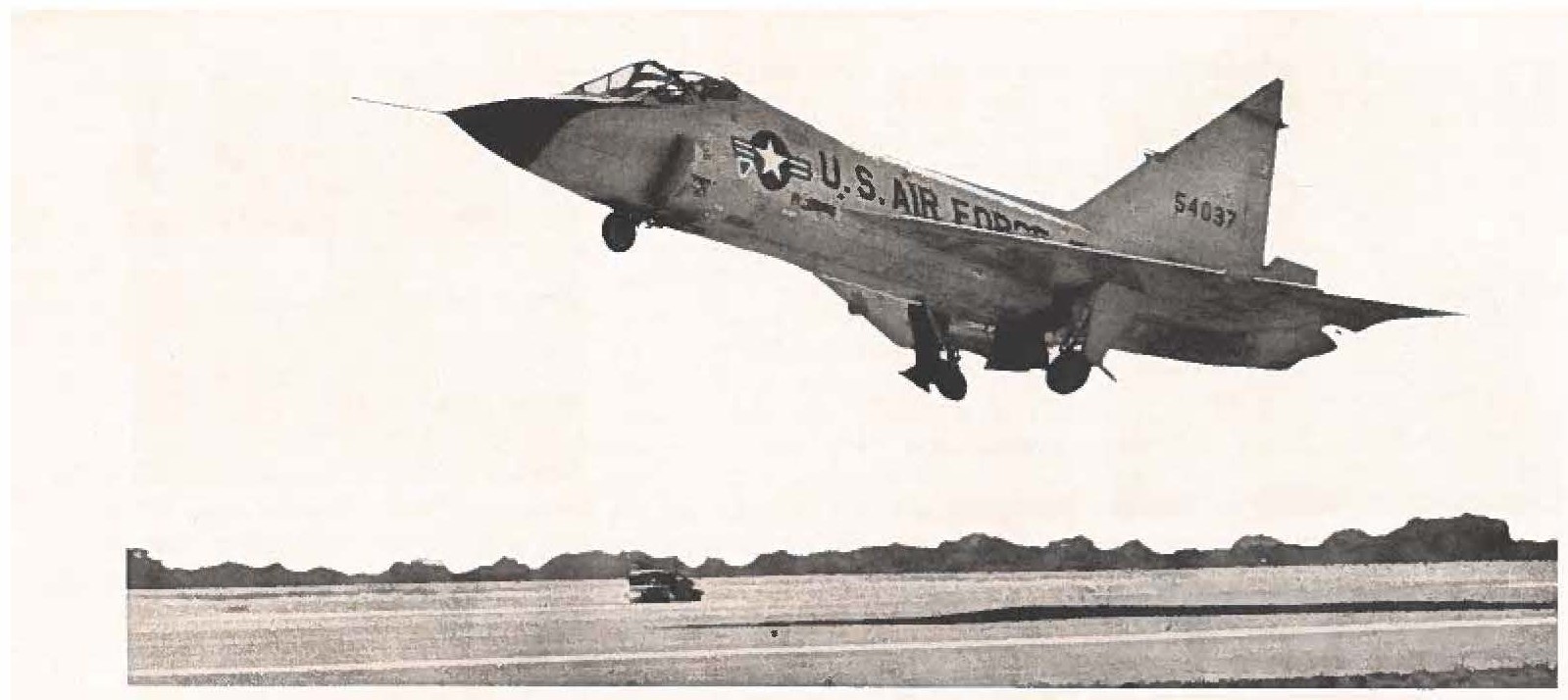
The squadron entered the jet age in 1954 with the arrival of F-86E Sabre aircraft, followed by F-86L interceptors in 1958. On Dec. 1, 1960, the 199th Fighter Interceptor Squadron became part of the newly established 154th Fighter Group (Air Defense) at Hickam Air Force Base. The reorganization strengthened Hawaiʻi’s air defense structure and placed the squadron at the center of the state’s mission to identify, intercept and deter airborne threats. In 1961, the squadron transitioned to the supersonic F-102 Delta Dagger, expanding its ability to respond to potential threats to the Hawaiian Islands.
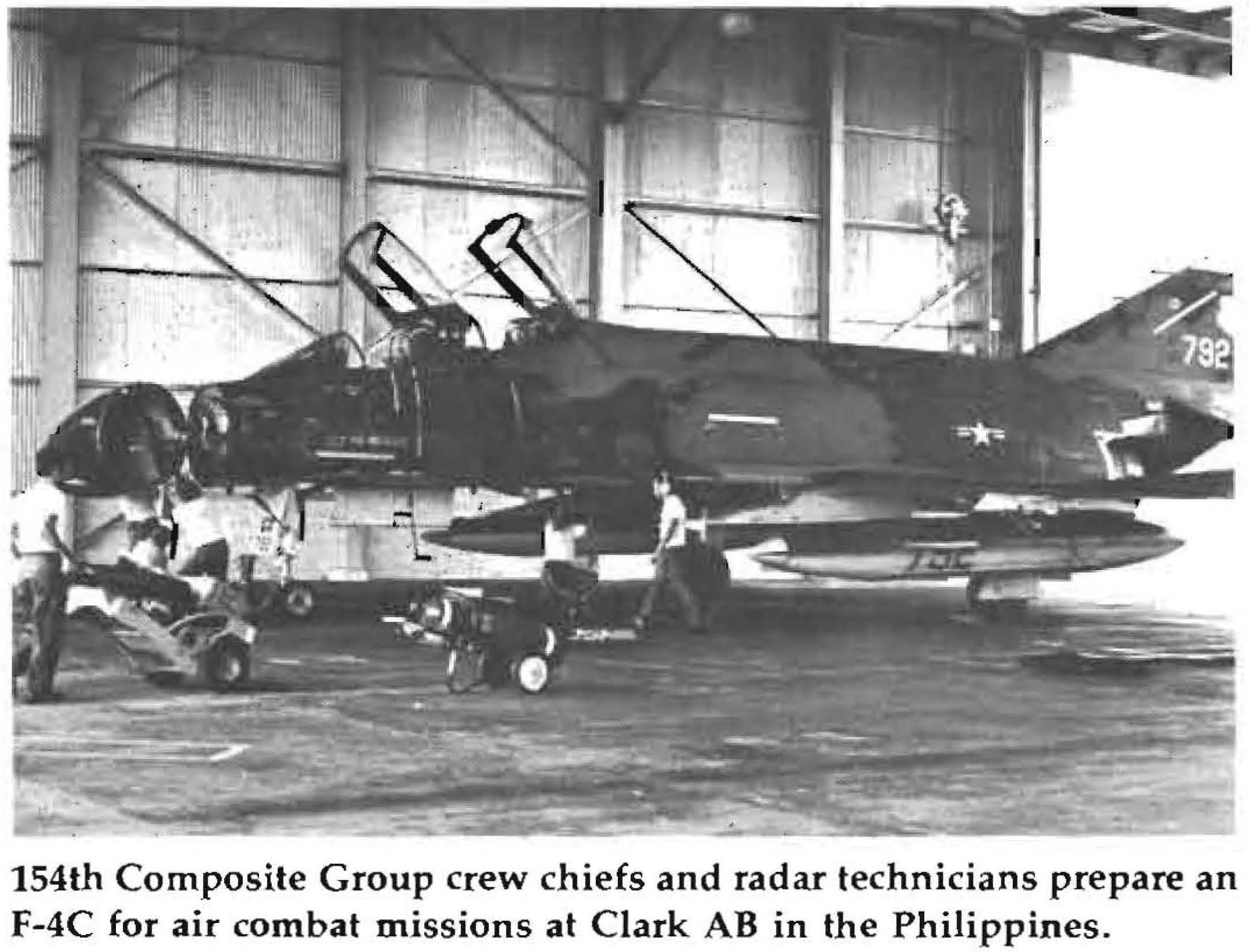
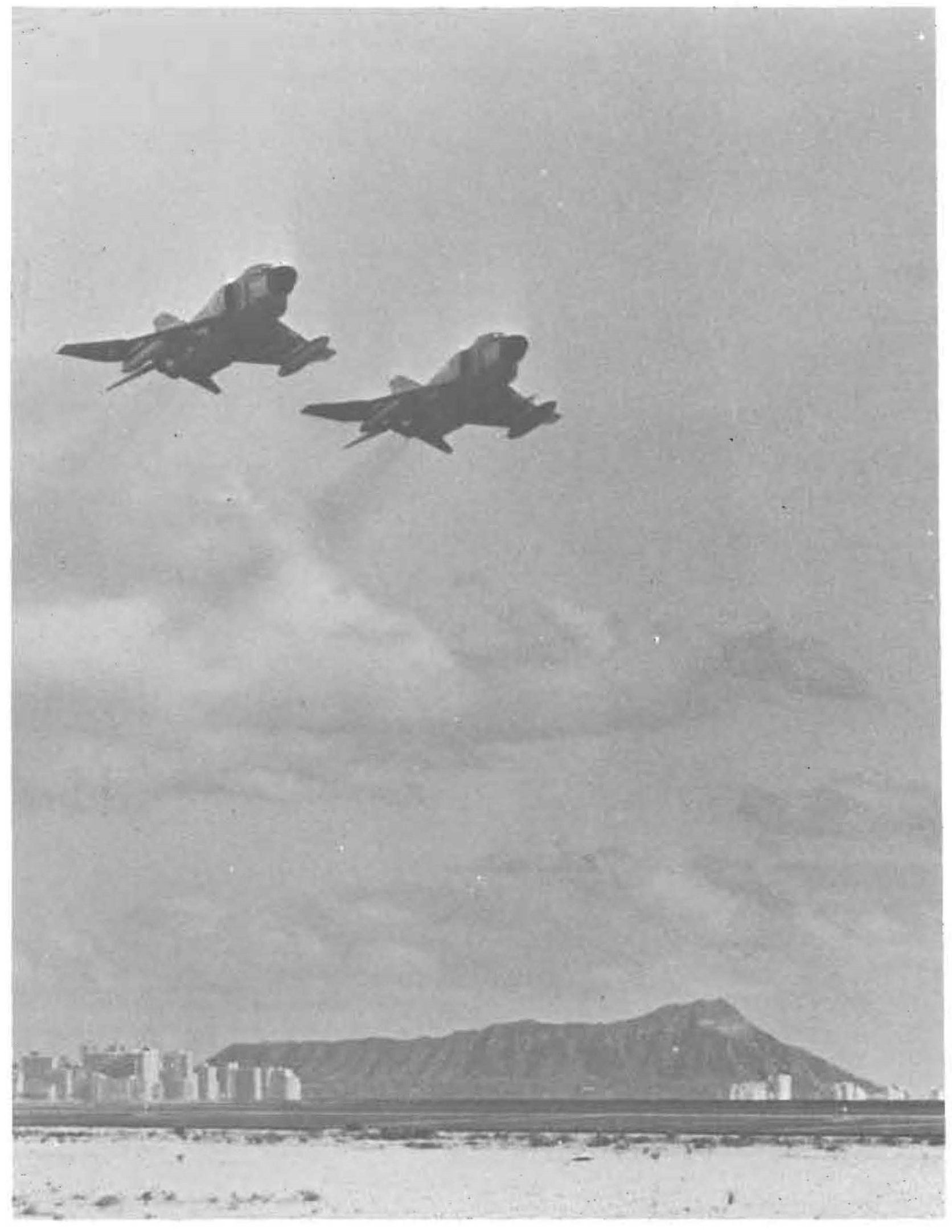
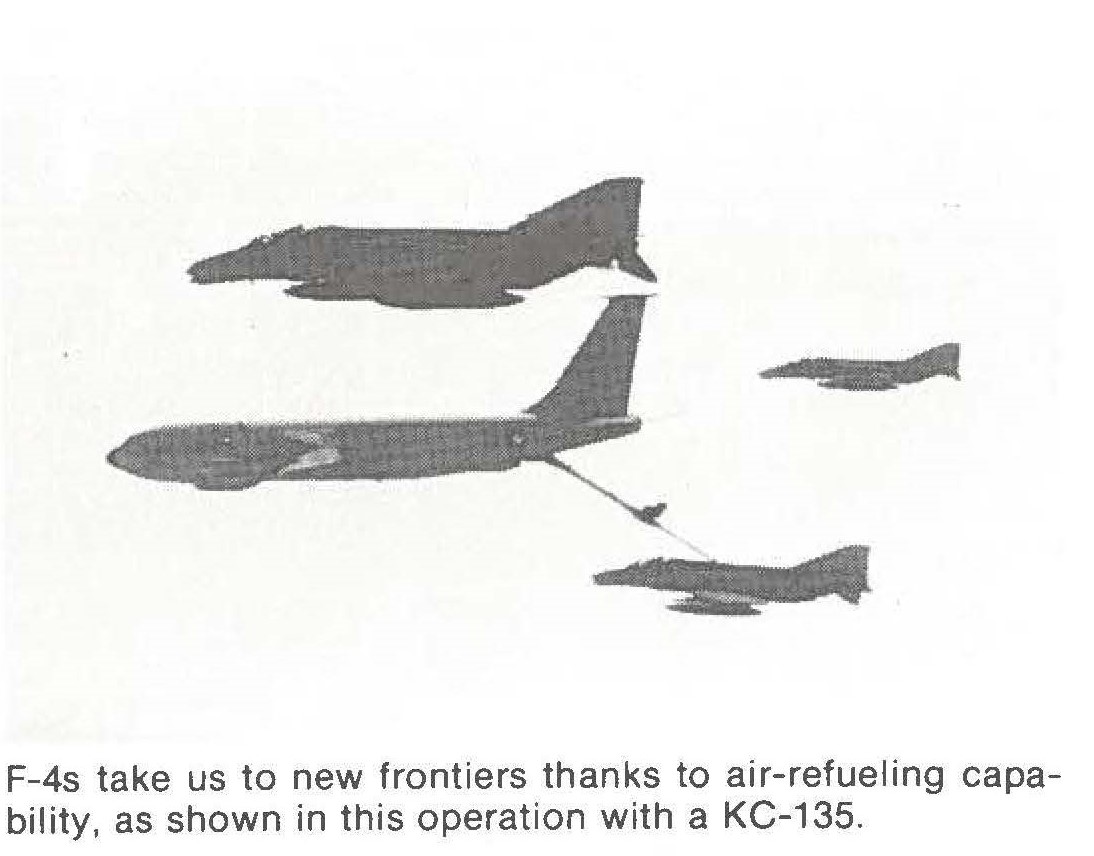
In 1976, the squadron transitioned to the F-4C Phantom II and was redesignated the 199th Tactical Fighter Squadron. The new aircraft expanded their tactical fighter capabilities and supported a broader range of training and operational missions.
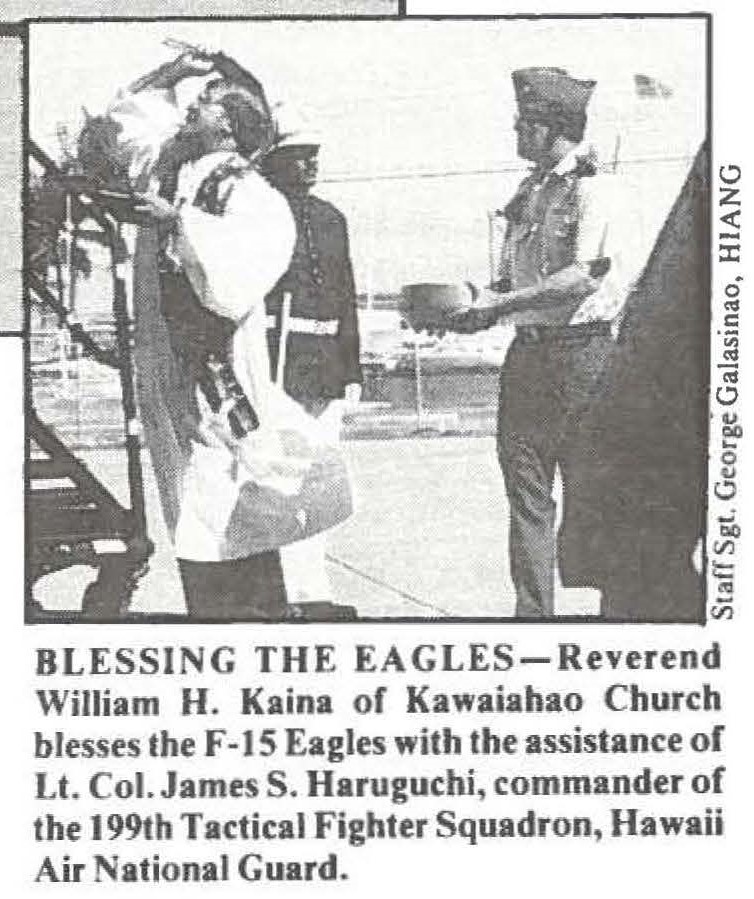
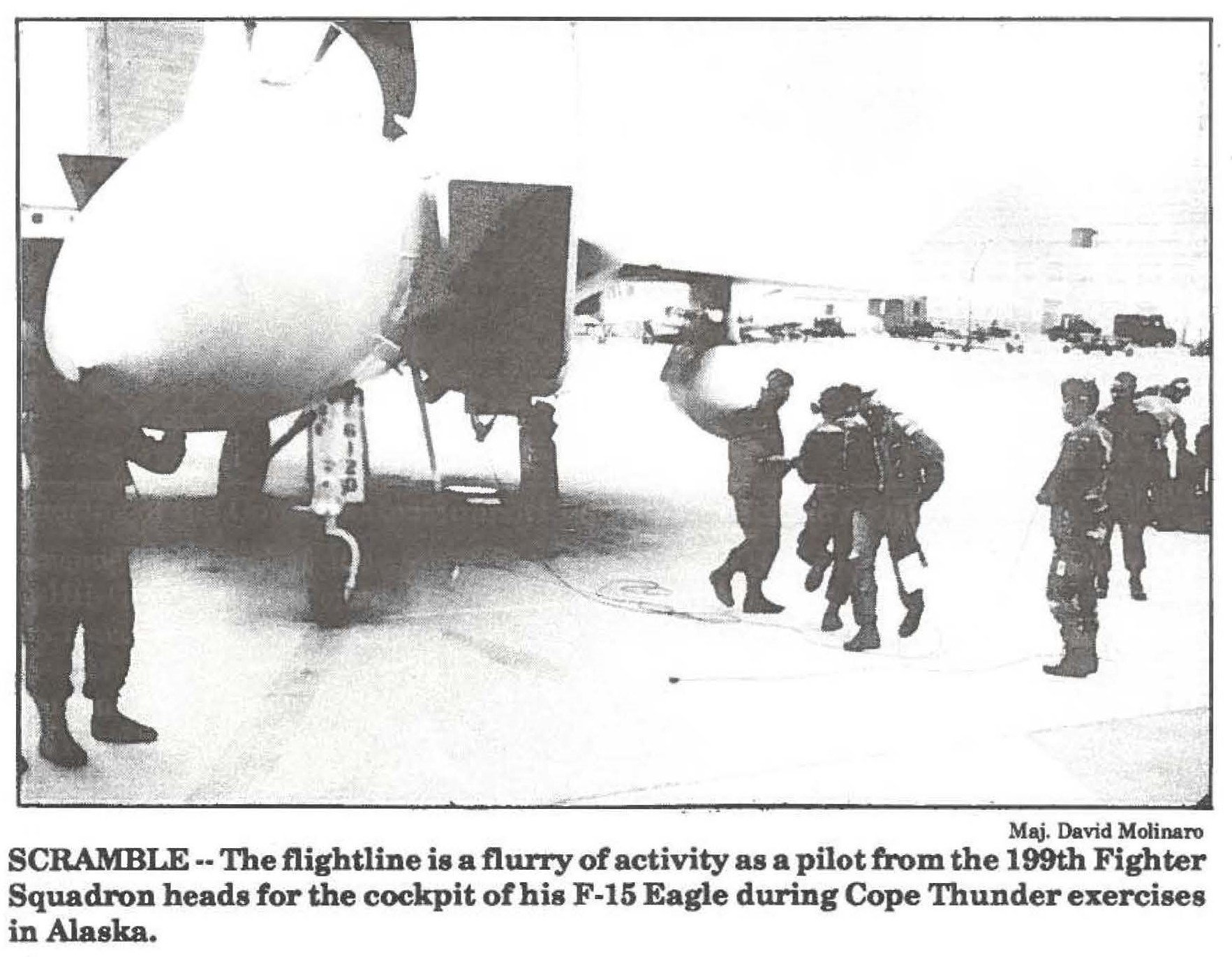
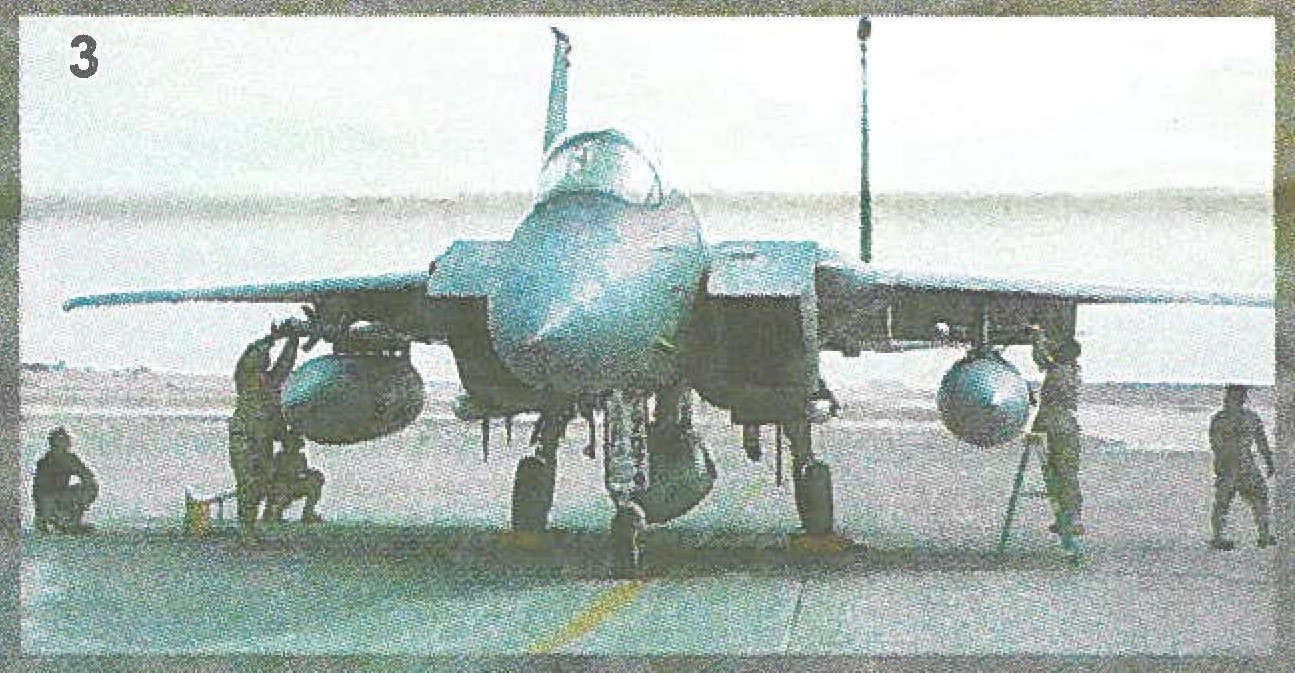
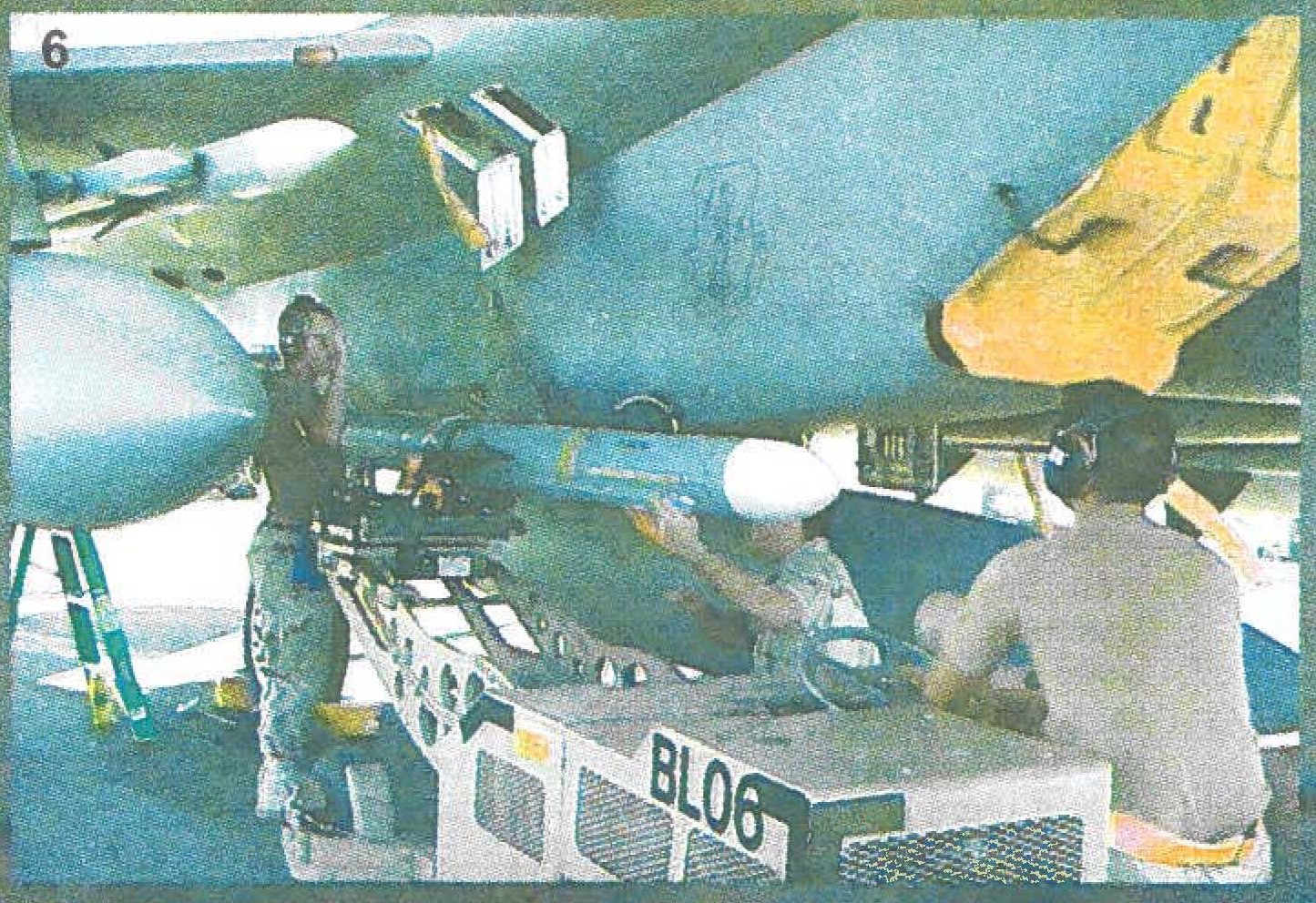
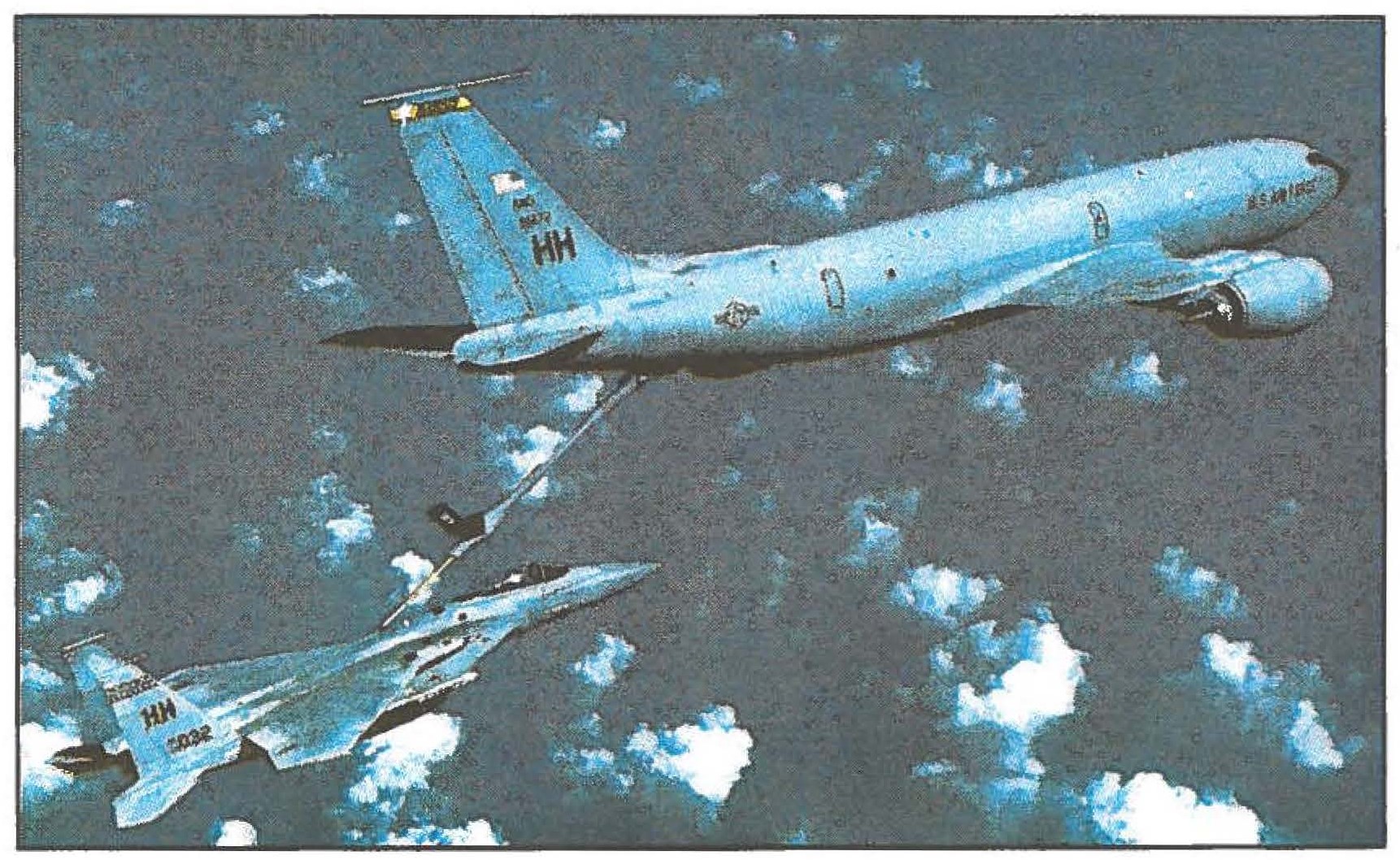
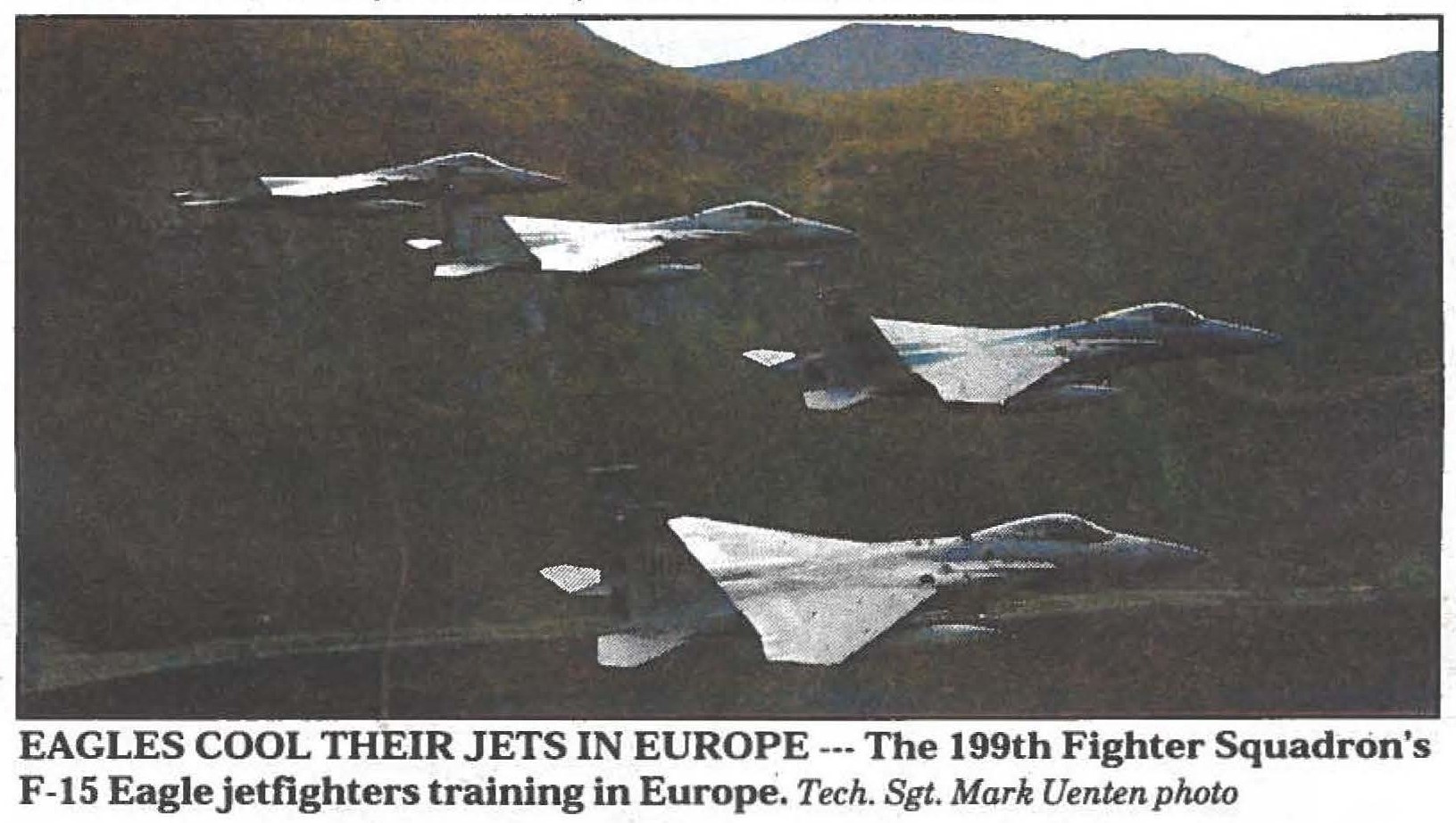
A major milestone came in 1987 when the squadron transitioned from the F-4C Phantom II to the F-15A/B Eagle. The conversion was completed ahead of schedule, allowing the unit to resume its around-the-clock air defense alert commitment. The F-15’s advanced air superiority capabilities strengthened Hawaiʻi’s defense posture and prepared the squadron for an expanding role in national and overseas operations.
The 199th’s operational reach grew significantly during the 1990s. In December 1994 and January 1995, the squadron became the first Air National Guard F-15 unit in the nation to patrol the northern no-fly zone over Iraq. Operating from Incirlik Air Base, Turkey, approximately 160 pilots and support personnel from the 154th Group participated in Operation Provide Comfort II.
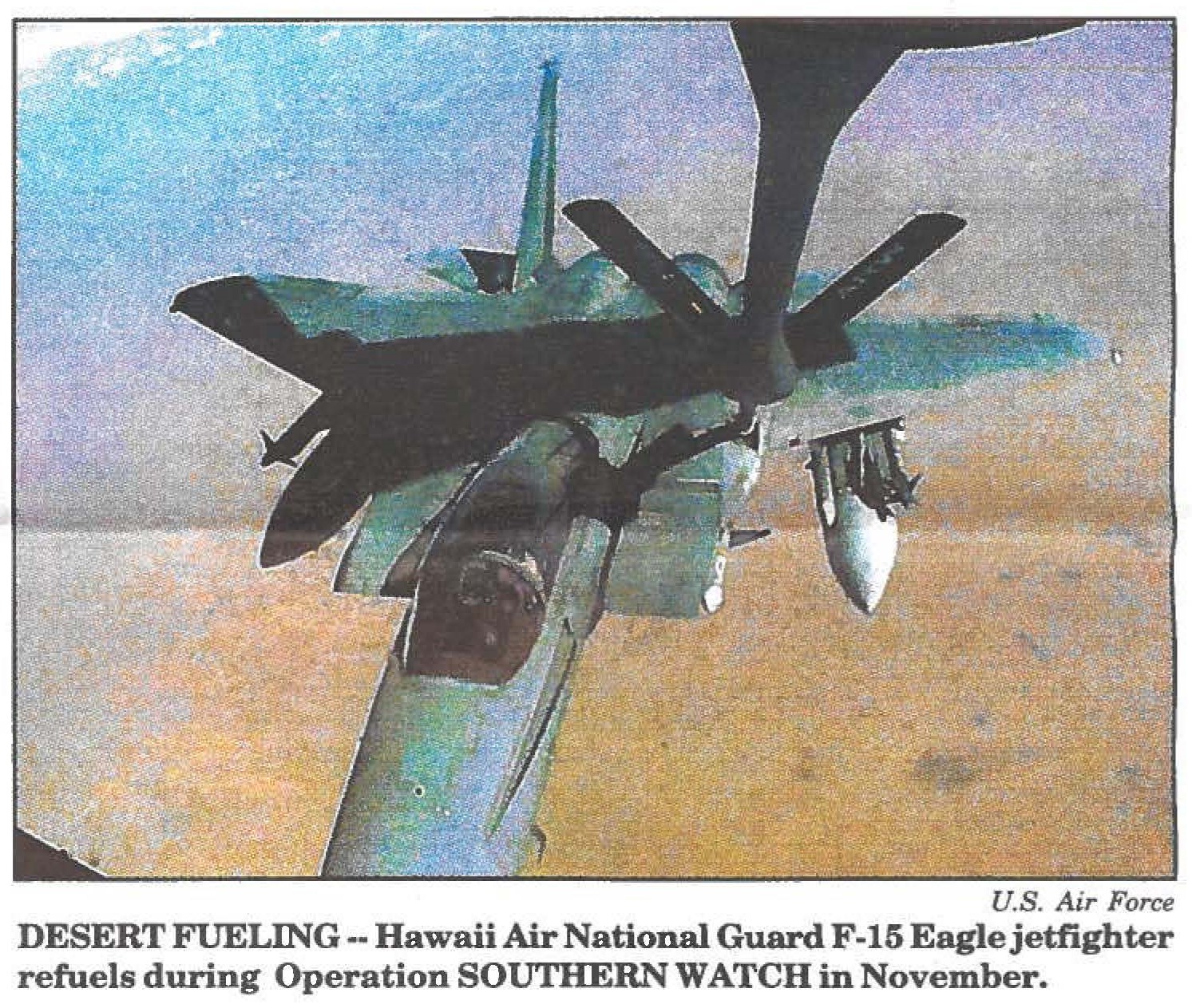
The squadron continued to support air defense and contingency operations into the 2000s. Following the terrorist attacks of Sept. 11, 2001, its F-15 aircraft were scrambled to escort commercial airliners remaining in the skies to Honolulu and Kona International Airports. The unit also participated in international exercises, including training with allied air forces, and supported Operation Southern Watch in the Persian Gulf region.
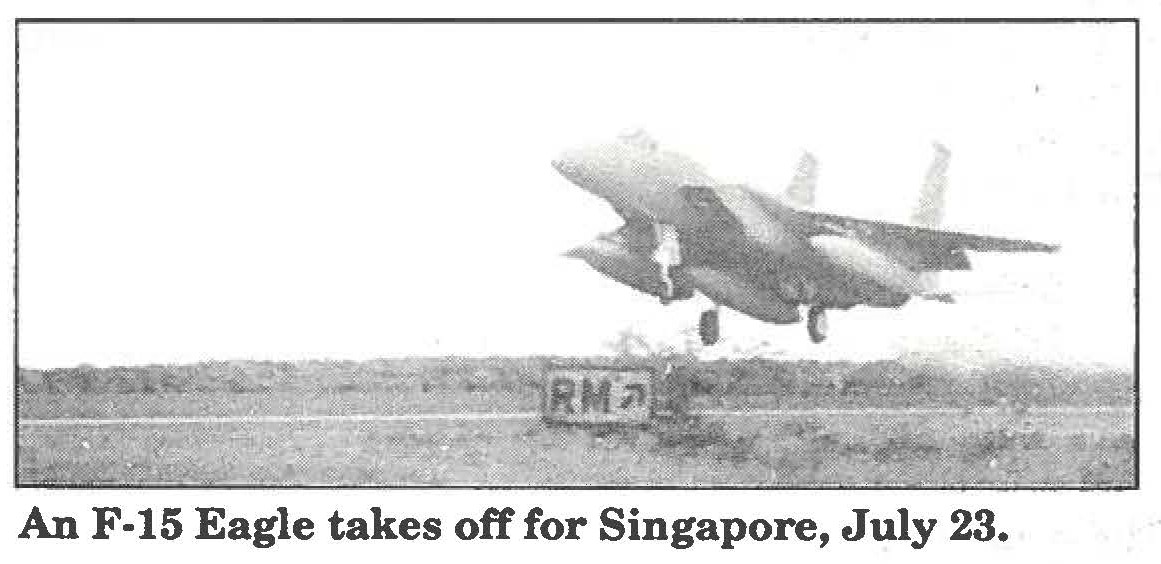
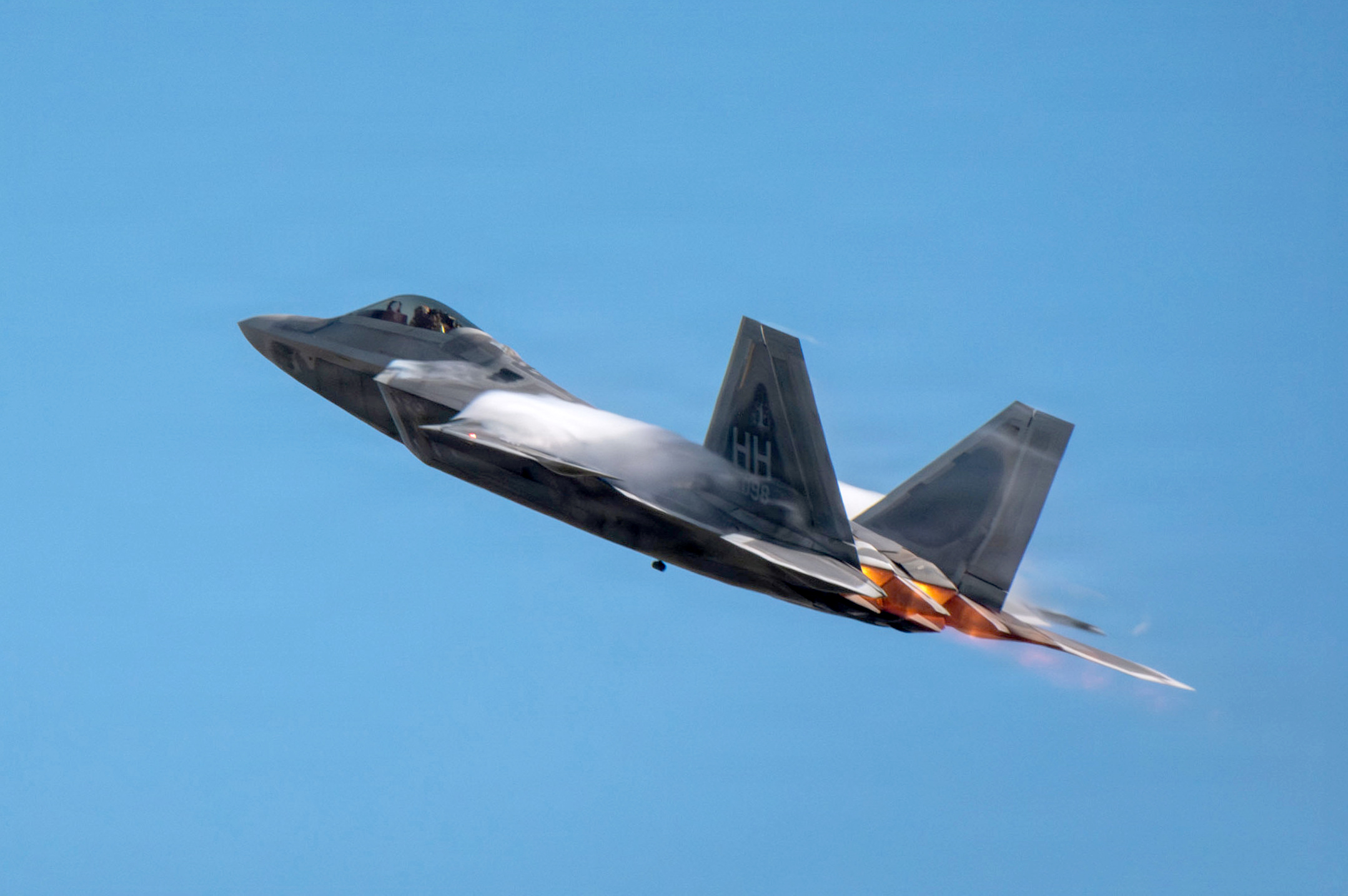
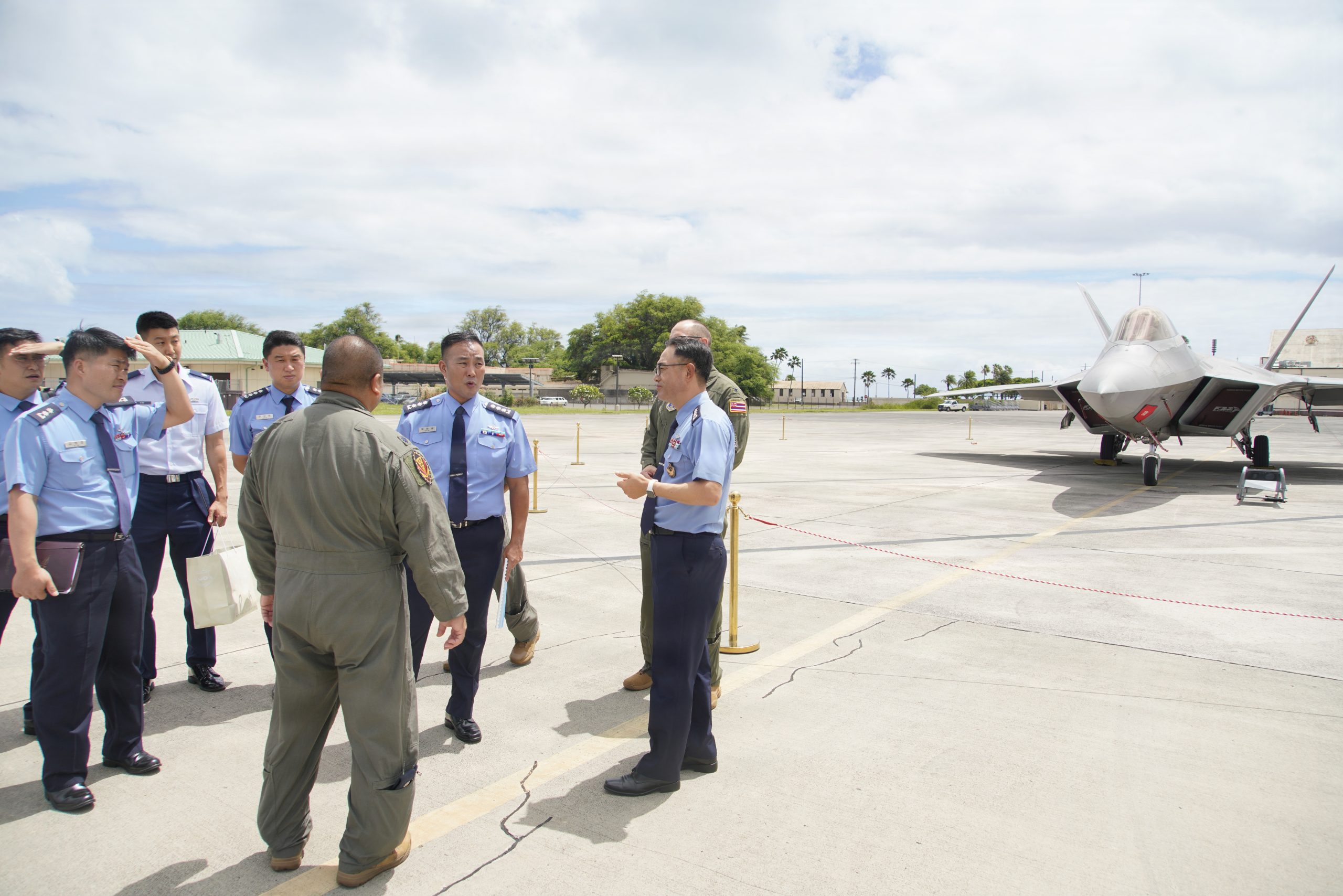
In 2010, the 199th Fighter Squadron began transitioning from the F-15 Eagle to the F-22 Raptor, marking another significant chapter in its history. The first two F-22s arrived at Joint Base Pearl Harbor-Hickam in July 2010, and the last F-15s departed Hawaiʻi on Sept. 1, 2010. The transition equipped the squadron with a fifth-generation fighter capable of advanced air superiority operations.
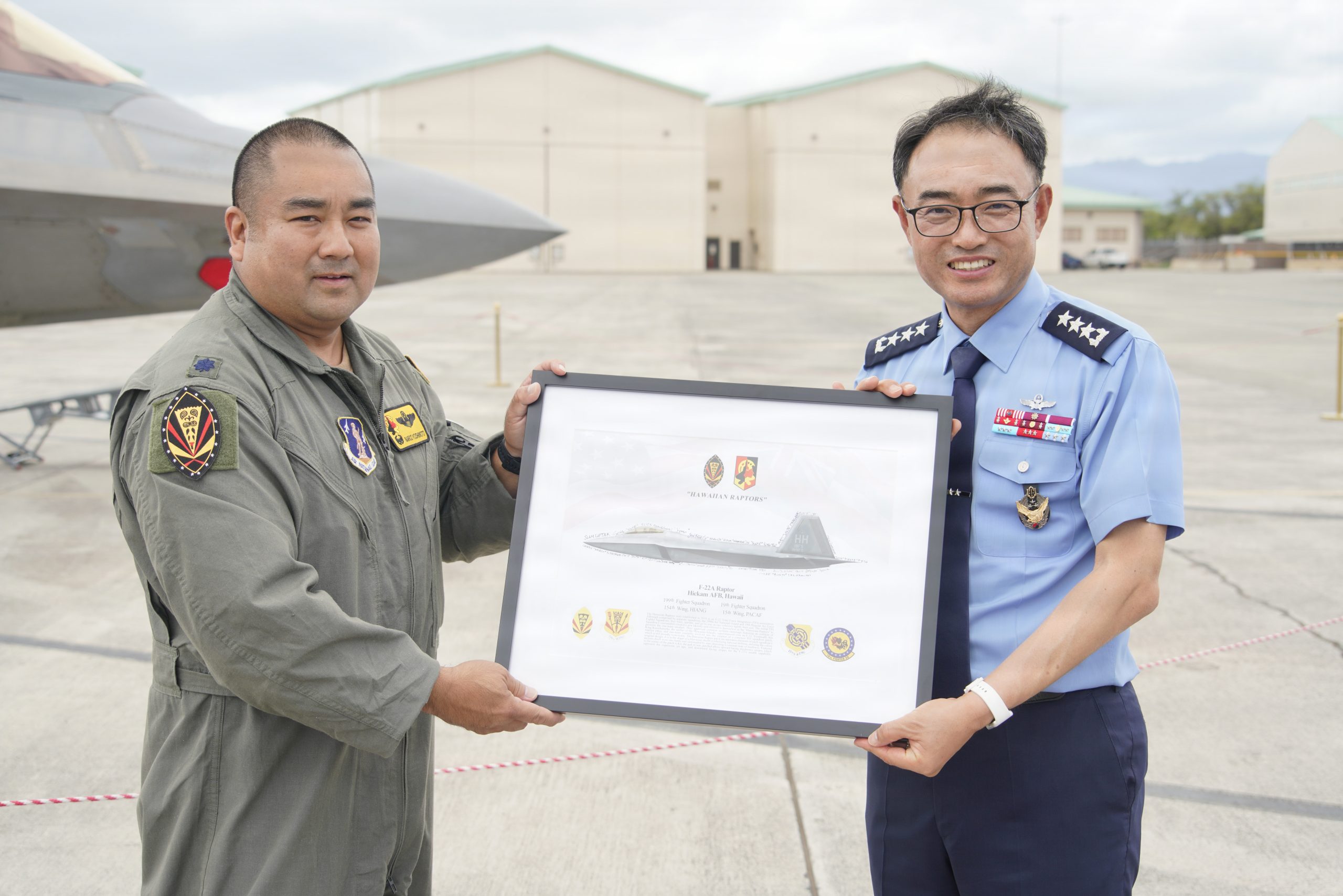
Today, the 199th Fighter Squadron remains a key component of the 154th Wing and the HIANG. Its mission includes defending the nation’s interests through air superiority operations, maintaining combat readiness and integrating with active-duty forces and allied partners. Recent deployments and exercises throughout the Indo-Pacific have strengthened interoperability with regional air forces and supported a free and open Indo-Pacific.
Last updated October 2026
199th Fighter Squadron Chronological History
P-47 “Thunderbolt” Planes of the 199th Fighter Squadron. Hawaii Air National Guard(Pictures from the 1947-1948 Annual Report)Capt. Coya of Det C, 199th Ftr Sq swearing in five (5) new recruits(Picture from the 1948-1949 Annual Report)
During the last four (4) days of field training, the Hawaii Air National Guard received the regular Air Force Operational Readiness Test. This test was made to determine the over-all combat efficiency of the Fighter Squadron and attached units. This operational Readiness Test lasted for ninety-six (96) hours of continuous operation. The total score awarded tJ the Hawaii Air National Guard is believed to be one of the highest if not the highest Operational Readiness Test score received by any air National Guard organization.
During the year, the squadron has made tremendous strides towards learning to fly and operate as a team. The Fighter Squadron constitutes a definite defending and striking force. The excellent showing during sum mer camp substantiates the claim that the Hawaii Air National Guard units are a team, capable of waging war against any aggressor force. . .
Flying training requirements as outlined by the Hawaii Air National Guard conform to Air Force Regulation 60-2 which requires each pilot to log 100 hours throughout the year of First Pilot, Instructor Pilot, and/or Co-Pilot flying time of which 20 hours will be Instrument Flight Time, 15 hours will be Night Time, and 35 hours will be flown in each six month period. In the fiscal year of 1949 all pilots met the above requirements.
Strong emphasis has been placed on Individual Pilot’s Uroficiency. Closely supervised flying training is being conducted to aid each man in reaching his attainment of skill in Aerial Gunnery, Strafing, Rocket Firing, Dive Bombing, Formation Flying, Instrument Flying, Navigation, Long Range Control and the mqny other phases of flying that the Fighter Pilot must be proficient in, whether he flys alone or as a member of a large striking force
Many National Guard Squadrons have difficulty in getting sufficient members together at one time to fly as a unit. The Hawaii Air National Guard solved this major problem by devising the “Dawn Patrol”. Four (4) mornings each week a flight reports to the Guard area for flying at 0515. With take-off scheduled at 0550 and landing at 0715 the Hawaii Air National Guard is able to train each flight separately and in a regular sequenced schedule. At frequent intervals’ the entire Squadron is called out for a maximum effort mission with all four (4) of the flight flying as a Squadron. On one (1) day each week the pilots, when reporting to their civilian positions, have already undergone an intensified period of aerial training.
During field training exercises, emphasis was again stressed upon unit training. Actual operations performed by the Squadron proved the training for the year to have been even more successful than planned. During the exercises, all pilots who had not as yet qualified for an instrument rating were flight tested and they were all given instrument ratings. Instrument flying is a special subject for the coming year. The Air Force gave this Squadron its Operational Readiness Test during summer camp. The test assumed the proportion of a large scale operation. Maximum effort was demanded by the Air Force of sixteen (16) fighters in the air during all manuevers. The pilots flew a total of 4,462 hours during 1949. Total time flown during summer camp was 832 hours
In support of Hawaii National Guard Installations throughout the Island Chain, the Air Guard flew seventy-six (76) freight runs in the cargo aircraft. The Utility Flight carried 180,758 pounds of freight and transported 1,452 passengers in 1949
The Red Cross requested aid in transporting medical and emergency supplies to Waimea, Kauai, in February 1949 as a result of the flash flood there. Other speCial flights included participation in “Air Force Day” at Hickam Field and in several air shows on Oahu.
At the end of the fiscal year 1949, the 199th Fighter Squadron (SE) possessed twenty-eight (28) aircraft of which eight (8) were at the Hickam Depot, one (I) undergoing repair of damage caused by a nose-up, one (ll for corrossion control, one (1) gas tank change and five (5) for an inspection in accordance with Technical Order 00-25-8 (Transfer Inspection).
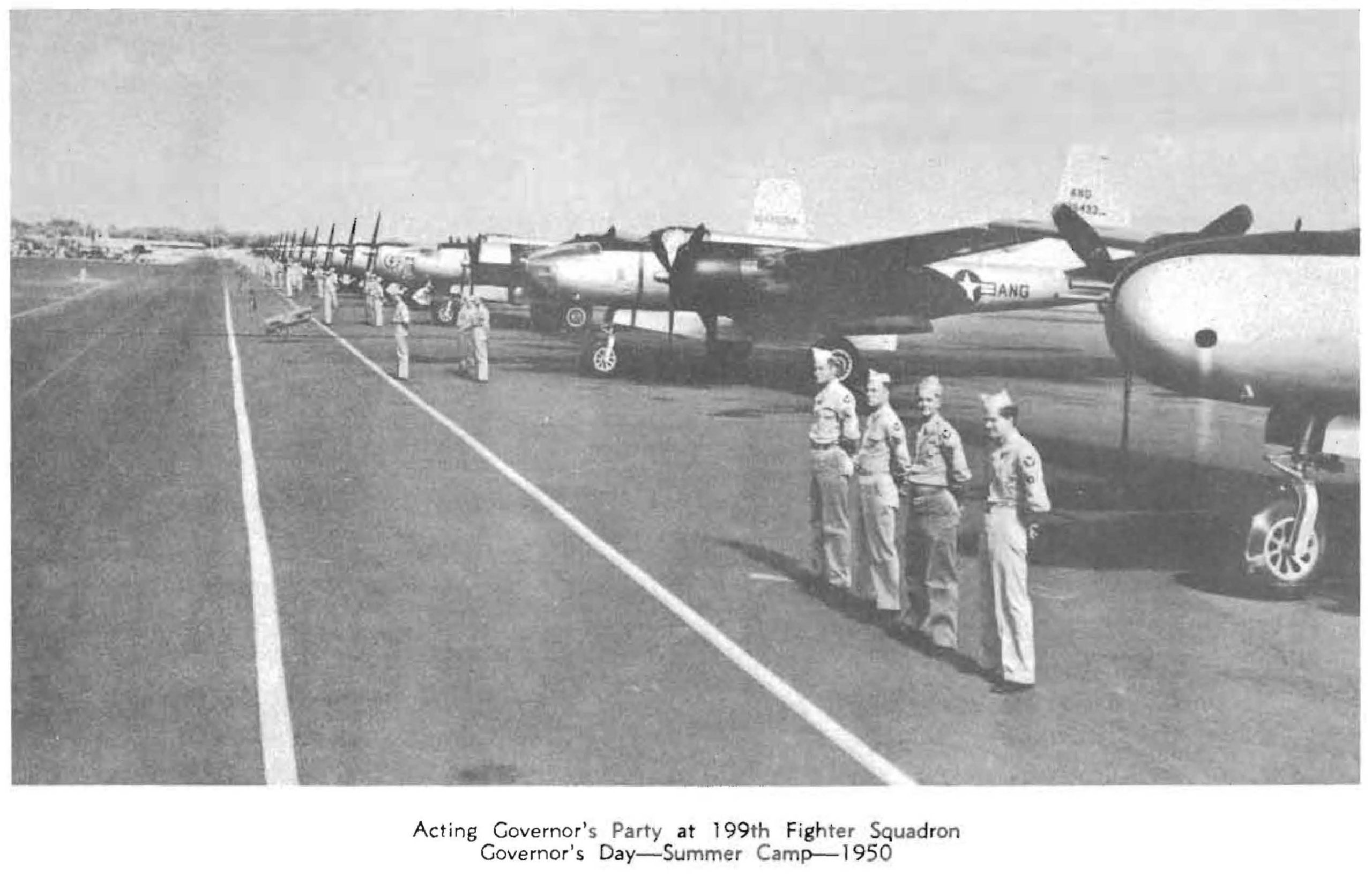
Acting Governor’s Inspection-199th Fighter Squadron Governor’s Day-Summer Camp-1950Acting Governor’s Inspection-199th Fighter Squadron Governor’s Day-Summer Camp-1950Acting Governor’s Party at 199th Fighter Squadron Governor’s Day-Summer Camp-1950(Pictures from the 1949-1950 Annual Report)
During the volcanic eruption on the Island of Hawaii 1 June 1950, the 199th Fighter Squadron, Hawaii Air National Guard, and key personnel of the 299th RCT performed valuable aerial reconnaissance and photographic missions over the affected area.
Armistice Day. Elements of the 298th RCT and the 199th Fighter Squadron participated in the American Legion’s Memorial Ceremony at Punchbowl. The State Staff aided in the planning and preparations for the ceremony. Other units paraded on their local islands.
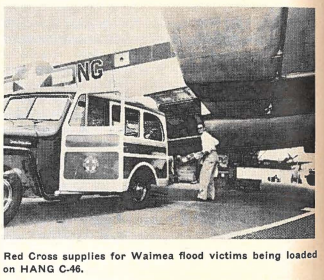
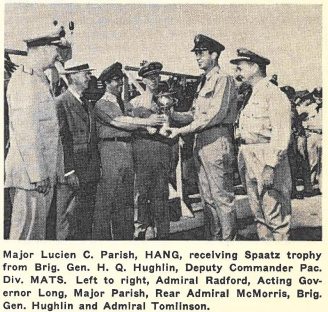
Red Cross supplies for Waimea flood victims being loaded on HANG C-46. Major Lucien C. Parish, HANG, receiving Spaatz trophy from Brig. Gen. H. Q. Hughlin, Deputy Commander Pac. Div. MATS. Left to right, Admiral Radford, Acting Governor Long, Major Parish, Rear Admiral McMorris, Brig. Gen. Hughlin and Admiral Tomlinson.(Pictures from the 1950 October The Hawaii Guardsmen)
The terse intelligence reports began coming over the teletype. They were immediately evaluated by intelligence officers of the Hawaii Air National Guard. Broken down, the reports painted a gloomy picture. Alaska was under attack from the enemy. Johnston Island was being bombed, with the probability that the enemy would soon take it over. The entire west coast of the United States was preparing for an attack that could come at any moment. Logically, then, Hawaii was a planned stepping stone for the enemy. The 199th Fighter Squadron of the Hawaii Air National Guard was immediately alerted—ready for round-the-clock action.
This was the summer of 1949, and the beginning of the ORT—Operational Readiness Test. The 199th Fighter Squadron, HANG, is affiliated with the 61st Wing, which includes fighter squadrons from California, Utah, and Nevada. All were competing for the “Spaatz Trophy,” a trophy originated by the National Guard Bureau for presentation to the outstanding squadron in each wing.
The ORT, in effect, required four days and four nights of continuous training and was held during the fifteen days of summer field training. MATS air inspectors from the Inspector General’s Office did the grading. The problems set up for the 199th Fighter Squadron were theoretical, of course, but the 199th was expected to carry them out as close to the actual thing as possible.
In the first place, it was necessary to formulate plans for air base defense. Intelligence reports showed that Hawaii was a likely target for the enemy, and an attack could come at any time. Demolition teams were formed. Decontamination teams were organized in the event of a chemical attack. Ground defense teams were also formed against the possibility of an enemy air attack.
As the intelligence reports came in, the picture grew clearer. Johnston Island had been heavily bombed, and the enemy was in the process of taking it over. A VLR (Very Long Range) photo-reconnaissance mission was planned. The F-47 Thunderbolts were made ready with ammunition, cameras, and wing tanks. Soon afterward, the pilots of the 199th were taking off on their first ORT mission.
It would be well to mention at this point that the Hawaii Air National Guard is composed of two primary “groups,” as regards planes. First of all, there is the 199th Fighter Squadron, which is made up of F-47 Thunderbolts. Secondly, there is the “Utility Flight,” this latter flight including the Guard’s B-26 attack bombers and C-46 transport ships. Throughout the ORT, the fighter squadron and the Utility Flight worked closely together as a team.
One of the peculiarities of flying in Hawaii—if it can be called a peculiarity—is the fact that most of it is done over water. Fighter squadrons within the continental limits of the United States do not necessarily face this problem. Obviously, for this reason and other operational factors, the 199th Fighter Squadron Thunderbolts did not actually fly to Johnston Island on their first mission. They flew within the limits of the Hawaiian Islands but traveled the same mileage as they would have had they flown directly to Johnston Island and back. Time in the air: six hours plus.
The first mission completed, the second followed almost immediately. Intelligence learned that enemy bombers from Johnston Island were on their way to Hawaii. The Guard’s Utility Flight of B-26 attack bombers acted as the enemy. Working directly with Fighter Direction Control, the F-47s of the 199th roared into the air on an intercept mission, which was carried out successfully.
Later reports from the outside islands showed that some of the enemy bombers that had been among those intercepted had theoretically bellied in on the island of Molokai. This island is located some 30 miles east of Oahu, where the 199th was based. A ground-attack mission was immediately launched against the enemy on Molokai. Strafing and rocket fire were carried out against the hypothetical enemy pilots there.
The fourth mission was carried out against the “dust island” of Kahoolawe. Intelligence reports showed that the enemy had made a landing on Kahoolawe with surface craft and was in the process of setting up an airfield. Dive-bombing, rocket, and strafing missions were flown against Kahoolawe, located some 7 to 10 miles southeast of Molokai.
The fifth mission was a combat air patrol against the probable enemy invasion. The patrol encompassed the entire southern fringe of the Hawaiian archipelago, a distance roughly approximating 250 miles.
A VLR escort mission followed, with the 199th’s Thunderbolts escorting friendly bombers. The latter were represented by HANG’s B-26 attack bombers. The entire squadron then participated in a night-navigation mission. This was followed by a pre-dawn scramble, with the 199th intercepting an enemy target. Later, the HANG B-26 attack bombers towed targets while the fighters flew gunnery missions. Aerial gunnery films were assessed and graded by the MATS air inspectors.
All told, there were nine different missions flown by the 199th Fighter Squadron, with the Utility Flight participating. The MATS air inspectors graded these missions and evaluated the way air base defense plans were drawn up and executed.
Fighters don’t get off the ground unless they’re properly maintained by the ground crew. It’s interesting to note here that 100 percent of the squadron was kept in commission during those four days and nights of the ORT. Naturally, the credit for this goes to the ground crews of the 199th. During those four days and nights, the crews were on the line at all times. They slept on the scene—under planes, trucks, and other equipment—and many never took off their clothes for the entire period. Engineering was rated superior.
The 199th was not scored on any squadron move into the field, inasmuch as it operated from the home base, Hickam Field, Oahu. Future field training plans, however, would very probably involve an actual move to one of the other islands.
The air instructors of the 61st Wing conferred at Hamilton Field, California, for the purpose of evaluating the ORT results. As was mentioned previously, the 61st Wing includes squadrons from California, Utah, and Nevada. Results showed that the 199th Fighter Squadron, HANG, was the outstanding squadron in the 61st Wing. As far as could be determined, the 199th received the highest score among 84 units in the entire nation!
On July 29, 1950, a review was held at Hickam Field, at which the Spaatz Trophy was presented to the Hawaii Air National Guard. It was presented by Brig. Gen. H. Q. Huglin, representing the Chief of Staff, Air Force, and Deputy Commanding Officer, USAFPAC.
The Hawaii Air National Guard prides itself on the fact that it is always on the alert, always prepared for an emergency—local or national. It was fortunate that such was the case during August of this year. The rampaging Waimea River on Kauai overflowed its banks. Families were forced from their homes in Waimea Valley, and the area was inundated. About 300 persons—men, women, and children—were quartered in the Waimea Community Hall. They needed blankets, clothing, cots, and other supplies. They needed them badly, and they needed them quickly.
Lt. Col. Philip C. Turner, G-2, received an anxious call on August 17 from the American Red Cross. They had the supplies but no way of getting them to the flood victims. Col. Turner called Maj. Lucien Parish, HANG.
“When?” Major Parish asked.
“As soon as possible!”
Within an hour and a half of the call from the Red Cross, a HANG C-46 was being loaded at Hickam Air Base. In another 45 minutes, the sleek, silver plane rose high into the sky, its course set for the Garden Island of Kauai. Forty-two minutes later, Maj. Valentine Siefermann made a perfect landing without the aid of ground-direction devices or ground crews on the abandoned Barking Sands airstrip. This airstrip was used because vehicles could not cross the Waimea River, and supplies had to be dropped on the Waimea side.
Major Siefermann’s capable co-pilot was Lt. Vernon Flake. His flight engineer was Sgt. Herman Adams. Staff Sgt. Richard S. O. Lee, photographer, was also aboard. Several of the pictures he took were used by the local Honolulu newspapers.
Two others were aboard, too—Mr. Wendel Bayne of the ARC and Lt. Richard R. Williams, who represented Col. Turner as Public Information Officer.
The Red Cross supplies were taken to Waimea on a truck loaned by the Kekaha Sugar Company. The truck was met at the Waimea Community Hall by Maj. Chun and Capt. Blake of the 298th’s 3rd Battalion.
About twenty volunteers of the headquarters company had worked many long hours evacuating families from the flood area. They used a “duck” that had been sent to Kauai for just such purposes only a short time previously. Guardsmen drove the duck from house to house, picking up victims. Approximately 80 families were taken to the community hall.
Said Major Chun: “Everything is under control. The operation has been orderly, and the guardsmen are doing one helluva good job!”
The 1950 summer field training for the 199th Fighter Squadron and Utility Flight saw two unusual events. First, Madame Pele, the fire goddess, belched fire and molten lava from the side of Mauna Loa on the Big Island of Hawaii. This happened, incidentally, just as summer camp began. The resulting haze that fell over the entire archipelago threw the summer camp schedule awry. The planes of the 199th were grounded.
However, the Governor’s Day ceremonies on the first Saturday morning went off as scheduled, with Acting Governor Oren P. Long, General Makinney, and other island dignitaries making an official inspection of the Air Guard unit, along with the ground units.
As it turned out, the haze that grounded all planes provided the pilots with valuable instrument training. Many hours were spent with the Navy’s Ground Controlled Approach Center at Barbers Point. All of the pilots expressed their appreciation to the Navy for this wonderful cooperation.
The moment the haze lifted, the planes of the 199th swarmed into the air. The next seven days saw almost round-the-clock missions by the F-47s and B-26 attack bombers. Thousands of rounds of ammunition were expended in aerial gunnery and strafing. Rocket, dive-bombing, and strafing missions were flown against the target island of Kahoolawe.
However, there was another interruption. The last few days of summer camp saw eight of the Air Force’s B-36 giant bombers land on Hawaiian soil. The Hawaii Air National Guard helped provide facilities for these planes. Both the pilots and ground crews of the 199th were greatly impressed by the formidable sky giants.
The 199th was more than proud to win the Spaatz Trophy—more than proud to have been able to help the Waimea flood victims. But the ORT and regular training missions have shown pilots and ground crews alike just how much more there is to learn—how much more must be done to prepare for any attack on Hawaii. As a result, training has been intensified. More and more missions are flown every week, and every effort is made to give the pilots and ground crews the best in classroom training and lectures.
There’s an important factor that has gone into the makeup of the 199th Fighter Squadron and the Utility Flight. That factor is pride. There’s a deep-seated pride in the entire squadron, a pride that says, “Whoever they are, whatever they are, we’ll be ready! Let ’em come!”
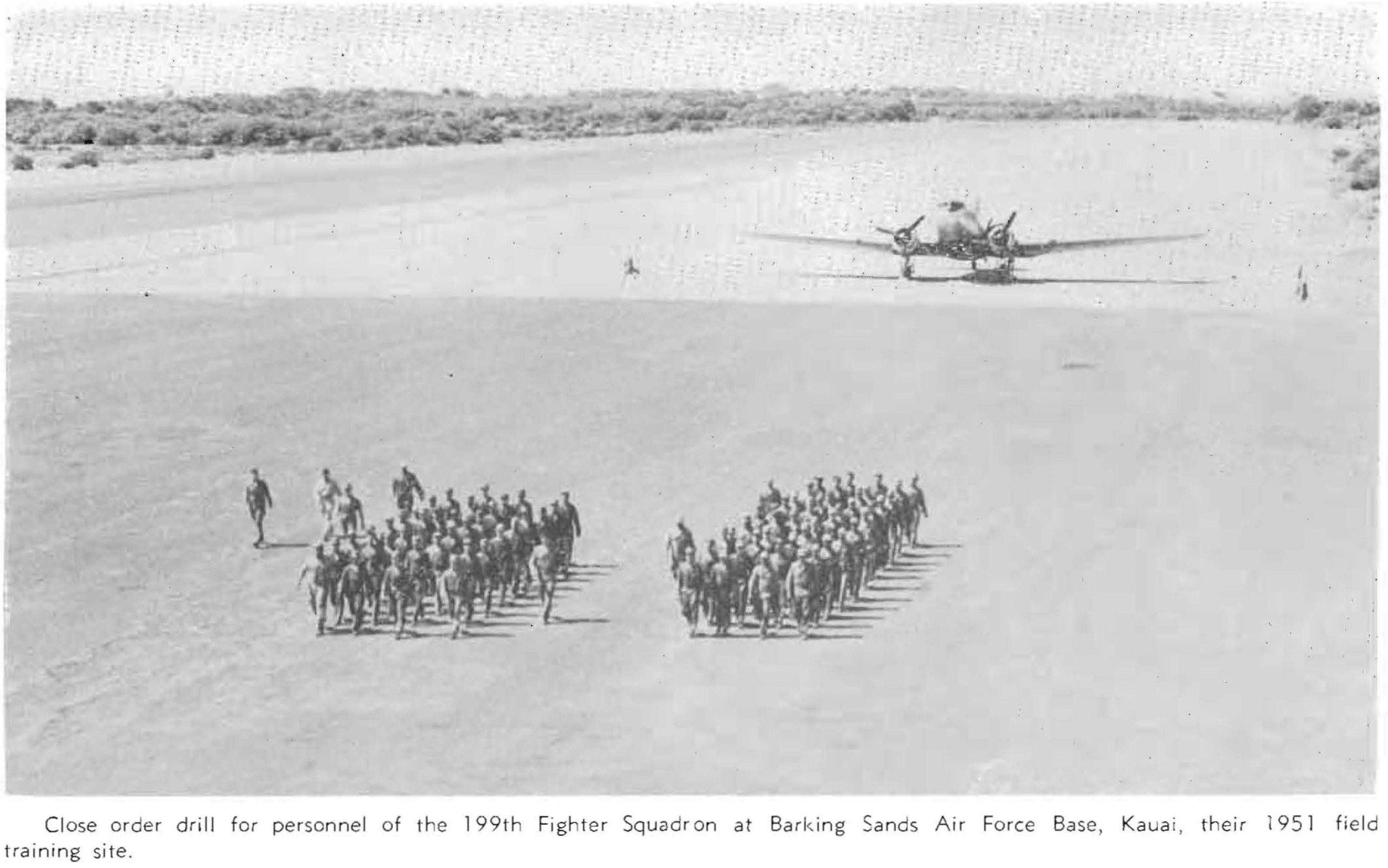
Close order drill for personnel of the 199th Fighter Squadron at Barking Sands Air Force Base, Kauai, their 1951 field training site.(Picture from the 1950-1951 Annual Report)
Waimea. Kauai Flood: . .
To care for the evacuees, the American Red Cross needed blankets, clothing, cots, and other supplies, all of which had to be flown in from Honolulu. The 199th Fighter Squadron, HANG was requested to assist and within two and one-half hours a C-46 was on its way carrying the essential supplies required.
All Army units on Oahu participated in the second Joint Armed Forces Day Parade (May 19th). The 199th Fighter Squadron flew an aerial review followed by a strafing and bombing demonstration. . .
The 199th Fighter Squadron flew an aerial review over the principal cities of Kauai on Kamehameha Day
The 199th Fighter Squadron reorganized under the Air Forces Wing Base Plan 1 November 1950. The reorganization orders inactivated the 199th Utility Flight and the Air Service Group and called for the activation of eight (8) supporting elements (Maintenance, Supply, Motor Vehicle, Medical, Air Police, Food Service, Installations and Communication) with an increase in authorized strength from 50 officers and 303 airmen to 52 officers and 406 airmen.
A total of 3907.5 hours were flown by the pilots of the 199th Fighter Squadron, 640.25 during the field training period. The air unit flew a total of 115 freight runs in support of the National Guard throughout the island chain carrying ~ total of 187,600 pounds of freight and 2049 passengers.
The 199th Fighter Squadron successfully completed the first movement of its entire organization, equipment and personnel, ever attempted in the 4 years of its existence. The success of the overwater move and the whole encampment, is a tribute to the harmonious relations that exist between the Regular Military Establishment and the Hawaii National Guard. Neither the move nor the camp could have been a success without the wholehearted cooperation of the Army, Air Force, (MATS) and Navy (MSTS).
The training of the fighter squadron was concentrated on the development of a well disciplined unit capable of sustaining itself in the field.
During the fiscal year 1949-1950 the 199th Fighter Squadron changed over from C-46 to C-47 type aircraft. The change is for the better, as less man hours are required to maintain the C-47 type aircraft.
MAJOR CARLOS W. BONHAMMembers of the air technical detachment. 199th Fighter Bomber Squadron, run a routine maintenance check on a B-26 bomber assigned to the squadron. An F-47 N fighter aircraft of the 199th Fighter Bomber Squadron is run up prior to take off on a bombing and rocket firing mission.(Picture from the 1952 Annual Report)
MILITARY DEPARTMENT
TERRITORY OF HAWAII
OFFICE OF THE ADJUTANT GENERAL
FORT RUGER, T. H.
GENERAL ORDERS 7 July 1952 NUMBER
The Adjutant General of Hawaii announces with deep regret the death of Major Carlos Willard Bonham at Barking Sands Air Force Base, Kauai, on 15 June 1952.
Major Bonham was born in Watertown, New York on 31 July 1919. He first entered military service as a member of the Missouri National Guard in 1937. He entered active duty with the U. S. Army in July 1942 and was commissioned a second lieutenant Officers Reserve Corps on 31 October 1942. Subsequent to his qraduation from Army Air Force Pilot Training in February 1944 he served in both the European and Pacific Theaters of Operation during World War II. He was discharged from active service in May 1948.
Major Bonham was awarded the Air Medal in 1945.
On 25 June 1948 he became a member of the 199th Fighter Squadron, Hawaii Air National Guard. He served as Flight Leader, and Operations Officer, in the grades of 1st Lieutenant and Captain respectively. Promoted to Major, Hawaii Air National Guard, he was assigned to command the 199th Fighter Squadron on 8 June 1951. Major Bonham’s selfless character, his integrity, and his devotion to duty placed the service of his country above his own personal interest. In the passing of this citizen soldier, the country and the military have sustained a great loss.
BY ORDER OF THE GOVERNOR:
OFFICIAL:
DAVID P. SILVA Lt Col, QMC, HNG Asst Adjutant General
During the year the 199th Fighter Bomber Squadron conducted eight squadron gunnery and bombing exercises. These exercises were over and above the normal authorized training for the Fighter Squadron. The first four gunnery exercises consisted of air to air gunnery with the last four being devoted to bombing and rocketry. The latter four exercises were carried out using the facilities of the U.S. Navy range on the western-most tip of Molokai and the targets located on the island of Kahoolawe.
The field training site of the 199th Fighter Squadron was Barking Sands Air Force Base, Kauai. Twenty-seven officers and 375 airmen were present there including 4 airmen of the 199th Weather Station.
The Annual Inspection of the 199th Fighter Bomber Squadron was made by the USAf Inspector General’s olfice , Hickam AfB, from 26 March 1952 through 30 March 1952. The inspection involved a detailed scrutiny of all phases of the Squadron’s administration and operation. A rating of “Satisfactory” was received by the 199th fighter Squadron.
During fiscal Year 1952, the 199th fighter Bomber Squadron had possession of 24 f-47N, 3 TB-26B, 2 C-47 A, and 2 T-6D aircraft. On 1 July 1951 an intensive corrosion control program was instituted to combat the high rate of corrosion caused by the salt air and coral dust prevalent along the coastal are as of the Hawaiian Islands.
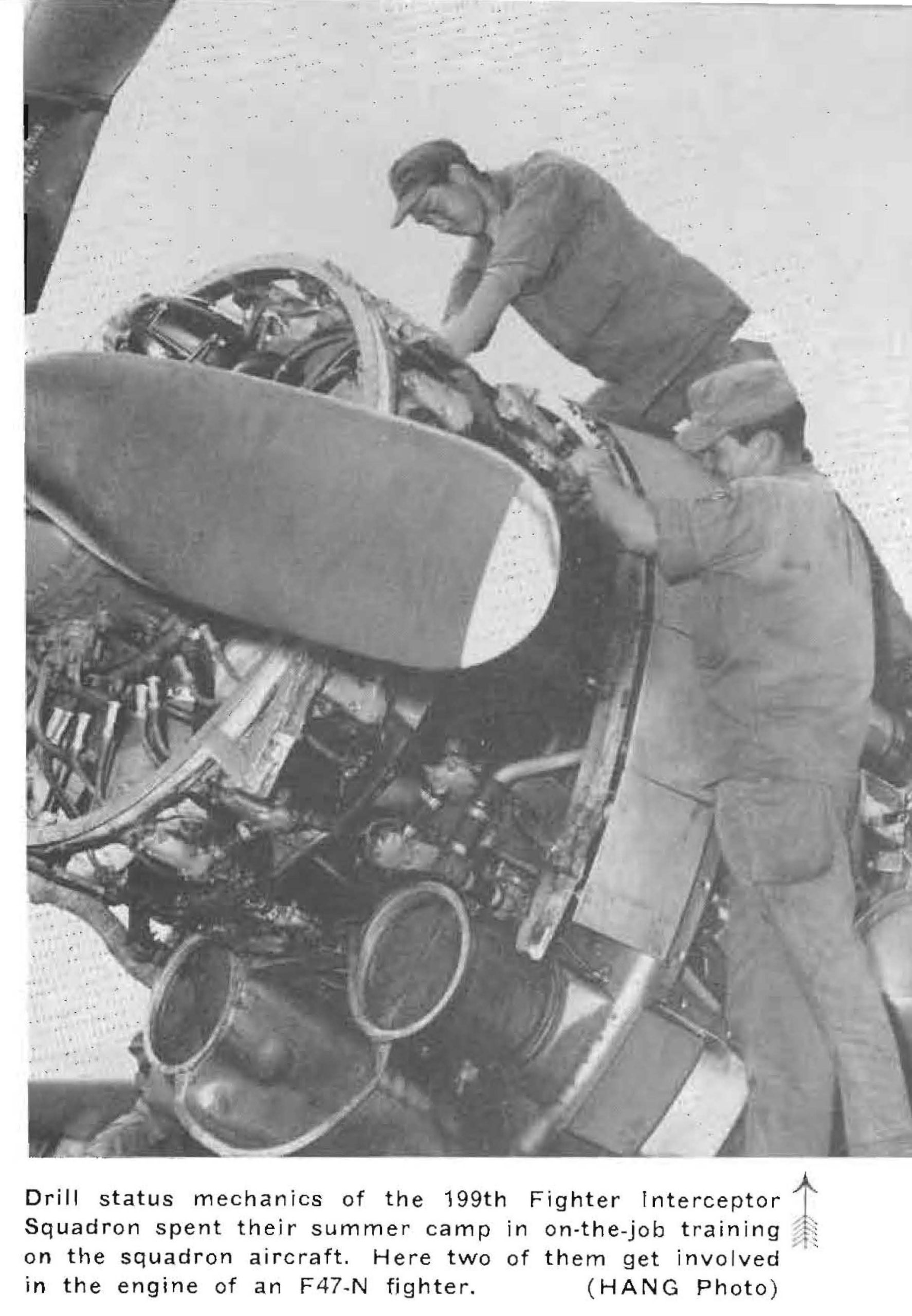
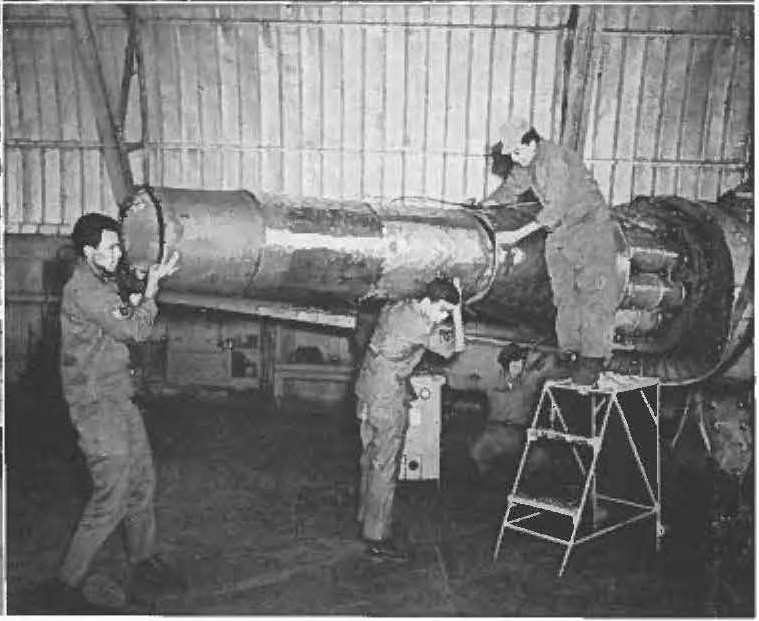
Drill status mechanics of the 199th Fighter Interceptor Squadron spent their summer camp in on-the-job training on the squadron aircraft. Here two of them get involved in the engine of an F47-N fighter. (HANG Photo) (Pictures from the 1953 Annual Report)
The 199th Fighter Bomber Squadron was reorganized and redesignated as the 199th Fighter Interceptor Squadron on November 19, 1952. The mission was changed from tactical ground support to aerial interception. The 199th thus formed a team with the 109th Aircraft Control and Warning Squadron for ground-controlled interception of enemy aircraft.
The 199th Fighter Interceptor Squadron held 48 regular drills, eight special aerial gunnery drills, two CPXs, one small arms firing drill, two pre-field training staff conferences, and the annual 15-day field training period during FY 53. A total of 4,643 hours were flown by pilots of the Hawaii Air National Guard, a significant increase over FY 52. Of these, 2,049 hours were flown in the F-47 fighter-type aircraft. A total of 182 flights (324 flying hours) were administrative in nature, transporting Hawaii National Guard personnel and freight between the islands. In view of the fighter-interceptor mission, the tactical pilots concentrated on air-to-air gunnery missions. The Squadron’s average score for the year was 15.7% hits out of 84,400 rounds fired.
As in previous years, the Squadron followed Continental Air Command Training Directives explicitly in its ground training. Classroom training prevailed during the regular Monday night drills (two per month), and on-the-job training was used during the regular Sunday drills (one per month).
The 199th participated in CPX Eversharp No. 2, held February 28–March 1, 1953. Operational control of the Squadron was delegated to KIRBY CONTROL (109th AC&W Squadron). The pilots flew 63 hours of interception missions and made 49 intercepts. This exercise provided much-needed training in communications and procedures during operational flights.
Field training for the 199th was held at Wheeler AFB, Oahu, June 13–27, 1953. The primary flying missions were aerial gunnery, squadron formation, and ground-controlled intercept in coordination with the 109th AC&W Squadron. The total flying hours increased by one-third from the previous year’s encampment, and the total missions flown were almost doubled.
The annual air inspection of the 199th by the Inspector General, Pacific Division, MATS, was held November 3–17, 1952, and resulted in a general rating of SATISFACTORY.
At the end of FY 53, the 199th Fighter Squadron had 26 aircraft including twenty F47N Fighters, two B-26 Light Bombers, two T6 T rainers. and two CA7 Transport aircr aft. Durin g the year, one B-26 was give n a complete cycle reconditioning b? the 1500th Maintenance Group, Hickam AFR. In anticipation of the necessity for cycle reco nditioning of the C-47 aircraft, the feasability of Hawaiian Air Lines performing the work on a contract basis was investigated. The pro posed contract was approved by the National Guard Bureau. The work was programmed to be performed during FY 1954. On 1 J anuary 1953, the 199th was authorized an increase in its Base Technical Detachment from 24 to 30 aircraft mechanics. Airc raft main tenance problems were aggravated by the relatively old VV’V II equipment, and by scarcit’ of parts. In spite of this, ai rcraft maintenance personnel maintained an in-commission percentage rate of 63 .66.
First Lieutenant Ira B. Wynne. lost on an aerial flight on 17 March 1954First Lieutenant Andrew S. Whitaker. lost on an aerial flight on 19 September 1953. A close-up 01 one 01 the F·SSE fighters received by the Hawaii Air National Guard in February 1954.(Pictures from the 1954 Annual Report)
Two pilots of the 199th Fighter Squadron were lost during Rights scheduled as part of this training. On 19 September 1953 1st Lt. Andrew S. Whitaker was killed when his F-47 fighter crashed into a peak in the Koolau Range on Oahu. On 17 March 1954 1st Lt. Ira B. ·Wynne was reported missing in a T-6 trainer on a routine training flight in the vicinity of Maui. He was later declared dead after an intensive air-land-sea search failed to disclose any evidence of his whereabouts.
Airmen from the Air Guard’s 199th Fighter Interceptor Squadron refuel an F-86 Sabrejet at Hickam Air Base.(Pictures from the 1956 Annual Report)
199th Ftr Intcp Sq and 8199th Rept Tng Sq. 5,387 :40 pilot flying hours were flown, of this 4,140 :00 hours were flown in jet aircraft. This represents an increase of about 10% over last fiscal year, and with about the same number of tactical pilots and aircraft. Support flying continued as a minor portion of the total time: 114:40 pilot hours were on command flights, 606:30 pilot hours were for· inter· island freight runs, and 526 :30 pilot hours were for aircrew training and 60-2 time.
Aerial Gunnery exercises were again authorized for the flying squadrons. These are extra flying drills for tactical pilots and limited support personnel and are entirely devoted to aerial gunnery training. Each tactical pilot participated an average of 8 times. A total of 501 sorties were flown, 54,190 rounds of cal. .50 ammunition were expended with average scores of 14.5%
Ground Controlled Intercepts in coordination with the 109th AC&W Sq were also a primary mission, and given equal emphasis with aerial gunnery.
In April 1956 the 199th acquired a C-llB Jet Synthetic Instrument Trainer ($65,000.). This was installed in a completely rebuilt and air conditioned Trainer Building. Prior to the end of the fiscal year over 100 hours of instrument training were logged on the trainer. A Link Aviation Inc., technical representative assisted the installations for one month.
The two weeks Annual Field Training was again held at Kaneohe MCAS. There was a significant increase in flying activity over the preceding summer camp. 729 training sorties were flown versus 626 the previous year.
The aircraft were flown six periods a day (0500-2000 I in two shifts, each of which was operated by the 199th or the 8199th. This type of scheduling was necessary to utilize the small number of jet aircraft. 12 F-86s and 3 T-33s were taken over for the encampment. An average of II F·86s were available daily (87% I and each aircraft flew an average of 48 times (41 :30 hours utilization) during this intensive period of operational training. The T·33s performed yeoman service in instrument training and towing targets. Each T·33 flew an average of 62 times (67 hours utilization).
The tactical pilots averaged 22:10 hours of prescribed missions in tactical aircraft during this two week period. Primary emphasis was on aerial gunnery (126 missions’ and ground controlled intercept (114 missions) in cooperation with the 109th. The average scores for the 59,400 rounds of cal. .50 ammunition expended in aerial gunnery were 15.6% above 20,000 feet and 14.9% above 27,000 feet. (Qualilication for combat ready is 15 % ) .
In spite of the desires and efforts of our Weather Flight, passing rain showers obscured Kaneohe MCAS at times and occasional returning flights were diverted to land at Hickam AFB. This necessitated the cancelling of the next flying period of these aircraft.
The limited number of F·86 aircraft presented considerable utilization and training problems.
The 199th Aerial Gunnery team fired their qualifying official scores during Annual Field Training. The Team’s score was sufficient so that they will compete with 4 other ANG teams (winners of ANG Regional Matches) in the Annual Air National Guard Gunnery Meet in September 1956 to determine the Air National Guard winner.
Officers. Tactical Pilots. The discontinuance of the 8199th Replacement Training Squadron, with the resultant absorption of personnel into the 199th Fighter Interceptor Squadron, augmented, placed the 199th over 100% tactical pilot manning.
199th Ftr Intcp Sq. 7,934 pilot hours were flown by Hawaii Air National Guard pilots during fiscal year 1957, an increase of over 2,000 hours over the previous year’s 5,M2 pilot hours. This was largely due to an increased flying training program and participation in the Air Defense Augmentation Program. Of the 7,934 pilot hours flown, 6,701 were in jet aircraft.
Excluding Air Defense Augmentation flying time, there were 5,0’13 jet pilot hours flown on specified training missions versus the previous year’s 4,313 jet pilot hours. Most of this large increase in training jet time can be attributed to more aircraft being available, and a more aggressive striving for combat readiness.
The tactical pilots averaged 220 hours of flying time, which is comparable to flying done by active duty fighter pilots. Most of their flying was of a tactical nature–aerial gunnery, fighter tactics, alert/GCI in cooperation with the Hawaii Air ational Guard AC&W Squadrons, etc.
Support flying decreased from fiscal year 1956’s 1,529 pilot hours to fiscal year 1957’s 1,233 pilot hours. Support hours for the C-47s were allocated by the National Guard Bureau. Weekly support missions were flown to Maui and Hawaii carrying freight and passengers between the Hawaii National Guard units.
Over 250 training hours were logged in the C-llB Jet Synthetic Instrument Trainer. This should increase, “‘S the air technician assigned as operator of this trainer has retnrned from an eight-month course at a USAF Technical School during the fiscal year.
Aerial gunnery continued to be the main training mission. 176,967 rounds of caliber .50 ammunition were expended, and the squadron average for high altitude (25,000′) was 16.3% hits; low altitude (20,000′) was 20.2% hits. The more outstanding fighter pilots averaged over 30%. This squadron gunnery was of such a caliber that a squadron team won an aerial gunnery match during Annual Field Training against an active duty Marine FJ-4 fighter squadron.
During Annual Field Training at Kaneohe Marine Corps Air Station in June 1957, the tactical pilots averaged 24:05 hours of flying time for this two-week intensive unit training. 777 sorties were flown, which totaled 744 :40 hours ofjet pilot time. The aerial gunnery average was 19.7% hits, which included the newly assigned pilots. The flying schedule was such that considerable aircraft maintenance training was performed to increase the capability of the lesser skilled airmen.
At the close of the fiscal year, 81% of the assigned taetical pilots were classified as combat ready, that is, those who were proficient with the Sabre-Jet and met a high criteria for ability in aerial gunnery, instruments, fighter tactics, etc. In June of 1956, there were 20 combat ready pilots; in June of 1957, there were 26 combat ready pilots.
Air Defense Augmentation. The 109th Aircraft Control & Warning Squadron and the 199th Fighter Interceptor Squadron participated in the Air Defense Augmentation Program during the entire year. The 109th provided 24-hour early warning radar and intercept control at Punamano, and the 199th provided jet fighters at Hickam. This program furnished Seventh Air Force with an air defense team in the Hawaiian Islands area under their operational control. . .
Fighter. Two pilots and two fully armed Sabre-Jets were on Alert from dawn to dusk awaiting the signal to “scramble” from Seventh Air Force. A five-minute maximum is allowed from scramble signal ·to takeoff’ time. The seriousness in which the pilots take their responsibilities is reflected in their consistently bettering this time by two to three minutes.
1,658 jet hours were logged in these air defense missions and the two pilots on Alert at anyone time were scrambled several times a day. They made over 1,600 interceptions, “actuals” or training, of other airborne aircraft in the Air Defense Identification Zone surrounding the Hawaiian Islands. The “actuals,” unknown aircraft, were alJ friendly-being unknown only because of variances from their planned flight path,; and their actual flight paths as plotted by Hawaii Air National Guard radar. These were successfully intercepted and identified.
All squadron combat ready pilots have participated in standing Alert. An average of 14 pilots participated each month. These pilots are on duty OIl days off, or take leave from their jobs or schools. Immeasurable training is received in interception of unknown aircraft. Safety is, of course, constantly practiced and monitored, and all pilots participating must be fully combat ready and have demonstrated their proficiency.
Brig Gen Joe C. Moffitt, CO of the Colorado Air NG Wing, gets the “royal Hawaiian treatment” from island beauty upon his arrival.The “Minute Men” aero-jet flying team of the Colorado Air National Guard, barrel roll in tight formation at less than a thousand feet. This team performed at the Hawaii Air National Guard Open House Air Show April 28th at Hickam Air Force Base.HANG • CANG = SUCCESS AND THRILLS! “MINUTE MEN” CHURN AIR OVER HICKAMLt Col Walt Williams, teader, Capt John Ferrier, slot, Maj Art Curran, right wing and Capt Bob Cherry, left wing.(Pictures from the 1957 June The Hawaii Guardsmen)
Two screaming F-86 Sabre jets made a high-speed, low-altitude pass over Hickam Air Force Base, pulled up, and rolled through the clouds.
This officially opened the Hawaii Air National Guard Air Show on Sunday, April 28, with over 50,000 islanders in attendance.
Highlighting the Open House Air Show were the “Minute Men” Aerojet Flying Team of the Colorado Air National Guard, flying T-33 jet aircraft.
The five flyers—four tight-formation flyers and one solo performer—gave the people of the islands their first look at a flying team in action.
The precision flying team rolled, looped, turned, and dove, yet never strayed from its tight formation.
The solo pilot, dubbed “the Clown” by local Guardsmen, put on a memorable demonstration with low flying, looping, four- and eight-point rolls, and his famous low, upside-down pass over the field.
The Hawaii Air National Guard Sabre jets, 18 strong, were fired up simultaneously and taxied out past the throngs for takeoff.
A few minutes later, the silver “birds” were thundering overhead, making a total of four passes in well-executed formations.
The timing of events was “down to the second,” and every event was right on time. One week before showtime, members of the Air Guard practiced their portion of the show every day until they had every small detail worked out to the second.
A static display of aircraft, from the smallest planes to the largest of the sky giants, covered the entire southeast end of Hickam Air Force Base. Many of the airplanes on display were open for public inspection, and over 2,000 people toured the inside of the C-124 Globemaster.
Although the large jet bombers and the Regulus missile were roped off, the public gathered 40-deep around these displays.
Two contests were held during the show: “Miss Sabre Jet of 1957” and “Honorary Jet Commander of the 100th FIS.”
The title of Miss Sabre Jet was won by Miss Elizabeth Mehren, a student at the University of Hawaii. She was chosen from six contestants by popular “penny” vote.
The girls toured the ramp area in the Air Guard scramble buggy, and the public voted for their choice by putting a penny into her basket. The donated money was placed into the Air Guard fund.
The Honorary Jet Commander title was won by 10-year-old Tommy Roof, who was presented with a real jet pilot’s helmet and also awarded a free week at a boys’ summer camp of his choice.
Young Tommy is the son of Capt. and Mrs. Hugh Roof. Capt. Roof is a member of the 199th FIS.
At the extreme right of the flight ramp, the Aircraft Control and Warning Squadron displayed one of its large radar sets, mounted in a van. The public was allowed to enter the van and was given a guided tour.
Men and equipment of the 158th Antiaircraft Artillery Battalion displayed their 90mm weapons, along with their radar and computer vans.
The flying model show drew large crowds throughout the entire performance.
Two small, fast-flying models swung in a circle, controlled by a young man holding the end of a long control line. One model, trailing a long, colored ribbon, was chased by another model, also trailing a ribbon. The object of the “dogfight” was to cut the ribbon on the other model. Once in a while, the chasing model would chop off a little of the lead plane’s tail as well as cutting the ribbon.
During the model show, there was one calamity. A controller got his prized model airborne, but only for a few seconds. With the engine turning at full RPM, it went straight up … then straight down, slamming into the pavement.
Ground maintenance crew members of the 199th FIS established a world’s record for changing a hot engine in an F-86 Sabre jet, completing the task in 14 minutes and 14 seconds!
This record would stand for the Hawaii Air National Guard until someone bettered the time.
To keep the younger set busy, a real .50-caliber machine gun was set up by the Armament Section. Armed with blanks and under the watchful eye of Air Guard personnel, the machine gun had such a workout that, before the show was over, it was carried into the repair shop.
The Civil Air Patrol drill team put on a display of its skill for 18 minutes and received a large ovation upon completing its fancy, well-coordinated maneuvers.
After the “Minute Men” performance, the five Aerojet flyers taxied to a halt in front of the viewing stands and were immediately given a tremendous ovation by the thousands in attendance. The contestants for the “Miss Sabre Jet” contest placed leis around the necks of the team members.
Commanding the flying team was Lt. Col. Walt Williams, considered one of the hottest gunnery pilots operating at the time. Flying left wing was Capt. Bob Cherry, an official World War II ace. Right wing was flown by Maj. Arthur “Ranger” Curran, air adviser with the 120th FIS, CANG, the only active-duty member of the flying team. Capt. John T. Ferrier, who flew the tough “slot” or “tail-end Charlie” position, was a pilot for United Airlines.
The solo performer and alternate pilot on the team, Maj. Winn Coomer, was also a United Airlines employee. He had over 10,000 hours of flying time.
All members of the “Minute Men” team had seen action in World War II and were highly decorated. They all resided in Denver with their families.
Hats are off to the “Minutemen” from the Colorado Air National Guard, who put on a superb and well-executed performance of precision aerobatics at the Hawaii Air National Guard Open House on April 28, 1957. After such a fatiguing demonstration, many were amazed that the pilots looked as fresh as they did after landing. Five to seven Gs were pulled during some of their maneuvers. Mahalo, Colorado! That was a great show, and we “sold” lots of Air Guard to Honolulu.
Eyes opened a little wider when the squadron formations came by, too! There’s no doubt in anyone’s mind that the boys in the cockpits have what it takes.
A great pat on the back goes to Open House Project Officer Lt. Col. John “Da Hawk” Giraudo. It went off as planned—the actual timing was right on the button. His nickname, by the way, comes from the fact that he’s the most avid “go-get-’em” jet bouncer.
The boys in the Armament Section are still shaking their heads over their Open House .50-caliber blank-cartridge firing display. Understand that some of the machine-gun barrels used will never be the same again.
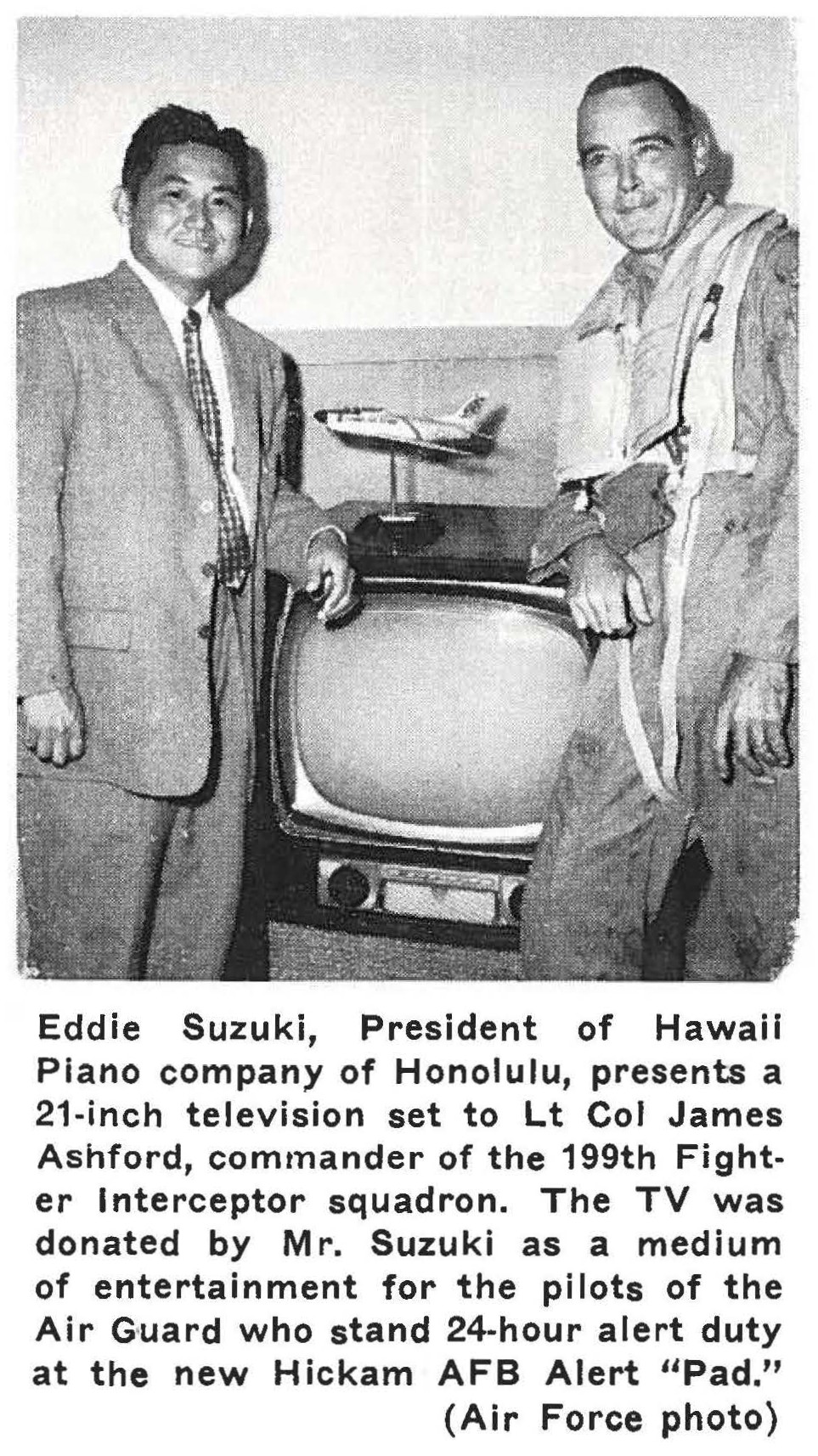
By the way, did you notice the F-86 that Lt. Col. Ashford was flying? It really gleamed with the terrific polish job its crew chief, S/Sgt. Kenneth Camara, is responsible for. That’s really showing interest and pride in your work!
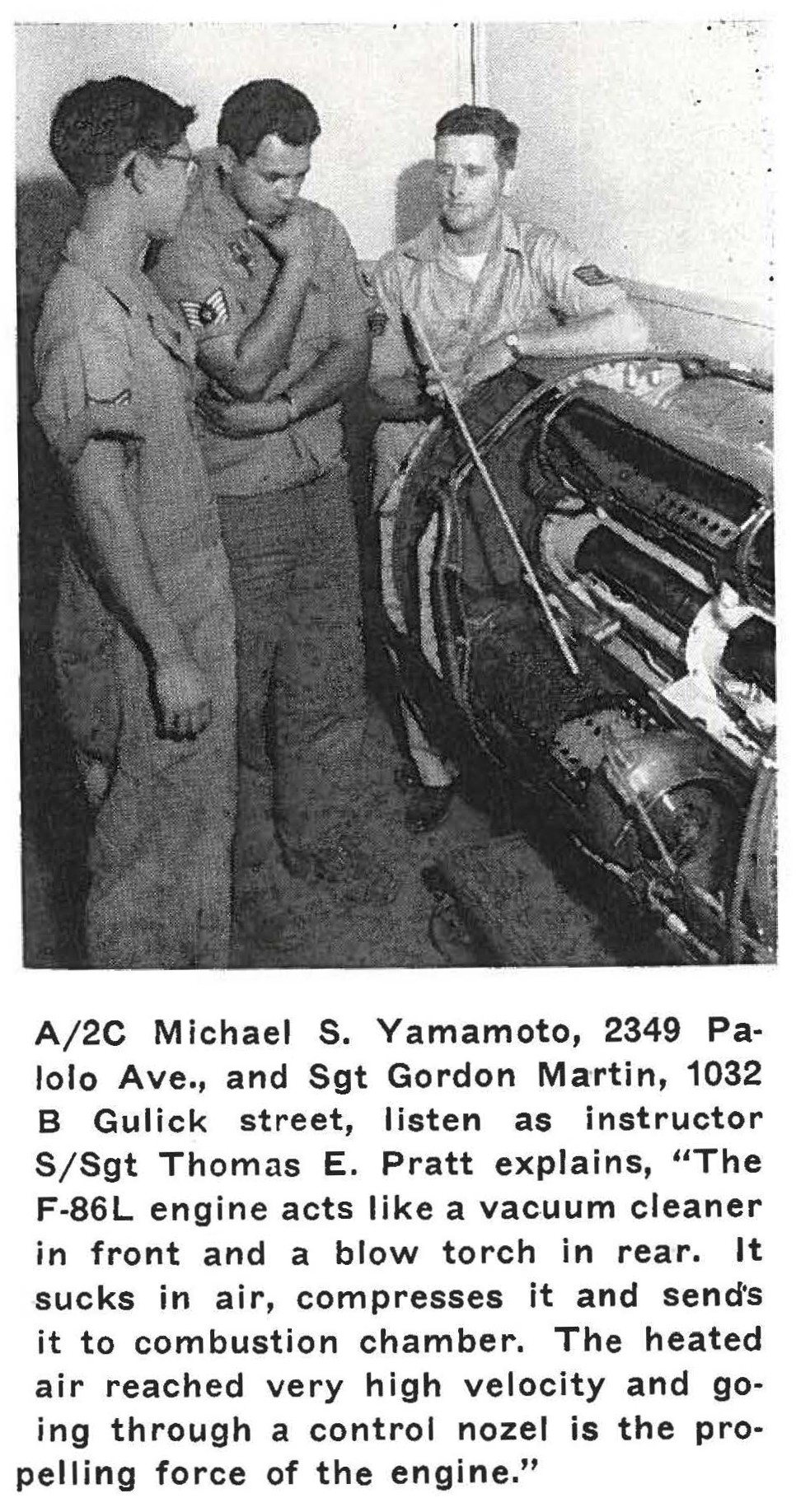
You can be sure that the 109th is proud of its F-86E jet engine change team. The nine men who comprised the team changed an engine on a hot F-86 in a world’s record time of 14 minutes and 14 seconds flat! The team was composed of M/Sgts. Norman Ault, Anthony Kim, and Clyde Sullivan; T/Sgts. George Joaquin and Lewis Kono; S/Sgt. Gordon Martin; and A/1Cs Samuel Saffery and Harry Awana, and A/2C Clement Crowell.
The Air Police of the 199th did a great job handling the overwhelming traffic and parking. Three parking areas were being filled at one time, and all the spillover areas were used. Lt. Henry Lee said that the newspapers’ estimate of 50,000 in attendance was a “conservative figure.” Hickam was required to call out its entire Air Police Force, since the roads were saturated.
Doc Caver’s harem aroused much interest …
The pilots came in for compliments on the new paint job and snazzy insignias on their helmets. All the old bizarre designs and patterns are no more. Incidentally, Lt. Tokunaga wasn’t satisfied until his helmet gleamed with sixteen coats of paint and untold amounts of elbow grease. It’s chromed, too.
Aside from the air show, the paper shufflers of Squadron Headquarters stood down from work one day and changed their AFSCs to that of painters. Instead of Kaiser Pink and Fire Engine Red, the offices of the headquarters section were painted turf green and light lime. Easy on the eyes, and yet bright.
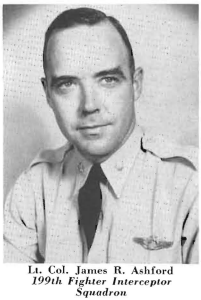
In competition with the other Hawaii Air National Guard units, the 199th was tops in drill attendance from January through March and won the new Hawaii Air National Guard Hi-Attendance Trophy. The trophy is perpetual and will be awarded after each quarter. It was presented to Lt. Col. Ashford at the May 5 drill by Col. Siefermann. The 199th averaged 96% drill attendance to win it for the first time; the 109th and 169th were only a couple of points behind.
M/Sgts. Toshio Oshiro, Tom Kato, Steve Vayda, and Simanu Afoa enjoyed their recent visit to some of the California Air National Guard installations to observe their maintenance techniques and pick up the latest “tricks” of the trade. They visited the Fresno, Van Nuys, and Ontario outfits on their two-week trip. All said that we’re not standing short. Some of the “systems” the Hawaii Air National Guard uses are better, they feel, and a higher aircraft in-commission rate is maintained here.
Because the 199th has been going all out and now has twenty individuals in flying school, the National Guard Bureau reluctantly forwarded word to discontinue the aviation cadet program.
Mr. William O’Brien, technical representative from the AC Spark Plug Company, is now with the 199th for approximately three months, assisting the Armament Section with problems concerning the F-86 gunsight. He will instruct and advise on troubleshooting, proper maintenance, and calibration of test gear.
Recent returnees from service schools include Capt. England from the Jet Instrument Instructor’s School at Moody Air Force Base, and new Tigers, Lts. C. Hutton Smith and Lawrence Mosher. Following the “Tiger Trails” are Calvin B. T. Hoo, Franklin H. Fukui, and Rexford F. Hitchcock, who are off to Lackland Air Force Base for preflight.
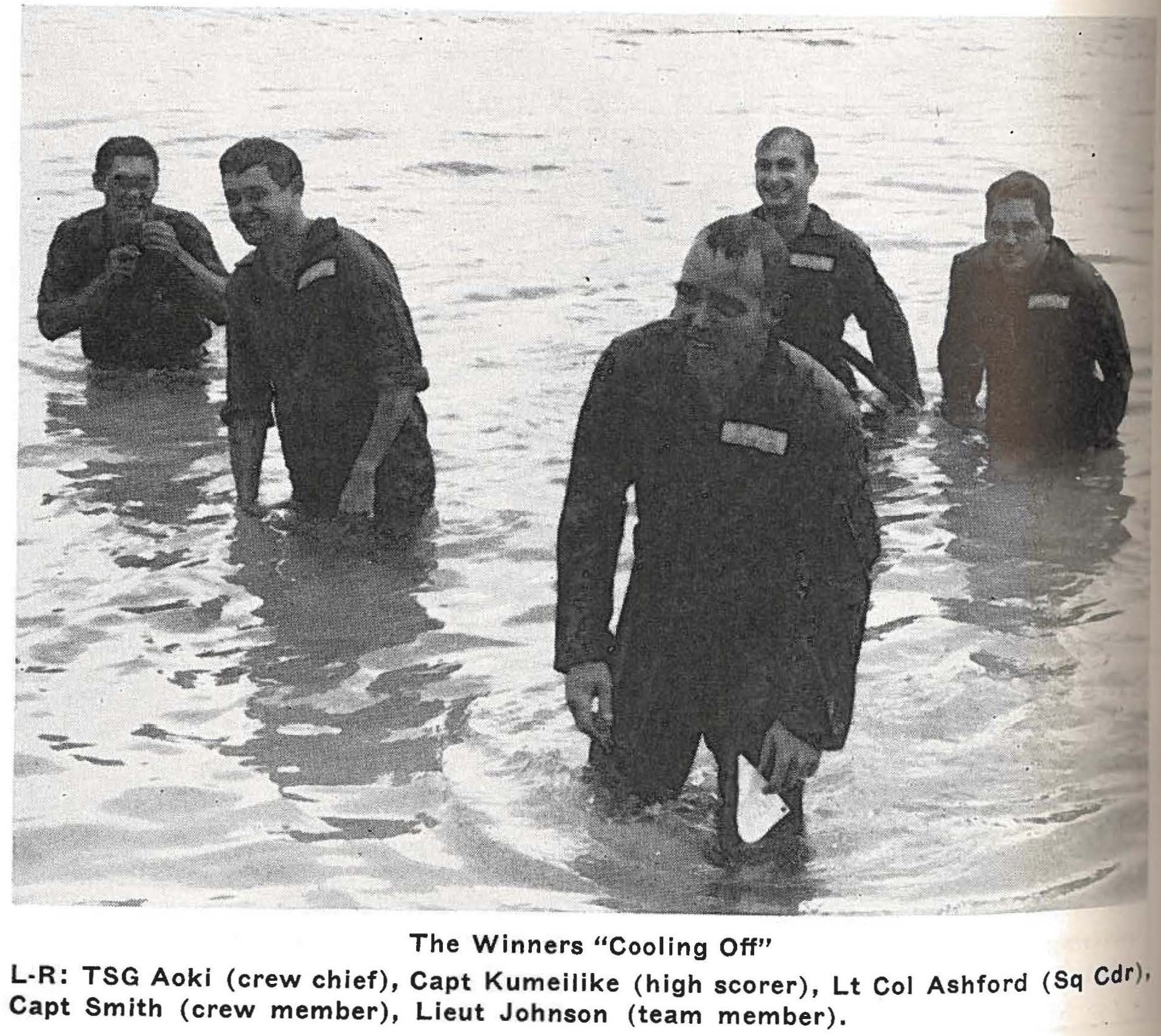
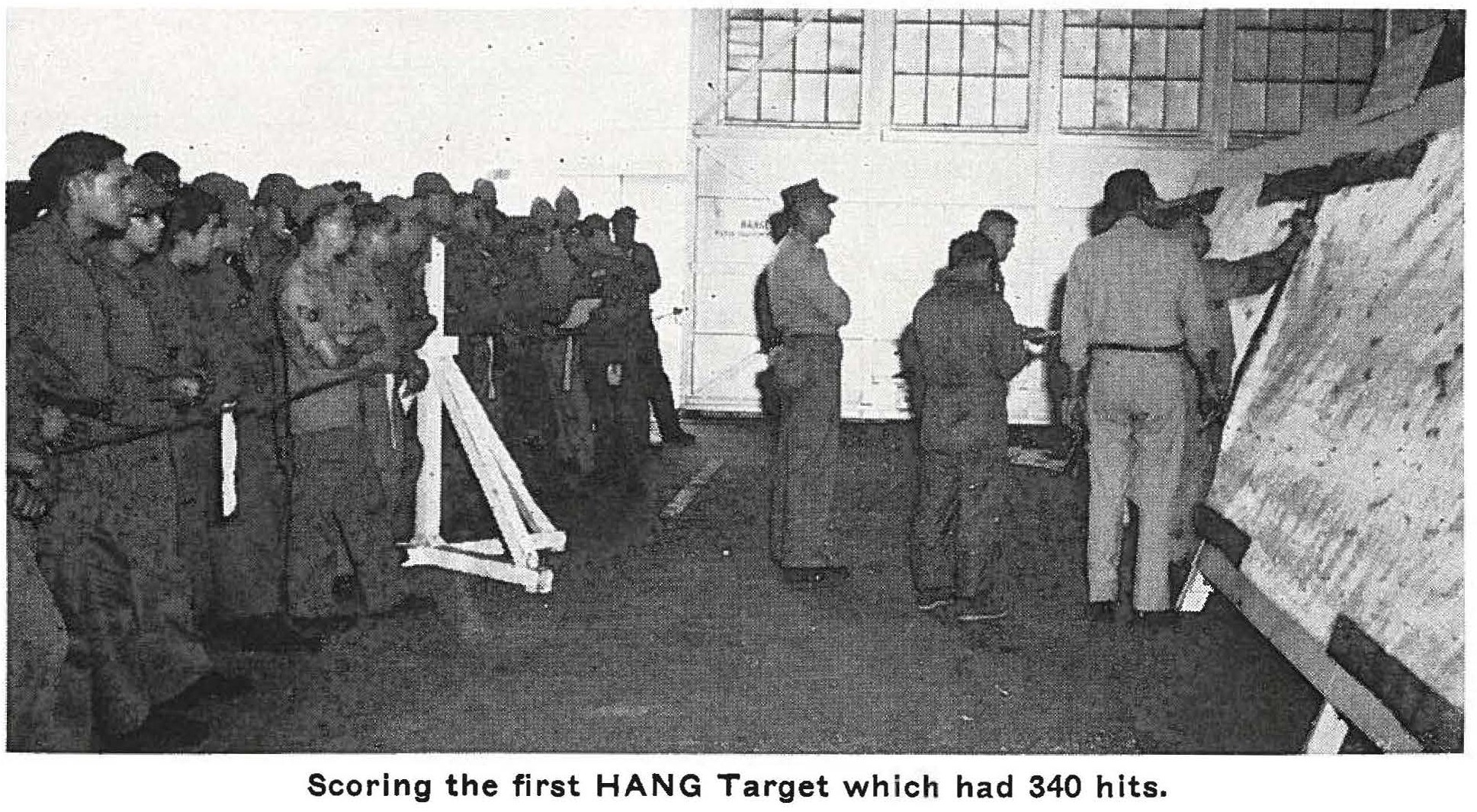
The Winners “Cooling Off” L-R: TSG Aoki (crew chief), Capt Kumeilike (high scorer), Lt Col Ashford (Sq Cdr), Capt Smith {crew member), Lieut Johnson (team member). Scoring the first HANG Target which had 340 hits. (Pictures from the 1957 September Hawaii Guardsman)
Once the 199th Fighter Interceptor Squadron, Hawaii Air National Guard, was able to rationalize that inter-squadron competition was not inter-service rivalry, it was OK to challenge a Marine fighter squadron to an aerial gunnery competition during the recent annual field training. For the past several years the 199th has held its encampments across the island of Oahu at the Kaneohe Marine Corps Air Station where the Marines have actually and literally rolled out the red carpet of welcome and cooperation. They have been grand hosts, and in previous “comparisons of aerial targets” they have edged out the Air Guard.
This year the 199th, which is equipped with the F-86E Sabre-jets, tilted with a Marine fighter squadron equipped with FJ4 Furies. During the past year the HANG jet-tigers found that the Furies had the performance edge on the Sabre-jets when they occasionally “bounced” each other in the local wild blue. So Hawaii’s Aerial Minutemen had slight chips on their shoulders and were raring to go.
The first week, after the 199th got shaken down, the pitch was set—primarily at the fabulous Marine custom of Friday afternoon Happy Hour at the Clubs in Officers and Airmen countries. A few bets were placed. The ground rules were established. Both squadron commanders bragged and told “partial truths” to each other. Minor friendly espionage occurred. Each squadron sympathized with the other squadron. The word got around. The pressure began.
During the past year the 199th had really come up in their aerial gunnery scores due to many intangible factors. Not the least was the pleasant fact that the squadron’s Air Force Advisor was Lt. Col. John Giraudo, whose previous assignment was bossman of the USAF Fighter Weapons School at Nellis AFB. The Armament Section had skill in depth, equipment, and the squadron had a number of better firing ships that the pilots vied to get.
The Marines who normally fired their Furies’ 20mm guns at 15,000 feet agreed to fire at 18,000 feet. The 199th, which normally fired their .50 caliber machine guns at 20–25,000 feet, fired at 20,000 feet. Each aircraft was charged with the 200 rounds it had aboard when it became airborne. No alibis. Four pilots would fire on each of the three team aerial targets and each flight was charged with 800 rounds per target. The better (and smoother) pilots were selected to tow the double-barred 6′ x 30′ aerial targets.
The 199th Team was composed of Lt. Col. James Ashford, Squadron Commander, Captain Lorenz Kumeilike, Captain Frank Smith, Lieutenant Paul Hummel and Lieutenant Kurt Johnson, one of whom would alternate for each of the three missions.
The fateful day arrived. The crew chiefs and armament personnel made their final checks. Colonel Jack Blanchard, who was visiting from the Operations and Training Branch of the NGB Air Division, dropped a few veiled threats to Lt. Col. Ashford about future support from his office. The Squadron Operations Officer took off in the T-bird to tow. The pressure grew. Just by chance many squadron personnel had duties in the vicinity of the flight line …
The gunnery flight became airborne and the progress of their mission was closely monitored by an avid group around the Operations mobile control truck UHF radio.
The first HANG target came down and was brought to the roped-off scoring board for the joint HANG-Marine judging. Exclamations broke out as the number of colored-edged holes were seen. Marine observers shook their heads. The scoring was deliberate and seemed much too slow. The final tally was 340 hits out of the 800 rounds charged—a 42.5% average target! Excellent in any man’s league. Only seven rounds were not fired.
Needless to say this put the Marines behind the gun. They looked grim. When the Furies taxied out for their first takeoff the pilots in the cockpits had abrupt and determined movements. The word spread. Lots of work temporarily stopped. The crowd grew. By any criteria the first HANG target was exceptional.
When the first Marine target came in, the assembled HANG-men tried to count with pointed fingers. The 20mm holes were big (the Marines had been kidding about the “teensy-weensy” .50 caliber holes). The average of 31.1% was a good competitive target. The Marine Group Commander came along to see how things were going and had quite a talk with the Squadron Commander. It was a good target, but the 199th had the old margin.
A thing could happen—a gun malfunction, a mechanical abort, a sight or radar out and the team was charged with the 200 rounds when each aircraft became airborne.
The second HANG target had a 30.1% average with all rounds fired. Colonel Valentine Siefermann, HANG Chief of Air Staff, had a nice chat with Lt. Col. Ashford. Ironically, Lt. Kurt Johnson, who was alternate on this mission, became airborne and fired on another flight’s practice target, getting 113 hits! It would have helped.
The second Marine target had a 33% average with 83 rounds not fired. Whew! If all had been fired, maybe … The Marine Squadron Commander had 52% hits. The crowd grew and the tension rose.
The third and last HANG target came down to the crowded area and Captain Kumeilike had a whopping average of 56% hits … the team target average was 35.2%. An audible sigh of relief came from the assembled HANG-men, who had quite the edge. The assembled Marines had very dogged expressions. One classic comment was overheard—”My gosh, these guys are civilians, and only fly twice a month!”
Perhaps prematurely the HANG-men started gently ribbing their Marine counterparts as it would take a terrific target to beat them. Various “Wheels” thoughtfully discussed the merits and great value of competitive spirit, etc., and had their crossed fingers behind their backs.
The atmosphere was tense when the last Marine target came to the scoring area. The target pickup crew were elaborate in their movements, and used casual and friendly gestures in forcing their way through the unyielding crowd that bordered the ropes. Again many fingers were counting. A good target. The scorers discussed one possible hit, and the crowd nervously laughed as the head scorer wrote “too bad” above the slight colorization. There were lots of hits on this target. You know, it’s amazing to one who is not familiar with 20mm hits, a big hole can be two hits …
The final additions and verifications were made by the three judges recording the hits. The crowd shifted around to the other side of the scoring board to see the final scores placed on the score sheet. Lt. Col. Giraudo, head judge, was deliberate in his entries. The two squadron commanders joked with each other and the crowd couldn’t tell who looked the happiest. Finally Lt. Col. Giraudo came to the important entry—a 35.2% target. Many had already mentally added up the grand totals and whoops and hollers rang out. The final team averages were:
HANG-men: 35.96%
Marines: 33.13%
There were a few quiet collections on the sides of the partly jubilant crowd. The usual pictures were taken, and then the triumphant HANG Team was rushed off by the happy maintenance airmen to the nearby Kaneohe Bay and “cooled off” with their crew chiefs.
Good shooting and good competition. The first HANG target was exceptional enough to swing the Match. Captain Kumeilike was high man with a terrific 50.2% average for the 600 rounds he fired in the three missions. Both squadrons had fine maintenance and there were no mechanical failures. The HANG men failed to fire only 15 rounds out of their 2,400 rounds charged in the Match and reflected great credit upon the Armament Section, who made this fact widely known without delay.
The aftermath of this competition was seen on the following day when the 199th returned from annual field training to home base. It soon became apparent that relations had really become cemented at the O and NCO Clubs. Instead of a squadron fly-by acknowledging splendid hosts and a good annual field training, the Sabre-jets flew back to Hickam by flights, weary and not too precise, but VICTORIOUS.
On August 2, Captain Kumeilike, firing on a moving target towed behind another jet, scored 153 hits out of a possible 200. This is a new record for HANG. This achievement betters 90% of all Air National Guard firing and is in the upper 10% of the regular Air Force.
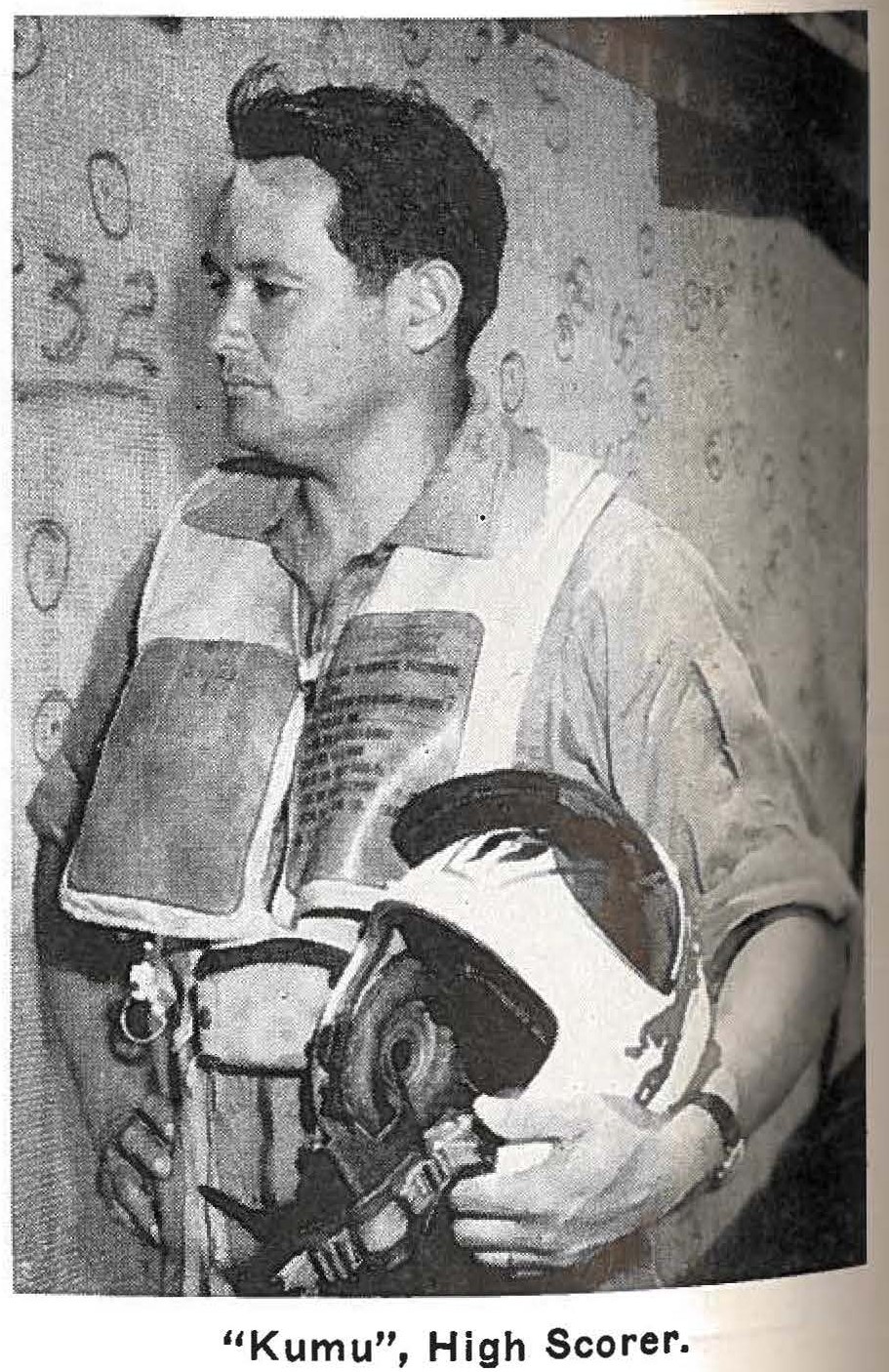
Capt. Lorenz L. Kumeilike Jr. was the high-scoring aerial gunnery jet fighter pilot of the 199th Fighter Interceptor Squadron, Hawaii Air National Guard, during the past fiscal year. He averaged 33.7% hits on the aerial targets out of the 6,530 rounds of caliber .50 ammunition he fired on 67 gunnery missions. He won the 7th Air Force Aerial Gunnery High Individual Trophy awarded annually to the high scorer.
“Kumu,” being one of the favored ones in the Squadron, has his name appearing on the blackboards variously as “Coomelikey,” “Koomerlick,” etc., and seldom the same twice in a row.
Not many of us are acquainted with gunnery in the F-86 Sabre-jet, so perhaps we better elaborate on the aerial gunnery problem and accomplishment.
When Kumu goes on a firing mission in his quarter-of-a-million-dollar Sabre-jet, two of the six guns are loaded with 100 rounds apiece. The bullets in each of the four firing ships on the mission are tipped with a different color of wax-base paint so the hits can be scored.
The target is a six-by-thirty-foot plastic mesh banner which is towed some 800 feet behind another jet aircraft. Firing is done at either 20,000 feet or 25,000 feet (between four and five miles high) in the aerial gunnery ranges north of Oahu.
The Sabre-jet is equipped with a computing sight that has radar to provide range information. The aerial gunnery pattern is based on what is known as the “pursuit curve.” That is, the attacker starts out 90° abeam and higher than the target, and more than a mile away. He banks his plane towards the target, and keeping the sight pipper on the target, fires at a norm of 1,000 feet from the target and at about a 20–25° angle.
There is a maximum of a one-second firing time span while in the pursuit curve for optimum firing. The Sabre-jet is flying at about 600 mph (TAS) and closing on the moving target at about 440 feet per second.
During these firing passes the pilot is subjected to at least three “G’s” (forces of gravity). Usually six to eight passes at the target are made on each mission, with a short burst of fire on each one. With four firing ships in the pattern, precise timing and teamwork is required.
At the close of the three-quarter-hour mission, the target is brought back and dropped so the Armament crew can bring it back to the HANG area for scoring and evaluation. Each firing aircraft is equipped with a gun-camera which operates when the guns are firing—the film is also evaluated so as to improve the pilot’s future aerial gunnery.
Aerial gunnery qualifications are based on percentages of hits at “high” altitude (25,000 feet) and “low” altitude (20,000 feet). Two acceptable percentages must be obtained within a thirty-day period for each altitude to be counted. Marksman qualification is “high” 12% hits and “low” 17% hits, and Expert qualification is “high” 25% hits and “low” 35% hits. The higher in altitude you go the less dense the air becomes, and a specific pattern is harder to fly.
The F-86 in the hands of an expert gunner is really a lethal weapon, for if all six guns were firing, each three-second burst would hurl out 360 rounds. There is a three-foot cone of dispersion at the boresight range of 1,000 feet.
What sort of background does this well-coordinated jet fighter pilot, Capt. Kumeilike, have?
This Dutch-Scotch-English-Hawaiian jet aerial gunnery expert, although born in California, was brought up in Honolulu. He graduated from Punahou in 1942 and went on to the University of Washington. World War II claimed him in 1943 and he went through Army Air Forces Navigation School. Kumu won the Distinguished Flying Cross and the Air Medal with four clusters while assigned to the 305th Bombardment Group, 8th Air Force, as a B-17 Navigator.
When he returned to the ZI, he went through pilot training and won his Pilot’s Wings in 1947. His last active duty was as an F-51 fighter pilot with the 479th Fighter Group in Itazuke, Japan.
Kumu joined the 199th after being relieved from active duty in 1949 and started flying the F-47 Thunderbolts the 199th was then equipped with. Since the 199th received their jets in 1954, Kumu has logged some 500 jet hours. He attended the University of Hawaii and obtained a BBAD degree in 1952. Although an auditor by trade, he flew for a while with Hawaiian Airlines, and is currently employed by the CAA as an Air Traffic Controller at Honolulu Airport. He is a spear fisherman of note and during off-hours can be found in the waters all around Oahu.
Kumu’s good shooting ability has won him places on two Squadron aerial gunnery teams representing the Hawaii Guard in Air National Guard-wide meets on the mainland. His scores during the recent annual field training averaged 49.75% hits and he was the high-scoring member of the Squadron team that won a competition with a Marine fighter squadron. He is considered “combat ready” and has been on Alert duty with the Air Defense Augmentation program.
The 199th is fortunate in having a jet fighter pilot of Capt. Kumeilike’s capabilities as he exemplifies the desired high caliber of Hawaii Air National Guardsmen. Certainly the younger jet fighter pilots have an enviable goal to aim for, and have an inspiration in Kumu’s ability and record.
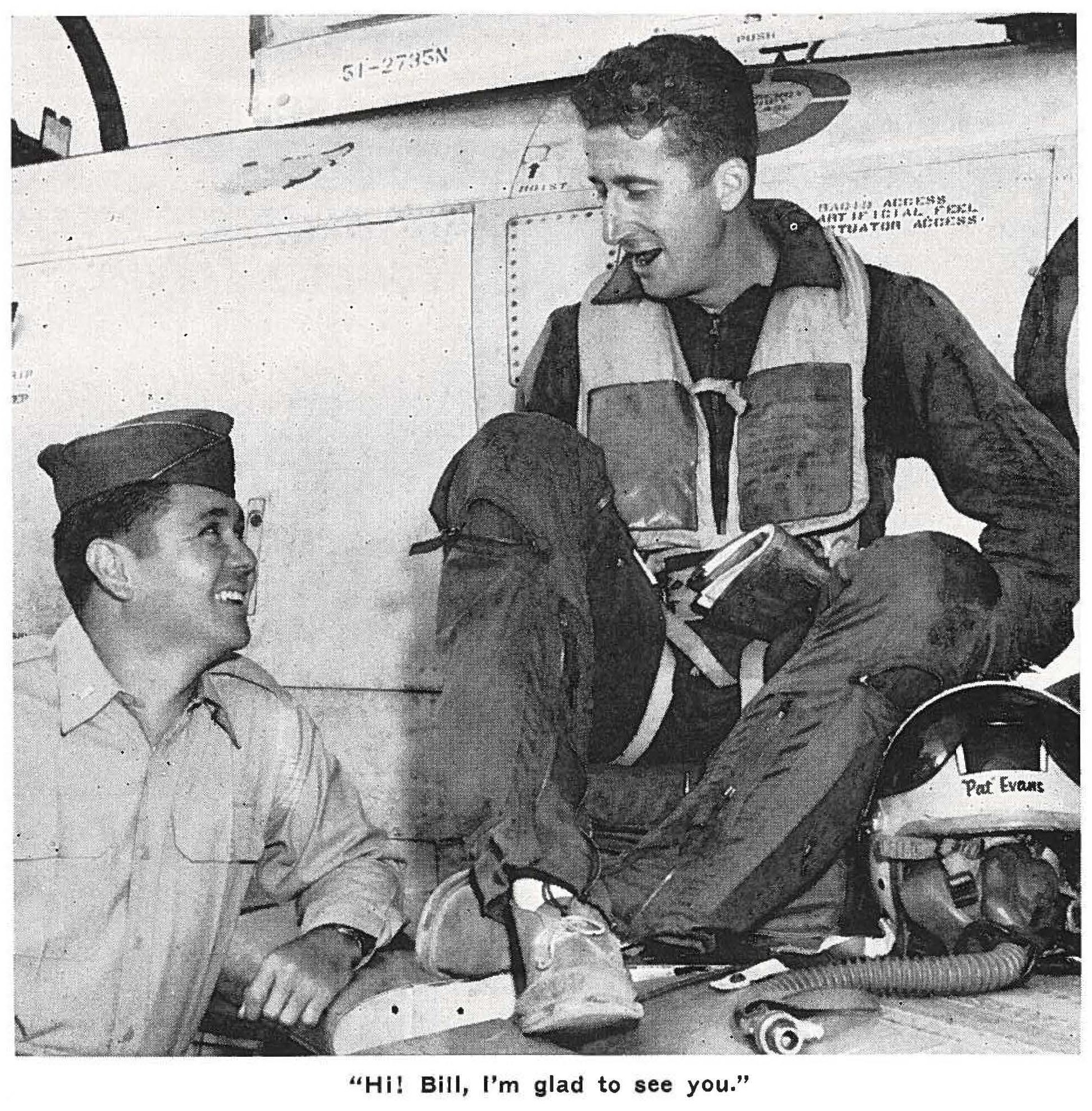
Having considerable difficulty with airborne communications in the Hawaiian area, Flight Leader Capt. Padraic “Pat” D. Evans, 199th Fighter Interceptor Squadron, Hawaii Air National Guard, worked out a system of using prearranged signals by use of the tone function of the radio set to communicate with local controllers.
With radio failure, the loss of the voice feature, and the CW tone operative, the following three signals were set up by Capt. Evans. Two dashes is the affirmative answer, three dashes is the negative reply, and a long series of dashes, repeated several times, is “emergency.”
The 199th FIS, HANG, immediately adopted this program and thoroughly indoctrinated both the pilots and controllers on its use.
Little did Capt. Evans realize that this system, set up by him, was to save his life just one week later!
On a test hop in an F-86E Sabre jet, Capt. Evans experienced an engine failure at a considerable distance from the base. At the same time, his transmitter failed!
He immediately turned on the emergency function of his IFF and headed in the general direction of the base.
Meanwhile, at a local radar site manned by Air Guardsmen, the short-range operator picked up a point of emergency IFF in the Honolulu area. Simultaneously, the radio monitor heard a series of CW dashes.
Remembering the prearranged system of radio signals, 1st Lt. William E. Mossman, radar officer, immediately called the pilot and asked him if he could receive. The pilot answered with two dashes, “affirmative.”
Mossman then did two things immediately. First, he called Honolulu Approach Control and informed them of the emergency, requesting a straight-in approach. Then he called the pilot back and told him to proceed to Honolulu International Airport.
Less than a minute later, Approach Control informed the airport tower of the rapidly descending jet. The tower, in turn, declared an emergency situation, holding all aircraft on the ground and waving off others approaching the field.
By this time, Capt. Evans, who had been listening to tower conversation, was boring down on Runway 8. A few seconds later he brought the swept-winged craft to a safe halt without incident at the world’s 18th busiest airport.
With the initiation of a good emergency system and with the quick action of radar officer Mossman, a possible tragic accident and loss of life was averted. These two officers exemplify the high quality of men in the Air National Guard throughout the nation and in Hawaii.
199th FIS. Pilots in advance training course. L-R. Lt Marl in Little, Lt John S. Carroll, Lt Charles F. Johnston.Instructors Advance Training Course. L-R. Capt Frank J. Smith, Lt Alexander Bell.Lt Robert Cowan, recent graduate of Advance Training Course.(Pictures from the 1957 December the Hawaii Guardsman)
All Hawaii Air National Guardsmen who received their wings through USAF flying schools prior to this last July were sent to advanced jet training schools in the USAF. The USAF decided that they were no longer able to handle this training because of lack of space for their own pilots and cuts in appropriations for training. Thus, this concentrated advanced flying training, designed to qualify a fledgling pilot in F-86E instruments, aerial gunnery, and fighter tactics, was placed right in the lap of the National Guard Bureau, which had no recourse but to refer this training back to the ANG squadron.
The 199th still has fourteen in flying school pre-wings, and four have come back for this home-station advanced flying training on a ninety-day active-duty status.
2nd Lt. David W. Cowan returned from Bryan AFB, Texas, with shiny new wings in June and was the first pilot to go through the home-station program at HANG Area, Hickam AFB, under the eagle eye of senior pilot-turned-instructor, Capt. Frank J. Smith. During the three-month period that followed, Lt. Cowan established an enviable record, being the only 199th pilot to become Alert Ready qualified during advanced flying training. He has fulfilled all but one of the requirements to become Combat Ready, needing only twenty-five more flying hours to attain this distinction. Previously, pilots returning from USAF Advanced Flying School have needed several months of training to attain this goal.
Lt. Alex Bell has taken on the role of assistant schoolteacher to assist Capt. Smith in the training of his three present students: Lts. Marlin Little, Charles Johnston, and yours truly, John Carroll.
Our only comment on Lt. Cowan’s achievement is that he sure makes it tough on us. We may not beat his record, but we will do our best to match it. Who knows? With our instructors’ help, we may beat his aerial gunnery scores …
The training program is composed of three phases.
Phase One is spent flying the T-33 jet trainer. During this phase, the student sits in the rear cockpit for fourteen flights with a hood over his head. He learns to take off, fly, and land without seeing anything but the instruments in front of him. How often have you driven your car on a dark, rainy night when you could hardly see outside of the car, and had to creep along at about 10 mph to stay on the road? Just visualize yourself under the same conditions, but flying at several hundred miles an hour, up away from streetlights, and in a position that if you slowed down below 120 mph your aircraft would stall—you’re OK if you have enough altitude! You can see the value of this training. The best fighter pilot in the world is useless if he can’t take off in the worst weather, hit his target, return to his home base, and land safely. Sometimes you can’t just talk about the weather—you go.
Phase Two involves transition into the F-86E Sabre jet. This is a phase we are all looking forward to, as it will be the first single-seat jet aircraft we’ve ever flown. And a fighter, too! Before, prior to our first solo ride, an instructor flew in the same aircraft with us on several flights. In the Sabre, we are on our own. Even though an instructor will follow us in another F-86, it won’t be the same. He won’t be able to grab the stick if we make a mistake, or see the instrument panel if something is wrong. The solo flight is the busiest, loneliest flight in the world!
At last, after sixteen months of flight training, we will have left trainers behind and be flying jet fighters. But our training will not cease after this flight. Phase Two consists of seventeen flights covering solo, formation flying, acrobatics, instruments, navigation, night flying, and maximum performance (going through the speed of sound! A Mach buster!).
Phase Three is the culmination of all the training that has gone before. This is the combat-training phase, consisting of sixty-five flights, primarily tactical formation, ground-controlled interception, fighter-versus-fighter tactics, fighter-versus-bomber tactics, camera gunnery, and finally, air-to-air gunnery. This phase gives us the most satisfaction of all, as we will finally be performing the functions of a jet fighter pilot and will have a chance to compare our skill against other pilots.
Then, the three phases being over in January 1958, three more Tigers will join the 199th Fighter Interceptor Squadron as qualified tactical pilots in the HANG Air Defense Team.
The 199th Fighter Interceptor Squadron, HANG, was awarded the “Order of the Hawaiian Airman” Friday, November 22, at the Pacific Jet Age Conference held at the Reef Hotel for being the most alert outfit of its kind in the United States during the past year.
Presentation was made at the opening session of the conference by Governor Quinn on behalf of the Air Force Association. Accepting the award was Lt. Col. James R. Ashford, commander of the 199th.
In the citation, the Air Guard was commended for maintaining the “highest operational readiness rating in comparison with 19 other Sabre jet-equipped units in the Air National Guard across the United States.”
The award was also made for HANG’s contribution to the air defense of the islands.
An important facet of an armed services organization is to insure that the “word” is passed from the top to the bottom and vice versa. This can be accomplished in several ways; for example, daily bulletins, regulations, memos, SOPs, and base newspapers.
As a means of cultivating morale, the 199th FINCEPTRON has published a monthly newsletter, Kukailimoku—a name which was selected after a “Name the Newspaper Contest” in which SSgt. Arthur Lee of the Engineering Section submitted the prize-winning entry.
The aim of the squadron newspaper is to inform all personnel of policies and regulations which affect him, to let him know what other elements in the organization are doing, and to disseminate complete and accurate international, national, and local news. With the use of pre-cut stencils and clipsheets provided by the Armed Forces Press Service, our newspaper has acquired a professional look since its inception two months ago.
Birthday Greetings
On 10 September 1957, the 199th Fighter Interceptor Squadron, HANG, quietly celebrated its eleventh anniversary. The present squadron was organized on 10 September 1946 as the 199th Fighter Squadron and numbered 81 personnel—officers and airmen. Federal recognition followed on 4 November 1946.
It was redesignated as the 199th Fighter Squadron (SE), Augmented, and later as the 199th Fighter-Bomber Squadron, Augmented, on 1 November 1950 and 15 July 1952, respectively. Its present organizational title was acquired on 19 November 1952.
Throughout its brief but colorful history, the 199th FINCEPTRON, HANG, has diligently and constantly proven itself capable of accomplishing its assigned mission: the interception and destruction of enemy airborne weapons.
Testimony of its high state of operational readiness was notification from the National Guard Bureau to Major General F. W. Makinney that the 199th achieved the highest operational readiness rating for the twelve months ending 1 July 1957. This outstanding status was in comparison to nineteen other Sabrejet units in the Air National Guard.
Premier of 199th in Color
A spectacular color production covering a typical drill day of the 199th FINCEPTRON was recently shown to all personnel in the squadron. Approximately a half hour in length and the result of months of sweat and toil, the movie was very favorably received.
Major Walter F. Judd, who was in charge of production, commented that the film was a “gigantic scrounge” of photographers, film, funds, and many other items. Upon completion of local legwork, the film was forwarded to the National Guard Bureau for final processing and soundtrack.
In addition to the squadron showing, the movie has been previewed by the QB and Farrington High School. It will be used for recruiting and other publicity purposes, as well as showings to various civic organizations.
Testing
The administrative section of the 199th has announced that the Airman Qualifying Examination (AQE) will be given each Sunday drill at 1300 hours. Interested personnel must report to headquarters between 1215 and 1245.
First Command Pilot
Congratulations go to Major Russell Smith, who was presented the wings of a Command Pilot. Major Smith, the first Command Pilot in the squadron’s history, logged over 3,000 flying hours and 15 years’ service as a rated pilot to achieve the honor.
. . .
Service School
The call of the mainland seemed to appeal to many 199th Guardsmen. Away at service schools on the mainland are:
SSgt. James T. Omura; A1C Earnest M. Azama, Walter Y. Komoda, and Harry M. Nakasone; A2C Raymond W. M. Loo, Lawrence J. Tsutsumi, Gordon N. Gilleres, Joseph W. Fasone, and Charles R. Calvan; A3C Charles Y. Arakaki, Abraham K. Hiapo, Warren K. Higa, Xavier P. Ishihara, James S. Yamamoto, Clarence K. Tsark, and Norman Tkachenko.
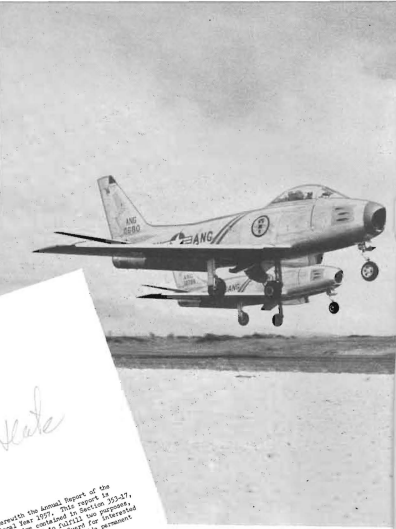
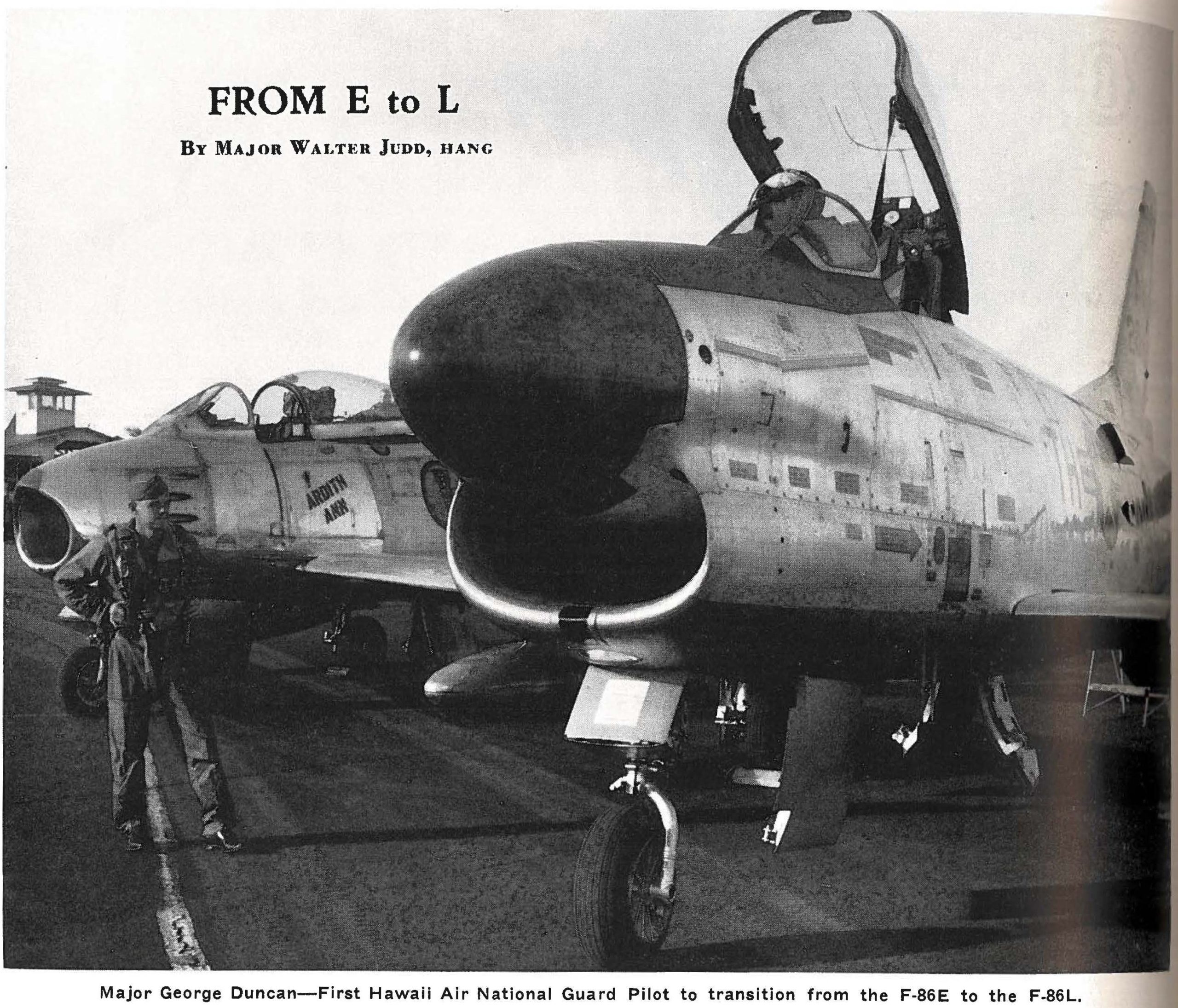
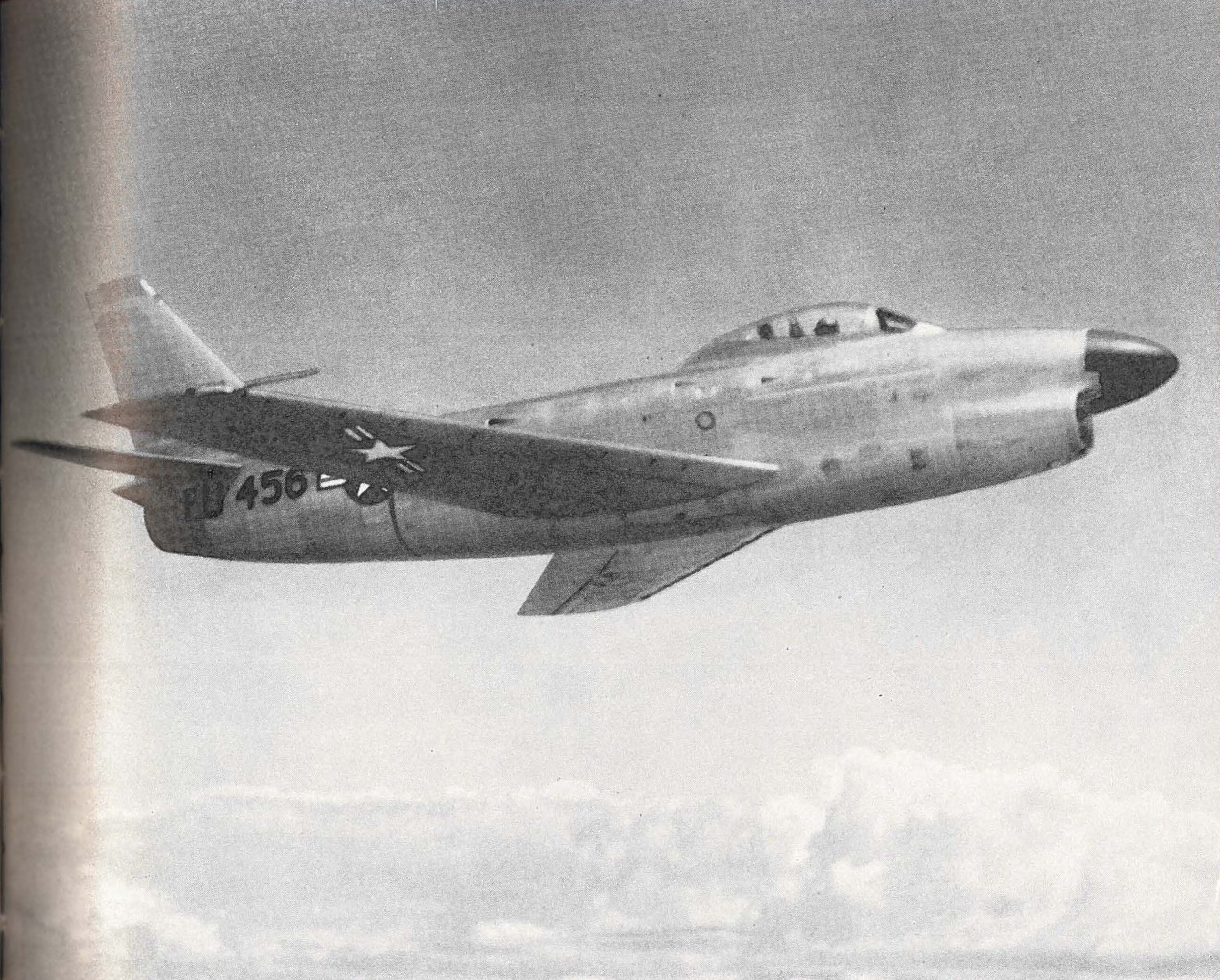
Air GuardThe F86-L, rocket firing, all weather Jet, of the Hawaii Air National Guard (Right), takes over as guardian of Hawaii’s skies front the now obsolete F86-E (Left).Lt. Col. James R. Ashford 199th Fighter Interceptor Squadron(Pictures from the 1958 Annual Report)
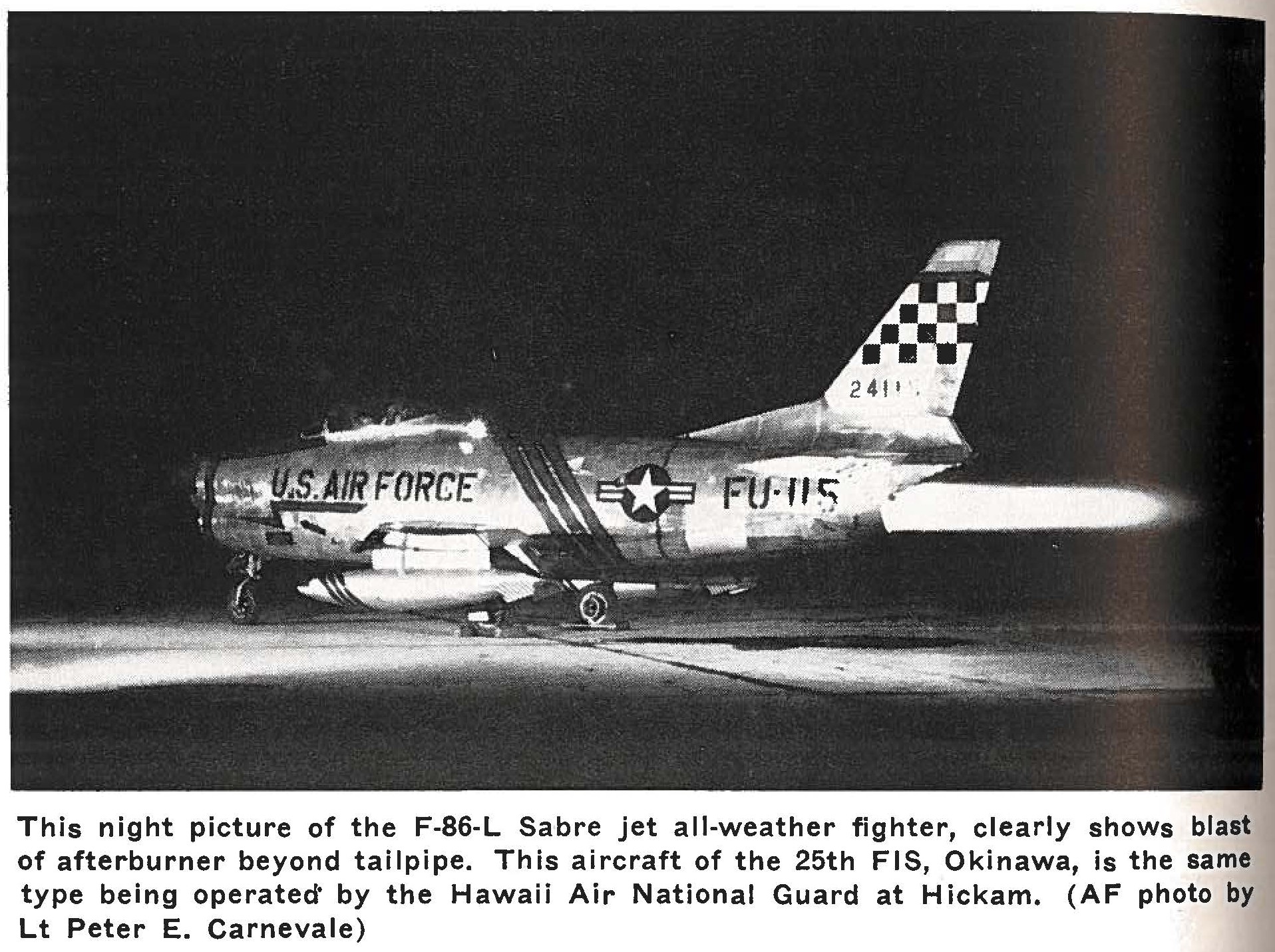
Fighter: The 199th Fighter Interceptor Squadron converted from F·86E day fighters to F-86L all weather fighters with the first “L” being received on 5 February 1958. The new aircraft is a lethal weapon which is not restricted to visual contact during daytime; it can perform its mission day or night and in any type of weather. Instead of machine guns, the F-86L carries the “Mighty Mouse” air-to-air rockets.
On 1 May 1958 the “L” replaced the HE” on the Air Defense Augmentation program and the Hawaii Air National Guard received a wire of congratulations from the Chief, National Guard Bureau on the rapid conversion-“The Best Yet.” By the end of June 1958 all tactical pilots of the Hawaii Air National Guard units had been transitioned into the new aircraft.
During conversion, the unit received big assists from the local Air Force. Personnel had to be retrained for the more complex aircraft and supplies and support equipment procured. First, the F-86-6 Mobile Training Detachment instructed all personnel concerned with the ground training requirements; secondly, the assignment of three well qualified all weather jet pilot” to the 199th Fighter Interceptor Squadron was accomplished to assist in the flying training of tactical pilots. Without the assistance of these pilots, transition would not have progressed smoothly or rapidly. They have been of tremendous value to the squadron.
During the fiscal period, 6,854 jet hours were flown by HAFNG pilots, an increase of 153 hours over the previous year’s 6,701 jet hours. The tactical pilots averaged 201 hours of flying time. Considering the fact that each hour flown is tactical flying-gunnery, tactics, radar intercepts, etc.-this is a notable achievement even for an active duty outfit.
Considering the fact that the 199th Fighter Interceptor Squadron had just been converted to all-weather aircraft and that new tactics had to be learned by all personnel, all units performed in an excellent manner during the ORE.
Major George Duncan-First Hawaii Air National Guard Pilot to transition from the F-86E to the F-86L. (Pictures from the 1958 March The Hawaii Guardsmen)
Significance
The 199th Fighter Interceptor Squadron is converting from F-86E to F-86L Sabrejets. There is a much bigger change involved than just the letters “E” and “L”—the squadron’s mission is changed from Day Fighter Interceptor to All Weather Fighter Interceptor. The new aircraft is a lethal weapon which is not restricted to visual contact during daytime; it can perform its mission day or night and in any type of weather. The F-86L uses different tactics for its function of intercepting enemy bombers.
Regretfully, the days of friendly competition “bouncing” the Marine jet fighters across the island are almost passé. The “L” has secondary fighter-versus-fighter capability.
Aircraft
Both models, “E” and “L,” are made by the North American Aviation Company and have General Electric engines. But there the similarity stops, as they are entirely different aircraft. In configuration, the “L” is larger and heavier, has the air scoop below a radome in the nose, and uses a clamshell canopy. The “L” engine has an afterburner for additional thrust for climbing or interception, and its fuel is metered by an electronic fuel control. There is an automatic pilot control system to be used in conjunction with interceptions, and a drag chute which is released upon landing to shorten the landing roll distance.
As mentioned above, the armament and fire control system are entirely new to us and considerably more complicated. Lots of little electronic black boxes! For each little black box in the “E,” there are ten in the “L” …
Incidentally, although there are other all-weather interceptors assigned to Air Guard squadrons, the 199th is one of the first to be honored with the F-86L, which is the latest and most up-to-date all-weather fighter in the Air Guard inventory.
Conversion
Conversion hit the HANG-men suddenly, and followed in the wake of current financial austerity to complicate planning. Big assists were received from Pacific Air Force, Hawaiian Air Defense Division, and PACAFBASECOM after many meetings to determine who does what. There was a sack full of problems. An important consideration was facilities. For example: the new engine and its afterburner require much more height than our present engine shop; the drag chutes have to be packed, so we needed a larger parachute-building area. Conversion meant not only finding the true facilities, but the time-consuming preparation of plans and specifications, etc., and getting the jobs done.
Being at the end of a long 120-day supply pipeline, logistical support required lots of thought and push. Some 5,000 new line items of parts and equipment had to be obtained by HANG Base Supply, and about 5,000 line items in stock disposed of. We found that only some 10% of F-86E parts were interchangeable with the F-86L. Each type of aircraft has its own auxiliary and test equipment—the “L” has some 290 line items, much of which is scarce and difficult to come by. The NGB and MANA surveyed their resources, and Pacific Air Force obtained some items from regular outfits in the Pacific. Without adequate support equipment, combat readiness would stand short and slow, if at all.
Another big problem concerned the flight simulator, which is an elaborate and complex piece of ground equipment for simulating aerial flights under differing conditions and problems. Much necessary instrument and procedure training is obtained that is so realistic that the incumbent pilot sometimes forgets—imagines himself airborne—and the sweat pours out as the operator cranks in difficult or emergency conditions. (One model simulator even has a seat that will jolt slightly when the pilot is in a condition where he has no alternative but to pull the ejection handle!)
We had a C-11B Link Trainer, some $65,000 worth of equipment, which was housed in a recently rehabilitated and air-conditioned building in the HANG Area, Hickam AFB. The new simulator proved too large to fit the building, so Hickam generously provided space in their simulator building by moving out a C-97 Flight Simulator.
It was found that the power requirements for our new simulator were more than for the two Hickam simulators combined, so there was a mad scramble for additional electricity … and so on.
These simulators occupy positions of such importance that our new one was airlifted from Louisiana in a C-124.
The new simulator has a book value of $405,000 and is accompanied by two factory technical representatives for installation and maintenance assistance to our synthetic trainer personnel. Speaking of dollars, the F-86E is valued at $219,457 and the F-86L is valued at $582,493. Multiply this by twenty-seven aircraft assigned to the 199th and you’ll come up with a respectable dollar inventory. We assume we’ll use as much jet fuel as we did last year—over $300,000 worth.
Whenever an outfit in the USAF or ANG is re-equipped with new aircraft, several sorts of skilled technical help are provided to assist in getting the squadron initially trained and over the hump. In our case, USAF provided a Mobile Training Detachment of one officer and ten airmen who have been conducting day and night classes these past few months for the pilots and maintenance personnel. They have superior mockups and provide instruction in the theory and actual operation of the F-86L systems.
Factory technical representatives, contracted for by the National Guard Bureau and who will be with us for up to a year, are on hand from the North American Aviation Co. (aircraft), General Electric Co. (engine), Lear Inc. (auto pilot), and Engineering Research Corp. (flight simulator). These “Tech Reps” will aid us in maintenance and troubleshooting techniques, and will assist us in learning the finer points of the new aircraft.
Tactics
There are completely new tactics for this jet fighter that our pilots will have to learn. In the F-86E on a ground-controlled interception mission, the AC&W Controllers would position the fighter 90° abeam, higher, and in visual contact with the target. The “E” is equipped with a computing sight that has radar to provide range information. The fighter pilot would bank his aircraft towards the target, keep the sight pipper on the target, and fire his six cal. .50 machine guns at a norm of about 1,000 feet from the target, and at about a 20–25° angle. This attack is known as the “pursuit curve.”
The F-86L has a much more elaborate fire control system that calculates for a “lead collision” attack during which the pilot does not have to see the target visually. The AC&W Controllers direct the fighter to a position and course which, if continued, would pass slightly astern of the target and at a 90° angle. When the fighter’s radar “locks on” to the target, the fighter pilot takes over control of the interception, and his own computing fire control system tells him where and how to go by means of a radar scope presentation. The armament is fired automatically at an optimum range by the fire control system after being activated by the fighter pilot.
Instead of machine guns, the F-86L carries twenty-four 2.75-inch “Mighty Mouse” air-to-air folding-fin rockets in a pod located below the cockpit which lowers and fires in a fraction of a second. Each rocket is about four feet long, weighs less than twenty pounds, and one hit is considered lethal to the target as the rocket has an explosive head.
Air Defense
It is known that for some time the HANG has provided the local Air Force with the basic tools to do the Air Defense job. The two AC&W squadrons man radar sites around the clock, which provide aircraft movement information and ground-controlled interceptions upon direction. The 199th is the other part of the team which provides two pilots and jet fighters on five-minute alert for interceptions, backed up by the remainder of the squadron’s aircraft and pilots.
We of the 199th are especially glad to get the “Ls” as they will provide us with the capability to handle the Air Defense fighter job in fair weather or foul and during longer operational hours. “Aerial Minutemen” is a realistic phrase which is taken seriously and means much to Hawaii’s Air Guardsmen.
Lots of Work Ahead
The pilots have to learn the new aircraft and their new tactics. The AC&W Controllers have to learn even more refined positioning. The squadron ground crews have to learn to maintain a very much more complicated aircraft, especially in the electronic and fire control fields. Like the entire Air National Guard, one of the biggest problems we face is to get the best of our young men properly trained to maintain the electronic black boxes. This beautifully efficient aircraft is useless unless we can properly maintain and adjust the complex equipment so it will function when needed.
And we will maintain our Air Defense Alert commitment in the “E’s” until we can do it in the “L’s.” Our squadron insignia is personified as “Manu Lele o ke Akua Kaua”—Flying Birds of the War God … We can do it!
A/2C Michael S. Yamamoto, 2349 Palolo Ave., and Sgt Gordon Ma-rtin, 1032 8 Gulick street, listen as instructor S/Sgt Thomas E. Pratt explains, “The F-86L engine acts like a vacuum cleaner in front and a blow torch in rear. It sucks in air, compresses it and send’s it to combustion chamber. The heated air reached very high velocity and going through a control nozel is the propelling force of the engine.”Air Guard students studying the Fuel System of the F-86L will learn every one of the dozen steps the life blood fuel goes through from the time it leaves tanks till it gets into the engine. From left to right S/Sgt Gilbert T. Tokunaga, 624 G Waipa Lane, instructor A/2C Ronald F. Beard, WO Harold T. Mattos, 627 N. Kainalu Drive, Kailua, and S/Sgt Samuel M. Saffery Ill, 1236 Polamea Lane look a little bewildered at the path the fuel takes to the engine which rsembles a complex road network. (Pictures from the 1958 March The Hawaii Guardsmen)
The 199th Fighter Interceptor Squadron, Hawaii Air National Guard, was kept busy preparing for the arrival of twenty-seven of the latest jet fighters ever assigned to any Guard unit. The F-86L’s, which arrived last month, will beef up Hawaii’s air defenses since they are all-weather fighters and are faster and more deadly than the F-86E’s now used by the Guard.
To instruct the Guardsmen in performing maintenance on this complex fighter, the Air Force sent the F-86-6 Mobile Training Detachment from Chanute Air Force Base, Illinois, to Hawaii. The detachment, consisting of Captain Paul F. Drake and ten enlisted instructor specialists, began training the Guard personnel in converting to the F-86L on November 17th.
They arrived in Hawaii with an elaborate series of training aids and a well-planned, rigid course in all phases of maintenance on the F-86L’s.
The Air Guard personnel attended classes at Hickam four hours a day in addition to their regular duties. The Guard pilots attended evening and weekend classes. The classes were from 7:15 in the morning until 3:45 in the afternoon.
The maintenance men, who were already specialists with the F-86E’s, were taught hydraulics, radio navigational electronics equipment, armament and fire control, radar instruments, electrical systems, engine maintenance, and electronic fuel control in order to become specialists in these fields with the F-86L’s. Although there is much similarity between the two planes, there are a great many differences. The new F-86L’s fire rockets exclusively, whereas the F-86E’s armament consisted of machine guns. The radar system of the F-86L is also greatly improved and enables a pilot to shoot down a target without seeing it except as a blip on his radar screen.
The Mobile Training Detachment set up a separate course for each group of specialists who will work on the new all-weather fighter. The electronics specialists, for example, received a 120-hour course, whereas the crew chiefs were given a 96-hour course. The men were required to pass detailed examinations before they graduated from the training.
In addition to training the maintenance men, the F-86-6 Mobile Training Detachment instructed the Guard pilots in all the technical phases of the aircraft they would need to know to fly it safely and effectively.
Technical Sergeant Donald J. Quinn, the noncommissioned officer in charge of the detachment, said that about 80 percent of the Guard’s maintenance personnel completed the classroom training by the time the new jets arrived, and the balance of the men were well along with the training. He said that the 199th was probably the sharpest outfit he had ever worked with and that he was amazed at the quality of the students.
Quinn stated his detachment would remain for several months after the new jets arrived to give the Guardsmen practical training on the plane. He said it would take the men a while to get used to the new aircraft, but that the F-86L’s would definitely be in good hands by the time his detachment returned to the Mainland.
Lieutenant Colonel James R. Ashford, commanding officer of the 199th Fighter Interceptor Squadron, said that the excellent assistance of the F-86-6 Mobile Training Detachment would ease the conversion to the new aircraft considerably and was greatly appreciated by his unit.
Another in the long line of “firsts” for the 199th Fighter Interceptor Squadron, Hawaii Air National Guard, took form when the carrier Windham Bay unloaded $16,000,000 worth of F-86Ls at Pearl Harbor.
Equipped with afterburners, these rocket-firing, radar-equipped interceptors will eventually pave the way for a 24-hour air defense alert of the Hawaiian Islands. Aided by an accurate fire control system, the pilot of the 625-mile-per-hour all-weather jet interceptor can loose 24 “Mighty Mouse” rockets at an aggressor, as compared with the .50-caliber machine-gun firepower of the present F-86E Sabrejet.
Dangerous at all hours, the pilot is directed to his target by radar, which aims the rockets and fires them without his having actually seen the intruders. . .
Summer Camp
Around the Corner Well, looks like the 199th FINCEPTRON will bivouac for summer camp at Hickam Air Force Base. Scheduled dates are 21 June to 5 July. This will be our third stay at Hickam for summer encampment, the last time being in 1950. . .
Quarterly Attendance Trophy
The 199th has possession of the HA G quarterly drill attendance trophy again, having the highest attendance during October-December 1957. The 199th averaged 96% which was several points ahead of the 109th and 169th. Since this trophy was established last year, the 199th has been the winner except for one calendar quarter. Congratulations, fellows- let’s keep it in our possession. Attendance is everybody’s business. You can’t learn if you aren’t here.
I walked down the sidewalk on my way to the Central YMCA gym, when a happy, smiling face greeted me. We shook hands and then he led me into a small, well-kept office. We started to talk about National Guard affairs and, of course, handball. This person was S/Sgt. Robert Sun of the ANG, also the Territorial Handball champion.
Sgt. Sun has been playing this game for over six years now, and he has too numerous titles to mention in this article. His reign as the handball king in the Territory has been for the past four years. The doubles crown has also been worn by him during the past two years. He told me a rather amusing story on how he actually got started in this game.
He used to watch many of the top players of yesteryears playing at the gym and, on one particular day, one more player was needed to complete a foursome. Rushing down to the court and very anxious to play, he was greeted with a “come back when you are a better player” remark. This was the turning point in the brilliant career of Bob Sun.
He practiced daily for months, but was rewarded, as we can see. As a matter of fact, Sgt. Sun was humiliated in his first big tournament, 21-0, 21-0 in two straight games. This may have discouraged others, but to him it only meant that he had to practice harder.
He gives credit to Young Suk Ko and Dr. Richard You for his continued success. Without them, he said, “I would be just an ordinary player.”
Last year at Dallas, Texas, playing against the Nation’s best, Sgt. Sun lasted until the third round before being eliminated. He received recognition from the United States Handball Association by being presented a beautiful trophy naming him “Sportsman of 1957.”
While on the Mainland, he acted as an ambassador from Hawaii and received the key to the city from the Mayor of Dallas. He also appeared on radio and television, both times on the popular Art Linkletter show.
“Handball is a terrific game; it develops condition, timing, coordination and stamina,” Sgt. Sun said. He later showed a magazine which featured an article on the US Air Force Academy in Colorado. There are nineteen handball courts located there, each costing $16,000.
Sgt. Sun has been in the 199th FIS for five years as the Assistant Mess Steward. He told me of his enjoyment in preparing food for our flyboys. He practices every day and feels that every opponent is a threat to his triple title: AAU, Territorial YMCA and USHA champion.
I thanked him for his time and, on my way out, he was joining someone in the court for a game. Walking out of the “Y,” I smiled to myself. It is very gratifying to know that an athlete of his prominence still has time to say on drill days at Hickam and at summer camp, “How do you want your eggs?”
This night picture of the F-86-L Sabre jet all-weather fighter, clearly shows blast of afterburner beyond tailpipe. This aircraft of the 25th FIS, Okinawa, is the same type being operated’ by the Hawaii Air National Guard at Hickam. (AF photo by Lt Peter E. Carnevale)(Picture from the 1958 June The Hawaii Guardsman)
If some evening you should see an aircraft hustling through the sky off of Diamond Head with a streak of fire coming out of its tail, don’t reach for the nearest phone to call the fire department. It’s probably one of the 199th Fighter Interceptor Squadron’s new F-86L aircraft.
The plane is on another Air Defense mission, and the pilot is using his afterburner to get the maximum performance out of the aircraft. This feature allows it to climb faster and higher to position the complex and efficient radar sighting and firing system, which in turn will launch the deadly 2.75-inch rockets. More insurance for yourself and your family!
Aircraft designers, engineers, and pilots are constantly striving for new and better ways to increase the speed, range, and combat capability of today’s jet aircraft. One of these ways is the afterburner.
Very simply put, an afterburner is a jet engine on the end of another jet engine. Jet engines develop their thrust, or power, from rapidly moving an immense amount of air through the engine. The air that enters the front end of the engine is compressed by a series of fan-like compressors, heated and expanded by burning fuel, and expelled out the tailpipe, thus creating thrust.
If a jet engine is equipped with an afterburner, the same process takes place just before the hot gases leave the tailpipe. The air is already compressed by the engine itself, so all that is necessary is to add more fuel to the rapidly moving gases, which even more increases the speed of the gases traveling through the engine, thus increasing the thrust developed by the engine.
So far, so good. The afterburner has increased the power of the engine by at least 30 per cent, and at the cost of no moving parts and very little additional weight. However, the afterburner does have its drawbacks. The biggest of these is the tremendously increased fuel consumption of the jet engine with the afterburner operating.
The F-86L, under normal conditions, is not the most economical aircraft in the world, burning six thousand pounds of fuel per hour at sea level (this is 925 gallons per hour). But with the afterburner operating, the fuel consumption jumps to 15,000 pounds or 2,300 gallons per hour. At sea level, with the afterburner operating, the F-86L carries enough fuel for twenty minutes of flight, compared to almost two hours at altitude without the afterburner.
Another problem created by the installation of the afterburner is the increased temperatures generated by the burning fuel. In the F-86L this problem is handled by installing a thin sheet metal liner in the tailpipe. This liner is coated with a ceramic substance, capable of withstanding extremely high temperatures, and in addition is corrugated to allow comparatively cool air to come between the liner and the tailpipe.
To control this additional power, and to insure the most efficient use of the additional fuel, the afterburner is equipped with an adjustable nozzle at the end of the tailpipe. These nozzles automatically open and close to adjust the power delivered by the engine as indicated by the movements of the throttle made by the pilot. The eye-lids (so called because they resemble an eye-lid placed vertical) also allow the engine to maintain its maximum power to a much higher altitude than does the conventional fixed tailpipe of the F-86E or the T-33.
What does it feel like to be able to instantly add almost half again normal power? Well, to a pilot it feels fine. On the ground, with the brakes locked, it feels much like being bumped from the rear at a traffic light. In the air, it feels like someone has planted a number thirteen combat boot in the middle of your rear and firmly propelled you down hill.
Well, another Summer Camp has passed by the board for the 199th Fighter Interceptor Squadron when the “Hawaiian Warriors of Kukailimoku” doffed Air Force blues and returned to their home on 5 July. The squadron did its training at Hickam Air Force Base.
Some 457 of them attended the encampment, representing 93 percent of the squadron’s membership, according to Maj. Walter F. Judd, executive officer. Maj. Judd added that this “compared favorably with attendance of past years.”
“One of the most productive camps we have had,” said Lt. Col. James R. Ashford, commander of the 199th. “Considering the status of our training,” he said, “the squadron made a fine show during the Operational Readiness Evaluation.” He commented that it would not be too long before the squadron would be considered a “hot all-weather outfit.”
Oahu “Attacked” by Air
Strategic Air Command’s B-47 bombers and Kaneohe MCAS jet fighters “attacked” Oahu during the summer training of the 199th at Hickam AFB, but were intercepted by F-86Ls in a test of the island’s air defenses during the Operational Readiness Evaluation. The first scramble of the jets began at 4 a.m.; by 9 a.m., some 30 Air Guard jets raced oceanward to find and “destroy” the aggressors.
HNG Service Medals
Gov. William F. Quinn presented Hawaii National Guard Service Medals to 36 officers and airmen of the 199th who completed ten years of continuous service at the annual Governor’s Day Parade during the encampment. The squadron looked mighty sharp as they passed in review. Other reviewing officials were Maj. Gen. F. W. Makinney and Col. Valentine A. Siefermann.
Last Man Out
2nd Lt. Walter M. Okino was the last pilot to qualify in the F-86L, the all-weather jet interceptor flown by the 199th. Lt. Okino’s check-out meant 100 percent transition of all tactical pilots from the F-86E Sabre jets to the “L.”
Lt. Okino was all smiles as he was presented a lei by the Cherry Blossom Queen, Jane Kuwata, as he taxied in.
Pretty Jayne Kuwata, 1958 Cherry Blossom Queen, drapes a lei around 2d Lt Walter M. Okino, tactical pilot with the 199th Fighter Interceptor Squadron. Lt Okino was the last pilot to check out with the F-86L, the all-weather jet interceptor flown by the 199th. The Squadron was scheduled to complete transition of all pilots to the “L” at the end of camp; the changeover, however, was done in nine days. (199th HAFNG photo)(Picture from the 1958 September The Hawaii Guardsman)
“The ‘L’ Was Sure Tested”
Robert (Bob) Hoover, former chief experimental test pilot for North American Aviation Inc., treated spectators to a spectacular display of aerial maneuvers with the F-86L at Kaneohe Marine Corps Air Station. Bob, who is a member of an F-86L Aircrew Indoctrination Team, did a roll on takeoff, 4-, 8-, and 16-point hesitation rolls, a low-speed flyby wherein he literally dragged the plane’s tail 50 feet off the runway while traveling at a mere 95 mph, and a dazzling one-wheel landing, first on the left and then on the right wheel.
Bob emphasized that these maneuvers were performed primarily to show the capabilities of the F-86L.
Summer Camp V.I.P.
Col. Jack D. Blanchard, chief of the Operations and Training Branch, Air Force Division, NGB, visited the 199th at Hickam AFB. Col. Blanchard, who was accompanied by Lt. Col. David H. Konin on the trip, was here to observe and inspect National Guard units in the islands as well as look into training problem areas.
Alert 24-hours a day, 7 -days a week, 365 days a year
By 1st Lt. Donald P. Giddings
Officially opening the new Alert “Pad” and hanger, Brig Gen Paul T. Preuss, Hickam AFB and Hawaiian Air Defense Division commander and Edward E. Johnston, Secretary of Hawaii, cut the red, blue and yellow ribbons with giant shears. At extreme right is Col Clayton Claassen, Deputy Commander of the Hawaiian Air Defense Division. Lt Col John Giraudo, Senior Air Guard Advisor is pictured in background. ( HAFNG photo by Gabe) (Picture from the 1958 December The Hawaii Guardsmen)
On the morning of the 16th of October, the 199th Fighter Interceptor Squadron was honored with the presence of the Secretary of the Territory of Hawaii, the Honorable Edward E. Johnston, and Brig. Gen. Paul T. Preuss, Commander, PACAFBASECOM, at a ceremony marking one of the biggest steps forward the Hawaii Air National Guard has yet taken.
The occasion was the opening of the 199th FINCEPTRON’s new $50,000.00 Alert Pad, and more important, the acceptance of the full-time twenty-four-hour Air Defense Alert responsibility by the 199th. Mr. Johnston and General Preuss, along with other military and civilian dignitaries, inspected the facilities, including a new and larger alert crew shelter, and one of the finest taxi-out alert hangars in the Air Force, and then observed the first scramble from the new pad.
Capt. Ross P. England, Assistant Operations Officer for the 199th, and Wayne Collins, KGMB newscaster, had taken off earlier in a T-33 jet trainer to act as target. The alert pilots, Lt. Col. James R. Ashford, Commander of the 199th, and Lt. Col. John C. Giraudo, Air Force Senior Advisor to the Hawaii Air National Guard, were airborne within three minutes, and made their simulated kill a few minutes later many miles out to sea.
This ceremony was significant for a number of reasons. The 199th has been standing dawn-to-dusk alert for the past two years, first in F-86E Day Fighters, and more recently in F-86L All-Weather Fighters. The inevitable requirement for twenty-four-hour alert was obvious when the 199th was first assigned an all-weather fighter. However, going on twenty-four-hour alert required more than just the decision to do it. It required trained qualified crews, both pilots and mechanics, operating out of properly designed alert facilities. The basic policy was established that the 199th would not go on full-time alert until it had achieved these goals. At the same time, of course, it was realized that it was vital for the security of the Territory and its more than half a million citizens that this be done in the most expeditious manner.
To train the crews, an accelerated training program was put into effect. In order to become fully alert ready, a pilot must fly twenty-two missions in the F-86L flight simulator (these missions include radar intercepts, navigation, and emergency procedures, and are all done under simulated weather conditions from take-off to landing), fly a minimum of thirty-five successful missions in the F-86L all-weather fighter, and take a number of written and oral examinations.
The actual flying portion of the training includes intercepts, both day and night at altitudes ranging from sea level to forty-five thousand feet, instrument training, navigational flights, identification passes, and four simulated combat missions. These four combat or profile missions include all of the tactics learned from the previous training.
These requirements for alert-ready pilot status are the same as those found in any Air Force All-Weather Fighter Squadron, and make no allowance for the fact that we are “week-end warriors.”
The accelerated training program went into high gear on the first of September, and by the 15th of October the 199th had the fine trained pilots necessary to begin full-time alert. These pilots included Capt. John S. Carroll, 1st Lt. Kurt E. Johnson, 1st Lt. Harold Nagai, 1st Lt. Robert A. Hinkley, 1st Lt. Donald P. Giddings, 1st Lt. William R. Reinders, 2d Lt. David W. Cowan, 2d Lt. Charles F. Johnston, and 2d Lt. Marlin L. Little.
The new alert facilities are just as important for the success of the twenty-four-hour alert program as any other single factor. The new pad and alert shelter were constructed on the same site as the old alert “shack.” Where the old alert “shack” was a single-room building with minimum comforts, the new crew shelter is a three-room building with kitchen and shower facilities, crew bunkroom, overstuffed furniture and, yes, even television.
The aircraft, instead of sitting on an open pad, are housed in giant hangars. When the alert horn sounds, the aircraft are started in the hangar and taxi directly to the runway.
Possibly this sounds excessively plush to you, but stop to think for a moment.
Sitting alert through the night is, at best, a tiring proposition. You are wearing a flight suit, boots and a rather uncomfortable life preserver. You can’t completely relax as the horn may go off any moment.
The hangars allow the aircraft to be maintained in a “ready to go” condition regardless of the weather. The lighting is such that maintenance can be performed at night with none of the old “one hand for flashlight, one for the aircraft” routine. So you can see that these facilities are necessary for keeping a ready-to-go status on the alert pad.
The full-time positions for the 24-hour operation will be filled by Hawaii Guardsmen. Although Guardsmen will operate and maintain the sites, the U.S. Army Engineers will be responsible for the initial construction of the emplacements.
What does this all mean to you and me? Well, for one thing, it means increased security from sneak attack for the islands. It also means increased prestige for the Hawaii Air National Guard and the National Guard as a whole, again proving the point that the Guard is a well-trained, useful force in America’s military strength.
Close cooperation was exhibited last October when a Navy jet pilot got into serious trouble. Attached to Guided Missile Group One, Barbers Point, Lt. T. D. Barrett experienced an electrical failure in his FJ-3D jet and became separated from his flight leader in a heavy overcast. Fortunately, the emergency radar signalling equipment sent out its “blip” for help which was picked up by ANG radar sites at Koko Head and Kaʻsuku.
Capt. Frank Smith, Flight Training Instructor, was nearby on a training mission with two other Squadron pilots. These two officers returned to Hickam, while Capt. Smith, informed of the Navy pilot’s predicament, flew to rescue the stricken jet. After making contact, he guided the jet through zero-visibility weather to a safe landing at Kaneohe Marine Corps Air Station. The Navy jet had less than three minutes’ fuel left.
Week-end Drills For Squadron
Effective 4 and 5 October, the 199th began week-end drills in place of the two Sundays per month schedule. Drill hours are 1300–2100 on Saturday and 0800–1630 on Sunday.
The change over to the one week-end assembly has brought about better continuity as well as more time for ground school training, according to Maj. Walter F. Judd, Executive Officer. “We’ll also have more night flying time,” he added.
Maj. Judd said that this will be a permanent change for unit drills.
Bowling Team in Action
The 199th FIS “Tigers” bowling team has entered the Hickam Intramural Bowling League. The League, which is composed of six flights with ten teams per flight, began competition 7 October. Games are played every Tuesday at the Hickam Bowling Alley beginning at 1800 hours.
Team Captain is S/Sgt. Rudolph Q. Luat. Other members are M/Sgt. Roy D. Stillwell, Maj. George R. Duncan, T/Sgt. William J. Bissen and David M. Rodrigues, S/Sgts. Sal Jordano and George Achong.
Battle of the Bulge
The “Battle of the Bulge” will begin soon for Squadron personnel, according to S/Sgt. Toshiyuki Watabayashi, NCOIC of the Medic Section. Judging from past physical examinations, he said that many airmen were overweight.
Sgt. Watabayashi said that those airmen who plan to reenlist should watch their “waist lines” as a recent NGB Bulletin has established a 20-pound over the maximum and 10-pound below the minimum weight.
Aloha!
Capt. Joseph W. Marusich, who was assigned to the Squadron in January 1958 as an instructor pilot to aid in the transition from “E” to “L,” has departed for stateside. He has been assigned to the 27th Fighter Interceptor Squadron at Griffiss AFB, Rome, New York.
TV Set Donated
Eddie Suzuki, President of Hawaii Piano company of Honolulu, presents a 21-inch television set to Lt Col James Ashford, commander of the 199th Fighter Interceptor squadron. The TV was donated by Mr. Suzuki as a medium of entertainment for the pilots of the Air Guard who stand 24-hour alert duty at the new Hickam AFB Alert “Pad.” (Air Force photo)(Picture from the 1958 December The Hawaii Guardsmen)
Squadron pilots can now enjoy those well-deserved “breaks” between alert scrambles, thanks to Mr. Eddie Suzuki, President of Hawaii Piano Company. Mr. Suzuki donated a television set to the Squadron which was installed in the Scramble Shack.
“Tiger” From Stateside
Greetings and welcome to 1st Lt. William R. Reinders who joined the Squadron. Lt. Reinders is from the 173rd Fighter Interceptor Squadron at Lincoln, Nebraska, where he served as Assistant Operations Officer.
Bill, who was a pre-law student at the University of Kansas, has racked up tactical flying time since 1955 on the F-86D and is “combat-qualified.” He has fired and scored hits with rockets.
Effective 1 February 1959, the 199t11 Fighter Interceptor Squadrom was reorganized to provide for manning requircmellts to operate under an interim all-weather eMD. The resultant strength of tllis U1lit is 52 ofJicers, three warrant ofJicers and 5:31 airmell.
Fighter: The 199th Ftr Intcp Sq was engaged ill its annual summer camp at the start of FY 1959, and had just phased out the F-86E day fighter and was transitioning into the F-86I~ all weather jet flghter. All pilots were checked out in the new aircraft during this period, participating in a training program divided into three phases: Phase I – the transition phase composed of II simulator missions and 11 flying missions to familiarize the pilot with the F-86L; Phase II -comprised of 11 simulator missions covering all types of radar missions and a minimum of 24 flying missions; Phase III – the annual unit proficiency training whieh is designed to maintain the highest level of flying proficiency. U pOll the completion of Phase II, a pilot is qualified Alert Ready. Once a pilot is in Phase III and proves his proficiency in hitting targets in Air-to-Air Rocketry, he is qualified as Combat Ready. All three training phases also have many hours of ground school.
On 1 July 1958, the unit had Jess than 10% of the pilots through Phase I, and none of the pilots qualified as Alert Ready or Combat Ready, and the air defense alert was being maintained only during daylight hours and with pilots who were not qualified as alert ready. However, by 15 October 1958, the 199th Ftr Intcp Sq was on 24-hour Alert, manning two aircraft around the clock. This was accomplished by putting nine pilots through a coneentrated training program to qualify them as alert ready. The new alert pad, whieh was dedicated 15 October 1958, consisted of two-airplane hangars and a large crew shelter, complete with recreational, sleeping and eooking facilities. USAF pilots touring the area indicated that it was among the finest they had seen in the Pacific Area.
Rocketry was started in December and three pilots became qualified as combat ready. Hapid strides were made in the succeeding six-month period and at the end of the fiscal year, 32 of the 35 pilots were qualified as combat ready. In comparison with all squadrons of the PACAF, the unit moved from last place to second place ill combat ready status
During October, a GCI director at the Koko Head radar site vectored one of the HANG’s alert pilots to within F-86L radar range of a Navy jet pilot who was in distress. With the help of a GCI director at the Kahuku Radar Site the pilot led the Navy pilot through low ceilings and visibility to a successful landing at Kaneohe MCAS, with the Navy jet having less than three minutes of fuel remaining at touchdown. The ANG received a commendation from the Commanderin-Chief, Fleet ~ir Hawai.i for their ~rofessional ability, eawork apd tImely actIOn for savmg a Navy jet and Its pilot durmg extremely hazardous weather conditions.
The year was marred by the loss of one T -33 jet trai~ler. II! ~anuary 19.59, the aircraft was on a target towmg mISSIOn 100 miles north of Oahu when it had an engine failure. The pilots ejected, were spotted in the water 10 minutes after ejecting and were picked up uninjured by a Coast Guard cutter within two hours.
The high point of fighter activities for this vear was the Operational Readiness Inspection conducted by PACAF. The 199th Ftr Intcp Sq met or bettered th~ criteria established by PACAF in almost all respects and performed in a manner comparable to the best activity duty air defense unit. During the ORI, the squadron flew over 220 F -86L sorties for a total of over 212 hours, firing better than 600 rockets on the last day alone. The ORr attested to the fact that the unit advanced from a transitiolling, completely unqualified all weather interceptor squadron to a fully combat ready, front line defense ullit 0 the Hawaiian Islands.
A total of 6,581 jet hours were flown by HANG pilots during the fiscal year, a decrease of 273 hours over the previous year’s 6,854 jet hours. The total F-86L flying time flm\in by the tactical pilots for the year was 5,052 hours. The T-33 jet trainer, which was utilized as a target aircraft and for instrument traiuing, was flOWH for a total of 1,529 hours. The average jet flying time per tactical pilot for the year was 188 hours which compares favorably with Air Force squadrolls – the minimum flying hours reqnired to maintain proficiencY is 100 hours per year.
“As long as the current upward trend in performance continues as it has in the past, you (the 199th) will be the first Guard unit to receive the F-102,” remarked Maj. Gen. Winston P. Wilson, Chief, Air Division, NGB. Although no actual delivery date was mentioned, late ’59 should bring a shipment of from 25 to 27 interceptors and about two two-place TF-102s.
The F-102 will be a potent addition to the Hawaiian air defense mission. Built by Convair at a cost of $1,189,257 each, the delta-wing jet is armed with similar rocketry as the “L,” in addition to guided missiles. An all-weather interceptor, it can climb to 55,000 feet and fly at speeds in excess of Mach One (700 mph at sea level).
Aloha!
Capt. George Harris will leave on a liaison tour for the Federal Aviation Agency to coordinate air traffic problems. He will visit Guam, Hong Kong, Manila, Tokyo, and Taipei. Capt. Harris, who will leave the squadron permanently upon completion of 20 years of service, is one of the three founders of the squadron.
He will return from his tour in March and then depart for Guam to begin assignment as Chief Controller of the Center-RAPCON.
Congratulations to S/Sgt. Stephen K. F. Heu, Armament Section, who was awarded two Bronze and a Gold USAF Excellence-in-Competition Badge for “outstanding pistol marksmanship.”
He fired in the 1953 National Trophy Pistol Team Match at Camp Perry, Ohio; the 1955 Honolulu Regional Matches; and the 1957 Army Area Pistol Matches at Schofield Barracks.
Sgt. Heu was also awarded the Air Force Distinguished Pistol Shot Badge “in recognition for his marksmanship in major pistol competitions.” He qualified for this award “by virtue of sustained superior shooting.”
Air Police Section
A1C William Tam gave some of his students a treat when he took them on a tour of the squadron area. Bill, who is presently working for a “Bachelor of Education” degree at the University of Hawaii, teaches the sophomore class at University High School. The class visited maintenance sections at work, the Alert Pad, a static display of the F-86L, and an AP weapons display. Highlight of the tour was a scramble film.
Skin Diving Club
The squadron has formed a skin diving club. It is open to all airmen and has an unlimited membership. If you are interested in the sport and would like to know more about the club, contact S/Sgt. Arthur Lee at the Engineering Section (44-111, Ext. 415-178).
Squadron Chaplain
1st Lt. (Chaplain) Walter R. Strobel is presently attached to the squadron for appropriate duty training. Chaplain Strobel is from the 114th Fighter Group (AD) in South Dakota.
Armed Forces Reserve Medal
For completion of 10 years of honorable and satisfactory service as a member or former member of the reserve components, the following airmen were presented the Armed Forces Reserve Medal:
M/Sgts. Norman C. Ault, Jr., and Sun Yau Goo; Steve A. Vayda, Jr.; T/Sgts. William J. Bissen, Jr., and Libert E. N. F. Yap; S/Sgts. Calvin Y. K. Chong, Samuel Pacarro, and Thomas K. H. Won
M/Sgt William Gray, Air Force Senior Advisor’s Office, was promoted to the new enlisted grade of E-8, Senior Master Sergeant. Sgt. Gray was one of 600 men in his career field who were eligible for the promotion.
Aloha and Welcome
The squadron welcomed 15 new airmen to its ranks during the last quarter. All except Fredrick Choy are in Basic Training or attending the Pre-Basic Training Program conducted by the Air Police Section. The new “tigers” are A/B Harold Demello Jr.; Richard Ishimi, George Shibata, Howard DeCosta, Richard Hu, Raymond Tasaka, Henry Nagahara, Clarence Teixeira, Roland Quijano, Stanley Heu, Jerry Kami, William Loehr, Segundo Vertido Jr., and Thurston Yoshina.
“One of the Finest”
Brig. Gen. Paul T. Preuss, Hickam Air Force Base commander and speaker at a recent luncheon, praised the Hawaii Air National Guard for its “professional skill and devotion to duty” and called the 199th Fighter Interceptor Squadron “one of the finest outfits in the Air Force.”
“General” Shift in Advisor’s Office
The Senior Air Advisor’s Office has welcomed a new member, Robert E. Lee. Robert E. Lee’s last duty station was Mitchell Air Force Base, Long Island, New York. Lee was last here in 1938–39, when he was stationed at Schofield. He replaces another famous “general” named Stillwell, who now moves to his last station before retirement. So we find ourselves saying “ALOHA” to an old friend, M/Sgt Roy Stillwell, and welcome to a new one, M/Sgt Robert E. Lee.
Thanks
Little Claire Takenaka is thankful to the squadron officers and airmen who contributed a total of $145.00 so that she could receive the specialized care she needed.
Claire has a hole in the partition separating the two sections of the heart. She needed treatment by a mainland specialist.
S/Sgt Chong Man Kim of the 199th Radio Section presented the check to the girl.
Promotions
To the grade of M/Sgt: Wilmer Baptiste and George Joaquin.
To T/Sgt: Alvin Johnson and Thomas Tsuruda.
Promotions to S/Sgt included: Leslie Nakashima, Clement Crowell, Stanford Lum, Mamoru Minami, Michael Yamamoto, and Hisao Yasunaka.
Wearing new A/1C stripes are: James Asato, Richard Puaa, Fredrick Sanjume, Marvin Soh, Theodore Wong, and James Yamamoto.
A/2C promotions included: Charles Fernandez, Theodore Goo, Xavier Ishihara, Melvyn Chock, David Chun, Robert Esterella, Abraham Hiapo, Daniel Sakuma, John Hoapili, Roy Nishimoto, and Robert Otake.
Last but not least, Nagato Kato, Albert Keliinui, and Melvin Kong were promoted to A/3C.
Supply Notes
Unit Supply took possession of its new quarters in the hangar area and, within a day, was back in operation. The new location offers more administrative working area as well as increased storage area.
Air Guardsmen of 199th FIS change jet engineKamehameha, greatest of all Hawaiian Kings (1758-1819) was the first King to mold spear-and-club wielding Hawaiians into organized militia schooled in the use of firearms and fundamentals of drill. The Hawaii National Guard traces its history back to the days of Kamehameha. Airman Andrew Berard, 199th FIS (left) and PFC Joseph Pacada, Battery “C” 1st Missile Bn gaze upon their heritage.-(Photo by Ignacio Gabriel.)Pictures from the 1959 September The Hawaii Guardsman)
199th Fighter Interceptor Squadron
By 2nd Lt. Randall K. White
Commander Gets a “Break”
A pleasant journey to Lt. Col. James R. Ashford, squadron commander, who departed stateside on August 1 for a long-awaited five-week vacation. The colonel left with his wife and children for Connecticut for a brief visit and will then tour the states.
Maj. George Duncan, squadron operations officer, will be the acting commander during Col. Ashford’s absence.
Air Guardsman to Air Force Academy
Congratulations to A/3C Allen K. Watt on his appointment to the Air Force Academy. Watt, who was formerly assigned to Communications Section, departed for Colorado Springs, Colorado, during the past summer encampment. Only 18, he will be a member of the graduating class of 1963.
Airman Walt will join another former squadron member, Teney Takahashi, who will be a junior this fall at the Academy. We might add that all five Hawaii youths who received appointments to the Academy were former squadron members.
Walt received his appointment from Delegate John Burns.
Aviation Cadet Training
Ten squadron members passed the 2½-hour Air Force Cadet Screening Test given at Wing Testing Section, Hickam AFB, and are thus qualified to receive further processing to compete for the two spaces allotted the squadron during the present fiscal year.
All ten will be interviewed by the squadron commander to determine their order for final processing into the cadet training program.
After the interview, final processing will consist of the AF Officer Qualification Test and a flying physical examination. Should both qualify, they will be notified of a class assignment prior to June 30, 1960. If either one fails to qualify, the airman holding the number three position will then be processed. The order of processing will continue until two of the ten are selected.
Those passing the AF Cadet Screening Test were S/Sgts. Gary K. Fujii and Arthur F. Tyson; A/1Cs. Paul H. Hashimoto, James K. Asato, Richard L. Bohner, Kazoo G. Akita, Aurino B. Abraham, and Francis D. Y. Owen; A/2C LeRoy Raphael; and A/3C Ronald T. Mizuno.
Officer Promotions
Congratulations to Majors George Harris and Letwell Duvauchelle. Their gold leaves become effective on September 10.
Order of the Hawaiian Owl
This certainly must be the month for passing out the praise for squadron members. So, another “pat on the back” goes to M/Sgt. Louis Perry, Food Service NCOIC, who was presented the Order of the Hawaiian Owl at a Hickam Air Technician’s meeting. It is given to the air technician who “most distinguished himself in any manner and for any cause deemed outstanding.”
The trophy, which stands over two feet high and has a Hawaiian owl perched on its top, is kept in the winner’s section for the entire month.
Perry was also presented with a certificate which entitled him to “stare fixedly and unblinkingly at each other or anyone else during duty hours or at other times they deem appropriate.”
Aloha
Welcome to M/Sgt. Frank Metasavage on his assignment to the Air Force Senior Advisor’s Office. Sgt. Metasavage, who has had 14 years of regular service as well as reserve time, was last stationed at Suffolk County Air Force Base, Long Island, New York, prior to his assignment here.
There is one unit in the HNG which is not only extremely active in the field of public relations hut employs the use of every recruiting and general information aid at its disosal. The unit, the 199th Fighter Interceptor Squadron, Hawaii Air National Guard, frequently tours groups through their shops. Officers and, on occasion, airmen talk to civic groups on the role of the HANG and almost every private car displays the unit insignia decal on the windshield. The 199th publishes an internal newsletter and has established an active skin diving and water skiing club for squadron members. They award a trophy for the airman of the month and are constantly thinking up gimmicks for publicity in the local press.
What does this prove? It proves that this unit is conscious of internal AND external public relations and as a result, does not have recruiting problems. In fact, THE 199TH HAS A WAITING LIST!
A unit’s public relations is only as good as the effort put forth by that unit. Favorable public relations fosters favorable public opinion.
The squadron will be awarded the National Guard Association Operational Readiness Trophy as the “most operationally ready Air National Guard unit.”
The awards board selected the 199th FINCEPTRON over all units flying the F-86L Sabre jet.
Lt. Col. James R. Ashford, squadron commander, and 23 other delegates were on hand to accept the trophy, which was to be presented in ceremonies at the 81st conference of the National Guard Association. However, a tie in another category between two units caused a cancellation of the presentation. The award will be presented at a later date.
Twelve F-86Ls participated in a tactical training flight to Kauai involving minimum equipment deployment. The purpose of the mission was to fly into a strange base with minimum personnel and materiel and effect recovery and departure. Pilots were faced with a fuel consumption problem. Flights were allotted a prescribed fuel load and were required to carefully manage their fuel load, as there was no refueling at the Kauai base. Hawaiian and Aloha Airlines ground power units were used for the turnaround.
There were three flights consisting of four F-86Ls per flight. The first flight departed at 1500 hours on 23 October, while the remaining two flights left at 1530 and 1700 hours, respectively. Maintenance personnel were ferried by squadron “gooney birds.”
Personnel remained overnight Friday and Saturday and departed for Hickam at 1000 hours Sunday.
New HANG Area
Mr. Joe Raskin, chief engineer, Air Division, National Guard Bureau, left on September 16 after making a comprehensive survey of the Fort Kam area, which will be the future location of the squadron.
Construction is slated to start about June 1960 and is expected to take about a year to complete.
News From the Air Force Academy
Capt. Ted Soong, Communications OIC, received a letter from a former member of his section who is now at the Air Force Academy.
Cadet Allen K. Watt gives a neat description of life at the Academy. Excerpts from his letter follow.
“… there is very little free time to ourselves around here. The training is really rugged and it can’t compare to that of Lackland, which was a picnic. Most of the time we’re double timing or marching at a brace. The food here is excellent if you get enough to eat. This is due to the fact that we eat at attention, but it isn’t too bad. Every day we have conditioning where we run 3 to 4 miles, so I’m in pretty good shape … The grounds cover 18,000 acres and I’ve seen a good portion of it while running around here. Of course, the upper classmen are on your back all the time, but if you let half of it go in one end and come out the other, everything is fine.”
Walt ends his letter with this cheerful note: “All in all this place is really tops.”
Traffic Crackdown at Hickam Air Force Base
Squadron personnel have really been on their toes as a result of the new traffic point system which went into effect at Hickam. The system was designed to identify habitual offenders and keep dangerous drivers off the base.
The system calls for mandatory assessment of points against the records of persons—military, family, and civilians—authorized to drive on the base. When 12 points are accumulated, the driver’s on-base driving privilege will be suspended for six months or, in some instances, it may be revoked permanently. Points accumulated after a two-year period will be deleted, and the driver starts again with a clean record.
Some offense assessments are: driving under the influence of intoxicating liquor, 12 points; 1–19 mph over the posted speed limit, 2–3 points; failure to obey traffic signs or signals or instructions of a traffic officer, 2–4 points.
Air Guardsmen of the 199th Fighter Interceptor Squadron load 24 rockets into F-86-L jet at Hickam Air Force Base. HANG Pilots stand 24-hour runway alert, providing Hawaii with excellent Air Defense.(Picture from the 1960 Annual Report)
Concurrent with the activation of the Support Squadron, effective 1 February 1960, the 199th Fighter Intereeptor Squadron, 109th and 169th Aircraft Control and Warning Squadrons were reorganized with the resuhant strength of 40 officers and 262 airmen for the Fighter Interceptor Squadron, 35 officers and 266 airmen for the 109th Aircraft Control and Waming Squadron and 35 officers and 265 airmen for the 169th Aireraft Control and Waming Squadron.
Fighter: Continued emphasis was placed ou operational missious desigued for comhat proficiency. As a result of this and other rcalistic training the 199th FI Squadron was awarded the Natioual Guard Association trophy as the most Operatioual Ready is a specific type of aircraft for the year. . .
The 199th Fighter Interceptor Squadron is schcduled to receive F-102 Delta Dagger supersouic iuterceptors iu December 1960 to replace the older slower F-86L’s. The Hawaii Air Natioual Guard has heen involved in much detailed plauniug with PACAF and the National Guard Bureau to iusure a smooth aud orderly conversion to ncwer aircraft.
The 199th FI Squadron enjoyed an accident free flying year and maintained thc air defcnse alert on a 24-hour day hasis throughout the report period. A total of 5,401 jet hours were flown during the fiscal year, a deercase of 1,180 jet hours over the previous ycar’s total of 6,581 jet hours. Thc average jet flying time per tactical pilot was 180 :00 hours which comparcs favorably with like Air Force squadrons (the minimum flying hours required to maintain flying proficiency is 100 hours per year)
HANG construction program was the major highpoint of the year. The contract for the new two million dollar 199th FI Squadron facility at Fort Kamehameha, Oahu was let in May 1960, with an estimated completion date of July 1961. The long awaited facility will provide for the administrative, maintenancc and operational functions of the fighter interceptor squadron and related units. This projecl was contracted by the US Army District Engineers at Fort Armstrong and awarded to McKcc and Nordic Contractors
Some people call it “Communications” or “Information Program” or “Commanders Call,” but to the Air Technicians of the 199th Fighter Interceptor Squadron at Hickam AFB, it is “Making Sure Everyone Gets the Word.”
For the past year, there has been a half-hour meeting of the 170-odd Air Technicians at the end of the Friday just preceding the monthly weekend drills. The agenda is the same at each meeting. First, Lt. Col. James R. Ashford, Base Detachment Commander, lectures for five minutes on what is new and startling, how they are doing compared with HANG goals, the good and the bad of current operations, future conversion information, clarifies the latest rumors, etc.
He is followed by Capt. Frank J. Smith, Base Operations Supervisor; CWO Harold T. Mattos, Base Maintenance Supervisor; and CWO Joseph L. Barnett, Base Supply Supervisor. Each has three minutes to tell what his section is doing, whether it is standing tall or short, and what, if anything, the other sections and individuals can do to assist.
These monthly meetings were started not only to pass the word, but to weld the organization. The internal functions of Operations, Maintenance, Supply, Administration, and Accounting are diverse and physically separated. When the meetings began, the 199th was intensely striving for the desired high level of immediate combat readiness. There was a tendency for a section or individuals to grumble that another section was “holding up their wheel of progress.” It also got to be “all work and no play,” and individuals were getting testy as they were all trying so hard. In an effort to smooth the mutual effort, the monthly meetings began—a little rough at first, but looked forward to now.
To add a little lightness to the Commander and Supervisors’ presentations, a different Air Technician is selected as Timer for each meeting. The Timer is a secret assignment—he has the job of providing a noisemaker of his own choice and cutting off a speaker if he talks beyond his prescribed time. So far, each Timer has performed his job using a watch with a second hand! The “silencers” have ranged from a wrecker air horn to trash can lids clattering on the cement floor. It is a bright day when the Timer can “catch” a Supervisor … and a brilliant day when he stops Lt. Col. Ashford!
Further lightness is provided by the next item on the agenda, the monthly award of the Order of the Hawaiian Owl. This is a perpetual emblem and membership conferred upon the Hickam Air Technician “who most distinguished himself in any manner and for any cause deemed outstanding” during the preceding month.
When this recognition idea was “dreamed up,” the coke fund was “raided” for enough money to buy a stuffed owl (genuine Pueo). A base was made for it, and it came into being last July. So far, it has been awarded (with a bit of fun) to the staunch backbone members of the outfit—MSgt. Louis W. Perry, TSgts. George G. Wela, Ignacio Gabriel, and Frederick H. Rittmeister—who kept it in their working area for the following month.
Oh yes, members of the Order of the Hawaiian Owl are “entitled to stare fixedly and unblinkingly at each other or anyone else during duty hours or at other times they deem appropriate.”
The last item on the agenda is a guest speaker. In many respects, the Hickam Air Technicians are located off the beaten track, out in the boondocks, so to speak. Speakers have been selected who talk about areas of professional interest or provide information about other and seldom-visited parts of our Hawaii National Guard—both Army and Air.
On the Air Guard side, Col. Valentine A. Siefermann (Assistant AG, Air NG) discussed the Hawaii Air Guard in general and its goals; Capt. Arthur U. Ishimoto (Hq HANG) provided information on the plans for the new neighbor-island radar sites; and Maj. Kiyoshi P. Goya (Cdr., 169th AC&W Sq.) talked about his Koko Head Radar Station and the Air Technicians who operate it 24 hours a day.
On the Army Guard side, Maj. Kerwin R. Keys (298th AAA Gp.) discussed the new NIKE program and weapon capabilities, and Maj. Archie Kennison (29th Inf. Brig.) talked about the Battle Groups and units on the neighbor islands. (Maj. Kennison also tried a little recruiting—without much success, but with many chuckles.)
Following this—any questions?
Pau Hana! And the Hickam Air Technicians are more a part of the Hawaii Air Guard air defense team, and more a part of the whole of the Hawaii National Guard.
In a move designed to increase efficiency within the squadron, the 199th FINCEPTRON was reorganized into a tactical and a support squadron effective February 1. Approval for the reorganization was granted by the National Guard Bureau.
With the exception of the Operations and Aircraft Maintenance Sections, the following sections—Food Service, Personnel and Administration, Air Police, Transportation, and Medical—will be transferred to the Support Squadron.
The 199th will retain its present designation, while the Support Squadron will be designated soon.
Lt. Col. Walter F. Judd, 199th Executive Officer, was named Commander of the Support Squadron. Lt. Col. James R. Ashford will continue as Commander of the Fighter Squadron.
Both squadrons will continue to occupy the quarters they now use.
Maybe the F-104?
According to The National Guardsman (January 1960), it seems as if certain ANG tactical units may receive the Mach 2 F-104A Lockheed “Starfighters” before the end of 1960. The Guard hopes for “two ANG Squadrons in the new birds some time after next 1 July.”
The planes will be coming from four active squadrons that the USAF will inactivate.
New Squadron Area
Col. Jack Blanchard, Air Force Senior Advisor, brought back some good news from Washington, in which he stated that the plans for the Squadron training area should be approved and back in Honolulu by February 1.
The plans should be ready for bids by February 15 and returned within 45 days. Construction is slated to begin in mid-April. Completion date is about 16 months later.
E-8 and E-9 Testing
The initial Supervisory Examination for all master sergeants who qualify for promotion to E-8 will be given in February. Squadron Headquarters will do the necessary screening to determine eligibility. Headquarters will also establish the date for the testing.
To be eligible for promotion to E-8, you must have at least 24 months in the grade of master sergeant and 10 years total enlisted service. For E-9, you must have 10 years total enlisted service and at least one year in the grade of E-8.
HNG Medal for Merit
Maj. Gen. Fred W. Makinney, State Adjutant General, awarded the Hawaii National Guard Medal for Merit to 1st Lt. Alexander Bell. Lt. Bell was presented the medal in recognition of his efforts in landing a burning F-86L safely at Lihue Airport, Kauai.
The medal was given at a HANG parade during the December Sunday drill.
Free Medical Benefits
The 199th’s Medical Section is giving free hearing tests to any airman who wants his ears checked. Come in during the Sunday drills after 1200 hours (the next Sunday drill is February 28).
You can also get a free flu shot after the hearing test.
Communications Man Wanted
Anyone interested in a full-time position as a Communications Maintenance man is invited to contact Capt. Ted Soong, Communications Section Chief, as soon as possible.
Thanks to the superb efforts of Fighter and Support Squadron personnel who participated in a house-to-house fund solicitation on May 3 for the Cancer Society. The drive had its minor kinks, but this was to be expected, as it was the first venture of the Guard into a community service project of this size.
Final figures on the amount collected during the fund drive are unavailable at this time, as the money from the house-to-house campaign is still being counted. However, other contributions have netted the Cancer Society about half of their goal of $128,000—approximately $63,000.
The following men served as “captains” or crew leaders during the drive: Support Squadron—Capt. Tyler Harr; MSgts. Adam Aki and George Oshiro; TSgts. Lino Fernandez Jr., Pastor Abelaye, William Bissen, and Thomas Bowers; SSgts. Gilbert Tokunaga, Kalfred Chang, Simeon Amor, and Kozen Kaneshiro. Those from the Fighter Squadron were Capts. Ross Eniland, Don Giddings, and Frank Smith; 1st Lts. Alexander Bell, Roger Clissold, Marlin Little, and Robert Hinkley; and Capt. John Carroll.
Red Caps
According to Lt. Col. Walter F. Judd, 199th Support Squadron Commander, all airmen in the Support Squadron will be required to wear red caps instead of fatigue caps as part of the official work uniform.
The woolen caps, which resemble baseball caps, have the Squadron’s motto, “Kokua,” sewn on the back. When available, the Squadron insignia will be put on the front.
Col. Judd said money to purchase the red caps will be obtained from the Squadron Fund. Aircraft Maintenance, Unit Supply, and Photo Lab sections are scheduled to receive the red caps. The remainder of the Squadron will receive theirs later.
National Guard Accident Insurance
The St. Paul Fire and Marine Company, through Home Insurance Company, is again offering accident coverage for Guard officers and airmen, both full-time and drill-time personnel.
The premium is $5.00 per year for officers and airmen on drill status and $10.00 per year for full-time employees. Coverage includes accidental death, $3,000.00; weekly benefits, $30.00; and medical expense, $300.00.
According to Capt. Norman T. Westly, Transportation Officer, drill-status personnel are covered from the time they leave home until they return. Air Technicians are covered the entire year. Westly also mentioned that the company will pay off regardless of any other coverage you may have.
Anyone interested is asked to sign up at Squadron Headquarters anytime before summer camp.
Additional Duty for Officers
1st Lt. Henry Uyehara, Installations Officer, was assigned additional duty as Disaster Control Officer, while Capt. Carl Thoene, Fighter Squadron Adjutant, will also serve as Information Services Officer.
Traffic Reminder
Airmen and officers are required to notify the 6486th Air Police Squadron when they sell their vehicles, renew their auto insurance, or change the color of paint on their autos. This must be done as soon as possible and not later than 72 hours after such changes.
Officers and NCOs are authorized to telephone and inform the Air Police Squadron of such changes. Airmen, grades E-1 to E-4, must report personally and furnish necessary proof of such changes.
Personnel are also reminded that a traffic violation point system is now in effect at Hickam Air Force Base. Points are assessed for various traffic violations. Under this system, your on-base driving privileges can be revoked. Better pay attention to traffic signs!
F-47 (foreground), F-86-E and T-33 (background). F-47 and F-86-E have since been retiredScramble at 199th FIS. F-102’s will replace these F–86-L’s shortly(Pictures from the 1960 October The Hawaii Guardsman)
. . .
The 199th Utility and Fighter Interceptor Squadron with its F-47 Thunderbo1t fighter p]anes and B-26 light bombers was first stationed at Bellows Air Force Base. Later, they moved to their present Jocation at Hickam Air Force Base. . .
Flying F-86 E Sabre jets, they soon received the faster, all-weather F-86-L Super Sal1re. In December of this year, 1960, the 199th Fighter Interceptor Squadron will take delivery of the supersonic F-102 DeJta Dagger jet aircraft.
The 199th Fighter Interceptor Squadron and the 199th Support Squadron will undergo a major reorganization effective December 15, 1960. Both squadrons will be activated into the 154th Fighter Group (AD) on that date, and the new Group will be federally recognized on December 17, 1960.
The Group Commander will be Lt. Col. Robert McGuire. Under his command will be the following units: 154th Group Headquarters, which will provide command and staff supervision over assigned units and centralized personnel and administrative functions. 199th FINCEPTRON (the old numerical designation was retained), which will carry out fighter-interceptor missions to identify and destroy enemy aircraft. 154th Consolidated Aircraft Maintenance Squadron (CAMRON), which is assigned aircraft maintenance responsibility. 154th Materiel Squadron, which contains Installations, Motor Vehicle, POL (petroleum and fuel functions), and HANG Base Supply. 154th Air Base Squadron, which is charged with base and housekeeping support and contains Food Service, Air Police, limited Communications, and 154th USAF Dispensary.
The following commanders have been appointed: Capt. Kenneth L. Fisher, Commander, 199th FINCEPTRON; Maj. William W. Dau, Commander, 154th Materiel Squadron; and Capt. Claude V. Caver, Commander, 154th USAF Dispensary.
Commanders for the CAMRON and Air Base Squadrons have not yet been appointed.
Sgt. Miller Promoted to Colonel
SSgt. Thomas Miller, Aircraft Maintenance Section, was recently appointed a Colonel, Aide-de-Camp on the staff of the Governor of the State of New Mexico.
Sgt. Miller received his commission and a letter of appreciation from Maj. Gen. John P. Jolly, New Mexico Adjutant General. Miller, who chauffeured the New Mexico delegation during the 82nd General Conference of the National Guard Association, was cited for his hospitality “and, in part, repay you for the fond memories that the delegation from New Mexico has for your beautiful Island …”
Air Technicians Will Get Tax Break
As a result of action initiated by the National Guard Bureau, the Internal Revenue Service ruled that the cost and maintenance of uniforms of National Guard technicians are tax deductible.
The authority is contained in NGB Bulletin 38, dated September 23, 1960.
Guardsmen to Receive Monetary Clothing Allowance
According to Capt. Richard Furuno, Finance Officer, Air Guardsmen are slated to receive a monetary clothing allowance by July 1, 1961.
Capt. Furuno, who returned from a two-day Air National Guard Supply, Maintenance, and Personnel Conference in Washington, D.C., said that Guardsmen will receive a $3.00 per quarter monetary allowance after their initial clothing issue. The money will be paid during the second and third years of enlistment and will be raised to $4.00 per quarter during the fourth year and each year thereafter.
The allowance would be added to the drill checks.
Fire Control System Mock-Up
The Fire Control Section has constructed a mock-up of the MG-14 Automatic Weapons Control System for the F-102. The mock-up is so large that it takes up almost all of the floor space in the building.
It is designed to troubleshoot defective “black boxes,” or components of the aircraft’s fire control system. When the defective component is removed from the plane, it is placed in its proper position in the mock-up in order to determine what is causing the defect.
The MG-10 has a much greater range capability than the old E-4 fire control system, and it can fire missiles and rockets.
BACK COVER-Picture shows the new, sleek F-102 Supersonic Delta Dagger (foreground) which replaced the slower rocket-armed F-86-L Sabre jet last year. HANG Photo by Gabe.(Picture from the 1961 Annual Report)
The 154th Fighter Group (Air Defense) was activated 1 December 1960 with station at Hickam AFB, Oahu. The previous 199th Fighter Interceptor Squadron was reorganized as a squadron within the new Group, and the 199th Support Squadron was inactivated 30 November 1960. This Group organization is authorized 974 personnel hut is limited to 750/0 manning of 738 personnel. The 154th Fighter Group (Air Defense) is composed of Headquarters, 154th Fighter Group (AD), 154th Air Base Squadron, 154th Consolidated Aircraft Maintenance Squadron, 154th Materiel Squadron, 154th USAF Dispensary, and 199th Fighter Interceptor Squadron. Pacific Air Forces conducted the required Federal Recognition Inspections.
Manning documents of all units were revised to include further provision for Chief (E-9) and Senior (E-8) Master Sergeants.
F-86L aircraft were replaced by the new supersonic, rocket and missile firing, F-I02A DELTA DAGGERS. The F-I02A will fly farther, higher, almost 200 mph faster and has a much better “kill” capability than the previously assigned F-86L aircraft.
lst Lt Edward V. Richardson, 199th FIS, was awarded the HANG Outstanding Interceptor Pilot Award for his demonstration of outstanding and noteworthy performance of Interceptor Pilot duties during the year.
Several months before arrival of the “Deuces,” personnel were sent to Yokota AFB, Japan, and attached to their technical counterparts in the 40th Fighter Interceptor Squadron to learn the aircraft’s MG-10 Fire Control System. Other personnel were sent to Kelly AFB, Texas, to train with their counterparts in the Texas Air National Guard, specifically in hydraulics, engines, airframe, instruments, and automatic flight control systems. The remaining personnel sustained the Group’s capability to support and provide the operationally ready F-86L aircraft in the Air Defense Augmentation Program. Four tactical pilots also went to Kelly AFB, Texas, to check out in the new aircraft and became instructor pilots upon their return.
A month before the aircraft arrived in Hawaii, the USAF 766A Mobile Training Detachment (F-102A) arrived from Amarillo AFB, Texas, to instruct personnel on the maintenance of the new aircraft. Classes commenced immediately, and training progressed with everyone taking their manuals home for many hours of night study. Training was completed in May 1961, and the Mobile Training Detachment moved Detachment 1 on to train Pacific Air Forces units in the Far East.
Land Air Incorporated, contractor for deprocessing the aircraft, began delivering the new aircraft in January after a difficult start. By the middle of March, 50% of the aircraft had been received by the 154th Fighter Group (Air Defense), and this date triggered the 120-day period to become operationally ready. The F-86Ls were phased out and turned over to Hickam AFB for salvage. The complete changeover of aircraft occurred in May, a feat that speaks exceptionally well for aircraft maintenance personnel, leadership, and planning.
The Air Defense Augmentation Program continued throughout the aircraft conversion. During this time, maintenance personnel not only learned to maintain the new F-102A but also maintained the retiring F-86Ls on alert. Capability was stretched lean with this double load. . .
A total of 5,805:40 jet hours were furnished during the fiscal year, with an average of 165:52 hours per tactical pilot. Proficiency training continued in the F-86L aircraft concurrently with the complex indoctrination and transition training required for F-102A conversion. With the aid of the $800,000 F-102A Flight Simulator, the tactical pilots were well prepared for transition by the time the aircraft and auxiliary equipment were ready for flight operations. The intensity of flight transition and readiness training was accomplished with minimum loss in overall readiness potential.
It was a normal and routine morning at Honolulu Airport during a recent February day, until a new call came over the air.
“Honolulu Tower, this is Guard zero two for takeoff. Test.”
The tempo of activity seemed to change automatically. There was an air of anticipation, for this was the first test flight of one of the new F-102 aircraft to be assigned to the Hawaii Air National Guard. In this particular case, the aircraft concerned was one of the two TF-102s, a two-place trainer.
“Roger, zero two. Clear for takeoff on Runway 8. Wind northeast at ten knots.”
There were over a dozen men standing nearly eight thousand feet from the approach end of the runway. For most of the guardsmen in the group, this would be the first takeoff of a TF-102 they had ever seen.
The afterburner cut in with a sudden, explosive sound, and the aircraft accelerated rapidly. It lifted cleanly from the runway and climbed rapidly out of sight. In the days to follow, there would be more of these tests, and the pilots of the 199th Fighter Interceptor Squadron would commence flying them shortly thereafter.
The conversion of the 199th Fighter Interceptor Squadron to the F-102 interceptor is the third since the early 1950s. First, it was to the F-86E; then to the F-86L all-weather interceptor; and now it was being accomplished in the F-102.
The aircraft stands 18 feet 2 inches above the ground to the tip of the vertical stabilizer and is 68 feet in length. By comparison, it is interesting to note that the aircraft is two feet higher and approximately four feet longer than the commercial C-47 or DC-3. Its supersonic speed and new armament capabilities will increase the air defense status of Hawaii considerably. Its range and greater altitude will give it a flexibility which was never enjoyed by the F-86L.
Hawaii Air National Guard plans for the implementation of this conversion have been in effect for over a year. In August 1960, the F-102 simulator arrived and was put into operation during the first week of November. Pilots of the 199th have been utilizing the simulator continuously, learning the normal and emergency procedures applicable to the aircraft. Thus, when the pilots commence their actual flying training, they will have an intimate understanding of the procedures involved in every conceivable situation which might arise.
In January 1961, two instructor pilots from PACAF units were loaned to the 199th. Both have been of tremendous value in the training program.
During the first week of December, an F-102 Mobile Training Detachment arrived at Hickam. Its purpose was to train airmen and officers in the various systems of the aircraft. The detachment is assigned for a period of six months. To date, the pilots have completed the 36 hours of instruction required, and the airmen are still attending on a rotational basis.
Although the aircraft arrived on December 5, 1960, they have not yet been put into the training program. Training plans call for a capability of 12 sorties per day prior to commencing a full pilot training schedule. Delays have been encountered due to maintenance difficulties, but it is estimated that the 199th will be capable of starting its full program sometime during the latter part of March or the first part of April.
At this time, five pilots will be put into a 30-day accelerated transition and operational readiness training program. At the completion of this program, the F-86Ls in the Air Defense Program will be replaced by the F-102s. Up to the time this training commences, seven air technician pilots will be undergoing the necessary training in the aircraft to qualify them as Alert Ready.
As a result of delays resulting from maintenance and deprocessing problems, the forthcoming HANG summer encampment will be directly affected. At the present time, it is planned that the 1961 camp period will be utilized almost solely for the purpose of transition training of pilots and on-the-job training (OJT) of airmen personnel in the maintenance and electronics fields.
In the very near future, the citizens of Honolulu will be seeing more and more of these delta-wing aircraft in the air. Their supersonic speed and kill capabilities, and their flexibility of performance, will serve as constant reminders that Hawaii has gained another “first” in air defense.
The Hawaii Air National Guard is considered in Washington to be the finest organization of its type in the United States?
The 199th Fighter Interceptor Squadron, through annual inspections, is a constant receiver of excellent ratings.
A few years ago, the 199th challenged the Kaneohe Marine Corps “flyboys” to an aerial gunnery meet. When the scores were tabulated, the HANG pilots, all weekend flyers, had outgunned the Marines, all of whom were “regulars.” For obvious reasons, this “shoot-out” was given no publicity in the local press.
SSgt. Clement Crowell, a 32-year-old jet mechanic with the 199th Fighter Interceptor Squadron, HANG, was a spectator at the million-dollar Aala district fire.
As he stood watching smoke and flames pour out of a two-story wooden building, he noticed an unidentified man standing on the second-floor balcony.
Realizing the man was trapped and could not find a way down, Crowell climbed 20 feet up a telephone pole and jumped to the balcony. Following close behind Crowell was Police Officer Richard T. Yoshimura.
At this point, great outpourings of smoke from the second floor completely hid both Crowell and Yoshimura from view.
Groping in the smoke, Crowell grasped the man and, with the help of Yoshimura, pulled him over to the railing.
All three scrambled down the telephone pole to safety just seconds before the entire second floor burst into flame.
Air Guard jets fly over new hangar facility in the Fort Kamehameha-Hickam Air Force Base complex. The over $2,000,000 facility was completed 6 November 1961.Deadly rocket and missile armed F-102 Delta Daggers give Hawaii long range protection. The supersonic Air Guard jets can be airborne within four minutes and locate targets by radar(Pictures from the 1962 Annual Report)
The grades of tactical pilot authorizations of the 199th Fighter Interceptor Squadron were increased 1 April 1962 to provide for more field grade officers.
Combat loaded F-102 DELTA DAGGERS and tactical aircrews are ready to scramble takeoff within five minutes notice and two radar stations are operating 24 hours a day, under operational control of the 326th Air Division, Pacific Air Forces. Twenty-four assistances to aircraft in distress, and 554 navigational assists, were given by the ACW Squadrons. There were 303 aircraft scrambles on active air defense missions.
The 199th Fighter Interceptor Squadron completed its transition into the new F-I02-A aircraft and qualified all assigned pilots at the start of the period as combat ready, 12 pilots were subsequently upgraded to Skilled level and one pilot was awarded the Expert grade. Tactical pilots flew 4,029 :05 total jet hours, for an average of 155 hours per pilot. Supervisory pilots (Commanders, Operations Officers, etc.) flew an additional 1,126: 15 jet hours.
Rocket and missile armed F-102 Delta Daggers scramble from Hickam Air Force Base to investigate unidentified aircraft approaching Hawaii.First Lieutenant Charles F. Johnston, pilot for the 199th Fighter Interceptor Squadron, Hawaii Air National Guard, was killed 21 June 1963 when his super sonic F-102 Delta Dagger plunged into the ocean 34 miles South East o f Oahu while on a training mission.(Pictures from the 1963 Annual Report)
Lt Ritchie K. Kunichika, 199th Fighter Inerceptor Squadron, was awarded the HANG Outstanding Interceptor Pilot Award.
The tactical pilots flew 4,525 F jTF-I02 hours on 3,544 F jTF-I02 tactical training sorties which averaged 1: 17 hours. Scheduling effectiveness was 84.5%. Tactical pilots averaged 104 F jTF-I02 sorties and 137 tactical flying hours.
The 154th Fighter Group (AD), Hawaii Air National Guard, now has openings for qualified individuals to attend Air Force pilot training and fly with the 199th Fighter Interceptor Squadron, HANG. Successful candidates will receive a pilot’s rating and a Second Lieutenant’s commission in the Reserve of the Air Force (ANG).
Candidates for pilot’s wings must be U.S. citizens between the ages of 18 and 26½. They must have 60 semester hours or 90 quarter hours of college education and be at least 5’4″ but not more than 6’4″ in height. The requirements for presently commissioned officers are somewhat less.
Applicants will be given Air Force qualification tests, a flight physical examination, and an interview by a board of officers. Qualified applicants will then be commissioned as Second Lieutenants and sent to one of eight Air Force bases on the mainland for undergraduate pilot training. This training requires 55 weeks. Upon graduation, a pilot rating is awarded.
After earning his wings, the new pilot proceeds to Perrin AFB, Texas, for advanced training in F-102 aircraft (26 weeks). Upon completion of this course, he returns to fly with the 199th Fighter Interceptor Squadron, Hawaii Air Guard.
For more information, call 154th Fighter Group (AD) Headquarters, 434 (Hickam AFB), extensions 48271, 49108, or 416240, and ask about pilot training.
The December issue of the Pacific Air Forces Flyer features the Hawaii Air Guard in its cover story. Entitled “Keep the Guard Up,” the article depicts fighter interceptor activities during last summer’s ORI. It also quotes Colonel James A. Wilson, director of the PACAF ORI Team, “HANG can take its place heside any other Air Guard unit in the United States.”
The Stairwell to the l 99th FIS Operations Room is high-lighted by a decorative device designed and huilt by Captain Kurt Johnson. Constructed of enamelized copper and reinforcing iron, the multi-colored mosaic impresses visitors with its symmetry and height. The 199th FIS insignia is featured and displayed to good vantage.
A member of the 199th Fighter Interceptor Squadron, HANG, was killed 21 June when his supersonic F-102 Delta Daggar crashed into the ocean 34 miles Southeast of Oahu during a normal training mission. His body was never recovered.
A few days later, memorial services for Lt Johnston were held at St. Andrew’s Cathedral, following which seven F-102 jets flew over the Cathedral in a “missing man formation.” The jets then proceeded to the spot where Johnston lost his life and dropped hundreds of vanda orchids from missile hays.
Johnston, born and educated in Honolulu, is survived by his wife and two young children who reside at 4439 Laakea St., Honolulu,
Honored as HANG Outstanding Interceptor Pilot was Lt Ritchie Kunichika of the 199th Fighter Interceptor Squadron. This award is made each year to the pilot who has demonstrated outstanding and noteworthy performance of duties during the past year. Lt Kunichika placed third in nationwide competition in F-102 aircraft during last year’s Ricks Event.
Dramatic photo shows pilot and armament (6 missiles and 24 rockets) plus. the crew necessary to service each F·l02 Delta Dagger jet fight er. The Air Guard operates 26 of these supersonic craft.Delta wing configuration of F-102 interceptor is clearly visible as lead jet “breaks” to the right. Excellent photo was taken by MSGT Ignacio Gabriel, Air Guard photographer.Major James Y. Sato, pilot for the 199th Fighter Interceptor Squadron, Hawaii Air National Guard, was killed 7 January 1964 when his supersonic F-102 Delta Dagger plunged into the ocean North West of Oahu while returning from a training mission. (Pictures from the 1964 Annual Report)
Air Defense Augmentation Program
The a lert aircraft were scrambled 207 times to intercept and identify over a hundred possible “hostile” aircraft detected by the ground environment system. The F-102s, with a full complement of combat weapons, flelY 417 hours in support of the air defense mission and to assist civilian and military aircraft in distress or lost in the Pacific.
F-102A Delta Dagger all-weather fighter interceptors equipped with Falcon air-to-air missiles and rockets are utilized. . .
Tactical pilo’ts flew 4.,520 F jTF-I02A hours of 3,586 tactical trai n;ng sorties which averaged 1.3 hours per sortie. ScheJ ding effectiveness averaged 87 % for a 2.5 % gain over the previous year; tactical pilots averaged 112 F /TF-I 02A sorties and 141 tactical flying hours
Major James Y. Sato, pilot with 199th Fighter squadron, was killed 7 January, when his supersonic fighter plunged into the ocean 10 miles SW of Barber’s Point without warning, as he approached Hickam AFB for landing. The 33-year old Major worked fulltime for Hq. HANG as Operations Staff officer. Educated locally, the young officer was married and the father of two children. Organizational emblem which grace, wall at entrance to 199th Fighter Squadron in new Hickam hangar, is admired by Capt. Mel Yen (right), who receives briefing on its construction from originator and designer Major Kurt Johnson. Johnson spent over 40 manhours constructing the brass, steel, copper and enamel mosaic. The red, yellow, black and gold design is worth $1,000.00.-(HANG photo by Gabe.) (Picture from the 1964 March The Hawaii Guardsman)
154TH FTR GROUP
PILOT TRAINEES IN MAINLAND SCHOOLS
Second Lt. James Haruguchi recently completed the undergraduate pilot course at Webb Air Force Base, Texas, and is now at Perrin AFB, Texas, attending the Advanced Interceptor School for F-102 aircraft. Upon completion of advanced training in August, he will return to fly with HANG’s 199th Fighter Interceptor Squadron.
The 199th’s newest pilot trainee, 2d Lt. Stewart R. Mayes, left for Webb AFB in January to begin his training. Other pilot trainees in undergraduate pilot training are 2d Lts. Daniel Q. K. Stone, Steven T. Oka, John K. Morley, Roger A. C. Moore, and Robert P. L. Yee.
On duty with the 199th while awaiting class assignment are new 2d Lts. Alvin A. Lind, Horatio I. Hawkins, and Robert P. Muller.
All were commissioned and assigned to the 199th FIS under HANG’s pilot training program. The program is open to citizens ages 18½ through 26½, with at least 60 semester hours of college work. Fledgling pilots may inquire about the program by calling HANG Consolidated Base Personnel Office at Hickam, dial 445-272.
America’s Top Living Ace “Joins” HANG’s 199th Fighter Interceptor Squadron
From time to time, active-duty Air Force pilots perform flying duties with the 199th Fighter Interceptor Squadron of the 154th Fighter Group. Colonel Francis S. Gabreski, America’s top living air ace, is among those Air Force pilots who have “joined” the 199th.
Colonel Gabreski, now Pacific Air Forces Inspector General, is credited with shooting down 40 enemy aircraft during World War II and the Korean Conflict. In Korea, he became history’s eighth jet ace by accounting for six and a half enemy aircraft.
Pilots on Alert Duty in New Quarters
Pilots of the 199th Fighter Interceptor Squadron who stand runway alerts are now housed in “new” surroundings. The Alert Pad has been completely renovated to include soundproofing, air conditioning, a disposal unit, and other “comforts of home.” The improved working conditions are designed to increase the efficiency of alert crews.
The winning team of the Air Guard 1964 Summer Camp Profile Competition pose next to one of the 199’s F-102A aircraft. Left to right, 1st row: Flying team members Capt Alex Bell, Lt George Kuroda, “8” Flight Commander Maj Ross England, Capt Joseph Ah New, Capt Marlin Little and Lt Donham Walker. 2nd row: SSgt Abraham Forges (Team Chief), A1C Alvin Johnson (Crew Chief), SSgt Paul Keoloho (Crew Chief), A IC Kenneth Sakai and A IC Gerald Chun. 3rd row: SSgt Jose Aquino, A2C Raymond Lum, A2C Ronald Chun, A2C Lester Nakata, A2C Xavier lkei, A1C Wallace Yara and TSgt Gordon Lum. Missing from picture are winning GCI Directors, Capt Roger Watanabe of 109th ACWRON, Capt Walter Watanabe of 169th ACWRON and Capt Reginald Doi of the 150th ACWRON(Picture from the 1964 September The Hawaii Guardsman)
The Hawaii National Guard Past and Present
By EDDIE ANDERSON
Scramble at 199th FIS area before construction of present facilities. These f-86-L’s were replaced by the faster F-102 in December 1960. (Pictures from the 1964 December The Hawaii Guardsman)
. . .
The 199th Utility and Fighter Interceptor Squadron with its F-47 Thunderbo1t fighter p]anes and B-26 light bombers was first stationed at Bellows Air Force Base. Later, they moved to their present Jocation at Hickam Air Force Base. . .
Flying F-86 E Sabre jets, they soon received the faster, all-weather F-86-L Super Sal1re. In December of this year, 1960, the 199th Fighter Interceptor Squadron will take delivery of the supersonic F-102 DeJta Dagger jet aircraft.
Hawaii Air Guard F-102’1 and USAF f.105 “Thunderchiefs” ln fly-by over Diamond Head. The 105’s new carry the HANG 199th fighter Interceptor squadron insignia below cockpit, Since USAF and HANG pilots and airmen have been working side-by-side each has developed a great respect for the other (see story). (Picture from the 1964 December The Hawaii Guardsman)
For the past few months, those who have driven past the Hawaiʻi Air Guard’s Hickam flight line have noticed something new in the way of jet aircraft. Six Air Force F-105 “Thunderchief” tactical jet fighters have been added attractions among the HANG F-102A “Deuces.”
The visitors, from Kadena Air Force Base, Okinawa, are in Hawaiʻi to participate in joint Air Force-Army training exercises on the Big Island.
This is the first time that PACAF jet fighters are taking part in combined ground-air maneuvers in the Pohakuloa Training Area.
Although Air Guard facilities are being used by the visitors, maintenance of the aircraft is being done by regular USAF personnel.
F-102 scoots past Koko Head, making picturesque shot for cameraman in companion aircraft. Note delta wing.Deadly F-102 Della Daggers are pictured on apron at 154th Fighter Group at Hickam AFB. Supersonic single seal fighter performs air defense mission in Hawaii. Pilots are highly skilled; receive frequent praise from Active Air Force inspection teams. “Hawaii Air Guard” markings on aircraft have been replaced with. “U.S. Air Force” as result of new regulations. Guard markings are on tail section only (see aerial shot next page).(Picture from the 1965 Annual Report)
Two combat loaded F-102’s were scrambled 198 times and intercepted 98 unknown aircraft penetrating the Hawaiian Air Defense Identi!ication Zone. Besides performing a vital federal mission, the air defense augmentation team consisting of two F-102s and two radar stations, furnished emergency assistance to military and civilian aircraft crossing the vast Pacific.
F-102A Delta Dagger all-weather fighter inte.rceptors, equipped with Falcon air-to-air missiles and rockets, are utilized. . .
Receipt of improved F-102 aircraft commenced near the end of the year. These aircraft. have an improved fire control system and have the capability of ifring a larger variety of air-to-air guided missiles. All existing aircraft will be replaced by the improved F-102A interceptor, early in the coming fiscal year. Originally assigned F-102A aircraft will be processed for shipment to the continental U.S. . .
Tactical pilots flew 4,691 F/TF-102A hours on 3,708 F /TF-102A tactical training sorties which averages 1.3 hours per sortie. Scheduling effectiveness averaged 82.4%. Tactical pilots averaged 95 F /TF-102A sorties and 120 tactical flying hours.
Returning to flying assignments with the famed 199th Fighter Interceptor Squadron (AD) are former pilot trainees Second Lieutenants James Haruguchi, Daniel Q. K. Stone, and John K. Morley. The new pilots are graduates of the HANG Pilot Training Program and joined the 154th in December 1962.
Graduate pilots in advanced F-102 training on the mainland are Second Lieutenants Robert P. W. Yee and Stewart Mayes. Also on the mainland in undergraduate pilot training are Second Lieutenants Alvin A. Lind, Robert P. Muller, and Roger A. C. Moore.
Newest pilot trainee in the 154th is Second Lieutenant Roger Wood, who was until February 1965 an Airman First Class (A1C) in the 199th FIS. Lt. Wood will be leaving shortly for intensive mainland training before returning to the 199th.
199TH FIS COMMANDER GETS OAK LEAVES—HIS PILOTS GET DUNKED
It’s usually the coach who gets dunked when something good happens, but this was not the case when the “Old Man” of the 199th Fighter Interceptor Squadron got promoted. Anyway, there’s little, or no connection between the two stories.
Promoted to Lieutenant Colonel in May was former Major Jarrett Carr, Commander, 199th FIS. From 1942 to 1947 Lt. Col. Carr was with the USMCR until he saw the light and joined HANG. He has been with the Hawaii Air Guard since 1947.
The dunking? Pilots of the 199th are taking part in the Sea Survival School in Numazu, Japan, and Naha, Okinawa. The course includes both classroom training and field work in the sea. Other personnel on flying status with HANG units are also participating in the one-week program.
Speaking of training, Captains Ritchie Kunichika and Edward Richardson of the 199th were recently sent to Travis Air Force Base to perform cross-training in F-102 configuration changes.
During the “dry run” for the Armed Forces Day Parade (the actual parade was cancelled because of rain), many onlookers noted the battle streamers affixed to the 199th FIS guidon.
The streamers mark the past battles and campaigns of the unit. As the successor to the former World War II 464th Fighter Squadron, the 199th FIS is entitled to the unit history, decorations, and awards of its predecessor.
The 464th, part of the Seventh Air Force, fought from Ie Shima in the Ryukyus in 1945 and took active part in the Japan air offensive and Ryukyus campaigns.
One of the streamers commemorates the air battle involving 12 pilots of the 464th on 13 August 1945 during a mission to Keijo, Korea. The F-47s of the 464th shot down 12 enemy aircraft on that day, and the squadron received the Distinguished Unit Citation for its outstanding performance.
Other historic data about the 464th can be found in the Unit History compiled by Colonel Walter F. Judd, HANG Executive Officer.
On a recent weekend in April, 11 members of the 199th FIS and their wives spent the weekend on Kauai for an informal get-together with the officers and wives of the squadron.
The delegation from the 199th was led by their Operations Officer, Major Kurt Johnson. They established their headquarters at the Kauai Surf Hotel.
The officers of the 150th and their wives hosted the visitors at a cocktail reception at the home of Lt. Col. and Mrs. Bye on the evening of 17 April 1965. The affair was climaxed with dinner at the Coco Palms Hotel.
Captain John S. W. Lee, F-102 pilot with the 199th Fighter Interceptor Squadron of the 154th Fighter Group (AD), has been chosen the HANG Outstanding Interceptor Pilot for the period 1 July 1964 to 30 June 1965. He is a sixth-grade teacher at the University of Hawaiʻi Elementary School. The award was presented by Brig. Gen. Valentine A. Siefermann during summer camp.
The award is given each year to the jet fighter pilot in the HANG who demonstrates outstanding proficiency in flying.
Captain Lee is a graduate of Farrington High School and the University of Hawaiʻi and earned his M.A. in Philosophy of Education at the local university in 1964. He is a Senior Pilot and flew F-84, F-86, and F-100 aircraft while on active duty with Tactical Air Command from 1956 through 1962, mostly in Europe.
He is 30 years old and joined HANG in 1963. He and his wife, Orlencia, live at 2505-A East Mānoa Road with their two young sons,
JUNIOR BIRDMAN-Capt Joe AhNew (right) introduces unidentified youngster to the thrills of being a pilot in the HANG. The 199th FIS believes that the best way to recruit fighter pilots is to start young. Man at left is also unidentified. (Pictures from the 1965 December The Hawaii Guardsman)
Pilot Passes Bar Exam
Gentleman, scholar, athlete, former tank commander, school teacher, jet pilot, and attorney-at-law. This varied background distinguishes Major John S. Carroll, 154th Group Headquarters Operations Staff Officer.
An old-timer in the Hawaii Air Guard, Major Carroll returned this year from “TDY” in law school and passed the Hawaii bar examination in October.
The only licensed attorney in the Hawaii Air National Guard has been flying with the 199th Fighter Interceptor Squadron since earning his wings through HANG. While attending law school, he returned each summer to put in active duty training with the 199th FIS.
Rockets and guided missiles are loaded into belly of F-102 Delta Dagger at Hickam AFB. In the shadow of the rough Waianae mountain range, Air Guard aircraft mechanics check supersonic F-I02 during summer training at Dillingham Air Force Base. (Pictures from the 1966 Annual Report)
The Hawaii Air National Guard received modified F-102 jet aircraft greatly increasing the air defense capabilities of the l54th Fighter Group.
Significant increase in mission capability was gained by conducting dispersal operations during Annual Field Training. Flight operations were conducted from Barking Sands, Kauai and Dillingham AFE. Oahu under field conditions. Operations from Hickam AFB were limited to support of the two forward operating bases. F-102 flight operations during this period was the highest amount this unit has ever attained. Experience gained in the movement of personnel, supplies and equipment, maintaining and operating complex equipment from bare strips added significantly to the mission capability of this unit.
Tactical pilots flew 4588 F/ TF- 102A hours on 3547 training sorties which averaged 1.3 hours per sortie. Scheduling effectiveness averaged 80 % . Unit tactical pilots averaged 109 sorties for 137 hours per pilot.
3. The ‘fun part’2. A sharp tug and ‘you’re off’1. Braced and ready 4. The ‘wet part’ (Pictures from the 1966 March The Hawaii Guardsman)
IN LATE JANUARY, Air Guard pilots of 199th FIS pulled a switch. They parked their jets on the ground and went UP in parachutes. The speciolly designed ‘chutes, called parasails, were brought to Hawaii by a 7-man team from the 5th Air Force Seo Survivor Center, Japan, upon HANG invitation. The 24-foot ‘chute has a series of ports and slots which give it lift when it is pulled into the wind. The Guardsmen were pulled by a boat from the edge of Keehi lagoon and dropped approximately 200 feel to the water ofter releasing tow rope. Realistic training gave pilots practice in getting out of ‘chute with emphasis on safety and other precautionary measures. HANG pilots were first Guard pilots to receive training in the Nation.
Keeping pace with their professional development, three young fliers of the 199th Fighter Interceptor Squadron recently exchanged gold bars for silver ones. 1st Lts Roger A. C. Moore, John Jlorley, and Daniel Q. K. Stone were promoted last December, three years to the date that they first joined HANG as pilot trainees.
MAJOR KURT JOHNSON, 199th FIS Operations Officer, shows Miss Phyllis Tamar, Cincinnati Enquirer Food Editor F-102 intake just prior to flight in jet. Miss Tamor was in Hawaii to cover Kaiser Cook-Out. Upon her return to Cincinnati she wrote half page story with pictures on HANG. She was much impressed with HANG and Johnson (“Lookout lady, he’s married to a real pistol!”) IN PAST YEARS when the Hawaii Air National Guard look delivery of new aircraft, the jets were mothballed in a costly plastic-rubber skin. After a long trip over the water on an aircraft carrier, jets had to be off-loaded, demothballed, cleaned, serviced and test flown. Old method was costly and time consuming. Now, mid-air refueling kits are placed on the F-102 and the jets are flown to Hawaii by regular Air Force pilots) as happened in early April. The five jets recently delivered to the HANG bring the total of jet aircraft to 25, the number authorized the 199th. Jets made the 2,500 mile flight from Fresno, California, in five and-a-half hours. New aircraft have improved radar and fire control systems over older model F-102’s which we returned back to the Air Force for delivery to Air Guard units in other states. IN PAST YEARS when the Hawaii Air National Guard look delivery of new aircraft, the jets were mothballed in a costly plastic-rubber skin. After a long trip over the water on an aircraft carrier, jets had to be off-loaded, demothballed, cleaned, serviced and test flown. Old method was costly and time consuming. Now, mid-air refueling kits are placed on the F-102 and the jets are flown to Hawaii by regular Air Force pilots) as happened in early April. The five jets recently delivered to the HANG bring the total of jet aircraft to 25, the number authorized the 199th. Jets made the 2,500 mile flight from Fresno, California, in five and-a-half hours. New aircraft have improved radar and fire control systems over older model F-102’s which we returned back to the Air Force for delivery to Air Guard units in other states. (Picture from the 1966 June The Hawaii Guardsman)CAPTAIN DON WALKER, pilot with 199th FIS, shows Mr. Bruce Melin, Liberty House Sales Promotion Director, Guard promotion brochure. Mr. Melin agreed to have brochure distributed to the general public through the liberty House chain in Hawaii. Through Walker’s efforts, more than 30,000 brochures were distributed during May of this year. Captain Walker is manager of AMFAC paper deportment. (Picture from the 1966 September The Hawaii Guardsman)
The Hawaii Air National Guard ‘Twenty Years Young’
OLD TIMER- Retired Air Force SSgt Melvin Snyder admires F-47 “Thunderbolt’ fighter, first tactical aircraft assigned to the newly organized HANG in 1946. At left is current F 102. “Pop” Snyder who resides in Honolulu, soys, “I remember when the Air Guard was first farmed. I used to scrounge stuff from them and they scrounged stuff from me.” Good natured Pop remembers the “jug” days.Hawaii Guard: 20 Years YoungCAPTAIN REX HITCHCOCK adjusts survival equipment on Star-Bulletin Aero-space Editor, Miss Koy Lund who took ride in F-102 while unidentified HANG’man looks on, Reporter from the Advertiser, Hawaii Hochi and local TV stations were also invited to ride the “Duce.” Much favorable publicity resulted. NEW PHOTO- Posing with F-86-E are those Air Guardsmen who are still members of the HANG ofter 20 years of service. (L to R) Lt Col Russell Smith, Jr., Lt Col George R. “Bob” Duncan, Colonel Wolter F. Judd, MSgt Fred Rittmeiter and SMSgt Robert Choi. THE LAST FLIGHT OF THE “THUNDERBOLT” (top) was token 7 March 1954 when F-86-E Sabre jet (bottom) was delivered to HANG. At right is T-33 trainer flown by HANG until F-102’s were delivered. ONE Of THE FlRST aircraft to be delivered to the newly organized HANG was the T-6 “Texan. Unit also had L-S’s and the C-46 “Commando.” OLD PHOTO- Shot taken in 1956 when HANG was 10 years old shows (1) Duncan (2) Smith (3) Choi (4) Rittmeister and (5) Judd. POWERFUL B-26 was flown by HANG during early days. The 199th was known as a Fighter Bomber squadron when picture was token. B-26 was a favorite among HANG pilotsWITH DIAMOND HEAD IN BACKGROUND, F-86-L makes lost flight over Honolulu when it was replaced by the laster F-102 (top)(Pictures from the 1966 December The Hawaii Guardsman)
HANG History
On 4 November last, the Hawaii Air National Guard became 20 years old, reflecting an interesting and varied historical background.
The post World War II organization of the HANG actually began on 10 September 1946 with temporary station at the old Honolulu Armory in downtown Honolulu. At that time, four air units were formed: The 199th Fighter Squadron, the 199th Utility Flight, the 199th Weather Station and Detachment “C” of the 199th Air Service Group.
It is interesting to note that the Washington National Guard Bureau re-designated the World War II 464th Fighter Squadron as the 199th Fighter Squadron, thus entitling the 199th to unit history, decorations and awards of the 464th.
Within two months of the initial HANG formation at Honolulu Armory, sufficient personnel had been recruited to meet minimum requirement11 for federal recognition. Seventy-four officers and airmen were in ranks 4 November 1946 at the Armory when the HANG units were inspected by members of the Hickam based 7th Air Force.
In late 1946, the Air Guard units moved to Bellows Field, Waimānalo, and began to receive their first aircraft by February 1947. By 30 June 1947, HANG had received two T-6s, four B-26s, one C-46 “Commando” transport, and two L-5 observation aircraft.
The first F-47 “Thunderbolt” fighters, the first tactical fighters delivered to the new HANG, landed at Bellows on the morning of 9 July 1947.
It should be noted here that on 18 September 1947, the Army Air Forces became the U.S. Air Force.
In October 1947, the units moved from Bellows to Hickam, where the Air Guard held its first summer camp in June of the following year.
When the 81st Fighter Group at Wheeler Field was deactivated in 1959, all F-47 aircraft, including a complete parts inventory, were turned over to the HANG, bringing the number of P-47s in the HANG inventory to 27.
It was at this point in our history, December 1950, that the nation’s first Air Guard-operated Aircraft Control and Warning Squadron, the 109th, was officially formed, with its station at Fort Kamehameha. It should be noted here that the 109th’s first summer camp was held at Wheeler the following June.
Summer training sessions for the 199th were held at Hickam until 1951, when the 199th moved its two-week summer training session to Barking Sands, Kauaʻi.
In June 1952, Headquarters HANG was formed, and the 199th Fighter Squadron became a fighter-bomber squadron. In this year, summer training was again held at Barking Sands.
Summer training in 1953 for the 199th was held at Wheeler.
The “year of the jet” was 1954, when the first F-86E Sabre was delivered to the HANG and the last F-47 flight was made on the 7th of March.
In 1955 and 1956, summer training for the “jet” set was held at Kaneohe Marine Corps Air Station.
A second Aircraft Control and Warning Squadron, the 169th, was organized on 7 October 1956.
The Air Defense Augmentation program began on 1 July 1956, with the 199th standing runway alert during daylight hours and the 109th AC&W Squadron at Punamano providing the 24-hour early warning radar. It was in this same year that the 169th AC&W Squadron moved from Sand Island to Koko Crater as a drill-status training site. It was not until 1958 that the 169th initiated its 24-hour operation.
It was in 1957 that the 199th matched their gunnery skill against the active-duty Marine FJ-4 fighter squadron at Kaneohe, beating the Marines by a hefty margin.
In April 1957, an Open House and Air Show was held at the HANG Hickam area, with the Colorado Air National Guard “Minutemen” flying team thrilling more than 50,000 islanders. This was the first air show held in Hawaii and was considered a huge success. Many Navy and Air Force aircraft were opened to the general public for the first time.
In February 1958, the HANG turned in their F-86E Sabres for the faster, all-weather F-86Ls. It was during this transition that the island unit established a national record for changing from one aircraft to another. Time: 75 days! With the arrival of the all-weather, rocket-armed, and radar-equipped jets, HANG was able to operate the runway alert on a 24-hour basis.
December 1960 marked the delivery of the supersonic F-102 Delta Dagger, and the 150th AC&W Squadron was activated at Kokee, Kauai, in the following year.
With the 169th at Koko Crater and the 150th on Kauai operating 24 hours, the 109th discontinued its 24-hour operation and became a drill-status AC&W unit at Punamano, Oahu. The 109th is presently located at Battery Selfridge, next to the 154th Fighter Group, and will shortly become a Communications Squadron.
In July 1965, the 169th moved from Koko Crater to their new quarters at Wheeler. Although the 169th’s radar is high atop Mount Kaala, all information picked up by the antenna is fed into the Wheeler operations building.
Where does the Hawaii Air Guard go from here? That’s anyone’s guess. But one thing is sure: Whatever mission or job the
CAPTAIN MARLIN L. LITTLE of the Hawaii Air National Guard’s 199th Fighter Interceptor Squadron received the HANG Outstanding Interceptor Pilot Award from Major General Benjamin J. Webster, Adjutant General, for FY 1967. (Picture from the 1967 Annual Report)
Tactical flight operations included operating from airfields with extremely limited facilities as might be required under mobilized and dispersed conditions. Flying training concentrated on intercepting “aggressor” aircraft utilizing various tactics such as high speeds at high and very low altitudes, changing altitudes and courses, emitting electronic countermeasures, dropping chaff, etc., all designed to confuse the air defense system. Tactical pilots averaged 137 hours of F-I02 flying time for the year which resulted in approximately 98 flights per pilot. Overall tactical pilot strength decreased from 37 to 35. Five pilots resigned from jet flying (four due to removal of residence) and three pilots joined the unit during the year.
The commercial contract program for major overhaul of F-102 aircraft continued during the year with nine F-102s processed. This is anticipated to be a continuous program. Local salaries paid for this and other contract programs supporting our F-102 aircraft amounted to $357,100.
JUST PRIOR TO DEPARTURE for the mainland ofter FebruaryMarch-April operations in Hawaii, seven Ohio F-84 jet sport 199th FIS emblems, painted quietly on each aircraft by HANG maintenance crews. The Ohio airmen, here for Tropic lightning exercises at Pohakuloa, Hawaii, were surprised and honored. The jets, based at the 154th area during the three month period are part of TAC. The subsonic ground sup port jets were refueled by Air Guard tankers on return trip. According to witnesses, the Ohio pilots were always “right on target” with their rockets, bombs, napalm and gun-fire at Pohakuloo.CAPTAIN EDWARD V. RICHARDSON, receives the Hawaii National Guard Commendation Medal from Brig Gen Valentine A. Siefermann, Air Guard Commander, “for meritorious and outstanding service to the Hawaii Air National Guard” while he was safety officer for the 154th Fighter Group. Richardson, 32, received the award for his part in developing a plan for handling the Air Guard’, complex weapons system. The award covers a period from 1 November 1965 to 31 June 1966. The Maui born officer who has worked fulltime for the HANG since 1962 received the award 12 March. He is presently a flying instructor with the 199th FIS. (Picture from the 1967 June The Hawaii Guardsman)CAPTAIN MARLIN L. LITTLE of the Hawaii Air Notional Guard’s 199th Fighter Interceptor Squadron receives the HANG Outstanding Interceptor Pilot Award from Major General Benjamin J. Webster, Adjutant General, at the closing formation of their monthly drill. LTC Russell Smith, Jr., was presented a commendation by Major General Benjamin J. Webster, Adjutant General, commending him for his long years of service to the Hawaii Air Notional Guard during a recent retirement ceremony. LTC Smith was appointed to the Air Guard in October of 1946 as one of 74 charter members of the unit. He was assigned to the 199th Fighter interceptor Squadron as a single engine fighter pilot. As a first lieutenant he was one of 19 officers and 15 enlisted men in the original 199th. (Pictures from the 1967 Fall The Hawaii Guardsman)THE LATEST MODIFICATION to the Hawaii Air National Guard’s F102s was the installation of wing tanks to give the interceptors greater range. The tanks can be dropped in case of emergency.(Picture from the 1968 Annual Report)
Tactical flight operations included operating from airfields with extremely limited facilities as might be requ ired under mobil ized or deploved conditions. Tactical pilots averaged 135 hours of F-102 flying time for the year. Of 5000 F-I02 hours allocated by NGB, 5002 were flown. with 4,743 utilized primarily for training, 117 for Air Defense Alert and 132 for functional check flights. Overall tactical pilot strength decreased from 35 to 33. Six jet pilots terminated two retired, two for removal of residence, one for job conflict and one death and four pilots joined the unit during the year.
The 154th Ftr Gp’s F102 aircraft have been NORS Free (Aircraft “Not Operational Ready Supply”) since 26 October 1965. This means that no aircraft were grounded for the lack of a part for over 40 months. For this outstanding achievement, the 154th Ftr Gp was awarded the PACAF Outstanding Achievement Award for being NORS Free for over two years. The emphasis in the development of a strong “One Team Concept” between Supply and Maintenance has continued to pay dividends in mission accomplishment.
BRIGADIER GENERAL VALENTINE A. SIEFERMANN is flanked by the first two volunteers for “Palace Alert” Major Gerald Sada (left) and Major Jon Parrish. Majors Sada and Parrish are now flying missions out of Da Nang, South Vietnam.(Picture from the 1967 Fall The Hawaii Guardsman)
Hawaii Air National Guard pilots are flying air defense missions in Viet Nam as part of a worldwide extension of their operations.
The worldwide program, dubbed “PALACE ALERT,” is the brainchild of the Pacific Air Force and the Hawaii Air National Guard.
The first two HANG F-102 pilots to volunteer for “PALACE ALERT” are Majors Gerald K. Sada and Jon G. Parrish of the 199th FIS. Majors Sada and Parrish left for Clark AFB, Philippines, in July and are now flying missions out of Da Nang AB, South Viet Nam.
More than 100 combat-qualified F-102 pilots nationwide have volunteered for the program, which will augment F-102 pilot resources of the active Air Force without a mobilization. Twenty Air Guard fighter-interceptor groups nationally maintain an around-the-clock runway alert as part of the Air Defense Command and comprise 44 percent of its interceptor forces. The 154th Fighter Group’s 199th Fighter Interceptor Squadron of the Hawaii Air National Guard comprises 100 percent of PACAF’s runway-alert interceptor force for Hawaii.
The Air Guardsmen are serving on short active-duty tours ranging from 89 to 179 days. The initial program requires the Air Guardsmen to maintain a commitment of 32 pilots on station over a two-year period. If all volunteers served the maximum six-month tour, this would require 128 pilots to sustain the requirement. The program may be expanded later to as high as 100 pilots on station, which would require at least 400 volunteers during a two-year period.
The 32-pilot program represents the equivalent of an additional active-duty squadron but does not hinder the capability of the runway-alert forces to perform their day-to-day mission of air defense.
Brigadier General Valentine A. Siefermann, Commanding General of the Hawaii Air National Guard, feels the benefits of the program are twofold.
“We will, of course, save the nation a considerable amount of money by using pilots from the Air Guard already trained and qualified to fly air defense missions not only in Viet Nam but throughout the world. In addition, our pilots will gain valuable experience.”
General Siefermann went on to say that, considering our national worldwide commitment and the status of the nation’s economy, our reserve forces are obligated to support their parent services wherever and whenever possible.
The Hawaii Air Guard will support the program with two pilots every 89 to 179 days, with a possible increase in this number during the next two years.
“PALACE ALERT” got underway July 1, with 17 pilots operating in Europe from bases in Germany and Holland, five in Okinawa, and ten at Clark AFB, Philippines. Those operating out of Clark have deployed to other Southeast Asian bases, including missions over Viet Nam.
At the present time, the program has been limited to pilots, and support personnel have not been included.
The next two volunteer pilots to be accepted for “PALACE ALERT” are Major Richie K. Kunichika and Captain Rexford P. Hitchcock. Both Kunichika and Hitchcock are F-102 pilots with the 199th FIS, HANG. They will be serving 89-day tours and will be assigned to the 405th Tactical Fighter Wing at Clark AFB, Philippines.
Major Harold Nagai, Operations Officer for HANG, played a primary role in putting the program together. Nagai, a qualified F-102 pilot in addition to his duties as an Operations Officer, said, “We think it’s a good program and will give us (Air Guard pilots) the benefit of overseas flying experience.” Nagai was the first of many F-102 pilots from the HANG to volunteer for the program.
Another first in HANG’s long history occurred on 15 June when over 1,200 of Hawaii’s air militia paraded for their Commander-in-Chief, Governor John A. Burns and military dignitaries. Highlighting the parade was an award presentation ceremony wherein 39 military awards were bestowed upon Air Guardsmen and one Air Force Technical Advisor. Awards included six Air Medals to F -102 pilots who flew aerial combat missions in Southeast Asia (SEA) under the Air Guard Palace Alert program and 26 merit certificates to 201st Mbl Comm Sq airmen for their outstanding support of Southeast Asian Treaty Organization (SEATO) Exercise “Sea Spirit” held in Thailand
Tactical flight operations induded operating from airfields with austere facilities as might be required in a mobilized and deployed condition. The 4,624 F -102 hours allocated by NGB were flown during the year. Overall tactical pilot strength increased from 33 to 36. Four jet pilots terminated (three removal of residence and one jut; conflict) and seven pilots joined the unit during the year.
The commercial contract program for major overhaul of F-102 aircraft continued, with Dynaelectron Corporation processing eight aircraft during the year. Local salaries paid for this and other contract programs supporting our F-102 aircraft exceeded $225,000.
Major overhaul of F-I02 aircraft under contract to Dynalectron Corporation continued, with eight aircraft processed during the year. The contract was expanded to include rework and inspection of the wings which will result in an extended life for the airframes. Local salaries for this and other contract programs supporting our F-102 aircraft amounted to $146,360.00.
Lt. Col. Tai Sung Hong, Commander of the 199th FighterIntercl:lptor Squadron, was selected as the Field Grade Commander of the Year for 1970. He was also selected as the Air Guard’s Fighter Pilot of the Year. These achieve- ments are more remarkable because Lt. Col. Hong is a part-time pilot in a unit which is composed of many full-time aviators. He works as a full-time stock broker for Francis I. duPont and Company~ and the brokerage business keeps him occupied from six in the morning until two in the afternoon, then the Squadron and flying take up his afternoons. The Commander normally spends 20 to 30 hours a week at his “part-time job.
Captain William D. Spillane, also of the 199th Fighter-Interceptor Squadron, was selected as the winner of the James Y. Sato Memorial Award for 1970. The award was established in memory of Major James Y. Sato, a member of Headquarters, Hawaii Air National Guard, who died in an F-102 aircraft accident in 1964. The award is presented annually to the Hawaii Air Guard officer who makes an exceptional contribution to his unit’s efficiency and to the mission of the Hawaii Air National Guard.
Captain Spillane has been an A-lE pilot in Southeast Asia, a Weapons Instructor at Tyndall Air Force Base, and is also rated as an EXPERT in interceptor tactics. He devoted many hours of his time toward instructing other 199th pilots in intercept techniques, interdiction, close air support, and search and rescue missions.
F -102 pilots of the 199th Fighter Interceptor Squadron recorded 382 flying hours. They also flew 238 alert, transition, and combat crew training sorties during the 12 day encampment.
Two aircraft and pilots were always on a “5 minute alert” status throughout the year, ready to intercept unknown aircraft. This capability was augmented in September 1970 by an additional two pilots and aircraft on “30 minute” status. A total of 302 F-102 aircraft hours were flown to provide active air defense of Hawaii.
Tactical flight operations resulted in 5,341 F -102 hours flown during the year without accident or serious incident. . .
The operational ready rate for F-102 aircraft averaged 70.3% which met Air Force standards. Aircraft authorization was changed from 25 to 18. Twenty-one were on hand. Several modifications were added to the F102, to extend the life of the airframe and improve the reliability of the engine. The work detracted slightly from the operational ready rate and flying hour accomplishment. February 1971 marked the tenth year of operations with F -102 aircraft. . .
Major overhaul of F -102 aircraft continued under contract to Dynalectron Corporation. Seven aircraft were processed during the year. Local salaries for this program amounted to $119,416.00.
Few organizations can claim as talented a member as the 199th Fighter Interceptor Squadron’s Captain Tom Haine.
Tom’s a man with impressive allAmerica and Olympia athletic credentials and he’s also a vice president and branch manager for the First Hawaiian Bank. During Guard sessions, Haine regularly pilots a single-seat, supersonic, allweather F-102 fighter jet for the Hawaii Air National Guard. In addition to all of this, Haine, 36, still has time for active participation in numerous community activities. And the Captain is also a devoted family man whose wife and two children have athletic champion too.
Let’s look for a moment at Raine’s background. In 1952 and 53, Haine was on the All America Swimming Team while attending Monterey Peninsula College. He also lettered in football, and basketball. Later, at San Jose State College, where he received his bachelor of art degree in 1955, Tom lettered in water polo.
He was on the All America Volleyball Team 11 times, the U.S. Men’s Volleyball Team for the 1963 Pan American Games held in San Paulo, Brazil, and the team that went to the 1967 Pan American Games in Winnepeg, Canada. In 1968, he was captain of the U.S. Olympic Volleyball Team that competed in the games at Mexico City. Currently, he’s the Hawaii State champion for men’s indoor and outdoor volleyball doubles. And he’s been the state champion TWELVE TIMES!
Haine joined the Hawaii Air Guard in early 1956, and graduated from Aviation Cadet Training in In 1958, he went to work forthe First Hawaiian Bank and he’s now a vice-president and the manager of the Waikiki branch. Tom’s also a vice president and member of the board of directors of the Outrigger Canoe Club.
Other Haine accomplishments included; receiving the 1969 Distinguished Salesman Award presented by the International Sales and Marketing Executives; volunteer work for the Red Cross, and the Aloha United Fund; and membership in the Punahou School P.T.A., and the Waikiki improvement Association.
In addition, Haine coached Punahou High School’s volleyball team last year despite the fact that he’s a Roosevelt High graduate. In 1962 he also conducted PACAF volleyball clinics in Japan, Korea and Okinawa.
Tom’s wife, Marilyn, is a former national finalist in girls swimming and is presently ranked second in the state in women’s doubles tennis. She’s also president of the Kapiolani Hospital Auxiliary and a member of the Junior League of Honolulu.
Haine’s son, Marc, was awarded second place in the Hawaii state surfing championships for boys age 10 and under. And Tom’s daughter, Kristin, is a standout on the Punahou Swimming Club.
Captain Tom Haine is one of those remarkable men who make up a remarkable organization.
LETS GO! F-86L flyby over ground breaking ceremonies of the new fighter facility at Fort Kamehameha. READY! DEUCES ready at Dillingham AFB. PMRF BARKING SANDS DEPLOYMENT. Ready to go!DILLINGHAM AFB DEPLOYMENT. Capt Thomas A. Haine, pilot. ARMED FORCES DAY. The DEUCE aroused much interest at Ala Moana Park. THE RAMP IS FULL. A rainy day for the new DEUCEs on the new ramp. NEW HOME. The new fighter facility at Fort Kamehameha. DEUCEs. COCOONED ARRIVALS. An Harris superintending offloading cocooned DEUCE from barge to dockTHE DEUCEF86L TURNAROUND. 1st Lt Melvin G. Yen, Pilot. OFF WE GO! Ls into the wild blue yonder. ROYAL RIDE. King Hussein of Jordan equipment check-out just prior to T-33 flight. DAY VERSUS ALL WEATHER. F-86E, Maj George R. Duncan, and F-86L. SEA LIFT BY JEEP CARRIER. Arrival of the cocooned F-86Ls at Pearl Harbor aboard the USS Windham Bay ALL-WEATHER LTHE SABRE JETTHE OLD AND THE : NEW, 7 March 1954. JUG: Capt William W. Dau. SABRE JET: Maj Archibald M. Harrison. T-BIRD: Lt Col Frank R. Harlocker and Col Barry B. Townsend. THE WINNER. Lt Col Frank R. Harlocker presents the USAFPac Carlos W. Bonham Trophy for Aerial Gunnery to Capt Lorenz L. Kumeilike. Capt George T. Harris, Flight Leader, on the right. BARKING SANDS AFB. KAUAI. Later renamed Bonham AFB. DOUGLAS B-26 INVADERT-6 TEXAN.JUG COCKPIT. HANG AREA. Home of the HANGmen at Area 65, Hickam AFB. PRANG! Lt Gladding, 16 June 1949. FIGHTER SQUADRON “WRENCH PUSHERS.” Sgt Melvin S. Klemme, SSG Robert J. Biondine, SSG Harold F. Mitchell, Sgt Dave L. Yarbrough, SSG Henry J. Beese, SSG Wallace J. Baxter, TSG Wilbur W. Walker, SSG Francisco Nawanao, SSC Max R. Gallegos, Sgt Wilbert Lee, SSC Richard H. Mitchell THE JUG(Pictures from the HANG 25 History of Hawaii Air National Guard)
The Hawaii National Guard was re-established following the end of World War II by Governor Ingram M. Stainback’s Executive Order of 3 August 1946. The Governor formally accepted National Guard troop units and strength the following day as recommended by the new Adjutant General, Brigadier General Fred W. Makinney. Among these were four Army Air Force units with an aggregate authorized strength of 353 personnel: I 99th Fighter Squadron (SE); 199th Utility Flight; Detachment C, 199th Air Service Group (Ftr); and the 199th Weather Station (Type A).
These Army Air Force units, new to the Hawaii National Guard, were organized 10 September 1946 by Military Department, Territory of Hawaii, General Order No. 4, with temporary station at the Honolulu Armory.
. . .
By the end of October sufficient personnel had been recruited to meet the minimum requirements for federal recognition. Seventy-four personnel were on the rolls and in the ranks when the units were inspected at 1930 hours, 4 November 1946, by an Army Air Force Inspection Team from Hickam Field. Captain Valentine A. Siefermann, then on active duty awaiting separation, was also present.
. . .
199th Fighter Squadron (SE). Capts: Frank R. Harlocker (C.O.), Charles 0. Royce, Vernon L. Smith, and William D. Weichert. 1st Lts: John A. Bogard, James T. Coleman, Henry F. Davis Jr, George R. Duncan, Walter F. Judd, William E. Magie, Charles K. Sey, Alfred D. Shaheen, Russell L. Smith Jr, Edwin L. Stuart, and David L. Withington. 2d Lts: Letwell P.A. Duvauchelle, George T. Harris, Richard F.K. Ludloff, and Lucius C. Thompson. MSG Max G. Morris. TSG Winton 0. Sanson. SSGs: Joseph L. Barnett, Robert W. Clevenger, Ernest B. Holmwood, Herbert Ing, Clydesdale L. LaPoint, Edgar Lott, Thomas J. Mennig, Edward R. Watson, and Oscar H. Weiss. Sgts: Philip T. Batis, Henry Dela Cruz, Robert B. Dow, and Milo Pelton.
There was an active recruiting drive of eight weeks duration which commenced on 11 November 1946 and doubled unit strength. Major William F. Nolan assumed command of the 199th Fighter Squadron (SE), 18 December 1946. Major Leonard S. Marshall arrived in December 1946 to become the first Senior Air Instructor. He was relieved 31 March 1947; Major Gwynne S. Curtis Jr temporarily filled this position until the arrival of Col Harold J. Rau on 29 May 1947. Major Chester G. Livingston became Air Officer on the Adjutant General’s staff.
The National Guard Bureau announced that the 199th Fighter Squadron (SE) had won one of the 12 Spaatz trophies for outstanding capabilities in 1949, based on the exceptionally high O.R.T. score of that year. The 199th was competing with California, Utah and Nevada like-squadrons of the Air Guard’s 61st Fighter Wing-in fact, the 199th scored highest of all 84 Air National Guard squadrons of the 12 Wings.
The latter part of calendar 1950 saw a number of organizational changes. All Air National Guard fighter units were reorganized under the Wing Base Plan 1 Nov 1950. The 199th Fighter Squadron (SE) became an augmented squadron the 199th Utility Flight and Detachment C, 199th Air Service Group were inactivated. Functions of the latter organization became augmenting elements of the fighter squadron. Strength authorization was increased to 52 officers and 406 airmen (a gain of 105 personnel).
Maj Carlos W. Bonham assumed command of the 199th Fighter Squadron 25 May 1951 just after he won permanent retention of the Brady Trophy for aenal gunnery.
The 199th was authorized eight gunnery and bombing exercises; the latter missions were flown on targets at the West End of Molokai (rockets) and on the island of Kahoolawe (bombs).
The 199th Fighter Squadron held its summer camp again at Barking Sands, Kauai, 14-28 June 1952. These HANGmen were now old hands at overwater shipments, and the movement was much more refined.
Major Carlos W. Bonham, Commander of the 199th Fighter Squadron, was killed 15 June 1952 in a mid-air collision while leading a flight of JUGs in acrobatics in-trail. The pilot of the other aircraft parachuted to safety in the sea between Barking Sands and the island of Niihau.
Major Archibald M. Harrison assumed command of the fighter squadron 16 June 1952. Capt Robert G. O’Hara became Operations Officer.
Services for Major Bonham were held at Barking Sands 24 June 1952. His ashes were scattered from a “Lone JUG” (piloted by Capt Robert B. Maguire) off-shore as the assembled squadron and friends were at Present Arms on the sand dunes. Flowers were dropped from a C-47, and Bonny’s former squadron flew a tight farewell formation.
The 199th Fighter Squadron was reorganized and redesignated the 199th Fighter Bomber Squadron 15 July 1952. Aerial training began to be concentrated on tactical ground support. Four months later, 19 Nov 1952, there was another reorganization and redesignation-this time to 199th Fighter Interceptor Squadron. Aerial training now emphasized aerial interception and air-to-air gunnery. The HANG was thus configured to provide a team of fighters (199th) and ACW (109th) for ground controlled interception of enemy aircraft.
After all the fighters had been checked out, the 199th Fighter Interceptor Squadron invited the public to share their pride and joy of having one of the latest type of jet interceptor aircraft. A full scale Air Show was held at Honolulu Airport in February 1954
AThe l 99th, 8199th and the Forecasting Flight held their encampments at Kaneohe MCAS 12-27 June I 954. The training program emphasized jet transition, F-86E formation flying, familiarization aerial gunnery, and ground controlled interception missions in conjunction with the 109th
The 199th and 8199th squadrons concentrated on qualifying in the high performance day-fighter SABRE JETs. A new factor was introduced-all pilots were warned against intentional sonic booms! North American Aviation Co., began awarding pins and memberships in the Mach Busters Club to the pilots as they qualified-to those who exceeded the speed of sound in the F-86E.
The tempo of the HANG was dramatically accelerated in February 1956. Approval was received for the HANG to participate in the active air defense program effective l July 1956. The 199th and 8199th were to provide two combat ready pilots and fully armed SABRE JETs on five minute Alert during daylight hours.
The 199th and 8199th June encampment was again at Kaneohe MCAS. Each day was broken down into six flying periods in two shifts, each of which was operated by the 199th or 8199th, and 729 sorties were flown. Fourteen F-86Es and three T-33s were taken to Kaneohe MCAS (one SABRE JET was left at Hickam, and was a “Hangar Queen.”). Each T-33 flew an average of 62 times on instrument training and tow target missions. SABRE JET in-commission rate was 87%. Aerial gunnery average scores rose to 15.6% hits above 20,000 feet and 14.9% hits above 27,000 feet.
Sunrise I July 1956: Two operationally ready pilots of the 199th FIS and two fully armed dayfighter SABRE JETs commenced sunrise to sunset five-minute active air defense Alert (WING DING).
An average of 14 fighter pilots went on Alert in short-lour active duty status each month. Five were on active duty al any one time. The Alert aircraft were parked at the head of the flight line closest to the taxiway lo Honolulu International Airport’s Runway 8. The Alert pilots’ lounge was a bench outside of the 199th FIS Operations shack. When the 25¢ scramble buzzer sounded (audible radius of 25 feel), the two pilots on Alert duly would make a I 00 yard dash to their SABRE JETs. The tower would hear breathless transmissions: ”Hick-am Tower-this-is-White One on a-scramble”.
It wasn’t long before the Alert pilots and crew chiefs moved lo a “Iii ole shack” close lo the Alert aircraft and adjacent lo “Fort Beaumont”. A liule later the Alert setup was moved to a site adjacent lo Taxiway Bravo (location of the present Alert Pad). Alert facilities grew lo two wooden shacks, a piercedsteel-planking ramp, and a horseshoe pitching set
Pacific Air Forces provied. three well qualified all weather jt pilots to assist m the checkout of 199th pilots (MaJ George R. Duncan was lhe first HANG pilol to transilion into the L). Te allweather L replaced the day-fighter E on sunnse . to sunset active air defense Alert I May 1958 wllh NAFAR sighl capability only (24 hou Alert was commenced five months laler). The Chief of the Nalional Guard Bureau senl a TWX slating “lhe most rapid and best conversion yel … ” The E’s were phased oul 30 May 1958.
Aircraft maintenance of the 199th FIS received an Inspection by the Western Air Defense Force (ADC) Tactical Evaluation Inspection Team in March Results—excellent, and commended. Communications equipment was received which permitted the implementation of the AFM 66-1 Maintenance Workload Control Section.
Authorizations of the 199th FIS were changed l April 1962 to provide for more field grade officers. After all, these pilots were flying a bird which cost over a million and a half dollars.
Other command changes during the fiscal year included: Lt Col George R. Duncan assumed command of the 154th CAMRON (l July 1962), Maj Dewitt C. Bye assumed command of the 109th AC&W Sq (31 July 1962), Maj Jarrett F. Carr assumed command of the 199th FIS (1 Jan 1963), and Capt James A. Forsyth assumed command of the 199th Wea Flt (1 June 1963).
Maj Tai S. Hong assumed command of the 199th Fighter Squadron 20 January 1968. Two days later the FIS received its first AFCAT (Alert Force Capability Test). One hundred hours of ECM (Electronic Counter Measure) flights were made available in February 1968.
F-I02 pilots of the 199th FIS recorded 180 flying hours or a total of 121 alert, transition, and combat crew training sorties during the six-day encampment.
Although total tactical pilot strength decreased within the 154th Fighter Group, the 199th Fighter Intercep tor Squadron ended the year in an overstrength condition.
Captain Michael H. Tice of the 199th Fighter Interceptor Squadron, (FIS) earned the HANG Outstanding Interceptor Pilot Award for his outstanding performance as an interceptor pilot.
F-I02 pilots ofthe 199th FIS recorded 164 flying hours and a total of 117 alert, transition and combat crew training sorties during the six-day encampment.
Air National Guard (ANG) cost reduction programs forced the termination of F-I02 flying assignments for two Air Force pilots of the 326th Air Division. This measure had to be taken so as not to adversely effect the HANG pilots. Two HANG pilots terminated their assignments with the 199th FIS and three new officers moved in. These three were second lieutenants who grad uated from the Air Force pilot training program and the ANG F-I02 Combat Crew Training School at Houston, Texas
Captain Clinton R. Churchill, 199th Fighter Interceptor Squadron, was presented the HANG Outstanding Interceptor Pilot Award for his superior performance during fiscal year 1974.
In 1973, Capt. Churchill was the winner of the 199th FIS Profile Competition, attaining a near-perfect score (one miss) throughout a full year of intercepts.
Cited for his “positive can-do” attitude and willingness to accept responsibilities, Capt. Churchill was also selected for his professionalism in the performance of his duties.
Major General Valentine A. Siefermann made the presentations.
The Air National Guard was involved with preparation for a major reorganization and devoted a great deal of time in planning for the l54th Fighter Interceptor Group’s conversion to the F-4C aircraft in Fiscal Year 1976.
In March 1975, the 199th Fighter Interceptor Squadron (FIS) rendered full support to Rim of the Pacific 75 (RIMPAC) 75, a large scale joint naval sea and air exercise. Naval forces from the United States, Canada, Australia and New Zealand operated in Hawaiian waters for about two weeks in mock air, surface and sub-surface battles, concentrating on electronic warfare techniques. The “enemy” air forces were offered the full facilities of the 199th FIS for briefing, debriefing, and data collection. The 199th FIS itself flew many “attack” sorties against the naval forces at sea.
The Air National Guard focused much time and energy on the 154th Tatical Fighter Group’s conversion from the F- 102A Delta Dagger to the F-4C) phantom II aircraft .
Significant progress was made by the 154th Tactical Fighter Group (TFG) toward converting from the F-102A Delta Dagger to the two-seater F-4C Phantom aircraft. Aircrew members recei ved initial transition training at Luke Air Force Base (AFB), Arizona, and George AFB, California. Construction and mod ification of existing facilities at Hickam proceeded while the 154th TFG maintained operations in both aircraft.
After 16 years of operation in the F-1 02A aircraft, tile 154th TFG initiated conversion to the F-4C McDonell Douglas Phantom. The expected role is to maintain the air defense alert posture and to increase the aircrew from a one-man to a two-man crew. The person who occupies the back seat is known as a weapons system officer (WSO).
Conversion to the F-4C aircraft required a significant amount of new construction and modification of existing facilities. . .
The TFG continued maintaining its air defense alert posture throughout the year with two pilots and two aircraft on “5-minute” alert St2tl US. Two additiona l p ilots and two aircraft were on “30-minute” alert status from July through Oct. 1975. The reduced posture to “two-on-5-minute alert” was to accommodate the maintenance iraining load.
The first F-4C aircraft arrived on Oct. 24, 1975 and was used exclusive ly for ” hands on” training by maintenance personnel. Other F-4Cs began arriving in Jan. 1976 and, by the end of the fiscal year, 15 were on hand. Flying training began in April 1976 as aircrews returned to Hawaii from F-4 checkout in the conti nental U.S.
Six tactical pilots joined the 199th during the year and two pilots left due to removal of residence. Leaving were Maj Roger Clissold and Capt Robert Muller. Joining were Maj John S. W. Lee, Captains David Bigelow and James Lockridge, 1st Lt Fred Bradley and 2nd Lts William Gore and Gary Watabayashi. Captain Rex Hitchcock was awarded the HANG Outstanding Interceptor Pilot Award. AIC Alan Y. Matsuoka, 154th Supply Sq., was awarded the HANG Airman Award for the period July I, 1970 to December 31, 1970 for his outstanding ability and performance.
In August of 1974, Lt Col Ed Richardson assumed command of the 199th FIS.
. . .
In March the 199th FIS gave full support to RIM PAC, a large scale joint naval sea and air exercise. Forces from the United States, Canada, Australia, and New Zealand operated in Hawaiian waters fur two weeks in mock air, surface and sub-surface battles. The “enemy” air forces were offered the full facilities of the 199th for briefing, debriefing and data collecting. The 199th flew many “attack” sorties against the naval forces at sea.
In June 1976, the maintenance gang moved into their new building hetween the hangar and the 201st Combat Communications S4uadron. And, the 199th FIS moved into their modern colorful quarters on the second deck, mauka side of the hangar. An attractive rustic sign, designed by art is tic Lt Col Kurt Johnson, was placed on the mauka, Waikiki wall.
. . .
It was early in 1976 that PACAF nominated the 199th FIS for consideration as recipient of the coveted Hughes Trophy for the year 1975. Although the 199th was not selected for the Trophy, it was considered an honor to be selected by PACAF over all of it:– regular Air Force units in the Pacific area . the large~t Air Force command in the world!
A flight in a TF-102A is not an everyday experience, unless, of course, you are an alert pilot.
It all started with a phone call that a seat would be available the next day in the TF, the trainer version of the F-102A. The TF differs in that it has two seats located side-by-side.
The F-102As are assigned to the Hawaii Air National Guard’s 199th Fighter Interceptor Squadron (FIS), whose mission is to maintain 24-hour air defense for Hawaii. Two F-102As are on a five-minute alert throughout the day and night.
The unit emblem of the 199th FIS appropriately combines an airplane with the mythological war god “Kukailimoku,” symbol of fearlessness, valor, and strength in the heat of battle.
Preparing for the flight, first there was a one-hour, first-time briefing in the Life Support Shop, headed by TSgt. Howard Hironaka. Sgt. Hironaka and his men meticulously maintain the parachutes, inspecting them every 30 days and repacking them every 120 days, always checking the “life support” systems of the pilots. The area is protected by a cypherlock door, and immediately inside, individual parachutes are lined up and matched with the helmet and name of each pilot—ready!
At 12:00 noon, Lt. Col. Tai Sung Hong gave a weather and mission briefing. The mission would be intercepts in pairs of F-102As. Each pilot briefed the pilot of the plane that would be next to him. Every move and emergency possibility was prediscussed. Soon, at 14,000 feet and 350 knots per hour, there would be a precision job to do.
Finally, at 1:30 p.m., stepping into the TF-102A with Lt. Col. Kurt E. Johnson, it was only minutes before we were in the air and on the wing of Capt. Edwin R. Miyahara, heading toward North Oahu.
There was not much room for two cameras. Time went quickly—focusing, clicking, getting used to breathing forced oxygen, and experiencing exhilarating, endless blue sky. At the controls, Lt. Col. Johnson maintained a steady feedback of his actions as he began intercept passes. Directed by Ground Control Intercept (GCI) radar of the 150th Aircraft Control and Warning Squadron (AC&W) on Kauai, the two planes separated by a distance of miles.
First one, then the other, flew an intercept course until within range of internal radar. Lt. Col. Johnson took over from the 150th AC&W Squadron, locked on, and completed the intercept, recording a hit.
Next, off the coast of Kauai, intercept passes were flown on a T-33, which earlier had taken off from Hickam Air Force Base and was now flying evasive maneuvers. The ground controllers of the 150th AC&W Squadron tracked the target and, by voice, directed the F-102As until internal radar made contact. Pursuit resulted a few short minutes later in a hit, again recorded by the NADAR video tape unit for later pilot review.
The flight lasted a little more than an hour. It seemed like minutes.
Back at Hickam AFB, the HANG pilots completed reports, shared debriefings, and called to thank the 150th AC&W Squadron ground controllers for a team job well done.
Mission accomplished. Tomorrow the mission would be the same.
Capt. Ed Miyahiro (right) is briefed on the day’s mission. Transmitter failure result in F-4 escort. Capt. Mike Tice briefs pilots on weather conditions. Two F-4 Phantoms make a pass over Pearl Harbor(Pictures from the 1976 July Pūpūkahi)
I have jumped out of perfectly good airplanes (that is, with a parachute), spent a few hours piloting a helicopter, and even taken lessons in soaring, but that was nothing compared to my recent participation in the Hawaii Air National Guard’s 199th Tactical Fighter Squadron’s (TFS) orientation with the F-4 Phantom jets just assigned to the unit.
The 199th TFS now has 13 of these two-seater jets in their inventory.
Lt. Col. Edward V. Richardson, 199th TFS commander, told the Pupukahi he hopes to have 18 by September, bringing the unit up to full strength.
The more than 36 pilots assigned to the Air Guard unit are now undergoing orientation courses at either Luke Air Force Base in Arizona or George Air Force Base in California.
“All of our alert requirements will be handled with the F-102s until we have been fully converted,” Richardson said.
“We are shooting to be operational late this year. More planes will be received later on this summer or in the fall, and our problem now is to get them operational as soon as possible so our pilots can get up into the air and become qualified.
“I don’t want to say we don’t have problems. We do, but everyone is working hard to fulfill our mission.”
Which brings me back to “my recent mission,” which was to accompany two F-4 Air Guard pilots as they conducted a routine training mission over the Pacific waters between Kauai and Oahu.
Even before getting off the ground, there was an orientation for me to go through on the necessary safety steps to take in case I had to leave the aircraft before it landed.
Then, outfitted in a flight suit, a Mae West vest, a helmet, and a 40-pound parachute, I accompanied Capt. Ed Miyahira to the F-102 on the pad at Hickam Air Force Base for the training mission.
Climbing into the cockpit of the F-102 is akin to being strapped into a tiny sports car. Not a space is wasted.
And the comparison can be carried even further when trying to describe what a flight in a fighter jet feels like—it’s like riding in a foreign sports car as compared to a luxury Cadillac Eldorado or Mark IV Continental.
Breathing pure oxygen, we followed the two F-4 Phantoms to the edge of the runway for another pre-flight check…and then we were off.
In my desire to record the takeoff on film, I didn’t even realize until several minutes into the flight that we had left the ground. I had been concentrating on the two fighters in front of us, trying to get the best photos possible, and completely forgot my own “butterflies.”
Within minutes, we were at 15,000 feet, speeding along at 270 knots and high above Leeward Oahu. The flight was to take 90 minutes, I had been told.
The jet I was riding in was to be the target aircraft—an unidentified, perhaps unfriendly fighter or bomber trying to break through Hawaii’s defense system.
After breaking away from the two F-4 Phantom fighters, Miyahira, my guide and pilot, headed for the channel between Kauai and Oahu and simulated an attack on Oahu.
The two F-4 fighters were guided to the target by ground controllers—all Hawaii Air National Guardsmen drilling that weekend.
The silence of flight was broken periodically with transmissions from the ground as the pilots were directed to the “target,” followed by a pilot’s reply: “Alpha’s got a Judy.”
This, I was told, was one of the fighter pilots responding that he was taking the intercept or would seek the target.
After six intercepts, it was time to go home.
Too soon for me, since I was just getting comfortable and enjoying the flight.
A minor mishap occurred when Miyahira’s transmitter went dead minutes before landing. We could receive transmissions but were unable to send.
Accompanied by the two F-4 fighters, Miyahira, who had been flying with the Air Guard for the past six years, skillfully landed the aircraft and taxied back to the pad.
He noted that to stay proficient, an Air Guard pilot must fly at least six times a month—or at least once a week.
Of the approximately 36 pilots with the Air Guard, 10 are full-time.
“The others come from all walks of life,” Miyahira said.
“There are airline pilots, school teachers, computer programmers, engineers, and even one pilot who is the director of personnel for the State Department of Education,” Miyahira added.
“About 70 percent of those who join the Guard want to fly.”
On Nov. 4, 1946, Federal recognition was granted to the units after a roll call showed 74 personnel present for duty.
Two of the units formed that day are still active – the 199th Fighter Squadron and the 199th Weather Station (now a weather flight). Two of the people present at the first roll call are still present for the rolls CMSgt Robert D. W. Choi, a charter member of HANG, and Maj. Gen. Valentine A. Siefermann, who was an active duty captain awaiting separation in order to join the Guard. . .
Capt. David Nishioka, one of the Air Guard’s WSOs, returns from a flying training mission. A total checkout of the F-4 aircraft and its armament made by Air Guardsmen just prior to putting the “bird” on alert. (Pictures from the 1976 December Pūpūkahi)
“WSOs are wonderful!”
This sometimes tongue-in-cheek phrase has been heard now and then around the Air Guard in recent months.
But what kind of code is it? What does it mean?
This phrase refers to the newest members of the 199th Tactical Fighter Squadron (TFS)—those multifaceted, flight-suited, aerial specialists who might look like pilots, but who are really weapon system officers, called WSOs (pronounced “WHIZZO”).
The WSO came to the Hawaii Air National Guard (HANG) with the arrival of the F-4C Phantom II aircraft. He is an integral part of the two-man team that is needed to operate the F-4C on an intercept mission. The pilot, known as the aircraft commander (AC), flies the aircraft, and the WSO is responsible for making the actual intercept.
Capt. James J. Magee, a 199th TFS WSO, explained that, “Making the intercept is an involved process that begins on the ground, continues in the air with the WSO replying to the ground control intercept (GCI), ‘Roger, FOXY one-one is a Judy, 30 port at 18,’ and ends with the pilot firing the appropriate weapon at the target.
“A ‘Judy’ refers to when the aircrew has the target fixed and is ready to proceed with the intercept without assistance from GCI,” he further explained.
This is all very simplified, of course.
What goes into that intercept prior to the aircraft being launched is equally important.
First of all, the WSO must complete the Air Force navigator’s training. From there, he receives specialized training in jet aircraft, and then he must continue his training in the F-4C.
The F-4C is an electronically sophisticated machine, and it takes many hours of intensive “hands-on” training for the WSO to become fully qualified to perform accurate intercepts.
A typical intercept training mission for the WSO at the 199th TFS begins with him checking the training requirements, coordinating for targets, coordinating with the GCI at the 169th or 150th Aircraft Control and Warning Squadrons (ACW Sq.), and clearing with the 326th Air Division at Wheeler AFB.
Next, he schedules a briefing in which the pilot briefs the tactical formation and the WSO briefs the intercept.
Finally, the two-man crew is ready to “strap on the aircraft” and take to the skies.
The fine-tuning of this team is now a factor. How the AC and the WSO work together will determine the success of the mission. Each man has a thorough working knowledge of the other’s responsibilities, and, for effectiveness, they periodically trade jobs during a training mission.
Besides the communication between the AC and the WSO, the key to a successful intercept lies in the five-inch-wide radar scope operated by the WSO.
With the use of this scope, which covers the mission environment, the crew can determine the range, altitude, and geometry of the target. Geometry refers to the direction the target is climbing or turning and how it is trying to prevent the F-4C from tracking it or shooting it down.
Through the intricate combination of the radar scope, the AC’s skill and knowledge in maneuvering the aircraft, and the WSO’s expertise in operating the weapon system, they accomplish the complex task of finding the target, “locking on” to it, and steering the F-4C and its missiles to it for a “kill.” Interdependence is a must!
The 199th WSOs have come to the HANG with various backgrounds from a variety of aircraft. Most have an extensive knowledge in some phase of navigation and weapon system operation, even to include training in electronic warfare.
Something they all seem to have, too, is the highest respect for the veteran pilots in the unit who previously had to function as both the AC and the WSO in the F-102A, the interceptor previously used by the Guard.
It’s good the WSO is here now to share the AC’s load in the more demanding F-4C. He functions as a radar navigator/bombardier, a back-seat fighter pilot, a radio operator, and an intercept officer.
Truly, the WSO is a technically trained, highly skilled member of a professional team, and even though he may operate from the back seat of the F-4C, he certainly does not take a back seat to anyone.
The Hawaii Air National Guard (HANG) highlights for the fiscal year included two significant achievements conversion of the 154th Tactical Fighter Group to F-4C aircraft and attaining mi ss ion-ready status as of June 1, 1977, and the fruitful gains of the HANG recruiting and retention program
Effective June 10, 1976, the 154th Fighter Interceptor Group (FIG) was reorganized, and its authorized strength increased from 695 to 824 (112 officers and 712 airmen) The HO 154th FIG was redesignated as HO 154th Tactical Fighter Group (TFG) and the 199th Fighter Interceptor Squadron (FIS) to 199th TFS. The significant increases were in the 199th TFS from 47 to 79 and in the 154th CAMS from 296 to 386. The increases activated positions in support of the F-4C aircraft.
Active air defense alert operations by F-1 02As were terminated on Oct. 22, 1976 , and assumed by the F-4Cs. As of June 30,1977, 18 formed aircrews were declared mission-ready (M R).
Key members of the 199th TFS finalized the training flow for individual pilot checkout in the F-4C aircraft. These checkout courses were conducted at George AFB, California, and Luke AFB, Arizona. By the end of FY 76 , 19 pilots and 4 WSOs had completed their initial checkout in the Phantom.
HQ PACAF selected the 199th TFS as their nominee for the annual Hughes Trophy competition , which compares fighter outfits using Hughes aircraft radar weapons systems. Although the 199th TFS did not win the trophy, the nomination to the competition was an honor.
The major highlight of the past year was the conversion from the F-1 02A Delta Dagger to the F-4C Phantom after 16 years of operation with the F-102A. Improved aircraft performance, newer state-of-the-art aircraft fire control system and air-to-air missiles of the F-4C will re sult in increased air defense missiO[1 capability. The added offensive capabilities of the F-4C brought a name change from fighter interceptor group to tacti ca l fighter group.
At the beginning of FY 77 , both F-102A and F-4C aircraft were maintained and operated with two F-1 02As continuing to remain on air defense alert, ready to scramble, intercept and identify any unknown aircraft penetrating the Hawa iian Air Defense System (HADS). After suffic ient aircrews were trained in the F-4C, a single F-4C was placed on air defense alert on Oct 22 , 1976, and all F-102A operations were terminated . The 154th TFG was the last organization in the entire USAF to operationally employ the F-1 02A. On Jan . 22, 1977, the number of F-4C aircraft on air defense alert was increased to two. As of June 1, 1977, sufficient aircrews were combat ready and the readiness posture of our F-4C aircraft had improved to the point that unit combat statu s capab ility was upgraded.
Eleven pilots completed their initial qualification (phase 1) in the F-4C Phantom at Air Force bases on the Mainland. Training consisted of flight simulator lessons, many hours of academics on aircraft system s, and 9 to 17 flying sorties. These 11 pilots plus the 16 who had completed their training earlier at Luke AFB, Ari zona, and George AFB, California, completed the pilot checkou t requirements.
Four locally recruited officers with navigator ratings who entered and completed combat crew training in the F-4C aircraft became qualified weapons system officers (WSOs). Combat crew training which lasted approximately seven months, was conducted at Homestead AFB , Florida , or Luke AFB, Arizona. Two other former Air Force navigators were recruited locally and comp leted WSO combat crew training at Luke AFB, Arizona
With the aiicrews qualified in AAR , the 199th Tactical Fighter Squadron (TFS) became eligible to ferry ANG aircraft to Tainan Air Base (AB), Taiwan, during March June 1977. The first part of the flight involved flying with a KC-135 tanker from Hickam AFB, Hawaii, to Guam. Then they departed Guam for Tainan AB where the aircraft was turned over to the Air Logistic Center Faci lity for its 60-day depot maintenance.
In March 1977, the 199th TFS had sufficient aircrews trained to be declared MR, the first step toward maximum combat readiness. By the end of June 1977, 18 pilots and 18 WSOs (18 formed crews) were fully trained to MR status. The ultimate goal will be reached when 12 to 14 more pi lots and 8 more WSOs are upgraded to MR status in the Phantom
During June 1977, the 154th TFG completed a very productive summer encampment. Maintenance generated 43 sorties during two days of an air defense exercise, and the unit ended-the month with 180 sorties flown. This was the best flying month in the F-4C aircraft – a major milestone for the 154th TFG. It was also proven that the F-4C Phantom could operate from the dispersal base at Barking Sands, Kauai.
The F-102A total flying time for the year was 326.6 = hours, and the F-4C total flying time was 1,804.9 hours. . . Additional F-4C aircraft were received to bring the total possessed up to 20.
REACHING OUT-Capt. Bill Jelks reaches to adjust his rear vision mirror just before a mission. (Pictures from the 1977 March Pūpūkahi)
Capt. William A. Jelks, a recent addition to the weapon system officers (WSO) of the 199th Tactical Fighter Squadron (TFS), received the “Top Gun” Award during the January drill weekend.
Jelks, the “perfect bombardier,” earned the award during his last six months on active duty with the United States Air Force in Europe (USAFE).
He outscored 50 fellow F-4 aircrew members in bombing reliability and was the only man in his wing, the 52d Tactical Fighter Wing (TFW), to achieve 100 percent strike reliability from Jan. 1 through June 30, 1976.
The 52d TFW, located at Spangdahlem Air Base, Germany, is comprised of two smaller units, the 81st TFS (Jelks’s home unit) and the 23d TFS.
Flying F-4Cs on gunnery and bombing ranges in Germany, the Netherlands, Belgium, and Spain, Jelks out-bombed all of his squadron mates, plus those in the 23d TFS as well. The 23d flies the F-4D model Phantom, which has a newer, more sophisticated bombing system than the “C” model.
The USAFE “Top Gun” Award is presented semiannually to the WSO who achieves the highest training reliability on three types of bombing runs:
Radar laydown.
Low-angle drogue delivery (a kind of “pop-up” and “lofting” of the weapon in a trajectory toward the target while the fighter recovers and flies away).
Jelks did this while flying a variety of day and night attack training missions in both visual and instrument flight conditions, at altitudes ranging from 6,500 feet down to 100 feet.
In addition to the “Top Gun” Award, Jelks received the Commander’s Recognition Certificate from Maj. Gen. Benjamin Bellis, commander of the 17th Air Force, Sembach, Germany. This certificate was presented for his achievements as one of Europe’s top wing strike/attack WSOs for the same six-month period.
Hooking Up-photo by 1stLt. Gregg K. Kakesako Gasing Up Over the Pacific Ocean at Sunset-photo by Capt. Garritt Osborne. (Pictures from the 1977 June Pūpūkahi)
The Hawaii Air National Guard (HANG) reached another milestone in the F-4 conversion. In only six days, from Feb. 16–17 and Feb. 28 through March 5, thirteen HANG aircrews made a total of 217 successful hookups with a KC-135 air refueling tanker.
This is no small feat. It requires smooth and precise formation flying with the KC-135 while a boom operator attempts to connect a fuel line between the two planes. Once the connection is made, fuel is pumped into the F-4 at a rate of 3,900–4,200 pounds per minute. One wrong move could mean two planes and thousands of pounds of fuel coming together in disastrous results.
The successful hookups clearly demonstrate the high caliber of flying skill in the 199th Tactical Fighter Squadron aircrews.
With the new air refueling capability, the Hawaii Air Guard can react within hours to any situation around the world by deploying the versatile F-4 Phantom.
To accomplish the air refueling training, the Hawaii Air Guard worked with two other Air Guard units. During the Feb. 16–17 training, a KC-135 refueling tanker from the 132d Air Refueling Squadron in Bangor, Maine, supplied the air refueling services, and during the Feb. 28 through March 5 period, a KC-135 tanker from the 115th Air Refueling Squadron in Spokane, Washington, was used.
During the most recent air refueling training, conducted in the week of May 2–6, an additional thirteen aircrews made successful hookups with the 115th Air Refueling Squadron, Washington Air Guard tanker.
The air refueling training went much faster and smoother than anyone had anticipated. Colonel Bob Elliott, acting commander of the 326th Air Division and Air Force advisor to the Hawaii Air Guard, summed up the training by saying, “They did a fine job! In fact, this is the best example of intensive training and accomplishment I’ve seen outside of a combat situation.”
To date, all pilots have been qualified in the air refueling training, and by the end of June, the Air Guard expects to have all weapons systems officers qualified.
Outstanding Weapons System Officer A ward-Capt. William Jelks, 199th Tactical Fighter Squadron, received this perpetual trophy for his high level of knowledge, skill, leadership and devotion to duty as demonstrated in sustair.ed superior performance.
Outstanding Fighter Pilot Award- Capt. Michael Tice, 199th Tactical Fighter Squadron, received this perpetual trophy for outstanding skill and knowledge in performing successful intercepts, assistance to aircrafts in distress/emergency situations, devotion to duty, leadership and efforts to better squadron capabilities . . .
Air Guard F-4C aircraft on the flight line at Hickam AFB.A Hawaii Air National Guard crew chief signals the F-4C jet to stop prior to pre-flight check.Mid-air refueling of Hawaii Air National Guard F-4C Phantom aircraft by a Washington Air National Guard KC-135 tanker. (Pictures from the 1978 Annual Report)
The Air Guard embarked on two new training events involving the F-4C Phantom aircraft – air refueling and air combat tactics. These new endeavors are the direct result of the upgraded qualification of aircrews in accomplishing their air defense training requirements.
In February 1978, the 199th Tactical Fighter Squadron began air combat tactics training. This intensive training was initiated with the assistance of two highly qualified Pacific Air Forces’ instructor pilots. The training is designed to upgrade the pilot/weapons system officer crew’s teamwork in fighter versus fighter combat situations.
The 199th Tactical Fighter Squadron has continued to check out pilots and weapons system officers in the F-4C Phantom. By June 30, 1978, 27 pilots had attained mission-ready status, an increase of 9 from June 30, 1977. Twenty-three weapons system officers completed the required training and attained mission-ready status, an increase of 5 from June 30, 1977.
A total of 3,075.5 hours were flown by the Hawaii Air National Guard’s F-4C fighter aircraft. The C-7A aircraft flew 366.5 hours in support of the Hawaii National Guard and other government agencies
The quiet of a peaceful Hawaiian Sunday morning is shattered as the scramble alert sounds. Within minutes, F-4C fighters of the 199th Tactical Fighter Squadron (TFS), Hawaii Air National Guard (HANG), piloted by Lt. Col. Tai Sun-Hong and Lt. Col. Edward Richardson, commander, 199th TFS, vault into the sky to intercept intruders.
The intruders are quickly discovered through radar and identified as enemy. Going to afterburners, Hong and Richardson order their weapons systems officers (WSOs) to arm the Sidewinder and Sparrow air-to-air missiles.
Reaching the intercept point, the evenly matched opponents are soon engaged in desperate, twisting and turning combat maneuvering, where losing is hazardous to your health.
Within a minute, Richardson’s crew is fighting alone for its life. Exploiting an enemy weakness, Richardson launches his missiles, scoring a hit. Before a shout of triumph can be uttered, the crackle of Capt. Bill Jelks’ voice sounds over the radio: “Bang, Ed, you’re dead!”
This scenario may soon be enacted (minus missiles) as instructor-pilots of the 199th TFS undergo training as a preliminary step toward qualifying in Basic Fighter Maneuvers/Air Combat Maneuvers (BFM/ACM). BFM/ACM is designed to sharpen the intuitive combat and team skills of the pilots and WSOs in actual fighter-versus-fighter “dog-fighting” techniques.
The program is scheduled for a fall completion, at which time it is expected that the 18 F-4C fighter crews will be devoting 30 percent of their annual training flight time to maintaining their proficiency, Richardson said.
Actual engagements will occur in the military airspace north of Oahu. Civilian traffic there is strictly prohibited.
In addition, Richardson said, strict compliance with PACAF safety regulations will be in effect. As a general rule, whenever a pilot loses sight of an aircraft known to be within one mile of the other, the engagement will be automatically terminated at a floor of 10,000 feet.
The PACAF instructor team is composed of Maj. Tom Emborsky and Capt. Stan Drodz. The initial HANG students are Lt. Cols. Kurt Johnson, Ed Richardson and Tai Sun-Hong, and Capts. Mike Tice, Michael Hastings, Bill Jelks, Nick Sporik and Richard Dove.
An Air Guard F-4C Phantom passes over Diamond Head154th Composite Group crew chiefs and radar technicians prepare an F-4C for air combat missions at Clark AB in the Philippines. (Picture from the 1979 Annual Report)
The 199th Tactical Fighter Squadron’s flying operations during the year were again conducted accident-free for a cumulative total of 72 months. A total of 3,047.1 hours was flown in the F-4C Phantoms during the fiscal year.
The qualification of aircrews certified as mission ready in the F-4C continued with the last pilot converting from the F-102 to the F-4C in April 1979.
The aircrews’ basic fighter maneuvers and air combat maneuvers programs were expanded to include the use of dissimilar adversary aircraft to more closely simulate the Soviet Bloc’s fighter aircraft. United States Navy A-4 and United States Air Force A-7 aircraft have been utilized to date.
The two overseas deployments to Guam and the Philippines resulted in expanding the operational readiness capability of the aircrew, maintenance and support personnel. The deployment in June, involving six F-4Cs and 219 group personnel, provided more challenging scenarios for increasing the aircrews’ readiness.
New look, more planes, more people for Hawaii Air National Guard (Picture from the 1979 June Pūpūkahi)
The Hawaii Air National Guard’s F-4 Phantoms will soon be painted with a new color scheme.
The 199th TFS, an air-to-air combat unit, will be changing from the familiar camouflage OD green and brown to an overall light gray. Pictured are two similar-model F-4s, camouflage green in the foreground and light gray in the back. This paint conversion is part of an Air Force change for all air-to-air fighter units.
In addition, the HANG will also be expanding with six more F-4Cs, as well as 111 military positions and eight full-time civilian positions in FY 1980.
EDITOR’S NOTE: Capt. Wayne Yamasaki circulated through the 154th Composite Group asking Air Guardsmen for their points of view about the Air Guard’s recent Operational Readiness Inspection. The question was, “Were you surprised with the excellent ORI rating your section received?”
Capt. Mel Matsui, 199th TFS, Weapon Systems Officer. No. It didn’t come as a surprise. It was expected! We all had an inkling about how well we did unofficially, but the official word came several days later.
Capt. Mike Y .M. Chow, 199th TFS, Pilot. No, everybody felt confident that we could do as well as we did. We were ready. Morale was really up just prior to ORI. It was satisfying to have gone through the frustrations and growing pains of conversion (from F·l02 to F-4) and to have someone on the outside tell us that we have been doing well.
Outstanding Weapons System Officer – Capt. Richard C. Hastings, 199th Tactical Fighter Squadron, received this perpetual trophy for his high level of knowledge, skill, leadership and devotion to duty as demonstrated in sustained superior performance.
Outstanding Fighter Pilot A ward – Lt. Col. Joseph A. Ah New Jr., 199th Tactical Fighter Squadron, received this perpetual trophy for outstanding skill and knowledge in performing successful intercepts, assistance to aircrafts in distress/ emergency situations, devotion to duty, leadership and efforts to better squadron capabilities.
Two F-4C Phantoms take off from Honolulu International Airport. (Picture from the 1980 Annual Report)
The 154th Composite Group and its affiliated units engaged in a historic training deployment to Guam and Japan in June 1980.
One week was spent in Guam training in an electronic counter-measures environment with United States Air Force B-52 aircraft of the Strategic Air Command. Six F-4C Phantoms and aircrews along with almost a hundred maintenance and support personnel participated in this exercise.
The week following the Guam exercise, the Hawaii Air National Guard personnel traveled to Misawa Air Base in Japan for an exercise entitled Cope North. This historic event marked the first time a Hawaii reserve unit had trained and flown with a fo reign air force in a foreign country. The joint exerc ise permitted the Hawaii aircrews to practice live air combat maneuvers.
HANG’s FORMIDABLE FIGHTER – The F-4C Phantom, and the men and women who maintain, support and fly her, combined to win the AFOUA for 154th COMPG achievements from October 1978 through June 1979.(Picture from the 1980 February Pūpūkahi)
Additionally, the 199th Tactical Fighter Squadron was selected to represent the entire Air National Guard in competition for the Air Force’s Hughes Trophy. This trophy is awarded annually to the unit which best performed America’s Air Defense Mission anywhere in the world. The nomination of the 199th TFS was forwarded to Headquarters, United States Air, Force.
FUTURE F-4 FLYER! With all the talk about registration, a young woman from Punahou Jr. ROTC decides to cover her bets with a cockpit briefing from Capt. Pete Pawling, 199th TFS, during a recent field trip to Hickam Air Force Base.(Picture from the 1980 February Pūpūkahi)
199th TFS Gets High Praise
The 199th Tactical Fighter Squadron of the Hawaii Air National Guard has been recognized by the Department of the Air Force for the outstanding performance of its air defense mission.
The squadron was a nominee for the 1979 Hughes Trophy, which recognizes exemplary fighter units throughout the world.
Although the 199th did not receive the award, Gen. Lew Allen Jr., chief of staff of the Air Force, commended the squadron for its performance.
Allen stated, “The selection of the 199th Tactical Fighter Squadron to represent the Air National Guard indicates the fine work they are accomplishing.
“Please extend our appreciation to the members of the squadron for their fine performance and significant contribution to air defense.”
The Group’s 199th Tactical Fighter Squadron continued an enviable safety record by completing 96 months of accident-free flying. A total of 3,108 flying hours were logged in the F-4C Phantom jet.
“Comrade” Lt. Col. Kurt Johnson of the 199th Tactical Fighter Squadron, Hawaii Air National Guard, climbs down from his “MIG-30” during recent filming for “Magnum, P. I.” The plane is a HANG F-4C disguised with washable paint. Photo by Spec. 4 Curtis Matsushige (Pictures from the 1981 Fall Pūpūkahi)
“Moscow to Maui” is the title of a Magnum, P.I. episode that will feature some of the people and equipment of the Hawaii Air National Guard.
The show’s plot revolves around a Soviet pilot who defects to the United States in the latest MiG fighter. The HANG cooperated by assisting the crew in filming a simulated alert scramble, takeoffs and landings, and filming inside the radar room of the 169th Aircraft Control and Warning Squadron, Wheeler Air Force Base.
Also, since MiG fighters are difficult to find in Hawaii, a HANG F-4 Phantom was painted to simulate the defector’s aircraft. The director said that the very familiar plane will not be recognizable on television.
The show is expected to be televised in Hawaii in late November.
The Group also had an opportunity to support the Defense Nuclear Agency’s Protect Alps project in the South Pacific area involving the firing of a high altitude rocket from an F-4C Phantom jet for research data collection
TAKE US to your leader. Capts. Michael Melich (1) and Ed Pickering, 199th Tactical Fighter Squadron, stroll out to their F-4.Phantom on Kwajalein. Both men are wearing full-pressure suits for high-altitude protection. They launched a special rocket to help test various radar equipment. (Pictures from 1982 Summer Pūpūkahi)
The Hawaii Air National Guard recently scored another first in a long list of accomplishments by taking part in Project ALPS (Air Launched Probe System) at Kwajalein Missile Range in the Marshall Islands.
The project, sponsored by the U.S. Army Ballistic Missile Defense Command and under the direction of the Defense Nuclear Agency, gathered information on special radar responses to a high-speed airborne target.
In early April, 26 HANG members and one F-4C Phantom deployed to Kwajalein. Supporting the movement were two C-130s from the California ANG and an Arizona ANG KC-135. Also taking part in the test project was the U.S. Air Force’s phased-array radar system COBRA JUDY, carried aboard the USNS Observation Island.
The HANG mission involved carrying a special two-stage rocket to extremely high altitudes and releasing it at supersonic speed. The rocket was carried aboard the centerline station of the HANG F-4C.
The aircrew, Capt. Edward Pickering as pilot and Capt. Michael Melich as back seater, had to wear military full-pressure suits. Both men said the “space suits,” similar to those astronauts wear, were cumbersome but provided an added margin of safety in the event of a high-altitude emergency.
The air and ground crews practiced for two days, working on control, accuracy and timing for the actual rocket launch.
Ground crews loaded the Pedro-Recruit solid-propellant rocket aboard the HANG jet as Capts. Pickering and Melich received their last-minute briefings. Taking off from Bucholz Army Airfield on tiny Kwajalein, the HANG jet roared into the upper atmosphere. On the very first run, everything proved operational, so the order to fire was given.
The mission was rated 100 percent successful, with much of the data coming from radar sensors on Roi-Namur, a small atoll north of Kwajalein.
The HANG members and equipment returned to Hickam Air Force Base, the closest thing to astronauts in the Air National Guard.
JIM GALLUP, new American record holder for half marathon (13.1 mi.) for men 45-49, crosses the finish line of 1982 Windward Marathon in 1:11:17.5. Photo by George Taylor (Picture from 1982 Summer Pūpūkahi)
Dr. (Lt. Col.) Jim Gallup doesn’t get older, he just gets faster. At 46, Gallup is running faster than ever. The proof is not hard to find. On May 16, Gallup set a United States record in the men’s 45–49 age class by winning the Windward half-marathon in 1:11:17.5. He knocked almost 23 seconds off the previous mark held by a Chicago runner.
The half-marathon took place on the windward side of Oahu, starting and finishing in the Enchanted Lake area of Kailua.
Gallup outran 1,000 other runners in his American record race. Gallup, a pathologist at Honolulu Medical Group, works part time as a flight surgeon with the 199th Tactical Fighter Squadron, Hawaii Air National Guard. Quite often you can find him in the back seat of a HANG F-4C. With almost 300 hours of flight time, Gallup handles the job very well.
Occasionally he’ll run to drill at Hickam Air Force Base from his home in Hawaii Kai, a mere 20 miles or so. As far as getting older is concerned, he says he’ll try it sometime, but not just yet. “I’m still getting faster.”
YOU’RE THE BEST-Next time you fly the friendly skies over these islands of aloha in the mid-pacific on Hawaiian Air, your pilot might be Daniel Stone. Recently named Hawaiian Airlines chief pilot, Maj. Stone is also an F-4 driver with the HANG’s 199th Tactical Fighter Squadron. (Picture from the 1982 Winter Pūpūkahi)(Picture from the 1983 Annual Report)
A select group of the 154th Composite Groups 199th Tactical Fighter Squadron. 154th Consolidated Aircraft Maintenance Squadron and other support unib flew west to Kunsan Air Base, Republic of Korea, to take part in Team Spirit 83 exercises. The movement of aircraft, equipment and personnel to distant Kunsan Base was difficult but not insurmountable. The challenges involved in such a move helped to further strengthen the stature of the group’s mission readiness.
Members of the Hawaii Air National Guard 199th Tactical Fighter Squadron, 154th Composite Group, give a “thumbs-Up” as they prepare for their long night from Hickam Air Force Base, Honolulu, to Andersen Air Force Base, Guam, to participate in the “Cope Road” air defense exercise. (Pictures from the 1984 Annual Report)
The 199th Tactical Fighter Squadron and the various support units demonstrated their mobility and fighting capabilities in numerous dissimilar air-to-air exercises using other aircraft as adversaries, such as Cope Road in the Marianas, Sentry Aloha in New Mexic and Exercise Sentry Tigre, wbich was conducted locally against A-7 aircraft from Tucson, Arizona
During Ext’reise Cope Road in the Marianas, the 199th Tactical Fighter Squadron battled the Strategic Air Command’s B-52s in and around the island of Cuam, The talent and success of the crews were recognized as they have been invited back again to demonstrate their abilities in the future
GUAM OR BUST – Lt. Col. Joseph Ah New, Jr., and Maj. Willson Sakai, from the 199th Tactical Fighter Squadron, 154th Composite Group, give a “thumbs-up” as they prepare for their long flight from Hickam to Anderson Air Force Base, Guam, to participate in the “Cope Road” air defense exercise. (Photo by Ron Bibo, 154th COMPG.)Lt. Col. William D. Spillane (right foreground) assumed command of the 199th Tactical Fighter Squadron, Hawaii Air National guard from Lt. Col. Joseph A. Ah New, Jr. (left foreground) who is retiring after 28 years of service with the Guard. Photo by TSgt Solomon Ford, Hawaii Air National Guard. (Picture from the 1984 First Quarter Pūpūkahi)WELCOME HOME, DADDY – Capt. Harold H. Fujii, Weapons Systems Officer with the 199th TFS was greeted by his daughters Laura (about to hug daddy) and Larissa and wife Lorenne as he returned from Sentry Aloha. Six HANG F-4s made the deployment to the Air Combat Maneuvering Instrumentation Range at Holloman AFB, New Mexico.(Picture from the 1984 Second Quarter Pūpūkahi)
Mission Accomplished
Johnson and Ah New Retire Their Wings
CHAMPAGNE BATH-2nd Lt. Garro “Ro” Johnson pours a bottle of champagne over his father, Col. Kurt E. Johnson, following the senior Johnson’s “last flight” on June 23, 1984.CONGRATS “PRIMO” Lt. Col. Joseph A. Ah New Jr., receives congratulations from Lt. Co. Harold R. Schatz, 199th Tactical Fighter Squadron, following his “last flight” on July 7, 1984. (HANG Photo)(Pictures from the 1984 Third Quarter Pūpūkahi)
The Hawaii Air National Guard (HANG) bid farewell to two very special jet fighter pilots in separate “last flight” ceremonies this summer. A “last flight” ceremony is a retirement ritual or celebration which marks the end of a pilot’s career in the HANG. It usually consists of a flyover, champagne “bath,” and after-drill party.
Colonel Kurt E. Johnson, former Director of Operations for Headquarters, HANG, had his last flight ceremony on June 23rd, ending a 33-year career as a pilot. Col. Johnson’s son, 2nd Lt. Garro “Ro” Johnson, a member of the HANG’s 199th Tactical Fighter Squadron, flew in formation on the last flight. “The Flying Johnsons” are the first father-and-son pilot team in the history of the Hawaii Air National Guard.
Colonel Johnson enlisted in the Air Force on February 8, 1951, as an aviation cadet. During the Korean War, he flew 75 combat missions in the F-86 Sabre jet, shooting down one MiG-15 aircraft and assisting in shooting down another. He got out of the Air Force in 1955 and joined the Guard the same year. In 1968, during the Vietnam conflict, Col. Johnson flew 46 combat missions over Southeast Asia in the F-102 Delta Dagger.
Like all pilots, Col. Johnson will miss flying the most. As he puts it, “The jet fighter and I were meant for each other. I don’t love it—I’m addicted to it.”
But it was not only the jet fighter that kept him in the Guard. It was a combination of things. “Between Hawaii, its people and jet fighters, Hawaii had it all. So I, of course, joined the Guard. The Guard is filled with so many open, honest, forthright people. I’m proud as hell that Ro’s in it.”
And Col. Johnson’s son is equally proud of his father and has learned one important lesson. Lt. Johnson recalls, “One of the greatest gifts flying has given me is to further my understanding and love for him as a man and as a father. He told me something about flying I’ll never forget. He said, ‘No matter how much fun you have up there, always remember that life is lived on the ground with family and friends.’ That seemed pretty important to me coming from someone that loves flying as much as he does.”
Another gifted pilot, Lt. Colonel Joseph A. Ah New, Jr., former commander of the 199th Tactical Fighter Squadron at Hickam Air Force Base, flew his last flight on July 7th. He retired with 28 years of flying with the HANG.
Joe, or as the boys call him “Primo Joe,” was raised and still resides in Palama. He attended St. Louis High School and the University of Hawaii. He joined the U.S. Air Force as an air cadet and attended pilot training at Webb Air Force Base, Texas. He flew for the Air Force for a few years before returning to Hawaii and joining the Guard. Joe’s first love has always been flying.
Colonel Ah New will still be busy at his full-time job as a structural engineer at Pearl Harbor. And, although he won’t be tearing up the skies, he will be tearing up any surface qualified to run on. Joe has run in every Honolulu Marathon since 1979.
Colonel Johnson and Lieutenant Colonel Ah New are both fine examples of what it takes to become a special HANG flyer. As the new wave of retirement begins in the HANG, we all wish we did not have to say goodbye. We know that Kurt Johnson and Joe Ah New will continue their long association with the Guard and will never leave us “in spirit.” Good luck and thank you.
Lt. Col. William D. Spillane (right foreground) assumed command of the 199th Tactical Fighter Squadron, Hawaii Air National guard from Lt. Col. Joseph A. Ah New, Jr. (left foreground) who is retiring after 28 years of service with the Guard. Photo by TSgt Solomon Ford, Hawaii Air National Guard. (Picture from the 1984 Third Quarter Pūpūkahi)
Two members of the 199th Tactical Fighter Squadron have distinguished themselves far beyond their demanding duties with the Air National Guard.
Lt. Col. Clinton Churchill, former president of Gaspro, Inc., joined the James Campbell Estate as its chief operating officer, a newly established position, effective October 2, 1984. Churchill will be responsible for all estate operations in Hawaii and on the mainland.
Meanwhile, Maj. Ed. “Easy” Pickering became an “Ace” on October 7, 1984. After a grueling five-hour, 28-minute battle, Pickering and his Outrigger Canoe Club teammates conquered the Molokai Channel, winning their second World Championship in a row, with Pickering racking up his fifth victory.
Congratulations to both and best wishes on all your future endeavors!
f-4C aircraft participated in Combat Sage/Cope Thunder exercises in the Philippines. (Picture from the 1985 Annual Report)
The 199th Tactical Fighter Squadron and the various support units demonstrated their abiIity to mobilize and fight in several dissimilar air combat training exercises, such as Cope Thunder and Combat Sage in the Republic of the Philippines.
Staff Sgt. Mona Kam (Hawaii Air National guard photo by 1st Lt. Stan Osserman) (Picture from the 1985 January – March Pūpūkahi)
Quick—what does World Airways have in common with the Hawaii Air National Guard? Give up? The answer is Mona Kam.
Kam is a local girl who was born and raised in Pearl City. She attended Waipahu High School and in April 1976, she enlisted in the Hawaii Air National Guard. Kam trained to become an Air Operations Specialist and currently serves as a drill status staff sergeant with the 199th Tactical Fighter Squadron at Hickam AFB.
In 1980, World Airways hired Kam as a flight attendant, giving her the opportunity to travel throughout the world. Her last vacation included several countries in Europe and the Middle East.
Although Kam is based out of Baltimore, Maryland, her attendance at unit training assembly (UTA) is equal to or better than her peers’. She has often rearranged her work schedule to ensure attendance at UTAs—even if it means arriving in Honolulu the evening before the UTA and departing the day after.
When she’s not flying or attending UTAs, Kam loves playing tennis and being a self-employed tour coordinator when back in the islands.
What does she like best about the Guard? “The friendships, the future retirement income, and the wonderful environment.”
So remember—if you ever happen to travel on World Airways and meet up with Kam, be sure to ask her how she enjoyed the last UTA. You might get a free drink!
Lt. Marcus Rosehill (left), 199th Tactical Fighter Squadron pilot, takes a breather after an A-7 ride during Sentry Tigre ’85. (Hawaii Air National Guard photo)Crew Chiefs from the 7th Tactical Fighter Squadron, Holloman AFB, give the “‘thumbs up” sign before the start of Sentry Tigre ’15. Left to right: Airman 1st Class Ethan Jones, Sgt. Gary Thomson. and Airman 1st Oass Greg Heebner. (Hawaii Air National Guard photo)Sentry Tigre ’85 Page 6SENTRY TIGRE ’85 PARTICIPANTS – 7th Tactical Fighter Squadron, 49th Tactical Fighter Wing, Holloman AFB, and the 199th Tactical Fighter Squadron aircrews (Hawaii Air National Guard photo)(Pictures from the 1985 January – March Pūpūkahi)
Six A-7s from the 162nd Tactical Fighter Group, Tucson, Arizona National Guard, and eight F-15s from the 7th Tactical Fighter Squadron, Holloman AFB, New Mexico, touched down at Hickam AFB on January 5, 1985, for the 5th annual Sentry Tigre exercise. The exercise was held January 7–11 and January 15–17.
Sentry Tigre is a Dissimilar Air Combat Tactics (DACT) exercise designed to sharpen the razor’s edge of the Hawaii Air National Guard’s air superiority force—the 154th Composite Group’s 199th Tactical Fighter Squadron. This was a “return match” for the Holloman F-15s, who hosted the Hawaii Air National Guard forces in May 1984.
The A-7s and F-15s simulated adversaries in wartime scenarios, providing aircrews the opportunity to engage numerous and dissimilar aircraft in very high-threat combat situations. Sentry Tigre, which accounts for the number of aircraft and their capabilities in posing high-performance threats, tasked mission commanders and aircrews with all the real-world demands of actual battle planning. The exercise also demanded more involved tactics and more thorough planning.
“It’s great for us,” said Lt. Col. Richard Hastings of the 199th Tactical Fighter Squadron. “We need the adversaries for training, and with the deployment, we have the opportunity to enhance our combat skills.”
Hastings and Maj. Ed Pickering of the 199th Tactical Fighter Squadron were the joint project officers who made the combat possible between the Red and Blue Forces. Locally, the Marine F-4s from VMFA-212 and VMFA-235, A-4s from Barbers Point, and T-33s from the 15th ABW, Hickam AFB, were all part of the Hawaii Air National Guard exercise.
As a welcome mat to Hawaii, the Composite Group hosted a luau for all the Sentry Tigre participants on January 9, 1985. The aloha spirit was evident in the hard work of countless 154th members.
The Arizona unit returned the 154th’s hospitality with a Mexican-style fiesta before leaving. The A-7s departed for home on January 13, and the F-15s on January 19. The Red and Blue Forces agreed to call a temporary cease-fire until the next exercise.
L-R: Capt. Harold Fujii, Maj. Bob Fleming, Lt. Col. Jack Salter, Lt. Col. Bill Spillane, 1st Lt. Ro Johnson, Maj. Kimo Kelly, Capt. Mark Johnson, Capt. Chuck Manley, 2nd Lt. Ken Sussel, 2nd Lt. Scott Hoadley, 199th Tactical Fighter Squadron, Hawaii Air National Guard, after a successful mission. (Picture from the 1985 January – March Pūpūkahi)Hawaii Air National Guard’s F-4C’s from the 199th Tactical Fighter Squadron conducted dissimilar air combat training throughout the year.(Picture from the 1986 Annual Report)
In another area of the world, working at Ramstein Air Base, Germany, Headquarters of the United States Air Forces in Europe, selected members of the 199th Tactical Fighter Squadron and the 154th Consolidated Aircraft Maintenance Squadron joined with
June 14, 1986 initiated the closing of a very historical chapter in the annals of the Hawaii Air National Guard. The return landings of eight F-4C aircraft from the air combat exercise Red Flag at Nellis AFB, Nevada, marked the end of the last deployment in the Phantom. With the expected arrival of the F-15 Eagle next fiscal year and the final phase out of the F-4C, an era will come to an end. Although Hawaii Air National Guard’s Phantoms are close to being 23 years old and by most 1980 standards, out-dated, the aircraft can still perform well in the air combat arena when flown by experienced and well-trained aircrews as was proven by the recent deployment to Red Flag.
199th Tactical Fighter Squadron Official EmblemDELTA DAGGER! PILOTS IN FRONT OF DOUGLAS B-26. Squatting: 2nd Lt. Hunter C. Parker, 2nd Lt. Leopold J. Brady, Capt. Archibald M. Harrison, 1st Lt. James F. Coleman, 2nd Lt. Frank J. Smith, 2nd Lt. Tyler M. Harr, 1st Lt. Jarrett F. Carr. Standing: 1st Lt. Carlos W. Bonham, Capt. Alfred D. Shaheen, 2nd Lt. Letwell P.A. Duvauchelle, 1st Lt. George R. Duncan, Capt. Douglas E. Guy, Maj. Valentine A. Siefermann, Maj. Frank R. Harlocker, Lt. Col. William F. Nolan, 1st Lt. Robert B. Maguire, 2nd Lt. George T. Harris.THE OLD AND THE NEW. Mar. 7, 1954. JUG: Capt. William W. Dau. SABRE JET: Maj. Archibald M. Harrison. T-BIRD: Lt. Col. Frank R. Harlocker and Col. Barry B. Townsend. 1954-From L-R: unknown, Frank Carlos, O’Hara, Russell Smith, Letwell “Paul” Duvauchelle, unknown, Walter Judd, Jarrett Carr, Olds, Kumulike, George Harris, unknown, Soren, unknown, Evans, Chambless, unknown, Smith, Fisher, Frank Harlocker, Valentine Sieferman, Barnett, Kneeling: Harr, Harrison, unknown, Lee, unknown, Lee, George Duncan, Ludloff, Flake, Dau.WHO’S AHEAD? The aerial gunnery competition between the HANG and the Marine Corps aroused great interest. NEW HOME. The new fighter facility at Fort Kamehameha. SCRAMBLE! Us. Paul L. Hummel and Robert A. Hinkley race for their aircraft. DAY VERSUS ALL WEATHER. F-86E, Maj. George R. Duncan, and F-86L. HANG’s F-4s sport three different paint schemes to aid in dissimilar aircraft training. F-4s take us to new frontiers thanks to air-refueling capability, as shown in this operation with a KC-135. 199th TFS pilots in the Philippines for Cope Thunder/Combat Sage exercise, 1985. The nerve center of the 199th Tactical Fighter Squadron, the command and control center. OFF WE GO! Ls into the wild blue yonder. AT-6. One of HANG’s early birds. F-102 DEL TA DAGGER, 1961-1976. The DEUCE served the HANG for 15 years. PHANTOM and DEUCE F-86L ALL WEATHER INTERCEPTOR, 1958-1961. Took HANG from daytime operations to 24 hours a day. B-26. One of the first aircraft assigned to the HANG along with the two aircraft types shown above. (1952) F-86E SABRE JET, 1954-1958. The HANG was no longer propelled by props. With this bird we entered the Jet Age.Happy 40th Anniversary HANG from the pilots of the 199th TFS. P-47 (later designated F-47) THUNDERBOLT, 1947-1954. Our first fighters were affectionately known as JUGs. DEUCE! COCOONED ARRIVALS. Art Harris supervising offloading of cocooned DEUCE from barge to dock.FAREWELL BONNY. Barking Sands AFB, June 24, 1952.F-4C PHANTOM, 1976-1987. Extended range and air refueling capability took HANG Pacific-wide. JUGs!(Pictures from the Mo’olelo Kahiko Helu Ekahi- Tradition of Excellence 40th Anniversary Hawaii Air National Guard)
199th Tactical Fighter Squadron
The 199th Tactical Fighter Squadron was formed on Sept. 10, 1946, as the Hawaii National Guard was re-established following the end of World War II. Initially assigned P-47N “Thunderbolts” and B-26C “Invaders,” we entered the jet age with F-86E “Sabre” jets in 1954. F-86Ls followed in 1958, and supersonic F-102 “Delta Daggers” arrived in 1961.
The F-4C “Phantom” era began in 1976 when members of the “Laguna Cove Opihi Eating Team” departed TDY to Luke AFB, Arizona, and George AFB, California, for transition training. While at Luke, the aircrews bought a mascot named “Jet Noise.” It was not a pet, but rather a trusty steed in the form of a Chevy sedan that provided transportation for weary aircrews between the squadron, BOQ, and the O’Club, where “all we did was eat.”
Air defense alert activities for the unit began on July 1, 1956, with two aircraft on “day alert.” On Oct. 23, 1958, a 24-hour air defense alert commitment was assigned to the unit. Notable is the fact that the alert commitment has been maintained throughout all of the unit’s aircraft conversions, without interruption and without assistance from other flying units—a fact the unit is proud of.
The 199th TFS was the first Air National Guard squadron to perform air defense alert with the F-4C. Realizing that the capabilities of the Phantom allowed for more than just an air defense mission in Hawaii, the unit pursued an enhancement of the mission. With approval from PACAF and the NGB, the unit changed from a purely air defense mission to a more challenging role of air superiority. This mission change made the 199th the first Air National Guard squadron to be assigned that role.
The opening of 1977 was preceded by a six-month-long “opportunity to excel” as the unit transitioned from the F-102 to the F-4C. By January, the F-4Cs were firmly in place after having replaced the F-102 on alert for the previous three months. Squadron operations began settling down as experience was gained in the F-4. There was still much work ahead, as a large percentage of the aircrews were not yet qualified as mission ready.
Being a two-seat aircraft, the F-4 required Weapon Systems Officers (WSOs), as well as pilots. This created a need to double everything, including beer and pupus for post-UTA festivities. Much of the credit for development of the F-4 program goes to our initial cadre of WSOs, including “imports” Majs. Jack Salter, Phil Matsusevic, and Jim Magee; Capts. Dick Hastings, Ray Putnam, Gar Pillgrim, and Bill Jelks; and finally, Lt. Mike Dudley. Our “local boys” were Capts. Mel Matsui and Dave Nishioka, and Lts. Clyde Torigoe, Dale Tengan, Gordon Fujimoto, and Joe Akim.
Months of hard work paid off over the September UTA when we successfully completed our first F-4 Operational Readiness Inspection (ORI). Flying scores were satisfactory; Life Support, under the direction of MSgt. Howard Hironaka and “company,” received an “Outstanding”—a tradition that still continues.
The year closed with an Aloha Party, held at Maj. Hal “Shaka” Schatz’s house for departing F-102 pilots, Majs. Tom “Bull” Haine, George Joy, Mel Souza, George “Dusty” Kuroda, and John King. Capt. Kimo Moncrief was also there, trying to perfect his infamous dance step.
Since the transition into the F-4 two years prior, the unit would finally have to prove itself in 1978. The HANG sent four F-4Cs to participate in a Combat Sage exercise. It was the HANG’s first major deployment in its 32-year history. Combat Sage, which takes place at Clark AB in the Philippines, tests the capabilities of aircrews as they attempt to shoot down drones with their radar-guided Sparrow and heat-seeking Sidewinder missiles. Several innovative techniques in positioning aircraft for missile employment were used.
Also during 1978, the air combat training program was initiated and met with much aircrew enthusiasm. The program trains and exposes the crews to basic and advanced combat maneuvering. Arms and hands now began to flail around the briefing rooms as crews attempted to reconstruct their “side” of the “dogfight” missions and prove how “they” won the fight.
We patted ourselves on the back for being named the HANG’s Outstanding Unit for 1978.
Lt. Col. Kurt and Claire Johnson hosted the annual squadron picnic. Afternoon activities included diving for Lt. Col. Edward Richardson’s outboard motor.
Longtime squadron secretary Alice Doyle retired. Operations hasn’t been the same since, and she’s still missed and fondly remembered.
On Sept. 1, Lt. Col. Lawrence “Cabby” Cabrinha took command of the squadron from Lt. Col. Edward “Rick” Richardson when he was promoted to the Chief of Staff position at HQ HANG.
The accumulation of many thousands of hours of training needed to refine skills and excel in the complex F-4 would be put to the test in 1979.
The first test came in June. Six F-4s roared off from Hickam AFB on June 1, headed to Guam. Phase I took place at Anderson AFB against the Strategic Air Command’s B-52 bomber force stationed there. Our aircrews and radar controllers defended Guam from being attacked by the B-52s. The missions involved training in electronic warfare and air defense exercises. The results were outstanding, since every bomber was neutralized prior to target.
Phase II began at the start of the second week. The aircrews on Guam were replaced by a new set of aircrews from home. This new set then flew the aircraft to Clark AB for Combat Sage/Cope Thunder exercises. Following the missile firings in Combat Sage, the aircrews participated in Cope Thunder, which involved advanced air combat tactics against the Aggressor F-5s stationed at Clark. The smaller, more agile F-5 simulated Russian aircraft and combat tactics. Fighting against them proved very challenging and provided excellent training for our aircrews and radar controllers—not only on how to hold their own, but ultimately on how to prevail over the most modern Soviet interceptors and tactical fighters.
The second test came later in the year with another Operational Readiness Inspection (ORI). Early morning recalls, detailed briefings and debriefings, along with simulated air defense and air combat missions, provided a very tense and demanding environment for aircrews. The results: “Outstanding.” It was considered by many to be the best inspection in the history of the 199th. SMSgt. George Sato and MSgt. Henry Yamaguchi, along with their dedicated operations and administrative technicians, played a key role in achieving this rating. They’re the unsung heroes of the 199th.
The 199th’s accomplishments of 1980, along with its long and distinguished record, provided the impetus for PACAF’s decision to nominate the unit for the coveted Hughes Trophy for FY 80. By providing active air defense alert for the islands since 1956 and demonstrating combat capability during its last ORI, “the unit reflected the highest standards of professionalism and combat readiness.” — Hoyt S. Vandenberg, Jr., Maj. Gen., PACAF/Vice Commander in Chief.
A deployment to Guam and to Japan for exercise Cope North highlighted the year. The HANG trained with the Japan Air Self-Defense Force (JASDF) at Misawa AB, whose pilots flew F-1s, F-104s, and F-4EJ aircraft. We considered the flying and hospitality absolutely great and hosted a luau to reciprocate. Lt. Col. Joe “Whadayameanmyeyebrowsaregone” Ah New utilized the latest in imu firelighting techniques.
Throughout the year, the unit flew air combat training sorties against several visiting units. The A-7s from the ANG Weapons School at Tucson, Arizona, were to become welcome annual visitors for the Sentry Tigre exercise.
Maj. Gar Pillgrim produced, directed, and marketed a series of HANG recruiting advertisements that were shown on all local television networks. The ads were tremendously successful and contributed directly to the HANG’s recruiting efforts and manning strength of 98 percent.
The intensity of our training scenarios increased throughout 1981. The A-7s from Tucson returned, as did F-14s from Navy carriers and Marine A-4s and F-4s. A new training experience took place when we were able to work with the Air Force’s latest version of the C-135, the E-3A Airborne Warning and Control System (AWACS) aircraft.
Our deployment for the year took us back to the Philippines for Combat Sage and Cope Thunder. Aircraft radar and missile launch systems and aircrew performance were all rated at 100 percent during the Combat Sage events. Lt. Art “Sky” Hicks and Maj. Bill “Willie” Jelks scored a direct hit on a drone. The Cope Thunder sorties were flown in support of the F-5 Aggressors.
The television program MAGNUM P.I. requested assistance in filming various sequences for an upcoming show. Lt. Col. Kurt Johnson flew an F-4, which was painted up like a Russian MiG, and landed at Hickam, simulating a defecting Russian pilot.
In March 1982, the unit flew six F-4s to Nellis AFB, Nevada, to participate in its first Red Flag exercise. Although similar to Cope Thunder, Red Flag takes place in a desert environment rather than a jungle and ocean. It’s considered the premier of all air combat training exercises. Previous experiences in the Philippines enabled the HANG to perform admirably in the scenarios. Maj. Gerrit “Oz” Osborne and Capt. Fred “Tri Fox” Fogel also participated in a survival exercise in the desert. Results were “classified.”
Also in March, we supported the Defense Nuclear Agency’s Project ALPS—Air Launched Probe System. Capts. Ed “Easy” Pickering and Mick Melich flew a specially modified F-4 to extremely high altitudes in order to launch a single rocket probe. The measurements taken from the launch were beneficial to future ballistic missile defense development.
Goodbyes were said to Lt. Col. Gerald “Jerry” Sada, who retired in July, and to Maj. Bill “Willie” Jelks, who returned to active-duty life in the Air Force. The “Sada Salute” was introduced at their Aloha party. The “real” Lt. Col. Mike “Boss” Tice surfaced as master of ceremonies for the event.
Our deployment for 1983 was to Kunsan AB, Korea, for Team Spirit. The scenarios flown were as realistic as can be, and the experience gained was immeasurable in improving the air superiority level of our aircrews. Col. John “Saigon” Lee, Lt. Col. Tai Sung “Mynah” Hong, and Capt. Darryl “Yobo” Chung felt right at home, although there was one tense moment for one of them on the radio: “Taegu Hi, Taegu Hi, this is Pelon 01. How do you read? Over.”
A deployment to Guam for Cope Road air defense training against the B-52s kicked off 1984. This was followed by another deployment to Holloman AFB, New Mexico. We trained against F-15s and were able to use the Air Combat Maneuvering Instrumentation (ACMI) equipment for the first time. The evidence was now irrefutable. We were great! ACMI allows aircrews to review their flights and see exactly what happened and what lessons can be learned. The training gained from this instrument alone is immeasurable to aircrews.
Alaskan Air Command F-15s deployed to Hawaii for training with us. We were quickly learning the versatility of the modern F-15. Its advanced radar system, outstanding maneuverability, and acceleration made it a more-than-challenging opponent.
Lt. Col. William “Bill” Spillane took command of the 199th as Lt. Col. Joseph Ah New, Jr., retired. “Primo Joe” flew his last flight in the summer of ’84, ending a long flying career. His leadership and fellowship will not be forgotten. Retiring with Joe was Col. Kurt Johnson. Kurt had joined the HANG in the early 1950s after serving in the Air Force in the Korean War, where he achieved “MiG Killer” status. Both Joe’s and Kurt’s commitment and inspiration to the unit had earned them the respect and admiration of their fellow aviators. They remain true images of the Hawaiian warrior and fighter pilots “extraordinaire.”
Besides leaving behind a legacy, Kurt also left behind his son, Lt. Garro “Rojo” Johnson. A recent returnee from F-4 training, Ro and his dad became the first father-and-son aircrew team in HANG history. Ro flew in formation with his dad during Kurt’s last flyover. It was truly an emotional and memorable salute to a great guardsman.
The old but venerable C-7 Caribou was finally replaced by a C-130A Hercules. The increased capabilities of the C-130 were almost tenfold. From C-7 cargo loads of 2,000 pounds and 20 passengers, capacity increased to 20,000 pounds and 75 passengers in the C-130. Maj. Eddie Miyahira was chosen to be head honcho of the C-130 program.
The annual Sentry Tigre exercise started 1985 off. The A-7s from the Arizona ANG and the F-15s from Holloman AFB, New Mexico, deployed to Hawaii for two weeks of flying, sunshine, and beaches. The training for all the participants was outstanding. In the end, we fared well, and all had a great time at the Mexican cookout on the last day. We could all attest to that the next morning.
In May, the squadron left for another Combat Sage/Cope Thunder exercise. This deployment was similar to the previous ones, with one exception: this deployment had more lieutenants flying than any other deployment in the past. The senior officers had to pay close attention to details due to the junior officers’ limited experience, but in the end, it was the lieutenants who had to repeatedly save their leaders in the “dogfights,” both in the air and on the ground.
During the Combat Sage phase, the squadron became the first Air Force F-4 unit to employ the latest Sidewinder missile, the AIM-9 Lima. We were credited with 100 percent hits on all drones. Overall, the flying was great, and so were the “Green Bean Jeepney Sweeps.” We frequented familiar haunts and spread goodwill throughout Angeles City, especially Maj. Mick “Allnight” Melich and Capt. Wayne “Takeitalloff” Wakeman.
The squadron guidon flag exchanged hands as Lt. Col. James S. “Gooch” Haruguchi took command of the 199th from Col. Spillane in December 1985. At the promotion party, Bill promised not to brief 3-bar scan techniques to the WSOs anymore.
The old alert pad underwent a complete overhaul. The crew’s quarters between the hangars was demolished, and work started on a new two-story, fully air-conditioned facility. We temporarily moved over to the Blue Eagle facility across the taxiway and were quickly spoiled by the single rooms. Many had difficulty sleeping at night without the accustomed background snoring.
In January 1986, the alert crews moved back to their newly renovated facility. The “Pad” now boasts new carpeting, air conditioning, a washer and dryer, a recreation room, and, most important of all, picture windows to check the weather. The old pad didn’t have windows, so the new addition was welcomed with open arms. The aircrews finally had an Alert Pad they could be proud of.
A-7s from the New Mexico ANG at Kirtland AFB deployed early in the year to Hawaii. They were followed later by the A-7s from the Colorado ANG. As in the past, both units provided the HANG invaluable training in the combat arena.
A solemn “missing man” flyover was performed over the National Memorial Cemetery of the Pacific at Punchbowl in honor of Challenger astronaut Lt. Col. Ellison Onizuka. He was a Hawaii-born aircrew member who was killed in the Space Shuttle accident in January. The squadron, like all of Hawaii, was touched by the tragic loss.
The squadron’s deployment this year took our aircrews to another Red Flag exercise in May. This deployment would be the last for our F-4Cs, as news of the conversion to F-15s had been announced a few months earlier.
The “Eagles” would arrive in 1987 to replace our aging F-4C “Phantoms.” The news caused a lot of happy faces, but also a lot of sad ones, especially among the WSOs. Moves would have to be made to other non-flying jobs since the F-15 is a single-seat fighter. As we all look forward, the F-15’s technology will not only increase our capability to fulfill our mission, but will also be a tremendous milestone in the annals of HANG history and a nice way to start our next 40 years!
We will not forget the “Phantom Era” and the WSOs who have served with us over the years and contributed so much. For those still with us, as well as those who have left, the 199th takes great pride in recognizing you and saying Mahalo, Aloha, and “Nana Okole.”
The first two of 26 F-15 Eagles the Hawaii Air National Guard received arrives at the 154th Composite Group hangar. (Pictures from the 1987 Annual Report)
The Hawaii Air National Guard marked its 40th Anniversary on September 10, 1986 and announced its conversion to the F-15 Eagle in February 1987. The conversion represented a quantum leap forward in the air defense of Hawaii.
The tactical fighter squadron, located at Hickam Air Force Base (AFB), is equipped with the F-15A Eagles and provides the fighter intercept capability for the air defense system.
The conversion from the F-4C Phantom to the F-15 Eagle aircraft was the centerpiece of a momentous year for the 154th Composite Group. In February 1987, the first four pilots entered upgrade training at Tyndall Air Force Base (AFB), Florida, and on March 11, 1987, the first two of 26 F-15 Eagles arrived at the 154th Composite Group, Hickam AFB. By the end of May 1987, training missions were being flown in the F-15 by pilots of the Hawaii Air National Guard’s 199th Tactical Fighter Squadron.
BLESSING THE EAGLES-Reverend William H. Kaina of Kawaiahao Church blesses the F-15 Eagles with the assistance of Lt. Col. James S. Haruguchi, commander of the 199th Tactical Fighter Squadron, Hawaii Air National Guard. (Picture from the 1987 January – March Pūpūkahi)EAGLE INTERVIEW-New F-15 Eagle pilot, 2nd Lt. Adrian L. Kinimaka Jr., 199th Tactical Fighter Squadron, Hawaii Air National Guard, speaks with TV and radio reporters on the day of the F-4Cs last scramble.(Picture from the 1987 July-September Pūpūkahi)
HIANG units change commanders
The Hawaii Air National Guard (HIANG) closes out 1987 and enters a new era with the arrival of the F-15A Eagles and new leadership to greet the new year.
The 199th Weather Flight, 169th Aircraft Control & Warning Squadron, 154th Resource Management Squadron, and 199th Tactical Fighter Squadron changed commands over the last three months.
. . .
On December 6, 1987 Lt. Col. James S. Haruguchi handed over the command of the 199th Tactical Fighter Squadron to Lt. Col. Harold R. “Shaka” Schatz.
North Dakota born Lt. Col. Schatz received his commission through the ROTC program at North Dakota State University. where he graduated with a mechanical engineering degree, in 1961. He flew C-124s with the Air Force out of Hickam Air Force Base from July 1963 to March 1967 and in June 1968 join the HIANG, flying F-I02s, F-4Cs. and now the F-l 5s. He has flown for Aloha Airline since 1967. Schat7 and his wife Joyce reside in Kaneohe with their three children. Laurel, Eric, and Brian.
Maui’s Lt. Col. Haruguchi retires after 25 years with HIANG. He will continue to fly for Aloha Airlines.
Hawaii Air National Guard F-15 Eagles take-off to perform their air defense mission. The conversion from F-4 Phantom to F-15 Eagle Jetfighters was completed ahead of schedule and enabled the Hawaii Air Guard to resume their defense of the Hawaiian Islands.
The Hawaii Air National Guard completed its conversion to the F-15 Eagle ahead of schedule and reassumed the full-time air defense alert mission for Hawaii.
The tactical fighter squadron, located at Hickam Air Force Base (AFB), is equipped with the F-15A Eagle and provides the fighter-intercept capability for the air defense system.
Fiscal Year 1988 brought many milestones for the 154th Composite Group as the conversion to the F-15 Eagle was completed ahead of schedule on June 22, 1988. Sept. 1, 1987 marked the last scramble of the 154th Composite Group’s F-4C Phantoms, as the F-15 Eagles assumed the air defense mission for the State of Hawaii.
The first F-15 missing man flyby formation was conducted during services held at Pearl Harbor in remembrance of those killed during the infamous attack on Dec. 7, 1941. Other flybys were provided at the Mayor of Honolulu’s Annual Memorial Day Ceremonies and during Armed Forces Day in May. Also during May, the 154th Composite Group presented their F-1 Ss for static display, one at Hickam AFB, Oahu, and another at General Lyman Field, Hawaii, for the annual Armed Forces Day observance.
Also in February, the unit resumed four-ship advanced tactics for the first time since the conversion to the F-15 Eagle. By November, the Composite Group had established DACT scenario arrangements involving U.S. Marine Corps F-4 Phantoms and U.S. Navy A-4 Skyhawks against Hawaii Air National Guard F-15s
In June, the 199th Tactical Fighter Squadron conducted the first firing of the F-15 20-millimeter cannons in Hawaii. Eighty-four shooter sorties and 28 tow target sorties were flown.
EARLYBIRD RETURNS HOME TO NEST- A Hawaii Air National Guard F-1S Eagle returns to Hickam Air Force Base after completing its mission.(Picture from the 1988 January – March Pūpūkahi)
The Hawaii Air National Guard (HIANG) is back in the cockpit, guarding the skies of Hawaii.
The 199th Tactical Fighter Squadron (199th TFS) has sent the last of its pilots to F-15 conversion training at Tyndall Air Force Base, Florida, and they are scheduled to return in March. Back in Hawaii, the 199th TFS retrained pilots tested their wings in Exercises Sentry Tigre and Lone Star.
The Arizona Air National Guard’s 162nd Tactical Fighter Group arrived February 20 for a week of training. Arizona’s A-7 Corsairs and F-16 Fighting Falcons tested the Hawaii 199th Tactical Fighter Squadron and 154th Composite Group team in Sentry Tigre ’88.
The ten Tucson, Arizona-based jet fighters provided valuable training, acting as current Soviet threat aircraft and flying similar Soviet-style threat tactics.
The exercise was the first opportunity for our pilots to measure their flying against A-7 and F-16 aircraft since Hawaii’s conversion to F-15s. The pilots operated in an advanced and complex multi-aircraft environment, testing both pilots’ and aircrafts’ abilities.
Lone Star ’88-1 filled the skies from February 26 through March 12. The Texas Air National Guard’s 147th Fighter Interceptor Group brought their F-4 Phantoms to train in complex simulated combat scenarios with our F-15s and local Navy and Marine A-4 Skyhawks and F-4s. This is the same Houston Air Guard unit that earlier received F-4 training from us.
NEWEST PILOT-Cap firmly in place, six-year-old Jesse Fergerstrom of Kailua-Kona receives a certificate from Major Pete Pawling, 199th Tactical Fighter Squadron making him an honorary HIANG fighter pilot. HIANG Photo by MSgt. Roy Kawamura.JESSE page 5 (Pictures from the 1988 April – June Pūpūkahi)
Six-year-old Jesse Fergerstrom, of Kailua-Kona, wants to be a fighter pilot when he grows up.
But Jesse has acute lymphocytic leukemia, and that hurdle has to be overcome first.
So, thanks to the efforts of the Hawaii Air National Guard and Make-A-Wish Hawaii, Jesse has his wings now and can carry on his fight against leukemia with the symbol of his dream pinned on his tiny chest.
Make-A-Wish Hawaii contacted the Hawaii Air National Guard and told them of Jesse’s wish to be a pilot and of the tremendous odds he faces. Major Pete Pawling of the 199th Tactical Fighter Squadron was asked to take on the task.
Maj. Pawling pulled out all the stops. With the help of his fellow pilots and the members of the 199th TFS, he set up a day that will be remembered always by young Jesse—Armed Forces Day, May 21, 1988, Hickam Air Force Base, Honolulu.
First, there was the specially tailored flight suit, just like the one the HIANG pilots wear, with all the insignia of the 199th. It was waiting for him at the main gate of Hickam.
Can’t be a pilot without a flight suit.
Then a tour of the B-1B bomber, followed by watching F-15s take off right from the airstrip.
That was followed by a cockpit inspection of the F-15 Eagle, with him in the pilot’s seat. And, of course, egress training—just in case.
Next, a pre-flight briefing and the ceremony when he received a certificate that he can show everybody back on the Big Island. The certificate that says he is, in fact, an honorary fighter pilot.
And, of course, the most important thing of all—his wings. At that ceremony, he was presented with a patch for the left side of his flight suit, his wings, his name, and the most important words of all—“Fighter Pilot.”
After that, a guided tour of the Armed Forces Day displays, riding in a mobile unit assigned to him—just like the generals have.
And then on to do other things, and to dream the dreams all young boys dream.
But this time the dream came true; this time he got his wish.
Hawaiian skies were extra secure Aug. 31, as the Commander in Chief of the Hawaii National Guard, Gov. John Waihee, took to the air in the Hawaii Air National Guard’s F-15 Eagle jet aircraft. The governor gives a thumbs up after Tech. Sgt. Clifford Fukuji, 199th Tactical Fighter Squadron life support technician, gave him a final takeoff systems check. (Picture from the 1988 July – September Pūpūkahi)
McPeak Trains with Hawaii Air Guard
Gen. McPeak test his water survival skills.Gen. Merrill A. McPeak, commander in chief of the Pacific Air Forces, and Hawaii Air Guard’s Col. John S.W. Lee, commander of the 154th Composite Group, await their turn at the water survival course. McPeak, page 2 (Pictures from the 1988 October – December Pūpūkahi)
The Commander in Chief, Pacific Air Forces (CINCPACAF), Gen. Merrill A. McPeak, went through Mission Qualification Training (MQT) with the 199th Tactical Fighter Squadron (TFS), keeping his flying status current. He went through the same training as new F-15 pilots and was mission qualified when the process was over.
While flying with the 199th TFS, the general was given an in-depth view into the Hawaii Air National Guard (HIANG) and how things operate. This perspective is extremely valuable to him as commander of PACAF and helps in understanding some of the assets under his control. Expect to see the general around the HIANG complex as he prepares for one of his many sorties.
Mission qualification training includes water survival, egress, F-15 performance standards, aerial combat maneuvers, combat systems, and almost every facet of pilot training one can think of. McPeak has many flying hours in fighter aircraft, with the most recent being the F-4 and F-16 in the ground attack mission.
Fighter squadron pilots scramble for an F-15 jetfighter mission.Gov. John Waihee gives a “thumbs-up” prior to taking off in a Hawaii Air National Guard F-15 Eagle jetfighter, Aug. 31, 1988.A future fighter squadron pilot tests his navigation skills in the F-15 flight simulator.Hawaii Air National Guard F-15 Eagle jet aircraft lift-off to perform their air defense mission.(Pictures from the 1989 Annual Report)
Also during this period, the Air Guard’s 154th Composite Group completed its conversion to the F-15 Eagle and simultaneously earned its fourth U.S. Air Force Outstanding Unit Award and fourth Distinguished Flying Unit Plaque from the National Guard Association of the United States.
The tactical fighter squadron, located at Hickam Air Force Base (AFB), is equipped with the F-1 SA/B Eagle and provides the fighter-intercept capability for the air defense system.
The successful conversion from the F-4C Phantoms to the F-15A/B Eagles was underscored by the satisfactory ratings received by the 154th COMPGP during its Operational Readiness Inspection and Unit Evaluation Inspection in December 1988.
The construction of a “Hush House” is 99 percent complete. It will enable the F-15 aircraft engines to be maintained without creating noise pollution. Construction of a new flight simulator facility was completed in April. This facility was constructed in line with the conversion to the F-15A/B Eagle. The installation of the flight simulator is nearing completion.
In one of its last community projects for the fiscal year, the 154th COMPGP provided its F-15s for static display during the Armed Forces Day celebration held at Hickam AFB
To provide the 199th Tactical Fighter Squadron {199th TFS) with an opportunity to fly against two different threats with different strengths and weaknesses, five F-16A Falcons from the 421 st Tactical Fighter Squadron, Hill AFB, and six F-4E Phantoms from the 1 08th Tactical Fighter Wing, New Jersey Air National Guard, deployed here in October to participate in Sentry Diamond ’88. In November, the 150th Tactical Fighter Group, New Mexico Air National Guard, deployed to Hickam AFB with six A-7 Corsair aircraft to participate in Sentry Roadrunner. The exercise provided pilot training with dissimilar aircraft in a multi-bogey environment. Also participating was a Contract Flight Services Lear Jet that provided electronic countermeasures training for the 199th TFS.
Also in May, the 154th COMPGP deployed its F-15s for the first time to Clark Air Base in the Philippines for two weeks during exercise Combat Sage. One hundred twenty-five personnel and eight F-15s took part. The primary objective of this exercise was to test the fighting capability of the 154th COMPGP under field conditions and to fire live AIM 7 radar and AIM 9 heat-seeking missiles. The 199th TFS engaged the U.S. Navy F-1 8 Hornets and A-4s in mock combat scenarios.
Exercise Sentry Tigre began shortly after the completion of Combat Sage. Hawaii Air National Guard F-15s trained with four F-16s from the Tucson, Arizona Air National Guard; KC-135 Stratotankers from the Phoenix Air National Guard; F-18s from the VMFA 212/232 Kaneohe Marine Corps Air Station; and A-4 Skyhawks from the VC-1 Naval Air Station, Barbers Point. Areas covered during the exercise included aerial defense, escort, strike, and basic fighter maneuvers
Lt. Col. Harold “Shaka” Schatz, commander of the 199th Tactical Fighter Squadron, retired his “G-suit” Aug. 20. He piloted the Hawaii Air National Guard’s F-!02, F-4, and F-15.
Assuming command of the fighter squadron is Lt. Col. Clint Churchill. His outstanding management background and extensive flying experience will continue to bring the squadron to new heights of achievement. In civilian life, Churchill is the chief executive officer of the James S. Campbell Estate
A 199th Tactical Fighter Squadron pilot returns to the briefing room after his mission.Col. John S. W Lee, 154th Composite Group commander, gives a “thumbs up” prior to taking his last flight in the F-15 Eagle.(Picture from the 1990 Annual Report)
The tactical fighter squadron, located at Hickam Air Force Base (AFB), is equipped with the F-15A/B Eagle and provides the fighterinterceptor capability for the air defense system.
Military construction presented some of the most obvious changes at Hawaii Air National Guard facilities in the fiscal year. The “Hush House”, a facility designed to test F-15 engines without adding to the State’s environmental noise pollution, was completed and is now fully operational.
In February, members of the 199th Tactical Fighter Squadron (199th TFS) began to train in” hot-pit” refueling, which will allow jet fighters to get back in the air in a fraction of the time normally used to ready an aircraft using conventional refueling techniques. The 199th TFS pilots also began to train for longer range intercepts to expand the depth of their air defense and air superiority tactics.
Deployments this year included taking six F-15s and 146 Guard members to Guam during the first week in October 1989. The deployment was hampered by very bad weather conditions that tested the versatility and skills of everyone involved. The second fighter deployment was to the Philippines for “Combat Sage”, which involved live missile firing, and “Cope Thunder”, a large-scale joint forces training exercise designed to realistically simulate wartime conditions in a deployed posture.
Capt. Arnold Balthazar, 199th Tactical Fighter Squadron, explains the completed mission to Lt. Col. Michael Melich, commander of the 154th Consolidated Aircraft Maintenance Squadron.The 199th Tactical Fighter Squadron’s F-15 Eagles and 193rd Attack Helicopter Battalion’s AH-1 Cobra and OH-58 Kiowa helicopters conduct a flyby honoring the commander in chief. (Pictures from the 1990 April – June Pūpūkahi)A 199th Tactical Fighter Squadron pilot makes a routine safety inspection before taking off on a mission.Four Hawaii Air National Guard F-15 Eagle jets, led by an F-16 Fighting Falcon, await runway clearance before practicing dissimilar aircraft combat tactics (DACT).(Picture from the 1991 Annual Report)
Also, the HIANG’s present F-15s will be exchanged for slightly newer models which were modified under the Air Force’s multi-stage improvement program. The upgrade will enhance the fighters’ avionics and weapons capabilities
Kaneohe Marine Corps Air Station fighters, favorite sparring partners of HIANG’s 199th Tactical Fighter Squadron, left behind few training adversaries when the Marines were sent to the Gulf. Training resumed after the cease-fire, with returning Marine fighters eager to share lessons learned in the Gulf.
Renewed availability of tankers enabled 199th Tactical Fighter Squadron pilots to take part in Exercise Red Flag at Nellis AFB, Nev., in July, and several units were able to come to Hawaii for DACT. Six fighters and support units deployed to Pacific Missile Range Facility (PMRF) Barking Sands, Kauai, for mobility and dispersal training in August.
Kaneohe native, Tech. Sgt. Edgar W. Alexander Jr. is the new command and control technician for the fighter squadron. While on active duty, he was selected as Airman of the Month as well as Airman of the Quarter.
The Hawaii Air National Guard’s 154th Composite Group welcomes the multi-stage improvement program (MSIP) F-15 Eagle jet fighters to their fleet.Hawaii Air National Guard F-15 Eagle jet fighters conduct a missing man fly over as part of the Hawaii State Veterans Cemetery dedication, June 2. (Picture from the 1992 Annual Report)
The Hawaii Air National Guard celebrated its 45th anniversary in November 1991 and began conversion of its F-15 Eagle fighters to more improved versions under the multi-stage improvement program (MSIP).
The transition to F-15 Eagles with the Multi-Stage Improvement Program (MSIP)conversionwascompleted this year. These newer aircraft have superior avionics and weapon systems that further enhance the ability to control the skies.
By Maj. Stanley Osserman 154th Mission Support Squadron
Though they look the same from the outside, the recently arrived F-15 A/B Eagle jet fighters are very different from their earlier counterparts.
The biggest change is the MSIP, or multi-stage improvement program, that boosts the avionics capabilities of the older F-15. The newer model has a ground-programmable navigation computer, enhanced target sorting, the ability to carry the latest missiles, and track-while-scan radar. (The advanced radar allows pilots to “lock on” to several targets and launch radar missiles while maintaining visibility of other aircraft on the radar.)
“In the air defense mode, we’ll get a much cleaner radar scope, less ‘birds’ (erroneous radar returns), and better capabilities in the electronic warfare environment where we have to contend with radar jammers and electronic deception,” said Maj. Gary Peters, flight safety officer for the 154th Composite Group. “In the air superiority role, the new improvements will give us more flexibility in our tactics and a better picture of the battle area.”
The 199th Fighter Squadron (formerly the 199th Tactical Fighter Squadron) will be the first Air National Guard unit in the world to have a full squadron of the new F-15s. The HIANG received its first aircraft in December, and the most recent were flown in from Holloman Air Force Base, New Mexico, April 20.
(Left to right) Maj. Pat Oka, Maj. Roy Sakata and Tech. Sgt. Bryan E. Asato or the 199th Fighter Squadron prepare to fly Hawaii Army National Guard soldiers home from Kauai. (Picture from the 1992 August – September Pūpūkahi)
Senior Airman Richard K. Riehn, command and control technician, 199th Fighter Squadron. Riehn joined the Guard three years ago and was a basic training honors graduate. Born in Califonia, he grew up in leeward Oahu and earned a bachelors degree from the University of Hawaii
Staff Sgt. Dawn C. James, command and control technician, 199th Fighter Squadron. James was born in Ohio, but graduated from Mililani High School. She has been in the HIANG for five years. Her hobbies include sailing, golf, volleyball and dancing.
The C-130 cargo aircraft crew from the Hawaii Air National Guard’s 199th Fighter Squadron prepares to fly personnel, equipment and supplies to Kauai in support of Hurricane lniki relief efforts.An aircraft mechanic from the 154th Consolidated Aircraft Maintenance Squadron guides Hawaii Air National Guard F-15 Eagles as they taxi down the runway at Hickam Air Force Base, July 1993.(Pictures from the 1993 Annual Report)
Also this year we completed conversion of our F-15 fighters under the Multi-Stage Improvement Program and began installing chaff and flare dispensers on these aircraft
Located at Hickam Air Force Base, its fighter squadron is equipped with F-15A/B Eagles to provide fighter-interceptor capability for the air defense system.
The designation of the 154th Composite Group was changed to the 154th Group, Feb. 1, 1993. The 199th Tactical Fighter Squadron was redesignated the 199th Fighter Squadron.
As part of the combined/joint RIMPAC ’92 exercises in July, the 199th Fighter Squadron flew more than 200 sorties involving dissimilar air combat training, high value asset escort and maritime operations against naval surface attack groups.
Four F-15s from the Hawaii Air National Guard’s 199th Fighter Squadron fly in formation over Kalakaua Avenue to salute the veterans or the 442nd Regimental Combat Team during their anniversary parade, March 27. (Picture from the 1993 February – March Pūpūkahi)
Six F-15 Eagles from the 199th Fighter Squadron, and a KC-10 and a KC-135 from the Tennessee Air National Guard carried support personnel from the 154th Group and enough fuel to get them to the Republic of Singapore.
A total of 73 personnel from the 199th and the 154th Consolidated Aircraft Maintenance Squadron deployed to Singapore for the combined exercise. The majority of the personnel returned Aug. 10.
The primary objectives of “Commando Sling” were to provide simulated combat scenarios against dissimilar aircraft from Singapore and to gain more experience, in general, while deploying to a theater of operations in Asia. The F-15s from the 199th were tasked with the role of flying air superiority missions.
A second group of pilots and support personnel left for Singapore, Aug. 6, and returned Aug. 22.
The Secretary offiefense has recently announced that the Air Force will reduce its fighterwing equivalents (FWE) to 20 wings. There will be 13 active FWEs and seven reserve FWEs. This will directly affect the Hawaii Air National Guard. The 199th Fighter Squadron will experience similar reduction in the number of F-15 Eagles it possesses. This reduction will have an impact on many of our units that support the fighter fleet.
THIS IS ONLY A TEST — A 199th Fighter Squadron pilot tests night vision goggles during evening training in April 1994.AIR TO AIR REFUELING — The Hawaii Air National Guard’s KC-135R Stratotanker refuels a Hawaii Guard F-15 Eagle enroute to Hawaii following the Cope Thunder exercise in Alaska in July 1994.(Picture from the 1994 Annual Report)
In February, the Secretary of the Air Force announced the addition of four more KC-135 Stratotankers, the addition of three more C-130 Hercules transports and the reduction of nine F-15 Eagles for the Hawaii Air National Guard.
Located at Hickam Air Force Base, its fighter squadron is equipped with F-15A/B Eagles to provide fighter-interceptor capability for the air defense system.
The 154th Group saw a number of changes in FY ’94, the most significant being the robusting of the 203rd Air Refueling Squadron (ARS) and the downsizing of the 199th Fighter Squadron (FS).
and the Fighter Squadron would decrease the number of its F-15As by nine, to a total of 15. A similar loss of F-15s was experienced by all fighter squadrons across the nation, as a cost cutting·measure, to bring down the total Air Force to 20 fighter wings.
In March 1994, pilots with the 199th began a series of evaluations using night vision goggles. The fighter squadron pilots were the first F-15 pilots in the nation (both Guard and active duty) to evaluate the devices. Six F-15s deployed to Gulfport, Miss., in April to conduct nighttime tests while flying simulated combat missions against other Air Guard and active duty Air Force units. The evaluations showed that the night vision goggles greatly enhanced the pilots’ capabilities.
Throughout the year, the Fighter Squadron hosted units from the active duty Air Force and Air National Guard for exercises flown from Hickam Air Force Base (AFB).
AIRLIFT COORDINATION — (Left to right) Lt. Col. Roy K. Sakata, 199th Fighter Squadron, and Sgt. 1st Class Edna Nazareno and Lt. Col Orlan L. Peterson Jr., 1st Battalion, 193rd Aviation, plot possible airlift scenarios during hurricane preparedness exercises at the Hawaii National Guard emergency operating center located in Battery 407 in Diamond Head Crater, May 26. (Picture of the 1994 June – July Pūpūkahi)SCRAMBLE — The flightline is a flurry of activity as a pilot from the 199th Fighter Squadron heads for the cockpit of his F-15 Eagle during Cope Thunder exercises in Alaska. (Picture from the 1994 August – September Pūpūkahi)NEW FIGHTER SQUADRON COMMANDER–(L to R) Col. Michael H. Tice, 154th Group commander, receives the colors from Lt. Col. Alan M. Robinson, who will become the Operations Support Flight commander, prior to passing them to Lt. Col. Geoffrey Avery (far right), the new commander of the 199th Fighter Squadron. Avery flies full-time for Hawaiian Airlines. (Picture from the 1994 September – October Pūpūkahi)EAGLE EYES -Lt. Col. Kimo Kelly and Maj. Wayne Wakeman, F-15 Eagle pilots from the 199th Fighter Squadron, pose next to a jetfighter in the alert pad hanger. The pilots scrambled, located, and directed a Coast Guard aircraft to a downed aircraft with three civilians aboard. Tech. Sgt. Wayne Pontes Photo(Picture from the 1995 Annual Report)
December 1994 and January 1995, F-15 Eagles from the 199th Fighter Squadron became the first Air National Guard F-15 unit in the nation to patrol the northern no-fly zone of lraq.
EAGLES SPREAD THEIR WINGS FLYING BEHINDAN ACTIVE DUTY KC-10– The Hawaii Air National Guard’s F-15 Eagles depart for Incirlik Air Base, Turkey, to fly in Operation Provide Comfort II. The 199th Fighter Squadron’s mission: to patrol the northern no-fiy zone of Iraq. Staff Sgt. Delmar Galicianao photo(Picture from the 1995 Annual Report)DAY IS DONE … — Capt. Wade Oganeku departs his F-15 jetfighter and heads for a debrief following a patrol mission over the northern no-fly zone of lraq during Operation Provide Comfort II in March.– Photos by Tech. Sgt. Mark Uenten(Picture from the 1996 January – March Pūpūkahi)
In March, pilots from the 199th Fighter Squadron assisted in the rescue of three civilians who ditched a twin-engine aircraft in the ocean 120 miles north of Maui. Two F-15s were scrambled from the alert pad at Hickam, rendezvoused with the aircraft, then marked its location and directed the Coast Guard rescue team to the downed aircraft.
Fighters, Refuelers and Controllers Participate in Ke Koa ’95
The 199th Fighter Squadron, 203rd Air Refueling Squadron, and 169th Aircraft Control and Warning Squadron participated in Ke Koa ’95 (“the warrior”), a joint exercise involving air units from the aircraft carrier USS Carl Vinson, Aug. 26–28.
Units from all the U.S. armed services and a Canadian warship took part in Ke Koa ’95, in and around the Hawaiian Islands. The exercise was conducted by the Commander, Anti-Submarine Warfare Force, U.S. Pacific Fleet.
The mission of the 199th Fighter Squadron F-15s was to simulate a multi-aircraft attack against the carrier task force. The aircraft included an active-duty Air Force F-111, which was escorted by two 199th F-15s; ten F-15s to provide offensive combat air superiority; a U.S. Air Force Learjet used to “jam” the electronic signals; and two KC-135 Stratotankers from the 203rd.
The entire strike force departed Honolulu in a northeast direction so as to “hide” the true number of aircraft involved in the raid.
On the way to the predetermined launch point, all the fighters were topped off with fuel. At that time, the tankers turned north and established a racetrack holding pattern, waiting for any of the strike aircraft that needed additional fuel following the attack.
The mission concluded prior to the end-of-war-in-the-Pacific celebrations held in September.
EAGLES TO THE RESCUE–Lt. Col Kimo Kelly and Maj. Wayne Wakeman, F-15 pilots stand at the Hawaii Air National Guard alert pad. Photo by Tech. Sgt. Wayne Pontes(Picture from the 1995 December Pūpūkahi)
In March, two pilots from the 199th Fighter Squadron were scrambled in the middle of the night to help rescue three people whose plane was about to ditch in the ocean north ofMaui. Lt. Col. Kimo Kelly and Maj. Wayne Wakeman marked the plane’s location, then helped vector a Coast Guard C-130 to the area. The crew of the downed plane was eventually picked up by a merchant vessel. . .
Lt. Col. Arnold W. BalthazarPilot wins tactical warfare instruction award page 7(Pictures from the 1995 December Pūpūkahi)
Lt. Col. Arnold W. Balthazar, instructor pilot for the 199th Fighter Squadron, has been awarded the Lt. Gen. Claire Lee Chennault Award. The Air Force Association recognizes him as the outstanding aerial warfare tactician in the entire Air Force.
This is the first time in history that it was presented to a member of the Air Guard. The award was presented for Balthazar’s work in bringing night vision goggles to the tactical F-15 arena. The 199th was the test team for his project.
Balthazar joined the Hawaii Guard in 1989. He has been attached to the Air National Guard Air Force Reserve Test Center (AFRTC) in Arizona since 1992. Between April 1, 1994, and March 31, 1995, he made enormous contributions to the integration and employment of unique systems and tactics development while serving as the F-15 director for the AFRTC in Tucson, Ariz.
Balthazar is the only individual in the Air Reserve Component responsible for F-15 Operational Test and Evaluation, Tactics Development and Evaluation, and special projects. He provides this service for all six F-15 fighter units in the Air National Guard, which represents almost one-third of all F-15s in the Combat Air Forces. In this role, he made advances in three major areas: night combat operations, electronic warfare, and the introduction of space-derived information into the cockpit.
MISSINGMAN FLYOVER– F-15s from the Hawaii Air National Guard’s 199th Fighter Squadron perform the Missing Man Flyover during the Memorial Day Service at the National Memorial Cemetery Pacific (Punchbowl), May 27, 1996. Deborah M. Sanders Murray(Picture from the 1996 Annual Report)
The 199th Fighter Squadron is equipped with F-15A/B Eagles to provide fighter-interceptor capability for the air defense system. The 199th is also tasked with providing the U.S. Air Force with air superiority fighters during war or other military contingencies.
The Operations Group includes the 199th Fighter Squadron, 203rd Air Refueling Squadron and the 204th Airlift Squadron. The F-15 community completed downsizing to 15 primary assigned aircraft while the 203rd’s KC135s robusted from four to eight, and attained mission ready status at the beginning of October 1995.
A new F-15 fuel celVcorrosion control facility and a new Consolidated Support Facility that will house the 154th Medical Squadron, Services Flight, Accounting and Finance and other elements of the wing headquarters will be dedicated in 1997.
The 199th Fighter Squadron (FS) was nominated for the Hughes Achievement Award, which is annually awarded to the unit that has demonstrated superior air superiority and air defense. The 199th FS also contributed to the testing and evaluation of the night vision devices, and testing of the SATCOM, a real-time audio and video communications systems for the F-15s.
From Oct. 21 through Dec. 4, 1995, 116 members of the 154th Maintenance Squadron, Aircraft Generation Squadron, and 199th Fighter Squadron deployed with F-15 aircraft to Howard Air Base, Panama, for Operation Cornet Nighthawk. The mission was to intercept and identify unknown aircraft suspected of attempting to enter the United States with illegal drugs. Information gathered during intercept missions was forwarded to U.S. Customs officials.
In January 1996, the 199th Fighter Squadron participated in Sentry Aloha exercises conducting air defense and offensive counter air exercises with F-16s from the Virginia Air Guard, B-ls from the Kansas Air Guard, and active duty B-52s.
HIANG F-15, KC-135, and C-130 aircraft flew aerial salutes at the Parade of Ships off Waikiki and at the Veterans Parade in Waikiki (the F-15s led the entire 60-aircraft contingent). In addition, HIANG F-15s flew in an aerial salute at Wheeler Army Airfield, performed a Missing Man flyover of the National Memorial Cemetery of the Pacific (Punchbowl) during the ceremonial unveiling of the National Guard Association of the U.S. plaque at Punchbowl, flew a Missing Man flyover of Punchbowl during a commemorative service attended by President Clinton and other dignitaries and flew a Missing Man fly-by for the dedication of the Missing Man Memorial at Hickam Air Force Base.
“Sentry Aloha” was accomplished in May between our 199th Fighter Squadron and the 162nd Fighter Wing from Tucson, AZ. It was an opportunity for our F-15s to fly dissimilar air combat tactics as opposed to going against our own F-15s. They were able to accomplish multi-ship training against the 162nd’s F-16s and even had the chance to incorporate the contracted Learjets into the training. . .
Two of our 199th pilots helped upgrade F-15pilots atKadenain night vision goggles operations
F-102 DELTA DAGGER, 1961-1976. The DEUCE served the HANG for 15 years. B-26. One of the first aircraft assigned to the HANG along with the T-6 and P-47.F4-C PHANTOM, 1976-1987. Extended range and air refueling capability took HANG Pacific-wide.P-4 7 (later designated F-4 7) THUNDERBOLT. 1947-1954. Our first fighters were affectionately known as JUGs. T-6 TEXAN, one of HANC’s early birds. F-86 SABRE JET, 1954-1958. The HANG was no longer propelled by props. With this bird we entered the jet age. F-86L. ALL WEATHER INTERCEPTOR, 1958-1961. Took HANG from daytime operations to 24 hours a day.(Pictures from the Five Decades of Service Excellence Hawaii Air National Guard Golden Anniversary 1946-1996)
199th Fighter Squadron
Since our last festive gathering for the 40th anniversary celebration, many exciting and rewarding moments have come to the 199th Fighter Squadron. In keeping with the “Total Force Concept,” the next aircraft conversion occurred in 1987 with the arrival of the F-15 “Eagle.” The “Eagle” is the world’s premier air superiority fighter.
The 154th Composite Group sent a maintenance acceptance team to Holloman AFB, New Mexico, to prepare aircraft for transfer from the Air Force. The first aircraft to be delivered to the HIANG ended in tragedy when it crashed immediately following takeoff from Holloman AFB, killing the active-duty pilot who would have delivered the first “Eagle” to the 154th ramp. This tragic event only strengthens our commitment to ensuring the security of our state and nation in memory of our fallen airman.
Two weeks later, two “Eagles” did arrive at Hickam AFB, beginning a new era for the Hawaii Air National Guard and the 199th. However, these two aircraft were returned to Holloman AFB after the Air Force decided to transfer F-15s from Elmendorf AFB, Alaska, to the HIANG. Our acceptance team packed their bags and flew to Alaska from Holloman AFB to begin the final transfer of 26 “Eagles” to the 154th Group.
The 199th began flying the F-15A operationally during July 1987. The last F-4C sortie occurred during September 1987, when the aircraft departed Hickam AFB to be delivered to the “boneyard” at Davis-Monthan AFB in Tucson, Arizona. Many of the F-4Cs last flown by the 199th can be seen on display at Hickam AFB.
Following this successful transfer from the F-4C to the F-15A, Lt. Col. James “Gooch” Haraguchi relinquished command to Lt. Col. Harold “Shaka” Schatz on December 31, 1987.
Col. Schatz would lead the 199th through a very successful transition and upgrade training program to prepare the unit for its first F-15 deployment to the Philippines to participate in Cope Thunder and Combat Sage during April 1988, and for an Operational Readiness Inspection in December 1988. Both Cope Thunder and Combat Sage were excellent tools to enhance the combat capability of the 199th and prepare the unit for its follow-on inspection.
Lt. Col. Schatz passed command of the 199th Fighter Squadron to Lt. Col. Clinton “Church” Churchill on August 5, 1989. Under Col. Churchill’s reign, the “Mytai’s” immediately deployed to Guam to participate in Tandem Thrust. Eight Eagles departed Hickam in September and arrived at Andersen AFB, Guam, just ahead of a typhoon that made for a very interesting arrival ceremony and exercise. Typhoons and fighters usually make for outstanding war stories.
Once again, in 1990, the 199th packed its bags to deploy to Clark AFB, Philippines, to participate in Cope Thunder and Combat Sage. Both exercises demonstrated to PACAF the unit’s commitment to excellence. Following Cope Thunder and Combat Sage, the 199th worked hard, dotting the “i’s” and crossing the “t’s,” to receive an excellent rating from the PACAF IG during the unit’s evaluation inspection in January 1991.
Six months later, the squadron successfully deployed eight “Eagles” to Nellis AFB to participate in Red Flag in July. During this deployment, the 199th Fighter Squadron quickly established itself as a very capable and professional combat team while flying with fighter squadrons that had just returned from “Desert Storm.” The “Mytai’s” always flew in simulated combat scenarios, outnumbered two to one against Red Flag aggressors. Our tactical success at Red Flag opened many eyes throughout the combat air force and continued the saga of excellence of the 199th Fighter Squadron.
Once again, the baton of leadership was passed to Lt. Col. Alan “Bizarre” Robinson on December 7, 1991. Five years after receiving the first F-15, the 199th made another transition to a more combat-capable Eagle with the Multi-Stage Improvement Program (MSIP) incorporated. This improved “Eagle” offered superior avionics and weapons capabilities to enhance the lethality of this outstanding fighter.
Our superb maintenance organization packed their A-bags to begin the aircraft transfer process from Holloman AFB, New Mexico, starting in March 1992 and continuing through May 1992. Col. Robinson quickly prepared the 199th for a very successful Operational Readiness Inspection in December 1992.
After our prosperous O.R.I., PACAF invited the 199th to deploy to Singapore for Commando Sling in August 1993. Our involvement in Commando Sling so impressed PACAF leadership with the Guard’s professionalism that it opened the door for other Air National Guard units from the mainland to begin deploying into the Pacific region beyond the Korean peninsula.
In July 1994, the “Mytai’s” deployed to Elmendorf AFB, Alaska, to participate in Cope Thunder. Cope Thunder once again reinforced the exemplary combat capability of the 199th Fighter Squadron and prepared our unit for its deployment to Turkey five months later. Since receiving the F-15, the squadron has deployed to the Philippines, Guam, Japan, Korea, Singapore, and Alaska to support PACAF.
In September 1994, Lt. Col. Geoffrey “Thunder” Avery took command of the 199th Fighter Squadron. During his tenure, the 199th deployed four times for a total of four months. Two of these deployments were into a combat zone. Also during this tour of duty, the unit quickly became the first air superiority unit to upgrade and maintain currency with night vision goggles.
The 199th Fighter Squadron was designated the lead air superiority unit as the Air National Guard deployed to Turkey to support USAFE with Operation Provide Comfort II in December 1994. The squadron pilots flew their “Eagles” halfway around the world, demonstrating the unit’s mobilization capability. The squadron flew combat missions within northern Iraq to enforce United Nations sanctions against the Saddam Hussein regime.
The 199th was the first reserve air superiority unit to fly combat missions since the Vietnam War. This deployment truly represented the citizen-soldier patriotism of the 199th and its maintenance partners because the unit stepped forward and volunteered to relieve USAFE forces so they would have an opportunity to spend time with their families over the Christmas season.
Immediately following our return from Turkey, the 199th began preparations for Combat Archer at Tyndall Air Force Base in April 1995. Combat Archer allowed our pilots to hone their skills in weapons employment against target drones. This deployment thoroughly demonstrated the readiness of the 199th and the excellent maintenance of our F-15s. Squadron pilots shot down every drone that flew against our pilots and F-15s.
During November and December 1995, the 199th participated in a six-week deployment to Howard AFB, Panama, where we flew counterdrug missions using night vision goggles in support of the Drug Demand Reduction Program. This counterdrug operation is known as Coronet Nighthawk and has been in existence since the late 1980s.
During the deployment, the unit scrambled on 14 drug-interdiction intercepts to identify and validate potential cocaine smugglers flying civilian aircraft from South America to remote landing strips in Central America.
Since 1993, the 199th has been—and continues to be—the lead unit for developing four-ship night employment tactics using night vision devices for a joint Air Combat Command and Air National Guard “Tactics Development and Evaluation” program. Pilots from the 199th established tactics and a training syllabus for combat air superiority forces to train upgrading fighter pilots effectively and safely in employing the “Eagle” at night.
The team from the 199th was 60 percent traditional Guardsmen, demonstrating the warfighting capability and professionalism of the citizen-airman to the combat air force. This all-important test, development, and evaluation ascertained the Air Guard’s cost-effective combat competence, even though our Guardsmen fly half as much as our active-duty partners.
Furthermore, the squadron was integral in designing and implementing night-vision-goggle-compatible lighting for the F-15 cockpit and external covert lighting to enhance the “Eagle’s” nighttime employment capability. The 199th possesses the only operational F-15s with NVG-compatible cockpits and external covert lighting within the combat air force.
The most remarkable, but least appreciated, aspect is that these tests were accomplished by a part-time organization that made two combat deployments, maintained a 24-hour alert commitment to the Hawaiian Air Defense Intercept Zone, and still completed the test within the budgeted time frame. The 199th Fighter Squadron is the only operational unit to attempt such an endeavor. I know of no active-duty fighter squadron that possesses the pilot talent required or the maintenance expertise to achieve this tremendous accomplishment.
A Hawaii Air National Guard fighter pilot from the island of Maui, Lt. Col. Arnold Balthazar, received the Lt. Gen. Claire Lee Chennault Award for “The Outstanding Aerial Warfare Tactician” for his innovative leadership in the development of night tactics using night vision goggles during 1994. He is the first Guard fighter pilot to receive this prestigious award.
Two 199th fighter pilots have been submitted for Air Medals for their leadership role and outstanding airmanship in leading a search-and-rescue mission 250 nautical miles east of Oahu at night in March 1995. Lt. Col. Wayne “Wildman” Wakeman and Lt. Col. Kimo “Kudzu” Kelly (Ret.) scrambled at 0130 hours to locate a civilian aircraft that had made a “Mayday” radio call stating that the aircraft would ditch at sea due to fuel starvation.
Col. Wakeman and Col. Kelly quickly intercepted the distressed aircraft and led the Coast Guard C-130 to a successful rescue of three civilian airmen after they ditched their aircraft at night in the Pacific Ocean.
The 199th Fighter Squadron, as the lead unit for the 154th Group and 154th Wing, has been the recipient of seven Air National Guard Outstanding Flying Unit Awards and seven Air Force Outstanding Unit Awards.
Since the last anniversary celebration, the unit has been the lead unit for the following awards: the Brig. Gen. William Spruance Safety Award for safety in 1990; the Major General John J. Pesch Trophy for five years of continuous flight, weapons, and ground safety in 1991; the Air National Guard Outstanding Flying Unit Plaque for 1992 and 1993; and three Air Force Outstanding Unit Awards for 1986–1987, 1988–1989, and 1992–1994.
At this writing, another Air Force Outstanding Unit Award is pending for the years 1994–1996. If awarded this eighth award, the 199th and 154th Wing will have been recognized by the United States Air Force as an outstanding unit for eight out of the last ten years. A truly remarkable accomplishment for all to be proud of.
The squadron has flown more than 43,000 sorties and 57,000 hours since January 1983 without a Class A or B flying accident. More than 38,000 hours have been in the F-15.
Our pilots just returned from Incirlik Air Base, Turkey, on April 14, 1996, where we completed the squadron’s second 30-day rotation in Operation Provide Comfort II from Incirlik AB, Turkey. Fifteen pilots volunteered to fly combat air patrol over northern Iraq to maintain vigilance over the regime of Saddam Hussein. The squadron flew 107 combat and combat-support sorties, accumulating a total of 366 combat hours during the 30-day deployment.
Lt. Col. Gary “Pork” Peters and Capt. Stan “Pilau” Hung flew to Kadena AFB, Japan, in April 1996 to lead a team of night vision goggle instructors to upgrade the 44th Fighter Squadron on nighttime employment with night vision goggles.
Through the hard work of the 199th Fighter Squadron and the 154th maintenance organization, we have earned the respect of our active-duty partners. The 199th Fighter Squadron will continue to lead the combat air force and maintain the most experienced night-fighting squadron in the world.
The 199th Fighter Squadron has a proud tradition of excellence and, as our predecessors before us, we vow to continue this proud heritage of professional airmanship and to lead the Guard, Reserves, and active-duty forces in warfighting ability, while developing unrivaled air superiority tactics to enhance the combat capability of our most precious resource—the HANG airmen.
NEW HOME FOR REPAIRS – The $5.1 million Fuel System Maintenance/Corrosion Control Facility was dedicated at Hickam Air Force Base in February. The facility provides hanger space for two fighter aircraft, shop spaces and administrative offices. Hawaii Air National Guard personnel can now repair aircraft corrosion in a controlled environment rather than having the F-15s exposed to the elements. Hawaii Air National Guard photoA Hawaii Air National Guard F-15B Eagle jetfighter aircrew (below) show their sign of aloha to Gov. Cayetano as the 203rd Air Refueling Squadron tanker refuels their aircraft. The tanker was returning from the Medal of Valor ceremony at Arlington National Cemetery in June. Sgt. 1st Class Stephen M. Lum photos(Pictures from the 1997 Annual Report)
The 199th Fighter Squadron is equipped with F-15A/B Eagles to provide fighter-interceptor capability for the air defense system. The 199th is also tasked with providing the U.S. Air Force with air superiority fighters, during war or other military contingencies.
Congratulations to the 199th Fighter Squadron for completing 40,000 accident free flying hours on Feb. 8! 31,400 sorties were flown to achieve this milestone. Given the nature of the sorties, the achievement is even more remarkable. It also means that the number of takeoffs equaled the number of landings.
Congratulations go to our 199th Fighter Squadron for being the Air National Guard’s nominee for the prestigious Hughes Trophy. This award is presented to the top air superiority squadron in the Air Force. The 199th beat out all Air National Guard F-15 and F-16 air superiority outfits for the second consecutive year. This is a first in the history of the competition!
MEDIA MESSAGE – Capt. Jeffrey “Sumo” Namihira, an F-15 Eagle pilot with the 199th Fighter Squadron, talks to a NBC News 8 crew about the Children and Youth Day at the Bishop Museum, October 1997. The Hawaii National Guard cosponsored the event orchestrated by the Guards Counterdrug program staff Sgt. 1st Class Wayne T. Iha photo(Picture from the 1998 Annual Report)
The 199th Fighter Squadron is equipped with F-1 SA/B Eagles to provide fighterinterceptor capability for the air defense system. The 199th is also tasked with providing the U.S. Air Force with air superiority fighters, during war or other military contingencies.
Exercise COMMANDO SLING involved six F-15s, and two KC-135s. Operation DELIBERATE GUARD was conducted in Pisa, Italy and involved several KC- l 35s. Exercise COMBAT ARCHER exercise involved eight F-15s
During Exercise COMMANDO SLING, F-15s and KC- l 35s deployed to Republic of Singapore. The purpose of this Combined Joint Chiefs of Staff sponsored deployment was to exercise the combat employment capabilities of the F-l 5s and the KC-135s in coordination with the Singapore Air Force, and allow the HIANG to strengthen its relationship with the Singapore military and civilian population
RIMPAC ’98 Demands Test Hawaii Air Guard’s Readiness
By Deborah M. Sanders Murray
With its mission to protect the skies over Hawaii, the Hawaii Air National Guard is playing an integral part in Rim of the Pacific ’98 or RIMPAC ’98.
RIMPAC is the largest exercise conducted by the Navy’s Commander in Chief Pacific Fleet (CINCPACFLT) this year.
HIANG units involved with RIMPAC ’98 include the 169th Aircraft Control & Warning Squadron, 154th Air Control Squadron, 203rd Air Refueling Squadron, 199th Fighter Squadron and 204th Airlift Squadron.
The 169th mission of ensuring that all aircraft flying in Hawaii’s airspace is identified has taken on a new meaning during RIMPAC. RIMPAC has intensified the Hawaii Air Guard’s air defense mission because there are more aircraft to identify, according to Maj. Morris Miyose, mission crew commander for the Hawaii Regional Operations Control Center (HIROCC) at Wheeler Army Airfield.
To accomplish its mission, the 169th must coordinate with the U.S. Navy’s Fleet Area Control and Surveillance Facility, Pearl Harbor, to make sure that all aircraft are identified and can squawk the proper identification codes.
The 154th Air Control Squadron on Kauai provides mission capabilities similar but mobile. The squadron worked as an opposing force to the Navy SEALs in defense of their radar equipment.
Miyose said that his four crews, or more than 75 airmen, are assisting in the exercise by providing air control services for the HIANG’s 199th Fighter Squadron’s F-15 Eagles that are flying sorties throughout the exercise.
Capt. Stan W. Hong, training officer and pilot with the fighter squadron, said that the 199th support during RIMPAC is very vital. “If we were not here, they would be hurting,” Hong said, explaining that the unit expects to fly more than 120 sorties during RIMPAC.
The fighter squadron is flying its F-15 Eagles against U.S. Navy F-18 Hornets and F-14 Tomcats, serving as the Red Force (bad guys) and the Blue Force (good guys) in various war scenarios. The sorties include missions that employ the use of night vision goggles. In 1994, the 199th Fighter Squadron made history by becoming the first unit ever, active duty or National Guard, to fly F-15 sorties with the NVGs. The F-15s are also being employed as escorts for C-130s flying missions between Oahu and Hawaii.
RIMPAC has provided the Hawaii Guard’s 203rd Air Refueling Squadron’s 62 members a paramount opportunity to train and refuel aircraft that they normally would not have the opportunity to refuel, according to 1st Lt. Sandra M. Hoggan, a navigator with the refuelers.
In addition to these duties, the 203rd has taken on the added responsibility of briefing incoming tanker crews, providing flight plans and other information needed to help ease the transition of the visiting tanker units during the exercise. The 203rd will be flying about 25 sorties.
The numerous sorties have given the media and other non-flight crew personnel an opportunity to fly orientation missions.
The 204th Airlift Squadron moved eight Hummers and 16 U.S. Marines from Kaneohe, Oahu, to the Big Island of Hawaii in July and is scheduled to bring them back in August, according to Tech. Sgt. Darren R. Morris, a loadmaster with the 204th. He said most of their support in past years has been movement of troops from Kaneohe.
The 199th Fighter Squadron is equipped with F-15 A/B Eagle aircraft which serve to provide interceptor capability for the sate’s air defense system. The 199th is also tasked with augmenting the active duty U.S. Air Force with air superiority fighters during war o other contingencies. The 203r4 Afr Refueling Squadron is equipped with KC-.135R Stratotanker aircraft which serve to provide worldwide, nonstop air refueling for almost every type of U.S. fixed-wing aircraft. The 204th Airlift Squadron is equipped with C-130H2/H3 Hercules tactical aircraft which transport National Guard and active duty troops for training, provide paratroop and tactical air drop capability, and deliver relief supplies following natural disasters. In April 1999, the 204th Airlift Squadron was awarded the Air Force’s Outstanding Unit Award for the period ofJuly 14, 1996 to July 13, 1998.
In Arpil, another “first” for the HIANG, the 199th Fighter Squadron deployed four F-15s, f2 pilots, and 58 maintenanc.e and support members to support the NATO alert operations at Keflavik Naval Air Station in Icelanid
. . .
Quarterly SENTRY ALOHA exercises were held fovolving both Guard and Reserve fighter units and active duty Air Force units to train with the 199th Fighter Squadron and aircraft control and warning units providing dissimilar aircraft training.
HAWAII GUARD SALUTE TO HAWAII’S MEDAL OF HONOR RECIPIENTS Four F-15 Eagle jetfighters, from the Hawaii Air National Guard’s 199th Fighter Squadron, fly a missing man formation at the sunset memorial service held at the National Memorial Cemetery of the Pacific at Punchbowl in August. Sgt. 1st Class Wayne T. Iha photoLIGHTING UP THE SKIES Hawaii Air National Guard F-15 Eagle jetfighter patrols the Hawaiian skies. John A. Dibbs, The Picture Plane Co. photoHAWAIIAN ARIEL GAS STATION – Hawaii Air National Guard KC-135R Stratotanker refuels her sister ship, the F-15 Eagle jetfighter. John A. Dibbs, The Picture Plane Co. photo(Picture from the 2000 Annual Report)
The 199th Fighter Squadron is equipped with F-15 A/B Eagle aircraft which serve to provide interceptor capability for the state’s air defense system. The 199th is also tasked with augmenting the active duty U.S. Air Force with air superiority fighters during war or other contingencies.
I want to take this opportunity to thank the Hawaii Air National Guard’s 199th Fighter Squadron for showing this Army “ground pounder” what it takes to soar with the eagles. In May, I was given the opportunity to fly in the unit’s two-seater F-15 Eagle on a training mission. It was certainly one of the biggest thrills of my military career, and it clearly demonstrated the professionalism of the HANG. My hats off to the pilots, controllers and ground crews who guard Hawaii’s skies and keep the HANG one of the premier fighting forces in the Total Force.
MEASURE UP TO THE TASK — BJ ltoman and brother, 1st Lt. Ryan ltoman, could become the first brother-sister pilot combination in the Air National Guard. Pilot program in progress(Pictures from the 2000 October- December Pūpūkahi)
BJ Itoman is a young woman who needs to challenge herself. She has been driven to excel for almost as long as she can remember.
Now the former University of Hawaii Na Wahine basketball standout is taking on, perhaps, the biggest challenge of her life, as a pilot trainee for the Hawaii Air National Guard.
Itoman, a 1999 UH graduate, has been selected to become a C-130 Hercules pilot with the 204th Airlift Squadron at Hickam Air Force Base. BJ Itoman is very well known locally for her exploits as a member of the Wahine team from 1995–1999, but she wasn’t entirely sure what she wanted to do after graduation.
A shot with the Women’s National Basketball Association did not work out, and she considered working in the field of physical therapy before deciding against it. But then, her brother, 1st Lt. Ryan Itoman, an F-15 Eagle fighter pilot with the 199th Fighter Squadron, kept touting the benefits and excitement of flying. That was it—she set her sights on becoming a pilot with the HIANG.
“I can see that there are similarities between sports and the military—the discipline, and working as a team,” said BJ. “My brother exposed me to the challenges of aviation. I decided that’s what I wanted to do as well,” she added.
“She has all the qualities that make a good pilot—she’s smart, determined and tough,” said Ryan. Although Ryan has faith in his sister’s abilities, he’s taking measures to improve her chances of succeeding while at UPT (undergraduate pilot training) by helping her study at home and encouraging her to get her private pilot’s license.
Once BJ is commissioned and completes pilot training, Hawaii will be the only state in the country to have a brother and sister who are Air National Guard pilots.
VETERANS SUPPORTING CAST – Veterans’ Day ceremonies are concluded with Hawaii Air National Guard’s F-15 Eagle jetfighters flying the missing-man formation and the Hawaii Army National Guard’s 1st Battalion, 487th Field Artillery firing a 105mm Howitzer salute at the National Memorial of the Pacific at Punchbowl. Sgt. 1st Class Wayne T. Iha photo(Picture from the 2001 Annual Report)
November 2000 the 199th Fighter Squadron deployed flying as the 199th Expeditionary Fighter Squadron under the 363rd Air Expeditionary Wing, the pilots launched daily F-15 Eagle combat patrols over southern Iraq. Following the 1991 Gulf War, coalition forces established no-fly zones over Iraq to limit Saddam Hussein’s ability to threaten regional stability.
DESERT FUELING -A Hawaii Air National Guard F-15 Eagle jetfighter refuels during Operation SOUTHERN WATCH in November 2000. U.S. Air Force photoRISKY BUSINESS Airman deployed in the Persian Gulf area, armed F-15 Eagle jetfighters for Operation SOUTHERN WATCH in November 2000. Senior Master Sgt. Myles Moriyama photo(Pictures from the 2001 Annual Report)Arming missleMaj. Jeffery “Sumo” Namihira prepares for missionFlight crews load missiles.Senior Airman Jorena Young and Staff Sgt. Joseph Salvador, lift support staff, check the parachute pack/ejection system prior to launch DESERT FUELING– Hawaii Air National Guard F-15 Eagle jetfighter refuels during Operation SOUTHERN WATCH in November. (Pictures from the 2000 October- December Pūpūkahi)
The 199th Fighter Squadron is equipped with F-15 A/B Eagle aircraft which serve to provide interceptor capability for the state’s air defense system. The 199th is also tasked with augmenting the active duty U.S. Air Force with air superiority fighters during war or other contingencies.
SENTRY ALOHA (4) – 199th Fighter Squadron, main player. The 154th Wing hosts visiting ANG flying units. These exercises integrate forces and maximize field training in a SAFE, realistic scenario. Mission objectives include some or all of the following: engaging and fighting dissimilar aircraft; defending Hawaii and the surrounding Pacific islands from airborne threats; and air refueling in offensive and defensive scenarios.
February 2001: Two F-15 aircraft from the 199th Fighter Squadron assisted a civilian aircraft issuing a distress call. The fighters escorted the civilian plane from an area north of the island of Maui, until it landed safely at the Kahului, Maui, airport.
May 2001: 199th Fighter Squadron conducted a flyby missing man formation for the world premiere of the Disney movie, Pearl Harbor, bringing international attention and highlighting the Hawaii Air National Guard.
The terrorist attacks of Sept. 11, 2001, forever changed the United States. As commercial aviation across the U.S. came to an abrupt halt, the Hawaiʻi Air National Guard was among the first military organizations to respond. The 199th Fighter Squadron launched F-15 Eagle fighter aircraft to safely escort civilian airliners still airborne into Honolulu and Kona’s International Airports.
ON GOING MISSION Hawaii Air National Guard aircraft train for their air defense mission over the Hawaiian Islands. A KC135R Stratotanker refuels F-15 Eagles. John M. Dibbs photo (Picture from the 2001 July – September Pūpūkahi)
EURO FLIGHT- The Hawaii Air National Guard’s 199th Fighter Squadron trains in Europe. Tech. Sgt. Mark Denten photoHULA OF ALOHA-Senior Airman Jorena Lehuanani Young, a life support technician with the Hawaii Air National Guard’s 199th Fighter Squadron, dances hula at the Memorial Day ceremonies held at the Hawaii State Veterans Cemetery in Kaneohe. Derek R. lnoshita photo(Pictures from the 2002 Annual Report)
The 199th Fighter Squadron is equipped with F-15 A/B Eagle aircraft which serve to provide interceptor capability for the state’s air defense system. The 199th is also tasked with augmenting the active duty U.S. Air Force with air superiority fighters during war or other contingencies.
Senior Airman Jorena Lehuanani Young Airman competes for Miss Aloha Hula page 3(Pictures from the 2002 January – March Pūpūkahi)
Senior Airman Jorena Lehuanani Young started dancing hula 10 years ago to get back in touch with her Hawaiian heritage. Her quest to reconnect with her roots has now led the full-time life support technician with the 199th Fighter Squadron to the Merrie Monarch competition.
This April, Young will be representing her halau, Kea-liʻi kapunihonua Keʻena Aʻo Hula, and the Hawaii Air National Guard during the Miss Aloha Hula competition.
Hula Competition
The Merrie Monarch, spanning three nights, is the premier hula festival in the state. The various kumu hula (instructors) handpick the candidate they feel best represents their halau to compete for the title of Miss Aloha Hula on the first night of the festival.
Young’s father was a helicopter pilot for the U.S. Army. When she was just a toddler, Young left Hawaii with her family for postings that included the mainland and Germany. She returned a decade later, glad to have experienced living around the world, but she quickly realized that she had also missed out on growing up in Hawaii.
“I was born here, but I didn’t know anything about the Hawaiian culture,” said Young. “The very first thing I wanted to do after returning to the islands was to learn more about it.”
Her grandmother, Joan “Auntie Pudgie” Young, a singer with the Kodak Hula Show, introduced Young to her kumu, Leimomi “Auntie Momi” Ho. Young learned quickly and honed her skills dancing at the Ilikai Hotel, the Kodak Hula Show, aboard the Navatek, and at Paradise Cove.
While in high school, Young competed at the Merrie Monarch with her halau, but this will be the first time that she will be competing solo.
“I’m very proud and honored, not only to be representing my halau, but the Hawaii Air Guard as well,” said Young. “I’m a little nervous, but I feel the members of the Guard are behind me 100 percent. The love and support of others help to carry me through this kind of competition.”
EAGLES COOL THEIR JETS IN EUROPE–· The 199th Fighter Squadron’s F-15 Eagle jetfighters training in Europe. Tech. Sgt. Mark Uenten photo(Picture from the 2002 July – September Pūpūkahi)
Hawaii Air National Guard’s 154th Wing personnel have returned from Norway, where they participated in air combat exercises held with NATO allies. Approximately 185 Hawaii Air National Guard airmen took part in the exercises, which were designed to test the 154th Wing’s ability to deploy anywhere around the world and successfully engage enemy aircraft.
HIANG personnel geared up and flew to Ørland Main Air Station, Norway, and other European air bases for the three-week-long exercises from Aug. 28 to Sept. 16.
Another unusual aspect of this deployment is that it involved all three types of aircraft flown by the 154th Wing (F-15 Eagle jet fighter, KC-135R Stratotanker and C-130 Hercules cargo aircraft).
NATO Air Meet 2002 provided the 199th Fighter Squadron’s F-15 pilots a chance to practice aerial combat with a variety of fighter aircraft that they would not ordinarily face. For example, the Hawaii F-15s engaged Tornados from Germany and Mirages from France in mock dogfights.
“I am very proud of our people for all their hard work and being able to travel many thousands of miles through many time zones to represent the United States of America,” said Lt. Col. Ro Johnson, 154th Wing deployment detachment commander.
(Editor’s note: See Puerto Rico deployment on page 5.)
Flyby -F-15 Eagle jetfighters, 199th Fighter Squadron, Hawaii Air National Guard(Picture from the 2002 October – December Pūpūkahi)
The 199th Fighter Squadron is equipped with F-15 A/B Eagle aircraft which serve to provide interceptor capability for the state’s air defense system. The 199th is also tasked with augmenting the active duty U.S. Air Force with air superiority fighters during war or other contingencies
An F-15 with the 199th Fighter Squadron touches down safely at Hickam Airforce Base.(Picture from the 2004 Annual Report)
Stateside exercises were also on the agenda. In November/December 2003 the 154th Logistics Group paiticipated in the Combat Archer/ Combat Sage deployment to Tyndall AFB. FL. Teamed with ru1 F-18 mlit from Canada and an F -16 unit from Wisconsin they successfully accomplished numerous live-fire exercises pe1fonning air-to-air missile shoots. Altogether they deployed nine F-15 aircraft and approximately 115 personnel.
The 199th Fighter Squadron is equipped with F-15 NB Eagle aircraft which serve to provide interceptor capability for the state’s air defense system. The 199th is also tasked with augmenting the active duty U.S. Air Force with air superiority fighters during war or other contingencies.
The 199th Fighter Squadron is equipped with F-15 A/B Eagle aircraft which serve to provide interceptor capability for the state’s air defense system. The 199th is also tasked with augmenting the active duty U.S. Air Force with air superiority fighters during war or other contingencies
The 154th Wing wrapped up participation in the joint and combined multi-lateral training Exercise Cope Tiger, in Thailand Feb. 4, 2005. The 203rd Air Refueling Squadron deployed one KC-135 as the 203rd Expeditionary Air Refueling Squadron, the 204th Airlift Squadron deployed two C-130s as the 204th Expeditionary Airlift Squadron, and the 199th Fighter Squadron deployed eight F-15s as the 199th Expeditionary Fighter Squadron.
The Hawaii Air National Guard’s 154th Aircraft Maintenance Squadron became the first unit in the Air Guard to complete the engine conversion of their F-15 Eagle jetfighters to newer, more powerful F100-PW-220 engines, May 10, 2005. Hawaii Air National Guard photo(Picture from the 2006 Annual Report)
The 199th Fighter Squadron is equipped with F-15 A/B Eagle jetfighter which serve to provide interceptor capability for the state’s air defense system. The 199th is also tasked with augmenting the active duty U.S. Air Force with air superiority fighters during war or other contingencies
(1947-1954) P-47, later F-47, Thunderbolt (1952) B-26, also one of the HIANG’s first aircraft. (1954-1958) F-86E Sabre Jet, enters the jet age. (1958-1961) F-86L All Weather Interceptor(1976-1987) F-4C Phantom (1961-1976) F-102 Delta Daggers (1987 – present) F-15 Eagle allowed the HIANG to go farther and faster. T-6 Texan one of the HIANG’s early birds. (Pictures from the Hawaii Air National Guard 60th Anniversary- A History of Excellence a Future Unlimited)
199th Fighter Squadron: The squadron is equipped with F-15 A/B Eagle jetfighters which serve to provide interceptor capability for the state’s air defense system. The 199th also augments the active duty U.S. Air Force during war or other contingencies.
199 FS: Provided escort to 100 percent of civilian airliners on Sept. 11, 2001; flew combat sorties in Operations Northern and Southern Watch; excellent rating in 2001 UCI and ASEV, outstanding in 2005 ASEV
YOUTHFUL INQUIRY – F-15 Eagle jetfighter pilot 1st Lt. Curtis Yoshimoto answers questions from Hawaii National Guard Youth Camp attendees about the aircraft and equipment. Sgt. 1st Class Wayne T. Iha photoDELIVERY SERVICE — Master Sgt. Kale Barney supervises the offload of an F-15 engine from a C-17 Globemaster III cargo aircraft during his evaluation checkride. Hawaii Air National Guard photo(Picture from the 2007 Annual Report)
The 199th Fighter Squadron is equipped with F-15 A/B/C/D Eagle fighter aircraft which serve to provide interceptor capability for the state’s air defense system. The 199th is also tasked with augmenting the active duty U.S. Air Force with air superiority fighters during war or other contingencies
154th Spreads Its Wings to Support Oregon Exercise
By 154th Wing Public Affairs Office
KLAMATH FALLS, Ore. — More than 70 members of the 154th Wing departed for Klamath Falls, Ore., to participate in the 13th biennial Sentry Eagle exercise in August.
The Sentry Eagle exercise is an air-to-air combat exercise, which tests flying skills including basic fighter maneuvers and air combat tactics against dissimilar aircraft, close air support and large force employment.
During the exercise, the 199th Fighter Squadron participated in large force employment scenarios, including defensive counter air and offensive counter air scenarios. “In DCA we protect a target from enemy fighters and bombers,” said Capt. Phillip Mallory, 199th weapons and tactics officer. “In OCA we escort friendly forces to a target area and keep them safe from enemy fighters.”
Although the exercise was an air-to-air combat exercise, the 199th did not travel alone. The fighter squadron had almost 60 maintenance personnel supporting them, along with refueling provided by the 203rd Air Refueling Squadron and airlift provided by the 204th Airlift Squadron.
“Whereas other fighter units have to solicit for airlift to support any move, the 154th Wing is fortunate to have both the 203rd Air Refueling Squadron and 204th Airlift Squadron on hand to support the needs of the 199th Fighter Squadron,” said Capt. Kimo Lowe, C-17 pilot with the 204th.
The move included 154th Wing maintenance members and over 10 tons of cargo, including an engine, bins, pallets, and other pieces of rolling equipment.
“This mission is precisely the reason the National Guard allocates flying hours to Airlift Squadrons,” said Lowe. “Mission Ready Airlift is the ability to move combat-ready units to locations necessary to accomplish training and obtain experience. The 204th utilizes MRA to gain experience flying to locations other than the local area can provide to our aircrew,” said Lowe.
Over 400 military personnel from 16 units across 13 states, encompassing the Air Force, Army, Navy and Marines, participated in this year’s Sentry Eagle.
“This is a great chance for cross talk at all levels and to practice total force integration as well as joint operations with the Navy and Marines playing as well,” said Mallory.
The 199th Fighter Squadron is equipped with F-15 A/B/C/D Eagle fighter aircraft which serve to provide interceptor capability for the state’s air defense system. The 199th is also tasked with augmenting the active duty U.S. Air Force with air superiority fighters during war or other contingencies
Wing deployments and exercises included the 199th Fighter Squadron sending F-15 Eagle aircraft and pilots and maintenance personnel to Australia for an exercise with the Australian Air Force
The 199th Fighter Squadron is equipped with F-15 A/B/C/D Eagle fighter aircraft, which serve to provide interceptor capability for the state’s air defense system. The 199th is also tasked with augmenting the active-duty U.S. Air Force with air superiority fighters during war or other contingencies.
HAWAIIAN STYLE BLESSING – Lt. Col. Christopher “Frenchy” Faurot, 199th Fighter Squadron pilot, along with his wife and Staff Sgt. Ben Nitta, a Hawaii Air National Guard F-22 Raptor crew chief, drapes a maile lei across the nose of the F-22 Raptor jetfighter during arrival ceremonies held July 12, 2010GASING UP – Hawaii Air National Guard’s KC-135R Stratotanker refuel her newest sister, the new incoming F-22 Raptor. Master Sgt. Mark Sindiong photo (Pictures from the 2010 Annual Report)
The 199th Fighter Squadron began the conversion from the F-15 A/B/C/D Eagle fighter aircraft to the F-22 Raptor in FY 2010, taking delivery on the first two Raptors at the beginning of FY 2011.
The 199th is also tasked with augmenting the active duty U.S. Air Force with air superiority fighters during war or other contingencies.
Throughout the year, the Hawaii Air National Guard continued to prepare for the arrival of the F-22 Raptors which are replacing the F-15 Eagles the 199th Fighter Squadron as flown since 1987. The first two Raptors flew into Joint Base Pearl Harbor-Hickam just days prior to the July 9 arrival ceremony.
A few months later, the Hawaii Air National Guard participated in another highly important mission, but this time its role was more behind the scenes as President Obama and his family visited Oahu for Christmas and New Years. The 199th Fighter Squadron provided top cover for Air Force One.
BUILDING A FOUNDATION – Construction workers build forms for the Hawaii Air National Guard’s F-22 Raptor facility’s foundation. Senior Master Sgt. Kirsten Stanley photo(Picture from the 2011 Annual Report)
The 199th Fighter Squadron has converted to the F-22 Raptor, replacing the older F-15 Eagles. The 199th is tasked with augmenting the active duty U.S. Air Force with air superiority fighters during war or other operational contingencies.
During FY 2011, the HIANG began a new chapter in its flying history. In July 2010, the first two F-22 Raptors arrived at Joint Base Pearl Harbor-Hickam. In August, the HIANG’s 199th Fighter Squadron flew is final F-15 Eagle local training sortie, and the last two F-15s in the unit’s inventory departed Hawaii on Sept. 1, 2010. During the time that the HIANG was transitioning to the F-22, a detachment from the Montana Air National Guard’s 120th Fighter Wing assumed the around-the-clock air defense mission.
The HIANG broke ground on several new military construction projects at Hickam related to the conversion to the F-22 in FY 2011. A projected $146 million in new facilities should be completed in the next several years.
TAKING STOCK– U.S. Sen Daniel K. Inouye, chairman of the Subcommittee on Defense tours the Joint Base Pearl Harbor Hickam F-22 Raptor military construction sites escorted by Maj. Gen. Darryll D. M. Wong, the adjutant general. Senior Master Sgt. Kristen Stanley photo(Picture from the 2012 Annual Report)
The 199th Fighter Squadron flies the F-22 Raptor in conjunction with the 19th Fighter Squadron of the U.S. Air Force. The 199th is tasked with augmenting the active duty U.S. Air Force with air superiority fighters during war or other operational contingencies.
In March 2012, the HIANG dedicated a new KC-135 simulator facility and later that Spring, ground was broken for a new operations/maintenance facility for the F-22 aircraft. Other F-22 construction projects were also begun or were on the drawing board.
TWO TAILS – Hawaii Air National Guard’s F-22 Raptors patrol the Hawaiian skies. Nate Leong photoTAKING STOCK – The late U.S. Sen. Daniel K. Inouye is honored by a military flyover by Hawaii’s F-22 Raptors. Sgt.1st Class-R Wayne T. Iha photo
The Hawaii Air National Guard’s F-22s, which it flies and maintains with the active duty Air Force, reached Full Operational Capability
The 199th Fighter Squadron flies the F-22 Raptor in conjunction with the 19th Fighter Squadron of the U.S. Air Force. The 199th is tasked with augmenting the active duty U.S. Air Force with air superiority fighters during war or other operational contingencies.
After many years of planning and the initial fielding of the F-22 Raptor fighter aircraft, the 199th and 19th Fighter Squadrons reached Full Operational Capability (FOC) in April 2013. FOC means the units are combat capable and can deploy a majority or all of their F-22s Raptors, the world’s most advanced fighter, for any contingency operation. The F-22A Raptor is capable of both airto-air, as well as air-to-ground combat and is the Air Force’s primary air superiority fighter providing unmatched capabilities for air supremacy and homeland defense.
The fifth-generation F-22 Raptor has unparalleled stealthiness, supercruise, unmatched maneuverability and improved sustainability that would enable the aircraft to strike deep and fast, day or night, paving the way for friendly air, ground and naval forces to operate freely; gather and distribute intelligence across the battlefield; and even engage incoming missiles. Joint Base Pearl Harbor-Hickam is home to a total of 20 F-22 Raptors. The HIANG and the active duty air Force share responsibility for flying and maintaining the F-22s.
TWO OF TWO-HUNDRED AIRCRAFT– F-22 Raptors flown by a 199th Fighter Squadron pilots flew RIMPAC missions over Hawaiian skies in Summer 2014. Kevin Jackson photoRAPTOR RESIDENCE – New 199th Fighter Squadron headquarters and munitions/ storage facilities for F-22 Raptors are open for business. Hawaii Air National Guard photoAIR COMBAT READINESS – Hawaii Air National Guard’s F-22 Raptor flies with the Royal Malaysian Air Force and active duty U.S. Air Force aircraft in Penang, Malaysian air space during Exercise COPE TAUFAN. Tech. Sgt. Jason Roberson, U.S. Air Force photoRAPTOR RESIDENCE – New 199th Fighter Squadron headquarters and munitions/ storage facilities for F-22 Raptors are open for business. Hawaii Air National Guard photo(Picture from the 2014 Annual Report)
The 199th Fighter Squadron flies the F-22 Raptor in conjunction with the 19th Fighter Squadron of the U.S. Air Force. The 199th is tasked with augmenting the active duty U.S. Air Force with air superiority fighters during war or other operational contingencies.
F-22 Raptor pilots and maintenance personnel flew to Malaysia in May 2014 for Exercise COPE TAUFAN. The exercise, held in conjunction with the Royal Malaysian Air Force, demonstrated the HIANG’s ability to deploy the world’s most advanced fighter, anywhere within the U.S. Pacific Command’s area of responsibility. The F-22A Raptor is capable of both air-to-air, as well as airto-ground combat and is the Air Force’s primary air superiority fighter providing unmatched capabilities for air supremacy and homeland defense. The fifth-generation F-22 Raptor has unparalleled stealthiness, supercruise, unmatched maneuverability and improved sustainability that would enable the aircraft to strike deep and fast, day or night, paving the way for friendly air, ground and naval forces to operate freely; gather and distribute intelligence across the battlefield; and even engage incoming missiles. Joint Base Pearl Harbor-Hickam is home to a total of twenty F-22 Raptors.In March 2014, the 199th Fighter Squadron hosted its largest SENTRY ALOHA exercise to date. Exercise SENTRY ALOHA’s mission is to provide the Air National Guard, U.S. Air Force and DoD counterparts a multi-faceted, joint venue, with supporting infrastructure and personnel that incorporates current, realistic, integrated training to equip the warfighter with the skill sets necessary to fly, fight and win. In previous years, SENTRY ALOHA would typically involve one or two visiting units for Dissimilar Air Combat Training. However, the exercise has grown to provide even more complex and highly realistic training scenarios. More than 350 visiting airmen and nearly 50 aircraft from five states participated in this iteration.
MISSION POSSIBLE– An F-22 Raptor jet fighter flown by the 199th Fighter Squadron takes off at Honolulu International Airport during Exercise SENTRY ALOHA. John Dibbs photo(Picture from the 2015 Annual Report)
The 199th Fighter Squadron is partnered with an active associate unit, from the active duty Air Force’s 15th Wing which provides pilots and support personnel. . .
The 199th Fighter Squadron flies the F-22 Raptor in conjunction with the 19th Fighter Squadron of the U.S. Air Force. Together they make up the “Hawaiian Raptors” team. The 199th is tasked with augmenting the active duty U.S. Air Force with air superiority fighters during war or other operational contingencies. Additionally, the Hawaiian Raptors maintain around the clock air defense alert at JBPH-H and can be quickly scrambled to defend Hawaii’s airspace.
Hawaiian Raptors Deploy to Central Command Area of Responsibility
Story by Lt. Col. Charles Anthony Photos by Airman 1st Class Robert Cabuco
A Hawaii Air National Guard F-22 Raptor takes off from Joint Base Pearl HarborHickam, Sept. 26, 2015. The Hawaiian Raptors are deploying to the CENTCOM area of responsibility. This is the first combat deployment for the 199th Fighter Squadron since it deployed to Saudi Arabia in 2000 to patrol the southern no-fly zone of Iraq. (U.S. Air National Guard photo by Airman 1st Class Robert Cabuco/released)The Hawaii Air National Guard F-22 Raptors taxi through the tarmac on Joint Base Pearl Harbor-Hickam, Sept. 26, 2015. The Hawaiian Raptors are flown by pilots from the HIANG’s 199th Fighter Squadron and the active duty’s 19th Fighter Squadron. Maintenance and other support personnel are from the HIANG’s 154th Wing and the active duty’s 15th Wing. The Hawaiian Raptors are deploying to the CENTCOM area of responsibility. (U.S. Air National Guard photo by Airman 1st Class Robert Cabuco/released)U.S. Air Force Brig. Gen. Braden Sakai, commander, 154th Wing Hawaii Air National Guard, returns a salute from an Airman leaving for deployment, Sept. 26, 2015, at Joint Base Pearl Harbor-Hickam. Airmen from the 154th Wing, Hawaii Air National Guard and active duty 15th Wing are part of the Hawaiian Raptor deployment to the Central Command Area of Responsibility. (U.S. Air National Guard photo by Airman 1st Class Robert Cabuco/released)(Pictures from the 2015 October Pūpūkahi)
JOINT BASE PEARL HARBOR-HICKAM, Hawaii — More than 200 members of the Hawaii Air National Guard (HIANG) and the active duty Air Force, as well as an undisclosed number of F-22 Raptors based at Joint Base Pearl Harbor-Hickam, have deployed to the Central Command Area of Responsibility (CENTCOM AOR).
The F-22 fighter aircraft and most of the Airmen departed from Joint Base Pearl Harbor-Hickam on Sept. 26. For security reasons, this deployment was announced only after the F-22 Raptors and Airmen arrived at the CENTCOM AOR base they will operate from for the next six months. Because of security considerations and host nation sensitivities, the HIANG will not release the base nor country where the Raptors are operating from, nor will the HIANG release the number of F-22 fighters that are deployed.
The Hawaiian Raptors are flown by pilots from the HIANG’s 199th Fighter Squadron and the active duty’s 19th Fighter Squadron. Maintenance and other support personnel are from the HIANG’s 154th Wing and the active duty’s 15th Wing.
This is the first operational deployment for the Hawaiian Raptors. In 2010, the 199th Fighter Squadron converted to the F-22 from the F-15 Eagle and began flying the Raptors in partnership with the 19th Fighter Squadron. This is the first combat deployment for the 199th Fighter Squadron since it deployed to Saudi Arabia in 2000 to patrol the southern no-fly zone of Iraq. The 19th Fighter Squadron last deployed to Southwest Asia in 1992.
The CENTCOM AOR encompasses the area of Southwest Asia and most of the Middle East.
While some of the Hawaiian Raptors are deployed, the HIANG will continue to perform its 24-hour-a-day, 365-days-per-year air defense mission, as some of the F-22s have remained in Hawaii.
Story and Photos by Tech. Sgt. Aaron Oelrich 15th Wing Public Affairs
An F-22 Raptor pilot, from the Hawaiian Raptors, runs the shutdown check list as his family waits to great him for the first time in six months, on Joint Base Pearl Harbor-Hickam, April 8, 2016. Airmen from the Hawaiian Raptors conduct an end of runway inspection of several F-22 Raptors as they return from a six-month deployment to the Central Command area of responsibility, Joint Base Pearl Harbor-Hickam, April 8, 2016. (Pictures from 2016 May Pupukahi)
“It is good to be home,” said an aircraft maintainer from the 154th Maintenance Squadron. “I think that everyone did an amazing job out there. It’s unbelievable to see my family; my sons have doubled in size. I can’t wait to be around my family, have some good food and go to the beach.”
The Hawaiian Raptors are made up of F-22 pilots from the 199th Fighter Squadron and the active-duty 19th Fighter Squadron and are supported by the Hawaii Air National Guard’s 154th Maintenance Squadron and the active-duty 15th Maintenance Squadron.
The deployment to the Central Command area of responsibility marked the first operational deployment for the Hawaiian Raptors. The Central Command area of responsibility encompasses Southwest Asia and most of the Middle East. While deployed, the F-22 Raptors successfully struck a number of high-value ISIS (also known as Daesh or ISIL) targets. The Hawaiian Raptors were an integral part of Operation INHERENT RESOLVE.
Operation INHERENT RESOLVE is an 18-nation air coalition that is driving ISIS back considerably in Iraq and Syria. ISIS has lost more than 40 percent of the populated areas it once controlled in northern Iraq and recently retreated from several key population centers in Syria.
“Our people performed extremely well and they did it with the Aloha spirit. Maintenance did an outstanding job, and made all their taskings. We integrated well with the other coalition forces and conducted our operations flawlessly,” said one of the Hawaii Air National Guard’s pilots.
The F-22 fighter aircraft and the Airmen of the Hawaiian Raptors started this mission by departing from Joint Base Pearl Harbor-Hickam in late September 2015 and all redeployed by April 8.
Sentry Aloha fighters fuel up, Joint Base Pearl Harbor-Hickam, HI. An F-22 Raptor assigned to the 199th Fighter Squadron flies away after receiving an airto-air refueling during the fighter exercise Sentry Aloha, which provides cost effective, tailored training for employees to perform homeland defense and overseas combat missions. (Photo by: Senior Airmen John Linzmeier)Hawai‘i Air National Guard performs Night Air Refueling Mission, Honolulu, HI. An F-22 Raptor from the HIANG 199th Fighter Squadron receives fuel from a KC-135 Stratotanker during a night air refueling exercise. (Photo by: Senior Airman Robert Cabuco)(Pictures from the 2019 Annual Report)
The 199th Fighter Squadron is partnered with an active associate unit, from the active duty Air Force’s 15th Wing which provides pilots and support personnel. . .
The 199th Fighter Squadron flies the F-22 Raptor in conjunction with the 19th Fighter Squadron of the U.S. Air Force. Together, they make up the “Hawaiian Raptors” team. The 199th is tasked with augmenting the active duty U.S. Air Force with air superiority fighters during war or other operational contingencies. Additionally, the Hawaiian Raptors maintain around the clock air defense alert at JBPH-H and can be quickly scrambled to defend Hawai‘i’s airspace.
The 199th Fighter Squadron is partnered with an active associate unit, from the active-duty Air Force’s 15th Wing which provides pilots and support personnel. . .
The 199th Fighter Squadron flies the F-22 Raptor in conjunction with the 19th Fighter Squadron of the U.S. Air Force. Together, they make up the “Hawaiian Raptors” team. The 199th is tasked with augmenting the active duty U.S. Air Force with air superiority fighters during war or other operational contingencies. Additionally, the Hawaiian Raptors maintain around the clock air defense alert at JBPH-H and can be quickly scrambled to defend Hawai‘i’s airspace.
Hawaii ANG Fighter Pilots Claim Top Honors with Winston P. Wilson Trophy
154th Wing Public Affairs – Hawaii Air National Guard | Story by Staff Sgt. John Linzmeier | Wednesday, September 29, 2021
The Winston P. Wilson Trophy for 2021 is displayed at the Hawaii Air National Guard’s 199th Fighter Squadron on Sept. 28, 2021, at Joint Base Pearl Harbor-Hickam, Hawaii. The 199th FS was recognized on behalf of the National Guard Association of the U.S., setting the unit apart from more than 30 other flying squadrons equipped with fighter and reconnaissance aircraft. The trophy is bestowed annually to recognize top performing units, based on overall effectiveness during exercises, deployments, inspection results, accident prevention and many other significant contributions. (U.S. Air National Guard photo by Staff Sgt. John Linzmeier)(Picture from the 2021 Fall Pupukahi)
A Hawaii Air National Guard fighter squadron was recently recognized as one of the Air National Guard’s most outstanding flying units after receiving the Winston P. Wilson Trophy for the year of 2021.
The 199th Fighter Squadron was presented the award on behalf of the National Guard Association of the U.S., setting the unit apart among more than 30 other flying squadrons equipped with fighter and reconnaissance aircraft.
The prestigious award is bestowed annually to recognize top-performing units, based on overall effectiveness during exercises, deployments, inspection results, accident prevention, and many other significant contributions.
Maj. Gen. Winston P. Wilson, who the trophy is named after, served as the Chief, National Guard Bureau from 1963 through 1971. He was the first Air Force officer to hold the position.
At Joint Base Pearl Harbor-Hickam, 199th FS pilots are better known as the “Hawaiian Raptors,” sharing the title and F-22 mission with active-duty aviators from the 19th FS. As a Total Force team, the Hawaiian Raptors are the only Guard-led Raptor unit in the world, with the 199th FS being the lead in the active associate.
“This is just another proud moment for the Hawaiian Raptors and it shows exactly what we set out to achieve — being the best in our nation during this critical time and making sure that we’re always ready to go,” said Lt. Col. Kevin Horton, 199th FS commander. “Arriving at this point means excellence on every front, and we clearly have the right people who are standing up to make it happen.”
According to Horton, the “secret sauce” to his squadron’s success is based on the Hawaiian Raptor cadre’s excess of experience and resourcefulness combined with their unparalleled support from aircraft maintenance specialists.
“What we have different in the Hawaiian Raptors is our experience,” said Horton. “But when you tie that in with the high performers on the maintenance side, based on their dedication to the mission, and you get a lethal combination of both ability and availability, which makes all the difference in a fight tonight scenario.”
Fighter operations at JBPH-H focus on more than just training pilots to be the best possible warfighters. The Hawaiian Raptors maintain a unique alert posture on a 24/7 basis, with standby aircrews who are permanently stationed at an alert facility. Upon notification of a threat within the Hawaiian Raptors’ area of responsibility, crews are ready to step without delay.
Members of the 199th FS have provided a nonstop watch over the Pacific skies since the alert mission was established in 1958, prior to Hawaii receiving its statehood. All pilots and ground personnel involved provide some of the nation’s primary defense measures to intercept any aircraft that poses a threat within the world’s most isolated area of operation.
With approximately 27 Total Force instructor pilots who operate inseparably, Horton said that the Hawaiian Raptors specialize in passing on their decades of flying experience with Airmen from the ANG and active-duty Air Force.
“Our Total Force partners are crucial in the sense that they provide a lot of the initiative and new blood and who arrive here during their first assignment, and with Hawaiian Raptors’ highly experienced cadre, they become instructor pilots really quickly,” said Horton. “So we’re able to generate first-assignment instructor pilots at a relatively fast pace, which overall helps the nation’s readiness.”
It’s not uncommon for squadron pilots to pass the 1,000-flying-hour mark, a career milestone that few achieve in the fighter community.
In alignment with the unit’s high-level award, a 199th FS member, who goes by the call sign “Baha,” was recently awarded the prestigious Lance P. Sijan Award by the National Guard Bureau for the year 2021. The award recognizes the highest qualities of leadership in the performance of their duties and the conduct of their lives. Baha will progress further as a nominee and compete for the same award among pilots across all Air Force components.
“Baha’s independent leadership is the characteristic we are trying to develop and replicate,” said Horton. “He is living the ‘Accelerate Change or Lose’ evolution General Brown so often speaks about, using boldness and initiative to make good things happen at his level.”
Devoted Hawaiʻi ANG Spouse Takes Home Joan Orr Award
Hawai‘i Air National Guard Key Ohana Spouse, Lucy M. Morris, is named the Air National Guard’s recipient of the 2021 Joan Orr Spouse Award May 14, 2022, Joint Base Pearl Harbor-Hickam, Hawaii. Lucy is the spouse of Maj. Morris, 199th Fighter Squadron. (U.S. Air National Guard photo by Master Sgt. Mysti Bicoy(Picture for the 2022 Summer Pūpūkahi)
154th Wing Public Affairs – Hawaiʻi Air National Guard | Story by Master Sgt. Mysti Bicoy | Saturday, May 14, 2022
Affectionate smiles and excited greetings follow Lucy Morris as she walks through the halls of the fighter squadron. Her endearing replies and the sincere conversations with Airmen encompass the true meaning of genuine support for squadron members and their families in her role as a “key ʻohana spouse.”
For several years, Morris, spouse of Maj. Morris, 199th Fighter Squadron, has devoted time and energy as a key spouse to members and families in the squadron. But as the pandemic hit, she realized that the extra time spent went a long way. Her gracious attitude and selfless efforts did not go unnoticed, as her local efforts were recognized at the national level as she became the recipient of the Air National Guard’s 2021 Joan Orr Spouse of the Year.
The Joan Orr Spouse of the Year Award honors significant contributions made by nonmilitary spouses of Air Force members.
“It gives me such joy when people know they can trust me with what are sometimes very important issues to their ʻohana,” said Morris, a native of Australia who moved to Hawaiʻi in 2013. “I felt this was a good way to give back to the Hawaiian Raptors who had supported me so well when I was a new military spouse.”
Upon moving to Hawaiʻi, she embraced a journey in a new country and a new culture, leading to the need to turn to others for assistance.
“I didn’t know anything about the military or Hawaiʻi,” said Morris. “I was blessed to be encompassed by the military community and spouse network who scooped me up and taught me everything I know; they became my support and friends.”
Since then, she’s distinguished herself as a Key Spouse by volunteering with the 19th and 199th Fighter Squadrons as part of a Total Force Integration team known as the “Hawaiian Raptors” in the local community.
Last year alone, she volunteered more than 280 hours to the squadron’s programs and community projects. Among her many contributions, she played a vital role in spearheading the Parent Relief Mission Support program that provided a friendly face and a safe space for childcare for parents struggling to find care during the pandemic. Her timely efforts, along with the Hawaiian Raptor spouse team, established a geographically organized emergency housing plan that provides a haven for 47 Total Force Integration families in a natural or civil disaster. As an essential contributor to the family hardship program, she cooks and delivers meals and distributes vital supplies to families undergoing unexpected life difficulties.
After all she does for the squadron, Morris still manages to find time to volunteer outside of the unit. She’s passionate about connecting her spouse network with Hawaiian cultural programs such as those offered by the Kualoa Ranch and the Mānoa Heritage Center. She also dedicates time to the Hawaiʻi Food Bank, helping to distribute food and supplies to hundreds of Hawaiʻi families.
“I have always enjoyed volunteering and being a social connector,” Morris said. “My goal is to encourage more units around the country to instill a strong Key Spouse program. I really hope this program will continue to grow stronger.”
Nominees for the award are evaluated in several categories, including participation in base and community activities, self-improvement efforts, voluntary service in Air Force-related organizations and activities, contributions to the state or to the nation, and contributions to the resolution of contemporary social problems.
“I could not be more proud and pleased with Lucy’s efforts alongside the Key ʻOhana Team,” said Col. Kevin Horton, 199th Fighter Squadron commander. “Her significant support with the ‘Hawaiian Raptors’ and her selfless contributions in the community is a true testament to the value she brings to not just our Airmen, but to all the lives she’s impacted.”
An F22 Raptor from the 199th Fighter Squadron takes on fuel from a KC135 attached to the 203rd Air Refueling Squadron during a training exercise off the coast of O‘ahu. – Staff Sgt. James Ro photo(Picture from the 2024 Annual Report)
199th Fighter Squadron (199th FS): Kadena deployment – The 199th FS deployed to Kadena Air Base Japan in support of a theatre security package. This included participation in multiple high visibility missions and higher headquarters taskings, highlighting the strategic importance of joint interoperability with allies and partners in the region. Our ability to integrate with assets across Global Strike Command, Air Combat Command, Pacific Air Forces, Philippine, Australian, Japanese, Singapore, and Korean Air Forces is critical to deterrence within the region and it ensures a free and open INDOPACIFIC. While abroad, we had the opportunity to participate in multiple subject matter expert exchange briefs, tactical mission execution and help promote the DOD message across the Pacific, including advancing the HIANG SPP
Hawaiian Raptors Make Historic First Landing at Basa Air Base
154th Wing, Hawaiʻi Air National Guard | Story by Master Sgt. Mysti Bicoy | Thursday, June 13, 2024
Philippine Air Force pilots welcome U.S. Air Force pilots from the 199th Expeditionary Fighter Squadron, following a successful inaugural landing during the Marine Aviation Support Activity 24, at Basa Air Base, Philippines, June 13, 2024. The 199th EFS is comprised of 19th and 199th Fighter Squadrons known as the Hawaiian Raptors based out of Joint Base Pearl Harbor-Hickam, Hawai‘i. MASA is an annual Philippine-U.S. military exercise focused on mutual defense, strengthening relationships, and rehearsing emerging aviation concepts. (U.S. Air National Guard photo by Master Sgt. Mysti Bicoy)(Picture from the 2024 Spring Pūpūkahi)
BASA AIR BASE, Philippines — The Hawaiian Raptors from the 199th Expeditionary Fighter Squadron made a historic first landing at Basa Air Base, Philippines, on June 13, marking a significant milestone in U.S.-Philippine military relations.
This inaugural landing occurred during the Marine Aviation Support Activity (MASA) 24, an annual Philippine-U.S. military exercise focused on mutual defense, relationship strengthening, and the rehearsal of emerging aviation concepts. MASA 24 encompasses a range of interoperability training events consistent with the Mutual Defense Board-Security Engagement Board.
The Hawaiian Raptors, based out of Joint Base Pearl Harbor-Hickam’s 154th Wing, Hawaiʻi Air National Guard, are currently deployed in the area of responsibility. Maj. Jared Fujii, 199th EFS project officer, working closely with U.S. Marine Air Control Group 38 and the Philippine Air Force’s 5th Fighter Wing, planned and executed the movement of F-22 Raptors, personnel, and equipment from Kadena Air Base, Okinawa, to Basa Air Base.
“The integration was very successful,” Fujii emphasized. “Two U.S. F-22 Raptors seamlessly integrated with the Pacific Air Force’s (PAF) three FA-50 fighter aircraft from the 5th Fighter Wing (FW), allowing us to conduct tactical flights through the challenging terrain of the Luzon Low-Level Tactical Training area. This combined operation not only demonstrated our interoperability but also strengthened our partnership with the PAF and the U.S. Marines, showcasing our combined warfighting capability to operate in complex environments.”
In addition to conducting operations to enhance cooperation and interoperability between Philippine and U.S. forces, participants engaged in various subject matter expertise exchanges (SMEE) across various military disciplines.
Maj. David Jung, 199th Expeditionary Fighter Squadron (EFS) pilot-physician, led a SMEE focused on low-level tactical flying with the 5th FW. This event was particularly notable as PAF members expressed keen interest in the Tactical Letdown maneuver—an advanced technique enabling rapid altitude descent from 20,000 to 500 feet.
“Due to its complexity, a flight simulator was utilized to demonstrate the maneuver, highlighting the challenges posed by ground rush effects encountered during high-speed descents,” said Jung. “This exchange not only facilitated participant skill enhancement but also stressed the practical benefits of collaborative learning and capability development in challenging operational environments.”
These interactions not only improve combined operational capabilities but also build upon lasting friendships and connections, strengthening the partnership between both countries.
The historic landing of the Hawaiian Raptors at Basa Air Base (AB) demonstrates the growing bond and enhanced military cooperation between the U.S. and the Philippines. As both nations continue to engage in joint exercises like MASA 24, they emphasize their commitment to mutual defense and regional security.
F-22 Raptors performed a flyover during the 83rd Remembrance Ceremony for the attack on Hickam Field at Joint Base Pearl Harbor-Hickam on Dec. 7, 2024. Attendees gathered at Atterbury Memorial Park to honor the service members killed and the wounded in the 1941 Japanese air raids at Hickam Field, reflecting on their sacrifices and the impact on others. – U.S. Air Force photo by Staff Sgt. Alan RickerF-22 Raptors from the Hawai‘i Air National Guard’s 154th Wing received fuel from the 203rd Air Refueling Squadron’s KC-135 Stratotanker while training over the Pacific Ocean in September 2024. During the mission, Brig. Gen. Phillip Mallory, 154th Wing commander, achieved a significant milestone of 1,000 flight hours in the F-22. – Hawai‘i National Guard photo by Master Sgt. Mysti BicoyF-22 Raptors assigned to the 154th Wing were parked beneath aircraft aprons at Joint Base Pearl Harbor-Hickam in December 2024. The 199th Fighter Squadron serves as the active associate in its partnership with the 19th Fighter Squadron, where both units share the responsibility of operating the Raptors. – Hawai‘i National Guard photo by Tech. Sgt. John (Pictures from the 2025 Annual Report)
The 154th Operations Group consists of the 199th Fighter Squadron, 203rd Air Refueling Squadron, 204th Airlift Squadron, 154th Operations Support Squadron and 297th Combat Airfield Operations Squadron.
The 199th Fighter Squadron (199th FS) deployed to Kadena Air Base (AB) Japan in support of a theatre security package. This included participation in multiple high visibility missions and higher headquarters taskings, highlighting the strategic importance of joint interoperability with allies and partners in the region. Our ability to integrate with assets across Global Strike Command, Air Combat Command, Pacific Air Forces, Philippine, Australian, Japanese, Singapore, and Korean Air Forces is critical to deterrence within the region and it ensures a free and open INDOPACIFIC. While abroad, we had the opportunity to participate in multiple subject matter expert exchange briefs, tactical mission execution and help promote the DOD message across the Pacific, including advancing the State Partnership Program (SPP)
U.S. Air Force F-22A Raptors assigned to the 199th Fighter Squadron, operated by members of the 199th and 19th Fighter Squadrons, and a KC-135 Stratotanker assigned to the 203rd Air Refueling Squadron taxi the runway at Joint Base Pearl Harbor-Hickam, Hawaii, on Feb 5, 2025 for Sentry Aloha 25-1. Fighter jets, tankers, and support units participated in simulated combat scenarios, enhancing interoperability and readiness among U.S. military forces. (U.S. Air National Guard photo by Senior Airman Roann Gatdula) (Picture from the 2025 pūpūkahi | volume 55 | No. 1)An F-22 Raptor from the 199th Fighter Squadron, Hawai‘i Air National Guard took flight during a Sentry Aloha 26-1 at Joint Base Pearl Harbor-Hickam on Jan. 26 (U.S. Air National Guard photo by Senior Master Sgt. Mysti Bicoy)a 199th Fighter Squadron pilot greeted a crew chief during the exercise. Hosted by the 154th Wing, Sentry Aloha 26-1 highlighted the Air National Guard’s role as a fully integrated and lethal operational force within the Department of War. (U.S. Air National Guard photo by Tech. Sgt. John Linzmeier)(Pictures from the 2025 Pūpūkahi | Volume 55 | No. 2)
Hawaiian Raptors enhance interoperability during Cope Thunder 26-1 in Philippines
By Senior Master Sgt. Mysti Bicoy | 154th Wing, Hawai‘i Air National Guard
Philippine Air Force 5th Fighter Wing pilots welcomed U.S. Air Force and Air National Guard pilots assigned to the 199th Air Expeditionary Squadron after their arrival at Exercise Cope Thunder 26-1 at Basa Air Base, Philippines on April 3, 2026. (U.S. Air National Guard photos by Senior Master Sgt. Mysti Bicoy)A U.S. Air Force F-22 Raptor from the 199th Air Expeditionary Squadron took off for a training sortie during Exercise Cope Thunder 26-1 at Basa Air Base, Philippines, on April 15, 2026. (U.S. Air National Guard photos by Senior Master Sgt. Mysti Bicoy)U.S. Air Force F-22 Raptor pilot, assigned to the 199th Air Expeditionary Squadron, flashed double shakas during the exercise. (U.S. Air National Guard photos by Senior Master Sgt. Mysti Bicoy)(Picture from the 2026 pūpūkahi Volume 56 No. 3)
CLARK AIR BASE, Philippines — For more than 90 Airmen from the 199th Air Expeditionary Squadron, Exercise Cope Thunder 26-1, conducted April 6 to 17, was more than just another deployment, it was an opportunity to strengthen a long-standing partnership while working side by side with Philippine Air Force counterparts in an environment that demanded trust, adaptability and teamwork.
Representing a mix of active-duty and Air National Guard personnel from Joint Base Pearl Harbor-Hickam, the team, known as the “Hawaiian Raptors,” brought fifth-generation F-22 Raptor airpower to the exercise, flying alongside Philippine FA-50PH fighter aircraft.
Over the course of the exercise, the squadron flew more than 30 sorties as part of a combined force of over 2,800 U.S. and Philippine personnel. But the impact of Cope Thunder went far beyond time in the air.
From the moment Airmen arrived, to their final flight, the work extended into planning rooms, maintenance areas and conversations on the flight line, where relationships were built and lessons were shared in real time.
“For the Hawai‘i Air National Guard, this partnership is especially meaningful. We just celebrated 25 years as state partners with the Philippines and look forward to the next 25 and beyond,” said Hawai‘i Deputy Adjutant General and Hawai‘i Air National Guard Commander Brig. Gen. Phillip L. Mallory. “This is the third time in recent years that Hawaii-based F-22 Raptors have deployed to the Philippines, and each time we continue to grow stronger together.”
Originally established in the Philippines in 1976, Cope Thunder has grown into a cornerstone bilateral exercise. Today, it reflects not only the demands of modern air warfare, but also the importance of working seamlessly with partner nations in complex environments.
That cooperation was evident throughout the mission, including across several subject matter expert exchanges. Through a maintenance-focused exchange, maintainers from both nations shared techniques, compared troubleshooting approaches and gained insight into how each generates aircraft across different platforms and processes.
“Working alongside our Philippine counterparts, we were able to share techniques and really get on the same page, even coming from different aircraft and specialties,” said U.S. Air Force 1st Lt. Kyle Matern, 199th Air Expeditionary Squadron maintenance officer. “At the end of the day, it comes down to trust, knowing we’ve got each other’s back and we’re all working toward the same mission.”
Behind every sortie was a network of support making it possible to keep aircraft flying. During the exercise, U.S. Army forces established expeditionary fuel systems in austere conditions, ensuring operations could continue without interruption — demonstrating how joint teams extend the reach and endurance of the force.
In the air, that same sense of trust translated into high-intensity training for pilots.
“I had the privilege to fly with our U.S. counterparts, with one of the best fighter squadrons in the world, the Hawaiian Raptors — and wow, that was the hardest one minute, and 30 seconds of basic fighter maneuvers I performed in my life,” said Philippine Air Force Maj. John Red “Period” Honrales.
“It’s always an honor to fly with our U.S. allies,” Honrales added. “Every sortie flown together is a reminder that freedom is defended not by one nation alone, but by alliances who stand shoulder to shoulder.”
For many involved, the connection between Hawai‘i and the Philippines added another layer of meaning. The two share a 25-year State Partnership Program relationship built on mutual respect, cultural ties and a shared commitment to regional stability—creating a foundation that allows teams to integrate quickly and operate effectively together.
At the center of the Hawaiian Raptors’ contribution was the F-22 Raptor. Flying alongside Philippine FA-50s, both forces trained to communicate clearly, adapt quickly and operate as a cohesive team in dynamic scenarios.
“Integrating the Raptor pushes everyone involved and makes us better every time we fly,” said Lt. Col. Curtis “Narco” Yoshimoto, 199th Air Expeditionary Squadron commander. “What matters most in this exercise is mutual respect, collaboration and the collective effort that drives us toward a shared goal. Working through the process, maintaining open communication at every level, and staying flexible is what allows us to come together and deliver. That’s how we build on success — putting in the work together.”
As the exercise ended, leaders emphasized that success wasn’t defined by any single mission or milestone — but by the people behind it.
“To the planners, leaders, subject-matter experts, maintainers, aircrew, ground personnel, security forces, logistics and medical teams and every individual working behind the scenes, your contributions may not always be visible, but they are essential,” said Philippine Air Force Brig. Gen. Angelito R. Retuta, wing commander, Tactical Operations Wing Northern Luzon. “Cope Thunder does not succeed because of one group or one leader—it succeeds because of the collective effort of every person.”
“Cope Thunder 26-1 is not just an event,” Retuta added. “It reflects our shared commitment to readiness, interoperability and security. We will continue to build on this as we move forward.”
With more than 2,800 personnel working together, Cope Thunder 26-1 showed that partnerships are built through shared experience, trust and consistent effort, ensuring both nations remain ready to meet future challenges together.
Hawai‘i Air National Guard’s 199th Fighter Squadron hosts Republic of Korea Air Force
Hawai‘i Air National Guard’s 199th Fighter Squadron hosts Republic of Korea Air ForceHawai‘i Air National Guard’s 199th Fighter Squadron hosts Republic of Korea Air ForceHawai‘i Air National Guard’s 199th Fighter Squadron hosts Republic of Korea Air Force(Pictures from the 2026 pūpūkahi Volume 56 No. 5)
The Hawai‘i Air National Guard’s 199th Fighter Squadron (199th FS) hosted a delegation of Republic of Korea Air Force Officers on Sept. 10 at the Daniel K. Inouye Fighter Squadron Operations Facility and Aircraft Maintenance Facility on Joint Base Pearl Harbor-Hickam.
During the trip, 199th FS Commander Lt. Col. Curtis Yoshimoto exchanged gifts with Lt. Gen. Jun Sun Cha, Republic of Korea Air Force Operations Command Commander, embodying the Aloha spirit.
The tour was coordinated with the State Partnership Program whose mission is to link National Guard units with military, security forces and disaster response organizations of partner nations to build long-term, mutually beneficial relationships and enhance global security.
Blazon: On an Air Force golden yellow Hawaiian shield, oval and pointed at the extremities, and bordered black, a stylized Hawaiian idol black, eyes, nose, mouth and markings voided of the field, malo red, above four shock waves radiating from middle base point upward flanking the idol, two on either side, red and black.
Significance: The Hawaiian shield, representing defense, bears a stylized Hawaiian idol as the combat symbol of this squadron. The emblem carries on the historical tradition and spirit of the former emblem as it retains a similar color scheme as well as Hawaiian idol design. The red and black shock waves adapt the design to modern concepts. The red, black, and yellow colors were traditionally used for the feather capes and helmets which the Hawaiian kings and chiefs of old wore in battle.
The emblem was designed by Capt Kurt E. Johnson, and updated the earlier 199th Fighter Squadron (SE) emblem approved 11 October 1951. Approved 18 September 1961.