Do you need help in another language? We will get you a free interpreter. Call 808-369-3580 to tell us which language you speak.
您需要其它語言嗎?如有需要,請致電 (808-369-3478), 我們會提供免費翻譯服務
您需要其它语言吗?如有需要,请致电 (808-369-3478), 我们会提供免费翻译服务
En mi niit alilis lon pwal eu kapas? Sipwe angei emon chon chiaku ngonuk ese kamo. Kokori (808-369-3478) omw kopwe ureni kich meni kapas ka ani.
Makemake `oe i kokua i pili kekahi `olelo o na `aina `e? Makemake la maua i ki`i `oe mea unuhi manuahi. E kelepona (808-369-3478)`oe ia la kaua a e ha`ina `oe ia la maua mea `olelo o na `aina `e.
Masapulyo kadi ti tulong iti sabali a pagsasao? Ikkandakayo iti libre nga paraipatarus. Awaganyo ti
(808-369-3478) tapno ibagayo kadakami no ania ti pagsasao nga ar-aramatenyo.
다른언어로 도움이 필요하십니까? 저희가 무료로 통역을 제공합니다. (808-369-3478)로 전화해서 사용하는 언어를 알려주십시요
Kwoj aikuij ke jiban kin juon bar kajin? Kim naj lewaj juon am dri ukok eo ejjelok wonen. Kirtok
(808-369-3478) im kwalok non kim kajin ta eo kwo melele im kenono kake.
E te mana'o mia se fesosoani i se isi gagana? Matou te fesosoani e ave atu fua se faaliliu upu mo oe. Vili mai i le numera lea (808-369-3478) pea e mana'o mia se fesosoani mo se faaliliu upu.
¿Necesita ayuda en otro idioma? Nosotros le ayudaremos a conseguir un intérprete gratuito. Llame al (808-369-3478) y diganos que idioma habla.
Kailangan ba ninyo ng tulong sa ibang lengguwahe? Ikukuha namin kayo ng libreng tagasalin. Tumawag sa (808-369-3478) para sabihin kung anong lengguwahe ang nais ninyong gamitin.
‘Okú ke fie maʻu tokoni ʻi ha lea fakafonua ʻe taha? Temau kumi haʻo taha fakatonulea taʻetotongi. Telefoni ki he (808-369-3478) ke fakahā mai ʻa e lea fakafonua ʻokú ke lea aí.
Bạn có cần giúp đỡ bằng ngôn ngữ khác không ? Chúng tôi se yêu cầu một người thông dịch viên miễn phí cho bạn. Gọi (808-369-3478)nói cho chúng tôi biết bạn dùng ngôn ngữ nào
Gakinahanglan ka ba ug tabang sa imong pinulongan? Amo kang mahatagan ug libre nga maghuhubad. Tawag sa (808-369-3478) aron magpahibalo kung unsa ang imong sinulti-han.
“As long as the current upward trend in performance continues as it has in the past, you (the 199th) will be the first Guard unit to receive the F-102,” remarked Maj. Gen. Winston P. Wilson, Chief, Air Division, NGB. Although no actual delivery date was mentioned, late ’59 should bring a shipment of from 25 to 27 interceptors and about two two-place TF-102s.
The F-102 will be a potent addition to the Hawaiian air defense mission. Built by Convair at a cost of $1,189,257 each, the delta-wing jet is armed with similar rocketry as the “L,” in addition to guided missiles. An all-weather interceptor, it can climb to 55,000 feet and fly at speeds in excess of Mach One (700 mph at sea level).
The 199th Fighter Interceptor Squadron is scheduled to receive F-102 Delta Dagger supersouic interceptors in December 1960 to replace the older slower F-86L’s. The Hawaii Air Natioual Guard has heen involved in much detailed plauniug with PACAF and the National Guard Bureau to iusure a smooth aud orderly conversion to newer aircraft.
According to The National Guardsman (January 1960), it seems as if certain ANG tactical units may receive the Mach 2 F-104A Lockheed “Starfighters” before the end of 1960. The Guard hopes for “two ANG Squadrons in the new birds some time after next 1 July.”
The planes will be coming from four active squadrons that the USAF will inactivate.
Flying F-86 E Sabre jets, they soon received the faster, all-weather F-86-L Super Sabre. In December of this year, 1960, the 199th Fighter Interceptor Squadron will take delivery of the supersonic F-102 Delta Dagger jet aircraft.
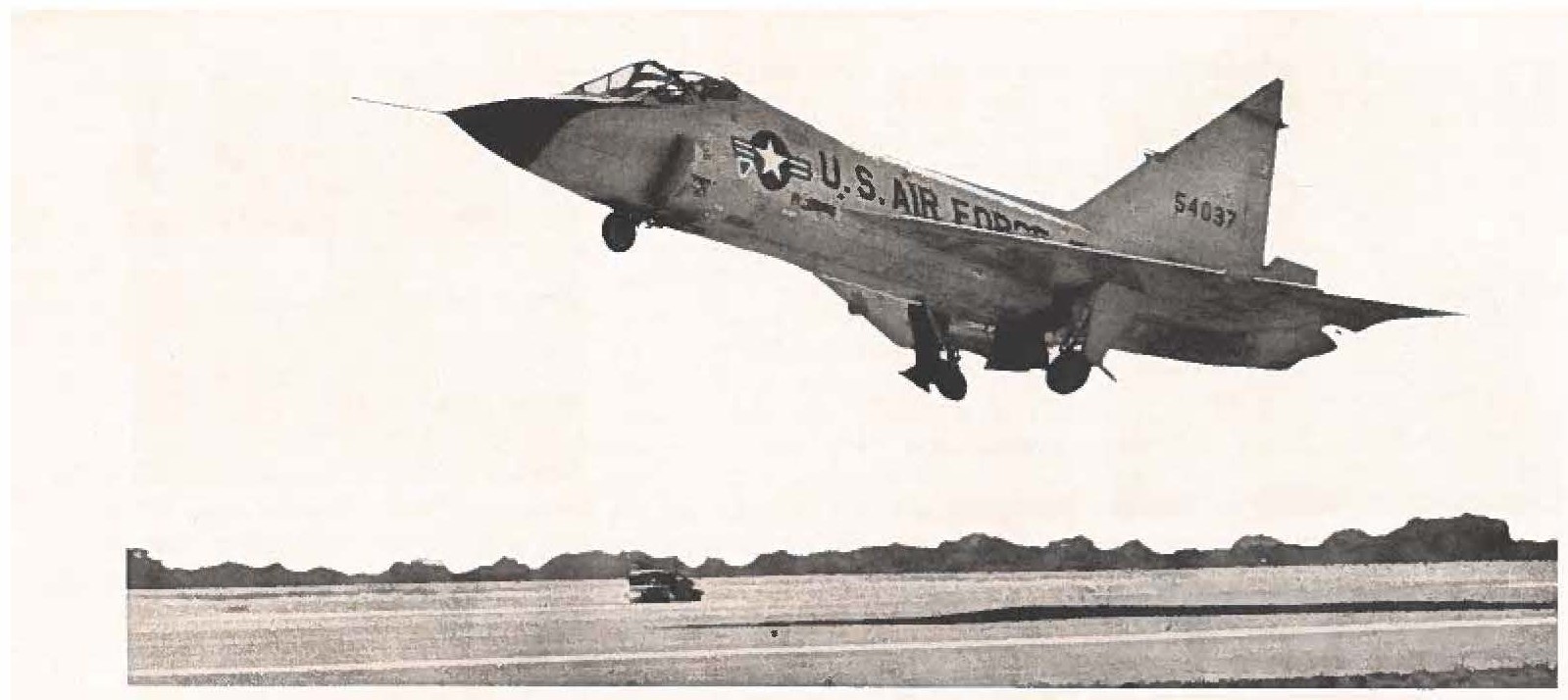
BACK COVER-Picture shows the new, sleek F-102 Supersonic Delta Dagger (foreground) which replaced the slower rocket-armed F-86-L Sabre jet last year. HANG Photo by Gabe.(Picture from the 1961 Annual Report)
F-86L aircraft were replaced by the new supersonic, rocket and missile firing, F-I02A DELTA DAGGERS. The F-102A will fly farther, higher, almost 200 mph faster and has a much better “kill” capability than the previously assigned F-86L aircraft.
Several months before arrival of the “Deuces,” personnel were sent to Yokota AFB, Japan, and attached to their technical counterparts in the 40th Fighter Interceptor Squadron to learn the aircraft’s MG-10 Fire Control System. Other personnel were sent to Kelly AFB, Texas, to train with their counterparts in the Texas Air National Guard, specifically in hydraulics, engines, airframe, instruments, and automatic flight control systems. The remaining personnel sustained the Group’s capability to support and provide the operationally ready F-86L aircraft in the Air Defense Augmentation Program. Four tactical pilots also went to Kelly AFB, Texas, to check out in the new aircraft and became instructor pilots upon their return.
A month before the aircraft arrived in Hawaii, the USAF 766A Mobile Training Detachment (F-102A) arrived from Amarillo AFB, Texas, to instruct personnel on the maintenance of the new aircraft. Classes commenced immediately, and training progressed with everyone taking their manuals home for many hours of night study. Training was completed in May 1961, and the Mobile Training Detachment moved Detachment 1 on to train Pacific Air Forces units in the Far East.
Land Air Incorporated, contractor for deprocessing the aircraft, began delivering the new aircraft in January after a difficult start. By the middle of March, 50% of the aircraft had been received by the 154th Fighter Group (Air Defense), and this date triggered the 120-day period to become operationally ready. The F-86Ls were phased out and turned over to Hickam AFB for salvage. The complete changeover of aircraft occurred in May, a feat that speaks exceptionally well for aircraft maintenance personnel, leadership, and planning.
The Air Defense Augmentation Program continued throughout the aircraft conversion. During this time, maintenance personnel not only learned to maintain the new F-102A but also maintained the retiring F-86Ls on alert. Capability was stretched lean with this double load. . .
A total of 5,805:40 jet hours were furnished during the fiscal year, with an average of 165:52 hours per tactical pilot. Proficiency training continued in the F-86L aircraft concurrently with the complex indoctrination and transition training required for F-102A conversion. With the aid of the $800,000 F-102A Flight Simulator, the tactical pilots were well prepared for transition by the time the aircraft and auxiliary equipment were ready for flight operations. The intensity of flight transition and readiness training was accomplished with minimum loss in overall readiness potential.
It was a normal and routine morning at Honolulu Airport during a recent February day, until a new call came over the air.
“Honolulu Tower, this is Guard zero two for takeoff. Test.”
The tempo of activity seemed to change automatically. There was an air of anticipation, for this was the first test flight of one of the new F-102 aircraft to be assigned to the Hawaii Air National Guard. In this particular case, the aircraft concerned was one of the two TF-102s, a two-place trainer.
“Roger, zero two. Clear for takeoff on Runway 8. Wind northeast at ten knots.”
There were over a dozen men standing nearly eight thousand feet from the approach end of the runway. For most of the guardsmen in the group, this would be the first takeoff of a TF-102 they had ever seen.
The afterburner cut in with a sudden, explosive sound, and the aircraft accelerated rapidly. It lifted cleanly from the runway and climbed rapidly out of sight. In the days to follow, there would be more of these tests, and the pilots of the 199th Fighter Interceptor Squadron would commence flying them shortly thereafter.
The conversion of the 199th Fighter Interceptor Squadron to the F-102 interceptor is the third since the early 1950s. First, it was to the F-86E; then to the F-86L all-weather interceptor; and now it was being accomplished in the F-102.
The aircraft stands 18 feet 2 inches above the ground to the tip of the vertical stabilizer and is 68 feet in length. By comparison, it is interesting to note that the aircraft is two feet higher and approximately four feet longer than the commercial C-47 or DC-3. Its supersonic speed and new armament capabilities will increase the air defense status of Hawaii considerably. Its range and greater altitude will give it a flexibility which was never enjoyed by the F-86L.
Hawaii Air National Guard plans for the implementation of this conversion have been in effect for over a year. In August 1960, the F-102 simulator arrived and was put into operation during the first week of November. Pilots of the 199th have been utilizing the simulator continuously, learning the normal and emergency procedures applicable to the aircraft. Thus, when the pilots commence their actual flying training, they will have an intimate understanding of the procedures involved in every conceivable situation which might arise.
In January 1961, two instructor pilots from PACAF units were loaned to the 199th. Both have been of tremendous value in the training program.
During the first week of December, an F-102 Mobile Training Detachment arrived at Hickam. Its purpose was to train airmen and officers in the various systems of the aircraft. The detachment is assigned for a period of six months. To date, the pilots have completed the 36 hours of instruction required, and the airmen are still attending on a rotational basis.
Although the aircraft arrived on December 5, 1960, they have not yet been put into the training program. Training plans call for a capability of 12 sorties per day prior to commencing a full pilot training schedule. Delays have been encountered due to maintenance difficulties, but it is estimated that the 199th will be capable of starting its full program sometime during the latter part of March or the first part of April.
At this time, five pilots will be put into a 30-day accelerated transition and operational readiness training program. At the completion of this program, the F-86Ls in the Air Defense Program will be replaced by the F-102s. Up to the time this training commences, seven air technician pilots will be undergoing the necessary training in the aircraft to qualify them as Alert Ready.
As a result of delays resulting from maintenance and deprocessing problems, the forthcoming HANG summer encampment will be directly affected. At the present time, it is planned that the 1961 camp period will be utilized almost solely for the purpose of transition training of pilots and on-the-job training (OJT) of airmen personnel in the maintenance and electronics fields.
In the very near future, the citizens of Honolulu will be seeing more and more of these delta-wing aircraft in the air. Their supersonic speed and kill capabilities, and their flexibility of performance, will serve as constant reminders that Hawaii has gained another “first” in air defense.
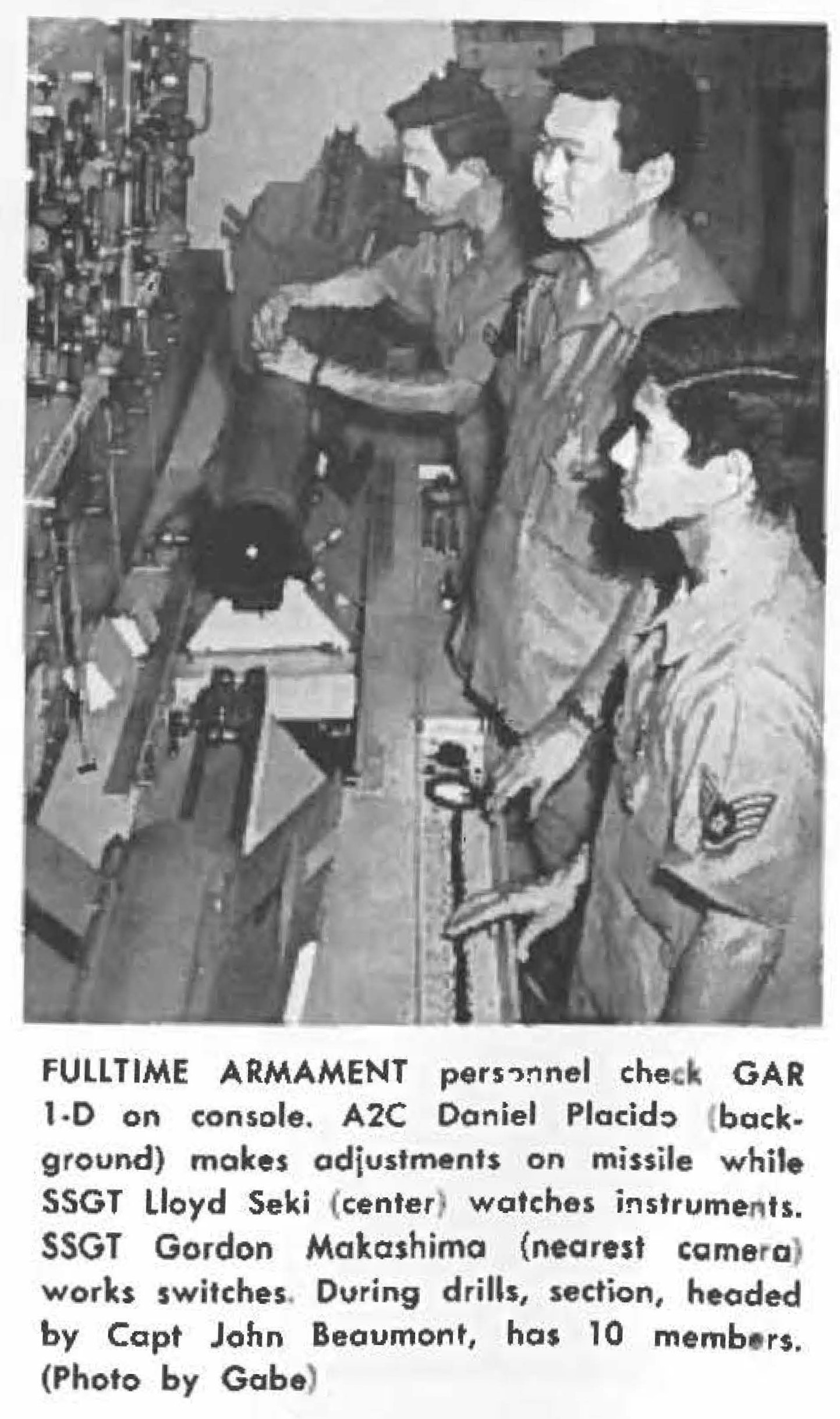
THE DEADLY DAGGERFULLTIME ARMAMENT personnel check GAR 1-D on console. A2C Daniel Placido (background) makes adjustments on missile while SSGT Lloyd Seki (center) watches instruments. SSGT Gordon Makashima (nearest camera) works switches. During drills, section, headed by Capt John Beaumont, has 10 members. (Photo by Gabe)(Pictures from the 1961 June The Hawaii Guardsman)
There’s a new shape in the sky over Hawaii an electronically controlled supersonic dart with a deadly sting.
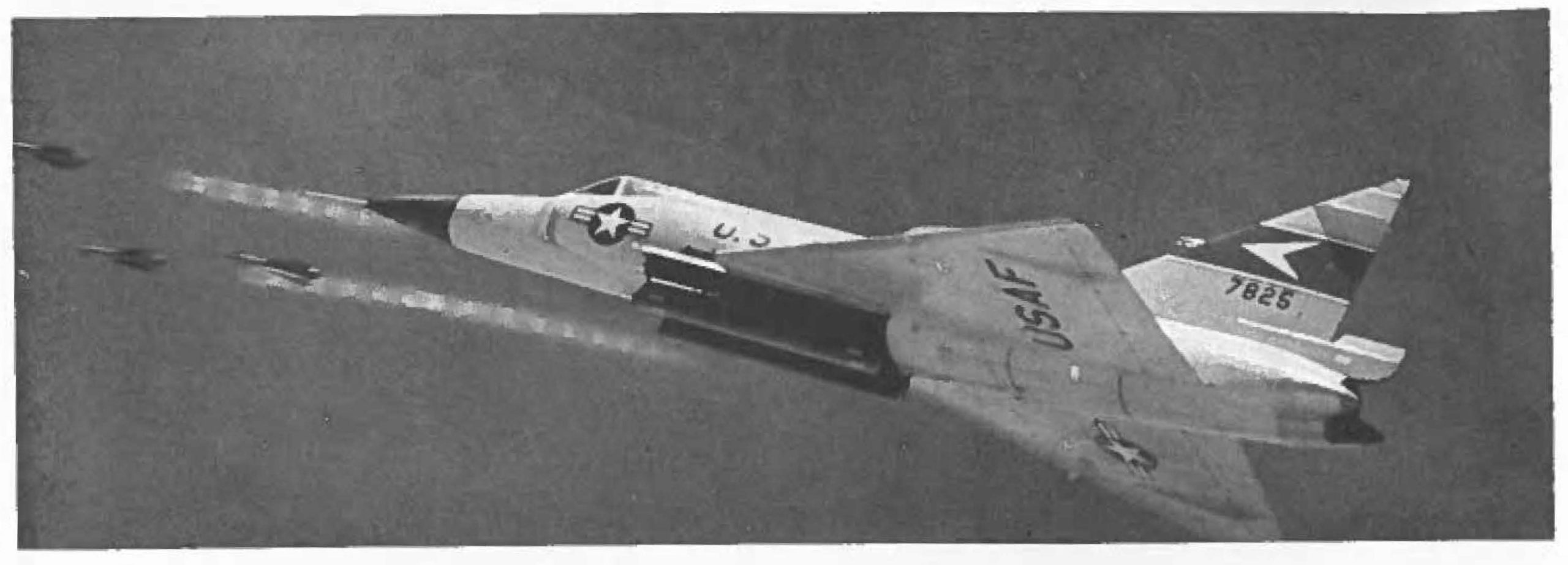
It’s the Hawaii Air National Guard’s F-102 Delta Dagger, an allweather interceptor equipped by the Hughes Aircraft Company with Falcon air-to-air guided missiles and with a radar electronic control system to launch them. The Delta Dagger is also capable of launching the nuclear lipped GAR II.
The F-102 is a flying weapon system a blend of men, missiles and electronics packed within a sleek, gray, dart-shaped airframe. With its MG-10 electronic control system and six Falcon missiles, the F-102 can intercept and destroy any invading bomber, day or night, in any type of weather. And the pilot need never see the target. He also has at his control, 24 Folding Fin rockets in addition to the Falcons.
Each Falcon missile is self-steering and makes its own adjustments in trajectory to maintain an unwavering bead on a target. Once a Falcon is launched from an interceptor, destruction of a target aircraft is practically inevitable.
The Delta Dagger is directed on an intercept mission by an Air Guard control1er speaking to the pilot from a around radar station tracking the t:, taruet aircraft. The ground controller ~ . .”. uides the interceptor to a pomt where the pilot detects the target on hi!, cockpit radar scope.
Once the target blip appears on the scope, the Hughes MG-IO system takes over. It computes the range and hearing of the target, pinpointing its position as the pilot locks on.
Any evasive maneuvers by the enemy bomher are now futile. The MGIO radar antenna is locked on the taruet and the MG-10 flight control e will automatically maintain the F-102’s proper attack headin~.
At a precisc1y computed instant, the interceptor’s armament hay doors pop open and the armament hlasts free. An X appears on the radar scope, telling the pilot the attack is over. He then breaks the Delta Dagger away and l1eads for home.
More than 30,000 tactical Falcon air-to-air uuided missiles have been delivered ~o the U. S. Air Force Air Defense Command since the first nroduction model cleared the Hnithes Aircraft Company assembly line in Tucson, Ariz. in 1954.
The Falcon was developed jointly by Hughes and the Air Force in the company’s main plant in Culver City. Calif. Work began on the project in Two years later, an experimental radar self-guided model was nro•<lured- a s1im, orange, 120 pound tuhular shaped missile about 61/2 feet tall.
In the flij!ht tests that followed, the development team packed the missile shell with a solid propellant rocket motor and a high explosive warhead with the wallop of a heavy artillery shell.
The Falcon is bas:cally a rocket intended for launching from an aircraft lo another aircraft- hence the designation GAR for Guided Aircraft Rocket.
Falcons are of two hasic types: radar uuided and infrared seeking. A e rndar guided Falcon homes on a target on reflected electronic waves beetween the launching interceptor’s radar system and the target aircraft. A heat seeking Falcon is attracted to a target by radiated heat energy and is particularly effective at discriminating targets at low altitudes.
Together, the two types of Falcons form a complementary armament for the supersonic F-l0lB, F-102A and F-106 interceptors, with one type suited for just the situations in which the other may he at a disadvantage.
Since t11e introduction of the GARI, the first Falcon, Hu~hcs has developed a series of successively more advanced air-to-air guided missiles that has hecome the primary weapon of the Air Defense Command – the GAR-ID, GAR-2, GAR-2A, GAR-3,GAR-3A, GAR-4A and GAR-II.
GAR-1 and GAR-1D FALCON
The GAR-I and its immediate successor, the GAR-ID, are equipped with a semi-active radar target seeker that homes on radar waves bouncing from an interceptor’s electronic armament control system to the target and hack again. Hughes built about 4,000 GAR-1 missiles for early interceptors, then discontinued production in favor of the GAR-ID, basically the same missile as its predecessor, with slightly larger control surfaces boosting its combat altitude. Both missiles are powered by a solid fuel rocket engine. They are 78 inches long, 6.4 inches in diameter, have a wing span of 20 inches and weigh about 120 pounds. The GARID is operational with the F-102A interceptor. About 12,000 units have been built and production is continuing.
GAR-2 and GAR-2A FALCON
The GAR-2 and GAR-2A Falcons are equipped with a passive infrared tarj!;et seeker that homes on the infrared radiation of a target aircraft’s engines. The GAR-2 was introduced in 1956. The GAR-2A, better able to withstand severe hot and cold temperature ranges, was introduced a year later. Both missiles have the same warhead, rocket engine, and, except for the nose cone, the same external configration as the radar .o,. -uidcd GAR-ID. Other dimensions are identical. GAR-2 production ended after about 16,000 units. The GAR-2A is operational with the F- 101B and F-102A interceptors. More that 9,500 units have been built and production is continuing.
The 199th Fighter Interceptor Squadron completed its transition into the new F-I02-A aircraft and qualified all assigned pilots at the start of the period as combat ready, 12 pilots were subsequently upgraded to Skilled level and one pilot was awarded the Expert grade. Tactical pilots flew 4,029 :05 total jet hours, for an average of 155 hours per pilot. Supervisory pilots (Commanders, Operations Officers, etc.) flew an additional 1,126: 15 jet hours.
The National Guard Bureau announced officially July 19, 1960 that the HANG was to be converted to F-102A Convair DELTA DAGGERS. HANG draft plans were rapidly finalized. Two C-124s arrived July 20, 1960, loaded with the many components of an $800,000 F-102 Flight Simulator. SSgts. Benjamin M.K. Goo, Guy M. Matsunaga, A1C Richard K. Kudo, and two Tech Reps began unpacking, assembly and checkout. It was located initially in a C-124 nose dock at Hickam AFB. Two months later the big day came-final checkout. When power was applied there were a few puffs of smoke. Problems were minor, and the simulator was operational and in full scheduled use several days later
In late 1976, the F-102s were retired and the F-4s were Put on runway alert. One of the DEUCEs was retained for our Aircraft Hall of Fame to be displayed with our other “old warriors.”