Do you need help in another language? We will get you a free interpreter. Call 808-369-3580 to tell us which language you speak.
您需要其它語言嗎?如有需要,請致電 (808-369-3478), 我們會提供免費翻譯服務
您需要其它语言吗?如有需要,请致电 (808-369-3478), 我们会提供免费翻译服务
En mi niit alilis lon pwal eu kapas? Sipwe angei emon chon chiaku ngonuk ese kamo. Kokori (808-369-3478) omw kopwe ureni kich meni kapas ka ani.
Makemake `oe i kokua i pili kekahi `olelo o na `aina `e? Makemake la maua i ki`i `oe mea unuhi manuahi. E kelepona (808-369-3478)`oe ia la kaua a e ha`ina `oe ia la maua mea `olelo o na `aina `e.
Masapulyo kadi ti tulong iti sabali a pagsasao? Ikkandakayo iti libre nga paraipatarus. Awaganyo ti
(808-369-3478) tapno ibagayo kadakami no ania ti pagsasao nga ar-aramatenyo.
다른언어로 도움이 필요하십니까? 저희가 무료로 통역을 제공합니다. (808-369-3478)로 전화해서 사용하는 언어를 알려주십시요
Kwoj aikuij ke jiban kin juon bar kajin? Kim naj lewaj juon am dri ukok eo ejjelok wonen. Kirtok
(808-369-3478) im kwalok non kim kajin ta eo kwo melele im kenono kake.
E te mana'o mia se fesosoani i se isi gagana? Matou te fesosoani e ave atu fua se faaliliu upu mo oe. Vili mai i le numera lea (808-369-3478) pea e mana'o mia se fesosoani mo se faaliliu upu.
¿Necesita ayuda en otro idioma? Nosotros le ayudaremos a conseguir un intérprete gratuito. Llame al (808-369-3478) y diganos que idioma habla.
Kailangan ba ninyo ng tulong sa ibang lengguwahe? Ikukuha namin kayo ng libreng tagasalin. Tumawag sa (808-369-3478) para sabihin kung anong lengguwahe ang nais ninyong gamitin.
‘Okú ke fie maʻu tokoni ʻi ha lea fakafonua ʻe taha? Temau kumi haʻo taha fakatonulea taʻetotongi. Telefoni ki he (808-369-3478) ke fakahā mai ʻa e lea fakafonua ʻokú ke lea aí.
Bạn có cần giúp đỡ bằng ngôn ngữ khác không ? Chúng tôi se yêu cầu một người thông dịch viên miễn phí cho bạn. Gọi (808-369-3478)nói cho chúng tôi biết bạn dùng ngôn ngữ nào
Gakinahanglan ka ba ug tabang sa imong pinulongan? Amo kang mahatagan ug libre nga maghuhubad. Tawag sa (808-369-3478) aron magpahibalo kung unsa ang imong sinulti-han.
The 154th Wing — originally designated 154th Fighter Group — was activated on Dec. 1, 1960 at Hickam Air Force Base. Initially equipped with F-102A Delta Daggers, the unit’s primary mission was the air defense of the Hawaiian Islands, maintaining 24-hour alert readiness. And they were the best at it, achieving national recognition for operational excellence and aircraft availability. The 1960s saw the Group develop robust training, disaster response capabilities and civic engagement, while participating in national competitions and forward operating exercises.
In the 1970s, the Group transitioned to the F-4C Phantom II, expanded its operational scope and was redesignated the 154th Tactical Fighter Group and later the 154th Composite Group. This period included large-scale Western Pacific deployments, participation in exercises such as Combat Sage and Cope Thunder and modernization of facilities and personnel, while maintaining a rigorous air defense posture and achieving its first Outstanding Unit Award.
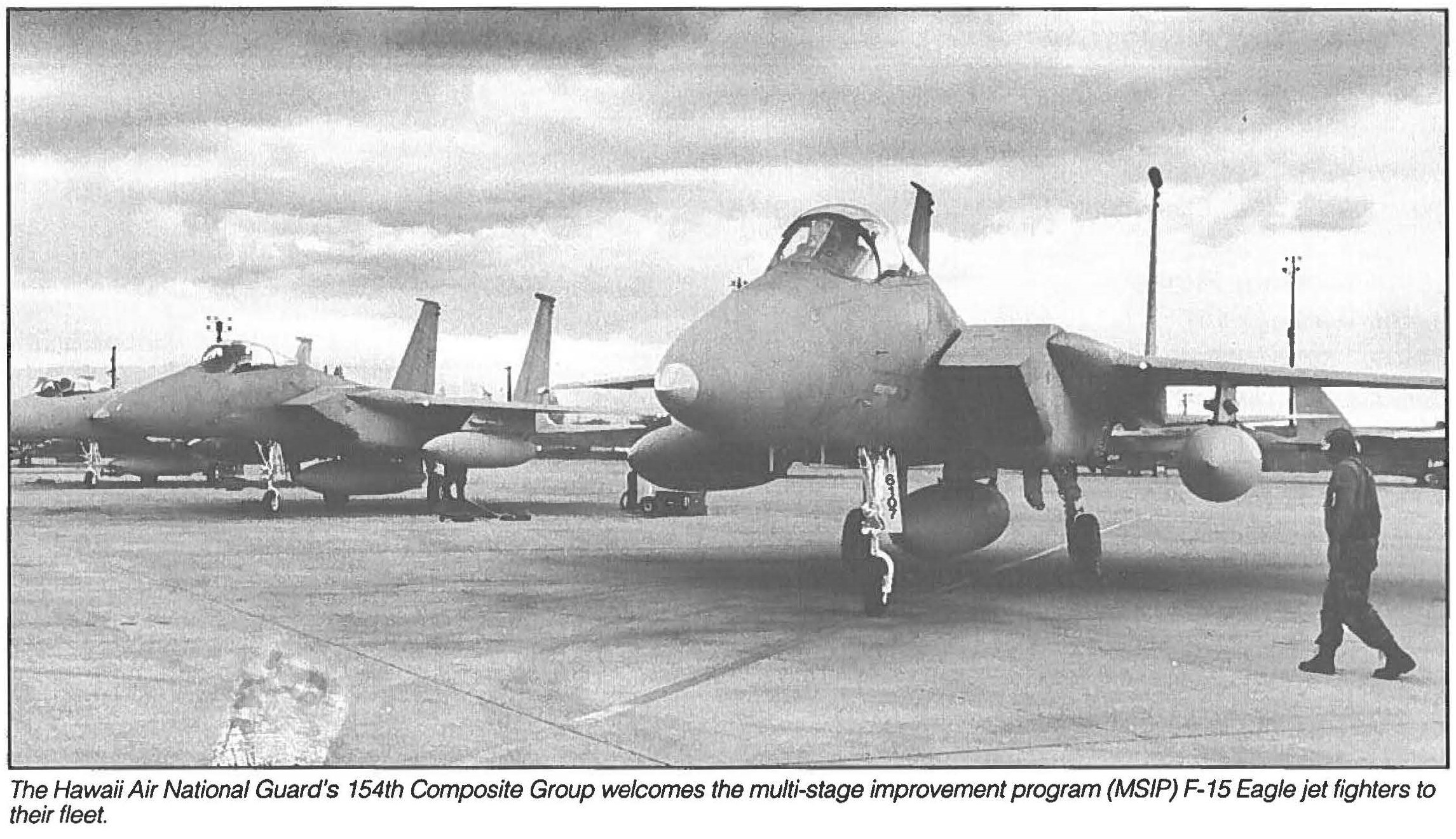
The 1980s marked pioneering overseas deployments to Japan, Guam, the Philippines, Korea and Europe. The unit engaged in multinational exercises, dissimilar air combat training and missile operations, consistently earning top ratings in operational readiness inspections. The late 1980s featured the transition from F-4C Phantoms to F-15A Eagles, completed in 1988, enhancing Hawaii’s air defense capability. Organizational refinements, safety awards and repeated Air Force Outstanding Unit Awards highlighted this period.
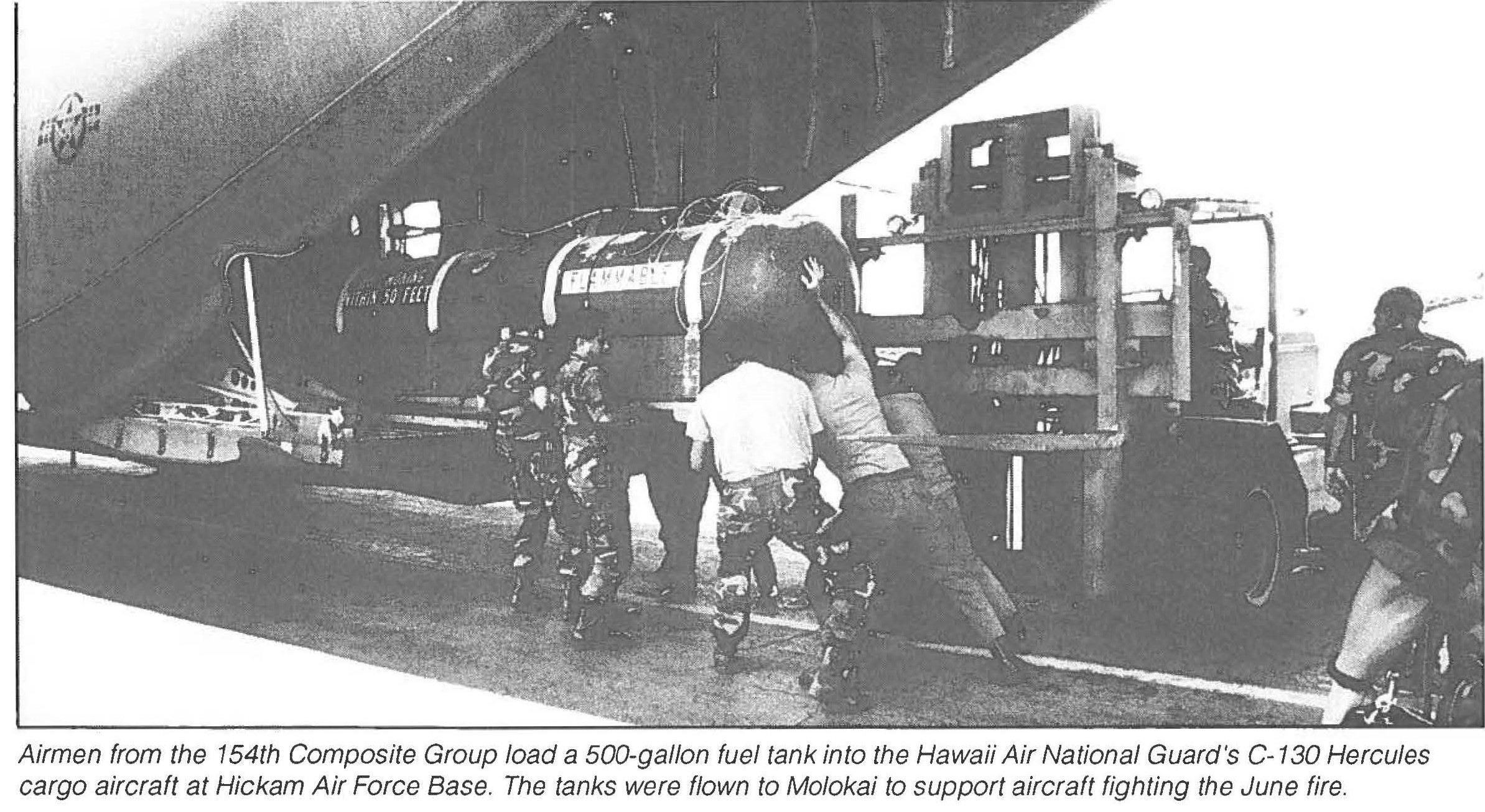
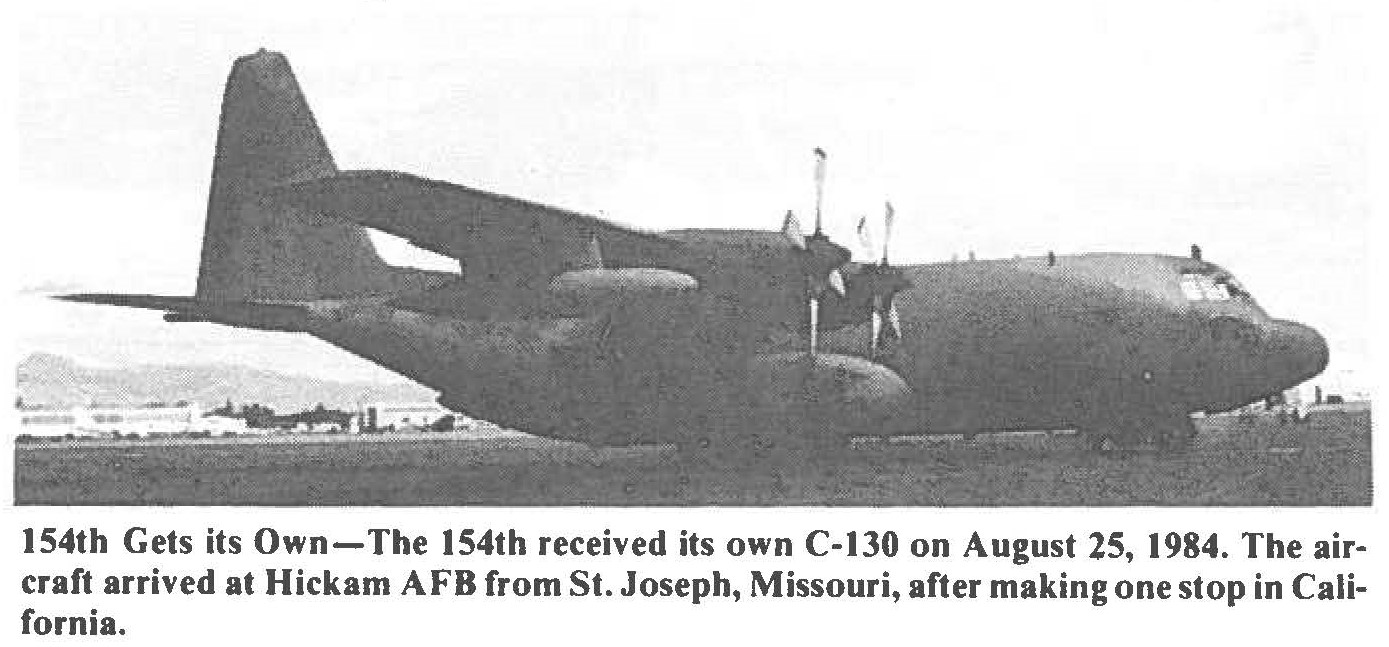
Airmen from the 154th Composite Group load a 500-gallon fuel tank into the Hawaii Air National Guard’s C-130 Hercules cargo aircraft at Hickam Air Force Base. The tanks were flown to Molokai to support aircraft fighting the June fire.(Picture from the 1991 Annual Report)
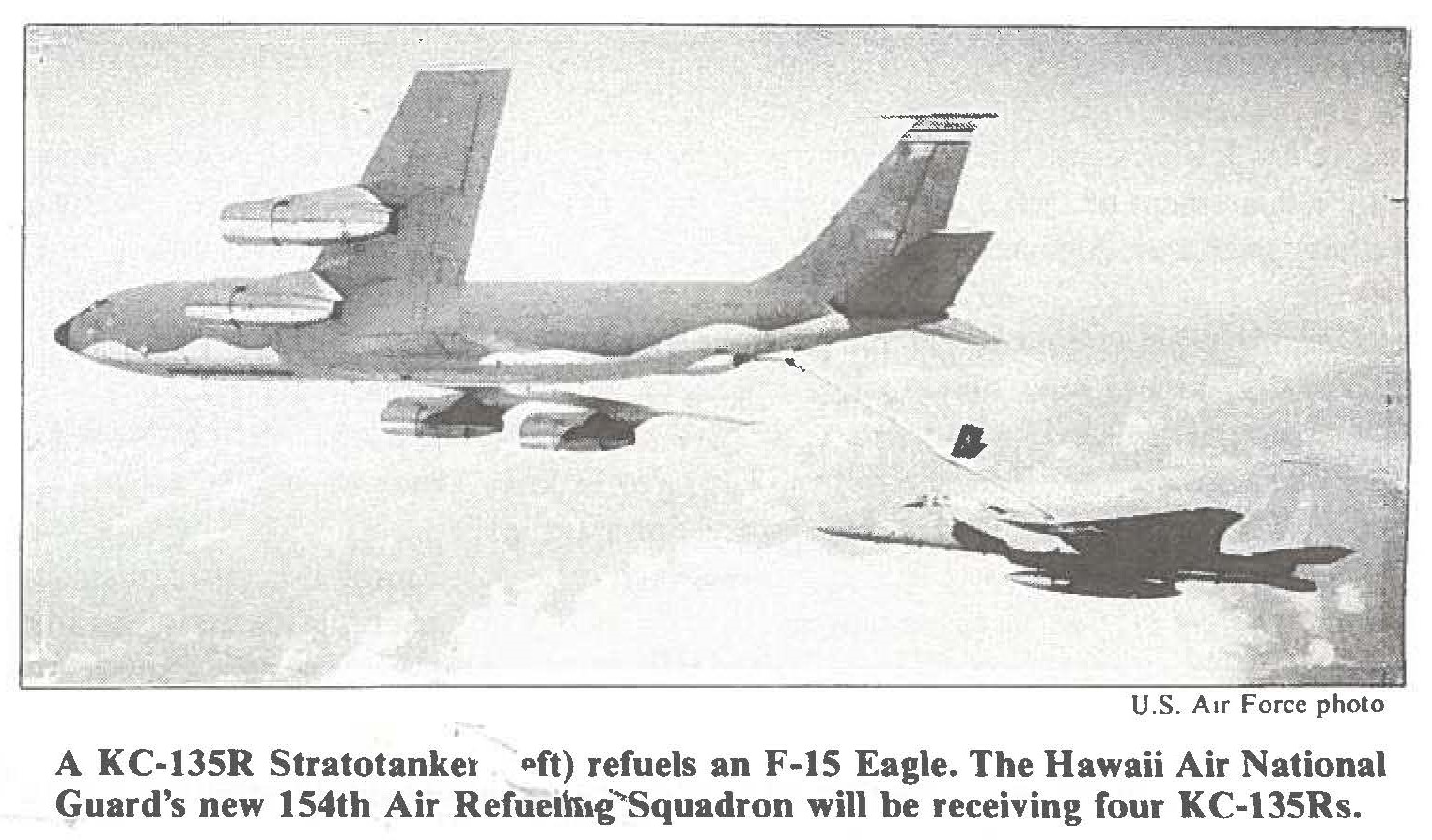
In 1993 the Group changed to the 154th Group, then in FY1996 , it became the 154th Wing, expanding into a multi-mission organization with fighter, airlift and air refueling capabilities. Key milestones included new C-130H aircraft, KC-135R Stratotankers and extensive overseas deployments supporting NATO operations, humanitarian relief, and domestic disaster response, including Hurricane Iniki. The unit consistently received national recognition for operational excellence, safety and mission effectiveness.
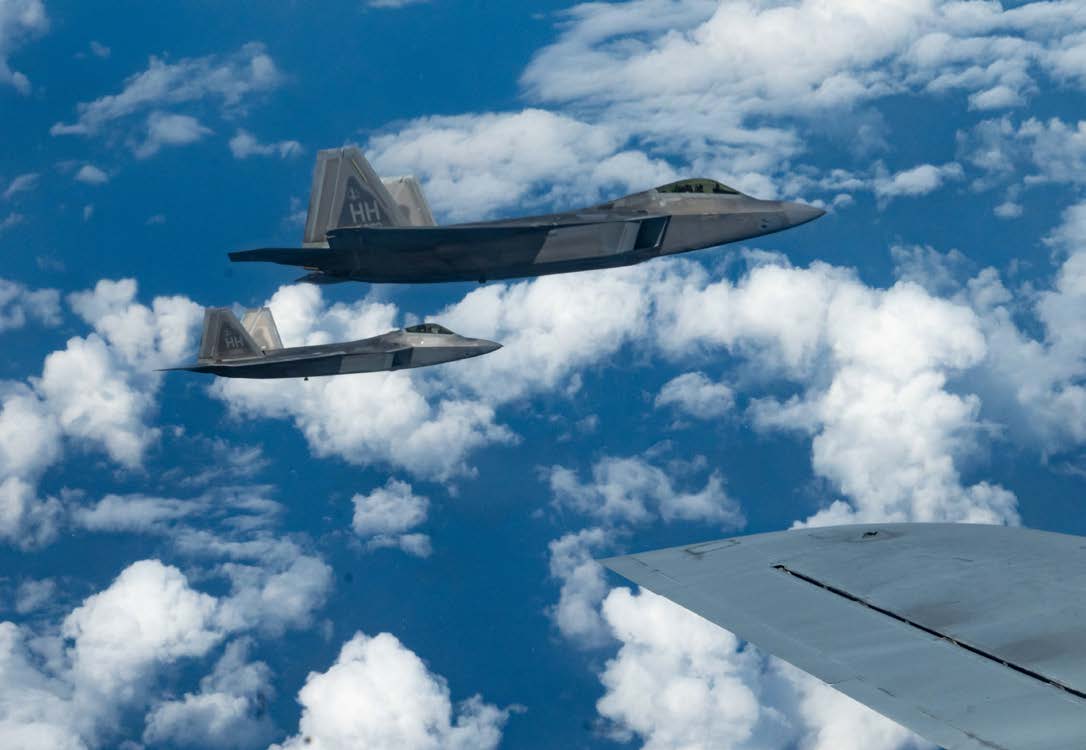
In the 2000s, the Wing integrated its “HH” tail markings and demonstrated global reach through deployments supporting Operations Enduring Freedom, Noble Eagle, Iraqi Freedom, and multinational exercises such as Cope Tiger. The arrival of C-17 Globemaster III aircraft in 2006 expanded strategic airlift capabilities, while ongoing Sentry Aloha exercises enhanced joint and coalition interoperability.
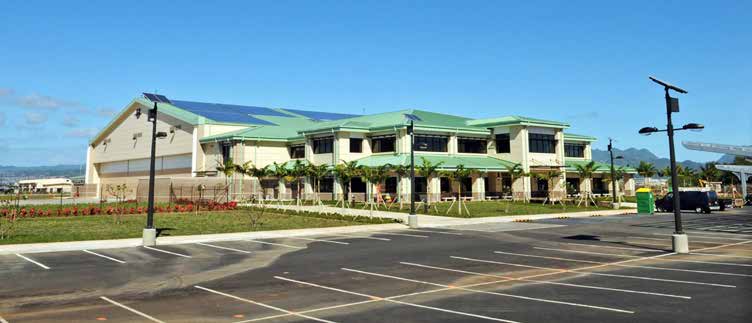
NEW BEGINNINGS – 154th Wing’s F-22 Raptor Operations and Maintenance facility is scheduled for dedication summer 2014. Airman 1st Class Robert Cabuco photo(Picture from the 2013 Annual Report)
Most recently, the Wing has continued with large-scale exercises including Sentry Aloha, Exercise Hoʻoikaika, Pacific Edge and Arctic Aloha, all emphasizing rapid airpower generation, joint operations and Total Force Integration with allied partners. Today, the 154th Wing maintains rapid-response capabilities, strategic reach, and seamless integration with joint and coalition forces. Its enduring commitment to the defense of Hawai‘i and the nation continues to uphold the highest standards of readiness, professionalism and mission effectiveness.
154th Wing Chronological History
Air Defense Group Organized at Hickam
The 199th Fighter Interceptor Squadron and the 199th Support Squadron will undergo a major reorganization effective December 15, 1960 Both squadrons will be activated into the 154th Fighter Group (AD) on that date and the new Group will be federally recognized on December 17, 1960. The Group Commander will he Lt. Col. Robert McGuire. Under his command will he the following units: 154th Group Headquarters, which will provide command and staff supervision over assigned units and centralized personnel and administrative functions; the 199th FINCEPTRON (the old numerical designation was retained), will carry out fighter-interceptor missions to identify and destroy enemy aircraft; 154th Consolidated Aircraft Maintenance Squadron (CAMRON), which is assigned aircraft maintenance responsibility; 154th Materiel Squadron, which contains installations, motor vehicle, POL (petroleum and fuel functions), and HANG Base Supply; 154th Air Base Squadron, which is charged with base and housekeeping support and contains food service, Air Police, limited communications, photo; and the 154th USAF Dispensary.
The following commanders have been appointed: Capt. Kenneth L. Fisher, Commander 199th FINCEPTRON; Maj. William W. Dau, Commander 154th Materiel Squadron; and Capt. Claude V. Caver, Commander 154th USAF Dispensary. Commanders for the CAMRON and Air Base Squadrons have not yet been appointed.
The 154th Fighter Group (Air Defense) was activated 1 December 1960 with station at Hickam AFB, Oahu. The previous 199th Fighter Interceptor Squadron was reorganized as a squadron within the new Group, and the 199th Support Squadron was inactivated 30 November 1960. This Group organization is authorized 974 personnel hut is limited to 750/0 manning of 738 personnel. The 154th Fighter Group (Air Defense) is composed of Headquarters, 154th Fighter Group (AD), 154th Air Base Squadron, 154th Consolidated Aircraft Maintenance Squadron, 154th Materiel Squadron, 154th USAF Dispensary, and 199th Fighter Interceptor Squadron. Pacific Air Forces conducted the required Federal Recognition Inspections.
Manning documents of all units were revised to include further provision for Chief (E-9) and Senior (E-8) Master Sergeants.
154th FIGHTER GROUP (AIR DEFENSE) Organization: The Hawaii Air National Guard units at Hickam AFB expanded from the previous two squadron structure to six units in a Group structure. The organization and shakedown of the new Group began in December and was complicated and accelerated by the arrival that month of the new F-102A jet fighters.
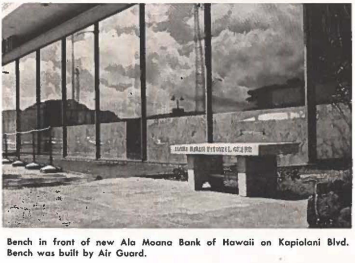
JUL 1961 Members of the 154th Fighter Group constructed six heavy cement benches for public benches at various locations around Honolulu, which have been placed in the city. The benches, were constructed from training aid funds, giving members of the group a chance to work with cement.
Learn more
OUR PUBLIC RELATIONS: we gave blood and built community benches
Seeing a need for public benches at various locations around Honolulu, the Hawaii Air National Guard constructed six heavy cement benches which have since been placed in the city.
The benches, constructed by members of the 154th Fighter Group, were constructed from training aid funds, giving members of the group a chance to work with cement. Designed without hack rests, the benches were constructed of materials which need no maintenance. Instead of wooden braces between the end supports, pipe was used. The wording “Aloha Hawaii National Guard” was pressed into the edge of the concrete slab.
Because a few benches put out by other organizations have been stolen from various locations in the city, ours were purposely built heavy. It takes six men to move the top alone!
Our benches, placed about the city in July, are situated in front of the new Bank of Hawaii (Ala Moana branch), next to the Honolulu Armory, in front of McKinley High School on King Street and two benches were placed across from City Hall on Hotel Street. The sixth bench will be placed somewhere within the city during this month.
Although constructed by members of the Hawaii Air National Guard, the project gives credit to the entire Hawaii Guard. Projects such as this reflect favorably upon the organization and should continue. Anyone having any ideas along this line are requested to contact the State Information Officer. Should we have one or two public relations project! each quarter, excellent public opinion will surely result.
Bench in front of new Ala Moana Bonk of Hawaii on Kapiolani Blvd. Bench was built by Air Guard.(Picture from the 1961 September The Hawaii Guardsman)
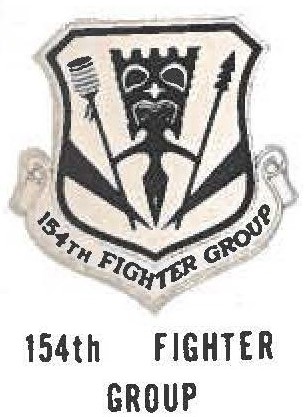
Group Emblem
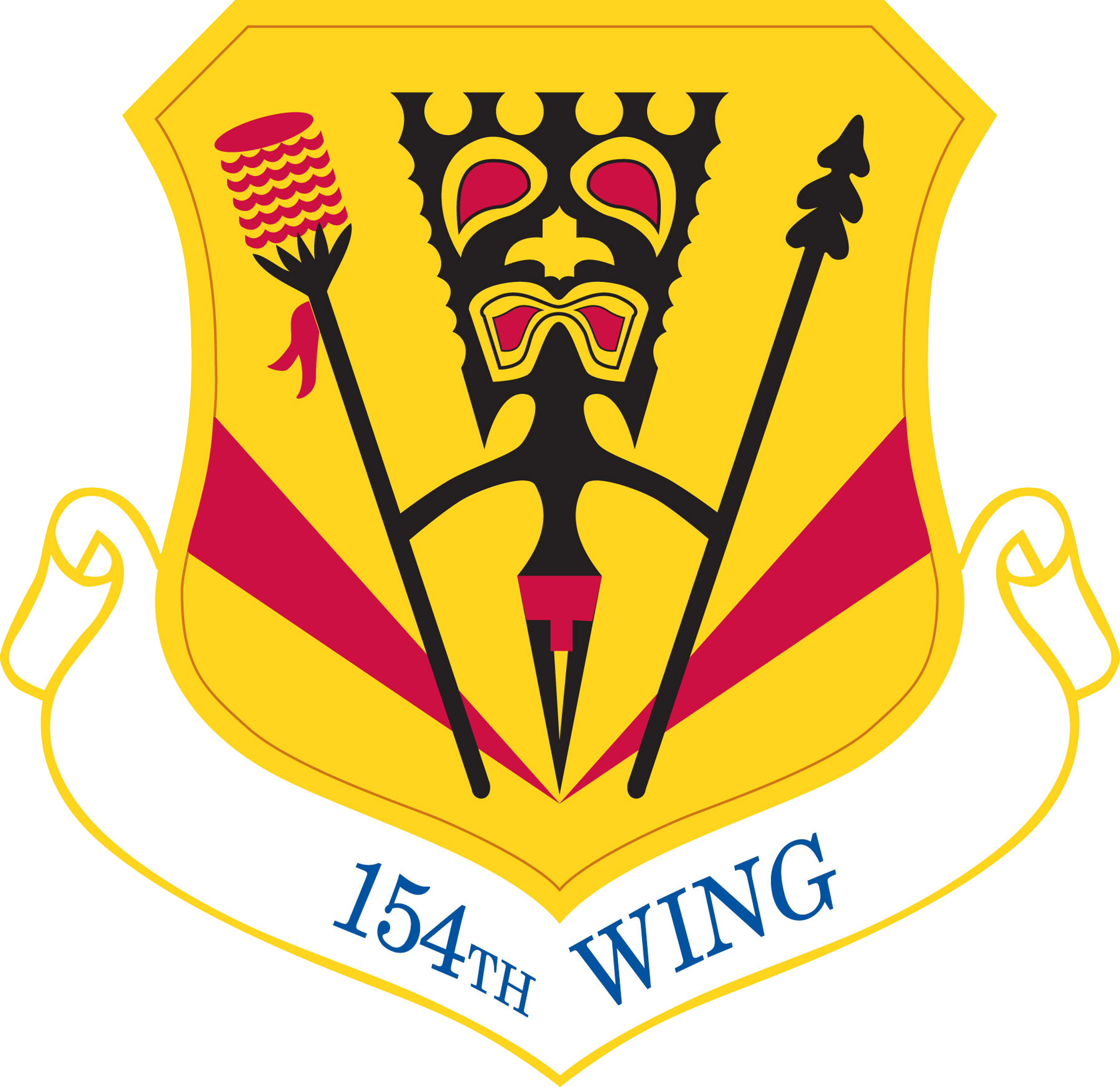
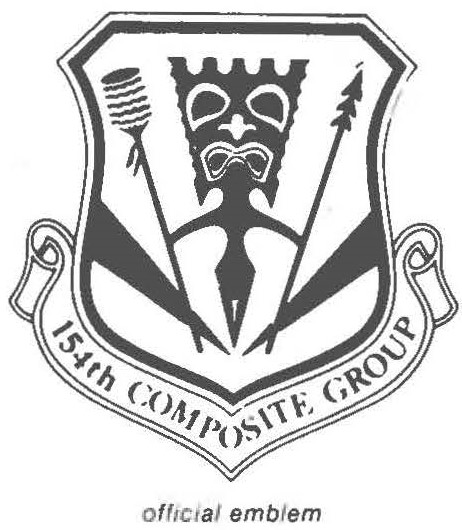
A request has been submitted to Hq. USAF for the approval of a Group emblem. The emblem may be described as an Air Force yellow shield bordered black, a Hawaiian kahili standard (right) with a black wooden shaft, crested with red feathers arranged in a cylindrical shape at the top of the standard, a black Hawaiian wooden spear (left), a Hawaiian idol (center) in black with red eyes, red mouth, and red malo, and two red shock waves.
The emblem is symbolic of the Group and its mission. The shield symbolizes defense, the colors being those used by the alii of Old Hawaii, and the stylized idol being emblematic with the Hawaii Air National Guard since its post-war formation. The new emblem is a modern stylization of the old design. It is symbolic of fearlessness, valor, strength in the heat of battle and readiness for combat, and is representative of the spirit of the 154th Fighter Group (AD).
As of 26 Oct., the Group received approval from the National Guard Bureau, Headquarters USAF for our emblem. Decals and patches will he made for use on windshields and clothing (fatigues).
The 154th Fighter Group (Air Defense), with station at Hickam AFB, Oahu, is equipped with F-102A Convair DELTA DAGGER all weather fighter interceptors. The mission of the group is to achieve and maintain operational effectiveness of an air defense fighter interceptor weapons system to identify friendly aircrafts and destroy enemy aircraft within the Hawaiian Air Defense Identification zone.
Considerable emphasis was placed on Disaster Control capability, and operations under radioactive fallout conditions were exercised realistically.
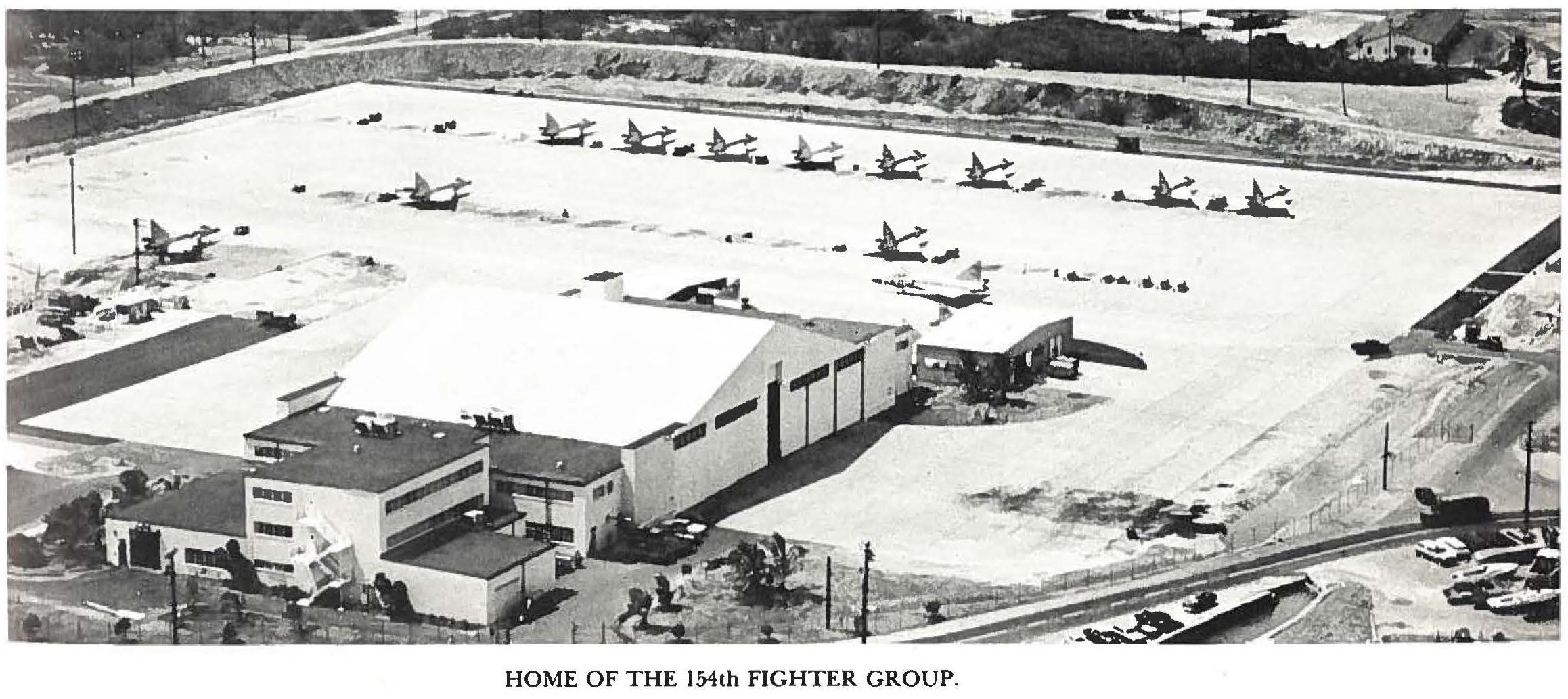
DEC 1961 The Group moved to its new hangar and ramp facilities at Fort Kamehameha
Learn more
Home
The 154th Fighter Group moved into its new hangar in early December. A public open house is slated for mid-January.
The completion of the hangar was a dream come true, a dream 15 years in the making, for many of the charter members still with the Group to day. These charter members are: CWO Joseph L. Barnett (SSgt); SMSgt Robert D. W. Choi (Sgt); Lt. Col. George R. Duncan (1/Lt); Major Letwell P. A. Duvauchelle (1/Lt); Lt. Col. Walter F. Judd (1/Lt); MSgt Frederick Rittmeister (Sgt); and Lt. Col. Russell L. Smith (1/Lt).
Cost of the hangar and supporting facilities was approximately $3 million.
After 15 years residency in Area 65 of Hickam Air Force Base, the Group moved to its new hangar and ramp facilities at Fort Kamehameha in December 1961. This move was without incident and with minimum interference to tactical training operations.
The 154th Ftr Gp (AD) will be operating their F-102A Delta Daggers out of the new 2.6 million dollar Fort Kam Facility for the first time. To obtain maximum training benefits during field training, 199th Weather Flight personnel will spend much of their time cross training with their active duty counterpart, Detachment 3, 1st Weather Wing and the Honolulu Weather Bureau. At these places, members will learn the finer points of their jobs as the 199th Weather Flight does not have qualified instructors nor the expensive weather equipment facilities to provide this highly technical training.
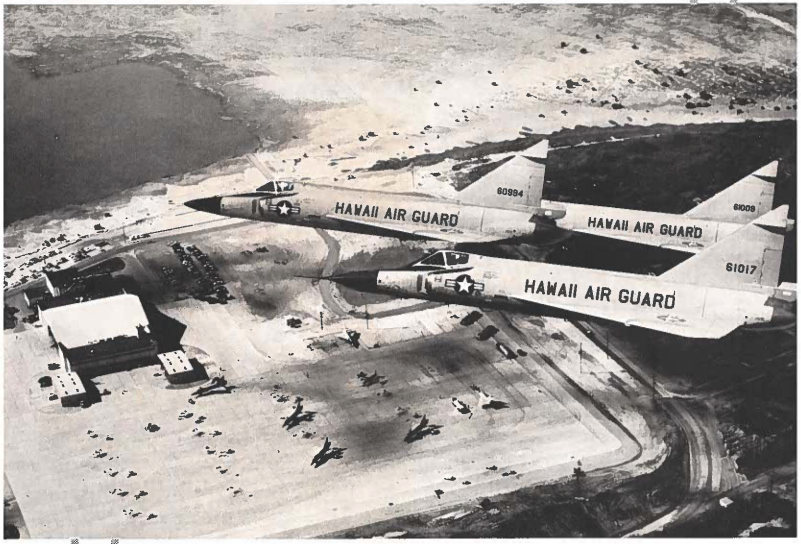
Hawaii Air National Guard F 102 Delta Daggers fly over new $2,600,000 154th, Fighter Group facility at Fort Kamenomeha. This shot was take from a TF-102 by MSGT Ignacio Gabriel, HANG official photographer. (Picture from the 1962 March The Hawaii Guardsman)
SEP 1962 The 154th Fighter Group participated in the Rick’s Memorial Trophy held at Tyndall AFB Florida, Four operationally ready F-102 aircraft were provided and a team of about 25 officers and airmen attended.
Learn more
Ricks Trophy . . .
The 154th Fighter Group has been invited to participate in this year’s Rick’s Memorial Trophy to he held at Tyndall AFB Florida, Four operationally ready F-102 aircraft will he provided to our team by the 331st FIS AFB Texas, from the United States Air Force. A team of about 25 officers and airmen are expected to make the trip in September.
The Earl T. Ricks Memorial Trophy is named for Major General Earl T. Ricks, former Chief, AF Division, National Guard Bureau, and is donated by the Air Force Association. The purpose of the trophy is to provide a competitive medium for ANG pilots which emphasizes flight planning, high speed cruise control and tactical proficiency. Awards will be presented at the Air Force Association Convention at Las Vegas, Nevada.
Well, this is it. The real thing. All the years of training, studying, practice, and work are about to be laid on the line. There’ll be no second chance. And what a night for it to happen. There isn’t even a moon to help. At least you can’t see the moon. It’s hidden by the black rolling clouds which arc occasionally lit up by the lightning from the cold front crossing the area. And the rain keeps coming down. Somewhere out in the murk is a target- your target. It is going to he up to you to kill that target. Nobody else will he able to help you. You know of some pretty sharp pilots who have already tried and failed, fooled by the electronic jammers in the target, or beaten by the storm. But you can’t afford to miss. Too much rests upon you.
Suddenly- the klaxon sounds. Your crew chief and you run to the waiting F-102. With the sudden activity and the end of the waiting, all of your doubts fade away. Whipping through your start and after-start checks, you receive scramble and take-off information from the control tower and are airborne in less than three minutes.
The instant your Deuce breaks ground it is swallowed up into the blackness of the thunderstorm. Quickly, you go on instruments. Switching radio frequencies, you contact your Ground Controlled Intercept site. The calm reassuring voice of the director tells you that your target is a single high speed, high flying ah-craft heading directly towards you.
You continue a maximum power climb to 35,000 feet and at the director’s command, level off and set your speed at .92 Mach. You recheck your radar set and re-set your armament switches.
In the belly of the Deuce rest the Hughes GAR-1 guided missiles which are the only things between the destruction of the logic and its getting through.
Now you begin to tighten up again. The range to the target is closing rapidly and still no radar contact. Forty miles. Thirty miles, twenty-five miles. Ah, there is a faint contact on your scope. Now there are two, three, four contacts. One of them is the bogie; the others are false targets made by him to confuse you. You have been trained for just such a situation and your training pays off. You study the radar scope intermittently and lock on to the real target. You tell your director that you are taking over the interception. “Roger, standing by.” Now you, the aircraft, and the steering dot become one. You no longer are aware of the storm raging inches from your head outside the cockpit nor are you nervous, uncertain.
The range and time circles shrink in size as you close on the target. You increase the accuracy of your steering until X. With a thump, a roar, and a flash of the light the missile is gone, speeding toward the bogie at Mach two speeds. “Splash! Splash!!” You’ve got him. The mission was a success.
The real thing? Not quite. This was an actual outline of a typical mission in the 1962 Ricks Trophy Event, in which Hawaii was represented by officers and men of the 154th Fighter Group (AD).
The Ricks Trophy Event is an annual competition between units of the Air National Guard, designed to do two things. First, it is designed to show the people of the United States the mission and the capabilities of the Air National Guard, and second, to supply competition between units of the Air Guard. It is named in honor of and in memory of General Earl T. Ricks, former chief of the Air Force Division, National Guard Bureau, who was instrumental in seeing that the Air National Guard has the first line mission it so proudly performs today.
The Ricks Event is always held between units with like equipment and missions, and may consist of cargo hauling over actual Military Air Transport Service routes, competition between the seven Air National Guard units equipped with F-l02’s.
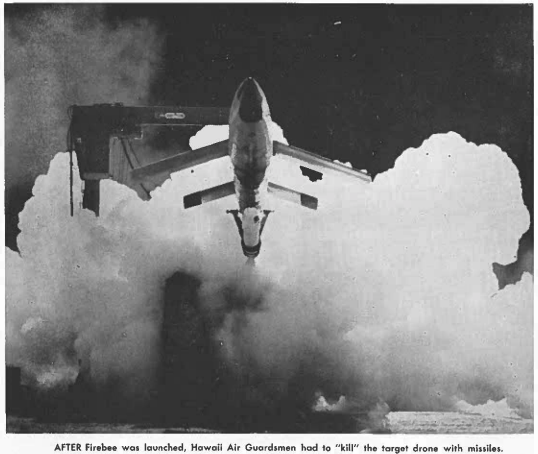
The missions were designed to closely match the combat mission of these units, and included a simulated deployment to a strange field, combat missions against low and high altitude targets, electronic jamming missions, and actual missile firing against Ryan Firebee drones. As you can tell from the story above, the missions were flown day and night regardless of the weather.
Every Ricks Trophy Event has been a team effort, but this year the team spirit was even more necessary. And as they have in the past, the men of the 154th Fighter Group prove that they had it. The team from Hawaii left on 1 September by Oklahoma Air National Guard C-97 and proceeded to Webb AFB, Texas where they were to borrow F-102 aircraft for the event. Upon arrival at Webb they were greeted by two signs: “ALOHA YOU’LL” and “CAN DO? HELL NO, WILL DO!” The members of the 331st Interceptor Squadron then set about proving that they meant just that.
The support the Hawaii team received at Webb was nothing short of being perfect. Being the only overseas squadron in the competition, Hawaii needed, and when the team left Webb for the competition they knew that it wouldn’t be the aircraft which would let them down.
The actual competition was less a test of individual pilot skill than a check of the capability of the team including the pilot. Ably commanded by Lt. Col. George R. Duncan, the team consisted of aircraft mechanics, missile technicians, engine specialists, ground-powered equipment operators, airborne radio technicians, radar technicians, administrative personnel, and pilots. They were also supported by civilian Technical representatives.
In their first taste of competition since 1955, the Hawaii Air National Guard placed third. More important than that, all members of the team profited by their exposure to other F-102 outfits, and again proved that the Hawaii Air National Guard has the spirit and capability to do the job required of it in these harsh times.
Hawaii was proudly represented at this year’s Ricks Event by the 154th, which placed third in nationwide competition in F-102 aircraft. Marking the first time that Hawaii has been represented in the event, the 154th competed with six other ANG teams. The event took place at Tyndall Air Force Base, Florida, and was climaxed by a cross-country flight to Las Vegas, scene of this year’s Air Force- Association annual meeting.
Commanded by Lt. Col. George R. Duncan, the team was comprised of 27 hand-picked guardsmen. Pilots participating were Maj. Jarrett Carr, Capt. Harold Nagai, 1st Lt. Franklin Fukui, and 1st Lt. Ritchie Kunicbika.
AFTER firebee was launched, Hawaii Air Guardsmen hod to “kill” the target drone with missiles. (Picture from the 1962 December The Hawaii Guardsman)
New Commander
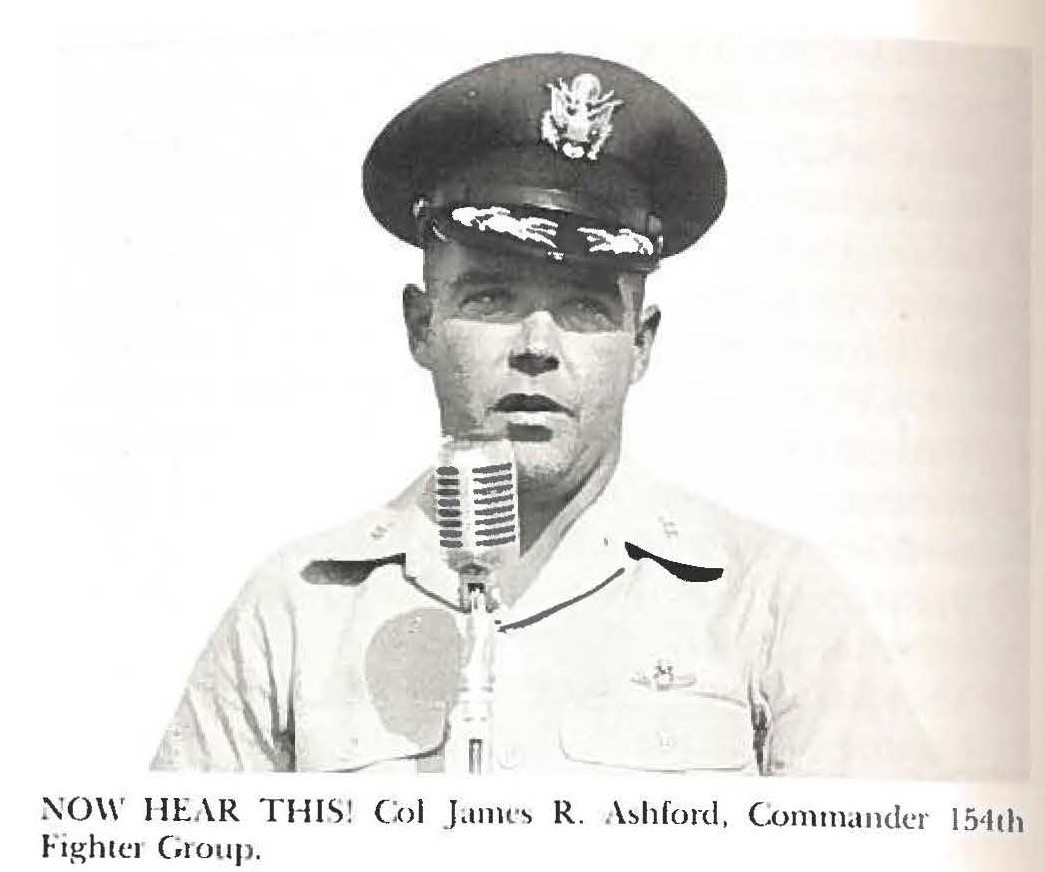
The 154th bade aloha to Col. James R. Ashford and to Lt. Col. Robert B. Maguire at recent change of command ceremonies. Col. Ashford assumed command in October, taking over from Lt. Col. Maguire, who assumed the former’s assignment as Director of Operations, Headquarters, HANG. . .
Awards
At closing formation in October, Brig. Gen. Valentine A. Siefermann presented the PACAF Tactical Unit Flying Safety Award to the 154th in recognition of the Group’s accident free flying safety record. Competition for this award is open to all PACAF units with tactical missions.
Missile Storage and Checkout Facility for 154th Fighter Group, HA NG, located in Hickam AFB, Fort Kamehameha complex.(Picture from the 1963 Annual Report)
The 154th Fighter Group (Air Defense), stationed at Hickam AFB, Oahu, provides the weapons for airborne identification of friendly aircraft and destruction of enemy aircraft that enter the Hawaiian Air Defense System. Convair F-102 DELTA DAGGER all weather fighter interceptors equipped with Falcon air-to-air missiles are utilized.
Exercises were conducted to test the capability of this organization to accomplish its M-Day war plan. This includes recall of personnel, mass loading of all aircraft, intercepting “faker” aircraft, quick recovery , turnaround and relaunch of aircraft, unit defense against saboteurs, and operating under radiological fallout conditions.
Salute to the President Joining the nation in a final tribute to the late President John Fitzgerald Kennedy, Commander-in-Chief of the Armed Services, three HANG F-102’s flew a “missing man formation” in honor of the slain President. The formation flown by Colonel Ashford, Major Giddings, and Captain Parrish flew with the right wing spot open in Kennedy’s tribute. The flight flew over military installations and Honolulu.
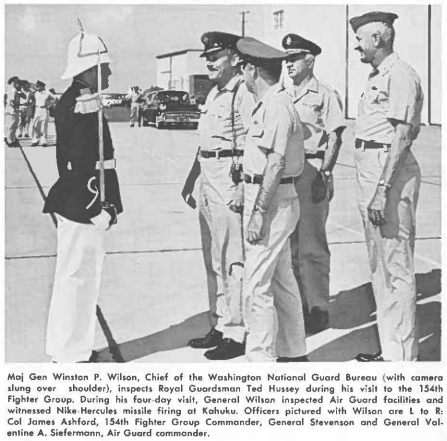
Maj Gen Winston P. Wilson, Chief of the Washington National Guard Bureau (with camera slung over shoulder), inspects Royal Guardsman Ted Hussey during his visit to the 154th Fighter Group. During his four-day visit, General Wilson inspected Air Guard facilities and witnessed Nike Hercules missile firing at Kahuku. Officers pictured with Wilson are L to R: Col James Ashford, 154th Fighter Group Commander, General Stevenson and General Valentine A. Siefermann, Air Guard commander. (Picture from 1964 September The Hawaii Guardsman)
Wives of MG-10 Fire Control Section and the AFCS Section were hosted at the 154th Fighter Group on two separate Saturdays. Purpose of tours and briefings was to inform wives of vital role husbands play in defense. Pictured (L to R) TSgt Nicala, Teves, AlC Wright Upchurch, Mrs. Teves and Mrs. Upchurch. Project was successful. (Picture from the 1964 December The Hawaii Guardsman)
The 154th Fighter Croup (AD) was reorganized 20 July 1963 with standardized air defense manning documents modified to provide for local requirements. Management was reoriented to the Double Deputy concept. . . .
154th FIGHTER GROUP (Air Defense) The 154th Fighter Group (AD) stationed at Hickam AFB provides the weapons for airborne identification of aircraft and destruction of enemy aircraft that enter the Hawaiian Air Defense System. F-102A Delta Dagger all-weather fighter interceptors equipped with Falcon air-to-air missiles and rockets are utilized.
Exercises are conducted periodically by the Air Force utilizing Air Force criteria to test this organization’s capability to accomplish its air defense mission, and the accomplishment of its M-Day war plan. These exercises entail the recall of personnel, mass loading of aircraft, intercepting “faker” aircraft, quick recovery, turnaround, relaunch of aircraft, deployment, unit defense against saboteurs and operating under radiological fail-out conditions. . .
16 JUN 1964 The 154th Fighter Group has been set aside during summer camp Employers’ Day, employers find out what their employees do during Air Guard training. The bosses took a look over the Hickam site, view static displays of aircraft and equipment, and watch demonstrations.
Learn more
Group Readies Plans for June “Employers’ Day”
June brings Kamehameha Day and Father’s Day. For the 154th Fighter Group, June brings another special day. June 16th has been set aside during summer camp to honor a VIP who makes field training possible the boss.
Normal training will go on during Employers’ Day but the doors will he open so that employers may find out what their employees do during Air Guard training. The boss will he able to look over the 154th‘s Hickam site, view static displays of aircraft and equipment, and watch demonstrations.
Bosses Visit 154th Fighter Group During Summer Training
The 154th honored the VIP’s who make it possible for the National Guard to conduct summer field training- the employers. Some twenty bosses visited the Hickam site to have lunch with their airmen hosts, visit work shops, watch the F-102A in action, and view static displays. Those who could, remained for the turnaround flights later in the afternoon and were fascinated by the missile loading team demonstration.
The bosses were surprised at the variety of work done by the Air Guard and were impressed by the high level of skills attained by “weekend warriors.” This initial community relations project will be repeated in the future and indications are that the 154th will he swamped with visitors next year.
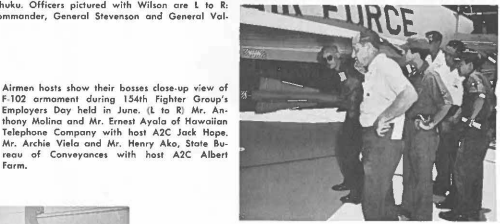
Airmen hosts show their bosses close-up view of F-102 armament du ring 154th Fighter Group’s Employers Day held in June. (L to R: Mr. Anthony Molina and Mr. Ernest Ayala of Hawaiian Telephone Company with host A2C Jack Hope. Mr. Archie Viele and Mr. Henry Ako, State Bureou of Conveyances with host A2C Albert Form. (Picture from 1964 September The Hawaii Guardsman)
OCT 1964 The 154th Fighter Group was presented the Base Commander’s Trophy and the Unit Award for its continuing efforts in guarding against fire losses and its initiative in promoting and maintaining an effective fire prevention program.
Learn More
154TH FIGHTER GROUP WINS FIRE PREVENTION AWARD
During October’s Fire Prevention Week at Hickam, the 154th Fighter Group was singled out from the many units at Hickam Air Force Base for its continuing efforts in guarding against fire losses. Brig. Gen. John A. Rouse, PACAF Base Commander, presented the Base Commander’s Trophy and the Unit Award to the 154th for its initiative in promoting and maintaining an effective fire prevention program.
The honors resulted from the Group’s high marks during PACAFBASECOM’s periodic inspections of the Group’s fire prevention activities and from a final evaluation of the program. This is the second year that the 154th, the only Hawaii Air National Guard unit on the base, has been recipient of the awards.
Present at the award ceremonies were Brig. Gen. Valentine A. Siefermann, HANG Commander, Colonel James R. Ashford, 154th Group Commander, and MSgt. Samuel Afoa, Group Fire Marshal. Witnessing the presentation were the hand-picked Fire Wardens and Deputy Fire Wardens of the 154th.
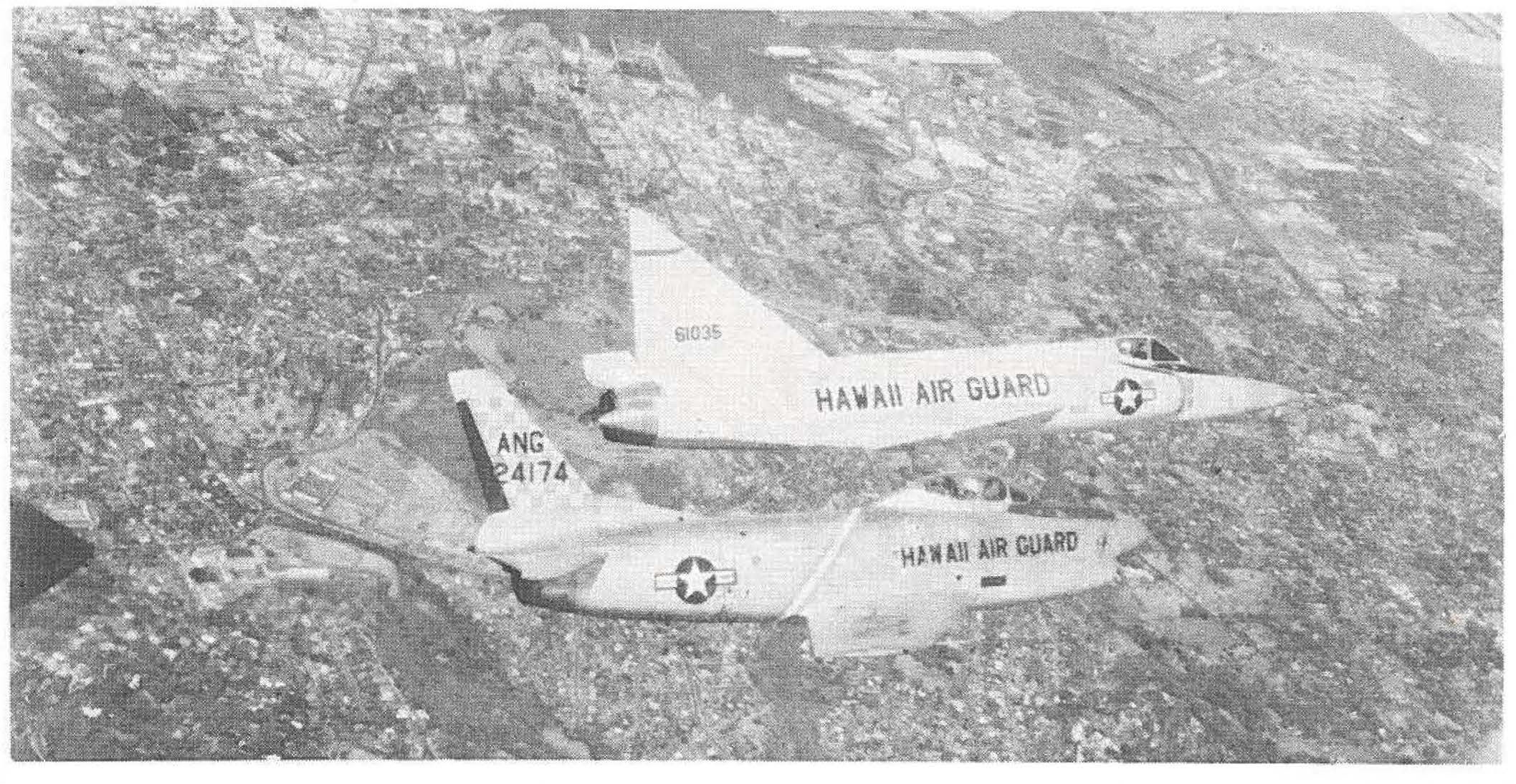
Deadly F-102 Della Daggers are pictured on apron at 154th Fighter Group at Hickam AFB. Supersonic single seal fighter performs air defense mission in Hawaii. Pilots are highly skilled; receive frequent praise from Active Air Force inspection teams. “Hawaii Air Guard” markings on aircraft have been replaced with. “U.S. Air Force” as result of new regulations. Guard markings are on tail section only (see aerial shot next page).Maintenance Control is nerve center of 154th Fighter Group maintenance section. Condition and position of all aircraft is kept up-to-the-minute on status board in background.(Picture from the 1965 Annual Report)
The 154th Fighter Croup (AD) stationed at Hickam AFB provides the weapons for airborne identification of friendly aircraft and destruction of enemy aircraft that enter the Hawaiian Air Defense System. F-102A Delta Dagger all-weather fighter interceptors, equipped with Falcon air-to-air missiles and rockets, are utilized.
Exercises are conducted periodically by the Air Force, utilizing Air Force criteria to test this organization’s capability to accomplish it’s air defense mission and M-Oay war plan. These exercises entail the recall of personnel, mass loading of all aircraft, intercepting “faker” aircraft, quick recovery, turnaround, relaunch of aircraft, deployment, unit defense against saboteurs and operating under radiological fall-out conditions.
Receipt of improved F-102 aircraft commenced near the end of the year. These aircraft. have an improved fire control system and have the capability of firing a larger variety of air-to-air guided missiles. All existing aircraft will be replaced by the improved F-102A interceptor, early in the coming fiscal year. Originally assigned F-102A aircraft will be processed for shipment to the continental U.S.
Pilot strength reached full authorization after several years of effort. Four recent pilot graduates reported for duty after completing advanced F-102 training at Perrin AFB.
An additional eight officers were in various states of flying training at the end of the fiscal year under the Air National Guard Training program. In this program, qualified applicants are locally commissioned, called to active duty for pilot training and upon completion of advanced training are returned to Hawaii where they revert to inactive duty and participate as regular pilot members of the 199th Fl Sq. This program insures a continual source of pilots to replace those that leave the ANG due to retirement or removal of residence.
Security in the 154th Fir Gp (AD) area of operations was considerably improved by the installation of an eight loot high chain link fence surrounding the ANG facility at Hickam AFB. Other facility improvements included the paving of the Motor Pool area. . .
The 154th Ftr Gp has exciting if not hectic plans in the mill for their field training from 12 to 26 June. Elements of the 154th may be training at Bonham ALF, Barking Sands, Kauai, Dillingham AFB, Mokuleia and at Hickam. At the same time the unit will be busy with an aircraft modification program.
The highly successful employers’ day held last summer camp is being seriously considered for a repeat this year. The response and interest shown by the employers in 1964 were most gratifying. It pays to let your employers know what you do as a Guardsmen.
Hawaii Air Guard Second in Nation in SKT Passing Rate
Like their active duty counterparts, airman personnel of the Hawaii Air National Guard must take and pass comprehensive written examinations before they can progress in their chosen career fields. Like their active duty counterparts, HANG unit commanders closely watch the passing and failure rates of the tests. A high passing rate reflects an excellent on-the-job training program; a low passing rate indicates that the airman personnel have not been given enough preparation to pass their Specialty Knowledge Test (SKT) in a specific Air Force job.
The latest National Guard Bureau On-the-Job Training Status Report shows that of all 52 states and possessions, Hawaii’s Air National Guard ranked NUMBER TWO in its SKT passing rate. Hawaii was topped only by Wyoming for the percentage of successful passing scores in calendar year 1964.
This accomplishment was made possible by all those who passed an SKT in the last year. In the last six months of 1964, 115 HANG airmen were tested and 103 local airmen passed for a passing rate of 89.6%, while the lowest state had a 52.8% and the highest state scored only 90.6%.
Last quarter the National Guard Bureau announced that the Hawaii Air National Guard’s 154th Fighter Group qualified for the On-the-Job Training Unit Achievement Award for calendar year 1964. Only 22 other Air Guard units in the nation make the select list.
The award is given on the basis of percentage of qualified personnel assigned and the passing rates compiled by airmen taking the Air Force’s Specialty Knowledge Tests. Colonel James R. Ashford, 154th Fighter Group Commander, had this to say about the national award: “This recognition reflects upon the day-to-day emphasis and effort which each officer and airman of the 154th places on OJT, an essential part of our overall training in the Hawaii Air National Guard. OJT enables us to keep our guard up.”
Reorganization of the 154th Fighter Group, to make it more responsive to mobilization and operating needs, will take place 1 July 1965.
One major change will see the 154th Materiel Squadron (Air Defense) split to form the 154th Consolidated Aircraft Maintenance Squadron and the 154th Supply Squadron.
In connection with this organizational revision, Major Tyler Harr, Jr., has been reassigned from his position as Commander, 154th Materiel Squadron, and takes over the Deputy Commander Materiel slot.
Replacing Major Harr as 154th Materiel Squadron Commander is Captain Harold Mattos, Aircraft Maintenance Staff Officer. A veteran of more than 18 years with the Hawaii Air National Guard, Captain Mattos has had extensive experience in aircraft maintenance and has followed the Hawaii Air Guard through its transition from the “good old days” of prop-driven airplanes to today’s supersonic jets.
As a result of last year’s success in holding a day for the bosses during summer field training, the 154th Fighter Group will again set aside one day to honor the employers who make summer camp possible. Plans call for the 154th to open its doors to the bosses on 22 June so that they can learn more about the Hawaii Air Guard and see what our citizen airmen do at camp.
The 154th Ftr Gp (AD) Was reorganized 1 Jul 1965 and 1 Dec 1965, respectively. With the latter reorganization, 154th Materiel Sq (AD) was inactivated; 154th CAMRON and 154th Supply Sq were activated. The resultant Group manning was 832 personnel, an increase of 57 personnel from the previous reorganization. . . .
154th FIGHTER GROUP (Air Defense) improved F-102A interceptor aircraft were received and originally assigned aircraft were shipped to the Mainland. The improved interceptors have an advanced fire control system, the capability of firing a greater variety of guided air-to-air missiles and better mission capability.
Significant increase in mission capability was gained by conducting dispersal operations during Annual Field Training. Flight operations were conducted from Barking Sands, Kauai and Dillingham AFB Oahu under field conditions. Operations from Hickam AFB were limited to support of the two forward operating bases. F-102 flight operations during this period was the highest amount this unit has ever attained. Experience gained in the movement of personnel, supplies and equipment, maintaining and operating complex equipment from bare strips added significantly to the mission capability of this unit. . . .
Four inspections delving into different areas of operation were conducted. One of the inspections was conducted by the Inspector General, USAF, the other three by Pacific Air Forces. Results of these inspections were satisfactory.
Early in the year, the twin engine C-47 mission support aircraft was replaced by a four engine C-54 aircraft. The increased load Giving capability of the C-54 (seven times that of the CA7) improved the dispersal capability of the 154th Ftr Gp (AD) and has been beneficial in airlift support of the Hawaii Army National Guard.
Increased security measures were implemented and supported by 6486th Air Base Wing. Twenty-four hour security coverage and positive entry control is now provided at the Alert Pad, aircraft parking ramp and missile storage/ Checkout facility. During air defense and upon mobilization, unit security personnel augment and are under the operational control of Hickam MB security personnel (6486th Air Police Sq).
Reorganization of the 154th Fighter Group (Air Defense) was okayed by the National Guard Bureau effective 1 December 1965. The former 154th Materiel Squadron (AD) has been replaced by two new units: the 154th Consolidated Aircraft Maintenance Squadron (AD) and the 154th Supply Squadron (AD).
Mission and functions of the 154th Fighter Group remain unchanged, hut the reorganization provides the Group with standard air defense organizational structures.
HANG old-timers have been assigned to command the new units. Major Harold T. Mattos is commander of the 154th CAMROX while Major Frank Carlos heads the 154th
11-25 JUN 1966 The 154th Fighter Group, For the first time in HANG history, was deployed between three fields, giving various sections and squadrons valuable training in mobility, supply and the myriad of details necessary to support three operations.
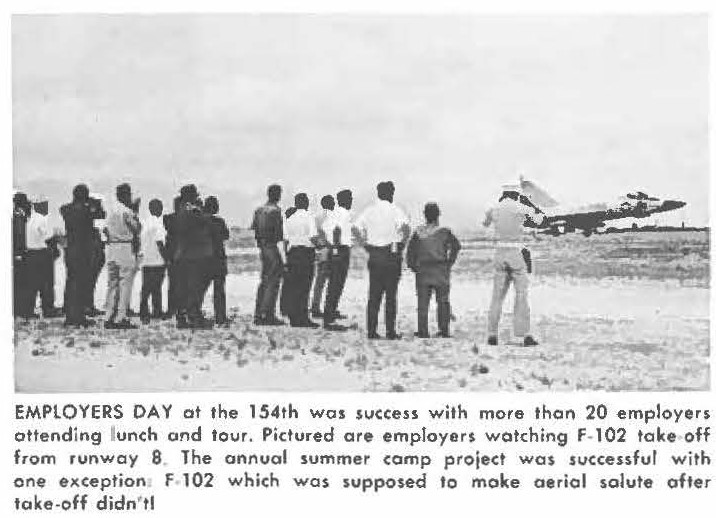
EMPLOYERS DAY at the 154th was success with more than 20 employers attending lunch and tour. Pictured are employers watching F-102 take off from runway 8 The annual summer comp project was successful with one exception F 102 which was supposed to make aerial solute after take-off didn’t!(Picture from the 1966 September The Hawaii Guardsman)
INTEREST FROM YOUTH-Two members of the Civil Air Patrol examine flight gear from the 154th Fighter Group, HANG, during the CAP’s annual summer encampment at Hickam AFB. (Picture from the 1967 Annual Report)
For the 154th Fighter Group, Fiscal Year 1967 was marked by an improvement in operational capability and favorable trends in almost every area of concern. The number of personnel assigned versus authorized increased from 88 to 90%. Personnel qualifications were raised to 72 %. Attendance at Unit Training Assemblies improved to over 96%. Re-enlistment rate of airmen was 76% compared to last year’s 67%. Though still above the all ANG average, the Specialty Knowledge Test passing rate showed a downward trend.
Tactical flight operations included operating from airfields with extremely limited facilities as might be required under mobilized and dispersed conditions. Flying training concentrated on intercepting “aggressor” aircraft utilizing various tactics such as high speeds at high and very low altitudes, changing altitudes and courses, emitting electronic countermeasures, dropping chaff, etc., all designed to confuse the air defense system. Tactical pilots averaged 137 hours of F-102 flying time for the year which resulted in approximately 98 flights per pilot. Overall tactical pilot strength decreased from 37 to 35. Five pilots resigned from jet flying (four due to removal of residence) and three pilots joined the unit during the year.
Aircraft maintenance activities set a new high of 79% operational ready rate for F-102 aircraft. This is well above the national ANG average. F-102 aircraft flew a total of 5,158 hours. The C-54 flew 543 hours and had an operational ready rate of 80%. Several improvements were incorporated in the F-102 aircraft during the year including engine modification, modifications to fire control system to improve reliability and an ejection seat modification to improve low altitude ejection capability
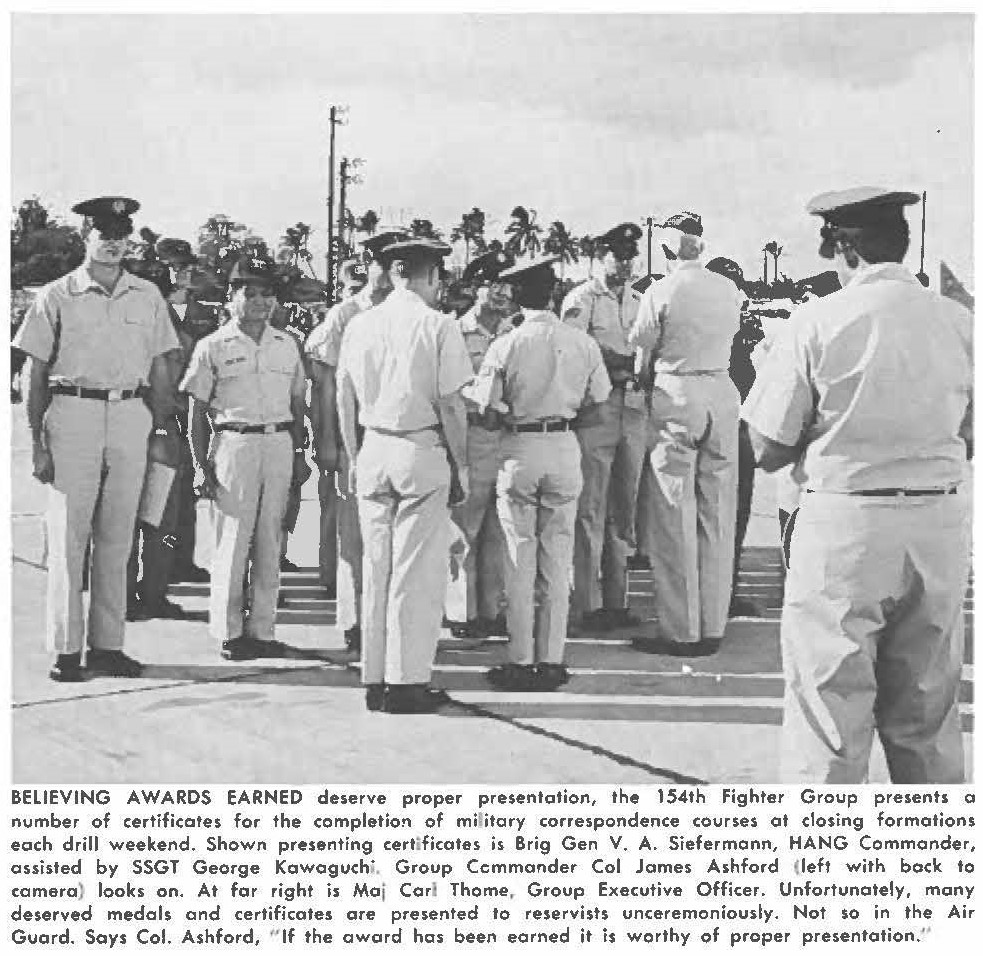
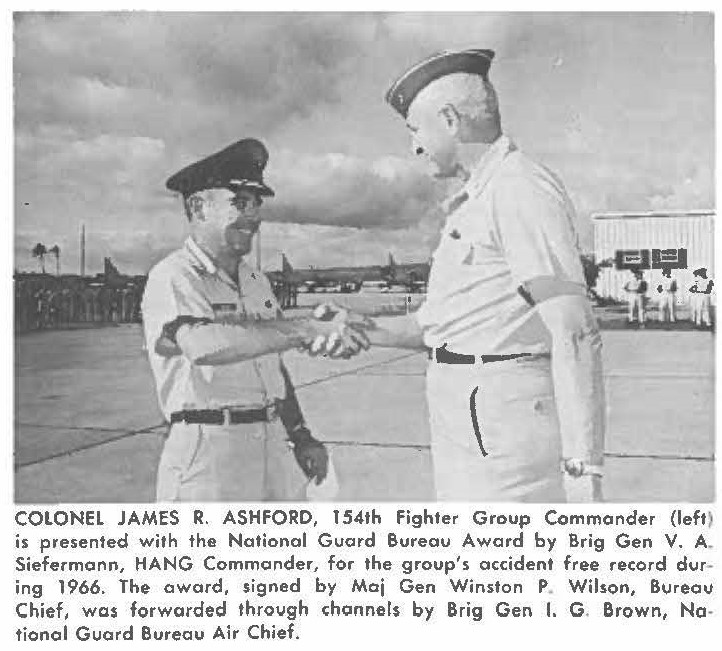
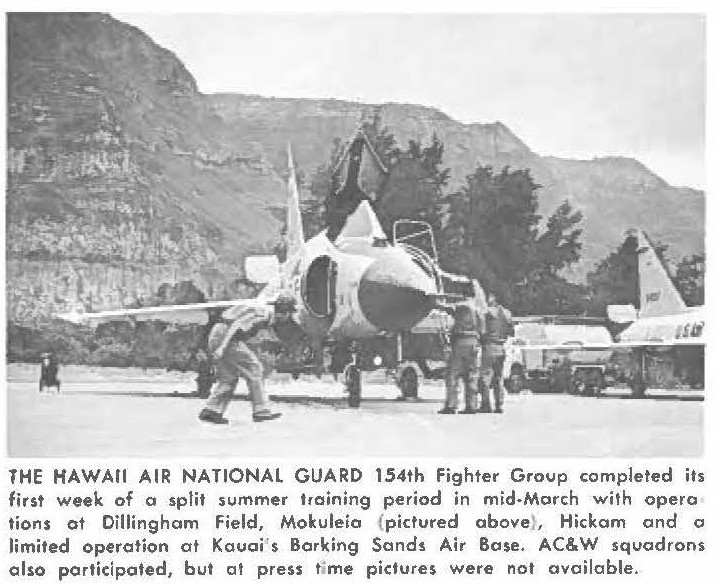
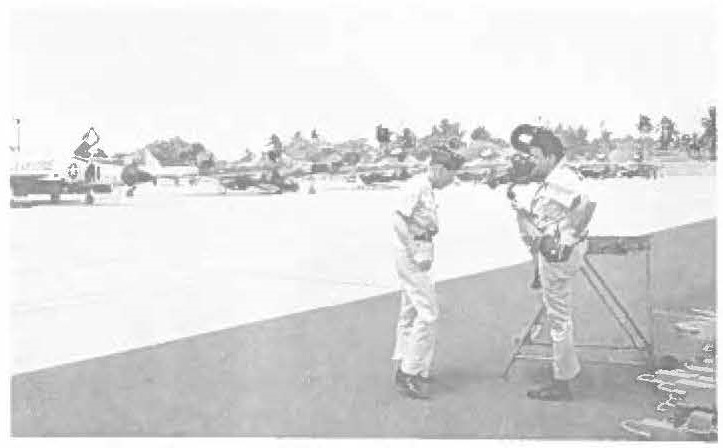
BELIEVING AWARDS EARNED deserve proper presentation, the 154th Fighter Group presents a number of certificates for the completion of military correspondence courses of closing formations each drill weekend. Shown presenting certificates is Brig Gen V. A. Siefermann, HANG Commander, assisted by SSGT George Kawaguchi. Group Commander Col James Ashford (left with back to camera) looks on. At far right is Maj Corl Thome, Group Executive Officer. Unfortunately, many deserved medals and certificates are presented to reservists unceremoniously. Not so in the Air Guard. Says Col. Ashford, ” If the award has been earned it is worthy of proper presentation.” COLONEL JAMES R. ASHFORD, 154th Fighter Group Commander (left) is presented with the National Guard Bureau Award by Brig Gen V. A. Siefermann, HANG Commander, for the group’s accident free record during 1966. The award, signed by Maj Gen Winston P Wilson, Bureau Chief, was forwarded through channels by Brig Gen I. G. Brown, Notional Guard Bureau Air Chief. (Picture from the 1967 March The Hawaii Guardsman)THE HAWAII AIR NATIONAL GUARD 154th Fighter Group completed its first week of a split summer training period in mid-March with operations at Dillingham Field, Mokuleia (pictured above), Hickam and a limited operation at Kauai’s Barking Sands Air Base. AC&W squadrons also participated, but at press time pictures were not available. A FILM CREW, working under the direction of Major James Elliott (left), Public Affairs Officer for the National Guard Bureau, are pictured on 154th Fighter Group flight line preparing to take pictures of departing Ohio F-84 jets. Photographer, Major Ray Simek of Chicago (right) and Major Frank Hirons (not pictured) also photographed 169th AC&W squadron operations at Wheeler and Mount Koala during April visit to Hawaii. Also to be featured in the next NGB produced movie will be the men of the 1st Battalion, 299th Infantry, photographed at Kahuku during weekend maneuvers. (Pictures from the 1967 June The Hawaii Guardsman)
1967 The 154th Fighter Group NORS-free (Not Operationally Ready, Supply) record stands at 730 days. NORS means a unit aircraft is grounded by unavailability of a part. That figure is the best among Air National Guard units and ranks second in the entire United States Air Force.
Learn more
HAWAII AIR GUARD UNIT EXTENDS NORS-FREE MARK TO 730 DAYS
By Airman Larry Edwards 154th Fighter Group
Old Man River, he just keeps rollin’ along. Or so the song goes. Similarly, the Hawaii Air National Guard’s 154th Fighter Group just keeps adding to its NORS-free record, which now stands at 730 days. That figure is far and away the best among Air National Guard units and ranks second in the entire United States Air Force.
The analogy, however, is far from perfect. Contrary to the lazy, effortless flow of Old Man River, the squadron’s record is predicated on the highly skilled, diligent and often feverish efforts of hundreds of men working over thousands of miles.
Just exactly what does NORS means? The term is literally Not Operationally Ready, Supply, and means a unit aircraft is grounded by unavailability of a part. Thus the Hawaii Air Guard has had no aircraft grounded for lack of parts during the past 730 days.
This is an accomplishment of considerable magnitude and has been recognized as such in letters of commendation from Brigadier General I. G. Brown, Assistant Chief for Air of the National Guard Bureau, and Major General Frank Rouse, Commander of the San Antonio Air Materiel Area.
There are 35,000 different parts to an F-102 aircraft such as the Hawaii Guard uses, 10,500 of which are stocked here. The rest are acquired when needed from the Air Force at Hickam Air Force Base, Clark AFB in the Philippines, or Naha AFB in Okinawa; the Navy at Barber’s Point; the Marines at Kaneohe MCAS; Air Guard units in Portland, Oregon, or Ontario, California; and occasionally from Aloha or Hawaiian Airlines.
This system of cooperation and assistance is necessary as it is impossible for every Air Force unit to stock enough parts to make it self-sufficient.
“We’ve just made it by the skin of our teeth on more than one occasion,” said Major Dan Au, 154th Supply Squadron Commander. “We have had parties on reaching 100, 200 and 500 days, and a luau at the one-year mark. Within a day or two of each celebration, we were suddenly faced with crises which almost blew the whole thing.”
Au passes a lot of the credit to Major Frank Carlos, the group deputy commander for materiel. Carlos, who has worked 20 years as a full-time Guardsman, is Chief of Supply and Services. In his inventory are a myriad of items ranging from a tiny cotter pin less than half an inch long to a $126,000 jet engine measuring over 20 feet.
“He has helped establish an overall can-do, nothing is impossible attitude,” Au said. “This has resulted in an average flight line delivery time of six minutes for priority two items. The limit is 30 minutes.”
Exact records are kept to ascertain that figure. The time is logged for a part’s request, its issuance and its delivery.
A man giving a great deal of assistance is the Supply Advisor, MSgt James C. Womack.
“Unquestionably the best outfit I’ve ever worked with,” said the man who was once in charge of supply for the Air Force precision flying team, the Thunderbirds. “We have first rate officers and non-coms, and (MSgt) Howard Okita, the property accounting supervisor, is the best in his position I’ve known.
“This is actually a supply and maintenance effort. The maintenance sections have developed a repair capability that enables them to handle 98 per cent of reparable items right here. That makes it a lot easier for us, since we rarely have to send a part away to be fixed.”
Major Harold Mattos is commander of the 154th Consolidated Aircraft Maintenance Squadron and everyone agrees that were it not for the excellence of his operation, the mark would never have been attained.
“I’ve never seen a regular Air Force unit match HANG’s performances,” Womack said. “During recent air defense exercises, the percentage of operationally ready aircraft has been considerably higher than the Air Force standard.
”The maintenance section’s tool kits are 97 percent complete compared to 80-8 5 per cent for the average Air Force unit and 100 per cent of all authorized flight line equipment are on hand and in use.”
Major Au then summed it all up when he held up a copy of the squadron motto. It read: “One team, one mission keep ’em flying. “
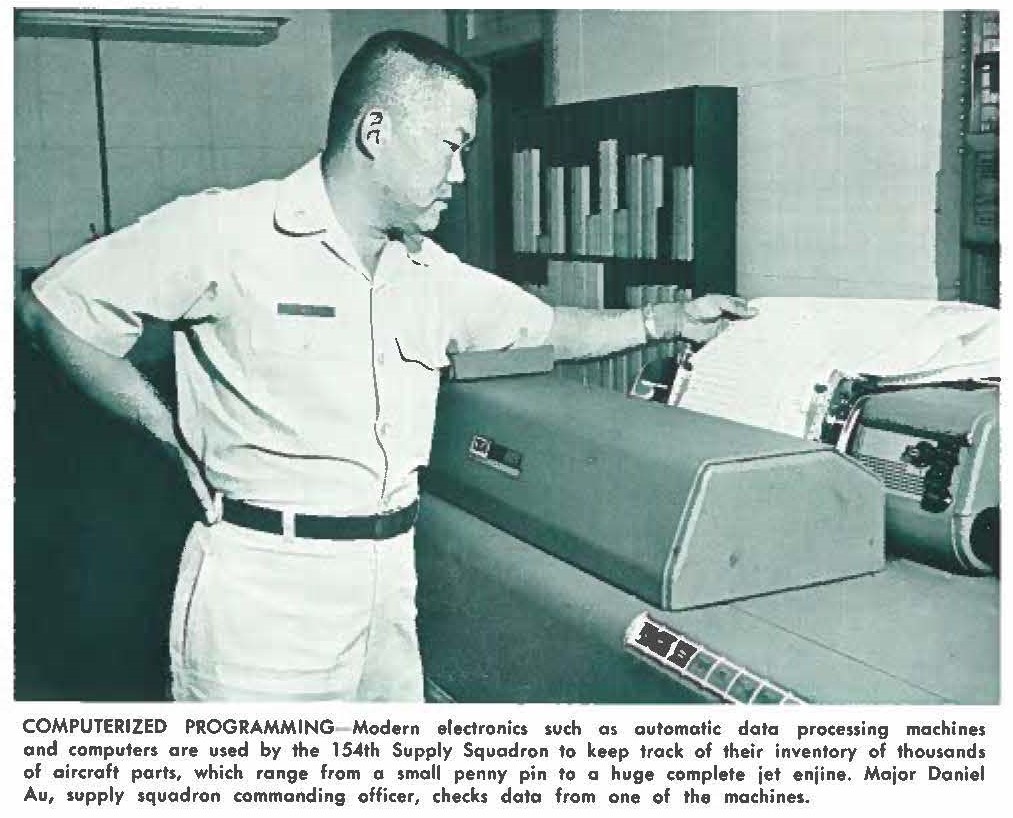
COMPUTERIZED PROGRAMMING Modern electronics such as automatic data processing machines and computers are used by the 154th Supply Squadron to keep track of their inventory of thousands of aircraft parts, which range from a small penny pin to a huge complete jet engine. Major Daniel Au, supply squadron commanding officer, checks data from one of the machines. (Picture from the 1967 Winter The Hawaii Guardsman)
For the 154th Fighter Group, Fiscal Year 1968 was marked by maintaining a high degree of operational capability and favorable trends in almost every area of concern. Personnel assigned versus authorized increased from 90% to 95%. Personnel qualifications improved from 72% to 76%. Attendance at unit training assemblies raised to over 97%. Though still above the national average, of like Air National Guard units, the re-enlistment rate showed a downward trend.
The Annual General Inspection and Operational Readiness Inspection retest conducted by Pacific Air Force resulted in favorable reports. The Personal Equipment section received an Outstanding rating. An Alert Force Capability Test conducted by 326th Air Division resulted in a commendable comment by the Air Force Evaluator on the results of the test.
Tactical flight operations included operating from airfields with extremely limited facilities as might be required under mobilized or deployed conditions. Tactical pilots averaged 135 hours of F-102 flying time for the year. Of 5000 F-102 hours allocated by NGB, 5002 were flown. with 4,743 utilized primarily for training, 117 for Air Defense Alert and 132 for functional check flights. Overall tactical pilot strength decreased from 35 to 33. Six jet pilots terminated (two retired, two for removal of residence, one for job conflict and one death) and four pilots joined the unit during the year.
Aircraft maintenance maintained a high F-I02 operational ready rate of 78%. The assigned C-54 flew 506 hours and had an operational ready rate of 75%. Base self sufficiency (ability to repair aircraft and fire control components) averaged 98.3% versus Air Force goal of 95%. Several modifications were incorporated in the F -102 including improvement of the Infra-red Detection System and improvements to the external tank mounting assembly
The alert force of the Hawaii Air National Guard’s 154th fighter Group received a new distinction recently, passing its first Alert Force Capability Test administered by the U.S. Air Force 326th Air Division.
The HANG was commended by Col. Ward Martindale, 326th Commander, for its outstanding demonstration of air defense capability.
The test, given without warning, called on Air Guard fliers to make a variety of intercepts within a specified time limit as well as show ability to reload and reservice the fighters for a quick return to alert ready status.
The HANG mans the 24-hour runway alert with rocker and missile armed F-102 fighter-interceptors. It is the only Air National Guard unit in the nation entrusted with the first-line air defense of its area.
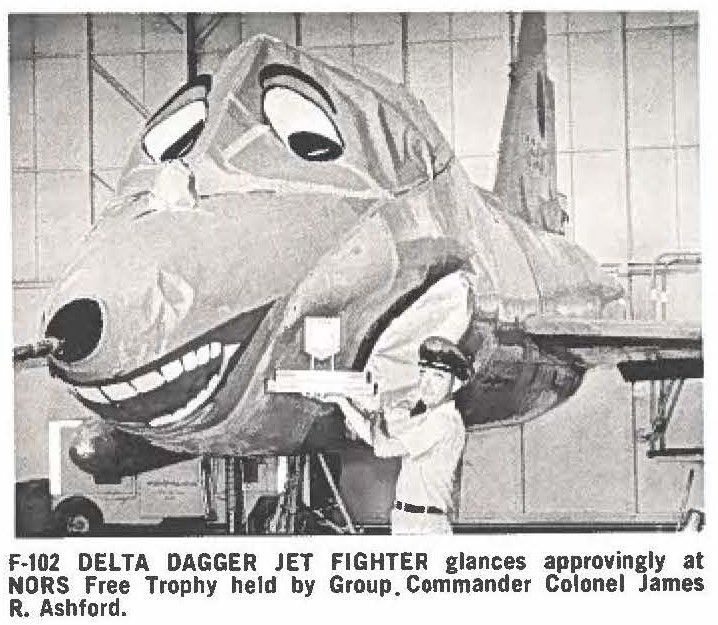
MAR 1968 The NORS free trophy, presented by PACAF, is the third major award from an outside agency to the 154th Fighter Group for its outstanding record. No aircraft has been grounded for two years for the lack of a part.
Learn more
NORS FREE TWO YEARS PLUS
The NORS free trophy, presented at Hickam AFB in mid March by PACAF, is the third major award from an outside agency to the 154th Fighter Group for its outstanding record. No aircraft has been grounded for two years for the lack of a part. NORS means, Not Operationally Ready, Supply and was achieved by the 154th Supply Squadron, a part of the group. The Supply Squadron, commanded by Major Daniel Au, is the best among Air National Guard Units nation wide and is third in the Air Force world wide. There are more than 35,000 different parts in the supersonic fighter
F-102 DELTA DAGGER JET FIGHTER glances approvingly at NORS Free Trophy held by Group. Commander Colonel James R. Ashford. (Picture from the 1968 Summer The Hawaii Guardsman)
Minor internal authorization changes were effected within the 154th Ftr Gp pertaining to the Senior Master Sergeant/Chief Master Sergeant (SMSgt/CMSgt) spaces. . . .
Fiscal Year 1969 was a year of continued high degree of mission capability for the 154th Ftr Gp with favorable trends in almost every area of concern. Personnel qualification improved from 76% to 80%. Reenlistment rate improved slightly and is well above national average as is the drill attendance percentage of 97%. Tactical pilot strength increased following a two year downward trend. Though still high, percentage of personnel assigned decreased from 95% to 90% of authorized.
Annual General Inspection and Operational Readiness Inspection conducted by Pacific Air Force resulted in favorable reports. The 154th Supply Squadron (Sup Sq) received an Outstanding rating for its On-the-Job training program.
Tactical flight operations included operating from airfields with austere facilities as might be required in a mobilized and deployed condition. The 4,624 F -102 hours allocated by NGB were flown during the year. Overall tactical pilot strength increased from 33 to 36. Four jet pilots terminated (three removal of residence and one jut; conflict) and seven pilots joined the unit during the year.
The Air Force Association’s Earl T. Ricks Memorial Trophy was awarded to Major Melvin G. Yen, for his outstanding airmanship while safely recovering an F -102 aircraft with a failed engine.
Pacific Air Forces “Outstanding Achievement Award” was presented to the unit for establishing a record of 3 years 5 months of F-102 operation without aircraft being grounded due to lack of spare parts. Commendations were also received from San Antonio Air Materiel Area and National Guard Bureau.
Seven pilots volunteered for 90 day tours of active duty to support and fly for the U.S. Air Force in the Philippines, South Vietnam and Thailand. Lt Col Kurt E. Johnson Majors Jon G. Parrish, Edward V. Richardson, Gerald K. Sada, and Captains Rexford F. Hitchcock ami Marlin L. Little, the participants, all received Air Medals with varying numbers of Oak Leaf Clusters for their part in this program called “Palace Alert.”
Two aircraft with pilots were maintained on “5 minute” alert status 24-hours each day of the year ready to be scrambled to intercept unknown aircraft approaching Hawaii. A total of 123 F-102 hours were flown in this mission of providing air defense for Hawaii.
Aircraft maintenance continued to be above the Air Force standard with an F-102 operational ready rate of 76.8%. The single assigned C-54 flew 423 hours and had an operational ready rate of 83.8%. In addition the C-54 received a major overhaul at a commercial contact facility in Texas.
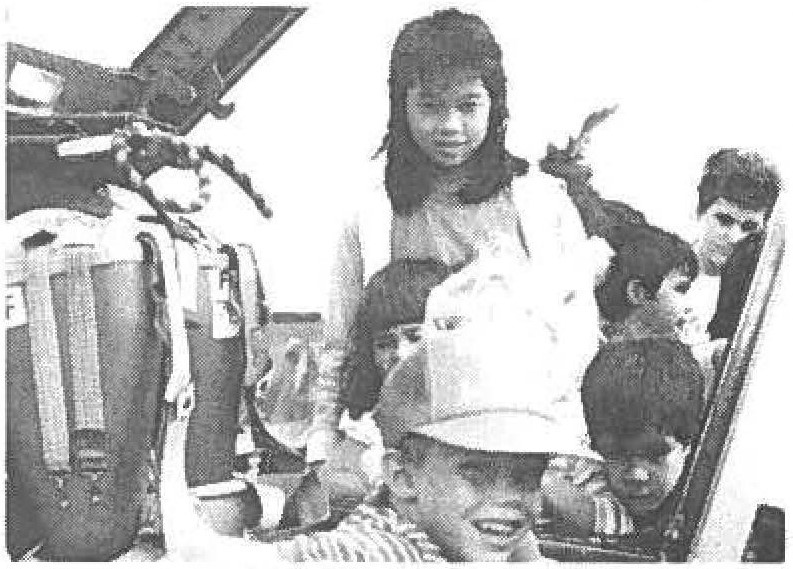
1969 Fifteen students from the Diamond Head School for the Deaf and Blind toured the Hawaii Air National Guard facility at Hickam AFB.
Learn more
Deaf and Blind Students Tour 154th
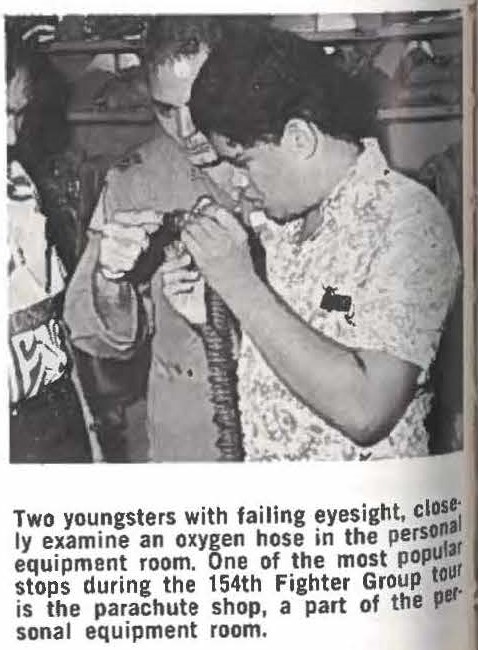
Fifteen students from the Diamond Head School for the Deaf and Blind toured the Hawaii Air National Guard facility at Hickam AFB recently during a regular HANG monthly training assembly.
Three blind and 12 deaf children spent the afternoon at HANG as the final stop on a tour of the base conducted by the Hickam Holy Name Society, with Sgt Charles Henderson acting as interpreter.
The children visited several areas of the HANG complex including the parachute shop and the pilot equipment room, where several tried on flight helmets and other gear.
The group was taken by bus to the runway to experience a jet scramble and on return, was given a thorough inspection tour of an F-102 on the ground.
Prior to the HANG visit, the group took in a demonstration by the Aerospace Rescue and Recovery unit and toured both a C-130 Hercules aircraft and the Hickam C-124 flight simulator.
Two youngsters with failing eyesight, closely examine an oxygen hose in the personal equipment room. One of the most popular tour stops during the 154th Fighter Group tour is the parachute shop, a part of the personal equipment room. (Picture from the 1969 Spring The Hawaii Guardsman)
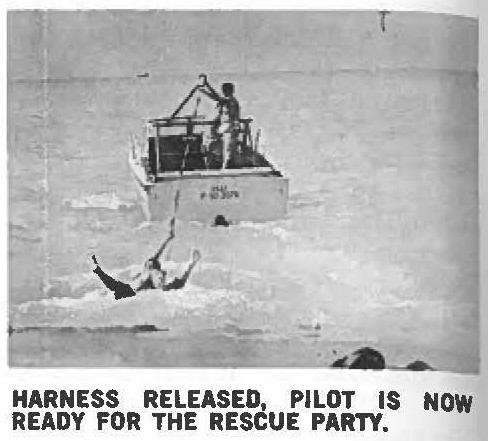
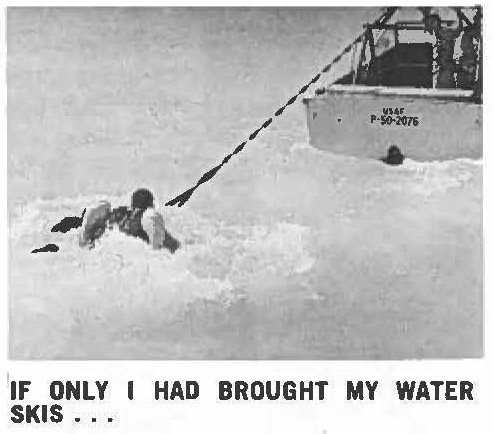
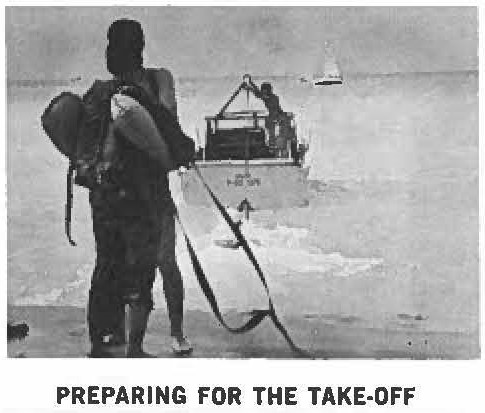
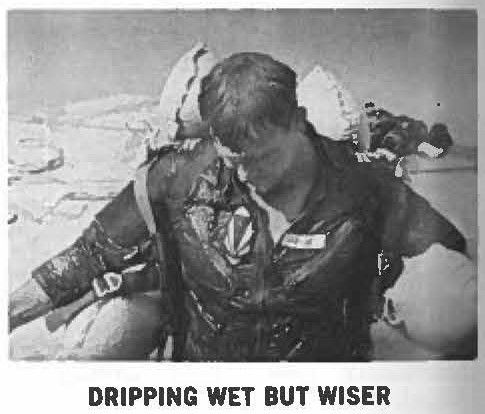
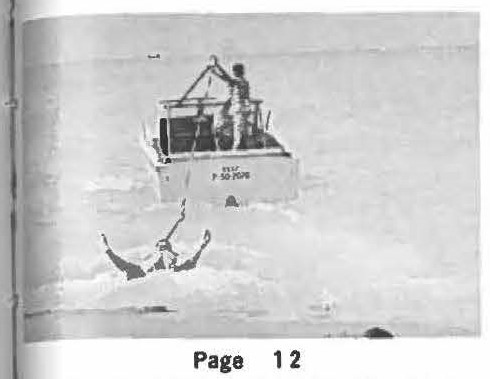
1969 The pilots of the 154th Fighter Group underwent their annual “wet ditch training”, they practiced freeing themselves from parachutes while being dragged both face up and face down in the water by a powerboat.
Learn more
154TH WET DITCH TRAINING
By Capt Eddie Anderson
HARNESS RELEASED, PILOT IS NOW READY FOR THE RESCUE PARTY. IF ONLY I HAD BROUGHT MY WATER SKIS . . . PREPARING FOR THE TAKE-OFFDRIPPING WET BUT WISER (Pictures from the 1969 Summer The Hawaii Guardsman)
During their April training assembly at Hickam Air Force Base, the pilots of the 154th Fighter Group underwent their annual “wet ditch training.” The pilots practiced freeing themselves from parachutes while being dragged both face up and face down in the water by a powerboat. The exercise was aimed at preventing a pilot from drowning in the event he is dragged by a blown chute following a ditching at sea. Once the pilot has freed himself from the chute harness, the chute is then free to blow away and collapse, enabling him to begin other survival measures.
The Hawaii Air National Guard’s 154th Fighter Group will prepare and donate 150 barrels to the City of Honolulu for use in beaches and parks to help stem the growing trash problem.
The project of supplying barrels to the City and State was initiated by the National Guard in 1960, and to date the Hawaii Air National Guard (HANG) has contributed some 300 barrels for this purpose. It is strictly voluntary and all barrels and materials are donated
The project is in keeping with the National Guard’s policy of assisting the community where practical.
Fiscal year 1970 was a year of continuing high mission capability for the 154th Fighter Group with favorable trends in every area of major concern. Tactical pilot strength continued to increase. Personnel qualification improved from 80 percent to 84 percent. Personnel assigned increased slightly from 90 percent to 92 percent. Drill attendance remained high and a slight improvement in the re-enlistment rate was experienced.
Active Air Defense Alert was provided with two pilots and aircraft on “5-minute” alert status 24 hours during each day of the year. The pilots were always ready to be scrambled to intercept and identify unknown aircraft approaching Hawaii. During June, two additional pilots and aircraft were placed on “30-minute” status during nighttime hours to augment the “5-minute” crews. A total of 111 F-I02 aircraft hours was flown in this mission to provide air defense for Hawaii.
Tactical flight operations included operations from airfields with very limited facilities, as might be required in a mobilized and deployed condition. Considerable effort was expended in a variety of air defense exercises designed to check our capability to counter an aircraft attack on Hawaii. The 5,300 F-I02 hours allocated by NGB were flown during the year. Squadron tactical pilot strength increased from 29 to 33. NGB authorized the unit to exceed the normal authorization of 30. An additional seven supervisory tactical pilots were assigned. Three pilots terminated their membership in HANG during the year due to removal of residence; however, six pilots joined the organization.
The operational ready rate for F-102 aircraft averaged 75.2 percent versus the Air Force standard of 71 percent. An additional TF-102 two-place aircraft was added to our inventory which allowed increased schedule flexibility for both Aircraft Maintenance and Operations. The single assigned C-54 flew 495 hours in support of all Hawaii National Guard activities and had an operational ready rate of 80.4 percent
Fiscal Year 1971 was a year marked by stability and continued high mission capability for the 154th Fighter Group. Favorable trends continued in major areas of concern. Tactical pilot strength increased slightly. Personnel assigned versus those authorized averaged over 90%. Personnel qualification increased to 85%. Drill attendance exceeded 97%, and the reenlistment rate improved to 59%.
Results of an Operational Readiness Inspection and General Inspection conducted by a Pacific Air Forces inspection team were gratifying and confirmed that the Group was fully capable of performing its assigned mission, of air defense. Performances by tactical pilots, aircraft mechanics, electronic technicians and weapons lead crews were well above PACAF standards.
Two aircraft and pilots were always on a “5 minute alert” status throughout the year, ready to intercept unknown aircraft. This capability was augmented in September 1970 by an additional two pilots and aircraft on “30 minute” status. A total of 302 F-102 aircraft hours were flown to provide active air defense of Hawaii.
Tactical flight operations resulted in 5,341 F-102 hours flown during the year without accident or serious incident. Continued emphasis was placed on air defense exercises and operations from airfields with very austere facilities. Total tactical pilot strength increased to 41 including seven pilots in supervisory positions. Six tactical pilots joined during the year. Three pilots terminated their membership due to removal of residence. One left due to incompatible occupation.
The operational ready rate for F-102 aircraft averaged 70.3% which met Air Force standards. Aircraft authorization was changed from 25 to 18. Twenty-one were on hand. Several modifications were added to the F102, to extend the life of the airframe and improve the reliability of the engine. The work detracted slightly from the operational ready rate and flying hour accomplishment. February 1971 marked the tenth year of operations with F-102 aircraft.
The single assigned C-54 flew 416 hours in support of Hawaii National Guard activities and had an operational ready rate of 76%. Medical support of all HANG units included over 500 medical examinations, 150 flying physicals, approximately 3,750 immunizations and over 500 sick calls during drill weekends ‘and field training. During this same period, approximately 1,400 Tuberculin Tine Tests were administered.
Major community activities involved the Royal Guard, support of the Cancer Crusade and the conducting of tours and orientation briefings of the 154th Fighter Group. Tours were conducted for 500 people, principally, school children, Boy Scouts and Civil Air Patrol cadets.
Blazon: Or, between two piles, one issuant from dexter fess, the other from sinister fess with points in middle base gules a Hawaiian idol sable, with eyes, mouth, and malo of the second, holding to dexter a Hawaiian kahili standard with wooden shaft of the third, crested with feathers in a cylindrical shape at the top of the second, and in sinister a Hawaiian wooden spear of the third, all within an orle of the like.
Significance: The shield symbolizes defense. The colors conform to the old Hawaiian colors used for the feather capes and helmets, which are traditional to Hawaii. The stylized idol, symbolic of Old Hawaii, were used by the ancient Hawaiian kings and chiefs as visual symbols of their personal gods, and this idol has been emblematic with the Hawaii Air National Guard since its post-war formation. The design is symbolic of fearlessness, valor, strength in the heat of battle, and readiness for combat. It typifies the spirit of the Fighter Group. The spear is symbolic of battle. The kahili is symbolic of authority and was the standard which accompanied the personages of kings and chiefs, identifying their high rank. The shock waves adapt the design to concepts.
The emblem was designed by Capt Kurt E. Johnson. Approved 26 October 1961.
A significant change occurred in the personnel area. The Hawaii National Guard’s first woman officer and first woman enlistee were sworn in as members of the 154th Fighter Group. They were First Lieutenant Barbara O’Hare and Airman 1st Class Phyllis Dickens.
154th Fighter Group: The 154th Fighter Group continued its high mission capability and favorable trends in major areas of concern during Fiscal Year 1972. There was a slight decrease in tactical pilot strength , and aggregate personnel assigned versus authorized strength averaged over 88 per cent. The personnel qualification rate was 82 per cent, drill attendance exceeded 96 percent and the reenlistment rate improved considerably to 69 percent.
February of 1972 marked the 11th year of operations with the F-102 aircraft. The number of aircraft authorized continued at 18, with 20 on hand and with an average operationally ready rate of 66.4 percent.
The engines, airframes and hydraulic systems of the F-102 aircraft were modified during the year to improve safety, handling capabilities and engine reliability.
A total of 4,81 5.5 F-102 hours of tactical flight operations were flown during the year. Continuing emphasis was placed on air defense exercises and operating from airfields with austere facilities.
“Alert” status aircraft (ready to be scrambled to intercept unknown aircraft entering the Hawaii air defense area) remained available around the clock. Two aircraft and pilots were always on a “5-minute” status and two additional pilots and aircraft were on a “30-minute” status. A total of 142.8 hours were flown in providing active air defense of Hawaii.
Tactical pilot strength decreased to 38, which included 7 pilots in supervisory positions. Two tactical pilots joined the unit during the year. One pilot terminated due to removal of residence, one pilot terminated for medical reasons, and three pilots transferred internally. Although total tactical pilot strength decreased within the I54th Fighter Group, the 199th Fighter Interceptor Squadron ended the year in an overstrength condition.
The assigned C-54 flew 468.1 hours in support of all Hawaii National Guard activities and had an operationally ready rate of 82.1 percent, a substantial improvement from Fiscal Year 1971.
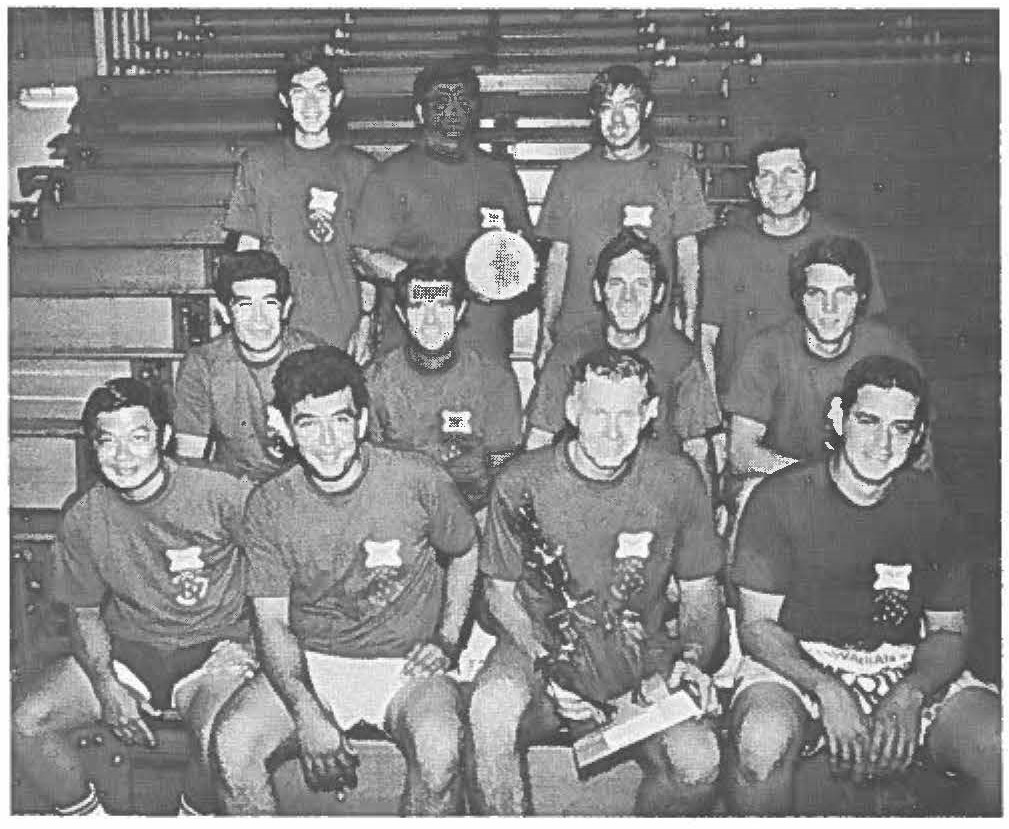
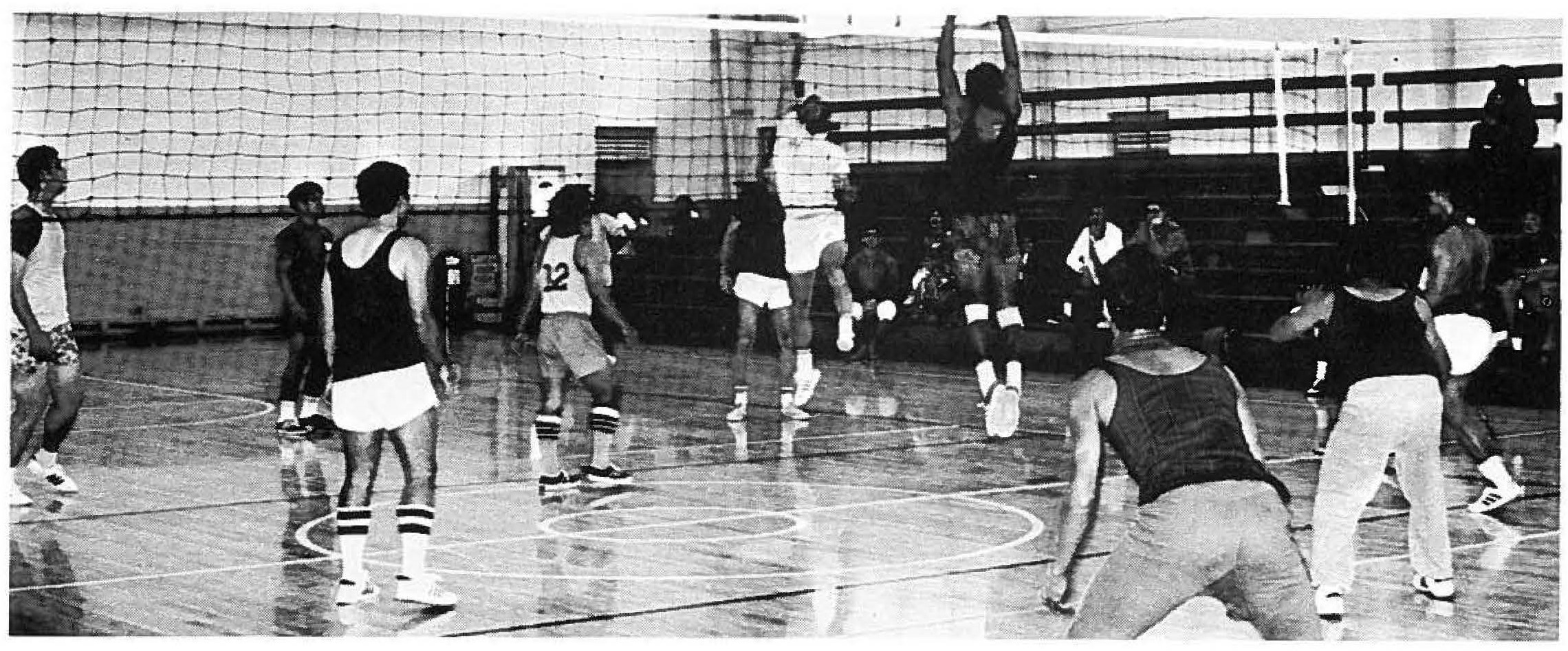
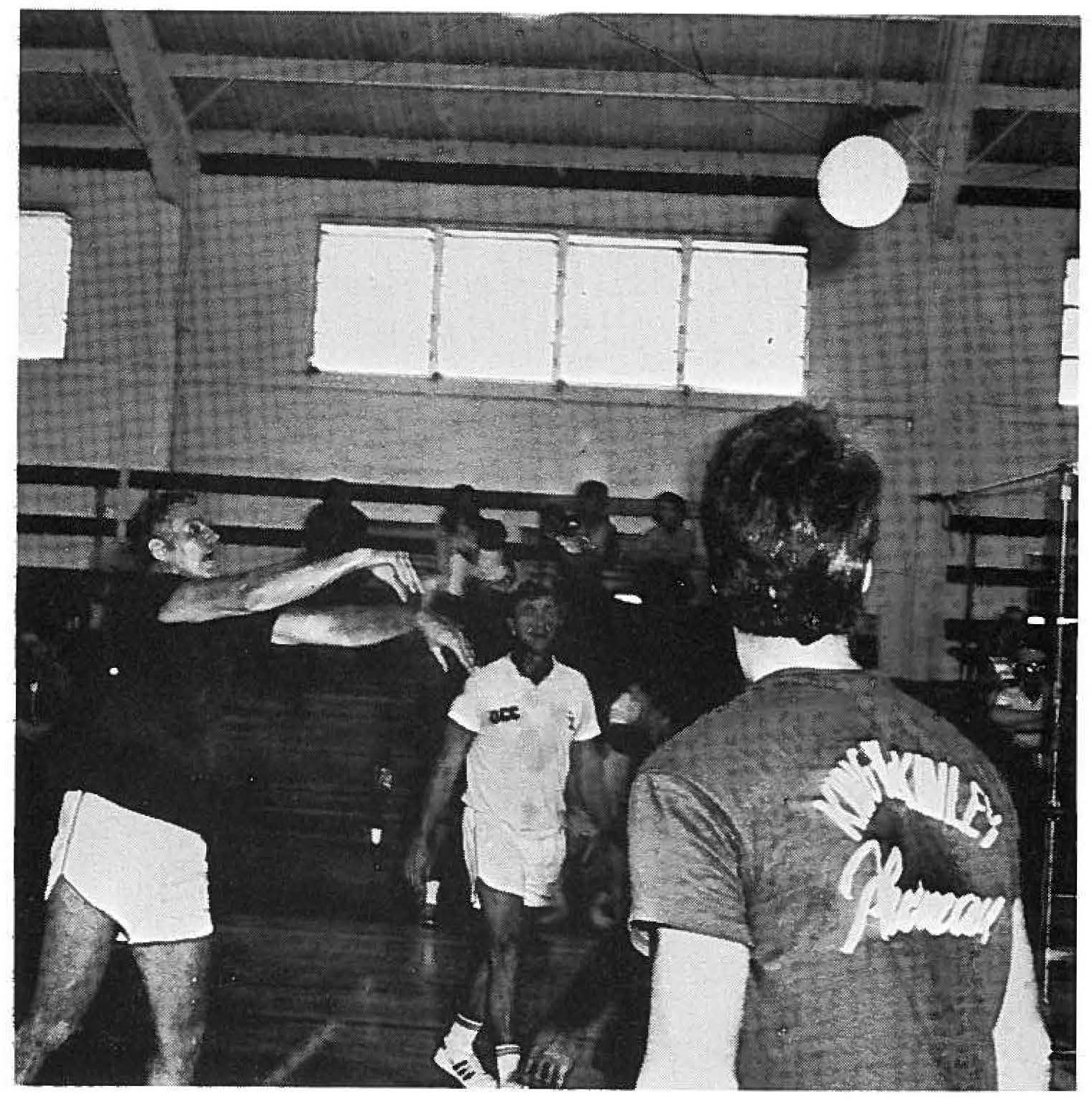
1972 The 154th Fighter Group the Hawaii National Guard volleyball program
Learn more
154th Fighter Group sweeps volleyball
The Hawaii National Guard volleyball program wound up in a blaze of blue – Air Guard blue – as the 154th Fighter Group and the 169th AC&W Squadron slugged, or slammed, it out at the Kaneohe Armory recently.
The 154th finally won after two very hard fought games. The scores were close, despite the fact that a defective scoreboard made them look lopsided.
Members of the winning team were: Majors Joseph Ah New, John Beaumont, George Joy, George Kuroda and Marlin Little; Captain Daniel St0ne; First Lieutenants Geoffrey Avery and Clinton Churchill; Master Sergeants Darryl Ho and Wayne Soma; Tech Sergeant Ronald Cozo; Sta ff Sergeants Harry Fujiwara, Melvin Ige. Richard Saunders and William Stern, Sergeant Garry Teves and Airman First Class Roland Pang.
The runners-ups, the 169th AC&W Squadron, were at least consistent. They were also runners-up in the Wheeler Air Force Base league. The 169th‘s team included: Capt Steve Oka, SMSgts Deo Agbayani and Joe Tibayan; TSgts James Akamine and Don Hashimoto; SSgts Wallace Akagi, Morris Geolina and Mike Nakaahiki, and AIC Wendell Wee.
They were captained by Ray lmbo and coached by MSgt Russell Ganiko.
The 154th Fighter Interceptor Group (FIG) maintained its air defense alert posture throughout the year with two pilots and aircraft on “5-minute” alert status and an additional two pilots and aircraft on “30-minute” alert status.
F-102 flying time for the year totaled 5,014 hours, providing sufficient air time for the 42 assigned or attached pilots to complete their in-flight combat readiness training requirements. The aircraft operational-ready rate averaged 67 percent. Air defense exercises and periodic use of the austere airfield facilities at Dillingham AFB and Barking Sands PMRF helped to maintain the effectiveness of the Hawaii Air Defense System.
Air National Guard (ANG) cost reduction programs forced the termination of F-102 flying assignments for two Air Force pilots of the 326th Air Division. This measure had to be taken so as not to adversely effect the HANG pilots. Two HANG pilots terminated their assignments with the 199th FIS and three new officers moved in. These three were second lieutenants who graduated from the Air Force pilot training program and the ANG F-102 Combat Crew Training School at Houston, Texas.
As a community service, the 154th FIG participated in the Cancer Crusade, Great Automobile Roundup, cardio-pulmonary resuscitation classes for the Hawaii Heart Association, a project for the Governor’s Committee on Employment of Handicapped, the Kamehameha Day parade, Kailua’s Independence Day parade, the veteran’s job fair, the tenth annual Merry Monarch Festival, and Armed Forces Day displays. In addition, approximately 1,845 young people from 21 high and elementary schools, community colleges, and youth groups toured the 154th FIG facility at Hickam AFB and were briefed on HANG missions and operations.
The blue-suiters did it again during the 1973 Hawaii National Guard Volleyball Tournament. For the second year in a row, the 154th Fighter Group team captured both the Oahu and State play-offs. The airmen, however, had to beat back a tough, young, 29th Support Battalion (since redesignated as the 159th Supply and Service Battalion) team. Later, a composite of both teams participated in the Statewide Haili Tournament on Hawaii. The Guard team beat the Hawaii Marines, top-rated team in local military circles, before they were eliminated.
Members of the 154th team were: Major Tom Haine and TSgt Richard Saunders, co-captains, Major John Beaumont, Captain Clint Churchill, 1st Lt Geoffrey Avery, SSgt Bill Stern, SSgt Harry Fujiwara, Sgt Jimmy Pahukula and Sgt Alvin Naumu. MSgt Darryl Ho was the team coordinator.
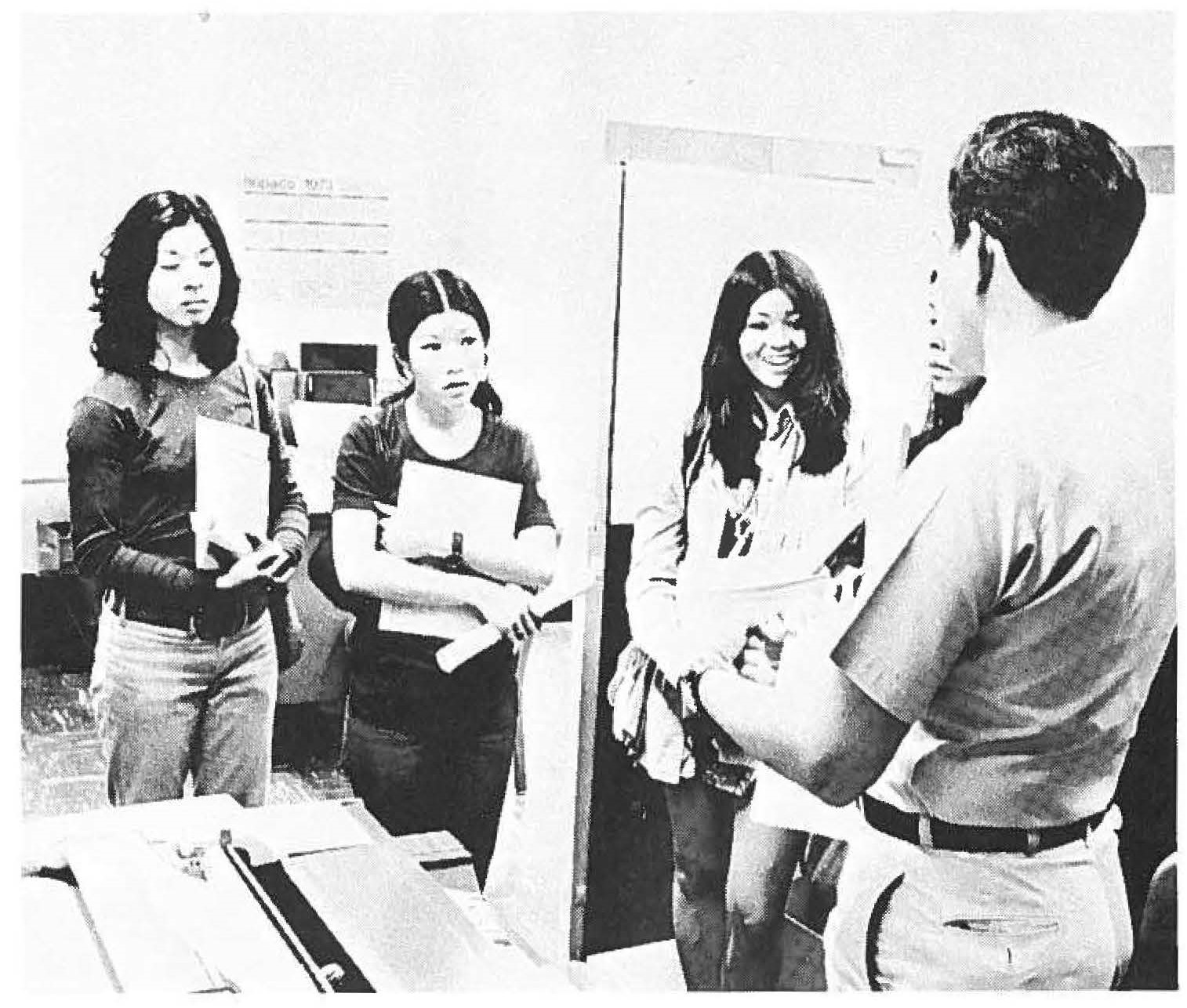
1973 Over the summer 100 young women from the senior classes of various Honolulu high schools visited the 154th Fighter Interceptor Group. Highlights of the tour were opportunities to trigger the F102’s Weapons System and the experience of flying the flight simulator.
Learn more
Women abound around HANGer
Women abound around HANGerWomen abound around HANGerWomen abound around HANGer(Pictures from the 1973 Summer The Hawaii Guardsman)
Over 100 young women from the senior classes of various Honolulu high schools visited the 154th Fighter Interceptor Group during the past three months.
The visitors were ushered around the Group by Captain “Sasha” Saromines of the Combat Support staff.
Highlights of the tour were opportunities to trigger the F102’s Weapons System which produced a big “whoosh” of com pressed air, the experience of flying the flight simulator compliments of Master Sergeant Benny Goo.
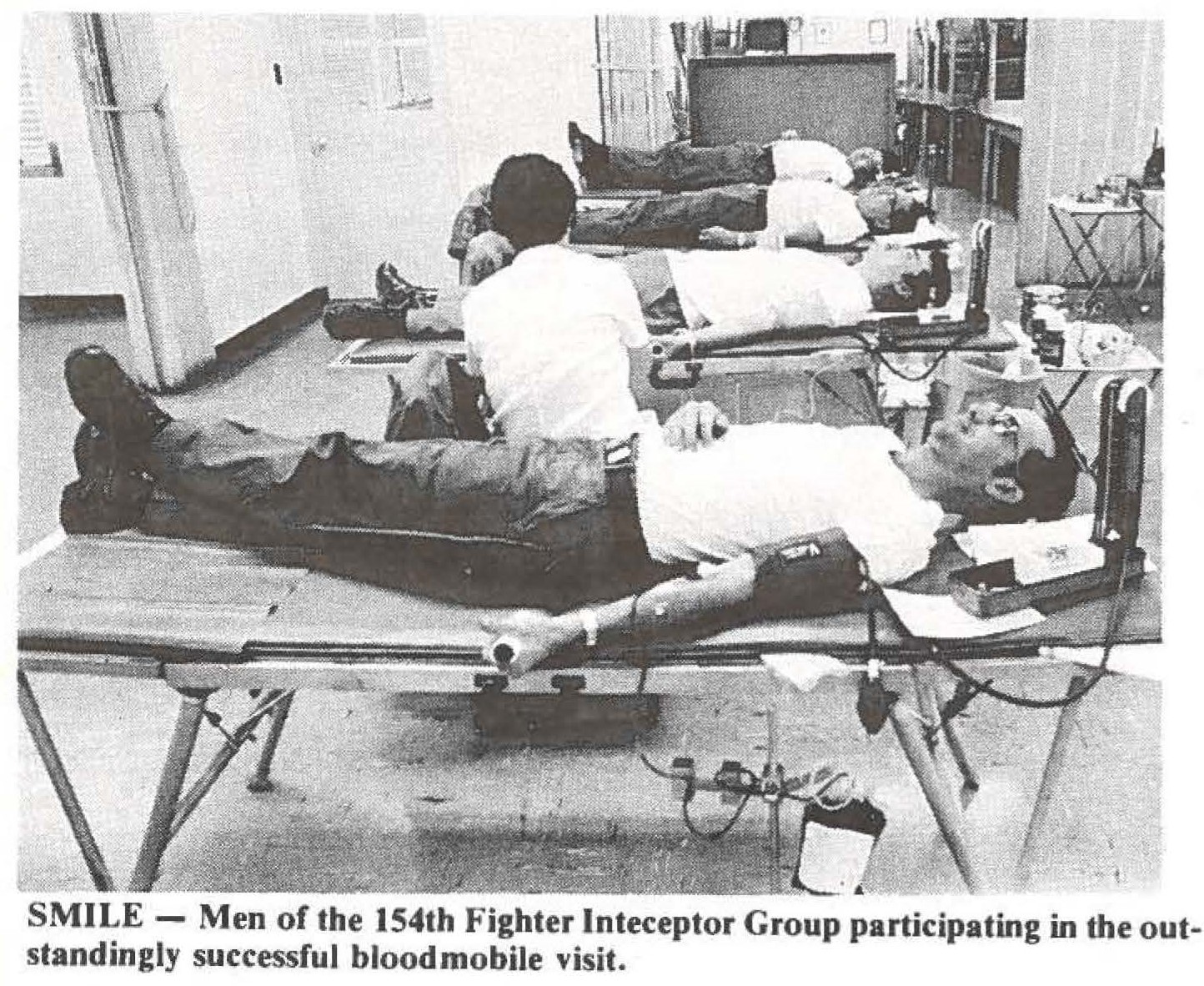
Toshi “Quack” Watabayashi, resident medic, put his troops through their paces by providing hearing and blood tests.
All hangar operations paused periodically as feminine giggles rippled through the corridors to break up an otherwise humdrum existence.
The tours are conducted by HANG as part of its special programs associated with the Air Guard’s public image.
Effective on July I, 1973, the 154th Fighter Interceptor Group was reorganized, and its authorized strength was reduced from 855 to 693 (81 officers and 612 airmen) with no change in mission, location, or gaining command.
The 154th Fighter Interceptor Group (FIG) continued to maintain its air defense alert posture throughout the year with two pilots and aircraft on a 5-minute alert status and two additional pilots and aircraft on 30-minute alert status.
During November 1973, Headquarters; Pacific Air Forces, conducted an operational readiness inspection and a management effectiveness inspection. As a result of these inspections, the 154th FIG was rated as fully capable of performing its assigned mission.
The F-102 flying time totaled 4,322.3 hours, providing sufficient air time for the 40 assigned and attached pilots to complete their inflight combat readiness requirements. This was a slight reduction from past flying time because of the fuel crisis in December and January. Air Defense exercises and periodic use of the austere airfield facilities at PMRF, Barking Sands, helped to maintain the effectiveness of the Hawaii air defense system.
The F-I12 operationally ready rate averaged 58 percent. Lack of engine spare”parts and serviceable engine support from the Air Logistic Command depot at Oklahoma City were the major reasons for this below-average performance. The C-54 aircraft flew 379.7 hours in support of Hawaii National Guard and other service activities and averaged a 71 percent operationally ready rate.
Overall assigned strength at the end of the year was 96 percent of authorized. For the first time in many years, the 154th FIG had to make a serious effort to recruit personnel. Without the draft as motivation, the unit found that it had to get out into the community to sell the young citizens of Hawaii on the benefits of belonging to the HANG. Tactical pilot strength decreased by four. This brought the FIG down to authorized strength.
In support of community activities, the 154th FIG participated in the residential cancer crusade, cardiopulmonary resuscitation classes for the Hawaii Heart Association, Friends of the Library of Hawaii book sale, Kailua’s Independence Day parade, Restoration Day parade, American Legion parade, the silver anniversary Aloha Week Festival, Friends of lolani Palace “Night Nostalgia,” Kailua’s fiftieth anniversary parade, Prince Kuhio Day parade in Papakolea, the Kamehameha Day parade, the veterans job fair, Armed Forces Day displays, and memorial services honoring King David Kalakaua at the Royal Mausoleum.
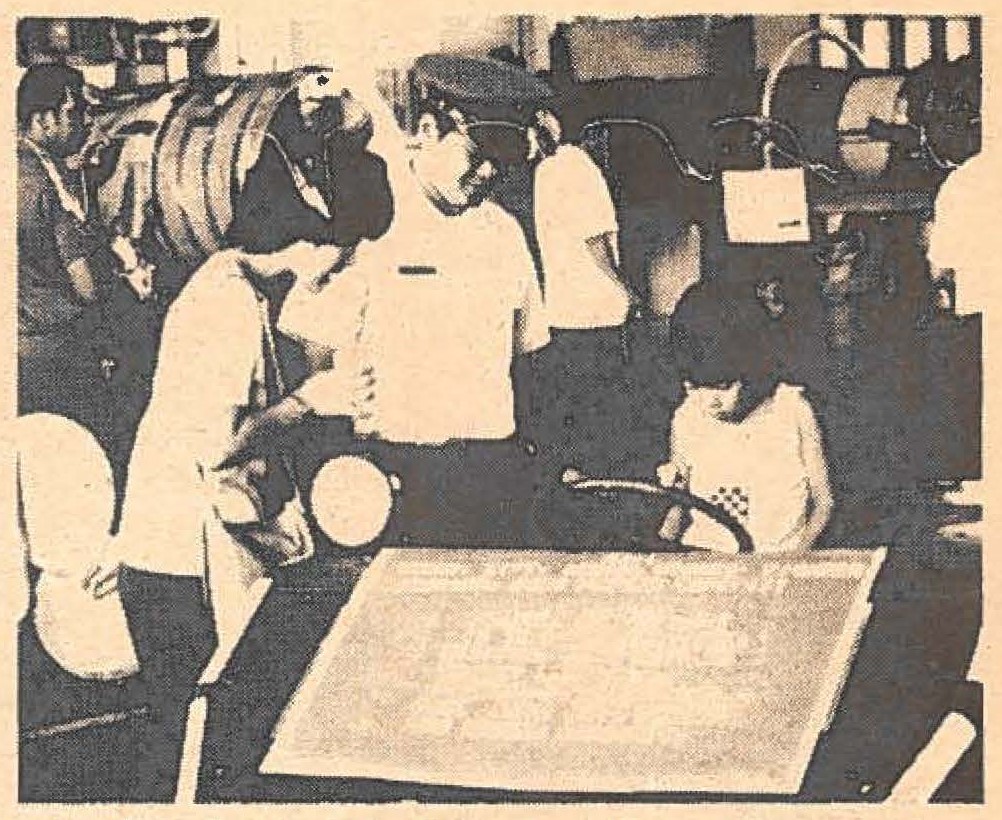
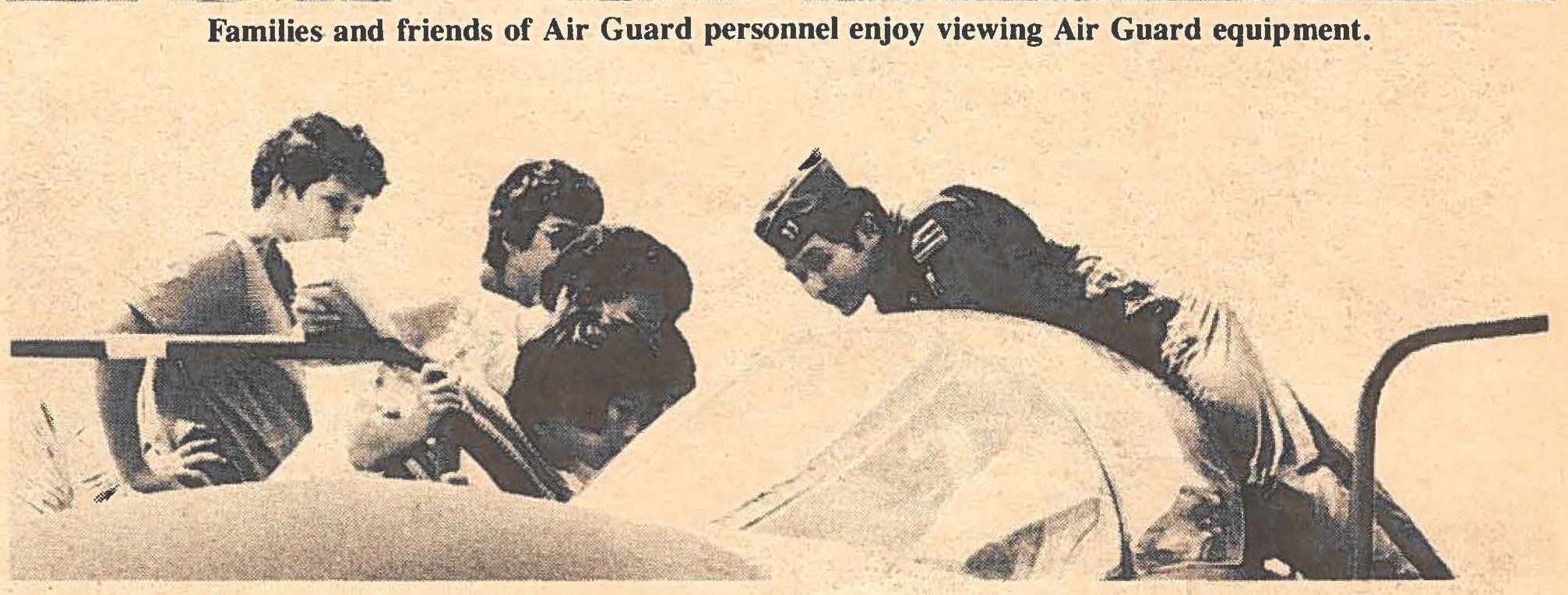
Approximately 1,200 members, families and friends participated in the second annual 154th FIG family-friend day on April 7, 1974. They toured the facility and witnessed F-102 scrambles, airborne intercepts and weapons loading. Additionally, approximately 812 young people from the elementary and high schools, community colleges, and youth groups toured the facility and shops at Hickam. They were briefed on HANG missions, equipment and operations.
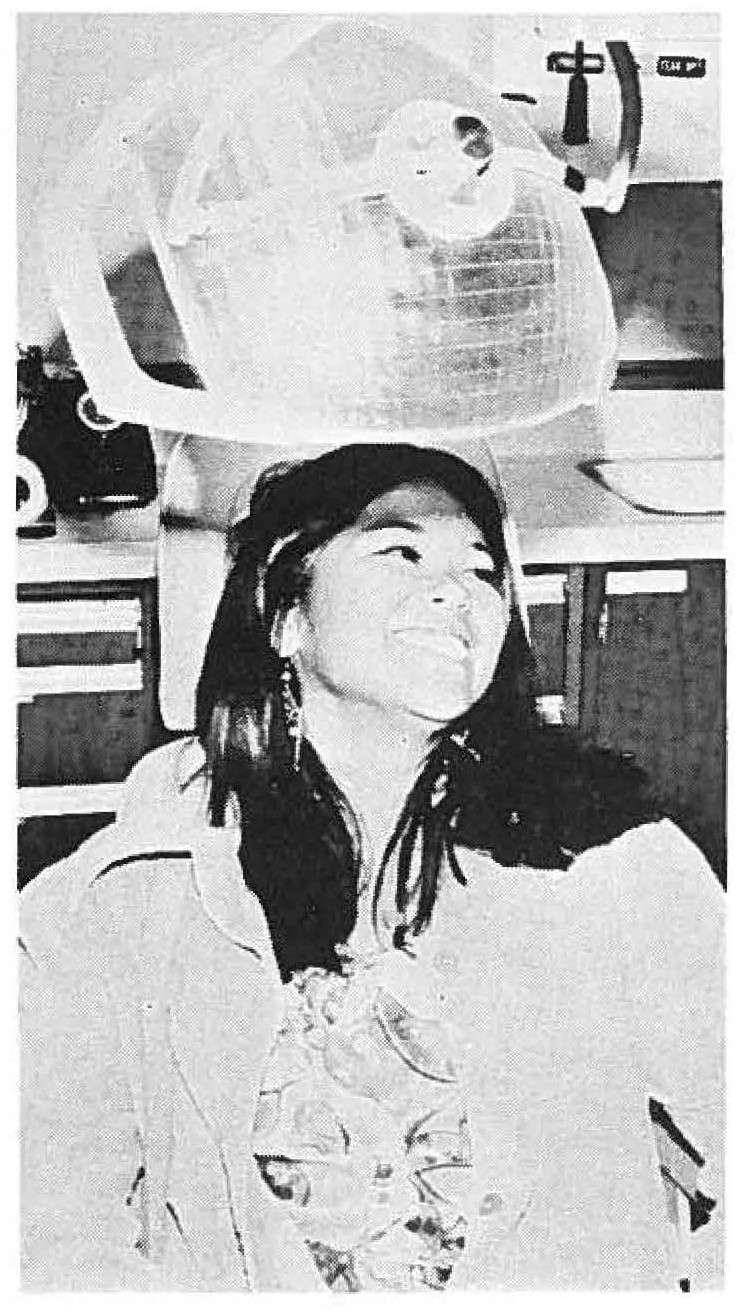
Lt Col James K. Lota of the 154th FIG, is just about to have his temperature taken with a disposable paper thermometer. (Picture from the 1974 Spring Pūpūkahi)
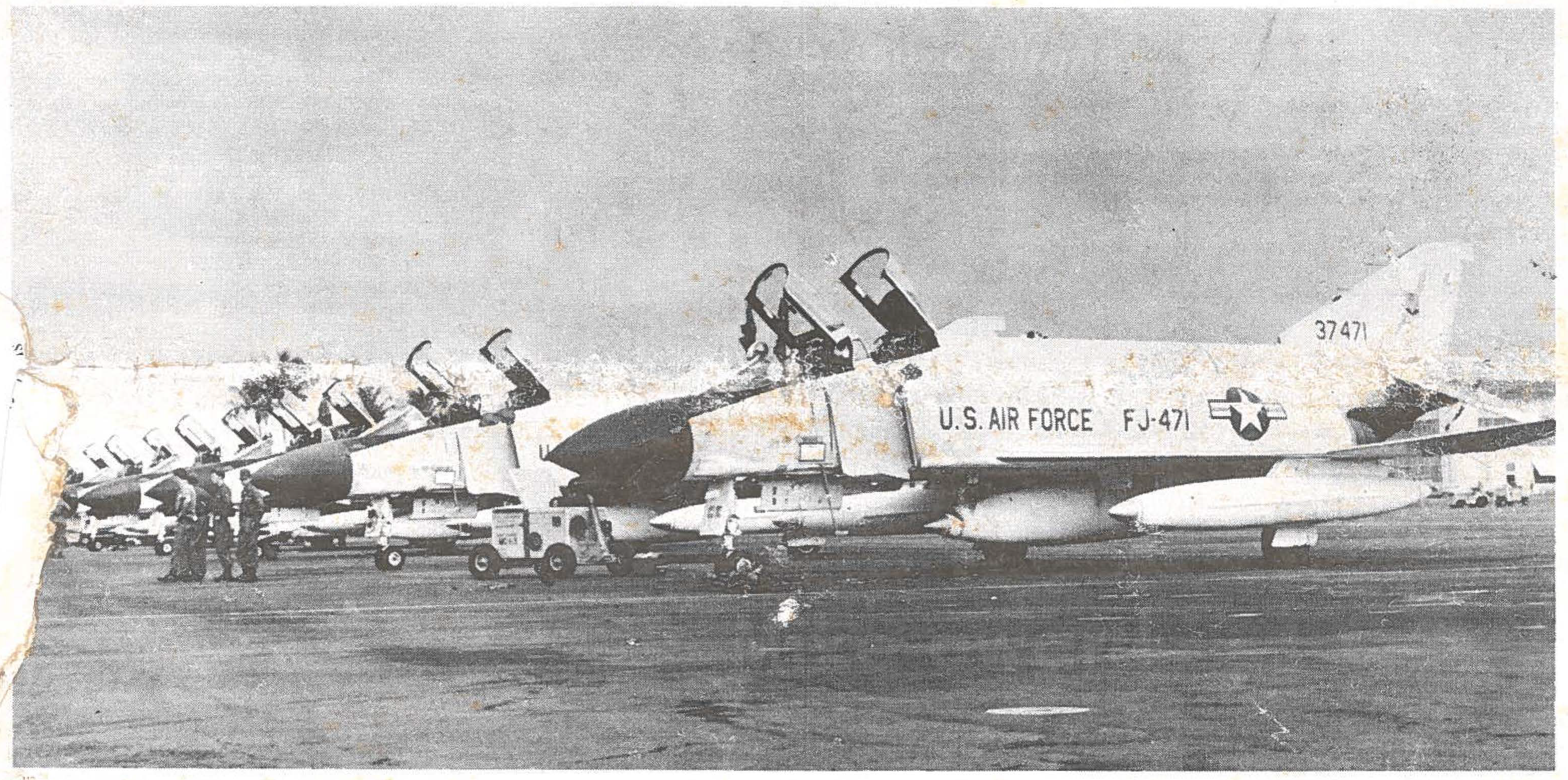
25 MAY 1974 The Hawaii Air National Guard was scheduled to receive F-4C Phantom jet fighter aircraft. The Phantoms will be assigned to the 154th Fighter Interceptor Group (FIG) at Hickam Air Force Base on Oahu and will replace the F-102 Delta Dagger interceptors currently flown by the unit.
Learn more
Phantoms for HANG in 1976
The Adjutant General of Hawaii announced on May 25 that the Hawaii Air National Guard has been scheduled to receive F-4C Phantom jet fighter aircraft.
Major General Valentine A. Siefermann said that the Phantoms will be assigned to the 154th Fighter Interceptor Group (FIG) at Hickam Air Force Base on Oahu and will replace the F-102 Delta Dagger interceptors currently flown by the unit. Approximately 20 aircraft will be released to the Guard from the Air Force inventory and delivered to Hawaii during the fourth quarter of Fiscal Year
The modernization is part of the Total Force policy that increases reliance by the active services on Guard and Reserve units.
One of the functions of the more sophisticated F4C will be the continued air defense of Hawaii previously performed by the HANG in the F-102.
The supersonic aircraft, manufactured by McDonnell Douglas, is capable of long-range, high altitude intercepts. using air-to-air missiles as primary armament and a 20mm gun as secondary armament. The Phantom can also be used for air-to-ground attack missions.
The conversion is expected to generate an increase in the manpower of the 154th Fighter interceptor Group both among air crews and support personnel. This increase will require the recruitment and training of additional guardsmen. Some modification of the unit’s facilities will also be required to accommodate the F-4Cs.
Significant changes are expected in the other . .. Air National Guard units.
the swept-winged. twin-engined. F-4C carries a . . .w of two – a pilot and a weapons system officer. its predecessor in Hawaii. the delta-winged. single-engine F-l02. is a single seat aircraft.
Two primary methods will be used to train guardsmen to fly and support the Phantom. Some guardsmen will be trained at Hickam by Air Force and Air National Guard personnel. The majority of the local training support will be provided by an Air
04-14 SEP 1974 The Aerospace Defense Command’s (ADC) fourth annual weapons loading competition was held at Tyndall Air Force Base, Fla. Twenty-four U.S. Air Force and Air National Guard teams entered the competition for honors as the safest, fastest and most efficient handlers of air defense munitions.
Learn more
154th team goes to international weapons test
The Aerospace Defense Command’s (ADC) fourth annual weapons loading competition was held September 4-14 at Tyndall Air Force Base, Fla.
Twenty-four U.S. Air Force and Air National Guard teams entered the competition for honors as the safest, fastest and most efficient handlers of air defense munitions. A team from Hawaii and teams from four Canadian air defense units were also entered for the first time, giving this year’s meet an international flavor. Hawaii’s team from HANG’s 154th Fighter Group includes; Captain Leslie Tam, team leader; SMSgt Gordon Makashima, MSgt George Padilla, TSgt Randall Lum, SSgt Gaylene Redoble and SSgt Steven Shideler.
The event tests the skills of the crewmen who load air-to-air rockets and missiles aboard the aircraft that guard Hawaii and North America against enemy air attack. Competitive loadings were staged on all three types of fighter-interceptor aircraft flown by the U.S. and Canada.
The announced goal of the rigid competition for ground munitions crew is to “foster a competitive spirit, give recognition to outstanding load crew performances, and raise the overall standards of excellence in weapons loading.”
Scoring of the competition was based on times required to execute two loadings, the condition of required loading tools and equipment, and on the results of written examinations given the crew members. Safety precautions and procedures played an important role in all competitive events.
ADC’s six F-106 fighter squadrons, the Air Defense Weapons Center and 17 Air National Guard units with air defense missions were represented in this year’s event. The north-of-the-boarder fighter units were represented in this year’s event. Ten north-of-the-boarder fighter units were from the Canadian Air Defense Command.
The Thomas K. McGehee trophy was presented to the unit sponsoring the winning load crew, while individual team members received personal awards for their efforts.
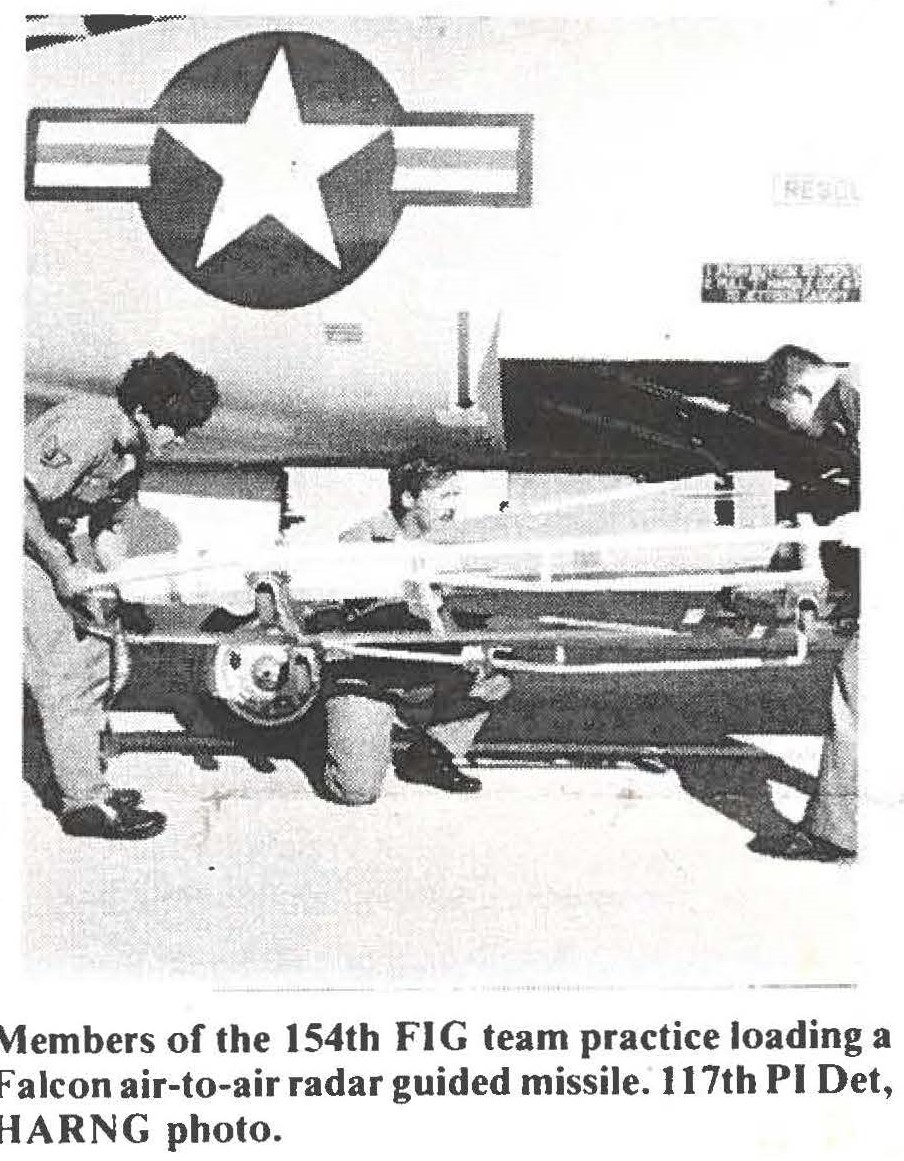
Members of the 154th FIG team practice loading a Falcon air-to-air radar guided missile. 117th Pl Det, HARNG photo. (Picture from the 1974 Fall Pūpūkahi)
154th Fighter Group seeks weapons officers
A major drive for 28 weapon systems officers to serve the new F4C aircraft is being conducted by the Air Guard’s 154th Fighter Interceptor Group.
The new two-seat aircraft will replace the current squadron of F-102’s in one year, and the Air Guard is looking for both rated WSO’s and candidates for WSO training at the ANG Academy of Military Science.
There are several ways in which both prior and nonprior service personnel may quality, according to Col James R. Ashford, 154th Fighter Interceptor Group commander.
Under the PALACE CHASE program, active duty residents of Hawaii who are qualified WSO’s may be granted an “early out” to join the Air Guard.
Other candidates must either be officers or meet the qualifications for the ANG Academy of Military Science and be within age limitations for attending WSO school.
Prior service personnel rated WSO will generally be accepted at the grade held at last separation, up to and including major.
The newly weapons officers can expect an active life while with the unit. Col Ashford added:
“The 154th FIG is one of the few Guard units performing an active duty mission. And our mission assured candidates that they will be serving with a highly professional ready unit – the 199th Fighter Interceptor Squadron.”
Interested parties should contact the 154th FIG Sq CBPO NCO IC, MSgt Darryl Ho at 449-5701 or 449-5684 for complete details and applications.
The 154th Fighter Interceptor Group (FIG) continued to maintain its air defense alert posture throughout the year: two pilots/F-102s on 5-minute alert status and two pilots/F-102s on 30-minute alert status.
The HQ PACAF Inspector General conducted a combined operational readiness inspection and management effectiveness inspection of the 154th FIG during Apr. 12-17, 1975. The 154th FIG was rated satisfactory in both inspections and fully capable of performing its assigned mission. Several of its activities received outstanding and commendable ratings.
The F-102 total flying time for the year was 4,550.8 hours, which sufficiently allowed the 39 assigned attached pilots to complete their annual combat readiness flight requirements. Air defense exercises and periodic use of a forward operating location at PMRF Barking Sands, Kauai, helped to maintain the effectiveness of the Hawaii air defense system.
The C-54 aircraft flew 220 hours in support of Hawaii National Guard and other service activities before the cessation of its services to the ANG/USAF because of extensive wing corrosion.
Overall assigned strength at the end of the year was 102 percent of authorized strength, an increase of 6 per cent over the previous year. Tactical pilot strength remained unchanged. The overall retention rate was 80 percent. . . .
In support of community activities, the 154th FIG participated in Hawaii Heart Association cardiopulmonary resuscitation classes , Friends of the Library of Hawaii book sale, Kailua’s Independence Day parade, 50th State Fair, Aloha Week Festival parade, Veterans Day ceremony and dedication ceremony of the new Armed Forces Memorial at the State Capitol site, Armed Forces Day display, memorial services honoring King David Kalakaua at the Kalakaua Intermediate School and Royal Mausoleum , the inauguration ceremony for the Governor of the State of Hawaii, Prince Kuhio Day parade in Waimanalo and Nanakuli , memorial services for the late Governor John A. Burns at the State Capitol, arrival ceremonies for the Queen of England at the Honolulu International Airport, Kailua Jaycees’ Miss Kailua Beauty Pageant, and the Oahu Clean-up Campaign covering the Nanakuli, Waianae and Makaha areas. . . .
Approximately 1,600 members, families , friends and employees participated in the third annual 154th FIG Family employers Day Open House on June 15, 1975. They toured the facility and witnessed F-102 scramble, airborne intercept, weapons loading and model airplane flying demonstrations.
Base tours providing an F-102 static display, short briefing on 154th FIG activities and mission, and tour of the shops, were conducted for high, intermediate, and elementary schools, boy/cub scout troops, Civil Air Patrol units, and the University of Hawaii Aerospace Education Workshop. The 154th CAM Sq provided a F-102 static display at the Ala Moana Park to highlight the successful public display of HNG equipment on Mar. 1, 1975 Exhibit Day for March is Minuteman Month.
During FY 76, the 154th FIG will undergo an aircraft conversion from F-102 Delta Dagger to the F-4C Phantom aircraft. Plans have been prepared to cover hangar modification construction projects and conversion training of aircrew members and aircraft maintenance personnel. The new aircraft will increase the unit’s ability to maintain its air defense alert mission.
1975 The “A” Team of the 154th FIG, Hawaii Air National Guard earned second in the 1975 Oahu volleyball championship. The 154th “A” Team was made up of Al Naumu, Paul Keliiaa, Bill Stern, Jeffery Avery, Richard Saunders, Colby Hopkins, Tommy Haines and the only woman in the league, Yvette Hopkins.
Learn more
298th Depot capture Oahu volleyball crown
The “B” Team from the 298th Field Depot, Hawaii Army National Guard, captured the 1975 Oahu volleyball championship when they beat the “A” Team of the 154th FIG, Hawaii Air National Guard at the 487th gym.
Playing before a frenzied crowd, the Army Guardsmen downed the Air in two sets, 16-11 and 11-7. Major General Valentine A. Siefermann, adjutant general, presented the championship trophy to Reuben Kaahanui, player-coach. The champs are comprised of guardsmen from the 159th Service Battalion. They are Clifford Makepa, Arthur Ugalde, Gideon Awa, Albert Chock, John Joseph, Arthur lsaki, Donald Mochizuki, and Herbert Franco.
The 154th “A” Team was made up of Al Naumu, Paul Keliiaa, Bill Stern, Jeffery Avery, Richard Saunders, Colby Hopkins, Tommy Haines and the only woman in the league, Yvette Hopkins.
SFC Harold Pukahi, HARNG, served as the tournament’s director.
298th Depot capture Oahu volleyball crown(Picture from the 1975 Summer Pūpūkahi)
24 OCT 1975 The Hawaii Air National Guard received its first F-4C Phantom jet fighter which marks the beginning of the Air Guard’s planned conversion from the F-102 Delta Dagger to the F-4C.
Learn more
First phantom jet arrives
Story by Sp5 Dean Hoofnagle
Pair of HANG F-102’s escort new phantom (center) NEWLY BLESSED – The Rev. Abraham Akaka is given a personal tour of the Air Guard’s newly acquired F-4C- Phantom jet fighter by Maj. Norman C. Ault (HANG). Rev. Akaka blessed the Phantom soon after it arrived at the 154th Fighter Group’s ramp at Hickam AFB Oct. 24. Eventually, the Air Guard will receive 18 Phantoms, phasing out its use of the Delta F-102. More details on page 3. National Guard photo by SpS Dennis Fujii (117th PID Staff).Taxiing to 154th FIG pad (Pictures from the 1975 October – November Pūpūkahi)
HICKAM AIR FORCE BASE, HAWAII – The Hawaii Air National Guard (HANG) received its first F-4C Phantom jet fighter on October 24.
The arrival of the Phantom marks the beginning of the Air Guard’s planned conversion from the F-102 Delta Dagger to the more sophisticated F-4C.
The F-4C trainer, which flew in from George Air Force Base, California, was intercepted 100 miles east of Oahu and escorted to Hickam Air Force Base by two F-102’s.
After the Phantom landed, a brief ceremony was held in front of the 154th Fighter Interceptor Group, where the new aircraft was blessed by the Rev. Abraham Akaka.
“The first Phantom will initially be used for ground training,” said Col. James Ashford, commander of the 154th Fighter Interceptor Group.
“The rest of the approximately 18 Phantoms should arrive in April and June, 1976,” he added.
The modernization is part of the Total Force policy that increases reliance by the active services on Guard and Reserve units.
One of the functions of the more sophisticated F-4C will be the continued air defense of Hawaii previously performed by the HANG with the F-102.
The supersonic aircraft, manufactured by McDonnell Douglas, is capable of Iongrange. high-altitude intercepts, using air-to-air missiles as primary armament and a 20mm gun as secondary armament.
The Phantom can also be used for air-to-ground attack missions.
The swept-winged, twin-engined F-4C carries a crew of two – a pilot and a weapons system officer. Its predecessor in Hawaii, the delta-winged, single-engined F-102 is a single seat aircraft.
Ashford noted that the switch from the F-102 to the F-4 is more than a switch from an old aircraft to a newer one.
The F-4 is a multi-mission-capable aircraft. In other words, it is capable of air defense. air superiority, and air-ground work. The F-102 was designed primarily for air defense.
“Of course, our primary role will be in air defense, but the added capability, especially in air superiority, would come prominently into play should the 154th be called into active duty overseas,” said Ashford.
The F-4C will be the fourth type of mission jet aircraft flown by the Hawaii Air National Guard since the organization was converted to jets in 1953. The others were F-86E Sabres, F-86L Sabres and the current F-102’s.
Since 1953 the Air Guard has flown four different jet aircraft. The Hawaii Guard’s first supersonic aircraft, the F-86E Sabre Jets were sent to the Guard in 1955 after proving themselves in the Korean War. The F-86L Sabre Jets (left photo – bottom plane) were introduced to the Air Guard in 1958. This all-weather fighterinterceptor provided Hawaii with air defense protection at night, rocket-firing capabilities (the F86E had only 50 caliber machine guns), and a more elaborate firecontrol system. The Guard converted to F-102A Delta Daggers (left photo – top plane) in 1961. The “Deuce” not only fired folding-fin rockets, but Falcon air-to-air guided missiles.(Pictures from the 1975 October – November Pūpūkahi)
Significant progress was made by the 154th Tactical Fighter Group (TFG) toward converting from the F-102A Delta Dagger to the two-seater F-4C Phantom aircraft. Aircrew members received initial transition training at Luke Air Force Base (AFB), Arizona, and George AFB, California. Construction and modification of existing facilities at Hickam proceeded while the 154th TFG maintained operations in both aircraft.
Effective June 10, 1976, the 154th Fighter Interceptor Group (FIG) was reorganized, and its authorized strength increased from 695 to 824 (112 officers and 712 airmen)
After 16 years of operation in the F-102A aircraft, tile 154th TFG initiated conversion to the F-4C McDonnell Douglas Phantom. The expected role is to maintain the air defense alert posture and to increase the aircrew from a one-man to a two-man crew. The person who occupies the back seat is known as a weapons system officer (WSO).
Conversion to the F-4C aircraft required a significant amount of new construction and modification of existing facilities. The new composite maintenance and security operations building provided for a portion of CAMS’s facility requirements It also provided space for the security police section of the combat support squadron and the entire weather flight. The hangar conversion project modified existing shops and offices to provide facilities for the TFS and the remaining shops of the CAMS.
The TFG continued maintaining its air defense alert posture throughout the year with two pilots and two aircraft on “5-minute” alert Status. Two additional pilots and two aircraft were on “30-minute” alert status from July through Oct. 1975. The reduced posture to “two-on-5-minute alert” was to accommodate the maintenance training load.
The first F-4C aircraft arrived on Oct. 24, 1975 and was used exclusively for “hands on” training by maintenance personnel. Other F-4Cs began arriving in Jan. 1976 and, by the end of the fiscal year, 15 were on hand. Flying training began in April 1976 as aircrews returned to Hawaii from F-4 checkout in the continental U.S.
In Oct. 1975, maintenance personnel began specialized training in preparation for the conversion from F-102A to F-4C aircraft. Training included the various maintenance career fields and was accomplished by a team of instructors from the Air Training Command, USAF. Most of the training was completed in April 1976.
Key members of the 199th TFS finalized the training flow for individual pilot checkout in the F-4C aircraft. These checkout courses were conducted at George AFB, California, and Luke AFB, Arizona. By the end of FY 76, 19 pilots and 4 WSOs had completed their initial checkout in the Phantom.
Recruiting WSOs for the new Phantom was a major effort. Capt. Melvin K. Matsui was the first WSO to join the 154th TFG. As a former Air Force F-4C WSO, he brought his experience as a POW in Hanoi and his valuable knowledge in the F-4C aircraft to the HANG. Nationwide interest in the 154th TFG attracted many USAF WSOs to the unit. Also five qualified applicants for undergraduate navigation training were commissioned at the ANG Academy of Military Science at McGhee Tyson Airport, Knoxville, Tennessee. Currently the five officers are in undergraduate navigator training and they are progressing satisfactorily.
4 FEB 1976 Fifty-six guard donors contributed during the Blood Bank of Hawaii bloodmobile visit to the 154th fighter Interceptor Group. Eighteen additional guardsmen who volunteered donations were deferred.
Learn more
They give “the gift of life”
By Capt John Maier PAO, Editor
Fifty-six guard donors contributed during the Blood Bank of Hawaii bloodmobile visit to the 154th fighter Interceptor Group on February 4, 1976. Eighteen additional guardsmen who volunteered donations were deferred. The drive was a tremendous success, and according to Mrs. Mary Lou O’Brien, Assistant Director for Volunteers and Recruitment “It went very smoothly considering the large number of people who were processed.”
The success credit goes to the men and women who gave and to the organizers, Lt Col James K. Lota, Maj John I. Oshiro, CM Sgt Hiroshi Go, MSgt Wayne Soma and Arnn Yvette Hopkins, who each coordinated donations of coffee, doughnuts, and other refreshments. The project coordinator was TSgt Mitchell K. Shimabukuro.
Blood donated is replaced by the body within 60 days, and by that time it’s not unusual to get the urge again. It’s a pretty good feeling giving “the gift of life.”
Recent Blood Bank of Hawaii shortages have made guard contributions even more appreciated, and Mrs. O’Brien stated that, “The 56 pints of blood given by guardsmen went a long way towards meeting the blood needs of the State.”
SMILE – Men of the 154th Fighter lnteceptor Group participating in the outstandingly successful bloodmobile visit.(Picture from the 1976 March Pūpūkahi)
15 AUG 1976 The Hawaii Air National Guard’s 154th Tactical Fighter Group (TFG) held a “Family, Friends and Employers Open House” at the Hickam AFB to show-off their new facilities and new jets. More than 2,000 people visited the newly constructed shops, observed demonstrations and looked at displays.
Learn more
154th hosts Guard families
By Maj. Eddie Anderson Information Officer 154th Tactical Fighter Group
154th open house Page 7 Families and friends of Air Guard personnel enjoy viewing Air Guard equipment.Families and friends of Air Guard personnel enjoy viewing Air Guard equipment.(Pictures from the 1976 September Pūpūkahi)
The Hawaii Air National Guard’s 154th Tactical Fighter Group (TFG) held a “Family, Friends and Employers Open House ” Aug. 15, 1976 at the Hickam AFB to show-off their new facilities and new jets.
“We considered this open house more of a family day. It gave our guardsmen and women an opportunity to personally show their family, friends, and employers just what they do in the Air Guard,” said Col. James Ashford, commander of the 154th TFG.
More than 2,000 people attended the festivities. The guests visited the newly constructed shops, observed demonstrations and looked at numerous displays.
Youngsters and oldsters alike crawled in, around and under a display of military aircraft from the various services.
”This function also gave the Guard members a chance to familiarize part of the community with how the organization operates,” Ashford said.
“Professor Fun” was on hand to entertain the youngsters while parents inspected the newly arrived F-4C Phantom jet fighters. The F-4C will be replacing the aging F-102 Delta Dagger which the Guard has been flying since 1961.
Air Guard jet aircraft saluted the crowd with a flyover at 10:40 a.m.
Hobbyists displayed a number of scale model radio controlled aircraft and later flew them for the public on the taxiway, fronting the Air Guard facility.
During the noon hour, the 111th Army National Guard band played while the throngs enjoyed a free lunch, courtesy of the Air Guard.
Families and friends of Air Guard personnel enjoy viewing Air Guard equipment.(Picture from the 1976 September Pūpūkahi)
The Hawaii Air National Guard (HANG) highlights for the fiscal year included two significant achievements conversion of the 154th Tactical Fighter Group to F-4C aircraft
The major highlight of the past year was the conversion from the F-102A Delta Dagger to the F-4C Phantom after 16 years of operation with the F-102A. Improved aircraft performance, newer state-of-the-art aircraft fire control system and air-to-air missiles of the F-4C will result in increased air defense mission capability. The added offensive capabilities of the F-4C brought a name change from fighter interceptor group to tactical fighter group.
At the beginning of FY 77, both F-102A and F-4C aircraft were maintained and operated with two F-1 02As continuing to remain on air defense alert, ready to scramble, intercept and identify any unknown aircraft penetrating the Hawaiian Air Defense System (HADS). After sufficient aircrews were trained in the F-4C, a single F-4C was placed on air defense alert on Oct 22, 1976, and all F-102A operations were terminated. The 154th TFG was the last organization in the entire USAF to operationally employ the F-1 02A. On Jan. 22, 1977, the number of F-4C aircraft on air defense alert was increased to two. As of June 1, 1977, sufficient aircrews were combat ready and the readiness posture of our F-4C aircraft had improved to the point that unit combat status capability was upgraded.
Eleven pilots completed their initial qualification (phase 1) in the F-4C Phantom at Air Force bases on the Mainland. Training consisted of flight simulator lessons, many hours of academics on aircraft systems, and 9 to 17 flying sorties. These 11 pilots plus the 16 who had completed their training earlier at Luke AFB, Arizona, and George AFB, California, completed the pilot checkout requirements.
Four locally recruited officers with navigator ratings who entered and completed combat crew training in the F-4C aircraft became qualified weapons system officers (WSOs). Combat crew training which lasted approximately seven months, was conducted at Homestead AFB , Florida , or Luke AFB, Arizona. Two other former Air Force navigators were recruited locally and completed WSO combat crew training at Luke AFB, Arizona
Air-to-air refueling (AAR) is a requirement for all F-4C aircrews MR. Pilots received initial exposure in the checkout programs on the Mainland and resumed AAR in Hawaii in February 1977. A KC-135 tanker from the Maine ANG provided the first AAR sorties in the Hawaiian skies. Since then, other ANG KC-135 aircraft from Washington and Tennessee supported the AAR qualification program. . . .
The 154th TFG assisted and conducted facility tours and provided static aircraft displays for visits by schools, community agencies, ‘ scouts and Civil Air Patrol units. For the sixth consecutive year, the 154th TFG was visited by 22 chiIdren and 3 advisors from the Alaskan Bureau of Indian Affairs Unalakleet Day School. The members of the 154th Supply Squadron again headed the project. Cultural interchange and lasting friendships resulted from this very worthwhile community service project.
For the sixth straight year, the 154th Tactical Fighter Group were visited by children and advisors from Alaska’s Unalakleet Day School. Members of the 154th Supply Squadron assisted with individual contributions and “love time.” Cultural interchange and lasting friendships resulted from this very worthwhile community service project.
The inspector general (IG) from Pacific Air Forces, conducted an operational readiness inspection of the Air Guard’s air defense units on Sept. 17 and 18. Members from the 154th Tactical Fighter Group, the 169th Aircraft Control and Warning (ACW) Squadron and the 150th ACW Squadron were called in at 3 a.m., and ran various mission-related exercises under simulated combat conditions. As one commander remarked, “All rating areas were displayed in the color blue, signifying outstanding results. What can you say? It was a perfect score. Whoopee!”
The 154th Tactical Fighter Group completed a successful and productive year. The year was highlighted by successfully passing two major United States Air Force inspections and participating in the Air Force Aerospace Defense Command’s weapons loading competition.
The 154th Tactical Fighter Group underwent its first operational readiness inspection in the F-4C Phantom jet in September 1977. The inspection was conducted by the Pacific Air Forces’ inspector general. The immense effort expended by each member of the group resulted in the highly successful completion of this inspection. The 154th Consolidated Aircraft Maintenance Squadron received an overall rating of excellent in this inspection. This was significant because the squadron overcame many difficulties relating to the conversion to the F-4C Phantom jet.
In June 1978, the unit underwent a management effectiveness inspection conducted by the Pacific Air Forces’ inspector general. The result was a highly successful completion of this inspection. It should be noted that the life support section of the 199th Tactical Fighter Squadron was rated the ” best” in the Pacific Air Forces. Also extremely noteworthy, the 154th Consolidated Aircraft Maintenance Squadron again received an overall rating of excellent. The rating of excellent in both the operational readiness inspection and management effectiveness inspection is a feat seldom attained by aircraft maintenance units in the Air Force or Air National Guard.
On October 1, 1978, the 154th Tactical Fighter Group was redesignated the 154th Composite Group and was reorganized in several major areas (see details under 154th Composite Group below). The 150th Aircraft Control and Warning Squadron (Fixed) and 169th Aircraft Control and Warning Squadron (Fixed) were made subordinate units of the 154th Composite Group effective January 1, 1979 . The 154th Security Police Flight and the 154th Resource Management Squadron also were activated, federally recognized, and added to the 154th Composite Group on January 14, 1979, and July 1,1979, respectively.
OCT 1978 The deployment to Clark Air Base, Republic of the Philippines, was to participate in an exercise called Combat Sage. This exercise evaluated aircraft electronic weapons systems and provided participants with actual training in air-to-air missile employment in a realistic environment and was the first time ever for the men and women of the organization.
Learn more
The deployment in October 1978 to Clark Air Base, Republic of the Philippines, was to participate in an exercise called Combat Sage. This exercise evaluated aircraft electronic weapons systems and provided participants with actual training in air-to-air missile employment in a realistic environment and was the first time ever for the men and women of the organization. The evaluation report received from Pacific Air Forces stated that the group’s performance during this exercise exceeded that normally attained by active Air Force counterparts.
154th Composite Group crew chiefs and radar technicians prepare an F-4C for air combat missions at Clark AB in the Philippines. (Picture from the 1979 Annual Report)
The 154th Composite Group continued to provide 24-hour air defense coverage for our state.
The 154th Tactical Fighter Group was redesignated the 154th Composite Group on October 1, 1978. This reorganization was ordered to realign the group structure with standard United States Air Force organizational structure. The realignment consolidated the various functions into four major areas operations, maintenance, resources, and support. This change resulted in the improved command and control of assigned units.
SNOWBALL TOSS AT HICKAM – Col. Alex MacDonald (left), commander of the 199th FIG, from North Dakota, tosses a cold one to A 1 C Larnette Phillips of CBPO while Col. John Lee, 154th Composite Group commander, quickly forms another snowball. The bag of snow was brought by the Fargo, North Dakota, pilots who stopped at Hickam after test flying their two new acquired F-4Ds. The visitors were greeted by commander of the 154th CG, Col. John Lee; Senior Air Force advisor, Col. Leon Johnson; and 326th Air Division commander, Col. Bob Johnson, as well as members of the 154th. Photo by Sgt. Ron Bibo. (Picture from the 1979 March Pūpūkahi)
Time again for HANG inspections
UNDER WATCHFUL EYES – PACAF inspectors carefully scrutinize Air Guard weapons loading procedures during an operational readiness inspection. Photo by Sgt. Ron Bibo. (Picture from the 1979 March Pūpūkahi)
Although the 154th Tactical Fighter Group is converting to the 154th Composite Group by the end of February, the operational and managerial inspections will continue at Hickam AFB in the coming year – perhaps at an even greater frequency than in 1978.
The new “Composite” label denotes that the 154th is no longer only in the fighter aircraft business. This year it has absorbed two former “independent” air defense radar warning units as well – the 169th Aircraft Control and Warning Squadron at Wheeler AFB, and the 150th Aircraft Control and Warning Squadron on Kauai. These units are also bracing themselves for the same number of Air Force and higher headquarters inspections as before. But starting now, ongoing scrutiny will coincide even more with alerts, sudden recalls, security checks, maintenance examinations, air- and ground-crew testing and war-game scenarios that are triggered with such monotonous (and sometimes agonizing) regularity against all Hawaii Air National Guard (HANG) personnel and hardware.
What is HANG bracing up for in the next 12 months? Here’s a rundown, in descending order of intensity:
ORI – Operational Readiness Inspection. This is the biggie, because, it is the final “proof of the pudding” that HANG can meet the standards and requirements set by the U.S. Air Force, PACAF, and the 326th Air Division (AD), charged with maintaining the defense and readiness of forces in the Hawaiian area. A large team of “black hats” (Air Force inspectors and observers) from the PACAF Inspector General’s Office will swoop down on the HANG ramp at Hickam and carefully scrutinize, analyze and grade nearly every facet of the 154th‘s operational capability – from fighter launches to pay records; from tastiness of the field kitchen’s food to the cataloguing of availability of medical supplies in the dispensary. During a four or five day inspection, the JG team will force a furious pace of testing, both in the air and on the ground; both oral and written. The group usually anticipates this “mini invasion” sometime during spring.
MEI Management Effectiveness Inspection. This is a sort of administrative version of the ORI: a thorough appraisal of the administrative and managerial efficiency at all levels of the operational functions of HANG personnel and hardware. In effect, the MEI isa sort of ORI of administration – where the administrators get hit with the same load of bricks the mechanics, aircrews and weapons controllers get in an operational inspection.
CEMT – Command Equipment Management Team. Don’t think that supply folks can escape the fine-tooth combs of inspections. The personnel in charge of the thousands of various items that keep the Air Guard flying, moving, dressing, training and in short – rolling along also are inspected, evaluated, categorized and judged as to effectiveness of supply capability (from F-4 wingtanks and air-to-air missiles to web belts and locknut washers). The supply troops say they expect a couple of these “CMets” during the next 12 months .. . so they also have to keep on their toes.
AFCT – Alert Force Capability Test. Referred to as “Af-Cat,” this exam is administered on split-second notice (usually by a team of 326th Air Division standardization and evaluation crews) who descend on both the fighter alert pad and on the ground controlled intercept sites. Often a practice scramble of F-4’s is initiated, then stopped once the wheels get rolling, and all personnel get tested with written tests, a grueling session, usually lasting several hours. “AfCats” can hit the fighter pilots, mechanics and radar controllers several times a year, and can be run by ORI, MEI and PACAF / 326 Air Division standardization/ evaluation teams.
MISCELLANEOUS Perhaps it’s beginning to appear as if HANG is spied upon. examined, poked. probed and analyzed much like a flier undergoing a full flight physical once each month. Well, that’s pretty much the way it is, because the Air Force and National Guard Bureau say that’s the way it has to be to maintain a high degree of readiness.
And what about the other primary Guard units? The 201st Combat Communications Group (CMBTCG) by no means escapes inspections. By the end of Fiscal Year 1980, the 201st expects to have undergone at least four (and perhaps five) accounting inspections by the U.S. Property and Fiscal Office. The USPFO regularly inspects at other Guard units. And besides, the 201st CMBTCG gets its share of MEi’s and quality control inspections, too.
HANG’s own security police are inspected by their inspectors, the 15th Air Base Wing security police. Also, the Hickam units experience at least quarterly safety inspections (both ground and air) by the 15th Air Base Wing and Headquarters, PACAF. And, finally, HANG units are inspected by their own headquarters evaluators in areas such as safety, vehicle control, security, and communications and electronics.
So, all in all, it certainly looks as if it has and will continue to be “The Year of the Eye” on the Hawaii Air National Guard.
APR 1979 The Pacific Air Forces operational readiness inspection (ORI) team slammed into the 154th Composite Group with the toughest kind of inspection PACAF can throw at flyers, maintenance crews and radar controllers.
Learn more
The year was highlighted by the group’s superb performance during April’s operational readiness inspection conducted by the Pacific Air Forces’ inspector General, and during two highly successful major overseas deployments.
PACAF inspections: 154th Composite Group gracefully hurdles toughest ORI; says HANG Meets or far exceeds Air Force standards
by Maj. Gar Pillgrim Public Affairs and Education Officer
Weapons team loaders shoulder a sidwinder missile. 117th PID Photo by SFC Wayne Iha. PACAF inspector evaluates Avionics/Weapons testings. HANG photo by SSgt. Solomon Ford. Maintenance Control Supervisor MSgt. Rudolph Q. Luat scans aircraft status board. 117th PAD photo by SFC Wayne Iha. 169th AC&W radar operators plotting an intercept. HANG photo by Capt. Eric Kanja.Sidewinder missiles get pre-loading check. 117th PAD photo by SFC Wayne Iha. Brig. Gen. Alfred M. Miller, PACAF IG, asks questions. HANG photo by SSgt. Solomon Ford(Pictures from the 1979 June Pūpūkahi)
The Pacific Air Forces operational readiness inspection (ORI) team slammed into the 154th Composite Group early and hard at the April drill. They hit the Air Guard with the toughest kind of inspection PACAF can throw at flyers, maintenance crews and radar controllers.
The result: “A superb performance. Without a doubt, the HANG is now considered to be among the best units in PACAF and the Air National Guard.” Those were the words of congratulations expressed by a beaming Brigadier General Arthur U. Ishimoto, HANG commander.
The ORI involved men and women hustling back to their units on two successive recalls (early Saturday and Sunday mornings) at Hickam, as well as to the 169th Aircraft Control and Warning Squadron, Wheeler AFB, Oahu, and the 150th AC&W Sq., Kokee Air Force Station, Kauai. In addition, the guard members’ Air Force counterparts at the 326th Air Division, colocated with the 169th at Wheeler, also had to respond to their role as Air Force command and control agency for Hawaii’s air defense.
The ORI team conducted two days of intensive evaluation and testing of various operational capabilities, including quality of maintenance, efficiency and response capability of weapons crews, proficiency of aircrews and radar controllers and general performance of support personnel at all three bases. According to the PACAF inspectors, the results “met or far exceeded Air Force standards in all areas of evaluations.”
And once again the Air Guard’s maintenance of the F-4C Phantom jet fighter was singled out as “well above average,” especially compared with similar fighter units throughout the Pacific area.
Not one to be constricted by PACAF phraseology, 154th COMPGp Commander Colonel John S.W. Lee offered a bit more glowing evaluation: “It’s super! You guys have done a terrific job!” Lee’s remarks were echoed and amplified by Major General Valentine A. Siefermann, adjutant general for Hawaii, who said, “the terrific results of the ORI show that the total force concept teamwork between the Air Guard and the Air Force – really works. My hat is off to all of you.
But perhaps Colonel Richie Kunichika, 154th deputy commander for operations, summed it all up in the shortest and sweetest way: “You people did ‘Some Good’ on this ORI. That’s the only way to put it. You’re all really “SOME GOOD!”
F-4 Phantom returns home after a successful intercept(Picture from the 1979 June Pūpūkahi)
JUN 1979 The 154th Composite Group had its first full-scale Western Pacific deployment. Some 225 HANG men and women who took part in the complex rotation to and through Andersen AFB, Guam, and Clark AB in the Philippines.
Learn more
The second major overseas deployment in June, 1979, entailed intensive overall training during an air defense exercise against Strategic Air Command B-52 bombers at Guam; participation in Combat Sage; and yet another special exercise called Cope Thunder, a major simulated air war scenario, at Clark Air Base. These deployments improved the operational readiness capability of the participating units and were among the most professional since Pacific Air Forces commenced these operational exercises.
Maj. Gar Pillgrim Public Affairs and Education Officer
GUARDING FAR-FLUNG GATEWAY – Airman 1st Class Saul M. Alvarico, of HANG’s 154th SP Flight, mans security gate of sensitive outpost on Guam. – HANG Photo by SSgt. Solomon Ford.“TRACKING, TRACKING!” – Sgt. Rania Agua, 169th Ac&W Squadron, updates plotting board Santa Rosa Radar facility, Guam, in F-4/8-52 exercise during first week of deployment. – USA SSgt. Bert Mau. HUSTLE! HUSTLE! – HANG F-4C Crew Chiefs and Radar Technicians scramble to prepare an AB in the Philippines. – HANG Photo by SSgt. Solomon Ford. ON DEPLOYMENT TRAINING – Going over details of her specialty is Senior Airman Melissa Reynolds, navigation specialist, being checked over by SSgt. Roger Singler (seated) in F-4 cockpit on Andersen flight line. – USAF Photo by SSgt. Bert Mau. UP AND AT ‘EM – Two of the six HANG F-4C’s deployed to Guam lift off at Andersen AFB before engaging B-52s (note towering bomber fins in background). – USAF Photo by SSgt. Bert Mau. “THE ENEMY” (SORT OF) – Remote-controlled “Firebee” target drone poised for launch against HANG fighters during COMBAT SA GE exercises at Clark AB, Philippines. Hawaii F-4 ‘s destroyed or damaged several of these $250,000 “min-fighters” during 2 week exercise. – HANG Photo by SSgt. Solomon Ford. “MAITAI, WE HAVE A BOGIE!” – SSgt. Ernie Ho-A tracks radar blips at GC1 site on Mt.Santa Rosa, Guam, during air intercept exercise involving HANG F-4s and SAC B-52s. – USAF Photo by SSgt. Bert Mau. (Pictures from the 1979 September Pūpūkahi)
How did the 154th Composite Group do in its first full-scale Western Pacific deployment? In the words of Lt. Col. Bill Spillane, one of the fighter jocks in the 199th TFS: “We waxed ’em … we knocked their socks off!”
That was his succinct (and accurate) description of the many and varied accomplishments rolled up by some 225 HANG men and women who took part in the complex rotation to and through Andersen AFB, Guam, and Clark AB in the Philippines throughout the month of June.
Increases proficiency
The massive three-phase deployment was designed to increase the proficiency, flexibility and readiness capability of the various operational and support units in the big fighter group headquartered at Hickam AFB.
Six F-4C Phanton jet fighters, supported by several KC-135 Stratotankers from Air Force and ANG units on the mainland. did the flying work during the 24-day deployment. But it was HA NG ‘s “masterful mix” of aircrews, radar controllers, maintenance troops, and support personnel (both in the Pacific and back in Hawaii) that brought forth one truly impressive laudatory comments from USAF “boss generals” in the Pacific theater.
Tremendous job
“It was a tremendous record of accomplishment,” said 13th AF Commander, Maj. Gen. James Hildreth, as he reviewed HANG’s air-to-air exercises against SAC B52’s on Guam and the missile target drones of COMBAT SAGE and COPE THUNDER’s F-5 Aggressor forces out of Clark.
But the highest praise came from Commander in Chief, Pacific Air Force, Lt. Gen. James D. Hughes in a letter to 154th Group Commander, Col. John S.W. Lee.
Hughes wrote: “My congratulations to you and all your fine people who posted an unprecedented record during the recent deployment to WESTPAC.
‘Group is ready’
“This first for the 154th means two things to me. First, your long hours of work and planning paid off handsomely and second, you have provided tangible evidence of the Total Force Concept: your Group is ready to fly and fight – safely.” he added.
Summing it all up, Col. Lee put it this way: “This whole deployment was the best example of Total Force implementation and training in the field that we would imagine. Everybody connected with it did an outstanding job; especially those people providing logistical support back here on home station, as well as the troops that made the trip. It was quite an effort. but it really paid off.”
More to come
What next? The same thing. . only more so, as the 154th starts planning for a similar multi-stage deployment next summer to Guam and (overleaping the Philippines in a single bound) Japan for even more complex and challenging training.
HIGH ABOVE TINIAN – Two Hawaii Air National Guard F-4C Phantoms zip over Tinian Island effortlessly on their way to Guam. The fighters and some 225 Air Guard members of the 154th Comp. Gp. rotated through Andersen AFB, Guam ad Clark AB, Republic of the Philippines in a massive three stage development. (Picture from the 1979 September Pūpūkahi)
DEC 1979 The154th Composite Group was notified it had been chosen to receive the United States Air Force Outstanding Unit Award (AFOUA).
Learn more
In recognition of a superb performance record, the 154th Composite Group received the United States Air Force Outstanding Unit Award, covering the period October 1978 to June 1979. The award was presented by Lieutenant General James D. Hughes, commander-in-chief of the Pacific Air Forces.
The 154th Composite Group was the National Guard Bureau’s only nominee in the prestigious Hughes Trophy competition. This annual award for excellence is presented to an Air Force or Air National Guard unit anywhere in the world that has an air defense objective. The Group came in second. Further reflecting its enviable record, the 154th received an Air Force flight safety plaque for accumulating 84 consecutive months of accident-free flying operations.
BUSY FLIGHTLINE – Hardworking ground and air crews and their supervisors helped make the big WESTPAC Deployment of ’79 a success. DIGGING FOR GOLD PAYS OFF – Annual dental checks by 154th USAF Clinic Dentists contributed to topnotch croup ratings.RADAR CONTROLLERS of the 169th ACW Sq. manning scopes in the vigil which earned their squadron its second AFOUA. HANG’s FORMIDABLE FIGHTER – The F-4C Phantom, and the men and women who maintain, support and fly her, combined to win the AFOUA for 154th COMPG achievements from October 1978 through June 1979.(Pictures from the 1980 February Pūpūkahi)
The Hawaii National Guard’s 154th Composite Group got a big red, white and blue pat on the back from the U.S. Air Force to start the New Year.
In fact, it was just before Christmas that the 154th was notified it had been chosen to receive the United States Air Force Outstanding Unit Award (AFOUA).
Pacific Air Forces Commander, Lt. Gen. James D. Hughes, was scheduled to present the award in a special ceremony at Hickam on Mar. 1.
The 154th is the only Air Force unit responsible for the air defense of the State of Hawaii. This mission has been consistently performed in a superior and professional manner for 21 years of uninterrupted 24-hour-a-day air defense alert
The citation to accompany the award states: The 154th Composite Group, Hickam AFB, Hawaii and its subordinate units, the 199th Tactical Fighter Squadron; 154th Consolidated Aircraft Maintenance Squadron; 154th Combat Support Squadron; 154th Civil Engineer Flight; 154th Security Police Flight; 154th USAF Clinic; 150th Air craft Control and Warning Squadron (located at Kokee, Kauai) and the 169th Aircraft Control and Warning Squadron, Wheeler AFB, Hawaii, have distinguished themselves by exceptionally meritorious service from October I, 1978 to June 30, 1979.
One additional note: the 169th ACW Squadron is a previous recipient of the AFOUA, which was awarded to that squadron when it existed as a separate entity in 1975
During the ’78-’79 period, the 154th Composite Group provided outstanding support for the United States Air Force; excelled in an operational readiness inspection; achieved outstanding results in long range Western Pacific deployments; and maintained constant air defense readiness.
Additionally, the 199th Tactical Fighter Squadron was selected to represent the entire Air National Guard in competition for the Air Force’s Hughes Trophy. This trophy is awarded annually to the unit which best performed America’s Air Defense Mission anywhere in the world. The nomination of the 199th TFS was forwarded to Headquarters, United States Air, Force.
Hickam’s 154th COMPG receives its first Air Force Outstanding Unit Award. See page 2 for the story.(Picture from the 1980 February Pūpūkahi)
A record of achievement and efficiency distinguished the performance of the 154th Composite Group. As the name implies, the Group is a composite of many organizations, including a squadron of F-4C Phantom fighters, two aircraft control and warning squadrons, and several support units.
1980 Senior Airman Napua N. Sugai of the 154th Composite Group has been selected as one of six Air National Guard outstanding airmen of 1980.
Learn more
Sugai selected for Guard outstanding airman honor
Senior Airman Napua N. Sugai of the 154th Composite Group has been selected as one of six Air National Guard outstanding airmen of 1980.
Airman Sugai, of Kauai, was chosen for the honor by the National Guard Bureau in Washington, D.C. She is a member of the 150th Aircraft Control and Warning Squadron, a component of the 154th, based at Kokee, Kauai. She was selected for this national honor from among more than 82,000 ANG members nationwide. Maj. Gen. Valentine Siefermann, adjutant general, and Brig. Gen. Arthur lshimoto, in having Airman Sugai in the Hawaii Air Guard.
The Kauai mother of two celebrated her second anniversary in the Guard in April. She is currently working under a two-year, full-time military training program as an aircraft control and warning operator at the 150th site high in the mountains of Kauai. She will receive her award in a presentation to be held this summer on the mainland.
JUN 1980 Six F-4C Phantoms and 125 154th Composite Group personnel flew to Andersen Air Force Base, Guam for five days of air-to-air exercises involving the Strategic Air Command’s huge 8-52 Stratofortresses. Then the personnel traveled to Misawa Air Base in Japan for an exercise entitled Cope North. This was the first time a Hawaii reserve unit had trained and flown with a foreign air force in a foreign country.
Learn more
The 154th Composite Group and its affiliated units engaged in a historic training deployment to Guam and Japan in June 1980
One week was spent in Guam training in an electronic counter-measures environment with United States Air Force B-52 aircraft of the Strategic Air Command. Six F-4C Phantoms and aircrews along with almost a hundred maintenance and support personnel participated in this exercise
The week following the Guam exercise, the Hawaii Air National Guard personnel traveled to Misawa Air Base in Japan for an exercise entitled Cope North. This historic event marked the first time a Hawaii reserve unit had trained and flown with a foreign air force in a foreign country. The joint exercise permitted the Hawaii aircrews to practice live air combat maneuvers.
Both exercises improved the professionalism and sharpened the operational readiness of the aircrews and maintenance personnel. The Hawaii Air National Guard received numerous commendations on this highly successful deployment.
DESTINATION: JAPAN – Hawaii Air National Guard personnel will be flying to Misawa Air Base from Guam in June to participate in joint U.S.-Japan military exercises.154th Composite Group off to Guam, Japan ………………… Page 5 GOING IN STYLE – This year something new has been added for the 2S0 members of the 154th Composite Group, deploying for two weeks in June to Andersen AFB, Guam and Misawa AFB, Japan. This time most of the passengers will travel in relative luxury aboard a U.S. Air Force C-141 Starlifter of the Military Airlift Command. First class all the way (they hope)!THE WAY IT WAS LAST YEAR – Nearly all 154th support troops deployed to Guam and the Philippines in June 1979 on ANG C-130 turboprop transports. For the Westpac ’80 deployment, most of the cargo and (alas) a few HANG members will again use C-130s; but most of the local travelers will be … (Pictures from the 1980 June Pūpūkahi)
June is travel time as it was last year for the men, women and hardware of the Hawaii Air National Guard’s 154th Composite Group. Hickam Air Force Base. However, this time the HANG troops will contribute to some historic firsts for the Hawaii Air Guard and American reserve forces in the Pacific.
The first stage of the Westpac ’80 deployment will seem almost like an instant replay of the 1979 trip. with six F-4C Phantoms and 125 HANG personnel flying to Andersen Air Force Base. Guam for five days of air-to-air exercises involving the Strategic Air Command’s huge 8-52 Stratofortresses.
Here the similarity ends, because instead of flying on to Clark Air Base in the Philippines as they did last year for training with other U.S. forces, the local troops will redeploy to Misawa Air Base in Japan for the challenging and ironic – task of flying Dissimilar Air Combat Training (DACT) with the Japanese Air Force.
A full contingent of 154th air crews. maintenance troops. radar controllers and support personnel will depart Hickam on the morning of June 6, but this year yet another novelty has been added: many of HANG’s finest will be whisked to Guam in style aboard a graceful Military Airlift Command C-141 Starlifter transport.
The four-jet C-141 will be a far cry from the steady (but slow) C-130 Hercules turboprops that take one refueling stop and roughly 15 hours to lumber westward to the Marianas.
To be sure, a number of C-l 30s again will be utilized for some cargo on certain legs during the deployment. but for those lucky folks aboard the Starlifter, arrival time at Andersen should be just seven-and-a-half hours after takeoff actually 30 minutes faster than the fighter crews. who have to slow down occasionally to gulp fuel from the KC-135 Stratotankers shepherding them to Guam.
For the second stage of the deployment a fresh contingent of 110 Hickam personnel will be airlifted all the way to Misawa, while the F-4s and some of the original Guam package redeploy to Japan on June 15.
Meanwhile. what’s happening on the Northeastern tip of Honshu? There at Misawa Air Base – an unusual installation operated by the U.S. Air Force, the U.S. Navy, and the Japanese Air Self Defense Force the Hawaii Air Guard members will prepare and participate in an exercise called COPE North. This is where more “Hawaii Firsts” come in. explained Brig Gen Arthur U. lshimoto, Commander. HANG:
“For the first time in our history, HANG personnel will train with. and fly against. a foreign air force .” said Gen. lshimoto. “The fact that we are the first reserve unit in the Pacific to do so. that we are coming from Hawaii, and that we’re doing it with the Japanese makes this a very historic deployment,” he added.
While at Misawa 154th air and ground crews, directed by HANG ground control intercept controllers. will tangle with Japanese F-1. F-l04J and F-4EJ fighters in mock dogfights all through the week of June 16.
HANG officials feel the training over new and different terrain. the integration of international forces. and the exposure to novel concepts and methods of operation of a foreign air arm will prove invaluable to the troops from Hawaii.
The Misawa activities should be pau by June 21 and all the troops and aircraft should be back home in Hawaii Nei by the evening of June 22 or June 23. at the latest. Obviously. the HANG folks plan to cram a lot of work. a lot of action. and a lot of travel into 15 days: it’s equally obvious they all think it will be more than worth it.
HANG’s 154th Composite Group returns from Japan exercises
Hawaii Air Guard ground crew personnel at Misawa Air Base work frantically to prepare a Phantom for an afternoon exercise. Japanese flight crew members assist Brig. Gen. Arthur U. lshimoto, HANG commander, in buckling up for a flight aboard a Japanese trainer aircraft. This JASDF pilot is not putting his arms up in despair; he’s just responding to the crew chiefs signal to begin his taxi. Air Guard and JASDF pilots aboard a HANG F-4. Sgt. Blossom Lee (foreground) and the members of the HANG Ohana perform a medley of Hawaiian songs and dances for their JASDF and Air Force hosts. Ohana members include (left to right): SSgt. Danny Tengan, Sgt. Mamo McCallum, MSgt. William Akiona and Sgt. Ron Cozo.Aircraft maintenance is more than checking the oil and tire pressure. For MSgt. Wallace Yara it means the responsibility for making the necessary critical adjustments to ensure that nothing goes wrong with a multi million dollar aircraft. Lt. Col. (Dr.) James Gallup (center) of the 154th U.S. Air Force Clinic, Maj. Gerrit Osborne and a JASDF pilot join in singing “Aloha Oe” in Japanese. Capt. Dave Talbert gets a big helping hand from his son as he makes his way to the flightline. (Pictures from the 1980 September Pūpūkahi)
A 125-member contingent from the Hawaii Air National Guard returned to the islands in late June after completing two weeks of highly successful – and historic – training exercises in Guam and Japan.
The unique two-stage deployment involved six HANG F4C Phantom fighters, ground crews and support personnel from the 154th Composite Group.
The Hawaii personnel left Hickam Air Force Base aboard transport aircraft from various mainland Air Guard units, and were accompanied by the F-4s and U.S. Air Force KC135 tankers.
Their first stop was Anderson Air Force Base on Guam, where the HANG fighters conducted intercept missions against Strategic Air Command (SAC) B-52s.
The intercept exercises proved to be invaluable for the Hawaii crews, particularly in view of HANG’s role in the around-the-clock air defense of the islands.
Col. Ritchie Kunichika, the 154th‘s deputy operations commander, was enthusiastic about the Guam exercises.
“Since we trained on Guam last year, the bomber crews had really sharpened up their procedure and fighter defense maneuvers, so we had a more challenging scenario during our engagement,” he said.
“We had more fun doing it and the B-52 crews told us they felt the same way about it … it was an exciting week of flying and we all got a lot out of it.”
The HANG unit was praised by the SAC commanders. Their sentiments were best summed up by Col. Robert Mock, deputy director of SAC air defense operations in the Western Pacific.
Said Mock, “The effort put forth by the men and women of the Hawaii Air National Guard has been terrific.
“The cooperation between the HANG F-4 crews and the SAC B-52 crews was impressive, and I’m told both sides got some excellent training … as far as the 13th Air Force is concerned … the deployment was outstanding.”
From there it was on to Misawa Air Base in Japan, located 400 miles north of Tokyo, for the joint exercises entitled Cope North.
Upon arrival, the HANG members were warmly welcomed by the commanders and troops of the Japan Air Self Defense Force. The Hawaii unit reciprocated by holding a luau for the JASDF staff, featuring a special show of Hawaiian music and dance performed by HANG personnel.
The historic exercises involved HANG’s F-4s and ground controllers and Japanese F-1, F- l04J and F-4EJ fighters. This was the first time in history that a Hawaii reserve unit had trained and flown with a foreign air force on and above that air force’s territory.
Col. John Lee, 154th Composite Group commander, gave his evaluation of the initial training exercises.
“We had several excellent training engagements with the Japanese fighters. What’s great about flying with JASDF is the effectiveness of training sorties; flying our F-4s against dissimilar combat aircraft flown by Japanese aircrews off their own base is a great learning experience,” he stated.
HANG commander Brig. Gen. Arthur Ishimoto was especially pleased with the performance of the Air Guard.
“I’m really proud of our people,” he said. “The HANG pilots and weapon system officers turned in a terrific’ performance on Guam and they’ve done equally well in the sorties at Misawa.”
“The efforts by the ground troops have also been excellent. The HANG men and women working in radar control, maintenance, life support, medical services and administration were really outstanding,” said lshimoto.
lshimoto’s sentiments were echoed by Lt. Gen. Yahiko Kanki, commander of JASDF’s Northern Air Defense Force. Said Kanki, “It is our great pleasure to be the first (foreign air force) to fly with the Hawaii Air National Guard … I know that the Air National Guard has a reputation for high professionalism and morale.”
Kanki thanked the HANG personnel for bringing a taste of Hawaii to Misawa and expressed his gratitude to those who had planned the mission.
Kanki said: “I am sure that this friendship will never be broken and cooperation will become stronger.”
The deployment was the latest this year in a series of noteworthy accomplishments by the 154th Composite Group.
Earlier this year, the group received the Air Force outstanding unit award which was presented by the Pacific Air Forces commander, Lt. Gen. James Hughes.
The group recently received an Air Force safety award and was the Air National Guard’s nominee in the Hughes Trophy competition which recognizes the best Air Force fighter groups worldwide.
A 154th Composite Group ground crew prepares an F-4C Phantom for an afternoon exercise at Japan’s Misawa Air Base.(Picture from the 1980 Annual Report)
154th earns another top rating
The 154th Composite Group, Hawaii Air National Guard, has been rated as doing a superb job by the Pacific Air Forces (PACAF) Governor George R . Ariyoshi announced.
The inspection took place between October 27 and November 2 at the 154th‘s three locations: Hickam Air Force Base, Wheeler Air Force Base, and Kokee Air Force Station, Kauai. The results were released October 7 by PACAF.
Over 70 PACAF inspectors checked every area from mess hall operations to actual aircraft fighter tactics. More than 60 flights or sorties took place over the weekend.
The inspection involved two parts. One, called the Operational Readiness Inspection (ORI), dealt mainly with the ability of the group to perform its mission of defending Hawaii from enemy air attack at a moment’s notice. The second area, called the Management Effectiveness Inspection (MEI) dealt with the administration of group affairs.
Governor Ariyoshi commended the more than 1,200 men and women of the 154th Composite Group on their distinguished accomplishments.
Maj. Gen. Hoyt S. Vandenberg Jr., PACAF’s deputy commander, personally congratulated the 300-plus members of the 154th who had gathered at Hickam’s Memorial Theater to hear the outcome of the inspection.
“Your record is hard to beat,” said Vandenberg, adding that he was “amazed and astounded” by the continued superior performance of the group.
Maj. Gen. Valentine A. Siefermann noted that “one area that the inspections didn’t rate is the relationship between the Air National Guard and PACAF.”
“I don’t think there’s a place in the United States where there’s a better relationship than here in Hawaii,” said Siefermann.
After thanking PACAF for its continued support, Siefermann noted, “I’ve been in the Air National Guard for 34 years and a commander for 29 years and I’ve never seen anything like I’ve seen today.”
Brig. Gen. Arthur U. lshimoto, Air Guard commander, congratulated the 154th on a “tremendous job.”
“I have never seen anything better. It shows the strength of the total force policy,” he said.
Ishimoto then thanked PACAF for its support and recognized Col. Edward V. Richardson, chief of staff, and the Air Guard staff who “made the job easier and more effective.”
This marks the second year in a row that the 154th Composite Group. commanded by Col. John Lee, has distinguished itself in the MEI-ORI program.
The 154th Composite Group and its subordinate units received several awards at the National Guard Association’s annual conference in August.
The 169th Aircraft Control and Warning Squadron was awarded the distinguished communication, electronics, and meteorology plaque. This was the second time they had been so honored.
SrA. Napua N. Sugai of Kauai’s 150th Aircraft Control and Warning Squadron was present to receive the award recognizing her as one of six outstanding airmen in the Air National Guard.
Finally, the 154th Composite Group received a safety plaque for 84 months of accident-free flying.
By far the largest unit in the Hawaii Air National Guard, the 154th Composite Group, commanded by Colonel John S. W. Lee, continued to demonstrate a high degree of professionalism. As implied in the name, the Group, with headquarters at Hickam Air Force Base, is made up of several organizations, including an F-4C Phantom Jet fighter squadron, two aircraft control and warning squadrons, and several support units.
The Group received a superb rating on an extensive operational and management inspection conducted by the U.S. Air Force during the fiscal year’s second quarter.
More than 125 men and women and six aircraft of the 154th Composite Group travelled to Clark Air Base in the Philippines for two weeks in April to take part in an exercise called Cope Thunder. The exercise involved a simulated air war and tested the combat skills of air and ground crews. Cope Thunder involved personnel and equipment from the active U.S. Air Force, New Zealand and the Philippines. The 154th Composite Group’s participation in Cope Thunder was highly commended by Pacific Air Force officials.
The Hawaii Air National Guard’s 154th Composite Group received nationwide publicity when they assisted an ailing 1500-pound hippopotamus from the Honolulu Zoo. The Group provided much needed X-ray equipment to allow zoo veterinarians to make a diagnosis.
1981 Senior Master Sergeant Kenichi Sonan, a production control specialist, 154th Composite Group, recently received a Presidential Letter of Commendation for a suggestion which saved the government more than $351,000.
Learn more
Kenichi Sonan receives Presidential commendation
A member of the Hawaii Air National Guard’s 154th Composite Group recently received a Presidential Letter of Commendation for a suggestion which saved the government more than $351,000.
Senior Master Sergeant Kenichi Sonan, a production control specialist, suggested a change in certain verification listings that has since been adopted nationwide.
Sonan received his Presidential Commendation from Maj. Gen. Valentine A. Siefermann, state adjutant general, at a special awards ceremony and assembly at Hickam Air Force Base. Sonan also was presented with the Air Force Base. Sonan also was presented with the Air Force Commendation Medal for meritorious service.
One hundred and thirty-two members of the 154th Composite Group, HANG, left Hickam during the first week of April for the long journey to the Republic of the Philippines and exercises Cope Thunder and Combat Sage. Support people and extra aircrews followed six of the group’s F-4C “Phantoms” in C-130s belonging to Air National Guard squadrons in Alaska, California, and Wyoming.
After an overnight stay at Andersen Air Force Base, Guam, it was on to Clark and probably the biggest air exercise in the Western Pacific. On hand for Cope Thunder 81-5 were Navy, Marine, and Royal New Zealand Air Force people and planes as well as several PACAF units.
With only one day to prepare, it was right into the “war” for the HANG with 64 rugged missions being flown in eight days with not one missed because of maintenance problems.
Cope Thunder involves advanced air combat maneuvering against the 26th Tactical Fighter Training Aggressor Squadron permanently based at Clark. The 26th TFT AS flies the small, agile F5E which has performance similar to a MiG-21 and they fly it using Soviet bloc tactics. Before it was all over, the HANG crews flew with and against everything from T-33s to E-3A AWACS and they apparently did very well. In a letter to MaJ. Gen. Siefermann, Lt. Gen. James Hughes, PACAF Commander-in-Chief said, “With the completion of Cope Thunder 81-5, the 154th Composite Group has reached another milestone in training and promoting the total force concept. This was our best Cope Thunder exercise and the HANG played a significant part in making it so …. The deployment was conducted with skill and professionalism as usual.”
The other portion of the deployment involved exercise Combat Sage, a PACAF weapons system evaluation program. It tests and provides training for fighter crews, maintenance troops and weapons loaders. The HANG F-4s fired their radar-guided Sparrow missiles and heat-seeking Sidewinder missiles at remotely-controlled “Firebee” miniature drones. There was one less “Firebee” in the PACAF inventory after 1st Lt. Art Hicks, pilot, and Maj. Bill Jelks, weapons system officer, knocked one into small pieces over the Pacific Ocean. Gen. Hughes in his letter said, “The success of the Combat Sage missile firing demonstrated the high quality of the 154th maintenance people as well as the skill of your aircrews. You may well be proud of them. I am.”
Members of HANG’s 169th Aircraft Control and Warning Squadron at Wheeler Air Force Base and 150th ACW Squadron at Kokee, Kauai, also participated in the exercises from the radar center at Wallace Air Station northwest of Clark.
Colonel John S.W. Lee, commander of the 154th Composite Group, attributed the success of the deployment to” … hard work, long hours, and lots of effort. We look forward to more such exercises in the future.”
Next year the group plans to head in the opposite direction and deploy to Nevada and the “Red Flag” exercise.
For most members, after their 18 hours of C-130 flying time back to Hickam, it was good to see those “Honolulu city lights.”
Two units of the Hawaii Air National Guard have been selected as recipients of national safety awards.
The 154th Composite Group was chosen to receive the National Safety Council Award of Honor. The award is the council’s highest and is presented for outstanding performance toward reducing civilian and military injury and fatality rates.
The 150th Aircraft Control and Warning Squadron, Kauai, received the National Safety Council Award of Commendation for superior ground safety performance.
Both awards will be presented at the National Guard Association convention later this year in Biloxi, Miss.
The largest unit in the Hawaii Air National Guard is the 154th Composite Group which is made up of several organizations including an F-4C Phantom jet fighter squadron, two aircraft control and warning squadrons, and other support units. The 154th continued to increase its combat readiness by participating in various deployments and exercises, such as the well-known Red Flag Exercise at Nellis Air Force Base, Nevada. The Group also had an opportunity to support the Defense Nuclear Agency’s Protect Alps project in the South Pacific area involving the firing of a high altitude rocket from an F-4C Phantom jet for research data collection.
The Group’s aircraft control and warning squadrons at Wheeler Air Force Base, Oahu, and Kokee Air Force Station on Kauai, continued to provide constant radar surveillance of Hawaii’s skies.
Considerable work was done to plan for the conversion of the current manual air defense system to that of a fully automated surveillance system for the air defense of the state. The cost of the design, construction and purchase of equipment for the system will be more than $12,000,000. The new system will be called the Hawaii Region Operations Control Center (HIROCC) and should be fully operational by mid-1984.
The 154th Composite Group also took part in one major deployment to Nellis Air Force Base, Nevada, called Red Flag 82-3. The exercise involved both aircrews and maintenance support personnel from the 154th Composite Group. The exercise tested the capability of the Hawaii Air National Guard to engage an aggressor force in air-to-air combat and to maintain aircraft for sustained period of time.
FEB1982 the 154th Composite Group’s B team captured the Hawaii National Guard’s Oahu Mountainball League championship Boasting a 9–0 win-loss record.
Learn more
Comp Group captures crown
Boasting a 9–0 win-loss record, the 154th Composite Group’s B team captured the Hawaii National Guard’s Oahu Mountainball League championship which concluded in February.
Behind the pitching of Master Sgt. Charles Calvan and Maj. Edwin ChungHoon, the team posted the best league record, two games ahead of second place finisher, Command Group A, HARNG.
Members of the championship team included: Joe Kim, Mike Montero, James Akau, Del Beasley, Phil Navares, James Kobashigawa, Keith Kunichika, Gene Yamashiro, Edwin Chung-Hoon, Cornwal Matsusaka, Gerald Gono, Irvin Yoshino, Roberto Carlos, Norman Kaleo, Bill Stern, Charles Calvan, Clyde Torigoe, Alvin Dang, Baltazar Ortiz, and Steven Silva.
Raymond Kaneshiro was coach and Val Wong was assistant. Ron Muronaga served as team manager
20 APR 1982 Fourteen teams from the Army and Air Guard entered the 1982 Hawaii National Guard Basketball Tournament with the 154th Composite Group “A” team finishing undefeated.
Learn more
154th HNG B’ball champs
Fourteen teams from the Army and Air Guard entered the 1982 Hawaii National Guard Basketball Tournament.
Coming out on top of the grueling competition, the 154th Composite Group “A” team finished undefeated. The championship game took place on April 20 at the 487th Field Artillery Armory. Losing 39-32 to the 154th “A” squad in the final was the 487th. Taking third spot in the tournament was the 298th Engineer Detachment edging out the 227th Engineer Company.
In the final game between the 154th “A”s and the 487th, the Composite Group took command early and went to the locker room at half-time with a 10-point lead. In the second half, the 487th regained their earlier tournament stride and closed the gap to three points. However the 154th took control of the backboards with some strong work by John Rodrigues and Don Almodova.
Brig. Gen. Arthur U. lshimoto was on hand to present the awards.
Also taking part in this year’s tournament were: 154th Composite Group “B”, “C”, and “D”; 297th Supply and Service Battalion, 169th Aircraft Control and Warning Squadron; 201st Combat Communications Group; Troop E, 19th Cavalry; 159th Service Battalion; and the 229th Medical Company.
154th COMPOSITE GROUP” A” squad, winners of the Hawaii National Guard 1982 Basketball Tournament. Kneeling (l-r): Rick Manaois, John Rodrigues, Mel Akamine, and Guy Fuentes. Standing (l-r): Bruce Hara, Don Almadova Charles Silva Milo Rhyne, Clayton Pabingwit, and Brig. Gen. Arthur U. Ishimoto. Photo by Tech. Sgt. Don Ho (Picture from 1982 Summer Pūpūkahi)
09 DEC 1982 The 154th Composite Group “A” team captured the Hawaii National Guard Basketball Championship crown in the final game 26-22 to cap the tournament.
Learn more
154th Comp. Grp. ‘A’ captures 1st place
JUMP SHOT – Keith Twiggs, team captain from Troop E, out-jumps Charles Silva from the 154th for two points.WINNING TEAM – The winners of the HNG basketball championship – 154th COMPG(Pictures from the 1982 Winter Pūpūkahi)
For the second year in a row, the 154th Composite Group “A” team captured the Hawaii National Guard Basketball Championship crown. On December 9, they beat Troop E in the final game 26-22 to cap the tournament.
Led by the shooting of Charles Silva and the rebounding of John Rodrigues, the 154th controlled the championship game from the start. Keith Twiggs headed the Troop E attack.
In the consolation game the 159th Service Battalion “B” squad out-scored the 298th Engineers to capture third place.
Also taking part in this year’s tournament were: 154th Composite Group “B” and “C”; 201st Combat Communications Group; 159th Service Battalion “A”; 297th Supply and Service Battalion “A” and “B”; 169th Aircraft Control and Warning Squadron; 227th Engineering Company; 487th Field Artillery; and the Provisional team made up of players from the 1th Battalion 299th Infantry, 29th Brigade Headquarters, and HARNG Headquarters.
SSgt. Haines B. Rego, Jr. was tournament director.
Trophies were presented to the winning teams by Brig. Gen. Edward V. Richardson, HANG commander on behalf of the adjutant general.
The Hawaii Air National Guard’s two major units passed their U.S. Air Force inspections with “flying colors,” announced Brig. Gen. Edward V. Richardson, HANG commander.
The 154th Composite Group and the 201st Combat Communications Group, Hickam Air Force Base, along with their subordinate units on the: neighbor islands, were evaluated by inspectors from the Pacific Air Forces and the Air Force Communications Command.
The 154th Composite Group, made up of the 199th Tactical Fighter Squadron, Hickam AFB; the 169th Aircraft Control and Warning Squadron, Wheeler Air Force Base; the 150th Aircraft Control and Warning Squadron, Kokee, Kauai; and several support units, according to the inspectors, excelled in both operational and management areas.
The 201st Combat Communications Group, is made up of a headquarters unit and the 202nd Combat Communications Flight, Hickam AFB; the 201st Combat Communications Squadron, Hilo, Hawaii;the 201st Combat Communications Flight, Kahului, Maui; the 201st Air Traffic Control
the 202nd Air Traffic Control Fligth, Barking Sands, Kauai. The 201st supports emergency communication and air traffic control needs of the state and the Air Force. The 201st received an overall high passing grade on its management inspection.
Earlier this year, the HANG’s third unit, the 199th Weather Flight, Wheeler Air Force Base, received an almost perfect rating during their inspection.
General Richardson expressed his thanks to the unit commanders and personnel saying, “I sincerely appreciate all your hard work and effort in making the inspections a success.” He went on to say, “These results show once again that the Hawaii Air National Guard is the equal of any Air Force or Air Guard unit in this country.”
During the year, the Group continued to improve its combat readiness and organizational effectiveness through its participation in long distance deployments and local exercises. Aircrew and ground personnel were rewarded for their diligence during a Management Effectiveness inspection phases, the Group earned an “excellent” rating. This rating was one of the highest ratings ever awarded 10 a Pacific Air Force unit, even among active Air Force units within the command. Another highlight to a year of high achievement was the National Guard Bureau’s citation of the Group with its Distinguished Flying Unit Award. Nationally, only two flying units are given the Air National Guard Distinguished Flying Unit Award each year.
The 154th Composite Group successfully increased its overall skill qualification rate. To increase the skill level of its members, the Group expanded and intensified its effort to create training opportunities to develop new skills and reinforce skills already acquired. Well-defined and executed exercises such as Opportune Journey, Cope Canine, Sentry Tiger and Team Spirit 83 provided excellent environments for the development of individual skills, coherence in Group operations and organizational effectiveness. The development of skills and the proficiency of its application are significant corollaries to the Composite Group’s ability to carry out assigned missions to support active military forces.
8-21 MAR 1983 The 154th sent six of its F-4C Phantoms and 130 men and women to Kunsan Air Base, Korea, with an Overnight stay on Guam at Anderson Air Force Base for Team Spirit ’83.
Learn more
154th sends six Phantoms to Kunsan
“Korea and Team Spirit ’83 etched a new milestone in the list of 154th Composite Group accomplishments,” says the 154th commander, Col. John S.W. Lee.
On March 8, the 154th sent six of its F-4C Phantoms and 130 men and women to Kunsan Air Base, Korea, with an Overnight stay on Guam at Anderson Air Force Base.
The MAC C-141 carrying the support personnel touched down at Kunsan first to be met by Lt. Col. James lwamura and his advance crew. A short time later, the six F-4Cs screamed overhead in tight formation before peeling off for six perfect touchdowns.
The 154th people found out that even though Team Spirit was no piece of cake they were ready for it. Ground crews worked 14- and 15-hour days battling cold weather problems never encountered back home at Hickam AFB.
Air crews got the chance to find out what the Korean theater of operations looked like. They also had the chance to work with their active Air Force and Korean Air Force counterparts.
Colonel Lee said, “This has been the most challenging overall war simulated exercise for the 154th Composite Group,” which is saying a lot for a unit that’s taken part in Red Flag, Cope Thunder and Cope North exercises. “It was cold, the work schedule was intensive and the environment was ‘near war’ as you can make it,” he went on to say. “The flying scenario was extra challenging because of the sheer number of fighters in a small airspace. Maintenance outdid itself in fixing everything that leaked or went out of whack,” he said.
Colonel Lee finished up by saying “Hawaii went to Kunsan and left the Hawaiian imprint in flying, working and off-duty.” The 154th returned to Hawaii on March 2 I.
JUST ARRIVED-Capt. Mick Melich appears happy moments after touchdown in his F-4 at Kunsan AB. He wears a “special” lei designed to protect him during his Korean stay. (Picture from the 1983 Spring Pūpūkahi)
154th, 169th selected for National awards
By Tech. Sgt. Charles Gravitt 154th Composite Group
The 154th Composite Group and 169th Aircraft Control and Warning Squadron recently captured two prestigious awards for their outstanding performance.
Maj. Gen. John B. Conway, Air National Guard director, National Guard Bureau, congratulated the units following their selection by the Air National Guard Awards Board. The board met recently to determine the recipients of the National Guard Association of the United States and Air Force Association awards for 1983.
The 154th Comp Gp was selected for the ANG Distinguished Flying Unit plaque for achievements in superior inspection ratings, Red / Green Flag participation, Project ALPS, numerous air defense and joint service exercise participation and community involvement. This was the 154th‘s first time to receive such an award.
The 169th AC&W Sq won the ANG Distinguished Communications-Electronics Meteorology Unit plaque in the Outstanding Tactical Control Unit category. The 169th was selected for this award for its accomplishments in mission performance, excellent inspection ratings, exercise participation, augmentee support to Pacific Air Forces, safety and community relations.
These awards will be presented during the National Guard Association Conference which will be held in Indianapolis, Indiana and the Air Force Association convention in Washington D.C. in October.
HNG VOLLEYBALL CHAMPS-Members of the 154th Composite Group “A” team captured the 1983 Hawaii National Guard Volleyball Championship by defeating the defending champs, the 159th Maintenance Battalion by a score of 15-11, 15-6 and 15-6. Posing with Brig. Gen. Edward Richardson, HANG commander, are Deogracias Agbayani, Mel Akamine, Don Almadova, Russell Campos, Eric Chang, Robert Davis, Mel lge, Kaipo Sing, Grant Suzuki and Fred Reynolds. (Picture from the 1983 Fall Pūpūkahi)
During the year, the 154th Composite Group continued to improve its combat readiness and organizational effectiveness through its participation in many overseas deployments and local exercises. The 199th Tactical Fighter Squadron and the various support units demonstrated their mobility and fighting capabilities in numerous dissimilar air-to-air exercises using other aircraft as adversaries, such as Cope Road in the Marianas, Sentry Aloha in New Mexico and Exercise Sentry Tigre, which was conducted locally against A-7 aircraft from Tucson, Arizona.
A major milestone occurred when the Hawaii Regional Operations Control Center (1 UROCC) of the 169th Aircraft Control and Warning Squadron was declared fully operational. This event culminated months of planning, construction and training of personnel to assume duties associated with the fully automated direction center and thereby greatly increased the mission capability of the Hawaii Air National Guard.
The National Guard Association of the United States honored the 154th Composite Group with the Distinguished Flying Unit Award. Only five awards are nationally presented each year. The unit also received numerous safety awards during the year.
in anticipation of an operational readiness inspection and management effectiveness inspection, the 154th Composite Group emphasized individual and sectional training to assure full mission capability. As in previous fiscal years, training resources were carefully managed to ensure maximum utilization of available funds for both unit training assemblies and annual training period. Aircrews participated in numerous planned missions of differing scenarios and utilized diverse tactics in sharpening their combat skills. Such training involved air-to-air combat training in Commando Dolphin, gun firing at the U.S. Marine Corps Air Station at Kaneohe, Opportune Journey, Sentry Tigre, Cope Road, Sentry Aloha, and joint nation exercises.
04 JAN-2 FEB 1984 19 officers and 83 enlisted members of the 154th COMPG deployed to Anderson AFB, Guam for the ten day air defense exercise COPE ROAD. While in Guam, Guard F-4Cs and their supporting crews were involved in 36 sorties.
Learn more
Heavy Training Schedule For 154th Composite Group
Units of the 154th Composite Group have been involved in a number of training exercises since the beginning of the year, including COPE CAGE, COPE ROAD and SENTRY TIGRE 84.
A quarterly joint military aid defense exercise, Cope Cage was conducted in and around Hawaii January 14. Personnel and equipment from the Air Force, Marine Corps, Navy and Federal Aviation Administration joined with units of the 154th in an exercise designed to test the capability of the Hawaiian Air Defense System and the Hawaii Air National Guard to respond to simulated air attacks. The Guards ability to relaunch F-4C Phantoms quickly after the jets returned from missions was put to the test.
Hawaii is the only state that relies solely on the Air National Guard for its air defense. The Hawaii Air National Guard has been on 24-hour alert 365 days a year since 1956 and presently maintains two F-4C aircraft and crews on continuous alert status.
Cope Cage was followed by the dissimular air combat tactics exercise Sentry Tigre 84. 162nd Tactical Fighter Group from Tuscon International Airport, Arizona deployed to Hawaii with six A-7 aircraft supported by three KC-135 tankers. They created a multibogey environment for a simulated mini-war involving Hawaii Air National Guard F4Cs, Marine Corps F-4s and Air Force T33s. Other guard forces, including the 150th and 169th Aircraft Control and Warning Squadron, 154th Combat Support Squadron, Consolidated Aircraft Maintenance Squadron and Federal Aviation Administration provided support to the 199th Tactical Fighter Squadron as they employed their aircraft in four ship tactics instead of the usual two ship configuration. The week long operation provided aircrews with another look at how a potential enemy might fight us in the air.
Between January 4 and February 2, 19 officers and 83 enlisted members of the 154th COMPG deployed to Anderson AFB, Guam for the ten day air defense exercise COPE ROAD. While in Guam, Guard F-4Cs and their supporting crews were involved in 36 sorties. The exercise tested the Hawaii Air National Guard deployment capabilities while providing total force field training and air crew training in a simulated wartime scenario.
The 154th Composite Croup experienced challenging battle scenarios when both operational and support personnel participated in Exercise Sentry Aloha and Exercise Cope Road. These two major deployments demonstrated the Croup’s ability to plan, organize, and conduct effective and highly productive missions thousands of miles from Hawaii’s waters. The exercise at Holluman Air Force Base in New Mexico pitted Hawaii’s FACs against the F-15s of the 7th Tactical Fighter Squadron.
GUAM OR BUST – Lt. Col. Joseph Ah New, Jr., and Maj. Willson Sakai, from the 199th Tactical Fighter Squadron, 154th Composite Group, give a “thumbs-up” as they prepare for their long flight from Hickam to Anderson Air Force Base, Guam, to participate in the “Cope Road” air defense exercise. (Photo by Ron Bibo, 154th COMPG.)(Picture from the 1984 First Quarter Pūpūkahi)
SELF HELP – Members of the Civil Engineering Flight, 154th Composite Group, got together on January 15th lo build a Golden Anchor walkway al Hickam Air Force Base. (Photo by TSgt. Soloman Ford.)(Picture from the 1984 First Quarter Pūpūkahi)
GUARD TO RECEIVE C-130
The Hawaii Air National Guard is scheduled to receive a C-130A Hercules cargo plane in late-summer.
The C-130A will replace two older and smaller C-7 Caribou aircraft which have been flown by the local Air Guard since 1975.
A medium range tactical airlift designed primarily for transportation of cargo and personnel, the C-l30A has been considered the “workhorse of the Air Force” since joining the inventory in December 1956. Because of its ability to operate on short runways, it was used extensively during the conflict in Southeast Asia. While the U.S. Air Force continues to operate later modifications of the C-130, all remaining A models are now flown by Air Force Reserve and Air National Guard members throughout the United States. ‘
“Addition of a C-130 will greatly improve our capability to support the neighbor island units and to move all Guard units to training sites throughout the islands,” said Brigadier General Edward V. Richardson, Commander of the Hawaii Air National Guard.
“It also gives us an expanded capability to assist in emergency relief efforts around the state, should the need arise.”
The new C-130A will be assigned to the 154th Composite Group at Hickam Air Force Base.
The C-130 Hercules can carry more than 42,000 pounds of cargo. Up to six pallets of cargo may be loaded onto the aircraft using the hydraulically operated main loading door and ramp in the rear of the aircraft. In its personnel carrier role, it can accommodate 92 combat troops on side facing troop seats. It has a range of 2,500 miles with a full Cargo load and can fly at speeds up to 368 miles per hour.
The crew complement for airlift missions is usually five-two pilots, a navigator, a flight engineer and a loadmaster.
When received, the C-130A will have the latest modifications for the model, including updated avionics, engines and cargo handling equipment. The Air National Guard expects to take operational control of the aircraft in July of this year.
6-21 APR 1984 The aircraft and 134 members of the 154th Composite Group deployed for Sentry Aloha at Holloman AFB, New Mexico. The purpose of the exercise was to allow aircrews to utilize the Air Combat Maneuvering Instrumentation Range.
Learn more
154th COMPG RETURNS FROM HOLLOMAN
C3CM – SRA Nathan R. Kum looks on as SSgt Yolanda M. Elliott tunes one of the several radio sets available on the MRC-108, a jeep mounted communications facility. Staff Sergeant Elliott, or Yoyo, as she is affectionally called by her teammates, was the only female member of this years C3CM teams. (Picture from the 1984 Second Quarter Pūpūkahi)
The six F-4s came roaring back to Hickam Air Force Base, Apr. 21. The aircraft and 134 members of the Hawaii Air National Guard’s 154th Composite Group had just returned from Sentry Aloha at Holloman AFB, New Mexico.
The participating group included 95 enlisted and 40 officers. A cadre of crew chiefs and supply couriers left Apr. 6 as an advance party to the exercise which was conducted Apr. 7-21. Their mission was to prepare for the arrival of the aircraft which were ferried over in a six-and-a-half hour flight, Apr. 7.
The purpose of the exercise was to allow aircrews to utilize the Air Combat Maneuvering Instrumentation Range at Holloman AFB, New Mexico. The facility has the capability of electronically tracking aircraft during air combat exercises. Missile circuits were modified to accommodate the ACMI electronic pod, allowing crews to “shoot” missiles while being recorded by video on the ACMJ board. The exercise gave aircrews a chance to sharpen their aerial combat skills and included an opportunity to take on the F-15 Eagle during training flights.
The F-15s were part of the 49th Tactical Fighter Wing at Holloman. Host during the deployment was the 7th Tactical Fighter Squadron, all part of the 833rd Air Division. This provided additional experience in operating in an Air Force environment.
Half of the aircrew members traveled to Holloman, which is near Alamogordo, New Mexico, for the first half of Sentry Aloha between Apr. 7-15. Then, a second contingent followed to participate between Apr. 14-21.
154th Commander, Col. John S.W. Lee said, “When we saw all of the electronic magic the F-15 is capable of doing, we knew we had a formidable opponent. A significant equalizer to the ego jet’s electronic wizardry was the use of our AIM9 LIMA weapon. We have been testing the weapon for the Air National guard and so far it has provided us with a quantum leap in weaponry.”
Col. Lee says all mission objectives were accomplished through outstanding teamwork and sheer hard work. He said, “Sentry Aloha left an indelible etching in the sands of Holloman.”
The 154th Composite Croup experienced challenging battle scenarios when both operational and support personnel participated in Exercise Sentry Aloha and Exercise Cope Road. These two major deployments demonstrated the Croup’s ability to plan, organize, and conduct effective and highly productive missions thousands of miles from Hawaii’s waters. The exercise at Holluman Air Force Base in New Mexico pitted Hawaii’s FACs against the F-15s of the 7th Tactical Fighter Squadron.
WELCOME HOME, DADDY – Capt. Harold H. Fujii, Weapons Systems Officer with the 199th TFS was greeted by his daughters Laura (about to hug daddy) and Larissa and wife Lorenne as he returned from Sentry Aloha. Six HANG F-4s made the deployment to the Air Combat Maneuvering Instrumentation Range at Holloman AFB, New Mexico.(Pictures from the 1984 Second QuarterPūpūkahi)
06 MAY 1984 154th Composite Group had an Open House held at Hickam Air Force Base, allowing family members a chance to see just what the Guard is all about.
Learn more
Support 154th COMPG and 169th ACWS Open House
The 154th Composite Group Open House will be held at 10:00 a.m. to 2:00 p.m. on May 6, 1984. With the large turnout expected for the event your support is needed to obtain about 200 more chairs for families and friends during lunch (The Open House Committee would rather spend money for a good lunch instead of renting chairs).
If anyone has access to chairs from a church or club please contact Master Sergeant Rod Correa at 449-9210. Arrangements will be made to pick up and return all chairs.
The 169th Aircraft Control and Warning Squadron Open House will be held on Saturday, July 14, 1984 at the HIROCC Bldg. 310. Squadron members, immediate families and invited guests are invited to tour the new facility and join in the festivities planned for that day. The time is tentatively scheduled from 1000 to 1400 with lunch beginning at 1130.
Reporting time will be 0730. An elaborate lunch, games and entertainment are being planned. Any questions or suggestions regarding the Open House should be directed to Lt. Sanford Ching, phone 655-173
More than three thousand members of the Hawaii Air National Guard’s 154th Composite Group and their families attended an Open House held at Hickam Air Force Base recently. On Sunday, May 6, the 154th threw open its doors and gave Guard members a chance to see just what the Guard is all about.
As with everything else 154th members do, the family affair was the product of a lot of cooperation and a lot of work. 154 CAM RON hosted the open house under the leadership of 2nd Lt. William Petti and MSgt Jack Uhrig, but just about everybody pitched in one way or another to make the event a success. And it was, too.
Children were delighted and a little surprised to find Ronald McDonald, of Golden Arches fame, on hand to present his “Big Red Shoe Review.” Free balloons and shaved ice added even more excitement to the day for the younger Guard’ , family members.
The 111th Army Guard Band provided music for the older set. And the day included a bit of a surprise for adults as well when the HANG O’hana appeared to round out the day with a few Hawaiian melodies.
The stars of the show, of course, were the F-4s that were on display. There were six flying and three on static display, one of which was available for family photos.
While the children were munching shaved ice, those stouter of stomach indulged in the menu prepared by our food service personnel and served with the assistance of many volunteers. The fare included Shoyu chicken, hotdogs, mac salad, tossed salad and fruit punch.
It was a day of fun for Guard members and family members. But it was also a day for those at home to see just what it is we do here at the 154th … and how we do it so well together.
STAR OF THE SHOW – Visitors to the 154th CO MPG Open House line up to view the open cockpits of a HANG F-4C, one of three on static display. An estimated 3000 attended the open house and most took the opportunity to get a close-up look at the aircraft. Six other F-4s were airborne during the day to provide formation flying demonstrations for the visitors.(Picture from the 1984 Second Quarter Pūpūkahi)
OCT 1984 The HANG ‘s 154th Composite Group, earned the National Safety Council Awards’s second highest honor, the Award of Merit. The award continued national recognition of the 154th‘s enviable safety record. In 1980, the group received the National Safety Council’s highest decoration, the Award of Honor. The group received Commendation Awards for safety in 1981 and 1982.
Learn more
NATIONAL SAFETY AWARD FOR HANG
Nine units of the Hawaii Air National Guard were honored recently by the National Safety Council for noteworthy ground safety performance during 1983.
The 154th Composite Group, Hickam, received the NSC Award of Merit. Awards of Commendation were received by the 169th ACWS, Wheeler; 201st CCG, Hickam; 201st CMBTCS, Hilo; 201st CCF, Wailuku; and the 202 CCF, Barking Sands. NSC President’s Award letters went to the 199th Weather Flight at Wheeler, the 201st ATCF at Barbers Point and the 202 ATCF at Barking Sands.
Of the 16 awards presented by the Safety Council nationwide, HANG units won 9.
In addition, the Hawaii Chapter of the American Society of Safety presented their Award of Honor to the Hawaii Air National Guard for having the best safety record of all federal agencies in Hawaii during 1983.
Commenting on the HANG safety record, Capt. Kenneth Wicks, Chief of Safety for the 154th COM PG, who accepted the award in behalf of the HANG, said, “Our workers are very conscientious and do the right things. They simply do not place themselves in positions that will get them hurt.”
Hawaii Air National Guard captures majority of National Safety Awards
By Capt. Drew Hurley
HONOLULU, Hawaii Hawaii Air National Guard (HANG) units captured nine out of 16 National Safety Council Awards for 1983 presented to Air National Guard units nationwide. HANG Commander, Brig. Gen. Edward V. Richardson, received the awards on behalf of his units at the National Guard Association of the United States conference held early October in New York city. The awards acknowledged the HANG’s outstanding safety record throughout 1983.
The HANG ‘s 154th Composite Group, Hickam Air Force Base, earned the Council’s second highest honor, the Award of Merit. The award continued national recognition of the 154th‘s enviable safety record. In 1980, the group received the National Safety Council’s highest decoration, the Award of Honor. The group received Commendation Awards for safety in 1981 and 1982. The 154th is commanded by Col. John S. W. Lee. In addition to the awards to the 154th, one of its subordinate units, the 169th Aircraft Control and Warning Squadron, based at Wheeler Air Force Base, earned a Commendation Award for its 1983 safety record.
Also capturing National Safety Council Awards this year were the Hawaii Air National Guard’s 201st Combat Communications Group and several of the group’s subordinate units on Oahu and on the neighbor islands. The 201st headquarters unit and the 202nd Combat Communications Flight, both based at Hickam Air Force Base, received Commendation Awards. The 201st Combat Communications Squadron in Hilo and the 201st Combat Communications Flight in Kahului, Maui. also received Commendation Awards. Additionally, the 201st Air Traffic Control Flight, Barbers Point Naval Air Station. and the 202nd Air Traffic Control Flight. Barking Sands, Kauai. received Presidential Award Letters from the National Safety Council. This year’s recognition of the safety efforts of the units of the 201st comes on top of 15 previous awards for safety received since 1980. The 201st is commanded by Lt. Col. Ernest T. Shima.
The HANG’s smallest unit, the 199th Weather Flight, Wheeler Air Force Base, also received a Presidential Award Letter.
Richardson said of his units receiving more than half of all of the Air National Guard safety awards. “The recognition of the efforts of the men and women of the Hawaii Air National Guard is well deserved. Our organization works hard to protect the lives of our people and the equipment that we arc entrusted with to insure that we are always ready to carry out our mission of protecting our country and our state.” Richardson also said. “I am very proud to have the efforts of the members of the Hawaii Air National Guard across the state recognized for their efforts nationally. They certainly deserve a lot of credit.”
The Hawaii Air National Guard has more than 2.160 members on all of the major islands of Hawaii.
Hawaii Air National Guard National Safety Awards Recipients (left to right): Col. John S.W. Lee, Commander, 154th CO MPG; Lt. Col. Jiro D. Arakaki, Director of Operations, HQ 201st CMBTCG; Maj. William N. Wright, Comdr., 201st CBMTCS: Brig. Gen. Edward V. Richardson, Cmdr., HANG; Maj. Kenneth P. Wicks, Chief of Safety, 154th COM PG; Maj. Lance Y. Okihara, Detachment Cmdr., 201st CCF; Maj. Jeffrey H. Okazaki, Cmdr., 201st, CBMTCF; and Lt. Col. Donald M. O’Day, Cmdr., 169th ACWS.(Picture from the 1984 October- December Pūpūkahi)
25 AUG 1984 The 154th Composite Group’s new C-130 was received.
Learn more
154th gets own C-130A
by Tech. Sgt. Charles S. Gravitt
Hickam AFB – The arrival of the 154th Composite Group’s new C-130 A marked the end of an era for the 154th and the end of a long waiting period by pilots from the 199th Tactical Fighter Squadron.
The 154th received its own aircraft on August 25, 1984. The aircraft traveled from St. Joseph, Missouri, making one stop in California before making its last trek to Hickam AFB.
Among those qualified to serve on the C-130 A crew are Col. Kenji Sumida, Maj. Edwin Miyahira, Maj. Patrick Tanaka, Maj. Mervin Honda, Capt. Peter Pawling, Capt. Wayne Nakamane, Capt. Patrick Oka, Master Sgt. Edward Uyeda, Tech. Sgt. Sam Wong, and Tech. Sgt. Melvin Enoki.
154th Gets its Own-The 154th received its own C-130 on August 25, 1984. The aircraft arrived at Hickam AFB from St. Joseph, Missouri, after making one stop in California.(Pictures from the 1984 October- December Pūpūkahi)
154th shows its stuff
The 154th Composite Group is currently demonstrating its state of readiness in the first phase of an operational readiness/ management effectiveness inspection (ORI / MEI).
The Pacific Air Force(PACAF) Inspector General, Col. Charles F. Luigs, heads the inspection team evaluating the 154th during the November and December unit training assemblies. With Luigs from PACAF are Col. Ronald N. Running, Director of Inspection; Col. John L. Cotton, Chief, Operations; Col. Travis D. Dabbs, Chief, Logistics; Lt. Col. Michael 0. Mullikan. Aircraft Maintenance; and Lt. Col. Kenneth L. Payne, Munitions Maintenance.
The team will evaluate every aspect of the 154th‘s operations and management, including flying, aircraft maintenance, and all support areas. – by Tech. Sgt. CharlesS. Gravitt, 154th COMPG / PA
During the year, the 154th Composite Group continued to improve its combat readiness and organizational effectiveness through its participation in many overseas deployments and local exercises. The 199th Tactical Fighter Squadron and the various support units demonstrated their ability to mobilize and fight in several dissimilar air combat training exercises, such as Cope Thunder and Combat Sage in the Republic of the Philippines.
These activities affirmed the vital role of the 154th Composite Group as a full partner of the U.S. Air Force team.
Back-to-back inspections by Headquarters, Pacific Air Forces Inspector General evaluated both the management effectiveness and operational readiness of the 154th Composite Group. The Group was awarded an enviable overall rating of “excellent” in both areas. These remarkably high overall ratings are rarely achieved by units in the command, active or reserve, and underline the overall commitment to excellence maintained by the Group.
The “six-pack” concept – a contingent of about 150 personnel and six fighter aircraft – was the key deployment mode throughout the year for the 154th Composite Group.
As in previous years, deployments to the Philippines during Exercises Combat Sage and Cope Thunder involved much planning and coordination effort among numerous active and reserve agencies. Participation in these projects capped the months of preparation and training and demonstrated the Group’s ability to plan and execute missions in an overseas area far from home support facilities. The Group also deployed to Guam to participate in an air defense and aircraft control and warning exercise to provide realistic training to aircrews and members of the 150th Aircraft Control and Warning Squadron.
The 154th Composite Group deployed eight F-4C aircraft and 168 personnel to Clark Air Base, Republic of the Philippines. The purpose of this deployment was to increase the combat readiness of the 154th Composite Group by participating in the air combat exercises of Cope Thunder and the USAF Weapons Systems Evaluation Program. Combat Sage.
The first three days at Clark were scheduled for Combat Sage missions. The objective of Combat Sage was “to determine the combat capability of the complete weapons system in realistic scenarios while enhancing training.” This means that aircraft were inspected for radar and fire control system condition, and crews were under realistic training conditions with a two versus one scenario and a maneuvering drone.
The Cope Thunder portion of the deployment began with a three-hour in brief starring a Rules of Engagement briefing by Maj. John “Conan the Librarian” Corley. Cope Thunder exercise objectives included:
a) exercise composite force tactics in the air-to-air arena.
b) exercise and refine F-4 ship tactics in the OCA and DCA roles.
c) front aspect defense in both BVR / VID environments.
The scenario was modeled after Vietnam situations for the first four days. followed by a hypothetical Soviet scenario for the remaining days. Our missions were all flagged as Defense Counter Air working with the Aggressors (total 12 Red Force players) for the first four days followed by additional Navy and Marine assets (total 20 Red Force players) for the remaining days.
Overall. our people experienced the challenge of a deployment. many for the first time. and the challenge of preparing nearly all deployed aircraft to fly every day. Our aircrews experienced the opportunities to put tactics to work in a large-scale. realistic training environment. and to fire live missiles in the Weapons System Evaluation Program. This deployment contributed significantly to the improvement of our tactical operational capability.
WINNING PUMPKIN-Master Sgt. Wayne Soma, 154th Composite Group, displays his pumpkin carving, which took top honors during a pumpkin carving contest at the Waimano Training School and Hospital. (HANG photo)THE GREAT PUMPKIN-154th Composite Group members (left to right) Chief Master Sgt. Thomas Sato, Master Sgt. Melvin Wong, Master Sgt. Mel lge, Tech. Sgt. Ron Lee, and Senior Master Sgt. Rodney Correa, demonstrate their pumpkin carving skills during a pumpkin carving contest held at the Waimano Training School and Hospital. (HANG photo) (Pictures from the 1985 October-December Pūpūkahi)
SEP 1985 The 154th Composite Group was awarded the Distinguished Flying Unit plaque, which recognizes five of the highest rate Air National Guard flying units. The award was presented at the Presidents’ Recognition Awards luncheon held in Louisville, Kentucky.
Learn more
Additionally, the 154th Composite Group received several safety awards from the National Safety Council, the Distinguished Flying Unit Award from the National Guard Association of the United States, and the Air Force Outstanding Unit Award in recognition of its superior achievements.
Seven units of the Hawaii Air National Guard will be honored at the National Guard Association of the United States (NGAUS) convention with the presentation of 10 awards. The convention will be held in Louisville, Kentucky, September 23-25, 1985.
The 154th Composite Group, Hickam AFB, will be presented with a Distinguished Flying Unit Plaque by the NGAUS. The Group will also receive the National Safety Council’s highest safety award, the Award of Flying Honor.
The NGAUS annually presents five Distinguished Flying Unit plaques nationwide to recognize units that have shown excellence in achievement, dedication, and service to the mission of the Air National Guard. The 154th Composite Group is the only Hawaii-based Air National Guard unit to be awarded the Award of Honor and this is the second time the Group has been selected for the award.
The 202nd Combat Information Systems Flight, Hickam AFB, and the 169th Aircraft Control & Warning Squadron, Wheeler AFB, have been selected to receive the Mission Support Plaque from the NGAUS. This plaque is presented to outstanding Air National Guard mission support units. Only five plaques are presented annually to Air National Guard units. In addition, both units have again been selected to receive the Award of Commendation from the National Safety Council for their out standing safety record.
The National Safety Council is awarding only 10 Awards of Commendation to Air National Guard units nation wide, with six of these awards going to Hawaii Air National Guard units. The Award of Commendation will also be presented to the 150th Aircraft Control & Warning Squadron, Kekaha; 201st Combat Information Systems Squadron, Hilo; 201st Combat Information Systems Group, Hickam AFB; and 201st Combat Information Systems Flight, Hickam AFB.
Brig. Gen. Edward V. Richardson, commander, Hawaii Air National Guard, will head the Hawaii Air National Guard’s delegation to the convention to receive the awards.
The 154th Composite Group led the HANG by being selected as the recipient of both the NGAUS Distinguished Flying Unit Plaque and the highest NSC award. the Award of Honor. In addition. the 202nd Combat Information Systems Flight and the 169th Aircraft Control and Warning Squadron were awarded NGAUS Mission Support Plaques. All in all. the HANG captured one-third of the NGAUS and NSC awards given to outstanding Air Guard units nationwide.
These noteworthy accomplishments are indicative of the high caliber of professionalism, competence, dedication and leadership of the HANG. Each member has made a positive contribution toward attaining this well-deserved recognition. I commend all of you on a job well done!
The National Guard Association awards were presented at the Presidents’ Recognition Awards luncheon held in Louisville, Kentucky late September. The 154th Composite Group was awarded the Distinguished Flying Unit plaque, which recognizes five of the highest rate Air National Guard flying units after the Spatz trophy winner (142nd FIG, Oregon Air National Guard).
The 154th Composite Group was selected as one of the five winners based on overall combat readiness during the reporting year and on performance with respect to all other 91 Air Guard flying units. Specific factors considered in the evaluation included flying safety, aircraft operational readiness, weapons firing, units alert, unit manning, skill level qualification, drill attendance, operational readiness inspections, outstanding accomplishments and special missions and exercises.
In addition to the Distinguished Flying Unit plaque, Col. John S.W. Lee accepted the Mission Support plaque authorized for the five highest-rated Air National Guard non-flying units. The 169th Aircraft Control and Warning Squadron, stationed at Wheeler AFB earned this award through their exceptional conversion progression from a manual to an automated radar facility as, readily demonstrated during the ORI / MEI.
The 169th Aircraft Control and Warning Squadron is commanded by Lt. Col. Donald M. O’Day and represents one of the two Aircraft Control and Warning Squadrons in the Composite Group.
Besides these two awards, the 154th Composite Group received four safety awards:
Flying Safety Meritorious Achievement 1984
National Safety Council Award of
Honor
National Safety Council Noteworthy
Awards:
169th ACW Squadron
150th ACW Squadron
With the 201st units garnering five awards, the Hawaii Air National Guard dominated the awards recognition ceremony.
ANOTHER FEATHER IN THEIR CAP-Brig. Gen. Edward V. Richardson and Col. John S. W. Lee receive the Flying Safety Meritorious Achievement Award from Maj. Gen. John Conaway at the NGA US convention in Louisville, Kentucky. (HANG photo)(Picture from the 1985 October-December Pūpūkahi)
The 154th Composite Group again performed admirably as a full partner and willing participant in the Pacific Air Force’s activities throughout the fiscal year. The 154th Composite Group took an active part in the prestigious Red Flag exercise in early June 1986 after yet another formidable test of its fighting prowess at Exercise Cope Road in the Mariannas Islands during the February 1986 time frame. These two exercises validated the combat capability of the Fighter Group in a high stress dissimilar air combat tactics arena.
No less important were the other deployments conducted under the aegis of the 154th Composite Group. The 154th Tactical Hospital conducted their deployment to Yokota Air Base, Japan, wherein medical personnel assisted 5th Air Force’s Regional Hospital in early July 1985. The 154th Civil Engineering Squadron’s venture during the hottest weather ever while at Clark Air Base in the Philippines proved a worthwhile experience for all participating in May.
Considerable planning and groundwork were accomplished for the F-15A aircraft conversion scheduled for Fiscal Year 87.
154th Composite Group Official emblemThe 154 Composite Group has received the distinguished honor of having received the USAF Outstanding Unit Award. twice! F-4s take us to new frontiers thanks to air-refueling capability, as shown in this operation with a KC-135. TENT CITY! This was home for some of those members of the 154 Composite Group that participated in a live gunfire exercise at PMRF Barking Sands, Kauai in 1985. The nerve center of the 199th Tactical Fighter Squadron, the command and control center. The 154th Composite Group oversees and supports our combat fighter force. The 154th Composite Group oversees and supports our combat fighter force. (Pictures from the Mo’olelo Kahiko Helu Ekahi- Tradition of Excellence 40th Anniversary Hawaii Air National Guard)
The 154th Composite Group (COMPG) is, just as its name implies, an intricate and complex composite of functions and activities that form the umbrella organization that oversees, maintains and supports the heart of the Hawaii National Guard’s (HANG’s) first line defense force. As you will see in the following sections of this book, each individual unit of the 154th Composite Group is capable and professional, and not only accomplishes each individual mission in an outstanding manner, but interacts with other Air National Guard units across the nation and the Pacific, exemplifying the dedication, perseverance and skill with which the Group and the HANG have become synonymous.
It is the task of the 154th COMPG’s Commander and staff to coordinate these efforts into a tight, efficient and smooth running organization that accomplishes the mission directed from Headquarters Hawaii Air National Guard (HQ HANG). Considering the recognition afforded the Group in the last ten years, we have maintained the excellence set forth by our predecessors and evolved even further as an integral part of our nation’s defense network.
The 154th COMPG came into being, as has all of the HANG as we know it today, through that evolutionary process. Col. John S. W. Lee assumed command of the Group on Aug. 1, 1978. Under this command are: a Deputy Commander for Operations; a Deputy Commander for Maintenance; a Deputy Commander for Resources; the 199th Tactical Fighter Squadron; the 154th Civil Engineering Squadron; the 154th Combat Support Squadron; the 154th Consolidated Aircraft Maintenance Squadron; the 154th Resource Management Squadron; the 154th Security Police Flight; the 154th Tactical Hospital; the 150th Aircraft Control and Warning Squadron; and the 169th Aircraft Control and Warning Squadron.
The 154th COMPG was initially organized as the 154th Fighter Group on Dec. 1, 1960, and consisted of six units. These units were: HQ 154 Fighter Group, 154th Air Base Squadron; 154th Materiel Squadron; 154th Consolidated Aircraft Maintenance Squadron; 199th Fighter Interceptor Squadron; and 154th USAF Dispensary. Its first Commander was Lt. Col. Robert B. Maguire. Col. James R. Ashford assumed command on Oct. 1, 1962 and served until August 1978.
The Group saw the transition of the F-86L ALL WEATHER INTERCEPTOR to the F-102 DEL TA DAGGER in 1961 and the F-102 to the F-4C PHANTOM in 1976. The transition planning is already well under way in preparation for the arrival of the F-15 EAGLE in 1987.
Major unit deployments have included participation in Commando Road in Guam, Combat Sage and Cope Thunder at Clark Air Base and Cope North at Misawa, Japan. From Mar. 6-20, 1982, the 154th COMPG, with a six F-4Cs, participated in its first Red/Green Flag 82-03 as aggressor forces. A high point in the 154COMPG achievement was duly recognized by the presentation by Lt. Gen. Hughes of the Air Force Outstanding Unit Award (AFOUA) on Mar. 1, 1980. The Pacific Air Forces (PACAF) Operational Readiness Inspection (ORI) conducted on Nov. 7, 1982 and Dec. 4-5, 1982 and the Management Effectiveness Inspection (MEI) during the Dec. 4-10, 1982 period resulted in a high ratings for both inspections.
During Mar. 8-21, 1983, the 154 COMPG participated in its initial Team Spirit staging out of Kunsan, Korea, with six F4Cs and 115 personnel at the three Korean GCI sites. At the 169th AC&W Sq. location, Hawaii’s air defense radar technology was revamped with computerized displays and instant information which has enabled Hawaii’s air defense system to better respond to any emergency. The Hawaii, Region Operational Control Center (HIROCC) automated system became fully operational in the summer of 1984. At the National Guard Association of the United States (NGAUS) convention in 1983, the Composite Group was honored with the award of the Distinguished Flying Unit Plaque for 1982.
In Fiscal Year (FY) ’84, the 154 COMPG deployed to Guam for a mini-air defense exercise in January, and deployed with six F-4Cs to Holloman AFB, New Mexico in April to utilize the ACMI range against the 7th TFS F-15s. Beginning in November and completed by Dec. 6, 1984the PACAF IG staff conducted an intensive ORI and MEI of the 154 COM PG. The unit again achieved high ratings for both the ORI and MEI phases.
In January, 1985, the 154 COMPG hosted an ambitious Composite Strike Force Exercise which featured eight F-15s from Holloman to add to the usual participants in our Sentry Tigre exercise. In March, the 154 COMPG was contingent to participate in the Support Services exchange deployment with the Portland ANG. And in March the Composite Group was notified that the 154th COMPG had been selected for the Air Force Outstanding Unit Award for CYs 82 and 83. During May 85, the 154 COMPG deployed eight F-4C aircraft and 168 personnel to Clark AB to participate in Combat Sage and Cope Thunder activities. The intensive weapons and tactics training was highlighted by the first AIM-9L ever fired by an operational F4 unit. At the Air National Guard Association Conference held in September 1985, the 154 Composite Group garnered six awards which included the Distinguished Flying Unit plaque, the Mission Support plaque (169 ACWS) and four safety awards.
In 1986, the Group continued to move onward and outward, including: Sentry Tigre with Arizona ANG A-7s and the deployment of ten F-4Cs to Guam for a two-week deployment in January; AC&W support of Team Spirit; HANG’s hosting of the 150th TFG (New Mexico) for a Disimilar Aircraft Combat Tactics (DACT) exercise in March; HANG’s hosting of the 140th TFG (Colorado) for a DACT exercise in April; that same month, the 154th Civil Engineering Squadron deployed to Clark Air Base in the Republic of the Philippines; in May, the 154th deployed to the Red Flag exercise (a major exercise) at Nellis Air Force Base, Nevada; and the deployment of the 154th Tactical Hospital to Elmendorf AFB, Alaska.
We’ve come a long way since 1946. We can now go farther and faster than we could way back then. And we have carved a distinguished niche in the edifice of time and the annals of military history. We have seen changes that, in 1946, would have boggled the minds of those who first called themselves members of the Hawaii Air National Guard. But one ingredient remains the same-people. The blood, sweat and tears of our people have carried us forward and the vision of our leaders have given us direction. No one knows where we will be forty years from now. But for the moment we can pause and reflect on where we’ve been and where we are and honestly say that we have continued the dream and maintained HANG’s Tradition of Excellence.
“FAMILY DAY” 154th Composite Group’s Family Day. 6 Apr 1986“FAMILY DAY” 154th Composite Group’s Family Day. 6 Apr 1986“FAMILY DAY” 154th Composite Group’s Family Day. 6 Apr 1986“FAMILY DAY” 154th Composite Group’s Family Day. 6 Apr 1986“FAMILY DAY” 154th Composite Group’s Family Day. 6 Apr 1986“FAMILY DAY” 154th Composite Group’s Family Day. 6 Apr 1986“FAMILY DAY” 154th Composite Group’s Family Day. 6 Apr 1986“FAMILY DAY” 154th Composite Group’s Family Day. 6 Apr 1986“FAMILY DAY” 154th Composite Group’s Family Day. 6 Apr 1986“FAMILY DAY” 154th Composite Group’s Family Day. 6 Apr 1986“FAMILY DAY” 154th Composite Group’s Family Day. 6 Apr 1986(Pictures from the Mo’olelo Kahiko Helu Ekahi- Tradition of Excellence 40th Anniversary Hawaii Air National Guard)
F-15 Eagles Update
By Lt. Col. Jerald K. Aoki and Capt. Wayne P. Wakeman, HANG
The 154th Composite Group’s (154th COMPG) F-15 conversion committee is on schedule with their plan for coordinating and managing the upcoming changeover. Members of the committee chaired by Lt. CoI. Jerald Aoki and assisted by Capt. Wayne Wakeman, include personnel from operations, maintenance, support area Headquarters, Hawaii Air National Guard.
A Site Survey Team, made up of experts who have handled F-15 conversions for the active Air Force and two other Air Guard units, completed their study in December 1985. Interim measures that would allow a timely conversion, with as little change to the daily operation, were implemented. Portable facilities were built or acquired to support supply function and the engine machine shop and will eventually be replaced with permanent facilities.
Many experts from the many functional areas nation-wide made up the Site Activation Task Force (SATAF). They wrapped-up a week of conferences in April, which identified possible problems the 154th COMPG may face if other alternatives to these problems were not considered.
The SATAF team’s four-part visit identifies (ID’s) possible problems; follows-up and 1D’s any new items; 1D’s training equipment, resolves any last minute problems and finalizes any schedules; and, if needed, a fourth visit to clean-up any last minute items or problems.
Topics of the first SATAF were getting the actual aircraft tail numbers of the F-15’s coming from Tyndall Air Force Base (AFB), Florida, and the supply ordering process.
Scheduling is proceeding for home and away schooling (as long as eight months), construction in the maintenance shops, and preparations to receive equipment and supplies.
Two F-15’s will arrive in March and April of 1987. There will be “hands on” maintenance trainers, with a Field Training Team joining them shortly to conduct retraining classes. In the months to follow, starting in July through the end of 1987, operational F15’s will be arriving. The aircrews will be attending F-15 pilot upgrade training beginning in March also, at either Tyndall AFB, Florida, or Luke AFB, Arizona.
After the majority of the pilots are fully qualified, an evaluation will be made to determine the combat capabilities.
The conversion will require additional effort from all functional areas. We can look forward to more academics, working in interim facilities, and using new equipment.
After a long, hard winter, the first Hawaii Air National Guard participants in Creek Klaxon (Air Guard’s only continuing deployment in Europe) returned to Hawaii this summer.
Maj. Ace Ellinwood, Capt. Chuck “Charles” Manley, Tech. Sgt. Steve Morita, and Sgt. William Abilla of the 154th Composite Group represented Hawaii.
At Ramstein Air Base, Germany, headquarters of the U. S. Air Forces in Europe, the Air Guard quickly established a positive reputation flying the only “Air Defense Gray” F-4’1.
Creek Klaxon’s commander/General of the 316th Air Division and hit radar weapons controllers reported that the Air Guard crews were the best, most professional crews that he had ever worked with.
Besides seeing Europe, Creek Klaxon players enjoyed the benefit of working together with Guardsmen from seven other Air Defense units. The “crosstalk” kept the units up to date on new innovations different units developed, both in air-to-air tactics and maintenance techniques. Many friendships were made that are sure to help all Air Guard units work more closely together in the future:
Creek Klaxon is scheduled to end May 31, 1987. Will it continue any longer’? No one knows yet, but many in the Guard and Europe’s forces hope it will. The travel opportunities and the chance to work and fly with other units n the European environment provide experiences and training that cannot be matched … have a warm coat handy.
RIMPAC and Giant Squid exercises
The Hawaii Air National Guard’s154th Composite Group (HANG, 154th COMPG) took part in RIMPAC exercises and missile project Giant Squid in June, 1986.
The 154th‘s aircrews participated in the RIMPAC exercises as adversaries against the naval forces attempting to strike Kahoolawe. HANG made up part of the Orange Forces, along with Marine F-4’s and A-4’s. The Navy Blue Forces were F-14 Tomcats, F-18 Hornets, A-7 Corsairs, and A-6 Intruders. Of six flights, only two were in actual engagements with the Navy Forces. The air combat training sorties provided good results. The 154th air crews proved that attacking the Islands would not be a “piece of cake.”
An aircraft and pilot from the 154th COMPG supported the Giant Squid project, enabling a photographer the angle to record the launching of the air-to-surface Harpoon missile. Maj. Ed Pickering flew a McDonnell Douglas photographer alongside the missile after it was fired from a U. S. Air Force bomber. Maj. Pickering was required to fly very low along the water and follow the missile until it hit the target. The launch on Kauai’s south point was successful. Congratulations for a well mission accomplished.
154th Composite Group aircraft maintenance personnel wheel a repaired engine back to the hangar for installation. (Picture from the 1987 Annual Report)
The active air defense of the State of Hawaii rests primarily with the units of the 154th Composite Group. The tactical fighter squadron, located at Hickam Air Force Base (AFB), is equipped with the F-15A Eagles and provides the fighter intercept capability for the air defense system.
The aircraft control and warning squadrons, located on Kokee Air Force Station (AFS), Kauai, and Mount Kaala AFS, Oahu, provide the 24-hour-a-day radar surveillance for the entire island chain.
The conversion from the F-4C Phantom to the F-15 Eagle aircraft was the centerpiece of a momentous year for the 154th Composite Group. In February 1987, the first four pilots entered upgrade training at Tyndall Air Force Base (AFB), Florida, and on March 11, 1987, the first two of 26 F-15 Eagles arrived at the 154th Composite Group, Hickam AFB. By the end of May 1987, training missions were being flown in the F-15 by pilots of the Hawaii Air National Guard’s 199th Tactical Fighter Squadron.
The 154th Composite Group was also awarded its third Air Force Outstanding Unit Award and was one of eight Air National Guard units to receive the u.s. Air Force Flight Safety Plaque for 1986.
From July 1986, operations and maintenance training started for members of the 154th Composite Group as they prepared for the conversion to the F-15 Eagle aircraft.
Selected avionics maintenance personnel were taught solid state and digital technology locally prior to leaving for Air Force technical training at Lowry AFB, Colorado, where the courses ranged from 24 to 35 weeks.
The remaining maintenance personnel began their training locally in March 198Z Approximately 15 Air Force instructors and several large pieces of training equipment arrived that month to conduct the classes. A total of 358 personnel required training for the F-15A conversion.
Aircrew training that started with the first four pilots in February 1987 continued with seven more pilots leaving for Luke AFB, Arizona, in May 1987.
10-18 JAN 1987 Sentry Tigre exercise featuring F-4C Phantoms and the Arizona Air National Guard A-7 Corsairs engaging in aerial manuvers and “dogfights”.
10-24 JAN 1987 Ten F-4D’s of the 507th Tactical Fighter Group, Florida Air Force Reserve were at Barbers Point, where The 154th COMPG conducted force protection, escort and air combat training.
11-14 JAN 1987 The 154th participated in air combat training and defensive/ offensive counter air operations against task force aircraft as part of the U.S. Navy’s Varsity Scrimmage task force exercise.
24 JAN – 21 FEB Patriot Palm, a maritime operations exercise gave 154th COMPG the opportunity to conduct DACT training.
6-7 FEB 1987 Cope Canine, a joint military air exercise the 154th Composite Group, participated in.
Learn more
In addition to conversion training, members of the 154th Composite Group participated in a number of large training exercises with the U.S. Air Force, U.s. Navy, and other military units. As in the past, these training exercises enable the units to improve their skills and interact with the active forces.
THE GUIDING LIGHT-1st Lt. Peter Ching, 169th Aircraft Control & Warning Squadron, HIANG, directs the F-4C pilots to an intercept during the Cope Canine air defense exercise. MISSION ACCOMPLISHED- Capt. Omar J. “O.J.” Faufata, weapon systems officer with the 199th Tactical Fighter Squadron, HIANG, deplanes after completing Cope Canine training for the day. (Pictures from the 1987 January – March Pūpūkahi)
They’re fighting like cats and dogs again!
The new year is off to a flying start for the Hawaii Air National Guard. A busy beginning with Sentry Tigre 1987, followed closely by Patriot Palm, Varsity Scrimmage, Cope Canine, and other air defense exercises.
The annual Sentry Tigre exercise featuring the Hawaii Air National Guard F-4C Phantoms and the Arizona Air National Guard A-7 Corsairs engaging in aerial manuvers and “dogfights” took place from January 10-18, 1987, off Hawaii’s coast.
HIANG’s 154th Composite Group and 199th Tactical Fighter Squadron have engaged in dissimilar air combat tactics (DACT) training with Tuson, Arizona’s 162nd Tactical Fighter Group since 1980.
HIANG’s F-4C Phantoms flew their last Sentry Tigre exercise, as the 199th TFS transitions to the F-15 Eagles this year.
The A-7’s simulated adversaries in wartime scenarios, employing chaff and flares designed to jam up the radar and add realism to the training. The 154th COMPG flew 54 sorties in the intensive one week training mission.
The Sentry Tigre 1987 exercise continues to be “some of the best team training opportunities we need to maintain that fighting edge,” said Col. John S. W. Lee, commander of the 154th COMPG, HIANG.
Ten F-4D’s of the 507th Tactical Fighter Group, Florida Air Force Reserve were at Barbers Point January l0-24
The 154th COMPG conducted force protection, escort and air combat training with the Tinker AFB unit.
The 154th also participated in air combat training and defensive/ offensive counter air operations against task force aircraft as part of the U.S. Navy’s Varsity Scrimmage task force exercise. The training was from January 11-14.
Patriot Palm, a maritime operations exercise, featured twelve F-16A’s from the 419th Tactical Fighting Wing, Utah Air Force Reserve, from January 24 to February 21.
Nearly 350 personnel from the Utah unit deployed. They gave 154th COMPG the opportunity to conduct more DACT training, along with local military aircraft from the Air Force, Navy and Marines.
Wrapping up a busy schedule was Cope Canine, a joint military air exercise conducted February 6-7. Personnel and equipment from Hawaii Air Guard’s 154th Composite Group, 169th Aircraft Control & Warning Squadron, 150th ACWS and 199th Tactical Fighter Squadron participated in the joint exercise sponsored by the U.S. Commander in Chief Pacific Command.
Cope Canine was planned and coordinated by the 326th Air Division, Wheeler AFB, to test the capabilities and readiness of the 326th AD, HIANG, and other military units to respond to simulated air attacks.
Elements from the active and reserve Air Force, the Navy, Marines and Coast Guard played key roles in the air and sea-based exercise.
The exercises were part of the continuing effort to train and fine tune the Hawaii Air National Guard’s skills in air superiority and the air defense mission of the State of Hawaii.
Story by the Staff of Kulailimoku, 154th COMPG PA, HIANG Photos by Tech. Sgt. Ron Biho, HIANG
PHANTOM VS. EL TIGRE-The Hawaii Air National Guard F-4C Phantoms race off against the Arizona Air National Guard A-7 Corsairs for the last time in Sentry Tigre 1987 exercises. HIANG is in the transitions phase of replacing the F-4C’s with the F-15 Eagles. (Picture from the 1987 January – March Pūpūkahi)
11 MAR 1987 The first two of 26 F-15 Eagles arrived at the 154th Composite Group.
Learn more
The conversion from the F-4C Phantom to the F-15 Eagle aircraft was the centerpiece of a momentous year for the 154th Composite Group. In February 1987, the first four pilots entered upgrade training at Tyndall Air Force Base (AFB), Florida, and on March 11, 1987, the first two of 26 F-15 Eagles arrived at the 154th Composite Group, Hickam AFB. By the end of May 1987, training missions were being flown in the F-15 by pilots of the Hawaii Air National Guard’s 199th Tactical Fighter Squadron.
THREE-TIME WINNER-Gen. Jack I. Gregory commander in chief, Pacific Air Forces, presents Col. John S.W. Lee, commander of the 154th Composite Group, Hawaii Air National Guard, with the Air Force Outstanding Unit Award. (Left to right) Observing the presentation to the 154th Composite Group’s second oak leaf cluster are: Maj. Gen. Alexis T. Lum, state adjutant general, Clement Keliikipi, representing U.S. Representative Daniel K. Akaka; and Brig. Gen. Edward V. Richardson, commander of the Hawaii Air National Guard.BLESSING THE EAGLES-Reverend William H. Kaina of Kawaiahao Church blesses the F-15 Eagles with the assistance of Lt. Col. James S. Haruguchi, commander of the 199th Tactical Fighter Squadron, Hawaii Air National Guard. THIS “BIRD” I’VE FLOW -Capt. William Pattison, pilot from the 49th Tactical Fighter Wing, Hollomon Air Force Base, New Mexico, shows Maj. Gen. Alexis T. Lum, state adjutant general, the cockpit of one of the first of the 26 F-15 Eagles the Hawaii Air National Guard will receive this year.A NEW ERA BEGINS-The first two of 26 F-15 Eagles the Hawaii Air National Guard will receive arrives at the 154th Composite Group hanger for welcoming ceremonies. (Pictures from the 1987 January – March Pūpūkahi)
The Hawaii Air National Guard celebrated a major milestone in its forty-year history as the first two F-15A Eagles arrived on March 11, 1987, at Hickam Air Force Base.
The newer, more superior F-15s are the first of 26 “birds” the 154th Composite Group, Hawaii Air National Guard, will receive this year to replace the F-4C Phantom and represent the fifth jet fighter aircraft conversion.
The Eagles, piloted by Lt. Col. Robert Summers and Capt. William Pattison of the 49th Tactical Fighter Wing, Holloman Air Force Base (AFB), New Mexico were greeted by Hawaii Air Guard’s Brig. Gen. Edward V. Richardson, commander of the Hawaii Air National Guard; Col. John S.W. Lee, commander of the 154th Composite Group and Lt. Col. James S. Haruguchi, commander of the 199th Tactical Fighter Squadron.
The welcoming ceremonies included an exchange of praises and thanks by the speakers: Gen. Jack I. Gregory, commander in chief, Pacific Air Forces (PACAF); Maj. Gen. Alexis T. Lum, state adjutant general; Brig. Gen. Edward Richardson and Irving L. Burrows, Jr., executive vice president of program management, McDonnell Douglas Corp.
Gen. Jack Gregory spoke of continuing the cooperative efforts between the active air force and the guard and also presented the 154th Composite Group, represented by Col. John Lee, with the Air Force Outstanding Unit Award. The unit was recognized for the third time in eight years and received a second oak leaf cluster for achievements in teamwork, dedication, and professionalism.
Maj. Gen. Alexis Lum said, “The air defense mission and the arrival of the F-15s clearly exemplify the cooperation and working relationships between the U.S. Pacific Command, the Pacific Air Forces, the National Guard Bureau, our congressional delegation, and our State government. This cooperative effort and teamwork has resulted in Hawaii now having one of the world’s best fighter aircraft.”
Brig. Gen. Richardson spoke of the dream of getting the best superiority aircraft in the Air Force’s inventory for the Hawaii Air Guard and thanked the men of vision at PACAF who shared Hawaii Air National Guard’s dream
Mr. Irivng Burrows, a member of the team that built and tested the earlier F-15s, commented on the superiority and accomplishments of the aircraft and also presented Brig. Gen. Richardson and the Hawaii Air National Guard with a scale model of the F-15 Eagle
The Eagles were draped with leis by members of the 154th Composite Group and then blessed by Kawaiahao Church’s Reverend William H. Kaina, with the assistance of Lt. Col.James Haruguchi.
Chaplain Robert H. Anders Jr., 201st Combat Communications, Hawaii Air National Guard, gave the invocation and the ceremonial Royal Guard provided the color guard and escorts. The Hawaii Army National Guard’s 111th Army Band played music for the pre-ceremonial and formal portions of the proceedings, while the Hawaii Air National Guard’s Na Mele ‘Koa provided music and Nani, 0 Wahine Koa provided dancing entertainment.
The Hawaii Air National Guard has been in the conversion process for lmost a year and personnel are actively involved in training on the new aircraft. Pilots and maintenance personnel started necessary training in July 1986 and will continue on scheduled training at Tyndall AFB, Florida; Luke AFB, Arizona and Lowery AFB, Colorado. Air Force teams will also perform temporary duty here at Hickam AFB to train many of the Hawaii Air National Guard personnel at home.
The F-15A Eagles represent a quantum leap foward for the Hawaii Air National Guard in providing for the air defense of the Hawaiian Islands and the people of Hawaii. The conversion, directed by the U.S. Air Force and the National Guard Bureau in Washington, D.C., is clear evidence of the Hawaii Air National Guard’s proven performance, ability and importance in our nation’s defense structure.
The first two of 26 F-15 Eagles the Hawaii Air National Guard received arrives at the 154th Composite Group hangar. (Picture from the 1987 Annual Report)
Air Guard reorganizes and redesignates several units
The two major divisions of the Hawaii Air National Guard (HIANG), the 154th Composite Group (154 COMPG) and the 201st Combat Communications Group (201 CCGP) have reorganized or redesignated several units.
On July I, 1987, the 154 COMPG was reorganized into a quad-deputy system. The new Deputy Commander for Support (DCS), Lt. Col. Richard C. Hastings, Jr., joins the present Deputy Commanders for Operations, Maintenance, and Resources.
With the growth of the Air National Guard flying units, new requirements levied on support functions were consuming the flying commander’s time, at the expense of the unit mission. To ease the burden, the support functions are now reorganized under the DCS.
The 154th Combat Support Squadron becomes the 154th Mission Support Squadron (154 MSS). The 154th Civil Engineering Squadron, in addition to the staff judge advocate, history, public affairs, and chaplain, now fall under the 154th MSS.
Another change moves the logistics plans area from the resources to the group level.
To support these changes, five additional military and two technician positions were added to the 154 COMPG manning.
For clarity, the 201 CCGP’s subordinate units were, on August I, 1987, redesignated the 201st Combat Communications Squadron, Hilo, changing its name to 291st Combat Communications Squadron (291 CCSQ): 201st Combat Communications Flight, Kahului, to 292nd Combat Communications Squadron (292 CCSQ); 202nd Combat Communications Flight, Hickam AFB, to 293rd Combat Communications Squadron (293 CCSQ); 201st Air Traffic Control Flight, Barbers Point NAS, to 297th Air Traffic Control Flight (297 ATCF); and 202nd Air Traffic Control Flight, Barking Sands. to 298th Air Traffic Control Flight (198 ATCF).
By Lt. Col. Myron Dobashi and Maj. Richard R. Dove, HIANG
Fiscal Year 1988 brought many milestones for the 154th Composite Group as the conversion to the F-15 Eagle was completed ahead of schedule on June 22, 1988. Sept. 1, 1987 marked the last scramble of the 154th Composite Group’s F-4C Phantoms, as the F-15 Eagles assumed the air defense mission for the State of Hawaii.
To allow Hawaii Air National Guard pilots and support personnel to train on the new aircraft, the 116th Tactical Fighter Wing, Georgia Air National Guard, supported the air defense mission during the conversion period. With their help, the 154th Composite Group was able to phase-out the F-4C Phantom earlier than scheduled (the last F-4C departed in October to close out the inventory).
With a majority of their personnel trained on the F-15, the 154th Consolidated Aircraft Maintenance Squadron resumed maintenance of alert aircraft in December. In January, the 199th Tactical Fighter Squadron was back on alert duty, replacing the pilots and aircraft from the 116th Tactical Fighter Wing.
The 154th Composite Group was awarded Flight Safety and Explosives Safety plaques for 1987. A member of the group, Maj. Alan Robinson, received the Pacific Air Force’s Aircrew Distinction Award for his handling of an F-4 takeoff emergency at Honolulu International Airport. The emergency involved a single engine recovery with the other engine in overheat condition. His professional recovery of the aircraft minimized damage to the aircraft and brought laudatory credit to the Air National Guard.
The first F-15 missing man flyby formation was conducted during services held at Pearl Harbor in remembrance of those killed during the infamous attack on Dec. 7, 1941. Other flybys were provided at the Mayor of Honolulu’s Annual Memorial Day Ceremonies and during Armed Forces Day in May. Also during May, the 154th Composite Group presented their F-1 Ss for static display, one at Hickam AFB, Oahu, and another at General Lyman Field, Hawaii, for the annual Armed Forces Day observance
The 154th Composite Group had several opportunities to test their readiness capabilities this year. During the Cope Cage exercise in November, the Composite Group flew 31 sorties to respond to simulated air attacks. It was a taxing exercise with superior results. Other exercises included a Department of Defense sponsored 200K Reserve call-up in October. a Navy sponsored readiness exercise in January and a joint mobilization exercise with the 15th Air Base Wing in June.
To maintain its air superiority, the Composite Group hosted numerous dissimilar air combat training (DACT) exercises throughout the year. In February, the 154th Composite Group flew against Arizona Air National Guard A-7 and F-16 fighters with simulated Soviet-style threat tactics during exercise Sentry Tigre. Immediately following was exercise Lone Star with F-4 fighters from the Texas Air National Guard. Also in February, the unit resumed four-ship advanced tactics for the first time since the conversion to the F-15 Eagle. By November, the Composite Group had established DACT scenario arrangements involving U.S. Marine Corps F-4 Phantoms and U.S. Navy A-4 Skyhawks against Hawaii Air National Guard F-15s.
For the fifth time in ten years, the 154th Composite Group, Hawaii Air National Guard. has been awarded the Air Force Inspection and Safety Center’s Flight Safety Plaque. The award recognizes meritorious achievement in mishap prevention for the year 1987.
The 154th is one of only eight Air National Guard units nationwide” to be so recognized. Of particular significance is that the group won the award in consecutive years. The 154th had previously been presented the award by the Air Force in 1979, 1981, 1984 and 1986.
Also awarded to the 154th for 1987 was the Center’s Explosive Safety Plaque for outstanding achievement in explosive safety and mishap prevention. The 154th has not had an explosive mishap in more than 10 years.
1988 Top ranking military officials from the Republic of China including General XU Huizi, deputy chief of the General Staff (Peoples Liberation Army), visited the 154th Composite Group to tour facilities.
Learn more
Chinese military tour Air Guard facilities
Top ranking military officials from the Republic of China including General XU Huizi, deputy chief of the General Staff (Peoples Liberation Army), recently visited the 154th Composite Group (COMPG) to tour facilities and see firsthand how a top fighter unit is run.
The tour was, led by Brig. Gen. Edward V. Richardson, commander of the Hawaii Air National Guard (HIANG) and Col. John S.W. Lee commander of the 154th COMPG, who showed the delegation Consolidated Aircraft Maintenance units, Life Support. 199th Tactical Fighter Squadron (TFS) operations, and other phases of the 154th COMPG.
The Chinese delegation was the guest of honor at a 199th TFS reception to start the day. They viewed the Hawaii Air Guard video briefing produced by Master Sgt. Ron Biho and Tech. Sgt. Charles Gravitt. The video extensively covers the Air Guard forces in Hawaii and the units they support.
Chinese military officials are greeted by Brig. Gen. Edward V. Richardson, commander of the Hawaii Air National Guard(Picture from the 1988 October – December Pūpūkahi)
The Hawaii Air National Guard (HIANG) attained several significant achievements during Fiscal Year 1989. The successful conversion from the F-4C Phantoms to the F-15A/B Eagles was underscored by the satisfactory ratings received by the 154th COMPGP during its Operational Readiness Inspection and Unit Evaluation Inspection in December 1990. The 154th COMPGP also received its fourth Air Force Outstanding Unit Award and was also selected the winner of the Distinguished Flying Unit Plaque for 1988 by the National Guard Association of the United States.
A variety of exercises tested the readiness of the 154th COMPGP during Fiscal Year 1989. The group took part with other Pacific military units in Hawaii Air National Guard a joint task force exercise. The exercise simulated a multiple nuclear strike on the island of Oahu. The purpose of the simulation was to evaluate shelter management, provide experience for the damage assessment teams, test the readiness of the 154th Tactical Hospital, evaluate our disaster preparedness, and test our ability to continue to perform our mission in a nuclear radiated environment.
15 JAN 1989 The 154th Composite Group held a Family Appreciation Day. Brig. Gen. Edward V. Richardson, also presented a fourth Air Force Outstanding Unit Award to the 154th COMPG.
Learn more
The 154th COMPGP also received its fourth Air Force Outstanding Unit Award and was also selected the winner of the Distinguished Flying Unit Plaque for 1988 by the National Guard Association of the United States.
The Hawaii Air National Guard’s 154th Composite Group shares an appreciation day with their family and friends. From hands-on demonstrations, displays and educational booths to games and goodies, there was something for everyone.154th’s Outstanding Unit Award presented(Pictures from the 1989 January – March Pūpūkahi)
Families and friends shared a day with the 154th Composite Group (COMPG) Jan. 15 at the Hickam Air Force Base complex. Family Appreciation Day was the Group’s way of saying thank you for the loyal support of the Hawaii Air National Guard (HIANG) throughout the year.
Brig. Gen. Edward V. Richardson, assistant adjutant general, air, also presented a fourth Air Force Outstanding Unit Award to the 154th COMPG. Col. John S.W. Lee, commander, Lee accepted the plaque and said, “The Guard family is vital to the successful completion of our mission. It is their strength and support that our Guardmembers draw on to perform mission related task throughout the long hours and days away from home.”
More than 2,900 people attended the day’s activities. Ronald McDonald, F-15 Eagles, shaved iced, tricycle obstacle courses, and education displays were available for everyone to enjoy.
The keikis could also choose to toss basketballs and bean bags, get their identification cards made, check-out the 154th Security Police weapons, or munch on a variety of goodies.
More than 3,000 shaved ice servings were consumed throughout the day.
Other activities included educational displays and booths which were set up by the tactical hospital, maintenance crews, recruiters, egress training staff and food service personnel.
The day concluded with the departure of many tired but smiling faces.
Mahalo to all the people who contributed to the success of the activity. A special Mahala Nui Loa to the guard families that support us
The Hawaii Air National Guard’s 154th Composite Group shares an appreciation day with their family and friends. From hands-on demonstrations, displays and educational booths to games and goodies, there was something for everyone.(Picture from the 1989 January – March Pūpūkahi)
326th Air Division is deactivated
The Hawaii Air National Guard’s 154th Composite Group is now under the operational control of the 6010th Aerospace Defense Group (ADG).
The 154th, stationed at Hickam Air Force Base (AFB), was under the operational control of the 326th Air Division at Wheeler AFB. The 326th AD was deactivated Feb. At the same time, the 6010th Aerospace Defense Flight was redesignated as the 6010th Aerospace Defense Group.
The 6010th ADG ‘s mission of providing for the air defense of the Hawaiian Islands and the Pacific region, remains the same. All assigned ADG members will stay at Wheeler AFB and Schofield Barracks.
The 6010th was also assigned to the 15th Air Base Wing, with operational control exercised by Headquarters, Pacific Air Forces Commander for Operations.
FUTURE PILOTS?-Kahuku High School students inspect the cockpit of a Hawaii Air National Guard F-15 Eagle jetfighter. Thirty students, accompanied by two adults, toured the life support and engine shop of the 154th Composite Group Jan. 28.(Picture from the 1989 January – March Pūpūkahi)
20 MAY – 1 JUN 1989 More than 125 airmen from the 154th Composite Group participated in exercise “Combat Sage” in the Philippines. This was the Hawaii Air National Guard’s first deployment with the F-15 Eagles.
3-18 JUN 1989 F-15 Eagles took to the skies to train with F-16s, F-18s and A-4s during exercise “Sentry Tigre”. The F-16 Falcons were from the Arizona Air National Guard, the F-18s from Kaneohe Marine Corps Air Station, and the A-4s from Barbers Point Naval Air Station.
Learn more
Also in May, the 154th COMPGP deployed its F-15s for the first time to Clark Air Base in the Philippines for two weeks during exercise Combat Sage. One hundred twenty-five personnel and eight F-15s took part. The primary objective of this exercise was to test the fighting capability of the 154th COMPGP under field conditions and to fire live AIM 7 radar and AIM 9 heat-seeking missiles. The 199th TFS engaged the U.S. Navy F-1 8 Hornets and A-4s in mock combat scenarios.
The Air Guard participated in two major exercises in May and June. “Combat Sage” in the Philippines and “Sentry Tigre” in Hawaii provided air and ground crews of the 154th Composite Group with training opportunities in all phases of air combat operations. In “Combat Sage, our pilots had their first opportunity to use their own F-15 Eagles in a simulated combat environment and to fire various types of live missiles against drone targets. Ground support and maintenance crews had their hands full with keeping the aircraft in mission-ready status to meet the various simulated combat scenarios that had to be flown. The weapons handlers were also vital players in the success of each mission because missiles had to be properly tested, loaded and armed before the F-15s could be a complete weapons system. The effectiveness of the total team effort was evident by the remarkable number of “kills” experienced during the exercise.
“Sentry Tigre,” which was conducted in the skies around Hawaii, was a test of not only the pilots and the ground support elements in generating aircraft to meet the incoming “aggressor” threat but also of the warning, tracking and aircraft control systems. In this exercise, the capability of the 154th Composite Group was tested and validated as wave after wave of “aggressor” aircraft were detected, properly engaged and destroyed. In both of these exercises, the Group performed extremely well and again demonstrated that it is one of the outstanding Air Guard units in the nation.
The Hawaii Air National Guard’s F-15. Eagles recently took to the skies to train with F-16s, F-18s and A-4s during exercise “Sentry Tigre”. The F-16 Falcons were from the Arizona Air National Guard, the F-18s from Kaneohe Marine Corps Air Station, and the A-4s from Barbers Point Naval Air Station.
During the exercise, the units emphasized dissimilar aircraft combat tactics (DACT) training. Pilots were exposed to five fighter units flying four different aircraft, three air weapons squadrons, and one tanker crew in the rigors of the DACT arena. Exercise areas included area defense, escorting strike, and basic fighter maneuvers.
The exercise began June 3 and continued through June 18. Four F16s from Tuscon, Ariz., and KC-135 tankers from the Phoenix ANG deployed to support the exercise, along with the Navy and Marine Corps fighter aircraft.
Some of the highlights include a simulated strike at Barking Sands, Kauai, which pitted four F-15s and four F-16s against 14 adversary aircraft (F-18s and A-4s); and a “high value asset protection” mission in which HIANG F-15s and 162nd Tactical Fighter Group F-16s escorted a KC-135 tanker along a 160 mile route while under “attack” by F-18s and A-4s.
Aircraft performance, weapons, and avionics capabilities vary and success in combat depends on the ability to optimize strengths against the enemy’s weaknesses.
154th deploys for first time with F-15 Eagles
More than 125 officers and airmen from the 154th Composite Group participated in exercise “Combat Sage” in the Philippines. This was the Hawaii Air National Guard’s first deployment with the F-15 Eagles.
Eighteen officers and 107 airmen trained at Clark Air Force Base, May 20 through June 1. Eight F-15s were flown to the base in two flights of four. The fighters departed an hour apart. The Eagles flew directly to the Philippines and arrived in 10.5 hours.
The deployment enabled the 154th to test its fighting capabilities under live-fire field conditions. Air crews fired live AIM7 “Sparrow” radar and the AIM-9 heat seeking missiles at drone targets. The 199th Tactical Fighter Squadron also engaged in Dissimilar Air Combat Tactics (DACT) with U.S. Navy F-18 Hornets and A-4 Skyhawks.
Maintenance and support personnel faced daily logistical and planning challenges in terms of keeping up with the aggressive flying schedule and hot, humid weather.
The flight crew and support airmen returned home safely after two weeks of hard work.
Stories by Capt. Stanley J. Osserman Jr. and Tech. Sgt. Charles T. Gravitt
FILL-IT-UP-An F-15 Eagle from the Hawaii Air National Guard is refueled from an Arizona Air National Guard KC-135 Stratotanker during Sentry Tigre.(Picture from the 1989 April – June Pūpūkahi)
Lt. Cols. Michael H. Tice and Kenneth P. Wicks are being appointed to 154th Composite Group command positions. Tice is slated to become the Group’s new commander, replacing
1 OCT 1989 The 154th Composite Group’s deployment exercise to Anderson Air Force Base, Guam was called “Commando Road”.
Learn more
Composite Group weathers Guam Storm
“Commando Road”, the 154th Composite Group’s deployment exercise to Anderson Air Force Base, Guam, got off to a slow start. The Hawaii Air National Guard unit arrived in Guam Oct. 1, as an impending typhoon headed toward the island.
Half the sorties were lost in the first three days due to heavy showers. The eight F-15 Eagle aircrews also used the redeployment preparation day as an additional flying day.
The anticipated typhoon did not materialize, but it did create a scare,” 1 said Col. John S.W. Lee, group commander. ”The bad weather limited us to 23 of the 42 sorties scheduled.”
“The 154th Consolidated Aircraft Maintenance Squadron personnel worked long hours, well into the night,” said Capt. Terel Hudson, “to prepare the Eagles for a safe flight home.”
With some fancy footwork and deadly serious mathematical calculations and recalculations, the first five Eagles and 45 tons of equipment returned to Hawaii.
Only one of the two scheduled KC-10 extender tankers was available due to maintenance problems. The solo KCIO and a KC-135 Stratotanker provided enough fuel to get the Group’s birds home.
Three aircraft, their crew, and several maintenance personnel stayed another day, in the balmy 99.99 percent humidly, waiting for critical spare parts. The parts arrived and the remaining planes were repaired, then took off for home.
A C-141 originally scheduled to carry the unit’s cargo was reconfigured for passengers. The cargo was also reconfigured for a KC-IO returning home two days later.
“I continue to marvel at the can do spirit of our officers and airmen in the field,” Lee said.
As with any deployment, good planning is essential. However, all units must be able to adjust to changes and take action to meet the unexpected.
ALL SYSTEMS GO – Sergeants Lilinoe Grub and Edmond Ching prepare a missile station for a functional check. (Picture from the 1989 October – December Pūpūkahi)
The Air Guard’s 154th Composite Group spent the month of July demonstrating its fighting capabilities against Florida Air National Guard F-16s and Marine Corps F-18s from Kaneohe during exercise “Sentry Aloha.” In September, the 154th faced Air Force B-lB bombers during “Cope Koa ’89” and received valuable training in defeating long-range, high-speed enemy bombers.
Other significant events included the leadership changes of the two largest components of the Hawaii Air National Guard. In December 1989, Col. John S.W. Lee retired as the commander of the 154th COMPGP. During the change of command ceremony, Brig. Gen. Edward V. Richardson, commander, HIANG, announced that the 154th COMPGP had been selected to receive an unprecedented fifth Air Force Outstanding Unit Award
The 154th COMPGP hosted three Air National Guard units who came to train and share information and tactics. In December 1989, the New Mexico Air Guard deployed to Hickam AFB with six A-7 Corsairs from the 150th Tactical Fighter Group. They were closely followed by a mixed fighter deployment consisting of F-16 Falcons and F-4D Phantoms from the 184th Tactical Fighter Group, Kansas Air National Guard. In June, six F-16s and four A-7s from the 162nd Tactical Fighter Group, Arizona Air National Guard, added an international touch to their deployment by bringing two Dutch foreign-exchange pilots who gave their version of F-16 tactics.
Brig. Gen. Edward V. Richardson, assistant adjutant general, Air, passes the colors of the 201st Combat Communications Group to the new commander, Col. Melvin C. Morris, as retiring commander, Col. Ernest T. Shima, looks on.(Picture from the 1990 January – March Pūpūkahi)
The 154th Composite Group of the Hawaii Air National Guard earned its fifth Outstanding Unit Award from the U.S. Air Force. The unit’s record of combat readiness is unequalled and reflects the commitment and dedication of its members to perform its vital mission of providing for the air defense of Hawaii I’d like to express my appreciation to all the members of the 154th for their support and loyalty. Keep up the good work
The 154th Composite Group completed a very intense training period this quarter. Pilots and support teams deployed to Clark Air Base, Philippines, on March 31 for two weeks of air combat training. A month later, they conducted two more weeks of air combat tactics training in Hawaii against Arizona Air National Guard F-16 and A-7 aircraft. During both exercises, the air and ground crews chalked up impressive records of accomplishments which again prove that there is no substitute for teamwork and cohesion.
31 MAR – 14 APR 1990 A team of 135 pilots and support personnel deployed with eight F-15 Eagles to Clark Air Base, Philippines. The 154th Composite Group flew eight aircraft and maintenance supplies to participate in the Combat Sage and Cope Thunder exercises.
Learn more
Deployment tests Group’s readiness
Sgt. Rex J.L. Peters and other 154th Consolidated Aircraft Maintenance Squadron crew members check the F-15 Eagle’s electronic compartment prior to takeoffCapt. Arnold Balthazar, 199th Tactical Fighter Squadron, explains the completed mission to Lt. Col. Michael Melich, commander of the 154th Consolidated Aircraft Maintenance Squadron.A Hawaii Air National Guard F-15B Eagle returns from a day of air combat practice. Lt. Col. Alan Robinson returns to the briefing room after a mission. (Pictures from the 1990 April – June Pūpūkahi)
A team of 135 pilots and support personnel deployed with eight F-15 Eagles to Clark Air Base, Philippines, March 31 to April 14. The 154th Composite Group flew eight aircraft and maintenance supplies to participate in the Combat Sage and Cope Thunder exercises.
The primary objective of the Combat Sage exercise is to validate the weapons systems on the F-15s. The exercise tested the capability of the aircraft ability to fire live AIM-7 radar and AIM-9 heat-seeking missiles.
Cope Thunder is designed to engage pilots in full-scale mock combat scenario is which test their ability to fight and win in a “muti-bogey” environment.
The Hawaii Air National Guard once again proved “No Ka Oi,” the best. In Combat Sage, all pilots scored well in the live-firing segment. Munitions and maintenance personnel were also rated outstanding. The Sage evaluation team remarked that it was the best they’ve seen in their corporate history.
According to Lt. Col. Kenneth Wicks, the 154th‘s deputy commander for operations, the Sage exercise expanded the Group’s missile envelopes phenomenally.
“Some of our best training comes when we’re deployed,” said Lt. Col. Michael H. Tice, commander of the 154th Composite Group. “People worked hard from the initial preparation phases to writing after-action reports. The reports highlighted the lessons we learned and made recommendations for improving future deployments.”
Cope Thunder tested the entire weapons systems, maintenance people and pilots. This year. the HIANG practiced large-scale employment tactics with active duty F-15s from the 18th Tactical Fighter Wing, Kadena Air Force Base.
Together, they flew missions involving 18 F-15s against a large assortment of F-16 Fighting Falcons, A V-8 Harriers and F-4 Phantoms posing as strikers. With as many as 45 strikers in the air, the sheer numbers and the complexity of the scenarios gave our aircrews some high energy, adrenaline pumping missions.
The deployment provided training that cannot be matched back home. Strenuous situations and conditions produced a constant challenge. And through the long hours and hot, humid weather, the 154th grew to respect each other even more and drew closer together as an effective team.
The 154th Composite Group completed a very intense training period this quarter. Pilots and support teams deployed to Clark Air Base, Philippines, on March 31 for two weeks of air combat training. . . . During both exercises, the air and ground crews chalked up impressive records of accomplishments which again prove that there is no substitute for teamwork and cohesion.
30 JUL & 5 AUG 1990 Master Sgt. Roy T. Kawana, Staff St. Rolf W. Oudraad and Sgt. Danny B. Gorman were awarded the Airman’s Medal. The medal is awarded to individuals who perform acts of heroism involving personal risk to life under conditions other than combat. Sgt. Terry Tagawa received the Medal of Merit, the Hawaii National Guard’s highest award.
Four Hawaii airmen were honored in July and August for their acts of heroism. They were joined at the ceremonies by their families.
Master Sgt. Roy T. Kawana, Staff St. Rolf W. Oudraad and Sgt. Danny B. Gorman were awarded the Airman’s Medal Aug. 5. The medal is awarded to individuals who perform acts of heroism involving personal risk to life under conditions other than combat. Sgt. Terry Tagawa received the Medal of Merit, the Hawaii National Guard’s highest award, July 30.
In March 1986, Kawana and Gorman extinguished a potentially explosive aircraft ground fire and Hickam Air Force Base. They prevented possible loss of life and saved an Air Force air craft from extensive damage.
Oudraad and Tagawa were honored for their roles in saving the lives of traffic accident victims. In August 1988, Oudraad entered an overturned vehicle on the H-1 Interstate Highway, extracted the victim and administered first aid.
Tagawa said his annual cardio-pulmonary resuscitation training helped him save the life of a woman whose car had flipped over on Moanalua Road last September. Discovering that the woman had stopped breathing, Tagawa successfully performed mouth-to-mouth resuscitation.
Kawana, Oudraad, and Gorman are full-time air technicians with the 154th Composite Group.
Kawana is a flightline technician. He and his wife, Carolyn, have a son, Kirk,and a daughter, Keris.
Oudraad, a pneudraulic systems mechanic, and his wife, Anita, have a son, Garrett.
Aircraft engine mechanic Gorman and his wife, Donnie, have three children: Jonathan, Nikki and Leah.
Tagawa is a wideband communications equipment specialist with the 169th Aircraft Control and Warning Squadron. When not on drill status, he is an operations manager at Hawaii Control and Cleaning.
Master Sgt. Roy T. Kawana, Sgt. Danny B. Gorman and Staff St. Rolf W. Oudraad (Picture from the 1990 July – September Pūpūkahi)
Air National Guard Safety Award
In December, the National Guard Bureau announced its 1990 Air National Guard Safety Awards. Congratulations to the 154th Composite Group, recipient of one of nine Air National Guard Flight Safety Plaques.
For the 154th Composite Group, the Middle East build-up made it difficult to find air-refueling tankers to bring units to Hawaii for the dissimilar air combat training (DACT) necessary for maintaining peak qualification air-to-air refueling skills. Kaneohe Marine Corps Air Station fighters, favorite sparring partners of HIANG’s 199th Tactical Fighter Squadron, left behind few training adversaries when the Marines were sent to the Gulf. Training resumed after the cease-fire, with returning Marine fighters eager to share lessons learned in the Gulf
23 JAN-MAR 1991 The 154th Composite Group took over aircraft runs to Johnston and Midway Islands for the Air Force’s 834th Airlift Division. Dubbed “Coral Run,” the mission provided channel airlift three times a week to the South Pacific islands.
Learn more
In January, the 154th Composite Group took over aircraft runs to Johnston and Midway Islands for the Air Force’s 834th Airlift Division. Dubbed “Coral Run,” the mission provided channel airlift three times a week to the South Pacific islands. Between January and March, the C-130 aircrew logged more than 126 hours and transported 995 passengers and 485,096 pounds of cargo.
Since Jan. 23, the Hawaii Air National Guard’s 154th Composite Group has been providing aircraft support for Johnston and Midway Islands. Known as “Coral Run,” the mission entail providing channel airlift three times a week to the two islands.
The Johnston tasking covers an 850-mile trip and a direct nine-hour commitment of the aircraft and crew. The Midway tasking is a 1,200-mile trip involving an 11 ½-hour commitment.
The Air Force’s 834th Airlift Division, which usually handles the runs, was pulled to support Desert Storm operations.
The C-130 aircrew has logged more than 126 hours from January through March, transporting 995 passengers and 485,096 pounds of cargo.
Thirty-six children from Lanakila School were treated to a tour and Christmas party at Hickam Air Force Base by the 154th Composite Group Dec. 19. The excited and surprised faces of the children, mostly handicapped and from underprivileged homes, warmed Guard members’ hearts and supported the adage, ” ‘Tis better to give than receive.”
The children arrived at 9 a.m. and toured the 199th Tactical Fighter Squadron and Life Support, followed by a close-up look of an’ F-1 5 static display. While at the display, the children were paid a surprise visit by the “Hamburgler” from McDonald’s of Hawaii.
The real fun began when Santa arrived at the “Ops/ Training Facility” after the children had finished a huge meal provided by a local country club. Santa arrived via 15th Air Base Wing fire engine and passed out gifts that the teacher had helped pick out for the individual children. In addition to their gift, each child also received a shopping bag filled with stuffed animals and other goodies.
A heartfelt mahalo to the many people who helped to make this special project a reality, including some who preferred to remain anonymous. The generous donations of your time, energy and money, helped to make the day very special for some very special children. Thanks to Tech. Sgt. Joyce Arakaki and Tech. Sgt. Rose Vindeola for their enthusiasm and many hours of hard work, and to Col. Mike Tice for his support.
15 APR 1991 The Office of the Secretary of the Air Force announced that the 154th Composite Group will be receiving four KC-135 Stratotanker aircraft.
Learn more
Air Guard to get tankers
The Office of the Secretary of the Air Force announced, April 15, that the 154th Composite Group will be receiving four KC-135 Stratotanker aircraft. The tankers will add a new dimension to the group’s overall mission capabilities. The “R” model tankers, modified versions of the KC-135A, are 98% quieter and use 27% less fuel than the earlier model, according to a General Electric field service representative.
The group will activate the 154th Air Refueling Squadron in 1993, in conjunction with the arrival of the tankers. An initial cadre of 10 to 12 technicians is being recruited. pending National Guard Bureau employment approval, Oct. I. The organizational concept is a combined operations/ maintenance squadron made up of more than 200 military positions, to include more than 100 air technicians.
The initial recruitment for air technicians began in June. The selection process to fill operations and maintenance positions will begin in mid-1992. Hiring of support technicians ( medical, personnel, supply) will be scheduled at a later date.
Lt. Col. James Hussey, program manager, and Chief Master Sgt. Jack Uhrig, assistant program manager, will manage the start up of the new squadron. Hawaii Air Guard members who are considering transferring or cross training into the new unit may contact Hussey or Uhrig (449-7745) or Master Sgt. Iris Kabazawa (4497794).
A KC-135R Stratotanker (left) refuels an F-15 Eagle. The Hawaii Air National Guard’s new 154th Air Refueling,Squadron will be receiving four KC-135Rs. (Picture from the 1991 April – June Pūpūkahi)
Composite Group goes to Red Flag
By Sgt. Wayne Acosta 154th Composite Group
in late June, the 154th Composite Group participated in exercise Red Flag, at Nellis Air Force Base, Nev. Red Flag is a tactical air command (TAC) activity which conducts tactical training for all branches of the U.S. military. The exercise evaluated the 154th‘s deployment capabilities and provided pilots the opportunity to employ combat tactics, techniques and procedures in a realistic threat environment.
The two-week deployment involved eight F-15A Eagles which were supported by two KC-JO tankers, 17 officers, 75 enlisted personnel and equipment.
Red Flag gave the group an opportunity to operate over a large land mass with high, irregular terrain and the radar considerations in such an environment. The training is designed to improve pilot and air weapons director capabilities in a large land area. The Nellis AFB Electronic Warfare Range exposed the 154th COMPG pilots to surface to air threat of simulated hostile areas. Pilots received initial evaluations and were subsequently stepped through increasing threat levels to culminate in a comprehensive final evaluation.
In recognition of the 154th COMPG’s ability to perform, the unit received two “safety” awards in 1991. These were the Air Force Explosive Safety Plaque and the National Guard Bureau Maj. Gen. John J. Pesch Flight Safety Award
The 154th COMPG’s flying mission was greatly enhanced with the deployments of various Air Guard and active duty fighter units from the mainland in support of Dissimilar Aircraft Combat Training (DACT). Numerous air refueling sorties with visiting mainland tanker units further extended flight time and training. The 154th COMPG successfully participated in Air Force, Navy and “Joint” Forces exercises such as RIMPAC in July.
154th Composite Group recognized for safety record
The 154th Composite Group, Hawaii Air National Guard, recently received three 1991 Air National Guard safety awards for flight, missile and explosive safety. The award for flight safety is especially noteworthy since the unit received the award last year, too. “It’s rare for a unit co receive the same award two years in a row,” said Maj. Gary Peters, chief of safety. The unit has been recognized for its outstanding flight safety record seven times since 1979, including back-co-back awards in 1986 and 1987. This is the second year the group has received an award for explosive safety.
The Group’s safety record is impressive given the number of exercises the unit has participated in while conducting its 24-hour air defense alen mission. In July, the group deployed to Nellis Air Force Base, Nev., with eight F-15As co take part in exercise Red Rag. A total of 102 sorties were scheduled and flown during the exercise without a single incident. The awards are “clearly indications of the leadership, quality and dedication of the the unit members in providing a safe, accident-free working environment,” wrote Maj. Gen. Edward V. Richardson, the adjutant general, in his congratulatory letter to the unit
The unit, which also received the Spruance Safety Award for 1991, will goon co compete with Air Force and Air Force Reserve units for the 1991 Air Force safety awards.
The 154th Composite Group, Hawaii Air National Guard, recently received two safety awards, the Maj. Gen. John J. Pesch Flight Safety Trophy and 1991 Air Force Explosive Safety Plaque. This is second year the Group has been recognized for explosive safety
The 154th Group saw a number of changes in FY ’94, the most significant being the robusting of the 203rd Air Refueling Squadron (ARS) and the downsizing of the 199th Fighter Squadron (FS). The 154th Group also prepared to restructure its organization to conform to the new Air Force structure.
In February 1994, the Secretary of the Air Force announced that the number of KC-135R Stratotankers in the 203rd ARS would increase from five to nine; the Hawaii Air National Guard would be receiving another three C-130H Hercules transports, in addition to the one already on hand, to form a new tactical airlift squadron; and the Fighter Squadron would decrease the number of its F-15As by nine, to a total of 15. A similar loss of F-15s was experienced by all fighter squadrons across the nation, as a cost cutting measure, to bring down the total Air Force to 20 fighter wings. Positions eliminated at the fighter squadron and 154th Consolidated Aircraft Maintenance Squadron (CAMS) were more than off set by an increase in positions at the 203rd ARS and 204th Airlift Squadron (AS). The net result of the robusting/ debusting was an increase of 92 positions, and 154th Group personnel affected by the debusting of the F-15s were able to begin retraining with other squadrons.
In June, documents detailing an organizational restructuring arrived and 154th Group personnel began planning for its implementation in FY ’95. The restructured chain of command will have three Groups (Operations, Logistics, Support) and their subordinate units, and one squadron (Medical) under the Group commander.
In January 1994, the 154th Group began, for a trial period, a new work schedule. The “5-4-9” schedule allows personnel to work 80 hours over a two-week period, essentially with every other Monday off.
Last month, the 154th Group completed its operational readiness inspection (ORI), earning a number of excellent ratings and a solid overall rating of satisfactory. In reviewing the results, I am impressed how well our units did despite all of the requirements placed on them during our Hurricane Iniki relief operations. Congratulations to Col. Michael H. Tice and his commanders, staff and unit members for a job well done.
21 JUL – 21 AUG 1993 Members of the 154th Group, deployed with six F-15s and required support personnel to Singapore to participate in “Commando Sling,” where they flew Dissimilar Aircraft Combat Training missions with the Singapore Air Force.
Learn more
In August, the 154th Group completed a very successful deployment to Singapore for “Singapore Sling.” I was very pleased with how well our airmen adapted to the foreign environment and the respect they showed their hosts. They set an excellent precedent for future deployments to Singapore.
On July 21, members of the 154th Group, under the leadership of Col. Michael H. Tice, deployed with six F-15s and required support personnel to Singapore to participate in “Commando Sling,” where they flew Dissimilar Aircraft Combat Training missions with the Singapore Air Force. After two weeks in Singapore, Tice and his contingent were replaced by Col. Kenneth P. Wicks and his people. They returned to Hawaii the weekend of Aug. 21 Members of the 154th GP not only received valuable training while deployed but had the opportunity to work with our Singapore allies.
Six F-15 Eagles from the 199th Fighter Squadron, and a KC-10 and a KC-135 from the Tennessee Air National Guard carried support personnel from the 154th Group and enough fuel to get them to the Republic of Singapore.
A total of 73 personnel from the 199th and the 154th Consolidated Aircraft Maintenance Squadron deployed to Singapore for the combined exercise. The majority of the personnel returned Aug. 10.
The primary objectives of “Commando Sling” were to provide simulated combat scenarios against dissimilar aircraft from Singapore and to gain more experience, in general, while deploying to a theater of operations in Asia. The F-15s from the 199th were tasked with the role of flying air superiority missions.
A second group of pilots and support personnel left for Singapore, Aug. 6 and returned Aug. 22.
29 SEP 1993 The 154th Group’s C-130 assisted with the rescue of a downed civilian helicopter pilot in the ocean by directing a Marine helicopter to the proper location.
Learn more
In September 1993, the 154th Group’s C-130 assisted with the rescue of a downed civilian helicopter pilot in the ocean between Oahu and Molokai. The helicopter quickly sank and the pilot was adrift with only a life preserver. The quick actions of the C-130 crew in directing a Marine helicopter to the proper location helped to save the downed pilot.
In September, the crew of MANU 01. flying a training mission. picked up a distress call from a helicopter indicating that he was going lo ditch. The crew consisting of Col. Tom Gresch. Lt. Col. Roy Sakata. MSgt. Alan Ogata. and TSgt Meh in Enoki. responded to the call and began an aerial search for the aircraft and survivors. After coordinating with a Coast Guard C-130 that was also dispatched to search. the crew of MANU 01 orbited at 1200ft AGL. MSgt. Ogata was the first person to spot the lone survivor. They immediately marked the spot on the aircraft’s SCNS system and vectored a Marine helicopter. also dispatched to search, to the area to pick up the survivor. Airmen’s medals were awarded to the crew for their part in the rescue
Members of the Hawaii Air National Guard’s 154th Group came to the aid of a downed civilian helicopter pilot off the western shore of Molokai, Sept. 29.
While on a pilot proficiency training sortie, Lt. Col. Roy Sakata, commander, Col. Thomas Gresch, pilot, Master Sgt. Alan Ogata, flight engineer, and Tech. Sgt. Melvin Enoki, loadmaster, were notified by the FAA Air Traffic Control Center that a helicopter had ditched four miles off of the Molokai shoreline. After descending to 1,000 feet, they began searching for the pilot through low cloud cover and moderately rough seas. After descending further to 500 feet, visual contact was made but soon lost due to weather conditions.
“With the rough white water and no visual marking capabilities, we were not able to maintain visual contact with the survivor,” said Sakata.
After a Coast Guard C-130 arrived and took over the search, the HIANG C-130 was directed to ascend to an altitude of 1,000 feet. With the Coast Guard C-130 flying at 500 feet and a Marine Corps CH-46 helicopter flying at 250feet, Gresch and Ogata again spotted the pilot. This time they were able to keep the man in visual contact and direct the Marine Corps helicopter to his location.
The HIANG C-130 crew, recording their first save, was happy to learn that the pilot suffered only bumps, bruises and jellyfish stings, and was released from the hospital that same day.
“Our HIANG C-130 operational support aircraft training flight was concluded with a real-life save, and a ton of self-satisfaction for the crew,” Sakata said.
TEAMWORK Tech. Sgt. Melvin Enoki (left), Master Sgt. Alan Ogata, Lt. Col. Roy Sakata and Col. Thomas Gresch celebrate the safe recovery of the downed civilian pilot.(Picture from the 1993 September – October Pūpūkahi)
11-12 OCT 1993 The 154th Group, Hawaii Air National Guard earned its fourth National Guard Association of the United States (NGAUS) Distinguished Flying Unit Plaque in 1992.
Learn more
154th Group earns fourth NGAUS Distinguished Flying Unit Plaque
By Gaye S. Sakamoto
Tech. Sgt. Francis K. Mahelona Jr. (right), an aircraft mechanic with the 154th Consolidated Aircraft Maintenance Squadron, guides Hawaii Air National Guard is Senior Airman Kevin Kalani, also a 154th aircraft mechanic.(Picture from the 1993 June – July Pūpūkahi)
The 154th Group, Hawaii Air National Guard earned its fourth National Guard Association of the United States (NGAUS) Distinguished Flying Unit Plaque in 1992.
NGAUS annually awards the plaque to the top five Air National Guard (ANG) flying units in the country.
The Group earned the award for a year full of accomplishments demonstrating its professionalism, readiness and dedication.
In April, the Group was the first ANG unit to undergo the F-15A multi-stage improvement program (MSIP), leading the way for other units undergoing this combat upgrade. The MSIP boosts the avionics capabilities of the F15, including the ability to employ the AIM-120 missile.
The Group flew more than 200 sorties during “RIMPAC ’92” in July. This multi-national exercise provided complex scenarios consisting of high value asset escort, maritime operations against naval surface attack groups and dissimilar air combat training.
The Group’s C-130H airlifted needed communication and electrical generation equipment to Kauai the day after Hurricane Iniki hit the island, Sept. 11, and flew 125 sorties supporting the hurricane relief efforts during the next 17 days. It provided needed medevac missions for dialysis patients stranded on Kauai and transported people and materials for the Kauai relief efforts.
The 154th also provided clean-up and technical assistance during Operation Garden Sweep, a mission to remove storm debris posing serious health concerns for Kauai residents.
More than 500 men and women of the 154th deployed to Kauai for a week to eliminate this health risk, and Group members continued to volunteer for various relief missions throughout the months of October and November.
The Group demonstrated to the state of Hawaii and other National Guard units their tremendous flexibility and professionalism during this disaster.
Throughout the year, the 154th was busy orchestrating the activation of the 203rd Air Refueling Squadron and welcomed the first of five KC-135R tanker aircraft in December.
The Group also received the Air National Guard Flight Safety Plaque and the Air National Guard Explosive Safety Plaque for its outstanding performance in 1992. The Group’s Class C flight mishaps decreased from seven in 1991 to two in 1992, a reduction of 62.3 percent at a rate of. 75 mishaps per 1,000 fighter flying hours.
The Distinguished Flying Unit plaque will be presented at the NGAUS annual conference in Biloxi, Miss., Oct. 11- 12, 1993.
This year we completed conversion of our F-15 fighters under the Multi-Stage Improvement Program and began installing chaff and flare dispensers on those aircraft. Finally, the 154th Group was awarded its fourth distinguished flying unit plaque.
5 DEC 1993 The 154th Group celebrated Family Day with hundreds of airmen and their families. Children played games, watched a science magic show and cheered as Santa arrived in an F-15 jet.
Learn more
Hawaii Guard families celebrate the holidays
Throughout the islands, Army and Air National Guard members brought their families to their units to celebrate the holiday season and Family Day, Dec. 4 and 5.
More than 200 soldiers and their families gathered at Headquarters, State Area Command for their annual Christmas party, Dec. 4. This year’s event was the first of its kind, held at night and featuring a wide variety of entertainment. Entertainment included children’s games, a dunking booth, movies, basketball and audience participation games.
Family members served as judges during a Christmas carol contest, and Santa Claus put in a personal appearance, bringing presents for the children. The evening wound up with an individual karaoke contest, followed by open karaoke, music and dancing.
At the Air Guard’s 154th Group, hundreds of airmen and their families celebrated Family Day, Dec. 5. Children played games, watched a science magic show and cheered as Santa arrived in an F-15 jet. Families were also treated to static displays of military aircraft., antique model cars and music by HIANG Ohana’s Ho’okahiko.
Tech. Sgt. Scott E. Duffield escorts Santa from his F-15 jet to the waiting children at the 154th Group’s Family Day, Dec. 5. (Picture from the 1993 November – December Pūpūkahi)
Work schedule change tested at 154th Group
Maj. Gen. Edward V. Richardson, state adjutant general, has approved a new “5-4-9” work schedule for the 154th Group for a six-month trial period, beginning Jan. 23.
The schedule is based on a two-week technician work schedule. During the first week, technicians will work nine hours, Monday through Thursday, and eight hours on Friday.
During the second week, technicians will have Monday off, and work nine hours, Tuesday through Friday. The total hours worked in two weeks will still add up to 80 hours.
The new schedule was given TAG approval after the concept was worked through Total Quality Management (TQM), a process designed to facilitate continuous improvement for the organization. The goal of the compressed work schedule is to increase training opportunities for our traditional Guard members, improve productivity and improve the quality of life for our full-time personnel.
Other departments contemplating a change to a similar compressed work schedule would also need to go through theTQM process.
Guard members who directly support our 24-hour air defense mission will be exempt from the work schedule change.
In March, the long awaited announcement on the restructuring of Air National Guard and Air Force Reserve units was finally released by the Pentagon. The restructuring follows plans laid out in the Pentagon’s ‘bottom-up review” of post-cold war service missions and by the 1993 Base Closure and Realignment Commission.
A special report in the Mar. 14 issue of the Air Force Times outlined the impact of the restructuring on a state-by-state basis. The Hawaii Air National Guard (HIANG) is impacted in the following manner:
The 154th Group will receive three additional C-130 cargo aircraft in mid-1994, creating a four-aircraft squadron that results in an increase of 12 Active Guard/Reserve (AGR), 108 drill and 49 technician slots.
The Group will lose nine F-15A/Bfighterjets-sixin mid1994 and three in mid-1995, resulting in a decrease of 24 AGR, 105 drill and 19 technician slots.
In late 1994, the Group will receive four additional KC135 aerial refueling tankers, resulting in an increase of 99 drill and 19 technician slots.
These three actions will result in a personnel net decrease of 12 AGR slots, and an increase of 102 drill and 49 technician slots. Compared to many mainland units, we did all right with these force structure changes.
You might be wondering “what’s next?” All of us must understand and accept the fact that this force restructuring is a very dynamic process. The resulting personnel changes should not be looked upon as being “chipped in stone,” but rather a best guess estimate at this time. It is my hunch that a more detailed analysis is currently going on to fine tune the personnel numbers. Civilian and military manning documents will not be available until at least April Further, we should not expect this announcement to be the last pronouncement on the restructuring of the reserve forces. Now that the fighter wing equivalent (FWE) issue has been resolved, at least for now, possible adjustments in the mobile communications side of our house can be expected. The force structure on the mobile communications side of our business is driven by the number of FWE’s that we must support. Therefore, we can presume that some adjustments in the mobile communications force is forthcoming. More to come.
13-31 JUL 1994 167 personnel from the 154th Group participated in Cope Thunder exercises in Alaska. Eight F-15s from the 199th Fighter Squadron (FS), two KC-135s from the 203rd Air Refueling Squadron (ARS) and an active duty KC-10 assisting with airlift, deployed to Elmendorf and Eielson Air Force Bases.
Learn more
Hawaii Air Guard practices combat skills at Cope Thunder’94
By 1st Lt. Charles J. Anthony
SCRAMBLE — The flightline is a flurry of activity as a pilot from the 199th Fighter Squadron heads for the cockpit of his F-15 Eagle during Cope Thunder exercises in Alaska. AIR TO AIR REFUELING- Hawaii Air National Guard’s KC-135R Stratotanker refuels a Hawaii Guard F-15 Eagle en route to Hawaii following Cope Thunder exercise, in Alaska. WHAT IN THUNDER?–Along with pilots, maintenance and support crews were challenged by the flying schedules demanded by the Cope Thunder ’94 exercise. This crew is conducting maintenance to an F-15. (Pictures from the 1994 August – September Pūpūkahi)
A total of 167 personnel from the 154th Group participated in Cope Thunder exercises in Alaska, July 13-31.
Eight F-15s from the 199th Fighter Squadron (FS), two KC-135s from the 203rd Air Refueling Squadron (ARS) and an active duty KC-10 assisting with airlift, deployed to Elmendorf and Eielson Air Force Bases.
The HIANG tankers and fighters worked hand in hand during Cope Thunder even though they were flying out of two different bases. The F-15s, based at Elmendorf, would fly 250 miles to the combat zone which required at least one aerial refueling, per mission, with the KC-135s.
Lt. Col. Pete Pawling, from the Fighter Squadron said Cope Thunder provided several of the younger pilots with their first opportunity to train as mission commanders on such a large scale. “This was the most time-consuming and toughest deployment for new mission commanders that I’ve ever seen,” said Pawling. “This was an exercise, in an austere environment, that was very close to what it would be like in the first few weeks of a war-time scenario.”
The HIANG F-15 pilots, maintenance and support crews were challenged with a demanding schedule, flying more than 100 sorties. The first week, the 199th played a defensive role, switching to an offensive role in week two.
The Refueling Squadron tankers also had a busy schedule, flying a ‘total of 17 sorties out of Eielson AFB in support of the HIANG F-15s as well as F-15s and F-16s from the active duty Air Force.
A complicated refueling operation involving the 199th FS and the 203rd ARS occurred on July 31, as the HIANG F-15s were returning to Hawaii. Because of a shortened runway at Eielson AFB, an active duty KC-10 was not able to carry enough jet fuel to fly the F-15s all the way to Hawaii. The solution was to have a HIANG KC-135 depart Hickam around dawn, head north, then accomplish a “point parallel” rendezvous with four F-15s in the middle of the ocean about 600 miles from Alaska. Close preflight planning and communication- with one another once they reached the general vicinity, allowed the KC-135 to make a 180 degree tum, then roll out about two miles in front of the advancing F-15s.
“We did it without even seeing each other, because we were in heavy cloud cover the whole time,” said Capt. Dano Robinson, the KC-135 pilot.
Once on station, the KC-135 relieved the KC-10 of its air refueling duties then completed the mission by bringing the F-15s home.
2-4 SEPT 1994 The 154th Group earned its fifth National Guard Association of the United States Distinguished Flying Unit Plaque in 1993.
Learn more
154th wins 5th flying unit award
The Hawaii Air National Guard’s 154th Group earned its fifth National Guard Association of the United States (NGAUS) Distinguished Flying Unit Plaque in 1993.
NGAUS annually awards the plaque to the top five Air National Guard flying units in the country.
The Group’s representative will accept the 1993 award at this year’s annual conference in Boston, Mass., Sept. 2-4.
Maj. Gen. Donald W. Sheppard, director of the Air National Guard and Maj. Gen. Edward V. Richardson, state adjutant general, sent letters of congratulations to the Group for its outstanding achievement, making special note of the Group’s cohesive teamwork.
The Hawaii Air National Guard’s 154th Group earned its fifth National Guard Association of the United States (NGAUS) Distinguished Flying Unit Plaque in 1993.(Picture from the 1994 April – May Pūpūkahi)
New Group fitness center offers convenient workout
The brand new 154th Group Fitness Center is blessed by Kahu Kealanahele Aug. 21, as Col MichaelH. Tice (background) looks on. The center is equipped with five new Nautilus machines, a stair climber, and a sit-up board. It is located on the ground floor of Building 3416 on the makai end of the engine shop. Airman 1st Class Christian Cofran watches Airman James Dolan use the double chest Nautilus, 154th Resource Management Squadron. The two Hawaii.Air National Guard airmen exercise at the new fitness center during their lunch break. (Pictures from the 1994 August – September Pūpūkahi)
– 1994 August – September Pūpūkahi pp. 7
03 DEC 1994 – 11 JAN 1995, MAR 1996 Members of the 154th Group deployed to Incirlik Air Base, Turkey, for operation Provide Comfort II. Guard F-15 pilots flew sorties to ensure that lraqi air forces adhere to the “no-fly” zone in northern Iraq.
DADDY’S HOME — The 154th Group returned home from Operation Provide Comfort II to a heroes’ welcome at Hickam Air Force Base where they were met by their families. Tech. Sgt. Wayne Pontes Photo(Picture from the 1995 Annual Report)
154th Group reorganized
The 154th Group has been reorganized into four major divisions and the following unit redesignations:
The 154th Group continues to be a beehive of on-going activity. We have downsized the Fighter Squadron, we have robusted the 203rd Air Refueling Squadron and are standing up the 204th Airlift Squadron. The objective group reorganized continues as we have just gone through the federal recognition process for several new units within the group and must now get used to the new unit designations. We have recently named the new subordinate group commanders at the 154th. Our congratulations go out to Lt. Cols. Michael J. Melich and Peter Pawling. Lt. Col. Walter Kaneakua has been named the new vice commander of the 154th Group. It will take several months before all of these people have fully assumed their new responsibilities but the leadership of the 154th Group is beginning to take shape. And while all of this activity is going on at the 154th Group, many of their people are preparing to take part in the Provide Comfort deployment in early December.
The two major units in the Hawaii Air National Guard were awarded the Air Force Outstanding Unit Award (AFOUA).
The 154th Group was awarded its sixth AFOUA for meritorious service during the period June 1, 1992 to May 30, 1994. The citations reads: “Superior efforts have assured attaining and maintaining the highest level of combat readiness. The 154th Group participated in nine major deployments, hosted six flying units for dissimilar air combat training, completed an entire 24 Primary Assigned Aircraft. conversion to the F-15 Multi-staged Improvement Program, provided the necessary leadership for the activation of the 203rd Air Refueling Squadron, was the lead unit in two Air Combat Command sponsored test projects, and rendered total assistance during the Kauai relief efforts following Hurricane Iniki.” The 201st Combat Communications Group received its first AFOUA for meritorious service during the period of Jan. 2, 1993 to July 31, 1994.
“The 201st (CCG) provided exceptionally superior communications and air traffic control service to both state and country,” the citation reads, adding that the 201st participated in Cobra Gold ’93 and ’94 in Thailand, provided secure voice, tactical network, Automatic Digital Network, Digital Switched Network, and Worldwide Military Command and Control System capabilities to 2,000 multi-service exercise participants.
“We are extremely proud of the tremendous work both units have done,” said Maj. Gen. Edward V. Richardson, state adjutant general. “This is recognition, on the national level, of what the Hawaii Air Guard has done.”
In August 1994, the 154th Group took possession of two new C-130H-3 Hercules aircraft. The roll-out ceremony at the Lockheed factory in Marietta, Ga., marked the first time the Hawaii Air Guard had received aircraft straight from the assembly line. In October, the 154th officially activated the 204th Airlift Squadron with four C-130 aircraft. . .
The 154th Group restructured in anticipation of becoming a wing during fiscal year 1996. In February, the 154th activated the 154th Operations, Logistics and Support Groups. As part of the restructuring, several support units were redesignated.
The 154th also took significant steps forward in the area of new construction. Ground was broken in September for the $3.3 million Composite Vehicle Maintenance/Aerospace Ground Equipment Facility at Hickam, as well as the $8.67 million Forward Air Control Point facility at Barking Sands, Kauai. In January, the group broke ground for a new Fuel Cell/Corrosion Control facility at Hickam.
14 OCT 1995 – 1999 Hawaiʻi National Guardsmen played a key role in NATO operations throughout the Yugoslav Wars, with major contributions from the 154th Wing. Across multiple deployments to Italy, France, Iceland, Hungary, Croatia, and Bosnia, Guardsmen supported no-fly zone enforcement, combat air campaigns, air traffic control, and peacekeeping missions.
WILD BLUE YONDER Hawaii Air National Guard KC-135 Statotanker refuels a French Jaguar over the Adriatic Sea, during Operation DELIBERATE GUARD, March 1998. The 203rd Air Refueling Squadron tanker is supporting the NATO force patrolling no-fly zone over Bosnia Herzegovina. Sgt. Mark Sindiong phot(Picture from the 1998 Annual Report)
The 154th Wing is the largest of the HIANG organizations. It includes a headquarters, a fighter squadron, an air refueling squadron, an airlift squadron, an aircraft maintenance squadron, two aircraft control and warning squadrons, an air control squadron and 10 additional support units.
Responsibility for the state’s air defense belongs primarily to the 154th Wing, headquartered at Hickam Air Force Base.
The 199th Fighter Squadron is equipped with F-15A/B Eagles to provide fighter-interceptor capability for the air defense system. The 199th is also tasked with providing the U.S. Air Force with air superiority fighters during war or other military contingencies. The 203rd Air Refueling Squadron is equipped with KC135R Stratotankers to provide worldwide non-stop air refueling capability for almost every type of U.S. fixed wing aircraft. The 204th Airlift Squadron is equipped with C130H2/H3 models to provide transport of National Guard and active duty troops for training, paratroop and tactical air drop capabilities, and deliver relief supplies following any natural disaster.
The Wing’s two aircraft control and warning squadrons operate radar sites at Kokee Air Force Station, Kauai, and Mount Kaala, Oahu. The two radars are linked to the Hawaii Regional Operations Control Center (HIROCC) at Wheeler Army Airfield, Oahu, and provide 24-hour surveillance of the entire Hawaiian island chain.
The “Objective Wing” Structure: The 154th Wing is comprised of three groups: Operations, Logistics and Support. The Logistics Group includes two newly created units, each servicing all three types of aircraft: the 154th Aircraft Generation Squadron and the 154th Logistics Support Flight. The Logistics Group is responsible for all HIANG aircraft maintenance and has the largest personnel force of all three groups.
The Operations Group includes the 199th Fighter Squadron, 203rd Air Refueling Squadron and the 204th Airlift Squadron. The F-15 community completed downsizing to 15 primary assigned aircraft while the 203rd‘s KC135s robusted from four to eight, and attained mission ready status at the beginning of October 1995. The 204th Airlift Squadron’s C-130s stood up with four authorized aircraft, and the conversion to modular control equipment was begun at the 154th Air Control Squadron on Kauai. Planning is underway for the 154th Wing and the 169th Aircraft Control & Warning Squadron (169 ACWS) to take on responsibilities of the 10th Air Defense Squadron in support of that mission.
The Support Group, which includes the 154th Engineering Squadron, worked hard to stay on top of the planning and construction of new facilities for the 154th Wing. The 154th Logistics Group’s vehicle and aerospace ground equipment maintenance facility was dedicated in February. A new F-15 fuel cell corrosion control facility and a new Consolidated Support Facility that will house the 154th Medical Squadron, Services Flight, Accounting and Finance and other elements of the wing headquarters will be dedicated in 1997.
Within the Hawaii Air National Guard CHIANG), changes included a restructuring of the 154th Group organization. The effect of restructuring included a downsizing of the 199th Fighter Squadron F-15 aircraft, robusting of the 203rd Air Refueling Squadron (from four to eight KC-135R aircraft), and the activation of the 204th Airlift Squadron (four C-130 aircraft). The net effect of these changes was an increase of approximately 100 full-time authorization
The 154th Wing (WG) is a composite of functions and activities forming an umbrella organization which oversees, maintains, and supports the heart of the Hawaii Air National Guardʻs (HIANG) first line defense force. Each individual unit of the 154th WC is a capable and professional organization which accomplishes their specific mission in an outstanding manning. The Wing, under the command of Brig. Gen. Michael Tice, operates with approximately 1830 military members of which approximately 630 are employed on a full time basis. This ratio of full time and part time manning remains the economic advantage of the United States’ ability to maintain an embedded war fighting capability during periods of reduced world tensions. The number of full time people performing the daily mission is based on a “cold war” model of reserve force strength. With the downsizing of our national military structure the balance of peace time taskings are shifting from active duty force’s to the reserve force components.
The 154th Wing serves as part of this force, which reports to the Governor during peacetime day to day operations, but trains daily with and “chops” to Pacific Air Forces (PACAF) for its war time mission. The military units employ civil service mehnicians and active Guard/ Reserve members to complete the training and care taking operations. The typical percentage of full time personnel varies from 10% to 60% based on the unit mission. Several units have “one deep” full time positions such as Services. Security Police and Air Base Operability many others are without full time help like the Judge Advocate. Social Actions, the Chaplain, and Public Affairs. While examining the part time or “Traditional Guard” force one finds doctors, lawyers, private business people, full time homemakers, clerks, sales representatives and dozens of other occupations from which Hawaiiʻs citizens come to serve with the Air National Guard. One of our tremendous strengths is the diversity of the population that serves in uniform. Another is the longevity of the full-time force: several organizations have people who have been in service for 30 years. The 154th Wing is large diverse and has undergone multiple mission enhancements in the past two decades. Since 1987 the rate of change seems to have accelerated Leaving our people excited. somewhat confused but consistently eager to perform the mission before them.
The 154th Wing interacts with the Air Force a a total Force partner. along with USCINCPAC. Army, Navy, and Marine units. It also operates with other Air National Guard organizations across the nation in world-with aircraft and support unit deployments.
The 154th Wing Commander and staff coordinate these efforts through smaller. diverse. and empowered organizations while accomplish missions directed and/or approved from Headquarters. Hawaii Air National Guard (HQ HIANG). The Wing has undergone constant changes since 1987 when the F-15 Eagle replaced the aging F-4c.The transformation became more complex as KC-135’s and C-130’s joined the flying arsenal. There were also upgrades to ground radar squadrons which, in all, significantly increased the combat Capabilities of the organization.
The 154th Wing evolved from a single-unit, single mission to a world-wide participating composite organization that deploys to all theaters and participates in a wide variety of operations. The 154th Wing Commander exercises responsibility and authority through his Group Commanders. Col. Peter S. Pawling commands the Operations Group, Lt. Col. (Col. selectee) Michael J. Melich, leads the 154th Logistics Group and Col. Richard C. Hastings heads up the 154th Support Group. Additionally the 154th Medical Squadron supports directly to the Wing Commander. The Wing oversees operation, of several units including the 199th Fighter Squadron: 203rd Air Refueling Squadron; 204th Airlift Squadron the 154th Civil Engineering Squadron: the 154th Communications Flight: the 154th Mission support Flight; the 154th Maintenance Squadron the 154th Aircraft Generation Squadron the 154th Logistics Support Flight: the 154th Logistics Squadron. 154th Security Police Squadron; the154th Services Flight: the 150th Aircraft Control and Warning Squadron the 169th Aircraft Control and Warning Squadron and the 154th Aircraft Control Squadron.
The 154th Wing was initially organized as the 154th fighter group on Dec. 1, 1960. The six (6) original units that comprised the Fighter Group were: the HQ 154th Fighter Group, the 154th Air Base Squadron: the 154th Material Squadron; the 154th Consolidated Aircraft Maintenance Squadron; the 199th Fighter Intercepter Squadron; and the 154th USAF Dispensary. The Wing saw the transition of the F-86L all weather into the F-102 Delta Dagger in 1961. The 1976, a transition was made from the F-102 to the F-4C Phantom. The last fighter transition occurred in the 1987 with the acquisition of the F-15 A/B Eagle. The conversion from the F-4C to the F-15 aircraft was Successful due in large part due to the guidance and leadership provided by Col. John S. W. Lee (154th Group Commander) and Col. Ritchie K. Kunchika (154th Group Deputy Commander for operations) Col. Allen M. Mizumoto (Deputy Commander for Maintenance) and Lt. Col. James K. Iwamura (Deputy Commander for Resources). The unit was, able to convert to the newer aircraft on schedule and was also able to continues it obligation to the 24-hour alert commitment with the 10th Air Division.
Maior unit deployments in the recent past included participation in Commando Road in Guam. Combat Sage and Cope Thunder at Clark Air Base, Team Spirit in Korea, and Cope North at Misawa, Japan. The 154th Wing participated in its first Red/Green Flag 82-03 in March 1982 us aggressor forces with six of our F-4Cs. Other deployments in the 1980s were a Dissimilar Aircraft Combat Tactics (DACT) exercise: HIANGʻs hosting of the 140th TFG (Colorado) for a DACT: the 154th Civil engineering Squadron deployment to Clark Air Base in the Republic of the Philippines; the 154th Wing deployment to the Red Flag exercise at Nellis Air Force Base. Nevada and the deployment of the 154th Tactical Hospital to Elmendorf AFB. Alaska.
Currently, the 154th Wing deploys its F-15 A/Bs to PACAF exercises in Japan, Okinawa, Singapore, Korea, Philippines, Australia and Alaska.It has flown twice in combat missions over Northern Iraq. and performed the drug interdiction mission in Panama. Its tankers have flown worldwide including more exotic locations such as Beijing. Hong Kong. Thailand, New Zealand, Italy, Iceland, Puerto Rico, and England. The C-130 transits throughout most of the continental states, Japan, Wake Island, Johnston Atoll, and Kwajelein Islands on a regular basis. The unit accepts taskings that take them as far as Thailand and the mission numbers, and distance from home base continues to increase. It began tactical airdrop training missions in late 1995. The 169ACWS recently deployed personnel to Saudi Arabia to support a major radar system installation for national air defense.
The 154th WG has certainly come a long way. lt deploys, more aircraft flying faster and farther than anytime in its history. At the National Guard Association of the United States (NGA US) convention in 1983. the Wing was honored with the awarding of the Distinguished Flying Unit Plaque for 1982. The Wing is the winner of six (6) Air Force Outstanding Unit Awards since 1978. eight (8) consecutive annual national safety awards. and numerous individual recognition honors at the national level.
There were also major accomplishments in non-flying activities. The 169th ACW Squadron revamped its air defense radar technology with computerized displays and instant information which enabled Hawaii’s air defense system to better respond to any emergency.The Hawaii Region Operational Control Center (HIHOCC) automated system became fully operational in the summer of 1984. The radar units and support squadrons, conduct various exercises and training scenarios, to measure combat effectiveness and readiness. Group commander debrief the results with affected agencies and attempt to determine what measures can be used to customer responsiveness.
The changes that have occurred since 1960 would have boggled the minds of those who first called themselves members of the 154th Fighter Group. But one ingredient remains the same: the culture of the people who believe in unit cohesion. an aversion to failure, and a solid work ethic. The blood, sweat and tears of our people have carried us forward and the vision of our leaders must continue to drive our units toward mission accomplishment. The national mood toward American foreign policy. the resolve to remove ourselves from international crises. and the population’s uncertainty about committing Gross National Product to maintenance of a large. military force leaves our future less than definite. The Current trend requires the Wing to shoulder a larger proportionate share of the active duty Air Force taskings. Older, tenured members of the organization have experienced an explosive growth in conducting military business. The change in worldwide exposure creates significant turbulence for this growing, developing wing. We are proud of our origins, the work and planning that brings us to this point and are committing energies to the improvements, that determine where we are headed. We recognize that we must concert our efforts to support the teamwork required to promote the 154th Wingʻs tradition of excellence.
Hawaii Air National Guard personnel were mobilized on State Active Duty in November 1996 for the largest disaster-relief operation in Hawaii, since Hurricane Iniki struck in 1992.
From Nov.19-30, 1996, the 154th Wing and the 201st personnel and equipment from Oahu units supported Operation KOKUA, a State of Hawaii public health emergency caused by severe flooding from extremely heavy rains in early November. The flooding primarily affected the Waianae and Haleiwa districts on the island of Oahu. More than 730 truckloads of debris weighing in excess of 1.6 million pounds, were removed from these areas to alleviate the health hazards to the thousands of residents.
In its capacity as the State’s first responder to natural disasters, the Hawaii National Guard trained to make its disaster response procedures even better.
In early May, the 154th Wing and 201st Communication units participated in Exercise MAKANI PAHILI ’97, the statewide emergency response exercise, providing staff officers for the Hawaii National Guard’s Emergency Operations Center (EOC), personnel and equipment for the HING EOC, and support to other county EOCs by units on Maui and Hawaii. Lessons learned in exercises such as MAKANI PAHILI would greatly improve the effectiveness of responding units, should a natural or environmental disaster strike the State of Hawaii.
Personnel and aircraft from the 154th Wing kept up with the rapid pace of deployments in FY 1997, which included numerous assignments in Europe, Asia, and the U.S. mainland, while at the same time, preparing for a major inspection in August 1996.
MAR 1997 Mark Atta and 20 Cub Scouts from Newtown’s Pack 488, were awestruck and amazed at the size of a parachute and numerous flotation devices when they visited the 154th Wing Survival Equipment Branch.
Learn more
Survival branch educates local community
By Capt. Tracey J. Saiki 154th Wing Public Affairs Officer
Tech. Sgt. Robert Yokono, from the 154th Wing’s Survival Equipment Branch, fits a parachute on Cub Scout Mark Atta. (HlANG photo) (Pictures from the 1997 Summer Pūpūkahi)
In March, Mark Atta and 20 Cub Scouts from Newtown’s Pack 488, were awestruck and amazed at the size of a parachute and numerous flotation devices when they visited the 154th Wing Survival Equipment Branch. “Thank you for making this tour very fun for us,” said Mark. “My favorite part was the parachute!”
Since March, more than 450 elementary school students have visited the survival branch. The survival equipment personnel make learning an entertaining and educational experience. To see and touch a parachute, gravity suit, gasmask and life boat is the “lesson plan” -item is introduced, purpose is demonstrated, importance is emphasized and a quiz is given.
From October 1996 through May 1997, more than 1,500 youths from thirty schools and community groups have been introduced to the mission and role of the Hawaii Air National Guard. From kindergarten to ROTC, these wide-eyed and curious-minded youths have been given the opportunity to “open a book” about military aviation and space without having to read it; just experience it. Educational activities have included static displays of the C130, F-15 and KC-135, and tours of the engine and fuel shops, F-15 life support, F-15 simulator and combat communications. For many, it is a once-in-a-lifetime experience; a show and tell what a parent does at work; or a seed planting for a future HIANG career.
These tours would not be possible without the dedicated support and enthusiastic teamwork of the guardmembers whose work areas are visited. The numerous thank you letters received are truly heartwarming and remind the HIANG of its significant contributions to Hawaii’s education and communities.
To the 154th Wing on its strong Combat Employment & Readiness Inspection (CERI) performance in August! Despite one of the toughest scenarios seen by a Guard organization, individual and unit performances underscored the wing’s strong readiness posture.
While there are success stories throughout the wing, particular recognition goes to those whose performance contributed to excellent rating in areas to include employment, operations mission support and sortie generation. A further plus was the excellent perfomance of our newer squadrons in their first full evaluation. An overall satisfactory rating also means that a couple of areas were judged to be in need of attention, so plans are in-place to provide the necessary training for them.
The 154th Wing participated in an Operational Readiness Inspection (ORI) Aug. 7-13, 1997. The ORI evaluated the unit’s capability to employ forces and perform mission tasking during wartime/peacetime contingency operations. In its capacity as the State’s first responder to natural disasters, the Hawaii National Guard trained to make its disaster response procedures even better. In early May, the 154th Wing units participated in Exercise MAKANI PAHILI ’98, the statewide emergency response exercise, providing staff officers for the Hawaii National Guard’s Emergency Operations Center (EOC), personnel and equipment for the HING EOC, and support to other county EOCs by units on Maui and Hawaii. Lessons learned in exercises such as MAKANI PAHILI would greatly improve the effectiveness of responding units, should a natural or environmental disaster strike the State of Hawaii.
Personnel and aircraft from the 154th Wing continued the rapid pace of deployments during this period, which included numerous missions around the globe. Units from the 154th Wing participated in Sentry Aloha 97-5. This exercise is conducted three times a year and provides dissimilar aircraft training (DACT) and high value airborne asset (HVAA) employment/protection training for aircrews and supporting units of the 154th Wing.
A “first time” milestone achievement for the HIANG deploying all three flying units combat, communications resources, and over 220 guard members in support of FOAL EAGLE, an annual Joint Chiefs of Staff exercise sponsored by PACAF at military locations throughout Korea, Okinawa, and Japan during October and November 1998. Airmen from the 201st Combat Communications joined the 154th Wing personnel at Exercise FOAL EAGLE. The communications personnel provided tactical communications support for 7th Air Force units.
March-June 2000: All 154th Wing aircraft had the designation “HH” painted on their tails at the direction of Brig. Gen. Michael H. Tice, wing commander. Prior to this, HIANG aircraft did not carry a tail flash designation
SENTRY ALOHA (4) – 199th Fighter Squadron, main player. The 154th Wing hosts visiting ANG flying units. These exercises integrate forces and maximize field training in a SAFE, realistic scenario. Mission objectives include some or all of the following: engaging and fighting dissimilar aircraft; defending Hawaii and the surrounding Pacific islands from airborne threats; and air refueling in offensive and defensive scenarios.
The 154th Wing will shortly be receiving its seventh Air Force Outstanding Unit Award (AFOUA). This award is for exceptionally meritorious service from July 14, 1998 to July 13, 2000. The citation accompanying the award states the 154th is the best-trained and equipped Air National Guard unit in the nation. The HIANG has been instrumental players in operations NORTHERN WATCH, SOUTHERN WATCH, DELIBERATE FORGE, ALLIED FORCE,AND PHOENIX SCORPION, As well as exercises such as FOAL EAGLE, ICELAND ALERT, and SENTRY ALOHA. The Wing has supported numerous missions such as Joint Task Force-Full Accounting, air refueling from Geilenkirchen, Osan and Kunsan. We’ve always known that we have outstanding people and that we’re capable of taking care of business. This AFOUA is proof that we’re recognized nationally for our efforts. Well Done!
In July, the Hawaii Air National Guard’s 154th Wing will hold a ceremony marking the receipt of its seventh Air Force Outstanding Unit Award. This latest award is for exceptionally meritorious service from July 1998 to July 2000. The skills of the unit’s airmen were proven in Operations NORTHERN and SOUTHERN WATCH, DELIBERATE FORGE, ALLIED FORCE and PHOENIX SCORPION. There is not a more deserving unit in the entire Air National Guard. Exceptionally well done!
The 154th Wing, Hawaii Air National Guard, received its seventh Air Force Outstanding Unit Award during a ceremony at its Hickam Air Force Base headquarters, July 15.
The award was given for exceptional meritorious service from July 14, 1998 to July 13, 2000. The citation accompanying the award states the unit’s unique combination of aircraft types, radar control, airspace and support making them the best-trained and equipped Air National Guard unit in the nation. The skills of the 154th Wing personnel were proven during Operations NORTHERN and SOUTHERN WATCH (patrolling the no-fly zones of lraq), Allied Force (the NATO bombing of Serbian targets in and around Kosovo in March 1999) and Phoenix Scorpion (the build up against Iraq in November 1998).
Throughout this demanding period, the wing maintained its perfect safety record with 17 years of accident-free flying. The 154th Wing is the most diverse wing in the Air National Guard. Commanded by Brig. Gen. Albert “Putt” Richards, the unit has more than 1,900 airmen, a squadron of fighters, tankers and transports, as well as aircraft control and warning units and other mission support organizations.
Most of the 154th Wing’s units are located on Hickam Air Force Base, but it also has geographically separated units on Kauai and at Wheeler Army Airfield, Oahu.
MAR 2002 – 2021 Airmen from the 154th Wing, HIANG were activated to support an aerial “air bridge” across the Pacific that refueled planes enroute to Afghanistan for Operations Enduring Freedom and Noble Eagle
28 AUG – 16 SEP 2002 The 154th Wing deployed to Norway, where they participated in air combat exercises with NATO allies. Approximately 185 Airmen took part in the exercises, which were designed to test the 154th Wing’s ability to deploy anywhere around the world and successfully engage enemy aircraft.
Learn more
154th Wing airmen train in Europe
By Majors Charles J. Anthony and Tracey Saiki
Hawaii Air National Guard’s’ 154th Wing personnel have returned from Norway, where they participated in air combat exercises with NATO allies. Approximately 185 Hawaii Guard airmen took part in the exercises, which were designed to test the 154th Wing’s ability to deploy anywhere around the world and successfully engage enemy aircraft.
The Norway deployment, for NATO Air Meet 2002, provides the 199th Fighter Squadron’s F-15 pilots a chance to practice aerial combat with a variety of fighter aircraft that they would not ordinarily face. For example, the Hawaii F-15s engaged Tornados from Germany and Mirages from France in mock dogfights. Another unusual aspect to this deployment is that it involved all three types of aircraft flown by the 154th Wing (F-15 Eagle jetfighter, KC-135R Stratotanker and C-130 Hercules cargo aircraft).
HIANG personnel geared up and flew to Oerland Main Air Station, Norway, and other European air bases for the three-week long exercises from Aug. 28 to Sept. 16.
“I am very proud of our people for all their hard work and being able to travel many thousands of miles through many time zones to represent the United States of America,” said Lt. Col. Ro Johnson, 154th Wing deployment detachment commander. (Editor’s note: See Puerto Rico deployment on page 5.)
EAGLES COOL THEIR JETS IN EUROPE–· The 199th Fighter Squadron’s F-15 Eagle jetfighters training in Europe. Tech. Sgt. Mark Uenten photo(Pictures from the 2002 July – September Pūpūkahi)
2003-2011 154th Wing Airmen deployed in support of Operations Iraqi Freedom and Enduring Freedom, contributing to air traffic control, base security, and combat communications.
At the same conference, the 154th Wing recruiters received two more significant awards. They brought home awards for the Fiscal Year 2003, First Quarter: “Wing With Most Critical Accessions” and “Wing With Most Health Professions Accessions.” Ten recruiting and retention members from the Wing attended the conference to represent the HIANG and receive the awards.
MAJOR RECOGNITION – Maj. Taison K. Tanaka, 154th Wing, briefs the Hawaii Air National Guard staff. In addition to earning the full-time HIANG Field Grade Officer of the Year award, Tanaka won the national Comptroller of the Year award. (Picture from the 2003 October – 2004 March Pūpūkahi)
In May 2004, 85 PACAF inspector General team members and augmentees challenged the 154th Wing during an Operational Readiness Inspection. The Wing did an exceptional job mobilizing and deploying 502 personnel and 186.5 short tons of cargo. It also generated 23 combined F-15, KC’ -135 and C-130 sorties, greatly exceeding requirements for quantity and timing. All the while, the 199th Fighter Squadron and 169th Air Control Warning Squadron personnel successfully performed their Homeland Defense mission.
The 154th Wing participated in numerous exercises and deployments during the year, despite preparing for the arrival of the first Team Hickam C-17 Globemaster III in 2006.
The 154th Wing wrapped up participation in the joint and combined multi-lateral training Exercise Cope Tiger, in Thailand Feb. 4, 2005. The 203rd Air Refueling Squadron deployed one KC-135 as the 203rd Expeditionary Air Refueling Squadron, the 204th Airlift Squadron deployed two C-130s as the 204th Expeditionary Airlift Squadron, and the 199th Fighter Squadron deployed eight F-15s as the 199th Expeditionary Fighter Squadron. Additionally, the efforts of three KC-135s from the 203th ARS were used to air refuel the 199th FS F-15s and two C-130s from the 204th AS were used to provide airlift of Wing support equipment and personnel from Hawaii to Thailand and back.
The exercise is designed to improve interoperability between allied forces while sharpening air combat skills and promoting closer relations between the United States, Thailand and Singapore
31 OCT – 6 DEC 2005 The 154th Wing deployed members to Anderson Air Force.Base, Guam, in what was the largest deployment of operations and maintenance personnel undertaken by the wing in recent history.
Learn more
Wing members hold steady around the-clock in Guam
By Lt Col Kurt Lajala, 203 AAS
The 154th Wing deployed members of their 203rd Air Refueling Squadron, 154th Maintenance Group, 154th Medical Group and 154th Mission Support Group Oct. 31 to Dec. 6 to Anderson Air Force.Base, Guam, in what was the largest deployment of operations and maintenance personnel undertaken by the wing in recent history.
A total of 120 Wing members and the KC-135R Stratotanker aircraft were assigned to the 506th Expeditionary Air Refueling Squadron· and supported the Air Mobility Command and Pacific Air Force missions as part of a Pacific. Command theater Support Package. Aircrew and maintainers operated under Contingency orders and were tasked with responding to around-the-clock missions.
The Wing “tankers” responded to a wide variety of air refueling missions and were sent to an assortment of locations.
They provided critical air refueling support to B-1 and B-2 Bombers, the E-4 National Airborne Operations Center aircraft and MC-130 Combat Talon. Although based on Guam, the missions were to Australia, Japan, Okinawa and even right back home to Hawaii. Altogether, the tankers flew 206.6 hours across 43 sorties and offloaded 1,220,000 pounds of fuel and achieved a 100% mission success rate.
This deployment clearly demonstrated the readiness of the Hawaii Air National Guard, its reliability for accomplishing any mission and the relevance it has in the Global War on Terrorism.
A 203rd Airlift Squadron KC-135 Stratotanker successfully refuels a B-2 Bomber while deployed to Anderson AFB, Guam. Courtesy photo. (Picture from the 2005 October – December Pūpūkahi)
Master Sgt. Ramon Quizon of HQ 154th Wing shown modeling the t-shirt and shorts of the new PTU. 1st Lt. Regina Berry photoMaster Sgt. Ramon Quizon of HQ 154th Wing graciously models the new PTU. He is shown here wearing the jacket and pants. 1st Lt. Regina Be.rry photoNew AF PT Wear Guidelines page 6(Pictures from the 2005 October – December Pūpūkahi)
08 FEB 2006 The first and second C17 Globemaster Ills to be housed at Hickam Air Force Base arrived. Thousands gathered on the flightline in front of the 15th Airlift Wing’s operations center to welcome Ke Aloha, the very first of Hickam ‘s C-17s to arrive.
Learn more
Hawaii Air National Guard makes history with arrival of the C-17 Globemaster Ill
By 154th Wing Public Affairs
The crowd is treated to a tour of the new C-17 Globemaster III. Hundreds lined up to take a sneak peak of the state-of-the-art flight deck. Its cargo area can hold two 18-wheeler big rig trucks side by side(Pictures from the 2006 January – March Pūpūkahi)
History was made early this year, with the arrival of the first and second C17 Globemaster Ills to be housed at Hickam Air Force Base. Thousands gathered on the flightline in front of the 15th Airlift Wing’s operations center Feb. 8 to welcome Ke Aloha, the very first of Hickam ‘s C-17s to arrive. The second followed shortly, arriving Feb. 21.
Piloted by active duty and Guard members, the Ke Aloha along with the second Globemaster ill, which was unofficially named the Hawaii 2 by Boeing representatives, sealed the 15th Airlift Wing and 154th Wing partnership at Hickam Air Force Base.
“It’s a whole new world at Hickam Air Force Base,” said Capt. Steven Snelson, C-17 pilot from the 535th Airlift Squadron. This is the first time the C-17 will make its home outside the continental United States.
“It makes so much sense having the C-17s stationed at Hickam Air Force Base. From this location, we’d be able to effectively support all the service branches of our American military said Brig. Gen. Peter “Skipper” Pawling, 154th Wing commander.
Both the Active Duty and the Hawaii Air National Guard are joining forces to bring the rapid strategic delivery of troops and all types of cargo under all sorts of conditions to all kinds of places.
“The C-17 will support missions wherever anyone needs our help,” said Tech. Sgt. Rafael Delasierra, Hawaii Air National Guard member and designated crew chief of Ke Aloha.
With an overall 60/40 split between active duty and guard, the partnership between the two will allow ample support for the National Guard’s state mission, which distinguishes them from their active duty counterparts.
“Not only will we use C-17 s in a joint manner to support all of our military forces, but in my other responsibility in homeland security, our response in the State of Hawaii is going to be so much improved,” said Maj. Gen. Robert Lee, Hawaii state adjutant General during the second C-17 ceremony.
“Our 93rd Weapons of Mass Destruction Civil Support Team can take its entire team and all of its equipment on one C-17, fly anywhere within the State of Hawaii and need be, fly throughout the Pacific in case of biological or nuclear disaster,” said Maj. Gen. Lee.
The C-17s will continue to arrive at Hickam Air Force Base through September until all eight aircraft arrive.
Ke Aloha, the first of Hickam’s Cl 7s, taxis in Feb. 8 to the cheers of thousands of military members and civilians. Courtesy photo (Pictures from the 2006 January – March Pūpūkahi)
Fourteen deployments occurred during the past year. Of particular note is the wing’s tremendous organic capability in moving its own combat power and personnel as demonstrated during Exercise COPE TIGER ‘07 in Thailand. Ten F-15s, two KC-135s, two C-17s and 250 personnel deployed over a three-week period in this multilateral exercise involving three countries (U.S., Thailand and Singapore) and three services (U.S. Air Force, Navy and Marine Corps). . .
Three major inspections: The wing successfully completed three major inspections to include the National Guard Bureau Maintenance Group’s Maintenance Standardization and Evaluation Program, Wing safety’s NGB Environmental, Safety, Occupational Health, Compliance Assessment and Management Program, Pacific Air Force’s Inspector General Alert Force Evaluation, and the PACAF/IG Unit Compliance Inspection. Successful ratings on each of these inspections validate the spirit of the 154th Wing members in doing the right thing, the right way, for the right reason and with the right attitude.
AUG 2007 More than 70 members of the 154th Wing went Klamath Falls, Oregon to participate in the 13th bi-annual Sentry Eagle exercise.
Learn more
154th spreads its Wings to support Oregon exercise
By 154th Wing Public Affairs Office
DELIVERY SERVICE — Master Sgt. Kale Barney gives instruction for the careful offload of an F-15 Engine to Staff Sgt. Kim Kido during his Evaluation Checkride given by Master Sgt. Kurt Uchimura, 204th Airlift Squadron. (Picture from the 2007 July – October Pūpūkahi)
KLAMATH FALLS, Ore.– More than 70 members of the 154th Wing departed for Klamath Falls, Ore., to participate in the 13th bi-annual Sentry Eagle exercise in August.
The Sentry Eagle exercise is an air-to-air combat exercise, which tests flying skills including basic fighter maneuvers and air combat tactics against dissimilar aircraft, close air support and large force employment
During the exercise the 199th Fighter Squadron participated in large force employment scenarios, including defensive counter air and offensive counter air scenarios. “In DCA we protect a target from enemy fighters and bombers,” said Capt. Phillip Mallory, 199th weapons and tactics officer. “In OCA we escort friendly forces to a target area and keep them safe from enemy fighters.”
Although the exercise was an air-to-air combat exercise, the 199th did not travel alone. The fighter Squadron had almost 60 maintenance personnel supporting them along with refueling provided by the 203rd Air Refueling Squadron and airlift provided by the 204th Airlift Squadron. “Whereas other Fighter units have to solicit for airlift to support any move, the 154th Wing is fortunate to have both the 203rd Air Refueling Squadron and 204th Airlift Squadron on hand to support the needs of the 199th Fighter Squadron,” said Capt. Kimo Lowe, C-17 pilot with the 204th.
The move included 154th Wing maintenance members, and over 10 tons of cargo including an engine, bins, pallets, and other pieces of rolling equipment.
“This mission is precisely the reason the National Guard allocates flying hours to Airlift Squadrons,” said Lowe. “Mission Ready Airlift is the ability to move combat ready units to locations necessary to accomplish training and obtain experience.
The 204th utilizes MRA to gain experience flying to locations other than the local area can provide to our aircrew,” said Lowe.
Over 400 military personnel from 16 units, across 13 states, encompassing the Air Force, Army, Navy and Marines participated in this year’s Sentry Eagle.
“This is a great chance for cross talk at all levels and to practice total force integration as well as joint operations with the Navy and Marines playing as well,” said Mallory.
154th Wing and the 109th Air Operations Group Airmen were among the units that supported the visit of President Obama and the first family to Hawaii in Dec. 2013, as part of Joint Task Force Presidential Visit.
10-24 JAN 2018 The 154th Wing has completed its first large-scale “SENTRY ALOHA” fighter exercise of 2018. SENTRY ALOHA is an ongoing series of exercises that provides multi-faceted, joint venue, fighter integration training that incorporates current and realistic training to equip the warfighter with the skillsets necessary to fly, fight and win.
Learn more
Sentry Aloha puts fighter integration to the test
154th Wing Public Affairs – Story by Senior Airman Orlando Corpuz – Sunday, February 4, 2018
Sentry Aloha puts fighter integration to the test(Picture from the 2018 Spring Pupukahi)
The Hawaii Air National Guard (HIANG) has completed its first large-scale “SENTRY ALOHA” fighter exercise of 2018. The training sorties ran from Jan. 10 to Jan. 24 in and around the airspace surrounding Hawaii.
SENTRY ALOHA is an ongoing series of exercises hosted by the Hawaii Air National Guard’s 154th Wing. It aims to provide the ANG, Air Force and DOD counterparts with multi-faceted, joint venue, fighter integration training that incorporates current and realistic training to equip the warfighter with the skillsets necessary to fly, fight and win.
According Maj. Kenneth Peterson, Sentry Aloha exercise director for the 154 WG, the scenarios put a premium on integration.
“One of the most valuable aspects of SENTRY ALOHA is the ability to bring together a wide range of air assets,” said Peterson. “We’re able to work out and hone the skills and procedures needed to effectively integrate 4th and 5th generation air assets.”
SENTRY ALOHA exercises are conducted by the HIANG several times a year. This SENTRY ALOHA iteration involved close to 1000 personnel and just over 40 aircraft from six other states.
“Large scale exercises such as SENTRY ALOHA are complex and require a good amount of planning and coordination,” Peterson said. “From logistics and support functions to the maintenance operations that keep the aircraft air and combat ready. All aspects of the air enterprise are put to the test and as result receive invaluable training from the experience.”
Visiting units included tanker support from Oklahoma and Iowa, F-16 Fighter Falcons from Alaska, F-15 Eagles from California, an E-3 Sentry (AWACS) from Oklahoma as well as U.S. Navy F/A-18 Hornets. The visiting aircraft took part in simulated combat sorties with F-22 Raptors flown by the HIANG’s 199th Fighter Squadron and active duty 19th Fighter Squadron.
Over 400 sorties were fl own, accounting for nearly 800 hours of flight time during the two-week exercise.
“Everyone involved played a huge role in making this Sentry Aloha a success,”said Peterson.
A fighter pilot with the 199th Fighter Squadron, Hawaii Air National Guard gives the traditional Hawaii “Shaka” to say hello on his way to takeoff at Joint Base Pearl Harbor-Hickam on Jan. 16, 2018 as part of Sentry Aloha Exercises. The 199th Fighter Squadron is part of the 154th Wing, which is the largest Air National Guard wing in the nation. (U.S. Air National Guard photo by Staff Sgt. James Ro)(Picture from the 2018 Spring Pupukahi)
04 AUG 2019 Col. Dann S. Carlson assumed command of the 154th Wing from Brig. Gen. Gregory S. Woodrow during a change of command ceremony held at Joint Base Pearl Harbor Hickam.
Learn more
Hawaii Air National Guard’s 154th Wing Change of Command
154th Wing Public Affairs | Story by Senior Airman Robert Cabuco | Sunday, August 4, 2019
Col. James Shigekane, 154th Wing vice commander, renders a final salute to the outbound wing commander during a change of command ceremony Aug. 4, 2019, at Joint Base Pearl Harbor-Hickam. During the event, Col. Dann S. Carlson assumed command of the Hawaii Air National Guard’s 154th Wing from Brig. Gen. Gregory Woodrow. (U.S. Air National Guard photo by Senior Airman John Linzmeier)(Picture from the 2019 Summer Pupukahi)
JOINT BASE PEARL HARBOR HICKAM, Hawaii – Col. Dann S. Carlson assumed command of the Hawaii Air National Guard 154th Wing from Brig. Gen. Gregory S. Woodrow during a change of command ceremony held Aug. 4, 2019 at Joint Base Pearl Harbor Hickam.
A ‘standing-room-only’ crowd of family, friends, and fellow 154th Wing Airmen packed into a C-17 Globemaster III hangar on the JBPHH flightline to say mahalo and aloha to its past and present leaders.
Woodrow who had been at the helm since 2016, retires after 33 years of military service; after guiding the Air National Guard’s largest wing. Future endeavors include increasing his surfing time and pursuing a second career in commercial aviation.
During the ceremony Woodrow said ‘mahalo’ to the personnel, who contributed to the wing’s success, spoke fondly of his guard ‘ohana’ (family) and left some words of wisdom for Carlson as the incoming commander.
“These folks here…give them a vector, a little vision,” said Woodrow. “Because these guys are professionals and they know how to succeed.”
Carlson, an Air Force Academy graduate, served 25 years as an active duty Airman in various capacities. Prior to coming to the 154th Wing, he was an F-16 instructor/evaluator pilot, Harrier exchange pilot, Thunderbird pilot, Fighter Squadron commander and Deputy Joint Base commander.
Retiring from active duty in 2018, his service to community continued as the assistant superintendent for the State of Hawaii Department of Education, Office of School Facilities and Support Services. After a brief military retirement he joined the HIANG, as the director of plans and programs.
Carlson was handed the 154th Wing guidon, or colors, representing the ceremonial passing of authority from one commander to the next.
“As men and women of the 154th Wing,” said Carlson “we are in a great trajectory and I want to see us keep it that way. The priorities that General Woodrow set out will continue for now. I will be getting out to all the different units in the next 90 days. I look forward to meeting with you and learning how we can improve this highly effective team.”
The 154th Wing is comprised of nearly 1,900 officers and enlisted Airmen making it the largest and one of the most complex wings in the Air National Guard. The wing executes several mission sets which includes federal response to national threats as well as state response to domestic civil emergencies.
Brig. Gen. Gregory Woodrow outgoing 154th Wing Commander and family with Col. Dann S. Carlson in-coming 154th Wing Commander and family pose for an aloha shaka after the change of command ceremony, August 04, 2019 (U.S. Air National Guard photo by Capt. Justin Leong)(Pictures from the 2019 Summer Pupukahi)
26-28 JUN 2019 Lt. Gen. L. Scott Rice, director of the Air National Guard visited to see and experience the 154th Wing’s wide mission sets, discuss leadership initiatives and interact with the Airmen who comprise the ANG’s largest wing.
Learn more
Air National Guard Director visits Team Hickam
154th Wing Public Affairs | Story by Staff Sgt. James Ro | Wednesday, June 26, 2019
The three-star general visited to see and experience the 154th Wing’s wide mission sets, discuss leadership initiatives and interact with the Airmen who comprise the ANG’s largest wing.
“This place called the Hawaiian National Guard has made a name for itself; You have made a name of itself,” said Rice, who last visited in January 2017. “Everyone of you can add to this big picture of creating a better environment for our kids, family, and spouses, I want to thank you for how you bring all of this together.”
During his two-day visit, Rice spent face-to-face time with Team Hickam Leadership, including Brig. Gen. Gregory Woodrow, 154th Wing commander, and Col. William Burks, 15th Wing commander.
Rice had the opportunity to tour the F-22 Raptor maintenance facility and held two town hall gatherings where he shared his vision for the Air National Guard, addressed questions and expressed his gratitude towards the Airmen and all that they do.
“You are making a difference in the world in this island this location, this Hawaii National Guard is making a difference for all of us. And I really thank you for that.” said Rice. “You’ve really done quite a job pulling yourself together, becoming an organization, becoming a unit, and there’s nothing you can’t do.”
Members of Pacific Air Forces Command, Maj. Gen. David Burgy, ANG Assistant to COMPACAF, Col. Chris Faurot, PACAF Headquarters ANG forces director and his deputy, Lt. Col. Jhonny Polanco, were also in attendance.
Rice’s career began in 1980, when he was commissioned through the Reserve Officer Training Corps at Rensselaer Polytechnic Institute, Troy, New York. He graduated from pilot training at Reese Air Force Base, Texas, in Prior to his current role as director of the Air National Guard, Rice served as The Adjutant General and Commander, Massachusetts Air National Guard, Hanscom AFB, Massachusetts.
The visit included a flight on a 204th Airlift Squadron C-17 Globemaster III, as a means of transportation to the island of Kauai where he met with Geographically Separated Unit Airmen as well as making other trips to the 297th ATCS GSU Unit located in Kapolei.
During a second town hall gathering, Rice with several outstanding performers, including Command and Control Battle Management Operations Airmen of the year and also presented Brig. Gen. Gregory Woodrow, 154th Wing commander, with his coin and thanked him for all his accomplishments, leading to his retirement next month.
“Is this a great place to work because we add value to this country? He had done that for me, and he has done that for all of you.” said Rice. “This is an exceptional wing commander. He is one of our top ten of almost 100 Wings that we have. Well done Woody, well done.”
In his closing remarks, Rice reiterated his feelings of appreciation for Airmen of the Hawaii Air National Guard and said, “bottom line, I have a tremendous amount of respect for all of you and doing what you do. And for that you can be proud, and I am very very honored to stand here in front of you as the director of the Air National Guard and say, I had the opportunity to serve with you. Thank you for all you do, thank you.”
Left to right, Lt. Col. Jhonny Polanco, Deputy Director ANG Forces, HQ PACAF, Col. James Shigekane, vice commander, 154th Wing, Col. Phillip Mallory, commander, 298th Air Defense Group, Lt. Gen. L. Scott Rice, director of the Air National Guard, Col. Dann Carlson, director A5/8, HQ HIANG, Maj. Gen. David Burgy, Air National Guard assistant to COMPACAF poses for a photo with the 204th Airlift Squadron surfboard on June 21, 2019 at Barking Sands, Kauai. During his visit, he met with and recognized members of the organization and also held two Town Hall meetings where he addressed current and future events with The Guard. (U.S. Air National Guard photo by Staff Sgt. James Ro)(Picture from the 2019 Summer Pupukahi)
23-6 MAR 2022 The 154th Wing executed a first-of-its-kind exercise Ho’oikaika partnering with the Nevada Air National Guard, 15th Wing, and 354th Fighter Wing Airmen. The exercise challenged Airmen to mobilize and generate stealth airpower from three separate locations throughout the multi-island state.
Learn more
New ANG exercise: Ho’oikaika strengthens TFI partnerships
154th Wing Public Affairs – Hawai‘i Air National Guard | March 13, 2022
New ANG exercise: Ho’oikaika strengthens TFI partnershipsAn F-16 Fighting Falcon assigned to the 18th Aggressor Squadron receives fuel from a KC-135 Stratotanker assigned to the 203rd Air Refueling Squadron during the Ho’oikaika Readiness Exercise March 5, 2022, near Oahu, Hawai‘i. During the exercise, the 18th Aggressor Squadron employed combat tactics alongside fifth generation F-22 Raptors from the 199th and 19th Fighter Squadrons in aerial combat over the Pacific Ocean. (U.S. Air National Guard photo by Mysti Bicoy)U.S. Air Force Airmen from the 297th Air Traffic Control Squadron go over checklists prior to the operation of a Tactical Air Navigation System, Mar. 3, 2022, at Marine Corps Base Kaneohe, HI as part of Agile Combat Employment exercise Hoʻo Ikaika. ACE is an operational concept that leverages networks of well-established and austere air bases, multi-capable Airmen, pre-positioned equipment, and airlift to rapidly deploy, disperse and maneuver combat capability throughout a theater. (U.S. Air National Guard photo by Staff Sgt. Orlando Corpuz)Services Airmen from the 154th Force Support Squadron transport a mannequin during an aero-medical evacuation training scenario during exercise Ho`oikaika March 4, 2022, at Hilo International Airport, Hawai‘i. Exercise participants were challenged to carry out their mission while being exposed to mock scenarios, such as broken equipment, security breaches, and depletion of resources. In addition, wing inspection and inspector general teams observed and evaluated how Airmen perform under adverse and alternative conditions, contributing to a report on how members can improve their best practices. (U.S. Air National Guard photo by Staff Sgt. John Linzmeier)F-22 Raptors assigned to the Hawai‘i Air National Guard 199th Fighter Squadron and the active duty 19th Fighter Squadron, are staged on the flightline of Marine Corps Base Kaneohe, HI Mar. 3, 2022 during Agile Combat Employment exercise Hoʻoikaika. ACE is an operational concept that leverages networks of well-established and austere air bases, multi-capable airmen, pre-positioned equipment, and airlift to rapidly deploy, disperse and maneuver combat capability throughout a theater. (U.S. Air National Guard photo by 2nd Lt. James Ro)Airmen from the 154th Maintenance Group examine technical orders March 4, 2022, during exercise Ho`oikaika at Hilo International Airport, Hawai‘i. Specialized personnel and equipment were airlifted to Hilo to operate in a simulated, deployed location, capable of generating combat airpower in a contested environment. Many participants applied newly adopted competencies during the exercise, validating that multi-capable Airmen can step outside their lane of expertise and assist other sections with contrasting skillsets. (U.S. Air National Guard photo by Staff Sgt. John Linzmeier)(Pictures from the 2022 Spring Pupukahi)
KANEOHE, HILO – The Hawai‘i Air National Guard’s 154th Wing successfully executed a first-of-its-kind exercise partnering with the Nevada Air National Guard, 15th Wing, and 354th Fighter Wing Airmen on March 3 to 6.
The exercise name, Ho’oikaika, originates from the Hawaiian language, meaning to strengthen and to encourage, as it challenged total force Airmen to mobilize and generate stealth airpower from three separate locations throughout the multi-island state.
In a rapid dispersal of F-22 Raptors, the training relied heavily on airlift capabilities, provided by locally-based C-17 Globemaster IIIs and visiting C-130s from Nevada, each delivering support packages to the forward-operating locations at Marine Corps Base Kaneohe and Hilo International Airport.
“Ho’oikaika, is a new way of conducting exercises,” said the 154th Wing Inspector General,” gently getting rid of as many simulations as we can by uniquely challenging the skillsets of our Airmen. We’ve never seen an exercise that is being challenged in multiple locations for a single organization.”
Teams of support Airmen poured out of each cargo aircraft, setting up a mobile infrastructure to provide for aircraft maintenance, weapon systems, navigational equipment, communication stations, security details, a single pallet expeditionary kitchen and more.
Capt. Jonothan Harris, 15th Wing Agile Combat Employment chief and Kaneohe MCB exercise lead, explains the top three goals: to continue generating airpower from airlift, evaluate command and control decisions and actions and test their interoperable communications.
“Having airlift compete with inter-theater requirements versus what the hub and spokes’ need, and seeing leadership command team make the decisions process of how could we get the people and parts in the right place at the right time to get F-22’a airborne while their authority to operate missions, definitely tests that airlift opportunity,” said Harris.
Unlike previously held exercises, participants were challenged to step outside the boundaries of their specialized career fields as part of the Air Force’s multi-capable Airman initiative. Members on the ground parted with their regular duty sections and assisted with critical flight line operations, granting new levels of authority to exercise ‘players’ and making a more autonomous force.
While only spanning three days long, Ho’oikiakia can be considered to be an exercise built within an exercise, having all activities falling in between the routinely-held dissimilar aircraft training event, called Pacific Raptor 22-1.
Past iterations of PR focused on locally-generated combat training between the Hawaiian Raptors, enabled by full-time staff and visiting partners, such as the 18th Aggressor Squadron F-16 Fighting Falcons from Alaska. But for the duration of Ho’oikaika, the vast majority of the 154th Wing was activated to employ the same airpower from each alternate location.
Airman 1st Class John Vasko, 292nd Combat Communications Squadron radio frequency transmission systems apprentice, said, “our mission is to be able to deploy anytime, anywhere. We have to be able to set up communication links from one point to another, anywhere in the world. Being able to communicate enables the rest of the services to work more effectively together.”
According to the Inspector General Team, which planned and orchestrated the exercise, operational complexity and stress levels soared throughout the employment of agile-combat capabilities. However, the intensified training regimen resulted in an invaluable set of notes, experiences and a sense of confidence for exercise participants.
“This is just a stepping stone into the things we want to get better at and a place where we want to grow from,” said the Inspector General, “I am absolutely proud.”
Airmen from the 154th Maintenance Group examine technical orders March 4, 2022, during exercise Ho`oikaika at Hilo International Airport, Hawai‘i. Specialized personnel and equipment were airlifted to Hilo to operate in a simulated, deployed location, capable of generating combat airpower in a contested environment. Many participants applied newly adopted competencies during the exercise, validating that multi-capable Airmen can step outside their lane of expertise and assist other sections with contrasting skillsets. (U.S. Air National Guard photo by Staff Sgt. John Linzmeier)(Pictures from the 2022 Spring Pupukahi)
Military Writer of the Year 1st Place – Staff Sgt. John Linzmeier, 154th Wing, HI(Picture from the 2022 Spring Pupukahi)
11 SEP 2022 Col. Phillip “Budda” Mallory assumed command of the 154th Wing from Brig. Gen. Dann S. Carlson after completing an in-flight change of command ceremony.
Learn more
Symbolic F-22 flight marks 154th Wing change of command
154th Wing Public Affairs – Hawai‘i Air National Guard | Courtesy Story | Sunday, September 11, 2022
The inbound and outbound commanders of the 154th Wing fly F-22 Raptors in formation with a KC-135 Stratotanker Sept. 7, 2022, near Oahu, Hawaii. The routine training flight served as an in-flight change of command ceremony as Brig. Gen. Dann S. Carlson relinquished command of the Air National Guard’s largest Wing to Col. Phillip L. Mallory. (U.S. Air National Guard photo by Tech. Sgt. Nicholas Brown)The inbound and outbound commanders of the 154th Wing fly F-22 Raptors in formation with a KC-135 Stratotanker Sept. 7, 2022, near Oahu, Hawaii. The routine training flight served as an in-flight change of command ceremony as Brig. Gen. Dann S. Carlson relinquished command of the Air National Guard’s largest Wing to Col. Phillip L. Mallory. (U.S. Air National Guard photo by Tech. Sgt. Nicholas Brown)(Pictures from the 2022 Fall Pūpūkahi)
Col. Phillip “Budda” Mallory assumed command of the Hawai‘i Air National Guard’s 154th Wing from Brig. Gen. Dann S. Carlson Sept. 11, after completing an in-flight change of command ceremony.
The inbound and outbound leaders took to the skies as part of a routine F-22 Raptor training sortie, which served as a backdrop for a symbolic change of command ceremony and also Carlson’s final flight before his military retirement.
Hawai‘i Air National Guard commander, Brig. Gen. Joseph R. Harris II presided over the aerial event while flying aboard a KC-135 Stratotanker. All three aircraft rendezvoused into a formation near the island of Oahu, with Harris directing the transfer of authority via radio communication.
“It’s been the honor of a lifetime to serve the Airmen of the 154th Wing,” said Carlson upon relinquishing command. “You’re in great hands. Buddha, you have the reigns.”
Moments later, Carlson rolled his Raptor to the left and vanished into the horizon, leaving his successor alone to lead on the Air National Guard’s largest and most complex wing.
Family and friends assembled on the Hickam Airfield Raptor Ramp to greet both fighter pilots as they returned to base, celebrating Carlson’s more than three decades of service and congratulating Mallory’s new role as Wing commander.
Throughout Carlson’s three-year tenure as wing commander, beginning in August 2019, he has placed ‘ohana as the number one priority of the organization, emphasizing a need to take care of every member and their families as they set out to accomplish the 154th Wing’s mission. The 154th Wing saw some of the Air National Guard’s highest-level awards under his leadership, including the Outstanding Unit Award and the Gen. Spaatz Trophy this past year.
Mallory, a U.S. Air Force Academy graduate, provided a wealth of experience over the past 24 years of service and has most recently served the Hawai‘i ANG as the 154th Wing vice commander, the 154th Operations Group commander, and the 298th Air Defense Group commander. He has accumulated more than 2,400 flying hours in the F-22, F-15 Eagle and AT-38B aircraft and has been recognized by his peers as a leader who deeply values Airmen at every level of the organization.
Following an emotional reception on the JBPH-H Raptor Ramp, Mallory was handed the 154th Wing gaidon, or colors, representing the ceremonial passing of authority from one commander to the next.
“I just want to thank [Brigadier] General Carlson for being an awesome wing commander,” said Mallory. “I really enjoyed being his vice as well as his OG and also working with him while I was outside the Wing. I couldn’t be more proud to be on this team; I am truly fired up to be wing commander and looking forward to serving Airmen in every capacity possible as we go forward.”
The 154th Wing is comprised of nearly 1,900 Airmen who upkeep and deploy multiple high-profile mission sets. This includes protecting the U.S. homeland as part of a 24/7 alert mission, enabling global reach to U.S. and allied aircraft through a robust tanker fleet and providing contingency rescue response capabilities for NASA’s human space flight program.
154th Wing Airmen are charged with maintaining wartime-ready assets and can deploy disaster-relief capabilities during peacetime operations within the State of Hawai‘i, the U.S. mainland and across the international community.
The inbound and outbound commanders of the 154th Wing fly F-22 Raptors in formation with a KC-135 Stratotanker Sept. 7, 2022, near Oahu, Hawaii. The routine training flight served as an in-flight change of command ceremony as Brig. Gen. Dann S. Carlson relinquished command of the Air National Guard’s largest Wing to Col. Phillip L. Mallory. (U.S. Air National Guard photo by Tech. Sgt. Nicholas Brown)(Pictures from the 2022 Fall Pūpūkahi)
28 NOV – 9 DEC 2022 The Hawai’i Air National Guard’s 154th Wing hosted its largest exercise on Hickam Field during the second iteration of PACIFIC EDGE. PACIFIC EDGE 23, culminated in a variety of fourth and fifth-generation fighter and command-and-control aircraft from three U.S. Service branches, and the Royal Australian Air Force.
Learn more
US, Australian fighter integration soars to new heights during PACIFIC EDGE 23
154th Wing Public Affairs – Hawai’i Air National Guard | Courtesy Story | Thursday, December 15, 2022
A Royal Australian Air Force F-35A Lightning II from No. 3 Squadron receives fuel from a KC-135 Stratotanker from the 203rd Air Refueling Squadron December 8, 2022, near the coast of Oahu, Hawaii. The U.S. Air Force routinely trains alongside allied partners, such as the RAAF, and is postured respond to crises and contingencies throughout the U.S. Indo-Pacific Command. (U.S. Air National Guard photo by Staff Sgt. John Linzmeier)Variants of F-35 Lightning IIs from the U.S. Navy, U.S. Marine Corps, U.S. Air Force and Royal Australian Air Force are stagged at Joint Base Pearl Harbor-Hickam, Hawaii, Dec. 9, 2022, upon the closure of exercise PACIFIC EDGE 23. This iteration of the exercise marked the largest participation of fifth-generation aircraft in an event hosted by the Hawai’i Air National Guard’s 154th Wing. The F-35 participants are from the U.S. Air Force’s 65th Aggressor Squadron, the U.S. Marine Corps Marine Fighter Attack Squadron (VMFA) 314, the Royal Australian Air Force No. 3 Squadron and the U.S. Navy Air Test and Evaluation Squadron Nine (VX-9). The aircraft integrated their capabilities with the locally based F-22 Raptors, operated by the 199th and 19th Fighter Squadrons. (U.S. Air National Guard photo by Staff Sgt. John Linzmeier)US, Australian fighter integration soars to new heights during PACIFIC EDGE 23(Pictures from the 2022 Winter Pūpūkahi)
The Hawai’i Air National Guard’s 154th Wing hosted its largest exercise on Hickam Field from Nov. 28 through Dec. 9 during the second iteration of PACIFIC EDGE.
The Pacific Air Forces training event, designated as PACIFIC EDGE 23, culminated in a variety of fourth and fifth-generation fighter and command-and-control aircraft from three U.S. Service branches, and the Royal Australian Air Force.
More than 1,000 participants attended to operate and maintain over 60 airframes. Each training day entailed mass launches of combat training missions, specifically tailored to expose fighter pilots with engagements against advanced airborne threats.
The exercise was built around an ongoing training partnership between the locally based F-22 Raptors, operated by the 199th and 19th Fighter Squadrons, and the RAAF No. 2 Squadron. The Australian forces have integrated their airborne-early-warning-support capabilities with Hawai’i F-22s for the past three years, but this marks the first time several RAAF E-7A Wedgetails have attended to support a cohort of fifth-generation aircraft at this size.
Multiple variants of F-35 Lightning IIs participated from the U.S. Air Force’s 65th Aggressor Squadron, the U.S. Marine Corps Marine Fighter Attack Squadron (VMFA) 314, the U.S. Navy Air Test and Evaluation Squadron Nine (VX-9), and the Royal Australian Air Force No. 3 Squadron, filling the Hickam Field Raptor Ramp with more fifth- generation fighters than ever before.
Lt. Col. Steven Augugliaro, PACIFIC EDGE exercise director, said Hawai’i’s backdrop of open water and uninterrupted airspace provides an ideal training environment for a virtual battle space. Hawai’i’s unique geographical features have been known to attract aviation units around the globe to practice Dissimilar Aircraft Combat Training and certify annual training requirements.
“It started with just a couple units trying to train amongst themselves, and it just grew more and more and became a PACAF exercise,” said Augugliaro.
Fourth-generation aircraft included U.S. Marine Corps F/A-18 Hornet with Marine Fighter Attack Squadron 232, Marine Aircraft Group 11, and U.S. Air Force F-16 Fighting Falcons from the 422nd Test and Evaluation Squadron.
In addition to the large influx of fighter airframes, supportive air-refueling and airlift assets from six other military installations attended to sustain daily flight and ground operations.
PACIFIC EDGE 23 also saw the introduction to Naval components to the simulated air battles, with a Royal Australian Navy’s guided missile destroyer, the HMAS Brisbane, joining the war games to increase interoperability and integration across multiple domains.
This large coalition-type venue provided multi-faceted and realistic training scenarios, tailored to equip warfighters with skills to confront advanced challenges throughout the Indo-Pacific Region.
Participants and planners alike overcame several environmental constraints to accommodate a high operational tempo, resulting in the completion of nearly 400 sorties within a period of one week. Hundreds of service members applied Agile Combat Employment practices to maintain aircraft effectively while facing facility constraints and ensure their aircraft can be seamlessly generated within the Honolulu International Airport’s shared runway.
Upon the first day of the exercise, Mauna Loa, a volcano on the island of Hawai’i, began to erupt, complicating plans to operate a key air refueling aircraft out of a geographically separated unit on the island. The planning team resolved to request the support of a KC-135 Stratotanker and crew from Okinawa, Japan, to help supply the need for tanker gas throughout the second half of the exercise.
While exercises at this scale normally require a period of six months to prepare, planners managed to prepare for the event in roughly half the amount of time. At the peak of the exercise, which carried over into the ANG’s drill weekend, the joint and multinational participants wrapped up nearly 400 sorties within seven consecutive days.
“What’s been accomplished here at PACIFIC EDGE 23 with a relatively short amount of time to prepare, demonstrates how much can be done when the challenge is on the table and failure is not an option,” said Augugliaro. “This is the most fighters I’ve seen here at Hickam Field in my nearly 28 years of being a member of the HIANG. Now that the exercise is over, the focus is on getting everyone packed up and home safely to enjoy the holidays with their loved ones.
Royal Australian Air Force E-7A Wedgetails, operated by No. 2 Squadron based at RAAF Base Williamtown, Australia, prepare for a training sortie December 8, 2022, at Joint Base Pearl Harbor-Hickam, Hawaii. Members of the RAAF relocated to Hawai’i to participate in exercise PACIFIC EDGE 23. The Wedgetail is equipped with a high-powered radar, used to monitor the battle space and provide friendly forces with an advantage over their opponents. (U.S. Air National Guard photo by Staff Sgt. John Linzmeier)(Picture from the 2022 Winter Pūpūkahi)
1-2 NOV 2023 Joint forces from across the United States and the Pacific executed an extensive training exercise, spanning from Hawaii to Alaska, known as Arctic Aloha. Built by Airmen from the 154th Wing, 15th Wing, 3rd Wing and 452nd Air Mobility Wing, Arctic Aloha is a joint Army and Air Force exercise aimed at preparing both the U.S. Army’s 11th Airborne Division and Mobility Air Forces for high-stakes operations against formidable adversaries in challenging environments.
Learn more
Hawaii and Alaska service members join forces for first Arctic Aloha exercise
154th Wing Public Affairs – Hawaii Air National Guard | Story by Airman 1st Class Roann Gatdula | Tuesday, December 26, 2023
Hawaii and Alaska service members join forces for first Arctic Aloha exerciseA U.S. Army Humvee and additional supplies assigned to the 2nd Brigade, 11th (Airborne) Division are offloaded from a U.S. Air Force C-17 Globemaster III over Anchorage, Alaska as part of a training exercise for the Joint Pacific Multinational Readiness Center Nov. 2, 2023. JPMRC includes live, virtual, and constructive training components, which generate a realistic and challenging experience for all participants. JPMRC replicates some of the most difficult aspects of military operations and provides unparalleled value. (U.S. Air National Guard photo by Airman 1st Class Roann Gatdula)U.S. Army and U.S. Air Force service members are briefed on the schedule of events for the Joint Pacific Multinational Readiness Center Oct. 30, 2023 at March Air Reserve Base, California. Operating alongside our Allies and Partners at JPMRC 24-01 demonstrates our unity, will, and collective commitment. (U.S. Air National Guard photo by Airman 1st Class Roann Gatdula(Pictures from the 2024 Fall Pūpūkahi)
Joint forces from across the United States and the Pacific executed an extensive training exercise, spanning from Hawaii to Alaska, known as Arctic Aloha on Nov. 1 – 2.
Built by Airmen from the 154th Wing, 15th Wing, 3rd Wing and 452nd Air Mobility Wing, Arctic Aloha is a joint Army and Air Force exercise aimed at preparing both the U.S. Army’s 11th Airborne Division and Mobility Air Forces (MAF) for high-stakes operations against formidable adversaries in challenging environments.
This exercise demonstrated the 11th Airborne Division’s proficiency in establishing operations from a geographically separated Intermediate Staging Base (ISB), securing airfields, and maintaining control for the Joint Task Force (JTF) before progressing toward subsequent theater objectives.
Arctic Aloha ran concurrently with the Joint Pacific Multinational Readiness Center (JPMRC) rotation 24-01, a large-scale training exercise that enables collaboration between 5,300 Active Duty, Reserve and National Guard members from across the U.S. Joint Forces, New Zealand, the United Kingdom, Indonesia, and Thailand.
“To display the magnitude and breadth of mobility operations, we utilized seven of our nine Hickam tails for Arctic Aloha with Total Force Integration (TFI) crews from the 204th Airlift Squadron, 535th Airlift Squadron, and the Royal Australian Air Force. This was the largest TFI exercise output for Hickam C-17s ever,” said Hawaii Air National Guard Maj. Michael Hank, 204th Airlift Squadron evaluator pilot and lead upgrade instructor for Arctic Aloha and JPMRC. “The 15th Maintenance Group deployed their maintenance expertise which led to a 100 percent mission generation rate, while exercising Conditions-based authority in the generation and launching of aircraft.”
The 11th Airborne Division, 154th Wing, 15th Wing, and 452nd Air Mobility Wing planners established an ISB at March Air Reserve Base, California to forward project power and add complexity to the exercise. MarchARB served as a strategic basing option for large-scale operations due to their geography, ramp space, and their ability to generate organic effects as a unit-equipped Air Force Reserve Command base.
“The largest hurdle the planning team faced was bringing three units, spanning 4,600 nautical miles, together to operate a plan that was built in a truly dispersed operating environment. This planning effort is the backbone of how we train in the C-17, preparing aircrews for a dispersed operating environment, preparing aircraft commanders to take responsibility and decision-making authority to their level, and giving people the tools to make decisions when the phone lines aren’t working,” said U.S. Air Force Reserve Maj. Keely Mahan, 729th Airlift Squadron, air mission commander for the initial JFEO.
“Arctic Aloha showcased the preparedness and superior level of execution of our Airmen for the next-gen fight. We made sure not to lose sight of the important role C-17s play in worldwide operations on a daily basis.”
On the day of execution, a formation of eight C-17 Globemaster III aircraft conducted a GPS-degraded ocean crossing and entered into a simulated threat scenario where they evaded threats, fought through communications jamming, and integrated with friendly combat Air Force assets before delivering over 450 jumpers into a contested environment, all within five seconds of the scheduled arrival time.
“Not only is this type of mission unprecedented and extremely impressive, it was done in the midst of a max effort surge of most Air Mobility Assets into the United States European
U.S. Army Soldiers assigned to the 2nd Infantry Brigade Combat Team (Airborne), 11th Airborne Division exit a C-17 Globemaster III during Joint Pacific Multinational Readiness Center 24-1 at March Air Reserve Base Oct. 28, 2023. The JPMRC is the Army’s newest Combat Training Center (CTC) and generates readiness in the environments and conditions where our forces are most likely to operate in. JPMRC 24-1 includes over 5,300 training participants from across the U.S. Joint Force, New Zealand, the United Kingdom, Indonesia, and Thailand. (U.S. Air National Guard photo by Master Sgt. Mysti Bicoy(Picture from the 2024 Fall Pūpūkahi)
31 JAN 2024 After a two-year hiatus, the 154th Wing’s first large-scale exercise of the year, Sentry Aloha 24-01 returned. Sentry Aloha aims to provide the Air National Guard, Air Force, and Department of Defense counterparts with multi-faceted, joint venue, fighter integration training that incorporates current and realistic training to equip the warfighter with the skillsets necessary to fly, fight, and win.
Learn more
HIANG’s Sentry Aloha 24-01 Empowers Warfighters for Success
154th Wing, Hawai‘i Air National Guard | Story by Master Sgt. Mysti Bicoy | Thursday, February 1, 2024
After a two-year hiatus, the Hawai‘i Air National Guard’s first large-scale exercise of the year, Sentry Aloha 24-01, concludes on Jan. 31.
Sentry Aloha, hosted biannually by the 154th Wing, aims to provide the Air National Guard, Air Force, and Department of Defense (DOD) counterparts with multi-faceted, joint venue, fighter integration training that incorporates current and realistic training to equip the warfighter with the skillsets necessary to fly, fight, and win.
The unique location of Hawai‘i, as stated by Maj. Michael Oliver, Sentry Aloha exercise director, offers an ideal setting for military training in the Pacific area of responsibility.
“The state offers great airspace and weather to maximize training such as Agile Combat Employment and distributed operations,” said Oliver. “Oahu is home to U.S. Indo-Pacific Command and Pacific Fleet, creating joint training opportunities with the U.S. Navy and Marine Corps.”
This iteration of Sentry Aloha involved over 700 personnel and over 40 aircraft across the DOD. Visiting units included U.S. Navy F/A-18E/F Super Hornets and EA-18G Growlers from VX-9 China Lake, F-35 Lightning II”s from VX-9 Det Edwards, the U.S. Navy’s premier Operational Test unit, and the Royal Australian Air Force’s E-7A Wedgetail from the No. 2 Squadron.
“The integration with 5th gen aircraft and RAAF E-7’s was valuable for test objectives and tactical proficiency, according to Lt. Mitch “MoonBoots” Mathis, VX-9 officer in charge. “We don’t often get to fly with these assets, so having these opportunities is great.”
Throughout the two-week exercise, the 154th Wing seized the opportunity to develop and refine tactics, techniques, and procedures in conjunction with Joint and Allied partners, reinforcing joint warfighting capabilities. This endeavor fostered not only joint training but also facilitated vital cross-communication among maintenance, logistics, and support personnel from various nations and services.
“In one instance, 154th Wing maintainers played a vital role in expediting the repair of an F/A-18E from VX-9, a situation that would have otherwise resulted in prolonged downtime, awaiting parts and personnel for several days,” explained Oliver.
Air refueling units played a pivotal role in achieving swift “turnarounds” between morning and afternoon missions, providing refueling services to fighters, tankers, airlift, and airborne surveillance aircraft.
“This demonstrated the 203rd Air Refueling Squadron’s proficiency in delivering both drogue and boom refueling to various aircraft while also ensuring the availability of essential reliability fuel to preempt any potential emergency fuel situations,” Oliver added.
With 380 sorties flown, the exercise resulted in the certification of two Instructor Pilots, one Four-Ship Flight Lead, and three Mission Commanders within the Hawaiian Raptors.
As Sentry Aloha continues to evolve and expand in future iterations, it remains an indispensable cornerstone in bolstering the readiness of military units operating within the Indo-Pacific region.
“This dynamic exercise not only leverages strategic advantages but also nurtures seamless collaboration among joint forces,” said Oliver. “Sentry Aloha undeniably stands as a remarkable and unparalleled training opportunity for military units across the DOD.”
As the exercise drew to a close on its final day, Brig. Gen. Phillip Mallory, 154th Wing commander, conveyed his deep pride and aloha to all the participants.
“I am extremely proud of the Airmen and Sailors who participated in Sentry Aloha 24-01,” said Mallory. “The Joint and Coalition Force came together and honed the skills we need to be successful in the Great Power Competition and ensure a free and open Indo-Pacific.”
A Hawai‘i Air National Guard F-22 Raptor, U.S. Navy F/A-18E/F Super Hornet and EA-18G Growler from VX-9 China Lake, U.S. Navy F-35 Lightning II from VX-9 Det Edwards, and the Royal Australian Air Force’s E-7A Wedgetail from the No. 2 Squadron fly in formation during Sentry Aloha 24-01 Jan. 30, 2024, Pacific Ocean, Hawaii. Sentry Aloha is an ongoing series of exercises hosted by the HIANG’s 154th Wing enabling tailored, cost effective and realistic combat training for Air National Guard, U.S. Air Force, and other Department of Defense services to provide U.S. warfighters with the skill sets necessary to perform homeland defense and overseas combat missions. (U.S. Navy Courtesy Photo)
1-12 JUN 2024 The 154th Wing concluded the latest iteration of its ongoing fighter exercise, Sentry Aloha, at Joint Base Pearl Harbor-Hickam. This training event brought together more than 1,000 participants from nine states and four service branches, providing essential combat training to joint and total-forces units.
Learn more
Hawai‘i Air National Guard hosts Sentry Aloha 24-2: Joint Forces Synchronize for Combat Readiness
154th Wing, Hawai‘i Air National Guard | Story by Tech. Sgt. John Linzmeier | Saturday, June 15, 2024
The Hawai‘i Air National Guard’s (HIANG) 154th Wing concluded the latest iteration of its ongoing fighter exercise, Sentry Aloha 24-2, on June 12 at Joint Base Pearl Harbor-Hickam.
This National Guard Bureau training event brought together more than 1,000 participants from nine states and four service branches throughout two weeks, providing essential combat training to joint and total-forces units. Aircraft operations were staged and held across geographically separated locations on both the islands of Oahu, Hawai‘i.
Visiting fighter and attack aircraft included A-10 Warthogs and F-16 Fighting Falcons from the Air National Guard Air Force Reserve Test Center (AATC), F-16s from the 177th Fighter Wing, F-35A Lighting IIs from the 422nd Test and Evaluation Squadron. These aircraft joined the 154th Wing’s locally based F-22 Raptors, operated by the 199th and 19th Fighter Squadrons.
This year’s iteration was built around a concept known as distributed mission planning and operations, enabling participants to operate with heightened levels of autonomy as warfighters accomplished a series of combat objectives. Maj. Michael ‘Deuce’ Oliver, Sentry Aloha Exercise Director, said this strategic shift challenged them to employ decentralized and flexible practices in dynamic combat environments while facing the threat of advanced enemy aircraft.
Daily training sorties focused on air-to-air combat, featuring large-scale combat simulations against adversarial forces, ‘red air,’ and integration with friendly, ‘blue air,’ forces.
Several scenarios included blue air fighters protecting A-10 aircraft conducting air-to-ground strikes. These operations took place on the Pohakuloa Training Area on Hawai‘i Island, with Airmen from the 25th Air Support Operations Squadron on the ground coordinating close air support strikes with the escorted Warthogs.
In addition to the air-to-ground strikes, maritime strike missions were conducted alongside the U.S. Navy, having both scenarios incorporating the support of a U.S. Marine Corps MQ-9A from Marine Unmanned Aerial Vehicle (UAV) Squadron 3. The UAV’s advanced airborne sensors and communication node provided intelligence, surveillance, and reconnaissance information to both red and blue air participants throughout the training.
Throughout each training objective, the Hawai‘i Air National Guard’s 169th Air Defense Squadron (ADS) diligently monitored and relayed battlespace information. They upheld command and control to ensure realtime situational awareness and coordinated responses to evolving threats.
“Exercises like this are exactly what we need to allow us to operate at a much larger scale and as a joint force,” said Tech. Sgt. Kukila Carreira-Manin, 169th ADS weapons director. “This also gave us an opportunity to integrate with more expeditionary Air National Guard members from [continental United States], such as the 128th, 116th, and 109th Air Control Squadrons, as well as 3d Littoral Anti-Air Battalion (LAAB) Marines stationed at Kaneohe Bay and Marine Air Control Squadron-4 out of Okinawa, Japan. We’re not going to win the fight as a single branch. We as military members on all levels must continue to work together as one to ensure we are relevant and ready in the race for Great Power Competition.”
Fighter activity was maintained through air-to-air refueling by local and visiting tanker aircraft, including KC-135 Stratotankers and KC-46A Pegasus airframes. C-130 aircraft variants from the Air Force Reserve Test Center and the 129th Rescue Wing delivered logistical supplies necessary for operations in remote locations, ensuring continued support and operational capability.
Throughout the exercise, AATC tested a developing communication system with airframes like the KC-135, known as Link 16, which facilitates seamless data exchange between aircraft and other sensors. This real-time information sharing capability significantly enhances situational awareness and coordination. The integration of Link 16 on atypical aircraft like tankers during the exercise demonstrated the potential to revolutionize communication strategies in combat scenarios, ensuring more efficient and effective mission execution.
Despite a smaller footprint of ‘Hawaiian Raptors’ due to off-island deployments, the exercise succeeded in minimizing the impact on general aviation at Honolulu International Airport by dispersing aircraft across multiple locations. This dispersion added complexity to the operations, showcasing the capabilities of conducting distributed planning and ensuring secure communications, provided by members of the HIANG’s 291st and 292nd Combat Communications Squadrons and National Guard augmentees from around the nation.
Key achievements included numerous mission commander upgrades and mission qualification training for the participating fighter squadrons.
Sentry Aloha remains a critical element of combat training, offering invaluable opportunities for total-force Airmen and other DoD services. As the exercise concludes, the lessons learned and skills honed will significantly bolster the readiness of the 154th Wing to support several security initiatives throughout the Indo-Pacific Theater and beyond, ensuring comprehensive preparedness for all involved.
“We’ve gotten quite a lot done over the past two weeks and are glad to see that many are walking away with some significant milestones checked off,” said Oliver. “Our hope is that the immense value gained from these experiences will inspire everyone to return for more opportunities to fly with us, the Hawaiian Raptors, again for more world-class training.”
A formation of U.S. Air Force aircraft, including an A-10 Warthog and F-16 Fighting Falcon from the Air National Guard Air Force Reserve Test Center, an F-16 from the 177th Fighter Wing, an F-35A Lighting II from the 422nd Test and Evaluation Squadron, and an F-22 Raptor, operated by the 199th and 19th Fighter Squadrons, assemble during exercise Sentry Aloha 24-2 June 6, 2024, above the island of Hawai‘i. This iteration of the exercise involves approximately 1,060 participants and more than 40 aircraft from nine states, which operated out of Joint Base Pearl Harbor-Hickam, Marine Corps Base Hawai‘i, and Onizuka Kona International Airport, Keāhole. The Hawai‘i Air National Guard’s 154th Wing has hosted the exercise for more than 20 years to provide tailored, cost-effective and realistic combat training for total-force Airmen and other Department of Defense services. (U.S. Air National Guard photo by Tech. Sgt. John Linzmeier)(Picture from the 2024 Spring Pūpūkahi)