Do you need help in another language? We will get you a free interpreter. Call 808-369-3580 to tell us which language you speak.
您需要其它語言嗎?如有需要,請致電 (808-369-3478), 我們會提供免費翻譯服務
您需要其它语言吗?如有需要,请致电 (808-369-3478), 我们会提供免费翻译服务
En mi niit alilis lon pwal eu kapas? Sipwe angei emon chon chiaku ngonuk ese kamo. Kokori (808-369-3478) omw kopwe ureni kich meni kapas ka ani.
Makemake `oe i kokua i pili kekahi `olelo o na `aina `e? Makemake la maua i ki`i `oe mea unuhi manuahi. E kelepona (808-369-3478)`oe ia la kaua a e ha`ina `oe ia la maua mea `olelo o na `aina `e.
Masapulyo kadi ti tulong iti sabali a pagsasao? Ikkandakayo iti libre nga paraipatarus. Awaganyo ti
(808-369-3478) tapno ibagayo kadakami no ania ti pagsasao nga ar-aramatenyo.
다른언어로 도움이 필요하십니까? 저희가 무료로 통역을 제공합니다. (808-369-3478)로 전화해서 사용하는 언어를 알려주십시요
Kwoj aikuij ke jiban kin juon bar kajin? Kim naj lewaj juon am dri ukok eo ejjelok wonen. Kirtok
(808-369-3478) im kwalok non kim kajin ta eo kwo melele im kenono kake.
E te mana'o mia se fesosoani i se isi gagana? Matou te fesosoani e ave atu fua se faaliliu upu mo oe. Vili mai i le numera lea (808-369-3478) pea e mana'o mia se fesosoani mo se faaliliu upu.
¿Necesita ayuda en otro idioma? Nosotros le ayudaremos a conseguir un intérprete gratuito. Llame al (808-369-3478) y diganos que idioma habla.
Kailangan ba ninyo ng tulong sa ibang lengguwahe? Ikukuha namin kayo ng libreng tagasalin. Tumawag sa (808-369-3478) para sabihin kung anong lengguwahe ang nais ninyong gamitin.
‘Okú ke fie maʻu tokoni ʻi ha lea fakafonua ʻe taha? Temau kumi haʻo taha fakatonulea taʻetotongi. Telefoni ki he (808-369-3478) ke fakahā mai ʻa e lea fakafonua ʻokú ke lea aí.
Bạn có cần giúp đỡ bằng ngôn ngữ khác không ? Chúng tôi se yêu cầu một người thông dịch viên miễn phí cho bạn. Gọi (808-369-3478)nói cho chúng tôi biết bạn dùng ngôn ngữ nào
Gakinahanglan ka ba ug tabang sa imong pinulongan? Amo kang mahatagan ug libre nga maghuhubad. Tawag sa (808-369-3478) aron magpahibalo kung unsa ang imong sinulti-han.
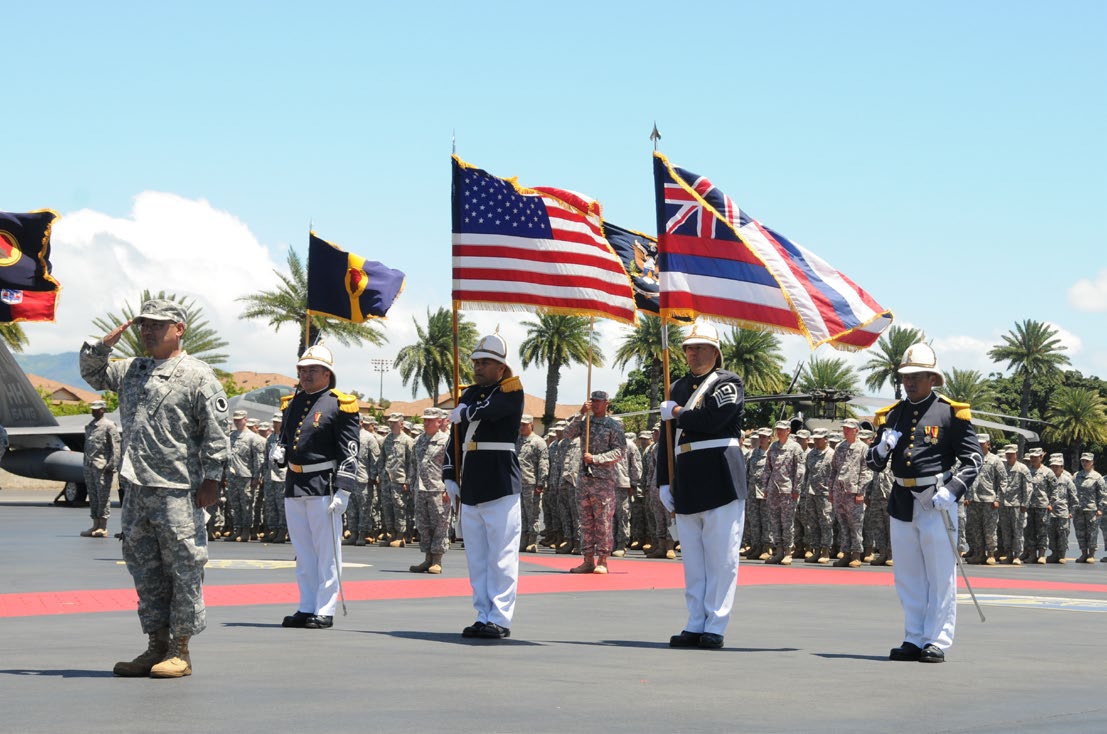
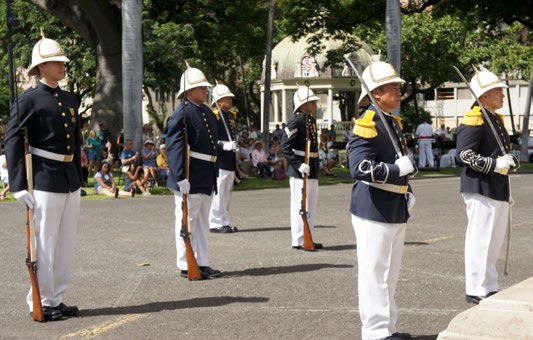
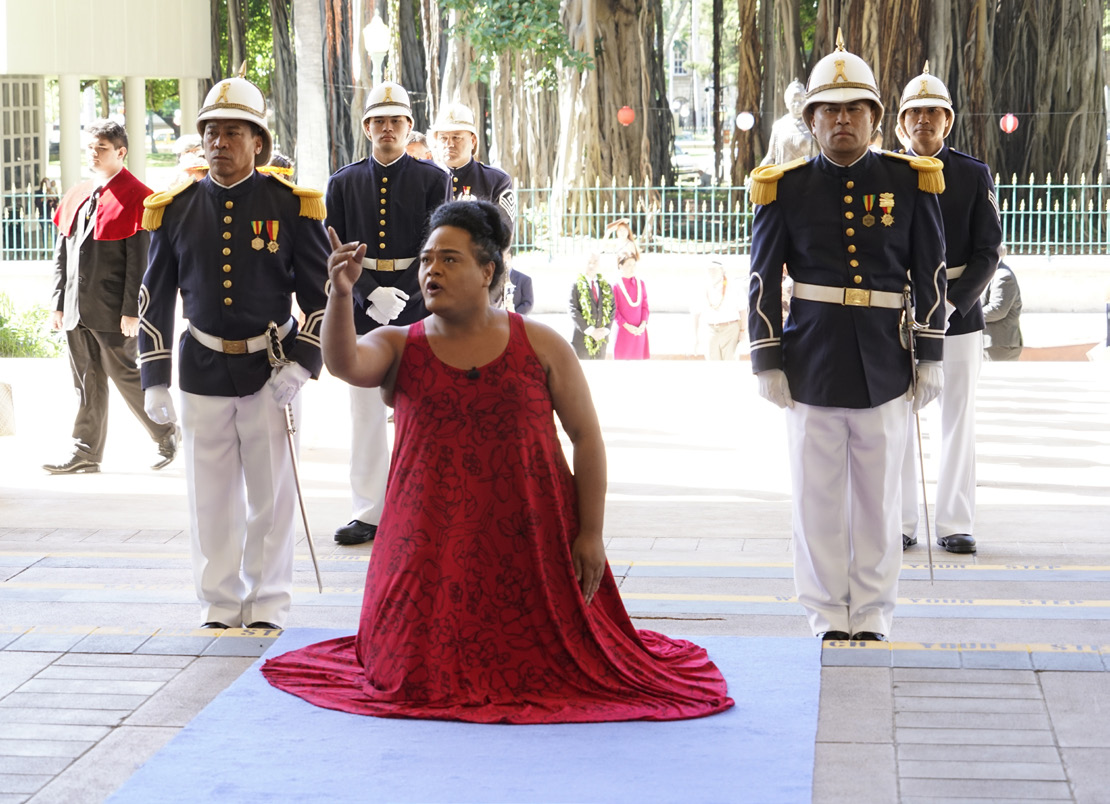
The modern Royal Guard of the Hawaiʻi Air National Guard was established on Jan. 20, 1963, when Lt. Col. Walter F. Judd and a group of 18 Air Guardsmen of Hawaiian ancestry revived the ceremonial guard of the Hawaiian monarchy. After years of archival research, the unit recreated the uniforms, equipment, drill and commands of the 19th-century guard that had served King Kalākaua and Queen Liliʻuokalani. Uniforms were tailored from historic photographs, buttons and buckles were recast from originals, and the Guard acquired period Springfield .45-70 rifles. Commands are delivered entirely in Hawaiian, and leadership retained traditional Hawaiian titles.
The Royal Guard made its first grand public appearance on Nov. 16, 1963, King Kalākaua’s birthday — a date that became the unit’s annual Posting and Mounting of the Guard at ʻIolani Palace. This ceremony featuring palace sentries, Hawaiian commands, and inspection by state and military leaders, became the signature expression of the Royal Guard’s role as a living bridge to the islands’ royal past. The unit continues to celebrate this appearance annually at the Palace.
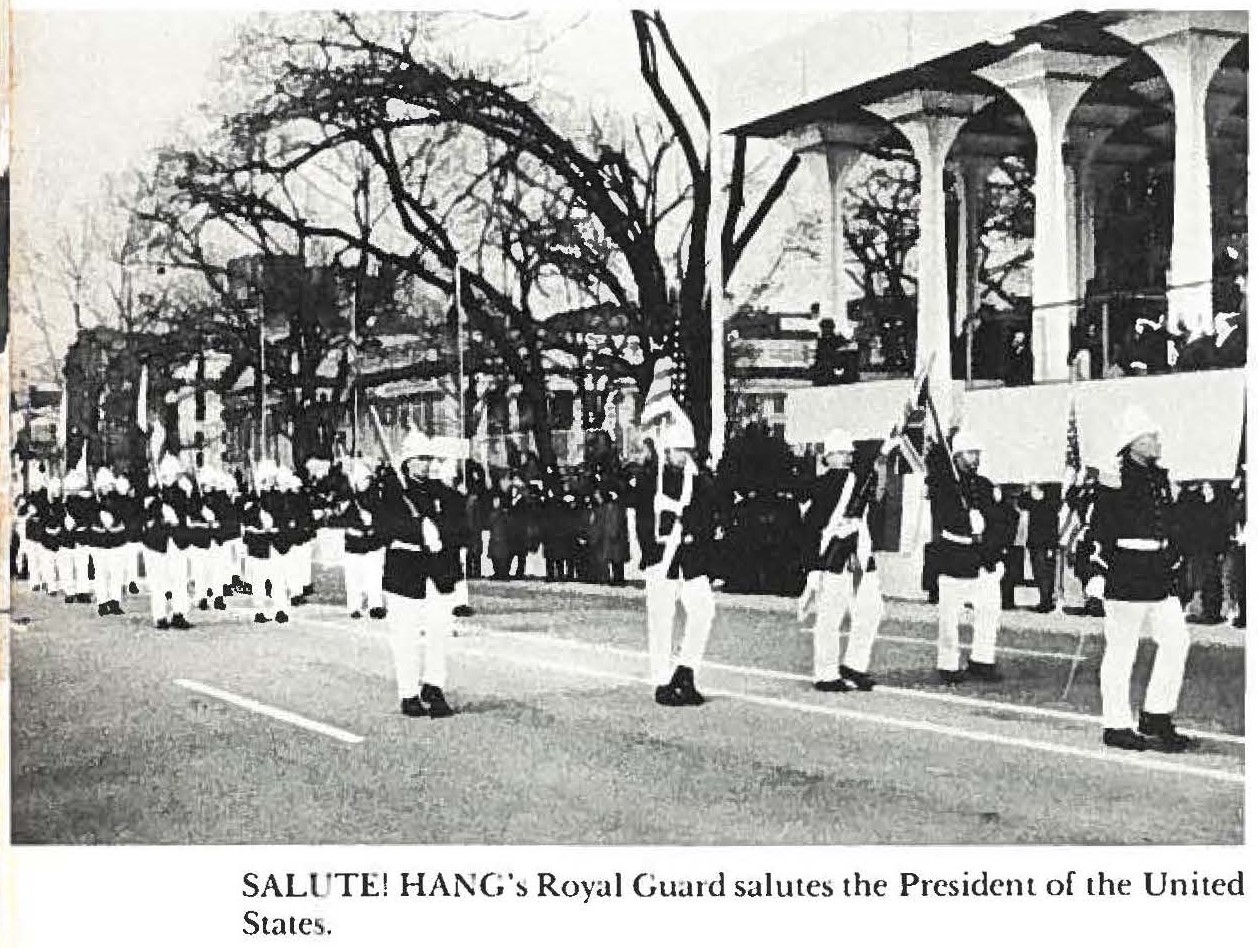
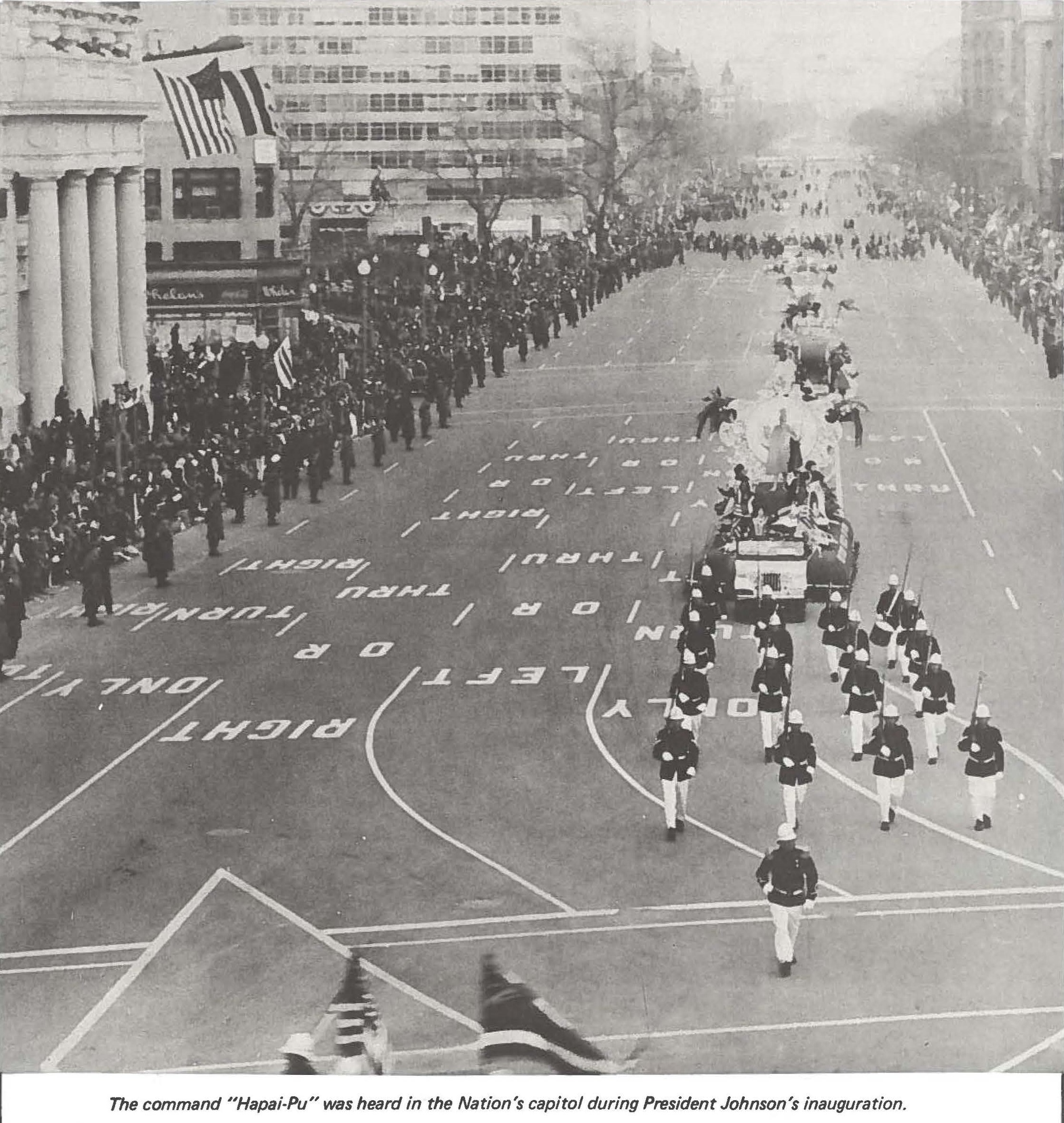
Through the 1960s and 1970s, the Royal Guard grew steadily in size and visibility, expanding to more than 40 volunteers. Fully self-supporting and strictly voluntary, the unit became a prominent ceremonial presence at parades, inaugurations, state occasions, and visits by heads of state. They represented Hawaiʻi in the 1965 Presidential Inaugural Parade, greeted President Lyndon Johnson, Queen Elizabeth II and conducted 18 high-profile appearances in FY 1970 — earning the Adjutants General Association’s award for the Nation’s Top Community Service Project.
During the 1980s and 1990s, the Royal Guard continued to refine its historic authenticity and ceremonial precision. It supported gubernatorial inaugurations, royal family events, Aloha Festivals, Merrie Monarchs, military ceremonies and major cultural commemorations including the unveiling of the Queen Liliʻuokalani statue at the State Capitol.
The Royal Guard has continued its role as the ceremonial arm of the Hawaiʻi National Guard. They presented the State Colors at major events, honored veterans, supported high-visibility state ceremonies and escorted new governors during inaugural processions, where the Royal Guard has led gubernatorial processions from ʻIolani Palace through honor cordons. The Royal Guard also worked alongside Hawaiian civic and royal organizations in commemorations that honored historical Hawaiian service members, further grounding its identity in cultural stewardship.
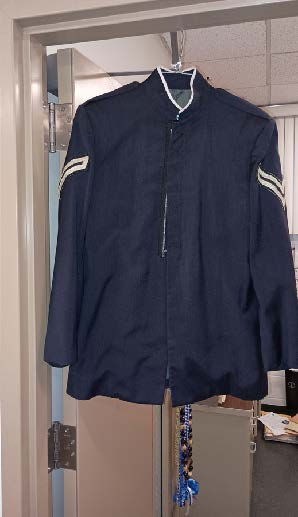
In the 2020s, the National Guard Bureau selected the Royal Guard to represent Hawaiʻi in the new National Guard Heritage Room at Fort Myer–Henderson Hall, where a Royal Guard jacket and helmet stood as the centerpiece of the state’s contribution.
This national recognition underscores the Royal Guard’s unique role: a ceremonial unit that embodies Hawaiian identity, honors the monarchy’s military traditions and represents the Hawaiʻi Air National Guard at the highest levels for more than six decades.
Royal Guard Chronological History
SHADES OF OLD HAWAll
A volunteer group entitled the “Royal Guards” will be formed within the Hawaii Air National Guard which intends to tangibly express our pride in our Hawaiian heritage. Active membership will be restricted to those who possess Hawaiian blood. From this group, an Honor Guard, Color Bearers, and Color Guard of initially 8-12 men will he formed. These men will he dressed and equipped similar to the Royal Guards of the Kingdom of Hawaiian circa King Kamehameha III through Queen Liliuokalani (1845-1893).
20 JAN 1963 A volunteer group of 18 Hawaii Air National Guardsmen known as the Royal Guard was officially organized at the 154th Fighter Group at Hickam AFB.
Learn more
The Royal Guard
By Lt Eddie Anderson
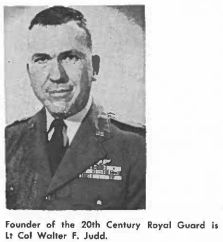
Royal Guard in King Kolakaua’s funeral procession. Founder of the 20th Century Royal Guard is Lt Col Walter F. Judd. (Pictures from the 1963 March The Hawaii Guardsman)
A volunteer group of 18 Hawaii Air National Guardsmen known as the “Royal Guard” was officially organized Sunday afternoon (20 January) at the 154th Fighter Group at Hickam AFB.
The select Air Guardsmen, all of Hawaiian ancestry, will dress as did members of the Royal Guard during the late 1800’s and will participate in future parades, reviews and other official functions.
The group may also he available for ceremonies commemorative Hawaii’s colorful past.
All verbal orders will he given in Hawaiian as they were during King Kalakaua-Queen Liliuokalani era. The unique group hopes to make its first public appearance on Kamehameha Day, June 11.
Originator of the idea is Lt Colonel Walter F. Judd, Administrative Assistant, Air National Guard headquarters, Fort Ruger.
Judd said that the object of the group was to “tangibly express pride in our Hawaiian heritage and preserve the traditions of the Hawaiian militia of the Monarchy.”
A Guard spokesman said that there were no appropriated funds for this purpose but gifts and donation from interested individuals and organizations will he sought to support the project.
Judd, a member of a well known kamaaina family, has researched for several months to recreate an autentically uniformed and equipped “Royal Guard.”
Uniforms will be tailored and copied from old photographs which were obtained from the Archives. Authentic coat buttons are being reproduced from originals obtained by a Guardsman.
Mr. Paul Parker of Honolulu, a postal employee, has offered the HANG the loan of an original belt buckle which was worn by his father, the late Robert Waipa Parker, while an officer of the Royal Guard. The HANC plans to reproduce more than 12 buckles from the original.
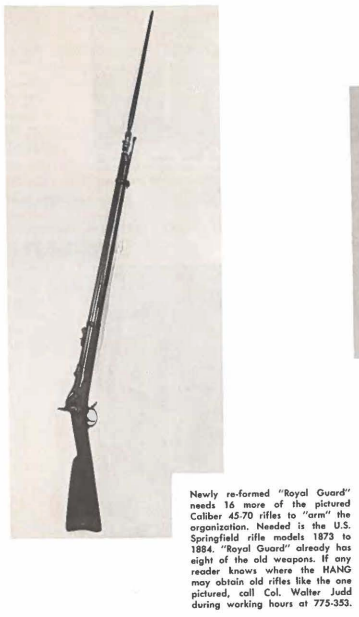
The newly formed organization has been able to obtain five 1873-1888 Springfield 45-70 rifles but need seven more to complete the Guard detachment.
Although the HANG has been able to obtain twelve helmets resembling the originals, they have heen unable to locate the helmet insignia.
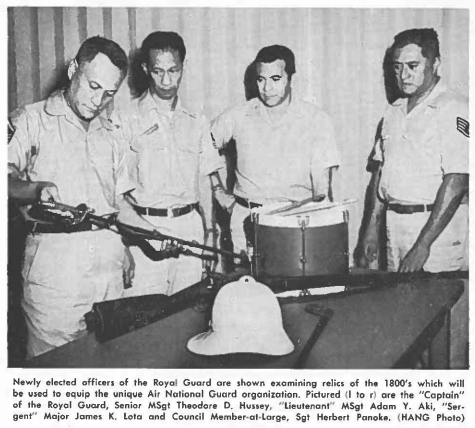
At a meeting held Sunday, Senior MSgt Theodore D. Hussey was voted the “Kapena Moku” or “Captain” of the Royal Guard. MSgt Adam Y. Aki was installed as the “Luna Koa” or “Lieutenant” and Major James K. Lota was voted the “He Kakiana” or “Sergeant” of the group. Council Member-at-Large is Sgt Herbert Panoke.
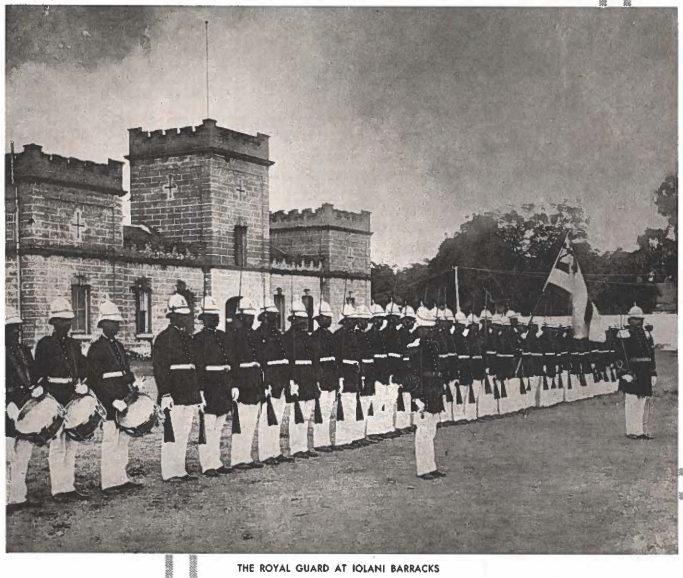
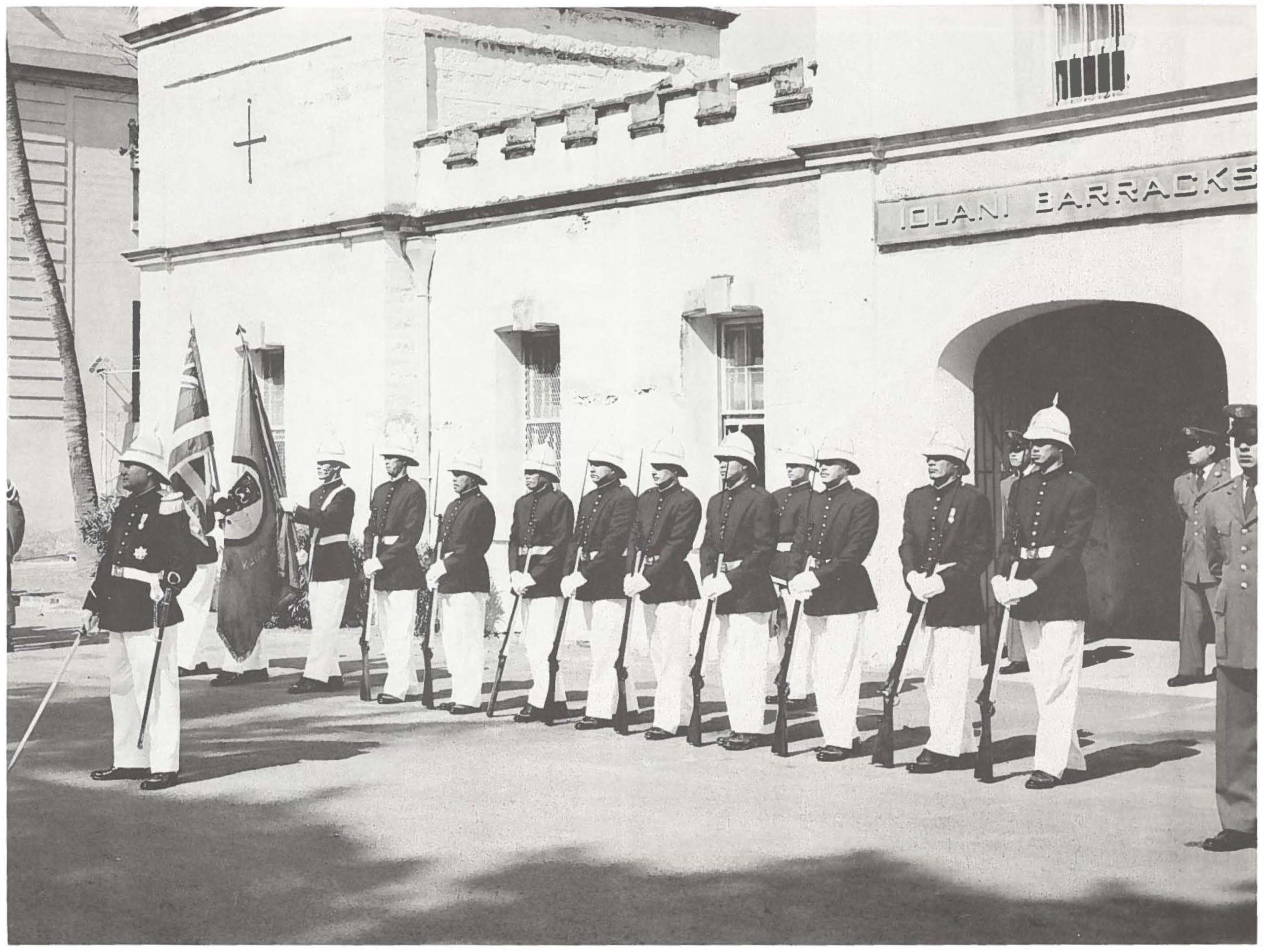
The original Royal Guard was composed of about 50 officers and men who had the prime duty of guarding Hawaii’s Royalty. The Royal Guard was stationed at Iolani Barracks.
Residents of Hawaii who can assist the Air Guard in locating uniforms or equipment of the late 1800’s are urged to call Colonel Judd at 775-353 between 8 A.M. and 4 P.M., Monday through Friday
Newly elected officers of the Royal Guard are shown examining relics of the 1800’s which will be used to equip the unique Air National Guard organization. Pidured (l to r) are the “Captain” of the Royal Guard, Senior MSgt Theodore D. Hussey, “lieutenant” MSgt Adam Y. Aki, “Sergent” Major James K. Lota and Council Member at large, Sgt Herbert Panak. (HANG Photo) (Pictures from the 1963 March The Hawaii Guardsman)
Newly re-formed “Royal Guard” needs 16 more of the pictured Caliber 45-70 rifles to “arm” the organization. Needed is the U.S. Springfield rifle models 1873 to 1884. “Royal Guard” already has eight of the old weapons. If any reader knows where the HANG may obtain old rifles like the one pictured, call Col. Wolter Judd during working hours at 775-353.(Picture from the 1964 March The Hawaii Guardsman)
Royal Guard Adds Color to Parade
The Royal Guard detachment was on hand on May 16, 1964 to add color to the Armed Forces Day celebration on Kauai.
The 14 man detachment under the direction of their “Kapena Moku” Ted Hussey, performed on 4 different occasions for the public: Parade in Lihue, Lihue Airport, Eleele Shopping Center, and the Military Ball at the Kauai Surf.
This was their first appearance on Kauai and from the comments from the public, most impressive.
Kauai’s sole representative in the Royal Guard is A2C Louis McKeague, radio man from the 150th, who served as a color hearer for the Royal Guards.
The 150th was represented in the parade with a color guard and a 51 man marching unit under the command of Lt Gerry Revuelto.
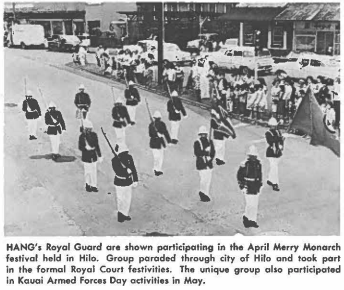
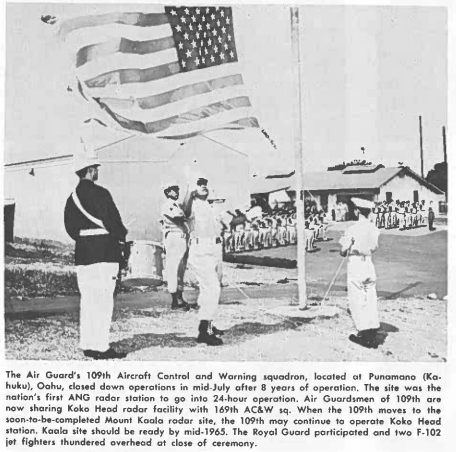
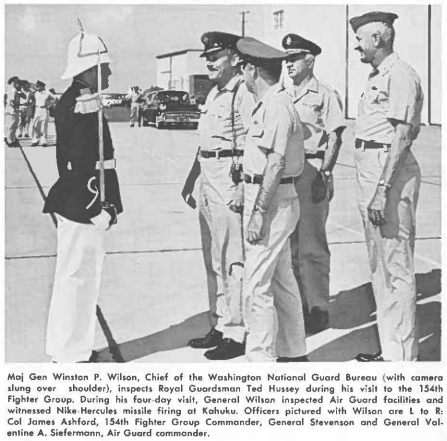
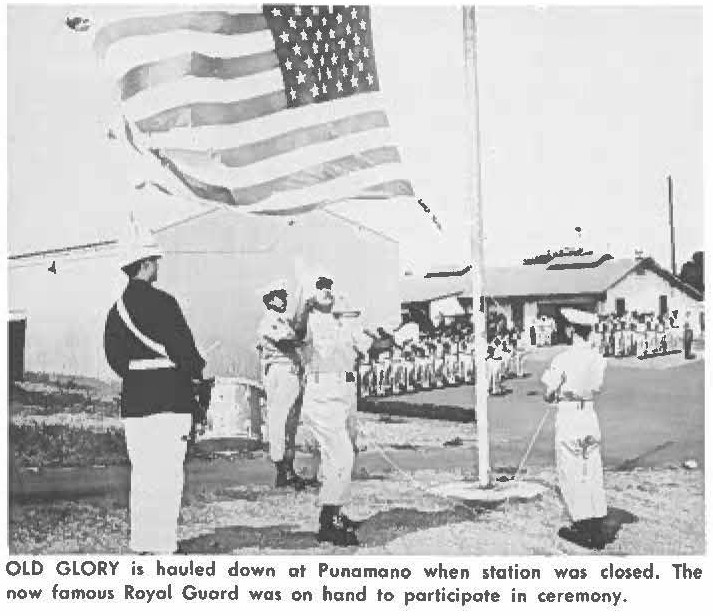
HANG’s Royal Guard are shown participating in the April Merry Monarch festival held in Hilo. Group paraded through city of Hilo and took port in the formal Royal Court festivities. The unique group also participated in Kauai Armed Forces Day activities in May. (Picture from the 1964 June The Hawaii Guardsman)The Air Guard’s 109th Aircraft Control and Warning squadron, located al Punamano (Kahuku), Oahu, closed down operations in mid-July ofter 8 years of operation. The site was the nation’s first ANG radar station to go into 24-hour operation. Air Guardsmen of 109th are now sharing Koko Head radar facility with 169th AC&W sq. When the 109th moves to the soon-to-be-completed Mount Koala radar site, the 109th may continue to operate Koko Head station. Koala site should be ready by mid-1965. The Royal Guard participated and two F-102 jet fighters thundered overhead at close of ceremonyMaj Gen Winston P. Wilson, Chief of the Washinglon National Guard Bureau (with camera slung over shoulder), inspects Royal Guardsman Ted Hussey during his visit to the 154th Fighter Group. During his four-day visit, General Wilson inspected Air Guard facilities and witnessed Nike Hercules missile firing at Kahuku. Officers pictured with Wilson are L to R: Col James Ashford, 154th Fighter Group Commander, General Stevenson and General Valentine A. Siefermann, Air Guard commander. (Pictures from the 1964 September The Hawaii Guardsman)
16 NOV 1964 The Royal Guard celebrated its first anniversary with an impressive public ceremony which was held at Iolani Palace. 16 November was also the birthday of King David Kalakaua who reigned from 1874 to 1891.
Learn more
ONE YEAR OLD … AND PROUD!
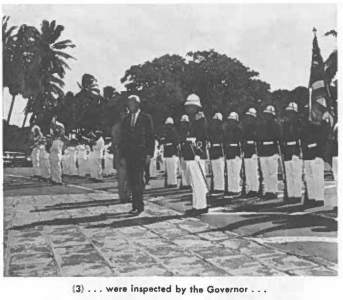
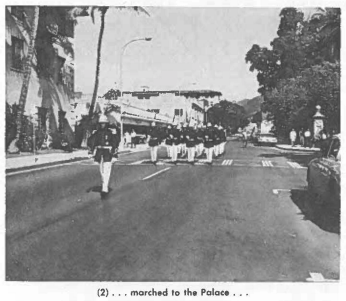
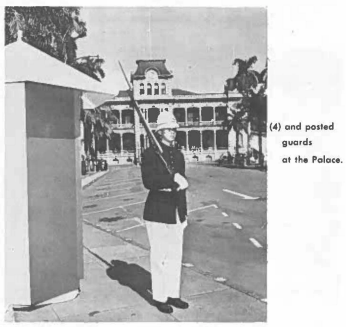
(3) … were inspected by the Governor … (2) … marched to the Palace … (4) and posted guards at the Palace. (Pictures from the 1964 December The Hawaii Guardsman)
The Hawaii Air National Guard sponsored “Royal Guard” celebrated its first anniversary 16 November with an impressive public ceremony which was held at Iolani Palace.
Appropriately, 16 November was also the birthday of King David Kalakaua who reigned from 1874 to 1891.
The 24 Royal Guardsmen were dressed as did members of the original Royal Guard during the days of the Hawaiian monarchy. All commands were given in Hawaiian.
The unique organization formed with the Royal Hawaiian Band at lolani Barracks on Hotel street at 1:30 p.m. and marched to Iolani Palace. Traffic was momentarily interrupted as the Air Guardsmen marched Ewa on Hotel street, makai on Richards street, Waikiki on King street to the Palace.
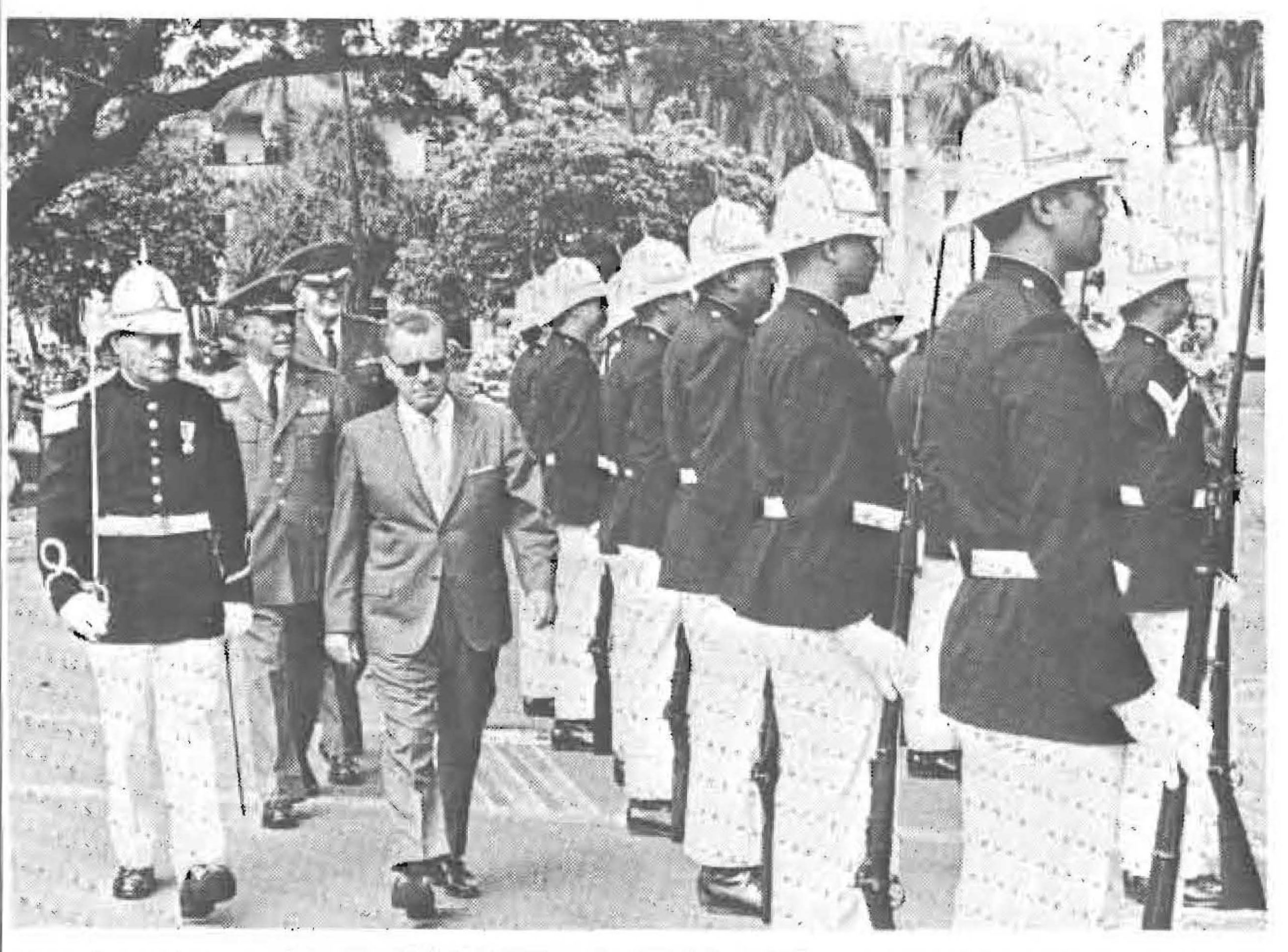
The unit marched to the palace steps and were greeted by Governor John A. Burns, Maj Gen Robert L. Stevenson, Adjutant General, and Brig Gen Valentine A. Siefermann, Air Guard Commander.
Following the short ceremony, members of the colorful unit were posted at the palace steps, in the Throne room, and at each entrance to the palace grounds. With pomp reminiscent of the 1800’s, the guard was changed ever) half-hour until 4 p.m.
At the close of the day’s activities, the Royal Guard marched to Washington Place and presented Mrs. John A. Burns with a maile lei.
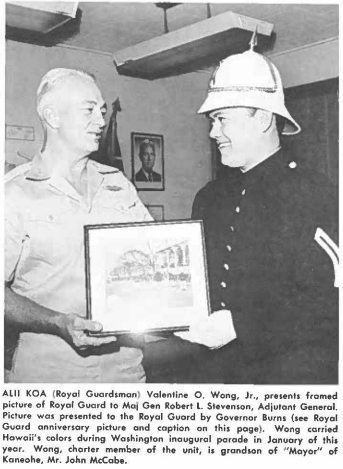
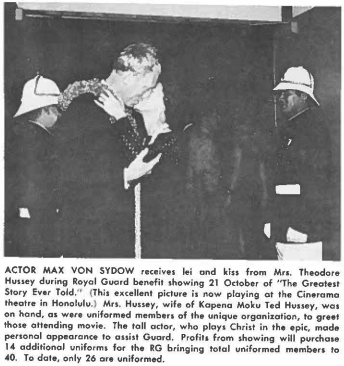
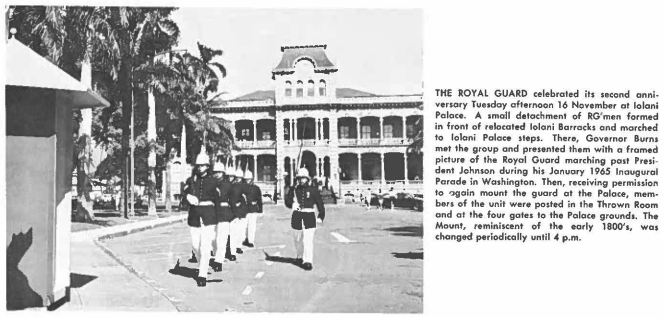
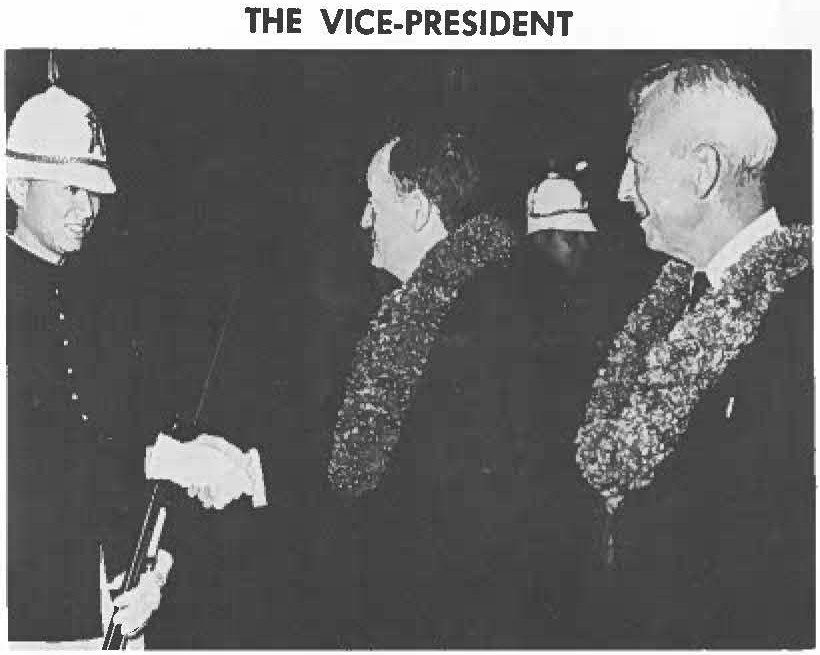
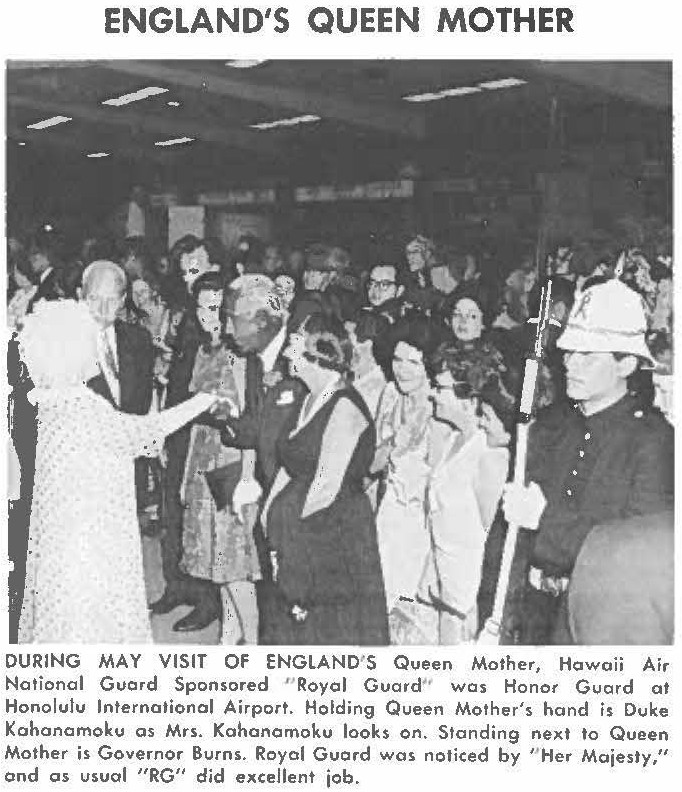
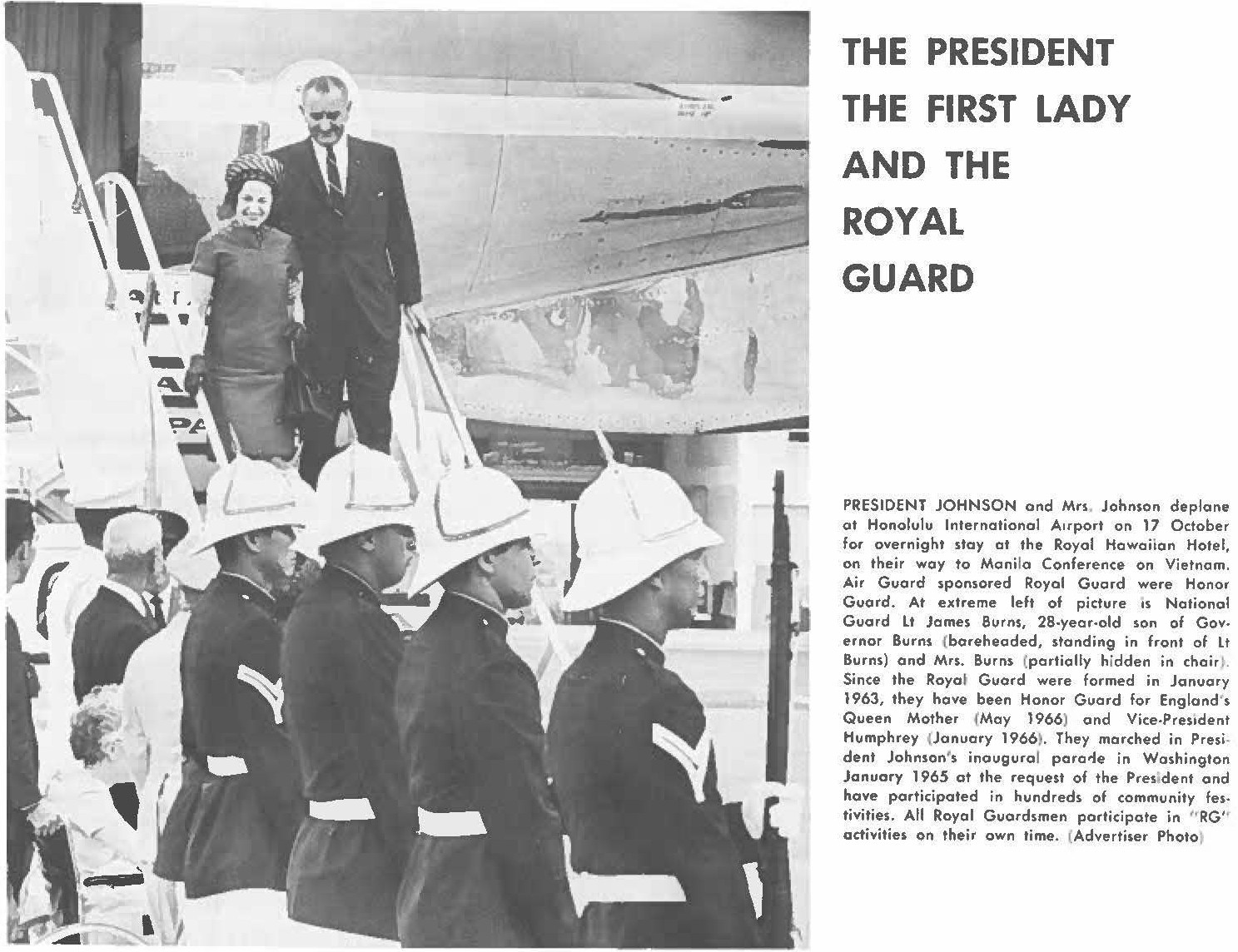
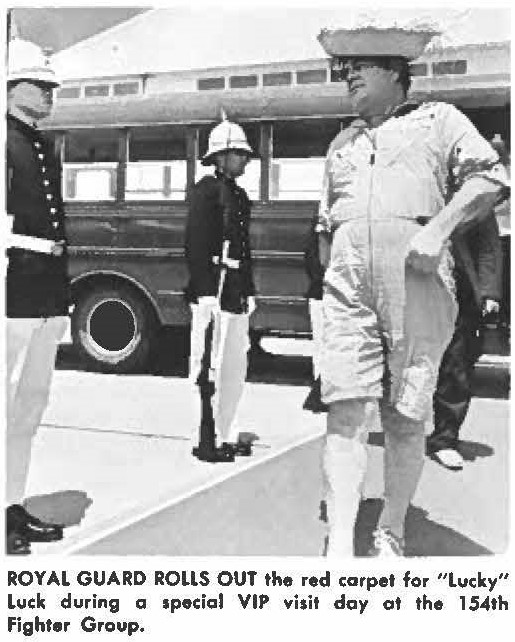
Alli KOA (Royal Guardsman) Valentine O, Wong, Jr., presents framed picture of Royal Guard to Maj Gen Robert l. Stevenson, Adjutant General. Picture was presented lo the Royal Guard by Governor Burns (see Royal Guard anniversary picture and caption on this page), Wang carried Hawaii’s colors during Washington inaugural parade in January of this year. Wong, charter member of the unit, is grandson of “Mayor” of Kaneohe, Mr. John McCabe. ACTOR MAX VON SYDOW receives lei and kiss from Mrs. Theodore Hussey during Royal Guard benefit showing 21 October of “The Greatest Story Ever Told.” This excellent picture is now playing at the Cineroma theatre in Honolulu.) Mrs. Hussey, wife of Kopeno Moku Ted Hussey, was on hand, as were uniformed members of the unique organization, to greet those attending movie. The tall actor, who plays Christ in the epic, made personal appearance to assist Guard. Profits from showing will purchase 14 additional uniform, for the RG bringing total uniformed members to 40. To date, only 26 are uniformed.THE ROYAL GUARD celebrated its second anniversary Tuesday afternoon 16 November at loloni Palace. A small detachment of RG’men formed in front of relocated loloni Barracks and marched to lolani Palace steps. There, Governor Burns met the group and presented them with a framed picture of the Royal Guard marching past President Johnson during his January 196S lnaugural Parade in Washington. Then, receiving permission to gain mount the guard at the Palace, members of the unit were posted in the Thrown Room and at the four gates to the Palace grounds. The Mount, reminiscent of the early 1800’s, was changed periodically until 4 p.m. (Pictures from the 1965 December The Hawaii Guardsman)(Picture from the 1966 Annual Report)DURING HIS 2 JANUARY VISIT TO HAWAII, Vice-P resident Humphrey was greeted with Honor Guard ceremony at Washington Place. Pictured shaking hands with the VP is Royal Guardsman SSql Randall K. H. Lum while Governor Burns looks on. Between VP and Governor (background is MSgt Harry Awana, Jr. Vice-President Humphrey shook hands with all Royal Guardsmen present that evening(Picture from the 1966 March The Hawaii Guardsman)DURING MAY VISIT OF ENGLAND’S Queen Mother, Hawaii Air National Guard Sponsored “Royal Guard” was Honor Guard at Honolulu International Airport. Holding Queen Mother’s hand is Duke Kahanamoku as Mrs. Kahanomoku looks on. Standing next to Queen Mother is Governor Burns. Royal Guard was noticed by “Her Majesty” and as usual “RG” did excellent job. (Picture from the 1966 June The Hawaii Guardsman)OLD GLORY is hauled down at Punamano when station was closed. The now famous Royal Guard was on hand to participate in ceremony. PRESIDENT JOHNSON and Mn, Johnson deplane at Honolulu International Airport an 17 October for overnight stay at the Royal Hawaiian Hotel, on their way to Manila Conference on Vietnam. Air Guard sponsored Royal Guard were Honor Guard. At extreme left of picture os National Guard Lt James Burns, 28-year-old son of Governor Burns (bareheaded, standing in front of Lt Burns) and Mrs. Surns (partially hidden in choir). Since the Royal Guard were formed in January 1963, they have been Honor Guard for England’ s Queen Mother (May 1966) and Vice-President Humphrey (January 19661. They marched in President Johnson’s inaugural parade in Washington January 1965 at the request of the President and have participated in hundreds of community festivities. All Royal Guardsmen participate in “RG” activities on their own time. (Advertiser Photo)(Pictures from the 1966 December The Hawaii Guardsman)ROYAL GUARD ROLLS OUT the red carpet for “Lucky” Luck during a special VIP visit day at the 154th Fighter Group. (Picture from the 1967 Fall The Hawaii Guardsman)
1967 Representative L. Mendel Rivers, Chairman of the House Armed Forces Committee, in Honolulu for a speaking engagement, took time out from his busy schedule to spend a day with the Hawaii National Guard.
Learn more
Representative Rivers Visits Hawaii Guard
Representative L. Mendel Rivers, Chairman of the House Armed Forces Committee, in Honolulu for a speaking engagement, took time out from his busy schedule to spend a day with the Hawaii National Guard.
“I came out here to make a speech, but then your Congressman Matsunaga and Senator Inouye asked me to look at the guard here,” Rivers said. “Do you realize you have one of the great air units as well as a great missile unit?” Rep. Rivers directed this question to a local newspaper reporter.
Rep. Rivers began his visit with a briefing of the Nike Hercules system by Major Melvin Alencastre, full-time supervisor for the 298th Arty Gp, and then was taken to the bunching area of Btry C, 1st Bn, 298th Arty Gp at Waimanalo by Major Tom Kimura, Btry Commander. He then proceeded to the 154th Fighter Group (AD) facilities at Hickam where he was given a briefing and a tour of the area by BG Val A. Siefermann, CG of the Air Guard, and Col James Ashford, CO of the 154th. During his tour of the fighter group, Rivers dropped into the pilots ready and asked one of the Air Guard pilots, “When are you going to get some new airplanes?” The pilot quickly replied, “Anytime you’re ready, sir.”
Representative Rivers was quoted from a speech he gave recently in Washington, D.C. as saying, “The National Guard has been the organization which has prevented our country from slipping permanently into the abyss of total violence and total lawlessness.”
Rep. Rivers was pleased with his visit here and the Hawaii National Guard was happy to show him our units.
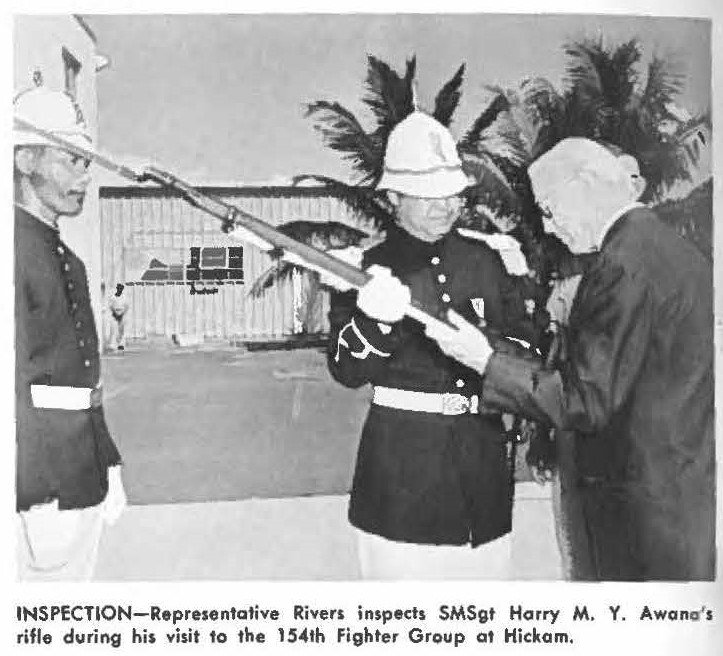
INSPECTION-Representative Rivers inspects SMSgt Harry M. Y. Awana’s rifle during his visit to the 154th Fighter Group at Hickam. (Picture from the 1967 Winter The Hawaii Guardsman)
16 NOV 1967 The traditional Mounting of the Royal Guard on the Palace steps, and the changing of the Guard every half hour was reenacted by members of the modern Royal Guard.
Learn more
MOUNTING OF THE GUARD
Honolulu- If King Kalakaua, whose birthday was celebrated November 16, could look once again out the windows of Iolani Palace, he would find at least one scene virtually unchanged.
That scene is the traditional Mounting of the Royal Guard on the Palace steps, and the changing of the Guard every half hour.
The scene was reenacted by members of the modern Air National Guard-volunteer Hawaii Air National Guardsmen who recreated the monarchial unit four years ago-November 16, 1963.
Commemorating their fourth anniversary, and the birthday anniversary of the last Hawaiian king to utilize the original Royal Guard, the 36-man Guard began the traditional ceremony in front of the Palace steps, where the Kapena Moku (Captain) presented the unit to the Governor.
The Kapena Moku is Senior Master Sergeant Theodore Hussey, first sergeant of the 154th Combat Support Squadron, Hawaii Air National Guard. AU members of the Royal Guard are of Hawaiian or part-Hawaiian blood. The drill commands to the Royal Guard are all given in Hawaiian.
Following presentation of the Royal Guard, the Kapena Moku asked the Governor to inspect the Guard. When the inspection was completed, permission was granted to “Mount the Guard over the Palace.”
Sentries were posted in the Throne Room, in front of the Palace, and at each entrance to the Palace grounds. They were changed every half-hour until 4:00 p.m., when the Guard Mount ended.
Credit for the formation of the modern Royal Guard four years ago goes to Colonel Walter F. Judd, administrative assistant for headquarters of the Hawaii Air National Guard.
Today’s Royal Guard participates in various official State functions and ceremonies and other public events which commemorate Hawaii’s colorful heritage and past.
16 NOV 1968 The fifth annual mounting of the Royal Guard at Iolani Palace in honor of Hawaii’s last monarch – King Kalakaua took place.
Learn more
Royal Guard 5 Years Young
by PFC Leonard Lueras
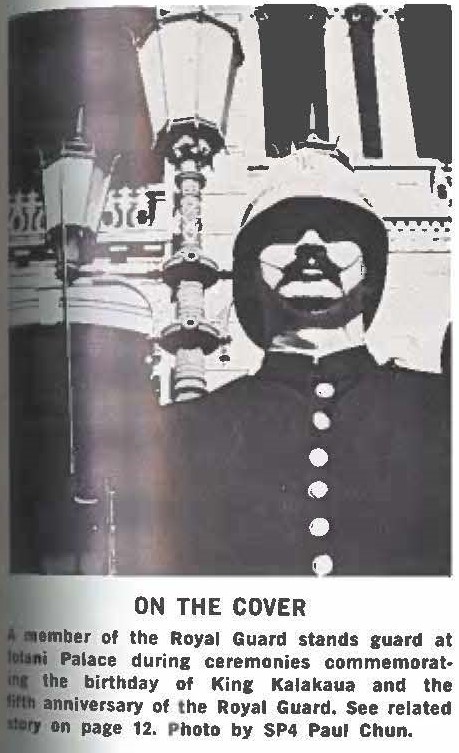
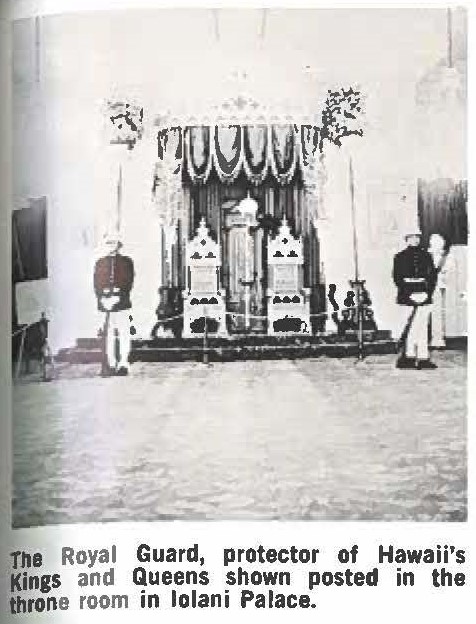
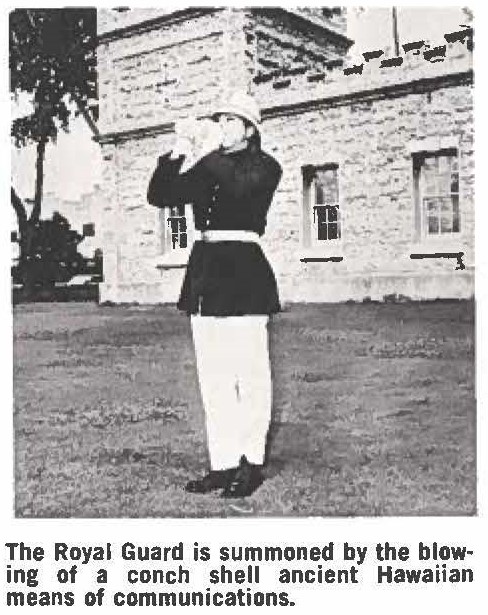
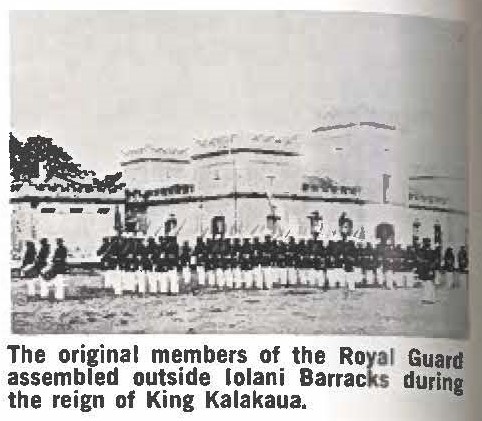
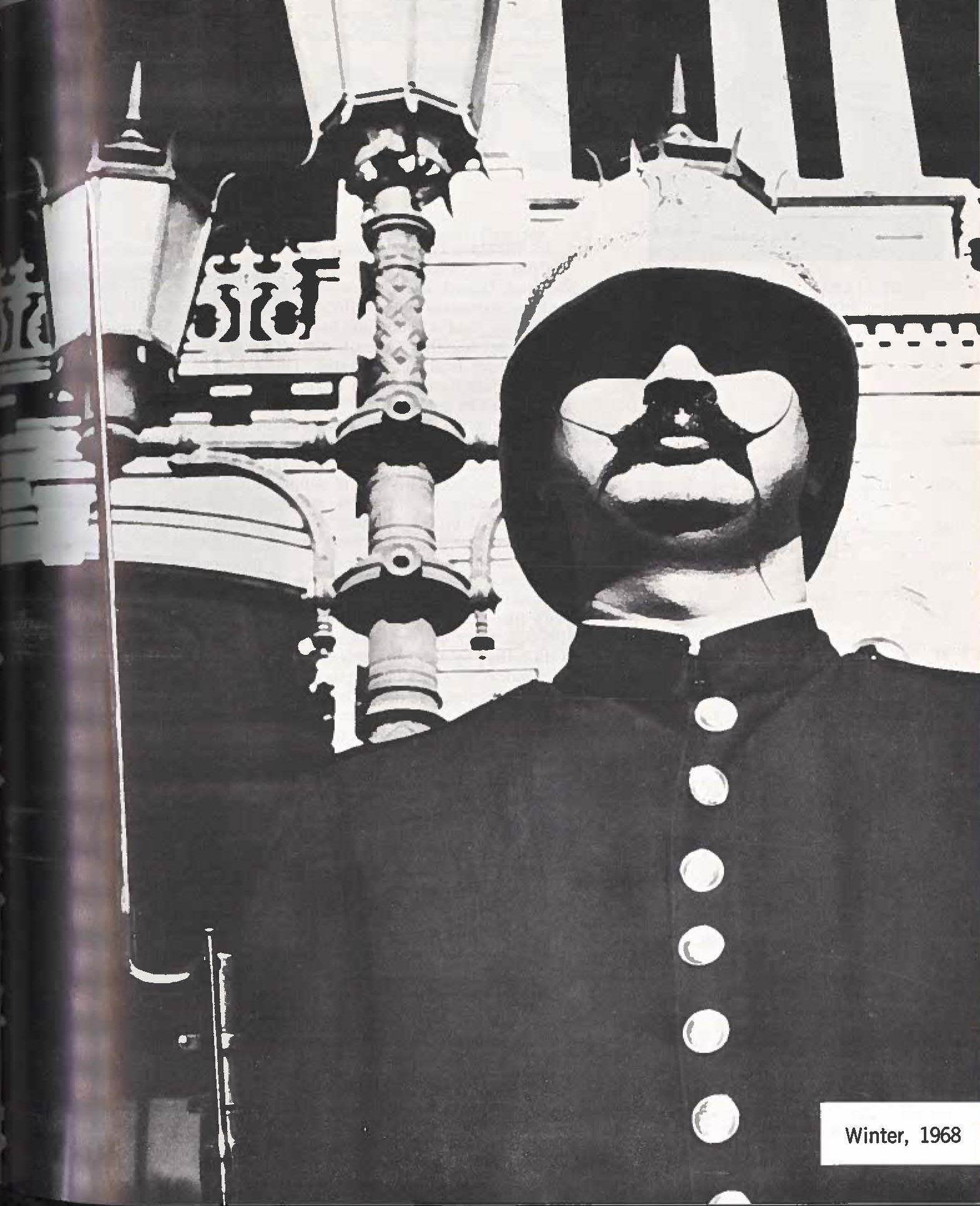
a member of the Royal Guard stands guard at Iolani Palace during ceremonies commemorating the birthday of King Kalakaua and the fifth anniversary of the Royal Guard, See related story on page 12. Photo by SP4 Paul Chun. The Royal Guard, protector of Hawaii’s Kings and Queens shown posted in the throne room in lolani Palace. The Royal Guard is summoned by the blowing of a conch shell ancient Hawaiian means of communicationsThe original members of the Royal Guard assembled outside lolani Barracks during the reign of King Kalakaua. (Pictures from the 1968 Winter The Hawaii Guardsman)
For a day last month at Iolani Palace, there was a bit of “live” royal spirit on the palace grounds.
The pompous scene was the fifth annual mounting of the Royal Guard at Iolani Palace in honor of Hawaii’s last monarch – King Kalakaua.
The traditional mounting ceremonies on Nov. 16 commemorated Kalakaua’s birthday and the fifth anniversary of the modern Royal Guard.
Outfitted in guard gear reminiscent of the Kalakaua era were 33 Hawaii Air National Guardsmen – members of the monarchial unit which was re-created five years ago on Nov. 16, 1963.
While their Kapena Moku (Captain) called out orders in Hawaiian, the unique guard unit changed off every half hour for three and a half hours at all palace entrances and in the royal throne room.
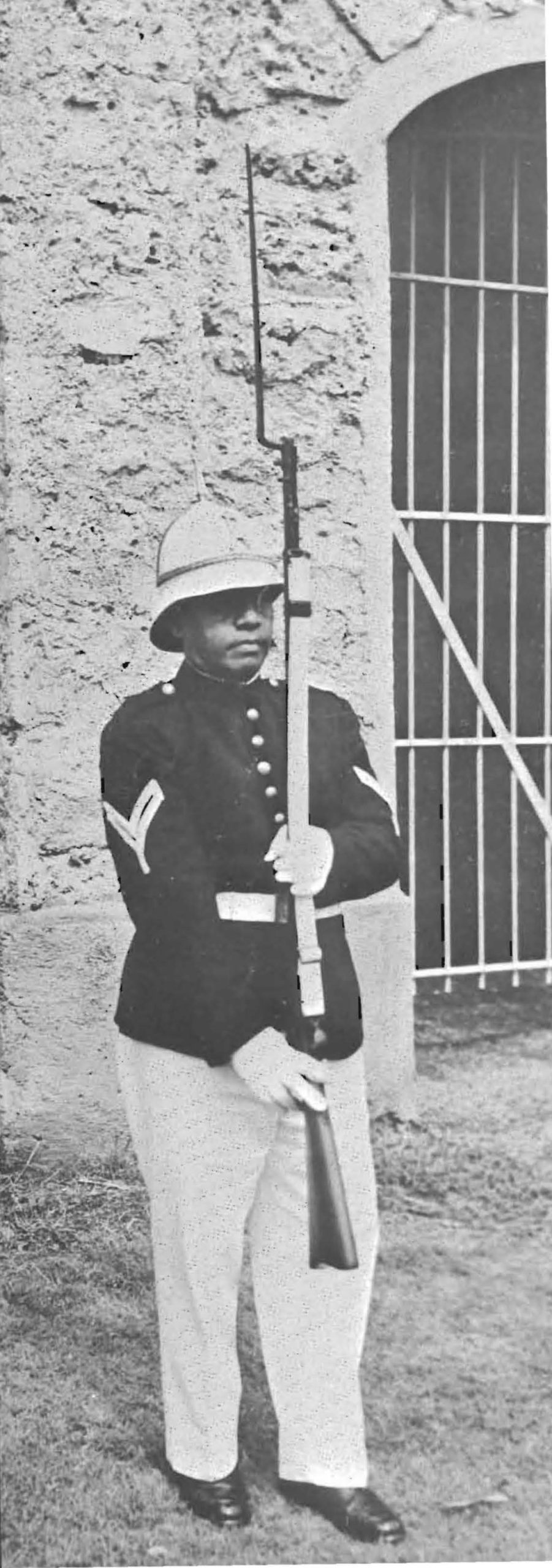
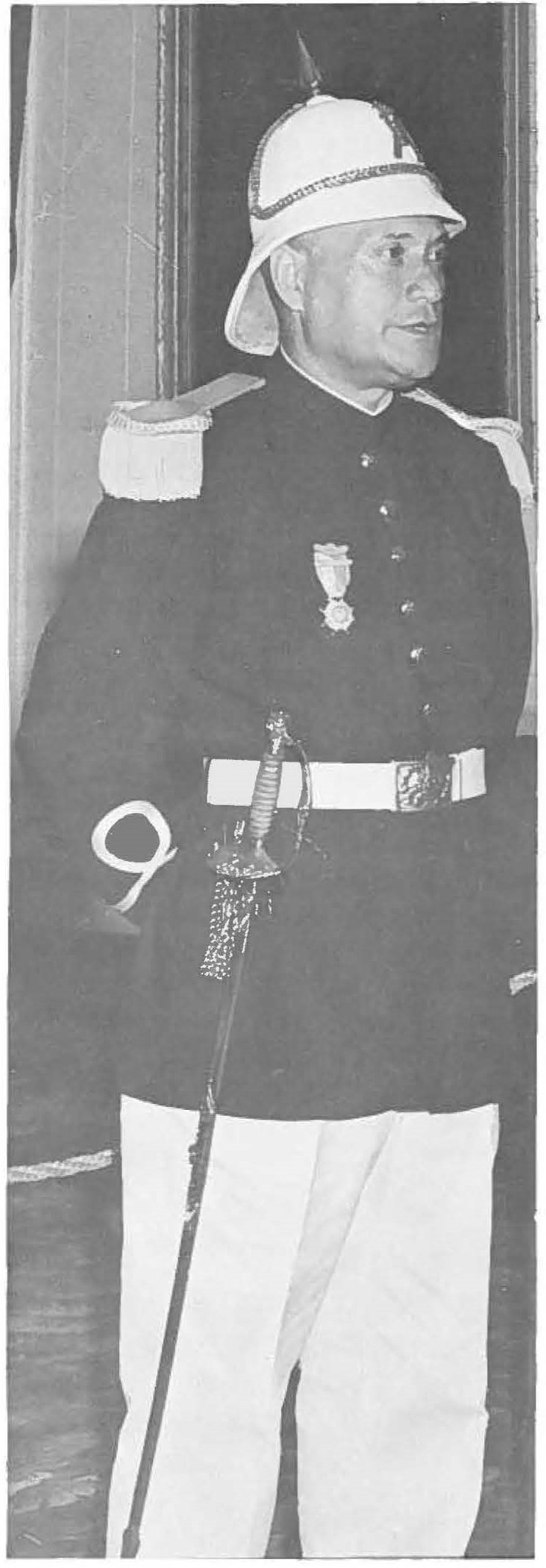
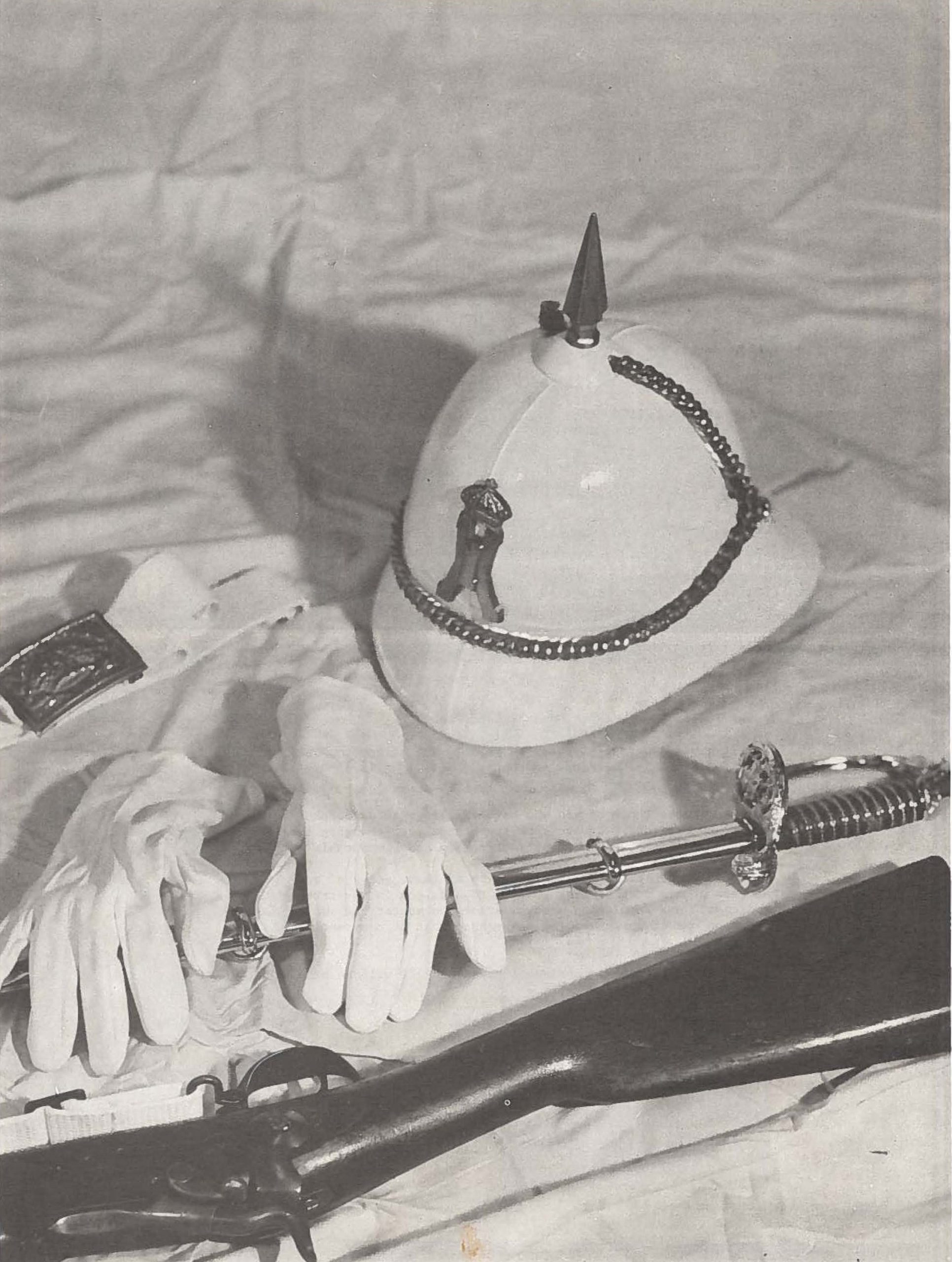
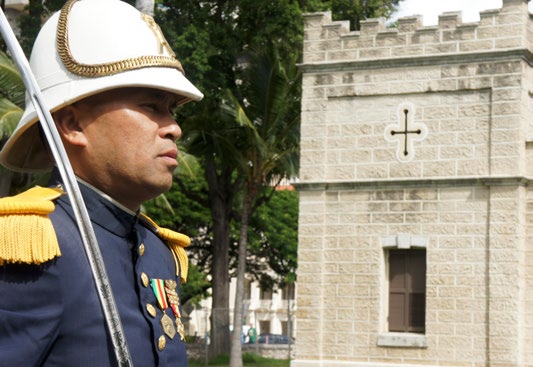
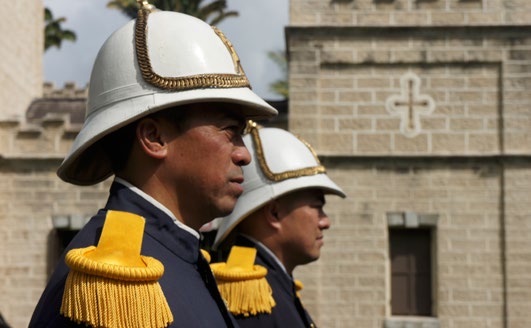
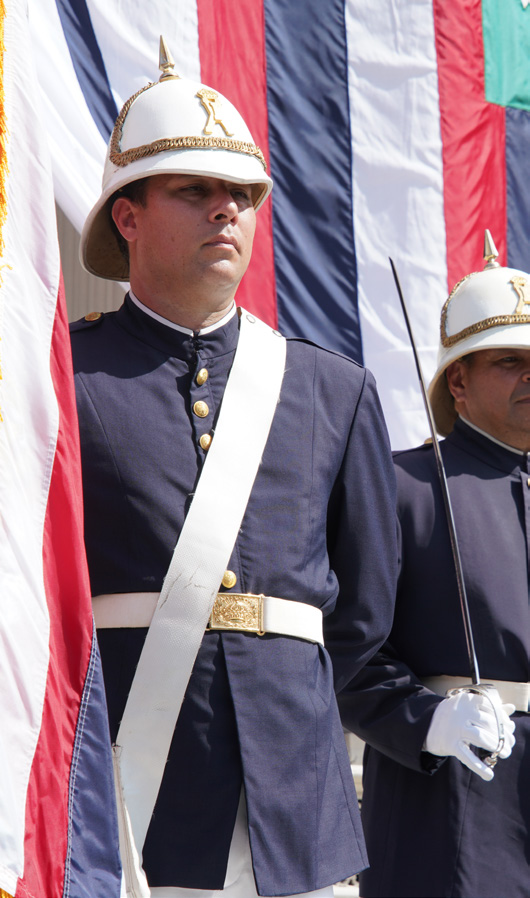
Each Guardsman wore a large dark blue coat and white trousers which are duplicates of the original Royal Guard uniforms worn in late 19th century Hawaii. Even the nine gold buttons on the coats were cast from originals worn by Kalakaua’s men.
Encircling the coats are white belts with large gold buckles patterned after one worn by Captain Robert Waipa Parker of the first Royal Guard.
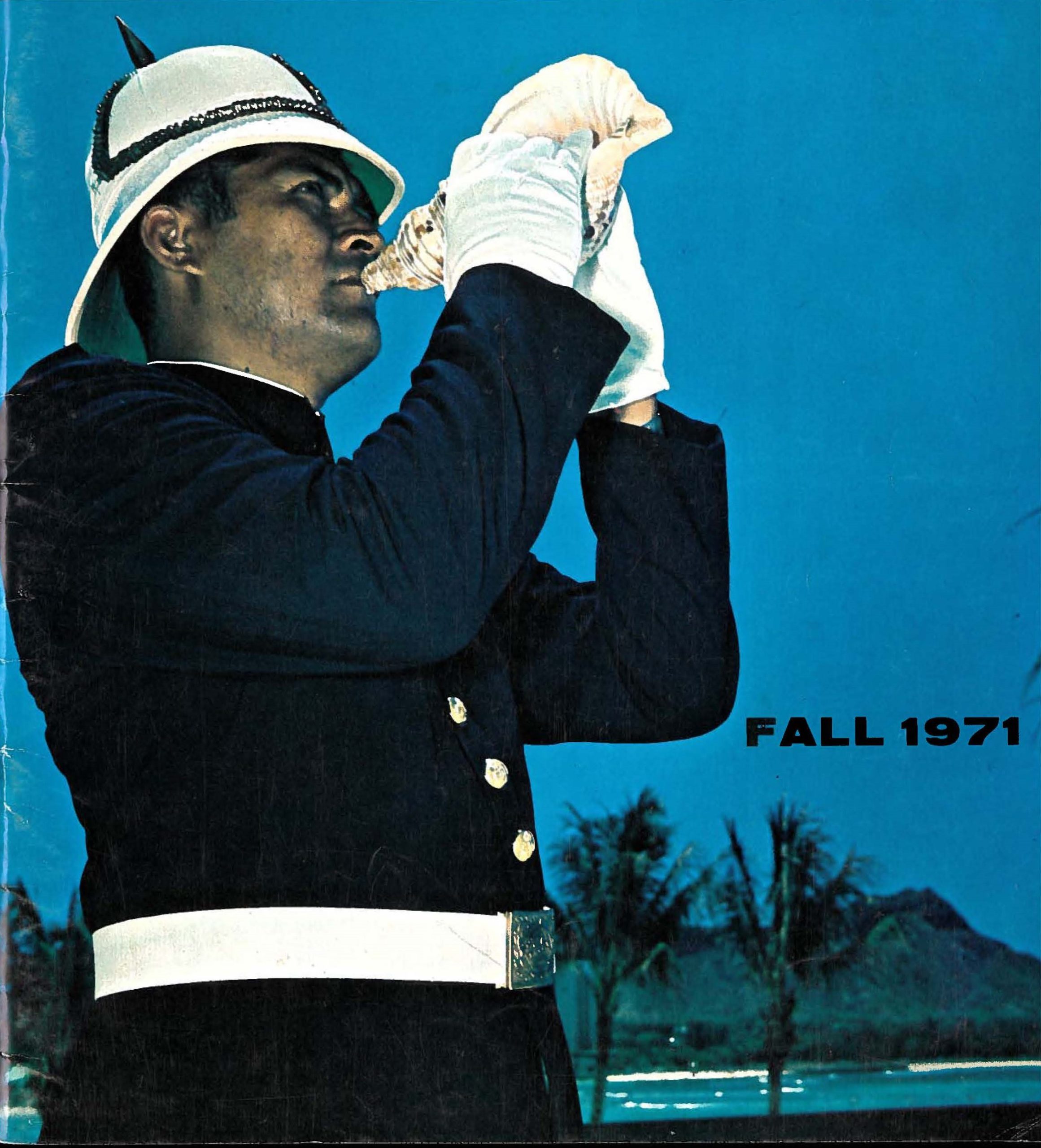
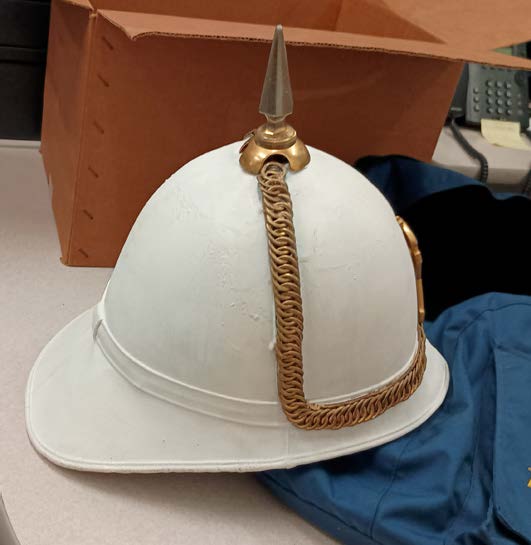
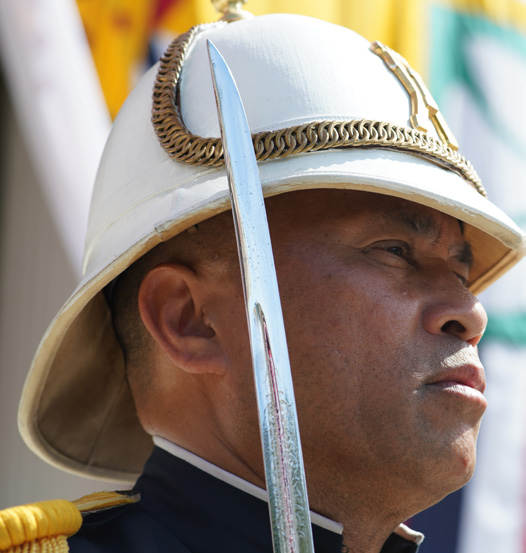
Topping the uniform -is a white spiked pith helmet, which is fronted with the Royal Guard crest and encircled with bright gold metal braid. All sentries carry Kalakaua era rifles, some of which are said to. have been used by the original Royal Guard.
Present Kapena Moku is Senior Master Sergeant Theodore Hussey, first sergeant of the 154th Combat Support Squadron, Hawaii Air National Guard.
All Royal Guard members are of Hawaiian or part-Hawaiian blood, and all drill commands are called in Hawaiian.
At the annual guard changing ceremonies, the Kapena Moku asks the Governor or his representative if he wishes to inspect the Guard. Following a formal inspection, the Kapena Moku is then given permission to “mount the Guard over the Palace.”
Sentries then move to posts in the throne room, in front of the Palace and at each entrance to the palace grounds.
Although there are presently uniformed members, the volunteers Air Guard unit hopes to eventually have 50 fully-uniformed Roy Guard members.
The royal unit, which participate in various official State functions, ceremonies and public events which commemorate Hawaii’ colorful heritage, was formed by Colonel Walter F. Judd, administrative assistant for headquarters of the Hawaii Air National Guard.
Colonel Judd spent months researching historical files at the State archives, before he finally created an authentically uniform and equipped Royal Guard unit 1963.
Members of the 1968 Royal Guard contigent include:
154th Consolidated Aircraft Maintenance Squadron – CMS Harry Awana, SSG Clement Crowell, SSG Ronald Cozo, AIC Howard Guerrero Jr., TSG Paul Kealoha, SSG Ronald Cozo, A1C Guerrero jr., TSG Paul Kealoha, SSG Larry Keahi, TSG Randall Lum, MSG Douglas Lee, AIC Patrick O’Sullivan, SSG William Stern, AIC Henry Thoene, SSG Valentine Wong and TSG Charles Yabui.
154th Combat Support Squadron SSG William Anana, AIC Edward Ane, AIC Douglas Bell, AIC Paul Hurley, SSG Albert Keliinui TSG Harold Kepaa, AIC Louis Kaaikala Jr., SSG Moses Timbal and SSG Delbert Dandurant.
169th Air Control and Warning Suadron – SGT Kenneth Johnson and SSG David Keohokapu.
154th Supply Squadron – MSG Adam Aki, SGT Thomas Chang, AIC Vaughn Kawai, AIC James Pahukula and MSG George Wela.
Headquarters, 154th Fighter Group – SGT Lennox Cockett.
201st Mobile Communications Squadron – AIC Alvin Ho and TSG David Langsi.
a member of the Royal Guard stands guard at Iolani Palace during ceremonies commemorating the birthday of King Kalakaua and the fifth anniversary of the Royal Guard, See related story on page 12. Photo by SP4 Paul Chun. (Picture from the 1968 Winter The Hawaii Guardsman)
16 NOV 1969 36 members of the Hawaii Air National Guard’s Royal Guard celebrated their sixth anniversary by performing the traditional “Mounting of the Guard” ceremony at Iolani Palace
Learn more
Royal Guard Celebrates Sixth Anniversary
On Sunday, November 16, 36 members of the Hawaii Air National Guard’s Royal Guard celebrated their sixth anniversary by performing the traditional “Mounting of the Guard” ceremony at Iolani Palace. All members of the Royal Guard are of Hawaiian or part Hawaiian blood. Today’s Royal Guard is patterned after the original Guard which protected the Kings and Queens of the Monarchy. The last King to use the Royal Guard was King David Kalakaua whose birthday coincidently is the same as that of the Modem Royal Guard, November 16th.
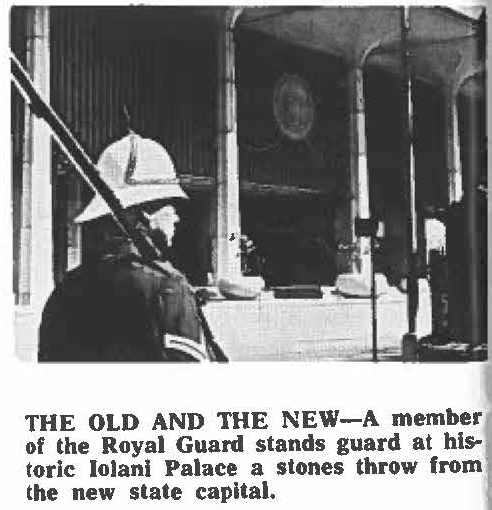
THE OLD AND THE NEW-A member of the Royal Guard stands guard at historic lolani Palace a stones throw from the new state capital. (Picture from the 1969 Winter The Hawaii Guardsman)
The Royal Guard made up of Air Guardsmen of Hawaiian ancestry made 18 public appearances; noteworthy appearances were those at an arrival ceremony for Queen Elizabeth of England and one welcoming the arrival of the newly commissioned submarine USS Kamehameha.
1970 The Royal Guard received the Minuteman Mike Award as the Guard’s Outstanding Community Service Project for 1969.
Learn more
The Hawaii Air National Guard’s Royal Guard was selected as the Nation’s top community service project for FY 1970 by the Adjutants General Association of the United States.
The Hawaii Air National Guard’s Royal Guard received the Minuteman Mike Award as the Guard’s Outstanding Community Service Project for 1969. The award is presented annually by the Adjutants General Association. The award-a six-inch-high bronze Minuteman statuette-was presented to State Adjutant General Benjamin J. Webster at the Association’s annual meeting.
The Royal Guard was selected because it represents HANG’s contribution to the community’s restoration of Hawaii s historic Kalakaua era. The unique organization bridges the complex identity gap between Hawaii’s Polynesian past and today’s jet-equipped organization.
1970 SMSgt Ted Hussey the Kapena Moku (captain in command) of the Royal Guard retired.
Learn more
A MAN OF MANY WORLDS
By Sgt Leonard Lueras
SMSgt Ted Hussey is a veteran of the Hawaii National Guard who lives in many worlds on one island. He serves as the First Sergeant of the 154 Combat Support Squadron and also:
Is a labor law specialist with the State Department of Labor and Industrial Relations.
Is the Kapena Moku (captain in command) of the Hawaii National Guard’s unique Kalakaua-era Royal Guard.
Is the founder and president of the Hussey Cousins Society-an organization here made up of 1,740 members of the Hawaii Hussey
Is president of the Oahu Chapter of the Hawaii Government Employees Association (HGEA).
Is the father of three, including sons Herbert, 20 and Theodore, Jr., 19; and a daughter, Alexis, 14.
“It’s all been very interesting,” Sgt Hussey said while reminiscing about his civilian and military career. “In fact, I can’t really point out any particular point of my life that was better than another.
“When the Royal Guard was formed on November 16, 1963, that was an interesting phase, but mainly because it did so much for young men in the Guard of Hawaiian ancestry.
“It gave them a particular feeling of pride that other groups don’t enjoy.”
Sgt Hussey couldn’t stay away from his favorite military subjectthe Royal Guard-too long, but he did stray away long enough to review his 32 years with the Hawaii Guard.
Fifty-six-year-old Hussey, who was born and raised in Hilo, joined the Guard in October 1938.
“When I enlisted in 1938, I enlisted as an Army private and was sworn in by the Rev. Henry Judd, who was the Hawaii Guard’s chaplain then.”
Hussey was assigned to the 298th Infantry’s Headquarters Company at the old downtown Guard armory on Hotel Street as a company clerk.
“I went from private to corporal in 1939, and. then from 1939 to 1940 I went from corporal to First Sergeant,” he recalls.
In October 1940, Hussey was inducted into the regular Army. He served for about a year with the Headquarters group at Fort Shafter, but once Hawaii was put under martial law, he was assigned to the Office of the Military Governor at Iolani Palace. Hussey described it as “a chaotic time.”
“On December 7, 1941, all the courts went into martial law. The civilian government suspended all activity and the military government took over. We then moved into the palace and set up a new State government under martial law.
“I had the rank of master sergeant on duty as a chief clerk assigned to the Provost Court.”
Throughout the war, Hussey served under three separate military governors, and finally was discharged from the active Army in February 1945.
He then re-enlisted in the Hawaii Army Guard and in 1950, after five more years as an Army Guardsman, he transferred into the Air Guard’s headquarters section and, ultimately, into the original 199th Fighter Squadron.
Since then, he has served the Air Guard with distinction and has received numerous commendations for his contributions to the HANG. He said, “I’ve found the entire period of my enlistment enjoyable. I find it challenging, and being among the men, I find it a diversion from the everyday, monotonous life. You meet a lot of people-all different kinds-and you learn every day.”
He admitted, however, that the high point of his Guard career was the formation on November 16, 1963 of the colorful Royal Guard. Since the Royal Guard was formed, Kapena Moku Hussey has presented his 35-plus Guardsmen at President Lyndon B. Johnson’s inauguration in 1966, before Queen Mother Elizabeth of England, and before several heads of state. And every November 16, he leads the Royal Guard in a formal Guard mount and changing of the guard at Iolani Palace’s Kalakaua Day ceremonies.
The Royal Guard, made up of Air Guardsmen of Hawaiian ancestry, made 17 public appearances including an appearance at the inauguration of Governor John A. Burns.
CONGRATULATING MEMBERS OF THE ROYAL GUARD OF THE HAWAII AIR NATIONAL GUARD
WHEREAS, formed during the late 1800’s, the Royal Guard of the Hawaiian Kingdom played a large role in the splendid regalia of the courts of King Kalakaua and Queen Liliuokalani; and
WHEREAS, with their spiked pith helmets, their white trousers and their dark blue coats with gold-colored buttons, the Royal Guard symbolized the grandeur of the Hawaiian Monarchy and today remains a favorite segment of the magical history of old Hawaii; and
WHEREAS, Colonel Walter F. Judd, Administrative Assistant for the Hawaii Air National Guard Headquarters at Fort Ruger and a member of a well-known kamaaina family, has spent many hours of research to recreate a Royal Guard with authentic uniforms and equipment and many more hours of work in organizing the modern-day Royal Guard; and
WHEREAS, other generous friends have contributed money and have donated historic items to duplicate the coats, the buttons, the white trousers, the crest, the rifles and the other equipment carried and wom by the original Royal Guard; and
WHEREAS, the following men, all active members of the Hawaii Air National Guard, have given of their time to practice and perform as members of the modern-day Royal Guard without any compensation whatsoever and but for the love of Hawaii and its history, to-wit:
Adam Y. Aki William E. Anana Edward M. Ane Harry M. Y. Awana, Jr. Thomas B. Chang Lennox R. Cockett Ronald Cozo Delbert D. Dandurant Howard L. Guerrero, Jr. Alvin G. Ho Paul S. Hurley
Theodore D. Hussey Kenneth Johnson Larry K. Keahi Paul J. Kealoha Albert A. Keliinui David N. Keohokapu Harold K. Kepaa David P. Langsi Douglas K.C.A. Lee James K. Lota Randall K.H.M. Lum
Stanley H.L. Lum James N. Pahukula Enias V.K. Spencer, Jr. William L. Stern, Jr. Henry E. Thoene Henry W.W. Thoene Moses K. Timbal George G. Wela Valentine 0. Wong, Jr. Charles M. Y abui
WHEREAS, The Royal Guard, dressed as in days of old and marching under commands given in Hawaiian language, has been reborn and is being enjoyed during parades and special ceremonies by the people of modem Hawaii; now, therefore,
BE IT RESOLVED by the Senate of the Sixth Legislature of the State of Hawaii, Regular Session of 1971, that it extends congratulations and thanks for a job well done to Colonel Walter F. Judd; to all members of the Hawaii Air National Guard who comprise the Royal Guard and to all other persons responsible for the recreation of this splendid part of Hawaii’s past; and Maj. Gen. Benjamin Webster, Adjutant General; and
BE IT FURTHER RESOLVED that duly authenticated copies of this Resolution be transmitted to Colonel W. C. Meyer, Deputy Adjutant General, Hawaii National Guard; to Colonel Walter F. Judd, Administrative Assistant, Headquarters, Hawaii Air National Guard; and to each and every member of the Royal Guard, Hawaii Air National Guard, Fort Ruger, Hawaii.
Royal Guard equipment – Bob NagaoSgt David Langsi of the Royal Guard, calls the 93rd NGAUS conference together at the Sheraton Waikiki. Photo by Captain Gerry Silva. The command “Hapai-Pu” was heard in the Nation’s capitol during President Johnson’s inauguration. (Pictures from the 1971 Fall The Hawaii Guardsman)
The Islands of Hawaii are geographically and historically disconnected from the New England-Colonial past with which most residents of continental America identify. The “kamaaina,” or local resident, links his background to the statue of the Polynesian warrior that stands before the Judiciary Building, not to that of the Minuteman in a New England town square. Many Hawaiian families plot their geneologies back to missionary forebears who arrived in Hawaii on the “Thaddeus,” not in Massachusetts on the “Mayflower.” When discussion turns to military exploits, the Hawaiian recounts the battle of Nuuanu Pali, not Gettysburg, and he speaks of Kamehameha and Kahekili with the same fervor that others reserve for Grant and Lee.
The Royal Guard is a unit which was re-created to highlight Hawaii’s own military heritage. The Royal Guardsman of Hawaii, like the Minuteman of the Continent, is the symbol with which our people identify and from which they draw strength.
The unit was re-created as the Hawaii Air National Guard’s (HANG) contribution to the community’s restoration of Hawaii’s historic Kalakaua era. The Royal Guard also represents a very successful means by which HANG identifies itself with the unique heritage of our IslandState.
The original Royal Guard was formed during the reign of King Kalakaua in the late 1800’s. It was an elite group of 50 men from which the King’s body guards were drawn, with a heritage which extended far back into Hawaii’s history. The organization was quartered in Iolani Barracks, next door to the royal palace
The re-created Royal Guard is the product of countless hours of research and the subsequent time required to re-create or recondition its authentic period equipment. The unit is structured in the same way as the original organization. The governing body, or “No Koa Hoomalu Kini O Ka Moi” (King’s Body Guards) is composed of five men elected by the general membership. The five men, in turn, select the “Kapena Moku” (Commander of Troops). In addition, they establish policies, approve plans and review operations. The unit includes:
Three Officers:
Kapena Moku (Captain)
Luna Koa (1st Lieutenant)
Lutanela (2nd Lieutenant)
Six Sergeants:
He Kakiana (First Sergeant)
Kakiana Ekahi (Sergeant – 1st Squad)
Kakiana Elua (Sergeant – 2nd Squad)
Kakiana Ekolu (Sergeant – 3rd Squad)
Kakiana Eha (Sergeant – 4th Squad)
Kaiana Pu (Ordnance Sergeant)
Five Corporals:
Kopala Ekahi (Corporal – 1st Squad)
Kopala Elua (Corporal – 2nd Squad)
Kopala Ekolu (Corporal – 3rd Squad)
Kopala Eha (Corporal – 4th Squad)
Kopala Hae (Color Guard Corporal)
One Drummer (Hookani Pahu)
Twenty-seven Soldiers (Koa)
All Royal Guardsmen are members of HANG. They are of Hawaiian descent (to add to the unit’s authenticity) and participate on a purely voluntary basis.
The project was begun in 1962 by Colonel Walter F. Judd, Executive Officer of HANG, whose forebears served as cabinet members during the reign of the Hawaiian Kings, Kamehameha III, Liholiho, and Kalakaua.
Colonel Judd began the project with a search of the State Archives. Pictures of the original Guard and a part of an old tunic were used to begin the re-creation of the uniforms. Authentic buttons and a buckle were found, and replicas were made by open-faced casting. Most items were donated or made, or in some cases, acquired by shrewd trading. When equipment or apparel had to be purchased, Colonel Judd and his group raised the money with an assortment of projects, including a benefit luau. On November 16, 1963, the first 14 members of the re-created Royal Guard were presented to the public. They emerged from the doors of Iolani Barracks, heralded by the trumpeting of the traditional Hawaiian conch shell. In the words of a reporter, “They peered around curiously as if seeing the light of day for the first time in 70 years.”
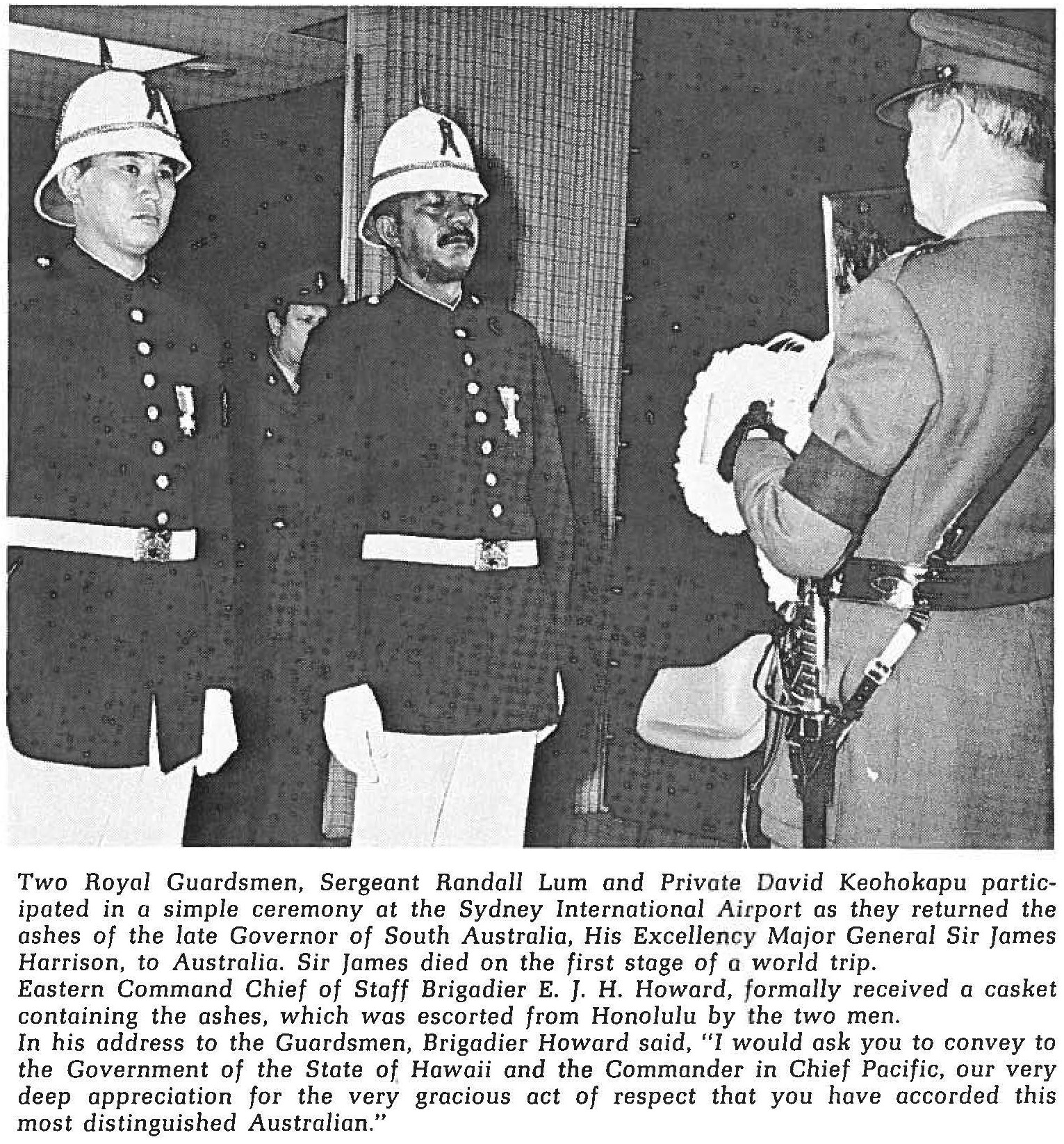
Two Royal Guardsmen, Sergeant Randall Lum and Private David Keohokapu participated in a simple ceremony at the Sydney International Airport as they returned the ashes of the late Governor of South Australia, His Excellency Major General Sir James Harrison, to Australia. Sir James died on the first stage of a world trip. Eastern Command Chief of Staff Brigadier E. J. H. Howard, formally received a casket containing the ashes, which was escorted from Honolulu by the two men. In his address to the Guardsmen, Brigadier Howard said, “I would ask you to convey to the Government of the State of Hawaii and the Commander in Chief Pacific, our very deep appreciation for the very gracious act of respect that you have accorded this most distinguished Australian.”(Picture from the 1971 Winter The Hawaii Guardsman)
The Royal Guard, made up of volunteer Hawaii Air Guardsmen, made 16 public appearances.
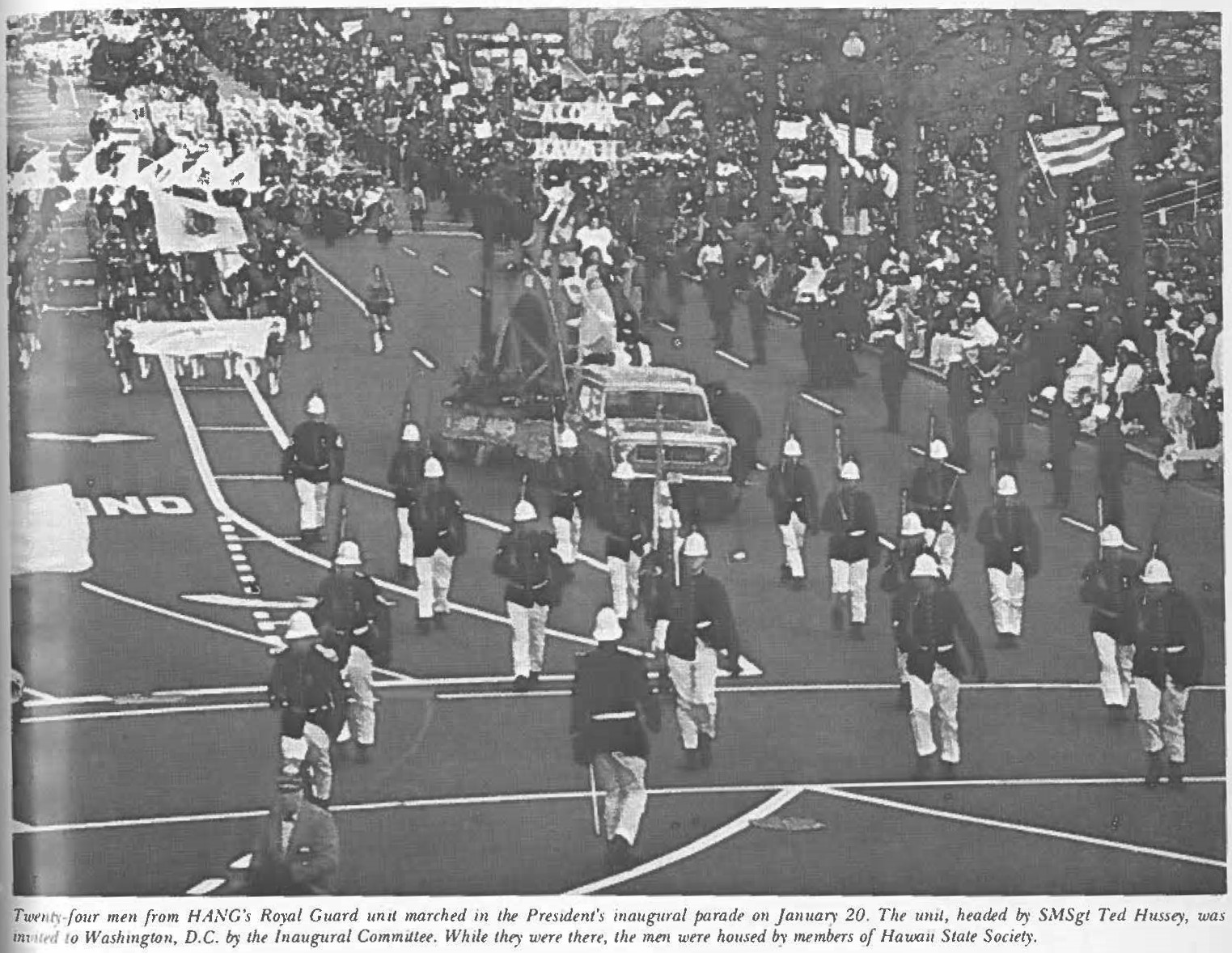
Twenty-four men from HANG’s Royal Guard unit marched in the President’s inaugural parade on January 20. the unit, headed by SMSgt Ted Hussey, was invited to Washington, D.C. by the inaugural Committee. While they were there, the men were housed by members of Hawaii State Society.(Picture from the 1972 Winter – 1973 Spring The Hawaii Guardsman)Final tribute at State Capitol (Pictures from the 1975 Summer Pūpūkahi)
The 154th TFG also provided community service support in the form of the Royal Guard. This organization made 26 appearances with 35 Royal Guardsmen participating.
THEY GUARD THE PALACE ROYALLY-Royal Guardsmen participate in the colorful “Mounting of the Guard” ceremony at Iolani Palace on King Kalakaua’s birthday, Nov. 16. Members of the Air National Guard of Hawaiian ancestry took part in the annual event designed to preserve the traditions of the old Royal Hawaiian militia. Pictured from left to right are TSgt. Ronald Cozo, TSgt. Lennox R. Cockett and TSgt. Edward M. Ane. (Photo by lLt. Gail Warok.) (Picture from the 1976 December Pūpūkahi)
The 111th Army Band , HARNG, along with four members of the Royal Guard, Hawaii Air National Guard, participated in the Presidential Inaugural Parade in Washington, D.C. on Jan. 20, 1977.
The Royal Guard is a fraternal organization made up of Hawaii Air National Guardsmen. The members are equipped and uniformed in the likeness of the 1890 Royal Guard of King Kalakaua. Members must be of Hawaiian or part-Hawaiian extraction. They must be fluent in the use of the Hawaiian language and in performing military drills and ceremonies. The present purpose of the Royal Guard is to appear at “various official State functions and ceremonies and other public events which commemorate Hawaii’s colorful heritage and past.” Re-created by the HANG on Nov. 16, 1963, the unit wiII be observing its fourteenth anniversary in November 1977.
The Royal Guard made 23 appearances with 26 members participating Highlights were: participation of four members in the Presidential Inauguration on Jan. 20, 1977, in Washington , DC, and the dedication of the Prince Jonah Kuhio Kalanianaole Federal Building on June 24, 1977, with four members participating. Honored at the latter appearance was Mrs. Rosalyn Carter, the President’s wife.
Journey through nostalgia with the Hawaii Air National Guard’s (HANG) elite ceremonial marching unit, the Royal Guard.
Re-created to highlight Hawaii’s military heritage, the Royal Guard is comprised of HANG members of Hawaiian descent.
Each year on Nov. 16 (King Kalakaua’s birthday), the Royal Guard participates in the mounting of the Guard in front of lolani Palace. The Royal Guardsmen hold an inspection formation , and the governor and adjutant general perform the inspection. Following the inspection, the Royal Guardsmen march to predesignated locations to guard the Palace throughout the day.
The original Royal Guard, formed during the reign of King Kalakaua, was an elite group of 50 men from which the King’s bodyguards were drawn.
The re-created Royal Guard is the product of countless hours of research and time required to duplicate the authentic equipment. The ceremonial Royal Guard was re-established in 1962. Walter F. Judd, retired HANG colonel, whose forebears served as Cabinet members during the reign of Kamehameha VI, Liholiho and Kalakaua, began researching through the State archives. Pictures of the original Guard and a part of an old tunic were found. Authentic buttons and a buckle were also duplicated by making replicas through open-faced casting. Most items were either donated, fabricated or acquired by trading.
When equipment or apparel had to be purchased, Judd and his group raised the money. with an assortment of projects, including a benefit luau.
On Nov. 16, 1963, the initial 15 members of the re-created Royal Guard made their first public appearance. They emerged from lolani Barracks, heralded by the trumpeting of the traditional Hawaiian conch shell. In 1967, the unit increased to include 42 men after $5,000 was appropriated by the State legislature to purchase new rifles and uniforms.
Today the ceremonial Royal Guard serves at the call of the governor for official State functions. It has also made many appearances at civil ceremonies commemorating Hawaii’s past.
Highlighting this year’s activities, four members of the Royal Guard marched in President Carter’s inaugural parade.
The preservation of the traditions of the Hawaiian militia during the monarchy days has been achieved through the Royal Guard. It has further led to a greater awareness of Hawaiian culture for many of our local residents.
11 FEB 1978 Members of the Royal Guard participated in a dedication ceremony and unveiling of a series of full-scale, historical murals, depicting Hawaii as it might have appeared in 1876.
Members of the Hawaii Air National Guard (HANG) ceremonial Royal Guard participated Feb. 11 in a dedication ceremony and unveiling of a series of full-scale, historical murals, depicting Hawaii as it might have appeared in 1876.
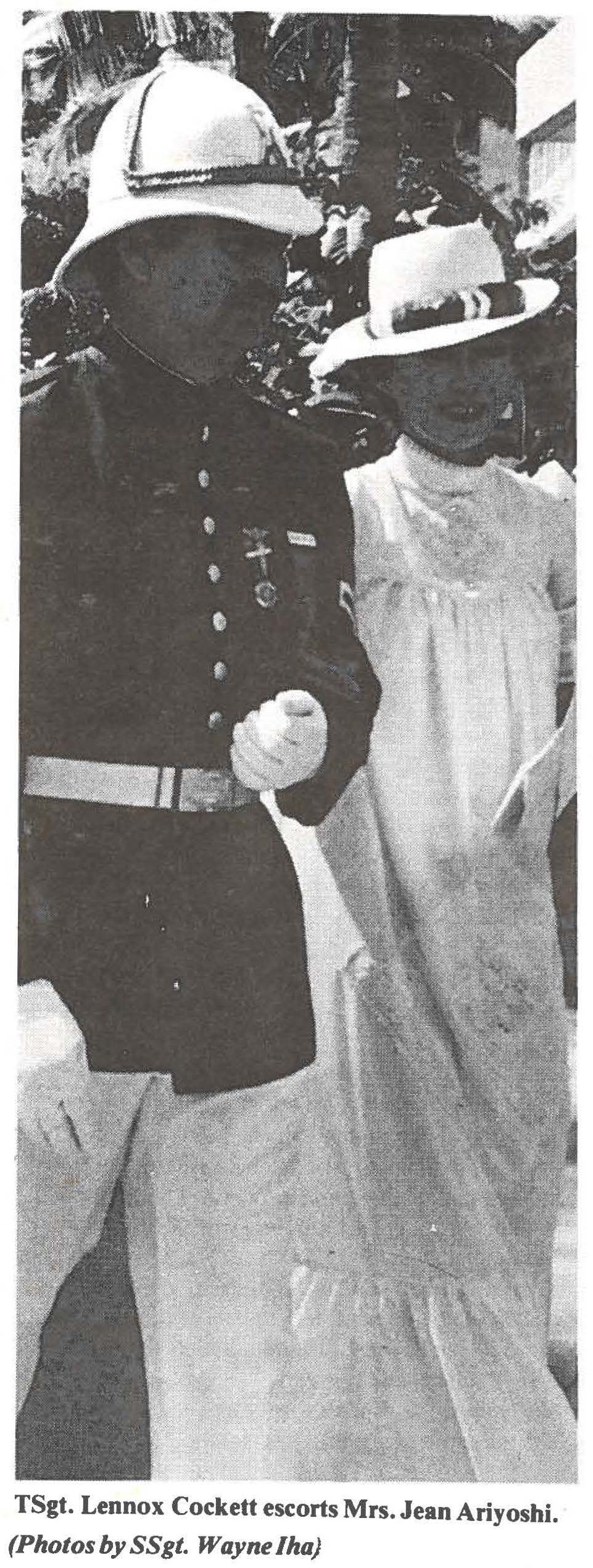
The guardsmen participated by providing an honor guard and an escort for Mrs. Jean Ariyoshi. the governor’s wife, who unveiled the murals.
Participating members of the Royal Guard were MSgt. Ronald Cozo. TSgt. Lennox Cockett and SSgt. James Pahukula.
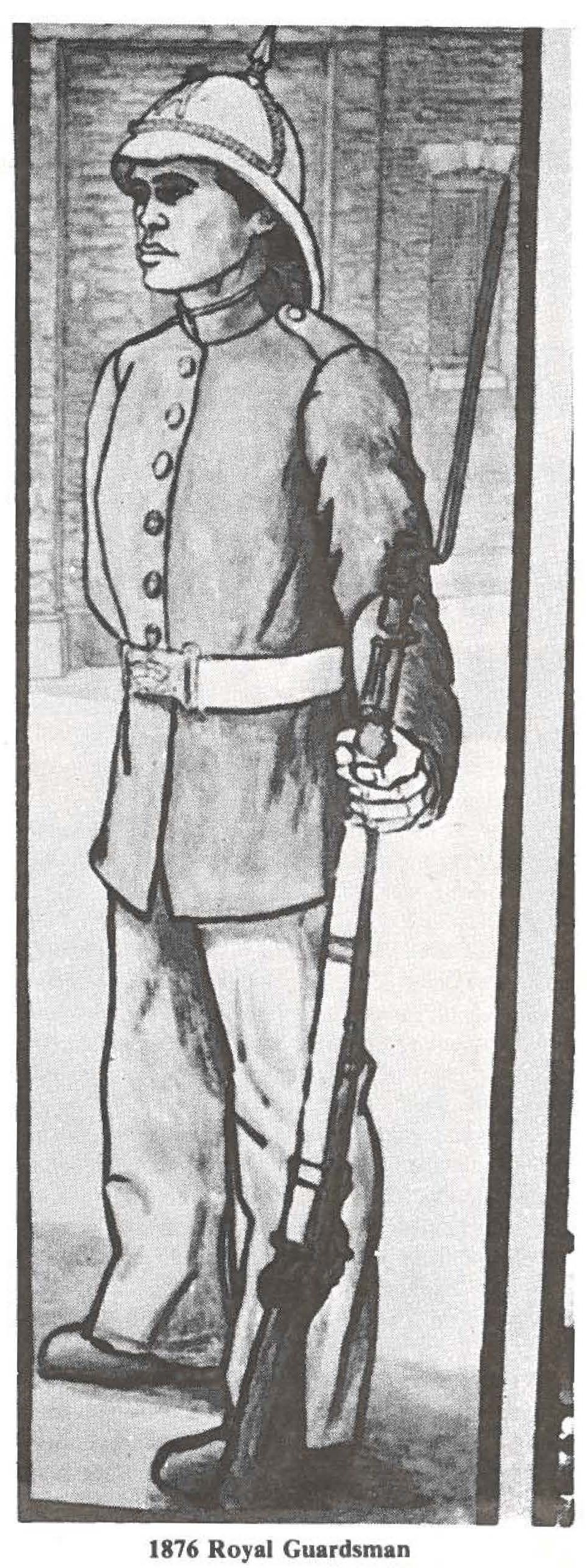
Included in the series of historic murals is a sentry of the Royal Household Guard. The uniform and the Civil War Period Springfield rifle were borrowed from the Royal Guard of the HANG during the artist’s initial research.
Research for the Royal Guard uniform was done by Col. Walter F. Judd, former executive officer of the HANG prior to the re-creation of the Royal Guard in 1963.
Many scenes and landmark buildings of the old downtown Honolulu are depicted along with over 100 people of those times.
Among the historical personages, many portrayed life-size, are King Kalakaua (soon to depart on a visit to President Ulysses S. Grant) chatting with his bandmaster, Capt. Henry Berger; a reform school boy who became a band musician; a Royal Household Guard sentry; and a stalwart Honolulu policeman.
In another panel, Charles and Princess Bernice Pauahi Bishop (returning from their grand tour of Europe) with builder Robert Lishman and clerk Samuel M. Damon Ill, are shown inspecting plans at the site of the soon-to-be erected Bank of Bishop & Co. building on Kaahumanu Street.
Also depicted are Gov. John Dominis with his wife, Princess Lydia Liliuokalani, Princess Ruth Keelikolani in her carriage accompanied by Crown Prince William Pitt Leleiohuku II and Col. Sam Parker, and Dowager Queen Emma talking with Honolulu’s first fire chief, Alexander Joy Cartwright, Jr.
TSgt. Lennox Cockett escorts Mrs. Jean Ariyoshi. (Photos by SSgt. Wayne Iha)(Picture from the 1978 March Pūpūkahi)
16 NOV 1979 The Royal Guard marched from the historic lolani Barracks to the steps of Iolani Palace for the mounting of the Guard
Learn more
Royal Guard post at lolani Palace; 1979 marks 16th anniversary
Days of Hawaii’s past came alive recently when members of the ceremonial Royal Guard marched from the historic lolani Barracks to the steps of Iolani Palace.
The captain of the guard, also known as the Kapena Moku, presented the Royal Guard to Gov. George R. Ariyoshi and declared the guard ready for inspection.
The Governor and State Adjutant General Maj. Gen. Valentine Siefermann, inspected the troops. The Kapena Moku was then granted permission by Ariyoshi to “mount the guard over the palace”.
The Nov. 16 ceremony is an annual event commemorating Kalakaua’s birthday. This year marks the 143rd anniversary.
Every year since 1963, the ceremonial Royal Guard which is made up of Hawaii Air National Guardsmen of Hawaiian ancestry don their blue jackets, white helmets and carry their Springfield rifles to pay tribute to King Kalakaua. This year’s ceremony also marked the 16th anniversary of the Royal Guard’s re-activation.
ANNUAL TRADITION – Kapena Moku, CMSgt. Harry Awana fronts Gov. George Ariyoshi (left) and Maj. Gen. Valentine Siefermann, Adjutant General, during the “Mounting of the Royal-Guard” in front of lolanl Palace.(Picture from the 1979 December Pūpūkahi)
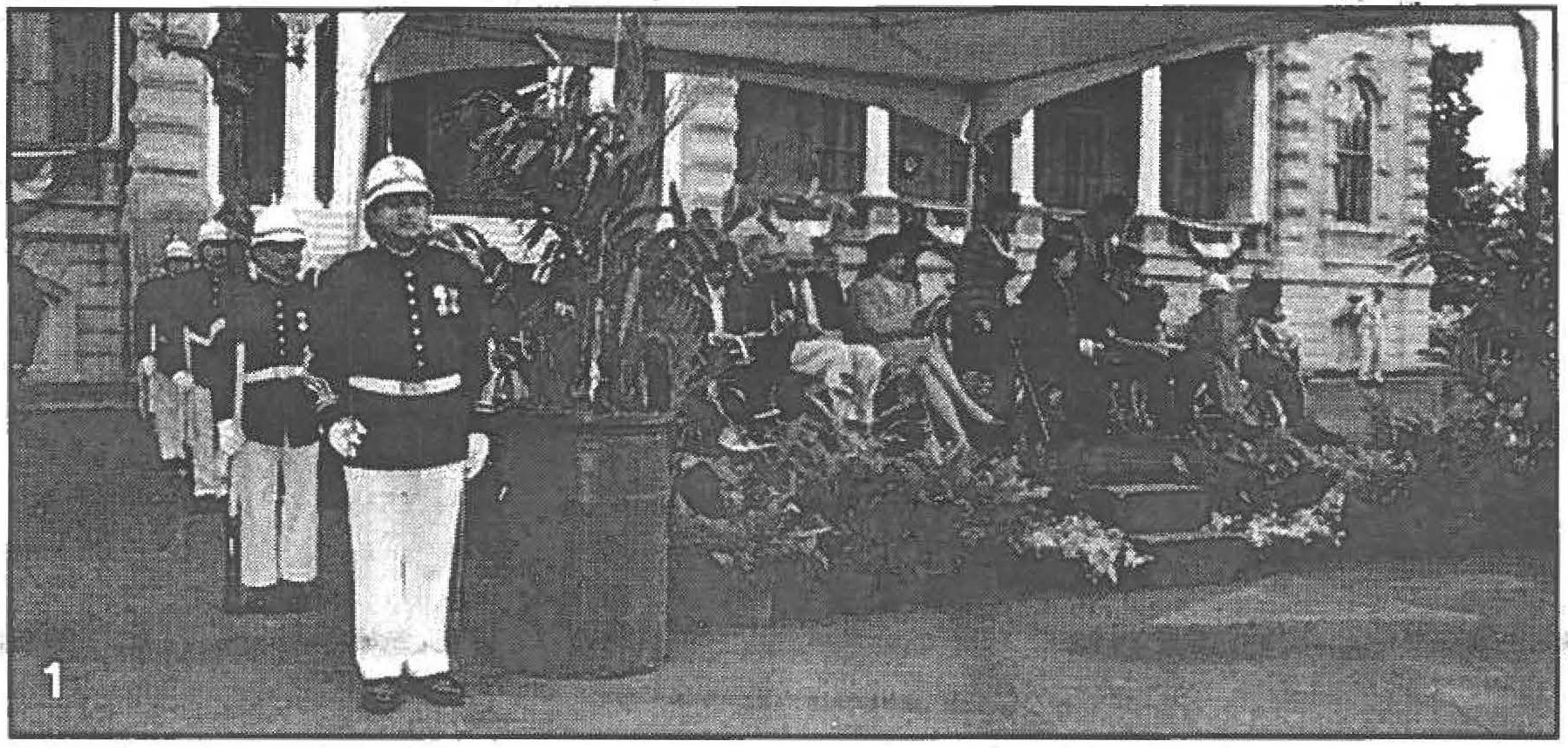
Gov. George R. Ariyoshi and Maj. Gen. Valentine A. Seifermann prepare to inspect the troops during the annual posting of the Royal Guard. The ceremony was held at lolani Palace on Nov. 16, the anniversary of the Royal Guard. All Guard members are from the Hawaii Air National Guard and of Hawaiian or part-Hawaiian ancestry.(Picture from the 1981 Winter Pūpūkahi)
The Royal Guard, dressed in the uniforms of the late 1800s, stood watch as the statue of Queen Liliuokalani was unveiled at the State Capitol. The Royal Guard is made up of Hawaii Air National Guardsmen of Hawaiian ancestry. The elite group participates with honor in a number of special occasions and events throughout the year including the Merrie Monarch Festival, Kamehameha Day and Fourth of July parades, and King Kalaukaua’s birthday celebration.
A PROUD MOMENT Gov. and Mrs. Ariyoshi walk past the Royal Guard, following his inauguration as Governor. The Royal Guard consists of members of the Hawaii Air National Guard. – 117th PAD Photo(Picture from the 1982 Winter Pūpūkahi)
The Hawaii Air National Guard’s Royal Guard supported many ceremonial events. Dressed in uniforms of 1he 1800’s, Royal Guard members participated in such events as the King Kamehameha Day parade, the Merrie Monarch Festival, the Governor’s inaugural ceremony and the annual posting of the guard at Iolani Palace. Three Royal Guard members accompanied the Royal Hawaiian Band during its European Tour.
Royal Guard Inspection – Gov. George R. Ariyoshi, accompanied by Maj. Gen. Alexis T. Lum, completes inspection of the Royal Guard in a ceremony marking the 148th anniversary of King David Kalakaua’s birthday. The ceremony, which also honored the 21st anniversary of the Royal Guard’s recreation in 1963, took place in front of the lolani Palace on November 16, 1984.(Picture from the 1984 October- December Pūpūkahi)
201st CMBTCF FACILITIES DEDICATION – A host of dignitaries salute the colors during the dedication ceremonies to officially open the new Kahului Communications Center on Maui.(Picture from the 1984 First Quarter Pūpūkahi)
The Royal Guard has a new Kapena Moku. Master Sgt. Ronald Cozo, 154th Consolidated Aircraft Maintenance Squadron, Hawaii Air National Guard, was selected for the post at a meeting of the Na Koa Hoomalu Kino O Ka Moi Directors. The Kapena Moku serves as chief executive officer of the Royal Guard and is selected from active members of the Royal Guard.
The constitution and by-laws of the Royal Guard require that the Kapena Moku chosen participate faithfully and regularly in ceremonial activities of the Royal Guard; is of outstanding military bearing and character; has demonstrated effective leadership ability; is proficient in the Hawaiian language used in drills and ceremonies; and is a current member of the Hawaii Air National Guard.
Cozo was selected from among six candidates. He succeeds Chief Master Sgt. Harry M.Y. Awana, Jr., as the Kapena Moku.
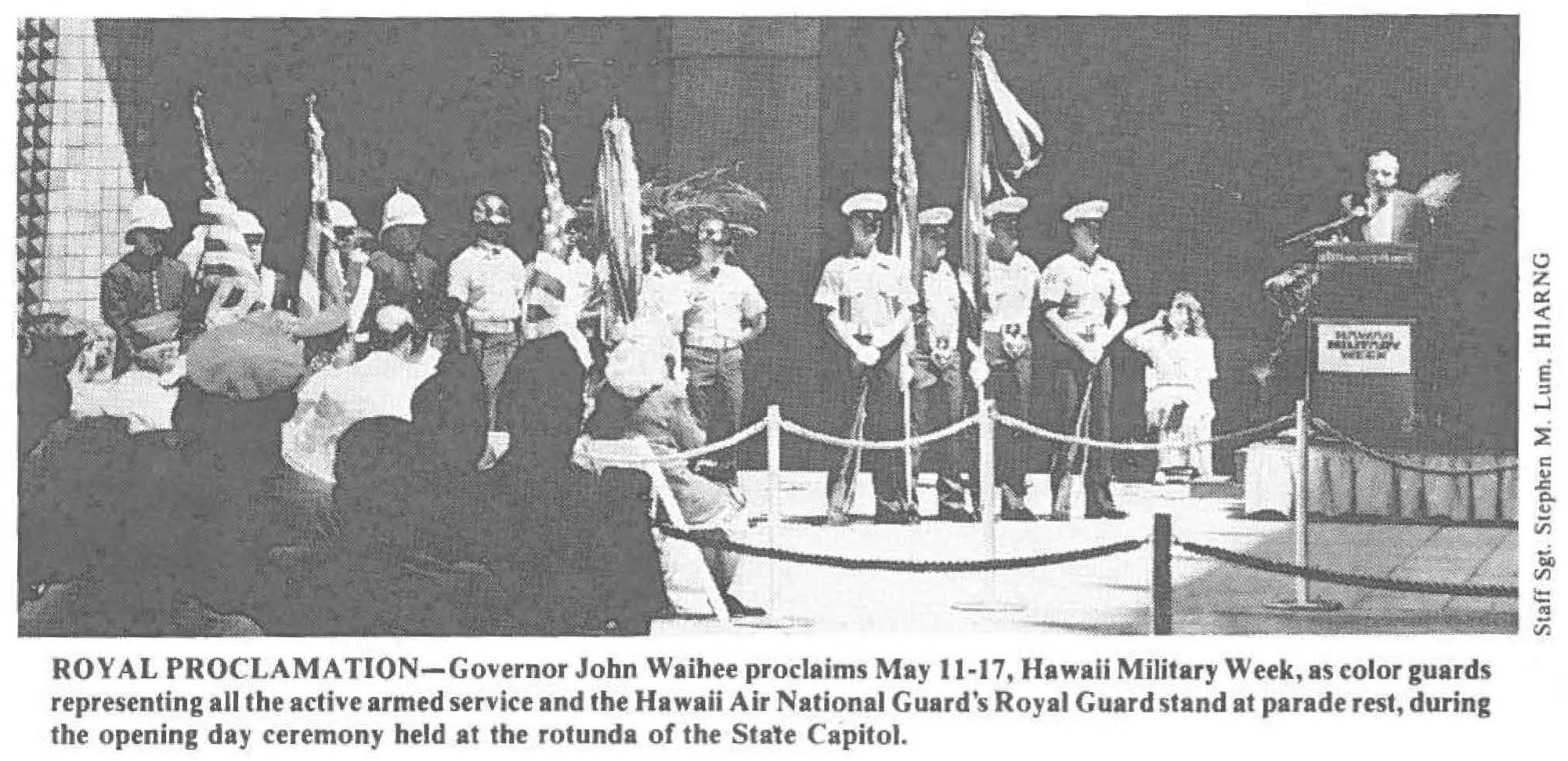
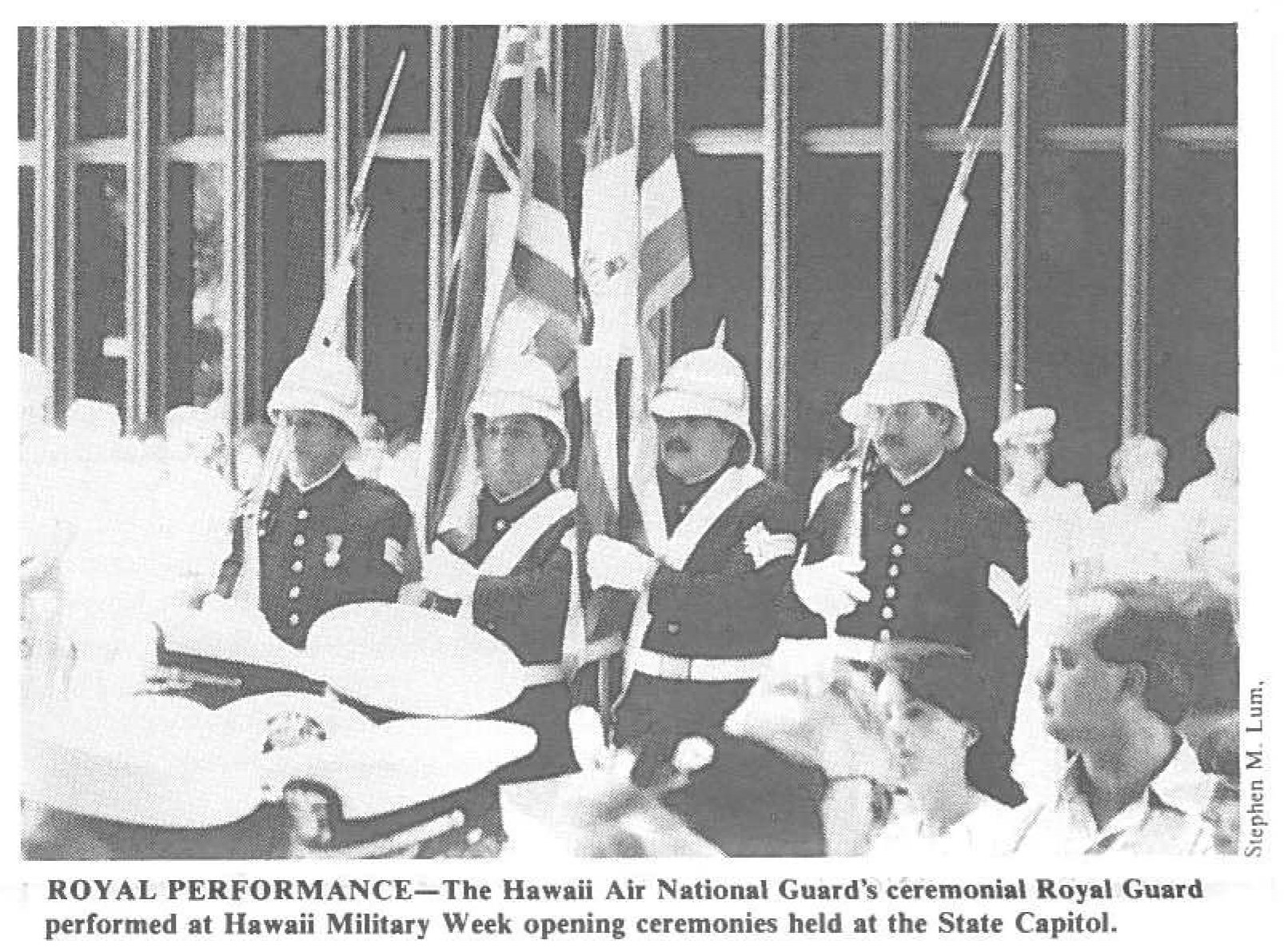
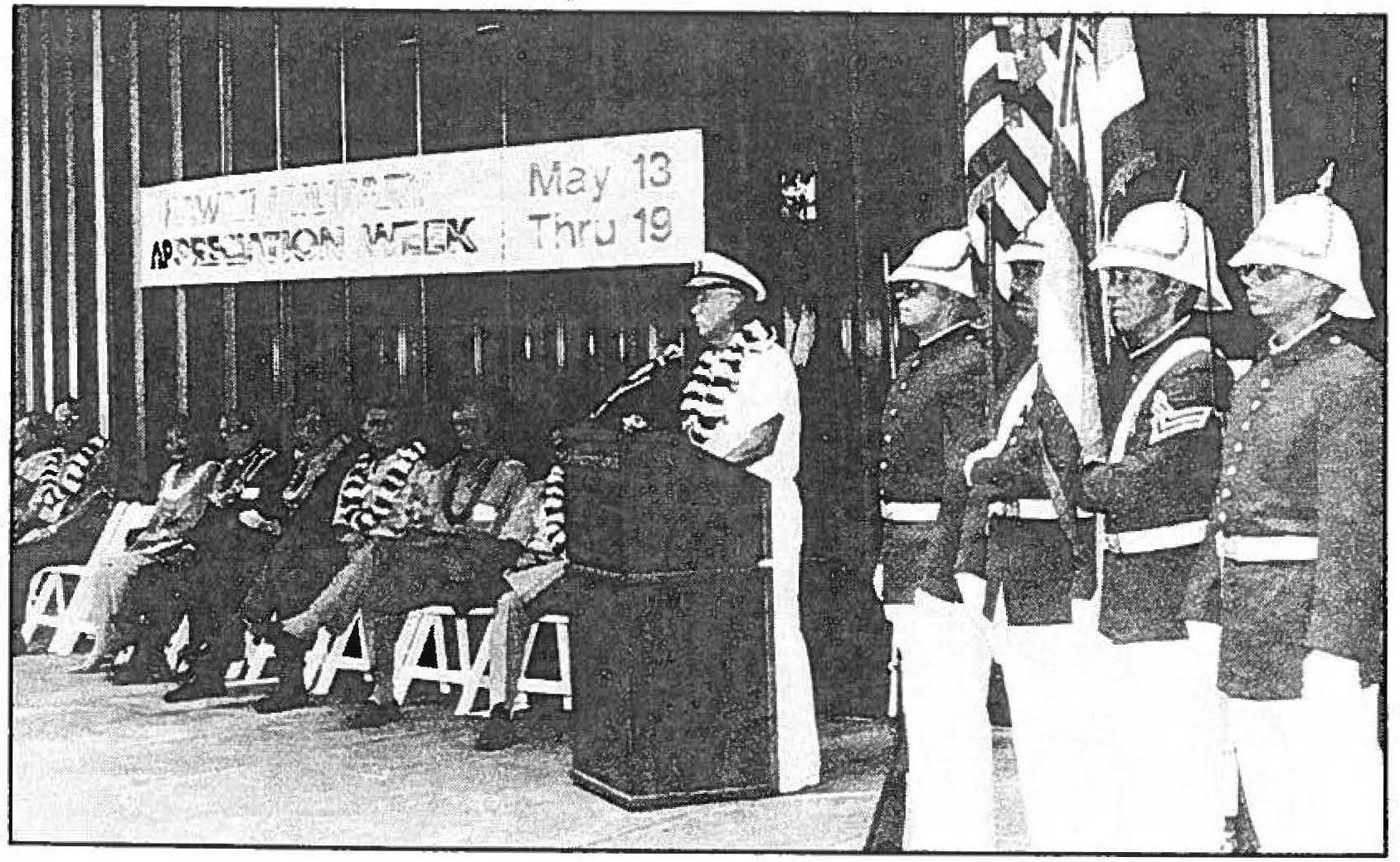
ROYAL SALUTE-HANG Royal Guard members present the colors during the Christmas Concert opening.(Picture of the 1986 January – March Pūpūkahi)ROYAL PROCLAMATION-Governor John Waihee proclaims May 11-17, Hawaii Military Week, as color guards representing all the active armed service and the Hawaii Air National Guard’s Royal Guard stand at parade rest, during the opening day ceremony held at the rotunda of the Stale Capitol.(Picture from the 1987 April – June Pūpūkahi)ROYAL PERFORMANCE-The Hawaii Air National Guard’s ceremonial Royal Guard performed at Hawaii Milltary Week opening ceremonies held at the State Capitol.(Picture from the 1989 April – June Pūpūkahi)
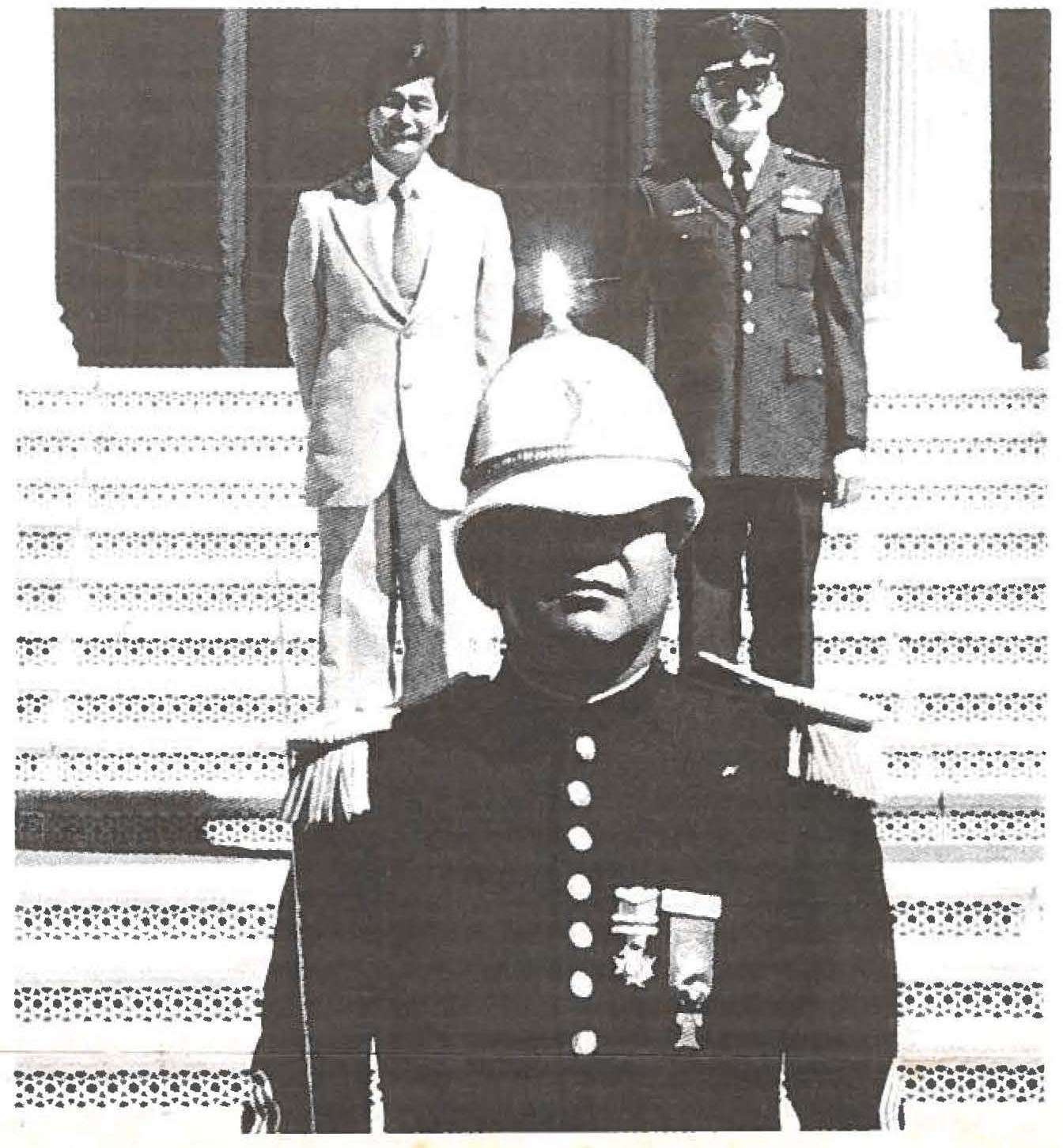
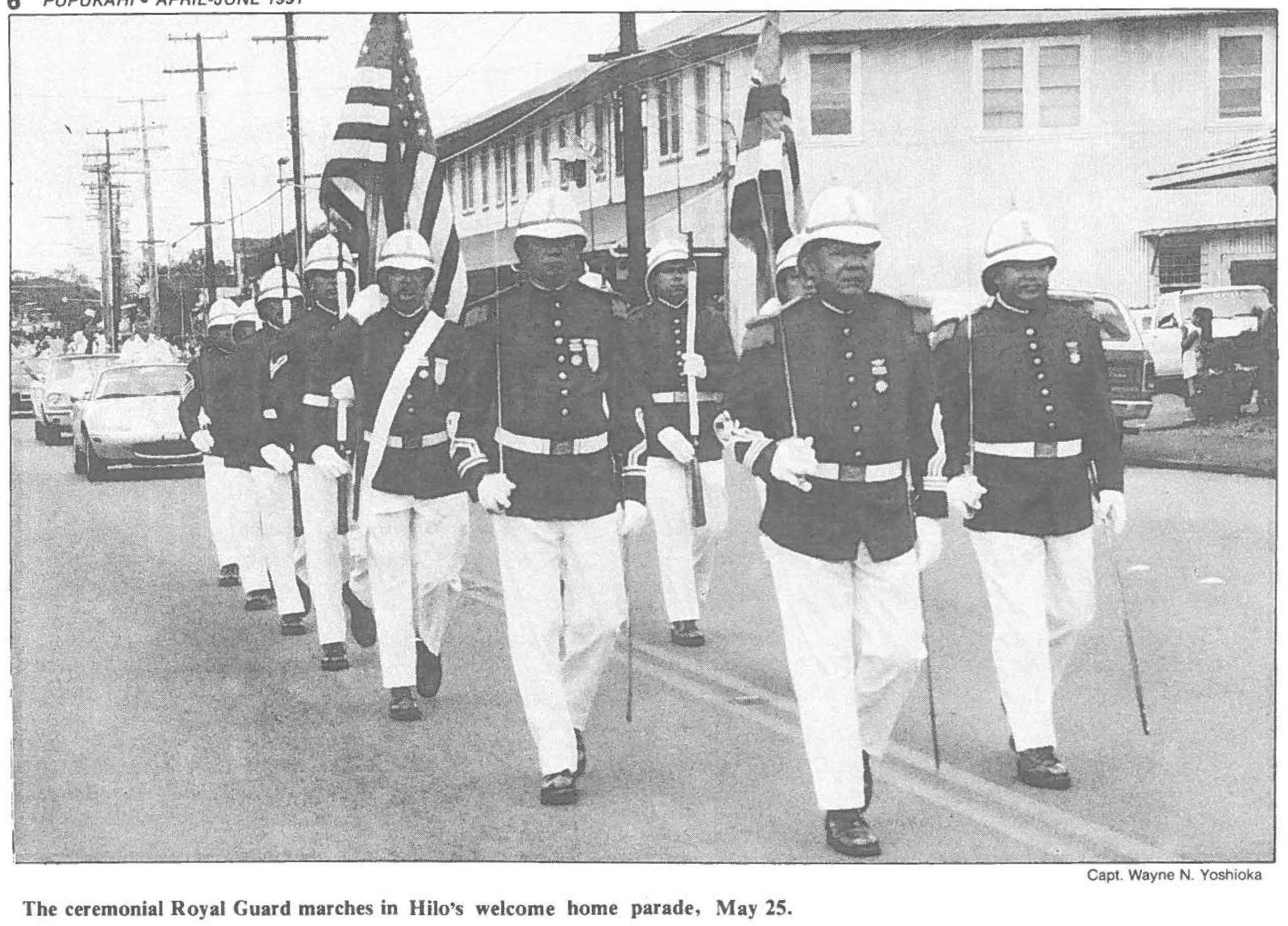
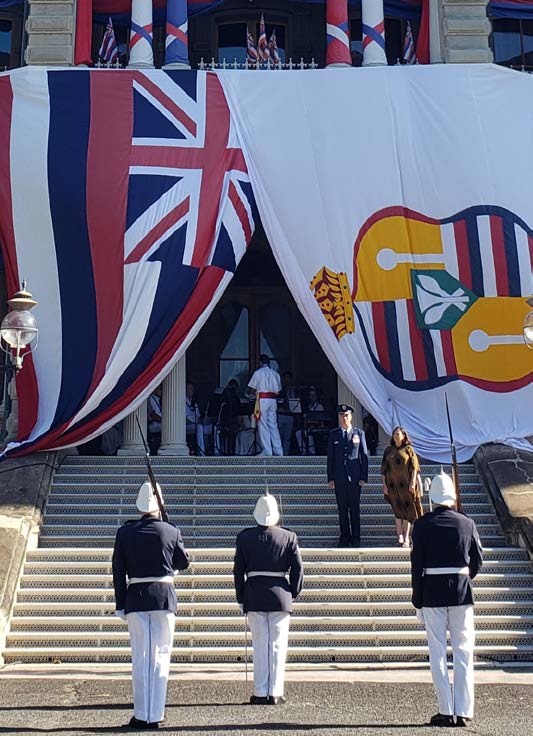
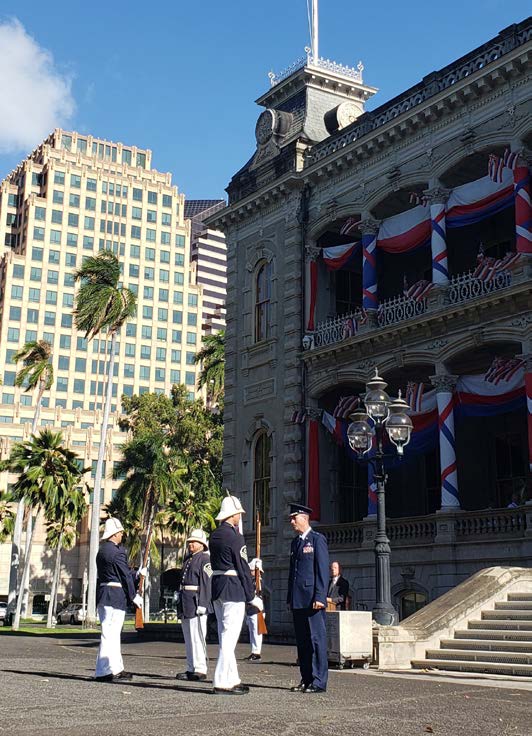
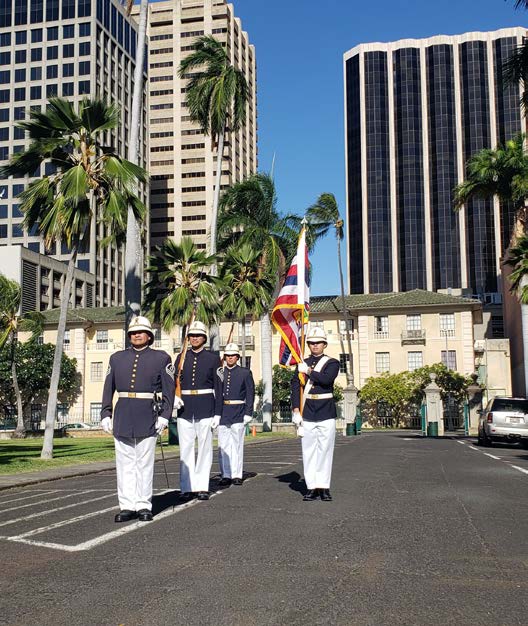
Brig Gen. Edward V. Richardson salutes the ceremonial Royal Guard during their annual mounting of the Guard ceremony at lolani Palace, Nov. 16. On Gen. Richardson’s side is Edward Kawananakoa, representing the Kawananakoa family. Gen. Richardson, the assistant adjutant general, air and commander of the Hawaii Air National Guard, represented Gov.John Waihee. The Royal Guard, who are Hawaii Air Guard members of Hawaiian ancestry, annually post the Guard at the Palace to celebrate King David Kalakaua’s birthday. (Picture from the 1990 October – December Pūpūkahi)The ceremonial Royal Guard marches in Hilo’s welcome home parade, May 25. (Picture from the 1991 April – June Pūpūkahi)The Hawaii National Guard’s ceremonial Royal Guard raise the Hawaii State flag in front of the Hawaii State Veterans Cemetery administration building (Picture from the 1992 July – August Pūpūkahi)
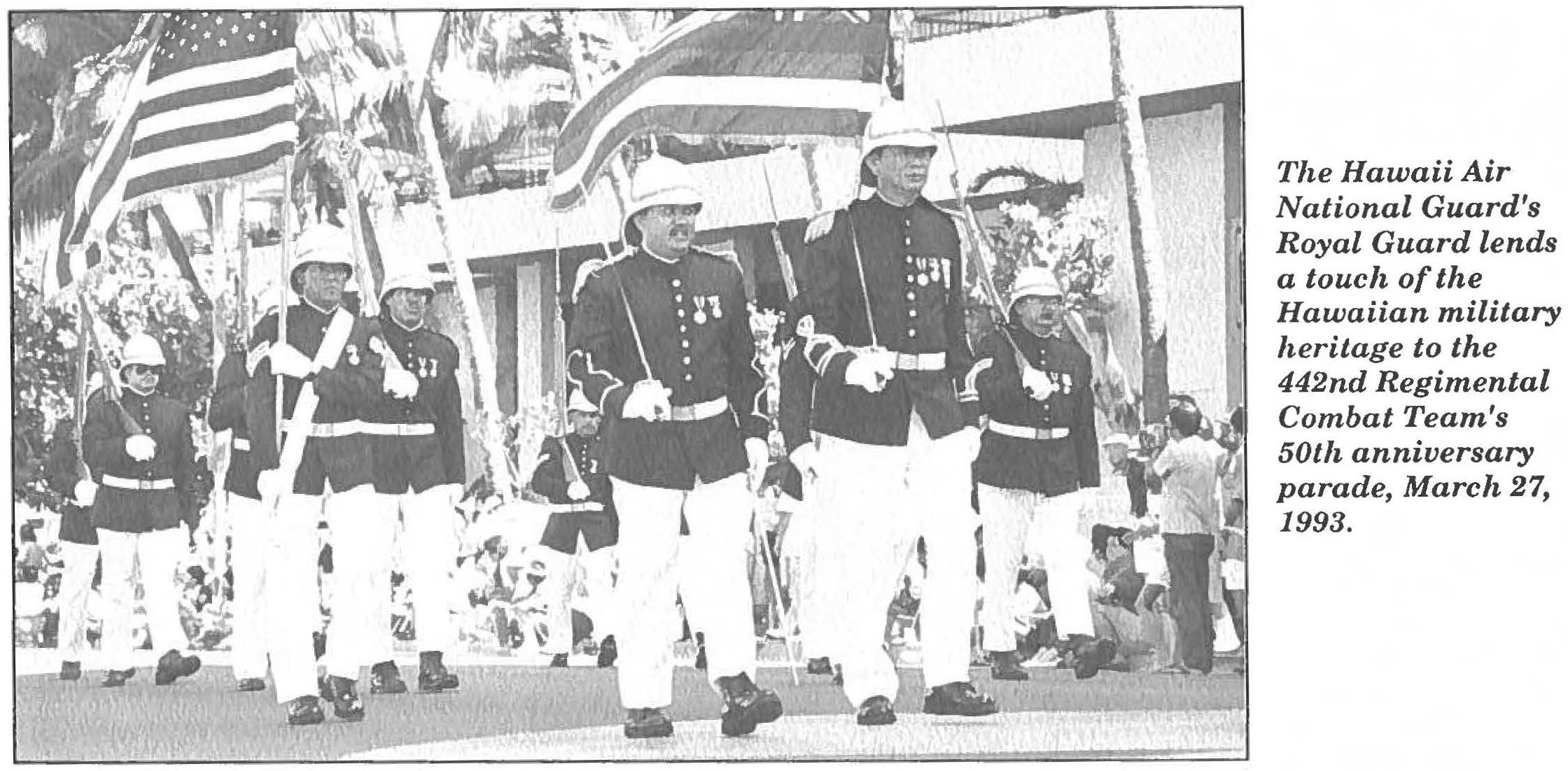
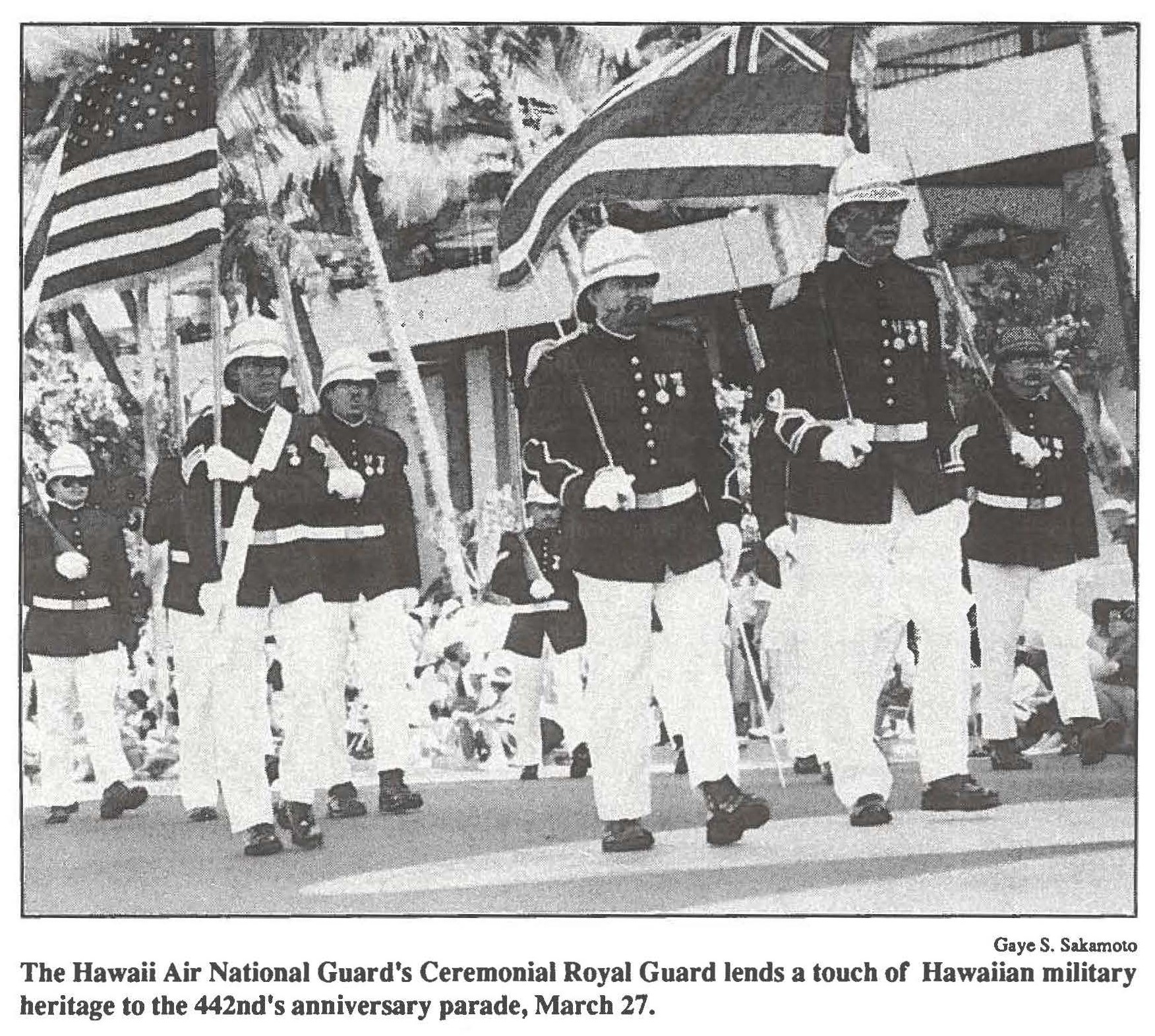
The Hawaii Air National Guard’s Ceremonial Royal Guard lends a touch or Hawaiian military heritage to the 442nd’s anniversary parade, March 27. (Picture from the 1993 February – March Pūpūkahi)
16 NOV 1993 For 30 years, the Royal Guard has annually performed this ceremony on their anniversary and the anniversary of King Kalakaua’s birthday.
Learn more
Royal Guard celebrates 30th anniversary
By Gaye s. Sakamoto
With a click of polished heels and the forward command “hele aku,” the Royal Guard swept a fascinated audience surrounding Iolani Palace back to the pomp and glory days of King Kalakaua in the late 1800s. For 30 years, the Hawaii Air National Guard’s (HIANG) Royal Guard has annually performed this ceremony on their anniversary and the anniversary of King Kalakaua’s birthday, Nov. 16.
The soldiers marched in rhythmic precision from Iolani Barracks to the front of the palace, carrying the royal standard of King Kalakaua and the Hawaiian flag. In front of the palace steps, kapena moku (captain) Randall Lum and his troops faced Gov.John Waihee, Prince Edward Kawananakoa, member of the royal family, and Maj. Gen. Edward V. Richardson, state adjutant general. After the command “I ke alo pu” (present arms), the governor, prince, and general filed through the ranks. After the inspection, the soldiers marched off to pose; one guard at each of the four palace gates. The guards remained at the gates until 4:00p.m., when the flag flying over the palace was lowered.
The inspection and posting of the Guard honors the original Royal Guard that watched over Hawaii’s royalty during the reign of King Kalakaua and his sister, Queen Liliuokalani.
The original Royal Guard, stationed at Iolani Barracks, had 50 officers and men until their disbandment following the overthrow of the Hawaiian Kingdom, Jan. 17, 1893.
However, 70 years later, on Jan. 20, 1963, it was revived and reorganized by Col. Walter F. Judd of the HIANG.
Judd spent 12 years researching the Royal Guard, recreating an authentically uniformed and equipped group. Uniforms were tailored and copied from old photos. Buttons and buckles were replicated from the originals.
The first 14 members of the recreated Royal Guard appeared in public, Nov. 16, 1963. Today, the Guard has about 35 volunteers of Hawaiian ancestry.
“We perform to express our pride in our Hawaiian heritage, and to preserve the traditions of the Hawaiian monarchy’s militia,” said Master Sgt. James Pahukula, lunakoa (first lieutenant) of the Royal Guard.
The Royal Guard performs at official state functions and civil ceremonies commemorating Hawaii’s past. Some of these special events included the inauguration parades for Presidents Johnson and Nixon, ceremonies for the Queen Mother of England and other heads of state and several other parades, symbolizing Hawaii’s own uniqueness and heritage of our island state.
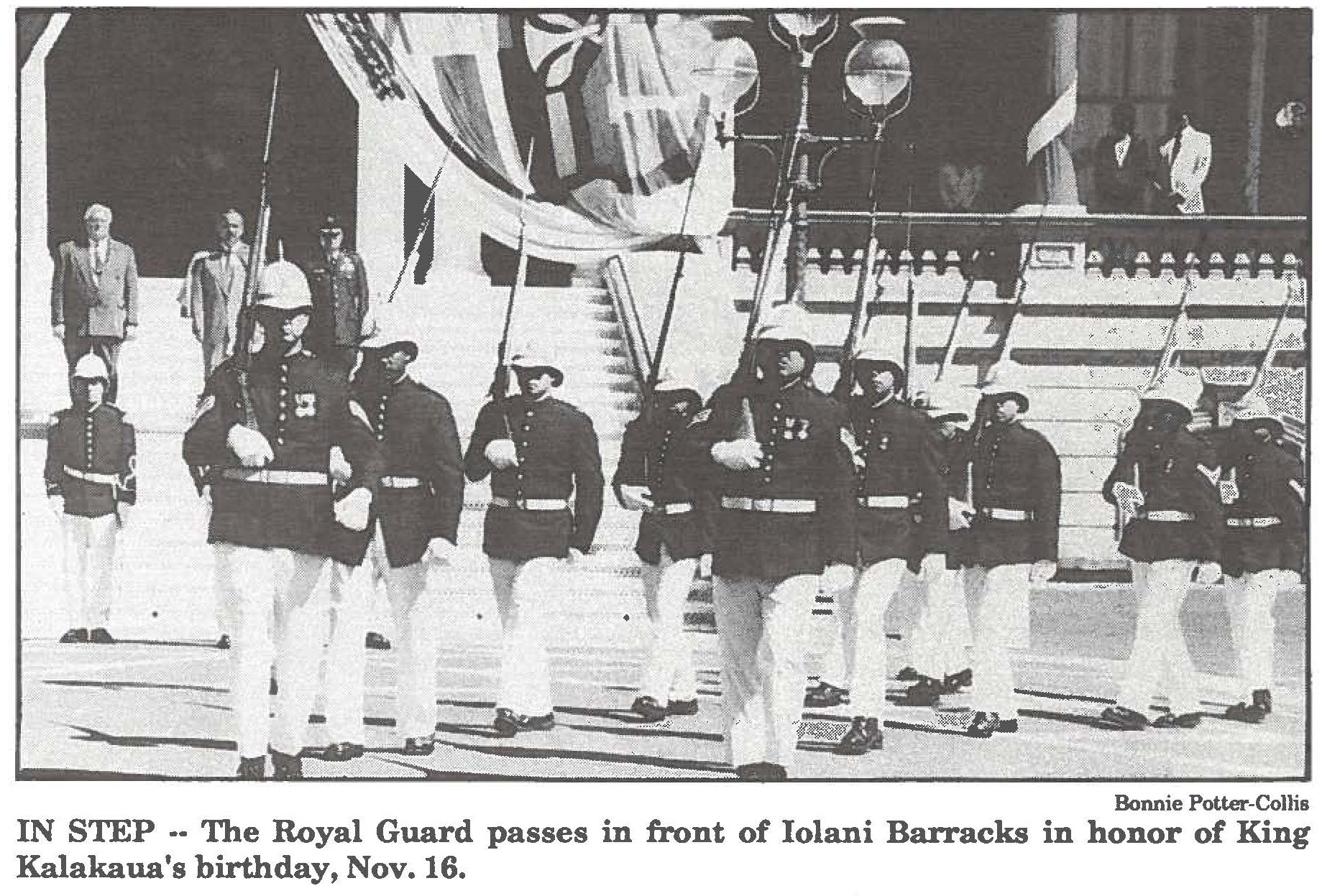
IN STEP — The Royal Guard passes in front of Iolani Barracks in honor of King Kalakaua’s birthday, Nov. 16(Picture from the 1993 November – December Pūpūkahi)
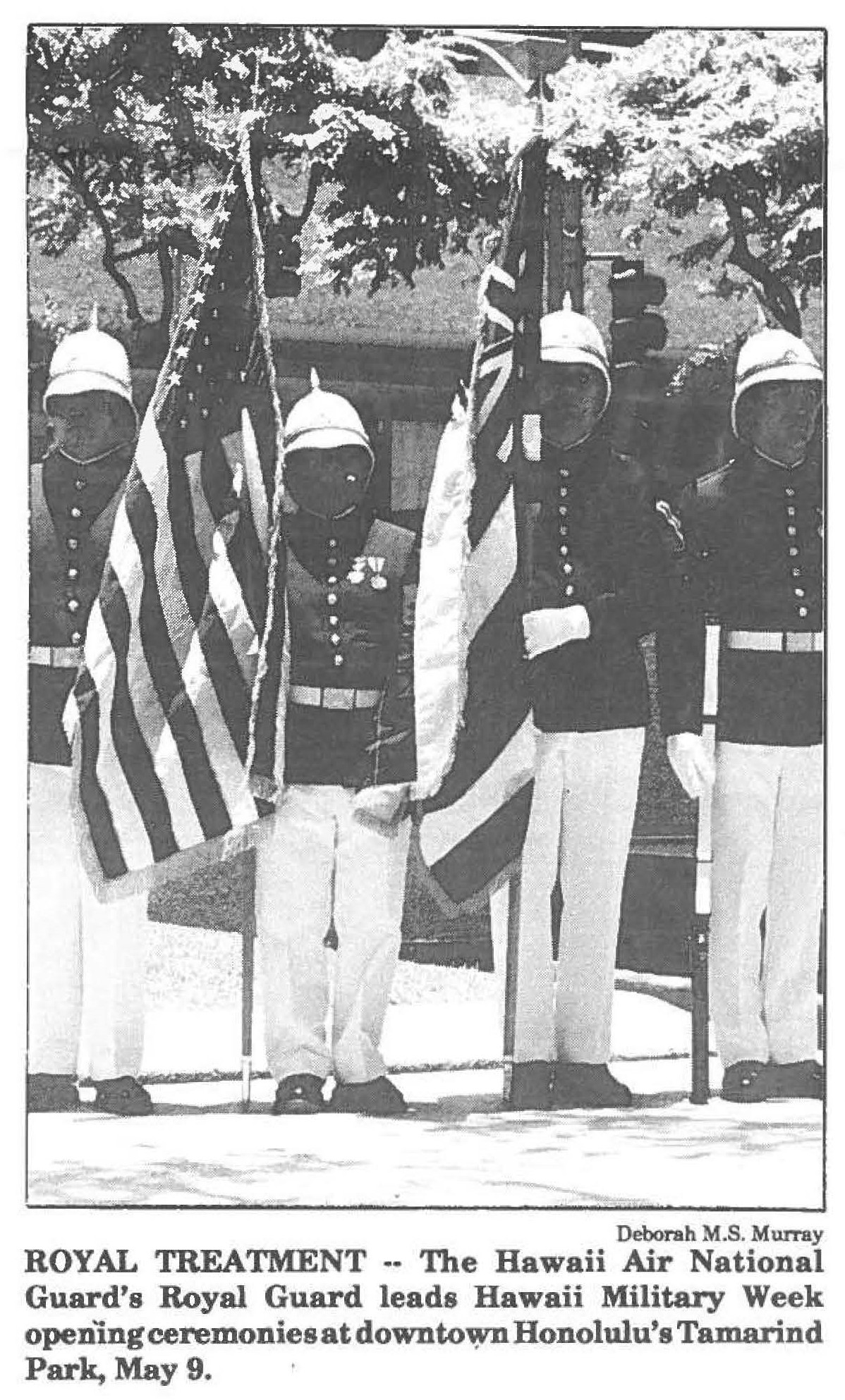
ROYAL TREATMENT — The Hawaii Air National Guard’s Royal Guard leads Hawaii Military Week opening ceremonies at downtown Honolulu’s Tamarind Park, May 9(Picture from the 1994 April – May Pūpūkahi)
16 NOV 1994 This year’s Posting of the Guard celebration, held in honor of the late King David Kalakaua’s birthday, marked the 30th anniversary of the reorganized unit.
Learn more
Annual Posting of the Guard at lolani Palace
Ceremonial Royal Guard celebrates 30th anniversary
Story and photos by Deborah M.S. Murray
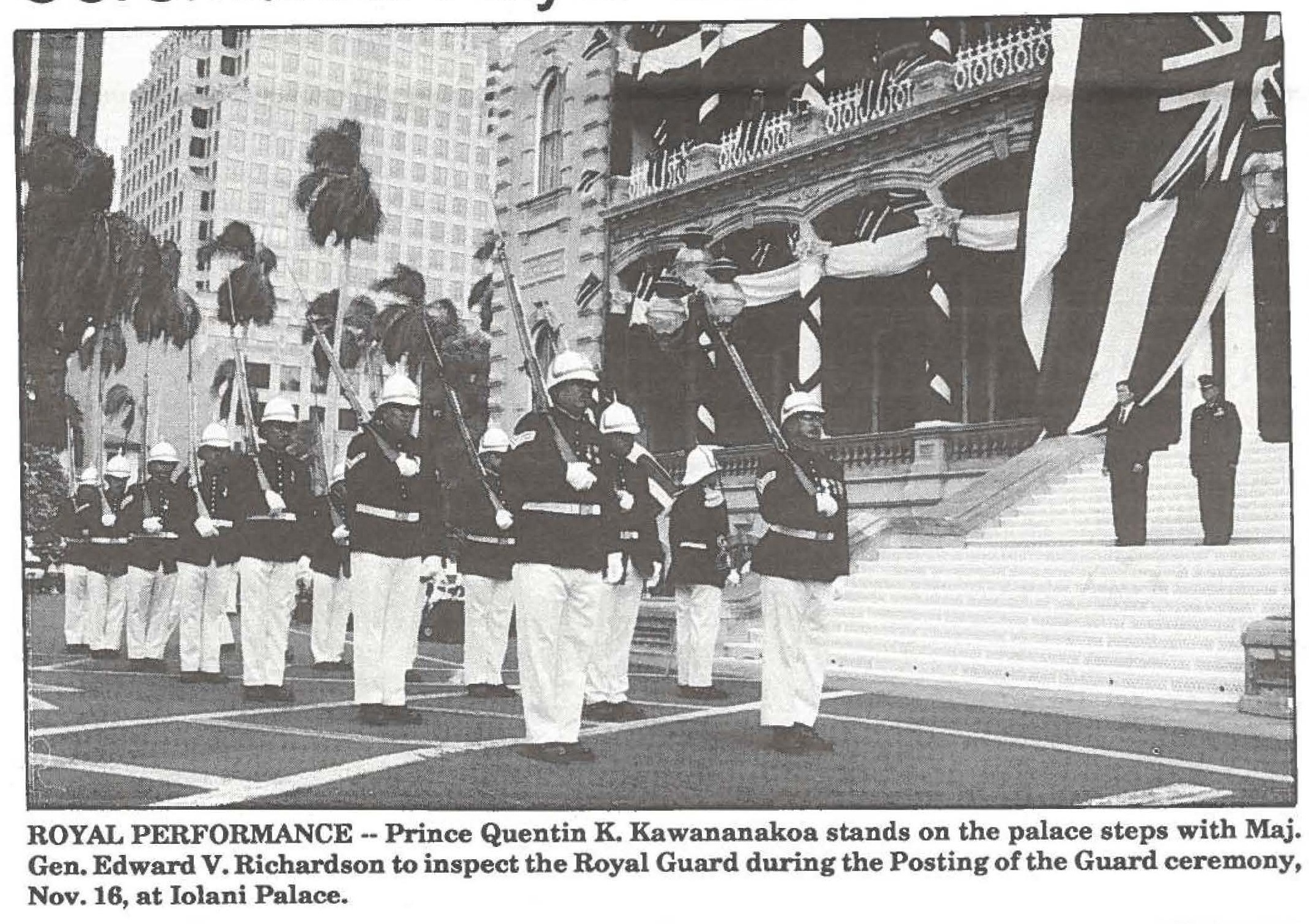
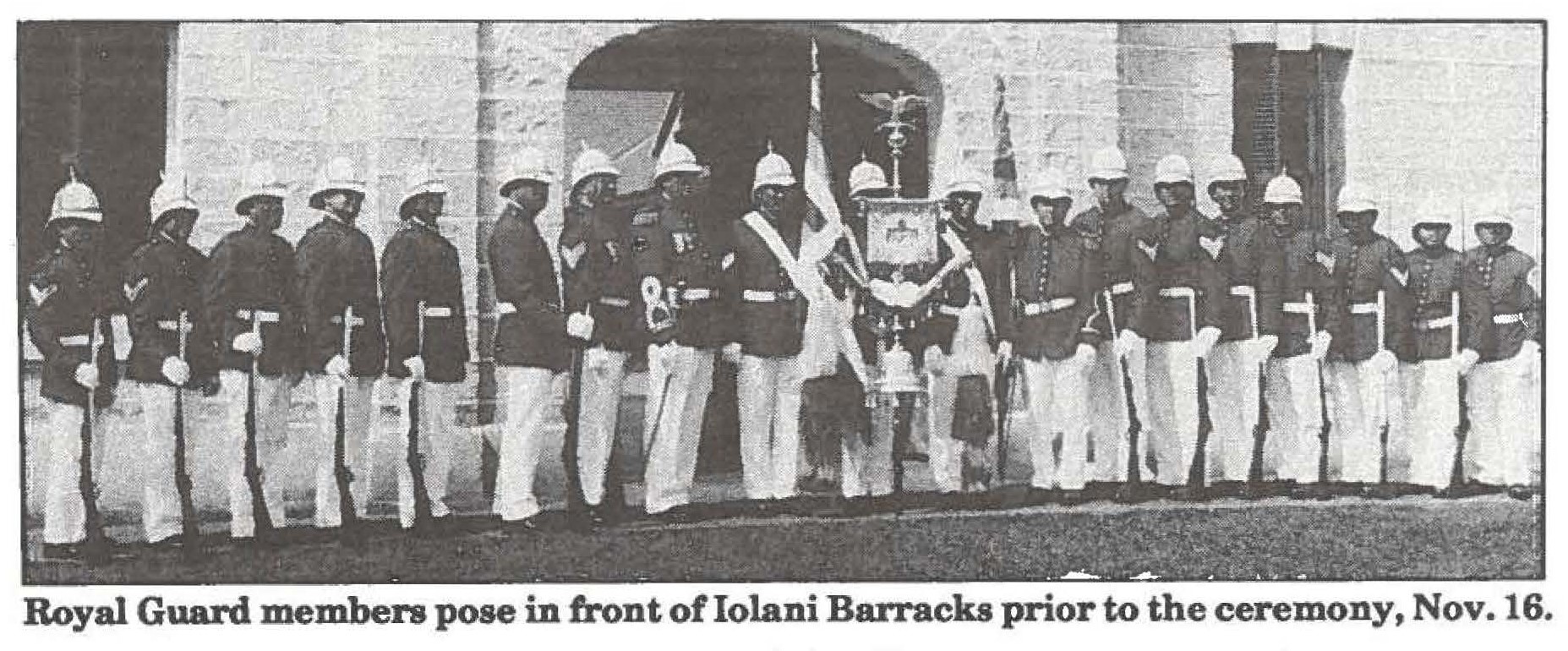
ROYAL PERFORMANCE — Prince Quentin K. Kawananakoa stands on the palace steps with Maj. Gen. Edward V. Richardson to inspect the Royal Guard during the Posting of the Guard ceremony, Nov. 16, at Iolani Palace. Royal Guard members pose in front of lolani Barracks prior to the ceremony, Nov. 16. (Pictures from the 1994 November – December Pūpūkahi)
Iolani Palace was decorated in majestic splendor as the Hawaii Air National Guard’s (HIANG) Royal Guard marched in double-file for inspection by relatives of Hawaii’s Royal Monarchy; Maj. Gen. Edward V. Richardson, state adjutant general, and a crowd of onlookers.
This year’s Posting of the Guard celebration, held in honor of the late King David Kalakaua’s birthday, Nov. 16, marked the 30th anniversary of the reorganized unit. The guard was organized, Jan. 20, 1963, when Col. Walter F. Judd, an officer in the HIANG and member of a kamaaina family, spearheaded the unit’s revival.
The Royal Guard of today is a revival of the Royal Palace Guard formed by King Kalakaua in the late 1800s. Back then, it was an elite group of 50 men from which the king’s bodyguards were drawn.
The ceremony was conducted by 18 HIANG members of Hawaiian or part Hawaiian ancestry, a membership requirement that was made to contribute to the authenticity of the unit. During the ceremony, all commands were called out in Hawaiian. The guardsmen marched from the barracks to the front of the palace, where they were inspected and prepared to post guards at the main palace gate, commonly known as the “Queen’s Entrance.” By this time, a steady mauka shower filled the air causing some onlookers to seek shelter under trees; nevertheless it did not discourage those who were anxious to witness a part of Hawaii’s history.
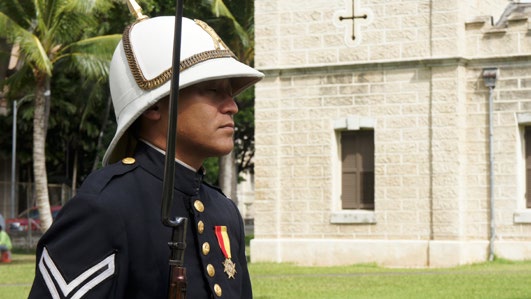
The uniforms worn by the Royal Guard are replicas of those used by the Palace Royal Guard down to the gold-colored buttons, that were cast from originals worn by the Palace Royal Guard in the 1800s.
The guardsmen were the epitome of military excellence as they marched in time to the Kalakaua March, dressed in their large dark blue coats, sharply-creased white trousers and spiked pith helmets, trimmed in gold metal braid fronted by the Royal Guard crest.
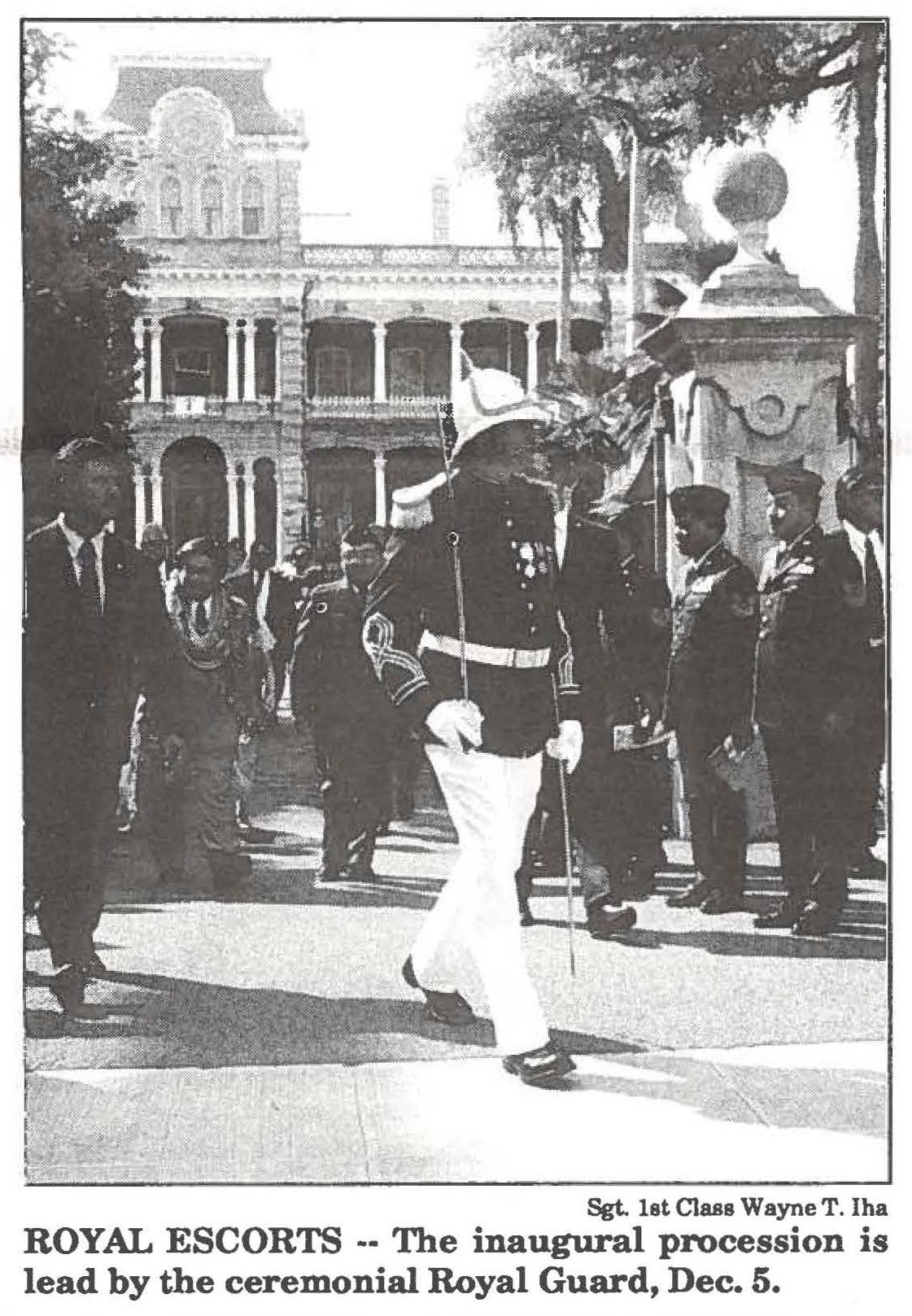
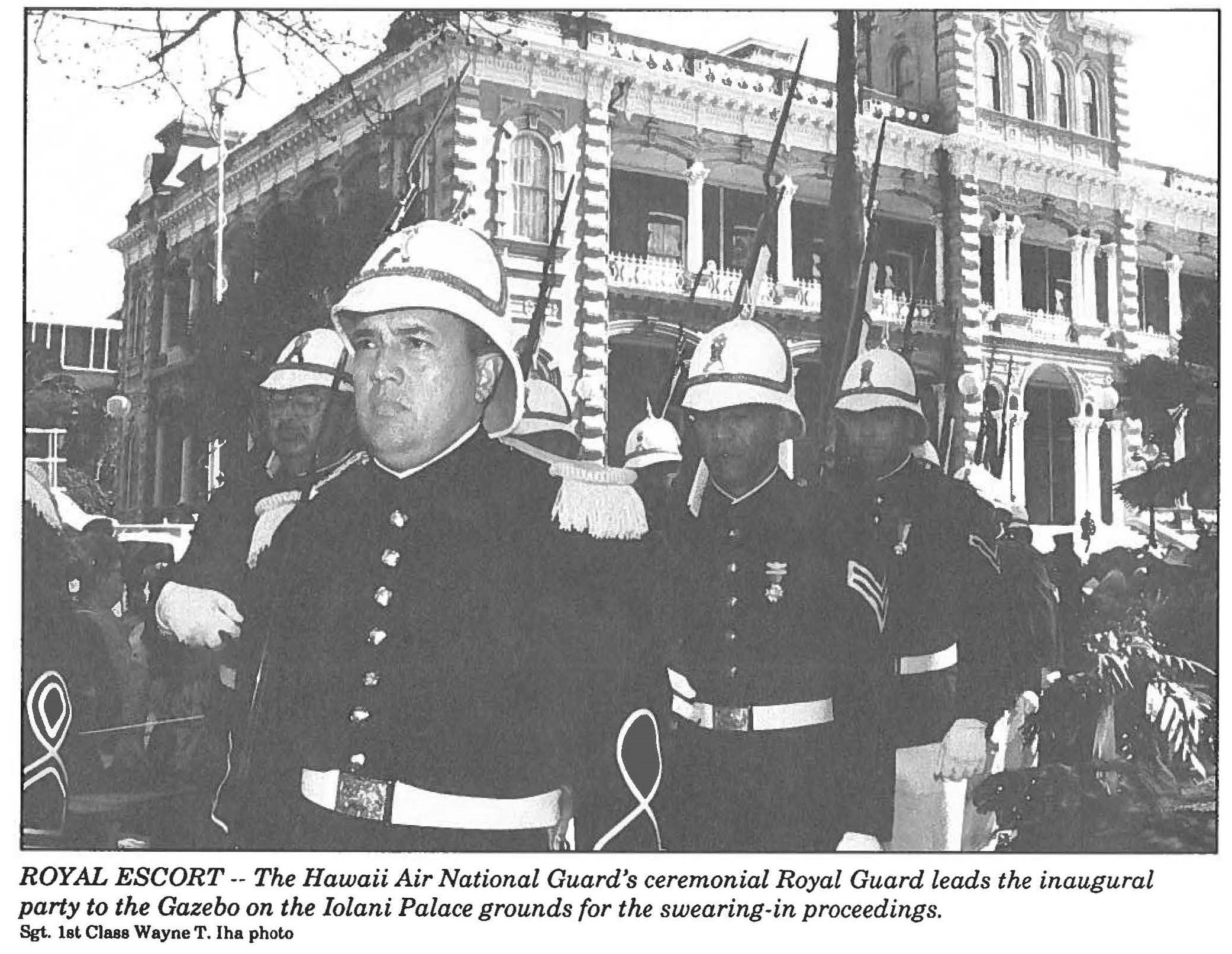
ROYAL ESCORTS — The inaugural procession is lead by the ceremonial Royal Guard, Dec. 5. (Picture from the 1994 November – December Pūpūkahi)ROYAL ESCORT– The Hawaii Air National Guard’s ceremonial Royal Guard leads the inaugural party to the Gazebo on the Iolani Palace grounds for the swearing-in proceedings. Sgt. let Clase Wayne T. Iha photo(Picture from the 1995 Annual Report)
16 NOV 1995 The Royal Guard performed the posting of the guard on their anniversary and the anniversary of King Kalakaua’s birthday.
Learn more
Royal Guard helps celebrate Kalakaua’s birth
By Deborah M.S. Murray
ROYAL TRUST Kapena Moku (captain) Senior Master Sgt. Randall K.H.M. Lum, (right) stands next to Gregory A.J. Lum-Ho Jr. who is carrying a Schellenbaum (bell tree) and Tech Sgt. Norton Molina.(Picture from the 1995 December Pūpūkahi)
The Hawaii Air National Guard’s ceremonial Royal Guard went back to its roots Nov. 16 to honor King David Kalakaua on the anniversary of his 159th birthday.
Marching double file to the beat of the Kalakaua March they thrilled a crowd of onlookers that crowded the Iolani Palace grounds for the annual November event.
They were reviewed by Maj. Gen. Edward V. Richardson, adjutant general, and Quentin R. Kawananakoa, as descendants of Hawaii’s royal family looked on.
The event also marks the Royal Guard’s 31st anniversary. The guard was organized Jan. 20, 1963, when Col. Walter F. Judd, a retired officer Air Guard officer and member of a kamaaina family, spearheaded the unit’s recreation. The Royal Guard of today is a revival of the Royal Palace Guard formed by Kalakuaua in the late 1800s. Back then, it was an elite group of 50 men from which the king’s bodyguards were picked.
All commands were called out in Hawaiian. The Royal Guards marched from the Iolani Barracks to the front of the palace, where they were inspected by Richardson and Kawananakoa. The uniforms worn by the Royal Guard are replicas of those used by the Palace Royal Guard down to the gold-colored buttons, that were cast from originals worn in the 1800s.
After the inspection, the guard marched to three of the gates at Iolani Palace and posted a guard at each.
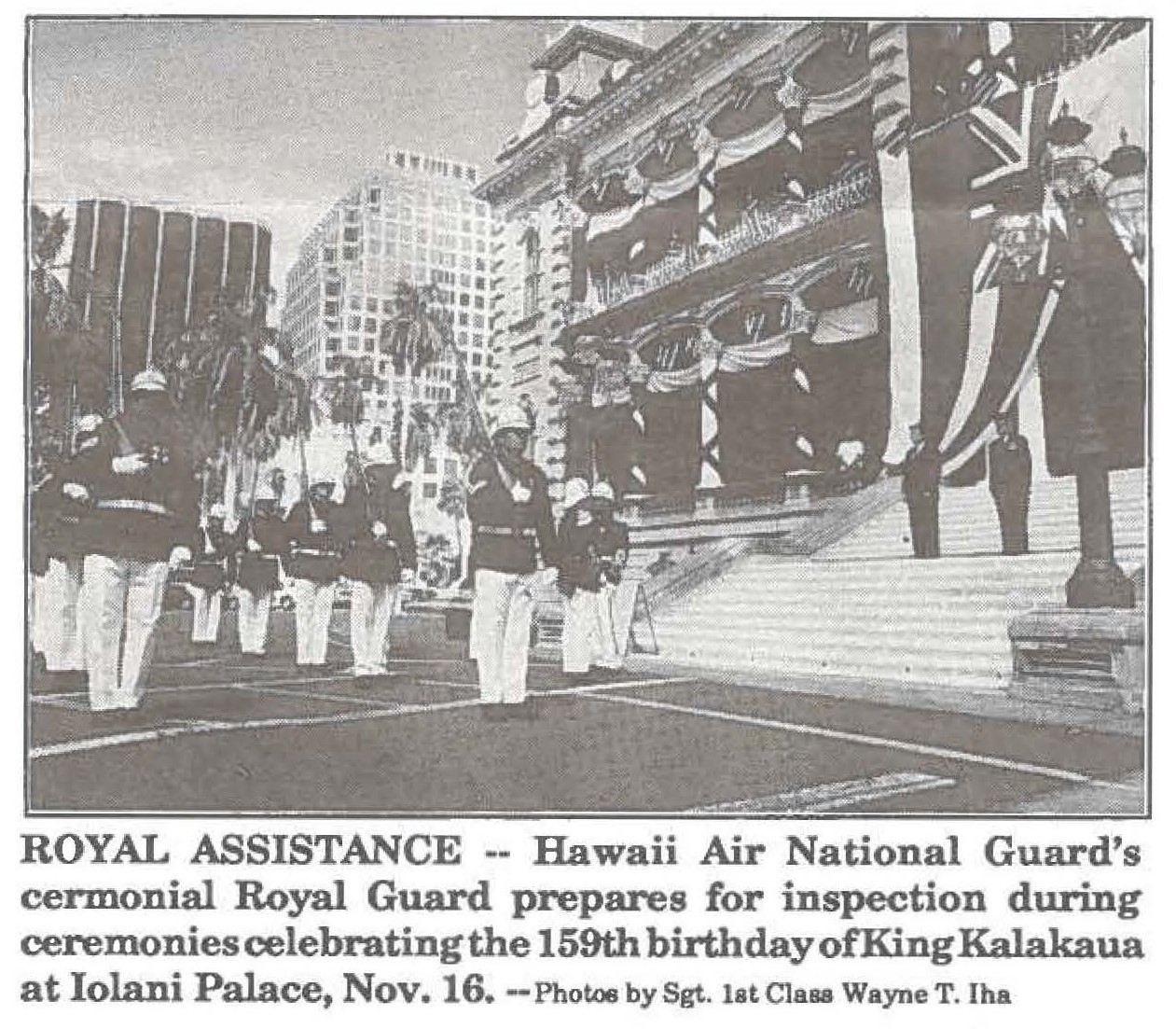
ROYAL ASSISTANCE — Hawaii Air National Guard’s ceremonial Royal Guard prepares for inspection during ceremonies celebrating the 159th birthday of King Kalakaua at Iolani Palace, Nov. 16. -Photos by Sgt. 1st Claaa Wayne T. Iha(Picture from the 1995 December Pūpūkahi)
HAWAII AIR NATIONAL GUARD’S ROYAL GUARD participates in numerous ceremonies throughout the year. Here they are featured in the opening ceremony to kick-off Hawaii Military Week. Photo by Deborah M. Sanders Murray(Pictures from the 1996 Annual Report)
28 DEC1995 A Kalakaua era cannon was found and restored at the Molokai Armory.
Learn more
Molokai Armory “cannon’s” roots rediscovered
By Sgts. 1st Class Aaron R. Pollick and Stephen M. Lum
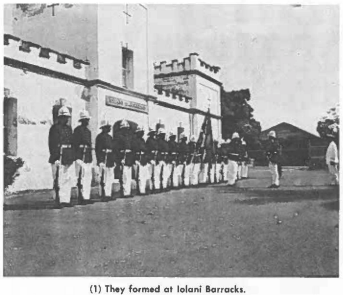
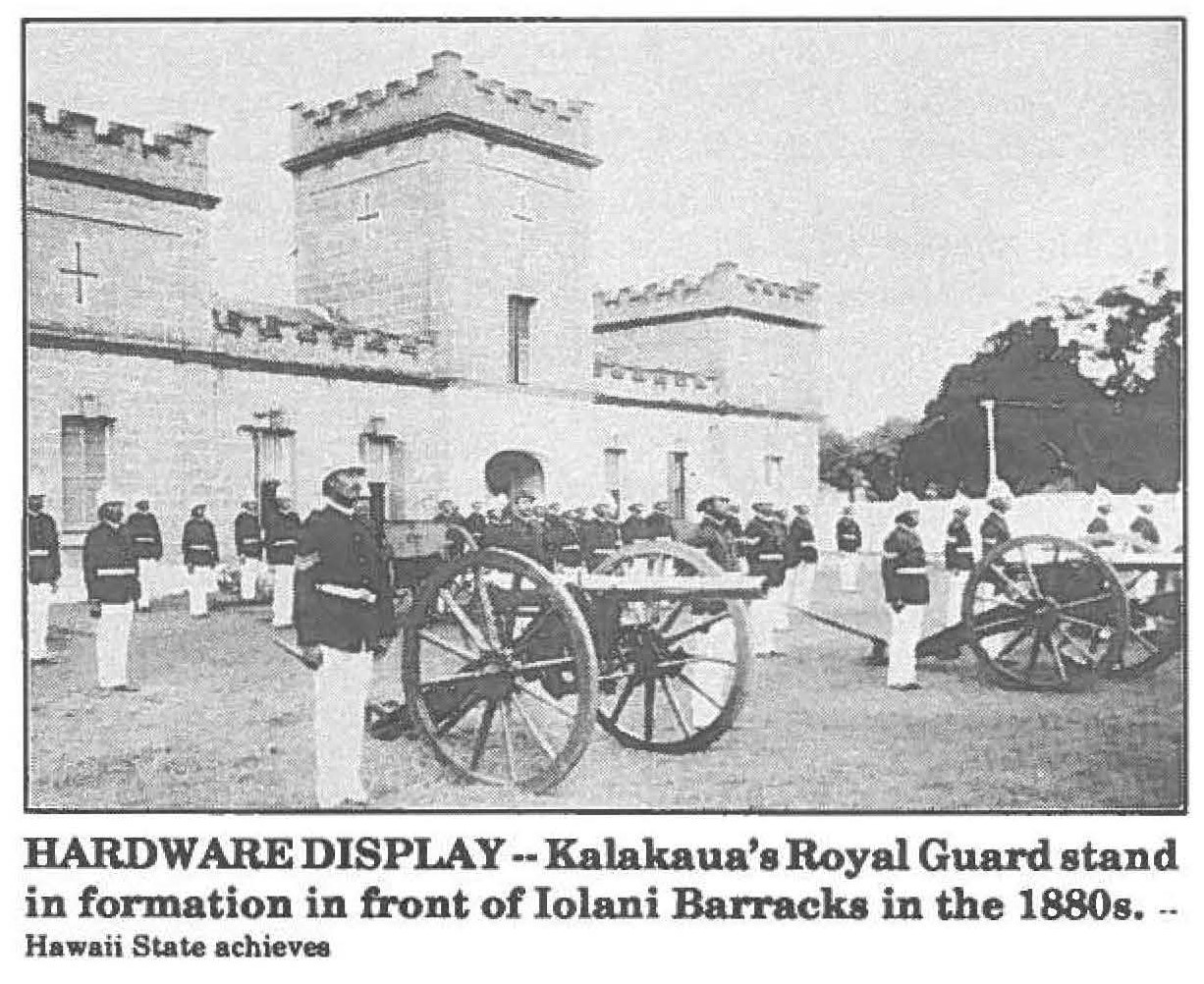
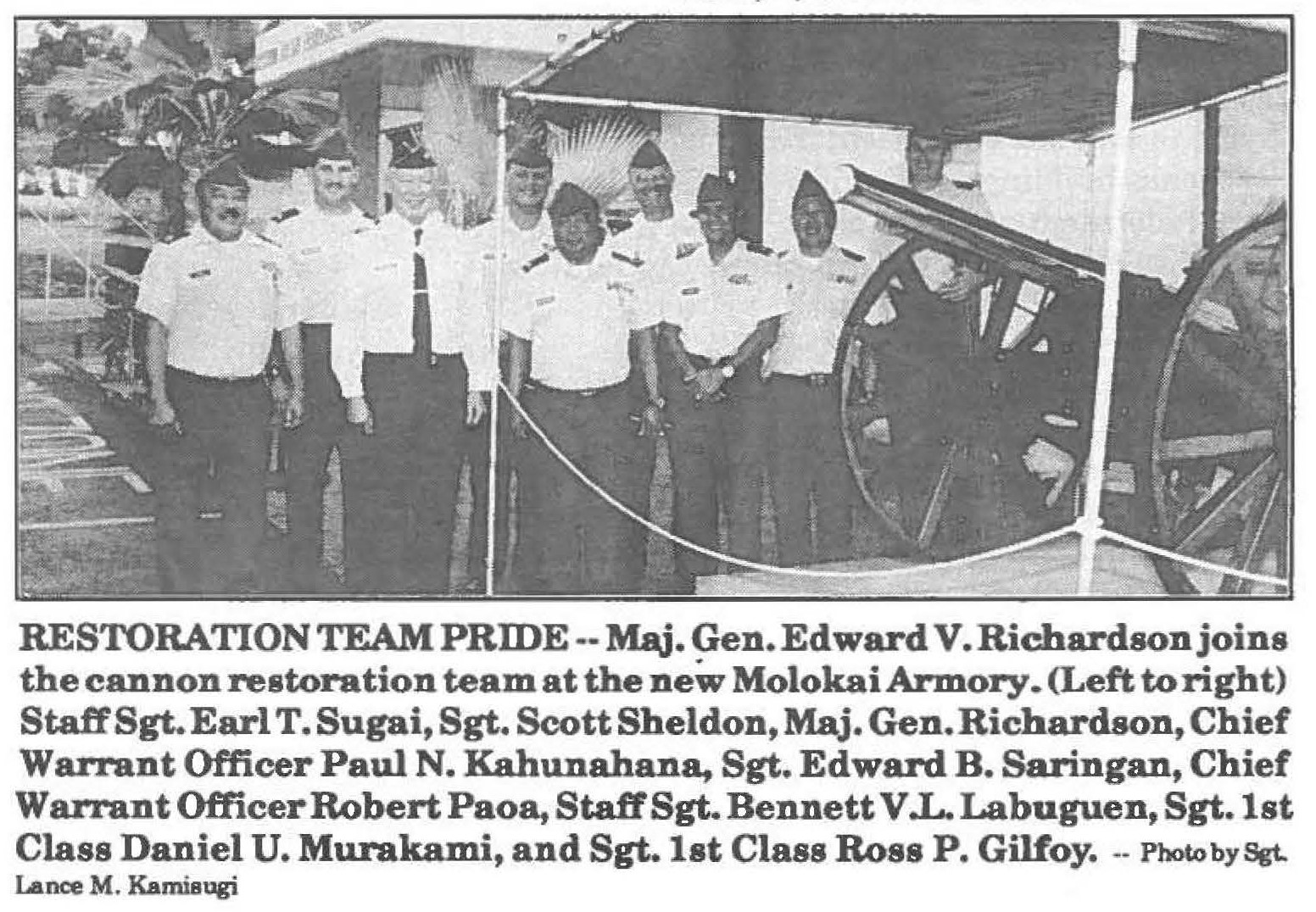
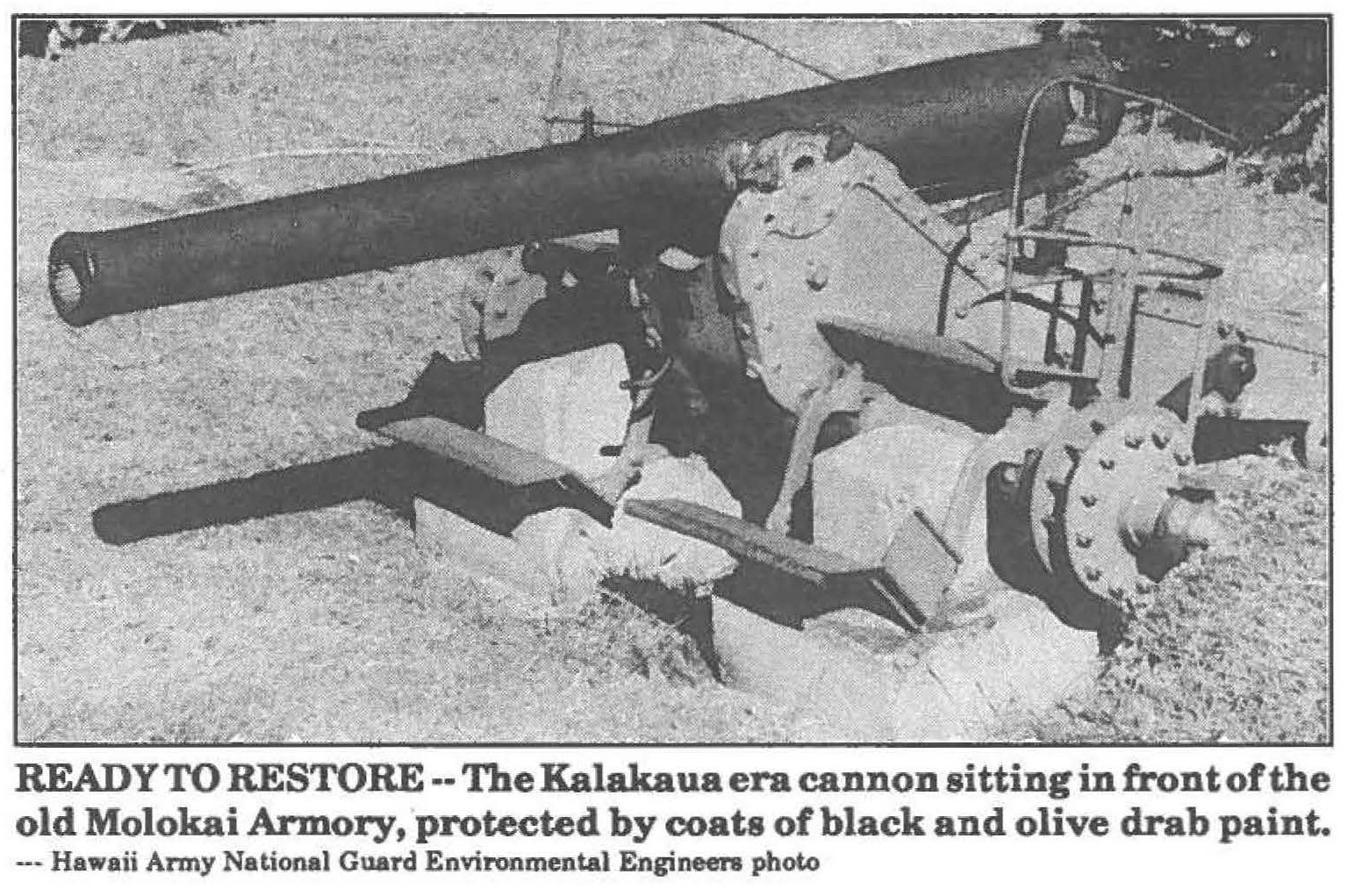
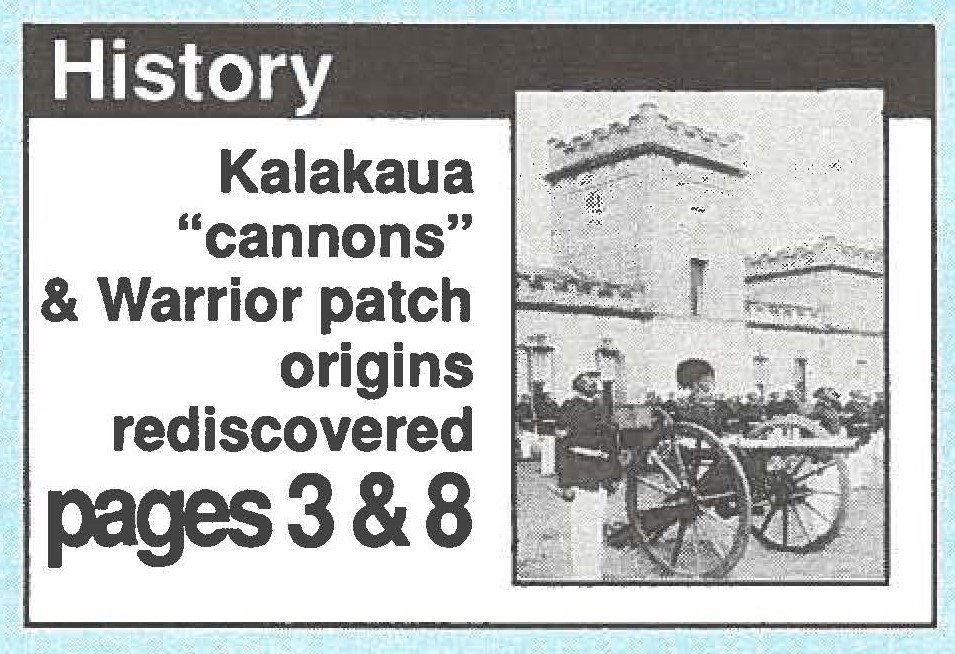
Chief Warrant Officer Robert PaoaHARDWARE DISPLAY — Kalakaua’s Royal Guard stand in formation in front of lolani Barracks in the 1880s. Hawaii State achievesRESTORATION TEAM PRIDE–Maj. Gen. Edward V. Richardson joins the cannon restoration team at the new Molokai Armory. (Left to right) Staff Sgt. Earl T. Sugai, Sgt. Scott Sheldon, Maj. Gen. Richardson, Chief Warrant Officer Paul N. Kahunahana, Sgt. Edward B. Saringan, Chief Warrant Officer Robert Paoa, Staff Sgt. Bennett V.L. Labuguen, Sgt. 1st Class Daniel U. Murakami, and Sgt.1st Class Ross P. Gilfoy. — Photo by Sgt. Lance M. Kamiaugi READY TO RESTORE — The Kalakaua era cannon sitting in front of the old Molokai Armory, protected by coats of black and olive drab paint. — Hawaii Army National Guard Environmental Engineers photo (Picture from the 1996 January – March Pūpūkahi)
What appeared to be a piece of corroding junk on the front lawn of the old Hawaii Army National Guard Molokai Armory has turned out to be a unique island treasure. The old cannon, coated in layers of black and olive drab paint, was discovered to be a King David Kalakaua era field piece.
In 1985, on a routine maintenance check at the 1930s built Molokai Armory, Chief Warrant Officer Robert Paoa decided to take a more careful look at the old cannon with broken spoke wheels propped up on cement blocks. Paoa, a Hawaiian military history buff, saw something familiar. Through research and with the help of photos, he concluded the cannon may be the last remaining piece of a battery of guns bought in the 1880s by Kalakaua.
Cannon’s origins discovered
In 1881, King David Kalakaua, ruler of the Hawaiian kingdom, embarked on a world tour to visit the heads of state from countries in Asia and Europe. When he was in Austria, he visited Emperor Franz Joseph who arranged a tour of the Vienna Arsenal for his majesty. Ka.lakaua was so impressed with the design and mobility of the Austrian cannons that he purchased a battery consisting of six field pieces and four mountain battery pieces
The field pieces (cannons) used by the Kings Royal Guard were described in an April 22, 1882, Pacific Commercial Advertiser newspaper article as a large gun, about six feet in length, which fires a shot four inches in diameter. The cannon is a very simple but effective breach loaded weapon with a sight range of 6,000 yards of three miles in accuracy.
The cannon used cartridges made of tough water resistant paper filled with gun powder along with single and double walled shells. The single walled shells were merely hollow cylinders rounded off on one end and into a cone shape with a center portion containing the charge. A single walled shell packed with ninety balls about half an inch in diameter was also found to be highly effective. The double walled shell consisted of a series of rings, piled on top of each other within a shell, leaving the center for the charge.
Cannons moved to California
When the United States annexed Hawaii in 1898, the Austrian cannons were considered obsolete and sent to the mainland to be stored at the Benicia Arsenal in Benicia, Calif. In 1930, after more that 30 years in storage, five returned to Hawaii and were once again placed on the palace grounds according to the Honolulu Advertiser’s March 27, 1930, edition.
During World War II, the cannons were unsupervised, leaving no records of their fate or whereabouts. The question of when or how this particular cannon ended up at the Molokai Armory remains a mystery. Based on historical events, it is believed that the transfer took place sometime between 1940 and 1950.
Research and restoration
The historical Kalakaua-era cannon, which sat on the grounds of the old armory, was brought to Honolulu for restoration in the summer of 1995 after Chief Paoa’s 1985 rediscovery and research confirmed the cannon was part of a battery of field pieces.
The cannon’s restoration was part of the master plan to enhance the Jan. 7 dedication of the new Molokai Armory. Bids were submitted ranging from $5-10,000. High cost stalled the restoration, but with Paoa’s persistence and the Hawaii Guard’s higher command’s blessing, the maintenance staff took on the task.
The Austrian-built field piece restored by past and present technicians from the Hawaii Guard’s Combined Support Maintenance Shop #1 in Honolulu. The 10 volunteers worked for more than six months, after hours and weekends (more than 225 hours) and spent less than $200 for varnish and paint. The oak and mahogany hardwoods for reconstruction of the wheels were donated. “After countless hours of sand blasting, welding, painting, and polishing,” said Chief Warrant Officer Paul N. Kahunahana, restoration coordinator, “our labor of love was complete.”
The restoration team also included Sgt. 1st Class Daniel U. Murakami (wheel fabrication); Staff’ Sgts. Earl T. Sugai (sandblasting, painting and polishing), Bennett V.L. Labuguen (wheel fabrication) and Ross P. Gilfoy (sandblasting, painting and polishing); Sgts. Edward B. Saringan (carriage welding and body work) and Scott Sheldon (sandblasting, painting and polishing); retirees Masters Sgt. George Tom (fullscale wheel design) and Staff Sgt. David Ogura (wheel fabrication).
Home again
The Kalakaua cannon came home to the Detachment 1, Headquarters and Headquarters Company, 2nd Battalion, 299th Infantry, Dec. 28, 1995, in time for the Jan. 7 dedication of the new Molokai Armory.
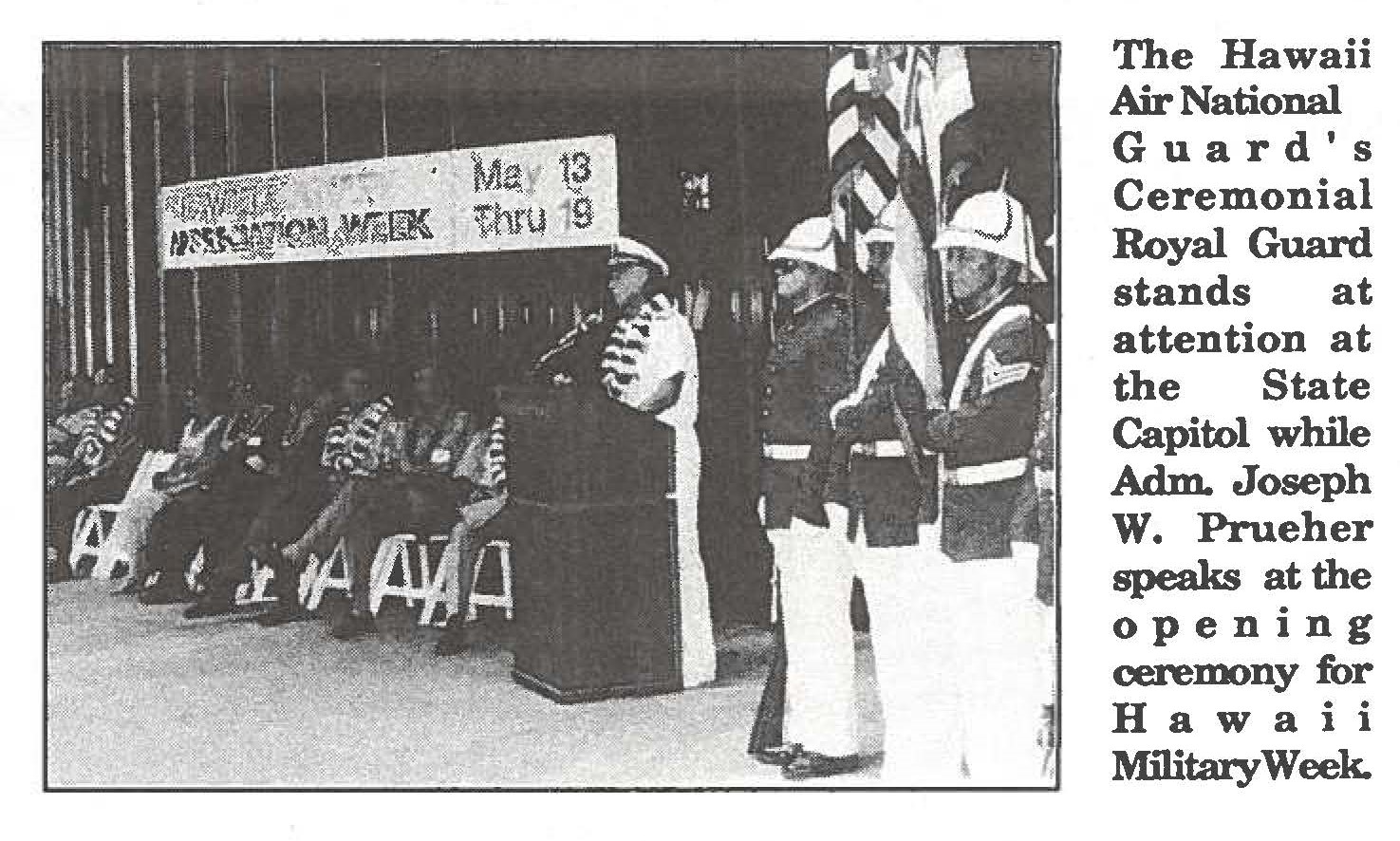
The Hawaii Air National Guard’s Ceremonial Royal Guard stands at attention at the State Capitol while Adm. Joseph W. Prueher speaks at the opening ceremony for Hawaii Military Week(Picture from the 1996 April – May Pūpūkahi)
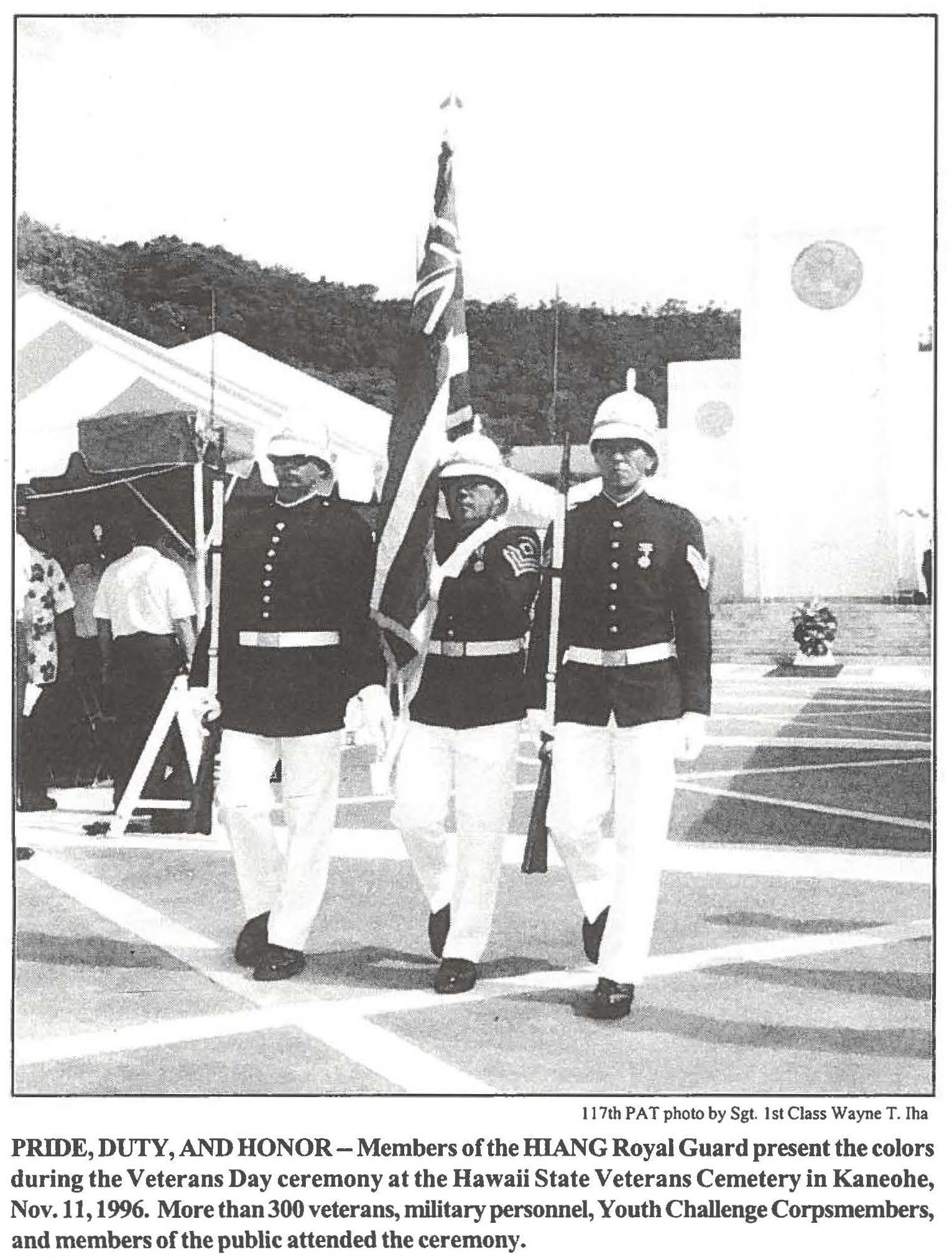
PRIDE, DUTY, AND HONOR-Members of the HIANG Royal Guard present the colors during the Veterans Day ceremony at the Hawaii State Veterans Cemetery in Kaneohe, Nov. 11, 1996. More than 300 veterans, military personnel, Youth Challenge Corpsmembers, and members of the public attended the ceremony.(Picture from the 1996 December Pūpūkahi)
The Ceremonial Royal Guard, a link to Hawaii’s past, proudly represented the Hawaii Air National Guard at numerous community events such as posting the Guard at Iolani Palace for King Kalakaua’s birthday, Nov. 16; the Sesquicentennial Celebration of Washington Place in October 1996; Aloha Festival Parade; and Queen Lili’uokalani’s birthday celebration at Iolani Palace in September 1996.
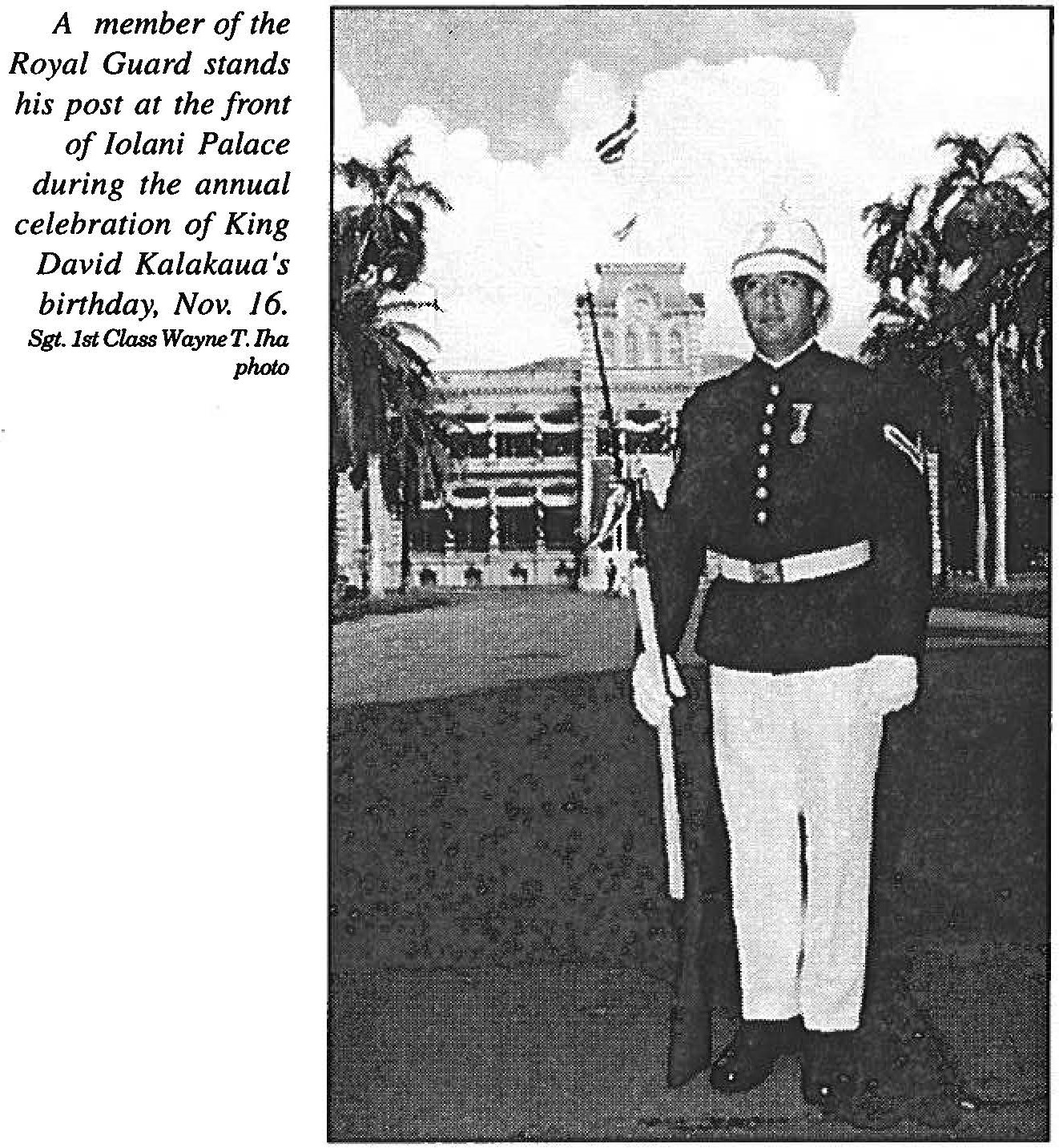
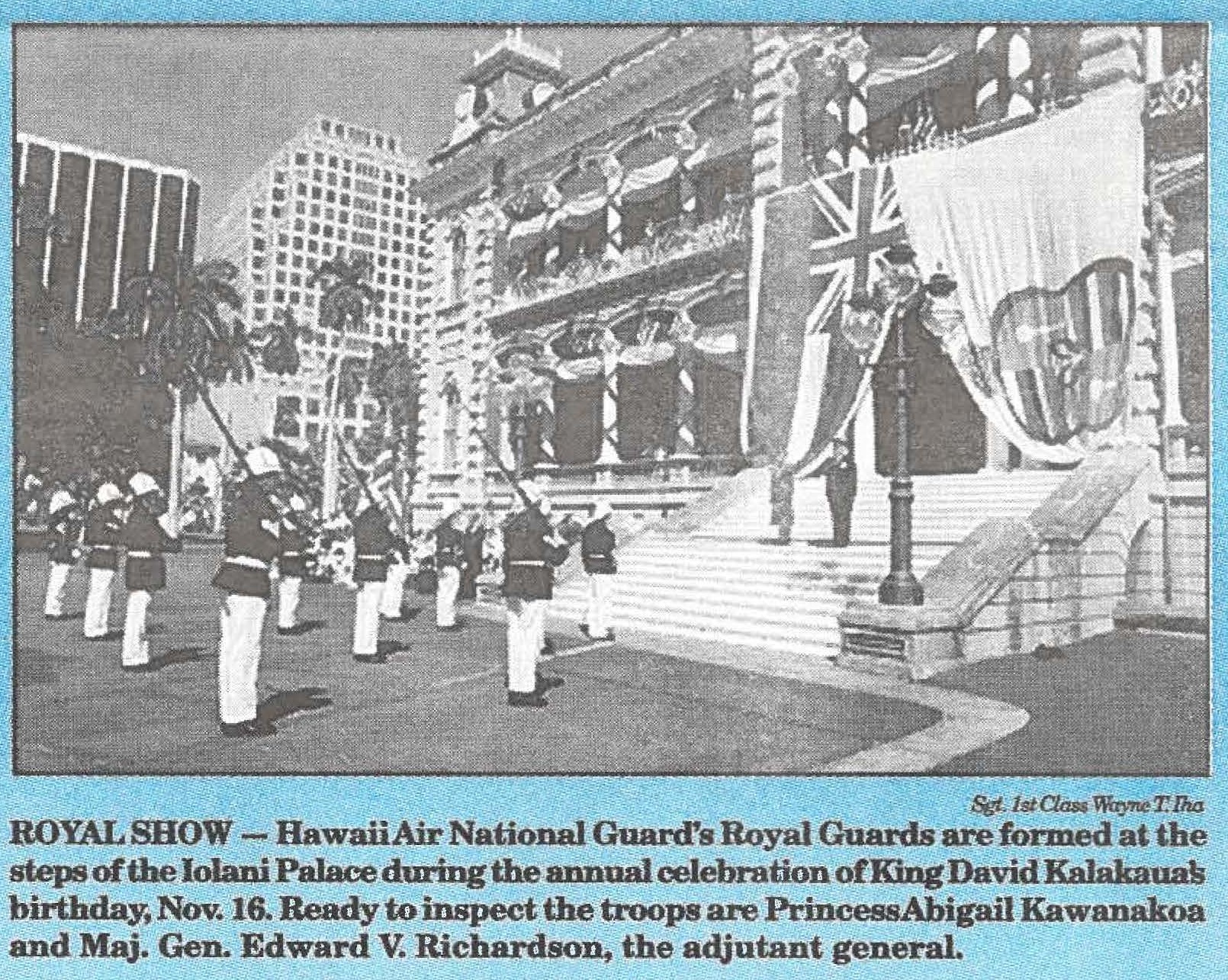
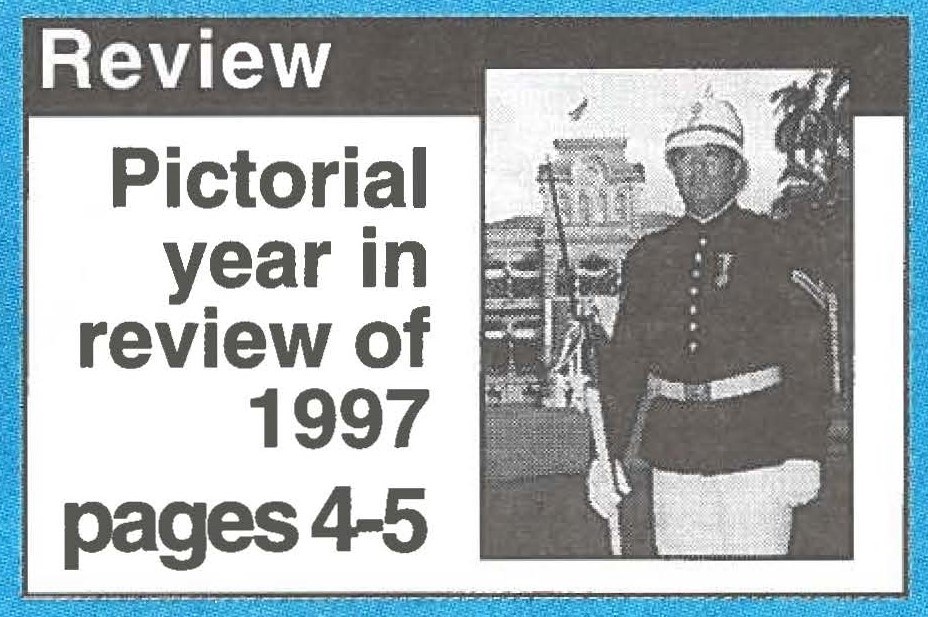
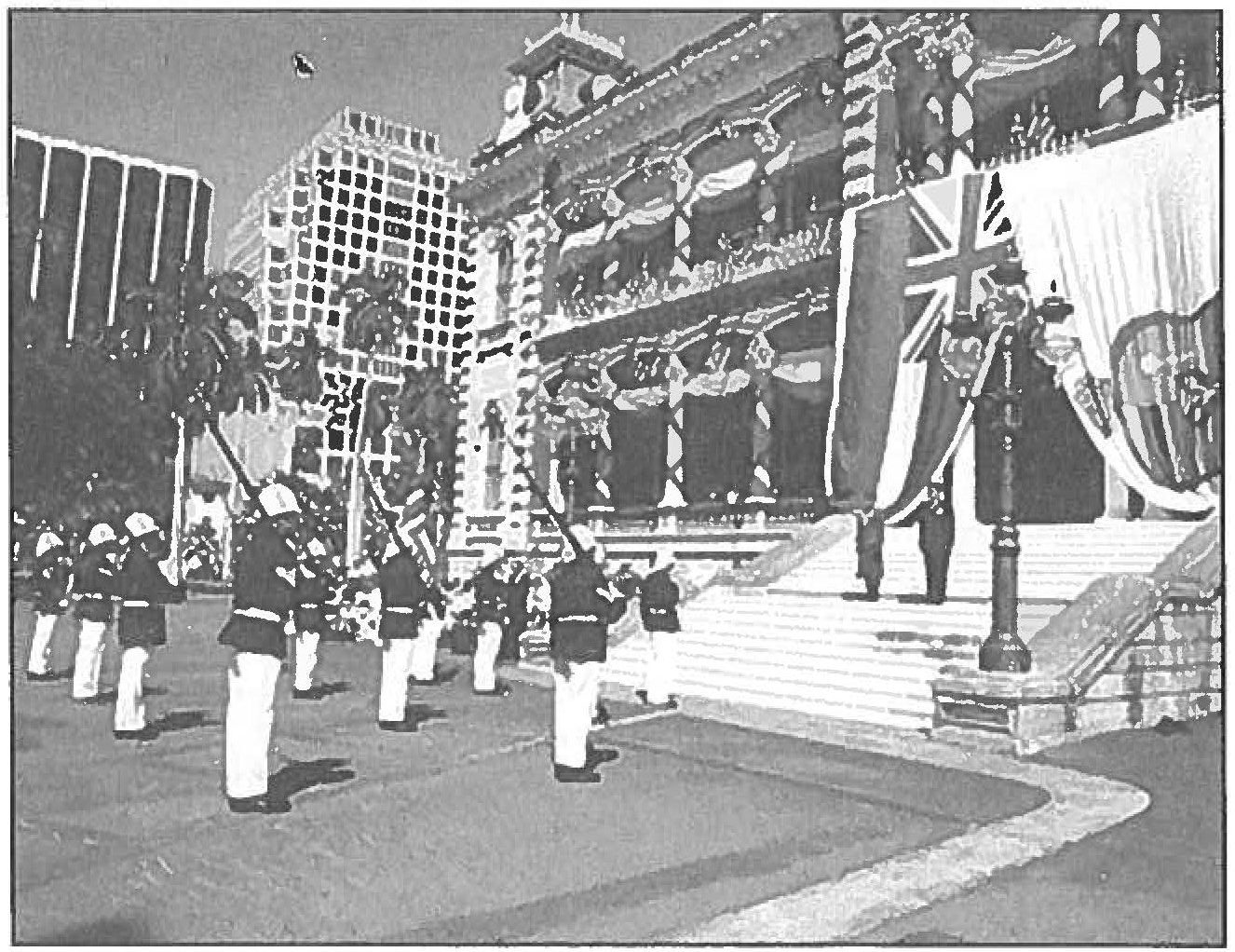
ROYAL SHOW — Hawaii Air National Guard’s Royal Guards are formed at the steps of the Iolani Palace during the annual celebration of King David Kalakaua’s birthday, Nov. 16. Ready to inspect the troops are Princess Abigail Kawanakoa and Maj. Gen. Edward V. Richardson, the adjutant general. Pictorial year in review of 1997 pages 4-5(Pictures from the 1997 December – 1998 January Pūpūkahi)ROYAL SHOW Hawaii Air National Guards ceremonial Royal Guard is formed at the step of Iolani Palace during the annual celebration of King David Kalakaua’s birthday, Nov. 16. Sgt. 1st Class Wayne T. Iha photo(Picture from the 1998 Annual Report)
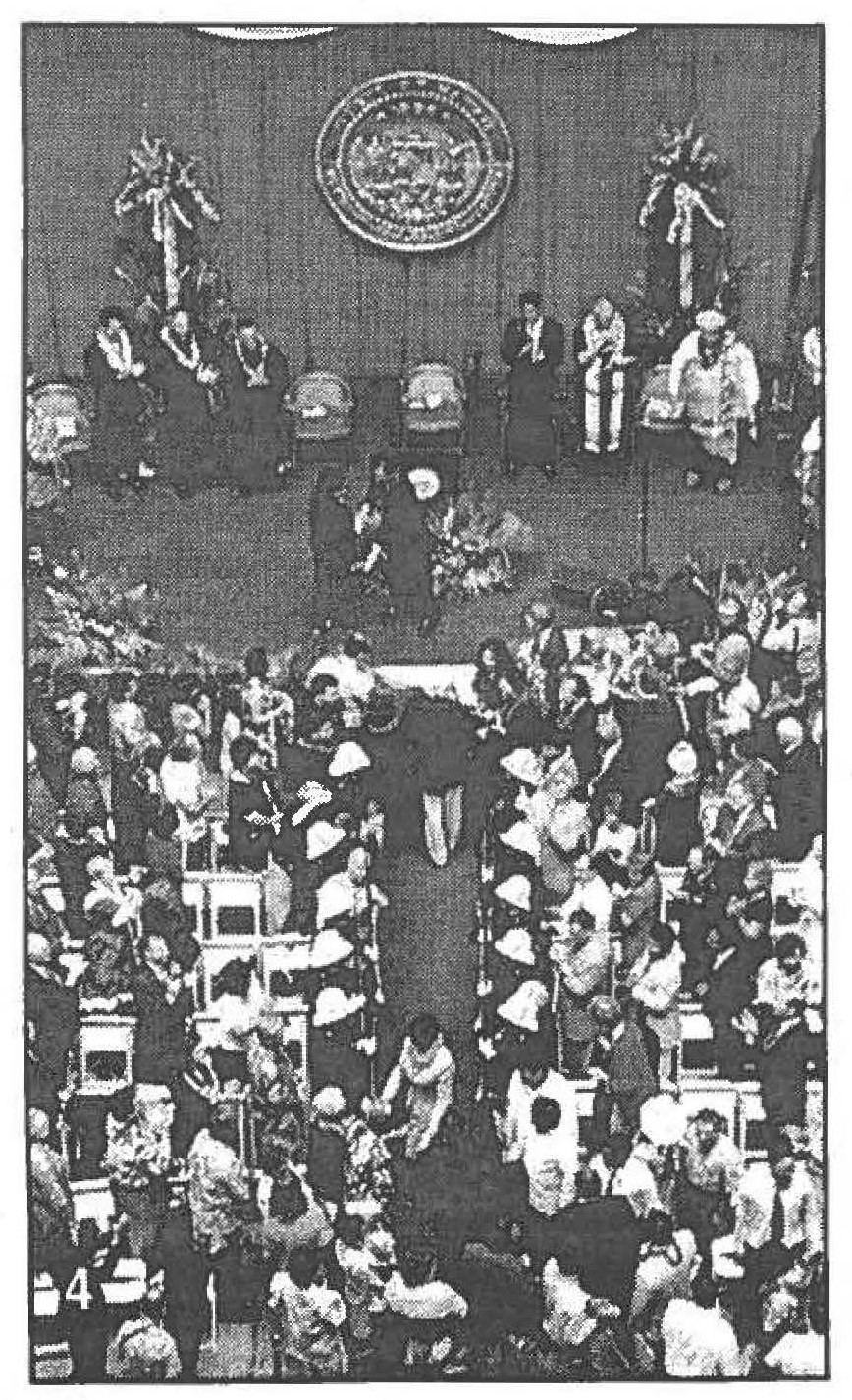
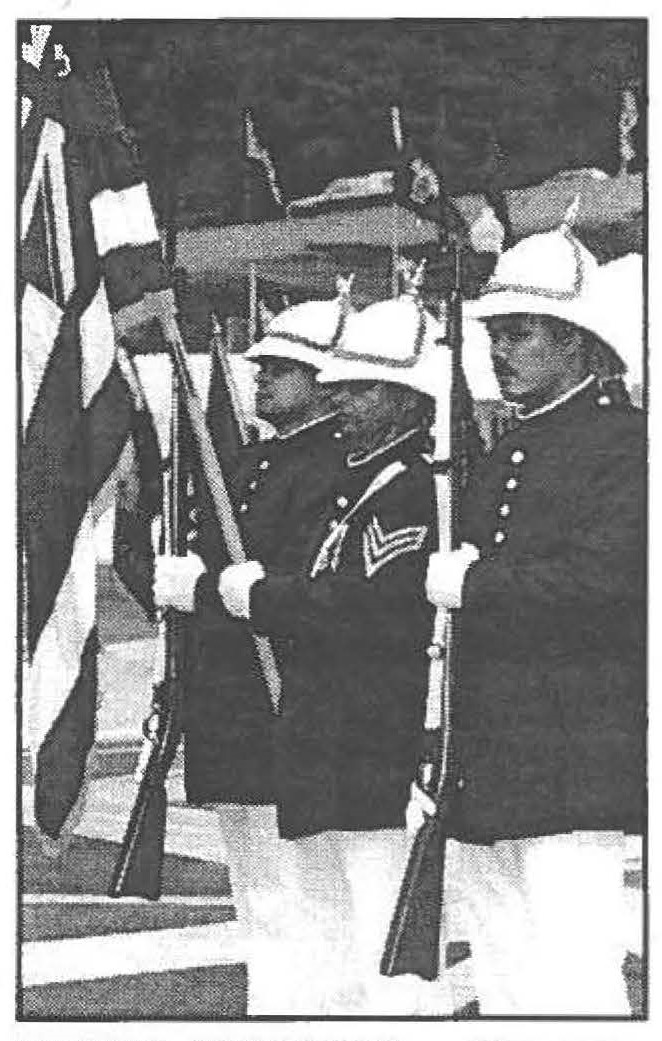
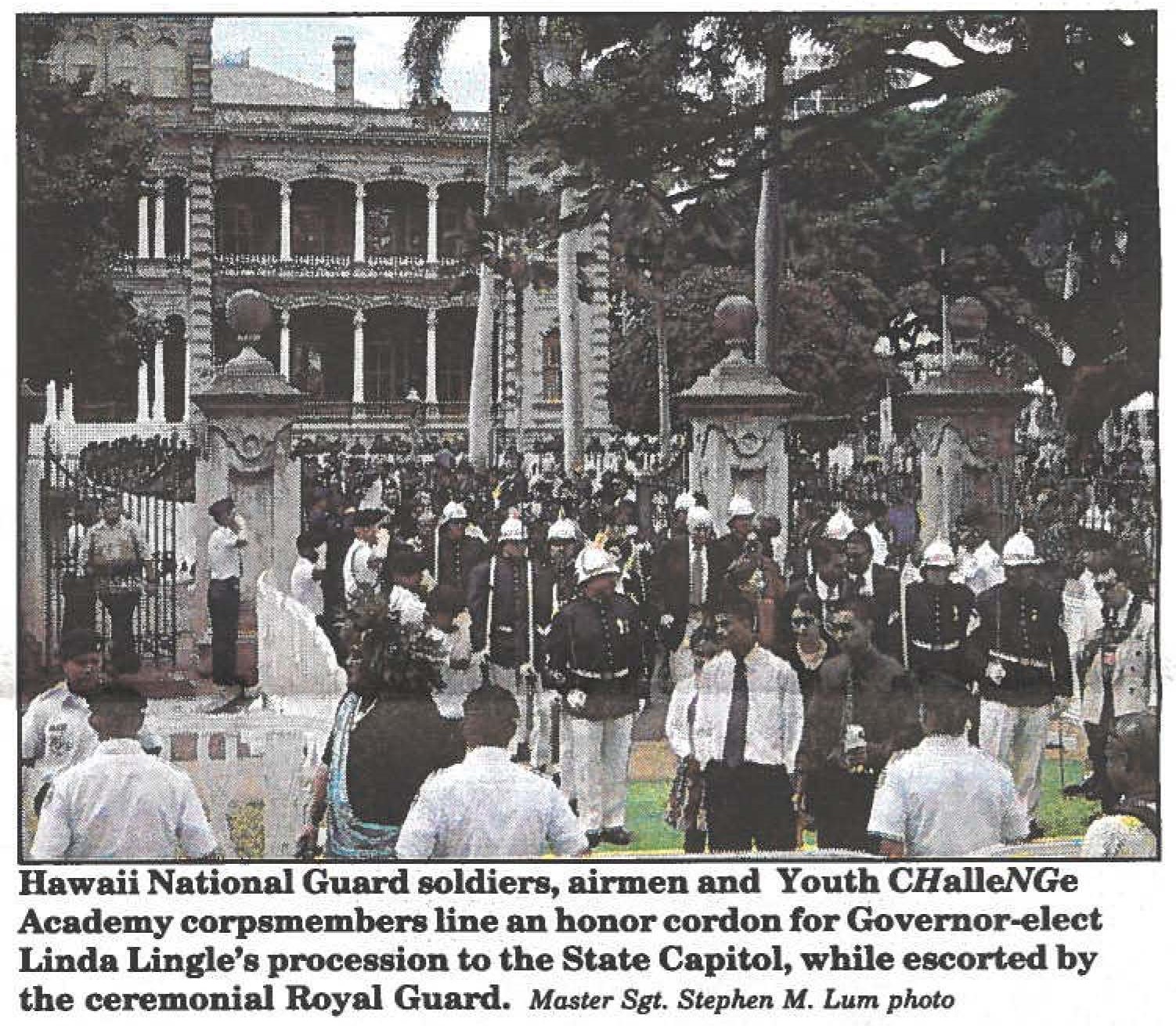
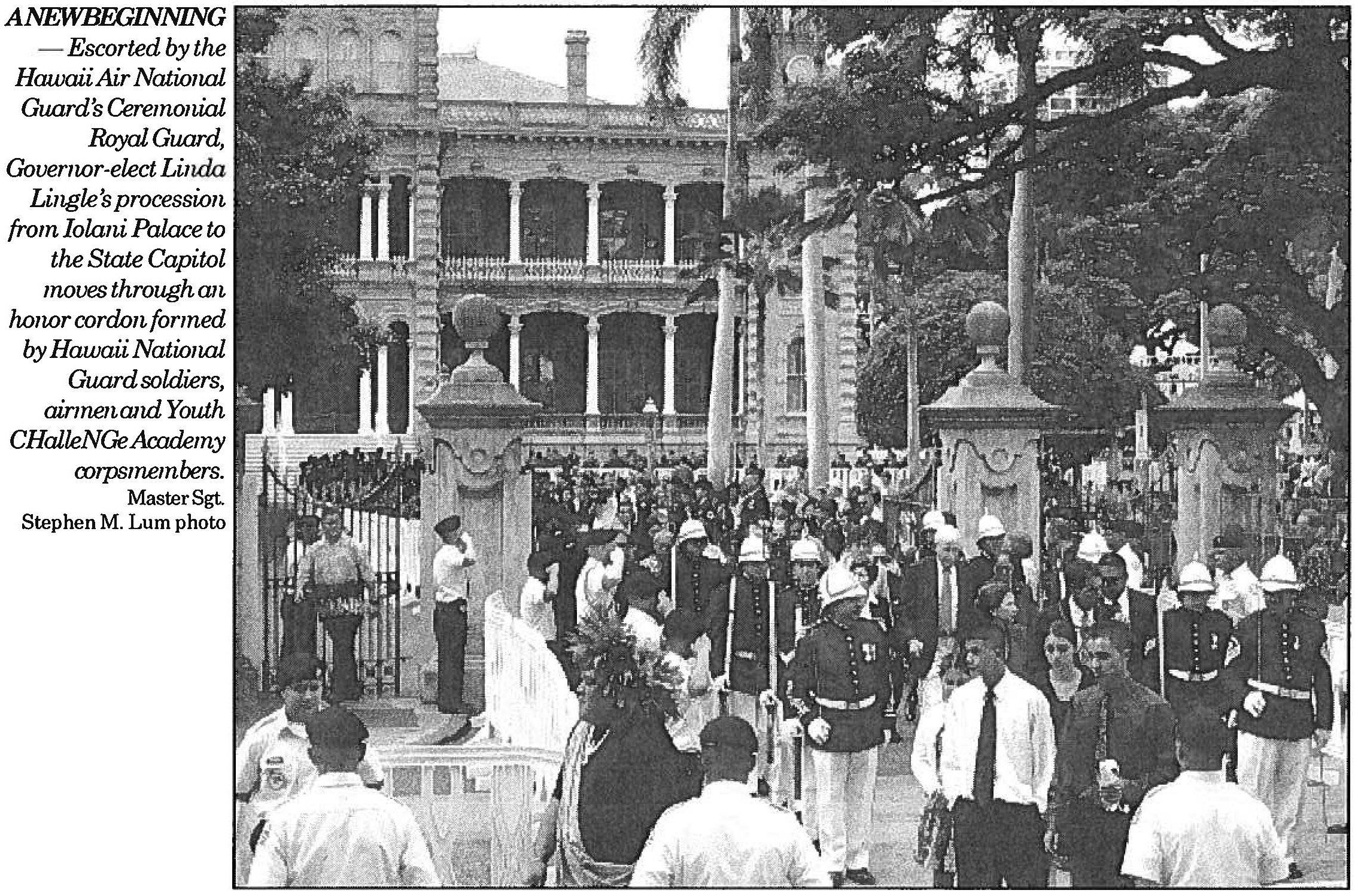
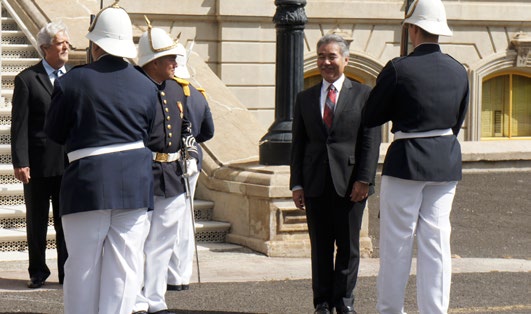
Pass in review parade and cordon to stage – Ceremonial Royal Guard, Hawaii Air National GuardROYAL HONORS — Ceremonial Royal Guard post the State Colors. Hawaii National Guard soldiers, airmen and Youth CHalleNGe Academy corps members line an honor cordon for Governor-elect Linda Lingle’s procession to the State Capitol, while escorted by the ceremonial Royal Guard. Master Sgt. Stephen M. Lum photo Veterans’ Day activities supported by Hawaii Guard page 3 Pass in review parade and cordon to stage – Ceremonial Royal Guard, Hawaii Air National Guard(Pictures from the 2002 October – December Pūpūkahi)A NEW BEGINNING – Escorted by the Hawaii Air National, Guards Ceremonial, Royal, Guard, Governor-elect Linda Lingle’s procession from Iolani Palace to the State Capitol moves through an honor cordon formed by Hawaii National, Guard soldiers, airmen and Youth CHalleNGe Academy corpsmembers. Master Sgt. Stephen M. Lum photo(Picture from the 2003 Annual Report)
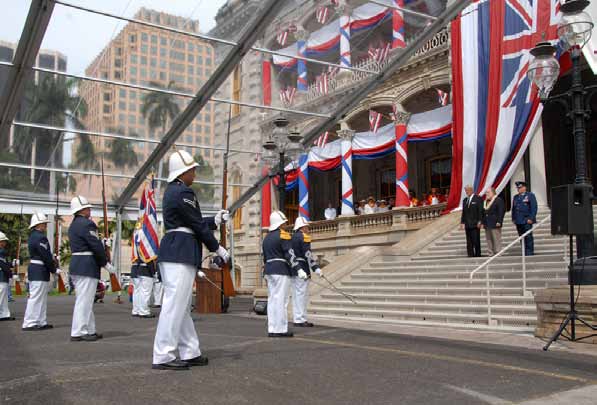
BEST FOOT FORWARD – Hawaii Air National Guard’s Ceremonial Royal Guard form at the steps of Iolani Palace during the annual celebration of King David Kalakaua’s birthday celebration, Nov. 16. Tech. Sgt. Andrew L. Jackson photo(Picture from the 2012 Annual Report)
ROYAL ESCORT– Hawaii Air National Guard’s ceremonial Royal Guard escort the soon to be inaugurated Gov. David Y. Ige past a cordon of Hawaii National Guard Youth CHalleNGe Academy Cadets at the December 2014 event. Master Sgt. (Ret.) Stephen M. Lum photo(Picture from the 2015 Annual Report)
Maj. Gen. Darryll D.M. Wong, former Hawaii State adjutant general and retired Gen. Craig McKinley, former chief, National Guard Bureau, salute the Hawaii state flag during a retirement ceremony at the Distinguished Visitors reception area on Joint Base Pearl Harbor-Hickam, Hawaii, April 12, 2015. The Royal Guard, consisting of members of the Hawaii Air National Guard, present the colors for the ceremony. (U.S. Air Force photo by Airman 1st Class Robert Cabuco/Released)(Picture from the 2015 April Pūpūkahi)
16 NOV 2015 The Royal Guard posted at Iolani Palace.
Learn more
King Kalakauka’s birthday
Photos and story by TSgt Andrew Jackson
King Kalakauka’s birthdayKing Kalakauka’s birthdayKing Kalakauka’s birthdayKing Kalakauka’s birthday(Pictures from the 2015 November Pūpūkahi)
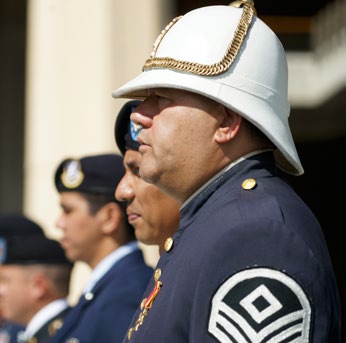
Recently, one unique unit of the Hawaii Air National Guard posted a ceremonial watch on the grounds of the country’s only palace. The Royal Guard is a special honor guard in the Hawaii Air National Guard where select members perform ceremonial duties at various events throughout the year. The Royal Guard was originally a unit of military palace guards in the Kingdom of Hawaii, before the overthrow in 1893. They where reestablished on November 16, 1963 marking beloved 19th century monarch King Kalakauka’s birthday. Members of the unit go to great lengths to maintain period-correct uniforms, even refurbishing original helmets, all on volunteer hours, and use the Hawaiian language to call commands during their drill and ceremony.
The members of the Royal Guard help the state and its Guard members to connect to their cultural past by serving as reminders of the heritage and history of their forebears.
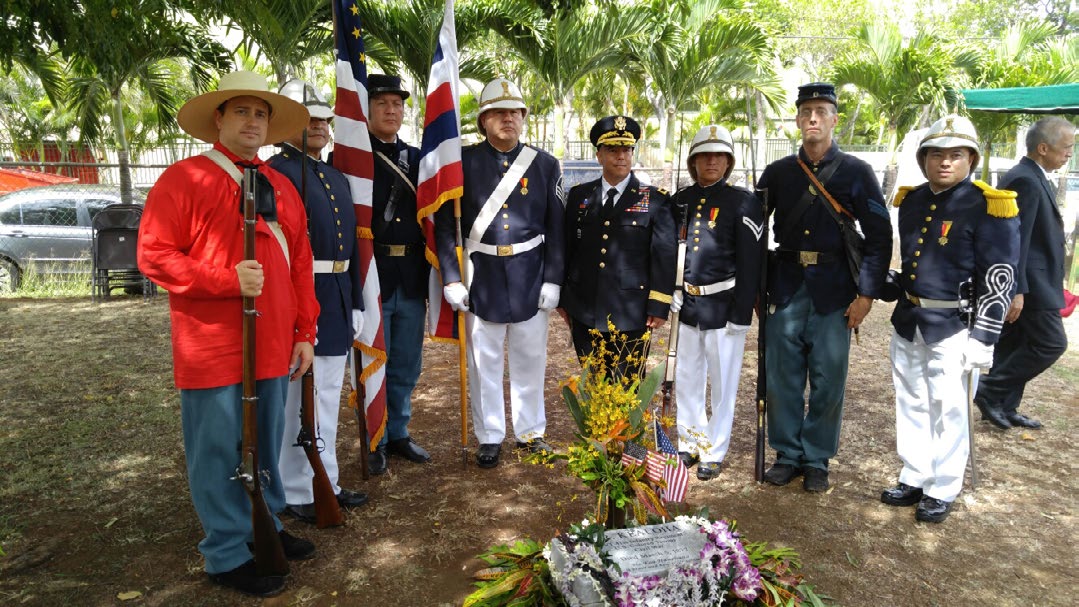
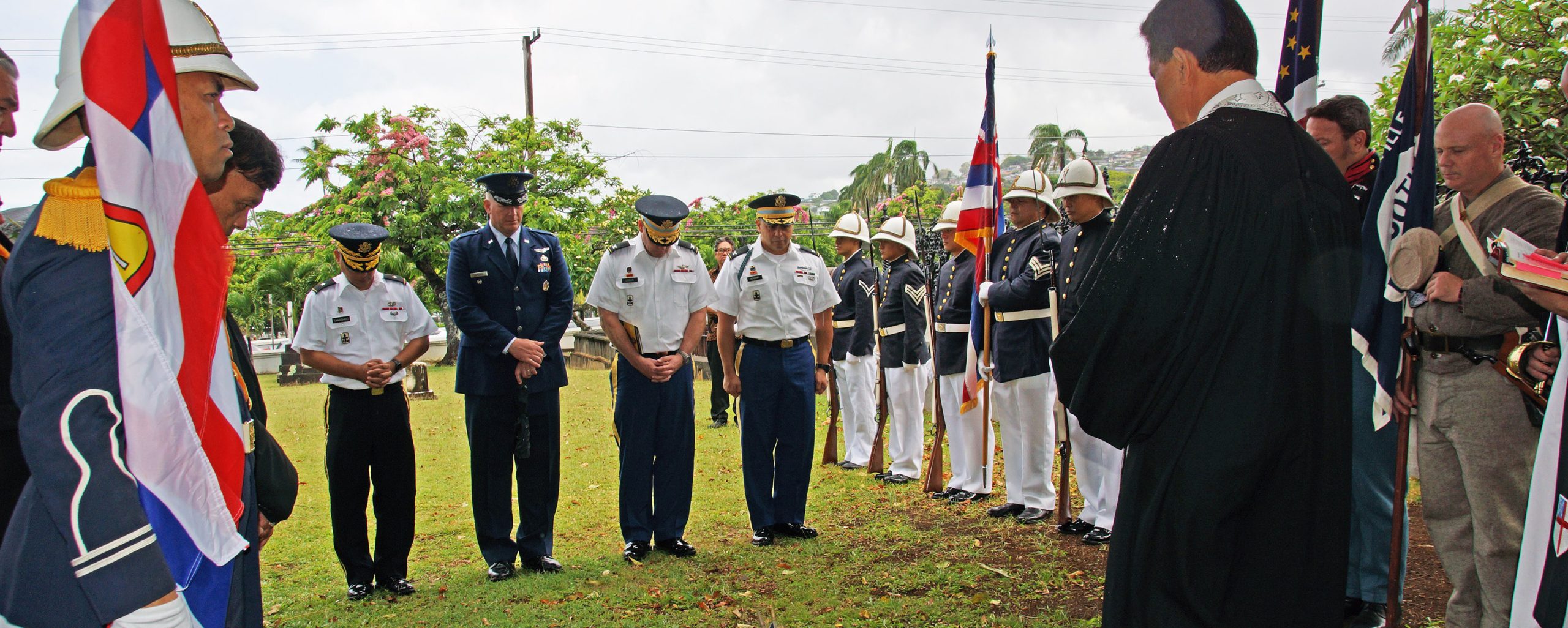
The Royal Order of Kamehameha I and the Hawaii Civil War Round Table honors the memory of military service of Soldiers and Sailors of the Kingdom of Hawaii who served in the Union and Confederate Army and Navy during the American Civil War from 1861 to 1865. Brig. Gen. Kenneth Hara, the deputy adjutant general and the Hawaii Air National Guard’s Ceremonial Royal Guard join Civil War reenactors at the newly dedicate grave marker of J.R. Kealoha at Oahu Cemetery, May 25, 2016.(Picture from the 2016 June Pupukahi)
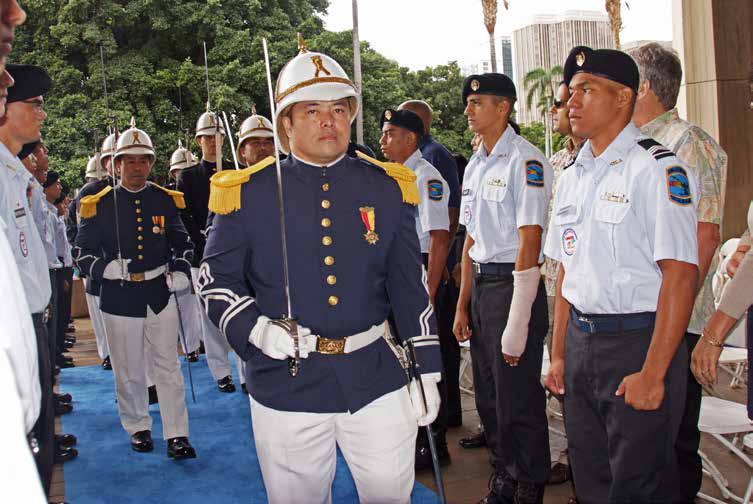
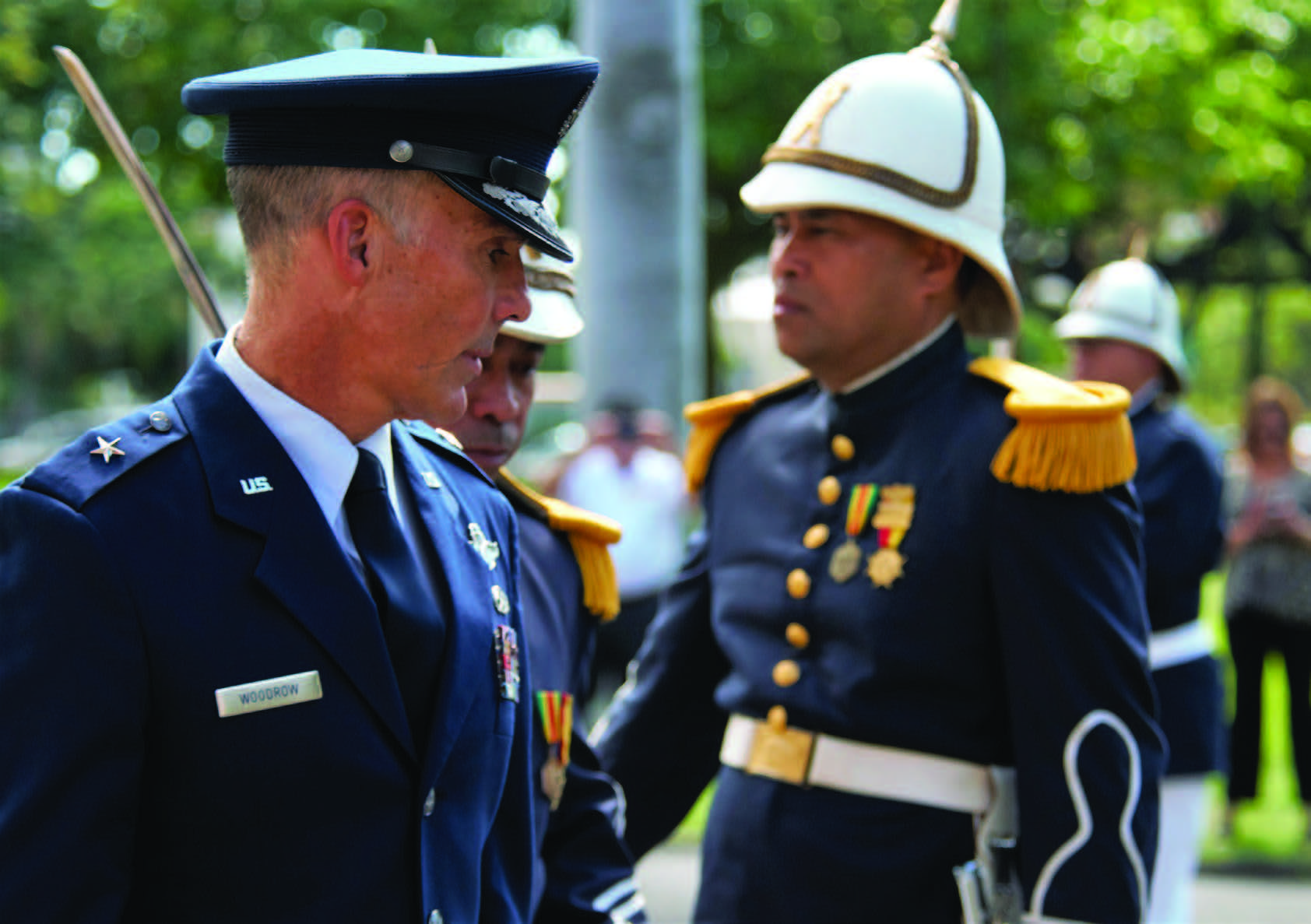
Present, former Hawaii Guard Soldier, Airmen help at the American Civil War Memorial Day Commemorative, May 17, at Oahu Cemetery (Pictures from the 2017 Spring Pupukahi)Brig. Gen. Gregory S. Woodrow conducts a troop review of the Hawaii Air National Guard’s Royal Guard, Honolulu, Hawaii, Nov. 16, 2017. Woodrow was participating in a ceremony commemorating the re-creation of the Hawaii Air National Guard’s Royal Guard, a unique Honor Guard where select airmen perform ceremonial duties at various events throughout the year, and stand as symbols and reminders of the HIANG’s heritage and history. (U.S. Air National Guard photo by Senior Airman Orlando Corpuz)(Picture from the 2018 Spring Pupukahi)All hail the Chief(Picture from the 2018 Winter Pupukahi)
2023 National Guard Bureau, asked the 54 states and territories National Guards to help him decorate and fill the new National Guard Heritage Room at Joint Base Fort Myer-Henderson Hall in Virginia. Many items from the HING were considered, but the artifact that was selected was a Royal Guard jacket and helmet.
Learn more
National Guard Heritage Room
National Guard Heritage RoomNational Guard Heritage RoomNational Guard Heritage Room(Pictures from the 2023 Summer Pūpūkahi)
Gen. Daniel R. Hokanson, Chief, National Guard Bureau, asked the Hawaiʻi National Guard to help him decorate and fill the new National Guard Heritage Room at Joint Base Fort Myer-Henderson Hall in Virginia. This exhibition is set to open in November and will showcase the contributions of National Guard units from the 54 states and territories. The display is designed to give the National Guard greater exposure among the broader military and the Department of Defense community considering its prime location near the Pentagon.
Many items from the HING were considered, but the artifact that was selected was a Royal Guard jacket and helmet. These are replicas of the uniforms used by the Royal Guards during the reign of King David Kalākaua. The current Royal Guards were established on Nov. 16, 1963. Their basic purpose is to express Hawaiʻi Air National Guard pride in its Hawaiian heritage and preserve the traditions of the Hawaiʻi Militia of the Monarchy.
The forbearers of Royal Guard were Kamehameha the First’s malo-wearing spear then musket-carrying bodyguards in the late 16th century. The “uniform” and mission evolved over the years. It was disbanded by Kamehameha the IV (Liholiho), after tensions between enlisted and officers resulted into the “Barracks Revolt of 1873.” When Kalākaua was elected King the next year, he reformed the Royal Guard in the late 1800’s. It was an elite group of 50 men from which the King’s bodyguards were drawn, with a heritage which extended far back into Hawaii’s history. The organization was quartered in ʻIolani Barracks, next door to ʻIolani Palace.
The unit is structured in the same way as the original organization. The governing body, or “Na Koa Hoʻomalu Kini 0 Ka Moi” (King’s Bodyguards), is composed of five men elected by the general membership. The five men, in turn, select the “Kapena Moku” (Commander of Troops). In addition, they establish policies, approve plans and review operations. All Royal Guardsmen are members of the Hawaiʻi Air National Guard, and they are of Hawaiian descent and participate on a purely voluntary basis. All commands by the Kapena Moku are given in the Hawaiian language.
This volunteer unit has marched in four Presidential Parades in Washington, D.C., and participated in numerous State and community functions (including the annual Aloha Week Festivals Parade) throughout its 60-year history. Recently, they have been called upon to carry the State Flag at large military events and ceremonies. They perform their annual inspection every November 16 at ʻIolani Palace, guarding the palace’s four gates throughout the day.
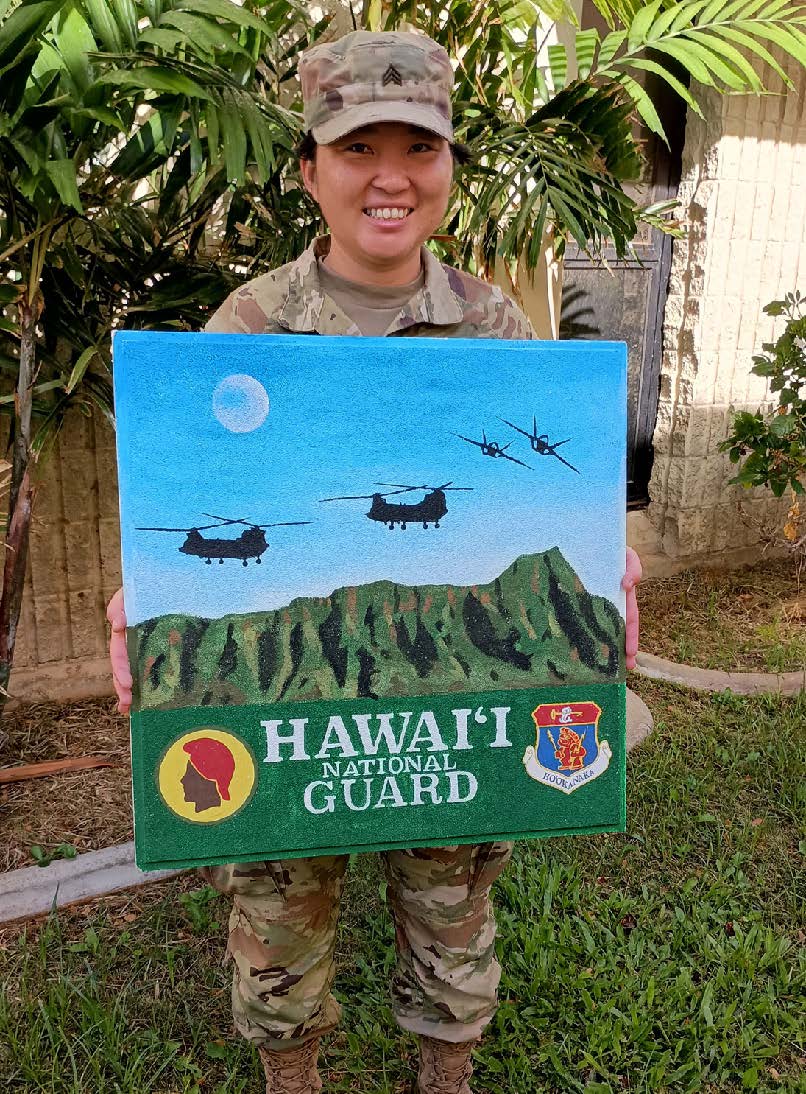
The Royal Guard jacket and helmet made it to Virginia and will proudly be displayed in the new heritage room. The ceiling in that heritage room will also have a “touch of the 54.” Each state and territory was asked to paint a 2’ x 2’ ceiling tile intended as a way for each of the 54 to express their individual identity.
The HING sifted through recommended designs and then selected a winner. It had to be a design that could be hand painted but still truly represent both the Hawaiʻi Air and Army National Guards. The final design includes the nighttime view of Diamond Head crater with a full moon in the sky. The sky also has two HIARNG CH-47 Chinooks and two HIANG F-22 Raptors. The patches from the HIARNG and HIANG are also on the tile with “Hawaiʻi National Guard” painted boldly in white. Sgt. Lianne Hirano, 117th Mobile Public Affairs Detachment, was the artist who put paint to tile. The original design was one of many submitted by Master Sgt. Andrew Jackson, Headquarters HIANG, and also works full-time in the State Public Affairs Office.
Brig. Gen. Kristof Sills, Commander 154 Wing, performs a ceremonial inspection of Royal Guard Members: Kāpena Moku, Thomas Mahi, He Kakiana, Jarrett Stone, Kakiana Maka‘ī‘ō, Roberts, Koa John De La Cruz during the King Kalākaua Birthday Celebration (188th Birthday) and annual Royal Guard Inspection at ‘Iolani Palace on Nov. 16.Brig. Gen. Kristof Sills, Commander 154 Wing, performs a ceremonial inspection of Royal Guard Members: Kāpena Moku, Thomas Mahi, He Kakiana, Jarrett Stone, Kakiana Maka‘ī‘ō, Roberts, Koa John De La Cruz during the King Kalākaua Birthday Celebration (188th Birthday) and annual Royal Guard Inspection at ‘Iolani Palace on Nov. 16.Brig. Gen. Kristof Sills, Commander 154 Wing, performs a ceremonial inspection of Royal Guard Members: Kāpena Moku, Thomas Mahi, He Kakiana, Jarrett Stone, Kakiana Maka‘ī‘ō, Roberts, Koa John De La Cruz during the King Kalākaua Birthday Celebration (188th Birthday) and annual Royal Guard Inspection at ‘Iolani Palace on Nov. 16.Kāpena Moku Thomas Mahi (present), Kāpena Moku Randy Lum (former), Paula Akana (Executive Director, ‘Iolani Palace) and Kāpena Moku, Darrell Bactad (former). Kāpena Moku Randy Lum was one of the original Royal Guardsman who was part of the re-creation of the Royal Guard on Nov 16, 1963.(Pictures from the 2024 Summer Pūpūkahi)Governor’s Memorial Day Ceremony (Picture from the 2025 Pūpūkahi | Volume 55 | No. 3)