Do you need help in another language? We will get you a free interpreter. Call 808-369-3580 to tell us which language you speak.
您需要其它語言嗎?如有需要,請致電 (808-369-3478), 我們會提供免費翻譯服務
您需要其它语言吗?如有需要,请致电 (808-369-3478), 我们会提供免费翻译服务
En mi niit alilis lon pwal eu kapas? Sipwe angei emon chon chiaku ngonuk ese kamo. Kokori (808-369-3478) omw kopwe ureni kich meni kapas ka ani.
Makemake `oe i kokua i pili kekahi `olelo o na `aina `e? Makemake la maua i ki`i `oe mea unuhi manuahi. E kelepona (808-369-3478)`oe ia la kaua a e ha`ina `oe ia la maua mea `olelo o na `aina `e.
Masapulyo kadi ti tulong iti sabali a pagsasao? Ikkandakayo iti libre nga paraipatarus. Awaganyo ti
(808-369-3478) tapno ibagayo kadakami no ania ti pagsasao nga ar-aramatenyo.
다른언어로 도움이 필요하십니까? 저희가 무료로 통역을 제공합니다. (808-369-3478)로 전화해서 사용하는 언어를 알려주십시요
Kwoj aikuij ke jiban kin juon bar kajin? Kim naj lewaj juon am dri ukok eo ejjelok wonen. Kirtok
(808-369-3478) im kwalok non kim kajin ta eo kwo melele im kenono kake.
E te mana'o mia se fesosoani i se isi gagana? Matou te fesosoani e ave atu fua se faaliliu upu mo oe. Vili mai i le numera lea (808-369-3478) pea e mana'o mia se fesosoani mo se faaliliu upu.
¿Necesita ayuda en otro idioma? Nosotros le ayudaremos a conseguir un intérprete gratuito. Llame al (808-369-3478) y diganos que idioma habla.
Kailangan ba ninyo ng tulong sa ibang lengguwahe? Ikukuha namin kayo ng libreng tagasalin. Tumawag sa (808-369-3478) para sabihin kung anong lengguwahe ang nais ninyong gamitin.
‘Okú ke fie maʻu tokoni ʻi ha lea fakafonua ʻe taha? Temau kumi haʻo taha fakatonulea taʻetotongi. Telefoni ki he (808-369-3478) ke fakahā mai ʻa e lea fakafonua ʻokú ke lea aí.
Bạn có cần giúp đỡ bằng ngôn ngữ khác không ? Chúng tôi se yêu cầu một người thông dịch viên miễn phí cho bạn. Gọi (808-369-3478)nói cho chúng tôi biết bạn dùng ngôn ngữ nào
Gakinahanglan ka ba ug tabang sa imong pinulongan? Amo kang mahatagan ug libre nga maghuhubad. Tawag sa (808-369-3478) aron magpahibalo kung unsa ang imong sinulti-han.
199th Weather Flight (Forecasting and Observing) (July 1, 1955 – Aug. 10, 1958)
199th Forecasting Flight (May 1, 1953 – July 1, 1955)
199th Weather Station (Type A) (Nov. 4, 1946 – May 1, 1953)
The 199th Combat Weather Flight traces its origins to the reestablishment of the Hawaiʻi National Guard following World War II. On Sept. 10, 1946, the unit was organized as the 199th Weather Station (Type A), receiving federal recognition on Nov. 4, 1946, establishing the weather unit as one of the charter organizations of the Hawaiʻi Air National Guard.
As military aviation requirements evolved, the unit underwent several redesignations reflecting its expanding capabilities. It became the 199th Forecasting Flight on May 1, 1953, and the 199th Weather Flight (Forecasting) on July 1, 1955. By Aug. 10, 1958, it was designated the 199th Weather Flight (Forecasting and Observing). Through specialized training with active-duty Air Force weather stations and the U.S. Weather Bureau, the unit improved its forecasting skills and earned recognition in 1963 as one of the nation’s best-qualified Air National Guard weather flights.
In 1964, the unit became the 199th Weather Flight (Mobile), transitioning toward providing weather services in deployed environments. Its designation changed again in 1965 to the 199th Weather Flight (Mobile/Fixed), reflecting its ability to support both established installations and field operations. The flight developed mobile weather-observation capabilities, used satellite imagery to improve forecasting and supported exercises throughout Hawaiʻi.
A major mission change occurred in 1987, when the flight shifted from primarily supporting base operations to providing tactical weather services to the Hawaiʻi Army National Guard’s 29th Infantry Brigade (Separate). This transition required Airmen to operate portable meteorological equipment and communications systems in austere field environments.
Throughout the 1990s, the unit participated in major exercises, including Team Spirit in Korea, Keen Edge in Japan and training at the Joint Readiness Training Center at Fort Polk, La. These exercises strengthened the flight’s ability to support joint and combined forces under demanding conditions.
During the 2000s, the flight expanded its support to additional Army and Air National Guard organizations, active-duty Air Force units and U.S. Army Pacific. When the 25th Infantry Division (Light) deployed to Iraq, flight personnel helped alleviate staffing shortages at Wheeler Army Airfield’s weather station, performing more than 80 percent of its daily forecasting and basic weather-watch duties.
By 2020, the flight provided weather observations, forecasts and climatological reports to organizations including the 29th Infantry Brigade Combat Team, the 34th Infantry Division, the 199th Fighter Squadron and Joint Force Headquarters. During fiscal year 2025 the unit became the 199th Combat Weather Flight.
Last updated October 2026
199th Combat Weather Flight Chronological History
The 199th Weather Station also conducted 48 armory drills during the year with attendance averaging I officer and 4 airmen.
The 199th Weather Station was rated “Unsatisfac tory” due primarily to an inadequate training program and inadequate equipment. Necessary steps were initiated subsequent to the inspection to correct the deficiences noted.
The 199th Weather Station was reorganized and redesignated as the 199th Forecasting Flight on 1 May 1953. The mission of the unit remained the same, to provide weather support for the 199th Fighter Interceptor Squaciron.
199th Weather Flight (Forecasting) take notice – Captain Pearson will be back in October from his sojourn on Wake Island. We still remember him at a Wheeler AFB summer encampment rushing out of the weather station and motioning the rain clouds back to the mountains.
In spite of the desires and efforts of our Weather Flight, passing rain showers obscured Kaneohe MCAS at times and occasional returning flights were diverted to land at Hickam AFB. This necessitated the cancelling of the next flying period of these aircraft.
Effective 10 August 1958, the 199th Weather Flight was reorganized with a resultant strength of three officers and 1:3 airmen; however, effective 20 May 1959, this unit was further reorganized with a resultant strength of four officers and 12 airmen.
Weather: Fiscal year 1959 was the most successful year of the Weather Flight since its organization primarily due to the assignment of qualified weather officers, enablillg the unit to achieve a 100% of authorized strength, officers and airmen. The weather flight is the only reserve unit of any of the services in the Hawaiian Islands whose mission is solely meteorology. This unit with no full time personnel, demonstrated that a reserve unit can provide significant support to the fighter squadron and any other related units as directed within the time limits ordinarily specified. The UI!it was effectively supported by Detachment 4, 1st Weather Wing and Headquarters 1st Weather Wing throughout the period.
Mobilization Assignment: The National Guard Bureau (NGB) announced mobilization assignments of the 199tb Fighter Interceptor Squadron, 199th Support Squadron, 109th and 169th Aircraft Control and Warning Squadrons to Paeific Air Forces and of the 199th Weather Flight (Forecasting and Observiug) to Military Air Transport Service, remained unchanged.
Weather: The support received from Headquarters 1st Weather Wing and Detachment 4, lst Weather Wing, continued unchanged and was of the highest caliber. The Weather Flight with no full time personnel continued to demonstrate that a reserve unit can provide significant weather support to the fighter squadron and any other related units as direeted, and memhers of this unit could replace or supplement the assigned staff of Detachment 4, 1st Weather Wing, upon very short notice if requested. The overall performance of the flight during field training was superior and highly successful.
Getting ready to track the pibal with the theodolite is A2C Daniel Char. Steadying the instrument is SSGT Harvey Hastrup, while A3c James Smith is set to release the balloon. (Photo by Gabe)(Pictures from the 1960 June The Hawaii Guardsman)
“I got so interested in weather during my assignment with the Guard that I decided to major in meteorology at the University of Hawaii, going to night school,” said SSgt. Kenneth Okinishi. Ken has been with the 199th Weather Flight (Forecasting and Observing) for over six years, where he is the NCOIC of the section. He works full-time at the Bureau of Conveyances.
Harvey was in the Supply Section when he first joined the Squadron. “After I read a book on weather, I decided to join the section. Best decision I ever made,” claimed SSgt. Harvey Hastrup, an observer with the flight. “Fact is, I liked it so much I quit my job and have applied for a job with the Weather Bureau.”
A/2C Kenneth Char is another member of the section. “I liked what weather had to offer, so I changed my mind about engineering and shifted to meteorology at the University of Hawaii.”
Capt. James Forsyth is certainly not one to be outdone. Jim flies in his single-engine plane from Hilo to make the weekend drills.
This is typical of the men in the Weather Flight. They are part of a team of 11 airmen and four officers who provide observational and forecasting service to the 199th Fighter Squadron. They can also support certain USAF, Army, or civilian agencies and are capable of operating as an integral part of the Air Weather Service. In the event of mobilization, the section would be assigned to the Hickam Weather Station. Thus, it would not solely be supporting the Air Guard, but the USAF as well.
Life in this section is not easy. They don’t have time to take it easy with three teletypes hammering out weather data constantly. The data is transmitted either in English or code. If the data is in code, it is decoded, then plotted on maps, analyzed, and a forecast is made, which is good up to 24 hours. Although forecasts are concentrated in the Pacific area, the station is capable of receiving worldwide weather information.
“The plotting serves as practice for the weather observers and gives them familiarity with the weather codes,” said 1st Lt. Guernsey Curran, forecaster with the section. Curran is an ex-USAF weather officer and is a securities analyst in civilian life.
Besides plotting, the station also sends pibals (pilot balloons) aloft. These rubber balloons are inflated with helium. When released, they are tracked by a theodolite, an instrument similar to an engineer’s transit. Pibals determine wind direction and speed. They are tracked for as long as they are visible on the theodolite, which is usually about five minutes in the Islands because of the cloud formations. They rise to heights up to 20,000 feet and burst when their limits are reached.
Surface observations are taken hourly to determine ceiling, altimeter setting for pilots, cloud types, or obstructions to vision. They may take local and special observations if there are significant changes in the weather.
The amount of rainfall is measured every six hours with a rain gauge, a cylindrical metal container about two feet in height. This is primarily for climatological records.
Air Guard fighter pilots are briefed by weather officers each drill morning on clouds, winds aloft, forecasts for Hickam and other bases, and other weather information.
The section was organized as a five-man station in 1947 under Capt. Sam Stidd. Two other commanders have followed him: Capt. Ed Banken and the present commander, Allen Pearson. According to Capt. Pearson, the flight was rated fourth among more than 30 other ANG Weather Flights throughout the nation in an Operational Readiness Report as of December 1959. Pearson anticipates moving up to a higher position. He is a forecaster with the Weather Bureau.
With such outstanding esprit de corps shown by the men in the Weather Flight, the Hawaii Air National Guard is assured of a capable partner in the air defense of the Islands.
The 199th Weather Flight (Forecasting and Observing) is stationed at Hickam AFB, Oahu, and has the mission of providing weather forecasting and observing services as required.
The year 1962 found the 199th Weather Flight at an all time high in operational readiness, training and manning. Cross training programs were conducted with Air Force weather stations at Hickam and Kunia. Especially successful, and a new innovation in Air National Guard training, was On-the-Job Training at the U.S. Weather Bureau High Altitude Forecast Center at Honolulu. This allowed officers and airmen to work under realistic conditions, latest equipment and techniques.
All officers of the Weather Flight are undertaking Extension Courses or graduate training at the University of Hawaii.
SSgt Kenneth M. OkinishL 199th Weather Flight, was awarded the Outstanding HANG Airman Award for his demonstration of outstanding ability and leadership.
The 199th Weather Flight (F&O) participated in inactive-duty training (week-end drills) as scheduled with the 154th Fighter Group (AD) and other HANG units. Intensive meteorological training was accomplished by both forecasters and observers in accordance with requirements. P ilots of the 199th Fighter Interceptor Squadron were regularly given weather briefings before flight operations. General Military Training was planned and conducted by officers of the Weather Flight as scheduled.
Twelve days Year Round Field Training was conducted from 15 June to 26 ] une. Seven days of this period were spent in intensive day and night weather station operation, including observing, plotting, forecasting and weather briefing. During the remaining 5 days, emphasis was placed on group and individual technical training, plus administrative and preventive maintenance details. Three days of Year Round Field Training were accomplished during the remainder of the year at the convenience of the individual, at the Air National Guard Weather Station (Hickam) , the Hickam Weather Station (Base Operations), at the U. S. Weather Bureau, or at Detachment 3, 1st Weather Wing (Kunia ) .
Inspections of the 199th Weather Flight by the 1st Weather Wing rated it among the best qualified Air National Guard Weather Flights in the United States.
The 199th Weather Flight (Mobile 1 participated in inactive-duty training (weekend drills) as scheduled with the 154th Fighter Group (AD) and other HANG units. Intensive meteorolog ical training was accomplished by both forecasters and observers in accordance with requirements. Pilots of the 199th Fighter Interceptor Squadron were regularly given weather briefings before flight operations.
Nine days of Year Round Field Training was cond ucted 13 June 1964 through 21 June 1964. Four of these days were spent in intensive day and night weather station operations, including observing, plotting, forecasting and weather briefing. During the remaining five days, emphasis was on group and individual training, plus administrative and preventive maintenance details. Also, a two day fi eld trip was made to Kauai for technical training in radiosond e operation at the Lihue Weather Bureau Station and orientation visits to the Kokee Radar Site and Bonham Field. Six days of Year Round Field Training was accomplished during the remainder of the year at the convenience of the individual, at the ANG Weather Station (Hickam I, the Hickam Weather Station (Base Operations I , the U.S. Weather Bureau, or at Detachment 3, 1st Weather Wing (Kunia).
A3C Alvin Kutara joined the unit from Weather School where he was an honor graduate. A2C Albert Higashi passed the five level SKT with 75 percentile. This grade is equal to that of top active duty weatherman.
The Weather Flight has openings for enlisted forecasters and weather observers. Experience is desirable but not necessary
The 199th Wea Flt (M) continued their meteorological mission training of day and night weather ohserving, forecasting, plotting and analysis of weather charts, etc. Weather briefings and general lectures on weather were given to the pilots of the 154th Ftr Gp (AD) .
The Flight was again given the highest rating in a comprehensive formal inspection conducted by the Air Weather Service April 1965.
New Weather Officer, the same joh he heltl when on active duty with the Air Force from 1960 to 1963 is First Lieutenant Christopher Jay. Lt Jay graduated from lolani (’55) and the University of Hawaii (’64) and is now in civilian personnel work at Fort Shafter. He is assigned to the 199th Weather Flight (Mobile/ Fixed).
The 199th Weather Flight (M/F) trained as scheduled with the 154th Fighter Group and other HANG units. Intensive meteorological training was accomplished by both forecasters and observers in accordance with Air Weather Service and local requirements. Pilots of the 199th Fighter Interceptor Squadron were given group weather briefings before flight operations. Most General Military Training (GMT) requirements were accomplished in conjunction with the 154th Fighter Group; however, additional GMT requirements were conducted by the Weather Flight during monthly Commander’s Call.
The National Guard Bureau recently made it mandatory that all ANG weather observers, immediately upon completion of service school course ABR 25231, be required to spend 30 days of active-duty training at one of the regular Air Weather Service detachments. Two 199th Weather Flight weather observers recently completed this training at Wheeler AFB, Oʻahu. This training was to enable our weather observers to become completely familiar with the many different types of weather equipment and procedures used by regular weather observer personnel.
The Weather Flight was inspected twice during the past six months. A comprehensive formal inspection was conducted during April 1966 by a representative of the Air Weather Service Inspector General’s Office and by representatives of the PACAF inspection team during the summer field training period. No major discrepancies were noted during either inspection.
The Weather Flight has significantly increased the number of its weather-observing personnel during the past year. Two recently graduated from the weather technical school, and three are presently in technical school. As of July 1, 1966, the manning of the Weather Flight was five forecasters, ten observers, and one clerk, with an overall percentage of 94.1% of authorized strength.
The Hawaii Air National Guard ‘Twenty Years Young’
HANG History
On 4 November last, the Hawaii Air National Guard became 20 years old, reflecting an interesting and varied historical background.
The post World War II organization of the HANG actually began on 10 September 1946 with temporary station at the old Honolulu Armory in downtown Honolulu. At that time, four air units were formed: The 199th Fighter Squadron, the 199th Utility Flight, the 199th Weather Station and Detachment “C” of the 199th Air Service Group.
. . .
Within two months of the initial HANG formation at Honolulu Armory, sufficient personnel had been recruited to meet minimum requirement for federal recognition. Seventy-four officers and airmen were in ranks 4 November 1946 at the Armory when the HANG units were inspected by members of the Hickam based 7th Air Force.
The 199th Weather Flight participated in inactive duty training (weekend drills) as scheduled with the 154th Fighter Group and other HANG units. Intensive meteorological training was accomplished by both forecasters and observers in accordance with A WS and local requirements. Pilots of the 199th FIS were given group weather briefings before flight operations. Most General Military Training (GMT) requirements were accomplished in conjunction with the 154th Fighter Group; however, additional GMT requirements were conducted by the Weather Flight during monthly Commander’s Call.
Annual field training was conducted in rwo sessions, 27 March-1 April 1967 and 5-10 June 1967. The 199th Weather Flight provided. observing, forecasting and briefing support to the 199th FIS. Weather suppOrt was provided at Hickam and Dillingham throughout the training period and at Bonham during a special exercise 6 June 1967. Observers maintained continuous weather watches at the sites, routine analysis and forecasts were prepared every six hours, and briefings were provided as required.
The 199th Weather Flight was inspected twice during the fiscal year. A comprehensive formal inspection was conducted during April 1967 by a representative of the Air Weather Service Inspector General’s office and by representatives of the PACAF Inspection Team during May 1967. During both inspections, the Weather Flight was rated as satisfactory. In addition, the Weather Flight was officially visited by personnel of the 1st W eather Wing Advisory Unit at Hickam AFB during March 1967 and was commended for its outstanding suppOrt.
The School Branch, NGB, recommended that all ANG Weather Observers immediately upon completion of course ABR 25231 be required to spend 30 days of active duty training at one of the regular Air Weather Service detachments. Two 199th Weather Flight weather observers completed this training at the base weather station, Wheeler AFB, Hawaii, and four at Mather AFB, California. This training was to enable our weather observers to become completely familiar with the many different types of weather equipment and procedures used by regular weather observer personnel.
The Weather Flight Commander and Air Force Advisor attended the ANG Weather Flight Commander’s Conference at Orlando AFB, Florida, and a five day orientation tour at Kunia Forecast Center. In addition, two of our personnel have completed the course ARR 75100, Technical Instructor course on the mainland.
The 199th Weather Flight performed unit trammg assemblies (one weekend per month) at the ATG Weather Station in the HANG facility at Hickam FB and at the mobile weather sites located at Dillingham and Bonham. Meteorological training requirements established by the Military Airlift Command and Air Wea ther Service for forecaster and observer personnel were accomplished. General Military Training requirements were met through participation in the 154th Fighter Group GMT program and supplemented by the Weather Flight’s own program to meet specific needs established by the gaining command.
Annual field training was accomplished by the Weather Flight at McClellan AFB, California during the period 9 June 1968 through 23 June 1968. This is the first time that the Weather Flight has ever trained outside of Hawaii since it received Federal Recognition in 1946. The unit was exposed to modern techniques and equipmentnt during this tra ining period which proved to be very beneficial to all personnel.
The Inspector General’s office of the Air Weather Service conducted an annual readiness inspection of the 199th Weather Flight in April 1968. The unit received a satisfac tory rating and was commended for its most outstanding O] T program. Nine personnel of the unit wele in upgrade training during FY68. All nine of them successfully completed their training, six of them achieved the maximum score of 95 percentile on their skill knowledge examinations and one achieved a score of 85 percentile. Test results of the other tra inees were 65 and 50 percentile Which are highly respectable scores. In other training areas, the 199th Weather Flight had two of its members graduate from the Weather Observer Course ABR 25231 at Chanute AFB, Illinois, during the year. One member of the unit is presently attending the technical course at Chanute.
During FY69, the operational readiness capability of the 199th Wea Fit decreased slightly from the previous fiscal year due to the loss of three highly skilled non-commissioned officers by expiration of their enlistments. These men were replaced by basic military recruits. 2Lt Kenneth M. Okinishi was commissioned an officer weather forecaster in the unit on 9 August 1968. Lt Okinishi had completed 15 years service in the unit as an enlisted weather observer and forecaster prior to his commissioned date. There were no other major personnel changes in the unit during this reporting period.
The 199th Wea Fit performed their UTAs, one weekend per month, at the Air National Guard Weather Station in the HANG facilities at Hickam AFB. During air defense exercises and annual field training, mobile weather teams and equipment were deployed to Dillingham AFB, Oahu and Barking Sands PMRF, KauaL Weather observing, analysis. and forecasting were performed by the unit. Weather briefings and meteorological surveillance were conducted in support of flying operations by pilots of the 154th Ftr Gp and the 199th FI Sq. Meteorological training requirements, established by Air Weather Service, were accomplished in order to meet our mobilization readiness capability.
During this fiscal year, the Inspector General of USAF’s Air Weather Service conducted an annual inspection of the 199th Wea Fit. The unit was rated as satisfactory without any major findings during the inspection. Also during this fiscal year, the 199th Wea Fit was presented the National Guard Bureau Outstanding OJT Achievement Award.
The flight performed their unit training assemblies, one weekend per month, at the ANG Weather Station in the HANG facilities at Hickam AFB. During air defense exercises and annual field training, mobile weather te ams and equipment were deployed to Dillingham AFB, Oahu and Barking Sands PMRF, Kauai. Weather observing, analysis, and forecasting were performed by the unit. Weather briefings and meteorological surveillances were conducted in support of flying operations by pilots of the 154th Fighter Group and the 199th Fighter-Interceptor Squadron. Meteorological training requirements, established by Air Weather Service, were accomplished in order to meet our mobilization readiness capability.
General Military Training requirements were met through participation in the 154 Fighter Group’s program and supplemented by our own program to meet specific requirements established by the gaining air command. Meteorologic al classroom instruction was provided to pilots as a refresher course twice during the fiscal year.
During annual field training, both forecaster and observer personnel were assigned to the USAF weather station at Hickam to train with an active-duty weather detachment and provide centralized forecasting services to th e forward operating bases as well as the HANG weather station.
During this fiscal year, the Inspector General of USAF’s Air Weather Service conducted an annual inspection of the flight. The unit was rated as satisfactory and was cited with a commend able finding. No major discrepancies were noted. Also during this fiscal year, the 199th Weather Flight was presented the Outstanding Air National Guard Weather Unit Award.
The 199th Weather Flight maintained a fully effective rating as measured by Air Wea ther Service’s standards during FY 71. Unit training assemblies a nd the annual field training were conducted at the HANG Weather Station at Hickam AFB. in support of the 154th Fighter Group . Deployment of weather teams during periods of air defense exercises was made to Dillingham AFB, Oahu and Barking Sands, K aua i.
The weather flight performed surface observations, winds aloft obse rvations (PIBAL ), weather map plotting and analyses, terminal forecasting and group stand-up briefings.
A representa tive observation site (ROS) was established during the fis cal year in the HANG staging area using the flight’s meteo rological van. The ROS observer relayed the surface observa tions to the HANG Weather Station using a field phone. Simulated long line transmission of these observations was then performed by the in-station observer. The ROS function fulfills an Air Weather Service requirement for continuous weather watch during all fl ying ac tivi ties.
The PIBAL program was also implemented during the past fiscal year. The men became highly proficient in taking winds aloft measurements in support of flying operations. The increased use of weather satellite pictures was greatly expanded and improved the weather support to the fighter group. Meteorological classroom instruction was prov ided twice to the fighter pilots of the 199th Fighter Intercept Squadron during the past fiscal year.
The annual Air Weather Service Inspector General inspection was conducted during April 1971 at the HANG Weather Station. For the third consecutive year, the weather flight had no major deficiencies. The unit was rated as satisfactory and operationally ready to accomplish its mission.
The Hawaii National Guard was re-established following the end of World War II by Governor Ingram M. Stainback’s Executive Order of 3 August 1946. The Governor formally accepted National Guard troop units and strength the following day as recommended by the new Adjutant General, Brigadier General Fred W. Makinney. Among these were four Army Air Force units with an aggregate authorized strength of 353 personnel: I 99th Fighter Squadron (SE); 199th Utility Flight; Detachment C, 199th Air Service Group (Ftr); and the 199th Weather Station (Type A).
These Army Air Force units, new to the Hawaii National Guard, were organized 10 September 1946 by Military Department, Territory of Hawaii, General Order No. 4, with temporary station at the Honolulu Armory.
. . .
By the end of October sufficient personnel had been recruited to meet the minimum requirements for federal recognition. Seventy-four personnel were on the rolls and in the ranks when the units were inspected at 1930 hours, 4 November 1946, by an Army Air Force Inspection Team from Hickam Field. Captain Valentine A. Siefermann, then on active duty awaiting separation, was also present.
. . .
199th Weather Station (Type A). Capt Robert M. Walck (C.O.). Pvts: Walter K.Y. Chun, Jesus 0. Rendon, and Robert K. Yogi.
All HANG units received “Satisfactory” on their Annual General Inspections except for the 199th Weather Station, which was deemed “Unsatisfactory”. This was due to “inadequate personnel and equipment” -no weather officers were assigned, and none could be recruited
The 199th Weather Station was reorganized and redesignated the 199th Forecasting Flight 1 May 1953. Capt Allen D. Pearson joined the HANG and proved to be a most vigorous weather commander. He became known as “Big Stormy”
The inactive duty training schedule was changed from two Sundays a month to one weekend a month. This allowed more continuity of training efforts. The 169th began in July; Hq HANG, 199th and the weather flight in October; and the 109th in November.
Capt James A. Forsyth of the weather flight had his civilian job transferred to Hilo, Hawaii in September 1961. He began commuting to Oahu for drills, most of the time flying a small plane himself. This certainly established a HANG record of initiative to maintain perfect attendance.
Not much has been said about the 199th Weather Flight. T hroughout the years since 4 November 1946 the Flight steadily maintained their excellence and mission accomplishment capability. It was named the Outstanding Air National Guard Weather Flight for 1969
199th Weather Flight: The 199th Weather Flight maintained a fully effective rating by Air Weather Service standards during FY 72. Unit training assemblies and year-round field training were performed at the HANG weather station at Hickam AFB. The Flight provided weather support to the 154 th Fighter Group. Deployments of weather observers were made to Dillingham AFB, Oahu, and Barking Sands, Kauai, during periods of air defense exercises and the annual operational readiness inspection.
The Weather Flight performed surface observations, winds aloft observations, weather map plotting and analysis, terminal forecasting, group stand-up briefings and area and terminal metwatching. The Commander performed duties as staff weather officer to the 154th Fighter Group. The representative observation site, established last fiscal year using the flight’s meteorological van, is performing well because of the capable guidance of the unit’s full-time Air Force weather air technica l advisor (WATA), Master Sergeant Maurice E. Swigert.
The men are proficient in pilot balloon (PIBAL) soundings and can take winds aloft measurements at any bare base with minimum preparation. Continued use of weather satellite cloud pictures from satellites ESSA 8 and 9 has enhanced support to the 154th Fighter Group.
General military training requirements were accomplished through participation in the 154th Fighter Group’s program and the Weather Flig ht’s own program. The civil disturbance training requirement was met through participation in th e 154th Fighter Group program.
The annual Air Weather Service Inspector General inspection was conducted during May 1972 at the HANG weather station. For the fOllrth consecutive year, the ‘Weather Flight had no major defi ciencies. The unitwas rated as satisfactory and operationally ready to accomplish its entire mission . For the first time in many years, the Wea ther Flight participated in the HANG operational readiness in spection conducted by PACAF. The unit received an overall rating of satisfactory.
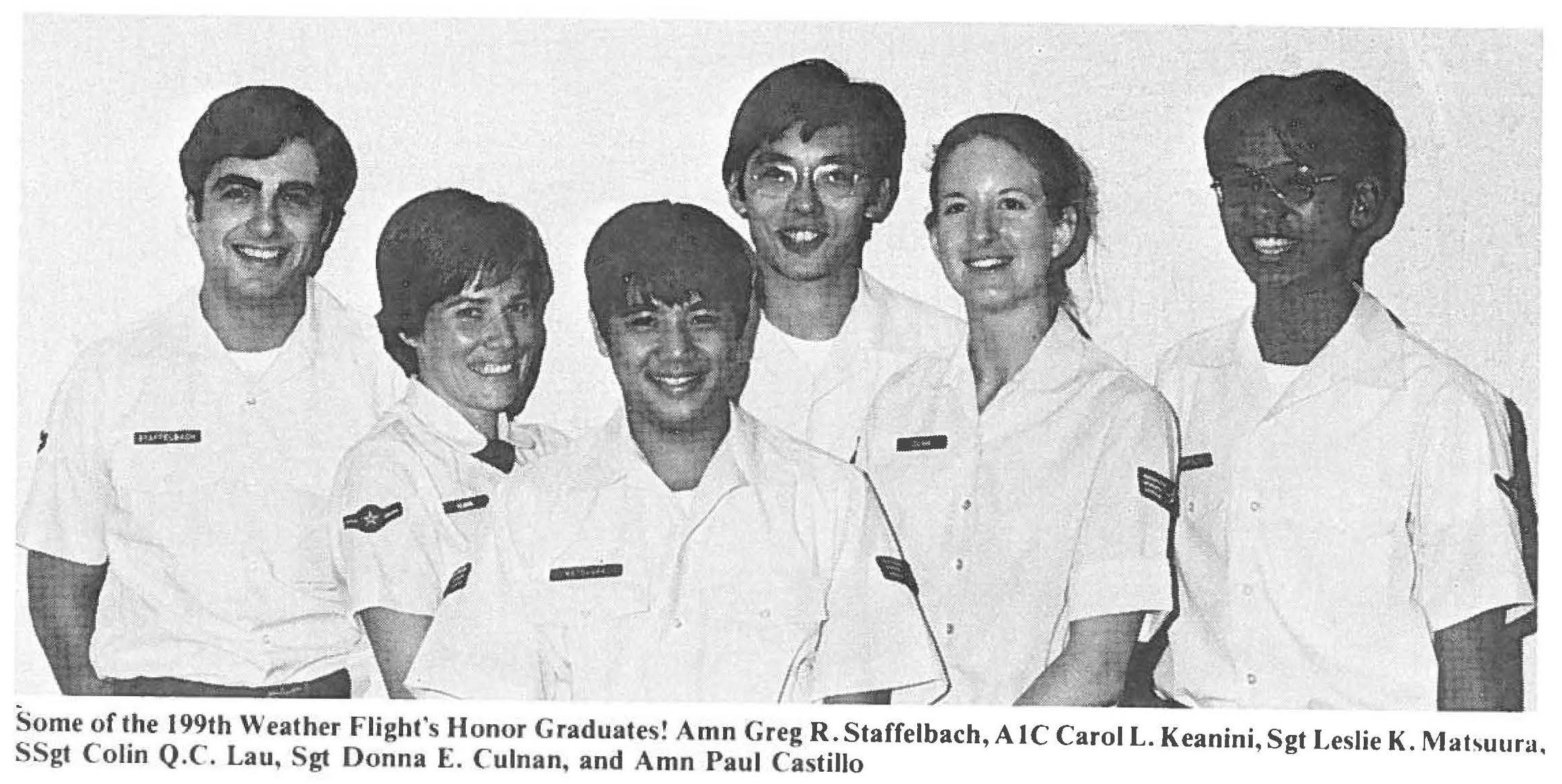
The Weather Flight had two distinguished honor graduates at technica l schools during the past fiscal year. Sergeant Colin Q.c. Lau topped his weather observer class at Chanute AFB, Illinois, and Airman First Class Leslie K. Matsuura topped his administrative specialist class at Keesler AFB, Mississippi .
Weather observations and pilot briefings at Barking Sands Pacific Missile Range Facility (PMRF) and Dillingham Air Force Base (AFB) were provided by weather specialists of the 199th Weather Flight.
The 199th Weather Flight maintained a fully effective rating by Air Weather Service standards during FY 73. Unit training assemblies and year-round field training were performed at the HANG weather station at Hickam AFB. The unit provided support to the 154th Fighter Interceptor Group. Deployments of weather observers were made to Dillingham AFB, Oahu, and Barking Sands, Kauai, during periods ofair defense exercises and the annual operational readiness inspection.
The Flight performed surface and winds-aloft observations, map plotting and analysis, terminal forecasting, group stand-up briefings and area and terminal metwatching. The commander performed duties as staff weather officer to the 154th Fighter Interceptor Group. The Flight’s mobile meteorological van was turned-in because of its poor maintainability and the improbability of its use in real emergencies. Existing tactical observing equipment allowed the Flight to maintain its observing program.
Weather observations were conducted at Barking Sands by the 199th Weather Flight. The unit also provided pilot weather briefings at Barking Sands and Hickam AFB.
The 199th Weather Flight maintained a fully effective rating during FY 1974. as measured by Air Weather Service standards. The annual Air Weather Service Inspector General Inspection was conducted during June 1974 at the HANG Weather Station. The unit was rated satisfactory and operationally ready to accomplish its mission.
Unit training assemblies and year-round field training were performed at the HANG Weather Station at Hickam ArB. The unit provided weather support to the 1S4th Fighter Group. Deployments 01 weather observcrs were made to Barking Sands. Kauai. during periods of air defense exercises and during the annual operational readiness inspection.
The Weather Flight performed surface and winds-aloft observations. map plotting and analysis. terminal forecasting. group stand-up briefings. and area and terminal met watching at Hickam ArB. The commander performed duties as staff weather officer lor the IS4th FIG. The Weather Flight also has a mobile mission. It can operate a weather station upon deployment to any bare base. Adeljuate observing and forecasting tactical equipment were available and ready for possible mobilization.
General military training requirements were accomplished through participation in the IS4th Fighter Group’s program and the Weather Flight’s own program. Civil disturbance training requirements were also met by participation in the IS4th Fighter Group’s program.
Airman Basic Donna Culnan was enlisted as the flight’s first WAF weather observer.
Besides conducting aircrew weather briefings at Barking Sands and Hickam, the 199th Weather Flight initiated a new training program in November 1974. The Flight spent portions of their UTA training with the 1st Weather Wing detachments at Hickam AFB and Wheeler AFB, thereby familiarizing themselves with the latest equipment and methods available in the Air Force.
The 199th Weather Flight (WF) is one of 39 weather flights throughout the country. Each weather flight is basically comprised of 17 members, including the commander, four weather forecasters, ten weather observers, one weather equipment repairman, and one administrative specialist. The mission of the 199th WF is to provide weather support to HANG and to train toward its wartime or mobilization mission.
For the first half of FY 75, unit training assemblies and year round training were performed at the HANG Weather Station at Hickam AFB, providing weather support to the 154th FIG/199th FIS. Deployments of weather observers were made to Barking Sands , Kauai, during periods of air defense exercises and the HANG operational readiness inspection.
Recently, to alleviate manpower shortages in the regular Air Force, Air Weather Service and National Guard Bureau have endorsed the Total Force Policy program, whereby weather flights would perform actual in-station duties at collocated active duty base weather stations . Since February 1975, the 199th WF has been participating in this program at Hickam and Wheeler Base Weather stations. Approximately 50 percent of the training has been performed at these stations. Station duties included surface and rawinsonde observations , chart plotting and analyses, facsimile chart reproduction, terminal forecasting, weather satellite cloud interpretation, aircrew briefings, and area and terminal met watching .
To maintain unit integrity, the entire unit assembled at the HANG Weather Station at least once per month. General Military Training, commander’s calls and other Guard related functions were performed during these periods.
During the fiscal year, the 199th WF had three airwomen observers on board. Airman Basic Carol Keanini was recently chosen as an honor grauduate from Basic Military Training at Lackland AFB, Texas, scoring in the top 10 percent of her graduating class. Airman 1 st Class Donna Culnan, the first airwoman to enlist in the 199th WF since its inception in 1946, was a recipient of the Hawaii Air National Guard Airman Award which is given twice yearly to outstanding Air Guardsmen. This is the second time within two years that a member of this unit has won the award. The unit gained a new full-time technical advisor, Master Sergeant William Cofield, and a new forecdster, Captain Ronald G. K. Wong. Capt. Wong is a recent transfer from the Iowa ANG, a Drake Law School graduate, was recently admitted to the Hawaii State Bar.
Effective Sept. 10, 1975, the 199th Weather Flight (WF) was reorganized, and its authorized strength decreased from 17 to 13 (4 officers and 9 airmen). There were no changes in mission, location, or gaining command.
The 199th WF is one of 39 weather fli ghts throughout the country, A major change in the unit manning was experienced during the fiscal year, All air support weath er flights were reduced from 17 members to 13 members with the loss of the weather equipment repairman and three weather observers, The 199th WF now includes the commander, four weather forecasters seven weather observers, and one administrative spe’cialist The missions of the 199th WF are to train toward its mobilization day mission and to provide weather support to HANG,
During the fiscal year, the WF performed training at Hickam and Wheeler Air Base Weather Stations under the total force policy. In order to alleviate manpower shortages in the USAF, Air Weather Service and NGB have endorsed the total force policy whereby weather flights would perform actual in-station duties at collocated acti ve duty base weather stations. App roximately 50 percent of the unit training has been performed at these stations, Station duties include surface and upper wind observations, chart plotting and analyses, facsimile chart reproduction, terminal forecasting , weather satellite cloud interpretation, aircrew briefings, and area and terminal meteorology watches.
During Aug, 1975, the 199th WF performed annual field training at Detachment 8, 15th Weath er Squadron, McClellan AFB, California. The flight members received valuable training experience in a totally new environment They became familiar with mid-latitude weather and continental U.S. weather stations. The flight was airlifted by the Wyoming ANG stationed at Cheyenne
Imagine an office full of people faster than “TheBus,” more powerful than a rubbish truck, and able to leap tall Quonset huts in single bounds.
Got the picture?
Well, maybe the 199th Weather Flight isn’t quite that fantastic, but they’re getting closer every day.
The 199th, already proud of its string of honor graduates from tech school, its outstanding airmen awards, and its involvement in Total Force Training, now adds another link to this brilliant chain.
Two members of this illustrious unit have recently received their undergraduate degrees from the University of Hawaii.
TSgt. Blaine K. Tsugawa, the unit’s chief observer, received concurrent bachelor’s degrees in biology and meteorology.
For two years, Tsugawa, a prior-service transfer via the Palace Chase Program, has been an employee of the National Oceanic and Atmospheric Administration. This month, he became an employee of the National Weather Service.
Tsugawa said he ultimately would like to pursue a master’s degree in business management.
Sgt. Leslie K. Matsuura, one of the lesser deities in the weather flight, also graduated recently with a bachelor’s degree in English.
He is presently the manager of the Control/Credit Office at Parkview GEM/Ala Moana. His plans call for a return to graduate school for advanced degrees in his major, and possibly obtaining a bachelor’s degree in biology to complement some work he is doing at the Waikiki Aquarium.
As the administrative specialist for the flight, Matsuura provides the major moving force in the office. Without his able guidance, nothing would ever be accomplished.
And so, the weather flight rolls on—and on—and on.
But don’t any of you other airmen out there despair. Just because you can’t do these things doesn’t mean you’re any less important—in the Hawaii Air National Guard, WE ALL BELONG… keep plugging, gang!!!
On Nov. 4, 1946, Federal recognition was granted to the units after a roll call showed 74 personnel present for duty.
Two of the units formed that day are still active – the 199th Fighter Squadron and the 199th Weather Station (now a weather flight). Two of the people present at the first roll call are still present for the rolls CMSgt Robert D. W. Choi, a charter member of HANG, and Maj. Gen. Valentine A. Siefermann, who was an active duty captain awaiting separation in order to join the Guard. . .
The 199th Weather Flight is one of HANG’s charter units. Founded in September 1946, its mission then, as now, was to provide weather forecasting and observing services to the pilots of HANG
The past five years have seen a major change in the operational style of the 199th. Like many of the Air National Guard units, the 199th benefited from the adoption of the Air Force’s Total Force Policy. The policy states that Guard units will be equipped and trained to meet a wartime commitment and be prepared to deploy anywhere in the world
To the 199th Weather Flight, it meant moving into base weather stations to work directly with the active duty forces during drills. The 199th is a small unit with a tradition of quietly getting the job done, and the changes of the past five years have been met with few problems or fanfare.
The history of the past five years for the 199th Weather Flight begins with the unit operating at the 154th Fighter Interceptor Group in what was designated a representative observation site. (ROS), using a meteorological mobile van. The ROS observer relayed the surface observations to the HANG Weather Station by means of a field phone . The ROS function fulfilled an Air Weather Service requirement for continuous weather watch during all flying activities.
A pilot balloon (PIBAL) program had also been established to measure the winds aloft in support of flying operations. The two programs gave the Weather Flight the capability of providing weather support to any flying unit at any bare base.
The 199th Weather Flight had two distinguished honor graduates of technical schools during the period. Sgt Colin Q. C. Lau topped his weather observer school, Chanute AFB, Illinois and A IC Leslie K. Matsuura lead his administrative specialist class at Keesler AFB, Mississippi.
The flight members were becoming proficient in PIBAL sounding and could take winds aloft measurements at any bare base with minimum preparation. Increased use of weather satellite cloud picture from ESSA 8 and 9 were utilized to enhance weather support to the 199th Fighter Interceptor Squadron.
In fiscal year 1973, the 199th Weather Flight “lost” its meteorological van, which was used as the ROS. The ROS was turned in because of its poor maintainability and the improbability of its use in an actual emergency.
The Weather Flight acquired two highly qualified weather observers from the Air Force under the Palace Chase program. SSgt. Blaine K. Tsugawa joined the unit from McClellan AFB, California, and A1C Ronald M. Sonoda, from Fairchild AFB, Washington. Both men were born in Hawaii, and this program allowed them to complete their military obligation in the Hawaii Air National Guard as “weekend warriors.” This also permitted them to enter the University of Hawaii under the Veteran G.I. Bill.
Fiscal year 1974 saw Airman Donna E. Culnan become the first WAF to join the 199th Weather Flight since its inception in 1946. She was also an honor graduate of the weather observer school at Chanute AFB, Illinois.
Sgt. Leslie K. Matsuura was the winner of the HANG Airman Award, given twice annually to the outstanding HANG airman.
Capt. Kenneth M. Okinishi was promoted to his present rank, having started in the Weather Flight 19 years previously (1955) as an airman basic.
In fiscal year 1975, the 199th Weather Flight began to perform their Sunday UTAs at Hickam and Wheeler Air Force Base weather stations under the Total Force Policy. As endorsed by the Air Weather Service and the National Guard Bureau, weather flights throughout the country began to perform actual in-station duties at co-located active-duty weather stations to fill projected wartime manpower shortages in the Air Force.
To maintain unit integrity, the entire unit assembled at the HANG Weather Station at least once a month. General military training, commander’s calls, and other Guard-related functions were performed during these periods.
During the fiscal year, Airman Carol L. Keanini was selected as an honor graduate from Basic Military Training at Lackland AFB, Texas, and the Weather Observer School at Chanute AFB, Illinois. A1C Donna E. Culnan was the recipient of the HANG Airman Award. The unit gained a new full-time MAC technician…
Advisor, MSgt. William Cofield, and a new forecaster, Capt. Ronald G. K. Wong. Capt. Wong was a recent transfer from the Iowa ANG and a Drake Law School graduate. He was recently admitted to the Hawaii State Bar.
The unit spent four days of annual training at the Kilauea Military Camp on the island of Hawaii. It rained the entire time they were there, from arrival to departure. One day, the Hawaii Volcano Observatory’s rain gauge had recorded 19 inches of rainfall in 24 hours. At that time, Hilo had experienced approximately 22 consecutive days of rain. Pretty good timing for the Weather Flight—a “non-prophet” organization.
The 199th Weather Flight began the 1976 fiscal year with annual training at McClellan AFB, California. The flight was airlifted on a C-130 of the Wyoming Air National Guard. Pineapples were brought for everyone and his brother. On the way back from the mainland, the flight members were given an added “thrill” due to engine trouble. It took the aircraft an additional two hours to arrive in Hawaii.
Airmen Greg R. Staffelbach and Paul Castillo both returned from Chanute AFB, Illinois, as honor graduates of the Weather Observer School, scoring above 90% in all their work. TSgt. Blaine Tsugawa, from the Palace Chase program, TSgt. Blaine Tsugawa graduated from the University of Hawaii with a BA in Zoology and a BS in Meteorology. Sgt. Gavin T. Yamada also received a BS in Tropical Agriculture from the University of Hawaii. Major Christopher W. K. Jay, a flight member for eight years, was “promoted” to the civilian personnel office of the Hawaii National Guard.
The 199th Weather Flight, at 30 years of age, still retains its tradition of unobtrusively carrying out its assigned mission. Weather is an ever-changing phenomenon, and pilots need to be able to foresee those changes with as much accuracy as can be achieved.
While the means of forecasting weather are becoming more readily available and satellite photography continues to improve the accuracy of locating trouble spots, the need for trained people remains constant.
The men and women of the 199th now work with their active-duty counterparts to obtain firsthand experience in current Air Force weather forecasting. Their mission remains the same: to provide weather forecasting and observation services to pilots and other Air Force personnel. The possible scope of their mission duty, however, is now the entire world.
The 199th Weather FIight (Wea Fit) is one of 39 weather flights in the Nation, each of which has 13 members. The 199th Wea Fit has maintained 110 per cent of its strength throughout FY 77. Its mission is to develop and maintain the capability to augment the Air Weather Service when mobilized and to provide weather support to the HANG.
During FY 77, the 199th Wea Fit performed training at Hickam and Wheeler AFB weather stations under the total force policy. Approximately 50 per cent of the unit training was performed at these stations, while the remainder of the time was spent at the HANG weather office. Station duties included surface and upper wind observations, chart plotting and analyses, facsim ile chart reproduction, terminal forecasting , weather sate llite cloud interpretation, aircrew briefings, and area and terminal meteorology watch. The 199th Wea Fit personnel also gained valuable experience working on the Continental Meteorological Data System (COMEDS). This system, installed at Hickam and Wheeler base weather stations in February 1977, greatly streamlined the amount of weather data available to weather stations. The COMEDS is widely used in the continental United States.
The 154th TFG’s monthly newsletter can be credited with the starting of a romance between two members of the Air Guard. Sgt. Donna E. Culnan, a weather specialist with the 199th WF, and SSgt. Gary K. L. Von, an aircraft mechanic with the 154th CAMRON, are the two members mentioned above.
In the November 1975 issue of KUKAILIMOKU, Donna was recognized with the HANG Airman Award. Also in that article, it was mentioned that tickets could be obtained through her for a musical. Gary called for tickets. Since then, Cupid has been doing his thing … on Valentine’s Day, 1976, they were engaged … then they finally tied the knot and were married on Dec. 26, 1976 … the happy ending for a new beginning.
Sgt. Gregg Staffelback cuts a weather map from the facsimile machine. (Picture from the 1978 Annual Report)
199TH WEATHER FLIGHT
The 199th Weathe r Flight is one of 39 weather flights in the Nation, each of which has an average of 13 members. The mission of the 199th Weather Flight is to develop and maintain the capability to augment the Air Weather Service when mobilized and to provide weather support to the Hawaii Air National Guard.
During the fiscal year, the 199th Weather Flight performed approximately 50 percent of its training at Hickam and Wheeler Air Force Bases’ weather stations. Station duties included surface and upper wind observations, chart plotting and analyses, facsimile chart reproduction, area and terminal meteorology watches, weather satellite interpretations, terminal fore asting and aircrew briefings. The remaining time was spent at the Hawaii Air National Guard ‘s weather office and on orientation visits to other operating meteorological facilities, such as the National Weather Service and the Pacific Missile Range, Barking Sands, Kauai.
The 199th Weather Flight has maintained 97 percent of its personnel strength throughout Fiscal Year 1978.
Major Christopher W. K. Jay succeeded Major Wyman W. M. Au as commander in February 1978.
Capt. Kenneth Okinishi of the 199th Weather Flight is another member of the Guard family who will be retiring. A member of the Hawaii Air National Guard for over 25 years, Okinishi was the first HANG forecaster to be fully certified at Hickam AFB, proficient in radar, forecasting, aviation briefings and weather warning criteria.
Both individuals will be greatly missed by the Guard. Aloha to you both!
Briefs Pilots and Crew: 199th WF Focuses on Weather
By Pfc. Tom Clements
117th Public Affairs Detachment
Sgt. Gregg Staffelback cuts weather map off facsimile machine. Photo by Pfc Tom Clements.(Picture from the 1978 December Pūpūkahi)
The eyes of the Hawaii Air National Guard’s 199th Weather Flight were on Hurricane Susan during their October drill at Hickam Air Force Base.
The 13-person Air Guard crew, commanded by Maj. Christopher Jay, works closely with the U.S. Air Force’s Detachment 4 of the 1st Weather Wing at Hickam AFB and Detachment 7 at Wheeler AFB.
The 199th members kept a close watch on the hurricane as it moved closer to the Hawaiian chain. They recorded its wind velocity, as well as the direction it moved, using sophisticated weather equipment from the 1st Weather Wing.
With information coming from the Air Force weather center in Texas and from the National Weather Service, the Air Guardsmen could see the path the hurricane had taken and the predicted path it might take.
The main job of the 199th Weather Flight is to provide weather briefings for the aircrews of the 199th Tactical Fighter Squadron. When weather has any serious impact on any Air Guard unit in the state, the 199th supplies needed information. They also brief regular Air Force aircrews.
Members of the 199th occasionally travel to Barking Sands, Kauai, for deployment exercises. They train at various locations on the Mainland about once every three years. But most of the time, they perform their duties alongside their active Air Force counterparts at either Hickam or Wheeler AFB as part of a Total Force training program.
In addition to an administrative section, the 199th Weather Flight is basically divided into two groups: observers and forecasters. The observers gather the information from the forecasting machines. The forecasters use this information to make their weather forecasts.
The observers record cloud types and height, wind direction and speed, temperature, humidity and barometric pressure for local weather forecasts.
The forecasters, when training at Wheeler, brief active Air Force crews that fly to the Mainland and various parts of the world. They also interpret satellite data covering the entire Pacific.
The members of the 199th also go through extensive training to become either observers or forecasters. They receive their training at Chanute AFB in Illinois. The observers then spend 30 days of temporary duty at an active-duty station for more training. The forecasters spend 45 days of temporary duty.
It’s not easy to make predictions, but with the keen knowledge of the 199th and the sophisticated equipment of the Air Force, we won’t have to depend on rheumatism. Just ask the 199th, “How’s the weather?”
Capt. Ronald Bound, 1st Weather Wing, Det. 4 commander, briefs Maj. Christopher Jay, 199th Weather Flight commander, on the morning’s weather condition. (Pictures from the 1979 Annual Report)
199TH WEATHER FLIGHT
The mission of the 199th Weather Flight is to develop and maintain the capability to augment the Air Weather Service when mobilized and to provide weather support to the Hawaii Air National Guard.
During Fiscal Year 1979, the 199th Weather Flight performed approximately 50 percent of its training at Hickam and Wheeler Air Force Base weather stations. The remainder of the time was spent at the Hawaii Air National Guard weather station and on orientation visits to other operating meteorological facilities, such as the Barbers Point Naval Air Weather Station, Palehua Solar Observatory and the Pacific Missile Range Facility, Barking Sands, Kauai.
In keeping with the Total Force Policy, the 199th Weather Flight took full charge of the Hickam Air Force Base weather station during May, 1979, as part of its annual field training. Also during this period, in addition to regular station duties, the flight assisted the Global Atmospheric Research Program, a data-gathering project focusing on the meteorology of tropical oceans.
During the year, the weather flight lost its Air Force Technical Advisor, Senior Master Sergeant William Cofield, Jr., who retired after 28 years of service, serving his last five years with the Hawaii Air National Guard.
The 199th Weather Flight had 14 personnel assigned, representing 107.6 percent of its authorized strength at end of FiscalYear 1979.
The 199th Weather Flight is the smallest unit in the Hawaii Air National Guard.
As of October 1, 1979, the mission of the Weather Flight was changed to include support of the flying and ground operations of the Army’s IX Corps, the 25th Infantry Division, and the Hawaii Army National Guard. The unit previously provided the weather support to the Air Force and the Hawaii Air National Guard only.
Capt. Ronald Bound, 1st Weather Wing, Det. 4 commander, briefs Maj. Christopher Jay, 199th Weather Flight commander on the morning’s weather condition. (Pictures from the 1980 February Pūpūkahi)
Imagine that there is a military convoy coming down the road somewhere out in the Schofield Barracks area. It looks like a typical Army convoy heading out to another field exercise, but there is something different about the uniform of the troops on one of the vehicles.
The fatigues are the same olive drab as all the rest are wearing, except chevrons on the sleeves are curving out of the blue circle containing a white star, and just above the left shirt pocket is a tag that reads U.S. Air Force.
If you’re wondering who they are and what they are doing, the answer is simple: they are the airmen of the 199th Weather Flight of the Hawaii Air National Guard on maneuvers. They are out in the field to provide weather support for the front-line units of the U.S. Army.
The mission of the 199th Weather Flight was officially changed from providing Air Force weather support to Army operations as of October 1, 1979. It is just one of 23 Air Guard weather flights that will be making the conversion.
The new mission is to provide weather support to the IX Corps and to augment Det. 7, 1st Weather Wing, in support of the 25th Inf. Div. In preparation for the realignment, unit members have been training at Wheeler AFB under the supervision of Detachment 7. The enlisted people have been instructed on map reading, camouflaging of vehicles, erecting tents, the setting up and operating of communication equipment, and other skills that are necessary for working in the field with Army units.
To get some firsthand experience in the field, the weather flight will be participating in the Army deployments TROPIC LIGHTNING and GOPHER BROKE at Schofield Barracks. In these field exercises, forward weather-observing teams will be deployed with front-line combat units. Their job is to observe weather conditions and transmit this information back to the staff weather officers at division and corps headquarters.
There, the overall climatology of the battlefield can be determined and Army operations planned accordingly.
In all, this is one of the most far-reaching changes that has happened to the 199th Weather Flight in quite some time. Though it might mean sleeping in the mud, eating out of tin cans and fighting the mosquitoes, the dedicated “weather-watchers” of the Air Guard will be out there supporting the Army, come rain or shine.
The 199th Weather Flight, the smallest unit in the Hawaii Air National Guard, has the unique mission of supporting active Army, Army Guard and Army Reserve forces in addition to the Air Force. Day-to-day affairs of the Flight are taken care of by an enlisted technical advisor from the Air Force’s Military Airlift Command. Lieutenant Colonel Christopher W. K. Jay commands the Weather Flight.
The Flight provides tactical in garrison and field support to Army flying and ground activities along with weather forecasting support to the Air Force and the Hawaii Air National Guard.
The 199th Weather Flight, the smallest unit in the Hawaii Air National Guard, provides meteorological support to the active duty, reserve and Guard components of the Army and Air Force. In addition, the meteorological information provided by the 199th Weather Flight is used in the worldwide network operated jointly by the Air Force Weather Service, the National Weather Service, and the World Meteorological Organization. The Flight relocated their facilities from Hickam Air Force Base to Wheeler Air Force Base during the fiscal year.
The 199th Weather Flight continued its proficiency training by providing technical meteorological support in addition to operating in an Army tactical environment. The tactical training involved learning to operate a variety of Army vehicles, convoy procedures, setting-up a field operations with camouflaging and site defense, etc.
The members of the 199th Weather Flight participated in field exercises conducted by the Army. The exercises gave practical training in providing meteorological information in a tactical environment, and overnight exercises to practice night procedures.
The Air National Guard’s 199th Weather Flight recently relocated to its new site at Wheeler Air Force Base after many years at Hickam. A significant mission change from Air Force to Army support and then to garrison support necessitated this move. Standing in front of their new home are 199th members (left to right): Amn. 1st Class Greg Arbues; Staff Sgt. Tom Ho; Lt. Col. Chris Jay, commander; Sgt. Jean Burrell; Senior Amn. Darryl Loo; Staff Sgt. Jim Shepherd; and Maj. Larry Kumata.(Picture from the 1982 Spring Pūpūkahi)
199th Weather Flight
The 199th Weather Flight, the smallest unit in the Hawaii Air National Guard, provides meteorological support to the active military, reserve and guard components of the Army and Air Force. Meteorological information produced by the 199th Weather Flight is fed into the worldwide meteorological network operated jointly by the Air Force’s Air Weather Service, National Weather Service, and World Meteorological Organization.
During the year, the Military Airlift Command rated the Weather Flight’s management “excellent.” The Weather Flight was presented with the Hawaii Air National Guard Outstanding Unit Award for its efficiency, effectiveness and productivity.
The 199th Weather Flight conducted training throughout the year at Wheeler Air Force Base. Guided by the Total Force Policy, the Weather Flight performed duties usually performed by active military units of the Air Weather Service. The Total Force Policy encourages National Guard units, such as the 199th Weather Flight, to assume operational responsibilities for functional areas where the active military cannot reasonably support.
The 199th Weather Flight provides meteorological support to the active military. reserve, and guard components of the Army and Air Force. Meteorological information provided by the unit is fed into the worldwide meteorological network operated jointly by the Air Force’s Air Weather Service, National Weather Service, and the World Meteorological Organization.
In February 1984, the 199th Weather Flight reloeat d from its old facility to the new Hawaii Army ational Guard building at Wheeler Air Force Base. Members of the flight maintained their technical proficiency in providing meteorological inputs into the worldwide weather network. Because of their proficiency, the flight is fully qualified to assume the entire operation of the Wheeler Air Force Base Weather Station.
The 199th Weather Flight conducted year round training at the Wheeler Air Force Base Weather Station. Under the total force policy. the 199th Weather Flight performed actual in-station duties normally assigned to an active duty unit of the Air Weather Service. Annual field training was also performed at Wheeler Air Force Base when the (light assumed the complete operations of the weather station providing meteorological support to active duty Army and Air Force units assigned or transiting the base. Training under this total force policy allowed the 199th Weather Flight to become fully qualified to perform its mobilization mission while al1eviating manpower shortages of the active duty weather force.
HICKAM AFB, Hawaii — Tech. Sgt. Pete Spurlin (HANG) is the new full-time advisor for the 199th Weather Flight. Spurlin has been with the weather flight for five years.
Previously, Spurlin was a forecaster’s aide with the National Weather Service. Prior to joining the Hawaii Air National Guard, Spurlin served as an Army air traffic controller for seven years.
The 199th Weather Flight provides meteorological support to the active military, reserve and guard components of the Army and Air Force. Meteorological information provided by the unit is fed into the worldwide meteorological network operated jointly by the Air Force’ s Air Weather Service, National Weather Service and the World Meteorological Organization.
The 199th Weather Flight is also tasked to closely monitor tropical cyclones that pose a threat to Hawaii Air National Guard resources. This information is relayed to Headquarters, Hawaii Air National Guard for contingency planning purposes. Because of the ongoing proficiency training, the 199th Weather Flight is capable of assuming complete operations of the Wheeler Air Force Base Weather Station.
The 199th Weather Flight conducted year-round training at the Wheeler Air Force Base Weather Station. Under the total force policy, the Weather Flight performed actuaI in-station duties normally assigned to an active duty unit of the Air Weather Service. The 199th Weather Flight also supported the Hawaii Army National Guard during their deployment to the Big Island for annual training. Training under this totaI force policy alIowed the 199th Weather Flight to become fully qualified to perform its mobilization mission while alleviating manpower shortages of the active duty weather force.
The 199th Weather Flight provides meteorological support to the active military, reserve and guard components of the Army and Air Force. Meteorological information provided by the unit is fed into the worldwide meteorological network operated jointly by the Air Force’s Air Weather Service, National Weather Service and the World Meteorological Organization. The 199th Weather Flight is also tasked to closely monitor tropical cyclones that pose a threat to Hawaii Air National Guard resources. This information is relayed to Headquarters, Hawaii Air National Guard, for contingency planning purposes. Because of the on-going proficiency training, the 199th Weather Flight is capable of assuming complete operations of the Wheeler Air Force Base Weather Station.
The 199th Weather Flight conducted year-round training at the Wheeler Air Force Base Weather Station. Under the total force policy, the Weather Flight performed actual in-station duties normally assigned to an active duty unit of the Air Weather Service. The 199th Weather Flight also supported the Hawaii Army National Guard during their deployment to the Big Island for annual training. Training under this total force policy allowed the 199th Weather Flight to become fully qualified to perform its mobilization mission while alleviating manpower shortages of the active duty weather force.
199th Weather FlightSgt. Miles Nonaka inflates weather balloon. PRESENT COLORS! TSgt. Peter Spurlin posts computer generated Weather Analysis and Prognosis charts. TSgt. Tony Querubin posts satellite photos for interpretation. A1C Pedro Velasco prepares to launch weather balloon. SSgt. Jean Burrell and Arnn Audrey Hilario monitors the equipment shelter for temperature verification. (Pictures from the Mo’olelo Kahiko Helu Ekahi- Tradition of Excellence 40th Anniversary Hawaii Air National Guard)
199 th Weather Flight
The 199th Weather Flight (WF) is one of the Hawaii Air National Guard’s (HANG) charter units. Founded in September 1946, its original mission was to provide weather forecasting and observing services to the pilots of the HANG. This mission has changed since moving to Wheeler AFB in 1982. The 199th WF now provides meteorological services to all aviation elements utilizing Wheeler AFB.
Like many of the Air National Guard’s units, the 199th WF has benefited from the adoption of the Air Force’s Total Force policy. This policy states that ANG units will be equipped and trained to meet a wartime commitment and be prepared to deploy anywhere in the world. To the 199th WF, this policy meant moving into the base weather stations to work directly with the active-duty forces during UTAs.
In the early 1970s, the unit started operating at the 154th Fighter Interceptor Group in what was designated a Representative Observation Site (ROS), using a mobile meteorological van. The ROS observer relayed surface observations to the HANG Weather Station by means of a field telephone. The ROS function fulfilled an Air Weather Service requirement for a continuous weather watch during all flying activities. Additionally, a Pilot Balloon (PIBAL) program had also been established to measure the winds aloft in support of flying operations. The two programs gave the 199th WF the capability of providing weather support to any flying unit at any bare base.
Presently, the flight is fully manned at 13 members and consists primarily of Weather Forecasters and Observers. The observers make weather observations, which consist of discerning cloud types and heights, wind direction and speed, temperature, dew point, and barometric pressure. The forecasters, in turn, use the information from the observations, as well as Weather Facsimile maps and other data, to construct weather forecasts.
During the past few years, the flight’s ability to produce more accurate forecasts has been enhanced by the addition of the Harris Laser Satellite Facsimile Machine. Sensor-equipped weather satellites are rapidly becoming one of the most important data-gathering mechanisms in the meteorological equipment inventory. These satellites provide cloud-cover data for “data-sparse” areas, filling in the observational void that has plagued meteorologists for decades. Another recent addition to the Wheeler Base Weather Station is a computerized Local Weather Dissemination System, which provides fast, accurate weather information to customers utilizing base weather services.
Throughout the years, the Weather Flight has had its cast of characters. Former commander Guernsey Curran III gained fame and wealth by inheriting part of the Singer fortune. Former weather officer Roy Matsuda continued his career as a high-salaried forecaster with the National Weather Service. Ex-observers, amiable Lee Cashman, became athletic director at Kalaheo High School, while Clyde Yamada, initially pursuing a promising future in engineering, now operates his own real estate firm. Another member, Les Matsuura, once an administrative specialist, rose to the rank of assistant director/educational coordinator of the Waikiki Aquarium from humble beginnings. Many other individuals with ties to the Weather Flight have made their marks in the community in such endeavors as accounting, law, sales, and government, to name a few.
In the past ten years, the 199th WF has had numerous personnel changes. The 199th WF is the smallest of the HANG units, with half of the flight occupying the weather station at any one time while the other half is performing drill in the training office. The 199th WF has had a high percentage of BMTS and technical school honor graduates and a college-educated enlisted force. Currently, of the 13 flight members, six have college degrees while five others are enrolled in college degree programs. As one can see, education plays an important role in the 199th WF.
During Fiscal Year (FY) 1980, SrA Antonio Querubin, representing the 199th Weather Flight, won the HANG Outstanding Airman of the Year Award.
In 1981, the 199th WF was tasked with an Army support mission. To Weather Flight members, this tasking meant providing weather support while camping out in a tactical environment, eating C-rations, erecting tents and antennas, practicing camouflaging techniques, and, in general, playing “Army.”
Fiscal Year 1982 was a memorable year for the 199th WF. The flight moved into its new home at the Wheeler Base Weather Station after many years at Hickam. Its members participated in the HANG’s Half Marathon and the HANG Tennis Tournament. To cap off the year, the 199th WF received the HANG Outstanding Unit Award.
During 1983, the Weather Flight moved into a new training office in the Hawaii Army National Guard Armory on Wheeler AFB. This location has been deemed the Weather Flight’s permanent home.
In 1984, the 199th WF received the National Safety Council President’s Award letter for excellence in providing a hazard-free work environment and safety education to its members, which resulted in an accident-free year. Also during this year, the flight underwent a conversion that resulted in the replacement of its active-duty Military Airlift Command (MAC) technical advisor with a full-time Active Guard Management Assistant. This was the first time in the unit’s history that all functions performed by the unit were being handled by Air National Guard (ANG) personnel.
FY 1985 saw the 199th WF undergo numerous personnel changes. It acquired two highly qualified prior-service observers via the Air Force’s Palace Chase Program. Sgt. Rodney Jacques joined the unit from Detachment 7, 1st Weather Wing, Wheeler AFB, and Sgt. Myles Nonaka from the 54th Weather Reconnaissance Squadron, Anderson AFB, Guam. Sgt. Jacques received training in Rocketsonde and Rawinsonde upper-air sampling techniques and is currently employed as a meteorological technician with the National Weather Service in Honolulu. Sgt. Nonaka was trained in the exciting field of weather reconnaissance and spent much of his time in the Air Force chasing hurricanes in a C-130. He was also a Basic Military Training School (BMTS) honor graduate and received the Air Force Humanitarian Service Award in connection with the Mt. St. Helens disaster of 1982. Other recent additions to the flight include SrA Colin Beal, a BMTS honor graduate, and A1Cs Audrey Hilario and Pedro Velasco.
With its mission goals ever before them, the men and women of the 199th WF are constantly striving to provide the best weather services available to aircrews and all other Armed Forces personnel in need of their unique skills.
The 199th Weather Flight provides meteorological support to the active military, reserve and guard components of the Army and Air Force. Located at Wheeler AFB, they provide information to the worldwide meteorological network operated jointly by the Air Force’s Air Weather Service, National Weather Service, and the World Meteorological Organization. In addition they closely monitor tropical cyclones that may pose a threat to Hawaii Air National Guard resources.
The Hawaii Air National Guard (HIANG) closes out 1987 and enters a new era with the arrival of the F-15A Eagles and new leadership to greet the new year.
The 199th Weather Flight, 169th Aircraft Control & Warning Squadron, 154th Resource Management Squadron, and 199th Tactical Fighter Squadron changed commands over the last three months.
Lt. Col. Larry Kumata took command of the 199th Weather Flight from Lt. Col. Christopher Jay at ceremonies held at the Army Aviation Support Facility, Wheeler Air Force Base (AFB), on October 4, 1987. Brig. Gen. Edward V. Richardson, the assistant adjutant general, air, presented the unit’s guidon to the new commander.
Prior to joining the Hawaii Guard in August 1979, Lt. Col. Kumata was a weather officer in the U.S. Air Force, with assignments in Idaho, Vietnam, and Japan. He received a Bachelor of Science in Mathematics and Computer Science at Oregon State and an Air Force Institute of Technology Certificate in Meteorology from Texas A&M College. Kumata is a Mail Processing Division supervisor with the U.S. Postal Service. He and his wife, Mitsuko, have a 12-year-old son named Kenny.
After almost 23 years with the Weather Flight, 9½ as its commander, Lt. Col. Jay will become the drill status Executive Support Officer at HQ HIANG.
THe 199th Weather Flight provides meteorological support to the active military, reserve and guard components of the Army and Air Force. Located at Wheeler AFB, they provide information to the worldwide meteorological network operated jointly by the Air Force’s Air Weather Service, National Weather Service, and the
The 201st Combat Communications Group received valuable training during the Team Spirit exercise in the Republic of Korea and the 199th Weather Flight tested its capabilities with the 29th Infantry Brigade (Separate) at Bradshaw Army Airfield on the island of Hawaii
The 199th Weather Flight, for the first time, actively participated with the 29th Infantry Brigade (Separate) in their annual training exercise held at the Pohakuloa Training Area on the island of Hawaii during the months of June and July 1988.
The 199th Weather Flight provides meteorological support primarily to the 29th Infantry Brigade (Separate) and secondarily to the active military and reserve components of the Army and Air Force. Located at Wheeler AFB, they provide information to the worldwide meteorological network operated jointly by the Air Force’s Air Weather Service, National Weather Service, and the World Meteorological Organization. In addition, they closely monitor tropical storms that may pose a threat to Hawaii Air National Guard resources.
The 199th Weather Flight continued to make great strides towards accomplishing the unique training needed to fulfill its mission of providing weather support for Army tactical operations. The flight was recently tasked to deploy its assets and personnel to provide full meteorological services to the 29th Infantry Brigade (Separate), Hawaii Army National Guard. Continuous 24-hour services to include forecasting, observing and climatological support were provided to the brigade’s tactical operations center. The flight also continued to provide outstanding meteorological support to active and reserve component units stationed at Wheeler AFB.
The 199th Weather Flight actively participated in several field training and command post exercises this past year. The entire flight deployed to the Pohakuloa Training Area on the island of Hawaii during July to provide tactical weather support to the 29th Infantry Brigade (Separate). Personnel also deployed to the state of Washington for the Cascade Peak exercise and to Japan for the Yama Sakura exercise. The flight acquired approximately two-thirds of the tactical equipment it is authorized to conduct field operations. Once the remaining equipment is received, training will proceed more rapidly and become more comprehensive.
The 199th Weather Flight provides meteorological support primarily to the 29th Infantry Brigade (Separate) and secondarily to the active military and reserve components of the Army and Air Force. Located at Wheeler AFB, they provide information to the worldwide meteorological network operated jointly by the Air Force’s Air Weather Service, National Weather Service, and the World Meteorological Organization.
The 199th Weather Flight was also put to the test when it successfully passed a crucial inspection of its wartime readiness as the Military Airlift Command conducted a UEI in June 1990. The inspection reviewed all equipment, training and procedures required of the unit to fulfill its wartime mission.
As with the 201 st CCGP, the 199th Weather Flight’s training was geared towards preparing for the Unit Effectiveness Inspection in June 1990. The 199th Weather Flight actively participated in several field training and command post exercises during the year. Six members of the flight deployed to Korea with the 29th Infantry Brigade (Separate) to provide tactical weather support during Exercise Team Spirit 1990. This provided the opportunity to test mobility plans and operating instructions. Additionally, the weather flight personnel supported the 20th Weather Squadron, 1st Weather Wing in the Keen Edge Exercise in Yama Sakura, Japan. Experiences gained through training undoubtedly contributed to the 199th Weather Flight’s success during the June inspection.
A meteorologist from the 199th Weather Flight checks wind speed at the Pohakuloa Training Area on the island of Hawaii.(Picture from the 1991 Annual Report)
199th Weather Flight
The 199th Weather Flight provides meteorological support primarily to the Hawaii Army National Guard’s 29th Infantry Brigade (Separate) and secondarily to active and reserve components of the Army and Air Force. Located at Wheeler AFB, the unit provides weather information to the joint, worldwide meteorological network operated by the Air Force’s Air Weather Service, National Weather Service and World Meteorological Organization.
During its annual training exercise, the 199th Weather Flight established interisland weather communication with its active counterpart for the first time using the Goldwing communication system.
Throughout the year, the 199th Weather Flight focused on improving the receipt and transmission of weather data via electronic equipment. The unit established interisland weather communication using the Goldwing system for the first time during annual training at Pohakuloa Training Area, Hawaii. It is also adjusting to the disestablishment of the 1st Weather Wing and its reassignment to the Pacific Air Forces upon mobilization.
Master Sgt. Peter D. Spurlin, 199th Weather Flight, Hawaii Air National Guard, uses an anenometer to check wind speed at the Pohakuloa Training Area.(Picture from the 1991 July – September Pūpūkahi)
199th Weather Flight
The 199th Weather Flight provides meteorological support primarily to the Hawaii Army National Guard’s 29th Infantry Brigade (Separate) and secondarily to active and reserve components of the Army and Air Force. When deployed, services provided include continuous 24-hour per day staff weather services, forecasting, observing, and climatological support to the 29th Brigade’s tactical operations center and a brigade airfield, drop zone, or helipad. Located at Wheeler Army Airfield, the unit provides weather information to the joint, worldwide meteorological network operated by the Air Force’s Air Weather Service, National Weather Service and World Meteorological Organization.
The 199th Weather Flight underwent a crucial restructure of its wartime readiness training in March. An internal combat readiness inspection conducted by the Director of Weather, Pacific Air Forces, reviewed the equipment, training, and procedures the flight would need to fulfill its wartime mission. The inspection was completed successfully, and the weather flight was declared fully combat ready.
The 199th Weather Flight actively participated in several field training and command post exercises this past year. Five members of the flight deployed to Pohakuloa Training Area, Hawaii, to provide tactical weather support to the 193rd Aviation, Hawaii Army National Guard, during their field evaluation. Additionally, the weather flight sent five of its members to Japan to participate in Exercise Yama Sakurai Keen Edge to support the 20th WeatherSquadron, PACAF, and the U.S. Marines 3rd Expeditionary Force. Cascade Peak ’92 rounded out the year with weather support to the U.S. Army’s IX Corps. The weather flight has acquired approximately 95 percent of the tactical equipment necessary to effectively support field operations and conduct rapid comprehensive training.
The 199th Weather Flight provides meteorological support primarily to the Hawaii Army National Guard’s 29th Infantry Brigade (Separate) and secondarily to active and reserve components of the Army and Air Force. When deployed, services include continuous, 24-hour staff weather services, forecasting, observing and climatological support to the 29th Brigade’s tactical operations center and a brigade airfield, drop zone, or helipad. Located at Wheeler Army Air Field, the unit provides weather information to the joint, worldwide meteorological network operated by the Air Force’s Air Weather Service, the National Weather Service and the World Meteorological Organization.
The 199th Weather Flight (WF) provides meteorological support primarily to the Hawaii Army National Guard’s 29th Infantry Brigade (Separate) and secondarily to active and reserve components of the Army and Air Force. When deployed, services include continuous, 24-hour staff weather services, forecasting, observation and climatological support to the 29th Brigade’s tactical operations center and a brigade airfield, drop zone, or helipad. Located at Wheeler Army Air Field, the unit provides weather information to the joint, worldwide meteorological network operated by the Air Force’s Air Weather Service, the National Weather Service and the World Meteorological Organization.
This map, produced by the 199th Weather Flight, shows the location of Super Hurricane Emilia and its position relative to Hawaii. The picture was taken by a hurricane reconnaissance team on July 20, 1994. Emilia was one the of the many hurricanes tracked by the flight this year. Although many storms threatened the islands this hurricane season, none came close enough to cause any damage. Hurricane lniki was the last and costliest storm to touch shore on the Hawaiian Islands.(Picture from the 1994 September – October Pūpūkahi)
“Be prepared” is not only a motto of the Boy Scouts, it’s also one for the Hawaii National Guard.
The Hawaii Guard stays prepared during the hurricane season with its own hurricane watchers, the 199th Weather Flight.
More than a dozen hurricanes have been tracked this year, already exceeding the previous record.
Thirteen Hawaii Air National Guard officers and airmen from the 199th provide meteorological support to the Guard, primarily the Army Guard’s 29th Infantry Brigade (Separate). The flight is one of 33 Air Guard weather units attached to Army Guard units nationwide. When deployed, services include continuous, 24-hour staff weather services, forecasting, observing and climatological support.
During Annual Training ’94, the Weather Flight deployed with brigade soldiers to the Big Island of Hawaii’s Pohakuloa Training Area and Camp Rilea, Ore.
While at Pohakuloa, the meteorologists continued their brigade mission. In addition, at the request of the Hawaii Army Guard’s Plans, Operations, and Military Support Office (POMSO-G3), with the concurrence of Maj. Gen. Edward V. Richardson, the adjutant general, the weather unit provided twice-daily hurricane forecasts.
The hurricane reconnaissance team, which included 1st Lt. Antonio Querubin, Master Sgts. Peter D. Spurlin and Myles Nonaka, Tech. Sgt. Alan Tanji, Staff Sgt. Larry Gray, and Senior Airman Robert Bohlin Jr., tracked the paths of super hurricanes Emilia and Gilma from their PTA-based station. The team faxed their forecasts to the Hawaii Guard Diamond Head headquarters.
The 199th forecasts the worst-case scenario. Being prepared for the worst case keeps the Hawaii Guard in a state of readiness most appropriate for an impending disaster.
The 199th Weather Flight enters and downloads weather information to joint, worldwide meteorological networks, including the National Weather Service, Air Force’s Air Weather Service, Naval Western Oceanography Center, and World Meteorological Organization.
The weather services track hurricane effects with land masses computer module. The 199th combines land mass data, along with the Navy’s tracking of the hurricanes over water, to make forecasts for Hawaii, which is surrounded by water.
The weather conditions affect the military in different ways, and so they tailor their responses accordingly. Based on these forecasts, a variety of preparations can be made. Some aircraft can fly above the storm, while some ships may need to go out to sea to ride out the storm. On land, homes and workplaces need to be secured and/or evacuated.
The meteorological unit, co-located with the Army Guard’s aviation unit at Wheeler Army Airfield, has one full-time position. Spurlin provides the day-to-day administrative support for the Weather Flight and, when requested, he provides the Hawaii National Guard staff with weather forecasts.
Spurlin says the dedicated drill-status members always call whenever the weather changes to see if they can be of assistance. Contingency plans are being drafted to activate key members of the flight at designated times to relieve the one-member full-time staff.
Nonaka, a former active-duty C-130 hurricane hunter, flies in for drill at his own expense.
“That’s dedication. The unit members stay with the unit without regard to rank or pay,” said Spurlin. “They just enjoy doing weather.”
This map, produced by the 199th Weather Flight, shows the location of Super Hurricane Emilia and its position relative to Hawaii. The picture was taken by a hurricane reconnaissance team on July 20, 1994. Emilia was one of the many hurricanes tracked by the flight this year.
Although many storms threatened the islands this hurricane season, none came close enough to cause any damage. Hurricane Iniki was the last and costliest storm to touch shore on the Hawaiian Islands.
The 199th Weather Flight provides meteorological support primarily to the Hawaii Army National Guard’s 29th Infantry Brigade (Separate) and secondarily to active and reserve components of the Army and Air Force. When deployed, services include continuous, 24-hour staff weather services, forecasting, observation and climatological support to the brigade’s tactical operations center and a brigade airfield, drop zone, or helipad. Located at Wheeler Army Airfield, the unit provides weather information to the joint, worldwide meteorological network operated by the Air Force’s Air Weather Service, the National Weather Service and the World Meteorological Organization.
During its deployment to the Pohakuloa Training Area in July, the 199th Weather Flight provided airfield and ground weather support to its primary customer, the 29th Infantry Brigade (Separate), and other active and reserve components of the Army and Air Force. Other weather flight personnel supported the brigade at staff training exercises held at Fort Leavenworth, Kansas, and Keen Edge ’95, held in Kumamoto, Japan.
Hurricane preparedness is a mission the Hawaii Guard is always poised to fulfill. The HIANG responded with personnel and equipment to the threats from hurricanes Gilma and Kristy that fortunately turned away from the Hawaiian Islands. The 199th Weather Flight kept the state adjutant general informed on tropical disturbances which had the potential to develop into hurricanes, while maintaining military mission with the Hawaii Army Guard at Pohakuloa.
The 199th Weather Flight (WF) provides meteorological support primarily to the Hawaii Army National Guard’s 29th Infantry Brigade (Separate) and secondarily to active and reserve components of the Army and Air Force. When deployed, services include continuous 24- hour staff weather services, forecasting, observation and climatological support to the brigade’s tactical operations center and a brigade airfield, drop zone, or helipad. Located at Wheeler Army Airfield, the unit provides weather information to the joint, worldwide meteorological network operated by the Air Force’s Air Weather Service, the National Weather Service, and the World Meteorological Organization.
During its deployment to Hilo, Pohakuloa Training Area, and Upolu Point in July, the 199th Weather Flight focused on improving its tactical and technical weather forecasting skills. At the same time, the 199th Weather Flight was able to pass along important weather information between the two islands via its high frequency communication system. An unexpected benefit of this deployment was that the 199th WF learned a lot about the finer details of maintaining and operating high frequency communication equipment from the 291st Combat Communications Squadron while in Hilo.
Disaster assistance and training in the Hawaii Air Guard emphasize the importance of the growing mission of assisting during natural disasters.
Weather information via the internet
The 199th WF continues to keep the state adjutant general informed on tropical disturbances, which have the potential of developing into hurricanes and other weather situations which could have a detrimental effect on the state of Hawaii. The 199th Weather Flight also assists the state adjutant general with retrieving important weather information via the internet.
The 199th Weather Flight (199 WF) is one of the Hawaii Air National Guard’s (HIANG) charter units. Founded in September 1946, its original mission was to provide weather forecasting and observing services to the pilots of the HIANG at Hickam AFB. This mission has changed since moving to Wheeler AFB (now known as Wheeler AAF) in 1982. The 199 WF now provides meteorological support to its primary customer, the 29th Infantry Brigade (Separate) of the Hawaii Army National Guard. In addition to supporting its primary customer, the 199 WF has provided meteorological support to aviation elements stationed at Wheeler and to various units in the Pacific Theater.
Currently, the 199 WF is fully staffed at 14 members. The 199 WF has three officers and 11 enlisted personnel. One administrative specialist is part of the 11 enlisted personnel. The remaining 10 enlisted personnel are responsible for the forecasting and observing functions of the unit. The observers make weather observations, which consist of discerning cloud types and heights, wind direction and speed, temperature, dew point, and barometric pressure. The forecasters, in turn, use the information from the observations, as well as other data, to formulate their weather forecasts. The 199 WF currently has the enviable distinction of having 7 out of the 10 enlisted weather personnel dual-qualified, meaning that they are capable of both forecasting and observing.
Like many of the Air National Guard’s units, the 199 WF has benefited from the adoption of the Air Force’s Total Force policy. This policy states that ANG units will be equipped and trained to meet a wartime commitment and be prepared to deploy anywhere in the world. To the 199 WF, this policy meant moving into a base weather station to work with the active-duty forces during UTAs. Since moving to Wheeler AFB in 1982, the 199 WF has enjoyed a close working relationship with its active-duty counterparts. Since the active-duty detachment provides weather support to the U.S. Army’s 25th Infantry Division (Light), there are many opportunities to share information between these two weather units at various field and command-post exercises.
In the early 1970s, the 199 WF started operating at the 154th Fighter Interceptor Group in what was designated a Representative Observation Site (ROS), using a mobile meteorological van. The ROS observer relayed surface observations to the HIANG Weather Station by means of a field telephone. The ROS function fulfilled an Air Weather Service requirement for a continuous weather watch during all flying activities. Additionally, a Pilot Balloon (PIBAL) program had also been established to measure the winds aloft in support of flying operations. The two programs gave the 199 WF the capability of providing weather support to any flying unit at any bare base.
The 1980s was a decade filled with changes. The decade began with SrA Antonio Querubin winning the HIANG Outstanding Airman of the Year Award. In 1981, the 199 WF was tasked with an Army support mission. To Weather Flight members, this tasking meant providing weather support in a tactical environment, eating C-rations, erecting tents and antennas, and practicing camouflaging techniques.
In 1982, the 199 WF moved to Wheeler AFB, and its primary mission was changed to a base weather support mission. In 1982, the 199 WF received the HIANG Outstanding Unit Award. The 199 WF worked at the base weather station during UTAs and annual training (AT). The primary means of obtaining weather information was through teletype and facsimile machines.
Before the use of weather satellites, facsimile charts were often inaccurate for forecasting weather in Hawaii, since atmospheric perturbations were not always detected due to a lack of data. Unlike the continental United States, where there is a rough distance of approximately 300 miles between weather stations, the distance from the Hawaiian Islands to the next weather station could be thousands of miles away. The addition of a Harris Laser Satellite Facsimile Machine greatly enhanced the flight’s ability to produce more accurate forecasts. These weather satellites can provide the weather forecaster with a picture of the clouds where data is not available.
In 1987, the 199 WF changed its primary mission from base weather support to supporting an infantry brigade in the field. At this time, the primary means of obtaining weather information was through the use of the Goldwing high-frequency communication system, the WRAASE portable satellite picture/weather bulletin retrieval system, and an observing kit. The Goldwing system is designed to provide a secure means of communication between weather units in the field.
The 199 WF began the decade by participating in Team Spirit with the 29th Infantry Brigade (Separate) in March 1990. Forced to endure nearly three weeks of Korean winter in floorless tents, questionable restroom facilities, and marginal food, this weary contingent was happy to return to the warm and friendly Hawaiian Islands. This exercise taught the 199 WF that personnel on mobility status must be in good health and mentally tough.
Other major exercises in which the 199 WF participated include Keen Edge, Cobra Gold, and Yama Sakura. The 199 WF has supported I Corps, IX Corps, 5th Air Force, 3rd Marine Expeditionary Force, and U.S. Army Japan.
In 1992, the 199 WF shared the HIANG Outstanding Unit of the Year Award with the 151st Security Police Flight. The subsequent breakup of the Soviet Union and breakthroughs in computer technology have resulted in major changes to the active and reserve components of the Air Force. Although subsequent budget cuts have forced the active and reserve components to work more closely together, these same budget cuts have resulted in funding cuts in the area of computer technology for the national weather flight program.
Through the efforts of Capt. Antonio Querubin, the 199 WF is a stalwart performer in integrating computer technology and weather information into a mobile package for the battlefield. Capt. Querubin has demonstrated that this package can result in communication between weather units via cellular phone, high-frequency electromagnetic waves, or through a local area network.
The 199 WF has also been providing weather support to the State of Hawaii. In the summer of 1991, the 199 WF was able to simultaneously support the 29th Infantry Brigade (Separate) and monitor six tropical cyclones in the Central Pacific during its AT.
Throughout the years, the 199 WF has had its cast of characters. Former commander Guernsey Curran III gained fame and wealth by inheriting part of the Singer fortune. Former weather officer Roy Matsuda continued his career as a forecaster with the National Weather Service. Former commander Christopher Jay is now on the Federal Executive Board, while former commander Larry Kumalu is a supervisor with the Postal Service. Former weather observers such as Lee Cashman became athletic director at Kalaheo High School, while Clyde Yamada started his own real estate firm. Another member, Les Matsuura, once an administrative specialist, became the assistant director/educational coordinator of the Waikiki Aquarium. Many other individuals with ties to the 199 WF have made their marks in the community in such endeavors as accounting, law, engineering, sales, and government, to name a few.
The composition of the 199 WF has always been a good mixture of prior- and non-prior-service members. With only one full-timer, the remaining unit members often put in many hours of work for the unit outside of UTA/AT.
MSgt. Myles Nonaka has nearly eight years of experience flying into hurricanes, while MSgt. Spurlin, the full-timer, has had nearly eight years as an Army air traffic controller. TSgt. Alan Tanji spent several years as a base weather forecaster at various CONUS bases, while SSgt. Bernard White has spent nearly all of his prior service time in Army support. SSgt. Larry Gray spent nearly eight years in the Army as an infantryman before joining the Weather Flight, while SSgt. Cindy Hychlec brings nearly six years of administrative experience to the unit. SSgt. James Shepard brings the wisdom of serving in the Army for nearly a decade.
The non-prior-service enlisted members include TSgt. Sent Fujioka, who, along with Capt. Antonio Querubin, is an expert in computer technology, and SSgt. Neal Wakayama, who has just completed one year of intensive weather training. SrA Stephen Omatsu brings fierce determination and tenacity to the unit. SrA Robert Bohlin Jr. and Capt. Brad Fujii work full-time as meteorologists for the federal government. The commander, Capt. Thomas Mau, is one of the few weather flight commanders nationwide with a four-year meteorology degree. These 14 unit members have an average of eight years in the unit.
In addition to training for its federal and state missions, the 199 WF is active in service to the community. The 199 WF has participated in the Special Olympics, Kolekole Pass Half Marathon, Combined Federal Campaign, and the Annual Food Bank Drive.
As the 199 WF celebrates its 50th anniversary along with the rest of the HIANG, the men and women of the 199 WF will continue to strive to provide the best weather services available to Armed Forces personnel in need of their unique skills.
The 199th Weather Flight, commanded by Maj. Thomas K.L. Mau, provides meteorological support primarily to the HIARNG’s 29th Separate Infantry Brigade and secondarily to active and reserve components of the Army and Air Force. When deployed, services include continuous 24- hour staff weather services, forecasting, observation, and climatological support to the brigade’s tactical operations center and a brigade airfield, drop zone, or helipad. Located at Wheeler Army Airfield, the unit provides weather information to the joint, worldwide meteorological network operated by the Air Force’s Air Weather Service and the World Meteorological Organization.
The Weather Flight provided meteorological support to the 29th’s Brigade Command Battle Staff Training held at Fort Leavenworth, Kan., in November 1996 and Schofield Barracks in February 1997. In addition, the 199th also provided a staff weather officer to the 29th Brigade, during its participation at Exercise YAMA SAKURA held in Sendai, Japan, in January 1996.
During its annual training at the Pohakuloa Training Area in July 1997, the flight supported not only the 29th Brigade but also the HIARNG’s 193rd Aviation, 451 st Medevac Squadron, and elements of the U.S. Army’s 25th Infantry Division (Light). The 199th also kept a wary eye on several hurricanes, brewing in the Eastern Pacific. As a result, this past year’s annual training gave meteorologists an opportunity to provide timely and valuable weather information to its customers. The 199th Weather Flight also received valuable training on the finer points of electronic communication from the 291 st Combat Communications Squadron.
UP TO DATE WEATHER- Tech. Sgt. Scott Fujioka, a meteorologist with the 199th Weather Flight, tracks weather/or the troops and air crews training on the Big Island of Hawaii during annual training in June 1998. The Hawaii Air National Guard airman’s unit is attached to the Hawaii Army National Guard’s 29th Separate infantry Brigade. Sgt. 1st Class Stephen M. Lum photo(Picture from the 1998 Annual Report)
199th Weather Flight
The 199th Weather Flight, commanded by Maj. Thomas K.L. Mau, provides meteorological support primarily to the HIARNG’s 29th Separate Infantry Brigade and secondarily to active and reserve components of the Army and Air Force. When deployed, services include continuous 24-hour staff weather services, forecasting, observation, and climatological support to the brigade’s tactical operations center and a brigade airfield, drop zone, or helipad. Located at Wheeler Army Airfield, the unit provides weather information to the joint, worldwide meteorological network operated by the Air Force’s Air Weather Service and the World Meteorological Organization. Throughout the past year, the 199th Weather Flight has been preparing for its deployment with the 29th Separate Infantry Brigade and other supporting units next summer at the Joint Readiness Training Center (JRTC) at Fort Polk, La. Exercises held at JRTC are designed to challenge active duty and reserve units of the U.S. Army specializing in light infantry combat operations. During its annual training at the Pohakuloa Training Area, in June 1998, the 199th WF supported 29th Infantry Brigade, 193rd Aviation Brigade, and the 451 st Medevac Squadron.
The 199th Weather Flight, commanded by Maj. Thomas K. L. Mau, provides meteorological support primarily to the HIARNG’s 29th Separate Infantry Brigade and secondarily to active and reserve components of the Army and Air Force. When deployed, services include continuous 24-hour staff weather services, forecasting, observation, and climatological support to the brigade’s tactical operations center and a brigade airfield, drop zone, or helipad. Located at Wheeler Army Airfield, the unit provides weather information to the joint, worldwide meteorological network operated by the Air Force’s Air Weather Service and the World Meteorological Organization.
In June, the 199th Weather Flight deployed with the 29th Separate Infantry Brigade to support the exercise at the Joint-Readiness Training Center (JRTC) at Fort Polk, La, Exercises held at JRTC are designed to callege active duty and reserve units of the U.S. Army. specializing in light infantry combat operations.
The 199th Weather Flight, commanded by Maj. Thomas K.L. Mau, provides meteorological support primarily to the HIARNG’s 29th Separate Infantry Brigade and secondarily to active and reserve components of the Army and Air Force. When deployed, services include continuous 24-hour staff weather services, forecasting, observation, and climatological support to the brigade’s tactical operations center and a brigade airfield, drop zone, or helipad. Located at Wheeler Army Airfield, the unit provides weather information to the joint, worldwide meteorological network operated by the Air Force’s Air Weather Service and the World Meteorological Organization.
The 199th Weather Flight, commanded by Maj. Thomas K.L. Mau, provides meteorological support primarily to the HIARNG’s 29th Separate Infantry Brigade and secondarily to active and reserve components of the Army and Air Force. When deployed, services include continuous 24-hour staff weather services, forecasting, observation, and climatological support to the brigade’s tactical operations center and a brigade airfield, drop zone, or helipad. Located at Wheeler Army Airfield, the unit provides weather information to the joint, worldwide meteorological network operated by the Air Force’s Air Weather Service and the World Meteorological Organization.
The 199th Weather Flight, commanded by Maj. Thomas K.L. Mau, provides meteorological support primarily to the HIARNG’s 29th Separate Infantry Brigade and secondarily to active and reserve components of the Army and Air Force. When deployed, services include continuous 24-hour staff weather services, forecasting, observation, and climatological support to the brigade’s tactical operations center and a brigade airfield, drop zone, or helipad. Located at Wheeler Army Airfield, the unit provides weather information to the joint, worldwide meteorological network operated by the Air Force’s Weather Agency and the World Meteorological Organization.
The 199th Weather Flight, commanded by Maj. Thomas KL. Mau, provides meteorological support primarily to the HIARNG’s 29th Separate Infantry Brigade and secondarily to active and reserve components of the Army and Air Force. When deployed, services include continuous 24-hour staff weather services, forecasting, observation, and climatological support to the brigade’s tactical operations center and a brigade airfield, drop zone, or helipad. Located at Wheeler Army Airfield, the unit provides weather information to the joint, worldwide meteorological network operated by the Air Force’s Weather Agency and the World Meteorological Organization.
The 199th Weather Flight commanded by Maj. Thomas KL. Man, provides meteorological suppo1t primarily to the HIARNG’s 29th Separate hlfantly Brigade mid secondalily to active and rese1ve components of the Anny and Air Force. When deployed, se1vices include continuous 24-hour staff weather se1vices, forecasting, obse1vation, and climatological supp01t to the brigade’s tactical operations center and a brigade airfield. drop zone, or helipad. Located at Wheeler Anny Airfield, the m1it provides weather infonnation to the joint worldwide meteorological network operated by the Air Force’s Weather Agency and the World Meteorological Orga1lization.
The 199th Weather Flight, commanded by Maj. Thomas K.L. Mau, provides meteorological support primarily to the Hawaii Army National Guard’s 29th Separate Infantry Brigade and secondarily to active and reserve components of the Army and Air Force. When deployed, services include continuous 24-hour staff weather services, forecasting, observation, and climatological support to the brigade’s tactical operations center and a brigade airfield, drop zone, or helipad. Located at Wheeler Army Airfield, the unit provides weather information to the joint, worldwide meteorological organization.
The 199th Weather Flight, commanded by Lt. Col. Thomas Mau, provides meteorological support for the Hawaii National Guard, Alaska National Guard and the U.S. Army Pacific. Located at Wheeler Army Airfield, the unit provides weather information to the joint, worldwide meteorological network operated by the Air Force’s Weather Agency and the World Meteorological Organization.
199th Weather Flight: Provides meteorological support for the Hawaii National Guard, Alaska National Guard and the United States Army Pacific.When deployed, services include continuous 24-hour staff weather services, forecasting, observation and climatological support. Recently the 199th Weather Flight moved from Wheeler Army Airfield to Hickam Air Force Base. They have deployed members to Bosnia, Italy, the Western Area Defense Sector, Kadena and Louisiana. Three members of the 199 WF were mobilized in 2001 to support the 17th Operational Weather Squadron for one year. In 2005 four members returned from a 90-day deployment to KadenaAir Base supporting the 18 SFS.
The 199th Weather Flight, commanded by Lt. Col. Thomas Mau, is a charter unit of the Hawaii Air National Guard, established on Sept. 10, 1946, as part of the 199th Fighter Squadron. The flight is just one of 20 Air National Guard Battlefield Airmen Weather Flights throughout the nation. As the sole Air Guard weather unit to PACAF, the 199th is the most versatile and heavily-tasked Weather Flight in the Air National Guard. The flight supports the Hawaii Army National Guard’s 29th Infantry Brigade Combat Team, as well as the Hawaii Air Guard’s 199th Fighter Squadron and 203rd Air Refueling Squadron, Alaska Air Guard’s 144th Airlift Squadron and 211th/212th Rescue Squadrons, the active Air Force’s 25th Air Support Operations Squadron and the U.S. Army Pacific.
Flight’s significant events
Deployed one enlisted forecaster to Thailand to serve as the joint Metoc (meteorological and oceanographic) officer for Exercise COPE TIGER with the 199th Fighter Squadron.
The flight alleviated critical manpower shortages at the Wheeler Army Airfield Weather Station during the 25th Infantry Division (Light) Iraqi deployment. The unit performed over 80 percent of the daily mission execution forecasting and basic weather-watch duties to keep the station operational.
The 199th Weather Flight, commanded by Lt. Col. Thomas Mau. The flight is just one of 20 Air National Guard Battlefield Airmen Weather Flights throughout the nation. As the sole Air Guard weather unit to PACAF, the 199th is the most versatile and heavilytasked Weather Flight in the Air National Guard. The flight supports the Hawaii Army National Guard’s 29th Infantry Brigade Combat Team, as well as the Hawaii Air Guard’s 199th Fighter Squadron and 203rd Air Refueling Squadron, Alaska Air Guard’s 144th Airlift Squadron and 211th/212th Rescue Squadrons, the active Air Force’s 25th Air Support Operations Squadron and the U.S. Army Pacific.
The 199th Weather Flight, commanded by Lt. Col. Thomas Mau, is just one of 20 Air National Guard Battlefield Airmen Weather Flights throughout the nation. As the sole Air Guard weather unit assigned to PACAF, the 199th is the most versatile and heavily tasked Weather Flight in the Air National Guard. The flight supports the Hawaiʻi Army National Guard’s 29th Infantry Brigade Combat Team, as well as the Hawaiʻi Air Guard’s 199th Fighter Squadron and 203rd Air Refueling Squadron, the Alaska Air Guard’s 144th Airlift Squadron and 211th/212th Rescue Squadrons, the active Air Force’s 25th Air Support Operations Squadron, and the U.S. Army Pacific.
The 199th Weather Flight, commanded by Lt. Col. Thomas Mau. The flight is just one of 20 Air National Guard Battlefield Airmen Weather Flights throughout the nation. As the sole Air Guard weather unit to PACAF, the 199th is the most versatile and heavilytasked Weather Flight in the Air National Guard. The flight supports the Hawaii Army National Guard’s 29th Infantry Brigade Combat Team, as well as the Hawaii Air Guard’s 199th Fighter Squadron and 203rd Air Refueling Squadron, Alaska Air Guard’s 144th Airlift Squadron and 211th/212th Rescue Squadrons, the active Air Force’s 25th Air Support Operations Squadron and the U.S. Army Pacific.
154th Wing Public Affairs Story by Airman 1st Class Robert Cabuco Wednesday, June 6, 2015
Hawaii Air National Guard Maj. Dana Uehara, 199th Weather Flight, discusses weather forecasts with leadership during exercise Vigilant Guard/Makani Pahili 2015 at the Joint Task Force 5-0 command center in the Hawaii National Guard (HING) Diamond Head Headquarters, Hawaii, June 2, 2015. Uehara interprets Terminal Aerodrome Forecasts (TAFs) released by the National Weather Service and the Central Pacific Hurricane Center to produce his assessment. (U.S. Air National Guard photo by Airman 1st Class Robert Cabuco)(Picture from the 2015 June Pūpūkahi)
HONOLULU – Among the many agencies that represent the brick and mortar that supports command elements during the Exercise Vigilant Guard/Makani Pahili 2015 in Hawaii, the 199th Weather Flight represents a keystone that provides critical weather forecasts to decision makers.
The Hawaii Air National Guard 199th Weather Flight’s primary mission is to provide weather forecasts for the Hawaii Army National Guard’s 29th Infantry Brigade Combat Team.
Represented by Hawaii Air National Guard, Maj. Dana Uehara, the weather flight “predicts weather conditions at a point in time that will determine when command will launch recovery and relief efforts. They will plan the mission based on the information the weather flight provides.”
Uehara is a staff weather officer for the weather flight as a traditional guardsman and also serves as a civilian satellite analyst for the 17th Operations Weather Squadron on the active duty side. Before the Guard, Uehara had served 10 years of active duty as a weather analyst in Travis Air Force Base, Korea, U.S. Army, Pacific (USARPAC) and finally the Air Force Weather Agency in Offutt Air Force Base, Nebraska.
The observations generated by Uehara are derived from Terminal Aerodrome Forecast (TAF) reports released by the National Weather Service and the Central Pacific Hurricane Center. Uehara decodes the TAF data and extracts wind speed and direction, temperature, and weather elements such as showers, thunderstorms and lightning. These factors are used to determine when to begin relief efforts, send out surveillance teams to assess damage, and release air reconnaissance and recovery teams.
Aviators specifically request visibility conditions, cloud heights and ceilings to assist in determining flight plans. Uehara reports the storm’s current position and path, determines impacted areas, and the strength of tropical storm force winds.
Last year, Uehara was activated for the state active duty in response to the real-world threat of Hurricane Anna. He set up shop at the Joint Operations Center (JOC) and put to use what he is now practicing in the Exercise Vigilant Guard/Makani Pahili 2015.
There are many challenges when interpreting the various models produced by the data. “Each forecast begins with an analysis of the hurricane’s current location and intensity. If the models give different results, the forecaster has to decide which one to use for the official forecast or compute a median result,” says Uehara.
The JTF 5-0 gathers information from many agencies to make decisions during catastrophic events. The 199th Weather Flight provides critical input that will guide leadership’s decisions and keep everyone safe through the storm.
The 199th Weather Flight is tasked to provide exercise and real world support in the form of current observed weather conditions, short and long term forecast, and climatology reports to the 29th IBCT, HIARNG, the 34th ID, MNARNG, the 199FS, and JFHQ.
154th Wing Public Affairs – Hawaiʻi Air National Guard | Story by Senior Airman Robert Cabuco | Sunday, March 6, 2022
U.S. Air Force Senior Airman Adam Mattson and Senior Airman Alec Lagalog with the 199th Weather Flight, Hawai‘i Air National Guard, set up a TMQ-53 Tactical Meteorological Observing System during aero-medical evacuation exercises at Dillingham Airfield March 4, 2022. The HIANG’s 199th Weather Flight has a long-standing mission requirement to provide weather support to the 126th and 189th Aviation Regiments of the Hawai‘i Army National Guard. (U.S. Air National Guard photo by Senior Airman Robert Cabuco)U.S. Air Force service members with the 199th Weather Flight, Hawai‘i Air National Guard, set up a TMQ-53 Tactical Meteorological Observing System during aero-medical evacuation exercises with the 126th and 189th Aviation Regiments of the Hawai‘i Army National Guard at Dillingham Airfield March 4, 2022. The TMQ-53 is a portable, automated weather station that can take observations in up to one-minute intervals, enabling flying missions from anywhere in the world. It collects weather data, that includes wind speed and direction, temperature, humidity, cloud height, precipitation and lightning. (U.S. Air Force photo by Senior Airman Robert Cabuco)(Pictures from the 2022 Spring Pupukahi)
DILLINGHAM AIRFIELD — The chaotic nature of weather can directly impact the outcome of any military operation. Thankfully, the joint relationship between Hawaiʻi National Guard’s weather Airmen and medical Soldiers makes it possible to perform life-saving operations through aeromedical evacuations, which was validated during training exercises at Dillingham Airfield near Kaʻena Point on March 4.
The Hawaiʻi Army National Guard’s 126th and 189th Aviation Regiments, 1st and 3rd Battalions, MEDEVAC teams rely on weather forecasts from Hawaiʻi Air National Guard’s 199th Weather Flight to successfully complete their mission.
Army pilots flew three HH-60M Black Hawk helicopters, configured for medical evacuation operations, during the training exercise. It is a specialized multi-mission helicopter that can support medical, personnel, or cargo transport missions. They were aided by the forecasts of Air Force weather professionals and their instruments.
“We’ve set up the TMQ-53 for the Army,” said Senior Airman Alec Lagalog, a staff weather officer for the 199th WF, “to provide 5-day weather forecasts and mission execution forecasts for our pilots and to inform them of any weather impacts to the mission.”
The TMQ-53 Tactical Meteorological Observing System collects weather data that includes wind speed and direction, temperature, humidity, cloud height, precipitation, and lightning. The data can be produced in remote and austere locations to provide tactical field reports to pilots for the mission.
“We are out here to provide weather forecast while the Army is getting certified on their aeromedical evacuation training,” said Senior Master Sgt. Matthew Jenkins, 199th WF SWO. “We are also here to complete our own annual weather certification.”
The 199th WF’s primary mission is to deliver mission-critical weather information to the Army Guard and has provided its services since it was established 75 years ago. The unit was originally part of the Army Air Corps Weather Service and supported the original Army Signal Corps. It later became one of the four foundational units of the Hawaiʻi Air National Guard and was federally recognized on August 3, 1946.
Due to recent COVID restrictions, there were few opportunities for both units to maintain readiness through regularly scheduled joint training. The exercise provided this opportunity to maintain their certifications and develop long-lasting relationships between both the Army and Air branches of the Hawaiʻi National Guard.
The 154th Regional Support Group (154th RSG) provides combat mission ready Airmen to enhance warfighting capability for communications, intelligence, weather and space capabilities in the Pacific. The 154th RSG consists of the 109th Electronic Warfare Squadron, the 199th Combat Weather Flight, and the 201st Intelligence Squadron all of which reside on O‘ahu.