Do you need help in another language? We will get you a free interpreter. Call 808-369-3580 to tell us which language you speak.
您需要其它語言嗎?如有需要,請致電 (808-369-3478), 我們會提供免費翻譯服務
您需要其它语言吗?如有需要,请致电 (808-369-3478), 我们会提供免费翻译服务
En mi niit alilis lon pwal eu kapas? Sipwe angei emon chon chiaku ngonuk ese kamo. Kokori (808-369-3478) omw kopwe ureni kich meni kapas ka ani.
Makemake `oe i kokua i pili kekahi `olelo o na `aina `e? Makemake la maua i ki`i `oe mea unuhi manuahi. E kelepona (808-369-3478)`oe ia la kaua a e ha`ina `oe ia la maua mea `olelo o na `aina `e.
Masapulyo kadi ti tulong iti sabali a pagsasao? Ikkandakayo iti libre nga paraipatarus. Awaganyo ti
(808-369-3478) tapno ibagayo kadakami no ania ti pagsasao nga ar-aramatenyo.
다른언어로 도움이 필요하십니까? 저희가 무료로 통역을 제공합니다. (808-369-3478)로 전화해서 사용하는 언어를 알려주십시요
Kwoj aikuij ke jiban kin juon bar kajin? Kim naj lewaj juon am dri ukok eo ejjelok wonen. Kirtok
(808-369-3478) im kwalok non kim kajin ta eo kwo melele im kenono kake.
E te mana'o mia se fesosoani i se isi gagana? Matou te fesosoani e ave atu fua se faaliliu upu mo oe. Vili mai i le numera lea (808-369-3478) pea e mana'o mia se fesosoani mo se faaliliu upu.
¿Necesita ayuda en otro idioma? Nosotros le ayudaremos a conseguir un intérprete gratuito. Llame al (808-369-3478) y diganos que idioma habla.
Kailangan ba ninyo ng tulong sa ibang lengguwahe? Ikukuha namin kayo ng libreng tagasalin. Tumawag sa (808-369-3478) para sabihin kung anong lengguwahe ang nais ninyong gamitin.
‘Okú ke fie maʻu tokoni ʻi ha lea fakafonua ʻe taha? Temau kumi haʻo taha fakatonulea taʻetotongi. Telefoni ki he (808-369-3478) ke fakahā mai ʻa e lea fakafonua ʻokú ke lea aí.
Bạn có cần giúp đỡ bằng ngôn ngữ khác không ? Chúng tôi se yêu cầu một người thông dịch viên miễn phí cho bạn. Gọi (808-369-3478)nói cho chúng tôi biết bạn dùng ngôn ngữ nào
Gakinahanglan ka ba ug tabang sa imong pinulongan? Amo kang mahatagan ug libre nga maghuhubad. Tawag sa (808-369-3478) aron magpahibalo kung unsa ang imong sinulti-han.
169th Aircraft Control and Warning Squadron (Oct. 7, 1956 – FY 2014)
The 169th Air Defense Squadron traces its roots to the early days of Hawai‘i’s modern air-defense network. Activated Oct. 7, 1956, as the 169th Aircraft Control and Warning Squadron, the unit was established to train and conduct air-defense operations at the Koko Head Radar Station. Maj. Kiyoshi Goya served as the squadron’s first commander and much of the unit’s original personnel came from the 109th Aircraft Control and Warning Squadron.
In February 1958, the squadron became one of the first Hawai‘i Air National Guard units to assume a full-time air-defense mission providing 24-hour radar surveillance as part of the Hawaiian Air Defense System.
The mission quickly expanded beyond simply watching the skies. The squadron’s weapons controllers directed ground-controlled intercepts, assisted aircraft in distress and provided navigational support to pilots. The unit also became a training center for military air-intercept controllers, working with active-duty Air Force and Navy personnel to maintain their proficiency.
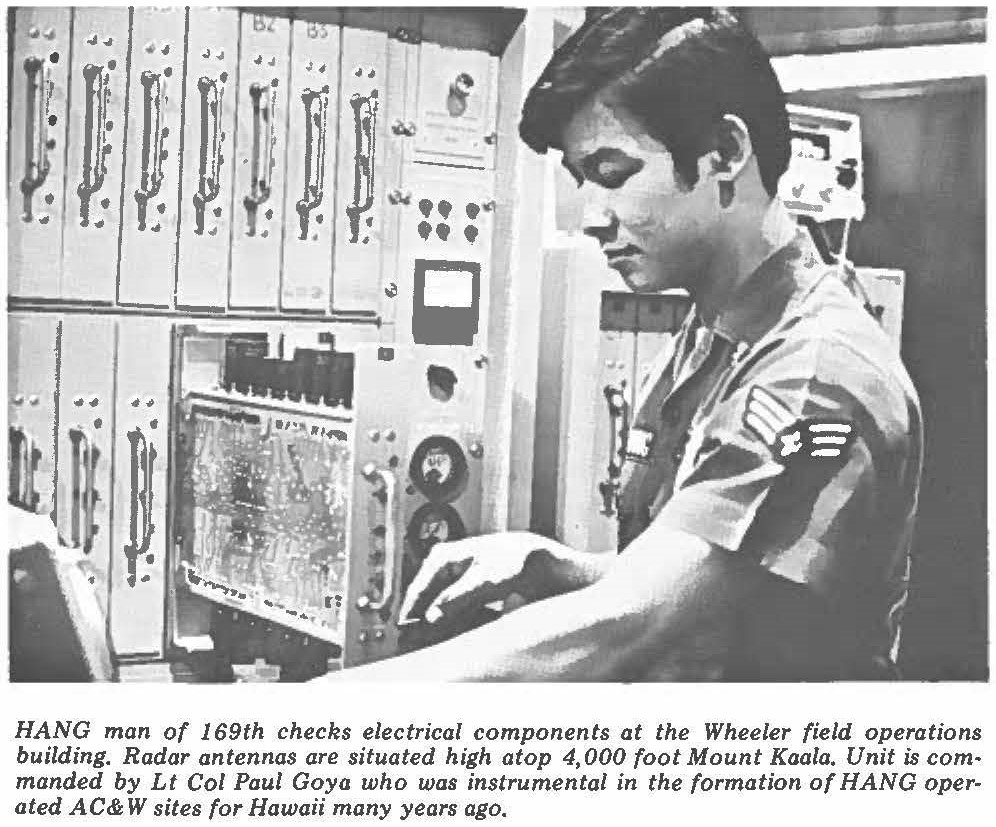
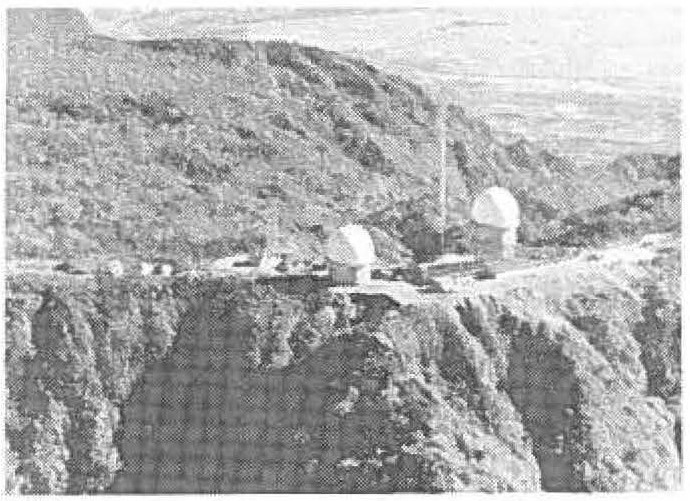
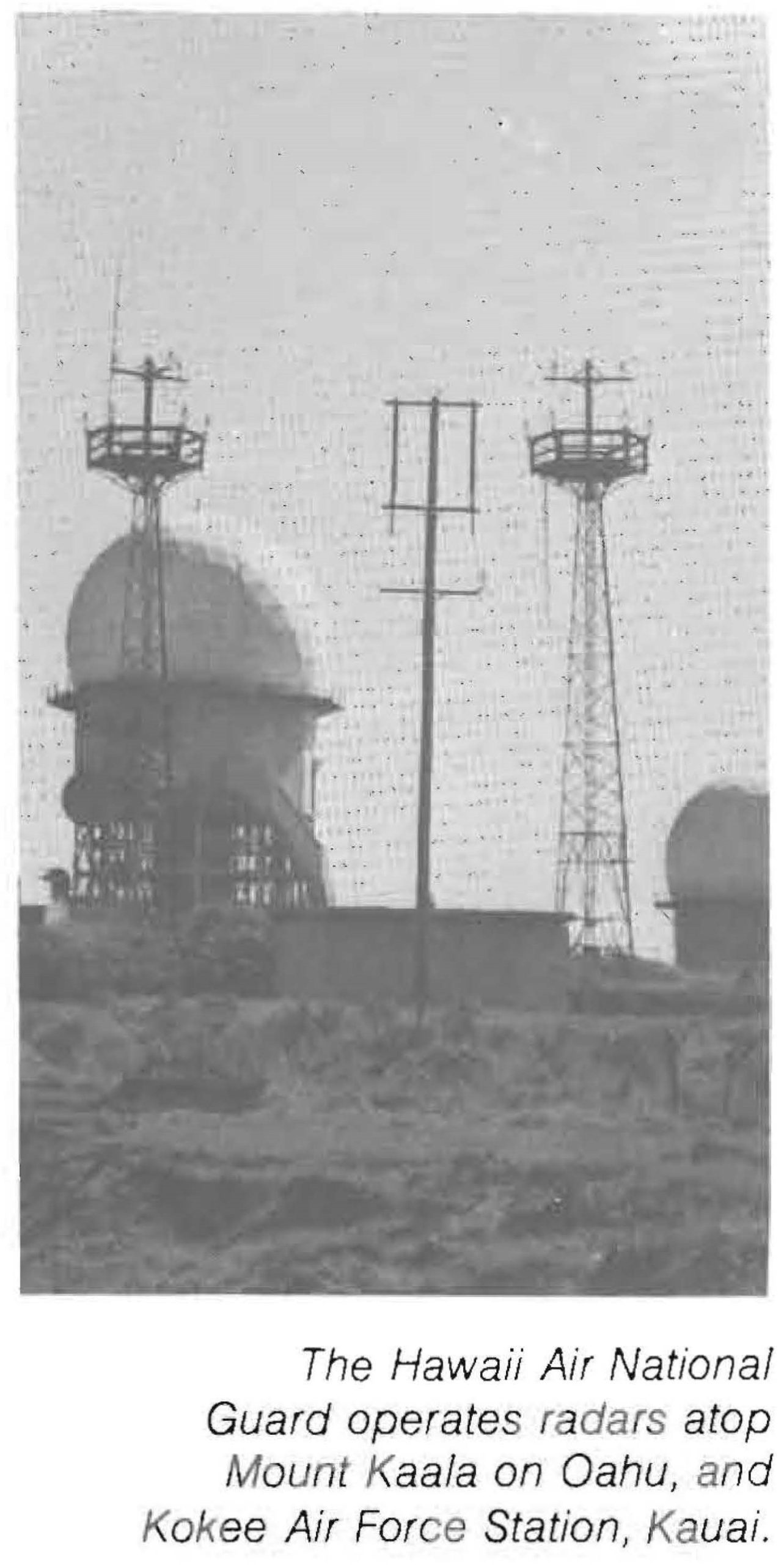
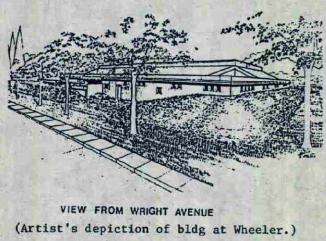
After nearly nine years at Koko Head, the 169th moved to a new facility at Mount Kaʻala and Wheeler Air Force Base in 1965. The move represented a major technological and operational step forward, radar equipment was installed atop Mount Kaʻala, while operations, administration and support functions were located at Wheeler. The new complex provided significantly greater capability and was operated jointly with the Federal Aviation Administration.
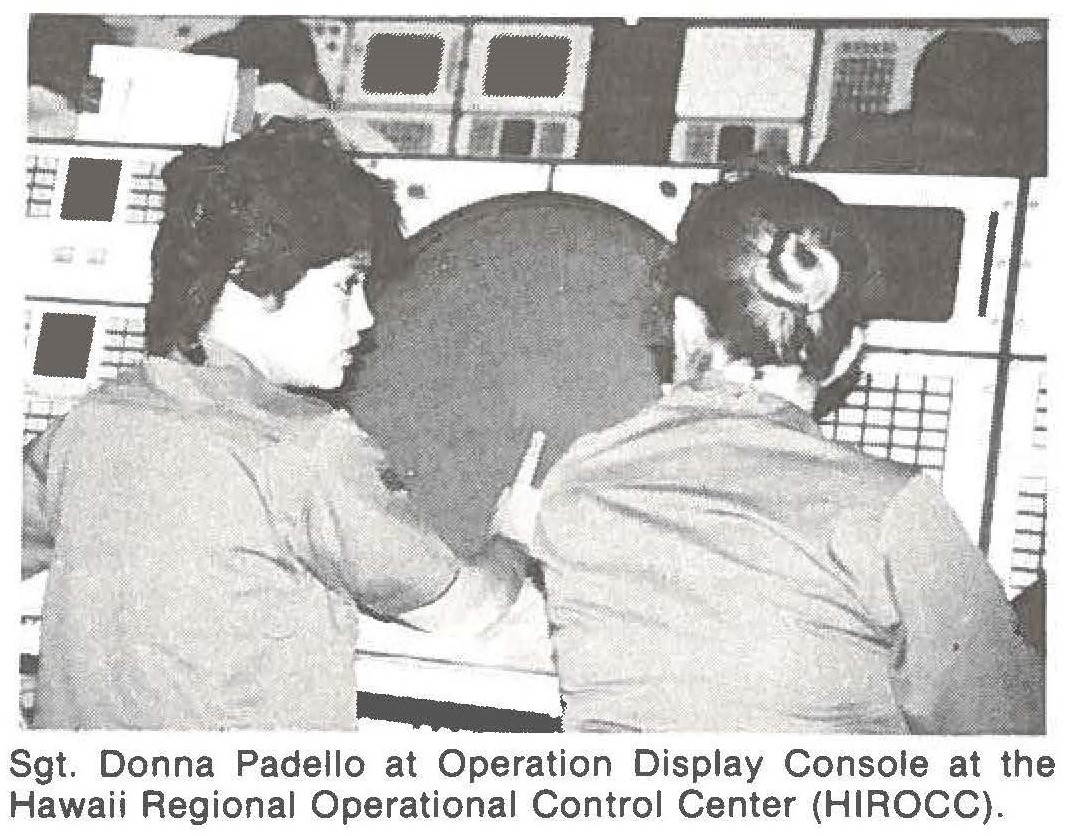
In 1984, the Hawai‘i Regional Operations Control Center became fully operational, replacing older manual processes with a highly automated direction center and significantly increasing the Hawai‘i Air National Guard’s air-defense capability. By the 1990s, the 169th’s mission had evolved into an integrated air-surveillance network. Radar sites on Oʻahu and Kauaʻi were connected to the Hawai‘i Regional Operations Control Center at Wheeler Army Airfield, providing continuous surveillance of the Hawaiian Islands.
In the days following the attacks of Sept. 11, 2001, the 169th provided around-the-clock surveillance of Hawaiʻi’s airspace and on Oct. 1, the 169th became the first Hawai‘i Air National Guard unit mobilized for Operation Noble Eagle, placed on federal active duty under the operational control of Pacific Air Forces.
Technology continued to transform the mission. In May 2006, the squadron retired the AN/FYQ-93 air-defense system after 22 years of service and transitioned to the Battle Control System-Fixed. The new system provided an open architecture designed to allow the Hawai‘i Air Defense System to expand and adapt to emerging threats. In 2007, the former 150th Aircraft Control and Warning Flight at Kokeʻe Air Force Station on Kauaʻi was redesignated as an operating location of the 169th.
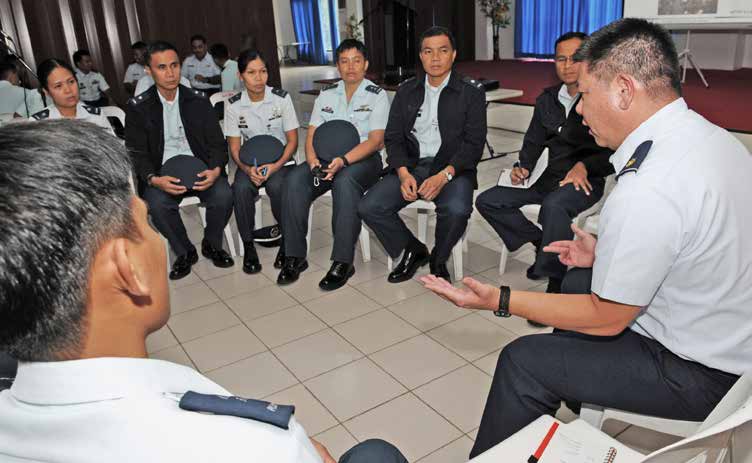
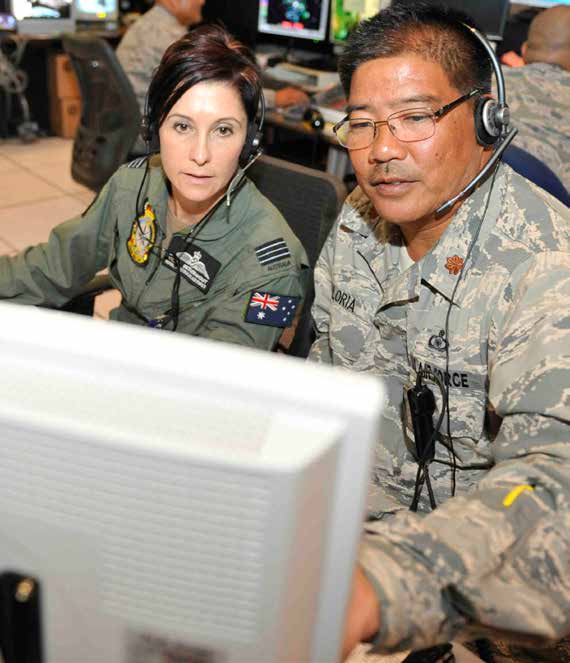
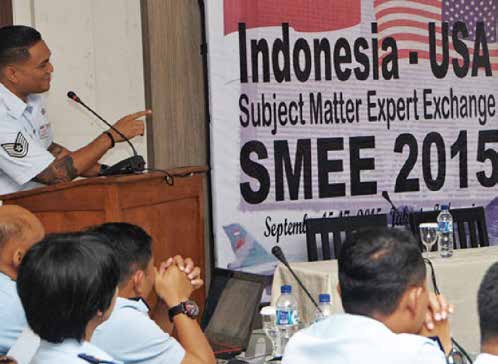
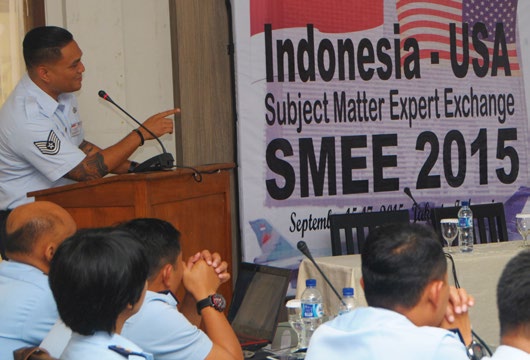
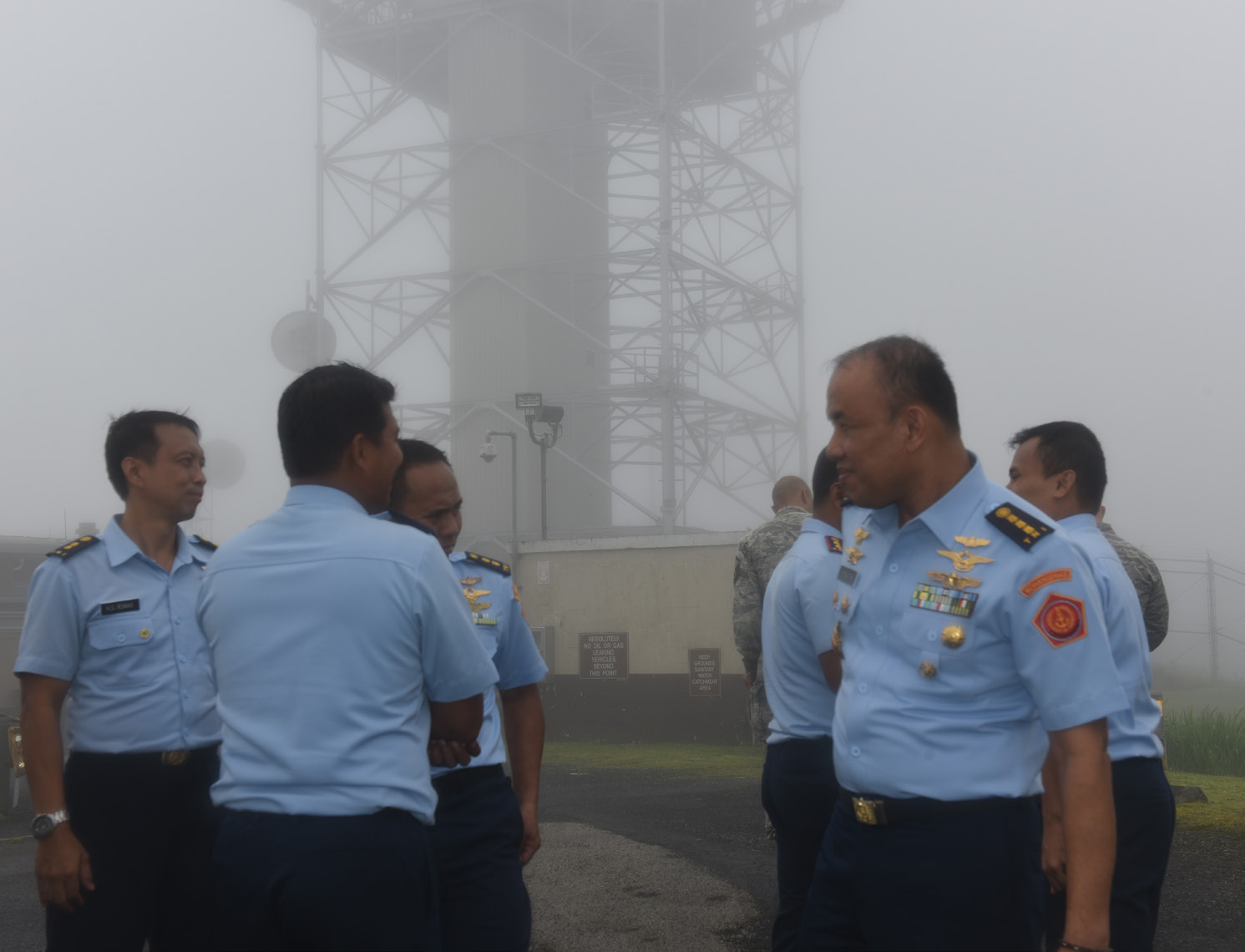
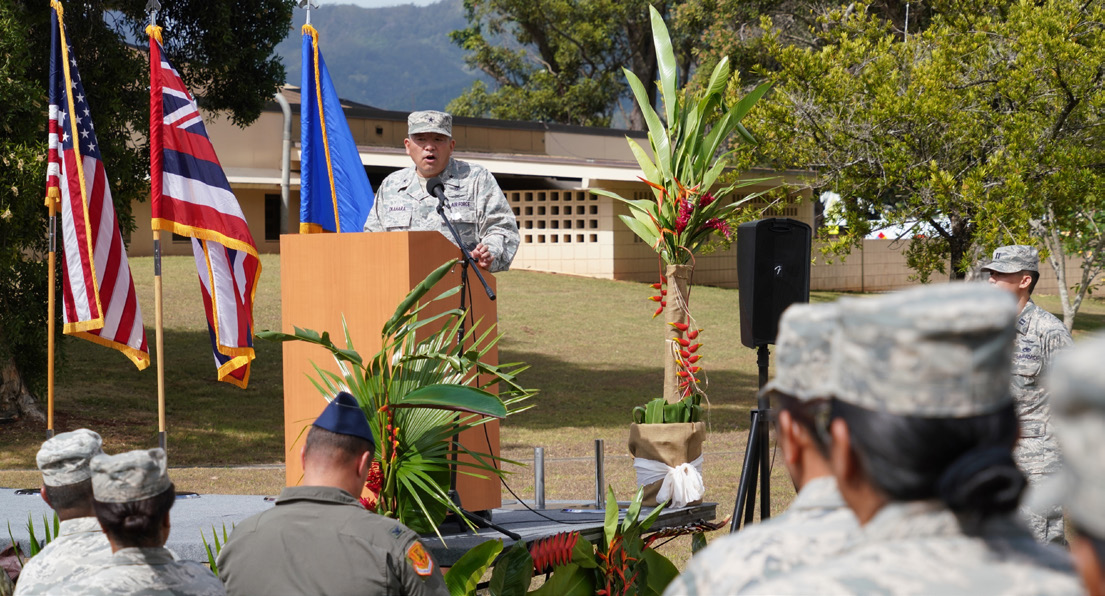
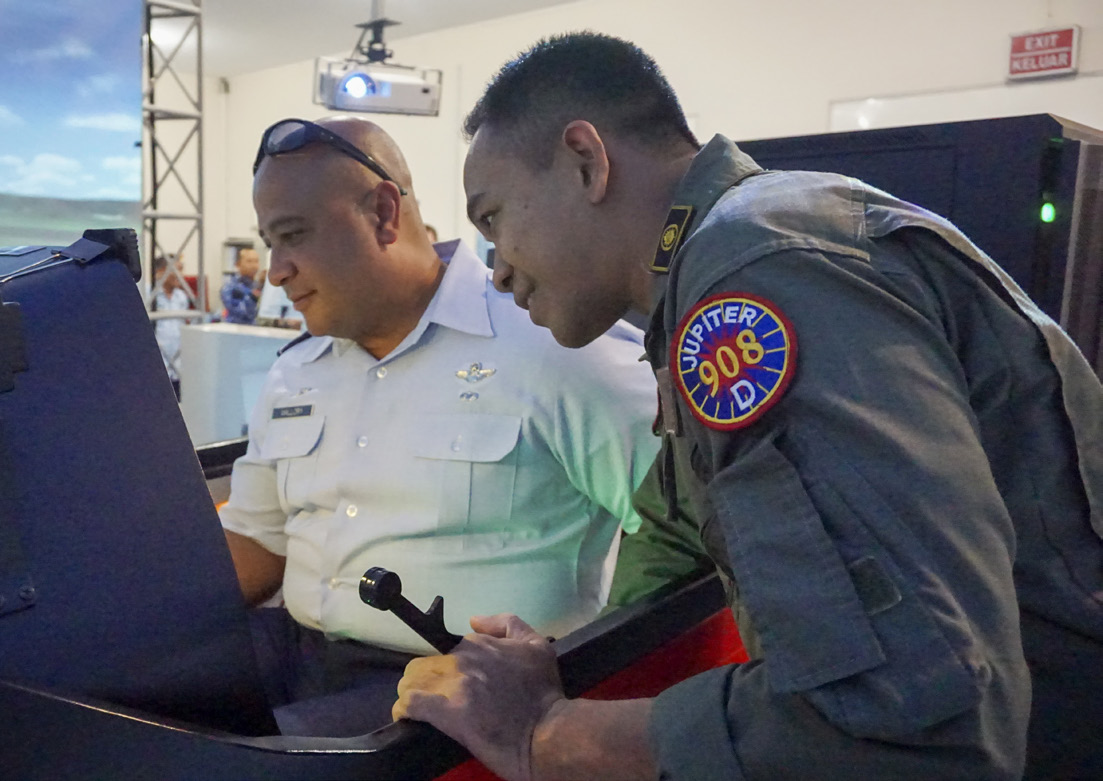
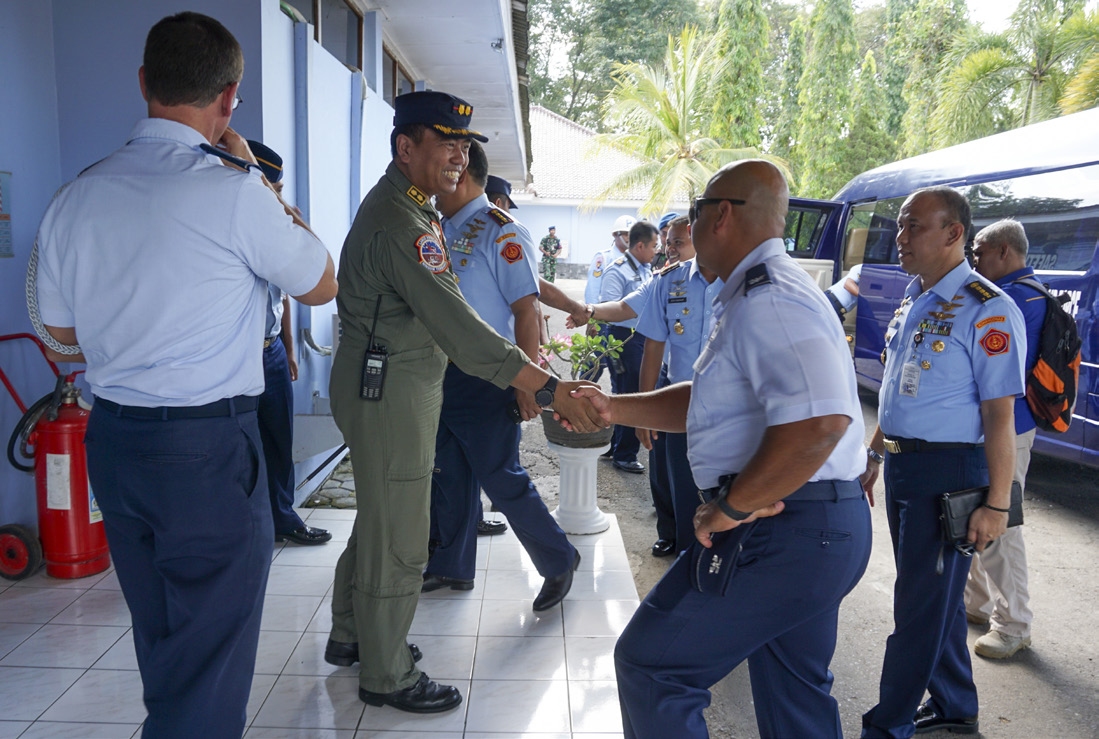
The squadron’s expertise also extended beyond Hawaiʻi. Through the State Partnership Program, 169th personnel participated in air-defense subject matter expert exchanges with international partners, including the Indonesian Air Force and Philippine Air Force. These engagements allowed Guardsmen to share knowledge on air surveillance, weapons control, ground-controlled intercept procedures and emerging challenges.
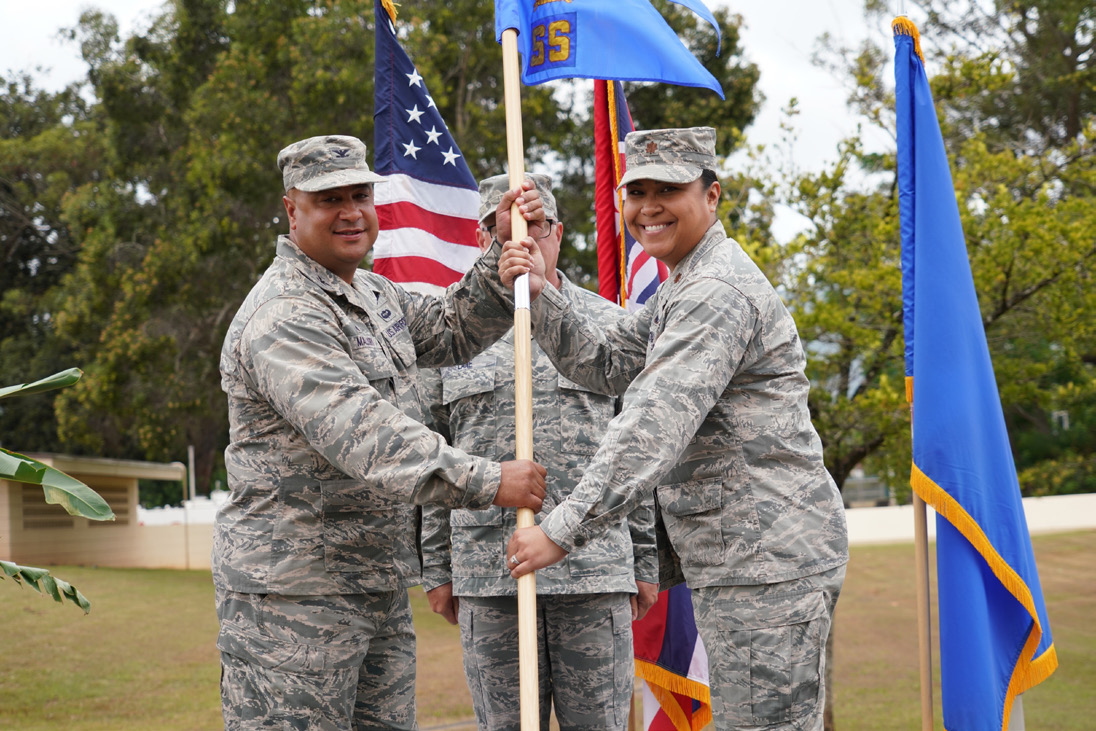
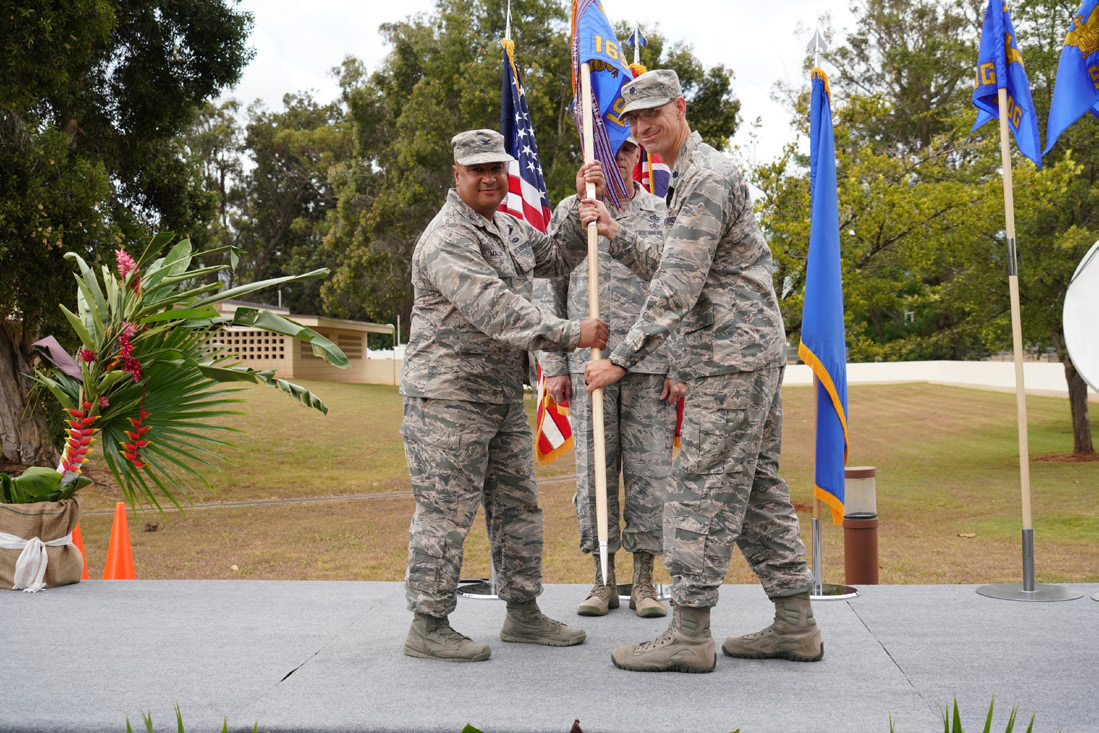
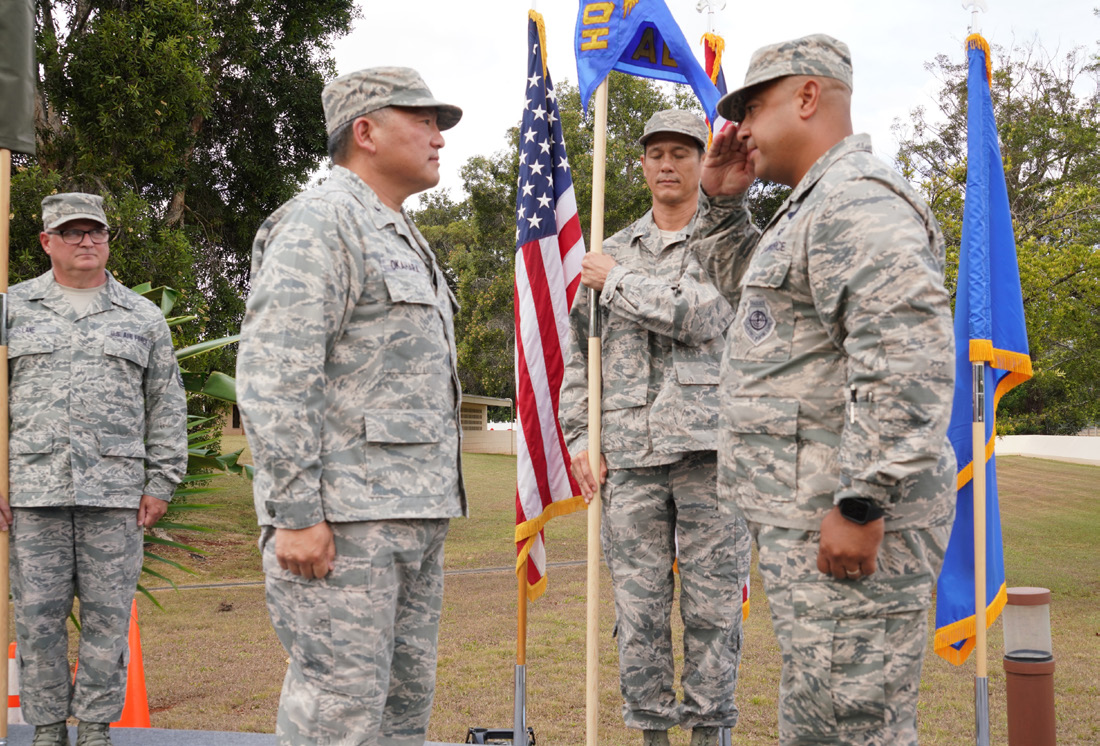
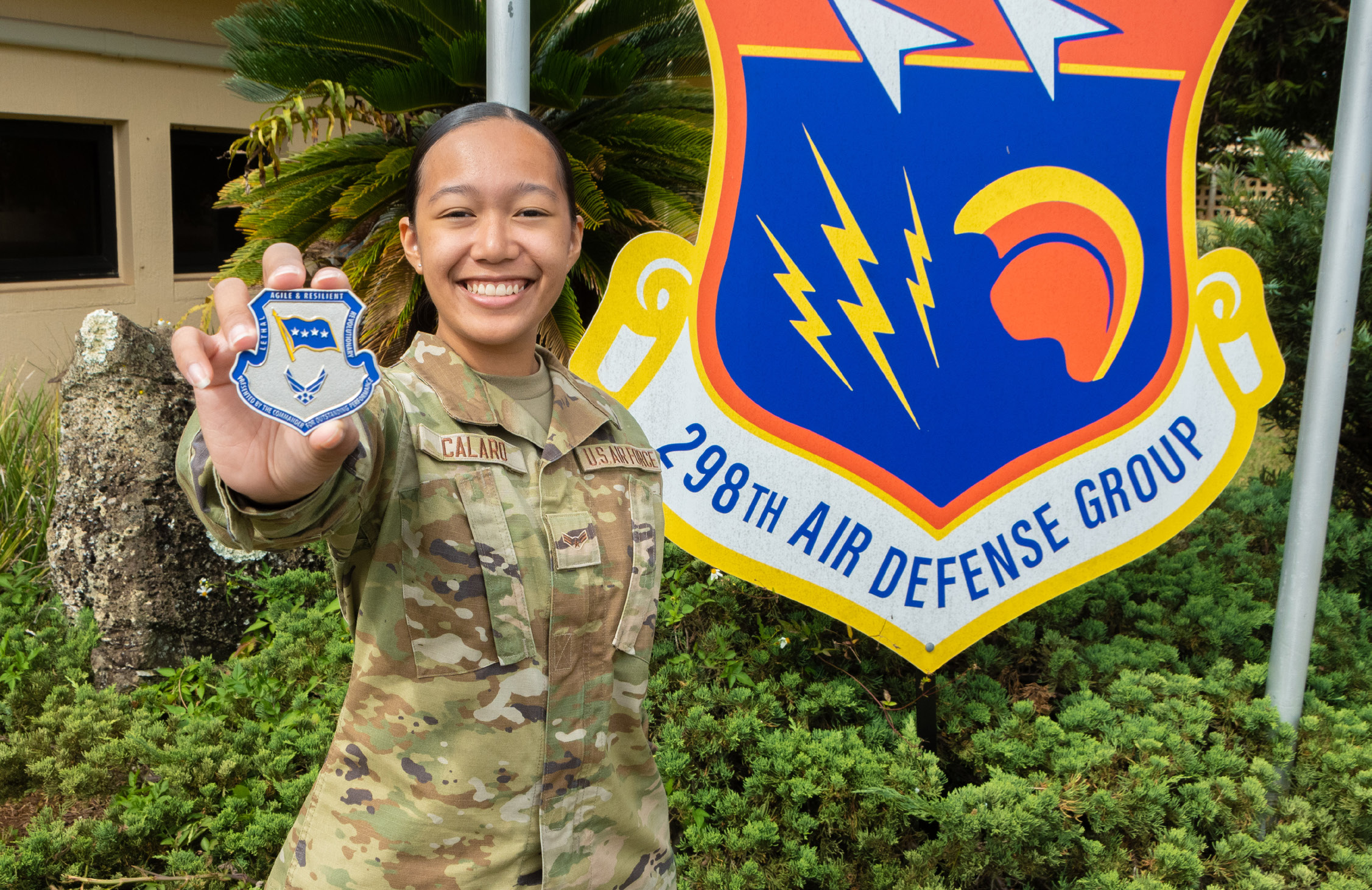
The unit’s evolution continued in the 2010s as its name and organizational structure changed to reflect its modern mission. The 169th Aircraft Control and Warning Squadron became the 169th Air Defense Squadron, and on Aug. 3, 2019, was reassigned to the newly activated 298th Air Defense Group, aligning its organizational structure with other Air Force air-defense organizations.
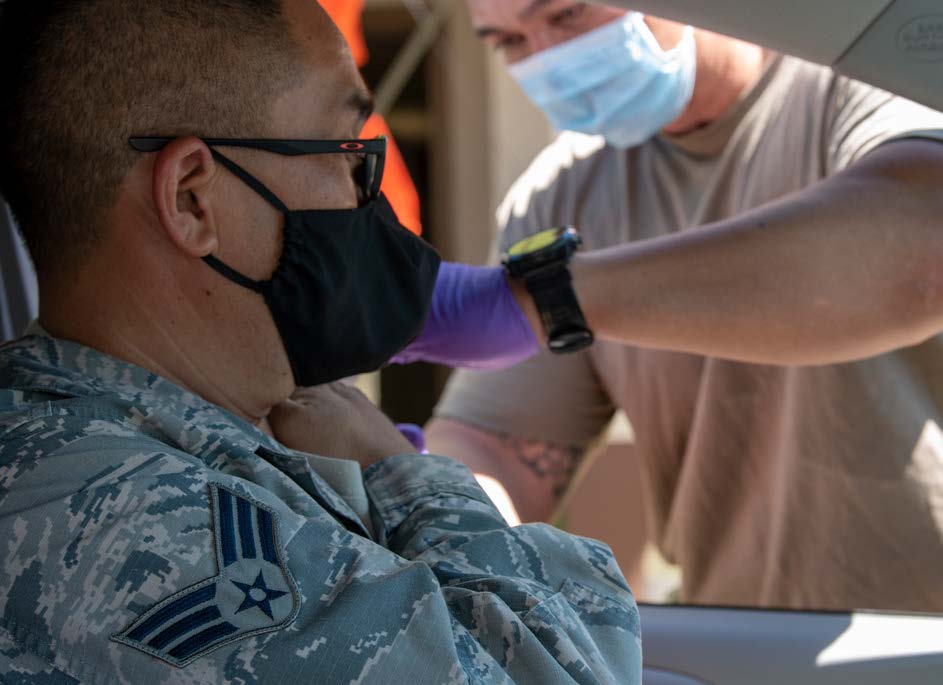
Today, the 169th Air Defense Squadron remains a critical component of Hawaiʻi’s integrated air-defense system and together with the 298th Air Defense Group, the squadron maintains the capability to monitor Hawaiʻi’s airspace around the clock, connecting radar, command-and-control and air-defense resources across the islands.
Last updated October 2026
169th Air Defense Squadron Chronological History
169th Aircraft Control and Warning Squadron. The 169th Aircraft Control and Warning Squadron was activated 7 October 1956, with station at Sand Island Site. In addition to training at the Sand Island Site, it was established to conduct training and operations at the Koko Head Radar Station, in accordance with agreements reached by the Military Department and Seventh Air Force. Major Kiyoshi P. Goya was assigned Commander.
109th Aircraft Control and Warning Squadron. Personnel for the 169th were obtained from the 109th Aircraft Control and Warning Squadron, which had a decrease in authorized strength. The 109th continued to operate the Punamano Site.
169th Every unit especially a new one, has its precious beliefs of what a is and what it takes to make a good unit. The officers and airmen of the 169th ACWRON, at time of inception realized the tremendous obstacles and the many vexing organizational problems that had to be solved before it couls reach maturity and rightfully take its place, side by side, with the other highly efficient and much respected units of the Hawaii Air National Guard. Though time has been a niggardly participant, we “young uns” have the forst test of organization with relative dignity and commposure. Under the capable leadership and direction of our commander, Major Kiyoshi P. Goya and his dedicated staff, we have seen in a relatively short span of a few drills, a massof men and a blueprint evolve into a living unit possed, we believe, with the basic essentials of a promising unit: – a unit with a solid core cohesive, with a sense of unit belongingness, and a concerted determination to attain quickly our assigned objectives. A great deal of our intial success goes to Major Robert G. O’Hara, Commander of the 109th ACWRON (our parent unit) for the generous contributions of men and material and to our Air Force Advisor, Major Frank Easley, for his wise councel and the many hours spent coordinating and integrating our varied ANG functions into the overall Air Force “Big Picture”.
169th ACWRON Spotlite. One of the men comprising the nucleus of our squadron is T/ Sgt Cyril Wong, Chief of our Construction and Utilities section. Sgt Wong has been a valuable contributing factor during our development with his wide experience in the construction trade and his solid military background. A graduate of McKinley High, he joined the Air Guard (109th ACWRON) in Feb 25 after 4 years of active duty during World War II and another 4 years with the ERC during the postwar period. Married in 1947, Sgt Wong resides with his charming wife, Laura, at 548 Mapu Lane.
Internal Growth. Vivid examples of the internal growth being experienced are the following recent unit personnel actions. Promoted to new grades are: to T/Sgt, Robert Nashiro I Radio Maint.) ; to S/ Sgt, Allen Chun (Radar Ops) , Clarence Kuwahara (Comm Ops) , Frederick Tao (Radar Maintl ; to A/ lC, Frank Fujishige (Radar Ops), Stanley Kodama (Pers), Clarence Mokepuha (Comm Ops I ; to A/ 2C, Gordon Au, Clarence Furuya, Albert Chow, Deogracias Agbayani, Donald Nagamine and Gordon Wong, all of the Radar Operations section.
New Members. New officers include Capt Douglas Bronson (AFRes). 1st Lt Raymond Moriguchi (AFRes) and 2nd Lt Lincoln Chang lcommissioned fr T1 Sgt). Recruits include: Richard Blakenfeld (St. Louis) , Stephen Landau (Punahou), Jose Estrera Jr (St. Louis) Ronald Smith (Kaimuki), Gen Nishimura (Maryknoll), Thomas Yano (aKimuki) , Wayne Kuramoto (Kaimuki) , Donald Fujii ( ‘H I and George Nakamura ( Kaimuki). Two transferees from the lllinois ANG include A IC Thomas Tanabe and A/ 3C Amador Casupang. S; Sgt George Teramoto is presently undergoing training at the Medical Tech school at Gunter AFB, Ala. 1st Lt Raymond Moriguchi is enrolled in the Intercept Controller course at Tyndall AFB, Fla.
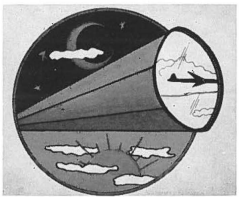
A unit insignia has been selected for members of the 169th Aircraft Control and Warning Squadron at Sand Island
The winning design was submitted by Airman 2C Herbert Katayama and depicts a scope with an aircraft in view. The top half of the insignia depicts an evening celestial scene, while the bottom half shows the sun. The significance of the emblem is that the unit controls the Hawaiian skies and aircraft both day and night.
Second prize winner was AlC James S. Miura and third prize winner, A3C Arnold K. Y. Chow.
Entries in the insignia contest were judged by officer personnel of the 169th AC&W Squadron and cash prizes were awarded at the Squadron luau October 6 commemorating the first anniversary of the Hawaii Air National Guard 169th AC&W unit.
Highlight of the evening of festivity was the presentation of awards and announcements by Major Paul Goya, Commander of the unit. In his talk, Maj Goya reviewed the achievements during the first year of operation and announced some plans for the coming year.
169th Aircraft Control and Warning Squadron: The 169th Aircraft Control and Warning Squadron on 15 December 1957 was relocated to Koko Head Radar Station, T.H., to enhance the effective training of the organization with better utilization of equipment at the site.
Aircraft Control and Warning Squadrons: During November, the 169th Aircraft Control and Warning Squadron commenced installation of new radar equipmmt at the Koko Head Radar Station, officially inaugurating the 24-hour operation on 1 February 1958. This opllration is comparable to the 24-hour operation of the 100th Aircraft Control and Warning Squadron at Punamano Radar Station. Implementation of the Koko Head Radar Station into the Air Defense System of Hawaii gaye the Pacific Air Forces a 360.degree coverage for the first time.
The following statistics reflect the performance of the stations during Fiscal Year 1958:
Non-Armory: Only two non-armory construction projects were awarded during Fiscal Year 1958, both of which were for the Hawaii Air National Guard. The first was for the construction of an operations building and other facilities at the upper base camp of the 169th Aircraft Control and Warning Squadron, Koko Head, Oahu, amounting to $39,960.00, and the second for construction of an operations building for the l09th Aircraft Control and Warning Squadron at Punamano Radar Station, Kahuku, Oahu, in the amount of $31,33000. Funds for both of these projects were furnished 100% by the Federal Government.
The 169th ACWRON officially started to train on one weekend per month commencing in July. The reasons for this weekend (Saturday-Sunday) training were many folds, however, the end result was to better train the personnel.
The response was excellent and the squadron is looking forward to one of the best years since its organization in 1956.
* * * * *
As a means to understand stock marketing and to see their investment grow, several personnel of the squadron decided to group together and form a club. They call it the 169th Investment Club and has Major Paul Goya as its president, TSgt Gilbert Yoshida, vice-president, SSgt James Oshiro, secretary and SSgt Edward Uemori, treasurer.
The 169th ACWRON is planning to organize a blood bank reserve for the benefit of its members. In a near future, constitution and by-laws of the blood bank reserve will be announced.
* * * * *
Presently attending the Interceptor Directors Course at Tyndall AFB are: Lts. Kazuo Yamamoto and Clifford Heu. They are expected back in October.
* * * * *
At press time, the 160th ACWRON will be loosing two of the most capable NCOs and technicians from the Air Technician Detachment. They are: MSgt John W. Keisler, who intends to enter college and MSgt Robert T. Nashiro, who will be employed by the Civil Aeronautics Administration as an aircraft radio maintenance man. The squadron will miss their services and hopes that their new endeavors be marked with success.
Training continued based 011 the needs of each section with emphasis on individual On-tilc-Job training programs. All-Day Assemblies held on two Sundays a IIlonth were changed to one weekend a month. On 12-13 July 1958, thc 169th ACW Squadron was the first HANG unit to train on a weckend, followed by Hq HA,,{G, 199th Fighter Interceptor Squadron and 199th Weather Flight on 4~5 Oetober 1958, and finally the 109th ACW Squadron OIl 15-16 November 1958.
Aircraft Control and Warning: The participation of the 109th and 169th ACW Squadrons in the Air Defense Augmentation program remained unchanged. The following statistics reflect the performance of the stations during Fiscal Year 1959:
The beginning of the fiseal year saw the 109th ACW Squadron starting to consolidate all activities at the PUllamano Hadar Station, with the Operations, Radar Maintenance, Radio Operations and Maintenanee sections gradually transferring from Sand Island to that site. The new operations building completed in November 1958 made possible the accelerated training of both operations and radar maintenance personnel. The old operations building was then converted into administrative offices, with a section set aside ror a dav room. This move in turn made possible larger radio facilities. An existing concrete bunker was also made available to the Communications Section making it possible for all such activities to be concentrated at Punamano. Space was provided for the Air Police Sedion in the Technical Supply building. A big step was made when the Food Service Section closed-out at the Sand Island mess hall and opened the field mess in the cantonment area at the site. For the first time, hot meals were prepared and served at Punamano during the weekend drills.
The newly promoted airmen of the 169th ACWRON to the present rank are as follows: S /Sgts James S. Kitazaki, James M. Kobayashi, James S. Miura, Clarence H. Mokepuha, and Stanley Y. Nagamine; A; lC Richard S. Arakiki, Roy Y. Ichimura, Reginald W. T. Lee, Jose V. Motas, Arthur E. Ogawa, Calvin T. Sagara, Ronald M. Urada, and Robert H. Yamasaki; A 2C Anthony D. Carvalho, Ronald C. K. Chun, Stanley T. U. Lum, and Walter Y. Tanaka.
Recent graduates from the USAF Tech Schools returning to the squadron with their certificates of proficiency are: A 12c Ronald C. K. Chun, A/ 2C Gen Nishimura, A/ 2C Walter H. Kuroda, ACW Radar Repairman; A/ 2C Larry H. Kashiwamura, Comm Center Specialist; A IC Stanley S. Kodama, Personnel Tech; S/ Sgt Frederick T. Tao, AN FPS-8 Repair; and S/ Sgt Robert H. S. Lee, Supply Publications.
School bells will be ringing for M/ Sgt Dennis H. Takasaki, who will attend the OJT Supervisor’s course at Keesler AFB, Miss, and also A/ lC Harvey F. Grocholski, Jr., who will attend the ACW Radar Repairman’s course, at the same base.
The 169th ACWRON air technicians organized an intramural basketball league, with five teams participating. League manager Lt Norman Chang said that all teams play at the Kaimuki gym and so far the competition has been so keen that it would be difficult to predict which team will emerge the winner.
Lt Kazuo Yamamoto is taking his charges of divot diggers at the Ala Wai course whenever possible. After a fe”· more preliminary “tune-ups”, they will be ready to compete in the Kaimana Hila tournament.
The latest “chapeau” worn by the maintenance personnel of the squadron has an insignia of significance and distinction, one with a triode tube with a “glow worm on the grid”. Lt Abraham Naehu, the C&E maintenance officer, have been responsible in the designing of the insignia, giving the communications and electronics maintenance personnel the feeling of belonging to a special group of “electron pushers”.
The 169th ACWRON Air Technicians’ Bowling League, played at Stadium Bowl-O-Drome on Tuesday afternoons, ended on the 2nd of June with the “After Burners” team of T/ Sgt Gilbert Yoshida and S; Sgt Calvin Chong winning the championship by a scant lead of 1 point over the second place “scramblers,” headed by S/ Sgt Paul Yamada and A/ lC Paul Miyasaki. The game was so close that the second place had to be played off by the “Scramblers” and the “Mornin’ Glorys,” the latter headed by S/ Sgt Ronald lchimura and A/ IC Stanley Kodama.
High Average trophy was captured by T/ Sgt Raymond Azama with an average of 181. The High-3 trophy was taken by S/ Sgt Ralph Kaneshiro in the last few weeks of play with a sizzling 655. A/ lC Frederick Merino walked away with the High Single trophy from the 1st day of the league with a score of 267 with handicap.
This seems to he a year of everyone trying to outdo the other. We have A IC Frederick Merino driving a Third; S/ Sgt Wallace Nakamoto a “maroon” MG; S/ Sgt Andrew Kobashigawa a “green” MG; S Sgt Kenneth Yamada a Corvette; T/ Sgt Frederick Tao driving a 59 Oldsmobile; S/ Sgt Waner Chow a 59 Ford; A, IC Emmerick Bosuego with a 59 big “M”; M/ Sgt Dennis Takasaki finally relented and turned in his “old faithful,” a 51 Studebaker, for a 59 Ford; and then came 1st Lt Kazuo Yamamoto with a 59 Galaxy.
As a special service to the members of the squadron, M/ Sgt Bob Shimoga wa will he able to provide you with special rates for your automotive needs, such as tire recaps, new tires, batteries, etc. Call Bob at 58265 or 902234 after hours.
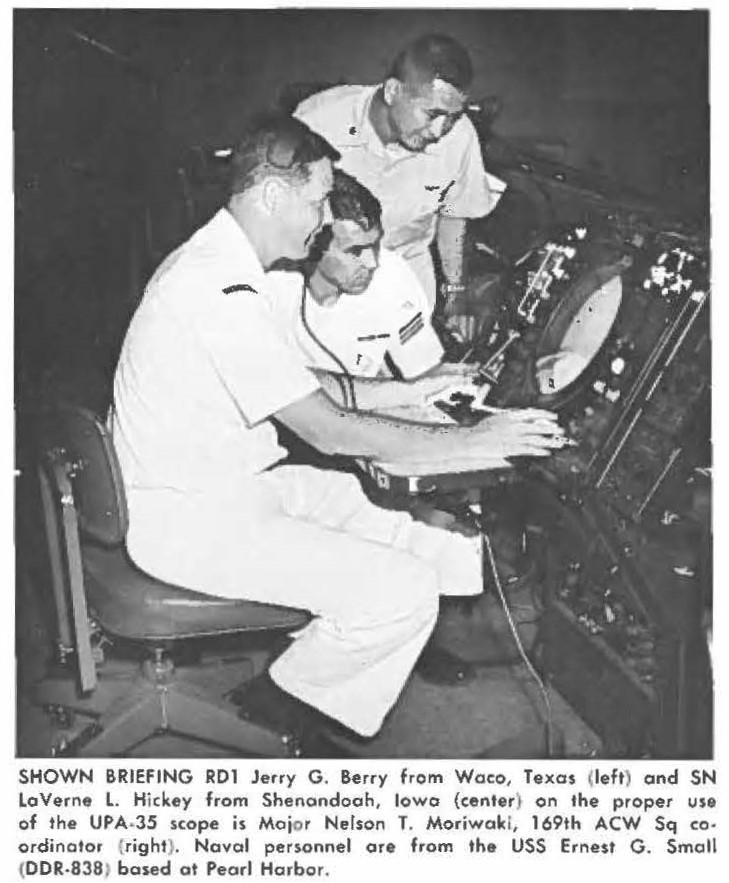
On the 12th of August, Brig Gen E. S. Chickering, Comdr HADD, honored the Koko Head Radar Station with an orientation visit. He observed an actual intercept being performed by Capt’s William Mossman and Nelson Moriwaki.
The third anniversary of the organization of the 169th AC&W Sq was celebrated by the members of the squadron with an informal hccr bust on 18 October. Although the official birthday of the squadron is 7 October, the celebration was held after duty hours on a drill day in order that the majority of the personnel could he present.
The highlight of the program came when A/ B Thomas Fukui, the youngest member of the unit, was given the honor of cutting the birthday cake by commander, Maj Paul Goya. Included on the program was draught beer, soda water, barbecue, pupu pups, chicken, and other lighter hord’ocuvres. Music was provided by SSgt Freddie Hirayama and his Musical Scope Dopes.
Earns Skill Qualification
A certificate of skill qualification was recently presented to 1st Lt Norman Chang, an aircraft director with the radar operations section. An air technician with the squadron since the inauguration of the site as a full time unit, Lt Chang has more than four years of controller expe rience. In addition to his director and flying duties, he is the unit’s athletic officer. Congratulations!
Monetary Awards Presented
An award of ten dollars each was made hy the PACAF Base Command to SSgt Paul Yamada of radar operations, and TSgt Raymond Azama of radar Maintenance for their site improvelllent suggestions.
Sgt Yamada suggested that a gauge he placed on the site’s water tank to measure the water level so that the airmen need not climb upon the tank to check the water load. This suggestion, in addition to being a time and labor saving device, was further noted as a safety factor.
Sgt Azama earned his prize by suggesting that a paved walkway he placed on the top of the hill to prevent injury to personnel and equipment, and to speed logistical movement.
Coneurrent with the activation of the Support Squadron, effective 1 February 1960, the 199th Fighter Intereeptor Squadron, 109th and 169th Aircraft Control and Waming Squadn)Il_s were reorganized with the resuhant strength of 40 officers and 262 airmen for the Fighter Interceptor Squadron, 35 officers and 266 airmen for the 109th Aircraft Control and Waming Squadron and 35 officers and 265 airmen for the 169th Aireraft Control and Waming Squadron. Both Aircraft Control and Warning Squadrons were subsequently reorganizcd effective 16 May 1960 with the resultant strength of each unit of 36 officers and 2M, airmen.
Aircraft Control and Warning: The participation of the 109th and 169th ACW Squadrons in the air defense augmentation program on a 24-hour day hasis remained unchanged. The following statistics reflect the performance of the stations during fiscal year 1960:
As previously noted, both AC&W Squadrons met andl or hettered criteria estahlished hy PACAF during the Operational Readiness Inspection. The limiting factor for hoth radar stations is their location. This will he alleviated in the future when hoth squadrons move to their new sites at Kokee, Kauai, and Haleakala, Maui, respectively.
Excellent cooperation has heen provided the ACW Squadrons hy Western Mobile Depot Activity SMAMA and the General Electric Company on communications and electronics support. Minimum delay was encountered when emergency assistance was requested. Support by P ACAFBASECOM on installations activities at Punamano was lacking. The access road maintenance, security fencing, and painting of huildings arc the principal maintenance projeets not accomplished. It is anticipated that these projects will he attended to hy the Hickam AIO. The 169th ACW and the 109th ACW Squadrons continued to experience low unscheduled maintenance time for the search radar set AN/FPS-8 due’kl -excellent maintenance by the unit radar technieians. However, the 169th ACW Squadron experienced difficulties with the height finder set AN/FPS-68 caused hy failure of the hall hearings on the variahle nod system.
The topographical feature and geographical location of Koko Crater does not provide optimum siting of radar for air defense purpose, and moreover, the amount of usahle area atop the hill precludes the installation of a more complex, larger and more powerful radar. Therefore, Haleakala, Maui, was selected hy the Air Force as one of two sites that will provide the hest coverage with a minimum of cost.
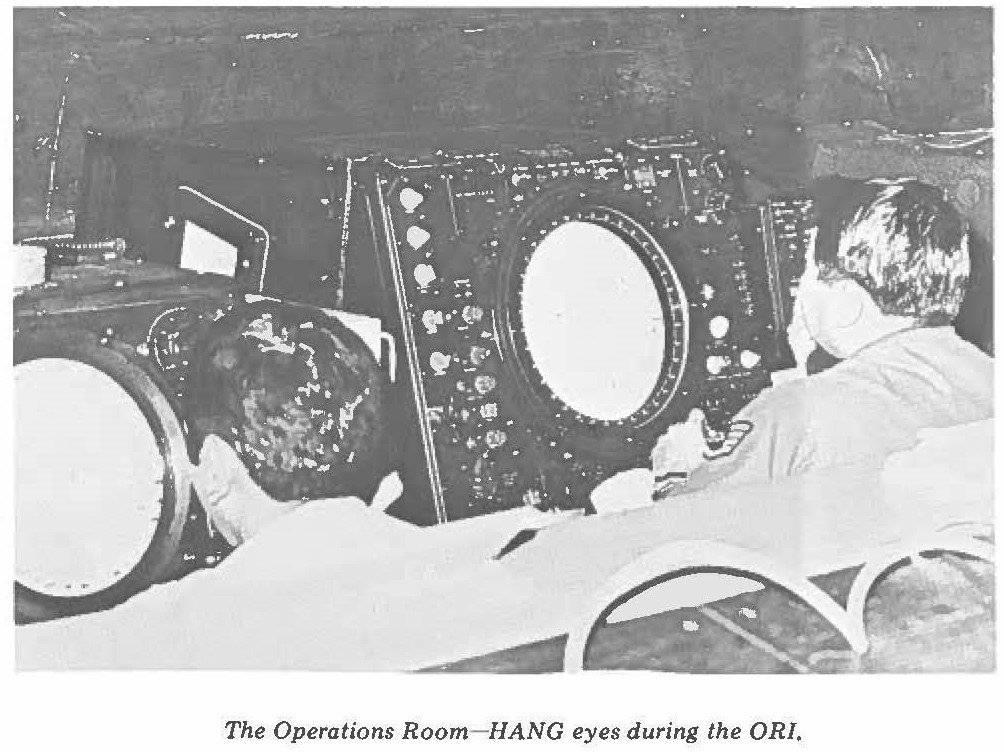
Within a short time, the annual summer encampment will he in fulI swing. Planning groups have already met to set up the programs for the two week periorl. This year, as in the past, the main event will he the ORI (Operational Readiness Inspection) . Other scheduled events are general fidd training, an intramural volleyhall tournament, a ping-pong tournament, and a “pau hana luau” at the end of camp. Of the squadron’s three year history, this year’s camp will he the biggest as the squadron has grown to almost twice its oriinal size. . .
Chung Named Delegate
1Lt Paul H. C. Chung was recently elected by the Squadron Officers as the delegate, to the Hawaii National Guard. Lt Chung is the squadron adjutant, has heen with the unit for the past two years, and has a total of seven years of commissioned service. An active republican, he is the elected Honolulu city and county clerk.
Ashi Wins Award
The PACAF Base Command Awards Committee rccently presented a prize of $5.00 to SSgt Thomas Ashimine for his time, lahor, and money savinµ: suggestion. He suggested tl1e use of a fifty• gallon drum instead of the present five-gallon tank to store gasoline on the hill top for the operation of a water tank. In his letter to the committee, he stressed the reason for his conclusion, and validated it with ac• tual accounts from past experiences. Major R. Smith of the Awards Com• mittee concurred with his logic, and heartily end as crew chief of “D” Flt on an air technician status.
Celebrating their fourth anniversary with a huge Hawaiian luau were memhers of the 169th ACW Sq. With more than two hundred in attendance, festivities included songs and dances by the Leilani Alama Hula troupe, and the 169th’s own Na Leos.
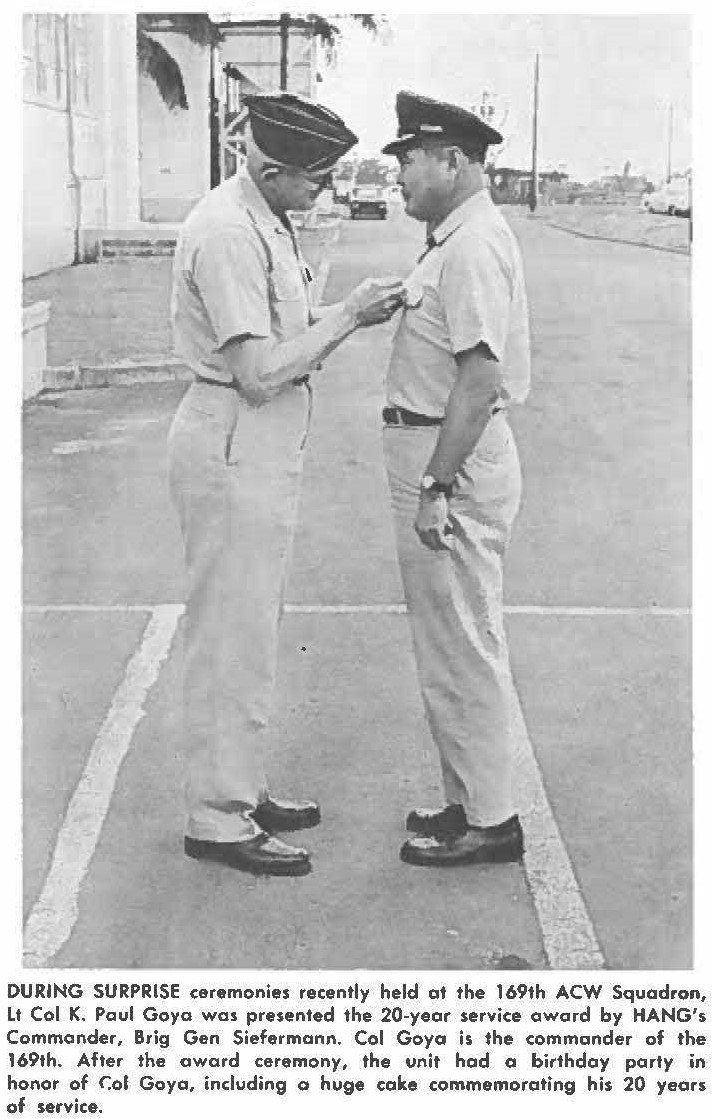
Among the honored guests were Congressman Daniel Inouye, Brigadier General Valentine Siefermann, Asst. Adjutant General for Air, Hawaii National Guard, and Lt. Col. William Kral, Air Force Advisor. Other guests included Lt. Eddie Anderson, Hawaii National Guard State PIO, and Mr. Scotty Stone of the Honolulu Advertiser. Highlight of the program was the cutting of the traditional birthday cake by Lt. Col. Paul Goya, squadron commander.
General Siefermann spoke on the past performances and future of the Air Guard units. In addition, he publicly congratulated Major lsonaga and Major Ing who recently attained their majority.
Honored with a trophy was the championship Support touch football team which just completed an undefeated season in the squadron intramural league. . .
Welcome
Newcomer to the squadron is 1st Lt. Eddie Beppu of the Valley Isle. The three ye ar ve teran of the Air Force is a former F86L pilot. A qualified weapons director and controller, he is presently employed as an air technician.
The Aircraft Control and Warning squadrons (the 109th at Kahuku and the 169th at Koko Head) the “other half” of the Air Guard in Hawaii, have saved over 32 million dollars in aircraft (military and civilian) and 24 lives through navigational assists? Frequently, during had weather, these land based radar sites are called by troubled pilots who request position reports. The radar sites not only give them a steer hut have frequently talked pilots to safe landings in the Hawaiian area.
It is interesting to note that the operation of AC&W sites by Guardsmen was first started in Hawaii. Because of local success, this concept has since spread to other states (Colorado and Utah).
Just chatting . . . Off to Tyndall AFB, Florida for three months of Ground Control Interceptor School is Lt. Colonel Paul Goya, commander of the squadron . . . Newcomers to the squadron are 1st Lt. Hank Nishino, 1st Lt. Christy Mamiya, AlC Alexander Chun, AlC Wilfred Larm, and A2C Fred Shigenaga … Again, champs of the squadron intra-mural basketball league are the dazzling demons of “D” flight . . . Spanking new squadron 1st sergeant is Super Sergeant Clifford Chee … Squadron mascot is “Koko Moo,” a month-old black and white Holstein calf donated by Leo De Mello of the FAA . . . Increasing emphasis is being placed on military courtesy to sharpen the squadron. Leading the way are the air technicians . . . The new 169th Golf Club shirts are a bright lipstick red … For the first time since the inauguration of the monthly ace, winning a monthly championship was “Long Ball” Freddie Hirayama. Sports
Captain William Mossman, former assistant operations officer at the 169th, is now station commander of Detachment #1, 109th ACW Sq. In a dual capacity, he is also the air technician supervisor at the Kokee Radar Site. The University of Hawaii graduate methodically rose from the enlisted ranks to his present position in ten and a half years of Air Guard service.
Transfers from the 109th are 1st Lt. James Kurita, SSgt. Raymond Ako and SSgt. Herbert Kuratsu. Lt. Kurita and Sgt. Kuratsu are with the operations section while Sgt. Ako is with personnel and administration, All are full time air technicians.
New Training Concept
The new training concept of HANG where air guardsmen take a portion of their two week active duty training as they are needed any time during the year has been fully implemented by all sections of the squadron. Each section has its own plans for putting the concept into effect, hut from all indications, the new idea is popular, and is being readily accepted by squadron members.
Visitors To Koko Head
Visitors to the site during the third quarter were students of the Honolulu Electro-Technical School and local language school teachers who attended the summer language institute at the University of Hawaii under the language development program of the National Defense Education Act, After talks on the mission of the Hawaii Air Guard, the visitors were escorted on tours to the electronics, communications, and operations sections
The preliminary planning for the 2nd Annual Children’s Christmas Party is under way. The project officer, Lt. Thomas Shimabuku, announced that he expects the party to be a smashing success.
The Children’s Christmas party was started when Lt. Col. Paul Goya and Lt. Shimabuku felt that there were many children in the community who were not receiving the cheer and fulfillment of Christmas, and it was then that Lt. Shimabuku hit upon the idea of a Christmas party for these children. The Lieutenant and the members of C-Flight, Operation section, planned and gave a Christmas Party complete with gifts for each child at Hanauma Bay Beach. There were over 75 happy children who really had a merry Christmas. When Lt. Shimabuku was asked why he volunteered for the project this year, he replied, “When you see all the happy faces and the fulfillment of Christmas dreams on each face, you can’t help but want to do it again.”
Texas Plan at Work
(see feature story this issue)
Recruiting Drive
With the introduction of a new manning document, the 169th now has openings in many fields of specialty. A recruiting drive, under the leadership of SMSgt. Clifford Chee, has been planned. Anyone interested in joining the squadron can contact SMSgt. Chee at 81011-Ext. 67015.
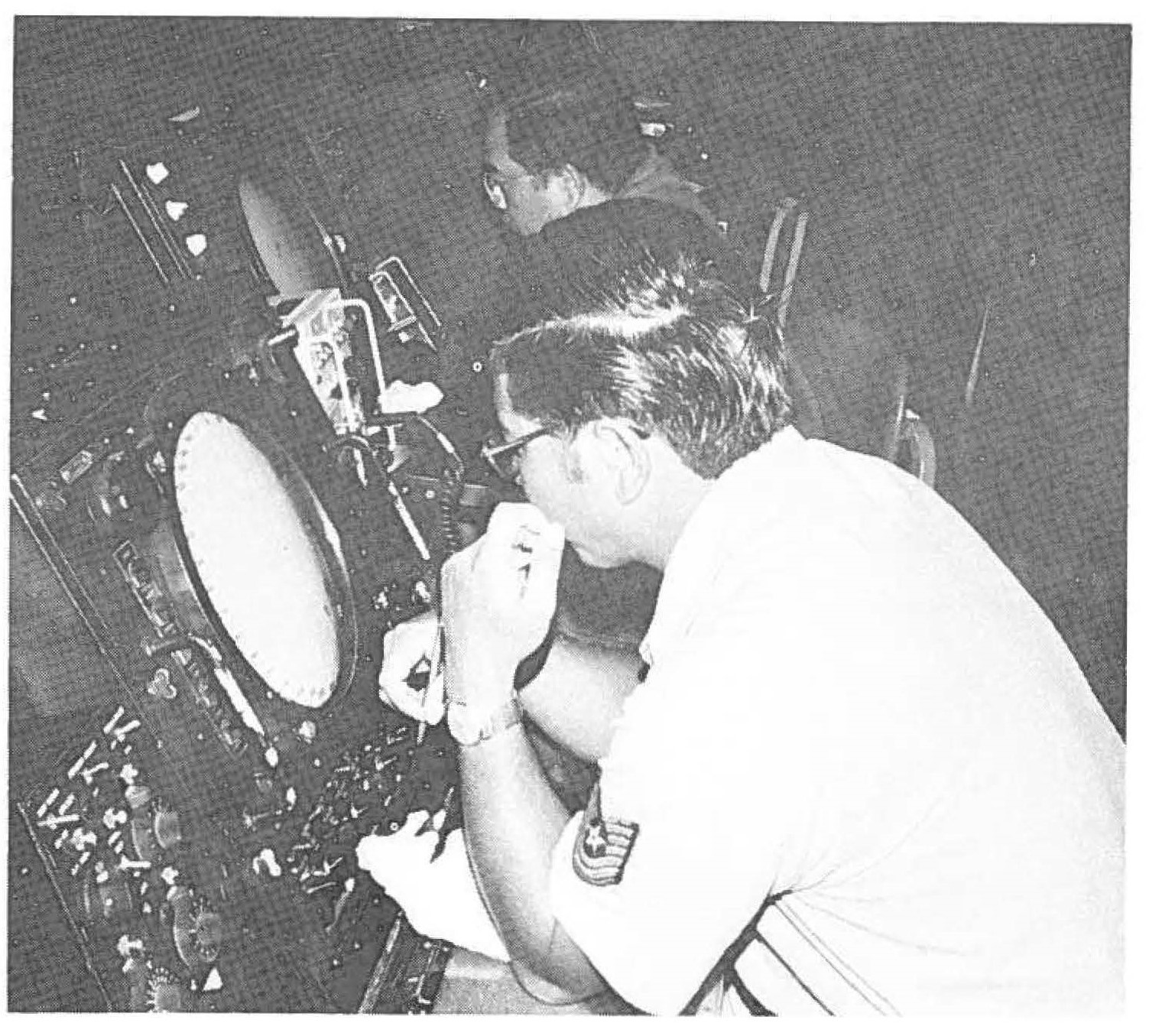
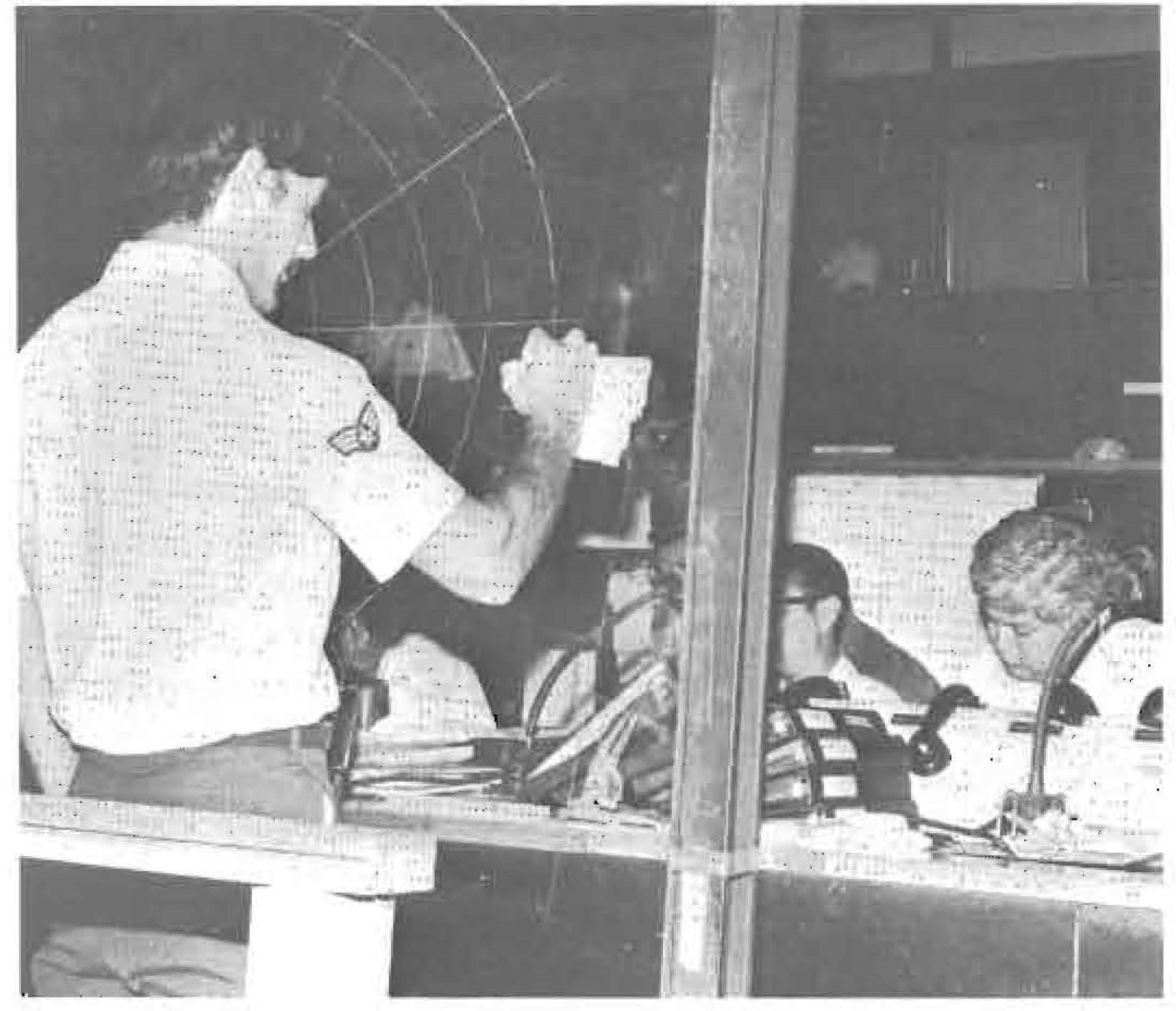
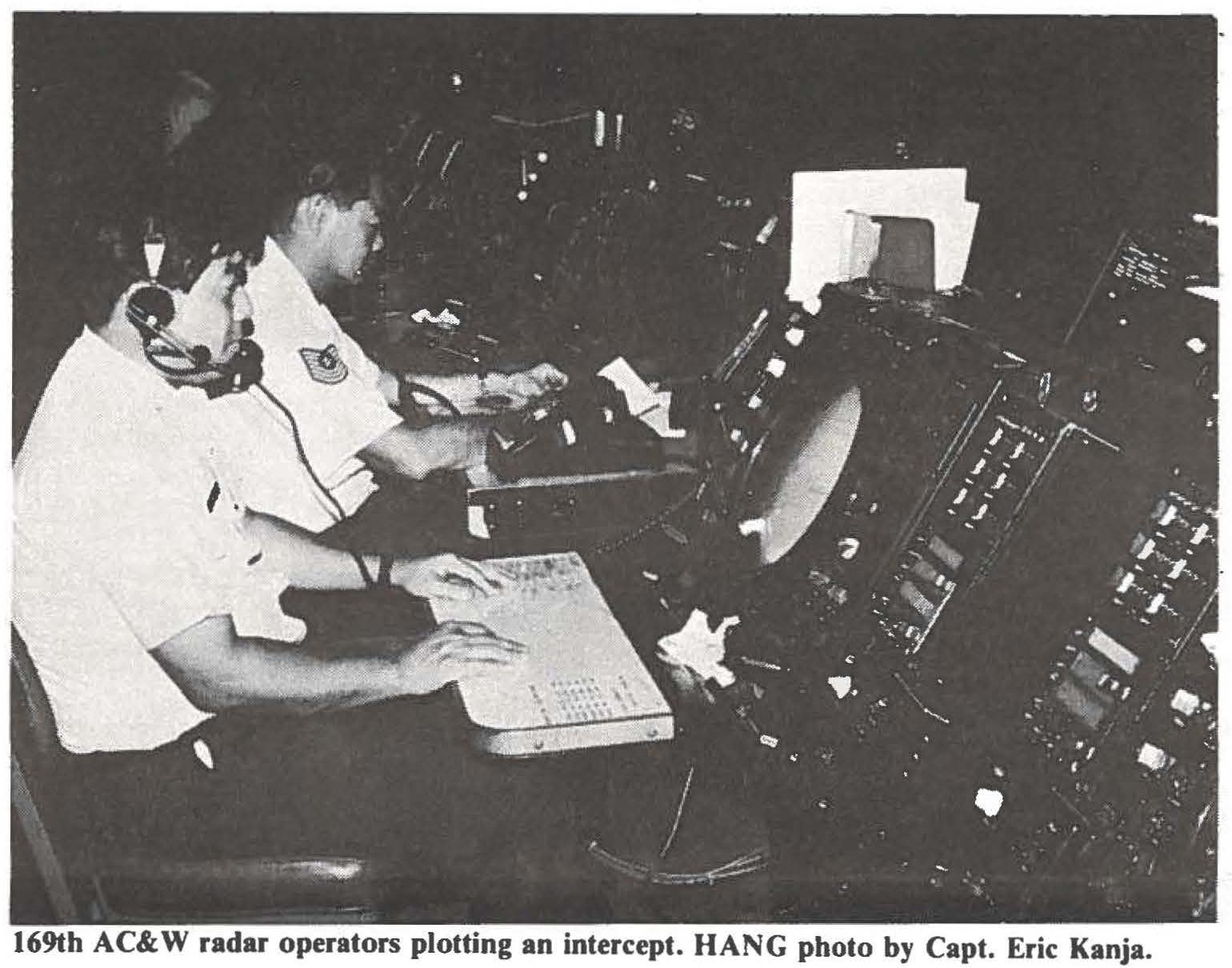
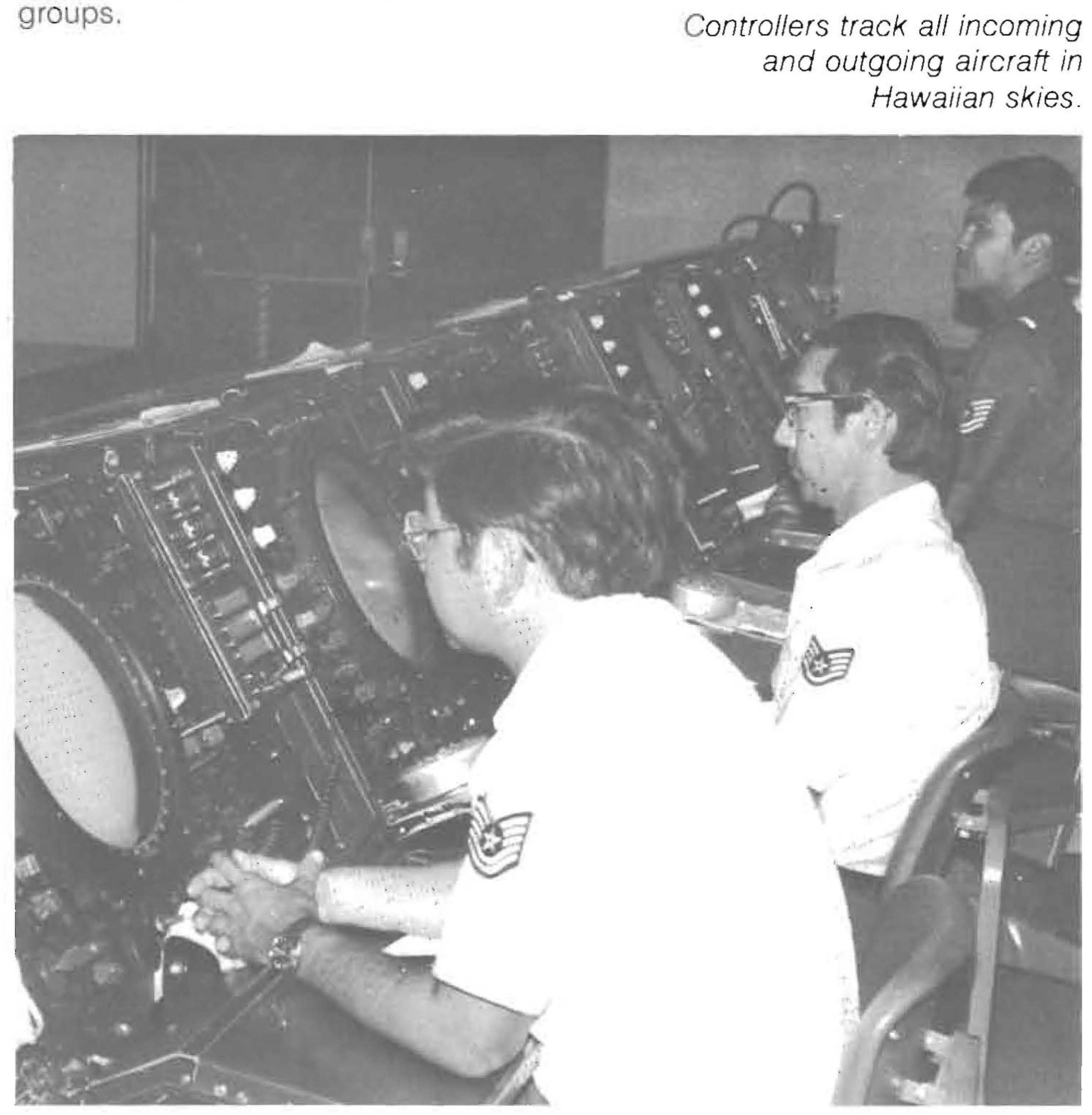
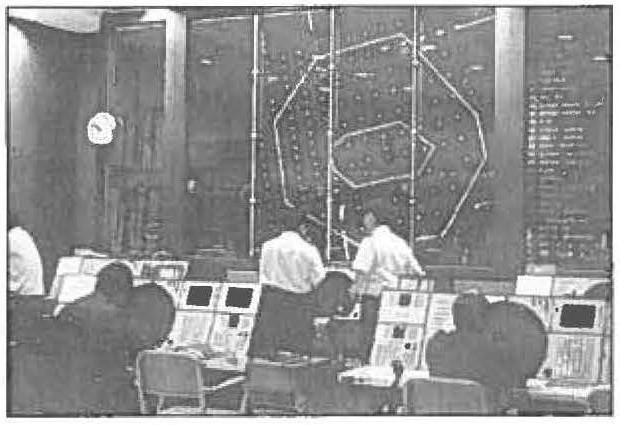
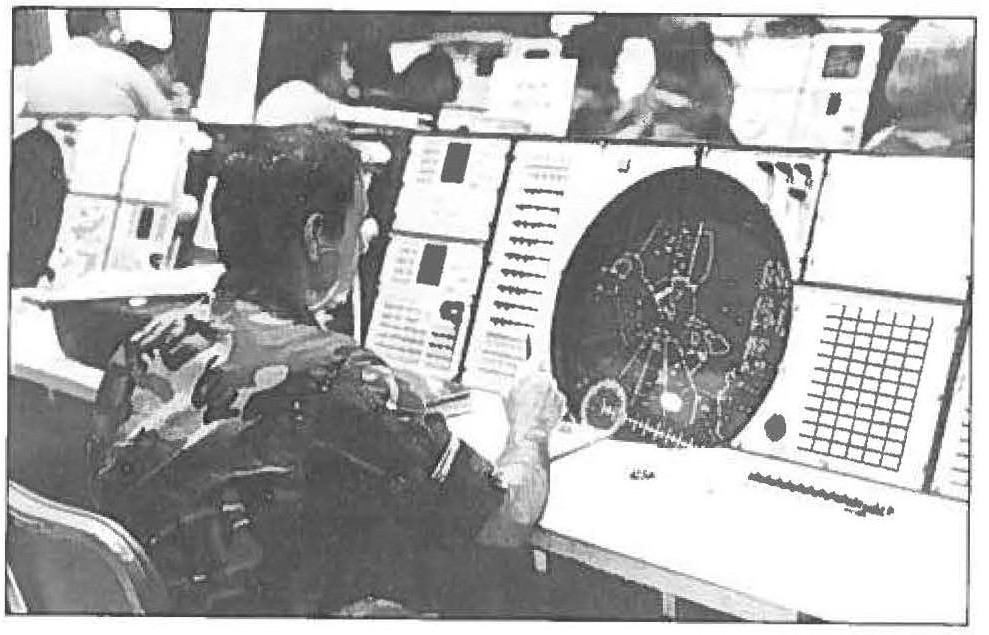
Air Guardsmen on 24-hour watch at two radar stations keep vigil. All air traffic in Hawaiian area is tracked and checked.(Picture from the 1962 Annual Report)
169th AIRCRAFT CONTROL AND WARNING SQUADRON (Fixed)
The 169th Aircraft Control and Warning Squadron (Fixed), with station at Koko Crater AFS, Oahu, along with the 150th ACW Squadron, participated in the Air Defense Augmentation Program with 24 hour-per-day radar surveillance and ground controlled interceptions.
Key personnel of the Squadron participated in detailed planning for their new radar station at Mount Kaala, Oahu, which will be jointly operated with the Federal Aviation Agency. The facilities of Koko Crater AFS were built during Wodd War II and have about reached the limit of their maintenance. They have also proved anti-quated as more and more radar and radio equipment has been installed.
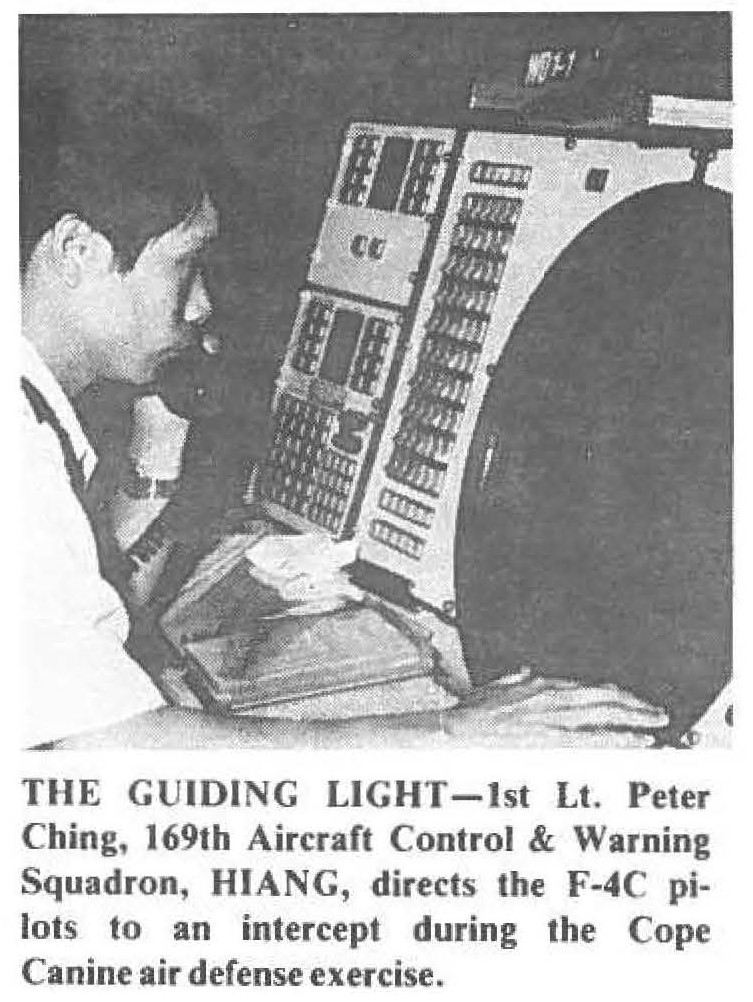
During the year over 23,000 tracks were plotted, over 2,000 intercepts were directed, 282 navigational assists were rendered, and 11 emergency assists were engaged in.
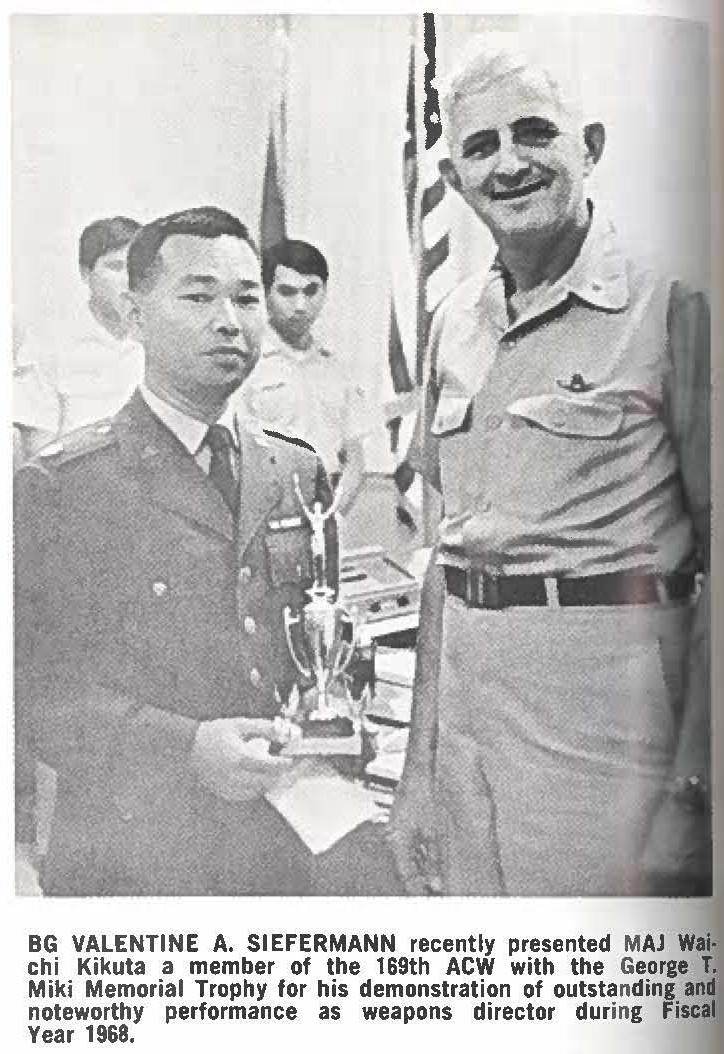
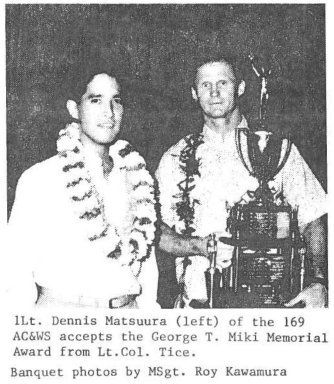
Captain Paul S. Sequcfra was awarded the Major George T. Miki Trophy for being the outstanding weapons controlled for fiscal year 1962 by Brig. Gen. Valentine A. Siefermann, Assistant Adjutant General of Air, at the morning formation of 23 July 1962. Captain Sequeira was presented the award for his dedication to duty and professional attitude with which he performed his duties.
Captain Sequeira joined the Hawaii Air National Guard in May 1959 as a first lieutenant and was asssigned to 169th as a weapons controller. Since then, his initiative and dedication to duty have added to the color and prestige of this squadron. His superior leadership has been an inspiration to his men and the men and officers of this squadron.
Captain Sequeira first entered the armed services in May 1949 as a private in the Hawaii Army National Guard and in June of 1954 he received his commission in the U.S. Air Force. He served as a navigator and weapons controller from 1954 to 1959 on active duty before joining the Hawaii National Guard.
169th Reaching Its 6th Anniversary
The 169th will be six years old on 7 October 1962. The squadron was federally recognized on 7 October 1956 at Sand Island. The squadron is tentatively scheduling a luau to celebrate the event, Major John Ing is project officer and TSG Fredrick Hirayama will he assiSting.
In celebration of the squadron’s sixth anniversary, the officers and airmen of the squadron attended a luau held at the St. Louis Alumni Hall on 30 November 1962. The affair was under the chairmanship of Maj. John C. Y. Ing and MC’d by Capt. Donald M. O’Day. The program included distinguished guest speakers, recognitions and awards, door prizes, gag prizes and music and entertainment provided by squadron members and a professional group.
Congratulations to TSgt. Joseph R. Tihayan, SSgt. David N. Keohokapu and SSgt. Stanley S. Kodama on receiving the National Guard Service Medal for 10 continouus years of honorahle and faithful service in the Hawaii National Guard.
Newcomers to the squadron are Capt. Paul F. Haygood, lLt. Donald K. Iwasaki, 2Lt. Paul H. Hashimoto, AB Wendell Tom, AB Stephen Wong, AB Harold Hata, AB Clifford Mito, AB Kelley Chang, AB Theodore Chong, and AB Vernon Freitas. We also hid welcome to A3C Ralph L. Kirkpatrick who hails from the Arizona Guard.
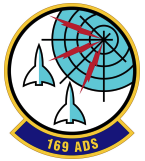
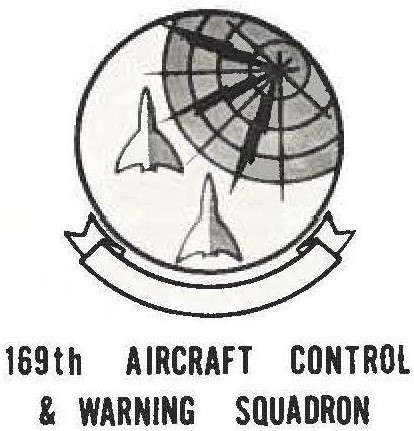
The organizational emblem as designed by SSgt. Emmerick M. Bosuego has been approved by the National Guard Bureau. It is now the squadron’s official insignia. Considering attractiveness of design and aptness to squadron mission, Sgt. Bosuego’s work was chosen in a squadron sponsored contest. The emblem is symbolic of the squadron and its mission of aircraft control and warning, and depicts a radar scope with angle and range marks, red lightning holts to indicate electronic (radar and radio) and two aircraft to symbolize all-weather we apons. The emblem bears a light blue to suggest the sky, and the national colors, red, white and blue, to indicate the patriotism of the unit’s personnel.
169th AIRCRAFT CONTROL AND WARNING SQUADRON (FIXED)
The 169th Aircraft Control and Warning Squadron, HANG, located at Koko Crater AFS, Oahu, performs a dual mission-training, and providing tools for the active air defense of Hawaii under the Air Defense Augmentation Program.
Although there was no formal Air Force inspection during this fiscal year, informal advisories were made by the Air Force Advisor’s staff to insure that the unit was performing its function in accordance with Air Force proced ures.
Greater emphasis was given to the On-the-Job training program. In addition, General Military Training was conducted on a continuing basis. Unit Training Assemblies averaged 98% attendance during the fiscal year and 100% attendance was attained for the June annual field training period.
For the first time, cross-training with the 130th Aircraft Control and Warning Squadron, Utah Air National Guard, was accomplished during the five day period in June. Althou gh there were 50 personnel involved in the cross-training, the 169th hosted 20 officers and airmen. The balance of the personnel from Utah were assigned to the 109th and 150th Aircraft Control and Warning Squadrons. In turn, 169th squadron personnel of like number and qualifications were sent to 130th Aircraft Control and Warning Squadron for their trammg in Utah. The exchange of ideas, working under different environment and operating under ADC requirements, stimulated all who participated in the cross-training program.
During the year over 28,000 tracks were plotted, over 3,000 intercepts were directed, 32 navigational assists and six emergency assists were rendered.
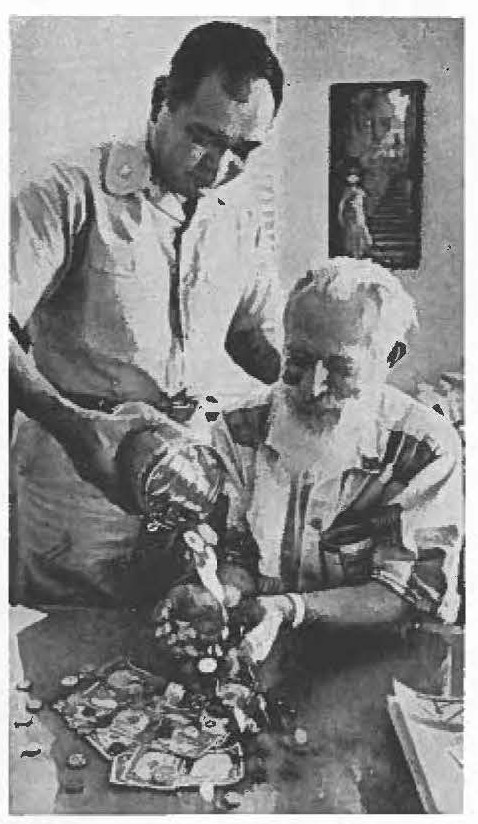
FOR THE KIDS-Lt Col Paul Goya, boss of the Hawaii Air Guard’s 169th Aircraft Control and Warning Squadron, pours $35 into the hands of “Shanghai” Betke to begin a drive to aid refugee children in Hong Kong and Taiwan. Betke organized the trust fund, to which the guardsmen began donating after an article in THE HAWAII GUARDSMAN magazine called attention to the plight of the youngsters(Picture from the 1963 March The Hawaii Guardsman)
169TH AC&W NEWS
Refugees in Chain Appeal
In the December 62 issue of the Hawaii Guardsman, there was an article entitled “Refugees in Chains,” written by Mr. Scott Stone of the Honolulu Advertiser. In response to this stirring appeal, this squadron took up a collection during our Sunday Drill in January. The collection was turned over to Mr. Stone soon after. This squadron will make this a quarterly service project.
Commander’s Call Conference
Lt Col K. P. Goya returned from the Commander’s Call Conference held at Savannah, Georgia, on 8th and 9th Feb 63. One of the major topics discussed was the “Try One” Program. This Squadron is offering a “Vacation Trip” as an incentive to unit personnel who bring in the most prior service personnel during this drive, which ends 30 June.
SDC Conference
Capt Nelson T. Moriwaki and MSgt Richard K. Senaha attended the Systems Development Corporation Conference held at Santa Moni ca, California. The conference started 29 Jan 63 and ran through 1 Feb 63. The representatives discussed current Radar Operations training problems and proposed new programs. The objective of this conference was to improve Training Programs.
Congratulations Bestowed
Receiving the Armed Forces Reserve Medal for 10 continuous years of honorable and faithful service in the Hawaii National Guard were Capt Abraham Naehu, MSgt Richard K. Senaha and TSgt Frederick K. Hirayama. 2Lt Paul H. Hashimoto was awarded a certificate for Qualified Contro1ler.
9 March 1963- The “word” “TRY ONE” was on the minds of every memher of the squadron. How would we he ahle to recruit enough men to meet our quota??? The quota was 35 men. While we were searching for the answer, TSgt Kenneth Kiyabu already had the answer. A Recruiting Booth in a central location. What could he more centrally located than the Ala Moana Shopping Center? Then, things started looking brighter. Ideas from MSgt Harold Abe and SSgt Stanley Kodama and SMSgt Clifford Chee and others too numerous to mention, started the ball rolling. Sure, we could put up the booth at the shopping center but what could we use to attract the prior service personnel to the hooth? Girls!! ! Sure, why not! Hey, how about making a movie showing the activities of the different sections at work during a normal drill day!
AlC Stanley Shinsato was called upon to be the Chief Photographer under the fine producing and directing of Capt Thomas Shimabuku. The movie was taken during the drill day of 9 March 1963. In the short span of 4 days, the movie was edited, cut and spliced over and over again until everyone was satisfied that the film was perfect.
Now, Lt Eddie Anderson and Mr. Boh Nagao were called upon to find a source of dubbing sound with the film. A tape recorder was loaned to us by HEPCO in the Ala Moana Shopping Center for this purpose. Mr. Tom Carroll of KGU permitted us to use the sound room for the narration on the tape for the film. Lt Anderson did the narration.
While this was going on, Capt Shimabuku and Sgt Kiyabu were approaching merchants at the shopping center to donate prizes for the girls helping at the booth. About $100 in merchandise was donated by the generous merchants.
TSgt Ronald I chimura and TSgt Clifford Yanagihara, with the help of their crews, set up the booth and decorated it with pictures, banners, signs and the flags of the United States and Hawaii.
The stage was set- in just 9 days. Opening nite was here. This was covered by the press and KHVH-TV. Music was provided h y squadron personnel called the “Koko-Leos” with TSgt Frederick Hirayama at ukulele, SSgt Lawrence Asing at guitar, SSgt Deogracias Agbayani at sax, SSgt Frederick Merino at bass, AlC Lemuel Aweau at vibes and a civilian volunteer, George Uechi at drums. And the public liked it!
The results- in 15 actual hours of recruiting time, 80 interested applicants were contacted at the booth.
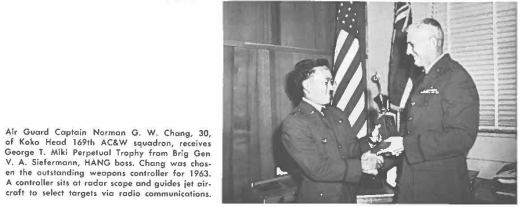
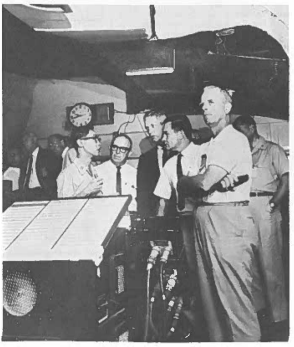
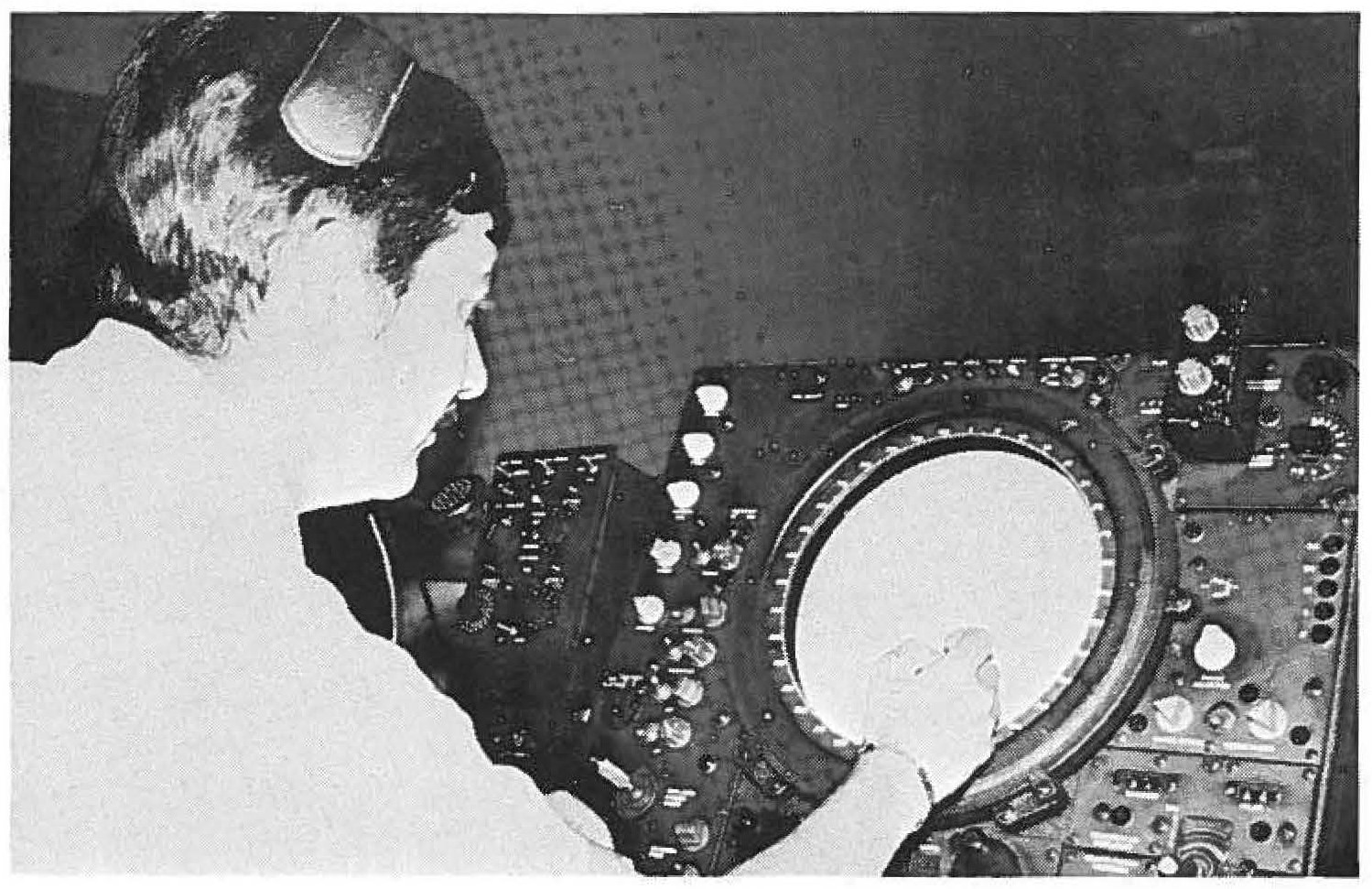
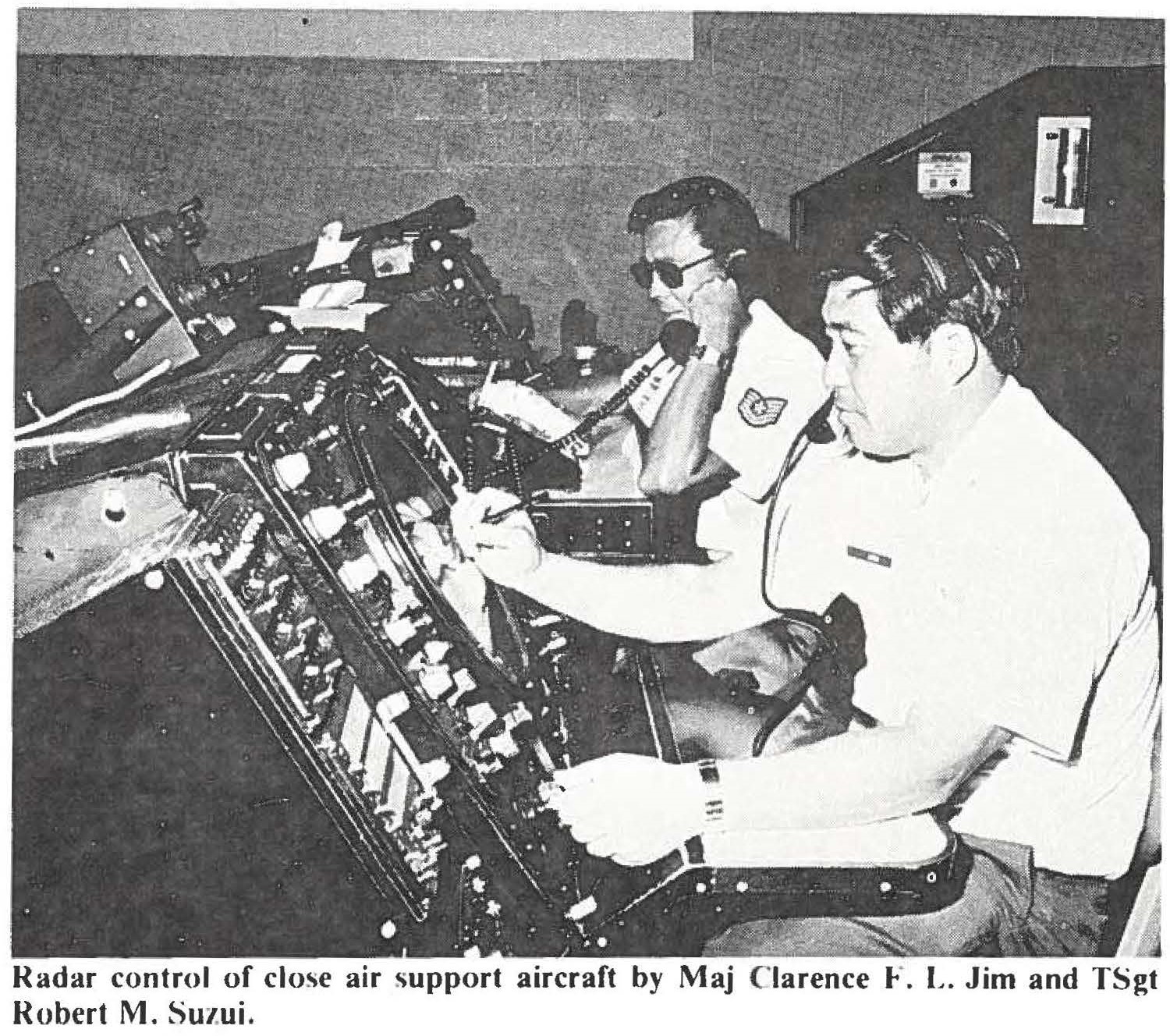
Air Guard Captain Norman G. W. Chang, 30, of Koko Head 169th AC&W squadron, receives George T. Miki Perpetuol Trophy from Brig Gen V. A. Siefermann, HANG boss. Chong was chosen the outstanding weapons controller for 1963. A controller sits at radar scope and guides jet aircraft to select targets via radio communications. (Picture from the 1963 September The Hawaii Guardsman)Air Guardsmen in this radar operations room keep constant vigil of Hawaiian area 24-hours a day, 365 days a year. The Hawaii Air Guard operates two radar stations, one on Kauai and one on Oahu. These radar stations have saved 29 lives and approximately 31 million dollars to date through giving troubled pilots navigational assistance.(Pictures from the 1964 Annual Report)
169th AIRCRAFT CONTROL AND WARNING SQUADRON (F)
The 169th ACW Squadron, located at Koko Crater Air Force Station, Oahu , is one of two aircraft control and warning squadrons providing air defense for the Hawaiian Islands.
During the Fiscal Year, this squadron participated in various types of training exercises under the supervision of the Hawaiian Air Defense Division , our gaining command. There was a total of forty-four (44) Division wid e exercises, consisting of fakers penetrating the Hawaiian Air Defense System and recall-mobilization type of training exercises to simulate emergency conditions. Also, there were one hundred twelve (1121 System Training Missions, synthetic training device simulating the actual live type exercises.
Continued emphasis was given to On-the-Job training program. Due to this concerted efforts, the percentage of personnel passing the Air Force Skill Knowledge Test (SKT 1 has improved considerably from the previous fiscal year. The average rate was 90%.
The 169th ACW Squadron was awarded the HANG Attendance Award for unit training assemblies for the third quarter of Fiscal Year 1964, with an average of 99%. However, the average attendance for the year was 97 % .
The 1964 Annual Field Training was conducted at Koko Crater Air Force Station for 10 days in June. The other five days were utilized by the sec tions of the squadron during the year under the “Texas Plan.”
The 169th ACW Squadron added another successful year under the Air Defense Augmentation Program during the Fiscal Year 1964. The following statIstIcs indicate the activity of the station during this reporting period: Total Number of Tracks-27,557, Total Number of Intercepts (Actual & Trng) – 3,809, Total Emergency Assists-8 and Total Navigational Assists-206.
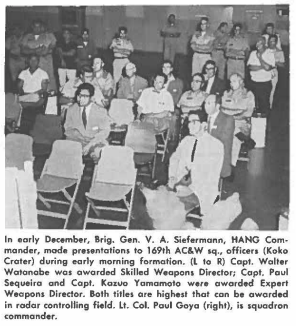
In early December, Brig. Gen. V. A. Siefermann, HANG Commander, mode presentations to 169th AC&W sq., officers (Koko Crater) during early morning formation. (L to R) Capt. Walter Watanabe was awarded Skilled Weapons Director; Capt. Paul Sequeira and Capt. Kazuo Yamamoto were awarded Expert Weapons Director. Both titles ore highest that can be awarded in radar controlling field. Lt. Col. Paul Goya (right), is squadron commander. (Picture from the 1964 March The Hawaii Guardsman)
169TH AC & W SQ.
SPIRIT OF CHRISTMAS
As a season’s greeting to the people of the State of Hawaii, the Air Guardsmen of the Hi9th Aircraft Control and Warning Squadron erected a forty foot Christmas tree consisting of more than 100 light bulbs on the top of Koko Crater. Koko Crater is located on the southeast corner of the island of Oahu.
ACHIEVEMENT AWARDS
On 15 December, at an early morning formation of the 169th Aircraft Control and Warning Squadron, Hawaii Air National Guard, Brigadier General Valentine A. Siefermann, Commander of the Hawaii Air National Guard, presented awards of achievement to Captains Kazuo Yamamoto, Paul P. Sequeira Jr., and Walter O. Watanabe. Having achieved the necessary requirements including the successful passing of Air Force tests, Captains Yamamoto and Sequeira were awarded the title of “Expert” Weapons Directors. Captain Watanabe was honored with the title of “Skilled” Weapons Director.
BIRTHDAY CELEBRATION
The 169th ACW Sq. celebrated its 7th Anniversary with an evening cocktail party under the picturesque Keawe trees on January 18. Highlights of the gala affair, besides the “spirits,” were the “ono” birthday cake and “swaying” to the haunting melodies of “Splash” Aweau and his 5 little drips-a positively “smashing” affair
MILITARY AFFAIRS COMMITTEE members of the Honolulu Chamber of Commerce, visited the HANG’s 169th AC&W squadron (left) at Koko Crater and the Nike-Hercules missile radar facility above Hawaii Kai on 2 April. The 20 visitors were greatly impressed with the modern-day Notional Guard. At the close of the tours, group lunched at M’s Ranch House. (Picture from the 1964 June The Hawaii Guardsman)
169TH AC & W SQ.
Trophy
On 18 April, at an early morning fonnation, Brig Gen Valentine A. Siefcrmann, Commander, HANG, presented the Hawaii Air National Guard quarterly attendance trophy to this Squadron. Recipient of the Trophy in the Squadron’s behalf was Lt Colonel Paul Goya, Commander. The 169th Squadron’s attendance rate during the past quarter was 99% . The Trophy has finally been uprooted from its seemingly permanent residency at HANG’s 199th Fighter Interceptor Squadron.
Farewell
The officers of the 169th gave a farewell party at the Fort DeRussey Officers’ Club for Major Herbert S. Isonaga. Major lsonaga’s new assignment is Training Officer for HANG.
Trainees Return From Mainland Schools Second Lt. Harold Lai completed Weapons Control School at Tyndall AFB, Florida and returned on 17 April with the second highest grade in his class.
A2C Fred Iwasaki and A2C David Sato returned from AC & W Ground Radar Maintenance Technical School at Keesler AFB, Mississippi on 3 April. Airman Iwasaki returned with the Honor Student distinction.
Lt Col Paul Goya, Commander of the 169th, has been appointed president of the Hawaii National Guard Association effective 1 January 1965. He presently holds the elected office of vice-president. Col Goya will reemphasize the benefits of membership and also pledges support of the HANG Association through legislation of hoth Army and Air National Guard units.
Sergeant Major
First Sergeant Clifford Chee has been promoted to Sergeant Major and assigned to Headquarters HANG. An Aloha party was held on Monday IO August in his honor. Cliff was presented a clesk pen set by Col Goya from members of the squadron.
On October 23, 1964, the members of the 169th ACW Squadron celebrated their 7th Anniversary which actually falls on the 7th of October. This year the newly organized 169th NCO Club sponsored the luau. Much lo the enjoyment of wives and girlfriends, they were invited for the first time to a major unit function. Hawaiian food, door prizes, entertainment, music by the Holiday Serenaders, and lots to drink kept the men and their dates in a merry mood. Among the many guests, we were honored by the presence of General and Mrs. Stevenson, Colonel and Mrs. Byers and Colonel and Mrs. Henderson. The highlight of the evening was the entertainment by the members of the squadron, especially the ‘Ukus,” Hawaii’s answer to England’s Beatles.
The Mount Kaala radar facility and the Wheeler AFB operational facility were completed and being tested at the end ol lhe fiscal year. This new radar complex which is to be operated by the 169th ACW Sq (F), will enhance air defense capabilities. The Mount Kaala radar facility is a FAA/ HANG joint-use facility; maintenance responsibility of the prime search radar is vested in the FAA with HANG providing Air Technicians to adequately man two shifts. The remainint electronic equipment is maintained solely by the HANG. The radar information from Mount Kaala is remotcd via a microwave radio system to the Wheeler AFB operational facility for use by the 169th ACW Sq (F) Direction Center.
169th AIRCRAFT CONTIIOL AND WARNING SQUADRON (Fixed)
The 169th ACW Sq (F) maintained its 24-hour surveillance at the Koko Crater AFS, Oahu, as one of two units providing air defense in Hawaii.
The squadron participated in various types of training exercises under the supervision of the Hawaiian Air Defense Division. These included four JTF 119 Exercises which involved recall-mobilization type of training, utilizing the full scope of the existing operations plans and 58 Team Training Exercises – which consisted of “faker,, aircraft penetrating the Hawaii Air Defense System. There were also 122 System Training Missions, a synthetic training device simulating the actual live type exercises.
The 169th ACW Sq (F) maintained its excellent SKT passing rate of 90% for all levels with continued emphasis given to On-the-Job Training. During the reporting period, 43 personnel were tested and 39 passed. In addition, General Military Training was conducted on a continuing basis.
The station detected and plotted 38,762 tracks, conducted 3,911 intercepts, provided four emergency assists and three navigational assists.
The 169th ACW Sq will have their hands full from 14 to 23 June moving and getting their Wheeler Field and Mount Kaala sites operational for the l July target date.
The unit will be bidding farewell to Koko Head with a big luau at the close of camp. It should be the best of many staged over the years.
A1C Stanley Shinsato receives “Airman of the Quarter” trophy from Brig Gen Valentine A. Siefermann, HANG Commander, while Lt Col Paul Goya, 169th Commander looks on. (Picture from the 1965 March The Hawaii Guardsman)
At an awards ceremony on 18 Jan 1965 at the 169th Aircraft Control and Warning Squadron, Airman 1st Class Stanley Shinsato of “B” Flight was presented a trophy by Brigadier General Valentine Sieffermann, commander of the Hawaii Air National Guard. Airman Shinsato received the trophy in recognition of being chosen the Hawaii Air National Guard’s “Airman of the Quarter.” Based on hearing, courtesy, job knowledge, self-improvement efforts, deportment, and participation in squadron and community activities, Airman Shinsato was chosen the best among the recommended representatives of each unit for the October through December period.
Being very active in squadron activities, Airman Shinsato’s more notable accomplishments are the voluntary filming of the 169th’s recruiting movie, “Try One,” and the invention of a measuring device for the squadron’s water tank which saved untold working hours, and increased safety for personnel.
The Farrington High School graduate is a member of the Japanese Junior Chamber of Commerce, and is active on its directory committee. He is also the squadron’s official photographer working on a voluntary basis.
With only a few weeks remaining before the men of the 169th ACW Sq move to Wheeler Air Force Base, the activity at both sites can be described as busy, busy, busy. According to all sections, target date of l July 1965 will be met.
A luau will be held during summer encampment at Koko Head to bid farewell to the station which has been the home of the 169th ACW Sq for eight (8) years. The general consensus is to make the last luau at Koko Head the “greatest” and one that will not be forgotten. Besides the usual menu of a luau, the third annual beauty contest will be held to select Miss Koko Head 1965. All sections are searching for a sweetheart to represent them. Each candidate will receive a gift and a lei from the section or flight that sponsors her. Trophies will also he presented to the Queen and her attendants. Naturally only single girls between the ages of 18 to 30 are eligible.
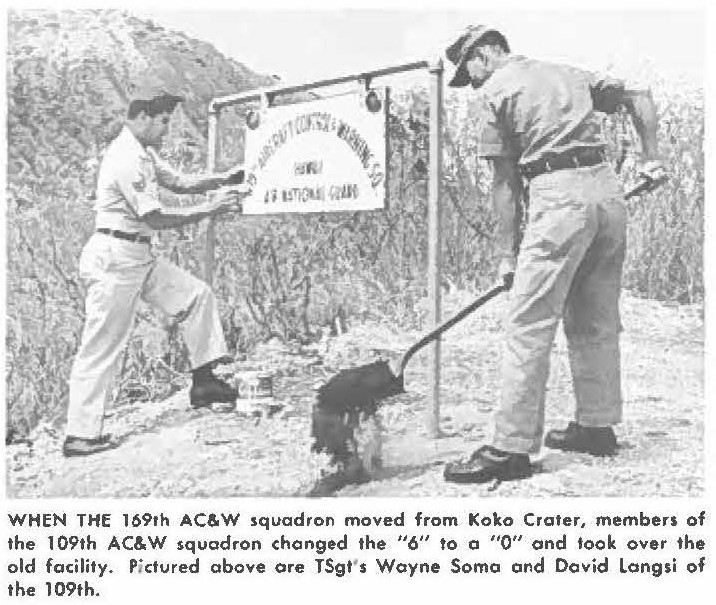
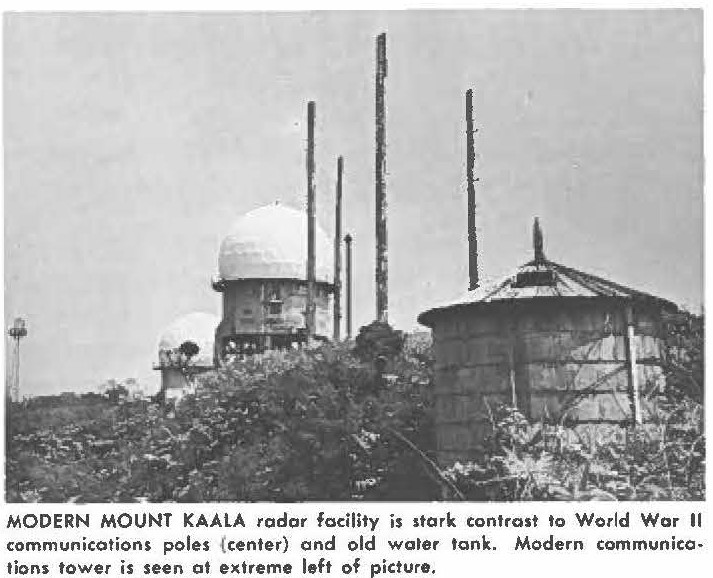
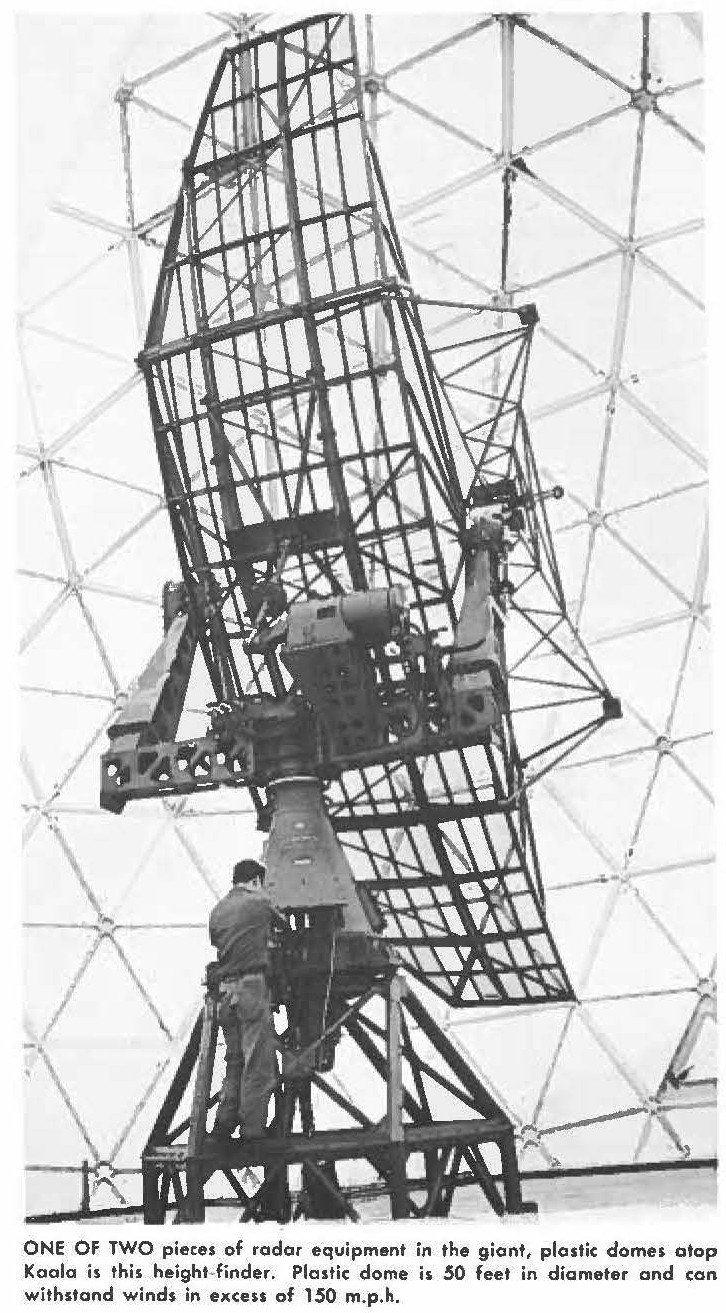
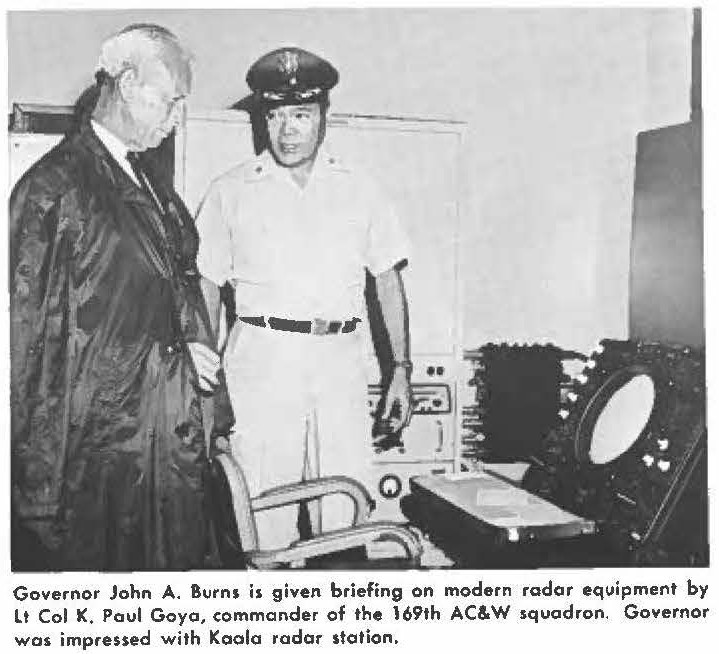
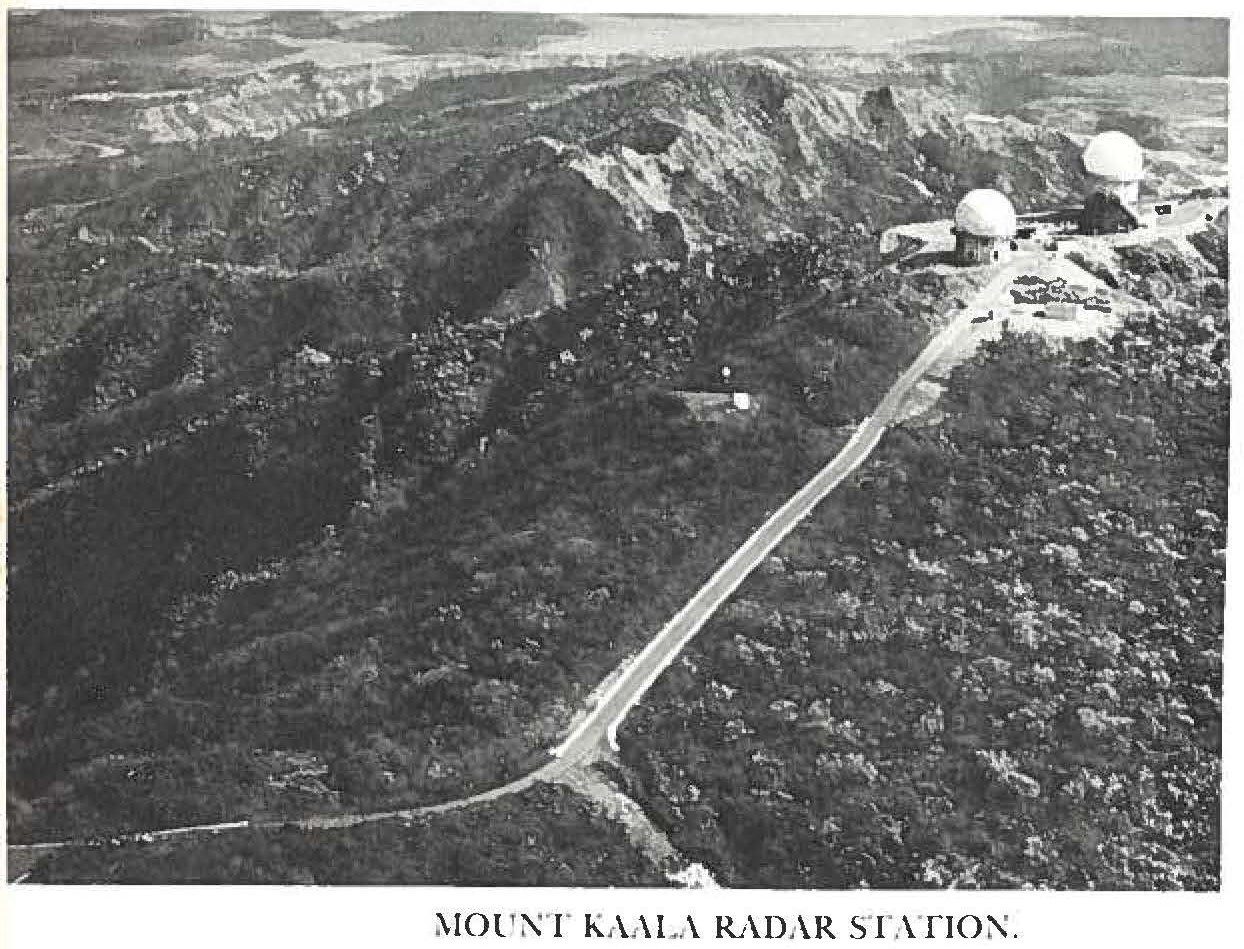
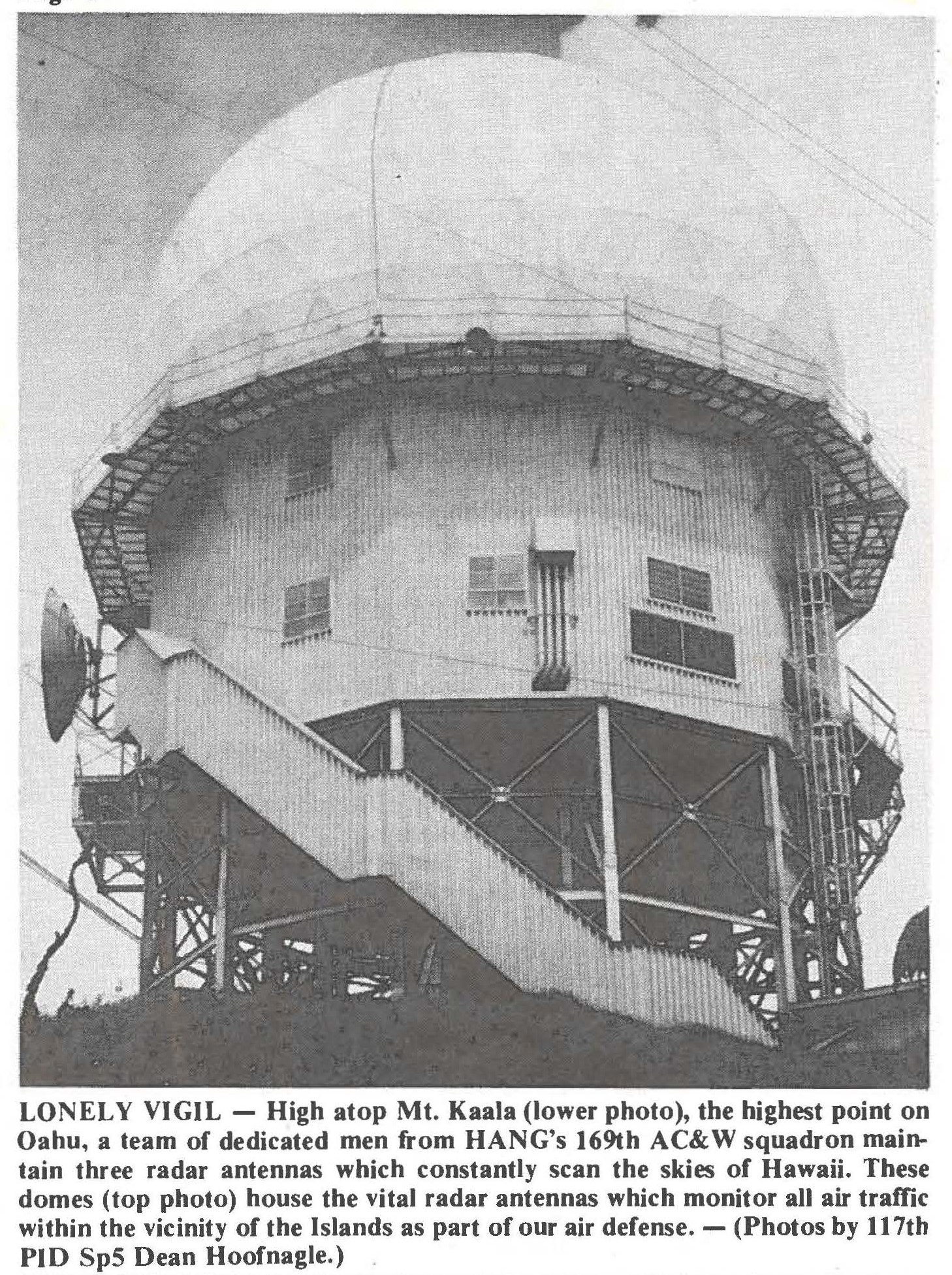
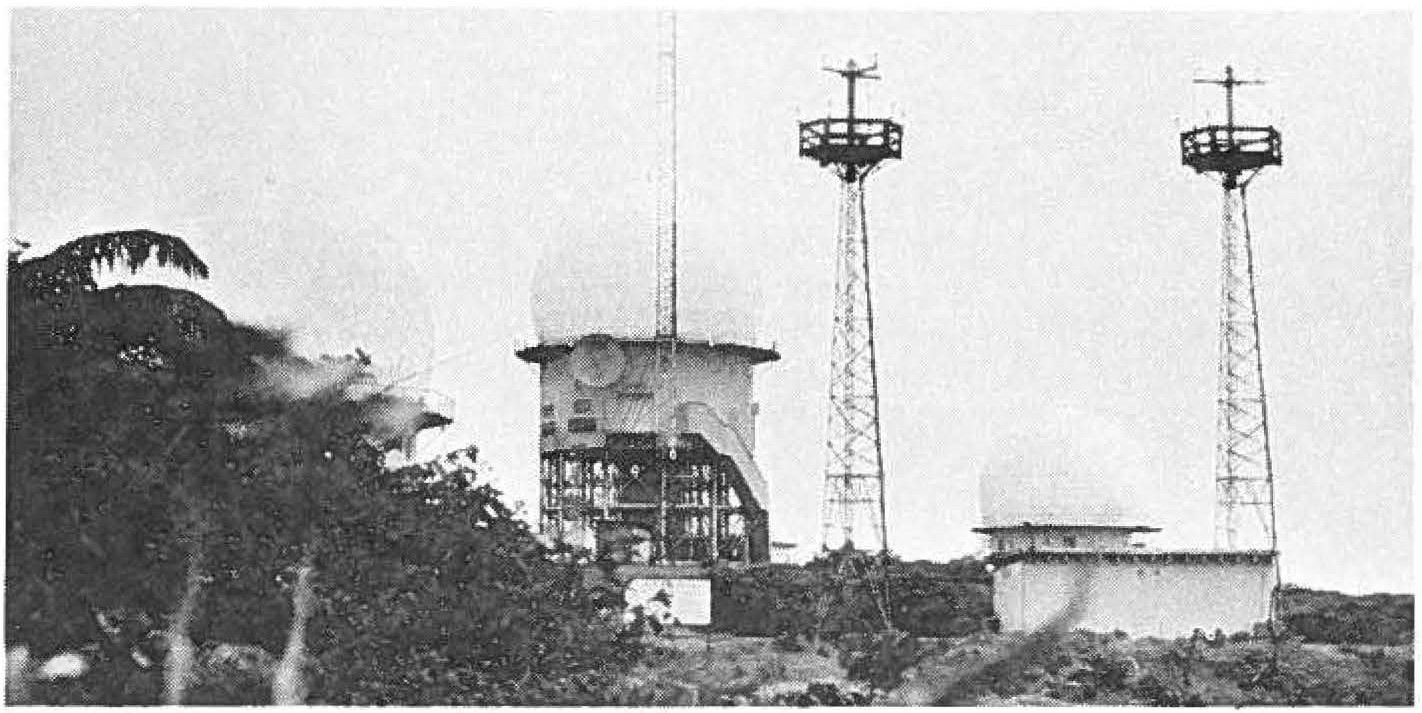
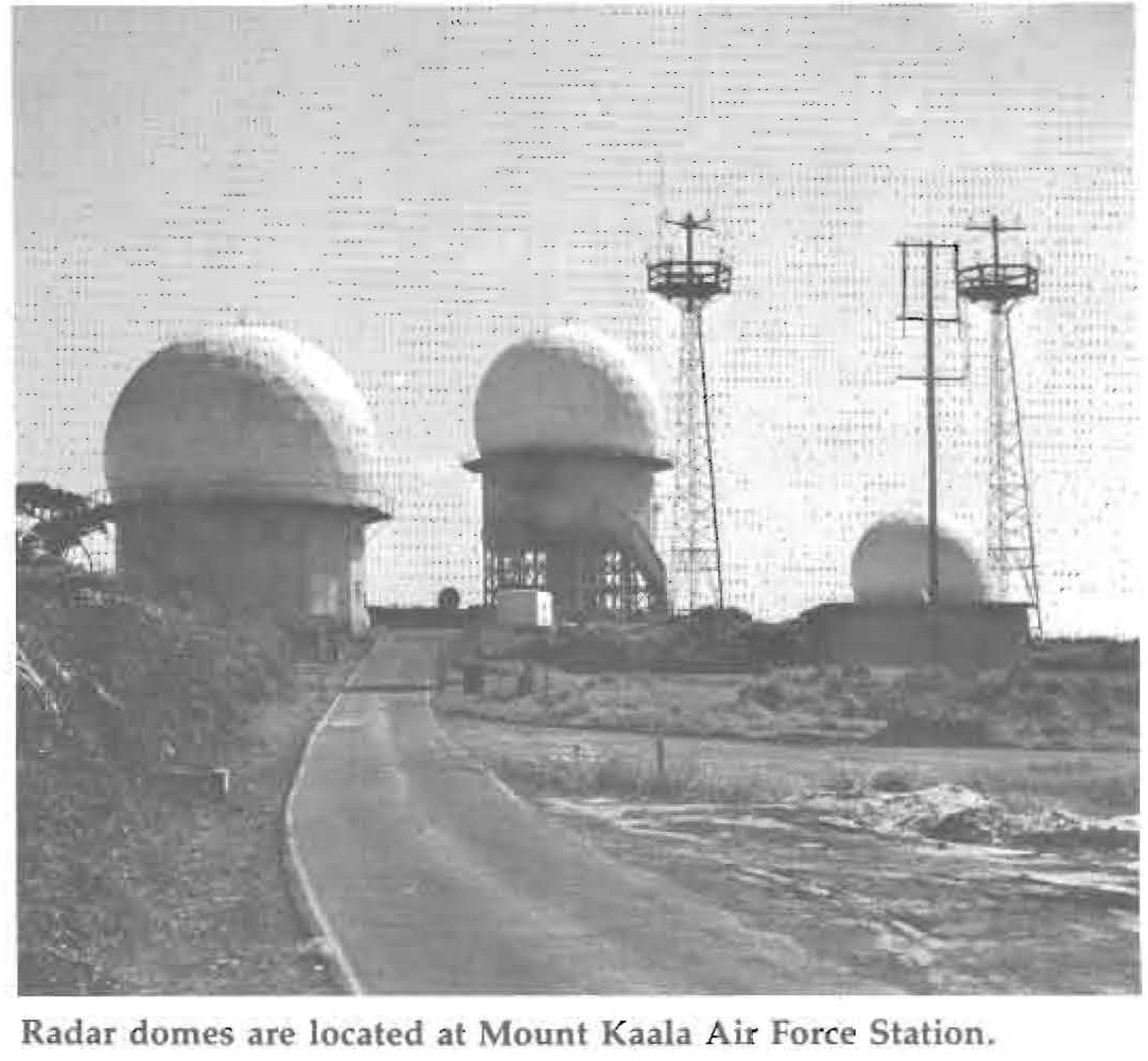
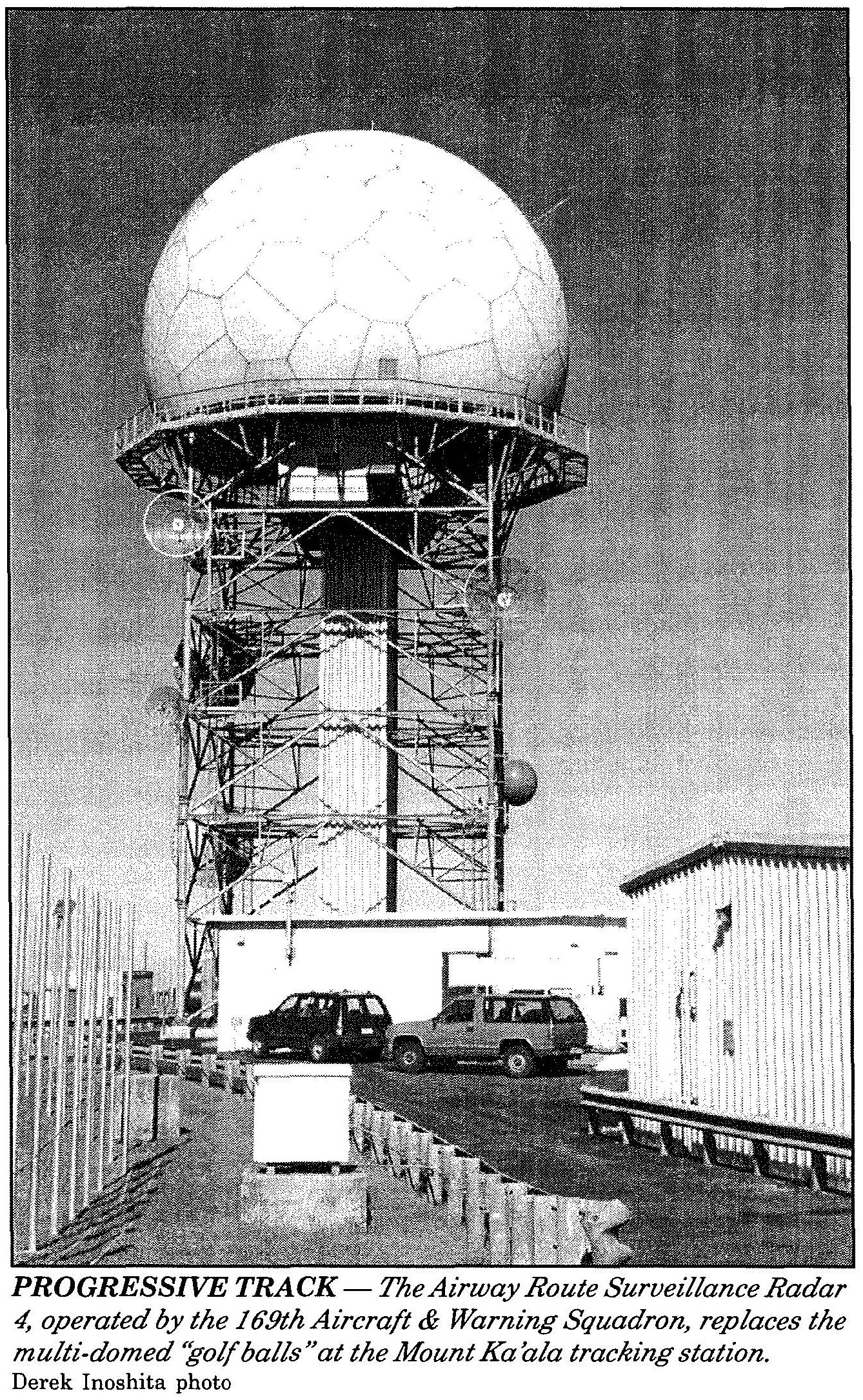
WHEN THE 169th AC&W squadron moved from Koko Crater, members of the 109th AC&W squadron changed the “6” to a “0” and took over the old facility. Pictured above are TSgt’s Wayne Somo and David Langsi of the 109th. MODERN MOUNT KAALA radar facility is stark contrast to World War II communications poles (center) and old water tank. Modern communications tower is seen at extreme left of picture, ROAD TO KAALA winds through Waianae Mountain range to highest point on Oahu. Only 4 wheel drive vehicles are allowed on the narrow roadway. Skilled drivers take approximately 30 minutes to make the drive from the Waialua side of the range to the top. ONE OF TWO pieces of radar equipment in the giant, plastic domes atop Kaala is this height-finder. Plastic dome is 50 feet in diameter and can withstand winds in excess of 150 m.p.h.Governor John A. Burns is given briefing on modern radar equipment by Lt Col K, Paul Goya, commander of the 169th AC&W squadron. Governor was impressed with Kaala radar station,(Picture from the 1965 September The Hawaii Guardsman)
. . .
Open House
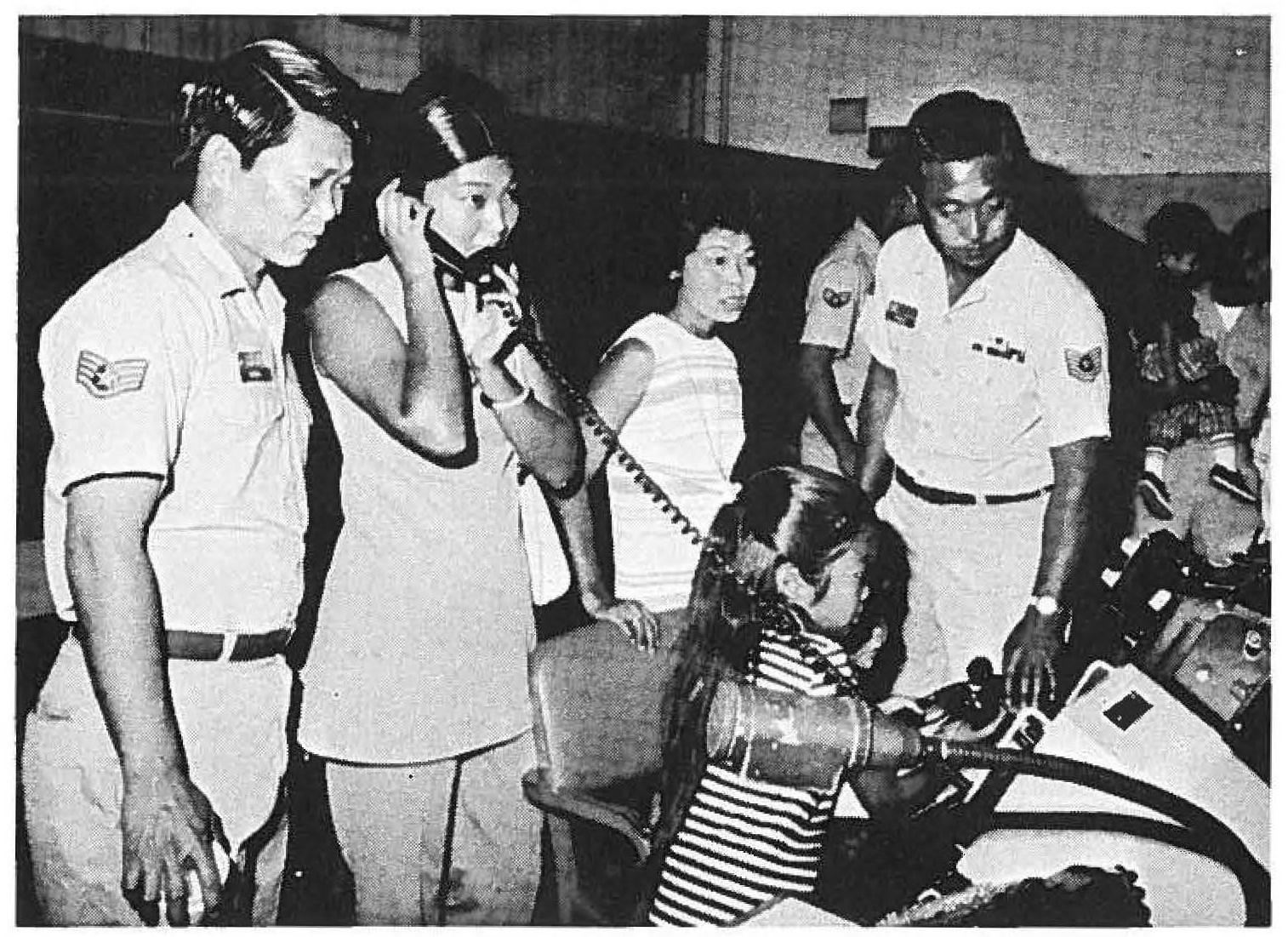
In order to acquaint families of the 169th AC&W Squadron with the new facilities at Wheeler AFB, the Squadron scheduled an ” open-house” for the Sunday drill in August.
The half day affair consisted of a briefing, visits to the various sections, a picnic lunch and outdoor games. The Squadron provided hot dogs with buns, soft drinks and other condiments.
Kaala Dedicated
Recently dedicated was the Mount Kaala/ Wheeler AFB facility, new home of the 169th Aircraft Control and Warning Squadron.
The radar equipment is located atop Mount Kaala, some 4,000 feet above sea level. All radar information is micro-waved to the operations building at Wheeler AFB.
The new facility, its equipment worth 3 million dollars, is the first joint use installation of its kind. Maintenance of the equipment will he performed jointly by the Federal Aviation Agency and the Hawaii Air National Guard.
Heading the list of dignitaries was Governor John A.Burns. The Reverend Abraham K. Akaka made the dedication speech. Also present were Maj Gen Robert L. Stevenson, Adjutant General; Brig Gen John A. Rouse, Commander, PACAF Base Command who has since been transferred to another command; Mr. Phillip M. Swatek, Director, Pacific Region FAA and other dignitaries.
Following the dedication ceremonies at the top of Kaala, members of the official party drove to Wheeler AFB and were given a tour of the operations building. A luncheon was held at the Wheeler Officers Club at the conclusion of official festivities.
A few tips from Lt Col Paul Goya, Commander, 169th AC&W Sq.
·’IT’S NO SECRET to Hecnlistmcnt”
“Every member of the 169th Aircraft Control and Warning Squadron plays a different role in accomplishing our goals, but each individual is t•11ually important to our team.” By continually impressing this belief upon each officer and airman, from the Commander down to the supervisors and to the rank and file airman, a feeling of hcloni,:ing persists and a high state of morale is created. To prepetuat this state of morale, one must be dependent upon good leadership entwined with a well-organizcd training program, proper communication, and over-all good management. The direct result will produce a high reenlistment rate, and furthermore, in the recruiting of new personnel, one need not go “hcgging.”
At the present time, the 169th ACW Sq enjoys a healthy manning of 95.2%. of the authorized strength. This unit also experiences a consistently hi17,h reenlistment rate which is the highest in the Hawaii Air ational Guard.
Periodically, the various section leaders are reminded of maintaining an effective training program and frequently the progress of training is monitored hy the Unit Training Officer and Unit Training NCO. Each trainee is treated and handled individuall}’ so that he will one day become a well-trained technician on our team.
On-thc-joh training records arc constantly checked for accuracy and the trainee is given periodic phase tests to insure that his joh knowledge has progressed so that at the end of the OJT period he will he alile to pass the Air Fore(‘ Specialty Knowledge Test I SKT). Due to th<> t•mphasis given hy the trainer and trnincc, the squadron’s passing rate of SKT’s has hcen 927, during Fiscal Year 1965. Again, this is higher than the national averai,:c. Much of the credit goes to imlividual instructors who have spent many long hours planning and improving all phases of training.
It is a standard practice at the 169th to “give credit where credit is due.” Being encouraged hy these words, the personnel of the unit frequently offer new ideas for improving our squadron as a whole. Particularly, the unit NCO Club has Leen most effective in promoting effecting communication between sections to improve better working relationships. Also, this “First-Three-Grader” group has taken the initiative in spearheading many community projects and unit functions. This, again, is a team effort and makes the squadron function as one with a feeling of belonging. Equall} important, we put a great deal of effort in planning and organizing affairs where families of our members participate. By familiarizmg th<• families with our mission requirement and our work conditions, they appreciate the necessity of calling out the .. Guard men” early in the morning for mobilization practice.
Many of our personnel who are employed in civilian occupations or arc attending the university, are unable to attend the scheduled unit training assemblies. Fortunately, duf’ to the mission of the unit (operating around the clock as part of the Hawaiian Air Defense System), we arc ahle to authoriz(‘ personnel to perform appropriate duty during the day or night, on W<‘ekends or holidays. This flcx1,ility has enahlcd the squadron to maintain a high drill attendance rating.
It is our standard practice to encourage all airmen to reenlist when Expiration Term of Service (ETS ) is around the corner. Each section supervisor personally interviews the individual concerned to assure him that we have a personal interest. However, should the problem of reenlistment appear insurmountable, he is then personally interviewed hy the Commander. In many cases, the prohlem is resolved with the mutual ,;atisfaction of aU concerned. Consequently th<‘ 169th ACW Squadron enjoys a relatively high retention rate which is dir<‘ctly related to the skill level of the personnel assigned to the unit. With more skiJled personnel on hand, the tasks becom(‘ easier and the unit more efficient, Our secret is not new.
Eighth Anniversery Celebrntion The 169th ACW Squadron celchrated its eighth anniversary with a nine course Chinese dinner at the Hong Kung Restaurant. The “Drag” affair was held on 13 November 1965. The dignitaries present were Maj General Robert L. Steveson, Adjutant General; Brig General Valentine A. Sicfcnnann, Assistant Adjutant General Air; Colonel Van Dcusen, Vici’ Commander, 326 Air Division; Lt Colonel Johu Byers, Deputy Commander, 326 Air Division; Lt Colonel Frank Hay, Commander, Wheeler Air Force Base; Captain Eddie Anderson, Director of Public Affairs, Hawaii National Guard, and their wives.
The no host cocktail hour started at 1745 and dinner was promptly served at 1830. After the seventh course, master of ceremonies Captain Tom “Marlon” Shimabuku welcomed the guests and squadron members and their wives. The highlight of the dinner was the presentation of the Commanders Trophy hy Lt Colonel Paul Goya to the outstanding Airman of the Year, Airman Second Class Herbert Souza.
Colonel Goya also addressed the distinguished guests and the officers and airmen of the 169th ACW Squadron. The sparkling gem of the party was our Sweetheart of 1965, Miss Jill Mona Otagaki.
History of 169th
In 1956, many of our old time personnel were part of the old 109th AC & W Squadron at Sand Island, Oahu. At that time, our operations were very crude and simple. Our radar antenna was a little old thing which we placed flat on the ground. The only things we could pick up on our scopes were ants and Sgt Abe’s big feet. Our operations were very unsophisticated. In fact, they were so unsophisticated that the most elementary and basic need of all human beings was not provided for. To satisfy this basic need, we had to go hehind the kiawc trees.
October 7, 1957 was the hig day for the 169th. It was on this day that the unit received official Federal rccogni1ion and was activated. Thus, from a humble beginning, the 169th was born.
In the following year, in February, the 169th became the second Air Nalional Guard squadron in Hawaii to be given a full time air defense mission. Koko Head Air Station was now the “eye” of the Pacific. In addition to seeing all airborne objects in the Hawaiian Air Defense Identification Zone, we were spccta tors to the most sensational submarine races on the island of Oahu.
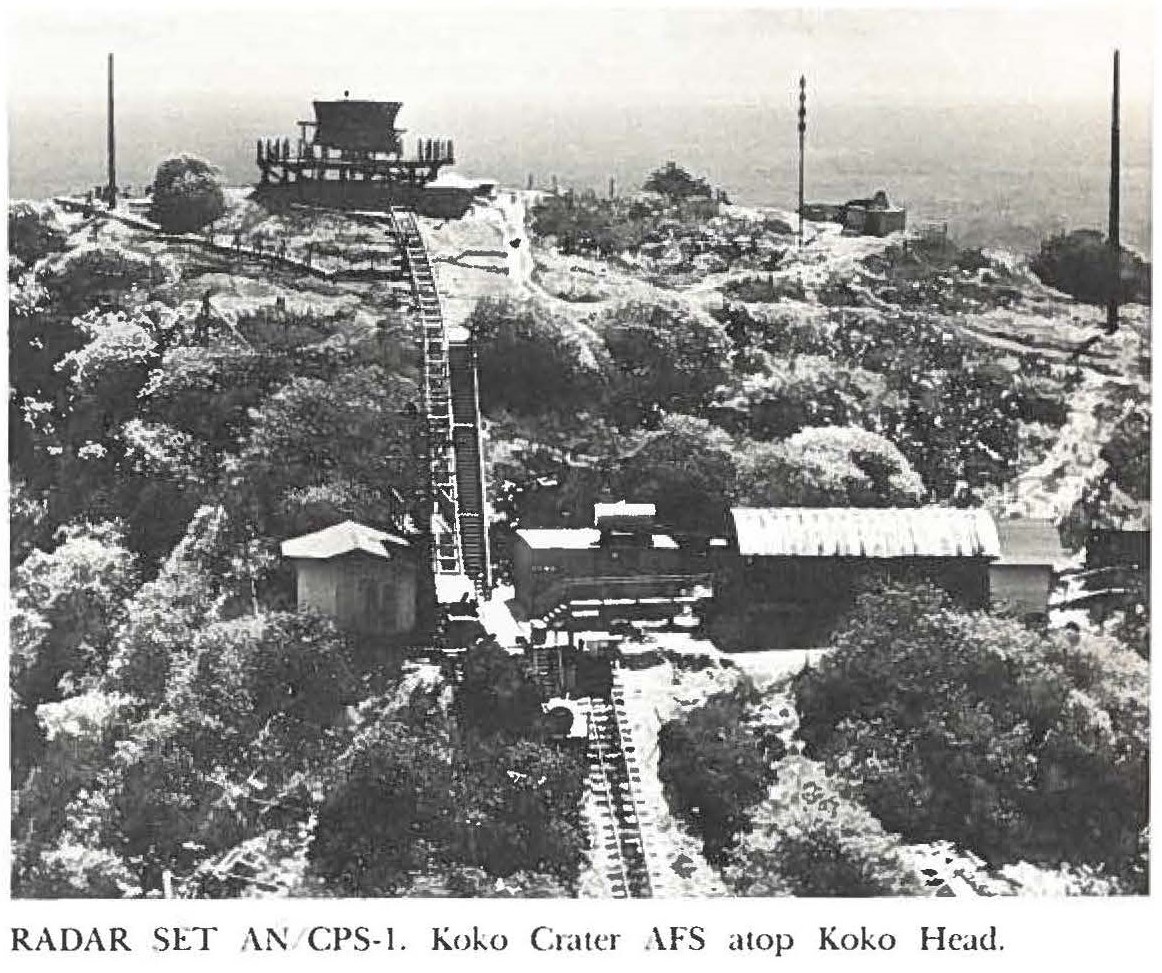
Koko Air Station became famous in the ensuing years. We hecame famous not only because of the unit’s ability to fulfill its mission or its ability to pass operational readiness inspections, but hecause everybody wanted to ride our tram, Hawaii’s answer to San Francisco’s cahle cars.
Another contributing factor to our fame was our Christmas tree the highest on all of Oahu- 1280 feet in the air.
After nearly seven years of operation, we moved to Wheeler AFB where we hecame guests of our brothers in air defense, the U.S. Air Force. The radar antenna was placed on Mt. Kaala, the highest point on the island of Oahu.
Presently, we have more than one hundred air technicians working full time. Augmenting this group of professionals are one hundred officers and men who are drill status personnel, ready to help in the event of an emergency. Thus, from a simple operation of a few thousand dollars, the squadron grew to a multi-million dollar organization.
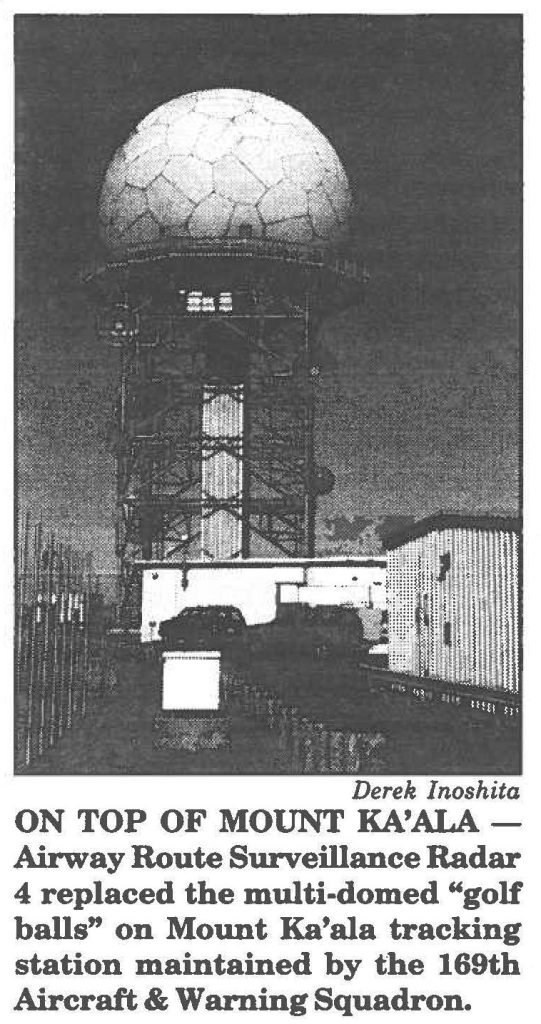
Looking like golf balls in the rough, two radar antenna bubbles high atop Mount Koala are stark contrast to rugged hill top. The new radar site is operated by the 169th Aircraft Control and Warning Squadron. (Picture from the 1966 Annual Report)
On 2 July 1965, the Mount Kaala/ Building 204 facility was officially dedicated. The 169th ACW Sq phased out its operation from Koko Crater AFS and began operation from the new facilities. Today, the radar at Mount Kaala provides radar information to both the Federal Aviation Agency and to the Hawaii Air National Guard.
The 109th ACW Sq changed station from Punamano AFS to Koko Crater AFS, and 169th ACW Sq changed station from Koko Crater AFS to Mount Kaala Complex effective 1 Jul 1965. (See pIate II-Section List of Units).
169th AIRCRAFT CONTROL AND WARNING SQUADRON (Fixed)
The 169th ACW Sg (F) aGivatcd the Mount Kaala Wheeler AFB Complex on 1 July 1965. Previously, the 169th ACWS Sq was locatcd at Koko Crater AFS. This new complex has given tbe Unit a much greater operational capabilicy.
An operational readines inspetion was administered by PACAf quring The period 20-28 June 1966, and this orginization was rated satisfactory. In addition, PACAf Standarization and Evaluation Team visits were most beneficial to our radar operations section during the year.
As in previous years U.S. Navy intercept Controllers cross-rrained at this unit’s Air Defense Direction Center and the required live and simulated imercept training. An dfor the first time, besides acquiring (Dining mentioned above, the U.S. Navy conducted a one week requalification course for Navy controllers who had lost their currency rating as an lnrercepr Controller.
The numher of training exercies remained the same as the previous fiscal year with torals as follows: (1) Division wide exercises-59; (2) System Tra ining Missions- ll). In addition, 43,43t tracks were pIonted, 4,185 intercepts; were conducted, 12 navigational assists were given.
During the months of September and Ocrober 1965, tbe radar set AN/Ff S-7, a joint· use radar with the Federal Aviation Agency a Mount Kaala, underwenr a major ltenna modification. The seven beam configuration was changed ro tim of a single beam. This modification, provided by the FAA, made the radar capable of providing two· channels, which makes the set more reliable for operational
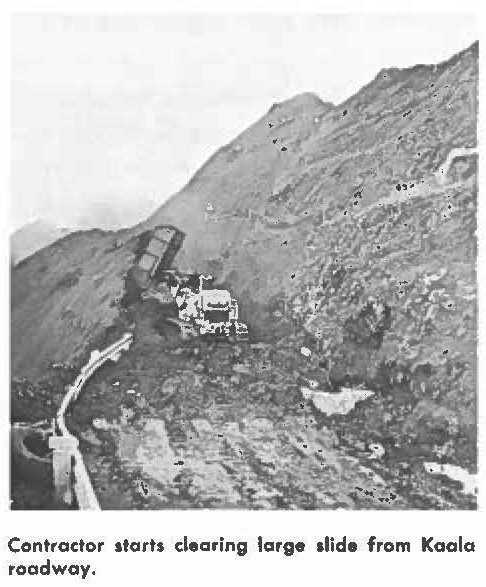
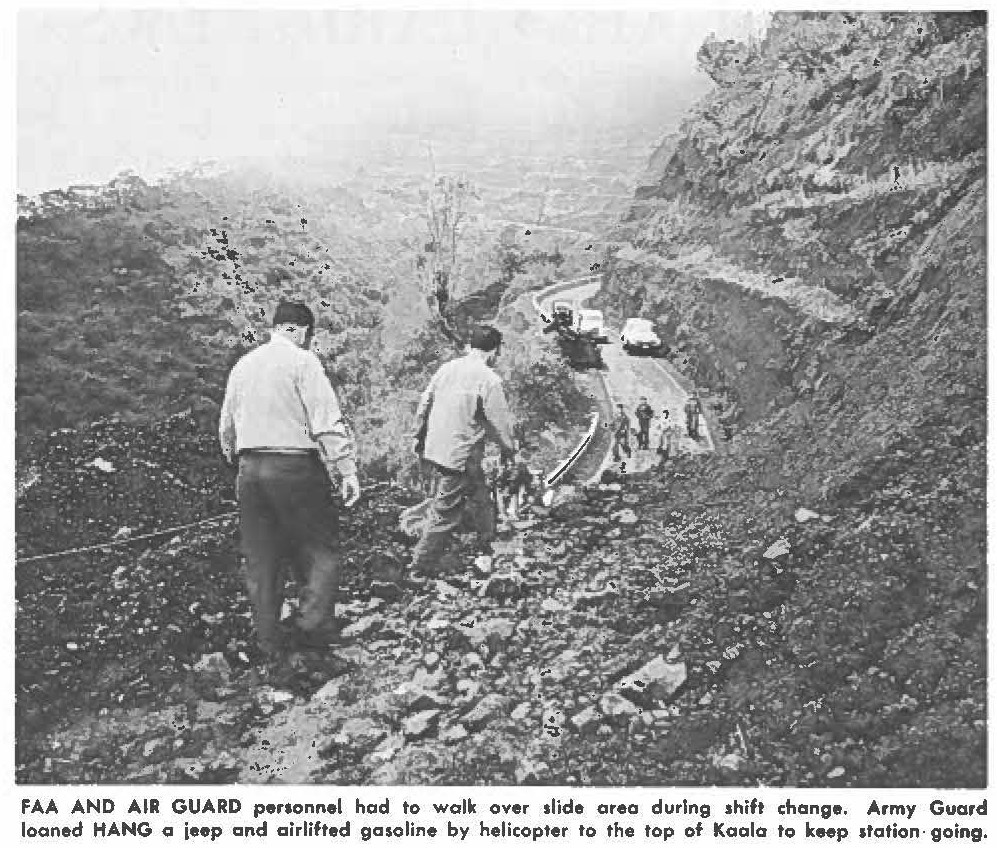
Contractor starts clearing large slide from Koala roadway. FAA AND AIR GUARD personnel had to walk over slide area during shift change. Army Guard loaned HANG a Jeep and airlifted gasoline by helicopter to the top of koala to keep station going. (Pictures from the 1966 March The Hawaii Guardsman)
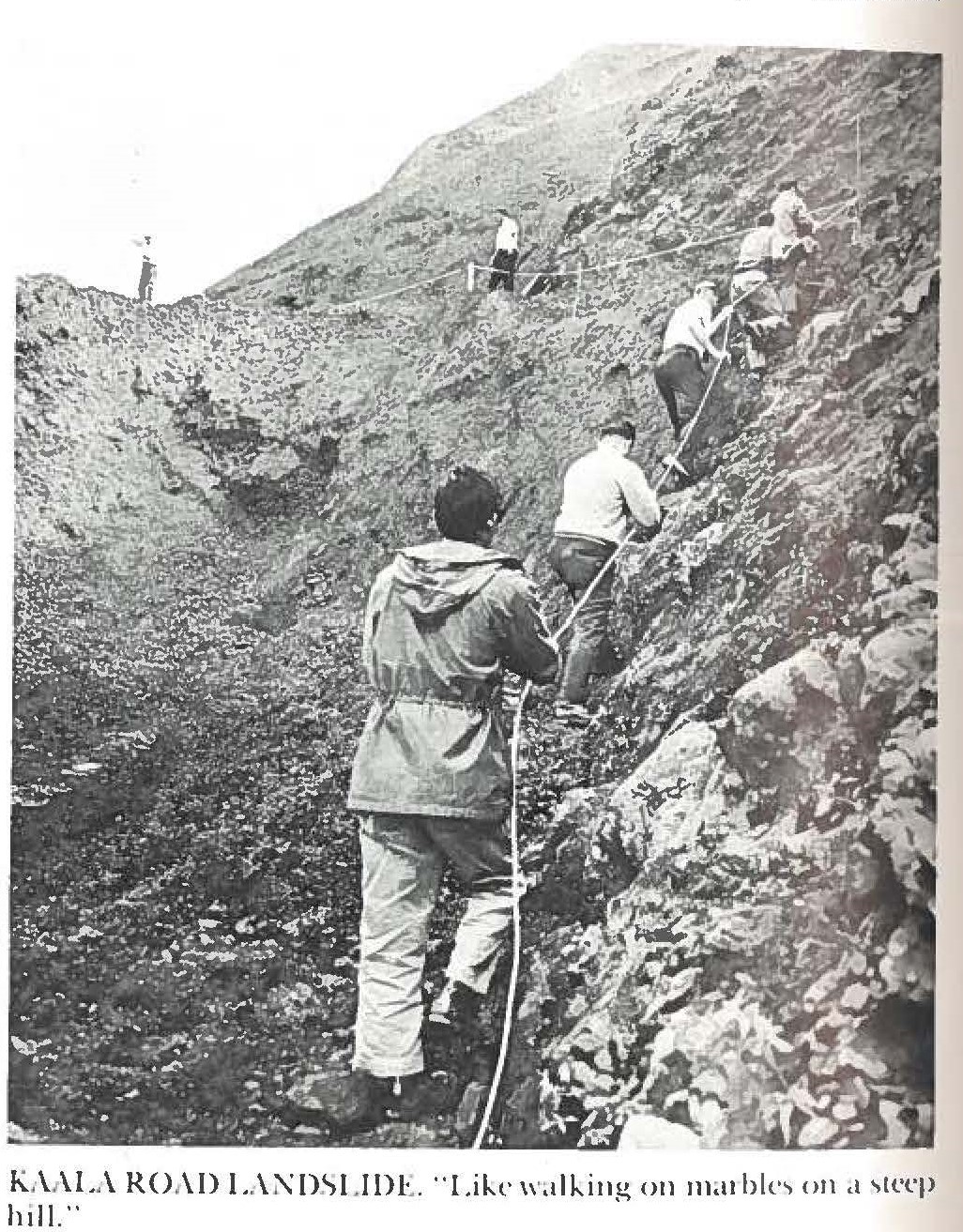
Through rain, landslides, and rubble, the undaunted electronics maintenance men of the 169th successfully fulfills their mission on the top of Mt. Kaala, the highest point on the island of Oahu. Frequent torrential downpours have caused landslides which blocked the 6.8 mile road to the radar site many times in the past, but the “daddy” of them all occurred on the 19th of January.
Mounds and mounds of earth and rubble covered the road for approximately a 75-yard area with the summit reaching 60 feet, the height of an average six-story building. Personnel going to duty stations traveled by motor vehicle to the disaster area, then by foot, crossing the slide area with the aid of ropes. Accomplishing this task required great dexterity. As one of the more articulate airman described the daily duty, “it’s like walking on marbles on a steep hill.” Meeting the men on the other side of the slide was an Army National Guard jeep which provided transportation for the remaining distance. Petrol for the jeep was a problem, but again, the Army National Guard came to the rescue. They provided 50 gallons of gasoline by helicopter.
After a difficult engineering problem was solved with blasting, terracing, and clearing, the J. M. Tanaka Construction Co. re-opened the road for use 22 days later. This was a happy day for the .. goat”” of the 169th. But there still remains the unanswer-able question, “will the next one e bigger?”
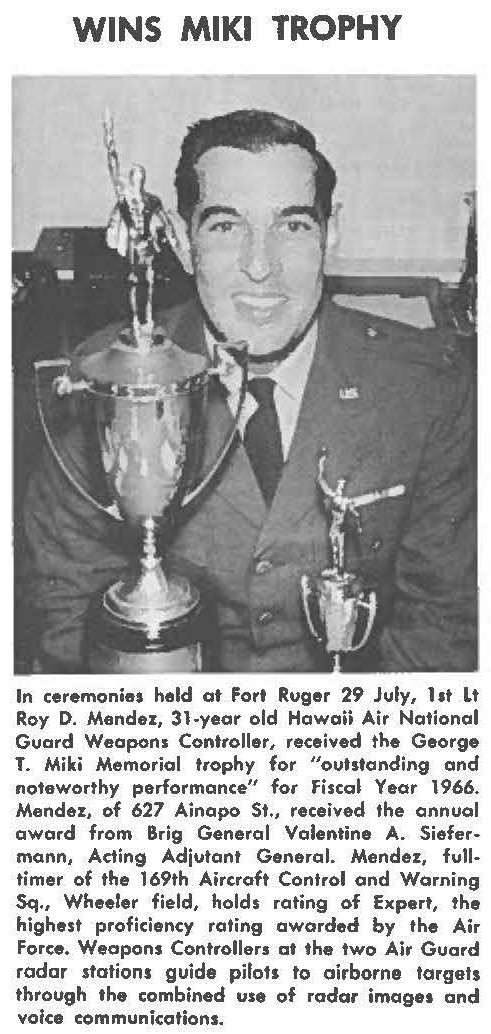
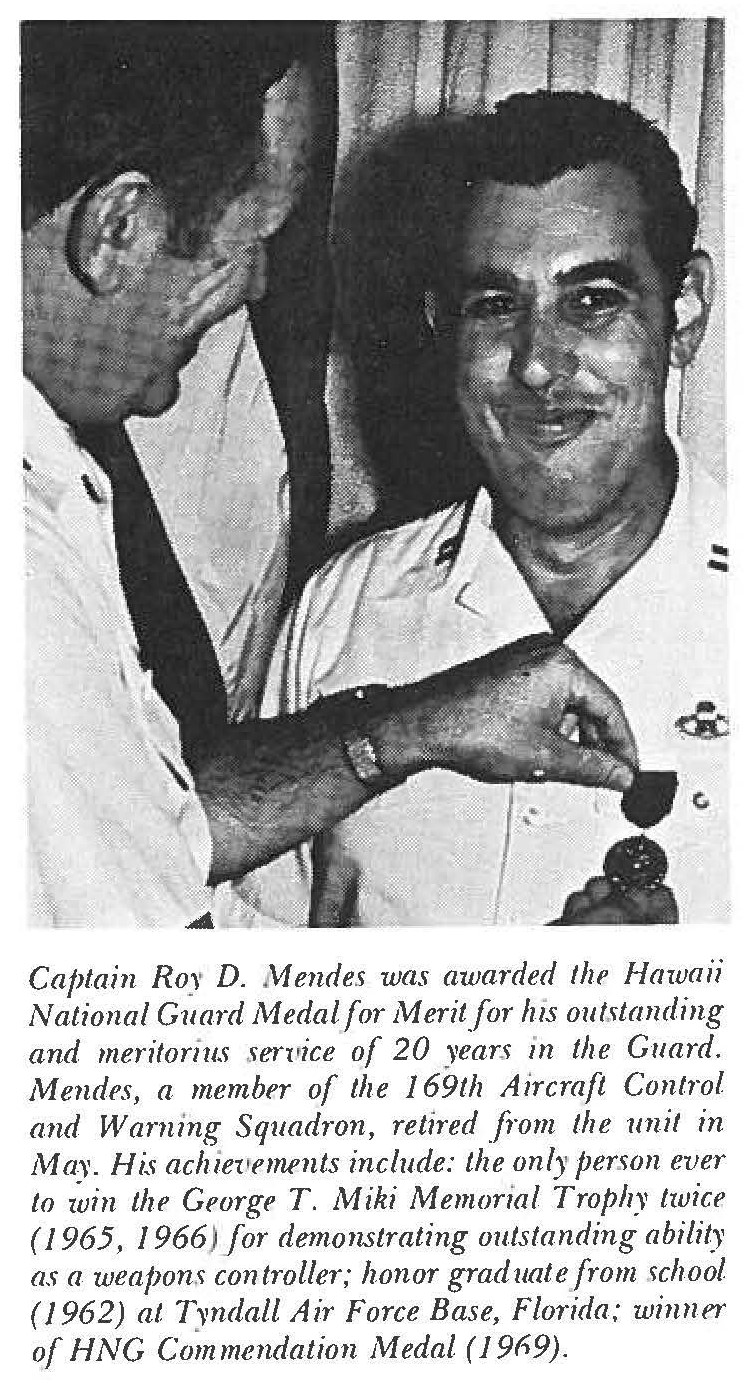
In ceremonies held at Fort Ruger 29 July, 1st Lt Roy D. Mendez, 31-year old Hawaii Air National Guard Weapons Controller, received the George T. Miki Memorial trophy for “outstanding and noteworthy performance” for Fiscal Year 1966. Mendez, of 627 Ainapo St., received the annual award from Brig General Valentine A. Siefermann, Acting Adjutant General. Mendez, fulltimer of the 169th Aircraft Control and Warning Sq., Wheeler field, holds rating of expert, the highest proficiency rating awarded by the Air Force. Weapons Controllers at the two Air Guard radar stations guide pilots to airborne targets through the combined use of radar images and voice communications. (Picture from the 1966 September The Hawaii Guardsman)
The Hawaii Air National Guard
‘Twenty Years Young’
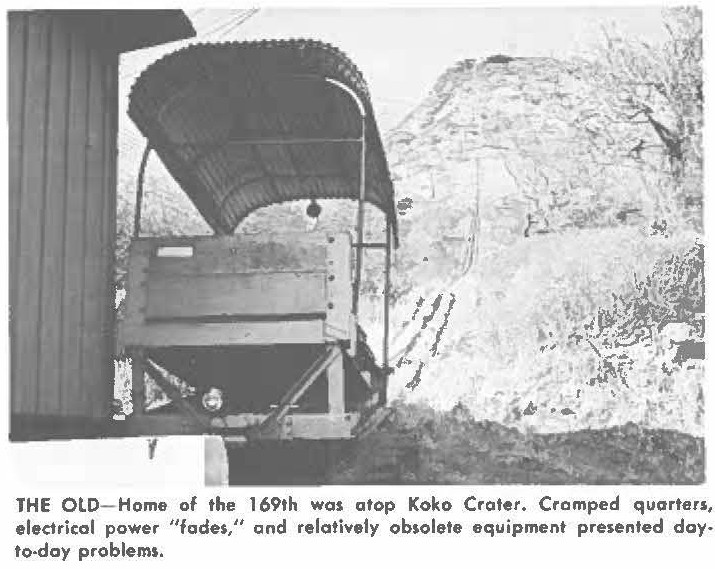
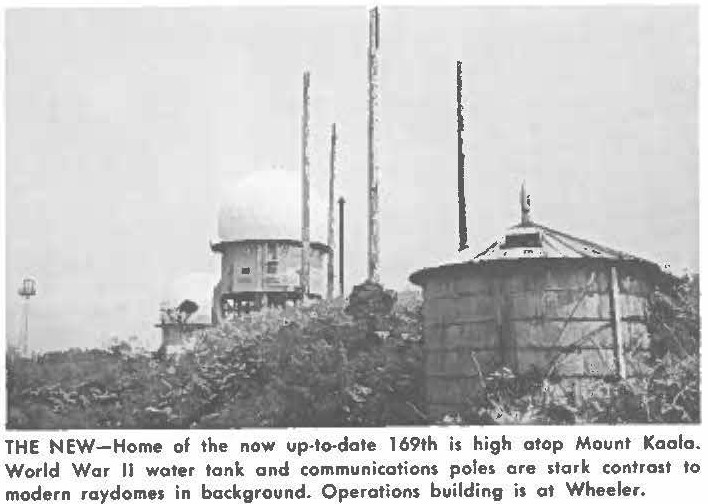
THE OLD- Home of the 169th was atop Koko Crater, Cramped quarters electrical power “fades,” and relatively obsolete equipment presented day to-day problems. THE NEW-Home of the now up-to-dote 169th is high atop Mount Koala. World War II water tank and communications poles are stork contrast to modern raydomes in background. Operations building is at Wheeler. (Pictures from the 1966 December The Hawaii Guardsman)
. . .
A second Aircraft Control and Warning squadron, the 169th, was organized on 7 October 1956.
The Air Defense Augmentation program Legan on 1 July 1956 with the 199th standing runway alert during daylight hours and the 109th AC&W squadron at Punanrnno providing the 24-hour early warning radar. It was in this same year that the 169th AC&W squadron moved from Sand Island to Koko Crater as a drill status training site. It was not until 1958 that the 169th intiated its 24-hour operation. . .
In July 1965, the 169th moved from Koko Crater to their new quarters at Wheeler. Although the 169th’s radar is high atop Mount Kaala, all information picked up hy the antenna is fed into the Wheeler operations building.
169th AIRCRAFT CONTROL AND WARNING SQUADRON (Fixed)
The 169th ACW Sq continued to operate the Mount Kaala/Wheeler AFB Complex during Fiscal Year 1%7. The new complex has increased the potential of the squadron to the highest degree of operational capability. The operational capability, reflected by a realistic index, is considered one of the highest in the Air National Guard’s aircraft control and warning system.
An operational readiness inspection was administered by PACAF during the period 20-26 May 1967, and this organization was rated satisfactory. Also, during this period, the PACAF Standardization and Evaluation Team visited the unit. Thorough evaluation of the Radar Operations Section was made, particularly in problem areas reported in the previous report and publications. The team rated the 169th ACW Sq satisfactory. One weapons controller and one weapons technician were evaluated to upgrade their skill qualification to “Expert.” They were successful in their evaluation. Consequently, the 169th ACW Sq is the only unit with eight “Expert’ Controllers in the PACAF area.
The U. S. Navy Intercept Controllers enroute to the South East Asia operations, cross-trained at this unit’s air defense direction center and performed the required refresher training.
The 169th ACW Sq, in conjunction with PACAF, hosted the first anti-jam operations (AJO) course in the Hawaii Air Defense System. The course, which was a week long, was attended by the representatives of 326th Air Division, the Hawaii Air National Guard, the Hawaii Army National Guard, Federal Aviation Administration, U.S. Navy and U.S. Marine Corps.
The number of training exercises conducted during the fiscal year were as follows: 1) Division-wide exercises54; 2) System Training Missions-122. In addition, 52,510 tracks were plotted, 6,342 intercepts were conducted, 12 navigational assists were accomplished, and one emergency assist was given. The volume in the tracks plotted increased 21% while the total number intercepts increased over 50% from the last fiscal year.
The Radar Set AN/FPS-7, a joint-use search radar with the Federal Aviation Administration at Mount Kaala maintained an average operational rate of 98.8% during the fiscal year, whereas, the average operational rate for the Radar Set AN/FPS-6E, Height Finder, maintained 95.6%. In August 1966, the height finder had an extensive antenna modification from the electrical elevation nod system to the hydraulic nod system.
During the fiscal year, a cost reduction program was initiated in the communications-electronics area. A savings of approximately $6,000 had been realized due to reduction of tools in each technician’s kit and better utilization of hand tools under centralized bench work use.
Greater emphasis was placed on training. As a result, 29 airmen personnel were upgraded in skill level. Average for passing the SKTs for 3 level, 85.7%; 5 level, 64.2%; and 7 level, 71.4%.
The 169th ACW Sq maintained its drill attendance average of 96.9% for the fiscal year.
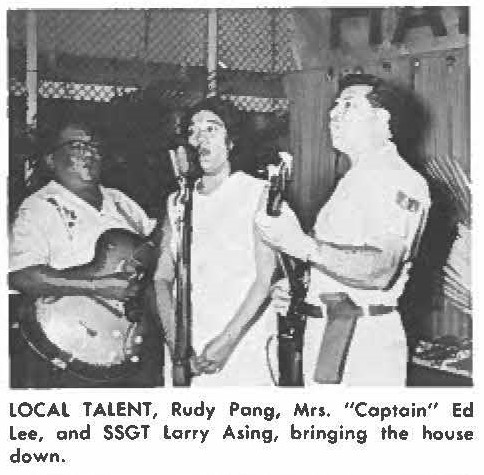
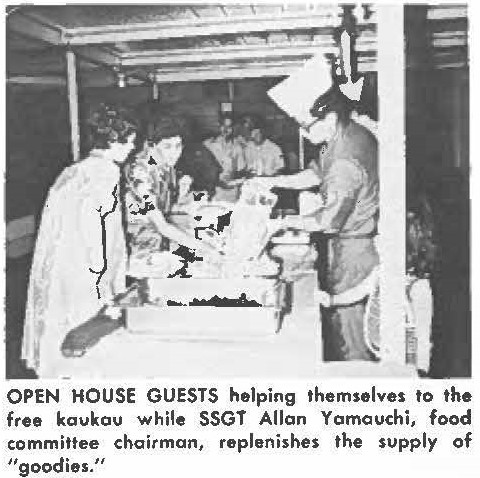
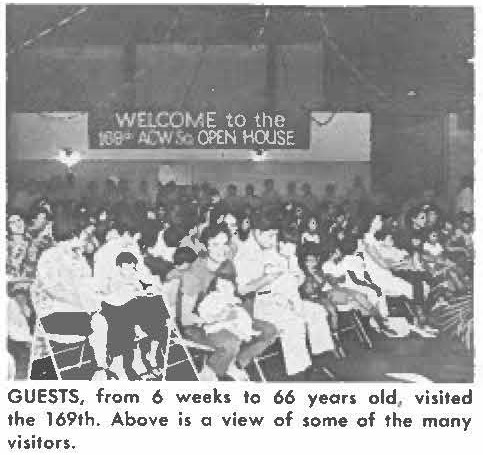
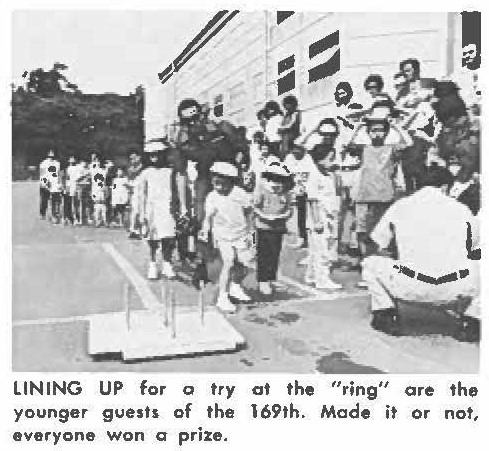
LOCAL TALENT, Rudy Pang, Mrs. “Captain” Ed lee, and SSGT Larry Asing, bringing the house down.OPEN HOUSE GUESTS helping themselves to the free kaukou while SSGT Allon Yamauchi, food committee chairman, replenishes the supply of “goodies.” GUESTS, from 6 weeks to 66 years old, visited the 169th. Above is a view of some of the many visitors. LINING UP for a try at the “ring” are the younger guests of the 169th. Made it or not, everyone won a prize. (Pictures from the 1967 March The Hawaii Guardsman)
The 169th Aircraft Control and Warning Squadron celebrated its 10th anniversary with an open house for families and friends. With approximakly 300 enthused people in attenance the event proved a resound success.
The purpose of the open house was to familiarize guests with the mission of the Squadron, and to emphaize each squadron members contribution to the accomplishment of that mission. The schedule of events for the day began at the Wheler Air Force Base theater with a Welcome speech by Lt Col K. Paul Goya, Squadron Commander.
The welcome was followed by a slide presentation narrated by 2nd Lt Rohert Nagao, HNG Information Specialist. The pesentation depected the role of the Hawaii National Guard. After a short intermission, a movie was shown. The movie illustrated the mechanics of an air defense mission from the detection of an unknown flying object to the actual intercept.
Maj Donald M. O’Day, Oprrations Officer, followed with a talk on the JTF 119 Exercises.
A skit featuring squadron pnsonnel elimaxed the program at the base theater. Entitled “The Saga of Maka Pipi, the Stargazer,” the skit emphasized the role of personneI in the various sections of the squadron. Leading the cast was Captain Pom Pom and the Pupule Playhouse Players.
When the program at the theater was completed, guests were escorted on tours through the variom, sections of the Squadron. At each section, displays were shown.
Lunch was then served with the compliments of unit members. Each member contributed to defray lunch costs. Soon after recess, the air police gave a demonstration in close order drill. A “kelly” conttest was also heldl. AIC Vernon Freitas was the winner.
With the formal portions of the program completed, action turned to entertainmcnt. Led by SSgt T.emur-1 Aweau, a musical group cornprisC’d of squadron personnel, played for tlw adults while the children were treated to games and prizes. lntcrspC’rsed with the entcrtainment W<‘rl’ door prizes. Lucky winners received turkeys, lawn chairs, dinner glasses, and many assorted prizes donated by squadron sections and local merchants.
Kudos to MSgt Joseph Tihayan and committee’ chairman TSgt Juniuf’ Tenn (Games ‘ Prizes), SSgt Allan Yamauchi I Food) , and TSgt Baldwin Nanhu. A special salute to the 169th NCO Club for making the open house a great success.
Building 204 “Face Lift”
Constrnction in the 169th’s Building 204 at Wheeler is at maximum pace at present. Working on a S42,000 project is the l:nitcd Construction Company which is building new shower, toilet and kitchen facilities.
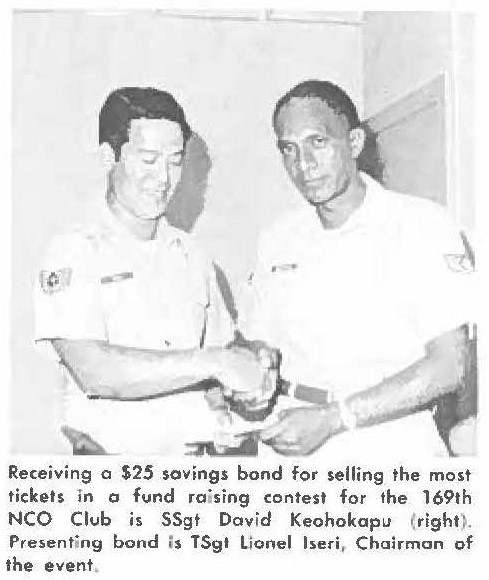
Receiving a $25 savings bond for selling the most tickets in a fund raising contest for the 169th NCO Club is SSgt David Keohokapu (right). Presenting bond Is TSgt Lionel Iseri, Chairman of the event. (Picture from the 1967 June The Hawaii Guardsman)
NCO Club Success
The 169th NCO Club just completed a successful fund-raising project with the showing of the Cinerama movie “Grand Prix.” Project chairman TSgt Lionel Y. Iseri and his committee worked hard to stage an entertaining evening.
Many familiar faces were seen at the Thursday night showing. Former squadron members and backers were out in mass. Treated to sandwiches and drinks during the intermission, most of the theatergoers went home a little dizzy, but happy.
The Club member selling the most tickets for the event was SSgt David Keohokapu. He was awarded a $25 savings bond for his efforts.
Money raised from this project will be used for various charitable community projects and other small, community-oriented programs. The Club has already donated $100 to the Squadron’s unit fund. Another planned project is the purchase of a perpetual trophy to be awarded to the Squadron’s Airman of the Year.
Summer Camp Luau
The NCO Club will provide the leaders to mastermind and organize the annual summer camp luau. MSgt Alfred Young of the Air Police is general chairman. Committee chairmen and sub-committee chairmen are MSgt Joseph Tihas, TSgt Lionel Iseri, SSgt Charles Honda, TSgt Gerald Yamamoto, SSgt Stanley Shinsato, TSgt Richard Godfrey, SSgt Wilfred Lann, TSgt Deogracias Agbayani, SSgt David Keohokapu, TSgt Jose Molas, SSgt Shigeo Yonamine, MSgt Edwin Chung-Hoon, SSgt James Young, SSgt Lernaud Aweau, SSgt Antonino Carlos, SSgt Allan Yamauchi and TSgt Russell Ganiko.
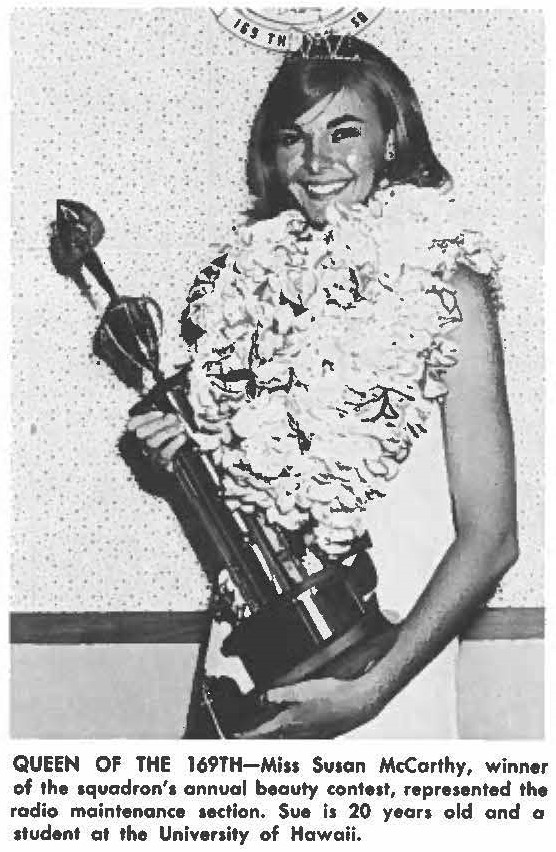
The big attraction for the luau will be a beauty contest to choose the Squadron’s Queen. Each section will sponsor an entrant. Judging will be by invited VIPs. Other highlights will be the Squadron talent contest and a hula troupe. Naturally, the kau kau will be typically Hawaiian, prepared by the men of the 169th.
Sports
The intramural mountainball competition has begun with the termination of a successful basketball season. With seven wins and one loss, “Maintenance” reigned as the overall champions. “C” Flight was runner-up with two losses and five wins.
Games for the mountainball competition are being played at the Elks Field (Kapiolani Park) on Saturday and Sunday mornings. Thus far, “A” Flight is leading the league with a 2–0 record.
Work Project Completed
The $42,000 construction project in Building 204 has just been completed. New showers, kitchen facilities and lockers are now available for squadron personnel.
Community Project in the Making
A community project to be organized for the town of Wahiawa on the outskirts of Wheeler AFB is now being formulated. Spearheading the project are SSgt Harold Taaka and SSgt Melvin Uyeda of C&E. Tentatively scheduled are a cleanup project and/or a tree-planting effort. Both committee chairmen have said that they are working closely with the Wahiawa Community Association in order not to duplicate the efforts of other organizations. The project, to be completed through the efforts of the 169th NCO Club, will revolve around Mrs. Johnson’s “Beautify America” theme.
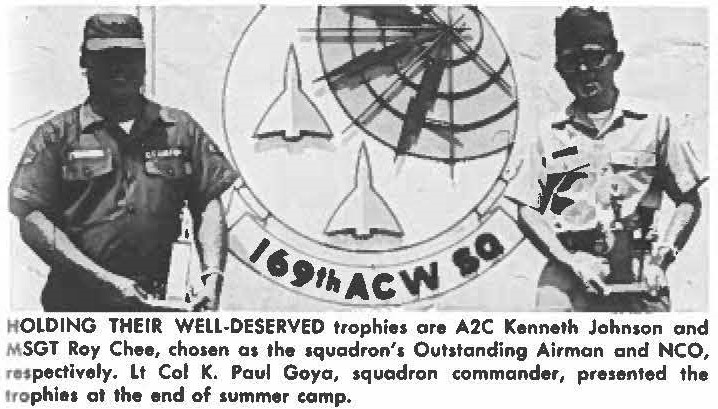
QUEEN Of THE 169TH-Miss Susan McCarthy, winner of the squadron’s annual beauty contest, represented the radio maintenance section. Sue Is 20 years old and a student at the University of Hawaii. HOLDING THEIR WELL-DESERVED trophies are A2C Kenneth Johnson and MSGT Roy Chee, chosen as the squadron’s Outstanding Airman and NCO, respectively. Lt Col K. Paul Goya, squadron commander, presented the trophies at the end of summer camp. (Picture from the 1967 Fall The Hawaii Guardsman)
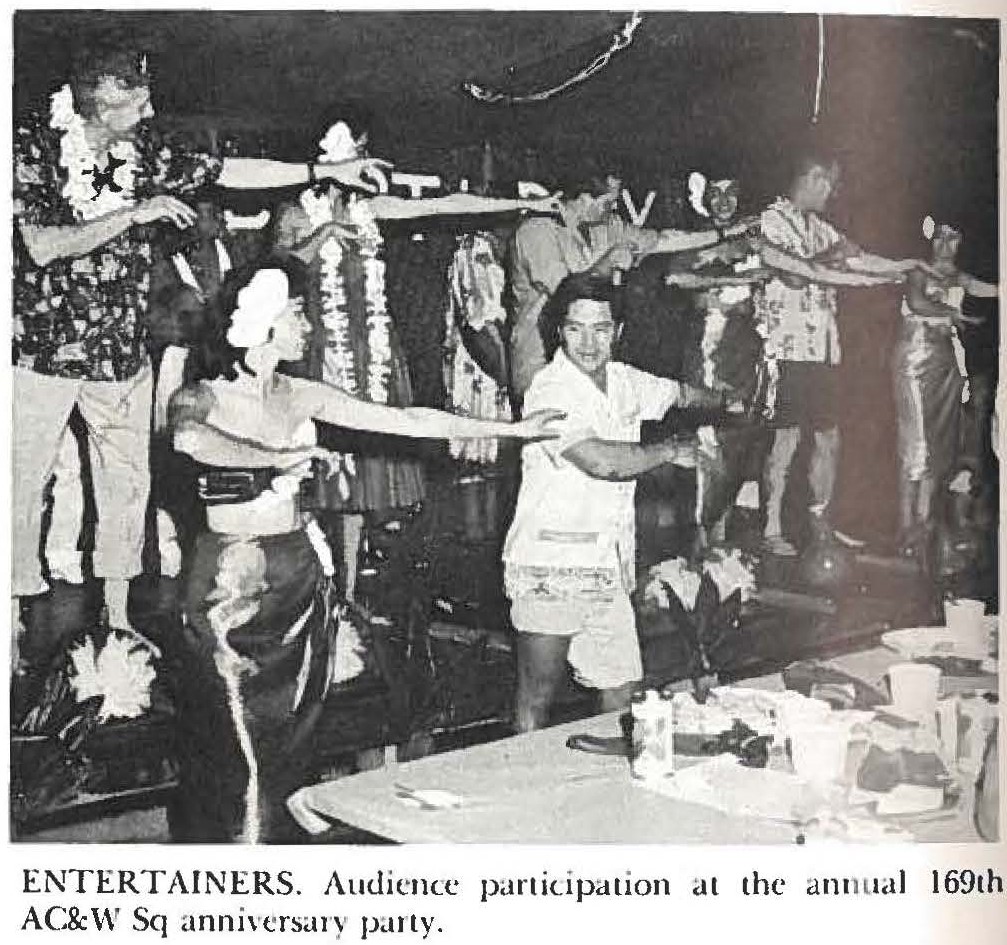
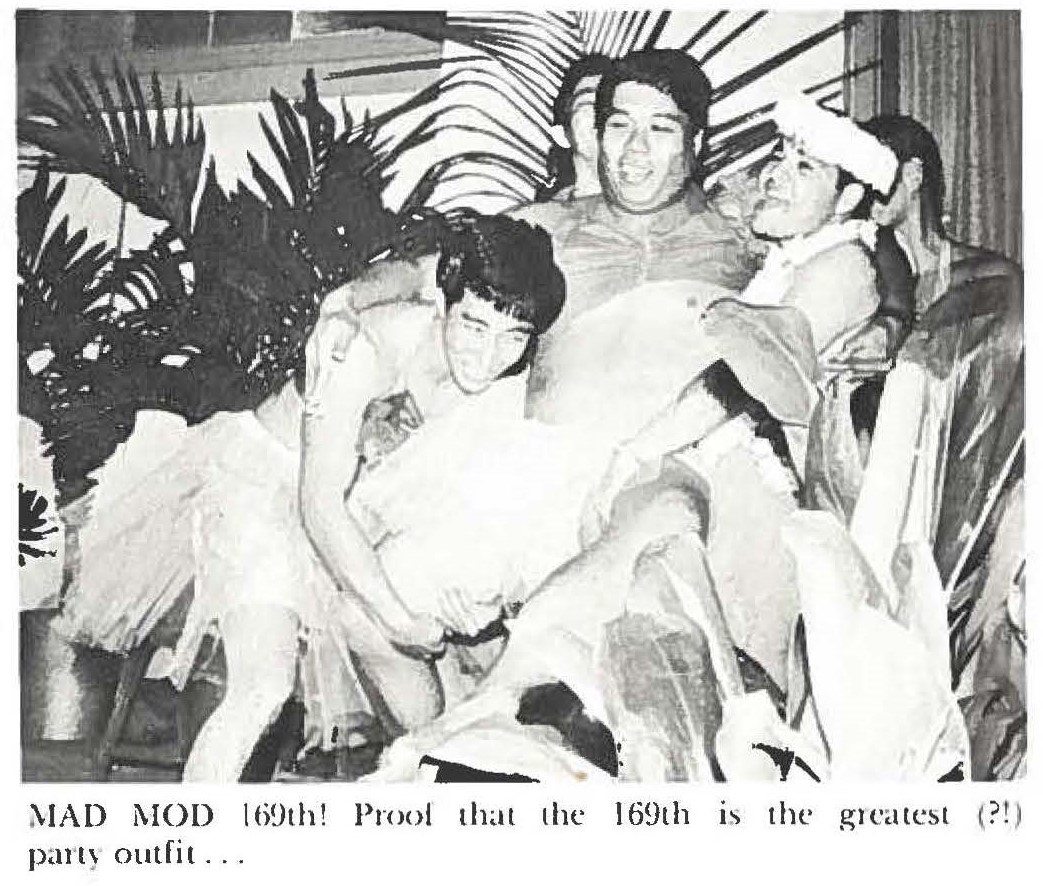
Everybody had a rip roaring time! Yes sir, the annual summer encampment luau proved to he a resounding success! Led by the members of the 169th NCO Cluh and MSgt Alfrrd Youn:i:, General Chairman of the event, the Squadron annual luau was held traditionally on the last eveninp: of the summer camp.
In a large trnt, decorated with heautiful Hawaiian garland and other South Pacific Flora, the program hegan with the John Piilani Watkins troupe presenting songs and dances of old and new Polynesia.
While the party goe rs feasted on authentic Hawaiian delicacies, !hr talt>ntcd troupe entertained them.
After the h<‘arty repast, master of ceremonies Captain Tom Shimahuku introduced the distinguished gucsll’> who represented the Hawaii Air National Guard, Hawaiian Air Defense Division, Wheeler AFB, and the Wahiawa Business Community. A short speech welcoming the guests and congratulating the men on their fine summer camp was given hy the Squadron Commander, Lt Colonel K. Paul Goya.
Then came the main event of the evening the beauty contest to choose the Squadron Queen. MC’d hy jovial SMSgt Ken Kiyabu, the contest proved to be both entertaining and delightful. The judges had a difficult time choosing the queen. Finally after a hectic contest, Miss Susan McCarthy, representing Radio Maintenance, was chosen Queen of the 169th. Runners up were Miss Edna Asing ( Medics and Utilities) and Miss Shirley Perkins (B Flight). Miss Popularity was Miss Matgaret Miller (A Flight). She was chosen by popular votes.
Topping the evening’s entertainment was a lively contest of songs, dances, and comedy routines between the various sections. Presenting a very clever and humorous skit, the C&E Section tied with C Flight’s team of ” beautiful” dancing ballerinas for first place. The winning sections were each presented with $20 for their efforts.
Much more went on during the evening and more should he said but it must l,e stressed that everybody. and we mean everybody, had a great time. Congratulations to all!
Also effective 1 January 1968, the 150th and 169th ACW Sqs were reorganized. . .The resultant authorized strength for the 169th ACW Sq was 37 officers and 198 airmen, representing an increase of 11 officers and 12 airmen
169th AIRCRAFT CONTROL AND WARNING SQUADRON (Fixed)
The 169th ACW Sq continued to operate the Mount Kaala j Wheeler AFB facility during Fiscal Year 1968. This unit maintained one of the highest operational capability indexs during the fiscal year when compared with other Air National Guard’s Aircraft Control and Warning units.
A general inspection of the unit was conducted bv the PACAF IG Inspection T eam from 1 M ay through 17 ‘May 1968: The 169.th ACW Sq was performing its assigned missIon 111 a sa tlsfactory manner.
The 169th ACW Sq maintained around-the-clock air defense posture as in the past years. The unit’s Air Defense Direc tion Center recorded a total of 60,164 tracks, 5,887 inter(,epts (46 actual and with 5,841 training); provided 8 emergency assists, 12 navigational assistance; and afforded 97 fligh t follows. Traini ng exercises conducted during the fis(,a l year were as follows: Division wide exercises 51: System Training Missions 138.
In addition to the normal day to day activity of maintaining Air Defense Direction Center functions, the 169th ACW Sq facilities were made available to U.S. Navy Weapons Controllers requiring training to maintain their combat readiness status. The 169th ACW Sq inaugurated the first PACAF approved Weapons Controller Requalification Course on 25 March 1968. Students were assigned from the with Tactical Control Group to the 169th ACW Sq for thirty days so that they would become operationally ready. Three classes of 12 officers completed the course by 30 .June 1968, with one rated Expert, 6 Skilled and 5 Qualified. These Weapons Controllers have returned to their parent organization at Clark Air Base, P. 1., with the possibility of further deployment to South East Asia operatiOns. It is felt that the efforts devoted to the PACAF Weapons Controllers Requalification Course by the Hawaii Air National Guard is a small but very worthwhile contriblltion to the SEA operations.
The Radar Set AN / FPS-7, a joint-use search radar with the Federal Aviation Administration at Mount Kaala maintained an average operational rate of 98.4% and the average operational rate of the Radar Set AN / FPS-6E, Height Finder, \,as 96.0’jr during the fiscal year. No major modifications to equipment were required and no major equipment difficulties; were encountered during; the reporting period.
DURING SURPRISE ceremonies recently held at the 169th ACW Squadron, Lt Col K. Paul Goya was presented the 20-year service award by HANG’, Commander, Brig Gen Siefermann. Cal Goya is the commander of the 169th. After the award ceremony, the unit had a birthday party in honor of Col Goya, including a huge cake commemorating his 20 years of service. (Picture from the 1968 Spring The Hawaii Guardsman)
THE 169TH OFFERS A HELPING HAND TO THE US NAVY
by Major Nelson T. Moriwaki
SHOWN BRIEFING RD1 Jerry G. Berry from Waco, Texas (left) and SN LoVerne L. Hickey from Shenandoah, Iowa (center) on the proper use of the UPA-35 scope is Major Nelson T. Moriwaki, 169th ACW Sq coordinator (right). Naval personnel are from the USS Ernest G . Small (DDR-838) based at Pearl Harbor. (Picture from the 1968 Spring The Hawaii Guardsman)
Since 1965, the 169th Aircraft Control and Warning Squadron, Hawaii Air National Guard, has been working with the U.S. Navy intercept controllers. During this period, more than 65 Navy air intercept controllers, representing 15 destroyers and aircraft carriers, have attained combat readiness through the facilities of the 169th ACW Sq. The training first started when the squadron was located at Koko Crater Air Station in Honolulu. The 169th is now stationed at Wheeler Air Force Base. Wheeler is about 25 miles northwest of Honolulu.
In the early phases, except for the required security clearances, coordination was accomplished on an informal basis. As more Navy controllers became aware of the Guard’s facility, the number of personnel requesting intercept training increased to a point where it became necessary to establish better control and coordination. This led to the establishment of our present system, where requests for training are channeled through Destroyer Flotilla Five, located at Pearl Harbor, and Headquarters, Hawaii Air National Guard.
The 199th Fighter Interceptor Squadron, Hawaii Air National Guard, flying F-102s, provides most of the interceptors for training the Navy controllers.
Due to the large number of Navy controllers requiring requalification, a temporary school was established at Wheeler Air Force Base in May of 1966. The Navy provided RDC A. E. Morton, from the U.S. Fleet Anti-Air Warfare Training Center, San Diego, California, as the instructor. Captain Roy D. Mendes, an interceptor controller with the 169th ACW Sq., was assigned to assist in the requalification school along with many other controllers of the 169th. These Air Guard controllers continuously provide support for the air intercept controller training program. The program is a continuing success, with all of the Navy controllers attaining combat readiness in the minimum time allowed.
When asked to comment on his coming to the 169th for training, Navy RDC Jerry G. Berry said, “Although the Navy stresses combat readiness, they have very limited training facilities here at Pearl Harbor. But with this setup at the 169th here at Wheeler, it’s terrific. All the guys I have talked to have much ‘aloha’ for the Hawaii Air National Guard.”
Many of these people have since gone to Southeast Asia, and we feel proud that we have contributed a share to our national security effort.
And up at the 169 ACW Squadron, Capt. Waichi Kikuta has received the George T. Mila Memorial Tropby as the outstanding Weapons Director during the Fiscal Year. As noted elsewhere, Capt. Kikuta was also recently promoted to Major.
The Hawaii Air National Guard’s 169th Aircraft Control and Warning (AC&W) Squadron has greatly enhanced the prestige of the Guard in recent months through its program of training weapons controllers for the 5th Tactical Control Group (TCG), Hickam.
The magnitude of the accomplishment has been duly noted in a series of letters of commendation received this week.
The situation arose when the 5th TCG became unable to properly handle the upgrading of its controllers due to a heavy influx of inexperienced personnel and the nonavailability of a live radar training environment because of priority operational commitments of Pacific Air Forces (PACAF) AC&W units.
HANG readily accepted the opportunity to provide controller training assistance. As a result, the 5th TCG now has one expert, six skilled and five qualified controllers. The training was accomplished during the short period from March through July 1968, and another class of four completed its training Friday.
The letters of commendation came from Col. S.D. Berman, commander of the 5th TCG; Maj. Gen. K.C. Dempster, PACAF vice commander; Maj. Gen. Ernest C. Harding, PACAF deputy chief of staff for operations; Maj. Gen. Benjamin Webster, state adjutant general; and Brig. Gen. Valentine A. Siefermann, HANG commander.
BG VALENTINE A. SIEFERMANN recently presented MAJ Waichi Kikuta a member of the 169th ACW with the George T. Miki Memorial Trophy for his demonstration of outstanding and noteworthy performance as weapons director during Fiscal Year 1968.(Picture from the 1968 Fall The Hawaii Guardsman)
OPERATION COOPERATION
by Captain Thomas Shimabuku
LISTENING ATTENTIVELY to HANG instructor Capt Roy D Mendes, as he gives some pointers on the attack computer, are from left to right, 2nd Lts Ronald R. Schurter, Joseph G. Homsy, Thomas D. Hudson, and Travis E. Wilkes from the 5th TAC Con Gp. (Picture from the 1968 Fall The Hawaii Guardsman)
The 169th Aircraft Control and Warning Squadron of the Hawaii Air National Guard has acquired another important mission. In addition to its responsibilities as part of the full-time air defense force of the Hawaiian Islands, the squadron now administers a weapons controller school.
In cooperation with the United States Air Force, a training and requalification program for the weapons controllers of the 5th Tactical Control Group stationed in the Philippine Islands has been established. Under the supervision of Lieutenant Colonel Paul K. Goya, Commander of the 169th, the operations section has organized a three-part course.
According to Major Donald M. O’Day, Operations Officer for the 169th, the three phases are divided into academics, actual missions and cross-training with the various tactical and air defense elements located in Hawaii.
The four-week course begins with academics, which range from a basic review to more complex and advanced subjects. The curriculum covers aircraft performance, weapons familiarization, air mass problems, tactics and techniques. Other subjects included are operational procedures, communications, electronics, weather and intelligence.
The second phase of the program is the application of acquired knowledge to actual situations. This part of the program includes live missions with F-102 interceptors of the Hawaii Air National Guard’s 199th Fighter Interceptor Squadron. In addition to the live intercept missions, each class participates in a minimum of four air defense exercises. Supplementing these missions are practice problems created by the squadron’s target simulator. According to Major Nelson T. Moriwaki, Project Officer for the 169th, a minimum of 100 hours of live intercept missions and 67 hours of simulated problems are scheduled for each class.
The third and final phase of the program is cross-training. Familiarization visits are made to the Air Force’s Air Defense Control Center, the Hawaii Air National Guard’s 154th Fighter Group, the 7th Direct Support Flight, the Marine Corps’ Air Defense Tactical Facilities, the Navy’s radar picket ships, and the Hawaii Army National Guard’s Nike Hercules Missile units.
So far, four classes have graduated from this accelerated course.
169th AIRCRAFT CONTROL AND WARNING SQUADRON (Fixed)
The 169th ACW Sq continued to provide the capability for the mission of the Hawaiian Air Defense System from the Mount Kaala/Wheeler Air Force Base (AFB) facility during FY 1969. The basic electronic equipment, such as search and height finder radars, and air-ground ultra high frequency (UHF) radios are located at Mount Kaala with the operational, administrative and support functions located at Wheeler AFB.
The squadron’s operational activity during the fiscal year recorded 62,957 aircraft tracks, conducted 5,740 intercepts of which 38 were actuals for identification purposes. In addition, this squadron provided eight emergency assists to aircraft for navigational assistance and 715 for aircraft radar flight monitoring.
In order that the unit could maintain its proficiency, there was a total of 32 division-wide exercises, which included Team Training exercises and Joint Task Force 119 Exercises. In addition, there was a total of 108 System Training Missions, which were exercises with simulated and synthetic targets to train site or division-wide req uirements.
The U.s. Navy Pearl Harbor based intercept controllers continued to utilize this unit’s ADDC on a regular basis to perform required live and simulated intercepts. During the period when the aircraft carrier USS Enterprise was at Pearl Harbor because of major repairs, the 169th AC\V Sq assisted the intercept controllers from the carrier in maintaining weapons controller proficiency.
Also, during FY 1969, the squadron continued to conduct the PACAF Weapons Controller Requalification Course. Six classes were conducted during the fiscal Year, and 21 graduated as qualified weapons controllers.
The radar set A W /FPS-7D, a joint-use search radar set with the FAA at Mount Kaala, maintained an operational rate of 99.0)'( during the fiscal year. The radar set A:\/FPS-6E height finder maintained 96.0% opcrational rate for air defense purposes.
An operational readiness inspection was conducted by the PACAF Inspector General (IG) Team from 17 May thru 27 Mav 1969. Concurrentlv, an administrative inspection of the’ squadron was con’ducted by the team. The PACAF IG Team stated that the 169th ACW Sq was performing its assigned duty in a satisfactory and capable manner.
FROM AIRMAN TO 2nd LT – 2nd Lt Eric S. Kanja formerly an enlisted man with the 169th recently returned from OTS at Lackland AFB, Texas as a Second Lieutenant. (Picture from the 1969 Summer The Hawaii Guardsman)
Eric S. Kanja, a weapons controller with the 169th Aircraft Control and Warning Squadron recently returned from Officers Training School at Lackland Air Force Base, Texas where he was commissioned a 2nd Lt. in the United States Air Force.
2nd Lt. Kanja enlisted in the Hawaii Air National Guard in March 1968 and after completing 6 weeks of basic training at Lackland AFB, as an enlisted man, returned to the 169th for additional training. In January 1969 SSgt Kanja left again for Lackland and after completing a rigid 12 week schedule of academic study and field training problems, he was commissioned a 2nd Lt.
2nd Lt. Kanja is a 1962 graduate of Leilehua High School. He received a B.A. degree from the University of Hawaii in 1967 and at the time of his enlistment in the Hawaii Air National Guard was in the process of acquring a master’s degree in Finance.
Major Kazuo Yamamoto was presented the George T. Miki Memorial Trophy as the Outstanding Weapons Director in the Hawaii Air National Guard durmg FY 1969. Major Yamamoto is the first drill status weapons controller to receive this award since its origin. Since leaving the air technician program in October, 1963, Major Yamamoto has consistantly maintained his “Expert” weapons controller rating. His weapons controller skill and proficiency exemplifies the spirit and intent of the George T. Miki Award.
OUTSTANDING NCO AWARD
TSgt Donald T. Hashimoto was presented the Outstanding NCO Award of the 169 ACW Sq for FY 1969. In part his nomination read “since his assignment to this squadron, Sgt Hashimoto h a s developed into one of the finest noncommissioned officers in the unit. His patience and genuine interest in people is reflected in the fact that he has never been known to turn anyone away who has approached him, no matter how busy he may have been. Sgt Hashimoto is truly one of the finest examples of a career guardsman.
HNG COMMENDATION MEDAL
During fiscal year 1969, the 169 ACW Squadron continued to conduct the PACAF Weapons Controller Requalificatior. Course. For their outstanding performance of their duties at the school, Major Nelson T. Moriwaki and Capt Roy D. Mendes received the Hawaii National Guard Commendation Medal. The two officers planned, formulated, and conducted the school. The first class convened on 25 Mar 68 and since the first hectic class, the requalification school has matured into a professional school the Hawaii National Guard can be proud of.
HANG AIRMAN AWARD
Sgt Walter T. Sakuda was nominated for the HANG Airman Award for the period I Jan 69 through 30 June 69. Sgt Sakuda distinguished himself during this period by assuming control of the Food Service Section and “Supervising the 15 airmen assigned to his section in an outstanding manner.”
OTS GRADUATE
Jerry M. Matsuda, a weapons controller with the 169 ACW Squadron recently returned from Officers Training School at Lackland AFB, Texas, where he was commissioned a 2nd Lieutenant in the Hawaii Air National Guard and as a reserve of the United States Air Force.
2nd Lieutenant Matsuda enlisted in the Hawaii Air National Guard in June 1968 and after completing 6 weeks of basic training at Lackland AFB, as an enlisted man, returned to the 169th for additional training. In April 1969, SSgt Matsuda left again for Lackland and after completing a rigid 12 weeks schedule of academic study and field training problems, he was commissioned a 2nd Lieutenant.
Lieutenant Matsuda is a 63 graduate of Hilo High School. He received a BS degree from the University of Hawaii in 1968, where he studied structural civil engineering.
The thirteenth anniversary of the 169th AC&W Squadron was held on October 26th at Paradise Park. Two hundred members and guests of the squadron were present for this memorable occasion.
The night’s festivities were initiated with cocktails being served on a lanai overlooking the park, where the sunset and gentle bird cries enhanced the peaceful Manoa Valley surroundings. As the evening progressed, dinner was served with background music of a female vocalist and her accompaniment.
Brigadier General Valentine A. Siefermann, representing the Adjutant General, presented a brief resume of the active role of the Air National Guard in Hawaii, and the major role in air defense performed by this unit, under the “able command” of Lieutenant Colonel Paul Goya.
The final event of the night’s program was the drawing of various door-prizes. All-in-all, the night was enjoyed by everyone on the thirteenth anniversary of the “birthday” of the 169th AC&W Squadron.
169th NCO Club
Under the able leadership of President Senior Master Sergeant Joseph R. Tibavan and his executive committee, the 169th Non-Commissioned Officer Club has planned a very busy and fruitful year.
Events thus far programmed for the year are grounds beautiflcation, fund raising drive, Christmas display, community project, squadron luau, and NCO Club picnic.
Initially, fifty NCOs had shown their interest and joined the club. But a membership drive has increased total membership to 73 ( 66%). Hopefully, a membership of 100% can be attained in the near future.
Honor Graduate
Recently returned from 30BR1741A, Weapons Controller (Manual) School at Tyndall Air Force Base, Florida, is Second Lieutenant Jerry M. Matsuda.
LT Matsuda received an Honor Graduate Certificate “for his outstanding performance. He exhibited a thorough knowledge of current tactics and techniques, and an exceptional capability as a weapons controller.”
To receive this honor, a graduate must maintain a high level of performance throughout the course. Grades for this course are based on daily radarscope performance, academic tests and detailed evaluation of intercept control procedures.
169TH AIRCRAFT CONTROL AND WARNING SQUADRON (FIXED)
The 169 AC&W Squadron continued to provide the capability for the Hawaiian Air Defense System to accomplish its assigned mission from the Mount Kaala/Wheeler AFB facility during Fiscal Year 1970. The search and height-finder radars and the air-ground UHF radios are located at Mount Kaala with the operational, administrative and support functional areas located at Wheeler AFB.
The Squadron’s operational activity during the fiscal year recorded 65,002 aircraft tracks and conducted 10,354 intercepts, of which 12 were actuals for identification purposes. In addition, this squadron provided emergency navigational assists to seven aircraft and radar flight monitoring of 651 aircraft.
In order for the unit to maintain its proficiency at all times, 39 division-wide exercises were scheduled, including Team Training exercises and Joint Task Force 119 Exercises. In addition, there was a total of 135 System Training Missions, which were exercises with stimulated situations and synthetic targets to meet squadron or division-wide requirements.
Besides performing round-the-clock air defense missions for the State of Hawaii, the 169 AC&W Squadron continued to expand its assistance program to active service units. U.S. Navy Pearl Harbor-based intercept controllers continued to utilize the unit’s Air Defense Direction Center (ADDC) on a regular basis to perform live and simulated intercepts required to maintain their combat-ready status.
The previously reported PACAF-approved Weapons Controller Requalification Course funetioned for the past year. A total of 35 student officers from the 5th Tactical Control Group attended the unit’s school to acquire and/or maintain their operational-ready status. (Results: 4 Skilled, 31 Qualified.) These students accumulated 4,360 live intercepts, 2,807 simulated intercepts, and 360 hours of academic training . There have been many good reports from the field on the results of the HANG efforts devoted to this course. PACAF has recognized this and decided to continue the requalification course indefinitely.
The Radar Set AN /FPS-7D, a join t-use search radar set with the Federal Aviation Administration at Mount Kaala, maintained an operati onal rate of 99.1 percent during the fiscal year. The Radar Set AN/FPS-6E, height finder, ma intained 96.9 percent operational rate for air defense purposes.
During the fiscal year, the AN/GPX- 18A was replaced by the AN/GPS-78 , a modern solid-state set. Further, installation of the inter-island microwave communication link between Kokee, Kaua i, and Mount Kaala was initiated by Collins Radio Corporation. Comp letion of this system is scheduled for Fiscal Year 1971.
Height finder radars at the 150th Aircraft Control and Warning Squadron on Kauai, and the 169th Aircraft Control and Warning Squadron on Mount Kaala, Oahu, were modified to incorporate Electronic Counter-Counter Measure (ECCM) features. This modification increased their capability to detect aircraft under electronic jamming conditions.
Construction of a new height finder radar facility at Mount Kaala began in June 1970. The radar should become operational in FY 4/72.
A1C GREGORY C. ING, recipient of the HANG Airman Award, his family, and BG Valentine A. Siefermann, Commander of HANG. (Picture from the 1970 Spring The Hawaii Guardsman)
second Lieutenant Eric S. Kanja recently returned from Tyndall Air force Base, Florida, where he 1 earned special recognition as an honor graduate from Course 30BR174A, Weapons Controller (Manual).
Competing with highly quahhd personnel of his specialty, LtKanjaJa distinguished himself by attammg a final course grade of 98 percent, placing him in the top five percent of the student body. His cooperative attitude, unusual ability ad active participation, coupled with demonstrated qualities of leadership, loyalty and dependability, proved to be a great value to his instructors and classmates.
The 169th ACW Squadron extends its sincere congratulations for a job well done.
Airman First Class Gregory C. Ing was selected for the HANG Airman Award for the second half of 1969. AlC Ing enlisted in the Hawaii Air National Guard on Nevember 7, 1968 and in just 13 months became fully qualified in his job; completed two NCO development courses (Cr No. 6 and 7A) and performed his duty in an outstanding manner. He also attained an overall academic average of 99.5 percent while attending the Administrative Specialist School at Keesler Air Force Base in Mississippi.
Gregory was graduated from Damien Memorial High School in 1967 and has completed three semesters of college at the University of Hawaii. His father is John C. Y. Ing, a retired major in the HANG, and a former member of the 169th ACW Squadron.
SQUADRON STRENGTH
For the first time in the history of the 169th ACW Squadron, we have attained an assigned strength of 99 per cent. The enlistment of Sgt Wilfred S. Shimata, a former NIKE technician, brought us up to strength. With an increase of service school spaces and an improved retention program, it looks as though we will be able to maintain this strength in the future.
SMSgt Joseph R. Tibayan was selected as the 169th ACW Squadron’s Outstanding NCO of the Year. A member of the 169th since its formation in October, 1957, Sgt Tibayan has contributed much of his own time and energy to the unit.
Sgt Tibayan’s selection was based in part on his leadership and drive in the organization and management of the 169th NCO Club. He is currently the Club’s president. As president, he has emphasized improving the Squadron’s image and assuring that each member derives satisfaction from Club projects. Some of the Club’s major projects have been: a Christmas display; the Squadron luau; a Squadron picnic; and a rock garden, which fronts the Squadron’s main entrance.
The award was also based on Sgt Tibayan’s past contributions. He designed and supervised the construction of our control dias, our briefing boards and our unusual three-dimensional Squadron sign.
Outstanding Airman of the Year
An Awards Board of senior noncommissioned officers selected AIC Gerald I. Miyoshi as the 169th ACW Squadron’s Outstanding Airman for the fiscal year 1970. The selection was made from a field of many excellent candidates. Some of the considerations for this award are: military qualification; knowledge of the job; military bearing; civic activities, and attendance at drills and field training.
A portion of Airman Miyoshi’s nomination read, “Airman Miyoshi has demonstrated initiative and ability seldom seen in so junior an airman”.
He is a 1967 graduate of Stanford University where he majored in Psychology. He is presently employed as a computer programmer at the University of Hawaii.
Lieutenant Jerry M. Matsuda, of 2511 Manoa Road, was awarded the George T. Miki Memorial Trophy as the Outstanding Weapons Director in the Hawaii Air National GuarQ (HANG) by Brigadier General Valentine A. Siefermann, HANG Commander. The trophy was presented for exceptional skill and proficiency as a Weapons Director. A Director is the man responsible for guiding friendly fighter aircraft to successful intercepts of hostile bombers. He also assists aircraft in distress and coordinates recovery operations.
Lieutenant Matsuda is employed full time by the State of Hawaii, Department of Transportation, Highways Division. He is a parttime Guardsman, a member of the 169th AC&W Squadron, and only the second pm’.t-timer to receive this award since its origin.
The 169th was recently awarded the Air National Guard Distinguished CEM Unit Plaque as runner-up C & E unit in nationwide Air Guard competition. Points were awarded for the unit’s weapons qualifications, Airman re-enlist ments, skill level qualification, manning levels, personnel passing 3, 5 and 7 level tests, annual training attendance, ORI capability, and other outstanding accomplishments. The trophy was awarded at the recent New York Conference.
A “Casino Night” function, with all the color and gaiety of Las Vegas, marked a fund-raising evening on behalf of MSG Roy Tamanaha, who is scheduled for disability retirement. Sgt. Tamanaha, a member of the 169th ACW squadron since August 1961, is awaiting word from the National Guard Bureau on his separation. This well-attended affair was sponsored by the Squadron NCO Club. Many of the gifts were donated by Squadron personnel. An informal presentation of the proceeds from the Casino Night was held at Roy’s home later.
Walt gives his personal attention to LT Gerald Irish from the 623d AC & W Squadron in Okinawa.(Picture from the 1970 Winter The Hawaii Guardsman)
Captain Walt Watanabe runs a very exclusive school in Hawaii. It uses $3,000,000 worth of equipment and enrollment is limited to four students at a time. The school is the Hawaii Air National Guard’s Controller Requalification School. To understand the school, you’ve got to know a little about Walt’s organization, the 169th Aircraft Control and Warning (AC&W) Squadron.
The 169th operates the largest radar in the State, housed in one of the big white domes on Mount Kaala. The big radar pumps millions of watts of energy into space and reaches hundreds of miles out to sea, around the clock, as it keeps track of all aircraft in Hawaiian skies. This serves several purposes. First, it insures that no aircraft, friendly or unfriendly, approach Hawaii undetected; second, it allows the 169th ‘s aircraft controllers to scramble the delta-winged F-102 interceptors at Hickam Air Force Base to check on unknown and potentially hostile aircraft (the controllers also guide the interceptors to the unknown aircraft by observing the radar presentation); third, the federal Aviation Agency (FAA) uses the radar’s output to check and control all of Hawaii’s air traffic.
Walt’s school trains aircraft controllers, and the staff has requalified controllers from the Guard and from active Air Force bases all over the Pacific area. Air Force officers from Japan, Okinawa, Thailand, Korea and the Philippines are channeled through the course. The men review pursuit and attack tactics and are briefed on the missiles and other weapons carried on board the interceptors. The bulk of the course is geared to practical work, which begins when the students are introduced to the T-4 simulator. The big gray T-4, with its blinking lights and scores of dials and switches, injects blips onto the student’s radar scope. The blips look and act like radar returns from F-102 and F-4 interceptors. As the student becomes more proficient, he works with several of the T-4’s simulated aircraft until he has mastered the art of aircraft control. Then, with a backlog on control time on the T-4, he begins work controlling the Air Force’s T-33 jet trainer aircraft, and eventually, he goes on to control actual supersonic F-102’s and F-4’s.
Walt’s work has won wide recognition. Recently, it played a large part in winning the 169th a national award as one of the top units in the Air National Guard. The program will continue and Walt, his simulator and radars, will continue to keep the Pacific aircraft controllers razor sharp.
Second Lieu tenant Melvin M. Maeda of the 169th AC&W Sq was designated as a distinguished graduate of the Officer Basic Military Training (precommissioning) at Lackland AFB in Texas. He accomplished this in competition with active Air Force personnel. Lt Maeda attended the University of Hawaii, where he majored in Electrical Engineering. After graduation, he enlisted in the Air National Guard and applied for a commission. Lieutenant Maeda then went to the Weapons Controller Course at Tyndall AFB, Florida, where he was designated as an Honor Graduate. The Lieutenant maintained a high level of performance throughout the course. His grades were based on daily radar scope performance, academic tests and detailed evaluation of his intercept control procedures. He was cited for exceptional ability to assimilate instruction in current tactics and techniques and outstanding capability as a weapons controller.
169th Aircraft Control and Warning Squadron (Fixed)
The 169th ACW Squadron continued to maintain its capability of providing surveillance for the Hawaiian Air Defense System from the Mount Kaala/Wheeler AFB facility during FY 71. The search and height finder radars and the air/ground UHF radios are located at Mount Kaala while the operational, administrative, and support functional areas are located at Wheeler AFB.
The squadron’s operational activity during the fiscal year included handling of 60,787 aircraft tracks and conduct of 5,309 intercepts. Fourteen were actual intercepts for identification purposes. In addition, the 169th provided emergency navigational assistance to nine aircraft and monitored 562 aircraft on radar.
In order for the squadron to maintain a high degree of aircraft control and warning proficiency, fifty-eight air defense exercises were conducted. Of these, 44 were team training exercises, two were JTF 119 exercises, eight were control phase exercises and one was an ORI exercise. Additionally, 161 system training missions (synthetic target exercises) were performed to further maintain unit and system air defense proficiency.
In addition to performing the active air defense mission, the 169th ACW Squadron continued its assistance programs for active service units. Pearl Harbor based Navy intercept controllers used the unit’s Air Defense Direction Center facilities on a scheduled basis to maintain their combat ready status. They conducted 731 training intercepts in this capacity.
The unit’s PACAF Weapons Controller Requalification Course enjoyed another successful year. Thirty-six student officers (22 from 5th Tac Con Gp, 13 from 623d ACW Sq, and one from 34 7th TFW ) were enrolled in nine unit-conducted classes. They acquired and j or maintained their required combat readiness status by attending the course. The tactical evaluations resulted in the awarding of 6 skilled and 30 qualified ratings. The students participated in 3,393 live intercepts, 3,524 simulated intercepts, and 360 hours of formal academic instruction. Additionally, two Weapons T echnicians (enlisted personnel ) from the 5th Tac Con Gp were trained and awarded expert and qualified ratings, respectively. There have been favorable reports from the fi eld about the HANG course. PACAF has recognized its value and decided to continue the course indefini tell”
The 169th ACW Sq was presented the CEM Distinguished Unit Plaque at the 92d General Conference of the National Guard Associa tion of the United States in NevI’ York City.
The ANj FPS-7D radar set, a joint-use search radar shared with the Federal Aviation Administration (FAA) at Mt Kaala, maintained an operational rate of 97.76%. The radar set, A ‘ ; FPS-6J, height finder, maintained an 80.76 operational rate for air defense purposes.
The installation of an AN jU PX -14; beacon system was completed and the system was accepted for air traffic control use by the FAA. The Mt Kaala facility was repaired and painted under an $80,000 contract let by the Hickam Air Force Base Civil Engineers.
SSGT Calvin K. Naipo of the 169th received the Army Commendation Medal from Major General Ben Sternberg. CG, USARHAW recently. Sgt Naipo was cited for his exceptionally meritorious service while serving as an Electrical Materiel Chief, with a Nike Hercules unit for 10 years. In part, Sgt Naipo’s citation read, “his profound knowledge, extraordinary proficiency and versatility contributed significantly to the outst:anding maintenance of all unit equipment!’ Sgt Naipo is a 1952 graduate of Kamehameha Schools, resides in Kahaluu and has four children ranging in age from 8 to 15 years. His wife is the former Charlene Watson from Honolulu. He is active in both the Kahaluu Pop Warner and Little leagues.
Naipo also wears both the HNG Commendation Medal, HNG Service Medal and Armed Forces Reserve Medal.
AMN Brian Nishie who recently returned from the Inventory Management School at Lowrey AFB, Colorado, was designated as an honor student. Our smart young airman completed the nine-week course with an average of 92%.
HANG man of 169th checks electrical components at the Wheeler field operations building. Radar antennas are situated high atop 4,000 foot Mount Kaala. Unit is commanded by Lt Col Paul Goya who was instrumental in the formation of HANG operated AC&W sites for Hawaii many years ago. (Picture from the 1971 Summer The Hawaii Guardsman)
Sgt Gregory C. Ing was selected as the 169th’s Outstanding HANG Airman of the Year after rigid competition. Sgt Ing was cited for his outstanding contributions in administration and training as well as academic achievement for his section. He completed non-commissioned officer development courses which are normally taken by personnel of senior rank. Sgt Ing was selected previously for the HANG Airman Award in 1969. He will now compete for the Outstanding Airman of the Air Force sponsored by the Air Force Association.
ANG NCO ACADEMY
MSgt Francis H. Shinsato and TSgt Walter Y. Tanaka returned with nothing but praise for the ANG NCO Academy at McGhee-Tyson AFB, Tennessee. Both were impressed by the material presented during their 5½ week stay, but were most impressed by the caliber of the instructors. The academy course is highly recommended for all NCOs.
OUTSTANDING NCO AND AIRMAN AWARD
MSgt Roy T. Takaoka and Sgt Scott T. Nomura were selected as the Outstanding 169th ACW Sq NCO and Airman of the Year respectively. Sergeant Takaoka’s Radar Maintenance Section at Wheeler AFB was consistently rated outstanding in maintenance effectiveness. He was further recognized for his compassionate approach and assistance to his personnel.
Sgt Nomura’s award was based on his high level of skill qualification in the relatively short time since his enlistment. He was further honored for his active participation in Scouting and other youth activities.
ANG-SHORT ACW COURSE
The first Air National Guard graduates in the shortened Aerospace Control and Warning Operator (AC&W) course, Computer Systems Department, were presented diplomas in ceremonies at Thompson Hall, Keesler AFB, Mississippi recently. Among the graduates was Arnn Paul S. Yamauchi of the Radar Operations Section.
The 169th Aircraft Control and Warning Squadron embarked on its drug education program with Drug Abuse I. an indoctrination conducted by the Drug Education and information Monitor from Headquarters Pacific Security Region. A total of 146 officers and airmen attended the two and a half hour lecture. Major John Mobley of OSI also conducted an excellent lecture on Drug Abuse.
Drug Abuse II, personal involvement, was conducted at the Waikiki Drug Clinic. Groups of 10 to 20 people reported there in “civies” for evening sessions.
The sessions began with a briefing about the purpose of the clinic. The men were instructed to enter the building inconspicuously to observe what was taking place. After that, they sat in the “rap” room where they particinated in a brief “encounter” supervised by a member of the clinic. Volunteers were asked to remain after the session to “rap” with people who were there seeking help.
LINE UP YOU! SSgt Gerald J. Yamamoto of the 169th aligning radar microwave link terminal equipment. KAALA ROAD LANDSLIDE. “Like walking on marbles on a steep hill” ENTERTAINERS. Audience participation at the annual 169th AC&W Sq anniversary party. MAD MOD 169th! Proof that the 168th is the greatest (?!) party outfit … RADAR SET AN/CPS-1. Koko Crater AFS atop Koko Head. MOUNT KAALA RADAR STATION. CHOW HOUNDS! 169th chow hounds led by SSgt Robert Chee(Pictures from the HANG 25 History of Hawaii Air National Guard)
The HANG multi stations AC&W structure was reorganized 7 Oct 1956. The 169th AC&W Sq was reformed from a 109th cadre with headquarters at former Oakland, California, and operational facilities at Koko Crater AFS. Maj. Kiyoshi P. Goya was appointed Commander; Maj. George T. Miki was Aircraft Controller Staff Officer; and Capt. John C. Y. Ing was C-E Staff Officer.
The 169th AC&W Sq was currenlly busy installing a new Search Radar (FPS-8) and allied equipment at Koko Craler AFS. The Sand Island facility was abandoned and the station of the 169th AC&W Sq became solely Koko Crater AFS 15 Dec 1957. The 169th commenced 24 hour active air defense 1 Feb 1958
Also during December 1960, the 169th AC&W Sq conducted a poignant emergency assist by guiding a lost (and low on fuel) small civilian aircraft through inclement weather to safely land at Kahului Airport.
Planning was vigorously pursued for the new hometo-be of the 169th AC&W Sq. An Agreement was negotiated with the Federal Aviation Agency (FAA) for joint use of a USAF long range radar to be located atop of Mount Kaala, Oahu. Video was to be micro-waved to the FAA and to the 169th operational facility to be located on Wheeler AFB. A steep and tortuous road to Mount Kaala was to be constructed and funded by FAA. The 169th would assume responsibility for the Punamano Radio Relay Station
NCOs of the 169th AC&W Sq organized an NCO Club, 19 July 1964. MSgt Kenneth S. Kiyabu was elected first President.
. . .
The 169th introduced a new innovation into its drill schedule in October 1964-split drills. This gave more opportunity for concentrated on-the-job training of all personnel, as the number on duty at any one time was small. The 169th also celebrated its 7th birthday in October with a luau. For the first time, and ever since, wives and girl friends were invited to this annual event.
The 169th had a huge handfull of things to do: the Mount Kaala Complex was completed and the $3 million of gear was being checked out, there was an ORI, 20 of their men were in Utah, and a leap frog move to their new home was imminent.
GUNG HO (Fiscal Year 1966)
Leap frog. A simple word, but when you leapfrog a radar station it calls for lots of planning. The 169th “closed shop” at Koko Crater AFS I July 1965 and at the same instant “opened shop” at the multistationed Mount Kaala Complex; operations and radio maintenance at Building 204, Wheeler AFB; radar maintenance jointly with FAA atop Mount Kaala; and radio-relay to/ from the 150th at Kauai at Punamano AFS.
The day following activation of the Mount Kaala Complex the 169th hosted the Dedication of the new facility. Dignitaries present in luded: Governor John A. Burns, Rev. Abraham K. Akaka, Major General Robert L. Stevenson, Brigadier Generals John A. Rouse and Valentine A. Siefermann, and Mr. Phillip M. Swatek, Director of the FAA Pacific Region. An Open House was held for 169th HANGmen families on the Sunday drill of August I 965
The 6.8 mile road to Mount Kaala was closed for three weeks in January 1966 because of a landslide. 169th radar maintenance men had to walk over a break in the road for three weeks with the assistance of a safety line-it was “like walking on marbles on a steep hill
The 169th AC&W Sq began conducting the AF Weapons Controller Requalification Course 25 March 1968. Active duty USAF Weapos- Conrollers from the 5th TAC Control Group, Phillipine islands were sent to the 169th for 30 days of refesher training. The 169th also continued refresher training of U.S. Navy Intercept Controllers. This latter program had been first started in 1965.
The 169th AC&W Sq was awarded the Air National Guard Distinguished Communications El ectronics Maintenance Unit plaque at the 92nd NGAUS Conference, New York City, in September 1970. This proud HANG unit placed second in competition with all ANG C-E units.
169th Aircraft Control and Warning Squadron (Fixed); The 169th ACW Squadron continued to perform its air defense mission from the Mount Kaala / Wheeler AFB complex in a highly professional manner. The search and height finder radar and the air/ground radio sets are located at Mount Kaala while the operational, administrative, and support functional areas are located at Wheeler AFB.
The Squadron operational activity recorded a total of 60,489 aircraft tracks and conducted 5,967 intercepts. Four of these intercepts were “actuals” for identification purposes. Three aircraft were given emergency and navigational assistance, and 376 aircraft flights were monitored on radar.
The l69th ACW Sq uadron participated in 12 team training exercises, I Joint Task Force (JTF) 119 exercise and I operational readiness inspection exercise during the fiscal year. Additionally, 137 system training mission (STM’s) were performed to supplement unit and system air defense proficiency training.
In addition to fulfilling its active air defense mission, the 169th ACW Squadron continued to provide assistance for the active services. U.S. Navy weapons controllers assigned to Pearl Harbor used the unit’s ADDC facilities on a scheduled basis to maintain their combat ready status. They were able to perform 713 training intercepts during the fiscal year.
The 169th continued to conduct the PACAF weapons controller requalification course. Thirty-two USAF student officers completed the course during the year. They either acquired and/ or maintained required combat ready status while on temporary duty status with the 169th ACW Squadron. The tactical evaluations resulted in the awarding of 9 “skilled” and 32 “qualified” combat readiness ratings. The student weapons controllers conducted 3,267 live intercepts, 4,417 simulated intercepts, and received 360 hours of formal academic instruction.
The AN/ FPS-7D radar set, a joint-use search radar shared with the Federal Aviation Administration (FAA) at Mount Kaala, maintained an operational rate of 98.43 per cent. The AN/FPS-6J height finder maintained an operational rate of 94.46 per cent. Due to the high reliability of this radar set, it increased its operational rate by 14 per cen t from the previous fiscal year.
Major Donald M. O’Day, weapons director staff officer, received the Hawaii National Guard Medal for Merit; and Captain Melvin C. Morris, communicationselectronics maintenance officer, received the Hawaii National Guard Commendation Medal. They rece ived the awards for their outstanding contributions to the Hawaii National Guard.
Members of the 169th Aircraft Control and Warning Squadron’s NCO Club sponsored a weekend recreation program recently for children in the Kunia area. The program was designed to reach children whose parents were unable to spend time with them on weekends.
Activities included organized games of flag football, kickball, basketball and volleyball. The NCOs doubled as coaches and officials and then ended each session by serving refreshments to the kids.
The most active participants in the program were NCOs Herb Padello, Jerry Bona, Alvin Tenn, Bert Yamamoto, Don Hashimoto, Al Frias, Alan Asakura, Ronnie Aniya, and Ed Enovejas.
The 169th Aircraft Control and Warning Squadron won the National Guard Association of the United States (NGAUS) Communications Electronics Trophy for 1972. This award annually goes to the top Air National Guard unit in the United States, including Puerto Rico, which excels in personnel qualification, attendance, unit strength, annual weapons firing, AKT testing and outstanding unit achivements during the year.
Major General I. G. Brown, director of Air, National Guard Bureau, made the presentation to L TC Paul Goya, commander of the 169th. The award was made during the 94th Annual NGA US conference held in San Francisco.
169TH AIRCRAFT CONTROL AND WARNING SQUADRON (FIXED)
The 169th ACW Squadron continued to perform its air defense mission in a highly professional manner with the search and height finder radars and the air/ground radio sets located at Mount Kaala and the operational, administrative and support functional areas located at Wheeler AFB.
The radar operations section detected 61,326 inbound aircraft and conducted 7,053 intercepts. Of these, 2 were actual intercepts for identification purposes. Additionally, 8 aircraft were given emergency assistance, 5 were given navigational assistance, and 530 were provided radar flight monitoring.
There were 18 air defense exercises conducted to maintain proficiency. Of these, 12 were team trammg exercises, 2 were JTF 119 exercises, and 4 were expanded air defense exercises. Also, 102 system training missions (synthetic target exercises) were performed to supplement unit and system air defense proficiency training.
Besides performing the active air defense mission, the 169th ACW Squadron continued its assistance programs for active service units. Pearl Harbor based U.S. Navy air intercept controllers used the unit’s Air Defense Direction Center (ADDC) on a regular scheduled basis to maintain their combat readiness status. Thev conducted 1,082 training intercepts. During the mo~th of September, support was provided to RIMPAC 72, a multinational naval exercise conducted by the U.S. Navy. The unit’s PACAF Weapons Controiler Requalification Course enjoyed another successful year. Twenty-six student officers acquired and/or maintained their required combat readiness status. Tactical evaluations resulted in the award of 11 “skilled” and 15 “qualified” combat readiness ratings. The students performed 2,717 live intercepts, 3,499 simulated intercepts, and received 360 hours of formal academic instruction.
The AN/FPS-7D radar set, a search radar at Mount Kaala, shared with’the Federal Aviation Administration, maintained an operational rate of 99.3 percent, an increase of 0.87 percent from the last report. The AT\/FPS-6J height finder radar maintained an operational rate of 96.0 percent, an increase of 1.54 percent from the last report.
During this reporting period, the installation of the AN/GPA-125 electronic aircraft identification equipment was completed. This system was re-engineered and installed using existing microwave equipment and was accepted for operational use in March, 1973. In addition, the installation of the microwave repeater at Mount Kaala for use by the Air Force was completed.
During the fiscal year, Captain Roy D. Mendes was presented the HNG Medal for Merit and :Vfajor Edward K. Lee, the HNG Commendation Medal upon their retirement from the HANG. SMSgt Harold K. Abe was presented the HT\ G Commendation Medal for outstanding achievement, and CMSgt Richard Senaha received the HNG NCO Association’s award as the Outstanding HANG Airman for 1972.
Lieutenant Colonel Kiyoshi Paul Goya, commander of the 169th Aircraft Control and Warning Squadron, recentl} recei ved the Air Force Commendation Medal for his work in establishing and administering the Pacific Air Force’s (PACAF) Wea pons Controller Requalification School.
The school, operated br guardsmen of the 169th, had been periodically training weapons controllers from the active Air Force and occasionally, keeping Navy controllers proficient since 1968.
The citation accompanying the medal also commended LTC Goya for training and management programs within the squadron. The programs were credited with helping the 169th achieve the highest retention rate (89.4 %) in the Hawaii Air National Guard.
The 169th recently celebrated its 16th anniversary. The colonel has been the 169th’s commander throughout its history.
169th NCO Club Members o f the 169th AC&W Squadron’s NCO Club have volunteered their off-duty time to repaint all of the wards in the Wahiawa General Hospital.
The project is being coordinated by Technical Sergeant Roy S. L. Chang.
Captain Paul H. Hashimoto, assigned to the 169th ACW Squadron as a weapons controller, was recently awarded the George T. Miki Memorial Trophy.
Captain Hashimoto was honored as an outstanding drill status weapons controller who has consistently maintained his “skilled” weapons controler rating since leaving the air technioan program.
From 1962-1966 Captain Hashimoto was a full-time air technician with the 169th ACW Squadron. In 1966 he resigned from the fulltime Air Defense Augmentation Program to pursue another career but still stayed with the squadron as a drill status member.
He is presently employed by the U.S. Navy as a job classifier and at the same time attends night school at the University of Hawaii, majoring in business administration.
In recommending Captain Hashimoto for the award, Lt. Col. K. P. Goya, commander of the 169th ACW Squadron, said: “From a managerial point of view, it is most gratifying to have drill status officers of his calibre to support the ever increasing mission requirements of the Air Defense System.
“Additionally, he serves as an outstanding example for other drill status weapons controller to emulate. His weapons controller skill and proficiency exemplifies the spirit and intent of the MIKI Award.”
Captain Roy D. Mendes was awarded the Hawaii National Guard Medal for Merit for his outstanding and meritorious service of 20 years in the Guard. Mendes, a member of the 169th Aircraft Control and Warning Squadron, retired from the unit in May. His achievements include: the only person ever to win the George T. Miki Memorial Trophy twice (1965, 1966) for demonstrating outstanding ability as a weapons controller; honor graduate from school (1962) at Tyndall Air Force Base, Florida; winner of HNG Commendation Medal (1969). (Picture from the 1973 Summer The Hawaii Guardsman)
The 169th AC&W held an open house recently and the response was so great, they’re going to do it every year.
About 300 dependents and guests of the squadron toured the facilities and were treated to a picnic, complete with games, at the Wheeler Picnic grounds.
The 169th Aircraft Control and Warning Squadron recently celebrated its fifth anniversary as an institution of higher learning. Specifically, the 169th has been in the controller training business for that length of time. This is a little unusual because, to begin with, there are only three AC& W squadrons in the entire Air National Guard that have a full-time air defense mission. And the 169th is the only one that runs a school to qualify controllers for the active services.
During the past five years, the school has trained 167 students from Air Force bases in the Philippines, Korea, Taiwan, Thailand and Okinawa. The training has included control of 17,869 live intercepts and 16,217 simulated intercepts.
Herman Aquiningoc was the recipient of the first 169th AC&W ROTC award. The trophy will be given annually to the outstanding junior member of ROTC at Leilehua High School. Aquiningoc’s name will also be put on a plaque, which will remain at Leilehua. The trophy was presented by Major Paul Sequeira. (Picture from the 1973 Summer The Hawaii Guardsman)
Another good idea
LTC Paul Goya, Commander of the 169th AC&W Squadron at Wheeler Air Force Base, has a good idea and we would like to pass it on for what it’s worth. The day before a Commander’s Call session, Squadron members are asked to jot down questions and submit them for answers by the C.O. All questions are submitted anonymously. LTC Goya then answers the questions at the Commander’s Call the next day. Furthermore, so that there are no misunderstandings, all questions and answers are typed up, duplicated and distributed to squadron members after the session.
Effective on July I, 1973, the 150th and 169th Aircraft Control and Warning (ACW) Squadrons were also reorganized with no change in mission, location, or gaining command. . . The authorized strength for the 169th ACW Squadron was reduced from 235 to 180 (28 officers and 152 airmen).
The AN f FPS-7D search radar at the 169th ACW Squadron, Mount Kaala AFS, was modified to improve the operational recovery time after electrical power nuctuations and interruptions of less than 30 seconds. This modification improved the operational readiness of the search radar which is used for HANG’s active air defense mission and for the air traffic control mission of the Federal Aviation Administration,
The AN/GPA-I22 Coder-Decoder Group was installed at both aircraft control and warning squadrons during the fiscal year. This equipment increases the units’ capability to identify friendly aircraft and also provides them with altitude information about airborne targets.
169th Aircraft Control and Warning Squadron (Fixed)
The 169th ACW Squadron continued to perform its air defense mission in a highly professional manner. The search and height finder radars and the air to ground radio sets are located at Mount Kaala while the operational, administrative, and support functional areas are located at Wheeler Air Force Base.
On November 19, 1973, the 169th ACW Squadron was inspected by the inspector general, Headquarters, Pacific Air Forces. A rating of satisfactory was awarded. The inspection consisted of an operational readiness Ins pection and a concurrent management effectiveness inspection.
The radar operations section detected 56, 159 inbound aircraft and conducted 6,785 intercepts. Five of these were actual intercepts for identification purposes. Additionally, 5 aircraft were given emergency assistance, I was given navigational assistance, and 456 were provid ed with radar Oight following.
During the fiscal year, 15 air defense exercises were conducted in order to maintain aircraft control and warning proficiency. Of these, 10 were team training exercises, 2 were Joint Task Force 119 exercises, and 3 were expanded air defense exercises. Also, 159 system training missions (synthetic target exercises) were run to suppkrnent unit and system air defense proficiency training.
In addition to performing the active air defense mission, the 169th ACW Squadron continued its assistance to the active military services. Pearl Harbor based U.S. Navy air intercept co ntrollers used the unit’s Air Defense Direction Center (ADDC) facilities on a regularly scheduled basis to maintain their combat ready status. They conducted 986 training intercepts. During the month of September, facility support was provided to RIMPAC 73, a multi-nation naval exercise conducted by the U.S. Navy.
A gala open house at Wheeler Field is being planned by the 169th AC&W Squadron for the weekend of May 4 and 5. The event is being planned by MSgt Jose “Pepe” Motas. The open house will give families, guardsmen from other units and interested people in the community a chance to visit the unit and view their facilities.
The last open house, which was held two years ago, attracted several hundred visitors.
The event is a rare opportunity for the community to visit the largest radar unit in the State.
For the second consecutive year, the 169th AC&W Squadron will present a trophy to the oustanding second year ROTC cadet at Leilehua High Schol. This is paid for by voluntary contributions from squadron members. Last year’s winner was Cadet Herman Aquinaquoc.
Several open houses were held during the past quarter by Hawaii Air ational Gua rd units. The biggest was held by the 201st Mobile Communications Squadron at Hickam. The event featured the Kailua (make that WORLD FAMOUS Kailua) Madrigal Singers. The 201st’s next door neighbor, the 154th Fighter Group, also held an open house featuring the Army Guard’s 111th Band. The third open house was held at the 169th Aircraft Control and Wa rning Squadron (accompanying picture) at Wheeler Air Force Base. This was the first time in its history that the 169th opened its doors to the general public. All of the events were well attended by Guard families and some prospective recruits.
New UHF air/ground radios (AN/GRT-22 and AN/GRR-24) were installed in January 1975 at the 150th ACW Squadron . Kokee AFS, and at the 169th ACW Squadron, Mt. Kaala, by the 130th Electronics Installation Squadron (ANG) from Salt Lake City, Utah. These radios , part of the United States Air Force Rivet Switch program, improve the availability of frequencies within the VHFUHF spectrum by reduci ng the bandwidth from 100 kHz to 50 kHz. Featuring transistors and integrated circuits , this equipment will increase reliability and improve maintenance.
169th Aircraft Control and Warning Squadron (Fixed)
The 169th ACW Squadron continued to successfully maintain its air defense posture. The search and height finder radars and the air/ground radio sets are located at Mt. Kaala while the operational, administrative, and support functional areas are located at Wheeler AFB. The year was highlighted by a satisfactory performance on an operational readiness/management effectiveness inspection conducted by the Inspector General, Headquarters Pacific Air Forces, in April 1975.
The radar operations section detected 55,436 inbound aircraft and conducted 6,015 intercepts. Six of these were actual intercepts for identification purposes. Additionally, 4 aircraft were given emergency assistance, 1 was given navigational assistance, and 507 were provided radar flight following.
During the fiscal year, 8 air defense exercises were conducted in order to maintain aircraft control and warning proficiency. Of these, there were 3 team training exercises, 2 Joint Task Force 119 exercises, and 3 expanded air defense exercises. In addition, 95 System Training Missions (synthetic target exercises) were performed to supplement unit and system air defense proficiency training.
Besides performing the active air defense mission, the 169th ACW Squadron continued its assistance programs for the active service units. Pearl Harbor based U.S. Navy air intercept controller$ used the unit’s air defense direction center (ADDC) facilities on a regularly scheduled basis to maintain their combat ready status. They conducted 1,818 training intercepts. During the month of March, facility support was provided to RIMPAC. The unit’s Pacific Air Forces Weapons ContrOller Requalification Course enjoyed another successful year. Twenty-two student officers enrolled in nine unit conducted classes acquired and/or maintained their required combat readiness status. Tactical evaluations resulted in the award of one “skilled” and 21 “qualified” combat readiness ratings. These students accumulated 2,079 live intercepts, 3,464 simulated intercepts, and 360 hours of formal academic instructions. The ADDC also regularly provided intercept control and flight following for Kaneohe based Marine F-4J attack aircraft.
From April 16 through June 24, this unit actively supported Exercise Cope Elite. This was a Joint Chiefs of Staff coordinated, Commander-in-Chief Pacific sponsored, joint exercise conducted in support of the U.S. Army’s Exercise Opportune Journey. This unit performed in the role of a Control and Reporting Center (CRC) within a Tactical Air Control System by providing radar control of A-7D aircraft from Barbers Point to Pohakuloa Training Area to provide Hawaii based U.S. Army with realistic Close Air Support training.
The AN/FPS-7D radar set, a search radar which is shared with the Federal Aviation Administration (FAA) at Mt. Kaala, mai ntained an operational rate of 97.7 percent. The AN/FPS-6J and the AN/FPS-90 height finder radars maintained an operational rate of 95.1 percent and 88.2 percent respectively.
The installation of the microwave remoting equipment for the AN/FPS-90 radar was completed. The radar was commissioned in August 1974. As a result of the AN/FPS-90 commissioning, a completed station evaluation was conducted by the 4754th Radar Evaluation Squadron in November 1974. All systems were found to be fully operational.
In January 1975, the unit’s air-to-ground radio facility was completely reaccomplished under project Rivet Switch. 100 kHz radio equipment were replaced with new 50 kHz radio equipment. Also, during the year, a comprehensive study was jointly (FAA/HANG) conducted on the HANG inter-island microwave system to determine if the microwave antenna on the 180 foot steel tower at Mt. Kaala could be relocated to a lower level. The study proved encouraging and corrective action is being initiated.
During the fiscal year, Technical Sergeant Seiichi Tsutsui was awarded the Hawaii National Guard Commendation Medal for outstanding performance of duty with the PACAF Weapons Controller Requalification Course and Technical Sergeant Theodore A. Outram, Jr. was recognized as the Outstanding Air Guardsman by the Hawaii National Guard Enlisted Association.
The Hawaii National Guard’s nominee for the Hawaii State Jaycees “Outstanding Young Men” honor was SSgt Barry Masuo of the 169th Aircraft Control and Warning Squadron.
Matsuo is a journalism teacher at Kaimuki High, and it is in that capacity, that he is most noted.
Following his graduation from the University of Hawaii (1968 including a fifth-year teaching certificate), he began teaching at Kaimuki.
At first he taught English and journalism, but decided to concentrate his attention solely on journalism.
His guidance has helped bring awards to Kaimuki’s school paper, “The Bulldog.” He also advises the school’s yearbook staff.
In June of 1974, “The Bulldog” was named the best student newspaper in the state, and Masuo was himself named one of the 34 top high school journalism teacher consultants for a workshop between the State Department of Education and the Hawaii Newspaper Agency.
He strted his Guard career in 1968, and after completmg the Inventory Management Specialists Course in Colorado, he was named “Outstanding Honor Graduate.”
The 169th Aircraft Control and Warning (ACW) Squadron has been named the outstanding unit of its kind in the nation by winning the 1975 Communications-Electronics and Meteorology Unit Award.
This marks the second time that the unit has received the prestigious award. They were the 1970 winner and were runner-up in 1971.
The award, based on operational readiness as well as training, recruiting, and accomplishments of the unit, will be officially presented at the National Guard Association Conference in Seattle the week of Sept. 21.
The 169th ACW Sq. commanded by Lt Col Kiyoshi P. Goya, is based at Wheeler Air Force Base and at Mount Kaala, where its radar stations are located. They are assigned the task of providing air defense warning as well as navigational aids to military and civilican aircraft.
They are the only Air Guard unit in the nation that has a school that trains active Air Force personnel. To date, 204 PACAF people have attended the school.
C&E AWARD WINNER – Lt. Col. Paul Goya, 169th AC&W commander, receive the Communications and Electronics Trophy during the 97th General Conference of the National Guard Association of the U.S. in Seattle, Washington. Maj. Gen. Duam Corning, president of the 48,000-member association, presented the medal Sept. 23. This is the second time the 169th has won this coveted award. LONELY VIGIL – High atop Mt. Kaala, the highest point on Oahu, a team of dedicated men from HANG’s 169th AC&W squadron maintain three radar antennas which constantly scan the skies of Hawaii. – (Photo by 117th PIO Sp5 Dean Hoofnagle.) LONELY VIGIL – These domes house the vital radar antennas which monitor all air traffic within the vicinity of the Islands as part of our air defense. – (Photo by 117th PIO Sp5 Dean Hoofnagle.) (Pictures from the 1975 October – November Pūpūkahi)
For the second time, the 169th Aircraft Control and Warning (AC&W) Squadron has been named the outstanding unit of its kind in the nation. Besides running the PACAF school, the Hawaii Air Guard unit was also cited for its outstanding operational readiness, as well as its training, recruiting and other accomplishments.
In 1970, the unit was awarded the Communications, Electronics and Meteorology Award. It was a runner-up in 1971.
And the Hawaii Air National Guard unit walked away with this top award again this year.
Lt. Col. Paul Goya, the unit’s commander, was presented the award Sept. 23 at the 97th General Conference of the National Guard Association of the United States.
Presenting the award at the Seattle conference was Maj. Gen. Duane L. Corning, president of the 48,000-member association.
The Air Guard unit, based at Wheeler Air Force Base and Mt. Kaala, provides air defense warning as well as navigational aids to military and civilian aircraft. And the more than 150 Air Guardsmen who are assigned to the 5,000-foot summit also face a diversity of working conditions.
In addition, it is the only Air Guard unit in the nation that trains active-duty Air Force personnel. So far, 204 PACAF weapons controllers have attended the five-week school.
The purpose of the school is to update Air Force weapons controllers on radar control of aircraft intercepts.
Besides running the PACAF school, the Hawaii Air Guard unit was also cited for its outstanding operational readiness, as well as its training, recruiting and other accomplishments.
There are more than 90 similar units throughout the United States and Puerto Rico. Forty-eight percent of the 282 men in the 169th are full-time Air technicians. The rest of the unit—161 enlisted men and 27 officers—are on drill status.
Reasons for winning the coveted award for the second time are apparent: morale is high, experience is abundant, and so capable are the men that several technicians were chosen to travel to Korea and the Philippines to install equipment. They were chosen mainly because they were the only qualified group in the Pacific region who use the gear.
And the more than 150 Air Guardsmen who are assigned to the 5,000 foot summit also face a diversity of working conditions.
Security is tight at Mt. Kaala.
The one-way, nine-foot road carved from the steep lava cliffs, the barbed wire, locked gates, and the numerous warning signs are clear indications that the area is off limits.
The area also poses several unique problems: traffic on the one-way, nine foot wide road must be coordinated from the bottom and the top so that there is no chance of two way traffic. At times rock and mud slides close the road, making the range accessible only with helicopter.
Usually, there are only four men operating the lookout, maintaining 24-hour shifts.
The Mt. Kaala facilities were constructed in 1965, on what is probably the highest spot on Oahu.
The weather at the summit of Mt. Kaala is unbelievable, with sunshine one minute. showers the next, and then dark ness, making one feel that he is wa tching a week-long time-lapse movie in Manoa Valley queezed into a minute.
The high elevation attracts others for information.
The U. S. Weather Bureau calls Mt. Kaala asking for weather and rainfall information, and the University of Hawaii has shown interest in its cool temperatures (down to the 40’s at night), wildlife, rainfall, and other uniq ue condition .
Hawaiian Telephone has its microwave station below the unit. pick ing up all transmissions from its satellite fo r those live television telecasts in Hawaii.
Occasionally, there are unwelcomed guests – hikers ignoring the barbed wire warning signs and other obstacles, and hang gliders flying overhead, unaware that they are subject to dangerous radiation when flying in front of the radar shields.
One consolation for the adverse weather the isolation, and the pressure surrounding the job might be the view. From one point one can look out and see Diamond Head and Kauai and at the ame time, view the beaches at Haleiwa, the Nonh Shore, and Makaha.
Gazing down upon this panorama, you can see that this is truly an island worth guarding.
On Sept. 23, the 169th Aircraft Control and Warning Squadron (ACW Sq) received the CommunicationsElectronics Trophy for being the outstanding communications-electronics unit during the previous fiscal year. In addition, in May 1976 Pacific Air Forces (PACAF) presented the 169th ACW Sq w ith the Air Force Outstanding Unit Award for exceptionally meritorious service.
169th Aircraft Control and Warning Squadron The 169th ACW Sq continued to successfully maintain a high state of air defense readiness from its Mount Kaala/Wheeler AFB complex. It maintained search and height finder radars and air/ground radios at Mount Kaala AFS and operational , administrative, and support functions at Wheeler AFB.
The year was highlighted by the presentation of the Air Force Outstanding Unit Award to this organization for exceptionally meritorious service performed in the operation of the PACAF Weapons Controller Requalification Course from July 1, 1973 to June 30, 1975. On Sept. 23, 1975, the unit was presented the CommunicationsElectronics Trophy at the 97th General Conference of the National Guard Association of the United States in Seattle, Washington.
The radar operations section detected 53,410 inbound aircraft and conducted 4,147 Intercepts. Four of these were actual intercepts for identification purposes. Additionally, 1 aircraft was given emergency assistance, 1 was given navigational assistance, and 754 were provided radar following assistance.
Besides performing the active air defense mission, the 169th ACW Sq continued its assistance programs for the active service units. Pearl Harbor-based U.S Navyair intercept controllers used the unit’s ADDC facilities on a regularly scheduled basis to maintain their combat ready status. They conducted 1,119 tra ining intercepts. The ADDC also provided intercept control and fl ight followi ng for Kaneohe-based Marine F-4J attack aircraft. Unit weapons controllers conducted a total of 676 intercepts.
The 169th ACW Sq continued to operate the PACAF Weapons Controllers Requalification Course in an outstanding manner until its termination on Dec. 15, 1975. Nine students (USAF officers) enrolled in four unitconducted classes , acquired and/or maintained their required combat readiness status. Tactical evaluations resulted in the award of one skil led and eight qualified combat readiness ratings. These students accumulated 742 li ve intercepts, 1,299 simu lated intercepts, and 160 hours of formal academic instruction.
Continued active support for Exercise COPE ELITE was provided by the unit duri ng the periods Sept. 15-Dec. 1, 1975 and March 15-May 27, 1976. COPE ELITE was a Joint Chiefs of Staff coordinated and Commander-inChief Pacific sponsored joint exercise conducted in support of the U.S. Army’s exercise OPPORTUNE JOURNEY. The 169th ACW Sq. performed in the role of a control and reporting center within a tactical air control system by providing radar control of tactical fighter aircraft from Barbers Point, Oahu, to the Pohakuloa Training Area, Hawaii. The exercise provided Hawaii-based U.S. Army units with realistic close air support training. The ADDC also provided intercept control and flight following assistance for these attack aircraft. A total of 222 intercepts was conducted.
Lt. Col. Donald M. O’Day assumed the unit’s leadershipon Feb. 1, 1976.
The 169th Aircraft Control and Warning Squadron has been awarded the Air Force Outstanding Unit Award for exceptionally meritorious service in support of military operations for the period 1 July 1971 to 30 June 1975.
The citation that accompanies the award to the 169th reads as follows:
“The 169th Aircraft Control and Warning Squadron (Fixed), Hawaii Air National Guard, Pacific Air Forces, distinguished itself by exceptionally meritorious service from 1 July 1973 to 30 June 1975. During this period, personnel of the squadron successfully operated the Pacific Air Forces Weapons Controller Requalification Course. This training program has been essential in providing highly qualified weapons controllers for active-duty units within the Pacific Command. The exemplary ability, professional skill, and devotion to duty displayed by members of the 169th Aircraft Control and Warning Squadron reflect great credit upon themselves, the Hawaii Air National Guard, and the United States Air Force.”
WHEELER AFB, Oahu – The Hawaii Air National Guard (HANG), held an award ceremony to honor the 169th Aircraft Control and Warning Squadron (ACW Sq.) as the first HANG unit to receive a superior award from the Air Force.
The 169th ACW Sq. was awarded the Air Force Outstanding Unit Award for exceptionally meritorious service in support of military operations from July I, 1973 to June 30, 1975.
During this period, the citation said, personnel of the squadron successfully operated the Pacific Air Forces’ Weapons Controller Requalification Course.
This training program has been essential in providing highly qualified weapons controllers for active duty units within the Pacific command.
“The exemplary ability, professiona lism, and devotion to duty displayed by membe rs of the 169th ACW Sq. reflect great credit upon themselves. the Hawaii Air National Guard, and the United States Air Force,” the citation said.
Members of the 169th ACW Sq. stood proudly in unit formation May 16 as Maj. Gen. Charles C. Pattillo, vice commander-in-chief of Pacific Air Forces, attached the award ribbon to the unit’s flag.
Military dignitaries attending the ceremony 117th PID Staff Writer included Maj. Gen. John J. Pesch, director of the Air National Guard, National Guard Bureau; Maj. Gen. Valentine A. Siefermann, adjutant general, State of Hawaii; and Col. Arthur U. lshimoto, Also attending the ceremony were Brig. Gen. Edward M. Yoshimasu, deputy adjutant general, State of Hawaii, and Col. Bob R. Elliott, Air Force senior advisor, 326th Air Division.
Lt. Col. Donald M. O’Day, commander of the 169th ACW Sq., said, “Members of the unit dedicated themselves to upgrading and maintaining a high level of proficiency in the training program, and I am extremely proud of them.
“And to requote the award citation, ‘The exemplary ability, professionalism, and devotion to duty displayed by the members of the 169th ACW reflect a great credit upon themselves,’ and it is gratifying to know this as their new commander,” concluded O’Day.
INFORMAL MEETING – Maj. Gen. John J. Pesch, director of the Air National Guard Bureau at the Pentagon, (left) chats with Lt. Col. Donald M. O’Day, commander of the 169th ACW Sq. AWARDS CEREMONY – Maj. Gen. Charles C. Pattillo, vice commander-in-chief of Pacific Air Force, attaches the Air Force’s Outstanding Unit ribbon to the Hawaii Air Guard’s 169th Sq.’s flag. (Photos by Dennis Fujii ) (Pictures from the 1976 July Pūpūkahi)
Major Gen. John Pesch, the director of the Air National Guard, National Guard Bureau (NGB), took time out from his Hawaiian vacation in May to participate in three Hawaii Air National Guard (HANG) events.
Pesch spent only part of his island holiday being a tourist with his wife.
He spent the other part participating in official HANG functions – a ceremony in which the Air Guard’s 169th Aircraft Control and Warning Squadron (ACW Sq) received the Outstanding Unit Citation from the Air Force; a reception during which Dr. Claude V. Caver, colonel (ret.), received a Meritorious Service Plaque from NGB; and a general military training (GMT) session for the 150th ACW Sq highlighted by their annual .. hukilau.”
During the ceremony for the 169th ACW on May 16, Pesch gave a brie address in which he emphasized the importance of this occasion as an example of how the Total Force Policy can effectively function.
On May 18, the General and Mrs. Pesch flew to Kauai to attend the 150th ACW Sq’s annual three-day summer camp and traditional .. hukilau.”
Upon his departure, he assured everyone that the two of them were well rested and had enjoyed their vacation to the fullest.
Mrs. Pesch commented, “It’s been so perfect, it’s like a dream. I still can’t believe that I’ve actually visited Hawaii.”
TSgt Gerald J. Yamamoto climbing the 180′ Microwave Tower atop Mt. Kaala. Cadet Master Sergeant Herman Aquiningoc Leilehua High School Last time, Francis … SM Sgt Francis H. Shinsato preparing to deliver Cancer Crusade packages. Sgt Steven Pagador Lt Col Donald M. O’Day Capt Melvin C. Morris SSgt Barry Masuo Radar control of close air support aircraft by Maj Clarence F. L Jim and TSgt Robert M. Sumi. L to R: SMSgt Joseph Tibayan, SMSgt Deogracias Agbayani, SMSgt Roy Chee, TSgt Shigeo Yonamine, and CMSgt Richard Senaha sort packets for the Cancer Crusade. LTC K. Paul Goya administers the oath to Ms Aurora Lee. MGen Corning and Lt Col Goya Capt Walter O. Watanabe and a PACAF student controllerOutstanding! Present at the Air Force Outstanding nit Award ceremony for the 169th AC&W Squadron were from left to right: Lt Col DeWitt C. Bye, Col James R. Ashford, Brig Gen Edward M. Yoshimasu, Maj Gen John J. Pesch, Col Arthur U. lshimoto, Maj Gen Valentine A. Siefermann, Lt Col Donald M. O’Day, Maj Gen Charles C. Pattillo, Col Paul J. Gilmorr. Lt Col Paul K. Goya, Col Marvin R. Leitzel, and Col Arlie R. Elliott. (Pictures from the HANG Twenty Five Plus Five- History of the Hawaii Air National Guard 4 November 1971 to 3 November 1976)
Hawaii! The dream of tourists the world over lies peacefully at the center ot the Pacific. blessed by a favorable climate and constant tradewinds. The lure brings millions of touriats winging across the ocean from the mainland and the Orient to ample this storied land.
The skies above Hawaii have not always been so peaceful, and the tradewinds have not always borne tourists. Because of a terrible day in her history, Hawaii has kept a cautious watch on the sky. From deep in darkened rooms, alert eyes watch for aircraft entering Hawaiian skies. Searching. Questioning. Challcngmg. Constant vigilance is the price of peace: it is the duty of the 169th Aircraft Control and Warning Squadron
The 169th AC&W Squadron was organized on 7 October 1956, with its headquarters at Sand Island and its operational facility at Koko Crater. Its duty then, as now, was to recognize intruders in the air above, give warning to the fighter aircraft poised on alert, and then guide them to intercept, identify, and, if necessary, do battle with potential unwelcomed visitors.
Moving to ib prese nt facilities at Mount Kaala and Wheeler Air Force Bac in 1965, the 169th has performed ib mission with sufficient skill and dedication to be rated one of the United States Air Force’s outstanding units. This histor;i of the past five years will focus on an eventful period in the twenty-year life of the squadron.
FY 1972
The 169th AC&W Squadron performed its air defense mission from the Mount Kaala / Wheeler AFB complex in an outstanding manner in fiscal year 1972.
In fiscal year 1972, the unit was recognized nationally by the Director of the Air National Guard, National Guard Bureau, as “Honorable Mention” in the field of communications-electronics. Previously this unit won the ANG Distinguished Communications Electronics Maintenance Unit plaque for placing seco nd in competition with all ANG C-E units.
The Wahiawa Outdoor Circle recognized the 169th for its participation in the island-wide cleanup campaign with a cert11icate ol appreciation on 21 November 1971. The unit also participated in the Great Automobile Roundup in cooperat ion with the sponsoring 154th Fighter Interceptor Group.
A “Fun Day” project was undertaken by the unit’s NCO Club for the children of Kunia at the Kunia Elementary School in January 1972. The NCOs provided supervision in several sport activities. Participation by the children of Kunia was excellent and the project reported a resounding success by the school’s principal.
A mellow weight control program was instituted by the HANG in January 1972. A total of I 12 HANGmen were classified overweight with the 169th having its share. Subse4uently, the unit’s “heavyweights” were instructed to undergo self-initiated weight control programs.
A “Drown Proofing” water safety course was conducted on 13 February 1972 as a part of GMT. Approximately 150 airmen participated in the course taught by Mr. F. Robert Meyer Ill of the Nuuanu YMCA and TSgt Guy Matsuguma of the 154th Fighter Interceptor Group. Valuable training was obtained by all.
SMSgt Richard K Senaha, NCOIC of radar operations, become the fir~t chief master sergeant of the 169th on 24 April 1972.
Headquarters PACAF conducted an operational readiness and general inspection of the HANG on 10-16 June 1972. All test criteria were satisfied and the unit was rated satisfactory.
Major Donald M. O’Day, Weapons Director Staff Officer, was awarded the Hawaii National Guard Medal for Merit on 18 May 1972 and Capt Melvin C. Morris, Communications Electronics Maintenance Officer, was awarded the Hawaii National Guard Commendation Medal on I June 1972 for their outstanding contributions to the Hawaii National Guard.
Major Walter 0 . Watanabe was selected as the year’s outstanding weapons director and awarded the George T. Miki Memorial Trophy
As part of the summer camp festivities, SMSgt Francis H. Shinsato and Sgt Sanford S. Ching were presented the unit’s Outstanding NCO and Airman awards for the fiscal year.
The fiscal year ended with the radar operations section recording a total of 60,489 aircraft tracks detected and 5,967 intercepts conducted. Four of these were actual intercepb for identification purpose~.
Three aircraft were provided emergency and navigational assistance. In addition, the section had the most expert weapons controllers of any unit in PACAF with 8. Thirty two USAF student officers completed the PACAF Weapons Controller Re4ualification Course during the year. The U.S. Navy weapons controllers continued to use the unit’s ADDC facilities on a scheduled basis.
FY 1973 ( I July 1972 – 30 June 1973)
Maj Norman G E Chang and his “A” crew members provided outstanding radar emergency assistance for search and rescue efforts involving a downed F-4 north of Oahu on 12 July 1972. Prior to the crash, the crew on the F-4 declared emergency which was detected on the surveillance radar scopes. The probable point of impact was marked on the surveillance vertical plotting board. Maj Chang vectored rescue aircraft out of Kaneohe via radio and radar to the estimated point of impact. Search and rescue of the downed aircrew was successful. Two letters of appreciation from VM F – 235 S4uadron, Kaneohe MCAS, were received commending the 169th for its role in the emergency rescue operations.
L TC K Paul Goya was awarded the Air Force Commendation Medal on 30 August 1972 for his role in establishing and administering the Pacific Air Force (PACAF) Weapons Controller Requalification School for the period I July 1968 to 30 June 1972.
The 169th AC&W Sq was awarded the NGAUS Air National Guard Communication Electronics Trophy for FY 1972 at the 94th NGAUS Conference, San Francisco, in September 1972. This unit was selected as the outstanding C-E unit from among a field of 102 organirntions nationally.
During August 1972, 94 members of the unit’s radar operations section were presented the Air Force Combat Crew Badge.
Unit support was provided to RIM PAC 72, a multi-national naval exercise conducted by the U.S. Navy, during the month of September.
Installation of the AN /GPA- 125 electronic identification equipment was completed during March 1973. This equipment provided a sophisticated version of the Mark X system which has been in use over the past two decades.
The fourth quarter of FY 1973 saw three unit members awarded Hawaii National Guard medals. SMSgt Harold K Abe was awarded the HNG Commendation Medal on 27 April 1973; Capt Roy D Mendes was awarded the HNG Medal of Merit on 7 May 1973; and Maj Edward K Lee was awarded the HNG Commendation Medal on 14 June 1973. Capt Mendes and Maj Lee were presented the medals upon their retirement from the Hawaii Air National Guard.
The unit’s summer encampment was held from 11 through 16 June. It turned out to be a “fun” camp as HQ PACAF did not visit the HANG with an ORI nor a General Inspection.
A team of position classifiers from the National Guard Bureau conducted an on-site survey of all authorized full-time technician positions in HANG communicationselectronics units. The survey resulted in some unit reorganization and reclassification of positions on I June 1973. The outcome was favorable for many and distasteful for a few.
The 169th initiated an award for the outstanding junior ROTC cadet at Leilehua High School in May. Purchase of a perpetual trophy and an individual award came via contributions from the members of the unit. Eligibility guidelines were established by the school’s principal and senior Army instructor. First award selectee was Cadet MSgt Herman A4uiningoc of Wahiawa.
MSgt Paul T. Miyasaki and Sgt Wayne T. Matsukawa were presented the unit’s Outstanding NCO and Airman awards for FY 1973 during the annual field training celebration held on 15 June.
Sgt Matsukawa, additionally, was awarded the HANG Airman Award for the period I January through 30 June 1973 as a result of his exhibition of outstanding ability and performance in the AC&W field. CM Sgt Richard K Senaha received the Hawaii National Guard NCO Association’s award for being selected the Outstanding HANG Airman of the Year.
Capt Paul H. Hashimoto was awarded the George T. Miki Memorial Trophy for his outstanding performance as a weapons director during the fiscal year.
FY 1974 (July I, 1973 – 30 June 1974)
The fiscal year for the 169th began with a reorganization on I July 1973. The unit’s authorized strength was reduced from 235 to 180 (28 officers and 152 airmen). The ground power and communications center sections were deactivated and the air police section reactivated. However, there were no changes in the unit’s mission, location nor gaining command.
The 169th was again cited an “Honorable Mention” in the field of communications-electronics for FY, 1973 by the Air National Guard’s Awards Board. This marked the fourth consecutive year in which the unit has been recognized for its outstanding performance in CEM.
HQ PACAF conducted an operational readiness and management effectiveness inspection on 10 November through 16 November 1973. The unit achieved an overall rating of satisfactory with some minor deficiencies which were routinely corrected.
Installation of the AN /GPA – 122 <. ‘oder-Decoder Group was compkted on 19 November 1973. This equipment replaced the outmoded AN I GPA – 78 Beacon System and brnught added sophistication into both the art of weapons controlling and the air defense identification system.
The AN / FPS – 7D search radar was modified on 14 December 1973 to improve the operational recovery time to less than 30 seconds following electrical power fluctuations and interruptions. This modification vastly improved the operational readiness of the. search radar.
SM Sgt Roy M.H. Chee, the unit’s first sergeant, was awarded the HNG Commendation Medal for outstanding and meritorious service to the Hawaii National Guard on 14 March 1974.
Maj Donald M. O’Day, operations officer, was selected Director of Personnel Management of Headquarters HANG in March 1974. Maj O’Day assumed the administrative officer technician position vacated by retiring Col Walter Judd, one of the original HANG guardsmen. Major Nelson T. Moriwaki was subse4uently selected unit operations officer on I April 1974.
A squadron open house was conducted on 5 May 1974. The theme was “Bring a buddy to drill”, for recruiting became the HANG’s priority issue as a result of zero draft’s negative impact on enlistments
The 169th, historically an all male outfit, was liberated with the enlistment of AB Aurora Lee on 17 May 1974. Ms. Lee has the distinction of being the unit’s first female enlistee. Shortly thereafter, three other females joined the unit, two of whom had prior service time.
Congratulations went out to Sgt Raymond R. Westfall who received the Military Achievement Award for Class 73CL at the ANG Leadership School and to TSgt Nobuo Takeno and SSgt Sanford S. Ching who received recognition as Distinguished Students for Class 73D at the ANG NCO Academy.
MSgt Charles T. Honda and Sgt Michael M. Nishimura received the unit’s Outstanding NCO and Airman Award, for FY 1974
Cpt Melvin C. Morris was the proud recipient of the James Y. Sato Memorial Trophy which was awarded for his outstanding contributions.
Distribution of Cancer Crusade packages during May 1974 in the east Honolulu area was the final inrnlvement of the 169th in this worthwhile community project. Mode of delivery of these Cancer Crusade packets were converted to the U.S. postal system.
FY 1975 (I July 1974 – 30 June1975)
The long-awaited second height finder radar, the AN / FPS-90, was finally completed and commissioned during August 1974 following the installation of its microwave remoting equipment. As a result of the AN / FPS-90 commissioning, a complete station evaluation was scheduled and conducted by the 4754th Radar Evaluation Squadron during the period 16October thru 8 November 1974. Evaluation aircraft support was provided by the 199th FIS and the 15th Air Base Wing at Hickam. Station evaluation findings indicated all systems to be fully operational with some minor deficiencies which were routinely corrected.
The high regard that PACAF has concerning HANG’s expertise was demonstrated again in September 1974. MSgt Gayle Y.H. Tom and an NCO from the 150th AC&W Sq were requested by PACAF to investigate and analyze the low operational times of an AN / FAP-90 height radar in Thailand. Their successful resolution of the problem reflected very favorably upon their units and the HANG’s experience and technical ability in this area.
The unit’s air-to-ground radios (AN / GRT-22 and AN / GRR-24) were completely replaced under the U.S. Air Force Rivet Switch program. The radios were installed in Jqnuary 1975 by a Utah-based ANG unit . Featuring transistors and integrated circuits, the new equipment increased reliability and improved maintenance capability.
The unit’s air-to-ground radios (AN / GRT-22 and AN / GRR-24) were completely replaced under the U.S. Air Force Rivet Switch program. The radios were installed in Jqnuary 1975 by a Utah-based ANG unit. Featuring transistors and integrated circuits, the new equipment increased reliability and improved maintenance capability.
SSgt Barry K. Masuo was selected the Hawaii National Guard’s representative in the Hawaii State Jaycees “Outstanding Young Men” contest on 25 Jan 1975. Sgt Masuo’s selection resulted from his outstanding achievements in both his civilian occupation and National Guard career.
The 169th received its initial exposure to the Tactical Air Control System by performing the role of a Control and Reporting Center (CRC) in its active support of Exercise Cope Elite . This was a Joint Chiefs of Staff coordinated, Commander-in-Chief Pacific sponsored, joint exercise conducted in support of the U.S. Army’s Exercise Opportune Journey held from 16 April to 24 June 1975. The 169th provided radar control of close air support aircraft ( A-7Ds) from Barbers Point Naval Air Station to Pohakuloa Training Area on the island of Hawaii. The weapons controllers additionally underwent initial training on air refueling tactics which were employed during a mock search and rescue exercise (SAR EX) of Exercise Cope Elite.
FY 1976(1 July 1975-30June 1976)
Fiscal year 1976 was a very exciting year for the 169th AC&W Squadron. The unit was again selected the Air National Guard’s Outstanding Communications-Electronics and Meteorology unit for FY t ‘JD; tnen: was a change of command midway through the year; and the squadron was presented the Air Force Outstanding Unit Award. The unit also experienced its first tragedy during the year with the death of an air technician who was on duty atop Mount Kaala.
The expertise of the HANG was again solicited by PACAF during July and August 1975. TSgt Daniel Y. Komatsu was requested by PACAF to conduct a class on the AN / GPA – 122 Coder-Decoder equipment for PACAF personnel assigned in Korea and to assist in the installation of this equipment at three vital radar installation in Korea. TSgt Komatsu’s efforts were highly commended by PACAF through a letter of appreciation.
Unit support for the Friends of the Library of Hawaii was provided on 8 August 1975. Specific requirements included manpower and vehicles to transport books from Wilson Elementary School to McKinley High School. The volunteers transported a record volume of books. Capt Steven T. Oka planned and coordinated this community project.
During opening drill ceremonies on I0 August 1975, SMSgt Joseph R. Tibayan was awarded the Hawaii National Guard Commendation Medal for his many years of outstanding and meritorious service to the HANG. As an added surprise, SMSgt Tibayan’s wife Dolly was invited and brought to the unit to participate in the ceremonies without her husband’s knowledge.
The squadron’ · fir t on-the-job casualty occurred on the afternoon of 10 August 1975 when SSgt Theodore K. Bonite died of a heart attack at the Mount Kaala complex. SSgt Bonite was a hard working, well liked individual, who was always cheerful and helpful to others.
TSgt Ted A. Outram, COIC of Food Service, was selected the Outstanding HA G Air Guardsman by the Hawaii ational Guard Enlisted Association. TSgt Outram was honored fo r his achievements at the H GEA’ · annual banquet on 28 June 1975.
The 169th took an active part in the 201st Mobile Communication S4uaJron’s Lanai GCA exercise that was conducted during 23 August to 6 September 1975. The 169th provided positive control of military aircraft through assigned airspace prior to handoff to the 20 !st MCS’s air traffic controllers on Lanai. The 169th also received control of the aircraft back from the 20 I st controllers for their home base recovery.
During the Sunday UT A in September, Lt Col Tad T. limura was presented the Hawaii National Guard Commendation l\·1edal for his meritorius and outstanding service to the HA G. Lt Col limura’s time and service contri buted greatly to t he operational success of the unit’s CEM section until his retirement on 27 August 1975.
The George T. Miki Memorial Trophy was also presented during the Sunday TA in September to Capt Eric S. Kanja for his outstandi ng and noteworth y performance of weapons controller duties.
cise Cope Elite from I 5 September to I December 1975. Mode of operation was identical to the previous exe rcise. However, rather than A-7D aircraft, F-4Es were employed for close air support. The exercise was a reported success.
The 169th was again awarded the CEM trophy for being selected the ANG’s out landing communications-e lectronics unit at the GAUS’s 97th General Conference in Seattle on 23 September 1975. This was the second time in four years that the 169th has achieved this top award . It also marked the fifth time in the past six years that the unit has been cited by the A G Awards Board.
At the annual Hawaii National Ciuard Association banquet held at the 829th Armory in Diamond Head Crater in ovember, Lt Col K. Paul Goya was presented the H GA’s Outstanding Field Grade Officer of the Year Award . This award capped the nineteen years of outstand ing lc;idcrshir Lt Col Goya has provided the 169th AC&W since its ncdgling int:cption in 1956.
Lt. Col K. Paul Goya was selected commander of the newly activated 201st Mobile Communications Group on 10 December 1975. Upon his departure from the 169th Lt Col elson T. Moriwaki was appointed interim commander of the 169th.
The highly successfu l PA~AF Weapons Cont roller Requahf1cat ion School came to an end on 15 December 1975. The school’s closing marked the end of this highly acclaimed PACAF sc hool which was started on 25 March 1968. A total of 63 classes were conducted for 211 active dut y SAF weapons controllers. The student controllers came from SAF stations throughout the PAC AF area for 39 days of refresher, and in one instance, initial training. A total of 21,969 live intercepts, 22. 780 simu lated intercepts and 2,520 hours of formal academic instructions were conducted.
1st Sgt Roy M.H. Chee transferred from the 169th AC&W Sq to the 201st MCG on 18 January 1976. CMSgt Charles M . Tasaka sub equently transferred to the 169th to become its 1st Sgt.
Selection of Lt Col Donald M. O’Day as the 169th new commander was announced on I February 1976.
PACA F conduc ted an o pe rational readiness a nd management effectiveness inspection from 12-17 April. The unit was rated satisfactory.
The 169th held its annual summer camp from 16to20June 1975. Onthe first day of camp, TSgt Seiichi Tsutsui was presented the Hawaii National Guard Commendation Medal for his outstanding performance of duty with the PACAF Weapons Controller Requalification School. TS gt Tsutsui earlier achieved the IWS’s Top Tech award for class 74D Interceptor Weapons Instructor School at Tyndall AFB, Florida based upon his superior academic and proficiency performance. At the close of camp, SSgt Allen M. Shimabukuro and AlC Steven Pagador were awarded the unit’s Outtanding NCO and Airman award.
During the UTA in May, the 169th was presented the Air Force Outstanding Unit Award for exceptional meritorious service in support of military operations for the period I July 1973 to 30 June 1975. Major General Charles C. Pattillo, Vice Commander-in-Chief of Pacific Air Forces. performed the presentation.
Other distinguished guests in attendence were: Major General John J. Pesch, Director of the Air National Guard; Major General Valentine A. Siefermann, Adjutant General State of Hawaii; Brigadier General Edward M. Yoshimasu, Deputy Adjutant General, State of Hawaii; Colonel Paul J. Gilmore, Commander 326th Air Division; Colonel Arthur U. lshimoto, Commander Hawaii Air National Guard; Colonel Richard L. Thompson, Vice Commander 15th Air Base Wing Colonel James R. Ashford, Commander 154th Fighter Interceptor Group; Colonel Marvin R. Leitzel, Commander 15th Air Base Squadron; Colonel Arlie R. Elliott, Air Force Senior Advisor 326th Air Division; Lieutenant Colonel K. Paul Goya, Commander 201st Combat Communications Group; and Lieutenant Colonel DeWitt C. Bye, Commander 150th Aircraft Control and Warning Squadron
The 169th experienced a year of accident-free operations in 1975. Capt Melvin M. Morris, Squadron Safety Officer, was recognized by HQ HANG for his efforts in the unit’s safety program via presentation of “Letter of Recognition of Safety Staff Leadership” on 7 March 1976.
TSgt Daniel Y. Komatsu was presented the Hawaii National Guard Commendation Medal on 10 Apr 1976 for his outstanding performance and unselfish contribution in the radar maintenance field from 16 Ma rch 1970 to 31 January 1975.
The 169th participated actively in Exercise Cope Elite from 15 March 1976 to 27 May 1976. There were no changes in operational procedures from the previous exercise. The unit was presented a letter of commendation upon conclusion of the exercise.
Capt Steven T. Oka was presented the George T. Miki Memorial Trophy on 9 Jun 1976 by Commander HANG for his outstanding performance as a weapons director during the fiscal year.
Unit strength for the 169th at the close of fiscal year 1976 was 27 officers and I 58 airmen or I 03% of the UDL authorization of 180 positions.
Pacific Air Forces continued to engage HANG units (150th and 169th Aircraft Control and Warning Squadrons and the 201st Combt Communications Group) in active Air Force roles in the Pacific area.
The 169th ACW Sq completed its twentieth year of operation in the HADS and continued to maintain a high state of air defense readiness from its Mount Kaala AFS/Wheeler AFB complex. Highlights of the year were the collocation of the 326th AD’s air defense direction center (ADDC) within the unit’s facility and the passing of a MEl conducted by the inspector general, PACAF.
In October 1976, the 326th AD’s ADCC was relocated within the 169th ACW Sq’s ADDC. With collocation , the 169th ACW Sq took on the additional responsibility of displaying all air defense data required by ADDC operation.
From Dec. 3-6, 1976, the IG, PACAF team conducted a MEl of the 169th ACW Sq. The team cited no finding and gave the unit a satisfactory rating .
Operational activity during FY 77 inc luded the detection of 48,169 aircraft and conducting 3,309 intercepts. There were seven actual unknowns which required intercept for identification purposes. Additionall y, 8 aircraft were gi ven emergency assistance; 4 were given navigational assistance; and 376 were provided radar flight following assistance.
During the year, seven air defense exercises were conducted to maintain proficiency. Of these, one was a jOint task force exercise; another was an expanded air defense exercise; three were system air defense exercises; and two were control phase exercises. There was also an alert force capability test. In addition, 88 system training missions (synthetic target exercises) were performed to supplement unit and system air defense proficiency training
The 169th ACW Sq also continued to assist other service organizations. LtCoi. Norman G. E Chang, CMSgt. Richard K. Senaha and SMSgt. Deogracias Agbayani, Jr. augmented the IG, PACAF team in its inspection of a USAF unit in the Philippines. Unit personnel also augmented a Washington ANG unit in Brave Shield. LtCol. Herbert K. Nemoto and Maj. Paul H. Hashimoto participated as evaluators for Team Spirit in Korea. Pearl Harbor-based Navy intercept controllers continued to use the AD DC control scopes on a weekly basis to maintain their intercept proficiency. They conducted 907 training intercepts in this manner. The ADDC further provided intercept control and flight following for Kaneohe-based Marine F-4J attack aircraft Unit weapons controllers conducted a total of 167 intercepts. The ADDC again supported Rim-of-the-Pacific 77 , a multi-nation naval exercise conducted by the U.S. Navy.
Additionally , C-E maintenance training was provided to PACAF personnel enroute to new duty stations in Korea. AN/GPA-122 coder-decoder equipment classes were conducted during July 1976 and February 1977 by TSgts. Daniel Y. Komatsu and Harold 1. Tasaka. Familiarization training was also given to a maintenance officer enroute to a USAF unit in the Philippines
Unit weapons controllers and technicians participated in Cope Elite from Sept. 10 – Dec. 2, 1976, Feb. 10 – April 30, 1977, and May 2-29, 1977. This is a joint-services exercise and is conducted in support of the U.S Army’s Opportune Journey. The 169th ACW Sq performed the role of a control and reporting center within a tactical air control system. Tactical fighter aircraft deployed at Barbers Point Naval Air Station were provided radar control to and from the Pohakuloa Training Area. The exercise provided Hawaii-based U. S. Army units with realistic close air support training. The ADDC also provided these attack aircraft with 155 training intercepts.
An Air Force depot maintenance team replaced the hydraulic antenna system in the height finder radar at the 150th and 169th Aircraft Control and Warning Squadrons with a mechanical antenna system which has improved the overall reliability and maintainability of the system
The 169th Aircraft Control and Warning Squadron continued to maintain a high state of air defense readiness from its Mount Kala Air Force Station/Wheeler Air Force Base compI The w1it maintained and operated search and height finder radars and air-to-ground radios atop Mount Kaala and conducted operational, administrative and support functions at Wheeler Air Force Base .
The sq uadron received an outstanding rating from the inspector general, Pacific Air Forces, for performance exhibited during the September 1977 operational readiness inspection. This was the first such achievement in the unit’s 21-year history.
In June 1978, the unit underwent a management effectiveness inspection by the inspector general, Pacific Air Forces, and was rated satisfactory.
Opera tional acti vity d urin g the fiscal year included detecting 48,884 aircraft and con ducting 4,375 intercepts. There were eight actual “unknowns” which required intercepts for identification. Additionally, 6 aircraft were given emergency assistance and 283 were provided radar flight-following assistance.
Eight air defense exercis2s were conducted during the year for system air defense proficiency training. These included a joint task force exercise, an expanded air defense exercise, fou r system air defense exercises an d two control phase exercises. A unit level air defense exercise and an alert force capability test were also performed . In addition, 103 system training missions (synthetic target exercises) were conducted to supplement unit and system air defen se p roficiency training.
The 169th Aircraft Control and Warning Squadron continued to assist other service organizations with p ersonnel and facility support. In November 1977, Major Steven T. Oka and Technical Sergean t Seiichi Tsutsui augmented the Pacific Air Forces’ inspector general team- in its inspection of Air Force units in the Republi c of Korea. Lieutenant Colonel Nelson T. Moriwaki and Captain Eric S. Kanja assisted another Pacific Air Forces’ inspection team during February 1978 in evaluatmg an Air Force unit in the Republic of the Philippines. In March 1978, Major Walter O. Watanabe and Technical Sergeant Robert M. Suzui participated in exercise Team Spirit in Korea.
The unit’s air defense direction center participated in Rimof-the-Pacific 78, a multi-nation exercise conducted by the Navy during April 1978. It also provided intercept control and flight following for Kaneohe- based Marines F-4J attack aircraft. Unit air weapons controllers conducted 185 intercepts with these Marine aircraft. Navy air inter ep t controllers from Pearl Harbor continued to use the unit’s control scopes and associa ted equipment in the air defense d irection center on a weekly basis to maintain their intercept proficiency. They conducted 1,359 training intercepts in this manner.
Commun ications-electronics mai ntenance instructional training, which included classroom and on-the-job training, was provid ed to three Pacific Air Forces’ airmen en route to new duty stations in Korea. These train ing sessions on the coderdecoder were conducted from July to September 1977 by Techmcal Sergeant Harold T. Tasaka.
Ad ditionally, the unit’s air weapons controllers and technician s participated in exercise Cope Elite during selected periods from October 1977 to June 1978. The purpose of Cope Elite, a joint service exercise in support of the Army’s Opportune Journey series of ground exercises, is to provide realistic and well-coordina ted close air support training for all participants. The 169th Aircraft Con trol and Warning Squadron performed the role of a control and reporting center within a tactical air control system. Participating tactical fighter aircraft, deployed at Barbers Point Naval Air Station, were provided radar control to and from the Pohakuloa Training Area on the island of Hawaii. The deployed aircrews were also given tactical intercept and air-to-air refueling training. The un it’s air defense direction center conducted 912 training intercepts for these attack aircraft.
A1C Salvatore Putzulu, radar technician, 169th ACW Sq. HANG. “I heard that t,hey were going to enforce weight control, but l didn’t pay much attention to it because I’m not overweight and never intend to be. Is the Guard trying to promote health or physical appearance fo the individual soldier? If the, answer is both, then we should also enforce a no smoking policy, for a skinny person who smokes two packs of cigarettes a day, is in just as bad condition as a person who eats a lot.”
Yesterday morning. our sister unit, the 169th Ai rcraft by HANG Control and Warn fng at Wheeler Field. assisted a lost Cessna to a safe landing after the aircraft became lost and reported “low fuel” on a flight from Los Angeles.
The FAA alerted the 169th controllers who scanned the scopes. A slow moving blip was seen 186 miles North-East of Kauai and a navy plane was dispatched to take a look. The “blip” turned out to be the Cessna.
The 4-engined Navy plane from Barbers Point guided the plane toward Oahu and the Cessna made an emergency landing at the Dillingham Field at 12:48 pm “with the tanks almost empty.”
TSgt. Charles Mires of the 169th Aircraft Control and WarningSquadron(ACW) was selected as the Air National Guard (ANG) Outstanding Security Police Airman (Security Specialty) for the calendar year 1977 by the ANG, Washington, D.C.
Mires, non-commissioned officer in giarge of the 169th’s security police section, was selected for his outstanding leadership, dedication to duty and ability to supervise and manage assigned resources which contributed directly to the accomplishment of the Air Guard’s mission.
The Air National Guard Meritorious Service A ward with accompanying citation was presented to Mires by BrigGen. Arthur U. lshimoto, commander of the Hawaii Air National Guard.
The 150th Aircraft Control and Warning Squadron (Fixed) and 169th Aircraft Control and Warning Squadron (Fixed) were made subordinate units of the 154th CompoSite Group effective January 1, 1979.
The 169th Aircraft Control and Warning Squadron completed its 22nd year of operation in the Hawaii Air Defense System. The squadron received an outstanding rating from the Inspector General, Pacific Air Forces, for performance exhibited during the operational readiness inspection. This was the second consecutive year in which such a rating was achieved by the unit.
Unit personnel participated in the two western Pacific deployments with other members of the 154th Composite Group.
Operational activity during Fiscal Year 1979 included the detection of 49,543 aircraft and conducting 4,484 ground controlled intercepts. The air defense direction center was required to intercept, for identification purposes, five actual unknowns. Additionally, seven aircraft were given emergency assistance and 255 were provided radar flight-following assistance.
Five air defense exercises were conducted during the year for system air defense proficiency training. In addition, 107 system training missions (synthetic target exercises) were performed to supplement unit and system air defense proficiency training.
The 169th Aircraft Control and Warning Squadron continued to assist other armed services with personnel and facility support. Squadron personnel were called upon to augment the Pacific Air Forces’ Inspector General team during the inspections of Air Force units in the Republic of South Korea (November, 1978) and the Republic of the Philippines (June, 1979) .
Pearl Harbor-based Navy air intercept controllers continued to use the air defense direction center’s control scopes and supporting equipment on a weekly basis to maintain their intercept proficiency. The air defense direction center further provided intercept control and flight following for Kaneohebased Marine F-4J and F-4S attack aircraft.
The Air Defense Direction Center also provided significant radar weather positions to the United States Weather Service throughout the year, which included the tracking and reporting of Hurricane Fico during July, 1978.
Additionally, the unit’s air weapons controllers and technicians participated in exercise Cope Elite in the role of a control and reporting center within a tactical air control system. Participating tactical fighter aircraft, deployed at Barbers Point Naval Air Station, were provided radar control and flight monitoring to and from the Pohakuloa Training Area on the island of Hawaii. The deployed aircrews also were given tactical intercept and air-to-air refueling training.
The 31-year-old designation “154th Fighter Group” is no more. With the transition begun last October now almost complete, the Group has become the “154th Composite Group (HANG).” Why? Because the 154th is no longer in the fighter aircraft business alone. Effective this year, it has incorporated two former independent control and warning (C&W) units as well.
Now the 169th Aircraft Control and Warning Squadron (Oʻahu) and the 150th Aircraft Control and Warning Squadron (Kauaʻi) are directly under the control of the 154th Group commander. In addition, the Group has realigned itself under a “Tri-Deputy” system of organization that follows regular Air Force command and control policy. . .
After spending three grueling weeks in the Philippines receiving dissimilar aircraft combat tactics (DACT) training, Lt. Col. NORMAN G. E. CHANG returned home during the second week of February as a certified code-one air weapons controller. Lt. Col. CHANG became the second unit member to achieve this rating. Lt. Col. WAIOH KIKUTA received his rating last September in the same training program, which is conducted at Clark Air Base and Wallace Air Station, Republic of the Philippines.
Radar Operations is currently an active participant in Cope Elite, a joint-service exercise conducted in support of the Army’s Exercise Opportune Journey at Pohakuloa Training Area on the Big Island. The role of the 169th ACW Sq is to provide radar monitor service for the TAC-deployed aircraft stationed at Barbers Point Naval Air Station. In addition, the 169th has provided the A-7D Corsair II aircraft from the 23rd Tactical Fighter Wing, England Air Force Base, Louisiana, tactical radar support in both air combat tactics (ACT) and DACT dedicated missions against Navy and Marine aircraft. This exercise started during the second week of February and will continue through May 1979.
The 169th received an administrative security inspection during the third week in February by CMSgt WESLEY G. HALL from the 326th Air Division Air Force Advisor’s Shop. The unit received a satisfactory rating. Radar DPS also received a COMSEC inspection on 9 February and similarly received a rating of satisfactory. The section will undergo further scrutiny by PACAF and 326th Air Division staff/evaluation personnel on 2 and 3 March.
An Air Force Reserve civil engineering “Red Horse” team from Louisiana was here at the 169th for nearly two weeks in March pounding, welding, sawing, painting, etc., to finish work on our vertical plotting boar ds in radar operations Toe Red Horse team members corrected many safety deficiencies on the boards. One of the more notable fruits of their labor is a stairway to the upper rung of our plotting boards. Prior to this, all that our plotters had were two very steep fixed steel ladders that led to the top half of the boards. This new stairway brought relief to a lot of old tired muscles.
Besides shooting footage fo r a documentary film on the 199th TFS and 161st AREFG performing air-to-air r efueling, Aerospace Audiovisual Service personnel from Norton AFB, CA also came up to the 169th the week o f Haich 5, 1979 and filmed the ground control environment portion of the mission. Personnel were interviewed and photographed, too.
Our initial spouse/dependent CPR training session was a success. On March 10, 1979, 11 unit membersr spouse/dependents were given a class on CPR by unit instructors TSgts ROY CHk’iG and ROY SUNAOKA at Moanalua Elementary School. The participants were very pleased with the program and the instructions received. There will be another class conducted soon for other unit members’ spouses and dependents .
On March 29, 1979, the 326AD Stan/Eval hit us with an Alert Force Capability Test. Membe rs of “C” Flight were given written examinations and inter cept evaluations. All paus ed exceedtngly well. So, forward to the ORI; the 169th forges on!
169th AC&W radar operators plotting an intercept. HANG photo by Capt. Eric Kanja.(Picture from the 1979 June Pūpūkahi)“TRACKING, TRACKING!” – Sgt. Rania Agua, 169th Ac&W Squadron, updates plotting board Santa Rosa Radar facility, Guam, in F-4/8-52 exercise during first week of deployment. – USA SSgt. Bert Mau. (Picture from the 1979 September Pūpūkahi)SINKING THAT PUTT – CMSgt. Charles Tasaka, 169th AC&W, follows through on his putting on the 16th hole at Hickam Golf Course.(Picture from the 1979 December Pūpūkahi)
169 th Takes Top HANG Honors
(OCEANIA) The rhird Annual HANG Banquet attracted some 250 Air Guard personnel and their families to the Oceania Floating Restaurant on November 17th. The banquet was organized by the 201st and according to most, went off reasonably well.
General Siefermann, in bis remarks, called on those attending to take time to reflect back on the accomplishments of the past year. “We deserve a pat on the back for all we accomplished.” The General went on to say, ”We can all do a heck of a lot more and look forward to a real good year in 1980. Thank you for being the type of people that you are.”
When the awards were actually presented, after a somewhat rushed dinner and prolonged stage show, the 169th ACWS took the top award by captuTing the Outstanding HANG Unit Award. Col O’Day accepted the award on behalf of the unit. The scope watchers earned their honor by showing combat readiness, strength and retention, attendance, military bearing, and inspections and safety recDrds. Congratulations to all the members of the 169th for a job extremely well done.
Of course one award does not make an award banquet. Taking the George T Miki memorial trophy for outstanding Air Weapons Controller was Lt Col Norm.an Chang of the 169th,
As far as flying airplanes goes, the 199th suceeded in handling that, Maj Richard Hastings was awarded the title of outstanding Weapooa Syatem Officer. Top Fighter Pilot went to Lt Col Joseph Ah New Jr. Both awards indicate how hard these men worked to achieve the level of skill and leadership they both display,
Outstanding Airman for this year is Amn Napua N Sugai of the 150th ACWS.
Outstanding HANG NCO was none other than our own TSgt Rodney Correa from the 154th CEF.
To find out who took the award for Outstanding HANG Senior NCO we have to head back up the hill to the 169th and congratulate MSgt Seiichi Tsutsui, Top Officer OF HANG for the past yaai: was Maj Gerald J Rewelto of the 150th ACWS.
To all those who won their spec1 deserved awards, you have the right and the privilige of being proud of your accomplishment. For the rest of us is the chance of earning that right next year.
The Hawaii Air National Guard operates radars atop Mount Kaala on Oahu, and Kokee Air Force Station, Kauai.Controllers track all incoming and outgoing aircraft in Hawaiian skies(Pictures from the 1980 Annual Report)
The 169th Aircraft Control and Warning Squadron, Wheeler Air Force Base, was selected as the Hawaii Air National Guard’s outstanding unit of 1979. The squadron, along with the 150th Aircraft Control and Warning Squadron on Kaual, provides the air defense radar network for Hawaii.
The National Guard Association of the United States presented the 169th Aircraft Control and Warning Squadron with its distinguished communications, electronics, and meteorology unit award for exceptional accomplishments during 1979.
The 150th Aircraft Control and Warning Squadron, Kauai counterpart of the 169th, completed its 19th year of operations. The unit, based at Kokee, maintained constant surveillance of Hawaii’s western sector, venturing into new training programs to keep pace with its air defense mission.
Squadron personnel plotted over 30,000 aircraft, conducted nearly 5,000 training intercepts, and provided navigational and in-flight emergency assistance. Live and simulated air defense training sessions gave unit members a realistic idea of their roles in the event of an air attack on the state
RADAR CONTROLLERS of the 169th ACW Sq. manning scopes in the vigil which earned their squadron its second AFOUA. (Picture from the 1980 February Pūpūkahi)
Hawaii Air Guard Scores at NGAUS Convention
The 154th Composite Group and its subordinate units received several awards at the National Guard Association of the United States annual convention held last month in Las Vegas. Lt CoJ.onels Ault and Mos8lllall attended the convention for the Hawaii Air Guard.
The 169th AC&W was awarded the Distinguished CEM (Conununications, Electronics, and Meteorology) Plaque. This marks the second time they have been ao honored. . .
Maj. Gen. John T. Guice, director of the Air National Guard, congratulates Lt. Col. William E. Mossman of the 169th Aircraft Control and Warning Squadron. The 169th received the Air Guard’s distinguished communications, electronics and meteorology award.(Picture from the 1980 December Pūpūkahi)
The 169th Aircraft Control and Warning Squadron, located at Wheeler Air Force Base, and the 150th Aircraft Control and Warning Squadron, at Kokee Air Force Station on Kauai, maintained constant radar surveillance of Hawaii’s skies. Live and simulated air defense exercises provided members of the Group with realistic training on what their roles would be in the event of an air attack on the State.
A member of the 169th ACW is doing well and resting comfortably after two other Guardsmen and an Air Force Staff Sergeant came to his rescue.
MSgt Edward Takeda fell unconscious and choking in the 169th building at Wheeler Air Force Base on March 21st. Major Steve Oka and TSgt Dennis Uyehara began first aid and cardiopulmonary r esusitat ion to restore breathing. They were assisted by SSgt Richard Dunigan of the 326th Air Division.
Lt Col Donald O’ Day, 169th Commander, commended the three men for their personal interest and concern.
Once again, Hawaii National Guard members have come to the rescue.
The most recent incident occurred at the 169th Aircraft Control and Warning Squadron when one of the air technicians fell unconscious. Maj. Steve T. Oka, Tech. Sgt. Dennis S. Uyehara,and Staff Sgt. Richard Dunigan used first aid and cardiopulmonary resuscitation to restore the member’s normal breathing.
The patient was not seriously injured, thanks to the actions of this trio
The 169th Aircraft Control and Warning Squadron celebrated its 25th anniversary (Oct. 7, 1956 to Oct. 7, 1981) on Saturday evening, Oct. 3.
A very special and enjoyable party was held at the Fort Shafter NCO Club’s Skyview Terrace. In attendance were many former members.
The outstanding entertainment by Nohelani Cypriano, Kevin I. Sonya Mendes, and Ronnie Miyashiro added to the evening’s festivities.
A slide show presentation prompted many old-timers to reflect back to the “good old days.” All in all, the very informal party was a most fitting way to observe the unit’s silver anniversary.
VIEW FROM WRIGHT AVENUE (Artist’s depiction of bldg at Wheeler.)(Picture from the 1982 July Kūkāʻilimoku)
The 169 Aircraft Control and Warning Squadron at Wheeler AFB will have a new hollle as a groundbreaking ceremony for the new HIROCC (Hawaii Region Operations Control Center) building has been scheduled for mid September. According to the unit commander, Lt Col Donald M. O’Day, the new facility will be “a vast improvement over the current system being that it is semiautomated.” The 26,000 square feet facility was planned by R..G. Wood and Associates and will greatly enhance the working ettrirom.ent for the 169th. Lt Col O’Day further commented that “the impact will be on operations in retraining for the computerized display console.” He looks at the facility as being a “quantum jump” for his unit and anxiously awaits the actual move in date.
SSgt. Vicky AhQuin (pictured above) of the 169th ACW Sq . was awarded the Community College of the Air Force (CCAF) degree of Associate in Applied Sci ence Ground Radar Technology. Lt. Col. Donald M. O’Day, Commander, presented the degree durjng GMT on July 18 at wheeler Air Force Base.
CCAF was established to provide enlisted members of the Air Force, Air Reserve and the Air National Guard with educational opportunities for personal and professional development CCAF is fully accredited and offers an associate deg,:-ee for successful completion of educational program related to Air Force specialties. CCAF programs consist of 64 to 70 semester hours divided between technical and general education requirements. It took SSgt. AhQuin a lot of hard work and approximately one year to complete all of the requirements for this program. SSgt. AhQuin ls the first member of the 169th ACW Sq. to take advantage of this fine program and to receive this prestigious degree. AhQuin was also presented a diploma for successful completion of the NCO Academy ECI correspondence course. Congratulations, SSgt, AhQuin, on your accomplishments and a job well done.
(This article was submitted by Capt. Jerry Bona of the 169th ACW Sq. We thank Capt . Bona for this input and as always heartily I encourage all units to send us articles and photos (if possible) of special achievement by Guard members. – Ed,)
WHAT A SMILE- SSgt. Vicky AhQuin, 169th AC&W Sq., receives a Community College of the Air Force degree diploma and a lei from Lt. Col. Donald O ‘Day, 169th AC&W Sq. commander. AhQuin is the first 169th member to earn the Air Force college degree. – Hawaii Air Guard photo by TSgt. Solomon Ford.(Picture from the 1982 Fall Pūpūkahi)
Staff Sgt. Vicky AhQuin, 169th Aircraft Control and Warning Squadron, has been awarded the Community College of the Air Force (CCAF) degree of Associate in Applied Science Ground Radar Technology. Lt. Col. Donald M. O’Day, Commander, presented the degree July 18 at Wheeler Air Force Base
CCAF was established to provide enlisted members of the Air Force, Air Reserve and the Air National Guard with educational opportunities for personal and professional development. CCAF is fully accredited and offers an associate degree for successful completion of educational programs related to Air Force specialties. CCAF programs consist of 64 to 70 semester hours divided between technical and general education requirements. It took Ah Quin a lot of hard work over one year to complete all of the requirements for this program.
AhQuin is the first member of the 169th to take advantage of the CCAF program and receive this prestigious degree. AhQuin also received a diploma for successful completion of the NCO Academy Extension Course Institute correspondence course.
SSgt. Joseph J. Holliday from the 169th ACW Sq attended the Security Police Technical School at Lackland AYB, Texas from 30 March 82 to 17 May 82, The curriculum for this school included tactics, crawls, fire team exercises, missiles and weapons exercises and 1DUch more. After the completion of this rigorous course, Holliday earned the distinction of being the “Honor Grad” for his class.
Holliday is from Baltimore, Maryland and bas lived here in Hawaii for ten years, He is a former member of t he U.S. Navy and was employed by the Wheeler AFB Security Police Section. Holliday is presently employed at Pearl Har bor Naval Base with the Base Police Section. He joined out squadron on July 30, 1981, has thoroughly enjoyed his enlistment in the guard and definately intend to reenlist ,
It has been sai d many times in the past thal people are our most important resource. In the Hawaii Air National Guard one does not need 114g• I nifying glasses to see that we ar e now io the process of losing many of our old timers who fir1 joined the guard in the late 1940s and early 195( We will soon all be participants in what we can refer to as the “changi ng of the guard”. It is therefore imperative that we continue to strive I obtain quality new people to replace the fine leiders we are s oon to lose.
SSgt Holliday, we congratulate you on your outstanding accomplishments, you are one of thes, quality people that we in the guard seek, and ve welcome you to the “changing of the guard”.
Gov. George Ariyoshi, center, appeared with PACAF and HANG leaders at the HROCC groundbreaking ceremony, Sept. 10.(Picture from the 1982 October Kūkāʻilimoku)
The new Hawaii Regional Operations Control Center (HROCC) building will become home for the HANG’s 169th Aircraft Control and Warning Squadron (AC&WS), now housed in an old Wheeler building. The modernization will result in some HANG members of the 150th AC&WS at Barking Sands, Kauaʻi, moving to Oʻahu to fill increased personnel needs at the 169th.
The full-time air defense mission of manning radar scopes and jet fighters on a round-the-clock basis has been the HANG’s responsibility for the past 25 years. The HANG is the only Air National Guard unit in the country with such an active mission
COVER PHOTO-Hurricane lwa as seen on a 169th ACW Sq. radar screen. Maj. Steven Berg took the picture when the eye was 200 miles southwest of Kauai. (Picture from the 1982 Winter Pūpūkahi)
. . .
The 169th Aircraft Control and Warning Squadron promptly filled the void. Using the powerful radar atop Mt. Kaala. 169th radar operators kept track of the storm’s movement and relayed that information to the Governor through General lshimoto allowing state officials to make initial, lifesaving decisions.
GROUND BREAKING – Governor George R. Ariyoshi, Maj. Gen. Arthur U. lshimoto and other Air National Guard dignitaries take part in groundbreaking for the new radar center facility at Wheeler Air Force Base. (Pictures from the 1982 Winter Pūpūkahi)
Groundbreaking and dedication ceremonies took place this fall for more than $26 million of new Hawaii Guard facilities.
On September 10, Governor George R. Ariyoshi joined Maj. Gen. Arthur U. lshimoto, the adjutant general, Col. Edward V. Richardson, Hawaii Air National Guard commander, and other HANG and Air Force dignitaries in turning over the first shovelfuls of dirt at Wheeler Air Force Base for the new HIROCC radar center facility. The $20 million future home of the 169th Aircraft Control and Warning Squadron should be ready by June 1984.
These past few months have seen many of our 169th ACW Sq. members “on the move” attending various schools/courses and augnenting PACA.F ORI teams overseas. The knowledge and experience gained is sure to enhance greatly the maintaining of a highlevel of combat readiness for our squadron and also contribute heavily to the overall effectiveness of HANG. The following is a :>def run-down of our people 11 0n the move. “
Sacramento Air Logistic Center Orientation and Coordination – California
1st Lt. Norbert Lulu? & MSgt. Ronald Aniya; Aug.
Technological Repair Center Training – California
TSgts. Wallace Tasaka, Garret Miura, Ken Sabong; SSgts. Scott Schluter, Fred Reynolds, Thomas Miyaji, Grant Kushi; Sgt. Irving Tomita & SrA Curtis ·Nonaka. August
MSgt. Harold T. Taealta, a fulltime maintenance technician at the 169th ACW Squadron, recently completed a very successful training TDY tour to the Philippines. Re spent two weeks at the 848 ACW Squadron, Wallace AS, RP, 81 a AB/GPST4 Radar Signal Simulator instructor. The T4 aiaulator ia a system which enables radar operators to gain practice in the use of the radar by simulating targets that appear and act like the actual aircraft displayed during tactical. operation.
Harold departed on 11 Nov. 1982 on a 17-day TDY tour that was fully supported by PACAF aodaya and funds. The two week course consuted of theory of operation, troubleshooting techniques and alignment procedures. Harold brought with hill schematic diagrams, student handouts and most important of all 24 years of electronic experience. The T4 training was provided as result of a PACAF/DClli 8 Oct. 1982 request.
MSgt. Taaab’ s outstanding perfonunce brings credit not only to himself but to tl1e 169 ACW Squadron, the 154 Composite Group, and the Hawaii Air National Guard. Congratulations for a job well done!
The 154th Composite Group and the 169th Aircraft Control and Warning Squadron were announced as winners of Air National Guard (ANG) awards. Maj. Gen. John B. Conaway, director of the ANG, recently announced that the ANG Awards Board met to determine the recipients of the National Guard Association of the United States (NGAUS) and Air Force Association (AFA) awards for 1983.
The 169th AC&W Squadron won an ANG Distinguished Communications-Electronics Meteorology Unit plaque in the category of Outstanding Tactical Control Unit. The 169th received the award for accomplishments in mission performance, excellent inspection ratings, exercise participation, augmentee support to Pacific Air Forces (PACAF), safety, and community relations.
These awards will be presented during the upcoming National Guard Association conference in Indianapolis, Indiana, and the Air Force Association convention in Washington, D.C. Maj. Gen. Conaway extended his congratulations to the outstanding members and units of the Air National Guard.
Congratulations to the 169th AC&W Squadron at Wheeler for its beginnings in automated radar control. Its new building, which was dedicated yesterday, reveals a solid skeletal structure underlying an improved air defense capability for the Hawaiian Islands. Lt. Col. O’Day and company are in the process of conversion training. Much of the training is back at CONUS technical training schools. Still part of the aircraft control and warning system is the 150th AC&W Squadron under Lt. Col. Owen Ota. The Kōkeʻe detachment, while maintaining a manual radar capability, will retain an important air defense role.
On Aug. 18, Governor George R. Ariyoshi presented official commendations to four Hawaiʻi public school teachers for their achievements in science and mathematics teaching.
The four high school teachers were nominated and selected by their peers to represent Hawaiʻi as finalists in the national Presidential Awards for Excellence in Science and Mathematics Teaching Program.
Arthur Kimura, a biology teacher at McKinley High School, was one of the nominees for the science teaching award. Kimura is a drill-status major assigned to the 169th ACW Squadron as an air weapons controller.
Kimura’s service to HANG has been invaluable. He was selected as the outstanding air weapons controller in HANG during 1980. Kimura participated in the last two Team Spirit exercises in Korea (1982 and 1983) and received letters of commendation from the commanders of the units he worked with for his outstanding performance. Because of his expertise, Kimura was personally asked by the PACAF inspector general team chief to augment the IG team during a no-notice operational readiness inspection/maintenance evaluation inspection (ORI/MEI) of regular Air Force units in the Western Pacific.
For the past 10 years, Kimura has taught biology and has been especially successful in applying classroom lessons to real-life situations in biology. His zoo instructors program enables students to receive practical experience in dealing with animals that cannot be provided otherwise. He has also contributed time and expertise as a coach and advisor to student and community groups.
Four state awardees were chosen from each of the 50 states, Washington, D.C., and Puerto Rico. From these 208 awards, 104 Presidential Award winners will be selected. They will be honored at an awards ceremony in Washington, D.C., and the teachers will receive a $5,000 grant from the National Science Foundation for their schools to supplement support for mathematics or science teaching.
By Tech. Sgt. Charles Gravitt 154th Composite Group
The 154th Composite Group and 169th Aircraft Control and Warning Squadron recently captured two prestigious awards for their outstanding performance.
Maj. Gen. John B. Conway, Air National Guard director, National Guard Bureau, congratulated the units following their selection by the Air National Guard Awards Board. The board met recently to determine the recipients of the National Guard Association of the United States and Air Force Association awards for 1983. . .
The 169th AC&W Sq won the ANG Distinguished Communications-Electronics Meteorology Unit plaque in the Outstanding Tactical Control Unit category. The 169th was selected for this award for its accomplishments in mission performance, excellent inspection ratings, exercise participation, augmentee support to Pacific Air Forces, safety and community relations.
These awards will be presented during the National Guard Association Conference which will be held in Indianapolis, Indiana and the Air Force Association convention in Washington D.C. in October.
NEARLY COMPLETED-The future home of the Hawaii Regional Operations Control Center at Wheeler AFB will be dedicated Sept. 17. The HIROCC will house and be operated by the Air Guard’s 169th AC&W Sq. (Picture from the 1983 Fall Pūpūkahi)
The future home of the Hawaii Region Operations Control Center (HIROCC), which will be operated by the Air Guard’s 169th Aircraft Control and Warning Squadron, will be dedicated during special ceremonies Sept. 17, at Wheeler Air Force Base.
The HIROCC is one of six USAF Regional Operations Control Centers that make up the Joint Surveillance Service (JSS). Together with two ROCCs operated by the Canadian Forces, the eight ROCC system will have a primary mission during peacetime of air superiority and surveillance.
Each ROCC will be comprised of automatic data processing equipment, display consoles, and communications. The JSS is replacing a 20-year-old air defense system.
The most dramatic modernization of the data processing and display equipment is evident in comparing the size of the computers of the old and new systems. The older computer requires the size of a basketball court comparied to the ROCC computer which requires space approximately the size of a filing cabinet.
Locally, the ROCC will replace the present manual air defense system. The HIROCC will utilize inputs from radar units located at Kokee Air Force Station on Kauai and Kaala Air Force Station on Oahu in order to provide continuous detection and identification of aircraft and air defense training with the 199th Tactical Fighter Squadron’s F-4C and other military aircraft.
Selected operations and maintenance personnel from the 169th AC& W Sq are currently in ROCC training at various technical schools at Keesler Air Force Station and Tyndall Air Force Base.
The Hawaii Air National Guard (HANG) dedicated a new building September 17, that will house state-of-the art computers, upgrading Hawaii’s air defense system at Wheeler Air Force Base. The building will be the future home of the Hawaii Region Operations Control Center (HIROCC).
Lt. Col. Donald M. O’Day, 169th Aircraft Control and Warning (AC& W) Squadron commander. Hawaii Congressman Daniel K. Akaka, Maj. Gen. Alexis Lum, state adjutant general, Maj. Gen. Fred A. Haeffner, vice commander in chief, Pacific Air Forces, and other top military and local civilian dignitaries untied the traditional Maile lei during the ceremony. Music for the ceremony was provided by the Hawaii Army National Guard’s 111th Army Band.
HIROCC will computerize many of the radar tracking and plotting functions now done manually and will process large amounts of data gained from HANG radar sites at Kokee AFS, Kauai, and Kaala AFS, Oahu. The system will also provide symbolic displays of aircraft showing their location, altitude and movement along with other information. The facility and equipment, valued at more than $15 million, is expected to be fully operational by June 1984.
The center will be maintained by HANG’s 169th AC&W Squadron, and jointly used by the Pacific Air Forces’ 326th Air Division.
Other distinguished guests include Rev. David K. Kaupu of Kamehameha Schools who blessed the facility; Brig. Gen. Michael H. Alexander, deputy for Strategic Systems, Electronic Systems Division; Brig. Gen. Edward V. Richardson, HANG commander; Col. B. V. Johnson, 326th Air Division commander and Col. John S. W. Lee, 154th Composite Group commander.
During a reception following the untying of the Maile lei, Congressman Akakajoined the HANG Ohana musical troupe to play the ukulele and sing to the more than 200 attendees.
The $3.4 million building was designed by R. G. Wood and Associates, Ltd., of Honolulu, to meet the operational and environmental requirements of the HIROCC. A massive air conditioning system runs under the floor of the building to cool the computer and display equipment. Backup electrical systems ensure no data is lost due to electrical surges or outages.
To make the building look less conspicuous to the adjacent base housing area, the designers placed earthen berms along the sides and at the corners of the building to reduce the “blockhouse” look.
Kenneth Shioi and Company, Ltd constructed the 29,000 square foot building using modern techniques such as pre-cast walls and roof panels. In spite of torrential rain in October 1982 and Hurricane lwa one month later, the building was finished ahead of the 364 days allowed by contract.
Maj. Arthur Kimura, a drill status officer assigned to the 169th Aircraft Control and Warning Squadron was presented a Presidential A ward for Excellence in Science and Mathematics Teaching Oct. 19. at the White House by President Reagan.
Nominated earlier and selected by a committee of peers to represent Hawaii in the national competition for one of 104 Presidential awards, Kimura also received a $5,000 grant from the National Science Foundation for use in his school to supplement the school’s support of science education.
Kimura, a biology teacher at McKinley High School, was nominated and selected based on his development of an innovative career-exploration program in science which utilizes community learning centers and other resources as a means of obtaining practical experience in dealing with animal management, environmental education, and medical services.
His students spend six hours per week at the Honolulu Zoo, the Hawaiian Humane Society, and Straub Clinic and Hospital as zoo keeper aides, guides in the education programs. volunteers in the hospital wards and pharmacy. and other programs at the facilities.
As a member of the Hawaii Air National Guard, Kimura is an air weapons controller. He has participated in the last two Team Spirit exercises in Korea and has received letters of commendation from the commanders of the units he worked with for his outstanding performance. He has also augmented the Pacific Air Forces Inspection General team or. an Operational Readiness Inspections of regular Air Force units in Western Pacific. He was selected as the Outstanding Air Weapons Controller in HANG in 1980. As an additional duty, he is also a Liaison Officer for the U.S. Air Force Academy.
Kimura has also contributed time and expertise as a youth soccer, baseball, and basketball coach in the scouting and other student programs. He has annually taken groups of students on inter-island field trips and has been active in other community groups.
He credits the students of McKinley High School, the supportive faculty. the valuable involvement of the many community resources, and his non-teaching activities as major contributors in allowing him to have the opportunity of competing for the award. He credits his service with the Air National Guard with providing him with the opportunity of involvement with many outstanding individuals, of having many unique experiences, and of providing the basis for a valuable alternative work situation aside from his fulltime teaching career; he feels that his involvement with the Air Guard over the last 11 years, has allowed hirY maintain his enthusiasm for teaching and to avoid teacher burnout.
Kimura was earlier recognized by Governor George Ariyoshi and by the Honolulu City Council for his nomination for the Presidential Award . Besides the reception at the White House. he attended receptions at the Air and Space Museum and the National Science Foundation. visited with Hawaii’s congressional delegation, and attended workshops at NASA and the National Science Teachers Association.
Interior of the new Hawaii Regional Operation Control Center (HIROCC) of the 169th Aircraft Control and Warning Squadron. An open house was held in June 1984. (Picture from the 1984 Annual Report)
A major milestone occurred when the Hawaii Regional Operations Control Center (1 UROCC) of lhe 169th Aircraft Control and \ arning Squadron was declared fully operational. This event culminated months of planning, construction and training of personnel to assume duties associated with the fully automated direction center and thereby greatly increased the mission capability of the Hawaii Air National Guard
A bit of history took place on 15 Dec. 1983, which is of special significance not only to the 169th ACW Sq but to all of HANG. On this day, the first live intercept control of aircraft was accomplished utilizing the automated equipment at the HIROCC.
Directly involved in this mission were Capt. Jerry Bona, weapons director (controller); MSgt. Seiichi Tsutsui, weapons director technician; Lt. Col. Waichi Kikuta, senior director; and SMSgt. Joseph Tibayan, HIROCC core cadre adviser. Two T-33s from the 15th Air Base Wing at Hickam AFB alternated as target and interceptor during the mission.
This event signifies another step toward the final objective of bringing the HIROCC to fully operational status.
The HIROCC is currently undergoing On-Site Verification (OSV) to ensure that the newly installed automated equipment is functioning properly. OSV involves numerous aircraft air defense evaluation missions, gathering flight data, analyzing this data, and many, many briefings and debriefings to resolve any problem areas.
If you’ve been in the HIROCC building in the past few weeks, you’ve probably seen a lost-looking lieutenant wandering around, closely followed by an equally lost-looking MSgt and TSgt. These people make up three-quarters of the present HIROCC programming staff. The remaining quarter of the staff, another lost lieutenant, will be here this drill weekend.
Lt. Mary Ooka, one of the Computer Programming Section members, was a weapons controller at the 150th for 5½ years before going to the mainland for 6½ months of programmer training. She is a graduate of North Dakota State University and worked at the University of Minnesota as an electron microscopist for eight years before moving to Kauaʻi in 1977.
Lt. Lincoln Higa, a drill-status programmer, is a University of Hawaiʻi graduate with six years of experience as a drill-status communications center specialist with the 201st. He also served three years in the regular Air Force as a radio officer. At the present time, Linc is teaching industrial arts at Mililani High School. He and his wife, Natalie, reside in Waialae. When Linc isn’t busy teaching or programming, he enjoys bowling and golf.
MSgt. Randall Tom, an air technician programmer, holds a degree in computer science from the University of Hawaiʻi. Randy has been in the HANG for 11 years, the last two of which he was assigned to CBPO, with assignments as NCOIC, Customer Assistance, and NCOIC, Quality Force Section.
During his free time, Randy is an avid novice tennis player and, in fact, won the base singles championship at Tyndall AFB, Florida, while on temporary duty there earlier this winter. He presently lives in Nuʻuanu.
TSgt. Arthur Takayama, a drill-status programmer, is a Farrington High School graduate with 18 years of service to the 169th. He was NCOIC of Customer Assistance at CBPO. Prior to going to computer programmer training in June, Art was parts manager at Pflueger Lincoln-Mercury.
He lives in Mililani with his wife, Ellie, and daughter, Amy. The three Takayamas are all volleyball champs, so watch out for them on the courts!
The 169th Aircraft Control and Warning Squadron Open House will be held on Saturday, July 14, 1984atthe HIROCC Bldg. 310. Squadron members, immediate families and invited guests are invited to tour the new facility and join in the festivities planned for that day. The time is tentatively scheduled from 1000 to 1400 with lunch beginning at 1130. Reporting time will be 0730. An elaborate lunch, games and entertainment are being planned. Any questions or suggestions regarding the Open House should be directed to Lt. Sanford Ching, phone 655-1731.
Yesterday also marked our four th air defense exercise utilizing the computerized radar system at the 169 AGW site (HIROCC). The team effort between air crew and controllers is a dernandine challange and definable “grermlins” will have to be worked out
On the morning of Sept. 10, Lt. Col. O’Day hosted ten visitors associated with a multinational group project on international security issues. Following a 326th Air Division briefing given by Lt. Col. Wingman, Lt. Col. O’Day provided a tour through the Hawaii Regional Operations Control Center (HIROCC).
The group was comprised of government officials with varying backgrounds in foreign affairs, journalism, and academic studies in international security issues.
According to Lt. Col. O’Day, the group thoroughly enjoyed themselves, as evidenced by their conversations on a wide range of topics.
The group was visiting Hawaiʻi after touring several facilities on the mainland, which included Headquarters North American Aerospace Defense Command (NORAD), the Air Force Academy, Fort Bliss, and Northrop’s F-5 plant in Hawthorne, California.
Some of the countries represented by the visitors were Argentina, Bangladesh, India, Norway, Sri Lanka, Uganda, and Pakistan.
ON PARADE-Two units of the Hawaii Air National Guard, the 154th Secwity Police Flight and augmented by personnel of the 169th Aircraft Control and Warning Squadron participated in the 4th of July State Silver Jubilee parade. Photo by TSgt Donald Ho(Picture from the 1984 Third Quarter Pūpūkahi)
169th News
HANG Retirees Return
By Capt. M. E. Branan
A tour of the HIROCC for a special group of HANG retirees was hosted by Brig. Gen. Edward V. Richardson on Saturday, 13 January.
The guests included Brig. Gen. Robert Maguire, former HANG commander; Col. James Ashford, former 154th Fighter Group commander; Col. Robert O’Hara, former commander of the 109th ACW Squadron; Lt. Col. Nellon Moriwaki, former 169th ACWS operations officer; and Lt. Col. Fred Chee, former 169th ACWS weapons controller.
The visit included an introductory briefing by Lt. Col. Donald O’Day, 169th ACWS commander, in the operations briefing room; a tour of operations, the equipment rooms, and the offices that support the round-the-clock mission. The tour concluded in the lanai area, where refreshments were served.
At the conclusion of the visit, Brig. Gen. Richardson presented a certificate of retirement to Brig. Gen. Maguire on behalf of Gen. Gabriel, Air Force chief of staff, and Maj. Gen. Conaway, director of the Air National Guard.
A film crew at work recently filming various aspecs the HIROCC and sensor site for the Hughes Aircraft Corporation last month.A film crew at work recently filming various aspecs the HIROCC and sensor site for the Hughes Aircraft Corporation last month.(Pictures from the 1985 March Kūkāʻilimoku)
169th News
Employee Recognized
Mr. Richard Sakamoto, principal of McKinley High School, received a Department of Defense Certificate of Appreciation for his support of the Hawaii Air National Guard at the HIROCC building on Wheeler AFB during the March 2, 1985, Unit Training Assembly (UTA).
The 169th ACWS presented the award on behalf of the National Committee for Employer Support of the Guard and Reserve. Mr. Sakamoto was nominated for the award by Maj. Arthur I. Kimura, a science teacher at McKinley High School. The award is part of a national program to recognize employers who support Guardsmen and Reservists.
Maj. Kimura, a highly qualified, longtime drill-status air weapons controller, has received tremendous support over the years from his employer in meeting his Guard requirements. This was quite evident during the unit’s conversion to the new computerized air defense display systems in 1984. Maj. Kimura was allowed considerable time off from his teaching job to learn and qualify on the new automated equipment. Because of Mr. Sakamoto’s support and understanding, Maj. Kimura continues to be one of the unit’s mainstay air weapons controllers.
Our hats are off to Mr. Sakamoto. His support is truly appreciated.
From Apr. 16-18 the HANG will be hosting the Joint Surveillance System Region Operations Control Center (JSS/ ROCC) Computer Program Configuration Sub-Board (CPCSB) at the 154 COMPG area. This board, which is chaired by Lt. Col. J. Sageser. HQ NORAD/J3PA, meets to act upon computer software change proposals and to discuss other topics of impoTtan.ce to the JSS/ROCC system. Representatives from the Alaskan Air Cormnand, e Canadian Forces, the ROCC System Support Facility, HQ ADTAC, Radar Evaluation Squadron, Sacramento Air Logistics Center, PACAF, 326 AD, as well as programmer staff officers from each of the ROCCs are scheduled to attend this meeting. In addition to the formal meeting, a reception for meeting attendees will be held at the close of business April 16 at: the Composite Recreation Center; and on the afternoon of the 17th, attendees will be transported to the HIROCC for a facility briefing and tour. Lt. Col. Mossman, 154 COMPG/DOC and Capt. M. Ooka, 169 AQJS/DOP are the local coordinators for this meeting.
SMSgt. Ronald S. Aniya of the 169 ACWS has been selected to receive the Department of the Army/AirForce Award certificate in the amount of $250 for a suggestion that eliminates a safety hazard on the AN/TJPA 62C Radar Operator Scope. The new method, which consists of a wiring change .saves maintenance and material. Good job l
Lt. Col. O’Day, 169 AC&W commander, presents an award of recognition from tbe HANG to Lt. Col. “Matt” Furr of the National Guard Bureau for his prominent role in acquiring the automated H1ROCC for the Hawaiian Air Defense System.(Picture from the 1985 May Kūkāʻilimoku)
169th ACWS Annual Training
By Capt. Mary E. Branan
The 169th conducted annual training from June 8–14, 1985, covering a wide range of instruction and activities. Annual training after camp provides the opportunity for maximum participation in completing our necessary requirements, and this year was no exception.
Our squadron members received instruction in first aid, CPR, self-aid and buddy care, driver training, height system orientation, environmental health education, ARH/ECM and PACAF 55-79 training, and Halon orientation. In addition to the scheduled training periods, we also received immunizations and underwent our annual weight checks and physical fitness testing. As part of the week’s activities, on June 12, Capt. Tim Lee and a group of 20 members of the 169th boarded the HANG C-130 and flew to Kauaʻi for a cross-training visit with the 150th ACWS. At the HIROCC, we hosted a group of U.S. Air Force Academy cadets on June 14. They toured the complete facility and received extensive orientation on our control consoles.
As a wrap up a week of hard work, a get-together was held on Thursday afternoon. Needless to say, it was a great success due to the many contributions of our fellow members.
Col. B. V. Johnson, Commander, 326 AD, demonstrates an operations console to Maj . Gen. Craven c. Rogers, Vice Command in chief of PACAF. (Picture from the 1985 November Kūkāʻilimoku)
During the last couple of months, the HIROCC hosted two very distinguished visitors from Headquarters, Pacific Air Forces (PACAF).
On Sept. 3, Maj. Gen. Craven C. Rogers, vice commander-in-chief of PACAF, toured the HIROCC. Col. B. V. Johnson, commander of the 326th Air Division, and Lt. Col. Donald O’Day, commander of the 169th Aircraft Control and Warning Squadron, escorted General Rogers throughout the facility. General Rogers was keenly interested in all aspects of the HIROCC operation, particularly the computer room and its integration with operations.
Maj. Gen. Rogers’ visit was followed by Brig. Gen. E. Daniel Cherry on Oct. 16. General Cherry is the deputy chief of staff for plans at Headquarters, PACAF. Colonel Johnson briefed General Cherry on the overall operations of our air defense system. Afterwards, the colonel conducted an extensive tour of the HIROCC, including all of…
TENNIS CHAMPIONS-Maj. Willian Wright, commander, 201st Combat Information Systems Squadron, Hilo, presents the 1st place trophy to Master Sgt. Randall Tom, 169th Aircraft Control and Warning Squadron team captain. (HANG photo)(Picture from the 1985 October-December Pūpūkahi)
The New Year brought a new commander to the 169th Aircraft Control and Warning Squadron. Lt. Col. Norman G. E. Chang took the flag Jan. 2.
Colonel Chang says, “It’s a big job but I’m l ooking forvard t o doing it.”
Lt. Col. Ghan g attended ROTC at the University of Portland, graduating in 1954 He joined the Guard in 1958, starting at ci 169th AC&W as a weapon cont oller. As a polit he has flown the T-33, the C-47 and the CThe colonel has served as Senior Director Crew Commanuer for the 169th .
The 169th Aircraft Control and Warning Squadron Hawaii Air National Guard, located at Wheeler Air Force Base, has been awarded one of the five Mission Support Plaques given by National Guard Association of the United States (NGAUS). It is for the 169th ‘s significant contributions to the professionalism of the Total Force. This is in addition to the National Safety Council Award of Commendation announced in the last Pupukahi.
154 CAMS Fabrication Section Supports the 169th Aircraft Control & Warning Squadron
By SMSgt Ken Sonan
Recently, the 169th ACWS Height Finder Radar at Mt. Kaʻala AFS experienced an antenna malfunction. The 154th CAMS Fabrication Section responded without hesitation to a request for assistance.
SMSgt Larry DeRego, MSgt Gary Cera, TSgt Michael Kang, TSgt Moises Felipe, and TSgt Johnson Sensano responded to support the 169th ACWS in repairing the antenna mast section, which was badly cracked.
The Fabrication Section did an outstanding job repairing the antenna. Due to their “can-do spirit” and professionalism, the 169th ACWS Height Finder Radar experienced minimal downtime in support of the air defense mission.
They have assisted the 169th ACWS on other occasions and have always done an outstanding job. They have a positive attitude about the HANG mission and have always helped others, although they are busy with their own jobs.
The HANG mission gets accomplished because of people like these NCOs. They are commended for a job well done!
THE FAMILY THAT WORKS TOGETHER-Tech.Sgt. RichardT. Harada (left), 169th Aircraft Control and Warning Squadron, HANG and recruiter Master Sgt. Maricio Geolina (far right) show off their newest recruits: Sgt. Harada’s three daughters (1-r) Dana, Stacey, and Jamie. (HANG photo)(Picture from the 1986 October – December Pūpūkahi)
Tech. Sgt. Richard T. Harada, an air traffic control specialist with the Hawaii Air National Guard’s 169th Aircraft Control & Warning Squadron, strengthens his family ties with the enlistment of his three daughters, Jamie, Dana and Stacey in the Hawaii Air Guard.
Seventeen-year old Jamie, the youngest, got the message first. She’ll be attending basic training then medical service specialist school this December. Jamie plans to continue her education by pursuing a degree and a career in business management. She also plans to stay in the Guard, hopefully as an officer.
Dana, 19, has already completed two years at the University of Hawaii, working towards a career as a medical lab technician. The Air Guard provides her the tuition waiver assistance program to finance her schooling. Dana will leave for basic training and medical administrative specialist school in March 1987. When she can find the time, her hobby is hula dancing.
Stacey, 28, is a full-time Licensed Practical Nurse at St. Francis Hospital, where she’s been since completing college in 1981. In March 1987, she will attend basic training, then on to Aerospace Ground Equipment (AGE) Mechanic Technical School. Why AGE school? “I wanted to do something different, other than the medical field. Besides, I’d like to be around the guys!” she said. Stacey plans to continue college, in pursuit of a four-year degree. When not engrossed in her career, Stacey enjoys photography, body surfing and martial arts.
Jamie and Dana are members of the 154th Tactical Hospital and Stacey belongs to the 154th Consolidated Aircraft Maintenance Squadron.
Tech. Sgt. Harada, a Guard member for 23 years, has since their high school days, repeatedly encouraged the girls to join the Guard. Jamie, then Dana, and finally Stacey enlisted (all within two months). He strongly pointed out the advantages of being in the Guard, in particular, the educational benefits.
Tech. Sgt. Richard Harada and his daughters three, Stacey, Dana, and Jamie are clear examples of family involvement in the Hawaii Air National Guard .
DISTINGUISHED SUPPORTING CAST-Col. Allen M. Mizumoto, (center) 169th Aircraft Control and Warning Squadron, HANG, accept the Distinguished Mission Support Plaque from Maj. Gen. Joseph Healey, at the 108th General conference of the National Guard Association of the United States. Maj. Gen. John B. Conaway, Director of the Air National Guard, looks on. (NGAUS photo) (Picture from the 1986 October – December Pūpūkahi)
169th Aircraft Control & Warning Sq.
MOUNT KAALA RADAR STATION. 169th Aircraft Control & Warning Sq. Official Emblem SSgt. Sam Achuela in the HIROCC Computer Room. The “Eyes and Ears” of the 1969th Aircraft Control and Warning Squadron, Mt. Kaala. Sgt. Donna Padello at Operation Display Console at the Hawaii Regional Operational Control Center (HIROCC). Hawaii Governor George R. Ariyoshi (center) heads the distinguished delegation present for the groundbreaking of the HIROCC building. (Pictures from the Mo’olelo Kahiko Helu Ekahi- Tradition of Excellence 40th Anniversary Hawaii Air National Guard)
The 169th Aircraft Control and Warning Squadron (AC&W SQ.) moved into computer age technology when it attained initial operational capability on June 29, 1984 in the Hawaii Regional Operations Control Center (HIROCC), one of eight ROCC’s located in the United States and Canada, which make up the Joint Surveillance System. The new building at Wheeler AFB to house the new Air Defense Direction Center (as well as the active Air Force’s Air Defense Control Center), the equipment represented an investment of over 20 million dollars. Just as it was when the unit was organized on October 7, 1956 with its headquarters at Sand Island and its operational facility at Koko Crater, its mission has been to detect and identify aircraft entering the airspace surrounding Hawaii, provide intercept information to the fighters scrambled for identification of unknown aircraft, and if necessary, to order the destruction of hostile aircraft which threaten our islands. Since moving from Koko Crater to its facilities at Mount Kaala and Wheeler AFB in 1965, the 169th has performed its mission with such skill and dedication as to be rated as one of the outstanding Air Fore~ units.
In Fiscal Year (FY) 1972, the 169th AC&W Squadron was recognized nationally by the Director of the Air National Guard, receiving an “Honorable Mention” award in the field of communications-electronics. Previously, the unit had won the ANG Distinguished Maintenance Unit plaque for placing second in competition among all ANG C-E units. SMSgt. Richard K. Senaha, Non-Commissioned Officer in Charge (NCOIC) of Radar Operations, became the first Chief Master Sergeant of the 169th AC&W Sq. on April 24, 1972. The 169th AC&W Squadron was awarded the National Guard Association of the United States (NGAUS) Air National Guard Communications-Electronics Trophy at the 94th NGAUS Conference in September 1972.
The 169th AC&W Sq. began FY 1974 with a reorganization of the unit’s strength with a reduction from 235 to 180 (28 officers and 152 airmen) in authorized strength. The ground power and communications sections were deactivated, but the air police section was reactivated. The 169th was again cited and received an “Honorable Mention” award in the field of communications-electronics by the Air National Guard Awards Board. This marked the fourth consecutive year in which the unit had been recognized for its outstanding work in communications-electronics. The 169th received its initial exposure to the Tactical Air Control System by performing the role of a Control and Reporting Center in its active support of Exercise Cope Elite. Held in conjunction with the U.S. Army’s Exercise Opportune Journey, the 169th AC&W Sq. provided radar control of A-7D close air support aircraft from Barbers Point Naval Air Station to the Pohakuloa Training Area on the Island of Hawaii. Weapons controllers additionally underwent initial training in air refueling tactics whichwere employed during a search and rescue exercise and Exercise Cope Elite.
The 169th AC&W Sq. was again selected for the Air National Guard’s Outstanding Communications-Electronics and Meteorqlogy unit for FY 1975. Further, the unit was presented with the Air Force Outstanding Unit Award (AFOUA) for exceptionally meritorious service in support of military operations for the period July 1, 1973 to June 30, 1975, with special recognition of the Paciifc Air Forces (PACAF) Weapons Controller Requalification Course operated by the unit, the first HANG unit to receive this prestigious award. Lt. Col. Paul Goya, unit commander, transferred to the 201st Mobile Communications Group (MCG), and was replaced by Lt. Col. Donald M. O’Day. The 326th Air Division’s Air Defense Control Center was co-located with the unit’s Air Defense Direction Center in building 204 at Wheeler AFB. The unit received the National Safety Council’s Certificate of Commendation based on a perfect ground safety performance in 1976.
The unit performed extremely efficiently during the PACAF Operational Readiness Inspection. The effort of all unit members earned the unit the HANG Outstanding Unit Award for Hscal year 1977. The unit further received the National Safety Council’s Award of Commendation for the second year in a row for noteworthy ground safety performance during 1977.
The 326AD Stan/Eval team conducted a formal visit to the 160th AC&W Sq. for which the unit received an excellent rating. Capt. Melvin Sumida and MSgt. Edwin Doi participated in HANG’s first deployment to Combat Sage in the Philippines. With a deployment to Guam as well, a total of 14 unit members participated in deployment activities during the year. On Jan. 25, 1979, the Department of Defense, State of Hawaii General Order Number 4-HI was issued announcing the realignment and reorganization of the AC&W units and assigned the 169th to the 154th Composite Group at Hickam AFB. The unit received the ANG Distinguished GEM Unit Plague at the 101st General Conference of the National Guard Association of the United States.
The 169th celebrated its 25th anniversary with a party on Oct. 3, 1981, at the Skyview Terrace at Fort Shafter. Fun was had by all as we were treated to a slide presentation reflecting on our first 25 years as part of the HANG.
The 169th AC&W Squadron won the Outstanding Tactical Control Unit award for unit achievements from Jan . 1, 1982 through Dec. 31, 1982. Additionally, the unit was presented the National Safety Council Award of Commendation.
Fiscal year 1983 was highlighted by the dedication of a new building housing the HIROCC, part of the nationwide Joint Surveillance System, on Sep. 24, 1983. This new home for the 169th was designed to upgrade the Hawaii Air Defense System by utilizing state-of-the-art technology and equipment. Its computer processes large amounts of data and displays the information in near-real time, replacing the radar scopes and manual plotting boards used by the HANG since 1956. Among the dignitaries present were Governor George Ariyoshi, U.S. Representative Daniel Akaka, Adjutant General, Maj. Gen. Alexis Lum and Commander, HANG, Brig. Gen. Edward V. Richardson. With the new HIROCC computerized system and over 25 years of manual operations, 1983 meant new schools and intense in-house training for the members of the unit. With many members attending schools in Keesler and Tyndall AFB, the 169th was able to maintain its 24-hour Air Defense and make a smooth transition into the computerized system.
Members from radar operations participated again in Team Spirit 1983 in the Republic of Korea; the participants were assigned to detachment units of the 621st Tactical Control Squadron at Yongmunsan Manilsan as well as at Osan AB.
For the second time, the 154 COM PG received the prestigious AFOUA for the period Jan. 1, 1982 through Dec. 31, 1983; as part of the 154 CO MPG, the 169th was cited for its participation with the Third Fleet Training Group, Marine Aircraft Group, and helping FAA commercial air traffic to transmit safely. This was a significant step toward true joint use of our Hawaii Air space in a manner which can reasonably accommodate FAA transit without adversely affecting the military activity therein.
The year 1984, was highlighted by the Initial Operational Capability of the HIROCC, a culmination of the installation and checkout of new computerized, state-of-the-art equipment and the retraining of squadron personnel to operate and maintain the new system. The first ACT/DACT mission was conducted on Mar. 20, 1984. On May 22, 1984, operations
The Director of the Air National Guard, Maj. Gen. John B. Conaway, announced the selection of the 169th AC&W’ Squadron to receive a NGAUS Mission Support Award for the units performance during the period June 1, 1984 through Dec. 31, 1984. Of particular significance was the attainment of Initial Operational Capability of the HIROCC ahead of schedule and successfully passing the PACAF IG MEI/ORI within five months thereafter.
Maj. Arthur Kimura, drill status weapons controller and full time school teacher was selected as one of two teachers from Hawaii to participate in the NASA Teacher in Space Project; as a finalist from the initial 10,000 applicants. He was one of 114 teachers who convened in Washington D.C. where the final selection of the teacher to fly on the space shuttle took place.
The new year started with a change of the unit commander. Lt. Col. Donald M. O’Day, Commander, retired on Jan. 3, 1986. Taking over as unit commander was Lt. Col. Norman Chang. He joined the HANG in October 1957 as a Weapons Controller and a transport pilot flying the C-47 and C-54. Prior to becoming the unit commander, he was a Flight OIC, Senior Controller and Senior Director as a member of the 169th AC&W Sq. More changes to the 169th occured as Lt. Colonel Paul Sequeira, Weapons Director Staff Officer, transferred to the 154 COMPG at Hickam AFB and Lt. Col. Steve Oka took over as the new Director of Operations for the 169th.
Although the conversion received the most visibility, members of the 150th and 169th Aircraft Control and Warning Squadrons demonstrated their skill and professionalism by receiving high ratings from the Pacific Air Forces inspectors. Both squadrons were inspected in November 1986 for operational readiness and unit effectiveness.
THE GUIDING LIGHT-1st Lt. Peter Ching, 169th Aircraft Control & Warning Squadron, HIANG, directs the F-4C pilots to an intercept during the Cope Canine air defense exercise. (Picture from the 1987 January – March Pūpūkahi)
TSgt Michael M. Nishimura, 169 ACW Sqadron, received a certificate from the Community College of the Air Force for completion of the Ground Radar Technology Course.
Lt Col Steven T. Oka assumed command of the 169th Aircraft Control and Warning Squadron, Hawaii Region Operation Control Center (HIROCC), on October 11, 1987. He replaced Lt Col Norman G. E. Chang, who terminated his command due to mandatory retirement. As commander of this 207 member unit, he is responsible for the HIROCC’s 24 hour AC&W air defense augmentation operations as well as assigned functional support sections. Lt Col Oka’s previous assignment was as HIROCC Director of Operations, a position which he held for two years. He has been a Hawaii Air National Guard (HANG) technician for 22 years, initially working at the 150th ACWS, Kokee AFS, Kauai as a weapons controller and later transferring to the 169th ACWS operations, Wheeler AFB, HI.
He attended St. Louis High School and the University of Hawaii from which he receiveri a degree in secondary education in 1964.
Lt Col Oka is married to the former Jeanne Yap, has a daughter, Robin, employed by Aston Property Management Inc.; and son, Scott, who recently joined the HANG’s 154 CAM Sq NDI shop and is currently attending technical school at Chanute AFB, Illinois.
On September 26, a retirement party, attended by 200 guests, was held in honor of our Commander, Lt Col Norman G.E. Chang. Lt Col Change officially retired from the 169th on October 2 with approximately 20 years of service with the unit. Lt Col Steven Oka, who had been our Operations Officer, has been appointed to succeed Lt Col Chang as Commander. Lt Col Clarence Jim has been temporarily appointed to fill the Director of Operations slot vacated by Lt Col Oka. Congratulations to all!
GOLF The Home and Home ( 150/ 169) Golf Tournament was held August 17-19, 1987 at the Navy-Marine, Leilehua, and Hickam Golf Courses. The actual Home and Home match was held on Tuesday, August 18 at Leilehua. The 150th became the first visiting team to win the tournament by squeaking out a four stroke cumulative score victory (446-450). A three-day jackpot was held with MSgt Robert Kawamura and TSgt Wendell Chung sharing first place with net 202’s. A greaL time was had by all participants and everyone is anxiously awaiting the next tournament. The 169th is determined to regain the perpetual trophy.
OFF ISLAND Capt Dan Firestone, OIC Bravo Flight, has been asked to augment the PACAF IG–somewhere, sometime this month. Looking forward to hearing all about it when you return, Danny.
TSgt Dennis Uyehara, A Flight, is at beautiful downtown Keesler AFB, Mississippi attending the Data Quality Monitor School. Hope the course isn’t so demanding that Dennis is prevented from going out for oysters, catfish, hushpuppies, etc … Anyway Dennis will be home in time to have turkey with his family on Thanksgiving. Word just came that two of our OPS troops, Blain Kimura and Paul Perry, have been accelerated in their tech school, so they’ll be home in time for Turkey Day too.
Capt Mary·Ooka, Chief Programmer, has been invited to accompany a PACAF team to the Korean ROCC to perform a Staff Assist with their programmers in early December. So when you see Mary O. in mid-December, she’ll be decked out in custom-made uniforms, Rolex watches and Porche Carrerra sunglasses …. shop, shop, shop til you drop.
MT KAALA If Capt Norbert Luke looks a bit more harried than usual, it’s because there are big things happening on the mountain. For the next eight months, or so, various contractors will be at Kaala performing bout $600,000 worth of renovation and Some of the major projects are:
Stabilizing the landslide area
Corrosion control of both height finde domes
Demolition and replacement of the flammable storage shed
Replacement of the high voltage transformer
So when you see the “up-the-hill gang”, treat them gently, because their normally serene work environment is being temporarily disrupted.
NEW FACES 2Lt Joe Holliday is our newlyappointed Administration Officer, replacing Capt Sanford Ching who transferred to the AF Reserve. Capts Gordon Fujimoto and Chuck Pribyl have been transferred to the 169th from the 199th TFS. They’ll be joining Lt’s Scott Hoadley and Dal Wong who’ve already been transformed from WSO’s into Weapons Controllers. A few more of those guys come on board and the HIROCC will sprout wings and fly …
The Hawaii Air National Guard closes out 1987 and enters a new era with the arrival of the F-15A Eagles and new leadership to greet the new year.
The 199th Weather Flight. 169th Aircraft Control & Warning Squadron. 154th Resource Management Squadron. and 199th Tactical Fighter Squadron changed commands over the last three months . . .
On October 11, 1987 Lt. Col. Steven T. Oka assumed command of the 169th Aircraft Control & Warning Squadron (AC&WS). Hawaii Regional Operations Control Center (HI ROCC). He replaces Lt. Col. Norman G.E. Chang, who retired.
As commander of the 207-member unit. Lt. Col. Oka is responsible for the HIROCC’s 24-hour AC&WS air defense augmentation operations as well as assigned functional support sections.
Oka graduated from St. Louis High School and the University of Hawaii. He received a secondary education degree in 1964.
Oka has been with the Air Guard for 22 years. as a weapons controller and operations technician, the last two years as HIROCC Director of Operations.
He and his wife. the former Jeanne Yap, have a daughter, Robin, employed be Aston Property Management Inc.; and son, Scott, who recently joined the 154th Consolidated Aircraft Maintenance Squadron.
AMS Attendees – OPS has struck again! Two Maintenance troops, SSgt Vicky Ah Quin (radar maintenance), and SrA Kyle Yanagisawa (computer maintenance) have been lured into OPS with promises of gold bars. Both Vicky and Kyle will be heading for MaryvilleAlcoa, Tennessee to attend the AMS course beginning February 22, 1988. After completion of AMS, Vicky will be joining the computer programming staff and Kyle will become a weapons controller.
Away at school – Lt Craig Tsutsui is now in his sixth week of the Weapons Controller Course at Tyndall Air Force Base, Florida–it’s downhill all the way now. SrA Mel Murakami is at beautiful, homey Keesler Air Force Base, Mississippi attending the Information Systems Programming Specialist Course. Mel came home for the holidays and we’ve been told he had to be bound and gagged to be transported to the airport for his return flight to Gulfport.
Honolulu Marathon – Four 169th members participated in the 1987 Honolulu Marathon, and all finished it too! These four rugged individuals are: Maj Steve Berg, Capt Marvin Matsuda, MSgt Roy Takaoka and TSgt Maurice Egloria. Since Marvin and Maurice work in the office next door to mine, I went over to get their connnents on the marathon. Marvin said this was his FIRST AND LAST Honolulu Marathon because there were just too many people. Maurice has ran in the Honolulu Marathon for three years in a row and plans to continue participating – he says Marvin will be there with him next year in spite of what he’s saying now. Speaking of Maurice Egloria–Congratulations are in order to him and his wife, Joyce, on the birth of their thitd child, a daughter named Meredith Ashley, On January 3, 1988.
From what I’ve been told, Sunday December UTA saw the 169th looking very pretty indeed. Our Commander, Lt Col Oka, called for a service blues inspection that day so everybody turned up looking sharp. One of our troops, affectionately known as “POPS”, came attired in his original issue gold belt buckle and “hundred-mission-crush” wheel cap and a smile. Somebody said he looked like the state of “Twelve O’ Clock High”.
I wasn’t an eye-witness to the December UTA, because I spent that weekend in Seoul following a terrific TDY to Osan Air Base. Seoul is a beautiful city and I made the most of my three days there thanks to the briefings I got from jetsetters Jimmy Kobayashi, Stan Miura, and Art Takayama. All three of these guys pulled duty as shopping bag porters for their wives during personal trips to the Orient in the Summer and Autumn of 1987. Capt Firestone augmented the PACAF Inspector General Team to Osan Air Base in November, so he gave me the low down on Osan. I was well prepped before I left!
Wishing you all the best in ’88. Until next month ..
By the time you read this, approximately 95% of the 169th will have completed their yearly physical fitness run on February 19-20. A few 169th personnel, with the expert advice of Maj Berg, set up a brand new scheme for logging poeple in as they crossed the finish line.
Last month saw the retirement of two more of our trusty reliable OPS people. Maj Allan Fujimoto and TSgt Raymond Imbo both retired effective Jan. 31, 1988. Ray’s retirement party was held on February 17– when is Allan’s party? (that’s a hint, OPS!)
Several people of the 169th are either at school or on their way. They are:
Kyle Yanagisawa & Vicky Ah Quin – both leaving for Academy of Military Science on February 20. Good Luck!!!
TSgt Ricahrd Harada – Data Quality Monitor Keesler Air Force Base, Mississippi.
SSgt Fred Hirayama – Security Specialist Course – Lackland, Texas.
SrA Guy Hironaka – Joint Surveillance Data Processing/Display Maintenance – Tyndall Air Force Base, Florida.
SSgt Bruce Leonida – NCO Leadership – McGhee Tyson, Tennessee.
MSgt Roy Sunaoka – NCO Academy (Phase II) McGhee Tyson, TN
MSgt Nobu Takeno – CEM Quality Assurance, Keesler AFB, MS.
The 169th basketball team came from behind after losing their first game in the playoffs, to win three straight games and then become winner of the consolation bracket. They will be going to Kauai to play in the Basketball Tournament on March 12-13. So if you’re going to be on Kauai that weekend, go to Kauai High School and cheer them on.
On 12, 13 March, the 169th basketball team journeyed to Kauai to participate in the HANG State Basketball Tournament. Although they lost two straight games, the guys all said they had a terrific time on the Garden Isle and would definitely like to return. Following are the team members who participated in the tournament: R Aniya*, S Baclaan*, C Beal(l99WF), D Chang, R Lee, M Matsuda, D Mau, M Morris, M Paragas, P Perry, and A Takayama*.
*designates those in the age 35-andover bracket who deserve special recognition for risking life and limb on the basketball court.
Home from school —
A special welcome home from AMS to brand new 2nd Lt’s Vicky AhQuin and Kyle Yanagisawa. After surviving six weeks of replay of Basic Training, compounded by a Tennessee winter, I’m sure they;re happy to be home in Hawaii.
Mel Murakami is finally back from the Computer Prograrmning Course at Keesler AFB, MS. He seemed to think that 13 weeks there is the equivalent of 13 years hard labor at Leavenworth. Nobu Takeno also just returned from Keesler where he had attended a two week Quality Control course. He said his two weeks there just flew by – ha! Alvin Tenn is another 169er recently “released” from the DQM course at Keesler. He was replaced by Richard Harada who just got his sentence there for the same course.
Roy Sunaoka is freshly returned from the NCO Academy at McGhee-Tyson, Tenn, He too seems extremely happy to be home. Must be no place like Hawaii – huh?!
This summer has been an exceptionally busy, but enjoyable one for the 169th. On the night of June 10, we finished off our summer camp with a luau that can only be described as spectacular’ A total of 385 people attended this yearly event. Under the capable leadership of Luau chairs, Steve Nakayama and Dennis Nagai (with advice from Joe Tibayan and Mako Akagi) we again managed to produce a luau that makes the Waikiki (attempts at) luaus pale in comparison. The food, entertainment – and best of all good fellowship, made this an event that was we 11 worth every .bit of effort put into it. Seems everyone in the unit got involved with some facet of the production – lei-making, decorating, food prep, etc. This goes to show what fine results team work can accomplish.
Away at school–Stan Shinsato left last week for the Data Quality Monitor School at Keesler Air Force Base, Mississippi. Paul Miyasaki took off for Keesler the same day to attend a radio equipment course. Have a good time in the 100 degree temperatures and 99% humidity guys! Ron Comeaux began the JSS Computer Maintenance Course at Tyndall Air Force Base, Florida a few weeks ago. Hope Ron makes it through those 3 long months without acquiring an ulcer and/or a southern accent.
Back from school–Welcome home from Tyndall to Guy Hironaka and Mel Murakami. Sounds as though those two guys caught all the fish worth catching in the Gulf. (So Ron may as well forget fishing and just study while he’s there.) As well as doing a fine job of fishing, rumor has it that both Guy and Mel did exceptionally well in their courses. Glad to have you guys back home!
Welcome aboard to new 169th members: Capt. Stacey Clowe – Operations, SSgt. Dan Honda – Computer Maintenance, Sgt. Wayne Matsukawa – Quality Control, Sgt. Philip Morgan – Security Police,and Amn. Jeff Daog Computer Maintenance.
Also welcome to the 150th members attached to Operations: Airmans Jeffrey Chun, Ryan Gionson, Bradley Johnson, Obed Sniffen, Blaine Viloria, Catherine Wicks, Harvey Yoneda and Colin Yoshimitsu. Until next month — Mary 0.
BIG WINNERS-KAI KANE TROLLERS: Steve Oka (team captain, left), Pat Kinerney, Scott Oka, Kevin Abe, and Keala Lanning (boat owner and skipper of the (WAHINE KAPALOA I) show off their largest ko shibi catch.(Pictures from the 1988 July – September Pūpūkahi)
HIROCC
BY SRA GAYE SAKAMOTO
What is HIROCC? HIROCC stands for Hawaii Region Operations Contra: Center which is another name for the 59th Aircraft Control and Warn.ng Squadron, the early warning detection center for the islands. Operating 24 hours a day, HIROCC’s different sections work together to make their unit an outstanding and selfsufficient one.
The heart of HIROCC is the Operations Room. The Operations Room, operated by an expert group of Air National Guard members, identify all aircraft which fly through the islands. With the help of the Federal Aviation Administration (FAA), the Operations Room receives approximately 170 flight plans daily from Diamond Head which are typed into a computer and use~ to identify the aircraft. An aircraft is picked up by HIANG maintained radars on Mt. Kaala, Oahu, and Kokee, Kauai. The information enters a computer whic h processes data such as speed, altitude, and destination of the aircraft. This information, along with flight plans already entered in the computer is used t o identify aircraft as either friendly or unknown. If the Aircraft’s flight plan is in the computer, it is identified as a friendly. If the aircraft is unknown and can’t be positively identified, the battle staff, which consists of regular Air Force members of the 326th Air Division decide whether or not to send the 199 Tactical Fighter Squadron ‘s F-15’s to identify the unknown air’craft.
This unit with the strength of approximately 200 people work together on techncal and complicated computerized systems with expertise and ease. Together the 169th AC&W Squadron work to make Hawaii’s air defense flawless and the islands safe.
Lt. Col. Herb Nemoto also retired in August. He served full-time for more than 32 years with the 169th Aircraft Control & Warning Squadron. His air weapons controller leadership will be missed.
. . .
Caspillo, Oganeku, Spencer, and Gionson are air traffic assistants with the 169th Aircraft Control & Warning Squadron. They keep watchful eyes on the skies at the Hawaii Regional
1Lt. Dennis Matsuura (left) of the 169 AC&WS accepts the George T. Miki Memorial Award from Lt. Col. Tice. (Picture from the 1989 December Kūkāʻilimoku)
Five families call the 169th home
Brothers: Senior Master Sgt. Francis and Master Sgt. Stanley Sbinsato, pictured in front of their unit’s sign, take a break from their air technician duties. (Picture from the 1990 April – June Pūpūkahi)
There’s a “family feeling” among those who have been in the Air Guard for any length of time. But for some of the 169th Aircraft Control and Warning Squadron (Fixed) airmen, there is more than just the feeling of Ohana: they are actually related.
There are five sets of brothers in the Wheeler Air Force-based 169th: Master Sgt. Junius and Tech. Sgt. Alvin Tenn, Senior Master Sgt. Francis and Master Sgt. Stanley Shinsato, Master Sgt. Harold and Tech. Sgt. Wally Tasaka, Tech. Sgt. Ma1,1rice and Sgt. George Egloria, and Capt. Kevin and Staff Sgt. Russell Abe.
Junius “JT” Tenn is the senior member of this fraternal group. He joined the operations section of the 169th in 1953 when the unit was still operating out of Koko Head. Tenn said he decided to join the Guard because some of his friends had joined and because he thought the Guard would give him the opportunity to travel.
Tenn left a civil service position at Hickam in 1958 to become an air technician. His youngest brother, Alvin, joined the 169th immediately after graduating from high school in 1967.
Alvin Tenn said he joined the Guard because he felt that it was “the right thing to do.” He also noticed how much his brother was enjoying his career.
Of the five brother duos in the unit, the Tenns are the only pair who are in the same section
Francis Shinsato joined the 169th in 1954 as a teletype repairman. He became an air technician in 1956, the same year his brother Stan joined as an ACW operator. Stan Shinsato came on board as an air tech two years later and has spent his entire career with B Flight.
Harold Tasaka came into the unit in November, 1958, as a radar maintenance technician and became an air technician in 1961. Wally Tasaka signed with the 201st in July, 1967, and began his training to become an air traffic repairman.
Shortly after returning from school, Wally accepted a full-time air technician position with the 169th in radio relay. He has remained in the radio section ever since.
Of the five sets of brothers in the unit, the Egloria brothers are the only ones who are not both air technicians.
Maurice Egloriajoined the Air Guard in February, 1975, after serving in the Air Force for four years. He moved to California in June of 1977, but returned to Hawaii in November when he was offered an air tech position at the 150th. He joined the 169th in June, 1980.
George Egloria joined his brother in the 169th after graduating from high school in 1982. George spends his Guard time in the Security Police section. He chose that area because of the physical activity involved.
One of the reasons George entered the Guard was for the travel opportunities,but has stayed on for eight years because he enjoys the experience. He feels the Guard has taught him a lot and he plans to stay in the Guard for 20 years or more.
Kevin and Russell Abe are the newest brothers in the unit. They signed-on in 1977 after Kevin’s high school graduation and attended basic training and technical school together.
Russ Abe said that he and his brother originally joined the Guard for “something to do.” They chose the Air Guard over the Army because their father had been in the Air Guard and he convinced them that it was the best decision.
Both Russ and Kevin began their Guard careers in the “ops” because they did not want to be away from home for too long and it was the shortest technical school available.
Russ went through his first career change in 1981 when he moved to radar maintenance. In 1983, be changed careers once again, this time moving into the field of computer maintenance. He became an air technician in 1984.
In 1983, Kevin complekd weapons controller training and became a second lieutenant through the Academy of Military Science. He earned his bachelor’s degree in 1984 and joined the 169th as an air technician in 1985.
LARGEST AHi — The Kai Kane Trollers team shows off the biggest catch of the tournament, a 134 pound ahi. Team members present at the weigh-in are (left to right) Mike Lanning, Staff St. Pat Kinerney, Lt. Col. Steve Oka, Keala Lanning, Capt. Mark Matsuda, and Airman 1st Class Scott Oka. (Picture from the 1990 July – September Pūpūkahi)
169th Aircraft Control and Warning Squadron
Staff Sgt. Robert S.K. Lee Second Lt. Jo Ann T. RapozaStaff Sgt. Kelvin K. Yoda(Pictures from the 1991 January – March Pūpūkahi)
Second Lt. Jo Ann T. Rapoza is the 169th’s newest electronics technician. She previously was an electronics mechanic for the unit before completing officer candidate school m Knoxville, Tenn.
Electronic technician Staff Sgt. Robert S.K. Lee was named Technician of the Quarter while in the Air Force. He was born in Tokyo and is an avid canoe paddler. He and his wife. Margie, have a nine-year old son, Brandan.
Staff Sgt. Kelvin K. Yoda is a computer maintenance technician. He hails from Pearl City and was in the Navy before joining the Guard.
The 154th SVF sent personnel on deployment to Kulis ANGB, Alaska, for training in June. Accompanying them were personnel from the 169th Aircraft Control and Warning Squadron and the 154th Mission Support Squadron Operations Control Center (HIROCC), Wheeler Air Force Base. They detect, identify, and monitor inbound flights in the Hawaiian Air Defense Identification Zone.
Caspillo, who has an associate degree in auto mechanics, enjoys fixing cars, motorcycling, scuba diving, archery, and hiking.
Oganeku, a 1988 University of Hawaii business administration graduate, wants to fly the F-15s for the Hawaii Air National Guard. He enjoys competitive sports including golfing, biking, and weight-lifting.
When Spencer is not at the HIROCC’s operator console, he keeps active building a home with his wife, Lisa, or “working out” (lifting weights or running).
Gionson, a former instructor at the Honolulu Tennis Club, enjoys playing tennis, golf, basketball, and volleyball.
Airmen from the 169th Aircraft Control and Warning Squadron (169 ACWS) on the “A” flight swing shift knew it wasn’t a drill when they detected a hijacked aircraft, Jan. 12. The squadron, stationed at Wheeler Anny Air Field, was the first to detect that something was wrong aboard the flight coming in from the Big Island.
Senior Airman Blane H. Viloria, identification operator, first picked up the transponder code Mode 7500 for hijack at 7:28 p.m. He immediately informed Tech. Sgt. Steve I. Nakayama, air surveillance officer, and in turn Capt. Kevin K. Abe, duty director. Within minutes, the radar crew had notified the center radar approach control (CERAP) in Honolulu and the U.S Air Force’s 6010th Aerospace Defense Group, co-located with the squadron at Wheeler.
CERAP identified the plane as an Aloha Island Air twin-engine Otter enroute to Oahu. Shortly after takeoff from Kamuela, an unruly passenger began interfering with the aircrew, causing the pilot to “squawk hijack.” Efforts to calm the passenger were unsuccessful, and the plane was forced to divert to Kahului, Maui.
The 169th ACWS tracked the aircraft to Maui, where the unruly passenger was picked up by county police and FBI agents. The plane continued on to Oahu without incident.
Staff Sgt. Sharon N. Haruguchi, radio maintenance technician, 169th Aircraft Control and Warning Squadron. Haruguchi was born in Okinawa and now lives in Pearl City. She has recently taken up pistol shooting and bowling
Sgt. Jeffrey P. Daog, electronics computer switching system specialist, 169th Aircraft Control and Warning Squadron. Daog graduated from Waiakea High School and studied electronics at Honolulu Community College. He has been with the 169th ACWS since joining the Guard in 1987.
. . .
Senior Airman Ei Jung Yiu, air traffic assistant, 169th Aircraft Control and Warning Squadron. Yiu served on active duty from 1985 to 1989, when he joined the Army Guard’s 297th Supply and Service Battalion. Born in Hong Kong, he has completed both the airborne and Vulcan repair courses.
Senior Airman Guy I. Hironaka, electronic digital computer mechanic, 169th Aircraft Control & Warning Squadron (ACWS). Hironaka graduated from Iolani High School in 1979 and joined the Guard in 1985. In his free time, he enjoys playing tennis. He and his wife, Hody Ann, have two sons, Gabriel, 12 and Ryan, 3.
Capt. Mark S. Waddell, air weapons director, 169th ACWS. New Jersey-born Waddell received his B.A. from Grinnell College, Indiana in 1974. He served 11 years in the active Air Force before joining the HIANG. Waddell lives in Makakilo.
Capt. Jeffrey J. Waechter, air weapons direc tor, 169th ACWS. Waechter graduated in 1984 from the University of Missouri. He served seven years in the Air Force before joining the HIANG. He and his wife, Carmen, have one son, Allan. Waechter enjoys tennis and running
Senior Airman Blane H.Viloria, air traffic control assistant, 169th Aircraft Control and Warning Squadron (ACWS). Viloria graduated from Roosevelt High School and received his B.B.A. from the University of Hawaii, Manoa. He enlisted in the HIANG in 1987. Viloria is an avid tennis, basketball and dart player.
Master Sgt. Herbert Padello, an air surveillance officer with the Hawaii Air National Guard’s 169th Aircraft Control and Warning Squadron, monitors the air picture on an HMD-22 radar console at the Hawaii Regional Operations Control Center (HIROCC) during Cope Cage 93-04, June 1-6. Cope Cage is ajoint air defense training exercise involving F-15, F-16, B-52 and P-3 aircraft. (Picture from the 1993 June – July Pūpūkahi)
169th adopts a highway
By 1st Lt. Kyle T. Yanaglsawa
1st. Lt.Kyle T. Yanagisawa tosses a bottle into a trash bag. Yanagisawa and 24 members of the 169th Aircraft Control and Warning Squadron collected 60 bags of litter from two miles of highway between Mililani and Wahiawa, Dec. 11. (Pictures from the 1993 November – December Pūpūkahi)
On a bright and early Saturday morning, members of the 169th Aircraft Control and Warning Squadron, armed with reflective vests, trashbags and gloves, cleaned up their stretch of highway, Dec. 11. In little over an hour, 60 bags of litter were collected, leaving the rest of the morning for the 25 volunteers to enjoy refreshments, stories and fun.
Since September 1992, the squadron has participated in the State Department of Transportation’s Adopt-A Highway program. This public service program allows volunteers to “adopt” a stretch of highway. Volunteers are responsible for picking up litter at least four times a year for two years.
The squadron’s stretch of highway between Mililani and Wahiawa is marked by two signs that read, ”This highway is adopted by the 169th ACWS.”
The squadron decided to participate in the project as a way to give something back to their surrounding community, and to help build stronger community relations between civilians and the miltary.
Not only do unit members get a sense of pride and satisfaction in keeping Hawaii clean, they have fun working together doing it. 1st Lt. Tamahlani Nakamoto vocalized the group’s feelings by saying, “When you’re out picking up trash and a car honks their horn in approval, you feel good to know that you’re doing something worthwhile.”
COMMUNITY SERVICE — A 169th Aircraft Control and Warning Squadron member collects litter from two miles of highway between Mililani and Wahiawa in December 1993.(Picture from the 1994 Annual Report)
In October 1993, several members of the 169th Aircraft Control and Warning Squadron (ACWS) deployed to Elmendorf AFB, Alaska, for Amalgam Warrior exercises.
In May, personnel from the 169th Aircraft Control and Warning Squadron travelled to Saudi Arabia to assist that country install an automated air defense system fortheRoyal Saudi Air Force similar to the Hawaii Regional Operations Control Center at Wheeler Army Airfield
Planning is underway for the 154th Wing and the 169th Aircraft Control & Warning Squadron (169 ACWS) to take on responsibilities of the 10th Air Defense Squadron in support of that mission.
Also that month, members from the 169th Aircraft Control and Warning Squadron (169 ACWS) participated in the first ever “Top Scope ’96,” a multi-regional “Top Gun” air defense competition. . .
From May 20 to June 28, 1996, members of the 169th ACWS, 199 FS, 203 ARS and 201st CCG participated in “RIMPAC ’96” exercises with other U.S. military and multinational forces.
The 169th ACWS sent a fivemember team to Tyndall Air Force Base to participate in the first time in TOP SCOPE, a competition for weapons controllers. Our team finished with 11,110 points out of a possible 14,600—and only 800 points behind the winner. Well done, to the 169th’s team of Capt. Jeffrey Waethcher, Capt. Peter W. Ching, Senior Master Sgt. Deogracias Agbayani Jr., Staff Sgt. Obed Sniffen Jr., and Staff Sgt. Selwyn V alenciano. In addition. Sniffen placed first in target tracker!
Mahalo to Lt. Col. Mel Matsui, who retires in July from the Guard and relinquishes command of the 169th Aircraft Control and Warning Squadron. Mel took over the squadron that needed solid direction and leadership, and he delivered! He has the squadron doing very well meeting its daily commitments and working to assume the entire air sovereignty mission from the active force. No surprise that he was recently recognized by the Hawaii National Guard Association as its Field Grade Officer of the Year.
The 169th Aircraft Control and Warning Squadron (ACWS) is responsible for the air defense of the Hawaiian airspace. Its mission is to detect and identify aircraft entering the Hawaiian airspace, provide intercept information to fighters scrambled for identification of unknown aircraft, and, if necessary, to order the destruction of hostile aircraft which threaten the Hawaiian Islands.
Originally called the 109th ACWS, the unit was organized on October 7, 1956, with its headquarters at Fort Shafter Island and operational facility at Koko Crater. At that time, it provided Hawaii with an early warning system during daylight hours. A train trolley carried people and supplies to the top of Kokohead Crater where the unit’s wooden buildings and outdoor latrine stood on a dusty landscape beneath kiawe trees. In 1958, the unit began 24-hour surveillance that has been uninterrupted to this day. The unit relocated from Kokohead Crater to facilities at Mt. Kaala and Building 204 at Wheeler AFB in 1965. On January 25, 1979, the unit was realigned and assigned to the 154th Composite Group (now the 154th Wing).
The 169th ACWS replaced the older radar scopes and manual plotting boards and moved into new facilities known as the Hawaii Regional Operations Control Center (HIROCC) on June 29, 1984. The HIROCC is one of seven region/sector operations control centers located in the United States and Canada which make up the Joint Surveillance System responsible for U.S. air defense. The HIROCC was the first ROCC/SOCC to be operated by a National Guard unit; until 1995, when the Air Force began transitioning all U.S. ROCC/SOCC air defense responsibilities to the Air National Guard.
A conversion period for the assumption of active Air Force duties began in October 1995. The HIANG will have the authority to scramble the HIANG F-15s on 24-hour alert, authority previously done only by the active Air Force. This will give the HIANG a greater stake in the air defense mission.
The Operations Section performs surveillance, identification, intercept control, and command and control within the Hawaiian Air Defense Region by use of automated data processing and display equipment and inputs from Kaala and Kokee sensor sites. It also provides navigational and emergency assistance to aircraft in distress. Although air defense is its primary mission, the 169th (Baldwin control) controls daily air combat/dissimilar air combat training missions with F-15 Eagles, KC-135 Stratotankers and visiting flying squadrons of F-18 Hornets, A-10 Warthogs, F-16 Falcons, F-14 Tomcats, and B-1 and B-52 bombers.
The 169th ACWS has come a long way since its early years. The unit actively participates in multi-force, multinational exercises such as Hawaii’s RIMPAC and Ke Koa, Alaska’s Cope Thunder, Korea’s Team Spirit, Japan’s Cope North, and Thailand’s Cobra Gold. Because their years of experience surpass many of their active-duty counterparts, HIROCC members are well known and sought after for their expertise and advice. Five HIROCC operations personnel went to Saudi Arabia from June to December 1995 for the country’s Peace Shield Program. Capt. Jeff Waechter, Capt. Kyle Yanagisawa, SMSgt. Robert Suzuki, MSgt. Roy Sunaoka, and MSgt. Gary Ishii visited Saudi military installations to evaluate its air defense systems. Together these five members, with more than 120 years of experience in Air Defense, represented the United States as evaluators of “Peace Shield,” the Royal Saudi Air Force Air Defense System.
The 169th sent its first team to “Top Scope 96,” the Air Force competition to determine the best in Air Defense and AWACS units worldwide. The HIROCC team, which went to Tyndall AFB, Florida, in March 1996, included: Weapons assignment officer — Capt. Jeff Waechter, Weapons director — Capt. Peter Ching, Weapons technician — SMSgt. Deogracius Agbayani, Tracking technician — SSgt. Obed Sniffen, ID technician — SSgt. Selwyn Valenciano. Capt. Waechter tied for first place as weapons assignment officer, and SSgt. Obed Sniffen placed first among tracking technicians throughout the Air Force/Guard.
The 169th ACWS, which has a radar site on Mt. Kaala and a command and control site at Wheeler Army Airfield, has an authorized unit strength of 203 officer and enlisted personnel. Computer Programmers develop and implement systems and procedures to ensure maximum use of the HIROCC computer software. The security police provide security for the Mt. Kaala complex; participate in multiforce, multinational exercises such as Commando Warrior in Korea; and provide security for the community during events such as Hurricane Iniki. Food Service personnel provide meals for the Mt. Kaala complex and HIROCC personnel during increased air defense alert conditions. Vehicle Maintenance personnel manage and maintain assigned vehicles. Administration personnel assist and advise the commander on all matters pertaining to unit administration and personnel actions. And Supply personnel provide supply support for the squadron.
The Ground Computer Electronic Equipment Maintenance section maintains the Wheeler/Mt. Kaala complex air defense communications, radar, HIROCC computer/displays and other allied equipment. Pacer-bound radios installed in September 1993 brought us into the tactical world of digital information links. Through the use of RADIL (ROCC/AWACS Digital Information Link), these HF frequency radios link the HIROCC with aircraft, ships and other ground bases. During non-duty hours, the HIROCC monitors the Oahu State Civil Defense Pacific Disaster Center computer, which alerts the state of any natural disasters in the Pacific. HIROCC involvement will be very cost effective to the state and benefit the whole Pacific area.
The Advanced Interface Control Unit expanded our capability to receive and update flight plans. Have Quick II radios installed in 1996 expanded our operations capability and enhanced our ability to support real-world contingencies anywhere on the globe. This multi-channel radio with frequency-hopping capability prevents radio communication jamming between HIROCC and fighters by its adversaries.
The 169th ACWS also takes part in humanitarian efforts and community service. On September 1992, Hurricane Iniki devastated the island of Kauai. Members from the 169th ACWS came to Kauai’s aid by staffing the voting booths during the island’s primary elections; worked at the Oahu State Civil Defense operations control center; and arrived in Kauai days after the hurricane to provide security, clean-up and hand out food, plastic bags, lumber and other materials to aid residents in rebuilding their lives and homes. Since January 1993, the 169th takes part in the State Department of Transportation’s Adopt-A-Highway Program. Chairperson Capt. Kyle Yanagisawa organizes this event once a quarter to serve the community and inspire unit camaraderie. The 169th performs its state and federal missions with such skill and dedication, it received the Air Force Outstanding Unit Award seven times.
In July 1996, 201 st personnel deployed to Australia to support Air Force flying units in Exercise PITCH BLACK 96. Also that month, KC135 aircraft from the 203rd Air Refueling Squadron and maintenance support crews from the 154th Logistics Group deployed to Eielson Air Force Base, while controllers from the 169th Aircraft Control and Warning Squadron deployed to Elmendorf AFB, Alaska for Exercise COPE THUNDER.
Hawaii Air Guard assumes operational control of Hawaiian air space
By Staff Sgt. Barry Masuo and Staff Sgt. Stephen L. Thomas
END OF AND ERA – The 10th Air Defense Squadron sign has been replaced as the HawaiiAir National Guard assumes the responsibility of overseeing the air defense mission from the active component.(Picture from the 1997 Fall Pūpūkahi)
In an historic ceremony Sept. 30, the U.S. Air Force 10th Air Defense Squadron was inactivated and officially turned over the responsibility it has held for the las t40 years- over seeing the air defense mission in the State of Hawaii – to the Hawaii Air National Guard.
The ceremony took plare at the foot of the Channel Display near the Hickam Air Force Base Officers’ Club.
Lt. Gen. Eugene Santarelli, vice commander Pacific Air Forces, presided over the ceremony. Invited guests at the morning ceremony included Maj. Gen. Edward V. Richardson, the adjutant general, Brig. Gen. Dwight M. Kealoha, commander of the Hawaii Air Guard; and Brig. Gen. Michael Tice, commander of the Hawaii’s 154th Wing.
The symbolic ceremony ended with Col. Ann Tosta, 15th Air Base Wing commander, handing over the Koa waniorspear, a symbol of the defense of the Hawaiian Islands, to Santarelli, who represented the commander of the Hawaii Air Defense Regionand Headquarters, Pacific Air Forces Director of Operations. He then handed the spear over to the vice Commander of the 154th Wing, Col. Walter Kaneakua, marlongthe end of one era and the beginning of another.
Lt Col. Jeny Bona, the Hawaii Air Guard’s 169th Air Control and Warning Squadron commander, was pleased to assume the mission.
“This assumption is advantageous because cost is one of the biggest factors. We are replacing a 29-person squadron with 20 fulltime positions,” he said.
We recognize the gravity of the task upon which we embark and the trust with which you pass this baton. The 154th Wing is up to the challenge, having partnered with the active duty Air Force over these many years. We have together made this a strong team. day, we take the historic step of ‘going it alone” under PACAF guidanoo,” said Kaneakua.
Amonument with an engraved plaque in tribute to the 10th ADS will be erected at Wheeler Army Airfield’s Memorial Park. Another Plaque was given to the 15th Air Base Wmg.
In the Hawaii Air National Guard, the 169th Aircraft Control and Warning Squadron, Wheeler AAF, and the 154th Operations Support Flight, Hickam AFB, were robusted to absorb additional air defense mission duties. The 150th Aircraft Control and Warning Squadron, Kokee AFS, was downsized. Full-time resources from the 150th were moved to support the 169th and 154th. The net effect of robusting and downsizing within HIANG is negligible.
SKIES ARE SAFE – A surveillance technician with the 169th Aircraft Control & Warning Squadron, reviews his data entry codes at the Hawaii Region Air Operations Center at Wheeler Army Airfield. Sgt. 1st Class Stephen M Lum photo(Pictures from the 1998 Annual Report)
The Wing’s 169th Aircraft Control and Warning Squadron operates the radar at Mount Kaala, Oahu. The radar is linked to the Hawaii Regional Operations Control Center (HIROCC) at Wheeler Army Airfield, Oahu, and provides 24-hour surveillance of the entire Hawaiian Island chain.
RIMPAC ’98 demands test Hawaii Air Guard’s readiness
By Deborah M. Sanders Murray
With its mission to protect the skies over Hawaii, the Hawaii Air National Guard is playing an integral part in Rim of the Pacific ’98, or RIMPAC ’98.
RIMPAC is the largest exercise conducted by the Navy’s Commander in Chief, Pacific Fleet (CINCPACFLT), this year. Hawaii Air National Guard units involved in RIMPAC ’98 include the 169th Aircraft Control & Warning Squadron, 154th Air Control Squadron, 203rd Air Refueling Squadron, 199th Fighter Squadron and 204th Airlift Squadron.
The 169th’s mission of ensuring that all aircraft flying in Hawaii’s airspace are identified has taken on a new meaning during RIMPAC. The exercise has intensified the Hawaii Air Guard’s air defense mission because there are more aircraft to identify, according to Maj. Morris Miyose, mission crew commander for the Hawaii Regional Operations Control Center (HIROCC) at Wheeler Army Airfield.
To accomplish its mission, the 169th must coordinate with the U.S. Navy’s Fleet Area Control and Surveillance Facility, Pearl Harbor, to make sure all aircraft are identified and can squawk the proper identification codes. . .
The Wing’s 169th Aircraft Control and Warning Squadron operates a radar site at Mount Kaala, Oahu, and the 150th Aircraft Control and Warning Flight operates a radar site at Kokee Air, Force Station, Kauai. These radar sites are linked to the Hawaii Region Air Operations Center (HIRAOC) at Wheeler Army Airfield, Oahu, where 24-houi air surveillance of the Hawaiian island chain is provided
Army, Air Guard assist in community page 4 COMPUTER ALERT – Senior Master Sgt. Irvin Yoshino, from the 154th Maintenance Squadron, Haw,n Air National Guard, delivers computers to Royal Elementary School in March. (Pictures from the 1999 Spring Pūpūkahi)
It’s been said that something good can come out of something bad.
That’s exactly what happened this Christmas, and it involved three vandalized Makaha Elementary School classrooms and the generosity of a Hawaii Air National Guard member.
Master Sgt. Rob Lee of the 169th Aircraft Control and Warning Squadron, based at Wheeler Army Airfield, was watching the news one night and heard about how three classrooms were vandalized on Christmas Day.
As he continued to watch the report, he learned that, in addition to the vandalism, computers, televisions and video cassette recorders were stolen during this senseless and reckless act.
“The amount of damage that was done really kind of bummed me out, and because I have a child in school also, I can kind of relate to the needs of the schools these days, you know,” said Lee.
Rather than remaining bummed out, Lee decided to do something about it.
“I called the school, found out what type of VCRs they needed, and after I was done with work, I went to the Navy Exchange and bought two VCRs for the school,” said Lee.
But it didn’t end here.
Lee then got into his car and drove all the way out to Makaha to deliver his gifts to the school.
Lee was greeted with open arms when he arrived at the school’s main office.
“It’s people like Sgt. Lee that make me realize that the spirit of Aloha is alive and well in Hawaii,” said school principal Ed Oshiro. “Sgt. Lee doesn’t have any children in our school, yet he was so concerned about how the children would suffer because of the vandalism. We really appreciate his gifts.”
Since helping the community is a key factor in the Hawaii National Guard’s mission, Sgt. Lee’s donation to Makaha Elementary is a shining example of what makes the Guard proud of one of its members.
The Wing’s 169th Aircraft Control and Warning Squadron operates a radar site at Mount Kaala, Oahu, and the 150th Aircraft Control and Warning Flight operates a radar site at Kokee Air Force Station, Kauai. These radar sites are linked to the Hawaii Region Air Operations Center (HIRAOC) at Wheeler Army Airfield, Oahu, where 24-hour air surveillance of the Hawaiian island chain is provided.
PROGRESSIVE TRACK – The Airway Route Surveillance Radar operated by the 169th Aircraft & Warning Squadron, replaces the multi-domed “’golf balls” at the Mount Ka ‘ala tracking station. Derek Inoshita photo(Picture from the 2001 Annual Report)
The Wing’s 169th Aircraft Control and Warning Squadron operates a radar site at Mount Kaala, Oahu, and the 150th Aircraft Control and Warning Flight operates a radar site at Kokee Air Force Station, Kauai. These radar sites are linked to the Hawaii Region AirOperations Center (HIRAOC) at Wheeler Army Airfield, Oahu, where 24-hour air surveillance of the Hawaiian island chain is provided.
COPE CAGE & COPE CHOW (6) – 169th Aircraft Control and Warning Squadron, main player – live-fly or simulated air defense exercise in battle management coordination, air weapons control, and air defense surveillance for the state of Hawaii
Federal Aviation Administration consolidates radar facility with Hawaii Air Guard in Wahiawa
Story and photo by Derek lnoshlta
ON TOP OF MOUNT KA’ALA – Airway Route Surveillance Radar 4 replaced the multi-domed “golf balls” on Mount Ka’ala tracking station maintained by the 169th Aircraft & Warning Squadron. Guard radar facilities undergo changes page 6(Pictures from the 2001 January – March Pūpūkahi)
The Hawaii Air National Guard and the Federal Aviation Administration are working together to make the skies over the Hawaiian Islands safer for people both in the air and on the ground.
Operating under the “Onipa’a” project, translated from Hawaiian as “all together as one,” the Hawaii Air Guard and the FAA are sharing their resources to consolidate radar systems networks that provide radar coverage over the Hawaiian Islands. “This consolidation will allow uninterrupted air traffic control and air defense under the majority of foreseeable contingencies,” said Lt. Col. Dewey Arakawa, operations officer with the Hawaii Guard’s 169th Aircraft Control and Warning Squadron.”The system’s been designed specifically to ensure operations won’t fail even during natural disasters such as tsunamis and hurricanes.”
Backup system moving to Hawaii Guard’s Wahiawa facility
The origins of the Onipa’a project began with the anticipated closure of the FAA’s primary radar tracking facility located inside Diamond Head crater in 2001. This facility is responsible for monitoring all incoming and outgoing air traffic over the islands. Demolition of the facility is scheduled to begin in May and should return the crater site to its natural state by the end of 2001.
As a result of this scheduled closure, the FAA is in the process of moving its primary operations center to the site of its former backup facility located at the Honolulu Tower on Hickam Air Force Base. Commissioned in January, the new Honolulu Consolidated Air Traffic Control Facility will continue to provide complete radar coverage for all islands while maximizing existing FAA resources.
Assets combined
As mandated by federal law, a backup radar system, or Risk Mitigation Facility, capable of maintaining complete and uninterrupted monitoring, must be active in the event of an emergency or natural disaster that renders the primary system inoperable. With the new Honolulu Consolidated Air Traffic Control Facility’s geographical location within a lowlying tsunami inundation zone, the FAA turned to the Guard’s 169th and their Hawaii Regional Air Operations Center (HIRAOC), located at Wheeler Army Airfield, for assistance in creating a new backup monitoring center.
Responsible for the defense of the airspace over the Hawaiian Islands, the 169th monitors air traffic 24-hours-aday to detect and identify potential threats to the islands.
As part of the “Onipa’a” project, the FAA plans to construct its new Risk Mitigation Facility within the HIRAOC command center, using its office space, power supplies and information systems.
Radar data from the Airway Route Surveillance Radar 4, located atop Mount Ka’ala, the highest point on Oahu, will continue to be shared by the HIANG and the FAA. Now, however, “we’ll be able to share and analyze the data face-to-face,” said Arakawa.
“Having both the HIANG and FAA operations in the same location will benefit both organizations, and the citizens of Hawaii, immensely. The FAA will be able to get its program up and running in no time, not having to build from the ground up and we’ll all be on the same page in the event of a crisis.”
With a commissioning date projected in May, the new HIRAOC Risk Mitigation Facility will also save millions in taxpayer dollars by maximizing the potential of existing infrastructure and human resources.
The consolidated HIANG and FAA radar facilities at Hickam and Wheeler will continue to provide quality air defense and air traffic control for Hawaii.
UNDER CONTROL .. Master Sgts. Napua Sugai (right) and Blaine Kato, weapons directors from the 169th Aircraft Control and Warning Squadron, uses a radar to monitor air traffic over the island. MOUNTAIN MIST– Master Sgt. Garret Miura (left), radio maintenance manager, and Staff Sgt. Glenn Hayase, from the 169th Aircraft Control and Warning Squadron, Wheeler Army Airfield, discuss equipment test procedures at the 4,000 feet above sea level Mount Kaala Air Force Station. Master Sgt. Val Gempis photo (Pictures from the 2001 October – December Pūpūkahi)
Increased operation tempo to meet any air defense requirements, faster pace upgrade training and a lot more appreciation from the public, are some of the benefits of the placement to active duty status of the Hawaii Air National Guard’s 169th Aircraft Control and Warning Squadron in October. Squadron members said they are glad and ready to meet the challenge.
“We’re very enthusiastic and very proud that we are making an important contribution to the defense of our nation,” said Lt. Col. Dewey Arakawa, who assumed command of the Wheeler Army Airfield based unit in July. The 169th is responsible for the air defense of the Hawaiian Air Defense Region. Its mission is to detect and identify aircraft entering the Hawaiian airspace and to provide intercept information to fighters scrambled for identification of unknown aircraft. Within a few hours after the attacks, the controllers at the command center, known as the Hawaii Region Air Operations Center, were in contact and directing F-15 fighter aircraft from the Hawaii Air Guard’s 199th Fighter Squadron providing air defense over the island.
Arakawa said that his unit, whose mission has always been air defense 24 hours a day, seven days a week, since 1958, has been busy even before the terrorist attacks. After Sept. 11, they underwent a dramatic shift in their work schedule. He said that the activation of his unit, which meant that they can utilize their full staff now, enabled them to have a more flexible, stable and better-balanced operation to accomplish their tasks. Before some of his troops were limited to a 40-hour work- week. Others, like the traditional Guardmembers, only reported twice a week annually. With the activation, they have now more resources and appropriate manning needed to support any air defense, including force protection requirements. “Every individual here has stepped forward and is doing a great job,” said Arakawa.
With the increased manning they’ve also now been able to speed up their upgrade training program. “This has been a win-win situation for us,” according to Master Sgt. Garret Miura, radio maintenance manager at Mount Kaala Air Force Station, located about 4,000 feet above sea level on the northern part of the island. Miura, who has been with the Hawaii Guard for over 38 years, said that more people means that he can now have trainees and trainers working together consistently. Normally, it takes about eight months for a technician and up to three years for a traditional guardsmembers to fulfill their initial upgrade training. “This activation can cut that training time in half. It’s been great,” said Miura.
Staff Sgt. Glenn Hayase, a radio maintenance technician, said that it’s real gratifying to know that they are needed and essential in the defense of the nation and the state. It’s really great how much more received from the public since they were tapped to be on active duty. Before when people find out that he is in the Guard, often the reaction was a somber ‘Oh!’ implying that’s it’s “just the Guard”.
Now when they hear about him being a “Guardsman” it’s more like’Wow!’followed by inquisitive questions about his unit’s vital role in protecting the island against “The Hawaii National terrorist threats. “Before people assumed that the active-duty military folks did all of the work. But now they are beginning to realize and appreciate more what we do,” he added. This has given them a new sense of worth. He said that his family is very proud of him. “It’s almost self-fulfilling”.
Master Sgt. Russell Ishizuka, the squadron’s first sergeant and a traditional Guardsman works for the state housing department. On the morning of Sept. 11th he was watching the news for the traffic reports before going to work he saw that the World Trade Center was under attack. He said that what happened was horrible and totally unbelievable. He normally takes the kids to school and then goes to work, but that day would be different. His sense of came to him after he dropped off his kids. He turned around, went home, put on his uniform and drove straight to his duty station. Like many others in his outfit, Ishizuka reported to work that day without being recalled and hasn’t been back to his civilian job since. He said that being on active duty is a lot of sacrifice for him and his family but being there motivates him gives him a sense of belonging. “There’s no other greater feeling than being able to serve your country,” he added.
UNDER CONTROL Master Sgts. Napua Sugai and Blaine Kato, weapons directors from the 169th Aircraft Control and Warning Squadron, use a radar to monitor the air traffic over the Hawaiian islands during their 9-11 activation. Master Sgt. Val Gempis photo(Picture from the 2002 Annual Report)
The Wing’s 169th Aircraft Control and Warning Squadron operates a radar site at Mount Kaala, Oahu, and the 150th Aircraft Control and Warning Flight operates a radar site at Kokee Air Force Station, Kauai. These radar sites are linked to the Hawaii Region Air Operations Center (HIRAOC) at Wheeler Army Airfield, Oahu, where 24-hour air surveillance of the Hawaiian island chain is provided.
In the days after Sept. 11th, the F-15 alert posture was increased and Hawaii Air National Guard KC-135 aircraft were also placed on alert status to provide continuous coverage, protecting Hawaii’s airspace. Around the clock airspace surveillance was provided by the 169th Aircraft Control and Warning Squadron.
On Oct. 1st, the first Hawaii Air National Guard unit was mobilized for Operation NOBLE EAGLE. The 169th Aircraft Control and Warning Squadron at Wheeler Army Airfield was placed on federal active duty, coming under the direct operational control of Pacific Air Forces (PACAF)
The Wing’s 169th Aircraft Control and Warning Squadron operates a radar site at Mount Kaala, Oahu, and the 150th Aircraft Control and Warning Flight operates a radar site at Kokee Air Force Station, Kauai. These radar sites are linked to the Hawaii Region Air Operations Center (HIRAOC) at Wheeler Army Airfield, Oahu, where 24-hour air surveillance of the Hawaiian island chain is provided.
The Wing’s 169th Aircraft Control and Warning Squadron operates a radar site at Mount Kaala, Oahu and the 150th Aircraft Control and Warning Flight operates a radar site at Kokee Air Force Station, Kauai. These radar sites are linked to the Hawaii Region Air Operations Center (HIRAOC) at Wheeler Army Airfield, Oahu. where 24-hour air surveillance of the Hawaiian island chain is provided
The Wing’s 169th Aircraft Control and Warning Squadron operates a radar site at Mount Kaala, Oahu, and the 150th Aircraft Control and Warning Flight operates a radar site at Kokee Air Force Station, Kauai. These radar sites are linked to the Hawaii Region Air Operations Center (HIRAOC) at Wheeler Army Airfield, Oahu, where 24-hour air surveillance of the Hawaiian island chain is provided.
The 169th Aircraft Control and Warning Squadron also underwent some changes. One of the most significant changes was the departure of the old air defense system. The AN/FYQ93 was shutdown after 22 years during a termination sequence May 19, 2006. The Battle Control System-Fixed was put in its place with its open architecture design to allow the Hawaii Air Defense system to expand and grow to meet emerging threats to our homeland security
The Wing’s 169th Aircraft Control and Warning Squadron operates a radar site at Mount Kaala, Oahu, and the 150th Aircraft Control and Warning Flight operates a radar site at Kokee Air Force Station, Kauai. These radar sites are linked to the Hawaii Regional Air Operations Center (HIRAOC) at Wheeler Army Airfield, Oahu, where 24-hour air surveillance of the Hawaiian island chain is provided.
169th Aircraft Control and Warning Squadron: Detects and identifies aircraft entering the Hawaiian airspace, provides intercept information to fighters scrambled for identification of unknown aircraft. Utilizes a radar at Mt. Kaala that links to the Hawaii Region Air Operations Center where they perform 24-hour air surveillance of the Hawaiian Island chain is provided.
169 ACWS: Pivotal in sovereignty and safe operations of Hawaii on Sept. 11, 2001; major modernization to Battle Control System- Fixed (BCS-F), insuring continued relevance of unit’s air defense mission
The Wing’s 169th Aircraft Control and Warning Squadron operates radar sites at Mount Kaala, Oahu, and at Kokee Air Force Station, Kauai. These radar sites are linked to the Hawaii Regional Air Operations Center at Wheeler Army Airfield, Oahu, where 24-hour air surveillance of the Hawaiian island chain is provided. In July 2007, the 169th Aircraft Control and Warning Squadron got a new member to the team as the 150th Aircraft Control and Warning Flight deactivated its flag, but not its mission, becoming an operating location of the 169th.
In December 2006, Staff Sgt. Michael J.A. Paderes found himself in need of a specific goal as the result of a marginal on the Physical Training test.
The marginal and the necessity to pass the PT test in order to land an active duty tour proved to be a pivot point in the life of Paderes.
“To get thin and pass the test became more or less a New Year’s resolution,” said Paderes, 169th Aircraft Control and Warning Squadron.
Paderes developed another goal that would help him maintain and achieve his New Year’s resolution.
“I had heard about the Armed Forces Bodybuilding Contest that would be taking place in April 2007, and I decided I wanted to compete,” said Paderes.
Armed with goals, Paderes developed a plan and set about to change his 5′ 5″, 202-pound frame. His training would include two cardio workouts a day and lifting one and one-half hours a day. “Once you get into the groove, the workout goes by fast,” said Paderes.
He would also go through a change in diet. “I eat five to six times a day, every two to three hours,” said Paderes. “Previously, I ate three big meals a day.”
By the end of February, he had dropped 30 pounds, had retaken the PT test, and had passed with a 95 percent. By April, he was down to 145 pounds and at eight percent body fat and ready for the Armed Forces Contest. He took fourth place and used it as a springboard to the next competition.
“Being on stage and the compliments afterward were motivating factors and made me want to do another show,” said Paderes.
He set his eyes on the July Hawaiian Islands Body Building Competition. He took the next four months to get “lean.” By the competition, he was down to five percent body fat and 135 pounds. Although he should have competed at the bantam weight division, he had to compete in the lightweight division, where his competition would naturally have more muscle mass, making it more difficult for him to place.
Undeterred, Paderes was on to the next goal, the November Paradise Cup Body Building Championship, and five more months of training, but with stricter discipline.
“I was developing will power,” said Paderes. “At first it was very difficult to maintain the diet.”
“You’re supposed to cut out red meat and, finally, by the last contest, I was able to cut out the red meat,” said Paderes. “I ate mostly chicken breasts and salmon.”
The discipline paid off. He entered the Paradise Cup competition at 141.2 pounds and just under three percent body fat.
He took first place in the bantam weight division and was awarded best poses in the novice class.
According to Paderes, the key to his success was focus, dedication and discipline.
He did not rest on his laurels. “Taking first has motivated me to get to the gym every day,” said Paderes. “It makes me feel younger. I go through the day without getting tired.”
Unlike most people, Paderes kept his New Year’s resolution by achieving his goals through focus, dedication and discipline.
The Wing’s 169th Aircraft Control and Warning Squadron operates radar sites at Mount Kaala, Oahu, and at Kokee Air Force Station, Kauai. These radar sites are linked to the Hawaii Regional Air Operations Center at Wheeler Army Airfield, Oahu, where 24-hour air surveillance of the Hawaiian island chain is provided.
The Wing’s 169th Aircraft Control and Warning Squadron operates radar sites at Mount Kaala, Oahu, and at Kokee Air Force Station, Kauai. These radar sites are linked to the Hawaii Regional Air Operations Center at Wheeler Army Airfield, Oahu, where 24-hour air surveillance of the Hawaiian island chain is provided
The 169th Aircraft Control and Warning Squadron, for the first time implemented the Presidential air defense protection plan in support of a presidential visit to Hawaii, while the 203rd Air Refueling Squadron provided aerial refueling services to support aircraft.
The wing’s 169th Aircraft Control and Warning Squadron operates radar sites at Mount Kaala, Oahu, and at Kokee Air Force Station, Kauai. These radar sites are linked to the Hawaii Regional Air Operations Center at Wheeler Army Airfield, Oahu, where 24-hour air surveillance of the Hawaiian island chain is provided.
The wing’s 169th Aircraft Control and Warning Squadron operates radar sites at Mount Kaala, Oahu, and at Kokee Air Force Station, Kauai. These radar sites are linked to the Hawaii Regional Air Operations Center at Wheeler Army Airfield, Oahu, where 24-hour air surveillance of the Hawaiian island chain is provided.
The 169th Aircraft Control & Warning Squadron (ACWS) worked closely with the USSS, dedicated to the 24/7 Airspace Security Protection Mission of the President. A few weeks later, the 169th ACWS again worked with the USSS in the Hawaii Region Air Operations Center (HIRAOC), successfully executing Joint Task Force – President of the United States visit during the Christmas and New Year’s holidays without incident.
SHARING EXPERTISE – Maj. Collin Yoshimitsu, 169th Aircraft Control and Warning Squadron mission crew commander, discusses a broad range of air defense topics with military counterparts of the Philippine Air Force. These military-to-military breakouts were held during the State Partnership Program Air Defense Subject Matter Expert Exchange, August 2013, at Col. Jesus Villamor Air Base, Pasay City, Philippines. Senior Master Sgt. Kirsten Stanley photo(Pictures from the 2013 Annual Report)
The 154th Operations Group consists of the 199th Fighter Squadron, 203rd Air Refueling Squadron, 204th Airlift Squadron, 169th Aircraft Control and Warning Squadron, and the 154th Operations Support Squadron and the 297th Air Traffic Control Squadron.
The wing’s 169th Aircraft Control and Warning Squadron operates radar sites at Mount Kaala, Oahu, and at Kokee Air Force Station, Kauai. These radar sites are linked to the Hawaii Regional Air Operations Center at Wheeler Army Airfield, Oahu, where 24-hour air surveillance of the Hawaiian island chain is provided
RIMPAC TRACKING – Australian Air Force and Hawaii Air National Guard technicians track Rim of the Pacific international maritime warfare exercise’s air and sea forces at the 169th Air Defense Squadron Wheeler Army Airfield operations room. Petty Officer 1st Class Martin Wright, U.S. Navy photo(Picture from the 2014 Annual Report)
The 154th Operations Group consists of the 199th Fighter Squadron, 203rd Air Refueling Squadron, 204th Airlift Squadron, 169th Air Defense Squadron, the 154th Operations Support Squadron, 297th Air Traffic Control Squadron and the 201st Intelligence Squadron
The wing’s 169th Air Defense Squadron operates radar sites at Mount Kaala, Oahu, and at Kokee Air Force Station, Kauai. These radar sites are linked to the Hawaii Regional Air Operations Center at Wheeler Army Airfield, Oahu, where 24-hour air surveillance of the Hawaiian island chain is provided
PARTNER EXCHANGE – Hawaii Air National Guard Tech. Sgt. Jacy Lau, an air surveillance technician with the 169th Air Defense Squadron briefs track detection and initiation to members of Kohanudnas, the component of the Indonesian Armed Forces responsible for air defense, Jakarta, Indonesia. The Subject Matter Expert Exchange with the HIANG shared air defense information with their Indonesian counterparts. Senior Airman Orlando Corpuz photo(Picture from the 2015 Annual Report)
The 154th Operations Group consists of the 199th Fighter Squadron, 203rd Air Refueling Squadron, 204th Airlift Squadron, 169th Air Defense Squadron, 154th Operations Support Squadron, 297th Air Traffic Control Squadron and the 201st Intelligence Squadron.
The wing’s 169th Air Defense Squadron operates radar sites at Mount Kaala, Oahu, and at Kokee Air Force Station, Kauai. These radar sites are linked to the Hawaii Regional Air Operations Center at Wheeler Army Airfield, Oahu, where 24-hour air surveillance of the Hawaiian island chain is provided.
Hawaii Air National Guard completes first ever Indonesia air defense subject matter expert exchange
154th Wing Public Affairs – Story and photos by Senior Airman Orlando Corpuz Thursday, September 24, 2015
Tech. Sgt. Jacy Lau, an Air Surveillance Technician with the 169th Air Defense Squadron briefs track detection and initiation to members of Kohanudnas, the component of the Indonesian Armed Forces responsible for air defense, Jakarta, Indonesia. Master Sgt. Joseph Salvador, Hawaii Air National Guard State Partnership Program, speaks with Lt. Col. Satriyo Utomo from Kohanudnas. Kohanudnas is the air defense component of the Indonesian armed forces. Brig. Gen Raharyono, Senior Staff Officer 7/TNI Staff of Operations, stops by to meet members of the Hawaii Air National Guard during a subject matter expert exchange with Kohanudnas, the Indonesian armed forces component responsible for air defense, Jakarta, Indonesia. (Pictures from the 2015 September Pūpūkahi)
JAKARTA, Indonesia – Air defense experts from the Hawaii Air National Guard completed a Subject Matter Expert Exchange with counterparts from Indonesia, Sept. 15-17.
The three day exchange took place near Halim International Airport in Indonesia’s capital of Jakarta. This was the first time a SMEE involving air defense had been conducted between the HIANG and Kohanudnas, the component of the Indonesian armed forces responsible for air defense.
“The team’s immediate goal was to lay the foundation for a productive relationship between the Hawaii Air National Guard and the Kohanudnas.” said Maj. Michael O’Donnell, Mission Crew Commander, 169th Air Defense Squadron.
“Long term, we would like to have an enduring partnership with the Kohanudnas that promotes stability in the region.”
The exchanges were part of the National Guard’s State Partnership Program. The program matches a state’s National Guard with a partner country in order to build capacity and reinforce security cooperation. Program partners engage in a wide range of security cooperation activities such as homeland defense, disaster response, and interagency cooperation.
“The State Partnership Program is a Department of Defense joint security cooperation program administered by the National Guard.” said Maj. Robert Galino, Theater Command and Control Officer with the 109th Air Operations Group.
“It supports the combatant commander’s security cooperation objectives and Ambassador’s intergrated country strategies.”
A team of seven HIANG personnel from the 169th ADS and 109th AOG engaged with Kohanudnas on topics ranging from air battle management, target identification, target tracking, and data transmission.
“It’s very important to share experiences with air defense and to learn and collaborate with each other as we share in the common goal of peace and security.” said Galino.
“We hope to continue our relationship with Indonesia… to not just include the tactical level, but operational and maybe strategic.”
The partnership with Indonesia was just one example of the HIANG’s execution of the SPP mission and reflects the National Guard’s growing international affairs mission. In August, the HIANG hosted air defense officials from the Philippine Air Force for bi-lateral learning and discussions. The HIANG teams up with the Guam National Guard to execute the SPP mission with the Philippines.
Currently, the National Guard maintains SPP relations with 76 nations around the world.
“The purpose of the State Partnership Program is to build mutually beneficial military relationships with foreign nations. This is accomplished by face to face interactions that foster professional and personal contacts.” said O’Donnell.
Hawai‘i Air National Guard conducts SPP SMEE, Mount Ka’ala, HI. Hawai’i Air National Guard members from the 169th Air Defense Squadron, now under the 298th Air Defense Group, visited the highest point of Oahu, Mount Ka’ala Air Force Station, while participating in a State Partnership Program (SPP) subject matter expert exchange with their Indonesian counterparts. (Photo by: Tech Sgt. Alison Bruce-Maldonado)(Pictures from the 2019 Annual Report)
The 154th Operations Group consists of the 199th Fighter Squadron, 203rd Air Refueling Squadron, 204th Airlift Squadron, 169th Air Defense Squadron, 154th Operations Support Squadron, 297th Air Traffic Control Squadron and the 201st Intelligence Squadron.
The wing’s 169th Air Defense Squadron operates radar sites at Mount Kaala, Oahu, and at Kokee Air Force Station, Kaua‘i. These radar sites are linked to the Hawai‘i Regional Air Operations Center at Wheeler Army Airfield, Oahu, where 24-hour air surveillance of the Hawaiian island chain is provided.
Hawaii Air National Guard Expands its Air Defense Mission
State of Hawaii, Department of Defense, Public Affairs Office | Story by Tech. Sgt. Andrew Jackson | Saturday Aug 03, 2019
Maj. Mariko Boone accepts command of the newly formed 298th Support Squadron from Col. Phillip Mallory, commander, 298th Air Defense Group during its activation ceremony, Wheeler Army Air Field, August 03, 2019. (U.S. Air National Guard Photo by Tech. Sgt. Andrew Jackson)Lt. Col. Daniel C. Wrazien accepts command 169th Air Defense Squadron from Col. Phillip Mallory, commander, 298th Air Defense Group as the 169th ADS was transferred to the 298th ADS. (U.S. Air National Guard Photo by Tech. Sgt. Andrew Jackson)Col. Phillip Mallory, commander, 298th Air Defense Group salutes Brig. Gen. Ryan Okahara, commander, Hawaii Air National Guard as He accepts command of the newly formed 298th Air Defense Group during its activation ceremony, Wheeler Army Air Field, August 03, 2019. (U.S. Air National Guard Photo by Tech. Sgt. Andrew Jackson)Brig. Gen. Ryan Okahara, commander, Hawaii Air National Guard, speaks to members of the newly formed 298th Air Defense Group and 298th Support Squadron during their activation ceremony, Wheeler Army Air Field, August 03, 2019. (U.S. Air National Guard Photo by Tech. Sgt. Andrew Jackson)(Pictures from the 2019 Summer Pupukahi)
The Hawaii Air National Guard mark the expansion of its air defense mission with the creation of two new units.
The Hawaii Air National Guard activated two new units today, the 298th Air Defense Group, and the 298th Support Squadron. It also reassigned the 169th Air Defense Squadron to the 298th Air Defense Group. The move is an effort to better align the Hawaii Air Guards organizational structure with other Air Force organizations. The mission of the 289th Air Defense Group is to provide a means to detect, monitor, identify and intercept airborne objects that may pose a threat to the Hawaii and Guam Air Defense Region. This is a fulltime mission that is actively engaged in daily operations, monitoring the air space in the Hawaii and Guam region.
“Today we continue to redefine the Hawaii Air National Guard and our air defense mission,” said Brig. Gen. Ryan Okahara, Commander, Hawaii Air National Guard. “The mission of the 298th ADG is a ‘24 hours a day,’ ‘365 days a year,’ no fail mission. Keeping the skies of Hawaii safe is job number one for these Airmen.”
During the ceremony Brig. Gen. Ryan Okahara, Commander of the Hawaii Air National Guard assigned Col. Phillip Mallory as the Group Commander for the 298th ADG. Col Mallory then assigned Maj. Mariko Boone as the 298th Support Squadron Commander and designated Lt. Col. Daniel C. Wrazien as the 169th Air Defense Squadron Commander.
In his remarks Brig. Gen. Okahara stated that the 298th ADG is the second group in a plan to have two wings in the Hawaii Air National Guard, a kinetic wing with the flying mission, and a terminal wing that is more cyber and space oriented. The plan is moving faster than most would think. The third group could be established in a year’s time frame according to Okahara.
The Hawaii Air National Guard role in air defense goes back to 1956 when the 169th Aircraft Control and Warning Squadron was activated and operated out of Koko Head. In 1961, the 150th Aircraft Control and Warning Squadron was activated. It operated out of Mt. Kokee on Kauai. This unit later joined the 169th. In 1965, the coverage area was expanded to Mt. Kaala. The 169th has since been re-designated as the 169th Air Defense Squadron and has expanded its air defense coverage. Today the 169th effectively became its own group with two squadrons.
HIANG and Indonesian Air Defenders build relationships during SMEE 19-2
154th Wing Public Affairs | Story by Tech. Sgt. Alison Bruce-Maldonado | Sunday, July 14, 2019
Hawaii Air National Guardsman (HIANG) Colonel Phillip L. Mallory, commander, 298th Air Defense Group (ADG), speaks with a TNI pilot during a tour of the Indonesian Air Force (TNI) Air Training Wing Jul. 10, 2019 in Yogjakarta, Indonesia. (U.S. Air National Guard photo by Tech. Sgt. Alison Bruce-Maldonado)Hawaii National Guard (HING) and Indonesian Air Force (TNI) personnel greet one another during a tour of the TNI Air Training Wing Jul. 10, 2019 in Yogjakarta, Indonesia. The tour was part of an Air Defense Subject Matter Expert Exchange (SMEE) held as part of the State Partnership Program which links a state’s National Guard with a partner nation in support of mutual interests. (U.S. Air National Guard photo by Tech. Sgt. Alison Bruce-Maldonado)(Pictures from the 2019 Summer Pupukahi)
Six Hawaii Air National Guardsmen (HIANG) participated in a State Partnership Program (SPP) Air Defense subject matter expert exchange July 10, 2019, in Yogyakarta, Indonesia. The SPP SMEE began in late June on the island of Oahu, Hawaii, when members of the HIANG’s 169th Air Defense Squadron hosted their Indonesian Air Force (TNI) counterparts.
Army Captain Marco Hartanto, Hawaii National Guard SPP director, was on hand in Yogyakarta to share general information about the Hawaii SPP and HING missions. Being bilingual in the Indonesian language, Hartanto’s presence was crucial to the mission as he provided his own brand of professional expertise in the continuing effort to build a stronger and more cohesive relationship with the Indonesian military.
“Indonesia’s mission is similar to the HIANG’s mission of air defense in the pacific,” said Hartanto. “The focus of this trip was to work on an exchange of air defense ideas and strengthening our relationships. Having mutual trust can build on our lasting efforts.”
“The purpose of our participation in the state partnership program is to develop a bond between the two militaries,” said Major Michael F. O’Donnell, mission crew commander, 169th Air Defense Squadron, Air Defense SME. “That way, we can build on the relationships with our Indonesian counterparts and have a more advanced detailed discussion on air defense.”
The State Partnership Program links a state’s National Guard with a partner nation in support of mutual interests. The program is held to foster and strengthen positive relations, grow partnerships and to build a capacity of trust with partner countries.
Including Hartanto and O’Donnell, nine military personnel made the nearly two-day journey to Yogyakarta in an effort to strengthen alliances with Indonesia’s air defenders.
“This trip was conducted to talk about tactics, techniques and procedures with air defense experts in the Indonesian military,” said O’Donnell. “This was a way for us to get smarter by learning from each other on how to protect our air space. That included a conversation relating to the tactics on protecting a nation’s air space.”
The SMEE in Yogyakarta included tabletop discussions and question-and-answer sessions on the challenges with drones and GCI procedures, as well as the HING and TNI organizational structures. There was a visit to the TNI Air training Wing and the 215th Wing radar tower.
“There were in-depth discussions over the flying presence in Asia,” said Hartanto. “This was the first time this objective was accomplished, so not only did we meet the HIANG objectives, but an additional objective was met in the Pacific Command.”
“For the future, we would like to invite our federal administration officials to participate in the SMEE,” said Hartanto. “We will continue to progress into other airmen to airmen discussions including mobility, leadership and professionalism, especially for those who are controllers or pilots that support the air defense mission.”
“Now that we have advanced discussions on defending air space, we can build on that foundation,” said O’Donnell. “This will allow us to advance our discussions and build on conducting exercises together. This will include training on the air systems we have and whether it’s a radar, jet and maintenance facility, the goal is to ensure that we can operate and fly safely.”
The 154th Operations Group consists of the 199th Fighter Squadron, 203rd Air Refueling Squadron, 204th Airlift Squadron, 169th Air Defense Squadron, 154th Operations Support Squadron, 297th Air Traffic Control Squadron, 199th Weather Flight, and the 201st Intelligence Squadron.
The 298th ADG’s subordinate units are the 169th Air Defense Squadron, the 298th Support Squadron, and the 298th Support Squadron Operating Location A. The group’s 169th Air Defense Squadron operates radar sites at Mount Ka‘ala on O‘ahu and Koke‘e Air Force Station on Kaua‘i These radar sites are linked to the Hawai‘i Regional Air Operations Center at Wheeler Army Airfield where 24-hour air surveillance of the Hawaiian island chain is provided.
Highlights
Six HIANG Guardsmen participated in a State Partnership Program (SPP) Air Defense subject matter expert exchange (SMEE) July 10, 2019, in Yogyakarta, Indonesia. The SPP SMEE began in late June on the island of O‘ahu, when members of the HIANG’s 169th Air Defense Squadron hosted their Indonesian Air Force (TNI) counterparts. The SMEE in Yogyakarta included tabletop discussions and questionand-answer sessions on the challenges with drones and GCI procedures, as well as the HING and TNI organizational structures. There was also a visit to the TNI Air training Wing and the 215th Wing radar tower
On Aug. 3rd, 2019, the HIANG activated the 298th Air Defense Group and the 298th Support Squadron, and reassigned the 169th Air Defense Squadron to the 298th Air Defense Group to better align its organizational structure with other Air Force organizations.
Senior Airman Kevin Miura a command and control battle management operations specialist assigned to the 169th Air Defense Squadron receives a flu shot from Tech. Sgt. Alvin Turla, 154th Medical Group aerospace medical service specialist during a Hawaii Air National Guard drive-thru vaccination operation held Oct. 3, 2020 at Joint Base Pearl Harbor-Hickam. The drive-thru vaccination station allowed the 154th Medical Group to administer the yearly flu shot to a large number of Airmen while exercising COVID-19 prevention best practices. (U.S. Air National Guard photo by Staff Sgt. Orlando Corpuz)(Picture from the 2021 Winter Pupukahi)
Hawai’i Guardsman is champion of 1st Top Scope Competition
154th Wing Public Affairs – Hawai’i Air National Guard | Story by Staff Sgt. John Linzmeier | Saturday, October 1, 2022
Hawai’i Guardsman is champion of 1st Top Scope Competition1s Lt. Sheldon Lee, 169th Air Defense Squadron air battle manager, operates an electronic training system Oct. 1, 2022, at Wheeler Army Air Field, Hawaii. Lee was named the overall champion of a career-field-wide training competition utilizing an artificial intelligence-based training platform. The platform, called Battle Management Training NEXT, simulates the activities of an air-to-air engagement and serves as a costeffective means for users to develop their command-and-control competencies. (U.S. Air National Guard photo by Staff Sgt. John Linzmeier(Pictures from the 2022 Winter Pūpūkahi)
A Hawai’i Air National Guard air battle manager received a first-ofits-kind award on October 1, at Wheeler Army Airfield, naming him a career-field champion within a new electronic training platform.
1s Lt. Sheldon Lee, from the 169th Air Defense Squadron, partook in a ‘Top Scope’ competition alongside air battle managers from all U.S. Air Force air defense sectors this past summer, administered through an artificial intelligence-based training software.
The Battle Management Training NEXT platform serves as a real-time battle space simulator, allowing operators to play out realistic air battles and perform their job as though it were a videogame. Comparable to an E-sports event, each contestant’s actions are rewarded and penalized through a live point system, measured by the operator’s ability to support command and control during a simulated air-to-air engagement.
Chief Master Sgt. Bradley Spencer, 169th ADS senior enlisted leader, presented the award to Lee during the unit’s monthly drill. According to Spencer, Lee’s performance and contributions as a team player ensured that the Pacific Air Defense Sector also took home first place, beating regional competitors by an extensive margin.
Air defense professionals such as Lee are responsible for monitoring vast amounts of radar data on a 24/7 basis. In addition, they utilize strategy and experience with aircraft, weapons and surveillance systems to ensure friendly forces have every possible advantage in a potential conflict.
Top Scope contestants were evaluated through machine learning, biometric input, natural-language-processing capabilities and communication efficiency.
The skills and scenarios that are portrayed within real-world and computer-generated flights are designed to be interchangeable while testing the operator’s ability to digest the most critical information.
“We pick out the most relevant data and give pilots exactly what they need to know,” said Lee. “That way, we can maximize their situational awareness without making them feel overwhelmed; and that’s how we ensure they’re always in the best position to accomplish their mission.”
Lee earned his ‘wings,’ or aeronautical rating, as a fully qualified air battle manager before the BMNT rolled out as a training tool last year. As a practitioner of both conventional and computer-generated training methods, he has developed an appreciation for all practices that helps him and his peers improve their battle management intuition.
“One of the coolest parts about the trainer is being able to rewatch the scenario you just played out,” said Lee. “You get an exact playback of your performance with timestamps. It gives you everything you need to cross reference it to what other actions could have been better.”
Outside the scope of the competition, the AI trainer serves a higher purpose than tallying up high scores and meriting bragging rights. Skills and competencies that the BMTN fortifies are applied daily to support Operation Noble Eagle, a Homeland Defense mission that was stood up after the attacks of September 11, 2001.
Since then, regional air battle control centers have remained online permanently, keeping eyes on aircraft and airborne objects that may threaten U.S. airspace.
Upon indication of a rogue aircraft, air battle managers have the means to analyze and matriculate all relevant information up the chain of command, where the decision is made to scramble armed weapon systems to intercept the aerial threat – a process that can also be replicated using the AI training system.
Lee’s area of responsibility falls under the 298th Air Defense Group, postured as the primary organization that tracks potential threats within the Hawai’i and Guam Air Defense Regions.
Under peacetime conditions, 298th ADG personnel also provide support for daily training flights at Joint Base Pearl Harbor-Hickam, primarily focused on enhancing mission readiness for the Hawai’i ANG’s fifth-generation aircraft and several other weapon systems
Rising Star: Junior Airman’s Alertness Averts Potential Crisis in Air Defense
154th Wing Public Affairs – Hawaii Air National Guard | Story by Airman 1st Class Roann Gatdula | Sunday, July 9, 2023
Rising Star: Junior Airman’s Alertness Averts Potential Crisis in Air DefenseRising Star: Junior Airman’s Alertness Averts Potential Crisis in Air Defense(Pictures from the 2023 Summer Pūpūkahi)
One of the most junior Airmen in the 298th Air Defense Group was commended by Pacific Air Forces leadership in May for her immediate response to action in a real-world operation.
Airman 1st Class Faith Calaro, 169th Air Defense Squadron surveillance technician, received a commander’s coin from Gen. Kenneth S. Wilsbach, commander of Pacific Air Forces, for her role in demonstrating quick decisionmaking that helped uphold national security.
As Calaro was settling into her workstation during a routine shift, an unfamiliar radar reading instantly caught her attention. The reading occurred within the first minute of assuming the radar station and her training instincts kicked in immediately, allowing her to flag the discrepancy with a sense of urgency. She alerted her leadership of the identified discrepancies, setting off a chain reaction among a highly-trained team of air defense professionals. Validation procedures followed, and her discovery was soon elevated to the regional air operations center and then the Pentagon.
While these readings may seem like mere blips on a screen to the untrained eye, small details that go unnoticed can be the difference between life and death.
Air defense agencies have a robust information-sharing network that enables them to immediately relay critical information that poses a threat to national security at a moment’s notice.
“It’s definitely an honor and privilege for me [to receive this award], but really, it was the crew and leadership,” Calaro said. “I’m surrounded by a lot of aloha spirit yet still challenged to always improve.”
Surveillance technicians like Calaro have a critical role in detecting, identifying, and tracking foreign and domestic aircraft. This entails identifying potential aerial threats in the 298th ADG’s region of surveillance, which includes the State of Hawaii and Guam. They operate and maintain electronic warfare, radar surveillance, and computer systems in a secure location, ensuring that the Hawaii Air National Guard is on alert and ready to engage potential adversaries and helping to maintain air space safety.
Senior Master Sgt. Brandon Trehern, one of Calaro’s senior enlisted leaders, said her initiative displayed the capability, determination, and motivation of Airmen from the 169th ADS. These qualities also showcased the Hawaii Air National Guard’s capabilities to Wilsbach.
“Do not mistake Airman 1st Class Calaro’s humility and subtle demeanor for weakness,” Trehern said. “Her motivation, determination, and no-fear attitude is showcased when she performs her duties with a quiet confidence portrayed by her deliberate and forthright communication skills.”
Despite only being in the Air Force for less than a year, at the age of 18, Calaro has already taken on a level of responsibility that can impact day-to-day operations.
A full-time Active Guard Reserve Airman, Calaro attributes her passion for the military to her love for action and military movies. Inspired by action heroes portrayed on screen, she aspires to be that ‘cool person’ who fearlessly takes on challenging missions. She also mentions her father, who once expressed a desire to join the Air National Guard, and now lives vicariously through her accomplishments.
“With current worldly activities or events going on, I believe that our mission is extremely important, we are the tip of the spear,” Calaro said. “The 169 ADS is a hidden gem in the Hawaii Air National Guard and I can’t help but strongly believe in the mission.”
Airmen like Calaro serve as a reminder of the role individuals have towards the success of the mission. Her intelligence and motivation continues to inspire others and show that you’re never too young to make a big impact.
“I’d like to say that all of this and what I’ve been through so far has all been a miracle and the wonderful work of God,” Calaro said. “He gave me this opportunity and potential to experience a great, positive beginning to my career.”
The 298th ADG, to include its two squadrons, the 169th Air Defense Squadron and the 298th Support Squadron protect Hawai‘i’s skies 24 hours a day, 7 days a week.
On a white disc edged Air Force blue, a light blue radar scope issuing from sinister (left) chief, angle and range markings Air Force blue, surmounted by three red lightning flashes originating from the center of the scope and radiating respectively to chief, to dexter (right), and to base; two stylized delta-winged aircraft in upward flight palewise, per pale white and light blue, one in dexter, one in base, outlines Air Force blue.
Significance
The emblem depicts a radar scope with angle and range marks, lightning bolts to indicate electronics (radio and radar) and two aircraft to symbolize all-weather weapons. The emblem bears a light blue to suggest the sky, and the national colors, red, white, and blue, to indicate the patriotism of the unit’s personnel.
The emblem was designed by SSgt Emmerick M. Bosuego. Approved 7 August 1962.