
Kona Low Storms Disaster Recovery
Update: The State of Hawaiʻi has activated a Disaster Case Management Program to connect individuals affected by natural disasters with resources including housing, supplies, financial assistance, insurance help and counseling. Click here to get registered with a disaster case manager that can tailor a recovery plan for you and your ʻohana.
Not Sure What to Do?
Call 2-1-1 or visit www.auw211.org to get connected with Aloha United Way. This service connects people with over 4,000 local resources across the state of Hawaiʻi. 2-1-1 hotline hours: Daily, 7 a.m. to 10 p.m.
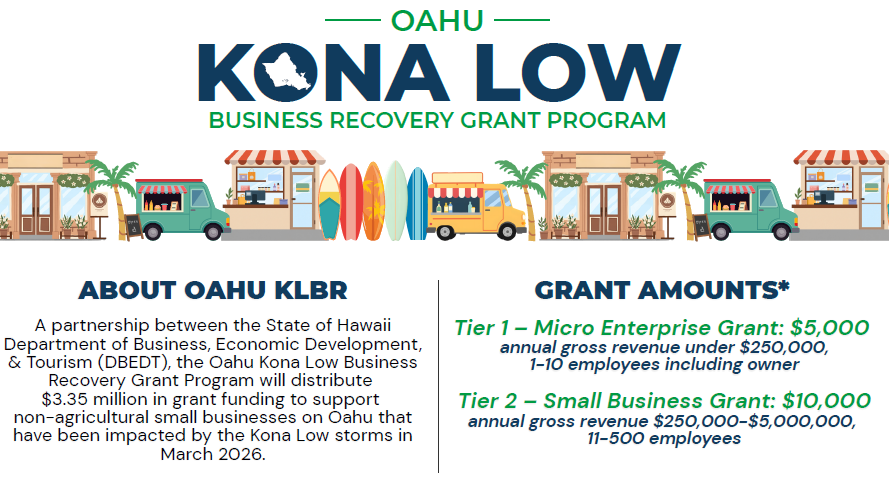
Oʻahu Kona Low Business Recovery Grant Program
The State of Hawaiʻi Department of Business, Economic Development & Tourism (DBEDT) is distributing $3.35 million in grant funding to support non-agricultural small business on Oʻahu that were impacted by the Kona Low storms in March 2026.
Qualified applicants must have sustained material, economic or physical harm directly caused by the Kona Low storms. Businesses must have been registered with the State of Hawaiʻi Department of Commerce and Consumer Affairs (DCCA) prior to March 10, 2026 and be current in state and federal taxes. Get details here or click on the image.
Farmer Disaster Assistance
The U.S. Department of Agriculture (USDA) Farm Service Agency (FSA) has a number of assistance programs for farmers, ranchers and producers who were impacted by the Kona Low disaster.
There are assistance programs for:
- Livestock grazing losses
- Livestock deaths
- Emergency assistance for livestock, honeybees and farm-raised fish
- Farm loans
- Farmland damage
- Crop losses
- Orchard and nursery assistance
More information on USDA assistance: https://www.fsa.usda.gov/resources/programs/disaster-assistance-programs.
Farmers can also get help navigating disaster relief options through the local organization Agricultural Stewardship Hawaiʻi.
Donate to Kona Storm Relief
Please note: Monetary donations are preferred at this time so that our partner relief organizations can procure the specific supplies needed for each community and each family affected by the Kona Low disaster.