Do you need help in another language? We will get you a free interpreter. Call 808-369-3580 to tell us which language you speak.
您需要其它語言嗎?如有需要,請致電 (808-369-3478), 我們會提供免費翻譯服務
您需要其它语言吗?如有需要,请致电 (808-369-3478), 我们会提供免费翻译服务
En mi niit alilis lon pwal eu kapas? Sipwe angei emon chon chiaku ngonuk ese kamo. Kokori (808-369-3478) omw kopwe ureni kich meni kapas ka ani.
Makemake `oe i kokua i pili kekahi `olelo o na `aina `e? Makemake la maua i ki`i `oe mea unuhi manuahi. E kelepona (808-369-3478)`oe ia la kaua a e ha`ina `oe ia la maua mea `olelo o na `aina `e.
Masapulyo kadi ti tulong iti sabali a pagsasao? Ikkandakayo iti libre nga paraipatarus. Awaganyo ti
(808-369-3478) tapno ibagayo kadakami no ania ti pagsasao nga ar-aramatenyo.
다른언어로 도움이 필요하십니까? 저희가 무료로 통역을 제공합니다. (808-369-3478)로 전화해서 사용하는 언어를 알려주십시요
Kwoj aikuij ke jiban kin juon bar kajin? Kim naj lewaj juon am dri ukok eo ejjelok wonen. Kirtok
(808-369-3478) im kwalok non kim kajin ta eo kwo melele im kenono kake.
E te mana'o mia se fesosoani i se isi gagana? Matou te fesosoani e ave atu fua se faaliliu upu mo oe. Vili mai i le numera lea (808-369-3478) pea e mana'o mia se fesosoani mo se faaliliu upu.
¿Necesita ayuda en otro idioma? Nosotros le ayudaremos a conseguir un intérprete gratuito. Llame al (808-369-3478) y diganos que idioma habla.
Kailangan ba ninyo ng tulong sa ibang lengguwahe? Ikukuha namin kayo ng libreng tagasalin. Tumawag sa (808-369-3478) para sabihin kung anong lengguwahe ang nais ninyong gamitin.
‘Okú ke fie maʻu tokoni ʻi ha lea fakafonua ʻe taha? Temau kumi haʻo taha fakatonulea taʻetotongi. Telefoni ki he (808-369-3478) ke fakahā mai ʻa e lea fakafonua ʻokú ke lea aí.
Bạn có cần giúp đỡ bằng ngôn ngữ khác không ? Chúng tôi se yêu cầu một người thông dịch viên miễn phí cho bạn. Gọi (808-369-3478)nói cho chúng tôi biết bạn dùng ngôn ngữ nào
Gakinahanglan ka ba ug tabang sa imong pinulongan? Amo kang mahatagan ug libre nga maghuhubad. Tawag sa (808-369-3478) aron magpahibalo kung unsa ang imong sinulti-han.
The 154th Medical Group traces its origins to Dec. 1, 1960, when the 154th USAF Dispensary was activated as part of a major Hawai‘i Air National Guard reorganization. Throughout the 1960s, the Dispensary provided comprehensive medical, safety, and sanitation support for the growing air defense mission; it also conducted physicals and occupational health monitoring. The unit extended its mission into community service through school health programs and support for anti-poverty initiatives.
The unit entered the 1970s with a new name — the 154th USAF Clinic. During this decade, it completed 600 to 800 physical examinations annually, administering large-scale immunization programs and supported all HIANG units statewide, including through quarterly neighbor-island rotations. Clinic personnel served prominently in community and statewide disaster-response events, providing medical coverage for major public gatherings.
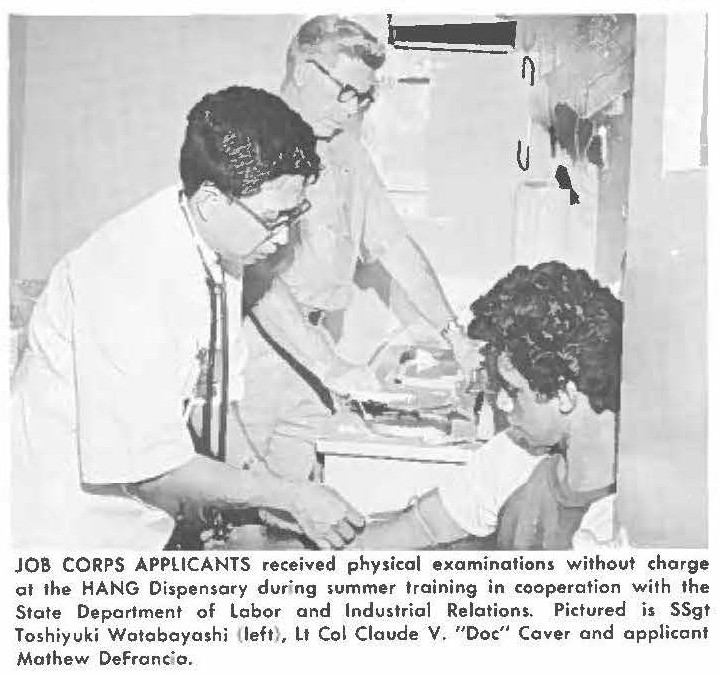
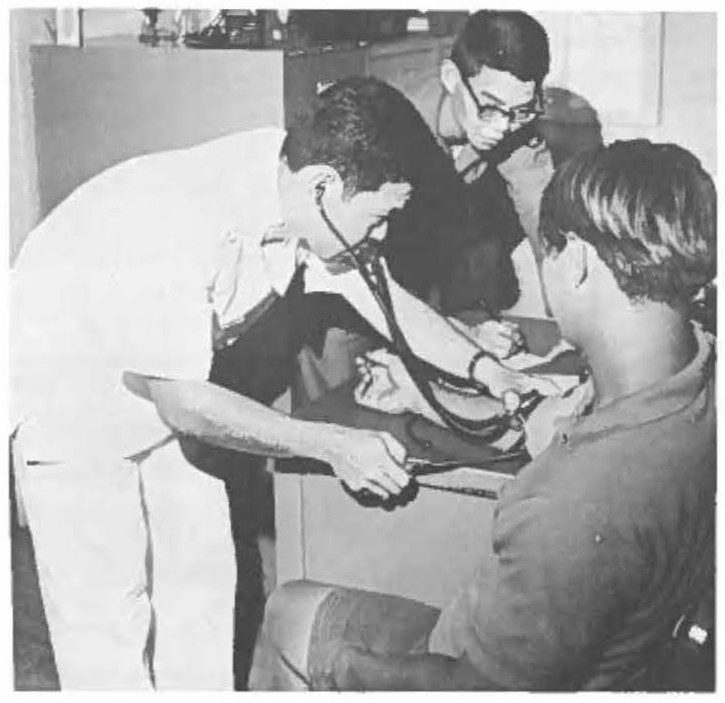
JOB CORPS APPLICANTS received physical examinations without charge at the HANG Dispensary during summer training in cooperation with the State Deportment of Labor and Industrial Relations. Pictured is SSgt Toshiyuki Wotoboyashi (left), Lt Col Claude V. “Doc” Cover and applicant Mathew Defroncio. (Picture from the 1965 September The Hawaii Guardsman)
Lt. Col. (Dr.) James Gallup (center) of the 154th U.S. Air Force Clinic, Maj. Gerrit Osborne and a JASDF pilot join in singing “Aloha Oe” in Japanese. (Picture from the 1980 September Pūpūkahi)
In the 1980s, the clinic expanded its capabilities through frequent overseas annual training deployments, integrating with active-duty hospitals at Travis AFB, Yokota AB and Elmendorf AFB. These missions strengthened clinical proficiency in mass casualty care, injury treatment, mobility operations and field training. By the mid-1980s, the unit was redesignated the 154th Tactical Hospital, reflecting its broadened medical mission and earned high marks in multiple Air Force medical inspections.
Throughout the 1990s, the Tactical Hospital later renamed the 154th Medical Squadron, continued intensive medical readiness training at locations around the globe. Members refined combat medical skills, litter evacuation and field-sanitation procedures.
In the 2000s, the newly designated 154th Medical Group enhanced its role as the Wing’s primary provider of fixed and deployable medical capabilities. It supported mass-casualty exercises, FEMA partnerships and major disaster-response exercises such as Vigilant Guard. The Medical Group through Medical Innovative Readiness Training missions delivered free medical, dental and vision services to underserved communities across O‘ahu. The 2010s highlighted the Medical Group’s growing interagency and international role with a landmark Medical Capabilities exercise and a subject matter expert exchange focusing on pandemic response with Indonesia.
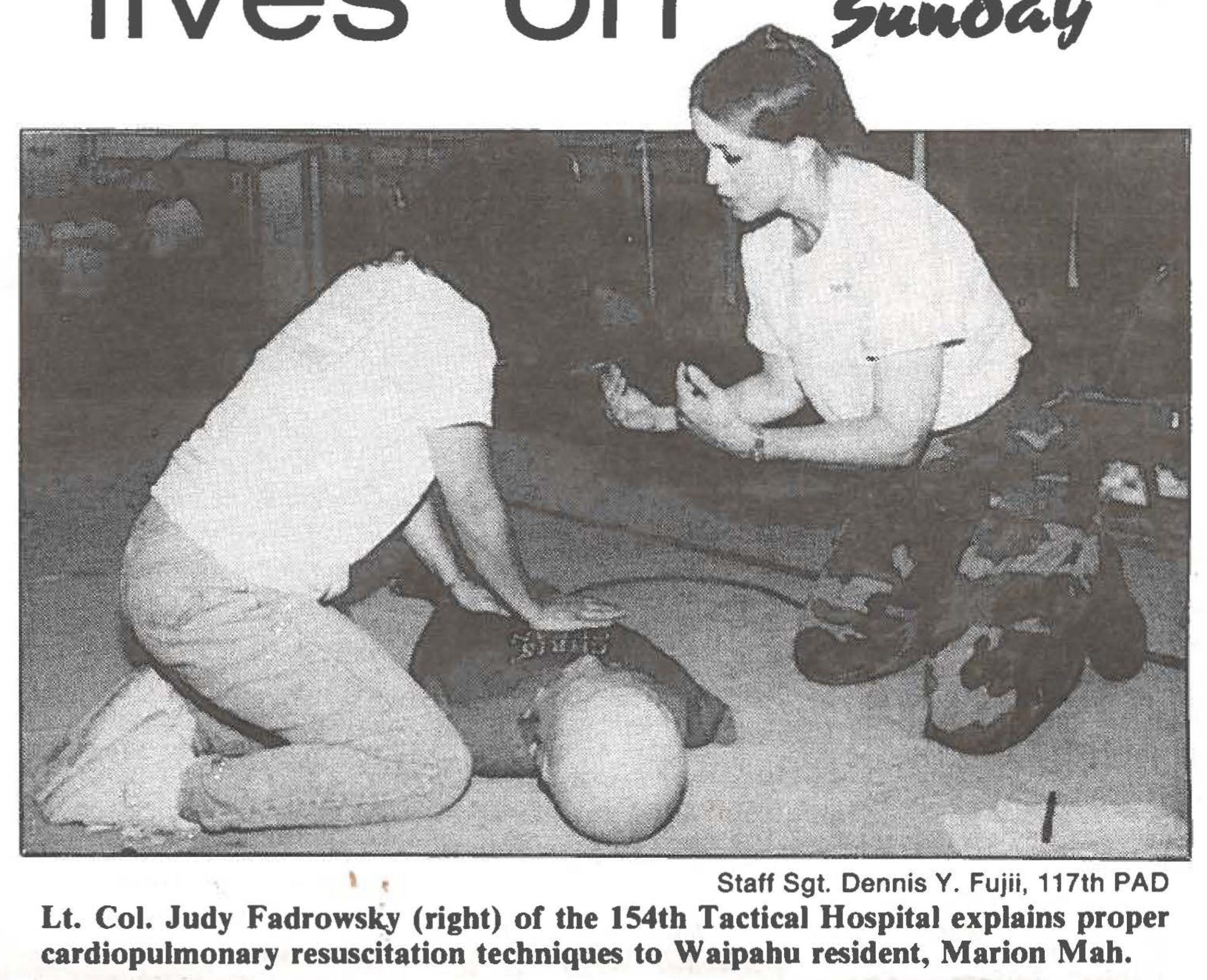
Lt. Col. Judy Fadrowsky (right) of the 154th Tactical Hospital explains proper cardiopulmonary resuscitation techniques to Waipahu resident, Marion Mah. (Picture from the 1990 October – December Pūpūkahi)
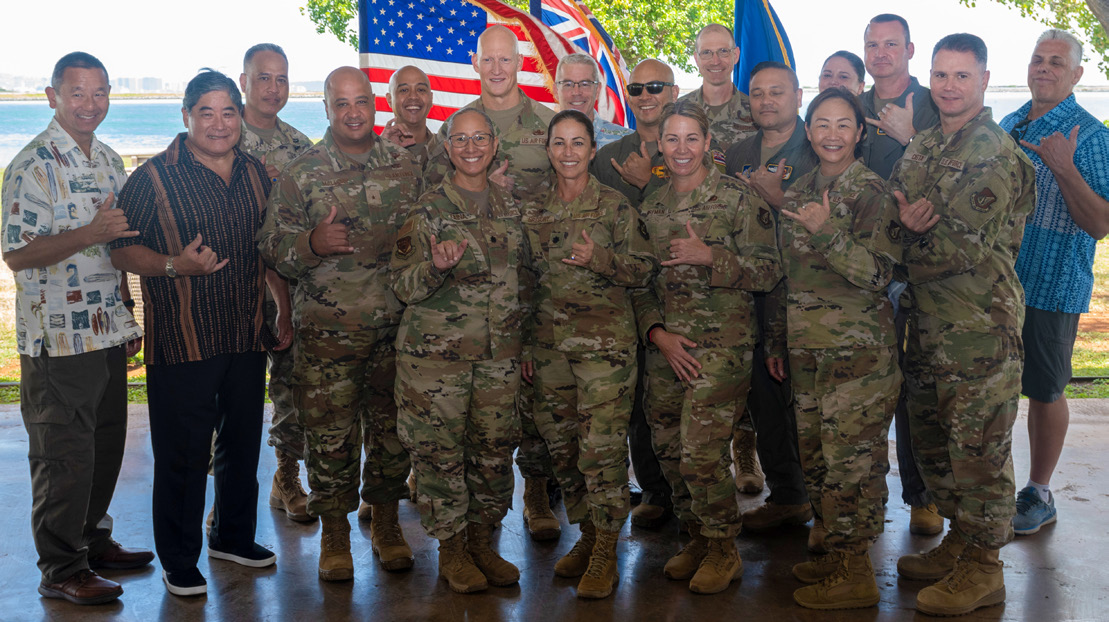
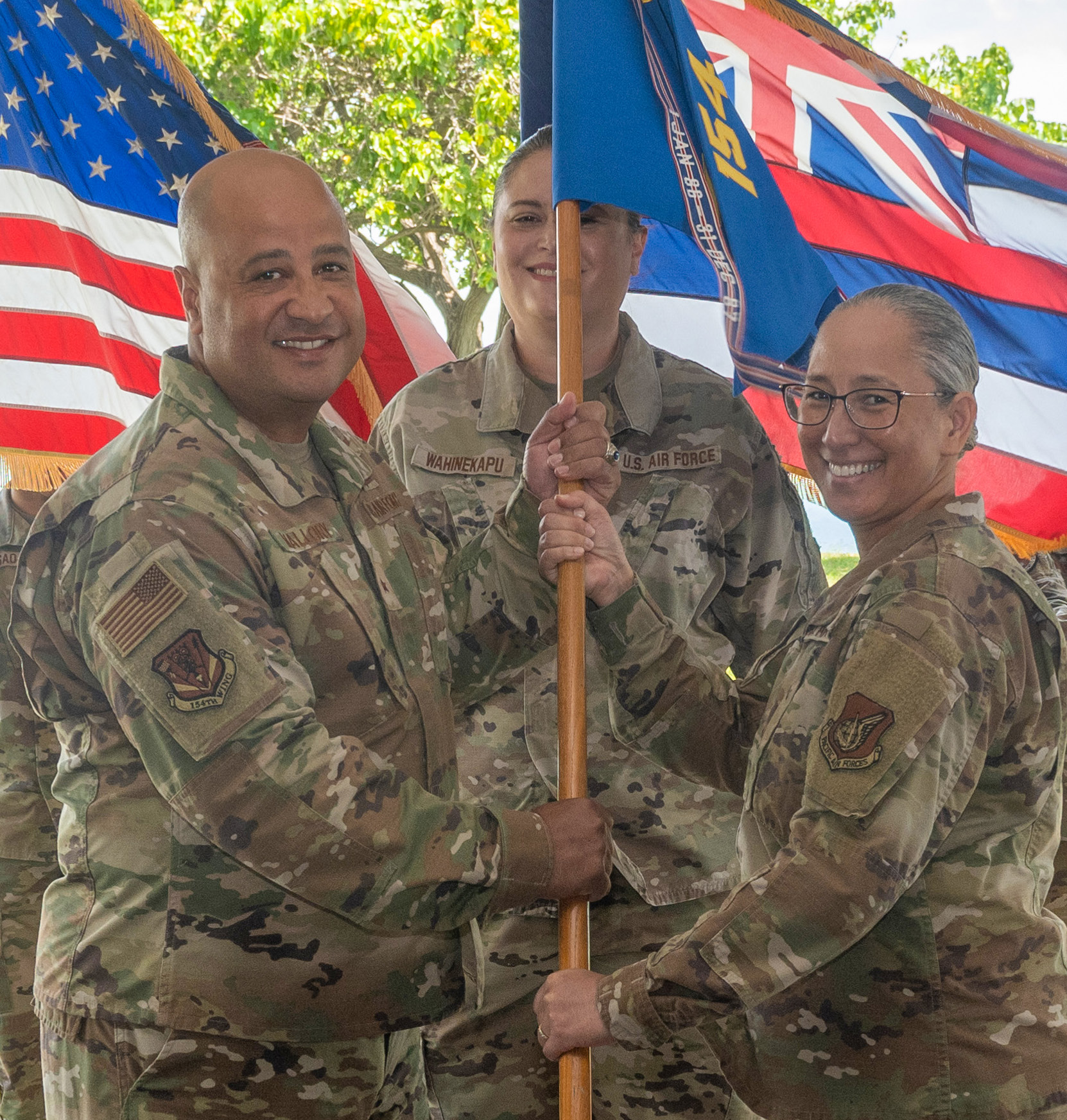
U.S. Air Force commanders past and present gathered together for 154th Medical Group commander Lt. Col. Elzadia Kaina’s assumption of command ceremony May 7, 2023 on Joint Base Pearl Harbor-Hickam, Hawaii. During the ceremony, Kaina invited former and current commanders for a photo opportunity highlighting diversity and the importance of representing different perspectives in leadership. (U.S. Air National Guard photo by Airman 1st Class Roann Gatdula)(Pictures from the 2024 Fall Pūpūkahi)
The Medical Group played a central role in Hawai‘i’s COVID-19 operations, supporting neighbor-island missions under the Hawai‘i National Guard Joint Task Force. After pandemic restrictions lifted, the unit reengaged in large-scale field training, mountain and water-rescue operation, and emergency medical support during the 2023 Maui Wildfire response.
Across six decades, the 154th Medical Group has evolved from a small dispensary into a globally engaged, domestically indispensable medical organization — one known for readiness, resilience, innovation, and its unwavering commitment to the people of Hawai‘i and the nation.
154th Medical Group Chronological History
Air Defense Group Organized at Hickam
The 199th Fighter Interceptor Squadron and the 199th Support Squadron will undergo a major reorganization effective December 15, 1960 Both squadrons will be activated into the 154th Fighter Group (AD) on that date and the new Group will be federally recognized on December 17, 1960. The Group Commander will he Lt. Col. Robert McGuire. Under his command will he the following units: 154th Group Headquarters, which will provide command and staff supervision over assigned units and centralized personnel and administrative functions; the 199th FINCEPTRON (the old numerical designation was retained), will carry out fighter-interceptor missions to identify and destroy enemy aircraft; 154th Consolidated Aircraft Maintenance Squadron (CAMRON) , which is assigned aircraft maintenance responsibility; 154th Materiel Squadron, which contains installations, motor vehicle, POL (petroleum and fuel functions), and HANG Base Supply; 154th Air Base Squadron, which is charged with base and housekeeping support and contains food service, Air Police, limited communications, photo; and the 154th USAF Dispensary.
The following commanders have been appointed: Capt. Kenneth L. Fisher, Commander 199th FINCEPTRON; Maj. William W. Dau, Commander 154th Materiel Squadron; and Capt. Claude V. Caver, Commander 154th USAF Dispensary. Commanders for the CAMRON and Air Base Squadrons have not yet been appointed.
The 154th Fighter Group (Air Defense) was activated 1 December 1960 with station at Hickam AFB, Oahu. The previous 199th Fighter Interceptor Squadron was reorganized as a squadron within the new Group, and the 199th Support Squadron was inactivated 30 November 1960. This Group organization is authorized 974 personnel hut is limited to 750/0 manning of 738 personnel. The 154th Fighter Group (Air Defense) is composed of Headquarters, 154th Fighter Group (AD), 154th Air Base Squadron, 154th Consolidated Aircraft Maintenance Squadron, 154th Materiel Squadron, 154th USAF Dispensary, and 199th Fighter Interceptor Squadron. Pacific Air Forces conducted the required Federal Recognition Inspections.
154th USAF Dispensary: The Dispensary conducted safety, medical, and sanitary inspections for the entire Hawaii Air National Guard. It further rendered initial medical care to industrial type injuries at HANG Area, Hickam AFB, condueted all non-flying physical examinations, special examinations, and monitored Hickam AFB based Air Guardsmen for hearing loss due to jet engine sounds. Close coordination continued with Hickam AFB Dispensary and TripIer Army Hospital for training and operations.
For the first time in our history, in fact HANG and HARNG, a nurse has been authorized for our newly organized 154th USAF Dispensary. Capt. Jean Albrecht, a regular Air Force nurse, was being processed for appointment in the unit. Unfortunately, however, she’s changing stations and will be flying home to the Mainland.
Rounding out the dozen in the 154th USAF Dispensary is Captain (MC) Casimer Jasinski, who fills the vacancy of Flight Surgeon. As such, he will handle flying physicals for the Group as well as the ACW squadrons. Captain Jasinski, formerly with the USN/USNR, is a fulltime State Civil Defense Medical Consultant. He graduated from the University of Washington MedicaI School, St. Louis, Missouri, and interned locally at Queen’s Hospital. He is married to the former Doris Reimann, Chicago, Illinois. The couple have two children and reside at 4821 Sierra Drive.
Recent additions of the officers rank are 1st Lt Arnold L. Cornez, CAMRON; Capt Paul L. Hummel and 1st Lt Lawrence C. Cahrinha, Fl Sq; and by direct commission of ANG Airman, 2nd Lt James T. Myers as Food Service Officer, ABRON.
The 154th USAF Dispensary again garnered the outstanding unit attendance trophy. This is the fourth time in the past five quarters that the “Medics” have captured the title
Personnel of the 154th USAF Dispensary have volunteered their services for OPERATION SWALLOW. Stationed at Hickam Elementary School for SWALLOW ONE, the volunteers will he on duty again for SWALLOW TWO. Maj. Claude V. Caver is Officer-in-Charge of the dispensary.
For the eighth time since 1961, the 154th USAF Dispensary was designated winner of the HANG Attendance Trophy for 100% attendance. Brig. Gen. Valentine A. Siefermann, HANG Commander, presented the coveted award in October to Major Claude V. Caver, Dispensary Commander.
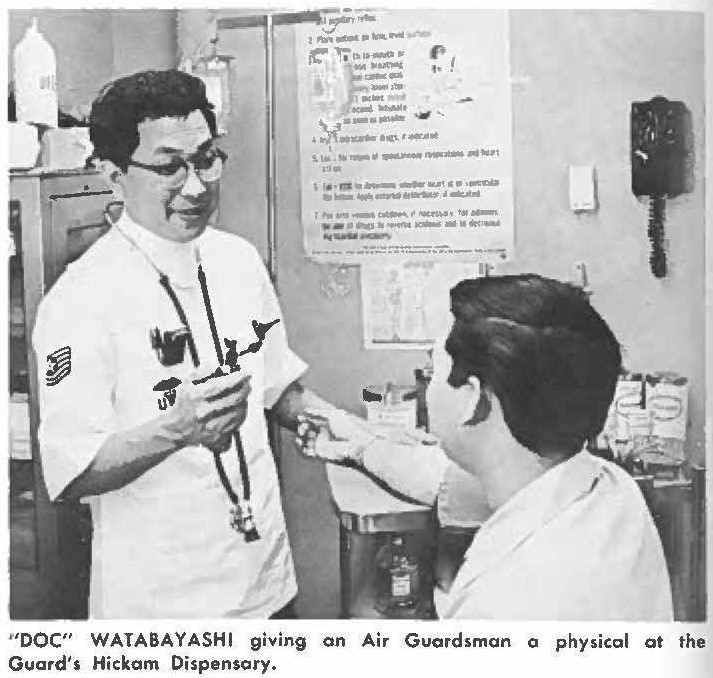
air Guardsmen in 154th Group Dispensary, headed by capable Lt CoI (Doc) Claude Caver, give physical to prospective enlistee. Dispensary is well equipped; is manned by three doctors and 16 airmen. (Picture from the 1966 September The Hawaii Guardsman)“DOC” WATABAYASHI giving on Air Guardsman a physical at the Guard’s Hickam Dispensary. (Picture from the 1968 Spring The Hawaii Guardsman)
“DOC” WATABAYASH!
Hawaii Air National Guard sergeant, 37-year-old Toshiyuki Watabayashi, will be the only man of enlisted rank attending a special two-week session at the ANG Dispensary in Washingcon, D.C. Watabayashi will gain practical experience in the latest medical techniques currently in practice in Washington. Watabayashi has served in his full-rime capacity with HANG for the past 10 years.
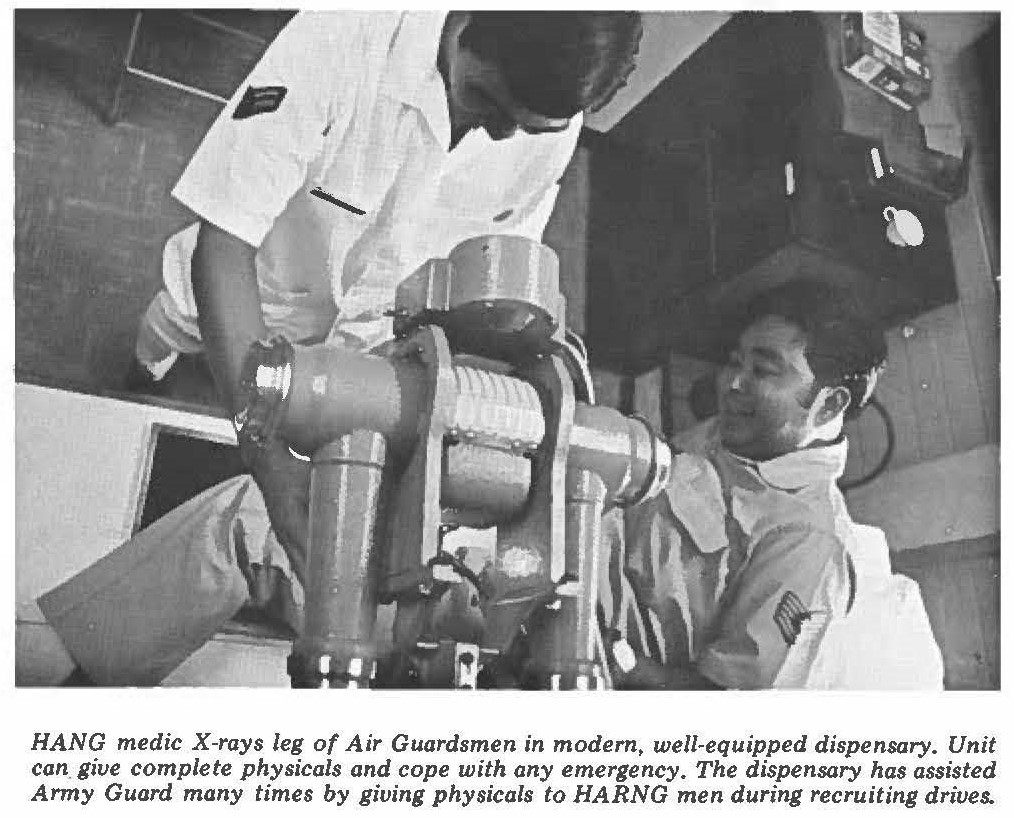
HANG medic X-rays leg of Air Guardsmen in modem, well-equipped dispensary. Unit can. give complete physicals and cope with any emergency. The dispensary has assisted Army Guard many times by giving physicals to HARNG men during recruiting drives. (Picture from the 1971 Summer The Hawaii Guardsman)
The 154th USAF Dispensary was redesignated as the 154th USAF Clinic on April 8, 1973.
HANG Squadron Attendance Trophy Awards were presented to the 154th USAF Clinic, 169th ACW Squadron, 154th USAF Clinic, and the 199th FIS for the respective fiscal quarters
The 154th Fighter Group was redesignated as the 154th Fighter Interceptor Group, and the 154th USAF Dispensary was redesignated as the 154th USAF Clinic.
During FY 76, the 154th USAF Clinic performed a total of 820 physical examinations (315 periodic, 360 enlistment, 145 flight). The clinic also administered approximately 1,500 inoculations and 1,500 tine tests to HANG personnel.
Medical support of all HA G units by our U.S. Air Force Dispensary included over 500 medical examinations (cough!), 150 flying physicals, 3,750 immunizations and over 500 “sick calls” during drill weekends and field training. This was the year that they gave HANG me n 1,400 Tuberculin tests. Remember? They “scratched” you while you were in the noon chow line.
The 154th USAF Clinic performed a total of 678 physical examinations (214 periodic, 266 enlistment, 179 flight, 14 appointments and 5 service academy). The clinic also inoculated 63 per cent of the HANG personnel with the swine flu vaccination before the discontinuation of the program.
The 154th United States Air Force Clinic performed a total of 676 physical examinations (278 periodic, 178 enlistment, 196 flight, 20 appointment and 4 service academy). The clinic also coordinated immunizations, inoculating all Hawaii Air National Guard personnel. The clinic supported the community by providing medical support to the statewide disaster preparedness exercise, the Honolulu Marathon, the Hawaii Heart Association’s Health Fair and the Maui County Fair.
The 154th Tactical Hospital’s first off-island summer camp was to Kokee, Kauai, in 1978. Half way up Mt. Kokee the bus carrying all the personnel got stuck in a ditch luckily, a 4-wheel jeep stopped and hauled the bus back on the road.
The 154th United States Air Force Clinic provided medical support to all personnel of the Hawaii Air National Guard and certain members of the Hawaii Army National Guard by performing a total of 759 physical examinations (332 periodics, 186 enlistments, 226 flight physicals, 10 officer appointments and 5 service academy). The activities of the clinic for the past year included quarterly trips to neighbor islands (Maui, Kauai and Hawaii) to provide medical support for Hawaii Air National Guard units on those islands. Clinic personnel also coordinated immunizations and clinical testing for Hawaii Air National Guard members.
Participation by the clinic: was not limited to military activities, but included community support for a statewide disaster preparedness exercise, the Honolulu Marathon, and the governor’s inauguration.
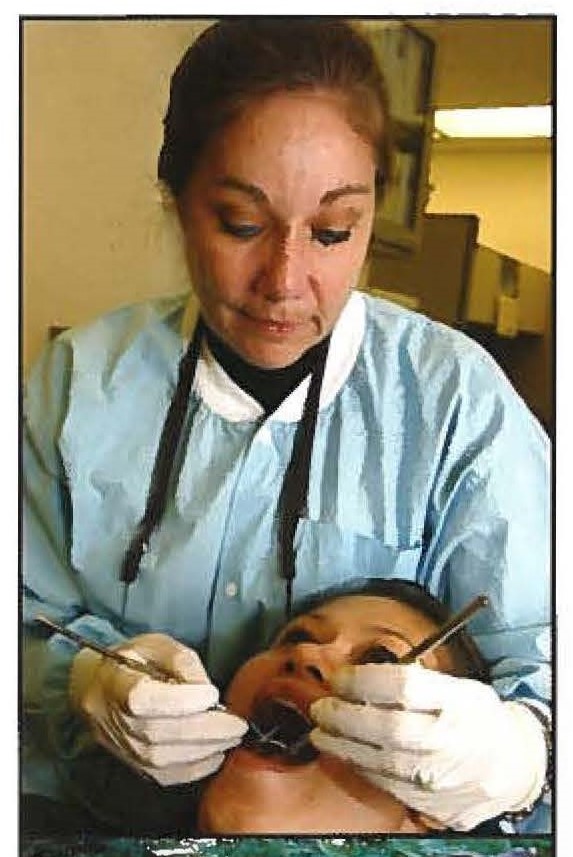
DIGGING FOR GOLD PAYS OFF – Annual dental checks by 154th USAF Clinic Dentists contributed to topnotch croup ratings.(Picture from the 1980 February Pūpūkahi)
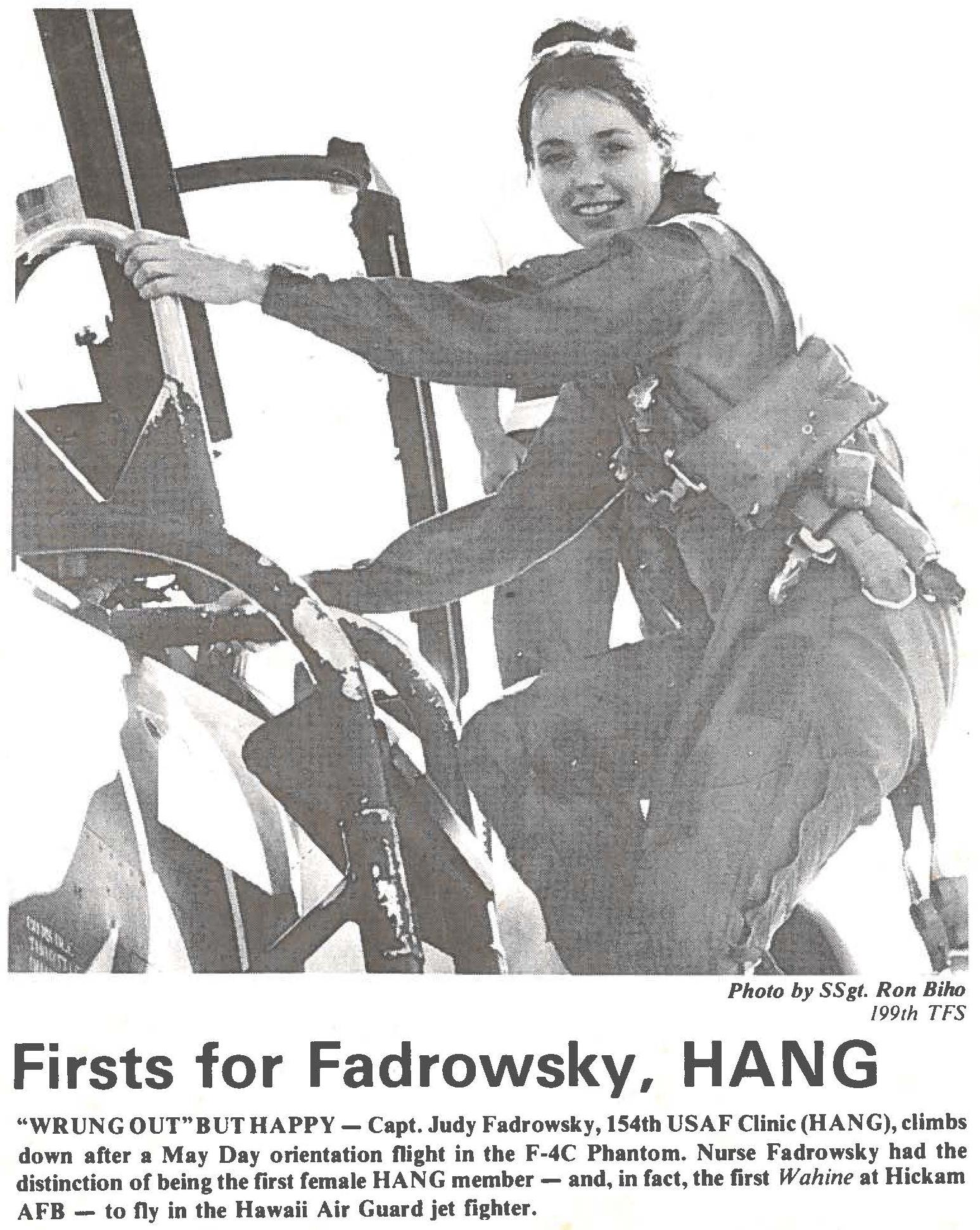
Firsts for Fadrowsky, HANG Photo by SSgt. Ron Biho 199th TFS “WRUNG OUT” BUT HAPPY – Capt. Judy Fadrowsky, 154th USAFClinic(HANG),climbs down after a May Day orientation flight in the F-4C Phantom. Nurse Fadrowsky had the distinction of being the first female HANG member – and, in fact, the first Wahine at Hickam AFB – to fly in the Hawaii Air Guard jet fighter. (Picture from the 1980 June Pūpūkahi)
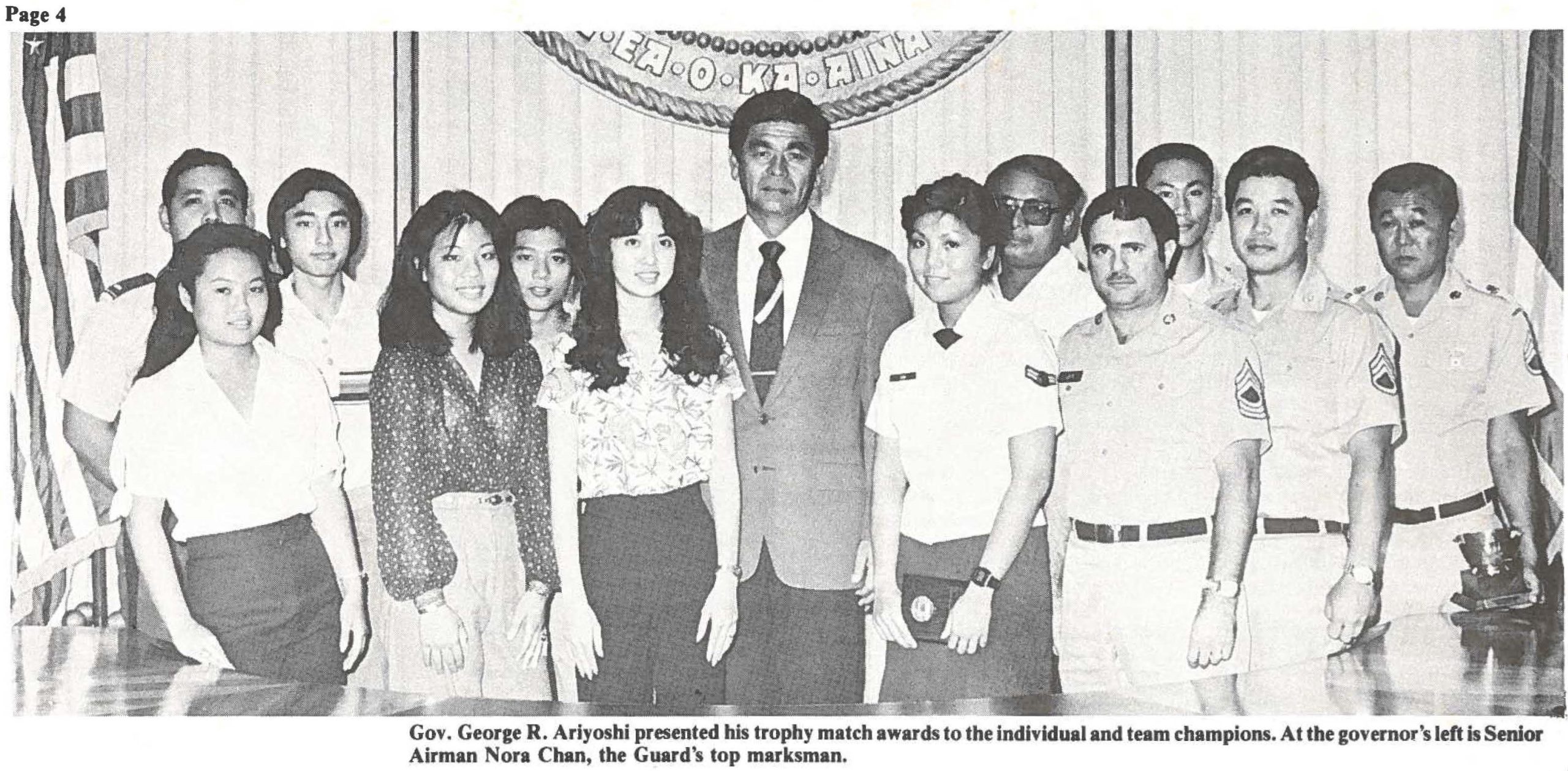
1982 Senior Airman Nora Chan of the 154th Composite Group clinic was the top marksman in the Governor’s Trophy Match rifle competition and received her award from Gov. George R. Ariyoshi in a special ceremony held at the State Capitol.
Learn more
Nora Chan is top marksman
Senior Airman Nora Chan of the Hawaii Air National Guard was the top marksman in the recent Governor’s Trophy Match rifle competition.
Chan, of the 154th Composite Group clinic, received her award from Gov. George R. Ariyoshi in a special ceremony held at the State Capitol. Finishing second was Master Sgt. Henry Leite of the Army Guard’s Command and Control Headquarters. Third was Sgt. Anthony Lendio of the 154th Consolidated Aircraft Main tenance Squadron, HANG.
One important aspect of the Governor’s Trophy Match was that it included teenage shooters who were teamed with National Guard units. Each four-person team was comprised of two Guard members and two of the junior shooters.
First place in the team competition went to the 829th Maintenance Company. Members were Staff Sgts. Donald Mochizuki and Wallace Kawakami and McKinley High School students Rey Cabradilla and Henry Cheung.
The 154th Consolidated Aircraft Maintenance Squadron was second. Team members were Tech. Sgt. Galen Yamada, Sgt. Anthony Lendio and Punahou students Jeremy Low and Chris Chee.
Third place was won by the Command and Control Headquarters team of 1st Lt. Gregory Burgess, Master Sgt. Henry Leite, and Pearl City High students Kim Tsukamoto and Gordon Aihara.
Gov. George R. Ariyoshi presented his trophy match awards to the individual and team champions. At the governor’s left is Senior Airman Nora Chan, the Guard’s top marksman.(Pictures from the 1981 Summer Pūpūkahi)
The 154th U.S. Air Force Clinic deployed to Travis Air Force Base Hospital for a week of duty and training. The group, including physicians, flight surgeons, dentists, nurses and clinic support staff demonstrated their competence by performing alongside active duty personnel. Many of the clinic personnel are private health practitioners in Hawaii.
The 154th USAF Clinic last month returned from a two-week training deployment to Yokota Air Base, Japan.
According to Col. (Dr.) Walter W.Y. Chang, commander of the 154th USAF Clinic. the deployment was a success and provided job related experience and mobility orientation the unit.
The deployment also provided an orientation for the type environment and facility the clinic people would have to operate in during a deployment to West PAC.
The two week deployment involved 50 Air Guard members, 43 clinic and seven personnel assigned to the 154th Composite Group.
Highlighting the trip to Japan was a Hawaiian luau prepared by members of the 154th USAF Clinic for the staff of the USAF Hospital at Yokota AB
JUN 1984 42 members of the 154th Composite USAF Clinic, Hawaii Air National Guard deployed to Clark AFB, Philippines. The 250 bed USAF Regional Medical Center at Clark AFB offered the members proficiency training and an opportunity to work in a new different environment with their active counterparts.
Learn more
154th Composite USAF Clinic
Exercise provides unique experiences
154th Composite USAF Clinic Exercise provides unique experiences154th Clinic page 4(Picture from the 1984 Third Quarter Pūpūkahi)
As part of their Annual Training, 42 members of the 154th Composite USAF Clinic, Hawaii Air National Guard deployed to Clark AFB, Philippines in June.
“The 250 bed USAF Regional Medical Center at Clark AFB offered the members of the 154th good proficiency training and an opportunity to work in a new different environment with their active counterparts” said NCOIC MSgt. Tashiyuki Watabayashi.
MSgt. Watabayashi also said that this kind of training was most beneficial to the 154th clinic.
Their instruction included treatment of mass casualties, handling nuclear, biological, and chemical injuries, and hands on clinical work with rabies patients at the Regional Medical center. They also live fired small weapons as part of training.
Unit members did have time to tour Manila city and visit Camp John Hay; a beautiful inter-service recreation center in the mountains of Baguio City. Some of the unit members bought rattan articles and some of the locally woven cloths.
MSgt. Watabayashi said that the instruction was excellent and the medical environment and cases seen in the regional hospital could only be experienced on a deployment exercise.
The 154th hosted a pau hana cocktail party with pupus at the Top Hat NCO Club on base.
The unit was transported to Clark AFB via C-5A Galaxy aircraft in about 12 hours and returned home via Minnesota Air Guard C-130 which took about a day and a half with a night stop over in Guam. Next deployment?
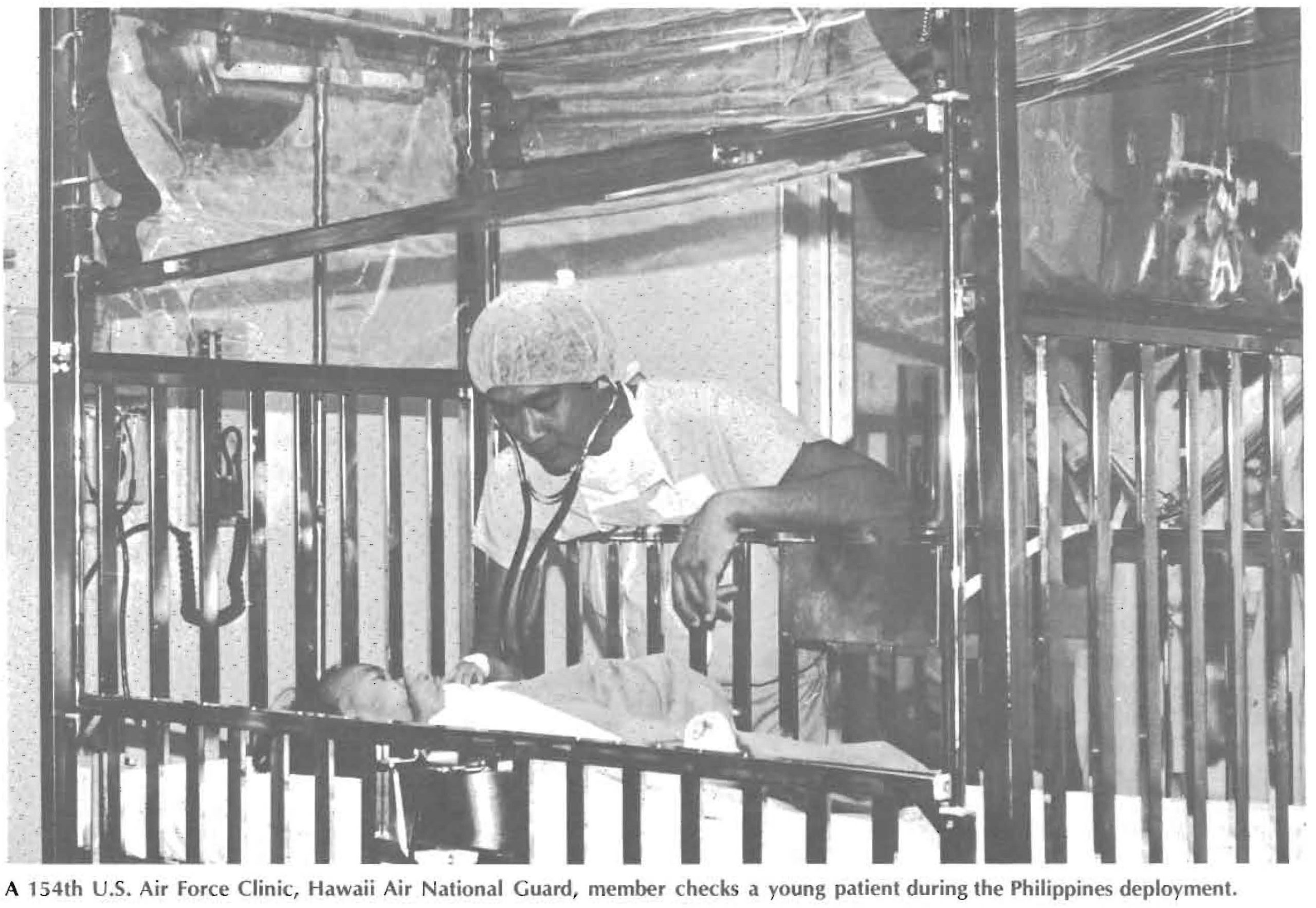
A 154th U.S. Air Force Clinic, Hawaii Air National Guard, member checks a young patient during the Philippines deployment. (Picture from the 1985 Annual Report)
The 154th U.S. Air Force Clinic staff tackled the medical workload at the Yokota Air Base hospital in Japan again this year, sharpening medical skills and clinical experience.
The 154th Tactical Hospital returned from Yokota Air Base, Japan, on July 4, 1985, after spending two busy weeks assisting the 5th Air Force’s Regional Hospital.
The 154th Tactical Hospital conducted their deployment to Yokota Air Base, Japan, wherein medical personnel assisted 5th Air Force’s Regional Hospital in early July 1985.
SEP 1986 34 medical and four support personnel of the 154th Tactical Hospital spent two weeks at Elmendorf Air Force Base, Alaska. The primary purpose of the deployment was to provide training and job related experience at an Air Force medical treatment facility.
Learn more
HANG Hospital is home
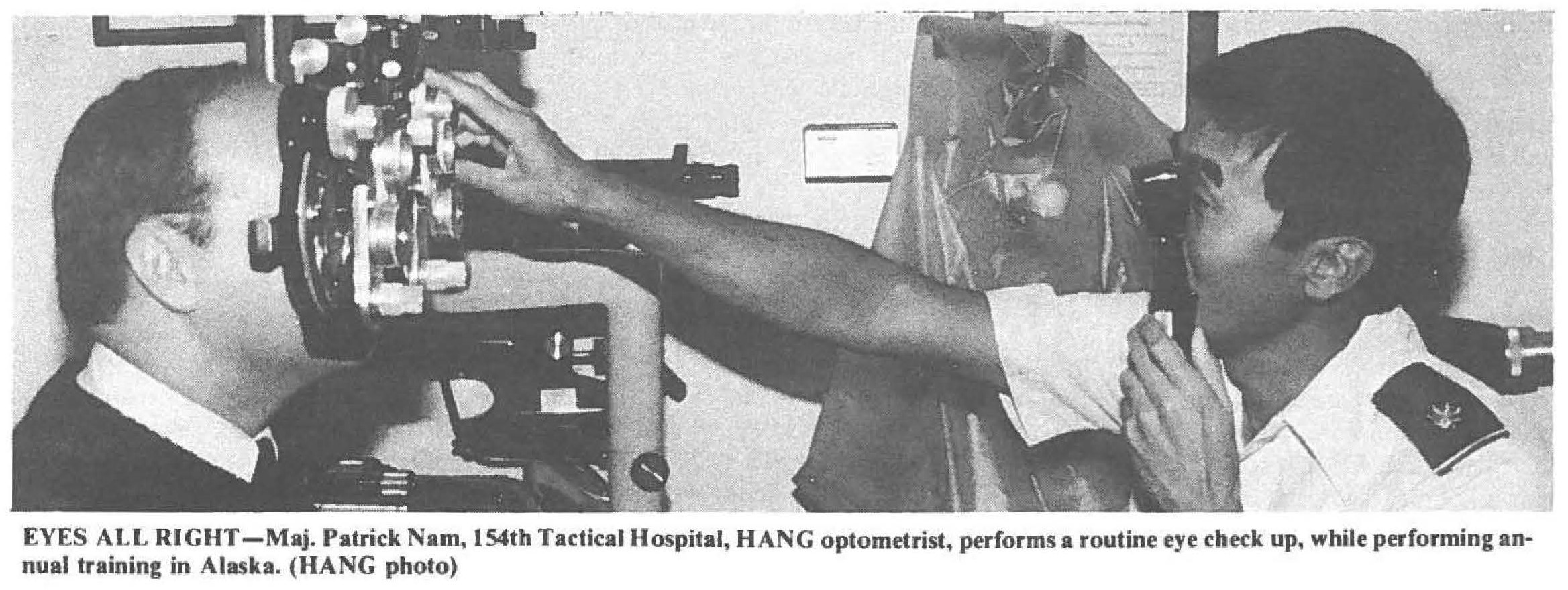
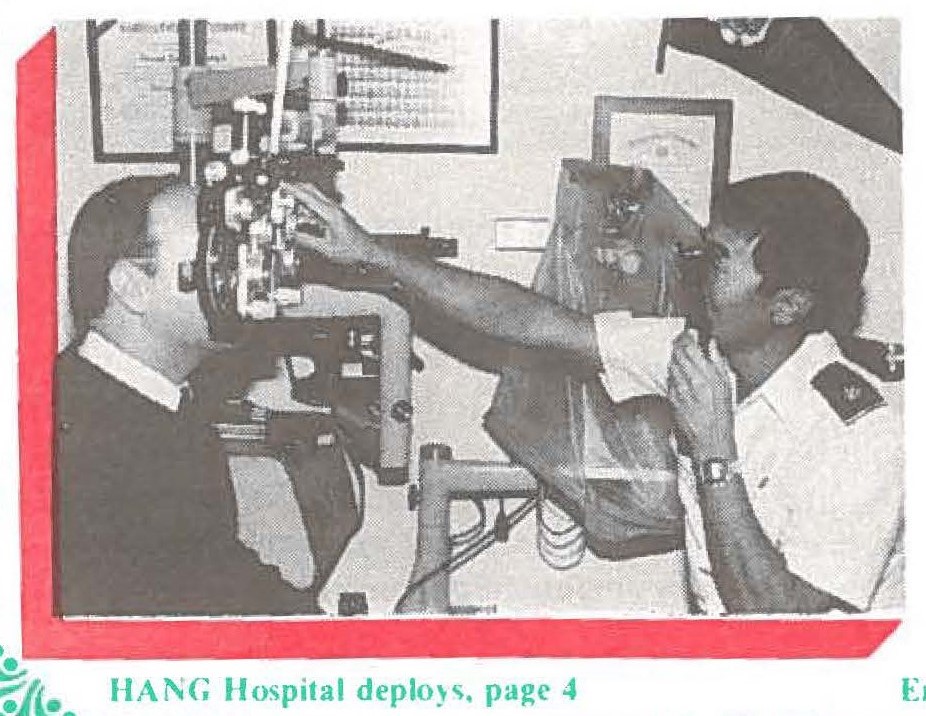
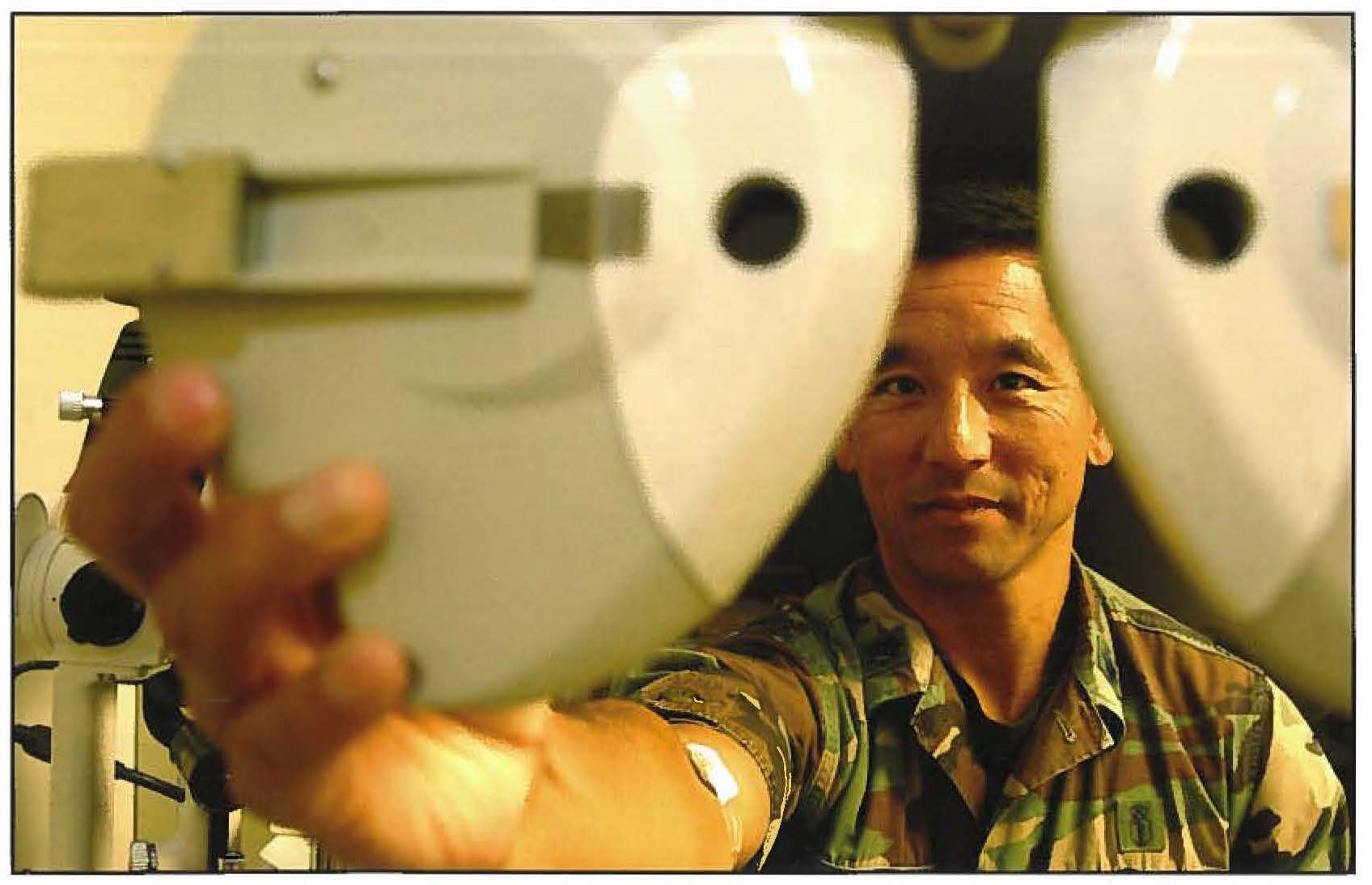
EYES ALL RIGHT-Maj. Patrick Nam. 154th Tactical Hospital, HANG optometrist, performs a routine eye check up, while performing annual training in Alaska. (HANG photo)(Picture from the 1986 October – December Pūpūkahi)
Members of the 154th Tactical Hospital returned to Hawaii after spending “Christmas in September” for two weeks at Elmendorf Air Force Base, Alaska.
The team comprised of 34 medical and four support personnel.
The primary purpose of the deployment was to provide training and job related experience at an Air Force medical treatment facility. The trip also offered a chance to participate in Continuing Medical Readiness Training (CMRT) (Medical Red Flag) conducted by the staff of the U.S. Air Force Regional Hospital Elmendorf.
Personnel spent three days and two nights in the field participating in simulated combat exercises including agressor infiltration and mass casualty.
The 154th‘s two family practice physicians assisted in alleviating a backlog of patients in the family practice clinic and in the emergency room, at times seeing 30-40 patients a day.
The readiness training was excellent, but all welcome returning to the warmth of the Hawaiian sun.
Join us as we step aboard the wings of our caduceus, the herald staff symbolic of the medical service corp, and are whisked through time to the early 1950s. Our final approach and decent brings us to an old World War 11, 12×12, wooden hut that serves as a first-aid station for HANG personnel. The staff of the first aid station is a physician, Dr. Claude V. Caver (Remember Dr. Caver? He was the redheaded dermatologist with the swagger stick and elegant cigarette holder held in a jaunty manner ala Roosevelt) and two enlisted men with no medical experience. These were the beginnings of the HANG’s 154th Tactical Hospital.
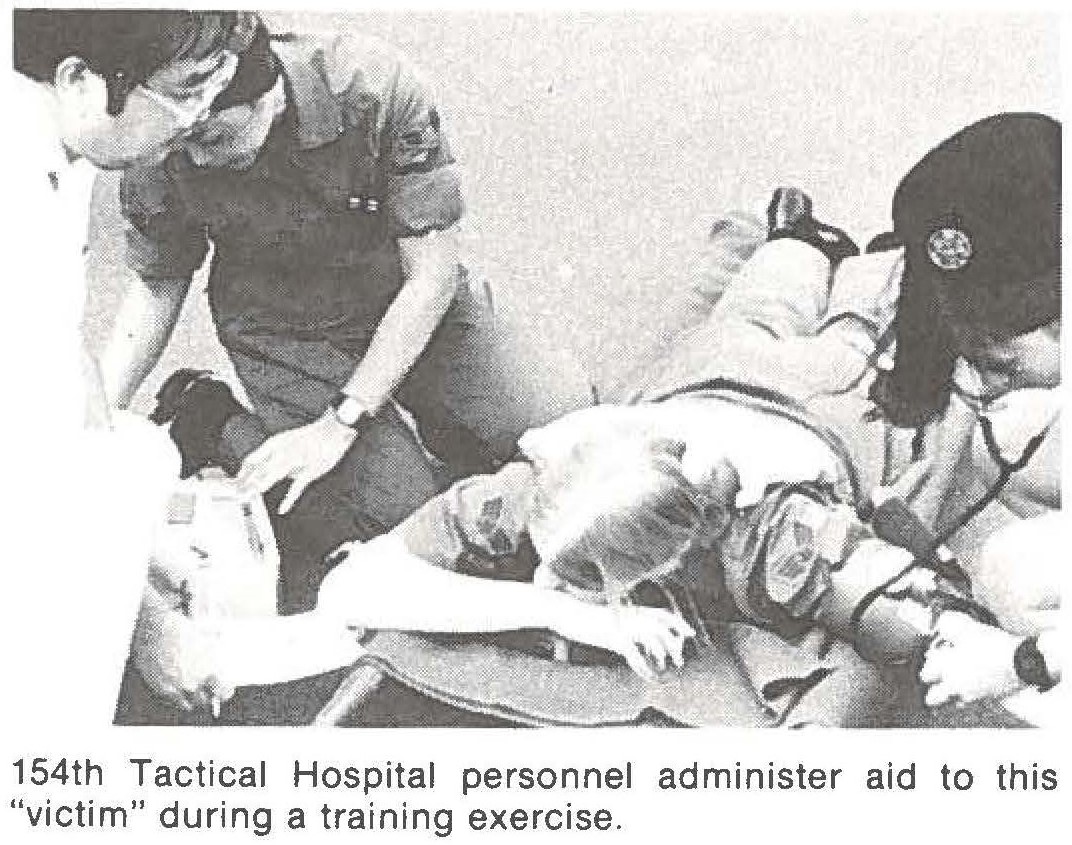
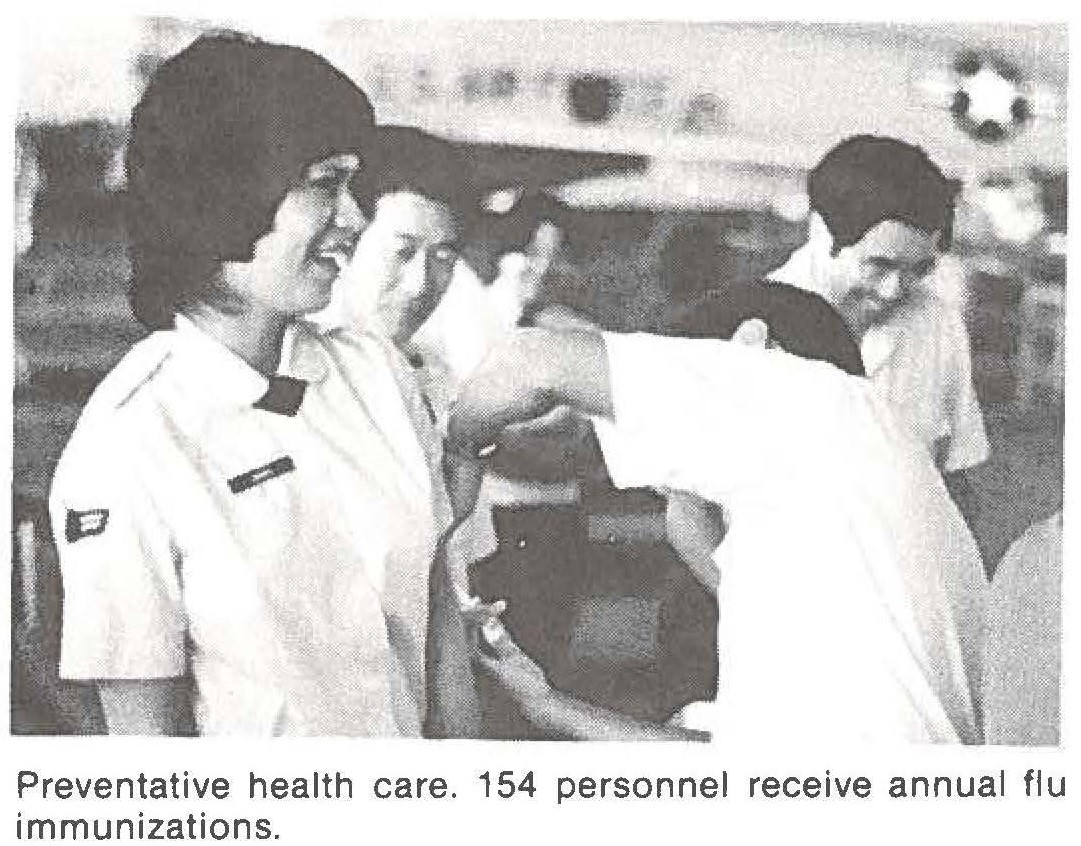
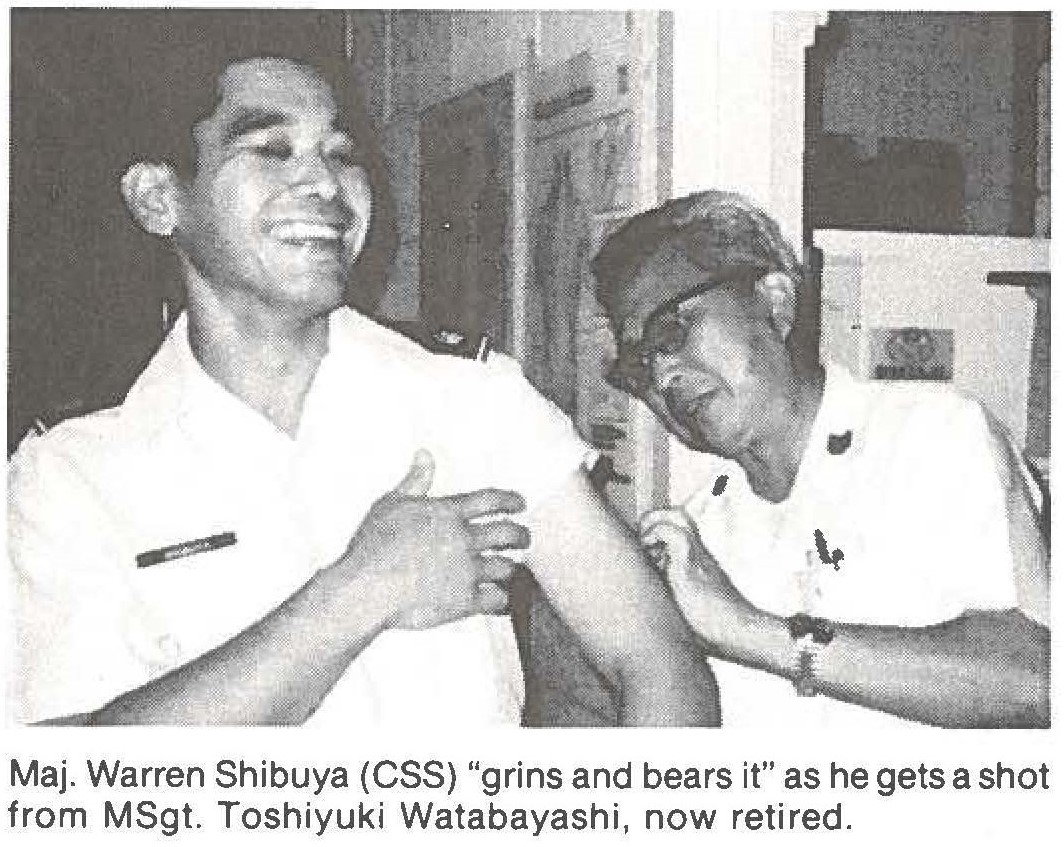
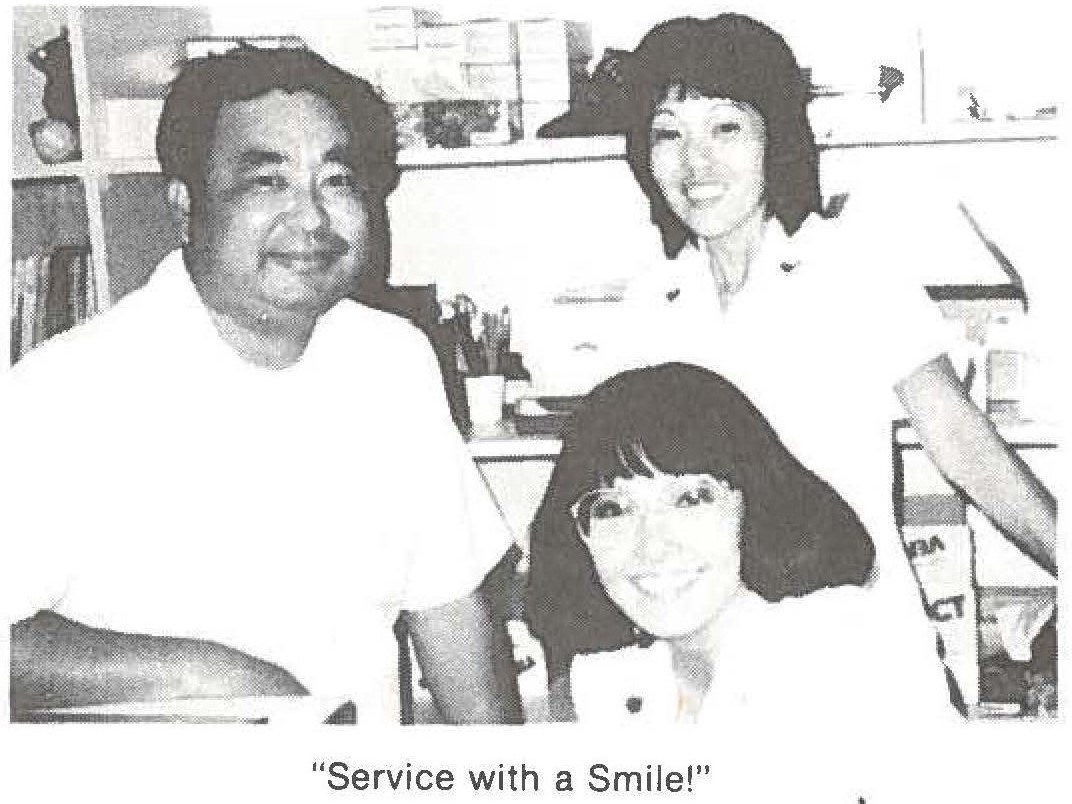
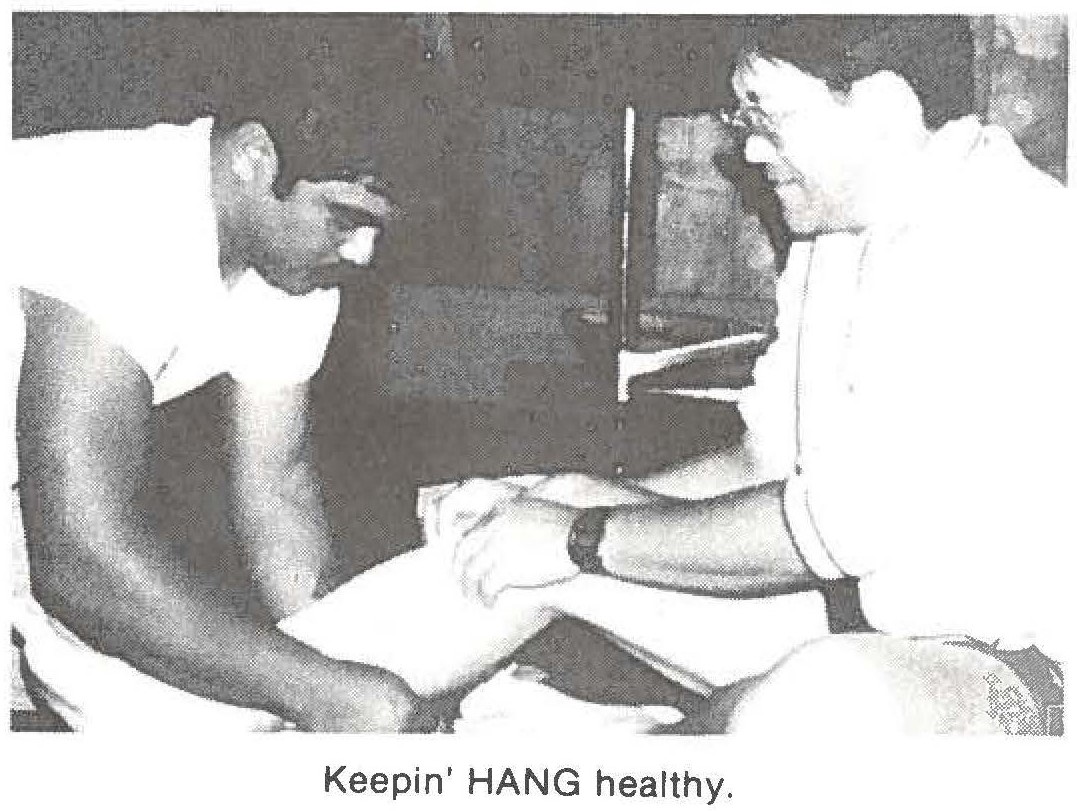
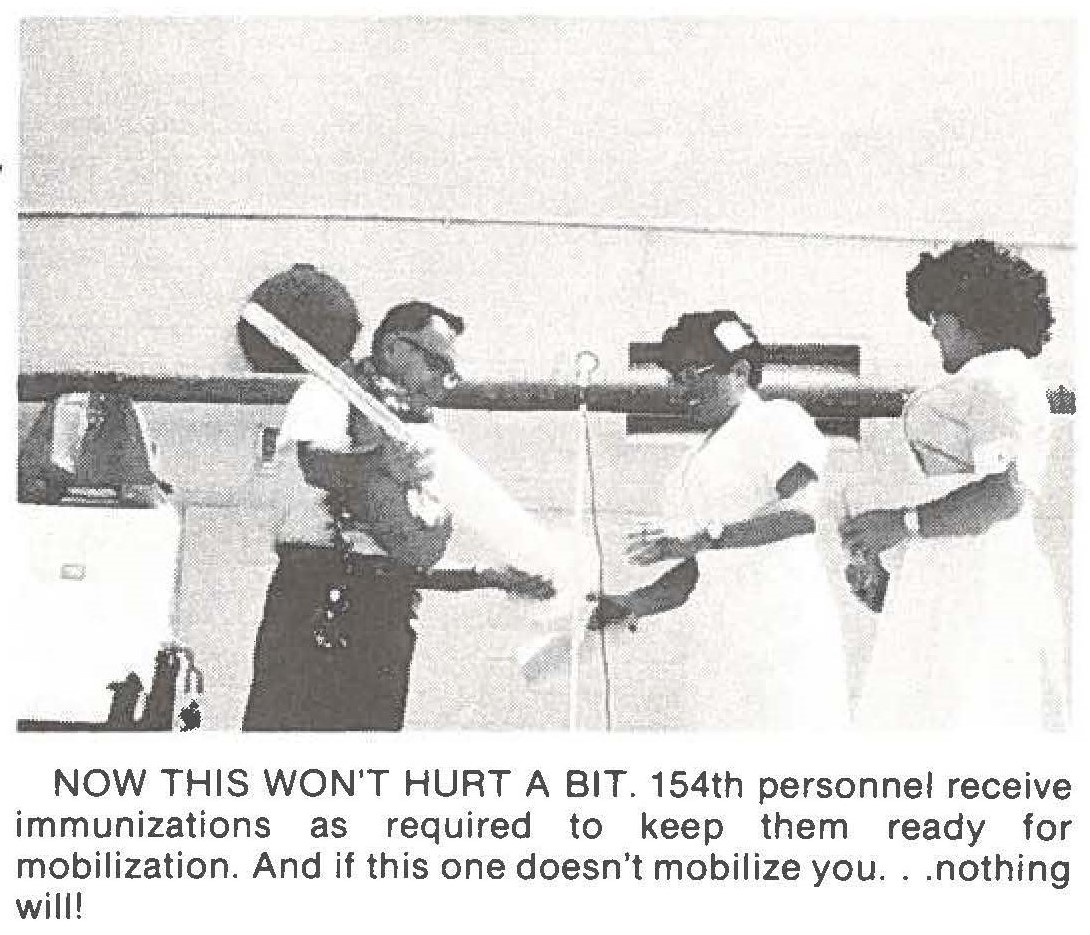
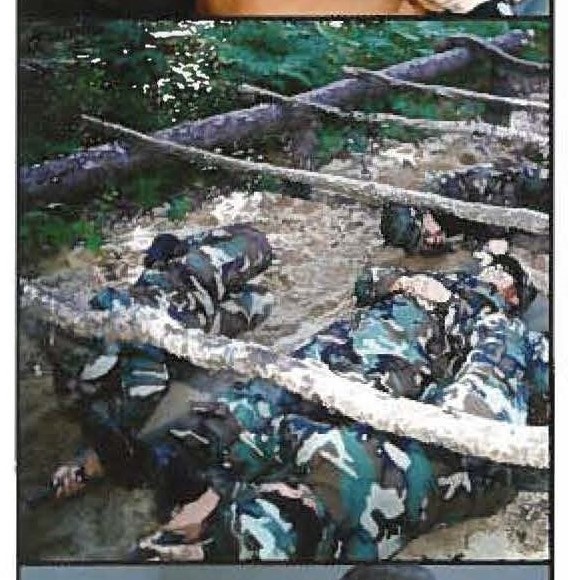
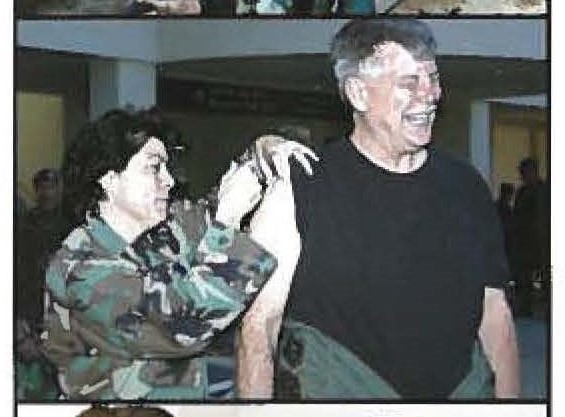
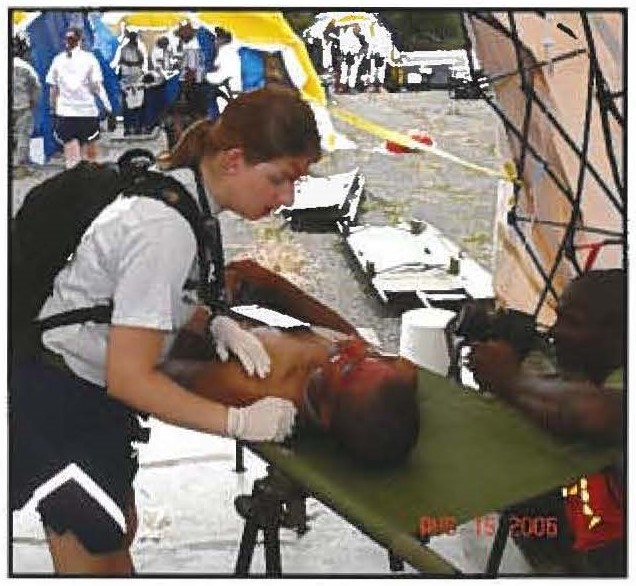
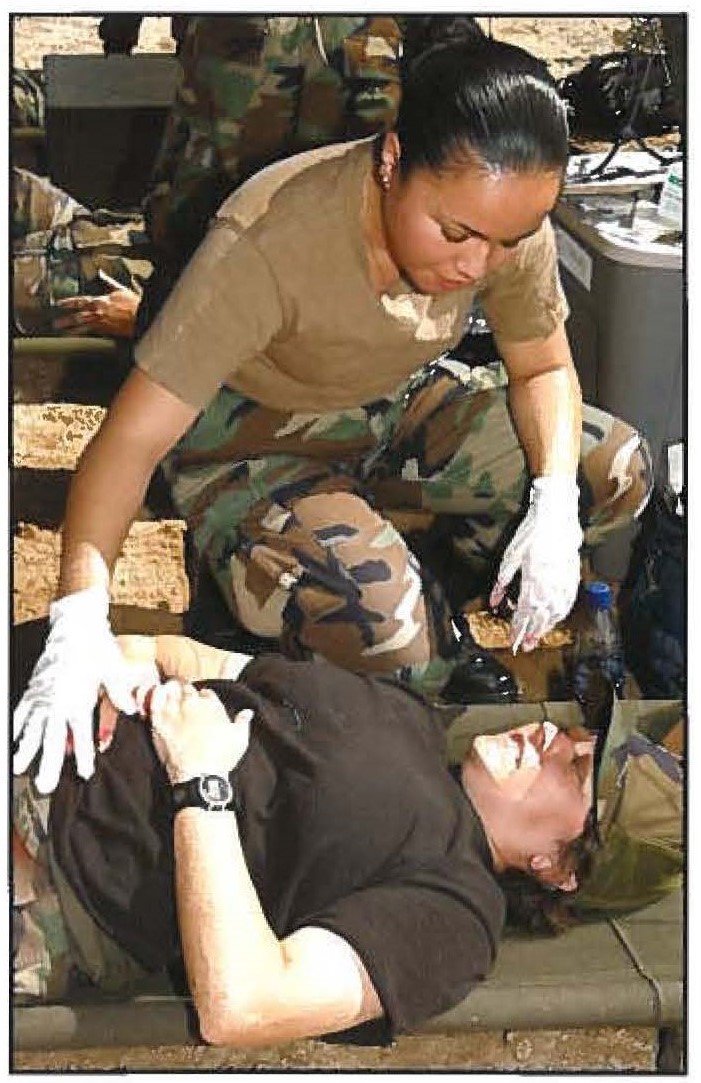
154th Tactical Hospital 154th Tactical Hospital personnel administer aid to this “victim” during a training exercise. Preventative health care. 154 personnel receive annual flu immunizations. Maj. Warren Shibuya (CSS) “grins and bears it” as he gets a shot from MSgt. Toshiyuki Watabayashi, now retired.“Service with a Smile!”Keepin’ HANG healthy. NOW THIS WON’T HURT A BIT. 154th personnel receive immunizations as required to keep them ready for mobilization. And if this one doesn’t mobilize you … nothing will! (Pictures from the Mo’olelo Kahiko Helu Ekahi- Tradition of Excellence 40th Anniversary Hawaii Air National Guard)
Time continues to advance forward as we approach May 1957, the time when the HANG supplements its medical element with its first full-time Health Services Technician. Sgt. Toshiyuki Watabayashi, “Toshi”, as everyone calls him, spent many long arduous hours scrubbing and cleaning that 12×12 wooden hut that he finally refurbished into a more decent first aid station.
The first unit manning document of this unit included one flight surgeon, one aerospace medical technician and one laboratory technician. With Dr. Caver and Toshi on board, Leslie I. Nakashima was recruited from the Weather Flight to fill the position of lab technician. In December 1960 the unit was formally recognized as the ·154th Dispensary and the manning document was increased to two flight surgeons, and six enlisted personnel.
Things began to look brighter for the medics and they started moving up. In 1967 with the dedication of Building 3400, the dispensary relocated to the back half of the third floor sharing space with the USAF advisors and the Combat Support Squadron. As workload increased the dispensary was authorized a second full-time Health Services Technician and in April 1969 filled the position with Mitchell K. Shimabukuro. Also during this time period Dr. Caver became the State Air Surgeon. Dr. Cas Jasinski succeeded him as dispensary commander. Cas was a navy pilot originally, and then went to medical school.
As the mission of the HANG changed and its units grew in size, so did the dispensary. Since 1960 when it was first recognized as a numbered dispensary, it has had two subsequent name changes, first in 1973 as the 154th USAF Clinic and more recently as the 154th Tactical Hospital. It has also grown from that initial UMD of two flight surgeons and six enlisted personnel to 14 officers and 45 enlisted with two off location, geographically separated medical units. Speaking of geographically separated units … our first off-island summer camp was to Kokee, Kauai, in 1978. Memorable events then were the cold, wet mornings and Bob, or was it Stan, getting the bus and a full load of medics stuck in a ditch half way up Mt. Kokee. Luckily, a kindly fellow in a 4-wheel jeep stopped and hauled the bus back on the road.
The clinic’s mission changed dramatically in 1979, with the addition of mobility and medical readiness training require ments. Dr. Walter Chang assumed command during this period of dynamic growth and change. In its recent Health Services Management Inspection (HSMI), the hospital graded an outstanding in its mobility and medical readiness training. The designation of its new mission capabilities has enabled the hospital staff to venture beyond the Hawaiian Islands to perform its annual training. In 1981 hospital personnel travelled east and deployed to the David Grant Medical Center, Travis AFB, California. The years to follow took us to WESTPAC and began our international deployment. Our first stop was at the Regional Medical Center Clark, Clark AFB, Republic of Philippines. The following year lured us to the “Land of the Rising Sun” to perform duty at the USAF Hospital Yokota, Yokota AB, Japan. The subsequent two years rotated our deployments between Clark and Yokota AB. This year’s deployment took the hospital personnel to the “Land of the Never Setting Sun” as training is performed at the USAF Regional Hospital Elmendorf, Elmencorf AFB, Alaska.
Although training is the hospital’s primary mission, providing medical support to all the HANG units is the focal point of our peacetime activities. Keeping the 154th Composite Group and the 201st Combat Communications Group combat ready for world wide duty is an assignment that is never ending. MASH trips (mini-deployments to the neighbor islands) to provide medical support to our neighbor island units are done monthly. The coordination of these mini deployments which involve ground and air transportation, supplies and equipment, and personnel is carried out behind the scenes by MSgt. Mitchell K. Shimabukuro. Without his efforts the hospital would not be able to mount the wings of its caduceus.
Mission readiness training and operational effectiveness is the military side of the Tactical Hospital, but lending a helping hand to the community we call home has been an integral part of our activities. Back in 1962 personnel from the then dispensary assisted in the administration of the oral polio vaccine. In 1972 they also participated in the administration of flu vaccines and TB skin test to the patients of Waimano Home. Participation in the Statewide Civil Defense Disaster exercises has been an ongoing, recurring activity that the hospital supports. The hospital also supports events like the Honolulu Marathon, Pepsi 10-K run and the Women’s 10-K run with a team of volunteers to man an aid station. This is only part of the role that the Tactical Hospital plays in being a leader and supporter of community activities.
As we continue on the final leg of our venture on the wings of our caduceus, we cannot help but gaze into the future and wonder what will be the role of the Tactical Hospital? Only time and the world situation will tell, but until we can focus more clearly on what the future holds, we the members of the 154th Tactical Hospital will continue to be mission ready and support the HANG for another 40 years.
In April 1987, the 154th Tactical Hospital demonstrated their skill by passing a thorough Health Services Management Inspection by a top team of medical inspectors from Norton AFB, California.
Thirty-eight members of the 154th Tactical Hospital performed their annual training at the U.S. Air Force Hospital, Yokota Air Base, Japan, from July 25 through Aug. 7, 1987. Experience and training in the hospital setting was accomplished along with Medical Readiness Training. As related by the Yokota Hospital Commander, the Hawaii Air National Guard’s Tactical Hospital contributed significantly toward reducing a burdensome backlog of patient care through their unselfish, professional approach in dealing with this problem. Accompanying Tactical Hospital personnel were six members of the 154th Mission Support Squadron and three members of the 154th Resource Management Squadron who conducted annual training as well as support during the deployment.
Forty-one members from the 154th Tactical Hospital deployed from March 27 to April 9, 1988 to the 8th Medical Group, Kunsan Air Base, Republic of Korea, to participate in the Team Spirit exercise. Medical readiness training provided realism and practice in a wartime scenario when the wailing tone of the attack warning system announced the approach of enemy aircraft. Working with members of the 8th Medical Group, hospital personnel were trained to treat simulated casualties from triage through the decontamination area to their final destination of immediate, minimal or delayed care. This helped the unit put into perspective their role as augmentees of the 8th Medical Group.
A variety of exercises tested the readiness of the 154th COMPGP during Fiscal Year 1989. The group took part with other Pacific military units in a joint task force exercise. The exercise simulated a multiple nuclear strike on the island of Oahu. The purpose of the simulation was to evaluate shelter management, provide experience for the damage assessment teams, test the readiness of the 154th Tactical Hospital, evaluate our disaster preparedness, and test our ability to continue to perform our mission in a nuclear radiated environment.
28 JUL – 9 AUG 1989 The 154th TacticaI Hospital completed training in their technical and clinical specialties as well as receive instruction on combat medicine at Osan Air Base, Republic of Korea.
Learn more
The 154th Tactical Hospital deployed for two weeks to Osan Air Force Base, Korea, in late July. The 154th medical personnel had the opportunity to train in their technical and clinical specialties as well as receive instruction on combat medicine.
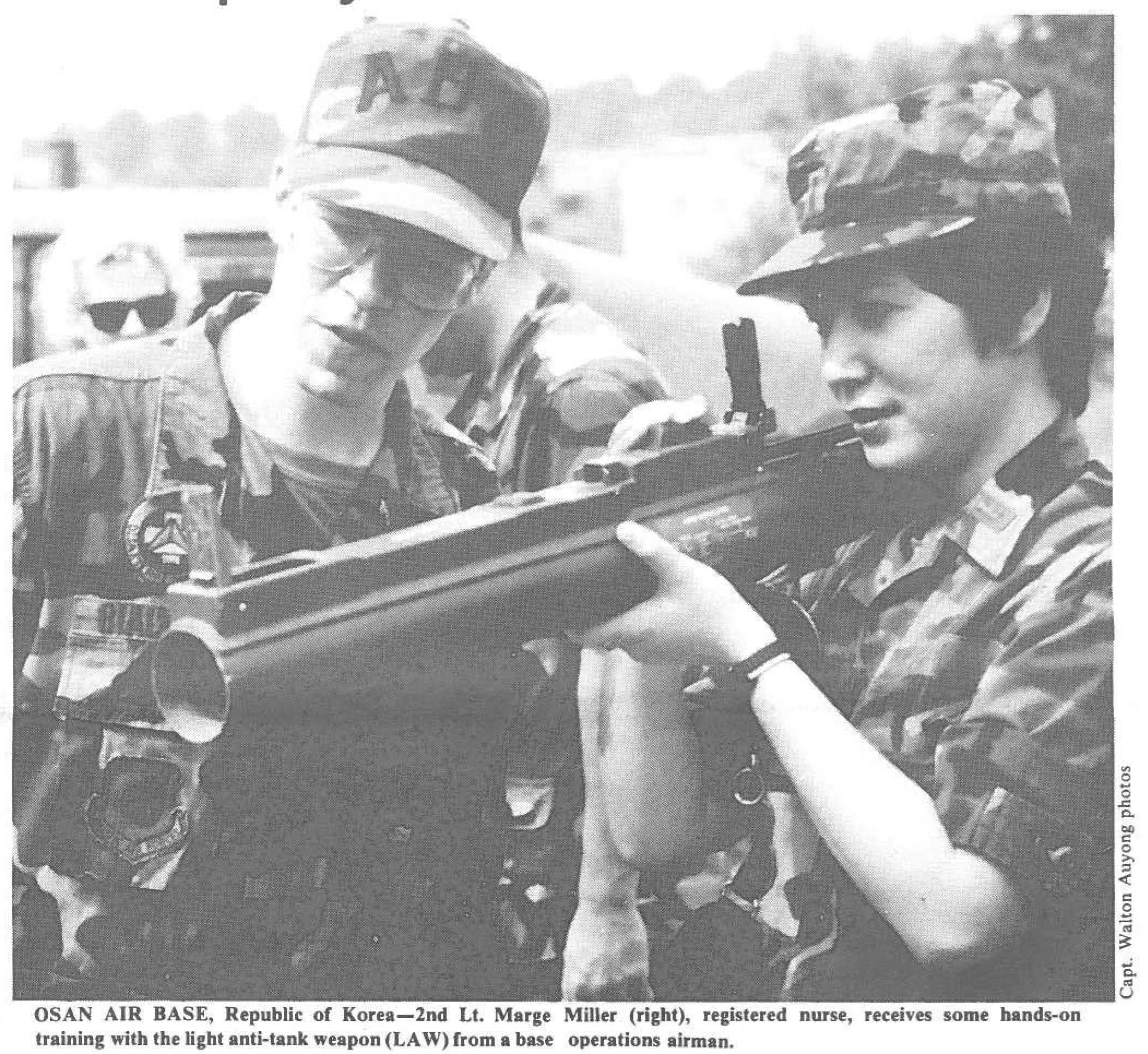
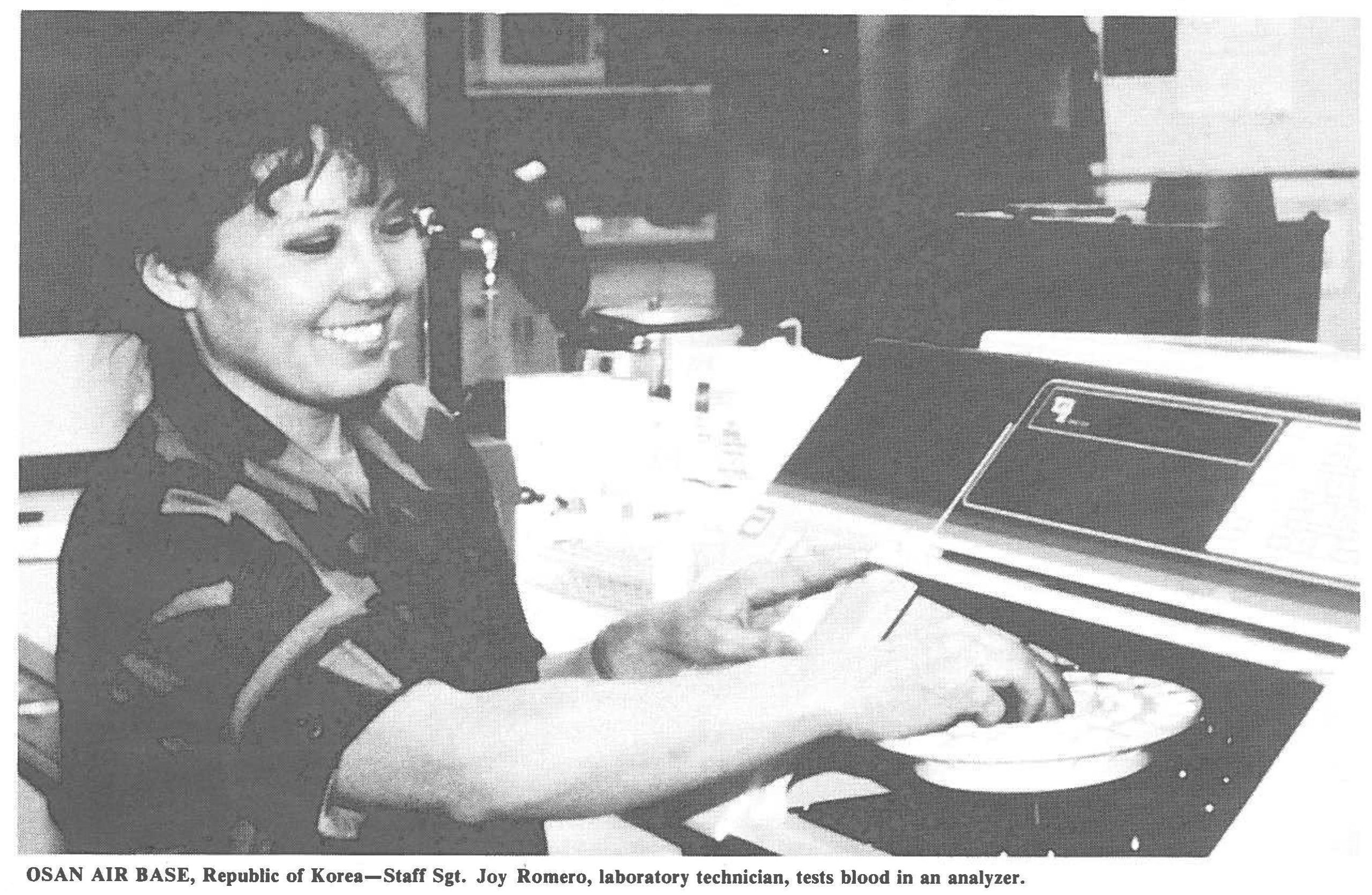
OSAN AIR BASE, Republic of Korea-2nd Lt. Marge Miller (right), registered nurse, receives some bands-on training with the light anti-tank weapon (LAW) from a base operations airman.OSAN AIR BASE, Republic of Korea-Staff Sgt. Joy Romero, laboratory technician, tests blood in an analyzer.(Pictures from the 1989 July – September Pūpūkahi)
The 154th TacticaI Hospital completed two weeks of unit mobilization training at Osan Air Base, Republic of Korea.
From July 28 to Aug. 9 twelve officers and 42 airmen trained with the 51st Medical Group.
Doctors. a dentist. an optometrist, nurses, medics. and support staff were able to enhance or improve their technical and clinical skills at Osan’s medical treatment facility.
Personnel trained in their specialty areas. unlike medical readiness training during the Team Spirit exercises. Tactical Hospital assistance to physicians also reduced the family practice and aeromedical clinics’ workloads.
The 154th received combat medical training and cardiovascular pulmonary resuscitation instructor certification and recertification.
All returned home cager for another educational training mission.
OSAN AIR BASE, Republic of Korea-Capt. Connie Hickman (left), 51st Medical Group, Sgt. Jesus Delmar, medical service specialist and 2nd Lt. Sharon Streb, registered nurse, participate in an intravenous therapy class.(Picture from the 1989 July – September Pūpūkahi)
‘Tactical Hospital trains in Korea
Unit works at Osan medical treatment faciIity again
Medical and support personnel of the 154th Tactical Hospital endured an 18-hour C-130H cargo aircraft flight to the Republic of Korea July 28. The deployment provided training and job-related experience for hospital personnel at the Osan Air Base medical treatment facility.
Ten officers and 36 enlisted personnel trained along side their host, the 51st Medical Group, while completing their individual and unit mobilization duties. The officers included three doctors, a dentist, five nurses and one health services administrator. The enlisted team included medical service technicians and six support personnel.
“The Tactical Hospital personnel blended into the daily routine of the family practice (general practitioner), aeromedical clinic (flight surgeon team that examines pilots and aircrews) and dental clinic,” said Lt. Col. Gildo S. Soriano, unit commander.
Members of the 154th were able to update and enhance their clinical skills. Training included cardiopulmonary resuscitation (CPR), combat medical, continuing medical readiness, air trans-portable clinic and chemical warfare defense.
“Think Safety,” the deployment’s motto, was reemphasized by 51st Medical Group staff as they briefed Hawaii airmen on safety, weather and health considerations.
For the second year, the Hawaii medical unit organized a luau for their military and civilian hosts. At the gathering, Soriano presented an appreciation plaque to Col. E. Charles Robacker and his staff. The special meal was prepared by cooks Senior Master Sgt. Harry Teramoto, Sgt. Bryon Lau and Senior Airman Jason lyomasa.
The Hospital personnel returned Aug. 9 to Hawaii on a commercial flight out of Kempo Airport.
Soriano gave special thanks to Chief Master Sgt. Mitchell Shimabukuro and the support staff for their efforts. Shimabukuro, noncommissioned officer in charge, carried out pre-and postdeployment coordination. Support staffing provided assistance in pay and travel (finance), transportation (motorpool), and food (cooks).
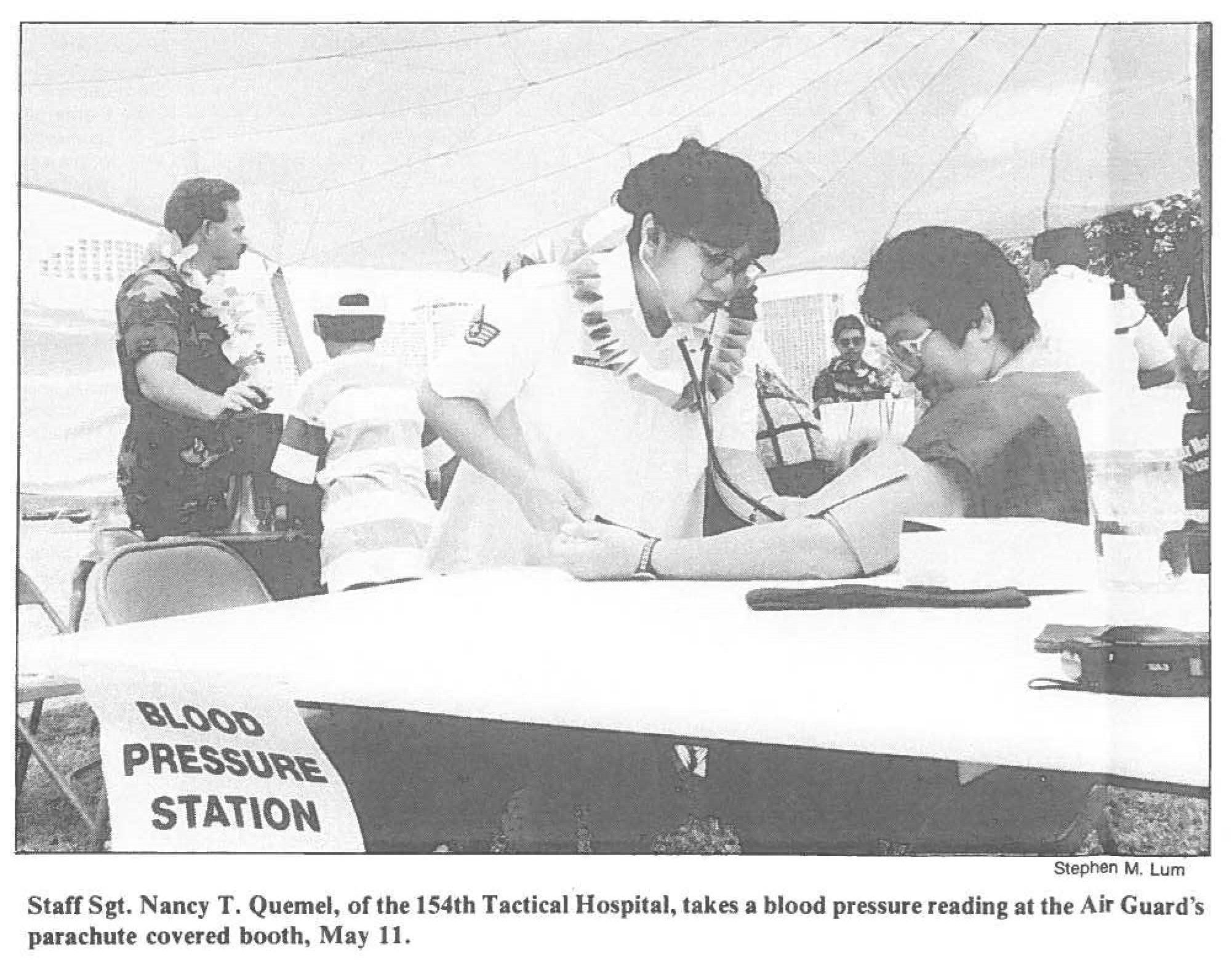
Staff Sgt. Nancy T. Quemel, of the 154th Tactical Hospital, takes a blood pressure reading at the Air Guard’s parachute covered booth, May 11. (Picture from the 1991 April – June Pūpūkahi)
Lt. Col. Judy Fadrowsky, 154th Tactical Hospital, discusses health issues during a breakout session.(Picture from the 1991 July – September Pūpūkahi)
10-26 MAY 1991 The 154th Tactical Hospital deployed to Phelps Collins Air National Guard Base in Alpina, Mich., to participate in their first medical mobility training. Highlights included the erection of a second echelon facility configuration and performance of medical tasks wearing full chemical warfare gear.
Learn more
In May, airmen of the 154th Tactical Hospital deployed to Phelps Collins Air National Guard Base in Alpina, Mich., to participate in their first medical mobility training as a unit. Highlights in eluded the erection of a second echelon facility configuration and performance of medical tasks wearing full chemical warfare gear.
By Staff Sgt. Gayle Sakamoto 154th Tactical Hospital
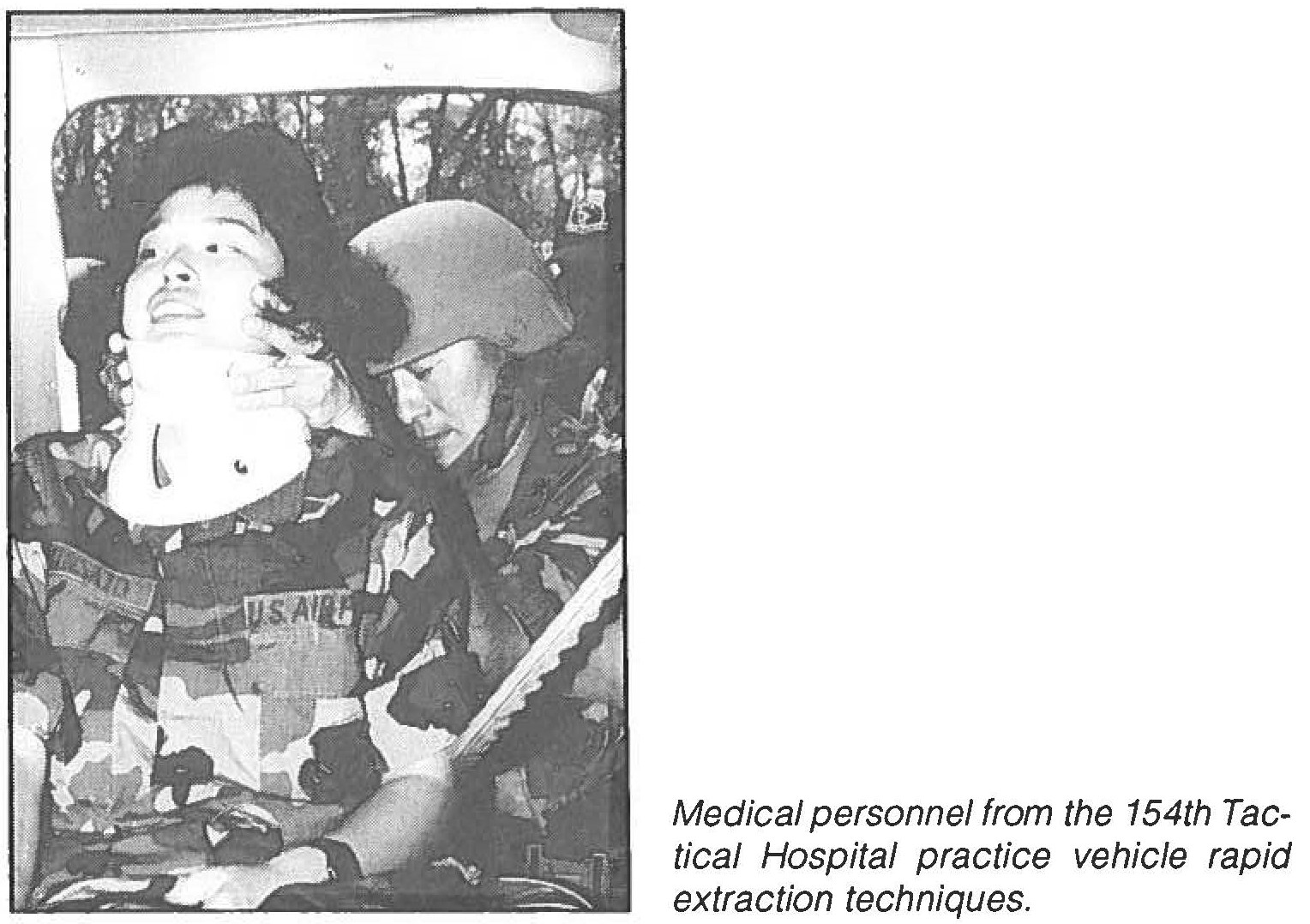
Maj. Patrick Nam prepares to move “patient” Senior Airman Kimberly Shinsato during a vehicle rapid extraction training session.(Picture from the 1991 July – September Pūpūkahi)
Forty-seven members of the 154th Tactical Hospital took part in the unit’s first medical mobility training, May 10-26. The unit deployed to Phelps Collins Air National Guard Base in Alpena, Mich., and discovered that being in the National Guard truly is an adventure.
The deployment, which involved both academic and hands-on experience, fulfilled medical readiness training requirements for the unit’s wartime mission and trained unit personnel in the second echelon (2E) concept of military medical care. The training focused on enhanced readiness capabilities and improved performance effectiveness for wartime and peacetime missions in support of the Pacific Air Force and Hawaii Air National Guard.
The highlights of the training mission were the field exercise and erection of a 2E facility configuration. Members retrieved and treated casualties under different situations and guarded the facility’s perimeter against aggressors. The unit practiced triage (separating patients according to the severity of their wounds) and treated patients in temper tents. The ultimate test was the performance of medical tasks with the full chemical warfare ground crew ensemble in a simulated chemical environment.
The unit also completed a challenging litter obstacle course. Tac Hospital members carried patients on stretchers across rocky and hilly terrain, sometimes carrying the litters overhead or while crawling. Members were ordered to hit the ground during simulated fire.
In addition to hands-on training, unit personnel received classroom training in the Geneva Convention, field sanitation and combat stress.
Supplementing the unit were three service technicians from the 154th Tactical Control Squadron, Kekaha, Kauai. Led by Staff Sgt. Mike Akama, Staff Sgt. Oscar Sagucio and Airman 1st Class Steve Carvalho prepared outstanding meals throughout the deployment and were greatly appreciated by the Tac Hospital personnel and local mess hall staff alike. The three prepared Island-style delicacies whenever possible.
At the request of a base instructor, Tech. Sgts. Ronald Babb and Alan Yoneshige agreed to speak with the instructor’s daughter and her fourth grade classmates at nearby Hillman Community School. The elementary students had recently studied Hawaii and were enthralled by Babb’s brief presentation and question and answer session. Photographer Yoneshige gave macadamia nut candies and treats as well as educational material to the children.
Medical personnel from the 154th Tactical Hospital practice vehicle rapid extraction techniques.(Picture from the 1991 Annual Report)
The 154th Tactical Hospital deployed to Japan for annual training in Hawaii Air National Guard June. There they honed their medical skills in a field environment.
Congratulations to the men and women of the 154th Tactical Hospital for the fine showing you made during the recent Hospital Service Readiness Inspection conducted by members of the U.S. Air Force Inspector General’s office. Your hard work and dedication under the adverse condition of major renovations to your facilities, prior to and during the inspection, made your accomplishments even more significant. The two outstanding ratings in your dental and cardiopulmonary resuscitation programs, eight excellent ratings, and full validation of your combat and mobility readiness speak high! y of your commitment to excellence. You can all be justifiably proud of your accomplishments.
In September, 63 members of the 154th Tactical Hospital will be deploying to Osan Air Base, Republic of Korea. While in Korea, they will train with the 51st Medical Group to enhance the unit’s capability in patient care and ancillary services. The Tactical Hospital will be deployed for two weeks.
In February 1994, Lt. Col. Myron Tong replaced Col. Norberto Baysa as the commander of the 154th Tactical Hospital (Tac. Hosp.). Col. Baysa returned to HQ HIANG as the state air surgeon.
As we gaze back over the last ten years to where we left off at the 40th celebration, many changes have taken place in the 154th Medical Squadron. Back in 1986 the unit was designated as the 154th Tactical Hospital and was commanded by Lt. Col. Norberto Baysa.
The hospital was in the throws of robusting from a 52 person unit to a 73 person unit with a new wartime mission to support a second echelon medical facility. Name changes seem to be in, keeping with the changing wartime mission. When the 154th Tactical Hospital was redesignated as the 154th Medical Squadron in May 1994, patient retrieval and generation unit taskings were added to the second echelon personnel package tasking. There also have been three commanders. Lt. Col. Gilclo Soriano. Col. Norberto Baysa (who returned to the unit for a year from his post as Staff Air Surgeon) and Col. Myron L. Tong, the unit’s current commander. Col. Tong is the’ first non-physician commander in the history of the unit.
With the downsizing of the active Air Force. The 154th medical Squadron. along with most other medical units. absorbed new wartime tasking as part of the total force. Medical readiness training became the new buzz word for us as we worked and trained with the active duty forces. Annual training deployments to Air Force medical treatment facilities in Alaska. Japan and Korea were part of the training regime to provide clinical and hands on training for our personnel. The unit also deployed twice to Medical Readiness Training Site in Alpena. Michigan for its quadannual proficiency testing. Competency. proficiency and sustainment are the new measuring tools to ensure that our guardsmen are capable of performing their wartime mission.
Training, more training and even more training are the keys to our success. However, training is not the only element that consumes our time and effort. As the operations tempo of the units we support has increased, so have the medical requirements. New requirements for worldwide duty include DNA testing, TB testing, Hepatitis A and B immunization, drug testing, and Denial Class 3 and 4 screening. These requirements add to the demands on the already limited availability of time. The question of how do we do more with less. has always been answered with looking at ways to continually improve the way we do things. As we embark on our quality journey our focus is on customer service – striving to meet or exceed the expectations of our customers.
The 154th Medical Squadron underwent a health services inspection by the Air Force Inspector General held May to June 1995 and received a satisfactory rating.
September 2000: . . . 154th Medical Squadron conducted a mass casualty exercise here locally to better train and familiarize the medical personnel on their role during a mass casualty.
JAN-MAR 2005 Dr. Brett Wyrick officer with the Hawaii Air National Guard, serving as the commander of the 154th Medical Group decided to perform an active duty tour with the U.S. Air Force at Balad Air Base, Iraq.
Learn more
Hilo Doctor Volunteers for Operation Iraqi Freedom
By 2Lt. Regina Berry, 154th Wing Public Affairs
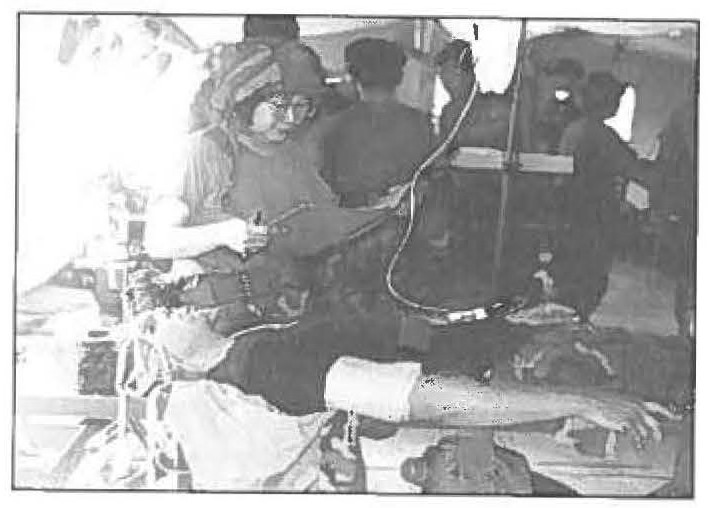
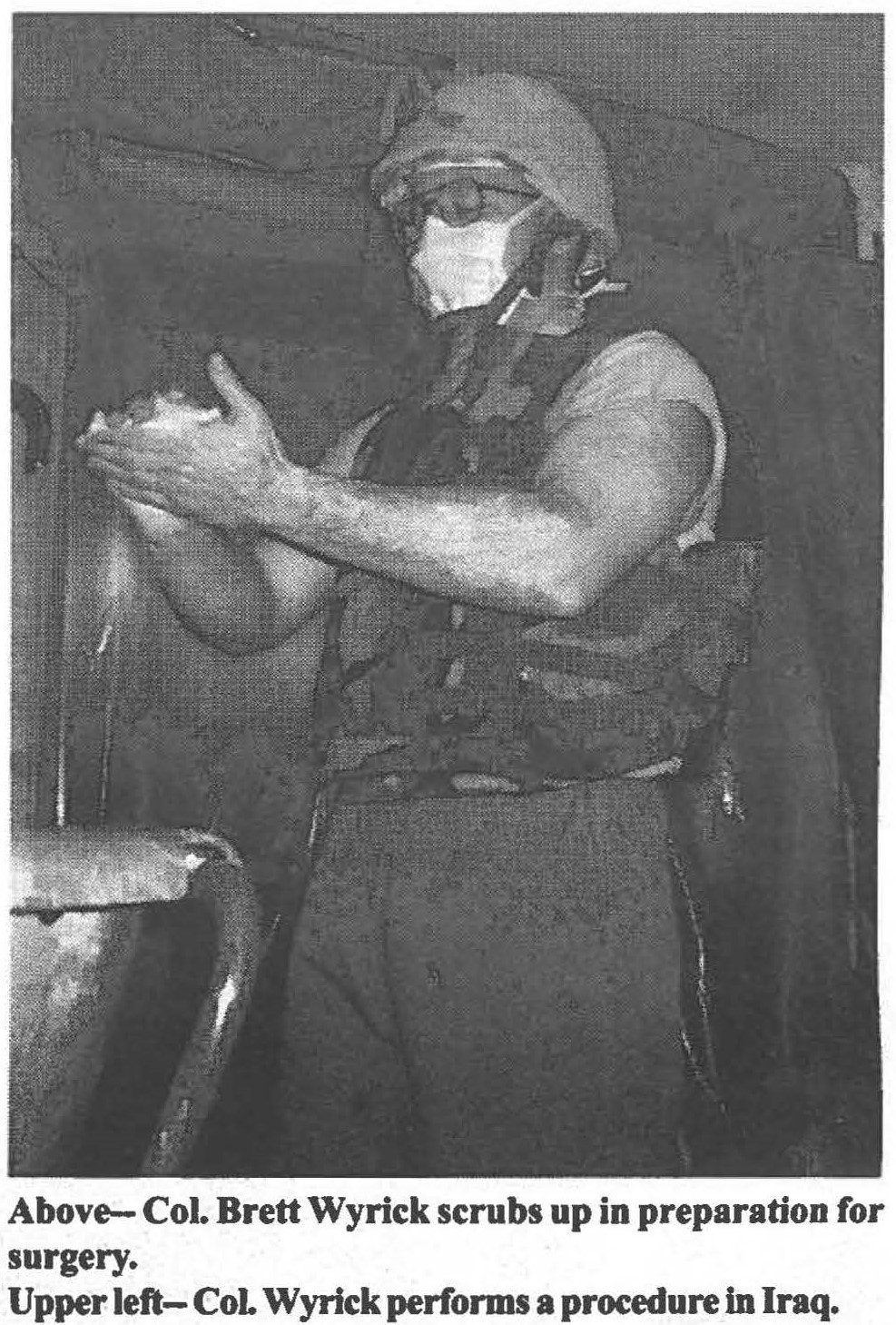
Col. Brett Wyrick scrubs up in preparation for surgery. CoL Wyrick performs a procedure in Iraq. (Pictures from the 2005 June Pūpūkahi)
Motivated by television news reports of the war in Iraq, Hilo physician Dr. Brett Wyrick decided that he needed to make a contribution. The full-time doctor is also a part-time officer with the Hawaii Air National Guard, serving as the commander of the 154th Medical Group at Hickam Air Force Base.
In January, Dr. Wyrick temporary put aside his practice in Hilo in order to perform an active duty tour with the U.S. Air Force at Balad Air Base, Iraq.
“I volunteered to come over for a full 120-day rotation because they need surgeons over here. and I could not stand to watch the evening news everyday without trying to help the war effort,” said Wyrick.
“This is the first Air Force Theater Hospital to be deployed since the Vietnam War, and it is the busiest hospital for trauma in Iraq,” said Wyrick.
Being deployed as a trauma doctor in the middle of a wartime environment comes with a lot of challenges. One is working in a hospital built with a series of tents. This creates problems for the surgeons when trying to do surgery in a muddy and sandy environment, said Wyrick. “There is nothing in civilian practice to prepare for what goes on here.”
Another challenge is treating high numbers of heart-wrenching trauma patients. “Every trauma seems to be worse as a result of the high energy weapons that are used on a modem battlefield,” said Wyrick. “I operate every day and night until I just cannot do it anymore, and then I get a nap, a meal, and go back to the operating room.”
To ease some of those challenges, the mission has brought in a staff that consists of a large number of U.S. Air Force, Royal Australian Air Force, and a small contingent of U.S. and Australian Army personnel who see anyone and everyone in need of medical treatment.
The doctors don’t only treat servicemembers, they also treat anyone who is injured in the field “We see U.S. and Coalition troops, Iraqi National Guard and police forces, captured enemy insurgents, and civilian casualties,” said Wyriclc.
From half a world away, Wyrick is trying to maintain his decade-long Hilo private practice in general surgery. “The practice definitely suffers, and it is hard on the patients and staff when I am away,” said Wyrick. “Almost all of the patients have been supportive, but it is hard on the medical staff when we are short of surgeons”.
Wyrick believes his wartime experience will be beneficial for his patients after he returns home. “Everyday I learn things that I will bring home to my civilian practice. I am sure I will be a much better surgeon after being over here”. Wyrick is scheduled to return to Hilo next month.
Air Guard doctor volunteers in Balad page 3 (Pictures from the 2005 June Pūpūkahi)
Response team participates in emergency exercise
The very next month, the Chemical, Biological, Radiological, Nuclear or High-Yield Explosive-Enhanced Response Force Package participated in a joint exercise called COYOTE CRISIS involving, the Federal Emergency Management Agency Region IX, local civilians and military teams. During the exercise, the teams practiced working together to respond to large scale emergencies and disasters. The 154th Medical Group, which makes up most of the CERF-P, worked with the California Army National Guard to decontaminate, triage, and treat 200 patients in three hours with minimal manpower while members of our 204th Airlift Squadron used one of Hawaii’s own C-17 Globemaster III aircraft to evacuate 29 patients. The mission provided the medical and airlift personnel with hands on training of air evacuation procedures.
Provides the Hawaii Air National Guard with fixed and deployable medical and dental resources. This includes SUPER-MASH medical support for the geographically separated units.
The 154 MDG also supports the Chemical, Biological, Radiological, Nuclear and High-Yield Explosive Enhanced Response Force Package mission. Although the CERF-P mission is a joint mission, the majority of members are currently Hawaii Air National Guard members from the 154 MDG.
The 154th Medical Group has participated in the Global War on Terror by providing forces for the Central Command Area of Responsibility. Members of the Group have deployed to nearly every base in the theater while continuing to provide for the in garrison support of the Hawaiian Islands.
The 154 MDG has also provided teams of trained professionals which have deployed to the Philippines in support of the Hawaii State Partnership for Peace Program. Medical Group members continue to support the Youth Challenge Academy as well as other community outreach programs.
The last ten years …
The 154th Medical Squadron, initially established in 1960 became the 154th Medical Group in 2003
Designated the lead unit in support of the Joint WMD response capability (CERFP) Chemical, Biological, Radiological, Nuclear and High-Yield Explosive Enhanced Response Force Package mission in 2003, designed to serve as a first responder team for Homeland Defense
Deployed for AEF operations in Balad, Diego Garcia, Kyrgyztan, and Iraq
In Joint Operations with the AZANG, CANG and city of Scottsdale during the FEMA Region IX Coyote Crisis Exercise MDG deployed CERFP capability as a Medical All-Hazards Response Team, air lifted for the first time an entire CERFP assemblage using a C-17
In support of the State Partnership program and Humanitarian Assistance Missions, deployed personnel worldwide to Indonesia, Bosnia, and Philippines
2003 recieved excellent rating in HSI, one of the highest rating ever provided to a unit; received highest evaluation of any CERFP during its proof of concept evaluation
Lt. Col. Stan Sato receiving the award for Optometrist of the Year for the Air National Guard in 2004; state wide recognition of it’s dentist as Field Grade Officer of the year 2005; Winning team award 2003; and Outstanding unit award 2003
The 154th Medical Group’s annual training event to Robert C. Byrd Training Center, in West Virginia, provided the hazardous materials training and certification of the medical component of the CERF-P mission, as well as fulfilling many of the recurring medical training requirements. The training culminated with a mass casualty exercise incorporating the local West Virginia Youth Challenge Cadets as simulated casualties
The Hawaii National Guard deployed 65 Soldiers and Airmen in response to an “emergency request for assistance” in Reno, Nev. The large-scale earthquake disaster response Exercise VIGILANT GUARD was held in June. Soldiers came from Joint Forces Headquarters – Hawaii, Deputy Chief of Staff for Information Management, 103rd Troop Command staff, 230th Engineer Co. and 297th Firefighting Team. Airmen came from the 154th Wing, 154th Medical Group and the 293rd Combat Communications Squadron.
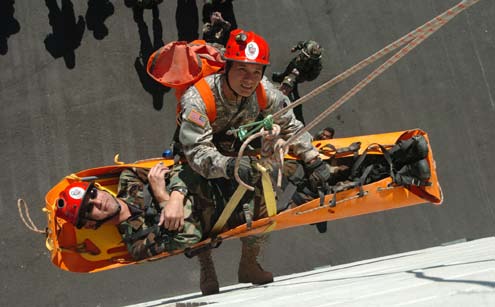
RESCUE RAPELLING – Spc. John Kumalae, 297th Firefighting Team, firefighter, “rescues” Lt. Col. Stanley K. Sato, 154th Medical Group commander, role-playing a victim packaged for extraction, during a high angle rescue demonstration held during Exercise VIGILANT GUARD in Reno, Nev. Spc. Joanna N. Amberger photo(Picture from the 2008 Annual Report)
The 154th Medical Group organized three Medical Innovative Readiness Training (MIRT) opportunities during the year. MIRTs were conducted in partnership with the Department of Health and visiting Guard and reserve medical units from the mainland. The medical personnel provided free health screenings, physicals and eye and dental exams for school children and homeless veterans along the Waianae Coast, Kalaeloa and Kahuku. The Medical Group also received an “outstanding” result, the highest performance possible, on a major health inspection, equivalent to a unit Operational Readiness Inspection. Finally, the Medical Group also participated in Exercise VIGILANT GUARD in Nevada. The airmen are part of the CERF-P which has three missions: capability to locate and extract victims from a contaminated environment, perform mass casualty/patient decontamination, and medical triage and treatment.
The 154th Medical Group Organized 3 medical Innovative Readiness Training (MIRT) opportunities during the year. the MIRTs were conducted in partnership with the State Department of Health and visiting Guard and reserve units from the mainland. Medical personnel provide free health screenings, physicals and eye and dental exams for school children and low income residents in waimanalo, the leeward coast and in Kahuku. The August MIRT in Kahuku helped set the stage for a large-scale community-based disaster exercise at Kahuku hospital as part the annual Makani Pahili drill in June 2009. The exercise, involving hundreds of Hawaii National Guard troops, State and county first responders as well as community volunteers, was the largest ever disaster drill conducted for a North Shore Community.
26 JAN – 2 FEB 2018 40 members of the 154th Medical Group travelled to Nevada to lead a Medical Capabilities exercise with counterparts from the Nevada Air National Guard and California Air National Guard and was designed to validate the capabilities of the respective medical units.
154th Wing Public Affairs – Story by Senior Airman Orlando Corpuz – Tuesday, February 6, 2018
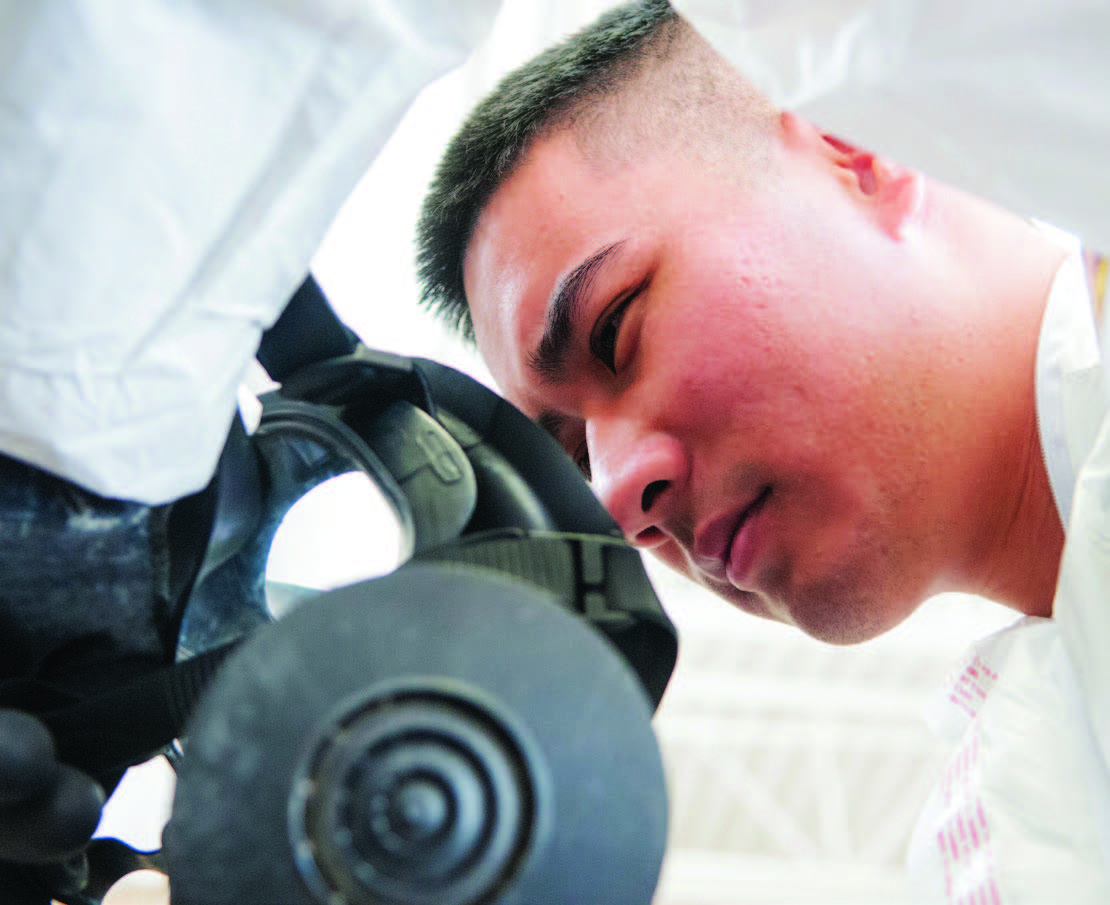
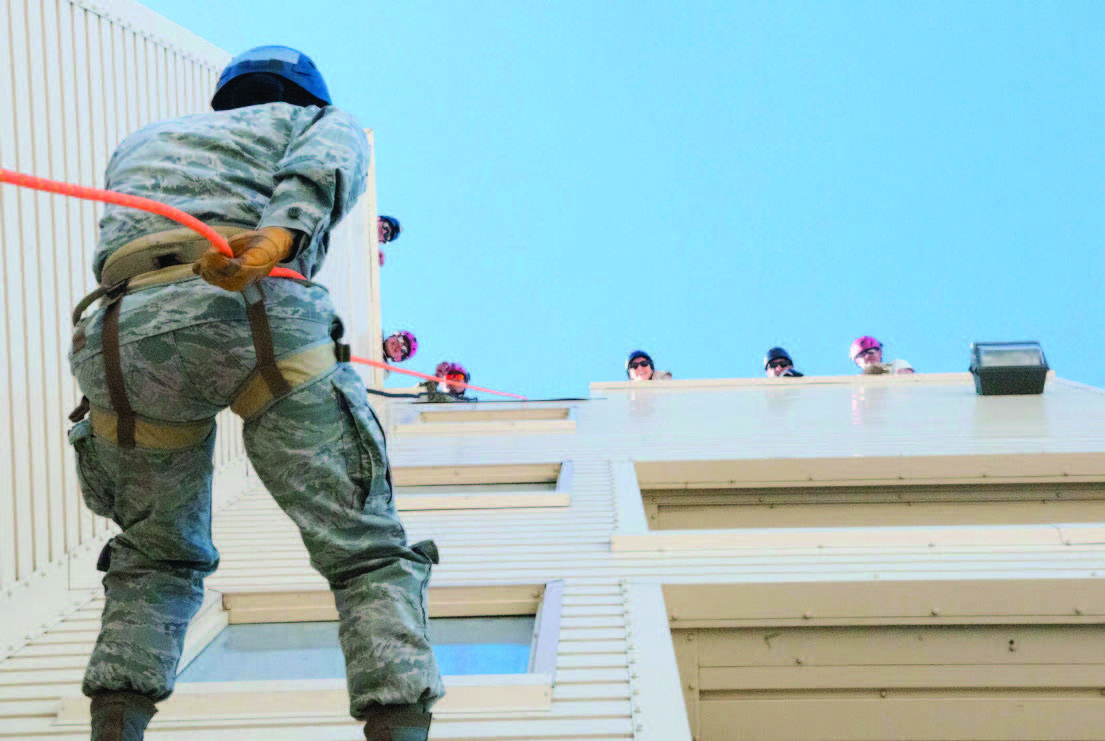
Senior Airman Nicklaus Young, an aerospace medical technician with the Detachment 1, 154th Medical Group, dons his gas mask at a Medical Capabilities exercise held in North Las Vegas, Jan. 27, 2018. (U.S. Air National Guard photo by Senior Airman Orlando Corpuz)An airman rappels down a building while team members look on from above during search and extraction training as part of a Medical Capabilities exercise conducted Jan. 28, 2018 in North Las Vegas. During the exercise Air National Guard medical units from Hawaii, California, and Nevada practiced the skills and procedures needed during a coordinated emergency response involving the FEMA Region 9 partners. (U.S. Air National Guard photo by Senior Airman Orlando Corpuz)(Pictures from the 2018 Spring Pupukahi)
Approximately 40 members of the Hawaii Air National Guard Detachment 1, 154th Medical Group travelled to Nevada to lead a Medical Capabilities [MEDCAP] exercise Jan. 26 to Feb. 2.
The exercise was conducted with counterparts from the Nevada Air National Guard and California Air National Guard and was designed to validate the capabilities of the respective medical units.
Hawaii, California, and Nevada are partners in Federal Emergency Management Agency [FEMA] Region 9. The exercise marked the first time the three Region 9 partners were able to train together at the same time.
“It’s very rare that we get these opportunities to work together and focus specifically on medical capabilities,”said Lt. Col. James Faumuina, commander, Det 1, 154 MDG. “This is an excellent opportunity for us to practice how we can respond in support of a civilian incident.”
One of the many objectives of the exercise was to evaluate the procedures that would be employed when assisting civilian authorities and organizations with domestic disaster response.
“The key with our capability is that our airmen are qualified to work within a civilian incident,” Faumuina said. “They can integrate with many parts of the civilian emergency response system.”
According to Faumuina, recent natural disasters brought a re-focus on military support to civil authorities.
“If you look at what happened just recently in Puerto Rico, many of the resources coming into territory were coming in from far away. We can plug into the incident response to enhance the response capability,” Faumuina said. “In Hawaii, we need to have these capabilities since we are so far away.”
Two primary locations were utilized during the training events. Search and Extraction Rescue training was facilitated at Federal Fire Department facilities in Nellis, Air Force Base while classroom instruction and certification courses were held at the North Las Vegas Readiness Center.
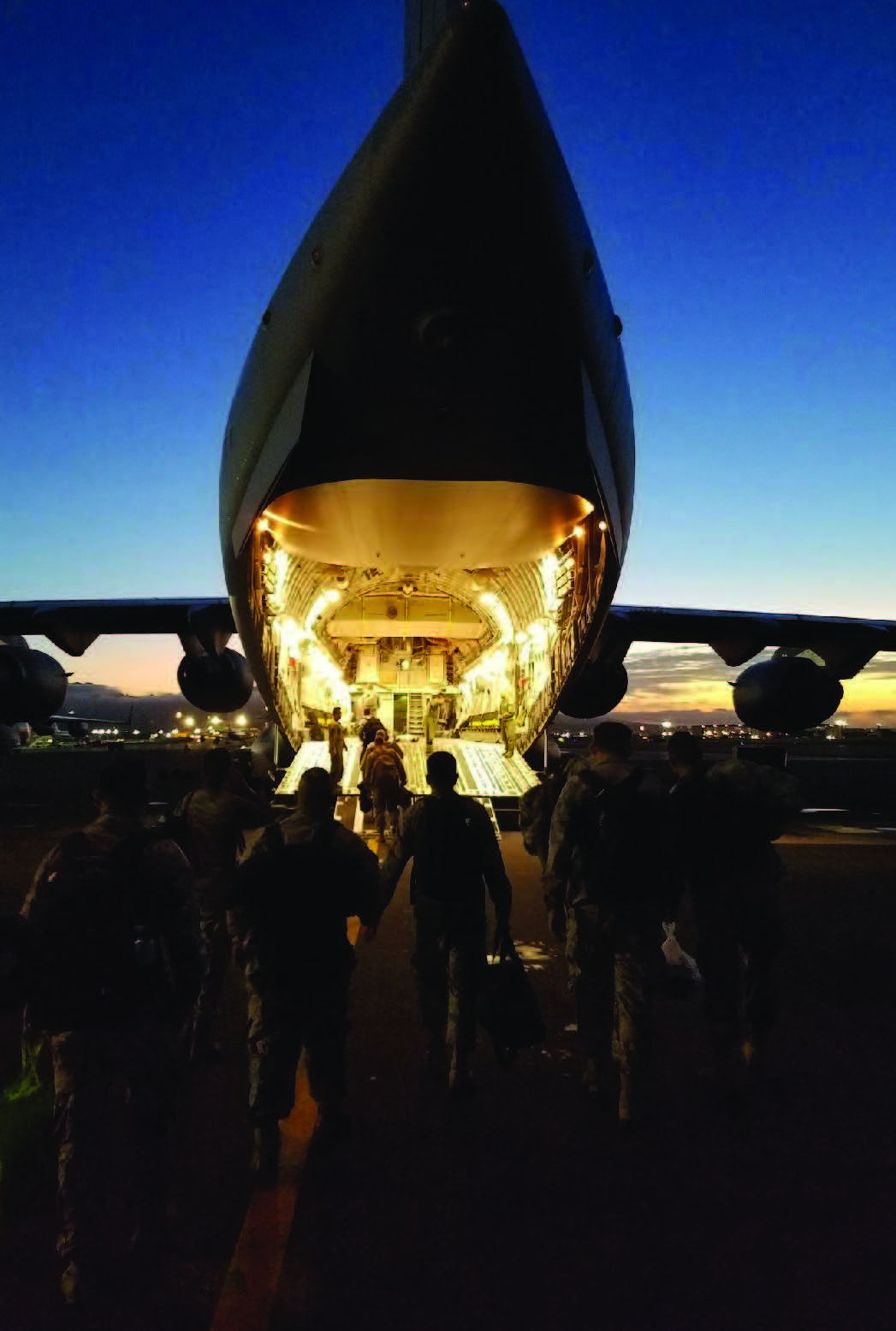
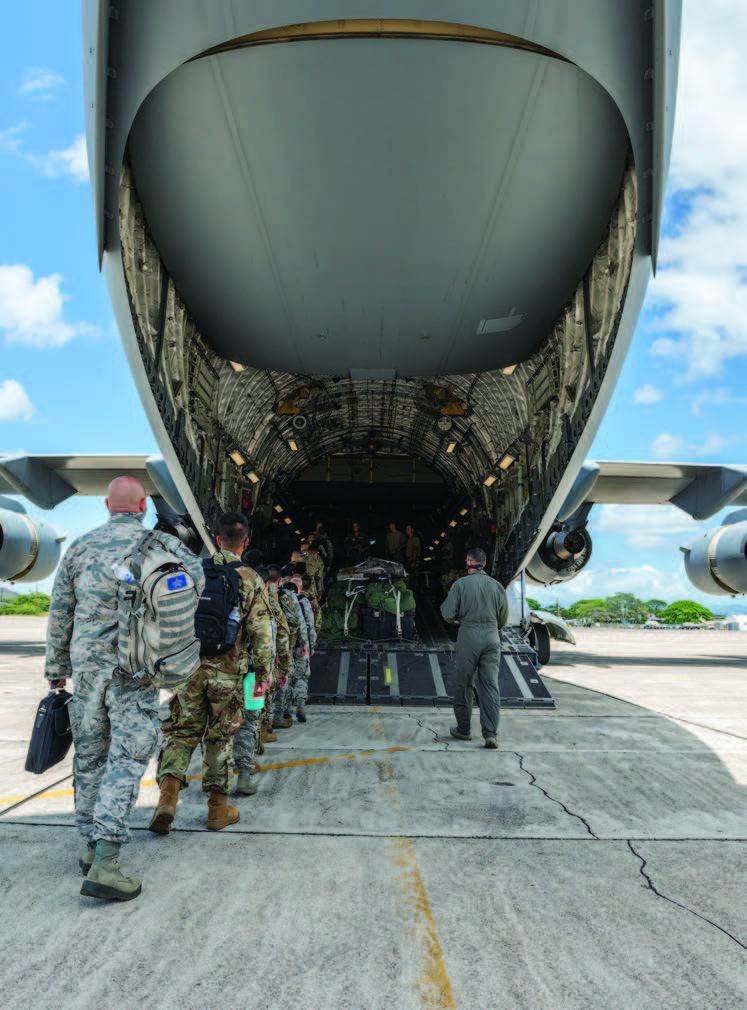
Airmen from the 154th Medical Group, Detachment 1, board a C-17 Globemaster III assigned to the 204th Airlift Squadron, Joint Base Pearl Harbor-Hickam, Jan. 26, 2018. The medical airmen were headed to Nevada to facilitate a FEMA Region 9 field training exercise with partners from the California and Nevada Air National Guard. (U.S. Air National Guard photo by Capt. Sanders Sandoval)(Picture from the 2018 Spring Pupukahi)
Life saver takes ‘fast track’ in career progression
154th Wing Public Affairs – Story by Senior Airman John Linzmeier – Tuesday, November 27, 2018
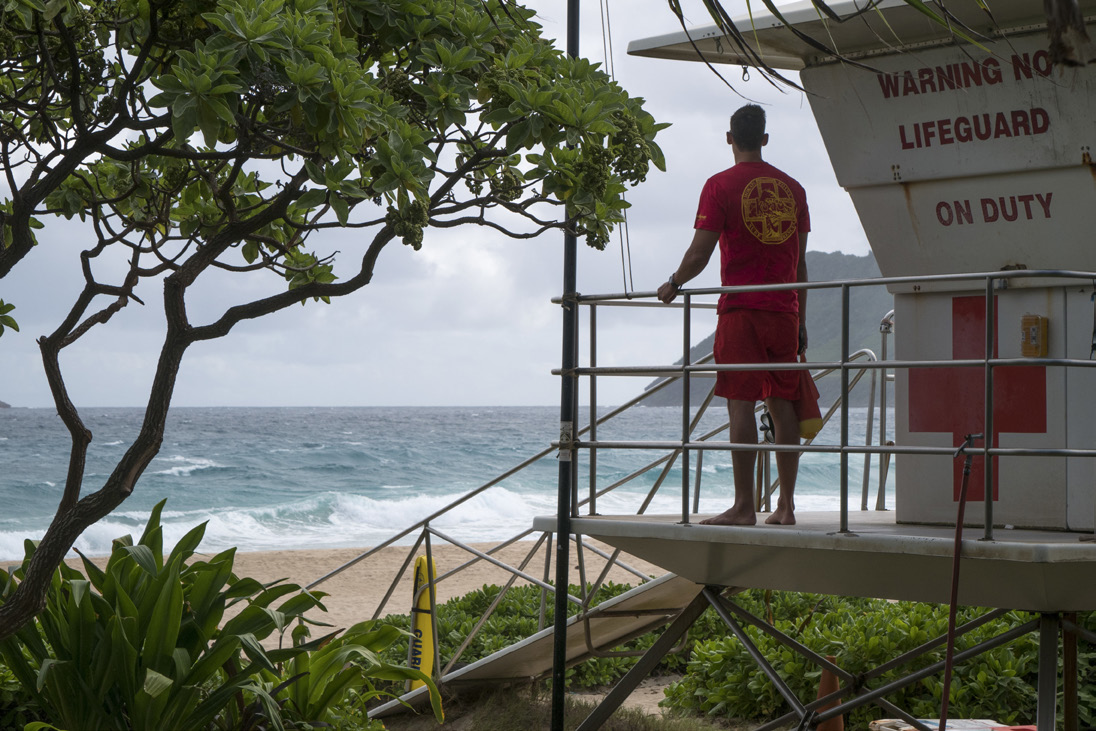
Senior Airman Casey Whitworth, a full-time lifeguard and triage response team member of the Hawaii Air National Guard, monitors Pyramid Beach November 20, at Marine Corpse Base Hawaii. He was posted near this spot on October 22, when he was called to help rescue the victims of a commercial helicopter crash. All three victims were saved. As a member of the 154th Medical Group’s Chemical, Biological, Radiological, Nuclear, High Yield Explosive Enhanced Response Force Package (CERFP), Whitworth says his military experience has made him a more competent and attentive lifeguard. (U.S. Air National Guard photo by Senior Airman John Linzmeier)(Pictures from the 2018 Winter Pupukahi)
Life-threatening scenarios seem to occur at the most random of times and places; and when they do, it’s usually not a pretty scene.
While most people go about their daily lives hoping to steer clear and far away from incidents, there are others who strive to be in positions where they can offer help at the forefront of an emergency.
For Senior Airman Casey Whitworth, it’s hard to imagine a lifestyle that doesn’t involve helping others. As a fulltime beach lifeguard at Marine Corps Base Hawaii and medical first-responder in the Hawaii Air National Guard, Whitworth’s lifesaving skills can be called upon at any time.
“I always knew I wanted to be in sort of emergency response, like my uncle who’s a paramedic. His job seemed like a lot of fun, so I ended up following in his footsteps, and now we’re working together in the same unit,” said Whitworth. “It really turned out to be a fast-track way to get some quality career experience.”
By the age of 19, Whitworth became a certified emergency medical technician in the 154th Medical Group’s AllHazard Triage team, assigned to Detachment 1. The training equipped him with skills to aid victims affected by chemical, biological, radiological and nuclear environments amongst other hazards. Two years later, he was hand-picked to complete the EMT bridge program at Kapiolani Community College. The accelerated course served as a scholarship and hands-on-internship, making him an employable and licensed technician in the state of Hawaii.
Within the last six months, he engaged in a variety of crisis events, consisting of hurricanes, the Big Island volcanic outbreak and, most recently, a downed helicopter rescue that occurred on a sandbar in Kaneohe Bay.
As Whitworth was wrapping up his lifeguard shift on October 22, he was informed about a commercial-helicopter crash over the radio. He and two other lifeguards boarded a jet ski and made their way to the crash site, where they found several bystanders attending to the fallen aircraft. Both parties worked together to ensure a quick recovery.
“It was a kind of surreal experience,” said Whitworth, “When I was triaging the victims, it was hard to believe that they could make it through a helicopter crash in their condition. They didn’t appear to have any outstanding injuries, so it was pretty miraculous.”
Tide levels continued to drop throughout the extraction, making it more challenging to bring passengers back to shore. Whitlock and the rescue team ended up dragging the watercraft and a victim through an estimated 150 to 200 meters of shallow water, said to be only a few inches deep at some parts. With the help of a few good Samaritans, all victims made it to shore safety, and two passengers were healthy enough to fly back to their home in the mainland U.S. the next day.
While recovery operations tend to be grueling and, in less fortunate cases, full of heartache, emergency response members seem to fully-embrace the occasional hardships and relentless training that comes with the job.
According to Senior Master Sgt. Jared Mina, Detachment 1 superintendent, Airmen like Whitworth barely need to think about what to do in rapid-response scenarios because their reactions happen instinctively, due to the extensive amount of training and variety of expertise in his unit.
Most of the Airmen assigned to Detachment 1’s Chemical, Biological, Radiological, Nuclear, High Yield Explosive Enhanced Response Force Package are medical professionals in the civilian sector. In addition to their military title, many of them are full time doctors, nurses, physician assistants, firefighters, paramedics, college instructors and lifeguards.
“Being surrounded by a community like this makes all the difference,” said Mina, “because the drive and mentality rubs off and elevates our newer Airmen. Especially for guys like Whitworth, who joined straight-out-of high school. I’ve seen him go through a tremendous amount of growth because he’s surrounded by people who have been doing this kind of work for years.”
Unlike most agencies in the 154th Wing, which typically have a few days to mobilize and deploy, CERFP Airmen need to be ready gear up and head out the door within hours. Mina said this short dispatch window is hardly an issue in Detachment 1, since Airmen often volunteer before being asked to deploy. This was especially the case during this year’s volcano outbreak on the Big Island when medical teams were embedded into Joint Task Force 5-0 to provide a medical presence.
“Since it’s my passion, I see every call as an opportunity,” said Whitworth. “In this case, I got to see volcanic eruptions, which was an incredible, one-time experience. I think people don’t sign up because they want to stay home and do nothing; it’s because they want to go through something which they couldn’t do otherwise.”
With an extensive network of medical professionals in the CERFP community, which he calls ‘a second family,’ Whitworth has plenty of directions to take his lifesaving career within the Hawaiian Islands. But for now, his aspirations are to further his military career and become an active duty pararescueman, which is no small feat.
This special-operations position entails more than 500 days of intensive training, prepping the Airman to carry out rescue missions in hostile or otherwise unreachable areas. Approximately 70 to 80 percent of candidates who set off to take the pararescue indoctrination course are unable to complete the training due to mental or physical limitations.
Regardless of the course’s high washout rate, Whitworth’s leadership have shown nothing but support and confidence in his longterm goals.
“Honestly, I’m sure that anyone here would be very surprised if he doesn’t make the cut,” said Mina. “After watching his performance and seeing his ability to execute over the years, I see no reason to question his ability to succeed in whatever he puts his mind to.”
18-20 JUN 2019 Airmen from the 154th Medical Group detachment 1 conducted a subject matter expert exchange with counterparts from the Indonesian Armed Forces in Jakarta. The exchange focused on military medical response to a biological pandemic.
Learn more
Medical experts join partners in Indonesia, improve pandemic response abilities
154th Wing Public Affairs | Story by Senior Airman Orlando Corpuz | Thursday, June 20, 2019
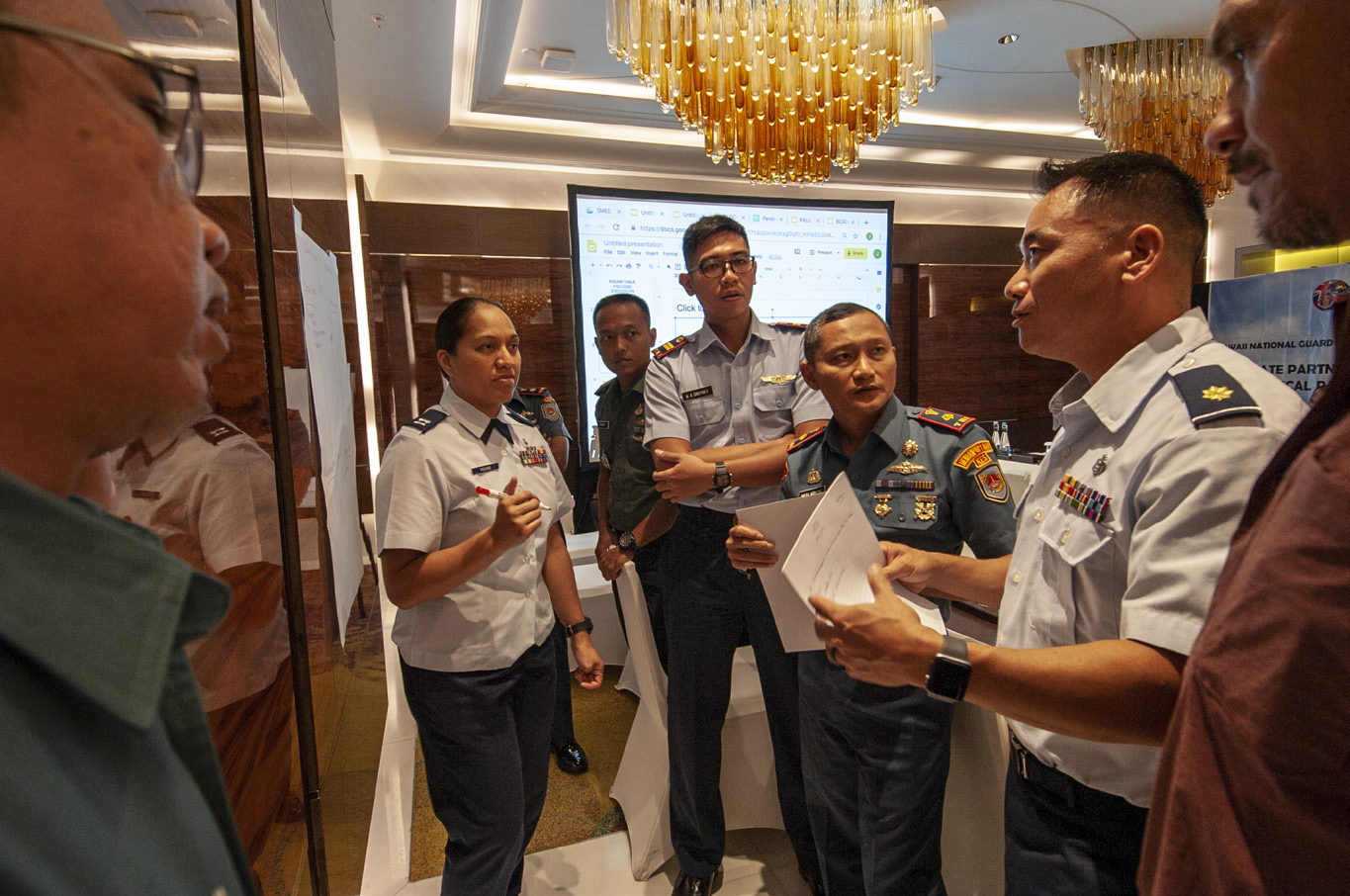
Hawaii Air National Guard (HIANG) Airmen from the 154th Medical Group detachment 1 conducted a Subject Matter Expert Exchange (SMEE) with counterparts from the Indonesian Armed Forces in Jakarta, Jun. 18-20.
The SMEE focused on military medical response to a biological pandemic and was part of the National Guard’s State Partnership Program (SPP) which links a state’s National Guard with a partner nation in support of mutual interests.
“The Pandemic Subject Matter Exchange is a premiere program for the Hawaii National Guard State Partnership Program,” said Lt. Col. James Faumuina, 154 MDG Det 1 commander. “Through this engagement we’re able to bring together experts from both Indonesia and the State of Hawaii in the areas of pandemic detection, response, and mitigation.”
The Hawaii delegation consisted of eight medical Airmen from the medical detachment, a medical operations officer from the Hawaii Army National Guard and two experts from Hawaii civilian agencies: Hawaii Disaster Management Assistance Team (DMAT) and the Hawaii Emergency Management Agency (HIEMA).
Topics ranging from pandemic detection, crisis planning, logistics and response operations were discussed during the three day engagement. Visits to the Indonesia Health Crisis Center of the Ministry of Health and the National Hospital for Infection Central allowed for close examination of how pandemic response is conducted in Indonesia.
The World Health Organization (WHO) defines a pandemic as a worldwide spread of a new disease. In an increasingly interconnected world, the threat of another pandemic is ever present; collaboration is needed to build capability of nations to respond to the next pandemic.
“When you’re talking about a worldwide spread of a disease, one of the big things is to have cross border relationships and to be Indonesia and Hawaii, their relative isolation does not exclude them from a pandemic; both are world wide destinations and crossroads for tourists and business travelers alike. “If an outbreak is detected, having capacity to respond is key,” Hiura said. “The quantity and quality of the response can make a huge difference.”
As an enhanced-response force-package unit (CERF-P), 154 MDG Det 1 capabilities make it uniquely qualified for pandemic response. In addition to military medical training as a CERF-P unit, many members have civilian occupations as doctors, nurses, first-responders, or other medical specialties; a majority of the subject matter experts were drill-status Airmen.
For Capt. Jorena Young, 154 MDG Det 1 clinical nurse, the experience provided valuable insight not normally available in Hawaii.
“I feel we have a lot to learn from other countries’ militaires because we haven’t experienced it, especially in Hawaii we don’t see as much as they do…they have 17,000 plus islands they have to take care of in Indonesia, while we only have our eight,” Young said. “They have a lot more experience that we can learn from and take those lessons back with us.”
Rounding out the team were experts from civilian Hawaii emergency response agencies.
Sentiment from Edward Caballero, a civilian medic and Hawaii Disaster Medical Assistance Team operations branch leader mirrored what many involved with the SMEE felt; that collaboration improves pandemic response.
“I think that the collaboration between the state partners was incredible,” Caballero said. “There was mutual understanding from both sides. It was reassuring to know that the military is developing these partnerships should the unfortunate situation occur where we need additional resources beyond our capabilities.”
Although the SMEE was in execution of the National Guard State Partnership Program, according to Faumuina, it supported the larger DoD initiative of Global Health Engagement (GHE).
“We’ve been working with our counterparts in Indonesia for three years now,” Faumuina said. “The level of communication and exchange between our two countries has cultivated a relationship where we’re moving towards unison to further the US Indo-Pacom Theater Support Cooperation Plan, through the strategy of GHE.”
The exchange continues in September when Indonesian medical experts visit the HIANG.
Medical experts from the Hawaii Air National Guard, Tentara Nasional Indonesia, and Hawaii Civil agencies brainstorm pandemic response strategies during a Pandemic Subject Matter Expert Exchange between the HIANG and Indonesian Armed Forces held Jun. 18 , 2019 in Jakarta, Indonesia. The SMEE was part of the State Partnership Program which links a state’s National Guard with a partner nation in support of mutual interests. The program is held to foster positive relations and to build capacity with partner countries. (U.S. Air National Guard photo by Senior Airman Orlando Corpuz)(Picture from the 2019 Summer Pupukahi)
06 APR 2020 – 15 MAR 2022 Airmen who are a group of medical providers, first responders, and planners from the 154th Medical Group’s Guard Medical Unit and Detachment 1, and the 154th Force Support Squadron assigned to Task Force Medical supported the COVID-19 response. They worked in partnership with the Hawai‘i Department of Health, public health nurses, Department of Public Safety, and Hawai‘i Public Housing Authority to conduct N95 fit testing, COVID education and training in highrisk/public housing, senior living communities, and the O‘ahu Community Correctional Center.
Hawai‘i Army National Guard COVID-19 neighbor island response, Honolulu, HI. Members of the Hawai‘i National Guard board a C-17 from the 204th Airlift Squadron, which made several runs of troops to Maui, Kaua‘i, and Hawai‘i island to assist with the COVID-19 response. (Photo by: Sgt. John Schoebel)(Picture from the 2020 Annual Report)
16-18 APR 2021 Medical specialists from the 154th Medical Group Detachment 1, went to Concord, Calif., for exercise Sentinel Response which tested the skills of the medical team reacting to a simulated radiological explosion in which mass casualties were sustained.
Learn more
Back to business for Med-Det 1
154th Wing Public Affairs – Hawaii Air National Guard | Story by Staff Sgt. Orlando Corpuz | Thursday, July 1, 2021
Medical specialists from the 154th Medical Group Detachment 1, took their expertise on the road to participate in a California disaster response exercise April 16-18.
Held in Concord, Calif., primarily on the grounds of a U.S. Navy military installation, exercise Sentinel Response tested the skills of the medical team reacting to a simulated radiological explosion in which mass casualties were sustained.
The three-day exercise stress tested the coordination efforts between California State, Bay Area County, and National Guard elements responding to scenarios in which a wide array of responses was required. Exercise participants were required to respond to everything from hazmat containment, rescue operations, and medical triage and treatment.
For the 154th Medical Group, Detachment 1, in a year where COVID-19 hampered or shut-down many of the training exercises it would have normally participated in, Sentinel Response represented a ‘getting-back-to-business’ of sorts to the mission sets and capabilities it had originally been designed for.
“From a training standpoint, the pandemic threw our normal training ops and routines for a loop,” said Lt. Col. James Faumuina, 154th Medical Group Detachment 1 commander. “The pandemic didn’t allow for many of the didactics and field training events we would have normally been participating in a normal year. Add to that, many of our Airmen were involved with our state’s COVID-19 response efforts. So what you really had was a situation where it was challenging to train for our normal mission, and that’s what Sentinel Response gave us.”
The exercise was executed as parts of the nation were slowly easing back on some of the pandemic mitigation efforts that had become routine for many. Still, COVID-19 was on the minds of exercise planners and participants and strict pandemic guidelines were followed.
“Safety was first and foremost,” said Faumuina. “We’re not completely out of the pandemic shadow so many of those pandemic mitigation efforts were still followed. Many times our unit was in generally outdoor areas. And for those scenarios which required a little tighter physical response, masks were still the norm.”
The navy grounds which the exercise was conducted at, with its large areas and variety and number of structures allowed exercise planners to concoct challenging yet realistic scenarios. Vehicle collision rescue, hazmat threat reaction, confined space rescue, breach and stabilization, decontamination, and medical treatment were some of the challenges first responders faced.
Integration was a priority for the Hawaii Airmen as the exercise’s military presence involved counterparts from the California Air National Guard’s 144th Medical Detachment 1 and a heavy dose of California Army National Guard soldiers.
“In large and complex dom-ops disaster response, you are going to have a multitude of personnel coming together from a multitude of organizations and jurisdictions and you’re going to have to merge that effort very quickly,” Faumuina said. “The military effort such our unit and our counterparts from the 144th can come in and supplement that civilian response, either with a plus-up in effort or to contribute our capabilities that may not necessarily be available to incident command.”
According to Faumuina, integration or lackthere-of can make or break disaster response.
“That complexity is going to require an organized and coordinated effort,” Faumuina said. “You’ll see civilian incident command coordinating the efforts of county, state, and federal response outfits all coming together. Integration will be key, and I’m not just talking integration amongst the military element, we’re talking integration up and down the chain of response. That integration is not easy and that’s why exercises such as these are important.”
While the main body of Det 1 was training in California, an eight hour drive away, a team of Hawaii ANG medical experts were completing annual required certification and training in Nevada.
“This really was a comprehensive effort by our medical Airmen,” Faumuina said. “Many of our team members were able to stretch out those response muscles in the field, and a segment of our folks were able to finish didactics and retain their certifications.”
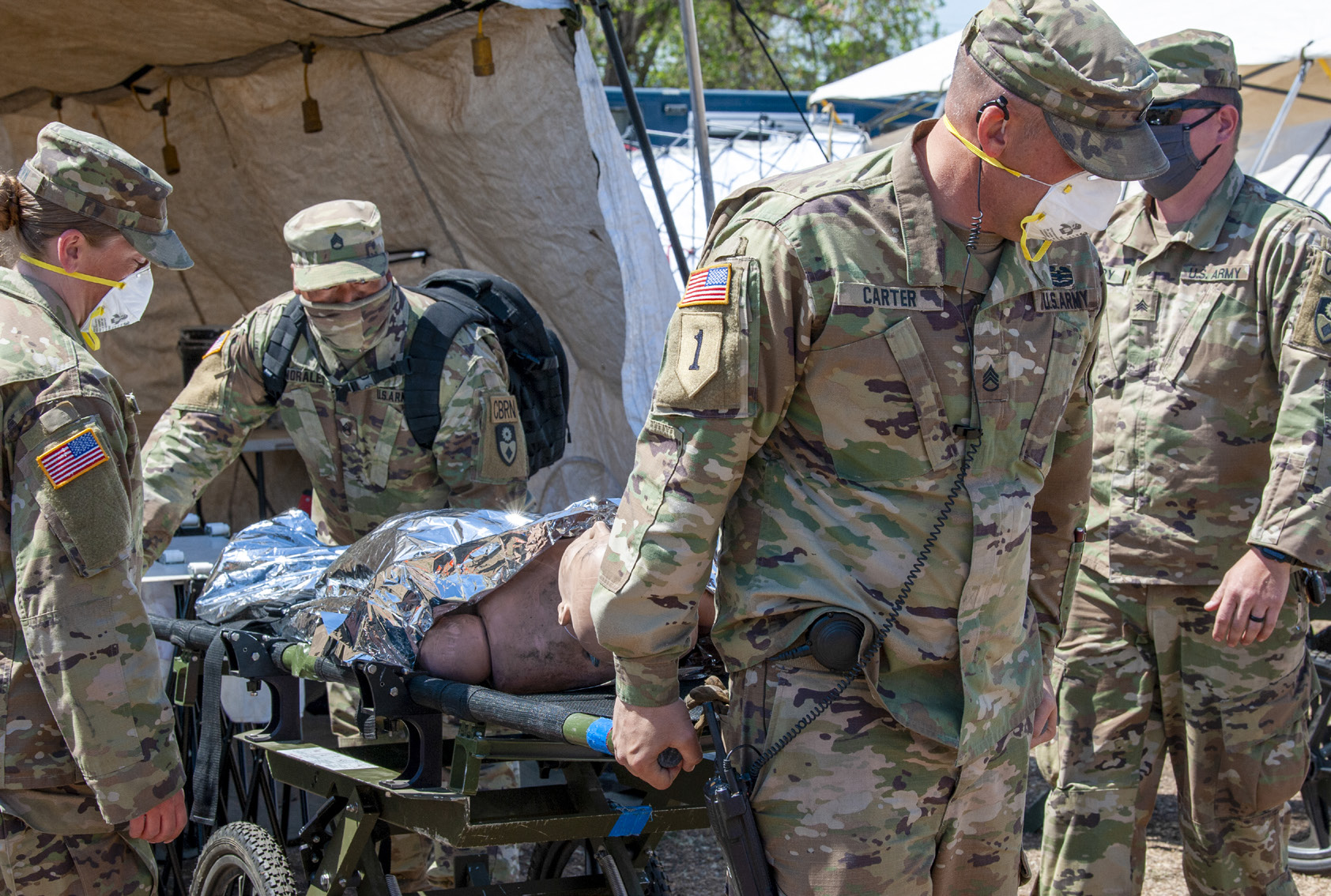
California Army National Guard Soldiers with the 95th Civil Support Team transport a simulated victim of a notional radiological explosion on a stretcher during exercise Sentinel Response 2021 in Concord, Calif., April 16, 2021. Sentinel Response 2021 is a full scale exercise that provides local and state first responders and elements of the California Army and Air National Guard with the opportunity to conduct Urban Search and Rescue Operations in a simulated radioactively contaminated environment. (U.S. Air National Guard photo by Staff Sgt. Orlando Corpuz)(Picture from the 2021 Fall Pupukahi)
7-9 JUN 2022 Hawai‘i Air National Guard medical professionals converged with the U.S. Coast Guard – a first for the Hawai‘i medical Airmen – and FEMA partners to learn new skills, hone existing ones, and create lasting connections in training scenarios that would test professional skills as well as physical endurance.
Learn more
Hawai‘i Airmen practice river rescue with Coast Guard, regional partners
154th Wing Public Affairs – Hawai‘i Air National Guard | Story by Staff Sgt. Orlando Corpuz | Thursday, August 25, 2022
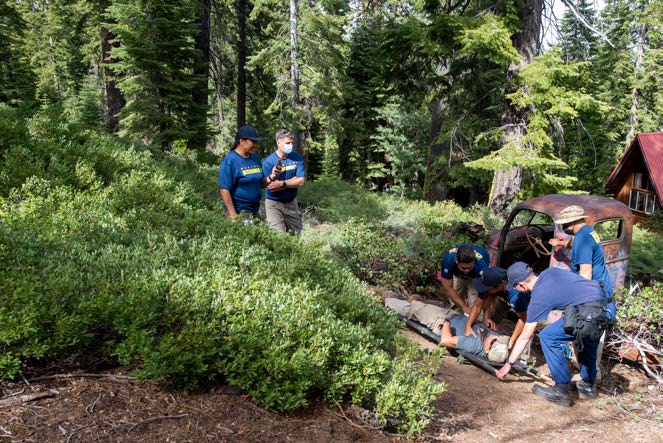
Hawai‘i Air National Guard medics partner with U.S. Coast Guardsmen during a rescue and medical treatment exercise conducted in the mountain areas above Lake Tahoe, Calif., Jun. 8, 2022. The rescueers hiked the mountainous trails where exercise planners staged numerous rescue scenarios, challenging the teams to respond. (U.S. Air National Guard photo by Staff Sgt. Orlando Corpuz)(Picture from the 2022 Fall Pūpūkahi)
With its mountainous terrain and varying bodies of water, the Lake Tahoe topography proved more than a match at challenging the joint team as they hiked in elevation, braved white water rapids, and endured high speed boat maneuvers, all in the name of honing skills needed for medical treatment and rescue.
From June 7-9, Lake Tahoeʻs challenging landscape was the scene of joint training as Hawai‘i Air National Guard medical professionals converged with the U.S. Coast Guard – a first for the Hawai‘i medical Airmen – and FEMA partners to learn new skills, hone existing ones, and create lasting connections in training scenarios that would test professional skills as well as physical endurance.
“This training is important because it is an opportunity to collaborate with our FEMA Region IX partners from Nevada and California and to continuously train our skill sets to be operationally effective,” said Lt. Col. Ian Beltran, 154th Medical Group Detachment 1 commander. “Also, our exercise planners coordinated training with the U.S. Coast Guard to crosstrain and to share expertise, this is truly an event of sharing and collaboration.”
A large geographic area, FEMA Region IX encompasses the states of Hawaii, Arizona, California, and Nevada and has a multitude of landscapes. As regional partners, should one state become overwhelmed and in need of help during times of disaster, partner states could lend assistance, essentially ʻbeefing upʻ response efforts.
A key to this interoperability is a clear understanding of the challenges that different regional environs can pose. While the three-day exercise had the Airmen split into two separate training tracks, both groups had ample opportunities to learn new skills and put them into play.
At Coast Guard Station Lake Tahoe, a morning Field Training Exercise (FTX) provided opportunities to practice and exchange knowledge on various trauma care skill sets. The FTX also saw Airmen and Coast Guardsmen hiking through the surrounding mountains, where exercise planners staged several medical rescue scenarios challenging the joint team to respond.
“The training on the Tahoe Rim Trail was particularly valuable I feel, as it was both realistic and challenging,” Beltran said. “The hike had the effect of physically taxing the rescuers while providing an element of unpredictability, which could be experienced in real-world rescues.”
On day two, the joint team took their skills to the waters of Lake Tahoe. With Coast Guardsmen taking the lead, the team worked through various water rescue situations and engaged in high speed boat maneuvers to execute rescues in an effort to bring simulated victims to shore where they could be treated and triaged.
“It was excellent to see the group integrating,” said Beltran. “This is only the beginning of our partnership with the Coast Guard, and hopefully, weʻll be able to develop this relationship further cause I feel it brings value to both groups.”
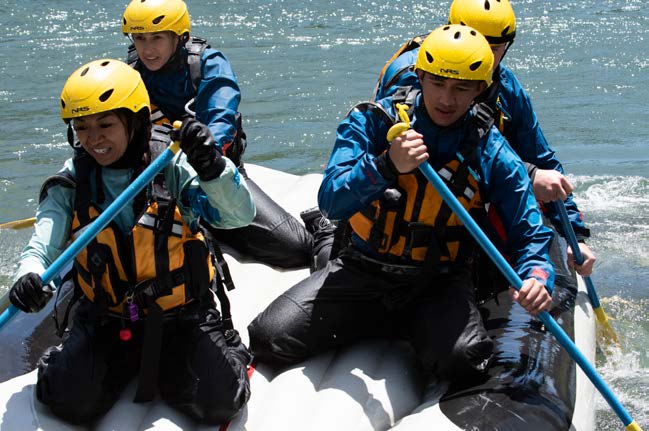
While Airmen toiled on Lake Tahoeʻs waters and shorelines, several miles away, another group of HIANG Airmen braved white water rapids on the Truckee River as they teamed up with counterparts from the California and Nevada Air National Guards for Swift Water Rescue training. The course focused on the fundamentals of survival in moving water, swift water swimming, shore, boat, and in-water rescue.
“When I joined the Hawai‘i Air National Guard, I never thought Iʻd be learning any sort of water rescue,” said Staff Sgt. Danielle jordan Demello, 154th Medical Group medic. “It wasnʻt even on my radar when I joined, truthfully. We had the opportunity to take the course a couple of years ago, so this is a recertification class for me, and I’m happy to be doing this cause it’s a skill-set that you can easily see would be valuable back home.”
Though Hawai‘i medical Airmen primarily focus on land-borne operations, learning new skills was a vital theme of the three-day training exercise.
For Beltran, the training is part of a larger effort to enhance the medical unit’s capabilities.
“I foresee our operation will provide a full spectrum of medical response in support of not only domestic operations, but to also support the USAF ACE Concept with medical support during contingency operations.” Beltran said.
Hawai‘i, Nevada, and California Air National Guard Airmen paddle a boat in rough water during Swift Water Rescue Training held Jun. 8, 2022 on the Truckee River, Calif. The course focused on the fundamentals of survival in moving water, swift water swimming, shore, boat, and in-water rescue. U.S. Air National Guard photo by Staff Sgt. Orlando Corpuz)(Picture from the 2022 Fall Pūpūkahi)
U.S. Air Force Brig. Gen. Phillip L. Mallory, 154th Wing commander, passes the guidon of the 154th Medical Group to Lt. Col. Elzadia Kaina, 154th Medical Group commander, on May 7, 2023 at Joint Base Pearl HarborHickam, Hawaii. Kaina makes history as the first female commander of the 154th Medical group. The 154th Medical Group is responsible for the medical readiness of all Airmen assigned to 30 local and geographically separated units across four islands of Hawaii. (U.S. Air National Guard photo by Airman 1st Class Roann Gatdula(Pictures from the 2024 Fall Pūpūkahi)
The 154th Medical Group provides the HIANG with fixed and deployable medical and dental resources and a medical response capability to the CERFP mission.
AUG2023 The 154th Medical Group provided 41 medical personnel in support of the Maui Wildfire with search and rescue/recovery operation teams at the hot zone, medical logistics and planning, force health protection and medical monitoring of military personnel, and civilian care at Lahaina Comprehensive Health Center.
HING 93rd Chemical, Biological, Radiological, and Nuclear Enhanced Response Force Package with Maj. Gen. Stephen F. Logan and Command Sgt. Maj. James Jimenez at the 230th Engineer Company Armory on Maui during the wildfire recovery efforts. – Hawai‘i National Guard photo(Picture from the 2024 Annual Report)
1-7 JUN 2024 Members of the 154th Medical Group Detachment 1 participated in the 2024 Federal Emergency Management Agency Urban Search and Rescue Medical Specialist Course, held at the Livermore-Pleasanton Fire Training Center in Livermore, CA.
Learn more
Hawai‘i Air National Guard Medical Professionals Excel at National FEMA Urban Search and Rescue Course
154th Wing, Hawai‘i Air National Guard | Story by Tech. Sgt. John Linzmeier | Sunday, July 7, 2024
Members of the 154th Medical Group Detachment 1 (DET1) and USAR Team Members from across the nation gather June 6, 2024, during the FEMA Urban Search and Rescue Medical Specialist Course at LivermorePleasanton Fire Training Center in Livermore, Calif. The course provided critical hands-on training in urban search and rescue operations, enhancing the participants’ readiness for real-world emergencies. (courtesy photo)(Picture from the 2024 Spring Pūpūkahi)
Members of the 154th Medical Group Detachment 1 (DET1) successfully participated in the 2024 Federal Emergency Management Agency (FEMA) Urban Search and Rescue (USR) Medical Specialist Course, from June 1-7, held at the Livermore-Pleasanton Fire Training Center in Livermore, CA.
The annual course is hosted by California Task Force 4 in the East Bay area of Northern California and brings together some of the most experienced Urban Search and Rescue (USAR) professionals from around the nation to hold lectures and navigate through a plethora of hands-on training in a realistic field-training environment.
Lt. Col. Hiura, 154th Medical Group (MDG) DET1 mission commander, said that the course is a rare and privileged opportunity to train alongside USAR Task Forces from all over the nation, with the 24 Hawai‘i Air National Guard (HIANG) members joining in as the only military participants.
Its world-class instructor cadre includes physicians, rescue firefighters, paramedics and veterinarians who have deployed in response to the Oklahoma City bombing, Sri Lanka Tsunami, Haiti Earthquake, Hurricane Katrina, the Tsunami that struck Tōhoku in Japan, events of 9/11, the recent 2022 Surfside apartment collapse in Florida and many other disasters.
Students became proficient with patient packaging and extrication in confined spaces, ingress and egress of collapsed structures and medical management of crush injury. They also practiced emergency surgical airways, intubation, ventilator management and field amputations on real tissue samples.
This marked the third consecutive year of having DET1 members attending as students, having three enrolled, and its second year with DET1 members participating as instructors. Maj. Jason Habu, 154th MDG DET1 Search andExtractions Rescue Operations officer-in-charge and one of the two instructors from DET 1, emphasized how the course’s realism and intensity mirrored real-life disaster scenarios.
“The class was a physically intense experience where you’re crawling around in a live rubble pile extricating live patients,” said Habu. “Imagine exerting yourself trying to reach a patient, then having to treat and extricate them while being drilled by an medical doctor on how and why you are providing certain medical treatments.”
Further integrating into this year’s course, 19 other members from DET1 also attended to fulfill the needs of an on-scene Disaster Medical Assistance Team (DMAT). This mobilized unit provides pre-hospital treatment and rapidresponse medical care during public health and medical emergencies.
Master Sgt. Kyra Santos, a 154th MDG DET1 aerospace medical technician and DMAT participant, stated that standing up this capability was only possible because the men and women of DET1 bring a wide variety of medical and emergency response backgrounds from their civilian and military roles, ranging from administrative support and medics to nurses and physicians.
Portions of the course included a simulated mass casualty scenario, where attendees extricated and treated simulated patients using live actors and mannequins. These patients were then transported to the DET1 treatment team for triage, treatment, and stabilization.
The training utilized rubble piles made from live materials, adding an element of realism with the potential for shifting as simulated victims were egressed. This level of authenticity was so realistic that an actual USAR rescue team was on standby during the training to respond in case of a realworld collapse.
In addition to the realistic scenarios, the training schedule was designed to match the intensity of a real incident. Students and instructors alike put in 12–16-hour days, often starting at 7:30 a.m. and finishing close to midnight.
This grueling schedule culminated with a final 18-hour exercise, with a scenario that involved a simulated 8.4 earthquake that resulted in structure collapse with multiple casualties and survivors requiring extrication, medical management and transport.
“This course was challenging to our Hawai‘i Air National Guard (HIANG) members because, out of a class of 36, our three were the only military members,” said Habu. “The class is usually only open to USAR Task Force Team Members, which typically include firefighters and physicians. Our members stick out like sore thumbs, but their great attitudes and hard work made them successful. Because of these attributes, we have been invitedback to participate in this training as students and adjunct instructors, which is an honor for us.”
Currently, the State of Hawai‘i does not have an assigned FEMA USAR Task Force and DET 1 is helping to fill this void in the event of a disaster or catastrophic event that involves Search and Rescue operations. Detachment 1 is one of 17 Chemical, Biological, Radiological, Nuclear, and Explosive (CBRNE) Enhanced Response Force Package medical units in the U.S. and the first to have five certified FEMA USAR Medical Specialists.
DET1’s mission is to deliver scalable responses to chemical, biological, radiological, nuclear, explosive, and disaster medical emergencies worldwide. Holding this training event alongside civilian emergency response counterparts significantly enhanced their capabilities and preparedness, as such collaboration is crucial because teamwork and coordination are expected in real-world crises.
Hiura said that DET1 has been fostering a strong relationship with the FEMA USAR Training Coordinator for more than seven years to ensure seamless integration and joint preparedness efforts.
“Attending these specific courses allows our members to learn the latest life-saving measures and guidelines from medical professionals who are the subject matter experts in this field,” said Hiura. “Many of these skills learned are perishable if not used or practiced. I believe our DET1 Airmen will be more prepared to make a difference in saving lives if Hawai‘i experiences a major disaster.”
A Hawai‘i Air National Guard Trauma Treatment Team from the 154th Medical Group Detachment 1 attends to a patient June 6, 2024, at Livermore-Pleasanton Fire Training Center in Livermore, Calif. The team demonstrated advanced medical procedures in a simulated disaster scenario as part of the 2024 FEMA Urban Search and Rescue Medical Specialist Course. (courtesy photo)(Picture from the 2024 Spring Pūpūkahi)
18-30 MAY 2025 Hawai‘i Air National Guard medical professionals completed their fourth annual Tactical Combat Casualty Care exchange with partners from the Armed Forces of the Philippines at Camp O’Donnell. The Subject Matter Expert Exchange, helped 85 medical and non-medical personnel develop critical life-saving skills.
Learn more
Hawai‘i Guard, Philippine Armed Forces unite
By Tech. Sgt. John Linzmeier
154th Wing, Hawai‘i Air National Guard
Hawaii‘i Air National Guard Staff Sgt. Brittnee Haili, 154th Medical Group medic and Tactical Combat Casualty Care instructor, center, evaluated Philippine Army Capt. Fevalyn A. Jamayo, Nurse Corps, Office of the Chief of the Army Nurse, during a field training exercise on May 29 at Camp O’Donnell, Philippines. Haili provided feedback on Jamayo’s performance in applying TCCC techniques under intense simulated combat conditions. (U.S. Air National Guard photo by Tech. Sgt. John Linzmeier)Hawaii‘i Air National Guard Staff Sgt. Maritza Garcia, 154th Medical Group Detachment 1 medic and Tactical Combat Casualty Care instructor, evaluated Armed Forces of the Philippines students during a medical field training exercise on May 29, at Camp O’Donnell, Philippines. The training emphasized rapid response and effective medical treatment in high-pressure environments. (U.S. Air National Guard photo by Tech. Sgt. John Linzmeier)(Pictures from the 2025 Pūpūkahi | Volume 55 | No. 3)
CAMP O’DONNELL, Philippines — Hawai‘i National Guard medical professionals completed their fourth annual Tactical Combat Casualty Care (TCCC) exchange with partners from the Armed Forces of the Philippines (AFP) at Camp O’Donnell May 18-30.
The Subject Matter Expert Exchange (SMEE), facilitated by the Department of Defense National Guard Bureau State Partnership Program, helped 85 medical and non-medical personnel develop critical life-saving skills.
For the first time, an AFP instructor corps was qualified through the training to teach follow-up courses, a significant step toward developing a standardized medical training curriculum aligned with U.S. standards.
The training was tailored to support AFP participants at the Peacekeeping Operations Center, which is responsible for preparing personnel for United Nations peacekeeping missions, with a focus on stabilizing volatile regions through the use of military strength.
“This initiative has been greatly enriched by the collaboration between the Peacekeeping Operations School, the Peacekeeping Operations Center and Subject-Matter Experts from the Hawai‘i National Guard through the Joint United States Military Assistance Group-Philippines,” said Philippine Army Maj. Gen. Pedro C. Balisi Jr., Armor Pambato Division commander. “Their invaluable insights and shared commitment to advancing combat casualty care have deepened the training experience, fostering an exchange of best practices that will elevate our operational capabilities to new heights.”
The two-week SMEE was divided into two five-day programs. From May 18-22, Hawai‘i National Guard staff trained 36 AFP nurses and training managers as TCCC instructors, equipping them to deliver future courses. The 20-module curriculum covered topics such as hemorrhage control, airway and breathing management, shock recognition, hypothermia prevention, eye injuries, fractures, burns and wound treatment. Training included lectures, hands-on practice and videos, culminating in a mass casualty field exercise on the fifth day to validate instructor readiness.
From May 26-30, the newly certified AFP instructors taught 49 members of the AFP’s Quick Reaction Force (QRF), including Army Rangers, infantry, artillery and combat engineers, with Hawai‘i National Guard medics evaluating their performance. The QRF acquired critical combat life support skills, ensuring readiness for potential deployments in peacekeeping and combat operations. The week ended with another mass casualty exercise, testing participants’ ability to practice their skills in realistic combat scenarios.
Each week’s field training exercise FTX replicated combat zone stresses, with participants assigned roles as patients, medics, security teams or litter teams navigating complex terrain.
The multinational instructor team incorporated intense simulated stressors, such as explosive charges and patients inflicted with photo-realistic injuries while under attack from a hostile ambush, giving the students a sense of multidirectional chaos. This immersive approach rigorously tested TCCC skills, honing trainees’ ability to deliver rapid, life-saving responses under the heat of a contested battle space.
“One of the most critical lessons TCCC imparts is conditioning medics to keep treating patients under extreme pressure,” said U.S. Air Force Maj. Sanders Sandoval, 154th Medical Group Detachment 1 TCCC officer-in-charge. “Amid the chaos of gunshots, IEDs [improvised explosive devices] and intense yelling, we saw high performers staying focused, treating patient after patient. In combat, you get one shot to save a life, and that’s the standard we train for — operators who never freeze, who seize every moment to save as many lives as possible.”
TCCC, a cornerstone of military medical training, emphasizes combat life support techniques to address life-threatening injuries before patients are relocated to a hospital. It covers care under fire, tactical field care and tactical evacuation care, enabling medics and non-medical personnel, such as infantry and combat engineers, to significantly reduce fatalities in conflict zones.
This milestone event highlighted the Hawai‘i National Guard’s dedication to mutual learning and interoperability with the Armed Forces of the Philippines, equipping participants with essential combat life support skills for both combat and peacekeeping missions.
“Marking 25 years of the Hawai‘i-Philippines State Partnership,” Sandoval said, “we are committed to fostering a sustainable model for medical training and evacuation capabilities. Through shared goals, our leaders and warfighters strive to grow together, aspiring to integrate advanced TCCC techniques into standard operating procedures to prepare for future challenges.”
By certifying AFP instructors and training the Quick Reaction Force, this TCCC Subject Matter Expert Exchange strengthened the partnership, fostering trust and advancing a shared vision of readiness for United Nations peacekeeping and regional security, ensuring both forces are prepared to save lives in high-pressure environments.
Hawaii‘i Air National Guard Staff Sgt. Maritza Garcia, 154th Medical Group Detachment 1 medic and Tactical Combat Casualty Care instructor, led Armed Forces of the Philippines students during a medical field training exercise on May 29 at Camp O’Donnell, Philippines. The training focused on critical life-saving skills, including hemorrhage control and airway management, as part of the Subject Matter Expert Exchange. (U.S. Air National Guard photo by Tech. Sgt. John Linzmeier)(Pictures from the 2025 Pūpūkahi | Volume 55 | No. 3)