Do you need help in another language? We will get you a free interpreter. Call 808-369-3580 to tell us which language you speak.
您需要其它語言嗎?如有需要,請致電 (808-369-3478), 我們會提供免費翻譯服務
您需要其它语言吗?如有需要,请致电 (808-369-3478), 我们会提供免费翻译服务
En mi niit alilis lon pwal eu kapas? Sipwe angei emon chon chiaku ngonuk ese kamo. Kokori (808-369-3478) omw kopwe ureni kich meni kapas ka ani.
Makemake `oe i kokua i pili kekahi `olelo o na `aina `e? Makemake la maua i ki`i `oe mea unuhi manuahi. E kelepona (808-369-3478)`oe ia la kaua a e ha`ina `oe ia la maua mea `olelo o na `aina `e.
Masapulyo kadi ti tulong iti sabali a pagsasao? Ikkandakayo iti libre nga paraipatarus. Awaganyo ti
(808-369-3478) tapno ibagayo kadakami no ania ti pagsasao nga ar-aramatenyo.
다른언어로 도움이 필요하십니까? 저희가 무료로 통역을 제공합니다. (808-369-3478)로 전화해서 사용하는 언어를 알려주십시요
Kwoj aikuij ke jiban kin juon bar kajin? Kim naj lewaj juon am dri ukok eo ejjelok wonen. Kirtok
(808-369-3478) im kwalok non kim kajin ta eo kwo melele im kenono kake.
E te mana'o mia se fesosoani i se isi gagana? Matou te fesosoani e ave atu fua se faaliliu upu mo oe. Vili mai i le numera lea (808-369-3478) pea e mana'o mia se fesosoani mo se faaliliu upu.
¿Necesita ayuda en otro idioma? Nosotros le ayudaremos a conseguir un intérprete gratuito. Llame al (808-369-3478) y diganos que idioma habla.
Kailangan ba ninyo ng tulong sa ibang lengguwahe? Ikukuha namin kayo ng libreng tagasalin. Tumawag sa (808-369-3478) para sabihin kung anong lengguwahe ang nais ninyong gamitin.
‘Okú ke fie maʻu tokoni ʻi ha lea fakafonua ʻe taha? Temau kumi haʻo taha fakatonulea taʻetotongi. Telefoni ki he (808-369-3478) ke fakahā mai ʻa e lea fakafonua ʻokú ke lea aí.
Bạn có cần giúp đỡ bằng ngôn ngữ khác không ? Chúng tôi se yêu cầu một người thông dịch viên miễn phí cho bạn. Gọi (808-369-3478)nói cho chúng tôi biết bạn dùng ngôn ngữ nào
Gakinahanglan ka ba ug tabang sa imong pinulongan? Amo kang mahatagan ug libre nga maghuhubad. Tawag sa (808-369-3478) aron magpahibalo kung unsa ang imong sinulti-han.
298th Regimental Combat Team ( Aug. 4, 1946 – Jan. 7 1957)
The 103rd Troop command was organized on 1 November, 1986 in Waiawa, Pearl City. It was previously known as Headquarters Installation Command. At the time, the 103rd Troop Command comprised of the 193rd Aviation Battalion (Attack Helicopter) stationed at Wheeler AAF, the 297th Supply and Services Battalion with companies in Wahiawa and Pearl City, and the 298th Engineer Detachment in Honolulu. Although 111th Army Band and the 117th Mobile Public Affairs Detachment was already in existence in the Hawaii Army National Guard, it was not a subordinate unit of the 103rd Troop Command during this period.
103rd Troop Command Chronological History
Under date of August 4, 1946, the Governor of Hawaii formally accepted the following troops for the Hawaii National Guard, with numerieal designation, location and authorized strength of major units as follows:
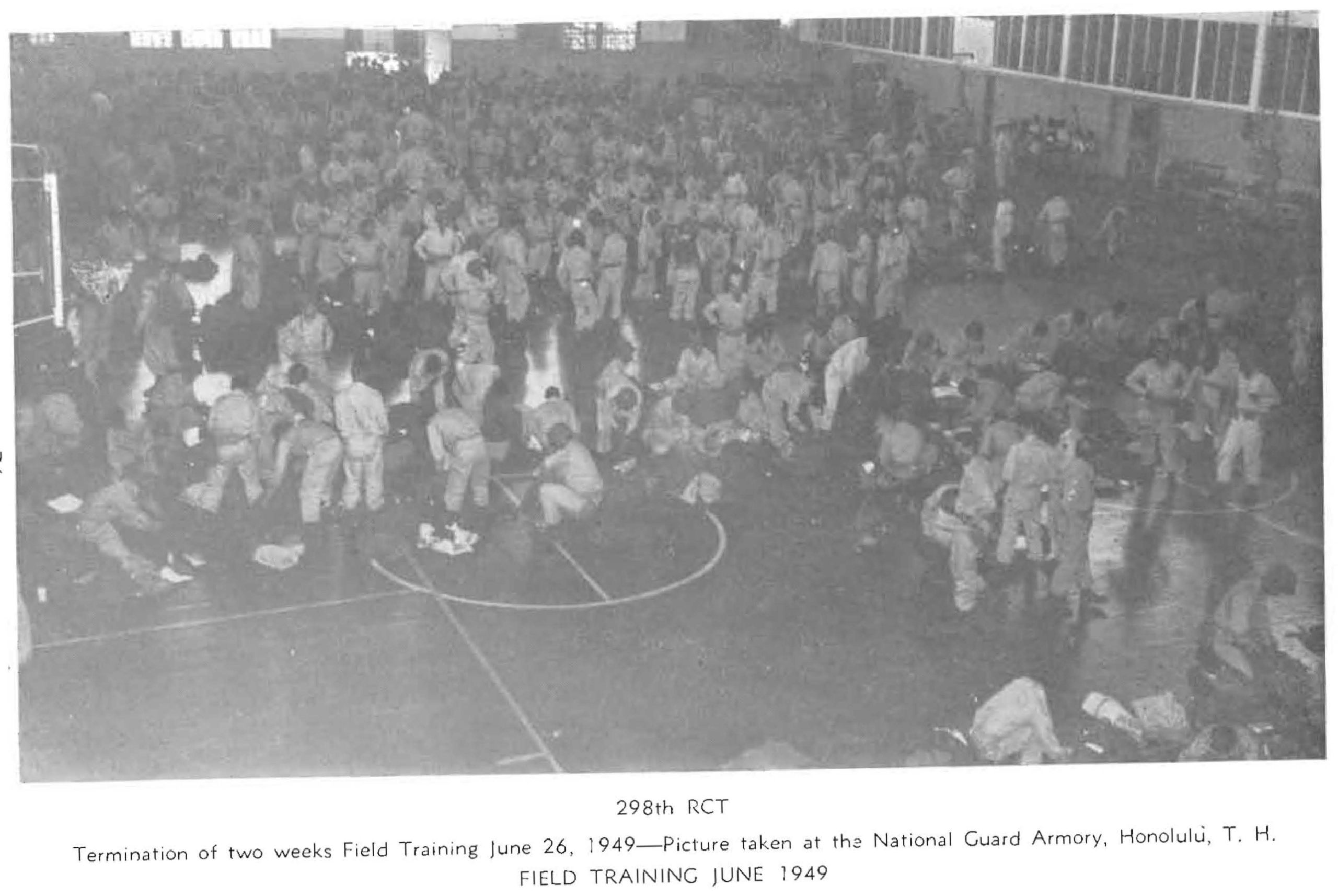
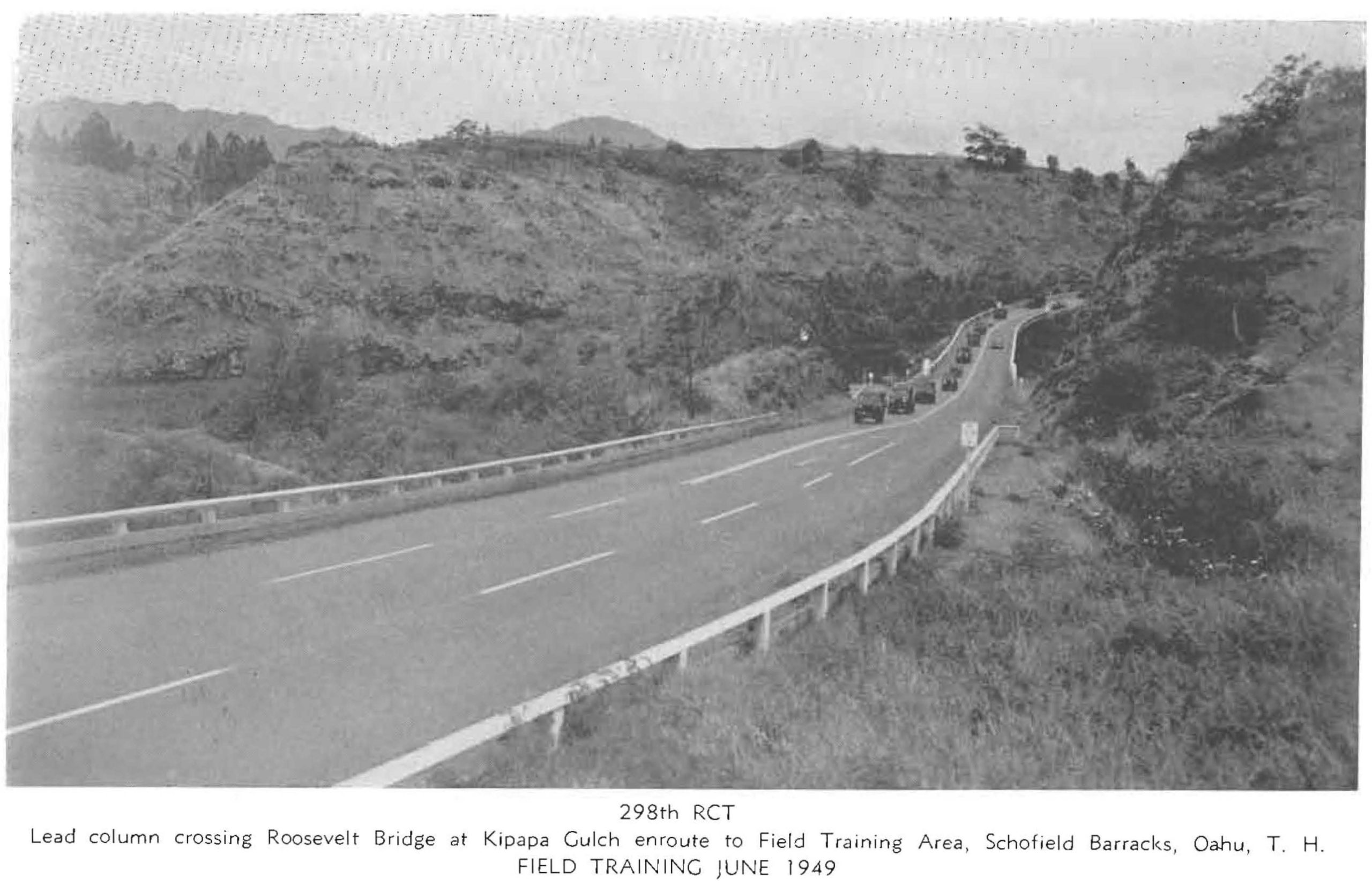
298th RCT Termination of two weeks Field Training June 26, 1949 – 1949- Picture taken at the National Guard Armory, Honolulu, T. H. FIELD TRAINING JUNE 1949298th RCT Lead column crossing Roosevelt Bridge at Kipapa Gulch enroute to Field Training Area, Schofield Barracks, Oahu, T. H. FIELD TRAINING JUNE 1949(Pictures from the 1948-1949 Annual Report)
Hq & Hq Det Hawaii National Guard. 613th Ord (MM I Co and all Honolulu elements of the 298th RCT were moved to Fort Ruger. Oahu, with first unit arriving on February 15, 1950.
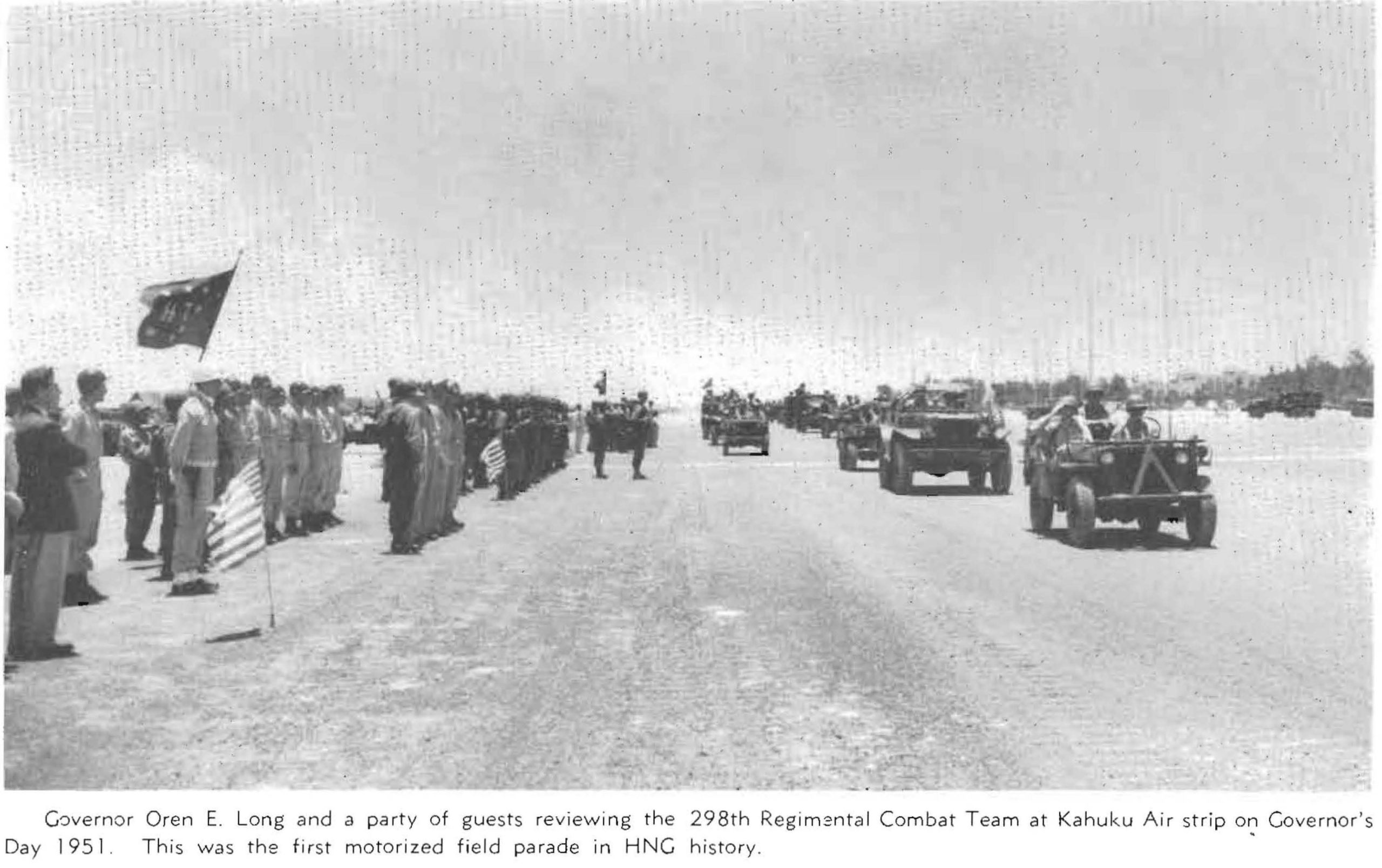
Governor Oren E. Long and a party of guests reviewing the 298th Regimental Combat Team at Kahuku Air strip on Governor’s Day 1951. This was the first motorized field parade in HNG history.(Pictures from the 1950-1951 Annual Report)
Shoulder Insignia of the 298th ReT
Insignia. On 15 June 1953 the Quartermaster General, Department of the Army, approved the design of a shoulder sleeve insignia for the 298th Regimental Combat Team. The insignia (see cut on page 13) featuring a Hawaiian warrior head and an ancient spear is symbolic of the military prowess of the ancient Hawaiians. The design for the insigni a was originated by Corporal Albert Soriano of Service Company 298th Infantry. Approval of this insignia gives the Hawaii NationaI Guard two distinctive patches, the other one being the familiar warrior head patch previosly worn by all Guard troops.
The major organizational change of Fiscal Year 1957 was the conversion of the 298th RCT to Anti-Aircraft Artillery beginning the latter part of 1956. On 3 December 1956, elements of the 2nd Battalion, 298th Infantry were converted, redesignated and reorganized as follows:
Hq & Hq Co 2nd Bn 298th Inf to Hq & Hq Btry 297th AAA Bn
Company E (Waialua) to Btry C, 297th AAA Bn
Company F (Pearl City) to Btry D. 297th AAA Bn
Company H (Wahiawa) to Btry A, 297th AAA Bn
Tank Co (Wahiawa) to Btry B, 297th AAA Bn
On 7 January 1957 other units of the 298th RCT were converted to Anti-Aircraft Artillery as follows:
Hq & Hq Co 298th Inf (Hon,) to Hq & Hq Btry 298th AAA Gp
Hy Mortar Co (Hon,) to Hq & Hq Btry 298th AAA Bn
Company B (Hon.) to Btry A 298th AAA Bn
Company D (lIon.) to Btry B 298th AAA Bn
Company L (Kanoohe) to Btrv C, 298th AAA Bn
Service Co (Hon.) to 368th AAA Det (Opn)
Also on 7 January 1957 the 158th AAA Bn, the 121st and 122d Signal Detachments were assigned to the 298th AAA Group. In addition, Medical Detachments were organized for the 297th and 298th AAA Battalions.
The 298th AAA Gp has made remarkable progress since its organization in January 1957. The inspection results of Field Training Performance in June 1957 were: 21 Superiors and 1 Excellent ratings.
Organization: A major reorganization was completed during this period which placed units of the Hawaii ARNG on line with the best in modern organizations which can be employed in the event of war. Current troop allotments for the Hawaii ARNG are as follows:
a. Effective 15 January 1959:
Toe
Additions
Deletions
44-5,1,5’1′ (10 Feh 58)
1st Msl Bn (Nike Hercules) 298th Arty
158th AAA Bn (90mm Gun)
44-5451′ (10 Feb 58)
2nd Msl Bn (Nike Hercules) 298th Arty
297th AAA Bn (90mm Gun) 1218t Sig Del (RMU, Type E) 122nd Sig Det (RMU, Type E) 367th AAA Bn (90mm Gun) 368th AAA Det (Opn)
7-52D (10 Feb 58)
Hq & Hq Co 29th InC Bde (Sep)
120th Sig Spt Co
5-17D (Draft)
227th Engr Bn (Inf Div) (-Cos D & E)
227th Engr Bn (Cmht) (Army)
b. Effective 15 February 1959:
Toe
Additions
Deletions
7-11D (Draft)
1st Battle Group (Sep) 299th Inf
1st & 2nd Bns 299th Inf
7-11D (Dmft)
2nd Battle Group (Sep) 299th Inf
299th Inf Regt (-1 &2 Bns) 230th Engr Co (Cmht) 11Oth Army Band 487th FA Bn (105mm How Towed)
Training: Training progressed under the Army Training Programs with emphasis being placed on Basic Unit Training which was initiated by all units on 1 Octoher 1958 except for the missile units. Due to reorganization into Nike Hercules missile units, the 298th AAA Gp concentrated on Nike Hercules orientations and advance individual training.
Air Defense. The 298th Arty. Gp. (AD) is charged with the Army Air Defense of Hawaii. To accomplish this mission six units of the 1st and 2d Msl. Bns. are occupying Nike Hercules Sites which ring the island of Oahu. The Army Air Defense Command Post (AADCP) is manned and operated around the clock by personnel from Hq. & Hq. Btry., 298th Arty. Gp
The 298th Arty Gp (AD) is charged with the Army Air Defense of Hawaii. To accomplish this mission six units of the 1st and 2d Msl Bns are occupying Nike Hercules Sites which ring the island of Oahu. The Army Air Defense Command Post (AADCP ) is manned and operated around the clock by personnel from HHB 298th Arty Gp.
The 298th Arty Gp (AD) is charged with the Army Air Defense of Hawaii. To accomplish this mission six units of the 1st and 2d MsI Bns are occupyin g Nike Hercules Sites which ring the island of Oahu. The Army Air Defense Command Post (AADCP) is manned and operated around the clock by personnel from HHB 298th Arty Gp
The 298th Artillery Group (AD) is charged with the Army Air Defense of Hawaii. (See organization & Mission)
System Im provement: The Air Defense system for Hawaii continued its growth to provide increased protection through the addition of new equipment and modification of existing equipment. During this past year, a radar netting and an electronic fire distribution system was added to the defense. This enables instant exchange of data between various radars, Nike Hercules batteries, and the Army Air Defense Command Post (AADCP) by advanced digital data transmission techniques. The capability of the Nike Hercules batteries is being further increased by the addition of High Power Acquisition Radars IHIPAR) and the Improved Hercules modifications which are presently being installed.
The 298th Arty Gp (AD) is charged with the Army Air Defense of Hawaii. To accomplish this mission six units of the lst and 2d Msl Bns are occupying Nike Hercules Sites which ring the island of Oahu. The Army Air Defense Command Post (AADCP, is manned and operated around the clock by personnel from HHB 298th Arty Gp.
The 298th Artillerx Group (AD) is charged with the Army Air Defense of Hawaii. System lmproven1enl: A major modification, which will funher automate the Fire Distribution Systern, was initiated. This modification is scheduled to be completed in mid FY 1966. Another projeet initiated during this FY was the programmed construction of facilities for an Alternate Battery Acquisition Radar (ABAR) at Blry C, 2d Msl Bn, Dillingham Airfield. Completion of this facility is scheduled during the 3d Quarter FY 1966.
Effective 15 November 1965, all except three HARNG units were reorganized in support of national war plans to insure that adequate units of the type needed to back up the Active Army are maintained within the Reserve Components. Hawaii’s maximum authorized strength was increased from 3,970 to 4,258 officers and men while the number of authorized units was reduced from 39 to 35 units.
To meet the expansion of the Brigade and to streamline the command and control of the Air Defense units, the 298th Artillery Group (Air Defense) was reorganized from a nine unit organization to a five unit organization consisting of four firing batteries (two of which are double batteries) under the control of HHB, 298th Arty Gp (AD) . Both HHBs of the 1st and 2nd Msi Bns were absorbed within the HARNG and four units were consolidated toform the twO double batteries.
System Improvements: The 298th Artillery Group continues to improve its air defense capability through system modifications and the addition of new equipment. Battery A, 1st Battalion, Site 84, Dillingham Field installed an Alternate Battery Acquisition Radar (ABAR) which greatly enhances their target acquisition capability. The AN/ FSQ 38 Fire Distribution System which electronic ally links the Army Air Defense Command Post (AADCP) and the Air National Guard’s surveillance radars with the six Nike fire units completed a 1.4 million dollar modification. This modification further automates the entire air defense system, speeds response to an air threat and reduces the possibility of human error. Site 45, Bellows AFS, (Battery C, 1st Battalion) exchanged their basic Nike Hercules system for the more sophisticated Improved Nike Hercules system. Construction of facilities for a dual channel ABAR was initiated. This ABAR will serve both fire units (Sites 32 and 45) of Battery C and will be installed during mid FY 1967. Headquarters, 298th Artillery Group received a target simulator which is a mobile piece of equipment that provides fire control operators with a realistic combat situation of varying complexity.
The 298th Artillery Group (AD) has the distinction of being the only Army National Guard unit to provide the entire Nike Hercules Air Defense of its area as well as manning and operating the Army Air Defense Command Post (AADCP) on an around the clock basis.
Site Redesignation:
The six sites were redesignated using single digit numbers as follows: Site 1, Battery A-Dillingham Field; Site 2, Battery B–Kahuku; Sites 3 and 4, Battery C-Bellows AFS; Sites 5 and 6, Battery D-Ewa.
Systems Improvement:
Since first moving on-site in 1960, the overall capability of our units to accomplish their air defense mission has improved each year with the addition of new equipment and systems modification. At the close of the fiscal year our last basic system was converted to an improved system and the dual channel acquisition radar (ABAR), serving both Sites 3 and 4 was operational. The Hawaii Air Defense System is now comprised of the AN/FSQ 38 Fire Direction System, 6 Improved Nike Hercules System, 2 High Power Acquisition Radars (HIPAR) and 2 ABAR’s. All sites except Site 6 now have a long range target acquisition capability.
The 298th Artillery Group of the Army National Guard also continued to provide the total surface-to-air missile defense of the State. The units of the 298th Group deployed personnel to the McGregor Range in New Mexico for Annual Service Practice for the first time in several years and scored well in comparison with Regular Army and National Guard units based in the continental United States.
The 298th Artillery Group (AD) remains the only National Guard unit in the United States to provide the entire Nike Hercules air defense of its area and is the only National Guard unit to man and operate an Army Air Defense Command Post (AADCP).
Systems Improvement:
Modofications to the Nike H ercules system are being constantly apphed to upgrade the systems capability to respond to an enemy air attack. In addition, five of the six systems have been replaced with factory rebuilt systems. The one remaining old system will be replaced in FY 69.
Annual Service Practice:
The firing units of the 298th Artillery Group returned to McGregor Range for the first time since 1960 to participate in Short Notice Annual Practice (SNAP ). Under SNAP procedures a unit is given only 48 hours notice prior to their departure for McGregor Range. O nce there, they undergo an intensive tactical evaluation to test their overall ability as missilemen. This year’s SNAP gave our units the opportunity to compete with like units from both the Active Army and National Guard using the same evaluation procedures. Our units fared well in this competition by recording a higher than national average score. Hawaii’s high scoring unit was Battery B Site 2 Kahuku commanded by Captain Lawrence P. Mosher. This unit was also designated as an H onor Battery.
The 298th Artillery Group (Air Defense) celebrated its 10th anniversary on 15 January 1969 as a Nike Hercules Air Defense unit. They are the only National Guard unit in the United States to provide the entire surface-to-air missile defense of its area and the only Army National Guard unit to man and operate an Army Air Defense Command Post (AADCP). They also enjoy the distinction of being the first National Guard unit to be equipped with the Nike Hercules system and, as such, became the prototype for the eventual conversion of Continental United States (CONCS) National Guard units from Nike Ajax to Nike Hercules.
After completing the initial phase of training at Los Angeles, California and Fort Bliss, Texas, the first units occupied training sites at Sand Island and East Range, Schofield Barracks, on 15 February 1960. The move to the six tactical sites started on 15 December 1960 v\hen Site 3 moved to Bellows Field and was completed when the last unit, Site 5, moved to its permanent location north of Barbers Point. The 298th Artillery Group closed fiscal year 1960 with 379 air defense technicians on board with an annual payroll of 1.1 million dollars. At the close of fiscal year 1969, 560 technicians were authorized and the annual payroll amounted to 4.6 million dollars.
A major blow to the Hawaii Army National Guard came with the news in October of 1969 that the 298th Artillery Group (Nike) would be inactivated by June of 1970. Actual inactivation was on March 31, 1970. Of some 534 full-time personnel in this program, only 127 could be offered other positions within the National Guard and 407 were forced to find other jobs. While, to many of our employees, this meant hardship to various degrees, other State departments and the community at large helped greatly in securing positions for those affected. The unit was replaced by the 298th Field Depot with very few full-time positions but with nearly equal total unit strength.
The 298th Field Depot also suffered loss of personnel, to a large degree due to its changed mission. It, too, faces a retention and recruiting need as well as a large retraining requirement.
The 298th is an organization, which upon reaching the prope r trai ning and equipment levels, will be capable of providing su pplies and serv ice support for up to three corps over sustained periods of time. HARNG u nits are also capable of supporting civil au thorities during natural disasters and civil distu rbances.
The 298th Artillery Group (Air Defense) was officially relieved of its air defense mission in Hawaii on December 9, 1969, after ten years as the only National Guard organization in the United States providing the entire surface-to-air missile defense for its area, and as the only Army National Guard unit manning and operating an Army Air Defense Command Post. The initial announcement of the inactivation of the 298th Artillery Group was received from the Department of the Army on November 28, 1969. Although an initial inactivation date of June 30, 1970 was established, the reorganization date was subsequently changed to March 31, 1970.
The 298th Artillery Group was reorganized into Combat Service Support units. The reorganization became effective on April 1, 1970. The new organization has the mission of providing units trained and equipped to support the State mission and also of providing trained and equipped combat service support units for its Federal mission, Newly organized units of the 298th Field Depot were designated as follows:
HHC, 298th Field Depot
HHC, 297th Supply and Service Battalion
290th General Support Company
291st Light Maintenance Company
292d Supply and Service Company
298th Engineer Detachment
The strength of the 298th Field Depot upon reorganization was 770 as compared to an authorized strength of 886, As of June 30, 1970, the strength decreased to 656 or 74,1 percent of authorized strength, This consisted of 59 officers, 19 warrant officers and 578 enlisted personnel. A viable recruiting program has been instituted to reverse this trend by recruiting and retention of personnel. . .
The 298th Field Depot, upon reorganization, concentrated on individual military occupational specialty qualification training, strength build-up, and processing of new equipment. Attendance at Army Service Schools and enrollment in correspondence courses were also emphasized to qualify individuals in their new assignments.
The 298th Field Depot is the other of HARNG’s two major commands. The depot’s mission is to conduct training that prepares individuals and units to provide combat service support to combat elements and to provide military assistance to civil au thorities.
During fiscal year 1971, the field depot established a training program that emphasized individual military OCCllpational specialty (MOS ) qualifica tion, technical team functioning, and maintenance of equipmC’ nt. D epot units conducted annual training in August of 1970. Personnel performed on-the-job trammg at the United States Army Hawaii laundry, mortuary, supply and maintenance shops and the U nited States Army Pacific computer center. In April of 1971, troop leaders participated in 16 hours of troop leading training for civil disturbance duty, and staff members attended a five-day staff refresher training course at Fort Lee, Virginia. In May of 1971 each company received eight additional hours of training in civil disturbance techniques.
The strength of the 298th F ield Depot at the beginning of the fiscal year 74.1% of the 886 authorized men. Strength declined until December 1970 when it stabilized. By the end of the fiscal year, the 298th was at 73.4% of its authorized strength. This included 53 officers, 17 warrant officers and 581 enlisted men.
298th Field Depot: The 298th Field Depot is the second major command of the Hawaii Army National Guard. The Depo t is commanded by Colonel Clyde W. Woods, Jr. , a seasoned veteran of World War II and the Vietnam conflict. Depot units are loca ted on Oahu at Wahiawa, Ewa , Waimanalo and Koko Head. The Depot’s mission is to prepare individuals and units to provide combat service support to combat elements. The Depot also furnishes reserve forces for military assistance to civil authorities during domestic emergencies and natural disasters.
During FY 72, the Field Depot continued its efforts to qualify individua ls in their military occupational specialties (MOS), to increase the emphasis on technical team fun ctioning a nd to effectively maintain equ ipment. Depot units conducted annual training in August of 1971 at Schofield Barracks, Hawaii, and at Fort Lee, Virginia. The support and service units issued rations, materials and ammu nition to th e combat units of H ARNG. The Light Maintenance Company provided direct support repairs to equipment sent to the Combined Service Maintenance Shop. Personnel a lso worked at the United States Army, Hawaii laundry, mortuary, supply and maintenance shops and the United States Army Pacific Computer Center. . .
The strength of the 298th Field Depot at the close of the fiscal year was at 76 per cen t of the au thorized strength. This included 53 officers, 17 warrant officers, and 582 enlisted men. . .
Reorganization: On January 22, 1972, the Hawaii Army Nationa l Guard underwent a minor reo:garllzation o f its units. This reorganization involved the loss of the 290th General Supply Company of the 298th Field Depot and the addition of a support company to the First and Second Battalions, 299th Infantry, and a service ballery to the First Battalion, 487th Artillery. The 2929 th Medical Detachment (Hel Amb) was converted to the Aviation Section of Headquarters and Headquarters Company, 29th Infantry Brigade.
As a resu lt of this reorganization, the authorized strength of the Hawaii Army National Guard decreased from 4,327 to 4,226.
The 298th Field Depot, the other major command of the Hawaii Army National Guard, is commanded by Colonel Francis A. 1. Bowers, Jr., an experienced combat leader. Depot units are located on Oahu at Wahiawa, Ewa, Waimanalo and Koko Head. The Depot’s mission is to prepare individuals and units to provide combat service support to combat units. The Depot also furnishes reserve forces for military assistance to civil authorities during domestic emergencies and natural disasters.
During FY 73, the Depot continued its efforts to qualify individuals in their military occupational specialities (MOS), to increase the emphasis on technical team functioning and to effectively maintain equipment. During August, 1972, Depot units conducted annual training at Schofield Barracks, Hawaii, and a contingent of 103 enlisted men trained at Fort Lee, Virginia.
On April 1, 1973, the Depot was reorganized. The major changes were a reduction in total authorized strength and the redesignation of one company. The 291st Light Maintenance Company was converted into a heavy equipment maintenance company. It was assigned the mission of provid ing general support main tenance to military units on an area-wide basis.
The 298th Field Depot, a combat service support organization of the Hawaii Army National Guard (HARNG), is commanded by Colonel Francis A. I. Bowers, Jr. This major command is composed primarily of supply and service units including an engineer detachment, and a maintenance company. Its units are located in the central, windward, and leeward areas of Oahu. The Depot’s mission, during its inactive duty status, is to train people in technical skills and units in service functions that support combat elements.
Combat service support includes receipt, storage and shipment of supplies; repair and rebuilding equipment for return to the supply system; and preparation of facilities and maintenance of utilities at military instaUations.
Depot units are at a level of readiness that would allow short-notice mobilization for Federal service. The Depot also serves the State as a HARNG reserve force ready to assist civil authorities during domestic emergencies and natural disasters. During Fiscal Year 1974, the Depot was involved in the HARNG operation at the Hawaii State Prison. . .
At the close of the fiscal year, the 298th Field Depot was overstrength in enlisted members but understrength in officers and warrant officers. The end of year overall figure was 96% of the authorized strength. This percentage included 62 officers, 12 warrant officers, and 468 enlisted men.
The 298th Field Depot is the second major command of the Hawaii Army National Guard. It is composed of nine companies and two detachments. The 11 units are located throughout Oahu with stations at Fort Ruger, Pearl City, Wahiawa, Waimanalo, and Honolulu International Airport. The Depot’s mission during inactive duty status is to train men and women in vocational skills and to prepare units for combat service support (CSS) functions. These personnel skills and CSS unit functions will provide the State and Nation with reserve components for state service and federal active duty. The State can utilize the specialized skills of Depot personnel and units to assist civil authorities during local domestic emergencies and natural disasters. The Nation in the event of mobilization for war will also be provided with HARNG units that can provide CSS general and direct support to combat forces.
Combat service support includes receipt, storage, and issue of supplies; repair and rebuild of military equipment for reissue through the Army supply system; maintenance of electronic gear and helicopters; movement of cargo and troops; medical evacuation and care; preparation of camp installations, to include maintenance of utilities; and field services such as baking bread and pastry, laundering and renovation of clothes, and collecting and identification of dead bodies (graves registration). The Depot is organized to perform these functions with three headquarters and two battalions. The Depot units are:
Headquarters and Headquarters Company, 298th Field Depot
298th Engineer Detachment (Facilities and Utilities)
Headquarters Detachment, 159th Service Battalion
291st Maintenance Company (Heavy Equipment)
293d Service Company (Aircraft Maintenance)
829th Maintenance Company (Forward Support)
Headquarters Company, 297th Supply and Service Battalion
229th Medical Company (Infantry Division)
292d Supply and Service Company (Direct Support)
329th Quartermaster Company (Forward Support)
1154th Transportation Company (Light-Medium Trucks)
Two companies, the 229th Medical Company and 829th Maintenance Company, are “roundout” units to Active Army battalions. In the roundout concept the Active Army sponsors HARNG units for training; the two companies are expected to deploy with the 25th Infantry Division. A vivid example of short-notice mobilization for State service was the callup of a Depot task force for duty at the Hawai i State Prison during Fiscal Year 1975. . .
At the close of the fiscal year, the 298th Field Depot was overstrength in enlisted members but slightly understrength in officers and warrant officers. The end of year overall percentage was 105 percent of the authorized strength. This figure included 90 officers, 21 warrant officers, 916 enlisted men, and 30 enlisted women for a total personnel strength of 1,057.
On June 1, 1976, Heauquarters and Headquarters Detachment, Hawaii Army National Guard, was reorganized with an increase of strength from 87 to 80. Within the new organization, a new Headquarters Installation Command was organized for the command and control of two existing battalions. On the same date, Headquarters and Headquarters Company, 298th Field Depot, was inactivated. This reorganization reduced the HARNG’s authorized strength from 3,710 to 3,642.
FY 76 was a year of change and accomplishment for the 298th Fld. Dep. On Feb. 1, 1976, Col. Alexis T Lum assumed command of the depot replacing Col. John E. Aiona, Jr, who assumed command of the 29th Infantry Brigade Then, on May 3, 1976, the 298th Fld Dep. was inactivated and re-established on June 1, 1976 as the Headquarters Installation Command (HIC).
The mission of HIC is the command and control of nine companies and three detachments. The 12 units are located throughout Oahu with armories at Fort Ruger, Pearl City, Wahiawa, Waima na lo, and Wheeler Air Force Base. HI C’s mission inc ludes training men and women in vocational skills and preparing units for combat service support (CSS) functions. These personnel skills and CSS unit functions provide both the State and the Nation with valuable services during loca l domestic emergencies , natural disasters, and national mobilization for war.
CSS activities include receipting, storing, and issuing of supplies; repairing and rebuilding of military equipment; maintaining vehicles, weapons, helicopters and sophisticated electronic gear; moving troops and cargo; providing medical care and evacuation; preparing and commanding camps or installations to include providing administrative support; and providing field services such as baking, laundering, and renovating textiles. The HIC is organized to perform these functions with three headquarters and two battalions. The HIC units are:
Headquarters Installation Command
298th Engineer Detachment (Facilities and Utilities)
Headquarters, 159th Service Battalion
12th Administration Company (Administrative Services)
291st Maintenance Company (Heavy Equipment-General Support)
Headqarters Installaion Command (HIC) provides the command and controlhead quarters for combat service support (CSS) units of the HARNG The HIC is commanded by Col. Alexis T Lum .
There are 12 units in the HIC. Oahu armories are at Fort Ruger, Pearl City , Wahiawa , Waimanalo and Wheeler AFB. Units of the HIC and their location are listed in Plate II. Two companies, 229th Medical (Med) and 829th Mai ntenance (Maint. ), both roundout unit, may be activated as part of the 25th Inf. Div. in the event of national emergency.
The mission of HIC includes training all personnel in vocational skills and preparing units for CSS during local domestic emergencies, natural di sasters and national mobilization for war.
CSS activities include receipting , storing and issuing supplies, repairing and rebuilding military equipment; maintaining vehicles, weapons, helicopters and sophisticated electronic gear; moving troops and cargo; providing medical care and evacuation, preparing and commanding an Almy installation; and providing field services such as baking, laundering and renovating textiles. . .
The HIC ended the year with a strength of 1,062 personnel or 94 per cen t of authorized strength. The number of women in HIC significantl y increased over the past year from 58 to 124.
Headquarters Installation Command , the second major command , provid s the command and control headquarters for combat service support units of the Hawaii Army National Guard. It is command ed by Colonel Alexis T. Lum.
Units of th is command and their locations are listed in Table 2 in Appendix. Tw o com panies, 229th Medical and 829th Main tenance, are designated ro undout units and would be activated as part of the 29th Infantry Division in the event of national emergency.
The mission of the Headquarters Installation Command includes training all personnel in military skills and preparing units for combat service support during local domestic emergencies, na tural disasters and national mobilization for war.
Combat service support activities include: receipting, storing and issuing supplies; repairing and rebuilding military equipment; maintaining vehicles, weapons, heli copters and sophisticated electronic gear; moving troops and cargo; providing medical care and evacuation; preparing and commanding an Army installation; and providing field services such as baking, laundering and renovating textiles. . .
(5) The H eadquarters Installation Command ended the year with a strength of 1,202 personnel or 105 percent of authorized strength. This is a signifi cant increase of 140 personnel or an 11 percent increase over last year.
Headquarters Installation Command, the second major Army Guard command, is the command and control element for combat support and combat service support units of the Hawaii Army National Guard. It is commanded by Colonel Alexis T. Lum.
Unit armories of the Headquarters Installation Command are located at Fort Ruger, Pearl City, Wahiawa, Bellows Air Force Station, and Wheeler Air Force Base. Specific unit locations are listed in Table 1 in the Appendix . Four companies, Troop E (Air), 19th Cavalry; 227th Engineer; 229th Medical; and 829th Maintenance are designated roundout units and would be activated as part of the 25th Infantry Division in the event of national emergency.
The mission of the Headquarters Installation Command includes training of all personnel in combat and vocational skills and preparing units for the performance of assigned missions during local emergencies, natural disasters and national mobilization for war.
Support provided by the Headquarters Installation Command units includes: aerial and ground reconnaissance; aerial fire support; combat engineer support; receipting, storing and issuing supplies; repairing and rebuilding military equipment; maintaining vehicles, weapons, helicopters and sophisticated electronic gear; transporting troops and cargo; providing medical care and evacuation; and providing field services such as baking, laundering and renovating of textiles. . .
7) The Headquarters Installation Command ended the year with a strength of 1,526 personnel – 98.8 percent of authorized strength.
The Headquarters Installation Command is the second major command of the Hawaii Army National Guard. It also continued to initiate improvements to upg rade its readiness. It functions as the command and control element for combat and support units of the Hawaii Army National Guard.
Headquarters Installation Command units provided logistical support to all Army Guard units during annual training. Among its duties were ground and aerial reconnaissance and fire support, engineering, supply, and repair and maintenance of al l equipment. Transportation, medical care, and food services, to name a few, were also among the organization’s many tasks.
The Headquarters Installation Command, the second major command of the Hawaii Army National Guard, continued to upgrade its readiness. It functions as the command and control element for combat and support units of the Hawaii Army National Guard.
Headquarters Installation Command units provided logistical support to all Army Guard units during annual training. Among its duties were ground and aerial reconnaissance, fire support, engineering, supply, and repair and maintenance of all equipment. Transportation, medical care, and food services were also among the organization’s many additional tasks. On October 1, 1980 the 329th Quartermaster Company was redesignated the 329th Field Services Company.
The Headquarters Installation Command, the second major command of the Hawaii Army National Guard, serves as the command and control element for combat support and combat service support units.
Unit armories of the Installation Command are located on Oahu at Fort Ruger, Pearl City, Wahiawa, Bellows Air Force Station and Wheeler Air Force Base. Also, an aviation detachment is located at Keaukaha Military Reservation in Hilo.
The mission of the Installation Command includes training all its personnel in combat and vocational skills, and preparing units for the performance of assigned missions during local emergencies, natural disasters and national mobilization for war.
Support provided by Installation Command units include: aerial and ground reconnaissance; aerial fire support; tactical aerial transporting of troops and cargo; combat engineer tasks; receipting, storing and issuing supplies; repairing and rebuilding military equipment; maintaining vehicles, weapons, helicopters and sophisticated electronic gear; ground transporting of troops and cargo; providing medical care and evacuation; providing field services such as baking, and the laudering and renovating of textiles.
The Headquaners Installation Command is another major command within the Hawaii Anny National Guard. Headquartered at Waiawa, Oahu, the Headquarters Installation Command is made up of three combat service support battalions.
Units of the Headquarters Installation Command are located primarily on Oahu at Fort Ruger, Pearl City, Wahiawa, Bellows Air Force Station and Wheeler Air Force Base. An aviation detachment is located at Keaukaha Military Reservation, Hilo, Hawaii.
The units within the Headquarters Installation Command provide a broad spectrum of combat support and services. The kinds of support and services the Headquarters Installation Command provides include: aerial and ground reconnaissance; aerial fire support; tactical aerial trans pot t of troops and cargo; combat engineering; storing and issuing supplies; repairing and rebuilding military equipment; maintenance for vehicles, weapons, helicopters, and sophisticated electronic equipment; ground transportation for troops and cargo; medical care and evacuation and field services which include baking, laundering and renovation of textiles.
The Headquarters Installation Command is a major command within the Hawaii Army National Cuard. Headquartered at Pearl City, Oahu (Waiawa Armory), the Headquarters Installation Command is made lip of three ombat service support battalions and one engineer detachment.
Units of the Headquarters Installation Command arc located primarily on Oahu at Fort Ruger, Pearl City, Wahiawa, Bellows Air Force Station, and Wheeler Air Force Base. A n aviation detachment is located at Keallkaha Military Reservation, Hilo, Hawaii.
The units within the Headquarters Installation Command provide a broad spectrum of combat support and combat service support, including: aerial and ground reconnaissance; aerial fire support; tactical aerial transport of troops and cargo; combat engineering; storing and issuing supplies; repairing, and rebuilding military equipment; maintenance for vehicles, weapons, helicopters, and sophi ·ticated electronic equipment; ground tra.nsportation for troops ami cargo; medical care and evacuation; and field services that include graves registration, baking, laundry and bath, and renovation of light textiles.
The Headq uarters Installation Command has five subordinate units that are round out to the 25th Infantry Division, and in the event of serious national emergency would provide combat support and combat service to the 29th Infantry Brigade.
The Headquarters Installation Command (HIC) is a major command within the Hawaii Army National Guard. The Headq uarters Installation Command is headq uartered in the Waiawa Armory at Pearl City, and is made up of three combat service support battalions.
Units of the Headquarters Installation Command are located primarily on Oahu at Fort Ruger, Pearl City, Wahiawa, Bellows Air Force Station and Wheeler Air Force Base. An aviation detachment is located at Keau kaha Mi I itary Reservation, Hilo, Hawaii.
The units within the Headquarters Installation Command provide a broad spectrum of combat support and combat service support. The support and services that the Headquarters Installation Command provide include : aerial and ground reconn aissance; aerial fire support; tactical aerial transport of troops and cargo; combat engineering; storing and issuing supplies; repairing and rebuilding military equipment; maintenance for vehicles, w eapons, hel icopters and soph isticated electronic q uipmenl; ground tran sportation for troops and cargo ; medical are and evac uation; and field services that include graves registration, baki ng, laundry and bath, and renovation of light textiles.
The Headquarters Instal lation Command has five subord inate units that round out the 25th Infantry Division. In the event of a national emergency, these units would provide combat sUPP:Jrt and combat service support to the Division.
The Headquarters Installation Command is a major command within the Hawaii Army National Guard. Headquartered at Pearl City, Oahu (Waiawa Armory), the Headquarters Installation Command s made up of three combat service support battalions.
Units of the Headquarters Installation Command are located primarily on Oahu at Fort Ruger, Pearl City, Wahiawa, Bellows Air Force Station, and Wheeler Air Force Base. An aviation detachment is located at Keaukaha Military Reservation, Hilo, Hawaii.
The units within the Headquarters Installation Command provide a broad spectrum of combat support and combat service support. The support and service provided by the Headquarters Installation Command include: aerial and ground reconnaissance; aerial fire support; tactical aerial transport of troops and cargo; combat engineering; storing and issuing supplies; repairing and rebuilding military equipment; maintenance for vehicles, weapons, helicopters and sophisticated electronic equipment; ground transportation for troops and cargo; medical care and evacuation. The organization also provides field services which include: graves registration, baking, laundry and bath, and renovation of light textiles.
The Headquarters Installation Command has five subordinate units that round out the 25th Infantry Division and, in the event of mobilization, they would provide combat support and combat service support to the 25th Infantry Division.
The Troop Command, headquartered at the Waiawa Armory in Pearl City on Oahu, is the other major command within the Hawaii Army National Guard. The Troop Command is made up of one combat aviation battalionat Wheeler Air Force Base, one combat service support battalion at the Wahiawa Armory, and an engineer detachment at the Waiawa Armory.
The units within the Troop Command provide a broad spectrum of combat support and combat service support. The aviation battalion provides aerial reconnaissance and aerial fire support while the supply and service battalion stores and issues supplies, repairs and rebuilds military equipment, and maintains vehicles, weapons, helicopters and sophisticated electronic equipment. The organization also provides field services which include graves registration, baking, laundry and bath, and renovation of light textiles. The engineer detachment provides utilities repair and maintenance.
The HIC was also reorganized into a headquarters organization called the Troop Command. It now commands the 297th Supply and Service Battalion and the 193rd Aviation Battalion.
The Troop Command, headquartered at Waiawa Armory in Pearl City on Oahu, is the other major command within the Hawaii Army National Guard. The Troop Command is made up of one combat aviation battalion at Wheeler Air Force Base, one combat service support battalion at the Wahiawa Armory, and an engineer detachment at Fort Ruger.
The units within the Troop Command provide a broad spectrum of combat support and combat service support. The aviation battalion provides aerial reconnaissance and aerial fire support. The supply and service battalion stores and issues supplies, repairs and rebuilds military equipment, and maintains vehicles, weapons, helicopters and sophisticated electronic equipment. The organization also provides field services which include laundry and bath, graves registration, baking, and renovation of light textiles. The engineer detachment provides utilities repair and maintenance.
The Troop Command is headquartered at Waiawa Armory in Pearl City on Oahu. It is the other major command within the Hawaii Army National Guard. The Troop Command includes a combat aviation battalion at Wheeler Air Force Base, a combat service support battalion headquartered at the Wahiawa Armory, and an engineer detachment at Fort Ruger.
The units within the Troop Command provide a broad spectrum of combat support and combat service support. The aviation battalion provides aerial reconnaissance and aerial fire support, while the supply and service battalion stores and issues supplies, repairs and rebuilds military equipment, and maintains vehicles, weapons, helicopters and sophisticated electronic equipment. The organization also provides field services which include laundry and bath, graves registration, baking, and renovation of light textiles. The engineer detachment provides utilities repair and maintenance.
The Troop Command is headquartered at Waiawa Armory in Pearl City on Oahu. It is the other major command within the Hawaii Army National Guard. The Troop Command includes a combat aviation battalion at Wheeler Air Force Base, a combat service support battalion headquartered at the Wahiawa Armory, and an engineer detachment at Fort Ruger.
The units within the Troop Command provide a broad spectrum of combat support and combat service support. The aviation battalion provides aerial reconnaissance and aerial fire support, while the supply and service battalion stores and issues supplies, repairs and rebuilds military equipment, and maintains vehicles, weapons, helicopters and sophisticated electronic equipment. The organization also provides field services which include laundry and bath, graves registration, baking, and renovation of light textiles. The engineer detachment provides utilities repair and maintenance.
The Troop Command is headquartered at Waiawa Armory in Pearl City on Oahu. It is the other major command within the Hawaii Army National Guard. The Troop Command includes a combat aviation battalion at Wheeler Air Force Base, a combat service support battalion headquartered atthe Wahiawa Armory, two aviation detachments based at Hilo’s aviation support facility, and an engineer detachment at Fort Ruger.
The units within the Troop Command provide a broad spectrum of combat support and combat service support. The aviation battalion provides aerial reconnaissance and aerial fire support. The aviation detachment provides a trained pool of qualified replacement aviators. The supply and service battalion stores and issues supplies, repairs and rebuilds military equipment and maintains vehicles, weapons, helicopters and sophisticated electronic equipment. The organization also provides field services, including laundry and bath, graves registration, baking and renovation of light textiles. The engineer detachment provides utilities repair and maintenance.
The mission of the Troop Command is to provide command and control over its assigned units. The command’s assigned strength, as of Sept. 30, 1992, was 719. This includes 56 officers, 73 warrant officers and 590 enlisted members.
The Troop Command is headquartered at Waiawa Armory in Pearl City on Oahu. It is one of the two major commands within the Hawaii Army National Guard. The Troop Command includes a combat aviation battalion at Wheeler Army Airfield, a combat service support battalion headquartered at the Wahiawa Armory, two aviation detachments based at Hilo’s aviation support facility, a division level tactical rear operations cell at Waiawa Armory and an engineer detachment at Fort Ruger.
The units within the Troop Command provide a broad spectrum of combat and combat-service support. The aviation detachments provide a trained pool of qualified replacement aviators. The supply and service battalion stores and issues supplies, repairs and rebuilds military equipment and maintains vehicles, weapons, helicopters and sophisticated electronic equipment. The organization also provides field services, including laundry and bath, grave registration, baking and renovation of light textiles. The division rear operations cell provides support of division rear operations. The engineer detachment provides utilities repair and maintenance.
The mission of Troop Command is to provide command and control over its assigned units. The command’s assigned strength, as of July 31, 1993, was 716. This included 59 officers, 76 warrant officers and 581 enlisted members.
The Troop Command is headquartered at Waiawa Armory in Pearl City, Oahu. It is one of two major commands within the HIARNG. The Troop Command includes a combat aviation battalion at Wheeler Army Airfield, a combat service support battalion headquartered at the Waiawa Armory, two aviation detachments based at Hilo’s Gen. Lyman Field, a divisionlevel tactical rear operations cell at Waiawa Armory and an engineer detachment at Fort Ruger.
The uni ts within Troop Command provide a broad spectrum of combat and combat-service support. The aviation detachments provide a trained pool of qualified replacement aviators. The supply and service battalion stores and issues supplies, repairs and rebuilds military equipment and maintains vehicles, weapons and sophisticated electronic equipment. The organization also provides limited field services, including renovation of light textiles. The division rear operations cell provides support of rear operations. The engineer detachment provides utilities repair and maintenance.
The mission of the 103rd Troop Command is to provide command and control over its assigned units. The command’s assigned strength, as of July 31, 1994, was 687. This included 56 officers, 75 warrant officers and 556 enlisted members.
The Troop Command is headquartered at Waiawa Armory in Pearl City, Oahu. It is one of two major commands within the HIARNG. The 103rd includes a combat aviation battalion at Wheeler Army Airfield, a combat service support battalion headquartered at the Waiawa Armory, two aviation detachments based at Hilo’s Gen. Lyman Field, a division-level tactical rear operations cell at Waiawa Armory, and an engineer detachment at Fort Ruger.
The units within Troop Command provide a broad spectrum of combat and combat-service support. The aviation detachments provide a trained pool of qualified aviators. The supply and service battalion stores and issues supplies, repairs and rebuilds military equipment and maintains vehicles, weapons and sophisticated electronic equipment. The organization also provides limited field services, including renovation oflight textiles. The division rear operations cell provides support of rear operations. The engineer detachment provides utilities repair and maintenance.
On July 1, 1994, Detachment 1, Headquarters, State Area Command, Troop Command, Hawaii Army National Guard, was redesignated as the 103rd Troop Command, Headquarters, State Area Command, Hawaii Army National Guard.
The mission of the 103rd Troop Command is to provide command and control over its assigned units. The command’s assigned strength, as of July 31, 1995, was 505. This includes 35 officers, 58 warrant officers and 412 enlisted members.
The troop command is headquartered at Waiawa Armory in Pearl City, Oahu. It is one of two major commands within the Hawaii Army Guard. The 103rd includes two aviation companies at Wheeler Army Airfield, and two aviation detachments based at General Lyman Field in Hilo, Hawaii, a division rear operations cell at Waiawa Armory, an engineer detachment, and a personnel services detachment at Fort Ruger, Oahu. The supply and service battalion and most of its subordinate units are being phased out as part of the Hawaii Army Guard’s reorganization.
The units within 103rd provide a broad spectrum of combat and combatservice support. The aviation detachments provide a highly trained pool of qualified aviators and technical aviation maintenance personnel. The engineer detachment’s capabilities include horizontal and vertical construction and grading and paving roads. The division rear operations cell provides support to the 25th Infantry Division (Light) rear operations cell. The personnel services detachment, the remaining service battalion unit, provides the majority of the administrative support to the Hawaii Army Guard.
The mission of the 103rd Troop Command is to provide command and control over its assigned units. The command’s assigned strength, as of September 30, 1996, was 632. This includes 40 officers, 51 warrant officers and 541 enlisted members.
The troop command is headquartered at Waiawa Armory in Pearl City, Oahu. It is one of the two major commands within the Hawaii Army National Guard. The 103rd includes two aviation detachments at Hilo International Airport. The aviation companies at Wheeler Army Air Field provide medium lift and aviation intermediate maintenance support to both Active and Reserve Component units. The aviation detachments at Hilo provide a highly trained pool of qualified aviators and technical aviation maintenance personnel in support of counter drug and aeromedical operations.
Other support units within the 103rd include a division rear operations cell which supports the 25th Infantry Division (Light), a personnel services detachment which provides administrative support to all units in the HIARNG, a facility engineer detachment whose capabilities include both vertical and horizontal construction support. In March 1996, the 111th Army Band became the newest unit assigned to the 103rd Troop Command. The 111th Army Band is a fully organized band with concert, jazz ensemble, and marching band capabilities. They provide music at parades, special events, and National Guard and active duty functions.
The 103rd Troop Command, commanded by Col. Glenn I. Sakagawa, is headquartered at the Waiawa armory in Pearl City, Oahu. The mission of the 103rd is to serve as a support element for the HIARNG. Its primary mission is aviation support by the 193rd Aviation. Other support provided by the command includes engineering, personnel services, and entertainment from the 111 th Army Band.
The 103rd Troop Command, commanded by Col. Glen I. Sakagawa, is located at the Waiawa Armory in Pearl City, Oahu. The mission of the 103rd Troop Command is to serve as a command and control headquarters for separate units of the HIARNG. The support provided by the Troop Command includes the 193rd Aviation. Other support provided by the command includes engineering, personnel services, counterdrug activity, augmentation of the Anny’s 25th Infantry Division’s rear area operations, and entertainment from the 111th Army Band.
The 103rd, commanded by Col. Gary M. Hara, is located at the Waiawa armory in Pearl City on Oahu. The mission of the 103rd is to serve as a command and control headquarters for separate units of the HIARNG.The mission of the 103rd is to serve as a command and control headquarters for separate units of the HIARNG. The organizations assigned to the Troop Command include a CH-47 (medium lift) helicopter company, an aviation intermediate maintenance (AVIM) company, an engineer detachment, a personnel service detachment, a counterdrug reconnaissance and interdiction detachment (RAID), a tactical operations cell for the 25th Infantry Division’s rear area operations, and the 111th Army Band. A medical airlift section will be reorganized to a general support aviation company on Sept. 1, 2000.
The 103rd, commanded by Col. Gary M. Hara, is located at the Waiawa armory in Pearl City on Oahu. The mission of the 103rd is to serve as a command and control headquarters for separate units of the HIARNG. The organizations assigned to the Troop Command include a medium lift helicopter company (CH-47D Chinooks), an aviation intermediate maintenance company (A VIM), a combat support helicopter company (UH-60 Blackhawks), a counterdrug reconnaissance air intrastate detachment (OH-58A Kiowa), a personnel services detachment, an engineer detachment, a fire-fighting team, a rear operations cell for the 25th Infantry Division’s rear area center, and the 111th Army Band.
The 103rd Troop Command is commanded by Col. Gary M. Hara and is located at the Waiawa Armory in Pearl City. The mission of the 103rd is to serve as a command and control headquarters for separate units of the HIARNG. The organizations assigned to the 103rd include a medium lift helicopter company (CH-4 7D Chinooks), an aviation intermediate maintenance company (AVIM), a combat support helicopter company (UH-60 Blackhawk), a counterdrug reconnaissance air intrastate detachment (OH-58A Kiowa observation helicopter), a personnel services detachment, an engineer detachment, a fire fighting team, a rear operations cell for the rear area center of the 25th Infantry Division (Light), and the 111th Army Band.
The 103rd Troop Command is commanded by Col. Richard S.W. Young and is located at the Waiawa Armory in Pearl City. The mission of the 103rd is to serve as a command and control headquarters for separate units of the HIARNG. The organizations assigned to the 103rd include a medium lift helicopter company (CH-47D Chinooks), an aviation intermediate maintenance company (AVIM), a combat support helicopter company (UH-60L Blackhawk), a counterdrug reconnaissance air intrastate detachment (OH-58A Kiowa observation helicopter), a personnel services detachment, an engineer detachment, a firefighting team, a rear operations cell for the rear area center of the 25th Infantry Division (Light), and the 111th Army Band.
The 103rd Troop Command is commanded by Col. Richard S. W. Young and is located at the Waiawa Armory in Pearl City. The mission of the 103rd is to serve as a command and control headquarters for separate units of the HIARNG. The organizations assigned to the 103rd include a heavy-lift helicopter company (CH-47D Chinook), an aviation intermediate maintenance company (AVIM), an aviation helicopter company (UH-60L Blackhawk), a counterdrug reconnaissance and intrastate detachment (OH-58A Kiowa observation helicopter), a personnel services detachment, an engineer detachment, a firefighting team, a rear operations cell for the 25th Infantry Division (Light), a band, and a public affairs unit.
The 103rd Troop Command is commanded by Col. Richard S.W. Ymmg and is located at the Waiawa Anno1y in Pearl City. The mission of the 103rd is to serve as a command and control headqll8lters for separate units of the IIlARNG. The organizations assigned to the 103rd include a heavy-lift helicopter company (CH-47D Chinook), an aviation intermediate maintenance company (AVIM), an aviation helicopter company (UH-60L Blackhawk), a counterdrng reconnaissance and intrastate detachment (OH-58A Kiowa observation helicopter), a personnel services detachment, an engineer detachment, a firefighting team, a rear operations cell for the 25th Infantry Division (Light), a band, and a public affairs unit.
The 103rd Troop Command is commanded by Col. Richard S.W. Young and is located at the Waiawa Armory in Pearl City. The mission of the 103rd is to serve as a command and control headquarters for separate units of the HIARNG. The organizations assigned to the 103rd include a heavy-lift helicopter company (CH-47D Chinook), an aviation intermediate maintenance company (AVIM), an aviation helicopter company (UH-60L Blackhawk), a counterdrug reconnaissance and intrastate detachment (OH-58A Kiowa observation helicopter), a personnel services detachment, an engineer detachment, a firefighting team, a rear operations cell for the 25th Infantry Division (Light), a band, and a mobile public affairs unit
The 103rd Troop Command is commanded by Col. Stanley R. Keolanui and is located at the Waiawa Armory in Pearl City. The mission of the 103rd is to serve as a command and control headquarters for separate units of the HIARNG. The organizations assigned to the 103rd include a heavy-lift helicopter company (CH-47D Chinook), an aviation intermediate maintenance company (AVIM), an aviation helicopter company (UH-60L Blackhawk), a counterdrug reconnaissance and intrastate detachment (OH-58A Kiowa observation helicopter), a personnel services detachment, an engineer detachment, a firefighting team, a rear operations cell for the 25th Infantry Division (Light), a band, and a mobile public affairs unit.
The 103rd Troop Command is commanded by Col. Stanley R. Keolanui Jr. and is located at the Waiawa Armory in Pearl City. The mission of the 103rd is to serve as a command and control headquarters for separate units of the HIARNG. The organizations assigned to the 103rd include a heavy-lift helicopter company (CH-47D Chinook), an aviation support company, a utility helicopter company (UH-60L Blackhawk), a counterdrug observation helicopter detachment (OH-58A Kiowa), a personnel services detachment, an engineer detachment, a firefighting team, an Army band and a mobile public affairs detachment. The three aviation companies, engineer and public affairs detachments all underwent changes, while the 25th Infantry Division Light’s 25ID Detachment-Rear Operations Cell was deactivated, September 2007.
The 103rd Troop Command is commanded by Col. Stephen F. Logan and is located at the Waiawa Armory in Pearl City. The mission of the 103rd is to serve as a command and control headquarters for separate units of the HIARNG. Organizations assigned to the 103rd include a heavy-lift helicopter company (CH47D Chinook), an aviation support company, a utility helicopter company (UH-60L Blackhawk), a counterdrug observation helicopter detachment (OH58A Kiowa), a personnel service detachment, an engineer company, a firefighting team, a contract team, an Army band and a mobile public affairs detachment.
The 103rd Troop Command is commanded by Col. Stephen F. Logan and is located at the Waiawa Armory in Pearl City. The mission of the 103rd is to serve as a command and control headquarters for separate units of the HIARNG. Organizations assigned to the 103rd include a heavy-lift helicopter company (CH-47D Chinook), an aviation support company, a utility helicopter company (UH-60L Blackhawk), a counterdrug observation helicopter detachment (OH-58A Kiowa), a personnel service detachment, an engineer company, a firefighting team, a contract team, an Army band and a mobile public affairs detachment
The 103rd Troop Command is commanded by Col. Stephen F. Logan and is located at the Waiawa Armory in Pearl City. The mission of the 103rd is to serve as a command and control headquarters for separate units of the HIARNG. Organizations assigned to the 103rd include a heavy-lift helicopter company (CH-47D Chinook), an aviation support company, a utility helicopter company (UH-60L Blackhawk), a counterdrug observation helicopter detachment (OH-58A Kiowa), a personnel service detachment, an engineer company, a firefighting team, a contract team, an Army band and a mobile public affairs detachment
103rd Troop Command The 103rd Troop Command is commanded by Col. Stephen F. Logan and is located at the Waiawa Armory in Pearl City. The mission of the 103rd is to serve as a command and control headquarters for separate units of the HIARNG. Organizations assigned to the 103rd include a heavy-lift helicopter company (CH-47D Chinook), an aviation support company, a utility helicopter company (UH-60L Blackhawk), a counterdrug observation helicopter detachment (OH-58A Kiowa), a personnel service detachment, an engineer company, a firefighting team, a contract team, an Army band and a mobile public affairs detachment.
The 103rd Troop Command is commanded by Col. Paul S. Tamaribuchi and CSM Russell Ige. The unit is headquartered at the Waiawa Armory in Pearl City, Oahu. The mission of the 103rd is to serve as a command and control headquarters for separate units of the HIARNG. There are eleven units assigned to the Troop Command include a heavy- lift helicopter company (CH-47F Chinook), a medium utility helicopter company (UH-60M Blackhawk), a light utility security and surveillance helicopter detachment (LUH72), an intermediate aviation maintenance support company, a mobile public affairs detachment, an engineer company (vertical), a firefighting team, a contract team, an aviation ground support company, an Army band and a headquarters detachment
The 103rd is commanded by Col. Paul S. Tamaribuchi. The unit is headquartered at the Waiawa Armory in Pearl City, Oahu. The command’s mission is to provide ready forces to support federal and state missions, and provide mission command during Defense Support of Civil Authorities events. Troop Command staff supports subordinate units in all phases of the mobilization cycle.
Numerous units have recently or are currently deployed in direct support of Operation ENDURING FREEDOM in Afghanistan.
Participated in the multilateral Exercise GARUDA SHIELD in Indonesia.
The 103rd is commanded by Col. Robert W. Lesher. The unit is headquartered at the Waiawa Armory in Pearl City, Oahu. The command’s mission is to provide ready forces to support federal and state missions, and provide mission command during National Guard Domestic Operations. Troop Command’s staff supports its subordinate units during all phases of the mobilization cycle.
Numerous units have recently or are currently deployed in direct support of Operation ENDURING FREEDOM in Afghanistan.
Participated as a brigade-level staff in the multilateral Exercise GARUDA SHIELD in Indonesia.
The 103rd is commanded by Col. Roger T. Pukahi. The unit is headquartered at the Waiawa Armory in Pearl City, Oahu. The command’s mission is to provide ready forces to support federal and state missions, and provide mission command during National Guard domestic operations. Troop Command’s staff supports its subordinate units during all phases of the mobilization cycle brigade level staff in the multilateral Exercise GARUDA SHIELD 2015 in Indonesia.
The 103rd Troop Command is commanded by Col. Neal S. Mitsuyoshi and Command Sgt. Maj. Thomas Odoardi. The unit is headquartered at the Waiawa Armory in Pearl City. The command’s mission is to provide ready forces, execute mission command during NGDO, and support exercises/overseas deployments in support of state and federal missions within the state of Hawai‘i, and anywhere in the world as required.
The 103d Troop Command is commanded by Col. Tyson Y. Tahara and Command Sgt. Maj. Bret D. Moore. The unit is headquartered at the Waiawa Armory in Pearl City, O‘ahu. The command’s mission is to provide ready forces, execute mission command during National Guard Domestic Operations (NGDO) and support exercises/overseas deployments in support of state and federal missions within the state of Hawai‘i, and anywhere in the world as required. Soldiers from all subordinate units of 103TC stood up Task Force Maui and Task Force Aviation on Apr. 15 2020 in support of the State of Hawai‘i’s COVID-19 response.
Commanded by Lt. Col. Phoebe Inigo and Command Sgt. Maj. Roger Goodwin. The unit is headquartered at the Waiawa Armory in Pearl City. 103rd TC executes training plans to meet personnel readiness, as well as mission essential task proficiency required, individual and collective training readiness goals, provides ready forces to support exercises, National Guard Civil Support (NGCS) operations, and multidomain operations in order to protect our communities and support combatant commander requirements. On order, establish Task Force (TF) Maui and provide support to TF Aviation in response to NGCS operations and exercises.
103rd TC supported multiple incidents throughout the year, providing fire suppression, search and rescue, public affairs coverage, and staff operations support on the islands of Maui, Oahu, and Kauai. 103rd TC also provided support during the historic Maui Wildfires in August 2023.
103rd TC successfully deployed the 1950th Support Detachment in support of Operation Spartan Shield in Arifjan, Kuwait from October 2023 to July 2024.
In May 2024, 103rd TC participated in Exercise Tiger Balm at Joint Base Lewis-McChord, Wash. Tiger Balm is in its 43rd year of execution and is the longest running bilaterial military exercise between the Singapore Armed Forces and the US Army. 103rd TC administered the command post exercise which tested the operational and interoperability capabilities of the 29th Infantry Brigade Combat Team (United States) and the 76th Singapore Infantry Brigade (Singapore). 103rd TC also provided sustainment support to all of exercise participants.
103rd TC provided personnel to support the 29th Infantry Brigade’s Joint Readiness Training Center (JRTC) Rotation from July 2023 to August 2023 at Fort Johnson, La. Company C, 1st Battalion, 183rd Aviation Regiment deployed alongside the Brigade, supporting the Brigade’s aviation requirements as it trained for large scale combat operations. 103rd TC also provided personnel to support the training administration and sustainment requirements of the rotation.
The 103rd Troop Command is commanded by Col. Phoebe Inigo and the unit is headquartered at the Waiawa Armory in Pearl City. The mission is to provide ready forces, execute mission command during National Guard Civil Support (NGCS) and support exercises/ overseas deployments in support of state and federal missions within Hawai‘i, and anywhere in the world as required.
Conducted Tiger Balm (May 5-16, 2025), with Singapore Armed Forces, at Mandai Hill Camp, Pasir Laba Camp, Safti City, Singapore
NGCS operations in support of Kona Winds (Maui, Jan. 2025).
103rd TC Change of Command ceremony from Col. Barbara Tucker to Col. Phoebe Inigo