Do you need help in another language? We will get you a free interpreter. Call 808-369-3580 to tell us which language you speak.
您需要其它語言嗎?如有需要,請致電 (808-369-3478), 我們會提供免費翻譯服務
您需要其它语言吗?如有需要,请致电 (808-369-3478), 我们会提供免费翻译服务
En mi niit alilis lon pwal eu kapas? Sipwe angei emon chon chiaku ngonuk ese kamo. Kokori (808-369-3478) omw kopwe ureni kich meni kapas ka ani.
Makemake `oe i kokua i pili kekahi `olelo o na `aina `e? Makemake la maua i ki`i `oe mea unuhi manuahi. E kelepona (808-369-3478)`oe ia la kaua a e ha`ina `oe ia la maua mea `olelo o na `aina `e.
Masapulyo kadi ti tulong iti sabali a pagsasao? Ikkandakayo iti libre nga paraipatarus. Awaganyo ti
(808-369-3478) tapno ibagayo kadakami no ania ti pagsasao nga ar-aramatenyo.
다른언어로 도움이 필요하십니까? 저희가 무료로 통역을 제공합니다. (808-369-3478)로 전화해서 사용하는 언어를 알려주십시요
Kwoj aikuij ke jiban kin juon bar kajin? Kim naj lewaj juon am dri ukok eo ejjelok wonen. Kirtok
(808-369-3478) im kwalok non kim kajin ta eo kwo melele im kenono kake.
E te mana'o mia se fesosoani i se isi gagana? Matou te fesosoani e ave atu fua se faaliliu upu mo oe. Vili mai i le numera lea (808-369-3478) pea e mana'o mia se fesosoani mo se faaliliu upu.
¿Necesita ayuda en otro idioma? Nosotros le ayudaremos a conseguir un intérprete gratuito. Llame al (808-369-3478) y diganos que idioma habla.
Kailangan ba ninyo ng tulong sa ibang lengguwahe? Ikukuha namin kayo ng libreng tagasalin. Tumawag sa (808-369-3478) para sabihin kung anong lengguwahe ang nais ninyong gamitin.
‘Okú ke fie maʻu tokoni ʻi ha lea fakafonua ʻe taha? Temau kumi haʻo taha fakatonulea taʻetotongi. Telefoni ki he (808-369-3478) ke fakahā mai ʻa e lea fakafonua ʻokú ke lea aí.
Bạn có cần giúp đỡ bằng ngôn ngữ khác không ? Chúng tôi se yêu cầu một người thông dịch viên miễn phí cho bạn. Gọi (808-369-3478)nói cho chúng tôi biết bạn dùng ngôn ngữ nào
Gakinahanglan ka ba ug tabang sa imong pinulongan? Amo kang mahatagan ug libre nga maghuhubad. Tawag sa (808-369-3478) aron magpahibalo kung unsa ang imong sinulti-han.
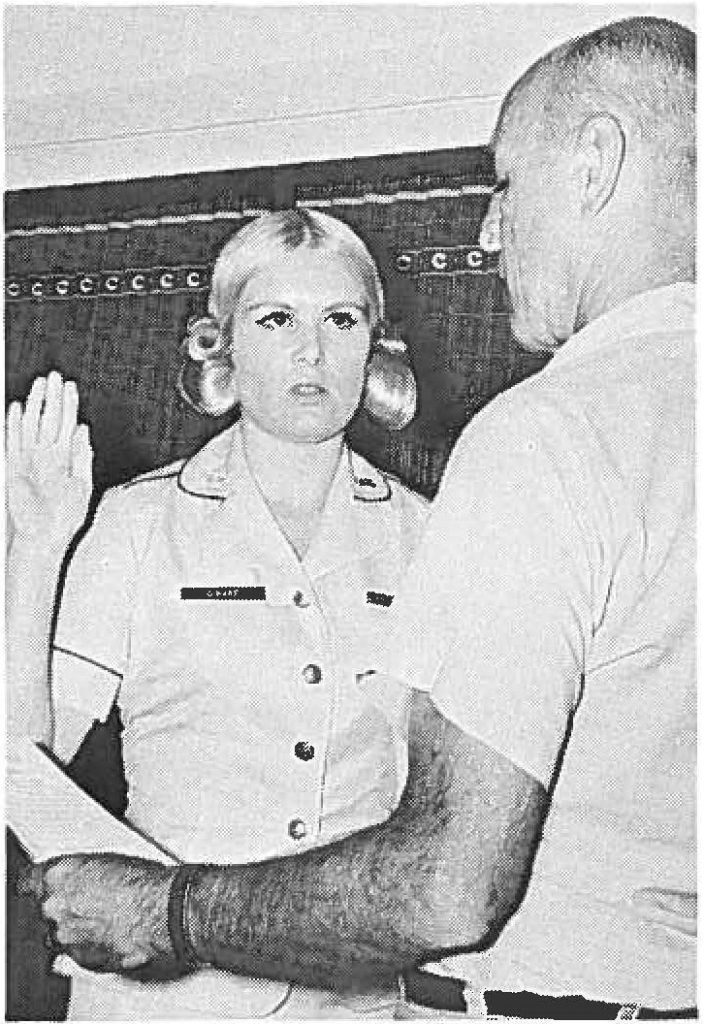
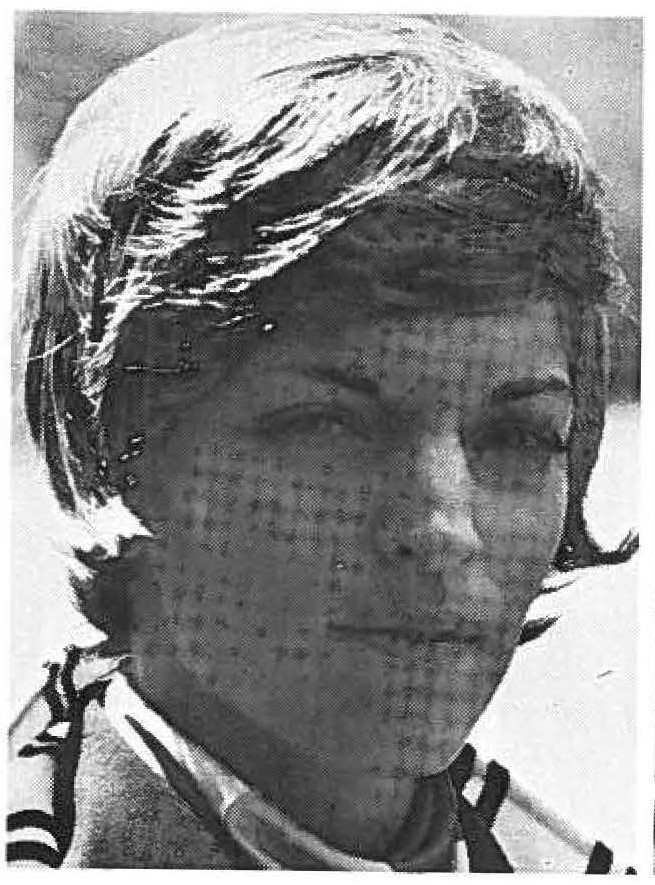
21 July, 1971 the Hawaiʻi National Guard recruited its first woman member, 1st Lieutenant Barbara O’Hare.
A significant change occurred in the personnel area. The Hawaii National Guard’s first woman officer and first woman enlistee were sworn in as members of the 154th Fighter Group. They were First Lieutenant Barbara O’Hare and Airman 1st Class Phyllis Dickens.
The State of Washington broke a 300-year old tradition recently, when it enlisted the first Army National Guard WAC (Women’s Army Corps), SP5 Dora Campbell.
Two days later, Alaska enlisted SP5 Mary L. Cunningham to further the break-through for women.
Here in Hawaii, the Hawaii Air National Guard recruited its first woman member, First Lieutenant Barbara O’Hare, on July 21, 1971 after a yearlong chase from California to Hawaii to Alaska and back.
It wasn’t until 1956, when Congress amended the law, that women could be members of the Guard. Both Army and Air National Guard units began signing up nurses almost immediately.
However, it wasn’t until a year ago that the Air Guard signed up its first WAF (Women in the Air Force ). The Army Guard, because of its combat role, has been faced with a lack of spaces suitable for women. The two first ARNG WACs will be working at their respective State headquarters.
Only non-prior service women in grades E-5 and above are currently being accepted.
The National Guard Bureau and the WAC Directorate in Department of the Army, are analyzing MOSs within the Army Guard Troop structure to determine where other WACs could serve. According to a Bureau spokesman, only a handful of Army Guard units will have openings for WACs.
According to HARNG G-3, Lieutenant Colonel Manuel DeMello, WACs should be authorized in Hawaii’s Army Guard by March 1972. But don’t expect to see an immediate improvement in the HARNG’s appearance. The women will only be authorized in about a half dozen slots in the headquarters detachment. Furthermore, those slots are now occupied by qualified men. So it all amounts to matching a qualified prior-service woman with the correct vacant slot. The immediate chances look slim from here.
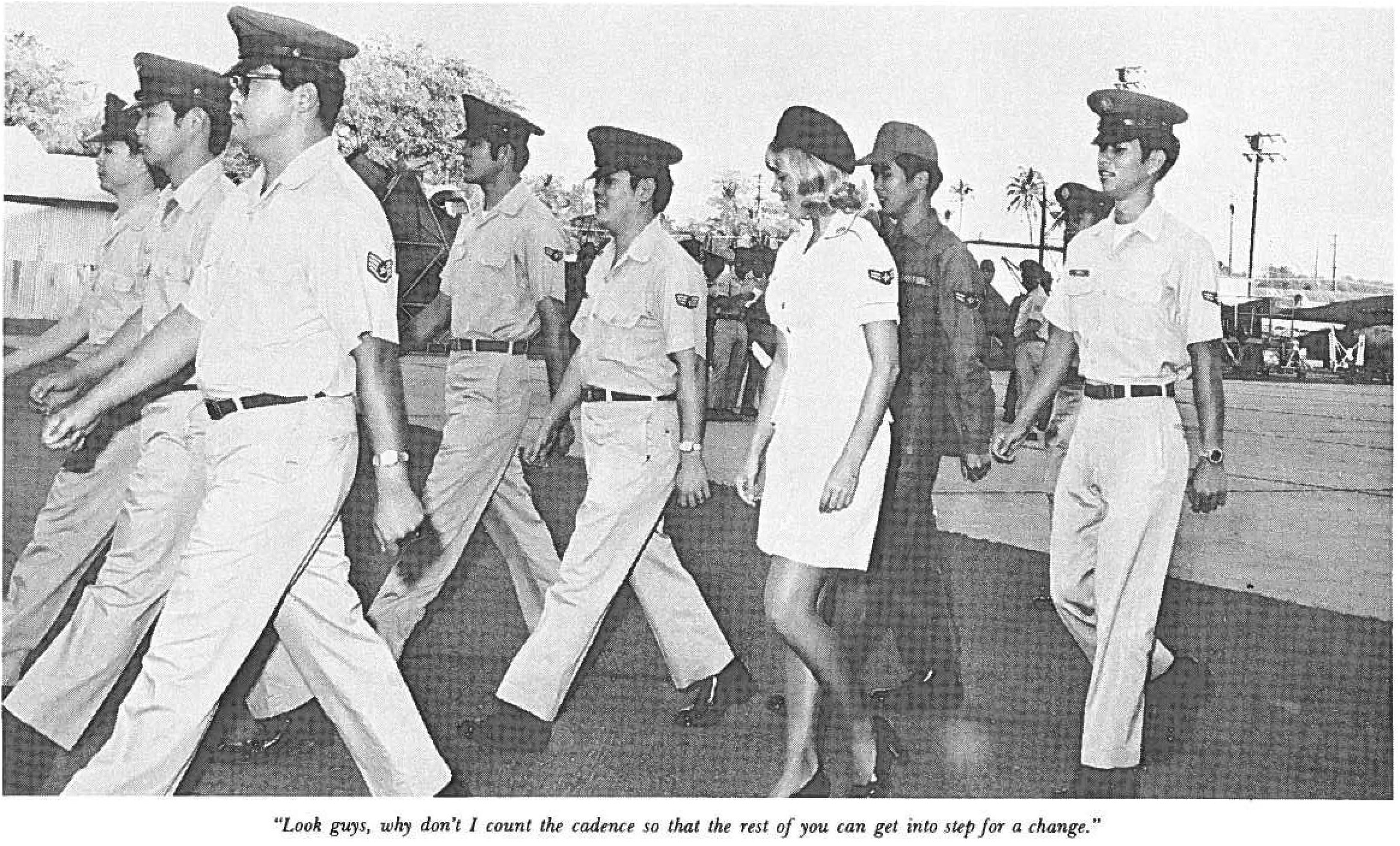
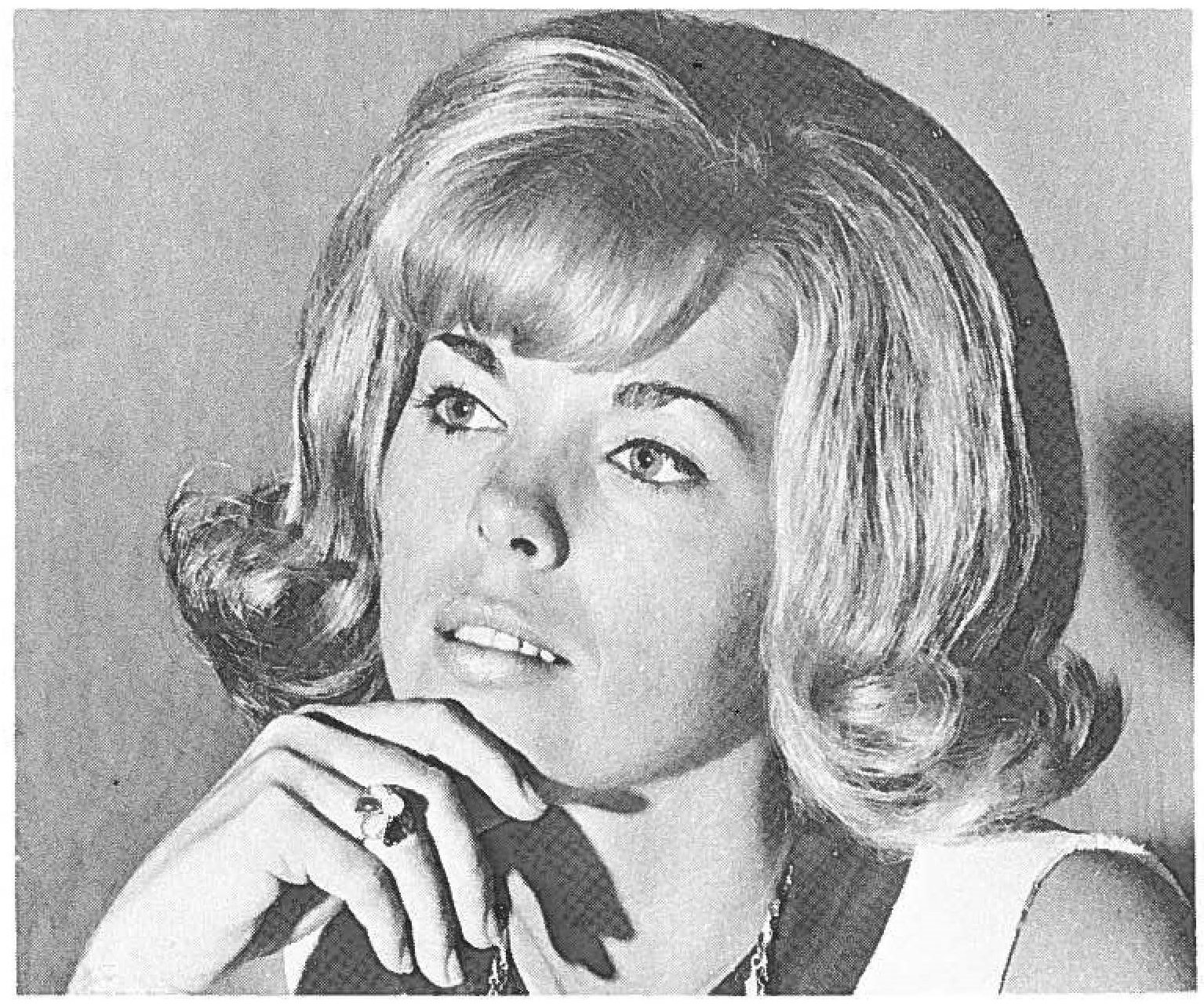
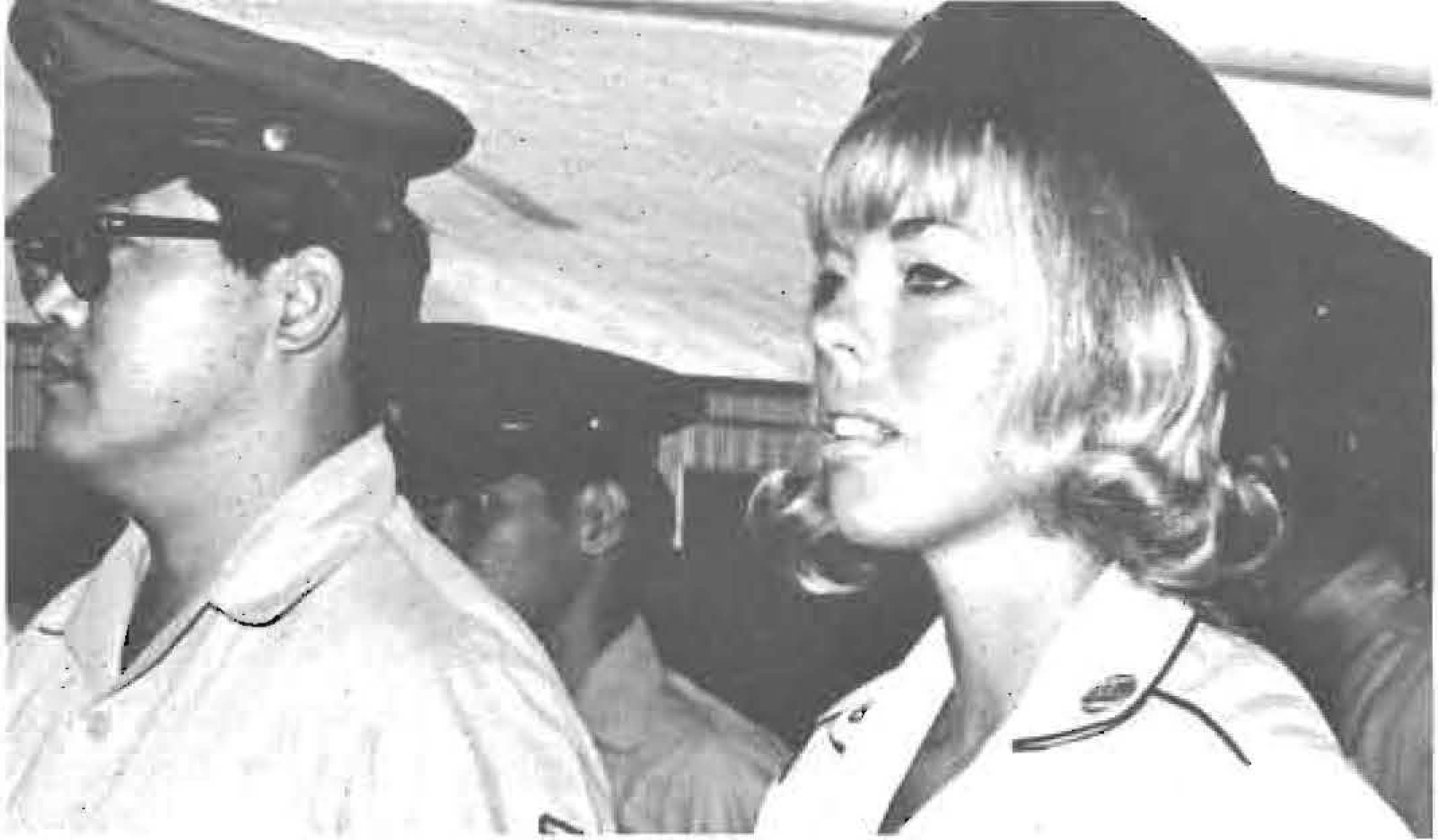
Airman 1st Class Phyllis Dickens is the second woman to join the Hawaiʻi National Guard and the first enlisted woman.
A significant change occurred in the personnel area. The Hawaii National Guard’s first woman officer and first woman enlistee were sworn in as members of the 154th Fighter Group. They were First Lieutenant Barbara O’Hare and Airman 1st Class Phyllis Dickens.
“The old hanger won’t smell the same anymore,” according to Brigadier General Valentine A. Siefermann, Commander of the Hawaii Air National Guard (HANG). There will probably be a hint of Chanel No. 5 mixed in with the scent of jet fuel now that Airman First Class Phyllis Dickens has joined the organization.
“Look guys, why don’t I count the cadence so that the rest of you can get i11to step for a change.”(Pictures from the 1972 Spring The Hawaii Guardsman)
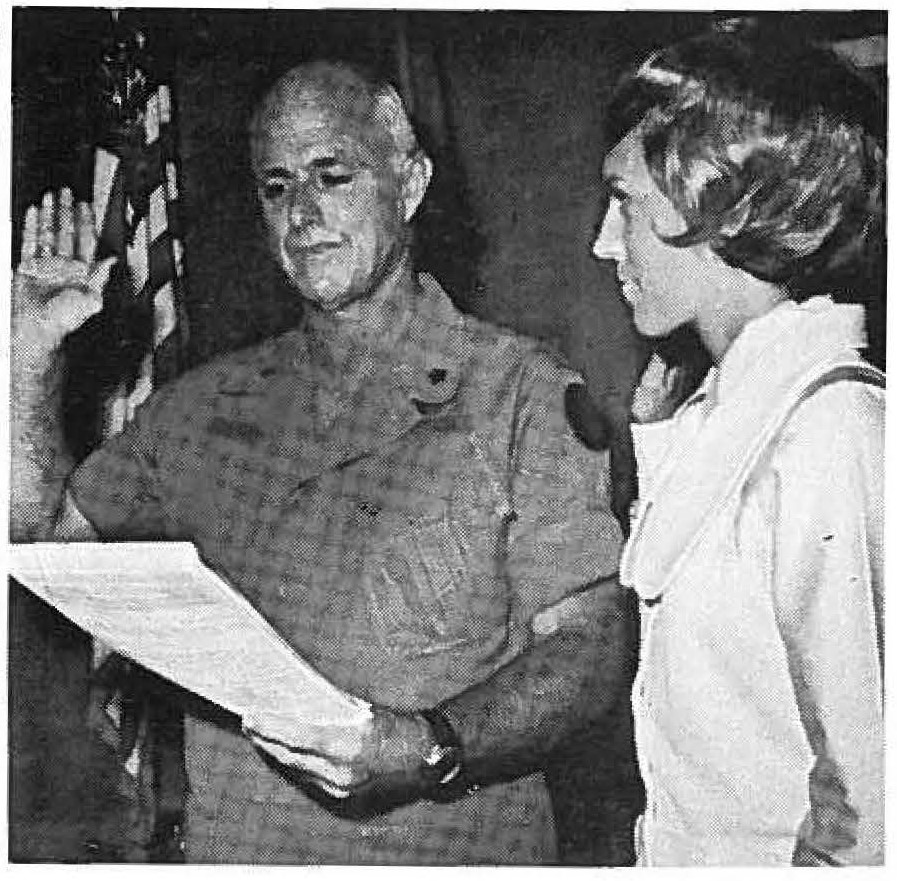
Phyllis is the second woman to join the Hawaii Guard. The first was First Lieutenant Barbara O’Hare who was appointed last June. Phyllis, however, became the first enlisted woman in the Air Guard here when she was sworn in by Major General Benjamin J. Webster, State Adjutant General, a few weeks ago.
The petite blonde from Indiana spent a year in the active Air Force as a WAF (Woman in the Air Force). She later left the service and moved to Honolulu where she became a civilian employee of the 154th Fighter Group.
The Air Guard in Hawaii recently reviewed its personnel requirements and designated about 40 per cent of its jobs as suitable for either men or women. Approximately 60 more vacancies for women exist in the Hawaii Air Guard at this time.
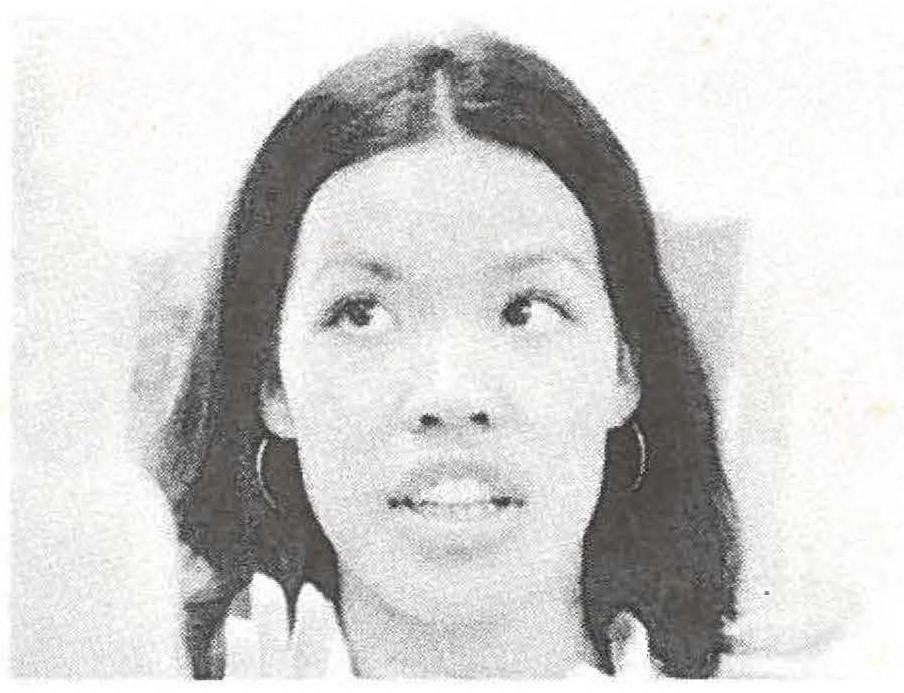
Iris Kabazuwa is the first non-prior service female enlistee to the Hawaiʻi National Guard.
The first WAFs were enlisted in HANG in 1972. Lt. Barbara O’Hare and A1C Phillis Dickens, Iris Kabazuwa was the first non-prior service female enlistee
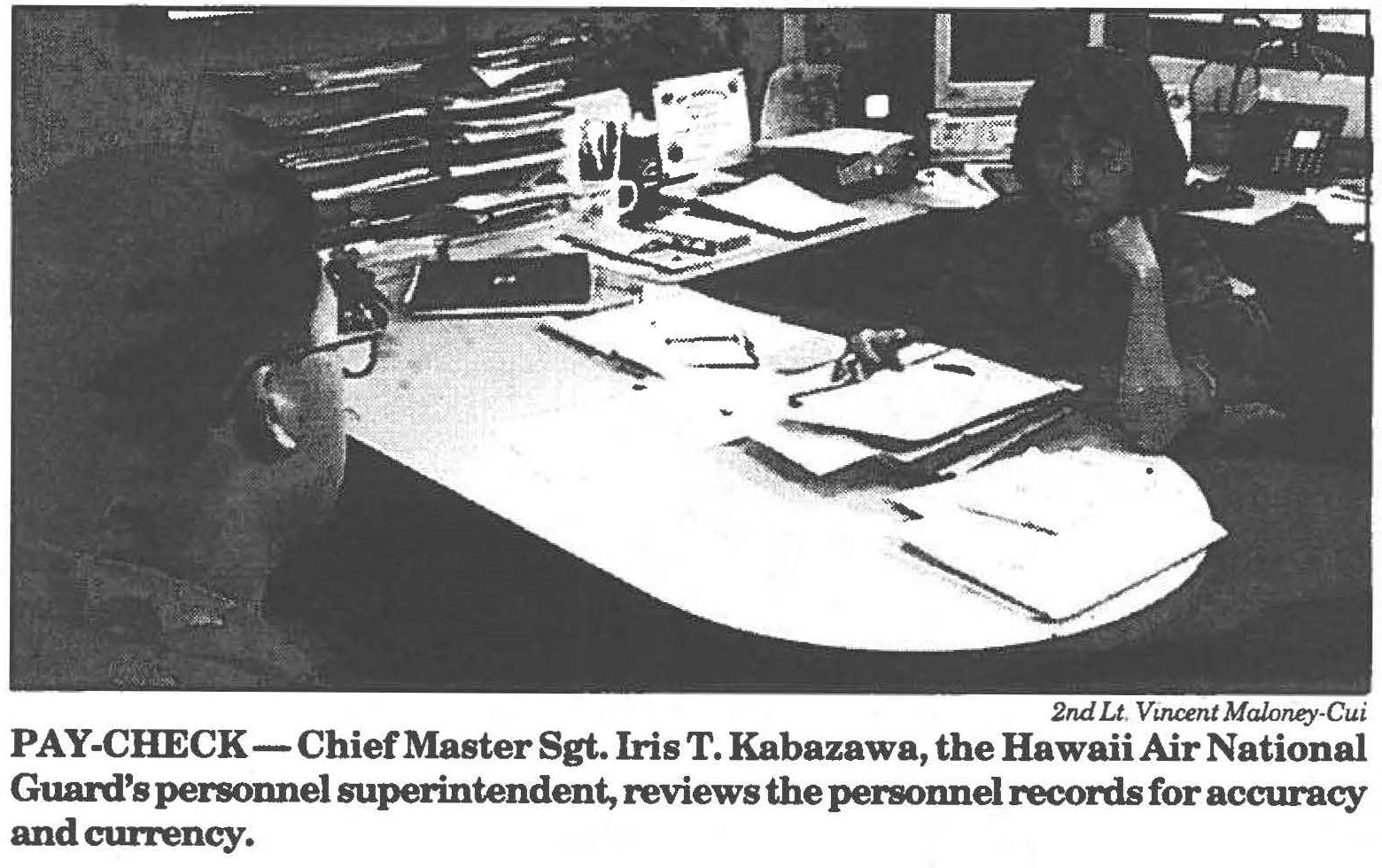
The enlisted female population of the Hawaii Air National Guard doubled with the enlistment of Iris T. Kabazawa. Iris was sworn into HANG recently by BG Valentine A. Siefermann, HANG commander. Iris joined Phyllis Dickens, HANG’s first enlisted WAF.
Asked why she had enlisted in HANG, lris replied, “I guess you can say that this was done to satisfy my curiosity about military life. You see, I have some male friends who are already in the Air National Guard, and ever since they returned from basic training, I noticed that they’re more mature and have a better oulook on life.”
After her basic train ing, Iris will attend Personnel Specialist training at Keesler AFB, Mississippi. Upon her return, Iris will be assigned to the 154th Combat Support Squadron as a personnel specialist.
Miss Kabazawa is a native of Waimea, Kauai, and is a graduate of Waimea High School.
The 150th Aircraft Control And Warning Squadron (Fixed) enlisted two female airmen, Sergeants Janet S. Cox and Eileen N. B. Camat
150TH AIRCRAFT CONTROL AND WARNING SQUADRON (FIXED) The unit enlisted its first women. Two female airmen, Sergeants Janet S. Cox and Eileen N. B. Camat, were assigned as ACW operators. Both had prior service in the Army.
150TH AIRCRAFT CONTROL AND WARNING SQUADRON (FIXED) HIGHLIGHTING THE YEAR 1973: “I don’t know if the squadron was ready for us. but I know I was ready to see if I could compete in a ‘man’s world’ of ACW operations” says SSgt Janet Cox. the first female to be accepted into the squadron. . .
Perhaps the most significant happening for 1973 was the introduction of females to the airman ranks. Women in the Guard? Skepticism prevailed.
The two female pioneers who broke the male barrier were SSgt Janet Cox of Hanapepe and Sgt Eileen Camat of Waimea, both former WACs from the Army. Both decided to get right into “male” territory by requesting positions in the ACW operations career field as radar operators.
Both were sent off to the basic radar operators school at Keesler AFB. Mississippi, qualified as combat ready through OJT at the Kokee AFS, and eventually hired as full time air technicians. SSgt Cox is an administrative / radar operator technician and SSgt Eileen Camat is the first female to work on a 24 hour crew with Bravo Flight. THE MALE BARRIER HAD BEEN BROKEN!
Since that, breakthrough. the squadron’s female count has blossomed to 5. The others include: Sgt Jill Ray of the radio section, SSgt Verna P. Semienick of Administration. AH Estrelita Silva of Administration, and Airman Linda Brooks of Operations.
The first woman in the Hawaiʻi Army National Guard is Linda Lee Woolf, a member of the 117th Public Information Detachment.
The first lady of Hawaii’s ARNG
A 24-year old blonde became the first woman in the Hawaii Army National Guard recently. Linda Lee Woolf was sworn in as a member of the 117th Public Information Detachment by Brigadier General Frederick A. Schaefer, III, commanding general of the Hawaii Army National Guard, at his Fort Ruger headquarters.
Ms Woolf, a communications consultant for Hawaiian Communications, will leave for training on the mainland this month. She will be trained at Fort Benjamin Harrison, Indiana, as an information specialist in the field of journalism and radiotelevision news.
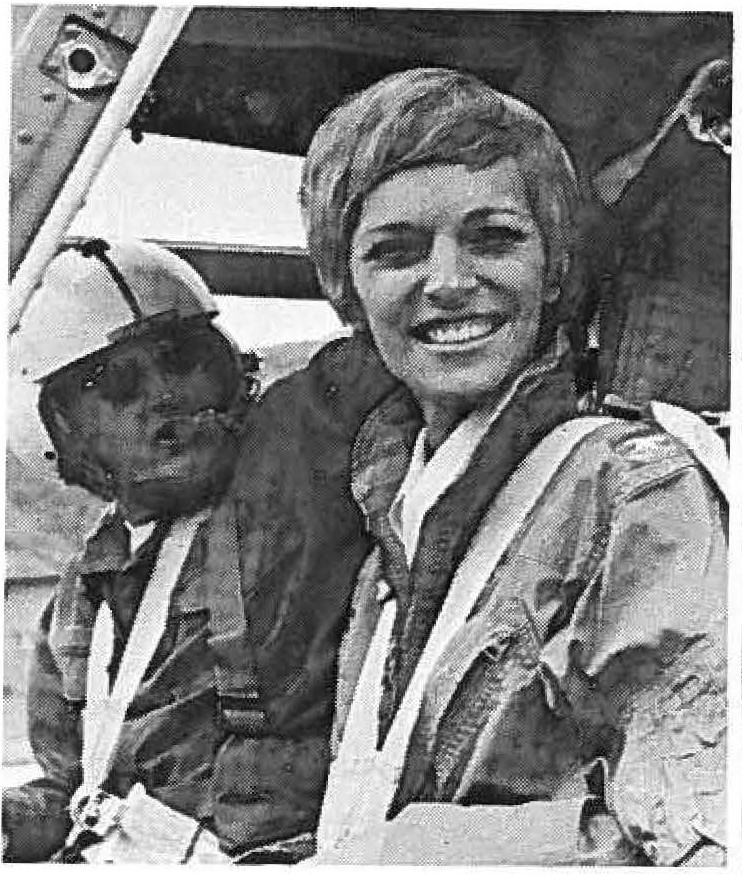
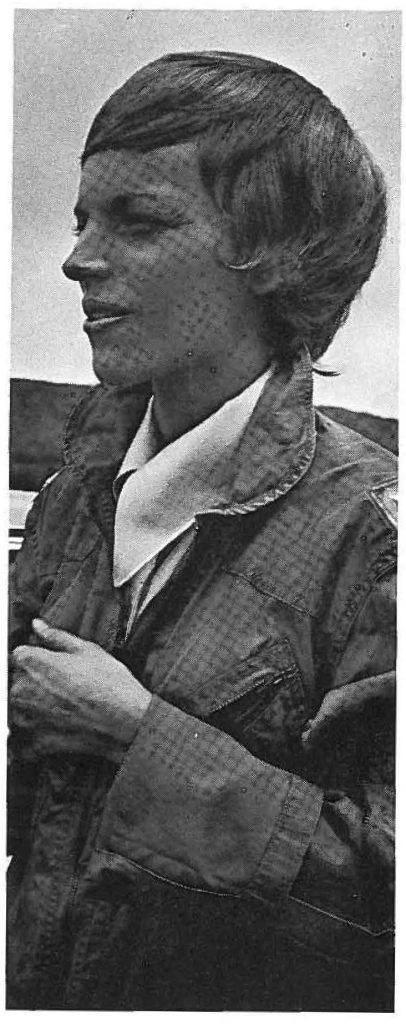
Linda concluded her first day with the Army National Guard with a helicopter ride. The 5-foot 3-inch part time model made the trip in a flight suit, complete with two stars, borrowed from 6-foot 3-inch Adjutant General Valentine A. Siefermann. The suit nevern looked better.
The Army National Guard currently has a number of openings for women in the fields of journalism, administration and communications. Eventually, there could be as many as 600 women in the Army Guard.
AB Aurora Lee became the unit’s first female enlistee of the the 169th.
The 169th, historically an all male outfit, was liberated with the enlistment of AB Aurora Lee on 17 May 1974 Ms. Lee has the distinction of being the unit’s first female enlistee. Shortly thereafter, three other females joined the unit, two of whom had prior service time.
The first father-daughter team in the Army Guard is CWO3 Phillip Gaboya and his daughter PY2 Francine.
Guard fathers enlist their daughters
CW4 Albert Chong of the 297th Supply and Service Battalion, recruited his daughter Ava (left) into the Guard. CW3 Phillip Gaboya of the 298th Field Depot recruited his daughter Francine.(Pictures from the 1974 Summer Pūpūkahi)
Two Army Guard warrant officers like to keep their recruiting in the family. CW4 Albert Chong of the 297th Supply and Service Battalion, recruited his daughter Ava (left) into the Guard. CW3 Phillip Gaboya of the 298th Field Depot recruited his daughter Francine. Colonel Jack Hilburn, the Army Guard’s Senior Advisor, also talked one of his sons into joining the Guard’s aviation unit. Unfortunately, he wasn’t available for a picture, but we can’t fault our senior advisor’s advice.
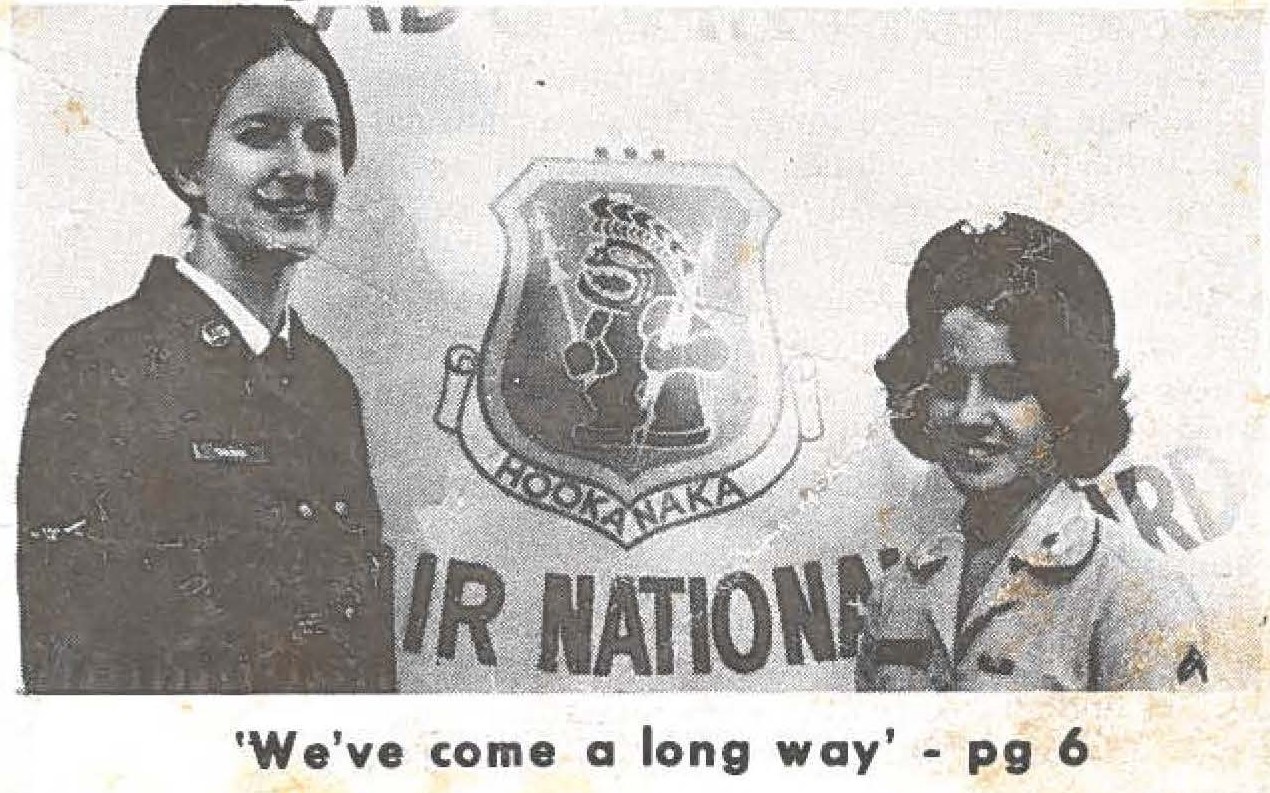
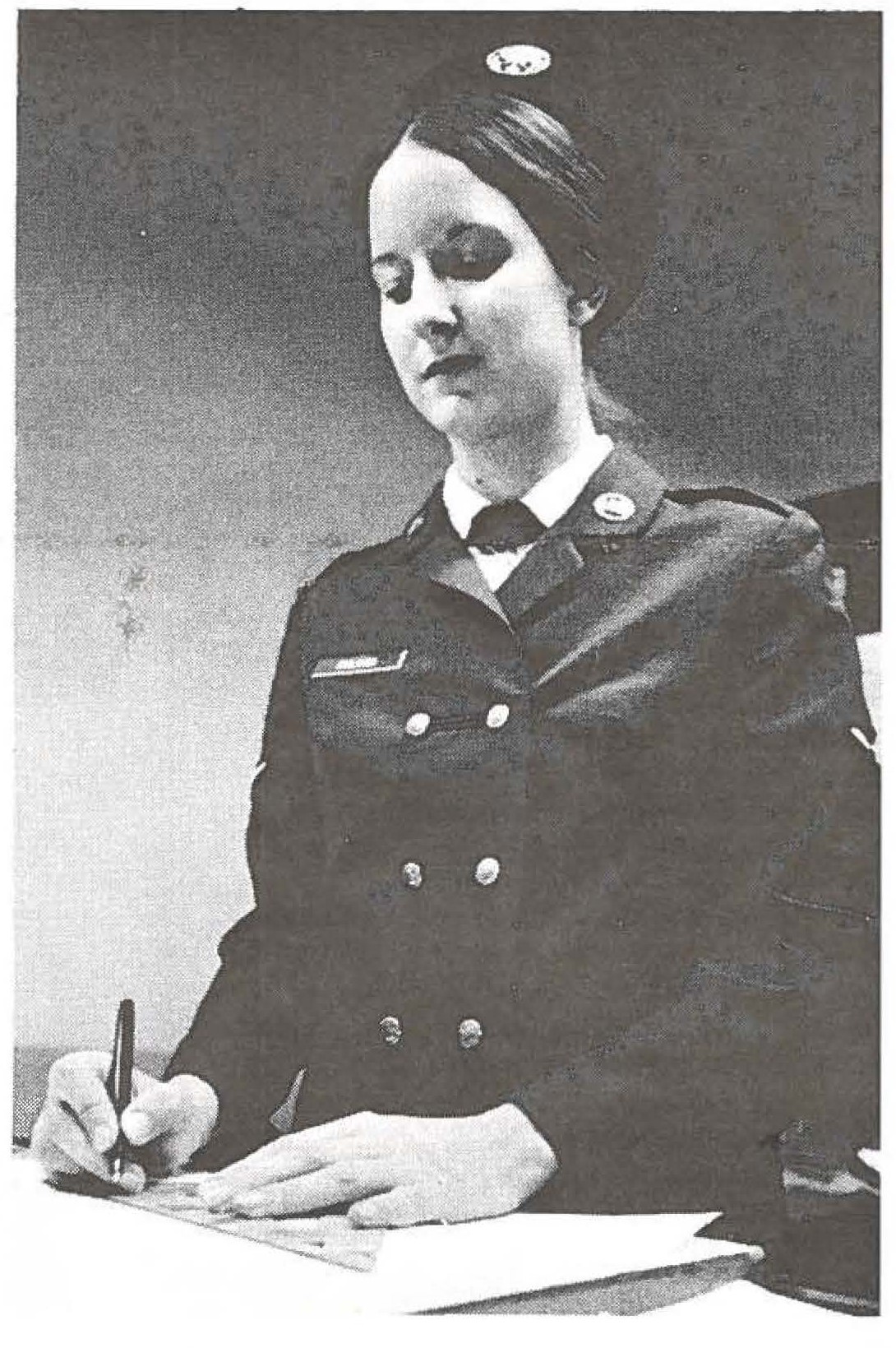
‘We’ve come a long way’ Airman Donna Culman happily at work during a drill weekend with HANG. Donna really feels the Guard and the “guys” in her unit are great. (Pictures from the 1974 Winter Pūpūkahi)
One of the greatest changes in the Hawaii National Guard in years has been the welcome addition of women in our ranks. Not only is the scenery around the armory more attractive, but the atmosphere is changing too: drilling is no longer a weekend with the guys.
At the present time there are very few women, percentage-wise, in both the Air and Army Guard. The Air Guard has 33 ladies of whom four are officers. That puts them ahead of the Army Guard, who has 30, all enlisted. However, plans for the first women’s OCS classes are on the drawing board, and hopefully next year, the Army Guard will graduate its first “female” louie.
The Hawaii NG being the truly liberated organization it is, our ladies are doing all types of “nifty” jobs. The days of the woman behind the desk are fast disappearing. Kauai has three ladies in: the 150th ACW Sq, all air traffic controllers. Sgt Eileen Camat, Sgt Janet Cox and Arnn Linda Brooks, are all presently attending AIT at Keesler AFB in Mississippi. Maui is also proud of PY2 Wendy Kostka, who recently returned from Ft Ord as a supply clerk.
The first father-daughter team in the Army Guard is CWO3 Phillip Gaboya and his lovely daughter (PY2 Francine. Although of different ranks, they have lots of fun comparing notes on the Army from both sides of the fence. Francine is with the 298th Field Depot as a computer key puncher; CWO3 Gaboya is technician with OMS #4.
The Air Guard has Capt. Meriem Saromines, now away at training, who will be a nurse and social action officer upon her return. Joanne Chone, 154th CAM RON Sq, is a newly enlisted recruit who will be leaving for jet engine mechanic training shortly. How liberated can you get?
The 299th Medical Company has perhaps the most women; five including SP4 Lionila Angelias. Armed with her blood pressure reading kit, he checks out recruits as well as annual physicals for those of us who are already in. Now that the medical company has so many attractive ladies, physicals and testing won’t be so hum-drum, right gang?
Of course the 117th has its own horn to toot about women in the Guard. They got the first woman in the Army Guard, and then decided if one was good; two is twice as good. Presto! PFC Sandra Mascoto is now the jovial clerk-typist for the PIO. Her sharp sense of humor and never-ending smile really perks us up!
The Air Guard has CPT Meriem Saromines, now away at training, who will be a nurse and social action officer upon her return. Joanne Chone, 154th CAM RON Sq, is a newly enlisted recruit who will be leaving for jet engine mechanic training shortly.
Although the number of women in the HNG is growing rapidly, only selected units can accept women. Combat and combat support units cannot, for obvious reason. That leaves only Category lll units, however, there are quite a few vacancies up for grabs.
Are women accepted as members of the team? Amn Donna Culman answers, “All the guys in my squadron are really great. When I came for the first drill, they went out of their way to help me get settled and feel like a member of the team. They could have just ignored me, but they didn’t. They treat me like any other member of the gang, and it makes me feel good.”
Francine joins the Army … Guard! An employee with the Bank that says ‘yes,’ Francine said ‘yes’ when her Dad, CW3 Phillip Gaboya, asked her to join the Guard. Francine, having completed her basic and advanced training, is now attending drills with her dad at HHC, 298th Field Depot. (Picture from the 1974 Winter Pūpūkahi)
The recruiting of WAFs continued with considerable success. Most units were now partially staffed with female volunteers. This resulted in an immediate improvement in morale and a general upgrading of the language in some of the formerly all-male shops. The number of women in the Guard increased from 8 to 24, with 2 officers and 23 enlisted women.
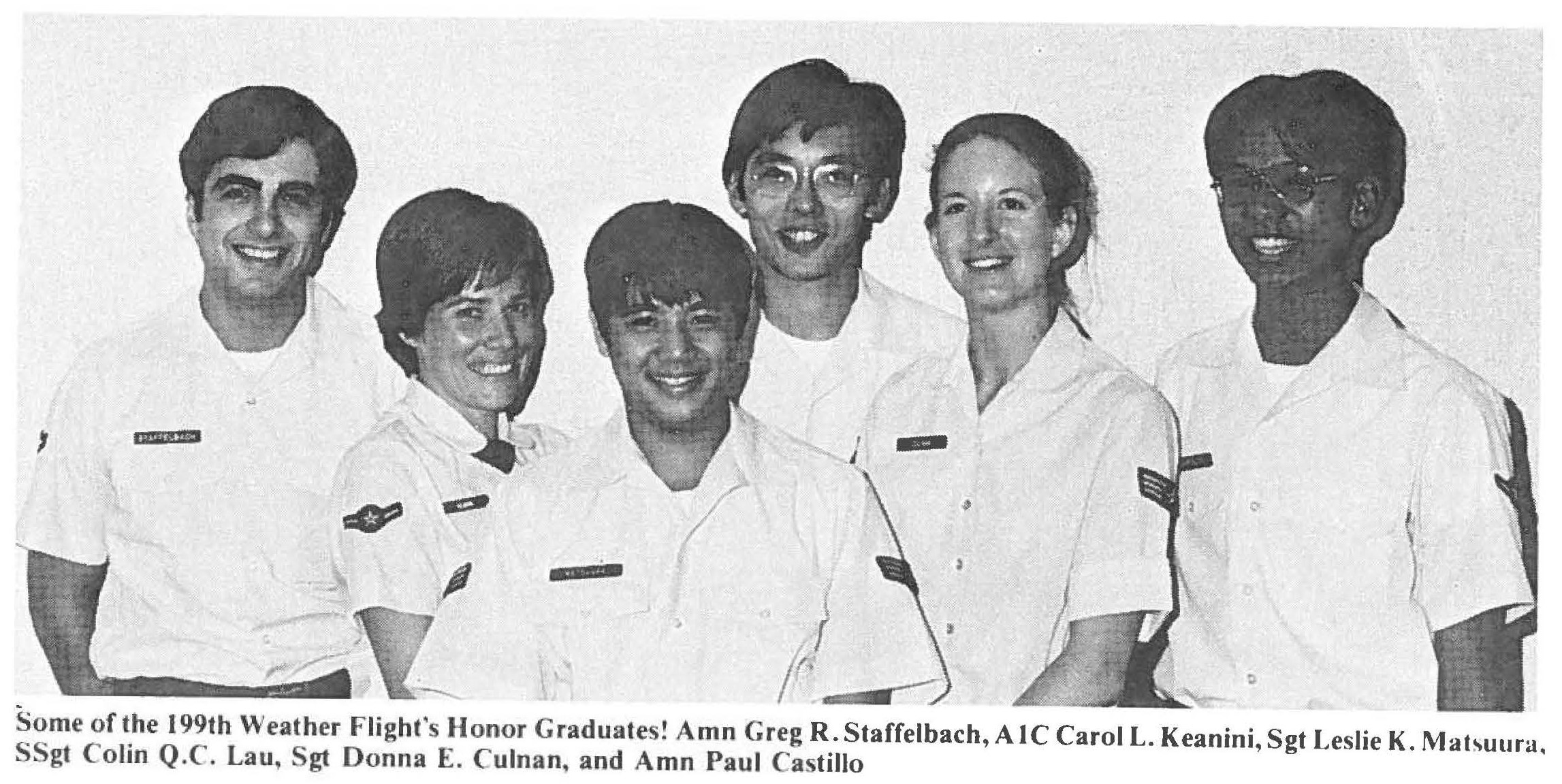
Fiscal year 1974 saw Airman Donna E. Culnan become the first WAF to join the 199th Weather Flight since its inception in 1946. She was also an honor graduate of the weather observer school at Chanute AFB, lllinois.
Joanne Gabeler, a receptionist at the Naniloa Surf Hotel, recently became the first woman to join the Army Guard on the Big Island. She joined the Second Battalion as an administrative personnel specialist.
Joanne is a former WAC specialists fourth class who underwent basic training at Fort McClellan. Alabama and advanced training at Fort Sam Houston, Texas, as a medical corpsman. She then worked at Walter Recd General Hospital at Washington. D. C. and as a social worker at Fort Sam Houston.
Joanne joined the Guard “because I felt it would be a great opportunity to expand my knowledge of military operations outside of a hospital setting.”
One of the Hawaii National Guard’s smallest minority groups made significant gains within the past twelve-month period. There are now 19 women in the organization – 15 in the Air Guard and 4 in the Army Guard.
The HANG contingent includes two officers, Captain Meriem Saromines, social actions officer with the 154th Combat Support Squadron, and Captain Carolyn Beres, a clinical nurse with the 154th USAF Dispensary.
HANG’s enlisted women include Sergeants Eileen Camat and Janet Cox, aircraft control and warning operators with the 150th ACW Squadron at Kokee. Airman Basic Linda Brooks is also an ACW operator at the Kauai unit.
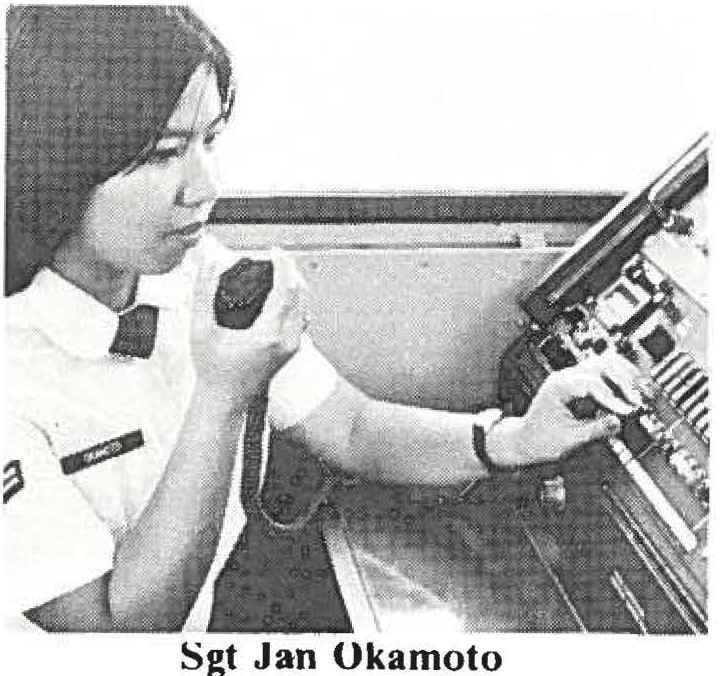
Women in the 201st Mobile Communications Squadron include: Airman First Class Mariko Best, a communication center specialist. Airmen Basic Katherine Castillo, an administrative specialists and Jan Okamoto and Collette Tamburi, air traffic control perators.
Besides Capt. Beres, the 154th USAF Clinic includes Airman First Class Jacqueline Doyle in apprentice medical administrative specialist; Airman Linette Muraoka, a dental specialist; and Airman Nora Takashiba, an apprentice medal service specialist.
HANG has two women in the personnel field Sergeant Phillis Dickens, assigned to HQ HANG at Fort Ruger, and Airman First Class Iris Kabazaa of Hickam 154th Combat Support Squadron.
The 15th woman in the organization belongs to HANG’s smallest unit, the 199th Weather Flight. She’s Airman Basic Donna Culnan aircraft observer.
Three of the Army Guard’s four women are assigned to Fort Ruger units. Two of them are PFC Linda Stevens, a journalist and broadcast specialist with the 117th Public Information Detachment and PVT Sandra Mascoto, a clerk typist with the same unit.
The third woman in the Ruger area is Specialist Four Lionila Angelias, operating room specialist with the 229th Medical Company.
The fourth woman in the HARNG is PVT Gail Warok, a clinical specialist with the 293d Service Company at Honolulu Airport. The progress made during the past year has been significant, however, it appears to be just an indication of changes still to come.
The Hawaii Army National Guard can now offer Island female high school seniors the opportunity to attend drills with pay for up to six months if the enlistee agrees to leave for basic training within 60 days, after graduation.
Prior to this, women could only enlist in the Army Guard, if they were high school graduates. Under the new policy, any female high school senior between the ages of 17½ and 18 – will be able to enlist in the Army Guard and be paid for attending drill assemblies for up to six months while still in school.
However, if she fails to graduate from high school, her enlistment will be voided.
Whee . . . more women are here and what a welcome sight. Latest count shows the following “figures” – HARNG – 229th Medical Company Lionila Angelas, Donna O’Daniels, Terry Phelps, and Rosemarie Soney; 12th AG Company, Katherine Henley and Ululia Sua; Headquarters Company, 298th Field Depot, Francine Gaboya, Vaelua loane and Eveline Palite; Headquarters Company, 297th Supply and Service Battalion, Ava Chong. HANG boasts the following new gals – 169th ACW, Aurora Agbayani; 154th CAM Sq, Johanna Chang. Aloha ladies!
Although great strides have been made in bringing women into the National Guard, the National Guard Bureau says women cannot be assigned to Category I combat units or take combat arms training. In a Bureau letter, Major General Charles A. Ott, director of the Army Guard, noted that WAC officer attendance at basic or advanced courses offered by infantry, armor, field artillery or air defense schools is in violation of Army policy.
Airman Basic Carol Keanini was chosen as an honor graduate from Basic Military Training at Lackland AFB, Texas, scoring in the top 10 percent of her graduating class.
During the fiscal year, the 199th WF had three airwomen observers on board. Airman Basic Carol Keanini was recently chosen as an honor graduate from Basic Military Training at Lackland AFB, Texas, scoring in the top 10 percent of her graduating class. Airman 1st Class Donna Culnan, the first airwoman to enlist in the 199th WF since its inception in 1946, was a recipient of the Hawaii Air National Guard Airman Award which is given twice yearly to outstanding Air Guardsmen.
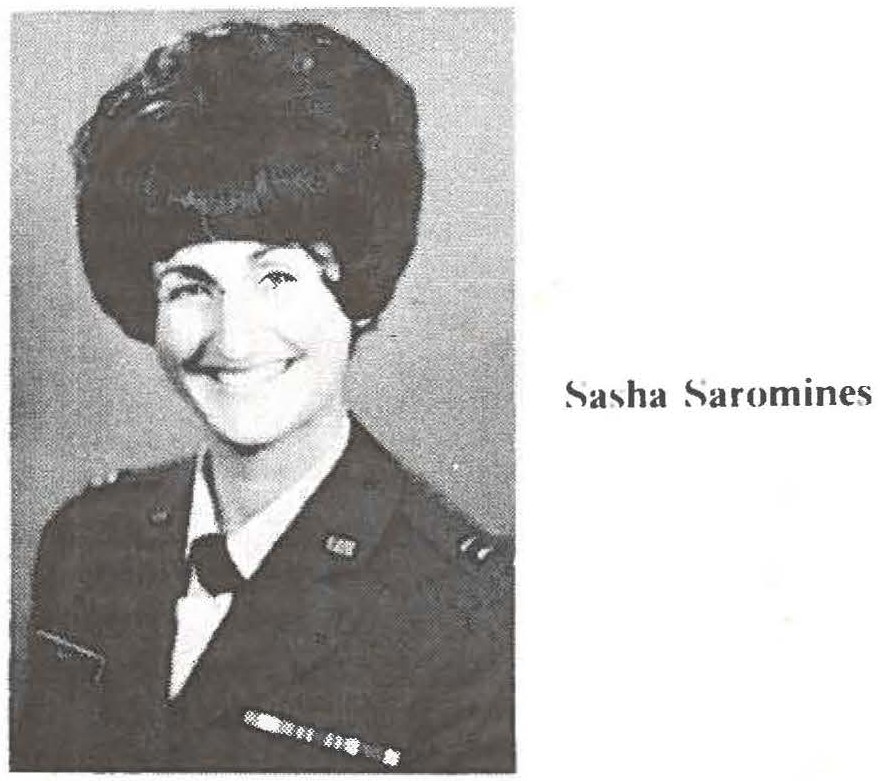
The first “guardswoman”, Sasha Saromines attends the Air Command and Staff College. She was one of 12 air guardsmen to attend the Class of ’75 at the ACSC.
First ‘guardswoman’ at Air College
Staying home was boring
When you first meet Sasha Saromines, little would you guess that, in addition to having a beautiful name. she has also had enough thrills and excitement to last a person a lifetime. Sasha has experienced flying in several combat aircrafts, of being married to a “Hawaii 5-0” star, providing protocol services to General (Ret) and Mrs. Omar Bradley, and spending a day as an escort to a party from the People’s Republic of China when they brought the Panda bears to the United States.
She also devotes one weekend a month for 16 hours to being a captain in the Hawaii Air National Guard where she is assigned to the 154th Combat Squadron as the equal opportunity and treatment officer. Sasha is presently on active duty at Maxwell Air Force Base, Alabama. Where she is the first “guardswoman” to attend the Air Command and Staff College. She was accepted by the National Guard Bureau as one of 12 air guardsmen to attend the Class of ’75 at the ACSC.
Sasha has served seven years with the United States Air Force and while stationed in California, rode in an F-4 Phantom jet and an F-105 Thunderchief. “I was probably the first woman in that area to fly in fighter aircraft.” she recalls. “Normally. because of regulations, women cannot he used in combat positions, so flying in those type of aircrafts was an unusual opportunity.”
After receiving her discharge in Hawaii, Sasha and her husband, Joseph, chose to remain in the islands. Joe became a policeman with the Honolulu Police Department, and Sasha settled down to be a housewife. But the Air Force was still “in her blood” and in 1972, retained her reserve commission and joined the Hawaii Air Guard.
Hubby Joseph has had several minor roles in “Hawaii 5-0” where he has enacted the role he knows the best – a policeman. “They use real policemen because it’s cheaper to film that way, and the uniforms are bona fide,” explained Captain Saromines.
One of the highlights of her protocol assignment in the U.S. Air Force came at Andrews AFB, Maryland. when she provided protocol services to General and Mrs. Bradley.
“I dearly enjoyed Mrs. Bradley, and the General was always a gentleman,” Sasha recalls fondly. Later, General Bradley sent Captain Saromines a personal letter of appreciation for the services she provided.
Reminiscing about the Pandas, Sasha said, “It was fun to pet the bears. and I remember presenting floral leis in the Hawaiian tradition to members, of the party.”
While at Maxwell, she is on a full year of active duty. Upon graduation from ACSC, Sasha will return home to Hawaii and revert to her role of being a housewife.
She is hopeful of obtaining a master’s degree in counseling and guidance from the Troy State branch at Maxwell Air Force Base.
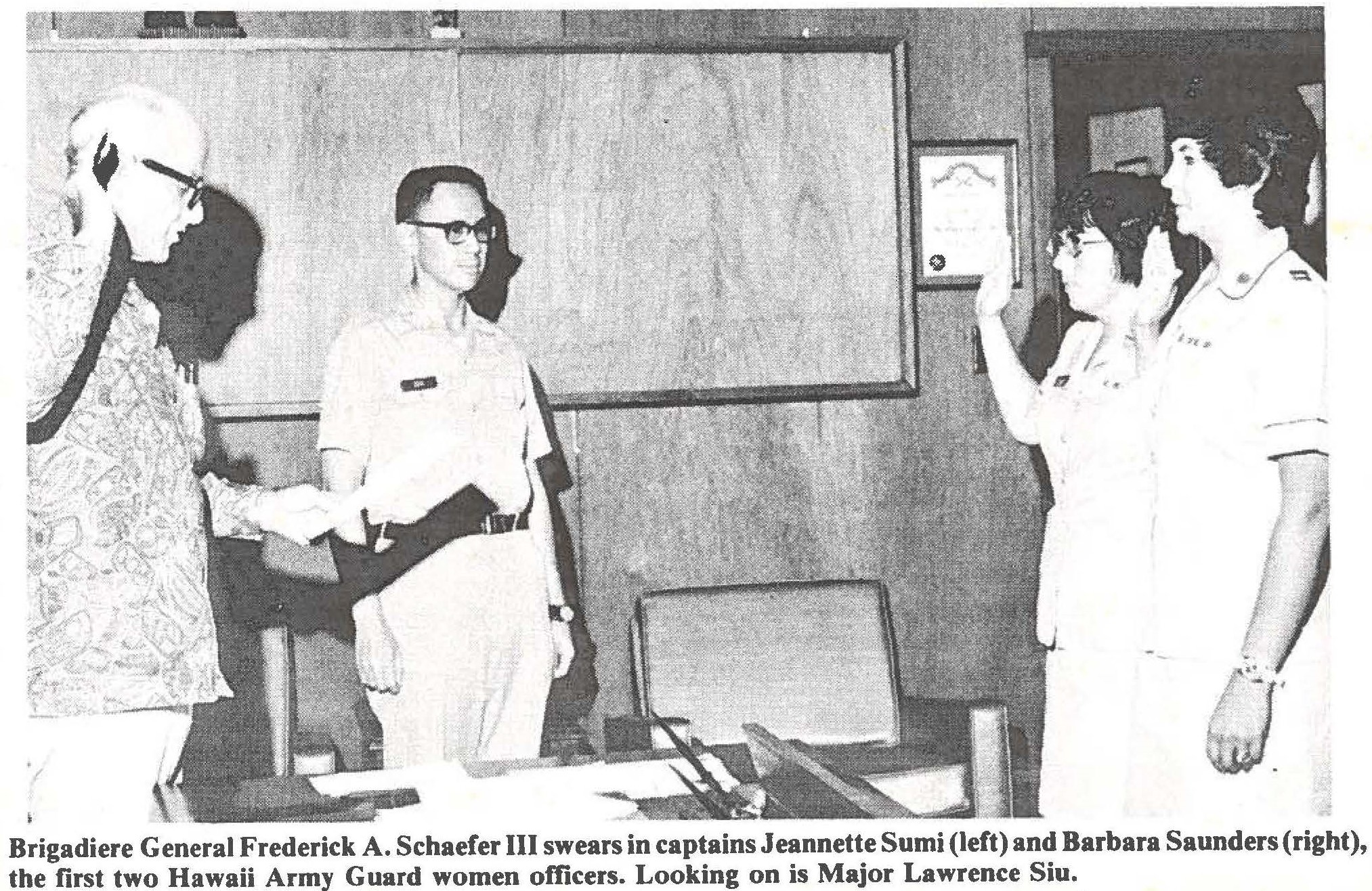
The Hawaiʻi Army National Guard signed it’s first two women officers Captains Barbara Sanders and Jeannette Sumi
Army Guard signs first two women officers
By Ken Kalb 117th PIO Staff Writer
The Hawaii Army National Guard signed up its first two women officers last month. They are Captains Barbara Sanders, originally from Minnesota, and Jeannette Sumi, originally from Vermont.
Ms. Sanders taught school for three years after earning her teaching credential from Mankato State. She then decided to get out of teaching and into the military (July 1968).
“At the time I went to college, women were only going into nursing or teaching,” said Ms. Sanders. “Since I didn’t like to see sick people, I went into teaching.”
But Ms. Sanders “didn’t care for teaching” all that much and went on active duty as a first lieutenant. She was a recruiting officer in Southern California, a protocal officer and chief of the readiness branch in Ft. Mead, Md., before arriving in Hawaii in April, 1975.
Her husband, Robert, is a lieutenant commander in the Navy here. She then decided to join the Guard, where she has been assigned to the Race Relations/ Equal Opportunity office.
Ms. Sanders looks on her position as the first (along with Ms. Sumi) woman officer in the Guard as a “challenge” and in a way a kind of a pioneer.
“I’ve always been the only woman officer, but I hate to have to keep proving myself to everyone,” said Ms. Stevens, who has also played string base for three symphony orchestras. “I wonder why I’m only the first woman officer. Hawaii has had a Guard a long time.”
Ms. Sumi graduated from the University of Vermont and spent two years teaching second grade in her home state. She then joined the Army and wen’t to San Pedro for two years active duty. She then got out of the army, but was given a job in Germany teaching military dependents.
“I got into the army mainly for experience,” said Ms. Sumi. “I was born and raised in a small town and the army broadened my perspective.”
She arrived in Hawaii in July, 1974. Her husband, Eugene, is a captain at Schofield Barracks. Ms. Sumi just finished getting her masters degree. in education through an extension course offered by Pepperdine, and decided to join the Guard.
“I enjoy working with the military on a part-time basis and it’s not bad part-time money,” said Ms. Sumi.
She will also be assigned to the Race ‘Relations/ Equal Opportunities office.
Brigadiere General Frederick A. Schaefer III swears in captains Jeannette Sumi (left) and Barbara Saunders(right), the first two Hawaii Army Guard women officers. Looking on is Major Lawrence Siu. (Picture from the 1975 Autumn Pūpūkahi)
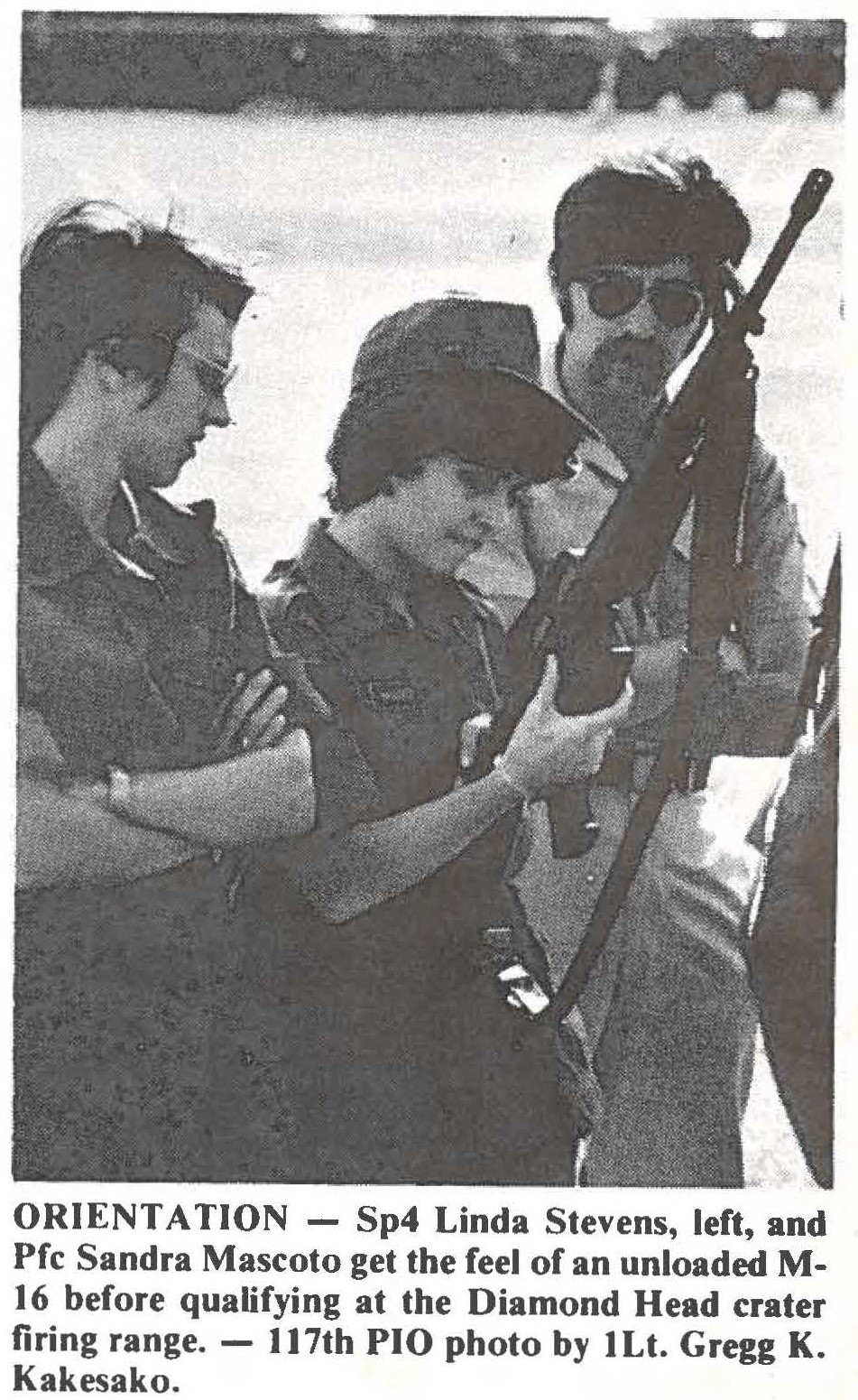
The Hawaiʻi Army National Guard female members are required to undergo weapons qualifications on the same basis as male members.
Female Army guardsmen required to qualify with M-16 rifles July 1
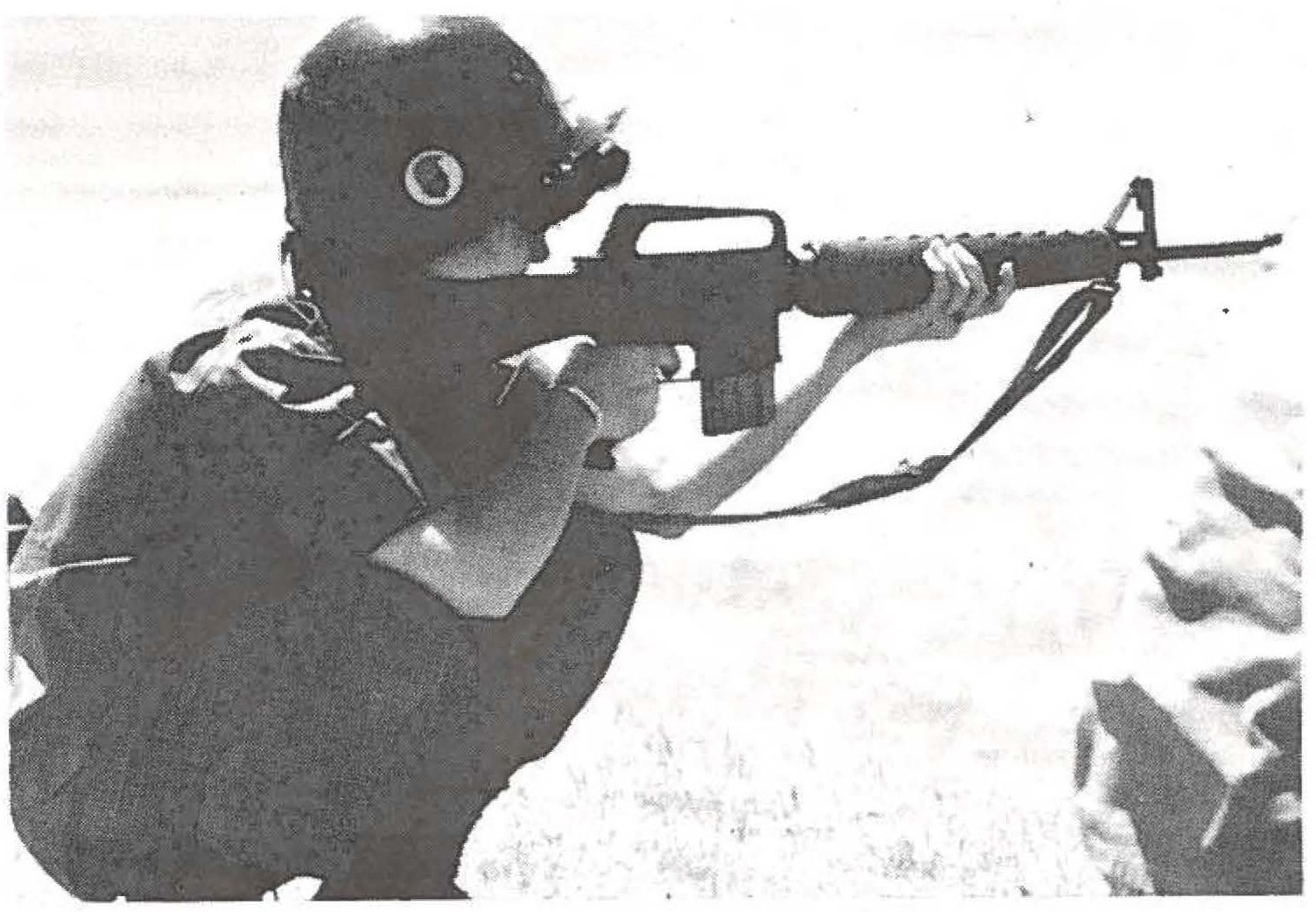
ORIENTATION – Sp4 Linda Stevens, left, and Pfc Sandra Mascoto get the feel of an unloaded M16 before qualifying at the Diamond Head crater firing range. – 117th PIO photo by 1 Lt. Gregg K. Kakesako. (Picture from the 1975 Summer Pūpūkahi)
Equality among the sexes in the Hawaii Army National Guard has even extended to the firing range with female members required to undergo weapons qualifications on the same basis as male members beginning July 1.
Under the new revised Army policy, all female Army Guard enlistees must acknowledge that they are also volunteering for weapons qualification with the standard Army rifle – currently the M-16. They will have to sign the following statement: “In connection with my enlistment, I hereby acknowledge that enlistment serves as my volunteering for basic weapons qualification and familiarization training.”
However, women will still not be subjected to combat training nor will they be separated from the service if they fail to qualify with a weapon, according to Col. Saburo Ito, HARNG GI.
Ito says that the new regulation in no way conflicts with current Army policy forbidding women to participate in combat, nor does it advocate the utilization of women in any combat-oriented career field.
The revised policy does provide, however, for women the capability of defending themselves or their unit if the need ever arises.
Women currently in the Army Guard will not be required to undergo weapons training during their current enlistment. ‘However, in order to re-enlist, they must be willing to take weapons training.
Female Army guardsmen required to qualify with M-16 rifles July 1(Picture from the 1975 Summer Pūpūkahi)
The number of women in the Air Guard increased almost 100% as the female contingent increased to 49: 4 officers and 45 enlisted women. Many of the women entering the Guard selected training in such areas as maintenance and air traffic control rather than the more traditional administrative areas. Their aggressiveness and ability were becoming evident as many returned from Air Force schools as “Distinguished Graduates.”
150th Aircraft Control and Warning Squadron (Fixed) The squadron’s female count increased to 5 with one enlistee electing to enter the antenna maintenance repair career field, a position that requires working on 90-foot antenna poles.
Scaling the ladder of success and spotting their ranks are: WO1 Melvin Chock (298th Engineer Detachment) and WO1 Joseph Nakoa (487th). Both are 1953 St. Louis grads and Joe was “pinned” by his Commander, Major Louis Perry, another Crusader classmate . . . LTC Alvin Cabrinha (HARNG), Captains Bob Fishman and William Rennie (HARNG), LTC’s Tad limura, John Lee, 1LT Robert St. Clair and 2LT Sally Hall, the first women aircraft maintenance officer and Congrats to LTC Morio Takahashi.
From a manpower level of around 70 percent in 1970, the Hawaii Army National Guard has soared to a strength level of 96.4 percent – the highest it has ever been since the 29th Brigade went off active duty in 1969. Figures for the Air Guard are a little lower – 91.3 percent. Of the 1,544 persons in the Air Guard, 44 are women.
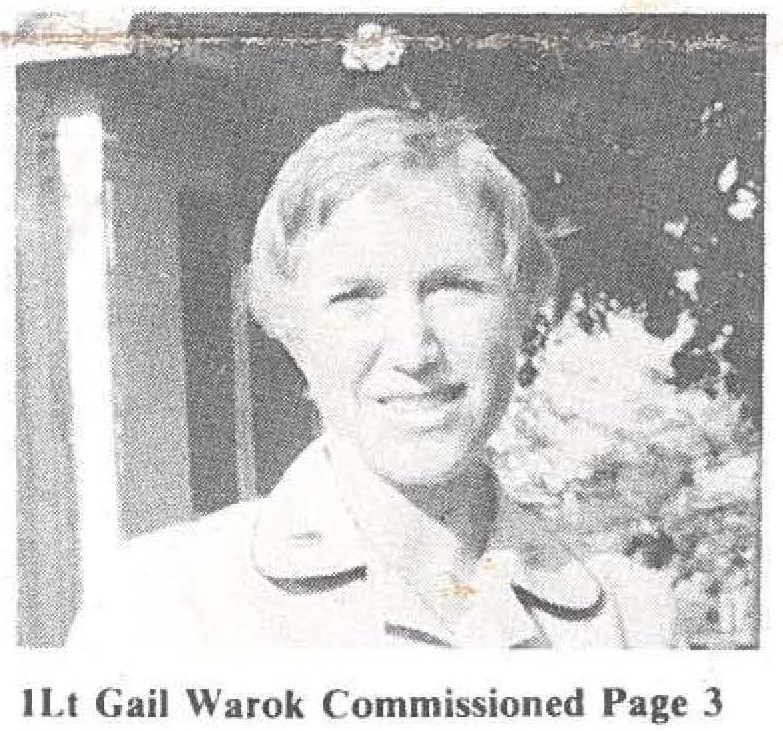
The first enlisted woman, 1st Lt Gail Warok become an officer in the Hawaiʻi Army National Guard under the Direct Commission Program.
1Lt Gail Warok receives direct commission
By SSG Joe Ruttle 117th PID Staff Writer
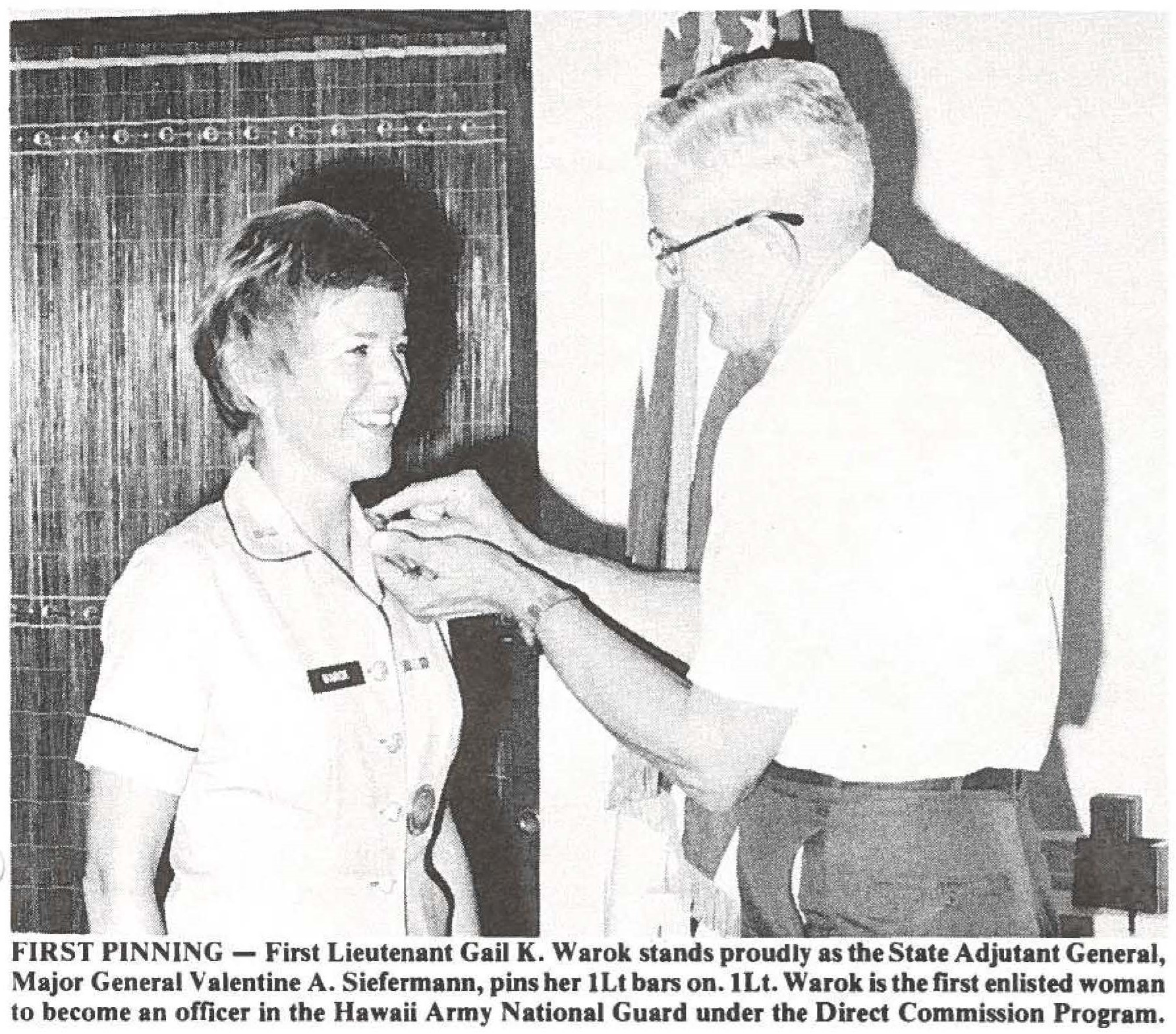
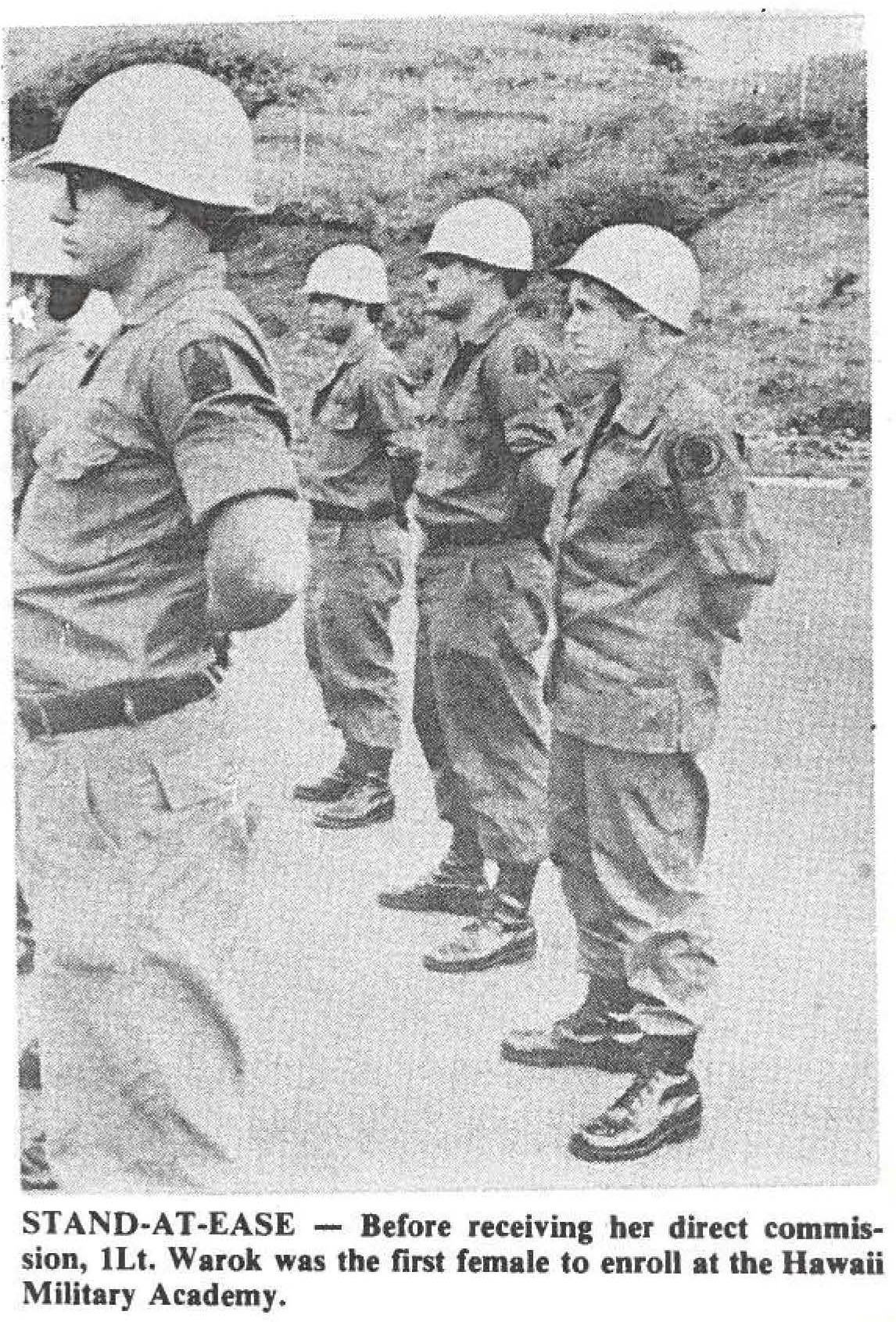
FIRST PINNING – First Lieutenant Gail K. Warok stands proudly as the State Adjutant General, Major General Valentine A. Siefermann, pins her 1Lt bars on. 1Lt. Warok is the first enlisted woman to become an officer in the Hawaii Army National Guard under the Direct Commission Program.STAND-AT-EASE – Before receiving her direct commission, 1Lt. Warok was the first female to enroll at the Hawaii Military Academy(Pictures from the 1976 January Pūpūkahi)
The first enlisted woman to become an officer in the Hawaii Army National Guard under the Direct Commission Program had her bars pinned on at Ft Ruger last month.
Gail K. Warok, formerly a clinical specialist with the 293rd Services Company (Aircraft Maintenance), received her commission as a first lieutenant in the Adjutant General Corps and was assigned to the 12th AG Company.
A native of Berkeley, Calif., and a graduate of Santa Clara University where she studied psychology, Miss Warok came to the Islands in 1969 to do graduate work at the University of Hawaii.
In August 1973 she became the second woman to enlist in the Hawaii Army National Guard. After basic training and AIT, she spent 10 months at Ft Lewis, Wash., where she received training to qualify as an Army practical nurse.
Miss Warok works as a recruiter for the Hawaii Army National Guard in her full-time job.
In July she was the first woman to enroll in the National Guard’s Officer Candidate School, however, midway through the course her application for a direct professional commission was approved.
“Ever since joining the Guard I wanted to become an officer,” she told the Pupukahi. “I felt that with my educational background I could qualify for more responsibility. OCS afforded me the opportunity to learn the basics of management.”
“Management training at OCS included classes in effective speaking and writing, as well as experience in different leadership positions.”
“Attention to detail was stressed along with working under pressure.”
“Each candidate was also given experience in different leadership positions.”
When asked if the program provided a solid foundation in management skills, she replied, “It is only a beginning. The rest has to be acquired through further education and work experience.”
As part of her military obligation Miss Warok will attend the 11 week WAC officers’ orientation at Ft McClellan, Ala., this month.
Then she will travel to Ft Benjamin Harrison, Ind., for the Adjutant General Corps Basic Course and the Defense Information Officer School.
The first woman, 1st Lt. Gail Warok enrolled in the Hawaiʻi National Guard’s Officer Candidate School
1Lt Gail Warok receives direct commission
By SSG Joe Ruttle 117th PID Staff Writer
FIRST PINNING – First Lieutenant Gail K. Warok stands proudly as the State Adjutant General, Major General Valentine A. Siefermann, pins her 1Lt bars on. 1Lt. Warok is the first enlisted woman to become an officer in the Hawaii Army National Guard under the Direct Commission Program.(Picture from the 1976 January Pūpūkahi)
The first enlisted woman to become an officer in the Hawaii Army National Guard under the Direct Commission Program had her bars pinned on at Ft Ruger last month.
Gail K. Warok, formerly a clinical specialist with the 293rd Services Company (Aircraft Maintenance), received her commission as a first lieutenant in the Adjutant General Corps and was assigned to the 12th AG Company.
A native of Berkeley, Calif., and a graduate of Santa Clara University where she studied psychology, Miss Warok came to the Islands in 1969 to do graduate work at the University of Hawaii.
In August 1973 she became the second woman to enlist in the Hawaii Army National Guard. After basic training and AIT, she spent 10 months at Ft Lewis, Wash., where she received training to qualify as an Army practical nurse.
Miss Warok works as a recruiter for the Hawaii Army National Guard in her full-time job.
In July she was the first woman to enroll in the National Guard’s Officer Candidate School, however, midway through the course her application for a direct professional commission was approved.
“Ever since joining the Guard I wanted to become an officer,” she told the Pupukahi. “I felt that with my educational background I could qualify for more responsibility. OCS afforded me the opportunity to learn the basics of management.”
“Management training at OCS included classes in effective speaking and writing, as well as experience in different leadership positions.”
“Attention to detail was stressed along with working under pressure.”
“Each candidate was also given experience in different leadership positions.”
When asked if the program provided a solid foundation in management skills, she replied, “It is only a beginning. The rest has to be acquired through further education and work experience.”
As part of her military obligation Miss Warok will attend the 11 week WAC officers’ orientation at Ft McClellan, Ala., this month.
Then she will travel to Ft Benjamin Harrison, Ind., for the Adjutant General Corps Basic Course and the Defense Information Officer School.
STAND-AT-EASE – Before receiving her direct commission, 1Lt. Warok was the first female to enroll at the Hawaii Military Academy(Picture from the 1976 January Pūpūkahi)
Prior to the reorganization, the 201st CMBTCS conducted its annual field training with full tactical air base deployment to the island of Lanai. The 201st CMBTCS took over the Lanai Airport operation for a two week period. It deployed approximately 125 officers and airmen. For the first time, the deployment team included several women of the ANG. They performed with distinction working beside their airmen counterparts under less than ideal field conditions.
Can women on Kauai join the Army National Guard? Well, if the new commander of Company B, 1st Bn, 299th Infantry had his way, guardswomen would be training right alongside men at the Hanapepe Armory.
While the Hawaii Army National Guard has a number of guardswomen on Oahu, Kauai does not have any women members … yet.
First Lieutenant Theodore A. Daligdig III. Kauai’s new commander for the Guard’s infantry company feels that women on Kauai should be able to join Hawaii’s Army National Guard.
If joining the Guard is as popular with the girls on Kauai as it is in Honolulu, the lieutenant could have a long line of women at his office door. According to Daligdig, positions for women, however, must first be authorized.
Until positions for women are authorized, the lieutenant must continue to fill the few vacancies in his company with men.
Lieutenant Daligdig assumed his new command from Captain Melvin Cummings who has joined the staff of the 1st Battalion, 299th Infantry as its S-2.
A fuel utility supervisor with the Lihue Sugar Plantation, the lieutenant’s future plan for the Guard on Kauai includes filling most of the unit’s remaining vacancies and assisting the community with conservation related projects.
He is a 1968 graduate of the Hawaii National Guard’s Officer Training Academy and was educated at Kapaa High School and Kauai Community College. A Vietnam veteran, he is married and has three sons.
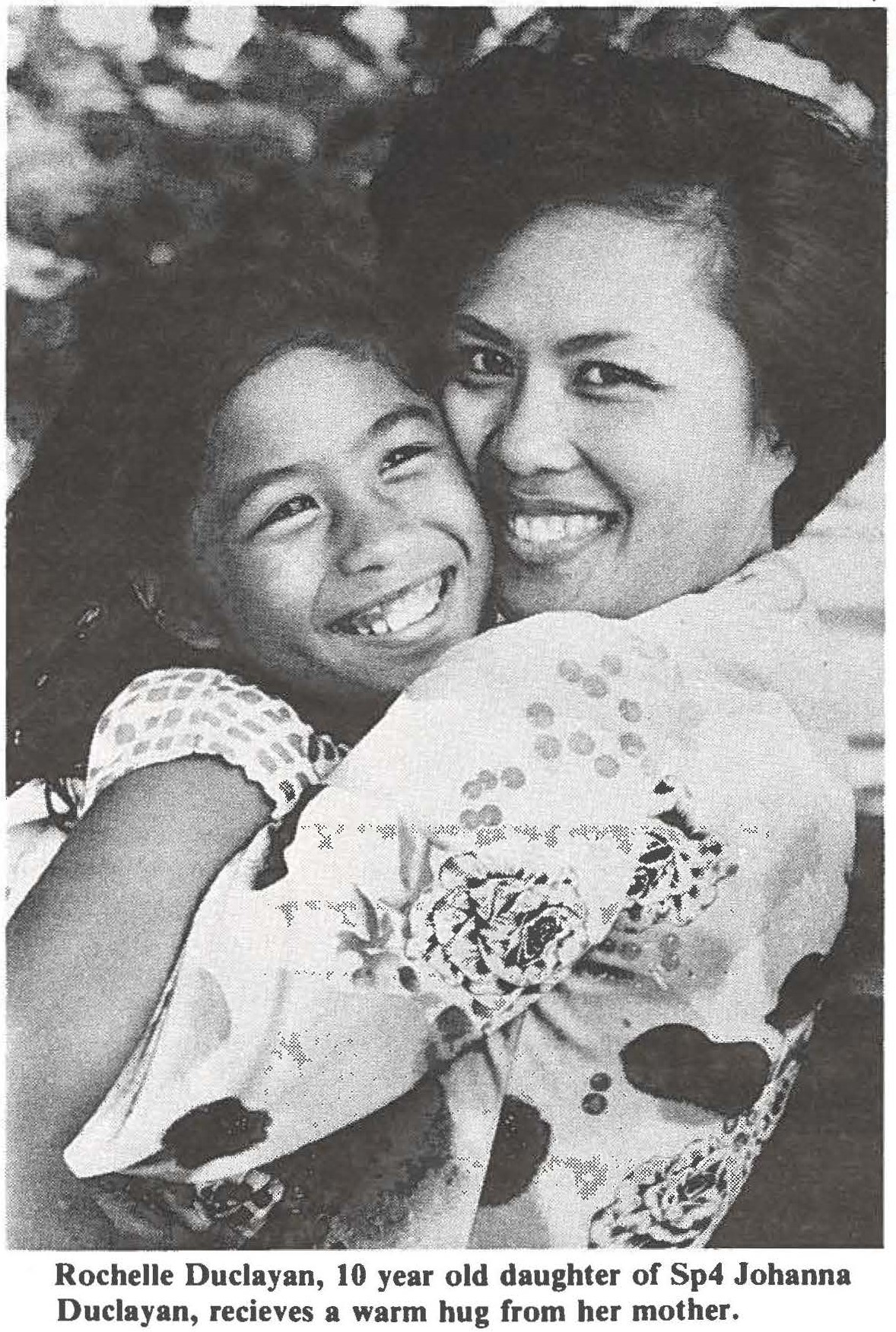
Rochelle Duclayan, 10 year old daughter of Sp4 Johanna Duclayan, receives a warm hug from her mother. (Picture from the 1976 July Pūpūkahi)
“JOIN THE ARMY GUARD! FEMALES 18- 35 YEARS OF AGE, THE ARMY GUARD NEEDS YOU!!” Does this sound like a standard recruiting poster blurb?
How many times have you passed a poster like this and never gave it a second thought? Well, I did many times. I thought it was the right type of organization for younger women to join; younger women with no obligations to job, husband and/ or children. So, from that view point, I never pursued the issue.
The idea now seems so far away.
Today, I can proudly say that even though I’m 31 years old, married, with three children ( 10, 9, and 7 years old), and employed in a secure job, I am in the Army National Guard. I went through the Army’s basic training and passed!
I voluntarily enlisted in the Hawaii Army National Guard in September of 1975. This was after being influenced by the varied programs and job trainings that were offered. All you can handle for the mere price of giving a few hours a month to 1 your unit for a specific number of years.
I was also informed that if I accept this offer, I would have to go through basic training for seven weeks at a training center for women on the mainland and that I had the opportunity to attend Advanced Individual Training (AIT) for my qualified Military Occupational Skill (MOS).
But, because of my civilian skill (licensed practical nurse, with experience in working in a hospital and training school for the mentally retarded, private hospitals, and presently working as a psychiatric aide), I was qualified to enlist under the Civilian Acquired Skills (CAS) program.
Under this program I was ordered to active duty for the period of basic training and then returned to my home unit to assume my National Guard status. The thought of leaving for that long a period of time was really the hardest to accept and to adjust to, not only for me but for my whole family. During the months prior to my leaving, we psychologically prepared ourselves for that actual separation.
During those months prior to separation, it helped me to voice my anxieties, my fears of not knowing what to expect out of basic training and my doubts as to whether or not I might be able to perform as well as the younger women in training with me.
For the individual members of my family, the separation would be a time without that special person who yells at them, scolds them, referees their fights, gets them ready for school and work, cooks their meals whenever they want to eat, washes their clothes, and cares for them and loves them.
We all knew, though, that we could and would survive because we had set a goal, and we would work together to accomplish this.
To attend basic training, with or without AIT, you, yourself, have to be psychologically prepared to follow through, must be in good physical condition, and should be striving to reach your goal – what do you want out of this training?
Basic training will affect you in whatever way you want it to – your attitude plays an important role during this time of decisions and desires. If you’re trying to escape and you think the Army will help solve your problems, think again. The Army’s main function is to train you and prepare you to do a job.
If you’re joining with the idea of being trained and are willing to learn and pursue, then by all means – join.
Then some day you can proudly say “I joined and I did it.”
The Army Green Pantsuit, consisting of slacks, jacket, and gray green turtleneck overblouse has been approved for female personnel . Also, the green double-knit summer dress with jacket i optional for wear and will soon replace the Army cord uniform. Both outfits are available at the PX, and women in the Army National Guard may purchase them.
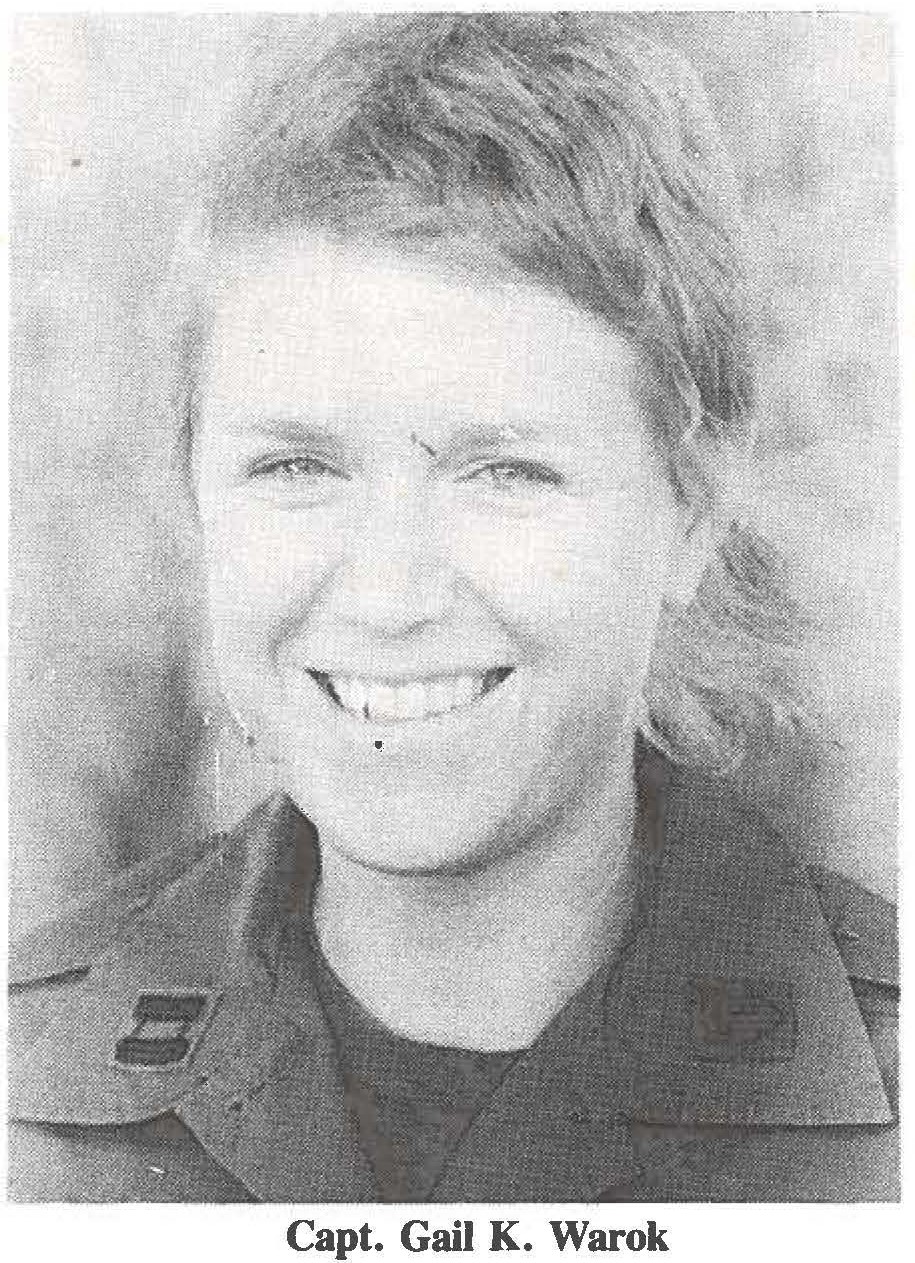
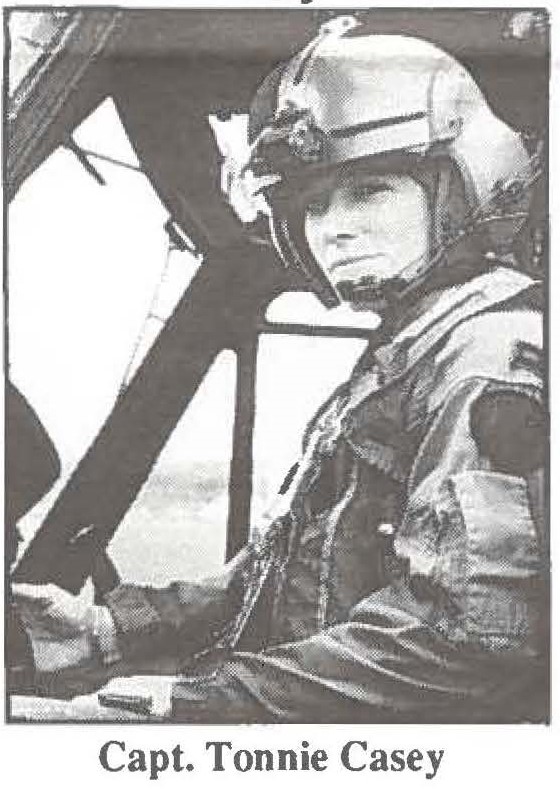
The first woman officer, Capt. Gail K. Warok took command of an Hawaiʻi Army National Guard unit in Hawaii.
Army Guard assigns first woman commander
by Dennis Y. Fujii Associate Editor
More women are taking on greater responsibilities in the military, and women in the Hawaii Army National Guard (HARNG) are no exception.
Capt. Gail K. Warok recently became the first woman officer to take command of an Army Guard unit in Hawaii.
Capt. Warok commands the 117th Public Affairs Detachment, a unit comprised of broadcast specialists and photojournalists. The 117th provides news coverage and publicizes the various training activities of the HARNG.
Capt. Warok, the full-time public affairs officer for the Department of Defense, State of Hawaii, also served as the aide to the adjutant general before being assigned as the 117th commander.
The change of command ceremony took place in front of the HARNG Headquarters building, located on Diamond Head Road. Members of the detachment stood in formation as Col. John E. Aiona, Jr., commander, HARNG, presided over the ceremony in which Maj. Patrick K. Tobara turned the command over to Capt. Warok.
Maj. Tobara, commander of the 117th since February 1976, will serve in the Selective Service section of the HARNG.
The appointment of Capt. Warok as the 117th’s commander was part of a recommendation made by Col. Aiona. His recommendation also placed the 117th under the operational control of the adjutant general’s office. This will result in more effective public affairs support for the entire State Department of Defense. The 117th is the only official public affairs unit within the Department.
As the new commander of the 117th, Capt. Warok is very positive that the efforts and talent in her new unit will provide the Department with a substantial public affairs program.
“Being assigned as a commander is a different and challenging experience for me. I feel that more women who have the ability and desire should seek jobs of higher responsibility,” remarked Capt. Warok.
Non-Commissioned Officer School The Non-Commissioned Officer (NCO) school provides training in small unit leadership and selected military subjects, and seeks to improve the professional quality of the NCO corps of the HARNG. The school, under the direction of an OCS commandant, is operated by the NCO tactical staff. The curriculum consists of approximately 130 hours of classroom work and practical exercises in general military subjects, weapons and tactics Three classes are conducted each year – two of six months’ duration and one during an intensified two weeks of annual training. Class 1-77 produced 28 graduates SSgt. Harry C Miller, Jr. was the distinguished graduate. Class 2-77 produced 23 graduates. This was the first NCO class with women in attendance, and the distinguished graduate was a guardswoman, Sp5 Johanna F. Duclayan.
Four enlisted women of the Hawaii Army National Guard are making history at the Hawaii Military Academy.
Privates First Class Leonora Delardo, Joyce Gallarde, Cynthia Costanios, all from the 292d Supply and Service Company, and Specialist Four Johanna Duclayan from the 229th Medical Company are the first female candidates to be enrolled in the Noncommissioned Officer class at the Academy.
Training at the Academy is the same for the young women as the men except in two areas. The first is the slightly modified physical training and the second is the training they receive for support roles in combat related exercises.
In academics and drill and ceremony, the training expectations are the same for the women as they are for the men.
What motivated these women to sign up for the rigorous training? PFC Gallarde said, “I was curious. I wanted to know first hand what was involved in the training .” All women agreed on one point. It was a challenge they couldn’t resist.
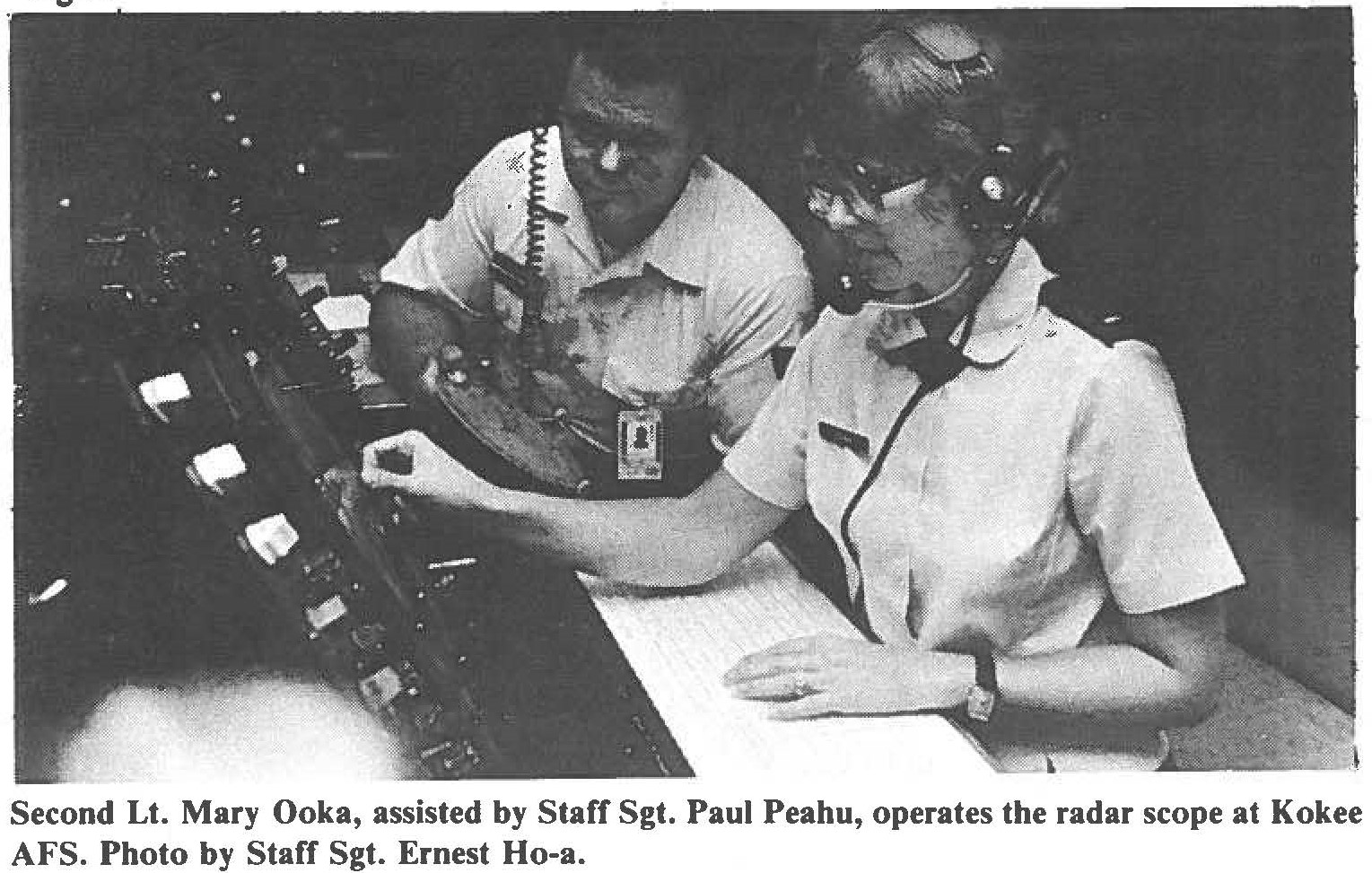
2nd Lt. Mary Ooka became the first female air weapons controller in the Hawaiʻi Air National Guard.
Second Lieutenant Mary C. P. Ooka, a member of the 150th Aircraft Control and Warning Squadron, became the first female air weapons controller in the Hawaii Air National Guard.
Second Lt. Mary Ooka recently became the first woman officer in the Hawaii Air National Guard to become combat ready as a weapons controller.
Lt. Ooka was commissioned into the Hawaii Air National Guard earlier this year before she was sent off to attend the basic weapons controller school at Tyndall Air Force Base, Florida.
A native of Minnesota, she spent over eight years at the University of Minnesota where she worked as an electronmicroscopist doing bio-medical research and teaching.
In her new job as a weapons controller, Lt. Ooka is responsible for controlling all types of aircraft from fighter jets to the refueling tankers. After participating in her first live air defense exercise, she remarked that, “the experience was very stimulating and challenging.”
She is married to Dr. Jeri Ooka who is a plant pathologist at the University of Hawaii Agricultural Experiment Station, Kauai Branch.
Her future plans include pursuing a post graduate degree, and continuing in her new career field in the Air Guard.
Second Lt. Mary Ooka, assisted by Staff Sgt. Paul Peahu, operates the radar scope at Kokee AFS. Photo by Staff Sgt. Ernest Ho-a(Picture from the 1978 December Pūpūkahi)
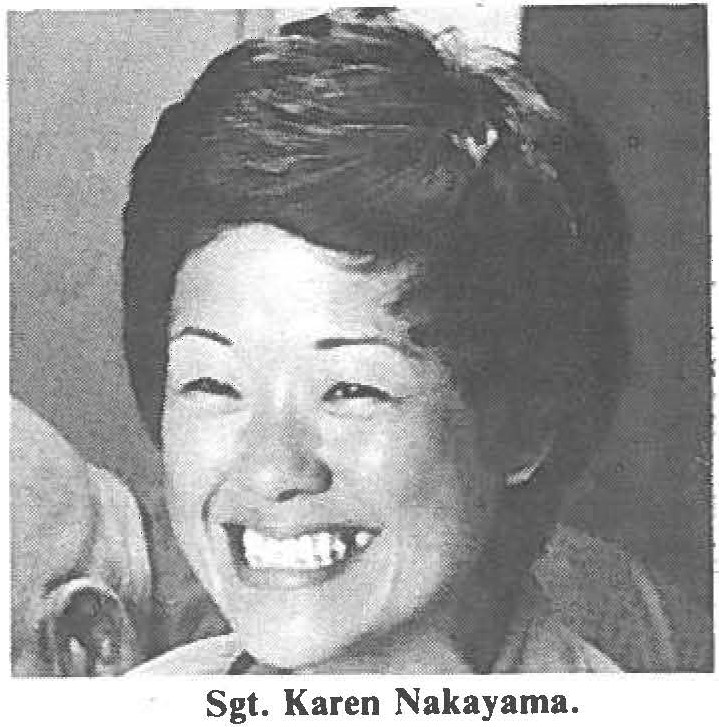
Sgt. Karen Nakayama became the first female administrative supply technician in the Hawaiʻi Army National Guard.
1st female AST
by Capt. Bill Rennie HQ Install. Command
The Headquarters Installation Command recently chalked up another first when Sgt. Karen Nakayama became the first female administrative supply technician (AST) in the Hawaii Army National Guard.
She took on the challenging job of supply sergeant and AST for the 298th Engineer Detachment in July.
She was formerly a member of the Headquarters, 159th Service Battalion before she assumed her new duties at the Wahiawa Armory.
Prior to her enlistment in the Hawaii Army Guard, she spent three years with the 411th Engineer Company, U.S. Army Reserve.
Speaking of her new assignment, Karen says, “It’s a challenge and the people I work with have all been very supportive. I’m really excited about my new job, and I’m looking forward to attending the AST course at Little Rock, Arkansas.”
Karen is a Farrington High School graduate and completed her undergraduate work in psychology at the University of Hawaii. She plans someday to return to school and work on her master’s degree.
Capt. Meriem Saromines of the Air Guard recently received the Air Force Commendation Medal for her outstanding achievement as a human relations seminar instructor for the Army and Air National Guard general officers.
She was one of four Air Guard officers selected nationwide to conduct the seminar … Congratulations, Sascha
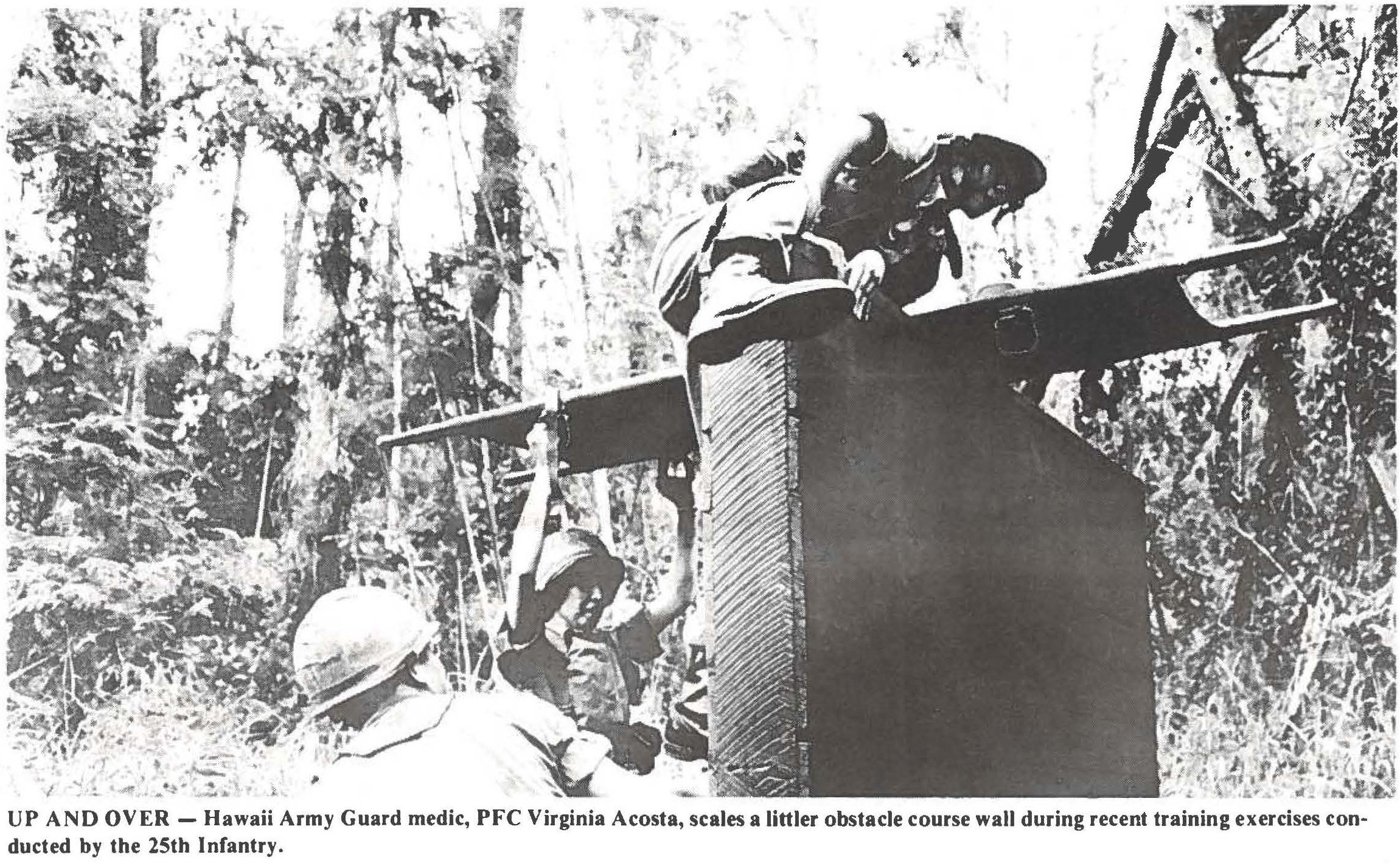
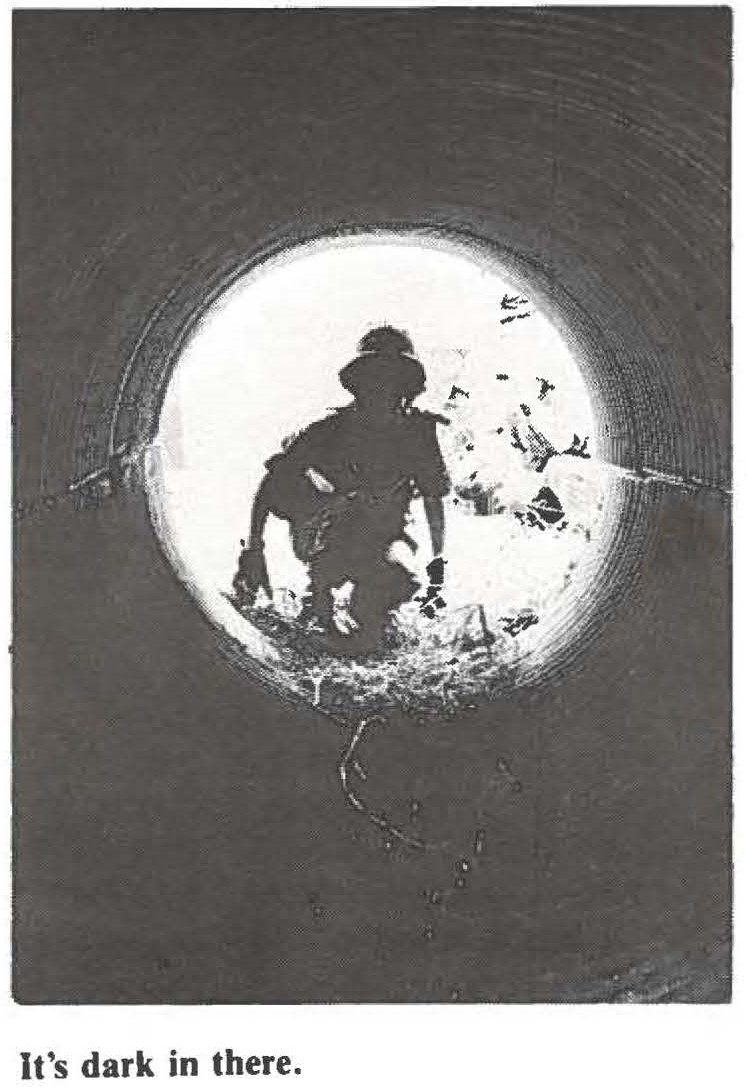
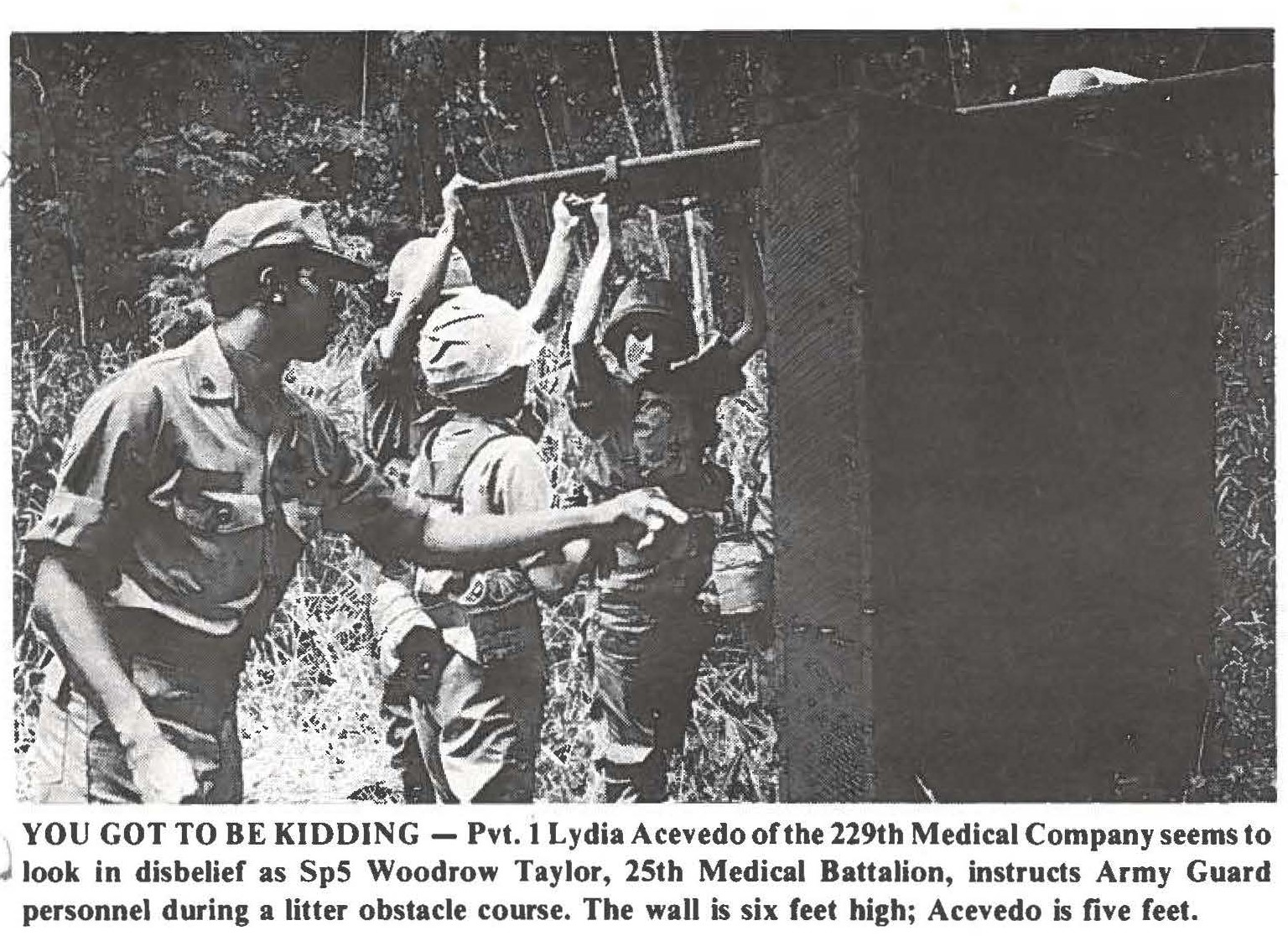
UP AND OVER – Hawaii Army Guard medic, PFC Virginia Acosta, scales a littler obstacle course wall during recent training exercises conducted by the 25th Infantry. It’s dark in there. YOU GOT TO BE KIDDING – Pvt. 1 Lydia Acevedo of the 229th Medical Company seems to look in disbelief as SpS Woodrow Taylor, 25th Medical Battalion, instructs Army Guard personnel during a litter obstacle course. The wall is six feet high; Acevedo is five feet. (Pictures from the 1979 June Pūpūkahi)
HONOLULU, Hawaii – Barbed wire. a six-foot high wall, steep hills and a sewer pipe spelled trouble for the 229th Medical Company during a recent training session at Schofield Barracks.
Advisors from the 25th Division’s Charlie Company, 25th Medical Battalion put the Guard members through a solid day oft raining, including a difficult obstacle course.
After a morning filled with classes on aeromedical evacuation, ambulance loading and transportation of the wounded, the predominantly female medical company tackled the infamous obstacle course.
Teams of four moved through the obstacle course delicately carrying a stretcher over and under barbed wire, over a wall, up a steep hill and through a pipe. The course included other obstacles that would have been difficult enough even without the stretcher.
Moral was high during the obstacle course phase as the members of the Guard unit usually gave themselves a round of applause when a team finished the obstacle course. One girl shyly asked an advisor if she could walk around the six-foot wall.
Specialist 5 Pete Neu of the 25th Division said the tough obstacle course is used as one of the qualifications for the Army’s Expert Field Medical Badge.
Besides tackling the obstacle course. the 229th Medical Company learned many different ways of making an improvised stretcher, or “litter,” as the medical companies call them.
It was not an easy day for members of the 229th, but it was a day for learning about themselves and the importance of belonging to a medical company.
Photos by SSgt. Lloyd Kurashima 117th Pub. Affairs Det.
Hawaii Army National guardmembers will soon be sporting a new look. For the men, the Army is now previewing its new line of class “A’s”. A new grey-green shirt to be worn with Army dress green trousers is being tested by selected individuals at Fort Shafter.
A short-sleeve and a long-sleeve version are available. Both may be used as outer garmets.
The long-sleeve version has to be worn with a tie, but the short sleeve one may be worn without a tie, except when worn with the dress green uniform.
The new grey-green shirts will replace the familiar “khaki” uniforms and the tan poplin shirts. The wear-out date of the “khakis” is 1985.
Issue of the new shirts should begin in 1980 for regular Army personnel, however. the shirts will be in the PX much sooner than that. ( Long-sleeve is available now.) Price of the short-sleeve is $8 to $9 and for the longsleeve. $11 to $12.
Insignia to be worn on the new shirt is limited to the nametag, cloth shoulder marks for officers and bright brass pin-on insignia of rank for enlisted personnel.
The enlisted brass insignia will be placed on the shirt collar in the same position as on the fatigue shirts while the officer insignia of rank will be worn on the shirt shoulder loops. The name tag will be placed on the right pocket flap as on the “khakis’.
The versatile new shirts are designed to allow soldiers maximum comfort. According to textile technologists, the shirt fabric is too light and too loosely woven to adequately support decorations, badges, and other accessories without damaging the shirt; therefore. only a limited number of accessories are authorized for wear.
Several Army women’s uniform changes have recently been approved by Army authorities.
A new green uniform ensemble of slacks. jacket and skirt will in time replace the current mint green uniform, pant suit and the cord two-piece.
A gray-green overblouse, matching the men’s will come in long or short sleeves. This blouse may be worn tucked in or out of the skirt or slacks. A black neck tab will be used with this new blouse.
As with the men, ribbons or badges are not allowed on this new shirt because the fabric is too light to bear the weight.
The green turtleneck tunic currently issued as part of the initial issue will be discontinued sometime in 1981. It will remain an optional purchase item in the PX.
A black windbreaker for men and women will be sold in the PX for optional wear. It will replace the current green windbreaker.
Women will also receive a pair of navy black leather dress gloves which have been found to be warmer and more comfortable than the current issue. The gloves will come as a clothing bag issue.
Also on the drawing boards are new maternity uniforms for the first time. Army Uniform Board approval for the maternity uniform is expected in the spring.
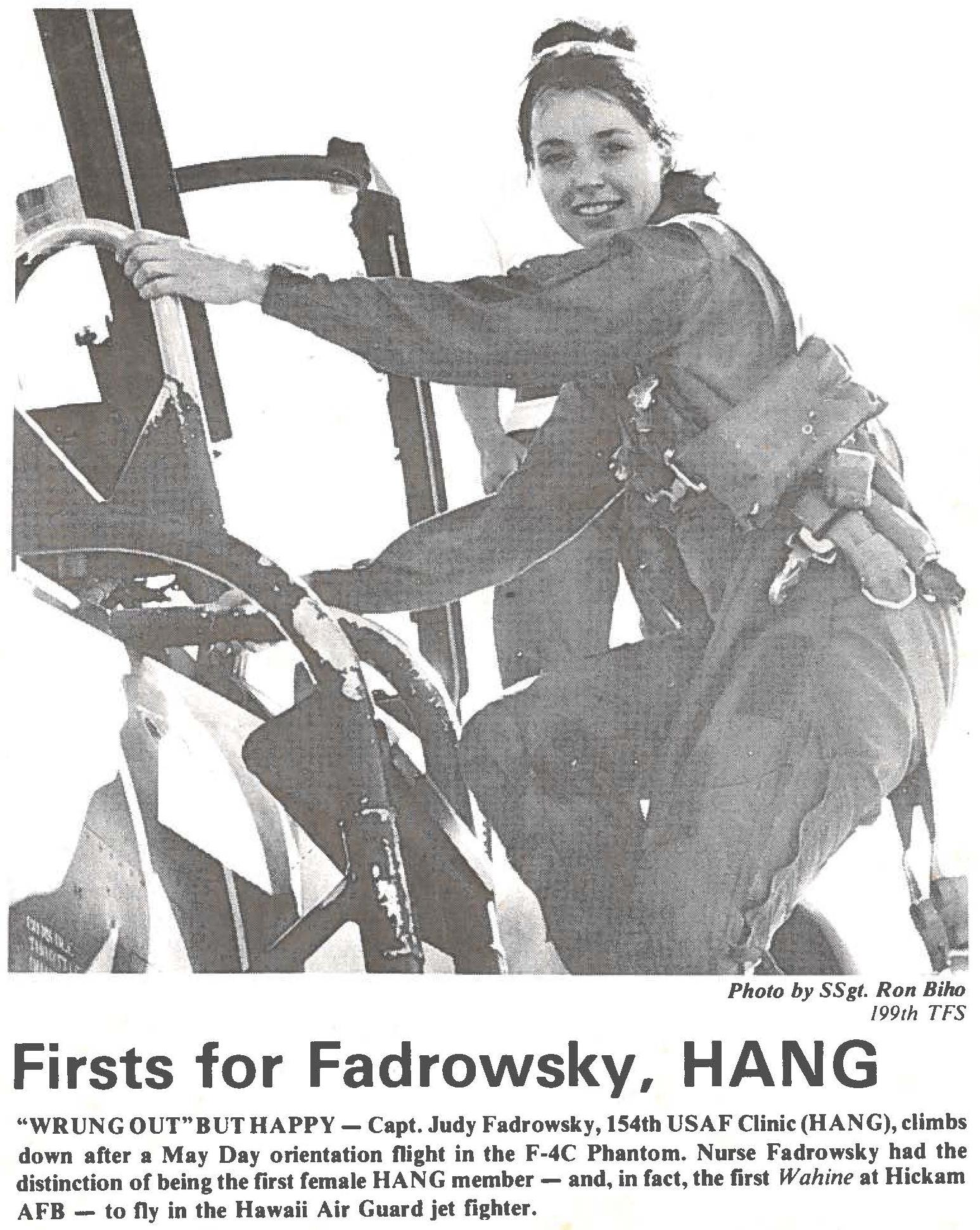
Capt. Judy Fadrowsky became the first women Hawaiʻi Air National Guard member and, women at Hickam AFB to fly in the Hawaiʻi Air National Guard jet fighter.
Firsts for Fadrowsky
HANG Photo by SSgt. Ron Biho 199th TFS
“WRUNG OUT” BUT HAPPY – Capt. Judy Fadrowsky, 154th USAF Clinic (HANG), climbs down after a May Day orientation flight in the F-4C Phantom. Nurse Fadrowsky had the distinction of being the first female HANG member – and, in fact, the first Wahine at Hickam AFB – to fly in the Hawaii Air Guard jet fighter.
Firsts for Fadrowsky, HANG Photo by SSgt. Ron Biho 199th TFS “WRUNG OUT” BUT HAPPY – Capt. Judy Fadrowsky, 154th USAF Clinic (HANG), climbs down after a May Day orientation flight in the F-4C Phantom. Nurse Fadrowsky had the distinction of being the first female HANG member – and, in fact, the first Wahine at Hickam AFB – to fly in the Hawaii Air Guard jet fighter. (Picture from the 1980 Annual Report)
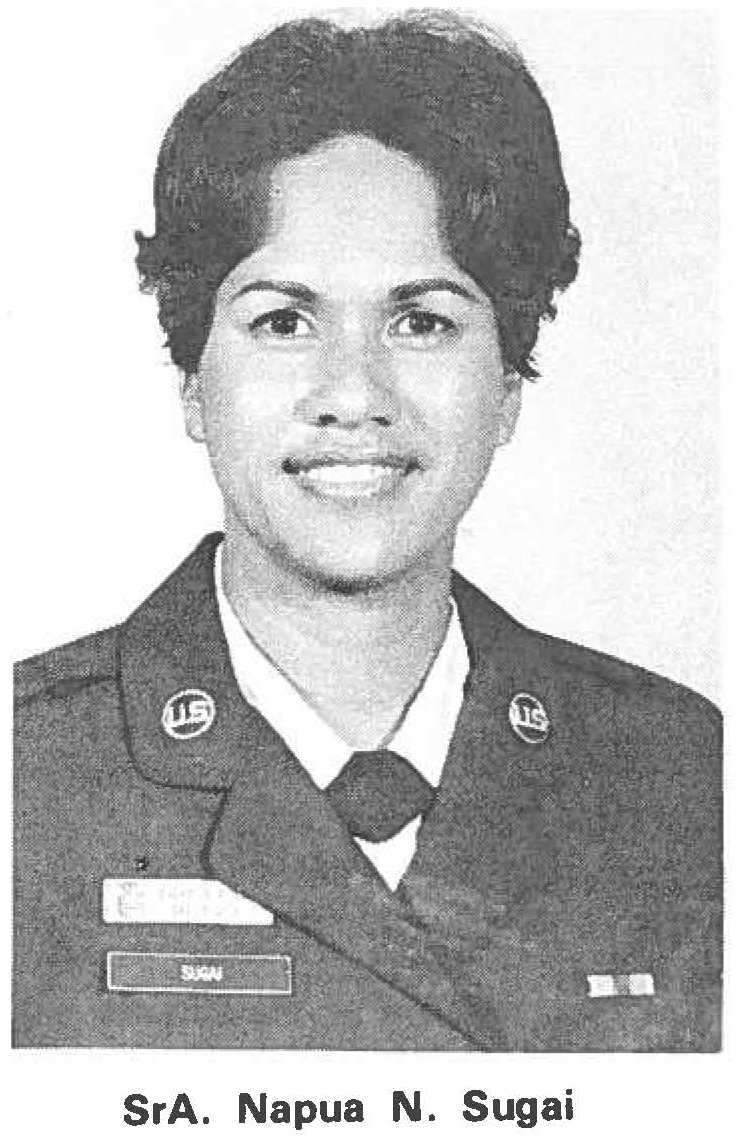
Senior Airman Napua N. Sugai of the 154th Composite Group has been selected as one of six Air National Guard outstanding airmen of 1980.
Airman Sugai, of Kauai, was chosen for the honor by the National Guard Bureau in Washington, D.C. She is a member of the 150th Aircraft Control and Warning Squadron, a component of the 154th, based at Kokee, Kauai. She was selected for this national honor from among more than 82,000 ANG members nationwide. Maj. Gen. Valentine Siefermann, adjutant general, and Brig. Gen. Arthur lshimoto, commander, HANG, expressed their pride in having Airman Sugai in the Hawaii Air Guard.
The Kauai mother of two celebrated her second anniversary in the Guard in April. She is currently working under a two-year, full-time military training program as an aircraft control and warning operator at the 150th site high in the mountains of Kauai. She will receive her award in a presentation to be held this summer on the mainland.
The number of women in the Hawaii Army National Guard has steadily increased in the last five years. “Guardswomen” are filling jobs that were traditionally slotted for men.
To help these women cope with any difficulties they may have, the Army has decided to initiate a program called, “Problems of Being a Woman in the Army.”
In the Hawaii Army National Guard, Capt. Deborah Smith, a registered nurse presently with the HARNG surgeon’s office, will coordinate this program. She said that her job will be to go to any unit and meet with her fellow. women soldiers.
The first meeting will be a one-hour lecture and discussion. It will be followed up during the next month with a two-hour “rap session” with the same group. She asked that the group size be kept between 10-15 persons to encourage discussion.
Arrangements for the meetings can be made through the surgeon’s office. which is temporarily located in the armory, phone 737-8625.
At the meetings, topics for discussion are open to the needs and special concerns of the unit. Some of the possible topics Smith has slated for discussion are the need for separate latrines and showers and potential problems for women.
The following article is provided compliments of the DA Scene, a publication of the Department of the Army. “Fit to fight” is what the Army’s new Physical Readiness Test (APRT) is all about.
There will be one test for male and female soldiers in all types of assignments. The test includes sit-ups, pushups, and the two-mile run. At the start 1 of this new test, soldiers over 40 will only have to run the two-mile event, but this may change in a year to include the other two events.
Sit-up and push-up tests will have a two-minute time limit. Previously, men had a one-minute time limit and women had no time limit.
The standards for sit-ups and pushups will be tougher but the push-ups will be done differently under the new program. The push-ups will still be started from the “front leaning rest” position. The soldier will lower his or her body, bending the elbows until the top of the upper arms, shoulders and lower back are straight and parallel to the ground. It is no longer necessary for the chest to touch the ground. When the soldier’s body returns to the front leaning position rest position with the elbows locked, it will be counted as one pushup. Men and women will do push-ups the same way.
Sit-ups for both men and women will be done with the knees bent at 90-degree angles and feet held to the ground by another soldier. Fingers will be joined behind the head. However, there is no requirement to touch elbows and shoulders to the ground. Only the hands and back have to touch the ground.
Two-mile run times are faster for most age groups but there are no other changes in the running event.
In order to pass the new APRT, all soldiers except those in basic training must score at least 60 points in each event and have a total score of 180 points.
Soldiers in basic training must get at least 40 points in each event and have a total score of 160 points to pass. In order to reach the goal of 160 points, a soldier in basic training must score more than 50 points in at least one event to pass the overall test.
All soldiers will be tested twice a year under the three-event APRT with at least four months between each test. Soldiers over 40 will have some different rules. Medical clearance must be given by an Army doctor before a soldier can take part in the over-40 APRT program. Once the soldier has been cleared, a six-month conditioning program must be completed before the two-mile run test will be given.
Army training officials said the new APRT manual was expected to be published in January 1981. It will contain details of the overall program. After November 30, 1980, the new APRT can be given to soldiers for record.
Scoring table
This is the table of scoring standards that will be used in the new Army Physical Readiness Test program. The first figure shown in each column is the minimum number needed to pass the test. The second figure is the number needed to score the maximum 100 points in each event.
MEN UNDER 40
Age
Push-ups
Sit-ups
Two-mile run
17-25
40 / 68
40 / 69
17:55 / 13:05
26-30
38 / 66
38 / 67
18:30 / 13:40
31-35
33 / 61
36 / 65
19:10 / 14:20
36-39
32 / 60
34 / 63
19:35 / 15:05
WOMEN UNDER 40
Age
Push-ups
Sit-ups
Two-mile run
17-25
16 / 40
27 / 61
22:14 / 17:10
26-30
15 / 38
25 / 51
22:29 / 17:25
31-35
14 / 34
23 / 41
24:04 / 19:00
36-39
13 / 30
21 / 31
25:34 / 20:30
SOLDIERS OVER 40
Soldiers over 40 will only be tested in the two-mile run. They will be graded on a go / no-go basis. The standards are as follows
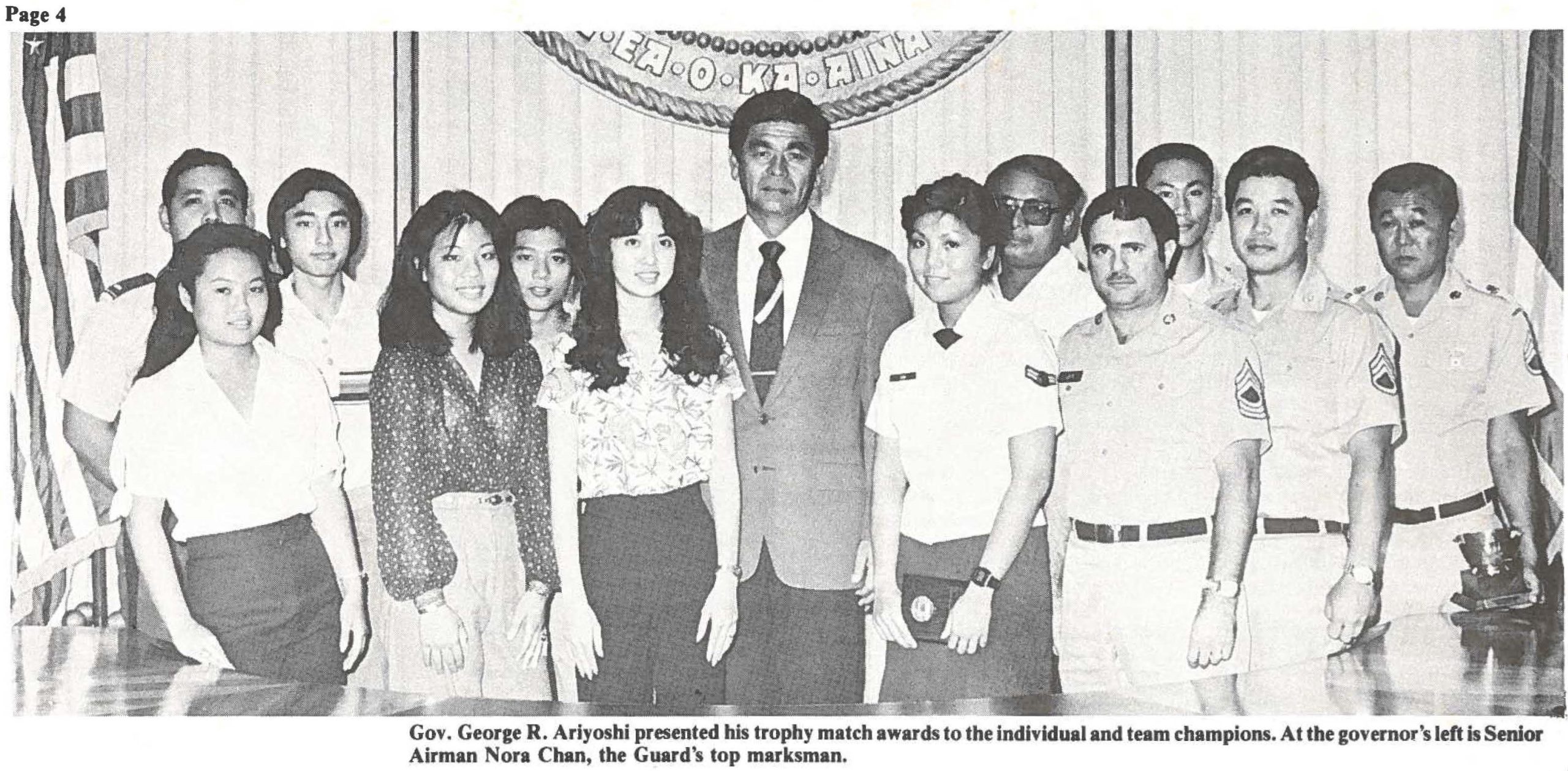
Gov. George R. Ariyoshi presented his trophy match awards to the individual and team champions. At the governor’s left is Senior Airman Nora Chan, the Guard’s top marksman.(Picture from the 1981 Summer Pūpūkahi)
Senior Airman Nora Chan of the Hawaii Air National Guard was the top marksman in the recent Governor’s Trophy Match rifle competition.
Chan, of the 154th Composite Group clinic, received her award from Gov. George R. Ariyoshi in a special ceremony held at the State Capitol. Finishing second was Master Sgt. Henry Leite of the Army Guard’s Command and Control Headquarters. Third was Sgt. Anthony Lendio of the 154th Consolidated Aircraft Maintenance Squadron, HANG.
One important aspect of the Governor’s Trophy Match was that it included teenage shooters who were teamed with National Guard units. Each four-person team was comprised of two Guard members and two of the junior shooters.
First place in the team competition went to the 829th Maintenance Company. Members were Staff Sgts. Donald Mochizuki and Wallace Kawakami and McKinley High School students Rey Cabradilla and Henry Cheung.
The 154th Consolidated Aircraft Maintenance Squadron was second. Team members were Tech. Sgt. Galen Yamada, Sgt. Anthony Lendio and Punahou students Jeremy Low and Chris Chee.
Third place was won by the Command and Control Headquarters team of 1st Lt. Gregory Burgess, Master Sgt. Henry Leite, and Pearl City High students Kim Tsukamoto and Gordon Aihara.
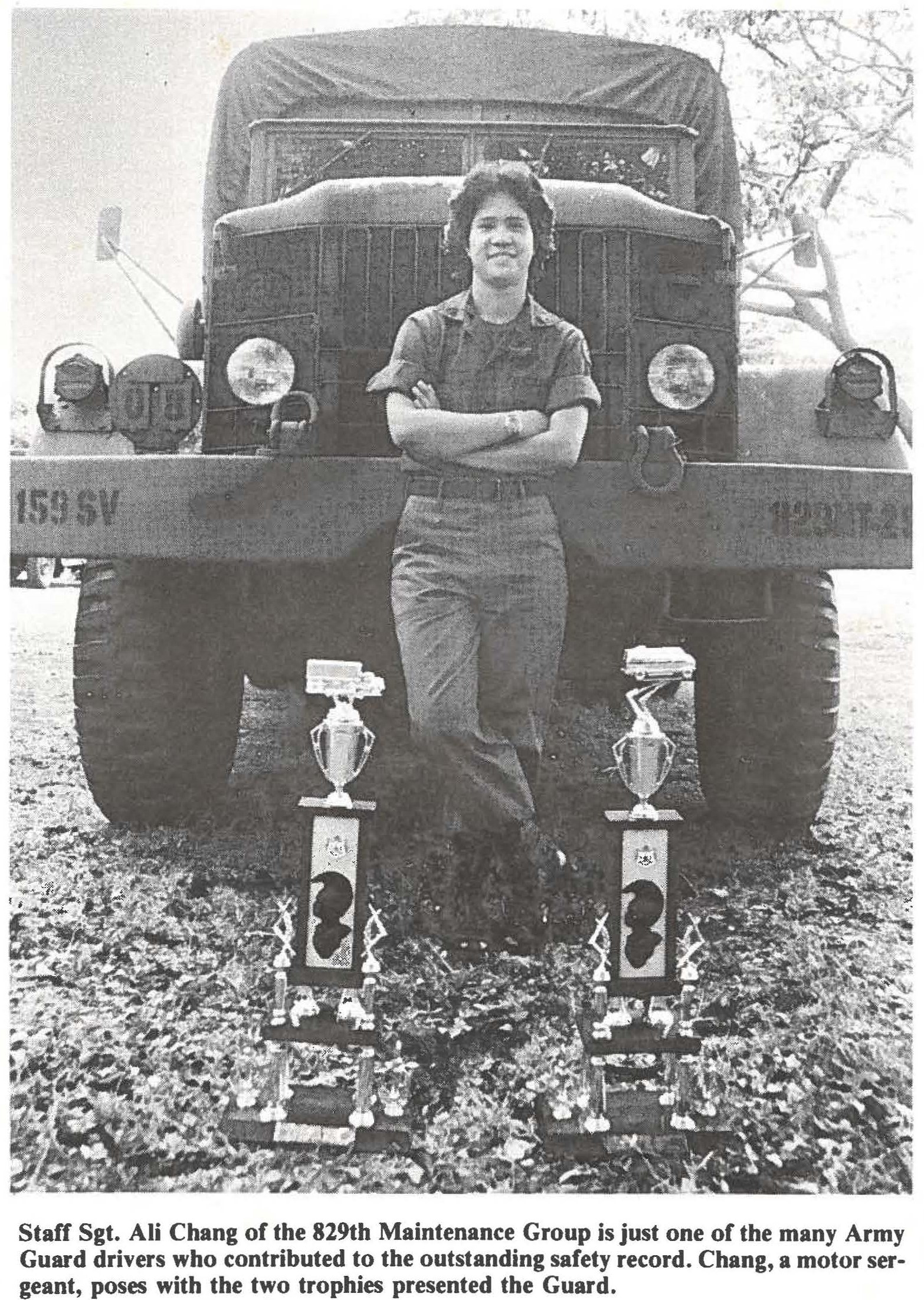
Staff Sgt. Ali Chang of the 829th Maintenance Group is just one of the many Army Guard drivers who contributed to the outstanding safety record. Chang, a motor sergeant, poses with the two trophies presented the Guard. (Picture from the 1981 Summer Pūpūkahi)
The Hawaii Army National Guard has received no less than two Oahu Fleet Safety Organization awards for driving safety in 1980.
The Army Guard motor vehicle operators amassed a total of 560,000 accident-free miles in the truck category, ensuring them of a first place finish among organization members. In the under-a-million mile bus category, the Army Guard again was first with 3,000 accident-free miles.
The Oahu Fleet Safety Organization’s membership includes all large truck and bus operations on Oahu. Members report their fleet mileage and accidents every month. At the end of each year, the mileage is totaled and the members with the best records in various categories are recognized.
Chief Warrant Officer 4 David Y. Lee, HARNG safety specialist, credits the honors to the outstanding performance of the Army Guard’s motor vehicle operators, on drill status and full-time duty
As told by: Vivian “Pineapple” Haney From hula-maiden to olive-drab green
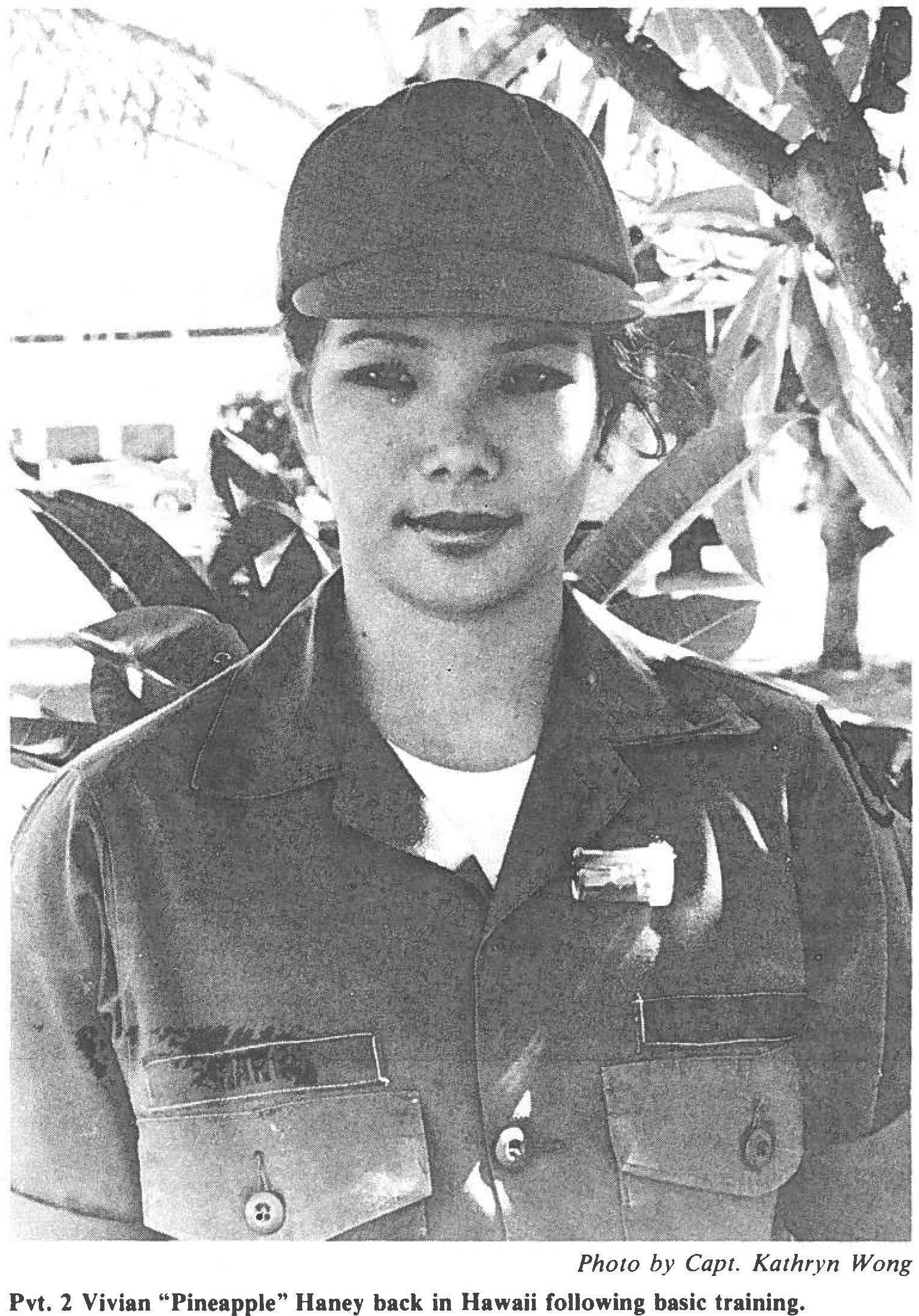
Editors note: Vivian Haney, 18, recently returned to Hawaii following basic training at Fort Jackson, South Carolina. Of Korean-Irish-Italian descent, she works for Greeters of Hawaii and enjoys dancing, roller skating, and going to the beach in her free time. Raised an “Army brat,” she has lived in Hawaii for 1O years with her family in Mililani.
Pvt. 2 Vivian “Pineapple” Haney back in Hawaii following basic training. (Picture from the 1981 Winter Pupukahi)
What follows is her personal account of basic training:
When I joined the National Guard, my recruiter, Sgt. 1st Class Eddie Llanos, never promised me the world; he made every effort to present all aspects of the Army, the bad as well as the good.
Sergeant Llanos asked me several times if I really wanted to join. At the time, it was all I wanted. I passed the tests and took my oath. Before leaving, I had the opportunity to attend two drills t my future unit. I met lots of nice people of all ranks.
So, I thought to myself, “This can’t be too bad.”
Was I in for a big surprise! I had been told time and time again to go to basic training thinking, “This is just a game. Stick it out and everything will be okay.”
It took two days to reach Fort Jackson, arriving at the reception station on a cold Saturday morning. It was 14° and I was certain I’d die. I suffered from jetlag, hunger, and was just plain miserable. I’d never been away from my family. I’d always had someone near me and now I was alone and on my own.
Since it was Saturday, it took extra long to in-process because most of the staff had weekends off. I remember sitting in a big room full of strangers, feeling so alone and afraid. Finally, after two or three hours of waiting, we were led to our company barracks.
We got our linen and were assigned bunks. There were already 35 girls there who had arrived the previous night. I put away my belongings, sat on my bunk, looked at all the different faces, and started to cry.
Fifteen minutes later we were called to chow. The chow line was so long, it took an hour before I entered the mess hall and another 30 or 40 minutes to get my food. But I had no appetite. I didn’t eat at all for the next three days.
Processing on Monday was followed by the issuing of uniforms on Thursday, which took all day. After finishing that, the next day we had our name tags and insignia sewn on our fatigues and in the afternoon we got our immunizations.
I’ve always hated needles and was terrified. When I began to cry (I do that pretty well.), the medical technician said to me, “Shut up before I shoot you in the nose!”
I was so angry at her. Of course, I didn’t realize that she had to cope with thousands just like me. I had more shots, then we had a 20-minute rest period. I was crying real hard.
That’s when I got my first look at my tough drill sergeant. He walked around the room and just laughed and told us he hated female trainees and was going to run us into the ground. I was afraid to look at him.
After a terrifying ride to our new barracks aboard an Army truck, we filled out more forms and got the supplies and books we would be needing for basic training.
We then had to run to our barracks with our belongings. I had a duffle bag, suitcase, and another bag. After making two trips to finally get everything together, I entered the barracks.
What a mess! Dust covered everything.
By this time, the shots were beginning to take effect and I felt so sick. I thought that I had come down with something awful but the drill sergeant told us that if we felt sick, it was just temporary from the shots. He briefed us on what to expect, then told us to fall out for chow.
That meant running in formation. I was weak but managed to jump over a duffle bag to get out with everyone else: Somehow, I also managed to run almost head on into the drill sergeant.
He yelled at me and made me stand at parade rest and keep an eye on all the baggage while everyone else ate. When he finally left, I started to cry once again.
By now I was a real professional at crying and considered making it my military occupational specialty. I stood there for 20 minutes before someone finally came to get me. The food didn’t look good because I was sick. To make it worse, it tasted awful.
In basic training, you’re supposed to run everywhere you go. I didn’t know that so after chow I walked to my formation-and my sergeant yelled at me again. This time he made me do pushups. That came as a big shock to me. I left home never having done any. Believe me, you can do anything under pressure, I did two to the best of my ability.
He let me get up and told me that from now on he was going to keep an eye on me.
Slowly, l picked up the name, “Pineapple.” That was my Army name from then until the end of basic.
For a while, I tried to get a trainee’s discharge. For some reason I just couldn’t seem to convince the first sergeant that I was a failure. He was more sure of me than I thought l could ever be.
After a long lecture from the company’s sergeant major, I decided to stick it out and make each day count. It was hard, very hard.
The first thing that we learned was drill and ceremonies and facing movements. I enjoyed that. I also enjoyed learning the different songs that we sang to cadence.
We were issued our very own buddy, not the human kind but an M-16. I was pretty excited to be carrying around an M-16 and couldn’t wait to learn how to operate it.
Next, we began classroom training which consisted of first aid, guard duty, the Geneva Convention, and so forth. It was very difficult to stay awake sometimes but l knew that these classes were important so I took notes and tried hard to keep awake.
Then we learned to assemble and disassemble our weapons. Besides classroom instruction, we had two-hour bleacher instructions, which meant sitting on cold bleachers and learning all kinds of things like range safety. It was miserably cold and I thought I would catch the flu.
Several days later, our company was to experience what I thought was the worst thing in basic training: the gas chamber.
It was a nightmare to me because l stayed in there for about three minutes without a mask. Entering the chamber with our protective masks and steel helmets, we were asked to take off the helmets. Then we were asked to take our masks off, stand still, then execute an about face. l could see that people were suffering from the burning gas.
The sergeant approached me and yelled, “What the hell is wrong with you, soldier?”
I just barely answered him, choking back the tears, and told him that I did not really want to do this. He then made our squad take off our masks. I tried to leave with the first five to be dismissed but was too slow. I felt a burning in my chest and all over my face and hands.
After about three minutes, l got sick. l recovered after 10 minutes and stood at the top of a hill and watched the others. l knew what it was like and told myself that I would never go back in there ever again.
Next came the crucial part of basic training, surviving in the fields. This is what the Army calls bivouac. We arrived at the site and unloaded the bivouac gear, including tents, gas suits, shovels, sleeping bags, and so forth.
We had to put our tents up while wearing our gas suits and masks. We then dug trenches around our tents in case of rain.
After that was completed, we had the famous P.T. That was something we did every day, regardless of the weather. During basic training we ran two or two-and-a-half miles a day. During bivouac it got worse. We had to run in the woods, with sand hills and leave everywhere.
Finished with our first session of P.T. we got ready to go on the march to a day-night defense range. It was very cold so we had to bring our field jackets and liners but unfortunately I left mine behind.
The whole day was spent preparing for the night exercises. Then came the big surprise. The chow that we had been so hungry for turned out to be a nightmare C-rations. I settled for the fruits.
Then it was time to return to the company, but this time not in the trucks that we were so used to riding. We had to march back! We had already completed the 7- and 10-mile marches and this was to be the final one a lot of us were not anxious to do.
It was late afternoon and we were on our way. Single file and 15 meters apart, we marched carrying our weapons and wearing backpacks which consisted of our bivouac equipment.
The biggest mistake I made was drinking lots of juice. After a few hours of marching, it began to take effect. I could hardly stand it, marching and having to go to the bathroom so badly. Finally, after what seemed to be an eternity, we stopped for a break and this was the only opportunity to go to the bathroom, in ‘the woods’.
Marching on and on, I thought that we had almost reached our destination when I saw the rifle ranges and knew that we had further to go .. As we marched along we knew that we were getting close to what we called home, and it certainly was, after bivouac
We knew there was one more tough part to complete and that was a hill. I used all my remaining energy to reach the top of the hill and when we did, a couple of us yelled out, “We made it!” That must have been the happiest time of the entire experience.
Graduation day had been our main goal. Our whole company had looked forward to that day so distant it seemed it would never come. After eight weeks of hard, physical training, it arrived.
I remember it so clearly. It was a cold morning and I thought it would snow. Four of us were chosen to clean the day room and we were all talking a bout how soon we’d see home again; what a good feeling that was.
At 7:30 a.m. we all marched two miles to the theatre looking sharper than we ever thought we could look. The ceremonies were brief and awards given to outstanding recruits. We marched the two miles back, then it was really over.
Some of the more fortunate people had family come see them.
I called home and told my family that it would be another five or six weeks before I returned home. We said our good-byes, exchanged addresses, and went our separate ways.
Basic training was over and I was so glad. It had been the most difficult experience of my life, but also the most rewarding.
Thinking back to the beginning when I’d wanted to get a discharge and go home, I was embarrassed and so glad I hadn’t left. I’d have been a loser and worse than that, I’d have missed the opportunity to grow up and be more proud of myself.
One of the most important discoveries was what I learned about my family and what they meant to me. I missed my family so much. At home I had always wanted to be left alone, to think for myself, and not have anyone on my back.
The longer I was away from home, the more I realized that I had taken the love, care, and attention at home for something other than the fact that these people, my family, cared for me and I hadn’t ever really appreciated it. That thought stayed with me from day one at Fort Jackson until I returned to Hawaii.
Since my return I’ve tried to get friends to join the National Guard and experience what I have. Sure, basic training was awful at times but what I got out of it, the pride and self-confidence and maturity, was worth every minute of it!
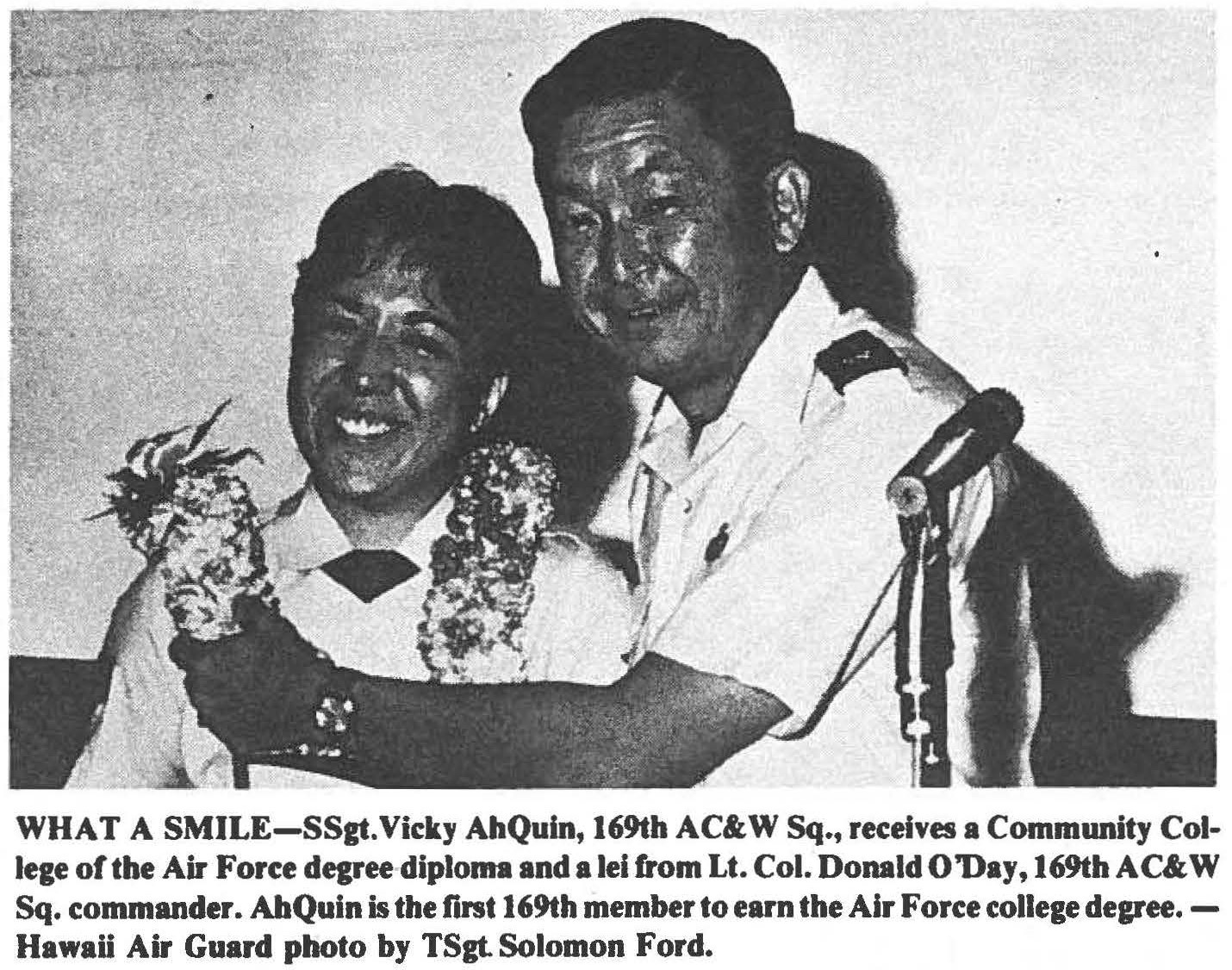
Staff Sgt. Vicky AhQuin is the first member of the 169th to take advantage of the Community College of the Air Force program and receive an Associate in Applied Science Ground Radar Technology.
AhQuin earns AF degree
Staff Sgt. Vicky AhQuin, 169th Aircraft Control and Warning Squadron, has been awarded the Community College of the Air Force (CCAF) degree of Associate in Applied Science Ground Radar Technology. Lt. Col. Donald M. O’Day, Commander, presented the degree July 18 at Wheeler Air Force Base.
CCAF was established to provide enlisted members of the Air Force, Air Reserve and the Air National Guard with educational opportunities for personal and professional development. CCAF is fully accredited and offers an associate degree for successful completion of educational programs related to Air Force specialties. CCAF programs consist of 64 to 70 semester hours divided between technical and general education requirements. It took Ah Quin a lot of hard work over one year to complete all of the requirements for this program.
AhQuin is the first member of the 169th to take advantage of the CCAF program and receive this prestigious degree. AhQuin also received a diploma for successful completion of the NCO Academy Extension Course Institute correspondence course.
WHAT A SMILE- SSgt. Vicky AhQuin, 169th AC&W Sq., receives a Community College of the Air Force degree diploma and a lei from Lt. Col. Donald O ‘Day, 169th AC&W Sq. commander. AhQuin is the first 169th member to earn the Air Force college degree. – Hawaii Air Guard photo by TSgt. Solomon Ford.(Picture from the 1982 Fall Pūpūkahi)
Shibata win shoots 829th to top
Last year, Beverly Shibata, civilian, handled her .22 caliber rifle well enough to take second place in the Hawaii Army National Guard sponsored Governor’s Trophy Match competition. This year, Beverly Shibata, Pvt. 2, shot even better, well enough to take home the Governor’s Trophy and lead her four person team to the overall win.
Shibata, 19, shooting with the 829th Maintenance Company, HARNG, scored 368 points out of 400 to beat some grizzled HARNG and HANG veterans. Gov. George R. Ariyoshi recently congratulated her on the victory and presented her trophy.
Last year, Shibata was just about to graduate from high school and was participating as a Junior shooter. From her experience with the members of the HARNG, she decided the Guard was for her. Now in her freshman year at the University of Hawaii, Shibata looks forward to her career in the HARNG. She works in the 829th as a small arms repairer.
The Junior Shooter Program, now in its third year, matches high school shooters with various HNG units around the state. The program is designed to foster a sense of comraderie and teamwork between Hawaii’s young people and the men and women of the Hawaii National Guard.
Other members of the winning 829th team were: Ray Cabradilla (361), Dennis Kawano (358), and Staff Sgt. Howard Goya (340). Total team score 1,427. Second place team was Battery B, 1st Battalion, 487th Field Artillery (1,361). Third place was the 1293rd Aviation Company, Wheeler Air Force Base (1,227).
In the individual standings: Shibata, first place (368); Tech. Sgt. Ron Muronaga, 154th Consolidated Aircraft Maintenance Squadron, second (359); Staff Sgt. Steven Young, Battery B. 487th Field Artillery, Third (347); and Staff Sgt. Norman Tyau, 154th Consolidated Aircraft Maintenance Squadron fourth (344).
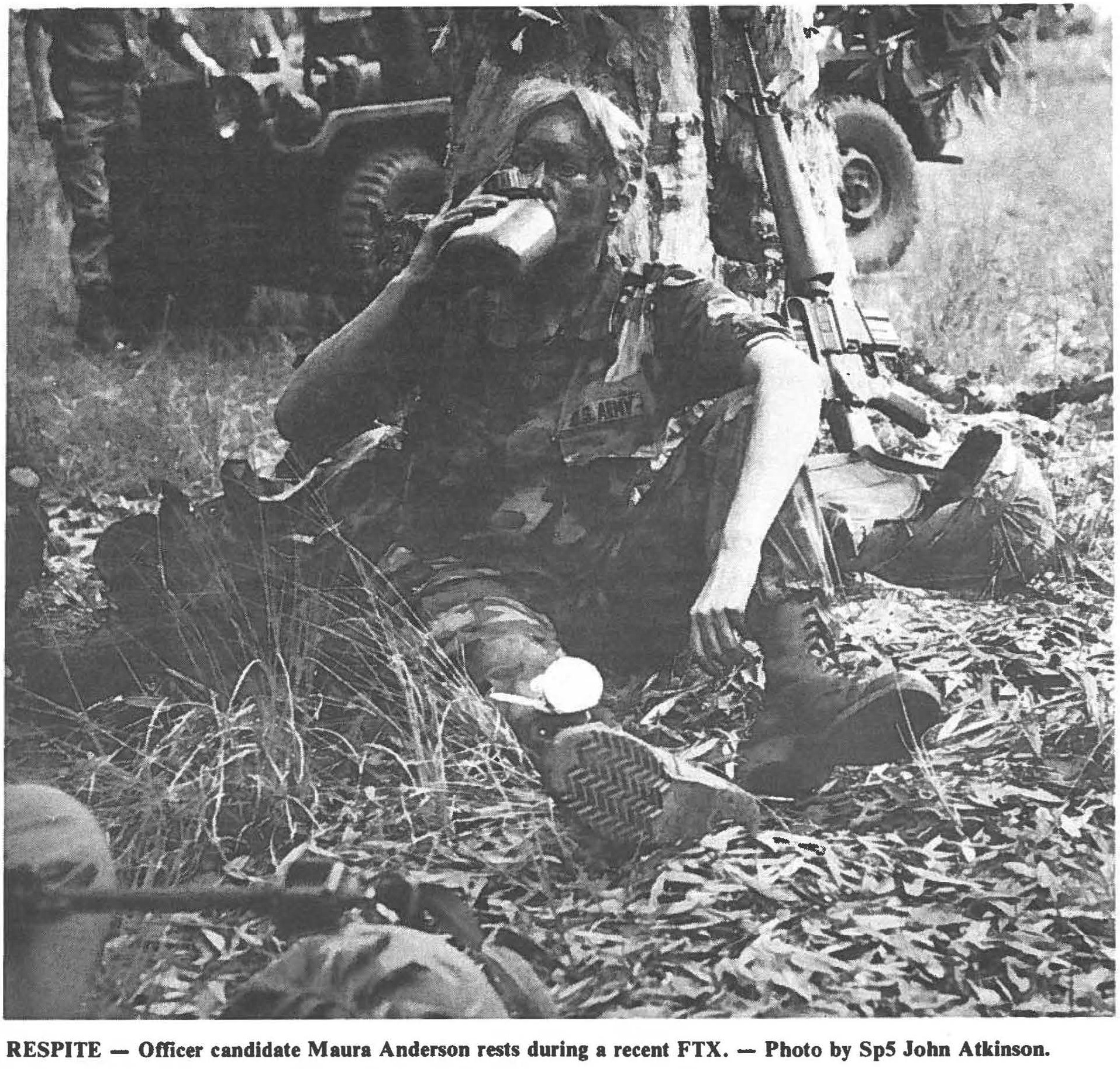
RESPITE – Officer candidate Maura Anderson rests during a recent FTX. – Photo by SpS John Atkinson. (Picture from the 1982 Fall Pūpūkahi)
The soldiers began their attack at dawn; eleven of them, camouflagued and weary from weeks of training.
They attacked in two groups, one provided covering fire protection while the other advanced. Advancing toward a hill, their objective, they fired at the enemy. Through a stream, up another hill, firing and covering each other. After one frenzied hour, they took the hill. The enemy was chased into a ravine.
Then came the all-too-familiar sound.
“OK. . . OK. . . candidates, that was good, but why do this part of the attack in the open? Why not use the cover provided by the tree line on the side of the hill?”
They agreed.
“So let’s try it again!”
Although the situation seemed real, this was a training experience so mistakes which could prove to be costly and damaging in war were permitted. The Army National Guard’s Hawaii Military Academy Officer Candidate class 20-82, went through their final hours of training in the hills of Schofield Barracks. A critique from qualified training officers would eliminate the possibility of these mistakes occurring in the future.
They graduated on Aug. 1 becoming commissioned officers in either the Hawaii Army National Guard or the U.S. Army Reserve. This was the 20th class at the Hawaii Military Academy. Since it began in 1962, the Academy has trained more than 300 officers. More than 30 percent of the Hawaii Guard’s 286 current officers have been trained by the Academy.
The program, taught largely by Army National Guard officers qualified in various specialties, is designed by the U.S. Army Infantry School at Fort Benning, Georgia. According to Maj. Edward L. Correa, assistant commandant of the Hawaii Military Academy, the curriculum is comparable to the Regular Army program.
“We’re part of the one-Army concept, so we follow the same doctrine,” Correa said. “We have experts in the National Guard teaching most of our courses such as Artillery and Infantry tactics. We also work closely with the 25th Division, which assists us in many classes such as Soviet doctrine and radio communications.”
Correa, a State deputy attorney-general in civilian life, has served with the Academy for five years. He served as an Army officer after receiving his commission through the Army’s Officer Candidate Course at Fort Benning, Georgia,. Military subjects include 12 major categories such as military leadership, map and aerial photograph reading, weapons, methods of instruction, unit administration and civil disturbances.
By attending the Academy during their regular monthly weekend drills plus two summer camps, Hawaii Army National Guard soldiers have an opporturnity to become officers.
“If we didn’t have the Academy, many island soldiers wouldn’t have an opportunity to be officers. Now we can give them the basic concepts and instruction comparable to that of the Regular Army,” Correa said.
The training offers overwhelming diversity. One day a candidate is a private on the battlefield. The next day he could serve as a company commander.
And what do the “candidates”, as they are called, think of this program?
“It’s really a good experience for those who want to be leaders,” says candidate Victor Regidor of Honokaa, a computer programmer for Davies Hamakua Sugar Co. Regidor was a fire control chief for his 81 mm mortar platoon in C Company, 2nd Battalion, 299th Infantry and wiM return to begin his career as a platoon leader.
The class president, candidate Dunstan Canne, has high praise for the program too:
“The course was good because they tried to make the training as realistic as possible. We would have classes, then a practical exercise. Our patrolling classes, for example, gave us a chance to test our leadership abilities. All of us were put in a position where we had to make decisions.
Canoe’s civilian employment is with a transportation company’s safety department.
Class Treasurer, candidate Jerry Allen has similar praise.
“I thought the training was excellent because I could apply the leadership training to my civilian job,” Allen declared. “In leadership we talked about psychological factors. Discipline was emphasized throughout the program. High standards were set and met.”
Allen is a Federal employee working as a fireman at Barbers Point.
The two women officer candidates also praised the program.
“I don’t look at it as work. . . It’s an experience, something I’ll never get to do in civilian life,” said Vanessa Coloma, a medical corps member who will return to her unit as a medical officer.
In civilian life, Coloma will be a student this fall at Leeward Community College.
Maura Anderson, the other woman candidate, was extremely enthusiastic. “It’s added so much confidence to my life. . . Now I can get up in front of people and talk-before I couldn’t.”
Admission to the Academy is available to all Guard or Reserve members between 18 and 30 years of age who have served for one year in their organization. Acceptance to the school is granted following the successful completion of a physical examination and a written test. The applicants must be high school graduates.
Warrant Officer Marian Kuzma, is the Hawaiʻi Army National Guard’s first female helicopter pilot.
Army Guard appoints first female helicopter pilot
Warrant Officer Marian Kuzma, … a civilian instructor pilot for the past three years, will become the Hawaii Army National Guard’s first female helicopter pilot, after successfully completing training at Ft. Rucker.
Kuzma was commissioned as a warrant officer in July and will attend the three month helicopter qualification course at Ft. Rucker, Ala.
Col. Irwin Cockett, commander of the Hawaii Army National Guard, noted that as a helicopter repairer with the 1293rd Aviation Company for the past 19 months, Kuzma already has proven herself to be “a valuable asset” to the Hawaii Army National Guard.
Kuzma, 28, said she joined the Hawaii Army National Guard in January, 1982 with the intention of improving her civilian flying skills and because she was impressed with the National Guard’s mission.
As a civilian instructor pilot, Kuzma holds a multi-engine rating and has logged 1,500 flying hours. She has a commercial flying Iicense with instrument rating.
Kuzma was able to obtain her warrant officer’s commission because of her commercial flying skills, after being a member of the Hawaii Army National Guard for 18 months. She is currently a cargo pilot for Rainbow Islands Cargo.
As for being the first female Hawaii Army National Guard pilot, Kuzma said: “I think I am lucky. There were many women before me who, for whatever reason, could not make it. Under the conditions and restrictions placed on women in the National Guard, I feel extremely appreciative for the honor bestowed on me.”
As for combat mission for women soldiers, Kuzma said she is willing to do whatever is asked of her by the military.
FIRST HARNG FEMALE AVIATOR-Col. Irwin Cockett, Army Guard commander, and Maj. Eugene Young, state aviation officer, pins on the warrant officer’s bars for Marian Kuzma. Kuzma will become a helicopter pilot assigned to Hq, ST ARC, HARNG and is the first female aviator in HARNG.(Picture from the 1983 Fall Pūpūkahi)
Candace Y. Seto, daughter of Sergeant First Class and Mrs. John W. C. Seto, HARNG, received a Bachelor of Science degree in applied physics an was commissioned a second lieutenant on May 23 upon graduation from the U.S. Military Academy at West Point. She was one of five from Oahu to graduate from West Point this year. Lt. Seto will undergo training with the Corps of Engineers at Fort Belvoir, Va. before reporting for duty in Germany. SFC Seto is attached to G-3 at Headquarters, STARC, HARNG.
From E-1 to 2nd lieutenant, a dream I thought would never come true. But now, it is close to reality. As the saying goes, “So close but yet so far.” I still have until the end of July before I reach my goal.
I joined the National Guard in February 1979 as a private E-1. Upon completion of my graduation from Pearl City High, I left for basic training in Alabama. Further training in my MOS, 918/ 91 D, was held in Texas and Washington. On my return to Hawaii, I was reattached to the 229th medical company.
After I got my promotion to specialist 5, I started to think about OCS. But yet it was just a thought in my mind, a very far thought. Then one day I decided to take a chance, what did I really have to lose? So I started my OCS application with help of my company commander I completed the entrance requirements and was on my way to OCS.
Why did I choose to go to OCS? I was temporarily insane! But when I think about it, the first thing that comes to my mind is the challenge and the adventure. Then comes the feeling that I have a lot to offer as an officer, especially as a female officer.
After our first OCS drill, I was the only female in our class. This was then a tramatic experience for me, but proved to be the turning point in my training. As the only female I feel that I have to prove something not just to my fellow classmates or Tac officers, but mostly to myself. I have to prove that I can do it even if the odds are against me.
I’m always going against the odds. Thats why I’m still here at OCS. As the sixth child in a family of nine, I had to be that way. The spirit of challenge, competition, and never giving up has always been in my life. Because of this I plan to complete OCS and become a commissioned officer.
One word I like to use to describe myself is dynamite. In everything I do I try my best and give a little extra. Also dynamite comes in small packages and in our class I’m the smallest, 5ft. 2in. This means I have to give a little extra to be as tall as the tallest man in our class.
I work full time at Kapiolani-Childrens Medical center and also go to school part time. I’m also a full time wife. My life is pretty full but I enjoy it. And like dynamite I’m ready to explode into something new at any time.
Women’s hair rules modified for new garrison cap wear
By Don Hirst reprinted from the Army Times
WASHINGTON – The Army has modified the wear policy for the women’s garrison cap by strjking the prohibition against hair covering “any portion of the bottom edge” of the new headgear. That was changed when the Army realized that would present problems for women with naturally curly hair.
Hair still is not supposed to be visible on the forehead below the front bottom edge of the cap. But the policy modification means that hair touching the bottom edge of the cap along its sides – a problem for those with naturally curly hair – is not automatically taboo.
The cap will be worn with the front vertical crease of the cap centered on the forehead, in a straight line with the nose so that the front lower parting of the cap will be one inch above the eyebrows, approximately the width of two fingers.
The top of the cap will be opened to cover the crown of the head. The bottom of the rear vertical crease will fit snugly to the back of the skull.
When the garrison cap goes on sale it will be an optional item, but eventually it will become part of the enlisted women’s clothing bag replacing the black beret. After the garrison cap becomes an issue item, a date will be set when all enlisted women must have the cap.
The officer’s version of the new cap is $5.50, an AAFES spokesman said, while the enlisted version is 20 cents less. The men’s garrison cap is not required for male officers. Accordingly, the women’s cap is expected to remain an optional item for female officers, too.
Schmitt is the Hawaii Army National Guard’s new Occupational Health Nurse. She comes from the State Department of Health where she worked as a public health nurse. Schmitt is a graduate of the University of California at San Francisco, and the University of Hawaii, where she received her Masters degree in Public Health. Schmitt has lived in Hawaii for eight years. is single and enjoys running, biking, and hiking. She looks forward to running in the Lincoln. Nebraska marathon in May. . .
Magno is a clerk-typist in the Hawaii Army National Guard’s G-1 office. Like Schmitt, Magno was also with the State Department of Health before joining the Department of Defense. Magno is married, has two children, and enjoys cooking and reading.
Tech. Sgt. Richard T. Harada, an air traffic control specialist with the Hawaii Air National Guard’s 169th Aircraft Control & Warning Squadron, strengthens his family ties with the enlistment of his three daughters, Jamie, Dana and Stacey in the Hawaii Air Guard.
THE FAMILY THAT WORKS TOGETHER-Tech.Sgt. RichardT. Harada (left), 169th Aircraft Control and Warning Squadron, HANG and recruiter Master Sgt. Maricio Geolina (far right) show off their newest recruits: Sgt. Harada’s three daughters (1-r) Dana, Stacey, and Jamie. (HANG photo)(Picture from the 1986 October – December Pūpūkahi)
Seventeen-year old Jamie, the youngest, got the message first. She’ll be attending basic training then medical service specialist school this December. Jamie plans to continue her education by pursuing a degree and a career in business management. She also plans to stay in the Guard, hopefully as an officer.
Dana, 19, has already completed two years at the University of Hawaii, working towards a career as a medical lab technician. The Air Guard provides her the tuition waiver assistance program to finance her schooling. Dana will leave for basic training and medical administrative specialist school in March 1987. When she can find the time, her hobby is hula dancing.
Stacey, 28, is a full-time Licensed Practical Nurse at St. Francis Hospital, where she’s been since completing college in 1981. In March I 987, she will attend basic training, then on to Aerospace Ground Equipment (AGE) Mechanic Technical School. Why AGE school? “I wanted to do something different, other than the medical field. Besides, I’d like to be around the guys!” she said. Stacey plans to continue college, in pursuit of a four-year degree. When not engrossed in her career, Stacey enjoys photography, body surfing and martial arts.
Jamie and Dana are members of the 154th Tactical Hospital and Stacey belongs to the 154th Consolidated Aircraft Maintenance Squadron.
Tech. Sgt. Harada, a Guard member for 23 years, has since their high school days, repeatedly encouraged the girls to join the Guard. Jamie, then Dana, and finally Stacey enlisted (all within two months). He strongly pointed out the advantages of being in the Guard, in particular, the educational benefits.
Tech. Sgt. Richard Harada and his daughters three, Stacey, Dana, and Jamie are clear examples of family involvement in the Hawaii Air National Guard.
The Hawaii Army National Guard can be a place to strengthen family ties. Capt. James D.H. Bacon of the 193rd Aviation Battalion (Attack Helicopter), Hawaii Army National Guard (HIARNG) recently gave the oath of enlistment to his two younger sisters, 19-year-old Anna Mahealani and 17-year-old Mara Leihulumamo.
I SWEAR TO UP HOLD . . . Capt. James D.H. Bacon swears in his sisters Anna and Mara Bacon as members of the Hawaii Army National Guard. Capt. Bacon is an aviator with the 193rd Aviation Battalion (Attack Helicopter) and his sisters joined Company A, 29th Support Battalion as clerk-typists.(Picture from the 1987 July-September Pūpūkahi)
Pfc. Anna Bacon graduated from Kamehameha Schools in May 1985. She is presently a sophomore at the University of Hawaii (UH) at Manoa. Anna’s goal is to graduate with a business administration degree.
Private I Mara Bacon is a June 1987 graduate from the Kamehameha Schools. She also is enrolled at the UH, with future plans as an elementary school teacher. She is the recipient of the following scholarships: Allen E. Bailey Memorial, Japanese Chamber of Commerce, and Lunalilo Trust.
Anna and Mara will join Company A, 29th Support Battalion, 29th Infantry Brigade (Separate), as clerk-typists upon returning from basic and advance training at Ft. Jackson, South Carolina, in Spring 1988.
It was through the encouragement of big brother, Capt. James Bacon (older than Mara by 17 years), that Anna and Mara enlisted. He advised them to take advantage of the education benefits (military and civilian / tuition waiver) of Joining the Hawaii Army National Guard.
Capt. Bacon noted that today, “Between the better training, higher pay, increased privileges, and educational benefits, the younger soldier is receiving more that I did as a lieutenant.”
2nd Lt. Sara Shirin Razani’s life story is a testimonial to the triumph of the human spirit and her accomplishments embody the Army’s recruiting slogan which encourages everyone to “be all you can be.”
Razani was born in Cleveland, Ohio, Feb. 20, 1964, to an American mother and Iranian father. At age two, her father, a professor of civil engineering, moved the family to Shariz, Iran. Shirin (as she likes to be called) attended English speaking schools and spent many summers traveling around the world.
In the summer of 1980, Razani’s life changed dramatically. The Ayatollah Khomeini had recently deposed the Shah of Iran and 50 Americans were taken hostage during the revolution there. Razani, then 16, moved to Hawaii to escape the ever increasing tensions in that troubled Islamic country.
“Coming out of a revolution, there is this adrenaline feeling you have and it’s hard to get rid of,” Razani said. “I really wanted military training and I chose to get it in the United States because I wanted to serve my country.”
Although Razani wanted to join the military, active duty service meant that she would have a three year commitment and would have to postpone her plans to attend a college or university.
In 1981, a Hawaii Army National recruiter visited Kaiser High School in Hawaii Kai. For Shirin, National Guard service seemed to fulfill all of her needs.
“When I found out there was a reserve force, I said, ‘this is it!’ This is what I wanted to do and I have never regretted it,” Razani said.
In February 1982, at the age of 18, Razani gave up her Iranian citizenship to join the Hawaii Army National Guard. She also began attending the University of Hawaii. She received a $2000 enlistment bonus and signed up for the Guard’s tuition waiver assistance program. (Hawaii National Guard members under the grade of captain can attend the University of Hawaii or State community college without having to pay tuition).
“When we moved to Hawaii, my family was in a financial bind. Much of our money was frozen in Iran. I don’t think I would have gotten my education as soon as I did without the National Guard’s tuition waiver,” Razani said.
Razani also completed the behavioral science specialist course at the Academy of Health Sciences, Ft. Sam Houston, Texas in 1982 as a distinguished graduate.
Following her training, she was assigned to the 229th Medical Company, Hawaii Army National Guard.
“The best training I have gotten has been through the Guard. I actually loved basic training,” Razani said.
In 1985, after being an enlisted soldier for three years, Razani attended officer candidate school at the Hawaii Military Academy and was commissioned a second lieutenant in 1986.
Razani graduated with honors in May from the University of Hawaii. She received a bachelor’s degree in history and international relations.
July 31 marked Razani’s last day with the Hawaii Army National Guard. She is now studying at Notre Dame in Indiana. She plans to major in international law with special emphasis on volunteering her time to help with securing international human rights. She hopes to use her law degree to work in the area of human rights which eventually could lead to a job at the United Nations.
On a part-time basis, Razani also works as a model. She has appeared on the cover of the Waikiki Beach Press tourist newspaper on three different occasions.
Her hobbies include the study of philosophy and learning about different cultures by reading their literature. She enjoys collecting carpets and rugs from different countries. Whenever she travels, she likes to collect a significant piece of art that depicts that culture.
As far as the Army National Guard goes, Razani already has a position with the Illinois Army National Guard and is looking forward to the challenge. As she tells anyone who asks, “Of course I’m staying in!”
She is assigned to the 108th Support Battalion as a platoon leader for Company C. In addition, Razani received her federal recognition and pinned on her new first lieutenant bars.
“I think the things the Guard offers in terms of leadership training are fantastic,” Razani said. “When I compare my resume with those of people my age with a bachelor’s degree, I feel it is far superior because of the training I have received in the Guard.”
Sara Shirin Razani, 25, appears to be well on her way to “being all that she can be.”
Lt. Col. Deborah A. McGeehan became the Hawaiʻi Army National Guard first female lieutenant colonel
Nurse becomes Hawaii Army Guards first female lieutenant colonel
The Hawaii Army National Guard promoted its first female lieutenant colonel June I.
Lt. Col. Deborah A. McGeehan, 38, a nurse with the Headquarters State Area Command became the first female to attain that rank during promotion ceremonies here.
She joined the Hawaii Army ational Guard in 1979 following three year of active duty in the Army. She is currently the chief nurse at the Headquarters.
“The Hawaii Army National Guard’s medical program has developed into a real quality program with individual care,” McGeehan said.
“When I joined, there was only a doctor and myself assigned to the headquarters. Since then, we went from a staff of two to 15 .”
“My goal is to see the headquarters equipped to be able to complete full physical examinations, including lab work,” she said. “That means being able to do electrocardiogram examinations for soldiers over 40 and tonometry or eye pressure tests.”
In civilian life McGeehan is a registered nurse with Straub Hospital. She and her husband, Gene, live in Salt Lake.
Col. Eugene S. Imai (left), Hawaii Army National Guard commander, pins a silver oak leaf on newly promoted Lt. Col. Deborah A. McGeehan, as husband, Gene, looks on.(Picture from the 1991 April – June Pūpūkahi)
1992
215 enlisted (Air)
17 officer (Air)
174 enlisted (Army)
27 officer (Army)
1 warrant officer (Army)
1993
215 enlisted (Air)
17 officer (Air)
199 enlisted (Army)
30 officer (Army)
2 warrant officer (Army)
Maj. Kathleen Berg is the first woman to command a squadron in the 201st Combat Communications Group.
Maj. Kathleen F. Berg made Hawaii Air National Guard history as she assumed command of the 293rd Combat Communications Squadron (CCSQ) at Hickam Air Force Base, July 18.
Berg is the first woman to command a squadron in the 201st Combat Communications Group.
She replaced Maj. Barry J. Castellano, who stepped down after two years as the 293rd’s commander.
As the commander of more than 130 Guard members, Berg is responsible for the continuing excellence of the 293rd’s command and control communications support for the Air Force.
Castellano said leaving was “a tough decision made easier knowing the squadron would be in the capable hands of Maj. Berg.”
Berg, who served as the director of operations for the 293rd before taking command stated, “It is both a privilege and a high honor to have been selected.”
Berg holds a doctorate in educational psychology from the University of Hawaii (UH). She is currently employed with the UH Curriculum Research and Development Group where she has been a mathematics teacher, curriculum developer, educational researcher and writer.
She is married to retired Maj. Stephen R. Berg, formerly with the HIANG’s 169th Aircraft Control and Warning Squadron.
Maj. Kathleen F. Berg accepts the guidon from Col. Jeffrey Okazaki, 201st CCGP commander, while Maj. Barry Castellano stands at attention, July 18.(Picture from the 1993 July – August Pūpūkahi)
Female aviators permitted to fly combat missions
Secretary of Defense Les Aspin announced April 28 that the U.S. Department of Defense has lifted the ban on female pilots flying combat missions. Under the directive, female pilots could be flying combat aircraft within a year.
The U.S. Marine Corps is the only branch of service that does not have female aviators. The Navy has 184 female pilots, the Air Force 295 and the Army 327.
The Hawaii National Guard currently has two female helicopter pilots. Capt. Tonnie Casey, a UH-lH pilot, is the commander of the Hawaii Army National Guard’s 451st Aviation Detachment, and 1st Lt. Laura Jones, also a UH-lH pilot, is in-processing to join the 451st.
Also, Hawaii Air National Guard Staff Sgt. Heidi N. Kunichika is now in flight screening and scheduled to be commissioned in August and begin pilot training in September.
Casey feels the change is a positive step and hopes more women will see aviation as a choice. “The decision should give greater incentive for women to join and learn. Women will have more responsibility.”
Senior Master Sgt. Debra A. Brownhill, became the first female senior master sergeant in the Hawaiʻi Air National Guard.
Brownhill promoted to top Hawaii Air Guard female NCO
Recently promoted Senior Master Sgt.Debra A. Brownhill, training systems technician for the 154th Civil Engineering Squadron, became the first female senior master sergeant in the Hawaii Air National Guard (HIANG).
Brownhill served three years in the U.S. Air Force as a reciprocating engine mechanic and an administration clerk. She enlisted in the Arkansas Air Guard as an administrative specialist in 1980. She received the prestigious Arkansas Traveler Award from Gov. Bill Clinton and the secretary of state, who made her an honorary state ambassador in 1984.
Brownhill joined the HIANG in 1985. She was named 1986 non-commissioned officer of the year, and was selected as enlisted specialty training manager of 1993.
Though very low key about her dedication, she is well known to voluntarily work evenings and weekends at home and in the office to insure all squadron matters are resolved. An enthusiastic advocate of Guard opportunities, especially educational, she strives to improve retention by spreading the word to coworkers.
Brownhill has a bachelors degree in social psychology. She has three children, Sarah, 19, Nathan, 17 and Seth, 15.
If you ask Master Sgt. Charlene H. M. Takesue her formula for success she will say she succeeded by being persistent and having her family’s support.
She made Hawaii Army National Guard (HIARNG) history July 15, when she became the only woman in HIARNG history to be promoted to the rank of E8. She was pinned by Brig. Gen. Myles M. Nakatsu, deputy adjutant general, and her husband, Charles Takesue.
She is now numbered with three Hawaii Air National Guard E-8 role models: Senior Master Sgt. Debra Brownhill, 154th Civil Engineering Squadron; Senior Master Sgt. Pamela Goya, 154th Resource Management Squadron; and Senior Master Sgt. Patti Winterschmidt, of the 203rdAir Refueling Squadron.
Takesue works with the Recruiting and Retention Office, a detachment of Headquarters, State Area Command. She serves as a military entrance processing station liaison and senior guidance counselor.
She was lauded by Lt. Col. Walter Y. Kinoshita, HIARNG Recruiting and Retention Manager, as “a very dedicated and decisive leader. “Takesue’s personal commitment to excellence has contributed directly to the efficiency, effectiveness, high morale, and professionalism of the Recruiting and Retention Force.”
Takesue joined the Guard Aug. 20, 1974. During her almost 20-year Guard career she has received numerous awards including the Meritorious Service Medal and Army Commendation Medal (First Oak Leaf Cluster).
During her tenure in the Guard, she has taken numerous military education courses in recruiting. She graduated from the University of Hawaii, majoring in Japanese.
She is a member of the National Guard Enlisted Association, Moanalua Elementary Parent/Teacher Association and the Salt Lake Community Association.
HISTORY MAKING EVENT – Charlene H. M. Takesue made HIARNG history when she became the only woman to make the rank of E-8. Brig. Gen. Myles Nakatsu and her husband, Charles, bestowed the honors.(Picture from the 1994 June – July Pūpūkahi)
HIANG has its first female pilot
Upon graduation, 2nd Lt. Heidi Kunichika became the Hawaii Air National Guard’s first female pilot. She graduated from Undergraduate Pilot Training (UPT) at Columbus Air Force Base, Miss., Sept. 28, and is now training to fly KC-135s.
As the HIANG’s first female pilot, Kunichika can be considered a celebrity of sorts. She hasn’t let it get to her head, although she knows that she is a role model, showing that opportunities in the cockpit are available to women. She is grateful that her peers haven’t treated her differently.
She said she feels like any other pilot in training. “I don’t think that I should be treated differently from anyone else, and at school I wasn’t.”
Kunichika was back in Hawaii for just a short break before leaving Oct. 9 for four months of KC135 training at Castle AFB, Ca. and Altus AFB, Okla. After survival school, which will last several weeks, she’s planning to rejoin the 203rd Air Refueling Squadron as a drill-status pilot in April.
Kunichika credits her father, retired Col. Ritchie Kunichika formerly with the HIANG, with first getting her interested in aviation. 2nd Lt. Kunichika said she would eventually like to fly for one of the major airlines.
We also welcomed our first female aircrew member, TSgt Karen Cary into our unit. TSgt Cary would become our first female loadmaster. In October, TSgt Cary began her six months of training, which included basic, initial, and mission qualification aircrew training. TSgt Cary completed her training, graduating as an honor and distinguished graduate. Along with TSgt Cary, our full time and traditional guardsmen manning increased.
Nakano is distinguished graduate and outstanding leader at Navigator Training
Lt. Col. Walter K. Kaneakua Jr.
Hawaii Air National Guard CHIANG) 2nd Lt. Sandra Nakano was named “top Navigator Track graduate” and presented the Ira J. Husik award at Randolph Air Force Base, Texas, Jan. 20.
The Ira J. Husik award is presented in recognition of excellence during flying phases of Randolph’s Undergraduate Navigator Training (UNT) course and reflects the highest possible standards.
As a distinguished graduate, Nakano earned a place in history with Randolph’s first UNT class. During the course, she also earned the affection of her fellow students for her willingness to encourage and look out for others.
The evening prior to the graduation ceremony, the class hosted a dinner where students and faculty exchanged plaques, awards and gag gifts. The assembly awarded Nakano the “Mother Hen” distinction for outstanding leadership and perseverance.
Squadron commanders remarked glowingly of her progress in academic and flying training, quickly pointing out her willingness to help fellow students get through the tough program.
Nakano departed the day after graduation, heading to Castle Air Force Base, California, where she’ll undergo KC-135R training prior to assignment as a line tanker navigator with the HIANG’s 203rd Air Refueling Squadron.
“It’s much harder to be positive than negative,” she says, “but people need to stop worrying about the negative things and move on with their lives.”
This attitude has led to a variety of challenges and accomplishments for Maldonado, who spent eight years in the Marines before joining the Guard in 1991.
Maldonado credits her Guard career with helping to expand her horizons. It was a stabilizing influence financially and emotionally during her transition from active duty and, later, became an opportunity to explore different career fields.
Although a “traditional Guard member,” she has been able to take on additional duty with the Guard’s counterdrug interdiction team and the Air Guard’s recruiting and education offices.
In 1993, Maldonado was crowned Mrs. Ebony World Hawaii. She entered the pageant, in part, to show her 10- year-old daughter, Heather, that people can do whatever they set out to do. She says that it’s very easy to tell children that they should try new things, but it’s more effective if you show them that it can be done.
Maldonado feels her title has provided her with an excellent opportunity to increase the voice of African Americans in Hawaii and encourage African Americans to become actively involved in their community.
“People don’t realize that it takes work to do things,” she says. “I think I got that attitude from the Marines. They don’t let people sit around.”
Music provides another outlet for Maldonado’s positive energy. She sang with the “Love Notes” show at the Sheraton Waikiki for two months and now performs with the Spirit of America Show on the Star of Honolulu. She hopes to one day conduct the world’s largest multi-ethnic children’s choir. “Music is universal,” she says. “It’s a positive force that brings people together.”
Maldonado is also continuing her education with the help of the G.I. bill offered through the Guard. She is working on an associates degree in liberal arts at Leeward Community College and plans to pursue degrees in voice and theatre from the University of Hawaii.
She encourages all Guard members to take advantage of the educational benefits offered by the Guard “even if it’s just to dabble in education.” She feels making the time to take even one class pays off highly in terms of learning new things and meeting new people.
Maldonado thinks it is very important for people to get out and “do something different.”
She feels the Guard provides excellent opportunities and has encouraged many of her friends to speak with Guard recruiters. “The Guard has been good to me and has been there for me when I needed it’s support.”
Maldonado’s husband is also a member of the Guard. He is a full-time technician with the 154th Tactical Hospital.
Hawaii sends first National Guard soldier to Haiti
Staff Sgt. Catherine P. Ballie became the first Army Guard soldier in the nation to deploy to Haiti when she left Honolulu with the active Army’s 25th Infantry Division (Light), Jan. 9.
During Hawaii Army National Guard drills, Ballie is the secretary for Maj. Gen. Edward V. Richardson, the adjutant general. As a civilian, she works as executive secretary to the chief of staff, 25th Infantry Division (Light) at Schofield Barracks in Wahiawa, Hawaii.
It was her civilian employment that led to her activation for Operation Uphold Democracy. Maj. Gen. George A. Fisher, 25th Infantry Division (Light) Forward USARHAW (U.S. Army Hawaii) commander, personally requested that she be assigned as executive administrative assistant to the commander of the Multi National Force in Haiti.
“It’s going to be a great opportunity, both professionally and personally challenging,” said Ballie, a member of the Hawaii Guard since 1973. “I’ve never been deployed to a foreign country in my 20 years of service.”
Ballie will return in late June or early July. While in Haiti, she will be stationed at Camp Democracy in Port au Prince.
She is married to Sgt. 1st Class James D. Ballie, also a soldier of the Hawaii Army Guard. He is a member of the Guard’s Company B, 193rd Aviation Battalion. The Ballies have a daughter, Veronica and son, Jason.
Tuition waiver program helps Hawaii Air Guard sisters achieve educational goals
For three Hawaii Air National Guard sisters, education and Guard service go hand-in-hand. In April, 2nd Lt. JamieJicha, a health service administrator with the 154th Medical Squadron, became the third sister in her family to receive her commission. 1st Lt Stacey Harada, a nurse with the 154th Medical Squadron, 2nd Lt. Dana Harada, an air weapons director with the 169th Aircraft Control and Warning Squadron, and Jicha, all completed their educations at the University of Hawaii, while in the enlisted ranks, through the tuition waiver program.
SISTER ACT ll-(L to R) Hawaii Air National Guard’s 2nd Lt. Jamie Jicha, 1st Lt. Stacey Harada, and 2nd Lt. Dana Harada Staff Sgt. Delmar F. Galicinao(Picture from the 1995 July – September Pūpūkahi)
“I joined the Air Guard because of the tuition waiver program,” said Dana. “But I stayed because of the people and because the Guard has been very good to me.”
“The tuition waiver program is a very valuable recruiting tool,” echoed Jamie. “For me it has led to a full career commitment in the Guard.”
Stacey said she joined the Guard to “learn a new career field and to serve my country.” The sisters emphasize that the tuition waiver was a very important factor in their decision to sign up. “Without the tuition waiver, I wouldn’t be in the Guard,” said Stacey, who is currently working on her master’s degree at UH, with the help of the tuition waiver.
The 1995 State Legislature passed a bill which allows the University of Hawaii to retain collected tuition and which repeals all tuition waivers to include those granted to qualified Hawaii Guard members and dependents. UH officials said that all tuition waivers will remain in effect through the spring semester 1996. The UH Board of Regents will decide which tuition waivers will remain in effect beyond that date.
Newly promoted Chief Master Sgt. Iris T. Kabazawahas come a long way from being a visit or from telephone company to becoming the personnel superintendent at the Hawaii Air National Guard’s 154th Mission Support Flight. The Hawaii Air Guard has also come a long way since she joined in. At that time, Kabazawa, of Kaneohe, was one of only two women in the Hawaii Air Guard.
Today, there are more than 300 females in Hawaii’s 2,500 member Air Guard.
Kabamwa, raised in Waimea, Kauai, is the Hawaii Air Guard’s senior enlisted female and its first female chief master sergeant (equivalent to the Army’s sergeant major).
Her 26 years with the Guard began with a with visit to a friend’s part-time workplace (154th Composite Group in the 1970s) at Hickam Air Force Base. The next thing Kabamwaknew, she was off to basic training and a full-time job in the personnel office.
“When I joined, the positions for women were traditional,” said Kabazawa. “Today, with the no-combat barrier removed and the expansion of the Hawaii Guard, there are more career opportunities open for women.”
“Iris is one of the good ones,” said Maj. Ronald P. Han Jr., 154th Logistics Squadron commander. “She’s one of the finest people I’ve met since joining the Hawaii Air Guard five-an- a-half years ago. She deserves t.o be chief, because as far as I’m concerned, she’s been doing the work of one for some time.”
“Computers have helped streamline the paper trail, but they’ll never replace old-fashioned personal service,” said Kabazawa who is not a stranger to hard work and long hours.
To get away from the day to day paperwork, Kabazawa likes to fish at her favorite secret fishing spot with husband, Roy; working with the enlisted association; or volunteering at the Hawaii Foodbank.
PAY-CHECK-Chief Master Sgt. Iris T. Kabazawa, the Hawaii Air National Guard’s personnel superintendent, reviews the personnel records for accuracy and currency. (Picture from the 1998 April – August Pūpūkahi)
Rhonda Akima is the Hawaiʻi Army National Guard first female first sergeant of Company C, 29th Support Battalion.
Hawaii Guard females bring units into 21st Century
By Sgt. 1st Class Stephen M. Lum and Sgt. Lance M. Kamisugl
Akima becomes medical first shirt
Hawaii’s Army National Guard equal opportunity reached new firsts with the June promotion of Rhonda M.K Akima to first sergeant of Company C, 29th Support Battalion.
She joins the select company of five other females who made history in the Hawaii Army Guard: Linda Lee WoolfStevens (first enlistment-August 1973), Capts. Barbara Sanders and Jeanette Sumi (first officers – August 1973), Gail K. Warok Oura (first direct commission to first lieutenant – December 1975) and Charlene H.M. Takesue (first master sergeant-July 1994, first sergeant major- August 1997).
Akima, of Kahaluu, was pinned by her father, Joseph Akima and Maj. Steve Logan at the battalion headquarters in Honolulu. Her mother, Janet was also in attendance.
After graduating from Castle High School in 1981, she became interested in a military career while working as a student aide at Kaneohe Marine Air Base. “I really feel that everyone should do their part for this country,” said Akima. “So I went to the recruiting office in the Fall of 1981 and joined the Army.” Her first duty station was in Stuttgart, Germany.
Akima enlisted as a clerk in he Hawaii Guard’s medical company in 1987. She became interested in medicine and went to school to become a preventive medicine sergeant in 1989. She has built a good rapport with soldiers working with her the past 10 years, according to Sgt. Rafael C. Ped, a soldier who worked with Akima for 10 years in the ambulance platoon.
“She knows her job, is a good leader, and gets you motivated,” said Ped. “If you are assigned to guard duty, you want to go because she makes you feel good about doing that task,” added Ped, a medical lab technician for St. Francis-West. “She takes care of you, can relate t.o you, and creates good morale among the soldiers.”
The transition is important to the company, which is scheduled to participate in the Joint Readiness Training Center at Fort Polk. “Akima will accomplish many positive things for this company,” said Sgt. 1st Class David Aponte, the previous first shirt. “She has the soldiers behind her.”
Besides having the support of her comrades, Akima is full of confidence and looks forward to her new assignment.
“It is definitely an advantage to have experience working with different platoons because you have a better understanding of their functions,” said Akima. “I was feeling comfortable as the platoon sergeant so this opportunity presents new challenges.”
One thing is certain, when Akima encounters these challenges, she will often reflect on how the late Sgt. Maj. Harry T. Nishida, one of her mentors, might have taken care of business.
“Sgt. Maj. Nishida was very positive, very professional,” said Akima. “We would talk about soldier’s stuff. I could always ask for his advice on certain situations. And as he always said, lead by example.”
FIRST THINGS FIRST – First Sgt. Rhonda M.K. Akima (right),new enlisted leader of Company C, 29th Support Battalion, discusses a mission with Staff Sgt. Ruth P. Osbome at the Pohakuloa Training Area on the Big Isle of Hawaii in June. (Picture from the 1998 April – August Pūpūkahi)
1999
290 enlisted (Air)
24 officer (Air)
282 enlisted (Army)
27 officer (Army)
4 warrant officer (Army)
Senior Airman Kathy W.H. Wai of the 154th Aircraft Generation Squadron, is the first female tanker crew chief in the Hawaiʻi National Guard assigned to a KC-135R Stratotanker refueling aircraft.
Tanker crew chief is Hawaii Air National Guard’s top airman By Tech. Sgt. James Young
Senior Airman Kathy W.H. Wai, of the 154th Aircraft Generation Squadron, has demonstrated that she has what it takes to represent the caliber of men and women within the Hawaii Air National Guard. The Hawaii Air Guard’s Outstanding Airman of the Year is the first female tanker crew chief in the Hawaii Guard assigned to a KC-135R Stratotanker refueling aircraft.
She belongs to one of the five-member teams assigned to keep the tankers mission ready. The other members of the team are Master Sgt. Robert Santos, dedicated crew chief; Tech. Sgt. Darren Oganeku, assistant crew chief; Staff Sgt. Paul Foster, crew chief; Senior Airman Daniel Fleming, crew chief. Wai and Fleming are both traditional guardmembers.
When she was first informed of her nomination, she modestly said, “I didn’t think I would win, and that the other full time members should be nominated because they do most of the work on the aircraft. I only work on the aircraft during drills.”
As a crew chief, she insures that the aircraft is fully mission capable at all times. One of the things that the crew chief is responsible for is to insure the preventive maintenance both scheduled and unscheduled is done. She has learned a lot from her team members and is treated as one of the Ruys. “I am always looking for things to do, even if I am very tired. I am motivating the other crews to do more, because if they see me doing things, then they may feel if she can do it so can they,” said Wai.
Wai joined the Hawaii Guard in the April 1996. Prior to joining the Guard, she was an apprentice plumber for three years. She joined the Guard because she had “no direction in life.” Since joining the Guard, she has enrolled in the aeronautical program at Honolulu Community College where she is a full-time student. She is currently working on her Associate Science degree in aeronautics and her A&P license. Her ultimate goal is to become fully Federal Aviation Administration (FAA) certified.
When not working on her professional military education or her studies at Honolulu Community College, Wai relaxes by lift weights and volunteering for various community service projects.
With the Millennium approaching, not many can claim that they made the find of this century, but one Hawaii National Guard soldier holds that title.
Officer made “find of the century” page 10Maj. Tonnie L. Casey, an environmental officer with Headquarters State Area Command, Hawaii Army National Guard, discovered the only bird of this century on Maui. The Po’o uli is illustrated on the Hawaiian rainforest poster by Sheryl Ives Boynton in 1988. (Picture from the 1999 Summer – Fall Pūpūkahi)
In 1973, while on a scientific expedition to study the unexplored Koolau Forest Reserve ecosystem on the island of Maui, Tonnie L.C. Casey and her other team members sighted the Po’o uli, the only previously unknown bird discovery of this century. Casey, who is now a major in the Hawaii Army National Guard’s environmental office, was the ornithologist, a branch of zoology that studies birds, with the eight-person team of University of Hawaii undergraduate students working on a National Science Foundation grant in the forest reserve above the Waihoi Valley from May-November 1973.
As first describer, Casey was given the honor of naming the bird. “I followed the tradition of naming Hawaiian birds by their physical characteristics,” she said. “I called it Melamprosops phaeosoma, meaning black face, brown body.”
“I also wanted to give the bird a Hawaiian name and asked Mary Kawena Pukui, Hawaiian linguist at the University of Hawaii at Manoa, for help. Pukui named the bird, Po’o uli, which means black head (black mask).”
The Po’o uli is about the size of a sparrow and has only been found on Maui in altitudes of 5,000 to 7,000 feet. Casey said there are only three living birds presently known, but a search for others continues. Casey went on to earn a Bachelor of Science degree from the University of Hawaii at Manoa and a Masters in Zoology and Entomology at Colorado State University.
She began her military career with the U.S Army in 1984 and came to the Army National Guard in 1991. She became a helicopter pilot so she could gain easier access to remote areas to study the birds.
Casey commanded the Hawaii Army Guard’s Combat Enhanced Capability Aviation Team (CECAT) before joining the environmental section in 1998. For the past ten years she’s primarily flown the Vietnam-era UH-lH Iroquois (Huey) troop carrier helicopter.
Presently, she is part of the Hawaii Army Guard environmental protection program, which deals with how National Guard training affects the environment. Her advice will help with the safe construction of training lanes for the infantry units, ensuring minimal damage to the plants and animals. Casey also plans to help units educate troops to become environmentally sensitive to how their operations affect the environment.
As a civilian, she is a wildlife biologist for Kamehameha Schools Bishop Estate lands. Her duties include conservation of endangered species of plants and animals, which include dealing with weed problems and predator control of herbivores and small mammalian predators, such as mongooses, rats, feral cats, as well as mosquitoes as disease carriers.
Casey also surveys birds in a cooperative relationship with the State Division of Wildlife, U.S. Fish & Wildlife service and the Peregrine Fund (TPF). TPF supports the raising of endangered bird species from eggs. Young chicks that have been captivly reared have also been successfully released back into the wild.
In her civilian position, Casey has just completed an aerial rodenticide drop on the Big Island of Hawaii. It is an experimental project six years in the making, designed to eradicate the small mammal populations to help the endemic plants and animals to survive and thrive. It’s based on a technique she learned from her New Zealand colleagues.
Hawaii is still rich with wildlife even though 40 percent of the native Hawaiian bird species have become extinct since the state’s discovery in 1778 by Captain Cook. Unfortunately, Hawaii has the negative distinction of being the “extinction capitol of the world,” more than all other states in the Union.
Casey has dedicated her life to the conservation and preservation of Hawaii plants and wildlife as a Guard member and as a civilian.
READY FOR ACTION Senior Airman Nicolle Nakano, a crew chief with the 154th Aircraft Generation Squadron, works on the belly of an F-15 Eagle jetfighter. Maj. Charles J. Anthony photo(Pictures from the 2001 Annual Report)HULA OF ALOHA-Senior Airman Jorena Lehuanani Young, a life support technician with the Hawaii Air National Guard’s 199th Fighter Squadron, dances hula at the Memorial Day ceremonies held at the Hawaii State Veterans Cemetery in Kaneohe. Derek R. lnoshita photo(Picturesfrom the 2002 Annual Report)(Picture from the 2003 Annual Report)SAMOAN RELIEF TEAM – Soldiers and Airmen prepare to board the KC-135 Stratotanker to provide assistance to storm ravaged American Samoa. The Soldiers are from the 411th Engineer battalion, U.S. Army Reserve, while the aircrew is from the Hawaii Air National Guard’s 203rd Air Refueling Squadron. Sgt. 1st Class Wayne Iha photo(Picture from the 2005 Annual Report)CLEAN SWEEP — Airman 1st Class Asti Sorge, 204th Airlift Squadron, inspects and cleans an aircrew helmet and oxygen equipment at the life support shop. Tech. Sgt. Shane A. Cuomo, U.S. Air Force photo(Picture from the 2006 Annual Report)
Promotions
The year was full of firsts for the Hawaii Air National Guard. On July 29, 2005, it was confirmed by the Senate that Brig. Gen. Wong would be the first HIANG commander promoted to major general; and Col. Kathleen F. Berg would be the HIANG’s first female brigadier general.
DELIVERY SERVICE – Master Sgt. Kale Barney supervises the offload of an F-15 engine from a C-17 Globemaster III cargo aircraft during his evaluation checkride. Hawaii Air National Guard photoTRACKING SKY SATELLITE – Brig. Gen. Gary M. Ishikawa and Col. Ann Greenlee watch as the space operations staff explain how they track a satellite balloon’s locations and directions. Sgt. 1st Class Stephen M. Lum photo(Pictures from the 2007 Annual Report)HELPING HAND – A Hawaii Air National Guard Airman (right) directs a woman to a station at the Disaster Assistance Center on the Hawaii Pacific University Hawaii Loa campus. Shelly Ichishita photoHAPPY 371ST – Pfc. Roland Parajillo, 18, and Master Sgt. John Gollero, 61, representing the youngest and oldest active Hawaii National Guard members at the 371st National Guard birthday ball are joined by Command Chief Master Sgt. Denise M. Jelinski- Hall, the senior enlisted advisor, to cut the birthday cake at the Sheraton Waikiki on Dec. 13, 2007. Maj. Gen. Robert G.F. Lee, the adjutant general, and retired Sgt. Maj. Milton M.W. Yee look on. Master Sgt. (R) Stephen M. Lum photoJOINT OPERATIONS – Battery 407 in Diamond Head Crater serve as operations offices for the joint staffs during hurricane Exercise MAKANI PAHILI in May 2008. Sgt. 1st Class Wayne T. Iha photos(Pictures from the 2008 Annual Report)ON-LINE – Maj. Gen. Darryll D.M. Wong, Hawaii Air National Guard commander, presides over activation ceremonies of the 109th Air Operations Group and its subordinate units in November. Hawaii Air National Guard photoHAPPY 373RD – Retired Command Sgt. Maj. James Reis, Pfc. Amber Sevidal and Master Sgt. Francis Hapenny representing the retirees, and, the youngest and oldest active Hawaii National Guard members at the 373rd National Guard birthday ball are assisted by Command Chief Master Sgt. Denise M. Jelinski-Hall, the senior enlisted advisor, to cut the birthday cake at the Ihilani Resort on Dec 12, 2009. Maj. Gen. Robert G.F. Lee, the adjutant general. looks on. Sgt. 1st Class Curtis H. Matsushige(Pictures from the 2009 Annual Report)MORE ON HAND – Airmen from the 109th Air Operations Group perform operations during a real world mission at Joint Base Pearl Harbor-Hickam. Tech. Sgt. Andrew L. Jackson photo(Pictures from the 2011 Annual Report)FIFTY YEARS OF THE OFFICER CANDIDATE SCHOOL PROGRAM TREE PLANTING CEREMONY – Brig Gen. Bruce E. Oliveira (center right), Col Suzanne P. Vares-Lum, OCS Cadre and OCS alumni celebrate the occasion by mixing the soil for the newly-planted kamani trees at the 298th Regiment’s Regional Training Institution training ground. Tech. Sgt. Andrew L. Jackson photoDEPLOYMENT READINESS – Staff Sgt. Cathlyn Nguyen, 154th Logistic Readiness Squadron, briefs Airmen from the Hawaii Air National Guard as part of a personnel deployment function line Nov. 7 during an exercise at Joint Base Pearl Harbor Hickam, Hawaii. The PDF line tests the ability of Airmen to be medically, legally, administratively, spiritually, and financially ready to deploy, as well as the functionality of the processes in place with which to deploy them. Tech. Sgt. Andrew L. Jackson photoLOGISTICS MISSION – Hawaii Air National Guard’s 154th Logistics Readiness Squadron personnel are recognized at the annual Honolulu-Pacific Federal Executive Board awards lunch held at the Sheraton Waikiki, April 13, 2012. Maj. Gen. Darryll D.M. Wong, the adjutant general, joins the Logistics personnel, Senior Airman Uyen T.Tran, Senior Master Sgt. Margaret B. Soon, Lt. Col. Taison Tanaka, Staff Sgt. Jantzen A. Fernandez, First Sgt. Darrell Bactad, and Chief Master Sgt. Alvin J. Fritz cerebrate their recognition. Master Sgt. (R) Stephen M. Lum photoCapt. B.J. Itoman, a 204th Airlift Squadron pilot, shares a story about the C-17 Globemaster III a mission with local born actress Kelly Preston. Staff Sgt. Lee Tucker photoHawaii Air National Guard Master Sgt. Jermiane Speed, 201st Intelligence Squadron, & Hospitalman Alexandra Stivers, Naval Health Clinic Hawaii, pick up trash along Iliili Road to help prevent flooding in Lualualei Valley. Navy Spec. 2nd Class Mark Logico photo(Pictures from the 2012 Annual Report)SURVIVAL TRAINING – Senior Airman Famellajamie Aquino, chemical biological and nuclear environment survival instructor with the 154th Civil Engineering Squadron, walks Hawaii Air National Guard Airmen though a basic map reading exercise during the hands on portion of self-aid/buddy care training during unit training assembly, Joint Base Pearl Harbor-Hickam. Tech. Sgt. Andrew Jackson photo(Pictures from the 2015 Annual Report)