
The Deputy Adjutant Generals of the Hawaiʻi National Guard
Deputy Adjutant General
21
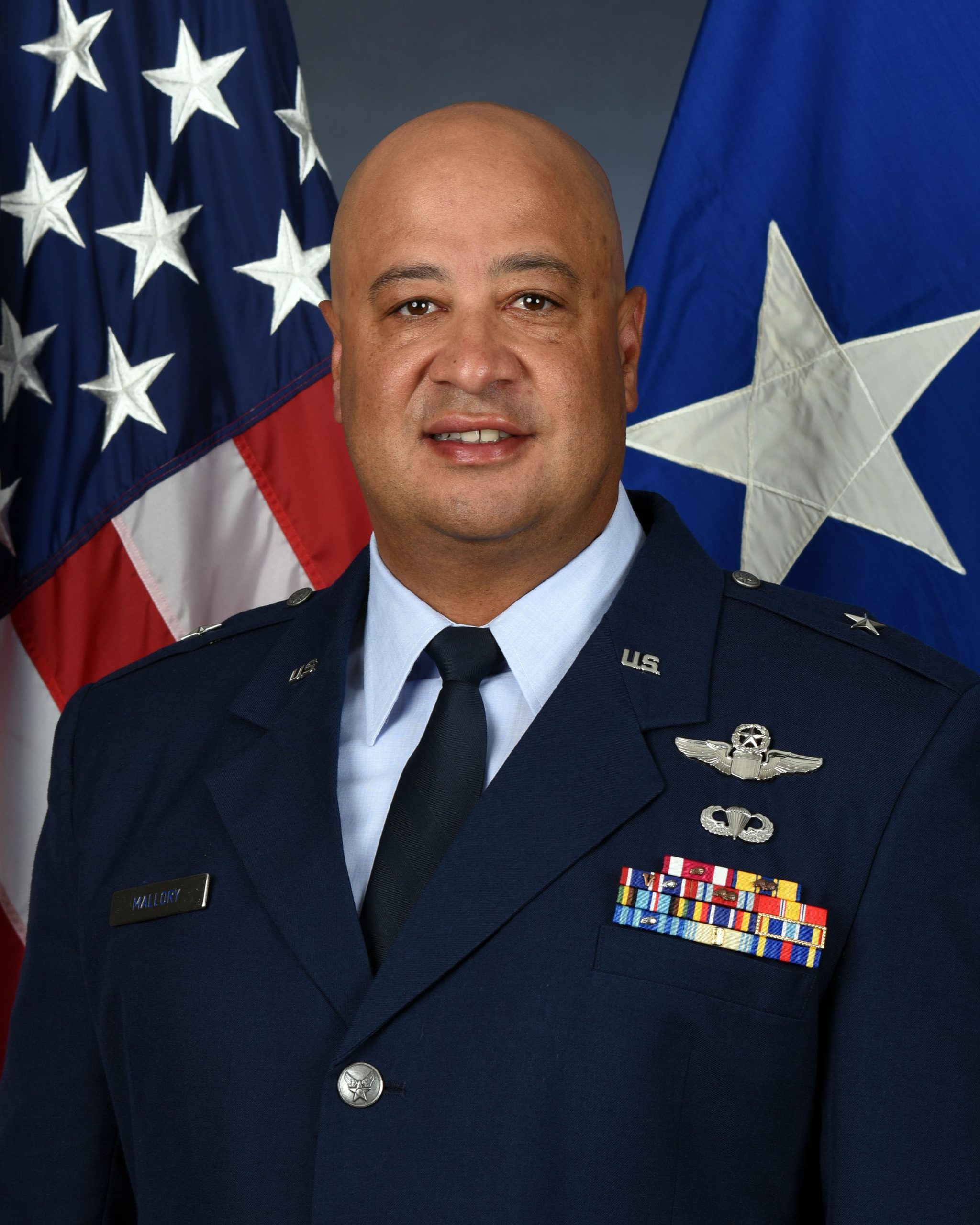
Brig. Gen. Phillip L. Mallory
October 2024 – Present
20
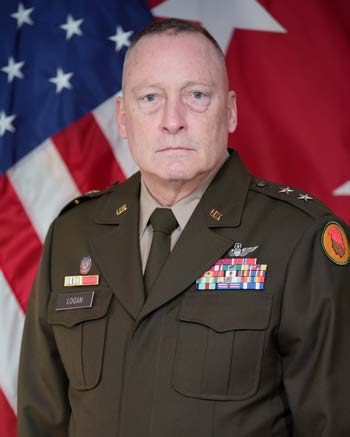
Brig. Gen. Stephen F. Logan
December 2019 – October 2024
Maj. Gen. Stephen Logan enlisted in the Hawaiʻi Army National Guard in 1981 and received his commission as a 2nd Lieutenant of Infantry through the Hawaiʻi Military Academy, Officer Candidate School, in 1983. He has served in numerous positions of increased authority and responsibility from platoon leader through the Commanding General of the Hawaiʻi Army National Guard. In 2012, Logan deployed as the deputy commander of the Operations Coordination Center – Regional Command South, Security Forces Assistance Advisory Team, Kandahar, Afghanistan. In addition he has served on several state missions in support of local authorities. Most notable were Loganʻs duties as the Dual Status Commander of Joint Task Force – 50 in support of the Maui Wildfire Response. He holds a Master of Strategic Studies from the U.S. Army War College and a bachelor’s degree in criminal justice from Chaminade University. He retired as a Metropolitan Police Lieutenant from the Honolulu Police Department in 2004 and holds both military and civilian rotary and fixed wing qualifications. Throughout his career, Logan has flown the C-26, C-12, CH-47, OH-58, UH-1, MD500D, and MD520N aircraft.
19

Brig. Gen. Kenneth S. Hara
December 2014 – December 2019
Maj. Gen. Kenneth Hara was raised on the island of Hawaiʻi and received his commission as a 2nd Lieutenant of Infantry in 1987. He earned a Bachelor of Arts Degree in Human Services from Hawaiʻi Pacific University and later earned a Master of Strategic Studies from the U.S. Army War College. Hara has deployed three times, in 2005 to Baghdad, Iraq; in 2008 to Camp Arifjan, Kuwait both in support of Operation Iraqi Freedom; and 2012 to Kandahar, Afghanistan in support of Operation Enduring Freedom. In addition, he has served on many state missions in support of local authorities. Notable state response missions include Hurricane Iniki response in 1992; Commander, Task Force KOA for the 2006 Kiholo Bay Earthquake Response and as Dual Status Commander of Joint Task Force-50 in support of the Kilauea volcanic eruption and Hurricane Lane responses in 2018. However, it was Hara’s appointment as the state’s overall incident commander for the 2023 Maui Wildfire Response and as the state’s overall COVID-19 Incident Commander that defined his tenure as Adjutant General.
18
Brig. Gen. Joseph K. Kim
January 2011 – December 2014
Brig. Gen. Joseph K. Kim was commissioned in the U.S. Air Force in 1982 upon graduating from the U.S. Air Force Academy with a Bachelor of Science degree in engineering mechanics. He later earned a Master of Business Administration from City University in 1990 and completed Air War College by seminar in 1996. A command pilot with more than 8,000 flight hours in the T-37, T-38, and KC-135, General Kim began his military career as a T-38 instructor pilot and training officer. He went on to serve in multiple flying and leadership roles, including KC-135A Evaluator Instructor Aircraft Commander, Chief of KC-135 Standardization/Evaluation, and instructor at the KC-135 Combat Crew Training School. In 1993, Kim joined the Hawaiʻi Air National Guard, where he served in a wide range of positions with increasing responsibility. His early assignments included pilot and current operations officer roles in the 203rd Air Refueling Squadron and 154th Operations Support Flight. He went on to serve as Director of Operations and then Commander of the 203rd Air Refueling Squadron, followed by leadership positions as Deputy Commander and then Commander of the 154th Operations Group. He later served as Vice Commander and ultimately Commander of the 154th Wing, the largest wing in the Air National Guard.
17
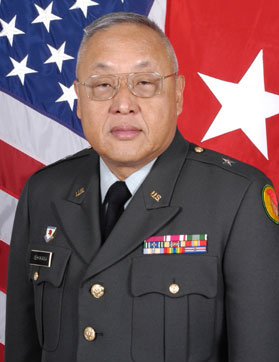
Brig. Gen. Gary M. Ishikawa
January 2003 – December 2010
Brig. Gen. Gary M. Ishikawa began his military career on May 23, 1971, when he was commissioned as a second lieutenant through the Army ROTC program. Throughout his distinguished career, he held numerous command and staff positions within the U.S. Army Reserve, most notably with the 411th Engineer Battalion and the 9th Regional Support Command. His leadership roles included Battalion Commander, Deputy Commander, and Chief of various staff divisions, culminating in his retirement from the Army Reserve in June 2001. He returned to service shortly thereafter, taking on the role of Deputy Adjutant General for the Hawaiʻi National Guard. Ishikawa’s military education includes the Air Defense Officer Basic Course, Engineer Officer Advanced Course, the Command and General Staff Officer Course, and the Army War College. He earned a Bachelor of Science degree in Mechanical Engineering from the University of Hawaiʻi in 1971.
16
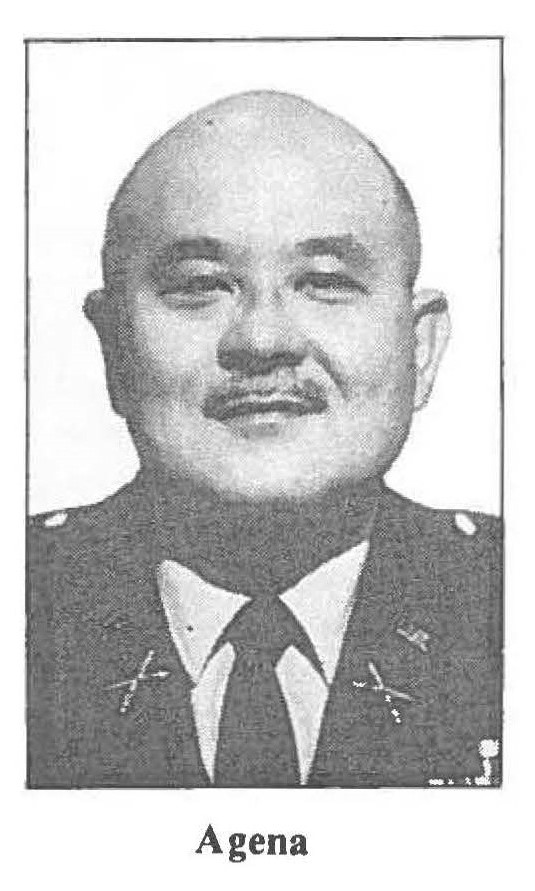
Brig. Gen. Clarence M. Agena
January 2000 – December 2003
Brigadier General Clarence M. Agena was born in Lahaina, Hawaiʻi, on July 2, 1944. In 1962 after graduating from Lahainaluna High School, he attended Oregon State University. He transferred to the University of Hawaiʻi where he earned a Bachelor of Arts degree in mathematics and was commissioned a second lieutenant through its ROTC program in 1967. His early Army assignments include tours with the 2nd Armored Division in Fort Hood, Texas, the 4th U.S. Army Missile Command in Korea, and the 25th Infantry Division in Vietnam. Agena was the Honest John platoon commander in Texas; nuclear support team leader and battalion intelligence officer in Korea; and the field artillery liaison officer for the 2nd Battalion, 27th Infantry; and battery commander of the 2nd Battalion, 77th Field Artillery, in Vietnam. In February 1971, Agena left active duty and joined the Hawaiʻi Army National Guard. He served in various command and staff positions in the units which included tours as a battery commander, battalion executive officer, and acting commander of the 1st Battalion, 487th Field Artillery; executive officer and commander of the 297th Supply and Service Battalion; executive officer for Headquarters Installation Command; and deputy commander of the 29th Separate Infantry Brigade (Enhanced). At the Headquarters State Area Command, he served as plans, operations and military support officer; personnel officer; plans, operations and training officer; logistics officer; and the Hawaiʻi Army National Guard chief of staff.
15
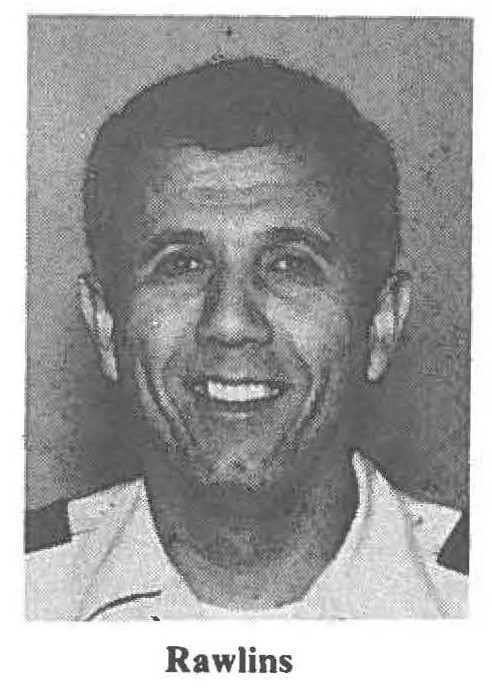
Col. Michael E. Rawlins
1995 – 1998
Col. Michael E. Rawlins joined the Army and attended the Quartermaster Basic Course and the Army and Air Force Exchange Operations at Fort Lee, Va. His first assignment was as Assignment Battalion Supply Officer at Fort Sill, Okla. and was promoted to first lieutenant on Nov. 12, 1968. Rawlins served in Vietnam as an Operations Officer for the Army and Air Force Exchange in Cam Rahn Bay, Vietnam, from November 1968 to October 1969. He later returned to the States and was assigned to the Adjutant for 502nd Supply and Transportation Battalion, 2nd Armored Division, Fort Hood, Texas, and was promoted to Captain on Nov. 12, 1969. Rawlins joined the Hawaiʻi Army National Guard in October 1971. He served in various staff positions with the 29th Supply and Service Battalion until his assignment as commander of the 291st Maintenance Company from March 1975 to December 1977. He moved to the Engineer and Aviation Command and Control unit of Headquarters, Installation Command and later became the Personnel Officer earning his gold Major and silver Lieutenant Colonel oak leaves in April 1980 and October 1984, respectively. Rawlins transferred to the 4960th U.S. Army Reserve School in March 1986 and served as the school’s secretary until returning to the Hawaiʻi Army National Guard as the U.S. Property and Fiscal Office, Supervisory Logistics Management Specialist, from February 1989 to September 1994. Before working full-time for the Hawaiʻi National Guard, Rawlins was employed in sales and management positions with the Gibson Greeting Card, Co., Transpacific Drugs, and Boise Cascade/HOPACO Office Products.
14
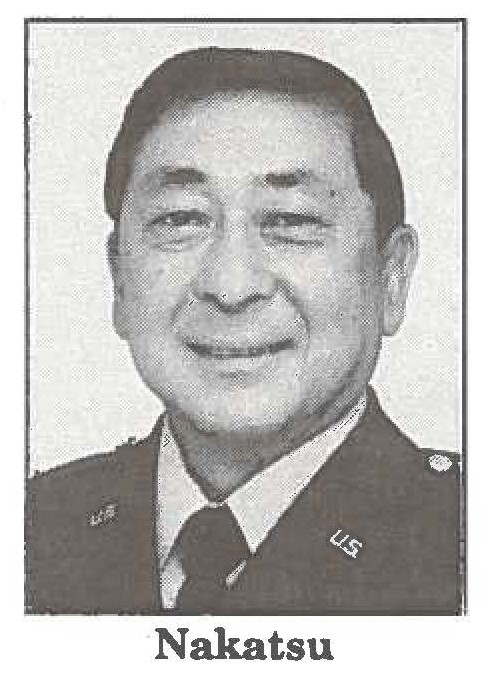
Brig. Gen. Myles M. Nakatsu
September 1988 – December 1994
Brigadier General Myles M. Nakatsu was born on July 18, 1938, and graduated from Hilo High School and enlisted in the Hawaiʻi Army National Guard in 1961. He completed the Hawaiʻi Officer Candidate School in 1963 and was commissioned a second lieutenant in 1964. Initially assigned as an infantry platoon leader, he later served as company executive officer and was promoted to the rank of first lieutenant in 1967. From 1967 to 1968, Nakatsu served as the aide-de-camp to the commanding general, Hawaiʻi Army National Guard. From 1968 to 1971, he was assigned as the senior tactical officer at the Hawaiʻi Officer Candidate School. He was promoted to the rank of captain in 1969. As a Captain, he served as the assistant operations & training officer for the 29th Infantry Brigade (Separate) from 1971 to 1973. His next assignment was as a training officer for the Operations & Plans, Headquarters and Headquarters Detachment, Hawaiʻi Army National Guard. From 1976 to 1979, he served as operations officer on the Adjutant General’s joint staff. In 1979, he became the chief of staff of the Adjutant General’s joint staff and was federally recognized as a colonel on May 5, 1981. As a result of a reorganization in 1982, Nakatsu became the chief, Post Mobilization State Headquarters. He has a bachelors of education, professional teaching certificate and professional school administrator’s certificate from the University of Hawaiʻi. He was a professional educator for many years and served as the principal of Ilima Intermediate School, Hawaiʻi.
13

Col. Paul K. Nakamura
1986
12

Col. Daniel K.C. Au
August 1980 – September 1985
Col. Daniel K.C. Au was born in Honolulu, Hawaiʻi on Jan. 18th, 1934. He graduated from McKinley High School in 1952 and continued his education at the University of Hawaiʻi where he received his degree in Business Administration in 1956. Before joining the Hawaiʻi Air National Guard in September 1959, Major Au served with the Air Force from Nov. 6, 1956 to Aug. 7, 1959.
11
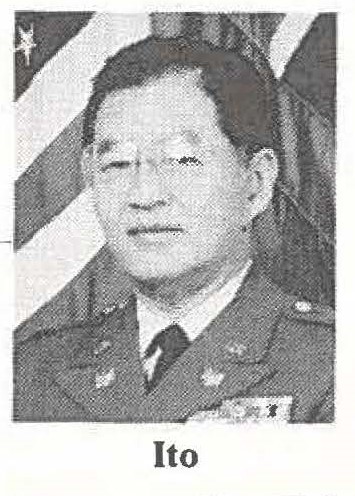
Brig. Gen. Thomas S. Ito
1978 – July 1980
Brig. Gen. Thomas S. Ito was commissioned as a second lieutenant in the Field Artillery through the University of Hawaiʻi’s ROTC program on June 1, 1952. He subsequently held numerous command assignments, including Battery Commander for the 483rd Field Artillery Battalion and the 298th Missile Battalion (Nike Hercules), and later as Battalion Commander of the 487th Field Artillery Battalion. His staff assignments were equally significant, including service as Assistant Chief of Staff, G4, and as the U.S. Property and Fiscal Officer for Hawaiʻi. A committed lifelong learner, Ito earned a Bachelor of Science in Education from the University of Hawaiʻi in 1952. His military education included the Battery Officers Course and Air Defense Officers Course, the Command and General Staff Course, training at the Army Logistics Management Center, and the Defense Strategy Seminar. Ito’s assignments were broad and impactful, beginning as Executive Officer of Battery B, 483rd Field Artillery Battalion in 1951. He later served in leadership positions throughout Hawaiʻi and the continental U.S., including key roles at the National Guard Bureau. His culminating assignments included serving as Assistant Division Commander and Deputy Adjutant General from 1976 to 1980, and returning as the U.S. Property and Fiscal Officer.
Assistant Adjutant General
10

Maj. Gen. Arthur U. Ishimoto
April 1976 – 1978
Honolulu-born Maj. Gen. Arthur Ishimoto enlisted in the Army in 1944. He served as an interrogator and translator in Gen. Douglas MacArthur’s intelligence section during the World War II Philippines campaign. In 1948, Ishimoto joined the 442nd Infantry and received a direct commission to second lieutenant. In 1949, he transferred to the three-year old Hawaiʻi Air National Guard and in 1957, served as the detachment commander of first Air National Guard unit assigned with the full-time air defense mission of a given area. Other assignments included acting Hawaiʻi Air Guard chief of staff in 1974, and commander and Assistant Adjutant General, Air in 1976. During Ishimoto tenure the Hawaiʻi National Guard provided relief assistance after Hurricane Iwa struck the islands in November 1982 and the Hawaiʻi Air National Guard’s Hawaiʻi Regional Operations Center was constructed at Wheeler Army Air Field.
9
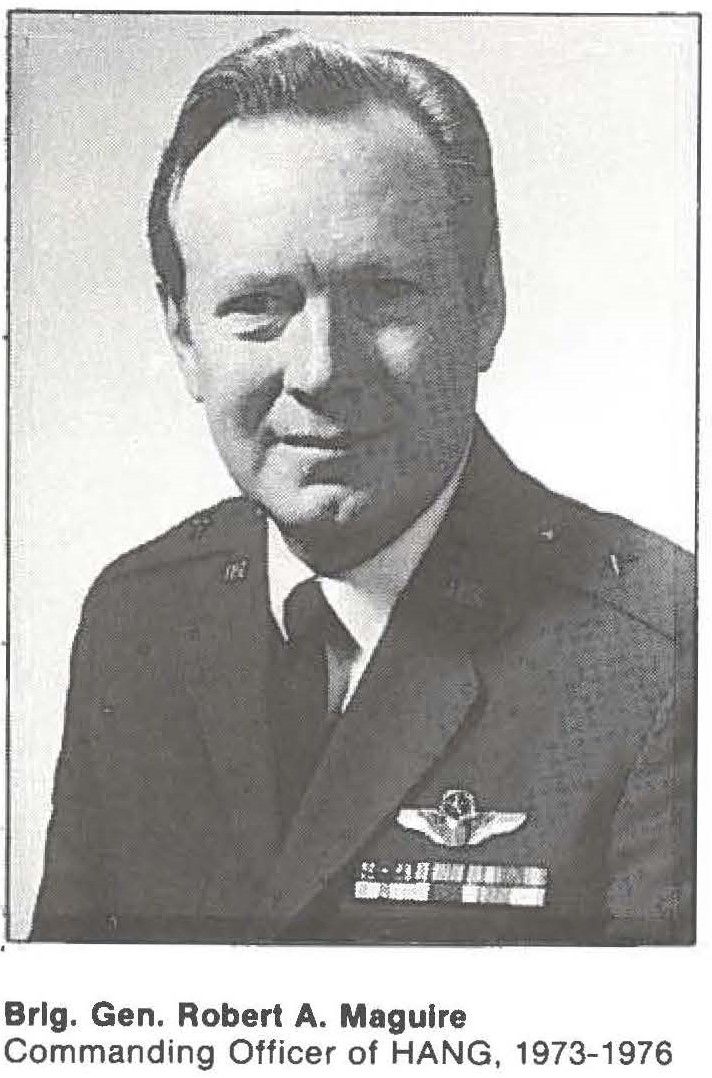
Commanding Officer of HANG, 1973-1976
Brig. Gen. Robert B. Maguire
1973 – 1976
Brig. Gen. Robert B. Maguire was born on Dec. 5, 1924 in Los Angeles, Calif. He grew up and graduated from Glendale High School in June 1942. Maguire enlisted in the Army Air Corps as an Aviation Cadet in April 1943. On June 27, 1944, at Brooks Field, Texas, Maguire was commissioned a second lieutenant and was awarded Air Corps pilot wings. He then attended 8-26, B-24, and 8-17 flight transition schools and served in various flying assignments in the Continental U.S. and in Hawaiʻi. He was honorably discharged on Dec. 11, 1946. Maguire moved to Hawaiʻi in the summer of 1947 and worked for the Flying Tiger Lines as a Flight Dispatcher and Operations Supervisor. On Oct. 4, 1947, Maguire joined the Hawaiʻi Air National Guard (HIANG) assigned to the 199th Fighter Squadron as a P-47 Fighter Pilot. Later that year he was hired as a civilian Air Technician Operations Officer with the Squadron. In April 1950, Maguire left his Air Technician position with the HIANG to accept a position as a pilot with Hawaiian Airlines, but he continued as a drill status Officer and Pilot with the HIANG. At Hawaiian Airlines, Maguire enjoyed a 33 year career where he progressed from Pilot to Vice President, Flight Operations. He retired from the Airline in June 1983. In the HIANG, Maguire progressed from Squadron Pilot to Flight Leader and other positions of increased responsibility during changes of assigned aircraft from the P-47 to the F-86 to the F-86L and to the F-102. December 1960 he was assigned as Commander of the newly formed 154th Fighter Group flying F-102 aircraft. In 1964, Maguire moved from his position as Commander, 154th Fighter Group to Headquarters, HIANG and assumed the position of Direct of Operations where he supervised the operational activities of all of the rapidly expanding number of HIANG units. Maguire was a Command Pilot with over 10,000 military and civilian flight hours in 15 types of training, bomber, transport, and fighter Military aircraft and seven types of propeller, turbo prop and jet in civilian Airline aircraft.
8
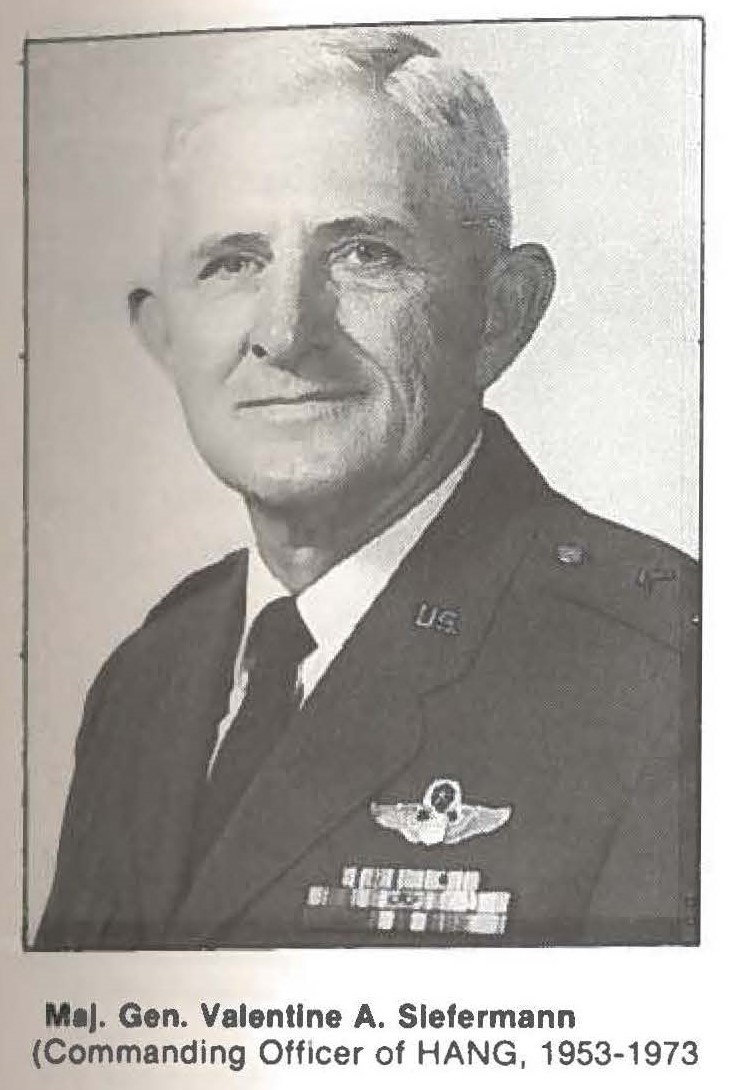
Brig. Gen. Valentine A. Siefermann
1961 – March 1973
In 1947, New York-born Maj. Gen. Valentine Siefermann left active duty as an Army Air Corps fighter and bomber pilot who flew more than 22 combat missions in World War II’s Pacific campaign. The next day he joined as one of the original members of the newly created Hawaiʻi Air National Guard. In 1953, Siefermann was appointed Commander Hawaiʻi Air National Guard and Assistant Adjutant General, Air. He served as acting Adjutant General in 1966 prior to Maj. Gen. Webster’s tour and was appointed Adjutant General after Webster. Siefermann pioneered the idea for all Air Guard units in the nation to report to the major air command. This allowed the Air National Guard units to move into action faster without the red tape of command delays. He worked with the U.S. Air Force to implement the system that enabled the Air National Guard to assume the Air Force’s role in air defense of Hawaiʻi. His system was adopted nationally eight years later. In 1974, Siefermann helped modernize the Post-Vietnam Hawaiʻi Army National Guard aviation program, including assisting law enforcement in the confiscation of illegal marijuana.
7

Brig. Gen. Frederick A. Schaefer, III
February 1960 – 1968 and 1970 – 1978
Brig. Gen. Frederick A. Schaefer III, was born in Honolulu, Hawaiʻi on Jan. 3, 1921. He graduated from Cornell University in 1942 with a Bachelor of Science degree in Agriculture. He was commissioned a second lieutenant, upon graduation as a result of ROTC training. On graduation from college, he was called to active duty and assigned to Company F, 27th Infantry Regiment, 25th Infantry Division, as platoon leader. He served with this unit during World War II in Guadalcanal in the Southwest Pacific until 1943. In April of that year, he was assigned to the 66th Infantry Division where he commanded the division’s Ranger School and was later an Assistant G3. In October 1944, the division went to Europe, stationed in France and Germany. Schaefer remained on active duty until October 1945. He then joined the Hawaiʻi Army National Guard, and served as an Infantry battalion commander. Infantry regimental commander and as an anti-aircraft Artillery group commander. On Jan. 15, 1959, Schaefer assumed command of the 29th Infantry Brigade (Sep). He served with that unit until February 1960 when he became the Commanding General of the Hawaiʻi Army National Guard and Assistant Adjutant General (Army). Schaefer served in this capacity until May 1968. He then volunteered again to take command of the 29th Infantry Brigade (Sep), on its being alerted for active duty. In January 1969, Schaefer departed from the 29th Infantry Brigade (Sep) enroute to Vietnam, where he assumed duties as 4th Infantry Division’s Assistant Division Commander on Jan. 15. In July 1969, Schaefer was reassigned as Assistant Division Commander, 9th Infantry Division, and in October 1969 reassigned as Commanding General, 29th Infantry Brigade (Sep). On Dec. 12, 1969, the 29th Infantry Brigade (Sep) was demobilized and returned to State status, and on Dec.13, 1969, Schaefer was reassigned as Commanding General, Hawaiʻi Army National Guard and Assistant Adjutant General (Army).
6
Brig. Gen. Frank A. Alameda
1956 – October 1959
Brigadier General Frank A. Alameda was born on October 4, 1899, in Halawa, Hawai‘i. He began his education at the Territorial Public School in Makapala and later attended St. Louis College in Honolulu, graduating in 1919. He continued his education by completing various military courses at institutions such as Fort Benning, Ga.; Southern Pines, N.C.; the University of Virginia; and Yale University. Following graduation, Alameda worked as a clerk for the Pioneer Mill Company in Lahaina. On Mar. 1, 1927, he began a long career in public service with the Territory of Hawai‘i as Deputy Tax Assessor and Collector for Lahaina. In 1935, he was promoted to Deputy Tax Assessor for the entire Second Taxation Division, overseeing real property tax assessments across Maui, Moloka‘i, Lāna‘i, and Kaho‘olawe. His civilian service was interrupted by World War II, during which he served in the Army from 1940 to 1946. After the war, he returned to civilian government service, serving as Tax Assessor and Collector until his retirement in January 1965, culminating in 38 years of public service. Alameda’s military career spanned more than 34 years, beginning with his enlistment as a private in Company A, 1st Hawaiian Infantry, 299th Regiment, Hawaiʻi National Guard on January 12, 1925. Rising steadily through the ranks, he received his commission as a second lieutenant in 1932 and was eventually promoted to Brigadier General in 1957. During World War II, he served in multiple command and staff positions including company and battalion commander, regimental supply officer, post commander of Fort Ruger, and Civil Affairs Officer on the staff of the 6th Infantry Division. He was also appointed Military Governor of Challa Pukto Province during the U.S. occupation of South Korea. Following his return from active duty in 1946, Alameda rejoined the Hawaiʻi National Guard, voluntarily accepting a reduction in rank to lead the 1st Battalion, 299th Infantry. His rank of Colonel was restored in 1950 when he assumed command of the 299th Regimental Combat Team. He led the unit for seven years, earning recognition for its exceptional performance among National Guard units nationwide.
5
Col. David P. Silva
1950 – 1956
4
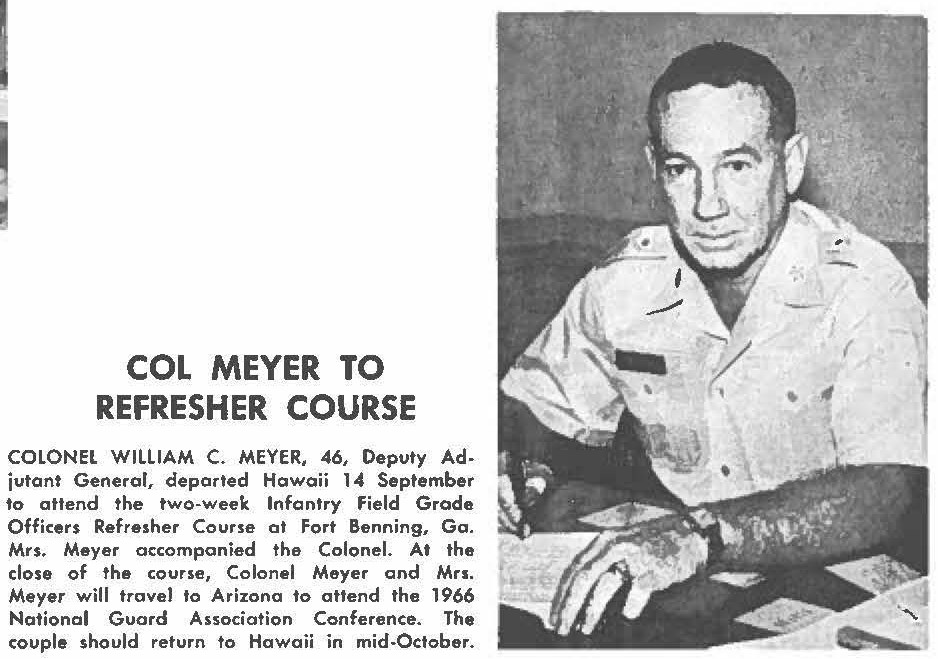
National Guard Association Conference. The couple should return to Hawaii in mid-October.
Maj. William C. Meyer
1950 – 1950
3
Col. Allen W. Smith
1946 – 1949
2
Lt. Col. Dean R. DeMerritt
June 1940 – ?
1
Brig. Gen. Wilhelm A. Anderson
1931 – 1940
Maui-born, Brig. Gen. Wilhelm Andersen, joined the National Guard of Hawaiʻi prior to World War I. After graduating from Officers’ Training Camp held at Schofield Barracks in Nov. 26, 1917, the newly commissioned first lieutenant was assigned to the 2nd Infantry. He was called into federal service in December 1917 and reported to Fort Shafter. Eight months later, he left for more officers training at Camp Fremont, Calif. Andersen was honorably discharged after the war at Schofield Barracks. In 1923, the demobilized Hawaiʻi Guard was reorganized. In 1925, Andersen became a lieutenant colonel and 1st Battalion, 298th Infantry command. 1929 brought Andersen his full-bird eagles (colonel) and command of the 298th Infantry. The following year he received his 10-year Hawaiʻi National Guard Service Medal and he attended advance field and staff officer school at Fort Benning, Ga. Andersen becomes the Assistant Adjutant General in addition to 298th commander, in 1934. He and the Hawaiʻi National Guard were federalized Oct. 15, 1940, prior to the United States “joining” World War II. The 298th Infantry became the active duty 22nd Infantry Brigade, Hawaiian Division, at Schofield. In 1942, he was promoted to Brigadier General and concluded his military service shortly after the war in 1945. In civilian life he worked at Theo. H. Davis and Co. Ltd., and later at the Bank of Hawaiʻi.