Do you need help in another language? We will get you a free interpreter. Call 808-369-3580 to tell us which language you speak.
您需要其它語言嗎?如有需要,請致電 (808-369-3478), 我們會提供免費翻譯服務
您需要其它语言吗?如有需要,请致电 (808-369-3478), 我们会提供免费翻译服务
En mi niit alilis lon pwal eu kapas? Sipwe angei emon chon chiaku ngonuk ese kamo. Kokori (808-369-3478) omw kopwe ureni kich meni kapas ka ani.
Makemake `oe i kokua i pili kekahi `olelo o na `aina `e? Makemake la maua i ki`i `oe mea unuhi manuahi. E kelepona (808-369-3478)`oe ia la kaua a e ha`ina `oe ia la maua mea `olelo o na `aina `e.
Masapulyo kadi ti tulong iti sabali a pagsasao? Ikkandakayo iti libre nga paraipatarus. Awaganyo ti
(808-369-3478) tapno ibagayo kadakami no ania ti pagsasao nga ar-aramatenyo.
다른언어로 도움이 필요하십니까? 저희가 무료로 통역을 제공합니다. (808-369-3478)로 전화해서 사용하는 언어를 알려주십시요
Kwoj aikuij ke jiban kin juon bar kajin? Kim naj lewaj juon am dri ukok eo ejjelok wonen. Kirtok
(808-369-3478) im kwalok non kim kajin ta eo kwo melele im kenono kake.
E te mana'o mia se fesosoani i se isi gagana? Matou te fesosoani e ave atu fua se faaliliu upu mo oe. Vili mai i le numera lea (808-369-3478) pea e mana'o mia se fesosoani mo se faaliliu upu.
¿Necesita ayuda en otro idioma? Nosotros le ayudaremos a conseguir un intérprete gratuito. Llame al (808-369-3478) y diganos que idioma habla.
Kailangan ba ninyo ng tulong sa ibang lengguwahe? Ikukuha namin kayo ng libreng tagasalin. Tumawag sa (808-369-3478) para sabihin kung anong lengguwahe ang nais ninyong gamitin.
‘Okú ke fie maʻu tokoni ʻi ha lea fakafonua ʻe taha? Temau kumi haʻo taha fakatonulea taʻetotongi. Telefoni ki he (808-369-3478) ke fakahā mai ʻa e lea fakafonua ʻokú ke lea aí.
Bạn có cần giúp đỡ bằng ngôn ngữ khác không ? Chúng tôi se yêu cầu một người thông dịch viên miễn phí cho bạn. Gọi (808-369-3478)nói cho chúng tôi biết bạn dùng ngôn ngữ nào
Gakinahanglan ka ba ug tabang sa imong pinulongan? Amo kang mahatagan ug libre nga maghuhubad. Tawag sa (808-369-3478) aron magpahibalo kung unsa ang imong sinulti-han.
His Air Force career commenced on Jan. 27, 1942 when he entered the Army Air Forces as an aviation cadet. He obtained his pilot training in the Army Air Force Southeast Training Center, graduating and receiving his pilot’s wings and second lieutenant commission on Dec. 13, 1942. During World War II, he served with the Asiatic-Pacific Theater of Operations where he was assigned to and flew with the 30th Bomb Group and 7th Fighter Wing until discharged Feb. 15, 1946. The day after his discharge from active duty, he was appointed in the newly formed Hawaii Air National Guard where he has served ever since. From 1946 to 1960, he rose in grade from the rank of captain to brigadier general.
From 1953 to March 1973, Siefermann served as commander, Hawaii Air National Guard and assistant adjutant general, Air, Department of Defense, State of Hawaii. He commanded a rather unique organization in that in addition to its reserve mission, it provides the only Air Force weapons and radar ground environment for the active air defense of Hawaii. Working with the Far East Air Forces in 1956, Siefermann was one of the designers of and one of the motivating forces behind the Hawaii Air National Guard-Pacific Air Forces air defense system as it exists today. The concept has resulted in the most effective blend of the Reserve and Regular missions to date.
On April 1, 1973, the Governor of the State of Hawaii, nominated Sierfermann to be the adjutant general, State of Hawaii. His appointment was confirmed by the Senate of the state legislature on April 11, 1973, and he was subsequently commissioned the adjutant general, State of Hawaii, and director of State Civil Defense on April 19, 1973.
Siefermann was promoted to his present rank on 24 April 1974.
Brigadier General Valentine A. Seifermann, 40, Assistant Adjutant General, Hawaii Air National Guard, was promoted to his present rank recently in brief ceremonies held in the Adjutant General’s office.
General Seifermann, a native of Mount Vernon, New York, began his military career in 1942 as a second lieutenant. He was separated from active military service in February 1947 with the permanent grade of captain. That same month, he joined the Hawaii Air National Guard.
General Seifermann has been in command of the Hawaii Air National Guard since 1957.
His major interests and hobbies are woodworking, learning to better understand people, and acquiring a knowledge of the physical sciences.
General Seifermann resides at 252-A Kihipai Street, Kailua, with his wife, Pauline, and children.
Brigadier General Valentine A. Siefermann was born in New York City on 18 January 1920 and was educated in that city. He was rated and received his commission in the Air Force in December 1942. He received his flight training as an aviation cadet at the Army Air Force Southeast Training Center, with headquarters at Maxwell Air Force Base, Alabama.
In addition to flight training, he attended the Air Inspector’s School, AFTAC, and the AC&S orientation course. He was in the Air Force from 1942 to 1947 and served in the commissioned grades from second lieutenant to captain. In World War II, he served in the Asiatic-Pacific Theater from 1943 to 1946. He was separated from active military service in February 1947 and immediately joined the Hawaii Air National Guard.
From 1947 to 1960, he rose in grade to the rank of brigadier general.
As Assistant Adjutant General and Commander of the Hawaii Air National Guard, he is responsible for advising and assisting the Adjutant General of Hawaii in the administration, logistics, and training of Air National Guard units within the state; the performance of state requirements; and the preparation of the Air National Guard for its federal mission.
On 15 July 1966, he was appointed Acting Adjutant General, State of Hawaii, by Governor John A. Burns, upon the resignation of Maj. Gen. R. L. Stevenson, the Adjutant General.
He is married to the former Pauline F. Capanas of Honolulu, Hawaii. They make their home at 47-504 Lulani Street, Kaneohe, Hawaii.
Brigadier General Valentine A. Siefermann wears numerous service medals for participation in World War II, among these being the American Campaign Medal, World War II Victory Medal, Asiatic-Pacific Medal, and the Air Force Reserve Medal.
Brigadier General Valentine A. Siefermann was appointed director of civil defense and adjutant general for the State of Hawaii on April 1, replacing Major General Benjamin J. Webster, who retired. The appointment was made by GovernorJohn A. Burns and confirmed by the State Senate on April 11. Brig. Gen. Siefermann was promoted to the rank of major general by the State on April 19. Prior to his new assignment as the head of the State’s Department of Defense, the general was commander of the Hawaii Air Kational Guard and assistant adjutant general, Air.
Maj. Gen. Valentine A. Siefermann was reappointed on Dec. 2, 1974, by Governor George R. Ariyoshi as director of civil defense and adjutant general. John N. Butchart continued to serve as vice director.
Brigadier General Valentine A. Siefermann was sworn in as Hawaiʻi’s State Adjutant General on April 19 at 2:00 p.m. The General had been nominated by Governor John A. Burns on March 29 and confirmed by the State Senate on April 11.
The new Adjutant General was an original member of the Hawaii Air National Guard when it was first federally recognized. He became the first Commander of HANG and Assistant Adjutant General, Air, when the post was created in 1953.
The New York-born Siefermann first arrived in the islands as a young bomber pilot during World War II. He served in the Pacific as both a bomber and fighter pilot until he joined the Hawaii National Guard.
In an address to commanders of the Air and Army Guard and key NCOs, the new Adjutant General discussed the precepts that would guide his administration. He listed his basic principles of operation, saying:
“The basic principles upon which our leadership and management must be based are that the organization and mission accomplishment come first, our enlisted men and airmen next, then the junior officers, and last, those of us in the command and staff positions.”
He made several points about the Department’s organization, saying:
“I intend to take a good look at the staff at my level to determine if it can be reduced. To have a large staff at the departmental level when the three divisions have the capability to provide whatever staff support is necessary seems redundant.”
He continued:
“Division Commanders are asked to develop and implement policies that will insure that all technicians hold comparable positions within the military structure. The Department will function under the concept that the technician organization and the military organization are one and the same. The technicians are authorized solely for the purpose of supporting the military organization. It will be up to the Division Commanders to insure that no divisiveness develops between the two components of their organizations.”
The bulk of the General’s talk centered on people—their responsibilities, management practices, and their rights. His views included:
“Every individual has a right to be heard. If the answers he receives from a particular level do not satisfy him, he has the right to go through the chain of command to me. If I cannot satisfy him, he should feel free to go to the Governor—in fact, I would feel obligated to assist by making the appointment for him.”
He continued, saying:
“Every individual, down to the newest recruit, will be treated with the respect normally accorded any human being—the same you would expect to be extended to you. It should not compromise development of a disciplined corps as long as we develop and employ the techniques of good personnel management and leadership.”
He also said:
“One of our prime responsibilities as the leaders of today’s organizations is to insure that we do everything in our power to build leadership in depth—the leaders of tomorrow, our replacements—in both the officer and NCO corps. We have an obligation to each and every man working with us, regardless of relationship or personal feeling, to honestly evaluate, counsel, and guide him.”
As he neared the end of his talk, Brig. Gen. Siefermann spoke on recruiting and retention.
“Every disillusioned or disgruntled individual in the organization, or those who have left us, increases our retention and recruiting problem many fold because he runs down the Guard in the community. We must convince all our people to become involved in the program, especially the full-time technicians whose livelihood depends on a viable force of ‘weekend warriors’—the non-technicians. Insuring that our guardsmen have a sense of accomplishment from their association with the Guard can contribute much to retaining them past their first enlistment.”
The General concluded with his thoughts about the Open Door Policy, saying:
“I hope I can express my sincerity in stating that my door will always be open to any individual who thinks my policies are wrong or who has a suggestion to improve any facet of our operations. When a man complains or exposes inefficiencies or problems, he is either right or he is wrong. If he is right, everyone concerned should be man enough to accept the criticism and correct the situation; or if you think he is wrong, explain why. If you can’t, he undoubtedly has a point.”
General Siefermann Retires After 35 Years of HNG Service
Maj. Gen. Valentine A. Siefermann has been an Air National Guard officer for 35 years and state adjutant general for almost nine.
He was instrumental in fostering the growth of HANG in its early years and administered many innovative programs during his term as adjutant general.
Yet, he remains characteristically modest about his achievements, crediting those around him as the reasons for the Guard’s success.
“You can’t call it a job,” he said. “In retrospect, even though we’ve had trying times, it has not been a chore; it has been a pleasant and rewarding experience.”
“No one man runs an organization. He may guide it, but he isn’t the organization. It’s a team of qualified people working in concert to achieve a given objective. People were always there to assist.
“It would take a long time to name them all.
“When you work as a true team, it’s an unbeatable organization. Anything I’ve achieved I owe to people …,” he noted.
Siefermann gave special credit to his secretary, Jeannette Yoshimori; Sgt. Maj. Shinsato; all the staff; his deputies; and each and every member of the department for their extraordinary contributions.
Siefermann has especially enjoyed the challenge of leadership.
“I’ve always enjoyed problems. Facing each with a positive attitude, looking for the imaginative and innovative solution which will prevent problems from surfacing, is a challenge, and challenges keep one’s mind active, growing, and lucid.”
Maj. Gen. Valentine A. Siefermann: 35 Years with the National Guard
Valentine Siefermann (standing, center) as a young captain in the new Hawaii Air National Guard. The Air Guard was based at Bellows Field in Waimanalo in the early years, operating with only a few aircraft and makeshift facilities. Lt. Col. Valentine Siefermann, at his desk at Fort Ruger, and in his new position as commander of the Hawaii Air National Guard. Gov. John A. Burns and General Siefermann’s wile, Pauline, pin him with his major general’s star in 1974. Gov. Oren E. Long tours the new Air National Guard facilities at Hickam Air Force Base, accompanied by Valentine Siefermann. Valentine Siefermann (extreme right) and a group of his fellow Guard members proudly pose atop the wing of the Air Guard’s B-26, the first plane ever received by the new unit in 1947. The Air Guard’s P-47 Thunderbolt during a dawn patrol near Oahu. Siefermann and his fellow pilots flew such patrols in the early years of the Air Guard, returning to base in time to go to their regular full-time jobs in the community.As commander of the Air Guard, Siefermann oversaw the Hawaii unit’s entry into the jet age, including the introduction of the familiar F -102s.General Siefermann is presented with the Hawaii National Guard Commendation medal by Gov. George R. Ariyoshi, under whom Siefermann served for many years until his retirement. The medal was presented in ceremonies at the State Capitol.(Pictures from the 1981 Winter Pūpūkahi)
On December 30, 1981, Maj. Gen. Valentine A. Siefermann retired as state adjutant general, climaxing a 35-year career with the Hawaii National Guard and Department of Defense.
Siefermann is synonymous with the National Guard, having been a part of its growth since the end of World War II.
He was born and educated in New York, first arriving in island waters aboard a troop ship in 1943. He served as an aviator in Asia and the Pacific. During this time, he fell in love with the Hawaiian Islands and decided to make them his home after the war.
In 1946, while working for the commander of the 7th Air Force, Siefermann, then a 26-year-old captain, was asked if he wanted a job with the new Hawaii Air National Guard.
He gladly accepted and began officially working for HANG two days after Christmas in 1946.
“When I first got on board, we didn’t even have any airplanes,” Siefermann recalled. Instead, the first corps of Air Guard members, 56 strong, spent their time setting up Bellows Field while awaiting the arrival of the planes.
“We moved shacks across Bellows Field to provide much-needed facilities. We used forklifts and drums and trucks to move these shacks,” he noted. “We had a hell of a lot of fun setting up the facility. There was a tremendous amount of teamwork between people and we got tremendous help from the Army Air Corps.”
In March 1947, HANG’s first plane, a B-26, arrived. This was followed by nine more aircraft over the next few months.
“We had to scrounge for parts to keep the aircraft operational,” said Siefermann. Scrounging meant staging “raids” on Hickam Air Force Base.
Soon the unit was nicknamed “Nolan and His 40 Thieves,” Nolan being the unit commander at the time.
“We were a real close-knit group,” he recalled. Despite the inconvenience of travel across the Pali, attendance of full-timer and drill-status personnel was extremely high.
By June 1947, HANG had half its required troops. One month later, the first fighter was received.
“In October 1947, the unit moved to Hickam Air Force Base to an old troop carrier area and we again started the same process,” he said. Everyone pitched in to help build the new headquarters. “There was no such thing as being impossible. If it was needed, we did it.”
Siefermann and the pilots flew regular runs between the islands, carrying people and equipment.
He and his fellow pilots also flew dawn patrols. Dawn patrols were the vogue then.
“The maintenance personnel would get up early, get the aircraft ready, and the pilots would fly before they went to work. We flew more for the fun of flying than for the money.”
Siefermann fondly remembers one special event that closed out the decade of the ’40s—HANG’s first operational readiness test.
“We worked 96 hours straight. I can remember mechanics working around the clock. We were determined to make it and we did. It was then that we received the highest OR score earned by any National Guard unit in the nation,” said the general.
In early 1951, Siefermann, by then a major, was appointed air staff officer for the adjutant general’s staff at Fort Ruger.
Two years later, in July 1953, he was appointed commander of the Hawaii Air National Guard, a position he held until 1973.
During his 20-year tenure as HANG commander, he oversaw the growth of the Guard’s responsibilities. It grew from a small reserve unit to one with the duty of providing Hawaii’s total air defense network.
Siefermann remembers this period as one in which “the Guard started to grow even more.”
“We started to plan for the jet age. The first T-33 arrived in November 1953 and the organization just kept growing.”
HANG received its first F-86 jet in 1954 and began working with the Far East Air Forces at that time.
“In ’56, HANG assumed the air defense mission for the islands. It gave us a reason for existing other than training. We had a live mission and training became more intense, more demanding,” he commented.
“There was still tremendous morale, even with the aircraft transition,” he said. “Everyone was always gung-ho. Every aircraft, every piece of equipment was better after we got through with it.”
“The men really went all out to keep the equipment operational,” he said.
In addition to the new aircraft, Siefermann saw HANG’s 169th Aircraft Control and Warning Squadron’s Koko Head radar station become operational in February 1958, providing 24-hour radar service.
“The late ’50s marked a turning point of the Guard into a mission-capable modern force,” he said. “Throughout all of this, we continually functioned on alert. Transitions to new aircraft were accomplished in an exceptional manner. Continuous—almost unlimited—talent was always available.”
In December 1960, HANG received its first F-102s, to be followed in rapid succession by the construction of the Kokee radar facility and a similar radar station atop Mount Kaala on Oahu, and the establishment of a permanent HANG home at Fort Kamehameha.
In April 1973, Siefermann became adjutant general upon the retirement of Robert Stevenson.
Siefermann outlined what he felt were the department’s major achievements during his term as adjutant general.
“For the Army National Guard, the Roundout program was a turning point in terms of training relations with the U.S. Army and the fact that our units are now so well-equipped in comparison with mainland units,” he said.
He was instrumental in establishing this Roundout relationship in 1973.
“It created closer relations between the U.S. Army and HARNG,” he commented. “Our association with Roundout helped improve quality and training, which is reflected in improved readiness.”
“We also built the Waiawa facilities and acquired an aviation unit.
“But what amazes me [about the Army Guard] is how they live through constant change …. They roll with the punches and are able to come out with a quality organization.
“What we need in the Hawaii Army National Guard is more full-time people, especially when you compare it to manning in the Air Guard.
“We built the Organizational Maintenance Shop and got additional manning, but it hasn’t been sufficient.
“If combat arms gets an improved officer and rank structure, we’d have depth and more experienced leadership. If he’s aggressive, a young man’s got to keep moving up and rotating to get ahead. But the impact is always on the troops because every new commander has a new program,” he said.
Nevertheless, Siefermann feels that the Guard has “excellent commanders” and an NCO corps that the active Army envies.
As for the Air National Guard, which has been such an essential part of his career, Siefermann cites its continued operational capability, 24-hour alert program, and the acquisition of new facilities as the major accomplishments.
“We’ve developed a hell of a good capability. We have a good air defense system and a fine group of people,” he said.
“However, the program will really remain viable since Congress authorized $12 million this year for the automation of the command and control phase of the system.”
“The time flew by so fast,” said Siefermann only a few days before his retirement.
“You can’t really single out achievements, you’ve got to look at the entire group of people. It’s the people that really did it.
“Anything I’ve achieved or have gotten I owe to others—every man and woman who has been or is in the department.
“In departing, I want to say to one and all—thank you. You’ve made that phase of my life a most meaningful and wonderful experience.”
Maj. Gen. Valentine A. Siefermann April 1, 1973 – Dec. 30, 1981(Picture from the 1982 Summer Pūpūkahi)
From April 1973 to the end of December 1981, Valentine A. Siefermann held the reins of the Hawaii National Guard and State Civil Defense. Some of his major accomplishments include establishment of the “Roundout” program with the U.S. Army’s 25th Infantry Division and, as HANG commander, developing that organization into one of the best in the nation. Siefermann has embarked on several business endeavors since his retirement.
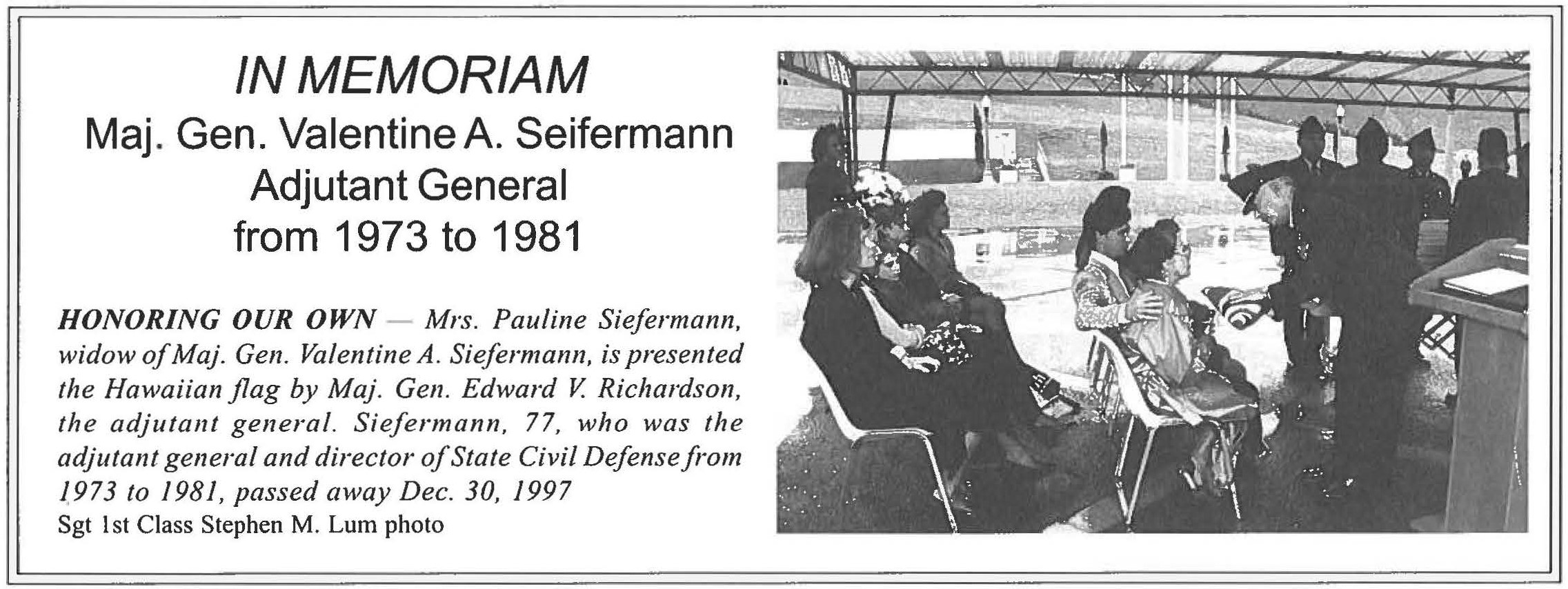
HONORING OUR OWN – Mrs. Pauline Siefermann, widow of Maj. Gen. Valentine A. Siefermann, is presented the Hawaiian flag by Maj. Gen. Edward V. Richardson, the adjutant general. Siefermann, 77, who was the adjutant general and director of State Civil Defense from 1973 to 1981, passed away Dec. 30, 1997 Sgt 1st Class Stephen M. Lum photo (Picture from the 1998 Annual Report)