Do you need help in another language? We will get you a free interpreter. Call 808-369-3580 to tell us which language you speak.
您需要其它語言嗎?如有需要,請致電 (808-369-3478), 我們會提供免費翻譯服務
您需要其它语言吗?如有需要,请致电 (808-369-3478), 我们会提供免费翻译服务
En mi niit alilis lon pwal eu kapas? Sipwe angei emon chon chiaku ngonuk ese kamo. Kokori (808-369-3478) omw kopwe ureni kich meni kapas ka ani.
Makemake `oe i kokua i pili kekahi `olelo o na `aina `e? Makemake la maua i ki`i `oe mea unuhi manuahi. E kelepona (808-369-3478)`oe ia la kaua a e ha`ina `oe ia la maua mea `olelo o na `aina `e.
Masapulyo kadi ti tulong iti sabali a pagsasao? Ikkandakayo iti libre nga paraipatarus. Awaganyo ti
(808-369-3478) tapno ibagayo kadakami no ania ti pagsasao nga ar-aramatenyo.
다른언어로 도움이 필요하십니까? 저희가 무료로 통역을 제공합니다. (808-369-3478)로 전화해서 사용하는 언어를 알려주십시요
Kwoj aikuij ke jiban kin juon bar kajin? Kim naj lewaj juon am dri ukok eo ejjelok wonen. Kirtok
(808-369-3478) im kwalok non kim kajin ta eo kwo melele im kenono kake.
E te mana'o mia se fesosoani i se isi gagana? Matou te fesosoani e ave atu fua se faaliliu upu mo oe. Vili mai i le numera lea (808-369-3478) pea e mana'o mia se fesosoani mo se faaliliu upu.
¿Necesita ayuda en otro idioma? Nosotros le ayudaremos a conseguir un intérprete gratuito. Llame al (808-369-3478) y diganos que idioma habla.
Kailangan ba ninyo ng tulong sa ibang lengguwahe? Ikukuha namin kayo ng libreng tagasalin. Tumawag sa (808-369-3478) para sabihin kung anong lengguwahe ang nais ninyong gamitin.
‘Okú ke fie maʻu tokoni ʻi ha lea fakafonua ʻe taha? Temau kumi haʻo taha fakatonulea taʻetotongi. Telefoni ki he (808-369-3478) ke fakahā mai ʻa e lea fakafonua ʻokú ke lea aí.
Bạn có cần giúp đỡ bằng ngôn ngữ khác không ? Chúng tôi se yêu cầu một người thông dịch viên miễn phí cho bạn. Gọi (808-369-3478)nói cho chúng tôi biết bạn dùng ngôn ngữ nào
Gakinahanglan ka ba ug tabang sa imong pinulongan? Amo kang mahatagan ug libre nga maghuhubad. Tawag sa (808-369-3478) aron magpahibalo kung unsa ang imong sinulti-han.
Maj. Gen. Arthur U. Ishimoto serves as the State Adjutant General. In his position, he is Director of the Hawaii Department of Defense and a member of the Governor’s cabinet, Commander of the Hawaii Army and Air National Guard, and Director of Civil Defense.
Ishimoto was appointed to his post by the Governor, effective Feb. 1, 1982. He was federally recognized as major general on June 18, 1982.
Ishimoto began his military career in January 1944 when he volunteered and enlisted in the U.S. Army and was assigned to Military Intelligence School in Camp Savage, Minn. In May 1945, he participated in the Philippines Campaign while attached to the Allied Interrogation and Translation Section, G-2, in Gen. Douglas MacArthur’s headquarters.
In May 1948, he joined the 442nd Army Reserve and received a direct commission as a second lieutenant. In June 1948, he served a short tour of active duty as Company Executive Officer, Headquarters and Headquarters Company, Schofield Barracks. He returned to the 442nd Infantry Reserve and served as platoon leader.
In April 1949, he transferred to the three-year old Hawaii Air National Guard and was assigned to the 199th Air Service Group as an Adjutant. In 1950, he was assigned to the newly activated 109th Aircraft Control and Warning Squadron serving initially as the Adjutant and subsequently as Communications Officer. In 1955 he was assigned to Headquarters, Hawaii Air National Guard, as Electronics Officer. In 1956, he worked for the 7th Air Force as project engineer for engineering and installation of heavy ground radar and air/ground radio equipment. Subsequently, he served as the detachment commander of the GCI station–the first Air National Guard unit to be assigned a full time air defense mission operating 24 hours a day, seven days per week.
In February 1959, he again was selected as project engineer to design the permanent Hawaiian Air Defense System to include engineering and installing two ground controlled intercept stations which consisted of heavy ground radar, air/ground radios, point-to-point radio system, and intra-site telephone system. In July 1965, he served as Director of Communications -Electronics.
In January 1968, he was appointed as Director of Logistics. In August 1974, he served as Acting Chief of Staff and in April 1976 he was appointed as Assistant Adjutant General (Air) and Commander of the Hawaii Air National Guard. He was federally recognized as brigadier general on Feb. 4 1977.
Under his command, units of the Hawaii Air National Guard have been cited for outstanding performance on several occasions. The largest unit, the 154th Composite Group, received a U.S. Air Force Outstanding Unit Award in 1979. The 154th Composite Group, which has the responsibility for providing Hawaii’s total air defense network, has also participated in deployments and exercises on Guam, the Philippines, and Japan. The 1980 Japan exercise, entitled Cope North, involved Japanese military aircraft, and was the first time a Hawaii reserve unit had trained and flown with a foreign air force on that air force’s territory.
Ishimoto’s awards and decorations include: the Legion of Merit, Meritorious Service Medal, Good Conduct Medal, American Campaign Medal, Asiatic-Pacific Campaign Medal, World War II Victory Medal, Army of Occupation Medal, Air Force Longevity Service Award Ribbon, Armed Forces Reserve Medal, Small Arms Expert Marksmanship Ribbon, Philippine Liberation Ribbon, Philippine Independence Ribbon, Hawaii National Guard Medal for Merit, Hawaii National Guard Service Medal, and U.S. Department of Defense Award for Outstanding Contributions to the Nation’s Defense.
His schooling includes: Military Intelligence School, 1944; National Radio School (Electronics), 1951; Communications Officers Course, 1953; Communications-Electronics Staff Officers Course, 1954; Reserve Officers Orientation Course AC&SC, 1968; Institute of Aerospace Safety and Management, University of Southern California, 1969; and Air War College, 1975.
Ishimoto was born in Honolulu on March 30, 1923. He and his wife, Mitsue, reside in Honolulu. Ishimoto retired on March 10, 1983.
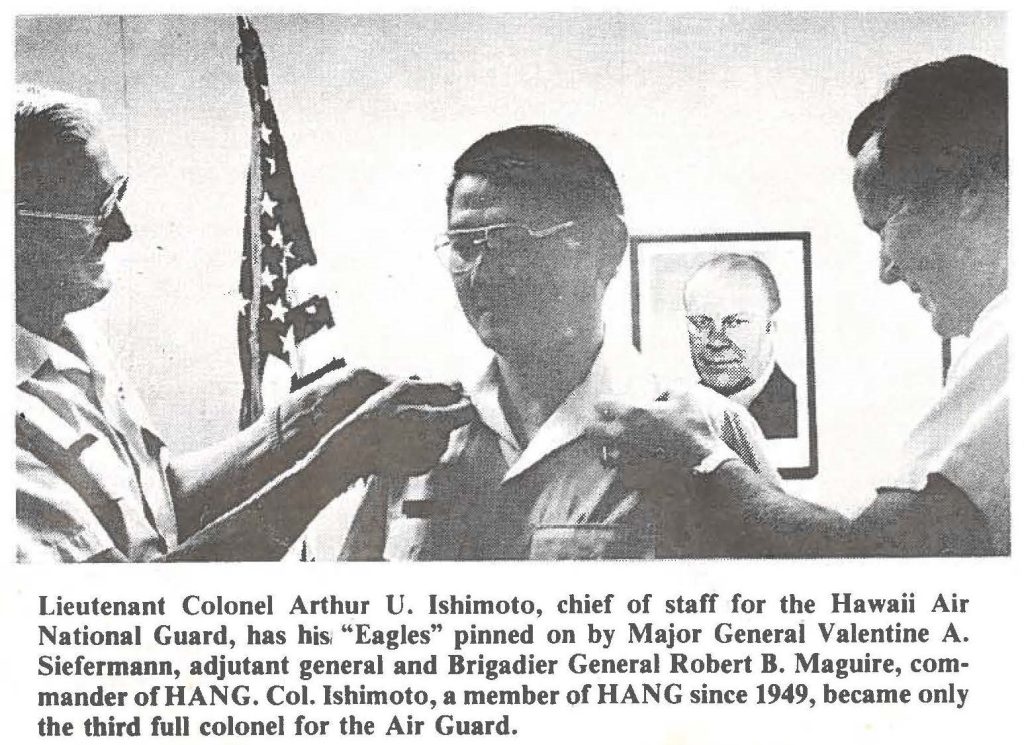
Lieutenant Colonel Arthur U. Ishimoto, chief of staff for the Hawaii Air National Guard, has his, “Eagles” pinned on by Major General Valentine A. Siefermann, adjutant general and Brigadier General Robert B. Maguire, commander of HANG. Col. Ishimoto, a member of HANG since 1949, became only the third full colonel for the Air Guard. (Pictures from the 1975 Spring Pūpūkahi)
Self-Defense: Air Guard Commander Sets High Standards of Physical Conditioning and Self-Discipline
By Gail Warok Editor
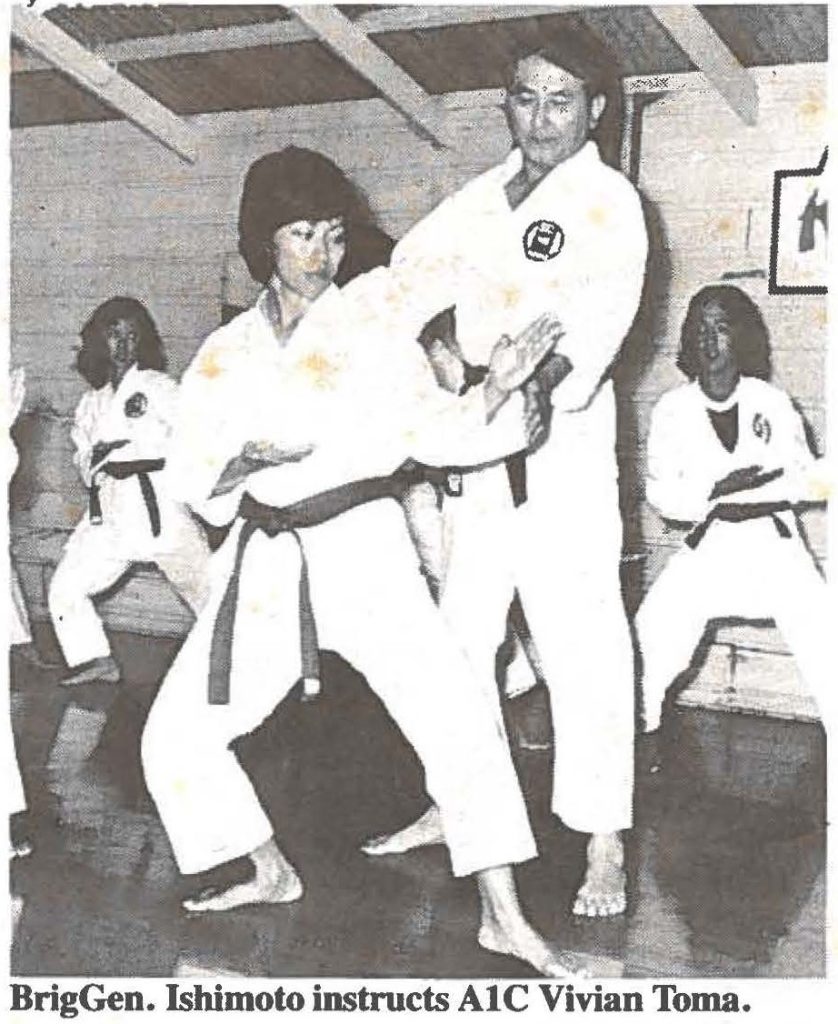
Self-defense: Air Guard commander sets high standards of physical conditioning and self-discipline Self-defense: Air Guard commander sets high standards of physical conditioning and self-discipline Self-defense: Air Guard commander sets high standards of physical conditioning and self-discipline Brig Gen. Ishimoto instructs AlC Vivian Toma.(Pictures from the 1977 September Pūpūkahi)
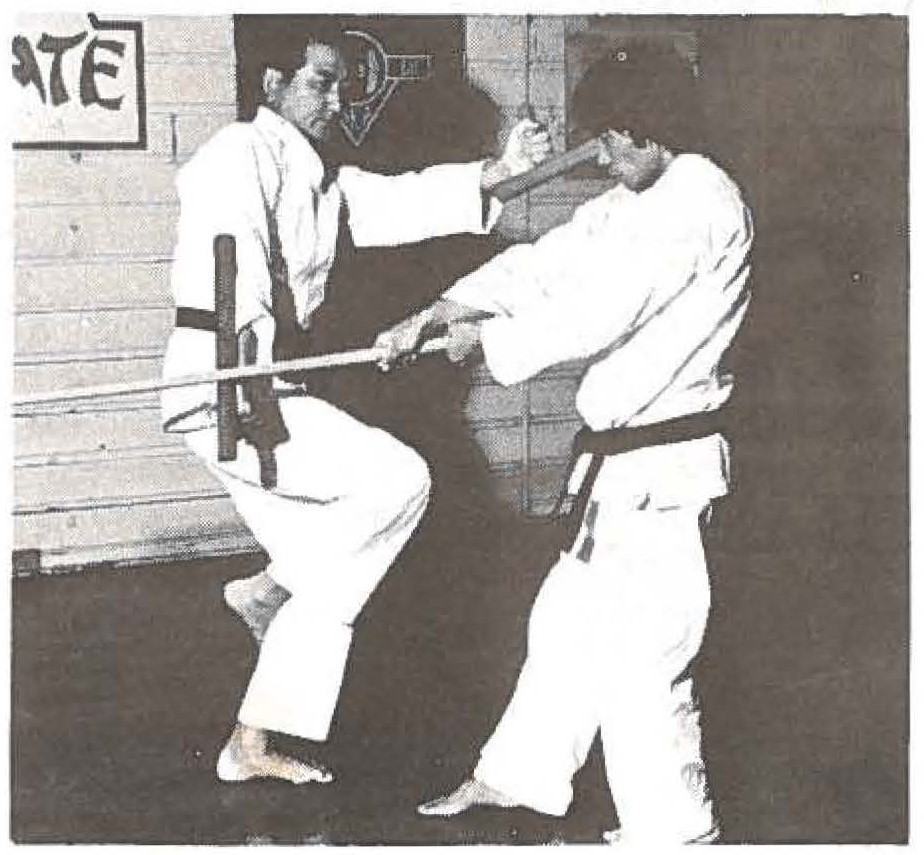
High standards of physical conditioning and self-discipline are motivating forces for Brigadier General Arthur U. Ishimoto—not just as the commander of the Hawaii Air National Guard, but also as a fifth-degree black belt karate instructor.
Gen. Ishimoto instructs for the Statewide Karate League, one of the oldest schools in the islands.
He started training back in 1947, when karate was not publicized because it was considered a dangerous sport. In fact, he had to meet secretly in someone’s garage for those original lessons. Later, in 1964, he took up the training again and went on to get his black belt.
Since 1968, he has been instructing. According to Ishimoto, “Instructing karate is a very gratifying experience. It’s more than the physical conditioning; it’s an interest in the total development of people.”
Students in the class, which meets twice weekly at a “dojo” (gymnasium) in Manoa, are taught self-discipline, loyalty, respect for people, etiquette, and even meditation. All students are treated alike—whether 8 years old or 80 years old, man or woman.
In Ishimoto’s opinion, instruction in karate could also be very practical training for members of the Air National Guard.
“Our aircrews,” he said, “are still undergoing transition training to the F-4C fighter aircraft. When training is completed, I would like to teach them the techniques of hand-to-hand combat, that is, how to defend against knives, pistols, etc., with their bare hands.
“I believe such training would enhance their survivability during wartime if there ever is an occasion for them to bail out behind enemy lines.
“My chief instructor taught such techniques to Strategic Air Command aircrews in the early 1950s, including Commander-in-Chief Strategic Air Command’s General Curtis LeMay.”
Even beyond the self-defense capability the training affords, there’s a certain esprit de corps that those who train so strenuously together feel.
“Once you become committed to karate,” Ishimoto says, “you’ll find it to be a way of life.”
For Gen. Ishimoto, it is a way of life. When asked how long he would continue this endeavor, he said, “I’ll be doing this as long as I am physically able to.”
Brig. Gen. Arthur lshimoto is new state adjutant general
Brig. Gen Arthur U. Ishimoto State Adjutant General(Picture from the 1982 Spring Pūpūkahi)
Brig. Gen. Arthur U. Ishimoto has been appointed state adjutant general by Gov. George R. Ariyoshi.
Before his appointment, Ishimoto commanded the Hawaii Air National Guard, a post he had held since April 1976. As adjutant general, Ishimoto commands the Army and Air National Guard. He also acts as the director of civil defense.
In making the announcement, Gov. Ariyoshi said, “I am very pleased that Gen. Ishimoto has accepted the position of state adjutant general. He brings to this post a distinguished record as commander of the Hawaii Air National Guard. Under his capable guidance and leadership, our Hawaii Air Guard units have been cited on numerous occasions for their outstanding performance and are fully capable of meeting their military responsibilities, should the need ever arise.”
General Ishimoto, 58, began his military career in January 1944, when he volunteered and enlisted in the U.S. Army and was assigned to Military Intelligence School at Camp Savage, Minnesota. In May 1945, he participated in the Philippines campaign while attached to the Allied interrogation and translation section, G-2, in General Douglas MacArthur’s headquarters.
In May 1948, he joined the 442nd Army Reserve and received a direct commission as a second lieutenant.
In April 1949, he transferred to the three-year-old Hawaii Air National Guard and was assigned to the 199th Air Service Group as an adjutant. In 1950, he was assigned to the newly activated 109th Aircraft Control and Warning Squadron, serving initially as the adjutant and subsequently as communications officer.
In 1956, he worked for the 7th Air Force as project engineer for the engineering and installation of heavy ground radar and air-ground radio equipment. Subsequently, he served as the detachment commander of the GCI station—the first Air National Guard unit to be assigned a full-time air defense mission operating 24 hours a day, seven days a week.
In February 1959, he was again selected as project engineer to design the permanent Hawaii air defense system, including the engineering and installation of two ground-controlled intercept stations. The two-site project was estimated to cost $6.8 million. Through the elimination of numerous radio repeater stations and redesign of the facilities, the total project cost only $800,000.
Later, he obtained additional funding to replace the existing point-to-point radio system, which had limited channels, with a modern microwave system by personally staffing the project through the Pacific Air Forces and U.S. Air Force headquarters. He received $500,000 for the project; however, a cost overrun of $1,000,000 was encountered as a result of errors made by the contractor. Working closely with the contractor, the cost error was reduced to $55,000 merely by locating the radio repeater stations near roads and power lines.
Today, all of the HANG units are combat ready and capable of meeting their wartime missions.
In January 1968, he was appointed director of logistics. In August 1974, he served as acting chief of staff, and in April 1976, he was appointed assistant adjutant general (air) and commander of the Hawaii Air National Guard.
He was federally recognized as a brigadier general on February 4, 1977.
Under his command, units of the Hawaii Air National Guard have been cited for outstanding performance on several occasions.
The largest unit, the 154th Composite Group, received a U.S. Air Force Outstanding Unit Award in 1979. The 154th has the responsibility for providing Hawaii’s total air defense network and has participated in deployments and exercises on Guam, the Philippines, and Japan.
The 1980 Japan exercise, entitled Cope North, involved Japanese military aircraft and marked the first time a Hawaii reserve unit had trained and flown with a foreign air force on that air force’s territory. Gen. Ishimoto personally made many of the arrangements.
BRIG. GEN. ARTHUR ISHIMOTO takes his oath of office as adjutant general in special ceremonies in the Governor’s office. Supreme Court Justice Edward Nakamura gives the oath as Gov. Ariyoshi looks on. Also taking their oaths were Charles Clark (I) as director of the Dept. of Health and Jack Suwa as Chairman of the Board of Agriculture. Photo by Gregg Hirata (Picture from the 1982 Summer Pūpūkahi)
Hawaii’s AG Past to Present
Brig. Gen Arthur U. Ishimoto State Adjutant General(Picture from the 1982 Summer Pūpūkahi)
And that brings us to Brig. Gen. Arthur U. Ishimoto, an accomplished karate instructor, former Army private, and World War II veteran.
BRIG. GEN. ARTHUR ISHIMOTO takes his oath of office as adjutant general in special ceremonies in the Governor’s office. Supreme Court Justice Edward Nakamura gives the oath as Gov. Ariyoshi looks on. Also taking their oaths were Charles Clark (I) as director of the Dept. of Health and Jack Suwa as Chairman of the Board of Agriculture. Photo by Gregg Hirata(Picture from 1982 Summer Pūpūkahi)
GETS HIS SECOND STAR – Maj. Gen. Arthur lshimoto, state adjutant general, receives his second star from his wife, Mitsue (left), and Gov. George Ariyoshi in ceremonies at the State Capitol. As adjutant general, Ishimoto becomes a member of the governor’s cabinet. – Photo by Gregg Hirata. (Picture from the 1982 Fall Pūpūkahi)