
History of the 29th Infantry Brigade Combat Team
The 29th Infantry Brigade was organized in the Hawaii Army National Guard (HARNG) in January 1959. The original elements of the Brigade consisted of the Brigade Headquarters and Headquarters Company and the 1st and 2nd Battle Groups, 299th Infantry. These units of the new Brigade were formed primarily from the 299th Regimental Combat Team, the 298th AAA Battalion, and the 120th Signal Support Company.
In April 1963, the Brigade reorganized with the conversion of the battle group into three separate infantry battalions under brigade control. The Brigade reorganized again in November 1965 with one of the infantry battalions of the Brigade providing the nucleus for a support battalion and the 227th Engineer Battalion reorganized into the 227th Engineer Company and 1st Battalion, 487th Field Artillery. In December 1967, Troop E, 19th Cavalry, was added to the Brigade base.
The Brigade was called to active duty for the Vietnam War on May 13 1968 through Dec. 13, 1969. The 100th Battalion, 442nd Infantry, U.S. Army Reserve; 227th Military Intelligence Detachment from Arizona; and the 40th Aviation Company from California joined the Brigade at Schofield Barracks. Twenty-nine individuals gave their lives in the service of their country while on active duty during the mobilization.
In October 1972, the Brigade was designated a round-out brigade to the 25th Infantry Division at Schofield Barracks. The Brigade served as a round-out brigade until Sept. 30, 1986. In October 1986, the Brigade was reorganized and designated as the 29th Infantry Brigade (Separate). The Brigade served as the round-up separate brigade to I (US) Corps. In 1993, the 29th Infantry Brigade (Separate) was designated as one of the fifteen Enhanced Army National Guard (ARNG) Brigades. The Brigade was to become the only multi-state and multi-component enhanced brigade.
In September 1995, the 1st Battalion, 184th Infantry, California ARNG; Battery E, 1st Battalion, 216th Air Defense Artillery, Minnesota ARNG; and Troop F, 82nd Cavalry, Oregon ARNG were added to the 29th Infantry Brigade (Separate) replacing the deactivated 1st Battalion, 299th Infantry and Troop E, 19th Cavalry.
On Aug. 16, 2004, the 29th Infantry Brigade (Separate) was called to active duty to support the Global War on Terrorism. The Brigade mobilized at Schofield Barracks, HI, then formed at Fort Bliss, Texas. On Oct. 2, 2004 the Brigade deployed in support of Operation Iraqi Freedom and assumed the Security Forces Mission in theater. Units of the 29th Brigade Combat Team served in Saudi Arabia, Kuwait, and Iraq. Eighteen Soldiers gave their lives in service to their country during this mobilization.
On Sept. 1, 2006, the 29th Separate Infantry Brigade became the 29th Infantry Brigade Combat Team (IBCT). The 29th IBCT comprised of the Brigade Headquarters and Headquarters Company; 1st Battalion, 158th Infantry, Arizona ARNG; 100th Battalion, 442nd Infantry, USAR; 1st Squadron, 299th Cavalry Regiment; 1st Battalion, 487th Field Artillery; 29th Brigade Special Troops Battalion; and 29th Brigade Support Battalion.
In August of 2008, the 29th IBCT was called upon again to serve in support of Operation Iraqi Freedom. The Brigade mobilized at Fort Hood, Texas and teamed with the 45th Fires Brigade from the Oklahoma ARNG, forming “Task Force Lava Thunder.” The 100th Battalion, 442nd Infantry and the 1st Squadron, 299th Cavalry performed convoy security escort missions into Iraq. The 1st Battalion, 487th Field Artillery, 29th Brigade Support Battalion, and the 29th Brigade Special Troops Battalion were responsible for Camp Command Cell and security operations in Kuwait. Three Soldiers gave their lives in service to their country during this mobilization.
Upon the Brigade’s return home in the fall of 2009, the 29th IBCT was again reorganized, replacing the 100th Battalion, 442nd Infantry with the 1st Battalion, 294th Infantry from the Guam ARNG.
During the summer of 2012, Headquarters and Headquarters Company (HHC), 29th IBCT mobilized twelve Security Force Assistance Advisor Teams (SFAT) that deployed across Afghanistan to support Operation Enduring Freedom. The SFAT is a team organized of subject matter experts: commanders, officers, and senior non-commissioned officers – whose mission was to enable the Afghan security forces to lead independent operations.
On Sept. 1, 2014 the 29th Brigade Special Troops Battalion was deactivated and reorganized as the 227th Brigade Engineer Battalion. Then on 1 September 2016 the 29th IBCT added a third Infantry Battalion 1-297th Infantry from Alaska ARNG.
During the period Nov. 5, 2018 to 22 July 2019, the Headquarters 29th IBCT mobilized to provide mission command over multinational operations throughout Kosovo, strengthening the United State’s interoperability with the North Atlantic Treaty Organization Alliance partners and supporting the U.S. Army Europe’s lines of effort in the Balkans region.
Last updated Jan 2025
Distinctive Unit Insignia
Description/Blazon
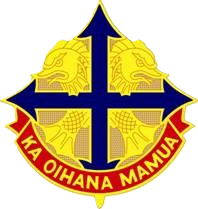
A gold color metal and enamel device 1 1/8 inches (2.86 cm) in height consisting of a blue cross with barbed ends supporting between the arms two gold dolphins in saltire with heads up and facing out contained in base by an arced red scroll inscribed with the motto “KA OIHANA MAMUA” in gold.
Symbolism
The blue cross is suggested by Hawaii’s nickname, “Crossroads of the Pacific,” and the barbed ends represent the protective mission of the Brigade. The gold dolphins allude to the crest of the Hawaii Army National Guard. The motto is translated as “Mission First.”
Background
The distinctive unit insignia was originally approved for the noncolor bearing units of the 29th Infantry Brigade on 25 April 1967. It was redesignated for the 29th Infantry Brigade Combat Team with the description and symbolism updated on 18 December 2007.
Shoulder Sleeve Insignia
Description/Blazon
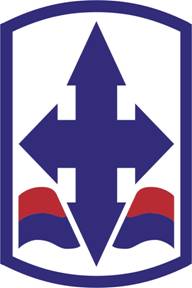
On a white shield with arched top and bottom, 2 inches (5.08 cm) in width, a blue barbed cross, in base two wavy bars – red and blue conjoined but separated from the cross, and bordered by a white fimbriation 1/16 inch (.16 cm) wide all within a 1/8 inch (.32 cm) blue border.
Symbolism
The colors blue and white are used for Infantry. The blue cross is suggested by Hawaii’s nickname “Crossroads of the Pacific,” and the barbed ends represent the protective mission of the Brigade. The red and blue conjoined bars in conjunction with the white appear on the Hawaiian Flag, and also on the Hawaiian Coat of Arms. The bars are wavy to allude to the geographical location of Hawaii as being overseas from the continental United States.
Background
The shoulder sleeve insignia was originally approved for the 29th Infantry Brigade on 16 May 1968. It was redesignated for the 29th Infantry Brigade Combat Team with the description and symbolism updated on 18 December 2007. (TIOH Drawing Number A-1-494)
29th Infantry Brigade Combat Team Leadership
- Jan. 1959 – Feb. 1960 Brig. Gen. Frederick A. Schaefer III
- Feb. 1960 – Oct. 1963 Brig. Gen. Michael R. Roman
- Oct. 1963 – Feb. 1968 Brig. Gen. Francis S. Takemoto
- May 1968 – Jan. 1969 Brig. Gen. Frederick A. Schaefer III
- Jan. 1969 – Feb. 1969 Col. Clyde W. Woods Jr.
- Feb. 1969 – Aug. 1969 Brig. Gen. James K. Terry
- Aug. 1969 – Oct. 1969 Col. Howard H. Lee
- Oct. 1969 – Dec. 1969 Brig. Gen. Frederick A. Schaefer III
- Dec. 1969 – March1976 Brig. Gen. Edward M. Yoshimasu
- Jan. 1976 – Sept. 1977 Brig. Gen. John E. Aiona Jr.
- Sept. 1977 – Nov. 1979 Col. Ellsworth M. Bush
- Nov. 1979 – Aug. 1982 Col. Louis W. Perry Jr.
- Aug. 1982 – Aug. 1983 Col. Louis N.H.M. Miranda Jr.
- Sept. 10, 1983 – Jan. 10, 1988 Col. Donald Oura
- Feb. 1988 – Oct. 1990 Brig. Gen. John R. D’Araujo
- Oct. 1990 – Aug. 1994 Brig. Gen. Bernard M. Watson
- Aug. 1994 – Nov. 3 1996 Maj. Gen. Edward L. Correa Jr.
- Nov. 3 1996 – Jan. 2000 Col. Dennis Kamimura
- Nov. 3 1996 – Jan. 2000 Col. Dennis Kamimura
- Jan. 2000 – May 2003 Brig. Gen. Glen I. Sakagawa
- June 2003 – June 23, 2007 Brig. Gen. Joseph J. Chaves
- June 23, 2007 – May 22, 2010 Brig. Gen. Bruce E. Oliveira
- May 22, 2010 – 2012 Brig. Gen. Keith Y. Tamashiro
- 2012 – 2014 Maj. Gen. Kenneth S. Hara
- 2014 – 2015 Maj. Gen. Stephen F. Logan
- OCT. 2015 – Nov. 2017 Brig. Gen. Moses Kaoiwi Jr.
- Nov. 2017 – Aug. 2019 Maj. Gen. Roy Macaraeg
- 2019 – Apr. 2021 Col. Michael Tougher III
- Apr. 2021 – Apr. 2022 Col. Jonathan A. Ishikawa
- Apr. 2022 – Aug. 2024 Lt. Col (P) David R. Hatcher II
- Aug. 2024 – Present Col. Wesley K. Kawakami
Colonel Oura was commissioned a second lieutenant, Infantry, from the University of Hawaii ROTC program and entered active duty in May 1960.
Colonel Oura continued on active duty until August 1973 and served in a variety of duty positions such as Detachment Commander and S3 (Air) Officer with the 8th Special Forces Group in the Canal Zone; Battalion Executive Officer, 2d Battalion 12th Infantry, 25th Infantry Division, Vietnam; Deputy Headquarters Commandant for Headquarters, USARPAC, Fort Shafter; Senior Advisor, Song Be District, Vietnam (2d tour); and Reserve Component Coordinator with the Directorate of Planning and Training at Fort Ord, Califonia.
Colonel Oura joined the Hawaii Army National Guard in August 1973 and has served as S3, Executive Officer, and Commander, 1st Battalion 299th Infantry; Commandant, Hawaii Military Academy; and as Assistant G3, Hawaii Army National Guard. He is a graduate of the US Army War College.
His decorations and awards include the Combat Infantry Badge, Senior Parachutist Badge, Ranger Tab, Bronze Star Medal w/Oak Leaf Cluster, Meritorious Service Medal, Army Commendation Ribbon w/Oak Leaf Cluster, Army Achievement Medal, Purple Heart, National Defense Service Medal, Vietnam Service Medal, Republic of Vietnam Campaign Medal,Republic of Vietnam Gallantry Cross w/Bronze Star, Hawaii National Guard Medal for Merit, and the Hawaii National Guard State Active Duty Ribbon.
Colonel Oura assumed command of the 29th Infantry Brigade (Separate) on 1 September 1983.
He and his wife, Gail, have a daughter, Melanie, and a son, Dean.
Last updated January 1988
Colonel Miranda was commissioned a second lieutenant in the Corps of Engineers upon completion of the Officer Candidate School at Fort Benning, Georgia, in October 1961. He joined the Hawaii Army National Guard in April 1952 and served in a variety of command and staff positions which included Tactical Officer, HARNG OCS; aide-de-camp to Commander, HARNG, and as a Battery Commander of 1st Battalion 487th Field Artillery. He was called to active duty with the 29th Brigade in October 1968 and served in the Republic of Vietnam as a Target Analyst and Artillery Operations Officer with the Capital Military Assistance Command.
Upon return from active duty in December 1969, Colonel Miranda served as Commander, Headquarters t Headquarters Detachment, HARNG; Executive Officer, 1st Battalion 487th Field Artillery; Operations and Plans Officer, G3 section, HARNG; and Commander, 1st Battalion 299th Infantry. He was the Brigade Executive Officer from June 1977-August 1982. He assumed command of the Brigade in August 1982. He is a graduate of the US Army Command and General Staff College.
His decorations and awards include the Bronze Star Medal w/Oak Leaf Cluster, Meritorious Service Medal, Army Commendation Medal w/Oak Leaf Cluster, Air Medal w/ Oak Leaf Cluster, Army Achievement Medal w/Oak Leaf Cluster, I National Defense Service Medal, Armed Forces Reserve Medal w/20 yr service, Vietnam Service Medal, Army Reserve Component Achievement Medal w/2 Oak Leaf Clusters, Technical Service Medal 1st Class, Army Service Ribbon, Overseas Service Ribbon, Vietnam Campaign Medal, HNG Medal for Merit, HNG Commendation Medal, HNG Service Medal (30 yrs), HNG Federal Service Ribbon, and HNG State Active Duty Ribbon.
Colonel Miranda has been appointed Assistant G3, HARNG, and assumed this duty as of 1 September 1983.
He and his wife, Lorna, have one son, Michael.
Last updated September 1893