
History of the 199th Fighter Squadron
199 FS
199th Fighter Squadron
199th Tactical Fighter Squadron (June 10, 1976 – Feb. 1, 1993)
199th Fighter Interceptor Squadron (Nov. 19, 1952 – June 10, 1976)
199th Fighter Bomber Squadron (? – Nov. 19, 1952)
TBD
Last updated October 2026
199th Fighter Squadron Chronological History


During the last four (4) days of field training, the Hawaii Air National Guard received the regular Air Force Operational Readiness Test. This test was made to determine the over-all combat efficiency of the Fighter Squadron and attached units. This operational Readiness Test lasted for ninety-six (96) hours of continuous operation. The total score awarded tJ the Hawaii Air National Guard is believed to be one of the highest if not the highest Operational Readiness Test score received by any air National Guard organization.
– 1948-1949 Annual Report pp. 39
During the year, the squadron has made tremendous strides towards learning to fly and operate as a team. The Fighter Squadron constitutes a definite defending and striking force. The excellent showing during sum mer camp substantiates the claim that the Hawaii Air National Guard units are a team, capable of waging war against any aggressor force. . .
Flying training requirements as outlined by the Hawaii Air National Guard conform to Air Force Regulation 60-2 which requires each pilot to log 100 hours throughout the year of First Pilot, Instructor Pilot, and/or Co-Pilot flying time of which 20 hours will be Instrument Flight Time, 15 hours will be Night Time, and 35 hours will be flown in each six month period. In the fiscal year of 1949 all pilots met the above requirements.
Strong emphasis has been placed on Individual Pilot’s Uroficiency. Closely supervised flying training is being conducted to aid each man in reaching his attainment of skill in Aerial Gunnery, Strafing, Rocket Firing, Dive Bombing, Formation Flying, Instrument Flying, Navigation, Long Range Control and the mqny other phases of flying that the Fighter Pilot must be proficient in, whether he flys alone or as a member of a large striking force
Many National Guard Squadrons have difficulty in getting sufficient members together at one time to fly as a unit. The Hawaii Air National Guard solved this major problem by devising the “Dawn Patrol”. Four (4) mornings each week a flight reports to the Guard area for flying at 0515. With take-off scheduled at 0550 and landing at 0715 the Hawaii Air National Guard is able to train each flight separately and in a regular sequenced schedule. At frequent intervals’ the entire Squadron is called out for a maximum effort mission with all four (4) of the flight flying as a Squadron. On one (1) day each week the pilots, when reporting to their civilian positions, have already undergone an intensified period of aerial training.
During field training exercises, emphasis was again stressed upon unit training. Actual operations performed by the Squadron proved the training for the year to have been even more successful than planned. During the exercises, all pilots who had not as yet qualified for an instrument rating were flight tested and they were all given instrument ratings. Instrument flying is a special subject for the coming year. The Air Force gave this Squadron its Operational Readiness Test during summer camp. The test assumed the proportion of a large scale operation. Maximum effort was demanded by the Air Force of sixteen (16) fighters in the air during all manuevers. The pilots flew a total of 4,462 hours during 1949. Total time flown during summer camp was 832 hours
In support of Hawaii National Guard Installations throughout the Island Chain, the Air Guard flew seventy-six (76) freight runs in the cargo aircraft. The Utility Flight carried 180,758 pounds of freight and transported 1,452 passengers in 1949
The Red Cross requested aid in transporting medical and emergency supplies to Waimea, Kauai, in February 1949 as a result of the flash flood there. Other speCial flights included participation in “Air Force Day” at Hickam Field and in several air shows on Oahu.
– 1948-1949 Annual Report pp. 40
At the end of the fiscal year 1949, the 199th Fighter Squadron (SE) possessed twenty-eight (28) aircraft of which eight (8) were at the Hickam Depot, one (I) undergoing repair of damage caused by a nose-up, one (ll for corrossion control, one (1) gas tank change and five (5) for an inspection in accordance with Technical Order 00-25-8 (Transfer Inspection).
– 1948-1949 Annual Report pp. 42

Governor’s Day-Summer Camp-1950

Governor’s Day-Summer Camp-1950
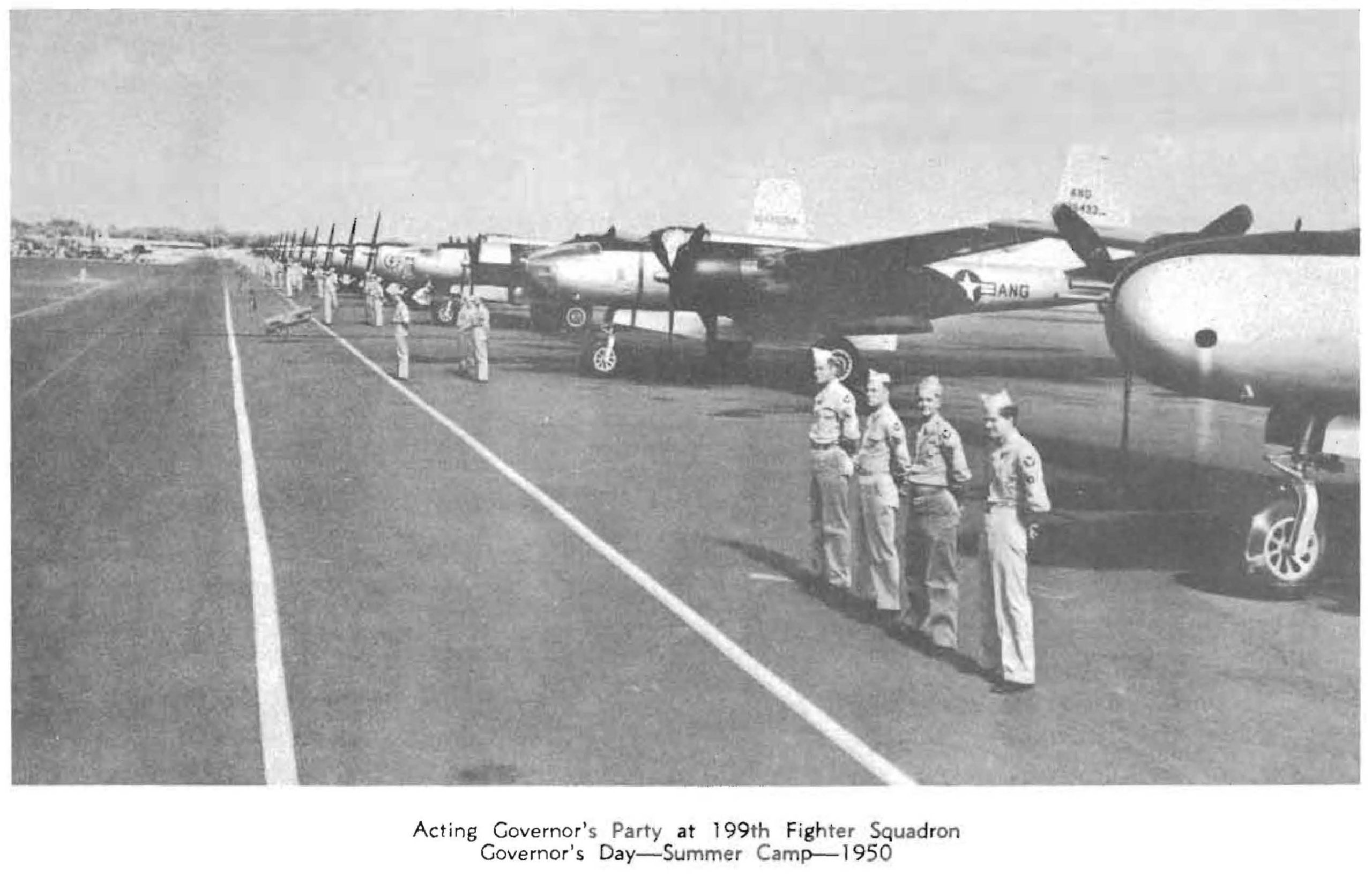
Governor’s Day-Summer Camp-1950
During the volcanic eruption on the Island of Hawaii 1 June 1950, the 199th Fighter Squadron, Hawaii Air National Guard, and key personnel of the 299th RCT performed valuable aerial reconnaissance and photographic missions over the affected area.
– 1949-1950 Annual Report pp. 18
Armistice Day. Elements of the 298th RCT and the 199th Fighter Squadron participated in the American Legion’s Memorial Ceremony at Punchbowl. The State Staff aided in the planning and preparations for the ceremony. Other units paraded on their local islands.
– 1949-1950 Annual Report pp. 24
Waimea. Kauai Flood: . .
To care for the evacuees, the American Red Cross needed blankets, clothing, cots, and other supplies, all of which had to be flown in from Honolulu. The 199th Fighter Squadron, HANG was requested to assist and within two and one-half hours a C-46 was on its way carrying the essential supplies required.
– 1950-1951 Annual Report pp. 15
All Army units on Oahu participated in the second Joint Armed Forces Day Parade (May 19th). The 199th Fighter Squadron flew an aerial review followed by a strafing and bombing demonstration. . .
The 199th Fighter Squadron flew an aerial review over the principal cities of Kauai on Kamehameha Day
– 1950-1951 Annual Report pp. 18
The 199th Fighter Squadron reorganized under the Air Forces Wing Base Plan 1 November 1950. The reorganization orders inactivated the 199th Utility Flight and the Air Service Group and called for the activation of eight (8) supporting elements (Maintenance, Supply, Motor Vehicle, Medical, Air Police, Food Service, Installations and Communication) with an increase in authorized strength from 50 officers and 303 airmen to 52 officers and 406 airmen.
– 1950-1951 Annual Report pp. 28
A total of 3907.5 hours were flown by the pilots of the 199th Fighter Squadron, 640.25 during the field training period. The air unit flew a total of 115 freight runs in support of the National Guard throughout the island chain carrying ~ total of 187,600 pounds of freight and 2049 passengers.
– 1950-1951 Annual Report pp. 29
The 199th Fighter Squadron successfully completed the first movement of its entire organization, equipment and personnel, ever attempted in the 4 years of its existence. The success of the overwater move and the whole encampment, is a tribute to the harmonious relations that exist between the Regular Military Establishment and the Hawaii National Guard. Neither the move nor the camp could have been a success without the wholehearted cooperation of the Army, Air Force, (MATS) and Navy (MSTS).
The training of the fighter squadron was concentrated on the development of a well disciplined unit capable of sustaining itself in the field.
– 1950-1951 Annual Report pp. 29
During the fiscal year 1949-1950 the 199th Fighter Squadron changed over from C-46 to C-47 type aircraft. The change is for the better, as less man hours are required to maintain the C-47 type aircraft.
– 1950-1951 Annual Report pp. 29


MILITARY DEPARTMENT
TERRITORY OF HAWAII
OFFICE OF THE ADJUTANT GENERAL
FORT RUGER, T. H.
GENERAL ORDERS 7 July 1952
NUMBERThe Adjutant General of Hawaii announces with deep regret the death of Major Carlos Willard Bonham at Barking Sands Air Force Base, Kauai, on 15 June 1952.
Major Bonham was born in Watertown, New York on 31 July 1919. He first entered military service as a member of the Missouri National Guard in 1937. He entered active duty with the U. S. Army in July 1942 and was commissioned a second lieutenant Officers Reserve Corps on 31 October 1942. Subsequent to his qraduation from Army Air Force Pilot Training in February 1944 he served in both the European and Pacific Theaters of Operation during World War II. He was discharged from active service in May 1948.
Major Bonham was awarded the Air Medal in 1945.
On 25 June 1948 he became a member of the 199th Fighter Squadron, Hawaii Air National Guard. He served as Flight Leader, and Operations Officer, in the grades of 1st Lieutenant and Captain respectively. Promoted to Major, Hawaii Air National Guard, he was assigned to command the 199th Fighter Squadron on 8 June 1951. Major Bonham’s selfless character, his integrity, and his devotion to duty placed the service of his country above his own personal interest. In the passing of this citizen soldier, the country and the military have sustained a great loss.
BY ORDER OF THE GOVERNOR:
OFFICIAL:
DAVID P. SILVA
Lt Col, QMC, HNG
Asst Adjutant GeneralDistribution “A”
F. W. MAKINNEY
Brig. Gen., HNG
Adjutant General– 1952 Annual Report pp. 4
During the year the 199th Fighter Bomber Squadron conducted eight squadron gunnery and bombing exercises. These exercises were over
– 1952 Annual Report pp. 27-28
and above the normal authorized training for the Fighter Squadron. The first four gunnery exercises consisted of air to air gunnery with the last four being devoted to bombing and rocketry. The latter four exercises were carried out using the facilities of the U.S. Navy range on the western-most tip of Molokai and the targets located on the island of Kahoolawe.
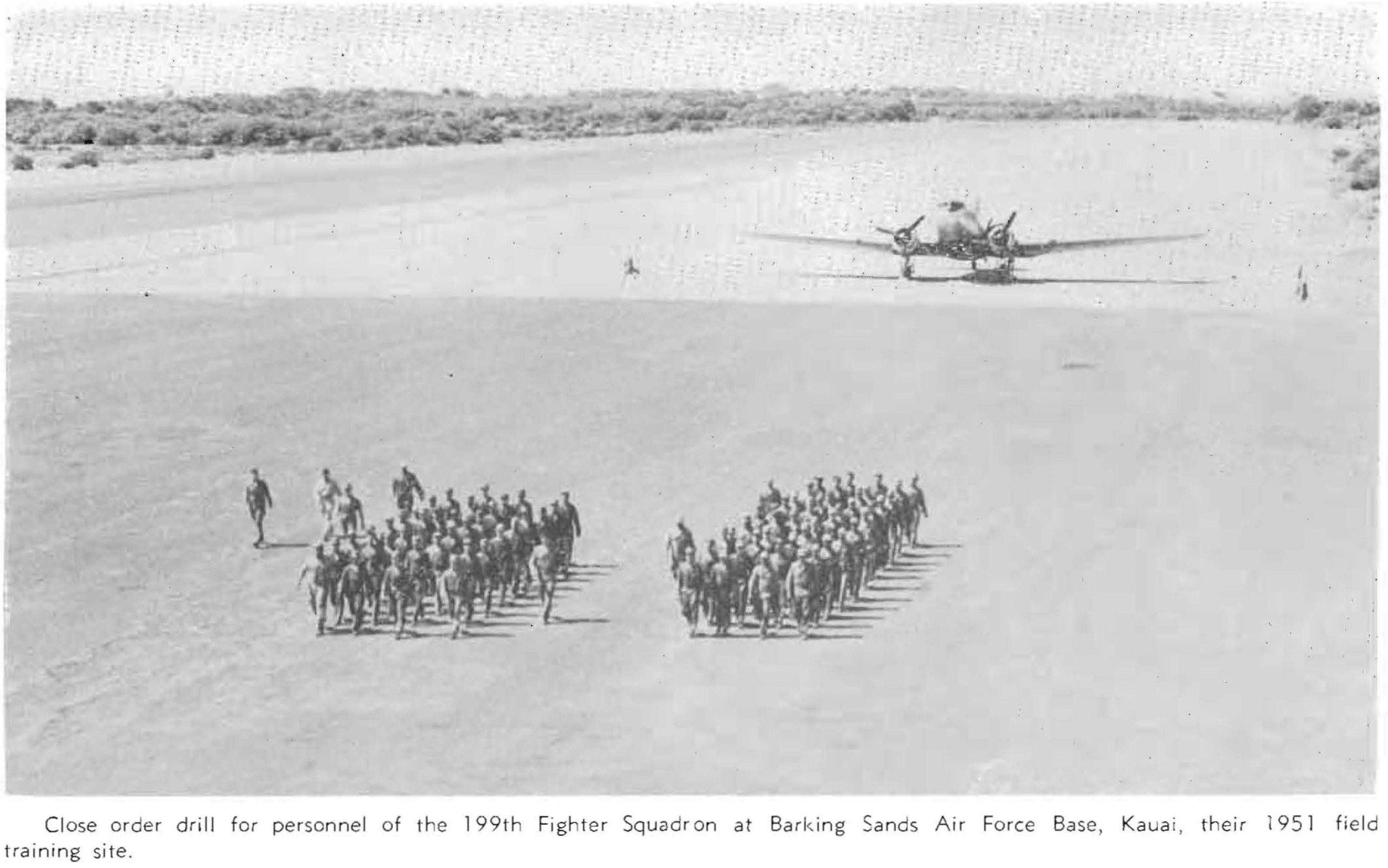
The field training site of the 199th Fighter Squadron was Barking Sands Air Force Base, Kauai. Twenty-seven officers and 375 airmen were present there including 4 airmen of the 199th Weather Station.
– 1952 Annual Report pp. 29
The Annual Inspection of the 199th Fighter Bomber Squadron was made by the USAf Inspector General’s olfice , Hickam AfB, from 26 March 1952 through 30 March 1952. The inspection involved a detailed scrutiny of all phases of the Squadron’s administration and operation. A rating of “Satisfactory” was received by the 199th fighter Squadron.
– 1952 Annual Report pp. 29-30
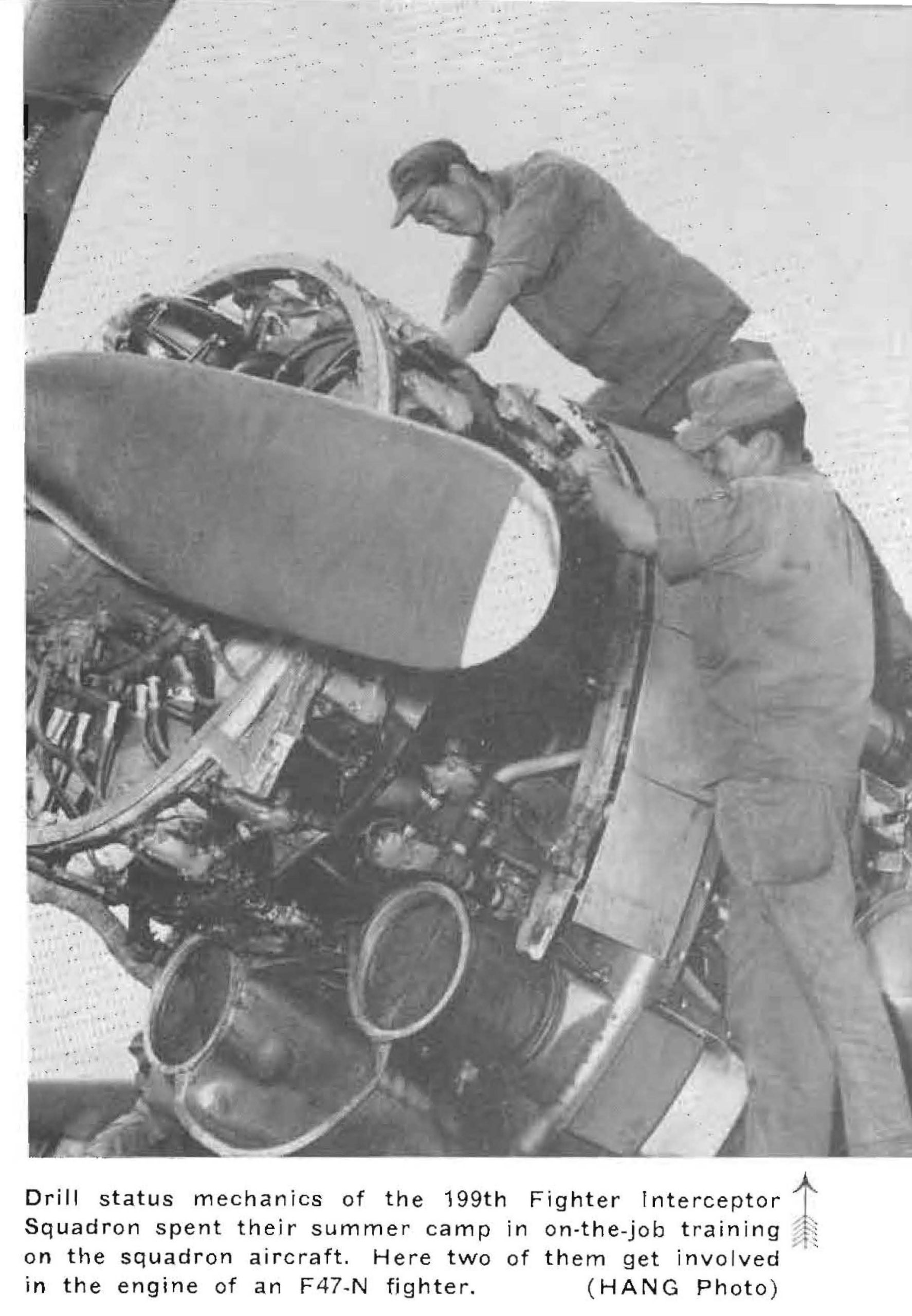
During fiscal Year 1952, the 199th fighter Bomber Squadron had possession of 24 f-47N, 3 TB-26B, 2 C-47 A, and 2 T-6D aircraft. On 1 July 1951 an intensive corrosion control program was instituted to combat the high rate of corrosion caused by the salt air and coral dust prevalent along the coastal are as of the Hawaiian Islands.
– 1952 Annual Report pp. 30
The 199th Fighter Bomber Squadron was reorganized and redesignated as the 199th Fighter Interceptor Squadron on November 19, 1952. The mission was changed from tactical ground support to aerial interception. The 199th thus formed a team with the 109th Aircraft Control and Warning Squadron for ground-controlled interception of enemy aircraft.
– 1953 Annual Report pp. 11
The 199th Fighter Interceptor Squadron held 48 regular drills, eight special aerial gunnery drills, two CPXs, one small arms firing drill, two pre-field training staff conferences, and the annual 15-day field training period during FY 53. A total of 4,643 hours were flown by pilots of the Hawaii Air National Guard, a significant increase over FY 52. Of these, 2,049 hours were flown in the F-47 fighter-type aircraft. A total of 182 flights (324 flying hours) were administrative in nature, transporting Hawaii National Guard personnel and freight between the islands. In view of the fighter-interceptor mission, the tactical pilots concentrated on air-to-air gunnery missions. The Squadron’s average score for the year was 15.7% hits out of 84,400 rounds fired.
As in previous years, the Squadron followed Continental Air Command Training Directives explicitly in its ground training. Classroom training prevailed during the regular Monday night drills (two per month), and on-the-job training was used during the regular Sunday drills (one per month).
The 199th participated in CPX Eversharp No. 2, held February 28–March 1, 1953. Operational control of the Squadron was delegated to KIRBY CONTROL (109th AC&W Squadron). The pilots flew 63 hours of interception missions and made 49 intercepts. This exercise provided much-needed training in communications and procedures during operational flights.
Field training for the 199th was held at Wheeler AFB, Oahu, June 13–27, 1953. The primary flying missions were aerial gunnery, squadron formation, and ground-controlled intercept in coordination with the 109th AC&W Squadron. The total flying hours increased by one-third from the previous year’s encampment, and the total missions flown were almost doubled.
The annual air inspection of the 199th by the Inspector General, Pacific Division, MATS, was held November 3–17, 1952, and resulted in a general rating of SATISFACTORY.
– 1953 Annual Report pp. 11-12
At the end of FY 53, the 199th Fighter Squadron had 26 aircraft including twenty F47N Fighters, two B-26 Light Bombers, two T6 T rainers. and two CA7 Transport aircr aft. Durin g the year, one B-26 was give n a complete cycle reconditioning b? the 1500th Maintenance Group, Hickam AFR. In anticipation of the necessity for cycle reco nditioning of the C-47 aircraft, the feasability of Hawaiian Air Lines performing the work on a contract basis was investigated. The pro posed contract was approved by the National Guard Bureau. The work was programmed to be performed during FY 1954. On 1 J anuary 1953, the 199th was authorized an increase in its Base Technical Detachment from 24 to 30 aircraft mechanics. Airc raft main tenance problems were aggravated by the relatively old VV’V II equipment, and by scarcit’ of parts. In spite of this, ai rcraft maintenance personnel maintained an in-commission percentage rate of 63 .66.
– 1953 Annual Report pp. 13


Two pilots of the 199th Fighter Squadron were lost during Rights scheduled as part of this training. On 19 September 1953 1st Lt. Andrew S. Whitaker was killed when his F-47 fighter crashed into a peak in the Koolau Range on Oahu. On 17 March 1954 1st Lt. Ira B. ·Wynne was reported missing in a T-6 trainer on a routine training flight in the vicinity of Maui. He was later declared dead after an intensive air-land-sea search failed to disclose any evidence of his whereabouts.
–1954 Annual Report pp. 7

199th Ftr Intcp Sq and 8199th Rept Tng Sq. 5,387 :40 pilot flying hours were flown, of this 4,140 :00 hours were flown in jet aircraft. This represents an increase of about 10% over last fiscal year, and with about the same number of tactical pilots and aircraft. Support flying continued as a minor portion of the total time: 114:40 pilot hours were on command flights, 606:30 pilot hours were for· inter· island freight runs, and 526 :30 pilot hours were for aircrew training and 60-2 time.
Aerial Gunnery exercises were again authorized for the flying squadrons. These are extra flying drills for tactical pilots and limited support personnel and are entirely devoted to aerial gunnery training. Each tactical pilot participated an average of 8 times. A total of 501 sorties were flown, 54,190 rounds of cal. .50 ammunition were expended with average scores of 14.5%
Ground Controlled Intercepts in coordination with the 109th AC&W Sq were also a primary mission, and given equal emphasis with aerial gunnery.
In April 1956 the 199th acquired a C-llB Jet Synthetic Instrument Trainer ($65,000.). This was installed in a completely rebuilt and air conditioned Trainer Building. Prior to the end of the fiscal year over 100 hours of instrument training were logged on the trainer. A Link Aviation Inc., technical representative assisted the installations for one month.
The two weeks Annual Field Training was again held at Kaneohe MCAS. There was a significant increase in flying activity over the preceding summer camp. 729 training sorties were flown versus 626 the previous year.
The aircraft were flown six periods a day (0500-2000 I in two shifts, each of which was operated by the 199th or the 8199th. This type of scheduling was necessary to utilize the small number of jet aircraft. 12 F-86s and 3 T-33s were taken over for the encampment. An average of II F·86s were available daily (87% I and each aircraft flew an average of 48 times (41 :30 hours utilization) during this intensive period of operational training. The T·33s performed yeoman service in instrument training and towing targets. Each T·33 flew an average of 62 times (67 hours utilization).
The tactical pilots averaged 22:10 hours of prescribed missions in tactical aircraft during this two week period. Primary emphasis was on aerial gunnery (126 missions’ and ground controlled intercept (114 missions) in cooperation with the 109th. The average scores for the 59,400 rounds of cal. .50 ammunition expended in aerial gunnery were 15.6% above 20,000 feet and 14.9% above 27,000 feet. (Qualilication for combat ready is 15 % ) .
In spite of the desires and efforts of our Weather Flight, passing rain showers obscured Kaneohe MCAS at times and occasional returning flights were diverted to land at Hickam AFB. This necessitated the cancelling of the next flying period of these aircraft.
The limited number of F·86 aircraft presented considerable utilization and training problems.
The 199th Aerial Gunnery team fired their qualifying official scores during Annual Field Training. The Team’s score was sufficient so that they will compete with 4 other ANG teams (winners of ANG Regional Matches) in the Annual Air National Guard Gunnery Meet in September 1956 to determine the Air National Guard winner.
– 1956 Annual Report pp. 11

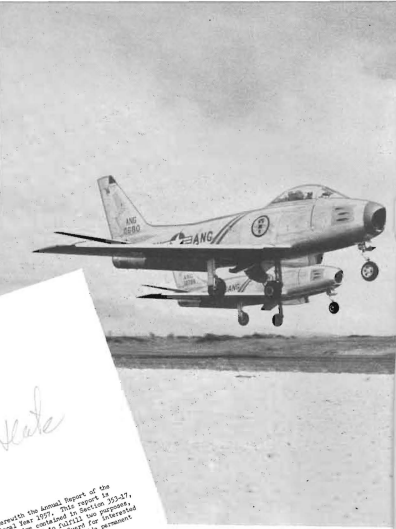
Fighter Interceptor Squadron. To intercept and destroy enemy airborne weapons
– 1957 Annual Report pp. 6
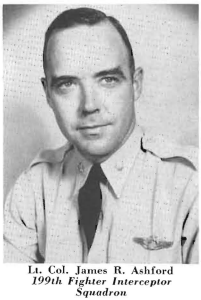
Officers. Tactical Pilots. The discontinuance of the 8199th Replacement Training Squadron, with the resultant absorption of personnel into the 199th Fighter Interceptor Squadron, augmented, placed the 199th over 100% tactical pilot manning.
– 1957 Annual Report pp. 6
199th Ftr Intcp Sq. 7,934 pilot hours were flown by Hawaii Air National Guard pilots during fiscal year 1957, an increase of over 2,000 hours over the previous year’s 5,M2 pilot hours. This was largely due to an increased flying training program and participation in the Air Defense Augmentation Program. Of the 7,934 pilot hours flown, 6,701 were in jet aircraft.
Excluding Air Defense Augmentation flying time, there were 5,0’13 jet pilot hours flown on specified training missions versus the previous year’s 4,313 jet pilot hours. Most of this large increase in training jet time can be attributed to more aircraft being available, and a more aggressive striving for combat readiness.
The tactical pilots averaged 220 hours of flying time, which is comparable to flying done by active duty fighter pilots. Most of their flying was of a tactical nature–aerial gunnery, fighter tactics, alert/GCI in cooperation with the Hawaii Air ational Guard AC&W Squadrons, etc.
Support flying decreased from fiscal year 1956’s 1,529 pilot hours to fiscal year 1957’s 1,233 pilot hours. Support hours for the C-47s were allocated by the National Guard Bureau. Weekly support missions were flown to Maui and Hawaii carrying freight and passengers between the Hawaii National Guard units.
Over 250 training hours were logged in the C-llB Jet Synthetic Instrument Trainer. This should increase, “‘S the air technician assigned as operator of this trainer has retnrned from an eight-month course at a USAF Technical School during the fiscal year.
Aerial gunnery continued to be the main training mission. 176,967 rounds of caliber .50 ammunition were expended, and the squadron average for high altitude (25,000′) was 16.3% hits; low altitude (20,000′) was 20.2% hits. The more outstanding fighter pilots averaged over 30%. This squadron gunnery was of such a caliber that a squadron team won an aerial gunnery match during Annual Field Training against an active duty Marine FJ-4 fighter squadron.
During Annual Field Training at Kaneohe Marine Corps Air Station in June 1957, the tactical pilots averaged 24:05 hours of flying time for this two-week intensive unit training. 777 sorties were flown, which totaled 744 :40 hours ofjet pilot time. The aerial gunnery average was 19.7% hits, which included the newly assigned pilots. The flying schedule was such that considerable aircraft maintenance training was performed to increase the capability of the lesser skilled airmen.
At the close of the fiscal year, 81% of the assigned taetical pilots were classified as combat ready, that is, those who were proficient with the Sabre-Jet and met a high criteria for ability in aerial gunnery, instruments, fighter tactics, etc. In June of 1956, there were 20 combat ready pilots; in June of 1957, there were 26 combat ready pilots.
Air Defense Augmentation. The 109th Aircraft Control & Warning Squadron and the 199th Fighter Interceptor Squadron participated in the Air Defense Augmentation Program during the entire year. The 109th provided 24-hour early warning radar and intercept control at Punamano, and the 199th provided jet fighters at Hickam. This program furnished Seventh Air Force with an air defense team in the Hawaiian Islands area under their operational control. . .
Fighter. Two pilots and two fully armed Sabre-Jets were on Alert from dawn to dusk awaiting the signal to “scramble” from Seventh Air Force. A five-minute maximum is allowed from scramble signal ·to takeoff’ time. The seriousness in which the pilots take their responsibilities is reflected in their consistently bettering this time by two to three minutes.
1,658 jet hours were logged in these air defense missions and the two pilots on Alert at anyone time were scrambled several times a day. They made over 1,600 interceptions, “actuals” or training, of other airborne aircraft in the Air Defense Identification Zone surrounding the Hawaiian Islands. The “actuals,” unknown aircraft, were alJ friendly-being unknown only because of variances from their planned flight path,; and their actual flight paths as plotted by Hawaii Air National Guard radar. These were successfully intercepted and identified.
All squadron combat ready pilots have participated in standing Alert. An average of 14 pilots participated each month. These pilots are on duty OIl days off, or take leave from their jobs or schools. Immeasurable training is received in interception of unknown aircraft. Safety is, of course, constantly practiced and monitored, and all pilots participating must be fully combat ready and have demonstrated their proficiency.
– 1957 Annual Report pp. 6-7


Fighter: The 199th Fighter Interceptor Squadron converted from F·86E day fighters to F-86L all weather fighters with the first “L” being received on 5 February 1958. The new aircraft is a lethal weapon which is not restricted to visual contact during daytime; it can perform its mission day or night and in any type of weather. Instead of machine guns, the F-86L carries the “Mighty Mouse” air-to-air rockets.
On 1 May 1958 the “L” replaced the HE” on the Air Defense Augmentation program and the Hawaii Air National Guard received a wire of congratulations from the Chief, National Guard Bureau on the rapid conversion-“The Best Yet.” By the end of June 1958 all tactical pilots of the Hawaii Air National Guard units had been transitioned into the new aircraft.
During conversion, the unit received big assists from the local Air Force. Personnel had to be retrained for the more complex aircraft and supplies and support equipment procured. First, the F-86-6 Mobile Training Detachment instructed all personnel concerned with the ground training requirements; secondly, the assignment of three well qualified all weather jet pilot” to the 199th Fighter Interceptor Squadron was accomplished to assist in the flying training of tactical pilots. Without the assistance of these pilots, transition would not have progressed smoothly or rapidly. They have been of tremendous value to the squadron.
During the fiscal period, 6,854 jet hours were flown by HAFNG pilots, an increase of 153 hours over the previous year’s 6,701 jet hours. The tactical pilots averaged 201 hours of flying time. Considering the fact that each hour flown is tactical flying-gunnery, tactics, radar intercepts, etc.-this is a notable achievement even for an active duty outfit.
– 1958 Annual Report pp. 10
Considering the fact that the 199th Fighter Interceptor Squadron had just been converted to all-weather aircraft and that new tactics had to be learned by all personnel, all units performed in an excellent manner during the ORE.
– 1958 Annual Report pp. 10

Effective 1 February 1959, the 199t11 Fighter Interceptor Squadrom was reorganized to provide for manning requircmellts to operate under an interim all-weather eMD. The resultant strength of tllis U1lit is 52 ofJicers, three warrant ofJicers and 5:31 airmell.
– 1959 Annual Report pp. 9
Fighter: The 199th Ftr Intcp Sq was engaged ill its annual summer camp at the start of FY 1959, and had just phased out the F-86E day fighter and was transitioning into the F-86I~ all weather jet flghter. All pilots were checked out in the new aircraft during this period, participating in a training program divided into three phases: Phase I – the transition phase composed of II simulator missions and 11 flying missions to familiarize the pilot with the F-86L; Phase II -comprised of 11 simulator missions covering all types of radar missions and a minimum of 24 flying missions; Phase III – the annual unit proficiency training whieh is designed to maintain the highest level of flying proficiency. U pOll the completion of Phase II, a pilot is qualified Alert Ready. Once a pilot is in Phase III and proves his proficiency in hitting targets in Air-to-Air Rocketry, he is qualified as Combat Ready. All three training phases also have many hours of ground school.
On 1 July 1958, the unit had Jess than 10% of the pilots through Phase I, and none of the pilots qualified as Alert Ready or Combat Ready, and the air defense alert was being maintained only during daylight hours and with pilots who were not qualified as alert ready. However, by 15 October 1958, the 199th Ftr Intcp Sq was on 24-hour Alert, manning two aircraft around the clock. This was accomplished by putting nine pilots through a coneentrated training program to qualify them as alert ready. The new alert pad, whieh was dedicated 15 October 1958, consisted of two-airplane hangars and a large crew shelter, complete with recreational, sleeping and eooking facilities. USAF pilots touring the area indicated that it was among the finest they had seen in the Pacific Area.
Rocketry was started in December and three pilots became qualified as combat ready. Hapid strides were made in the succeeding six-month period and at the end of the fiscal year, 32 of the 35 pilots were qualified as combat ready. In comparison with all squadrons of the PACAF, the unit moved from last place to second place ill combat ready status
During October, a GCI director at the Koko Head radar site vectored one of the HANG’s alert pilots to within F-86L radar range of a Navy jet pilot who was in distress. With the help of a GCI director at the Kahuku Radar Site the pilot led the Navy pilot through low ceilings and visibility to a successful landing at Kaneohe MCAS, with the Navy jet having less than three minutes of fuel remaining at touchdown. The ANG received a commendation from the Commanderin-Chief, Fleet ~ir Hawai.i for their ~rofessional ability,
eawork apd tImely actIOn for savmg a Navy jet and Its pilot durmg extremely hazardous weather conditions.The year was marred by the loss of one T -33 jet trai~ler. II! ~anuary 19.59, the aircraft was on a target towmg mISSIOn 100 miles north of Oahu when it had an engine failure. The pilots ejected, were spotted in the water 10 minutes after ejecting and were picked up uninjured by a Coast Guard cutter within two hours.
The high point of fighter activities for this vear was the Operational Readiness Inspection conducted by PACAF. The 199th Ftr Intcp Sq met or bettered th~ criteria established by PACAF in almost all respects and performed in a manner comparable to the best activity duty air defense unit. During the ORI, the squadron flew over 220 F -86L sorties for a total of over 212 hours, firing better than 600 rockets on the last day alone. The ORr attested to the fact that the unit advanced from a transitiolling, completely unqualified all weather interceptor squadron to a fully combat ready, front line defense ullit 0 the Hawaiian Islands.
A total of 6,581 jet hours were flown by HANG pilots during the fiscal year, a decrease of 273 hours over the previous year’s 6,854 jet hours. The total F-86L flying time flm\in by the tactical pilots for the year was 5,052 hours. The T-33 jet trainer, which was utilized as a target aircraft and for instrument traiuing, was flOWH for a total of 1,529 hours. The average jet flying time per tactical pilot for the year was 188 hours which compares favorably with Air Force squadrolls – the minimum flying hours reqnired to maintain proficiencY is 100 hours per year.
– 1959 Annual Report pp. 10

Concurrent with the activation of the Support Squadron, effective 1 February 1960, the 199th Fighter Intereeptor Squadron, 109th and 169th Aircraft Control and Warning Squadrons were reorganized with the resuhant strength of 40 officers and 262 airmen for the Fighter Interceptor Squadron, 35 officers and 266 airmen for the 109th Aircraft Control and Waming Squadron and 35 officers and 265 airmen for the 169th Aireraft Control and Waming Squadron.
– 1960 Annual Report pp. 8
Fighter: Continued emphasis was placed ou operational missious desigued for comhat proficiency. As a result of this and other rcalistic training the 199th FI Squadron was awarded the Natioual Guard Association trophy as the most Operatioual Ready is a specific type of aircraft for the year. . .
The 199th Fighter Interceptor Squadron is schcduled to receive F-102 Delta Dagger supersouic iuterceptors iu December 1960 to replace the older slower F-86L’s. The Hawaii Air Natioual Guard has heen involved in much detailed plauniug with PACAF and the National Guard Bureau to iusure a smooth aud orderly conversion to ncwer aircraft.
– 1960 Annual Report pp. 8
The 199th FI Squadron enjoyed an accident free flying year and maintained thc air defcnse alert on a 24-hour day hasis throughout the report period. A total of 5,401 jet hours were flown during the fiscal year, a deercase of 1,180 jet hours over the previous ycar’s total of 6,581 jet hours. Thc average jet flying time per tactical pilot was 180 :00 hours which comparcs favorably with like Air Force squadrons (the minimum flying hours required to maintain flying proficiency is 100 hours per year)
– 1960 Annual Report pp. 9
HANG construction program was the major highpoint of the year. The contract for the new two million dollar 199th FI Squadron facility at Fort Kamehameha, Oahu was let in May 1960, with an estimated completion date of July 1961. The long awaited facility will provide for the administrative, maintenancc and operational functions of the fighter interceptor squadron and related units. This projecl was contracted by the US Army District Engineers at Fort Armstrong and awarded to McKcc and Nordic Contractors
– 1960 Annual Report pp. 10

The 154th Fighter Group (Air Defense) was activated 1 December 1960 with station at Hickam AFB, Oahu. The previous 199th Fighter Interceptor Squadron was reorganized as a squadron within the new Group, and the 199th Support Squadron was inactivated 30 November 1960. This Group organization is authorized 974 personnel hut is limited to 750/0 manning of 738 personnel. The 154th Fighter Group (Air Defense) is composed of Headquarters, 154th Fighter Group (AD), 154th Air Base Squadron, 154th Consolidated Aircraft Maintenance Squadron, 154th Materiel Squadron, 154th USAF Dispensary, and 199th Fighter Interceptor Squadron. Pacific Air Forces conducted the required Federal Recognition Inspections.
Manning documents of all units were revised to include further provision for Chief (E-9) and Senior (E-8) Master Sergeants.
– 1961 Annual Report pp. 8
F-86L aircraft were replaced by the new supersonic, rocket and missile firing, F-I02A DELTA DAGGERS. The F-I02A will fly farther, higher, almost 200 mph faster and has a much better “kill” capability than the previously assigned F-86L aircraft.
– 1961 Annual Report pp. 8
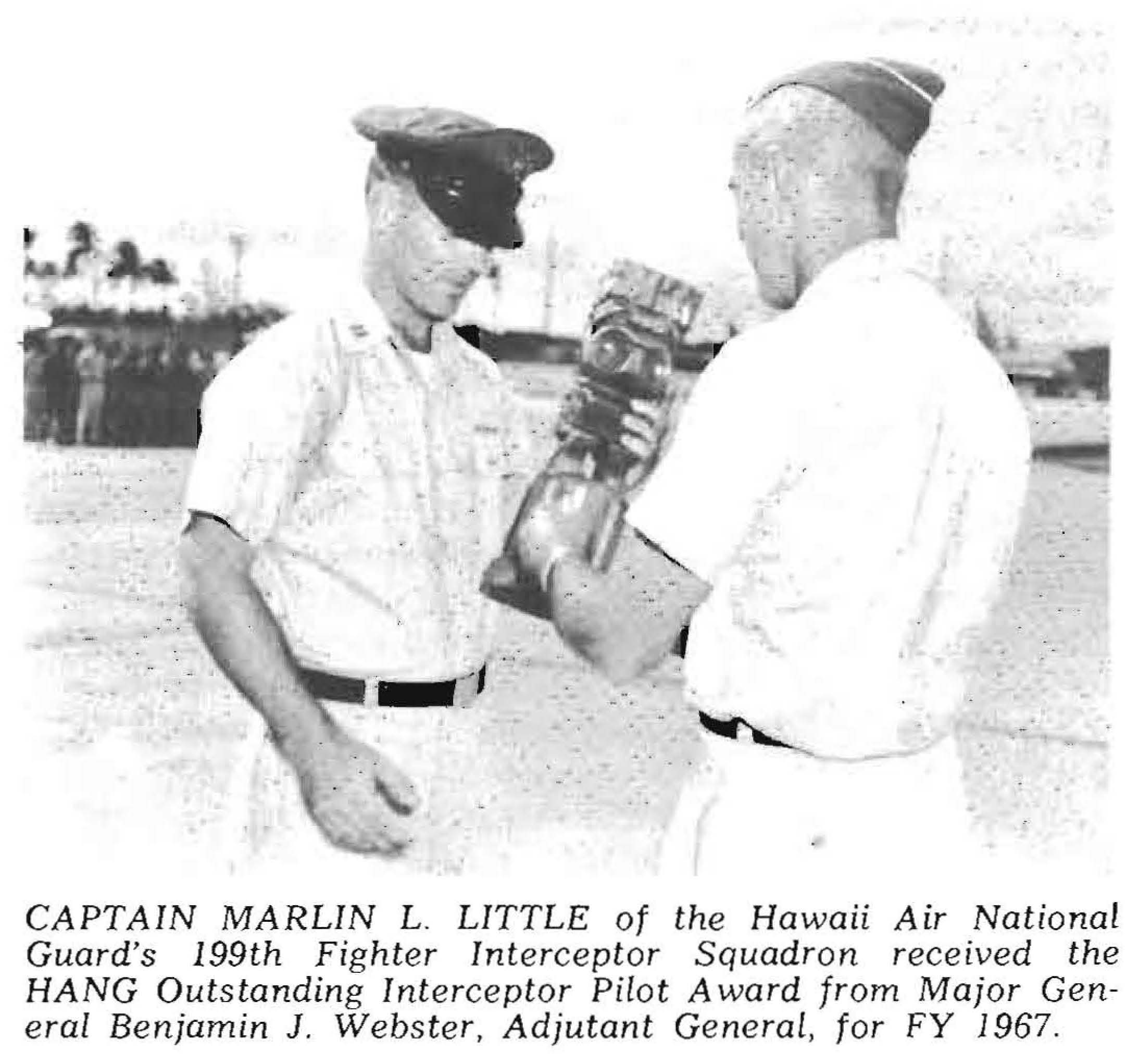
lst Lt Edward V. Richardson, 199th FIS, was awarded the HANG Outstanding Interceptor Pilot Award for his demonstration of outstanding and noteworthy performance of Interceptor Pilot duties during the year.
– 1961 Annual Report pp. 9
Aircraft Conversion
Several months before arrival of the “Deuces,” personnel were sent to Yokota AFB, Japan, and attached to their technical counterparts in the 40th Fighter Interceptor Squadron to learn the aircraft’s MG-10 Fire Control System. Other personnel were sent to Kelly AFB, Texas, to train with their counterparts in the Texas Air National Guard, specifically in hydraulics, engines, airframe, instruments, and automatic flight control systems. The remaining personnel sustained the Group’s capability to support and provide the operationally ready F-86L aircraft in the Air Defense Augmentation Program. Four tactical pilots also went to Kelly AFB, Texas, to check out in the new aircraft and became instructor pilots upon their return.
A month before the aircraft arrived in Hawaii, the USAF 766A Mobile Training Detachment (F-102A) arrived from Amarillo AFB, Texas, to instruct personnel on the maintenance of the new aircraft. Classes commenced immediately, and training progressed with everyone taking their manuals home for many hours of night study. Training was completed in May 1961, and the Mobile Training Detachment moved Detachment 1 on to train Pacific Air Forces units in the Far East.
Land Air Incorporated, contractor for deprocessing the aircraft, began delivering the new aircraft in January after a difficult start. By the middle of March, 50% of the aircraft had been received by the 154th Fighter Group (Air Defense), and this date triggered the 120-day period to become operationally ready. The F-86Ls were phased out and turned over to Hickam AFB for salvage. The complete changeover of aircraft occurred in May, a feat that speaks exceptionally well for aircraft maintenance personnel, leadership, and planning.
The Air Defense Augmentation Program continued throughout the aircraft conversion. During this time, maintenance personnel not only learned to maintain the new F-102A but also maintained the retiring F-86Ls on alert. Capability was stretched lean with this double load. . .
A total of 5,805:40 jet hours were furnished during the fiscal year, with an average of 165:52 hours per tactical pilot. Proficiency training continued in the F-86L aircraft concurrently with the complex indoctrination and transition training required for F-102A conversion. With the aid of the $800,000 F-102A Flight Simulator, the tactical pilots were well prepared for transition by the time the aircraft and auxiliary equipment were ready for flight operations. The intensity of flight transition and readiness training was accomplished with minimum loss in overall readiness potential.
– 1961 Annual Report pp. 10


The grades of tactical pilot authorizations of the 199th Fighter Interceptor Squadron were increased 1 April 1962 to provide for more field grade officers.
– 1962 Annual Report pp. 7
Combat loaded F-102 DELTA DAGGERS and tactical aircrews are ready to scramble takeoff within five minutes notice and two radar stations are operating 24 hours a day, under operational control of the 326th Air Division, Pacific Air Forces. Twenty-four assistances to aircraft in distress, and 554 navigational assists, were given by the ACW Squadrons. There were 303 aircraft scrambles on active air defense missions.
– 1962 Annual Report pp. 8
The 199th Fighter Interceptor Squadron completed its transition into the new F-I02-A aircraft and qualified all assigned pilots at the start of the period as combat ready, 12 pilots were subsequently upgraded to Skilled level and one pilot was awarded the Expert grade. Tactical pilots flew 4,029 :05 total jet hours, for an average of 155 hours per pilot. Supervisory pilots (Commanders, Operations Officers, etc.) flew an additional 1,126: 15 jet hours.
– 1962 Annual Report pp. 8


approaching Hawaii.

Lt Ritchie K. Kunichika, 199th Fighter Inerceptor Squadron, was awarded the HANG Outstanding Interceptor Pilot Award.
– 1963 Annual Report pp. 8
The tactical pilots flew 4,525 F jTF-I02 hours on 3,544 F jTF-I02 tactical training sorties which averaged 1: 17 hours. Scheduling effectiveness was 84.5%. Tactical pilots averaged 104 F jTF-I02 sorties and 137 tactical flying hours.
– 1963 Annual Report pp. 10


Air Defense Augmentation Program
The a lert aircraft were scrambled 207 times to intercept and identify over a hundred possible “hostile” aircraft detected by the ground environment system. The F-102s, with a full complement of combat weapons, flelY 417 hours in support of the air defense mission and to assist civilian and military aircraft in distress or lost in the Pacific.
– 1964 Annual Report pp. 8
F-102A Delta Dagger all-weather fighter interceptors equipped with Falcon air-to-air missiles and rockets are utilized. . .
Tactical pilo’ts flew 4.,520 F jTF-I02A hours of 3,586 tactical trai n;ng sorties which averaged 1.3 hours per sortie. ScheJ ding effectiveness averaged 87 % for a 2.5 % gain over the previous year; tactical pilots averaged 112 F /TF-I 02A sorties and 141 tactical flying hours
– 1964 Annual Report pp. 9


Two combat loaded F-102’s were scrambled 198 times and intercepted 98 unknown aircraft penetrating the Hawaiian Air Defense Identi!ication Zone. Besides performing a vital federal mission, the air defense augmentation team consisting of two F-102s and two radar stations, furnished emergency assistance to military and civilian aircraft crossing the vast Pacific.
– 1965 Annual Report pp. 9
F-102A Delta Dagger all-weather fighter inte.rceptors, equipped with Falcon air-to-air missiles and rockets, are utilized. . .
Receipt of improved F-102 aircraft commenced near the end of the year. These aircraft. have an improved fire control system and have the capability of ifring a larger variety of air-to-air guided missiles. All existing aircraft will be replaced by the improved F-102A interceptor, early in the coming fiscal year. Originally assigned F-102A aircraft will be processed for shipment to the continental U.S. . .
Tactical pilots flew 4,691 F/TF-102A hours on 3,708 F /TF-102A tactical training sorties which averages 1.3 hours per sortie. Scheduling effectiveness averaged 82.4%. Tactical pilots averaged 95 F /TF-102A sorties and 120 tactical flying hours.
– 1965 Annual Report pp. 10


The Hawaii Air National Guard received modified F-102 jet aircraft greatly increasing the air defense capabilities of the l54th Fighter Group.
– 1966 Annual Report pp. 1
Significant increase in mission capability was gained by conducting dispersal operations during Annual Field Training. Flight operations were conducted from Barking Sands, Kauai and Dillingham AFE. Oahu under field conditions. Operations from Hickam AFB were limited to support of the two forward operating bases. F-102 flight operations during this period was the highest amount this unit has ever attained. Experience gained in the movement of personnel, supplies and equipment, maintaining and operating complex equipment from bare strips added significantly to the mission capability of this unit.
Tactical pilots flew 4588 F/ TF- 102A hours on 3547 training sorties which averaged 1.3 hours per sortie. Scheduling effectiveness averaged 80 % . Unit tactical pilots averaged 109 sorties for 137 hours per pilot.
– 1966 Annual Report pp. 9
Tactical flight operations included operating from airfields with extremely limited facilities as might be required under mobilized and dispersed conditions. Flying training concentrated on intercepting “aggressor” aircraft utilizing various tactics such as high speeds at high and very low altitudes, changing altitudes and courses, emitting electronic countermeasures, dropping chaff, etc., all designed to confuse the air defense system. Tactical pilots averaged 137 hours of F-I02 flying time for the year which resulted in approximately 98 flights per pilot. Overall tactical pilot strength decreased from 37 to 35. Five pilots resigned from jet flying (four due to removal of residence) and three pilots joined the unit during the year.
The commercial contract program for major overhaul of F-102 aircraft continued during the year with nine F-102s processed. This is anticipated to be a continuous program. Local salaries paid for this and other contract programs supporting our F-102 aircraft amounted to $357,100.
– 1967 Annual Report pp. 9-10

Tactical flight operations included operating from airfields with extremely limited facilities as might be requ ired under mobil ized or deploved conditions. Tactical pilots averaged 135 hours of F-102 flying time for the year. Of 5000 F-I02 hours allocated by NGB, 5002 were flown. with 4,743 utilized primarily for training, 117 for Air Defense Alert and 132 for functional check flights. Overall tactical pilot strength decreased from 35 to 33. Six jet pilots terminated two retired, two for removal of residence, one for job conflict and one death and four pilots joined the unit during the year.
– 1968 Annual Report pp. 15
The 154th Ftr Gp’s F102 aircraft have been NORS Free (Aircraft “Not Operational Ready Supply”) since 26 October 1965. This means that no aircraft were grounded for the lack of a part for over 40 months. For this outstanding achievement, the 154th Ftr Gp was awarded the PACAF Outstanding Achievement Award for being NORS Free for over two years. The emphasis in the development of a strong “One Team Concept” between Supply and Maintenance has continued to pay dividends in mission accomplishment.
– 1968 Annual Report pp. 18

F-102 pilots of the 199th Ftr Intep Sq logged 325 hours during the 12 days encampment flying runway alert, air defense and tactical training missions.
– 1969 Annual Report pp. 14
Another first in HANG’s long history occurred on 15 June when over 1,200 of Hawaii’s air militia paraded for their Commander-in-Chief, Governor John A. Burns and military dignitaries. Highlighting the parade was an award presentation ceremony wherein 39 military awards were bestowed upon Air Guardsmen and one Air Force Technical Advisor. Awards included six Air Medals to F -102 pilots who flew aerial combat missions in Southeast Asia (SEA) under the Air Guard Palace Alert program and 26 merit certificates to 201st Mbl Comm Sq airmen for their outstanding support of Southeast Asian Treaty Organization (SEATO) Exercise “Sea Spirit” held in Thailand
– 1969 Annual Report pp. 14-15
Tactical flight operations induded operating from airfields with austere facilities as might be required in a mobilized and deployed condition. The 4,624 F -102 hours allocated by NGB were flown during the year. Overall tactical pilot strength increased from 33 to 36. Four jet pilots terminated (three removal of residence and one jut; conflict) and seven pilots joined the unit during the year.
– 1969 Annual Report pp. 15
The commercial contract program for major overhaul of F-102 aircraft continued, with Dynaelectron Corporation processing eight aircraft during the year. Local salaries paid for this and other contract programs supporting our F-102 aircraft exceeded $225,000.
– 1969 Annual Report pp. 15

Major overhaul of F-I02 aircraft under contract to Dynalectron Corporation continued, with eight aircraft processed during the year. The contract was expanded to include rework and inspection of the wings which will result in an extended life for the airframes. Local salaries for this and other contract programs supporting our F-102 aircraft amounted to $146,360.00.
– 1970 Annual Report pp. 14
F -102 pilots of the 199th Fighter Interceptor Squadron recorded 382 flying hours. They also flew 238 alert, transition, and combat crew training sorties during the 12 day encampment.
– 1971 Annual Report pp. 15
Two aircraft and pilots were always on a “5 minute alert” status throughout the year, ready to intercept unknown aircraft. This capability was augmented in September 1970 by an additional two pilots and aircraft on “30 minute” status. A total of 302 F-102 aircraft hours were flown to provide active air defense of Hawaii.
Tactical flight operations resulted in 5,341 F -102 hours flown during the year without accident or serious incident. . .
The operational ready rate for F-102 aircraft averaged 70.3% which met Air Force standards. Aircraft authorization was changed from 25 to 18. Twenty-one were on hand. Several modifications were added to the F102, to extend the life of the airframe and improve the reliability of the engine. The work detracted slightly from the operational ready rate and flying hour accomplishment. February 1971 marked the tenth year of operations with F -102 aircraft. . .
Major overhaul of F -102 aircraft continued under contract to Dynalectron Corporation. Seven aircraft were processed during the year. Local salaries for this program amounted to $119,416.00.
– 1971 Annual Report pp. 15-16

F-I02 pilots of the 199th FIS recorded 180 flying hours or a total of 121 alert, transition, and combat crew training sorties during the six-day encampment.
– 1972 Annual Report pp. 15
Although total tactical pilot strength decreased within the 154th Fighter Group, the 199th Fighter Intercep tor Squadron ended the year in an overstrength condition.
– 1972 Annual Report pp. 15
Captain Michael H. Tice of the 199th Fighter Interceptor Squadron, (FIS) earned the HANG Outstanding Interceptor Pilot Award for his outstanding performance as an interceptor pilot.
– 1973 Annual Report pp. 13
F-I02 pilots ofthe 199th FIS recorded 164 flying hours and a total of 117 alert, transition and combat crew training sorties during the six-day encampment.
– 1973 Annual Report pp. 14
Air National Guard (ANG) cost reduction programs forced the termination of F-I02 flying assignments for two Air Force pilots of the 326th Air Division. This measure had to be taken so as not to adversely effect the HANG pilots. Two HANG pilots terminated their assignments with the 199th FIS and three new officers moved in. These three were second lieutenants who grad uated from the Air Force pilot training program and the ANG F-I02 Combat Crew Training School at Houston, Texas
– 1973 Annual Report pp. 15


The Air National Guard was involved with preparation for a major reorganization and devoted a great deal of time in planning for the l54th Fighter Interceptor Group’s conversion to the F-4C aircraft in Fiscal Year 1976.
– 1975 Annual Report pp. 1
Much planning and construction was begun in preparation for the 154 Fighter Interceptor Group’s conversion to F-4C aircraft in FY 76.
– 1975 Annual Report pp. 5
In March 1975, the 199th Fighter Interceptor Squadron (FIS) rendered full support to Rim of the Pacific 75 (RIMPAC) 75, a large scale joint naval sea and air exercise. Naval forces from the United States, Canada, Australia and New Zealand operated in Hawaiian waters for about two weeks in mock air, surface and sub-surface battles, concentrating on electronic warfare techniques. The “enemy” air forces were offered the full facilities of the 199th FIS for briefing, debriefing, and data collection. The 199th FIS itself flew many “attack” sorties against the naval forces at sea.
– 1975 Annual Report pp. 17


The Air National Guard focused much time and energy on the 154th Tatical Fighter Group’s conversion from the F- 102A Delta Dagger to the F-4C) phantom II aircraft .
– 1976 Annual Report pp. 1
Significant progress was made by the 154th Tactical Fighter Group (TFG) toward converting from the F-102A Delta Dagger to the two-seater F-4C Phantom aircraft. Aircrew members recei ved initial transition training at Luke Air Force Base (AFB), Arizona, and George AFB, California. Construction and mod ification of existing facilities at Hickam proceeded while the 154th TFG maintained operations in both aircraft.
– 1976 Annual Report pp. 4
After 16 years of operation in the F-1 02A aircraft, tile 154th TFG initiated conversion to the F-4C McDonell Douglas Phantom. The expected role is to maintain the air defense alert posture and to increase the aircrew from a one-man to a two-man crew. The person who occupies the back seat is known as a weapons system officer (WSO).
Conversion to the F-4C aircraft required a significant amount of new construction and modification of existing facilities. . .
The TFG continued maintaining its air defense alert posture throughout the year with two pilots and two aircraft on “5-minute” alert St2tl US. Two additiona l p ilots and two aircraft were on “30-minute” alert status from July through Oct. 1975. The reduced posture to “two-on-5-minute alert” was to accommodate the maintenance iraining load.
The first F-4C aircraft arrived on Oct. 24, 1975 and was used exclusive ly for ” hands on” training by maintenance personnel. Other F-4Cs began arriving in Jan. 1976 and, by the end of the fiscal year, 15 were on hand. Flying training began in April 1976 as aircrews returned to Hawaii from F-4 checkout in the conti nental U.S.
– 1976 Annual Report pp. 15

Within the Air National Guard, the l54th Tactical Fighter Group completed its conversion from the F-102A Delta Dagger to the F-4C Phantom aircraft.
– 1977 Annual Report pp. 1
The Hawaii Air National Guard (HANG) highlights for the fiscal year included two significant achievements conversion of the 154th Tactical Fighter Group to F-4C aircraft and attaining mi ss ion-ready status as of June 1, 1977, and the fruitful gains of the HANG recruiting and retention program
– 1977 Annual Report pp. 6
Effective June 10, 1976, the 154th Fighter Interceptor Group (FIG) was reorganized, and its authorized strength increased from 695 to 824 (112 officers and 712 airmen) The HO 154th FIG was redesignated as HO 154th Tactical Fighter Group (TFG) and the 199th Fighter Interceptor Squadron (FIS) to 199th TFS. The significant increases were in the 199th TFS from 47 to 79 and in the 154th CAMS from 296 to 386. The increases activated positions in support of the F-4C aircraft.
– 1977 Annual Report pp. 14
Active air defense alert operations by F-1 02As were terminated on Oct. 22, 1976 , and assumed by the F-4Cs. As of June 30,1977, 18 formed aircrews were declared mission-ready (M R).
– 1977 Annual Report pp. 15
A unit level air defense exercise for th e F-4C was held during December 1976, as well as deployment activity to Barking Sands, Kauai, in Ap ril 1977.
– 1977 Annual Report pp. 15
Key members of the 199th TFS finalized the training flow for individual pilot checkout in the F-4C aircraft. These checkout courses were conducted at George AFB, California, and Luke AFB, Arizona. By the end of FY 76 , 19 pilots and 4 WSOs had completed their initial checkout in the Phantom.
– 1977 Annual Report pp. 15
HQ PACAF selected the 199th TFS as their nominee for the annual Hughes Trophy competition , which compares fighter outfits using Hughes aircraft radar weapons systems. Although the 199th TFS did not win the trophy, the nomination to the competition was an honor.
– 1977 Annual Report pp. 16
The major highlight of the past year was the conversion from the F-1 02A Delta Dagger to the F-4C Phantom
after 16 years of operation with the F-102A. Improved aircraft performance, newer state-of-the-art aircraft fire control system and air-to-air missiles of the F-4C will re sult in increased air defense missiO[1 capability. The added offensive capabilities of the F-4C brought a name change from fighter interceptor group to tacti ca l fighter group.At the beginning of FY 77 , both F-102A and F-4C aircraft were maintained and operated with two F-1 02As continuing to remain on air defense alert, ready to scramble, intercept and identify any unknown aircraft penetrating the Hawa iian Air Defense System (HADS). After suffic ient aircrews were trained in the F-4C, a single F-4C was placed on air defense alert on Oct 22 , 1976, and all F-102A operations were terminated . The 154th TFG was the last organization in the entire USAF to operationally employ the F-1 02A. On Jan . 22, 1977, the number of F-4C aircraft on air defense alert was increased to two. As of June 1, 1977, sufficient aircrews were combat ready and the readiness posture of our F-4C aircraft had improved to the point that unit combat statu s capab ility was upgraded.
Eleven pilots completed their initial qualification (phase 1) in the F-4C Phantom at Air Force bases on the Mainland. Training consisted of flight simulator lessons, many hours of academics on aircraft system s, and 9 to 17 flying sorties. These 11 pilots plus the 16 who had completed their training earlier at Luke AFB, Ari zona, and George AFB, California, completed the pilot checkou t requirements.
Four locally recruited officers with navigator ratings who entered and completed combat crew training in the F-4C aircraft became qualified weapons system officers (WSOs). Combat crew training which lasted approximately seven months, was conducted at Homestead AFB , Florida , or Luke AFB, Arizona. Two other former Air Force navigators were recruited locally and comp leted WSO combat crew training at Luke AFB, Arizona
– 1977 Annual Report pp. 16
With the aiicrews qualified in AAR , the 199th Tactical Fighter Squadron (TFS) became eligible to ferry ANG aircraft to Tainan Air Base (AB), Taiwan, during March June 1977. The first part of the flight involved flying with a KC-135 tanker from Hickam AFB, Hawaii, to Guam. Then they departed Guam for Tainan AB where the aircraft was turned over to the Air Logistic Center Faci lity for its 60-day depot maintenance.
In March 1977, the 199th TFS had sufficient aircrews trained to be declared MR, the first step toward maximum combat readiness. By the end of June 1977, 18 pilots and 18 WSOs (18 formed crews) were fully trained to MR status. The ultimate goal will be reached when 12 to 14 more pi lots and 8 more WSOs are upgraded to MR status in the Phantom
– 1977 Annual Report pp. 16-17
During June 1977, the 154th TFG completed a very productive summer encampment. Maintenance generated 43 sorties during two days of an air defense exercise, and the unit ended-the month with 180 sorties flown. This was the best flying month in the F-4C aircraft – a major milestone for the 154th TFG. It was also proven that the F-4C Phantom could operate from the dispersal base at Barking Sands, Kauai.
The F-102A total flying time for the year was 326.6 = hours, and the F-4C total flying time was 1,804.9 hours. . . Additional F-4C aircraft were received to bring the total possessed up to 20.
– 1977 Annual Report pp. 17


The Air Guard embarked on two new training events involving the F-4C Phantom aircraft – air refueling and air combat tactics. These new endeavors are the direct result of the upgraded qualification of aircrews in accomplishing their air defense training requirements.
– 1978 Annual Report pp. 1
It should be noted that the life support section of the 199th tactical Fighter Squadron was rated the “best” in the Pacific Air Forces
– 1978 Annual Report pp. 15-16
In February 1978, the 199th Tactical Fighter Squadron began air combat tactics training. This intensive training was initiated with the assistance of two highly qualified Pacific Air Forces’ instructor pilots. The training is designed to upgrade the pilot/weapons system officer crew’s teamwork in fighter versus fighter combat situations.
The 199th Tactical Fighter Squadron has continued to check out pilots and weapons system officers in the F-4C Phantom. By June 30, 1978, 27 pilots had attained mission-ready status, an increase of 9 from June 30, 1977. Twenty-three weapons system officers completed the required training and attained mission-ready status, an increase of 5 from June 30, 1977.
A total of 3,075.5 hours were flown by the Hawaii Air National Guard’s F-4C fighter aircraft. The C-7A aircraft flew 366.5 hours in support of the Hawaii National Guard and other government agencies
– 1978 Annual Report pp. 16

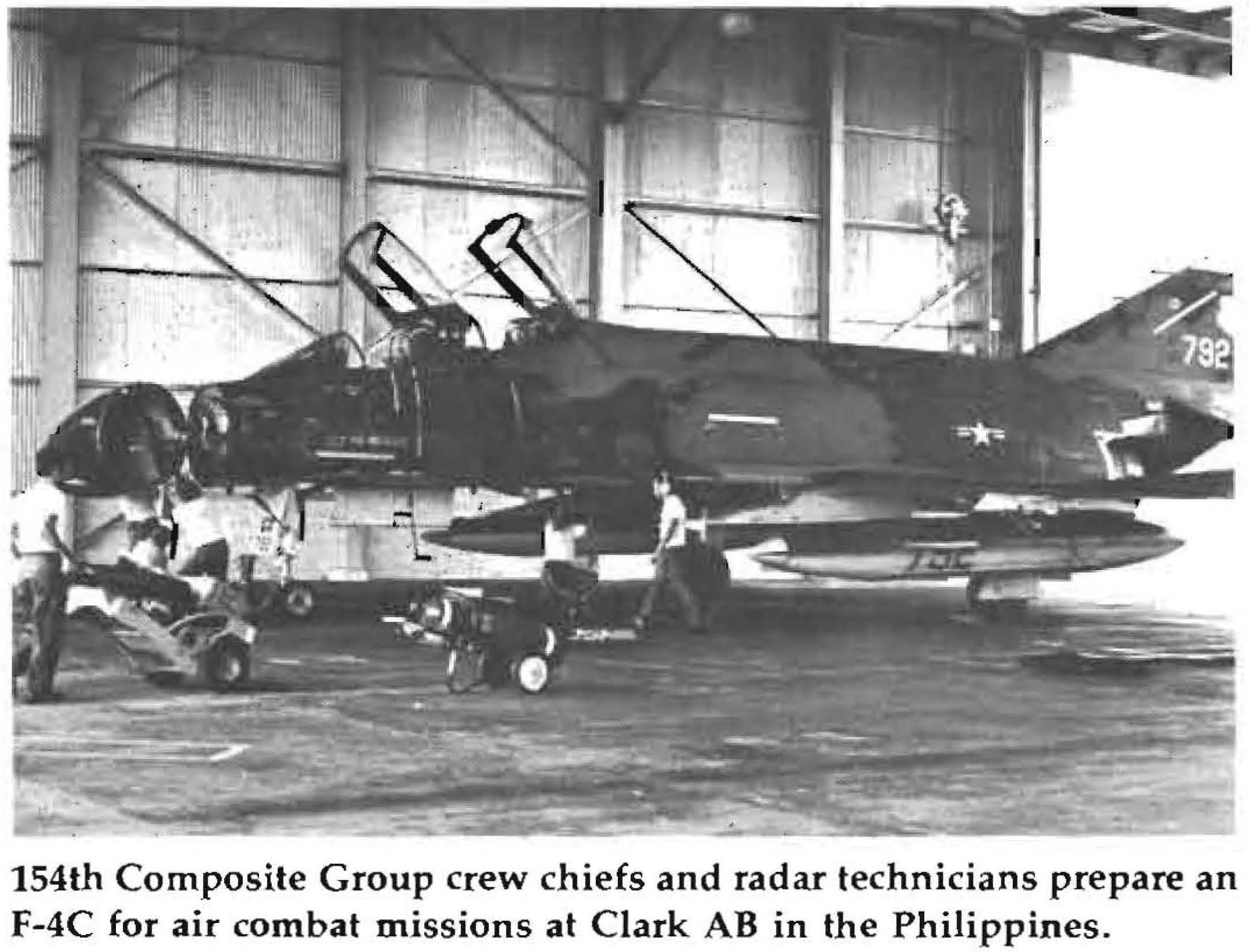
The 199th Tactical Fighter Squadron’s flying operations during the year were again conducted accident-free for a cumulative total of 72 months. A total of 3,047.1 hours was flown in the F-4C Phantoms during the fiscal year.
The qualification of aircrews certified as mission ready in the F-4C continued with the last pilot converting from the F-102 to the F-4C in April 1979.
The aircrews’ basic fighter maneuvers and air combat maneuvers programs were expanded to include the use of dissimilar adversary aircraft to more closely simulate the Soviet Bloc’s fighter aircraft. United States Navy A-4 and United States Air Force A-7 aircraft have been utilized to date.
The two overseas deployments to Guam and the Philippines resulted in expanding the operational readiness capability of the aircrew, maintenance and support personnel. The deployment in June, involving six F-4Cs and 219 group personnel, provided more challenging scenarios for increasing the aircrews’ readiness.
– 1979 Annual Report pp. 11
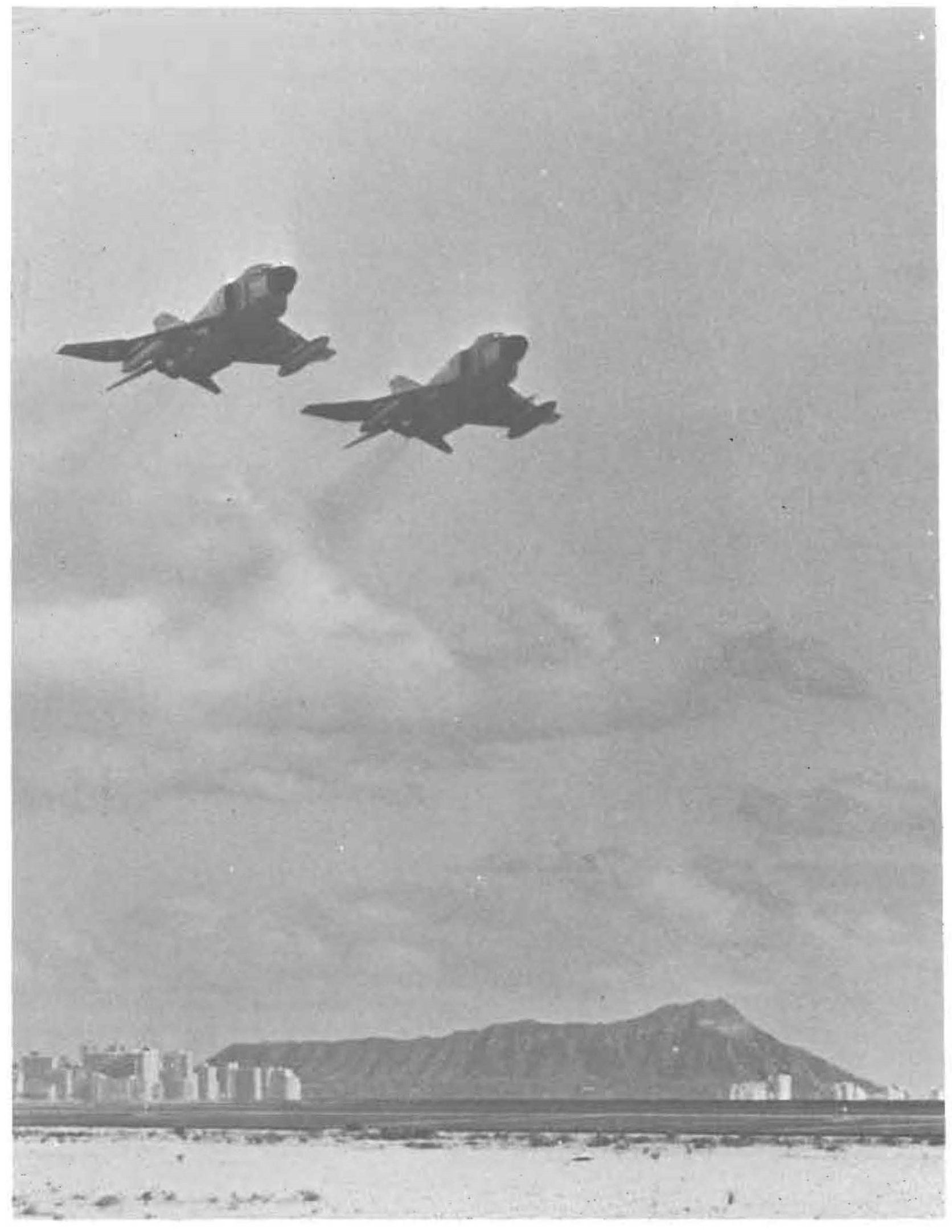
The 154th Composite Group and its affiliated units engaged in a historic training deployment to Guam and Japan in June 1980.
One week was spent in Guam training in an electronic counter-measures environment with United States Air Force B-52 aircraft of the Strategic Air Command. Six F-4C Phantoms and aircrews along with almost a hundred maintenance and support personnel participated in this exercise.
The week following the Guam exercise, the Hawaii Air National Guard personnel traveled to Misawa Air Base in Japan for an exercise entitled Cope North. This historic event marked the first time a Hawaii reserve unit had trained and flown with a fo reign air force in a foreign country. The joint exerc ise permitted the Hawaii aircrews to practice live air combat maneuvers.
– 1980 Annual Report pp. 12
The Group’s 199th Tactical Fighter Squadron continued an enviable safety record by completing 96 months of accident-free flying. A total of 3,108 flying hours were logged in the F-4C Phantom jet.
– 1981 Annual Report pp. 10


The Group also had an opportunity to support the Defense Nuclear Agency’s Protect Alps project in the South Pacific area involving the firing of a high altitude rocket from an F-4C Phantom jet for research data collection
– 1982 Annual Report pp. 10

A select group of the 154th Composite Groups 199th Tactical Fighter Squadron. 154th Consolidated Aircraft Maintenance Squadron and other support unib flew west to Kunsan Air Base, Republic of Korea, to take part in Team Spirit 83 exercises. The movement of aircraft, equipment and personnel to distant Kunsan Base was difficult but not insurmountable. The challenges involved in such a move helped to further strengthen the stature of the group’s mission readiness.
– 1983 Annual Report pp. 13

The 199th Tactical Fighter Squadron and the various support units demonstrated their mobility and fighting capabilities in numerous dissimilar air-to-air exercises using other aircraft as adversaries, such as Cope Road in the Marianas, Sentry Aloha in New Mexic and Exercise Sentry Tigre, wbich was conducted locally against A-7 aircraft from Tucson, Arizona
– 1984 Annual Report pp. 11
During Ext’reise Cope Road in the Marianas, the 199th Tactical Fighter Squadron battled the Strategic Air Command’s B-52s in and around the island of Cuam, The talent and success of the crews were recognized as they have been invited back again to demonstrate their abilities in the future
– 1984 Annual Report pp. 13

The 199th Tactical Fighter Squadron and the various support units demonstrated their abiIity to mobilize and fight in several dissimilar air combat training exercises, such as Cope Thunder and Combat Sage in the Republic of the Philippines.
– 1985 Annual Report pp. 12

In another area of the world, working at Ramstein Air Base, Germany, Headquarters of the United States Air Forces in Europe, selected members of the 199th Tactical Fighter Squadron and the 154th Consolidated Aircraft Maintenance Squadron joined with
– 1986 Annual Report pp. 13
June 14, 1986 initiated the closing of a very historical chapter in the annals of the Hawaii Air National Guard. The return landings of eight F-4C aircraft from the air combat exercise Red Flag at Nellis AFB, Nevada, marked the end of the last deployment in the Phantom. With the expected arrival of the F-15 Eagle next fiscal year and the final phase out of the F-4C, an era will come to an end. Although Hawaii Air National Guard’s Phantoms are close to being 23 years old and by most 1980 standards, out-dated, the aircraft can still perform well in the air combat arena when flown by experienced and well-trained aircrews as was proven by the recent deployment to Red Flag.
– 1986 Annual Report pp. 13

The Hawaii Air National Guard marked its 40th Anniversary on September 10, 1986 and announced its conversion to the F-15 Eagle in February 1987. The conversion represented a quantum leap forward in the air defense of Hawaii.
– 1987 Annual Report pp. 1
The tactical fighter squadron, located at Hickam Air Force Base (AFB), is equipped with the F-15A Eagles and provides the fighter intercept capability for the air defense system.
– 1987 Annual Report pp. 10
The conversion from the F-4C Phantom to the F-15 Eagle aircraft was the centerpiece of a momentous year for the 154th Composite Group. In February 1987, the first four pilots entered upgrade training at Tyndall Air Force Base (AFB), Florida, and on March 11, 1987, the first two of 26 F-15 Eagles arrived at the 154th Composite Group, Hickam AFB. By the end of May 1987, training missions were being flown in the F-15 by pilots of the Hawaii Air National Guard’s 199th Tactical Fighter Squadron.
– 1987 Annual Report pp. 11

The Hawaii Air National Guard completed its conversion to the F-15 Eagle ahead of schedule and reassumed the full-time air defense alert mission for Hawaii.
– 1988 Annual Report pp. 1
The tactical fighter squadron, located at Hickam Air Force Base (AFB), is equipped with the F-15A Eagle and provides the fighter-intercept capability for the air defense system.
– 1988 Annual Report pp. 9
In January, the 199th Tactical Fighter Squadron was back on alert duty, replacing the pilots and aircraft from the 116th Tactical Fighter Wing.
– 1988 Annual Report pp. 10
Fiscal Year 1988 brought many milestones for the 154th Composite Group as the conversion to the F-15 Eagle was completed ahead of schedule on June 22, 1988. Sept. 1, 1987 marked the last scramble of the 154th Composite Group’s F-4C Phantoms, as the F-15 Eagles assumed the air defense mission for the State of Hawaii.
– 1988 Annual Report pp. 10
The first F-15 missing man flyby formation was conducted during services held at Pearl Harbor in remembrance of those killed during the infamous attack on Dec. 7, 1941. Other flybys were provided at the Mayor of Honolulu’s Annual Memorial Day Ceremonies and during Armed Forces Day in May. Also during May, the 154th Composite Group presented their F-1 Ss for static display, one at Hickam AFB, Oahu, and another at General Lyman Field, Hawaii, for the annual Armed Forces Day observance.
– 1988 Annual Report pp. 10
Also in February, the unit resumed four-ship advanced tactics for the first time since the conversion to the F-15 Eagle. By November, the Composite Group had established DACT scenario arrangements involving U.S. Marine Corps F-4 Phantoms and U.S. Navy A-4 Skyhawks against Hawaii Air National Guard F-15s
In June, the 199th Tactical Fighter Squadron conducted the first firing of the F-15 20-millimeter cannons in Hawaii. Eighty-four shooter sorties and 28 tow target sorties were flown.
– 1988 Annual Report pp. 11


Also during this period, the Air Guard’s 154th Composite Group completed its conversion to the F-15 Eagle and simultaneously earned its fourth U.S. Air Force Outstanding Unit Award and fourth Distinguished Flying Unit Plaque from the National Guard Association of the United States.
– 1989 Annual Report pp. 11
The tactical fighter squadron, located at Hickam Air Force Base (AFB), is equipped with the F-1 SA/B Eagle and provides the fighter-intercept capability for the air defense system.
– 1989 Annual Report pp. 11
The successful conversion from the F-4C Phantoms to the F-15A/B Eagles was underscored by the satisfactory ratings received by the 154th COMPGP during its Operational Readiness Inspection and Unit Evaluation Inspection in December 1988.
– 1989 Annual Report pp. 12
The construction of a “Hush House” is 99 percent complete. It will enable the F-15 aircraft engines to be maintained without creating noise pollution. Construction of a new flight simulator facility was completed in April. This facility was constructed in line with the conversion to the F-15A/B Eagle. The installation of the flight simulator is nearing completion.
– 1989 Annual Report pp. 12
Governor John Waihee also toured the group in August and flew with the 199th Tactical Fighter Squadron in an F-15B aircraft. . .
The HIROCC and the 199th Tactical Fighter Squadron also received a visit from the Royal Thai Air Force in September.
– 1989 Annual Report pp. 13
In one of its last community projects for the fiscal year, the 154th COMPGP provided its F-15s for static display during the Armed Forces Day celebration held at Hickam AFB
– 1989 Annual Report pp. 13
To provide the 199th Tactical Fighter Squadron {199th TFS) with an opportunity to fly against two different threats with different strengths and weaknesses, five F-16A Falcons from the 421 st Tactical Fighter Squadron, Hill AFB, and six F-4E Phantoms from the 1 08th Tactical Fighter Wing, New Jersey Air National Guard, deployed here in October to participate in Sentry Diamond ’88. In November, the 150th Tactical Fighter Group, New Mexico Air National Guard, deployed to Hickam AFB with six A-7 Corsair aircraft to participate in Sentry Roadrunner. The exercise provided pilot training with dissimilar aircraft in a multi-bogey environment. Also participating was a Contract Flight Services Lear Jet that provided electronic countermeasures training for the 199th TFS.
– 1989 Annual Report pp. 13
Also in May, the 154th COMPGP deployed its F-15s for the first time to Clark Air Base in the Philippines for two weeks during exercise Combat Sage. One hundred twenty-five personnel and eight F-15s took part. The primary objective of this exercise was to test the fighting capability of the 154th COMPGP under field conditions and to fire live AIM 7 radar and AIM 9 heat-seeking missiles. The 199th TFS engaged the U.S. Navy F-1 8 Hornets and A-4s in mock combat scenarios.
Exercise Sentry Tigre began shortly after the completion of Combat Sage. Hawaii Air National Guard F-15s trained with four F-16s from the Tucson, Arizona Air National Guard; KC-135 Stratotankers from the Phoenix Air National Guard; F-18s from the VMFA 212/232 Kaneohe Marine Corps Air Station; and A-4 Skyhawks from the VC-1 Naval Air Station, Barbers Point. Areas covered during the exercise included aerial defense, escort, strike, and basic fighter maneuvers
– 1989 Annual Report pp. 14

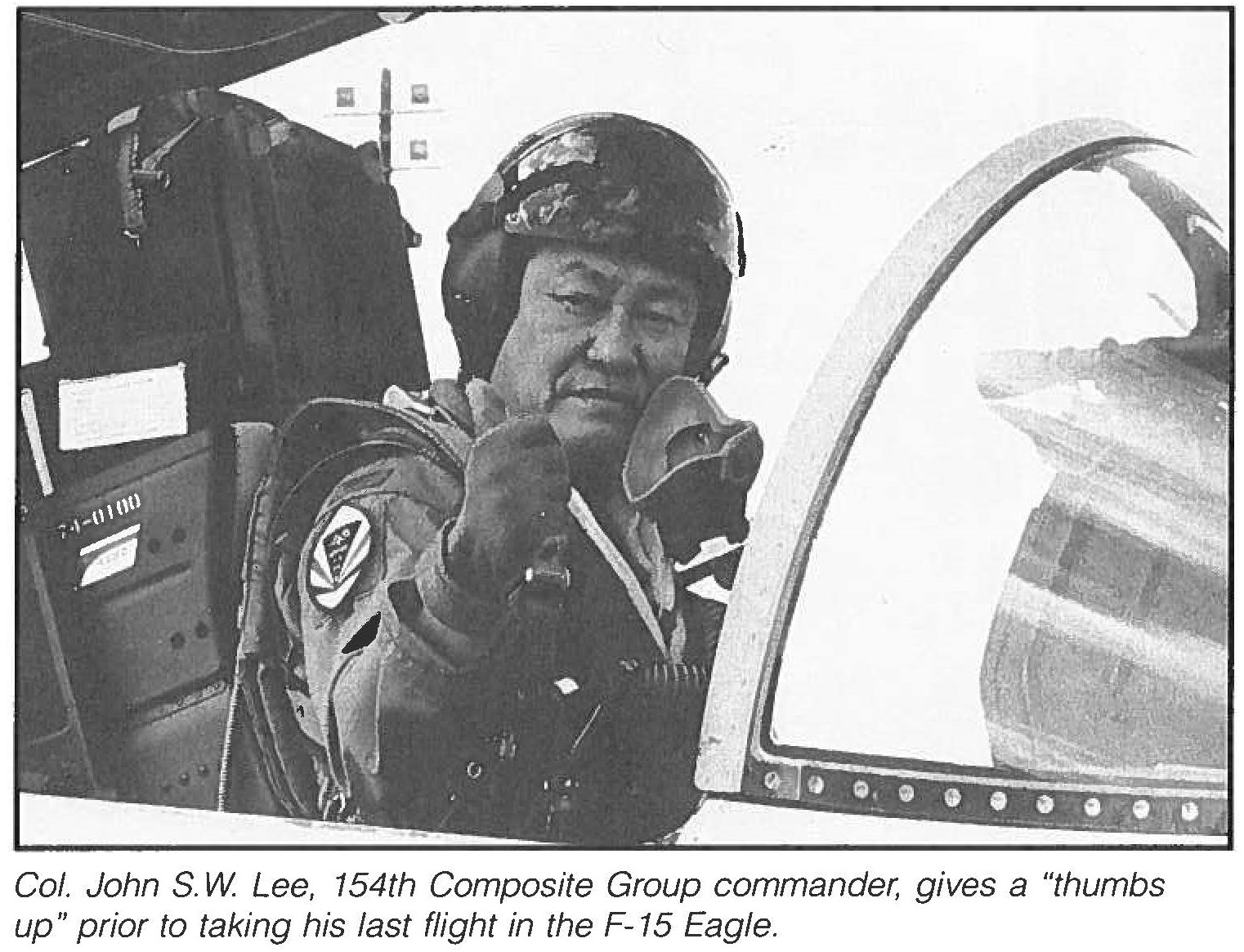
The tactical fighter squadron, located at Hickam Air Force Base (AFB), is equipped with the F-15A/B Eagle and provides the fighterinterceptor capability for the air defense system.
– 1990 Annual Report pp. 11
Military construction presented some of the most obvious changes at Hawaii Air National Guard facilities in the fiscal year. The “Hush House”, a facility designed to test F-15 engines without adding to the State’s environmental noise pollution, was completed and is now fully operational.
– 1990 Annual Report pp. 12
In February, members of the 199th Tactical Fighter Squadron (199th TFS) began to train in” hot-pit” refueling, which will allow jet fighters to get back in the air in a fraction of the time normally used to ready an aircraft using conventional refueling techniques. The 199th TFS pilots also began to train for longer range intercepts to expand the depth of their air defense and air superiority tactics.
– 1990 Annual Report pp. 13
Deployments this year included taking six F-15s and 146 Guard members to Guam during the first week in October 1989. The deployment was hampered by very bad weather conditions that tested the versatility and skills of everyone involved. The second fighter deployment was to the Philippines for “Combat Sage”, which involved live missile firing, and “Cope Thunder”, a large-scale joint forces training exercise designed to realistically simulate wartime conditions in a deployed posture.
– 1990 Annual Report pp. 13


Also, the HIANG’s present F-15s will be exchanged for slightly newer models which were modified under the Air Force’s multi-stage improvement program. The upgrade will enhance the fighters’ avionics and weapons capabilities
– 1991 Annual Report pp. 12
Kaneohe Marine Corps Air Station fighters, favorite sparring partners of HIANG’s 199th Tactical Fighter Squadron, left behind few training adversaries when the Marines were sent to the Gulf. Training resumed after the cease-fire, with returning Marine fighters eager to share lessons learned in the Gulf.
Renewed availability of tankers enabled 199th Tactical Fighter Squadron pilots to take part in Exercise Red Flag at Nellis AFB, Nev., in July, and several units were able to come to Hawaii for DACT. Six fighters and support units deployed to Pacific Missile Range Facility (PMRF) Barking Sands, Kauai, for mobility and dispersal training in August.
– 1991 Annual Report pp. 13
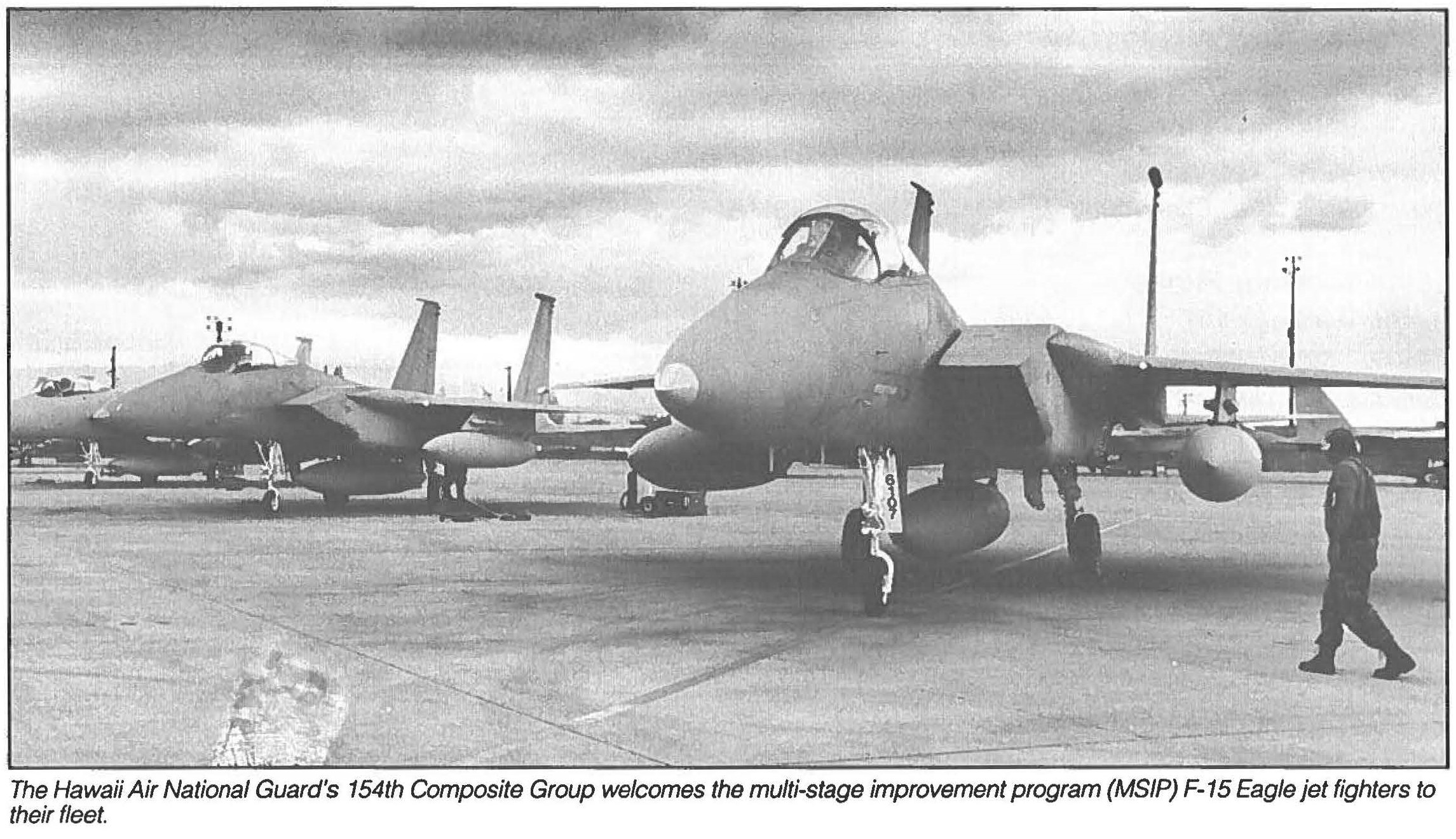

The Hawaii Air National Guard celebrated its 45th anniversary in November 1991 and began conversion of its F-15 Eagle fighters to more improved versions under the multi-stage improvement program (MSIP).
– 1992 Annual Report pp. 1
The transition to F-15 Eagles with the Multi-Stage Improvement Program (MSIP)conversionwascompleted this year. These newer aircraft have superior avionics and weapon systems that further enhance the ability to control the skies.
– 1992 Annual Report pp. 12


Also this year we completed conversion of our F-15 fighters under the Multi-Stage Improvement Program and began installing chaff and flare dispensers on these aircraft
– 1993 Annual Report pp. 1
Located at Hickam Air Force Base, its fighter squadron is equipped with F-15A/B Eagles to provide fighter-interceptor capability for the air defense system.
– 1993 Annual Report pp. 6
The HIANG’s C-130H, attached to the 199th Fighter Squadron, flew the first of 189 sorties related to relief efforts, Sept. 12, 1992.
– 1993 Annual Report pp. 16
The designation of the 154th Composite Group was changed to the 154th Group, Feb. 1, 1993. The 199th Tactical Fighter Squadron was redesignated the 199th Fighter Squadron.
– 1993 Annual Report pp. 17
In May 1993, F-15s from the Fighter Squadron began upgrading their defensive capabilities by acquiring the ALE-45 chaff and flare dispenser system.
– 1993 Annual Report pp. 18
As part of the combined/joint RIMPAC ’92 exercises in July, the 199th Fighter Squadron flew more than 200 sorties involving dissimilar air combat training, high value asset escort and maritime operations against naval surface attack groups.
– 1993 Annual Report pp. 18


In February, the Secretary of the Air Force announced the addition of four more KC-135 Stratotankers, the addition of three more C-130 Hercules transports and the reduction of nine F-15 Eagles for the Hawaii Air National Guard.
– 1994 Annual Report pp. 1
Located at Hickam Air Force Base, its fighter squadron is equipped with F-15A/B Eagles to provide fighter-interceptor capability for the air defense system.
– 1994 Annual Report pp. 13
The 154th Group saw a number of changes in FY ’94, the most significant being the robusting of the 203rd Air Refueling Squadron (ARS) and the downsizing of the 199th Fighter Squadron (FS).
– 1994 Annual Report pp. 15
and the Fighter Squadron would decrease the number of its F-15As by nine, to a total of 15. A similar loss of F-15s was experienced by all fighter squadrons across the nation, as a cost cutting·measure, to bring down the total Air Force to 20 fighter wings.
– 1994 Annual Report pp. 15
In March 1994, pilots with the 199th began a series of evaluations using night vision goggles. The fighter squadron pilots were the first F-15 pilots in the nation (both Guard and active duty) to evaluate the devices. Six F-15s deployed to Gulfport, Miss., in April to conduct nighttime tests while flying simulated combat missions against other Air Guard and active duty Air Force units. The evaluations showed that the night vision goggles greatly enhanced the pilots’ capabilities.
– 1994 Annual Report pp. 16
Throughout the year, the Fighter Squadron hosted units from the active duty Air Force and Air National Guard for exercises flown from Hickam Air Force Base (AFB).
– 1994 Annual Report pp. 17-18


Highlighting the deployment schedule was the mission flown from Turkey. In December 1994 and January 1995, F-15 Eagles from the 199th Fighter Squadron became the first Air National Guard F-15 unit in the nation to patrol the northern no-fly zone oflraq. The deployment to Incirlik Air Base, Turkey, involved 160 pilots and support personnel from the 154th Group. The group’s mission during Operation Provide Comfort II was to protect ethnic Kurds in northern Iraq from the forces of Saddam Hussein by denying Iraqi aircraft from restricted airspace.
– 1995 Annual Report pp. 15
In March, pilots from the 199th Fighter Squadron assisted in the rescue of three civilians who ditched a twin-engine aircraft in the ocean 120 miles north of Maui. Two F-15s were scrambled from the alert pad at Hickam, rendezvoused with the aircraft, then marked its location and directed the Coast Guard rescue team to the downed aircraft.
– 1995 Annual Report pp. 20
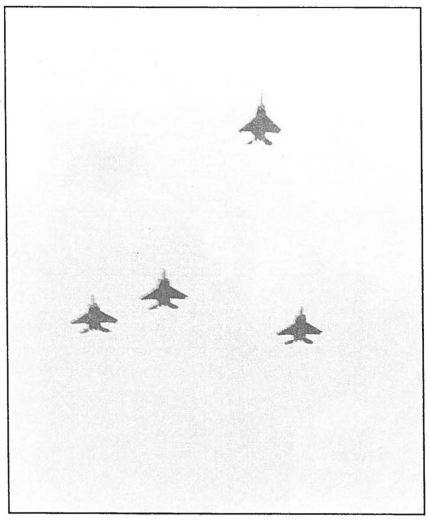
The 199th Fighter Squadron is equipped with F-15A/B Eagles to provide fighter-interceptor capability for the air defense system. The 199th is also tasked with providing the U.S. Air Force with air superiority fighters during war or other military contingencies.
– 1996 Annual Report pp. 15
The Operations Group includes the 199th Fighter Squadron, 203rd Air Refueling Squadron and the 204th Airlift Squadron. The F-15 community completed downsizing to 15 primary assigned aircraft while the 203rd’s KC135s robusted from four to eight, and attained mission ready status at the beginning of October 1995.
– 1996 Annual Report pp. 16
A new F-15 fuel celVcorrosion control facility and a new Consolidated Support Facility that will house the 154th Medical Squadron, Services Flight, Accounting and Finance and other elements of the wing headquarters will be dedicated in 1997.
– 1996 Annual Report pp. 16
The 199th Fighter Squadron (FS) was nominated for the Hughes Achievement Award, which is annually awarded to the unit that has demonstrated superior air superiority and air defense. The 199th FS also contributed to the testing and evaluation of the night vision devices, and testing of the SATCOM, a real-time audio and video communications systems for the F-15s.
– 1996 Annual Report pp. 18
From Oct. 21 through Dec. 4, 1995, 116 members of the 154th Maintenance Squadron, Aircraft Generation Squadron, and 199th Fighter Squadron deployed with F-15 aircraft to Howard Air Base, Panama, for Operation Cornet Nighthawk. The mission was to intercept and identify unknown aircraft suspected of attempting to enter the United States with illegal drugs. Information gathered during intercept missions was forwarded to U.S. Customs officials.
– 1996 Annual Report pp. 18-19
In January 1996, the 199th Fighter Squadron participated in Sentry Aloha exercises conducting air defense and offensive counter air exercises with F-16s from the Virginia Air Guard, B-ls from the Kansas Air Guard, and active duty B-52s.
. . .
Also, in March 1996, more than 100 men and women from the 199th Fighter Squadron and 154th maintenance and support personnel deployed to Incirlik Air Base, Turkey, for Provide Comfort II to help enforce the northern no-fly zone of Iraq. This was the second time that the Hawaii Air National Guard had deployed F-15s, pilots and maintenance crews to Turkey for Operation Provide Comfort IL
– 1996 Annual Report pp. 19
HIANG F-15, KC-135, and C-130 aircraft flew aerial salutes at the Parade of Ships off Waikiki and at the Veterans Parade in Waikiki (the F-15s led the entire 60-aircraft contingent). In addition, HIANG F-15s flew in an aerial salute at Wheeler Army Airfield, performed a Missing Man flyover of the National Memorial Cemetery of the Pacific (Punchbowl) during the ceremonial unveiling of the National Guard Association of the U.S. plaque at Punchbowl, flew a Missing Man flyover of Punchbowl during a commemorative service attended by President Clinton and other dignitaries and flew a Missing Man fly-by for the dedication of the Missing Man Memorial at Hickam Air Force Base.
– 1996 Annual Report pp. 20


The 199th Fighter Squadron is equipped with F-15A/B Eagles to provide fighter-interceptor capability for the air defense system. The 199th is also tasked with providing the U.S. Air Force with air superiority fighters, during war or other military contingencies.
– 1997 Annual Report pp. 12

The 199th Fighter Squadron is equipped with F-1 SA/B Eagles to provide fighterinterceptor capability for the air defense system. The 199th is also tasked with providing the U.S. Air Force with air superiority fighters, during war or other military contingencies.
– 1998 Annual Report pp. 13
Exercise COMMANDO SLING involved six F-15s, and two KC-135s. Operation DELIBERATE GUARD was conducted in Pisa, Italy and involved several KC- l 35s. Exercise COMBAT ARCHER exercise involved eight F-15s
– 1998 Annual Report pp. 16
During Exercise COMMANDO SLING, F-15s and KC- l 35s deployed to Republic of Singapore. The purpose of this Combined Joint Chiefs of Staff sponsored deployment was to exercise the combat employment capabilities of the F-l 5s and the KC-135s in coordination with the Singapore Air Force, and allow the HIANG to strengthen its relationship with the Singapore military and civilian population
– 1998 Annual Report pp. 17
The 199th Fighter Squadron is equipped with F-15 A/B Eagle aircraft which serve to provide interceptor capability for the sate’s air defense system. The 199th is also tasked with augmenting the active duty U.S. Air Force with air superiority fighters during war o other contingencies. The 203r4 Afr Refueling Squadron is equipped with KC-.135R Stratotanker aircraft which serve to provide worldwide, nonstop air refueling for almost every type of U.S. fixed-wing aircraft. The 204th Airlift Squadron is equipped with C-130H2/H3 Hercules tactical aircraft which transport National Guard and active duty troops for training, provide paratroop and tactical air drop capability, and deliver relief supplies following natural disasters. In April 1999, the 204th Airlift Squadron was awarded the Air Force’s Outstanding Unit Award for the period ofJuly 14, 1996 to July 13, 1998.
– 1999 Annual Report pp. 17
In Arpil, another “first” for the HIANG, the 199th Fighter Squadron deployed four F-15s, f2 pilots, and 58 maintenanc.e and support members to support the NATO alert operations at Keflavik Naval Air Station in Icelanid
. . .
Quarterly SENTRY ALOHA exercises were held fovolving both Guard and Reserve fighter units and active duty Air Force units to train with the 199th Fighter Squadron and aircraft control and warning units providing dissimilar aircraft training.
– 1999 Annual Report pp. 19


The 199th Fighter Squadron is equipped with F-15 A/B Eagle aircraft which serve to provide interceptor capability for the state’s air defense system. The 199th is also tasked with augmenting the active duty U.S. Air Force with air superiority fighters during war or other contingencies.
– 2000 Annual Report pp. 15


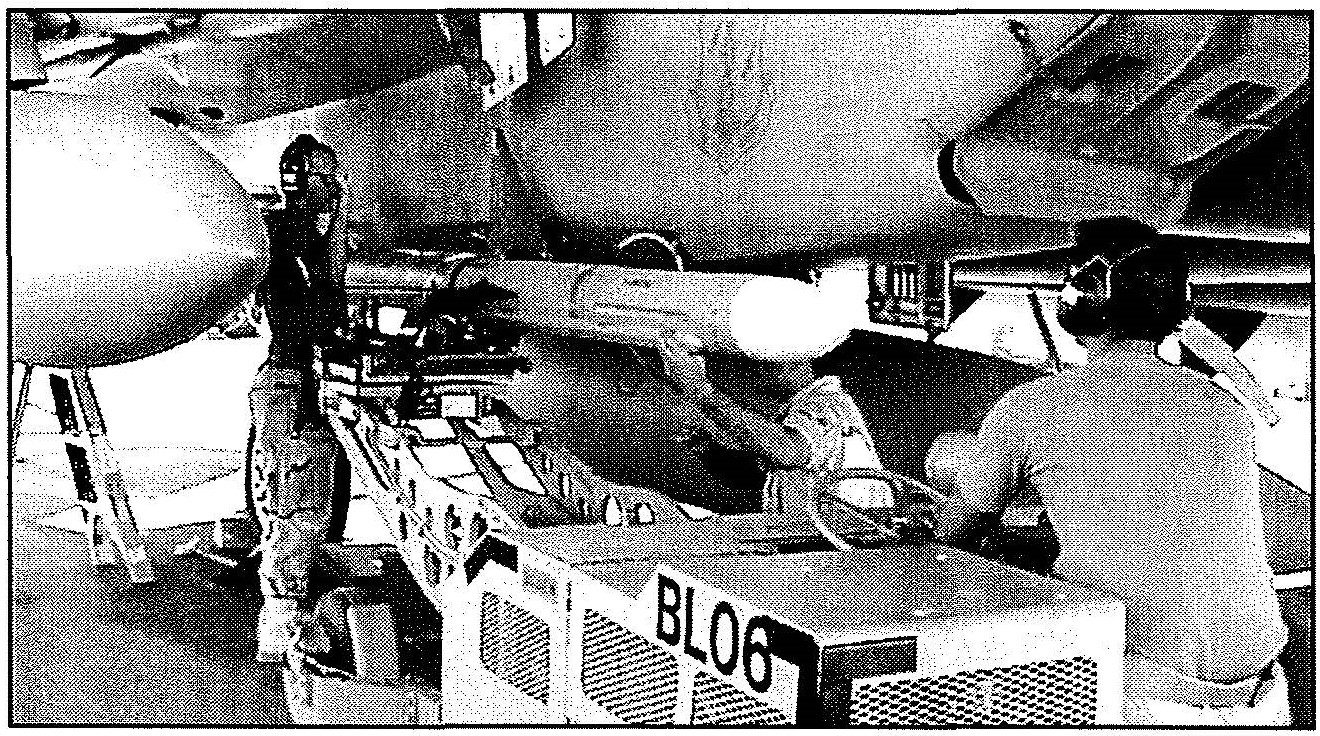
The 199th Fighter Squadron is equipped with F-15 A/B Eagle aircraft which serve to provide interceptor capability for the state’s air defense
– 2001 Annual Report pp. 15
system. The 199th is also tasked with augmenting the active duty U.S. Air Force with air superiority fighters during war or other contingencies.
SENTRY ALOHA (4) – 199th Fighter Squadron, main player. The 154th Wing hosts visiting ANG flying units. These exercises integrate forces and maximize field training in a SAFE, realistic scenario. Mission objectives include some or all of the following: engaging and fighting dissimilar aircraft; defending Hawaii and the surrounding Pacific islands from airborne threats; and air refueling in offensive and defensive scenarios.
– 2001 Annual Report pp. 18
February 2001: Two F-15 aircraft from the 199th Fighter Squadron assisted a civilian aircraft issuing a distress call. The fighters escorted the civilian plane from an area north of the island of Maui, until it landed safely at the Kahului, Maui, airport.
– 2001 Annual Report pp. 18
May 2001: 199th Fighter Squadron conducted a flyby missing man formation for the world premiere of the Disney movie, Pearl Harbor, bringing international attention and highlighting the Hawaii Air National Guard.
– 2001 Annual Report pp. 19

The 199th Fighter Squadron is equipped with F-15 A/B Eagle aircraft which serve to provide interceptor capability for the state’s air defense system. The 199th is also tasked with augmenting the active duty U.S. Air Force with air superiority fighters during war or other contingencies.
– 2002 Annual Report pp. 11-12
Immediately following the terrorist attacks of Sept. 11th, the Federal Aviation Administration shut down all commercial air traffic across the nation. Hawaii Air National Guard F-15s from the 199th Fighter Squadron were scrambled to safely escort all remaining airliners into Honolulu and Kona’s Keahole International Airports.
– 2002 Annual Report pp. 13
The 199th Fighter Squadron is equipped with F-15 A/B Eagle aircraft which serve to provide interceptor capability for the state’s air defense system. The 199th is also tasked with augmenting the active duty U.S. Air Force with air superiority fighters during war or other contingencies
– 2003 Annual Report pp. 12-13

Stateside exercises were also on the agenda. In November/December 2003 the 154th Logistics Group paiticipated in the Combat Archer/ Combat Sage deployment to Tyndall AFB. FL. Teamed with ru1 F-18 mlit from Canada and an F -16 unit from Wisconsin they successfully accomplished numerous live-fire exercises pe1fonning air-to-air missile shoots. Altogether they deployed nine F-15 aircraft and approximately 115 personnel.
– 2004 Annual Report pp. 14
The 199th Fighter Squadron is equipped with F-15 NB Eagle aircraft which serve to provide interceptor capability for the state’s air defense system. The 199th is also tasked with augmenting the active duty U.S. Air Force with air superiority fighters during war or other contingencies.
– 2004 Annual Report pp. 15
The 199th Fighter Squadron is equipped with F-15 A/B Eagle aircraft which serve to provide interceptor capability for the state’s air defense system. The 199th is also tasked with augmenting the active duty U.S. Air Force with air superiority fighters during war or other contingencies
– 2005 Annual Report pp. 13-14
The 154th Wing wrapped up participation in the joint and combined multi-lateral training Exercise Cope Tiger, in Thailand Feb. 4, 2005. The 203rd Air Refueling Squadron deployed one KC-135 as the 203rd Expeditionary Air Refueling Squadron, the 204th Airlift Squadron deployed two C-130s as the 204th Expeditionary Airlift Squadron, and the 199th Fighter Squadron deployed eight F-15s as the 199th Expeditionary Fighter Squadron.
– 2005 Annual Report pp. 16

The 199th Fighter Squadron is equipped with F-15 A/B Eagle jetfighter which serve to provide interceptor capability for the state’s air defense system. The 199th is also tasked with augmenting the active duty U.S. Air Force with air superiority fighters during war or other contingencies
– 2006 Annual Report pp. 17

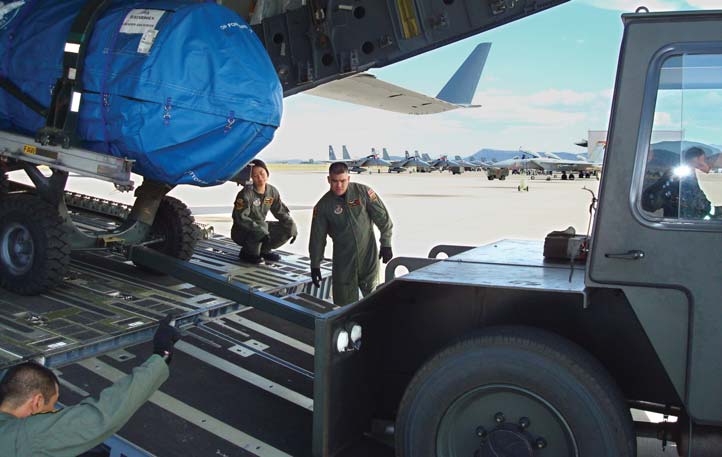
The 199th Fighter Squadron is equipped with F-15 A/B/C/D Eagle fighter aircraft which serve to provide interceptor capability for the state’s air defense system. The 199th is also tasked with augmenting the active duty U.S. Air Force with air superiority fighters during war or other contingencies
– 2007 Annual Report pp. 15
The 199th Fighter Squadron is equipped with F-15 A/B/C/D Eagle fighter aircraft which serve to provide interceptor capability for the state’s air defense system. The 199th is also tasked with augmenting the active duty U.S. Air Force with air superiority fighters during war or other contingencies
– 2008 Annual Report pp.15-16
Wing deployments and exercises included the 199th Fighter Squadron sending F-15 Eagle aircraft and pilots and maintenance personnel to Australia for an exercise with the Australian Air Force
– 2008 Annual Report pp. 16
The 199th Fighter Squadron is equipped with F-15 A/B/C/D Eagle fighter aircraft, which serve to provide interceptor capability for the state’s air defense system. The 199th is also tasked with augmenting the active-duty U.S. Air Force with air superiority fighters during war or other contingencies.
– 2009 Annual Report pp. 15


The 199th Fighter Squadron began the conversion from the F-15 A/B/C/D Eagle fighter aircraft to the F-22 Raptor in FY 2010, taking delivery on the first two Raptors at the beginning of FY 2011.
The 199th is also tasked with augmenting the active duty U.S. Air Force with air superiority fighters during war or other contingencies.
– 2010 Annual Report pp. 15
Throughout the year, the Hawaii Air National Guard continued to prepare for the arrival of the F-22 Raptors which are replacing the F-15 Eagles the 199th Fighter Squadron as flown since 1987. The first two Raptors flew into Joint Base Pearl Harbor-Hickam just days prior to the July 9 arrival ceremony.
– 2010 Annual Report pp. 18
A few months later, the Hawaii Air National Guard participated in another highly important mission, but this time its role was more behind the scenes as President Obama and his family visited Oahu for Christmas and New Years. The 199th Fighter Squadron provided top cover for Air Force One.
– 2010 Annual Report pp. 18

The 199th Fighter Squadron has converted to the F-22 Raptor, replacing the older F-15 Eagles. The 199th is tasked with augmenting the active duty U.S. Air Force with air superiority fighters during war or other operational contingencies.
– 2011 Annual Report pp.14
During FY 2011, the HIANG began a new chapter in its flying history. In July 2010, the first two F-22 Raptors arrived at Joint Base Pearl Harbor-Hickam. In August, the HIANG’s 199th Fighter Squadron flew is final F-15 Eagle local training sortie, and the last two F-15s in the unit’s inventory departed Hawaii on Sept. 1, 2010. During the time that the HIANG was transitioning to the F-22, a detachment from the Montana Air National Guard’s 120th Fighter Wing assumed the around-the-clock air defense mission.
The HIANG broke ground on several new military construction projects at Hickam related to the conversion to the F-22 in FY 2011. A projected $146 million in new facilities should be completed in the next several years.
– 2011 Annual Report pp.16

The 199th Fighter Squadron flies the F-22 Raptor in conjunction with the 19th Fighter Squadron of the U.S. Air Force. The 199th is tasked with augmenting the active duty U.S. Air Force with air superiority fighters during war or other operational contingencies.
– 2012 Annual Report pp. 14
In March 2012, the HIANG dedicated a new KC-135 simulator facility and later that Spring, ground was broken for a new operations/maintenance facility for the F-22 aircraft. Other F-22 construction projects were also begun or were on the drawing board.
– 2012 Annual Report pp. 18


The Hawaii Air National Guard’s F-22s, which it flies and maintains with the active duty Air Force, reached Full Operational Capability
– 2013 Annual Report pp. 1
The 199th Fighter Squadron flies the F-22 Raptor in conjunction with the 19th Fighter Squadron of the U.S. Air Force. The 199th is tasked with augmenting the active duty U.S. Air Force with air superiority fighters during war or other operational contingencies.
– 2013 Annual Report pp. 17
After many years of planning and the initial fielding of the F-22 Raptor fighter aircraft, the 199th and 19th Fighter Squadrons reached Full Operational Capability (FOC) in April 2013. FOC means the units are combat capable and can deploy a majority or all of their F-22s Raptors, the world’s most advanced fighter, for any contingency operation. The F-22A Raptor is capable of both airto-air, as well as air-to-ground combat and is the Air Force’s primary air superiority fighter providing unmatched capabilities for air supremacy and homeland defense.
The fifth-generation F-22 Raptor has unparalleled stealthiness, supercruise, unmatched maneuverability and improved sustainability that would enable the aircraft to strike deep and fast, day or night, paving the way for friendly air, ground and naval forces to operate freely; gather and distribute intelligence across the battlefield; and even engage incoming missiles. Joint Base Pearl Harbor-Hickam is home to a total of 20 F-22 Raptors. The HIANG and the active duty air Force share responsibility for flying and maintaining the F-22s.
– 2013 Annual Report pp. 18-19


The 199th Fighter Squadron flies the F-22 Raptor in conjunction with the 19th Fighter Squadron of the U.S. Air Force. The 199th is tasked with augmenting the active duty U.S. Air Force with air superiority fighters during war or other operational contingencies.
– 2014 Annual Report pp. 18
F-22 Raptor pilots and maintenance personnel flew to Malaysia in May 2014 for Exercise COPE TAUFAN. The exercise, held in conjunction with the Royal Malaysian Air Force, demonstrated the HIANG’s ability to deploy the world’s most advanced fighter, anywhere within the U.S. Pacific Command’s area of responsibility. The F-22A Raptor is capable of both air-to-air, as well as airto-ground combat and is the Air Force’s primary air superiority fighter providing unmatched capabilities for air supremacy and homeland defense. The fifth-generation F-22 Raptor has unparalleled stealthiness, supercruise, unmatched maneuverability and improved sustainability that would enable the aircraft to strike deep and fast, day or night, paving the way for friendly air, ground and naval forces to operate freely; gather and distribute intelligence across the battlefield; and even engage incoming missiles. Joint Base Pearl Harbor-Hickam is home to a total of twenty F-22 Raptors.In March 2014, the 199th Fighter Squadron hosted its largest SENTRY ALOHA exercise to date. Exercise SENTRY ALOHA’s mission is to provide the Air National Guard, U.S. Air Force and DoD counterparts a multi-faceted, joint venue, with supporting infrastructure and personnel that incorporates current, realistic, integrated training to equip the warfighter with the skill sets necessary to fly, fight and win. In previous years, SENTRY ALOHA would typically involve one or two visiting units for Dissimilar Air Combat Training. However, the exercise has grown to provide even more complex and highly realistic training scenarios. More than 350 visiting airmen and nearly 50 aircraft from five states participated in this iteration.
– 2014 Annual Report pp. 19

The 199th Fighter Squadron is partnered with an active associate unit, from the active duty Air Force’s 15th Wing which provides pilots and support personnel. . .
The 199th Fighter Squadron flies the F-22 Raptor in conjunction with the 19th Fighter Squadron of the U.S. Air Force. Together they make up the “Hawaiian Raptors” team. The 199th is tasked with augmenting the active duty U.S. Air Force with air superiority fighters during war or other operational contingencies. Additionally, the Hawaiian Raptors maintain around the clock air defense alert at JBPH-H and can be quickly scrambled to defend Hawaii’s airspace.
– 2015 Annual Report pp. 16

Sentry Aloha, which provides cost effective, tailored training for employees to perform homeland defense and overseas combat missions. (Photo by: Senior Airmen John Linzmeier)

The 199th Fighter Squadron is partnered with an active associate unit, from the active duty Air Force’s 15th Wing which provides pilots and support personnel. . .
The 199th Fighter Squadron flies the F-22 Raptor in conjunction with the 19th Fighter Squadron of the U.S. Air Force. Together, they make up the “Hawaiian Raptors” team. The 199th is tasked with augmenting the active duty U.S. Air Force with air superiority fighters during war or other operational contingencies. Additionally, the Hawaiian Raptors maintain around the clock air defense alert at JBPH-H and can be quickly scrambled to defend Hawai‘i’s airspace.
– 2019 Annual Report pp. 18
The 199th Fighter Squadron is partnered with an active associate unit, from the active-duty Air Force’s 15th Wing which provides pilots and support personnel. . .
The 199th Fighter Squadron flies the F-22 Raptor in conjunction with the 19th Fighter Squadron of the U.S. Air Force. Together, they make up the “Hawaiian Raptors” team. The 199th is tasked with augmenting the active duty U.S. Air Force with air superiority fighters during war or other operational contingencies. Additionally, the Hawaiian Raptors maintain around the clock air defense alert at JBPH-H and can be quickly scrambled to defend Hawai‘i’s airspace.
– 2020 Annual Report pp. 18

199th Fighter Squadron (199th FS): Kadena deployment – The 199th FS deployed to Kadena Air Base Japan in support of a theatre security package. This included participation in multiple high visibility missions and higher headquarters taskings, highlighting the strategic importance of joint interoperability with allies and partners in the region. Our ability to integrate with assets across Global Strike Command, Air Combat Command, Pacific Air Forces, Philippine, Australian, Japanese, Singapore, and Korean Air Forces is critical to deterrence within the region and it ensures a free and open INDOPACIFIC. While abroad, we had the opportunity to participate in multiple subject matter expert exchange briefs, tactical mission execution and help promote the DOD message across the Pacific, including advancing the HIANG SPP
– 2024 Annual Report pp. 36
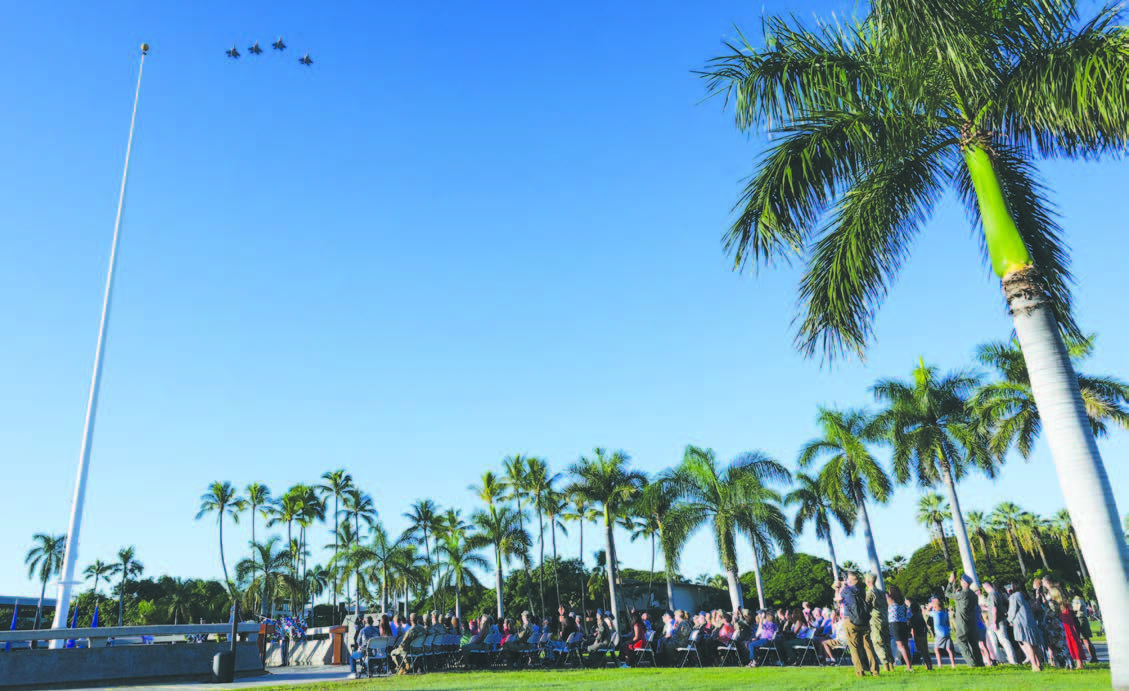
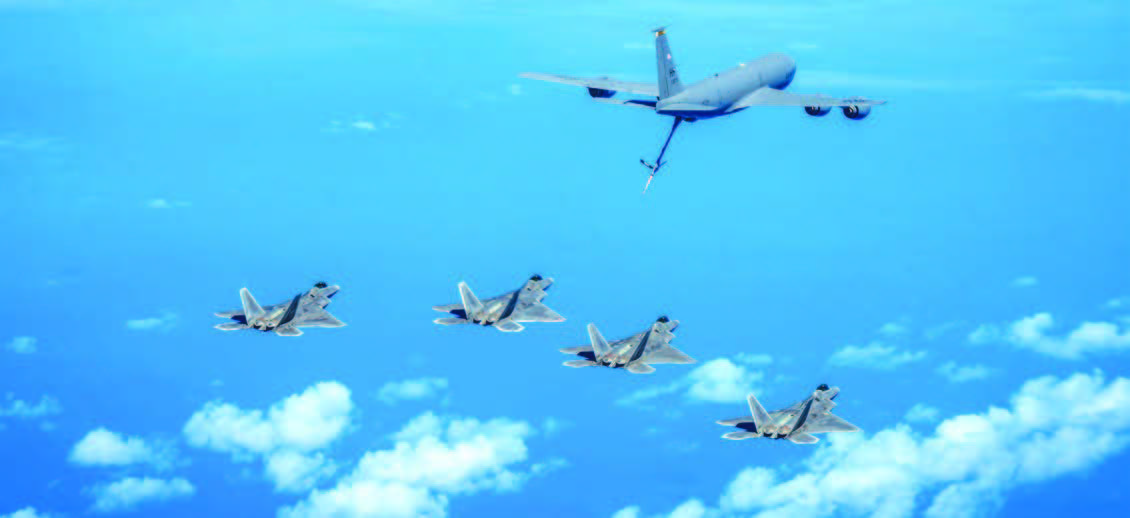
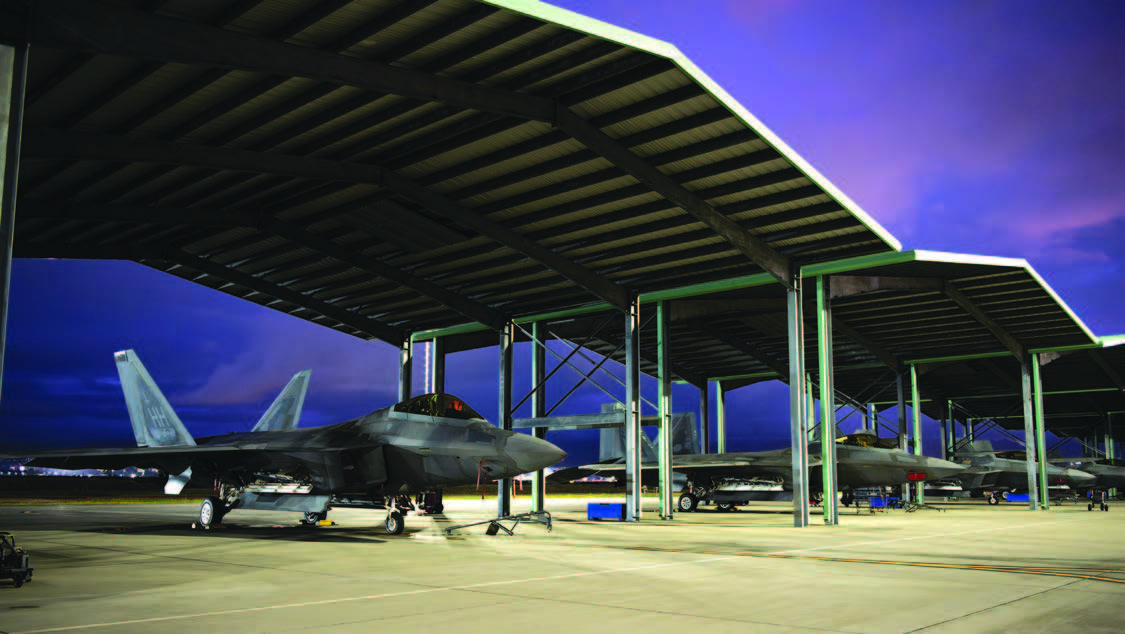
The 154th Operations Group consists of the 199th Fighter Squadron, 203rd Air Refueling Squadron, 204th Airlift Squadron, 154th Operations Support Squadron and 297th Combat Airfield Operations Squadron.
– 2025 Annual Report pp. 37
The 199th Fighter Squadron (199th FS) deployed to Kadena Air Base (AB) Japan in support of a theatre security package. This included participation in multiple high visibility missions and higher headquarters taskings, highlighting the strategic importance of joint interoperability with allies and partners in the region. Our ability to integrate with assets across Global Strike Command, Air Combat Command, Pacific Air Forces, Philippine, Australian, Japanese, Singapore, and Korean Air Forces is critical to deterrence within the region and it ensures a free and open INDOPACIFIC. While abroad, we had the opportunity to participate in multiple subject matter expert exchange briefs, tactical mission execution and help promote the DOD message across the Pacific, including advancing the State Partnership Program (SPP)
– 2025 Annual Report pp. 38-39
199th Fighter Squadron Leadership
- FY 1946 – 1947 Lt. Col. Wm. F. Nolan
- FY 1950 – FY 1951 Maj. Carlos Bonham
- FY 1958 – FY 1959 Lt. Col. James Ashford
- FY 1960 Maj. George Duncan
- FY 1961 – FY 1962 Maj. Kenneth Fisher
- FY 1963 – FY 1966 Lt. Col. Jarrett Carr
- FY 1967 Maj. Kurt Johnson
- FY 1968 – FY 1972 Lt. Col. Tai Sung Hong
- FY 1994 Lt. Col. Harold Nagai
- FY 1975 – FY 1978 Lt. Col. Edward Richardson
- FY 1979 – FY 1983 LI. Col. Lawrence Cabrinha
- FY 1984 Lt. Col. Joseph Ah New Jr.
- FY 1985 Lt. Col. William Spillane
- FY 1986 – FY 1987 Lt. Col. James Haruguchi
- FY 1988 – FY 1989 Lt. Col. Harold Schatz
- FY 1990 – FY 1991 Lt. Col. Clinton Churchill
- FY 1992 – FY 1994 Lt. Col. Alan Robinson
- FY 1995 – FY 1996 Lt. Col. Geoffrey Avery
- FY 1997 – FY 1998 Lt. Col. Gary Peters
- FY 1999 Lt. Col. Wayne Wakeman
- FY 2003 – FY 2004 Lt. Col. Chris Sakamoto
- FY 2005 – FY 2007 Lt. Col. Braden Sakai
- FY 2008 – FY 2012 Lt. Col. Jeffrey Namihira
- FY 2013 Lt. Col. Mark Latkow
- FY 2019 Lt. Col. Shane Nagatani
- FY 2020 Lt. Col. Brian Nash
- FY 2024 Lt. Col. Kenneth Peterson
- FY 2025 Lt. Col. Curtis Yoshimoto
199th Fighter Squadron Unit Emblem