

HHARP Module 1 – Getting Started
HHARP GOAL
To enhance community resilience to multiple hazards through a facilitated education and outreach program that promotes hazard understanding and awareness, and offers tools and information resources to guide mitigation, preparedness, response and recovery.
HHARP Module 1: Getting Started
Module 1: Milestones
1A. The HHARP Program Record reflects that the community has held at least one outreach session covering the Module 1: Getting Started presentation. Each outreach session has engaged a representative number of community members.
1B. Program Record reflects that the community completed Worksheet A and has summarized results in the “Community Description” section of their Emergency Operations Plan.
1C. Program Record reflects that the community has held at least one working group session during which the following tasks were accomplished: – appoint a core Implementing Committee. – Developed a Meeting Schedule. – Established a method for record-Keeping. – Defined community engagement strategies
Module 1: Key Tasks
-
Worksheet A: Define Your Community
How do you define your community? By geography? By neighborhood? Decide upon the extent of your planning area.
-
Start Writing Your Plan!
Begin drafting your Community Emergency Action Plan by describing the unique geographic and demographic features of your community
-
Appoint a Core Implementing Group (CIC) to Lead HHARP
Establish a Core Implementing Group (CIC) to lead the HHARP implementation in your community. Review HHARP materials. Decide how to share responsibilities and benefit from individual skills and talents.
-
Develop a Meeting Schedule
Decide where, when and how often to meet. Plan for smaller working group meetings as well as larger community meetings. Find out how you can participate in preparedness fairs, trainings, etc
-
Establish a Method for Record Keeping
It is important to keep track of all program activities. Maintain a binder with sign-in sheets, meeting notes, contact information, module outputs, etc. This will be reviewed along with your application for recognition.
-
Define Engagement Strategies
What are the best ways to get the word out and encourage participation among community members (e.g., social media, newsletters, newspapers, word of mouth, websites, service organizations)?
THE HAWAIIAN ISLANDS a subtropical paradise:
– Located nearly 2,500 miles from any other populated land mass.
– Exposed to severe weather, land based and coastal hazards.
– Growing population.
– Single-sector economy.
– Dependence on imported goods.
– Outer-island reliance on single point of entry.
THE HAWAIIAN ISLANDS a catastrophic disaster …
– Approximately ~1.6 million people could be affected.
– Structures and infrastructure damaged or destroyed.
– Food, water, shelter needs will exceed availability.
– Service providers will be overwhelmed.
– Days to weeks to receive resupply by air/sea assuming functioning airports and seaports.
– Isolated coastal communities.
Emergency Management in Hawai‘i Introduction
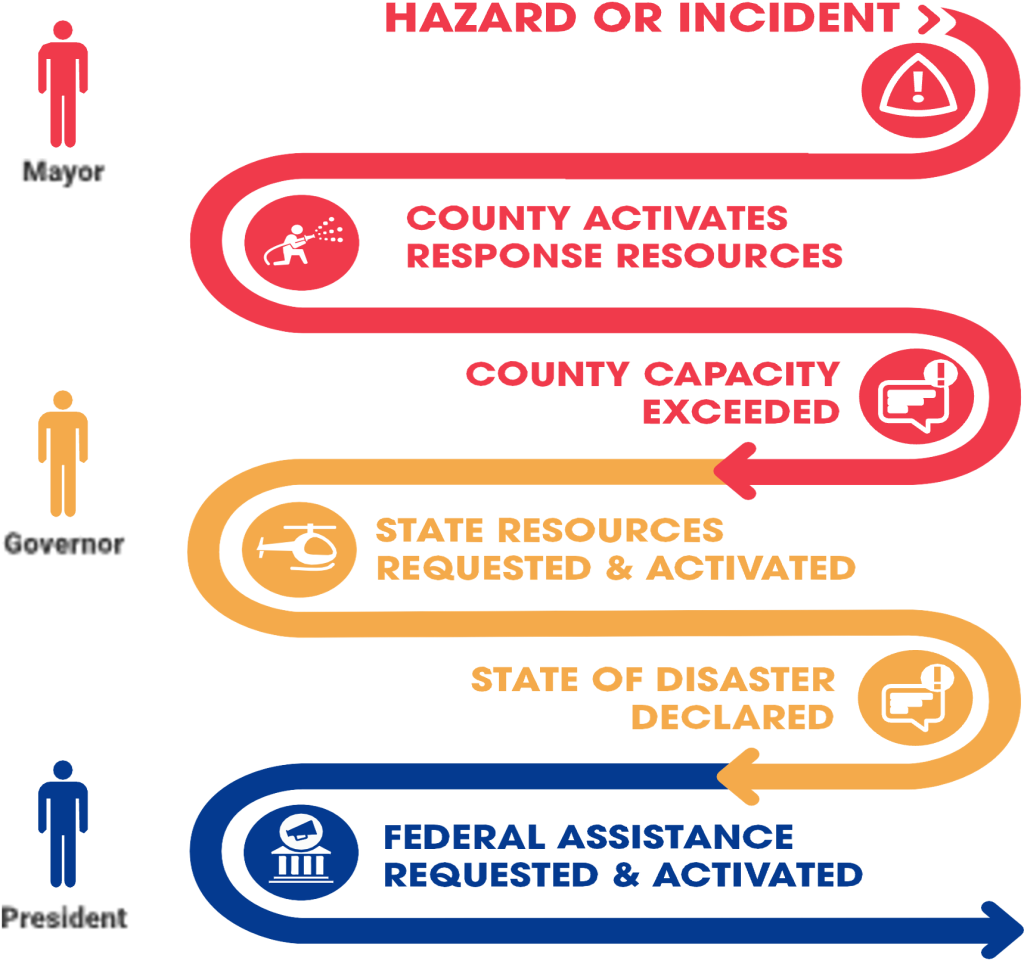
County Level Response: Mayor
- Hazard or Incident
- County Activates Response Resources
- County Capacity Exceeded
State Level Response: Governor
- State Resources Requested by Mayor
- State Resources Activated by Governor
- State of Disaster Declared
Federal Level Response: President
- Federal Assistance requested by Govneror
- Federal Assistance Activated
Sample Resources Activated
County: Mayor
- County Emergency Management Agency
- Voluntary Organizations Active in Disaster (VOAD)
- First Responders
State: Governor
- State Emergency Management Agency
- National Guard
- Emergency Management Assistance Compact
Federal: President
- Federal Emergency Management Agency (FEMA)
- Defense Support to Civil Authorities

Multi-Agency Collaboration is Essential
Types of Collaboration
County Government Responsibilities
- County government provides the first level of response to local emergencies and disasters and have the primary responsibility for:
- Warning and evacuating residents.
- Life Safety, incident stabilization, property preservation.
- Educating the public on emergency preparedness.
- Coordinating response, and initial recovery efforts.
- Coordinating requests for mutual aid and state resources.
- Coordinating mitigation activities to reduce impacts of future events.
State Government Responsibilities
- State resources are activated when local capacities to deal with the event are exceeded.
- Coordinates requests for assistance.
- Coordinates response of state agencies, private sector and non-governmental organizations (NGOs) such as American Red Cross.
- Governor declares emergency or disaster
- Activates the Emergency Management Assistance Compact (EMAC).
- Coordinates resources and support from federal partners (e.g. FEMA).
State of Hawai‘i Emergency Support Functions (ESFs)
- Transportation
- Communication
- Public Works and Engineering
- Firefighting
- Emergency Management
- Mass Care and Emergency Assistance
- Logistics Management and Resource Support
- Public Health and Medical Services
- Search and Rescue
- Oil and HAZMAT Response Support
- Agriculture and Natural Resources
- Energy
- Public Safety and Security
- Long-term Community Recovery
- External Affairs …20. Military Support
Federal Government Responsibilities
Federal assistance becomes available when the severity of the event exceeds state and county capacities.
•A Presidential Disaster Declaration makes federal resources available to the disaster-affected area.
•Some cost-sharing requirements may apply.
•Approved Multi-Hazard Mitigation Plans make additional funds available to the state and counties.
Phases of Emergency Management
-
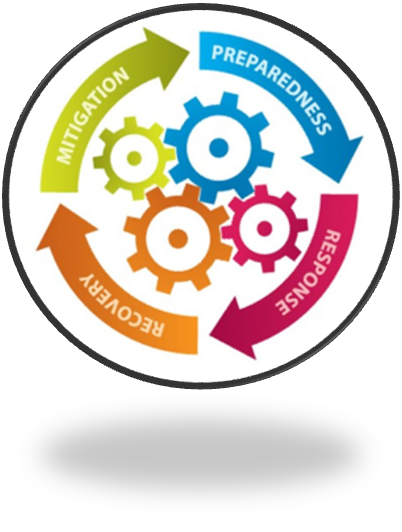
Mitigation:
Steps taken to reduce or contain potential hazards or threats.
-
Preparedness:
Measures taken to prepare for and reduce the effects of disasters.
-
Recovery:
Restoring or improving livelihoods and health, as well as economic, physical, social, cultural and environmental assets, systems and activities, of a disaster-affected community or society.
-
Response:
Actions taken directly before, during or immediately after a disaster in order to save lives, reduce health impacts, ensure public safety and meet the basic needs of those affected.
Disaster Declarations in Hawai‘i Total of 68 from 1955 – 2024
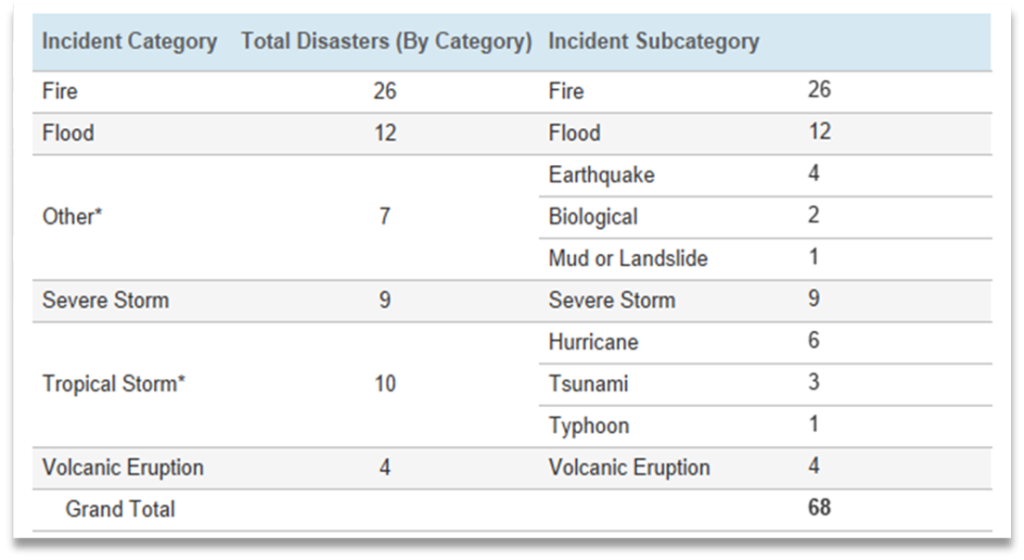
Types of Disasters:
- FIRE: A fire disaster is a destructive burning of material that produces light, flame, heat and smoke1. It is a sudden, accidental event of great magnitude that causes considerable damage to life and property
- FLOOD:
- OTHER:
- SEVERE STORM:
- TROPICAL STORM:
- VOLCANIC ERUPTION:
Warnings, Watches, and Advisories
-
Hurricane/Tropical Storm Watch:
Hurricane/Tropical Storm conditions are possible within 48 hours.
-
Hurricane/Tropical Storm Warning:
Hurricane/Tropical Storm conditions are expected within 36 hours.
-
Flash Flood Warning:
Take action, flooding is imminent (within 1-6 hrs) or is already occurring. Get to high ground if you’re in a flood prone area.
-
Flood Advisory:
Be aware of a potential weather event that could cause nuisance flooding (e.g., ponding on roads, slippery driving conditions).
-
Flood Watch:
Be prepared for the possibility of hazardous weather. A Flood Watch is issued when conditions are favorable for flooding.
-
Tsunami Advisory:
Issued when a tsunami with potential to generate strong currents or waves dangerous to those in or very near the water is imminent, expected, or occurring.
-
Tsunami Watch:
Issued by Pacific Tsunami Warning Center (PTWC) after distant earthquakes with potential to create a tsunami in Hawaii.
-
Tsunami Warning:
Issued whenever tsunami waves have been confirmed by PTWC and/or a damaging wave is detected.
-
Urgent Local Tsunami Warning:
Issued when a local earthquake has occurred, and damaging waves are probable. Wave travel time may be as short as 10-20 minutes.
Why Enhance Community Resilience?
During a major disaster, government priorities will be focused on meeting life sustaining and life-saving needs, so cannot be relied upon to provide immediate assistance to all who need it.
Hawai’i has numerous communities that will be isolated during disasters.
Resources to sustain these communities will be limited to what is on-hand
What is “Community Resilience?”
Community Resilience:
The ability of a community exposed to hazards to resist, absorb, accommodate, adapt to, transform and recover from the effects of a hazard in a timely and efficient manner, including through the preservation and restoration of its essential basic structures and functions through risk management. (UNISDR, 2017}
Community Resilience:
The ability to prepare and plan for, absorb, recover from, and more successfully adapt to actual or potential adverse events. (National Research Council, 2012
How do we Build Community Resilience?
-
Strengthen capacities of individuals, families, and community institutions.
-
Organize, cooperate, engage in civic action
-
Prepare and plan
-
Train and educate
-
Adaptive and flexible
-
Reduce risks and vulnerabilities
-
Financial protections
-
Develop diverse and redundant systems
What is HHARP?
GOAL: To enhance community resilience to multiple hazards through a facilitated education and outreach program that promotes hazard understanding and awareness, and offers tools and information resources to guide mitigation, preparedness, response and recovery
HHARP Concept: Program Objectives
Program Objectives
HHARP Communities are “Self Defined.”
- “Community” is a relative term.
- Communities may be defined by geographical boundaries, culture, ethnicity, shared ideals or circumstances.
- Typically have something in common (place, conditions, interest, interdependencies, etc.)
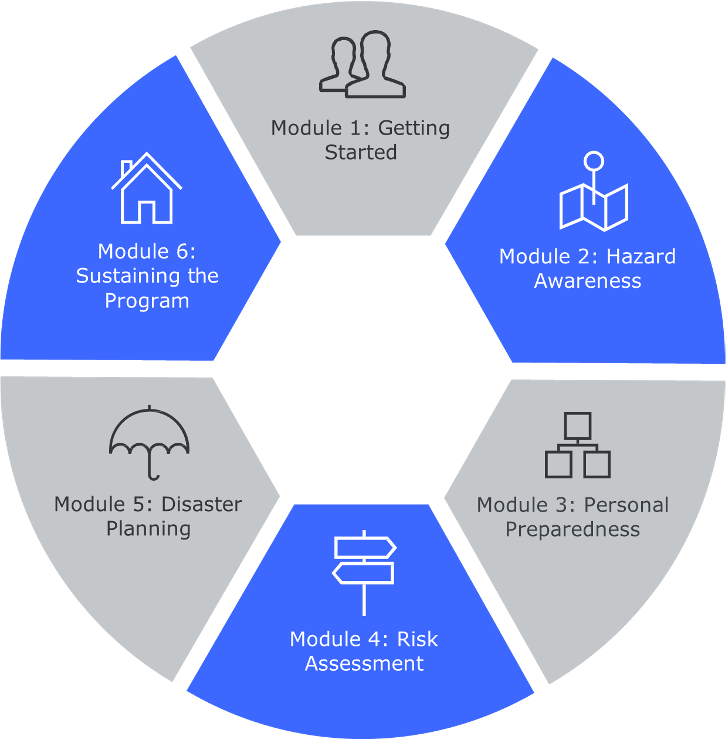
Program Structure Six Modules:
- Help communities accomplish specific tasks and meet “resilience milestones.”
- Example: As participants progress through each module, they develop content that is directly applicable to their community Emergency Operation Plan, a key milestone completed during Module 5: Disaster Planning.
-
Module 1: Getting Started
•Introduces communities to the program concept and structure and provides guidance documents and resources to facilitate program implementation.
-
Module 2: Hazard Awareness
•Promotes understanding of Hawaii’s major hazards, alert and warning procedures and immediate response actions.
-
Module 3: Personal Preparedness
•Provides guidance and resources to help individuals and families plan and prepare for a disaster.
-
Module 4: Risk Assessment
•Helps communities understand their risk and identify coping capacities and resources that can be leveraged in support of disaster preparedness and response.
-
Module 5: Disaster Planning
•Provides communities with a template and guidance for developing an Emergency Operations Plan.
-
Module 6: Sustaining the Program
•Provides guidance for implementing activities that sustain community engagement and promote resilience.
HHARP Modules Contain:
- Facilitator Resources
- PowerPoint Presentations
- Reference Materials
- Worksheets and Templates
Multi-Hazard Focus
A Multi-Hazard focus helps communities prepare for almost any type of hazard event.
Synergies with Existing Programs
HHARP
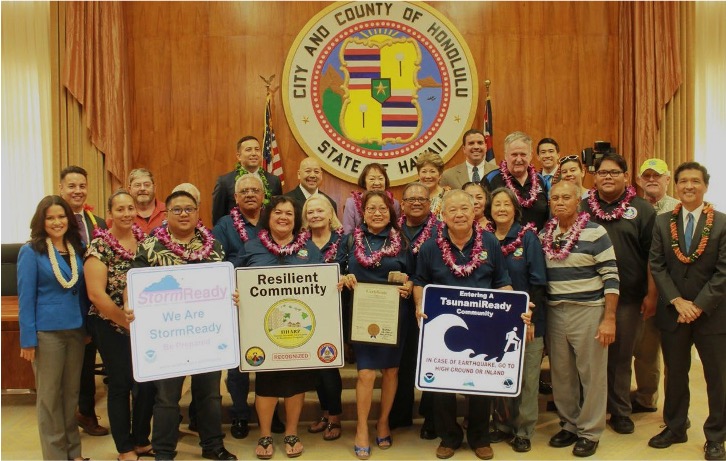
Complements ‘TsunamiReady’ and ‘StormReady’ programs by helping communities take steps beyond readiness, towards resilience. Resources and tools assist communities in meeting ‘TsunamiReady’ and ’StormReady’ guidelines or renewing applications.
Implementation: Who Leads the Effort?
Community Facilitators:
-
Plan, organize, present, manage, schedule, and run the program for the community.
-
You are the community champions!
-
Maintain documentation.
-
Submit Application for Recognition.
Implementation: Who Can Help?
Program Administrators:
-
Publicize and promote the program.
-
Provide guidance, subject matter expertise, assist community efforts.
-
Validate applications.
-
Recognize communities.
Strategies for Success
Some best practices
Community Recognition
“Resilient Community”
Communities meeting all program requirements are recognized as “Resilient Communities” by the State of Hawaii.
HHARP assists communities in meeting ‘TsunamiReady’ and ’StormReady’ guidelines or renewing applications.
Program Road Map: Setting Expectations
Major Activities and Timeline
- Time commitment: 6+ months to complete
- Meeting frequency: 1-2 times per month
- Meeting duration: 1.5 to 2 hours
-
Community Meetings and Presentations
-
Activities, Worksheets, Training
-
Emergency Operations Plan Development
-
Exercises, Outreach Events
-
Application for Recognition
Frequently Asked Question:
What about Liability?
Federal and State Laws have been enacted to protect individuals (e.g., volunteers, property owners, medical professionals) and organizations (e.g., charitable or nonprofit) providing assistance during an emergency.
Example: Good Samaritan Law HRS 663-1.5(a)
Summary
•An individual who, in good faith and without compensation, provides emergency care at the scene of an emergency will not be held legally responsible for acting or failing to act. They can be held legally responsible if acting with extreme carelessness or intent to cause harm. Generally, Good Samaritan laws only offer protection for those individuals who provide care during spontaneous emergencies unrelated to volunteer deployment.
Full Text
•(a) Any person who in good faith renders emergency care, without remuneration or expectation of remuneration, at the scene of an accident or emergency to a victim of the accident or emergency shall not be liable for any civil damages resulting from the person’s acts or omissions, except for such damages as may result from the person’s gross negligence or wanton acts or omissions.
Emergency Law
•Some laws allow License Reciprocity during an emergency to facilitate the provision of services and expertise by individuals licensed in another state or jurisdiction (e.g., medical professionals, building contractors).
•Scope of Practice laws grant those licensed in another state and responding to an emergency the same powers, duties, rights and privileges as a state or county employee.
•Other laws entitle those whose services have been accepted by authorized persons during an emergency to Worker’s Compensation benefits (in the event of injury or death).
Letʻs Get Started
-
Worksheet A: Define Your Community
How do you define your community? By geography? By neighborhood?
Decide upon the extent of your planning area.
-
Start Writing Your Plan!
Begin drafting your community Emergency Operations Plan by describing the unique geographic and demographic features of your community.
-
Appoint a Core Group to Lead HHARP
Establish a core group to lead the HHARP implementation in your community. Review HHARP materials. Decide how to share responsibilities and benefit from individual skills and talents.
-
Develop a Meeting Schedule
Decide where, when and how often to meet. Plan for smaller working group meetings as well as larger community meetings. Find out how you can participate in preparedness fairs, trainings, etc.
-
Establish a Method for Record Keeping
It is important to keep track of all program activities. Maintain a binder with sign-in sheets, meeting notes, contact information, module outputs, etc. This will be reviewed along with your application for recognition.
-
Define Engagement Strategies
What are the best ways to get the word out and encourage participation among community members (e.g., social media, newsletters, newspapers, word of mouth, websites, service organizations)?
Task 1: Define Your Community
- Worksheet A will assist you in completing Task 1: Define Your Community.
- Group Activity (60 minutes)
- Instructions: Work together in small groups to complete the worksheet. Completed worksheets will be collected in the form at the bottom of this module
Task 2: Start Writing Your Plan!
Describe Your Community
•EXAMPLE: West Maui has an abundance of exceptional community assets including natural beauty, world class beaches, popular resort areas, important cultural sites and historic Lahaina Town.
Home to nearly 25,000 residents, West Maui is also a popular tourist destination, with an average daily visitor population of around 33,000.
Yet, the steep topography and limited transportation infrastructure can isolate West Maui from important resources and services during a disaster…
-
Community Description
Worksheet A helped you create a high-level summary describing your community’s demographic information, geography, economic drivers, etc.
-
Start Writing Your Plan
Summarize the contents of Worksheet A in the “Community Description” section of your Emergency Operations Plan. A Plan Template is provided in the Module 5 Worksheets folder.
-
A Plan is a Living Document
Periodically update your plan as new information becomes available.
Next Steps
Module 1: Milestones
1A. The HHARP Program Record reflects that the community has held at least one outreach session covering the Module 1: Getting Started presentation. Each outreach session has engaged a representative number of community members.
1B. Program Record reflects that the community completed Worksheet A and has summarized results in the “Community Description” section of their Emergency Operations Plan.
1C. Program Record reflects that the community has held at least one working group session during which the following tasks were accomplished:
- Appointed a Core Implementing Committee.
- Developed a Meeting Schedule.
- Established a method for record-keeping.
- Defined community engagement strategies.