Do you need help in another language? We will get you a free interpreter. Call 808-369-3580 to tell us which language you speak.
您需要其它語言嗎?如有需要,請致電 (808-369-3478), 我們會提供免費翻譯服務
您需要其它语言吗?如有需要,请致电 (808-369-3478), 我们会提供免费翻译服务
En mi niit alilis lon pwal eu kapas? Sipwe angei emon chon chiaku ngonuk ese kamo. Kokori (808-369-3478) omw kopwe ureni kich meni kapas ka ani.
Makemake `oe i kokua i pili kekahi `olelo o na `aina `e? Makemake la maua i ki`i `oe mea unuhi manuahi. E kelepona (808-369-3478)`oe ia la kaua a e ha`ina `oe ia la maua mea `olelo o na `aina `e.
Masapulyo kadi ti tulong iti sabali a pagsasao? Ikkandakayo iti libre nga paraipatarus. Awaganyo ti
(808-369-3478) tapno ibagayo kadakami no ania ti pagsasao nga ar-aramatenyo.
다른언어로 도움이 필요하십니까? 저희가 무료로 통역을 제공합니다. (808-369-3478)로 전화해서 사용하는 언어를 알려주십시요
Kwoj aikuij ke jiban kin juon bar kajin? Kim naj lewaj juon am dri ukok eo ejjelok wonen. Kirtok
(808-369-3478) im kwalok non kim kajin ta eo kwo melele im kenono kake.
E te mana'o mia se fesosoani i se isi gagana? Matou te fesosoani e ave atu fua se faaliliu upu mo oe. Vili mai i le numera lea (808-369-3478) pea e mana'o mia se fesosoani mo se faaliliu upu.
¿Necesita ayuda en otro idioma? Nosotros le ayudaremos a conseguir un intérprete gratuito. Llame al (808-369-3478) y diganos que idioma habla.
Kailangan ba ninyo ng tulong sa ibang lengguwahe? Ikukuha namin kayo ng libreng tagasalin. Tumawag sa (808-369-3478) para sabihin kung anong lengguwahe ang nais ninyong gamitin.
‘Okú ke fie maʻu tokoni ʻi ha lea fakafonua ʻe taha? Temau kumi haʻo taha fakatonulea taʻetotongi. Telefoni ki he (808-369-3478) ke fakahā mai ʻa e lea fakafonua ʻokú ke lea aí.
Bạn có cần giúp đỡ bằng ngôn ngữ khác không ? Chúng tôi se yêu cầu một người thông dịch viên miễn phí cho bạn. Gọi (808-369-3478)nói cho chúng tôi biết bạn dùng ngôn ngữ nào
Gakinahanglan ka ba ug tabang sa imong pinulongan? Amo kang mahatagan ug libre nga maghuhubad. Tawag sa (808-369-3478) aron magpahibalo kung unsa ang imong sinulti-han.
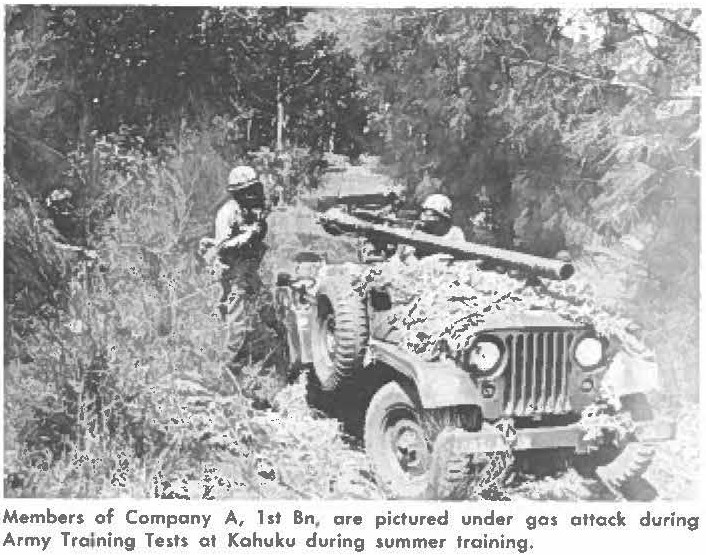
Field Training: For all, except the 298th Arty Gp (AD), annual field training was conducted during the period 11-25 June 1960 as follows:
Organization
Special Troops
227th Engr Bn (Inf Div)
29th Inf Bde
Location
Schofield Barracks
Kahuku
Schofield Barracks & Kahuku
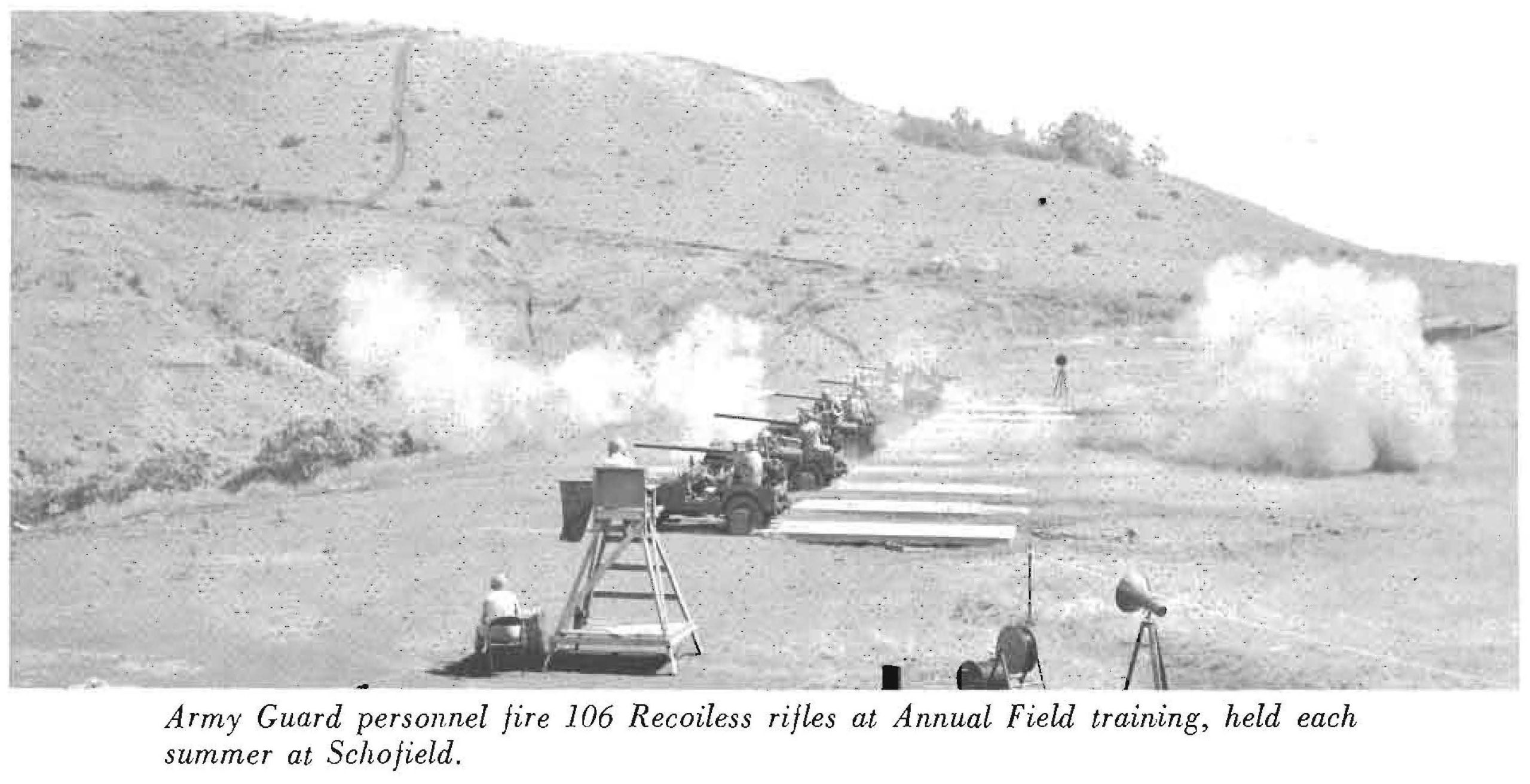
a. The 29th Infantry Brigade stressed training at the rifle platoon level. Rifle platoons successfully completed platoon tests during the period. The next level of testing will be at the company level. numerous schools and demonstrations were conducted for the Brigade by the 25th Inf Div. Some of these were: Radiological Monitoring & Survey, a special NCO Academy Course of two weeks duration, 81mm Mortar anti 106mm Rifle Instruction, Counterfire Training, anti Radar Training. Other concentrated training areas included principles of mobile task force organizations, battle (hill, and combat formations in actual basic unit field problems.
b. The 298th Arty Group (Air Defense) will train primarily at its Sand Islantl and East Range NikeHercules training sites during August 1960 utilizing Nike-Hercules equipment. Training stressed battery drills to include Operational Readiness Inspection, tracking missions, and Air Defense Exercises to increase the speed and proficiency of teams to ready themselves for any firing Mission. This organization is 90% complete in qualifying each officer and enlisted men as a basic missileman. This training is additional anti is conducted primarily during the individual’s own time so as not be interrupt the unit’s training program. Each member is required to be cross trained in three related tactical positions to add depth in all critical positions in the 298th Arty Group.
c. The 227th Engr Bn (Inf Div) was employed as a direct support organization to the 1st and 2nd Battle Groups of the 299th Inf. Major support included the repair and maintenance of approximately twelve (12) miles of roads in the Kahuku Training Area, presentations of instructions on the “rifle company in defense” with concentration on demolitions, mines, barbed wire, and fieM fortifications. This unit conducted a special demonstration for all HARNG troops on the Claymore Mine, the Army’s newest and most lethal anti-personnel mine. Special projects included the rehabilitation of an emergency airstrip and the construction of a cross-strip thereon at Waialee anti the construction of a Class 60 ton bridge at East Range, Oahu. This bridge which can support the heaviest known tank win diminish the travel time previously required of heavy vehicles to enter this area.
Field Training: HANG units conducted their annual field training with 98% of the assigned personnel in attendance. The period of the encampment was 11 through 25 June 1960. Again, in conjunction with field training, the Pacific Air Forces conducted a Readiness Inspection of HADD and HANG units. It is noteworthy to report that the 199th FI Squadron, 109th and 169th ACW Squadrons were rated fully operationally ready and considered capable of accomplishing their assigned operational mission. All units performed in an excellent manner during the readiness inspection and the encampment.
b. Field Training. For all, except the 298th Arty. Gp. (AD), annual field training was conducted during the period 17 June 61 thru 1 July 61 as follows:
Organization
Special Troops
227th Engr Bn (lnf Div)
29th InC Bde
Location
Schofield Barracks
Schofield Barracks & Kahuku
Schofield Barracks & Kahuku
All units (less Air Defense Arty.) conducted a minimum of four (4) days and four (4) nights in field tactical exercises in conjunction with their required training during this period.
The 29th Infantry Brigade stressed training at the rifle company level. All rifle companies successfully completed practice company tests during the period. Actual tests will be at the company level next year. Numerous schools and demonstrations were conducted for the Brigade by the 25th Inf. Div. Some of these were: Radiological Monitoring & Survey, 81mm Mortar and 106mm Rifle Instruction, Counterfire Training, and Radar Training. Other concentrated training areas included principles of mobile task force organizations, battle drill, and combat formations in actual basic unit field problems.
One weekend a month and 15 days annual field training per year are the periods that Hawaii Air National Guard units get together as a group and train towards a goal of being instantly ready to perform their mission if mobilized during a national emergency. Training schedules are such that each organization works as a part of the team in their mission of air defense. During these periods intensive individual and sectional training is also accomplished. Emphasis is placed on working at the job rather than formalized classroom lectures. Attendance at the weekend assemblies was 95%, and 99% of assigned personnel attended the 15 day annual field training. 165 personnel are enrolled in extension courses to self improve their proficiency.
b. Field Training. For all, except the 298th Arty Gp (AD), annual field training was conducted during the period 16 Jun 62 thru 30 Jun 62 as follows:
ORGANIZATION
Special Troops
227th Engr Bn (lnf Div)
29th Inf Bde (.)
2nd BG 299th Inf
LOCATION
Schofield Barracks
Schofield Barracks & Kahuku
Schofield Barracks & Kahuku
Pohakuloa Tng Area, Hawaii
All units (less Air Defense Arty ) conducted a minimum of four (4) days and four (4) nights in field tactical exercises in conjunction with required training during this period.
The 29th Infantry Brigade stressed training at the rifle company level. All rifle companies successfully completed company level exercises during the period and live firing platoon tests. Numerous schools and demonstrations were conducted for the Brigade by the 25th Inf Div. Some of these were: Radiological Monitoring & Survey, 81mm Mortar and 106mm Rifle Instruction, Counterfire Training, and Radar Training. Other concentrated training areas included principles of mobile task force organizations, battle drill, and combat formations in actual basic unit field problems.
The 298th Arty Gp (AD) conducted two periods of annual field training this past fiscal year. Annual field training for calendar year 1961 was conducted during the period 26 July 61 to 12 Aug 1961, while training for calendar year 1962 was held during the period 9-23 June 1962. All periods of annual field training were conducted at the six Nike-Hercules sites. Annual service practice for the six on-site units were conducted from the Dillingham site during November & December Three of the six units were cited as honor batteries with Btry B 1st Msl Bn 298th Arty establishing a world record for range to intercept against a supersonic RP76 drone aircraft.
The 227th Engr Bn (lnf Div) successfully completed engineer platoon training test during field training. One week was spent at Kahuku with primary training centering on tactical exercises and maneuvers in preparation for the engineer company training test. During this period and simultaneously with its own required training tests, the battalion provided direct support operations for other units of the Hawaii ARNG by maintaining training area roads, operating water points, serving as infantry when required, etc.
Special Troop units provided normal support operations. In addition, two (2) units, the 613th Ord Co (DS) and the 120th MP Co provided direct support for 2nd BG units training at Pohakuloa, Hawaii.
A departure was made from previous years’ 15 consecutive days of Annual Field Training in that “summer camp” was only five consecutive days in June and the remaining ten days were scheduled by Unit commanders. This provided for more concentrated On the Job Training for individuals and also provided an additional capability to assist in supporting peak workloads. Individuals were scheduled for the ten days released to the units on weekends, dependent upon school vacations, or as coordinated for the convenience of employers of Air Guardsmen. So much of Hawaii Air National Guard training is in technical fields that it is extremely advantageous to have individuals or small sections train together. This proved effective, and will be continued.
h. Field Training. For all units (except the 298th Arty Gp) training was conducted during the period 15 through 29 June 1963 at Schofield Barracks. Emphasis was placed on the firing of heavy crew served weapons, combat formations, battle drill, and other technical training in radar and communications which led towards battalion and company controlled small unit tactical problems and platoon level Army Training Tests.
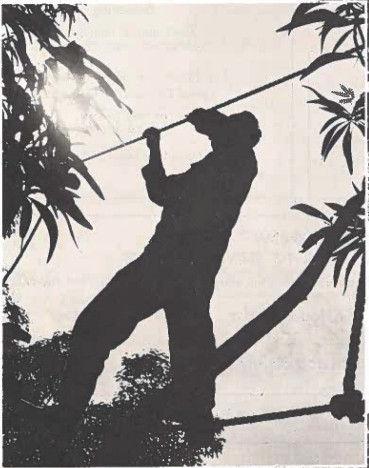
In addition, emphasis was placed on Jungle and Guerrilla Warfare. Excellent instructions were presented by personnel of the 25th Infantry Division in a compact thirty-two hour course involving mountain climbing; rappelling; river crossings by rope bridges and expedient means; jungle crafts, shelters, and food; U.S. Guerrilla and counter-guerrilla operations; communist guerrilla operations; jungle first aid and hygiene; ambush organization, execution, and counter ambush methods; jungle land and compass navigation; jungle tactics; and aerial resupply and evacuation.
This training was designed to develop the individual into a jungle fighting and instill confidence in him to survive while traversing the jungle, using the natural environment to construct shelters and secure food. At the completion of field traIning 1963, the HARNG earned the distinction of being the only JUNGLE TRAINED reserve component in the nation.
Year Round Field Training: The 298th Artillery Group (AD) embarked upon a new concept of field training this year by extending field training throughout the entire year rather than the traditional 15 day unit encampment. The entire Group conducted a six day on-site training period during June. The remaining nine days was scheduled by Unit Commanders. This system enabled more efficient utilization of manpower during peak work periods and provided better on the job training for non full time members of units.
Again in Fiscal Year 1963, the year round active duty for training concept proved effective. Under this program, individual members of the HANG were permitted to train with their units on a random schedule. Individuals reported to units throughout the year whenever proper training facilities were available. This flexible concept made it possible for closely supervised on-the job training. Of the 15 active duty for training days available to reservists, various combinations were used by HANG unit commanders. As an example, the 169th Aircraft Control and Warning Squadron employed a 10/ 5 concept. This program allowed individuals to use ten days throughout the year in a random fashion , while during the month of June the whole unit reported for five days summer encampment. Training emphasis during the summer phase was directed toward up-grading each individual. In line with this idea the HANG and Utah Air National Guard engaged in Operation “Big Switch” during the summer encampment. A total of one hundred Utah and Hawaii personnel swapped places. This cross training program enabled HANGmen to observe an air defense environment as it exists on the mainland.
Twelve days Year Round Field Training was conducted from 15 June to 26 June. Seven days of this period were spent in intensive day and night weather station operation, including observing, plotting, forecasting and weather briefing. During the remaining 5 days, emphasis was placed on group and individual technical training, plus administrative and preventive maintenance details. Three days of Year Round Field Training were accomplished during the remainder of the year at the convenience of the individual, at the Air National Guard Weather Station (Hickam), the Hickam Weather Station (Base Operations), at the U. S. Weather Bureau, or at Detachment 3, 1st Weather Wing (Kunia ) .
HAWAII ARMY AND AIR GUARD SUMMER CAMP PLANS FOR 1963
HAWAll ARMY GUARD
Infantry
The first week will be devoted to Phase I of Jungle and Guerrilla Warfare Training, Combat Range firing and small unit tactical exercises. Cadre personnel will have instructions on trainfire.
During the second week, the battle group will move to the Kahuku, Kawailoa Training areas and conduct a {4) consecutive days and nights tactical exercise in jungle, mountain terrain warfare. This exercise is to train personnel in the battle group in guerrilla, anti-guerrilla, civil affairs and jungle mountain operations.
The objective of this year’s annual field training is to maintain proficiency in conventional warfare and to complete Phase I of the Jungle and Guerrilla Warfare.
Individual leadership training will the conducted concurrently with the field exercises.
227th Engineer
The major objective of the 227th Engineer during the Field Training FY 63 is the development and training of junior leaders. All problems both tactical and nontactical have been designed to provide the small unit leader an opportunity to exercise leadership and demonstrate his knowledge of basic engineer skills with a minimum of supervision.
To provide them with situations that will not only test the unit they lead hut provide practical work for all members of the squad and platoon, the S3 has developed a set of squad and platoon size training problems which will he a 30-hour continuous problem. Tasks to be performed by squads and platoons include preparation of a bridge reconnaissance, squad in the attack, field fortifications, ahatis, laying minefields, breaching of minefield which consists of soviet type mines, construction of an M4 bridge dry span over a sixty-foot gap utilizing trestles, M4T6 raft, use of live demolition to destroy a concrete hunker, construction of timber trestle bridge to replace unsafe existing bridge in the training area (Note: Material supplied by USARHAW) construction of a class 60 timber trestle over a 60-foot gap for training only, road and culvert repair.
The leadership reaction course is a six-hour squad size reconnaissance problem which includes an encounter with friendly partisan who has been wounded, breaching an anti-personnel minefield, reaction to fire from a lone aggressor in a hunker, fire from an aggressor machine gun, search of enemy dead, encounter with enemy patrol, movement through artillery fire, scaling a high cliff and reporting information.
Army Aviation
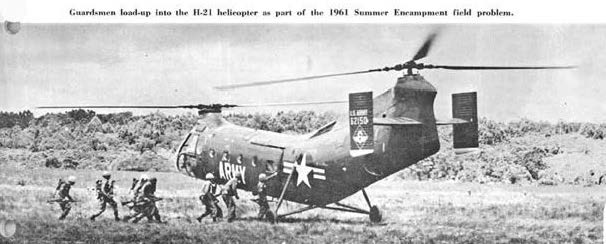
Army Aviation will again have the primary mission of supporting the 1st and 2nd Battle Groups during Annual Field Training, while these units are in the field. The direct support capability of the Aviation Platoon, 29th Infantry Bde, will he increased this year with the additional cargo and troop carrying capacity of the CH-21C light cargo helicopter, a recent addition to the HARNG aviation inventory.
Aviation unit training will be conducted under tactical field conditions for most of the two-week period, with the platoon based and operating from unimproved and forward air strips in the Kahuku, Dillingham and Haleiwa areas. Day and night platoon movements and occupation of new strips in these areas, will he executed under simulated combat situations, while providing continuous mission support to other units. Individual pilot proficiency flying will stress the techniques of harrier and short field landings, message drop and pick-up, aerial resupply (free fall and parachute) and adjustment of artillery fire.
Nike-Missile Units
ADA units have embarked upon a new concept of Annual Field Training with the implementation of the Year-Round Training Plan. This plan, which originated with the Air National Guard, does away with the annual 15 consecutive days of field training and spreads it throughout the entire calendar year, thus insuring higher standards of proficiency and providing additional manpower for both administrative and mission requirements. Under this plan, any number of individuals may he ordered to active duty for periods of 1 to 6 days. The entire 298th Arty Gp, minus the armory status batteries, will conduct six days of annual field training during 17-22 June. The remaining 9 days of field training will be on an individual basis.
It remains doubtful as to whether or not annual service practice for our Nike-Hercules units will he conducted during FY 1963. This delay in service practice was caused by new construction on sites as well as the unavailability of the supersonic RP76 targets, required for service practice. USARHAW is presently attempting to make arrangements for one or two of our units to participate in a short notice annual practice, (SNAP) during the later part of this year with possible use of Kahuku as the service practice point.
HARNG-OCS
During the Annual Field Training period 15 through 29 June, the HARNG OCS will have two classes, 01-63 and 02-64 in session simultaneously. While the junior class will be operating within the base-camp area which is tentatively slated for the 25th Infantry Division NCO Academy, the senior class will be operating in the field for a major portion of the two weeks and will be engaged in advanced weapons, jungle warfare and tactical training.
In the first week, the senior class will undergo practical exercises in Military Method of Instruction, 81 mm mortar, 4.2″ mortar, 106 mm recoilless rifle and three days of jungle warfare training. The Associate Arms: artillery, armor and engineers wiIl take to the field for a two-day practical exercise in the planning and execution of small unit patrols, followed by attaclc, defense, and organization of road block problems.
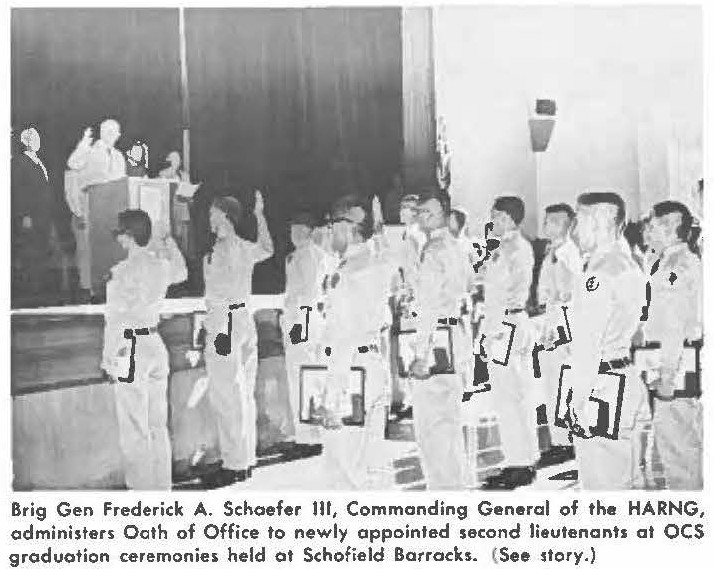
By Wednesday, 26 June, the Class 01-63 will have completed the program of instruction for state OCS. Candidates will then face the selection hoard for appointment and federal recognition as 2d Lts in the HARNG.
Graduation exercises are scheduled for Friday, 28 June, followed by a reception and banquet.
The junior class will have an orientation drill on the weekend of 24-26 May 1963.
During the two weeks at field training, this class wiII undergo intensive training in Phase I of the program of instruction which will include subjects such as organization of the armed forces, leadership, drill and command, methods of instruction, mapreading and aerial photography, camouflage, communications, M-1 rifle and machine guns.
HAWAll AIR GUARD
Since fiscal year 1952, the Hawaii Air National Guard has modified its field training program. In the past, the HANG units assembled once a year for fifteen continuous days during the month of June. However, because of the daily operational demands imposed upon the HANG, it has been impossible to attain a high level of combat readiness by scheduling field training once a year. In order to maintain an acceptable level of combat readiness, the HANG developed a modified training concept. This concept calls for the utilization of the field training days on a flexible annual basis.
The HANG pro11:ram calls for the 15 days authorized for active duty for training to he utilized in the following manner: Five days are designated “All HANG” whereby all HANG air defense units are required to attend training during the same time period. This will enable the HANG to meet the manpower requirements which the air defense system demands when operating at maximum efficiency. During this time period system wide exercises, ORis, and other special events of large magnitude can he scheduled.
Another set of five consecutive days is designated “Unit” training and is set aside specifically to meet unit training requirements. Upon approval of the Commander, HANG, the unit commanders have the choice of selecting the dates anytime during the fiscal year. This flexibility gives the unit commanders a chance to meet the training requirements of his own unit and not be harassed by the incessant manpower demands of the air defense system.
The last five days are designated “individual” field training days. As the name implies, these days are specifically apportioned to meet the training requirements of each individual. Scheduling is at the unit commanders discretion and is dependent upon the availability of qualified trainers and not at the convenience of the individual. Close supervision can be given to on-the-job training.
The Commander, HANG has selected 17-21 June as the “All HANG” active-duty-for-training period. Current plans calls for intensified air defense training during this time phase. All HANG members can he assured that the scheduled activities will he exciting and will tax the imagination. These five days will be packed with air defense training in all areas bordering on combat realism. Food service will probably operate under simulated battle conditions; flying training will probably occur during hours of darkness; radar operators will probably work under a continuous ECM environment; deployment to other airfields will also be exercised; intensive missile firing is also planned; penetration by saboteurs will be attempted; nuclear radiation procedures will he implemented. These activities should keep HANGMEN in a high state of motion.
Special Summer Camp Pictorial SpreadSpecial Summer Camp Pictorial SpreadSpecial Summer Camp Pictorial Spread(Pictures from the 1963 September The Hawaii Guardsman)
Fifty select Hawaii Air National Guardsmen from Hawaii’s Aircraft Control and Warning (AC&W) squadrons swapped units with 50 Utah Air National Guardsmen for eight days in June as part of their annual summer training.
Called “Operation Big Switch,” the exchange program between the two states was the first exchange of its type in National Guard history.
Utah Guardsmen, selected from Utah’s only AC&W squadron, the 130th, arrived in Hawaii 14 June aboard a Utah Air National Guard C-97 for training in Hawaii. Hawaii Guardsmen, selected from the 109th, 169th and 150th AC&W squadrons, boarded the same aircraft for the 13 hour trip to Salt Lake City and training at the 130th AC&W site.
The Utah group was split up among Hawaii’s three stations. Twenty were assigned to Oahu’s 169th AC&W squadron at Koko Head, twenty to Kauai’s 150th AC&W squadron and ten to the 109th AC&W squadron at Kahuku, Oahu.
During off duty hours, visiting Guardsmen were given the VIP treatment. Hawaii Guardsmen were given tours of the Mormon Church and its grounds, Big and Little Cottonwood Canyons and stopped at Brighton Ski resort where HNG’men were given a ride on the ski lift which took them to the 10,000 foot level. The Hawaii men toured Tampanagos Cave, were dinner guests of the Disahled American Veteran’s Club, visited the Brigham Young Monument and the Kennocof Open Pit Copper Mine and saw many other attractions in the vicinity of Salt Lake City.
Utah Guardsmen assigned to Hawaii were given similar treatment. The visitors were given tours of pineapple canneries and sugar mills, rode surfboards and canoes and visited the various historic sites on Oahu and Kauai. They attended a number of parties given in their honor, were constantly showered with leis and enjoyed Hawaiian entertainment.
During duty hours, each group received cross training and became familiar with the different training and operational requirements of the two areas. Hawaii Air Guardsmen operate under Pacific Air Forces Operational procedures while Utah operates under the Air Defense Command.
Although both States operate their AC&W sites on a 24-hour basis, the procedures are somewhat different. Many different ideas were exchanged during ” Operation Big Switch.”
Because of the success of the operation, Hawaii and Utah may plan a repeat program next year. Additionally, other ANG units in other states are considering “Switch” programs of their own after hearing of the success of “Operation Big Switch.”
One officer, commenting on the program, said, “Not only did we learn a lot, the trip did a great deal to boost morale.”
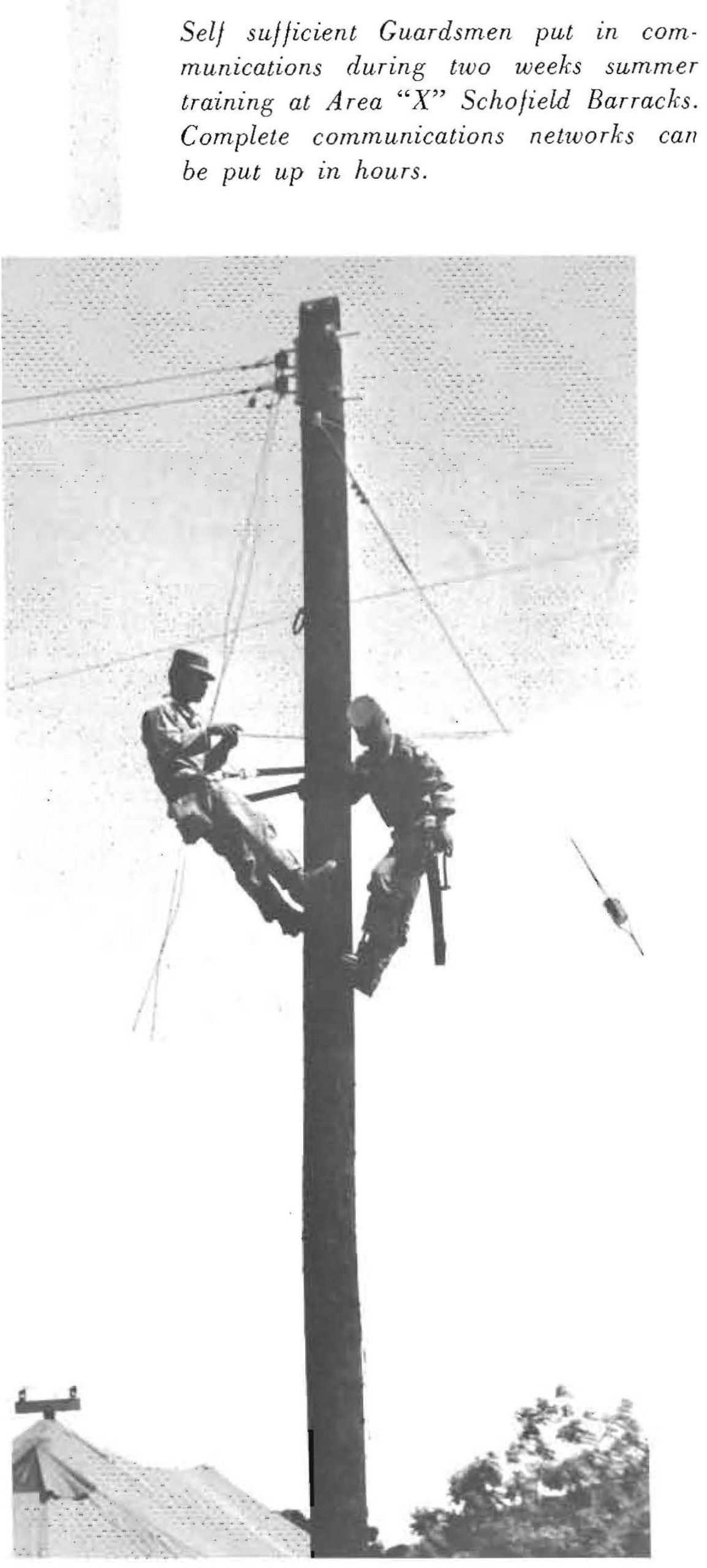
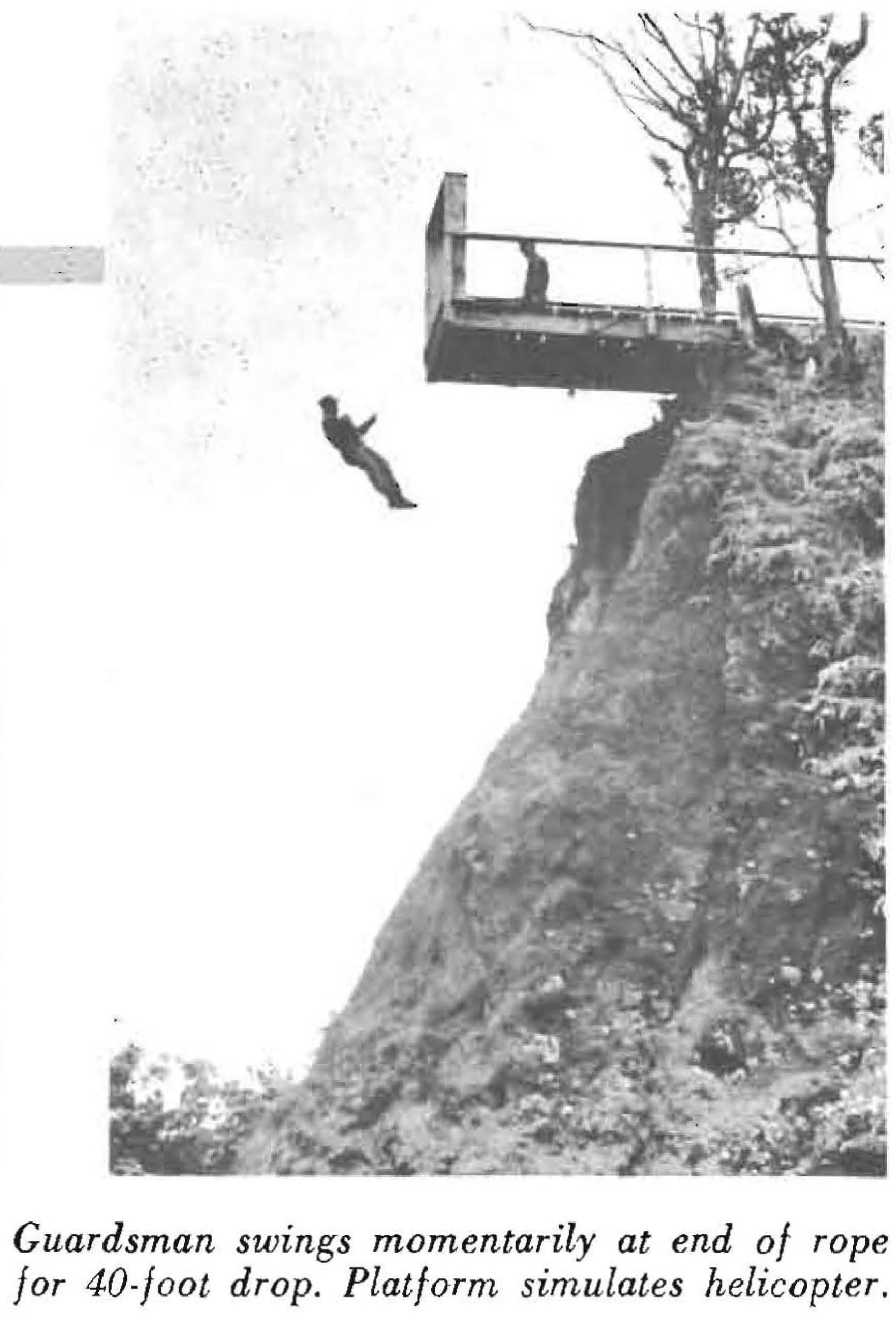
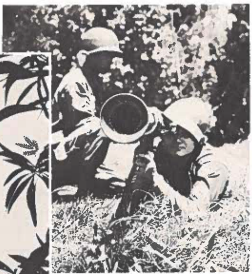
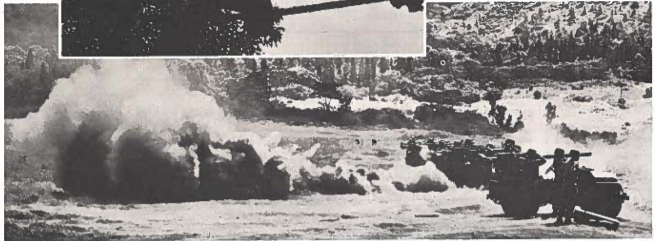
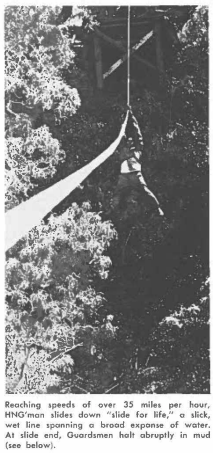
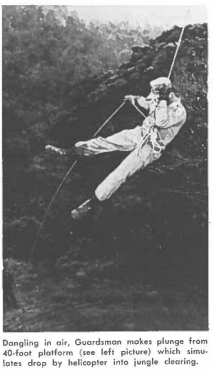
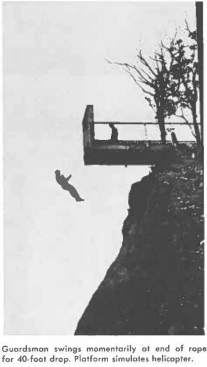
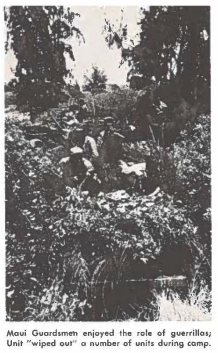
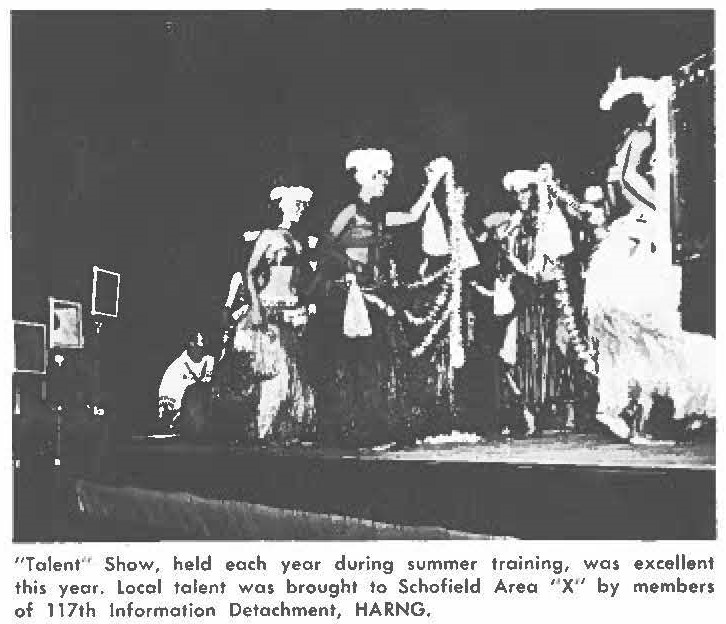
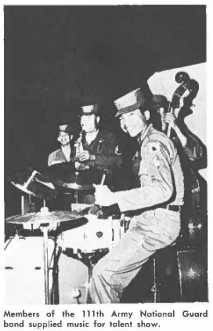
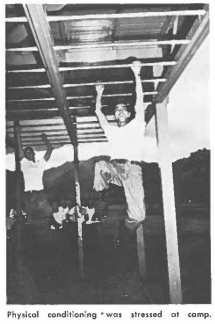
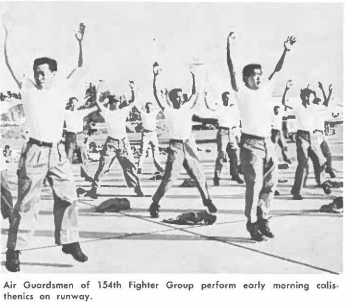
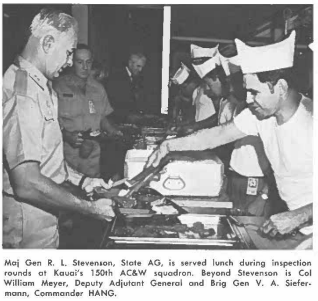
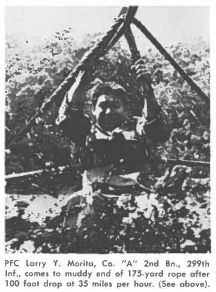
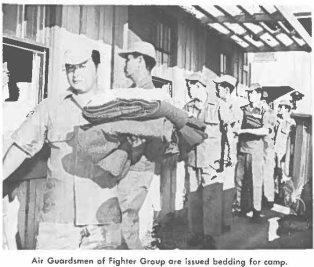
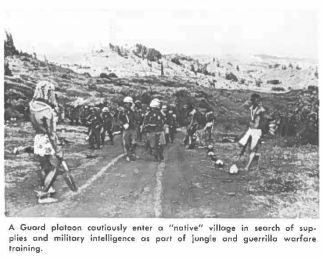
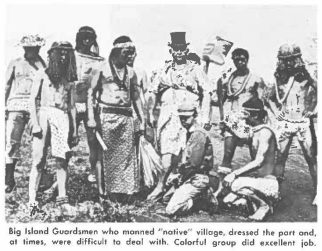
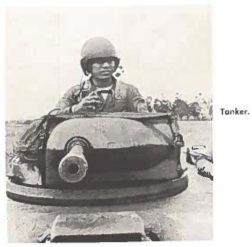
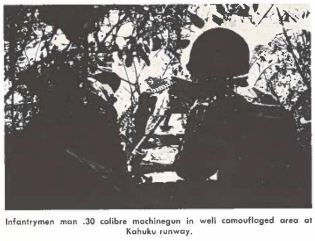
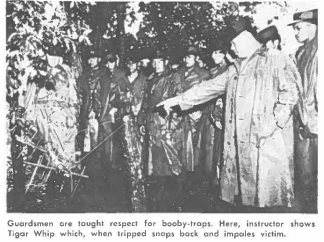
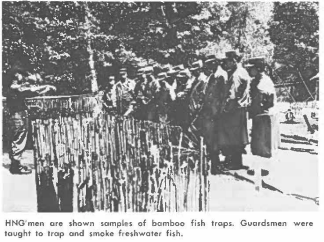
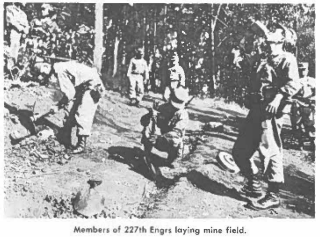
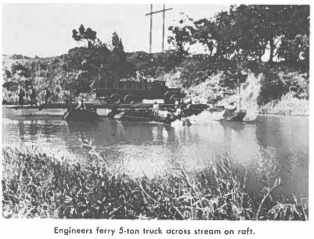
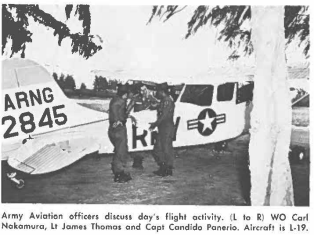
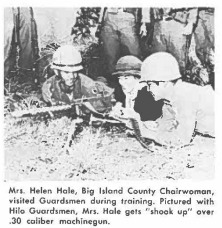
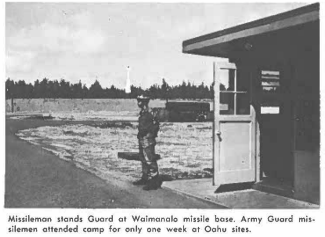
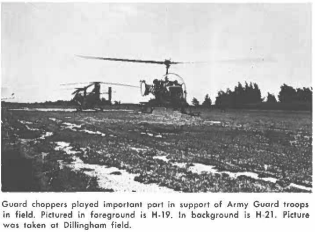
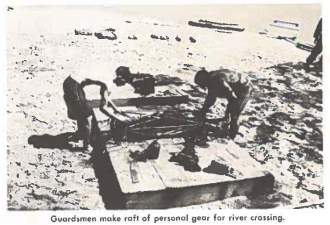
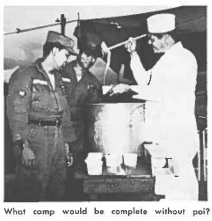
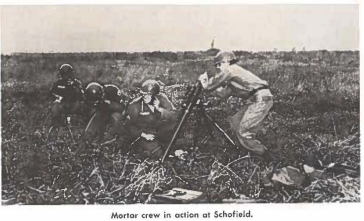
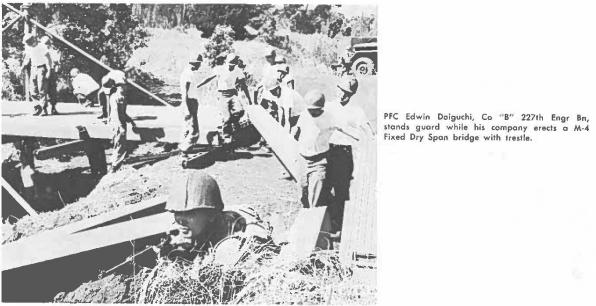
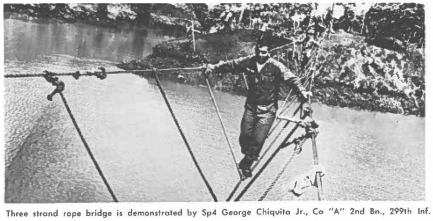
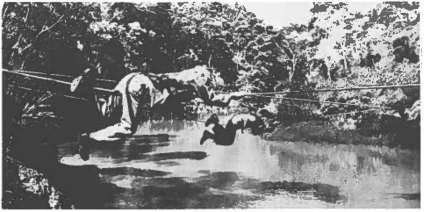
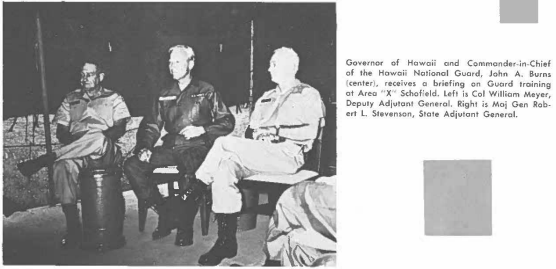
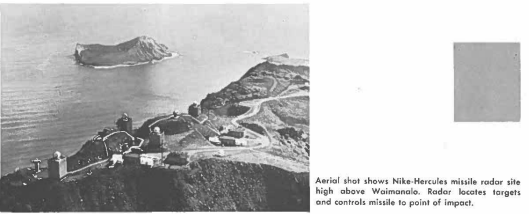
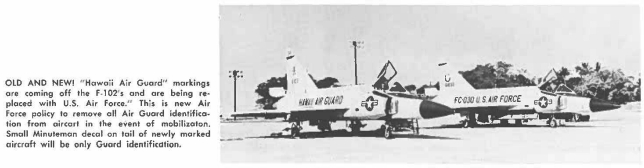
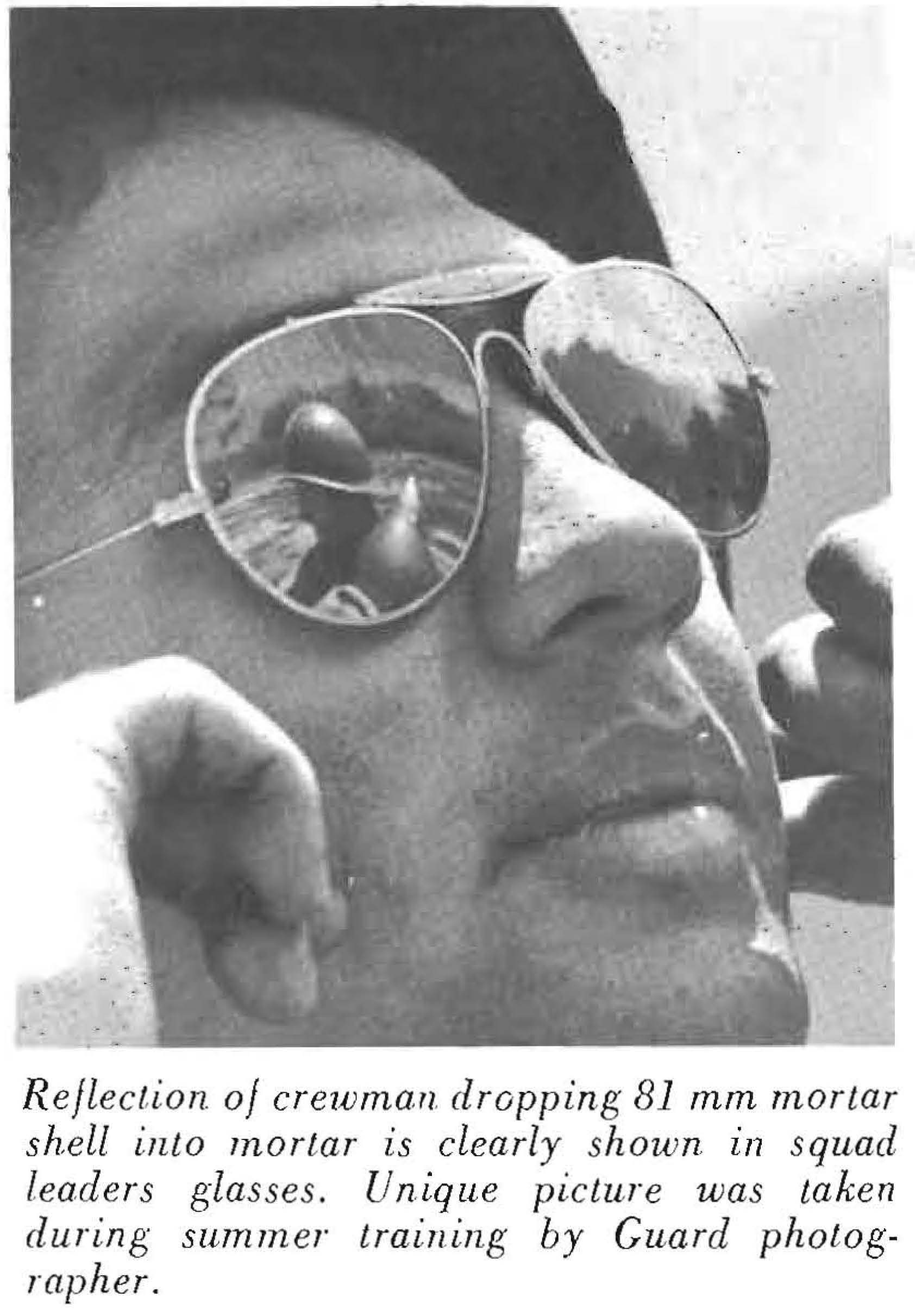
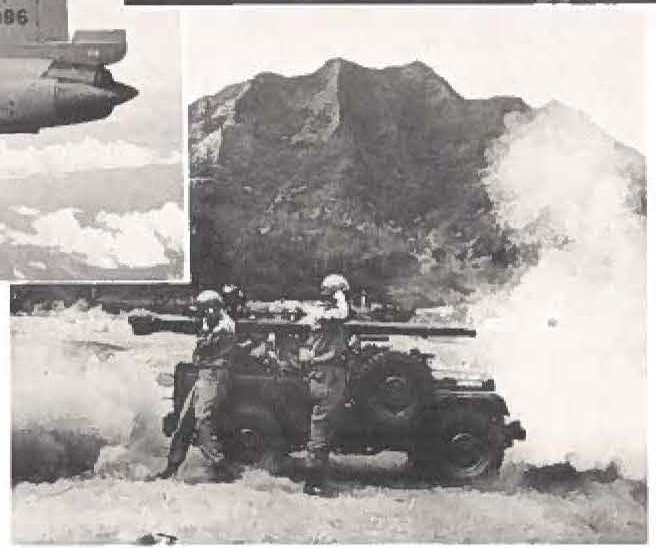
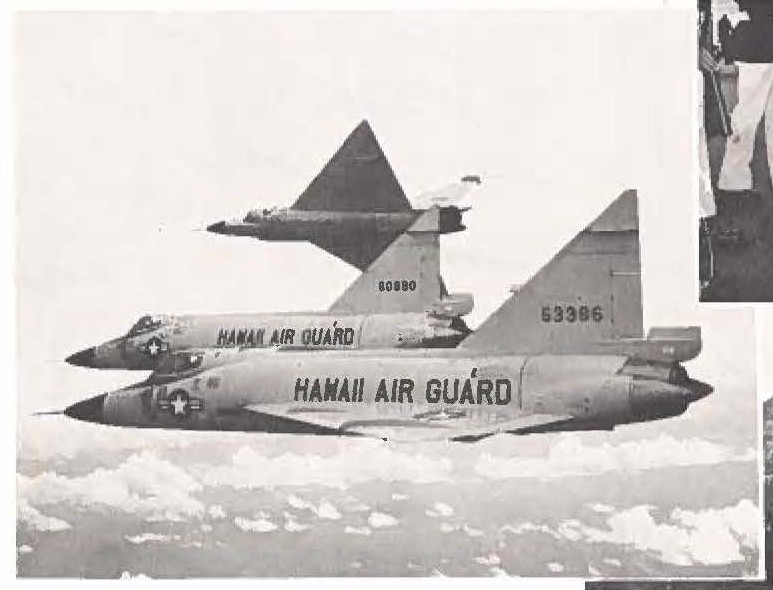
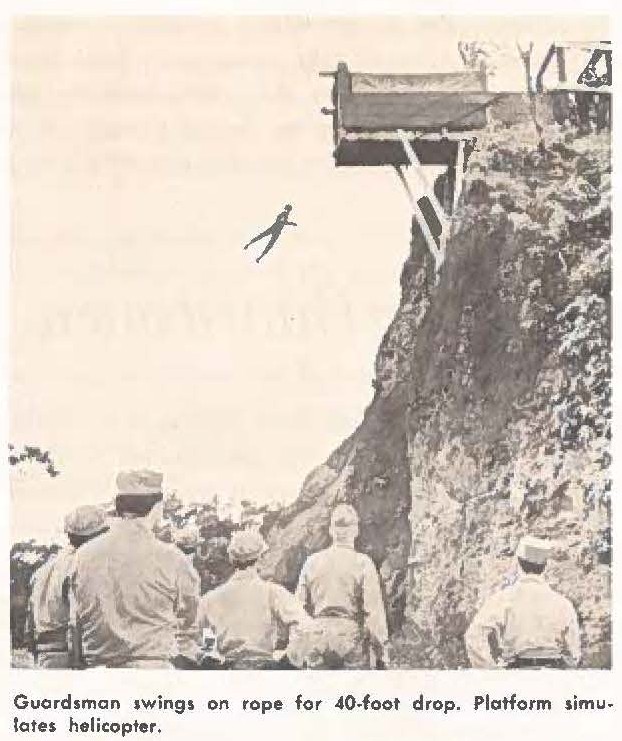
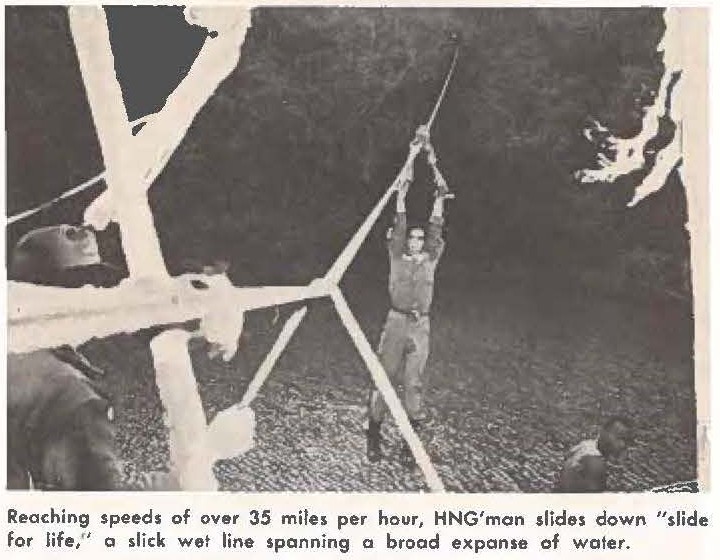
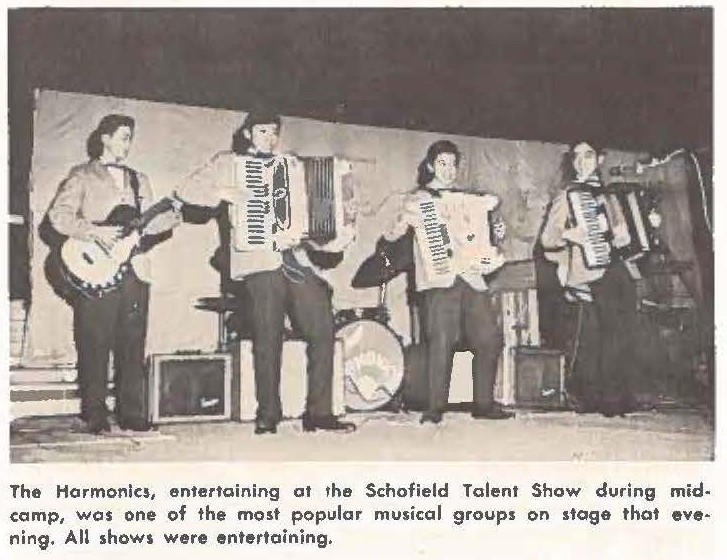
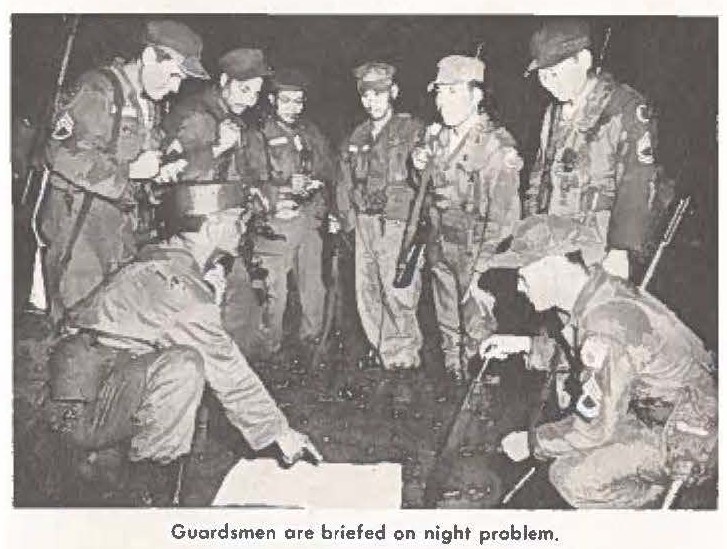
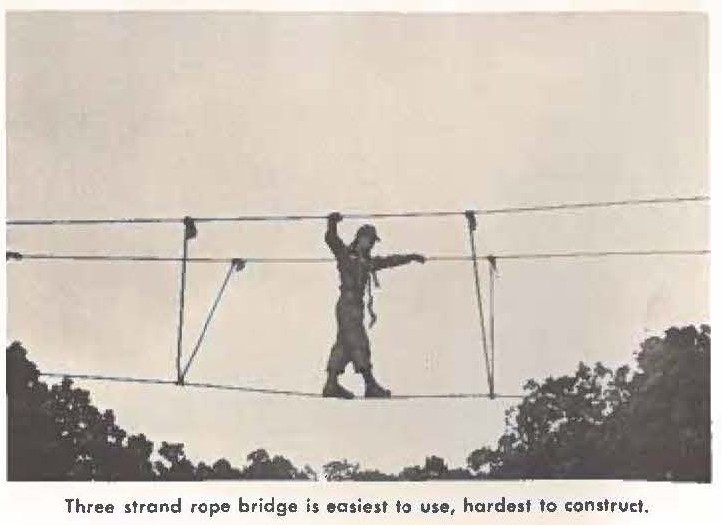
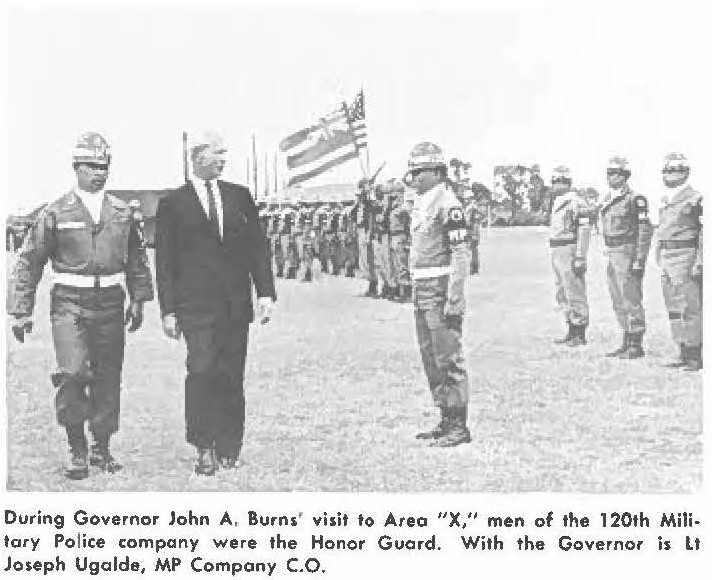
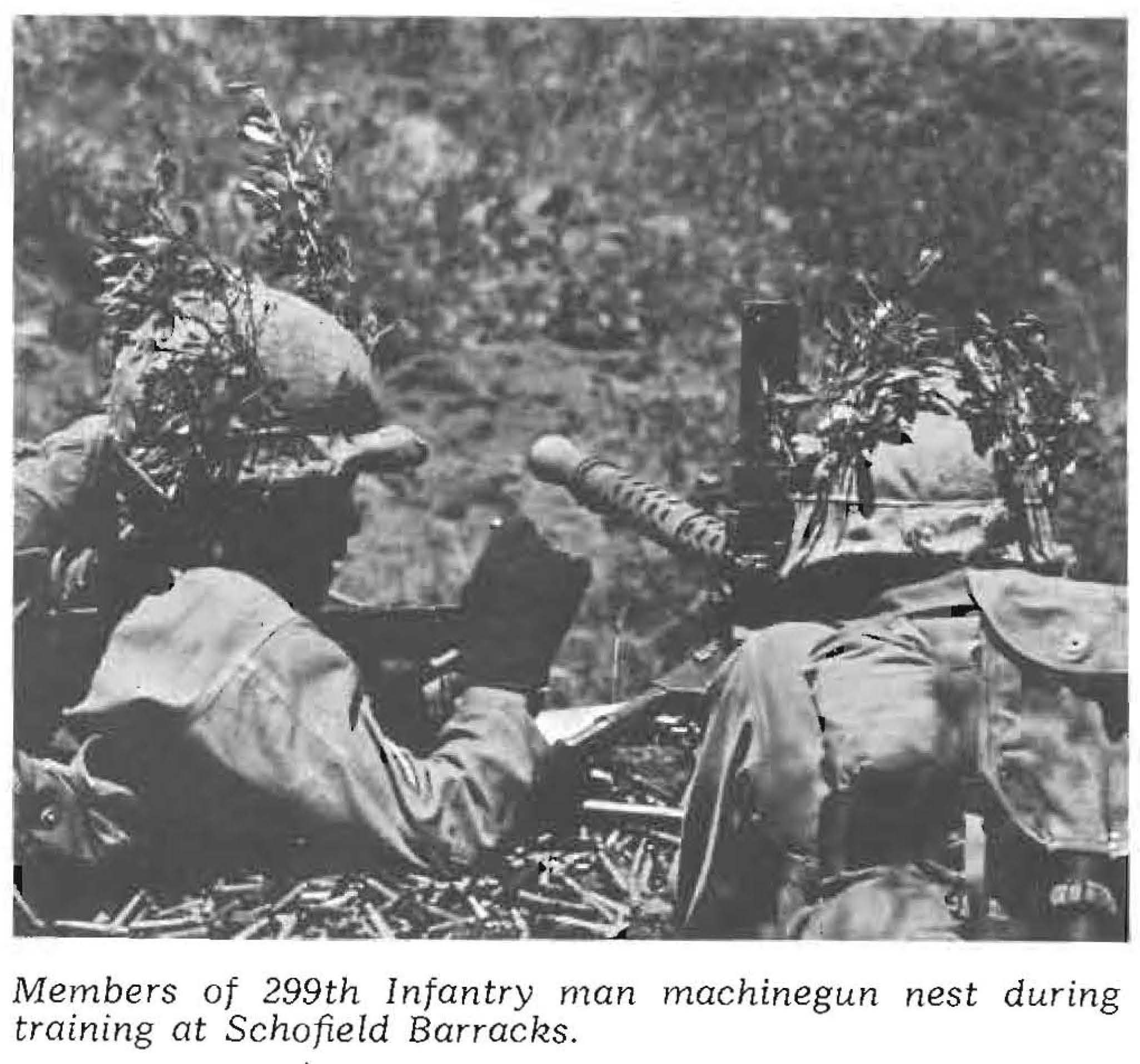
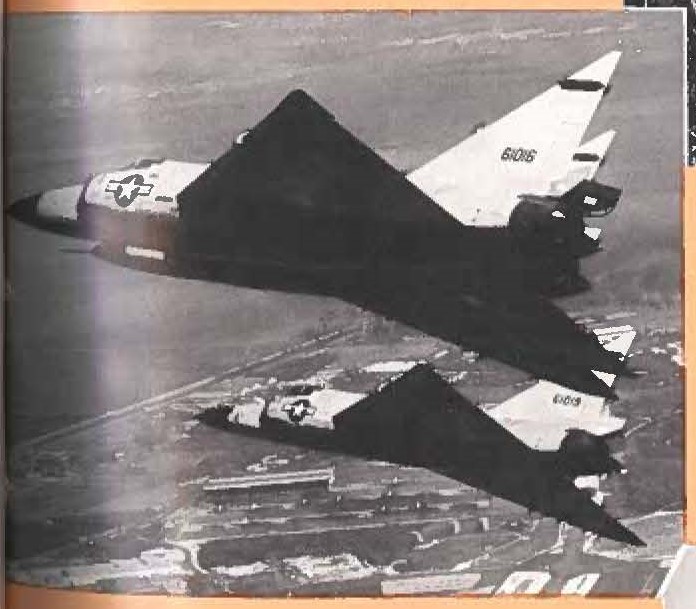
Reaching speeds of o ver 35 miles per hour, HNG’ man slides down “slide for life,” a slick, wet line spanning a broad expanse of water. At slide end, Guardsmen halt abruptly in mud (see below). Dangling in air, Guardsman makes plunge from 40-foot platform (see left picture) which simulates drop by helicopter info jungle clearing. Guardsman swings momentarily at end of rope for 40 foot drop. Platform simulates helicopter. Maui Guardsmen enjoyed the role of guerrillas; Unit “wiped out” a number of units during camp. “Talent” Show, held each year during summer training, was excellent this year. local talent was brought to Schofield Area ” X’ ‘ by members of 117th Information Detachment, HARNG.Members of the 111th Army National Guard band supplied music for talent show.Physical conditioning was stressed at camp. Air Guardsmen of 154th Fighter Group perform early morning calisthenics on runway. Maj Gen R. L. Stevenson, State AG, is served lunch during inspection rounds al Kauai’s 150th AC&W squadron. Beyond Stevenson is Col William Meyer, Deputy Adjutant General and Brig Gen V. A. Siefermann, Commander HANG. PFC larry Y. Morita, Ca. “A” 2nd Bn., 299th Inf., comes to muddy end of 175-yard rope after 100 foot drop at 35 miles per hour. (See above).Air Guardsmen of Fighter Group are issued bedding for camp. A Guard platoon cautiously enter a “native” village in search of supplies and military intelligence as part of jungle and guerrilla warfare training. Big Island Guardsmen who manned “native” village. dressed the part and, at times, were difficult to deal with. Colorful group did excellent job.TankerInfantrymen man .30 calibre machinegun in well camouflaged area at Kahuku runway. Guardsmen are taught respect for booby-traps. Here, instructor shows Tigar Whip which, when tripped snap, back and impales victim. HNG’men are shown samples of bamboo fish traps. Guardsmen were taught to trap and smoke freshwater fish. members of the 227th Engrs laying mine fieldEngineers ferry 5-ton truck across stream on raft. Army Aviation officers discuss day’s flight activity. (L to R) WO Carl Nakamura, Lt James Thomas and Capt Candido Panerio. Aircraft is L-19. Mrs. Helen Hale, Big Island County Chairwoman, visited Guardsmen during training. Pictured with Hilo Guardsmen, Mrs. Hale gets “shook up” over .30 caliber machinegun. Missileman stands Guard at Waimanalo missile base. Army Guard missilemen attended camp for only one week at Oahu sites. Guard choppers played important part in support of Army Guard troops in field. Pictured in foreground is H-19. In background is H-21. Picture was taken at Dillingham field. Guardsmen make raft of personal gear for river crossingWhat camp would be complete without poi? Mortar crew in action at Schofield. PFC Edwin Doiguchi, Co “8” 227th Engr Bn, stands guard while his company erects a M-4 Fixed Dry Span bridge with trestle. Three strand rope bridge is demonstrated by Sp4 George Chiquita Jr., Co “A” 2nd Bn., 299th InfLt Col George S. McEldowney, 2nd Bn Commander, crones water with aid of single rope. Guard General officers also made crossing. Governor of Hawaii and Commander-in-Chief of the Hawaii National Guard, John A. Sums (center), receives a briefing on Guard training at Area “X” Schofield. Left is Col William Meyer, Deputy Adjutant General. Right is Maj Gen Robert l. Stevenson, State Adjutant General.Aerial shot shows Nike-Hercules missile radar site high above Waimanalo. Radar locates targets and controls missile to point of impact.OLD AND NEW! “Hawaii Air Guard” markings are coming off the f-102’s and are being replaced with U.S. Air Force.” This is new Air Force policy to remove all Air Guard identification from aircraft in the event of mobilization. Small Minuteman decal on tail of newly marked aircraft will be only Guard identification(Pictures from the 1963 September The Hawaii Guardsman)
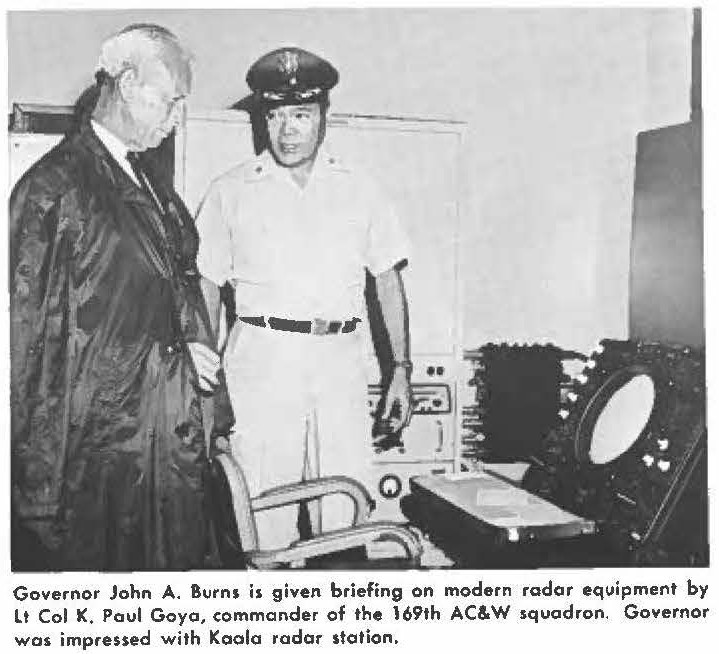
OPERATION BIG SWITCH occurred during the five day June summer camp (there was no Operational Readiness Inspection this year). Fifty HANGmen cross-trained at the Air Guard’s 130th AC&W Sq in Utah; a like number of UTAHmen cross-trained at the 109th, 150th and 169th AC&W Sqs. This worthy effort should really have been called Operation Goya, for it was the “brain child” of Lt Col Kiyoshi P. Goya, Comdr of the 169th.
h. Field Training. The 298th Arty Group, because of its mission and annual service practice, conducted its field training on a modified schedule. All other units of the HARNG trained at Schofield Barracks during the period 6 June to 20 June 1064. The 29th Infantry Brigade (- I placed emphasis on Platoon and Company tactics during the first week. Second Battalion of the 299th Infantry marched from East Range over the Koolau Range into Waikane Valley to carry out Phase II of Jungle Training. Third Battalion 209th Infantry carried out Phase II at the Kahuku Training area. During the second week, elements of the 20th Infantry Brigade (-I completed Phase I of Jungle Warfare and the Code of Conduct training. Crew served weapons were fired during the second week also.
Certain National Guard units throughout the United States were selected to participate in Guardlift 1. The Hawaii Army National Guard, invited to participate, selected the 1st Battalion of the 299th Infantry to exchange places with the 1st Battalion of the 185th Infantry of the California National Guard. Lt Col Archie Kennison, Jr. and his 1st Battalion, augmented b y elements of the 3rd Battalion and Special Troops, spent their Field Training at Camp Roberts, California. The different climatic condition and rolling terrain offered new training experiences. On the other hand, the California Battalion participated in Phase I and Phase II of Jungle Warfare and Code of Conduct to fill out their field training requirements.
Year Round Field Training: The 298th Artillery Group (AD) continued the use of year round training. The three headquarters units attended two consecutive five day ANACDUTRA periods to coincide with HARNG Field Training while the six fire units each used 5 days for Annual Service Practice and will spread the remaining days throughout the year in an “as needed” basis.
Again in FY 1964 HANGmen performed field training under the year round concept wherein individuals are ordered to active duty for training throughout the year. This concept of field training affords unit commanders the flexibility of scheduling drill status personnel to augment full time technicians during peak work periods. Another important benefit of the year round training is the ideal instructor-student ratio for on-the job training and personalized classroom training. The Guardsmen employers are also pleased with the year round concept particularly where a large number of employees are in various reserve organizations.
Operation ” Big Switch II,” the exchange of training stations, was successfully completed in FY 1964 with some 120 Utah and Hawaii Guardsmen participating. Aside from the many military benefits derived from this operation, the ” Big Switch” operation has been a tremendous boost for morale, recruiting and retention.
Nine days of Year Round Field Training was conducted 13 June 1964 through 21 June 1964. Four of these days were spent in intensive day and night weather station operations, including observing, plotting, forecasting and weather briefing. During the remaining five days, emphasis was on group and individual training, plus administrative and preventive maintenance details. Also, a two day fi eld trip was made to Kauai for technical training in radiosonde operation at the Lihue Weather Bureau Station and orientation visits to the Kokee Radar Site and Bonham Field. Six days of Year Round Field Training was accomplished during the remainder of the year at the convenience of the individual, at the ANG Weather Station (Hickam I , the Hickam Weather Station (Base Operations I , the U.S. Weather Bureau, or at Detachment 3, 1st Weather Wing (Kunia).
The 1964 Annual Field Training was conducted at Koko Crater Air Force Station for 10 days in June. The other five days were utilized by the sections of the squadron during the year under the “Texas Plan.”
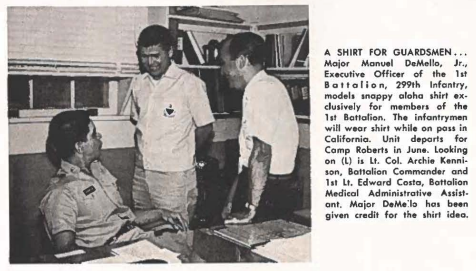
A SHIRT FOR GUARDSMEN … Major Manuel DeMello, Jr., Executive Officer of the 1st BattaIion, 299th Infantry, models snappy aloha shirt exclusively for members of the 299th Battalion. The infantrymen will wear shirt while on pass in California. Unit deports for Camp Roberts in June. Looking on (L) is Lt. Col. Archie Kennison, Battalion Commender and 1st Lt. Edward Costa, Battalion Medical Administrative Assistant. Major DeMe’.lo has been given credit for the shirt idea. (Picture from the 1964 March The Hawaii Guardsman)
Summer camp for 1964 incorporates an entirely new phase of training and operational concepts. Nationally, over 10,000 Army National Guardsmen will be air lifted to AFT areas all over the Mainland, Hawaii, Alaska, and Puerto Rico.
Training under unfamiliar terrain and weather, coordinating the many details in transporting, housing, and feeding of troops are valuable training activities.
Through the Chief of the National Guard Bureau, the Commanding General, HARNG, has selected the 1st Bn., 299th Inf., HARNG to conduct its summer training at Camp Roberts, California, departing Hawaii on 7 June. Aircraft will land at Fresno, California. Troops will then hoard CAL ARNG vehicles for a four-hour trip to Camp Roberts. The exchange Infantry Battalion, from the 49th Infantry Division (CAL ARNG) , will arrive at Hickam AFB on 6 June.
Intensive coordination is currently being conducted to insure a smooth switch in this operation called “GUARDLIFT I.” We all look forward to more “GUARDLIFT” operations in succeeding years to give other HARNG units the opportunity to train away from the islands.
In Hawaii, training (6-20 June 64) will he at the Kahuku-Schofield training area complex for all except Air Defense units. Emphasis will he on field work, the type training we need to extensively practice what we learned during the year.
HARNG still remains the only “Jungle Trained” reserve component organization in the nation. We expect all unqualified personnel (to include the California Bn.) to complete Phase I (individual training) of Jungle and Guerrilla Warfare Training. Further, Phase II (small unit exercises) of JGWT will be completed by all combat units.
In addition to Jungle Training, all units plan to participate in scheduled Army Training Tests. Teet scores will tell us how good and how ready we are for combat. Infantry unite will conduct live-fire platoon tests. Engineer units will emphasize engineer projects and squad level ATT. Special Troop units will provide normal support and conduct company practice ATT.
The 298th Arty. Gp. will conduct AFT under the “Year Round” concept again this year. Under this plan commanders are able to bring personnel to active duty during peak work periods throughout the year. Nike-Hercules annual service practice will he conducted from 9 May to 19 June with each firing battery ordered to 5 days of AFT at Site 17. The missile launching point is on the beach in the vicinity of Kahuku airstrip. Spectators will be allowed to observe 2 Nike-Hercules missiles fired against supersonic drone targets on each Wednesday during the ASP period.
The headquarters units plan on spending two consecutive 5-day periods at field training. Headquarters 298th Gp. and Headquarters 1st Msl. Bn. will train at Ft. Ruger and Headquarters 2d Msl. Bn. will train at Wahiawa during the periods 7-12 June and 15-19 June.
So much for our plans for 1964. Our preparedness for combat is basically evaluated on the results of our Army Training Tests. Our Air Defense Units with their nearly fifty percent full-time strength, will in all probability retain their “Readiness” condition by successfully passing “Operational Readiness Inspections” as conducted by the Active Army. This is the eventual goal for all HARNG units, to pass Operational Readiness Tests as soon as possible after mobilization. To begin bridging this gap, we will conduct platoon ATTs during Summer Camp 1964 and company A TTs by Summer Camp If we succeed, Summer Camp 1966 should see us conducting advanced unit training such as battalion ATT, battalion field exercises, or large unit combined type operations.
Our Commanding General, Brigadier General Frederick A. Schaefer III, has set our goals for the coming years. To reach these goals, leaders at all levels, beginning with the fireteam leaders, must carefully lead their troops to greater proficiency and to higher levels of Army Training Tests. Let us begin our tasks with this thought:
“Every citizen who enjoys the protection of a free government owes net only a portion of hie property hut even of his personal services to the defense of it.” {George Washington)
All units of the Hawaii Air ational Guard will perform annual field training under the year round field training concept or better known as the Texas Plan. Under the Texas Plan, Guardsmen are called to active duty for training throughout the fiscal year for a maximum of ten days. During the All HANG field training period (15 thru 19 June) all HANG units will perform field training at their respective sites.
During the All HANG camp, units will exercise all tasks prescribed by current War plans to train and to evaluate their operational readiness. In past summer encampments, the PACAF Inspector General has “sneaked” operational readiness inspections (ORI) on the HANG. We welcome and look forward to these evaluations, as the results prove to the Air Force and the National Guard that the air defense of Hawaii is in capable hands.
Forecasters and observers of the 199th Weather Flight will make a field trip to Lihue for route familiarization and receive radiosonde training which is not available on Oahu. The U.S. Weather Bureau has generously consented to furnish this training at no expense to the HANG.
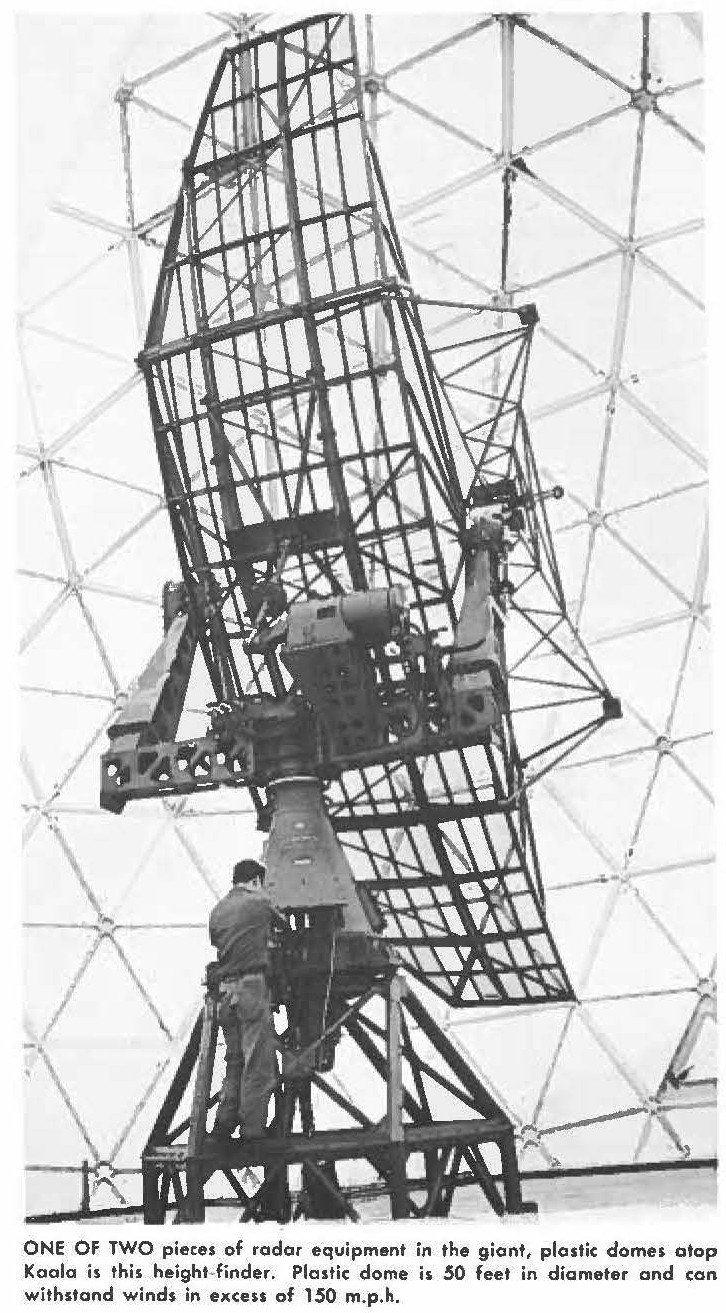
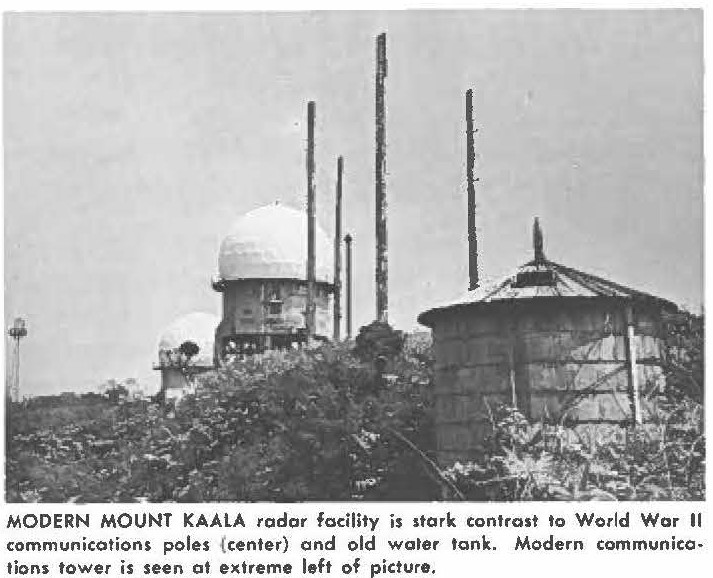
Members of the 169th ACW Sq. will paint and make minor renovations to Bldg. 204 at Wheeler AFB. This building will house the 169th ACW Sq. in their forthcoming move to the Kaala/Wheeler ACW Complex.
Due to the enthusiasm of the Guardsmen who participated in an exchange program between the Utah ANG and Hawaii ANG AC & W Units, we will engage in “Big Switch II” during the 1964 summer camp. This program involves exchanging some 60 officers and airmen on a man for man, skill/ job basis. For many Utah Guardsmen who took part in the 1963 exchange program, it was the first time they had seen the beautiful Pacific Ocean. Operation “Big Switch” affords the units an opportunity to exchange operational concepts, training and maintenance procedures and exercise flexible planning. Moreover, this exchange program is an excellent vehicle for retaining our qualified pros and does wonders for our recruiting efforts. Initially the exchange program was planned for ACW units only. However because of the tremendous success of “Operation Big Switch I” we plan to institute similar exchanges between fighter units.
Col. Becker has announced that Summer Training will be held within a 6-week period beginning in May and ending in June. The big event for the artillery missilemen this year is the Annual Service Practice, scheduled for this period. ASP Firing will he conducted from Site 17 at Kahuku with the launching point along the beach. In line with the year around training program, firing batteries will hold their 5-day camp when the unit is scheduled to conduct its Annual Service Practice. All Headquarters units are scheduled for two 5-day camp periods over successive weeks from 7 June to 19 June. The remaining days of camp will he performed during the remainder of the year on an individual basis. The primary objectives of Summer camp are Annual Service Practice, Group Operations during Air Defense Activities, and Equipment Maintenance.
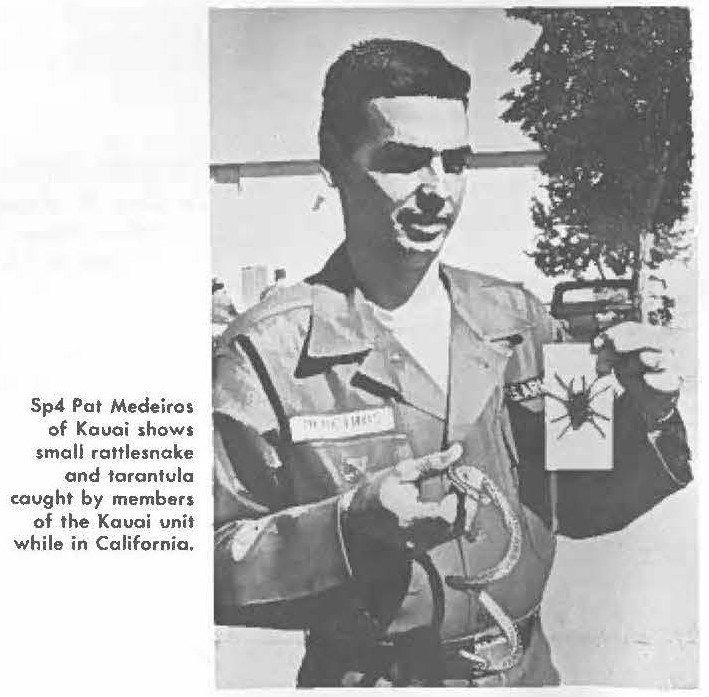
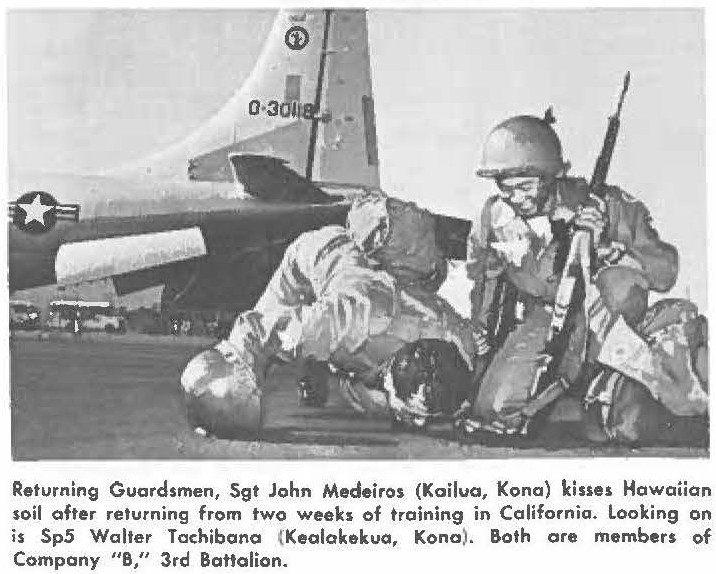
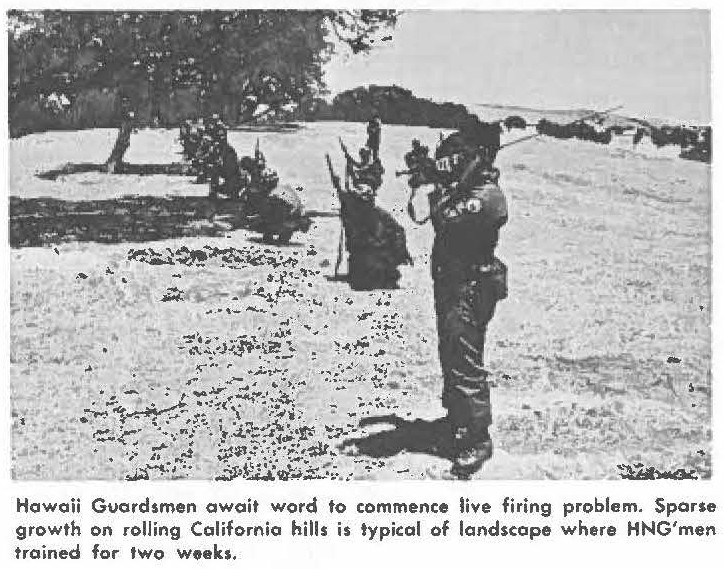
Sp4 Pat Medeiros of Kauai shows small rattlesnake and tarantula caught by members of the Kauai unit while in California.Returning Guardsmen, Sgt John Medeiros (Kailua, Kona) kisses Hawaiian soil after returning from two weeks of training in California. looking on is Sp5 Walter Tochibona (Kealakekua, Kona). Both are members of Company “B,” 3rd Battalion. Hawaii Guardsmen await word to commence live firing problem. Sparse growth on rolling California hills is typical of landscape where HNG’men trained for two weeks. (Pictures from the 1964 September The Hawaii Guardsman)
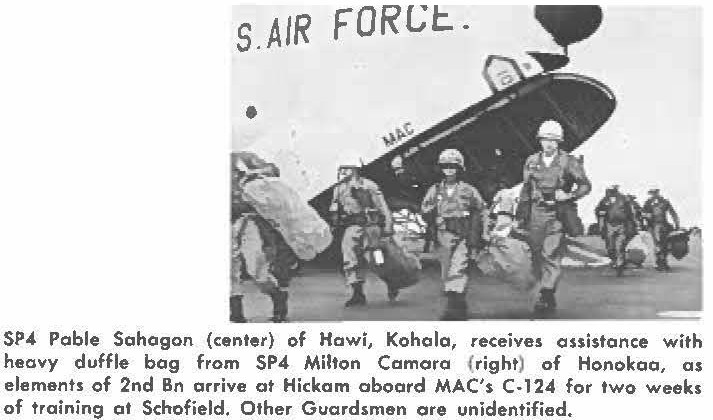
On the morning of 6 June, nine Air National Guard 4-enginc C-97’s with Utah, California and Arizona tail markings, landed at Hickam Air Force Base and deposited 576 California Army National Guardsmen of the 185th Infantry (1st Bn) on Hawaiian soil for Jungle and Guerrilla Warfare training at Schofield Barracks.
Operation “Guardlift I” involving the exchange of Hawaii and California Army National Guardsmen, had begun.
On the following morning, 557 Hawaii Army National Guardsmen boarded the same aircraft for the 12-hour return trip to California and training at Camp Roberts.
Arriving at Fresno, the Hawaii men, all members of the 1st Bn., 299th Infantry, received a hot turkey dinner, overnight billets and, on the following morning, were trucked to Roberts.
Spacious Camp Roberts with its 43 degree morning cold and 96 degree afternoon heat, offered excellent squad and rifle platoon combat courses and firing ranges for crewserved weapons. These courses, designed by the Continental Army Command, offered many training features not found in Hawaii.
During the first week of training, HNG’men received training in live firing tactics. Emphasis was placed on the NCO’s. During the second week, the Guardsmen placed emphasis on night patrol, platoon in attack and counter-attack problems during the bivouac stages of training.
For the majority of Isle Guardsmen, this was their first trip to the Continental United States. Encounters with squirrels, wild rabbits, snakes and tarantulas which infest the training areas offered new experiences for the Guardsmen.
During mid-camp, Hawaii Guardsmen took their passes and scattered to the four winds. They visited Disney Land, Mexico, Las Vegas, Los Angeles and San Francisco. Returning to Camp Roberts, many had interesting and humorous stories to tell about “the big cities.”
In the initial planning stages, six Hawaii Army National Guard officers visited Camp Roberts two months prior to the June departure of the main body.
Coordination for the airlift was effected with the Air Guard 146th Air Transport Wing at Van Neys, California in April by Hawaii planners. And according to UNG officers, cooperation received from the 146th ATW, California Army Guard and the Active Army was “outstanding.”
Active Army rating officers made frequent comment about the discipline, morale and esprit de corps of the Hawaii Group. Additionally, ratings received by the Hawaii group were above 90 percent.
Guard officers and enlisted men agree that this exchange training program was valuable in many respects:
First – the airlifting of almost 600 men presented many problems, none of which were major, but gave Hawaii planners excellent training and experience.
Second- training in relatively open terrain was completely different from the jungle type training so familiar to the Hawaii men. Additionally, the firing of live ammunition during platoon attack problems was a new experience for the group.
Thirdly- and important for the wellbeing of any organization was the morale factor. Different types of training under unfamiliar climatical conditions broke the monotony for many of the “old timers.” It should he added here that cross training of this type has excellent recruiting value. Many men, scheduled for discharge from the Guard, re-enlisted following the announcement of “Guardlift I.” Recruiting of new men also showed a definite increase.
To discuss the many minor problems which confronted planners would take more space here than the items deserved. However, this cross training offered many excellent experiences for Guard planners in many areas to better qualify them for that day which we hope never comes.
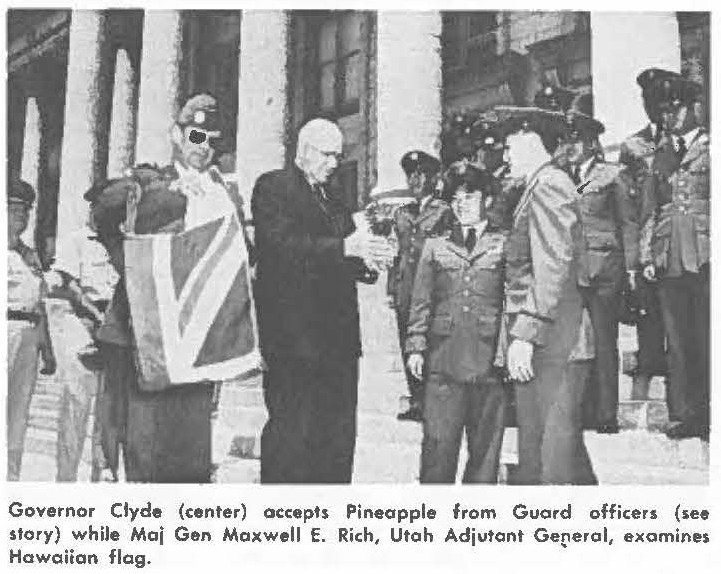
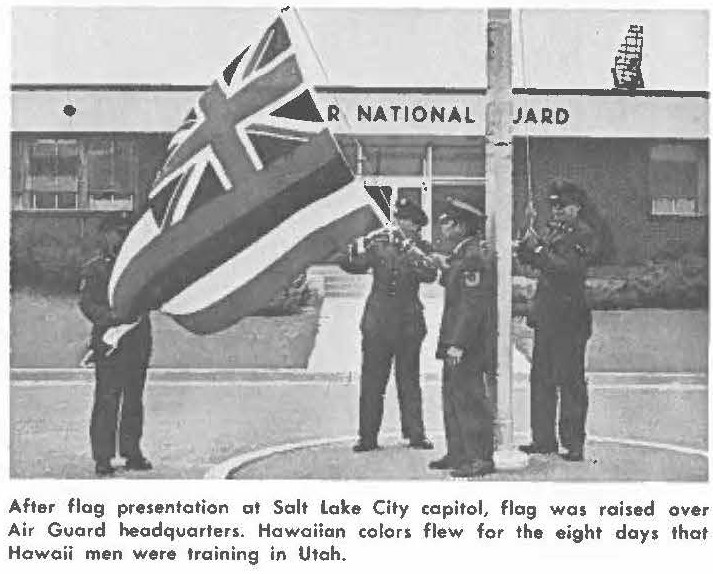
Governor Clyde (center) accepts Pineapple from Guard officers (see story) while Maj Gen Maxwell E. Rich, Utah Adjutant General, examines Hawaiian flag. After flag presentation at Salt lake City capitol, flag was raised over Air Guard headquarters. Hawaiian colors flew for the eight days that Hawaii men were training in Utah. (Pictures from the 1964 September The Hawaii Guardsman)
Sixty Hawaii Air National Guardsmen from the three Aircraft Control and Warning squadrons on Oahu and Kauai, swapped training sites with 60 Utah Air National Guardsmen during mid-June as part of their annual summer training.
Similar to the movement of HARNG’men to California, the HANG’men boarded a Utah Air National Guard 4-engine transport for the 12-hour trip to Salt Lake City after the Utah men had disembarked from the aircraft at Hickam.
The Utah Air Guardsmen were divided between the 150th AC&W squadron at Kokee, Kauai and the two Oahu sites, the 169th at Koko Crater and the 109th at Kahuku.
The Hawaii Guardsmen arrived at Salt Lake City at 2 a.m, (15 June) and were given a warm welcome at the airport, After a hot meal, the island men were assigned comfortable quarters at the Air Guard base.
On the following morning, Captains Robert Konishi and Norman Chang and a small group of Guardsmen called on Governor George D. Clyde and presented him with a Hawaiian flag and fresh pineapples. Following the presentation, the flag was transported to the Utah Air Guard headquarters where it was flown below the American flag for the eight days that the Hawaii men were training at the base.
During their training phase, the Hawaii men visited the SAGE l Semi-Automatic Ground Environment) Air Defense Control Center at Reno, Nevada.
Although the island horn reservists put in many hours of cross training at the 130th Aircraft Control and Warning squadron, their off-duty hours were filled with tours and sight-seeing as guests of the Utah Guard. The special bus used for this purpose was named “The Hawaiian Special.”
The hospitality extended by the Utah officers and men was “outstanding in every respect,” according to Captain Norman Chang, project officer for the Hawaii Group. “They did everything in their power to make our stay interesting and comfortable,” he added.
This is the second year that the two states have swapped Air Guard personnel.
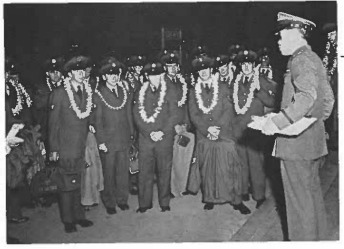
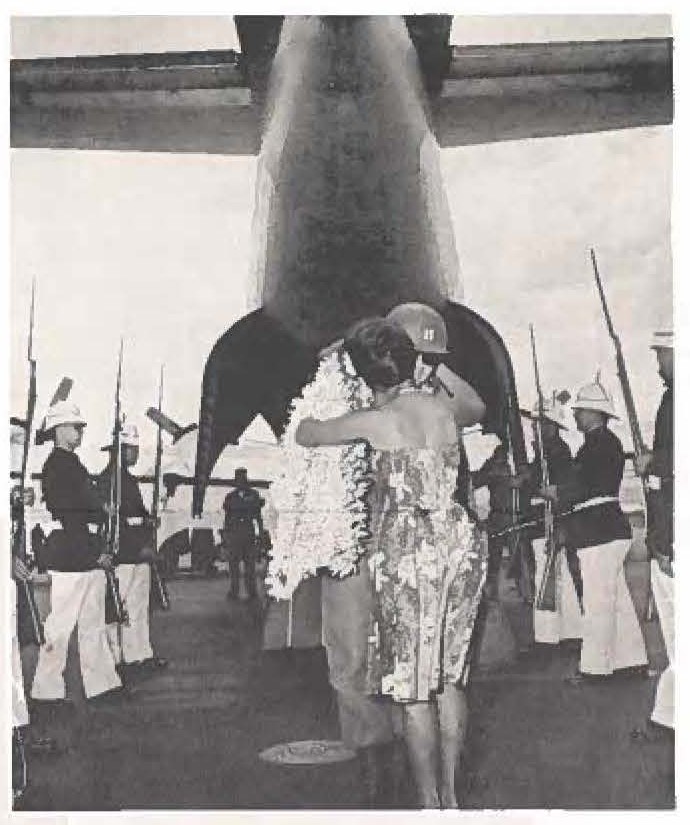
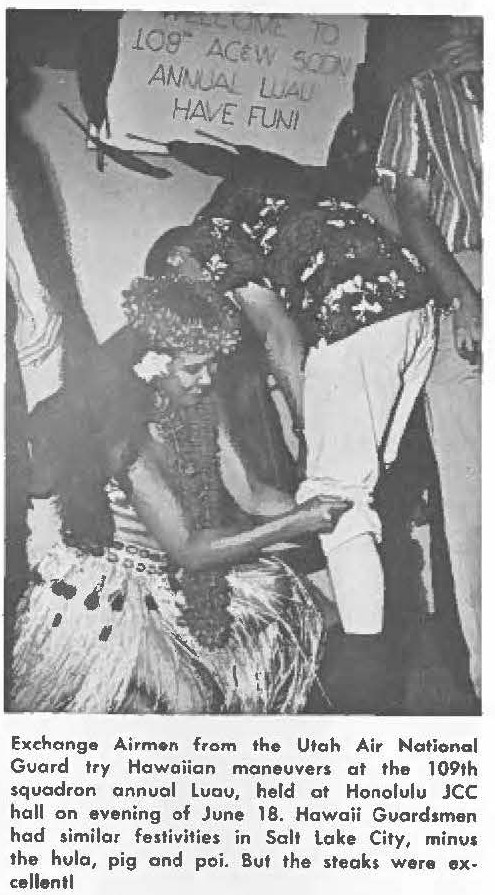
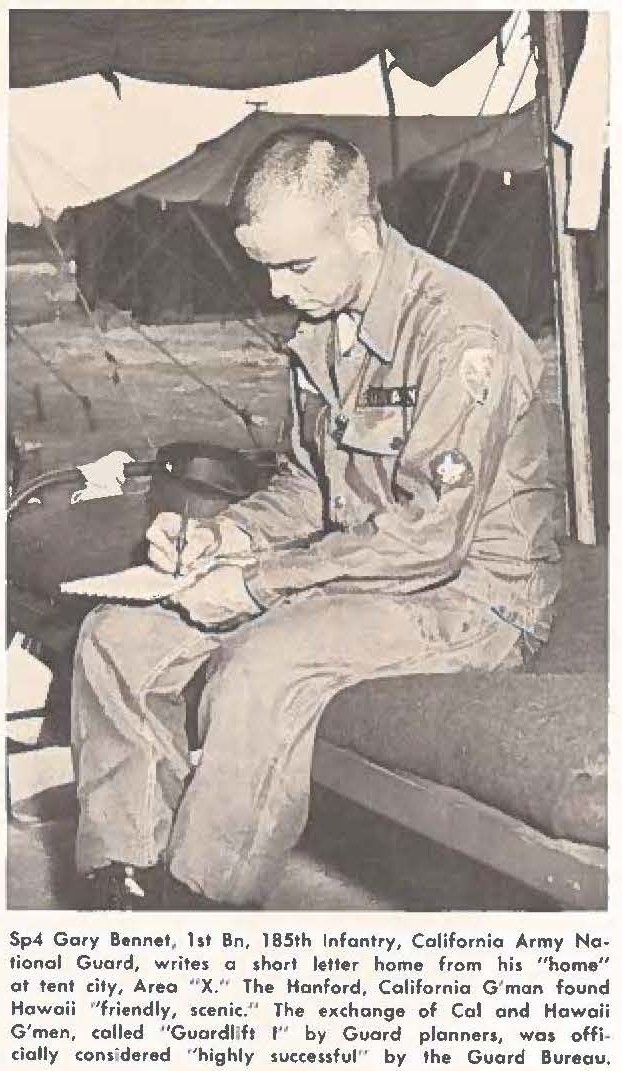
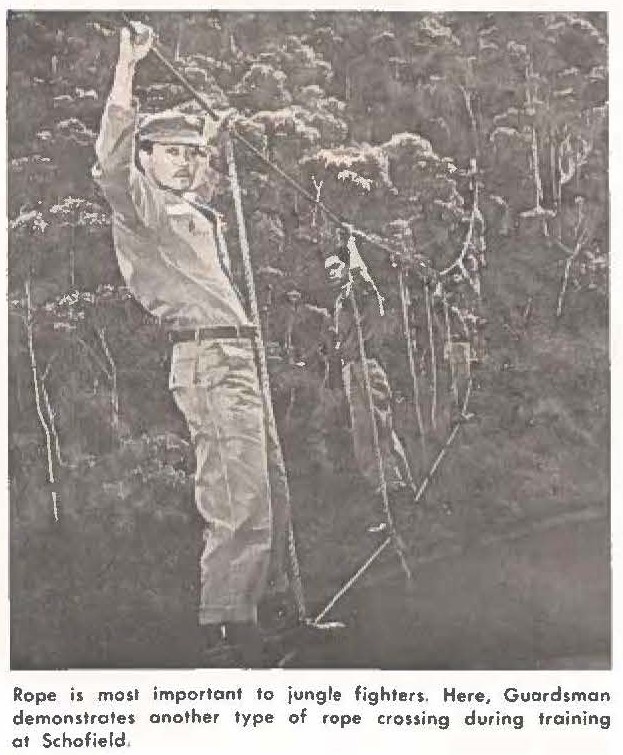
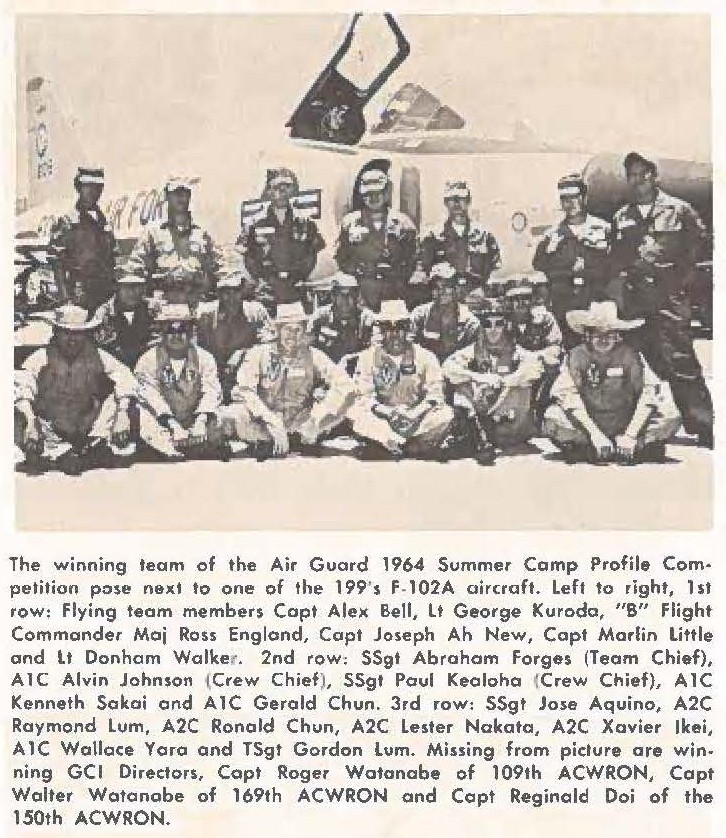
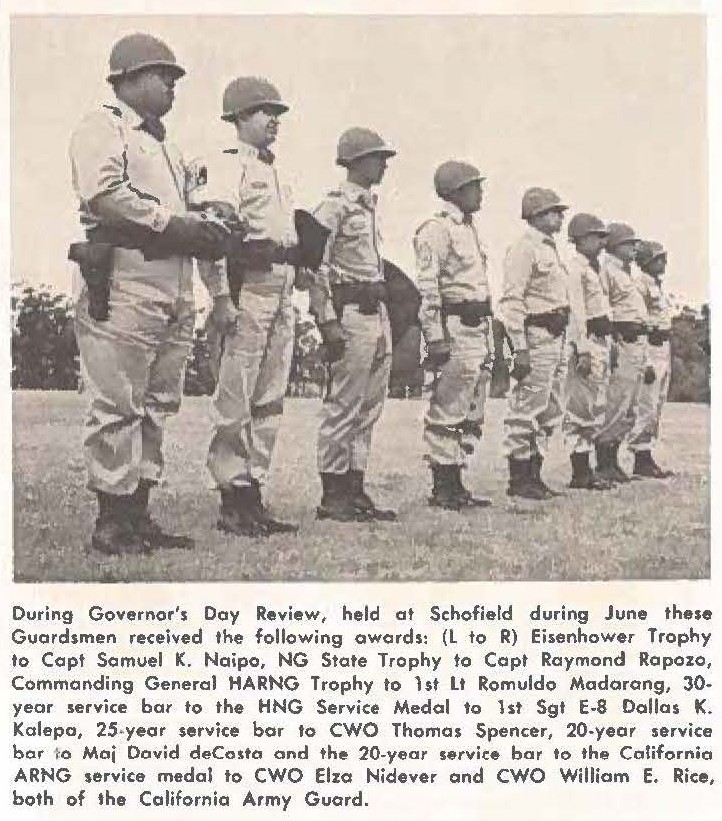
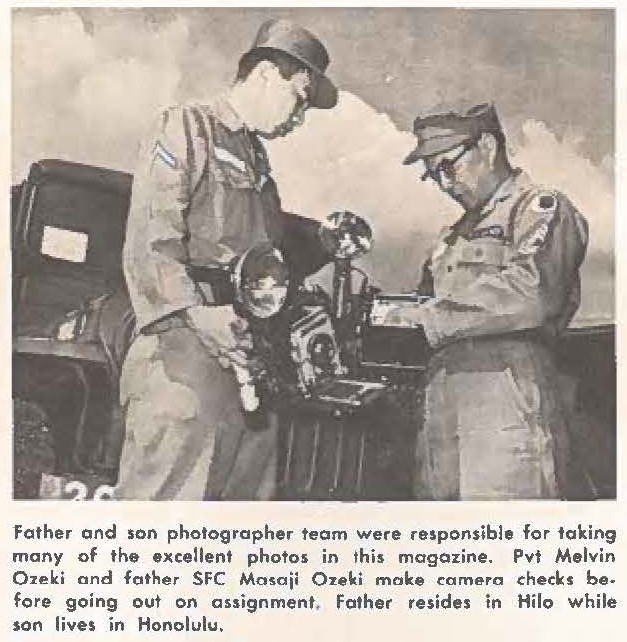
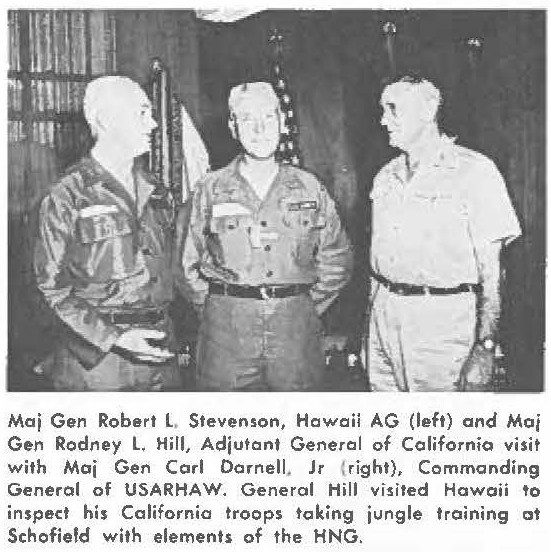
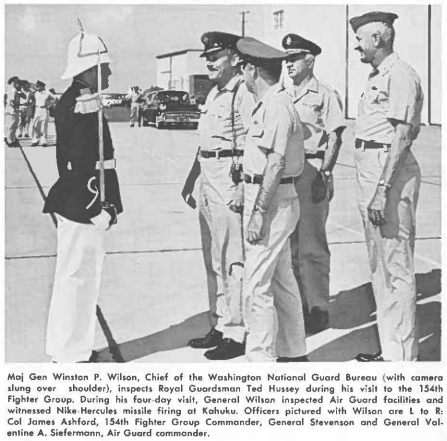
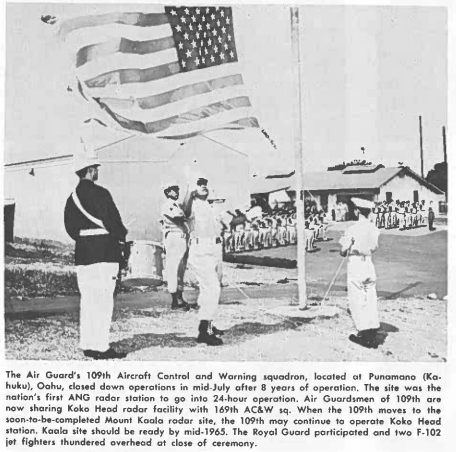
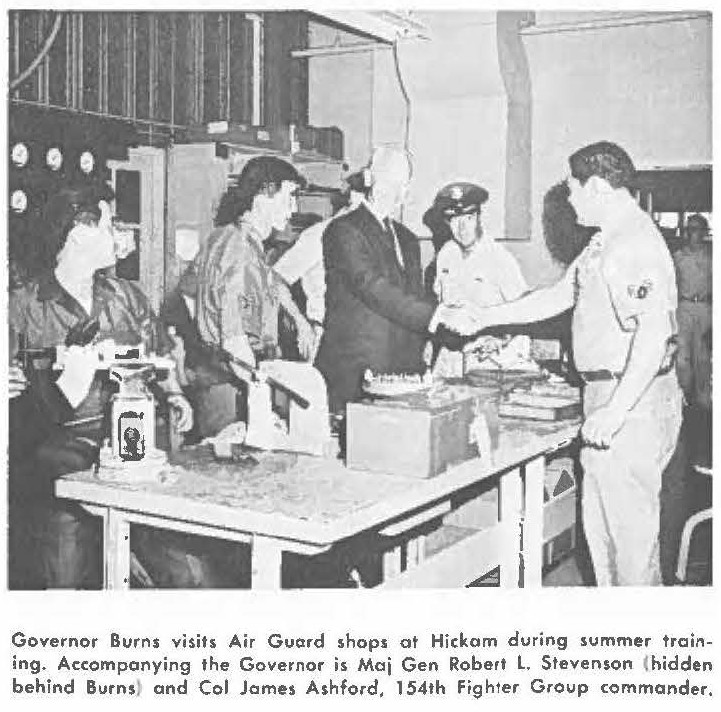
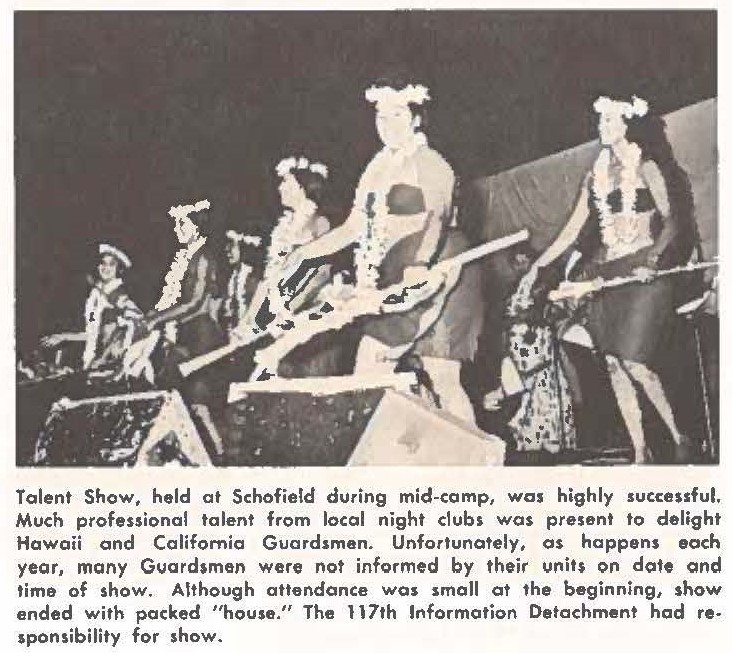
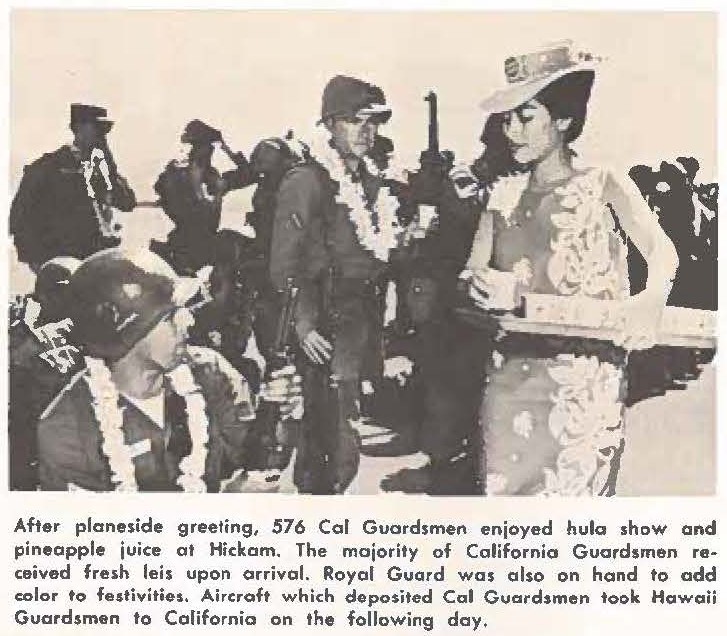
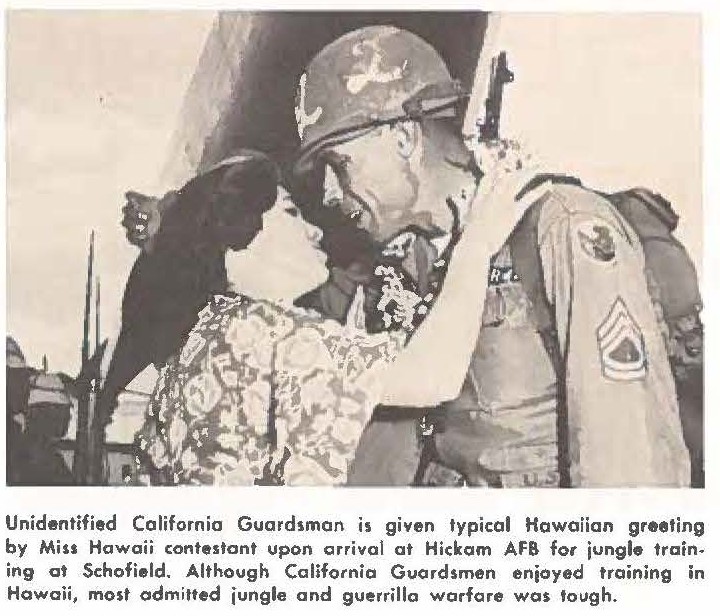
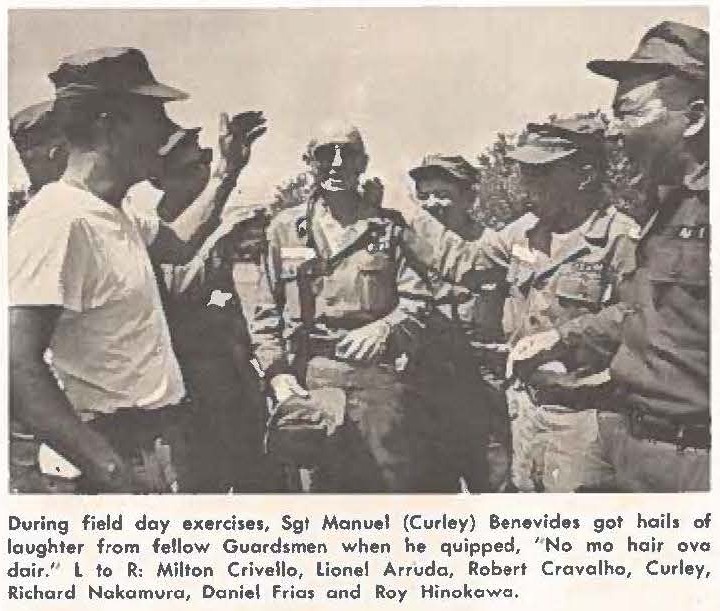
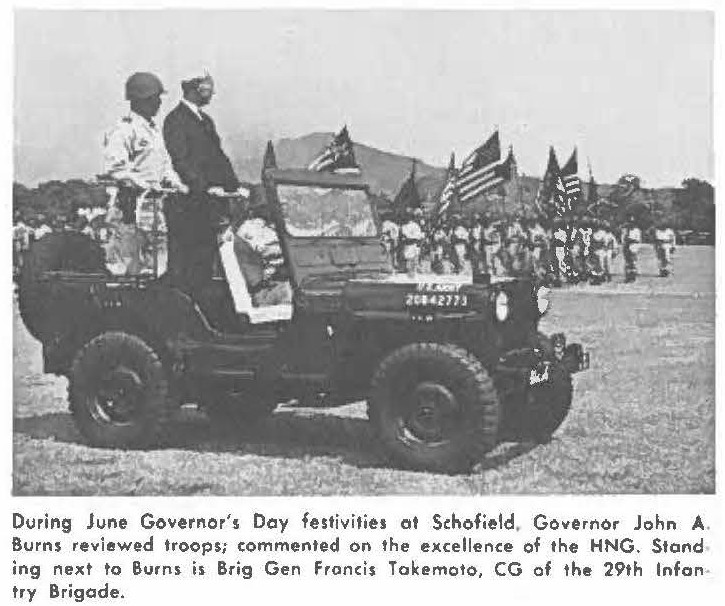
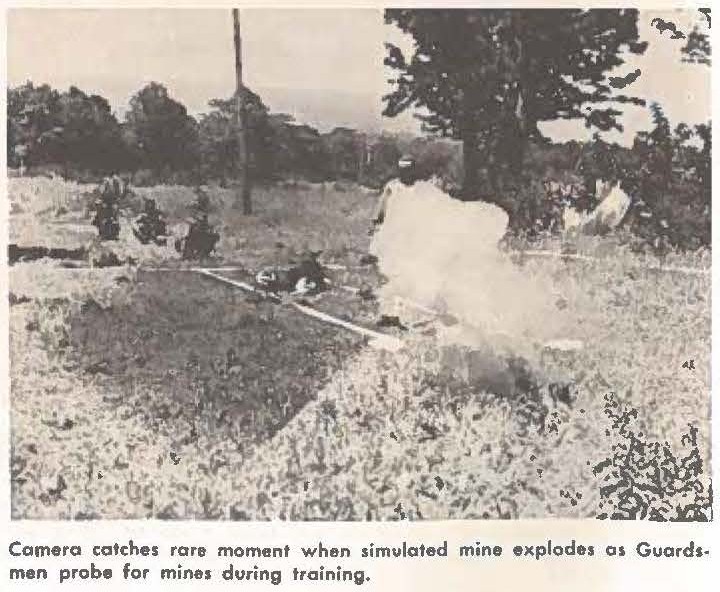
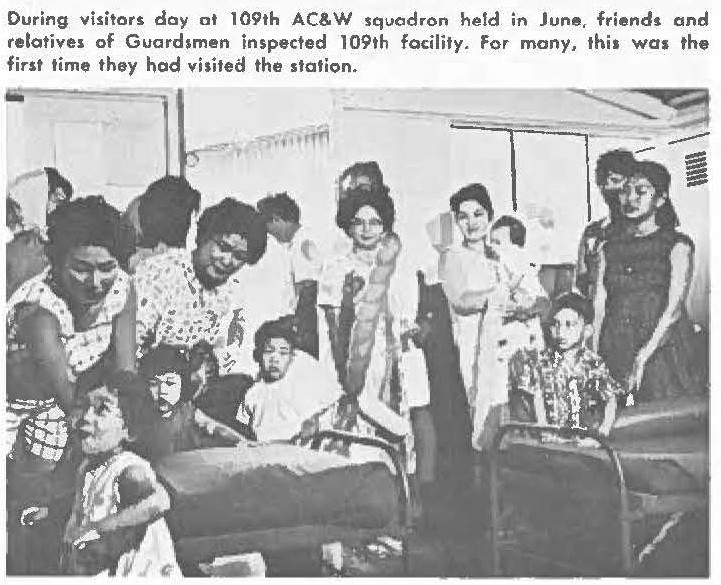
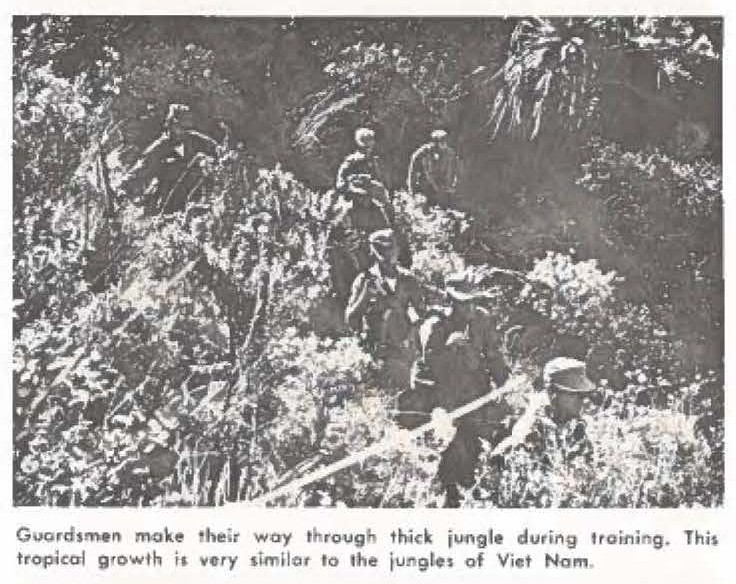
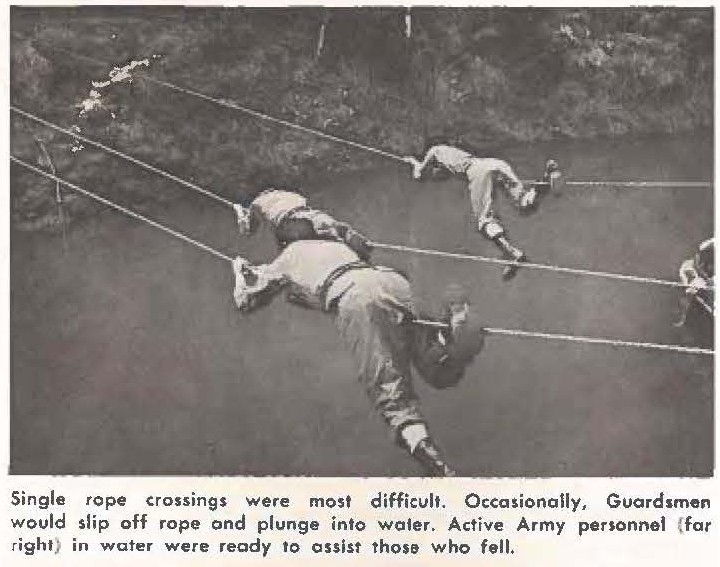
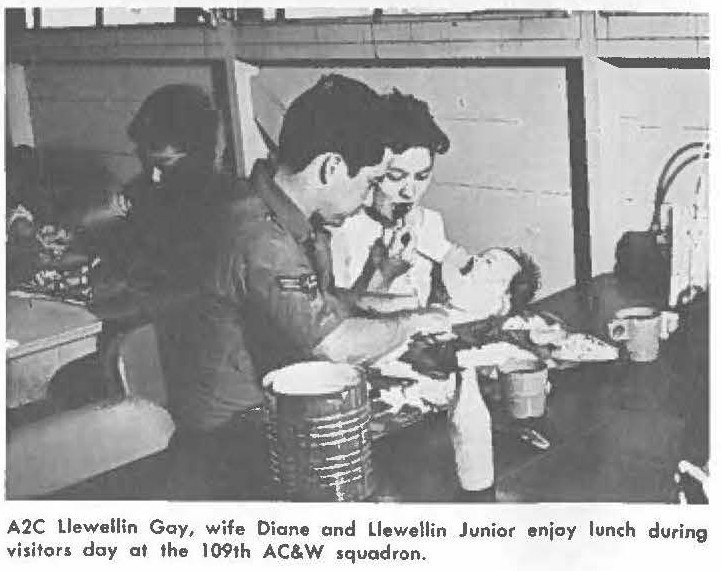
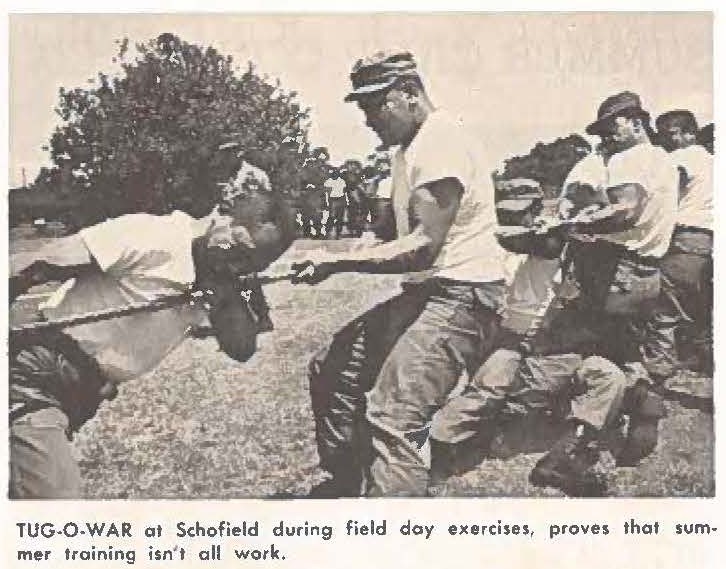
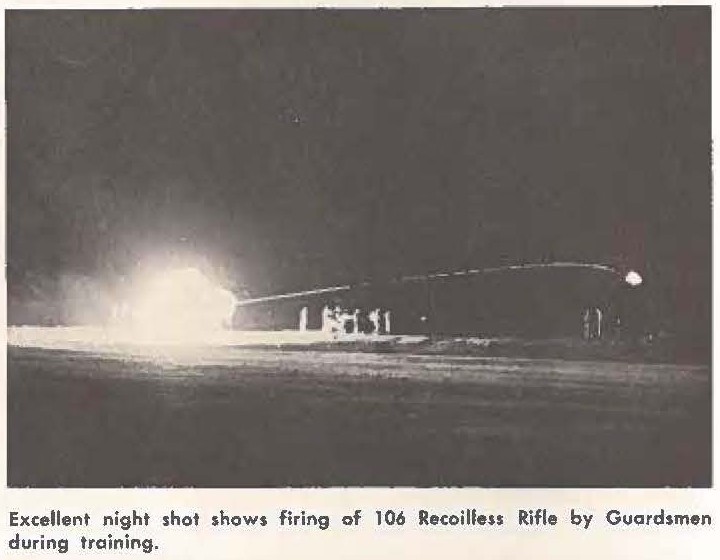
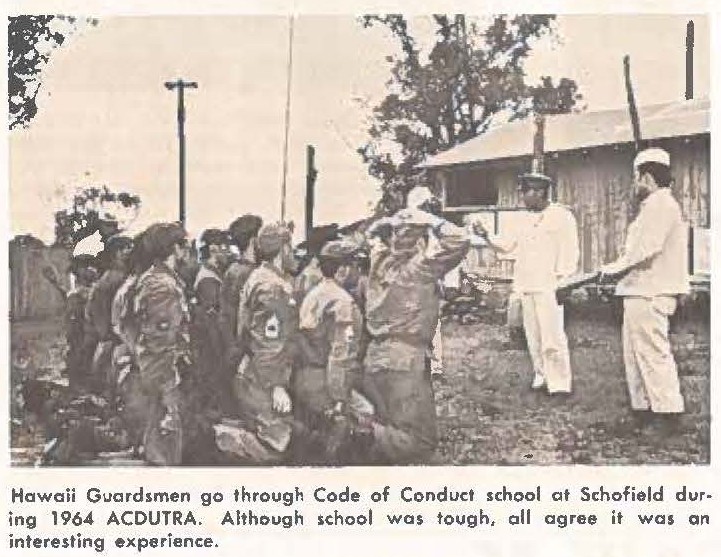
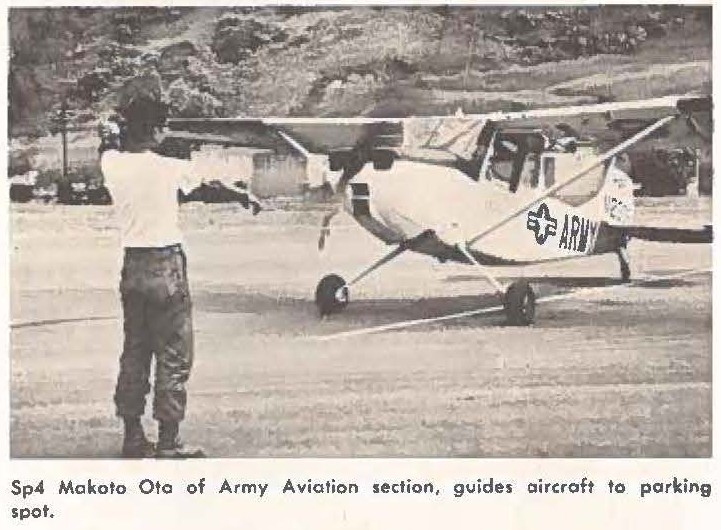
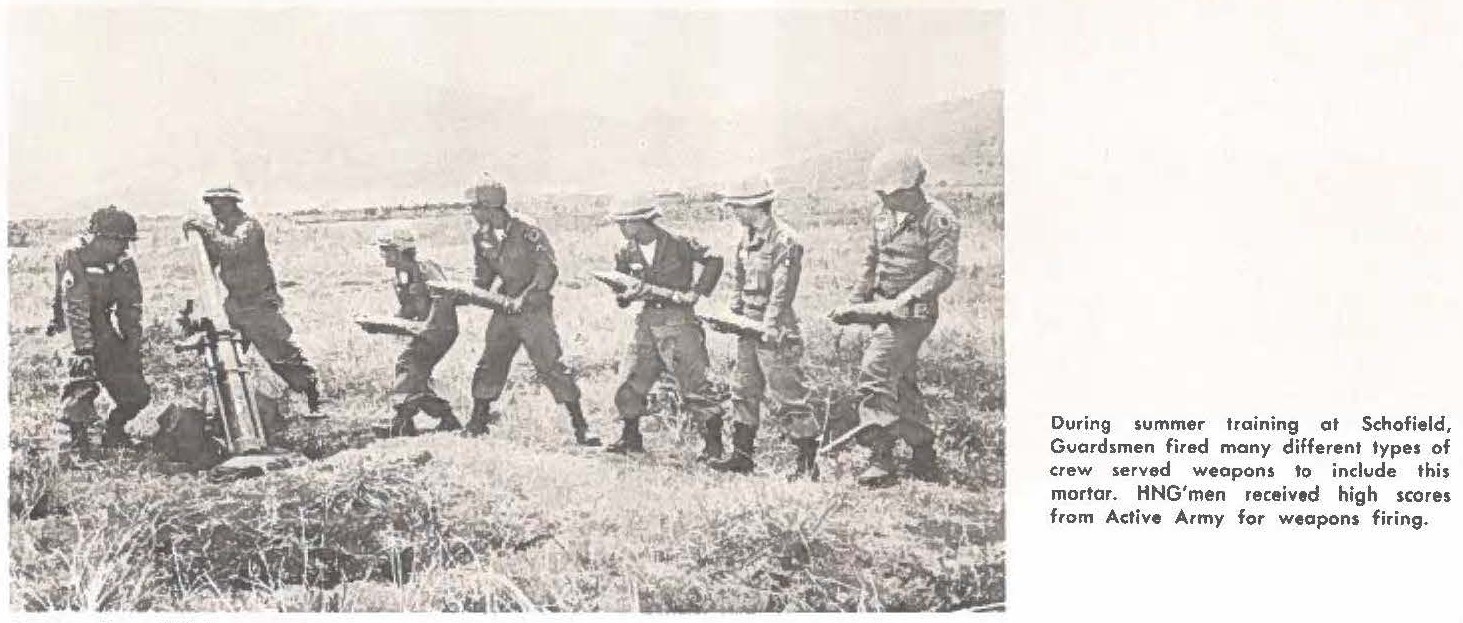
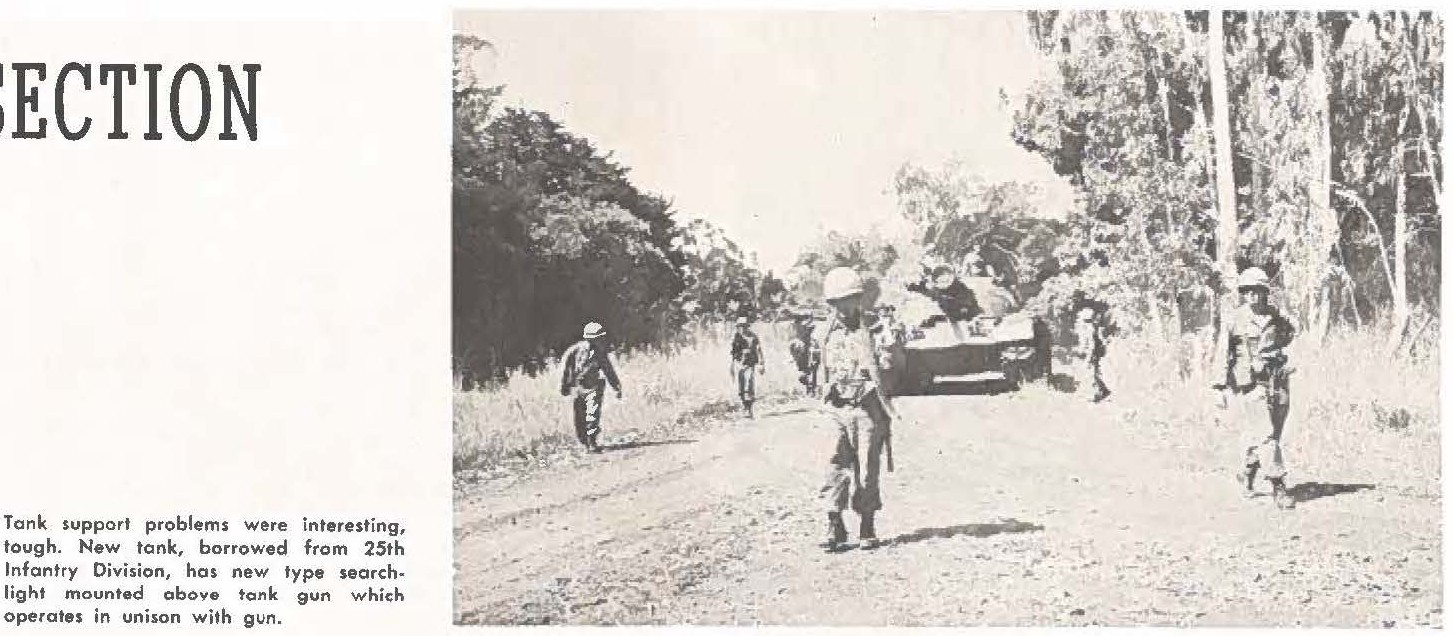
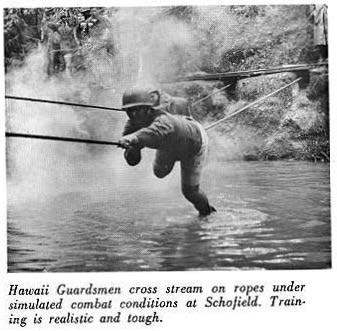
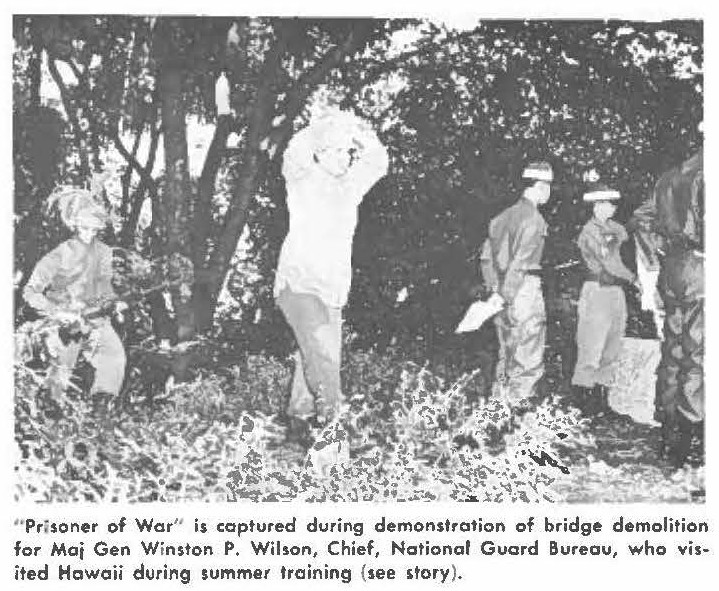
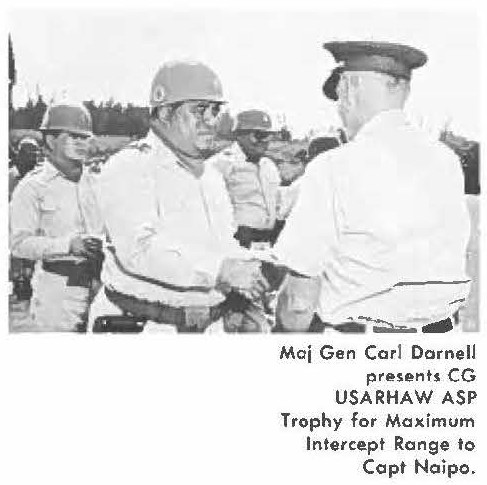
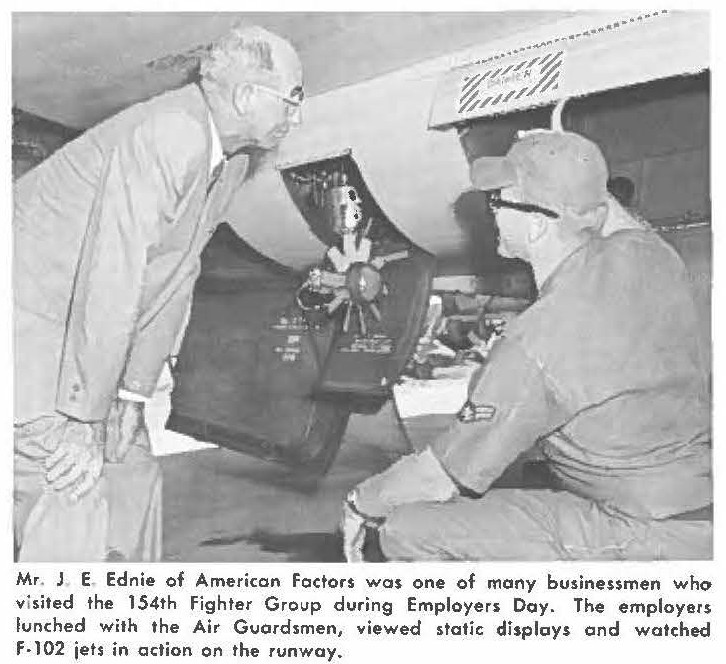
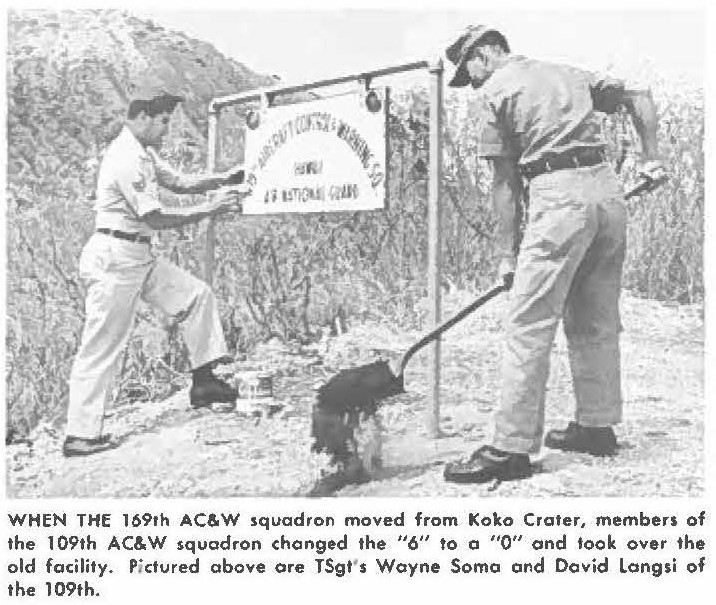
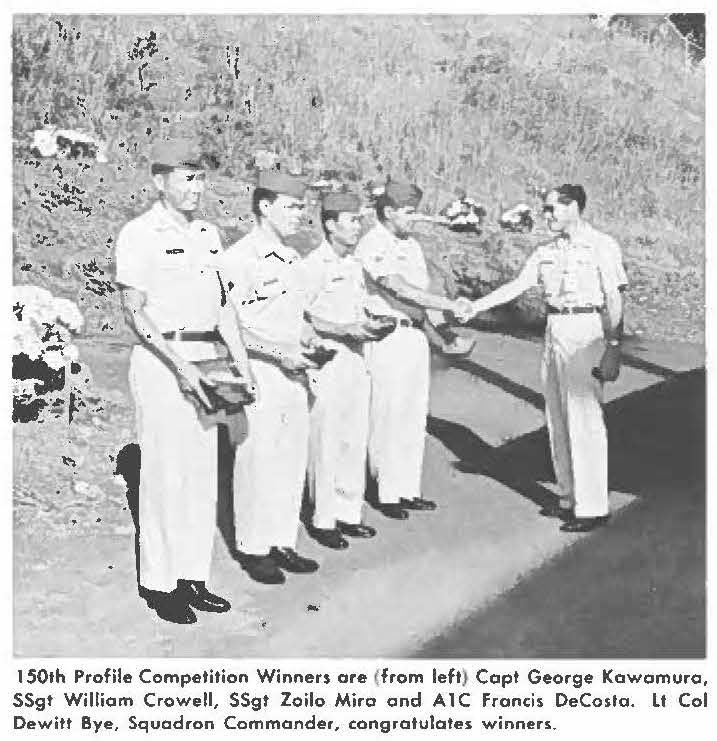
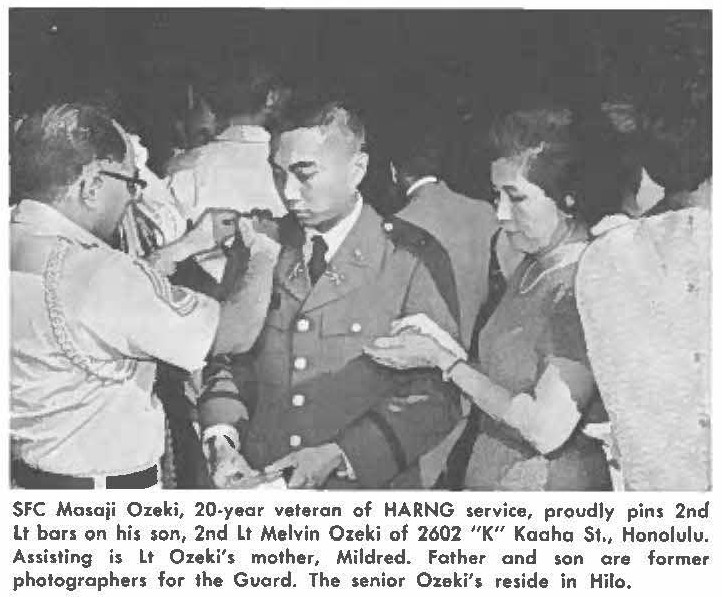
Exchange Airmen from the Utah Air National Guard try Hawaiian maneuvers at the 109th squadron annual Luau, held at Honolulu JCC hall on evening of June 18. Hawaii Guardsmen had similar festivities in Salt Lake City, minus the hula, pig and poi. But the steaks were excellent! Sp4 Gary Bennet, 1st Bn, 185th Infantry, California Army National Guard, writes a short letter home from his “home” at tent city, Area ” X.” The Hanford, California G’ man found Hawaii “friendly, scenic.” The exchange of Cal and Hawaii G’men, called “Guardlift I” by Guard planners, was officially considered ” highly successful” by the Guard Bureau. Rope is most important to jungle fighters, Here, Guardsman demonstrates another type of rope crossing during training at Schofield,Guardsman swings on rope for 40-foot drop. Platform simulates helicopter. The winning team of the Air Guard 1964 Summer Camp Profile Competition pose next to one of the 199’s F-102A aircraft. Left to right, 1st row: Flying team members Capt Alex Bell, Lt George Kuroda, “8” Flight Commander Maj Ross England, Capt Joseph Ah New, Capt Marlin Little and Lt Donham Walker. 2nd row: SSgt Abraham Forges (Team Chief), A1C Alvin Johnson (Crew Chief), SSgt Paul Keoloho (Crew Chief), A IC Kenneth Sakai and A IC Gerald Chun. 3rd row: SSgt Jose Aquino, A2C Raymond Lum, A2C Ronald Chun, A2C Lester Nakata, A2C Xavier lkei, A1C Wallace Yara and TSgt Gordon Lum. Missing from picture are winning GCI Directors, Capt Roger Watanabe of 109th ACWRON, Capt Walter Watanabe of 169th ACWRON and Capt Reginald Doi of the 150th ACWRONDuring Governor’s Day Review, held at Schofield during June these Guardsmen received the following awards: (L to R) Eisenhower Trophy to Capt Samuel K. Naipo, NG State Trophy to Capt Raymond Rapozo, Commanding General HARNG Trophy to 1st Lt Romuldo Madarang, 30-year service bar lo the HNG Service Medal to 1st Sgt E-8 Dallas K. Kalepa, 25-year service bar lo CWO Thomas Spencer, 20-year service bar to Maj David deCosto and the 20-year service bar lo the California ARNG service medal to CWO Elza Nidever and CWO William E. Rice, both of the California Army Guard. Father and son photographer team were responsible for taking many of the excellent photos in this magazine. Pvt Melvin Ozeki and father SFC Masoji Ozeki make camera checks before going out on assignment, Father resides in Hilo while son lives in Honolulu,Maj Gen Robetrt L. Stevenson, Hawaii AG (left) and Maj Gen Rodney L. Hill, Adjutant General of Californio visit with Maj Gen Carl Darnell, Jr (right), Commanding General of USARHAW. General Hill visited Hawaii to inspect his California troops toking jungle training at Schofield with elements of the HNG. Maj Gen Winston P. Wilson, Chief of the Washinglon National Guard Bureau (with camera slung over shoulder), inspects Royal Guardsman Ted Hussey during his visit to the 154th Fighter Group. During his four-day visit, General Wilson inspected Air Guard facilities and witnessed Nike Hercules missile firing at Kahuku. Officers pictured with Wilson are L to R: Col James Ashford, 154th Fighter Group Commander, General Stevenson and General Valentine A. Siefermann, Air Guard commander. The Air Guard’s 109th Aircraft Control and Warning squadron, located al Punamano (Kahuku), Oahu, closed down operations in mid-July ofter 8 years of operation. The site was the nation’s first ANG radar station to go into 24-hour operation. Air Guardsmen of 109th are now sharing Koko Head radar facility with 169th AC&W sq. When the 109th moves to the soon-to-be-completed Mount Koala radar site, the 109th may continue to operate Koko Head station. Koala site should be ready by mid-1965. The Royal Guard participated and two F-102 jet fighters thundered overhead at close of ceremonyGovernor Burns visits Air Guard shops at Hickam during summer training. Accompanying the Governor is Maj Gen Robert L. Stevenson (hidden behind Burns) and Col James Ashford, 154th Fighter Group commander. Talent Show, held at Schofield during mid-comp, was highly successful, Much professional talent from local night clubs was present to delight Hawaii and California Guardsmen. Unfortunately, as happens each year, many Guardsmen were not informed by their units on date and time of show. Although attendance was small at the beginning, show ended with packed “house.” The 117th Information Detachment had responsibility for show.After planeside greeting, 576 Cal Guardsmen enjoyed hula show and pineapple juice at Hickam. The majority of California Guardsmen received fresh leis upon arrival. Royal Guard was also on hand to add color lo festivities. Aircraft which deposited Cal Guardsmen look Hawaii Guardsmen to California on the following day. Unidentified California Guardsman is given typical Hawaiian greeting by Miss Hawaii contestant upon arrival at Hickam AFB for jungle training at Schofield. Although California Guardsmen enjoyed training in Hawaii, most admitted jungle and guerrilla warfare was tough. During field day exercises, Sgt Manuel (Curley) Benevides got hails of laughter from fellow Guardsmen when he quipped, “No mo hair ova dair.” L to R: Milton Crivello, Lionel Arruda, Robert Cravalho, Curley, Richard Nakamura, Daniel Frias and Roy Hinokawa, During June Governor’s Day festivities at Schofield, Governor John A. Burns reviewed troops; commented on the excellence of the HNG. Standing next to Burns is Brig Gen Francis Takemoto, CG of the 29th Infantry BrigadeCamera catches rare moment when simulated mine explodes as Guardsmen probe for mines during trainingDuring visitors day at 109th AC&W squadron held in June, friends and relatives of Guardsmen inspected 109th facility. For many, this was the first time they had visited the station. Guardsmen make their way through thick jungle during the training. This tropical growth is very similar to the jungles of Viet Nam Single rope crossings were most difficult. Occasionally, Guardsmen would slip off rope and plunge into water. Active Army personnel (for right) in water were ready to assist those who fell.A2C Llewellin Gay, wife Diane and Llewellin Junior enjoy lunch during visitors day at the 109th AC&W squadron. TUG-O-WAR at Schofield during field day exercises, proves that summer training isn’t all work.Reaching speeds of over 35 mile. per hour, HNG’man slides down “slide for life,” o slick wet line spanning a brood expanse of waterExcellent night shot shows firing of 106 Recoilless Rifle by Guardsmen during training. Hawaii Guardsmen go through Code of Conduct school at Schofield during 1964 ACDUTRA. Although school was tough, all agree it was on interesting experience. The Harmonics, entertaining at the Schofield Talent Show during mid. camp, was one of the most popular musical groups on stage that evening. All shows were entertaining, Guardsmen are briefed on night problem.Sp4 Makoto Oto of Army Aviation section, guides aircraft to parking spot. Three strand rope bridge is easiest to use, hardest to construct. During summer training at Schofield, Guardsmen fired many different types of crew served weapons to include this mortar. HNG’men received high scores from Active Army for weapons firing. Tank support problems were interesting, tough. New tank, borrowed from 25th Infantry Division, has new type searchlight mounted above tank gun which operates in unison with gun.Airmen hosts show their bosses close-up view of F-102 armament du ring 154th Fighter Group’s Employers Day held in June. (L to R: Mr. Anthony Molina and Mr. Ernest Ayala of Hawaiian Telephone Company with host A2C Jack Hope. Mr. Archie Viele and Mr. Henry Ako, State Bureou of Conveyances with host A2C Albert Form. (Pictures from the 1964 September The Hawaii Guardsman)
The HANG short summer camp was held 15-19 June 1964 at home stations as usual. OPERATION BIG SWITCH II caused 60 HANGmen and 60 UTAHmen of AC&W units to cross-train as they had the previous year. The fighter group invited employers of HANGmen to visit their encampment 16 June 1964. Competition being the spice of life, the 199th FIS conducted a Profile Competition. The winner was “B” Flight, commanded by Maj Ross F. England. Major General Winston P. Wilson, now Chief of the National Guard Bureau, visited the HANG units.
HNG’MEN TO ARIZONA Biggest news to date for 800 Big Island Guardsmen is that the 1965 Summer Field Training will he at Ft Huachuca, Arizona via C-97 airlift to California between 12 June and 26 June 1965. Although not guaranteed definite, “ARIZONA IN ’65” is the battle cry resounding through the armories, which in lighter version goes:
“SNAKES, SAND, AND SPIDERS WE DO NOT FEAR NOGALES SENORITAS, WE ARE HERE.”
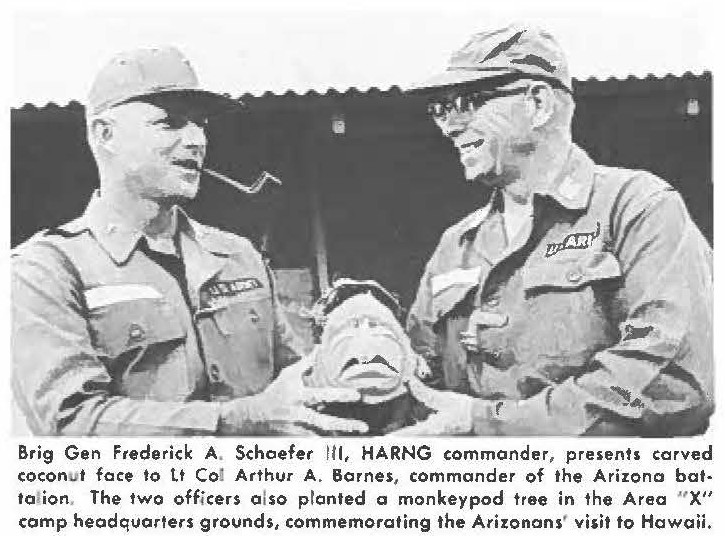
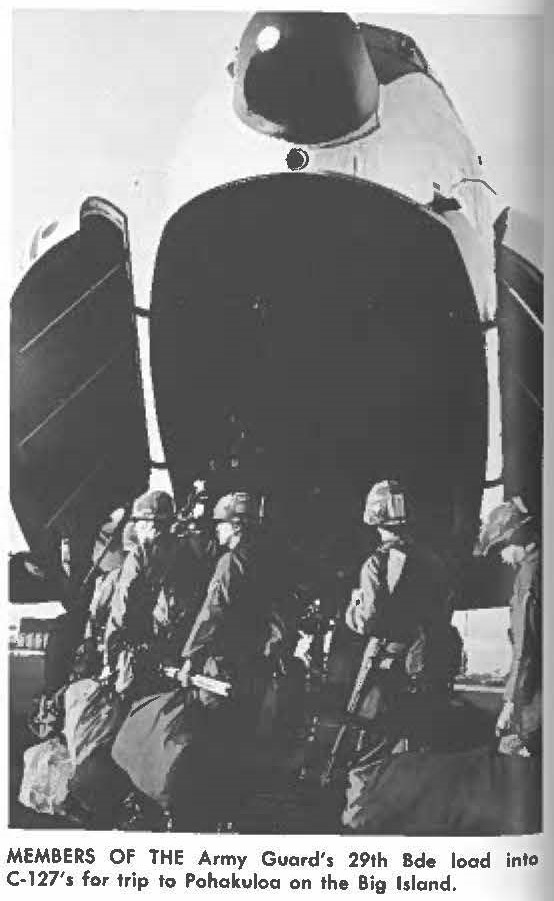
With the exception of the Selective Service Section and the 298th Artillery Group, all units of the HARNG trained during the period 12-26 June 1965. HQ & HQ Det HARNG, 227th Engineer Battalion, 613th Ordnance Company, 120th Military Police Company, 111th Army Band and 117th Public Information Detachment trained at Schofield Barracks, Oahu. The 29th Infantry Brigade (-) and the 284th Transportation Compony trained at Pohakuloa Training Area, Hawaii. The 2d Battalion, 299th Infantry exchanged training sites with the 3d Battalion, 158th Infantry of the Arizona Army National Guard in Guard, lift 11. The 2d Bn, 299th Inf trained at Fort Huachuca, Arizona, while the 3d Bn, 158th Inf trained at Schofield Barracks, Oahu.
The three infantry battalions of the 29th Inf Bde completed company level army training tests during the year and will be preparing to go into battalion level exercises during the next Annual Field Training period. Other units completed either section or platoon level training and will be advancing to platoon or company level training al the next AFT.
Units of the 298th Arty Gp conducted AFT on their respective sites during the period 10-24 July 1965. The Selective Service Section of HQ & HQ Det, HARNG, trained at Whidbey Island Naval Air Station, Washington, during the period 10-24 July 1965.
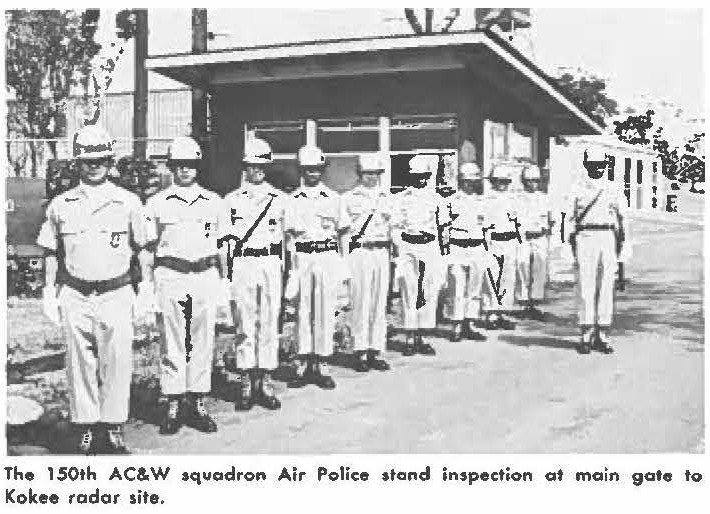
The HANG commenced FY 1965 field training with a no-notice Operational Readiness Inspection by the Pacific Air Forces on 12 June 1965: The 154th Ftr Gp (AD), 199th Wea Flt (M), and 109th ACW Sq (Fi conducted the traditional 15 days summer camp while the 150th and 169th ACW Sqs ( F) continued with the year round field training program. Ninety-seven percent of assigned Guardsmen fulfilled their annual active duly requirement. Deployment Operations were conducted during the All HANG training period. The 109th ACW Sq (F) field trained at the Koko Crater AFS with full use of the equipment, facilities and talents of the 169th ACW Sq (F). The 109th’s communications personnel were assigned to the 1957th Comm Gp at Hickam AFB for orientation and OJT with their active duty counterparts. Kauai Air Guardsmen completed the nine days of year round field training with operational activities and messing being conducted at the Kokee site, and classroom and administrative functions being handled at the Kekaha Armory.
The 169th ACW Sq (F) had two big orders to fill during camp. While maintaining the 24 hour air defense mission at Koko Crater AFS, they had to orient their personnel on the new equipment, operating instructions and join-use radar procedures for the Mount Kaala/Wheeler complex. Big Switch III gave 115 Hawaii and Utah Guardsmen an opportunity to observe a similar mission performed at each other’s stations.
The Hawaii Army National Guard minus the Air Defense missile units will be at ANACDUTRA during 12-26 June 1965.
The disposition of the units during this period is as follows:
Schofield Barrack, and Complex
HQ HARNG
227th Engr Bn
2d Bn 158th Inf (Guest Bn from Arizona)
613th Ord Co (-)
120th MP Co
111th Army Band
117th Pub Info Det
Pohakuloa Training Area, Hawaii
HHC 29th Inf Bde
1st Bn 299th Inf
3d Bn 299th Inf
284th Trans Co
Support Elements
Ft Huachuca, Arizona
2d Bn 299th Inf
At Schofield Barracks HARNG units will be supporting various activities and at the same time fulfilling their AFT requirements. The 227th Engr Bn will be constrncting the pistol range in Diamond Head crater, constructing a road to a Boy Scout Camp in the Koolaus, and working on other engineer projects together with Regular Army Engineer units. All units except HQ HARNG will participate in the four days and four nights of bivouac during this period.
The 2d Bn 158th Inf, the exchange Bn from Arizona, goes through Phase I of Jungle and Guerrilla Warfare Training and Code of Conduct Training during the first week and Phase II of the JGWT at Kahuku during the second week.
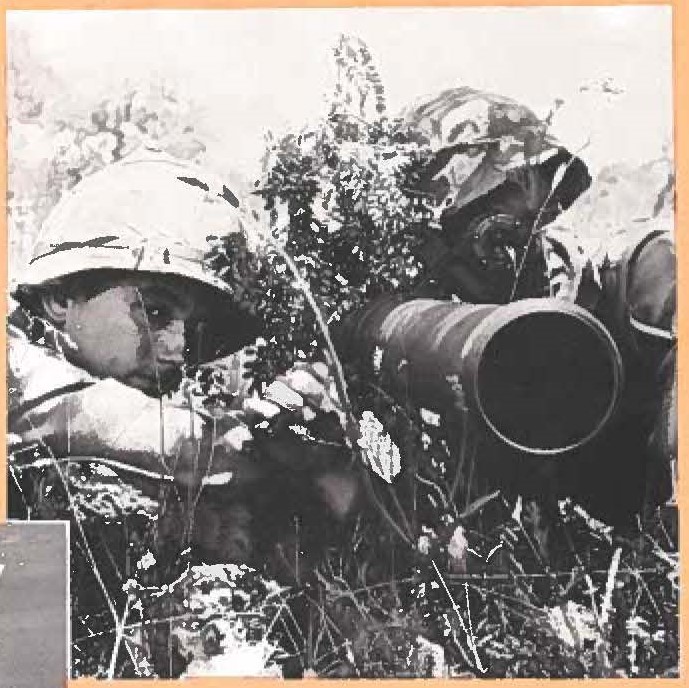
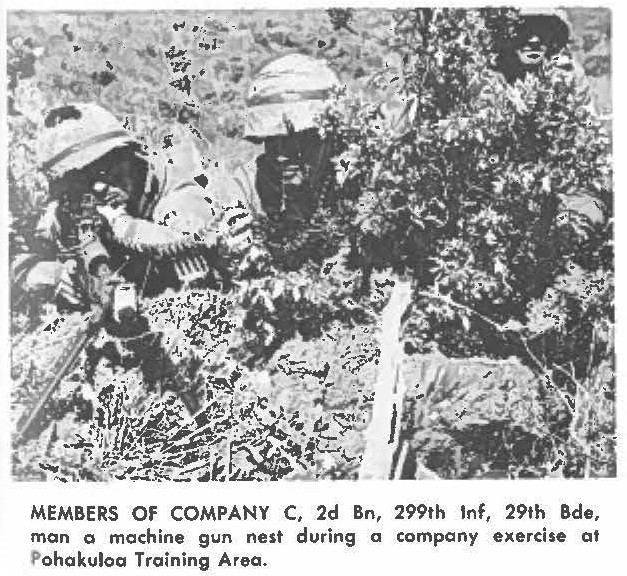
At Pohakuloa Training Area, the 29th Inf Bde minus the 2d Bn 299th Inf, will be participating in Company type Army Training Tests. All units to he tested during this summer encampment are at present busily making preparations for the tests. The test involves close teamwork, for it encompasses problems in day and night defense, retrograde movement, and the company in attack.
The 2d Bn 299th Inf will be training at Fort Huachuca, Arizona. In the early history of the United States this is the area where many bloody Indian battles were fought. This area then would be very appropriate for the 2d Bn to conduct its company ATTs.
The Air Defense units will he at AFT during the month of July. These units will he busy during the months of May and June firing their Annual Service Practice at Kahuku.
The Officers Candidate School is scheduled for 5-19 June 65 at the Helemano Training Site. At present there are 23 candidates in the Class of ’65 and an enrollment of 36 is expected for the Class of ’66.
HAWAII AIR GUARD
Utah Trip
The feature event of the Hawaii Air National Guard for summer camp 1965 is Big Switch III. For the third consecutive year, a cross training arrangement has been made with the Utah Air National Guard.
Sixty men will be winging their way to Salt Lake City on a Utah Air Guard C-97. The allocation of personnel has been set at ten men each from the 154th Ftr Gp (AD) and 109th ACW Sq and 20 men each from the 150th and 169th ACW Squadrons.
As in the past, the men will be ambassadors of goodwill for our State and the visitors from Utah will be accorded the full Aloha treatment by the hosting units.
Major William Mossman is the project officer and is assisted by Captain Daniel Au.
154th Fighter Group (AO)
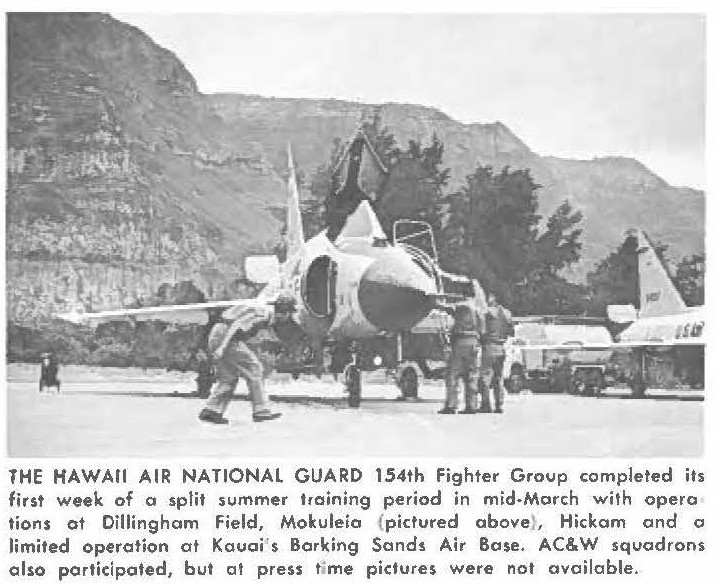
The 154th Ftr Gp has exciting if not hectic plans in the mill for their field training from 12 to 26 June. Elements of the 154th may be training at Bonham ALF, Barking Sands, Kauai, Dillingham AFB, Mokuleia and at Hickam. At the same time the unit will be busy with an aircraft modification program.
The highly successful employers’ day held last summer camp is being seriously considered for a repeat this year. The response and interest shown by the employers in 1964 were most gratifying. It pays to let your employers know what you do as a Guardsmen.
109th ACW Squadron
The 109th ACW Sq will he training at Koko Head from 29 May to 12 June. Since the Koko Head Radar Station will be closing on or about l July, much of the activity of the unit will be in the move to the Wheeler Field operations site and orientation on the new facilities.
150th ACW Squadron
The 150th ACW Sq will he in for some cool living at Kokee from 12-20 June. It will he the haven for staff and other visitors to escape from the summer heat.
Operational readiness will be their prime training criteria.
An employers’ day is being planned.
A half a dozen wild pigs should he placed in a pen shortly for their annual luau.
169th ACW Squadron
The 169th ACW Sq will have their hands full from 14 to 23 June moving and getting their Wheeler Field and Mount Kaala sites operational for the 1 July target date.
The unit will be bidding farewell to Koko Head with a big luau at the close of camp. It should be the best of many staged over the years.
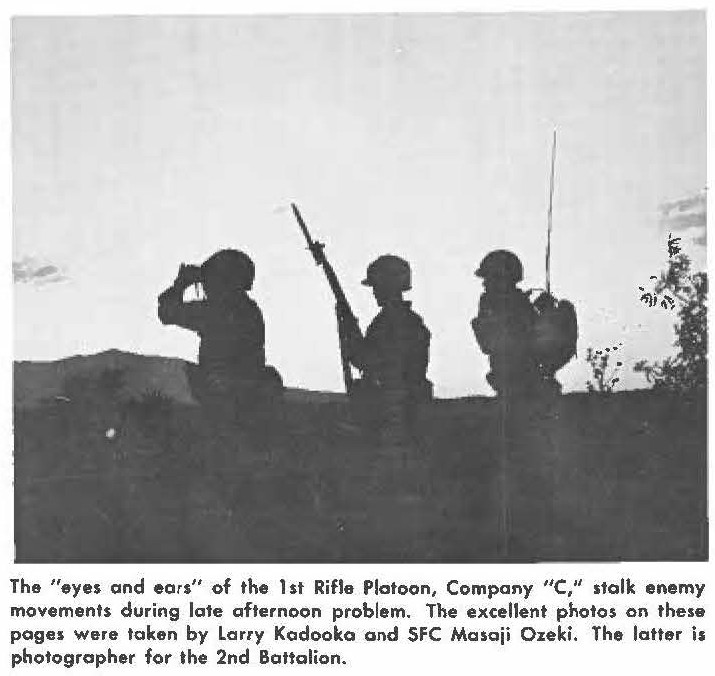
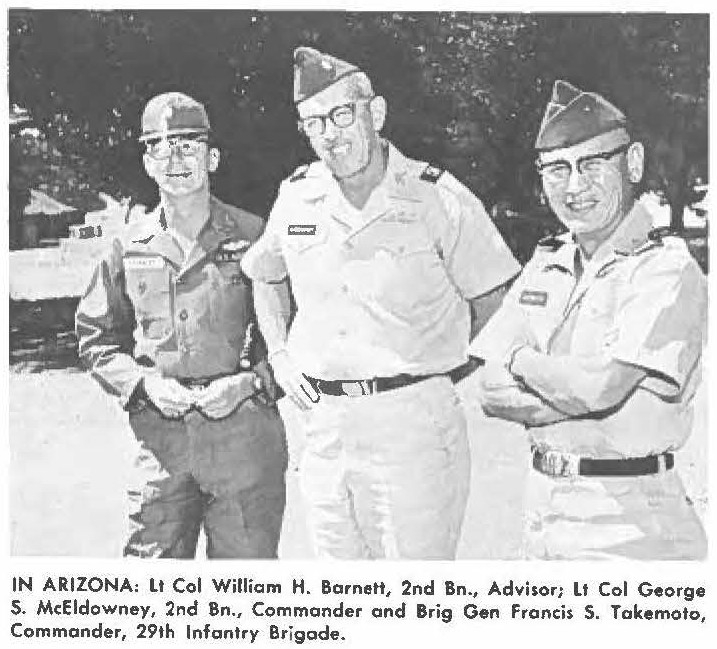
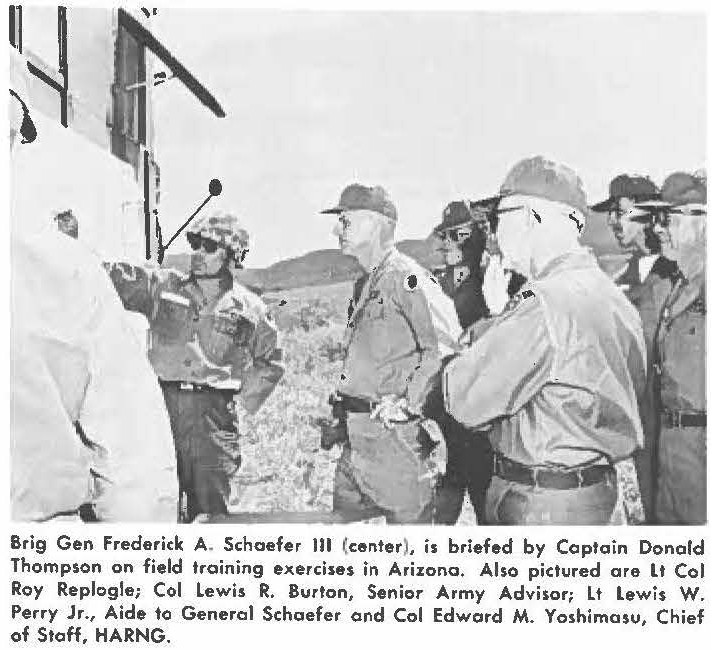
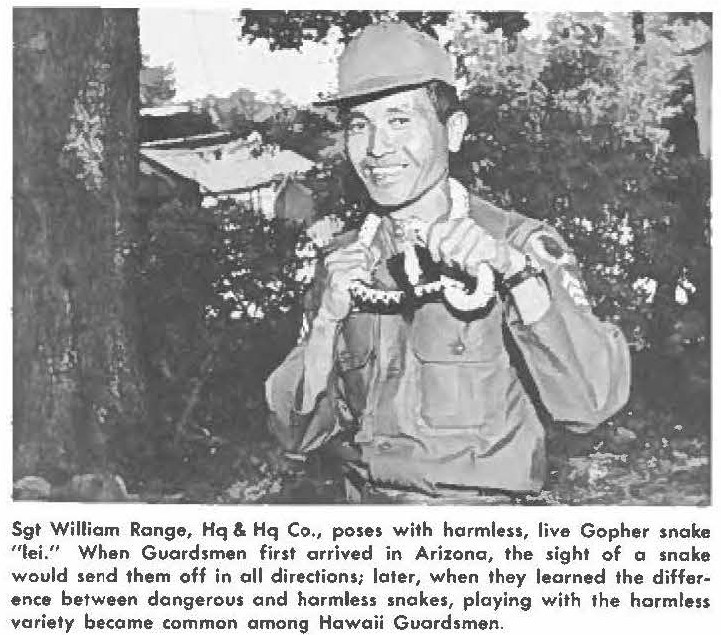
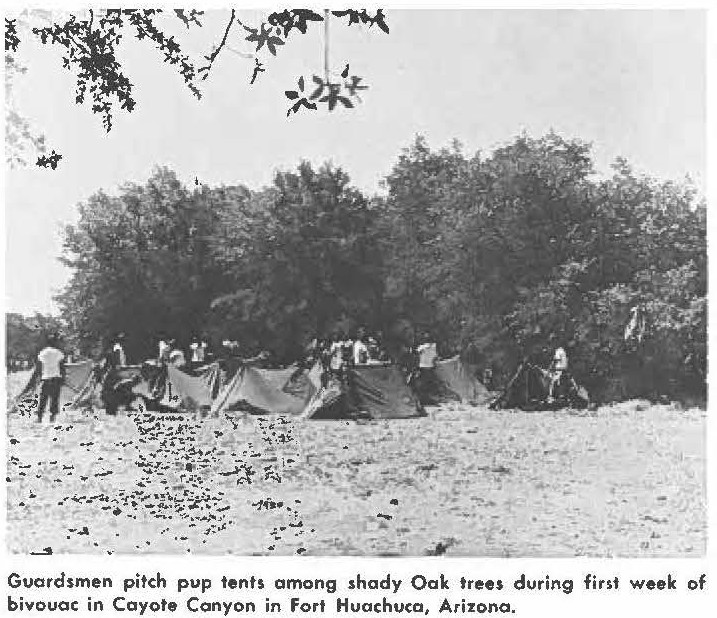
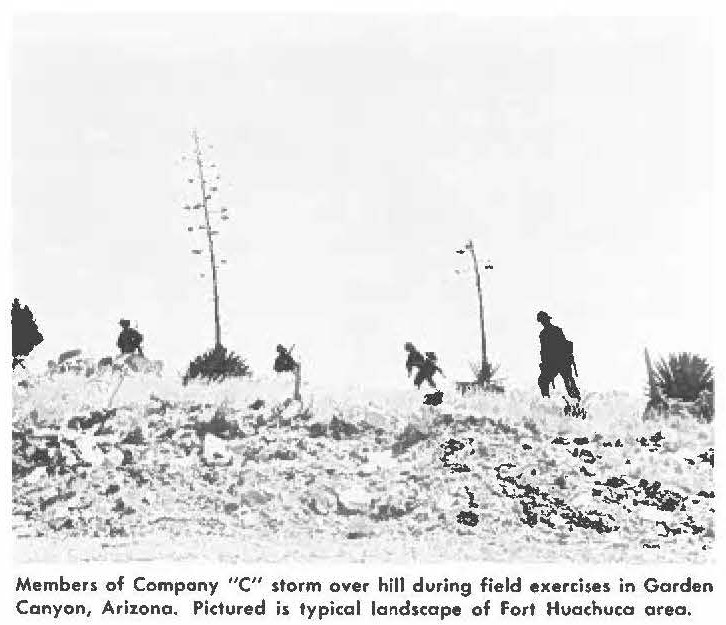
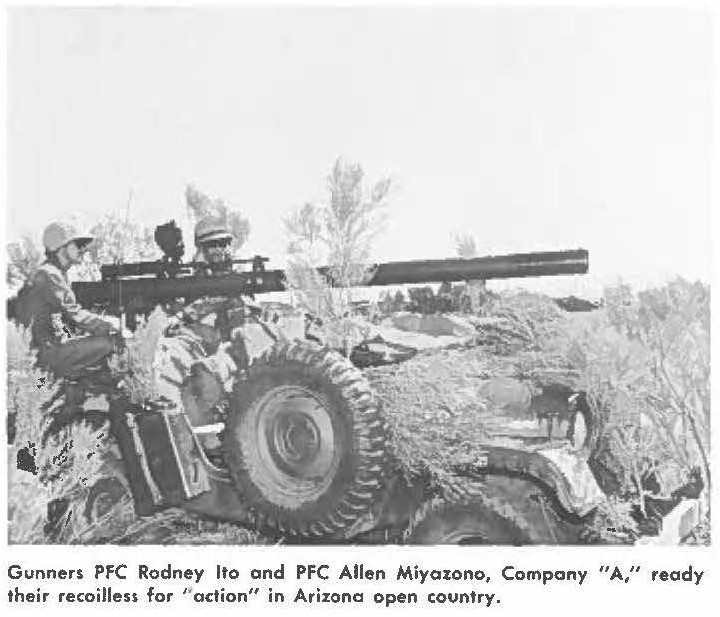
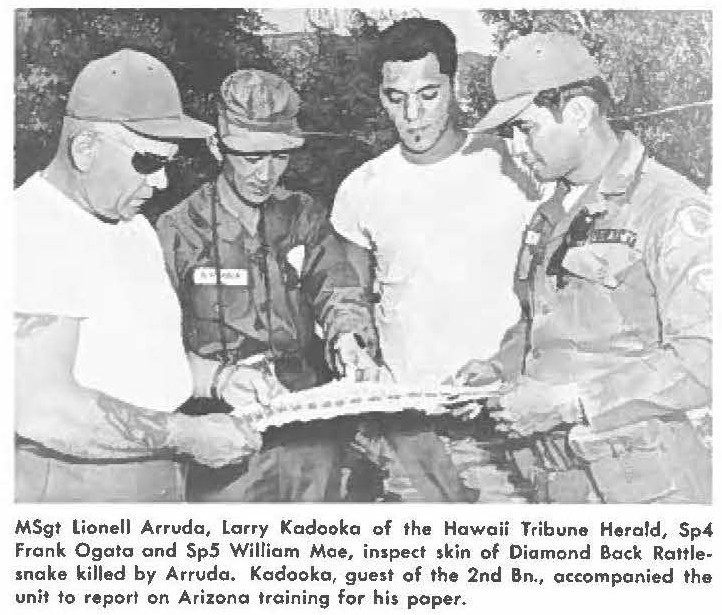
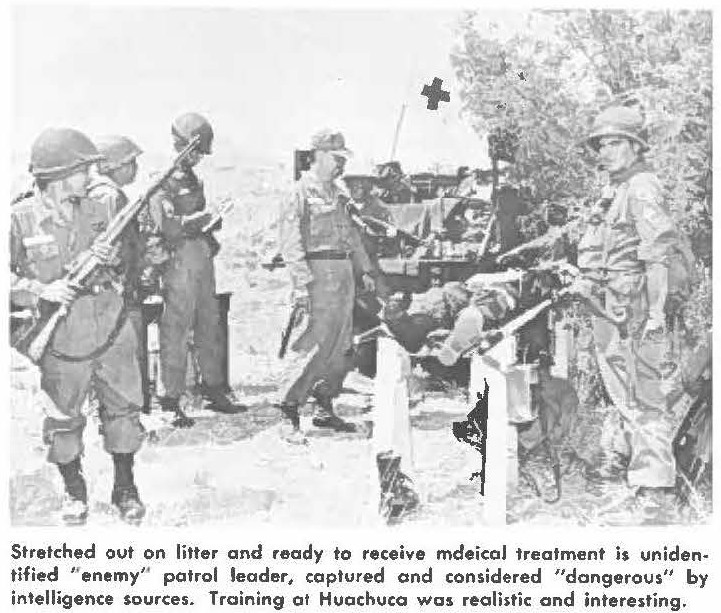
Summer TrainingThe “eyes and ears” of the 1st Rifle Platoon, Company “C,” stalk enemy movements during late afternoon problem. The excellent photos on these pages were taken by Larry Kadooka and SFC Masaji Ozeki. The latter is photographer for the 2nd Battalion. IN ARIZONA: Lt Col William H. Barnett, 2nd Bn., Advisor; Lt Col George S. McEldowney, 2nd Bn., Commander and Brig Gen Francis S. Takemoto, Commander, 29th Infantry Brigade. Brig Gen Frederick A. Schaefer Ill (center), is briefed by Captain Donald Thompson on field training exercises in Arizona. Also pictured are Lt Col Roy Replogle; Col Lewis R. Burton, Senior Army Advisor; Lt lewis W. Perry Jr., Aide to General Schaefer and Col Edward M. Yoshimosu, Chief of Staff, HARNG.Sgt William Range, Hq & Hq Co., poses with harmless, live Gopher snake “lei.” When Guardsmen first arrived in Arizona, the sight of a snake would send them off in all directions; later, when they learned the difference between dangerous and harmless snakes, playing with the harmless variety became common among Hawaii GuardsmenGuardsmen pitch pup tents among shady Oak trees during first week of bivouac in Coyote Canyon in Fort Huachuca, Arizona. Members of Compony “C” storm over hill during field exercises in Garden Canyon, Arizona. Pictured is typical landscape of Fort Huachuca area, Gunners PFC Rodney Ito and PFC Allen Miyazono, Company “A,” ready their recoilless for “action” in Arizona open country. MSgt Lionell Arruda, Larry Kadooka of the Hawaii Tribune Herald, Sp4 Frank Ogata and Sp5 William Mae, inspect skin of Diamond Bock Rattlesnake killed by Arruda. Kodooko, guest of the 2nd Bn., accompanied the unit to report on Arizona training for his paper. Stretched out on litter and ready to receive medical treatment is unidentified “enemy” patrol leader, captured and considered “dangerous” by intelligence sources. Training at Huachuca was realistic and interesting. (Pictures from the 1965 September The Hawaii Guardsman)
Early in November 1964, a letter went out from the Battalion Commander, 2d Bn 299th Inf, HARNG, to all employers of Guardsmen on the island of Hawaii. This letter served as advance notice of the impending participation of the Battalion in Guardlift II. Several items were stressed: the objectives of the Guardlift program, the benefit to the men involved, and the necessity for full attendance to accomplish proper team training. Similarly, a letter was sent to the family of every man in the outfit. During the ensuing months, three other letters were sent to employers and families, informing them of plans and progress, and in each was a pitch for cooperation.
This mild form of propaganda was the first excursion into Psywar for our Battalion, hut it apparently paid dividends. At the unit level, it was accompanied by bulletin hoards with travel information, starting with pictures of the planes that would transport us, a map of the destination area, and more detailed pictures of Fort Huachuca and vicinity. A field training attendance percentage of 94 per cent is one that we have exercise some exceptional problems this year.
Whatever the case, planning pays off. Certainly, our experience in moving the Battalion from Hilo, Hawaii to Fort Huachuca, Arizona, proved the validity of this time-worn cliche. The planning actually started almost concurrently with the end of 1964 Annual Field Training. We anticipated continuance of the Guardlift program and we were reasonably sure that our Battalion would he the one selected to participate. Tasks were assigned to various staff officers, with instructions to do background study and estimate problems that might be encountered.
By January of 1965, a directive on the required four day continuous tactical exercise had been published, along with a compilation of specific reading references for all training exercises. A tentative Master Training Schedule was issued and writing of lesson plans and scenarios for tactical problems commenced. Our weekend drills, meanwhile, were being used to practice Company ATT’s, since we knew successful completion of these would be one of our major objectives. Simultaneously, a steady stream of correspondence concerning our logistical requirements was going to our higher headquarters for consideration in their coordinating conferences.
Members of the Battalion made their Pre-camp reconnaissance in late March. Here again, there is no substitute for on-the-ground familiarization of an area. In addition to the Battalion Commander, S3, and S4, several other staff members made the trip on their own time and at their own expense. A comprehensive knowledge of the training facilities was thereby gained and put to good use later. Immediately upon return to Hawaii, a training memorandum, covering the Annual Field Training period, was issued.
A NGB conference in Washington, D. C., in early April set up the air transport operation. This was supplemented by an on-the-spot coordination conference between representatives of the 146th Air Transport Wing and ourselves in May. The close cooperation of both transported and transporting personnel was one of the outstanding elements in the success of our movement.
Now came the task of tying everything into an operational vehicle. We elected using an OP LAN for this purpose. An imaginary extension of the Cuban revolt created a General Situation with a Central American insurrection theme. Eight successive situations were then incorporated, each with a broad-scope requirement. Included was the Air movement from Hawaii to Arizona, a preliminary first week of training upon arrival including Company ATT for rifle units, then subsequent simulated combat operations during the second week to fulfill the CONARC four day tactical exercise requirement. The OPLAN was completed with appropriate annexes for all portions of the two week encampment, providing complete staff involvement.
A succession of Intelligence reports generated implementation of our OPLAN a s an Operations Order effective with the beginning of the Field Training period. Fourteen hours on an aircraft is a long stretch, particularly in web seats! Since our Island State mandates an air movement to field training every year, the experience was not new to our Battalion . .. just a great deal more prolonged. A non-stop flight from Hilo to Tucson, then a motor movement to Fort Huachuca. All unit equipment was on an exchange basis with the Arizona Army National Guard–only individual weapons and equipment were carried. It was basically the concept of using pre-positioned materiel on a rapid overseas deployment.
The Camp site selected was just that- a camp site. No barracks for this Battalion, but instead a field bivouac of pup tents in one of Huaehuca’s mountain canyons. To take advantage of the long daylight hours, a training day started at 6:00 and ended (except for night exercises) at 3:00 P.M. The first week included the Company ATT’s as well as Weapons Firing, Advance Guard exercises, Patrolling, Raids, and other exercises. Headquarters personnel were all busily engaged in section operations supporting the rifle units. The Hawaii troopers, brought up in a land where there are no snakes, were slightly apprehensive at first … later turned into real snake killers! During the second week, when the sustained tactical exercise was underway, the Battalion undertook a six mile movement to contact (on foot), subsequent offensive, defensive, relief-in-place actions, and a heavy load of night patrolling and night defensive action. Aggressor activity was provided by a special contingent of our own troops especially trained and uniformed for this purpose.
From a training point of view, there can be little doubt of the value of Exercise Golf, which was the name given to our portion of Guardlift II. The record of the Battalion speaks for itself … reflected in the Superior evaluation rating attained by each company and the Battalion staff. But a great deal more value can be attached to the operation. Many of our men had never been to the “Mainland” before. Recognizing this, we provided scheduled tours to points of interest during off duty hours of the first week. The historic city of Tombstone and the copper mining center of Bisbee were visited by almost all members of the unit. During the middle weekend, a 600 mile bus tour taking in Tucson, Old Tucson, the Desert Museum, Phoenix, and Nogales in Mexico was set up. Over 300 of our men took advantage of this trip, while others chartered a flight to Las Vegas for a fling at the bright lights. There was unity and esprit in all of these undertakings … people did not meet us as individuals from Hawaii, hut rather as members of the Hawaii Battalion. Certainly, the travel experience and exposure to a different manner of living was as educational to us as was the training itself.
And what of the lessons learned? Our emphasis for the past several years has been in the area of “Jungle Warfare.” … Here instead we learned open country, almost desert warfare tactics. We learned what the change from a semi-tropical humid climate to a low-humidity, high-heat area is like, and learned how to adjust to it. We learned a great deal about movement and mobility, both in the air and on the ground. We learned the difficulties as well as the benefits of operating independently away from a higher headquarters. We learned the elements of cooperation and coordination with other branches, with Post complements, with Commands that were strangers to us. We think we acquired a great deal of the knowledge that goes towards making both men and units more professional in soldiering. Certainly, we learned that we would like to try it again!
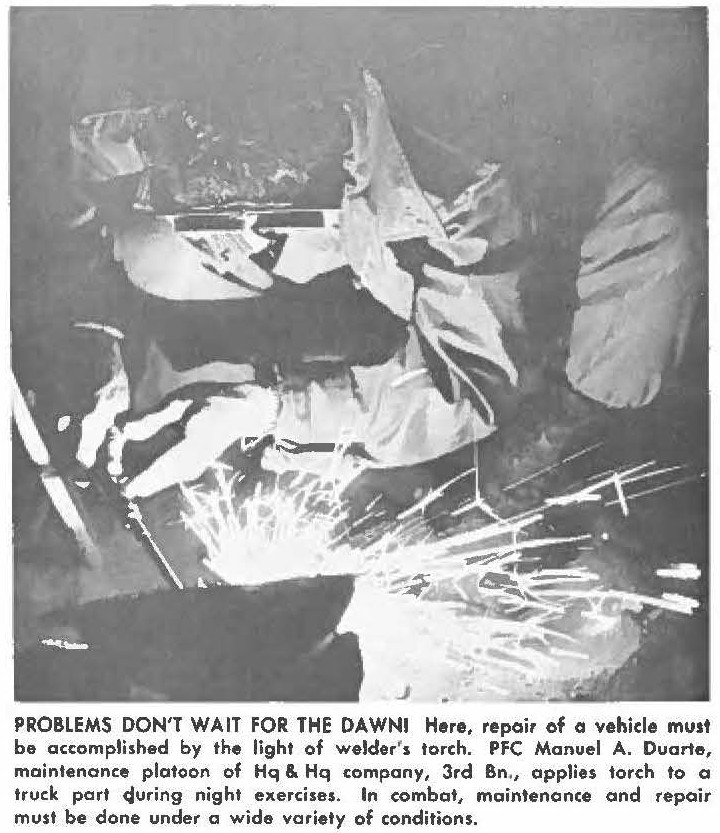
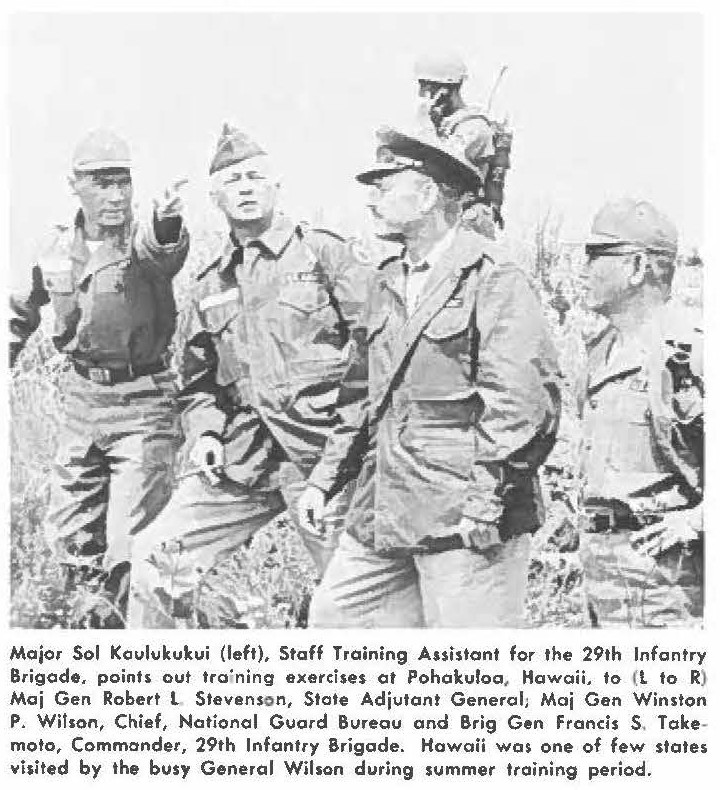
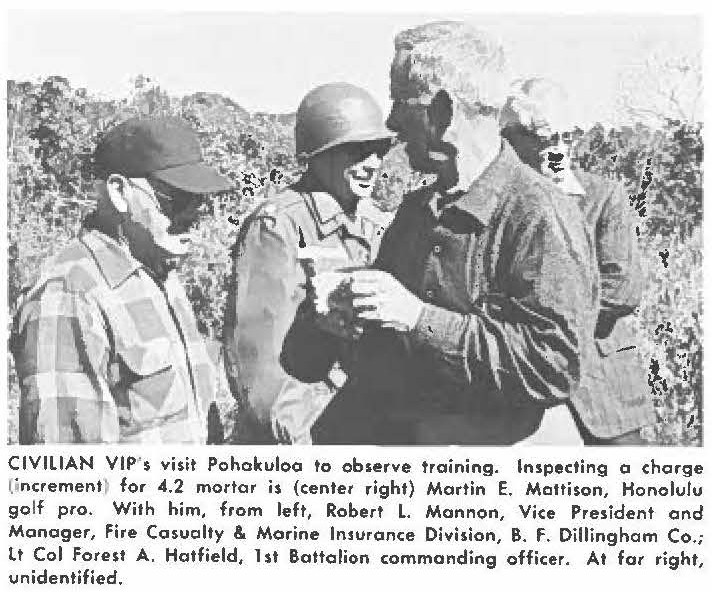
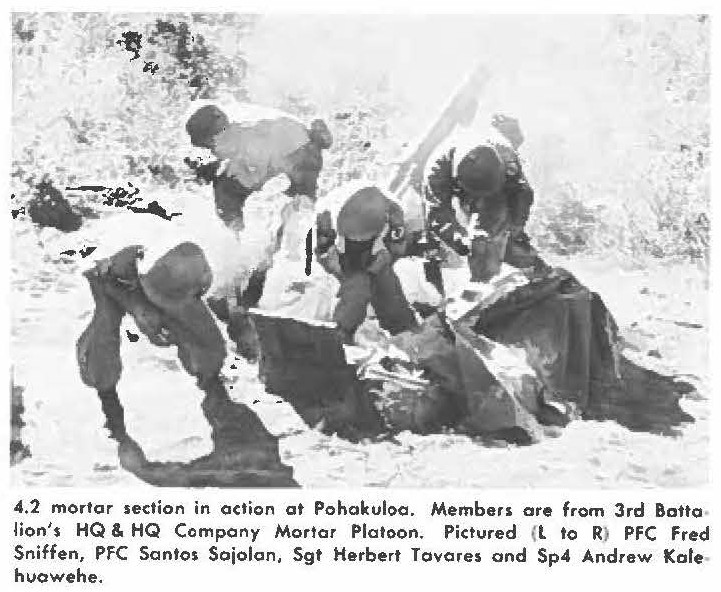
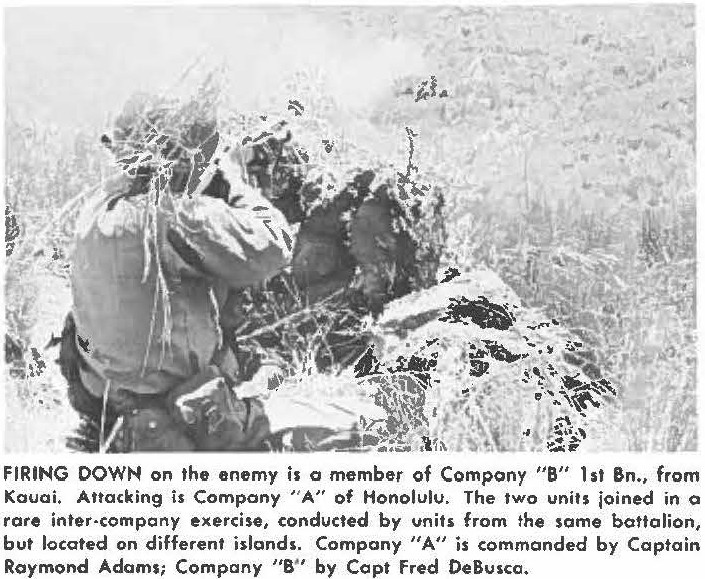
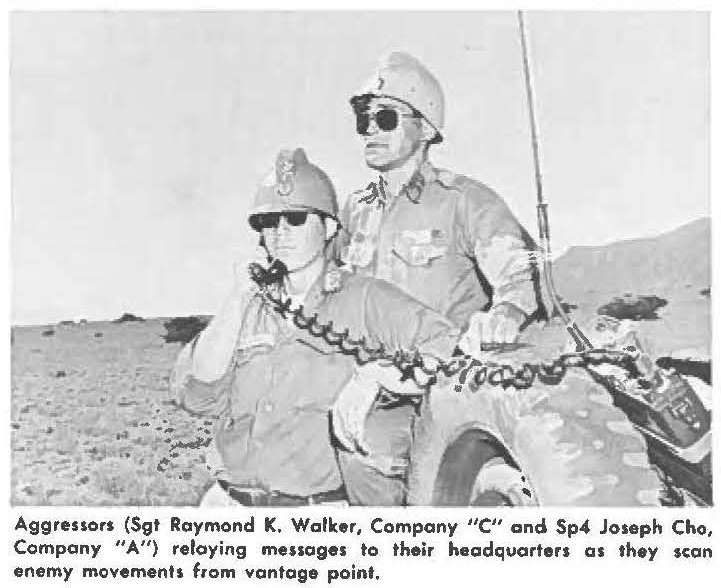
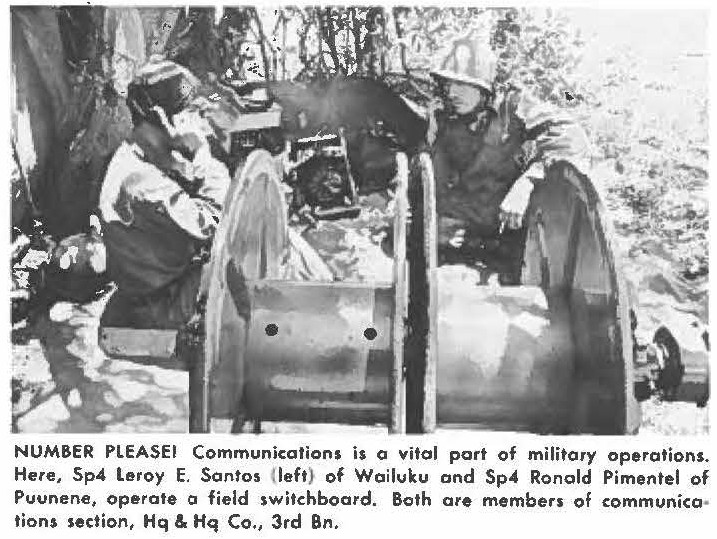
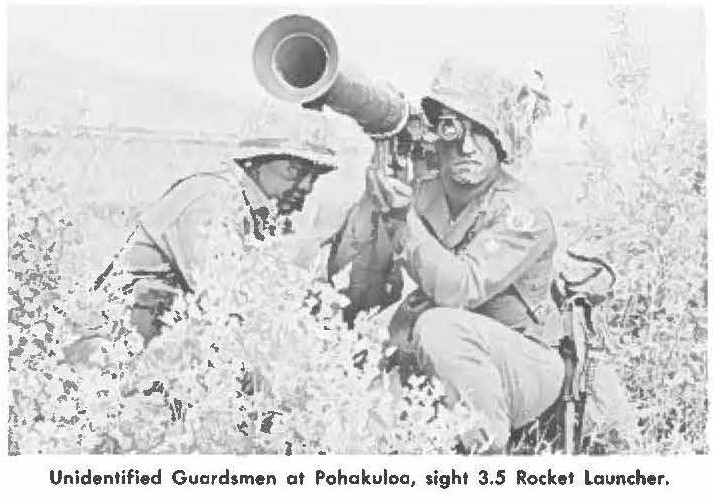
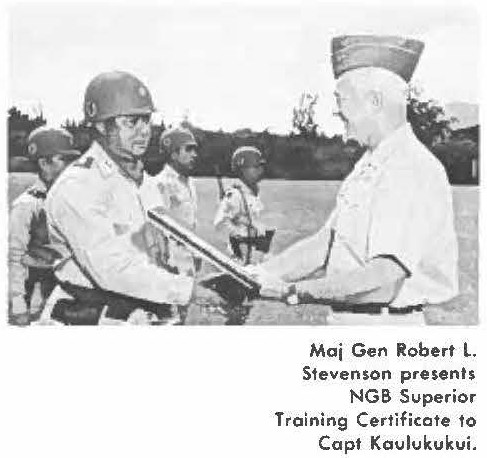
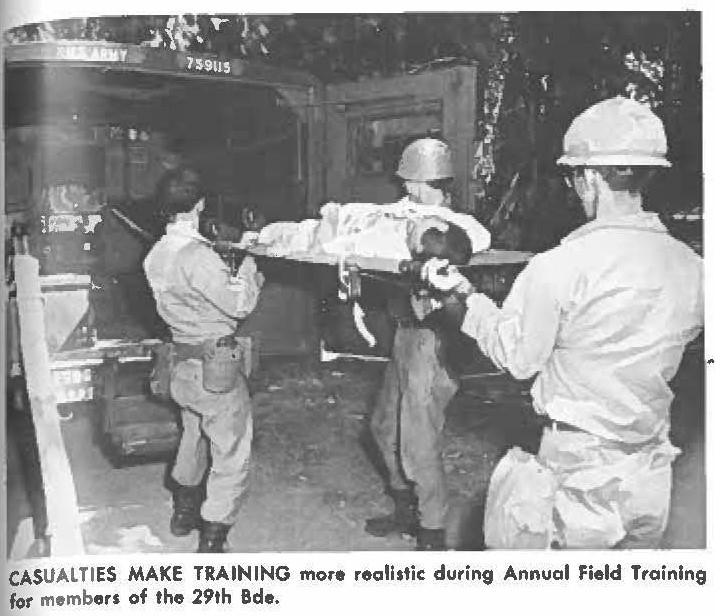
PROBLEMS DON’T WAIT FOR THE DAWN! Here, repair of o vehicle must be accomplished by the light of welder’s torch. PFC Manuel A. Duarte, maintenance platoon of Hq & Hq company, 3rd Bn, applies torch to a truck part during night exercises. In combat, maintenance and repair must be done under a wide variety of conditions. Major Sol Kaulukukui (left), Staff Training Assistant for the 29th Infantry Brigade, points out training exercises at Pohokuloa, Hawaii, to (L to R) Maj Gen Robert l. Stevenson, State Adjutant General; Maj Gen Winston P. Wilson, Chief, National Guard Bureau and Brig Gen Fronds S. Tokemoto, Commander, 29th lnfantry Brigade. Hawaii was one of few states visited by the busy General Wilson during summer training period. CIVILIAN VIP’s visit Pohakuloa to observe training. Inspecting a charge (increment) for 4.2 mortar is (center right) Martin E. Matfoon, Honolulu golf pro. With him, from left, Robert L. Mannon, Vice President and Manager, Fire Casualty & Marine Insurance Division, B. F. Dillingham Co.; Lt Col Forest A. Hatfield, 1st Battalion commanding officer. At far right, unidentified. 4.2 mortar section in action at Pohakuloa. Member are from 3rd Battalion’s HQ & HQ Company Mortar Platoon. Pictured (L to R) PFC Fred Sniffen, PFC Santos Sojolan, Sgt Herbert Tavares and Sp4 Andrew kalehuawehe. FIRING DOWN on the enemy is a member of Company “B” 1st Bn., from Kauai, Attacking is Company ” A” of Honolulu. The two units joined in a rare inter-company exercise, conducted by units from the same battalion, but located on different islands. Company “A” is commanded by Captain Raymond Adams; Company “B” by Capt Fred DeBuscaAggressors (Sgt Raymond K. Walker, Company “C” and Sp4 Joseph Cho, Company “A”) relaying messages to their headquarters as they scan enemy movements from vantage point. NUMBER PLEASE! Communications is a vital port of military operations. Here, Sp4 Leroy E. Santos (Left) of Wailuku and Sp4 Ronald Pimentel of Puunene, operate o field switchboard. Both are members of communications section, Hq & Hq Co., 3rd Bn. Unidentified Guardsmen al Pohakuloa, sight 3.5 Rocket launcher(Pictures from the 1965 September The Hawaii Guardsman)
“BABY- IT’S COLD OUTSIDE” seemed to be the theme song of some 1,000 members of the 29th Infantry Brigade training at Pohakuloa on Big Island, June 12-26.
Nighttime temperatures near freezing- and a constant, choking dust- were the things most remembered by the Army Guardsmen who came from Kauai, Oahu, Maui, Molokai and Hawaii.
The units which participated in the rugged mountain training on the lava-encrusted slopes of Mauna Kea, included: 29th Brigade Headquarters (Oahu); 1st Battalion (Oahu and Kauai); 3rd Battalion (Maui-MolokaiHawaii); 120th Military Police Company (Oahu); 284th Transportation Company (Hawaii); 613th Ordnance Company (Oahu) and 227th Engineers (Oahu).
Arriving at General Lyman Field in Hilo, the Army Guardsmen were greeted with a hot meal- complete with catering service. From then on however- meals would be considerably different “C” rations for the most part- hot meals served in the field and at base camp when possible.
From Hilo, there was the long, tortuous climb up the narrow, winding Saddle Road to Pohakuloa. Heavy mists enclosed much of the area between Hilo and Pohakuloa most of the time- a biting, cold mist which cut through even the heavy field jackets. Pohakuloa itself was usually bright and clear.
At base camp were rows of quonset huts which were “air conditioned”. wide cracks through which the wind blew. Cleanup of the huts was the first order of the day. Some had quite an accumulation of dust and dirt deposited by the wind.
The two-week encampment saw units normally separated brought together (1st Battalion’s “A” Company of Honolulu and “B” Company of Kapaa, Kauai) in inter-company exercises- and a split company give an impressive possible farewell performance- 3rd Battalion’s “B” Company split into two units-one located on Molokai, the other at Kona on the Big Island. This company, whose separate units do not get to train together, became the highest-rated company of the entire encampment and received one of the highest ratings ever accorded a Guard or Reserve company. If the Army Guard and Army Reserve should merge- “B” Company is slated to be assigned to another command a loss sadly noted by the Battalion Commander, Lieutenant Colonel Solomon Lee.
The training proved rough and rugged among the lava fields- and it led someone to observe that members of the highly rated “B” Company, 3rd Battalion, must be mountain goats.”
The terrain was a far cry from the lush jungle-like areas which the Guardsmen were used to, but it provided the diversity needed for today’s “up-to-the-Minute-Men” who may he called upon to fight in any corner of the globe in case of war.
First units into the field on bivouac were from 3rd Battalion. During the first Week, “the 3rd” bivouaked. while 1st Battalion operated out of base camp. The second week, 1st Battalion and 29th Brigade Headquarters went into the field and 3rd Battalion operated from base.
There were no nighttime passes during the encampment- the first “liberty” came at the end of the first week.
It was then that the bone-tired Guardsmen were able to relax.
The lights of Hilo and the charm of Kona were the two main targets of troops on liberty. Many single Guardsmen found that the real charm of Kona (as far as they were concerned), was the charming women tourist season was in full bloom- and the town of Kailua was jumping.
Hilo was a little quieter hut it was a real relief from the dirt and cold of the mountain-top.
The weekend ended all too soon and it was “back to the war.”
By the end of the second week, the men were ready to come to come down again this time for good- they hoped.
The jungle-trained Guardsmen – now mountain-trained looked forward to making a trip to the mainland for their next summer training “just so it isn’t Arizona- or more lava fields,” someone said.
MSgt Frederick S. Castillo is helped by SSgt Raymond W. O. Quon in camouflaging his crutches during a recent camouflage and concealment training exercise. Castillo, on advance detail, injured his leg while leaping from a truck just prior to camp. “You just can’t keep a good man down”.Hawaii Guardsmen go through gas chamber during summer training to become familiar with use of gas mask and the effects of tear gas. After entering sealed quonset hut, Guardsmen must remove mask and deport “chambers”.“Prisoner of War” is captured during demonstration of bridge demolition for Maj Gen Winston P. Wilson, Chief, Notional Guard Bureau, who visited Hawaii during summer training (see story)During Governor John A. Burns’ visit to Area “X,” men of the 120th Military Police company were the Honor Guard. With the Governor is Lt Joseph Ugalde, MP Compony C.O. Brig Gen Frederick A. Schaefer Ill, Commanding General of the HARNG, administers Oath of Office to newly appointed second lieutenants at OCS graduation ceremonies held at Schofield Barracks. (See story.) Brig Gen Frederick A, Schaefer Ill, HARNG commander, presents carved coconut face to Lt Col Arthur A. Barnes, commander of the Aizona battalion, The two officers also planted a monkeypod tree in the Area “X” camp headquarters grounds, commemorating the Arizonans’ visit to Hawaii. Members of 111th Army Notional Guard Band march to Honor Guard ceremonies for General Wilson (see story). Bandsmen worked hard during summer training.(Pictures from the 1965 September The Hawaii Guardsman)
The Hawaii National Guard completed the greatest airlift in its long history, during Annual Field Training 1965. It all began with the transporting of nearly 1200 men of the 1st and 3rd Battalions from their home stations to Pohakuloa Training Area on the Big Island and the nearly 650 men 2nd Battalion to Fort Huachuca, Arizona.
However, let us briefly talk about the three battalions that were at Schofield Barracks. They included the Special Troops Battalion, made up of the 613th Ordinance Company, 120th Military Police Company, 111th Army Band, Headquarters and Headquarters Detachment and the 117th Public Information Detachment; the 227th Engineer Battalion; and the visiting 158th Infantry Battalion from Arizona.
Highlights of this camp included the visits of Governor John A. Burns; Major General Winston P. Wilson, Chief of the National Guard Bureau; and Major General Joe Ahee, Adjutant General of Arizona.
General Wilson was impressed with the esprit of Hawaii National Guard units and their ability to get out and do a rough job. He commented that the National Guard is making great strides toward reaching its most important role combat readiness!
120th Military Police Company
The 120th Military Police Company, under the command of Captain Joseph Ugalde, underwent various intensive field tactical prohlems, simulating wartime conditions, in the East Range area. Upon completion of field training the unit worked with the 25th Division Military Police at Schofield and the 524th Military Police Company at Fort Shafter.
In addition the unit provided security for Area X and the ammunition depot, They also had the distinction of providing the honor guard for both the Governor and General Wilson. Their company area was the show place of the entire camp and was frequented by visiting dignitaries. The MP’s also provided escort and security service for the Variety Show.
During the summer training period, the Evaluation Board awarded the unit the second highest rating in the entire HNG.
613th Ordnance Company
The Ordnance Company achieved a high level of efficiency in the maintenance of vehicles. The ordnance hoys worked hanl to keep the vehicles rolling and were commended by the Governor, General Wilson and General Stevenson for their fine level of operational readiness.
Headquarters and Headquarters Detachment
This detachment supplied the usual excellent support to the HARNG command staff and the Arizona battalion. They were called upon to furnish an assortment of jobs, and Captain Santos and his men came through as always.
111th Army Band
This Guard hand was literally heard by everyone at camp. They were on their feet every morning at 0400 hours and marched around the area, waking the troops. During the day, the bandsmen could be heard rehearsing for their many performances. These bandsmen participated in the Annual Flag Day ceremonies at lolani Palace and all honor guard functions. Their dance hand performed in several concerts and opened the Annual Variety Show.
117th Public Information Detachment
This detachment had two main functions: (1) To provide fast and effective news for the various press media, including all newspapers, radio, TV and wire services; (2) To produce the Annual National Guard Variety Show for the benefit of the troops training at Schofield Barracks.
The variety show which featured the 111th Band, OCS Candidates, the Aloha Airlines Hula Troupe, and the USO Troupe was termed a success. In addition, this unit was host to the PIO Detachment from Arizona and assisted them in getting their news releases to local newspapers and television stations.
227th Engineer Battalion
The Engineers put their many skills to work this camp. As a public service they built permanent type rest rooms at the Girl Scout Pupukea Camp Site and constructed the new Guard and Police pistol ranges in the Diamond Head crater. The engineers had the responsibility for the construction of the stage and backdrop for the variety show and did a most professional job. Their demonstrations of mine laying and a simulated bridge demolition were very impressive.
HARNG OCS
The HARNG Officer Candidate School had another successful year which culminated in the graduation and commissioning of 23 new Second Lieutenants. OCS Class 03-65 proved to be the best ever by attaining a high rate of proficiency. They won high praise from the Governor of Hawaii and had the distinction of graduating the lightest lieutenant in the history of the school. 2nd Lt Edwin Nakasone is the only lieutenant who literally ate his way to a commission, by gaining the necessary weight to qualify for his commission.
158th Arizona Battalion
The Arizona Guardsmen became the second continental unit to become jungle trained in Hawaii. During the first week, the Arizonans went through all the stations at the Jungle and Guerrilla Warfare Training Center in the Koolau Mountains. The second week was spent in the Kahnku hills undergoing field tactical problems. One of the highlights of their visit was the placing of a wreath on the USS Arizona Memorial. The wreath, shaped in the outline of the State of Arizona, was placed on the memorial by Maj Gen Joe Ahee, Adjutant General of Arizona.
Water was used in the crater to keep dust down. They worked from sunrise to sunsetFirst, come the foundation …. .. then the floor .. and finally, the roof. The finished product. (Pictures from the 1965 September The Hawaii Guardsman)
During the first week of comp, the 227th Engineer Battalion received valuable training and at the same time, created much goodwill with the Boy Seoul movement in Hawaii and the Honolulu Police Department.
As part of On-The-Job training (OJT), three companies built eight comfort stations in the Boy Scout Camp at Camp Pupukeo with materials furnished by the Aloha Council.
‘”A” and “B” companies with a complement of 50 men each, completed six stations and “C” Company, with 35 men, completed two.
During the 5-day project, the battalion worked under tactical conditions and bivouacked in the area.
Other members of the battalion worked from sunrise to sunset in the construction of a new pistol range and police combat course in Diamond Head crater. Approximately 30 men worked on the project, using bulldozers, earth movers, graders, front-end loaders and dump trucks.
Junior Missilemen plant donated tree during ceremonies at the Wahiawa ceremony. The youngsters also received briefing on new HARNG helicopter, flown to Wahiawa for the purpose. Maj Gen Carl Darnell presents CG USAR HAW ASP Trophy for Maximum Intercept Range to Capt Naipo.Guardsmen of Battery C, 2nd Missile Bn., have initiated a Blood Donor’s Club to assist the Hawaii Blood Bonk. Program was initiated to replenish dwindling blood supplies and to set up a blood bank for use by unit personnel. Pictured at the blood bank (not necessarily in order) are the charter members of the club: PSgt Markle, Sgt Sekigawa, SpS Yamada, Sp4 Estores, Sp4 lndreginol, Sp4 Sugimuro, PFC Guigui and Lt Nakano. Brig Gen Frederick A. Schaefer Ill presents Guardsman of the Year award to Sergeant Major BailadoMai Gen ll Robert L. Stevenson presents NGB Superior Training Certificate to Capt Kaulukukui. Captain Cabrinha receives Governor of Hawaii ASP Trophy from Mr. Edward Burns. Guardsmen participating in Military Skills Competition in Diamond Head crater.(Pictures from the 1965 September The Hawaii Guardsman)
The 298th Arty Gp (AD) held its 1965 Summer Camp during the period 12-16, and 19-24 July.
During the first week of training, the three headquarters batteries move out to firing sites to conduct training on Nike equipment. Group Headquarters moved to sites 32-45 at Waimanalo; HHB, 1st Msl Bn traveled to site 17 at Kahuku and HHB, 2d Msl Bn spent three days at Site 63 back of Barber’s Point. Officers and men of these units all felt that their skill had been renewed by this period of close contact with the physical equipment of the firing sites.
During the second week of camp the entire group was reunited and all units were busy.
The Second Annual Military• Skill competition was held on 21 July inside of Diamond Head crater, Ft. Ruger. This competion involves knowledge and skill in nine military subjects. Subjects include CBR Warfare, Customs and Traditions of the Service, Code of Conduct, Close Order Drill, First Aid, Map Reading, Military Justice, Nike General Capabilities, and Weapons Marksmanship. A maximum of 100 points is given for completing all nine stations in one hour or less.
SFC Cornwall Matsusaka A/ 2d, was high scorer with 835 points out of 1000 possible points, winning S25.00 and a certificate of achievement ; SpS Ronald Uchiyama C/ 2d, was second with 833 points and won $15.00 and a certificate; Sp4 Frank K. Naahielua D/ 2d won Sl0.00 and a certificate for third place while APS Clyde F. Akita C/lst, won SS.00 and a certificate for placing fourth.
Btry D, 2d Msl Bn was first in unit competition, while second and third place was won by HHB, 2d Msl Bn and Btry A, 2d Msl Bn, respectively.
The Second Missile battalion won the Battalion competition.
A special award ceremony was held at the Bellows Air Force Station, Waimanalo on 23 July by the 298th Arty Gp (AD).
The Governor of Hawaii ASP Trophy and the CG USARHA WASP Highest Scoring Battery trophy was presented to Capt Alvin Cahrinha of Btry B, 1st Msl Bn, by Mr. Ed Burns, representing the Governor, and Maj Gen Carl Darnell respectively. Capt Samuel Naipo of Btry C, 1st Msl Bn, Trophy for Maximum Intercept Range from Gen Darnell while CWO Tukuo Kunitomo received the CG USARHAW ASP Honor Battery Certificate for Btry C. The General also presented the CG USARHAW Plaque to Capt Naipo,
The USARHAW Outstanding CMMI Certificate for 1964 was presented to Capt Cahrinlia, Btry B, 1st Msl Bn, by Gen Darnell.
Maj Gen Robert L. Stevenson, AG, presented the NGB Superior Training Certificate to all nine units of the Arty Gp.
Capt Richard Kaulukukui received for Btry A, 2d Msl Bn, the NGB’s Award for Highest Standard of Maintenance Efficiency.
Sgt Major Sotero Bailado, HHB, 2d Msl Bn, received the Outstanding Guardsman Award (Tiki) of Hawaii from Brig Gen Frederick A. Schaefer III.
The 264th U.S. Army Band, USARPAC participated in the colorful ceremony.
HHB
The Kauai and Ft. Ruger Radar Tracking Staitons (RTS) conducted cross training for the first time this year for a one week period.
Sp5’s Samuel Fong and Philemon Aranaydo and Sp4 Sergio Barcial went to the Kokee RTS while Sp4’s Frederico Acoha, Robert Nakamoto, and Richard Ahira flew to Honolulu to operate the Diamond Head RTS. This enabled the personnel to get acquainted with radar coverage of the various areas.
During the ADX, held during summer camp, the drill status personnel ran the exercise from the battle staff positions to the plotters in the back of the hoards.
1st Msl Bn
Highlights of Summer Camp for the 1st Msl Bn were the Operational Readiness training, the realistic 25th Infantry Division Code of Conduct training and the movement of HHB to Kahuku for three days.
Beside the normal sports events and unit parties at the end of field training, HHB invited all the ladies employed by the Hawaii Dept. of Defense to a luncheon at the unit’s mess hall at Ft. Ruger on 21 July.
The purpose of the luncheon was to afford the ladies an opportunity to visit a unit and its facilities, and to show appreciation for their cooperation and support.
The idea for the luncheon originated in 1964 with the NCO’s of HHB who underwrite the project.
2d Msl Bn
The 2d Msl Bn held a father-son get-together day at their Wahiawa Armory during summer camp.
Sixteen hoys between the ages of 8 and 13 were greeted by their fathers and Lt Col Francis A. I. Bowers gave the official wch•ome and orientation.
The boys set-up their own pup tents in which they spent the night. They rode a 2½ ton truck to visit a missile site.
A briefing on a helicopter was also given to the boys. They received silk screened Junior Missilemen T-shirts and Junior Missilemen Certificates.
California Packing Corp donated a Norfolk pine tree which was planted in a ceremony in front of the Wahiawa Armory.
Maj Edward K. N. Kim was project officer for the father-son day activities.
Btry C 2d Msl Bn
Two new lieutenants experienced their first summer camp as officers at Btry C, 2d Msl Bn. Lt. Walter Nakano has been assigned as fulltime Launcher Platoon Leader and Lt. Ray C. Smith, drill status, to the fire control platoon. Both lieutenants are recent graduates of the HARNG OCS.
‘Salt Lake City Air Guardsmen came to Hawaii and Hawaii Guardsmen went to Salt Lake City’
“LOAD UP!”
With this command from the Load Master, Operation BIG SWITCH Ill was under way. What was being loaded at Hickam AFB were three officers and 57 airmen representing the units of the Hawaii Air National Guard the 154th Fighter Group, the 109th, the 150th and the 169th Aircraft Control and warning Squadron. These 60 enthusiastic men briskly and almost hurriedly stepped up the two loading ramps and through the yawning rear cargo doors of a massive C-97 transport. Within a few minutes the four powerful engines were warming up and the cargo doors were closed. In another few minutes the C-97 was roaring down the runway and was quickly airborne. The time 0915, the date 13 June 1965.
What was happening? Who were these 60 men? Where were they doing? In short, this was Operation Big Switch III!
“Big Switch” was the third field training personnel exchange and cross-training program between the Hawaii Air National Guard and the 130th Aircraft Control and Warning Squadron at Salt Lake City, Utah. Under this program, personnel, carefully selected on the bais of merit and performance, exchange places and duties. The primary purpose is the interchange and exchange of ideas, procedures, problems and solutions to these problems, and discussions on operational methods of the two units. The objective of the program is to utilize these ideas, the solutions to problems and the methods used in each respective section, and apply them as applicable to one’s own section in the squadron. The result is increased individual, sectional and squadron efficiency.
Thirteen hours later, at 0100 hours 14 June, the C-97 of the 151st Air Transport Group completed the long 3001 mile non-stop flight and touched down at the Salt Lake City airport. The men deplaned and were met by some of the officers and men of the 130th ACW Squadron. Among them was Lt. Col. Roy Stapp, Commander of the 130th. Nothing was welcomed and appreciated more by the Hawaii group than the reception planned for them by the host squadron. For some, this was the first time they had ever been to the mainland. For some, this was their first trip to Utah. For others it was their first ride on a C-97.
The following morning, the Hawaii personnel were officially welcomed by the Commander. Each man was then assigned, according to his AFSC, to individual sections for duty. The specialties represented by the HANG air-men included Radar Operations, Radio and Radar Maintenance, Air Police, Food Service, Administration/Personnel, BEMO, Supply, Utilities/Ground Power and Transportation/ Motor Pool. Each man was assigned to report to his NCOIC for supervision training and duty.
The duty hours during the week were spent in performing assigned tasks, exchanging ideas and discussing mutual problems. Several trips to UANG/FAA facilities were conducted and the men were introduced to the vast complex of the 7-station Air Defense network. One group, the motor pool, was exposed to a once-in-a-lifetime task; performing maintenance on a snow-cat which, is used in removing snow from the mountainous road to the Francis Peak Radar Site, 9000 ft. in elevation.
Although sectional assignments occupied most of the time, this did not preclude evening enjoyment and entertainment. One high spot of the week was an authentic Hawaiian luau prepared for the 130th by some of the exprienced men in the HANG group. Supervised by limping Captain Mamiya, the group did a marvelous job of making the event a success. Another equally memorable event was an Elk barbacue, prepared by the 130th for the HANG men.
At 1745 on 18 June, the seemingly short week of Operation Big Switch III came to a close and HANG personnel again hoarded the C-97 for the trip home.
What was the gain of this field training? The men exposed to this invaluable new experience came away with not only a better understanding of individual responsibilities and duties, but also gained insight into the overall operations of a larger air defense complex. Personal and sectional ties hetween the two ANG Units and mutual respect for the men in the units were heightened.
How is such an experience to be summarized? One airman did it quite well when he said, “man, what a week!”
THEY KEPT THEM FLYING, “B” Teem of the 154th Materiel Squadron (AD) took top honors among mechanics during the Hawaii Air Guard”s summer camp competition, the Lt Charles Johnston Memorial Event. Left to right. kneeling are, SSgt Rodney Leong, A1C Jomes Kaneshiro, A1C Vincent Soeda, A2C Joseph Inciong, A2C Robert Davis. and A2C Michoel Higuchi. Standing are, AlC Jomes Tokemoto, AlC Rendall Lum, AlC Urben Caires, SSgt Fausto Allosada, SSgt August Bernadina, ond Teem Chief TSgt Thomas M. Soto. Inciong and Davis were Crew Chiefs. Missing from picture is A1C Wright Upchurch.JOB CORPS APPLICANTS received physical examinations without charge at the HANG Dispensary during summer training in cooperation with the State Deportment of Labor and Industrial Relations. Pictured is SSgt Toshiyuki Wotoboyashi (left), Lt Col Claude V. “Doc” Cover and applicant Mathew Defroncio. Mr. J. E. Ednie of American Factors was one of many businessmen who visited the 154th Fighter Group during Employers Day. The employers lunched with the Air Guardsmen, viewed static displays and watched f-102 jets in action on the runway. DO. IT-YOURSELF PROJECT, This Butler building was erected by the maintenance personnel of 154th Fighter Group to replace old converted latrine used as a flight line building for many years. Flight line personnel hove plans for beautifying the area around building, All pilots on the winning team in the Charles F. Johnston Memorial Event held June 22, were dunked in the ocean at Hickam Harbor. Capt George E. M. Joy, Jr., is heaved into the drink by his maintenance crew while a lovely lady looks on. (Pictures from the 1965 September The Hawaii Guardsman)
The Lieutenant Charles F. Johnston Memorial Event
This year the annual summer camp profile competition was renamed the Lieutenant Charles F. Johnston Memorial Event in honor of the late “Chuck” Johnston who was lost while preforming flying duties in 1963. Lt Johnston was well known to his fellow pilots in the 199th Figthter Interceptor Squadron not only as a dedicated and skilled flyer, hut also as a keen competitor who always put forth maximum effort as a member of the team.
At 0600 22 June the summer camp profile competition began. The competition conducted under the most realistic conditions possible- pitted teams of pilots, mechanics, CGI directors and radar operators, and other support elements,- one against the other.
HANG F-102 aircraft, aircrews, CGI directors, and support personnel were closely judged and rated by experts to determine which team had the greatest combat potential. All units of the Hawaii Air National Guard were put to the test.
Emphasis was placed on getting aircraft airborne, vectoring the aircraft to the target, and centering the steering dot for a hit against targets under the most trying conditions. Targets were in varied environments – high altitudes, low altitudes, and chaff.
The most qualified and operationally ready pilots of the 199th FIS were split into three flights The 15th Materiel Squadron picked three evenly balanced aircraft support teams and the 109th, 169th, and 150th Aircraft Control and Warning Squadrons named their most qualified directors to take part.
At the conclusion of the one day test, Bravo Flight of the 199th FIS was tabbed the winning team. Commander by Major Ross P. England, flying team members were Captains Alex Bell, Joseph Ah New, Donham Walker. George Kuroda, and 2Lt John Morley. Other team members were Captains George Joy Kenneth Costa and William Helibron
“B” Team of the 154th MATRON took top honors among mechanics. Team Chief was TSgt Thomas M. Sato. A2Cs Joseph linciong and Robert Davis were crew chiefs. Others were Staff Sergeants Fausto Allosatla, August Bernadino and Rodney Leong; AICs Vincent Soeda, Wright Updtureh, Randall Lum. Urban Caires, Janws Takesoto. and James Karwshiro ; and A2C Michael Higuchi.
In charge of the winning radar team was Captain Waichi Kikuta of the 169th ACWRON.
Summer Camp Highlights
12 June 1965 summer field training starts with a BANG in the early morning hours as the PACAF Operational Readiness inspection (ORI) team calls the Hawaii Air Guard to “war.” 13 June Captain Carl Thoene and his Group Headquarters detail begin cleanup of stairwells in Administration Building …. Ten Utah Air National Guardsmen from 130th AC&W squadron welcomed the 154th as part of exchange program. Nine men show up; tenth airman whisked erroneously to “Kauai’s 150th AC&W Squadron . . .. 154th Combat Support Squadron goes into “Operation Head start” gets a head start on other squadrons by holding first squadron party of the camp
16 June 154th USAF Dispensary gives helping hand to anti-poverty program. Conducts physical examination for Youth Corps applicants without charge.
18 June Governor’s Day. Governor John A. Burns, accompanied by Major General Robert L. Stevenson and Brigadier General Valentine A. Siefermann, visits 154th and has lunch in dining hall. VIPs visit hangar and 199th FIS operations, look in at Alert Pad, meet alert crews, view scramble, and depart via helicopter to look in at HANG auxiliary troops in Schofield. Stairwells sparkle, thanks to Captain Thoene and his Stairwell Detail.
19 June 199th FIS Commander seen warmly congratulated by his pilots for inventing item to improve driving safety. The Safe-Carr Cushion does away with seat belts. (Directions: insert deflated weather balloon in car; fill with air; then get in and drive off with maximum protection if you can get in.)
20 June. DAY OFF! Troops plead with Chief Master Segerant George H. Oshiro to allow them to stay in camp to put in extra training. Oshiro unmercifully sends them home for Father’s Day.
21 June Major General Winston P. Wilson, Chief of National Guard Bureau, visits HANG area after inspecting new Mt. Kaala radar site. Captain Thoene and stairwells shine again!
22 June. Employers Day. Bosses from town drop in on 154th and learn first-hand what the Hawaii Air National Guard is all about. Bosses came from Sears, Aloha Airlines, Hawaiian Telephone, First Insurance Company, Kaiser Cement and Gypsum, United American Bank, Kentron Hawaii, Hawaii Newspaper Agency, H. Kawano and Company, City and County Finance Department, Xerox Corporation, D. Audron and Company, American Factors, Hawaiian Trust, and various Federal agencies.
Bosses lunched at the 154th, looked in on shops and officers, inspected displays of aircraft and equipment, watched the Deuces take off on Runway 8, and left with high praise for the Hawaii National Guard. Several remarked how clean the stairwells looked. (Thank you again, Captain Thoene!)
Summer camp profile competition held the same day. Winning teams dunked in Hickam Harbor during 154th MATRON celebration that evening.
23 June. AGE Supervisor ordered by HANG Headquarters to water-paint vehicle Air Force blue. Asks no questions. Follows orders diligently. Vehicle turns out to be Group Commander’s Volkswagen, a family heirloom. Commander can’t find his car in parking lot. (“Where’s that white Volks?”JAGE Supervisor position vacancy advertised in Help Wanted column of next day’s Daily Bulletin.
In retrospect summer camp 1965 consisted of a great deal of hard work and intensive training in job skills. But as indicated, there were many light moments, too.
ONE OF TWO pieces of radar equipment in the giant, plastic domes atop Kaala is this height-finder. Plastic dome is 50 feet in diameter and can withstand winds in excess of 150 m.p.h.Governor John A. Burns is given briefing on modern radar equipment by Lt Col K, Paul Goya, commander of the 169th AC&W squadron. Governor was impressed with Kaala radar station,ROAD TO KAALA winds through Waianae Mountain range to highest point on Oahu. Only 4 wheel drive vehicles are allowed on the narrow roadway. Skilled drivers take approximately 30 minutes to make the drive from the Waialua side of the range to the top. WHEN THE 169th AC&W squadron moved from Koko Crater, members of the 109th AC&W squadron changed the “6” to a “0” and took over the old facility. Pictured above are TSgt’s Wayne Somo and David Langsi of the 109th. MODERN MOUNT KAALA radar facility is stark contrast to World War II communications poles (center) and old water tank. Modern communications tower is seen at extreme left of picture, Lt Mendes and MSgt Kiyabu following dedication. Not pictured is Lt Hashimoto who was also honored at special ceremonies. (Pictures from the 1965 September The Hawaii Guardsman)
HANG Awards Presentation
At an awards ceremony at Koko Crater Air Force Station 22 June 1965, 1st Lt Paul H. Hashimoto, 1st Lt Roy D. Mindes and MSgt Kenneth S. Kiyahu, were honored before the Squadron with presentations by Brigadier General Valentine A. Siefermann, Commander HANG. Lt Hashimoto was honored with the “Skilled” Weapons Controller title. Lt Mendes won the George T. Miki Memorial trophy as the outstanding Weapons Controller in the Hawaii Air National Guard for Fiscal Year 1965. MSgt Kiyabu was awarded the HANG Outstanding Airman Award for Fiscal Year 1965.
Lt Hashimoto attained the “skilled” designation in less than three years as a Weapons Controller. He was a distinguished graduate of the weapons controller school at Tyndall AFB, Florida in 1962. Presently, he is employed as an air technician.
Lt Mendes has been in the HANG for 13 years. Working his way through the ranks, he attended aircraft controller school at Tyndall AFB, Florida in 1962 and graduated as the top student. Other schools the St. Louis graduate attended are the Management School for AF Supervisors and maintenance management school at Hickam AFB. Presently, he is an air technician in radar operations and also doubles as the Squadron Transportation Officer.
Sgt Kiyahu, an eleven year veteran of the HANG, is crew chief of Radar Operations ” C” Flight. He has been extremely active in the air guard’s program. Formulating a recruiting idea in the “Try One” program, he was instrumental in the HANG’s most successful venture with 82 possible recruits. As editor of the Squadron’s newspaper, he has organized an effective staff which publishes the best squadron paper in the HANG. The Kaimuki High School graduate has attended the radar operator’s school at Keesler AFB, Mississippi, the management school for supe rvisors at Hickam AFB, and electronics counter-counter measure seminar at Hickam AFB. Being the president of the Squadron’s NCO Club, he is also the delegate to the Hawaii National Guard NCO Association. The busy NCO also acts as assistant to the squadron’s Public Information Officer. When interviewed, Sgt Kiyahu stressed that his success can only he attributed to the men in his crew.
Open House
In order to acquaint families of the 169th AC&W Squadron with the new facilities at Wheeler AFB, the Squadron scheduled an ” open-house” for the Sunday drill in August.
The half day affair consisted of a briefing, visits to the various sections, a picnic lunch and outdoor games. The Squadron provided hot dogs with buns, soft drinks and other condiments.
Kaala Dedicated
RecentJy dedicated was the Mount Kaala/ Wheeler AFB facility, new home of the 169th Aircraft Control and Warning Squadron.
The radar equipment is located atop Mount Kaala, some 4,000 feet above sea level. All radar information is micro-waved to the operations building at Wheeler AFB.
The new facility, its equipment worth 3 million dollars, is the first joint use installation of its kind. Maintenance of the equipment will he performed jointly by the Federal Aviation Agency and the Hawaii Air National Guard.
Heading the list of dignitaries was Governor John A. Burns. The Reverend Abraham K. Akaka made the dedication speech. Also present were Maj Gen Robert L. Stevenson, Adjutant General; Brig Gen John A. Rouse, Commander, PACAF Base Command who has since been transferred to another command; Mr. Phillip M. Swatek, Director, Pacific Region FAA and other dignitaries.
Following the dedication ceremonies at the top of Kaala, members of the official party drove to Wheeler AFB and were given a tour of the operations building. A luncheon was held at the Wheeler Officers Club at the conclusion of official festivities.
150th Profile Competition Winners are (from left) Copt George Kawamuro, SSgt William Crowell, SSgt Zoilo Miro and AlC Francis DeCosta. Lt Col Dewitt Bye, Squadron Commander, congratulates winners. On behalf of People of Kauai, County Chairman Hortwell Bloke (in dark suit) presents wooden tray to Capt Raymond Briscoe, Officer In Charge of the Utah ANG. Utah Guardsmen switched training sites with HANG’men during summer training. At left rear is Capt Reginald Doi, information Officer for the unit. At right is Col Bye, 150th commander. The others who attended Kokee, Kauai ceremonies are unidentified. The 150th AC&W squadron Air Police stand inspection at main gate to Kokee radar site. (Pictures from the 1965 September The Hawaii Guardsman)
Major Moriguchi to Air University Major Raymond Moriguchi, Operations Staff Officer of the 150th, left recently to attend the Command and Staff College at Maxwell AFB, Alabama. The course, designed to prepare selected officers for command and staff positions, will run for 39 weeks.
Major Moriguchi plans to work toward a Master’s Degree’ at George Washington University, Washington, D.C., after completing the course at the Air University. He will then be attending school for approximately one year.
The entire family departed Honolulu in August for their new one year residence in Montgomry, Alahama.
Capt. Robert Konishi has been appointed to the position left vacant by Major Moriguchi.
Bravo Flight Wins Profile Competition
The Bravo Flight team of Capt. George Kawamura (Weapons Director), SSgt. William Crowell (Weapons Technician) and AlCs James Carvalho and Ulderico Ahreu (Height Range Operators) recently won the 150th Profile Competition on 22 June ’65. The squadron competition was held simultaneously with the HANG competition with the exception of local rules governing the 150th competition. Coincidentally, the HANG competition was also won by the BRAVO team.
The local competition was divided into three categories: Weapons Director, Weapons Technician, and Height Range Operators. The Bravo team won in both the W capons Director and W capons Technician category while top honors went to the Delta team of AIC Francis DeCosta and SSgt. Zoilo Mira in the Height Range Operators category.
Alii Award
MSgt. Lawrence Sugihara, Squadron First Sergeant and Administrative Chief, was recently honored as the winner of the ALII AWARD. This award is presented each year to the Outstanding Airman in the squadron.
This year’s winner has set a precedence in winning awards, having won the quarterly HOKP AWARD on two separate quarters during the year. He has consistently maintained the highest standards in performing his duties as First Sergeant and Chief of Administration.
As the winner of the AUi A WARD, MSgt. Sugihara was the 150th’s nominee for the HANG OUTSTANDING AIRMAN AW ARD.
Hoku Hou Award
This year’s winner is a member of the Drill Status “C” flight. A2C Edward Sarita is the recipient of the award which is present annually to the Outstandinµ Airman in the squadron during his first year of enlistment.
This year’s winner is the crew chief of our “C” Flight. His desire to excel and his dedication and devotion to the objectives and mission of the squadron has won this individual high praise from his supervisors.
A2C Sarita is employed by the Lihue Plantation Company in Lihue.
Hoku Award
The 4th quarter winner of the HOKU AW ARD is SSgt. Zoilo Mira of Delta Flight. This award is presented to the outstanding airman for a specific quarter in the FY 64-65.
This quarter’s winner is a very competent individual who has demonstrated not on]y the desire and initiative hut the ability and character to excel in his duties as a radar operator.
Squadron Wives’ Club Adopt Joint Project
As part of the squadron’s community relations project, the members of the squadron have contributed to a fund to be used by the 150th Wives’ Club in their annual project to assist the Mentally Retarded Centers on the island of Kauai. The entire fund will be used to purchase items needed by the Centers and to entertain the students at the center during the Christmas season. Squadron members will contribute to the fund each year at the conclusion of the summer encampment period.
The 15 day summer encampment started off with a no-notice Operational Readiness Inspection. Deployment operations at forward operating bases were tested for the first time. 109th Comm personnel trained with the 1957th Comm Gp at Hickam AFB (HANG was still pressing for a mobile communications mission, and this training was really looking into the future). The group had another successful Employer’s Day at camp. BIG SWITCH III sent 10 men each from the 154th and 109th and 20 men from the 150th and 169th to Utah. A like number of UTAH-men came to Hawaii for a busy camp (and much Aloha).
Major General Winston P. Wilson, Chief of the National Guard Bureau, again visited the HANG. This was the year in which the Guard and Reserve merger was much discussed.
All HARNG units minus the 298th Arty Gp (AD) conducted their AFT at Schofield Barracks during the period 11-25 June. State HHD, 117th PI Det and the 111th Army Band supported the training of the 29th Inf Bde.
HHC, 29th Inf Bde, 227th Engr Co and the 29th Spt Bn (-Co A) (Admin) are considered to have successfully passed their company level ATT. Co A (Admin) will complete its A TT prior to AFT 67.
The 1st Bn, 487th Arty conducted an abbreviated battery level ATT for its units. These tests were locally devised to evaluate the units operational procedures under simulated combat conditions.
The 1st and 2d Infantry Battalions, 299th Infantry met their USCONARC mission by successfully passing the battalion level ATT. This is an exceptional accomplishment for any ARNG Infantry Battalion and places them among the best of the ARNGUS.
The Active Army evaluates the operational efficiency of each unit during the AFT period. Unit training performance ratings are either Superior, Satisfactory or Unsatisfactory using a new USCONARC Form 151. All HARNG units were awarded Satisfactory or higher ratings.
The year round active duty for training concept proved very effective during FY 1966. The Hawaii ANG Headquarters, 150th ACW Sq and 169th ACW Sq accompliShed the annual 15 days active duty for training under the Year Round Concept. The 154th Ftr Gp (AD), 199th Wea Fit and 109th ACW Sq conducted the traditional 15 consecutive days encampment during 11-25 June 1966. Major emphasis during the 154th Ftr Gp’s June camp was deployment operations from Hickam AFB to Dillingham AFB and Bonham ALE Major field maintenance support functions continued at Hickam AFB. All operational aircrews, aircraft and deployment team personnel were rotated between Hickam AFB and the two deployment fields. The 109th ACW Sq furnished communications support to the 154th Ftr Gp., and the 199th Wea FIt supported the flying operation at Dillingham AFB, Bonham ALF and Hickam AFB.
The 150th ACW: Sq conducted part of their field training from 11-1 9 June 1966 in support of the 154th Ftr Gp (AD). Prime objective during camp was squadron section and individual training. The 169th ACW Sq conducted their active duty for training from 18-22 June 1966 in conjunction with the All HANG and support of the 151th Ftr Gp (AD).
Annual field training dlates for all units of the Hawaii Army National Guard, with the exception of the 298th Artillery Group and HARNG Officer Candidate School, will be from 11 June )966 to 25 June 1966. The 298th Arty Gp will conduct its annual field training under the “Year Round” concept again this year. HARNG OCS Classes 04-66 and 05-67 will start summer training at Schofield Barracks on 4 June and complete its AFT on 18 June 1966. Newly commissioned officers of Class 04-66 will have the opportunity of serving an additional week with their assigned units during the period 18-25 June.
As of this writing, all units of the HARNG will conduct their AFT on the Island of Oahu.
The major objective of the 29th Infantry Brigade during this year’s AFT is to complete Company and Battalion level Army Training Tests. The two infantry battalions of the 29th Infantry Brigade will conduct Battalion A TT’s while the 29th Support Battalion and the 227th Engineer Company will undergo Company ATT’s. Units of the 1st Battalion, 487th Artillery will participate in Field Artillery Displacement Tests during AFT. HQ & HQ DET, HARNG, 111th Army Band, and the 117th Pub Info Detachment will conduct support operations during the same period.
This year’s AFT period is considered one of the most important in which the HARNG will participate since its reorganization after World War II. The accelerated training which the 29th Infantry Brigade has undertaken since its designation as a Selected Reserve Force by Department of the Army on 15 November 1965 has added an urgency to its critical assignment and mission. Our Guardsmen know what is expected of them and there is no doubt that they will prove themselves to he among the best in the nation.
Two special events arc scheduled during this summer camp. The OCS will hold its graduation exercise for Class 04-66 on Friday, l7 June 1966. The big event for AFT 1966 will be the Annual Governor’s Day Review to be held on Saturday, 18 June 1966.
AIR GUARD
The Hawaii ANG Headquarters, 150th ACW Sq and 169th ACW Sq have elected to accomplish the annual 15 days active duty for training under the Y car Round Concept. The 154th Ftr Gp (AD), 199th Wea Flt and 109th ACW Sq will conduct the traditional 15 consecutive days encampment during June 1966.
The 109th ACW Sq will be in camp from 11 through 25 June and operate from Battery Selfridge, Hickam AFB. In addition to ACW activities, 109th personnel will plan and train in mobile communications functions in anticipation of their forthcoming conversion. The 109th will furnish communications support to the 154th Ftr Gp during system wide air defense exercises.
Weathermen of the 199th Weather Flight will train for their military jobs from 11 through 25 June 1966. In support of the flying operation, weather personnel will he divided into three clements with stations at: Hickam AFB, Dillingham AFB, and Bonham ALF, Kauai. Weather observers and forecasters will furnish weather data and pilot briefings to fighter aircrews operating from the various bases. Particular emphasis will be placed on acquiring actual field experience in conjunction with classroom training.
Major emphasis during the 154th Ftr Gp’s 11-25 June camp will be on deployment operation from Dillingham AFB and Bonham ALF. Field maintenance and other major support functions will be provided at Hickam AFB. All operational aircraft and aircrews will be dispersed to the deployment bases. Approximately six aircraft and 155 personnel will conduct daylight flying operation at Bonham ALF. The Dillingham AFB Detachment with 155 personnel will launch eight sorties during the morning and afternoon periods, All deployment team personnel will be rotated between Dillingham AFB and Bonham ALF to gain depth in field experience. The daily air defense mission under operational control of the 326th Air Division will be maintained at Hickam AFB.
Garden Isle Air Guardsmen will field train from 11 through 19 June in conjunction with the All HANG encampment. Personnel are scheduled to perform cross training trips to Oahu units. Prime objective during summer camp will be intensive squadron, sectional and individual training to enhance mission accomplishment.
169th ACW Sq personnel stationed at Mt Kaala Wheeler AFB will be on active duty for training 18 through 22 June 1966. Training during this period will he geared toward furnishing 24-hour control and surveillance capability for the air defense mission.
CWO John R. Araujo (left), gives a few tips on running a mess to Mess Steward SP5 Williar T. Goya of Company C, 29th Support Bn. Araujo, Food Advisor for the HARNG is a recent honor graduate of the Command Food Service Training Course given by the U.S. Army, Hawaii. He attained a perfect score in all courses of instruction.A simulated nuclear blast took place during tests of Army Guard units at Kahuku to add realism to maneuvers. Shot shows blast to peak.MSGT Randolph Ahuna, Co. 8, 2nd Bn, 299th Inf. (Hilo), reports to Capt George W. Makaeo, Jr. (right), for pay on lost day of comp at Schofield Barracks as other men wait their turn. Makoea, commander of the unit, is assisted by Lt Toshia Nishida (back to camera), unit executive officer. A total of nearly $415,000 was paid to HARNG’men at the close of training this year. Guardsmen of Company B, 2nd Bn (Big Island) move through the Kahuku hills during Army Training Test, Although the training was tough on Selected Reserve Force (SRF) units, men did well; morale was high, Many agree 1966 was best camp in memory. SP4 Herbert Kahakuo, BAR man with Co. A, 1st Bn (Honolulu) taker break with “C” Rations at Kohuku. In civilian life, Herb is expert outboard motor repairman with McWoyne Marine at Kewalo Basin. In brief ceremony, Lt Col Froncis A. I. Bowers, Jr., CO of 487th Field Artillery Bn, along with Lt Col Roy Replogle (far right) former commander of the old 487th Artillery which was deactivated in 1959, pull lanyard, firing first round. Weapon is 105mm Howitzer. SSgt Jomes Ahloy, well known for his musical talents, leads 111th Army Notional Guard band during parade. Band woke troops up almost every morning with music; played in concert in the late afternoons. Many of the Guardsmen are professional musicians. Twenty six members of the HARNG Officer Candidate School receive the Oath as 2nd lieutenants from Brig Gen Fred A. Schaefer Ill, CG, HARNG, during graduation ceremonies al Schofield 17 June 1966. This is the fourth class to graduate from Hawaii State OCS since the school was started four years ago. SFC Masaji Ozeki, 20-year veteran of HARNG service, proudly pins 2nd Lt ban on his son, 2nd Lt Melvin Ozeki of 2602 “K” Kaaha St., Honolulu. Assisting is Lt Ozeki’s mother, Mildred. Father and son are former photographers for the Guard. The senior Ozeki’s reside in Hilo. The Color Guard Detachment, led by Captain Douglas Tom, posses reviewing stand during parade at lightning field, Schofield. Master of ceremonies for parade was Copt Norman Camara, CO of 117th Information Detachment. Members of Company A, 1st Bn, are pictured under gas attack, during Army Training Tests at Kahuku during summer training. During Governor’s Day, Governor John A. Burns, Commander-In-Chief of the Hawaii National Guard (Army and Air), is honored during “pass in review.” Standing with Governor Burns (l to RJ Brig Gen Frederick A. Schaefer III, CG, HARNG; Maj Gen Robert l. Stevenson, the then Adjutant General and Maj Gen Carl Darnell, Jr., CG of United States Army Hawaii. First Sergeant lsaycu D. Santo Ana, Btry “B”, 1st Bn, receives 1966 Most Outstanding Enlistedman award (HARNG) from Brig Gen Frederick A. Schaefer Ill, CG, HARNG, during parade. Guard officers beyond Schaefer also received awards: (l to R) Capt Colin C. Kippen (partially hidden) CO of HQ & HQ Service Btry 487th FA, received Eiienhower Trophy; Major Marvin Ferriera, CO of Btry “C”, 1st Missile Bn, received National Guard State trophy and Copt Alvin S. Cabrinha, CO Btry “B”, also of 1st Missile Bn, received USARHAW trophy. SP.4 Poble Sohogon (center) of Howi, Kohalo, receives assistance with heavy duffle bag from SP4 Milton Camara (right) of Honokaa, as elements of 2nd Bn arrive at Hickam aboard MAC’s C-124 for two weeks of training at Schofield. Other Guardsmen are unidentified. SSgt Stanley Matsuo (left) and SP4 Dennis Franklin, both of HQ & HQ Co., 29th Brigade, check rations at Schofield during first day of training, This year, HARNG men were housed in concrete quadrangles instead of the usual Area “X” Tent City.SP4 Santos Baco,, Co. C, ht Bn (Maui) shoots new M-79 Grenade Launcher. Coaching is Pvt Elton Chong of Company A (Honolulu). This was first year HNG’men fired the weapon. Note large shells in foreground.Lt Col George S. McEldowney, Commander, 2nd Bn, 299th Inf. (seated center, holding papers), briefs his officers on night attack phase of Army Training Test at Kahuku. The Big Island Guardsmen did well in all phases of training.(Pictures from the 1966 September The Hawaii Guardsman)
Units of the Hawaii Army National Guard completed a highly successful summer camp which was highlighted by many “firsts”:
98% attendance at camp which was the highest attendance within the last IO years.
The administration of the entire Army Training Tests by army guard personnel.
The firing for the first time of the new M79 Grenade Launchers.
The Hawaii Army National Guard Recruit Training Program.
Firing of the first round from a 105 MM Howitzer by the newly created 487th Artillery Battalion.
For the first time in many years …
All units of the Army Guard less the 298th Artillery Group trained together in the same general area
lived in cement quadrangles instead of tents.
participated in the island-wide voter registration.
Hdqrs. Hawaii National Guard
The G-3 SecHon, headed by Lt Col Masato Sugihara, undertook the enormous task of administering the Army Training Tests to the 1st and 2nd Battalions. This was the first time that these tests were given by guard personnel. The key man responsible for this test was Lt Col Reginald Lau. Colonel Lau, with the assistance of Major William Paris and Capt Fred Holck laid out the entire program for this operation. The test control personnel consisted of officers and men of Hq HARNG and the 298th Artillery Group. Some of the highlights of the test were the detonation of two simulated nuclear blasts, Psychological Warfare and the two opposing battalion concept.
Another first for the Hq HARNG was the establishment of the new recruit training program. This prebasic training was given to 130 Army Guard recruits from all islands. The instruction was given by Army Guardsmen and the Senior OCS candidates. The training received by these recruits gave them a good start in the basic training.
The HARNG Officer Candidate School ended another successful year with the graduation of 26 new Second Lieutenants. The OCS program plays a vital role in the Army Guard by providing the leaders of tomorrow. Leslie A. Hao won the Erickson Trophy for the Distinguished Army National Guard Graduate and Raymond Nelson of the U.S. Army Reserve won the Saber Award for being the Honor graduate.
Another new event at camp was the Voter Registration Drive in response to the Citizens Action Committee for Registration. Two deputy registrars from the city clerk’s office spent a day at Schofield Barracks registering Army Guardsmen for the fall election.
This camp was also marked with the highest attendance within the last ten years-a smashing 98%, This excellent attendance record was attributed to the tremendous support and cooperation by the employers of Army Guardsmen who permitted these Guardsmen to attend camp.
Headquarters and Headquarters Detachment
This detachment, in addition to their normal support of billeting, transportation, and supply to the HARNG command, also provided messing facilities for the first time. This detachment had the responsibility of running a garrison mess, an officers’ mess and a mess for the 111th Army Band and the 117th Public Information Detachment. The food and service put out by the section was excellent. The high morale of this unit at camp was attributed to the hot showers, permanent quarters and permanent messing facilities.
The 111th Army Band
This unit is not only well known for good sounding marches but also for its entertaining serenades of popular music. As usual, while the rest of the troops were still in slumberland, the bandsmen were on their feet playing the usual morning serenade. These bandsmen participated in the Kam Day Parade, Governor’s Day Parade and the OCS Graduation Exercises. In addition to the above activities they conducted evening serenades. For their efforts this unit received a superior rating for summer camp.
The 117th Public Information Detachment
This detachment provided the public with information of camp activities and events through the various press media, radio, television and wire services. A total of 44 news articles appeared in the newspapers throughout the State and eight TV clips were shown on three TV stations. This unit also received a superior summer camp rating for their efforts.
Air Guard F–102 retracts landing gear for “go around” at Dillingham. the HANG fighter unit has 25 of the supersonic craft, one of which is a two seater.HARD WORKING Group photographers visited all camp operations sites and took the majority of pictures on these pages. Pictured is A2C Roy Kawamura, working in Group lab. Roy, who is presently at service school, received his first helicopter ride during camp. DURING CAMP, Maj Gen R. l. Stevenson, Adjutant General and HANG Commander Brig Gen Valentine A. Siefermann (right) were an hand to present trophies and awards. Shown presenting Outstanding Airman Award (1966) to A1C John S. Matsuda is General Stevenson. Matsuda, School teacher, is member of 154th CAMRON. Shown (L to R), Lt Col Jarrett Corr and Major Harold Nagai who received Combat Readiness Medal and certificates. To date, 21 pilots of 199th have qualified for medal. General Stevenson also presented Air Force Commendation Medal to MSgt James C. Womack (last in line) for meritorious service while serving with USAR ” Thunderbird” Demonstration Squadron from 1962 to 1965 The popular Sgt Womack is Air Force Technical Advisor lo HANG in supply fi&ld. Aerial shot, from Army Guard helicopter, show s facilities at Dillingham, Mokuleia. Hutments are shown at lower left; Supply building , lower right; mess hall, center. Roofless cement structure at center left w as used for fuel storage and aircraft maintenance. HANG’men operated own control tower on flight line with Copt Ed Richardson, 199th FIS, doing most of the control work. FATHER AND SON AND MAMA TOO- Lt Col George R. (Bob) Duncan congratulates son after swearing him into the Air Guard during camp, Son, George E., l 9, is admired by Mrs. Duncan who was on hand for ceremony. The young Duncan has since returned to Hawaii from basic training and is taking “On The Job Training” in the 154th Instrument shop at Hickam. MAISIE’S HOME AND IN GOOD COMPANY- The disappearing tiki makes friends with (left) Miss Julie Bettencourt, 20 of Hanamaulu and Miss Kathy Texeira, 20 of Lihue, Both Kauai girls were vacationing in Hawaii. Julia is a Junior at University of Colorado; Kathy works in Los Angeles for Modern Talking Pictures. If you’re wondering why tiki (originally thought to be a “wahine”) is smiling, see story. Air Guardsmen put finishing touches on six hutments, moved from Wheeler to Dillingham. Men literally picked up buildings and placed them on movers at Wheeler then moved them in record time to Dillingham. The “can do” attitude amazed Wheeler Air Force personnel.Manager Witbracht (left) toasts F 102 which passes in salute to “Maizie” and Witbracht. Aerial salute was arranged when ” birds” completed mission over Kauai. Pilots were careful to stay within FAA and Air force regulations during salute and thrilled patrons of Tahiti long House. Young attractive female at right is unidentified. Modern sleek Delta Dagger, landing at Bonham, is stark contrast to World War II fighter wrecked on edge of runway. F-102 is armed with six missiles, 2-4 rockets; Hellcat was armed with six 50 calibre machine-guns.EMPLOYERS DAY at the 154th was success with more than 20 employers attending lunch and tour. Pictured are employers watching F-102 take off from runway 8 The annual summer comp project was successful with one exception F 102 which was supposed to make aerial solute after take-off didn’t!air Guardsmen in 154th Group Dispensary, headed by capable Lt CoI (Doc) Claude Caver, give physical lo prospective enlistee. Dispensary is well equipped; is manned by three doctors and 16 airmen. Shot, taken from top of control tower at Bonham, shows F-102ʻs on ramp with operations building in background. At extreme left is Air force C–47, operated by Air Force personnel in support of the HANG Bonham operation. (Pictures from the 1966 September The Hawaii Guardsman)
The 154th Fighter Group, of which the 199th Fighter Interceptor squadron is a part, started 1966 summer training at 0745 on 11 June. Indications from the early morning staff meetings at the squadron level were that this camp was going to he fast moving, interesting and challenging. And it was!
For the first time in HANG history, the Fighter Group was deployed between three fields, giving various sections and squadrons valuable training in mobility, supply and the myriad of details necessary to support three operations.
The majority of F-102 aircraft were deployed to Kauai’s Bonham field ( the Navy prefers to call it Barking Sands) and Dillingham Air Force base, Mokuleia (Oahu). A few aircraft and the majority of personnel remained at Hickam AFB.
Alert Flight (runway alert) continued to be manned by personnel rotating between the three fields. Pilots and mechanics would spend a few days at Bonham then rotate to Dillingham. The Dillingham crew would rotate to Hickam. Although the C-54 did the majority of hauling of support crews and equipment, the Air Force assisted with a daily flight to Bonham using the old reliable C-47.
Prior to camp, Combat Support Squadron personnel, under the able direction of young 2nd Lt Hiram Pang, moved a number of small buildings from Wheeler to Dillingham to support requirements at that field. The buildings will remain at Dillingham for future use.
As in past years, Air Guardsmen at the two radar stations (the 150th AC&W sq., at Kokee, Kauai and the 169th AC&W sq., at Wheeler, Oahu) and the pilots of the 199th worked together on air defense exercises under the watchful eyes of P ACAF and Guard personnel. Needless to say, HANG passed with “flying coIors.”
Major Leslie Tarbutton, Air Force advisor, pulled a “sneaky” hoping to catch HANG’men at Hickam off guard. Armed with colored smoke bombs, the Major sauntered out onto the flightline, pulled the pin and tossed the smoke bomb onto the coral to simulate a jet aircraft fire on the ramp.
“Operation Broken Arrow” was on hut HANG’men were wide awake. With the exception of the “burning” fighter, Air Guard personnel had completely cleared the ramp of all jet aircraft and ramp equipment within 7 minutes. “In the event of an actual aircraft blaze, fire fighting equipment from Hickam would have responded,” said the satisfied Major Tarbutton.
In addition to responding to “Broken Arrow,” the Inspector General team and Joint Task Force 119 exercises Air Guardsmen had to respond to “Operation High Standard.”
‘”High Standard” was an operation whereby simulated problems were assumed to exist. The individual selected to solve the problem and take the necessary “action” was either called by phone or was handed a piece of paper on which the problem was presented.
For instance : The maintenance section was handed a message which read, “A HANG jet blew a tire upon landing on runway eight and is blocking the runway.” The section then had to make all the necessary arrangements short of actually going out to the runway to retrieve the “crippled aircraft.”
At Bonham, pilots and maintenance crews were billeted in World War II Navy structures with the Navy offering excellent support. HANG’men had “excellent” meals in the Navy mess and supplied the necessary daily KP’s to assist Navy cooks.
The “White Hats” at Bonham were much impressed with the capability of HANG’men, particularly the way in which the “jet jocks” handled the F-102.
The vast majority of Air Guardsmen felt that Summer Training 1966 was the finest in history.
On the humorous side, Kauai residents won’t forget HANG’men for many years. Air Guardsmen “borrowed” a 150-pouncl tiki idol, “Maizie,” from its Koloa home – the Tahiti Long House.
Fully intending to re turn 4-foot tall “Maizie” after completing Kauai training, 199th pilots spirited the wooden tiki an<l returned to Bonham where Maizic took up her new post in the operations building.
While Maizie was enjoying the company of HANG’men ( and vicc-versa), most of Kauai was looking for her. Kauai police investigated the so-called theft- Rumor had it that Maizie was swiped by surfers who frequent the Poipu beach area. The surfers said, “Not us!” Second rumor: The surfers had sold “her” to a rich tourist and Maizie was in the trunk of a car, on her way to the mainland.
At the close of camp, Maizie disappeared from Bonham and re-appeared-in the operations room of the 199th at Hickam, dressed in (ahem) ladies’ underthings!
But all good things must come to an end. Maizie was returned to her Koloa home by Captain Eddie Anderson, Guard public affairs officer. Hearing the entire story, Long House food and beverage manager Bob Witbacht roared with laughter.
As Anderson spoke, two F-102’s roared overhead in salute to mascot Maizie and to manager Witbracht.
Turning to Anderson, the good-natured Witbracht said, “This is the greatest story I have ever heard. But tell your pilots that Maizie is a him. The real Maizie is over there,” pointing to another tiki.
It seems they took Herman!
During mid-camp at Mokuleia, HANG’men were shocked to see a hi-plane “attacking” the field, catching a number of F-102’s on the ground. Wide-eyed and unbelieving, pilots and maintenance crews watched the Stearman dip, buzz, pitch and roll.
Said one Air Guardsman as he cowered under a truck, “I donno who’s controlling that thing but one thing’s sure-he didn’t just get his license!”
At the controls of the well-preserved flying machine (top speed: 100 mph) was none other than Lt Col Robert Maguire who borrowed the craft from his good friend Wally Waterhouse, President of Murrayair.
The most frequent adjective used to describe the demonstration was “Beautiful.”
To cover all the humorous and colorful events of 1966 ACDUTRA would fill a small book; however, we in the Air Guard thought you Army Guard types would like a thumbnail sketch.
George “Granny Goose” Groves of KGMB gets briefing on F-102 simulator in 154th hangar from Captain Eddie Anderson, Guard Public Affairs Officer. Groves, originally from Papaikou, Hawaii, was impressed with modern facilities at Hickam. The 28-year old disc-jockey is a 1956 graduate of Hilo High and started his radio career at the age of 16. Before coming to KGMB, “Goose” worked for KHBC, KIPA and KIMO in Hilo and for KTOH, Kauai. In parachute shop, lucky shows his survival kit to (left) Sgt Howard Hironaka and A2C Fred Takaru: a can of lucky lager beer. On lucky’s right chest is 154th Group patch; on his left is name strip and Good Conduct Medal(?). Hironaka was responsible for coming up with gag dress for Luck. luck got many laughs during his visit.lucky “broke ’em up” in the Radio Maintenance shop during his visit to the 154th. Hat, with lucky Lager beer can label attached to front, was fabricated by Parachute shop as was flight suit. luck sported three Colonel eagles on each shoulder. On rear of flight suit was sign “LISTEN KOU.” (Pictures from the 1966 September The Hawaii Guardsman)
During HANG’s two-week summer training, HANG’men hosted two of Hawaii’s leading radio personalities, giving both a tour of the shops and facilities and lunch.
First to visit the 154th Fighter Group at Hickam was Lucky Luck of KGU who was presented with flight suit hemmed at the knees. (Lucky likes Bermuda’s.) Honorary Colonel Luck visited every shop in the 154th to include an “inspection” of the 109th AC&W squadron. As the pictures on these pages indicate, HANG’men enjoyed Lucky’s antics.
Number two personality to visit the 154th was the lively and personable George “Granny Goose” Groves of KGMB fame. Although a tight schedule didn’t permit the young star to visit every shop in the area, he did manage a few “inspections” plus a hurried lunch.
Both have done much to “plug” the Air Guard on their radio shows.
During visit to 150th, Col Philip A. Sykes, Hickam Air Force Base Commander was served by Men Steward SSgt Butch Toguchi. Toguchi has 15 years’ HARNG service and five years’ HANG service. In civilian fife, he is training officer for Kauai Civil Defense. Maj Sterling Tuck, Air force advisor is at far right. Col Corral Wight, Senior AF Advisor who has since departed Hawaii for re-assignment, is seated behind Toguchi. At right is 150th Commander, Lt Col DeWitt Bye. A1C Timothy Albao, Outstanding 1st Year Airman receives award from Maj Gen Robert L. Stevenson, State AG, in ceremonies at 150th site. (see story). 58X- HANG’men of 150th AC&W squadron, Kokee, Kauai, go through afternoon exercises. Exercise must be rough; note beer bottle in foreground. These are 150th Award Winners (see story). Standing (l to R) TSgt George Svsterich, SSgt John Bandmonn, SSgt Ken Vidinha, TSgt Harry Ishihoro, SSgt Francis Oecosto, SSgt Ulderico Abreu, SSgt Escolastico Miro and Emilio Olivas. Kneeling (L to R) SSgt Ken Kali, TSgt Frank Harada, SSgt Conrado Edayan and A3C Timothy Albao. (Pictures from the 1966 September The Hawaii Guardsman)
June 11
For most “civilians,” June ll signified a holiday and the Kam Day Parade; however, for 14 Officers and 142 Airmen of the 150th ACW Squadron, it signified the first day of their annual 9 days of Year Round Field Training at the Kokec AFS. Two unique features of this year’s camp were: (I) With no Big Switch IV, all personnel were present for camp for the first time in three years (2) This year was the last year that squadron personnel would he housed at the Kokee Lodge facilities.
For the first two days, the primary emphasis was on squadron training in General Military Subjects. For the Operations Section, Weapons Directors were kept busy controlling the “deuces” scrambled out of Bonham ALF.
June 13
Bright and early Monday morning, squadron personnel put the finishing touches to the squadron area and their dress “Blues” awaiting the inspection of the Adjutant General, Major General Robert L. Stevenson, and HANG Commander, B/ G Valentine A. Siefermann. The General’s party was greeted at planeside by a special Air Police Honor Guard which accorded the Adjutant General full honors. After a quick tour of the Bonham facilities, the VIP group arrived at the Kokee AFS where they were met by a full squadron formation with all personnel in dress Blues. After a few remarks, General Stevenson presented awards to the following members of the squadron: Squadron Outstanding Airman of the Year (Alii Award) to MSgt. Emilio M. Olivas of the Air Police Section ; Squadron Outstanding First Year Airman (Hoku Hou Award) to A3C Timothy L. Albao of the Supply Section; and Squadron Outstanding 4th Quarter Airman (Hoku Award ) to TSgt. George P. Susterich of the Radio Section. Weapons Director’s Qualification Certificates were presented to; Capt Clarenee Jim and Lt John Oshiro. Weapons Technician Qualification Certificates to: TSgts Harry Ishihara and Frank Harada, SSgts John Bandmann, Escolastico Mira, Kenneth Vidinha, Ulderico Abreu, Francis DeCosta, Conrado Edayan, and Kenneth Kali. After lunching with the Squadron Staff, the AG’s group toured the sections and site, then enplaned at Bonham ALF for the flight hack to Oahu and more inspections of Guard units on Oahu.
“Exercise High Standard” was kicked off by the “note-handing” umpire, Major Sterling Tuck of the Air Force Senior Advisors Office.
June 14
“Exercise High Standard” accelerates its pace . . . more notes handed to each section . . . Col Philip A. Sykes, Commander of the Hawaii Air Defense Division, pays an inspection visit to the Kokee AFS . .. Col Carroll Wight, AFSA, roughs it with the officers of the 150th staying overnight at Locale facilities … Capt Eddie Anderson, PIO, gives an inspirational and entertaining talk to 150th Stargazer reporters … Sections emphasize OJT while not participating in High Standard … Pilots flying out of Bonham X-Training at Kokee AFS.
June 15
“Exercise High Standard” building up to its peak … sections very busy trying to keep up with note passing umpire, Major Tuck … DEFCON condition continues to climb . . . Training suspended to take up increased readiness posture … The Operations location to their combat manning positions anticipating “potential” threat to the Hawaiian area … weaknesses in the system arc weeded out, tested, and corrected as they are detected …
June 16
Squadron “mobilized” at a very early hour … through bleary eyes, personnel react automatically to the situation as their training is put through the test in the Joint Task Force Exercise … Simulated “ho, guys” approach the Hawaii area from all directions kicking off a simulated air attack on the Hawaiian Islands … All day long, Operations buzzes with activity trying to defend the islands against the “simulated” invaders … Finally, after the daylong battle, umpires call the battle to a halt declaring that the Battle had been “won”!!
June 17
With “another” battle won, squadron personnel celebrated the occasion with a Steak Fry at the Kokee Ranger Camp … special guests of the squadron were 190 members of the 154th group stationed at Bonham ALF … We were honored with the presence of the “Black Berets” from the 199th FIS … Mellowed by the beer and delicious steaks, everyone forgot about the stress and strain of the previous days and everyone enjoyed themselves … lively competition between 154th and 150th entertainers and dancers … Long past the normal “taps,” squadron personnel “stumbled” into their racks …
June 19
As personnel filed past lo collect their pay “envelops,” it was evident that this was the conclusion of one of the most successful camps experienced at the Kokee AFS.
Summer camp for the 154th, 109th and Weather Flight was 11-25 June 1966. The 154th operated three sites and the 109th operated out of Battery Selfridge. The 150th and 169th encampments over lapped-11-19 June and 18-22 June 1966 respectively. There was the usual PACAF ORI and a new exercise, HIGH STANDARD, which tested support areas.
All HARNG units minus the 298th Artillery Group (AD) conducted AFT during the period 17 June-1 July. The 298th Artillery Group conducts its AFT period on a year-round basis a its Nike-Hercules operational sites.
Major units of the 29th Infantry Brigade successfully passed all training tests administered during the AFT period. This is considered a significant achievement and places the Brigade among the nation’s best ARNG organizations, to wit:
a. The 227th Engineer Company successfully passed its Army Training Test. The test encompassed the infantry and engineer missions of this 217 man unit. This unit trained at Schofield Barracks.
b. The 1st Battalion, 487th Artillery, successfully completed all firing battery tests and conducted a practice battalion level Army Training Test at Pohakuloa Training Area on the Island of Hawaii. This unit has progressed remarkably since its reorganization and conversion in November 1965, from an engineer to an artillery battalion.
c. The 1st and 2d Battalions, 299th Infantry also trained at Pohakuloa Training Area. Both units were administered the Army’s battalion level Operational Readiness Test. This is the highest level test for these units. Both successfully passed the test which places these units among the best of the ARNGUS.
d. The 29th Support Battalion was administered a battalion level Army Training Test at Schofield Barracks. The test encompassed all areas of combat and combat support missions of this unit. The success in passing the test in view of the myriad responsibilities of the battalion is indeed commendable.
The State Headquarters and Headquarters Detachment, 117th Public Information Detachment, 111th Army Band and Headquarters and Headquarters Company, 29th Infantry Brigade conducted support operations from Schofield Barracks.
The Active Army evaluates the operational efficiency of each ARNG unit during the AFT period. Unit training performance ratings are either Superior; Satisfactory or Unsatisfactory. All HARNG units were rated Satisfactory or higher.
In 1967, the 15 days of year round active duty for training was broken down into two 6-day periods of field training. Objective was: 1) Provide individual productive work from the available manpower supporting the daily mission requirements; 2) Provide periods during which all HANG units can be fully exercised in the performance of the Air Defense and related mission. The remaining three days, individual members of the HANG were permitted to train with their units on an individually suited random schedule.
Exercises conducted during the All HANG Training periods tested the capability of the units to accomplish its M-Day war plan. This included recall of personnel, mass loading of all aircraft intercepting “faker” aircraft quick recovery, turnaround and relaunch of aircraft and unit defense against saboteurs. Interceptors were deployed to the Forward Operating Bases during the All HANG Training periods.
It seems only a few weeks ago that we successfully completed our last Annual Field Training. Yet, in a Very few months, Annual Field Training 1967 will again be a reality.
Present plans indicate that the 29th Infantry Brigade (less 1st Bn 487th Arty), HHD HARNG, 111th Army Band, and the 117th Public information Detachment will train at Schofield Barracks and Kahuku training areas during the period 17 June through 1 July. During the same period the 1st Bn 487th Arty is scheduled to train at the Pohakuloa Training Area. The State OCS training will be held during the period 10 June through 24 June at Schofield Barracks.
The important role that every enlisted man of the Hawaii army National Guard will play in the training during Annual Field Training 1967 as in past years cannot he overemphasized.
It is during this training period that all Guardsmen will put into practical use the duties and responsibilities of their Military Occupational Specialties (MOS). For the veteran Guardsman, this training constitutes a yearly evaluation of his proficiency as an individual soldier. For the newcomer, this training is the culmination of all that he has learned through REP and formal service school training, respondence courses, classroom training, OJT. and weekend field exercises.
GROUND CREWS place safety pins in landing gear of F-102 ofter the 29,000-pounds jets landed at Dillingham. The ground crew motto: ” The difficult we do right away; the impossible takes a little longer!” CAPTAIN Gearge “Dusty” Kurodo looks back at crew chief after landing at Dillinghom. Air Guard will take second week of summer training 5-10 June and will operate from same bases. PILOTS AT DILLINGHAM parked their supersonic aircraft after a hard day’s work and took courtesy rides in a glider piloted by Tom Winkler, well-known Island soaring enthusiast. One pilot, Major John Carroll, received his solo certificate from Winkler. Glider was towed by automobile on taxiway; when glider reached altitude, pilot released tow cable. THE HAWAII AIR NATIONAL GUARD 154th Fighter Group completed its first week of a split summer training period in mid-March with opera lions at Dillingham Field, Mokuleia (pictured above), Hickam and a limited operation at Kauai’s Barking Sands Air Base. AC&W squadrons also participated, but at press time pictures were not available. C-54 MAINTENANCE CREW is caught by camera, making checks on engine at Hickam. The 4-engine transport, named the “Spirit of Aloha,” ran men and supplies between forward bases during camp. COOKS PREPARE meals for hungry troops in clean mess hall at the 154th. Cooks had to split their operations between, Hickam and Dillingham but always managed to serve hot, excellent meals. Air Guardsmen pictured are unidentified. (Pictures from the 1967 June The Hawaii Guardsman)
– 1967 June The Hawaii Guardsman pp. 9
ROCKETRY- SSgt Michael Minakowo, left, Air Guard weapon, technician, has a rapt audience as he explains about rockets and other armaments used on the F-102 jet interceptor. The youngster are Civil Air Patrol cadets from throughout the slate who visited the Air Guard facilities during their annual summer encampment at Hickam.HOLDING THEIR WELL-DESERVED trophies are A2C Kenneth Johnson and MSGT Roy Chee, chosen as the squadron’s Outstanding Airman and NCO, respectively. Lt Col K. Paul Goya, squadron commander, presented the trophies at the end of summer camp. (Pictures from the 1967 Fall The Hawaii Guardsman)
Annual Field Training 1967
MEMBERS OF THE Army Guard’s 29th Bde load into C-127’s for trip to Pohakuloa on the Big Island. MEMBERS OF COMPANY C, 2d Bn, 299th Inf, 29th Bde, man a machine gun nest during a company exercise at Pohakuloa Training Area. CASUALTIES MAKE TRAINING more realistic during Annual Field Training for members of the 29th Bde. MAJOR GENERAL BENJAMIN J. WEBSTER, AG, and BG F. A. Schaefer 111, Army Guard Commander, review camp facilities. MEMBERS OF THE 487th Arty Bn firing during AFT-1967. THE ARMY GUARD’S Aviation Section’s U-8 was kept constantly on the go throughout the annual training period. MEMBERS OF THE Army Guard get the “Gas Chamber” treatment during exercise, at Schofield. (Pictures from the 1967 Fall The Hawaii Guardsman)
On l July 1967 the Hawaii Army National Guard conducted its twentieth annual field training period since World War II. For some of you this was also your twentieth annual field training.
I am indeed proud and appreciative that this twentieth anniversary was marked by a highly successful field training period on the part of you Guardsmen. As was expected, we made a few mistakes but these will serve as guides to improve our military proficiency. The enthusiasm demonstrated by our Guardsman both at Pohakuloa and at Schofield Barracks was truly inspiring and commendable. I wish to extend mv personal appreciation to each of you for a job well done. Your performance was in keeping with the best tradition and spirit of the Hawaii Army National Guard. I ask that you continue with your good work in the year ahead.
The HANG had two annual field training periods-a spring camp of six days in April and a six day summer camp in June. And PACAF conducted an Operational Readiness Inspection in May.
All HARNG units minus the 298th Arty Gp were scheduled to conduct AFT during the period 15-29 June 1968 at Schofield Barracks. The mobilization alert of the 29th Inf Bde caused an immediate change in these plans. Authority was received from CNGB for HHD HARNG (minus Selective Service Section), 111th Army Band, and 117th Pub Info Det to conduct year around training. The 111 th Army Band and the 117th Pub Info Det utilized all 15 days to ‘assist the 29th Inf Bde in their preparation for mobilization, while HHD, HARNG, scheduled ten days to assist the 29th Inf Bde and five days for training in Military Support to Civil Authorities.
Selective Service Section, HHD HARNG, conducted AFT 68 during the period 15-29 June 1968 at the Office of State Selective Service.
Year Round Field Training The HANG participated in a Year Round Field Training Program during FY68. The objectives were:
Increase participation by commanders, staff officers and supervisors in planning and supervisory responsibilities for daily operations of the unit.
Increase daily support capability for participation in gaining command exercises and activities.
Improve individual proficiency training through reduction of trainer to trainee ratio and increase actual job performance in normal duty Air Force specialties.
The 298th Artillery recently completed their ten-day AFT held 15-19 and 22-26 July. HHB completed the full ten-day period while the fire units attended AFT in five-day increments. Batteries B and D attended from the 15th through the 19th and Batteries A and C from the 22nd through the 26th.
In addition to the primary mission of providing Army Air Defense for the state, personnel received training in riot control, the Ml rifle and a gas chamber exercise where the effectiveness of CS as a riot control agent became a personal experience. Members of the group staff and key unit personnel received extra instruction in the planning aspects of riot control from members of the HARNG staff.
Extra curricular activities were many and varied. These included fishing parties, golf, bingo, volleyball and the traditional beer busts all after duty hours, of course. On July 24th, the group officers held a PUPU PARTY at the Schofield Officers Club. Officers of the 29th Brigade were special guests. During the course of events, it was discovered that the 24th was also COL Becker’s birthday. An appropriate cake was located at a nearby bakery.
Trips to Sacramento and Lake Tahoe spiced annual field training in June for one squadron of the 154th Fighter Group.
Captain Wyman Au and 12 members of the 199th Weather Flight spent 9-23 June at McClellan AFB in California with Detachment 19, 24th Weather Squadron. Active duty training with a regular unit is required once each three years, and this was the first trip outside Hawaii for the 199th.
“The forecasters received crosscounter briefing training,” Captain Au said, “and the observers learned to work with the latest meteorological equipment. All became familiar with various centralized weather products from Washington and with the geographical locations of airfields in the continental United States.”
Annual Field Training was on the basis of two six day encampments in January and June. During the year there were 51 326th Air Division exercises. The tactical pilots flew 5,002 DEUCE hours, versus allocation of 5,000 hours, for an average of 135 hours per pilot. Aircraft maintenance supported with an average of 78% DEUCE in-commission rate.
Headquarters & Headquarters Detachment, Hawaii Army National Guard, less the Selective Service Section; 111th Army Band; 117th Public Information Detachment: and the State Officer Candidate School will conduct AFT at Fort Ruger during the period 9-23 August 1969. Originally scheduled to be held at Schofield Barracks, the training site was changed to Fort Ruger due to the redeployment of troops from Vietnam to Schofield Barracks.
The Selective Service Section of Headquarters and Headquarters Detachment began their AFT on a year around basis on 1 June 1969 at the headquarters of the local Selective Service System. Emphasis will be placed on the study of current operations and on-the-job training and work performance with the local Selective Service Headquarters.
The 298th Artillery Group continued to conduct AFT on a year-around basis.
During FY69, Hawaii Air Guardsmen performed 12 days active duty for training from 2-13 June 1969 and used the remaining three days throughout the year to satisfy sectional training needs. The 201st Mbl Comm Sq conducted field training from 16-27 June 1969, with a select number of air traffic controllers and communications specialist training with 154th Ftr Gp to support flying activities at the forward bases. The air defense augmentation segments of the HANG continued to maintain the 24-hour alert commitment. For the first time in HANG’s summer camp program, a C-124 was used to airlift personnel and equipment to Barking Sands, Kauai. The heavy transport was furnished thru the courtesy of the Utah ANG and afforded our deployment personnel valuable training in mass cargo handling. F-102 pilots of the 199th Ftr Intep Sq logged 325 hours during the 12 days encampment flying runway alert, air defense and tactical training missions. Weapons controllers of the ]69th ACW Sq amassed 241 ground control intercepts while the controllers at Kokee Air Force Station (AFS), Kauai, logged 188. The 326th Air Division, HANG’s Intermediate Gaining Command, conducted a no-notice Alert Force Capability Test of the 154th Ftr Gp and 169th ACW Sq on 12 June 1969. Both units passed the test in a commendable fashion, in many areas surpassing test criteria established by the Air Force. Another first in HANG’s long history occurred on 15 June when over 1,200 of Hawaii’s air militia paraded for their Commander-in-Chief, Governor John A. Burns and military dignitaries. Highlighting the parade was an award presentation ceremony wherein 39 military awards were bestowed upon Air Guardsmen and one Air Force Technical Advisor. Awards included six Air Medals to F -102 pilots who flew aerial combat missions in Southeast Asia (SEA) under the Air Guard Palace Alert program and 26 merit certificates to 201st Mbl Comm Sq airmen for their outstanding support of Southeast Asian Treaty Organization (SEATO) Exercise “Sea Spirit” held in Thailand.
The 298th Artillery Group recently completed a very rewarding two-week period of field training. The 1969 encampment was pointed toward a three-day Defense Combat Evaluation (DCE) held in conjunction with the JTF – 119 exercise. The first week of camp was spent preparing for the exercise. A few classroom-type subjects were given and HHB troops were given an orientation tour of Battery D. The majority of training, however, was “on-the-job.” At the start of the second week, the firing batteries Joined HHB at camp and the DCE started with a practice mobilization. On Wednesday afternoon, the DCE terminated after seventy-two hours of sustained combat operations.
Summer Camp was not all work. There was time for play also. During the first week and the latter part of the second week, various recreational activities were held. They included bowling, fishing and golf tournaments and a unit party. A unit-run PX and beer garden contributed to the high unit morale during camp. SP4 Gilbert Streeter was the head “honcho” of the unit PX – a particular suitable job. Specialist Streeter is the Assistant Manager of the Schofield Barracks PX in civilian life.
LT COL Paul S. Mori, center right, 201st Mobile Communications Squadron (HANG) commander, accepts an Award of Honor on behalf of the entire unit from BGen Harold R. Johnson, Commander, PAC Comm Area. The award was presented at formal ceremonies recently in recoinition of outstanding 201st support of the Joint SEATO operation “Sea Spirit.” A1C MILTON MORIKONE, left, telephone operator, and A1C Jon Okudara, telephone maintenance technicians, both of the 201st Mobile Comm Sq install a telephone switchboard on location at Sattahip Royal Thai Naval Base, Thailand.SEA SPIRIT(Pictures from the 1969 Fall The Hawaii Guardsman)
“SEA SPIRIT” was the name of the exercise and the 201st Mobile Communications Squadron of the Hawaii Air Guard was there. The 201st fast gaining the reputation of being “where the action is” recently participated in the South East Asia Treaty Organization (SEATO) exercise, “SEA SPIRIT.” The exercise which took place in late May and early June, consisted of the deployment of an armada of ships from the Philippines bound for the Gulf of Siam off the coast of Thailand. Command and control for the operation was centered at Sattahip Royal Thai Naval Base where elements of the 201st and its active counterpart, the 1st Mobile Communications Group, set up and operated all headquarters communications for the exercise. The primary reason for the 201st participation in this exercise was to give their personnel the opportunity to train along side regular Air Force personnel in an environment similar to what they would expect should they ever be mobilized.
The gaining command for the 201st MCS is the Pacific Communications Area of the Air Force Communications Service. As the probable parent unit, PAC Comm Area is most anxious to see that the 201st MCS has every opportunity to exercise as much unit capability as possible in order to make it a fit and able resource that can be counted on in any emergency.
Aside from the training benefits the 201st received from its participation in “SEA SPIRIT” there were many other additional benefits, both to the 201st and to the Air Force. The USAF by utilizing the 201st was able to save personnel in critical skills for other requirements in South East Asia. The 201st on the other hand was able to give unit morale a shot in the arm by offering their personnel a chance to perform their annual field training in exotic Thailand.
Stops enroute to and from Thailand included Clark AB, Philippine Islands; Tan Son Nhut, Republic of Vietnam: Kadena AB, Okinawa; Chiang Chuan Kang AB, Taiwan; Wake Island; and Guam.
As one of eight member nations, the United States is committed to support the Southeast Asia Treaty Organization (SEATO) in cooperative economic development and collective security of the treaty area. The military portion of this obligation has been placed on the Pacific Command. The Commander-in-Chief Pacific (CINPAC) is the U.S. Military Advisor to SEATO and has a vital interest in seeing that this mutual defense organization is able to function at a high state of readiness. Exercises are held periodically to test the ability of the member nations to work together.
A site survey of the exercise area was conducted jointly by USAF and HANG personnel. 1st Lt David F. Howard and SMSgt Walter T. Furuyama represented the 201st MCS on the six-man survey and at preliminary planning sessions in Thailand and the Philippines. The survey team inspected the exercise location and determined what material and personnel would be required to accomplish the mission.
An advance party of seven wire maintenance men was sent to Sattahip, Thailand on the 29th of April to install telephone cables and prepare for the installation of equipment by the main body of deployment personnel. SSgt Ronald H. Ikeda, Wire Maintenance NCOIC, a Hawaiian Telephone Company employee in civilian life, and five of his wire specialists worked with TSgt Charles H. Martin of the 1st MOB.
The main group of 201st, telecom personnel and Deployment Team Commander, Capt Jiro D. Arakaki, departed for Thailand on 15 May 69.
All 1st MOB and 201st MCS team members were quartered at UTapao Air Base in Southern Thailand on the Gulf of Siam. The SEATO exercise site at the Royal Thai Naval Base in Sattahip is approximately ten miles from the quarters at U-Tapao. The men lived in corrugated iron “hootches” and had Thai maid service doing the housekeeping and laundry. Operations were carried on 24 hours a day seven days a week but everyone got time off to do some sightseeing. Most of the personnel spent a weekend in Bangkok sampling some of the famed night life of that city.
“SEA SPIRIT” was favored with good weather and although Thailand is hot and humid in most places, the exercise location at Sattahip always had a refreshing sea breeze blowing in from the gulf. The monsoons were late in coming this year and fortunately ”SEA SPIRIT” was over before they came.
Participation in this exercise was most beneficial to the Hawaii Air Guardsmen, it gave them practical experience in dealing with the problems a unit would encounter should they be called upon to serve within the active Air Force. Unit personnel gained a variety of knowledge, more than they ever would have learned at fie Id training exercises in Hawaii. Being far away from home base and in a totally new environment, individuals learned to use their own ingenuity and initiative and above all learned to appreciate the value of careful planning. Having to install, maintain, and operate equipment in an actual field situation gave the men of the 201st the needed confidence in their ability to perform in any situation.
“SEA SPIRIT” was one of those exercises and it involved naval and air forces of six nations; Australia, New Zealand, the Philippines, Thailand, the United Kingdom, and the United States.
Part of the requirements for “SEA SPIRIT” called for communications support from the United States Air Force. The Pacific Communications Area was tasked to provide it. PAC Comm Area in turn tasked the 1st Mobile Communications Group (1st MOB), Clark AB, P.I., to provide part of the requirement with the balance to be made up of selected volunteers from the 201st MCS, Hawaii ANG. In all, the 1st MCG provided 29 people and the 201st provided 28.
Annual training for Headquarters and Headquarters Detachment, HARNG, less the Selective Service Section, 111th Army Band, 117th Public Information Detachment, and the State Officer Candidate School was held at Fort Ruger during the period August 9 to 23, 1969, The Selective Service Section conducted its training on a year-around basis at the headquarters of the local Selective Service System, The 298th Artillery Group (AD) continued its annual training on a year-around basis prior to its reorganization,
A Utah ANG C-124 airlifted 154th personnel and equipment to and from PMRF Barking Sands during the 2-1 3 June 1969 summer camp. Billeting space at Hickam AFB was in short supply, and the 201st held its summer camp 16-27 June 1969.