Do you need help in another language? We will get you a free interpreter. Call 808-369-3580 to tell us which language you speak.
您需要其它語言嗎?如有需要,請致電 (808-369-3478), 我們會提供免費翻譯服務
您需要其它语言吗?如有需要,请致电 (808-369-3478), 我们会提供免费翻译服务
En mi niit alilis lon pwal eu kapas? Sipwe angei emon chon chiaku ngonuk ese kamo. Kokori (808-369-3478) omw kopwe ureni kich meni kapas ka ani.
Makemake `oe i kokua i pili kekahi `olelo o na `aina `e? Makemake la maua i ki`i `oe mea unuhi manuahi. E kelepona (808-369-3478)`oe ia la kaua a e ha`ina `oe ia la maua mea `olelo o na `aina `e.
Masapulyo kadi ti tulong iti sabali a pagsasao? Ikkandakayo iti libre nga paraipatarus. Awaganyo ti
(808-369-3478) tapno ibagayo kadakami no ania ti pagsasao nga ar-aramatenyo.
다른언어로 도움이 필요하십니까? 저희가 무료로 통역을 제공합니다. (808-369-3478)로 전화해서 사용하는 언어를 알려주십시요
Kwoj aikuij ke jiban kin juon bar kajin? Kim naj lewaj juon am dri ukok eo ejjelok wonen. Kirtok
(808-369-3478) im kwalok non kim kajin ta eo kwo melele im kenono kake.
E te mana'o mia se fesosoani i se isi gagana? Matou te fesosoani e ave atu fua se faaliliu upu mo oe. Vili mai i le numera lea (808-369-3478) pea e mana'o mia se fesosoani mo se faaliliu upu.
¿Necesita ayuda en otro idioma? Nosotros le ayudaremos a conseguir un intérprete gratuito. Llame al (808-369-3478) y diganos que idioma habla.
Kailangan ba ninyo ng tulong sa ibang lengguwahe? Ikukuha namin kayo ng libreng tagasalin. Tumawag sa (808-369-3478) para sabihin kung anong lengguwahe ang nais ninyong gamitin.
‘Okú ke fie maʻu tokoni ʻi ha lea fakafonua ʻe taha? Temau kumi haʻo taha fakatonulea taʻetotongi. Telefoni ki he (808-369-3478) ke fakahā mai ʻa e lea fakafonua ʻokú ke lea aí.
Bạn có cần giúp đỡ bằng ngôn ngữ khác không ? Chúng tôi se yêu cầu một người thông dịch viên miễn phí cho bạn. Gọi (808-369-3478)nói cho chúng tôi biết bạn dùng ngôn ngữ nào
Gakinahanglan ka ba ug tabang sa imong pinulongan? Amo kang mahatagan ug libre nga maghuhubad. Tawag sa (808-369-3478) aron magpahibalo kung unsa ang imong sinulti-han.
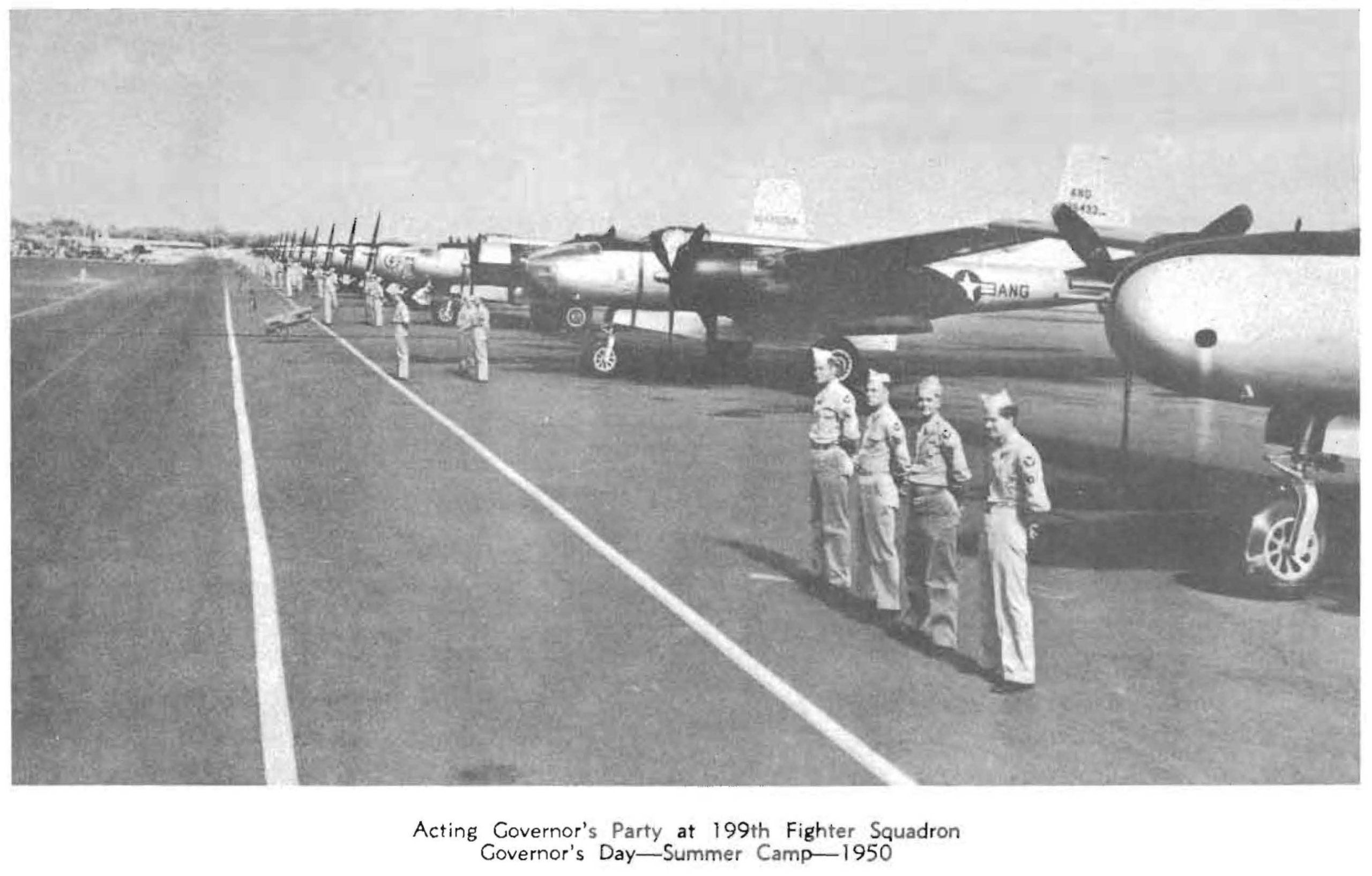
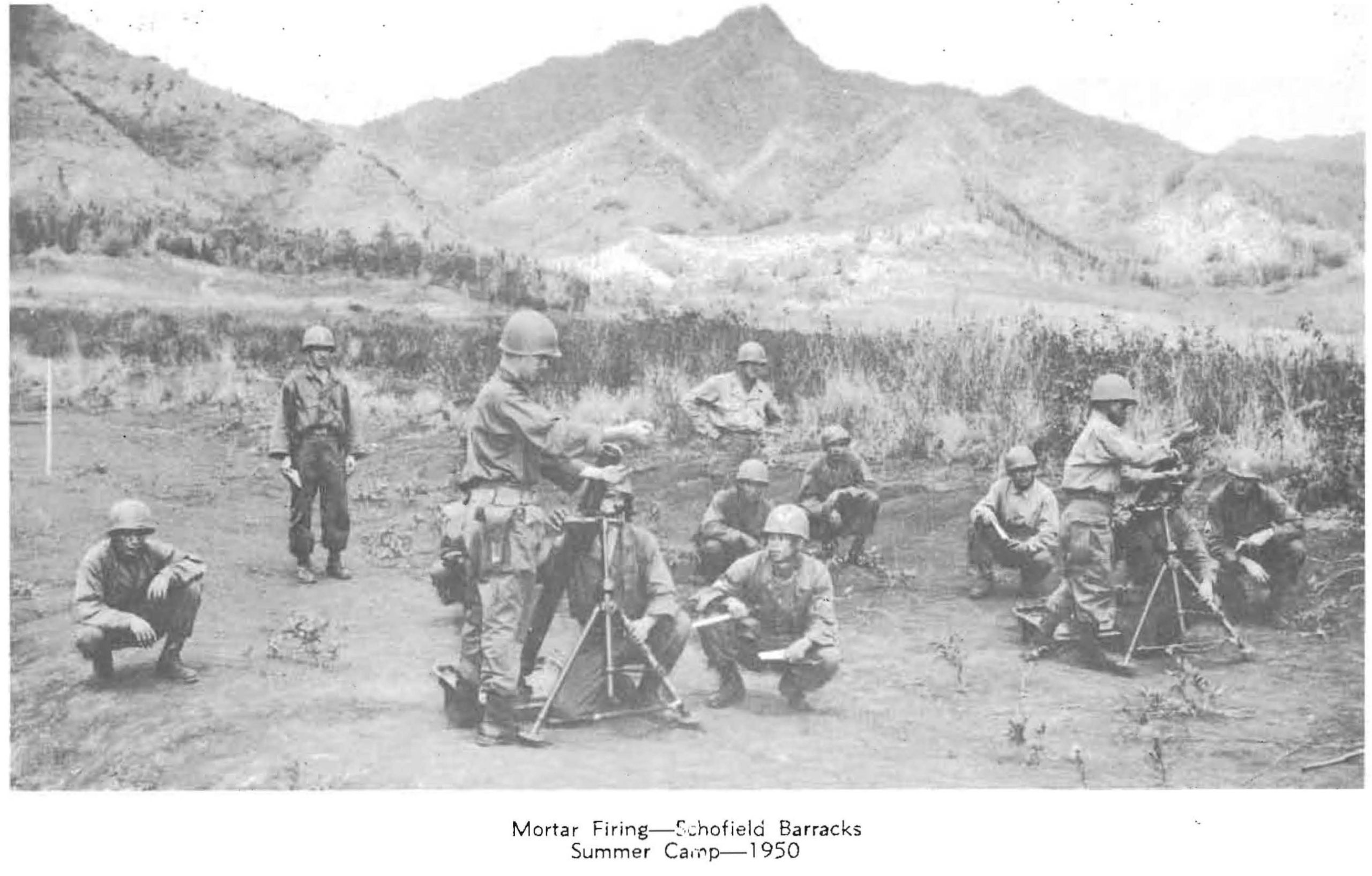
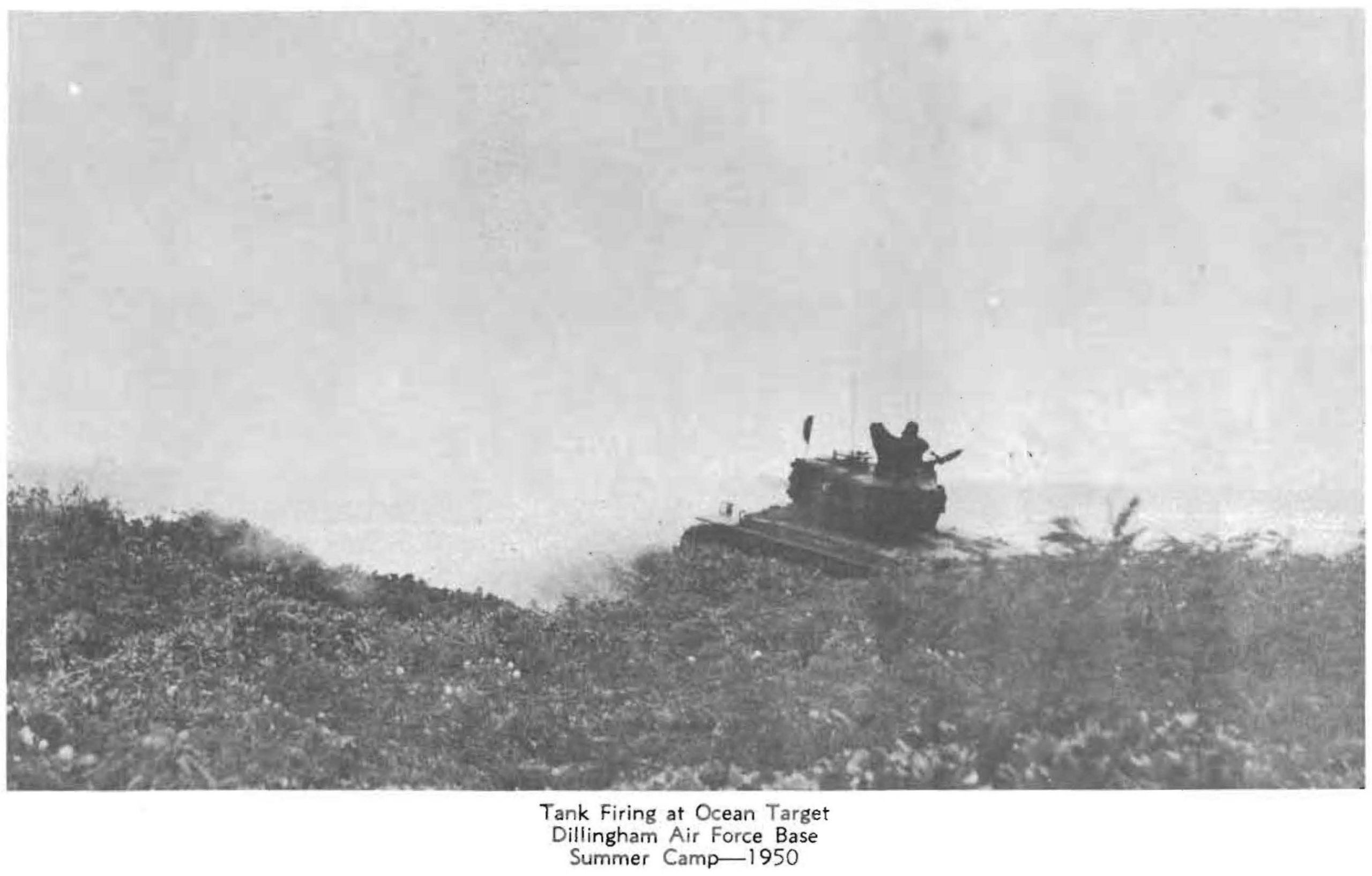
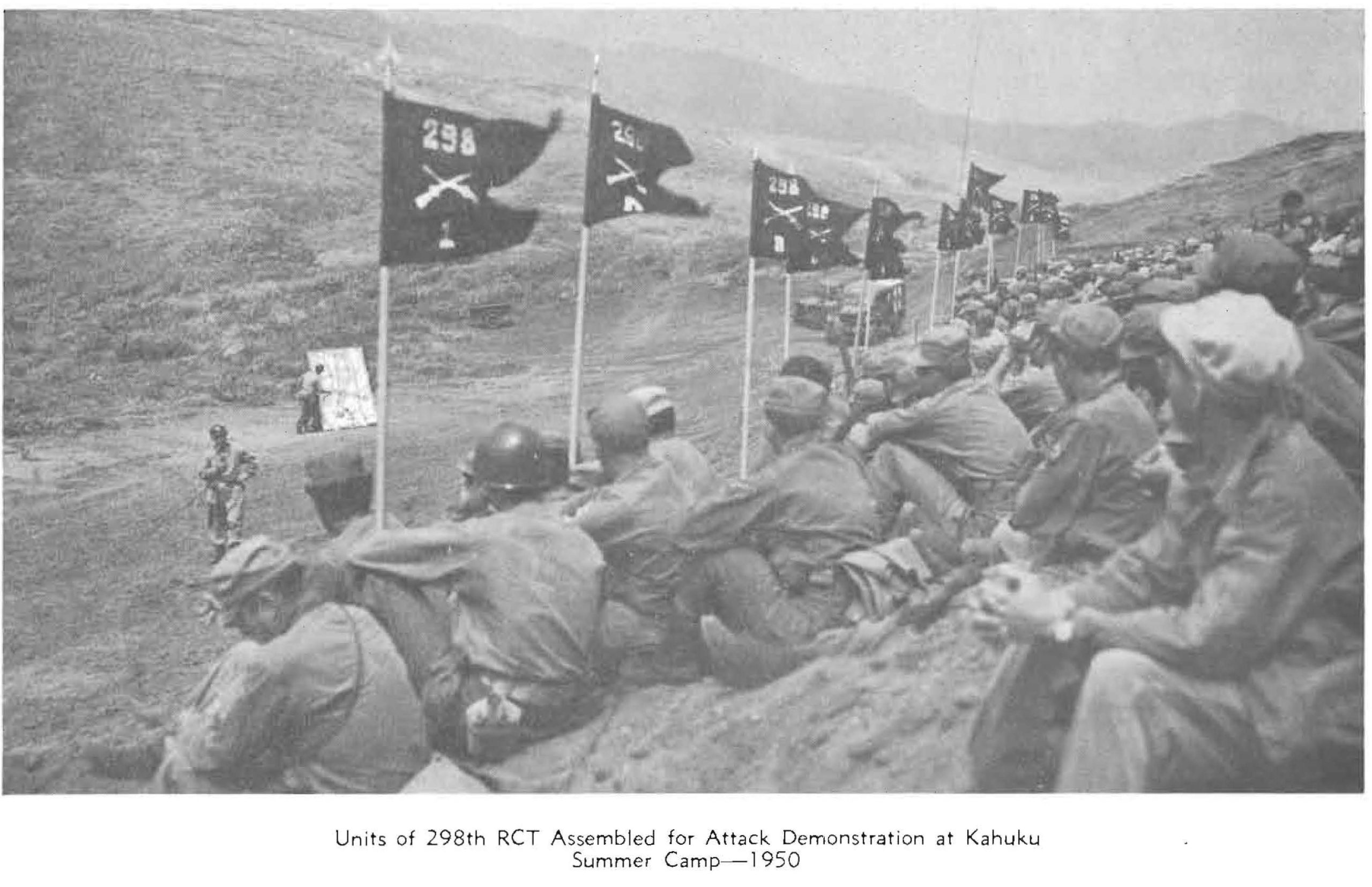
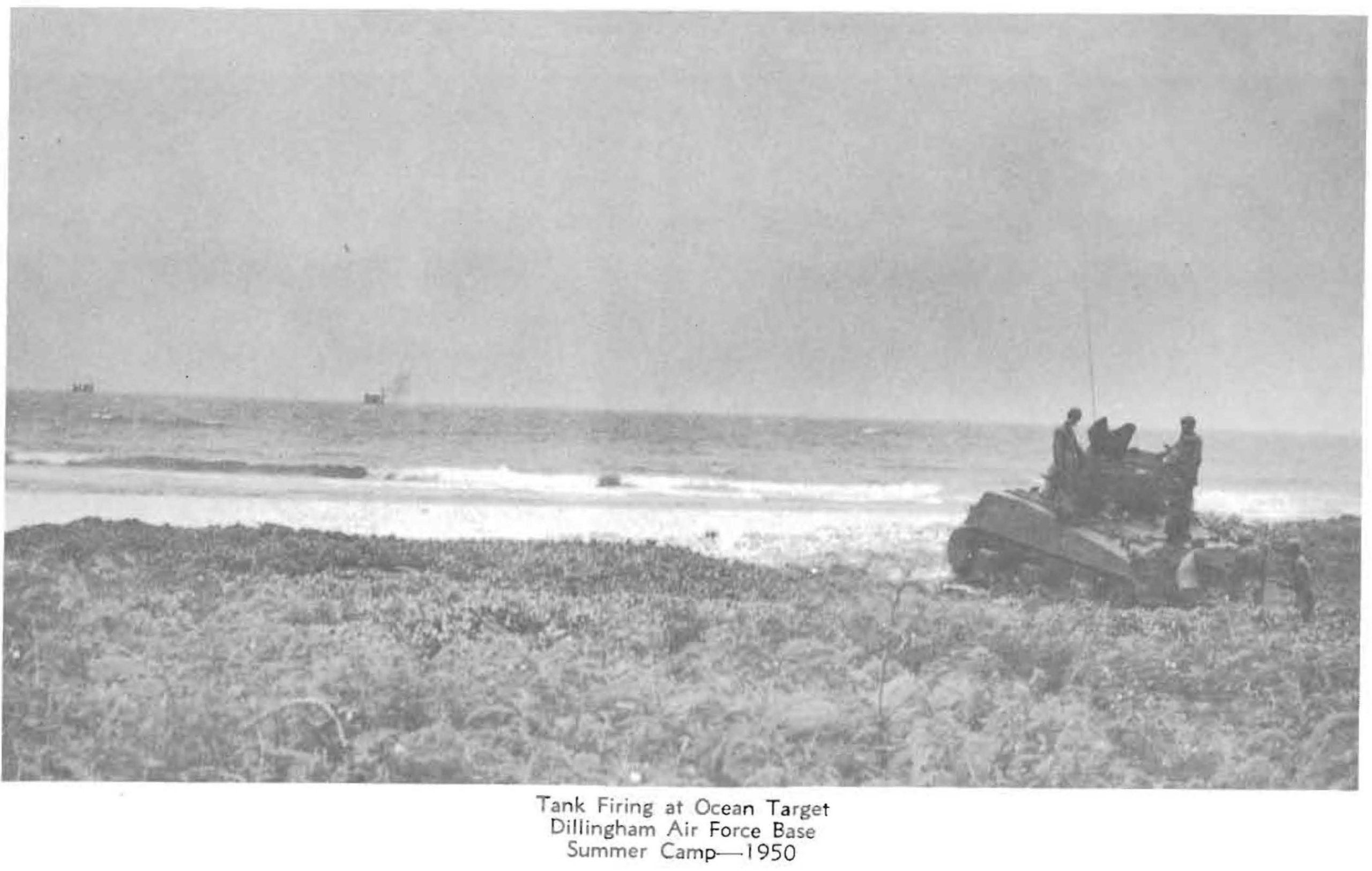
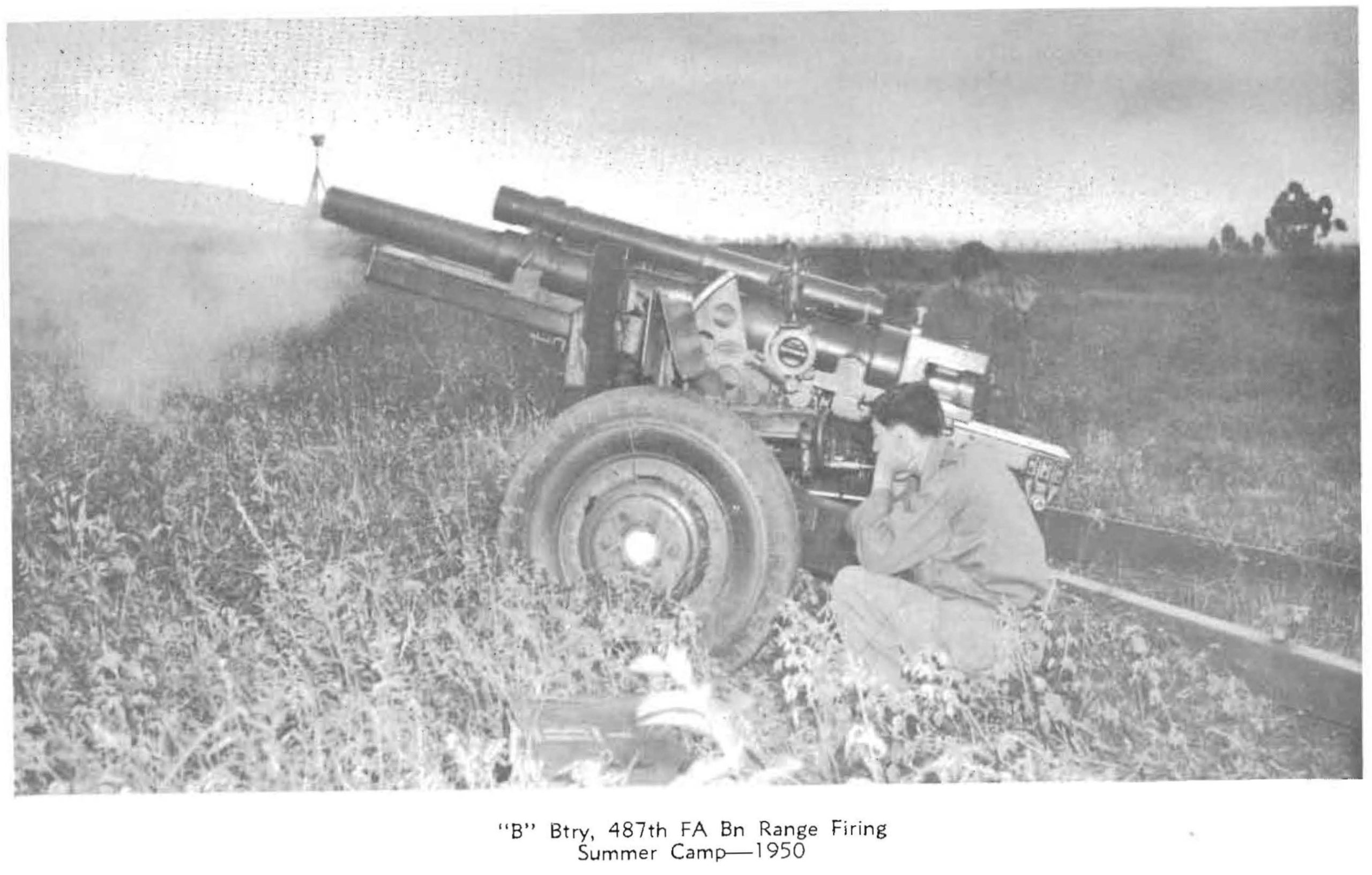
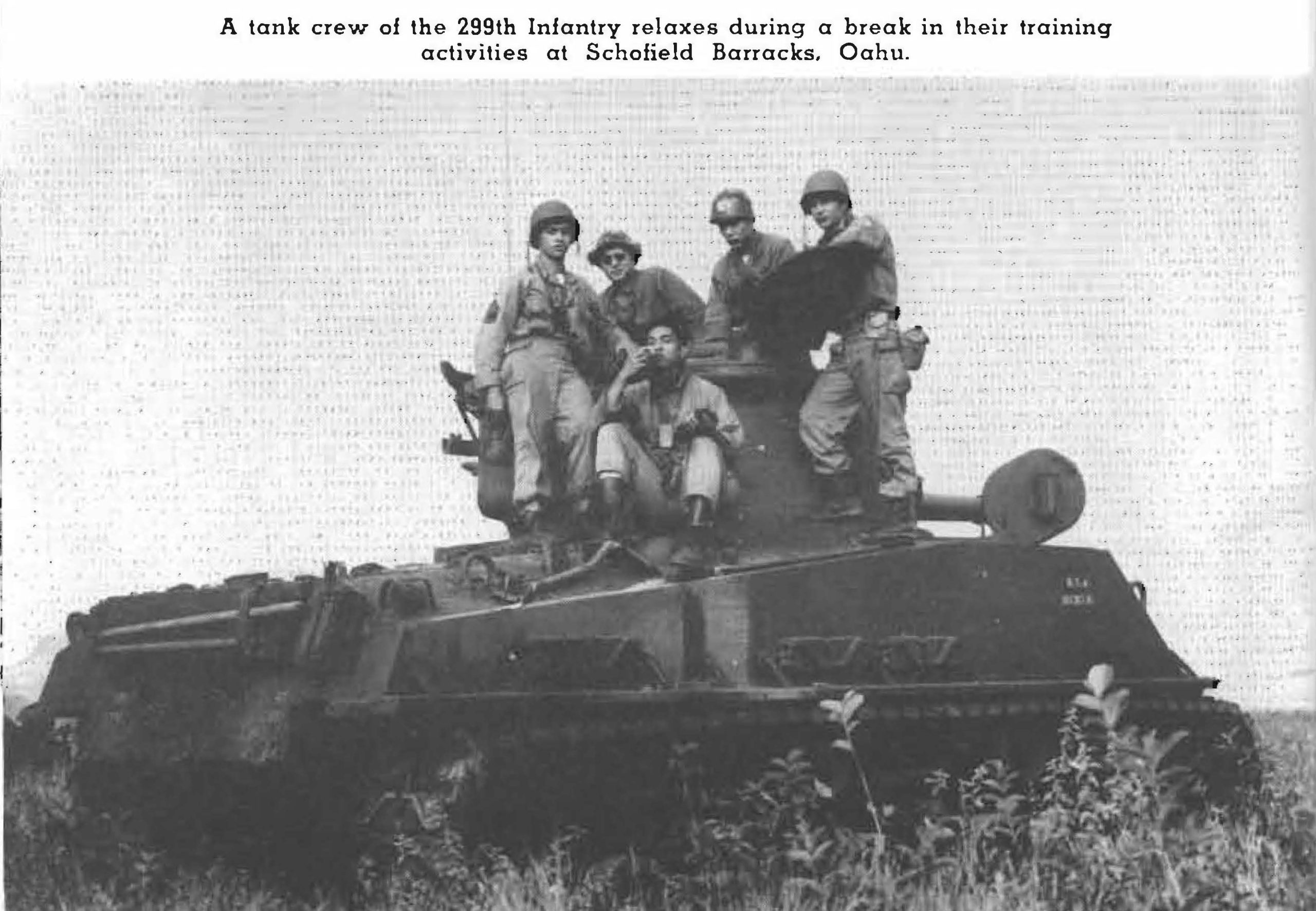
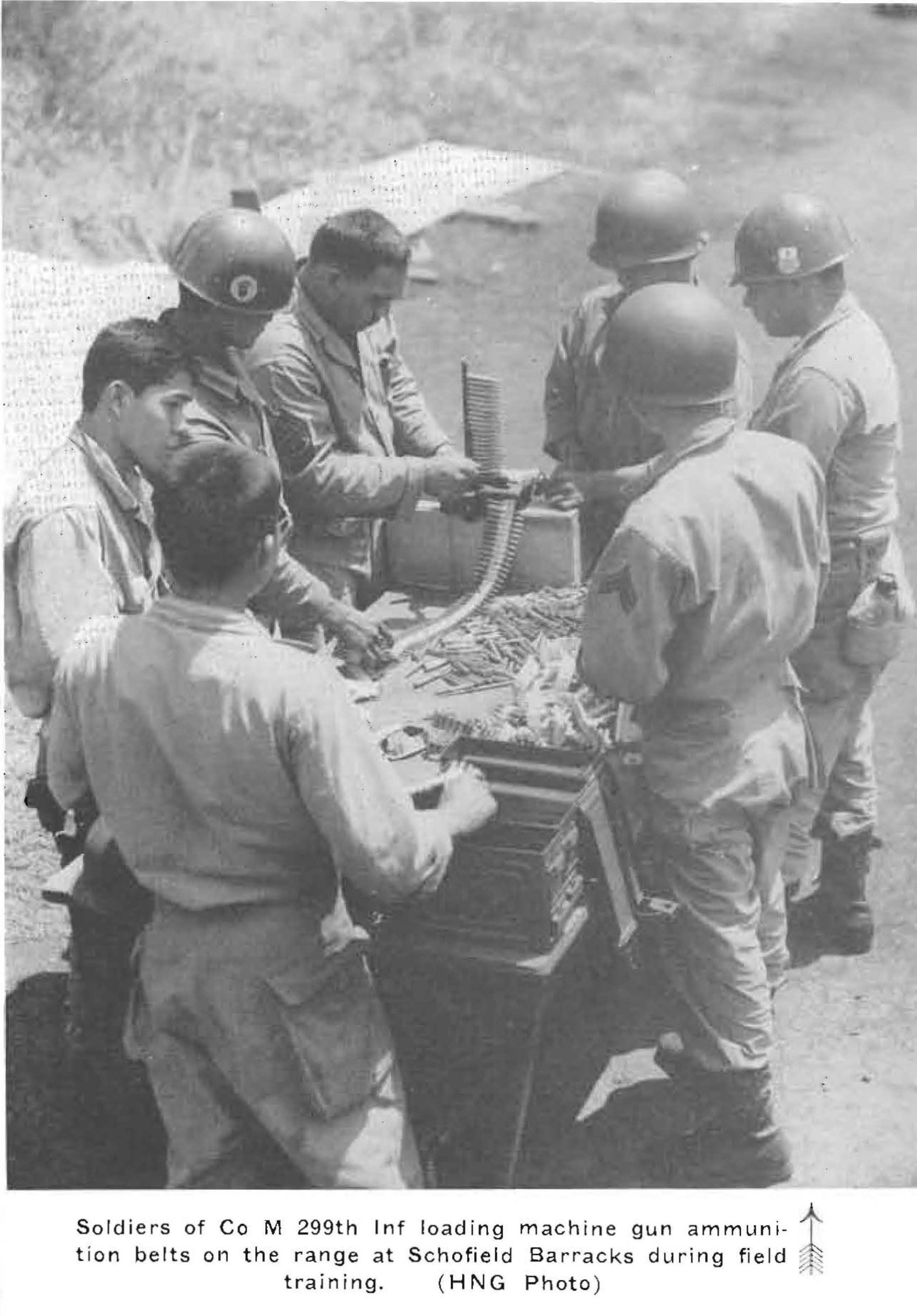
Field Training was held at Schofield Barracks, Oahu from June 10 to June 25, 1950. The highlights of the training under the second year of the National Guard Training Program were Infantry battalion attack problems, village fighting by platoons, the Army’s new transition firing course, Rocket Launcher, Rifle and Hand Grenade practice with live ammunition, and the firing of the 90mm tank guns at Navy towed targets off Dillingham Air Field. In the battalion attack problems, the tank company and the 199th Fighter Squadron lent support. The 483rd and 487th FA Bns concentrated on battery and battalion service practice at Schofield Barracks and Makua ranges and Battery and Battalion section training exercises and reconnaissance, organization, and occupation of position over the varied terrain of Schofield, East Range, Makua, and Wheeler Field. The range practice period was devoted to crew-serve weapons and transition firing, with some guardsmen who had not qualified firing their individual weapons for record. The field phase of the training was held at Kahuku where troops bivouaced on the beach at the air strip and used the air field and hills for their company attack, defensive exercises, and the battalion dawn attacks. The entire program was covered completely during the period and to a high degree of efficiency as indicated in the report of the Regular Inspection Board. In “PERFORMANCE” the ratings were:
Performance of:
Superior
Excellent
Satisfactory
Unsatisfactory
Unit Maintenance
1
38
18
0
Tactics and Technique
8
35
14
0
Communications
4
36
13
4
Deployments
7
38
12
0
The Commanding General, USARPAC, Lt General Aurand in a letter to the Adjutant General of Hawaii dated July 19, 1950 wrote in part as follows:
“I believe that the progressive training of our National Guard Units is one of the vital steps in maintaining a strong and effective military establishment. I was pleased to note the standards throughout your organizations during my visit to your camp,”
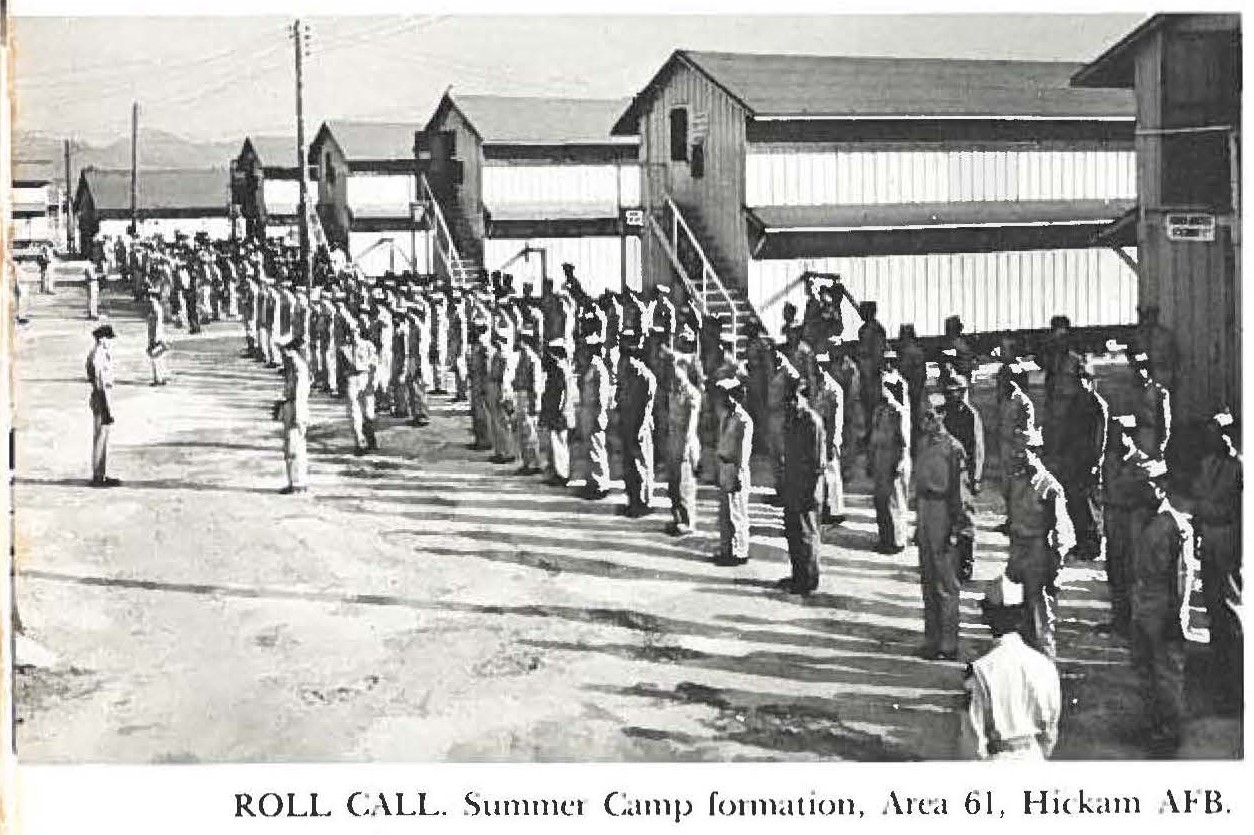
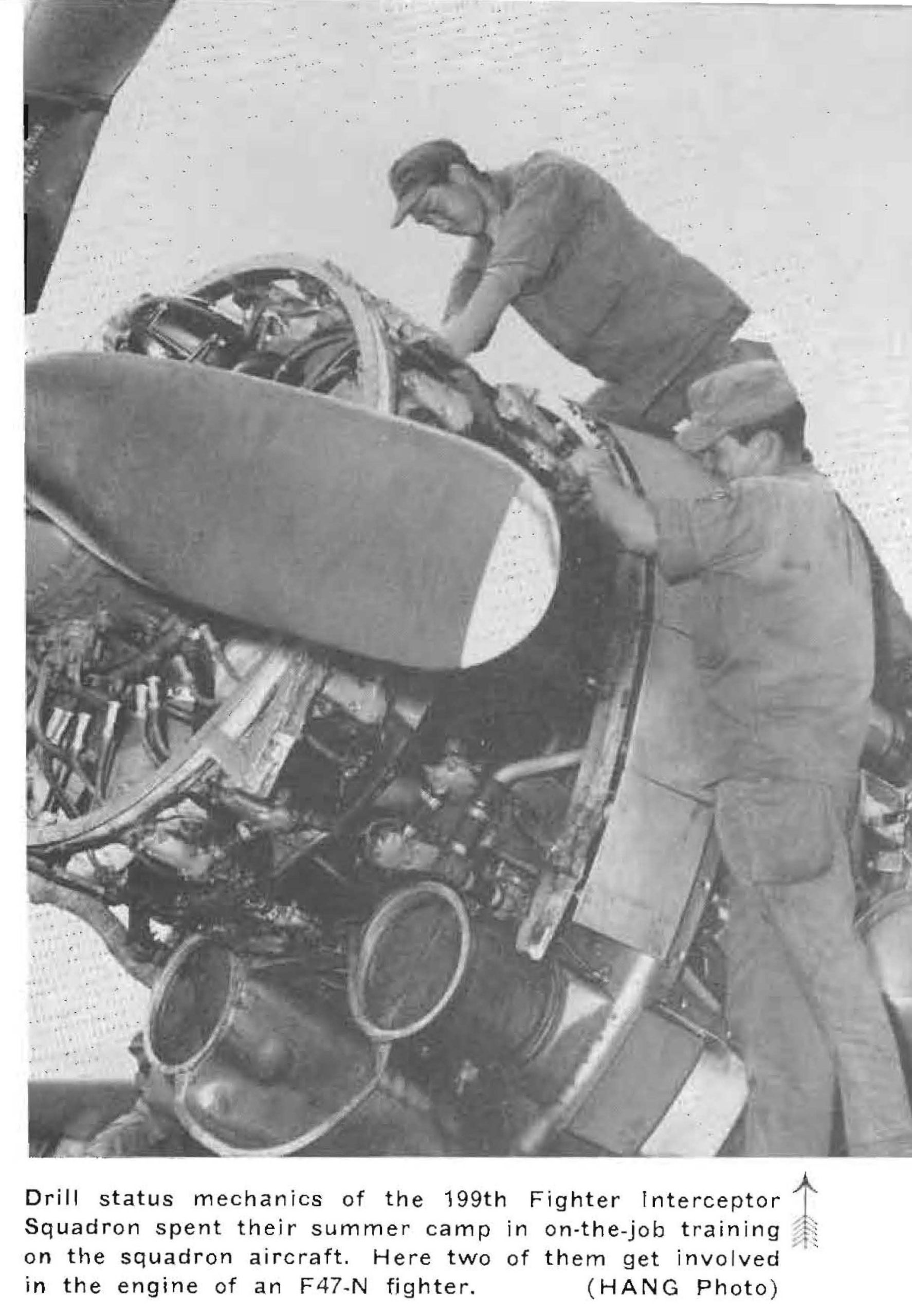
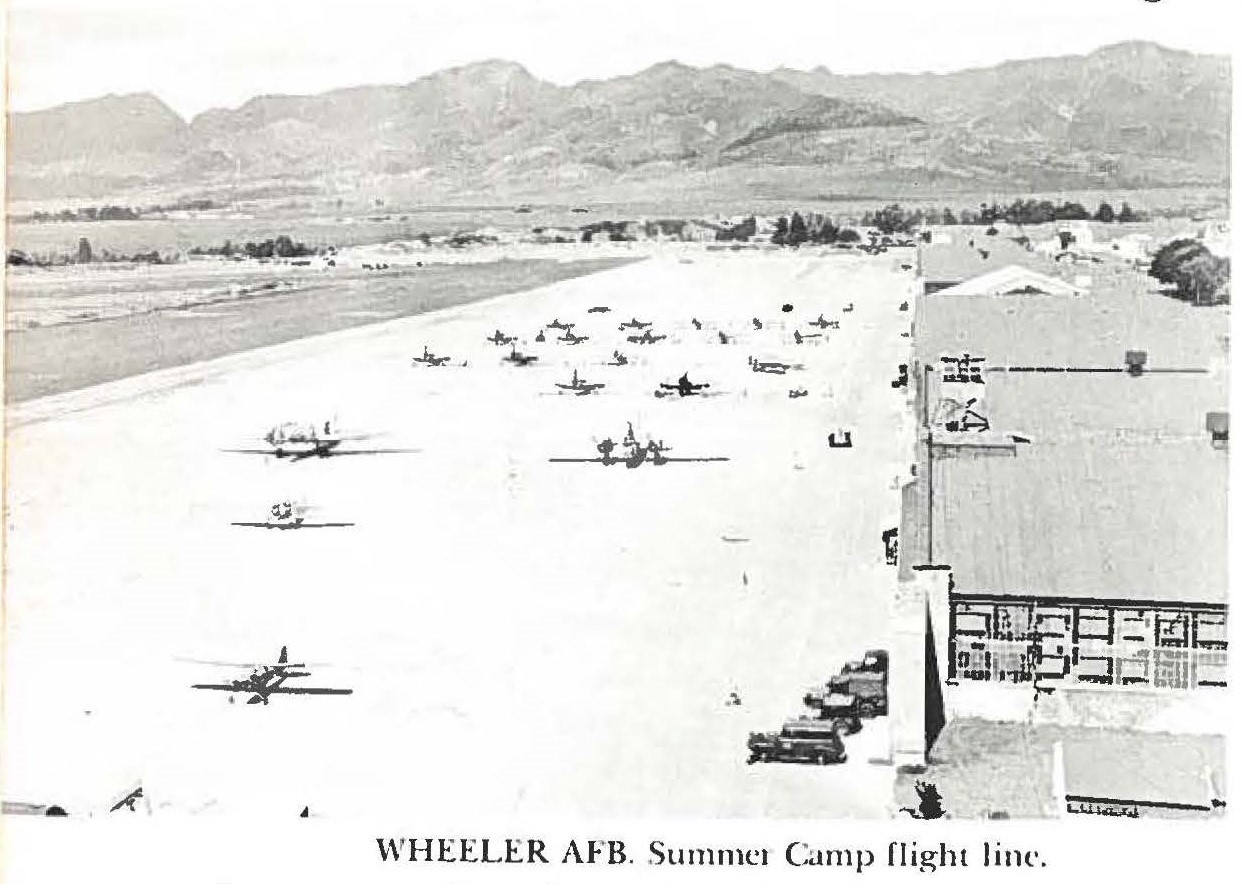
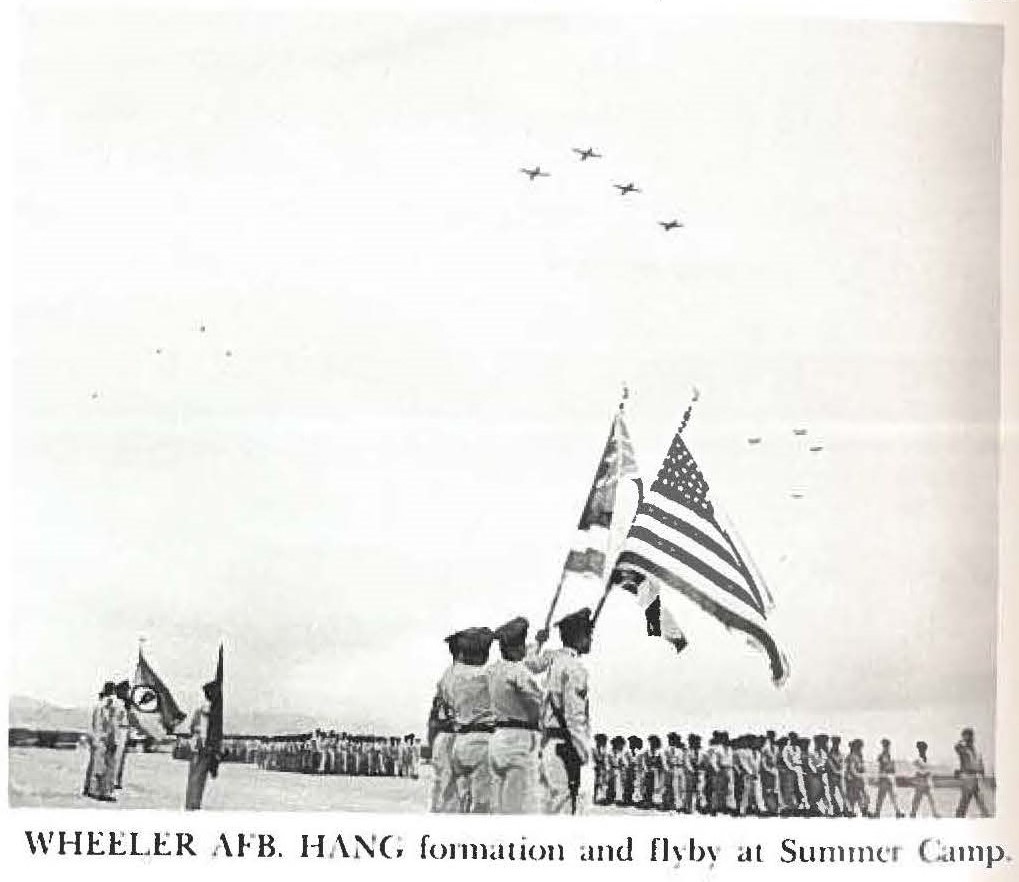
Summer Camp was again held at Hickam, 11-25 June 1950, with 88% attendance. It was a wild camp. First, eight huge B-36 bombers came to Hickam and took over the JUG flight line (strongest parking ramp on Hickam). HANG aircraft parked down the runway on the coral, and immense clouds of dust occurred whenever an engine was started or an aircraft taxied. Second, there was considerable volcano haze (“Vog”) all over the place, which inhibited some fighter training.
The 19th of June 1950 was noteworthy, as there were two aircraft accidents that day. Capt Carlos W. Bonham’s engine cut-out due to vapor lock, and he made an emergency landing downwind at the closed Ewa Marine Corps Air Base. His JUG nosed-up on the overrun-a new prop was installed and F-47N no. 218 was soon airborne. The second accident was that evening: 1st Lt Hunter C. Parker had an electrical failure, and landed his JUG unknown to the Tower and “long” on Hickam’s runway 7. Another “nose-up.” It always seems strange to say “nose-up” when the nose actually went down!
Secretary of Hawaii Oren E. Long represented the Governor of the Territory for “Governor’s Day” during camp-the first of many such visits. Major General Kenneth F. Cramer, Chief of the National Guard Bureau, visited the HANG shortly after the summer camp was over.
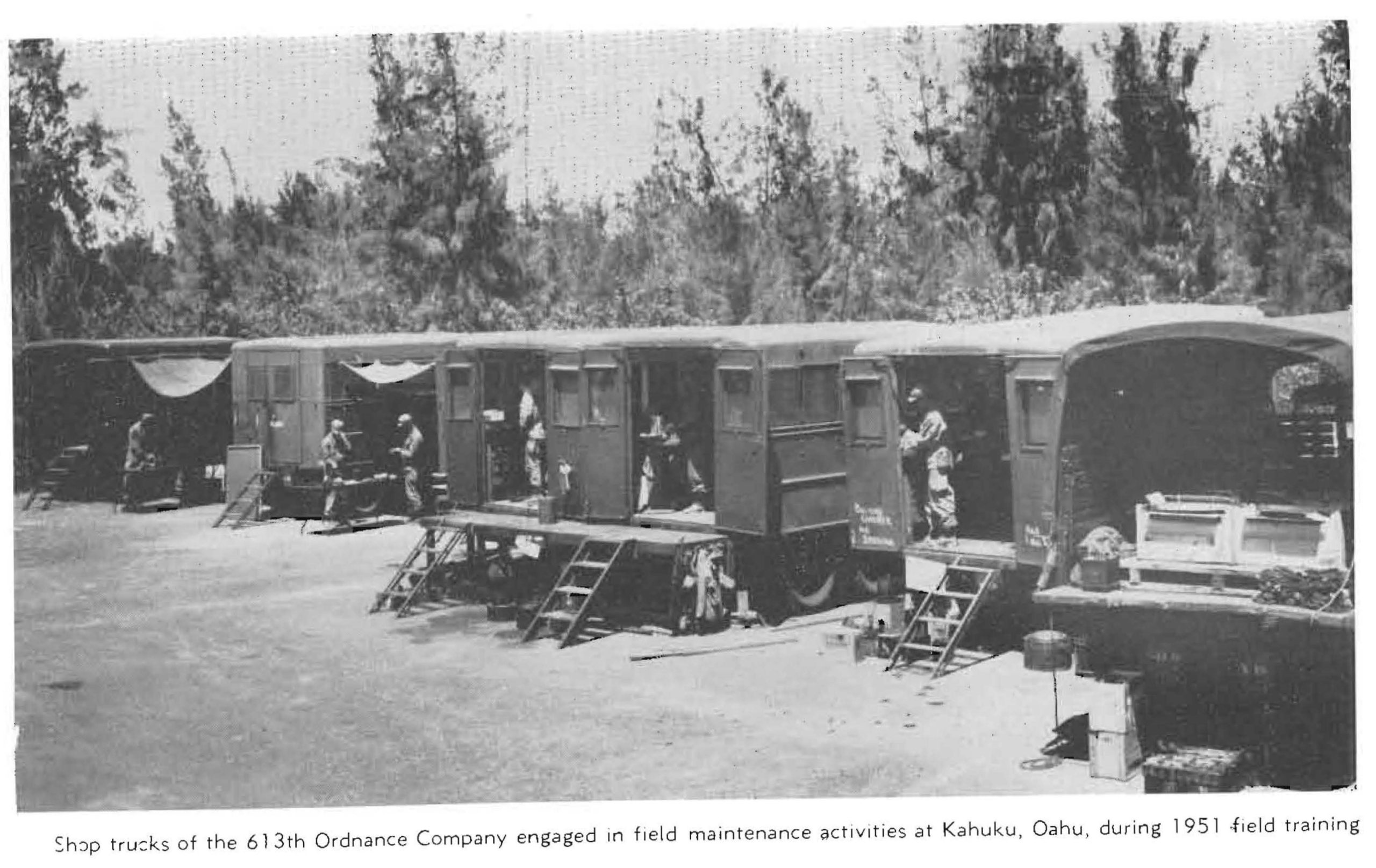
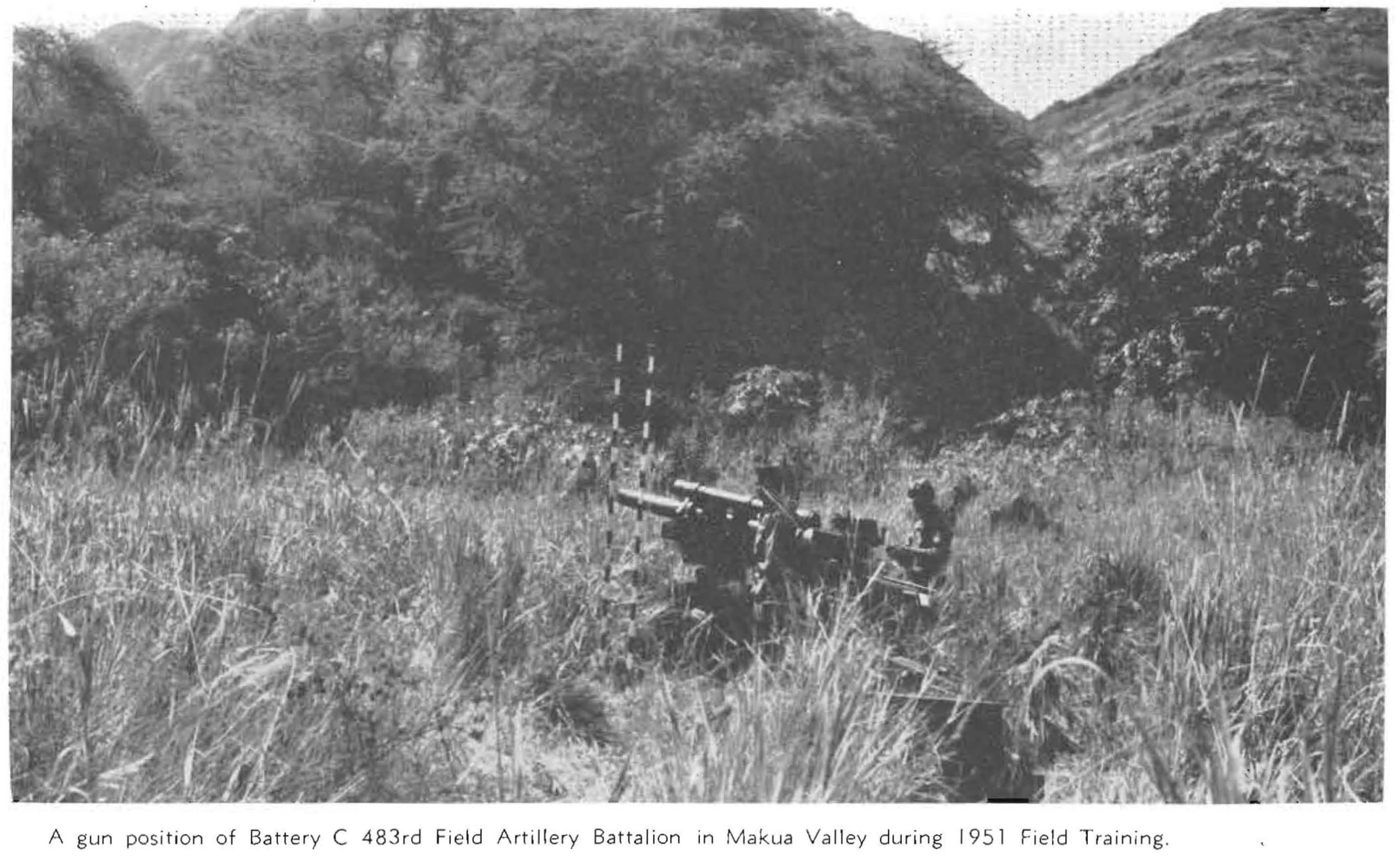
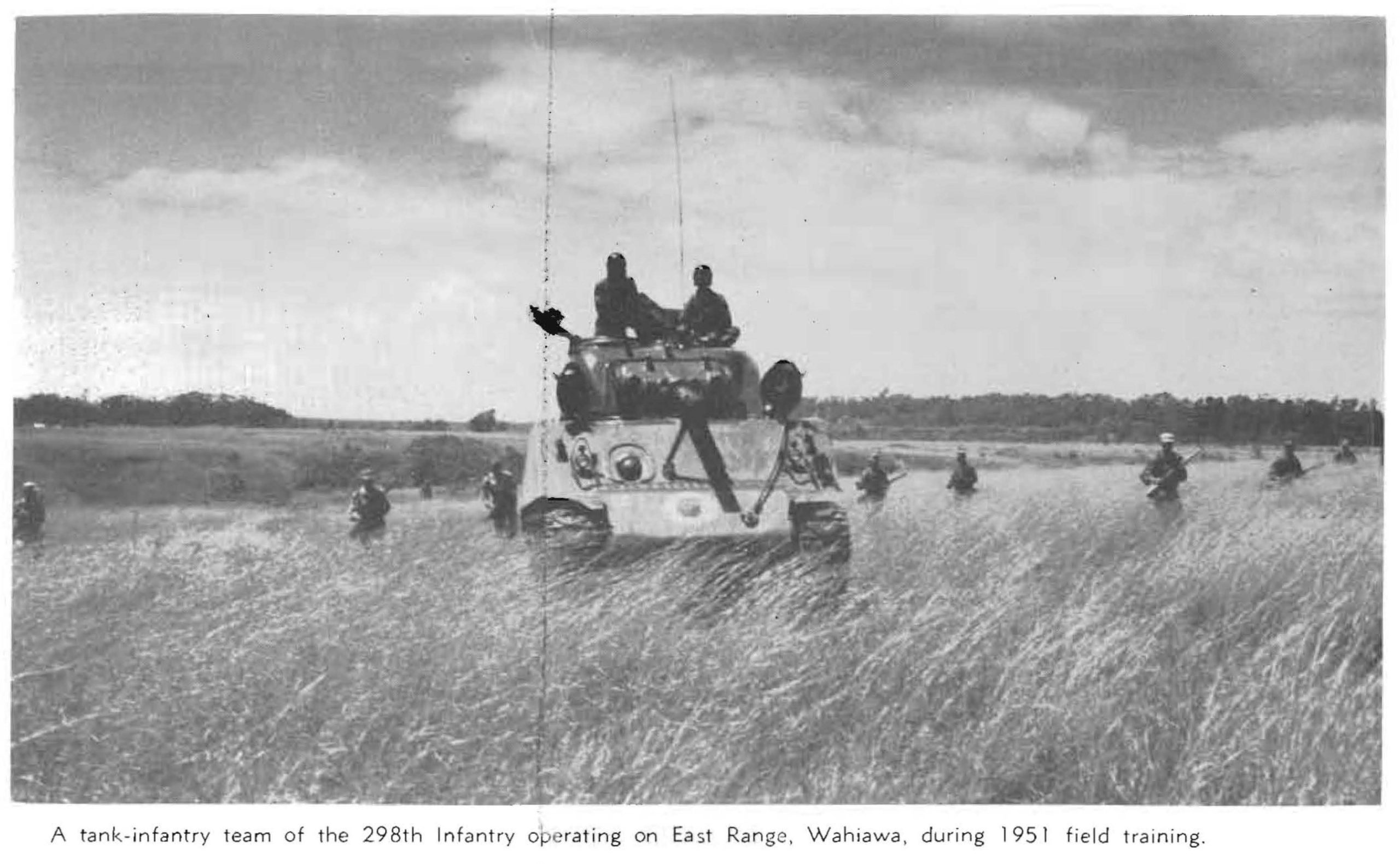
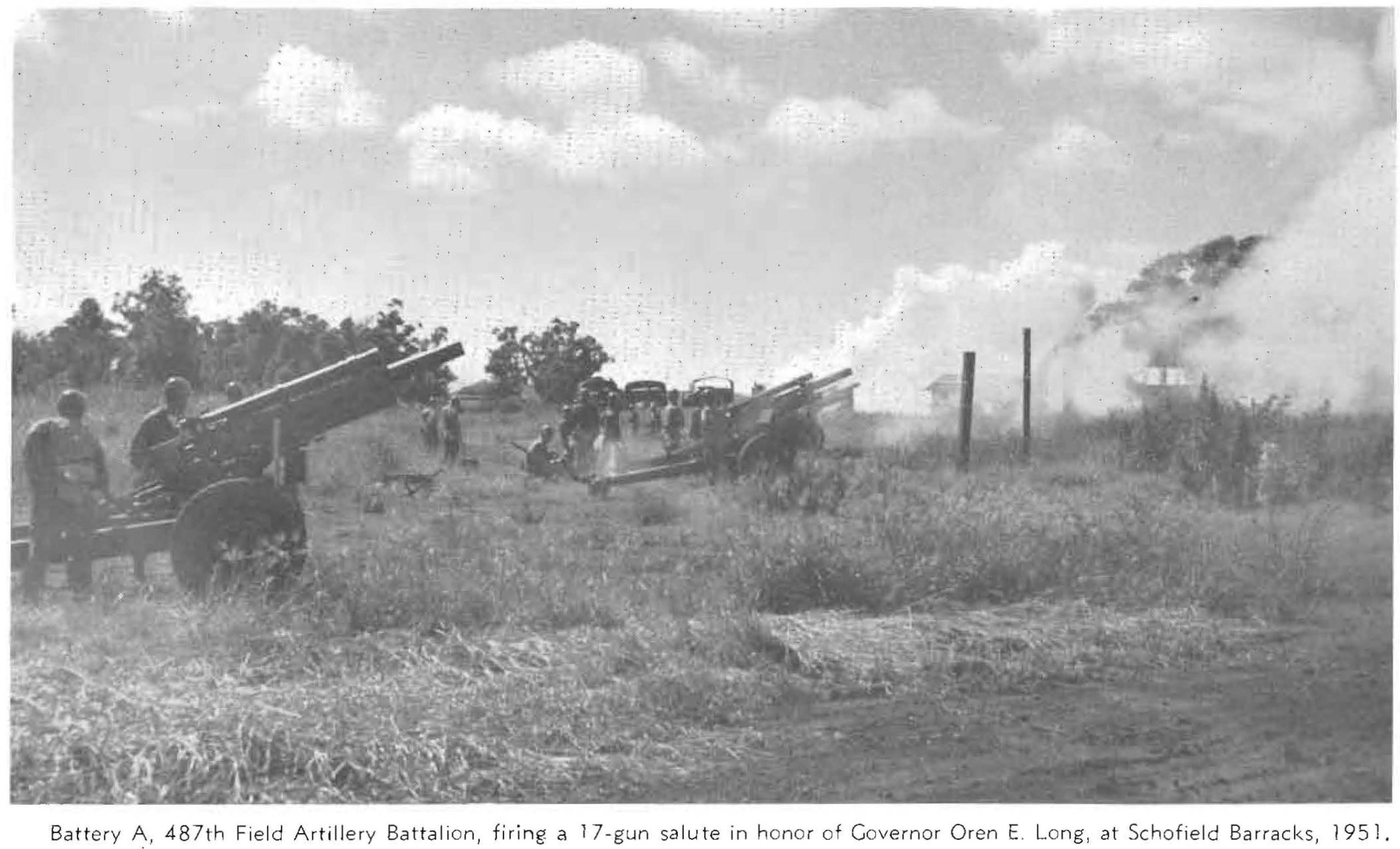
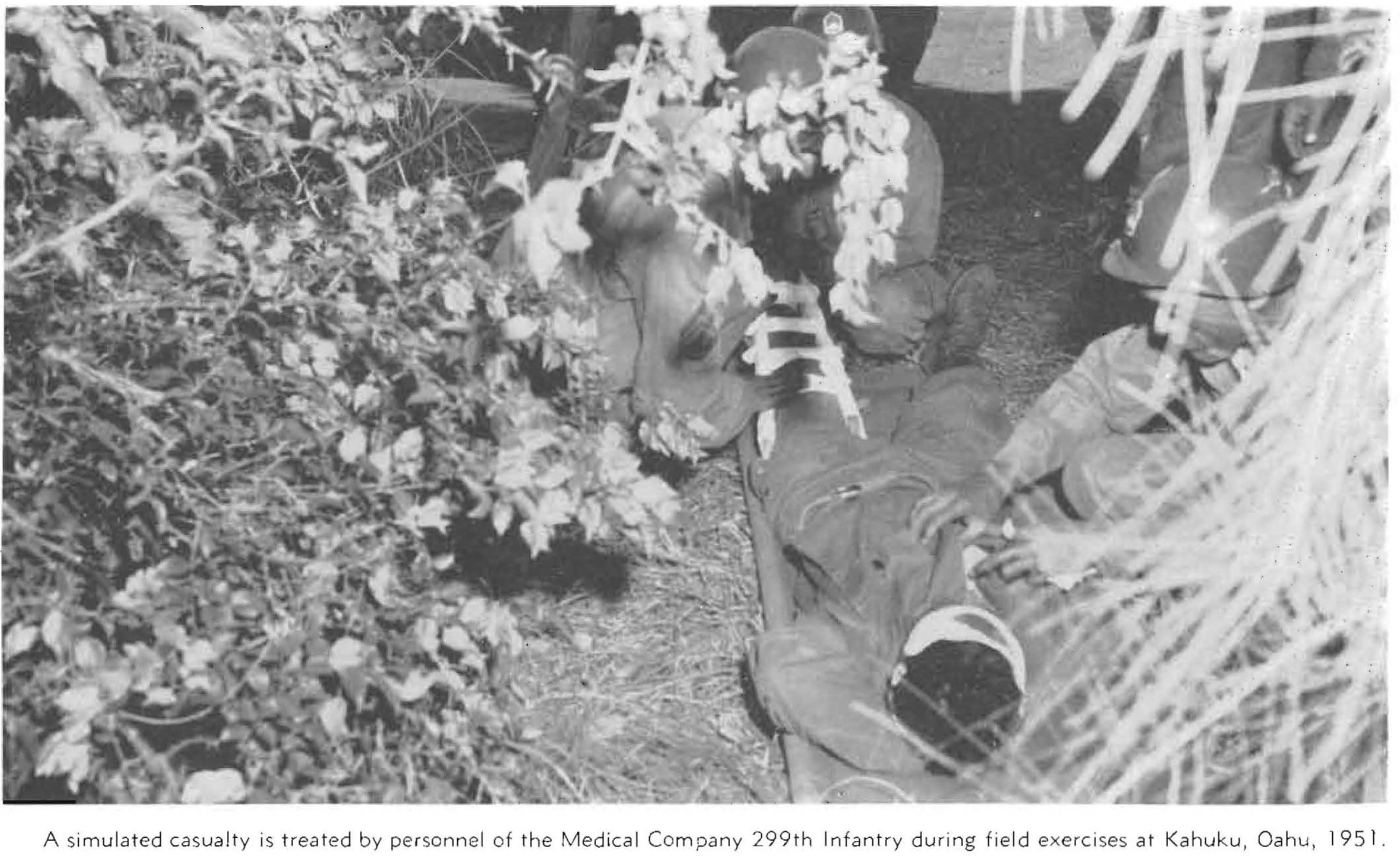
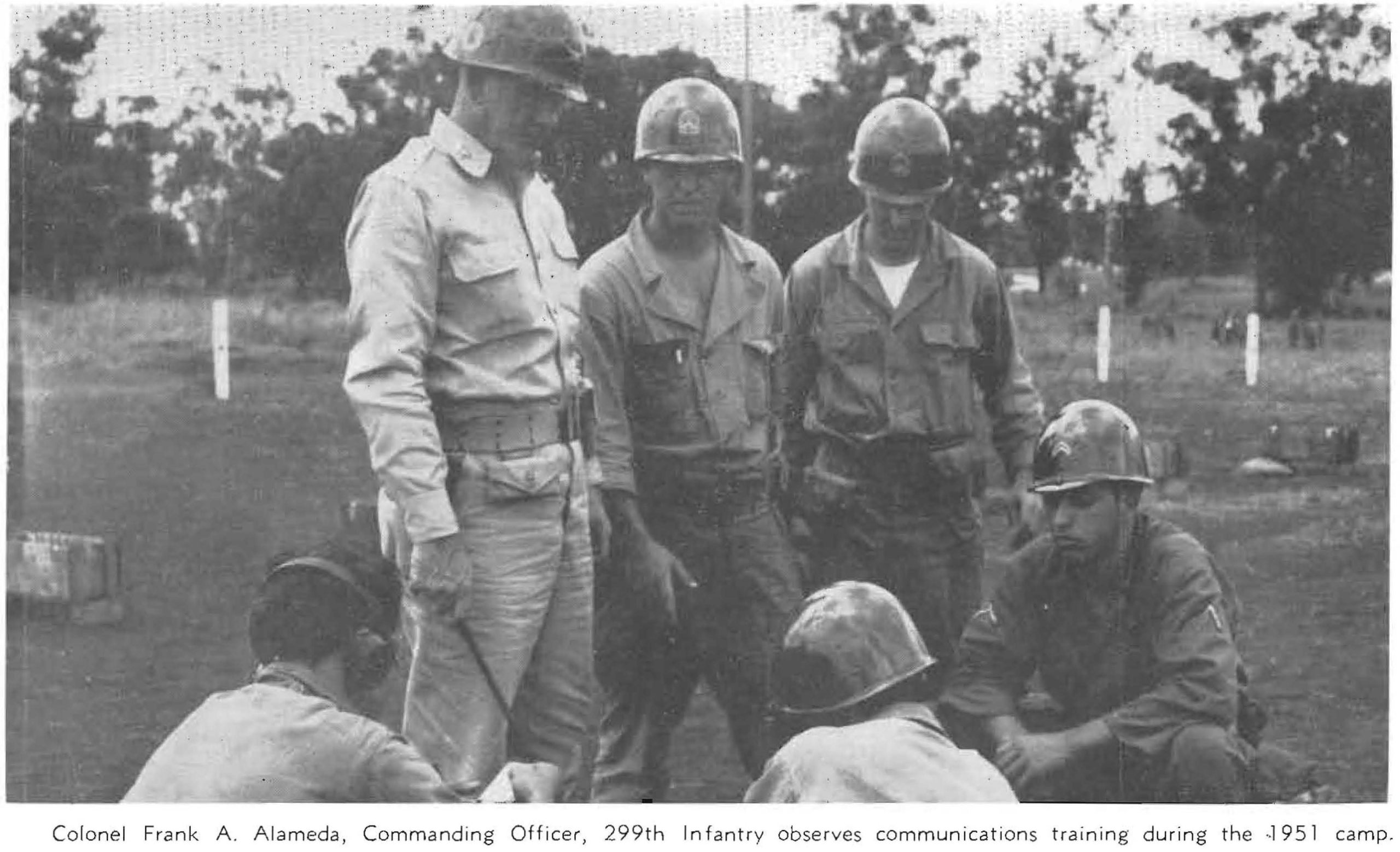
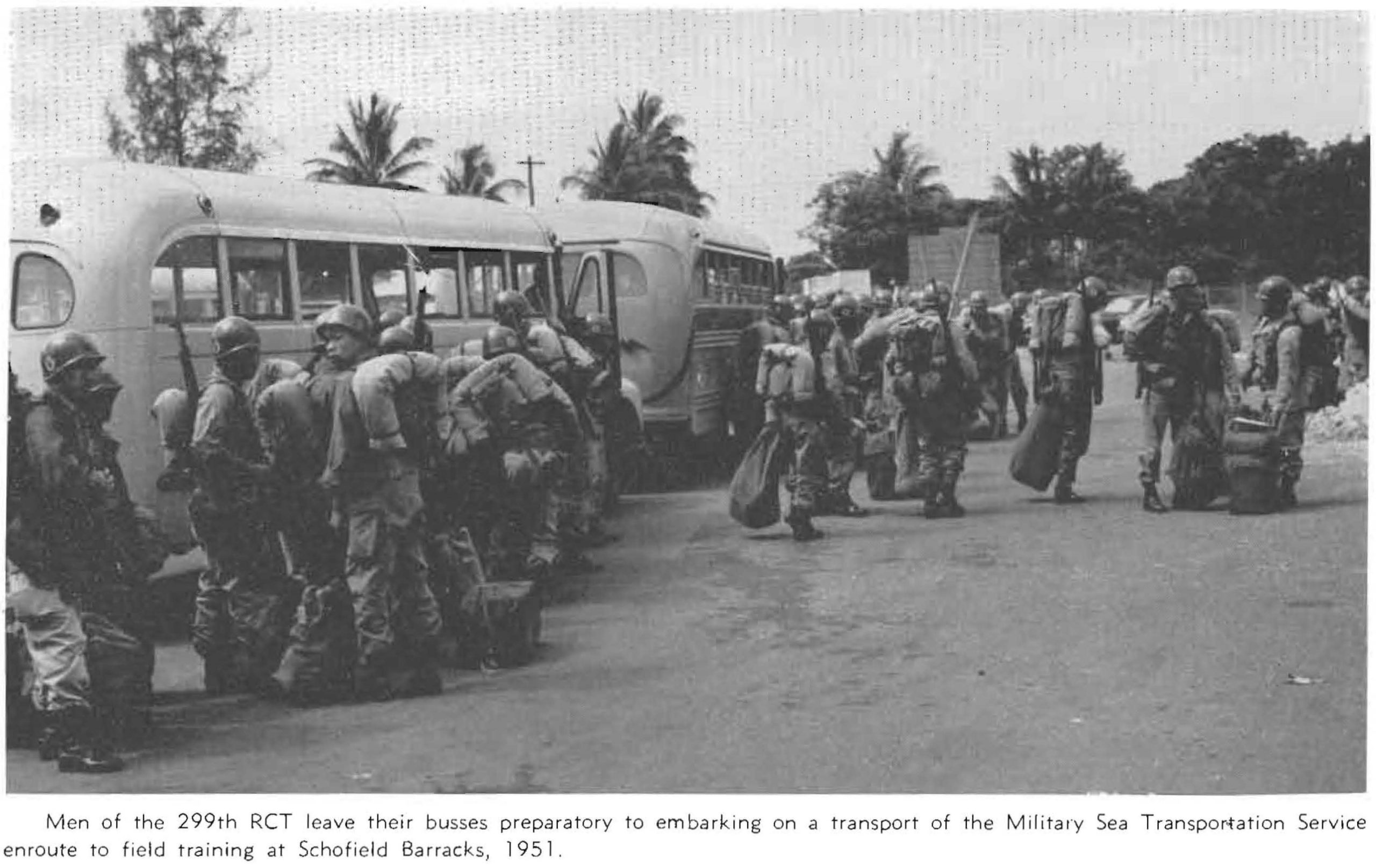
Field Training 1951. Field training was conducted at Schofield Barracks, Kahuku, and Makua, Oahu during the period 9-30 June with, the Hq & Hq Det., HNG; 298th RCT; 120th MP Co; and 111th Army Band reporting on June 9th for 15 days and the 299th RCT, 613th Ord (MM) Co, and 11 Oth Army Band on June 16th for 15 days.
Training accomplished covered the third year subjects as outlined in the National Guard Training Program. During the first week the Infantry riflemen, crew served weapons teams, and rifle squads fired the various combat ranges to develop battlefield technique and team work, while the Artillery Battalions and Tank Companies performed service practice in direct and indirect fire support missions. The second week’s training was devoted to tactical exercises at Kahuku. The first half covered the Infantry Battalion supported by tanks, artillery, and engineers in attack, defense, and withdrawal. The last two days were used for the conduct of the reinforced regiment in a dawn attack on an entrenched enemy, followed by a position defense and ending with a withdrawal from action.
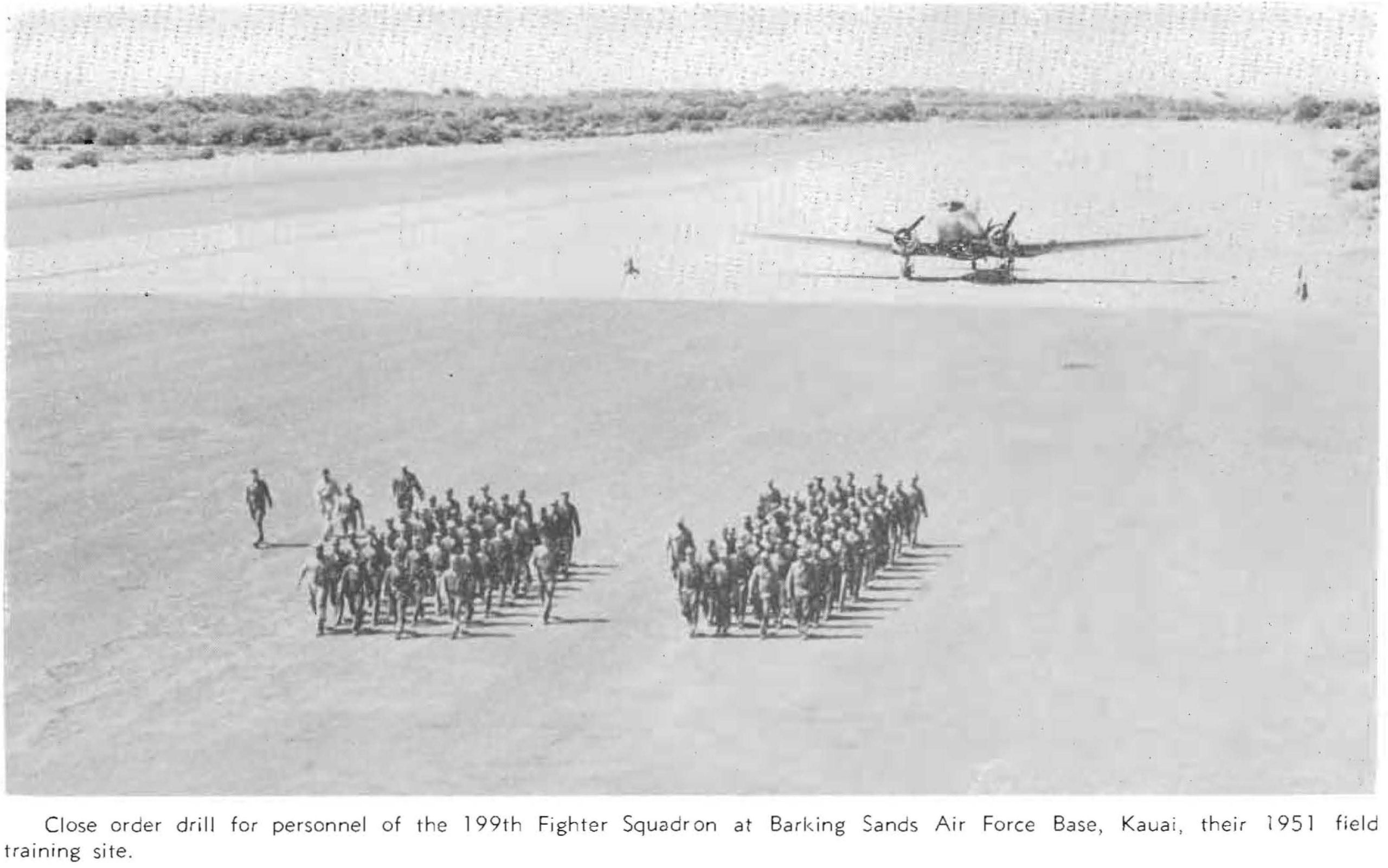
All Air units of the Hawaii National Guard attended field training from 9 June-23 June 1951, the 199th Fighter Squadron, Attached Elements and Weather Station at Barking Sands, Kauai and the 109th Aircraft Control & Warning Squadron at Wheeler Air Force Base, Oahu. A total of 631 Air Guardsmen attended the summer encampment, 92% of the assigned officers and airmen.
The 199th Fighter Squadron successfully completed the first movement of its entire organization, equipment and personnel, ever attempted in the 4 years of its existence. The success of the overwater move and the whole encampment, is a tribute to the harmonious relations that exist between the Regular Military Establishment and the Hawaii National Guard. Neither the move nor the camp could have been a success without the wholehearted cooperation of the Army, Air Force, (MATS) and Navy (MSTS).
The training of the fighter squadron was concentrated on the development of a well disciplined unit capable of sustaining itself in the field.
The 1951 field training period of the newly activated 109th Aircraft Control & Warning Squadron was very successful. The Regular Air Force Radar Unit, the 614th Aircraft Control & Warning Squadron is largely responsible for the tremendous success of the 109th’s encampment training program. The 109th was integrated into the 614th for the IS-day period.
The fighter squadron held its summer camp at Barking Sands, Kauai, 9-24 June 1951 (640 flying hours). Equipment was shipped via barge and a Navy tanker brought 75,000 gallons of AvGas to Port Allen. Squadron refuelers transported the fuel to the Barking Sands aqua system around-the-clock. USAF furnished a crash boat. AlC Arthur Lee cracked-up a 2½ ton truck returning from a pass run to Lihue. This was the first incident of this kind, and a number of HANGmen became “Legal Beagles” trying to set up the correct paperwork. MSgts Karl Kang and Harold Mattos (among others) returned late from pass and were restricted to the Base for two days (MSgt Robert Choi earlier escaped the same fate by faking sick).
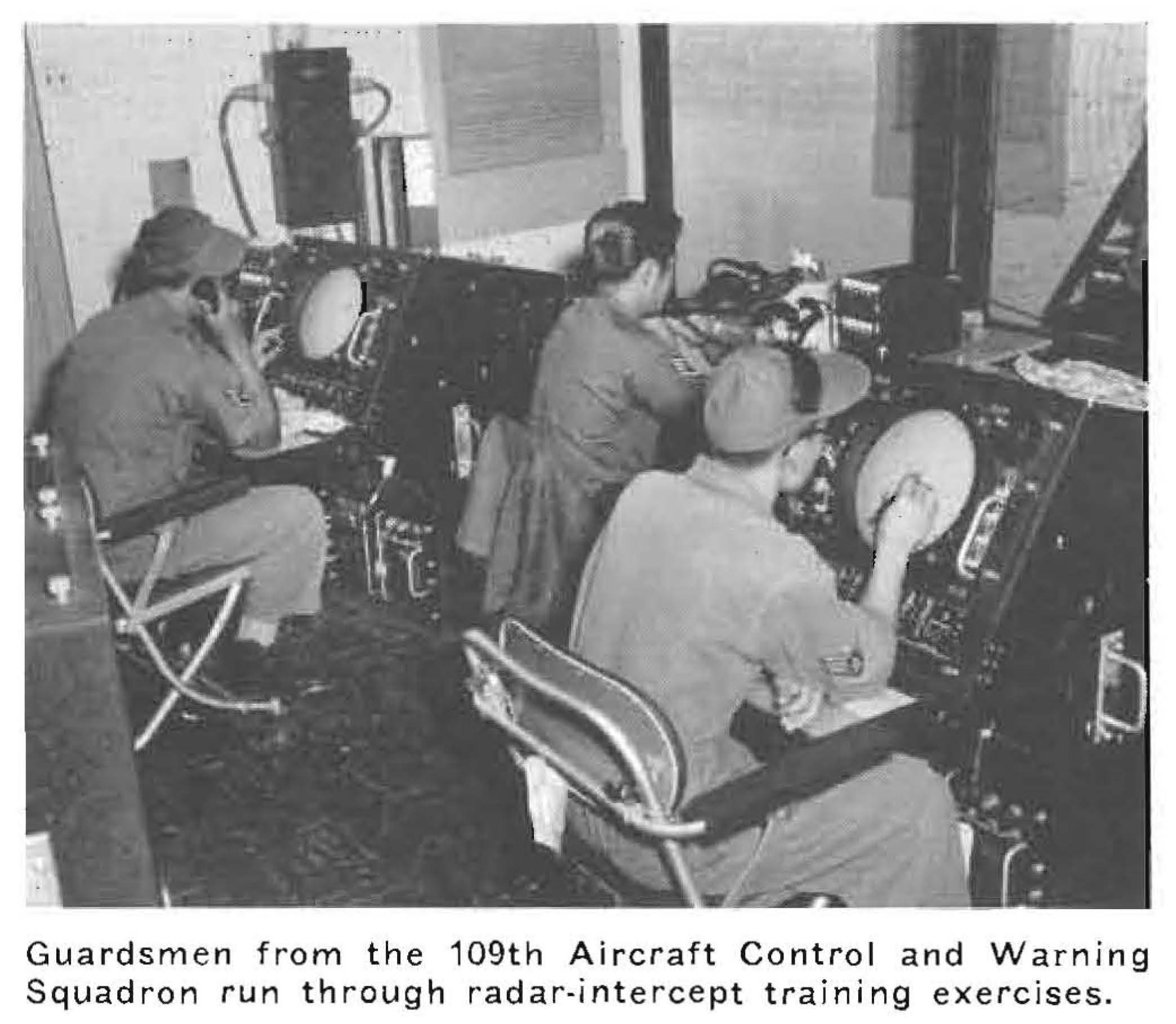
The 109th held its first summer camp at Wheeler AFB and trained with its counterparts at Punamano AFS.
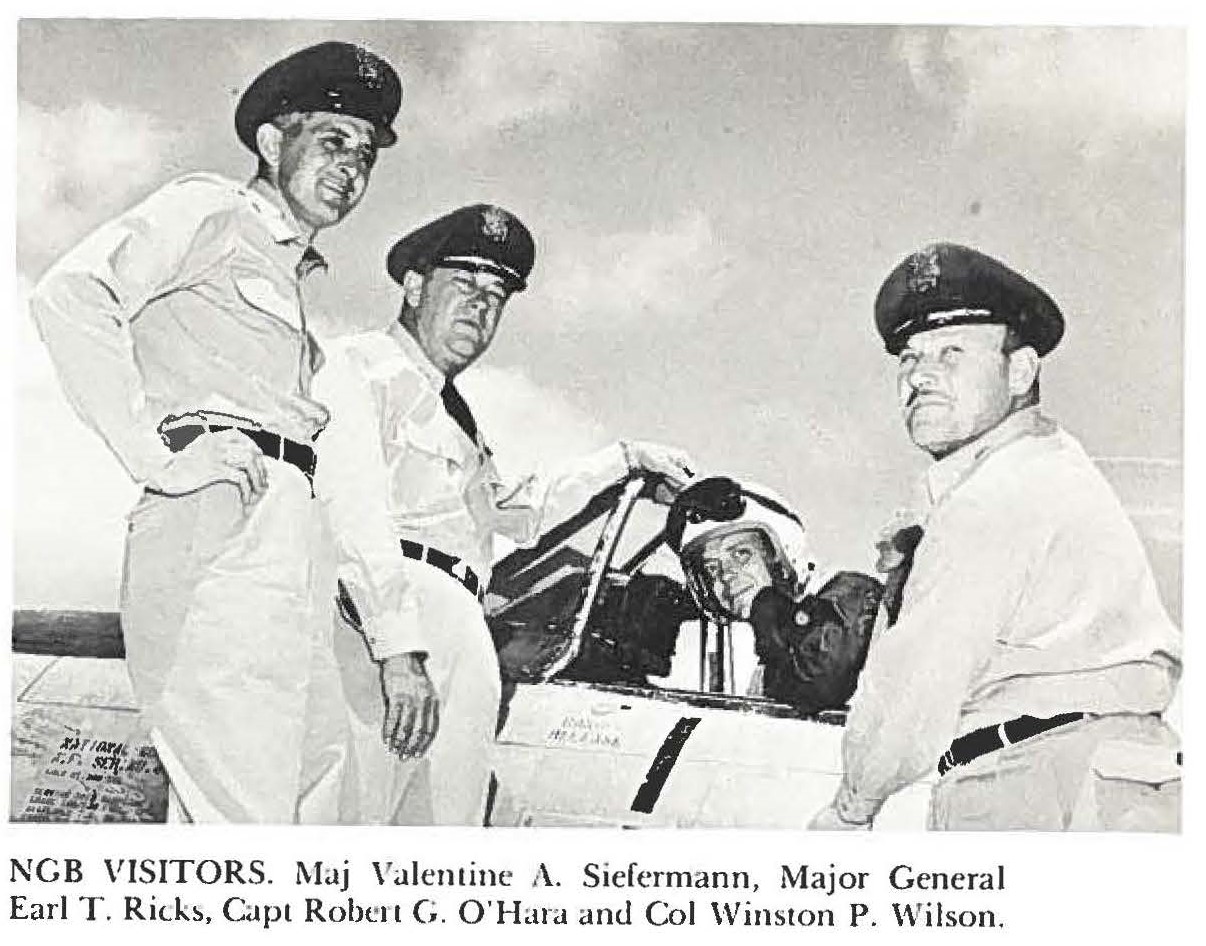
Major General Earl T. Ricks, Deputy Chief of the National Guard Bureau (accompanied by Col Winston P. Wilson), and Major General Earl S. Hoag, Special Assistant to the Chief of Staff, USAF, for Reserve Forces, visited the HANG summer camps.
Capt Russell L. Smith, 1st Lt Donald Seiler and TSgt Fred Mau were flying in a TB-26 13 June 1951 when the plexiglass bombing nose failed, ruptured, and was torn from the aircraft. Most startling. The aircraft landed safely at Barking Sands. Cause unknown.
NGB VISITORS. Maj Valentine A. Siefermann, Major General Earl T. Ricks, Capt Robert G. O’Hara anti Col Winston P. Wilson. (Pictures from the HANG 25 History of Hawaii Air National Guard)
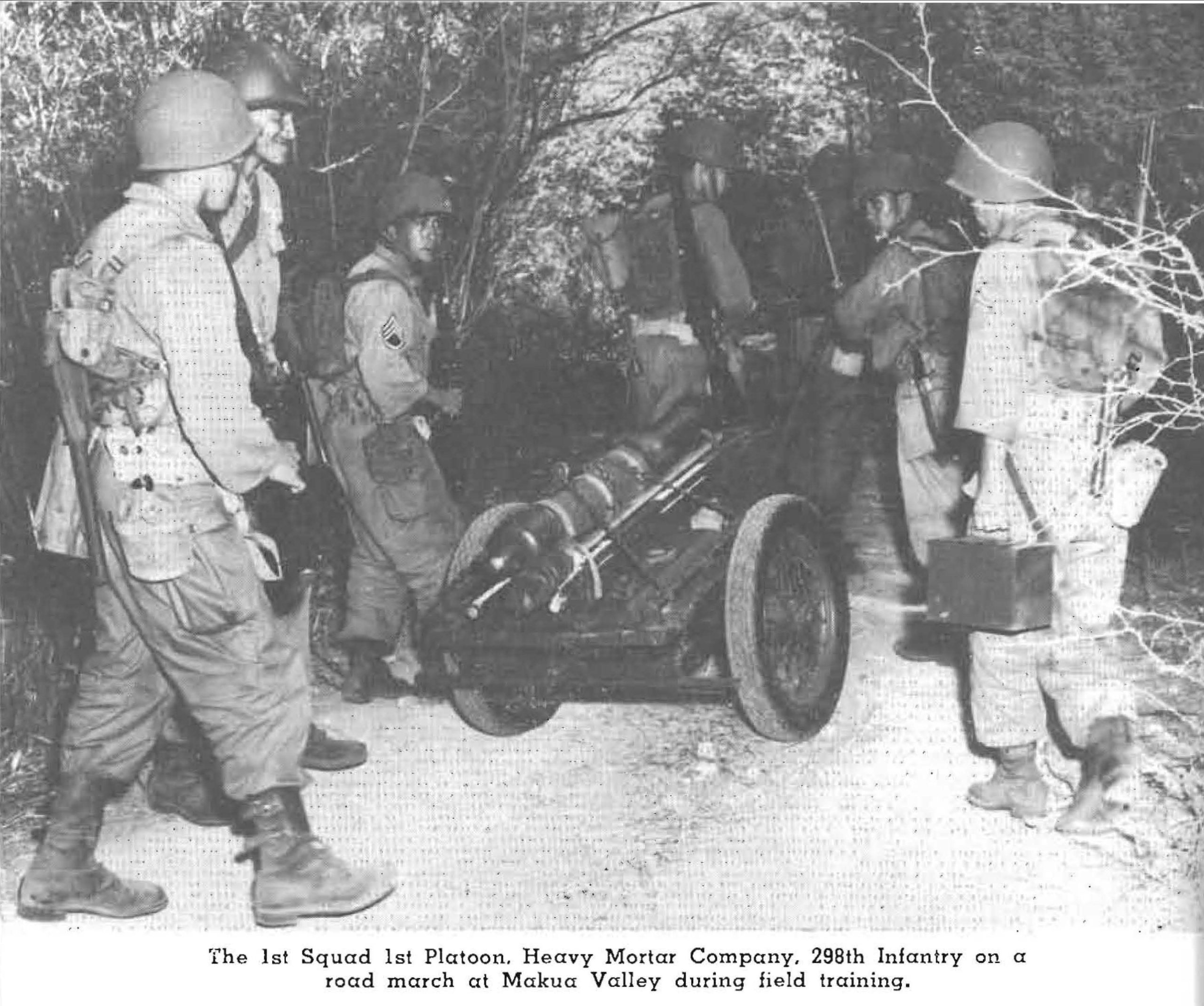
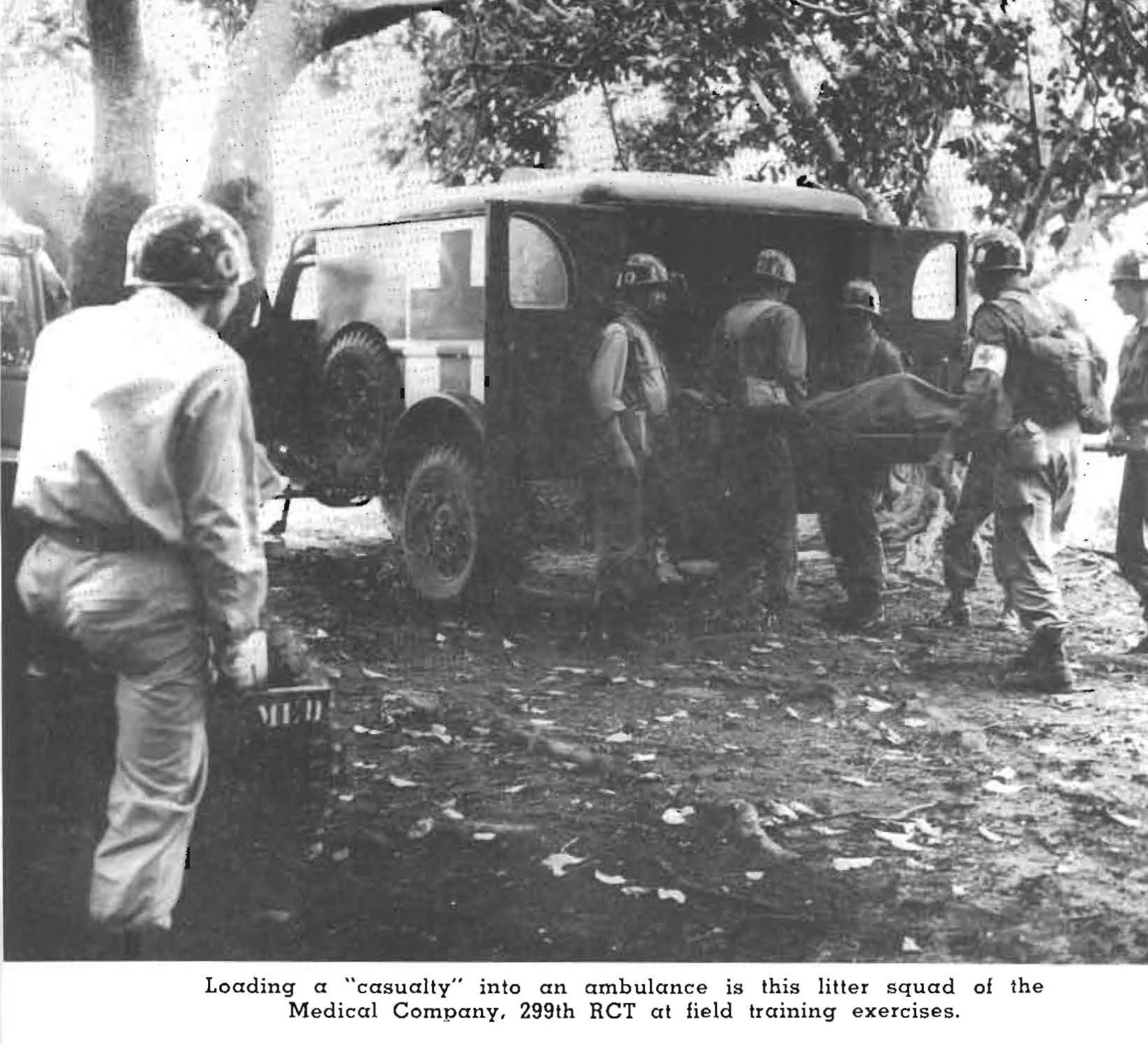
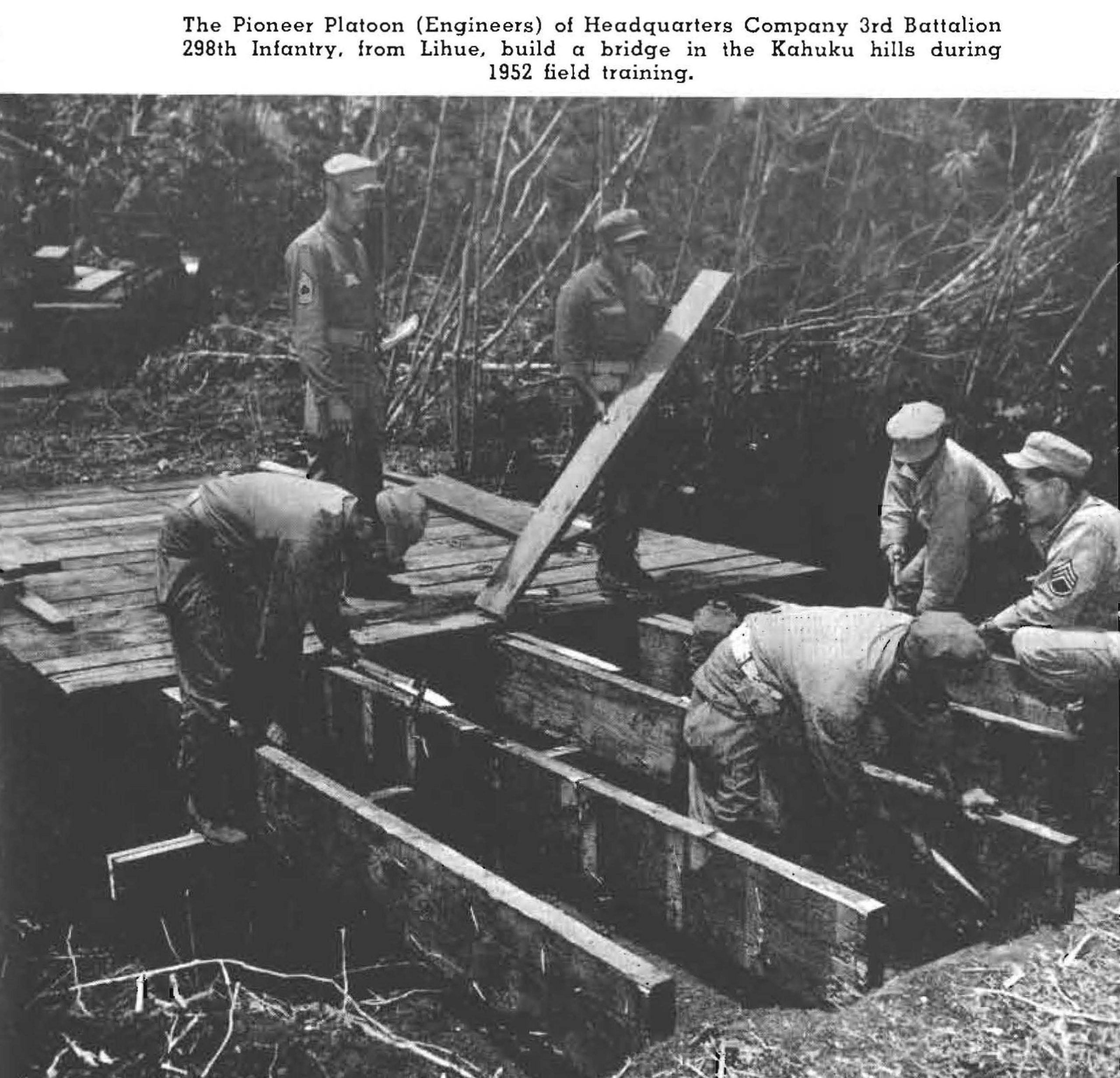
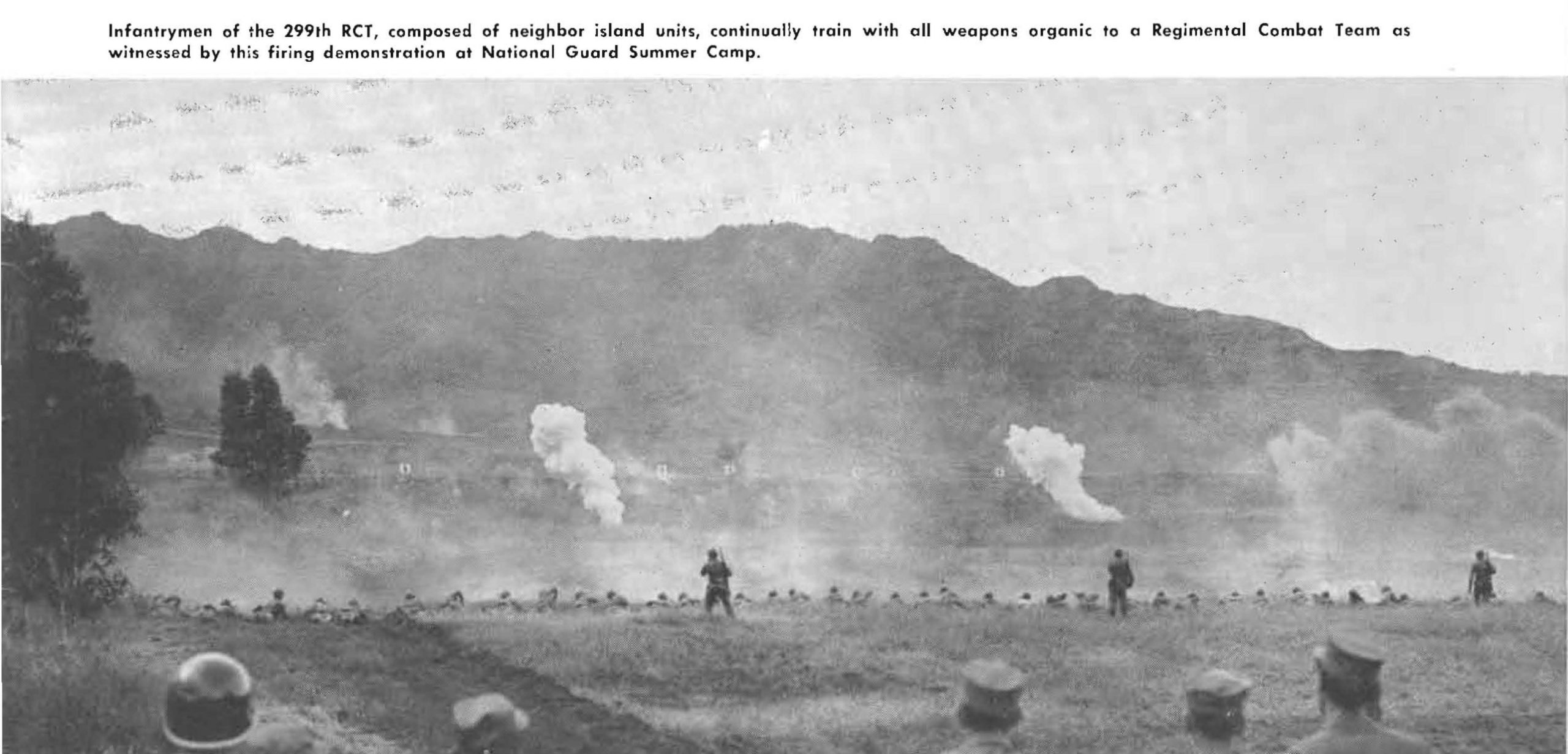
All army units of the Hawaii National Guard attended field training on Oahu as follows: 299th RCT June 9-23; Hq &, Hq Det HNG, 613th Ordnance Co and 120th Military Police Co June 14-28 and 298th RCT June 22 to July 6. The base camp of the regimental combat teams and the 613th Ordnance Company was on the old Kahuku airfield, with one infantry battalion at a time operating for 2 days out of a camp on the Schofield Barracks weapons ranges. The Field Artillery battalions each spent several days training and firing at Makua Valley, Schofield, East Range and Wheeler Field, and the two Tank Companies spent a week each at the Schofield ranges. The 613th Ordnance Company supported the combat team units at Kahuku. while the State Staff (Hq &, Hq Det HNG) supervised all units from Schofield Barracks. The 120th Military Police Company trained at Schofield Barracks, Pupukea heights and Dillingham Air Force Base. The training program covered the first year fie ld training subjects of the National Guard Training Program which concentrates on the individual and small units such as the squad, platoon, section, and company or battery, Emphasis was placed on combat firing and other subjects necessary to prepare for the army training tests which were administered to each unit. These tests are devised by Army Field Forces to determine the status of training of small combat units, and were modified by local Army and Hawaii National Guard teams to fit the existing conditions, The results o f the tests are proving of great value in evaluating past training procedures and methods for possible improvement
All units of the HANG participated in the annual field training exercises 14 June through 28 June 1952. The field training site of the 199th Fighter Squadron was Barking Sands Air Force Base, Kauai. Twenty-seven officers and 375 airmen were present there including 4 airmen of the 199th Weather Station. The 109th AC&W Squadron was located at Koko Head Radar Station for field training. The radar officers and radar maintenance sections operated on a 24 hour schedule for the entire 2 weeks
The 109th ACW Squadron annual field training was held 14-28 June 1952, with personnel being trained at the active 614th ACW Squadron Punamano and Koko Crater Radar Stations. These stations were then equipped with the AN/ CPS-l “Snow Plow”, AN/ CPS-5, BC-639, BC-640, and VHF-DF. The 109th was making strenuous efforts to build its technical capability. 1st Lts Arthur Ishimoto and Herbert Isonaga attended the Communications Officer Course at Scott AFB, and 25 airmen were awaiting class assignments.
Foxy, the 109th mascot woofwoof gave birth to sextuplets. The men named the pups Mafungo, Manafifi, Mascobe, Pogo Stick, Rabonjo, and Rugosogo. The 199th Fighter Squadron held its summer camp again at Barking Sands, Kauai, 14-28 June 1952.
These HANGmen were now old hands at overwater shipments, and the movement was much more refined. Some $21,000 was expended in minor rehabilitation of the mess hall and wooden barracks. Major General Earl T. Ricks and Col Winston P. Wilson of the Air Division, National Guard Bureau, again visited the summer camp.
Field training was scheduled for June 1953 and was timed to occur just after the closing of the schools and just prior to the time when most of the island canneries would be hiring the bulk of their seasonal employees. All army units attended summer camp at Schofield Barracks, Oahu, between 6 and 27 June. Adequate training areas were made available at Schofield, the Wahiawa East Range. Wheeler Air Force Base, Dillingham Air Force Base, Makua Valley, and Kahuku. Total attendance at field training was 4944 officers and men, which was 98%, of the actual assigned strength of the units at that time. The attendance record was outstanding and is attributed to good morale, and excellent community support and cooperation. The program at field training again stressed those subjects which require outdoor facilities. The continuity of training, housekeeping activities, discipline, etc . provided by the two week periods in valuable in molding the individual Guardsmen into capable, functioning units. Beginning where armory training left off, the summer camp schedule provided for the training and exercising of small units, i.e., squads, platoons, companies. and batteries. All of these units were given training tests designed to provide indications of the effectiveness of past training and to point out areas where improvement was needed. Much was learned from these tests, and the lessons were applied in planning the next year’s training. One of the outstanding features of this camp was the fact that all troops from islands other than Oahu were flown in to Hickam Air Force Base by the Military Air Transport Service. Some 2400 troops were airlifted to and from camp, saving two days of travel time which had been spent on shipboard in past years. The 4800 mandays of training thus saved were put to blood use at Schofield.
Field training for the 199th was held at Wheeler AFB, Oahu, 13-27 June 1953. The primary flying missions were aerial gunnery, squadron formation, and ground controlled intercept in coordination with the 109th AC&W Squadron. The total flying hours increased one-third from the previous years’ encampment and the total missions flown were almost doubled. . .
Due to limited billeting facilities at the Koko Head site, the 109th conducted its annual field training 011 a detachment basis. Detachment “A” operated from 6 to 20 June and Detachment “B” operated from 22. June to 6 July 1953. Since the 199th Fighter Squadron trained from 13 to 27 June both Detachments were able to work with the fighter squadron.
The fighter squadron held its annual field training this year al Wheeler AFB 13-27 June 1953. Primary missions were aerial gunnery, squadron formation, and ground controlled interceptions in coordination with the 109th ACW Squadron. Flying hours increased one-third from the previous year’s encampment, and the number of missions flown was almost doubled. Caliber .50 rounds expended totaled 34,618-average scores were 20.7% hits. Capt George T. Harris’ flight was ‘Tops” with an average of 25.8% hits. AIC George K. Meyer got into trouble one night at the NCO Club and was awarded the task the next day of cutting a huge pile of firewood.
The two “detachments” of the 109th ACW Squadron held “back-to-back” annual field training periods at Koko Crater AFS which overlapped the 199th Fighter Interceptor Squadron’s summer camp. Assigned Air Technicians attended both of these “detachment” encampments. Most of those attending field training for the first time were not used to the outdoor latrine covered with canvas fly and no roof. The “Outdoor Theatre” proved popular in the evenings (despite mosquitoes and some rain) for those who did not go “out on the town”. The PT (Physical Training) runs to Hanauma Bay were likewise popular-many summer coeds seemed to like it there also. Capt Theodore Soong arranged for religious services under the keawe trees, and for student barbers from the Barber College to come and give much needed haircuts at 50¢ each.
Major General Earl T. Ricks and Col Winston P. Wilson of the Air Division, National Guard Bureau, again visited the HANG encampments.
Field Training. The Hawaii National Guard again scheduled its field training for the month of June, and during the period 5 June to 5 July, 5815 officers and men attended two weeks of training. That figure included 841 members of the air units and 4974 from the army units.
Army unit training was scheduled at two principal campsites, Schofield Barracks on Oahu, and Keaukaha Military Reservation on Hawaii. The two artillery battalions (749 men) trained on Hawaii while the balance of the regimental combat teams and the special units (4225 men) were at Schofield. See Plate VI for dates, locations, strengths, etc. In both cases satellite training areas were utilized, namely, on Hawaii, the Pohakuloa artillery range and bivouac, and, on Oahu, Makua Valley, Kahuku Army Training Area, Wheeler Air Force Base, and the Wahiawa East Range.
The establishment of the camp on Hawaii marked the first such use of that island by the Hawaii National Guard since 1938. The principal reason for establishing the camp was to permit the artillery units to take advantage of the unlimited artillery firing range at Pohakuloa. The army training areas on Oahu do not permit live artillery firing at ranges greater than 4000 yards, which imposed a serious limitation on the training of the battalions. A secondary reason for establishing the Hawaii camp was the possibility that large numbers of Regular Army troops might occupy Schofield Barracks in the near future, in which case the limited training areas and facilities of that post might not be adequate to support both the regular and National Guard training programs. Territorial and Federal funds were used to construct minimum facilities for a one battalion base camp at the Keaukaha Military Reservation in Hilo. The battalions used this camp for the first week of training, and during the second week they operated out of the Pohakuloa bivouac area. The training periods were staggered one week so that each battalion had free use of the base camp.
As in past years, the army units which trained at Schofield were housed in permanent type barracks. Due to familiarity with the area from previous camps, the operation of the camp there posed no major difficulties.
The training mission of the army units was to complete the first year field training subjects specified in the National Guard Training ProgTam. These subjects were designed to achieve the objectives of training individuals to the level of efficiency and leadership required by their unit assignment, and to train small units such as squads, sections and platoons to function as teams in the fulfillment of their designated missions.
Field training for the air units was conducted at two sites on Oahu, the Koko Head Radar Site, home of the 109th AC&W Squadron, and Kaneohe Marine Corps Air Station.
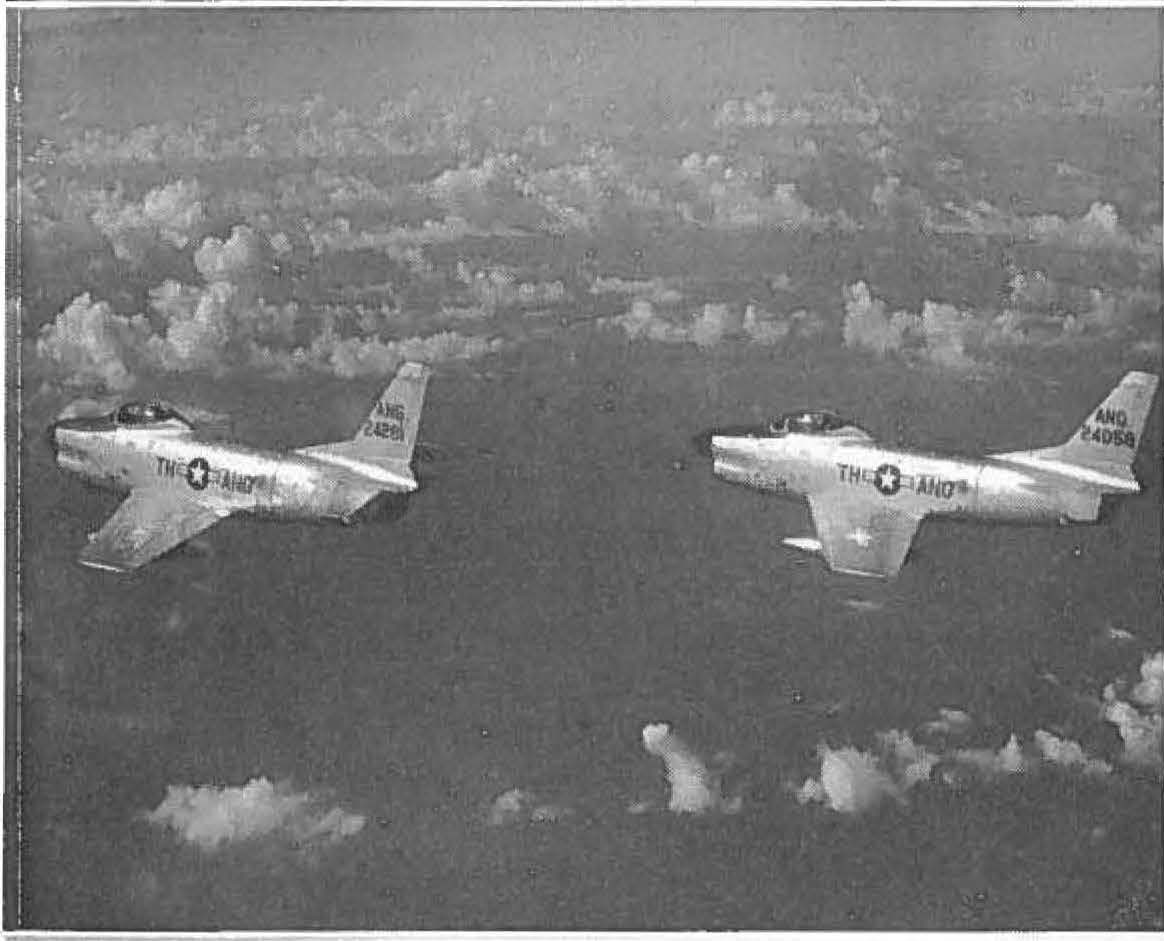
By arrangements with Fleet Marine Force Pacific, the latter base was used for training the flying elements of the Hawaii Air National Guard. The reason for this was the fact that intensive flying operation with jet aircraft constituted a serious hazard in the Honolulu Airport-Hickam AFB area with its heavy commercial and military transport traffic. It was felt that more benefit would be derived from the training period if it were scheduled at Kaneohe, which was in operation as a jet base and was free from interfering traffic. The cooperation and assistance extended by the Marine Air Group stationed there contributed greatly to the success of the training. The training program centered around the flying operations which consisted of transition training in T-33 and F-86 aircraft, formation flying in F-86’s, familiarization aerial gunnery missions, and ground controlled intercept missions in conjunction with the 109th AC&W Squadron.
The 109th AC&W Squadron was forced to schedule its training in two separate periods, one for Detachment A and one for Detachment B. The reason for that action was that the limited equipment and facilities available were not adequate to support an active training program for both detachments simultaneously. The program consisted of maintaining a 24-hour radar operation involving surveillance for warning purposes and the ground controlled interception missions mentioned above. All personnel of the squadron were trained on the job in their specialties.
The 109th AC&W Sq held end-to-end summer encampments at Koko Crater AFS; Detachment A, 5-19 June, and Detachment B, 21 June-5 July. Training was on a 24 hour basis (they now had a height finder). The 199th, 8199th and the Forecasting Flight held their encampments at Kaneohe MCAS 12-27 June 1954. The training program emphasized jet transition, F-86E formation flying, familiarization aerial gunnery, and ground controlled interception missions in conjunction with the 109th.
Field Training. 4-25 June. The training mission was to complete all subjects necessary to accomplish the year’s objective, i.e., to train the individual to the level of efficiency and leadership required by his unit assignment and to train the unit to the degree of proficiency required by its primary mission starting with the squad or comparable unit and progressing to larger units as smaller components thereof become proficient. The training was conducted on Oahu and Hawaii. The major effort was directed toward combat range firing and tactical problems. All troops received a four-hour Chemical Biological and Radiological course at the USARPAC CBR School and attended a special firing demonstration conducted by the 25th Division. The encampment was extremely successful and the training objectives were achieved. The cooperation and support rendered by the 25th Division was excellent.
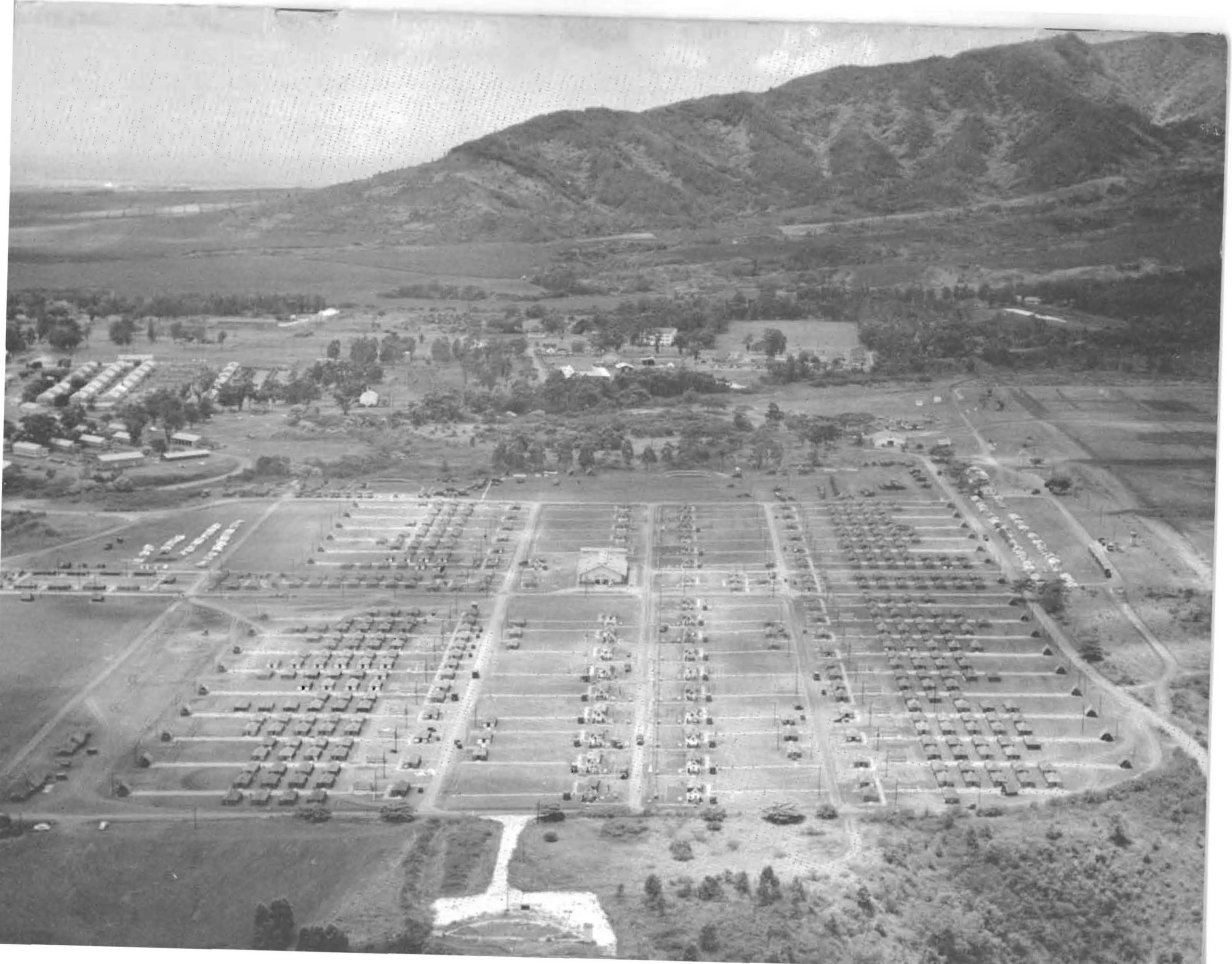
The Hawaii National Guard campsite located at Area X, Schofield Barracks.(Pictures from the 1955 Annual Report)
Flying during FY 1955 reached a peak at the Summer Camp, held at Kaneohe MCAS, where 847:05 hours were flown. This was made possible by Hying continuously during the hours of daylight.
The two “detachments” of the 109th AC&W Sq held their annual field training periods again at Koko Crater AFS. The other HANG units were at Kaneohe MCAS 11-25 June 1955. The flying training was tightly scheduled, and the days were long-first takeoff at 0600 and last landing at 1735. The SABRE JETs logged 617 hours during the encampment. Aerial Gunnery and Ground Controlled Interceptions in coordination with the 109th were the prime training missions.
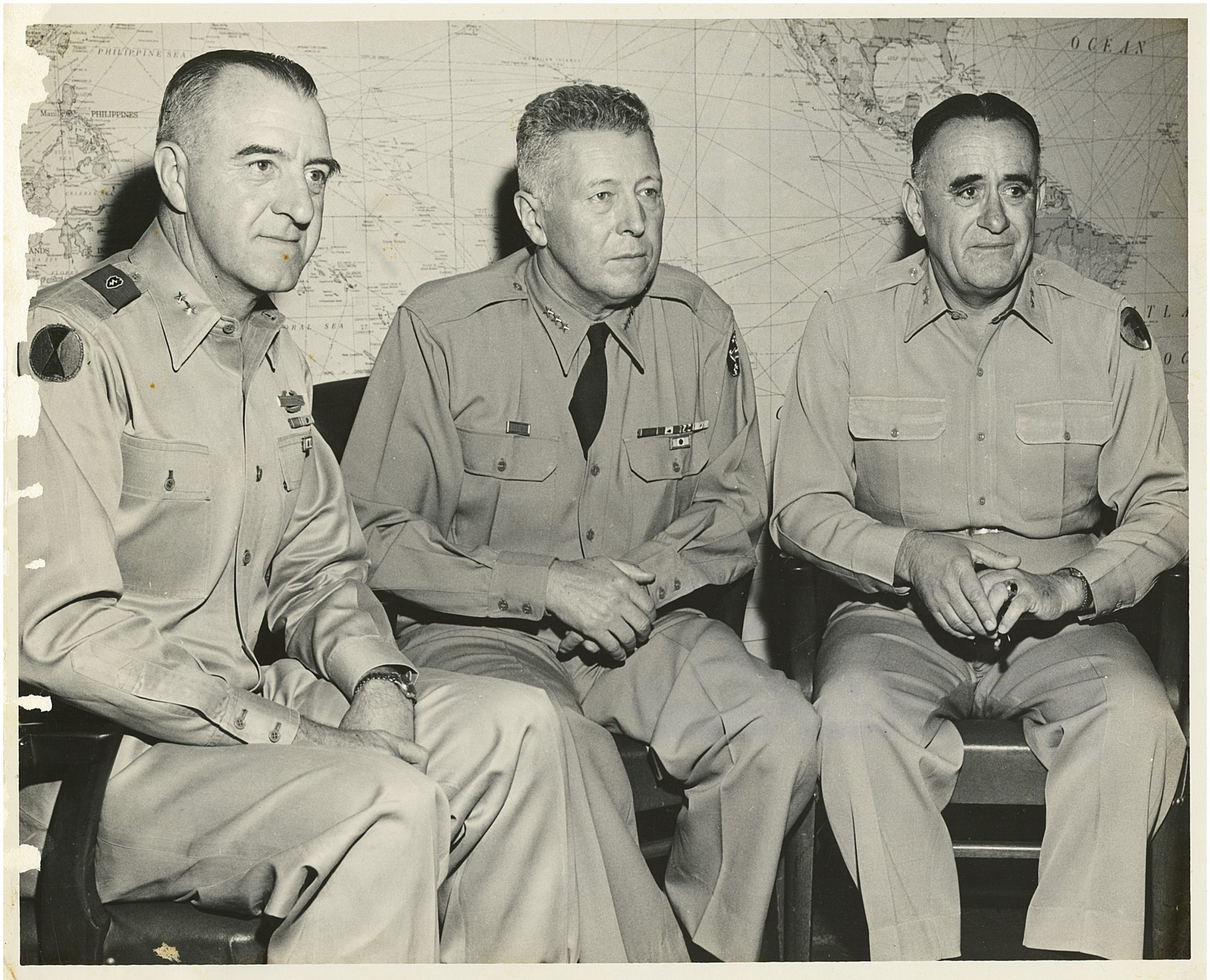
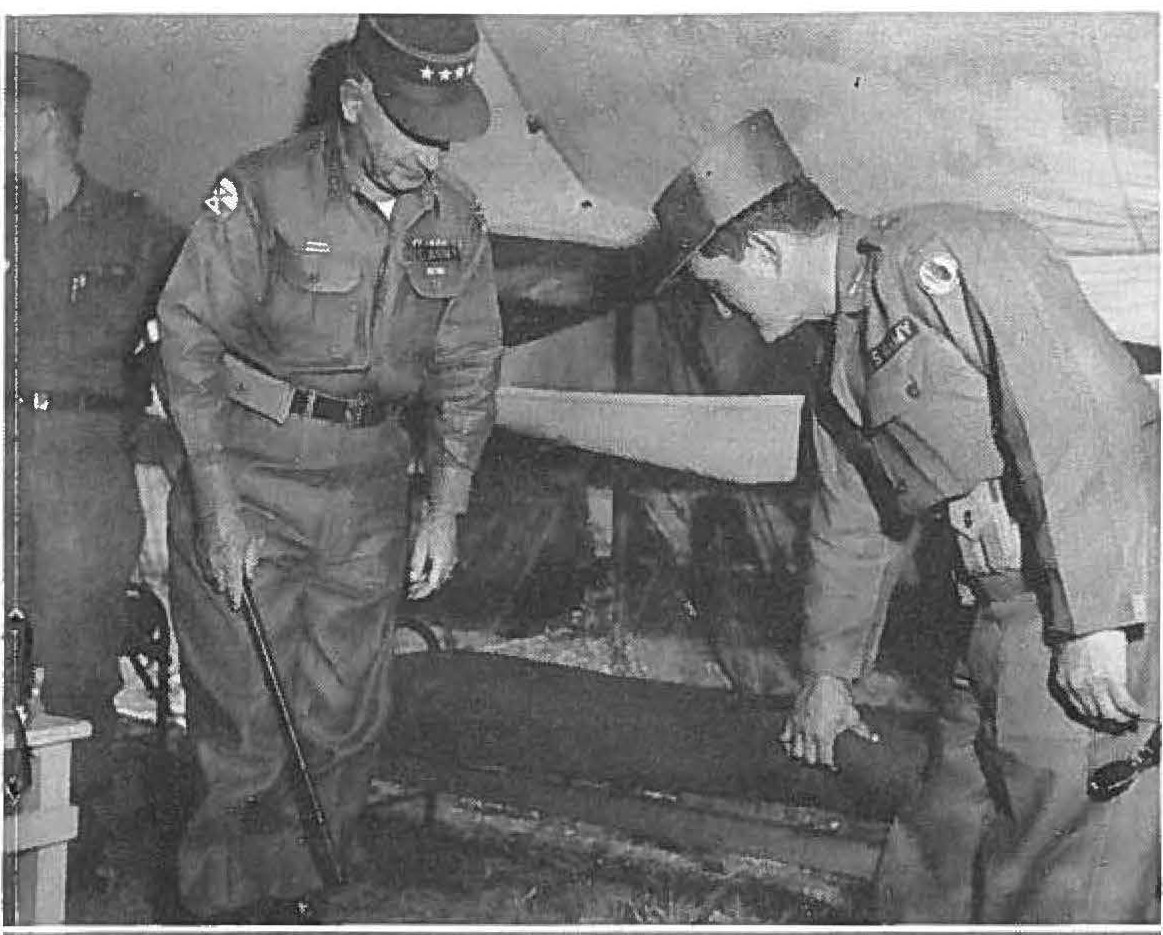
USARPAC-55-249 28 JAN. 1955 OAHU, T.R. Three of the top army generals of the United States Army, Pacific are pictured attending a briefing during a Conference held at headquarters, USARPAC, Fort Shafter on Friday Morning. Commanders and staff officers were at the meeting to talk over. Plans for the coming annual national guard and reserve encampment. Left to right Maj. Gen. H. B. Powell, 25th Division Commander; LT. Gen B. C. Clarke, U.S. Army Pacific Commander and Maj. Gen. F. W. Makinney, Adjutant Hawaii National Guard M/SGT Cordeiro, 8309TH Army Unit.(Photo from the Makinney Ohana)
1956 9th June – 1st July
Field Training: 9 June – 1 July, training was conducted in three stages to accommodate special desires of the units involved. The 299th RCT and Special Troop Units trained from 9- 23 June, the 158th AAA Bn from 16-30 June and the 298th RCT from 17 June – 1 July. The training mission was to complete all subjects necessary to accomplish the year’s objective, i.e. to train the individual to the level of efficiency and leadership required by his unit assignment and to train the unit to the degree of proficiency required by its primary mission starting with the squad or comparable unit and progressing to larger units as smaller components thereof become proficient. The training was conducted on Oahu and Hawaii. The major effort was directed toward combat range firing and tactical problems. Recruit detachments for the year displayed considerable enthusiasm and a willingness to learn which was evidenced in their fine training record. Again, the cooperation and support rendered by the 25th Division was excellent.
The two weeks Annual Field Training was again held at Kaneohe MCAS. There was a significant increase in flying activity over the preceding summer camp. 729 training sorties were flown versus 626 the previous year.
The aircraft were flown six periods a day (0500-2000) in two shifts, each of which was operated by the 199th or the 8199th. This type of scheduling was necessary to utilize the small number of jet aircraft. 12 F-86s and 3 T-33s were taken over for the encampment. An average of II F·86s were available daily (87% I and each aircraft flew an average of 48 times (41 :30 hours utilization) during this intensive period of operational training. The T·33s performed yeoman service in instrument training and towing targets. Each T·33 flew an average of 62 times (67 hours utilization).
The tactical pilots averaged 22:10 hours of prescribed missions in tactical aircraft during this two week period. Primary emphasis was on aerial gunnery (126 missions’ and ground controlled intercept (114 missions) in cooperation with the 109th. The average scores for the 59,400 rounds of cal. .50 ammunition expended in aerial gunnery were 15.6% above 20,000 feet and 14.9% above 27,000 feet. (Qualification for combat ready is 15%).
In spite of the desires and efforts of our Weather Flight, passing rain showers obscured Kaneohe MCAS at times and occasional returning flights were diverted to land at Hickam AFB. This necessitated the cancelling of the next flying period of these aircraft.
The limited number of F·86 aircraft presented considerable utilization and training problems.
The 199th Aerial Gunnery team fired their qualifying official scores during Annual Field Training. The Team’s score was sufficient so that they will compete with 4 other ANG teams (winners of ANG Regional Matches) in the Annual Air National Guard Gunnery Meet in September 1956 to determine the Air National Guard winner.
109th AC&W Sq. Annual Field Training for the 109th was held at Sand Island, Koko Head and Punamano. All sections of the squadron were on an operational basis. The radar operations section maintained 24 hour surveillance at Punamano and the Sand Island Air Defense Control Center, while the Koko Head site maintained 16 hour operation. Needless to say there were difficulties in the one squadron operating three sites. Half way through the encampment the antenna pedestal at Punamano became inoperative thus necessitating only a two site operation for the second week.
The radar operators netted a total of 1,450 tracks and 9,538 plots in covering air activity during these two weeks. The jet fighters from the 199th Ftr Intcp Sq provided simulated unidentified and friendly fighters for ground controlled intercepts. In addition, Kaneohe MCAS fighter units assisted in GCI missions by providing numerous flights. A total of 154 GCI missions were recorded with 130 as successful interceptions
The 109th had a frantic summer camp-24 hour shakedown operations were conducted at Punaman AFS, Sand Island operated a 24 hour Air Defense Control Center, and Koko Crater AFS maintained a 16 hour operation. During the second week the antenna pedestal at Punamano became inoperative, and the station “went off the air”. The 109th logged 154 GCI missions, with 130 recorded as successful.
The 199th and 8199th June encampment was again at Kaneohe MCAS. Each day was broken down into six flying periods in two shifts, each of which was operated by the 199th or 8199th, and 729 sorties were flown. Fourteen F-86Es and three T-33s were taken to Kaneohe MCAS (one SABRE JET was left at Hickam, and was a “Hangar Queen.”). Each T-33 flew an average of 62 times on instrument training and tow target missions. SABRE JET in-commission rate was 87%. Aerial gunnery average scores rose to 15.6% hits above 20,000 feet and 14.9% hits above 27,000 feet. . .
Major General Winston P. Wilson, Chief of the Air Division of the National Guard Bureau, visited the HANG during the summer encampment and observed a remarkable four ship diamond flyby. Capt Letwell P.A. Duvauchelle, the Flight Leader, was right on time, but was a little bit fast. One mile out he transmitted a strange message-“speed brakes … momentarily.” He did just that, the rest of his flight were bewildered at the strange order, and what was a tight diamond disintegrated over the General into what reminded one HANGman of a group of mynah birds who had just been shot at.
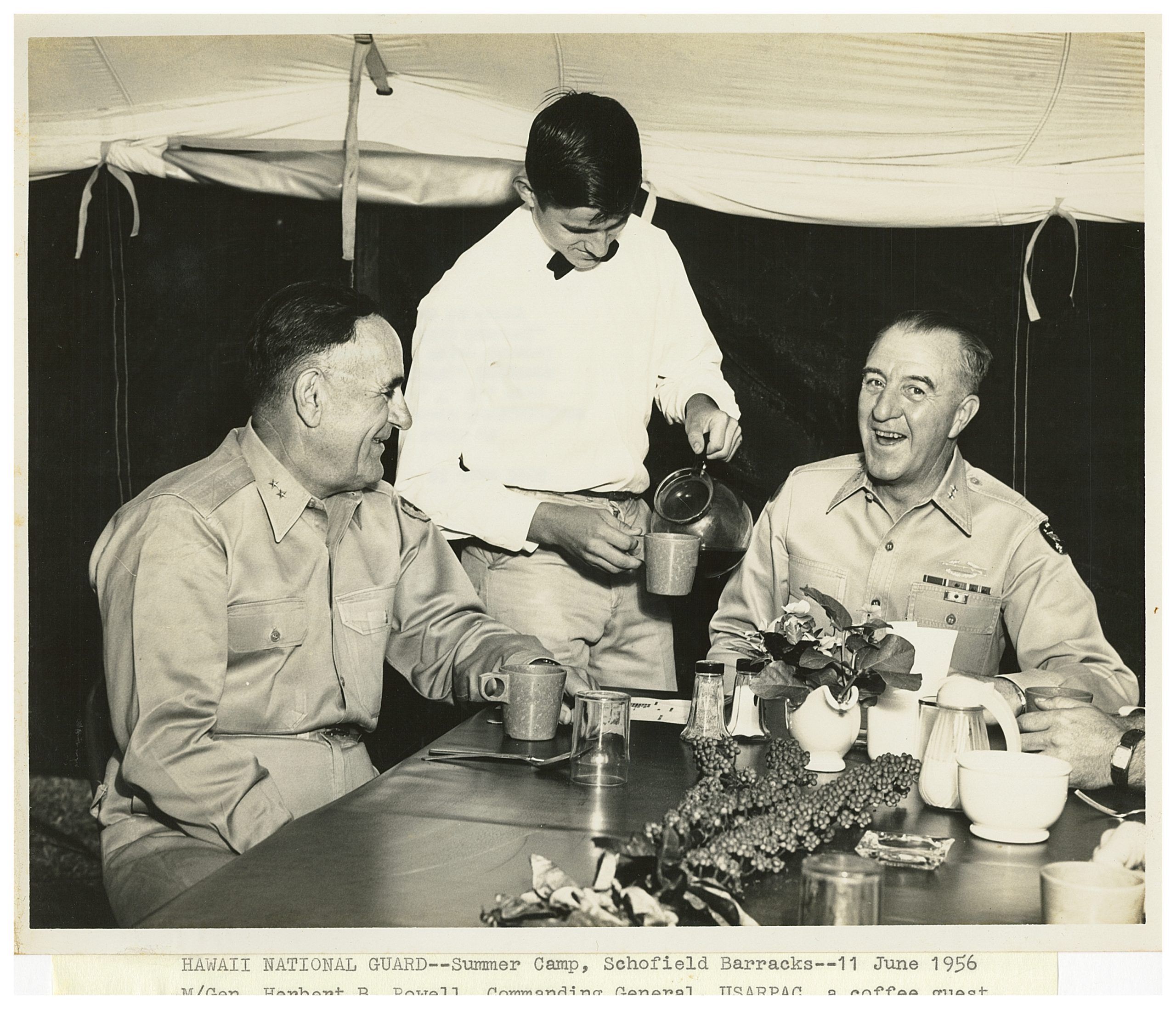
25D-742-1/GP-56 11 June 1956 Shown Sitting at the dinner Table at Army Hawaii National Guard Encampment Headquarters in Area X, Schofield Barracks, T. H., are: Major General Fred W. Makinney (Left), Adjutant General, Territory of Hawaii and Major General Herbert B. Powell (Right), Commanding General USARPAC. Serving them Coffee is Jerry Young of Honolulu, T. H. SP-1 Henry C. T. Chang 25th Signal Company, Schofield Barracks Territory of Hawaii(Photo from the Makinney Ohana)
1957 15th-29th June
Was conducted during 15-29 June at three locations: (1) Area X, Schofield Barracks for Camp Hq, 299th RCT and Special Troops, (2) Dillingham AFB for the 298th AAA Gp and (3) Pohakuloa, Hawaii for the 487th FA Bn and Tk Co, 299th RCT. The training mission to complete all subjects necessary to accomplish the year’s objective was achieved. The major effort was directed towards: combat firing and tactical problems for the 299th RCT; operation and maintenance of AAA equipment to assure the delivery of effective fire against aerial targets for the 298th AAA Group; advanced individual training for the 227th Engr Bn and qualification for the Special Security Forces for the 158th AAA Bn. Special Troops conducted formal support operations. The cooperation and support rendered by the Regular Services was excellent. ‘Furthermore, a team of 16 officers and EM was sent by the 16th AAA Bn, Boston, Massachusetts to assist the two new AAA battalions in their first field training period.
The Annual Field Training attendance averaged 98% for the entire Hawaii Air National Guard. . . During Annual Field Training at Kaneohe Marine Corps Air Station in June 1957, the tactical pilots averaged 24:05 hours of flying time for this two-week intensive unit training. 777 sorties were flown, which totaled 744:40 hours of jet pilot time. The aerial gunnery average was 19.7% hits, which included the newly assigned pilots. The flying schedule was such that considerable aircraft maintenance training was performed to increase the capability of the lesser skilled airmen.
Field Training as always has been the “acid test” for the Guard. Are we a well trained and efficient outfit, or have we merely been “going through the motions” for the past year? We will soon find out for these two weeks will certainly tell the tale. Remember, results not excuses!
The 1957 summer camp should provide an interesting demonstration of the ability of the Hawaii National Guard to convert units from one branch of service to another. During the past year, the Oahu units of the 298th RCT were converted from Infantry to Antiaircraft Artillery and Engineers. This is quite a feat when you consider the difficulties involved in such a task. But, as was expected, the 298th RCT met the challenge and is taking conversion in stride. A contributing factor to the success of any conversion is a well trained nucleus of officers and men who have been schooled in the techniques of their branch. To expedite this training, Antiaircraft Artillery and Engineers advisors were assigned to the Advisor Group and officers and men are being trained at Army Service and Area Schools. As an indication of the response to the educational opportunities which have been offered as a result of the conversion, thirty-five officers and fifteen enlisted men from Antiaircraft and Engineer units have either completed or are attending Army Service Schools, and 46 officers recently completed a two-week AAA Orientation Course conducted by USARPAC. Field Training will give these people a chance to put their knowledge to work.
Let’s take a look at this year’s field training and see what’s in store for us. Here’s the “Big Picture.”
All Army units of the Hawaii National Guard will participate in field training at the same time this yea, from the 15th to the 29th of June. Schofield Barracks will be the base camp for the 299th RCT ( minus the 487th FA Bn and the Tank Col, the 227th Engr Bn (Combat1 (Army) and the Special Troop units, with the combined aviation sections stationed at Wheeler AFB. Dillingham AFB will be the base camp for the 298th AAA Group which includes the 158th, 297th and 298th AAA Bns, the 121st and 122nd Sig Detachments, the 368th AAA Opns Detachment and the 628th Ord Detachment. Pohakuloa, Hawaii will be the base camp for the 487th FA Bn and the Tank Co, 299th RCT.
Officers and key NCO’s will be striving to insure that their units complete all the military subjects which are necessary to accomplish this year’s training objective. In addition, they must train their personnel to the level of efficiency and leadership required by their present or anticipated assignment and their units to the degree of proficiency required by their primary missions.
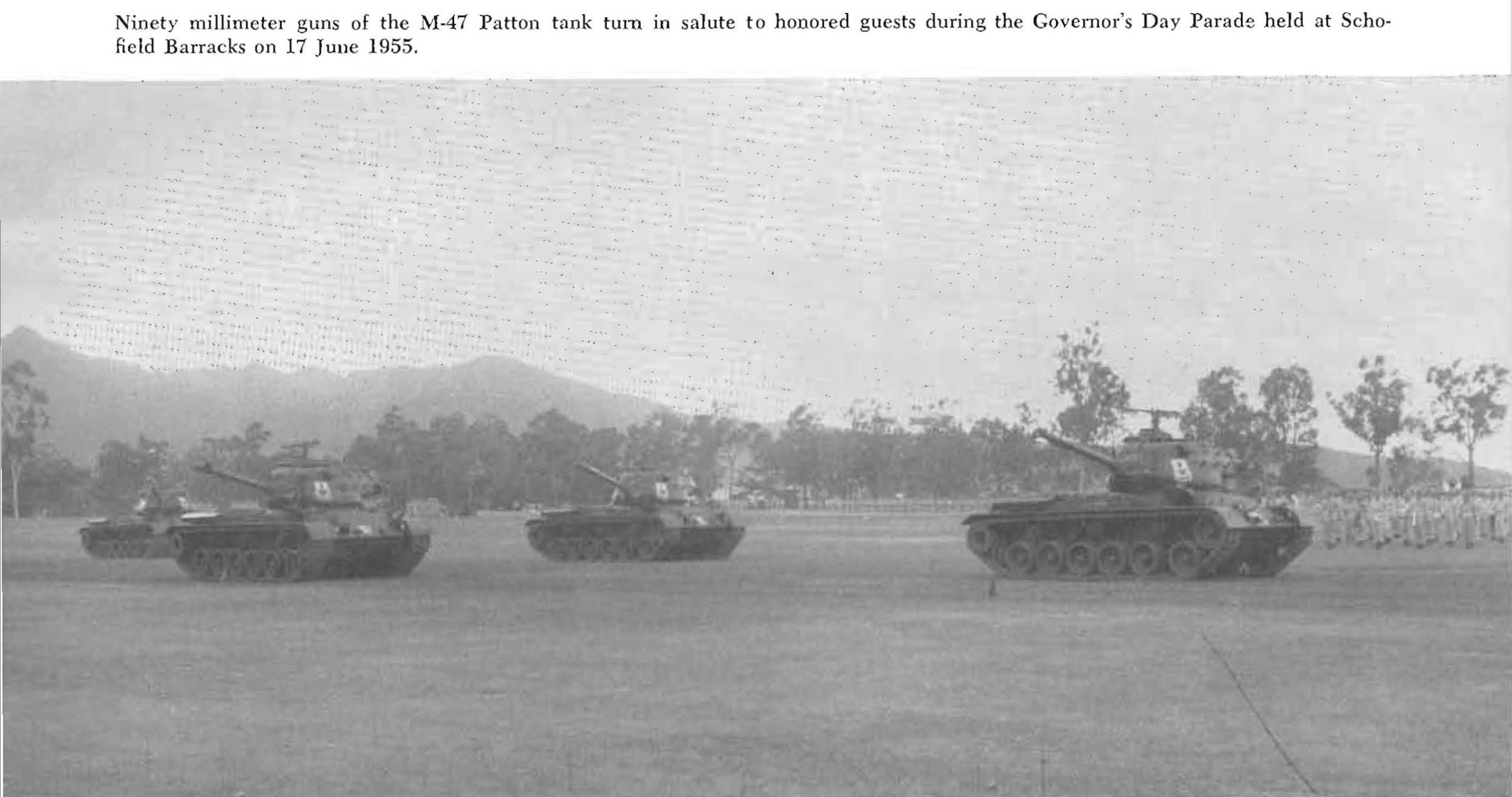
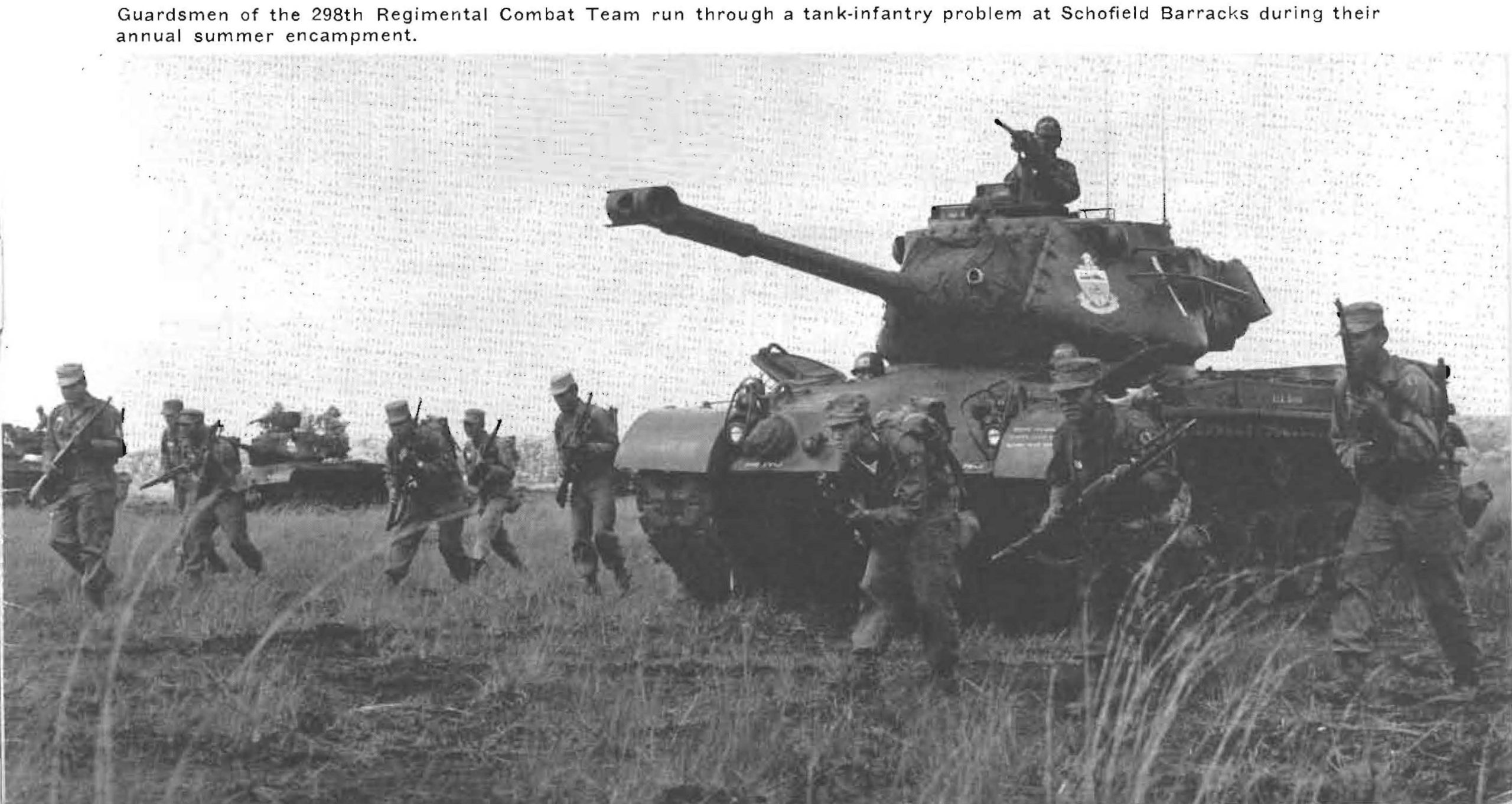
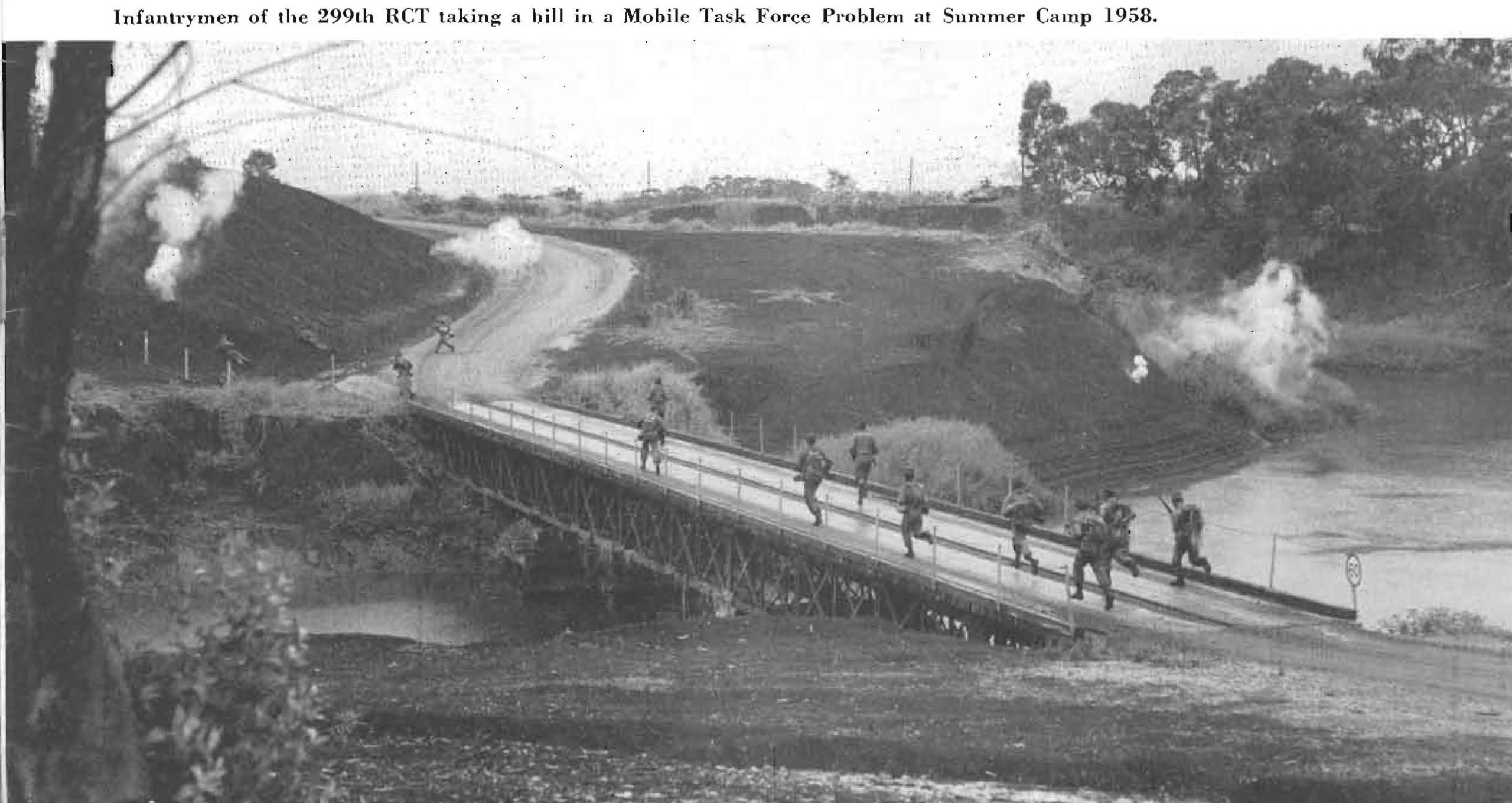
Infantry units will spend the first week of field training at Schofield Barracks undergoing range practice and individual and small unit tactical training. The 25th Inf Division will conduct a Fire Direction Center School for Heavy Weapons and Heavy Mortar Companies and a Communications School for all HNG Communications personnel. A demonstration in the employment of war dogs by the 37th Scout Dog Platoon, should be an interesting highlight. In addition, training in the Code of Conduct and Mobile Task Forces are scheduled. The 299th RCT will also participate in the Governor’s Day Review to be held on the 22nd of June at Lightning Field. During the second week the combat units will conduct unit tactical exercises at Kahuku training area. Night problems, Infantry-tank training and tactical bivouacs will be emphasized. Aggressors will be furnished by the 25th Inf Division to make this training as realistic as possible.
The 487th FA Bn and the Tank Co, 299th will devote their training at Pohakuloa on the Big Island primarily to develop individual technical proficiency; team training on platoon and company level for the Tank Co and battery and battalion level for the 487th. Delivery of effective fire against hostile ground targets will be emphasized. A l½ day tactical bivouac is scheduled for both units.
The 227th Engineers will emphasize the development of individual Engineer skills including instruction and practical work with explosives and demolitions, floating bridges and heavy equipment. Assistance from the 65th Engr Bn, 25th Inf Division is scheduled to enhance the effectiveness of this training. The 230th Engineer Company will work on some practical projects under the direction of the Post Engineers.
Antiaircraft units will utilize the entire field training period to train personnel in the fundamentals of operation and maintenance of AAA equipment. This training will include tracking of aircraft and radio controlled air targets (RCATS) by radar equipment and firing of 90mm guns and .50 caliber machine guns at RCA TS. A major contribution to AAA training this year will be the Regular Army Instructor Team which was selected from the 16th AAA Bn, Boston, Massachusetts. The 16th AAA Bn has an excellent record as a well-trained and efficient AAA unit which last year compiled the highest score in the Annual Army Training Tests. This team will furnish instructors for the M33 Fire Control System and the AN/TPS ID Surveillance Radars as well as for the gun platoons. The 158th AAA Bn will undergo its gunnery phase of the Army Training Test for nomination to the special security forces.
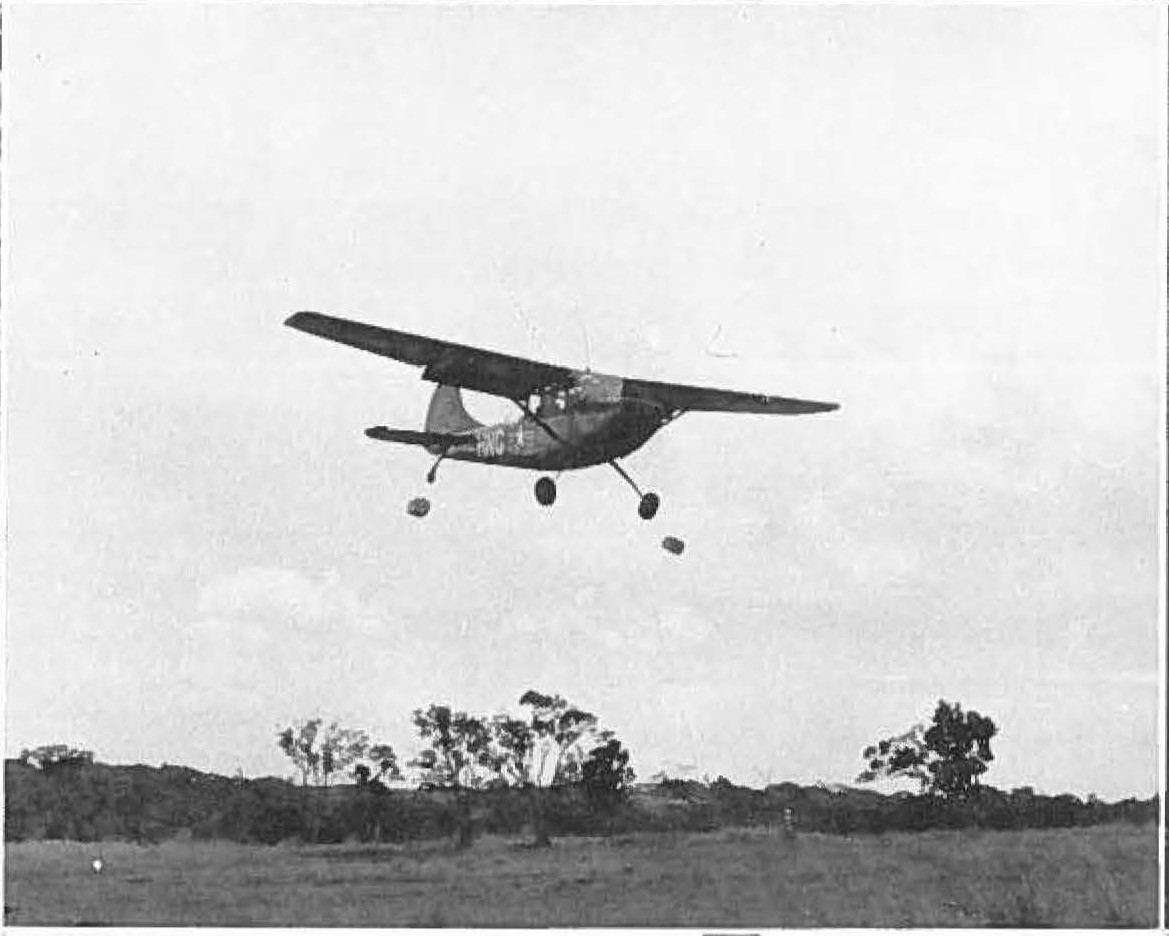
The Army Aviation Sections training on Oahu will be combined in order to facilitate Army aviation technical training for assigned personnel and to provide a pool of aircraft and pilots to support ground units of the HNG in such exercises as message drop and pick-up, column convoy control, reconnaissance and observation, etc.
Special Troops will perform their normal support missions in addition to training in their respective specialties.
Two weeks is just barely enough time to accomplish everything which has been scheduled. But with the spirit of enthusiasm and cooperation which have prevailed in previous encampments, the 1957 summer camp is bound to be a success.
FY 57 FIELD TRAINING, HANG
With only a few exceptions, Field Training for Fiscal Year 1957 for Hawaii Air National Guard units will be conducted in much the same manner as it was last year. Kaneohe Marine Corps Air Station will be utilized by the 199th Fighter Interceptor Squadron and 199th Weather Flight (Forecasting) ; the Sand Island site by Headquarters, Hawaii Air National Guard, certain personnel of the 109th Aircraft Control & Warning Squadron, and certain personnel of the 199th Fighter Interceptor Squadron; the Koko Head Radar Site by the 169th Aircraft Control & Warning Squadron; and the Punamano Radar Site by the 109th Aircraft Control & Warning Squadron 4 sites in all. In addition, the Hickam Air Force Base area of the 199th Fighter Interceptor Squadron will be utilized as a working area for Headquarters, Hawaii Air National Guard and certain Supply personnel.
It is felt that the forthcoming Summer Encampment will be the most successful ever conducted by the Hawaii Air National Guard, particularly as concerns training. Goals being set by the 199th, for instance, include 22 hours of jet time for each tactical pilot, an 85% combat readiness rate for tactical pilots, and 75% combat readiness status for tactical aircraft. As it was last year, the flying training will stress aerial gunnery, tactics, and Ground Control Intercepts. In addition, all ground training for airmen will be conducted so as to qualify each in his career field. The 199th is hoping to accomplish some 800 hours of flying time during the two week period.
Last year, the greater portion of the 199th’s operations emanated from a quonset hut area near the flight line. This year, the 199th will be able to centralize all operations in one of the Kaneohe MCAS hangars on the flight line. Obviously, such centralization of operations will be conducive to greater over-all efficiency.
The 109th Aircraft Control & Warning Squadron has advanced a few steps in their Field Training plans. Some difficulty was experienced during the last Encampment due to the fact that members of the 109th who trained at the Punamano Radar Site were billetted at Wheeler Air Force Base. This required a long ride to and from the training site, and resulted in an appreciable loss of training. This year, however, all personnel training at Punamano will be billetted at the site itself.
Being billetted and having mess facilities at the site itself has been made possible through recently completed construction at Punamano, which included grading work, the pouring of concrete tent slabs, and rehabilitation work on the existing water and electrical system.
Though the entire squadron will not be stationed at the Punamano Site at one time, it is planned that all operational personnel will have been rotated through the site by the end of the Field Training period. This will result in all personnel receiving the greatest amount of tranining possible during the two weeks involved.
The 169th AC&W Squadron, in its entirety, will be stationed at the Koko Head Radar Site during the two week Field Training period. Accomplishment of maximum training is anticipated.
Both AC&W units will be operating the radar sites on a 24-hour basis throughout the two week period. Since the fighters of the 199th Fighter Interceptor Squadron will not be available to them during the night hours for Ground Control Intercept work, coordination has been effected with the Kaneohe MCAS Marines to utilize their F-2H “Banshee” aircraft. Use of these aircraft will afford the AC&W personnel valuable training in all-weather intercept tactics.
During the daylight hours, the AC&W units will not only be operating with the fighters of the 199th, but will also be monitoring gunnery flights north of the island. In addition, the Punamano Site will still be responsible for maintaining its Air Defense Augmentation operation.
Directives from the National Guard Bureau state that the Air Defense Augmentation Program, which effects both the 109th AC&W Squadron and the 199th Fighter Interceptor Squadron, need not be maintained during the Field Training period. However, it is felt that the continuance of the program throughout the two week encampment would afford valuable training to personnel involved. In addition, the important Air Defense capability of Seventh Air Force would not be compromised by discontinuing the program during Summer Camp.
Present planning stipulates that all combat ready pilots and alert ready pilots of the 199th will rotate through the Air Defense Augmentation Program during Field Training. This program, for the 199th, will be maintained at Kaneohe MCAS during its two weeks there, instead of Hickam Air Force Base where it is located at the present time, without exception. Thus, all flight operations will emanate from Kaneohe Marine Corps Air Station.
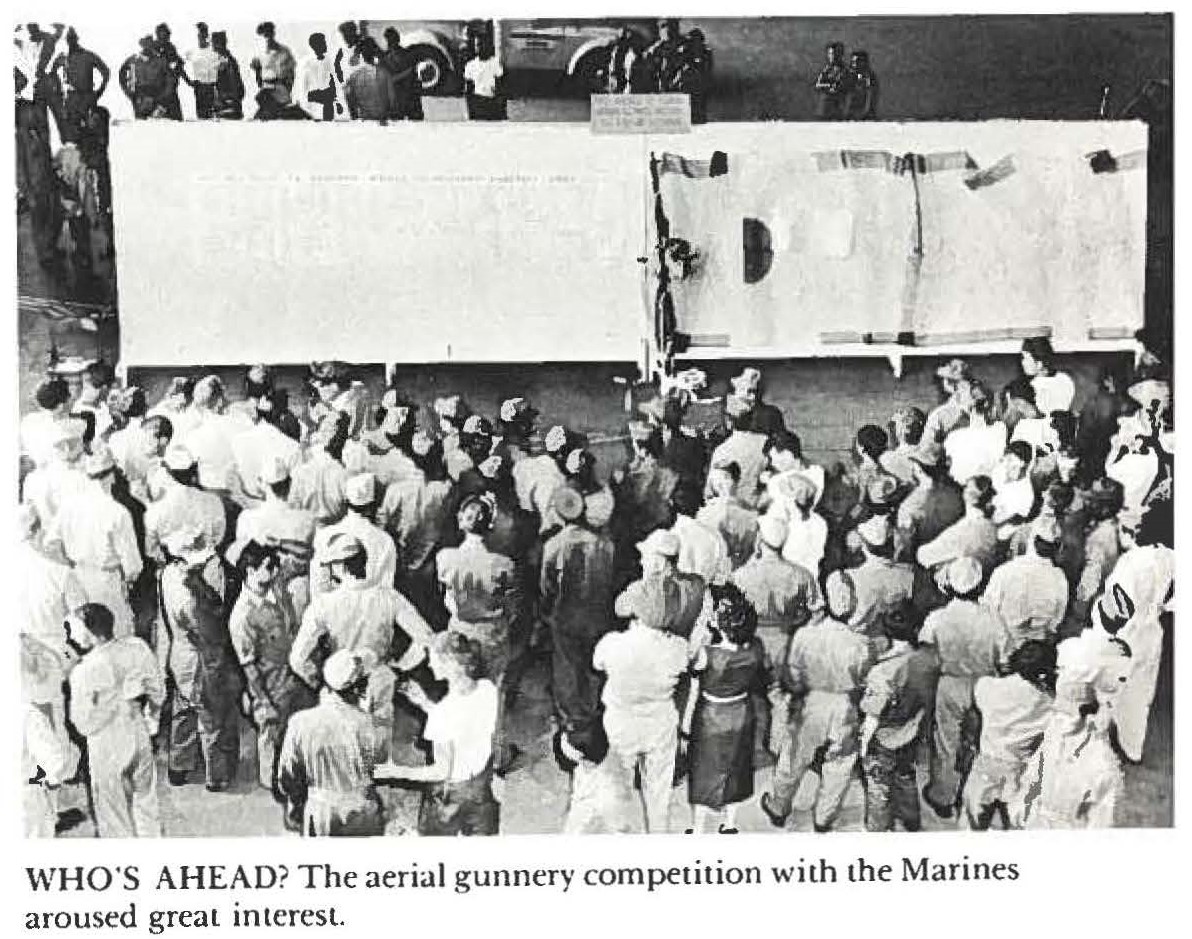
The outstanding event of the June summer camp (AC&W at home stations, remainder of the HANG again at Kaneohe MCAS) was an aerial gunnery competition with the Marines-F-86E SABRE JET vs FJ-4 FURY. Four pilots of each five man team flew three missions with the standard 200 rounds chargeable when airborne. No alibis. The F-86Es fired at 20,000 feel (the Marines said the cal. .50 holes in the targets were “teensy weensy”), the FJ-4s al 18,000 feet (HANGmen said the 20 mm holes in the targets were “bloody big”).
The HANG won, with a team average of 34.6% hits. The Marines were but 4.5% behind them. The winning HANG team was “dunked” immediately following the competition: Lt Col James R. Ashford, Capts Lorenz L. Kumeilike, Frank J. Smith, Lts Paul L. Hummel and Kurt E. Johnson. Capt Kumeilike was high man with an average of 50% hits. (HANGmen made out like bandits on the side bets!)
Field Training: Units of the Hawaii Air National Guard reported on 21 June 1958 for 15 days of active duty for training. For the first time, Pacific Air Forces conducted a Practice Mobilization Test of all units on the first day of camp, commencing at 0300 hours, resulting in an overall percentage of 72.5% of the available personnel reporting for duty within two hours. Also, for the first time, PACAF conducted their annual general air inspection during field training. All units were given a Satisfactory Rating. During this inspection, an Operational Readiness Evaluation (ORE) was conducted to provide a status report of the progress made by the tactical units in developing an all-weather air defense capability. Considering the fact that the 199th Fighter Interceptor Squadron had just been converted to all-weather aircraft and that new tactics had to be learned by all personnel, all units performed in an excellent manner during the ORE.
The 1958 HARNG field training was one of the best that the units have participated in. This is the consensus of opinion on all levels and as exemplified by the field training performance ratings issued by the Army Field Training Inspection Board in their ARNG Training Evaluation Report.
For Staff Performance we received all Superior Grades (10). For Field Training Performance, the following grades were given: 35 Superiors, 15 Excellents and 10 Very Satisfactories. For Annual Unit Training, 12 Superiors were given, 21 Excellents, 25 Very Satisfactories and 2 Satisfactories. No Unsatisfactories were given in any catagory.
The two satisfactory ratings in the annual unit training was due to the low attendance of personnel at field training from the units concerned – the results of the sugar strike attributed directly to low attendance at field training.
The elaborate pre-camp planning and reconnaissances of the training areas and the time consuming preparations at all levels of command added immensely to the success of the field training. The formal initial plans were formulated at the Commanders’ Conference held in November 1957 with HARNG staff and major unit commanders and RA advisors as participants. The conference was followed by the Initial Requirements Conference in March 1958 and the Final Coordination Conference in May 1958 between the USARHA W / 25th Inf Div staff and the HARNG staff and major unit commanders.
The staff performance in pre-camp planning and preparation, in the preparation and issuance of orders and directives, in the inter-staff and intra-staff coordination and in the supervision of training were superior.
Some of the many outstanding training observed were: the 299th Infantry training in tank-infantry and in mobile task-force; the Combined Aviation Section training in artillery fire adjustment; the 227th Engr Bn and 230th Engr Co construction of the AAA gun emplacements; the 158th AAA Bn, 297th AAA Bn and 298th AAA Bn performance in the TT; and the on-the-job training of the 613th Ord Co, the 120th MP Co and the 120th Sig Spt Co.
The assistance from USARHA W / 25th Inf Div and the AAA Advisor and umpire Teams from Fort Bliss were outstanding. Their enthusiasm and professional accomplishment of their assigned duties coupled with the enthusiastic receptiveness to learn as shown by the members of HARNG added greatly to the success of the 1958 field training.
1958 SUMMER ENCAMP HANG
All units of the Hawaii Air National Guard probably enjoyed their most successful summer encampment to date, during the 1958 Field Training period. With the 199th Fighter Interceptor Squadron being in the process of converting to F-86L all-weather aircraft, great strides were taken towards operating under an integrated team concept.
The HAFNG units were subjected to their Annual Air Inspection during this period, which was conducted by the Pacific Air Forces IG Office. Incorporated within the normal inspection was an Operational Readiness Evaluation of the units, this evaluation being in the form of a test of the operational capabilities of the Hawaii Air National Guard. The test was given in two phases – an evaluation of the entire Air Defense System; and an evaluation of the HAFNG capabilities within that system. All units received a rating of Satisfactory. Many problem areas were brought out through the ORE, and the benefits were therefore felt to be highly satisfactory.
The 199th Fighter Interceptor Squadron concentrated on a ground training program for the Aircraft Maintenance Section during the encampment. The flying program was therefore held down to an extent, with emphasis being given to the transitioning of pilots into the new aircraft. The encampment was satisfactory in all respects, and resulted in a firm basis from which to conduct the forthcoming annual program of opnation training.
Both the 109th and 169th AC&W Squadrons concentrated on streamlining all operational procedures and upgrading all personnel in their respective AFSC’s. In all respects, their encampment was highly successful, and will enable a more intense operational training program during the forthcoming year.
DOLLARS SUPPORT
Each year we attend field training at Schofield Barracks, Dillingham AFB, Pohakuloa Training site, or Hickam AFB, and seldom realize how many dollars are spent to support our activities. Lt Colonel Clark G. Johnson, U. S. Property and Fiscal Officer, as logistical advisor to the Adjutant General, is responsible for this support, dollar-wise and equipment-wise. He is a assisted by Lt Col Forest A. Hatfield, G-4, HARNG, and CWO Joseph E. Barnett, Base Supply Officer, HAFNG.
Federal funds expended for field training 1958 in support of the Army National Guard were: Pay, $418,900; Subsistence, $56,250; POL, $14,490; Ammunition and RCA T’s, $466,645; Transportation, $62,290.
The Air National Guard was supported with the following Federal dollars: Pay, $98,050; Subsistence, $13,590; Aviation fuel, $36,620.
Another figure which may startled you is the transportation support furnished by USARHAW /25th Inf Division dur camp. (These figures do not include the commercial airlift or the barge shipment). A total of 31,855 ton miles and 49,780 passenger miles were moved by the Highway Section of the Transportation Division.
To prepare our various camp sites for occupancy, USARHA W /25th Inf Div Hqs spent over $31,000. Our total expenditures for Field Training 1958 were in the neighborhood of $1,216,066.
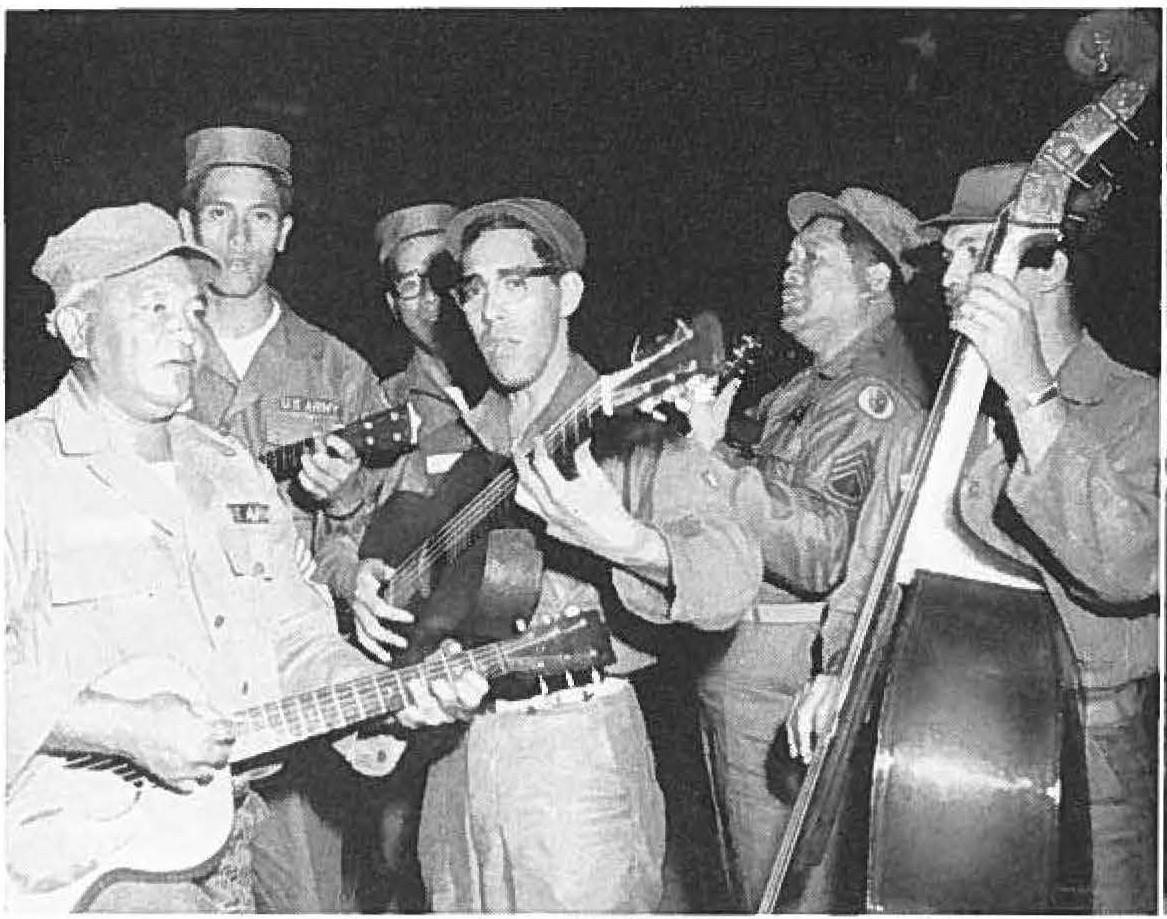
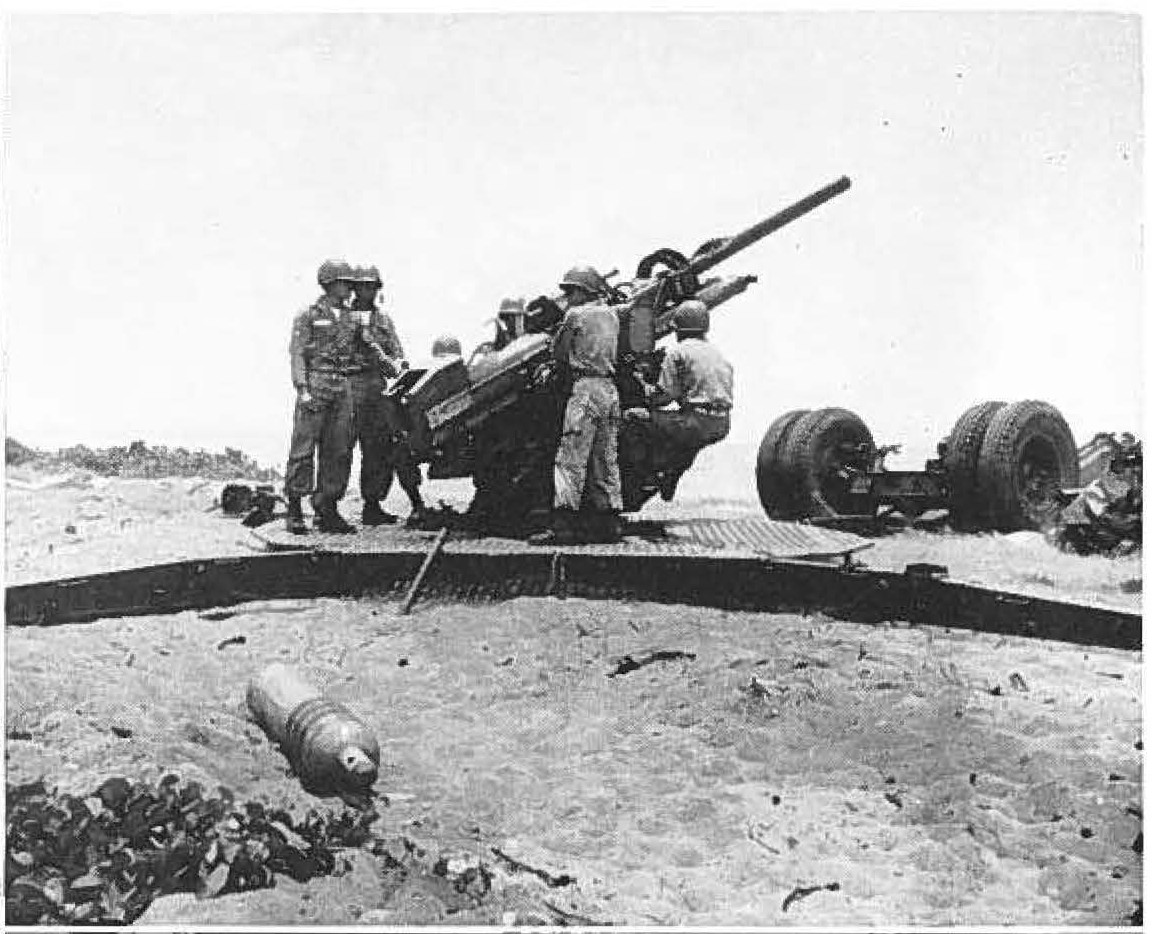
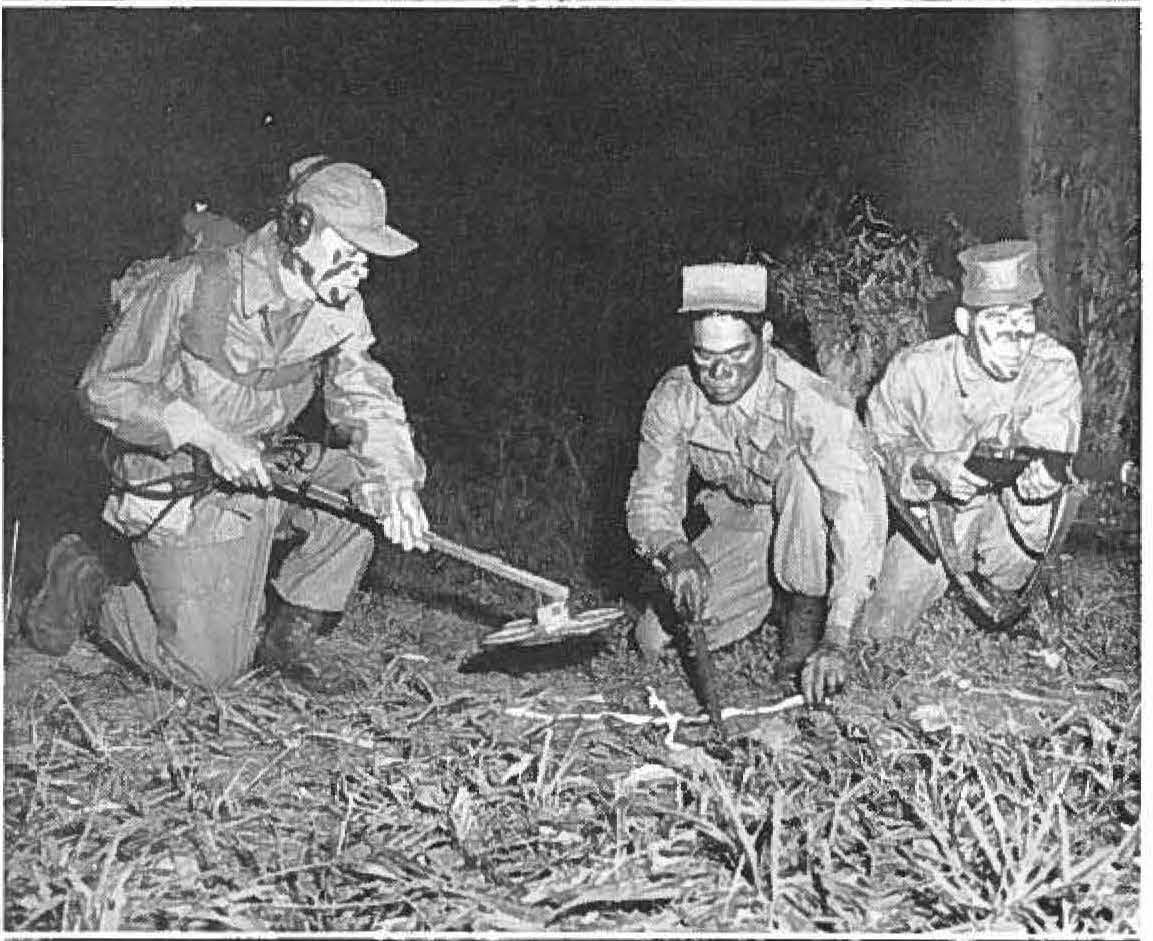
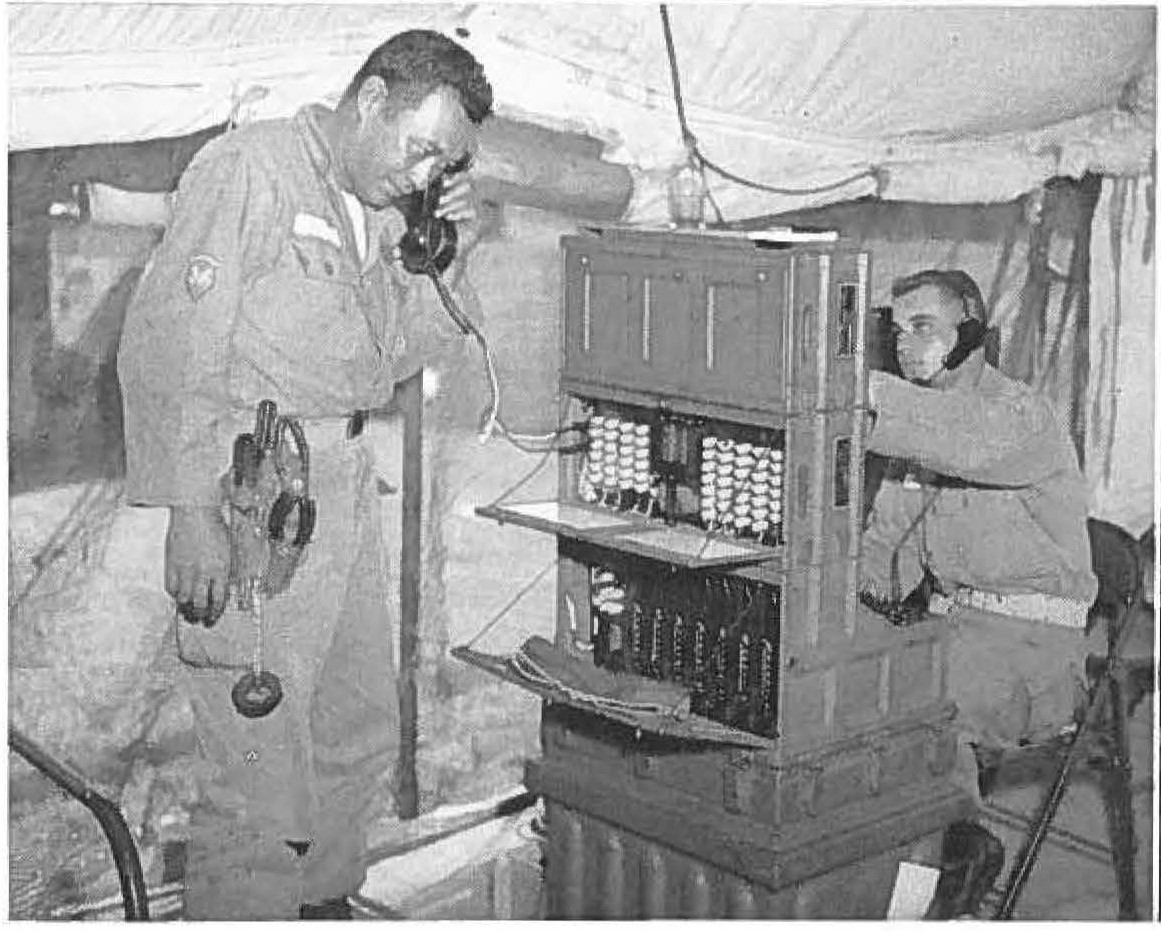
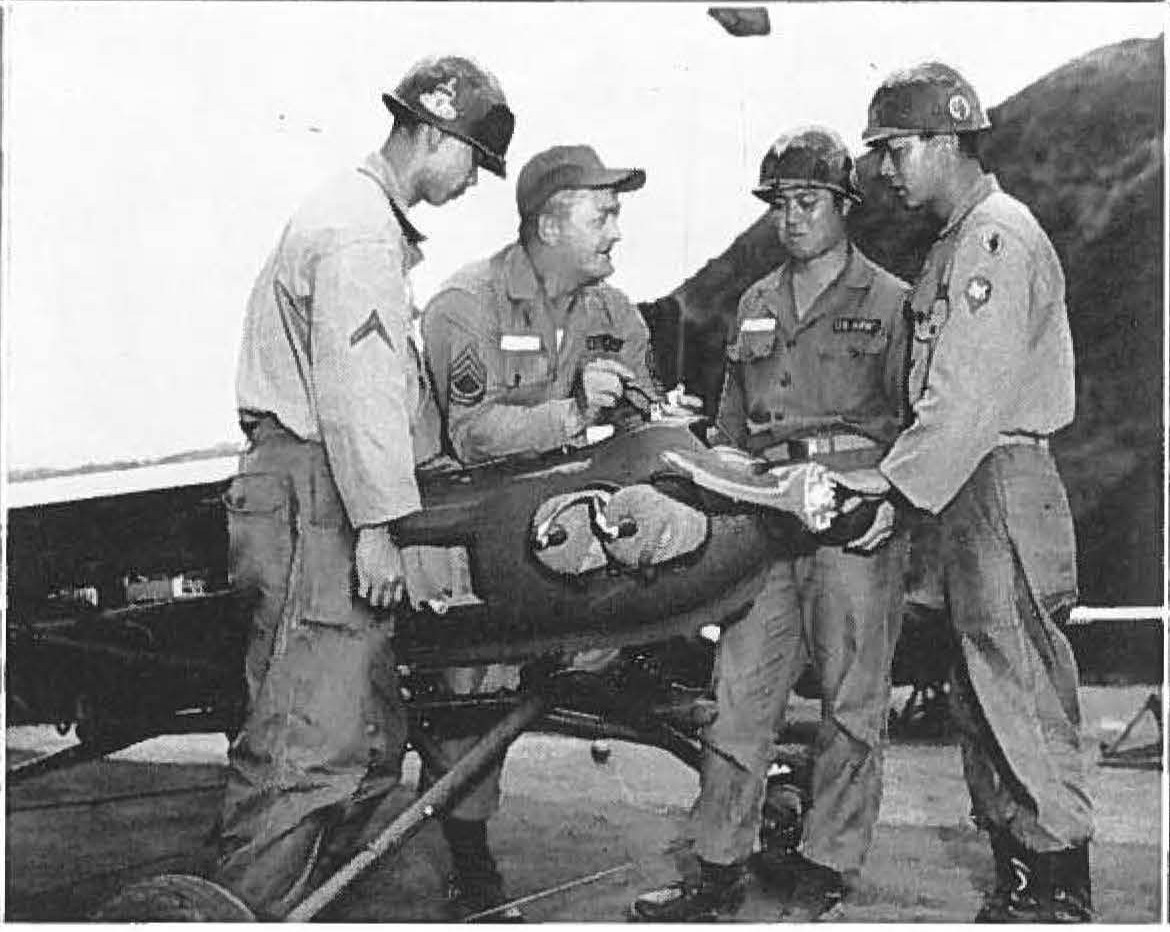
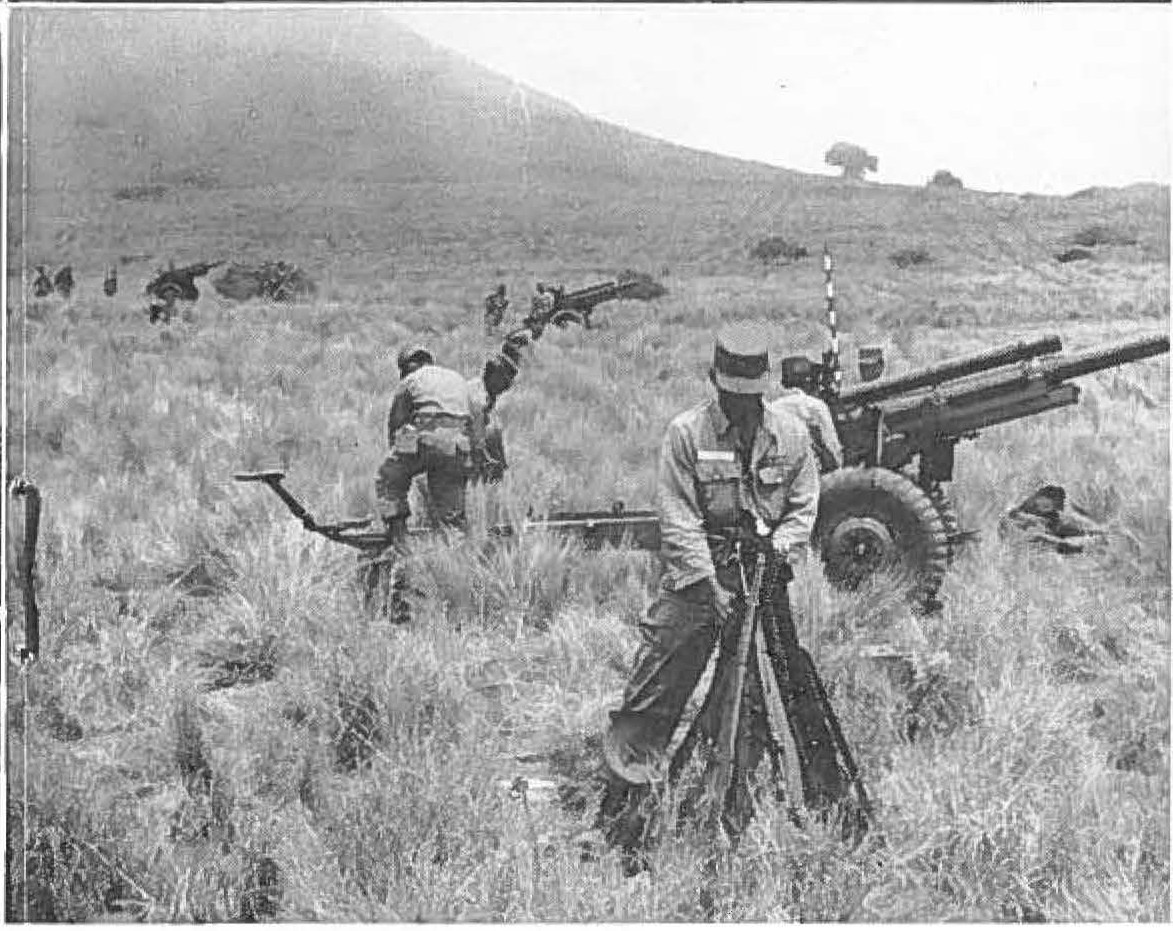
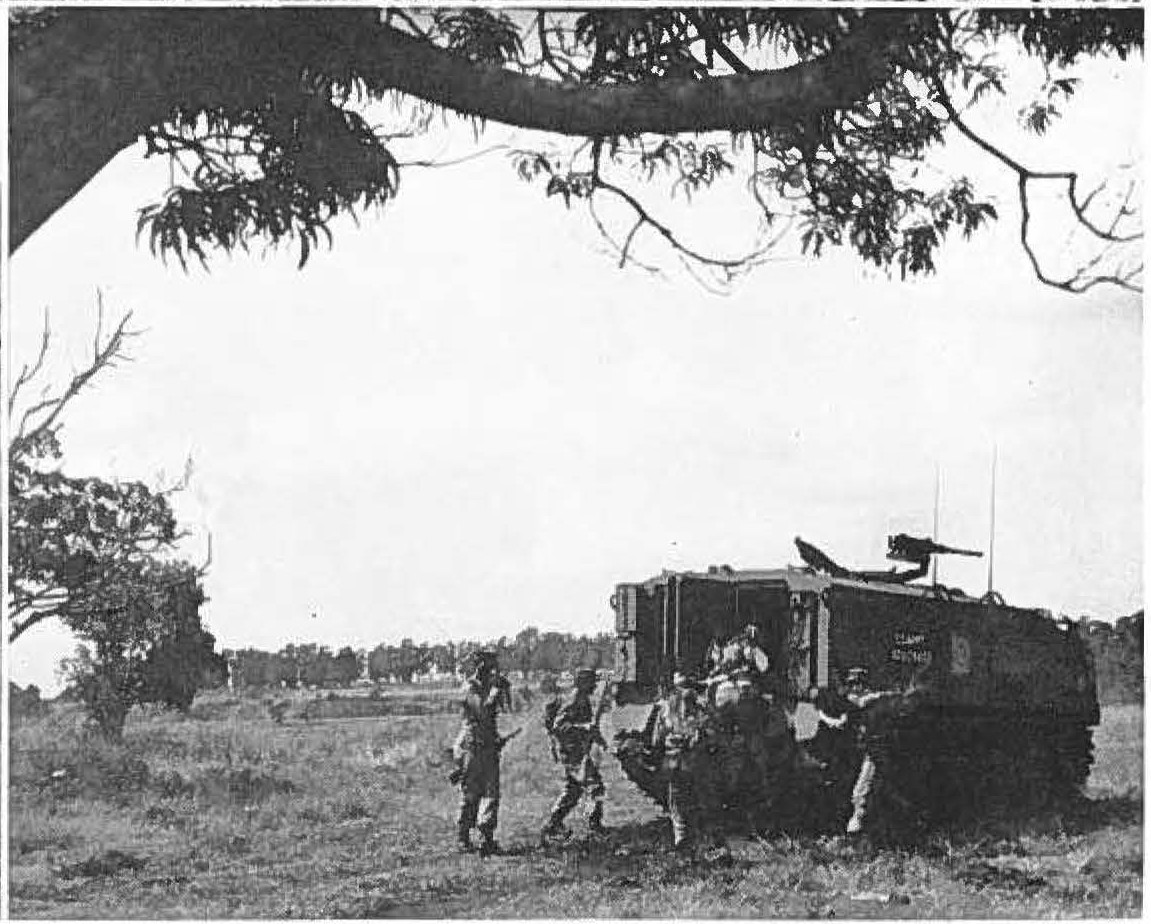
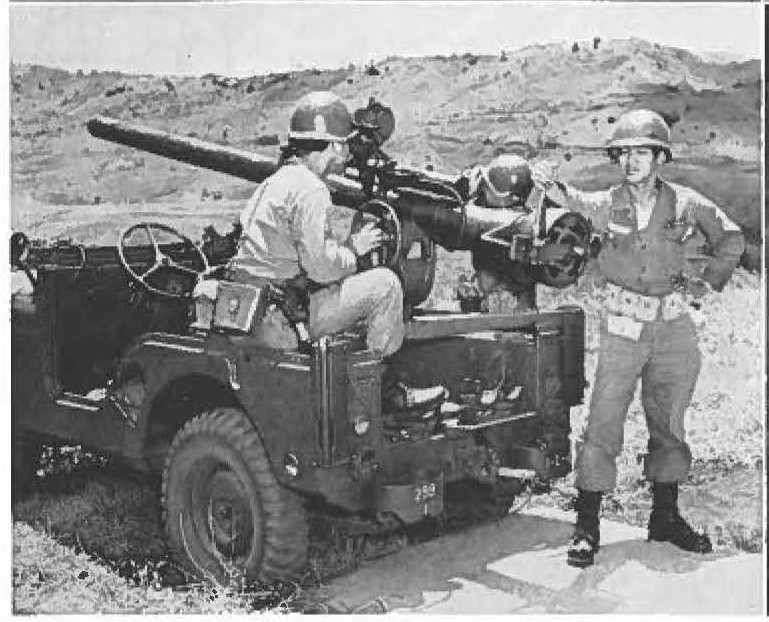
111th Army NG Band serenaders.A popular hour.Gen I. D. White inspects 297t h AAA90 MM AA gun in full recoil at Dillingham AFB.299th RCT problem.Army Aviation re-support mission.They search for strangers.227th Engrs probe for mines.120th Signal Company establish communication.158th AAA boys learn about the R-CAT.487th FA Bn at PohakuloaMen of 299th RCT enter personnel carrier(Pictures from the 1958 September The Hawaii Guardsman)
Summer camp, 21 June-5 July, was held at the various home slations of HANG units. Pacific Air Forces conducted a Practice Mobilization Test at 0300 on the first day (72.5% assembled within two hours), performed an Annual General Inspection during the encampment, and tested initial conversion capabilities wilh an Operational Readiness Evaluation. All unils were deemed Satisfactory . .. only four months following receipt of the new aircraft which required new tactics to employ as a weapon
Field Training: For all except the 298th AAA Group, was conducted during the period 13-27 June 1959 as follows:
Organization
Hq & Hq Det
111th Army Band
120th MP Co
613th Ord Co (DS)
227th Engr Bn (lnf Div)
29th InfBde (Sep)
Location
Schofield Barracks
Schofield Barracks
Schofield Barracks
Schofield Barracks
Schofield Barracks
Schofield Barracks
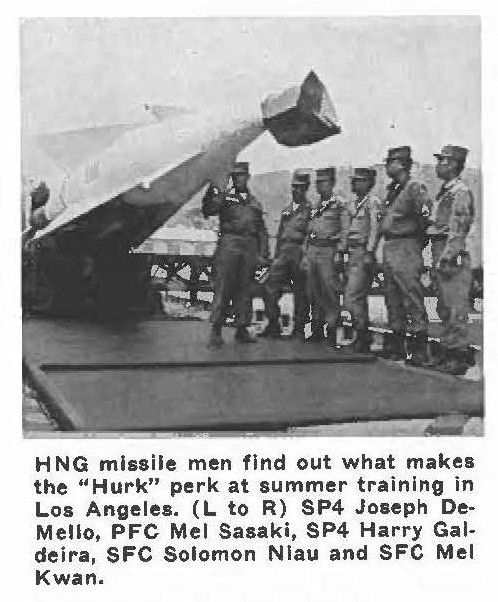
(1) The 298th AAA Group will train on RA sites in the Los Angeles area and receive Nike-Hercules instructions from batteries of the 47th Arty Bde (AD). Emphasis will be directed towards on-the-job training and practical exercises. Every man will be familiarized with the overall Nike system and trained in at least one tactical TOE position. This training required all personnel of the 298th AAA Group to be cleared for access to SECRET defense information. MATS will provide air transportation for the approximately 923 officers and men of the Group.
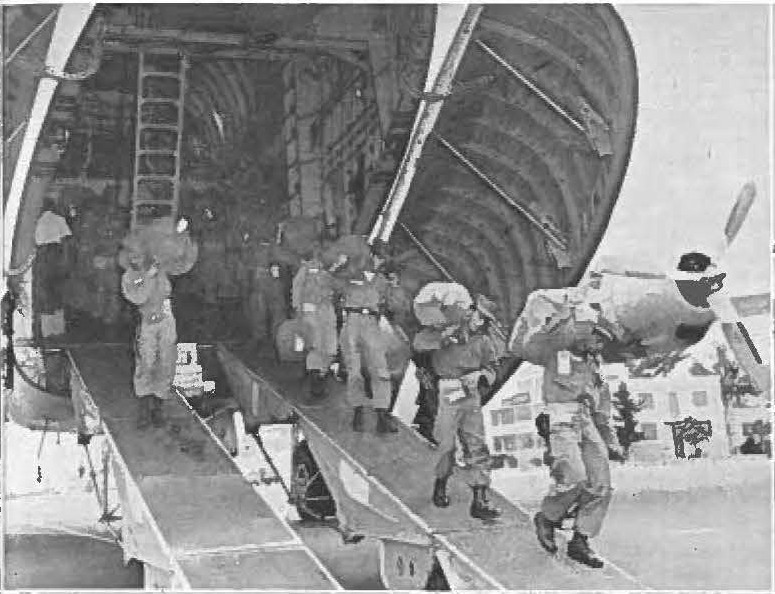
(2) The 29th Inf Bde conducted practical field exercises utilizing all principles taught during armory drills. The principles of mobile task force organization, battle drill, and combat formations were practiced by all units in actual basic unit field problems.
(3) During the first week the 227th Engr Bn conducted advance individual and unit training in infantry and engineer tactics to include construction of an infantry footbridge and assault river crossing. The second week was devoted to all engineer project which consisted of the rehabilitation and realignment of approximately four (4) miles of road in the Kahuku training area. This project provided excellent practical training.
(4) Special Troops provided normal support operations and training.
Field Training: Units of the HANG conducted their annual field training with 98% of the assigned personnel in attendance. The period of the encampment was 13 June through 27 June 1959. In conjunction with field training, the Pacific Air Forces conducted an Annual and Operational Readiness Inspection of the Hawaiian Air Defense Division and HANG units. It is noteworthy to mention that on the Operational Readiness phase of the inspection, the HANG units were rated as follows: 199th Ftr Intcp Sq-fulLy operationally ready; 109th ACW Sq – fully operationally ready; and 169th ACW Sq -operationally ready. All units performed in all excellent manner during the OHI and the encampment.
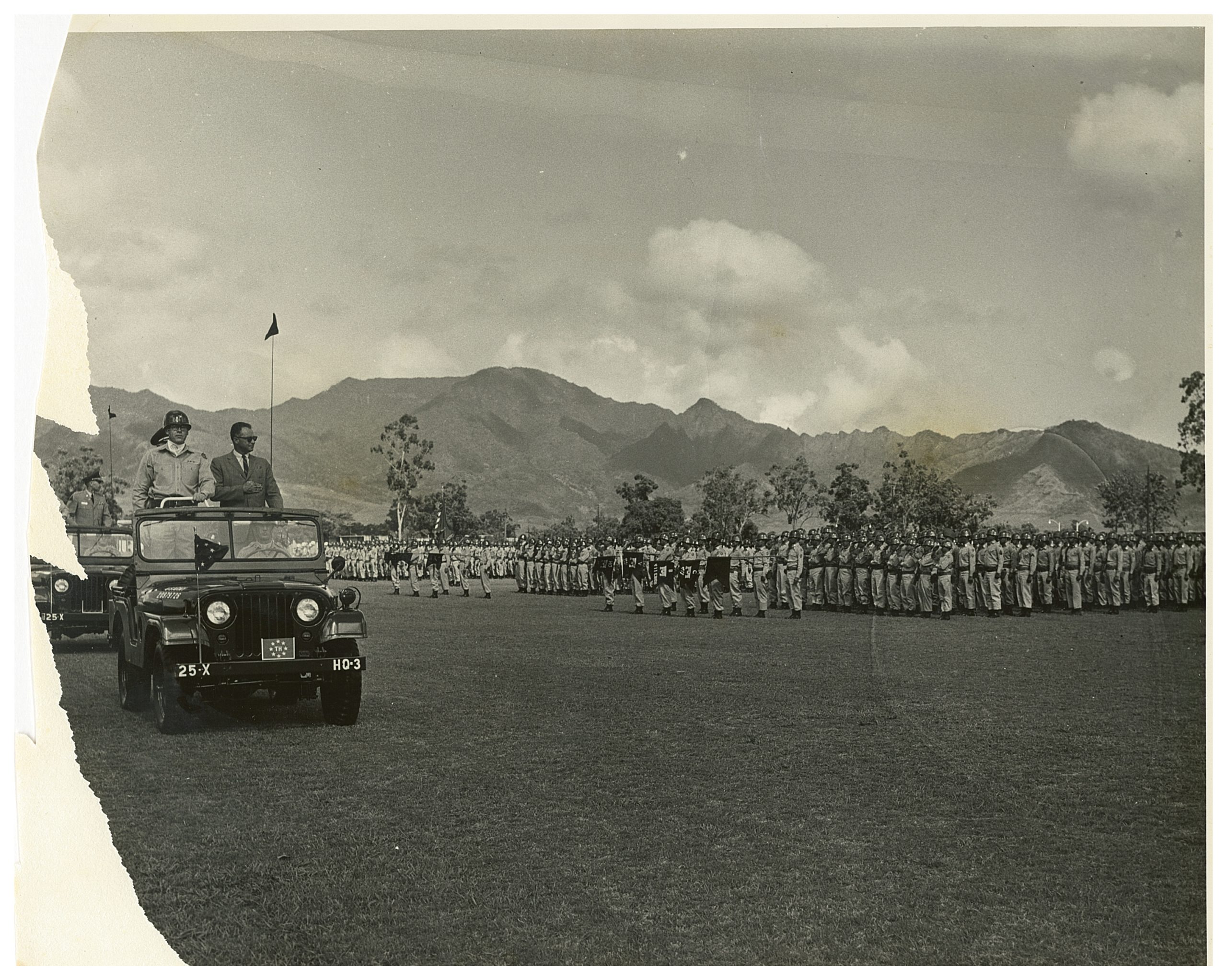
Governor William F. Quinn “troops the line” with Colonel Percy H. Johnson, Jr. Commander-of-Troops, during the Final Review of the Annual Reserve Summer Camp at Schofield Barracks on 22 August 1959.(Photo from the Makinney Ohana)
Highlights of HARNG Summer Training “IN A NUT SHELL”
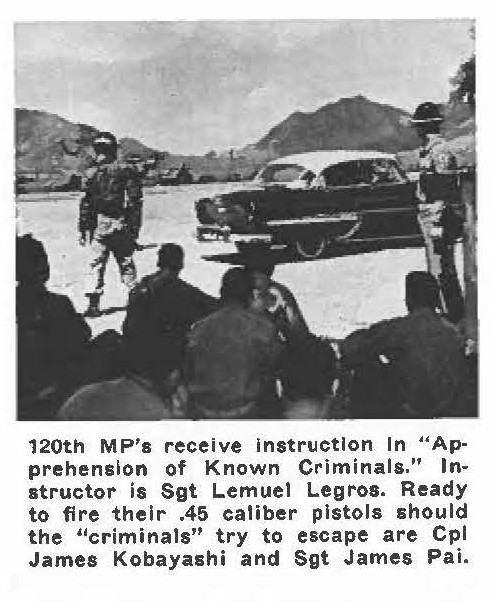
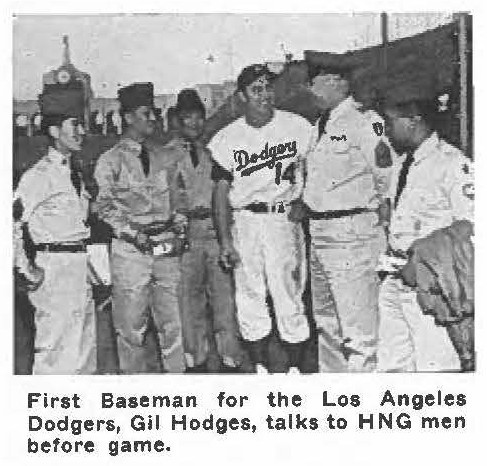
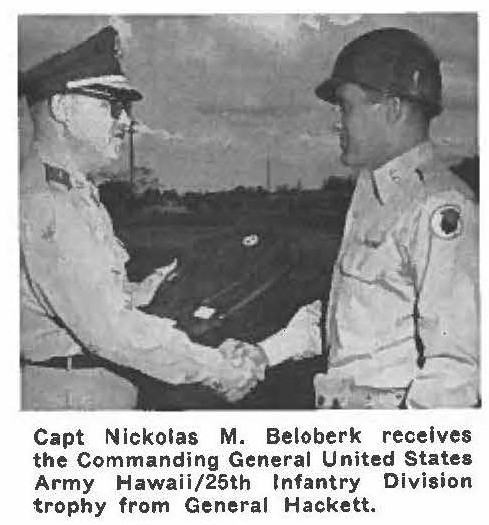
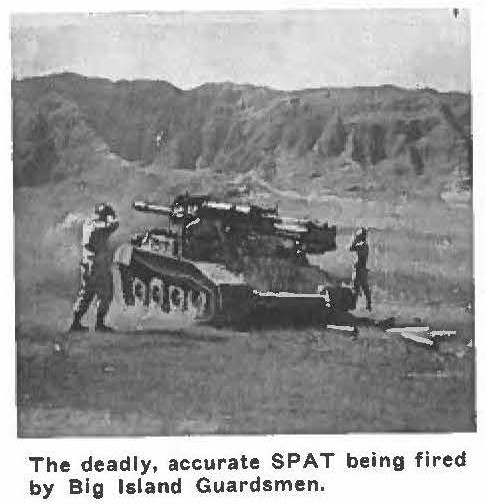
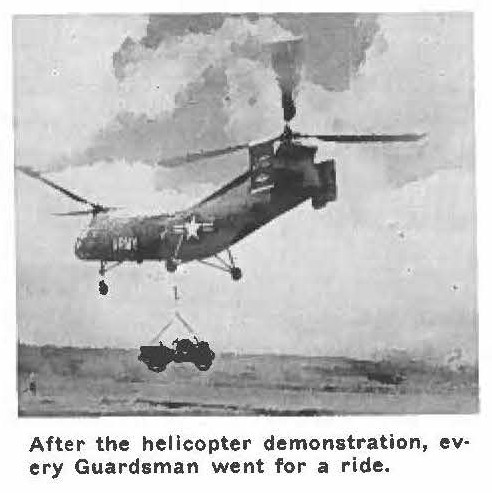
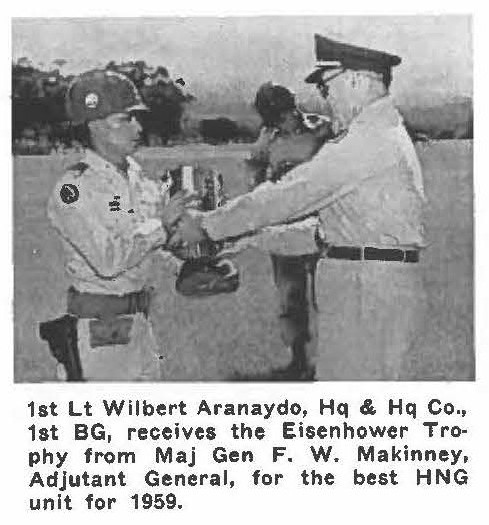
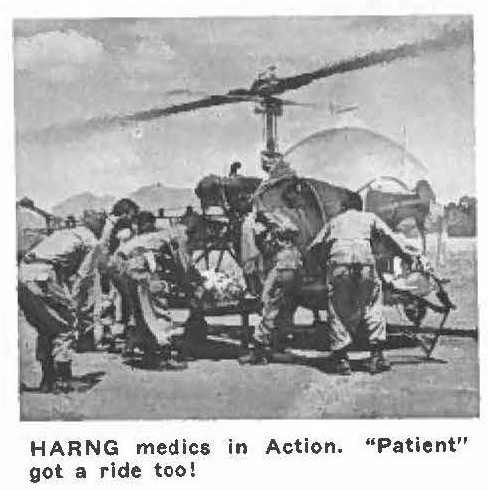
120th MP’s receive Instruction in “Apprehension of Known Criminals.” Instructor is Sgt Lemuel Legros. Ready to fire their .45 caliber pistols should the “criminals” try to escape are Cpl James Kobayashi and Sgt James Pai.HNG missile men find out what makes the “Hurk” perk at summer training in Los Angeles. ( L to R) SP4 Joseph DeMello, PFC Mel Sasaki, SP4 Harry Galdeira, SFC Solomon Niau and SFC Mel Kwan.First Baseman for the Los Angeles Dodgers, Gil Hodges, talks to HNG men before game.Capt Nickolas M. Beloberk receives the Commanding General United States Army Hawaii/25th Infantry Division trophy from General Hackett.The deadly, accurate SPAT being fired by Big Island Guardsmen.After the helicopter demonstration, every Guardsman went for a ride.1st Lt Wilbert Aranaydo, Hq & Hq Co., 1st BG, receives the Eisenhower Trophy from Maj Gen F. W. Makinney, Adjutant General, for the best HNG unit for 1959.HARNG medics in Action. “Patient” got a ride too!(Pictures from the 1959 September The Hawaii Guardsman)
Members of the Hawaii Army National Guard attended their annual summer training on a staggered basis this year with the Infantry units and the Special Troops attending camp at Schofield 13-27 June. Guardsmen of the 298th Antiaircraft Artillery Group were airlifted to Los Angeles via MATS aircraft in two increments and received training at Regular Army NIKE missile sites.
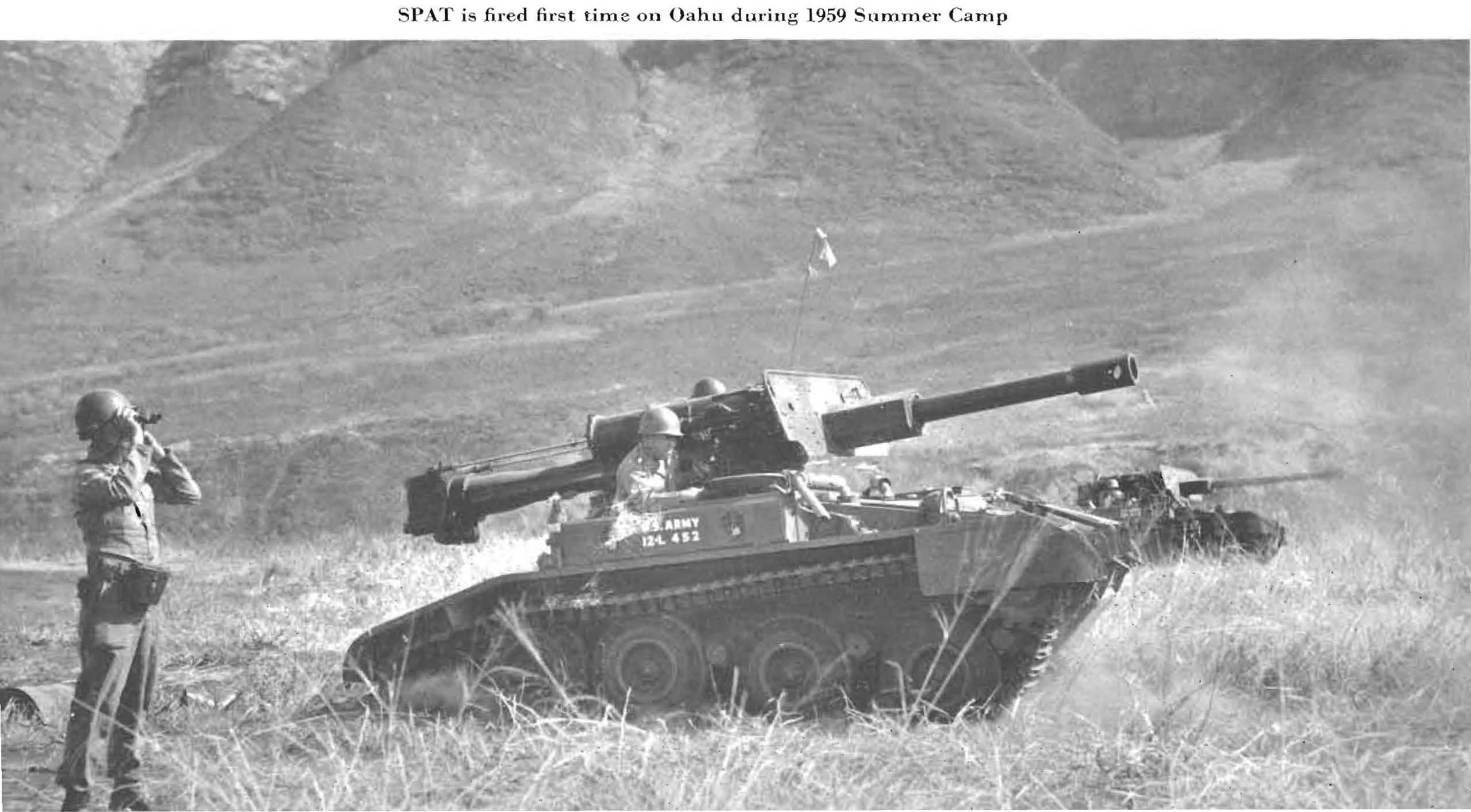
At Schofield, the 1st and 2nd Battle Groups of the 29th Infantry Brigade highlighted their training in the Pentomic concept with the firing of the SPAT (Self Propelled Anti-Tank) weapon.
SPAT, a 90 mm gun, is mounted on a tracked vehicle for quick movement and deployment. It is used in support of ground troops advancing against tanks, bunkers and pillboxes. SPAT can “kill” with the same effectiveness as a tank, up to 1,500 yards. It has an extreme range of about 17,000 yards and may he used as a mortar for indirect fire.
Isle Infantrymen were also given an orientation on Vertical Envelopment Movement, using H-21 and H-19 helicopters. Each Guardsman, after witnessing a demonstration by 25th Division personnel, was given orientation rides in the huge “choppers.” Division personnel also demonstrated how helicopters are used to re-supply ground troops and to move heavy equipment, including jeeps.
During the second week, Infantry units participated in a tank-infantry team problem at Kahuku. Units were given the “company attack and defense problem.”
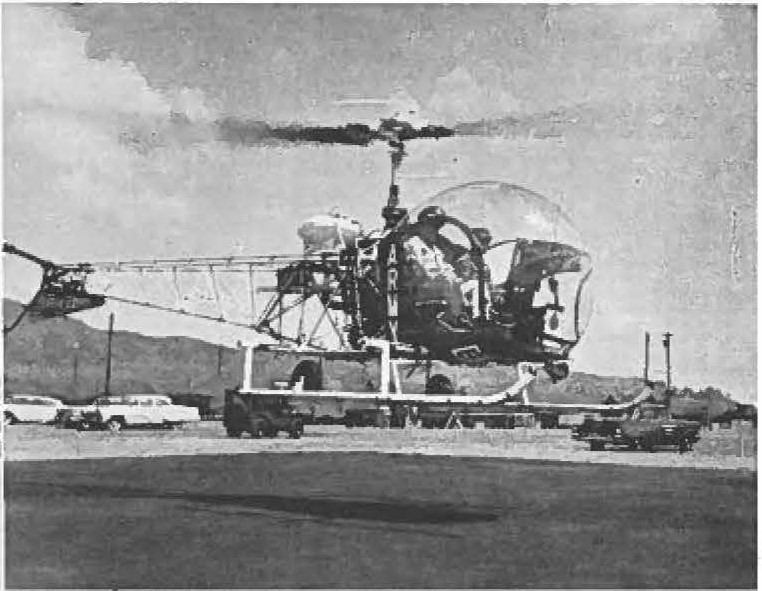
Medical personnel of both Battle Groups participated in a Medical Evacuation problem, held in the East Range area of Schofield. During the course of instruction, HNG men were strapped into litter baskets, mounted on either side of a small H-13 helicopter, and were “evacuated.”
The 227th Engineer Battalion built an assault-type pontoon bridge across the Wahiawa reservoir which was tested by Governor William F. Quinn during Ms visit to the area. During the second week of training, the 227th constructed four miles of road in the Kahuku Army training area under simulated combat conditions. They completed the project in four days at the rate of one mile-a-day.
Not only did the engineers receive valuable training in the use of their heavy equipment but they assisted the Army in constructing badly needed roads in the training area.
The 120th Military Police Company, in addition to normal class work, security patrols and regular MP duties, also assisted the 25th Division MP’s in manning the Schofield Main gate. The unit also provided honor guard details for visiting dignitaries.
Headquarters and Headquarters Detachment supported HARNG unite with over-all plans and training, personnel administration and supply.
The 111th Army National Guard hand furnished music for parades, honor guard ceremonies and supplied early morning “Wake-Up” music for Guardsmen at Area “X.”
The 613th Ordnance Company provided, for the first time, two direct support platoons which worked directly with the two Battle Groups. In past years, Infantry units had to take their work requests to the 613th area, creating delay and unnecessary paper work. The “big moment” for the Ordnancemen was receiving the Commanding General nited States Army Hawaii/ 25th Infantry Division trophy for attaining the highest rating during the last IG inspection. On behalf of the Company, Capt Nickolas M. Beloherk accepted the trophy from Brig Gen Robert Hackett, Commanding officer of the 25th Infantry Division Artillery.
Members of the 298th AAA Group, airlifted to California on Military Air Transport Service aircraft on 18 July and 2 August, received extensive training at NIKE missile sites in the Los Angeles area.
Although HNG men were not expected to he “Operational Ready during the two week period, they passed all the tests administered by the Regular Army during the second week. During the latter part of training, Fire Direction Personnel of Headquarters Battery, 1st Missile Battalion, took over the active Air Defense operation of the Los Angeles area for one shift.
At the firing battery sites, local Guardsmen were given Operational Readiness Evaluation tests which include checking the integrated fire control and launching area equipment, to include the three radars target tracking, missile tracking and distant acquisition. One unit, “D” Battery, 2nd Missile Battalion, completed the complicated operation in exactly fourteen minutes without a mistake, considered by Army standards to be “Superior.”
Island Guardsmen were hosted and trained by the 47th Air Defense Artillery Brigade, commanded by Brig Gen John T. Honeycutt. General Honeycutt stated that he had never before seen a finer group, more devoted to duty, than Hawaii Guardsmen.
HNG’men trained Monday through Friday from 7:30 a.m. to 4 :30 p.m. During the “off duty” hours, Regular Army members of the 47th hosted island men on tours of Los Angeles, Disney Land, Marine Land, Las Vegas, Knotts Berry Farm and Hollywood movie stars’ homes. Guardsmen also saw the Dodgers play at the Los Angeles Coliseum.
In addition to thoroughly impressing their Regular Army instructors, local Guardsmen from many sites gave their hosts a “Thank You” Luau; preparing the pigs in lmu’s in authentic Hawaiian style with all the trimmings, including Hawaiian music. Leis for the festivities were airmailed from Hawaii for the occasion.
Following the Los Angeles training, approximately 280 Guardsmen were flown to Texas, for additional missile training at Fort Bliss where they will actually fire the NIKE missiles.
Following their return from “package” training in November, these men will be employed full time in the Hawaii NIKE missile program.
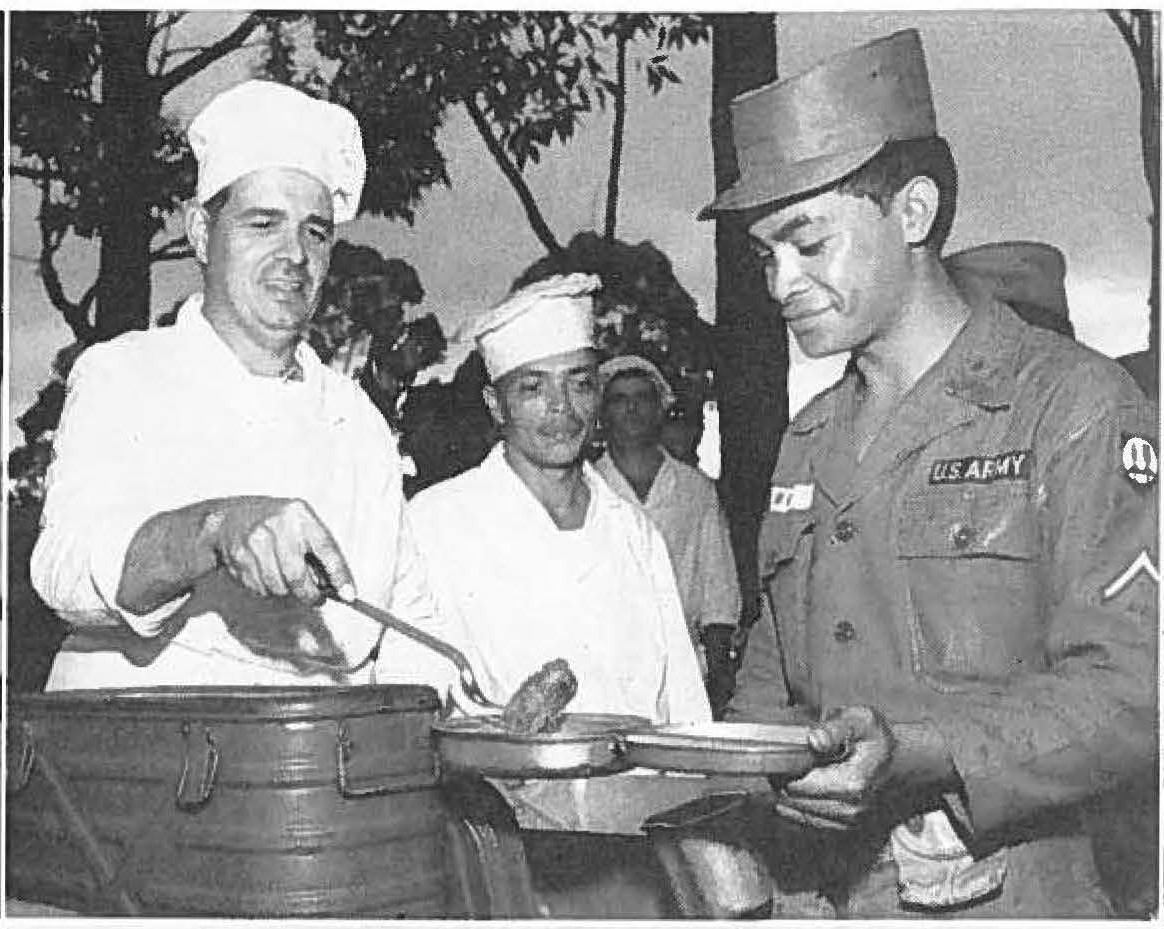
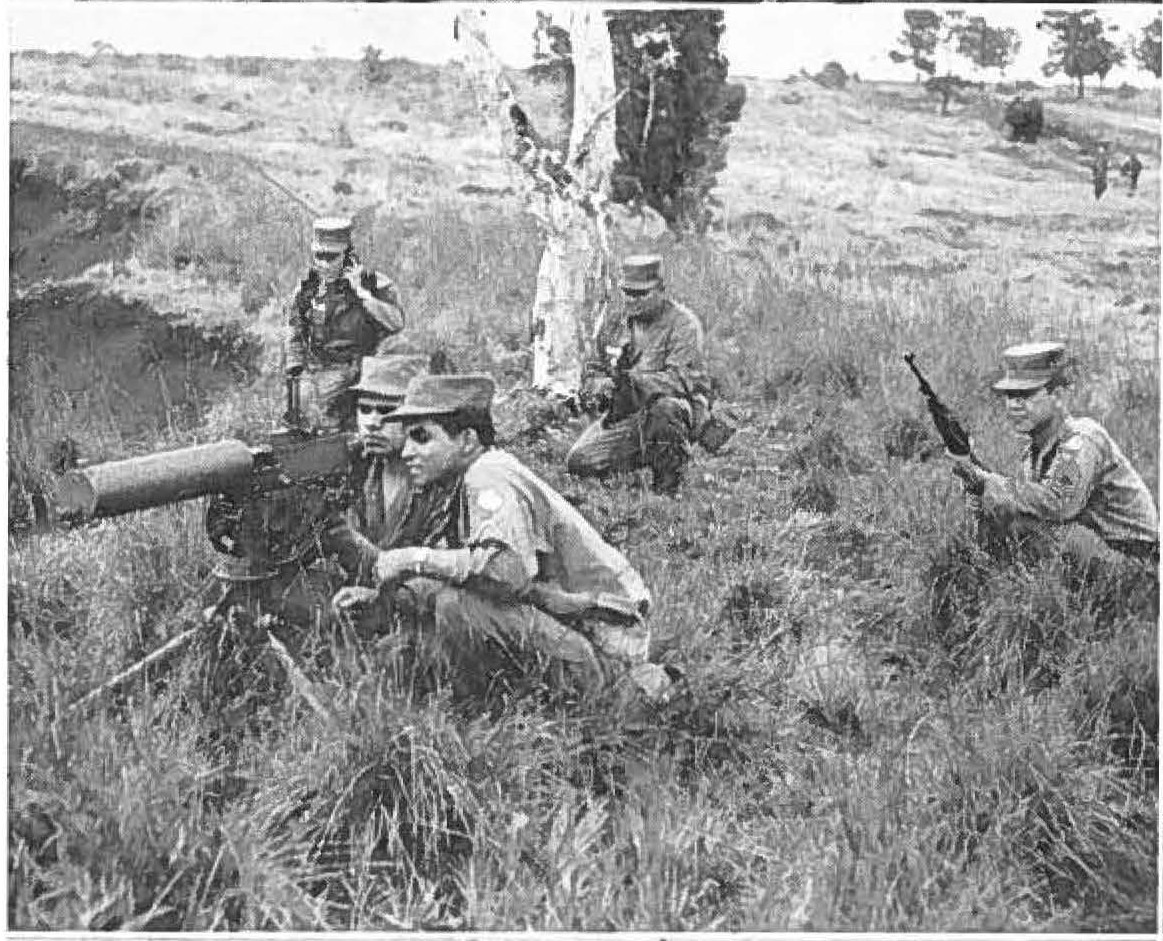
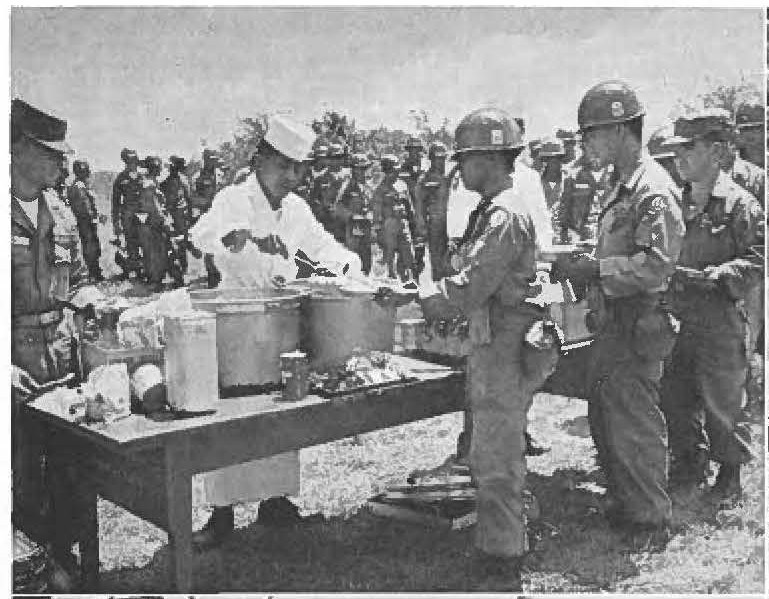
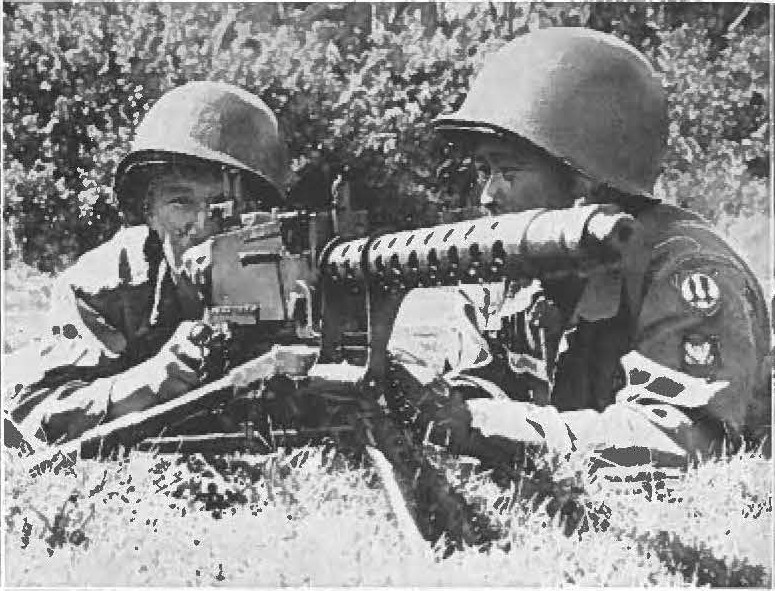
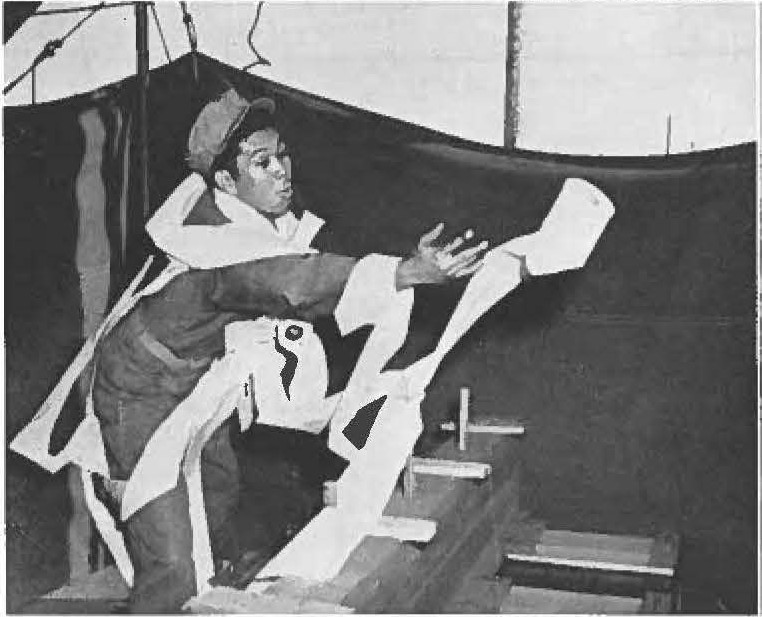
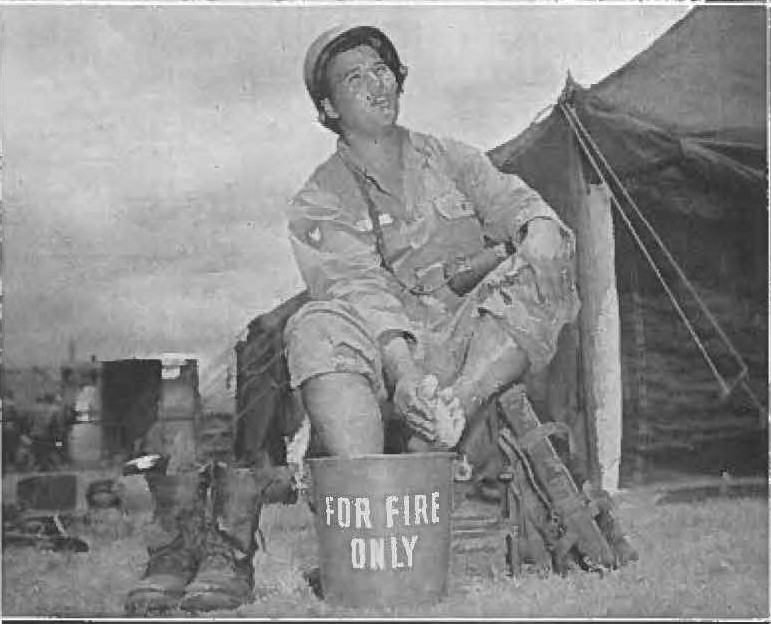
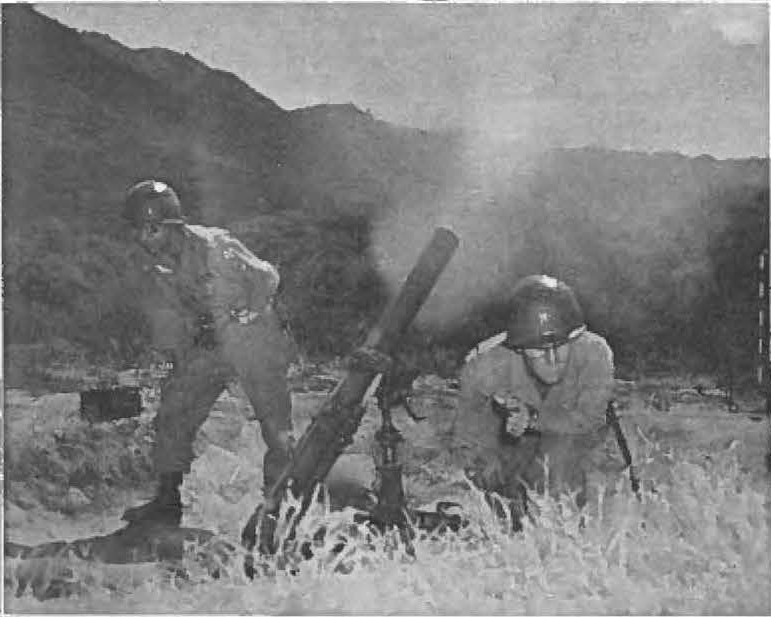
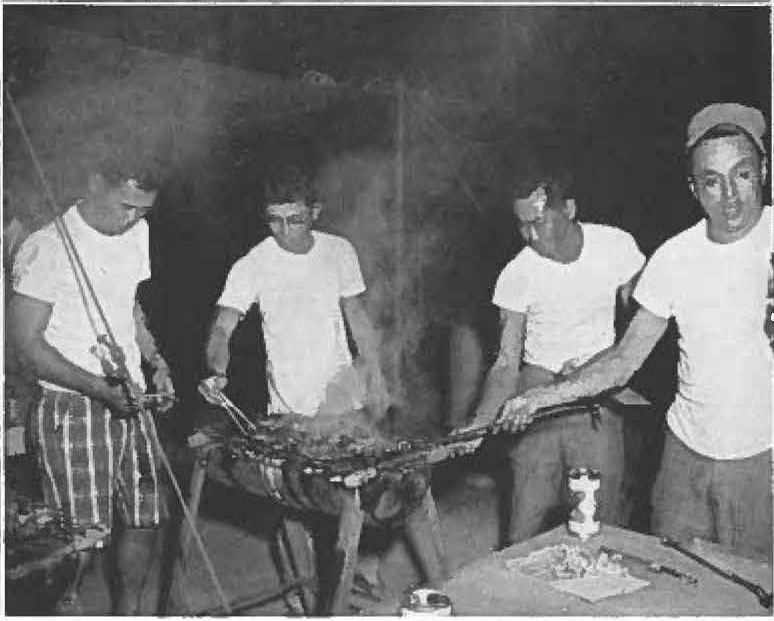
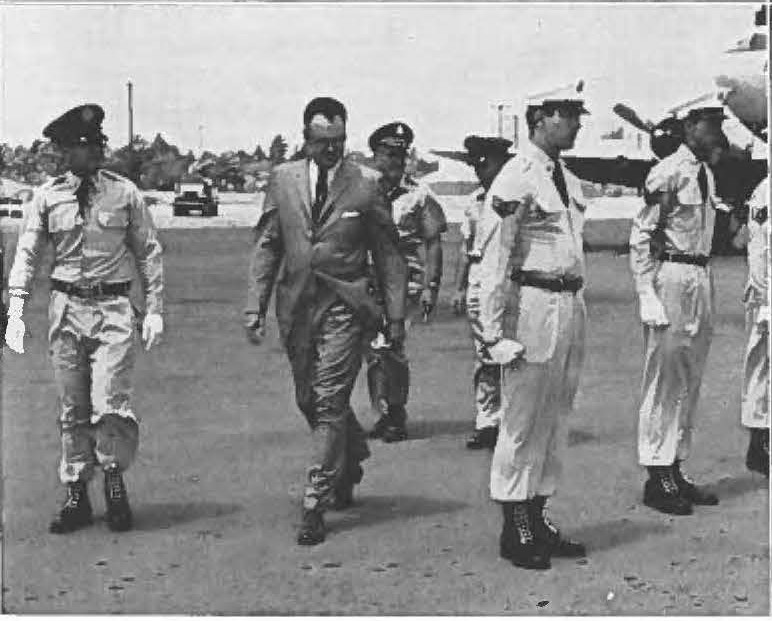
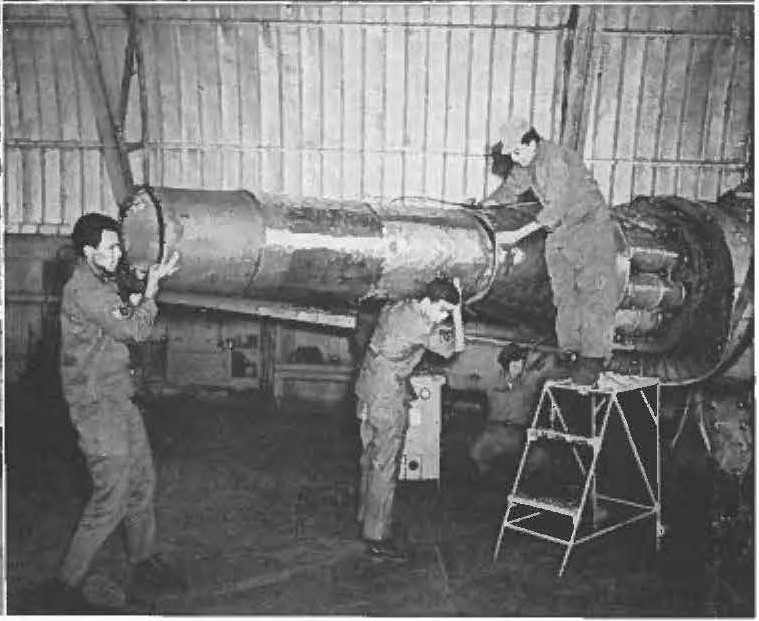
Company D, 2nd BG feed in the fieldBig Isle Guardsmen on targetBig Isle Guardsmen arrive for trainingGeneral Makinney arrives at Area “X”Oops!Maui Guardsman cools off after marchMortar crew caught in actionCombat Support Co, 1st BG, in Tank-Infantry problemMembers of Co “E”, 1st BG, and 106 Recoilless613th Ord’men celebrate last night of campGovernor Quinn inspects the Air GuardAir Guardsmen of 199th FIS change jet engine(Pictures from the 1959 September The Hawaii Guardsman)