Do you need help in another language? We will get you a free interpreter. Call 808-369-3580 to tell us which language you speak.
您需要其它語言嗎?如有需要,請致電 (808-369-3478), 我們會提供免費翻譯服務
您需要其它语言吗?如有需要,请致电 (808-369-3478), 我们会提供免费翻译服务
En mi niit alilis lon pwal eu kapas? Sipwe angei emon chon chiaku ngonuk ese kamo. Kokori (808-369-3478) omw kopwe ureni kich meni kapas ka ani.
Makemake `oe i kokua i pili kekahi `olelo o na `aina `e? Makemake la maua i ki`i `oe mea unuhi manuahi. E kelepona (808-369-3478)`oe ia la kaua a e ha`ina `oe ia la maua mea `olelo o na `aina `e.
Masapulyo kadi ti tulong iti sabali a pagsasao? Ikkandakayo iti libre nga paraipatarus. Awaganyo ti
(808-369-3478) tapno ibagayo kadakami no ania ti pagsasao nga ar-aramatenyo.
다른언어로 도움이 필요하십니까? 저희가 무료로 통역을 제공합니다. (808-369-3478)로 전화해서 사용하는 언어를 알려주십시요
Kwoj aikuij ke jiban kin juon bar kajin? Kim naj lewaj juon am dri ukok eo ejjelok wonen. Kirtok
(808-369-3478) im kwalok non kim kajin ta eo kwo melele im kenono kake.
E te mana'o mia se fesosoani i se isi gagana? Matou te fesosoani e ave atu fua se faaliliu upu mo oe. Vili mai i le numera lea (808-369-3478) pea e mana'o mia se fesosoani mo se faaliliu upu.
¿Necesita ayuda en otro idioma? Nosotros le ayudaremos a conseguir un intérprete gratuito. Llame al (808-369-3478) y diganos que idioma habla.
Kailangan ba ninyo ng tulong sa ibang lengguwahe? Ikukuha namin kayo ng libreng tagasalin. Tumawag sa (808-369-3478) para sabihin kung anong lengguwahe ang nais ninyong gamitin.
‘Okú ke fie maʻu tokoni ʻi ha lea fakafonua ʻe taha? Temau kumi haʻo taha fakatonulea taʻetotongi. Telefoni ki he (808-369-3478) ke fakahā mai ʻa e lea fakafonua ʻokú ke lea aí.
Bạn có cần giúp đỡ bằng ngôn ngữ khác không ? Chúng tôi se yêu cầu một người thông dịch viên miễn phí cho bạn. Gọi (808-369-3478)nói cho chúng tôi biết bạn dùng ngôn ngữ nào
Gakinahanglan ka ba ug tabang sa imong pinulongan? Amo kang mahatagan ug libre nga maghuhubad. Tawag sa (808-369-3478) aron magpahibalo kung unsa ang imong sinulti-han.
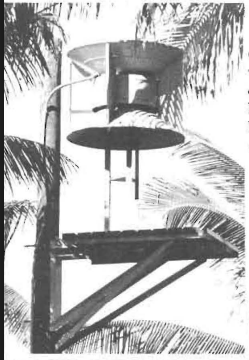
Also 71 more CD sirens for enemy attack and tidal wave warnings were purchased and are being installed throughout the Islands: 13 for Oahu, 12 for Hawaii, 21 for Kauai, and 25 for Maui county including 20 for the island of Maui and 5 for Molokai.
Three aerial siren and public address amplifiers have been purchased for installation in aircraft of the Hawaii Army National Guard (one on Hawaii and another on Oahu) and of the Civil Air Patrol in Honolulu.
A test of an airborne electronic siren and public address system, conducted in February utilizing a Civil Air Patrol aircraft on Oahu, proved satisfactory.
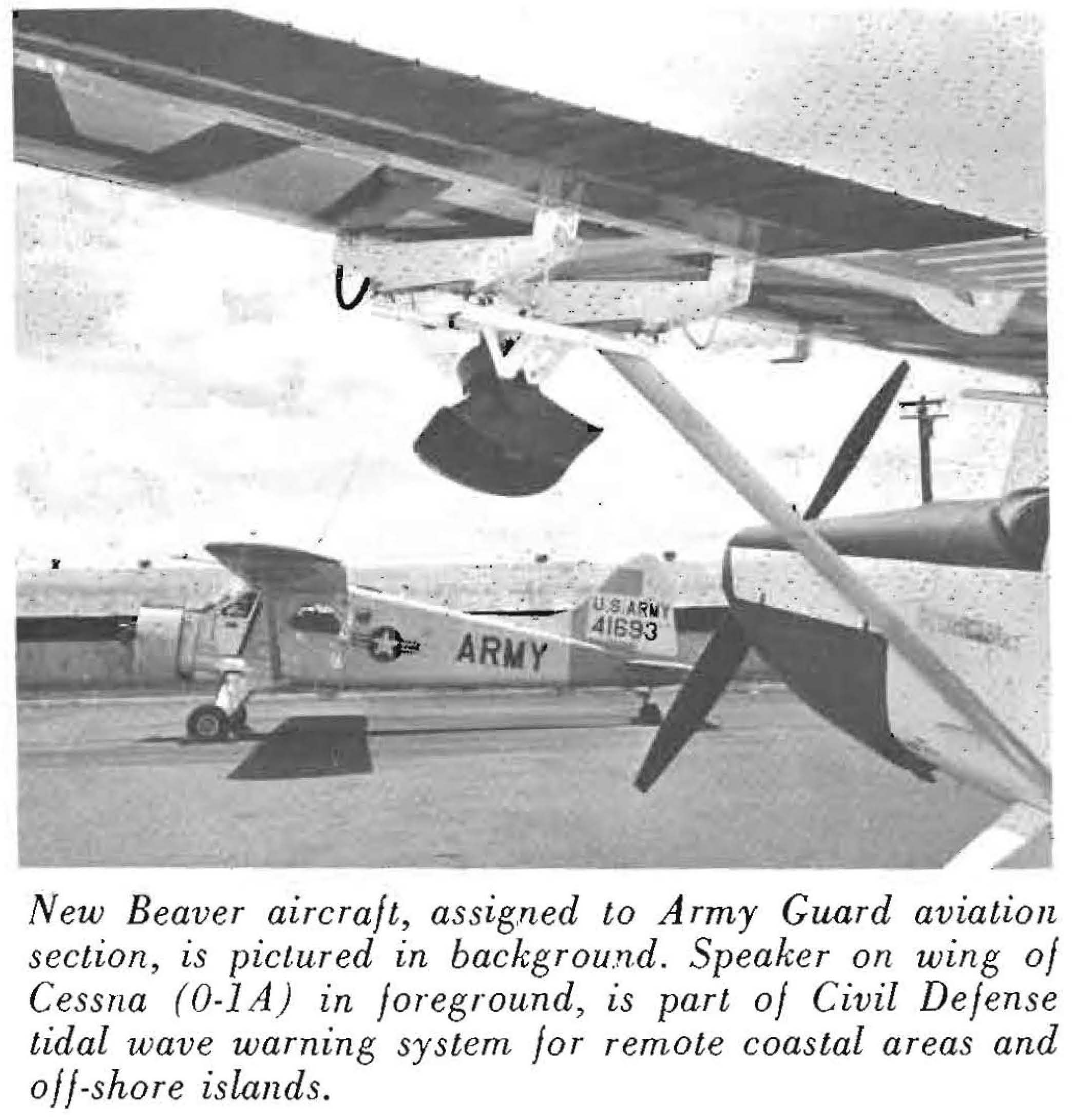
New Beaver aircraft, assigned to Army Guard aviation section, is pictured in background. Speaker on wing of Cessna (O-l1A) in foreground, is part of Civil Defense tidal wave warning system for remote coastal areas and off-shore islands. (Picture from the 1964 Annual Report)
CD Sirens: Eighteen new civil defense sirens were purchased, bringing the total lo 155 sirens throughout the State. Gains by islands were Oahu 10, Kauai 2, Maui 1, Molokai 1 and Hawaii 4, They were purchased with State funds matched by Federal money under the Federal Matching Funds program.
While line rentals are paid by the State, siren maintenance and power costs are borne by the County governments. Sirens throughout the State are tested on the first working day of each month and the Civ-Alert broadcast system is tested simultaneously from the Civ-Alert studio al Diamond Head.
Aircraft of the Civil Air Patrol and the Hawaii Army National Guard have been equipped by the State with combination electronic siren public address systems for tsunami warning and emergency uses. A total of six CAP and two Army National Guard helicopters are now equipped with the devices.
During tsunami warnings, the aircraft operate along coastlines and offshore islands to warn picnickers, campers, fishermen and the boating public.
CD Sirens: Bids were advertised for four sirens and three were awarded one new siren each on Oahu, Kauai and Hawaii. The 1966 legislative session appropriated additional funds to install eight additional sirens in FY 1967. Siren control-line rentals are paid by the State; siren maintenance and power costs are borne by the county governments. Sirens throughout the state are tested on the first working day of each month, and the Civ-Alert. broadcast system is rested simultaneously from the Civ-Alert studio at Diamond Head.
Aircraft and helicopters of the Civil Air Patrol and Hawaii Army National Guard are equipped by the State with combination electronic siren/ public address systems for tsunami warning and emergency uses. During tsunami warnings, the aircraft operate along coastlInes and offshore islands to warn campers, fishermen, picnickers and the boating public.
CD Sirens: Civil Defense sirens throughout the State are tested on the first working day of each month and the Civ-Alert broadcast system is tested simultaneously from the Civ-Alert studio at Diamond Head. Siren control line rentals are paid by the State; siren maintenance and power costs are borne by the County governments.
Aircraft and helicopters of the Civil Air Patrol and the Hawaii Army National Guard are equipped by the State with electronic combination siren/public address systems for tsunami warning and emergency missions. During tsunami warnings the aircraft operate along coastlines and offshore islands to warn campers, fishermen, picnickers and the boating public.
CD Sirens: Three new Civil Defense sirens were installed during the fiscal year – at Nanakuli, Oahu; Milolii, Hawaii, and Kealia, Kauai. Siren control line rentals are paid by the State; siren maintenance and power costs are borne by the County governments.
Aircraft and helicopters of the Civil Air Patrol are equipped by the State with electronic combination siren/public address systems for tsunami warning and emergency missions. They operate along coastlines and offshore islands to warn campers, fishermen, picnickers and the boating public.
CD Sirens: Eight new Civil Defense sirens were installed during the fiscal year at Waipahu, Pearl City Palisades, Makakilo; Ala Moana, Kahaluu Valley, Sandy Beach and Mokuleia, all on Oahu; and at Hana, Maui. The sirens at Waimanalo, Oahu, and Paukukelo, Maui, were replaced.
Siren control line rentals are paid by the State; siren maintenance and power costs are borne by the County governments.
CD Sirens: Six fixed warning sirens were installed during the fiscal year in the City and County of Honolulu at a cost of $17,214. These were replacements for worn-out World War II sirens. One-half of the total cost was matched by funds from the Federal Office of Civil Defense.
Siren-control line rentals are paid for by the State; siren maintenance and power costs are borne by the county governments.
On the first working day of each month, sirens wail on Oahu. At the same time, radio stations announce that a civil defense test is being conducted. This test is a coordinated effort by the civilian and military communities to check the civil defense warning system and to remind citizens that the sound of sirens should alert them to a domestic emergency or an enemy attack.
Joint testing by civil defense agencies and United States Army, Hawaii (USARHA W) is a conspicuous example of civil defense action and military support to civil defense. This mutual and cooperative concern for the common defense and public safety in wartime or emergency is a reason for the establishment of the Hawaii Area Command (HAWCOM). HAWCOM is a National Guard headquarters unit that would be federalized to plan, coordinate and control operations in military support of civil defense throughout the State.
The term “civil defense” was coined in World War I and has been used since then, although the practice of civil defense (man’s effort to preserve life and speed recovery in the event of calamity) is as old as man himself. In 1917, Americans, faced with the horror of total war, insisted that civilians work with governmental agencies to provide for homeland defense. During the Second World War, the concept and program of civil defense were directed by a national agency, but civil defense activities were performed by civilians at state and local levels. Since 1947, the spectre of world-wide nuclear devastation has caused the United States to seek a viable passive defense measure against nuclear attack. Early in the sixties, the Symington Committee proposed that the National Guard and Reserve units be made entirely responsible for civil defense. This measure would have made civil defense a military matter. The proposal was never accepted. In 1961, the President of the United States indicated that for the first time, the Federal government was going to seriously consider civil defense and military posture as integral factors in planning for national security. In 1964, the National Plan for Emergency Preparedness described the roles of the Federal Government, the States and their political subdivisions and of individual citizens. Civil defense was to be a totally civilian program and the military would support it. This complementary relationship was to be the salient characteristic of civilian-military operations in civil defense.
Since then, civil authorities have developed a national survival scheme in the form of fallout protection shelter plans, civil defense organizations and means to rehabilitate the country after attack. The military has always considered protective measures against nuclear attack an important part of military operations. In addition, they have always assisted civilians during emergencies caused by natural disasters, domestic disturbances and conflicts. In June 1964, the United States Department of Defense recognized the pre-eminence of civilian responsibilities of the military services. By March 1965, the Department of the Army established that States’ Adjutants General on the mainland and their staffs would participate actively in pre-attack planning for military support of civil defense. The State National Guard headquarters would be the primary focal point for military-support planning within its state and State headquarters would be mobilized prior to, or immediately after a nuclear attack in the United States. Under these circumstances, the commander of the State Area Command would exercise operational employment of forces made available from all services and components.
By December of 1965, the military-support concept was implemented in the State of Hawaii. Colonel Paul K. Nakamura, then a major and currently the G3 of the Hawaii Army National Guard, was appointed to the full-time position of Military Support Plans Officer on the staff of the State Adjutant General. Colonel Nakamura served until October 1969. He was instrumental in the initial formation of the Military Support of Civil Authorities (MSCA) Section which is composed of two officers and one warrant officer. Under his guidance, the MSCA Section planned and organized the headquarters known as HA WCOM, the Hawaii Area Command. Colonel Nakamura was succeeded by L TC Tom T. Kimura, who became the acting MSPO in the fall of 1969. L TC Melvin Alencastre, formerly the Defense Supervisor for the 298th Artillery Group, currently heads MSCA. Two members of the MSCA Section have served since 1966: CW4 Hisashi Kawai was appointed Administrative Specialist in January and I was appointed as the Operations and Training Specialist in March.
In July 1967, Brigadier General F. A. Schaefer III was designated Commanding General of HAWCOM. During General Schaefer’s tour of active service from May 13, 1968 to December 12, 1969, Brigadier General V. A. Siefermann, Assistant Adjutant General for the Air Guard, assumed command. The Adjutant General predesignated General Schaefer as Commander of HAWCOM when he returned.
HAWCOM is presently composed of personnel from the Headquarters of both the Army and the Air National Guard. If it is federalized HAWCOM will be under the direct command of the Commanding General, United States Army, Hawaii and will be located in the Diamond Head complex. Battery 407, a World War II artillery tunnel, is now being converted into a fallout protected Emergency Operating Center (EOC) for HAWCOM. The EOC is equipped with a system to allow HAWCOM to communicate with State Civil Defense and USARHAW. The HAWCOM Commander will employ the resources of all military services within the State of Hawaii for military support of civil authorities for civil defense. He is prepared to assist the State in wartime when State resources are lacking; when compelling humanitarian reasons dictate that military resources be used to support civil authorities in maintaining law and order; assisting in radiological defense; fighting fires; providing emergency medical treatment and assisting with the many problems of recovery operations.
When next you hear the sirens wail, it may be a civil defense test or it may be an actual attack warning. Turn on your radio and listen for emergency instructions. The sound of sirens means that civil and military authorities are working together to help you and other citizens survive.
Two new fixed warning sirens were installed during the fiscal year at a cost of $11,678. In addition, three fixed sirens were replaced at a cost of $12,874 and the first radio-controlled siren in the State was installed near Kapoho on Hawaii Island. One-half of the total cost was provided by federal funds. The siren control line rentals are paid for by the State while the siren maintenance and power costs are borne by the county governments.
New equipment is tested and evaluated. Included in these tests will be siren control radio receivers planned for installation in Fiscal Year 1973
CD Sirens: The siren warning system is a continuing program. The cost of purchasing and installing new equipment is borne by the State. Siren control line rentals are also paid for by the State, while the siren maintenance and power costs are borne by the County governments.
Current appropriations to replace worn out sirens and install new sirens amount to $152,000.
Federal funds to cover 50 per cent of the expense of the above project have been approved by the Regional Defense Civil Preparedness Agency.
New and proposed equipment was tested and evaluated. Included in these tests were siren control radio receivers planned for installation in Fiscal Year 1974.
CD Sirens: The siren warning system is a continuing program. The cost of purchasing and installing new equipment is borne by the State. Siren control line rentals are also paid for by the State, while the sirens maintenance and power costs are borne by the county governments.
Warning and communications programs are supported by 50 percent Federal matching funds
Bids were solicited for the Oahu phase of converting all of the warning sirens in the State to radio control. . .
CD sirens: The siren warning system is a continuing program. The cost of purchasing and installing new equipment is borne by the State. Siren control line rentals are also paid for by the State, while the maintenance and power costs are borne by the county governments.
Warning and communications programs are supported by 50 percent Federal matching funds.
It was a little more than a year ago when an earthquake jolted Hawaii injuring 11 persons on the Big Island and causing $5.5 million in damages there.
Since then Hawaii has experienced several severe rain storms. surf and storm damages and flash floods.
Each of the four County Civil Defense administrators in Hawaii is authorized to sound their sirens for natural disasters such as heavy rains, heavy surf, tornadoes and similar dangerous situations, such as an earthquake.
In addition, MajGen Valentine Siefermann, who doubles as the State’s director of Civil Defense, has been directed by Acting Gov George R. Ariyoshi to provide National Guard assistance without hesitation when the counties do not have the resources to cope with the emergency situation.
Emergency Civil Defense programs will be carried by all Island radio stations in the event of a disaster or a pending disaster.
Some of the projects accomplished or under way included the radio-controlled siren warning system on Oahu; . . .
CD sirens: The siren warning system is a continuing program. The cost of purchasing and installing new equipment is borne by the State. Siren control line rentals are also paid for by the State while the maintenance and power costs are borne by the county governments. The leased control lines are being phased out for radio control; Oahu wi II be so converted by FY 76.
Warning and communications programs are supported by 50 percent Federal matchinq funds.
Representative projects accomplished or under way by Communications during the year included the conversion of all Oahu CD warning sirens from leased landline control to State-owned radio control. . .
CD sirens: The siren warning system is a continuing program. The cost of purchasing and installing new equipment is borne by the State. Siren control line rentals are also paid by the State, while the maintenance and power costs are borne by the County governments, The leased lines, however, are being phased out for radio control; Oahu has been so converted, and the neighbor islands will be completed in 1978.
Warning and communications programs are supported by 50 percent Federal matching funds.
Some telecommunications projects, in progress or accomplished during FY 77, . . . and the successful shakedown of the new radio-controlled CD warning siren system on Oahu. . .
It is necessary to continually replace warn-out sirens. The engineering, purchase and installation of the CD warning siren system is accomplished by the State. Siren control line rentals are paid by the State, while the maintenance and power costs are borne by the county governments. There are currently 212 warning sirens throughout the State. During FY 77, 22 new sirens were installed, 15 replaced and 2 relocated.
Warning and communications programs are supported by 50 per cent Federal matching funds.
Plans related to both State and county EBS have been developed to broadcast emergency information to State and county operational area levels. Also, the monthly siren and broadcast test time was changed from 11:00 a.m. to 11:45 a.m. on the first business day of each month.
A continuing major telecommunications activity is the design of additional radio-controlled systems which will activate 73 civil defense warning sirens located on the islands of Kauai, Maui and Hawaii. A total of 39 sirens are presently being controlled by radio systems on these islands. A similar radio controlled siren system, developed and installed on Oahu, is operating successfully. . .
The engineering, procurement and installation of the civil defense warning system is the responsibility of State Civil Defense. There are currently 210 warning sirens throughout the State. The civil defense warning sirens, as well as the Emergency Broadcast System, are tested simultaneously throughout the State on the first working day of each month.
The engineering, procurement and installation of the civil defense warning system are the responsibility of State Civil Defense. There presently are 211 warning sirens throughout the state and more are planned each year to keep up with population and construction growth. The warning sirens, along with the Emergency Broadcast System, are tested simultaneously throughout the state on the first working day of each month.
The division, through its Telecommunications Branch, continued its operation and maintenance of the state’s civil defense warning system. The monthly tests of the 211-siren system and emergency broadcast system are now routine exercises conducted by division personnel, with the cooperation of Hawaii’s broadcast media.
The Telecommunications Branch continued to operate and maintain the state’s civil defense communications and warning systems. Monthly tests of the Emergency Broadcast System were conducted using the State’s 220 outdoor warning sirens. Twenty new and replacement warning sirens were installed.
Monthly tests of the Emergency Broadcast System were conducted with the accompanying intentionally loud blast of 220 outdoor warning sirens. A contract was let for nine new warning sirens and replacement of five of the smaller World War II and 1961 vintage sirens.
Monthly tests of the Emergency Broadcast System were conducted with the accompanying loud blast of 220 outdoor warning sirens. . .
Twenty-one of Kauai’s 32 outdoor warning sirens were damaged or demolished by Hurricane Iwa. A siren recovery contract was advertised by State Civil Defense with bids opened in July 1983.
During the fiscal year, contracts were let to repair, upgrade, or replace 29 warning siren on Kauai, which were lost during Hurricane lwa, and 51 sirens on other islands. On-site surveys and designs were started for the upgrade or replacement of an additional 21 sirens and for the designation of 45 new siren locations statewide.
Over 1,000 pieces of telecommunications and warning equipment at 350 locations were maintained in operational readiness. Projects for 1985 centered on increasing reliability of the Emergency Broadcast System, outdoor siren warning system, interisland teletype net, and state and county Emergency Operating Center radio links.
Eleven battery-operated sirens were installed in 1985. Power outages will not affect the new sirens, and once reliability is tested, other sirens will be added to the inventory.
During the year, 62 sirens were converted to radio control, completing the statewide changeover. Formerly operated by leased land line, the radio-controlled siren system has resulted in improved operations by eliminating multiple control points and reducing recurring operating and maintenance costs.
A contract was completed for the repair and upgrade of 16 sirens, bringing the total in service to 225 siren locations throughout the state.
Ongoing DOD Statewide Replacement (Upgrade) of Disaster Warning Sirens – 1984 project by Hygrade construction. Construction cost is $204,000. Project is scheduled for completion in February 1986.
Addition of Disaster Warning Sirens – 1984 the project involves adding new sirens and simulators at various locations statewide. Construction project to be awarded at $545,000. Project is scheduled for completion in September
Over one thousand pieces of telecommunications and warning equipment have been maintained in operational readiness. Projects for 1986 centered on establishing a permanent Emergency Broadcast System primary station for Hawaii County, establishing a backup hotline between the State Emergency Operating Center and Maui and Hawaii County Emergency Operating Centers via federal/state private microwave system, upgrading the interisland Teletype net, and contracting installation of new outdoor sirens. Efforts were also directed towards increasing the reliability of the Emergency Broadcast System, the outdoor siren warning system and the radio system used for direction and control during emergencies.
Conversion to battery operated electronic sirens continued in 1986. A total of 15 electronic sirens has been added to the system. Eighteen new sirens were also installed, bringing the total to 253 siren locations throughout the State.
Over 1000 pieces of telecommunications and warning equipment are maintained in operational readiness. 1987 projects established radio repeater facilities at Mt. Kaala on Oahu’s north shore and at Waimanalo Ridge for extended siren coverage and emergency directions and control.
Installation of new equipment and upgrading old systems increased the number of people reached by the outdoor siren warning system. 1987 also saw the introduction of indoor siren simulators, a suitcase-size radio receiver with an electronic amplifier that duplicates siren tones. Installed in security offices staffed 24 hours a day, simulators alert hotel guests and shoppers in large shopping malls.
Conversion to battery operated sirens continued in 1987. Thirtyseven of the 261 outdoor warning sirens now operate on batteries when commercial power fails.
More than 1000 pieces of telecommunications and warning equipment were maintained in operational readiness in 1988 and efforts continued to improve and expand the statewide outdoor siren warning system. Mechanical sirens are being replaced by battery operated electronic sirens which continue to function when commercial power is down. Installation of electronic siren simulators are being completed for major hotels and shopping centers along the Kaanapali, Kona and Waikiki coastlines. The suitcase-size simulator units extend alerting coverage to locations previously beyond reach by outdoor sirens.
In 1989, major efforts were made to install new microwave equipment on Oahu, expand the outdoor siren inventory, and add siren simulators for increased warning coverage. Simulator units were installed at military bases to coordinate simultaneous warning of both civilian and military populations. To date, 61 of the 271 outdoor sirens statewide have been converted to electronic operation, with battery backup to commercial power.
Over 1,000 pieces of telecommunications and warning equipment at 350 locations were maintained in operational readiness. Projects for 1985 centered on increasing reliability of the Emergency Broadcast System, outdoor siren warning system, interisland teletype net, and state and county Emergency Operating Center radio links.
Over one thousand pieces of telecommunications and warning equipment have been maintained in operational readiness. Projects for 1986 centered on establishing a permanent Emergency Broadcast System primary station for Hawaii County, establishing a backup hotline between the State Emergency Operating Center and Maui and Hawaii County Emergency Operating Centers via federal/state private microwave system, upgrading the interisland Teletype net, and contracting installation of new outdoor sirens. Efforts were also directed towards increasing the reliability of the Emergency Broadcast System, the outdoor siren warning system and the radio system used for direction and control during emergencies.
Over 1000 pieces of telecommunications and warning equipment are maintained in operational readiness. 1987 projects established radio repeater facilities at Mt. Kaala on Oahu’s north shore and at Waimanalo Ridge for extended siren coverage and emergency directions and control.
In 1989, major efforts were made to install new microwave equipment on Oahu, expand the outdoor siren inventory, and add siren simulators for increased warning coverage. . . .
With county support, the SCD maintains a statewide communications and warning system made up of outdoor sirens and the Emergency Broadcast System (EBS).
With county support, the SCD maintains a statewide communications and warning system made up of outdoor sirens and the Emergency Broadcast System (EBS).
With county support, State Civil Defense maintains a statewide communications and warning system made up of outdoor sirens and the Emergency Alert System.
Capital Improvement Project funds new sirens, upgrades older units. A total of $1.86 million in CIP funds adds new electronic sirens and upgrades older units in all counties. Capable of voice message broadcasts, the new units will provide improved coverage along coastlines and waterways prone to flooding. New and replacement sirens cost between $35,000 and $40,000 per unit. In 1997, twenty-six new units are slanted for installation, bringing the total Statewide siren inventory to 328.
With county support, State Civil Defense maintains a statewide communications and warning system made up of outdoor sirens and the Emergency Alert System.
Capital Improvement Projects underway for warning system, communications upgrades. The Maui County Siren Warning System is scheduled for conversion to the county’s new 800 MHz Trunked Radio System. The $1.1 million project is currently in the post-design precontract award phase. With completion of this new siren radio control system, Maui will be the second county to undergo conversion. Kauai was the first to complete the switch in 1997. The 800 MHz radio system provides communications links for various emergency services, differing by county.
With county support, State Civil Defense maintains a statewide communications and warning system made up of outdoor sirens and the Emergency Alert System.
State Civil Defense was able to make significant strides in the Outdoor Warning Siren Modernization Project. Governor Lingle released approximately $14.2 million in Capital Improvement Program (CIP) appropriations for the project in FY 2010. This project seeks to replace old electrical-mechanical sirens and to install new solarpowered sirens throughout the State. The Outdoor Siren modernization project will increase the State’s siren warning system inventory from 365 to 509 within 5 years. Work is also underway to switch from radio activation to redundant satellite and commercial wireless activation links with the goal of reducing potential geographic interference. The satellite and commercial wireless activation was successfully tested on eight Oahu sirens.
Project State Civil Defense is taking the initiative to upgrade the outdoor warning sirens and associated support infrastructure used to warn the public of approaching hazards, including tsunami. Over 140 siren sites have been designed and permitted for statewide construction contracts at a cost of approximately $10 million (construction and equipment). New siren designs will be more energy efficient and more reliable as they will utilize newer solar and communication technologies. New siren designs will also include composite poles, eliminating the termite problem, saving on installation and shipping while increasing the life of the siren. Governor Abercrombie released funds in FY 2011 for the immediate repair of eight critical sirens (seven on Oahu, one on Maui) utilizing the new design. These sirens are considered critical as they were inoperable as well as located in tsunami evacuation zones. Six of the eight sirens are currently operational with remaining two to be operational shortly.
SCD’s Telecommunications Branch supports preparedness and response actions through maintenance and installation of redundant communications. The Telecommunications Branch is also spearheading an initiative to modernize the Statewide Outdoor Siren Warning System. The Statewide Outdoor Siren Warning System provides public warning in the event of a number of emergencies, including but not limited to, hurricane, tsunami, and radiological events.
SCD’s Telecommunications Branch supports preparedness and response actions through maintenance and installation of redundant communications. The Telecommunications Branch is also modernizing the Statewide Outdoor Siren Warning System. The warning system provides public warning in the event of a number of emergencies, including but not limited to, hurricane, tsunami, and radiological events.
State Civil Defense staff continued to work on the Statewide Outdoor Warning Sirens. An improvement of activation systems for 195 Oahu sirens was completed in December 2012. The activation improvement added full satellite/cellular redundancy; computerized control for activation and monitoring; and, two-way communications between the State EOC and individual sirens. This marks a significant improvement of the Statewide Outdoor Warning System, which many rely on to provide early warning of lifethreatening hazards such as hurricane and tsunami.
The Telecommunications Branch supports preparedness and response actions through maintenance and installation of redundant communications. The Telecommunications Branch is also modernizing the Statewide Outdoor Siren Warning System. The warning system provides public warning in the event of a number of emergencies, including but not limited to, hurricane, tsunami, and radiological events.
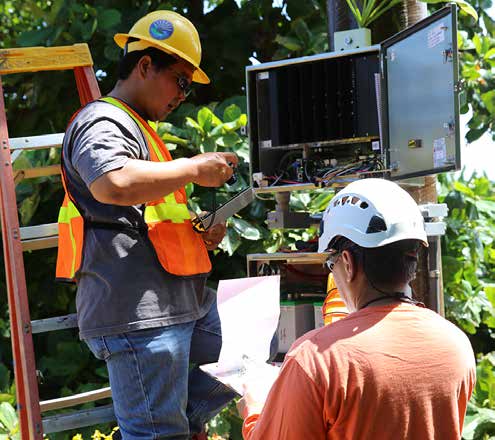
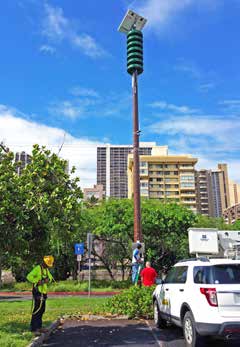
SOUND CHECK – Kurt Nagano and Jack Machida, SCD/HI-EMA radio technicians, inspect a siren installation at Camp Erdman, Oahu. Brian Miyamoto photo(Picture from the 2014 Annual Report)
SCD/HI-EMA Telecommunications staff worked with the counties to identify the priorities for the first batch of Outdoor Siren Warning System upgrades and additions under the siren modernization program. This effort is supplemented with the purchase of 100 IP INFORMER devices to serve as siren simulators in areas without siren coverage. The purchase of these devices increased statewide inventory to 125. The INFORMERs were installed on Oahu, Maui, and Kauai, with Hawaii County installations to be completed later this year.
SOUND CHECK – HI-EMA radio technicians inspect a siren during an acceptance test on Oahu near the Ala Wai Canal. HI-EMA photo(Picture from the 2015 Annual Report)
The Telecommunications Branch supports preparedness and response actions through maintenance and installation of redundant communications. The Telecommunications Branch is also modernizing the Statewide Outdoor Siren Warning System. The warning system provides public warning in the event of a number of emergencies, including but not limited to, hurricane, tsunami and radiological events.
HI-EMA Telecommunications staff worked with the counties o coordinate Outdoor Siren Warning System upgrades and additions under the siren modernization program. During FY 2015, staff completed the installation of 42 sirens to replace older, obsolete sirens or add new, improved coverage on Kauai, Oahu and Hawaii Island. Additionally, three sirens were installed to meet the needs of the public in newly constructed developments. Nine urgent siren restoral sites were completed to meet immediate warning needs where older sirens had failed.