Do you need help in another language? We will get you a free interpreter. Call 808-369-3580 to tell us which language you speak.
您需要其它語言嗎?如有需要,請致電 (808-369-3478), 我們會提供免費翻譯服務
您需要其它语言吗?如有需要,请致电 (808-369-3478), 我们会提供免费翻译服务
En mi niit alilis lon pwal eu kapas? Sipwe angei emon chon chiaku ngonuk ese kamo. Kokori (808-369-3478) omw kopwe ureni kich meni kapas ka ani.
Makemake `oe i kokua i pili kekahi `olelo o na `aina `e? Makemake la maua i ki`i `oe mea unuhi manuahi. E kelepona (808-369-3478)`oe ia la kaua a e ha`ina `oe ia la maua mea `olelo o na `aina `e.
Masapulyo kadi ti tulong iti sabali a pagsasao? Ikkandakayo iti libre nga paraipatarus. Awaganyo ti
(808-369-3478) tapno ibagayo kadakami no ania ti pagsasao nga ar-aramatenyo.
다른언어로 도움이 필요하십니까? 저희가 무료로 통역을 제공합니다. (808-369-3478)로 전화해서 사용하는 언어를 알려주십시요
Kwoj aikuij ke jiban kin juon bar kajin? Kim naj lewaj juon am dri ukok eo ejjelok wonen. Kirtok
(808-369-3478) im kwalok non kim kajin ta eo kwo melele im kenono kake.
E te mana'o mia se fesosoani i se isi gagana? Matou te fesosoani e ave atu fua se faaliliu upu mo oe. Vili mai i le numera lea (808-369-3478) pea e mana'o mia se fesosoani mo se faaliliu upu.
¿Necesita ayuda en otro idioma? Nosotros le ayudaremos a conseguir un intérprete gratuito. Llame al (808-369-3478) y diganos que idioma habla.
Kailangan ba ninyo ng tulong sa ibang lengguwahe? Ikukuha namin kayo ng libreng tagasalin. Tumawag sa (808-369-3478) para sabihin kung anong lengguwahe ang nais ninyong gamitin.
‘Okú ke fie maʻu tokoni ʻi ha lea fakafonua ʻe taha? Temau kumi haʻo taha fakatonulea taʻetotongi. Telefoni ki he (808-369-3478) ke fakahā mai ʻa e lea fakafonua ʻokú ke lea aí.
Bạn có cần giúp đỡ bằng ngôn ngữ khác không ? Chúng tôi se yêu cầu một người thông dịch viên miễn phí cho bạn. Gọi (808-369-3478)nói cho chúng tôi biết bạn dùng ngôn ngữ nào
Gakinahanglan ka ba ug tabang sa imong pinulongan? Amo kang mahatagan ug libre nga maghuhubad. Tawag sa (808-369-3478) aron magpahibalo kung unsa ang imong sinulti-han.
Hawaiʻi National Guard Support of Operation Jump Start
Operation Jump Start began in May 2006 after President George W. Bush directed the National Guard to assist U.S. Customs and Border Protection in strengthening border security. National Guard personnel from across the nation were mobilized to provide engineering, aviation, communications, surveillance and logistical support. Guard members performed missions that allowed Border Patrol agents to focus on their primary law enforcement responsibilities.
The Hawaiʻi National Guard (HING) played an important role throughout the mission, with both Army and Air National Guard units deploying to Arizona, California and Texas between 2006 and 2013.
The first HING members to participate were 15 Airmen from the Hawaiʻi Air National Guard’s 154th Civil Engineer Squadron, who deployed to Yuma, Ariz., in September 2006. The team joined National Guard engineers from several states and territories to construct sections of border fencing and supporting infrastructure.
The following year, more than 180 Soldiers from the 29th Brigade Special Troops Battalion deployed to Arizona during their annual training. The battalion’s mission combined surveillance operations with engineering support. Entry identification teams established observation posts overlooking the international border, using binoculars and infrared equipment to identify and report suspected illegal border crossings to U.S. Border Patrol. At the same time, soldiers improved the physical infrastructure along the border. They constructed roads to improve mobility, rebuilt fencing, enhanced drainage systems and erected new 20-foot steel barriers.
Hawaiʻi Army National Guard engineers continued supporting Operation Jump Start in 2008 when more than 80 Soldiers from the 230th Engineer Company deployed to San Diego, Calif. The unit undertook several infrastructure improvement projects that enhanced the effectiveness and durability of the border barrier system.
Members of the Hawaiʻi Air National Guard’s 293rd Combat Communications Squadron deployed to Arizona to provide communications support, helped ensure reliable connectivity for operations along the border.
In 2013, Company C, 1st Battalion, 207th Aviation Regiment deployed its UH-60 Black Hawk helicopters and personnel to Texas in support of continued border security operations. Operation Jump Start represents another chapter in the HING’s long tradition of federal service. Whether constructing infrastructure under harsh desert conditions, operating observation posts along remote stretches of the border, or providing specialized communications and aviation support, Hawaiʻi’s soldiers and airmen demonstrated the professionalism, technical expertise and dedication expected of the National Guard.
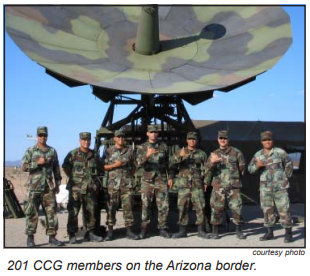
Seventy-eight Hawaii Air National Guardsmen from the 201st Combat Communications Group began deploying to various areas of Southwest Asia Sept. 1, in support of Operations Iraqi and Enduring Freedom while 20 members of the same unit have deployed to Arizona to support Operation Jump Start, the mission in support of the U.S. Border Patrol.
Members from every unit within the 201 CCG will send volunteers for the four month Air Expeditionary Force rotations in Southwest Asia. This is the “most volunteers from any ANG CCG in the history of AEF,” said Col. Robert Maglasang, commander 201 CCG. “The average number of positions normally taken by CCGs is 30- 35,” added Col. Maglasang.
All of the Airmen deploying for this AEF rotation have volunteered for the entire 120-days. Normally, an Air National Guard Group would only perform 60 day rotations.
While deployed, they will manage theater-wide communication systems, ensure systems are ready for all management level, from generals at Central Command’s Joint Task Force Headquarters to the Airmen and soldiers on the ground.
The HIANG Airmen will install and maintain telephone and computer networks as well as HF radio systems, administer and monitor network security and operations, and provide air traffic control.
Airmen who deployed to Arizona, will be supporting the Arizona Joint Force Headquarters, said Col. Maglasang. They will assist in providing voice and data service for Army Guard personnel in Yuma, establish satellite connectivity as well as communications security, user assistance and network monitoring.
The mission could range anywhere from 30 days to two years depending on the replacements.
The 201 CCG Airmen are the first HING members to deploy in support of Operation Jump Start.
At that same time, the Group also sent 20 members to Arizona to support Operation JUMP START, the mission in support of the U.S. Border Patrol. They were the first Hawaii National Guardsmen to deploy in support of Operation JUMP START.
By Senior Airman Byron Cooper and Capt. Ian Beltran 154th Civil Engineer Squadron
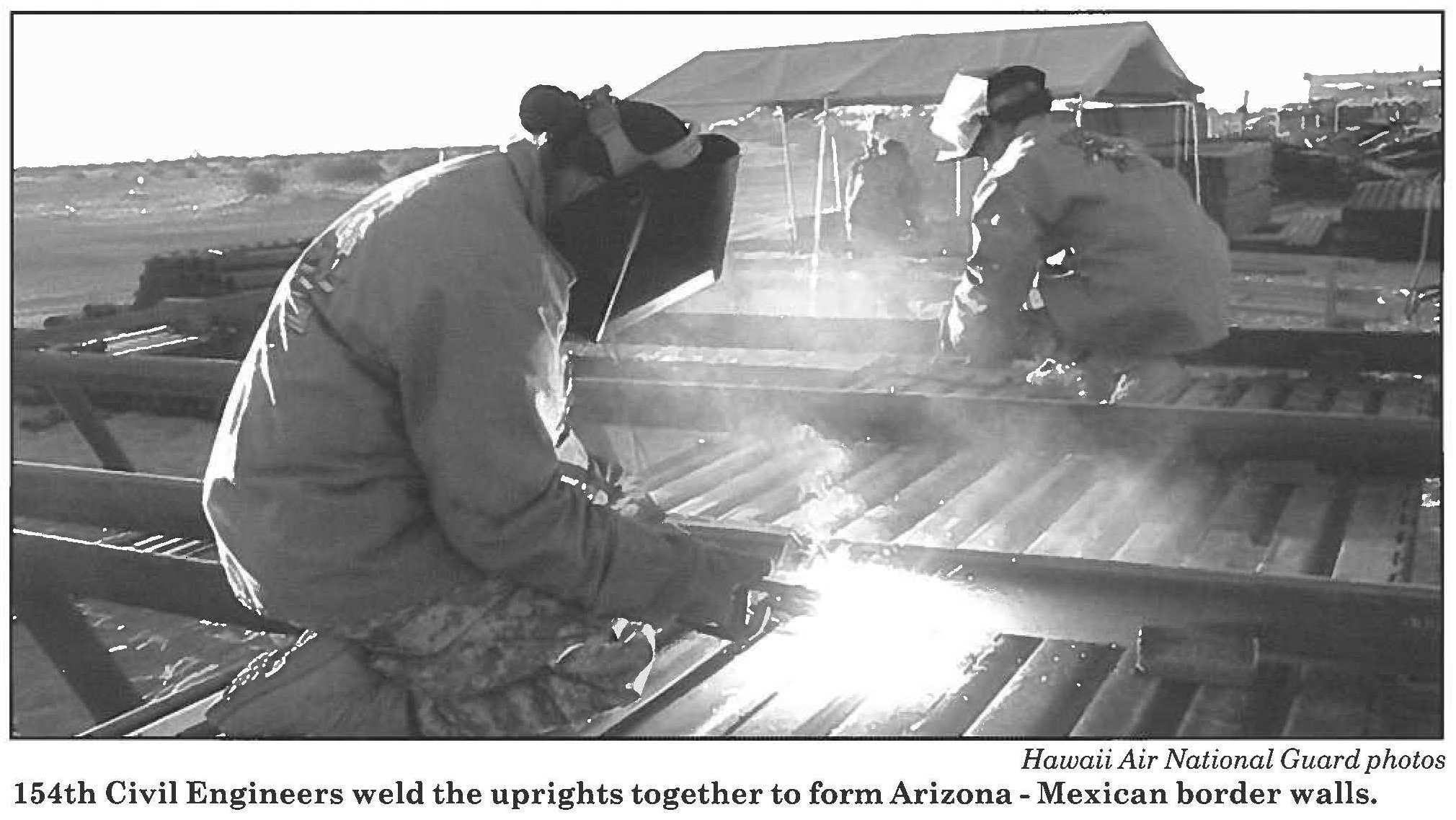
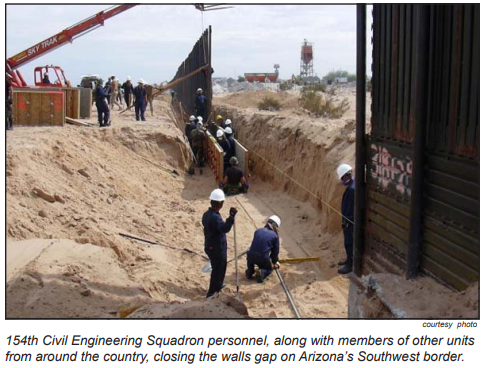
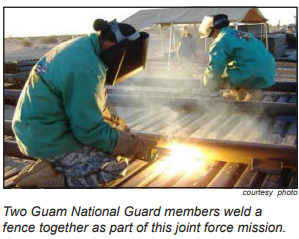
Civil Engineers buiId Mexico border wall pg. 3154th Civil Engineers weld the uprights together to form Arizona – Mexican border walls. Hawaii’s Operation JUMP START team builds the Arizona/Mexico border wall. Team members were Capt. Ian Beltran, Master Sgt. Darren Atabay, Master Sgt. Luke Sakanashi, Tech. Sgt. Rez Hadlich, Tech. Sgt. Timo Satola, Tech. Sgt. Roy Takamoto, Staff Sgt. Robert Grilho, Staff Sgt. Caplan Hashimoto, Staff Sgt. Jose Lujan, Staff Sgt. James Richardson, Staff Sgt. Clint Rodriquez, Senior Airman Paul Caparas, Senior Airman Byron A. Cooper, Senior Airman Brandon Ozaki, and Senior Airman Roger Yurko.(Pictures from the 2006 October – December Pūpūkahi)
In September, 15 Hawaii Air National Guard members from the 154th Civil Engineer Squadron deployed to Yuma, Ariz. in support of Operation JUMP START. Operation JUMP START is a joint force mission helping civil authorities better secure the U.S.- Mexico border.
The civil engineers, assigned to Task Force Diamond Back, have been tasked to erect 700 miles of steel fence and roadways along the Arizona-Mexico border. The Hawaii contingent, led by Capt. Ian Beltran, teamed up with Air and Army Guard units from Pennsylvania, Arkansas, and Guam.
The specific mission task was to close an 1,800- foot gap of fence on the outskirts of the border town of San Luis by November. The challenge was completing the mission in spite of end of the fiscal year materials and funding shortages.
The shortage of funding did not slow down operations for the engineers. The Hawaii-led team exceeded expectations by completing a 1,800-foot gap in just under a month with reused materials. The prior rotation, twice the size of the Hawaii’s contingent, put up 2,000 feet of fence in a one month period.
Mission broken into functional areas
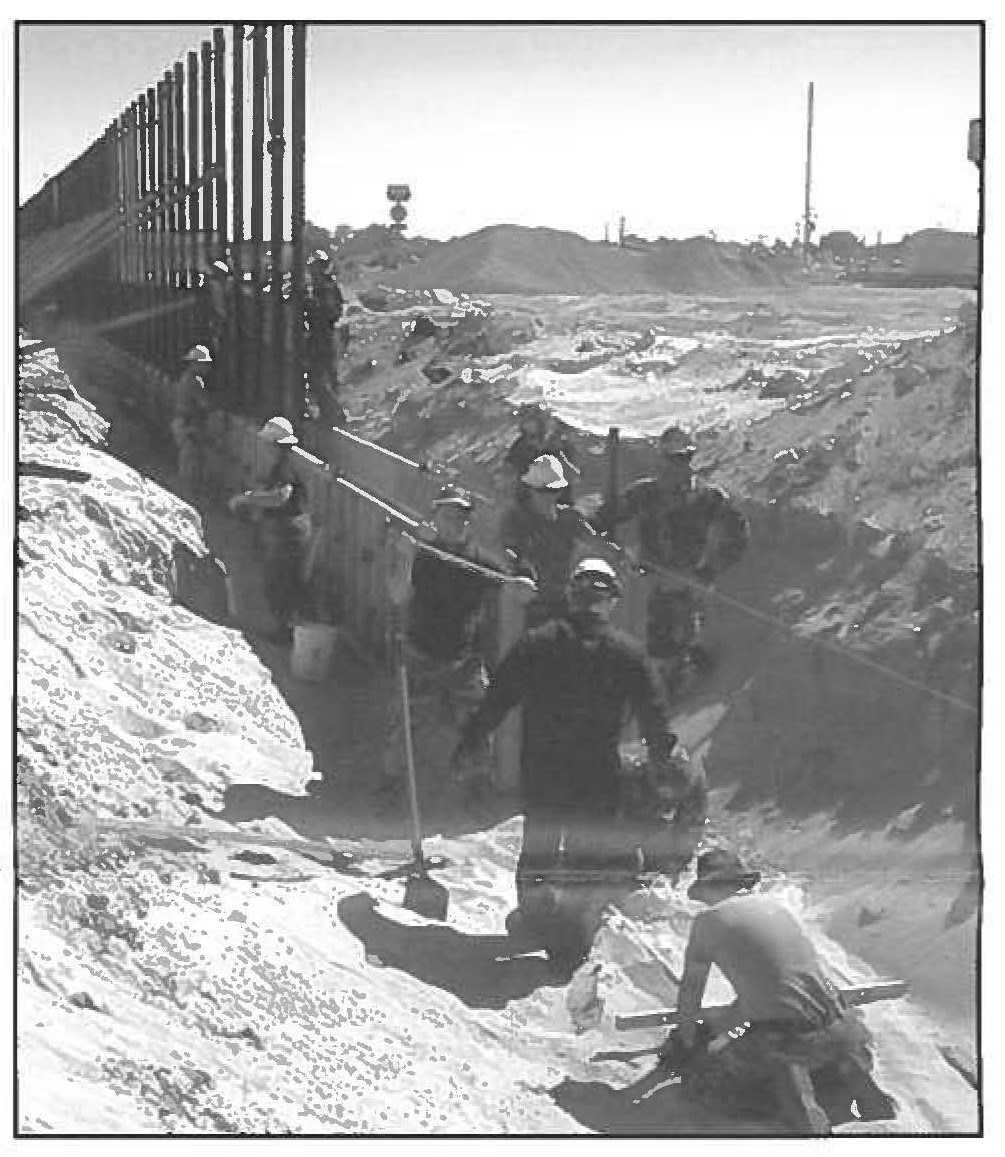
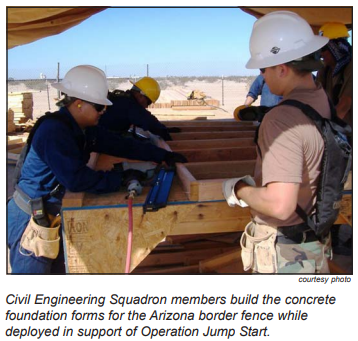
The operation was first broken into seven different functional areas. The first three included: form builders, who constructed 4 x 8 foot plywood forms used to hold the concrete and uprights of the fence until the concrete cured; engineer assistants or surveyors, who ensured that the two sections of fence would eventually line up and be the same height; and heavy equipment operators, who excavated sand prior to the forms being placed. Staff Sgt. Clint Rodriquez, from the154th’s heavy equipment shop, made a name for himself by excavating over 200 feet of trench in a single day.
The fourth functional area was responsible for setting the forms into sand level and even with the grade of sand. They also secured the forms by driving stakes into the sand every two feet.
The fifth functional area involved having welders weld the uprights together as well as welding the panels onto the finished fence once the concrete cured and the sand was backfilled up to the wall.
The sixth functional area was responsible for putting the uprights into the forms making sure that they were straight and plumb with the previous upright.
The seventh and final functional area was the concrete/form recovery crew. This crew was responsible for pumping the concrete into the forms and then troweling the finished product smooth. They also ended up recovering and reusing the forms as much as three times due to the shortage of materials.
Temperatures, snakes don’t stop mission
In the first week of being in Arizona, the temperatures in the desert were over 100°F. By early-to-mid-October, temperatures had dropped into the lower 90°F and by then, most of the troops were already acclimated to the weather. Due to the heat the engineers would start work at 6:00 a.m. and usually finish for the day at 3:00 p.m. Many days minor sand storms kicked up but the crew worked right through them. Even running into a couple of rattlesnakes and sidewinders didn’t stop the mission at hand.
by Capt. Ian Beltran and Senior Airman Byron Cooper
154th Civil Engineering Squadron personnel, along with members of other units from around the country, closing the walls gap on Arizona’s Southwest border.Two Guam National Guard members weld a fence together as part of this joint force mission.Civil Engineering Squadron members build the concrete foundation forms for the Arizona border fence while deployed in support of Operation Jump Start.(Pictures from the 2006 December Kūkāʻilimoku)
In late September, 15 members of the Hawaii Air National Guard’s 154th Civil Engineer Squadron deployed to Yuma, Ariz., in support of Operation JUMP START, and were assigned to Task Force Diamond Back.
Operation JUMP START is a joint force mission that includes Army and Air Guardsmen, helping civil authorities better secure the U.S. border with Mexico.
Civil Engineers have been tasked to erect 700 miles of steel fence and roadways along the Arizona-Mexico border.
Hawaii Air Guardsmen teamed up with many different units from across the country to include the 111 CES out of Pennsylvania, the 188 CES out of Arkansas, and 1224th Army National Guard/ 254th Civil Engineer Squadron (Soon to be 254th Red Horse) Guam Air Guard.
The specific task of the mission was to close an 1800 ft gap of fence on the outskirts of the border town of San Luis by Nov. 1. This was no easy task to complete be cause materials and funding for the job had run out at the end of the fiscal year.
The shortage of funding did not slow down operations for the engineers. 154 CES along with the other units exceeded expectations. A prior rotation team, twice the size of the HIANG-led contingent, had put up 2,000 ft of fence. The 154 CES-led team completed 1,800 ft of fence in just under a month while reusing materials.
Manpower of this operation was first broken into seven different functional areas. The first three included: form builders who constructed 4 ft x 8 ft plywood forms that would be used to hold the concrete and uprights of the fence until the concrete cured; have Engineer Assistants, or surveyors ensure that the two sections of fence would eventually line up and be the same height; have heavy equipment operators excavate sand prior to the forms being placed. Staff Sgt. Clint Rodriquez of 154 CES heavy equipment shop made a name for himself by excavating over 200 feet of trench in a single day.
The fourth functional area was responsible for setting the forms into sand level and even with the grade of sand. They also secured the forms by driving stakes into the sand every two feet.
The fifth functional area involved having welders weld the uprights together as well as welding the panels onto the finished fence once the concrete cured and the sand was backfilled up to the wall.
The sixth functional area was responsible for putting the uprights into the forms making sure they were straight and plumb with the previous upright. The seventh and final functional area was the concrete/ form recovery crew. This crew was responsible for pumping the concrete into the forms and then troweling the finished product smooth. They also ended up recovering and reusing the forms as much as three times due to the shortage of materials.
In the first week of being in Arizona the temperatures in the desert were over 100°F. By early to midOctober, temperatures had dropped into the lower 90°F but by then, most of the troops were already acclimated to the weather.
Due to the heat, the engineers would start work at 6 a.m. and usually finish for the day at 3 p.m. Many days minor sand storms kicked up, but the crew worked right through them. Running into a couple of rattlesnakes and sidewinders didn’t even stop the mission at hand.
In May, the newly formed 29th Brigade Special Troops Battalion “deployed” in support of the Operation JUMP START mission on the Southwest border in Tucson, Ariz. They conducted surveillance and counter-mobility operations to disrupt and prevent illegal border crossings. Most Soldiers were formed into entry identification teams, while the engineering company cut new roads, rebuilt fences and improved the drainage along the border
Story and photos by Sgt. 1st Class Stephen M. Lum 117th Mobile Public Affairs Detachment
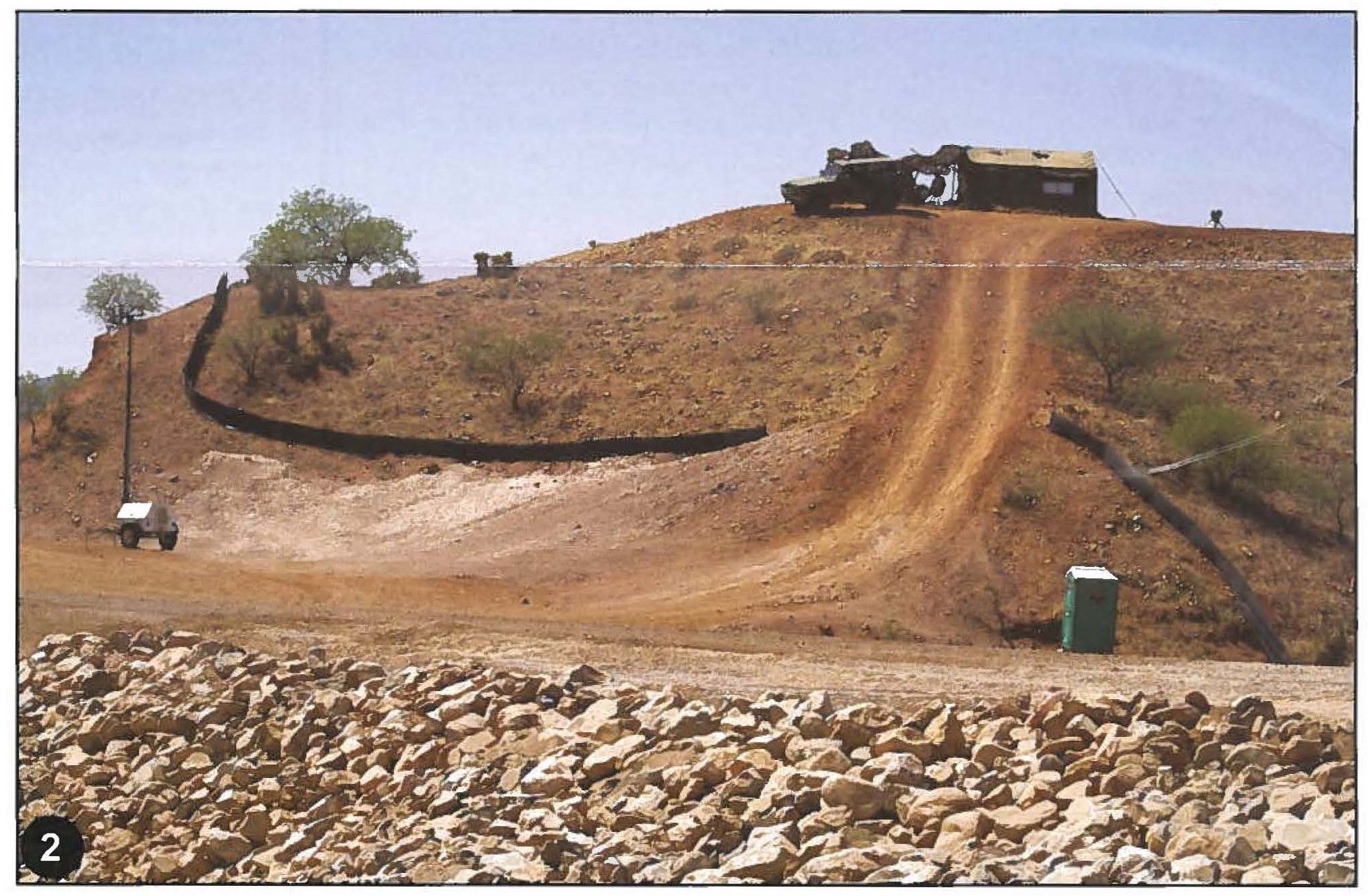
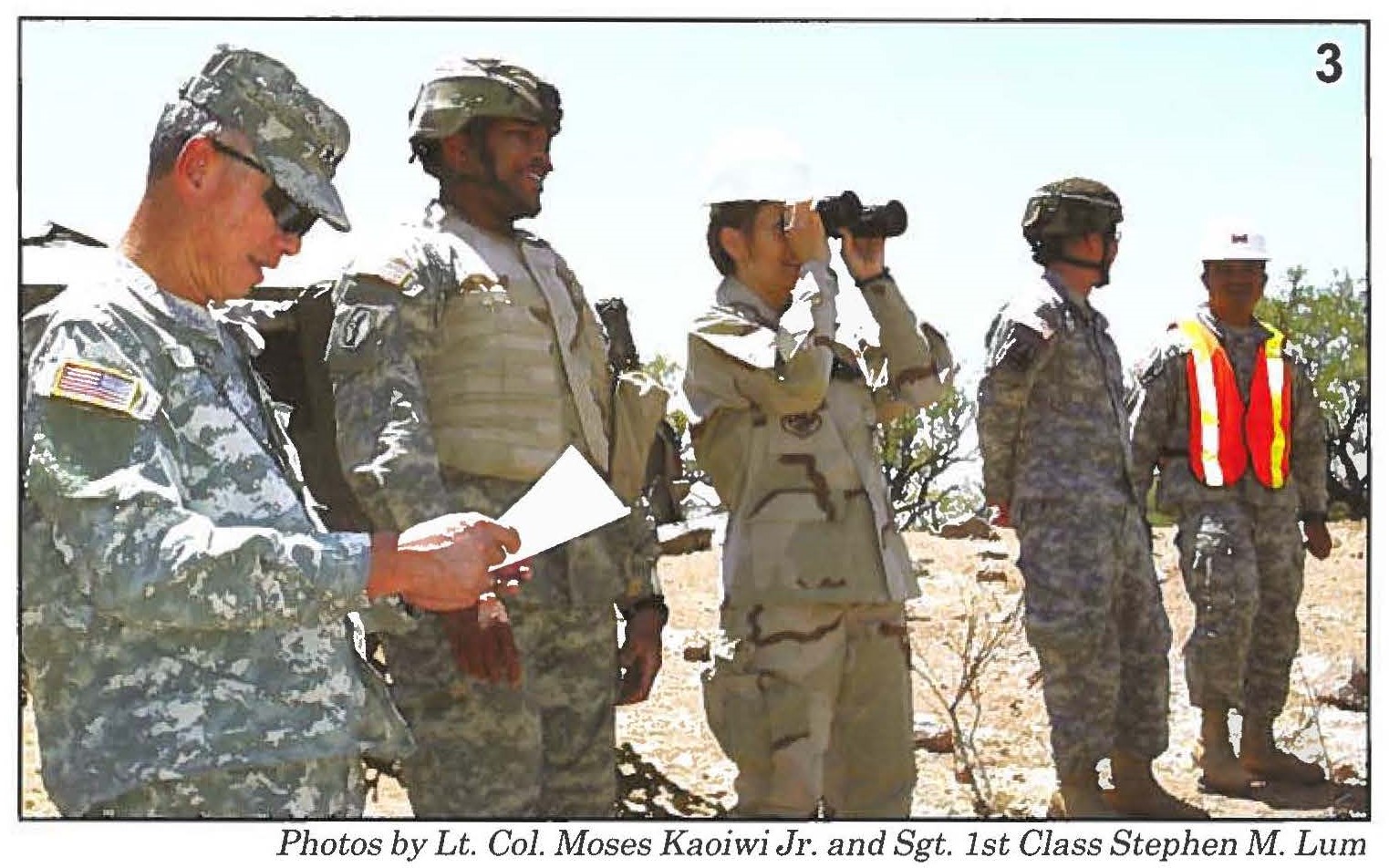
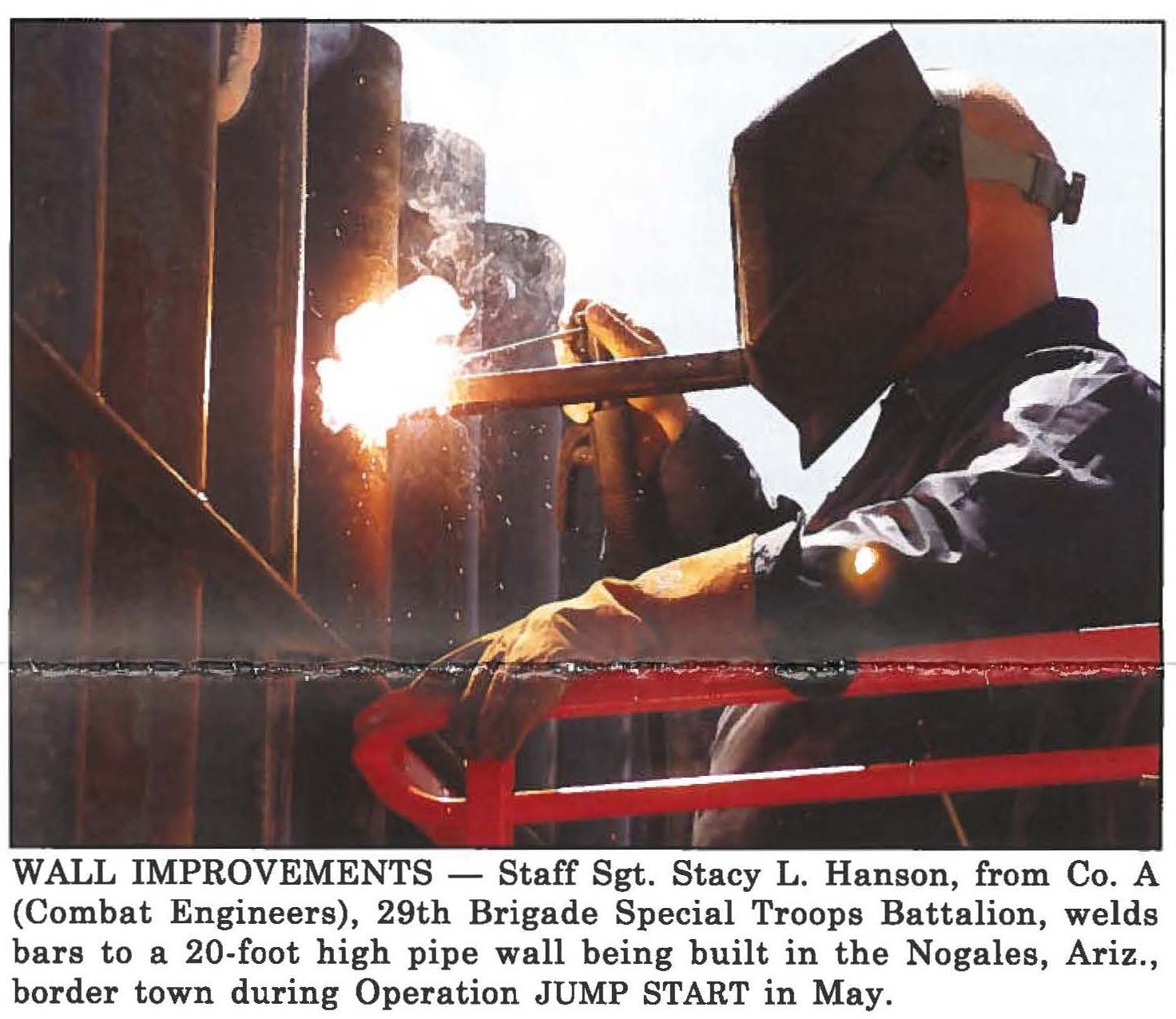
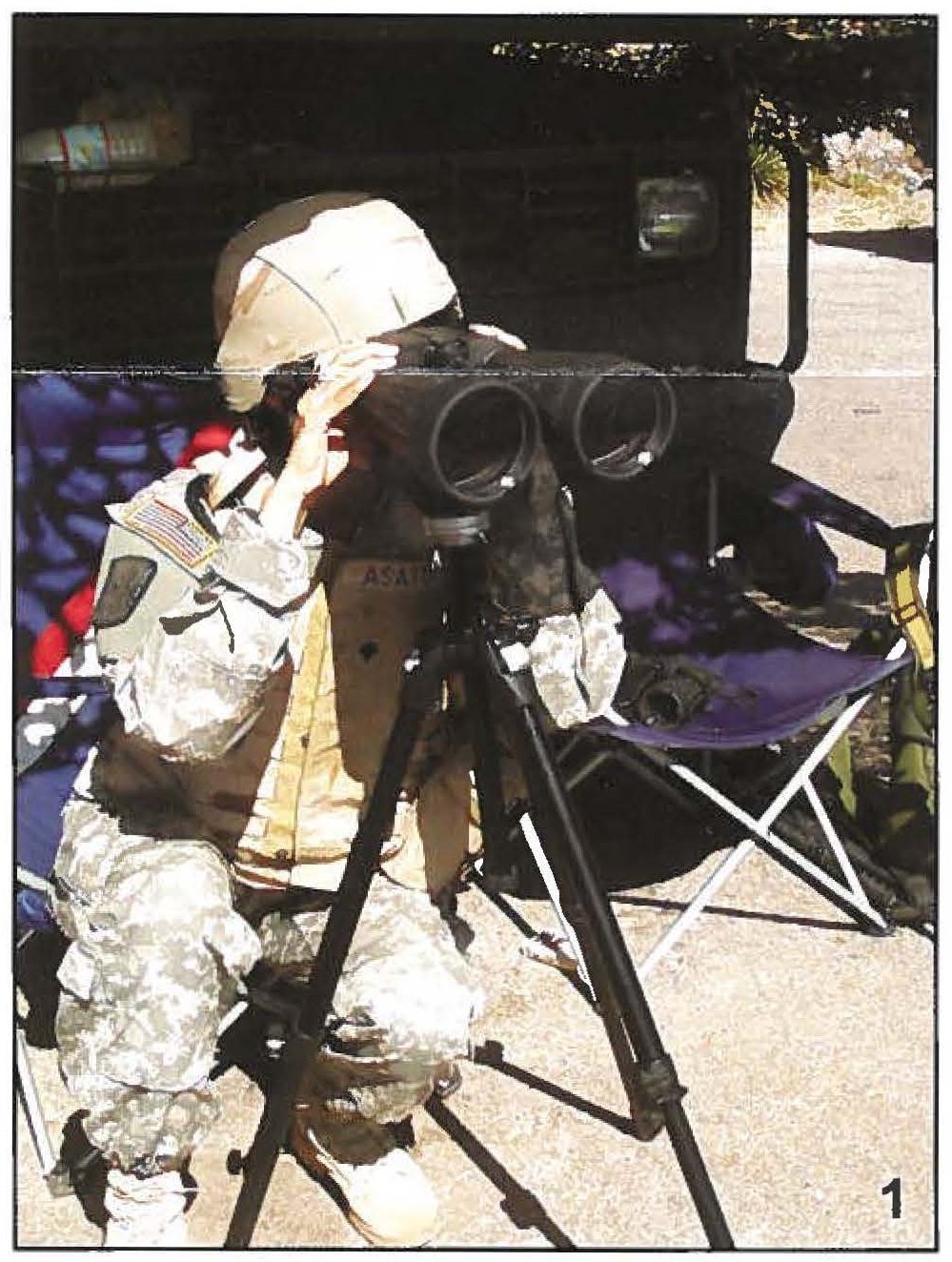
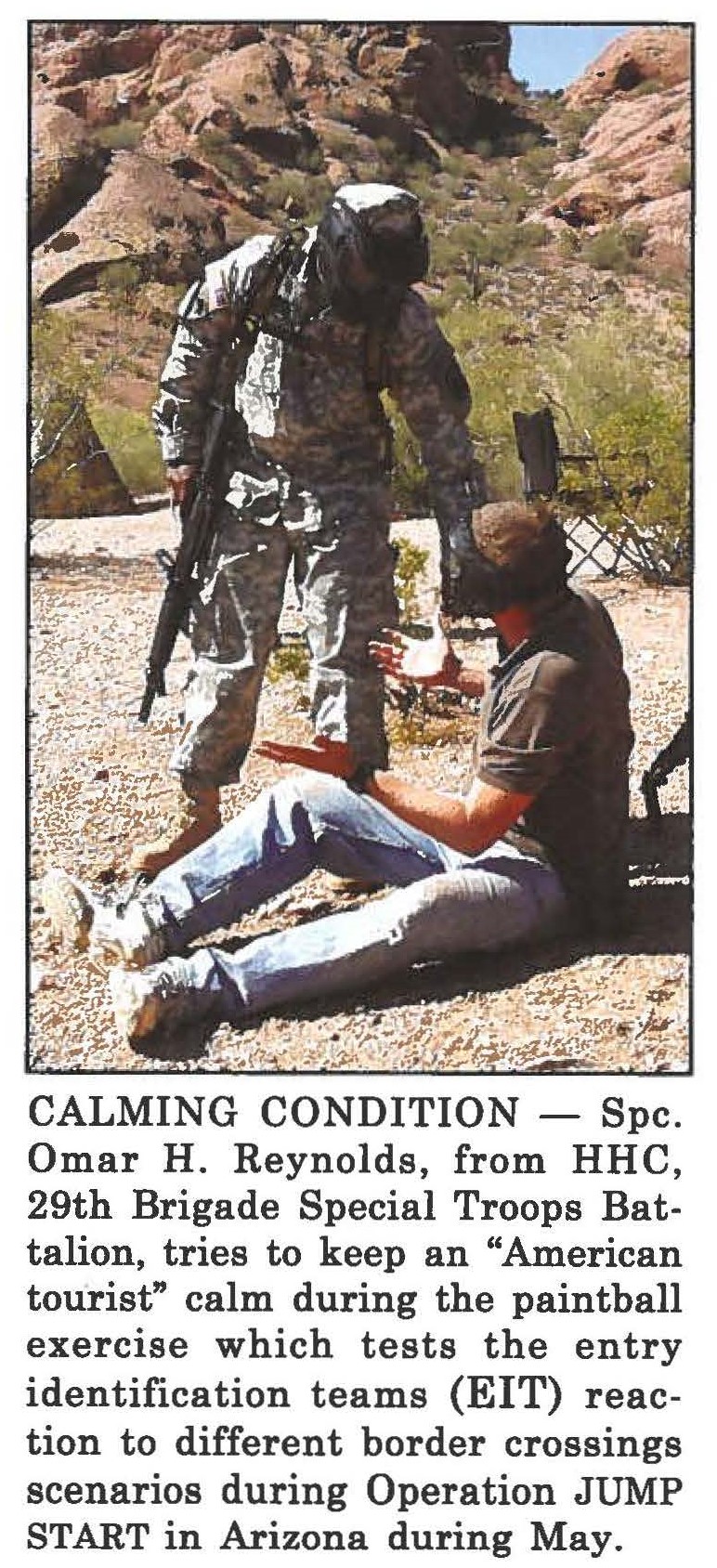
Maj. Gen. Robert G.F. Lee, the adjutant general (left) and State Command Chief Master Sgt. Denise M. Jelinski-Hall (with binoculars) check out the Hawaii Army National Guard rotation at Operation JUMP START in Arizona. A Nogales EIT observation site perched on a hilltop overlooking the Mexican border. WALL IMPROVEMENTS – Staff Sgt. Stacy L. Hanson, from Co. A (Combat Engineers), 29th Brigade Special Troops Battalion, welds bars to a 20-foot high pipe wall being built in the Nogales, Ariz., border town during Operation JUMP START in May. Spc. Bianca Asato, from the HHC, 29th Brigade Special Troops Bn., takes her shift spotting during the unit’s entry identification team mission.CALMING CONDITION – Spc. Omar H. Reynolds, from HHC, 29th Brigade Special Troops Battalion, tries to keep an “American tourist” calm during the paintball exercise which tests the entry identification teams (EIT) reaction to different border crossings scenarios during Operation JUMP START in Arizona during May. (Pictures from the 2007 April – June Pūpūkahi)
More than 180 Soldiers from the Hawaii Army National Guard’s 29th Brigade Special Troops Battalion spent annual training on the Southwest Border of Arizona supporting Operation JUMP START in May. The Battalion conducted surveillance and countermobility operations to disrupt and prevent illegal border crossings.
Special Troops Soldiers Task Force Tucson entry identification teams (EIT) performed surveillance missions while Task Force Diamondback engineers built roads and fences. The National Guard’s presence frees up U.S. Border Patrol personnel to concentrate on their law enforcement mission.
The new battalion, commanded by Lt. Col. Moses Kaoiwi Jr., is composed of former separate elements of the 29th Infantry Brigade Combat Team. The units are Headquarters and Headquarter Company (military police, medical, administrative and logistic personnel), Company A (227th Engineers), Company B (229th Military Intelligence) and Company C, the new signal unit.
Engineers work on again
More than 60 engineers from Company A cut new roads, rebuilt fences and improved the drainage in the Tucson sector’s border towns of Nogales and Sierra Vista.
“The roads being cut through the rolling small mountain range well improve access for the border personnel,” said Capt. Auredith T. Tumpap, the Co. A commander, “while the 20-foot pipe walls being erected will replace some of the older aircraft landing ramp walls. Our Hawaii Air Guard engineers were part of a team erecting the Yuma fence line last fall.”
“The mission has given the veterans an opportunity to share their expertise, especially in heavy equipment operation and welding to our newer Soldiers,” said Sgt. 1st Class Ian S. Ross, a member of the unit when it was an engineering battalion more than 30 years ago. “We’re not new to this mission either. We’ve done similar work twice on the Mexican border, south of San Diego, Calif., the last time in 2000.”
Mission differs from Iraqi
‘Most of the battalion Soldiers were divided into 10 EITs supporting Task Force Tucson,” said Kaoiwi. “After two days of briefings and a paintball exercise, the Soldiers were more than ready to go on with the mission. Our observation posts were on clearlyvisible locations on hilltops facing the border. The 24-hour mission uses binoculars and infrared sensors to detect undocumented aliens (UDA) during the day or at night.”
“During one of our construction missions, we spotted a dozen UDAs trying to cross the border,” said Tumpap. “We called in a report while they backtracked into Mexican half of the split city of Nogales.”
“This mission has provided an opportunity for our new battalion to test our mobilization operation in a real world mission,” said Kaoiwi.
For three weeks in May, the newly formed 29th Brigade Special Troops Battalion went on its first major mission since the Brigade redeploying from the Persian Gulf, to support the Operation JUMP START (see page 1) in Arizona. The real world mission requires Soldiers to maintain 24-7 entry identification teams at observation posts along the southwest border of Mexico, while our engineers built infrastructure like fences, drainage and roads. The Hawaii Soldier faced real potential hazards and I commend the them for putting in 100 percent effort to in getting the mission done and getting it done well.
Thirteen members of the 154th Medical Group supported Operation Jump Start and participated in the Medical Innovative Readiness Training Program in San Diego, California May 13 – 27, 2007.
In support of OJS, six members of the group provided clinical services and gained valuable training and experience at the Naval Amphibious Base Clinic, Coronado Island, and at Balboa Naval Hospital in San Diego. The others, supporting the MIRT provided clinical care at the Valley Health Care Center for seven different Native American tribes of the Rincon Reservation in the Pauma Valley of Southern California.
The Innovative Readiness Training Program allows National Guard units to assist eligible organizations and activities in addressing community needs. The purpose of the MIRT is to provide mission essential training for units, while building upon the long-standing tradition of the Armed Forces of the United States. By acting as good neighbors at the local level, military personnel assist worthy civic and community needs. At the Valley Health Care Center, Medical Services provided by the 154 MDG included sick-call support, laboratory services, administering immunizations, radiology and dental care. The Center is a state of the art clinic with one short fall, its lack of staff.
“The team members not only provided a critical service to the community, we were also able to participate in a cultural event, the Annual Health Gathering, which combined native American traditions; a sweat lodge, pit barbeque (there version of an Imu, with buffalo, and beef instead of pig), arts and crafts and the ever popular ‘Bear Dance,’” said Tech. Sgt. Curtis Palmer, Hawaii’s MIRT coordinator.
Working at the Valley Health Care Center was an introduction to the up-coming MIRT project the 154 MDG will be hosting in Hawaii in. In conjunction with the State of Hawaii Department of Health, the 154 MDG is establishing a pilot program that will provide indigent communities within Hawaii and possibly other areas of the Pacific, access to preventive health assessments, wellness referrals to outpatient clinics and community disaster preparedness awareness training. The project is called “Malama Kakou” (helping together).
The 154 MDG will serve as lead and host unit to other ANG/ARNG Medical Groups to provide clinical support for the community while accomplishing readiness skills and ancillary training. The deployed units will participate in a three phase training program, phase one covering didactic training; phase two-field training exercise, to include the local communities; phase three will be providing clinical services and referrals for the community.
Currently, only the Army Guard for Alaska and California host a MIRT program. Hawaii will be the first Air National Guard unit to host a MIRT.
Overall, the training accomplished during the OJS and IRT events proved invaluable to the 154th members who volunteered for this duty. The time spent with the OJS Task Force Phoenix provided extensive hands on experience for a variety of AFSCS. The MIRT participants gained first hand exposure in a community based service, in turn setting the course for future MIRT projects in Hawaii.
The 293rd CBCS also provided NGCE (National Guard Communications Equipment) support to Vigilant Guard 08 in Reno, Nev. and sent personnel to Arizona in support of Operation Jump Start, the National Guard operation supporting civil authorities along the U.S. Mexico border. 297th Air Traffic Control
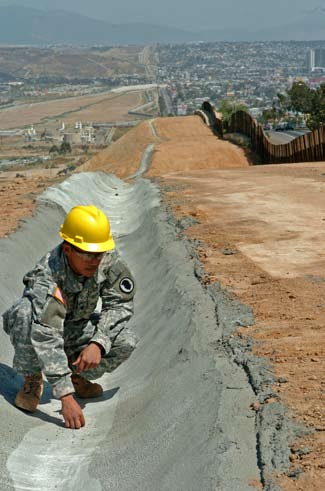
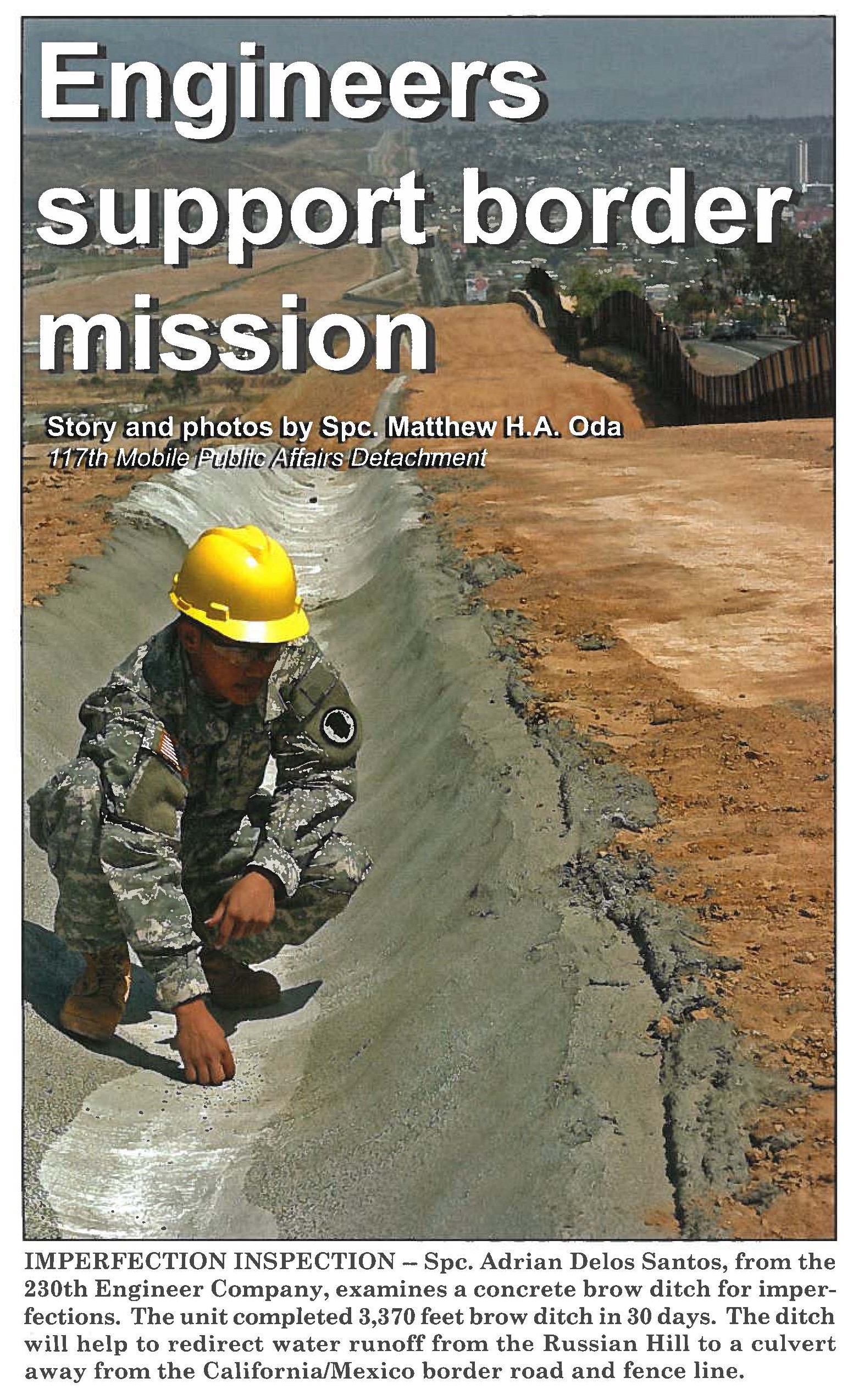
INSPECTION – Spc. Adrian Delos Santos, from the 230th Engineer Co., examines a concrete brow ditch for imperfections during an Operation JUMP START mission on the San Diego/Mexican border. The unit completed 3,370 feet of brow ditch in 30 days which will help redirect water runoff from “Russian Hill” to a culvert off the border road and fence line. Spc. Matthew H. A. Oda photo(Picture from the 2008 Annual Report)
In May, the 298th Engineer Co. supported the Operation JUMP START mission on the southwest border of San Diego, Calif. The engineering company cut new roads, rebuilt fences and improved the drainage along the border. They built infrastructure that supported operations that disrupt and prevent illegal Mexico border crossings.
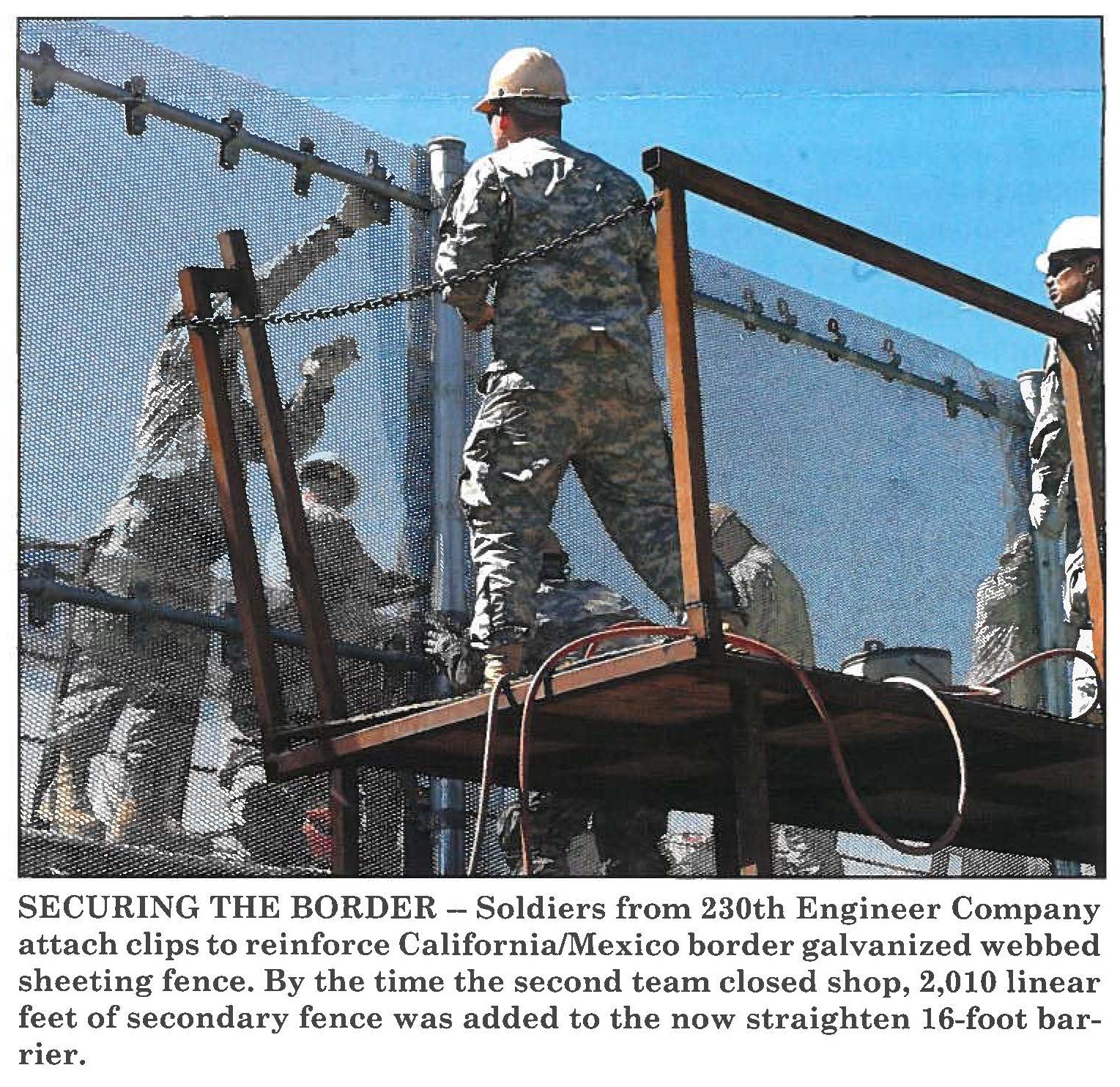
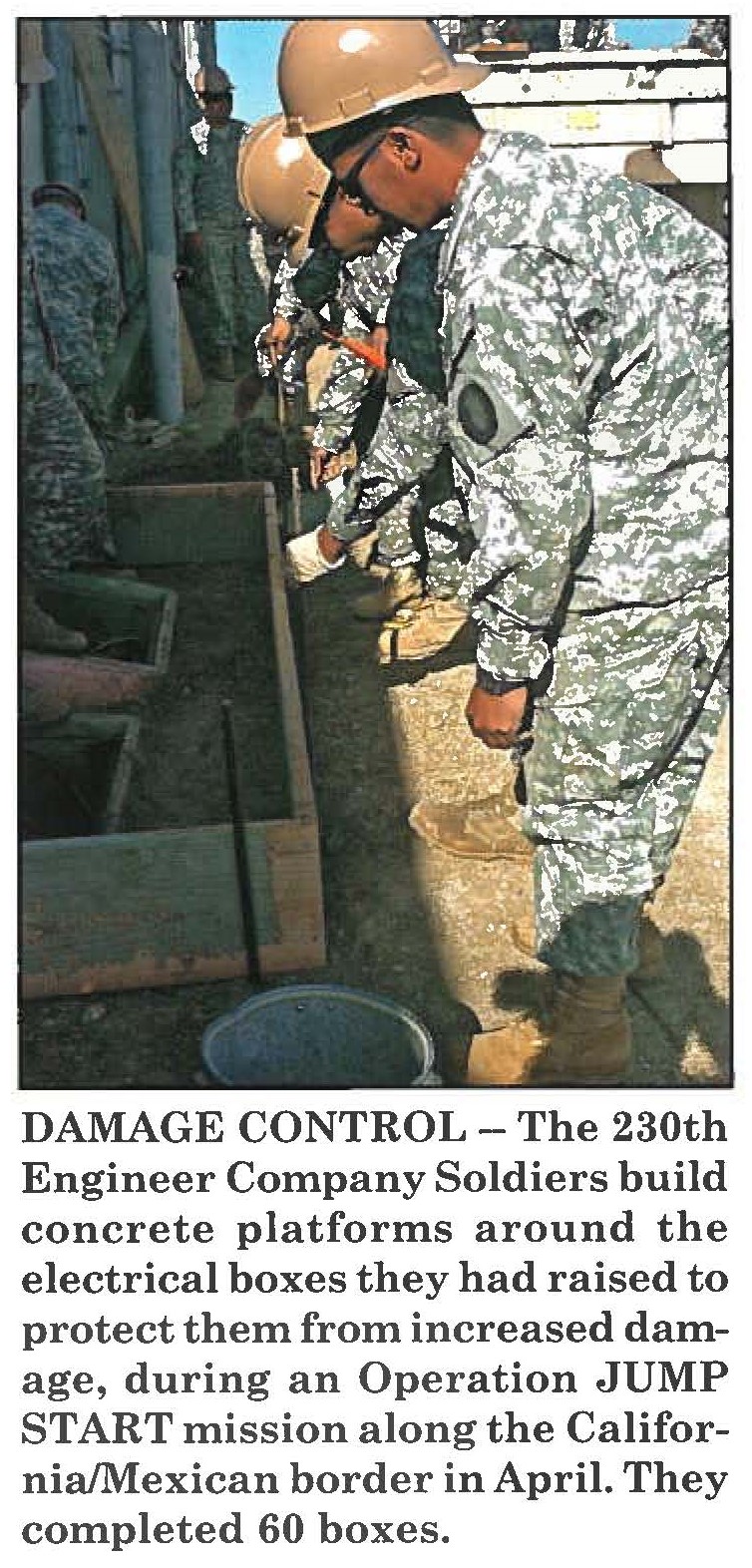
IMPERFECTION INSPECTION – Spc. Adrian Delos Santos, from the 230th Engineer Company, examines a concrete brow ditch for imperfections. The unit completed 3,370 feet brow ditch in 30 days. The ditch will help to redirect water runoff from the Russian Hill to a culvert away from the California / Mexico border road and fence line. SECURING THE BORDER – Soldiers from 230th Engineer Company attach clips to reinforce California / Mexico border galvanized webbed sheeting fence. By the time the second team closed shop, 2,010 linear feet of secondary fence was added to the now straighten 16-foot barrier. DAMAGE CONTROL – The 230th Engineer Company Soldiers build concrete platforms around the electrical boxes they had raised to protect them from increased damage, during an Operation JUMP START mission along the California/Mexican border in April. They completed 60 boxes. (Pictures from the 2008 April – June Pūpūkahi)
More than 80 Soldiers from the Hawaii Army National Guard’s 230th Engineer Company helped support California’s Operation JUMP START southwest border mission in April. As part of the President’s Homeland Security initiative, OJS uses National Guard troops to support the U.S. Customs and Border Patrol protection preventing illegal crossing and drug trafficking through the Mexico borders.
The Maui-headquartered engineer unit worked out of San Diego and was attached to Task Force STEEL CASTLE, the California National Guard’s engineering slice of OJS. The Hawaii engineers, who also have a detachment on Oahu and one on Molokai, made the trip on board an Air Force C-130 Hercules cargo aircraft flight. The 230th also has two Soldiers from the Big Island of Hawaii and one from Lanai.
Three major missions were accomplished
Engineering missions included retrofitting an existing fence, repositioning electrical boxes and making a drainage ditch.
“We modified the angle of the poles,” said Staff Sgt. Jason Jacinto, noncommissioned officer in charge of the fence and electrical box project, “and put clips on galvanized webbed sheeting to reinforce the fence.”
“Each day, we tried to do about thirty fence lines,” said Spc. Richard Galo, a 7-year Guard member from Maui, “which equals about 300 feet a day.”
“It took us about four days to complete our project,” said Galo. “Task Force Steel Castle personnel overseeing the project were impressed with our productivity.”
“Our team also rebuilt the electrical boxes along the fence line,” said Jacinto, a 15-year Guard veteran from Maui. “We raised the boxes a foot above ground to make them visible. We also built concrete platforms around the boxes to protect them from increased damage. TF STEELE CASTLE expectations were about 20 platforms a day, instead, we did 28 of them.”
“My team made a brow ditch on one of the hills by digging a long ditch and coating it with concrete to redirect the water runoff to a culvert,” said Staff Sgt. Lester Delos Reyes, brow ditch project NCOIC, “instead of running down the hills and causing potential damage to the surrounding areas.
We completed the task on Russian Hill in three days (ahead of schedule) even with some Soldiers doing on-the-job-training,” said Delos Reyes, from Molokai. “Many of our new Soldiers are infantrymen retraining as engineers.”
“The only obstacle the 230th faced was time,” said 1st Sgt. Michael J. Lacno, the engineer’s first sergeant, “given more time, the more we could have accomplished more.
“Things ran very smoothly . . . the leaders took charge,” said Lacno, the 22-year Guard member from Maui. “Our TF STEEL CASTLE host provided the materials and equipment we needed to get the job done. Many of our troops are transitioning from the infantry mission, but the young or inexperienced Soldiers were willing and motivated to learn engineering the . . ” mission.