Do you need help in another language? We will get you a free interpreter. Call 808-369-3580 to tell us which language you speak.
您需要其它語言嗎?如有需要,請致電 (808-369-3478), 我們會提供免費翻譯服務
您需要其它语言吗?如有需要,请致电 (808-369-3478), 我们会提供免费翻译服务
En mi niit alilis lon pwal eu kapas? Sipwe angei emon chon chiaku ngonuk ese kamo. Kokori (808-369-3478) omw kopwe ureni kich meni kapas ka ani.
Makemake `oe i kokua i pili kekahi `olelo o na `aina `e? Makemake la maua i ki`i `oe mea unuhi manuahi. E kelepona (808-369-3478)`oe ia la kaua a e ha`ina `oe ia la maua mea `olelo o na `aina `e.
Masapulyo kadi ti tulong iti sabali a pagsasao? Ikkandakayo iti libre nga paraipatarus. Awaganyo ti
(808-369-3478) tapno ibagayo kadakami no ania ti pagsasao nga ar-aramatenyo.
다른언어로 도움이 필요하십니까? 저희가 무료로 통역을 제공합니다. (808-369-3478)로 전화해서 사용하는 언어를 알려주십시요
Kwoj aikuij ke jiban kin juon bar kajin? Kim naj lewaj juon am dri ukok eo ejjelok wonen. Kirtok
(808-369-3478) im kwalok non kim kajin ta eo kwo melele im kenono kake.
E te mana'o mia se fesosoani i se isi gagana? Matou te fesosoani e ave atu fua se faaliliu upu mo oe. Vili mai i le numera lea (808-369-3478) pea e mana'o mia se fesosoani mo se faaliliu upu.
¿Necesita ayuda en otro idioma? Nosotros le ayudaremos a conseguir un intérprete gratuito. Llame al (808-369-3478) y diganos que idioma habla.
Kailangan ba ninyo ng tulong sa ibang lengguwahe? Ikukuha namin kayo ng libreng tagasalin. Tumawag sa (808-369-3478) para sabihin kung anong lengguwahe ang nais ninyong gamitin.
‘Okú ke fie maʻu tokoni ʻi ha lea fakafonua ʻe taha? Temau kumi haʻo taha fakatonulea taʻetotongi. Telefoni ki he (808-369-3478) ke fakahā mai ʻa e lea fakafonua ʻokú ke lea aí.
Bạn có cần giúp đỡ bằng ngôn ngữ khác không ? Chúng tôi se yêu cầu một người thông dịch viên miễn phí cho bạn. Gọi (808-369-3478)nói cho chúng tôi biết bạn dùng ngôn ngữ nào
Gakinahanglan ka ba ug tabang sa imong pinulongan? Amo kang mahatagan ug libre nga maghuhubad. Tawag sa (808-369-3478) aron magpahibalo kung unsa ang imong sinulti-han.
Hawaiʻi Air National Guard’s F-15A Eagle Aircraft Conversion
In the mid-1980s, the Hawaiʻi Air National Guard (HIANG) undertook one of the most significant modernization efforts in its history: the conversion from the Vietnam-era F-4C Phantom II to the cutting-edge F-15A Eagle air superiority fighter. This transition, executed between 1986 and 1988, marked a major enhancement for Hawaiʻi’s air defense capability and underscored the Guard’s role in national security.
Planning for the conversion began earnestly in 1985 as part of a broader U.S. Air Force initiative to modernize tactical forces within the Air National Guard and Reserve. In February 1986, the Air Force officially announced that the HIANG would replace its fleet of 24 F-4C Phantom aircraft with 24 F-15A Eagles. The F-15A, renowned for its superior acceleration, advanced avionics, extended range and formidable weapons systems, promised performance far beyond that of the aging Phantom.
June 1986 marked a symbolic closing of the Phantom era when eight F-4Cs returned from the Red Flag combat exercise at Nellis Air Force Base, Nevada, signaling the final major deployment of the aircraft.
The conversion effort was supported by the Pacific Air Forces and the National Guard Bureau, with Hawaiʻi becoming only the third Air National Guard unit in the nation slated to receive the F-15A. This early selection highlighted the strategic importance of Hawaii’s air defense mission and the HIANG strong record of performance.
Transition planning included comprehensive coordination across operations, maintenance and support personnel. A dedicated conversion committee oversaw site surveys, interim facility arrangements and the establishment of training schedules. Personnel assignments were adapted as needed; for example, weapons systems officers transitioned into new roles since the F-15A required only a single pilot.
In 1987 the transition accelerated: the first group of pilots began F-15A training, and in March the first two Eagles arrived at Hickam Air Force Base. Over the ensuing months, pilots and maintenance crews completed training missions.
By Sept. 1, 1987, the final scramble by F-4C Phantoms had occurred, with F-15A Eagles assuming the active air defense mission. The HIANG completed its full conversion ahead of schedule on June 22, 1988, reaffirming its readiness and commitment to defending Hawaiʻi and national interests.
This transition from the Phantom to the Eagle was the fifth aircraft conversion in the last four decades and a defining moment that equipped the 154th Composite Group with one of the most capable fighter aircraft of the era, significantly enhancing the air defense posture of the Hawaiian Islands.
The Hawaii Air National Guard diligently planned and executed the final steps for an aircraft conversion in fiscal year 1987. The F-15A Eagle aircraft will replace the F-4C Phantom jet fighters. This conversion will represent a quantum leap forward in the air defense of the State.
Within the past year, through the combined efforts of the Headquarters, Hawaii Air National Guard, Pacific Air Force, and the National Guard Bureau, the acquisition of the F-15A Eagle aircraft to replace the aging F-4C Phantom aircraft became a long awaited reality. aircraft in March 1987.
June 14, 1986 initiated the closing of a very historical chapter in the annals of the Hawaii Air National Guard. The return landings of eight F-4C aircraft from the air combat exercise Red Flag at Nellis AFB, Nevada, marked the end of the last deployment in the Phantom. With the expected arrival of the F-15 Eagle next fiscal year and the final phase out of the F-4C, an era will come to an end. Although Hawaii Air National Guard’s Phantoms are close to being 23 years old and by most 1980 standards, out-dated, the aircraft can still perform well in the air combat arena when flown by experienced and well-trained aircrews as was proven by the recent deployment to Red Flag.
5 FEB 1986 The Air Force announced changes in the tactical force structure of the Air Force Reserve and Air National Guard. The Hawaii Air National Guard’s F-4C (Phantom) fighter aircraft will be replaced by F-15 (Eagle) aircraft .
Learn more
On February 1986 the United States Air Force officially announced that the Hawaii Air National Guard will begin receiving the F-15A Eagle aircraft in March 1987.
On February 5, 1985 the Air Force announced proposed changes in the tactical force structure of the Air Force Reserve and Air National Guard. The Hawaii Air National Guard’s 24 F-4C (Phantom) fighter aircraft will be replaced by 24 F-15 (Eagle) aircraft in the summer of 1987, which will greatly enhance Hawaii’s air defense system for the people of Hawaii. The F-15 is recognized as one of the finest fighter aircraft in the world today. Its superior acceleration, range, weapons and avionics will enable the Hawaii Air National Guard to intercept, identify and destroy, if necessary, potential hostile aircraft at a greater distance from our shores.
According to Major General Alexis T. Lum, State Adjutant General, “The aircraft represents a monumental leap for Hawaii’s air defense and will provide a greater level of protection for the State of Hawaii. Hawaii has a definite need for this expanded capability and the Hawaii Air National Guard has demonstrated its ability to put the F-15 to the best possible use for our State and Nation.”
Hawaii Air National Guard, 3rd Guard unit to receive F-15’s
The Hawaii Air National Guard becomes the third Guard unit in the nation to be programmed for the F-15s, following the 159th Tactical Fighter Group, New Orleans, Louisiana, and the 116th Tactical Fighter Wing, Dobbins AFB, Georgia. Hawaii’s early selection for force modernization can be attributed to the very strong support received from Pacific Air Forces and the National Guard Bureau and our Hawaii Air National Guard’s unique air defense mission and its outstanding accomplishments. Over the next decade, several other Air National Guard units will be programmed for the F-15 aircraft as part of the modernization of the reserve forces.
As part of the conversion from the F4C to F-15 aircraft, the Hawaii Air National Guard will be upgrading and expanding its facilities at Hickam AFB to accommodate the new aircraft at an estimated cost of $8.2 million. An additional $15.2 million of improvements,
$23.4 million in facilities upgrading & expansion improvements
unrelated to the conversion, will be made to accommodate other facility needs of the Hawaii Air National Guard at Hickam AFB.
The conversion of the F-4C to F-15 aircraft will result in a slight increase in full-time and military manning for the 154th Composite Group, Hickam AFB, Hawaii. Some on-board personnel will be affected by the conversion. They will be reassigned and trained for new duties since the F-15 is less labor intensive to maintain than the F-4C because of improved technology and requires only one pilot to perform its mission. The F4C currently requires both a pilot and a weapons system officer to perform its mission. However, no existing personnel will be laid off since the overall manpower authorization will be slightly increased, as previously mentioned.
This conversion from the F-4C to the F-15 will be the fifth aircraft conversion for the Hawaii Air National Guard over the past four decades. Brigadier General Edward V. Richardson, Hawaii Air National Guard Commander, stated, “Since 1956, we have provided 24-hour air defense for the State of Hawaii and our people. With strong support from the Pacific Air Forces, we have worked hard to continually upgrade our people’s training, our tactics and our equipment to deny any potential adversary an undue advantage. General Robert W. Bazley, Commander in Chief, Pacific Air Forces, and the late General Jerome F. O’Malley deserve much of the credit for modernization of Hawaii’s air defense system. Their support and recognition of the Hawaii Air National Guard’s accomplishments contributed directly to our early conversion to the F-15. The F-15 is the world’s premier fighter aircraft and, combined with our outstanding aircrews and support personnel, I feel that the Hawaii Air National Guard will have the best air defense force for years to come. This conversion has added significance to all the men and women in the Hawaii Air National Guard as we celebrate our 40th anniversary in serving Hawaii’s people and our Nation.”
On February 5, 1986, the Air Force announced proposed changes in the tactical force structure of the Air Force Reserve and Air National Guard. The Hawaii Air National Guard’s 24 F-4C (Phantom) fighter aircraft will be replaced by 24 F-15 (Eagle) aircraft in the summer of 1987, which will greatly enhance Hawaii’s air defense system for the people of Hawaii. The F-15 is recognized as one of the finest fighter aircraft in the world today. Its superior acceleration, range, weapons and avionics will enable the Hawaii Air National Guard to intercept, identify and destroy, if necessary, potential hostile aircraft at a greater distance from our shores.
According to Major General Alexis T. Lum, State Adjutant General, “The aircraft represents a monumental leap for Hawaii’s air defense and will provide a greater level of protection for the State of Hawaii. Hawaii has a definite need for this expanded capability and the Hawaii Air National Guard has demonstrated its ability to put the F-15 to the best possible use for our State and “Nation.”
The Hawaii Air National Guard becomes the third Guard unit in the nation to be programmed for the F-15s. following the 159th Tactical Fighter Group, New Orleans, Louisiana, and the 116th Tactical Fighter Wing, Dobbins AFB, Georgia. Hawaii early selection for force modernization can be attributed to the very strong support received from Pacific Air Forces and the National Guard Bureau and our Hawaii Air National Guard’s unique air defense mission and its outstanding accomplishments. Over the next decade, several other Air National Guard units will be programmed for the F-15 aircraft as part of the modernization of the reserve forces.
As part of the conversion from the F-4C to F-15 aircraft, the Hawaii Air National Guard will be upgrading and expanding its facilities at Hickam AFB to accommodate the new aircraft at an estimated cost of $8.2 million. An additional $15 .2 million of improvements, unrelated to the conversion, will be made to accommodate other facility needs of the Hawaii Air National Guard at Hickam AFB.
The conversion of the F-4C to F-15 aircraft will result in a slight increase in full-time and military manning for the 154th Composite Group, Hickam AFB, Hawaii. Some on- board personnel will be affected by the conversion. They will be reassigned and trained for new duties since the F-15 is less labor intensive to maintain than the F-4C because of improved technology and requires only one pilot to perform its mission. The F-4C currently requires both a pilot and a weapons system officer to perform its mission. However, no existing personnel will be laid off since the overall manpower authorization will be slightly increased, as previously mentioned.
This conversion from the F-4C to the F-15 will be the fifth aircraft conversion for the Hawaii Air National Guard over the past four decades. Brigadier General Edward V. Richardson, Hawaii Air National Guard Commander, seated, “Since 1956, we have provided 24-hour air defense for the State of Hawaii and our people. With strong support from the Pacific Air Forces, we have worked hard to continually upgrade our people’s training, our tactics and our equipment to deny any potential adversary an undue advantage. General Robert W. Bazley, Commander ill Chief, Pacific Air Forces, and the late General Jerome F. O’Malley deserve much of the credit for modernization of Hawaii’s air defense system. Their support and recognition of the Hawaii Air National Guard’s accomplishments contributed directly to our early conversion to the F-15. The F-15 is the world’s premier fighter aircraft and, combined with our outstanding aircrews and support personnel, I feel that the Hawaii Air National guard will have the best air defense force for years to come. This conversion has added significance to all the men and women in the Hawaii Air National guard as we celebrate our 40th anniversary in serving Hawaii’s people and our Nation.”
… Well gang, another drill weekend has come and gone , mission accomplished til the next drill … Remember last issue when I mentioned attaining the goals set by MGen Conaway when he visited us? I guess you’ve already heard what is in store for the Hawaii Air Guard in the months ahead , and you’ve no doubt seen a few stickers around with the picture of the F-15 aircraft. Well folks, “THE EAGLES ARE COMING!” Along with the new aircraft comes a very demanding and hectic period of training and preparing called “CONVERSION”. There are many of us who went through several aircraft conversions and know what it will take for a conversion to be successful. It takes a good concerted effort on everyone’s part to make it all happen, so, LET THE EAGLES COME!, ….
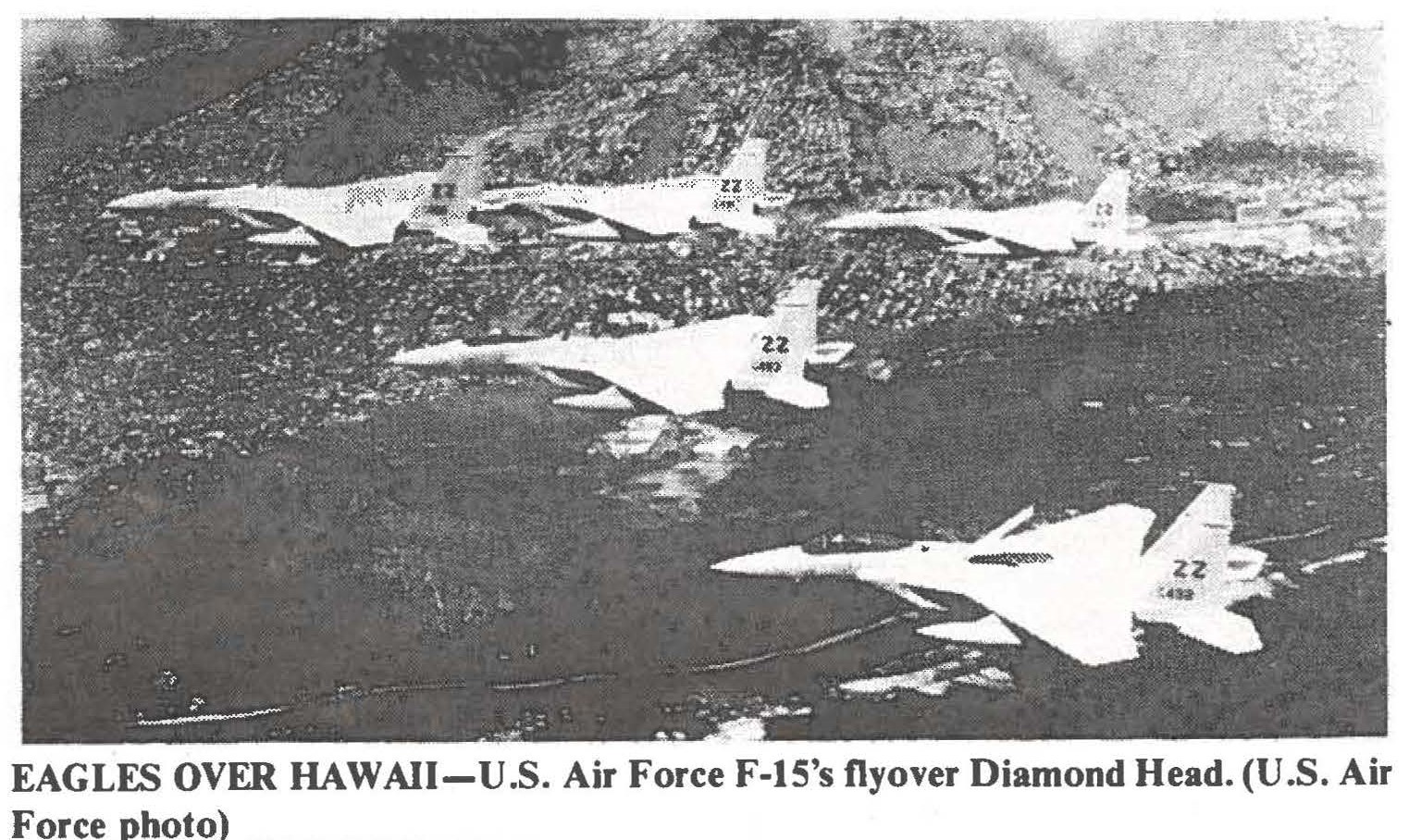
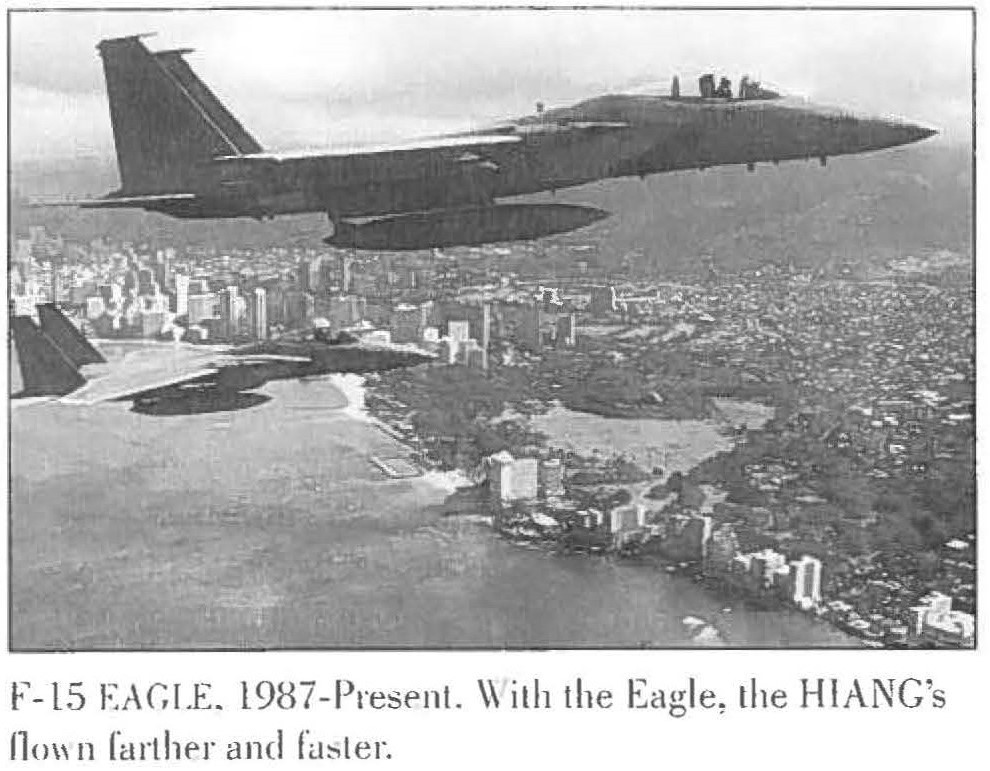
EAGLES OVER HAWAII-U.S. Air Force F-15’s flyover Diamond Head. (U.S. Air Force photo)(Picture of the 1986 January – March Pūpūkahi)
F-15 Eagles Update
By Lt. Col. Jerald K. Aoki and Capt. Wayne P. Wakeman, HANG
The 154th Composite Group’s (154th COMPG) F-15 conversion committee is on schedule with their plan for coordinating and managing the upcoming changeover. Members of the committee chaired by Capt. Jerald Aoki and assisted by Capt. Wayne Wakeman, include personnel from operations, maintenance, support area Headquarters, Hawaii Air National Guard.
A Site Survey Team, made up of experts who have handled F-15 conversions for the active Air Force and two other Air Guard units, completed their study in December 1985. Interim measures that would allow a timely conversion, with as little change to the daily operation, were implemented. Portable facilities were built or acquired to support supply function and the engine machine shop and will eventually be replaced with permanent facilities.
Many experts from the many functional areas nation-wide made up the Site Activation Task Force (SATAF). They wrapped-up a week of conferences in April, which identified possible problems the 154th COMPG may face if other alternatives to these problems were not considered.
The SATAF team’s four-part visit identifies (ID’s) possible problems; follows-up and I D’s any new items; 1D’s training equipment, resolves any last minute problems and finalizes any schedules; and, if needed, a fourth visit to clean-up any last minute items or problems.
Topics of the first SATAF were getting the actual aircraft tail numbers of the F-15’s coming from Tyndall Air Force Base (AFB), Florida, and the supply ordering process.
Scheduling is proceeding for home and away schooling (as long as eight months), construction in the maintenance shops, and preparations to receive equipment and supplies.
Two F-15’s will arrive in March and April of 1987. There will be “hands on” maintenance trainers, with a Field Training Team joining them shortly to conduct retraining classes. In the months to follow, starting in July through the end of 1987, operational F15’s will be arriving. The aircrews will be attending F-15 pilot upgrade training beginning in March also, at either Tyndall AFB, Florida, or Luke AFB, Arizona.
After the majority of the pilots are fully qualified, an evaluation will be made to determine the combat capabilities.
The conversion will require additional effort from all functional areas. We can look forward to more academics, working in interim facilities, and using new equipment.
Also arriving today are members of the Site Activation Task Force who will be working with our Composite Group staff to plan for our conversion requirements to the F-15 Eagle. You probably noted some trailers and a building along side of the Supply warehouse … we have already start ed our conversion thinking for FY87. The project manager for the Composite Group is Lt Colonel Aoki.
The 154th COMPG has fanned a conversion committee to plan, coordinate, and manage the forthcoming F-15 conversion. The committee is composed of the various function areas in the operations, maintenance and support areas as well as several members of the HQ HANG Staff. The conversion committee is chaired by Lt Col Jerald Aoki who is assisted by Capt. Wayne Wakeman.
During December 9-11, 1985 a site survey was conducted at the 154th COMPG facility to plan the F-15 conversion. The site survey determined what was necessary to support the conversion at HAFB. Several interim measures are proposed and accepted that will allow a timely conversion. Several portable facilities were built or acquired to support supply function and the engine shop. These are interim measures that will eventually be replaced with permanent facilities.
The first Site Activation Task Force (SATF) visit will be held between April 7-11, 1986. Many experts from the many functional areas nation wide who are responsible for F-15 conversions will be attending the meeting. All the issues that pertain to a successful aircraft conversion will be aired and solutions proposed and agreed upon. Your support in hosting these visitors will be greatly appreciated.
After the SATF 1, we can expect some of our people to be attending formal schools to become qualified in the various F-15 systems. Also, we can anticipate various construction projects to begin in the maintenance shops. Additionally, equipment and supplies will be arriving to support the conversion requirements.
Sometime in March 1987, two F-15’s will arrive. Both aircraft will be used for maintenance training. The Field Training Team will arrive shortly after the aircraft and they will be holding classes to retrain our maintenance people on the new systems.
At the same time many of our aircrews will be attending F-15 pilot upgrade training at either Tyndall AFB FL or Luke AFB AZ . Each pilot will return and start flying the eagles in a home station training program. After the majority of the pilots are fully qualified in the F-15, we can expect an evaluation to determine our combat capability.
The conversion will require additional effort from all functional areas. We can all look forward to more academics, working in interim facilities, and using new equipment.
With the official announcement in February that the HANG was to receive F-15’s, everyone in the 154COMG have been busy as bees. A Site Survey Team made up of experts who have handled F-15 conversions for the active Air Force and two other Air Guard units, completed their study with their recommendations on how the Composite Group should handle its conversion with a little change as possible continue without to such disruption. This was the first milestone for the HANG coward the conversion
During the weeks of April 7-11 another milestone was completed as the Site Activation Task Force (SATAF) wrapped up a week of conferences identifying possible problems that the Composite Group may face if other alternatives to these problems are not considered A SATAF team usually makes three to four visits to a converting unit.
The first visit identifies items that may be come problems as mentioned above while the second visit is for any following up that is needed from the first SATAF visit as well as to identify anymore new items that may have evolved from previous areas of concern
The third visit is to identify the training equipment that will be needed for the unit, to resolve any last minute problems and to finalize any schedules. Usually the fourth visit is not needed however it’s used “clean up” any last minute items or problems
Topics during first SATAF ranged anywhere from getting the actual aircraft tail numbers and where they’ll be coming from to the supply ordering process for F-15’s that we’ll be getting is coming all the way from Tyndall AFB, Florida. Our first maintenance “hands on” training F-15’s will be arriving in March and April of 1987, while our first operational F-15s will arrive sometime in July and every month after that until the end of the 1987 year when we ‘ll have our full compliment of Eagle jets. So the Eagles will be here before we know it’
As with any new equipment there is a need for training in that equipment. Schools have been identified and the process of acquiring school dates and money for this training were addressed during the SATAF meetings. Some school courses are as long as eight months and this definitely will cause some hardships. However everyone seems to be taking things in stride and with a positive attitude
Well the team has come and gone and the process continues to wait for no one. I would like to mention our Civil Engineering Squadron : You guys are the greatest and your pride speaks for itself Your efforts to support this conversion has not gone unnoticed. The Composite Group appreciates your efforts and especially to SMSt Rodney Correa who found a way to get the boys to come out during the week to erect those temporary buildings next to the supply building. I’d like to mention all your names but I can’t … you know who you are so thanks. I think I can speak not only for myself but for Col. John Lee and Lt. Col. Jerry Aoki, the Conversion Chairman, thank you, the support people that take our job to fly jets is a direct result of your dedication to the unit
Well time is marching on and some of you may have already noticed some temporary structures being built and the good .. ole .. sea containers around the area. These are positive signs that the conversion is going on as planned. These will obviously be temporary quarters for either personnel or equipment while new facilities are being built or present ones are being modified.
The F-4 simulator is no longer in existence. It was dismantled back in June and is somewhere being used as parts. What a way to go! Anyway, the simulator folks are not out of existence, in fact they are the trailblazers for the rest of us in the Composite Group. They have the distinct honor of being the first ones to be identified as “F-15 helpers.” They have already started their first of 2 phases of training. Three of the four full-timers started four months of electronic training here locally. September will begin their 2nd phase at Lowry AFB, Colorado, which has a completion around the end of December. Yes. that is a total of eight months of training that will qualify the as technicians in the Precision measuring Equipment Lab Type IV (DEML). I won’t explain what this entails now cause it would take too long! Maybe someday.
So what’s become of the “old” simulator space? Well, the folks from the printing “shack” finally have an area with room and space for their equipment and personnel. As you’ve probably guessed by now – thats what the simulator space is being used for.
Anyway, I hope to be briefing all at you during the August UTA CMT period. I’ll try to bring everyone up to date on what’s been going on and any other changes. Other than that the conversion is progressing smoothly with its minor problems but nothing we can’t handle. So until next month … check six!
In preparation for our conversion from F-4s to F-15s many of our key officers and NCOs have been visiting F-15 units to learn what the HANG can adapt rather than “re-inventing the wheel”. Our HANG representatives have learned a lot from the New Orleans and Georgia ANG units and from the USAF F-15 bases at Elemendorf, McChord, Tyndall and Luke AFBs. It is always invigorating to note how some of our personnel are “extra” perceptive of the subtle differences in how things are done … especially in the maintenance areas by other units, On October 5, we will again meet with Air Force, ANG and critical planning is expected. While we expect the F-15 Eagle in ’87, we must continue to maintain our high, standards in flying in the F-4 … the lessons learned is transferable to the F- 15.
Well the F-15 conversion is progressing as planned since the last briefing I gave at the GMT. There have been many of us taking TDY trips to other F-15 bases both active duty and Guard. Hopefully we are gathering valuable information and consolidating these ideas to become one of the best organized F-15 unit around. On the aircrew side of the picture, we’re all excited to start flight training but at the same time sad to see our WSOs leave the fold. Most will remain with us in other non-flying jobs like radar controllers, intelligence officers, maintenance officer, etc, and others will be transferring to mainland units to keep flying. It will be hard for those staying to see us flying while “pushing paper” or “flying a desk” as they say but as our squadron commander put it, “The WSOs have done such a good job in helping to build this unit into one of the best F-4 squadrons that they worked themselves out of a job! Without them we wouldn’t be getting the F-15.” My Aloha goes out to all of them and I’m sure the rest of the pilots will share the same.
Three weeks ago I visited the 43rd Tactical Fighter Squadron at Elmendorf AFB, Alaska. I got to fly the Eagle jet twice. After this momentous occasion I’ll agree that this airplane is a pilot’s dream. As for maintenance when you get to know the BITS (built in test system) it will be easy to identify the problem. As an example we were out on an air combat mission and we or I should say the aircraft developed an emergency. After we landed and taxied into the parking slot, the crewchief plugged into the aircraft and asked the pilot to watch for certain indications in the cockpit while he performed the BITS check. The questions and answers were completed between the two and the crew chief knew exactly what and where the problem was. Within the hour the problem was fixed and the bird turned for the next go. As far as scrambles were concerned … the crewchiefs responsibility was only to take down the ladder, arm the missiles and pull the chocks. The limiting factor for the scramble time was getting the INS (inertial navigational system) aligned.
Our next Site Activation Task Force (SATAF) Conference will be held just after the October drill during the week of Oct. 6-10. This should solve what ever problems we’ve had from the first meeting back in April and identify any new one since then. Anyway the F-15 is quite an airplane and should be here before we know it.
The Hawaii Air National Guard’s F-15 Eagle conversion is proceeding on schedule.
Many personnel are visiting other F-15 bases, both active duty and Guard, gathering valuable information and consolidating these ideas to become one of the best organized F-15 units.
Displaced personal like the weapons systems Officers (WSOs) are leaving for schools to train for new positions (maintenance, personnel, radar controllers, intelligence) or transferring to mainland units to keep flying. The officers may have had their wings clipped but the good job they have done has enabled HANG to upgrade to the F-15’s.
The F-15’s bring advance technology, including the Built in Test System (BITS). which enables the crewchief the easily identify a maintenance problem. The BITS is plugged into the aircraft and a system check is run. The pilot and crew chief confer on the data and the “problem” is fixed.
The conversion has affected the number of warm bodies around to accomplish the day to day mission, but those left behind picked up the slack to continue operations “as usual”.
The Hawaii Air National Guard marked its 40th Anniversary on September 10, 1986 and announced its conversion to the F-15 Eagle in February 1987. The conversion represented a quantum leap forward in the air defense of Hawaii.
The conversion from the F-4C Phantom to the F-15 Eagle aircraft was the centerpiece of a momentous year for the 154th Composite Group. In February 1987, the first four pilots entered upgrade training at Tyndall Air Force Base (AFB), Florida, and on March 11, 1987, the first two of 26 F-15 Eagles arrived at the 154th Composite Group, Hickam AFB. By the end of May 1987, training missions were being flown in the F-15 by pilots of the Hawaii Air National Guard’s 199th Tactical Fighter Squadron.
It is a New Year and we expect more exciting challenges for 87 such as the f-15 on our ramp in March. We have started our conversion as visibly seen with added warehouse material in our areas, people going to schools, and numerous planning meetings to anticipate this major event. Our first four aircrews will go to Tyndall, Florida for an 11 week conversion training beginning in February. Maintenance has already started their enormous conversion training here at home and on the mainland.
Well its been a few months since anything new was worthwhile to report so I thought I’d fill you folks in.
As you can see around the compound, the weapons bay area in Building 3416 has been reduced in size and somewhat enclosed to house the F-15 avionics equipment and the Precision Measuring Equipment Lab (PMEL) until their own building is built which is scheduled for construction sometime around December of 1989. If. some of you wander around our life support shop, you’ll notice some new walls up and some old ones removed. They’re getting ready to receive the F-15 Cockpit Egress Trainer. This trainer is a mock up of the F-15 cockpit. The pilots are required every six months to complete an emergency ground egress from the cockpit, fully strapped in, within a minimum amount of time. I can’t tell you how much time is allowed yet, but if its anything like our F-4 trainer, you got seven seconds to get completely out. Our unofficial record for the F-4 is around 2.97 seconds. Most of you will notice that our radar dock (next to the Ops building) is also being modified. This will be used for classrooms where some of you will be attending the F-15 transition. Well enough of the construction stuff … ! can hear the CE guys burning my ears for saying that!
Some of you might know that our F-15s are now coming from a combat ready unit out of Holloman AFB, N.M. instead of training birds. The other good thing is that these birds are all of the 1977 vintage. We were originally identified to receive aircraft from Tyndall AFB, FL. built in the 1974 and 1975 time period. Our first two aircraft will now be arriving on the 10th of March with some festivities planned for that “first” eagle jet. So unless you come down for the arrival ceremonies, April drill will be your first look. For you unit supervisors, I’ll bet you won’t get any work out of your people until you let them loose to see our “new toy”. It’s going to be exciting believe me!
Col Kunichika, Lt Col Hong, Maj Pawling and yours truly will be leaving here on the 21 of February to begin our flying training in the Eagle … you talk about being excited!!! We won’t be back until sometime around the 18th of May and when we do get back we’ll be the first Eagle drivers of the unit. Sounds conceited doesn’t it? Well it was meant that way. Anyway this will be it for F-15 update reporting unless they ask someone else to fill in while I’m “tripping the light fantastic” in the wild blue yonder over the skies of Florida. Until then check six!
11 MAR 1987 The first two F-15A Eagles arrived at Hickam Air Force Base. The F-15s are the first of 26 “birds” the 154th Composite Group, received to replace the F-4C Phantom.
Learn more
The Eagle has landed
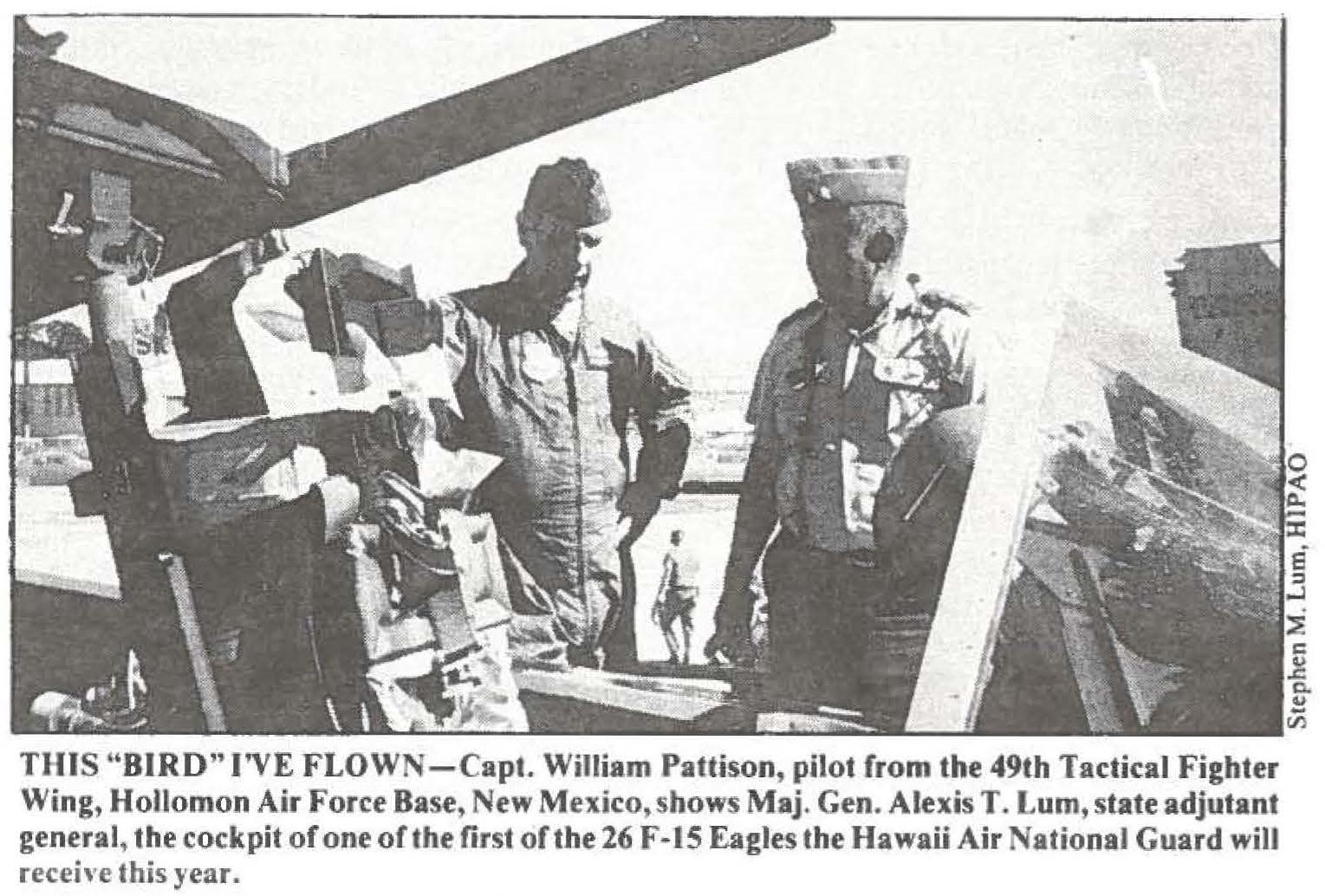
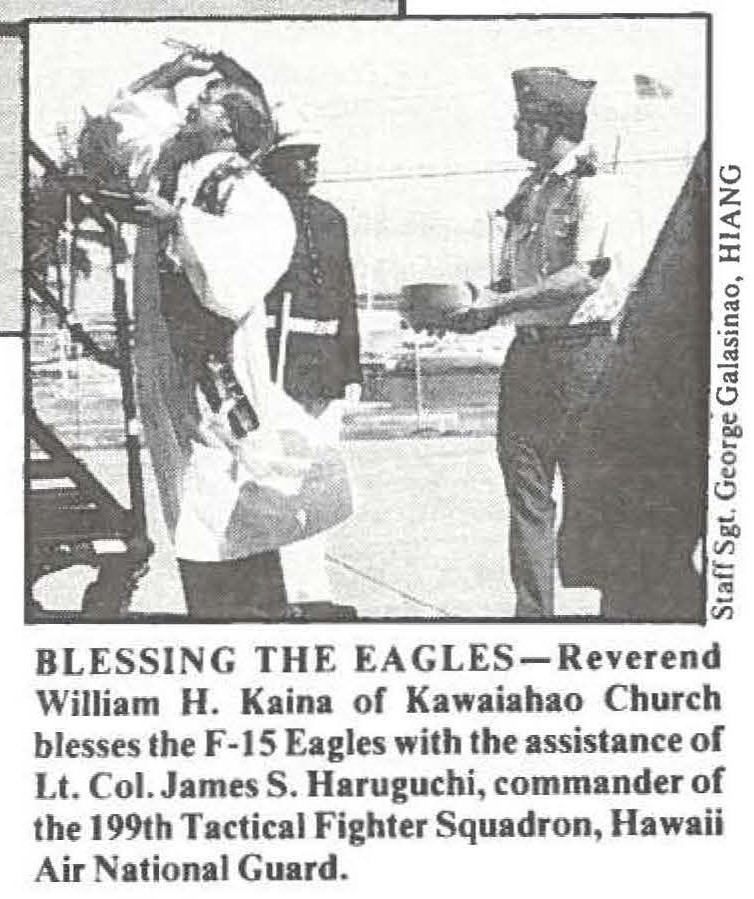
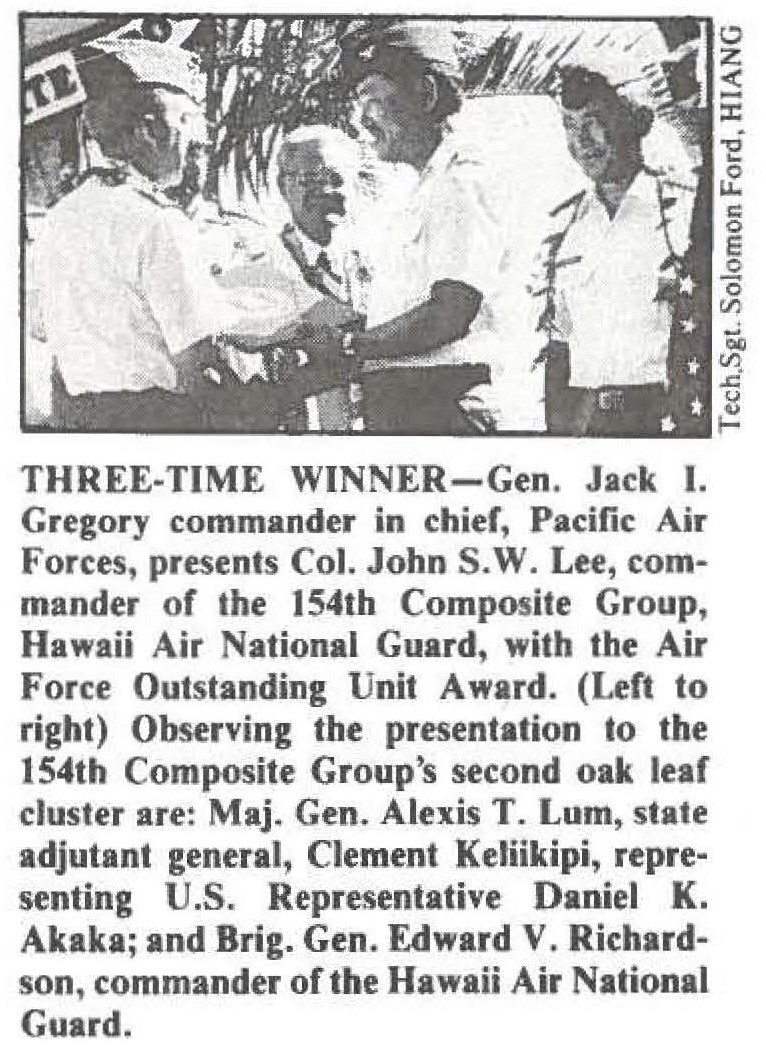
THIS “BIRD” I’VE FLOW -Capt. William Pattison, pilot from the 49th Tactical Fighter Wing, Hollomon Air Force Base, New Mexico, shows Maj. Gen. Alexis T. Lum, state adjutant general, the cockpit of one of the first of the 26 F-15 Eagles the Hawaii Air National Guard will receive this year.BLESSING THE EAGLES-Reverend William H. Kaina of Kawaiahao Church blesses the F-15 Eagles with the assistance of Lt. Col. James S. Haruguchi, commander of the 199th Tactical Fighter Squadron, Hawaii Air National Guard. THREE-TIME WINNER-Gen. Jack I. Gregory commander in chief, Pacific Air Forces, presents Col. John S.W. Lee, commander of the 154th Composite Group, Hawaii Air National Guard, with the Air Force Outstanding Unit Award. (Left to right) Observing the presentation to the 154th Composite Group’s second oak leaf cluster are: Maj. Gen. Alexis T. Lum, state adjutant general, Clement Keliikipi, representing U.S. Representative Daniel K. Akaka; and Brig. Gen. Edward V. Richardson, commander of the Hawaii Air National Guard.(Pictures from the 1987 January – March Pūpūkahi)
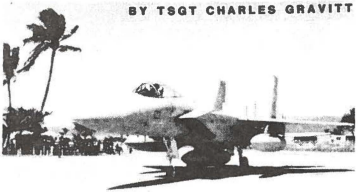
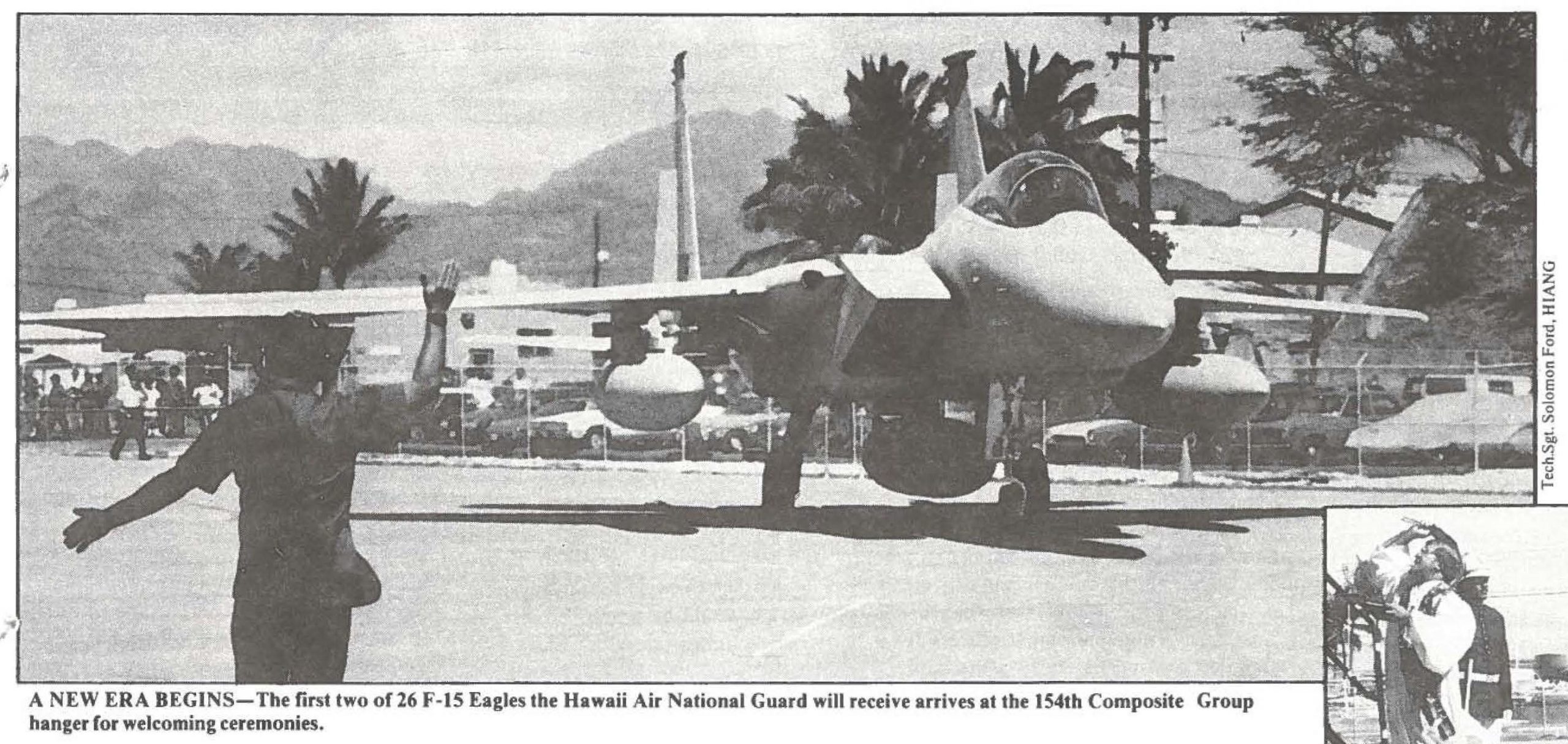
The Hawaii Air National Guard celebrated a major milestone in its forty-year history as the first two F-15A Eagles arrived on March 11, 1987, at Hickam Air Force Base.
The newer, more superior F-15s are the first of 26 “birds” the 154th Composite Group, Hawaii Air National Guard, will receive this year to replace the F-4C Phantom and represent the fifth jet fighter aircraft conversion.
The Eagles, piloted by Lt. Col. Robert Summers and Capt. William Pattison of the 49th Tactical Fighter Wing, Holloman Air Force Base (AFB), New Mexico were greeted by Hawaii Air Guard’s Brig. Gen. Edward V. Richardson, commander of the Hawaii Air National Guard; Col. John S.W. Lee, commander of the 154th Composite Group and Lt. Col. James S. Haruguchi, commander of the 199th Tactical Fighter Squadron.
The welcoming ceremonies included an exchange of praises and thanks by the speakers: Gen. Jack I. Gregory, commander in chief, Pacific Air Forces (PACAF); Maj. Gen. Alexis T. Lum, state adjutant general; Brig. Gen. Edward Richardson and Irving L. Burrows, Jr., executive vice president of program management, McDonnell Douglas Corp.
Gen. Jack Gregory spoke of continuing the cooperative efforts between the active air force and the guard and also presented the 154th Composite Group, represented by Col. John Lee, with the Air Force Outstanding Unit Award. The unit was recognized for the third time in eight years and received a second oak leaf cluster for achievements in teamwork, dedication, and professionalism.
Maj. Gen. Alexis Lum said, “The air defense mission and the arrival of the F-15s clearly exemplify the cooperation and working relationships between the U.S. Pacific Command, the Pacific Air Forces, the National Guard Bureau, our congressional delegation, and our State government. This cooperative effort and teamwork has resulted in Hawaii now having one of the world’s best fighter aircraft.”
Brig. Gen. Richardson spoke of the dream of getting the best superiority aircraft in the Air Force’s inventory for the Hawaii Air Guard and thanked the men of vision at PACAF who shared Hawaii Air National Guard’s dream.
Mr. Irivng Burrows, a member of the team that built and tested the earlier F-15s, commented on the superiority and accomplishments of the aircraft and also presented Brig. Gen. Richardson and the Hawaii Air National Guard with a scale model of the F -15 Eagle.
The Eagles were draped with leis by members of the 154th Composite Group and then blessed by Kawaiahao Church’s Reverend William H. Kaina, with the assistance of Lt. Col.James Haruguchi.
Chaplain Robert H. Anders, Jr., 201st Combat Communications, Hawaii Air National Guard, gave the invocation and the ceremonial Royal Guard provided the color guard and escorts.
The Hawaii Army National Guard’s 111th Army Band played music for the pre-ceremonial and formal portions of the proceedings, while the Hawaii Air National Guard’s Na Mele ‘Koa provided music and Nani, O Wahine Koa provided dancing entertainment.
The Hawaii Air ational Guard has been in the conversion process for almost a year and personnel are actively involved in training on the new aircraft. Pilots and maintenance personnel started necessary training in July 1986 and will continue on scheduled training at Tyndall AFB, Florida; Luke AFB, Arizona and Lowery AFB, Colorado. Air Force teams will also perform temporary duty here at Hickam AFB to train many of the Hawaii Air National Guard personnel at home.
The F-15A Eagles represent a quantum leap foward for the Hawaii Air National Guard in providing for the air defense of the Hawaiian Islands and the people of Hawaii. The conversion, directed by the U.S. Air Force and the National Guard Bureau in Washington, D.C., is clear evidence of the Hawaii Air National Guard’s proven performance, ability and importance in our nation’s defense structure.
It appears that those ‘Eagle’ bumper stickers are getting closer to becoming true. “The Eagle is Coming” will become passe on March 10, 1987 when the first HANG F-15s arrive from Holloman AFB, New Mexico.
This special occasion will truly mark the beginning of a new era for the HANG. The pilots are all looking forward to the F-15’s outstanding maneuverability, power, and weapon systems. The maintenance folks are also looking forward to the ease of repairing the aircraft via the “black box” system. With this in mind, it’s obvious that this special occasion deserves a special celebration.
Last month, several HANG members formed a committee to organize and plan such a celebration. A ceremony has been planned on that arrival day at 2 pm on the Diamond Head side of the hangar. The program should include a blessing of the aircraft and welcoming speeches by several dignitaries. Music will be provided by the Hawaii Army National Guard Band and the HANG OHANA.
If you listen carefully Tuesday afternoon, March 10, you’ll hear a familiar sound around the 154th Composite Group. The sound of success. The sound will be new, however, in that it will be the sound of our first F-15 Eagles humming down the ramp, the first two of 26 we will receive over the next year. It will be the sound of the 111th Army Guard Band striking up to salute our new “birds”. And it will be the sound of celebration.
The Group will be honored with many distinguished visitors when the ceremony begins at 2:00 p.m. The guest list includes the Honorable John Waihee, Governor of the State of Hawaii and our Commander-in-Chief. CINCPACAF, Gen. Jack I. Gregory will also be on hand as will the commanders of the 5th, 7th and 13th Air Forces. Congresswoman Patricia Saiki will be here. And you will hear the sound of congratulations.
The Royal Guard will sound the cadence. And glasses will clink in the sounding of toasts to the future. It will be the sound of hopes realized and dreams come true. And it will be the sound of things to come.
ON THE WINGS Of EAGLESON THE WINGS Of EAGLESON THE WINGS Of EAGLES(Pictures from the 1987 April Kūkāʻilimoku)
Like rolling thunder, two aircraft taxied down the ramp. The crowd watched in awe as the deafening roar of the twin PrattWhitney engines drew nearer. First one, then the second aircraft rolled in making sharp one quarter turns to face the audience. Side by side they sat, filling the air with throbbing power that will carry the HANG into the future. Every eye was focused on the sleek design and the unquestionable presence of the “birds”. The Eagle had landed. The HANG’s new F-15s had arrived.
It was 2:40 p.m., Mar. 11, 1987, a date that will be indelibly etched in the HANG’s history books. Spectators had. just a few minutes before, caught a brief glimpse of the F-lSs as they came in to land. The 111th Army Guard Band provided the triumphant beat of “National Emblem”. The large crowd mixed many distinguished guests, HANG retirees and current HANG members.
On the stage, those VIPs who would be participating in the reception ceremony also were visibly impressed by the aircraft’s arrival. They included Gen. Jack Gregory, Commander in Chief, Pacific Air Forces; Maj. Gen. Alexis T. Lum, State Adjutant General; Brig. Gen. Edward V. Richardson, Commander, HANG; Brig. Gen. Wayne Adams, Air National Guard Advisor to CINCPACAF; Brig. Gen. Kenji Sumida, Chief of Staff, HANG; Mr. Irving Burrows, Executive Vice President, McDonnell-Douglas Air craft Corporation; Col. John S. W. Lee, Commander, 154th Composite Group; Col. Robert Bartlett, Commander, 326th Air Division; Mr. David Peters, representing U.S. Senator Daniel Inouye; Mr. Clement Keliikipi, representing U.S. Representative Daniel Akaka; Lt. Col. James Haruguchi, Commander, 199th Tactical Fighter Squadron; and the Reverend William Kaina of Kawaihao Church.
The hangar had been skillfully decorated with flowers, trees and plants. And the stage was also beautifully decked out in red, white, and blue with the colorful emblems of the 154th Composite Group and the HANG’s Hookanaka. Flaming torch ginger flanked the stairway leading up to the stage.
As the aircraft shut down, General Richardson, Colonel Lee and Colonel Haruguchi walked out to greet the arriving pilots – Lt. Col. Robert Sommers and Capt. William Pattison. The pilots were escorted to their seats.
The Royal Guard looked sharp as they posted the colors and the National Anthem was played.
General Gregory, who had taken time out from his PACAF Commanders Conference to attend the reception, spoke of the importance of the HANG’s acquisition of the F-15. He emphasized not only the importance of the conversion to the HANG, but to PACAF and the United States Air Force as well.
General Lum, who was also appearing on behalf of Governor John Waihee, talked of the significance of the F-15 to the Hawaii National Guard as a whole and to the people of Hawaii.
General Richardson spoke of the HANG’s expanding role and the dream that began four years ago to obtain the F-15. He praised the men of PACAF who had the vision and shared that dream. Under their able guidance and leadership, he said, a team was formed of PACAF, 326th Air Division and HANG members to pursue that goal. General Richardson praised Major General Tom Mcinerney, Generals Haeffner, Hosmer, and Carnes, General Bazley and his staff and Hawaii’s congressional delegation for their support. And he paused to pay special recognition to General Jerome F. O’Malley, who was killed in a plane crash in April 1985, for his dedicated support. General Richardson said the F-15 brings with it a new challenge that the HANG gladly accepts. He said the HANG also faces a lot of hard work ahead but he expressed confidence that the HANG would soon become the best F-15 unit, not only in PACAF, but in the U.S. Air Force.
Mr. Irving Burrows reminisced about his involvement in the early days of the design of the F-15. He then presented General Richardson and the HANG a large model of the F-15 that will be on permanent display at the 154th Composite Group.
General Richardson thanked Mr. Burrows and then called on General Gregory to present the Air Force Outstanding Unit Award to Colonel Lee. It was the third AFOUA for the 154th Composite Group’s sustained professionalism and performance.
The aircraft were draped with giant maile leis, after which each aircraft was blessed by Reverend Kaina.
The Royal Guard retired the colors and the formal ceremony ended followed by an afternoon of terrific pupus and entertainment by Na Mele Koa and Na Nani O’ Wahine Koa.
Memories of that day will no doubt echo through the minds of those who were there, as the HANG marches on, carried now aloft on the wings of eagles.
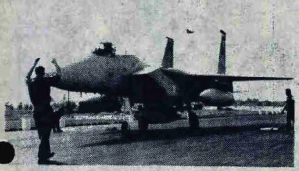
A NEW ERA BEGINS-The first two of 26 F-15 Eagles the Hawaii Air National Guard will receive arrives at the 154th Composite Group hanger for welcoming ceremonies. (Picture from the 1987 January – March Pūpūkahi)
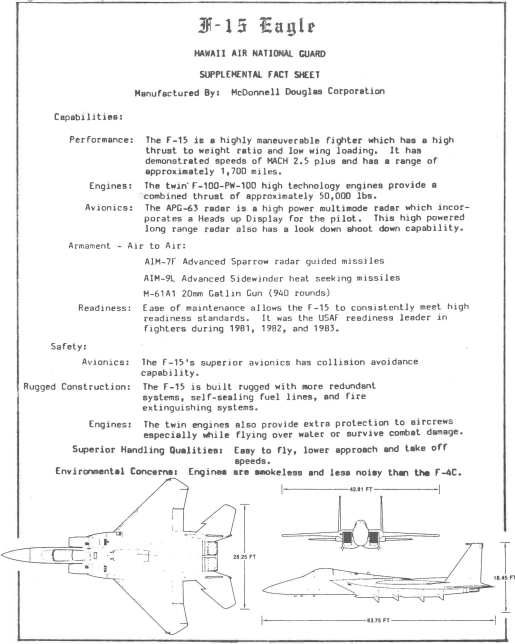
F-15 Eagle HAWAII AIR NATIONAL GUARD SUPPLEMENTAL FACT SHEET(Picture from the 1987 March Kūkāʻilimoku)
F-15 EAGLE UPDATE
By LtCol Jerald Aok
The 154th Composite Group (COMPG) F-15 Eagle conversion is proceeding well. To date the unit has received four F-15 aircraft. These aircraft were dedicated to maintenance training. From July to November 1987, we will be getting four aircraft per month. The last two Eagles will be transferred in December making it a total of 26 aircraft on the ramp.
The maintenance Field Training Team under the (FIT), provided by Air Training Command has been busy at work conducting classes here at the 154th COMPG. In spite of the problems we encountered in the sourcing of our aircraft, the training has gone well. The maintenance training activity will continue to October 1987.
The pilot training has progressed on schedule to date. We currently have nine pilots at Luke AFB, Arizona and six pilots at Tyndall AFB, Florida for upgrade training. All of our pilots will complete upgrade training by March 1988.
The any minor construction projects that supported the workarounds to allow a timely conversion have gone according to schedule. The only incomplete minor construction project is the sound proofing of the 199 TFS facility. This project will be finished in August 1987.
There are three current Military Construction Projects that are being worked on simultaneously. These projects are the Operational Flight Simulator Facility.
Overall, the F-15 Eagle Conversion is on schedule. We anticipate some problems in obtaining some critical support equipment and spares which may make the conversion process difficult. However, the flexibility and professionalism of the HANG personnel will allow using workarounds to get the job done.
The Hawaii Air National Guard completed its conversion to the F-15 Eagle ahead of schedule and reassumed the full-time air defense alert mission for Hawaii.
Fiscal Year 1988 brought many milestones for the 154th Composite Group as the conversion to the F-15 Eagle was completed ahead of schedule on June 22, 1988. Sept. 1, 1987 marked the last scramble of the 154th Composite Group’s F-4C Phantoms, as the F-15 Eagles assumed the air defense mission for the State of Hawaii.
1983 began as a very ambitious year for this headquarters. Plans were developed by the HQ staff, 326 AD, PACAF and NGB to work towards obtaining the F-15 (Eagles) for the HANG. . . . General Richardson continued to bring HANG into the total force policy by expanding the participation of the active forces and NGB various HANG activities to include the HANG Commanders’ Conference. This eventually resulted in the early selection of HANG for conversion to the F-15 from the F-4C, which was supported by PACAF and NGB. . . . The announcement of the replacement of the F4C Phantom by the F-15A Eagle was also made in 1986 . . .
The “Eagles” would arrive in 1987 to replace our aging F4C “Phantoms”. The news caused a lot of happy faces, but also a lot of sad ones, especially for the WSOs. Moves will have to be made to other non-flying jobs since the F-15 is a single seat fighter. As we all look forward, the F-15s technology will not only increase our capability to fulfill our mission, but will also be a tremendous milestone in the annals of HANG history and a nice way to start our next 40 years!
ln 1983, plans were developed by the HQ staff, 326th AD, PACAF and NGB to work towards obtaining the F-15 (Eagles) fur the HANG and plans to upgrade the crowded facilities at Hickam for the two Groups (154th CG and 201st CCGp). . . This eventually resulted in the early selection of HANG for conversion to the F-15 from the F-4C, which was supported by PACAF and NGB . . .
Everyone prepared for the arrival of the F-15 EAGLE in 1978. The “Eagle” would replace our aging F-4C ‘”Phantoms”. The news caused a lot of happy faces. but also a lot of sad ones, especially for the WSOs, since the F15 is a single seat fighter.
Brig. Gen. Edward V. Richardson, Commander HIANG, spearhead the move to convert the HANG’s aging F-4 fleet to new F-15 Eagles. He selected Lt. Col. Jerald K. Aoki as the conversion officer to oversee the conversion from phantoms to the Eagles. The HANG received the first two F-15 Eagles in 1987 as they arrived from Holloman AFB, New Mexico. A sudden turn of events saw 24 additional jets authorized for the HIANG to come from Elemendorf AFB, Alaska rather than Holloman AFB as was Originally planned.
In keeping with the ‘”Total Force Concept”, the next aircraft conversion occurred in 1987 with the arrival of the F-15A “Eagle.” The “Eagle” is the World’s Premier Air Superiority Fighter. The 154th Composite Group sent a maintenance acceptance team to Holloman AFB, New Mexico to prepare aircraft for transfer from the Air Force. The first aircraft to he delivered to the HIANG ended in tragedy when it crashed immediately following its takeoff from Holloman AFB killing the active duty pilot who would have delivered the first “Eagle”‘ to the 154th ramp. This tragic event only strengthens our commitment to ensuring the Security of our state and nation in memory of our fallen airman. Two weeks later, two “Eagles”· did arrive at Hickam AFB beginning a new Era for the Hawaii Air National Guard and the 199th. But these two aircraft were returned to Holloman AFB after the Air Force decided to transfer F-15s from Elmendorf AFB Alaska to the HIANG. Our acceptance team packed their bags and flew to Alaska from Holloman AFB to begin the final transfer of 26 “Eagles” to the 154th Group. The 199th began to fly the F-15A operationally during July of 1987.