Do you need help in another language? We will get you a free interpreter. Call 808-369-3580 to tell us which language you speak.
您需要其它語言嗎?如有需要,請致電 (808-369-3478), 我們會提供免費翻譯服務
您需要其它语言吗?如有需要,请致电 (808-369-3478), 我们会提供免费翻译服务
En mi niit alilis lon pwal eu kapas? Sipwe angei emon chon chiaku ngonuk ese kamo. Kokori (808-369-3478) omw kopwe ureni kich meni kapas ka ani.
Makemake `oe i kokua i pili kekahi `olelo o na `aina `e? Makemake la maua i ki`i `oe mea unuhi manuahi. E kelepona (808-369-3478)`oe ia la kaua a e ha`ina `oe ia la maua mea `olelo o na `aina `e.
Masapulyo kadi ti tulong iti sabali a pagsasao? Ikkandakayo iti libre nga paraipatarus. Awaganyo ti
(808-369-3478) tapno ibagayo kadakami no ania ti pagsasao nga ar-aramatenyo.
다른언어로 도움이 필요하십니까? 저희가 무료로 통역을 제공합니다. (808-369-3478)로 전화해서 사용하는 언어를 알려주십시요
Kwoj aikuij ke jiban kin juon bar kajin? Kim naj lewaj juon am dri ukok eo ejjelok wonen. Kirtok
(808-369-3478) im kwalok non kim kajin ta eo kwo melele im kenono kake.
E te mana'o mia se fesosoani i se isi gagana? Matou te fesosoani e ave atu fua se faaliliu upu mo oe. Vili mai i le numera lea (808-369-3478) pea e mana'o mia se fesosoani mo se faaliliu upu.
¿Necesita ayuda en otro idioma? Nosotros le ayudaremos a conseguir un intérprete gratuito. Llame al (808-369-3478) y diganos que idioma habla.
Kailangan ba ninyo ng tulong sa ibang lengguwahe? Ikukuha namin kayo ng libreng tagasalin. Tumawag sa (808-369-3478) para sabihin kung anong lengguwahe ang nais ninyong gamitin.
‘Okú ke fie maʻu tokoni ʻi ha lea fakafonua ʻe taha? Temau kumi haʻo taha fakatonulea taʻetotongi. Telefoni ki he (808-369-3478) ke fakahā mai ʻa e lea fakafonua ʻokú ke lea aí.
Bạn có cần giúp đỡ bằng ngôn ngữ khác không ? Chúng tôi se yêu cầu một người thông dịch viên miễn phí cho bạn. Gọi (808-369-3478)nói cho chúng tôi biết bạn dùng ngôn ngữ nào
Gakinahanglan ka ba ug tabang sa imong pinulongan? Amo kang mahatagan ug libre nga maghuhubad. Tawag sa (808-369-3478) aron magpahibalo kung unsa ang imong sinulti-han.
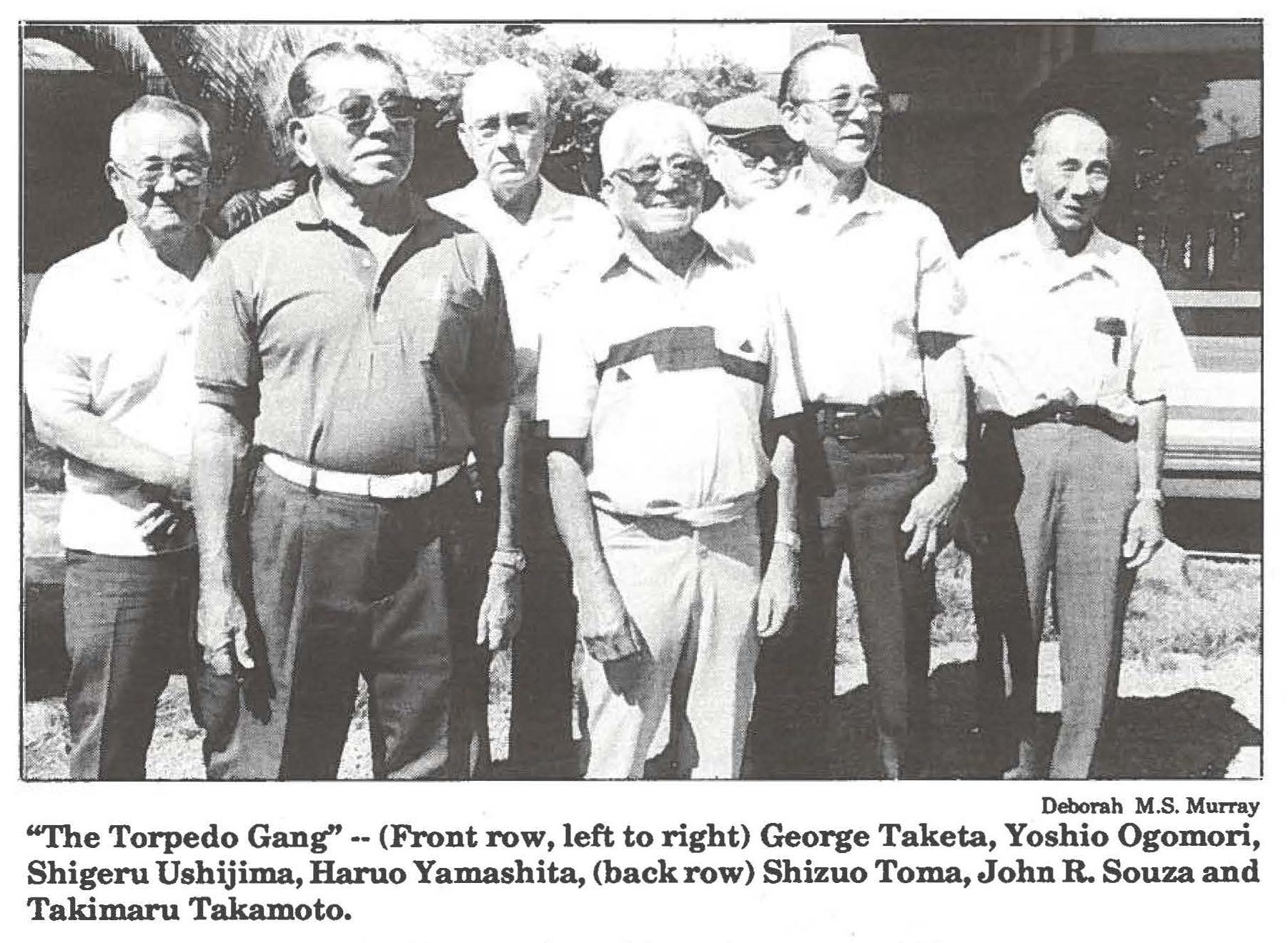
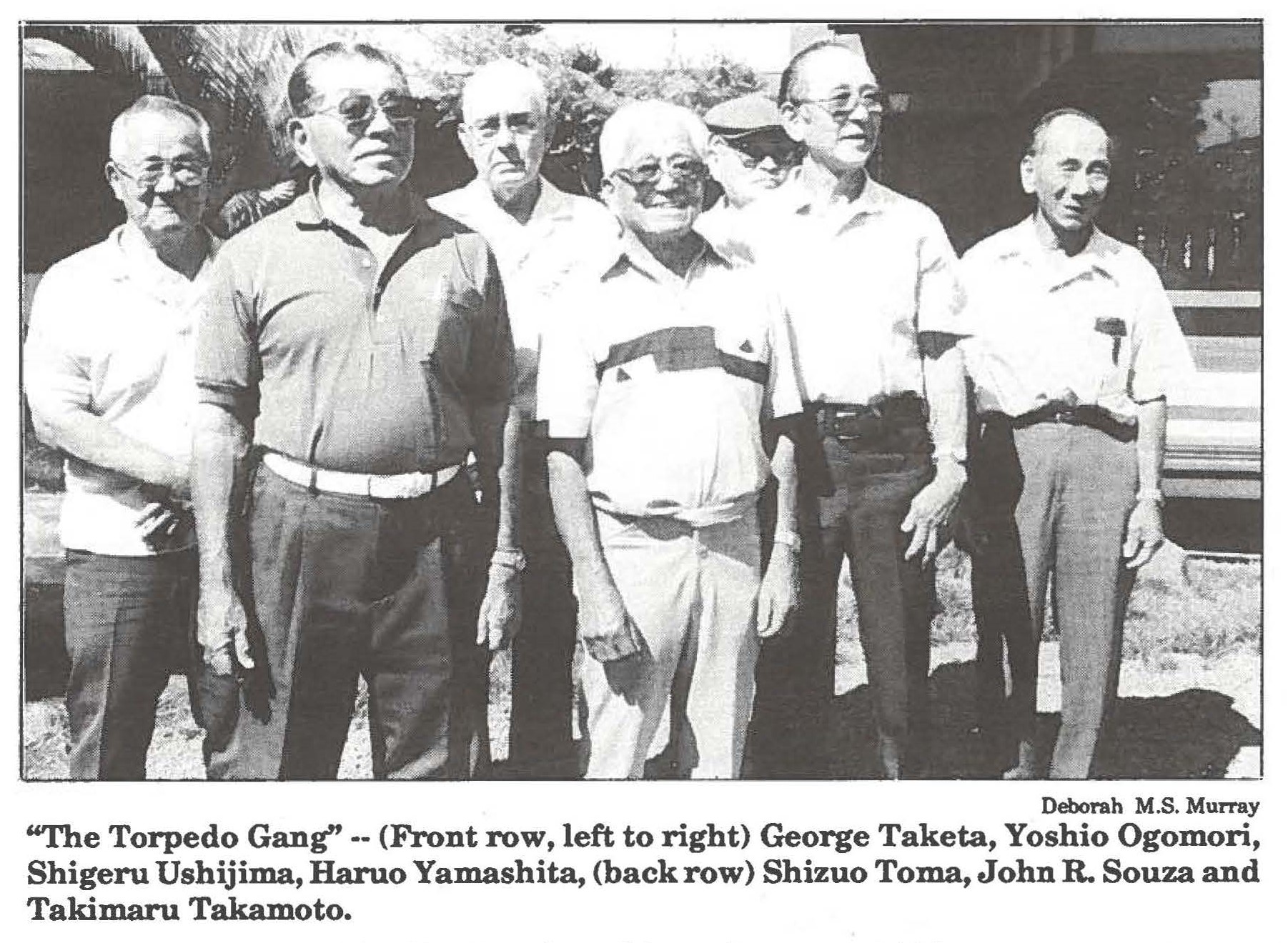
“The Torpedo Gang” — (Front row, left to right) George Taketa, Yoshio Ogomori, Shigeru Ushijima, Haruo Yamashita, (back row) Shizuo Toma, John R. Souza and Takimaru Takamoto.Guard vets remember lost shipmates page 6(Pictures from the 1995 January – February Pūpūkahi)
As a young soldier fresh out of basic training, George Taketa of Hilo, wasn’t afraid of playing against the odds in a dice game Unfortunately, the events that took place the morning of Jan. 28 1942, were even more than he gambled on.
That day, Taketa, with a pocketful of earnings and the intention of treating his fellow soldiers to breakfast in Hilo, found himself floating in the Alenuihaha Channel in the middle of an oil slick. The ship that he was travelling on, the U.S. Army transport General Royal T. Frank, had been torpedoed by a Japanese submarine.
Before the torpedo cut his trip and his friend’s lives short, the newly-recruited Army soldiers were anticipating a rendezvous with Hilo’s 299th Infantry. They had boarded the Frank in Honolulu enroute to Molokai, Maui and the final stop, Hilo.
No matter how you look at the incident, luck was clearly on Taketa’s side. He survived the attack along with eight of his army buddies. Seventeen other soldiers, however, weren’t so lucky. These 17 island-born men, federalized Army National Guard soldiers, died when the ship was attacked shortly after dawn.
Taketa and six other survivors, Yoshio Ogomori, John R Souza, Takimaru Takamoto, Shizuo Toma, Shigeru Ushijima and Haruo Yarnashita, met at the K K Tei Restaurant in Hilo, Jan. 27, for the 53rd observance of the tragedy.
The other two survivors of the attack were Susuma Yoshioka and Tsutomu “Mac” Wakimoto. Wakimoto is deceased, and Yoshioka did not attend the reunion.
From the time the first soldier arrived, it was evident that a sort of camaraderie still existed among them. The “Torpedo Gang” was clearly back in action. This time their mission was not to play war games, but to pay tribute to their buddies who died, celebrate life and renew their friendship–a friendship that has lasted since they were assigned to basic training at Schofield Barracks in the early 40s, witnessed the tragic deaths of their peers, and served together in the 298th Infantry on Oahu.
Seconds before the torpedo blew up the Frank, Taketa remembers hearing someone say, “Wake up. I see some big fish corning.”
What someone thought was a bigfish was a torpedo. In his account of the story, Taketa says that three torpedoes were fired.
He was able to survive the attack by holding on to a U.S. Mail bag that he had been sleeping on. Taketa was grateful that the mail bag was buoyant. It kept him afloat until he was rescued by a Young Brothers tugboat. He unfortunately lost all of his gambling earnings while attempting to remain afloat.
Like all of the other soldiers who survived, Taketa was sleeping above deck. He said the survivors were rescued by a tug boat and taken to Maui, a trip that took approximately four hours.
“fm thankful that I’m still around,” said Souza, who was below shortly before the torpedo hit the Frank Souza said he slept all night above deck because he could not tolerate all the smoke and gambling below deck. Waking up shortly before 7 am., he went below deck to get his mess-kit in”anticipation of breakfast.
While he was there, he heard the sound of metal scraping the bottom of the ship he decided to return to the upper deck to see what was happening. Seconds later, the torpedo hit, and the impact threw him against a chain railing.
Souza is grateful that he had a life jacket on since he didn’t know how to swim. He jumped overboard kicking and struggling to get away from the sinking vessel. He was rescued last because he had drifted so far away from the other survivors. Souza says he still has a piece of the cork he cut from the life jacket.
All information about the incident was placed under strict censorship by the U.S. Army. Taketa and the others could not talk or even write to their families about it until after the war.
When Souza’s fiancee, Ruth Luiz, received a letter he had written shortly after the Frank’s sinking, key passages were marked out. Despite the blacked-out passages, Ruth said she was relieved to know that her boyfriend was alive.
Three years later, they were married on May 19th. They will be celebrating their 50th wedding anniversary this year.
Ushijima was at the ship’s stern when the explosion occurred. The impact knocked him on his back. After he realized the ship was sinking, he said, he jumped overboard and started swimming away from it.
“We just tried to save our selves,” he said, explaining the ship was sinking so fast he did not have time to think.
Ogomori shared similar sentiments. The veteran said that he went below deck to change his clothes because they were wet from sleeping above deck all night long Like Taketa, he believes that two torpedoes scraped the ship before the final one exploded, breaking it in two. Like the other survivors, Ogomori jumped overboard, swimming away from the boom to prevent getting tangled up in the wires and cables above the ship.
The survivors were taken to Hana, Maui, where they changed out of their oil and water saturated clothing and spent a few days with Maui’s 299th lnfantry. The group was later transferred to the 298th lnfantry in Kaneohe.
When the 200-foot transport went down, it was part of a convoy that included a four-stack destroyer and the Kalae, a small freighter loaded with heavy equipment. The Kalae was reportedly towing a barge.
The attack occurred at about 7 a.m., when the convoy was in the Alenuihaha Channel about 18 miles northeast of Kauhola Point, where the lighthouse is located in north Kohala.
Historic accounts of the sinking reveal that, “The ship did not seem to blow up or sink, she just disintegrated and disappeared in 30 to 40 seconds.”
After the tragedy, the nine survivors served with the 298th Infantry on Oahu where they worked in the motor pool. All but Souza were transferred to the 100th Battalion, 442nd lnfantry, where they became part of one of the most decorated units during World War ll. Even then, Taketa never lost his zeal or spirit for gambling, or looking out for his friends. He explained that when they served with the 442nd he always traded the red cards for blue cards so the “torpedo gang” would never had to sleep below deck. In those days, Taketa explained, soldiers who were issued red cards were required to sleep below deck and those issued the blue cards could sleep above deck.
Souza was transferred to the 298th Infantry Division, Company E, where he served out his enlistment.
This story was written by Deborah M.S. Murray as part of the Hawaii National Guard’s tribute to veterans who served during World War II.
In Memory
The victims of the U.S. Army transport General Royal T. Frank, January 28, 1942, tragedy were:
Royal T. Frank — The Hawaiʻi Army National Guard’s forgotten tragedy of World War II
By Rachel Blaire
State of Hawai‘i Department of Defense Public Affairs
“The Torpedo Gang” — (Front row, left to right) George Taketa, Yoshio Ogomori, Shigeru Ushijima, Haruo Yamashita, (back row) Shizuo Toma, John R. Souza and Takimaru Takamoto. (Pūpūkahi, January – February 1995 photo)(Picture from the 2026 pūpūkahi Volume 56 No. )
The torpedoing and sinking of the U.S. Army transport Royal T. Frank on Jan. 28, 1942, is a little-known but deeply significant event in the history of the Hawaiʻi Army National Guard. The ship was carrying 26 newly trained soldiers — many of them Island-born members of the Hawaiʻi National Guard who had been federalized after Pearl Harbor — returning from basic training at Schofield Barracks to rejoin their home units, primarily the 299th Infantry Regiment on Hawaiʻi Island.
Sailing in convoy with a Navy destroyer and an ammunition vessel through the Alenuihāhā Channel (between Maui and Hawaiʻi), the 200-ton transport Royal T. Frank was struck by a Japanese submarine torpedo shortly after 7 a.m. The ship sank in less than a minute, killing all those below deck. Seventeen Hawaiʻi soldiers lost their lives, including 12 Nisei Guardsmen, making the incident one of the deadliest single losses for Hawaiʻi’s Army National Guard during World War II.
Nine Hawaiʻi Guardsmen survived, all of whom had been sleeping above deck. Thrown into the oil-covered sea, they clung to debris for hours before being rescued and taken ashore to Hana, Maui. There, residents and schoolchildren provided emergency aid and shelter, in a gymnasium until medical care arrived.
Under strict wartime censorship, the survivors were ordered not to speak of the sinking, and families of the fallen Guardsmen were not fully informed until after the war. This secrecy contributed to the tragedy being largely absent from official wartime narratives.
The nine survivors — later known as the “Torpedo Gang” — returned to duty with most eventually assigned to the 100th Infantry Battalion, formed largely from Hawaiʻi National Guard Nisei. Despite their earlier ordeal, they were not shielded from combat. Instead, they served with distinction in the European Theater, earning Combat Infantryman and Combat Medic Badges, Bronze Stars, Purple Hearts and other decorations. Their survival through two years of some of the war’s fiercest fighting stands as a remarkable chapter in history.
The shipwreck itself has never been found, but the legacy of the Royal T. Frank endures as a powerful reminder of the sacrifices made by Hawaiʻi Army National Guard soldiers — both at sea in defense of the islands and distant battlefields in Europe later on.
On Jan. 28, 2026, the Guardsmen who perished aboard the Royal T. Frank were memorialized at a ceremony at the Lt. Col. Henry S. Hara Armed Forces Reserve Center, Keaukaha Military Reservation in Hilo.
HING History: The sinking of the USAT Royal T. Frank
Lt Col. Kawika Hosea discuss a forgotten moment in World War II history, the sinking of the USAT Royal T. Frank and the survivors known as the “Torpedo Gang”.