Do you need help in another language? We will get you a free interpreter. Call 808-369-3580 to tell us which language you speak.
您需要其它語言嗎?如有需要,請致電 (808-369-3478), 我們會提供免費翻譯服務
您需要其它语言吗?如有需要,请致电 (808-369-3478), 我们会提供免费翻译服务
En mi niit alilis lon pwal eu kapas? Sipwe angei emon chon chiaku ngonuk ese kamo. Kokori (808-369-3478) omw kopwe ureni kich meni kapas ka ani.
Makemake `oe i kokua i pili kekahi `olelo o na `aina `e? Makemake la maua i ki`i `oe mea unuhi manuahi. E kelepona (808-369-3478)`oe ia la kaua a e ha`ina `oe ia la maua mea `olelo o na `aina `e.
Masapulyo kadi ti tulong iti sabali a pagsasao? Ikkandakayo iti libre nga paraipatarus. Awaganyo ti
(808-369-3478) tapno ibagayo kadakami no ania ti pagsasao nga ar-aramatenyo.
다른언어로 도움이 필요하십니까? 저희가 무료로 통역을 제공합니다. (808-369-3478)로 전화해서 사용하는 언어를 알려주십시요
Kwoj aikuij ke jiban kin juon bar kajin? Kim naj lewaj juon am dri ukok eo ejjelok wonen. Kirtok
(808-369-3478) im kwalok non kim kajin ta eo kwo melele im kenono kake.
E te mana'o mia se fesosoani i se isi gagana? Matou te fesosoani e ave atu fua se faaliliu upu mo oe. Vili mai i le numera lea (808-369-3478) pea e mana'o mia se fesosoani mo se faaliliu upu.
¿Necesita ayuda en otro idioma? Nosotros le ayudaremos a conseguir un intérprete gratuito. Llame al (808-369-3478) y diganos que idioma habla.
Kailangan ba ninyo ng tulong sa ibang lengguwahe? Ikukuha namin kayo ng libreng tagasalin. Tumawag sa (808-369-3478) para sabihin kung anong lengguwahe ang nais ninyong gamitin.
‘Okú ke fie maʻu tokoni ʻi ha lea fakafonua ʻe taha? Temau kumi haʻo taha fakatonulea taʻetotongi. Telefoni ki he (808-369-3478) ke fakahā mai ʻa e lea fakafonua ʻokú ke lea aí.
Bạn có cần giúp đỡ bằng ngôn ngữ khác không ? Chúng tôi se yêu cầu một người thông dịch viên miễn phí cho bạn. Gọi (808-369-3478)nói cho chúng tôi biết bạn dùng ngôn ngữ nào
Gakinahanglan ka ba ug tabang sa imong pinulongan? Amo kang mahatagan ug libre nga maghuhubad. Tawag sa (808-369-3478) aron magpahibalo kung unsa ang imong sinulti-han.
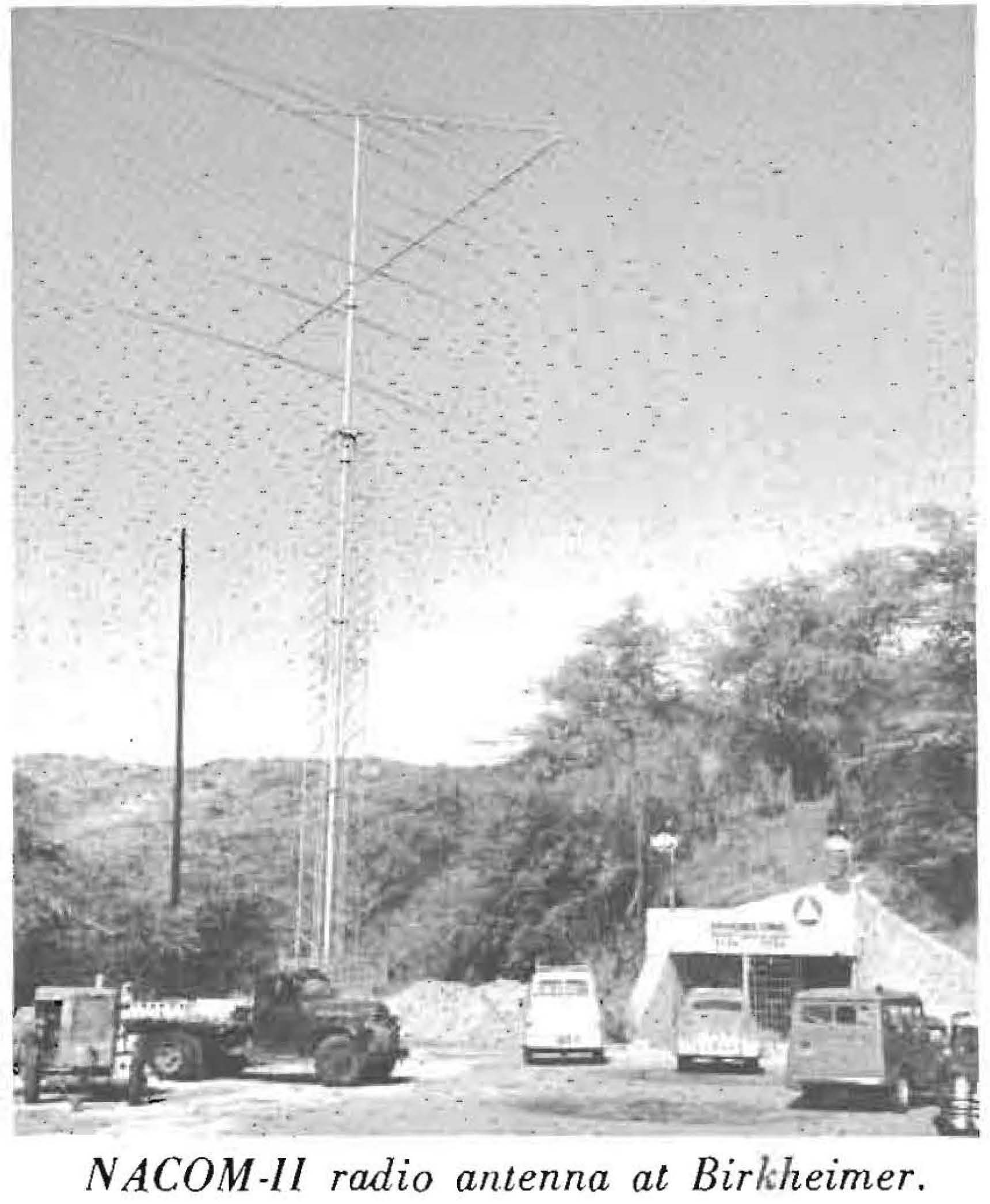
NACOM-ll radio antenna at Birkheimer. (Picture from the 1963 Annual Report)
Radio equipment for the National Communications System 2 (NACOM-Il) was received from the Federal government in the Spring of 1962 and space was allocated for the equipment in the radio room of the Emergency Operating Center.
Progress made in the area of communications and warning included the installation of a National Communications System Two (NACOM-II) station and improvements to the Civ-Alert System.
NACOM·II: A reliable direct radio circuit to Federal Civil Defense headquarters on the mainIand, NACOM·II will be used in the event of a national emergency to communicate with mainland headquarters by voice transmission, teletype or radio telegraph. The equipment, costing approximately $50,000, was paid for and installed by the Federal government. Its 116-foot-high antenna was erected near the entrance to the CD Emergency Operating Center in Diamond Head crater.
During the Cuban crisis the State CD Division stepped up its radio communications and maintained a daily five-hour NACOM-II watch. However, as normalcy returned, the twice-a-week test with the Regional OCD office was resumed.
The responsibility for NACOM-II maintenance, originally vested with the State CD, was assigned to the U.S. Department of Army toward the end of the fiscal year. . . .
Improvements and additions to the Civil Defense communications network included getting linked in the National Communications System One ( NACOM 1) chain, expanding the State CD mobile radio system, and assisting Kauai County in establishing its new FM radio system.
NACOM I: Since the NACOM I teletype equipment was installed in March, State Civil Defense has the means of instant communication 24-hours a day with the Regional headquarters of the Federal Office of Civil Defense.
The Hawaii terminal has two locations: (1) State CD Office and (2) CD Emergency Operating Center, Birkhimer Tunnel, Diamond Head Crater.
Civ-Alert – Emergency Broadcasting System – Emergency Alert System
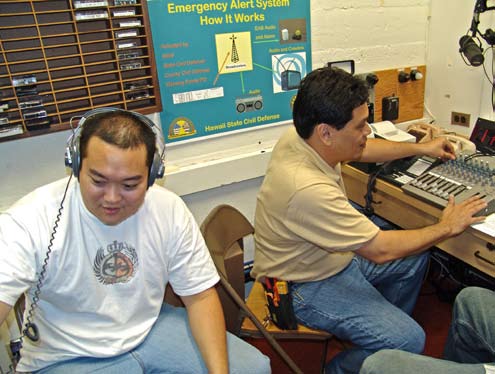
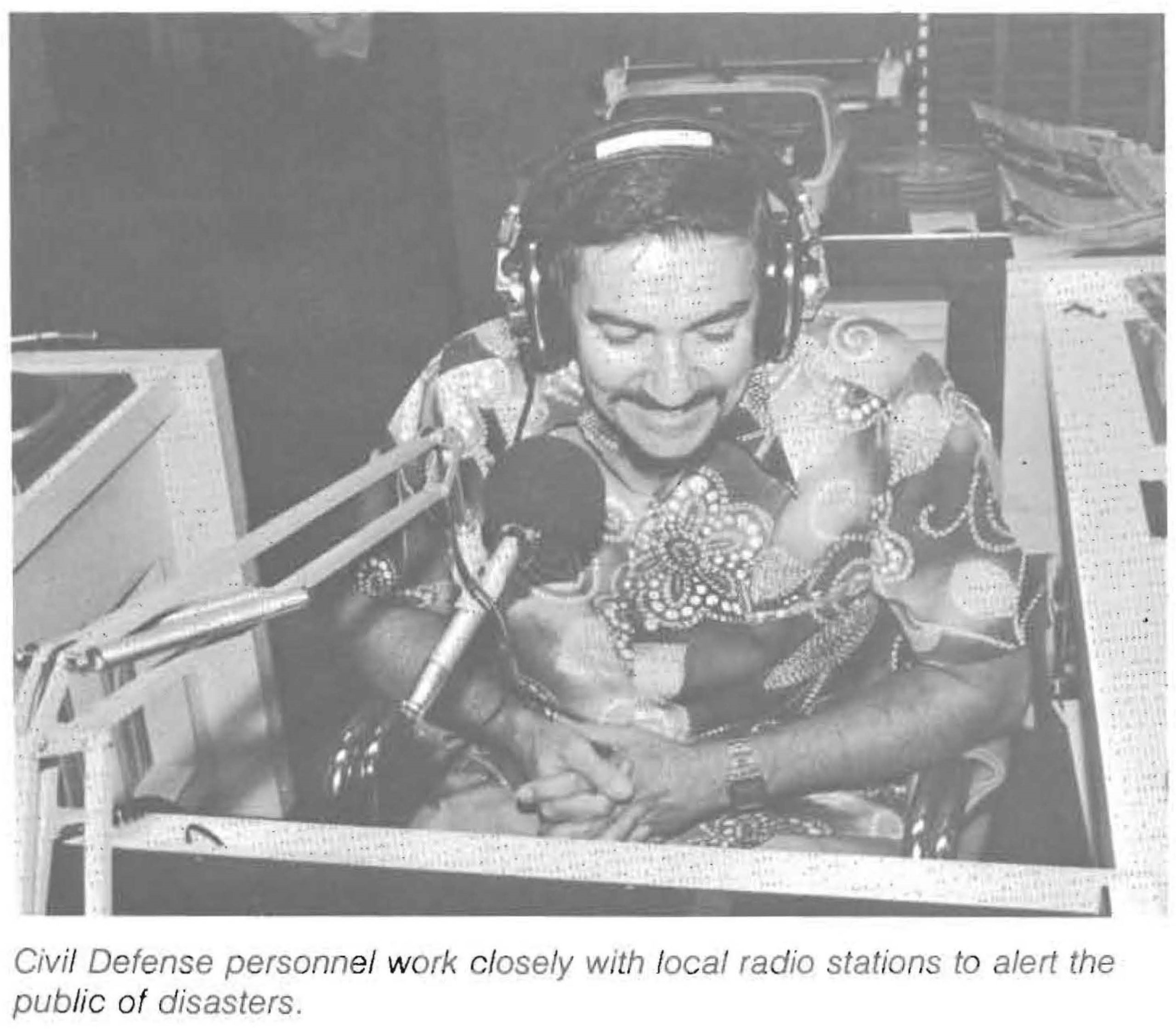
CAN YOU HEAR ME NOW? – SCD radio technicians, Mark Nonaka and Torrey Ho (above), monitor the Emergency Alert System broadcast from the radio booth at the Emergency Operating Center. Ray Lovell photo(Picture from the 2008 Annual Report)
Communications and Warnings System: The biggest headway in the area of communications and warnings system ever made in Hawaii since the establishments of Civil Defense here was the organization of Civ.Alert, a system in which disaster information can be broadcast simultaneously through the commercial radio stations of the State. The Civ-Alert broadcasting studio is located in Harlow Tunnel on the slope of Diamond Head, close to the State CD’s headquarters.
The Civ-Alert facilities represent a joint effort by the State and the radio-television industry working through the Hawaii Association of Radio and Television Broadcasters.
The operational procedure during natural disasters was revised, the principal change being that county CD agencies will be required to sound the warning signals at least once every 60 minutes during tidal wave warning periods, whereas previously the county agencies were required to sound the warning only at the beginning of the warning period although they were authorized to sound the sirens more frequently if they considered it necessary.
Both the establishment of the Civ-Alert system and the revision of the natural disasters standard operational procedure came about after the disastrous May 1960 tidal wave. . . .
Advancements were made in the area of communications and warning system. A study was initiated in late 1961 to improve (1) methods of receiving warning information at the primary warning point (the Honolulu Police Station), (2) the method of notifying key Civil Defense personnel and (3) the method of warning the public over Civ-Alert, R system in which disaster information can be broadcast simultaneously over all local commercial radio stations. The study was completed in February and upon approval by the Governor, work on the project was begun. The new additional system is scheduled to be operational by the end of 1962.
Also during the latter part of 1961 a new network was added to the warning system by having Civ-Alert broadcasts carried over the Music-Air Sound Systems. Thus employees and customers of business establishments served by Music-Air will hear the warning messages originating from the Civil Defense broadcasting studio. . .
Progress made in the area of communications and warning included the installation of a National Communications System Two (NACOM-II) station and improvements to the Civ-Alert System. . .
Civ·Alert: A Civ-Alert “break-in circuit” system was installed by which a dialing of a 10-digit number known only by a few CD officials, from any telephone will alert all Honolulu radio stations that there is a civil defense emergency. Civ-Alert broadcasts over all radio stations can then begin immediately from that telephone and continue until such time as a CD announcer can reach the Civ-Alert studio to take over the broadcasting. This system enables Civil Defense to alert the public by radio as soon as warning sirens are sounded.
Another item of progress was the installation of an emergency electric genera tor for the Civ-Alert studio, thus making power available at the studio in case of failure of the regular power source.
Emergency Broadcasting System: Federal funds have been allocated to initially establish radio stations KGU and KAIM as the Emergency Broadcasting System (EBS) stations in this State. The allocated funds will be used to provide fallout protection to the stations and provide them with emergency power and a two-way radio link with CD emergency ope rating center.
EBS has been devised by the Federal Government to provide a means of communicating with the general public in the event of a national emergency. Remote Recorder: Remote recording instruments for tide gauges in Honolulu and Nawiliwili, Kauai, harbors were installed by the Coast and Geodetic Survey. Previously only the tide gauge in Hilo was equipped with a remote recorder.
With instant readings of tidal disturbances in Hawaiian waters available, tsunami scientists here can evaluate situations and reach decisions sooner regarding a safe time to declare a termination to a tidal wave emergency.
Emergency Broadcasting System: Radio station KGU has been established as an Emergency Broadcasting System (EBS) station and work is nearing completion at KAIM, KUMU, and KOHO. Work at KHBC, KMVI and KTOH is scheduled for the 1965-1966 fiscal year.
Federal funds are used lo provide fallout protection to radio stations and provide them with emergency power and two-way radio communication with the CD Emergency Operation Center in the EBS program. This system was devised by the Federal Government lo provide a means of communicating with the public in the event of a national emergency.
Two more Hawaii radio stations, KLEI of Kailua, Oahu, and KUAI of Eleele, Kauai, were selected to become “hardened” Emergency Broadcast System stations for civil defense purposes. “Hardened” means the stations will have fallout protection for minimum operating personnel, emergency power generators and two-way radios. This brings the total number of “hardened” stations in the Islands to eight – two on Kauai, three on Oahu, one on Maui and two on the Big Island.
State Civil Defense maintains a vigorous program of preparing government agencies and the public to survive any natural or military disaster that may occur.
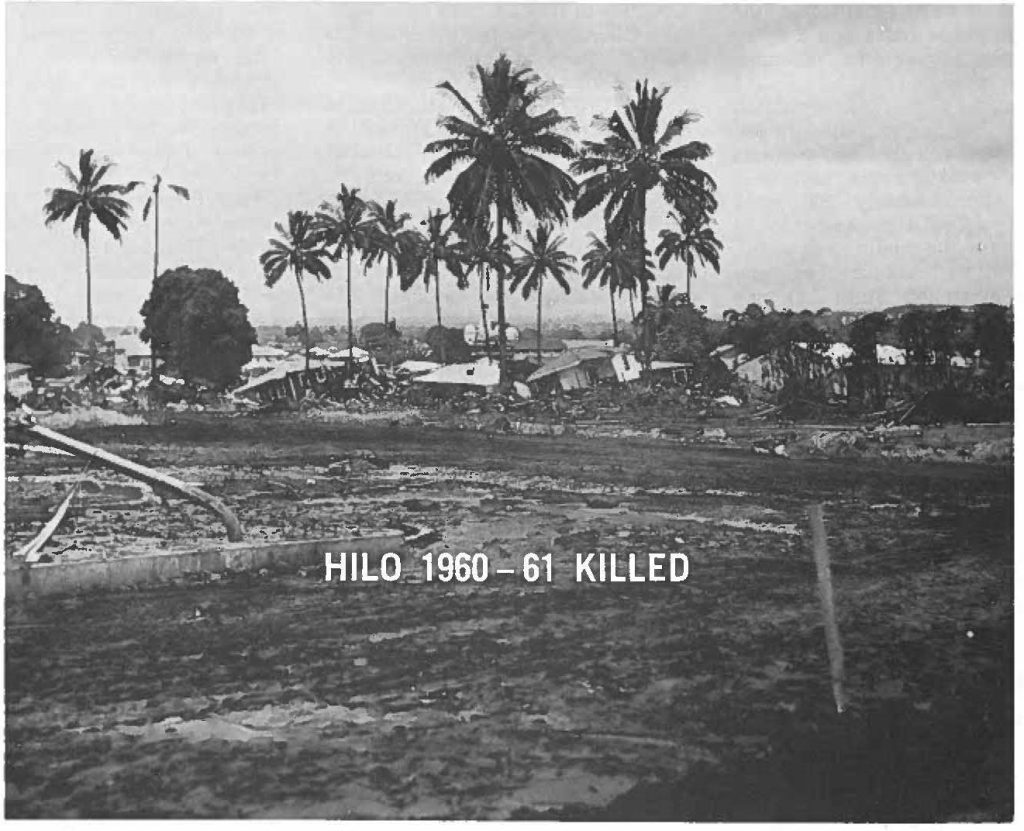
“As long-time residents know,” CD officials state, “Hawaii is subject to devastating tsunamis (tidal waves), such as the 1960 tsunami that killed 61 people in Hilo, Hawaii. Even worse was the 1946 tsunami that killed 159 people and injured 163 on all the major islands of the Hawaiian chain.”
Since these two catastrophes occurred, a Civil Defense organization has been built up which, with public cooperation, should minimize casualties and damage when the next severe tsunami strikes.
The Civ-Alert radio system, authorized by a special session of the State Legislature in 1960 after the Hilo tsunami, broadcasts simultaneously to all radio stations in the State and can now be used to warn people to clear coastal areas when a tsunami is coming.
Floods resulting from heavy rains are primarily a County Civil Defense responsibility (the four Counties in Hawaii each have their own CD Agency), but the State CD staff is ready to assist the County in handling the emergency.
The Civil Defense Division is part of the State Department of Defense, along with the National Guard. Maj. Gen. Benjamin J. Webster, who heads the National Guard, is also Director of Civil Defense.
One important aspect of floods that is handled by the State CD staff is the surveys to assess how much damage has been done. These are made for the Governor, who uses the survey in determining whether or not to provide financial assistance to the County for disaster recovery programs. And, the Governor may forward the facts of the survey to the President if the flood (or any other type of natural disaster, for that matter) is of sufficient magnitude to request that the area be declared a major disaster area.
Courses, conferences, meetings and talks are some of the means the State CD staff uses to prepare the public for emergencies. Natural and nuclear disaster preparedness are often covered in the same program.
State Civil Defense also has some 30 films that are loaned to public and private groups, and distributes numerous publications, both local and national, on Civil Defense subjects.
Tours of the Civil Defense facilities in Birkheimer and Harlow Tunnels are given on the average of twice a week, and often the groups in these tours come away with a new appreciation of emergency preparedness.
A continuing public information program is also maintained through news releases and contacts with the press, radio and television. Approximately 160 news releases on Civil Defense activities are issued to the media each year.
Training conferences and courses given by State CD, the University of Hawaii’s Civil Defense Extension Program and the Civil Defense Adult Education Program of the State Department of Education are another extremely effective means of educating the public for any crisis.
State Civil Defense also has a full-time radiological defense officer who maintains, with the Counties’ help 222 fixed fallout monitoring stations in the Islands. There are also vehicle monitoring stations.
This April, the Federal government and the State of Hawaii took steps to assist the Territory of Guam in setting up a network of fixed and mobile fallout monitoring stations.
The Federal Aviation Administration cooperated with State CD in this project by flying the radiological defense equipment to Guam in its planes.
Henceforth, State CD will also provide maintenance of the fallout monitoring equipment on Guam.
The State and Counties are continuing their efforts in the nationwide program to identify, license, mark and stock fallout shelters. This is an extremely important program, for the experts tell us that many people could survive the radioactive fallout of a nuclear explosion if they went to shelters in time.
One important event that took place recently – sponsored by the State CD and the University’s Civil Defense Extension Program – was a Civil Defense Management course in Turner Hall, Fort DeRussy.
The course was for Civil Defense Coordinators in State and County departments of goyernment, and covered preparedness for both natural and nuclear disasters.
During these CD conferences personnel can review past disasters and iron out the bumps.
It is the responsibility of new government personnel who have emergency Civil Defense duties to familiarize themselves with disaster plans, because disasters can and often do – strike unexpectedly.
Civil Defense personnel hope that through all these means – conferences, meetings, courses, tours of facilities, exercises both government leaders and the general public will know what to do in any emergency.
State CD operates and maintains all of the State’s emergency communications faciIities for both intrastate and interstate systems. This includes radio, “hotline” telephone, broadcasting and teletypewriter networks.
This year marks the 15th anniversary of CivAlert, the State Civil Defense emergency broadcasting system. When a tsunami (tidal wave) or other major emergency threatens Hawaii the State’s citizents have a simple way of finding out exactly what is going on.
All they have to do is turn on their radios. Any station will do. because every radio station in Hawaii will be broadcasting the same information simultaneously.
The same voice will be on the air, no matter which station you tune in.
In addition to the radio stations. the Muzak Sound System is also linked with Civ-Alert. Thus, employees and customers of business establishments served by Muzak will also hear the warning messages.
This is all possible through Civ-Alert, a joint effort by State Civil Defense and the local radiotelevision broadcasting industry. James T. Ownby, owner and licensee of radio station KNDI in Honolulu, is the present volunteer director of Civ-Alert.
He has a staff of announcers from local radio and television stations – all of them donating their time to help Hawaii’s people, save lives and minimize property damage, during major disasters.
Bob Sevey of KGMB-TV and Roger Coryell of Milici Advertising are co-executive directors of CivAlert. They too are volunteers.
Whenever the sirens are sounded, Hawaii’s people should know they must turn on their radios for emergency instructions and essential information.
Civ-Alert broadcasts originate from an underground studio on the slopes of Diamond Head, a stone’s throw away from the Hawaii State Civil Defense Headquarters.
Funds to establish the studio were provided by the State Legislature in a special session after the disastrous seismic sea wave (tidal wave) on May 22, 1960.
Said to be Hawaii’s worst disaster in a decade, the tsunami killed 61 Hilo residents and caused more than $25 million damage on the islands of Hawaii, Oahu, Maui, Molokai, Lanai and Kauai.
(It should be noted that tsunamis have struck all of Hawaii’s islands during the past 100 years.)
“The use of the powerful transmitters of the State’s radio stations,” said a spokesman for HawaiiCivil Defense. “is a free and voluntary gift to Island residents by members of the broadcast industry working through the Hawaii Association of Radio and Television Broadcasters.”
All Honolulu radio stations are linked into one network from the Civ-Alert studio, and the neighbor island stations pick up the broadcast through monitoring Honolulu stations. Thus the entire radio audience of the State can be reached simultaneously during disasters or impending disasters.
Persons watching television are warned by a message flashing on the screen, advising them to turn on their radios for Civil Defense emergency information.
Volunteer personnel, professionals from the radio and television industry, man the studio during disaster warning and operations periods.
The system is tested once a month on the first working day in conjunction with the monthly test of Civil Defense sirens.
State CD operates and maintains all of the State government’s emergency communications facilities for both intrastate and interstate systems. This includes radio, “hotline” telephone, teletypewriter and broadcasting networks.
State CD operates and maintains all of the State government’s emergency communications facilities for both intrastate and interstate systems. This includes “hotline” telephone, radio, teletypewriter and emergency broadcast networks. . .
State CD operates and maintains all of the State government’s emergency communications facilities for both intrastate and interstate systems. This includes “hotline” telephone, radio, teletypewriter and emergency broadcast networks. . .
Plans related to both State and county EBS have been developed to broadcast emergency information to State and county operational area levels. Also, the monthly siren and broadcast test time was changed from 11:00 a.m. to 1145 a.m. on the first business day of each month.
State Civil Defense also operates and maintains all State government disaster emergency communication facilities for both intrastate and interstate systems. This includes “hotline” telephone, radio, teletypewriter and emergency broadcast networks. . .
The engineering, procurement and installation of the civil defense warning system is the responsibility of State Civil Defense. There are currently 210 warning sirens throughout the State. The civil defense warning sirens, as well as the Emergency Broadcast System, are tested simultaneously throughout the State on the first working day of each month.
State Civil Defense operates and maintains all state government disaster emergency communication facilities for both intrastate and interstate systems. This includes “hotline” telephone, radio, teletypewriter and emergency broadcast networks. . .
The engineering, procurement and installation of the civil defense warning system are the responsibility of State Civil Defense. There presently are 211 warning sirens throughout the state and more are planned each year to keep up with population and construction growth. The warning sirens, along with the Emergency Broadcast System, are tested simultaneously throughout the state on the first working day of each month.
The division, through its Telecommunications Branch, continued its operation and maintenance of the state’s civil defense warning system. The monthly tests of the 211-siren system and emergency broadcast system are now routine exercises conducted by division personnel, with the cooperation of Hawaii’s broadcast media.
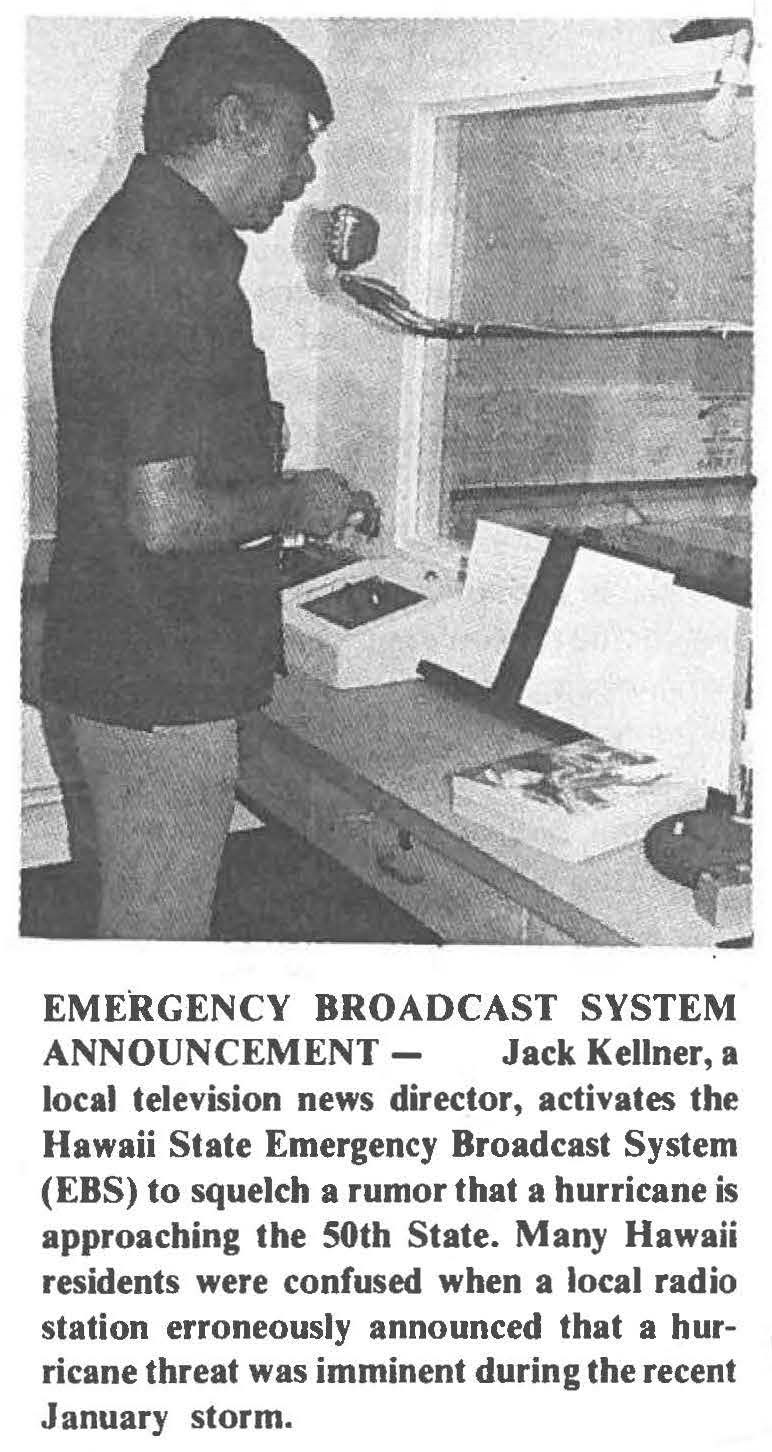
EMERGENCY BROADCAST SYSTEM ANNOUNCEMENT – Jack Kellner, a local television news director, activates the Hawaii State Emergency Broadcast System (EBS) to squelch a rumor that a hurricane is approaching the 50th State. Many Hawaii residents were confused when a local radio station erroneously announced that a hurricane threat was imminent during the recent January storm.(Picture from the 1980 February Pūpūkahi)
The Telecommunications Branch continued to operate and maintain the state’s civil defense communications and warning systems. Monthly tests of the Emergency Broadcast System were conducted using the State’s 220 outdoor warning sirens. Twenty new and replacement warning sirens were installed.
Monthly tests of the Emergency Broadcast System were conducted with the accompanying intentionally loud blast of 220 outdoor warning sirens. A contract was let for nine new warning sirens and replacement of five of the smaller World War II and 1961 vintage sirens.
Monthly tests of the Emergency Broadcast System were conducted with the accompanying loud blast of 220 outdoor warning sirens.
In the aftermath of Hurricane Iwa, a telecommunications upgrade proposal was submitted to Governor Ariyoshi, FEMA Region IX, members of the State Legislature and the State Emergency Communications Committee (broadcast industry) to increase the reliability and survivability of the State and County Emergency Broadcast Systems, the outdoor alerting warning system, the Inter-Island Teletype network and the hotline telephone and radio systems between the State and County Emergency Operating Centers.
Efforts continued to increase the reliability and survivability of the State and County Emergency Broadcast Systems, the outdoor alerting and warning system, the interisland teletype network and radio systems between State and County Emergency Operating Centers.
Over 1,000 pieces of telecommunications and warning equipment at 350 locations were maintained in operational readiness. Projects for 1985 centered on increasing reliability of the Emergency Broadcast System, outdoor siren warning system, interisland teletype net, and state and county Emergency Operating Center radio links.
Over one thousand pieces of telecommunications and warning equipment have been maintained in operational readiness. Projects for 1986 centered on establishing a permanent Emergency Broadcast System primary station for Hawaii County, establishing a backup hotline between the State Emergency Operating Center and Maui and Hawaii County Emergency Operating Centers via federal/state private microwave system, upgrading the interisland Teletype net, and contracting installation of new outdoor sirens. Efforts were also directed towards increasing the reliability of the Emergency Broadcast System, the outdoor siren warning system and the radio system used for direction and control during emergencies.
Emergency Broadcast System Improvements for Neighbor Islands. New Multichannel EBS receivers provided by the State of Hawaii were installed by the EBS primary stations on Kauai and Maui to improve emergency radio relays. Also, a direct EBS link for the State Emergency Operating Center EBS studio was installed to radio station KIPA on the Big Island using the State/Federal Microwave System. Three new Remote Transceiver Pickup Units were placed in operation by KGU in Honolulu.
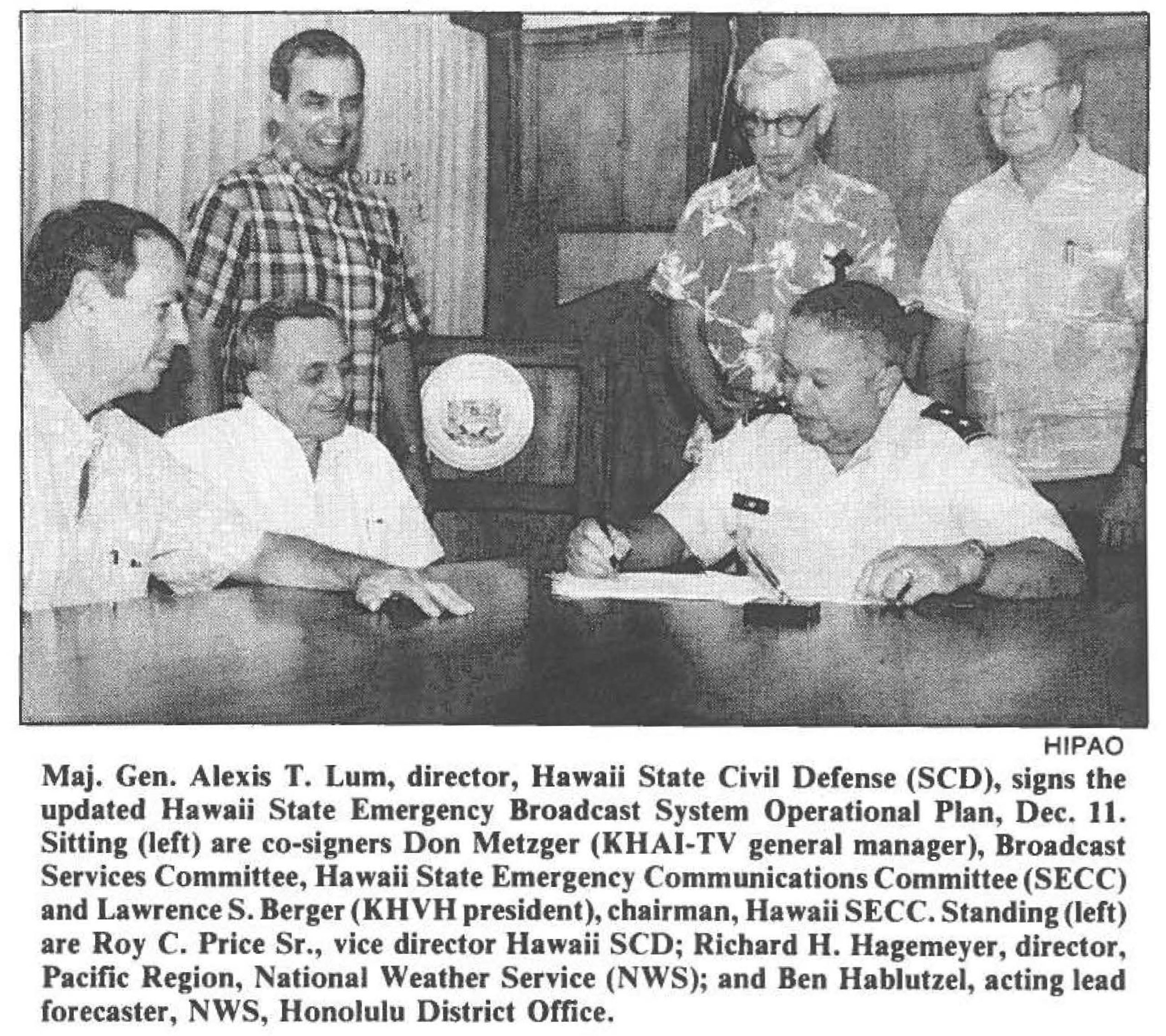
Maj. Gen. Alexis T. Lum, director, Hawaii State Civil Defense (SCD), signs the updated Hawaii State Emergency Broadcast System Operational Plan, Dec. 11. Sitting (left) are co-signers Don Metzger (KHAI-TV general manager), Broadcast Services Committee, Hawaii State Emergency Communications Committee (SECC) and Lawrence S. Berger (KHVH president), chairman, Hawaii SECC. Standing (left) are Roy C. Price Sr., vice director Hawaii SCD; Richard H. Hagemeyer, director, Pacific Region, National Weather Service (NWS); and Ben Hablutzel, acting lead forecaster, NWS, Honolulu District Office. (Picture from the 1990 October – December Pūpūkahi)
The updated Hawaii State Emergency Broadcast System (EBS) Operational Plan was signed Dec. 11. Participating in the signing were Maj. Gen. Alexis T. Lum, director, State Civil Defense; Lawrence S. Berger, chairman, Hawaii State Emergency Communications Committee (SECC); Don Metzger, Broadcast Services Committee, Hawaii SECC; and Richard H. Hagemeyer, regional director, National Weather Service.
The operational plan was developed by the Communications Committee in County Civil Defense agencies, County Operational Area Emergency Communication Committees and National Weather Service.
The signing was done on the 26th anniversary of the submission of the original EBS plan to the Federal Communications Commission for approval. Hawaii broadcasters have served as a model for the nation. The broadcasters support the important and vital services of the Hawaii Emergency Broadcast System.
The plan provides background information and prescribes specific procedures for the broadcast media to disseminate emergency information and warning to the general public. Information requests are made by designated county, state and federal government officials.
Program control, content and rebroadcasting rights as conceived and employed by the Hawaii broadcast community and Civil Defense are the same as those developed in 1960.
In addition to the weekly test of their system, over 50 radio, television and cable television stations participate in the monthly emergency system test. The stations are tested in conjunction with 278 Civil Defense warning sirens strategically located throughout the state.
Fortunately, we have never bad to use the statewide emergency system to warn of an attack on the state. State Civil Defense did use the system to inform the public of possible threat to the islands twice:
Hurricane lwa, Nov. 23, 1982
Tsunami warning, May 7, 1986; a tsunami was generated, but the waves were not life threatening.
The separate counties have used the county sections of the statewide system on many occasions to warn the public. The counties also use the system to give official information of high surf, flooding, lava flows and other local area disasters.
Emergency broadcasts on cable TV. In 1990, Oceanic and Chronicle cable television systems on Oahu acquired technology to air emergency broadcast information. As part of Oceanic’s franchise agreement with the state, the company has the capability to display supertext on all channels and carry the Emergency Broadcast System audio on a dedicated channel. Chronicle Cable serves as a relay agent for Oceanic broadcasts. Oceanic’s franchise agreement also requires the installation of video link for live broadcasts from the State Emergency Broadcast Studio by 1992, giving neighbor island subscribers access to similar cable services.
With county support, the SCD maintains a statewide communications and warning system made up of outdoor sirens and the Emergency Broadcast System (EBS). Operated over radio and cable television circuits, the EBS system is voluntarily supported by the local broadcast industry. Emergency communications are redundant by design and consist ofHF-SSB and HFVHF radio systems, multiple hard wire links with the National Weather Service, Pacific Tsunami Warning Center and all county police and civil defense agencies. The Integrated Emergency Management Information System (IEMIS) and Interim Baseline System (IBS) provide the state civil defense system with computerized mapping and modeling support. This database is used for resource, risk analysis and response applications.
With county support, the SCD maintains a statewide communications and warning system made up of outdoor sirens and the Emergency Broadcast System (EBS). Operated over local radio, television and cable circuits, the EBS system is voluntarily supported by the broadcast industry. VHF radio systems, multiple hardwire links with the National Weather Service, Pacific Tsunami Warning Center and all county police and civil defense agencies. SCD contains fully integrated computer hardware and software which provides mapping and modeling support used for resource, risk analysis and response applications.
With county support, the SCD maintains a statewide communications and warning system made up of outdoor sirens and the Emergency Alert System (EAS). Operated over local radio, television and cable outlets, the EAS system is voluntarily supported by the broadcast industry. Communications and computer systems represent the latest in technology to tie in response agencies around the state. Currently in place are satellite and microwave links, radio and telephone hotlines, and a full array of hardware and software. The high tech equipment is backed up by a single sideband radio equipment installed in all counties to guarantee fail-safe communications.
With county support, State Civil Defense maintains a statewide communications and warning system made up of outdoor sirens and the Emergency Alert System. Operated over radio, television, and cable outlets, the Emergency Alert System is voluntarily supported by the broadcast industry. Communications and computer systems represent the latest in technology to tie in response agencies around the state. Currently in place are satellite and microwave links, radio and telephone hotlines, and a full array of hardware and software. The hightech equipment is backed up by a single sideband radio equipment installed in all counties to guarantee fail-safe communications.
Emergency Alert System conversion completed. In compliance with the Federal CommunicationsCommission (FCC) requirement to install new digital equipment, State Civil Defense installed digital encoders and decoders at its Broadcast Studio and county civil defense agencies. The digital alerting system will help improve access for persons with special needs. Equipment installation is nearing completion for participating radio and television stations, as well as local cable operators.
With county support, State Civil Defense maintains a statewide communications and warning system made up of outdoor sirens and the Emergency Alert System. Operated over radio, television and cable outlets, the Emergency Alert System is voluntarily supported by the broadcast industry. Communications and computer systems represent the latest in technology to tie in response agencies around the state. Currently in place are satellite and microwave links, radio and telephone hotlines, and a full array of hardware and software. The hightech equipment is backed up by single sideband radio equipment installed in all counties to guarantee fail-safe communications.
With county support, State Civil Defense maintains a statewide communications and warning system made up of outdoor sirens and the Emergency Alert System. Operated over radio, television and cable outlets, the Emergency Alert System is voluntarily supported by the broadcast industry. Communications.and computer systems represent the latest in technology to tie in response agencies around the state. Currently in place are satellite microwave links, radio and telephone hotlines, and a full array of hardware and software. The hightech equipment is backed up by single sideband radio equipment installed in all counties to guarantee fail safe communications.
Advancements were made in the area of communications and warning system. A study was initiated in late 1961 to improve (1) methods of receiving warning information at the primary warning point (the Honolulu Police Station), (2) the method of notifying key Civil Defense personnel and (3) the method of warning the public over Civ-Alert, R system in which disaster information can be broadcast simultaneously over all local commercial radio stations. The study was completed in February and upon approval by the Governor, work on the project was begun. The new additional system is scheduled to be operational by the end of 1962. . . .
Mobile Radio System: Expansion of the State CD Mobile Radio System was accomplished. The system, originally consisting of one base station at the State CD Office and three mobile units, was expanded to 10 mobile units. In addition to the agency’s government owned vehicles, private vehicles of certain key staff members are equipped with CD radio sets.
A second base station was installed in the State Primary Warning Point (Honolulu Police Department Dispatch Bureau) and a third base station at the Honolulu Observatory of the U.S. Coast and Geodetic Survey, Ewa Beach, where tsunami warnings originate.
One of the improvements to the Civil Defense communications and warning systems was the construction of a separate room adjacent to the Honolulu Police Department Dispatch Bureau to house the State Primary Warning Point. The room contains special telephones directly connected to the Hawaiian Air Defense Division for air attack warning and to the Honolulu Observatory of the Coast and Geodetic Survey for tsunami information. Another phone is a direct line to the police desk in the CD Emergency Operating Center in Birkhimer Tunnel within Diamond Head Crater. A fourth has on unlisted number for use by certain key Civil Defense personnel in contacting the Honolulu Police during times of disaster or impending disaster.
Automatic siren programming timer controls were also installed at the Primary Warning Point. Other equipment in the room include a CD two-way base station and a CD statewide teletype machine. . . .
The State Civil Defense Division maintains widespread radio, teletype and telephone communications and warning systems throughout the State. Its mobile radio system on Oahu bas been improved with the installation of a radio repeater atop Diamond Head to link the state Emergency Operating Center, the State Primary Warning Point at the Honolulu Police Department, the tsunami warning center at the Honolulu Observatory and various State CD staff mobile units. Additional stations are planned to provide twenty-four hour operation and greater coverage.
The State Civil Defense Division maintains widespread radio, teletype and telephone communications and warning systems throughout the State. Its mobile radio system on Oahu has been improved with the installation of a new radio repeater atop Diamond Head to link the State CD Office and Emergency Operating Center, the State Primary Warning Point at the Honolulu Police Department, the tsunami warning center at the Honolulu Observatory, the Honolulu Airport Ramp Control Tower and various State CD Staff mobile units.
The first half of a two-year program to modernize the radio and teletype operating facilities in Birkhimer Tunnel has been completed. Controls and equipment are being replaced with modern and efficient units. Assistance was provided Counties in designing and obtaining new civil defense and public safety radio systems. . .
Improvements: The most significant communications improvement of the fiscal year was installation and activation of the new 100 per cent federally funded Civil Defense Hawaii Warning System (HAWAS). It was activated on January 6, 1972.
HAWAS is a full-period, four-wire, private-line voice circuit system, authorized and funded by the Federal Defense Civil Preparedness Agency and installed and maintained by the Hawaiian Telephone Company.
It ties in all the State and County warning points, as well as the Honolulu Observatory and 326th Air Division of the U.S. Air Force, and allows simultaneous voice transmission of warning information for tsunamis (tidal waves), military attack, weather conditions and other extraordinary dangers.
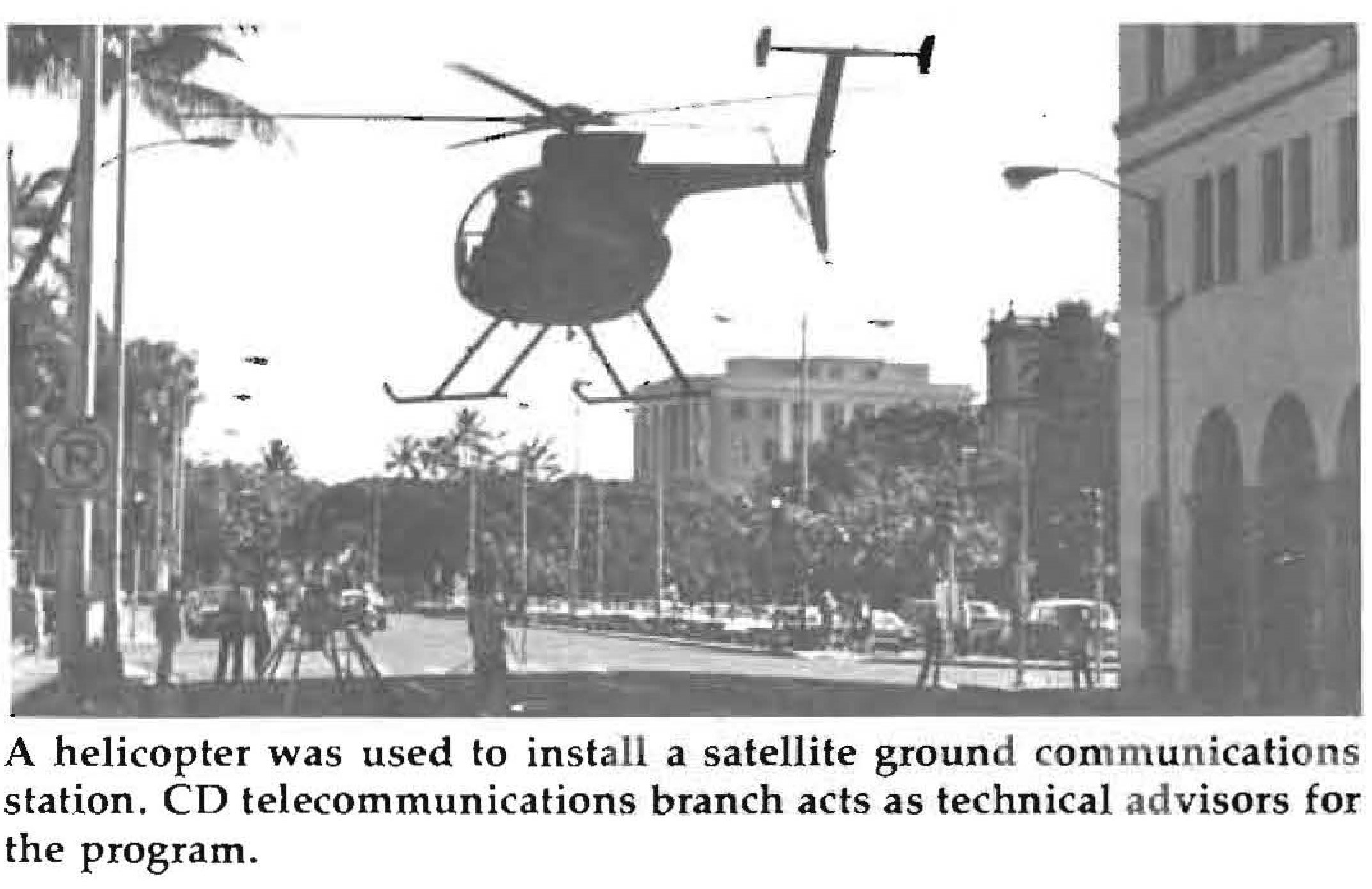
Fiscal year 2007 saw many changes for SCD, including the assumption of State Warning Point duties and functions performed for more than three decades by the Honolulu Police Department. The State Warning Point section is manned 24/7 by SCD staff and monitors the National Warning System which connects over 2,600 agencies and provides emergency responders and the public with information on terrorist attacks and natural hazards like tsunami, hurricane, flood, wildfire, earthquake, landslide and volcanic eruption.
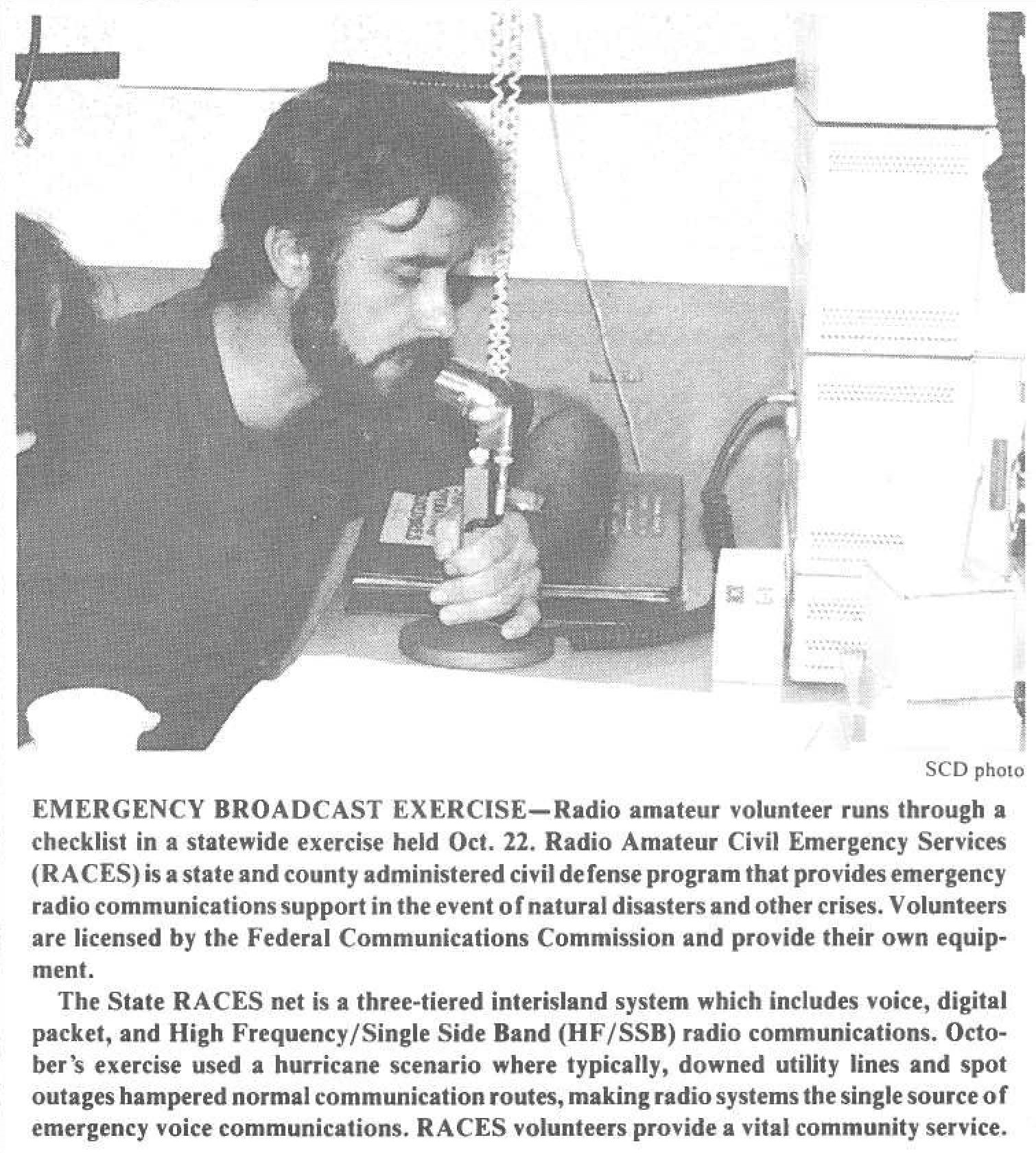
EMERGENCY BROADCAST EXERCISE-Radio amateur volunteer runs through a checklist in a statewide exercise held Oct. 22. Radio Amateur Civil Emergency Services (RACES) is a state and county administered civil defense program that provides emergency radio communications support in the event or natural disasters and other crises. Volunteers are licensed by the Federal Communications Commission and provide their own equipment. The State RACES net is a three-tiered interisland system which includes voice, digital packet, and High Frequency/Single Side Band (HF/SSB) radio communications. October’s exercise used a hurricane scenario where typically, downed utility lines and spot outages hampered normal communication routes, making radio systems the single source or emergency voice communications. RACES volunteers provide a vital community service.(Picture from the 1988 October – December Pūpūkahi)
The State plan for Radio Amateur Civil Emergency Service and plans for Oahu, Maui and Kauai were completed and given Federal Communications Commission approval. The Hawaii county’s plan has been submitted and awaits approval.
RACES Club House: Radio Amateur Civil Emergency Service (RACES) personnel established their meet ing place in Building 22 near the State CD Office. The benefits derived by Civil Defense in terms of increased RACES membership and higher quality training have been most satisfactory.
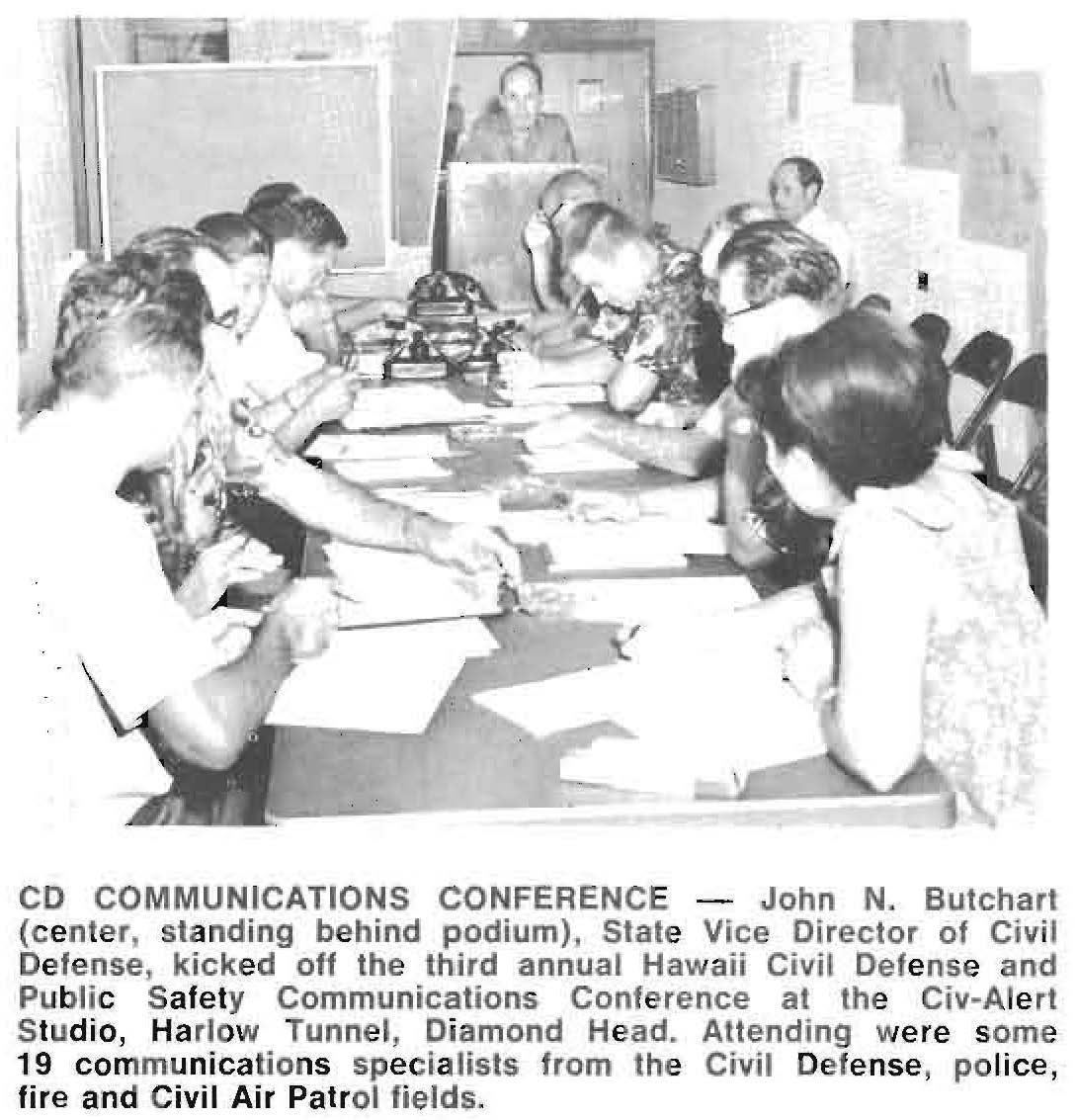
Hawai’i Civil Defense and Public Safety Communications Conference
CD COMMUNICATIONS CONFERENCE – John N. Butchart (center, standing behind podium), State Vice Director of Civil Defense, kicked off the third annual Hawaii Civil Defense and Public Safety Communications Conference at the Civ-Alert Studio, Harlow Tunnel, Diamond Head. Attending were some 19 communications specialists from the Civil Defense, police, fire and Civil Air Patrol fields.(Picture from the 1968 Annual Report)
State CD conducted its fourth annual communications conference with 42 attendees from throughout the State.
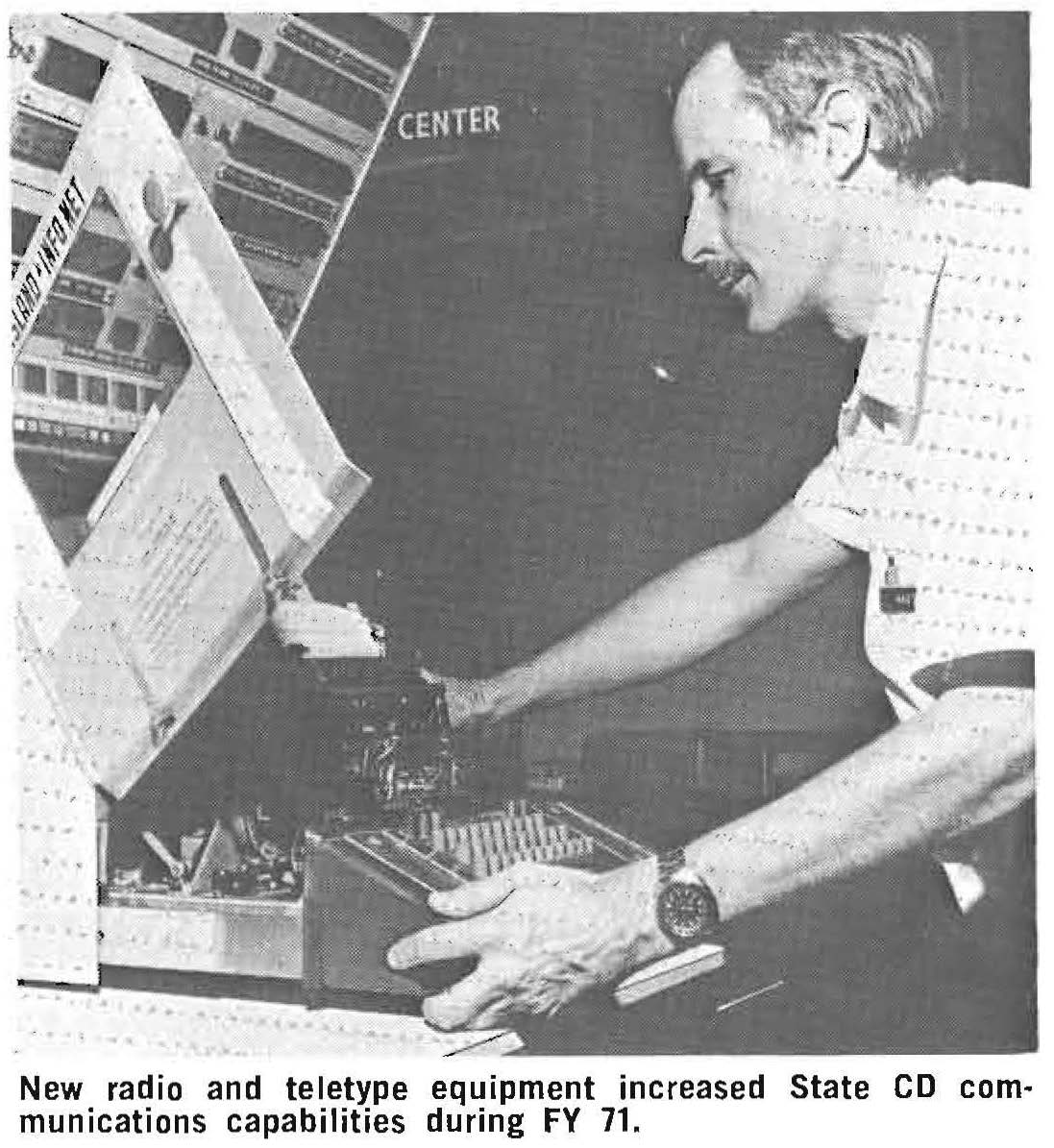
New radio and teletype equipment increased State CD communications capabilities during FY 71. (Picture from the 1971 Annual Report)
Other improvements enhancing the efficiency of the communications systems included installation of interisland teletype system connecting all police headquarters of the four counties with the State CD headquarters which was completed in late 1960 and the completion in June 1961 of the full automatic switchboard installation in the CD emergency operating center.
Recruiting and training of teletype operators and amateur radio operators progressed during the year under the direction of the Communications Officer.
The teletype equipment in the Emergency Operating Center, State CD headquarters, and Maui and Hawaii County CD Agencies was overhauled during the year.
The first half of a two-year program to modernize the radio and teletype operating facilities in Birkhimer Tunnel has been completed. Controls and equipment are being replaced with modern and efficient units. Assistance was provided Counties in designing and obtaining new civil defense and public safety radio systems. . .
During the past fiscal year, the modernization of the radio and teletype operating facilities in Birkhimer Tunnel continued. Controls and equipment are being replaced with new and more efficient units. . .
There were 3,411 messages sent over the State Civil Defense Inter-Island Teletype System during fiscal year 1969. This total does not include the hundreds of mock messages that were sent during Civil Defense exercises.
During the fiscal year, the modernization of the radio and teletypewriter facilities in Birkhimer Tunnel continued. Controls and equipment are being replaced with new and more efficient units. . .
There were 4,394 messages sent over the State Civil Defense inter-island teletype system during fiscal year 1970, a 29 percent increase over fiscal year 1969.
State Civil Defense maintains state-wide radio, teletypewriter, and telephone communications and warning systems. Radio and teletypewriter facilities in Birkhimer Tunnel were modernized during the year and the inter-island shortwave radio system was modified to include a teletype input.
A total of 4,081 messages were transmitted over the teletype system. The Honolulu office of the National Weather Service was tied into this system, enabling statewide dissemination of weather conditions several times daily.
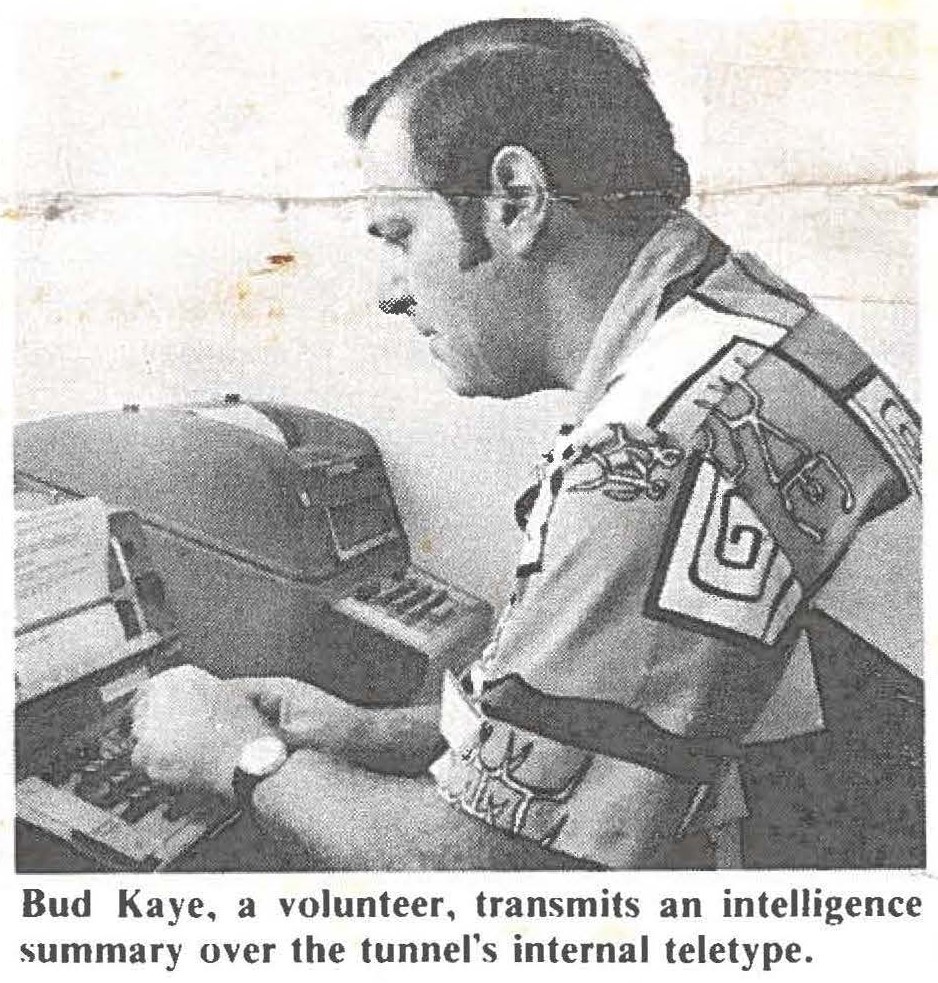
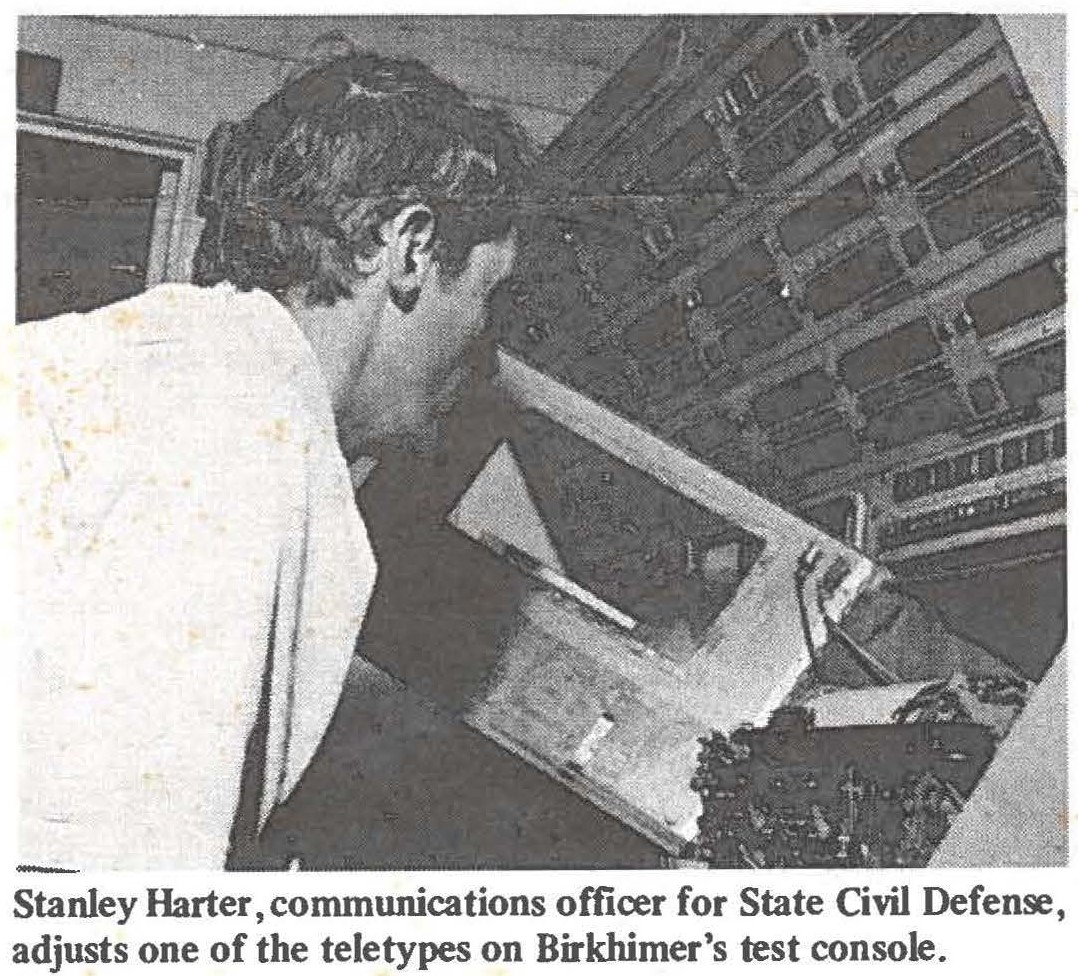
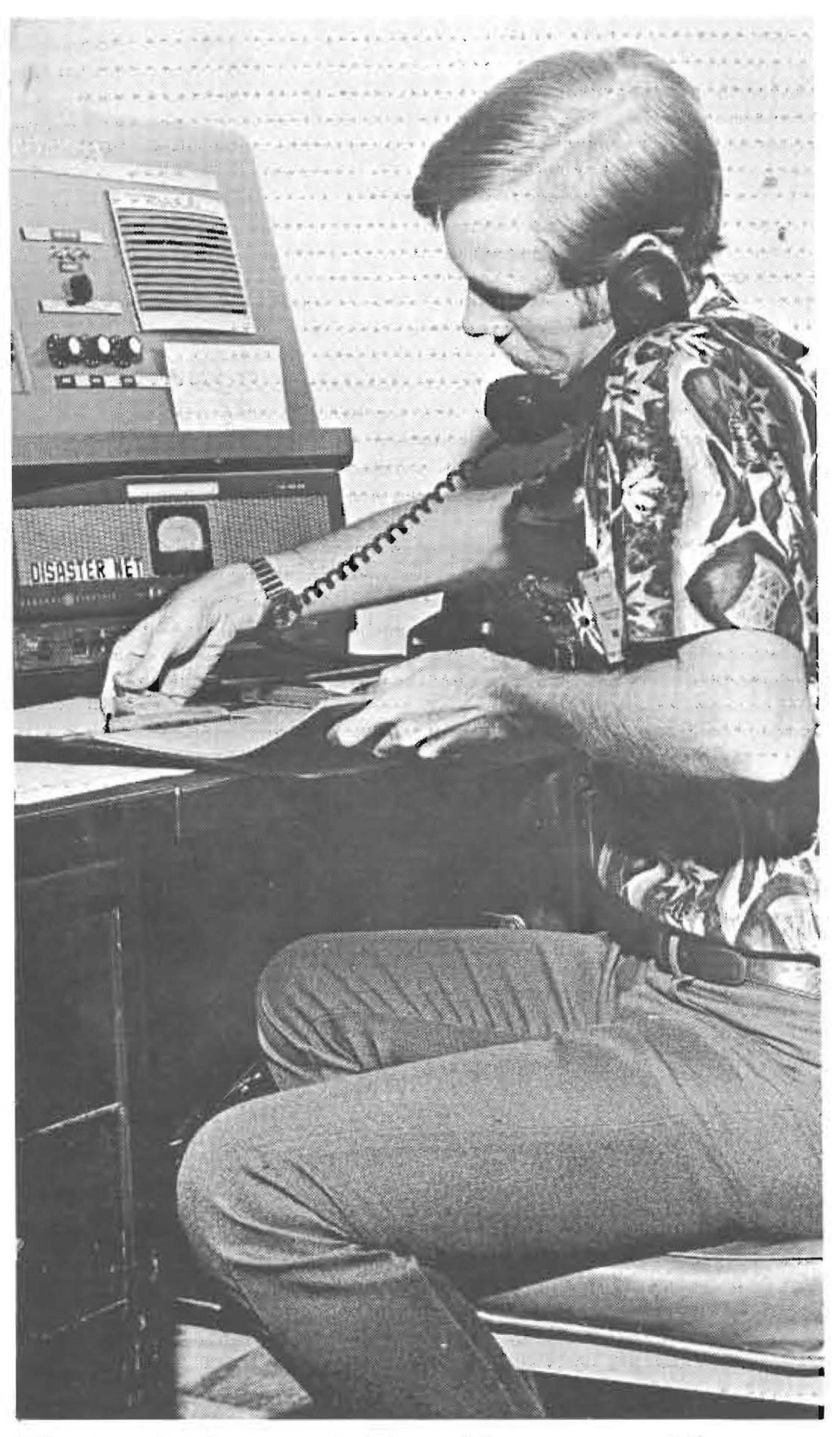
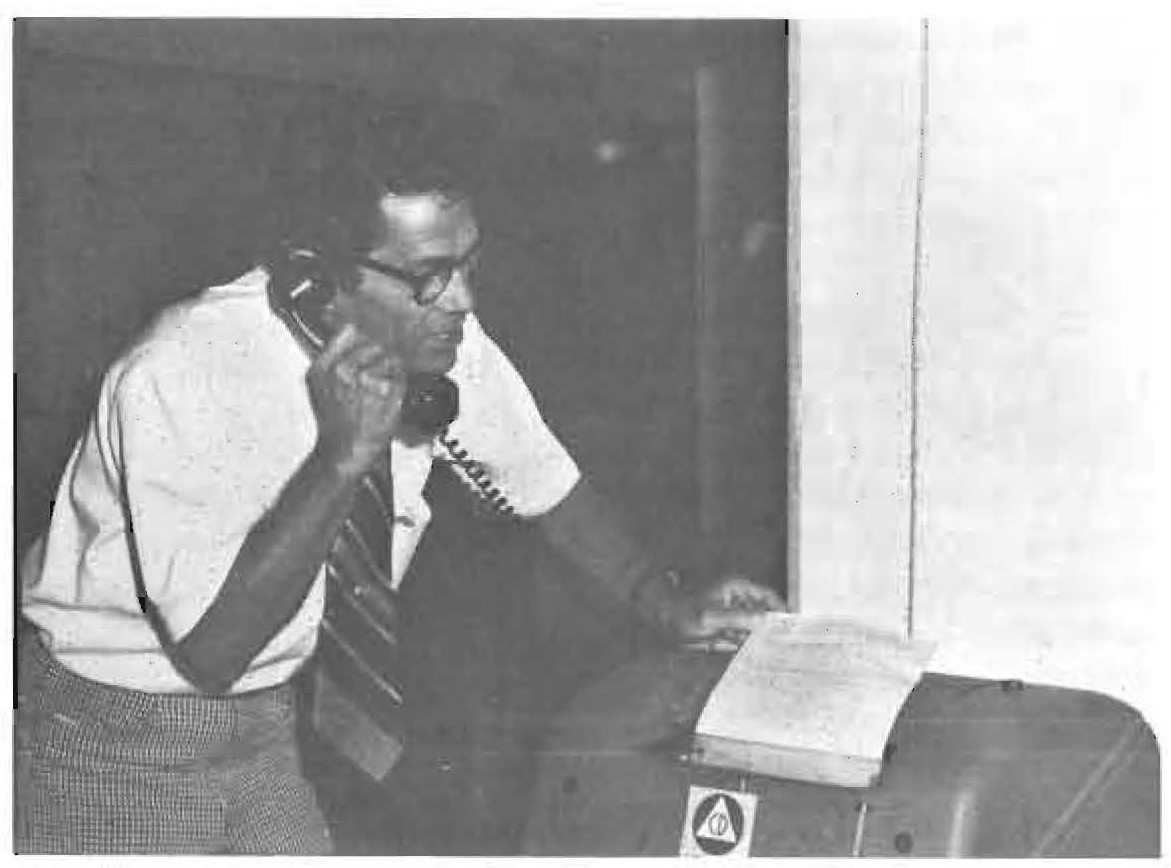
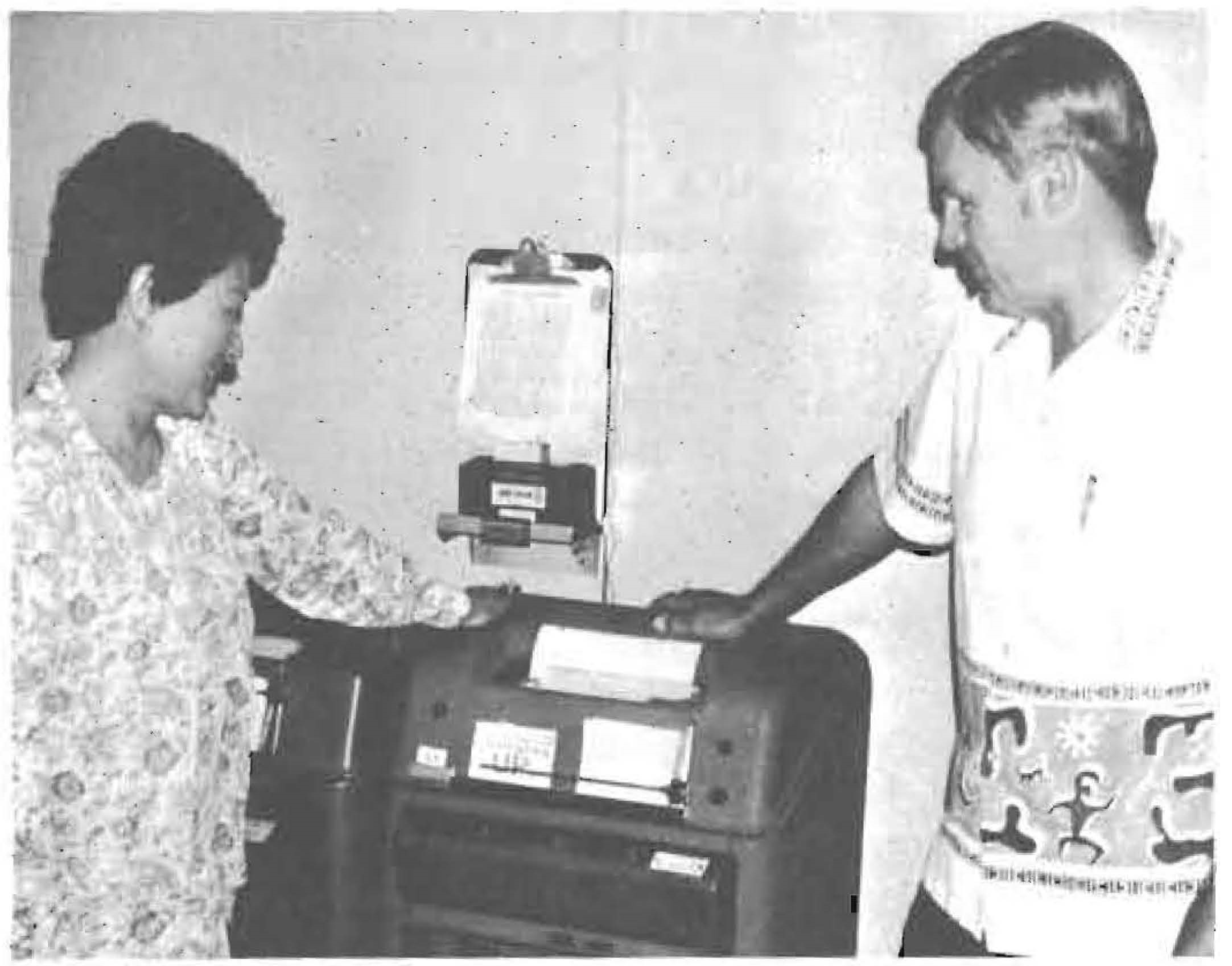
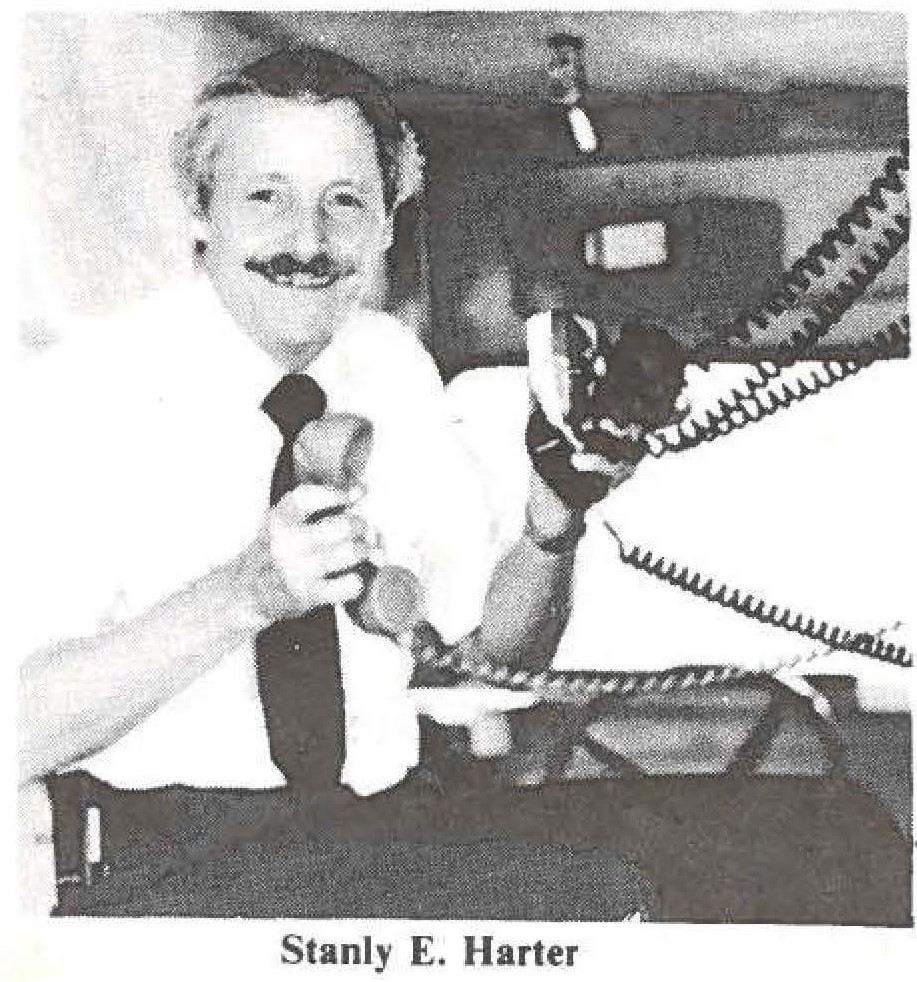
Bud Kaye. a volunteer, transmits an intelligence summary over the tunnel’s internal teletype. Stanley Harter, communications officer for State Civil Defense, adjusts one of the teletypes on Birkhimer’s test console. (Pictures from the 1974 Spring Pūpūkahi)
In the aftermath of Hurricane Iwa, a telecommunications upgrade proposal was submitted to Governor Ariyoshi, FEMA Region IX, members of the State Legislature and the State Emergency Communications Committee (broadcast industry) to increase the reliability and survivability of the State and County Emergency Broadcast Systems, the outdoor alerting warning system, the Inter-Island Teletype network and the hotline telephone and radio systems between the State and County Emergency Operating Centers.
Efforts continued to increase the reliability and survivability of the State and County Emergency Broadcast Systems, the outdoor alerting and warning system, the interisland teletype network and radio systems between State and County Emergency Operating Centers.
Projects for 1985 centered on increasing reliability of the Emergency Broadcast System, outdoor siren warning system, interisland teletype net, and state and county Emergency Operating Center radio links.
Projects for 1986 centered on establishing a permanent Emergency Broadcast System primary station for Hawaii County, establishing a backup hotline between the State Emergency Operating Center and Maui and Hawaii County Emergency Operating Centers via federal/state private microwave system, upgrading the interisland Teletype net, and contracting installation of new outdoor sirens.
The Oahu portion of the MEDICOM (Medical Communications) radio system was completed, tying together the State and County emergency operating centers with all emergency ambulances, hospitals, the Blood Bank and Department of Health.
The State Civil Defense System recently installed a medical radio system on Oahu which will provide for immediate communications between hospitals and ambulances.
Called MEDICOM (medical communications) the system is already in use for accident victims, as well as to help victims of heart attacks, strokes and similar medical crisis.
One of the units has been installed at the State Civil Defense headquarters at Fort Ruger for use during natural disasters and accidents when prompt treatment is issential.
Some of the projects accomplished or under way included the radio-controlled siren warning system on Oahu; the statewide MEDICOM voice and biomedical telemetry system for Emergency Medical Services; a new ambulance radio system for the City & County of Honolulu; new portable-mobile radios for Maui Police; new radio system for Halawa Correctional Facility; communications for the new Maui County Emergency Operating Center; plans for a Kauai County Fire radio system; airport fire truck radios; a new system for Kulani Honor Camp and Hilo Jail; and total communications for the Oahu Stadium under construction. The total dollar value for these State and county telecommunications projects totalled $1,325,388.00.
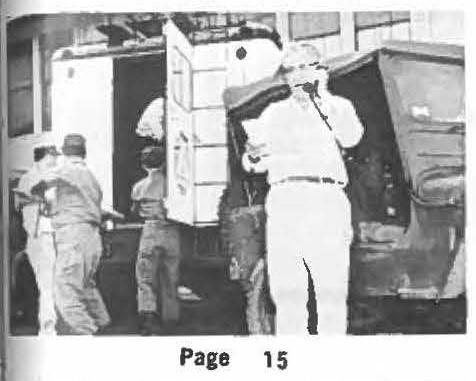
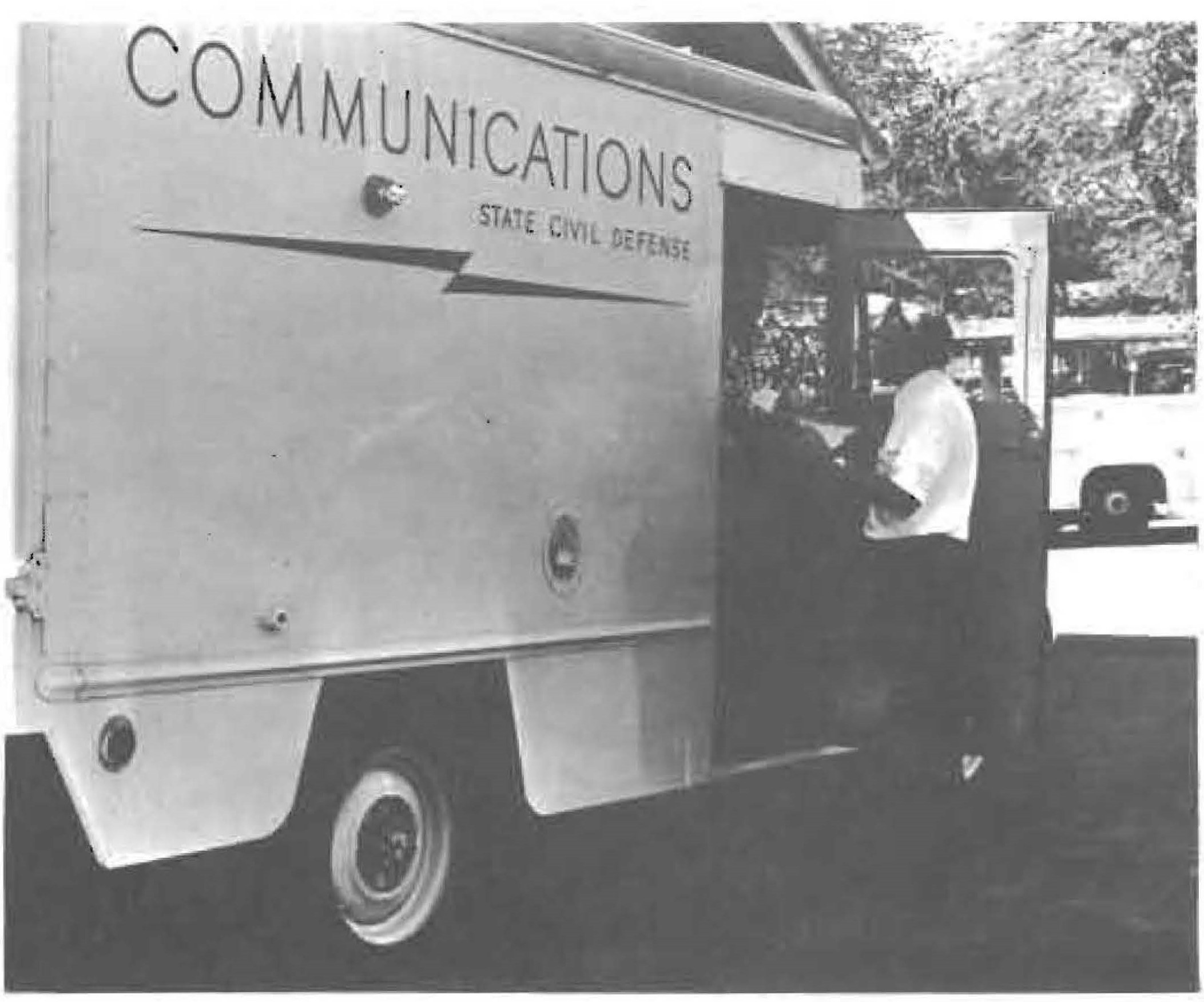
State Civil Defense a quires emergency communications truck
By Fred Pugarelli Public Information Officer State Civil Defense
The State Civil Defense Division now has an emergency communications truck to support command, control, coordination and mutual aid radio communications at the scene of an emergency or disaster.
It is a Dodge 4-Wheel Drive “Power Wagon” capable of accessing off-the road scenes of exigency operations.
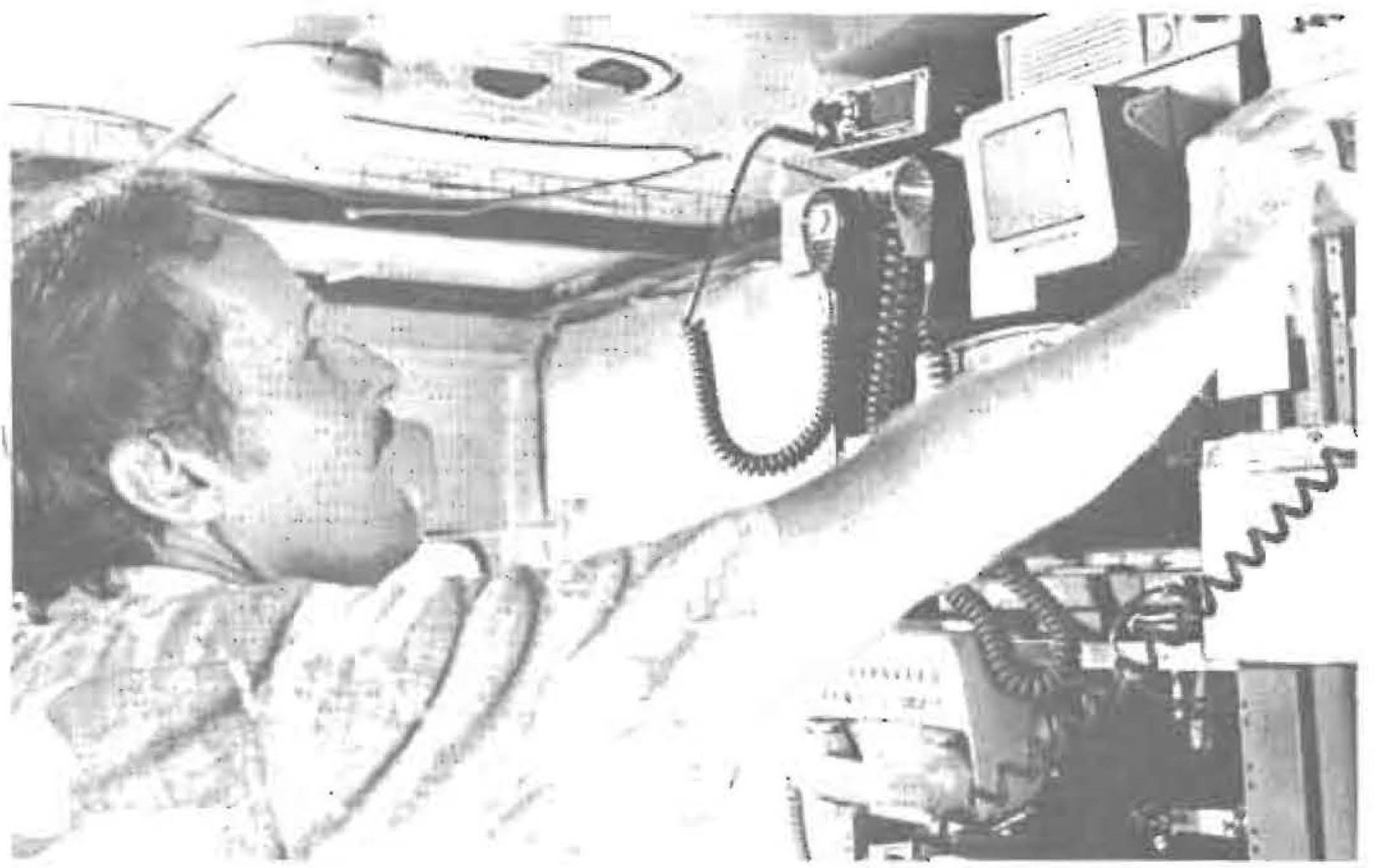
The vehicle has several two-way radios capable of joining a network with numerous federal, state and county systems. As systems and requirements change, special channels may be added or deleted as required.
Currently, the truck has a UHF-SM transceiver that nets with the total Medical Communications (Medicom) system.
Medicom links all hospitals, ambulances and several public safety dispatch centers throughout the state. The truck transceiver is equipped with a touch-tone “dial” so that the operator may “dial up” any Medicom base station in the state. The same radio is also capable of accessing the new city and county ambulance UHF radio system.
A scanning receiver on the vehicle enables monitoring of several radio frequencies in a rapid sequential or “scanning” rate. It is equipped with both National Weather Service continuous broadcast KBAOO frequencies to listen to the weather forecasts from either Mt. Kaala (Oahu) or Haleakala (Maui).
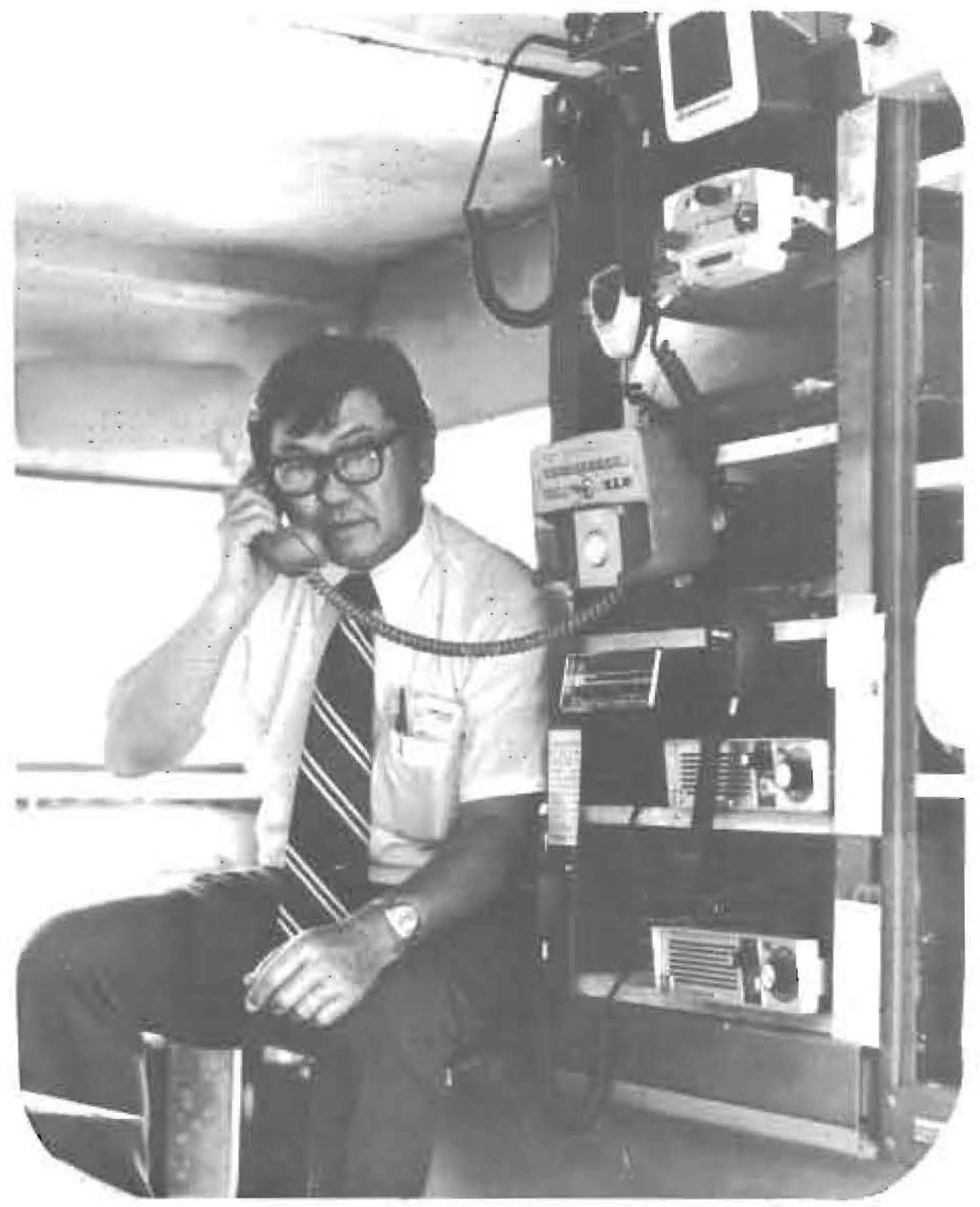
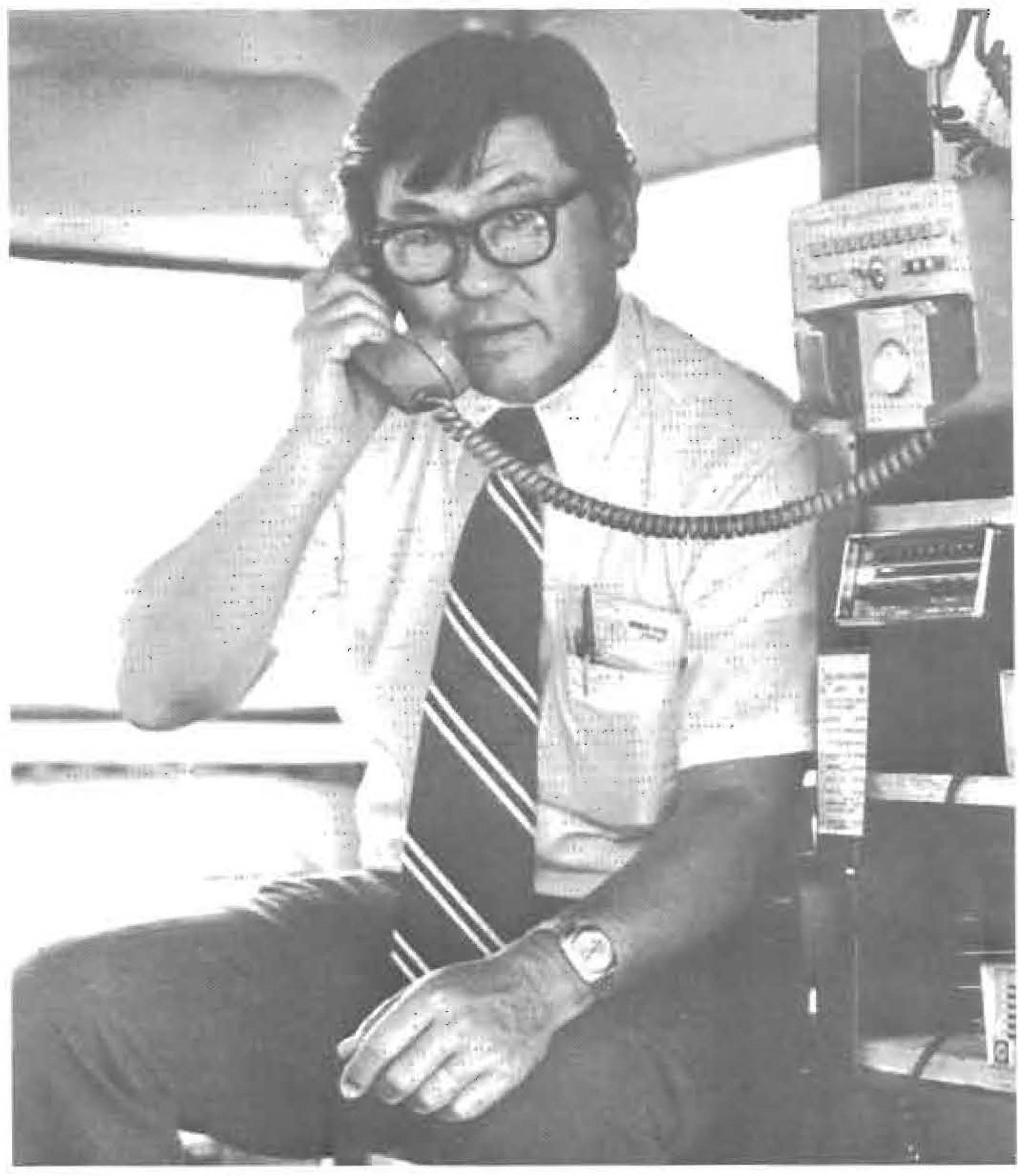
One of the most valuable operational “tools” on the wagon is the mobile radio telephone. It enables the operator to place a call direct to any particular office of interest to discuss and coordinate logistic and operational details without tying up a regular agency’s tactical channel. In turn, calls may be placed to the Comm Truck if necessary from any telephone.
In the 14th Century literary classic, “Sir Gawain and the Green Knight,” Pearl the Poet describes the magical powers of the Green Knight and his uncanny ability to mentally communicate with individuals, whether they be in the immediate vicinity or in another land. Today, mental communication is still a novelty, but most Americans can easily communicate with one another, whether near or afar, by simply picking up a telephone.
Yes, the use of telephones and other telecommunications equipment, which includes all devices utilized to transmit voice, video or data communications, has become so convenient and an integral part of our lives, that today, most of us take such equipment for granted. Unfortunately, when such a remiss attitude is taken, whether it be by an individual using such equipment or by a person who is responsible for obtaining the equipment, efficiency can slowly deteriorate and costs can rise at alarming rates.
Several years ago, there was some concern as to whether the State government was utilizing the most efficient telecommunications equipment for the least cost or failing to employ such equipment where services, safety and efficiency would be improved.
Because of these problems, the awesome responsibility of acquiring and supervising the utilization and facilities for State agencies was assigned to the adjutant general. The responsibility was then delegated to the State Civil Defense division. This responsibility includes the supervision of more than 18,000 telephones, approximately 11,500 telephone lines and hundreds of teletypewriters, radios, microwave and other communications and electronic equipment.
One of the first steps taken by the State Civil Defense to determine if the State was receiving the most cost efficient equipment and services was to hire a consultant firm to assist the State in conducting a detailed survey to ascertain the cost of State telephone services. Working with assigned telecommunications coordinators in each State department, the survey was completed in December, 1978, and early indications projected a substantial annual telephone cost savings to the State government.
According to Maj. Gen. Valentine A. Siefermann, adjutant general and director of Civil Defense, one of the problems that has led to the high cost of telecommunications within the State government is duplication. Previously, each State department would obtain its own equipment and services which led to a duplication of instruments in many departments. Eventually, what we hope to accomplish, Siefermann added, is to have a system where various departments can share a statewide network, thus cutting costs and increasing efficiency.
Now that the survey has been completed, the telecommunications program is being mapped out to upgrade services, reduce certain costs and increase the efficiency of the State network.
Radio communication systems for Hawaii State government are rapidly growing in addition to telephone. A diverse range of projects are currently being handled by the Civil Defense division. They include a new, State-funded “9-1-1 “emergency telephone and dispatch center for Maui County; the installation of satellite communications terminal; an interisland microwave system; upgrading the MEDICOM emergency medical services communications system; radio controlled civil defense siren warning systems; and new two-way radio systems for the Honolulu International Airport, Hawaii Division of Forestry, the Sheriff(Judiciary) and a drug intervention task force.
Although the development of a cost efficient telecommunications system is still in the infancy stage, Gen. Siefermann is confident that an effective and efficient State network can be established to the greater benefit of all departments m the State government.
The emergency communications truck was completed. It is equipped with over 60 two-way radio channels to support emergency field operations and task force commanders in disasters, forest fires and other emergencies.
State Civil Defense a quires emergency communications truck
By Fred Pugarelli Public Information Officer State Civil Defense
The State Civil Defense Division now has an emergency communications truck to support command, control, coordination and mutual aid radio communications at the scene of an emergency or disaster.
It is a Dodge 4-Wheel Drive “Power Wagon” capable of accessing off-the road scenes of exigency operations.
The vehicle has several two-way radios capable of joining a network with numerous federal, state and county systems. As systems and requirements change, special channels may be added or deleted as required.
Currently, the truck has a UHF-SM transceiver that nets with the total Medical Communications (Medicom) system.
Medicom links all hospitals, ambulances and several public safety dispatch centers throughout the state. The truck transceiver is equipped with a touch-tone “dial” so that the operator may “dial up” any Medicom base station in the state. The same radio is also capable of accessing the new city and county ambulance UHF radio system.
A scanning receiver on the vehicle enables monitoring of several radio frequencies in a rapid sequential or “scanning” rate. It is equipped with both National Weather Service continuous broadcast KBAOO frequencies to listen to the weather forecasts from either Mt. Kaala (Oahu) or Haleakala (Maui).
One of the most valuable operational “tools” on the wagon is the mobile radio telephone. It enables the operator to place a call direct to any particular office of interest to discuss and coordinate logistic and operational details without tying up a regular agency’s tactical channel. In turn, calls may be placed to the Comm Truck if necessary from any telephone.
MOBILE COM – Thomas C. Simon, a radio technician with State Civil Defense, shows the mobile satellite phone system from their mobile communications van. Max· W. Starr photo(Picture from the 1999 Annual Report)
Other improvements enhancing the efficiency of the communications systems included installation of interisland teletype system connecting all police headquarters of the four counties with the State CD headquarters which was completed in late 1960 and the completion in June 1961 of the full automatic switchboard installation in the CD emergency operating center.
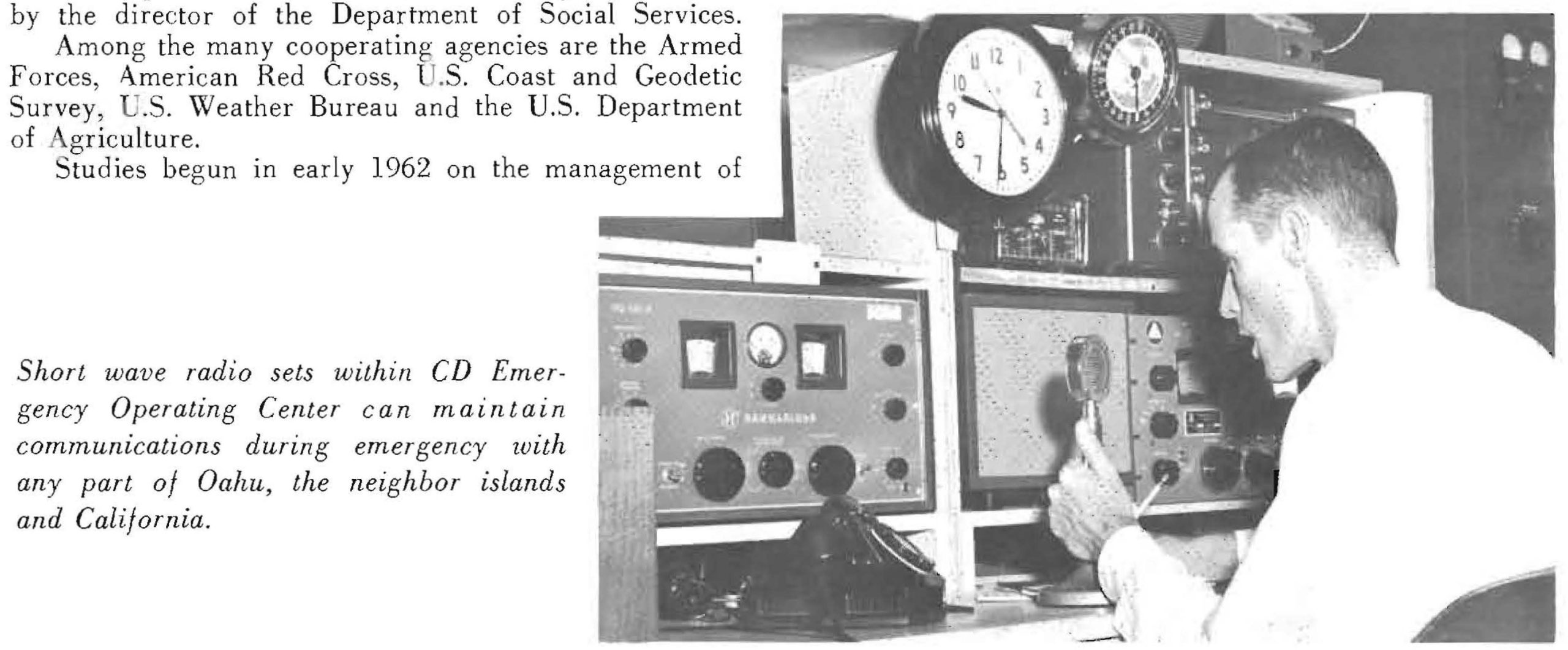
Short wave radio sets within CD Emergency Operating Center can maintain communications during emergency with any part of Oahu, the neighbor islands and California. (Picture from the 1962 Annual Report)
Advancements were made in the area of communications and warning system. A study was initiated in late 1961 to improve (1) methods of receiving warning information at the primary warning point (the Honolulu Police Station), (2) the method of notifying key Civil Defense personnel and (3) the method of warning the public over Civ-Alert, R system in which disaster information can be broadcast simultaneously over all local commercial radio stations. The study was completed in February and upon approval by the Governor, work on the project was begun. The new additional system is scheduled to be operational by the end of 1962. . . .
Recruiting and training of teletype operators and amateur radio operators progressed during the year under the direction of the Communications Officer.
Other Progress: An unlisted telephone for use by the Honolulu Magnetic Observatory was installed in the CD Emergency Operating Center in March, thus effecting closer liaison between the Observatory and CD officials during tidal wave warning periods. . .
Organized to coordinate CD radio communication matters and assignments on Oahu, the Oahu Civil Defense Communications Board is composed of representatives of the State CD, Oahu CD Agency, Honolulu Police and Fire Departments, public utilIties, Civil Air Patrol, Military Affiliated Radio System and Citizen Banders. . .
For the maintenance of communications and electronic equipment, repair tools and test equipment were obtained to begin the establishment of a maintenance shop. The hiring of a temporary part-time communications technician greatly accelerated the maintenance program. Request has been made for a full-time position with additional duties of maintaining radiological defense equipment.
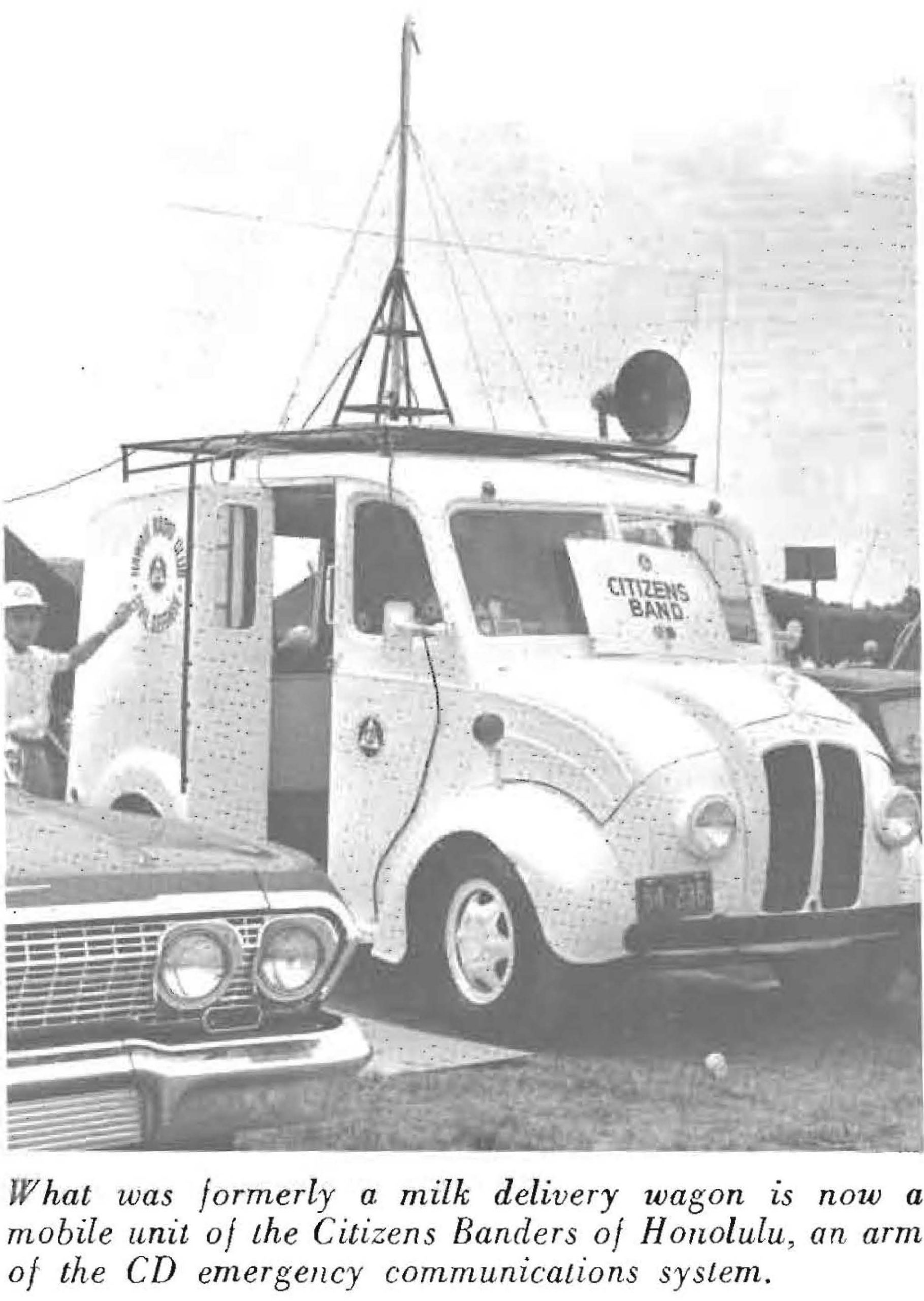
What was formerly a milk delivery wagon is now a mobile unit of the Citizens Banders of Honolulu, an arm of the CD emergency communications system. (Picture from the 1964 Annual Report)
Improvements and additions to the Civil Defense communications network included getting linked in the National Communications System One (NACOM 1) chain, expanding the State CD mobile radio system, and assisting Kauai County in establishing its new FM radio system. . .
Mobile Radio System: Expansion of the State CD Mobile Radio System was accomplished. The system, originally consisting of one base station at the State CD Office and three mobile units, was expanded to 10 mobile units. In addition to the agency’s government owned vehicles, private vehicles of certain key staff members are equipped with CD radio sets.
A second base station was installed in the State Primary Warning Point (Honolulu Police Department Dispatch Bureau) and a third base station at the Honolulu Observatory of the U.S. Coast and Geodetic Survey, Ewa Beach, where tsunami warnings originate.
Kauai County Network: The Kauai County’s new FM radio system used jointly by the Kauai CD Agency and the Police and Fire Departments was officially opened in March. Two automatic repeater stations make possible island-wide radio coverage. . .
Maintenance Shop: A maintenance shop where repairs and preventive maintenance of CD communications and electronics equipment and radiological monitoring instruments are done, has been established in Building 6, adjacent to the State CD headquarters. (See Personnel- this report)
Preventive Maintenance: A heavy work load of repair and maintenance of communications and radiological monitoring equipment was carried by the Radio Technician during the year.
Work done on radio units totaled 206 while 406 units of radiological monitoring instruments were repaired. In addition, 48 fixed radiological monitoring stations were checked. Improvements and maintenance of the public address system in the main Emergency Operating Center was completed during the reporting period.
Prior to the establishment of this position, the maintenance work was done by volunteers, temporary workers and private contractors.
Other improvements: With four mobile units added to the State CD Mobile Radio System, the net now has 14 mobile units. Plans for the coming year call for modifying the system with additional base stations to be installed at the Rural Area Command posts of the Oahu CD Agency at Waialua and Kailua. The repeater system will provide extended car-to-car communications. . .
A volunteer State CD Radio Officer, filling a three year vacancy, has provided valuable assistance in planning and coordinating the various CD radio services which support the State and County CD agencies during emergency warning periods.
The State Civil Defense Division maintains widespread radio, teletype and telephone communications and warning systems throughout the State. Its mobile radio system on Oahu bas been improved with the installation of a radio repeater atop Diamond Head to link the state Emergency Operating Center, the State Primary Warning Point at the Honolulu Police Department, the tsunami warning center at the Honolulu Observatory and various State CD staff mobile units. Additional stations are planned to provide twenty-four hour operation and greater coverage.
The State Civil Defense Division maintains widespread radio, teletype and telephone communications and warning systems throughout the State. Its mobile radio system on Oahu has been improved with the installation of a new radio repeater atop Diamond Head to link the State CD Office and Emergency Operating Center, the State Primary Warning Point at the Honolulu Police Department, the tsunami warning center at the Honolulu Observatory, the Honolulu Airport Ramp Control Tower and various State CD Staff mobile units.
The first half of a two-year program to modernize the radio and teletype operating facilities in Birkhimer Tunnel has been completed. Controls and equipment are being replaced with modern and efficient units. Assistance was provided Counties in designing and obtaining new civil defense and public safety radio systems. . .
Maintenance: A total of 1,360 radios and teletype machines were repaired and maintained during the year. This was an increase from 494 the previous year. A communications and electronic equipment maintenance shop is maintained at the State CD Headquarters to support a wide range of telecommunications equipment throughout the State.
The Civil Defense Division maintains widespread radio, teletype and telephone communications and warning systems throughout the State. . .
Oahu’s civil defense communications network was augmented during the year with the activation of hospital emergency radio network designed [or disasters involving the handling of mass casualties. Hospitals thus far participating in the network are Queen’s, Sl. Francis, Kuakini, Kapiolani, Children’s, Maluhia, Tripler, Kaiser and Castle.
During the fiscal year the Civil Defense Division purchased $31,000 of new single sideband radio equipment which is being installed in emergency operating centers on Oahu and the neighbor islands. The new equipment will transmit a more powerful signal then the old amplitude modulation (AM) double sideband radio system, thus reducing the chances of signal failure. . .
Maintenance: A total of 1,639 communication work orders were processed during the year. This was an increase from 1,360 the previous year. A communications and electronic equipment maintenance shop is maintained at the CD Headquarters to support a wide range of telecommunications equipment throughout the State.
State Civil Defense maintains widespread radio, teletype and telephone communications and warning system, throughout the State.
During the past fiscal year, the modernization of the radio and teletype operating facilities in Birkhimer Tunnel continued. Controls and equipment are being replaced with new and more efficient units.
State CD provided the Counties assistance in designing and obtaining new public safety and Civil Defense radio systems. . .
State CD has completed its plans to install an Inter-Island Police Radio Intercom (IPRI) system. It will be used as back-up to the Hawaiian Telephone Company radio links in the event of military attack, tsunami, flooding or other natural disaster. Funds for the new net have already been approved. . . .
Maintenance: A total of 1,623 communications work orders were processed during the year. A communications and electronic equipment maintenance shop is maintained at the CD Headquarters to support a wide range of telecommunications equipment throughout the State.
State Civil Defense maintains a vigorous program of preparing government agencies and the public to survive any natural or military disaster that may occur.
“As long-time residents know,” CD officials state, “Hawaii is subject to devastating tsunamis (tidal waves), such as the 1960 tsunami that killed 61 people in Hilo, Hawaii. Even worse was the 1946 tsunami that killed 159 people and injured 163 on all the major islands of the Hawaiian chain.”
Since these two catastrophes occurred, a Civil Defense organization has been built up which, with public cooperation, should minimize casualties and damage when the next severe tsunami. strikes.
The Civ-Alert radio system, authorized by a special session of the State Legislature in 1960 after the Hilo tsunami, broadcasts simultaneously to all radio stations in the State and can now be used to warn people to clear coastal areas when a tsunami is coming.
Floods resulting from heavy rains are primarily a County Civil Defense responsibility (the four Counties in Hawaii each have their own CD Agency), but the State CD staff is ready to assist the County in handling the emergency.
The Civil Defense Division is part of the State Department of Defense, along with the National Guard. Maj. Gen. Benjamin J. Webster, who heads the National Guard, is also Director of Civil Defense.
One important aspect of floods that is handled by the State CD staff is the surveys to assess how much damage has been done. These are made for the Governor, who uses the survey in determining whether or not to provide financial assistance to the County for disaster recovery programs. And, the Governor may forward the facts of the survey to the President if the flood (or any other type of natural disaster, for that matter) is of sufficient magnitude to request that the area be declared a major disaster area.
Courses, conferences, meetings and talks are some of the means the State CD staff uses to prepare the public for emergencies. Natural and nuclear disaster preparedness are often covered in the same program.
State Civil Defense also has some 30 films that are loaned to public and private groups, and distributes numerous publications, both local and national, on Civil Defense subjects.
Tours of the Civil Defense facilities in Birkheimer and Harlow Tunnels are given on the average of twice a week, and often the groups in these tours come away with a new appreciation of emergency preparedness.
A continuing public information program is also maintained through news releases and contacts with the press, radio and television. Approximately 160 news releases on Civil Defense activities are issued to the media each year.
Training conferences and courses given by State CD, the University of Hawaii’s Civil Defense Extension Program and the Civil Defense Adult Education Program of the State Department of Education are another extremely effective means of educating the public for any crisis.
State Civil Defense also has a full-time radiological defense officer who maintains,. with the Counties’ help 222 fixed fallout monitoring stations in the Islands. There are also vehicle monitoring stations.
This April, the Federal government and the State of Hawaii took steps to assist the Territory of Guam in setting up a network of fixed and mobile fallout monitoring stations.
The Federal Aviation Administration cooperated with State CD in this project by flying the radiological defense equipment to Guam in its planes.
Henceforth, State CD will also provide maintenance of the fallout monitoring equipment on Guam.
The State and Counties are continuing their efforts in the nationwide program to identify, license, mark and stock fallout shelters. This is an extremely important program, for the experts tell us that many people could survive the radioactive fallout of a nuclear explosion if they went to shelters in time.
One important event that took place recently – sponsored by the State CD and the University’s Civil Defense Extension Program – was a Civil Defense Management course in Turner Hall, Fort DeRussy.
The course was for Civil Defense Coordinators in State and County departments of goyernment, and covered preparedness for both natural and nuclear disasters.
During these CD conferences personnel can review past disasters and iron out the bumps.
It is the responsibility of new government personnel who have emergency Civil Defense duties to familiarize themselves with disaster plans, because disasters can and often do – strike unexpectedly.
Civil Defense personnel hope that through all these means – conferences, meetings, courses, tours of facilities, exercises both government leaders and the general public will know what to do in any emergency.
State Civil Defense maintains widespread radio, teletypewriter, and telephone communications and warning systems throughout the State.
During the fiscal year, the modernization of the radio and teletypewriter facilities in Birkhimer Tunnel continued. Controls and equipment are being replaced with new and more efficient units. The Civil Air Patrol completed the installation of a Wing Headquarters communications center and emergency operating center in Harlow Tunnel.
State CD provided the counties with assistance in designing and obtaining new civil defense and public safety radio systems. The Division completed the installation of the Inter-Island Police Radio Intercom (IPRI) system. IPRI is a backup to the common carrier radio links in the event of military attack, tsunami, storm warnings, or other natural disasters. . .
Other accomplishments during the year included the coordination of engineering, procurement and installation of two-way radio systems for the Governor’s office; the State Capitol Security Force; the State Divisions of Forestry and Fish and Game; and the ambulances on Oahu.
There was also the installation of equipment to enable statewide radioteletype communications between State CD and all neighboring County CD agencies, and the completion of a State Warning System analysis. . .
Maintenance: A total of 2,378 communications work orders was processed during the year. A communications and electronic maintenance shop is maintained at the CD Headquarters to support a wide range of telecommunications equipment throughout the State.
On the first working day of each month, sirens wail on Oahu. At the same time, radio stations announce that a civil defense test is being conducted. This test is a coordinated effort by the civilian and military communities to check the civil defense warning system and to remind citizens that the sound of sirens should alert them to a domestic emergency or an enemy attack.
Joint testing by civil defense agencies and United States Army, Hawaii (USARHA W) is a conspicuous example of civil defense action and military support to civil defense. This mutual and cooperative concern for the common defense and public safety in wartime or emergency is a reason for the establishment of the Hawaii Area Command (HAWCOM). HAWCOM is a National Guard headquarters unit that would be federalized to plan, coordinate and control operations in military support of civil defense throughout the State.
The term “civil defense” was coined in World War I and has been used since then, although the practice of civil defense (man’s effort to preserve life and speed recovery in the event of calamity) is as old as man himself. In 1917, Americans, faced with the horror of total war, insisted that civilians work with governmental agencies to provide for homeland defense. During the Second World War, the concept and program of civil defense were directed by a national agency, but civil defense activities were performed by civilians at state and local levels. Since 1947, the spectre of world-wide nuclear devastation has caused the United States to seek a viable passive defense measure against nuclear attack. Early in the sixties, the Symington Committee proposed that the National Guard and Reserve units be made entirely responsible for civil defense. This measure would have made civil defense a military matter. The proposal was never accepted. In 1961, the President of the United States indicated that for the first time, the Federal government was going to seriously consider civil defense and military posture as integral factors in planning for national security. In 1964, the National Plan for Emergency Preparedness described the roles of the Federal Government, the States and their political subdivisions and of individual citizens. Civil defense was to be a totally civilian program and the military would support it. This complementary relationship was to be the salient characteristic of civilian-military operations in civil defense.
Since then, civil authorities have developed a national survival scheme in the form of fallout protection shelter plans, civil defense organizations and means to rehabilitate the country after attack. The military has always considered protective measures against nuclear attack an important part of military operations. In addition, they have always assisted civilians during emergencies caused by natural disasters, domestic disturbances and conflicts. In June 1964, the United States Department of Defense recognized the pre-eminence of civilian responsibilities of the military services. By March 1965, the Department of the Army established that States’ Adjutants General on the mainland and their staffs would participate actively in pre-attack planning for military support of civil defense. The State National Guard headquarters would be the primary focal point for military-support planning within its state and State headquarters would be mobilized prior to, or immediately after a nuclear attack in the United States. Under these circumstances, the commander of the State Area Command would exercise operational employment of forces made available from all services and components.
By December of 1965, the military-support concept was implemented in the State of Hawaii. Colonel Paul K. Nakamura, then a major and currently the G3 of the Hawaii Army National Guard, was appointed to the full-time position of Military Support Plans Officer on the staff of the State Adjutant General. Colonel Nakamura served until October 1969. He was instrumental in the initial formation of the Military Support of Civil Authorities (MSCA) Section which is composed of two officers and one warrant officer. Under his guidance, the MSCA Section planned and organized the headquarters known as HA WCOM, the Hawaii Area Command. Colonel Nakamura was succeeded by L TC Tom T. Kimura, who became the acting MSPO in the fall of 1969. L TC Melvin Alencastre, formerly the Defense Supervisor for the 298th Artillery Group, currently heads MSCA. Two members of the MSCA Section have served since 1966: CW4 Hisashi Kawai was appointed Administrative Specialist in January and I was appointed as the Operations and Training Specialist in March.
In July 1967, Brigadier General F. A. Schaefer III was designated Commanding General of HAWCOM. During General Schaefer’s tour of active service from May 13, 1968 to December 12, 1969, Brigadier General V. A. Siefermann, Assistant Adjutant General for the Air Guard, assumed command. The Adjutant General predesignated General Schaefer as Commander of HAWCOM when he returned.
HAWCOM is presently composed of personnel from the Headquarters of both the Army and the Air National Guard. If it is federalized HAWCOM will be under the direct command of the Commanding General, United States Army, Hawaii and will be located in the Diamond Head complex. Battery 407, a World War II artillery tunnel, is now being converted into a fallout protected Emergency Operating Center (EOC) for HAWCOM. The EOC is equipped with a system to allow HAWCOM to communicate with State Civil Defense and USARHAW. The HAWCOM Commander will employ the resources of all military services within the State of Hawaii for military support of civil authorities for civil defense. He is prepared to assist the State in wartime when State resources are lacking; when compelling humanitarian reasons dictate that military resources be used to support civil authorities in maintaining law and order; assisting in radiological defense; fighting fires; providing emergency medical treatment and assisting with the many problems of recovery operations.
When next you hear the sirens wail, it may be a civil defense test or it may be an actual attack warning. Turn on your radio and listen for emergency instructions. The sound of sirens means that civil and military authorities are working together to help you and other citizens survive.
State Civil Defense maintains state-wide radio, teletypewriter, and telephone communications and warning systems. Radio and teletypewriter facilities in Birkhimer Tunnel were modernized during the year and the inter-island shortwave radio system was modified to include a teletype input. . .
State CD assisted the counties in designing and obtaining civil defense and public safety radio equipment. Coordination of engineering, procurement and installation of two-way radio systems was accomplished for numerous branches of State government, including the Governor’s office, Defense, Highways, Social Services and Housing, Airports, Fish and Game, and Forestry.
A radio repeater was installed on Windward Oahu to provide expanded CD coverage. Several nell’ base station radios were also installed. . .
Maintenance
A communications and electronics maintenance shop is maintained at the CD headquarters to support a wide range of telecommunications equipment throughout the State.
State Civil Defense operates and maintains all of the State’s emergency communications systems for both intra- and inter-state communications with telephone, radio and teletypewriter networks. . .
State CD assisted the Counties in engineering and obtaining civil defense and public safety communications systems and provided frequency coordination actions for 44 new Federal Communications Commission radio transmitter license applications.
Coordination of design engineering and procurement and installation of two-way radio systems was accomplished for the State Departments of Agriculture, Social Services and Housing, Education and the University of Hawaii, as well as for the Fish and Game Division, Forestry, Highways and the City and County of Honolulu. Telecommunications consultive services were provided the Attorney General, Airports, Governor’s Office, Harbors, Health, Land Board, National Guard, State Law Enforcement Agency and Hawaii County Fire and Police.
A communications and electronics maintenance shop is maintained at CD headquarters to support a wide range of telecommunications equipment throughout the State. New equipment is tested and evaluated. . .
Improvements: The most significant communications improvement of the fiscal year was installation and activation of the new 100 per cent federally funded Civil Defense Hawaii Warning System (HAWAS). It was activated on January 6, 1972.
HAWAS is a full-period, four-wire, private-line voice circuit system, authorized and funded by the Federal Defense Civil Preparedness Agency and installed and maintained by the Hawaiian Telephone Company.
It ties in all the State and County warning points, as well as the Honolulu Observatory and 326th Air Division of the U.S. Air Force, and allows simultaneous voice transmission of warning information for tsunamis (tidal waves), military attack, weather conditions and other extraordinary dangers.
State CD operates and maintains all of the State’s emergency communications systems for both intra-state and inter-state communications with radio, telephone and teletypewriter networks.
State CD assisted the counties in engineering and obtaining civil defense and public safety communications systems and provided frequency coordination for 71 new Federal Communications Commission (FCC) radio transmitter license applications. Coordination of design engineering and procurement and installation of telecommunication systems was accomplished for the Governor’s Office, Attorney General’s Office, Department of Health, Division of Forestry, City and County of Honolulu CD, Kauai County Police, and Hawaii County Police and Fire Departments. The National Weather Service joined the State CD radio system.
A communications and electronics maintenance shop continued to be maintained at CD headquarters to support a wide range of telecommunications equipment throughout the State. New and proposed equipment was tested and evaluated.
State CD operates and maintains all of the State’s emergency communications facilities for both intra-state and inter-state systems. This includes radio, “hot-line” telephone and teletypewriter networks.
During the fiscal year, State CD assisted the counties and other State agencies in engineering and consultant services to obtain civil defense and public safety communications facilities. It also provided frequency coordination for 57 new Federal Communications Commission radio transmitter applications.
Coordination of design engineering, procurement and installation of telecommunications facilities was accomplished for the Governor, Attorney General, Health, Forestry, Fish and Game, Airports, Highways, Harbors, Agriculture, State Law Enforcement Planning Agency, University of Hawaii, Emergency Medical Services, Kauai Police Department and the Hawaii County Police and Fire Departments.
A communications and maintenance shop is maintained at CD headquarters to support a wide range of telecommunications equipment throughout the State. New and proposed equipment was tested and evaluated. . .
State CD operates and maintains all of the State’s emergency communications faciIities for both intrastate and interstate systems. This includes radio, “hotline” telephone, broadcasting and teletypewriter networks.
During the fiscal year, State CD Communications assisted the counties and other State departments in engineering and consultant services to obtain disaster preparedness and public safety communications facilities. It provided frequency coordination for 62 new Federal Communications Commission radio transmitter station applications.
Design engineering and coordination of procurement and installation of telecommunications facilities were accomplished for the Governor, Airports, Attorney Genera l, Budget & Finance, Emergency Medical Services, Fish & Game, Forestry, Health, Oahu Stadium, Social Services & Housing, State Law Enforcement Planning, and the University of Hawaii. Similar support was provided to the civil defense, police and fire departments in all counties.
Some of the projects accomplished or under way included the radio-controlled siren warning system on Oahu; the statewide MEDICOM voice and biomedical telemetry system for Emergency Medical Services; a new ambulance radio system for the City & County of Honolulu; new portable-mobile radios for Maui Police; new radio system for Halawa Correctional Facility; communications for the new Maui County Emergency Operating Center; plans for a Kauai County Fire radio system; airport fire truck radios; a new system for Kulani Honor Camp and Hilo Jail; and total communications for the Oahu Stadium under construction. The total dollar value for these State and county telecommunications projects totalled $1,325,388.00. . .
A communications and electronics maintenance shop is maintained at State CD to support a wide range of telecommunications equipment throughout the State. New and proposed communications and warning equipment is tested and evaluated here.
State CD operates and maintains all of the State government’s emergency communications facilities for both intrastate and interstate systems. This includes radio, “hotline” telephone, teletypewriter and broadcasting networks.
During the year, State CD Communications assisted the Counties and other State departments with engineering and consultant services to obtain disaster preparedness and public safety communications facilities. State CD provided frequency coordination for 58 new radio transmitter applications.
Representative projects accomplished or under way by Communications during the year included the conversion of all Oahu CD warning sirens from leased landline control to State-owned radio control. Other projects included the design of a microwave radio system between Diamond Head and the Honolulu Municipal Building for CD, public safety, and government administration,
A communications and electronics maintenance shop is maintai ned by State CD to support a wide range of telecommunications equipment throughout the State. Another radio technician has been authorized because of the rapid growth and use of radio. A communications specialist was employed to concentrate on improved warning systems development Statewide.
State CD operates and maintains all of the State government’s emergency communications facilities for both intrastate and interstate systems. This includes “hotline” telephone, radio, teletypewriter and emergency broadcast networks.
During FY 77 , State CD Communications assisted the counties and other State departments with consultant services to obtain disaster preparedness and public safety telecommunications. Frequency coordination services were provided for 65 new transmitters throughout Hawaii.
Some telecommunications projects, in progress or accomplished during FY 77, were the completion of a microwave radio system between Diamond Head and the Municipal Building; a detailed study of the State government’s growing telecommunications resources, costs and management problems; and the successful shakedown of the new radio-controlled CD warning siren system on Oahu.
Engineering, procurement or operations advice was provided to many State agencies to expand or improve telecommunications. In addition, technical assistance was provided to the four county police departments. The value of these projects totaled $353,462.
A communications and electronics maintenance facility, operated by State CD, serviced a wide range of telecommunications equipment throughout the State. New and proposed communications and warning equipment for the State and counties were tested here. . .
In cooperation with the University of Hawaii, the State completed the installation and inspection of all twelve tsunami seismic triggers installed throughout Hawaii. These triggers provide rapid warning for locally generated tsunamis.
According to the Governor’s Administrative Directive No. 78-11, the adjutant general is now responsible for the acquisition and utilization of all telecommunication services and facilities for State agencies. The implementation of this responsibility has been delegated to the Civil Defense division. One of the first projects undertaken in this area is a detailed cost study regarding State government’s use of telephones, launched during the second half of Fiscal Year 1978 and scheduled for completion in December 1978.
State Civil Defense also operates and maintains all State government disaster emergency communication facilities for both intrastate and interstate systems. This includes “hotline” telephone, radio, teletypewriter and emergency broadcast networks.
The Telecommunications Branch assisted the counties and various State departments with consultant services to obtain and improve disaster preparedness and public safety telecommunications. Frequency coordination services were provided for 17 new transmitters throughout the State. . .
Engineering, procurement and operations advice was provided to several State agencies to expand or improve telecommunications. Such improvement will contribute immeasurably to their emergency response capabili ties under State and county civil defense programs.
A telecommunications and electronics maintenance facility, operated by State Civil Defense, serviced a wide range of telecommunications equipment throughout the State. New and proposed telecommunications and warning equipment for the State and county civil defense agencies was tested at the facility.
Stanly E. Harter, State Civil Defense chief of telecommunications, recently received special recognition from the State Department of Land and Natural Resources for his contributions in the development of their communications system.
He assisted them by developing a definition of their department’s equipment needs. He also devoted much of his time to training their staff personnel in the proper use of the equipment.
Harter was instrumental in allowing the Forestry and Fish and Game divisions of Land and Natural Resources access to the State Civil Defense radio communication system. He also served as their liaison in dealing with the Federal Communications Commission and other communication agencies.
Over the years, Harter has also kept the Department of Land and Natural Resources abreast of new developments in the communications field and has offered suggestions and proposals to update their communications system in a coordinated and economically feasible manner.
A helicopter was used to install a satellite ground communications station. CD telecommunications branch acts as technical advisors for the program. (Picture from the 1979 Annual Report)
State Civil Defense operates and maintains all state government disaster emergency communication facilities for both intrastate and interstate systems. This includes “hotline” telephone, radio, teletypewriter and emergency broadcast networks.
The Telecommunications Branch assisted the counties and various State departments in obtaining and improving disaster preparedness, public safety and protection , and administrative telecommunications. Frequency coordination actions were provided for 24 new state and county applications before the Federal Communications Commission.
Engineering, procurement and operations advice were provided to improve forest fire communications, a hospital alarm and public address system, new dispatch facilities and a 911 emergency telephone number center for Maui County. Numerous smaller radio and telephone projects also received technical assistance and advice.
Twenty-Six telecommunications projects were received by the Branch, totaling over $288,000. In contrast, 11 projects were received the previous year for a total of $248,000. Some of these projects are long-range and will take two to three years to complete.
A telecommunications and electronics maintenance facility is maintained by State Civil Defense. It services a wide range of equipment throughout Hawaii, such as mobile radios, microwave stations, single sideband radios and mountaintop repeaters. . .
Hawaii was linked by cable to the National Warning System on the mainland during the year. A special shielded room was installed in the State Emergency Operating Center, located in Birkhimer Tunnel in Diamond Head, to protect telecommunications equipment from electromagnetic pulses generated in a nuclear blast.
According to the Governor’s Administrative Directive No. 78-1, the adjutant general civil defense director is also responsible for the supervision and control over the acquisition and utilization of all telecommunications facilities and resources in the Hawaii State Government. The implementation of these responsibilities is further delegated to the vice director of civil defense. With the aid of a consultant, a statewide survey was completed by the branch on all state government telephone systems. From this survey came recommendations to guide the state telecommunications program in establishing an organization to control and plan the State’s development in this area. This program will assure that essential telecommunications services meet their operational needs at a minimum cost.
In the 14th Century literary classic, “Sir Gawain and the Green Knight,” Pearl the Poet describes the magical powers of the Green Knight and his uncanny ability to mentally communicate with individuals, whether they be in the immediate vicinity or in another land. Today, mental communication is still a novelty, but most Americans can easily communicate with one another, whether near or afar, by simply picking up a telephone.
Yes, the use of telephones and other telecommunications equipment, which includes all devices utilized to transmit voice, video or data communications, has become so convenient and an integral part of our lives, that today, most of us take such equipment for granted. Unfortunately, when such a remiss attitude is taken, whether it be by an individual using such equipment or by a person who is responsible for obtaining the equipment, efficiency can slowly deteriorate and costs can rise at alarming rates.
Several years ago, there was some concern as to whether the State government was utilizing the most efficient telecommunications equipment for the least cost or failing to employ such equipment where services, safety and efficiency would be improved.
Because of these problems, the awesome responsibility of acquiring and supervising the utilization and facilities for State agencies was assigned to the adjutant general. The responsibility was then delegated to the State Civil Defense division. This responsibility includes the supervision of more than 18,000 telephones, approximately 11,500 telephone lines and hundreds of teletypewriters, radios, microwave and other communications and electronic equipment.
One of the first steps taken by the State Civil Defense to determine if the State was receiving the most cost efficient equipment and services was to hire a consultant firm to assist the State in conducting a detailed survey to ascertain the cost of State telephone services. Working with assigned telecommunications coordinators in each State department, the survey was completed in December, 1978, and early indications projected a substantial annual telephone cost savings to the State government.
According to Maj. Gen. Valentine A. Siefermann, adjutant general and director of Civil Defense, one of the problems that has led to the high cost of telecommunications within the State government is duplication. Previously, each State department would obtain its own equipment and services which led to a duplication of instruments in many departments. Eventually, what we hope to accomplish, Siefermann added, is to have a system where various departments can share a statewide network, thus cutting costs and increasing efficiency.
Now that the survey has been completed, the telecommunications program is being mapped out to upgrade services, reduce certain costs and increase the efficiency of the State network.
Radio communication systems for Hawaii State government are rapidly growing in addition to telephone. A diverse range of projects are currently being handled by the Civil Defense division. They include a new, State-funded “9-1-1 “emergency telephone and dispatch center for Maui County; the installation of satellite communications terminal; an interisland microwave system; upgrading the MEDICOM emergency medical services communications system; radio controlled civil defense siren warning systems; and new two-way radio systems for the Honolulu International Airport, Hawaii Division of Forestry, the Sheriff(Judiciary) and a drug intervention task force.
Although the development of a cost efficient telecommunications system is still in the infancy stage, Gen. Siefermann is confident that an effective and efficient State network can be established to the greater benefit of all departments m the State government.
Civil Defense personnel work closely with local radio stations to alert the public of disasters. (Pictures from the 1980 Annual Report)
Steps were taken to improve the control communications network, a two-way FM radio network covering Oahu. State Civil Defense plans to expand the network to cover the neighbor islands, utilizing a microwave transmitting system. Division personnel also helped Kauai County public safety offices establish their 911 emergency telephone service. Nearly 80 telecommunications projects of this nature received division assistance.
The division also supervised and controlled the acquisition of all telecommunications facilities and equipment by state departments. Nearly 80 purchases were made by state agencies during the year, tripling the number of division evaluations. These purchases were valued at $1 million.
Other systems were used to provide emergency and administrative communications. They included telephone, intercounty and interstate radio communications systems, facsimile, teletypewriter, microwave and satellite communications.
A total of 196 applications from State departments for telecommunications equipment were handled by the branch, an increase of 118 over the previous year. The cost of the projects totalled $1,103,090 compared to $1 million for Fiscal Year 1980. Telephone management functions of the statewide telecommunications program were transferred from State Civil Defense to the Department of Accounting and General Services.
State Civil Defense continued to operate and maintain the State Civil Defense communications and warning system including an inventory of over 1,000 pieces of telecommunications equipment installed and scattered over 300 locations throughout the state. . .
Steps have been taken to increase the effectiveness and efficiency of state/ county emergency and administrative communications through agreements and sharing of the federal/state microwave linking the islands of Oahu, Maui and Hawaii.
State Civil Defense continued to operate and maintain the State Civil Defense communications and warning systems including an inventory of more than 1,000 pieces of telecommunications equipment installed and scattered over 300 locations throughout the State. . .
In the aftermath of Hurricane Iwa, a telecommunications upgrade proposal was submitted to Governor Ariyoshi, FEMA Region IX, members of the State Legislature and the State Emergency Communications Committee (broadcast industry) to increase the reliability and survivability of the State and County Emergency Broadcast Systems, the outdoor alerting warning system, the Inter-Island Teletype network and the hotline telephone and radio systems between the State and County Emergency Operating Centers.
The proposal is to provide redundancy and multipath systems between jurisdictional areas and, based on tentative approval from all concerned, the completion of the upgrade proposal is planned over the next five years.
State Civil Defense continued to operate and maintain the Civil Defense communications and warning systems including an inventory of more than 1,000 pieces of telecommunications equipment at more than 300 location throughout the State.
Efforts continued to increase the reliability and survivability of the State and County Emergency Broadcast Systems, the outdoor alerting and warning system, the interisland teletype network and radio systems between State and County Emergency Operating Centers.
An agreement was executed between the State and Kauai County, Lihue Plantation and Hawaiian Telephone for the use of Kalepa, Kauai, as a site for a State microwave link between Oahu and Kauai. The installation of this link will extend the microwave backbone system from the Big Island to Kauai and will enhance the overall Civil Defense communications posture.
Over 1,000 pieces of telecommunications and warning equipment at 350 locations were maintained in operational readiness. Projects for 1985 centered on increasing reliability of the Emergency Broadcast System, outdoor siren warning system, interisland teletype net, and state and county Emergency Operating Center radio links.
Over one thousand pieces of telecommunications and warning equipment have been maintained in operational readiness. Projects for 1986 centered on establishing a permanent Emergency Broadcast System primary station for Hawaii County, establishing a backup hotline between the State Emergency Operating Center and Maui and Hawaii County Emergency Operating Centers via federal/state private microwave system, upgrading the interisland Teletype net, and contracting installation of new outdoor sirens. Efforts were also directed towards increasing the reliability of the Emergency Broadcast System, the outdoor siren warning system and the radio system used for direction and control during emergencies.
Over 1000 pieces of telecommunications and warning equipment are maintained in operational readiness. 1987 projects established radio repeater facilities at Mt. Kaala on Oahu’s north shore and at Waimanalo Ridge for extended siren coverage and emergency directions and control.
WEHRMAN THE WIZARD-Phil Wehrman, who has spearheaded the development and installation of the Civil Defense management information system, test the computer hook-up. TYPING TERROR-Clerk-Stenographer El Murakami enters updated data for spreadsheet. (Pictures from the 1987 July-September Pūpūkahi)
It all began about two years ago with the arrival of the first computers at State Civil Defense. Since then, the system has grown to include seven microcomputers, one of them a portable for field use at disaster sites. Also on board are two color mapping terminals. Digitized mapping displays give ready access to siren warning system locations, evacuation routes, shelters, roadways, utility infrastructure and other information vital to emergency response. Additional microcomputers will be added by the end of the year. To support this expanded network, plans call for purchase of a minicomputer in 1988.
While day-to-day use sees word processing and spreadsheet applications, the system focuses on specialized programming in emergency resource inventories, digitized mapping, exercise scenario grids, desktop publishing and in-house planning projects.
The civil defense system is compatible with Federal Emergency Management Agency (FEMA) computers, providing access to phone linkup for electronic mail transfer and wire service nets. The latter gives up-to-date news on international disaster information. The net work is part of the Integrated Emergency Management Information System operated by FEMA and headquartered at The Emergency Management Institute in Emmitsburg, Maryland.
Locally, the University of Hawaii data systems net is providing interim backup for civil defense programming needs until storage and processing capacities are expanded by an in-house minicomputer next year.
With the State Civil Defense information system learning the final stages of completion, the next steps call for linkup with County Civil Defense Agencies. This statewide net will see significant gains in emergency reporting and response.
From immediate callup of resource inventories . .. equipment, supplies, personnel. . . to pinpointing transportation checkpoints, evacuation routes. shelter needs, and lifeline utility systems . . . all are within ready reach with the aid of computers. Tsunami and hurricane modeling holding promise as the future technology of choice in predicting wave behavior and enhancing tropical Cyclone tracking accuracy.
As Hawaii emergency management enters the “information age”, automated programming and technology are fast becoming the new tools to combat natural and technological disaster threats.
Story and photos by Barbara Hendrie, Information Officer, State Civil Defense
More than 1000 pieces of telecommunications and warning equipment were maintained in operational readiness in 1988 . . .
Another priority in 1988 was the computer network linkup with County Emergency Operating Centers (EOCs). Linkup was accomplished via State and Federal microwave channels. These toll free microwave circuits relay geomapping information directly to County EOCs, giving instant displays of evacuation routes, shelter locations and other vital emergency response data. This system will also pass information and data from the statewide tsunami warning system scheduled for installation in early 1989.
In 1989, major efforts were made to install new microwave equipment on Oahu, expand the outdoor siren inventory, and add siren simulators for increased warning coverage. . . .
Using the State/Federal microwave system as a main link, the State Civil Defense lnterisland Emergency Management Data System is an integral part of communications improvements. A minicomputer on a Local Area Network backed by microcomputers and terminals now supports geomapping, tide gauge readouts, graphics and office automation. These capabilities are also available to County Emergency Operating Centers
Emergency Information Systems expanded in 1990. Since 1986 automation has progressed considerably. In 1990, there were 19 computer workstations active on the local area network in the Emergency Operating Center. Two geomapping terminals are also an important part of the Integrated Emergency Management Information System. County Emergency Operating Center were linked with the State Emergency Operating Centers through a toll-free interisland data system. County EOC’s have access to the State’s Integrated Emergency Management Information System, including the geographic information system and connectivity with FEMA regional and national offices.
The system also provides County EOC’s the ability to access tsunami and storm system gauges recently installed in critical locations within their Counties.
Emergency communications are redundant by design and consist of HF-SSB and HFVHF radio systems, multiple hard wire links with the National Weather Service, Pacific Tsunami Warning Center and all county police and civil defense agencies. The Integrated Emergency Management Information System (IEMIS) and Interim Baseline System (IBS) provide the state civil defense system with computerized mapping and modeling support. This database is used for resource, risk analysis and response applications.
VHF radio systems, multiple hardwire links with the National Weather Service, Pacific Tsunami Warning Center and all county police and civil defense agencies. SCD contains fully integrated computer hardware and software which provides mapping and modeling support used for resource, risk analysis and response applications.
Diagram depicts how the “EARTH ALERT system will work to improve the communications of Hawaii residents. (Picture from the 1995 July – September Pūpūkahi)
In field tests held here this spring, the portable personal warning device, “EARTH-ALERT,” shows important promise for persons with special needs. Using a prototype unit, the tests proved the feasibility of link-up with the State of Hawaii outdoor siren warning system.
Maryland-based company developed
Developed by Maryland based Scientific Commercial Systems Corporation in cooperation with NASA, “EARTH-ALERT” broadcasts digital coded radio signals representing specific warnings and advisories. The unit can be programmed to meet the alerting needs of any community. This is good news for Hawaii, where alerts for high surf, tsunami and hurricanes, for example, can be brought directly into any household equipped with a portable warning device. “EARTHALERT” is especially useful in households where automatic audible or visual methods are preferable to either outdoor sirens or radio and television emergency broadcasts.
How EARTHALERT works
“EARTHALERT” is a portable radio activated alarm system consisting of a central transmitter plus handheld receivers. A variety of display alternatives can be programmed for a specific location or event. All transmissions use standard public service radio frequencies and are FCC compatible. A number of safety checks have been built into the system to ensure that all components are fully functional at all times. The system of fers silent testing to confirm operation during non emergency situations. Receivers are available as either battery operated portable units or electric units with battery backup.
More tests by the manufacturer are slated this summer to develop major future applications for “EARTHALERT.” Field tests using the University of Hawaii-based PEACESAT satellite network will develop warning capabilitytieins with Pacific Island nations.
The product will be available to consumers in the near future. For more information, write Scientific & Commercial Systems Corporation, 6429 Virginia Manor Rd., Beltsville, MD 20705, or call (301) 210-0250.
Communications and computer systems represent the latest in technology to tie in response agencies around the state. Currently in place are satellite and microwave links, radio and telephone hotlines, and a full array of hardware and software. The high tech equipment is backed up by a single sideband radio equipment installed in all counties to guarantee fail-safe communications.
Communications and computer systems represent the latest in technology to tie in response agencies around the state. Currently in place are satellite and microwave links, radio and telephone hotlines, and a full array of hardware and software. The hightech equipment is backed up by a single sideband radio equipment installed in all counties to guarantee fail-safe communications.
Communications and computer systems represent the latest in technology to tie in response agencies around the state. Currently in place are satellite and microwave links, radio and telephone hotlines, and a full array of hardware and software. The hightech equipment is backed up by single sideband radio equipment installed in all counties to guarantee fail-safe communications.
Installation of an emergency satellite communications system is slated for completion in 1999. Existing communications systems linking the state with the counties are vulnerable to disruption by natural disasters. While fiber optic cable has also helped to reduce disruption, overhead cable distribution systems remain exposed. The satellite system will help ensure uninterrupted communications vital for disaster response and recovery. The system will also include use of portable terminals for immediate response anywhere in the state. Satellite technology is slated to replace equipment which
With county support, State Civil Defense maintains a statewide communications and warning system made up of outdoor sirens and the Emergency Alert System. Operated over radio, television and cable outlets, the Emergency Alert System is voluntarily supported by the broadcast industry. Communications and computer systems represent the latest in technology to tie in response agencies around the state. Currently in place are satellite microwave links, radio and telephone hotlines, and a full array of hardware and software. The hightech equipment is backed up by single sideband radio equipment installed in all counties to guarantee fail safe communications.
Satellite Communications System completed in 1999. Hawaii’s emergency management community now has portable and fixed sites available to back up its communications array. The system is deployed when severe conditions disrupt or disable fragile land-based equipment. Satellite technology now maintains a constant link among all county Emergency Operating Centers which is invulnerable to land-based interruptions.
Quick access to emergency information for Hawaii public schools. In early 1999, public schools statewide received radio receivers to transmit emergency broadcasts directly to school administrators. State Civil Defense, issued 260 Sentinel units to school districts for placement in administration offices. The AM/FM receiver is automatically triggered by broadcasts or the Emergency Alert System. With ready access to emergency advisories, the Sentinel provides an extra margin of safety for Hawaii’s school system. The Sentinel unit is also available at local retailers for home or business use.
Sentinel receivers also in use in Campbell area. Some 400 Sentinel units have been distributed to businesses and households in the Campbell Industrial Park area, The project is a joint effort by the Campbell Local Area Ermergency Network (CLEAN) and Tesoro. This neighborhood effort improves local alerting capabilities in the event of accidental releases or spills in the industrial complex which can affect adjacent areas.
Public Safety Wireless Networks. Wireless communications interoperability is currently a challenge nationwide. At issue is the lack of interface between land-based mobile radios, cell phones and microwave systems in common use by police, fire, emergency medical services, and other emergency response agencies. The goal is to establish a shared communications infrastructure among public safety agencies.
Since December 1999, State Civil Defense has been actively involved in developing interoperability strategies for Hawaii’s emergency communications systems. State Civil Defense is a member of the ad hoc Interoperability Task Force, a multi-agency partnership to develop shared interoperable systems. The task force is currently in the process of identifying potential solutions to interoperability issues.
Like the proverbial Tower of Babel, the coordination of any project collapses when the participants cannot communicate with each other. The Hawaii Wireless Interoperability Network (HWIN) is being designed to solve that problem for agencies that respond to crises or disaster. SCD plans to have an HWIN Executive Committee in place and functioning before the end of the 2004 calendar year. With representatives from County, state, federal and private agencies, the committee’s goal will be to develop, coordinate, and promote cooperative and effective interoperable communications solutions for public and private responders at all level of government within the State of Hawaii.
The Hawaii Wireless Interoperability Network (HWIN) initiative met its goal of having an Executive Committee in place and functioning and several subcommittees dealing with areas such as grant funding, technical matters, and operations have been established during FY 2005. HWIN’s purpose is to develop reliable and effective wireless communications between and among the various communications systems now employed by organizations at all levels of government, and non-governmental agencies, who respond to disasters within the State of Hawaii.
An SCD initiative to speed up the process of providing the public with accurate reliable information in times of a threatened or real disaster was developed and tested during FY 2005. The Virtual Joint Information Center (V-JIC) links public information personnel from various governmental and non-governmental agencies through a secure web-based system. Through their computers V-JIC participants can hear and see each other, share documents, including news releases and power-point presentations, and jointly edit those documents.
Use of the V-JIC dramatically reduces the amount of time necessary for public information personnel to assemble and began coordinating the release of vital information to the public.
State Civil Defense continued the initiative to upgrade infrastructure used to collaborate and coordinate emergency response. Building up to the Asia Pacific Economic Cooperation (APEC) summit, State Civil Defense applied $61,000 of Emergency Management Program Grant (EMPG) funds to the purchase of 10 High Definition Video Teleconferencing (VTC) Units. These new VTC units will replace older VTCs, which no longer provide the capability necessary for Emergency Management collaboration. The new VTCs will provide vital communication links between the State Emergency Operating Center (EOC), the APEC Multi Agency Communications Center (MACC), the City and County of Honolulu EOC, and the National Weather Service (NWS). The VTC link will provide opportunities for daily briefings where staff could update each other and discuss issues.
An additional $50,000 of EMPG funds purchased 10 Push-To-Talk (PTT) Satellite Terminals to replace aging PTT Satellite Terminals, which have been failing. The PTT Satellite Terminals are used to back up the Hawaii Warning System (HAWAS) in the event of a telephone outage. The new satellite terminals were installed at the State EOC, MACC, the City and County of Honolulu EOC, Hawaii National Guard Joint Operations Center (JOC), NWS, and Pacific Tsunami Warning Center (PTWC) to support APEC.
Public Warning capabilities were expanded through the installation of satellite/cellular communications systems in Maui and Kauai. This freed the wideband frequency of the old 800 megahertz control systems and brought Hawaii into compliance with the Federal Communications Commission narrowband initiative. Hawaii County activation control retrofits began in July 2014.
Public Warning capabilities were expanded through the installation of satellite/cellular communications systems on Hawaii Island in December 2014, completing these enhancements statewide. This brought Hawaii into full compliance with the Federal Communications Commission narrowband initiative. The computercontrolled activation and management system provides a single standardized capability statewide, which significantly enhances warning system readiness.
Emergency communications were also enhanced through the fielding of broadband satellite systems in the State and each County Emergency Operations Center, providing backup data and voice support in the event on loss of normal terrestrial communications systems.