Do you need help in another language? We will get you a free interpreter. Call 808-369-3580 to tell us which language you speak.
您需要其它語言嗎?如有需要,請致電 (808-369-3478), 我們會提供免費翻譯服務
您需要其它语言吗?如有需要,请致电 (808-369-3478), 我们会提供免费翻译服务
En mi niit alilis lon pwal eu kapas? Sipwe angei emon chon chiaku ngonuk ese kamo. Kokori (808-369-3478) omw kopwe ureni kich meni kapas ka ani.
Makemake `oe i kokua i pili kekahi `olelo o na `aina `e? Makemake la maua i ki`i `oe mea unuhi manuahi. E kelepona (808-369-3478)`oe ia la kaua a e ha`ina `oe ia la maua mea `olelo o na `aina `e.
Masapulyo kadi ti tulong iti sabali a pagsasao? Ikkandakayo iti libre nga paraipatarus. Awaganyo ti
(808-369-3478) tapno ibagayo kadakami no ania ti pagsasao nga ar-aramatenyo.
다른언어로 도움이 필요하십니까? 저희가 무료로 통역을 제공합니다. (808-369-3478)로 전화해서 사용하는 언어를 알려주십시요
Kwoj aikuij ke jiban kin juon bar kajin? Kim naj lewaj juon am dri ukok eo ejjelok wonen. Kirtok
(808-369-3478) im kwalok non kim kajin ta eo kwo melele im kenono kake.
E te mana'o mia se fesosoani i se isi gagana? Matou te fesosoani e ave atu fua se faaliliu upu mo oe. Vili mai i le numera lea (808-369-3478) pea e mana'o mia se fesosoani mo se faaliliu upu.
¿Necesita ayuda en otro idioma? Nosotros le ayudaremos a conseguir un intérprete gratuito. Llame al (808-369-3478) y diganos que idioma habla.
Kailangan ba ninyo ng tulong sa ibang lengguwahe? Ikukuha namin kayo ng libreng tagasalin. Tumawag sa (808-369-3478) para sabihin kung anong lengguwahe ang nais ninyong gamitin.
‘Okú ke fie maʻu tokoni ʻi ha lea fakafonua ʻe taha? Temau kumi haʻo taha fakatonulea taʻetotongi. Telefoni ki he (808-369-3478) ke fakahā mai ʻa e lea fakafonua ʻokú ke lea aí.
Bạn có cần giúp đỡ bằng ngôn ngữ khác không ? Chúng tôi se yêu cầu một người thông dịch viên miễn phí cho bạn. Gọi (808-369-3478)nói cho chúng tôi biết bạn dùng ngôn ngữ nào
Gakinahanglan ka ba ug tabang sa imong pinulongan? Amo kang mahatagan ug libre nga maghuhubad. Tawag sa (808-369-3478) aron magpahibalo kung unsa ang imong sinulti-han.
The Korean War started on June 25, 1950 and ceased with an armistice on July 27, 1953
Spc. 2nd Class Francis H. Wright
Spc. 2nd Class Francis H. Wright, of C Company, 8th Regiment, 1st Cavalry Division, was captured by the Chinese Communist Army on Nov. 2, 1950 during the Korean War as the 1st Cavalry Division advanced north toward Manchuria in Ansan, North Korea. He was held as a prisoner of war for 32 months in Communist prison camps in North Korea. Wright was released on Aug. 23, 1953, following the signing of the Armistice, and after several months of rehabilitation, he returned to Honolulu and was discharged from the Army in November 1953.
In February 1954, he reenlisted in the 613th Ordnance Company, Hawai’i Army National Guard (HIARNG), where he worked as a trade helper. Wright was awarded the Prisoner of War Medal. He continued his service, eventually discharging from the HIARNG as a Staff Sergeant on March 11, 1988, and was transferred to the U.S. Army Reserves, Combat Group.
He initially enlisted in the 613th Ordnance Company, HIARNG in October 1947, left to enlist in the Regular Army in 1949, and rejoined the HIARNG in February 1954.
FIGHT FOR SURVIVAL
SP2 FRANCIS H. WRIGHT
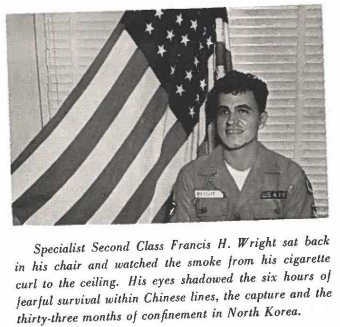
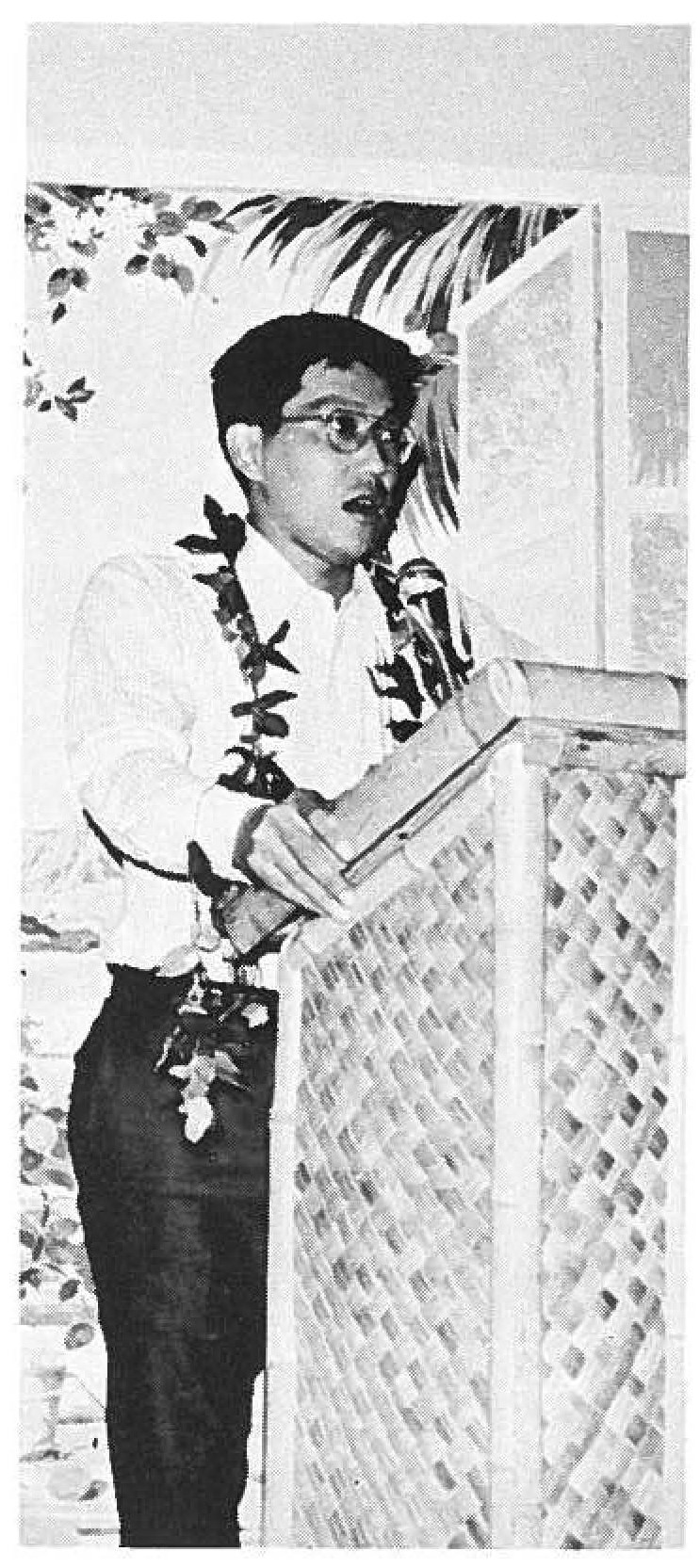
Specialist Second Class Francis H. Wright sat back in his chair and watched the smoke from his cigarette curl to the ceiling. His eyes shadowed the six hours of fearful survival within Chinese lines, the capture and the thirty-three months of confinement in North Korea.(Picture from the 1957 March The Hawaii Guardsman)
SP2 Francis H. Wright is a member of the 613th Ordnance Co. and stationed at Fort Ruger. He is employed by the USP&FO for Hawaii as a radio repairman. He is a 1949 graduate of Farrington High School where he played end on the football team. He is married to the former Helen Ng and resides at 2525 Myrtle St., Honolulu. He enlisted in the Hawaii National Guard in 1947 until 1949 when he enlisted in the Regular Army. After basic training at Ft. Ord, California and a utilities repair school in Virginia, he was ordered to Korea where he joined the 1st Cavalry Division in October 1950. One month later he was captured during the first onslaught of the Chinese Communist Forces in the vicinity of Unsan, North Korea. He wears the Combat Infantryman’s Badge, Korean Service Medal, the United Nations medal, the National Defense Service medal and the Republic of Korea Presidential Unit Citation. This is his story.
“Through the smoky haze, I could see bodies silhouetted against the sky, storming over the hill, passing amongst the lifeless forms of the dead. I shivered. I buried myself into the withered maze of bushes that cluttered my machine gun position. A long line of them appeared over the hill and in back of them more troops, pushing forward with victorious smiles, poking the bodies with their bayonets as they passed by. Only a few minutes ago the hill was alive with the sound of battle, machine guns muttered in the darkness, cries of pain besieged the cold night. Then, the utter stillness. Those that were still living had left the hill. The dead lay still, bothered only by the probing of bayonets. The Chinese soldiers, passed by me. I stood up and walked with them. The fires of battle had died down, leaving me a silhouette in the maze of shadows. One of the forms came up to me – I stiffened. He put out his hand and shook mine then walked on. Three soldiers walked up to me and one grabbed my rifle. I ran down the hill, tumbling, stumbling, rolling, pitching forward. A staccato of bullets spread overhead. I kept running. It became quiet again. If I could head south again I could reach the remnants of my unit. I crawled along the side of of the road. Up ahead a group of soldiers appeared. American troops I thought. I jumped onto the road and ran to one of them. Where are the Americans, I yelled. He looked at me, shrugged his shoulders, and with an indistinguishable reply beckoned me off. He was not American.”
“I had come into the army in 1949 after spending two years with the Hawaii National Guard. After a short stint in the States I was sent to Korea where I joined the 8th Cavalry Regiment in October 1950. Two weeks later near Unsan, North Korea, my company was in defensive positions preparing for an attack by Chinese forces. The attack started about six that evening (2 Nov). Masses of fanatical Reds attacked our positions, our artillery was knocked out, our machine guns were massed on line to keep the enemy back until we could withdraw to more suitable positions. Guns jammed, rifles misfired, the enemy mortar fire pounded us incessantly. The first few waves were pushed back, but the terrific pounding of mortar fire and the lack of ammunition told the story.”
“After I had left the soldier I had mistaken for an American I headed north to get around the Chinese positions then head south. I met another group of Chinese and one soldier hit me on my helmet with a shovel. l ran down the hill and stayed hidden for awhile. About two in the morning I moved out again. I wanted to get as far away from the Reds as possible before daybreak.
There was a corn field which my company had camped in the night before. I headed for it, crawling on my belly. The Reds had already taken the area and were resting in the field. I moved from cornstalk to cornstalk. One soldier spotted me. I stood up and walked natural. Nothing happened. I headed for the road and walked along the gulley. In front of me was a monstrous mountain. If I could get there I could follow the ridge line to our positions. But to get to the mountain I had to cross an open field of about 300 yards. I started crawling across the field when five or six of the Reds spotted me and yelled. They called to me to come back. I went. I was told to put my hands on the ground then I was searched. They let me keep some pictures and a can of chicken, but threw away my letters from home. I was taken to a Korean hut where an interpreter questioned me. He wanted to know how many troops we had. If I were an officer. I told him nothing. He didn’t wan’t war, he said, and he knew I didn’t. He wasn’t going to kill me he said. I said nothing.
From then on until we hit Camp 5 in Northern Korea, I was moved from hut to hut. Other Americans were picked up and moved with me. An American lay outside of one of the huts. His right leg was blown off to the knee. He wanted some water. I asked the Chinese if he could have some. They said no. He was going to die anyway. They finally relented and gave him some. They took me away and that was the last I saw of him.
We came to another enemy camp where there were about a hundred American prisoners and we were loaded on trucks to be moved north. Along the way we picked up more Americans. We were camped together so tight that there was no room to move. When it was possible to stretch, I couldn’t move my legs they were so stiff. Most of our traveling was done at night because of the daylight air raids and bombings by the UN planes.
Our first “home” was at a place called “Pleasant Valley” where we remained for a month. We would have stayed longer but for various incidents.
The Reds would get us into the assembly hall to join in singing songs – a regular community sing. One time, someone started singing the Star Spangled Banner and everyone stood up and joined in. The Reds tried to stop us but to no avail. After that, whenever we were told to sing songs, we sang the National Anthem. Once, we were being given an “indoctrination” class outdoors when we could hear another group in the auditorium singing the Star Spangled Banner so we all stood up and joined in.
It as just about then that the Reds decided to separate us, so part of the group was sent to Paktong where we stayed for a year, then another move to Changsong where I remained for the next two years.
Wherever we went, there was poor medical treatment. Because of the poor diet we existed on, many of the men died from dysentery and other filth diseases.
The worst time of the year was, of course during the winter months when the Korean weather stayed below zero for months. The meager wood that was allowed us didn’t compensate for the cold, so we used to steal wood. Even today, when I see a branch or a piece of wood on the ground, I want to pick it up and hide it; because that is exactly what we did. Of course if the guards spotted us picking up any of the wood, we would be given suitable punishment – standing at attention outdoors with arms extended to the front for an hour or so.
Towards the end of our imprisonment, we were getting rumors that the war was over. As days went by everyone grew excited and tense, however there was no official word, hut we could tell that things were happening because the attitude of our captors changed. We were getting better treatment and started to feel human again.
Then, one day, the International Red Cross came into our village. They brought us cigarettes, soap and toothpaste and even gave us a bottle of beer each the first I had tasted in three years!
The next day, the Chinese put us on trucks and took us to Kaesong which was just within the Red lines. We stayed there for two weeks, probably to fatten us up. But regardless of the good treatment we got there, nothing – nothing could erase our scars, the physical and mental beatings that we had taken at their hands.
From Kaesong we moved to Freedom Village, which was established as a prisoner exchange center. From there to the American camp! Ice Cream! Milk! Fresh bread! All the things we had been deprived of, things that I had earlier taken for granted, but thought I would never have again! After two years 9 months and 21 days of captivity I could go home!
The Vietnam War started Nov. 1, 1955 and ended with the fall of Saigon on April 30, 1975
Capt. Melvin K. Matsui
Capt. Melvin Kazuki Matsui was in the U.S. Air Force, born on May 22, 1945, in Hilo, Hawaiʻi. He served with the 4th Tactical Fighter Squadron, 366th Tactical Fighter Wing, at Takhli Air Base, Thailand, during the Vietnam War
Matsui spent the remainder of the war as a Prisoner of War in North Vietnam. Despite the brutal conditions, he adhered to the U.S. military’s Code of Conduct, demonstrating remarkable courage and professionalism. For his actions, he received the Bronze Star Medal with Combat “V” for his heroic behavior and the Prisoner of War Medal.
Matsui was released on March 29, 1973, after 236 days in captivity, as part of the broader POW repatriation effort. Following his return after 1974, he continued his service by joining the Hawaiʻi Air National Guard, as a Weapon Officer Roster who flew with the 199th Fighter Squadron 1976 – 1987 and ultimately commanding the 169th Aircraft Control and Warning Squadron 1994-1996. Melvin K. Matsui passed away on August 11, 2023.
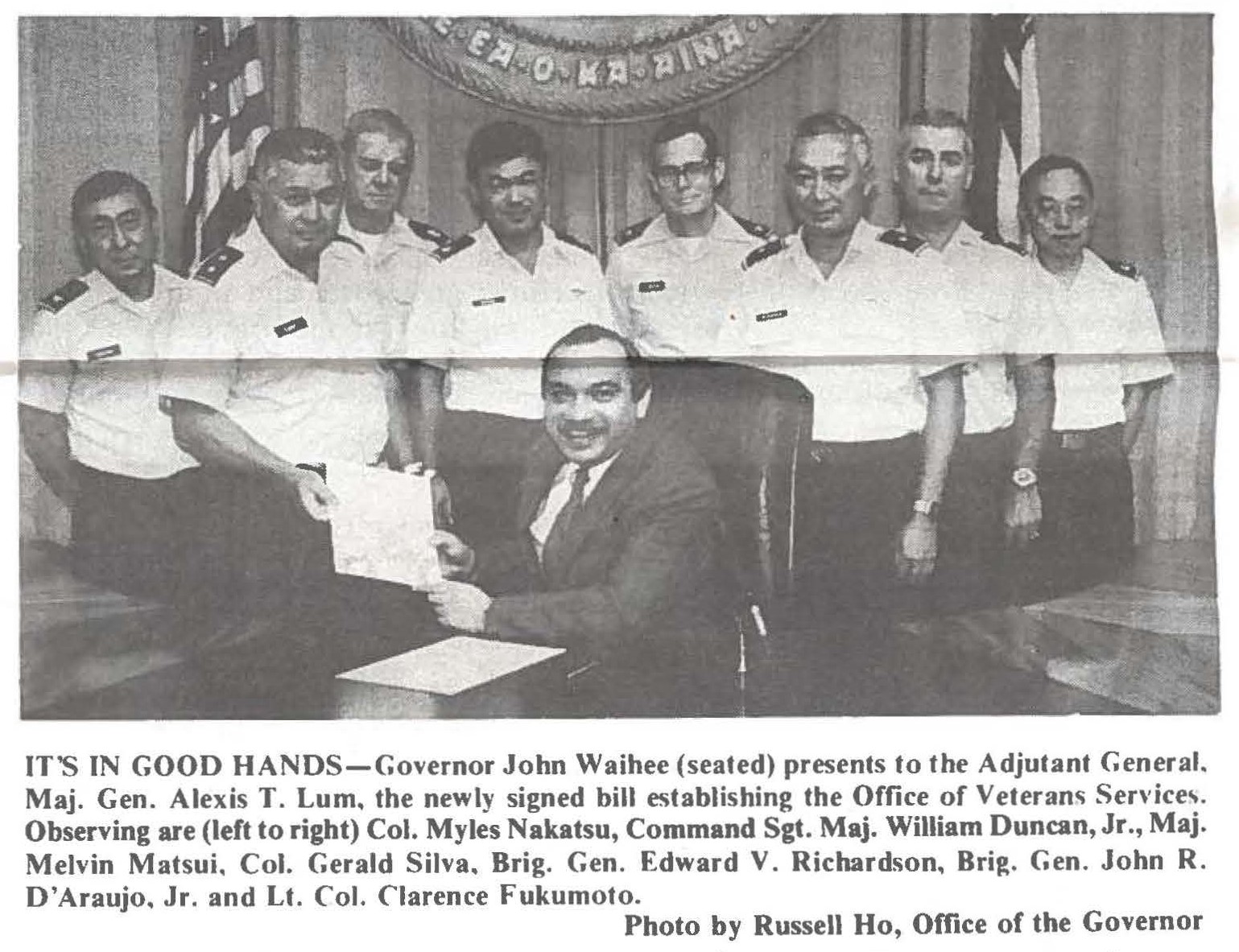
IT’S IN GOOD HANDS-Governor John Waihee (seated) presents to the Adjutant General. Maj. Gen. Alexis T. Lum, the newly signed bill establishing the Office of Veterans Service,. Observing are (left to right) Col. Myles Nakatsu, Command Sgt. Maj. William Duncan, Jr., Maj. Melvin Matsui. Col. Gerald Silva. Brig. Gen. Edward V. Richardson, Brig. Gen. John R. D’Araujo, Jr. and Lt. Col. Clarence Fukumoto. Photo by Russell Ho, Office of the Governor(Picture from the 1988 April – June Pūpūkahi)
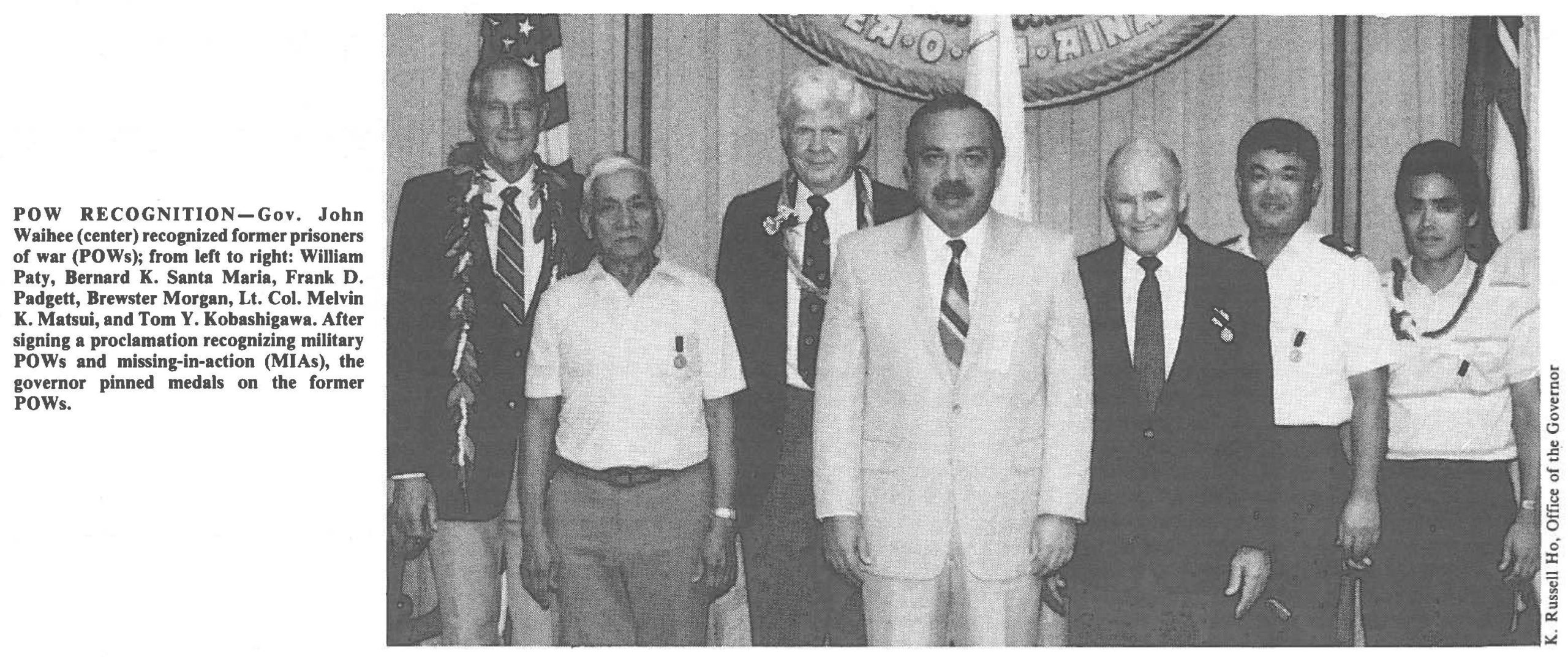
POW RECOGNITION-Gov. John Waihee (center) recognized former prisoners of war (POWs); from left to right: William Paty, Bernard K. Santa Maria, Frank D. Padgett, Brewster Morgan, Lt. Col. Melvin K. Matsui, and Tom Y. Kobashigawa. After signing a proclamation recognizing military POWs and missing-in-action (MIAs), the governor pinned medals on the former POWs. (Picture from the 1989 July – September Pūpūkahi)
COMMANDER’S COMMENTS
Our single biggest need right now is for the WSO-Weapons Systems Officer, to fly the back seat of the F-4C. There are a handful in Hawaii with experience, so the majority will have to be trained from scratch. Capt. Melvin Matsui former POW is a prospective member of the Air Guard, having flown as a WSO in Southeast Asia.
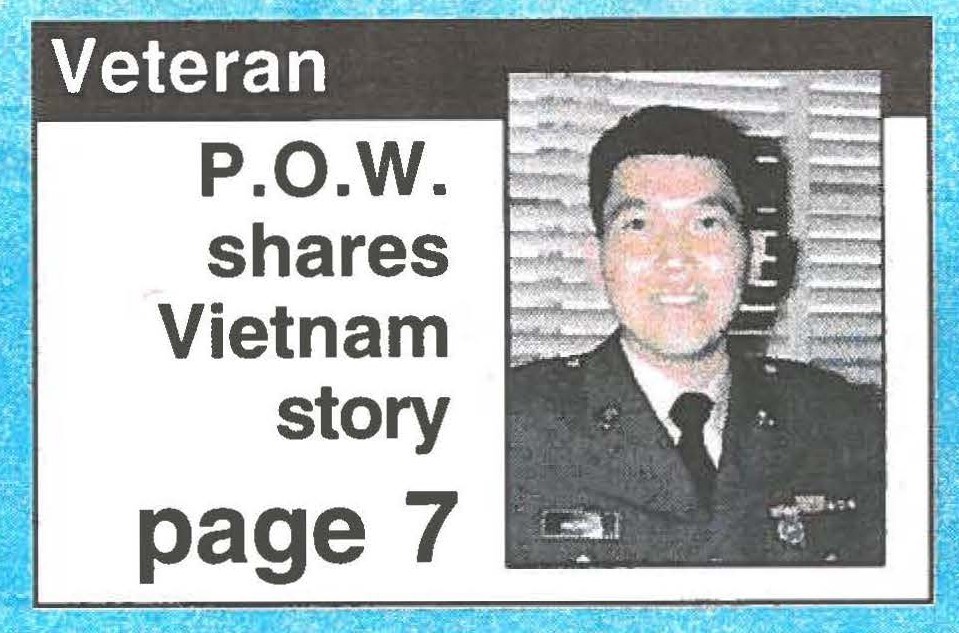
Spc. Six Thomas T. Horio, became a prisoner of war (POW) during the Vietnam War. After being activated in 1968, Horio was captured by the Viet Cong and spent nearly four years in captivity, mostly in the infamous “Hanoi Hilton.” During his imprisonment, he endured harsh conditions, including limited food, forced labor, and isolation from fellow prisoners. Despite the grim circumstances, Horio and his fellow POWs maintained hope, keeping faith in the Paris peace talks and supporting one another through communication and morale-boosting activities like exercising in secret.
Horio’s journey included a harrowing 350-mile trek to Hanoi, where he was hospitalized for malaria, and he spent Christmas 1969 in a prison camp called “The Plantation.” After more than three years in various camps, Horio was finally released in 1973 during Operation Homecoming. He then returned to Hawaiʻi, where he utilized his GI Bill benefits to complete his education and went on to work in medical technology and later with the IRS. Despite the trauma of his experiences, Horio maintained a positive outlook, attributing his mental survival to his Buddhist faith, exercise, and the support of his fellow POWs.
Former POW, Tom Horio honored by his 227th Engineers
Specialist 6 Thomas T. Horio, the only 29th Brigade member to become a prisoner of war during the Vietnam Conflict, was the guest of honor at a 227th Engineer Company reunion.
Specialist Horio, in a surprise address to the men and their families, said in part, “The POW’s have been looked upon as heroes. Thus people have forgotten about the soldiers who died in Southeast Asia; soldiers who came back disabled, soldiers who came back wounded and soldiers who went to Southeast Asia, did their job and were fortunate to come home safely.
“But all have suffered, by separation from their families, by having their lives endangered, by being put into a situation foreign to them.”
He also mentioned the courage of relatives of the men who served in Vietnam, then concluded by saying, “So who are the heroes of Vietnam or any war? They are the fighting men, but also all of you who suffered and continued to keep our great country intact while your sons and husband were away. You have my greatest respect – thank you.”
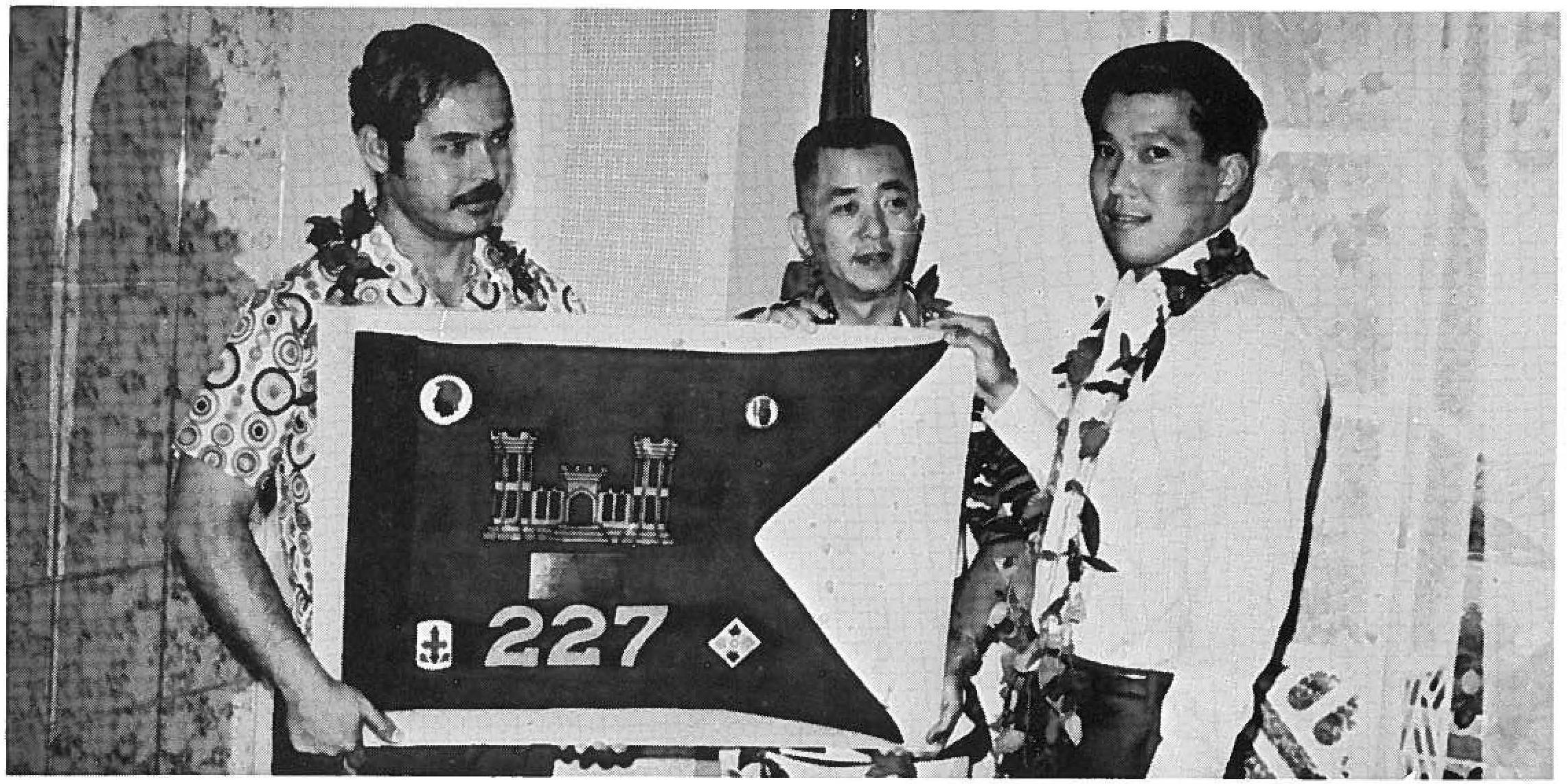
The company later presented the former POW with a coffee table decorated with the unit guidon and a series of shoulder patches representing the Engineer Company’s history.
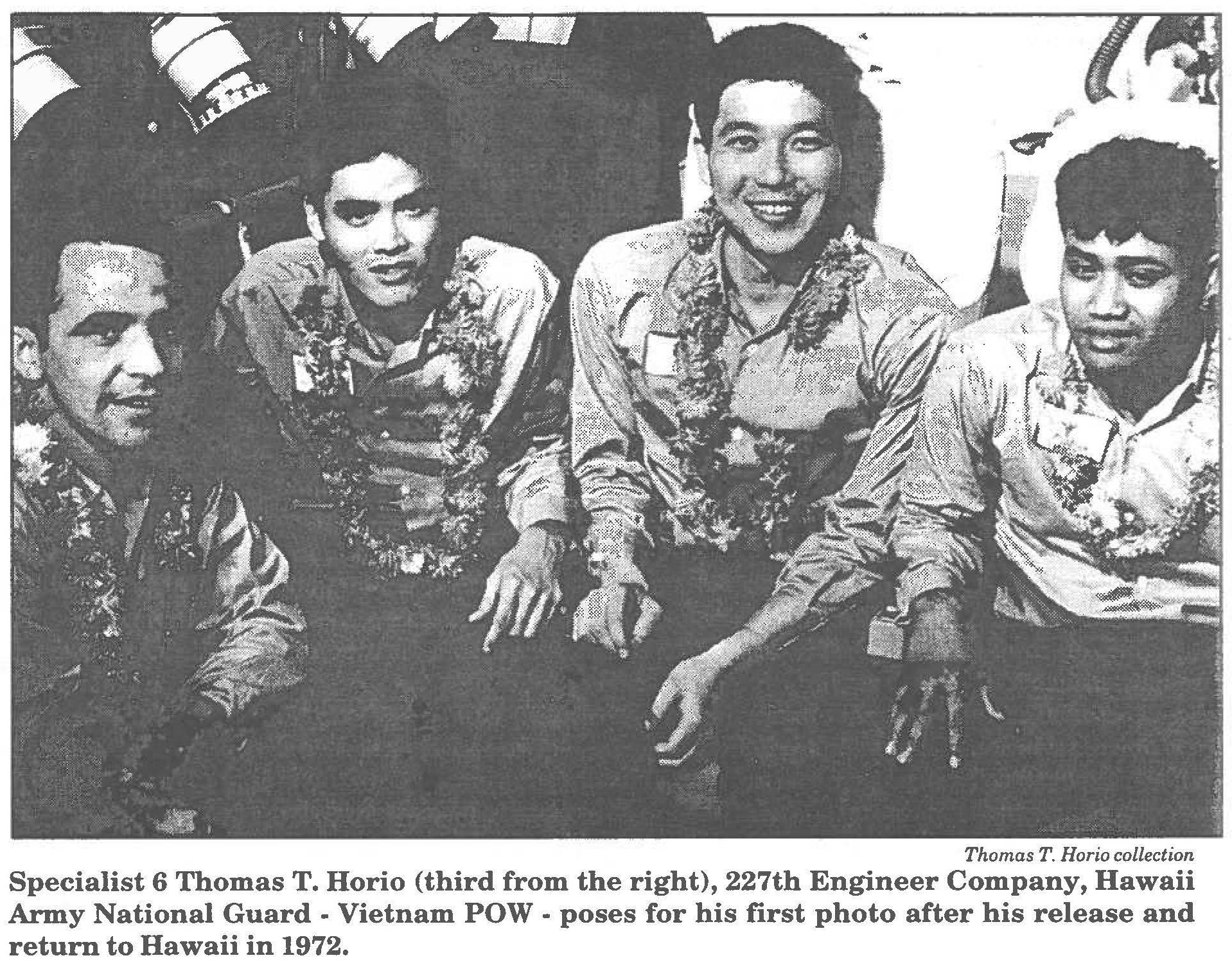
Specialist 6 Thomas T. Horio (third from the right), 227th Engineer Company, Hawaii Army National Guard – Vietnam POW – poses for his first photo after his release and return to Hawaii in 1972.Specialist 6 Thomas T. Horio shares Vietnam story page 7 (Pictures from the 1998 Winter Pūpūkahi)
Serving your country sometimes comes with a big price tag. For one member of the activated Hawaii Army National Guard, the price would be serving a nearly four-year tour of duty in the “Hanoi Hilton.”
Little did the Hawaii-born Thomas T. Horio know what the future would bring. The McKinley High School graduate enlisted in the Hawaii Guard in 1967. The Nuuanu raised soldier went on to attend Universities of New Mexico and Hawaii.
Carries on Guard legacy
Like his father, he joined the Hawaii Guard to serve his country. His father was a member of the Guard’s 299th Infantry Regiment of Maui and later, like most of the JapaneseAmericans, a member of the famed 100th Infantry Battalion during World War II. Horio, a member of the 227th Engineer Company, was activated along with 3,600 other 29th Infantry Brigade soldiers, May 13, 1968.
Imprisonment recalled
Shortly after arriving in Southeast Asia, Horio’s firebase guard post was overrun by the Viet Cong, and he was captured.
Instead of torturing us, the North Vietnamese forced us to read communist literature. We read it; it was the history about Cambodia when the French occupied FrenchIndochina and about Ho Chi Minh. For some reason, they left us alone after that.
At night, they would clamp our ankles in socks to prevent us from escaping. We were not allowed to exercise because the North Vietnamese wanted to keep us docile so we wouldn’t try to escape. But we maintained our sanity and kept the faith by exercising when the guards couldn’t see us. The only other thing we could do was pace and talk to each other. Our optimistic conversations always included discussions about what we were going to do when we got home.
We never lost faith. Our hopes for release hung on the success of the Paris peace talks that began on Jan. 18, 1969. The talks were still under way when Ho Chi Minh, Vietnam’s president for more than 30 years, died on Sept. 2, 1969.
Not long after Ho Chi Minh died, and after about five months in POW camps in Cambodia and Laos, we started on a month-and-a-half 350-mile trip to Hanoi,
One prisoner died, or was killed, enroute because he was too sick and frail to endure the journey.
The guy weighed about 200 pounds when he was captured; he got so skinny, you could pick him up with one arm. On the way to Hanoi, a guard escorted him down a trail, and we never saw him again. We think they killed him.
I fell ill during the journey, too, but luck was with me again. I contracted malaria and spent about a month in a North Vietnamese field hospital.
They made us carry all the food, and one day, I just passed out. All I remember was falling. The enemy soldiers showed compassion for me the rest of the way to Hanoi. I got to ride part of the way, and I arrived on Christmas eve 1969.
I joined the others in Hanoi at what American POWs dubbed “The Plantation”, about two miles from the infamous Hanoi Hilton. The Plantation was my home until I was moved to the Hanoi Hilton about seven months before being released in March 1973 during Operation HOMECOMING.
They stuck me in a room with six other enlisted guys. I had no idea of how many Americans were incarcerated in the camp. All I knew was the enlisted and officer prisoners were separated, and the officers were mostly pilots.
Camp food wasn’t very nourishing, bland, meatless, watery soup and a piece of bread twice a day. Summer brought a flavor change-pumpkin soup in the morning and pumpkin soup at night. There wasn’t any lunch. We prisoners got another flavor change at the end of summer – pumpkin soup with maggots.
On Christmas and the Vietnam Tet holidays, the communist captors were magnanimous. They treated us American captives to a half bottle of Vietnamese beer, candy and fruit. I traded my candy and fruit and got everybody’s beer, except for one guy, it was great!
Christmas 1972 was a hairraising, scary time for us. American bombs started falling and exploding around Hanoi. The North Vietnamese told us to dig foxholes through three-quarter-inch concrete floors in our cells.
We spent about a week-and-a-half trying to cut through the concrete with entrenching tools; they didn’t give us any picks or sledge hammers.
We went down about seven feet. We could hear the missiles all around us. Once we saw a B-52 U.S. bomber go down in flames. We were right in the city where the bombs were exploding, but none of them hit the POW camp area. I think they knew where we were.
Other than the bombings, the scariest time in my area was when a prisoner had frequent seizures. There wasn’t anything we could do. The doctor would come, but only gave him aspirin
A big morale boost came when the prisoners managed to steal enough metal wire and used it to fashion a crude communications system throughout the POW garrison. The garrisons were built by the French in rows like townhouses. The mortar in between the bricks were soft, so it wasn’t too hard to make holes through to the next room.
Every time we got information from Col. Guy (Air Force Col. Theodore W., the camp’s senior American prisoner and an F-4C pilot shot down in 1968), we’d relay it from room to room through the holes in the wall. We hid behind mosquito nets over our bunks when the guards came by at night.
The enlisted prisoners were given the task of emptying slop buckets for themselves and the officers. They learned to use the distasteful job to their benefit.
Col. Guyused toilet paper to put messages in the top of the lids, which gave us another way to communicate. I thought to myself, this can’t be true; this is like Hogan’s Heroes (the television comedy show about WWII POWs in Germany).
Meanwhile, the North Vietnamese were hell-bent on making the prisoners protest the war. They wanted us to write letters of protest to our congressmen and other dignitaries. They even offered to establish communications with our families if we protested the war. “We had to keep pretty tight to encourage each other not to fall for those kinds of things,” he said.
About five months before our release, the officer and enlisted prisoners were allowed to mingle and have recreation time together. Until then, we were only allowed to mingle with prisoners in our own rooms. One of the officers was a doctor who was shot down on a medical evacuation mission. He talked to the guys about their problems, but he didn’t have any medication.
The North Vietnamese anticipated the war would end and started feeding us more and gave us new clothes and shoes. They also let prisoners mingle and do recreation and exercise, but they guessed wrong. The peace pact wouldn’t be signed until Jan. 27, 1973. The four-year ordeal melted more than 40 pounds off of me. When I was captured, I weighed 190 pounds and had a 34-inch waist. It shrunk to less than 27 inches.
POW released
After our release, we spent three days being examined and debriefed at a hospital in the Philippines. I was then transferred to Tripler Army Medical Center.
When my escort officer in the Philippines asked me what was the one thing I wanted to eat, I said, ”beer and vanilla ice cream.”
”I chased the beer down with raw fish and clams,” with a chuckle. My escort officer attended my wedding when I married the former Phoebe Inabe of Maui, in 1974, and the first thing he did was give me a bowl of ice cream.
Returning to normalcy
Thomas wasted no time using his GI Bill benefits to finish his education. Discharged from the Army in April 1973, he returned to the University of Hawaii for summer school that June. He graduated with a bachelor’s degree in medical technology in 1976 and worked at Tripler Army Medical Center from September 1977 to January 1980. He accepted a job with the Internal Revenue Service and went to the mainland five years later.
A branch chief in the IRS’ Delaware/Maryland collection division in Landover, Md., Thomas quipped, “Now I’m licensed to take blood and money.”
The couple has two sons. Brant, 19, is a freshman at Virginia Polytechnic Institute and State University, Blacksburg, Va. Ross, 17, is a junior at Robinson Secondary School in Fairfax, Va.
Vietnam flashbacks
After attending a couple of POW reunions, Thomas decided to keep a low profile. “I try to forget some of the things that happened to me,” he said. “So I don’t go to many functions any more. The only one I keep in contact with is Nat Henry, the guy who had seizures in the camp. He lives in North Carolina. He was one of the five guys left after his unit was ambushed.”
Thomas’ luck is still holding. “I don’t have malaria relapses anymore. When I returned, they had developed a cure for the type of malaria I had.”
He said he also feels lucky because he doesn’t suffer flashbacks or any other severe, belated reactions to his captivity. “I attribute a lot of my mental survival to being a Buddhist,” he said. “Buddhism taught me to have peace of mind within myself. That, in combination with exercise, kept me going. I also have a personality where I don’t react emotionally to a lot of things. I’m more conservative.” If there was one word that helped, it would be ”faith, we never lost faith.”
Reference: Thomas T. Horio, American Forces Press Service by: Rudi Williams, Hawaii Army National Guard historical files, news articles and The Honolulu Advertiser.