Skip to Main Content

Hawaiʻi Guardsmen Who Were Olympians

February 9, 2026
Categories: 
HING History, People

Master Sgt. John Beaumont

(Jan. 7, 1924 – Sept.19, 2000)

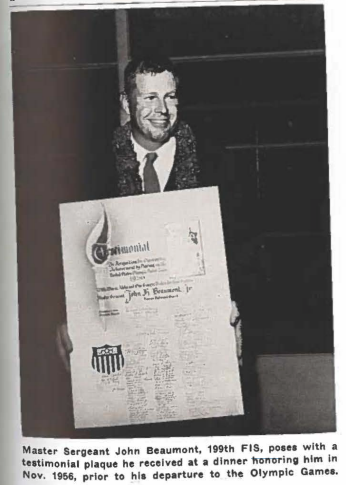
Beaumont was an American sports shooter. He competed in the 25 meter pistol event at the 1956 Summer Olympics in Melbourne, Australia and took seventh place against the best pistol shooters in the world.

Beaumont was the oldest Hawai’i National Guardsman Olympian at age 31 years. He joined the Hawaiʻi Air National Guard in early 1956 before being selected for the 1956 summer Olympic team.

Beaumont graduated from the Merchant Marine Academy and served during World War II. He rose to the rank of master sergeant in Hawaiʻi Air National Guard and later received a direct commission. Beaumont served for 30 years and retired in 1986 as a major.
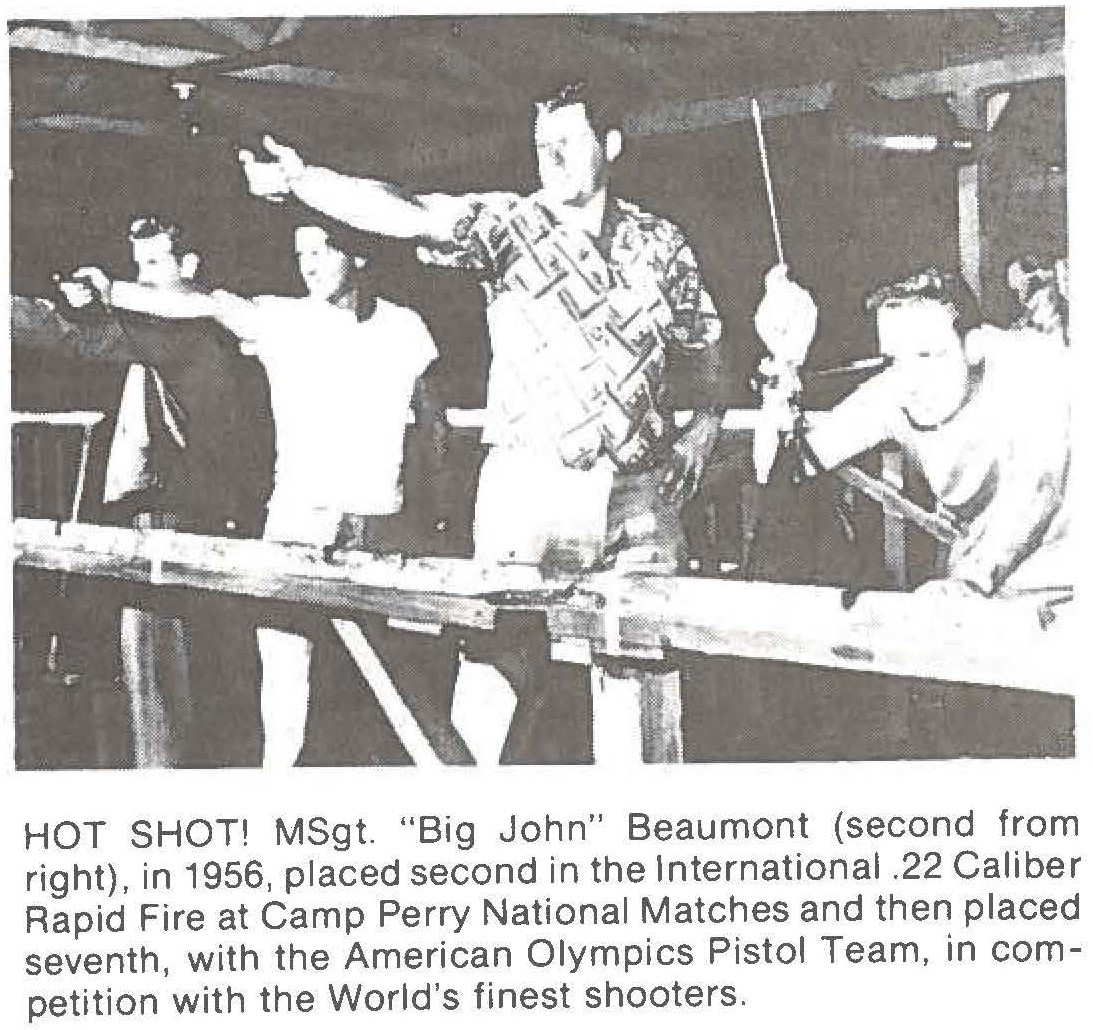
MSgt John H. Beaumont placed second in the international .22 Caliber Rapid Fire at the Camp Perry National Matches (1000 firers, he scored 1729 out of possible 2000). As a result of this high score, MSgt Beaumont won a berth on the American Olympics Pistol Team which competed in the Nov 1956 Olympics in Australia. He placed seventh in the Rapid Fire silhouette-in competition with the world’s finest shooters.

HANG 25 History of Hawaii Air National Guard pp. 30

Needless to say we are glad MSG “Little John” Beaumont is back for two reasons. first he had the distinction of being on the Olympic Team, and did really well; second, in his absence the Armament Section was getting out of line and needed his wee hand at the helm!

1957 March The Hawaii Guardsman pp. 18

Ready on the firing line

1956 OLYMPIC GAMES

by M/SGT. JoHN H. BEAUMONT, JR.
Guest Editor

To win a berth on the U. S. Olympic Shooting team is probably the greatest honor a shooter can receive in his life time. As in any sport luck plays a large part in the outcome, and luck seemed to be on my side.

The tryouts for the teams were held last September during the National Matches at Camp Perry. Three elimination matches were held to cut the 285 entrants down to 2. I was number 2.

Many weeks of practice and preparation followed. The team assembled Nov. 8 in Los Angeles where the uniforms and final instructions were issued. All our clothing and accessories were provided by the Olympic Committee. The team boarded a chartered PAA plane for the trip to Honolulu where they were met and entertained by the local shooters during a 36 hour rest stop. I joined the team here in Honolulu. We left for Australia via Cantor Island and Fiji on Nov. 10th.

Arrival at Melbourne gave us our first taste of Australian hospitality. We were met by thousands of autograph hunters and spectators. The Olympic Village where the 6,000 competitors and teams officials lived was constructed especially for the games with the intent of utilizing it for government housing at the completion of the games. We moved into a
3 bedroom house. I shared the kitchen with Joe Benner. Our house was a typical Australian home with only a fire place for heating and the toilet “out back”.

One of the most interesting things in Australia, from an American’s point of view, was the traffic. There were no boulevard stops at intersections. The car coming on the right had the right of way, therefore you need not look to the left at intersections, you just go. “U” turns were executed anytime and at any point. When changing lanes you just went ahead, the driver behind must look. out. All this is further complicated by driving on the left hand side of the road.

Shooting events in the Olympics are not considered a major sport. In Australia, pistol shooting had not been taken up as a sport because of the unfavorable gun laws, however a few shooters had started just because of the Olympics. Consequently the ranges were completed just before the games and were in good condition. All the ranges were situated near the ocean and had a “brisk” 20 to 30 knot sea breeze all the time.

We arrived early enough to be able to practice 3 weeks before the competitions began. During this time we became good friends with the shooters of the world. Most of them could speak English so we were able to swap ideas and information.

Most of the weapons used in the Rapid fire pistol event were Hammerliis and Berrettas. Very few American guns were used. As usual most were modified to suit the individual. The sights were painted different colors to suit the varying light conditions, some even used luminous plastic front sight blades. Black sights became the most popular after my carbide lamp started getting around. I finally sold it to an Argentine shooter. Our “yellow” shooting glasses caused much attraction.

The Slow Fire Free Pistol match was the first match fired. Joe Benner and Offet Pinion were the U. S. entries. Pinion placed 3rd for our only medal in shooting and Benner came in 13th. They fired on a very windy day and it was the first time I ever saw a coach “doping” wind for a pistol shooter.

The second event was the 300 meter Free Rifle event. The U.S. entries were Herb Volker, U.S.A. and Jim Smith U.S.M.C.R. They practiced 8 hours a day and placed 8th and 10th respectively in the match.

Both Smith and Volker felt that their guns and ammunition were not as good as some of the other competitors. The Russian shooters were outstanding. They placed 1st and 2nd. Their standing scores were 20 points better than the American boys.

The third event was the 50 meter free rifle match. Art Jackson and Verle Wright fired for the U.S. and placed 22nd and 24th the Canadians were outstanding in that both shooters used the same rifle in the time allowed for one shooter. They placed 1st and 3rd; the winner scored a possible 600.

The last event was the Rapid Fire Silhouette match in which John and I represented the USA. I placed 7th and Forman placed 13th. The only unusual pistol in the rapid fire was used by the Russians. It resembled a hacksaw frame in shape with the sights on the top of the frame the barrel 3 inches below the sights where the blade would be. The slide was upside down and ejection was down. The magazine clip was inserted in the top. The advantage of this design was that recoil was straight back instead of back and up

As competitors we had a special section in main cricket ground where track and field events were held. We saw all the events and quite excited when the U.S. won an event. the winner takes his place on the top step and the National Anthem of his country was played and the flag raised.

The Russian competitors seemed eager to be friendly and willing to talk. Theye were not allowed much freedom and were seldom seen in Melbourne or even around the Village. On the range they were eager to mingle with the other shooters but noticeably “clammed up” when their team officials were around.

The 1956 Olympics were the best in history. The management of the games and the whole-hearted support and friendliness from the Australian people made the games something to remember forever.

1957 March The Hawaii Guardsman pp. 30-31

Capt. Thomas Haine

(Jan. 6, 1933 – Sept. 10, 1994)

Thomas Allen “Tom” Haine was the captain of the 1968 Olympic volleyball team.

Haine was born in Minot N.D. and his family moved to Hawaiʻi as a youth and he graduated from Roosevelt High School in 1950. Haine didn’t go out for sports during high school, but at San Jose State University he was twice named an All American in swimming.

After graduating he joined the Air Force and served as a fighter pilot and later joined the Hawaiʻi Air National Guard. Haine flew F-102A Delta Daggers with the 199th Fighter Squadron as a Traditional Guardsman and was a banker in civilian life. He retired as a major.

Haine was a member of the All-America Volleyball team 18 times and won a silver medal at the Pan American Games in 1963 and a gold medal in 1967. He was elected captain of the 1968 Olympic Team. The team placed sixth, but had the distinction of being the only American squad to beat a Russian team in Olympic competition.

Haine was named Gold Masters Player of the Year in 1982 and received the U.S. Volleyball Association’s “All-Time Great Player Award” in 1990. He was inducted into the Volleyball Hall of Fame in 1991.
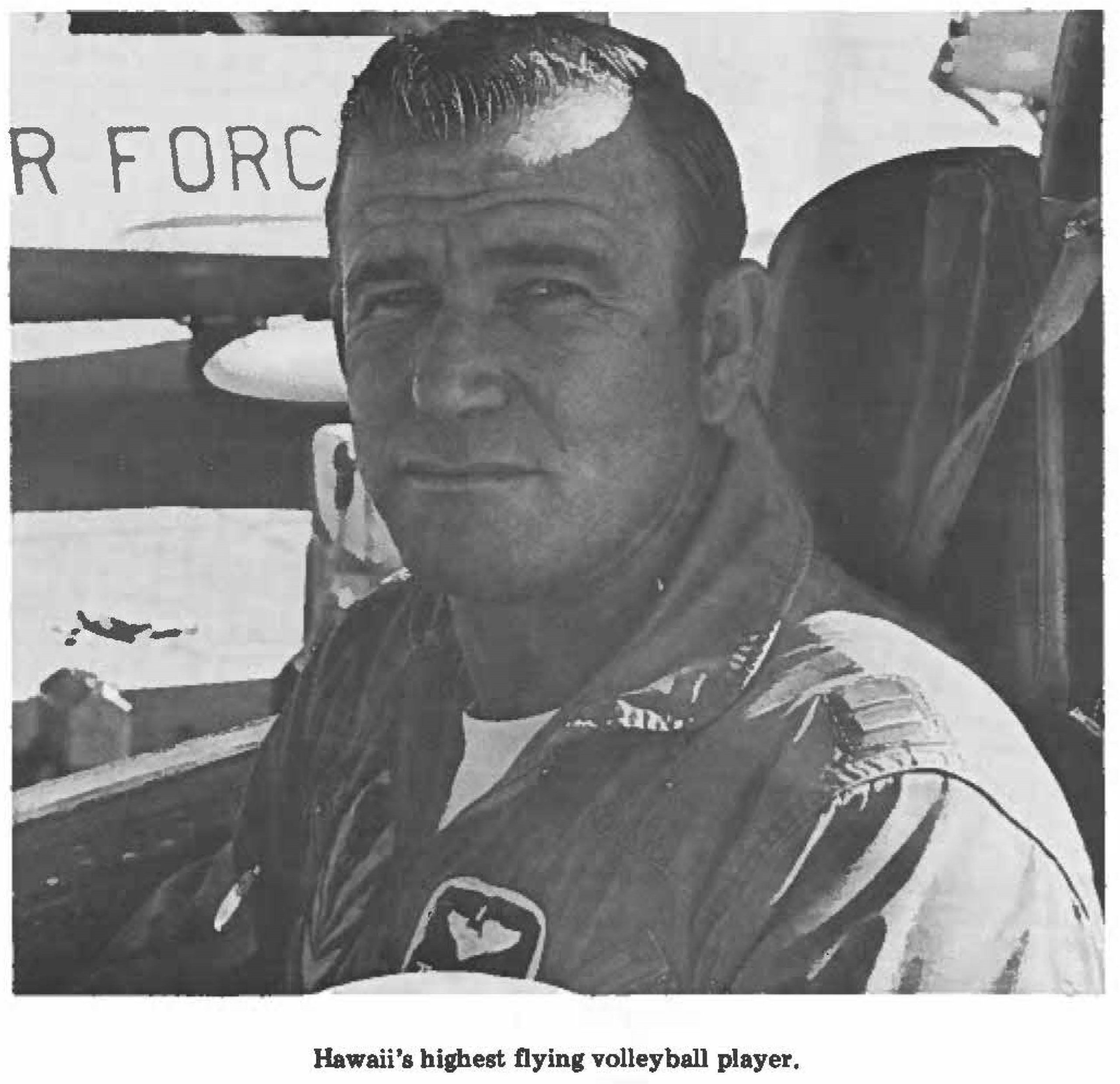
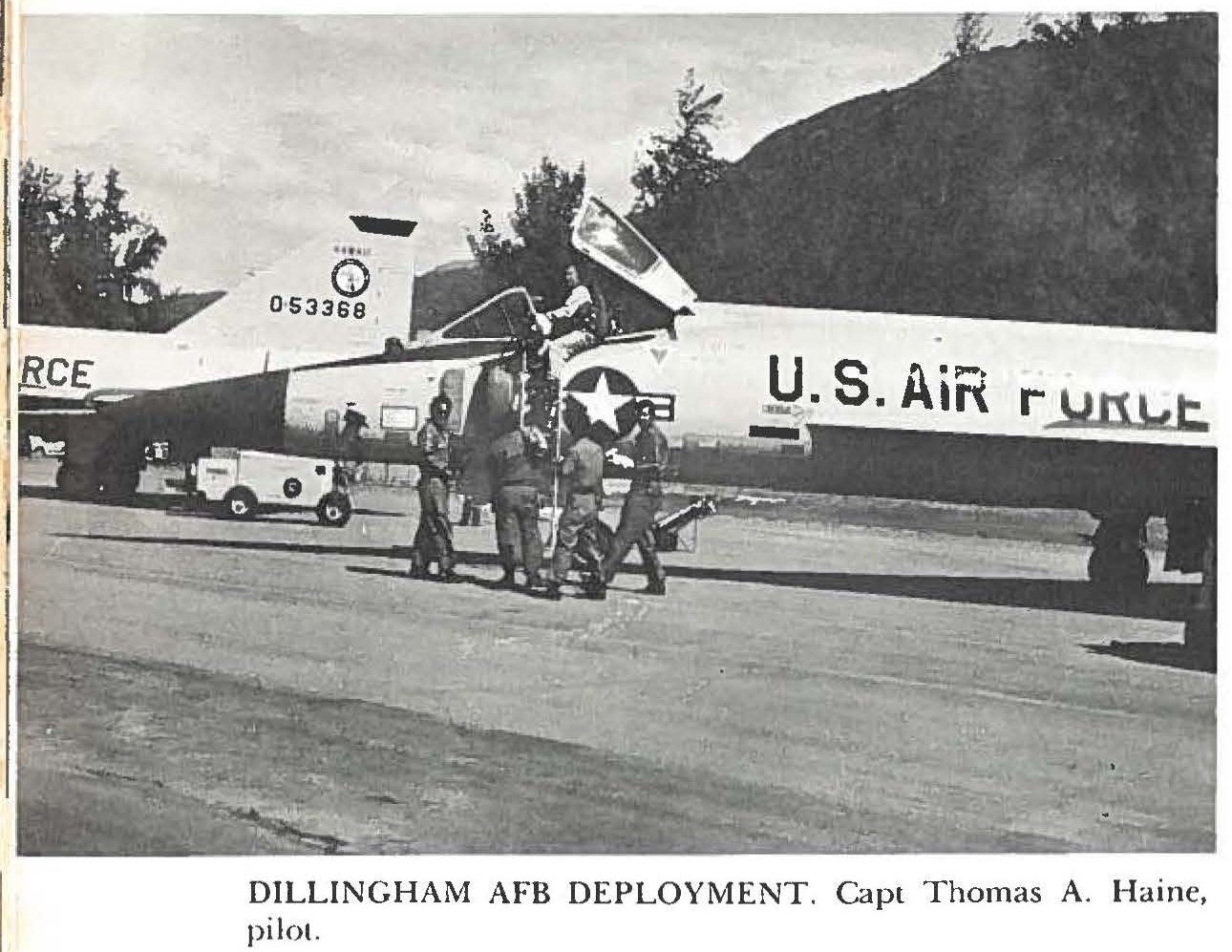
TALENTED TOM

Few organizations can claim as talented a member as the 199th Fighter Interceptor Squadron’s Captain Tom Haine.

Tom’s a man with impressive allAmerica and Olympia athletic credentials and he’s also a vice president and branch manager for the First Hawaiian Bank. During Guard sessions, Haine regularly pilots a single-seat, supersonic, allweather F-102 fighter jet for the Hawaii Air National Guard. In addition to all of this, Haine, 36, still has time for active participation in numerous community activities. And the Captain is also a devoted family man whose wife and two children have athletic champion too.

Let’s look for a moment at Raine’s background. In 1952 and 53, Haine was on the All America Swimming Team while attending Monterey Peninsula College. He also lettered in football, and basketball. Later, at San Jose State College, where he received his bachelor of art degree in 1955, Tom lettered in water polo.

He was on the All America Volleyball Team 11 times, the U.S. Men’s Volleyball Team for the 1963 Pan American Games held in San Paulo, Brazil, and the team that went to the 1967 Pan American Games in Winnepeg, Canada. In 1968, he was captain of the U.S. Olympic Volleyball Team that competed in the games at Mexico City. Currently, he’s the Hawaii State champion for men’s indoor and outdoor volleyball doubles. And he’s been the state champion TWELVE TIMES!

Haine joined the Hawaii Air Guard in early 1956, and graduated from Aviation Cadet Training in In 1958, he went to work forthe First Hawaiian Bank and he’s now a vice-president and the manager of the Waikiki branch. Tom’s also a vice president and member of the board of directors of the Outrigger Canoe Club.

Other Haine accomplishments included; receiving the 1969 Distinguished Salesman Award presented by the International Sales and Marketing Executives; volunteer work for the Red Cross, and the Aloha United Fund; and membership in the Punahou School P.T.A., and the Waikiki improvement Association.

In addition, Haine coached Punahou High School’s volleyball team last year despite the fact that he’s a Roosevelt High graduate. In 1962 he also conducted PACAF volleyball clinics in Japan, Korea and Okinawa.

Tom’s wife, Marilyn, is a former national finalist in girls swimming and is presently ranked second in the state in women’s doubles tennis. She’s also president of the Kapiolani Hospital Auxiliary and a member of the Junior League of Honolulu.

Haine’s son, Marc, was awarded second place in the Hawaii state surfing championships for boys age 10 and under. And Tom’s daughter, Kristin, is a standout on the Punahou Swimming Club.

Captain Tom Haine is one of those remarkable men who make up a remarkable organization.

1971 Spring The Hawaii Guardsman pp. 11

Capt Thomas A. Haine of the 199th FIS was Captain of the United States Volleyball Team that competed in the October 1968 Olympic Games at Mexico City

HANG 25 History of Hawaii Air National Guard pp. 54