Do you need help in another language? We will get you a free interpreter. Call 808-369-3580 to tell us which language you speak.
您需要其它語言嗎?如有需要,請致電 (808-369-3478), 我們會提供免費翻譯服務
您需要其它语言吗?如有需要,请致电 (808-369-3478), 我们会提供免费翻译服务
En mi niit alilis lon pwal eu kapas? Sipwe angei emon chon chiaku ngonuk ese kamo. Kokori (808-369-3478) omw kopwe ureni kich meni kapas ka ani.
Makemake `oe i kokua i pili kekahi `olelo o na `aina `e? Makemake la maua i ki`i `oe mea unuhi manuahi. E kelepona (808-369-3478)`oe ia la kaua a e ha`ina `oe ia la maua mea `olelo o na `aina `e.
Masapulyo kadi ti tulong iti sabali a pagsasao? Ikkandakayo iti libre nga paraipatarus. Awaganyo ti
(808-369-3478) tapno ibagayo kadakami no ania ti pagsasao nga ar-aramatenyo.
다른언어로 도움이 필요하십니까? 저희가 무료로 통역을 제공합니다. (808-369-3478)로 전화해서 사용하는 언어를 알려주십시요
Kwoj aikuij ke jiban kin juon bar kajin? Kim naj lewaj juon am dri ukok eo ejjelok wonen. Kirtok
(808-369-3478) im kwalok non kim kajin ta eo kwo melele im kenono kake.
E te mana'o mia se fesosoani i se isi gagana? Matou te fesosoani e ave atu fua se faaliliu upu mo oe. Vili mai i le numera lea (808-369-3478) pea e mana'o mia se fesosoani mo se faaliliu upu.
¿Necesita ayuda en otro idioma? Nosotros le ayudaremos a conseguir un intérprete gratuito. Llame al (808-369-3478) y diganos que idioma habla.
Kailangan ba ninyo ng tulong sa ibang lengguwahe? Ikukuha namin kayo ng libreng tagasalin. Tumawag sa (808-369-3478) para sabihin kung anong lengguwahe ang nais ninyong gamitin.
‘Okú ke fie maʻu tokoni ʻi ha lea fakafonua ʻe taha? Temau kumi haʻo taha fakatonulea taʻetotongi. Telefoni ki he (808-369-3478) ke fakahā mai ʻa e lea fakafonua ʻokú ke lea aí.
Bạn có cần giúp đỡ bằng ngôn ngữ khác không ? Chúng tôi se yêu cầu một người thông dịch viên miễn phí cho bạn. Gọi (808-369-3478)nói cho chúng tôi biết bạn dùng ngôn ngữ nào
Gakinahanglan ka ba ug tabang sa imong pinulongan? Amo kang mahatagan ug libre nga maghuhubad. Tawag sa (808-369-3478) aron magpahibalo kung unsa ang imong sinulti-han.
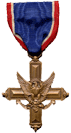
The Distinguished Service Cross is the second highest military decoration that can be awarded to a member of the United States Army (and previously, the United States Army Air Forces). It is awarded for extraordinary heroism:
While engaged in action against an enemy of the United States;
While engaged in military operations involving conflict with an opposing foreign force; or
While serving with friendly foreign forces engaged in an armed conflict against an opposing armed force in which the United States is not a belligerent party.
Actions that merit the Distinguished Service Cross must be of such a high degree that they are above those required for all other U.S. combat decorations but do not merit award of the Medal of Honor. The Distinguished Service Cross is equivalent to the Navy Cross (Navy and Marine Corps, and Coast Guard when operating under the authority of the Department of the Navy) and the Air Force Cross (Air Force).
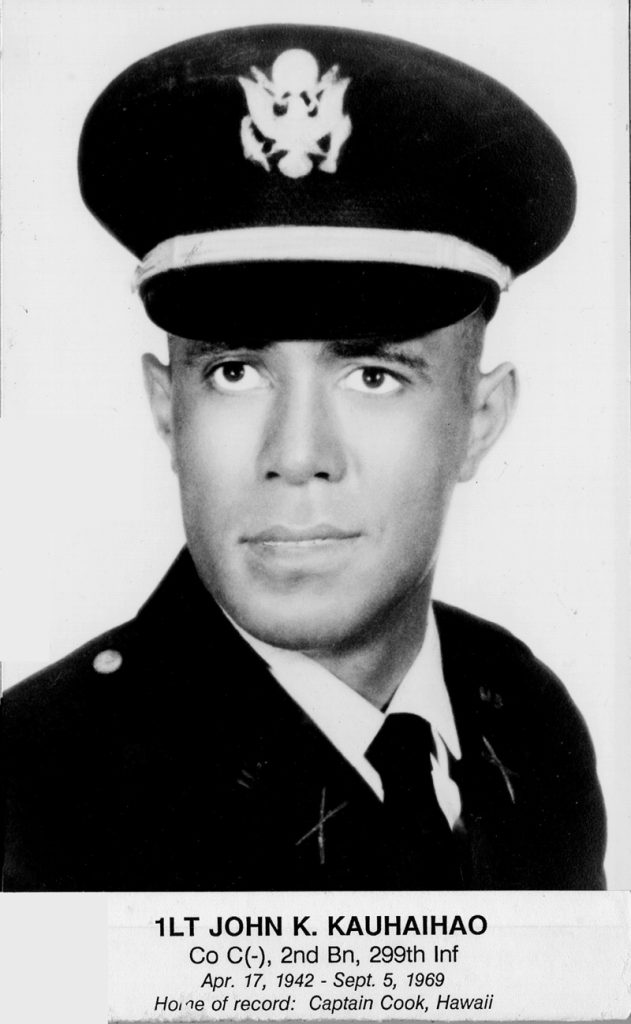
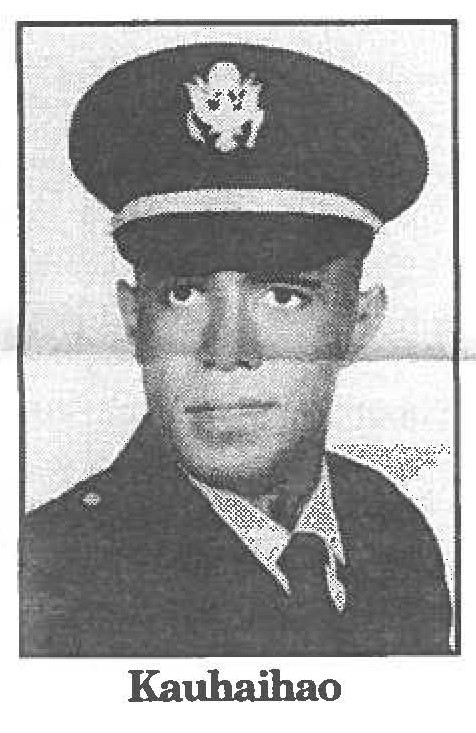
1st Lt. John K. Kauhaihao, 27, was born in Honaunau / Capt. Cook, Hawaiʻi on April 17, 1942. He enlisted in the Hawaiʻi Army National Guard as an infantryman with Company C (-), 2nd Battalion, 299th Infantry. His parent unit, the 29th Infantry Brigade was mobilized May 13, 1968. Kauhaihao was levied to Company B, 2nd Battalion, 8th Cavalry, 1st Cavalry Division, U.S. Army Vietnam, on May 22, 1969 and was killed in action less than four months later, on Sept. 5. He died of multiple fragmentation wounds in Tay Ninh Province, South Vietnam.
Kauhaihao awards include the Distinguished Service Cross, Purple Heart, National Defense Service Medal, Combat Infantry Badge, Vietnam Service Medal with Bronze Service Star Republic of Vietnam Campaign Medal.
Citation The President of the United States of America, authorized by Act of Congress, July 9, 1918 (amended by act of July 25, 1963), takes pride in presenting the Distinguished Service Cross (Posthumously) to First Lieutenant (Infantry) John Kuulei Kauhaihao, United States Army, for extraordinary heroism in connection with military operations involving conflict with an armed hostile force in the Republic of Vietnam, while serving with Company B, 2d Battalion, 8th Cavalry, 1st Cavalry Division (Airmobile).
First Lieutenant Kauhaihao distinguished himself during a reconnaissance-in-force operation in Tay Ninh Province. He was leading his platoon over thick jungle terrain at the point of their company when they were fired upon by a battalion-size force of North Vietnamese regulars occupying bunker fortifications. Lieutenant Kauhaihao quickly directed his men to cover behind several large, bamboo covered dirt mounds. As the rest of the company moved up to lend supporting fire to the pinned down point element, they were caught in a crossfire from flanking enemy bunkers. Seizing upon a momentary lull in the exchange of fire, Lieutenant Kauhaihao then hacked an opening through the bamboo growing over the dirt mound behind which he took cover. In the next fifteen minutes, he hurled more than thirty hand grenades through this opening at the enemy bunkers. In so doing, Lieutenant Kauhaihao drew enemy fire on himself again and again so that his men could sight enemy gunners and bring them under suppressive fire. Lieutenant Kauhaihao then directed the withdrawal of his battered point element. Crawling over a hundred meters of fire-swept terrain, he dragged vital equipment to the rear and helped wounded soldiers to a position of safety. While rejoining his men to the company’s main force, Lieutenant Kauhaihao sighted an enemy squad moving up on his tattered platoon. As he advanced to engage the approaching enemy, Lieutenant Kauhaihao was mortally wounded by enemy fire. First Lieutenant Kauhaihao’s extraordinary heroism and devotion to duty, at the cost of his life, were in keeping with the highest traditions of the military service and reflect great credit upon himself, his unit, and the United States Army.
A SPECIAL SORT OF MAN
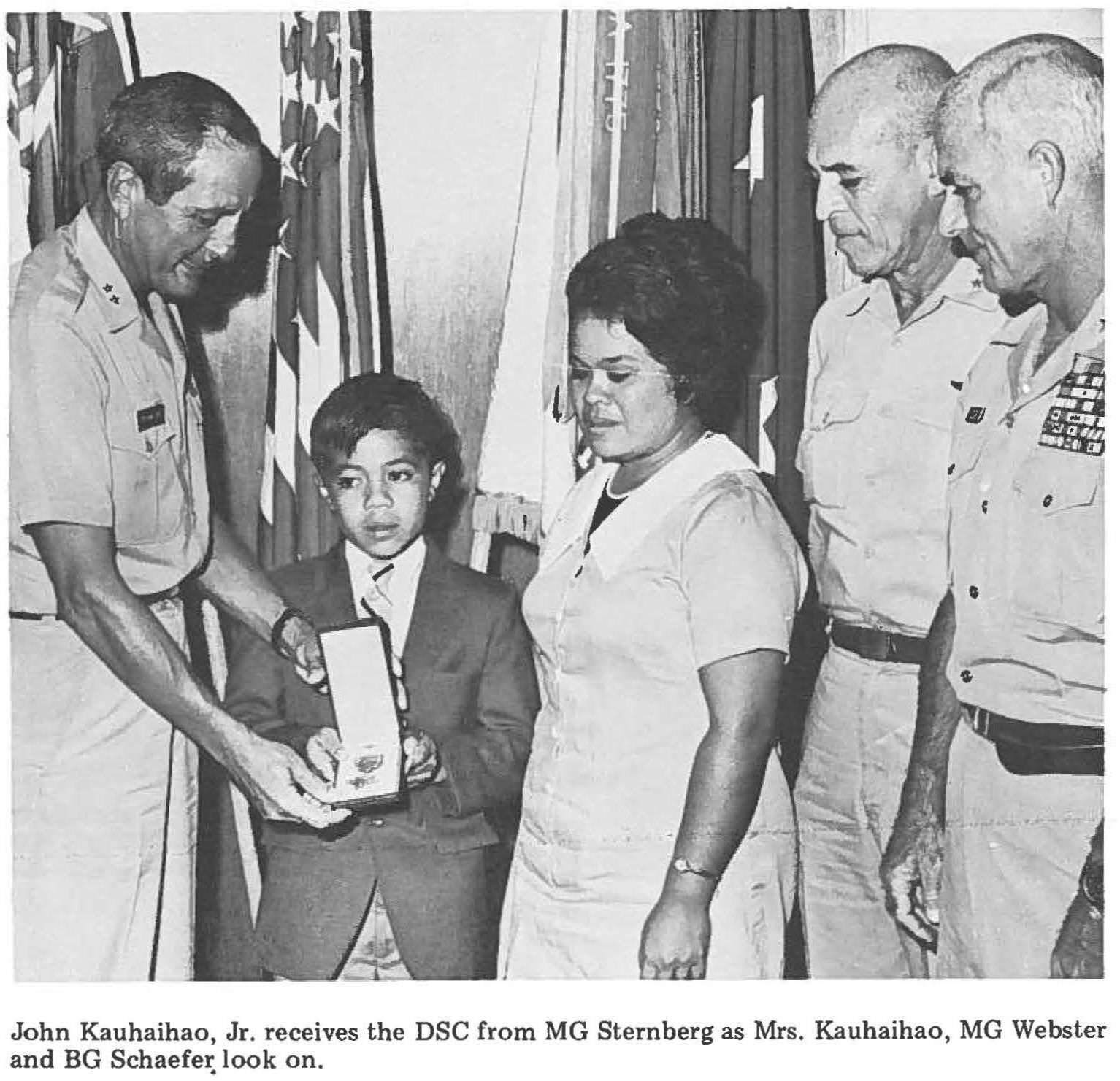
John Kauhaihao, Jr. receives the DSC from MG Sternberg as Mrs. Kauhaihao, MG Webster and BG Schaefer look on. (Picture from the 1970 Winter The Hawaii Guardsman)
Lieutenant John K. Kauhihao was a special sort of man. He spent most of his life on the Kana Coast of Hawaii, going to school, making a living, raising a family, and fishing when he wanted to relax and think. John died in Vietnam last year in a final effort that won him the Distinguished Service Cross, the nation’s second highest combat award.
His handwritten autobiography in the OCS files sketches a man of quiet strength and determination, who was devoted to his wife and four children. There are other letters in the file with the autobiography-letters of recommendation from his clergyman, a family friend, and one from his company commander in Kana. Descriptive phrases recur in the letters, “learns quickly,” “well coordinated,” “has a great deal of strength and stamina.” A sheaf of colored forms adds more to the picture of John’s character. His OCS classmates thought of him as fair, enthusiastic, cooperative, and a man who was always ready to help someone else. The staff at OCS concurred, and John Kauhaihao was selected to receive both the Hawaii National Guard Association and the Association of the United States Army awards for leadership.
The awards were presented on Friday, May 10, 1968. A short while later, his unit was activated. John was eventually reassigned to an infantry company of the First Cavalry Division.
On Friday, September 5, 1969, he was briefed by his OCS classmate, Lieutenant Zenon Wong, prior to a reconnaissance patrol near Tay Ninh. Later, during that mission, in the dense jungle, the patrol was fired upon by a battalion-size force of North Vietnamese regulars occupying bunker fortifications.
After John had directed his men to cover behind large bamboo covered dirt mounds, the rest of the company moved up to lend support fire to the pinned down element, only to be caught m a crossfire from flanking enemy bunkers. Seizing upon a momentary lull in the exchange of fire, Lieutenant Kauhaihao hacked an opening through the bamboo growing over the dirt mound behind which he had taken cover. During the next 15 minutes, he hurled more than 30 hand grenades at the enemy bunkers, drawing enemy fire on himself again and again so that his men could sight the enemy gunners and bring them under suppressive fire.
Lieutenant Kauhaihao then directed the withdrawal of his battered point element, crawling over a hundred meters of fire-swept terrain to drag vital equipment to the rear and helping wounded soldiers to positions of safety.
Later, as he and his men moved to rejoin the company’s main force, John sighted an enemy squad moving up on them. He engaged the approaching enemy and was mortally wounded by their fire.
For his extraordinary heroism, which cost him his life, Lieutenant Kauhaihao was awarded the Distinguished Service Cross.
Shirley Ann Kauhaihao, John’s wife, and John Jr, one of the four children, recently received the award from Major General Ben Sternberg, Commanding General of USARHAW.
John Kauhaihao lived for 27 years. His life was shaped by his personal choices. He chose to join the National Guard. He chose to become an officer, and he chose to perform some difficult tasks as a leader. John was one of those special men whose service in uniform make the wearing of that uniform a very special privilege for the rest of us.
By Sgt. 1st Class Aaron R. Pollick Historical Section
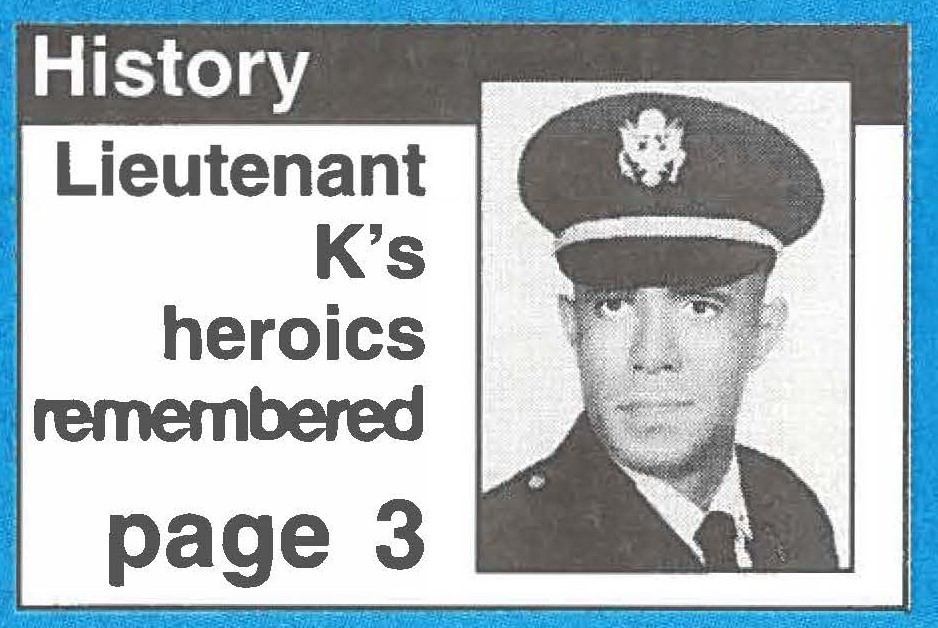
First Lt. John Kuulei KauhaihaoLieutenant K’s heroics remembered page 3(Picture from the 1998 February – March Pūpūkahi)
Lieutenant K. That’s what his men called him in Vietnam. They couldn’t pronounce his name so they nicknamed him ”Lieutenant K.”
First Lt. John Kuulei Kauhaihao, born and raised on the Kona coast of the Big Island, did what most local boys would do, went to school, made a living, raised a family and like most loved to fish. A devoted husband and father of four, John was a person who learned quickly, was athletic and had a great deal of strength and stamina said his family friends.
Hawaii Army National Guard Officer Candidate School, Class 06-68 classmates thought of him as fair, enthusiastic and cooperative. He was a man who was always willing to help someone else. Kauhaihao, a member of the Hawaii Guard’s Company C, 2nd Battalion, 299th Infantry out of Honokaa, was commissioned just two months after the call-up on May 13, 1968. Just a little over a year later, John was reassigned with Company B, 2nd Battalion, 8th Cavalry, of the 1st Cavalry Division.
“The Mission”
Lieutenant K’s story of heroism began Sept. 5, 1969. Kauhaihao was briefed by his OCS classmate 2nd Lt. Zenon K. Wong prior to his a reconnaissance patrol near Tay Ninh, South Vietnam. He was advised that there were unknown numbers of enemy bunkers hidden in his sector of patrol. His mission: to seek and destroy the bunkers. He was willing and ready.
Kauhaihao preferred hand grenades to rifle fighting and favored fragmentation grenades. At least 30 were fixed on and over his gear and clothing, so many that it looked like armor.
Lieutenant K’s search for the enemy bunkers was relatively short. He and 25 men from his platoon found a strand of blue communication wire in the scrub brush. They carefully traced the wire to its source. Then the battle began.
Fire erupted savagely from a bunker complex on the platoon’s flank. It was instantly clear that the Gls wereout numbered and they could only drop for cover. Kauhaihao’s cover was a mound of dirt. He knew his platoon was caught in a crossfire put down by a large North Vietnam force in thick jungle terrain. Recognizing his unit’s precarious position, he hacked an opening through the bamboo growing over the dirt mound and began a one-man war. In the next 15 minutes he threw 30 hand grenades. When his own supply dwindled, his men tossed theirs up to him. The lieutenant kept grabbing and tossing. Minute after minute until the battleground was littered with enemy dead, he drew fire upon himself again and again so that his men could sight the enemy gunners and bring them under suppressive fire. Kauhaihao then directed the withdrawal of his men and crawled more than 100 meters over fire-swept terrain to drag vital equipment to the rear and help wounded soldiers to a position of safety.
Later, as he and his men moved to rejoin the company’s main force, Kauhaihao sighted an enemy squad moving toward his platoon. He advanced toward them, opened fire, and was mortally wounded by their fire. It was said that after the battle a newspaperman heard of John K. Kauhaihao and wanted to do a story on him. The men eyed the newsman curiously. “Oh, you mean Lieutenant K. Listen man, you know, he saved our lives out there. Just say he was the greatest; that’s all, the greatest.”
Recognition
For his extraordinary heroism, Kauhaihao was posthumously awarded the Distinguished Service Cross, the highest award for valor to be given to anyone called up with the 29th Infantry Brigade.
Mrs. Shirley Kauhaihao and her four children also received a Bronze Star medal with one Oak Leaf Cluster for heroism, earned by her husband in an earlier engagement, as well as the Air Medal, Purple Heart and seven other awards.
Editor’s notes: Story based on materials gathered from the Honolulu Star-Bulletin, Hawaii Army National Guard records and the Hawaii Guardsman (Guard’s historical publication from 1950 to 1973, prior to the pupukahi).
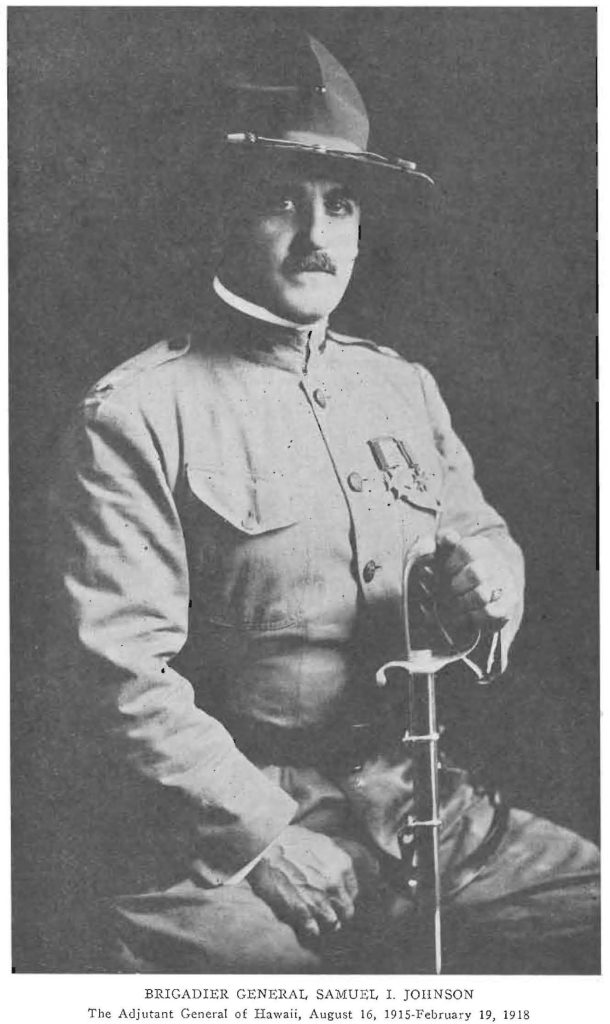
Brig. Gen. Samuel Johnson was born in the Cossack province of Odessa, Russia. His military career included three years in the Cossack cavalry, a year in the Russian Imperial Navy and a year in the Argentinean Army before coming to Hawaiʻi in 1892. By May 1893, Johnson enlisted as a full-time member of the National Guard. He played an active role in the overthrow and rose from private to Brigadier General in his 25-year career with the National Guard of Hawaiʻi. Prior to Johnson appointment by Gov. Lucius E. Pinkham as Adjutant General he was the 1st Regiment Commander. During his short Adjutant General tour, he oversaw the increase of the Hawaiʻi Guard from one to four regiments, comprising nearly 5,000 men. Johnson resigned to accept an appointment as major in U.S. Army to serve in World War I. He earned a Distinguished Service Cross.
The President of the United States of America, authorized by Act of Congress, July 9, 1918, takes pleasure in presenting the Distinguished Service Cross to Major (Infantry) Samuel Ignatieff Johnson, United States Army, for extraordinary heroism while serving with 27th Infantry, 33d Division, A.E.F. (Siberia), in action at Vladivostok, Siberia, on the night of November 17 – 18, 1919. On three successive occasions Major Johnson went through a zone swept by intense fire of contending factions to the railroad station and brought out noncombatants through the continuous fire from rifles and machine guns.