Do you need help in another language? We will get you a free interpreter. Call 808-369-3580 to tell us which language you speak.
您需要其它語言嗎?如有需要,請致電 (808-369-3478), 我們會提供免費翻譯服務
您需要其它语言吗?如有需要,请致电 (808-369-3478), 我们会提供免费翻译服务
En mi niit alilis lon pwal eu kapas? Sipwe angei emon chon chiaku ngonuk ese kamo. Kokori (808-369-3478) omw kopwe ureni kich meni kapas ka ani.
Makemake `oe i kokua i pili kekahi `olelo o na `aina `e? Makemake la maua i ki`i `oe mea unuhi manuahi. E kelepona (808-369-3478)`oe ia la kaua a e ha`ina `oe ia la maua mea `olelo o na `aina `e.
Masapulyo kadi ti tulong iti sabali a pagsasao? Ikkandakayo iti libre nga paraipatarus. Awaganyo ti
(808-369-3478) tapno ibagayo kadakami no ania ti pagsasao nga ar-aramatenyo.
다른언어로 도움이 필요하십니까? 저희가 무료로 통역을 제공합니다. (808-369-3478)로 전화해서 사용하는 언어를 알려주십시요
Kwoj aikuij ke jiban kin juon bar kajin? Kim naj lewaj juon am dri ukok eo ejjelok wonen. Kirtok
(808-369-3478) im kwalok non kim kajin ta eo kwo melele im kenono kake.
E te mana'o mia se fesosoani i se isi gagana? Matou te fesosoani e ave atu fua se faaliliu upu mo oe. Vili mai i le numera lea (808-369-3478) pea e mana'o mia se fesosoani mo se faaliliu upu.
¿Necesita ayuda en otro idioma? Nosotros le ayudaremos a conseguir un intérprete gratuito. Llame al (808-369-3478) y diganos que idioma habla.
Kailangan ba ninyo ng tulong sa ibang lengguwahe? Ikukuha namin kayo ng libreng tagasalin. Tumawag sa (808-369-3478) para sabihin kung anong lengguwahe ang nais ninyong gamitin.
‘Okú ke fie maʻu tokoni ʻi ha lea fakafonua ʻe taha? Temau kumi haʻo taha fakatonulea taʻetotongi. Telefoni ki he (808-369-3478) ke fakahā mai ʻa e lea fakafonua ʻokú ke lea aí.
Bạn có cần giúp đỡ bằng ngôn ngữ khác không ? Chúng tôi se yêu cầu một người thông dịch viên miễn phí cho bạn. Gọi (808-369-3478)nói cho chúng tôi biết bạn dùng ngôn ngữ nào
Gakinahanglan ka ba ug tabang sa imong pinulongan? Amo kang mahatagan ug libre nga maghuhubad. Tawag sa (808-369-3478) aron magpahibalo kung unsa ang imong sinulti-han.
A cadre of experienced pilot officers and airmen specialists as formed from the 199th and the 109th and organization of the new squadron was scheduled for 1 July 1953. The mission of the 8199th RT Sq is to train pilots and ground crews to fill vacancies occurring in the 199 th Ftr Sq and to provide a pool of trained manpower for use by the Air Force in an emergency.
There were two major additions to the Hawaii National Guard during the fiscal year. The first was the organization of the 8199th Replacement Training Squadron on 1 July 1953 at Hickam Air Force Base. The squadron is authorized 25 officers and 75 airmen and its mission is to train its personnel as combat crews and to provide technical support for a fighter interceptor squadron
By arrangements with Fleet Marine Force Pacific, the latter base was used for training the flying eJements of the Hawaii Air National Guard. The reason for this was the fact that intensive flying operatiom with jet aircraft constituted a serious hazard in the Honolulu Airport-Hickam AFB area with its heavy commercial and military transport traffic. It was felt that more benefit would be derived from the training period if it were scheduled at Kaneohe, which was in operation as a jet base and was free from interfering traffic. The cooperation and assistance extended by the Marine Air Group stationed there contributed greatly to the success of the training. The training program centered around the flying operations which consisted of transi tion training in T-33 and F-86 aircraft, formation flying in F-86’s, familiarization aerial gunnery missions, and ground controlled intercept missions in conjunction with the 109th AC&W Squadron.
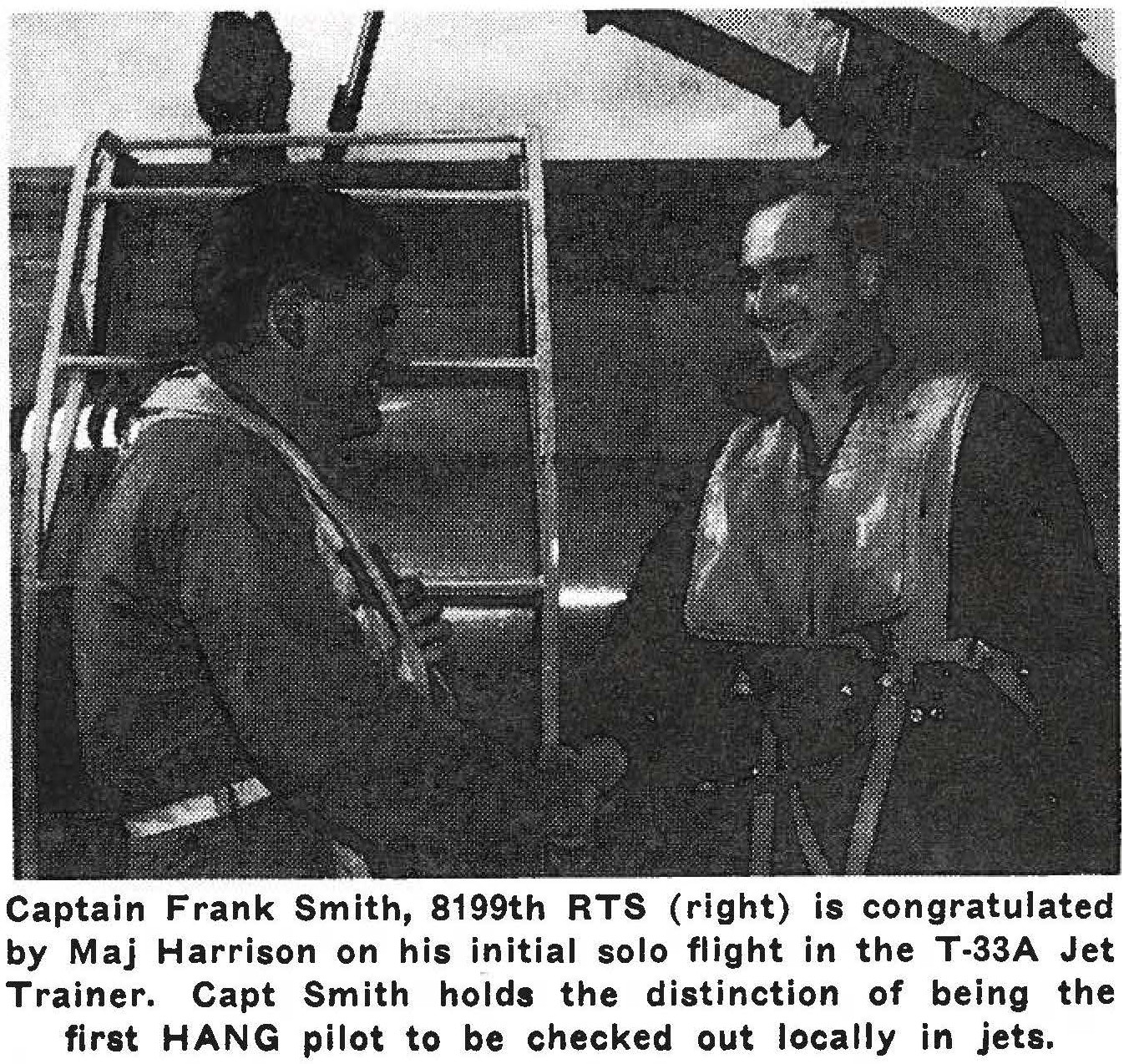
Captain Frank Smith, 8199th RTS (right) is congratulated by Maj Harrison on his initial solo flight in the T-33A Jet Trainer. Capt Smith holds the distinction of being the first HANG pilot to be checked out locally in jets. (Picture from the 1954 February Hawaii Guardsmen)
LOOK POP—NO PROP!
By Lt. Phil Dooley, HANG
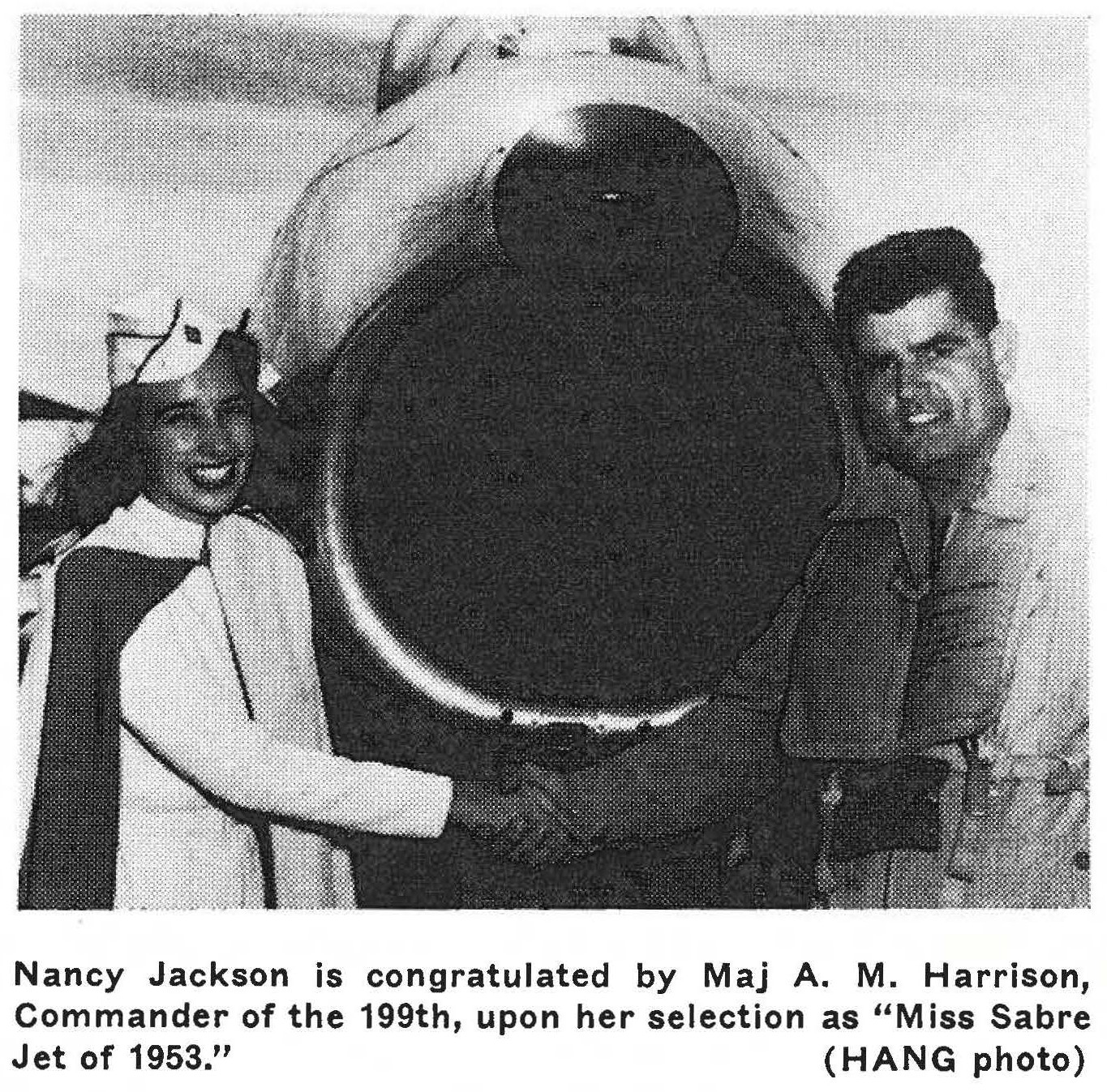
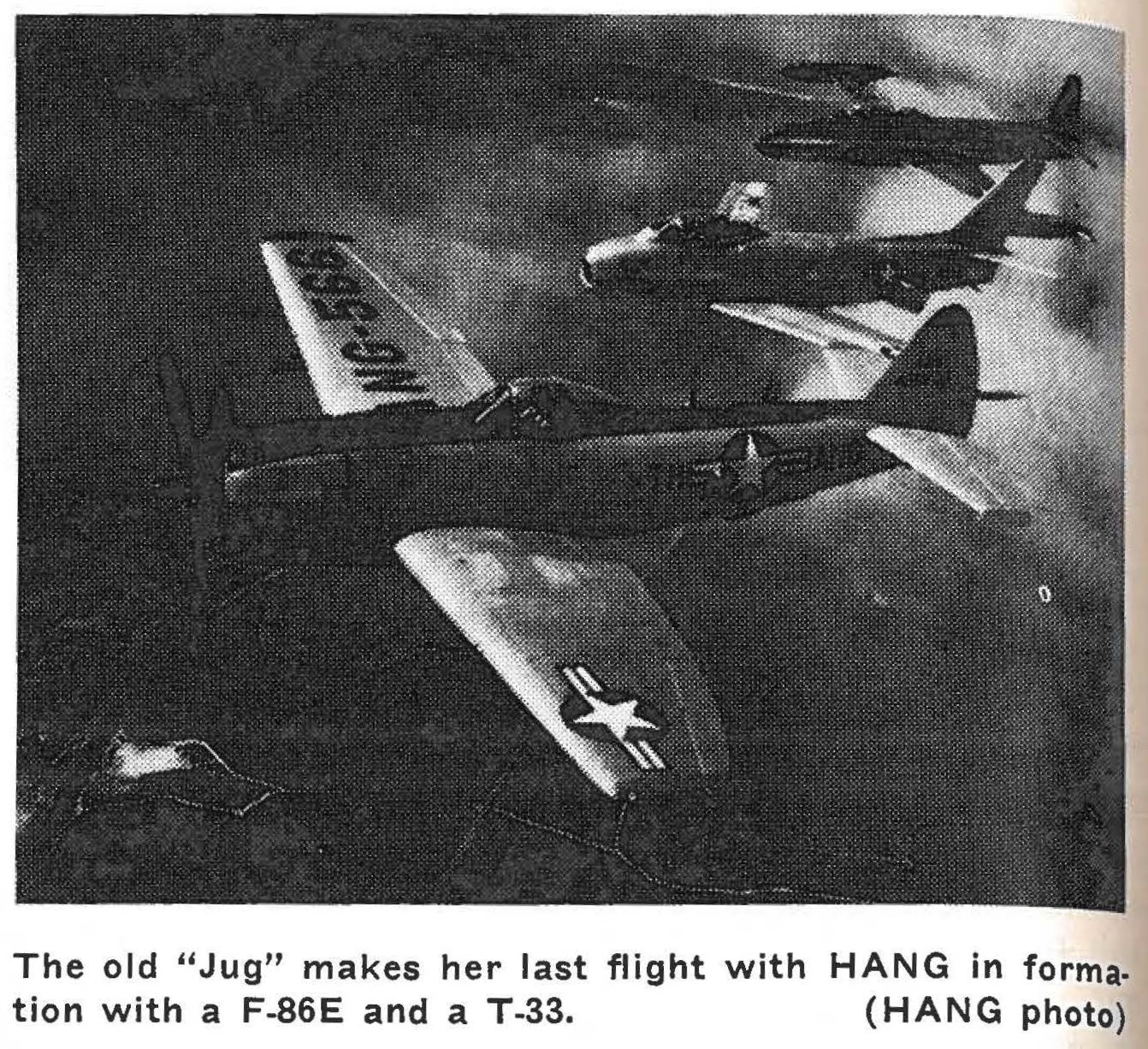
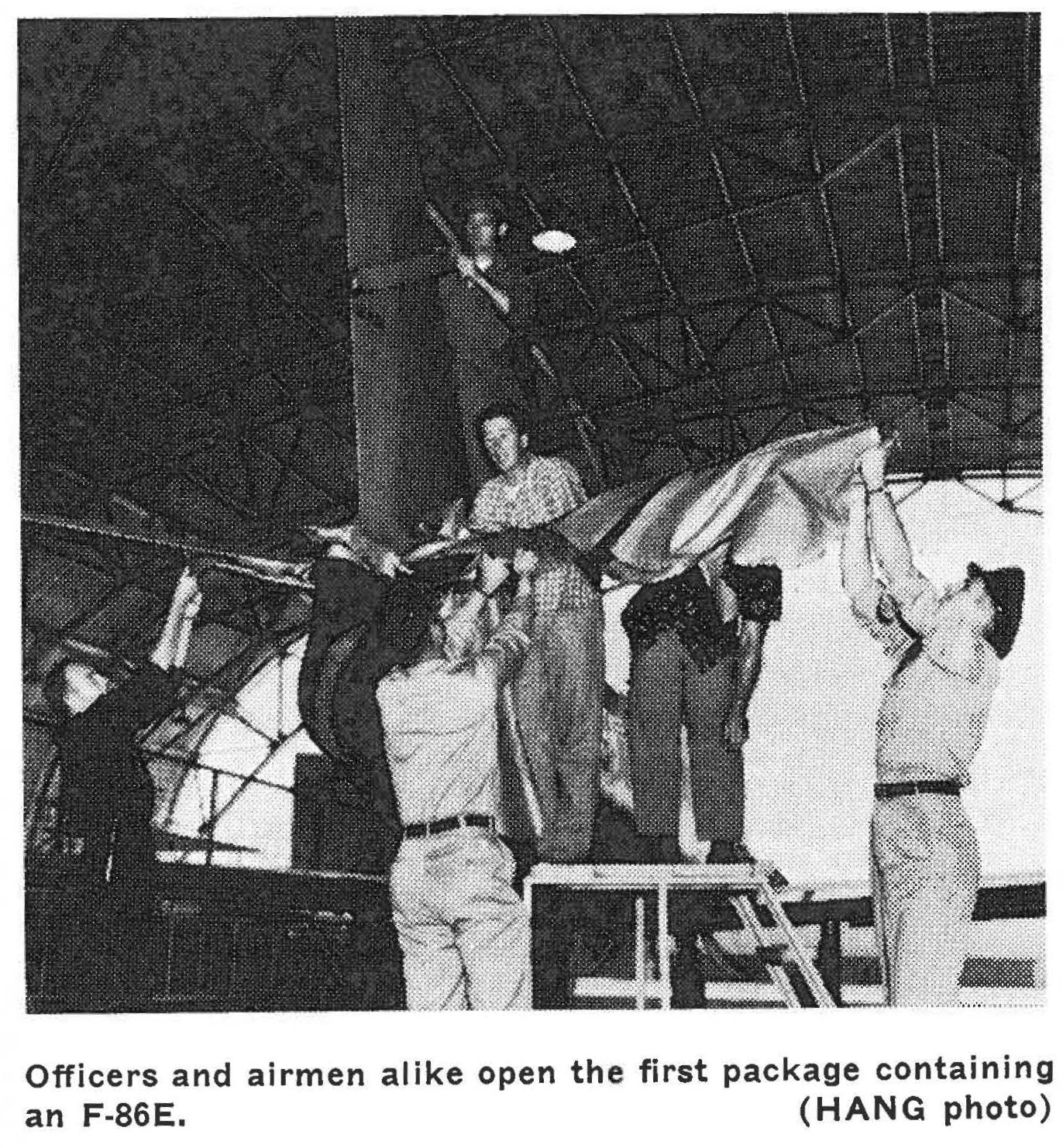
Nancy Jackson is congratulated by Maj A. M. Harrison, Commander of the 199th, upon her selection as “Miss Sabre Jet of 1953.” (HANG photo)The old “Jug” makes her last flight with HANG in formation with a F-86E and a T-33 (HANG photo) Officers and airmen alike open the first package containing an F-86E, (HANG photo)(Pictures from the 1954 May Hawaii Guardsmen)
“D-Day,” popular in use since the Normandy invasion, has become a household word to mark an eventful occasion. But this time I want something more forceful. How about “H-Day”—“H” for history? For the Hawaii Air National Guard, the arrival of the F-86E Sabre Jets is the making of history. Maj. George R. Duncan, Operations Officer of the 8199th Replacement Training Squadron, voiced an opinion that these will be the latest type fighters the Hawaii Air National Guard will ever fly—short of war.
The eagerness of the Air Guard was well displayed by the number of pilots who joined Air Force Reserve, Lt. Col. Brewster Morgan, at the arrival of the U.S.S. Cape Esperance on 10 February 1954. Col. Morgan virtually waded out to meet the carrier as it came into Pearl Harbor bearing supersonic gifts from the East. The unloading of the planes at Hickam Docks was well supervised by pilots grunting and groaning with each sickening lurch of the cradle. The first Sabre lured into the hangar was literally assaulted as Air Guard personnel stripped her of the protective plastic cocoon, revealing one of the Nation’s fastest operational fighters—the F-86E.
The acceptance of the planes by Maj. Gen. F. W. Makinney, Adjutant General of Hawaii, was an important formality. But even before the official ceremony on 17 February, those planes had been accepted by every man in the 199th. It would have taken red blood as well as red tape to remove the Sabres from the field. The fact that number 740, found among the 13 newly acquired ships, was determined to be that of Maj. Jabara, first American jet ace, only added to the pride of possession. Sgt. Afoa of Maintenance, formerly with Maj. Jabara’s squadron in Korea, verified the identification. Although the seven red stars had to go with the application of the HANG markings—the spirit is there.
It was determined that the advent of the F-86 to the Hawaii Air National Guard should not go unnoticed. Forthwith, a public demonstration was started and, like little Topsy, it just grew. One thing led to another until a full-scale air show lay hot and heavy in our hands. Publicity blared forth from every radio and TV station; newspapers were most cooperative. A “Miss Sabre Jet” contest was added, prizes donated, and a squadron dinner held. Out at the field, Lt. Col. V. A. Siefermann, Maj. Arch Harrison, Capt. Robert Hite and CWO Joe Barnett, along with other officers and men, labored diligently. The show was a huge success. The weather turned out perfect, the crowd was good, the exhibits well planned, and despite a faltering auxiliary power unit, Maj. Harrison took off in a cloud of JP-4 fumes to thrill an already excited crowd.
Many thanks are due to the Aircraft Owners and Pilots Association, Hawaii, for its kokua. They arrived with no thought of compensation, the many private pilots with their small planes to take aloft young men interested in signing up with the Air Guard and the “Miss Sabre Jet” contestant. What a wonderful way to demonstrate flying—up in the air! 28 February will long be remembered by many an eager youngster who that day made up his mind that flying was for him.
Problems were encountered. Tools and equipment for servicing the plane were lacking. Poor Richard’s quotation—“For want of a nail a shoe was lost”—was never more forcibly demonstrated. For want of a tool, a jack or a part, a plane was grounded before it ever left the hangar. Lt. Col. Siefermann, with factory representatives, Al Collins from North American and George Kramer from General Electric’s Jet Engine Division, labored hard and long, sometimes improvising where safe to do so, to get those planes into the air. The one and only A.P.U. capable of starting the Sabre Jet was overworked. This is important considering that each pilot checking out must have a tail chase. If there is any delay in starting the second plane, the first is sitting there burning 120 lbs. (20 gals.) of fuel per minute—and without external tanks there is but 30 to 40 minutes of fuel aboard on a capacity filling. At this writing, a second unit has been made available on a temporary basis and there are six more of these auxiliary power units on order.
While CWO Joe Barnett wrestled with the problem of replacing a warehouse full of parts and equipment to meet the demands of the jet aircraft, operations and training had their hands full. Minimum requirements were determined, ground school courses laid out, extensive questionnaires compiled, and the entire scope and thinking of operations changed to embrace the coming of the Jet age in the Hawaii Air National Guard. The pilots were ready and clamoring for more time in the one T-33. Tech Orders were checked out and much midnight oil was burned as informal groups gathered at individual homes to complete seemingly endless questionnaires. Miles per hour changed to knots, gallons of fuel changed to lbs. of fuel, emergency procedures were memorized—not by rote, but by reason—and at once the main topic of conversation changed from statehood for Hawaii to Jets!
The rush for scheduling in the T-33 was phenomenal. It was determined that the pilots checking out in the jet trainer should do so by devoting three consecutive days, morning or afternoon, so that the previous lesson or flight should not grow cold on them. When the “Minute Men” are needed, they can be counted on—and the T-33 was booked solid. From morning till late at night the ship performed beautifully, as if she knew that the boys had to get in their 10 or 20 hours, depending upon previous fighter time, so the next big step could be made—into the F-86, the hero of MIG Alley.
Maintenance and crew chiefs worked doggedly, and always alongside were the two factory tech reps, Al Collins and George Kramer. As hours were built up, so were the F-86s. Then the day came. Sunday double drill, 7 March: Maj. Harrison, trained in Sabres with the ANG, Boise, Idaho, soloed the first Air Guard pilot, Capt. Robert Hite. The tail pipe was not cold before 1st Lt. George Fitzgerald made the big step. Since that day, and in rapid succession, the boys have stepped out and won their gold Sabre Jet pins. Maj. Robert O’Hara, Maj. George R. (Bob) Duncan, Capt. George T. Harris, Capt. Frank Smith, Capt. Robert A. Maguire, 1st Lt. Henry Wilder, and, of course, Col. Barry B. Townsend, USAF, Senior Air Instructor, were the first.
Capt. Willie Dau flew the last old “Jug,” F-47, on Sunday, 7 March double drill. It was timely with the first F-86 solo. Each pilot’s final flight in the F-47 Thunderbolt was done in a different manner. The reaction was varied—from the pilot who said, “I figured it was the last trip in the old Jug and no use taking any chances—I flew straight and level,” to the pilot that “wrung it out as never before.”
So from here on out it’s “Look pop no prop” for the 199th Fighter Interceptor Squadron and her sidekick, the 8199th Replacement Training Squadron. As of 1 April, the hours on the T-33 have sailed past the 400 mark, while those on the F-86 aircraft are passing the 50 mark. Considering that the average local training flight in jet aircraft is not longer than 30 minutes, this is remarkable. By the time summer encampment rolls around, it is anticipated that there will be several pilots with the required 40-hours transition covering formation flying, cruise control, acrobatics, instruments and general proficiency.
These pilots will then go directly into aerial gunnery—contingent upon the presence of a tech rep. A tech rep is necessary since the F-86 uses a new radar gunsight completely different from the one used in the old F-47. The 199th will be sending a man to the mainland for a 10-month course to study this radar gunsight. The other pilots at summer camp will complete their transition.
This transition into jets is not as easy as the funny papers would have you believe. However, if we persevere, some bright, typically Hawaiian day in 1956, an equally bright and typically Hawaiian young pilot with a shiny pair of wings will walk out to one of the swept-wing Sabre Jets on the line, climb in and say to himself, “What did ‘Dad’ in operations mutter when I told him that transition into jets is easy as slipping into an old pair of shoes.”
By Lt. Col. W. Brewster Morgan and 1st Lt. Philip G. Dooley
The keynote of summer camp training this year for the squadrons of the Air National Guard was cooperation. This was embodied in the way the Marine Corps helped the Air National Guard to carry out their summer encampment. When Maj. Gen. F. W. Makinney, Adjutant General of Hawaii, requested use of certain Marine Corps facilities at Kaneohe, Colonel Frank G. Dailey, Commanding Officer of the station, made the necessary arrangements with a characteristic sense of cooperation and pleasantness.
The idea was born when the Air Guard received its F-86 Sabrejets. Wheeler Field had been formerly utilized for F-47 Thunderbolt operations with great success, but the runways were too short for the Sabres, which require at least 7,000 feet. Maj. Archibald Harrison and Maj. Henry F. Davis, Commanders of the 199th Fighter Interceptor Squadron and 8199th Replacement Training Squadron respectively, left the decision up to the pilots. They all knew there were certain basic requirements for an operational fighter station. Fire equipment of adequate force was a must, as were favorable flying conditions. They could remain at their Hickam AFB home base and operate from the long runways at adjoining Honolulu International Airport. However, commercial traveling was always very heavy and might be interrupted by jet training flights. Also, fighter missions might be slowed for the same reason.
First Lieut. George Fitzgerald, Air Guard pilot and former Marine Corps flyer, suggested Marine Corps Air Station, Kaneohe. The squadron pilots agreed that “Fitz” was prejudiced, but a unanimous vote was cast in favor of the Marine Corps Air Station.
On June 12, after the Sabres arrived at Kaneohe, the pilots and men took in their surroundings. The jets were parked along the apron of runway No. 5. Runway No. 4 was designated as the main operational runway as it was 7,770 feet long and cleared all housing areas and radar stations. Space was allocated the Air Guard in Hangar No. 1 for their inside maintenance. It was shared with Marine Corps base operations and base flight sections.
In a few days, Air Guard and Marine Corps planes could be seen side by side, their mechanics up to their necks in routine checks and trouble shooting. In one case, one of the Marine T-33s had been grounded for about six months due to lack of parts to put it back into the air. The Air Guard happened to have the part in stock and the Marines again had a flying T-33.
As camp progressed, Air Guardsmen realized how much their brothers in Marine green could help. The Air Guard supply of tires ran low due to the intensive flying and to supply bottlenecks on the mainland. The Marines promptly loaned a supply of tires to the Air Guard.
Air Guardsmen were assigned to Marine Corps sections where they worked with Marines who knew their business. In the food service sections and maintenance shops, Air Guardsmen could be seen working and learning along with Marines. This was of great importance, particularly in the maintenance field, as it released many regular Air Guard mechanics for their primary duty of keeping the Sabres in the air.
On the hill at Koko Crater, Lt. Col. Jimmy Ashford’s 109th Aircraft Control & Warning Squadron ground control interceptions were carried out, using a Marine Corps UH-34 loaned to the Air Guard by the Marines for fifteen days. The Air Guard equipment had not arrived in time. The percentage of intercepts was very high. Both Detachments “A” and “B” of the 109th were able to accomplish excellent training.
Special services for Detachment “A” was organized by Capt. Claude Takekawa and consisted of volleyball games almost every night and organized swimming at Hanauma Bay. Lieutenant Theodore Soong of Detachment “B,” which took over camp for the second two weeks, arranged many projects such as Operation Salvation Seaweed at Koko. On two Sundays, June 27 and July 4, church services of both Catholic and Protestant denominations were held. Father Maurice Holman of the Holy Trinity Church and Pastor Harold Cummings of the Olivet Baptist Church conducted the services.
Farewell parties were held for Maj. John Dolan, Air Instructor of the 109th, who was being reassigned to the mainland.
In summarizing the highlights of summer encampment of 1954 for the radar unit and their compatriots in the fighter squadrons, Lt. Col. Valentine A. Siefermann, Chief of Staff (Air), Hawaii Air National Guard, said, “The officers and men of the Hawaii Air National Guard have proved that they are a group any officer would be proud to command and serve with. A high percentage of intercepts was made indicating the efficiency of both ground and air units and when final figures were compiled, it was found that the availability of aircraft to the 199th Fighter Interceptor Squadron and the 8199th Replacement Training Squadron was 94%.
“As a whole, the most important factor in the success of our training this year was the excellent cooperation shown by Col. Frank G. Dailey and the personnel under him at Kaneohe Marine Corps Air Station.”
Flying during FY 1955 reached a peak at the Summer Camp, held at Kaneohe MCAS, where 847:05 hours were flown. This was made possible by flying continuously during the hours of daylight.
During the remainder of the year, pilots flew mostly on their own time, firing aerial gunnery, keeping up instrument and night proficiency, and staying current in the various types of aircraft.
A great deal of GCI training was accomplished during FY 1955, due mainly to the fine cooperation between the 109th AC&W Squadron and the 199th/8199th Sqs. About 94 GCI sorties were flown during Summer Camp alone.
Night flying was accomplished completely outside of regular drill periods, and all pilots who had no job conflicts kept up their 60-2 minimums.
For the most part, pilots maintained proficiency in the various types of aircraft by coming down during the week, whenever they could fit the time in.
Throughout the year the regularly scheduled freight runs provided inter-island airlift available to all the Services. In addition, special flights were sometimes scheduled to transport such groups as rifle teams, bands, etc.
Several times when the occasion arose, special tactical flights were flown in support of other services, i.e., simulated strafing attacks on Navy ships, and helping to test Air Force airborne DF equipment.
The average number of tactical pilots flying in both squadrons was 32. Inter-squadron, flight and element competition kept morale and proficiency at a high level.
The 495 hours of aerial gunnery exercises provided the keenest competitive flying …
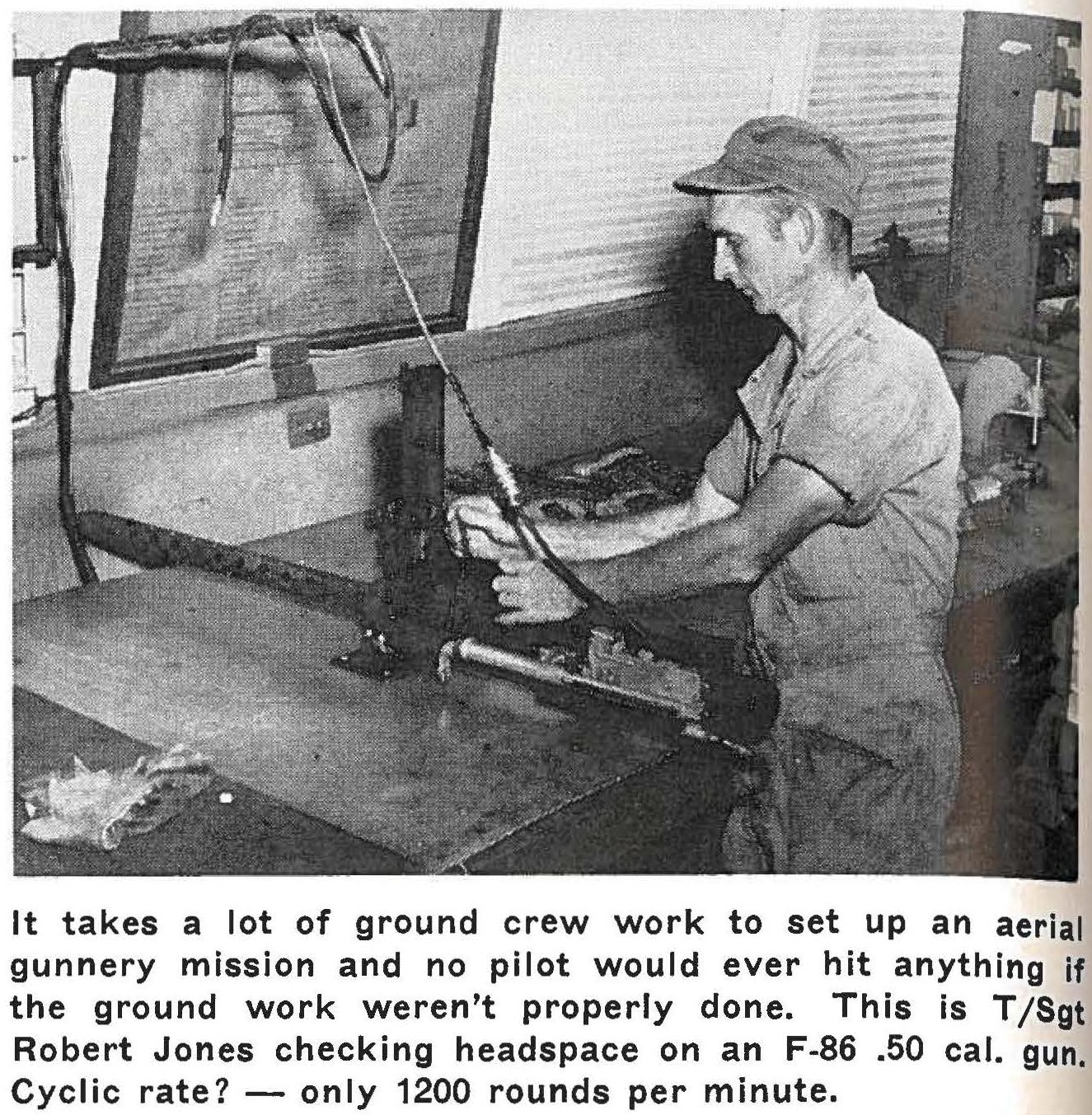
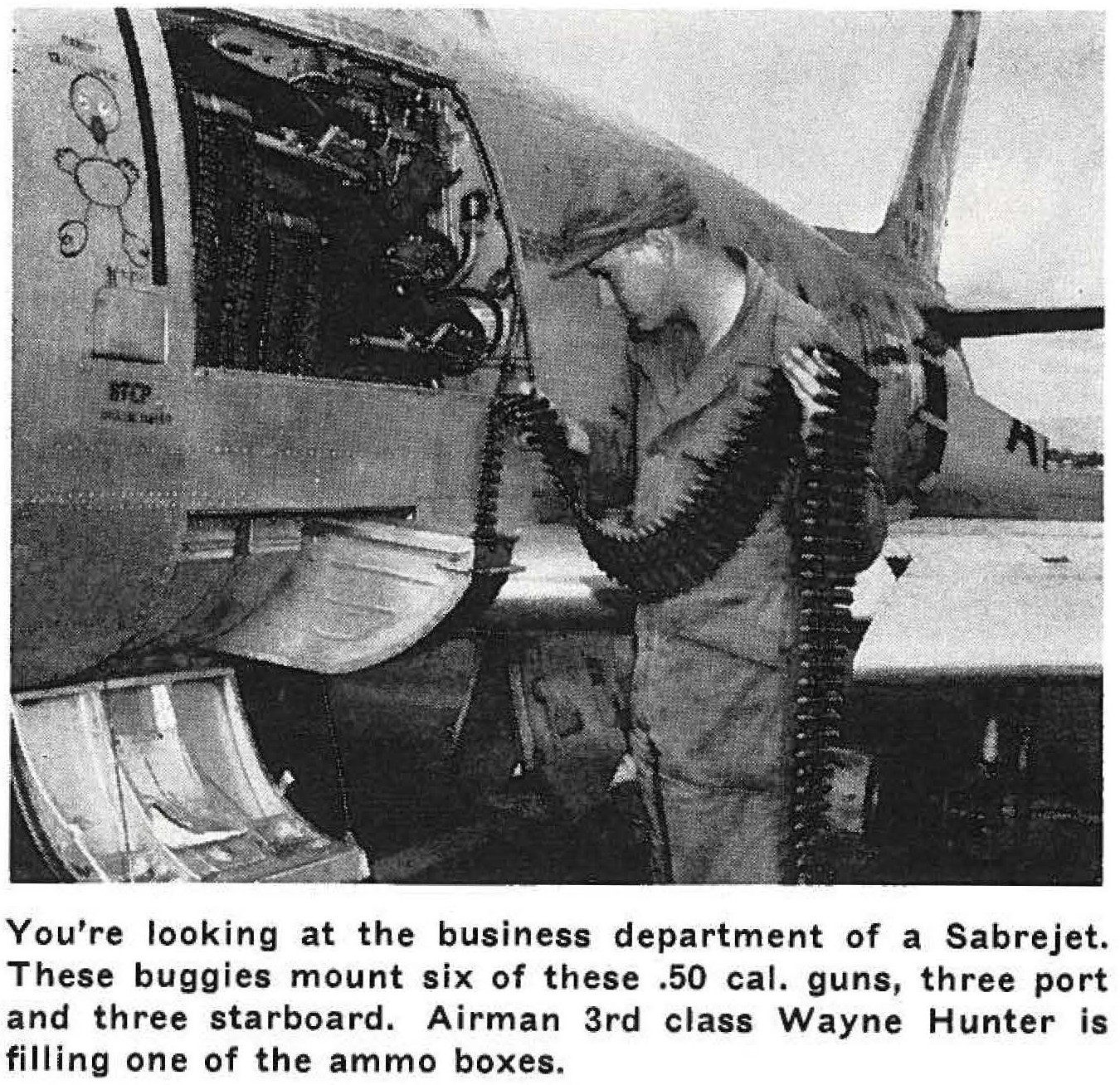
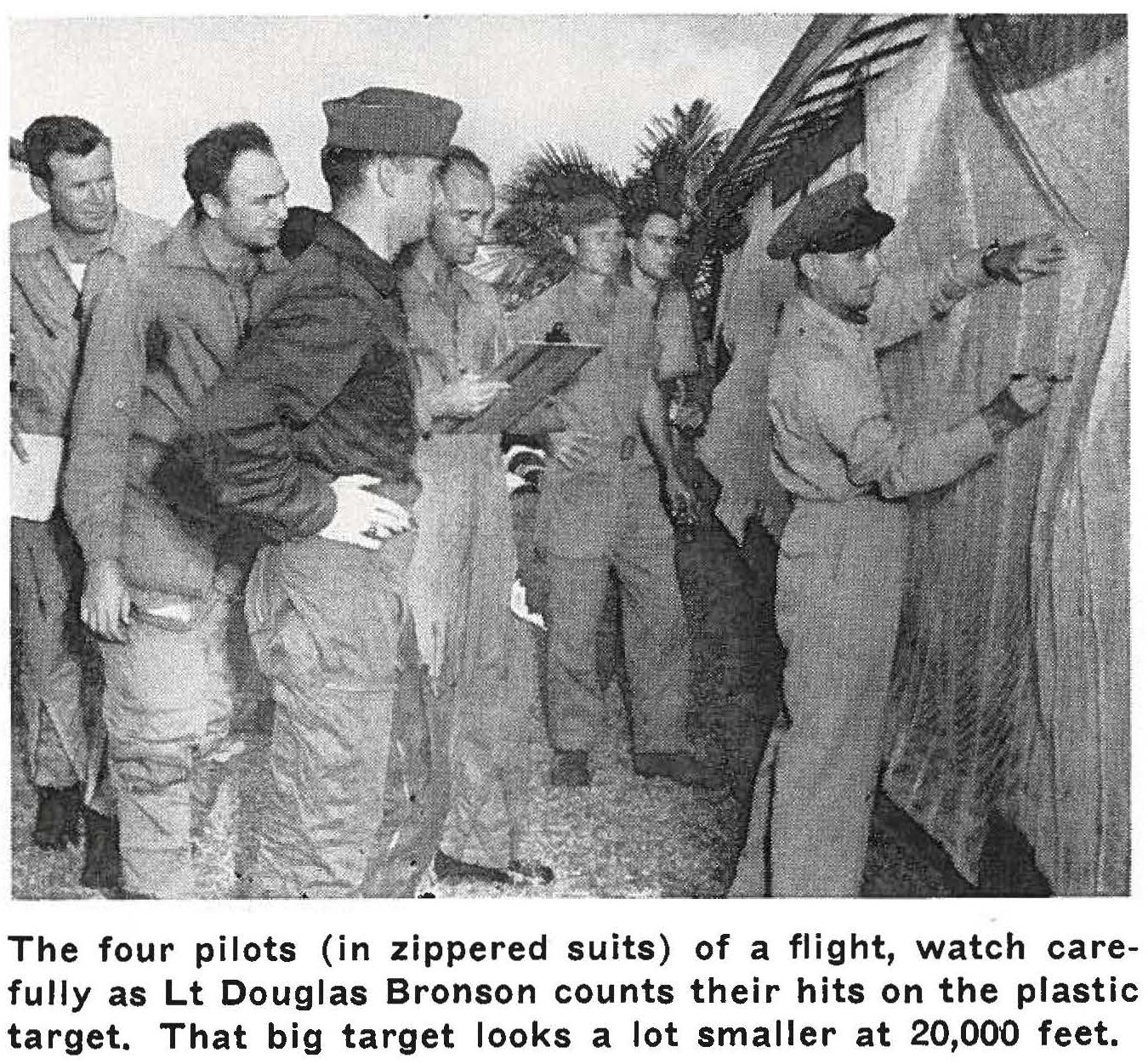
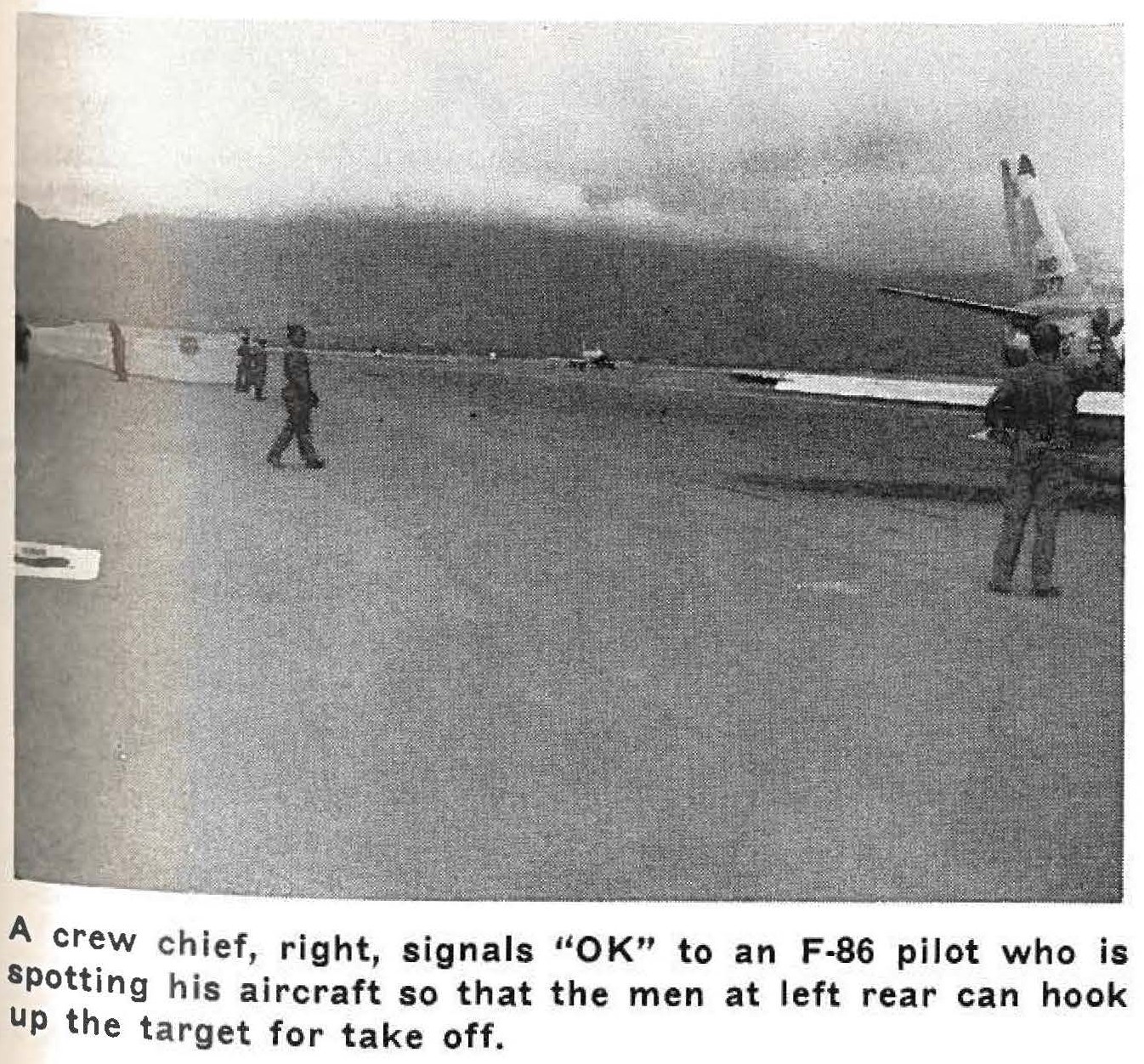
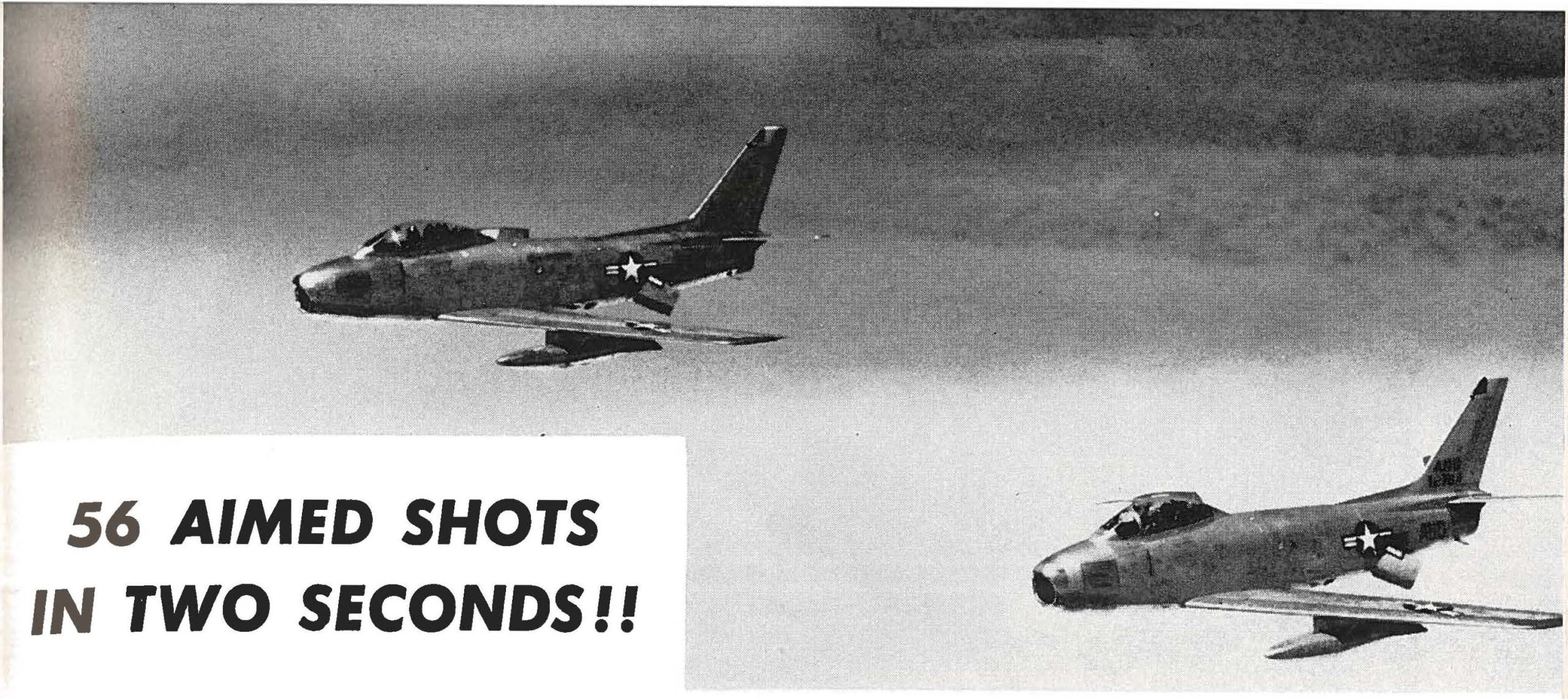
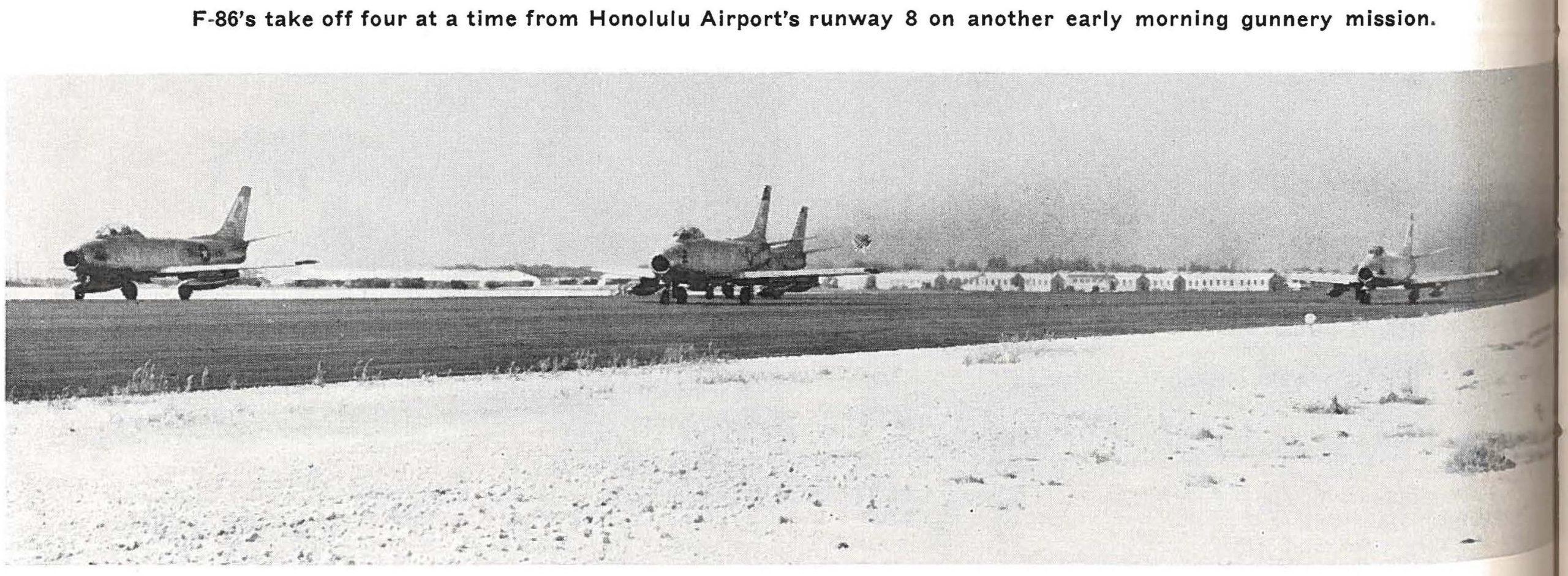
It takes a lot of ground crew work to set up an aerial gunnery mission and no pilot would ever hit anything if the ground work weren’t properly done. This is T /Sgt Robert Jones checking headspace on an F-86 .50 cal. gun. Cyclic rate? – only 1200 rounds per minute. You’re looking at the business department of a Sabrejet. These buggies mount six of these .50 cal. guns, three port and three starboard. Airman 3rd class Wayne Hunter is filling one of the ammo boxes. The four pilots (in zippered suits) of a flight, watch carefully as Lt Douglas Bronson counts their hits on the plastic target. That big target looks a lot smaller at 20,000 feet. A crew chief, right, signals “OK” to an F-86 pilot who is spotting his aircraft so that the men at left rear can hook up the target for take off56 AIMED SHOTS IN TWO SECONDS !!F-86’s take off four at a time from Honolulu Airport’s runway 8 on another early morning gunnery mission. (Pictures from the 1955 February Hawaii Guardsmen)
When “ground pounders” talk about “rapid fire marksmanship” they mean something like 10 rounds fired in 10 seconds from a stationary position at a stationary target 75 feet away. When it comes to our Air NG airplane drivers, however, that’s slower than molasses in winter. In order to qualify in their marksmanship course they have to fire 56 rounds in 2 seconds from a gun platform moving 440 miles per hour at a target 1,000 feet away moving 185 miles per hour. Impossible? That’s what you think, Buster—see below.
Pilots of the 199th Fighter Interceptor Squadron and 8199th Replacement Training Squadron, Hawaii Air National Guard, are presently undergoing intensive training in air-to-air gunnery through supplemental exercises authorized by the National Guard Bureau. The exercises, being held from January through March this year, are designed to afford each tactical pilot six days of gunnery training in increments of three consecutive days. Each day’s operation consists of three gunnery missions per pilot, which is the maximum that can be obtained in an eight-hour period consistent with flying safety. It has been estimated that at the end of this program, a total of 468 gunnery sorties (i.e., one plane, one flight) will have been flown during the three-month period they are scheduled.
In order to assure 100% attendance at the exercises, the Adjutant General forwarded letters to the employers of all pilots concerned, explaining the value and importance of the added training. The results were gratifying—100% attendance was assured.
On each mission, an F-86, T-33, or B-26 aircraft is used to tow a 6′ by 30′ banner target made of polyethylene, a resilient plastic material. The tow aircraft is flown at either 15,000 feet or 21,000 feet, depending upon whether or not the gunnery mission is to be a high- or low-altitude mission. Inasmuch as the sights installed in the F-86 are of a type where the range is computed by radar, radar reflectors are attached to the forward portion of the target. During the firing passes, the target is towed at a speed of 160 knots or 185 miles per hour.
From three to four F-86 aircraft make up a flight. Their firing passes are initiated at an altitude of approximately 500 feet above and 5 miles out to the side and parallel to the target. However, this criteria will often vary according to the idiosyncrasies of each pilot.
Only two of the six guns on the F-86, each loaded with 200 rounds of .50-caliber ammunition, are used during practice gunnery missions. The guns, which are boresighted on the ground to converge at 1,000 feet, are fired in the air between ranges of 1,200 and 650 feet from the target. The F-86 traveling at a speed of 440 miles per hour covers this distance in a matter of one to two seconds. This does not give the pilot too much time (!) to estimate range, engage the sight, keep the pipper on the target, and fire a burst of 56 rounds of ammo. When firing for record, the pilots must fire all their ammo in seven passes.
Scoring each pilot’s hits on the target is not as difficult as you might think. The tip of each round of ammunition is painted with a specially prepared paint and as the round passes through the target, it deposits a small amount of the paint around the rim of the bullet hole. Each pilot fires ammo painted a different color. When the target is returned, the holes in it are counted according to color and credited to the pilot who fired the ammo with that particular color.
When firing at a target between 8,000 and 15,000 feet, a pilot qualifies as “expert” if he scores 35% (70 hits); as “sharpshooter” if he scores 26% (52 hits); as “marksman” if he scores 17% (34 hits). When firing above 20,000 feet a pilot qualifies as “expert” if he scores 25% (50 hits); as “sharpshooter” if he scores 18% (36 hits); as “marksman” if he scores 12% (24 hits).
Obviously, there is more to aerial gunnery than that mentioned above. But to attempt to include all the ground training and procedures that go into preparing for and firing air-to-air gunnery would require more space than is available. In addition, certain factors cannot be dwelled upon here, due to the classified functions of the gunsight.
With increasing knowledge of the gunsight plus the experience gained through intensive training during the gunnery exercises, every pilot of the 199th Fighter Interceptor Squadron and 8199th Replacement Training Squadron should be able to qualify by the end of March. And considering the manner in which the exercises are progressing, it looks as though that will be the case.
Eighteen days of special aerial gunnery exercises were held to aid in providing a combat-ready squadron. Being in the first line of air defense demands proficiency. Business firms cooperated; twenty-nine fighter pilots and thirty-six airmen got off from their jobs to participate for an average of six days each. Some 340 sorties of air-to-air gunnery were flown; over 48,000 rounds of cal. .50 ammunition were expended. Three fighter pilots “broke the ice” by qualifying both below and above 20,000 feet. The first HANG jet fighter qualifications were: Maj. Duncan and Lt. Fisher as Sharpshooters, Lt. Russell as Marksman.
One of the major difficulties in aerial gunnery has been keeping the F-86 Sabre Jet’s armament sighting system in commission. It is electronically operated and considerably complicated. Initially we had a factory Tech Rep to give us a start with classes and on-the-job training. There was much self-study with the tech orders! Three airmen have returned from service school and three others are still in school. Test equipment has filtered in. It won’t be long until the sighting system will be a problem of the past.
The life-blood of a fighter interceptor squadron is its fighter pilots. The earlier program of sending qualified guardsmen back to flying school is beginning to pay off. Some eighteen months ago we sent four off to USAF flying school. They’ve recently returned—Lieutenants (and fighter pilots) Clissold, Sakamoto, Giddings, and Tokunaga. Everyone a tiger!!
Only two of our lads met the exacting requirements and became qualified aviation cadets during this past quarter. Letters, occasioned between the rigorous curriculum, come back—Aviation Cadet Wikeen reports he finished second in his pre-flight class at Lackland AFB, Texas; Lts. Heilbron and Olds are flying T-6 trainer aircraft at Moore AFB, Texas.
New training directives have laid out an extensive basic training program for newly recruited non-prior service airmen. The number of hours required could conceivably have a recruit still performing this type of training one year after enlistment. Once again the Squadron fell back on the USAF Service School program. A campaign began, and some 115 applications from the 199th and 8199th have been forwarded for SAF Basic School at Parks AFB, California. The National Guard Bureau has arranged for quotas which fall within the high school summer vacation—a pleasant trip to California, and much learning to be a soldier in the Air National Guard! For many it will be their first trip to America.
The 8199th Repl Tng Sq continues to outshine the 199th Ftr Intcp Sq in drill attendance. It’s close, though, only 2% different—what say, 199th? Hq HANG and 199th Fcstg Flt, having fewer personnel assigned, continue to battle in maintaining their 100% average.
178 airmen of Hawaii Air National Guard units made the mass movement to Parks AFB, California, to attend the eleven-week basic training course. This course, naturally, is the same as that received by regular Air Force personnel. For the majority of the Hawaii boys, this was the first trip away from the islands. Letters back asking for the inevitable leave after school state that the training is “rugged.” Their not being around for this year’s Field Training made everyone really “hump”!
Good luck and good flying to Major George R. Duncan, newly assigned as Commander of the 8199th Replacement Training Squadron. Captain Aimoku Duvauchelle takes over in the spot Major Duncan left, that of Operations Officer for the 8199th. Former Commander, Major Henry F. Davis, Jr., regretfully left the Air Guard due to the pressure of business.
Personnel who recently returned from service schools: A/3C Edward L. R. Boddington from Aircraft Jet Mechanic School; A/2C Howard T. Yoshida and A/2C Richard M. S. Chang from Air Police School; A/3C Ronald B. F. Liu from Sighting System Mechanic School; A/3Cs James Kitsu, Paul Miyasaki, and Alvin Tachibana from Radio Operators School; Lt. Harold Wong (Ground Electronics Officers Course); SSG Harry Matsuda and SSG David Langsi (Organizational Supply Supervisors); and Captain George Miki and Lt. Harold Lee from Interceptor Controllers School.
First Lt. Clinton S. Ballentyne, 8199th Replacement Training Squadron, HANG, killed in a jet crash during summer encampment at Kaneohe NICAS on June 15, 1956.(Picture from the 1956 Annual Report)
Mobilization Assignment. The National Guard Bureau announced mobilization assignments of Air National Guard units: on M-Day the 199th Fighter Interceptor Squadron (and absorbed 8199th Replacement Training Squadron) and the 109th Aircraft Control and Warning Sqquadron are assiglled to Pacific Air Force, the 199th Weather Flight (Forecasting ) is assigned to Military Air Transport Service.
Annual Inspections. During the month of August 1955 Seventh Air Force inspected the 199th, 8199th and 109th. The USAf does not rate units in a similar manner to that of the Army and their conclusion was ” … accomplishing their mission in a highly satisfactory manner.”
Unit Training Assemblies. The 48 unit training assemblies were held on two Monday nights and on: Sunday a month. At Hickam the 199th and 8199th each held separate Sunday drills so there would be two full days a month of flying for GCI practice and coordination with the l09th.
5,387:40 pilot flying hours were flown, of this 4,140:00 hours were flown in jet aircraft. This represents an increase of about 10% over last fiscal year, and with about the same number of tactical pilots and aircraft.
Support flying continued as a minor portion of the total time: 114:40 pilot hours were on command flights, 606:30 pilot hours were for inter-island freight runs, and 526:30 pilot hours were for aircrew training and 60-2 time.
Aerial Gunnery exercises were again authorized for the flying squadrons. These are extra flying drills for tactical pilots and limited support personnel and are entirely devoted to aerial gunnery training. Each tactical pilot participated an average of 8 times. A total of 501 sorties were flown, 54,190 rounds of cal. .50 ammunition were expended with average scores of 14.5%.
Ground Controlled Intercepts in coordination with the 109th AC&W Sq were also a primary mission, and given equal emphasis with aerial gunnery.
In April 1956 the 199th acquired a C-11B Jet Synthetic Instrument Trainer ($65,000). This was installed in a completely rebuilt and air conditioned Trainer Building. Prior to the end of the fiscal year over 100 hours of instrument training were logged on the trainer. A Link Aviation Inc., technical representative assisted the installations for one month.
The two weeks Annual Field Training was again held at Kaneohe MCAS. There was a significant increase in flying activity over the preceding summer camp. 729 training sorties were flown versus 626 the previous year. The aircraft were flown six periods a day (0500-2000) in two shifts, each of which was operated by the 199th or the 8199th. This type of scheduling was necessary to utilize the small number of jet aircraft. 12 F-86s and 3 T-33s were taken over for the encampment. An average of 11 F-86s were available daily (87%) and each aircraft flew an average of 48 times (41:30 hours utilization) during this intensive period of operational training. The T-33s performed yeoman service in instrument training and towing targets. Each T-33 flew an average of 62 times (67 hours utilization).
The tactical pilots averaged 22:10 hours of prescribed missions in tactical aircraft during this two week period. Primary emphasis was on aerial gunnery (126 missions) and ground controlled intercept (114 missions) in cooperation with the 109th. The average scores for the 59,400 rounds of cal. .50 ammunition expended in aerial gunnery were 15.6% above 20,000 feet and 14.9% above 27,000 feet. (Qualification for combat ready is 15%.)
In spite of the desires and efforts of our Weather Flight, passing rain showers obscured Kaneohe MCAS at times and occasional returning flights were diverted to land at Hickam AFB. This necessitated the cancelling of the next flying period of these aircraft.
The limited number of F-86 aircraft presented considerable utilization and training problems.
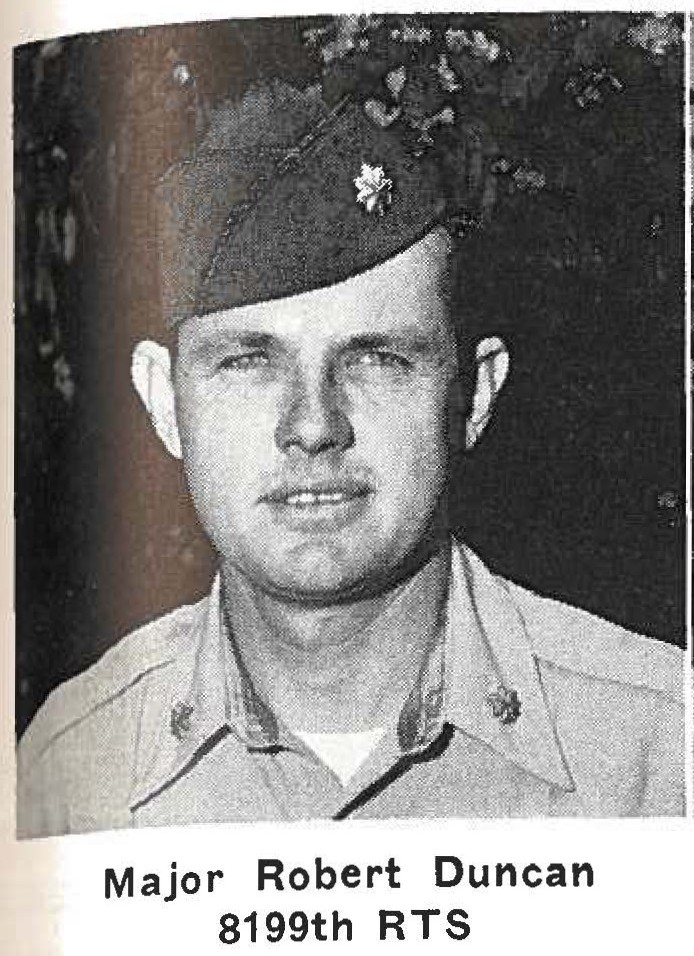
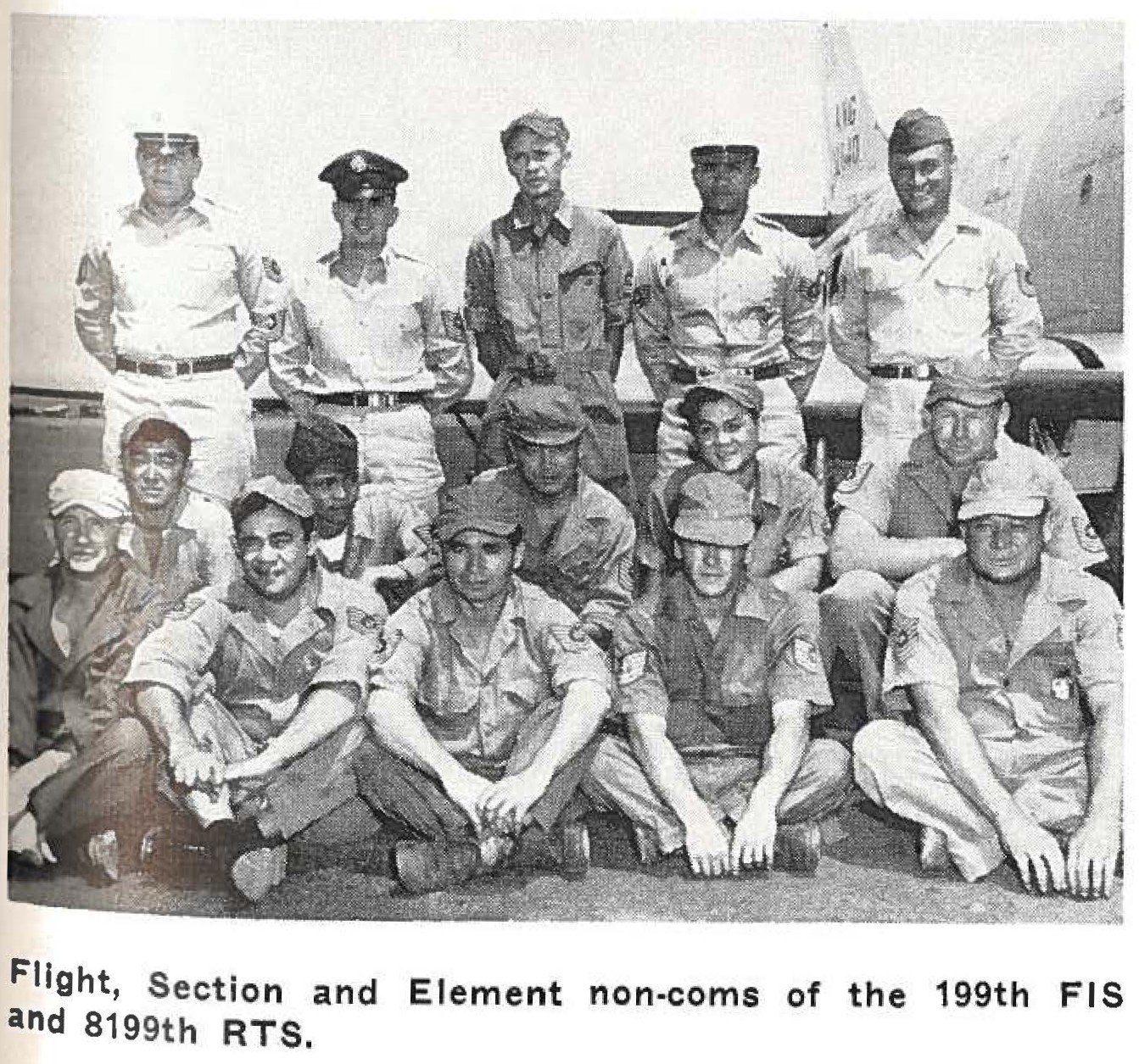
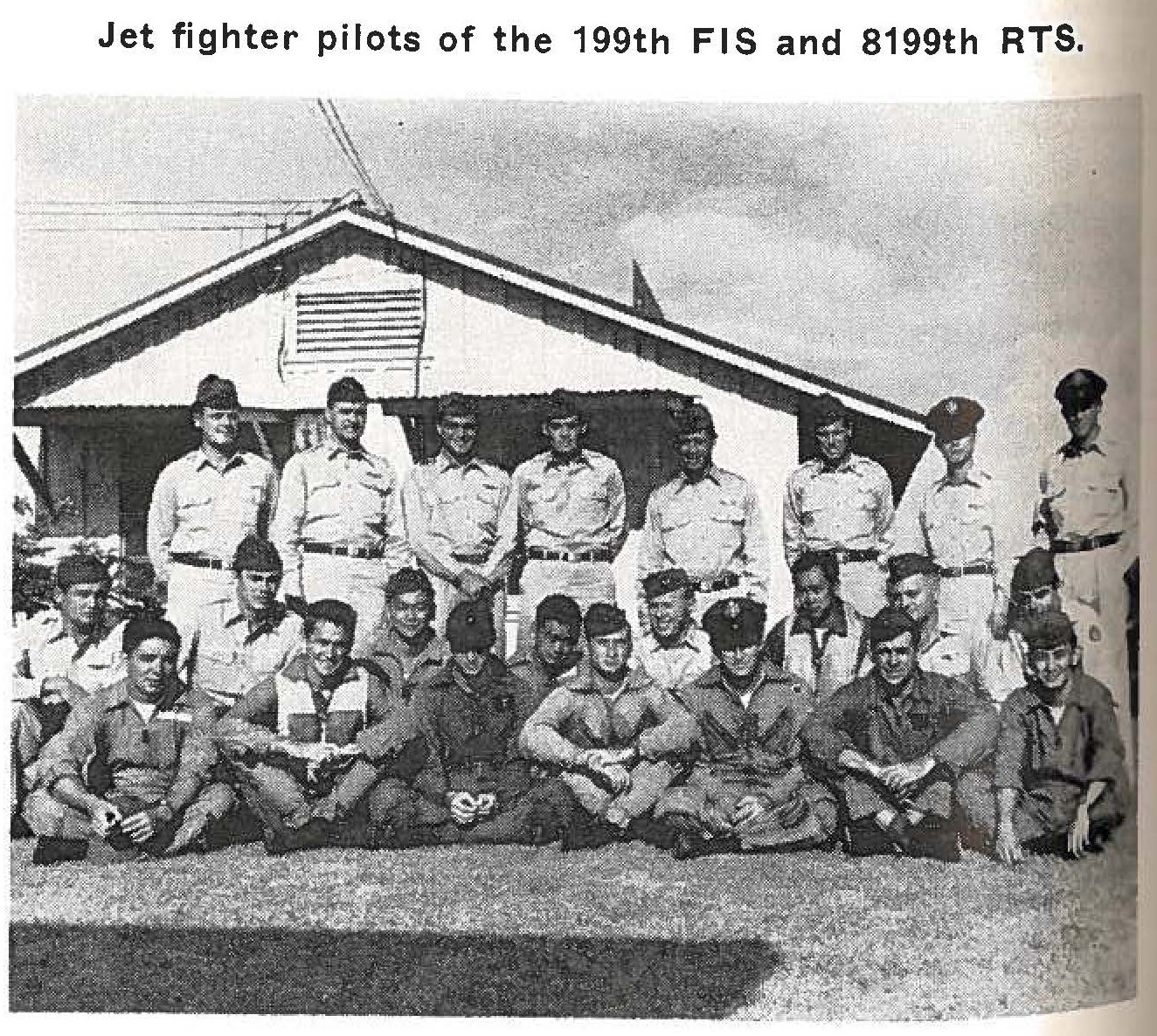
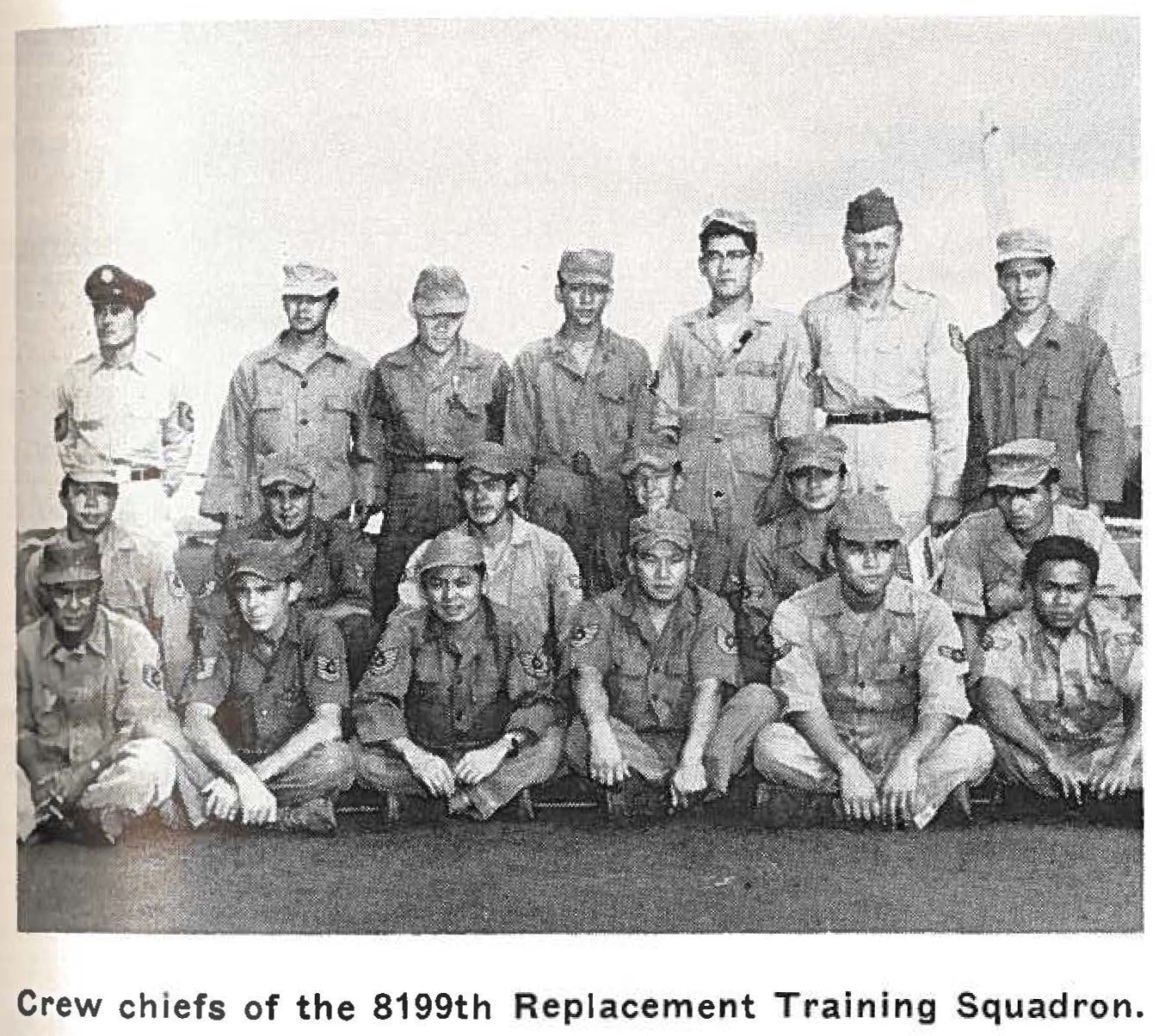
Major Robert Duncan 8199th RTS Flight, Section and Element non-coms of the 199th FIS and 8199th RTS. Jet fighter pilots of the 199th FIS and 8199th RTSCrew chiefs of the 8199th Replacement Training Squadron(Pictures from the 1956 September Hawaii Guardsmen)
1946 HAWAII NATIONAL GUARD -1956
The following additional units were added to the initial troop allotment to Hawaii and were federally recognized on the dates indicated: 120th Military Police Company, January 8, 1951; 8199th Replacement Training Squdron, July 12 1953; 120th Signal Company, January 4, 1954; and 158th Anti-Aircraft Artillery Battalion, September 1 1955.
The 7th Air Force Trophy was again presented to the 8199th Repl Tng Sq for the highest qualification aerial gunnery scores. Major George R. Duncan, Commander, accepted the perpetual trophy for the Squadron to retain for the forthcoming year. Maj or Duncan also received a trophy for having the highest individual aerial gunnery score
The 199th is “whopping” the 8199th on drill attendance – December 94.5% vs 87% 8199th better get going; you wana end your outfit on top. (The 8199th is scheduled to be merged with the 199th before July.)
8199th Replacement Training Squadron. The 8199th Replacement Training Squadron was discontinued 30 June 1957 as its structure was determined to be no longer required in the USAF Ready Reserve Program
Officers. Tactical Pilots. The discontinuance of the 8199th Replacement Training Squadron, with the resultant absorption of personnel into the 199th Fighter Interceptor Squadron, augmented, placed the 199th over 100% tactical pilot manning.
The fiscal year also started off with a new unitthe 8199th Replacement Training Squadron was organized 1 July 1953 consisting of 25 pilot officers and 75 airmen mechanics. The unit mission was to train pilots and ground crews to fill vacancies in the 199th and to provide a pool of trained manpower for use by the Air Force in any emergency. Capt Henry F. Davis Jr., was appointed Commander.
The addition of this unit accelerated the program of recruiting the best of Hawaii’s young men for USAFconducted pilot training and return to the HANG.
The 199th, 8199th and the Forecasting Flight held their encampments at Kaneohe MCAS 12-27 June 1954. The training program emphasized jet transition, F-86E formation flying, familiarization aerial gunnery, and ground controlled interception missions in conjunction with the 109th.
The tempo of the HANG was dramatically accelerated in February 1956. Approval was received for the HANG to participate in the active air defense program effective l July 1956. The 199th and 8199th were to provide two combat ready pilots and fully armed SABRE JETs on five minute Alert during daylight hours.
The 199th and 8199th June encampment was again at Kaneohe MCAS. Each day was broken down into six flying periods in two shifts, each of which was operated by the 199th or 8199th, and 729 sorties were flown. Fourteen F-86Es and three T-33s were taken to Kaneohe MCAS (one SABRE JET was left at Hickam, and was a “Hangar Queen.”). Each T-33 flew an average of 62 times on instrument training and tow target missions. SABRE JET in-commission rate was 87%. Aerial gunnery average scores rose to 15.6% hits above 20,000 feet and 14.9% hits above 27,000 feet.
Blazon: On a yellow disc with a black border, a Hawaiian Property Guard proper (red with a representation of a face below zig-zag horizontal bands all white, outlined in black, of primitive art origin in character) centered throughout vertically; ascending diagonally are four white jet aircraft with black exhaust trails.
Significance: The flight of aircraft represents the aerial mission of the unit. The centered image represents a pre-historic Hawaiian idol-the ancestral patron and protective deity. The red and yellow colors are those of the Hawaii National Guard.