Do you need help in another language? We will get you a free interpreter. Call 808-369-3580 to tell us which language you speak.
您需要其它語言嗎?如有需要,請致電 (808-369-3478), 我們會提供免費翻譯服務
您需要其它语言吗?如有需要,请致电 (808-369-3478), 我们会提供免费翻译服务
En mi niit alilis lon pwal eu kapas? Sipwe angei emon chon chiaku ngonuk ese kamo. Kokori (808-369-3478) omw kopwe ureni kich meni kapas ka ani.
Makemake `oe i kokua i pili kekahi `olelo o na `aina `e? Makemake la maua i ki`i `oe mea unuhi manuahi. E kelepona (808-369-3478)`oe ia la kaua a e ha`ina `oe ia la maua mea `olelo o na `aina `e.
Masapulyo kadi ti tulong iti sabali a pagsasao? Ikkandakayo iti libre nga paraipatarus. Awaganyo ti
(808-369-3478) tapno ibagayo kadakami no ania ti pagsasao nga ar-aramatenyo.
다른언어로 도움이 필요하십니까? 저희가 무료로 통역을 제공합니다. (808-369-3478)로 전화해서 사용하는 언어를 알려주십시요
Kwoj aikuij ke jiban kin juon bar kajin? Kim naj lewaj juon am dri ukok eo ejjelok wonen. Kirtok
(808-369-3478) im kwalok non kim kajin ta eo kwo melele im kenono kake.
E te mana'o mia se fesosoani i se isi gagana? Matou te fesosoani e ave atu fua se faaliliu upu mo oe. Vili mai i le numera lea (808-369-3478) pea e mana'o mia se fesosoani mo se faaliliu upu.
¿Necesita ayuda en otro idioma? Nosotros le ayudaremos a conseguir un intérprete gratuito. Llame al (808-369-3478) y diganos que idioma habla.
Kailangan ba ninyo ng tulong sa ibang lengguwahe? Ikukuha namin kayo ng libreng tagasalin. Tumawag sa (808-369-3478) para sabihin kung anong lengguwahe ang nais ninyong gamitin.
‘Okú ke fie maʻu tokoni ʻi ha lea fakafonua ʻe taha? Temau kumi haʻo taha fakatonulea taʻetotongi. Telefoni ki he (808-369-3478) ke fakahā mai ʻa e lea fakafonua ʻokú ke lea aí.
Bạn có cần giúp đỡ bằng ngôn ngữ khác không ? Chúng tôi se yêu cầu một người thông dịch viên miễn phí cho bạn. Gọi (808-369-3478)nói cho chúng tôi biết bạn dùng ngôn ngữ nào
Gakinahanglan ka ba ug tabang sa imong pinulongan? Amo kang mahatagan ug libre nga maghuhubad. Tawag sa (808-369-3478) aron magpahibalo kung unsa ang imong sinulti-han.
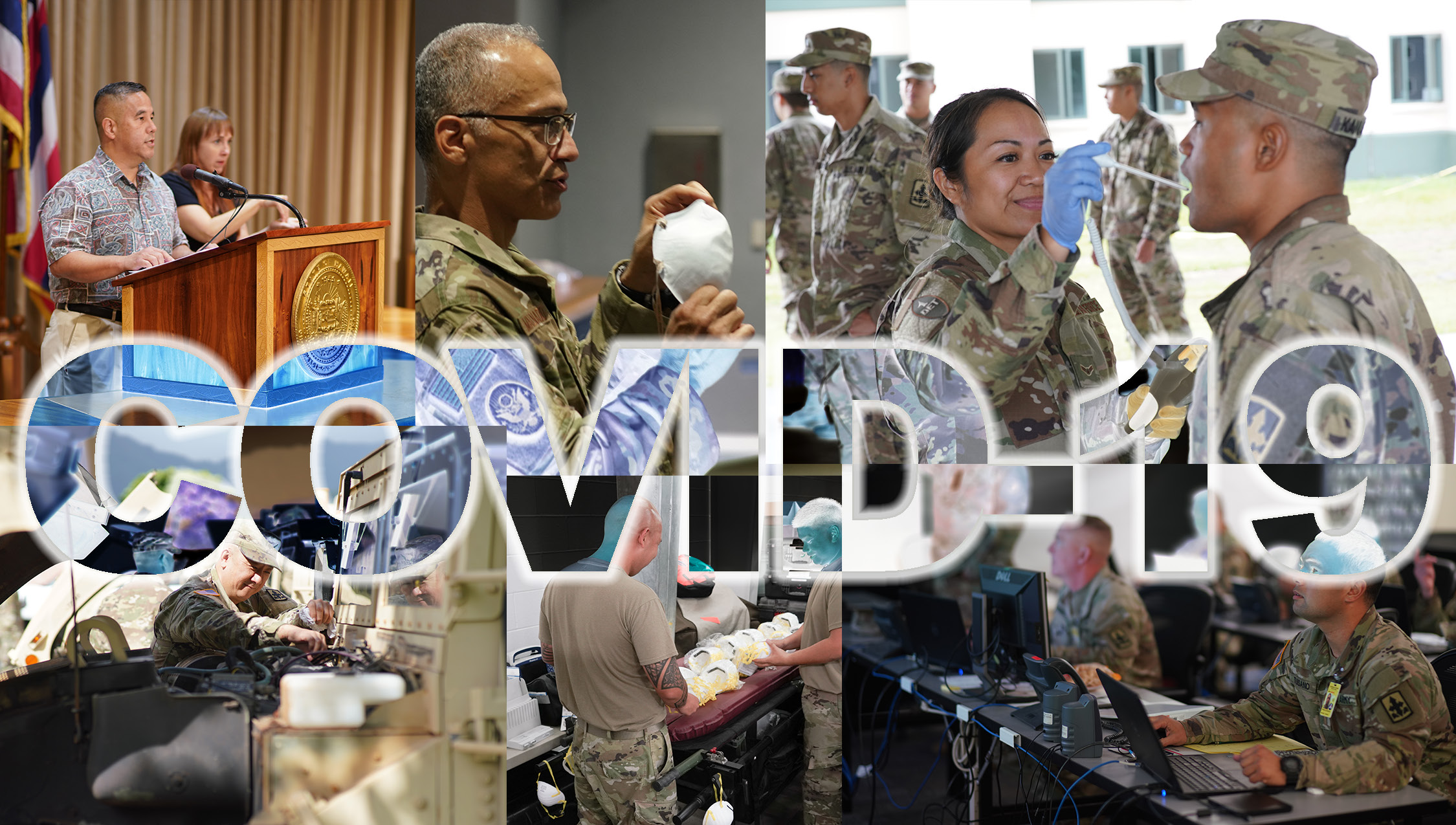
HI-EMA responded to the COVID-19 pandemic, and became fully operational in April 2020. HI-EMA helped secure and provide personal protective equipment (PPE), created messaging to the public on safety guidelines, and provided assistance to state, federal, and county partners on responding to infections caused by the ongoing crisis.
During the initial phases of the COVID-19 pandemic incident, a series of statewide deliberate planning sessions were conducted with the intent to develop the state strategy and create the operational design on how to deal with COVID-19. Plans included; COVID-19 Strategy, Medical Surge Staff Logistics Plan, Safe Travels Plan, Vaccine Distribution Plan; Neighboring Islands HHS Surge Testing Plan, and State Testing Plan
The State of Hawaii is continuing to monitor the COVID-19 pandemic that started late last year, and grew exponentially in 2020. Multiple state departments are working together to keep the community safe, including the Hawaii Department of Defense. The Hawaii Emergency Management Agency has taken a lead role, and its director Maj. Gen. Kenneth S. Hara was appointed by the governor as Incident Commander of the state emergency.
While cases are continuing to emerge in the islands, the state has implemented several protocols to try to flatten the curve. This includes instituting a mandatory 14-day quarantine for residents and visitors coming into the state. The new policy went into effect March 26. Gov. David Ige has also asked that all non-essential workers stay home and practice social distancing to avoid spreading the virus any further. Bars and clubs have been ordered to close, while restaurants are still allowed to operate – on a take-out only basis. Rules are continually updated as the state sees necessary to try to stop the spread of infection.
COVID-19, also known as the coronavirus, is a respiratory illness that can easily be spread from person-to-person through droplets produced when an infected person coughs or sneezes. It’s also possible that a person can get COVID-19 by touching a surface or object that has the virus on it and then touching their own mouth, nose, or eyes. Symptoms of COVID-19 include fever, cough, and shortness of breath. If you have any of these symptoms, you’re asked to stay home and call your health care provider for guidance. Make sure to cover your cough or sneeze with a tissue and make sure to throw that in the trash afterward. Also clean and disinfect frequently touched objects and surfaces.
If you’re healthy, the best way to protect yourself from getting infected is by practicing at least six feet of social distancing. Avoid close contact with people who are sick. Avoid touching your eyes, nose, and mouth. Wash your hands often with soap and water for at least 20 seconds. If you can’t physically wash your hands, using a sanitizer that contains at least 60% alcohol can also be effective.
The Hawaii Emergency Management Agency (HI-EMA) has always been there to protect and support our islands from a disaster, whether it was a hurricane, Kilauea’s volcanic eruption, or a tsunami. But with this unprecedented pandemic caused by the coronavirus known as COVID-19, HI-EMA continues to be at the forefront for preparedness, response, recovery, and mitigation.
As the numbers of infections slowly rise due to the reopening of the State, HI-EMA has been diligently battling the daily additional challenges posed by the increased number of cases.
Our Operations section led by Dr. Steve Sigler, PhD continues to provide resource support and coordination of response activities among all our federal, State, and local agencies and our private sector partners.
“In response to COVID-19,” said Sigler. “Our big task and challenge has been putting in place the Incident Command System structure within the telework and physical distancing environment, where those responsible for providing assistance and resources are not in the Emergency Operations Center, but instead safely at home and online so that discussions and tasks can be followed up on in real time.”
Going hand in hand with Operations is our Logistics section remotely headed by David Hafner.
“For the COVID-19 incident, HI-EMA logistics has teamed with the State Purchasing Office and the Department of Health to purchase and distribute critically needed personal protective equipment (PPE) and industrial hygiene supplies to over 20 State and County departments,” said Hafner.
These agencies ranged from the Attorney General’s office to the Department of Education, all of which has received face masks, hand sanitizers, and other essential equipment obtained by HI-EMA.
In addition to working with state and county governments, the HI-EMA Logistics Branch worked with dedicated volunteers to develop assistance programs to support Hawaii’s smaller independent medical providers locate and purchase PPE.
Obtaining PPE wasn’t as easy at sounds. Due to shortages, Hawaii found itself in a unique position for supplies. “This is a global crisis,” said Executive Officer David Lopez. “Hawaii has found itself competing for these products on a worldwide market when ordinarily we wouldn’t have to.”
For the medical aspects in response to the incident, HI-EMA activated University of Hawaii professor Dr. Steven Hankins to head up Emergency Support Function 8 to tie in the capabilities of the medical environment as well as comprehend the nature of COVID-19 itself.
Dr. Hankins and his team ensure the medical aspects of this emergency are taken care of and that capacities at hospitals are prepared to meet any increases in mass infection numbers. This has been in cooperation and collaboration with State Department Health.
Beyond the immediate challenges posed by the coronavirus, our recovery team, headed by the State Disaster Recovery Coordinator (SDRC) Alexandra Slous, facilitates ongoing collaboration and coordination with state, county, federal, and community partners through the State Unified Recovery and Resilience Facilitation (SURRF) Team. The SDRC’s role is designed to build the State of Hawaii’s capacity and structure for holistic, inclusive, and well-coordinated recoveries from past, current, and future disasters. The State Disaster Recovery Framework is informed by the National Disaster Recovery Framework and promotes organization by Recovery Support Function (RSF) including: community planning & capacity building, health & social services, housing, economic, infrastructure, and natural & cultural resources.
“We identify priorities and develop a comprehensive plan to pivot from the COVID-19 public health emergency to address an acknowledged need to renew and rebuild Hawaii’s communities moving forward,” said Slous.
The External Affairs section is in charge of distributing information to the public in the messaging forms of press releases, social media updates, and even public service announcement videos. The section has been supporting the Joint Information Center to deal exclusively with the manner communications matters arising from COVID-19.
“The challenge has been attempting to coordinate public messaging across all sectors of government and present it to the public in the timeliest manner possible to advise how we, as a State, can each do our part to make sure the COVID-19 outbreak doesn’t spread beyond our capacities,” said Arlina Agbayani, Public Information Officer.
But even with these capable staff members leading the charge against this unpredictable threat, HIEMA very much needs to rely on the community as well. During this point in time, it’s never been more crucial from an emergency management perspective for residents and visitors to wear masks while out in public, to continue washing their hands, and to continue to maintain safe physical distancing, especially in situations that find you in contact with people who are not members of your immediate household. All the mitigation, response and recovery goals achieved by HI-EMA cannot work without cooperation from the public.