Do you need help in another language? We will get you a free interpreter. Call 808-369-3580 to tell us which language you speak.
您需要其它語言嗎?如有需要,請致電 (808-369-3478), 我們會提供免費翻譯服務
您需要其它语言吗?如有需要,请致电 (808-369-3478), 我们会提供免费翻译服务
En mi niit alilis lon pwal eu kapas? Sipwe angei emon chon chiaku ngonuk ese kamo. Kokori (808-369-3478) omw kopwe ureni kich meni kapas ka ani.
Makemake `oe i kokua i pili kekahi `olelo o na `aina `e? Makemake la maua i ki`i `oe mea unuhi manuahi. E kelepona (808-369-3478)`oe ia la kaua a e ha`ina `oe ia la maua mea `olelo o na `aina `e.
Masapulyo kadi ti tulong iti sabali a pagsasao? Ikkandakayo iti libre nga paraipatarus. Awaganyo ti
(808-369-3478) tapno ibagayo kadakami no ania ti pagsasao nga ar-aramatenyo.
다른언어로 도움이 필요하십니까? 저희가 무료로 통역을 제공합니다. (808-369-3478)로 전화해서 사용하는 언어를 알려주십시요
Kwoj aikuij ke jiban kin juon bar kajin? Kim naj lewaj juon am dri ukok eo ejjelok wonen. Kirtok
(808-369-3478) im kwalok non kim kajin ta eo kwo melele im kenono kake.
E te mana'o mia se fesosoani i se isi gagana? Matou te fesosoani e ave atu fua se faaliliu upu mo oe. Vili mai i le numera lea (808-369-3478) pea e mana'o mia se fesosoani mo se faaliliu upu.
¿Necesita ayuda en otro idioma? Nosotros le ayudaremos a conseguir un intérprete gratuito. Llame al (808-369-3478) y diganos que idioma habla.
Kailangan ba ninyo ng tulong sa ibang lengguwahe? Ikukuha namin kayo ng libreng tagasalin. Tumawag sa (808-369-3478) para sabihin kung anong lengguwahe ang nais ninyong gamitin.
‘Okú ke fie maʻu tokoni ʻi ha lea fakafonua ʻe taha? Temau kumi haʻo taha fakatonulea taʻetotongi. Telefoni ki he (808-369-3478) ke fakahā mai ʻa e lea fakafonua ʻokú ke lea aí.
Bạn có cần giúp đỡ bằng ngôn ngữ khác không ? Chúng tôi se yêu cầu một người thông dịch viên miễn phí cho bạn. Gọi (808-369-3478)nói cho chúng tôi biết bạn dùng ngôn ngữ nào
Gakinahanglan ka ba ug tabang sa imong pinulongan? Amo kang mahatagan ug libre nga maghuhubad. Tawag sa (808-369-3478) aron magpahibalo kung unsa ang imong sinulti-han.
Hawaiʻi Air National Guard’s C-17 Globemaster III Aircraft Conversion
The arrival of the C-17 Globemaster III in 2006 marked a transformative moment for the Hawaiʻi Air National Guard (HIANG), ushering in a new era of air mobility and joint operations in the Pacific. The transition replaced the aging C-130 Hercules fleet with a strategic airlifter capable of overcoming vast distances. The journey began long before the aircraft touched down in Hawaiʻi, with significant milestones in aircraft assembly and preparation.
On Aug. 19, 2005, a ceremony was held at Boeing’s Long Beach, Calif. facility, where the wings were attached to the fuselage of the first C-17 destined for Hickam Air Force base, Hawaiʻi. This event symbolized the aircraft’s transition from parts to near-complete airlifter and underscored the industrial effort behind it. This aircraft was set to become the 146th C-17 of the U.S. Air Force and the first to be stationed outside the continental U.S.
The transition required extensive training and infrastructure development. HIANG pilots, loadmasters and maintainers trained at multiple locations, including Altus Air Force Base, Okla., McChord Air Force Base, Wash. and the Mississippi Air National Guard’s C-17 training facilities. At Hickam, a C-17 flight simulator was installed, and new maintenance facilities were constructed to support the aircraft’s size and technical requirements.
The C-17s were assigned under a unique “classic associate” arrangement, jointly operated by the active-duty’s 15th Airlift Wing and the HIANG’s 154th Wing. This partnership represented a departure from traditional Air Mobility Command basing and reflected Pacific Air Forces’ recognition of Hawaiʻi’s strategic role in global mobility. Under this construct, active-duty and Guard aircrew and maintainers operated and sustained the same aircraft, strengthening readiness, efficiency and total-force integration.
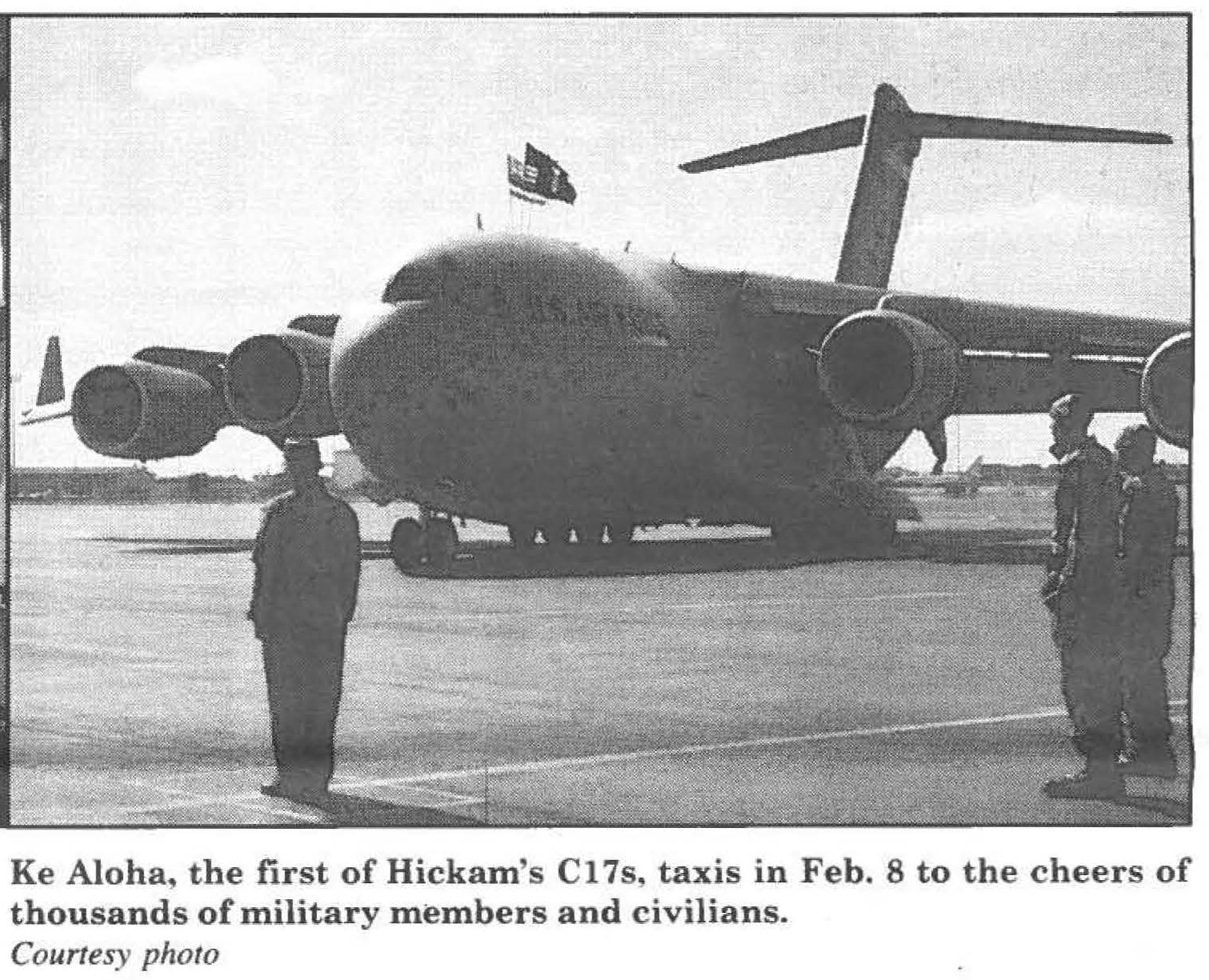
The arrival of the first C-17, officially named “Ke Aloha” (Spirit of Hawaiʻi), took place on Feb. 8, 2006, greeted by thousands of spectators, military personnel and civic leaders on the Hickam flightline. A second aircraft followed shortly thereafter on February 21. The introduction of the C-17 also marked the end of an era: the last C-130 Hercules aircraft departed Hickam on Feb. 15, 2006, concluding 20 years of service.
Upon arrival, the C-17s forged a lasting legacy of strategic airlift capability for Hawaiʻi. Their presence not only enhanced military mobility across 14 time zones but also strengthened joint force integration between active duty and Guard units — an enduring testament to the mission and partnership.
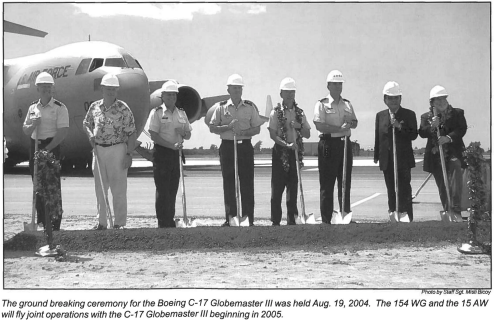
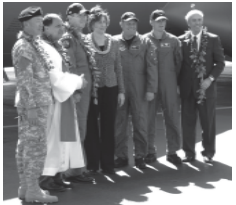
19 AUG 2004 A ground breaking ceremony for the Boeing C-17 Globemaster lll was held at Hickam AFB.
Learn more
With a lot of coordination and cooperation the HIANG was able to successfully take on new challenges. The C-17 Associate Unit, which would consist of an Active Duty, National Guard partnership, took its first step forward by having a ground breaking ceremony Aug. 19, 2004 at Hickam AFB. . .
The ground breaking ceremony for the Boeing C-17 Globemaster lll was held Aug. 19, 2004. The 154 WG and the 15AW will fly joint operations with the C-17 Globemaster III beginning in 2005.(Picture from the 2004 November Kūkāʻilimoku)
Besides supporting the GWOT and various humanitarian missions the HIANG began preparations to stand up the Air Guard and Active Duty’s first C-17 associate unit at Hickam Air Force Base.
The 154th Wing participated in numerous exercises and deployments during the year, despite preparing for the arrival of the first Team Hickam C-17 Globemaster III in 2006.
With a lot of coordination and cooperation the HIANG was able to successfully take on new challenges. . . . During this time, pilots and loadmasters of the 204th Airlift Squadron were already being qualified on the C-17 Globemaster III. At this time, members of the 204th AS were already flying with the McChord Air Force Base C-17 unit on missions in support of Operation Enduring Freedom.
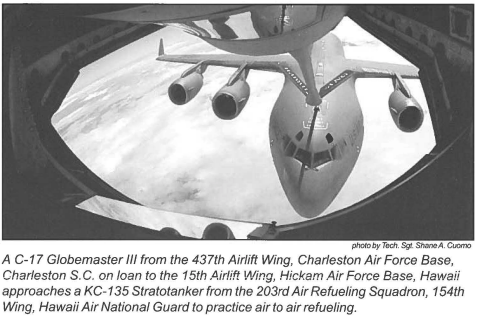
JUN 2005 The aircrews from the HIANG’s 204 AS and the 535th Airlift Squadron spent two hours practicing aerial refueling on C-17 from South Carolina at 20,000 feet in the southern warning airspace near Oahu.
Learn more
HIANG conducts first 15 AW C-17 air refueling
by Staff Sgt. Betty J. Squatrito-Martin
When opportunity knocks, open the door. That is what the 15th Airlift Wing’s new 535th Airlift Squadron did when news that a C-17 from South Carolina would be passing through PACAF in June.
The C-17 aircraft is scheduled to make Hickam Air Force Base its home in Jan. 2006. Its mission is scheduled to be a joint operation between the 15 AW and the Hawaii Air National Guard.
As the clock ticks toward the opening curtain, the C-17 family seeks opportunities for training. Therefore, when word that a C-17 from South Carolina would be spending time at Hickam, the 535 AS proceeded to make arrangements to borrow the aircraft and use it for training.
The steps taken by the 535 AS made it possible for the 535 AS and the HIANG’s new 204th Airlift Squadron C- 17 aircrews along with the HIANG’s KC-135 aircrews from the 203rd Air Refueling Squadron to perform their first local air refueling training mission aboard the C17 Globemaster III.
“This is another first for the Hawaii Air National Guard, with more to come during the stand up of the new Hickam based C-17 associate unit,” said Lt. Col. William Benton, commander of the 203 ARS.
The aircrews from the HIANG’s 204 AS and the 535 AS along with the 203 ARS spent two hours practicing aerial refueling at 20,000 feet in the southern warning airspace near Oahu.
Nine air refueling contacts were accomplished and both aircraft recovered back to Hickam.
The Hawaii Air National Guard and the 15th Airlift Wing began developing a working relationship with the arrival of the C-17 simulator, the opening of the C-17 Maintenance Complex, the first 15 AW C-17 refuel, and the completion of the first C-17 Home Station Check.
A C-17 Globemaster Ill from the 437th Airlift Wing, Charleston Air Force Base, Charleston S. C. on loan to the 15th Airlift Wing, Hickam Air Force Base, Hawaii approaches a KC-135 Stratotanker from the 203rd Air Refueling Squadron, 154th Wing, Hawaii Air National Guard to practice air to air refueling.(Picture from the 2005 September Kūkāʻilimoku)
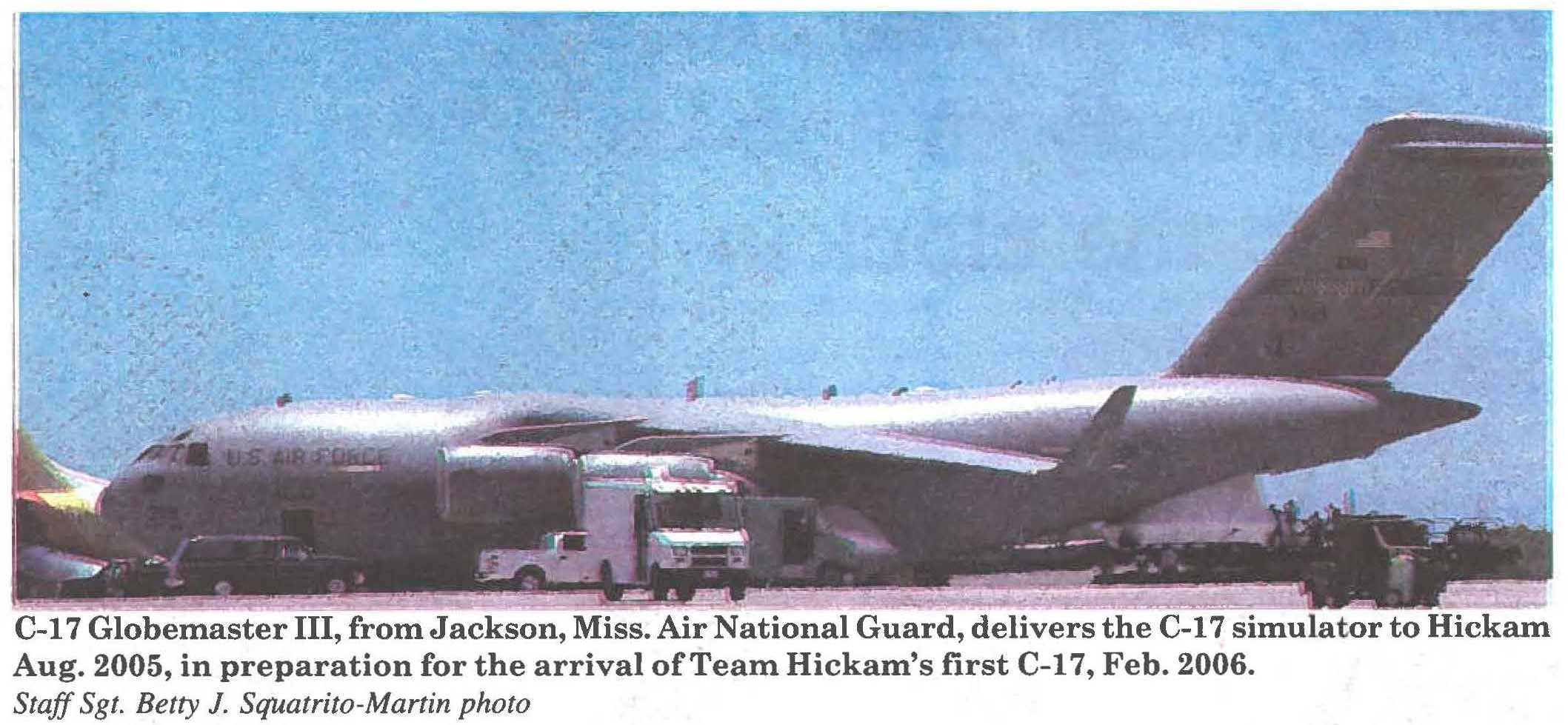
12 AUG 2005 The 15th Airlift Wing and the Hawaii Air National Guard 154th Wing took part in the stand up ceremony for the C-17 Weapons System Trainer, (flight simulator). The C-17 simulator arrived on Hickam aboard a C-17 from Jackson, Miss., and was placed in its new $7 million home marking the beginning of the integration of the trainer to the building in preparation of the future training of C-17 crews.
Learn more
. . .
C-17 simulator stands up
Leaders from the 15th Airlift Wing and the Hawaii Air National Guard 154th Wing took part in the stand up ceremony for the C-17 Weapons System Trainer, (flight simulator) here Aug. 12 .
The C-17 simulator arrived on Hickam aboard a C-17 from Jackson, Miss., and was placed in its new $7 million home marking the beginning of the integration of the trainer to the building in preparation of the future training of C-17 crews.
According to Lt. Col. Charles Darnell, Deputy Chief of the C-17 program integration, the integration effort will take six to seven months, which will make the simulator operational for training by the time the C-17 arrives here.
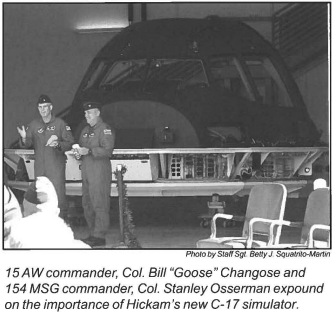
“The simulator itself is the major part of training for C-17 crews,” said Col. Stanley Osserman, 154th Wing Mission Support Group commander. “Unlike other weapons systems where crews go in the sim (simulator) once or twice a year for emergency check rides and special procedure training virtually all the training for the C-17 goes on using training devices and the crews do very little pure training in the aircraft,” Col. Osserman added.
Both active duty and Hawaii Air National Guard C-17 crews will perform training in the simulator, as the C-17 mission is the first Guard Associate flying unit in the Air Force.
The C-17 simulator stand-up marks another milestone toward the arrival of the C-17 Globemaster III·, which is due to arrive here in February 2006.
The simulator is just one of many C-17 facilities that will be in operation here. “The C-17 simulator was the first facility that we brought on board,” said Lt. Col. Darnell. “It was deemed the highest priority of the facilities to be accomplished before the C-17 aircraft arrives in February 2006,” added Lt. Col. Darnell.
As noted, the simulator will be up and running by February 2006, and run it will. “Boeing will be on contract to run the simulator, which will run five days a week, 12 hours a day and will include Guard weekends,” said Lt. Col. Darnell.
The Hawaii Air National Guard and the 15th Airlift Wing began developing a working relationship with the arrival of the C-17 simulator, the opening of the C-17 Maintenance Complex, the first 15 AW C-17 refuel, and the completion of the first C-17 Home Station Check.
15 AW commander, Col. Bill “Goose” Changose and 154 MSG commander, Col. Stanley Osserman expound on the importance of Hickam’s new C-17 simulator. (Picture from the 2005 November Kūkāʻilimoku)
19 AUG 2005 A ceremony was held at Boeing’s Long Beach, Calif. facility, where the wings were attached to the fuselage of the first C-17 destined for Hickam Air Force base, Hawaiʻi.
Learn more
Loadmaster journals C-17 “first rivet”
by Tech. Sgt. Peter Kali, 204 AS
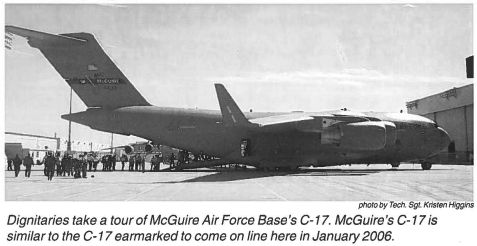
Dignitaries take a tour of McGuire Air Force Base’s C-17. McGuire’s C-17 is similar to the C-17 earmarked to come on line here in January 2006. (Picture from the 2005 May Kūkāʻilimoku)
A journal provided by Tech. Sgt. Peter Kali, a loadmaster with the 204th Airlift Squadron, describes in detail events that took place leading to the C-17 “first rivet” ceremony held at Boeing’s Long Beach, Calif. facility March 20.
SUNDAY – March 20, 2005
0500 – I never relish the thought of an early morning show time, especially when it falls on a weekend. This Sunday was shaping up to be no different, except for the fact that this morning’s mission would mark a historic milestone for members of the 204th Airlift Squadron. The crew of Manu 61 flew a C-130 to Long Beach, Calif. to attend the “first rivet” ceremony at the Boeing production facility – more on this ceremony later. Some of the special passengers onboard this morning’s flight were Col. Han, Lt. Col. Kim, Col. Osserman, Command Chief Master Sgt. Jelinksi-Hall, Chief Master Sgt. Wescott Lee, and other Wing and PACAF representatives.
MONDAY – March 21, 2005
1200 – 1400 – We met at the Boeing facility and waited for the arrival of the main package of dignitaries. First to land was the C-37 carrying our Lt. Gov. James “Duke” Aiona, the State Adjutant General Maj. Gen. Robert G. F. Lee, and others. Shortly after came the KC-135 that carried Brig. Gen. Peter S. Pawling, throngs of media types and other special passengers.
1400-1530- Everyone assembled in the cargo compartment of a newly built C-17 earmarked for Maguire AFB and listened to welcoming remarks by the head of Boeing’s C-17 Project. We then divided into two groups and went on a tour of the entire facility. This was a first-class tour all the way! We all witnessed how they build a C-17 from scratch until it rolls off the line. What stuck out most in many of our minds was how clean the facilities were. A person could drop a sushi on the floor and blatantly disregard the 3-second rule.
1545 – Both groups of visitors pulled up in buses in front of the initial production hangar. We stepped off the buses, passed through the massive doors, and were suddenly greeted by hundreds of Boeing employees cheering and applauding. They were all wearing flower lei. I glanced over my shoulders to see if the Lt. Governor was walking directly behind me because the experience thus far was both surreal and unnerving. Nope, it was just Lt.Col. Mansell.
While walking, I realized that I am part of a group of operators and maintainers that will operate a collective $2 Billion worth of Boeing hardware. Keep on clapping!
1600 – The official ceremony begins with remarks from the dignitaries. Lt. Gov. Aiona spoke about the impact the C-17 will have in Hawaii and mentioned how impressed he was with the entire production process. Maj. Gen. Lee reiterated the Lt. Governor’s comments and received loud cheers when he remarked on his efforts in getting the Air Force to increase the overall C-17 fleet size.
A Kahu then proceeded to bless the upper-fuselage section of what will become our first C-17 at Hickam, plane # 146. This was a unique and touching ceremony that represented the Hawaii National Guard well.
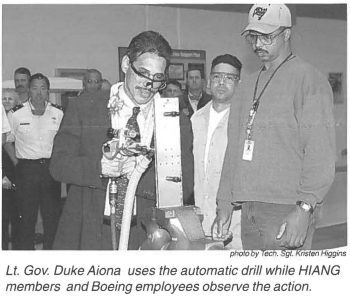
The Lt. Governor and TAG then proceeded to drive the “first rivet” into the fuselage. This was a technical operation controlled by a computer and huge machine. There was no manual pounding of a hammer, and the whole moment was not as dramatic as I envisioned. Nevertheless, the rivet was driven, and the ceremony ended with conversation and refreshments.
1800 – By now the C-37 and KC-135 have left with their respective dignitaries enroute back to Hickam. We took-off last with the brave souls who chose to spend 9-hours on a cozy C-130 recalling events of the historic day just passed.
This “first rivet” ceremony marked a milestone for the 204th Airlift Squadron as it continues to transition into a C-17 unit. We currently have more than 30 individuals away at formal training, learning how to operate this new aircraft. Incidentally, while the ceremony was taking place in Long Beach, two of our initial qualified C-1 7 loadmasters were halfway around the world delivering supplies in Afghanistan in direct support of Operation Enduring Freedom. They, and those who follow, will fly with the active duty out of McChord Air Force Base to gain experience and maintain currency until P-146 is delivered to Hickam in January 2006. There’s no question these are exciting times for the 204 AS.
The next big step for the Associate Unit was the “first rivet” ceremony held at Boeing’s Long Beach, Calif., facility Mar. 20, 2005. Brig. Gen. Pawling, 154th Wing commander along with numerous distinguished guests, flew to Long Beach to witness the “first rivet” ceremony. During the ceremony, Lt. Gov. James “Duke” Aiona and Maj. Gen. Robert G.F. Lee, the adjutant general had the honors of driving the “first rivet” into the fuselage.
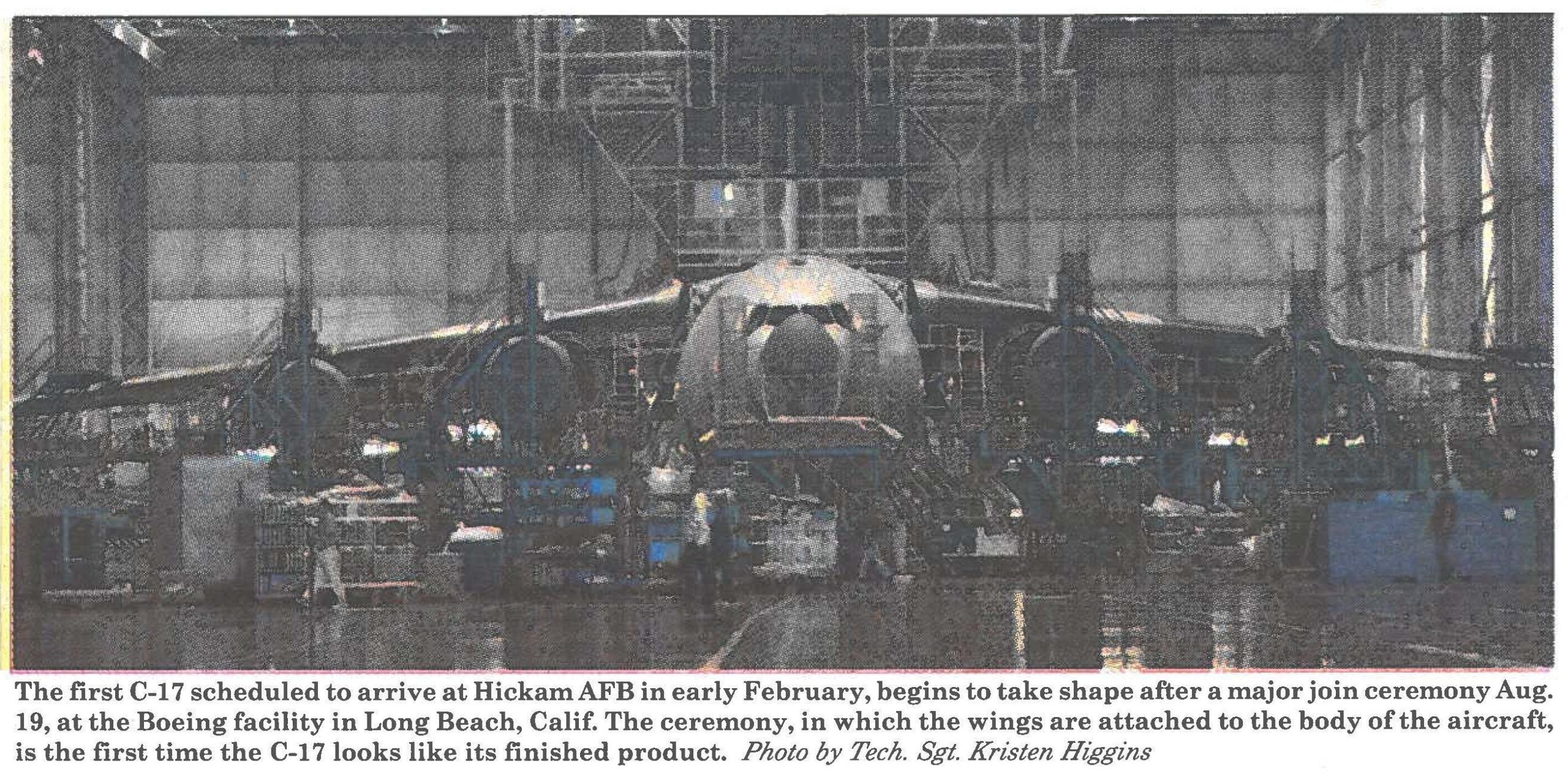
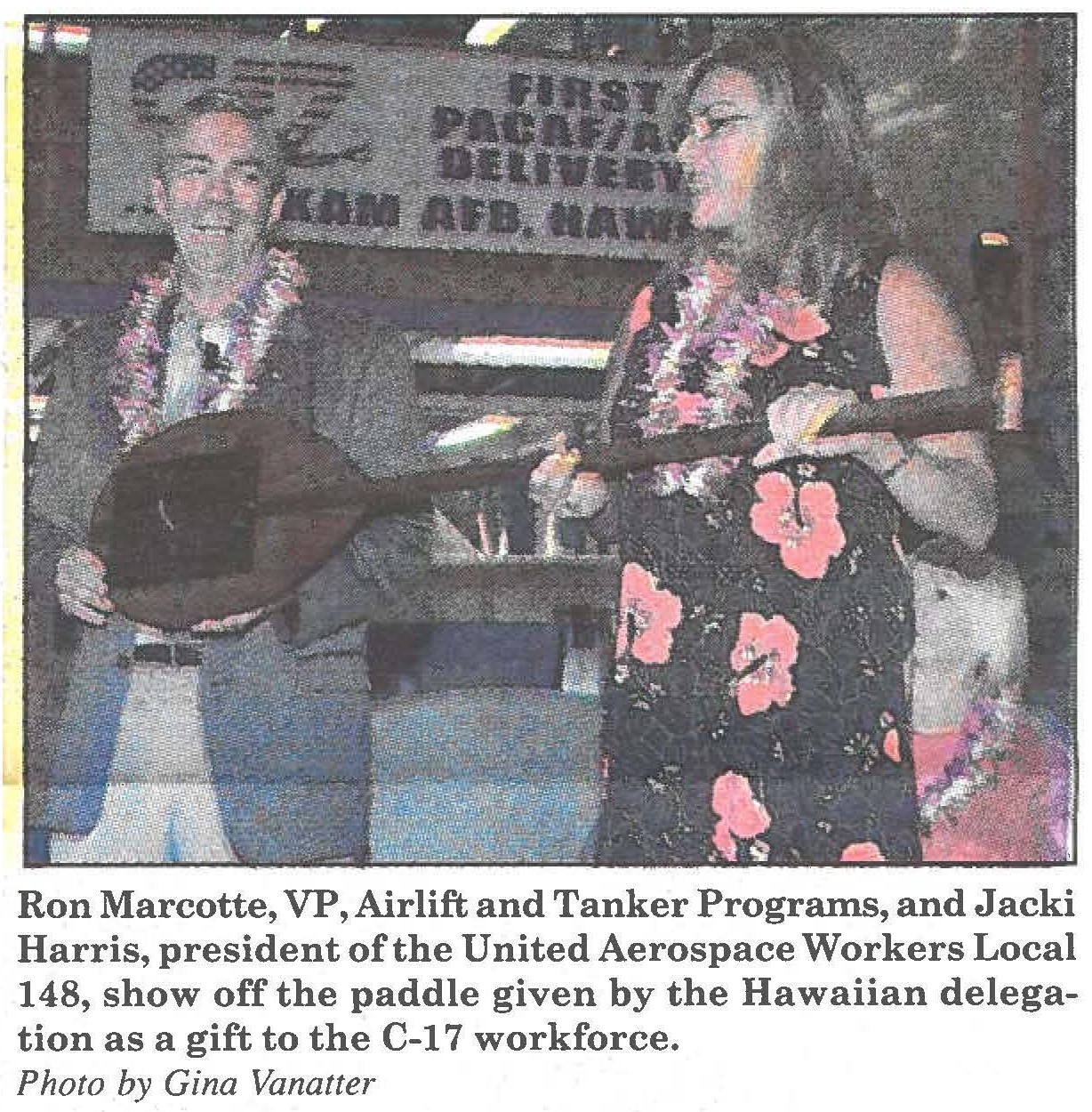
The first C-17 scheduled to arrive at Hickam AFB in early February, begins to take shape after a major join ceremony Aug. 19, at the Boeing facility in Long Beach, Calif. The ceremony, in which the wings are attached to the body of the aircraft, is the first time the C-17 looks like its finished product. Photo by Tech. Sgt. Kristen HigginsRon Marcotte, VP, Airlift and Tanker Programs, and Jacki Harris, president of the United Aerospace Workers Local 148, show off the paddle given by the Hawaiian delegation as a gift to the C-17 workforce. Photo by Gina Vanatter (Picture from the 2005 July – September Pūpūkahi)
In a colorful ceremony sprinkled with Hawaiian tradition, the four major sections for Hickam Air Force Base’s first C-17 were joined Friday, Aug. 19 in the Long Beach, Calif., factory where the giant airlifter is assembled. “We’re amazed at the effort and dedication it takes to put this air-plane together,” said Major General Robert Lee, adjutant general of the State of Hawaii and the commander of the Hawaii National Guard. “The industrial might of the United States of America is alive and well in the C-17 workforce in Long Beach.”
About 500 Boeing employees, as well as a large delegation of civic and military leaders from Honolulu were on hand for the event. Major join is a significant milestone in the aircraft’s assembly, as it’s the first time the C-17 actually looks like an airplane.
When delivered in January 2006, the aircraft will be the U.S.Air Force’s 146th C-17, and the first based outside of the continental United States. “We would welcome as many Boeing employees as possible to come to Honolulu for our delivery next year,” said Lee, drawing boisterous applause from employees. “We want to return your hospitality.”
The celebration aircraft is the first of eight C17s destined for Hickam. The seven C-17s that follow it will arrive in Honolulu approximately every three to four weeks- until the squadron is complete in mid2006.
The base’s C-17s are the first of 16 destined for the Pacific Air Forces. The other eight will go to Elmendorf Air Force Base in Alaska, beginning in 2007.
Maj. Gen. Edward A. Rice, Jr., said the C-17’s long-range capabilities will address one of the Pacific Air Forces’ biggest challenges – spanning 14 time zones. What he called “the tyranny of distance.”
Rice, commander of 13th Air Force, based in Guam, and part of the Pacific Air Forces, described the C-17 as “the centerpiece of our transformation. The C-17s are going to set the pace for the rest of the Air Force,” he said.
Hickam’s new C-17s will be jointly operated by the Air Force’s 15th Airlift Wing, and the Hawaii Air National Guard’s 154th Wing. It’s a unique arrangement that marks the first time C17s will be delivered to an organization outside Air Mobility Command. Hawaii’s C-17s will be under the jurisdiction of the Pacific Air Forces, headquartered at Hickam.
Brig. Gen. Peter Pawling, commander of the 154 WG, based at Hickam, presented the C-17 workforce with an outrigger paddle – a symbolic connection between the Boeing employees and the soon-to-be users of the aircraft. The paddle is made of koa wood.
”Like the aircraft, koa symbolizes strength, quality and durability,” said Pawling. “All of you are the paddle builders and we want to thank you.”
Members from the 154th Wing and 15th Airlift Wing traveled to the Boeing C-1 7 plant in Long Beach, Calif., Aug. 19, to participate in a Major Join Ceremony.
The Major Join Ceremony celebrated the attachment of the wing to the fuselage of Hickam’s first C17 Globemaster III, which began production March 21, 2005.
According to Master Sgt. Ramon Quizon, the interesting part of the ceremony was the ability to see all eight of Hawaii’s C-17s at various stages of production with each stage leading to the joining of the wing to the fuselage.
The major join marks another major step in the process of the C17 Globemaster IIIs coming to Hawaii as part of a Guard Associate flying unit in February 2006.
The C-17 Globemaster III is a four-engine , T-tailed aircraft designed to meet military airlift needs in the 21st Century.
Unlike its predecessor the C-5 Galaxy, which requires longer prepared runways, the C-17 Globemaster III has the capability of landing on small harsh inhospitable runways, which means it can deliver large combat equipment and troops, or humanitarian aid throughout the world. . .
Lt. Gov. Duke Aiona uses the automatic drill while HIANG members and Boeing employees observe the action. (Picture from the 2005 May Kūkāʻilimoku)
C-17 training
C-17 Globemaster III, from Jackson, Miss. Air National Guard, delivers the C-17 simulator to Hickam Aug. 2005, in preparation for the arrival of Team Hickam’s first C-17, Feb. 2006. Staff Sgt. Betty J. Squatrito-Martin photo(Picture from the 2005 October – December Pūpūkahi)
By Staff Sgt. Betty J. Squatrito-Martin Somebody said that it couldn’t be done, but with a chuckle he replied, “Just give them a chance, let’s see what they can do. Let’s see if the 15th Airlift Wing and the Hawaii Air National Guard’s 154th Wing can fly.” So Airmen, active duty and Guard, buckled down and step by step began to make the C-17 Globemaster Ill’s arrival at Hickam Air Force Base a reality.
The C-17 Globemaster Ill’s arrival Feb. 8 is predominately due to the determination and dedication of active duty and guardsmen alike who have been training and working since the C-17 ground breaking ceremony Aug. 19, 2004
With a 17-month break between the ground breaking and actual arrival of the aircraft you can rest assured that no one was waiting around to start training. While Hickam’s first C-17 was being built in Long Beach, Calif., Airmen were already learning to fly and load the C-17 aircraft.
To qualify to fly the C-17, pilots and loadmasters are sent to Altus Air Force Base, Okla. where they spend about four months training on the aircraft. According to Lt. Col. Michael Compton, chief of the C-17 transition office, once qualified on the C-17, the HIANG members go to McChord Air Force Base, Wash., and Jackson Air National Guard Base, Miss., to deploy with those units in an effort to develop their proficiency.
“We have flown throughout the Pacific and the Continental United States, but our most common missions are in support of Operation Enduring Freedom and Operation Iraqi Freedom,” said Lt. Col. Compton.
The C-17 crews have been bringing rebuilding supplies, vehicles and troop into country, flying troops home and flying Aeromedical Evacuation flights, added Lt. Col. Compton.
The transition from the C-130 to the C-17 has been and continues to be a busy time for the HIANG. Crew members are being asked to be away from home for over six months this year, and I am very proud of what the members have given up for this transition, said Lt. Col. Compton.
“We have flown about 5,000 hours in the C-17 with 1,500 hours of combat time,” said Lt. Col. Compton.
So far there are about 10 pilots and 20 loadmasters trained and ready for the C-17 s arrival. About that same number are currently in training.
Besides being capable of rapidly and strategically delivering troops and various types of cargo for combat purposes the C-17 aircraft is also known for performing humanitarian missions.
“With our comprehensive, aggressive training program, our crews are well prepared to immediately contribute to the global mobility mission,” said Lt. Col. Compton.
Our Classic Associate C-17 program with the 15 AW is gaining momentum, as we await the arrival of our first aircraft in late January or early February. Many of our C-17 facilities are nearing completion, with the requisite dedications pending. The 154 WG and the 15 AW are currently ramping up all aspects of the C-17 bed down.
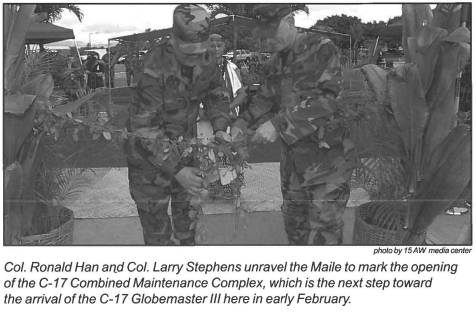
22 NOV 2005 Maintenance members from the active duty and Guard gathered together for the opening ceremony of the new C-17 Combined Maintenance Complex. The 154th Wing C-17 maintenance crews will work along side the 15th Airlift Wing C-17 maintenance crews to ensure the success of the C-17 mission.
Learn more
The Hawaii Air National Guard and the 15th Airlift Wing began developing a working relationship with the arrival of the C-17 simulator, the opening of the C-17 Maintenance Complex, the first 15 AW C-17 refuel, and the completion of the first C-17 Home Station Check.
Active duty and Guard members at the same place, same time, doing the same things is becoming a normal occurrence here. Maintenance members from the active duty and Guard gathered together Nov. 22 for the opening ceremony of the new C-17 Combined Maintenance Complex.
The 154th Wing C-17 maintenance crews will work along side the 15th Airlift Wing C-17 maintenance crews to ensure the success of the C-17 mission.
“We’re proud to be a part of the sky warriors …. one team, one mission,” said Col. Ronald Han, 154th Maintenance Group commander.
The active duty will have 60 percent of the maintenance responsibility, while the 154th will have 40 percent. Although it is not an even split, the 15th Airlift Maintenance Group Commander, Col. Larry Stephens, recognizes the strengths that the 154th Wing contributes to the team. “Without him (Col Han), without his people, without their expertise, we would not be able to do our job,” said Stephens.
Col. Ronald Han an.d Col. Larry Stephens unravel the Maile to mark the opening of the C-17 Combined Maintenance Complex, which is the next step toward the arrival of the C-17 Globe master III here in early February. (Picture from the 2006 January Kūkāʻilimoku)
The Hawaii Air National Guard made a history of its own as it stood up an active-duty/Air National Guard associate unit with eight C-17 Globemaster III transport aircraft.
The Hawaii Air National Guard and the 15th Airlift Wing began developing a working relationship with the arrival of the C-17 simulator, the opening of the C-17 Maintenance Complex, the first 15 AW C-17 refuel, and the completion of the first C-17 Home Station Check. With the acceptance of the C-17, the HIANG said farewell to the C-130 after 20 years of service. The last C-130 departed Hickam, Feb. 15, 2006.
FEB 8 & 21 2006 The arrival of the first C-17, officially named “Ke Aloha” (Spirit of Hawaiʻi), took place on Feb. 8, greeted by thousands of spectators, military personnel and civic leaders on the Hickam flightline. A second aircraft followed shortly thereafter on February 21.
Learn more
The year also brought the first C-17 Globemaster III cargo aircraft, the Spirit of Hawaii, to Hickam Air Force Base, Feb. 8, 2006. The Spirit of Hawaii was the first of eight C-17 aircraft to make Hickam its home as part of the first active duty and Air National Guard classic associate units. The Hawaii Air National Guard and the 15th Airlift Wing began developing a working relationship with the arrival of the C-17 simulator, the opening of the C-17 Maintenance Complex, the first 15 AW C-17 refuel, and the completion of the first C-17 Home Station Check. With the acceptance of the C-17, the HIANG said farewell to the C-130 after 20 years of service. The last C-130 departed Hickam, Feb. 15, 2006.
Hawaii Air National Guard makes history with arrival of the C-17 Globemaster Ill
By 154th Wing Public Affairs
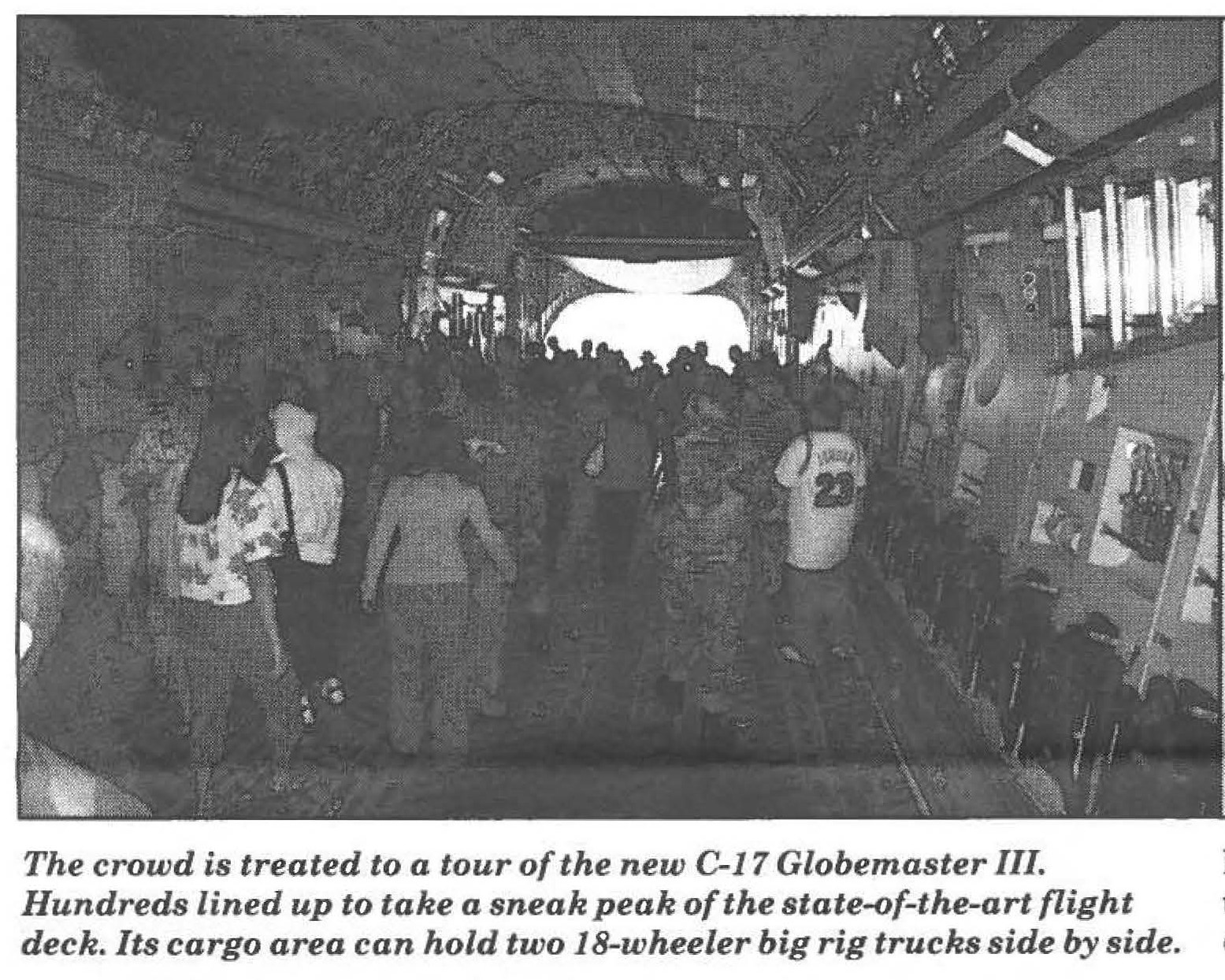
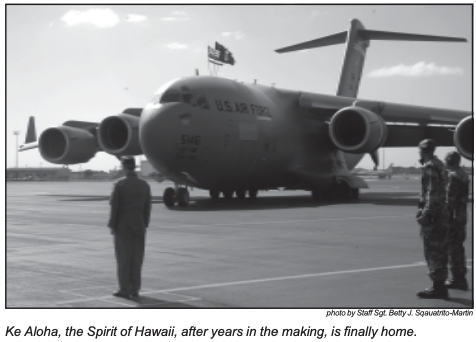
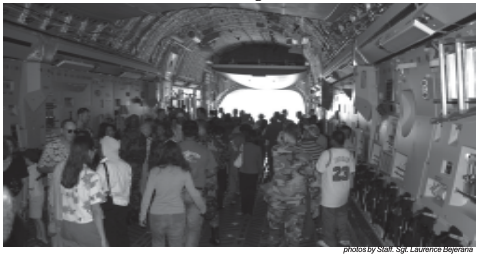
Ke Aloha, the first of Hickam’s Cl 7s, taxis in Feb. 8 to the cheers of thousands of military members and civilians. Courtesy photo The crowd is treated to a tour of the new C-17 Globemaster III. Hundreds lined up to take a sneak peak of the state-of-the-art flight deck. Its cargo area can hold two 18-wheeler big rig trucks side by side(Pictures from the 2006 January – March Pūpūkahi)
History was made early this year, with the arrival of the first and second C-17 Globemaster III’s to be housed at Hickam Air Force Base. Thousands gathered on the flightline in front of the 15th Airlift Wing’s operations center Feb. 8 to welcome Ke Aloha, the very first of Hickam ‘s C-17s to arrive. The second followed shortly, arriving Feb. 21.
Piloted by active duty and Guard members, the Ke Aloha along with the second Globemaster Ill, which was unofficially named the Hawaii 2 by Boeing representatives, sealed the 15th Airlift Wing and 154th Wing partnership at Hickam Air Force Base.
“It’s a whole new world at Hickam Air Force Base,” said Capt. Steven Snelson, C-17 pilot from the 535th Airlift Squadron.
This is the first time the C-17 will make its home outside the continental United States.
“It makes so much sense having the C-17s stationed at Hickam Air Force Base. From this location, we’d be able to effectively support all the service branches of our American military” said Brig. Gen. Peter “Skipper” Pawling, 154th Wing commander.
Both the Active Duty and the Hawaii Air National Guard are joining forces to bring the rapid strategic delivery of troops and all types of cargo under all sorts of conditions to all kinds of places.
“The C-17 will support missions wherever anyone needs our help,” said Tech. Sgt. Rafael Delasierra, Hawaii Air National Guard member and designated crew chief of Ke Aloha.
With an overall 60/40 split between active duty and guard, the partnership between the two will allow ample support for the National Guard’s state mission, which distinguishes them from their active duty counterparts.
“Not only will we use C-17s in a joint manner to support all of our military forces, but in my other responsibility in homeland security, our response in the State of Hawaii is going to be so much improved,” said Maj. Gen. Robert Lee, Hawaii state adjutant General during the second C-17 ceremony.
“Our 93rd Weapons of Mass Destruction Civil Support Team can take its entire team and all of its equipment on one C-17, fly anywhere within the State of Hawaii and need be, fly throughout the Pacific in case of biological or nuclear disaster,” said Maj. Gen. Lee.
The C-17s will continue to arrive at Hickam Air Force Base through September until all eight aircraft arrive.
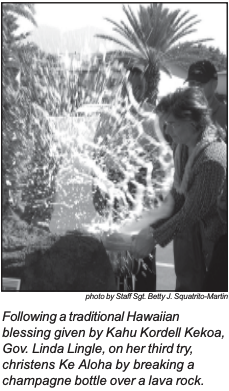
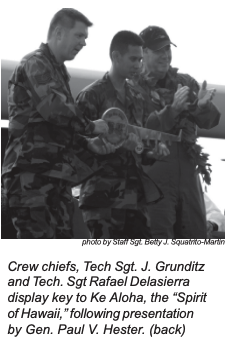
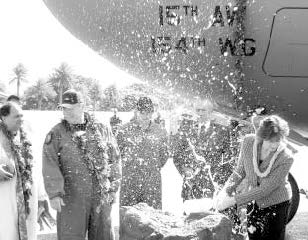
Following a traditional Hawaiian blessing given by Kahu Kordell Kekoa, Gov. Linda Lingle, on her third try, christens Ke Aloha by breaking a champagne bottle over a lava rock.Crew chiefs, Tech Sgt. J. Grunditz and Tech. Sgt Rafael Delasierra display key to Ke Aloha, the “Spirit of Hawaii,” following presentation by Gen. Paul V. Hester. (back)Ke Aloha, the Spirit of Hawaii, after years in the making, is finally home.The crowd is treated to a tour of the new C-17 Globemaster III. Hundreds lined up to take a sneak peak of the state-of-the-art flight deck. Its cargo area can hold two 18-wheeler big rig trucks side by side.Dignitaries, Maj. Gen. Robert Lee, Kahu Kordell Kekoa, Gen. Paul V. Hester, Gov. Linda Lingle, Brig. Gen. Peter S. Pawling, Col. William J. Changose and Mr. Ron Marcotte.(Pictures from the 2006 March Kūkāʻilimoku)
Ke Aloha, the first of Hickam AFB’s C-17 Globemaster IIIs, piloted by active duty and Guard members, taxied home to the cheers of thousands gathered for the C-17 Landing Ceremony here Feb. 8.
Gov. Linda Lingle christened the Ke Aloha or Spirit of Hawaii, to usher in a new era for Hickam Air Force Base as the first Active Duty/ Air National Guard associate unit in the Air Force takes off.
“It’s a whole new world at Hickam Air Force Base,” said Capt. Steven Snelson, C-17 pilot from the 535th Airlift Squadron.
This is the first time the C-17 will make its home outside the continental United States.
“It makes so much sense having the C-17s stationed at Hickam Air Force Base. From this location, we’ll be able to effectively support all the service branches of our American military,” said Brig. Gen. Peter “Skipper” Pawling, 154th Wing commander.
Both the Active Duty and the Hawaii Air National Guard are joining forces to bring the rapid strategic delivery of troops and all types of cargo under all sorts of conditions to all kinds of places.
“The C-17 will support missions wherever anyone needs our help,” said Tech. Sgt. Rafael Delasierra, Hawaii Air National Guard member and designated crew chief of Ke Aloha.
Prior to the aircraft landing, the crowd was treated to a multi-cultural show, which included traditional Chinese, Japanese, Filipino and Korean dances. The Kamehameha Schools Children’s Chorus serenaded the crowd with a medley of Hawaiian and patriotic songs, and as the Halau Hula Dancers were putting the final touches on their performance, the C-17 rolled into place.Once the aircraft came to a halt, and the engines came to a stop, a string of dignitaries including General Paul V. Hester, commander Pacific Air Forces, Boeing’s vice president and general manager for global mobility, Ron Marcotte, and Gov. Linda Lingle exited the aircraft.
As part of a symbolic gesture to show the joining of the Active Duty and Guard, the HIANG 154th Wing Commander Brig. Gen. Peter S. Pawling and the 15th Airlift Wing Commander, Col. William Changose, in partnership and in tandem removed the cover from the side of the C-17 aircraft to reveal the name, Ke Aloha, Spirit of Hawaii, which refers to the ever present spirit of warmth and friendship.
“When one talks about the Active Duty and Guard relationship, we say we’re one team first,” said Brig. Gen Pawling.
As part of the Landing Ceremony, the crew chiefs; one from the Guard and one from Active Duty, assigned to the C-17 were given the keys to the aircraft. “It was an honor to receive the key from Gen. Hester and all the other dignitaries,” said Tech. Sgt. Delasierra.
In addition to increasing our global reach and wartime capabilities, the C-17 is expected to bring greater capability for disaster relief throughout the Hawaiian Islands.
According to Brig. Gen. Pawling, the C-17 can do the work of four of the now departed C-130s.
The Landing Ceremony was the culmination of several years worth of preparation and work beginning with the ground breaking ceremony in August 2004. Milestones along the way included, Lt. Gov. Duke Aiona accepting the Hawaiian state flag at the First Assembly, Guard and Active Duty members celebrating the major join, where the C-17 took on the shape of an airplane, and the preparation for its maiden voyage home to Hawaii.
I want to take the time to thank everyone who helped make the C-17 arrival ceremonies we had in February a tremendous success. I know a lot of time and hard work was devoted to each of the ceremonies by both Guard and Active duty members, please know that it did not go unnoticed. The C-17 is an amazing aircraft. Its load capacity and versatility makes it extremely valuable for us while we continue to fulfill both our state and federal missions.
BLESS THIS SHIP – Gov. Linda Lingle christens the Spirit of Aloha during arrival of the C-17 Globemaster III cargo aircraft at Hickam Air Force Base in 2006. Hawaii Air National Guard photo(Picture from the 2006 Annual Report)
Commander’s Call: UCI moves to June 07
Other news items include greeting our seventh C-17 which arrives June 14. The seventh aircraft will be named “Go for Broke”. The eighth C-17 will be named the “Spirit of Kamehameha”. The arrival of the eighth C-17 in July wraps up the C-17 arrivals.
Also in June we had our seventh C-17 ceremony. It was an honor for me to be able to fly the seventh C-17 home especially since it was named the “Spirit of Go For Broke” which is the motto for the famed 100th Battalion and 442nd Regimental Combat Team. Many of the past and present members of the 100/442 were present to welcome the “Spirit of Go For Broke”. During World War II the 100/442 earned more medals for valor than any other U.S. military unit of its size during World War II. The eighth C-17, “Spirit of Kamehameha”, is scheduled to arrive July 18 with the ceremony starting at 1300 hours.
With the arrival of the C-17s at Hickam, much ado has been made about the ceremonies surrounding the aircraft arrivals, the emergency airlift missions to Southeast Asia and the Pacific, and the multi-million dollar state-of-art flight simulator.
However, introspective high-level leaders have been increasingly paying more attention to the burgeoning relationship between the active duty and Hawaii Air National Guard maintainers who jointly manage C-17 aircraft production. Some of these leaders include Secretary of the Air Force, Michael Wynne, Air Mobility Command Chief Gen. McNabb, Air Force Personnel Chief Lt. Gen. Brady, and recently appointed 13th Air Force Chief, Lt. Gen. Utterback.
The Hickam C-17 Maintenance model is an integrated rather than associate model of active duty/ Guard-Reserve partnership. The key behind integration is that both partners are interdependent meaning that one cannot function without the other. In the classic Air Force/Reserve associate model, the 20 percent makeup of Guard-Reserve provides basically a surge capability with the 80 percent active duty force capable of handling the day-to-day missions by them selves.
The HIANG planners (primarily senior enlisted maintenance personnel) who were involved in planning the integrated model applied a lessons-learned concept based on the Warner-Robins JSTARS Active Duty/ Guard experience. Given a 40 percent manning mandate, the planners carefully chose Guard-only shops and functions that would thrive with unique Guard skill sets and experiences. The active duty functions were designed to effectively integrate younger, sharp active duty maintainers who can interact with the older and more-experienced Guard personnel in the creation of a highly competent work force.
So far, the Hickam C-17 maintenance production rates have exceeded nearly all PACAF and AMC standards creating much curiosity and wonder among senior Air Force and ANG leaders. However, there is much more to this story.
The Hickam C-17 maintenance team has been beset by an Air Force-wide decrease in manning levels and the lack of required facilities. Moreover, a 24-hour 7-day operational requirement has been mandated for an organization manned to support only a 5-day, two shift schedule. Perhaps the biggest obstacle is lack of finalized agreement clearly defining the relationships between the ANG and Active Duty.
Why the success? Here are some of the factors that made Hickam C17 maintenance a story worth talking about.
(1) Careful selection of leadership and personnel. Both Guard and active duty personnel were screened for their ability to work together as one team. Individuals who were outstanding performers but had parochial mindsets generally did not make the cut.
(2) Mission and People First. Disagreements and squabbles have occurred, but these were overcome by focusing on a common mission and shared desire of taking care of people.
(3) Mutual Cultural Changes. Both AD and Guard components recognized the need for a culture change on both sides with or without written guidance.
(4) Responsible Leadership. Officers and Senior NCOs on both sides learned to manage differences at the appropriate management levels while maintaining a spirit of cooperation at the worker ranks. No tolerance for immaturity here.
(5) Building of Trust. Efforts on both sides to develop honest and sincere relationships have been the norm. Outside of business activities, social get-togethers have been frequent to facilitate the bonding of the two cultures.
(6) The Way Ahead. Decision making carefully weighed to ensure that results have positive long-term consequences.
(7) Aloha Spirit. The welcoming and “can do” attitudes of our local culture goes a long way.
This is further enhanced by the presence of a local civilian work force within the active duty maintenance organization (15 MXG), a number of active duty members with local ties, and the receptiveness of the active duty officers and Airmen.
The current relationship between the HIANG and Active Duty components of the Hickam C-17 Maintenance team is still very fragile. It needs constant vigilance and nurturing. However, this condition will eventually disappear if we continue to follow our winning formula.
We bid farewell to the C-130 Hercules and accepted eight brand new C-17 Globemaster aircraft, giving us more strategic airlift, tactical airlift, and airdrop capability than ever before. This C-17 unit has successfully integrated with the Active Duty Air Force becoming the first Air National Guard Associate unit and an example for others to follow.