Do you need help in another language? We will get you a free interpreter. Call 808-369-3580 to tell us which language you speak.
您需要其它語言嗎?如有需要,請致電 (808-369-3478), 我們會提供免費翻譯服務
您需要其它语言吗?如有需要,请致电 (808-369-3478), 我们会提供免费翻译服务
En mi niit alilis lon pwal eu kapas? Sipwe angei emon chon chiaku ngonuk ese kamo. Kokori (808-369-3478) omw kopwe ureni kich meni kapas ka ani.
Makemake `oe i kokua i pili kekahi `olelo o na `aina `e? Makemake la maua i ki`i `oe mea unuhi manuahi. E kelepona (808-369-3478)`oe ia la kaua a e ha`ina `oe ia la maua mea `olelo o na `aina `e.
Masapulyo kadi ti tulong iti sabali a pagsasao? Ikkandakayo iti libre nga paraipatarus. Awaganyo ti
(808-369-3478) tapno ibagayo kadakami no ania ti pagsasao nga ar-aramatenyo.
다른언어로 도움이 필요하십니까? 저희가 무료로 통역을 제공합니다. (808-369-3478)로 전화해서 사용하는 언어를 알려주십시요
Kwoj aikuij ke jiban kin juon bar kajin? Kim naj lewaj juon am dri ukok eo ejjelok wonen. Kirtok
(808-369-3478) im kwalok non kim kajin ta eo kwo melele im kenono kake.
E te mana'o mia se fesosoani i se isi gagana? Matou te fesosoani e ave atu fua se faaliliu upu mo oe. Vili mai i le numera lea (808-369-3478) pea e mana'o mia se fesosoani mo se faaliliu upu.
¿Necesita ayuda en otro idioma? Nosotros le ayudaremos a conseguir un intérprete gratuito. Llame al (808-369-3478) y diganos que idioma habla.
Kailangan ba ninyo ng tulong sa ibang lengguwahe? Ikukuha namin kayo ng libreng tagasalin. Tumawag sa (808-369-3478) para sabihin kung anong lengguwahe ang nais ninyong gamitin.
‘Okú ke fie maʻu tokoni ʻi ha lea fakafonua ʻe taha? Temau kumi haʻo taha fakatonulea taʻetotongi. Telefoni ki he (808-369-3478) ke fakahā mai ʻa e lea fakafonua ʻokú ke lea aí.
Bạn có cần giúp đỡ bằng ngôn ngữ khác không ? Chúng tôi se yêu cầu một người thông dịch viên miễn phí cho bạn. Gọi (808-369-3478)nói cho chúng tôi biết bạn dùng ngôn ngữ nào
Gakinahanglan ka ba ug tabang sa imong pinulongan? Amo kang mahatagan ug libre nga maghuhubad. Tawag sa (808-369-3478) aron magpahibalo kung unsa ang imong sinulti-han.
Hawaiʻi National Guardʻs NATO Support During the Yugoslav Wars
The Hawaiʻiʻ National Guard played an important role in NATO operations during the Yugoslav Wars (1991–2001), providing both combat support and peacekeeping contributions across Europe. The Hawaiʻi Air National Guard’s 203rd Air Refueling Squadron (203rd ARS) was at the forefront of these missions. In October 1995, the 203rd deployed KC-135R Stratotankers and support personnel to Pisa, Italy, in support of Operation Deny Flight. Over the course of five weeks, the unit carried out daily aerial refueling missions that enabled NATO fighters to enforce the no-fly zone over Bosnia-Herzegovina. Ninety-four personnel from the 154th Maintenance Squadron were mobilized as well and the Hawaiʻi crews worked alongside other U.S. and NATO forces, providing fuel to aircraft.
The 203rd ARS returned to the region in early 1999, this time deploying four KC-135Rs and more than 200 personnel to Istres, France. Their mission supported Operation Deliberate Force and later Operation Allied Force, NATO’s air campaigns over Bosnia and Kosovo. During this deployment, the unit flew 70 combat sorties with zero mishaps, logged more than 400 flight hours, and offloaded over 3.9 million pounds of fuel to allied aircraft. Their 100 percent sorties effectiveness rate made them a critical enabler of NATO’s combat air operations. Around the same time, the Hawaiʻi Air National Guard’s 199th Fighter Squadron deployed four F-15s, two pilots and 58 support personnel to Keflavik, Iceland, to reinforce NATO air alert missions.
The Hawaiʻi Army National Guard made contributions in June 1996, with four soldiers from the 117th Public Affairs Team deployed to Croatia and Bosnia-Herzegovina to cover NATO peacekeeping operations under the Implementation Force. Their mission was to document peacekeeping activities, producing media and imagery.
Around the same time, the Hawaiʻi Air National Guard’s 297th Air Traffic Control Flight sent controllers and technicians to Taszar, Hungary, where they managed radar operations and directed a variety of NATO aircraft. Integrated into the 406th Expeditionary Airbase Group, the Guardsmen earned high praise for their adaptability and professionalism, with some placed in charge of active-duty counterparts.
Other Hawaiʻi Guardsmen deployed in support roles throughout the late 1990s. At least seven Hawaiʻi Army Guard soldiers completed lengthy peacekeeping tours in Bosnia, serving as journalists, radar operators, and intelligence staff. In 1997, Hawaiʻi refueling, and logistics personnel went to Geilenkirchen, Germany, to support NATO operations.
Together, these deployments highlighted the Guard’s growing global role in the post – Cold War era. The Hawaiʻi National Guard demonstrated its ability to integrate with active-duty and allied forces in both combat and peacekeeping operations, earning recognition as one of the fine contributors to NATO’s success in the Balkans.
In April, a tanker and crew from the 203rd deployed to Keflavik, Iceland, to stand alert with the active Air Force and the Icelandic Defense Force for 17 days.
This time the 203rd Air Refueling Squadron went further than they’ve ever gone before … Iceland! Two aircrews and crew chiefs, under the command of Maj Stan Osserman, consisting of full time as well as traditional Guardsmen flew 11 1/2 hours over the northern route to Kalavik Naval Air Station, a NATO installation, to join their active duty counterparts on alert in support of Air Force F15s of the Icelandic Defense Force.
The two air crews and crew chiefs worked on a rotational basis for two weeks in a very severe environment. It was all part of the 203rd’s mission: to reaffirm the unit’s worldwide capability. The unit not only showed its capability of operating anywhere in the world, but in cold weather, as well.
The Kuakilimoku spoke to Capt. Joe Kim, one of the pilots. He said “The best experience was flying in a natural point of alert because most of the people that went have never pulled any sort of alert or increased readiness or any posturing at all, so that part of it, being on the hook just in case, was really a good experence for them. Our plane was always `cocked on’, so we could just jump in and take off.
“We received tremendous support from the 4557th Tanker Support Flight: inbriefings, local area orientation, alert procedures and maintenance support. It gave us a good look at cold weather operations. We experienced more severe weather conditions than even Alaska. For example, within a half hour’s time span, it was sunny, and by the time we came out, it was a blizzard. The weather would change that fast”.
“One interesting side trip we got to take was to Laimouth Royal Air Force Base over in Scotland. We took some F- 15 pilots and maintenance people over there to fix two airplanes that were broken. We were able to spend one evening in town and meet some of the people. They were very friendly and wanted to talk to us. We really had an enjoyable time.
Other refueling squadron crews deployed to Keflavik Naval Air Station, Iceland, in April to stand alert with U.S. active-duty and Icelandic Defense Forces
On April 21st, a KC-135 Stratotanker from the 203rd Air Fueling Squadron (203 ARS) deployed to NAS Keflavik, Iceland. Their mission: stand alert with US Air Force F-15s. Iceland affords the opportunity to chalk up some real world experience under sometimes difficult weather conditions. The weather can go from sunny to blizzard like conditions in less than an hour.
A second tanker deployed April 28th and returned April 30th after a crew swap out. The second crew is due back tomorrow, May 7th.
This is the second time members of the 203 ARS have deployed to Iceland. They first deployed in March 1994.
Members of the Hawaii Air National guard, under the direction of Maj. Gen. Edward V. Richardson, state adjutant general, will deploy later this month to Pisa Air Base, Italy, in support of Operation Deny Flight. The operation is the United Nations sanctioned effort to exclude Bosnian-Serb aircraft from the· no-fly zone of Bosnia-Herzegovina. The 203rd Air Refueling Squadron (203 ARS) will provide aerial refueling for NATO fighter aircraft enforcing the no-fly zone.
The 203 ARS will deploy with KC-135R Stratotanker aircraft, flight crews and ground support personnel. They are to depart Hickam Air Force Base October 14 & 15, 1995.
Operation Deny Flight has been ongoing since April 12, 1993.
Air Refueling Squadron completes Deny Flight mission over Bosnia-Herzegovina
By 1st Lt Charles J. Anthony
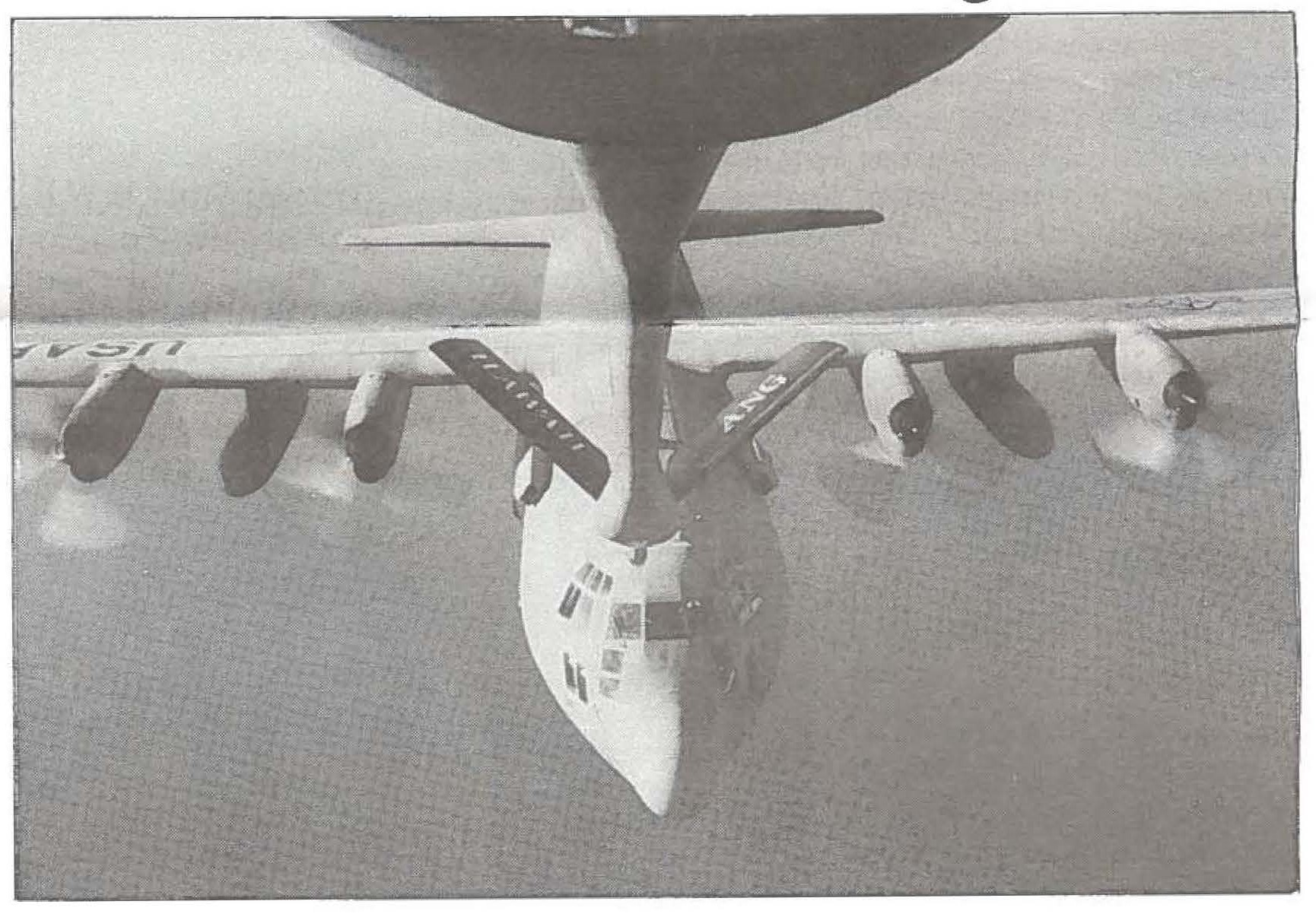
MISSION ACCOMPLISHED — A Hawaii Air National Guard KC135R Stratotanker refuels an MC130 Hercules aircraft over the Adriatic Sea. The 203rd Air Refueling Squadron tanker provided fuel for NATO aircraft flying the no-fly zone over BosniaHerzegovina. Photo by Senior Airman Mark A. Sindiong(Picture from the 1995 December Pūpūkahi)
Members of the 203rd Air Refueling Squadron, Hawaii Air National Guard have completed their mission supporting Operation Deny Flight. The third, and final Hawaii Air Guard KC-135R Stratotanker involved in the operation returned to Hickam Air Force Base, Nov. 16. Deny Flight is the NATO effort patrolling the no-fly zone of Bosnia-Herzegovina
Members of the 203rd, the 154th Maintenance Squadron and the 154th Aircraft Generation Squadron deployed to Pisa Air Base, Italy, beginning Oct. 14. All of the personnel are part of the 154th Wing.
The Hawaii Guard personnel worked as a team with members of the Ohio Air National Guard supporting the multinational forces in the theater. The 203rd tankers flew daily missions, refueling U.S. Air Force Fighter jets as well as aircraft from NATO allies such as Belgium, Turkey and France patrolling the no-fly zone. “Because those fighter aircraft were there protecting people on the ground, it meant that a few more children made it home from school and a few more moms and dads made it back from the marketplace, alive,” said Lt. Col. Edwin “Skip” Vincent, 203rd commander. Ninety-four personnel from the 154th Wing participated in the five week deployment Hawaii Air Guard personnel who participated in Operation Deny Flight were on federal active duty status, under the operational control of U.S. Air Forces, Europe.
NATO aircraft have flown more than 42,000 combat sorties in support of Operation Deny Flight which began April 12, 1993
Hawaii Guard supports worldwide missions and disaster relief
The 203rd Air Refueling Squadron spent five weeks in October and November refueling NATO fighter aircraft patrolling the no-fly zone of Bosnia-Herzegovina . . .
In October 1995, the 203rd Air Fueling Squadron deployed with KC-135s to Pisa, Italy, to support Operation Deny Flight over Bosnia. The 203rd‘s tankers refueled NATO aircraft patrolling the nofly zone of Bosnia.
Four members of the HIARNG’s 117th Public Affairs Team were deployed to the former Yugoslavia in support of Operation Joint Endeavor. The Hawaii Army National Guard soldiers are expected to return in early 1997. They are documenting the peacekeeping activities of the NATO Implementation Force (IFOR) in Croatia and Bosnia-Herzegovina. Deployed were Sgt. 1st Class Stephen M.W.S. Lum, Sgt. Lance M. Kamisugi, Spc. Erik B. DeRyke, and Spc. Eraina V. Andes.
As this issue is going to press, four members of the 117th Public Affairs Team are preparing to deploy to Bosnia in support of Operation Joint Endeavor. The Hawaii Army National Guard soldiers will be documenting the peacekeeping activities of the NATO implementation force (IFOR) in Bosnia. Sgt. 1st Class Stephen Lum, Sgt. Lance Kamisugi, Spc. Erik DeRyke and Spc. Eraina Andes must endure the sometimes difficult conditions of the war-torn country as well as separation from family and friends. They have been activated for up to nine months. We wish them all the very best as they help support U.S. military efforts overseas.
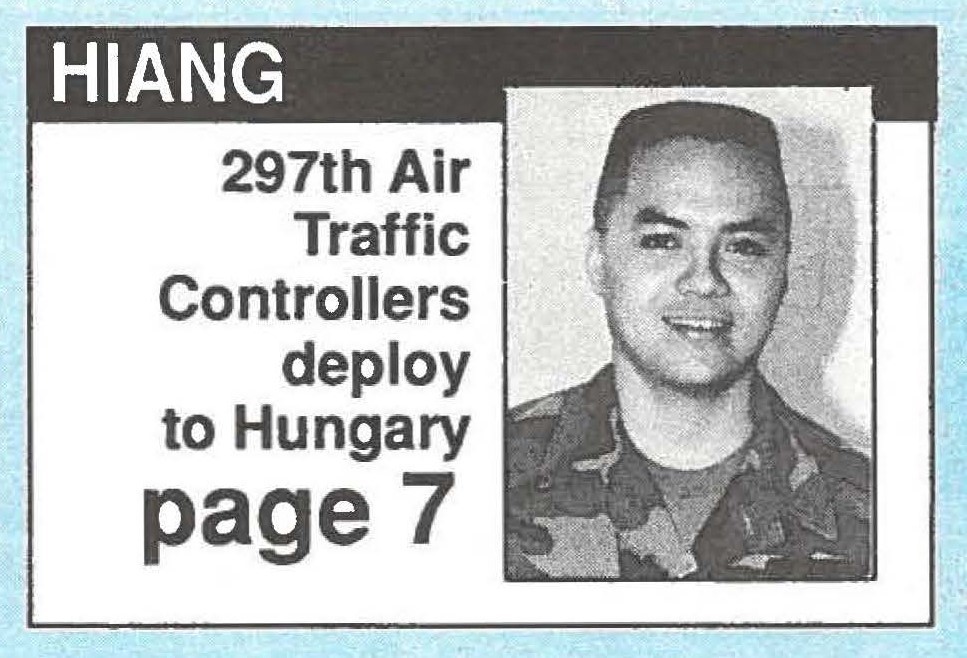
The first members of the Hawaii National Guard to deploy for Operation Joint Endeavor were members of the Air Guard’ s 297th Air traffic Control Flight. A total of six HIANG personnel will rotate through Taszar, Hungary, directing NATO aircraft in the area. (See the complete article on page 7.) Yet another example of Hawaii National Guard personnel performing for their state and country.
Hawaii Air National Guard deploys to Taszar, Hungary
Sgt. 1st Class Stephen Lum
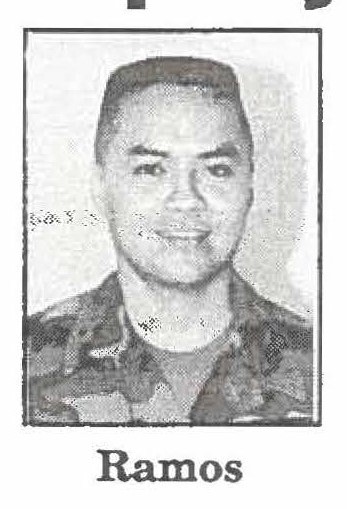
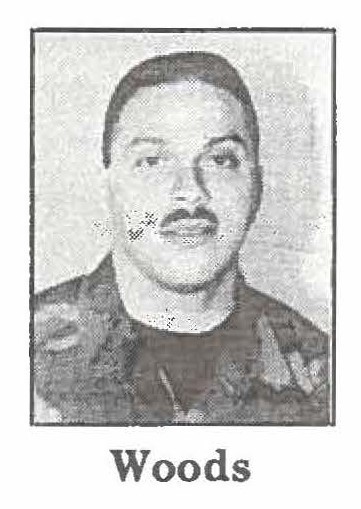
297th Air Traffic Controllers deploy to Hungary page 7 Staff Sgt. Jusserand RamosStaff Sgt. William Woods (Pictures from the 1996 April – May Pūpūkahi)
Airmen from the Hawaii Air National Guard are deployed to Taszar, Hungary, in support of Operation Joint Endeavor. Their mission is to help control the skies of the NATO peacekeeping force flying over Bosnia. Air traffic controllers and communications equipment repair technicians from the 297th Air Traffic Control Flight and 154th Air Control Squadron volunteered for the overseas mission.
Two controllers from the 297th based at Barbers Point Naval Air Station, Staff Sgts. William Woods and Jusserand Ramos, departed April 7, for the four-day radar controller’s course at Andrews Air Force Base, then on to Hungary.
From their mobile radar van in the non-combat zone of Hungary, Woods and Ramos control the flight patterns of MIG21s, C-12s, C-17 transports, and U.S. Army helicopters.
Both sergeants Woods joined the Hawaii Guard in 1992 after active duty tours.
While on active duty, Woods, 26, served as a communications equipment maintenance technician at Lindsey Air Station, Germany, during Desert Storm. The part-time scuba instructor, is scheduled for a 60-day tour in Hungary. He returns this summer to the U.S. to support exercise Century Vision, held in Wisconsin. Ramos, 27 returns earlier (after a 45-day tour) to attend military schooling. He is married, with one son.
Tech. Sgt.Charles D. Goo, a full-time ground radio communications maintenance technician with the 297th, left April 18, for a 60-day tour. His dad, retired Master Sgt. Benny Goo was the 199th Fighter Squadron’s flight simulator NCOIC during the F-102 Delta Dagger and F-4C Phantom jet era.
Staff Sgt. Robert J. Warren, joined them in May after his semester ended at Leeward Community College. He’ll also attend the radar controller’s course at Andrews AFB before deploying for his 45-day tour in Hungary.
Tech. Sgt. Kenneth Said, a ground radio technician from the Pacific Missile Range Facility, Barking Sands, Kauai-based-154th Air Control Squadron, left May 24, for a 139-day tour.
Master Sgt. Raymond W. Chang Jr., a full-time navigation aids radio technician from the 297th, leaves for a 60-day tour in June. The navigation aids tech maintains the signal direction beacon.
The controllers and maintenance technicians are attached to the 254th Combat Communications Group, based in Springfield, Ohio. The 254th is the lead communications unit in this phase of Operation Joint Endeavor.
Four members of the HIARNG 117th Public Affairs Team were deployed in June 1996 to the former Yugoslavia, in support of Operation JOINT ENDEAVOR/GUARD. The HIARNG journalists returned in February 1997. They documented the peacekeeping activities of the NATO Implementation Force (IFOR) in Bosnia-Herzegovina and Croatia. Deployed were Sgt. 1st Class Stephen M.W.S. Lum, Sgt. Lance M. Kamisugi, Spc. Erik B. DeRyke, and Spc. Eraina V. Eshelman.
By Sgt. 1st Class Stephen M. Lum and Spc. Aaron R. Reed
100th MPAD, TXARNG
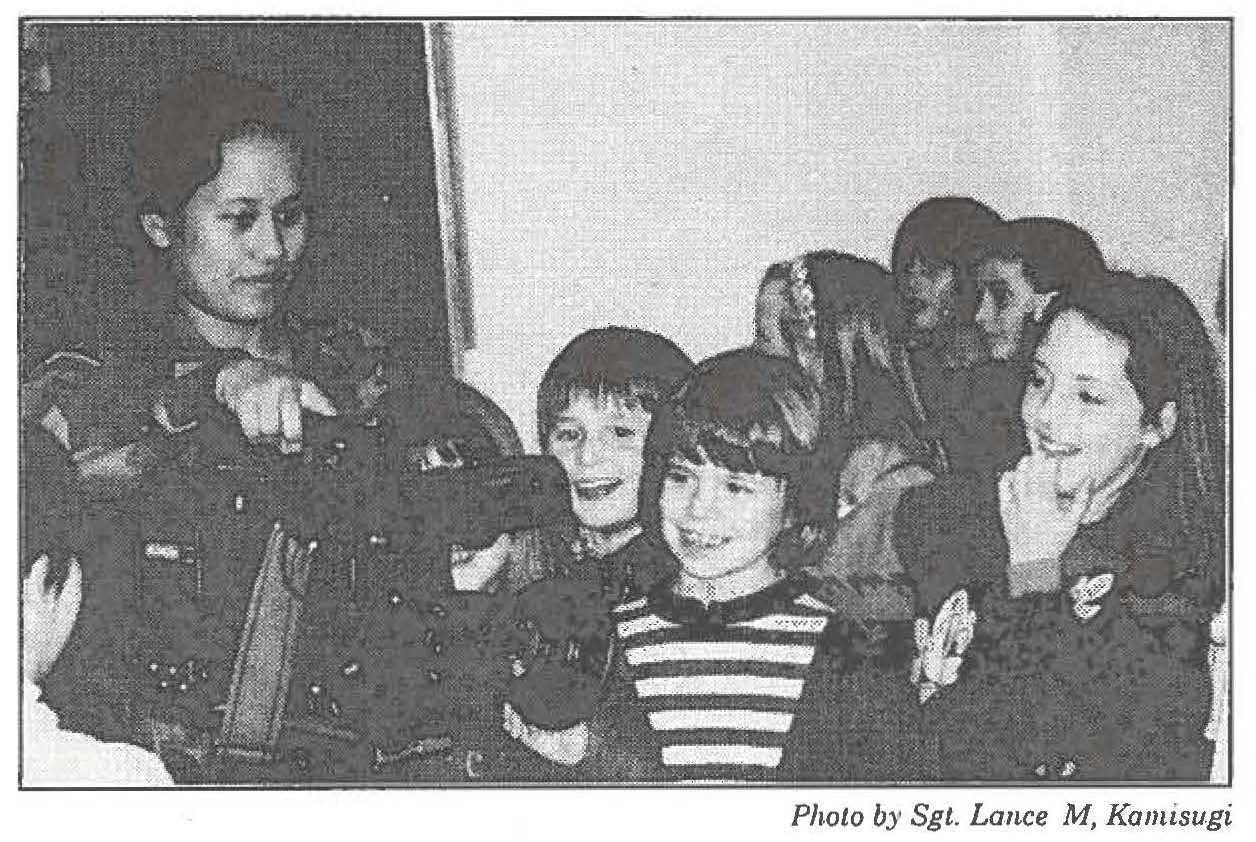
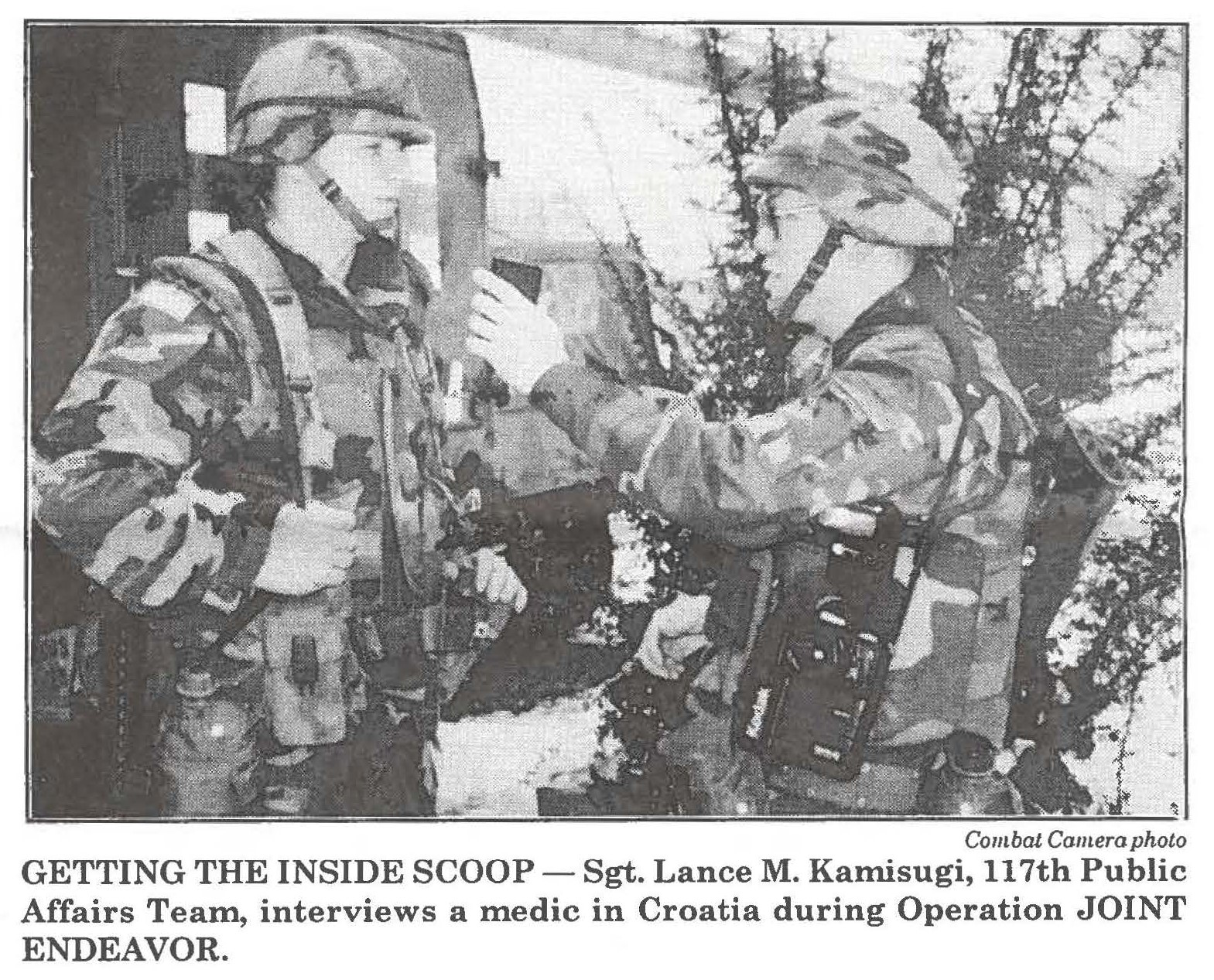
KIDS WILL BE KIDS – Spc. Eraina V. Andes, 117th Public Affairs Team broadcast journalist, talks to Croatian school children while on assignment to the former Yugoslavian country for Operation JOINT ENDEAVOR in 1996. Photo by Sgt. Lance M, KamisugiGETTING THE INSIDE SCOOP – Sgt. Lance M. Kamisugi, 117th Public Affairs Team, interviews a medic in Croatia during Operation JOINT ENDEAVOR. (Pictures from the 1997 January – March Pūpūkahi)
The world community was outraged with the civil war in the Balkans, reminiscent of the Nazi mass executions of the Jews in World War II. Who could have believed that ethnic cleansing would occur again in this century? NATO Forces, including 20,000 U.S. soldiers, were tasked with keeping the peace established by the Dayton Accords. The operation was known as Operation Joint Endeavor.
For four Hawaii citizen-soldiers the public affairs mission took on a whole new meaning with a deployment that lasted eight months.
Journalists Sgt. 1st Class Stephen M. Lum, Sgt. Lance M. Kamisugi, Spc. Erik B. DeRyke and Spc. Eraina V. Andes, were welcome to the world of Bosnia-Herzegovina and Croatia, in July.
In May, the four Hawaii Guard soldiers answered Texas Army National Guard’s 100th Mobile Public Affairs Detachment’s request for qualified journalists to augment their team. The journalists supported the Texas unit mobilized for the second rotation of Operation Joint Endeavor.
Hawaii journalists joined their Texas public affairs comrades at the Fort Benning, Ga. mobilization station in early June. Also joining the team were two Nevada officers and a California broadcast journalist.
The 18-member unit was broken into four teams: two for information gathering, one for newspaper production and another for administrative duties.
After medical and financial screenings, briefings and issue of an assortment of personal and cold weather clothing the unit departed for Germany.
Training in Germany, including a stop at Hohenfels Maneuver Training Center, land-mine awareness classes was highlighted. Instruction emphasized the dangers of being in an area where millions of land mines are buried and what action should be taken if a mine is found.
After three weeks in Germany the public affairs unit deployed with seven vehicles for the Balkans through Austria, and Hungary. Loaded with an assortment of field gear and electronic news gathering equipment, they arrived in Tazar Air Base. Hungary, July 4. The old Hungarian base serves as the intermediate staging base for deploying and redeploying troops. After being issued ammunition and painting IFOR (Implementation Force) on the vehicles the unit was ready to convoy down range.
The next day, wearing Kevlar helmet, flak jacket, protective mask, Ml6 rifle and pistol belt, with 180 rounds of live ammunition; the journalists drove to Croatia and Bosnia-Herzegovina, the final destinations of the public affairs team.
The convoy moved on to Slavonski Brod, Croatia where. Kamisugi, DeRyke and Andes would set up shop. Missions at Camp Sava North included print and video coverage of the 1st Armored Division’s and later 1st Infantry Division’s rear headquarters. Their products included production of a two-page weekly command information newsletter, daily ”battle star” slide briefings and still/video/ voice news releases.
Lum was part of the team headquartered at Eagle Base, Tuzla Main where they supported the 1st Armored Division and in late November, the 1st Infantry Division public affairs office. The Guard soldiers wrote, edited, and produced The Tawn, a weekly, full-color, 12 page, magazine-style newspaper covering 23,500 troops from 11 nations assigned to Task Force Eagle.
“Experiencing different cultures and seeing the aftermath of the war here in Bosnia has given me a new appreciation for both the freedoms and the luxuries of home.” Spc. Eraina Andes
‘We produced the Army’s first totally digital publication – accessible to anyone in the world with a modem and a computer said Lum, a 26 year veteran of the Guard.
“I increased my computer proficiency with the latest desktop publishing, digital photo enhancing and distilling programs,” Lum said, who served as The Talon design editor.
The journalists split their time between production and chasing down stories.
“If there is something big happening, chances are my people were there,” said Maj. Victoria D. Wood, 100th MPAD commander. “They’ve been with engineers on mine-clearing and bridge building operations, patrolled with infantry and spent hours at checkpoints with armor. My soldiers worked extremely hard.”
Before returning home in February the soldiers stationed in Croatia did their part to enhance the Texas unit’s public affairs mission. The Hawaii Guard soldiers toiled long hours on convoys, computers and editing bays to produce command information products for the 3,000 troops in Camp Sava North, Task Force Eagle and U.S. Army Europe.
Kamisugi wrote 20 stories for publication in the Task Force Eagle newspaper The Talon, gathering information for the weekly Sava Sentinel Division Rear newsletter, wrote press releases on redeploying units, and 15 hometown releases. The deployment gave him the opportunity to learn computer desktop publishing and digital photography.
DeRyke and Andes were involved in shooting, editing, voicing and packaging more than 40 American Forces Network/USAREUR broadcast television and radio products. They honed their video/editing skills and produced broadcast quality products on the Betacam SP system.
Maj. John E. Suttle, the 1st AD’s public affairs officer, said Operation JOINT ENDEAVOR has given him a unique perspective to view public affairs soldiers from both the active and reserve components. “The Texas-based Guard has clearly shown that the reserve public affairs concept works.”
“To deploy to BosniaHerzegovina and support the mission that is bringing peace to this war-torn region is the ultimate ARTEP (Army Training and Evaluation Program). The Texas Guard passed with flying colors,” Suttle said.
”The blend of Texas, Nevada, California and Hawaii Guard soldiers was top-notch. I couldn’t have asked for a better mix of people,” Wood said. “They really meshed. They support each other as effectively as any unit in the Army.”
Most days were the same as the next, no weekends or holiday off, but the day to day routine was not without incident. A real sense of possible danger kicked in when we heard explosions and gun fire. Fortunately the “action” did not include any injuries.
At Eagle Base in Tuzla, Bosnia-Herzegovina, an occasion explosion was heard as engineers located and exploded in place. Bursts of gun fire were not uncommon.
In one instance, the accidental ignition of old stored munitions caused an explosion at a factory near to the Camp Sava North living quarters, in Croatia.
The Bosnia deployment marked a number of transitions for Guard soldiers: from civilian life to military life, America to Europe, peace to peace enforcement. Everyone also faced the additional challenge of forging new work relationships.
“The deployment has been a real eye-opener for me,” said Spc. Andes, a 19-year-old broadcaster from Aiea. “Experiencing different cultures and seeing the aftermath of the war here in Bosnia has given me a new appreciation for both the freedoms and the luxuries of home.”
Four members of the HIARNG 117th Public Affairs Team were deployed in June 1996 to the former Yugoslavia, in support of Operation JOINT ENDEAVOR/GUARD. The HIARNG journalists returned in February 1997. They documented the peacekeeping activities of the NATO Implementation Force (IFOR) in Bosnia-Herzegovina and Croatia. Deployed were Sgt. 1st Class Stephen M.W.S. Lum, Sgt. Lance M. Kamisugi, Spc. Erik B. DeRyke, and Spc. Eraina V. Eshelman.
Thirty-one members of the HIANG’s 297th Air Traffic Control Flight have deployed to Tazar, Hungary in support of Operation JOINT GUARD, the NATO peacekeeping mission in Bosnia Herzegovina.They will be gone for 146 days which includes brief stops at Andrews Air Force Base, Md. and Ramstein Air Base, Germany. The 297th will provide Radar Approach Control air traffic services and Tactical Air Navigation (TACAN) support at Tazar Air Base. This is the first time a HIANG unit has been federally activated through the Presidential Selective Recall.
Thirty members of the 297th Air Traffic Control Squadron (the 297th was redesignated a squadron from a flight, Sept.16), Hawaii Air National Guard, are currently deployed at Taszar Air Base, Hungary, providing radar approach control air traffic services and tactical air navigation (TACAN) support for Operation JOINT GUARD, the NATO peacekeeping mission in Bosnia-Herzegovina
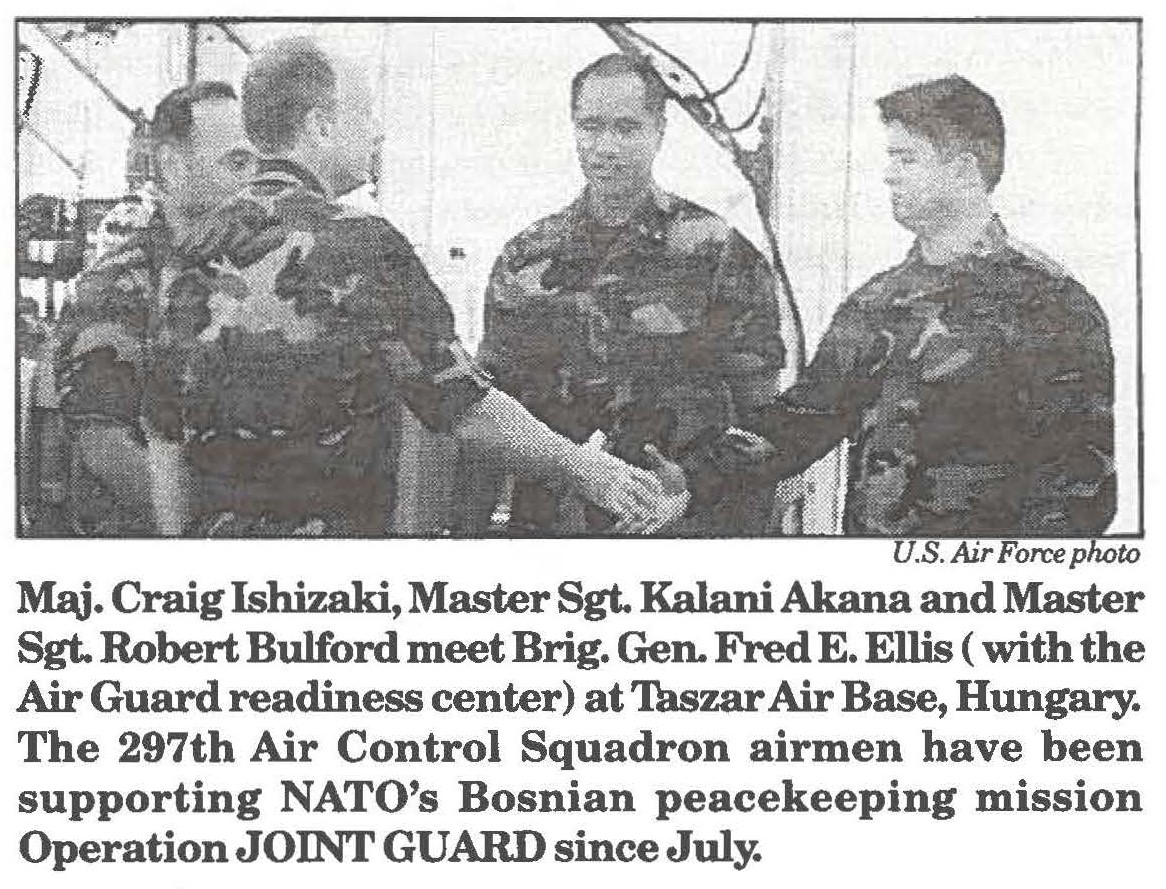
The Hawaii contingent left Honolulu for Hungary on July 20 and by Aug. 2, the controllers had taken over operations at Taszar. The 297th personnel are assigned to the 406th Expeditionary Airbase Group at Tuszar AB, the staging area for cargo and personnel destined for Bosnia-Herzegovina. ”This deployment is different. We were plugged into an existing USAF flying operation, instead of our previous deployments of setting up air bases from the ground up,” said Maj. Craiglshizaki, detachment commander.
While in Taszar, the Hawaii Air Guard has been receiving high marks from the U.S. Air Force. Some control flight personnel have been assigned as section NCOICs and are supervising active-duty forces. “They’ve adapted to their new responsibilities well and are taking charge of accomplishing the overall mission of the 406th,” said Ishizaki.
Master Sgt. Francis Akana says the Hawaii airmen are working well together on the unit’s longest-ever deployment, but that they miss home. “Our time here so far has shown that we have the skills to provide first class service,” said Akana. “I miss my family very much, but this deployment is providing me with an opportunity to see some of Europe an opportunity that I wouldn’t have had if I wasn’t in the Hawaii Guard.”
The 297th is expected to be back in Hawaii before Christmas.
The squadron is located at Barbers Point Naval Air Station and is one of four Hawaii units within the 201st Combat Communications Group.
To William Woods, Randy Ramos and Robert Warren, of the 297th Air Traffic Control Squadron. On their way to Taszar, Hungary, as part of the presidential call-up, gave just-time training for more than 17 air traffic controllers. The three 297th airmen went beyond what was expected, revising course materials, instructing and working long hours to fit it all together. Because of their efforts, Air National Guard/XOB (Battle Management) stated, “Please pass along our extreme gratitude for the hard work and effort displayed by Woody, Randy and Rob. They deserve the lion’s share of credit for the success of training of the Hawaii Air National Guard members.
Members of the 297th Air Traffic Control Flight deployed to Taszar. Hungary, on July 20th to support Project Joint Endeavor. They are expected to return to Hawaii in December after completing their 146-day deployment. Of the 31 deployed members of the flight, 23 are traditional HIANG members. We know they will do an outstanding job and come home safely.
297th Air Traffic Control Squadron deployed 30 members to Taszar, Hungary, as part of Operation JOINT GUARD. The air traffic controllers, radar approach and maintenance personnel assisted with the movement of U.S. forces in Bosnia-Hezegovina. The 203rd Air Refueling Squadron deployed KC-135 tankers to Aviano Air Base, Italy, where they refueled NATO aircraft patrolling the airspace over Bosnia-Hezegovina.
In July 1997, Air Guard personnel from the 297th Air Traffic Control Squadron deployed to Taszar, Hungary, to assist with the NATO peacekeeping mission in Bosnia-Herzegovina. The air traffic controllers and radar approach technicians helped direct the flow of aircraft in the area. . . Tankers from the 203rd Air Refueling Squadron deployed to France and Italy in February and March to refuel NATO aircraft patrolling the airspace over Bosnia-Herzegovina.
Thirty 297th Air Traffic Control Squadron personnel conducted air traffic control operations at Taszar Air Base, Hungary in support of Operation JOINT GUARD with NATO forces
Two artillery radar operators deploy to Bosnia-Herzegovina
By Sgt. 1st Class Stephen M. Lum
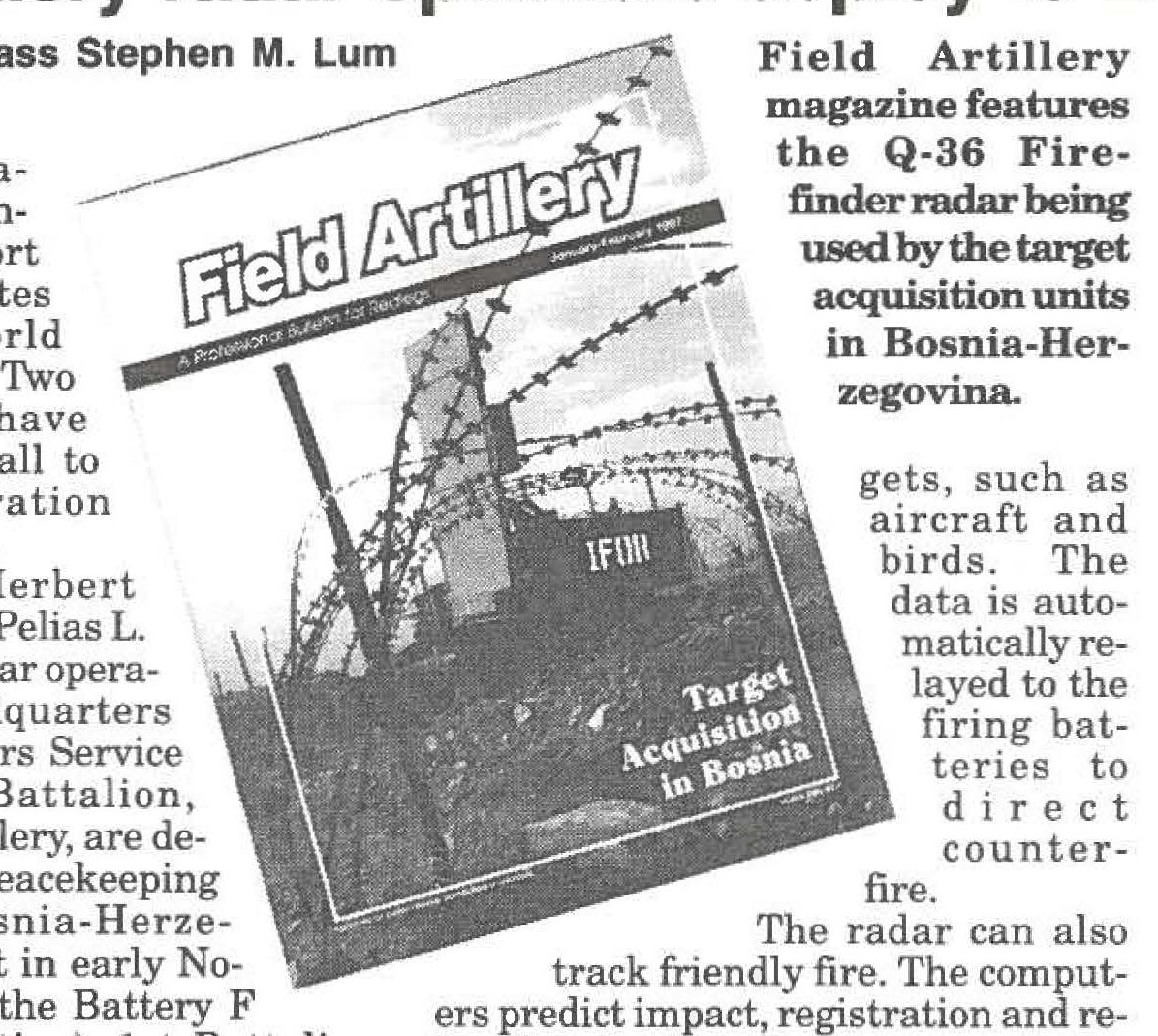
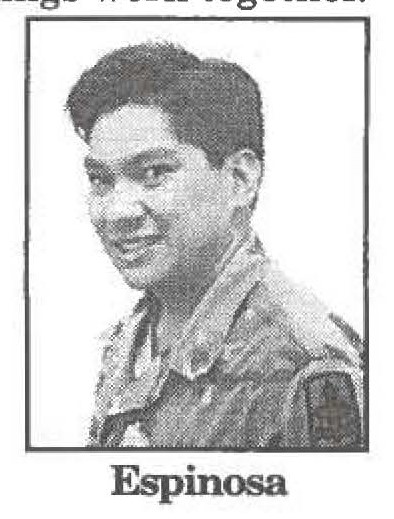
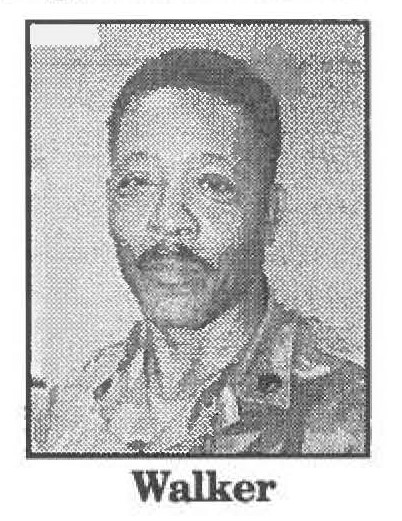
Field Artillery magazine features the Q-36 Fire-finder radar being used by the target acquisition units in Bosnia-Herzegovina.Sgt. Pelias L. Espinosa Jr.Staff Sgt. Herbert Walker(Pictures from the 1997 December – 1998 January Pūpūkahi)
Hawaii National Guard continues to support the United States military’s world peace missions. Two more soldiers have answered the call to serve in Operation JOINT GUARD.
Staff Sgt. Herbert Walker and Sgt. Pelias L. Espinosa Jr., radar operators from Headquarters and Headquarters Service Battery, 1st Battalion, 487th Field Artillery, are deploying for the peacekeeping mission in Bosnia-Herzegovina. They left in early November to join the Battery F (Target Acquisition), 1st Battalion, 144th Field Artillery, California Army National Guard.
The unit’s mission is to detect, locate and identify enemy elements and forces within the higher command’s area of interest.
Walker and Espinoza operate a radar system that automatically detects and pinpoints first burst projectile-firing weapons. The system can track and locate multiple targets. Signal and data processors test each object to discriminate and filter out unwanted targets, such as aircraft and birds. The data is automatically relayed to the firing batteries to direct counterfire.
The radar can also track friendly fire. The computers predict impact, registration and relays fire direction adjustments.
Deployments are not new to 53-year-old Walker, who was awarded a Purple Heart during his tour in Vietnam. The Indiana-born soldier resides in Pearl City. His military service began in 1969, when he enlisted in the U.S Marine Corps. He returned to the states and earned a nursing degree.
In 1984, Walker returned to military service, joining California’s 144th Field Artillery. The sergeant transferred to the Hawaii Guard in 1988 and worked full-time as a registered nurse with a local nursing home. The 16-year-veteran said we’ve had good training; now, its time to put it to the test, to see how things work together.
Espinosa, 31, born in the Philippines, joined the Hawaii Guard in 1982. The Aiea resident is a student at the University of Hawaii, majoring in hospital administration. He welcomes the challenges of putting his training and experience to a practical test.
The radar operators join public affairs Sgt. Curtis H. Matsushige, who is in Germany, in the (up to) 270 day tour of duty for Operation JOINT GUARD. Matsushige, 44, a science teacher on leave from Campbell High School, has been deployed since July. He is attached to the 134th Public Affairs Detachment, Alaska Army National Guard. The Alaska unit is backfilling the active duty units deployed in the theatre.
Our thoughts are with those who are currently serving overseas. Staff Sgt. Herbert Walker and Sgt. Pelias Espinosa, radar operators from Headquarters and Headquarters Service Battery, 1st Battalion, 487th Field Artillery, are now serving as part of the multinational peacekeeping force in Bosnia-Herzegovina (see story on page 1). Walker and Espinosa volunteered for the NATO duty and are temporarily attached to a California Army National Guard unit, which needed their specialty.
Since July, Public Affairs Sgt. Curtis H. Matsushige has been deployed in Germany in support of Operation JOINT GUARD. A science teacher at Campbell High School, Matsushige, 44, is attached to the 134th Public Affairs Detachment, Alaska Army National Guard. . . .
By early December, all of the members of the 297th Air Traffic Control Squadron, who deployed to Taszar Air Base, Hungary, had returned to Hawaii. Thirty members of the unit were called to active duty to provide radar approach control and tactical air navigation support at Taszar, the staging point for personnel and cargo destined for Bosnia-Herzegovina. Congratulations to all for a job well done!
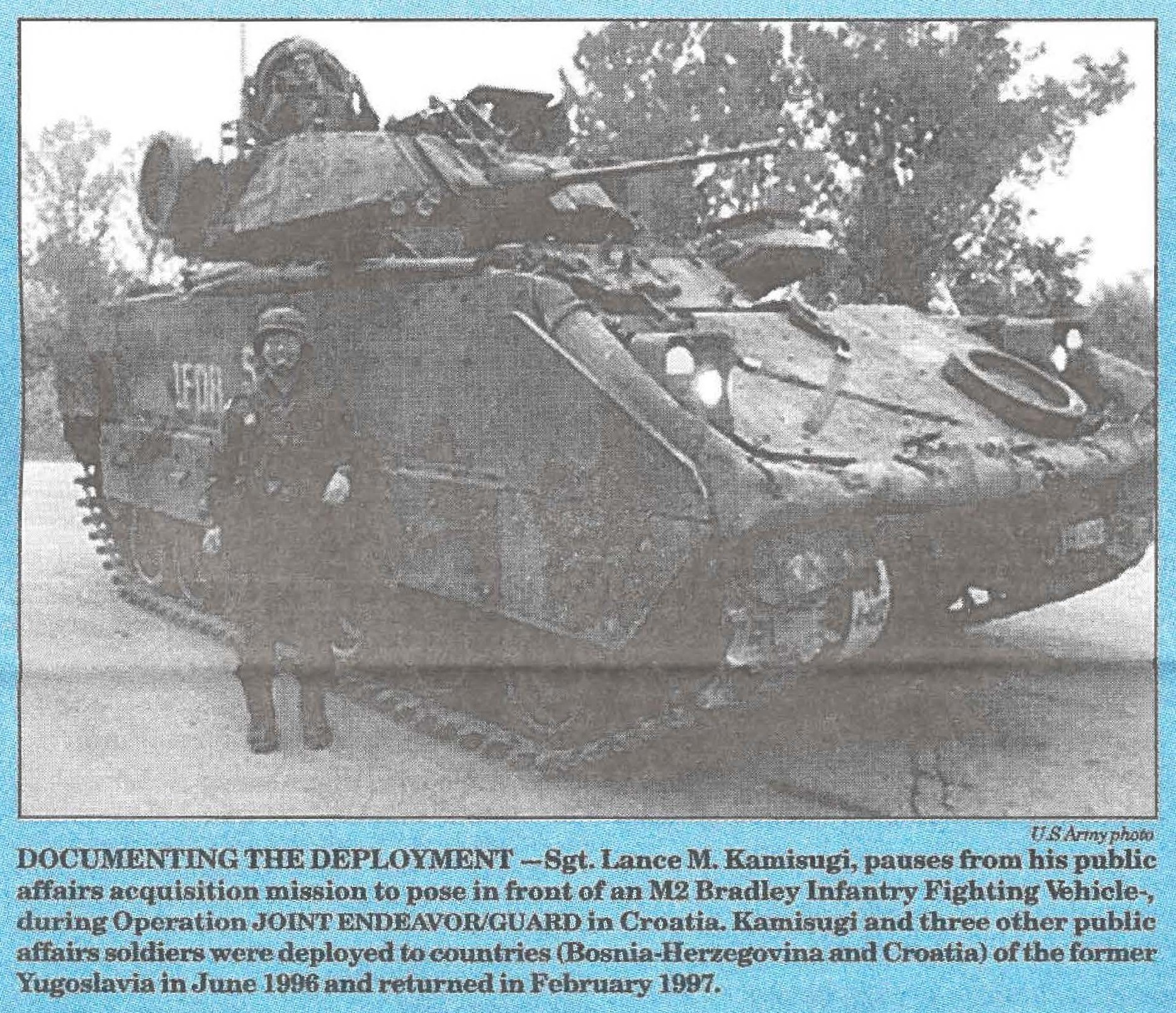
DOCUMENTING THE DEPLOYMENT – Sgt. Lance M. Kamisugi, pauses from his public affairs acquisition mission to pose in front of an M2 Bradley Infantry Fighting Vehicle, during Operation JOINT ENDEAVOR/GUARD in Coratia. Kamisugi and three other public affairs soldiers were deployed to countries (Bosnia-Herzegovina and Croatia) of the former Yugoslavia in June 1996 and returned in February 1997.(Picture from the 1997 December – 1998 January Pūpūkahi)
Air refuelers support Balkans peace mission again
By Capt. Charles J. Anthony and Sgt. 1st Class Stephen M. Lum
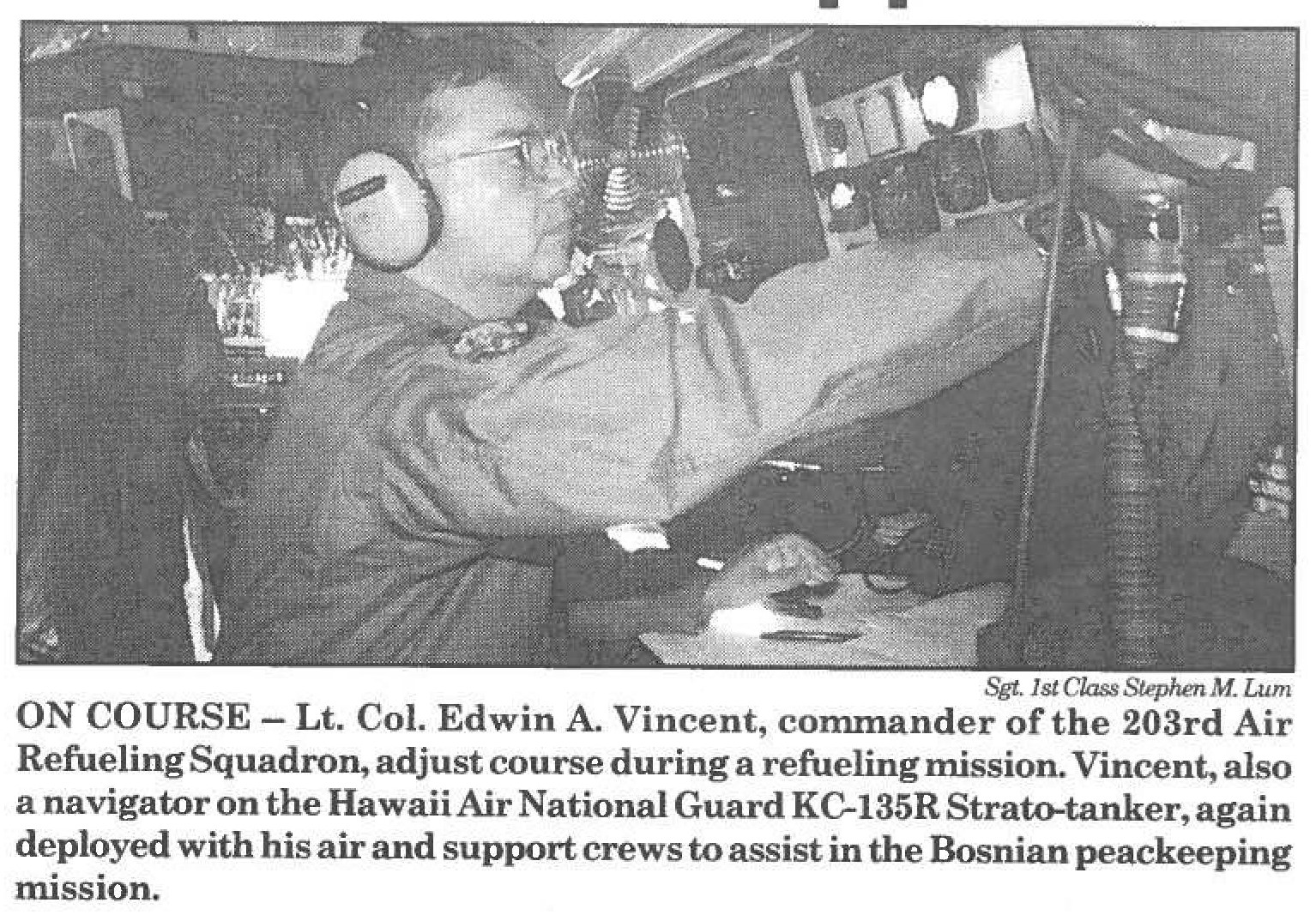
ON COURSE – Lt. Col. Edwin A Vincent, commander of the 203rd Air Refueling Squadron, adjust course during a refueling mission. Vincent, also a navigator on the Hawaii Air National Guard KC-135R Strato-tanker, again deployed with his air and support crews to assist in the Bosnian peackeeping mission.Hawaii assists at home, away page 4-5(Pictures from the 1998 February – March Pūpūkahi)
The Hawaii Air National Guard’s 203rd Air Refueling Squadron spent five weeks in Europe to supporting the ongoing no-fly zone mission over Bosnia-Herzegovina. Three KC-135R Stratotankers, along with 44 members of the 203rd aircrew and 154th Maintenance Squadron support personnel participated in Operation DELIBERATE GUARD, Feb. 3 to March 9.
The 154th Wing units flew air to air refueling operations as part of a NATO force tasked to enforce the no-fly zone over Bosnia-Herzegovina out of lstres, France and Aviano, Italy. The Hawaii refueling unit was partnered with the New York Air National Guard’s 107th Air Refueling Wing.
The Hawaii Air Guard flew over 20 combat sorties. “Our people did an outstanding job! They deployed halfway around the world, conducted complex flight operation in a very dynamic environment and met success on every mission,” said Lt. Col. Edwin “Skip” Vincent, 203rd commander.
The 203rd spent more than a month in the fall of 1995 flying similar missions refueling U.S. and NATO aircraft from Pisa Air Base, Italy for Operation DENY FLIGHT.
In a related deployment, Sgt. Curtis H. Matsushige returned in March after serving eight months in Germany providing backfill missions for active duty public affairs offices of the 1st Infantry and 1st Armored Divisions as they took turns deploying down range in Bosnia-Herzegovina.
Air Guard deploys in support of U.S. military buildup against Iraq
Forty-eight members of the 203rd Air Refueling Squadron, 154th Wing, Hawaii Air National Guard, deployed Nov. 12 in support of Operation PHOENIX SCORPION III, the buildup of U.S. forces in Southwest Asia.
Three KC-135 Stratotankers left Hickam Air Force Base to Eielson Air Force Base, Alaska, where they refueled U.S. Air Force bombers flying to the Persian Gulf area.
The 203rd aircraft are capable of refueling all types of U.S. Air Force fixed-wing aircraft in midair. The refueling squadron has participated in similar operations before. In September 1996, the unit refueled B-52 bombers that were flying across the Pacific for Operation DESERT STRIKE. The 203rd has also deployed twice to Europe to refuel NATO aircraft patrolling the Bosnia no-fly zone.
Bosnia bound
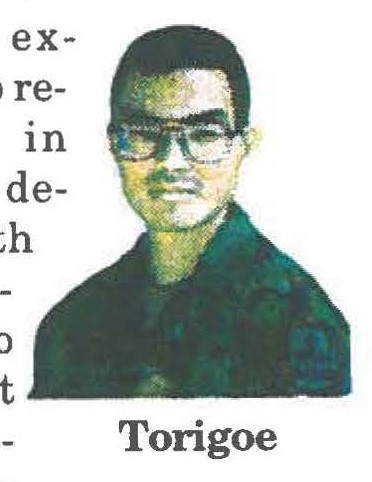
Sgt. Dean M. Torigoe, 25, from 2nd Battalion, 299th Infantry, Hawaii Army National Guard’s intelligence section (S2), deployed to Bosnia-Herzegovina in October.
Torigoe, an intelligence analyst with the battalion, is heading a three-person team from HQ & HQ Company, Military Intelligence Detachment 1, 29th Separate Infantry Brigade. The two other members are from the Georgia Army National Guard.
The Big Island soldier graduated from the University of Hawaii at Hilo with an administration of justice degree in Fall 1993.
Since joining the Guard as a Waiakea High School senior in November 1990, Torigoe has deployed for annual training to Camp Rilea, Ore. and Australia, as well as to Schofield Barracks and Pohakuloa Training Area.
He’s expected to return in time to deploy with the brigade to Joint Readiness Training Center at Fort Polk, La., in June 1999.
Since 1996, seven Hawaii Guard soldiers have been mobilized for 270-day deployments to support the peacekeeping mission in Bosnia. So far, four public affairs journalists and two field artillery radar operators have served in the Bosnian theater. One journalist served in Germany.
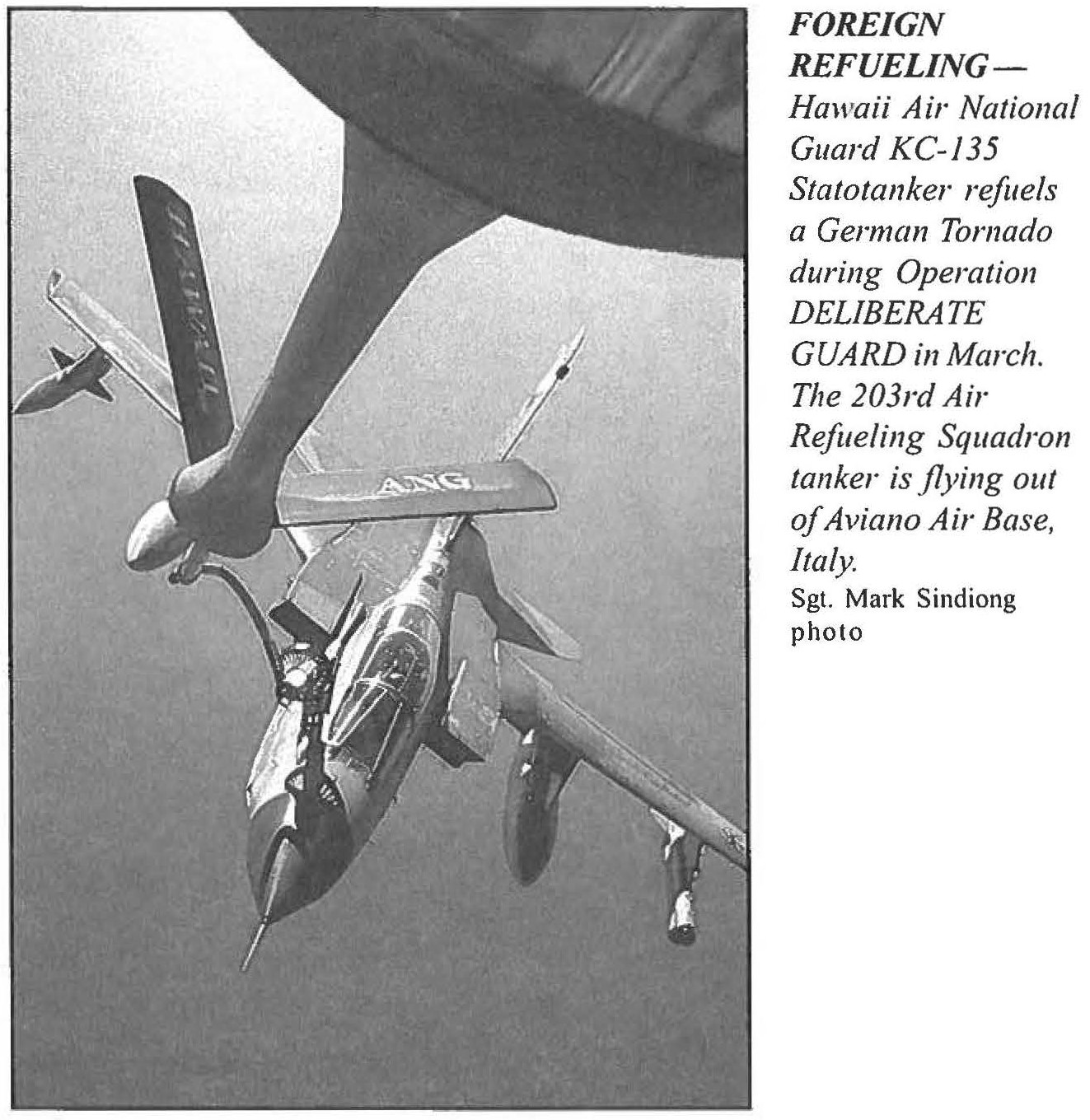
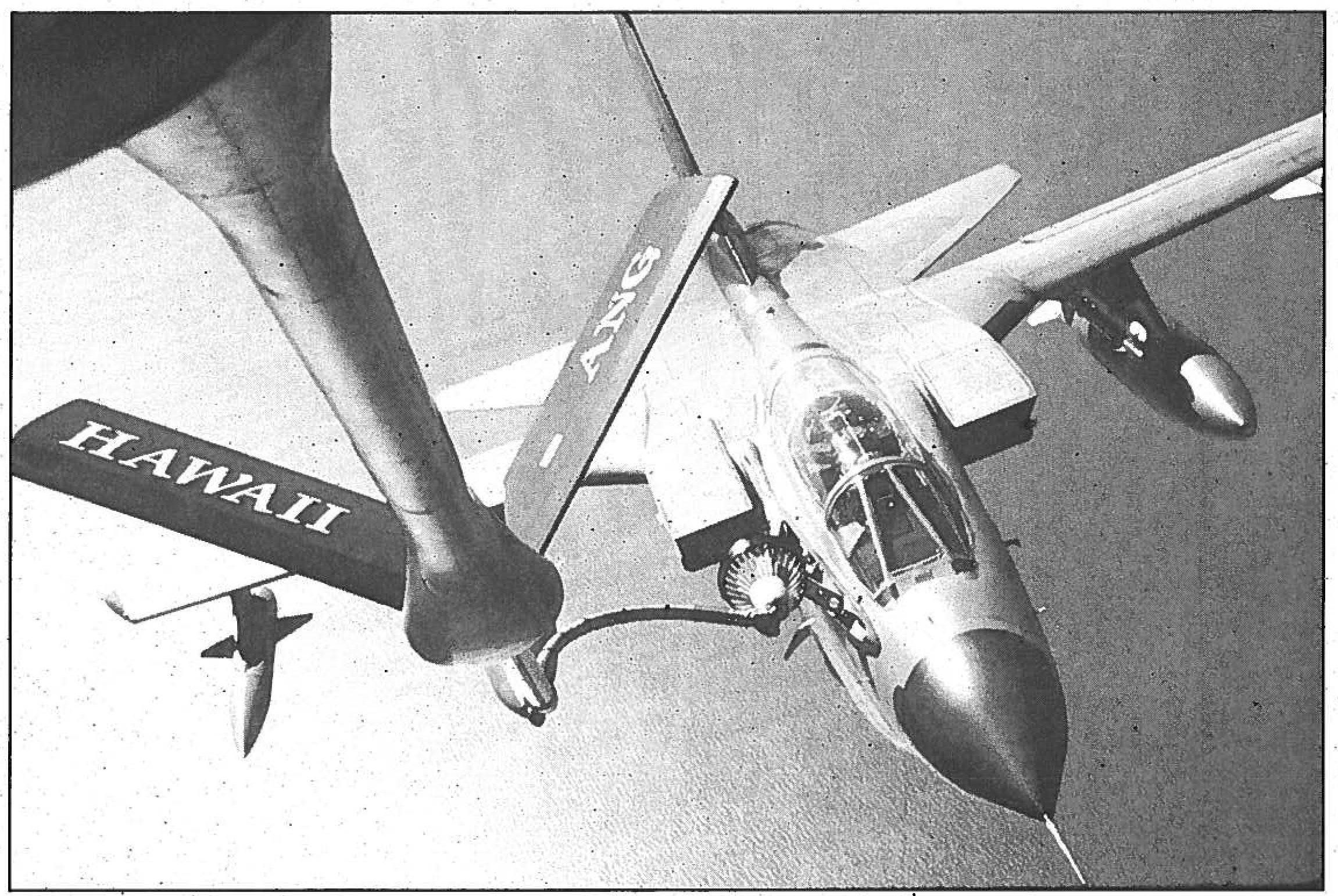
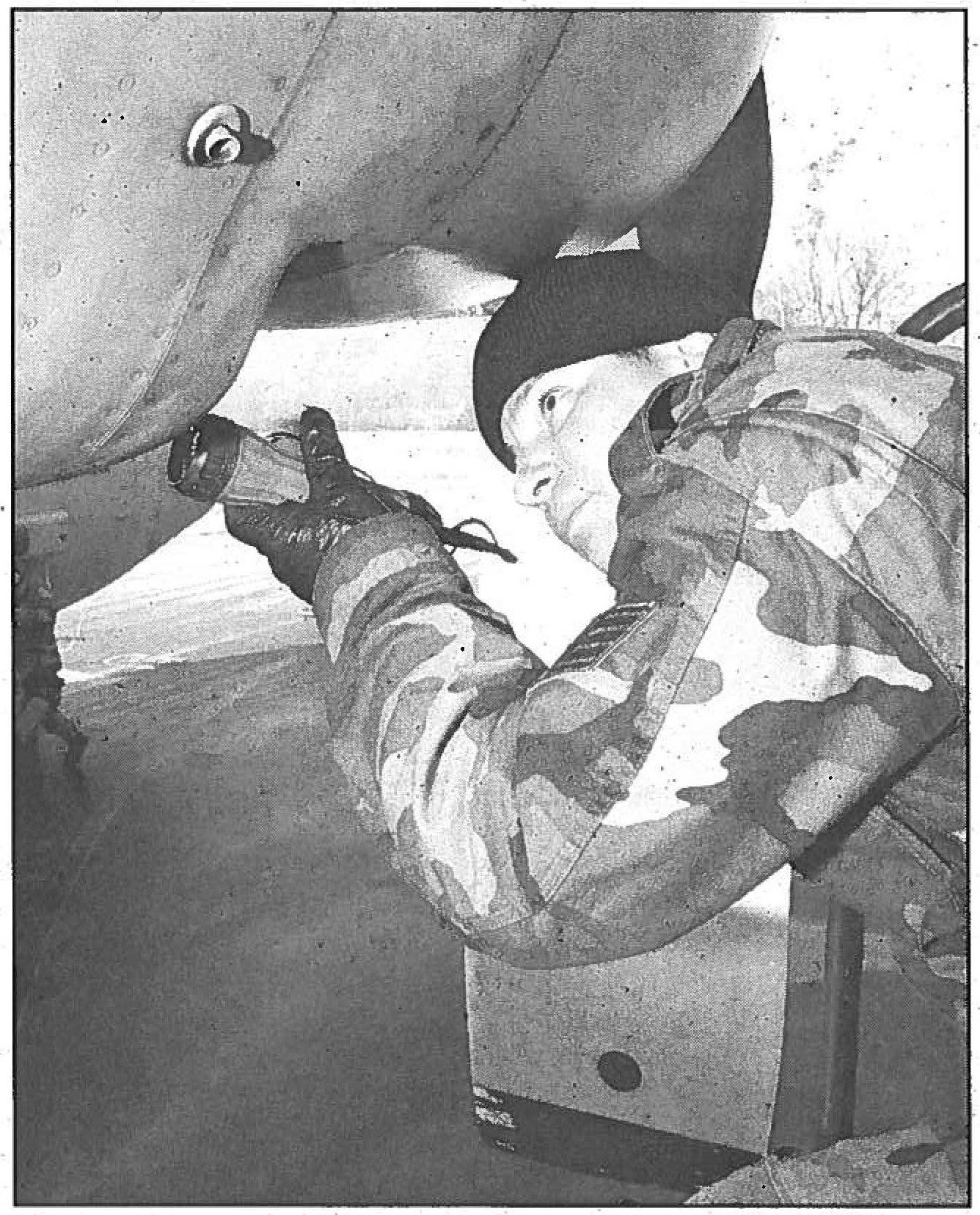
AERIAL PITSTOP A German Tornado is gassed up by a 203rd Air Refueling Squadron aircrew flying their Hawaii Air National Guard KC-135R -Stratotanker flown in support of the crisis in Kosovo during Operation ALLIED FORCE, March 1999. Staff Sgt. Mark Sindiong photoFINAL PRE-FLIGHT CHECK – A staff sergeant with the 203rd Air Refueling Squadron surveys the KC-135R Stratotanker before its mission in support of Operation ALLIED FORCE in March 1999. Staff Sgt. Mark Sindorig photo(Pictures from the 1999 Annual Report)
In March 1999, the Hawaii Air National Guard’s 203rd Air Refueling Squadron became the lead refueling unit at the beginning of NATO’s Operation ALLIED FORCE. The unit’s KC-135R Stratotankers refueled fighter and bomber aircraft striking Serb targets in and around Kosovo. The Refueling Squadron performed its Kosovo duty with a 100 percent mission capable rate.
In March 1999, personnel from the 203rd Air Refueling Squadron deployed to France to refuel NATO aircraft patrolling the airspace over Bosnia-Herzegovina. While there, NATO began its bombing campaign to halt Serb atrocities against ethnic Albanians in Kosovo. The 203rd Air Refueling Squadron was the lead refueling unit as the bombing began. The unit returned to Hawaii in March having successfully completed its mission with no injuries.
In April, another “first” for the HIANG, the 199th Fighter Squadron deployed four F-15s, f2 pilots, and 58 maintenance and support members to support the NATO alert operations alert Keflavik Naval Air Station in Iceland.
From late February to April, four KC-135R aircraft from the 203rd Air Refueling Squadron, and over 200 154th maintenance and support guard members deployed to Istres Air Base, France, “to participate in Operation DELIBERATE FORCE: As real world hostilities began, the focus turned to Operation ALLIED FORCE. Seventy combat sorties were flown with a 100 percent mission success rate and zero ground/air mishaps or injuries, and over 3.9 million pounds of fuel were transferred to U.S. and NATO aircraft.
Hawaii Guard tankers participate in NATO operation
By Capt. Charles J. Anthony
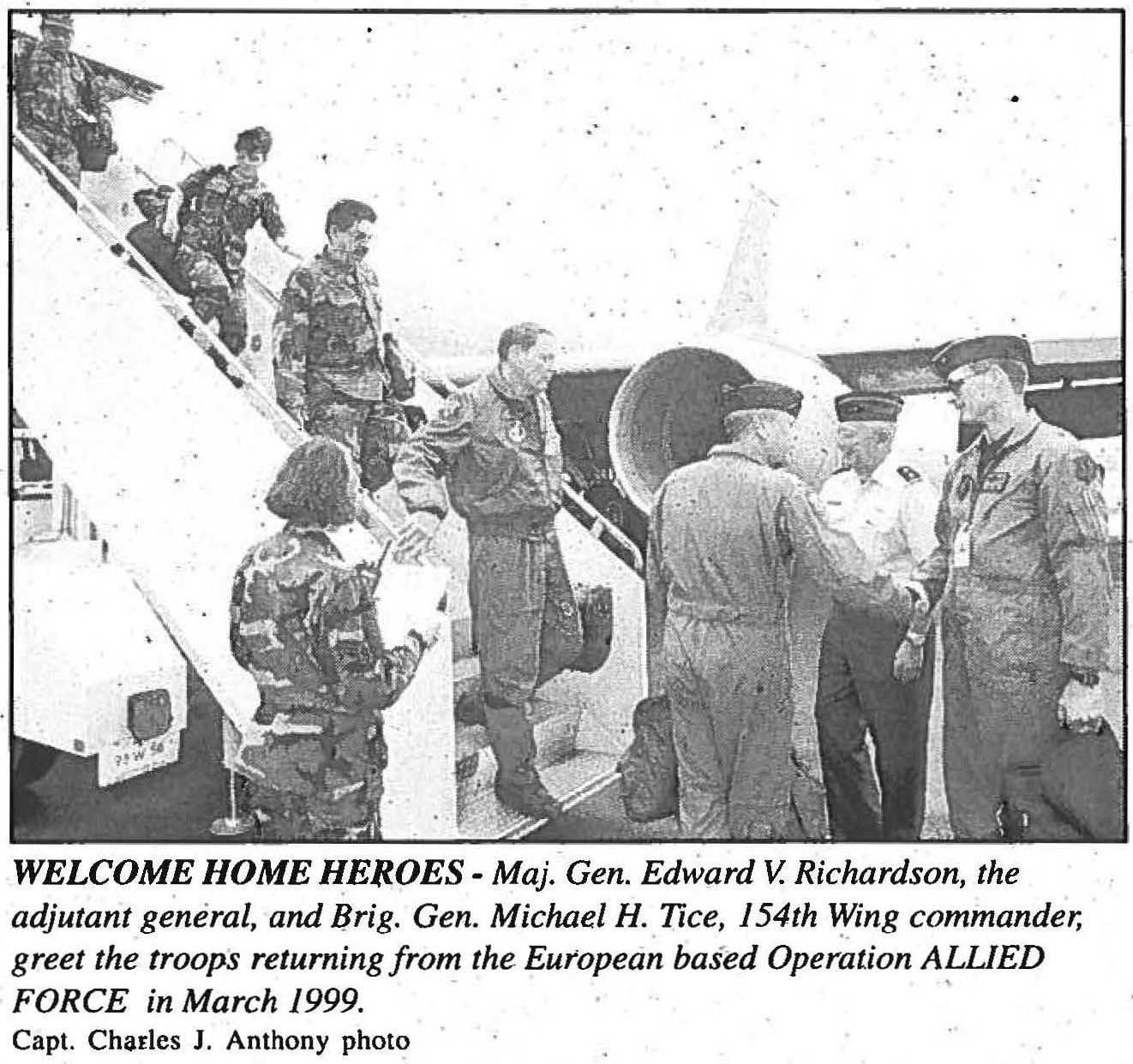
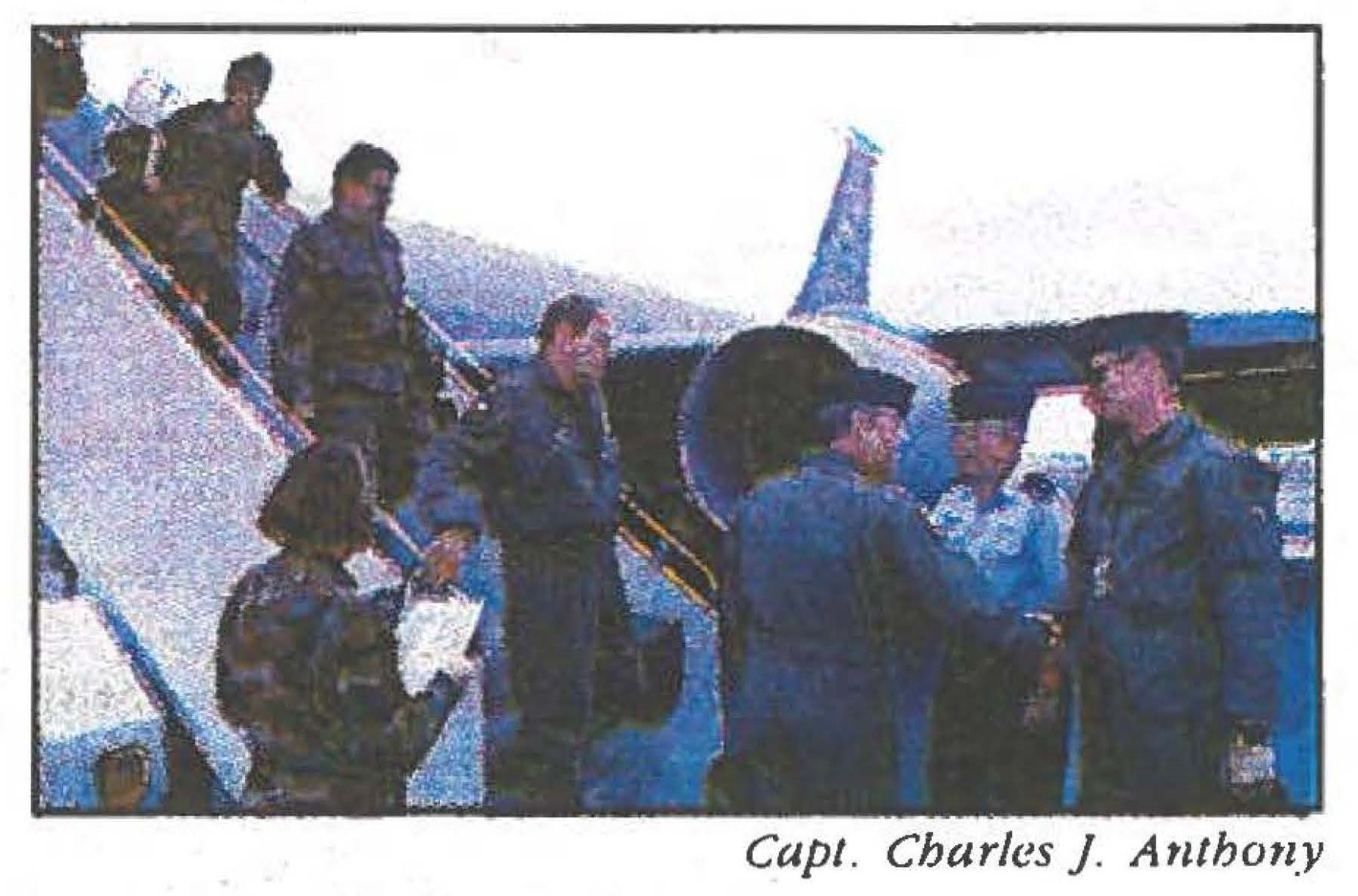
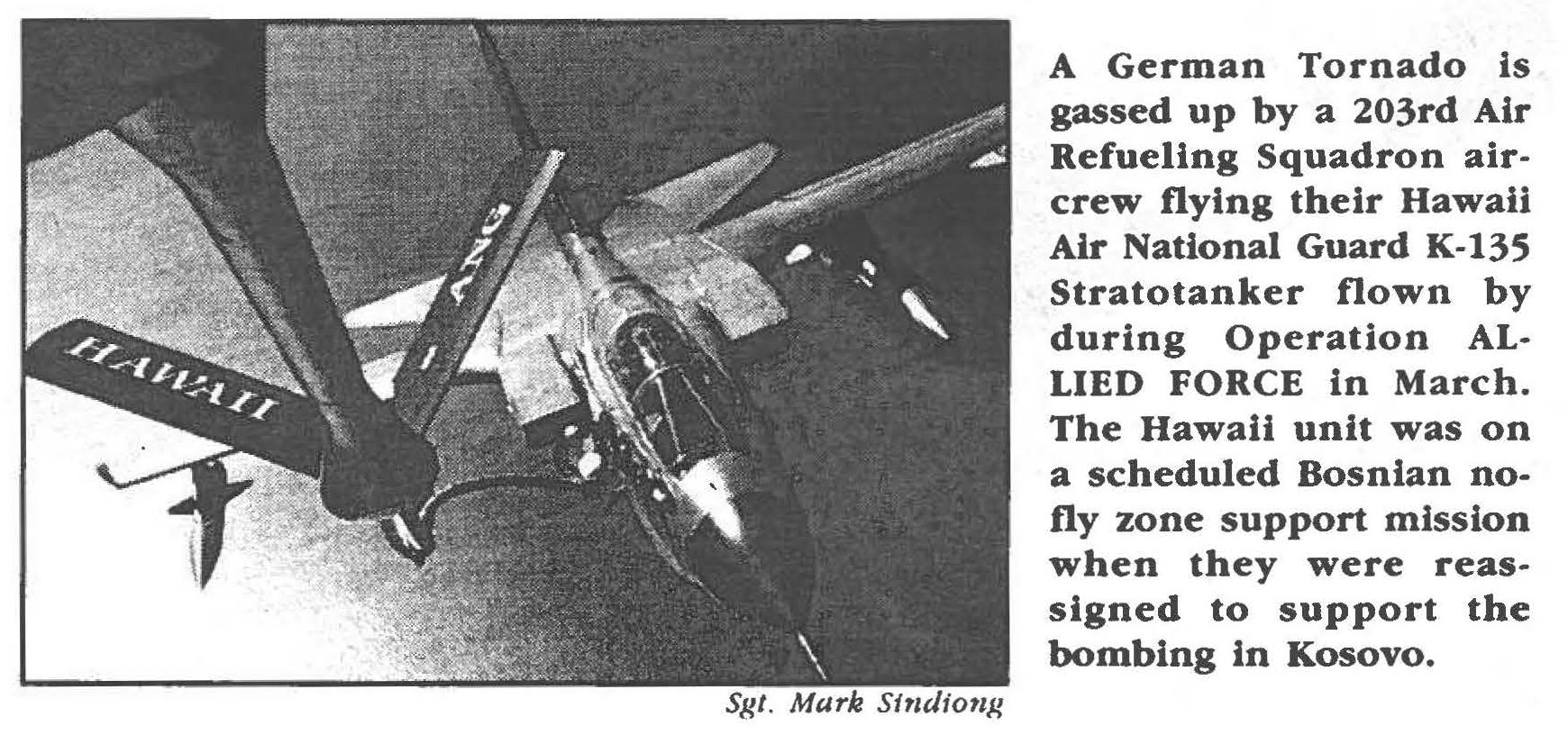
WELCOME HOME HEROES – Maj. Gen. Edward V. Richardson, the adjutant general. and Brig. Gen. Michael Tice, 154th Wing commander, greet the troops returning from Operation ALLIED FORCE in Europe.A German Tornado is gassed up by a 203rd Air Refueling Squadron aircrew flying their Hawaii Air National Guard K-135 Stratotanker flown by during Operation ALLIED FORCE in March. The Hawaii unit was on a scheduled Bosnian nofly zone support mission when they were reassigned to support the bombing in Kosovo. (Pictures from the 1999 Spring Pūpūkahi)
Hawaii Air National Guard personnel from the 154th Wing and KC-135 Stratotankers that participated in Operation ALLIED FORCE returned to Hawaii Easter weekend after successfully finishing their tour of duty in Europe. The maintenance and flight crews were met at Hickam Air Force Base by Maj. Gen. Edward V. Richardson, the adjutant general and family members who had waited anxiously for their return.
The 203rd Air Refueling Squadron deployed to Istres, France in February to provide refueling for NATO aircraft patrolling the nofly zone of Bosnia, but quickly shifted its operations to support air strikes in Yugoslavia. “We went from being a peacekeeping force, to initiating an operational contingency, in minimal time,” said Lt. Col. Edwin “Skip” Vincent, 203rd commander. The unit completed its rotation with a 100-percent mission and sortie effectiveness rate. “Our people did a great job keeping tankers in the air 24-hours-a-day for this operation. “
For the duration of its tour, the 203rd was placed in charge of the refueling effort for the NATO operation. The Hawaii air refuelers flew their last mission in support of Operation ALLIED FORCE April 1 and returned to Hawaii after completing their scheduled rotation.
Gov. Benjamin J. Cayetano, commander in chief of the Hawaii National Guard, commended the 154th Wing personnel for their efforts. “Hawaii can be proud of its sons and daughters who have assisted NATO in such an outstanding manner.”
The Hawaii Air Guard’s 154th Wing also includes the 199th Fighter Squadron with F-15 Eagle fighter aircraft, making it one of the few composite wings in the Total Force. The fighters and tankers routinely train with each other in the airspace around Hawaii. “That training has put the Hawaii Guard far ahead of other units in performing refueling for combat operations,” said Richard-son. “The groundwork for this successful operation was developed years ago when the composite wing structure was initiated, effectively using different types of aircraft under one command.”
One U.S. Air Force officer, with the 16th Expeditionary Operations Group in France, called the 203rd “the finest tanker unit, active-duty, Guard or Reserve, that I have ever served with.”
Congratulations also go to the members of the 154th Wing who recently supported Operation ALLIED FORCE. Gov. Benjamin J. Cayetano, commander in chief of the Hawaii National Guard, met with members of the Wing at the State Capitol, April 28th, to personally offer his thanks to those who deployed to France as part of the operation.
Flight crews from the 203rd Air Refueling Squadron and support personnel from the 154th Wing deployed to France, Feb. 27th, providing refueling for NATO aircraft patrolling the no-fly zone of Bosnia-Herzegovina. However, the NATO bombing operation in Yugoslavia began on March 24th and our tankers and support personnel very quickly developed plans for combat operations. During that time, our Hawaii crews flew 70 combat sorties, some directly over the Balkans, totaling 402 flying hours and off-loaded 3.9 million pounds of fuel to NATO fighter and bomber aircraft. Our crews flew eight sorties per day with an average sortie length of six hours. Our Hawaii Air National Guard people were in charge of the entire air refueling operation at the beginning of ALLIED FORCE and did an outstanding job. Maintenance crews fixed jets around the clock, working 12-hour shifts that often stretched into 16 hours or more. The result was a 100 percent mission effectiveness rate and 100 percent sorties effectiveness rate. In addition, there was not a single accident and there were no injuries.
To top it off, before departing France, despite their very busy and tight schedule, they even held a luau for their French hosts and members of the air base, which helped foster even closer ties. We can all be very proud of them. I also want to thank Missy Vincent, Maj. Marty St. Louis, and members of the 203rd Air Refueling Squadron and 154th Wing Family Support Groups for their assistance during the deployment and for the reception upon the unit’s return during Easter weekend.
by Lt. Col. Stan Osserman 203rd Air Refueling Squadron
It’s time to take a deep breath and try to recollect all that’s gone on in the past two weeks. It was overwhelming, it was awesome, it was scary, it was humbling, and in many ways, it was beyond description.
The members of the HIANG went to France to participate in peacekeeping operations and “no fly zone” patrol over Bosnia-Herzegovina, but we ended up helping develop contingency war plans and then flying those plans in less than two weeks.
The first half of our deployment here at Istres, France was characterized by a rather leisurely schedule of two sorties per day that allowed crews to visit many of the incredible sites of southern France. The winds were usually brisk and cold, but the towns and the people here were warm and friendly.
Olive oil and lavender soap, wine, cheese and Roman ruins were the topics of discussion as we gathered for fine French cuisine at 8 p.m. But the winds of war were stirring and the mission planning cell and senior staff was working towards a new mission for the members of the 154th Wing’s deployed forces.
Lt. Col. Vincent, the 203rd ARS commander, and Capt. Michael Perry, the tanker tactics officer, met with other planners armed with options, suggestions and concerns for USAFE war planners. We all watched CNN and tried to guess what it meant for us and we prepared in every way we could for an operation that seemed elusive at best and overwhelming at the worst.
Then the call came over the secure net to plan for combat operations at maximum tempo. Maintenance was already working around the clock, and the Ops Mission Planning cell began to build mission folders for the crews based on a draft contingency plan. The LG and XP shops were orchestrating the mid-deployment “swap out” when they learned we needed to make room for more tanker maintainers and crews. Supply, Motor Pool and the medical team were all suddenly busy, and the days of leisurely tours and fine French dining were only a distant memory.
The first challenge was preparation, and we couldn’t think of anything else in our power that we could do, but the unknown loomed just ahead and we were missing some critical information from our Combat Air Operations Center in Italy. That information arrived just ahead of the order to launch, and our fist crew went out the door like a sprinter out of the blocks, ushered by adrenaline-powered mission planners.
“Euro 41, cleared as fragged,” was the call that sent Maj. Steve SuaFilo and his crew into the unit’s first combat mission. At 1720 hours, local (0620 HST) on 24 March, they were airborne. Before their eight-hour sortie was over, we had launched our second aircraft and had planes and crews ready to support round-the-clock operations. At the same time, support aircraft and crews were arriving from the US, and our mission planners and staff were fine tuning combat operations that quickly ramped up to eight long missions per day.
Planners and support staff were working 16-hour days since Saturday, March 21st, and the strain was evident. This was for real. The threats were real, the pressure was real, so was the fatigue. Sortie after sortie took to the air with planners scrambling to correct problems and build packages. Maintenance ran like a well-oiled machine, bringing planes on status in record time. Augmenting USAF crews quickly learned our operations and tactics. The commander and operations officer waited like worried parents, breathing a sigh of relief as the crews called in with their recovery codes.
The Air Component Commander has passed kudos through our mission-planning cell twice this week. He appreciated the I 00% reliability of the HIANG. We will all come home with many stories to tell, but few can appreciate the experience we’ve all lived this week. It will change all our lives and temper our attitudes towards our mission forever.
Bonjour!
from Maj. Ron Han 154th logistics Squadron
With rain gusting and swirling between 35-45 knots on blistering cold 20-degree-weather nights and mornings, our maintainers, suppliers, transporters, and support personnel prepped, fixed, and quick-turned our available jets with flying colors! Whether wrapped in “long johns”, Gore-Tex, beanies and gloves, all of our folks have never let any of the elements deter them from completing their mission. In fact, our mission effectiveness rates were right on target and everyone involved in this process should be very proud of their support to our crews!
Integration of diverse backgrounds, geographical regions, and demographics could not hamper or impede our warrior spirit and support to our numerous taskings and common core mission. Although faced with a myriad of challenges, both physically and mentally here in France, logisticians of all specialties have always answered “the call” at any level and produced sterling results.
Mahalo!
from Lt. Col. Skip Vincent
“We engaged in the most intensive tanker combat flying since the Gulf War or the Vietnam conflict. The stakes were very high – and the tanker mission in this conflict was critical. Our Istres tanker team stepped up to the task and your performance was truly commendable.
Brig. Gen. Gelwin, 5th ATAF Battle Director, cited our performance as nothing less than outstanding. We have accomplished every tactical mission. Every strike package we were assigned to support got their gas when and where they needed it. To maintenance; mahalo for the great job and the personnel touches everywhere; to support functions and the 16th, mahalo for the great support. The mission would fail without you.”
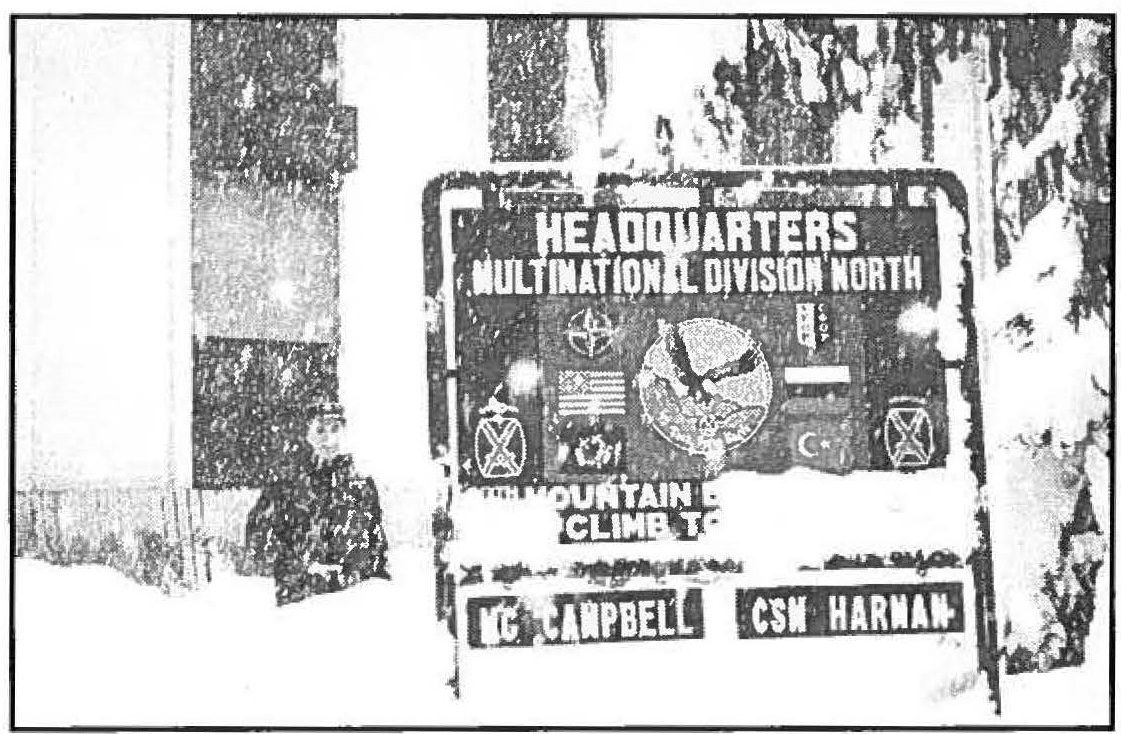
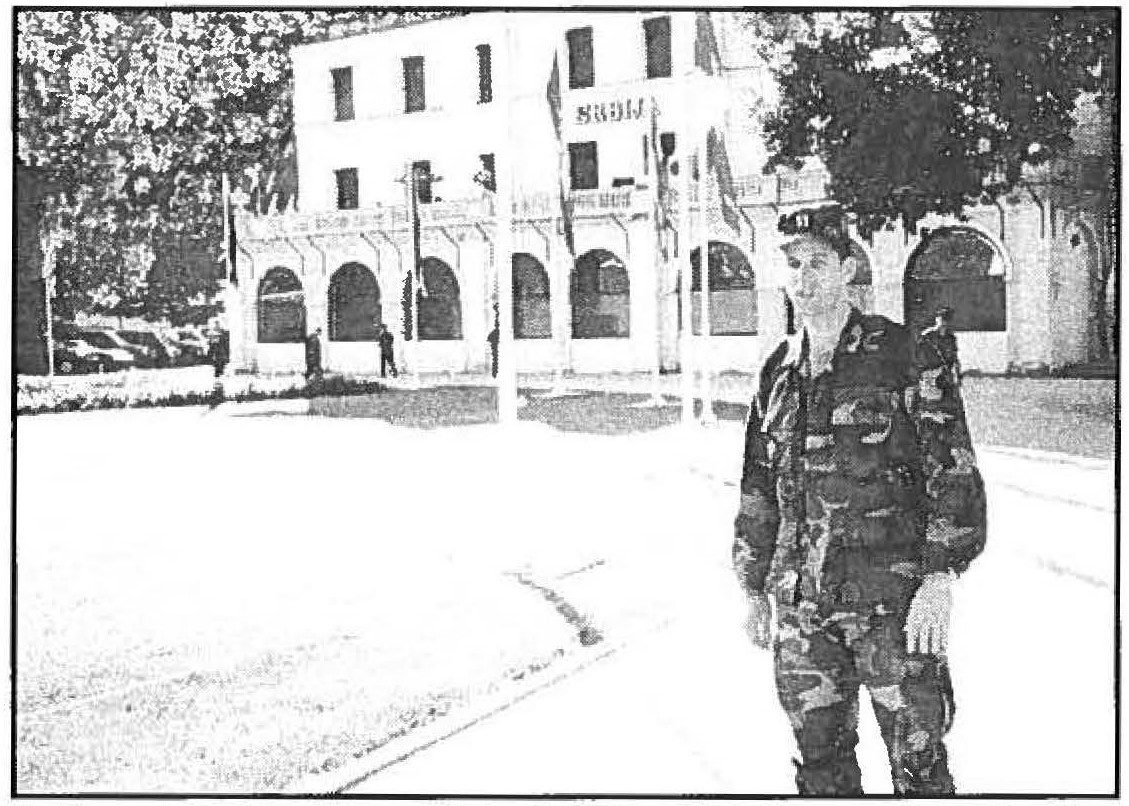
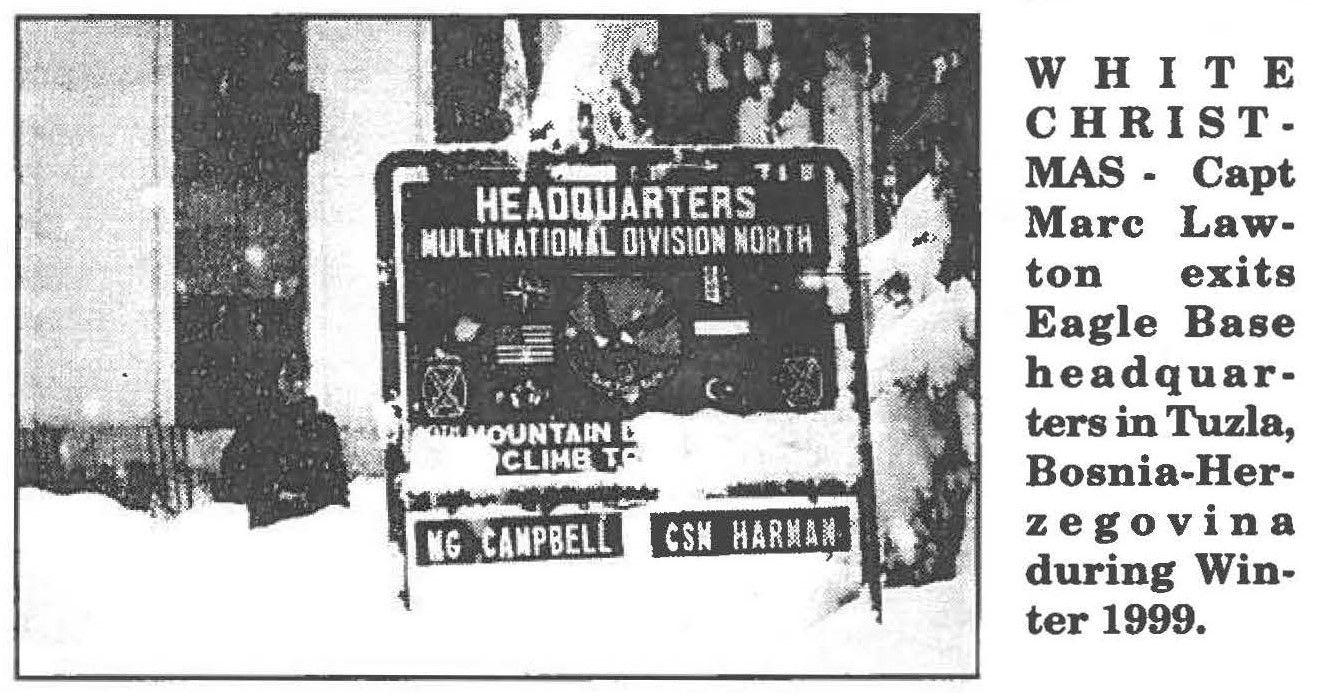
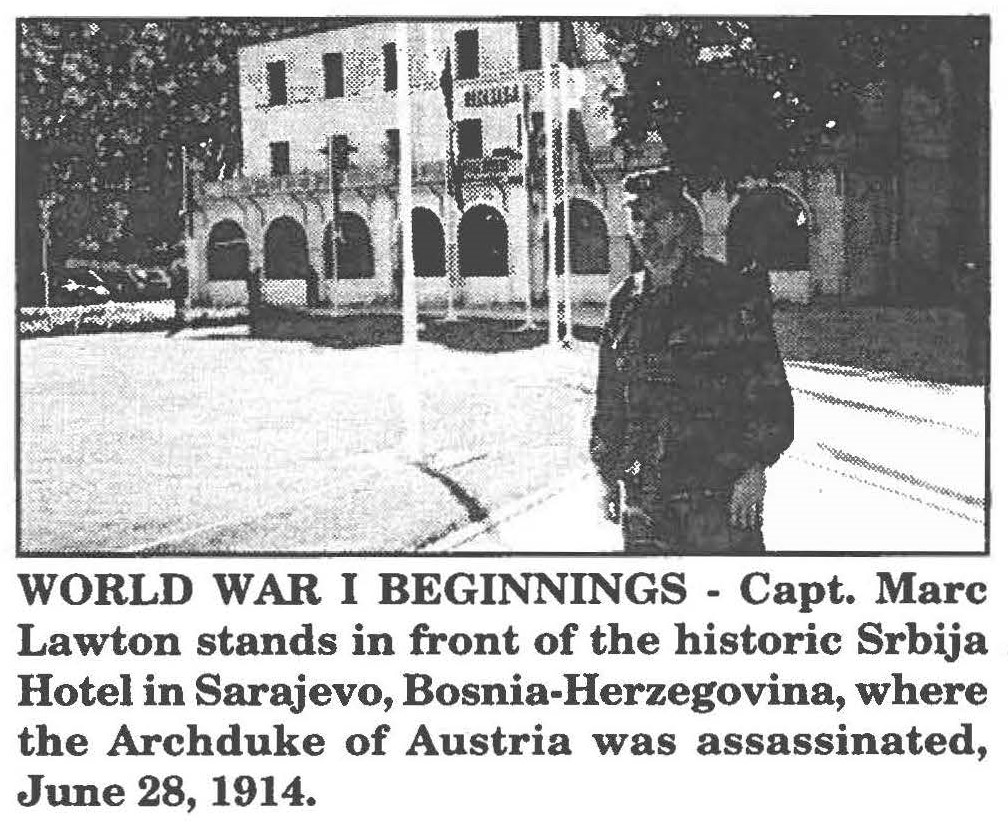
SEASONS GREETINGS – Capt. Marc Lawton exits Eagle Base headquarters in Tuzla, Bosnia-Herzegouina. During his eight-month tour as intelligence officer, Lawton was able to visit historic places such as the Srjija Hotel in Sarajeuo. The hotel is where the Archduke of Austria was assassinated, June 28, 1914, fueling the beginning of World War I.SEASONS GREETINGS – Capt. Marc Lawton exits Eagle Base headquarters in Tuzla, Bosnia-Herzegouina. During his eight-month tour as intelligence officer, Lawton was able to visit historic places such as the Srjija Hotel in Sarajeuo. The hotel is where the Archduke of Austria was assassinated, June 28, 1914, fueling the beginning of World War I.(Pictures from the 2000 Annual Report)
In January, an intelligence officer from the 29th Brigade returned from eight months of duty in Tuzla, Bosnia-Herzegovina, as part of the Joint Task Force Eagle.
WHITE CHRISTMAS Capt Marc Lawton exits Eagle Base headquarters in Tuzla, Bosnia-Herzegovina during Winter 1999. WORLD WAR I BEGINNINGS – Capt. Marc Lawton stands in front of the historic Srbija Hotel in Sarajevo, Bosnia-Herzegovina, where the Archduke of Austria was assassinated, June 28, 1914. Deployed soldier, airmen return page 6(Pictures from the 2000 January – February Pūpūkahi)
Capt. Marc Lawton return in January from an eight month deployment to Bosnia-Herzegovina. The Hawaii Army National Guard officer from the 25th Infantry Division (Light) Detachment-Rear Operation Cell, left May 1999 to provide intelligence support for Operation JOINT FORGE at Eagle Base, Tuzla.
Deep in the heart of mine infested Bosnia, Lawton went about the day to day mission of gathering intelligence and reporting the findings at the daily command out briefs. “Conditions have improved since the first Hawaii Army Guard soldiers set foot at Eagle Base,” said Lawton. “Many of the large tents have been replaced by wood structures, but the threat remains.” Every once in awhile another mine is found and the ordnance staff is called in to explode the mine in place. Force protect, as is called, still requires American troops not to travel off base without their web gear (vest, pistol belt, canteen, 1st aid pack, ammunition), Kevlar helmet and weapon.
Everyday is Monday, you need to get up go to work and do you mission. No weekends, no holidays. Thanksgiving, Christmas and New Years consist of a special dinner, a possible USO tour or visit by VIPs and its back to work. You work with troops from the NATO allied nations, local Bosnians and personnel from all branches of the U.S. military.
Calls to homes run up you phone bills in minutes and those eagerly awaited care package from home take weeks to come. “The snow which started around Thanksgiving left the their marks on the structures we worked and lived in,” said Lawton. “Icicles formed at 45 degree angles on the roofs, because of the high freezing winds.”
“The deployment was a great learning experience,” said Lawton. “While on a mission in Sarajevo, I was able to visit the site where World War I started with the assassination of the Austrian Archduke.”
The Hawaii Army Guard has had eight other soldiers serving eight-month tours since 1996. Four 117th Public Affairs journalists were the part of the second rotation to deploy to Bosnia, June 1996, followed by a public affairs journalist in Germany from July 1997, two 1st Battalion, 487th Field Artillery radar operators in November 1997, and 29th Separate Infantry Brigade intelligence sergeant from October 1998 in Bosnia
Five soldiers from the 29th Separate Infantry Brigade volunteered to train and deploy with the 25th‘s Task Force Eagle for the Stabilization Force 11 mission in Bosnia-Herzegovina. The soldiers began individual and theater-specific training in December 2001. They deployed for their six-month Bosnia-Herzegovina rotations in early March 2002.