Do you need help in another language? We will get you a free interpreter. Call 808-369-3580 to tell us which language you speak.
您需要其它語言嗎?如有需要,請致電 (808-369-3478), 我們會提供免費翻譯服務
您需要其它语言吗?如有需要,请致电 (808-369-3478), 我们会提供免费翻译服务
En mi niit alilis lon pwal eu kapas? Sipwe angei emon chon chiaku ngonuk ese kamo. Kokori (808-369-3478) omw kopwe ureni kich meni kapas ka ani.
Makemake `oe i kokua i pili kekahi `olelo o na `aina `e? Makemake la maua i ki`i `oe mea unuhi manuahi. E kelepona (808-369-3478)`oe ia la kaua a e ha`ina `oe ia la maua mea `olelo o na `aina `e.
Masapulyo kadi ti tulong iti sabali a pagsasao? Ikkandakayo iti libre nga paraipatarus. Awaganyo ti
(808-369-3478) tapno ibagayo kadakami no ania ti pagsasao nga ar-aramatenyo.
다른언어로 도움이 필요하십니까? 저희가 무료로 통역을 제공합니다. (808-369-3478)로 전화해서 사용하는 언어를 알려주십시요
Kwoj aikuij ke jiban kin juon bar kajin? Kim naj lewaj juon am dri ukok eo ejjelok wonen. Kirtok
(808-369-3478) im kwalok non kim kajin ta eo kwo melele im kenono kake.
E te mana'o mia se fesosoani i se isi gagana? Matou te fesosoani e ave atu fua se faaliliu upu mo oe. Vili mai i le numera lea (808-369-3478) pea e mana'o mia se fesosoani mo se faaliliu upu.
¿Necesita ayuda en otro idioma? Nosotros le ayudaremos a conseguir un intérprete gratuito. Llame al (808-369-3478) y diganos que idioma habla.
Kailangan ba ninyo ng tulong sa ibang lengguwahe? Ikukuha namin kayo ng libreng tagasalin. Tumawag sa (808-369-3478) para sabihin kung anong lengguwahe ang nais ninyong gamitin.
‘Okú ke fie maʻu tokoni ʻi ha lea fakafonua ʻe taha? Temau kumi haʻo taha fakatonulea taʻetotongi. Telefoni ki he (808-369-3478) ke fakahā mai ʻa e lea fakafonua ʻokú ke lea aí.
Bạn có cần giúp đỡ bằng ngôn ngữ khác không ? Chúng tôi se yêu cầu một người thông dịch viên miễn phí cho bạn. Gọi (808-369-3478)nói cho chúng tôi biết bạn dùng ngôn ngữ nào
Gakinahanglan ka ba ug tabang sa imong pinulongan? Amo kang mahatagan ug libre nga maghuhubad. Tawag sa (808-369-3478) aron magpahibalo kung unsa ang imong sinulti-han.
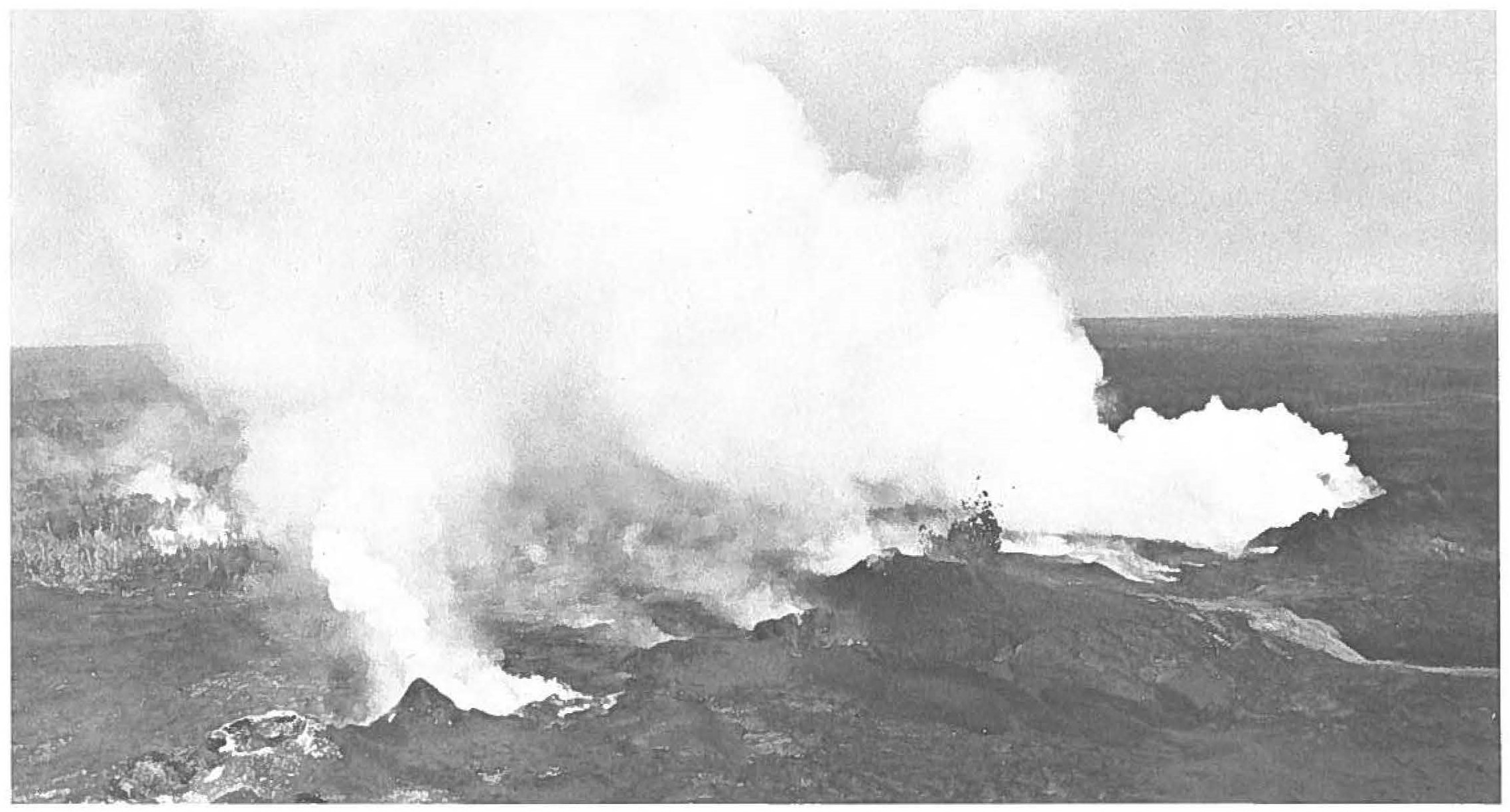
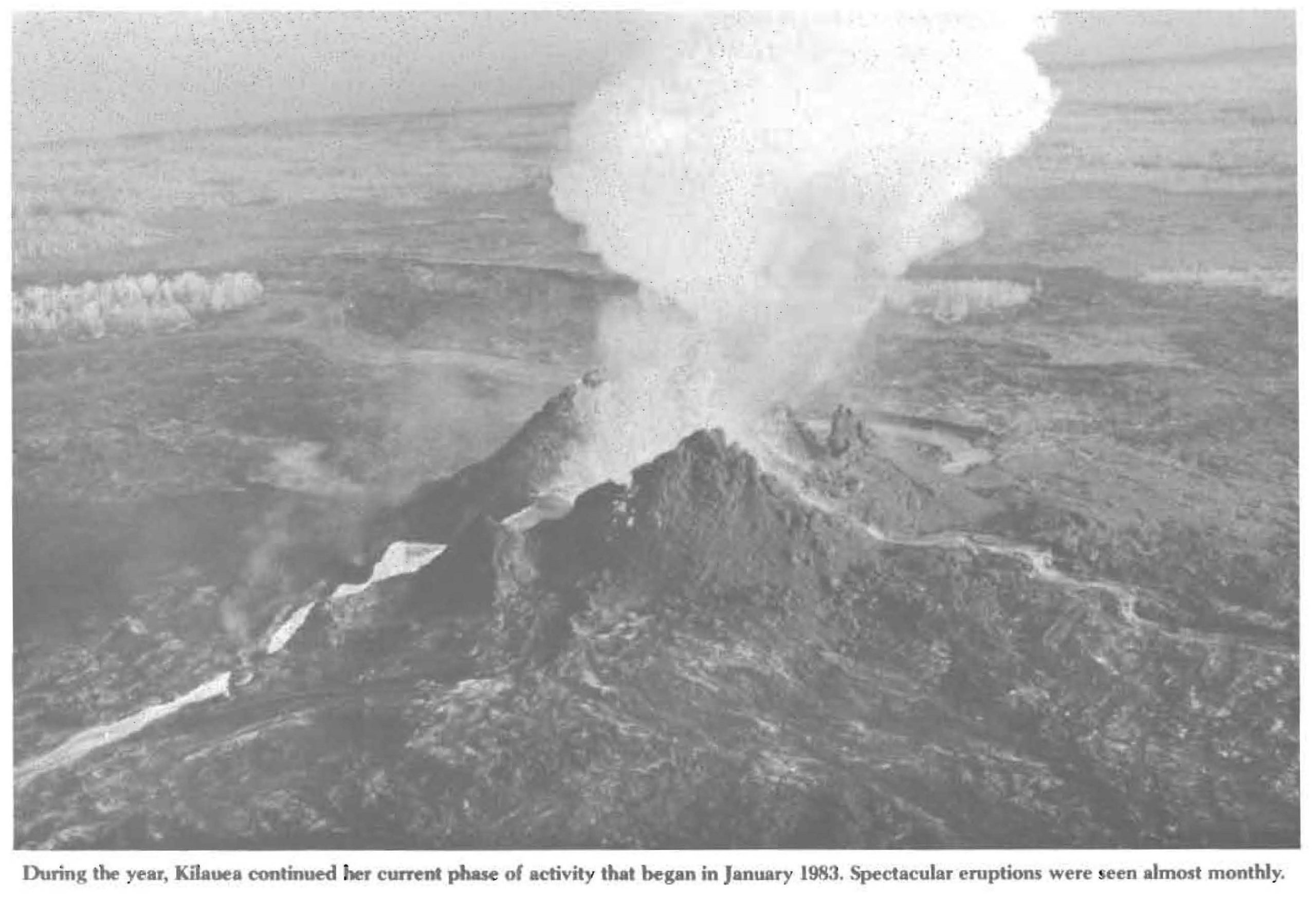
(Picture from the 1983 Annual Report)During the year, Kilauea continued her current phase of activity that began in January 1983. Spectacular eruptions were seen almost monthly. (Pictures from the 1984 Annual Report)
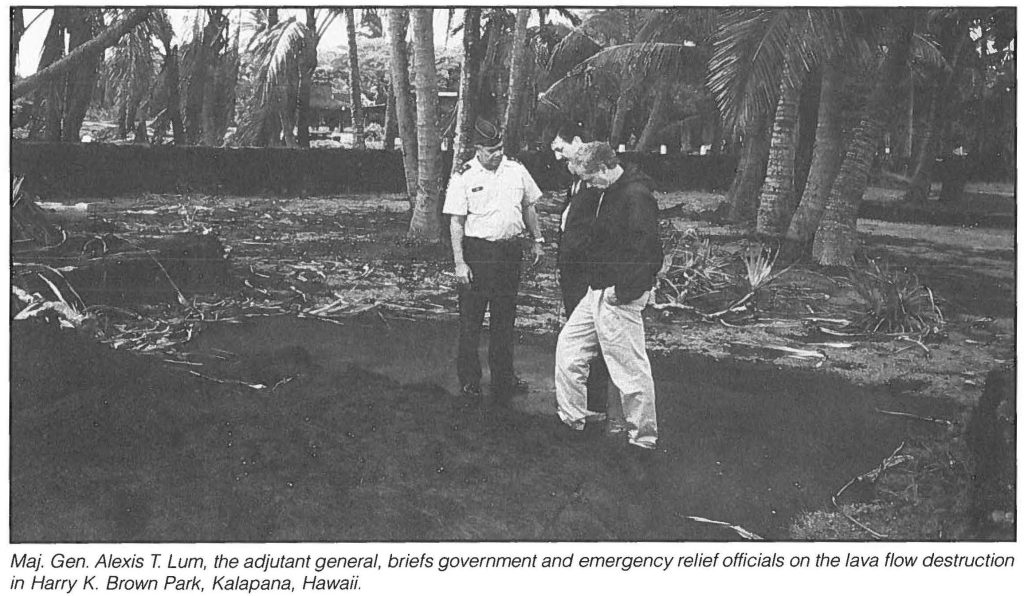
Kilauea’s Puu O’o Vent continued to remain active during the year. Dating back to January 1983, the 48th episode awakened to unleash a swath of destruction after remaining docile for nearly four years. Beginning in November 1986, rivers of lava flowing from the East Rift Zone overran homes, historical sites, and roadways in the Kalapana area, forcing residents to retreat. By the end of February 1987, lava had claimed 17 homes, severed waterlines, and cut off public roadway access. At year’s end, Puu O’o showed no signs of quieting.
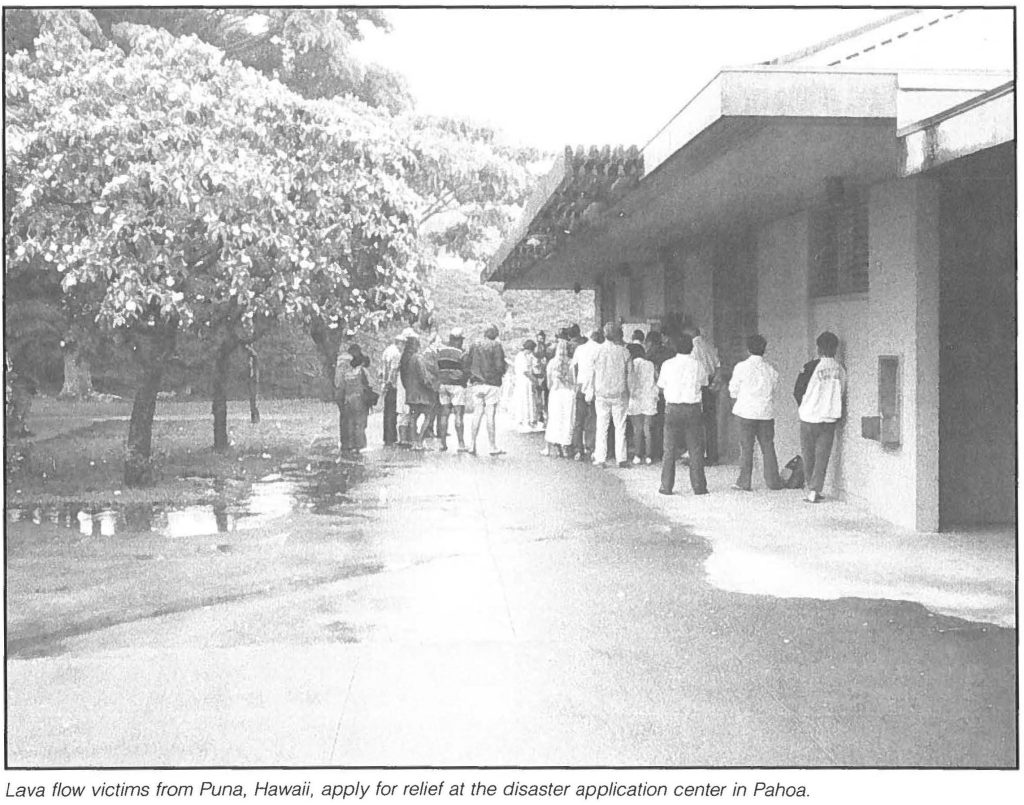
In early January 1987, State Civil Defense assisted in setting up and operating a Needs Assessment Center in Hilo to provide information on state and local individual assistance programs. Opened for victims of the Kalapana lava flow, the Center offered property and income tax relief, low interest loans and acquisition of stateowned lands.
Lava flow victims from Puna, Hawaii, apply for relief at the disaster application center in Pahoa. Maj. Gen. Alexis T. Lum, the adjutant general, briefs government and emergency relief officials on the lava flow destruction in Harry K. Brown Park, Kalapana, Hawaii.(Pictures from the 1990 Annual Report)
Kilauea declared major disaster in 1990. Since the eruption began in 1983, lava from Kilauea’s Pu’u O’o and Kupaianaha vents has affected over 35 square miles of land in the Puna District, destroying or endangering nearly 250 residences and buildings and burying 2,500 houselots. In seven years, lava has been responsible for more than $61 million in private and public property losses. Pumping out approximately 650,000 cubic yards daily, the Kupaianaha vent continues to pose an active threat to lands adjacent to Kalapana.
Property losses took a sharp upswing in the early months of 1990, as lava converged on the Kalapana community.
At the Governor’s request, the President declared the Puna District a disaster area, leading the way for Federal disaster aid. On May 23, a Disaster Application Center was opened in Pahoa, providing a single site for Federal, State and County assistance programs for victims of the lava flow.
The Federal Emergency Management Agency (FEMA) approved the State’s proposal to establish a disaster incident period covering the entire eruption phase dating to January 1983. The incident period will remain open until the current eruption ceases. The State of Hawaii is seeking ways to mitigate the impact of lava flows on the area. The Governor has appointed the Kalapana Task Force to consider mitigation measures for the long term, such as relocation, housing and land use.
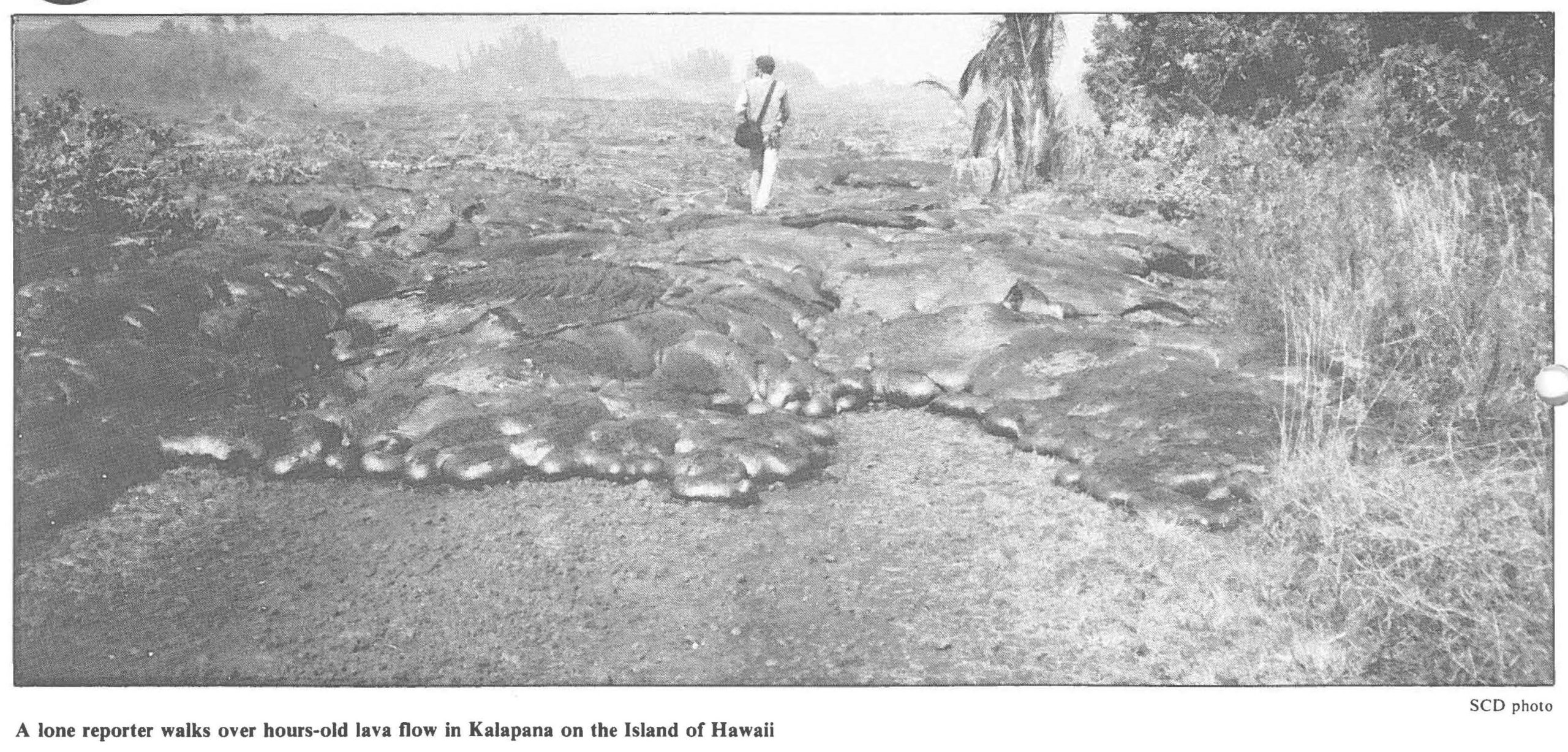
A lone reporter walks over hours-old lava flow in Kalapana on the Island of Hawaii (Picture from the 1990 July – September Pūpūkahi)
Since January 1983, Kilauea’s 48th eruption has slowly taken its toll on the Big Island’s Puna district. In January the destructive pace picked up aggressively and by May, entire subdivisions were covered by lava.
In the last seven years, 164 homes and structures have been destroyed and isolated, and some 2,500 residential lots buried by flows originating from Kilauea’s Pu’u O’o and Kupaianaha vents. Losses are estimated at $61 million, with $46 million in damage to private property and $15 million in damage to public roadways and utilities.
Hawaii State Civil Defense (SCD) was directly involved in both disaster response and recovery operations. In early May, the SCD staff was part of a team of Federal State and county representatives assembled to survey the ex eam of Federal, State and county representatives assembled to survey the extent of the damage in the Puna District. Based on the team’s estimates, President George Bush declared Puna a Federal disaster area, making Federal relief funds available to affected residents.
On May 23, the Disaster Application Center opened at the Pahoa Neighborhood Community Center, providing a centralized site to apply for disaster aid. The center offered Federal, State and county low cost loans, temporary housing and direct grants to help recover eligible property and uninsured losses. By the time the Disaster Application Center closed on June 8, 200 persons had registered for assistance. A toll-free number remains in place to handle inquiries and registrations.
Lava continues to threaten the Puna district, and the Federal disaster declaration remains open-ended to accommodate future property losses.
Kilauea eruption continues. Kilauea’s Kupaianaha vent continued to erupt throughout the year with a steady flow of approximately 650,000 cubic yards of lava per day. The lava moved into the Kaimu area, destroying homes, filling in Kaimu Bay and covering the famous Black Sand Beach. The lava flow later cooled and stopped its eastward advance, sparing remaining homes. Lava tubes in the Kalapana area continued to drain lava into the ocean.
The disaster incident period for the Puna District remained in effect throughout the fiscal year. The district had been declared a federal disaster on May 18, By the close of the year, 262 applicants had registered for disaster aid, with the Temporary Housing Program providing $500,000 to 182 applicants and the Individual and Family Grant Program distributing over $1 million to 119 applicants. The Small Business Administration approved 52 applications totaling nearly $3,000,000 in low-interest federal loans. More than $2.6 million was approved for public assistance projects and an additional $5.3 million for future public projects. Unemployment assistance continued, as did the State Disaster Loan Program.
State legislation provided an additional source of low-interest loans to disaster victims. Legislation was also drafted to set aside lands for the relocation of qualified applicants of Hawaiian ancestry.
State Civil Defense (SCD) continued to monitor the eight-year eruption of Kilauea Volcano, which destroyed homes and covered Kaimu Bay and Kalapana Black Sand Beach in the Puna district of the Big Island.
Kilauea claims more homes. In late October 1991, upslope lava from Kilauea’s Kupaianaha vent claimed the last remaining homes in the Royal Gardens subdivision. The subdivision, severely damaged by earlier flows, had been largely vacant for two years. October’s loss was the first since early January 1991, and the 180th structure claimed by lava since the beginning of the eruption. Active since January 1983, the Kilauea eruption has overrun an estimated 2,500 house lots and caused over $60 million in property damage in the Big Island’s Puna District. The area was declared a federal disaster in mid-1990, with an incident period retroactive to January 1983. The declaration remains open for possible future claims as the lava flow remains active in the Kalapana area.
Recovery continues amidst active lava flow. Proclaimed a federal disaster in 1990, the Kilauea Lava Flow has been active since 1983. Lava from the Pu’u O’o and Kupaianaha vents have caused an estimated $62 million in damage to homes, roadways, and utilities. Lava destroyed historic sites and public parks as well. Over $14 million in repair projects for public works and land acquisitions are completed or underway, with FEMA paying up to 75 percent of the costs. Projects include waterline replacement and deep water well installation, as well as construction of new public beach parks in Kalapana. Reconstruction of Highway 137 from Kalapana to Royal Gardens Subdivision is currently on hold, because of active lava flow in the area. Most repair projects have been completed, with the exception of a few awaiting findings of Environmental Assessments or set back by lava.
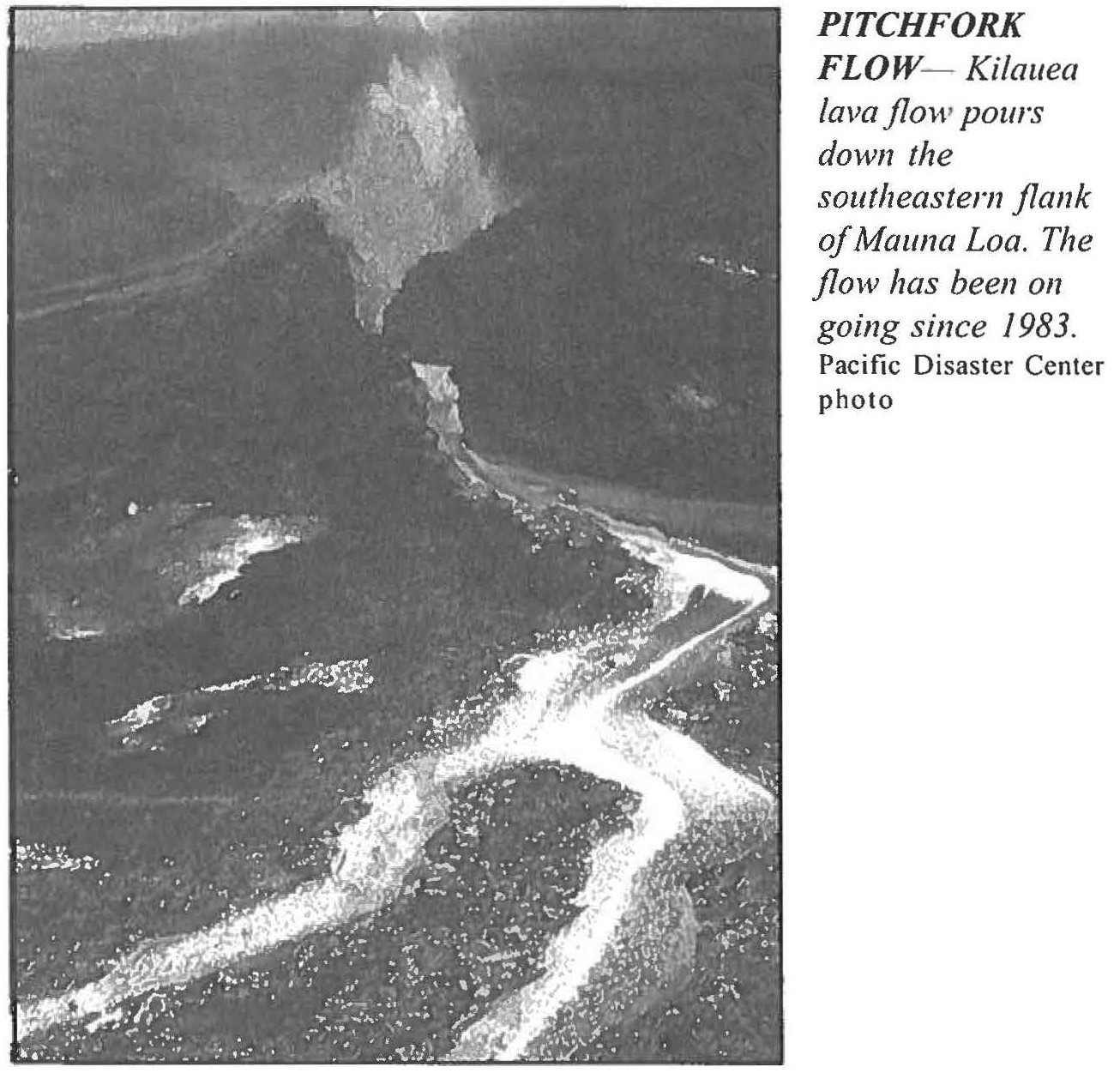
PITCHFORK FLOW- Kilauea lava flow pours down the southeastern flank of Mauna Loa. The flow has been on going since 1983. Pacific Disaster Center photo (Pictures from the 1998 Annual Report)
Active since January 1983, the Kilauea Lava Flow has caused millions of dollars in property damage. In 1990, a Presidential Disaster was declared, making federal aid available. The declaration remained open for over six years as lava continued its destructive path over the Puna District on the Big Island. FEMA closed the incident period on Jan. 31, 1997, on the determination that lava no longer posed a threat to populated areas. Kilauea’s activity remains alive, however.
In its 15-year run, Kilauea has destroyed nearly 200 homes, covered over 2,500 house lots, and caused more than $62 million in damages. Forty-two repair projects for damaged public facilities and services have been completed since 1990. Over $14 million in FEMA public assistance funding has gone to public works and land acquisition projects.
Kilauea update Work continued on county construction projects stemming from lava flow damage. The Ola’a Water System improvement Project began in May 1999 for construction of a reservoir and pipeline replacement, The $2.1 million project is currently underway near Mountain View on the Big Island.