Do you need help in another language? We will get you a free interpreter. Call 808-369-3580 to tell us which language you speak.
您需要其它語言嗎?如有需要,請致電 (808-369-3478), 我們會提供免費翻譯服務
您需要其它语言吗?如有需要,请致电 (808-369-3478), 我们会提供免费翻译服务
En mi niit alilis lon pwal eu kapas? Sipwe angei emon chon chiaku ngonuk ese kamo. Kokori (808-369-3478) omw kopwe ureni kich meni kapas ka ani.
Makemake `oe i kokua i pili kekahi `olelo o na `aina `e? Makemake la maua i ki`i `oe mea unuhi manuahi. E kelepona (808-369-3478)`oe ia la kaua a e ha`ina `oe ia la maua mea `olelo o na `aina `e.
Masapulyo kadi ti tulong iti sabali a pagsasao? Ikkandakayo iti libre nga paraipatarus. Awaganyo ti
(808-369-3478) tapno ibagayo kadakami no ania ti pagsasao nga ar-aramatenyo.
다른언어로 도움이 필요하십니까? 저희가 무료로 통역을 제공합니다. (808-369-3478)로 전화해서 사용하는 언어를 알려주십시요
Kwoj aikuij ke jiban kin juon bar kajin? Kim naj lewaj juon am dri ukok eo ejjelok wonen. Kirtok
(808-369-3478) im kwalok non kim kajin ta eo kwo melele im kenono kake.
E te mana'o mia se fesosoani i se isi gagana? Matou te fesosoani e ave atu fua se faaliliu upu mo oe. Vili mai i le numera lea (808-369-3478) pea e mana'o mia se fesosoani mo se faaliliu upu.
¿Necesita ayuda en otro idioma? Nosotros le ayudaremos a conseguir un intérprete gratuito. Llame al (808-369-3478) y diganos que idioma habla.
Kailangan ba ninyo ng tulong sa ibang lengguwahe? Ikukuha namin kayo ng libreng tagasalin. Tumawag sa (808-369-3478) para sabihin kung anong lengguwahe ang nais ninyong gamitin.
‘Okú ke fie maʻu tokoni ʻi ha lea fakafonua ʻe taha? Temau kumi haʻo taha fakatonulea taʻetotongi. Telefoni ki he (808-369-3478) ke fakahā mai ʻa e lea fakafonua ʻokú ke lea aí.
Bạn có cần giúp đỡ bằng ngôn ngữ khác không ? Chúng tôi se yêu cầu một người thông dịch viên miễn phí cho bạn. Gọi (808-369-3478)nói cho chúng tôi biết bạn dùng ngôn ngữ nào
Gakinahanglan ka ba ug tabang sa imong pinulongan? Amo kang mahatagan ug libre nga maghuhubad. Tawag sa (808-369-3478) aron magpahibalo kung unsa ang imong sinulti-han.
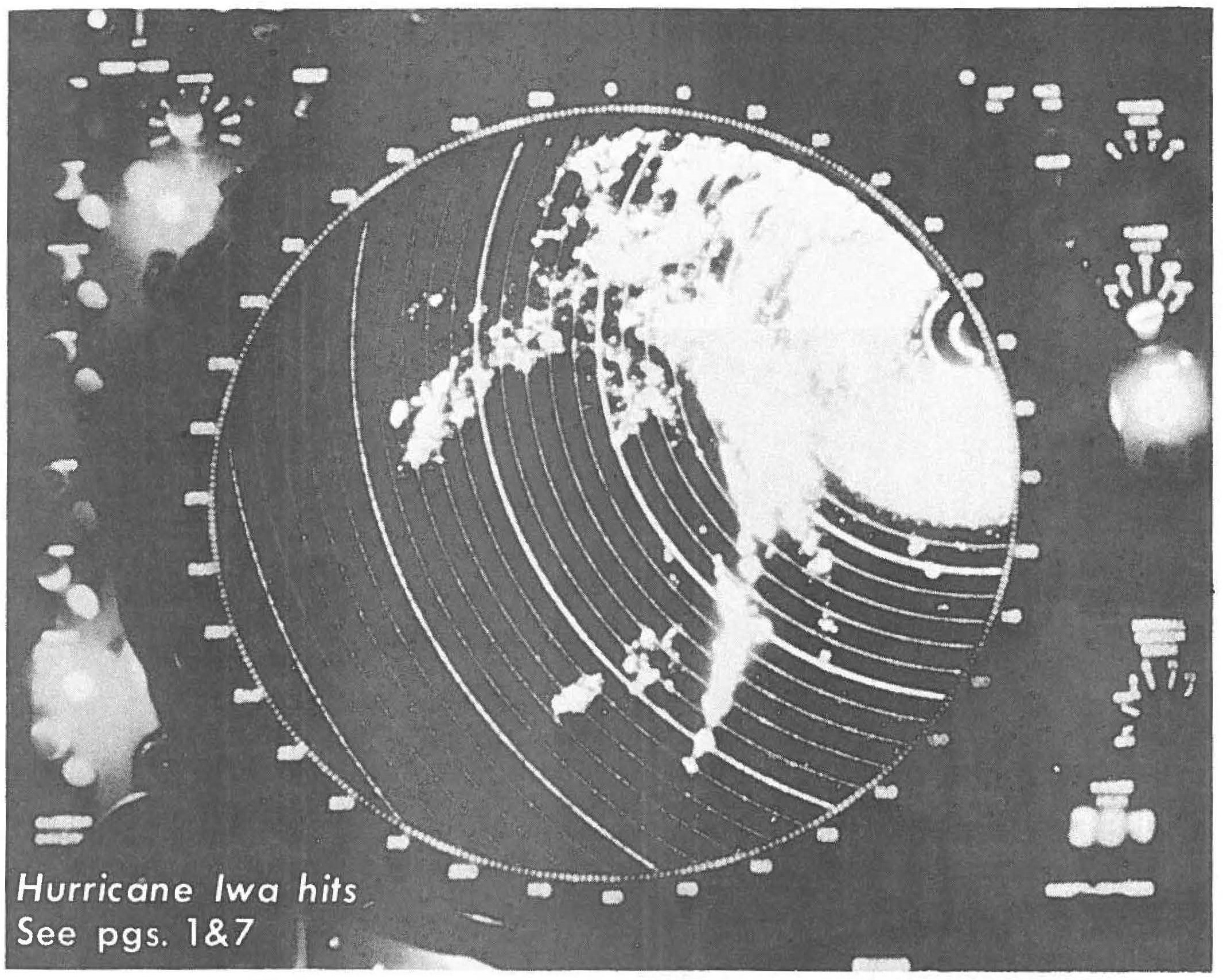
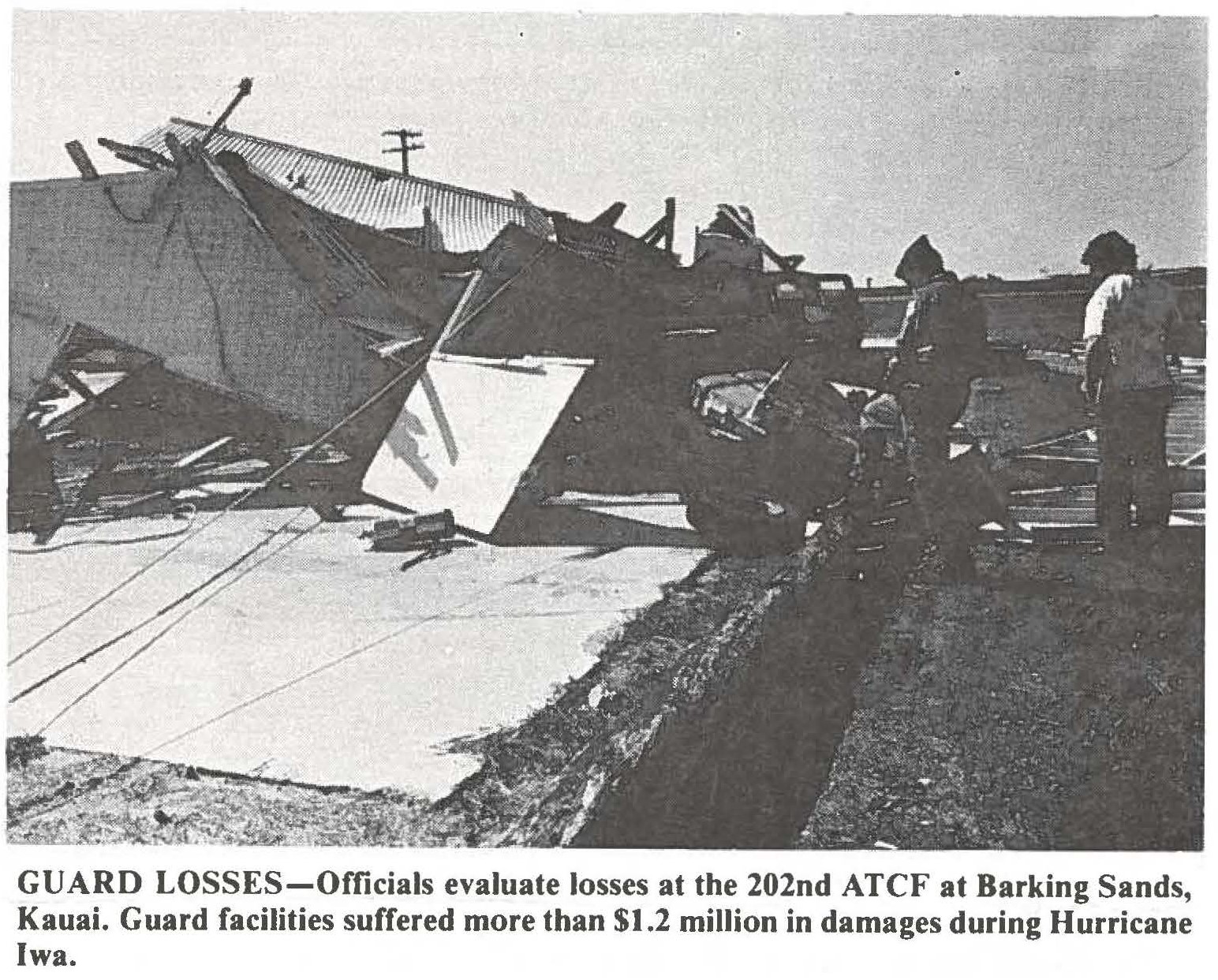
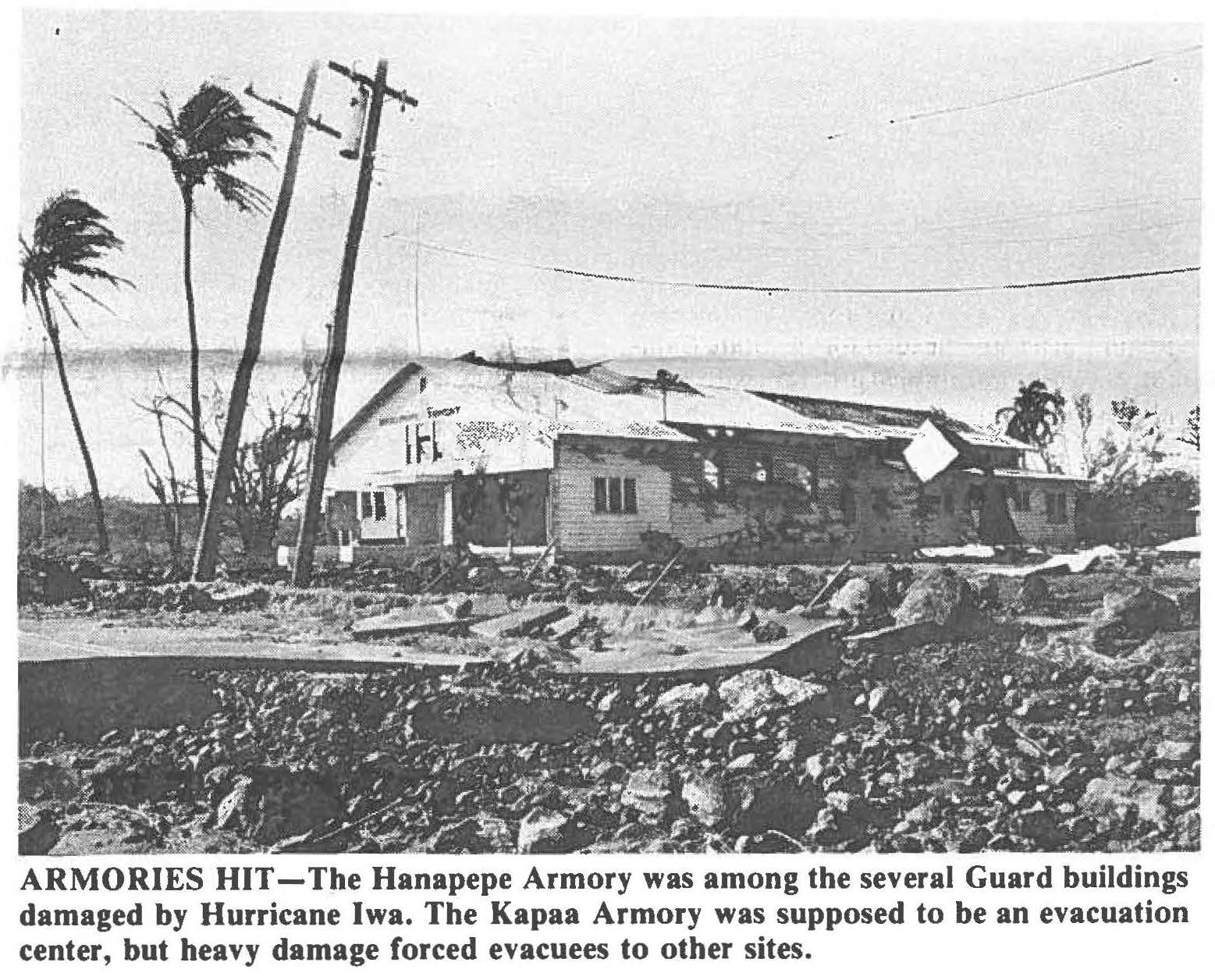
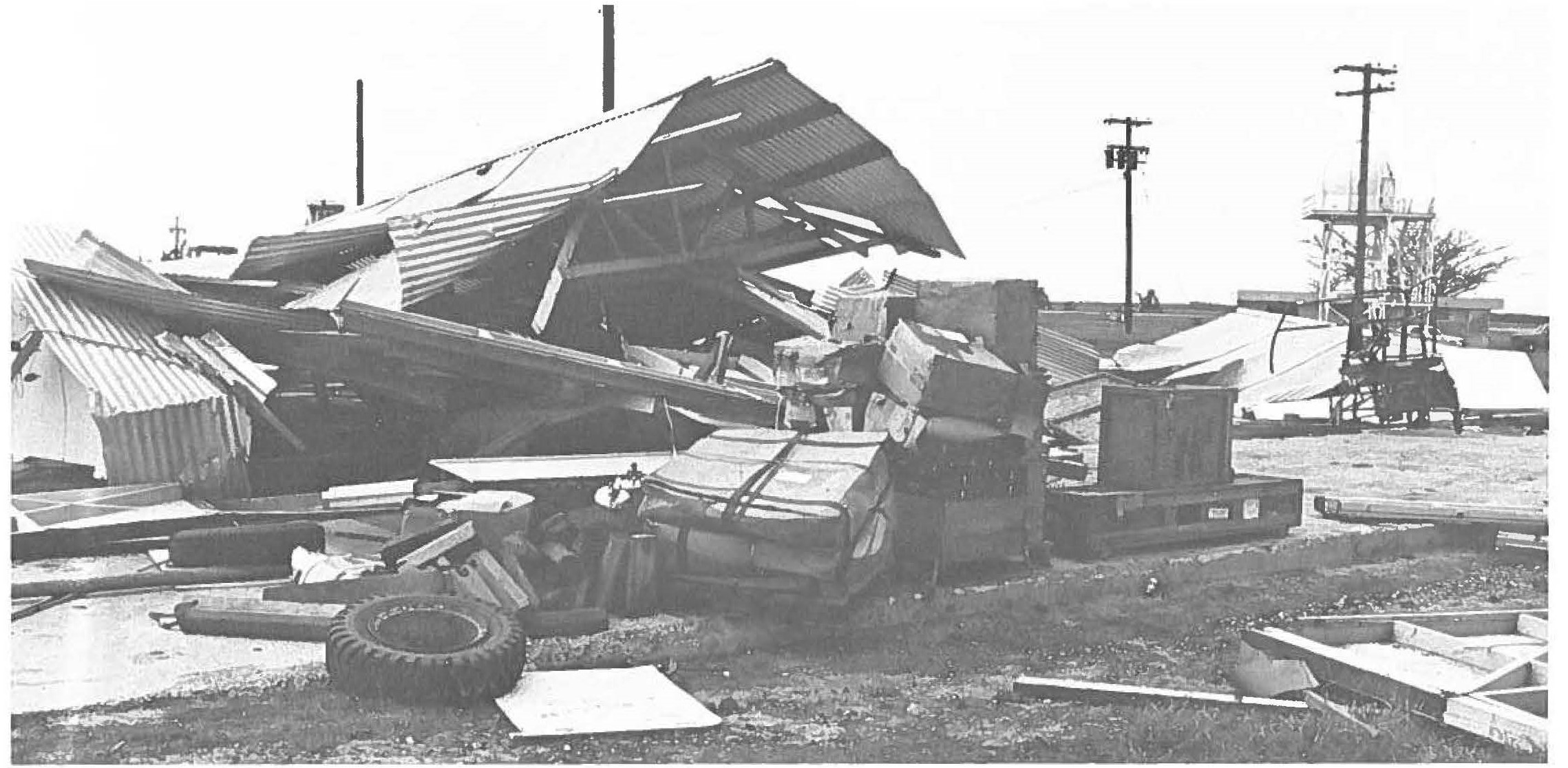
COVER PHOTO-Hurricane lwa as seen on a 169th ACW Sq. radar screen. Maj. Steven Berg took the picture when the eye was 200 miles southwest of Kauai.GUARD LOSSES-Officials evaluate losses at the 202nd ATCF at Barking Sands, Kauai. Guard facilities suffered more than $1.2 million in damages during Hurricane lwa. ARMORIES HIT-The Hanapepe Armory was among the several Guard buildings damaged by Hurricane lwa. The Kapaa Armory was supposed to be an evacuation center, but heavy damage forced evacuees to other sites. (Pictures from the 1982 Winter Pūpūkahi)
On November 23, Hurricane lwa slammed into Kauai and Oahu causing hundreds of millions of dollars in damages. Hours before it was known if the storm would actually hit the islands, the Hawaii National Guard and State Civil Defense were already getting ready to battle the storm and its devastating effects. By the time it was over, more than 300 Guard members had served their state.
Maj. Gen Arthur U. lshimoto donned his second hat, that of director of State Civil Defense, and at 7 a.m. on the day of the storm activated the State Emergency Operating Center at Birkhimer Tunnel in Diamond Head Crater. Maintaining constant communications with the National Weather Service and the various county civil defense centers, State Civil Defense officials initiated carefully prepared plans to deal with the hurricane.
WARNING GOES OUT
At 8 a.m., a hurricane warning for Kauai was issued. General lshimoto and Governor George Ariyoshi conferred several times during the morning by phone. On the general’s recommendation, Governor Ariyoshi ordered all Oahu schools shut down and directed all non-essential state employees to head for home.
National Guard commanders were notified to stand by for activation to state active duty. A HANG commanders meeting was cut short and those in Honolulu from the neighbor islands were told to return to their units. Lt. Col. Raymond Moriguchi, commander of the 150th Aircraft Control and Warning Squadron, and Maj. Vincent Nishina of the 201st Air Traffic Control Flight got on practically the last flight back to Kauai before the airlines stopped flying there.
Both the Army and Air Guard set up command posts in Department of Defense Headquarters on Diamond Head Road. Additionally, both divisions had members on duty up in the EOC to coordinate with civil defense and government officials. Others went to work at county civil defense centers.
SIRENS SOUND
At noon, Kauai’s sirens wailed their warning for people to evacuate potential tsunami inaundation areas. Selected Hawaii Army and Air National Guard members were ordered to state active duty by Governor Ariyoshi to help prepare for the developing emergency.
On Kauai, an evacuation center was set up in the Kapaa Armory while a truck was dispatched to Hanalei and Princeville to help evacuate area families.
Meanwhile, the National Weather Service satellite stopped sending pictures back of the storm and its movement. Without pictures, predicting when the storm would hit became almost impossible.
The 169th Aircraft Control and Warning Squadron promptly filled the void. Using the powerful radar atop Mt. Kaala. 169th radar operators kept track of the storm’s movement and relayed that information to the Governor through General lshimoto allowing state officials to make initial, lifesaving decisions.
By mid-afternoon, the state’s Emergency Broadcast System was operating, relaying vital instructions to Oahu and Kauai residents.
STORM HITS
Then came the storm. Late in the afternoon and into the evening 100-miles per hour winds plus high waves battered Hawaii’s two northern islands. However, due to adequate warning injuries were minimal. One Navy man died after his ship was struck by a huge wave while leaving Pearl Harbor. No other deaths were directly attributable to the storm.
Sixteen Guard 400-gallon water trailers were placed around Oahu to provide drinking water to those in need. Brigham Young University in Laie had four trailers, two went to the Craford Convalescent Hospital, one to Kahuku Hospital and the rest to various other areas on the North Shore and Leeward Coast.
By November 25 the Guard gears were working smoothing. Army and Air Guard command posts coordinated relief efforts with police, Civil Defense and Red Cross officials. When the Federal Emergency Management Agency officials arrived on Kauai, an Army Guard Huey was waiting to support them.
Even while the winds were blowing and power was out, Guard members were at work.
Elements of the 227th Engineer Company headed to the Waianae coast to help evacuate people from storm-damaged homes, and to assist the Honolulu Police Department in preventing looting.
At Barking Sands on Kauai, members of the 202nd Air Traffic Control Flight stayed on the job keeping open what turned out to be the only official communications channel between their island and the rest of the world that night and the following morning.
SM Sgt. Edgar Takabayashi and STgt. Albert Antonio maintained a high-frequency radio link to the 201st Combat Communications Group Headquarters at Hickam Air Force Base. The men also had a ham radio on hand that they used to keep in touch with Kauai Civil Defense. They were then able to relay important information to officials on Oahu. At 8 p.m., after an outside maintenance building had blown down, the unit’s antenna finally lost its battle against the high winds. Early the next morning, however, the unit got back on the air. Several other unit members, including Major Nishina worked throughout the night.
Up at Kokee, the 150th Aircraft Control and Warning Squadron had battened down the hatches, secured their radar antennas and then watched as the winds broke thick wooden 90-foot radio antenna poles like matchsticks and sent them crashing down on unit buildings. The winds also completely blocked the road leading to the site isolating the area for several days. Helicopters, Navy and Army Guard, ferried workers and repair crews back and forth until the road was opened.
Kauai Guardsmen from Company B, 299th Infantry, assisted Kauai police throughout the first long, dark night in the Kilauea and Poipu areas to prevent looting. They continued serving in that role for several days.
Finally the storm ended and Wednesday, November 24 dawned over the vast and previously unimagined destruction. Then the Guard and Civil Defense really got down to work.
The HANG C-7 started the first of 38 missions, flying in supplies and equipment to Kauai. Army Guard trucks helped distribute much needed food.
The Army Guard’s twin engine U-21 plane carried Governor Ariyoshi and General lshimoto to Kauai. Once there, they boarded a Guard Huey flown from Wheeler Air Force Base for an aerial reconnaissance of the stricken island. They also flew over Niihau and provided the first reports back that everything appeared to be all right in the remote community.
POWER RESTORED
More than 15 powerful electrical generators from 201st units on Oahu, Maui and the Big Island were airlifted over to Kauai to provide power for water pumping and emergency services. Accompanying the generators were 201st electrical specialists, many of whom volunteered for the mission. They augmented 202nd ATCF specialists already at work restoring vitally needed power.
GUARD DAMAGE
The Hawaii National Guard also had to deal with major damage to its facilities. According to Capt. Jerry Matsuda, state engineering officer, Guard facilities sustained damages of more than $1.2 million.
The most damage- $345,000- occurred at the 150th AC&W Squadron, however, the unit’s radar towers survived unhurt. The Hanapepe Armory and its vehicle storage building suffered $320,000 in damage.
For days after the storm, the Hawaii Army and Air National Guard kept up their intensive efforts to help all Hawaii’s affected people. More than 230 Hawaii Army Guard and 100 Air Guard members served on state active duty providing services to those in need and security for abandoned property.
General lshimoto had high praise for the actions, many heroic, performed by Guard and State Civil Defense personnel. He said, “In the state’s time of need, the Department of Defense was ready. I’m extremely proud of all who helped, and if there’s another emergency the people of Hawaii can count on the Hawaii National Guard and State Civil Defense.”
GUARD LOSSES-Officials evaluate losses at the 202nd ATCF at Barking Sands, Kauai. Guard facilities suffered more than $1.2 million in damages during Hurricane lwa.(Picture from the 1983 Annual Report)
The effects of Hurricane lwa, November 23, 1982, resulted in a gubernatorial proclamation of 18 disaster for the County of Kauai and the City and County of Honolulu. The Governor made available $750,000 from the State disaster fund to assist in recovery.
In addition, the Governor sought and obtained a Presidential disaster declaration 10 assist the State and counties’ efforts.
State Civil Defense coordinated with FEMA to identify and justify more than 1,000 State and county disaster projects on Oahu and Kauai eligible for Federal public assistance funds. In addition, the Governor sought and obtained the President’s approval to implement the Individual and Family Grant Program for Oahu and Kauai. The Governor also requested the Small Business Administration to extend its assistance to small businesses in Maui and Hawaii counties that suffered damage from the effects of Hurricane lwa.
Joint Federal-State-County Disaster Assistance Centers served more than 8,500 persons on Oahu and Kauai following the hurricane.
Hurricane lwa damages to public and private property were estimated at approximately $234 million . Hurricane lwa was the most costly disaster in the history of the State.
Administration of public assistance programs resulting from Hurricane Iwa, November 2..1,1982, continued throughout the year. With the exception of a few major repair projects, such as Port Allen, Kikiaola, Kuikui’ula small boat harbor and the Makelana Hospital Men’s Dormitory, all repairs to public facilities and the conduct of final Federal/State and local inspections were accomplished within the 18 month deadlines. Time extensions were obtained on those projects not completed within normal FEMA project repair time frame.
Administration of the Individual Family Grant Program implemented as a result of Hurricane Iwa continued throughout the year. The final audit was completed. After FEMA reviews the audit, the State will make a final settlement with FEMA during FY 85.
In 1985, work continued on wrapping up damage repairs, inspections and audits in the wake of Hurricane Iwa. Of 21 state and county departments and agencies that filed applications for eligible damage repair claims, 18 have completed repair work. joint final project inspections have also been completed for these agencies. Final audits are in on 9 of the 18, with the rest in the process of auditing. Of the total 21 departments, 3 have disaster projects requiring long-term, high-cost repairs that are slated for final inspection and audit in mid-1986.
In 1986 the last of the Hurricane lwa disaster repair projects on Kauai and Oahu drew to a close as final inspections were completed . The State is continuing with the final audit of the remaining five applicants. When these audits are completed and approved, they will be submitted to the Federal Emergency Management Agency for final payment.
In the wake of Hurricane lwa, which caused $234 million in property damage over Thanksgiving 1982, two project applicants remained open in 1988. After final audits and payments, all damage repair work will be completed, closing the books on lwa.