Do you need help in another language? We will get you a free interpreter. Call 808-369-3580 to tell us which language you speak.
您需要其它語言嗎?如有需要,請致電 (808-369-3478), 我們會提供免費翻譯服務
您需要其它语言吗?如有需要,请致电 (808-369-3478), 我们会提供免费翻译服务
En mi niit alilis lon pwal eu kapas? Sipwe angei emon chon chiaku ngonuk ese kamo. Kokori (808-369-3478) omw kopwe ureni kich meni kapas ka ani.
Makemake `oe i kokua i pili kekahi `olelo o na `aina `e? Makemake la maua i ki`i `oe mea unuhi manuahi. E kelepona (808-369-3478)`oe ia la kaua a e ha`ina `oe ia la maua mea `olelo o na `aina `e.
Masapulyo kadi ti tulong iti sabali a pagsasao? Ikkandakayo iti libre nga paraipatarus. Awaganyo ti
(808-369-3478) tapno ibagayo kadakami no ania ti pagsasao nga ar-aramatenyo.
다른언어로 도움이 필요하십니까? 저희가 무료로 통역을 제공합니다. (808-369-3478)로 전화해서 사용하는 언어를 알려주십시요
Kwoj aikuij ke jiban kin juon bar kajin? Kim naj lewaj juon am dri ukok eo ejjelok wonen. Kirtok
(808-369-3478) im kwalok non kim kajin ta eo kwo melele im kenono kake.
E te mana'o mia se fesosoani i se isi gagana? Matou te fesosoani e ave atu fua se faaliliu upu mo oe. Vili mai i le numera lea (808-369-3478) pea e mana'o mia se fesosoani mo se faaliliu upu.
¿Necesita ayuda en otro idioma? Nosotros le ayudaremos a conseguir un intérprete gratuito. Llame al (808-369-3478) y diganos que idioma habla.
Kailangan ba ninyo ng tulong sa ibang lengguwahe? Ikukuha namin kayo ng libreng tagasalin. Tumawag sa (808-369-3478) para sabihin kung anong lengguwahe ang nais ninyong gamitin.
‘Okú ke fie maʻu tokoni ʻi ha lea fakafonua ʻe taha? Temau kumi haʻo taha fakatonulea taʻetotongi. Telefoni ki he (808-369-3478) ke fakahā mai ʻa e lea fakafonua ʻokú ke lea aí.
Bạn có cần giúp đỡ bằng ngôn ngữ khác không ? Chúng tôi se yêu cầu một người thông dịch viên miễn phí cho bạn. Gọi (808-369-3478)nói cho chúng tôi biết bạn dùng ngôn ngữ nào
Gakinahanglan ka ba ug tabang sa imong pinulongan? Amo kang mahatagan ug libre nga maghuhubad. Tawag sa (808-369-3478) aron magpahibalo kung unsa ang imong sinulti-han.
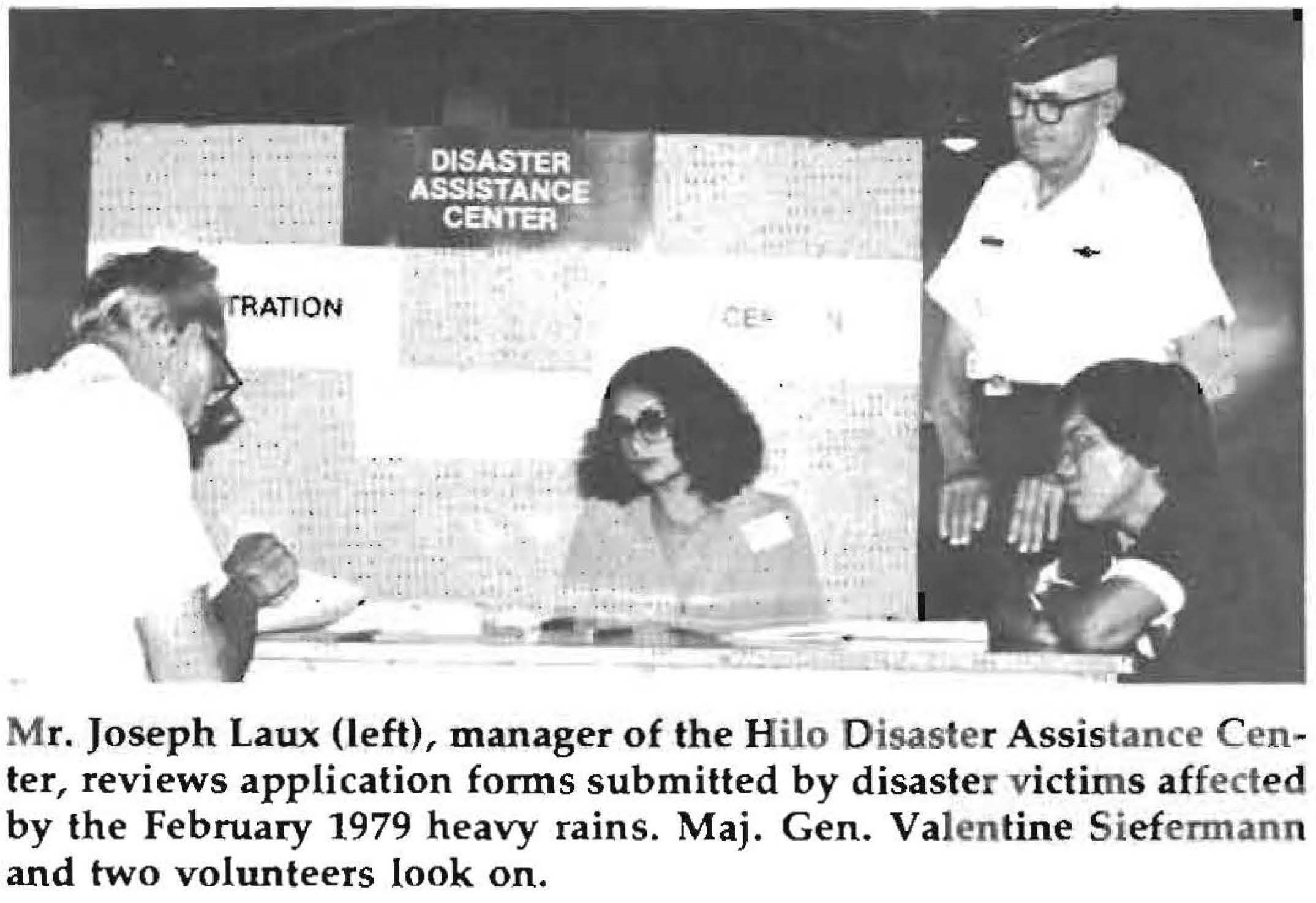
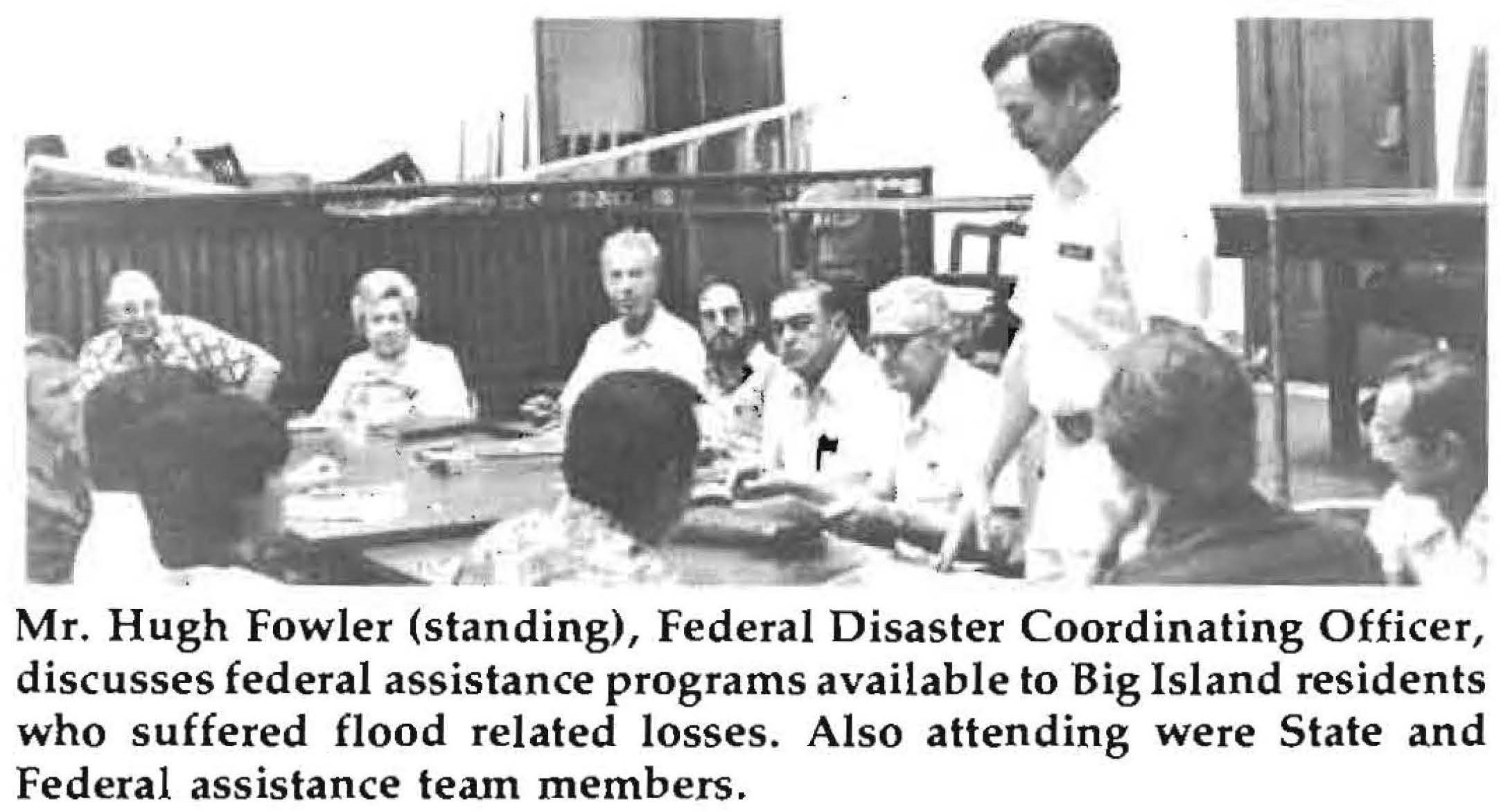
Mr. Joseph Laux (left), manager of the Hilo Disaster Assistance Center, reviews application forms submitted by disaster victims affected by the February 1979 heavy rains. Maj. Gen. Valentine Siefermann and two volunteers look on. Mr. Hugh Fowler (standing), Federal Disaster Coordinating Officer, discusses federal assistance programs available to Big Island residents who suffered flood related losses. Also attending were State and Federal assistance team members.(Pictures from the 1979 Annual Report)
During January and February, the County of Hawaii sustained record breaking rainfall that caused flooding in many sections of the county. Due to the severity of the rains, President Jimmy Carter, at the request of Governor George R. Ariyoshi, proclaimed Hawaii County a major disaster area for the period February 15-26, 1979.
Following the Presidential declaration, State Civil Defense opened a “one-stop” disaster assistance center in Hilo to assist citizens who suffered flood-related losses.
During the seven days that the center was open, some 330 people registered for various low-interest loans, grants and other means of assistance.
A total of 140 applications were taken for the Individual and Family Grant Program. Under this program, victims who had disaster-related necessary expenses (and could not qualify for other means of assistance) were eligible to apply for grants totaling upwards of $5,000. Approximately $34,000 was distributed under the Individual and Family Grant Program with the state government funding 25 percent and the federal government funding 75 percent of the Program.
State Civil Defense also directed and coordinated the preparation of detailed public damage survey reports and applications for federal financial assistance provided by Public Law 93-288, Disaster Relief Act of 1974. More than one million dollars of federal funds were allotted for restoration of public facilities.
With the cooperation of the County of Hawaii governmental departments and concerned state and federal agencies, State Civil Defense initiated a hazard mitigation program to prevent or reduce the destructive effects of surface runoff and other flood-related hazards which may threaten the county in the future.
Big Island residents accept disaster; life returns to normal as disaster subsides
by Bill Roome CD Information Specialist
“I’ve lived in Hilo J or nearly 40 years and the recent February rains were the worst I have seen, but most of the people/ know will rebuild or replant and go on as before,” reflected Ed Tanaka, a Big Island resident.
Residents of the Big Island are philosophical about disasters. And with good reason! They have suffered devastating blows from tsunami, had many of their public structures indiscriminately dissected by earthquakes and been forced to abandon their homes because of a temperamental lady named Madame Pele.
So when the latest disaster struck – the steady February rains that caused flooding in many parts of the county – Big Island residents took the setback in stride. According to Charlie De Meo, State Civil Defense administrative officer, most of the people who applied for assistance were optimistic and eager to return to their normal ways of life.
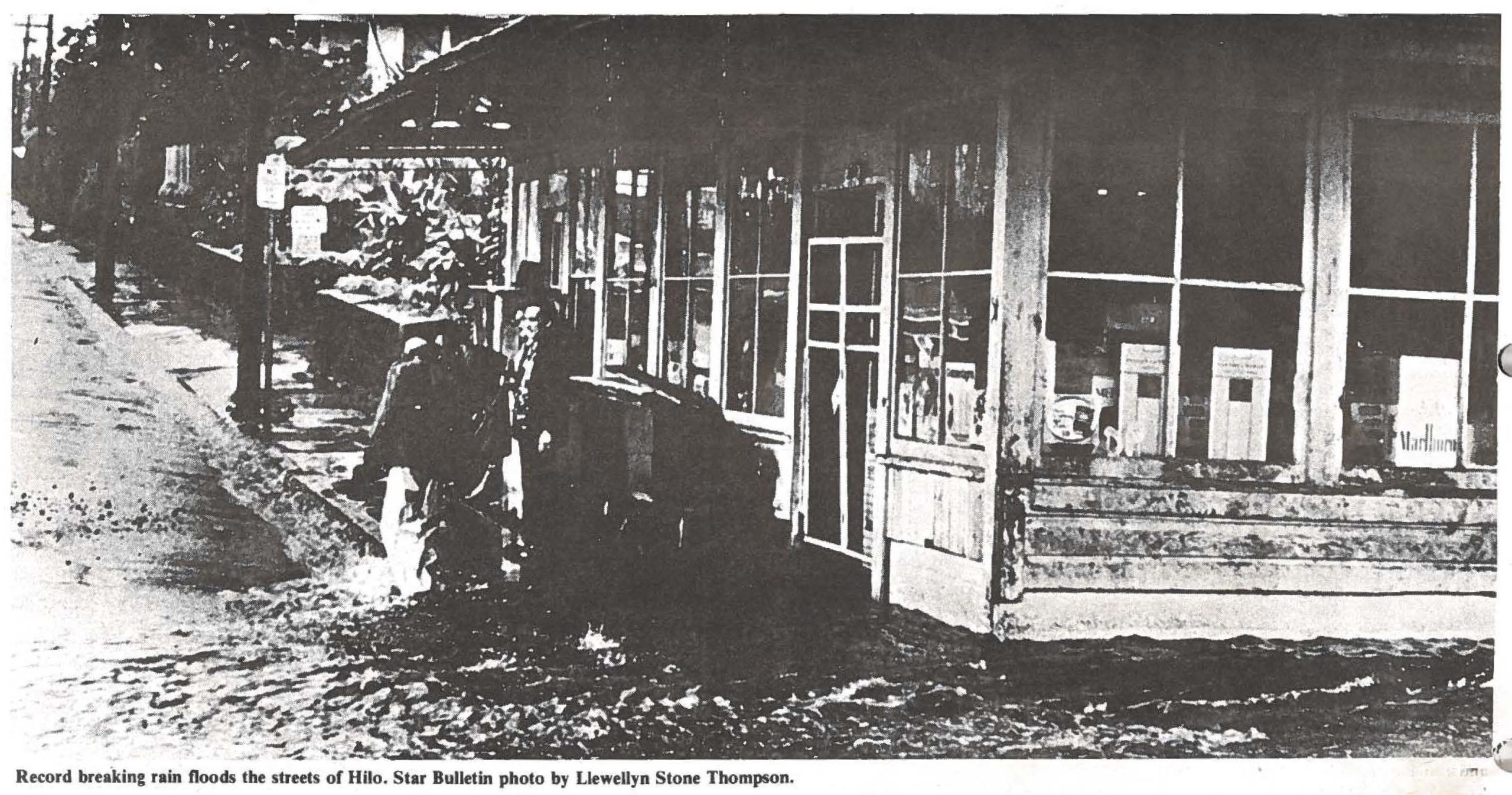
During February, severe rains caused damage to many agricultural fields, homes and public structures in the Hilo, Puna and Hamakua area. In a single 24-hour period, a record 22.3 inches of rain fell in the Hilo area.
Due to the copious amounts of rain, on March 7 President Jimmy Carter, at the request of Governor George R. Ariyoshi, proclaimed the County of Hawaii a major disaster area, and a State Civil Defense disaster assistance team moved into Hilo. Once the State Civil Defense team had conferred with State and county officials and representatives from a federal assistance team, a disaster assistance center was opened at the National Guard Armory in Hifo to assist individuals and families who suffered flood related losses.
During the seven days the center was open (March 13-19), 329 people registered for various low-interest loans, grants and other means of assistance. Some of these programs included tax advice, temporary housing, business and personal loans, American Red Cross assistance and the Individual and Family Grant (IFG) Program.
Although the majority seeking assistance requested state and federal, tax advice, a surprising number of people (140 applicants) sought relief under the Individual and Family Grant Program. Originally, State Civil Defense estimated that approximately 60 people would apply for the program.
Under the IFG Program, victims who have disaster-related necessary expenses or serious needs, and who cannot qualify for any other means of assistance, can apply for a grant totaling upwards of $5000.
The program works as follows: Once a victim has applied for a grant, a caseworker interviews the applicant and verifies the necessary items, listed on the application, as being damaged by the disaster. Once this is completed, the caseworker forwards the findings to an administrative panel, comprised of State government employees, who decide if the applicant qualifies for the grant, and if so, how much he or she will receive.
To date, not all of the applicants have been processed, but a sample of those that have been processed include grants for an automobile, school books for a Big Island student and a $5000 grant to assist in rebuilding a house. De Meo estimates that all the applications will be processed by June.
Yes, it is true, disaster relief programs can never replace the anguish and sorrow caused by the loss of personal property but the programs do make it possible to get a fresh start in returning to a normal way of life.
Record breaking rain floods the streets of Hilo. Star Bulletin photo by Llewellyn Stone Thompson.(Picture from the 1980 February Pūpūkahi)
It has been approximately 100,000 years since Diamond Head Crater last erupted but one would get the impression that this majestic land mark was stirring or certainly restless by the rumblings going on in Birkhimer Tunnel, home of State Civil Defense (SCD).
Many of the SCD staff have been on the constant go since February 1979, handling surf, heavy rains and flooding, prompted President Jimmy Carter, at the request of Governor George R. Ariyoshi, to declare Maui County a major disaster area. To date, statewide damage estimates have surpassed $25 million. With the President’s declaration, Maui now is entitled to Federal disaster assistance funds and loans.
One of the first steps that will be taken by SCD in coordinating the statewide disaster assistance effort will be to brief concerned State and county agencies applying for public disaster relief. Once this is completed, a statewide survey of damaged public facilities will be conducted to develop detailed engineering reports of each damaged site or facility. Finally, the disaster assistance applications will be processed, and Federal funds will be disbursed through SCD.
Persons who suffered damages from the January storm will be able to apply for lowinterest loans through individual agencies such as the U.S. Small Business Administration, the Farmers Home Administration, and the State Department of Planning and Economic Development.
Earlier, a state disaster was declared by the Governor for the Big lsland in November 1979 following damaging heavy rains and flooding. In Waipio Valley alone, 49 persons were evacuated and many taro farms destroyed. Following emergency restoration work on the Waipio Valley stream by the Hawaii Army National Guard and other state agencies, SCD began to approve State and county requests for financial assistance to repair damaged public facilities.
And there’s more: although the February 1979 Presidential .declaration disaster for Hawaii County may have been forgotten by many people, State Civil Defense still is busy processing requests for supplemental Federal disaster assistance and requests for cash advances on disaster work still in progress. SCD is also coordinating final inspection of completed disaster projects and reimbursements of State and Federal disaster funds.
The target date for completing restoration of Big Island public facilities damaged from the February 1979 disaster is late 1980. To date, there are no estimates as to when restoration will be complete following the November 1979 and January 1980 floods and storms.
The past 14 months certainly have been disastrous for the people of Hawaii County.
Various storms have claimed the lives of seven people, caused approximately $14 million in damages to public and private property, and forced many residents to evacuate their homes during storm periods.
Gov. George R. Ariyoshi has declared the county a major disaster area four times. President Carter proclaimed the county a disaster area in February 1979 and has been asked to release federal funds to restore public facilities damaged during the March tempest.
Mother nature began her unbenign frenzy in February 1979. During that month, heavy rains deluged the island. quickly saturating the soil in many districts and causing extensive flooding. In a single 24-hour period, 22.3 inches of rain fell in the Hilo area. During a 10-day period, 250 families were evacuated.
When the sun finally reappeared, a total of 200 homes had suffered various degrees of damage. Approximately 300 people later applied for such disaster assistance as low-interest emergency loans and grants, and damage estimates reach $6 million. The governor declared a state disaster, triggering the release of $500,000 in restoration funds; President Carter followed by declaring Hawaii County a federal disaster area.
In November 1979, heavy rains once again inundated sections of the county, resulting in the governor declaring Puna, Ka ‘u, South and North Hilo. Hamakua, and South and North Kohala major disaster areas. One person lost his life during the storm and approximately 120 people were evacuated. A total of 49 persons from the Waipio Valley area alone were relocated and many taro farms in the valley were destroyed.
The National Gaurd was quickly sent into the valley following the storm to clear debris and to rechannel water back into the Wailoa and Hiilawe Streams. Total damage to public and private property was $4 million.
In January of this year, the entire state was subjected to a tempest that left behind damages totaling some $27 million. Three people lost their lives in Hawaii County and about $300,000 in damages was recorded. A state disaster was declared for all counties.
The latest mayhem to strike Hawaii County occurred this March. claiming three more lives and inundating many districts on the windward side of the island.
Damage estimates for the county continue to come in to the State Civil Defense Division, with the latest tallies exceeding $3 million.
According to Steve Philben, SCD disaster assistance planner, some structures, such as the Waiohinu flood project, were severely damaged and repaired following the February storm; and then again were damaged in the March disaster.
The governor has already declared the Big Island a major disaster area and has asked the President again to declare Hawaii County a federal disaster area. lf this request is approved, Hawaii County will be eligible for federal funds to restore public facilities. such as roads, water and drainage facilities.