Do you need help in another language? We will get you a free interpreter. Call 808-369-3580 to tell us which language you speak.
您需要其它語言嗎?如有需要,請致電 (808-369-3478), 我們會提供免費翻譯服務
您需要其它语言吗?如有需要,请致电 (808-369-3478), 我们会提供免费翻译服务
En mi niit alilis lon pwal eu kapas? Sipwe angei emon chon chiaku ngonuk ese kamo. Kokori (808-369-3478) omw kopwe ureni kich meni kapas ka ani.
Makemake `oe i kokua i pili kekahi `olelo o na `aina `e? Makemake la maua i ki`i `oe mea unuhi manuahi. E kelepona (808-369-3478)`oe ia la kaua a e ha`ina `oe ia la maua mea `olelo o na `aina `e.
Masapulyo kadi ti tulong iti sabali a pagsasao? Ikkandakayo iti libre nga paraipatarus. Awaganyo ti
(808-369-3478) tapno ibagayo kadakami no ania ti pagsasao nga ar-aramatenyo.
다른언어로 도움이 필요하십니까? 저희가 무료로 통역을 제공합니다. (808-369-3478)로 전화해서 사용하는 언어를 알려주십시요
Kwoj aikuij ke jiban kin juon bar kajin? Kim naj lewaj juon am dri ukok eo ejjelok wonen. Kirtok
(808-369-3478) im kwalok non kim kajin ta eo kwo melele im kenono kake.
E te mana'o mia se fesosoani i se isi gagana? Matou te fesosoani e ave atu fua se faaliliu upu mo oe. Vili mai i le numera lea (808-369-3478) pea e mana'o mia se fesosoani mo se faaliliu upu.
¿Necesita ayuda en otro idioma? Nosotros le ayudaremos a conseguir un intérprete gratuito. Llame al (808-369-3478) y diganos que idioma habla.
Kailangan ba ninyo ng tulong sa ibang lengguwahe? Ikukuha namin kayo ng libreng tagasalin. Tumawag sa (808-369-3478) para sabihin kung anong lengguwahe ang nais ninyong gamitin.
‘Okú ke fie maʻu tokoni ʻi ha lea fakafonua ʻe taha? Temau kumi haʻo taha fakatonulea taʻetotongi. Telefoni ki he (808-369-3478) ke fakahā mai ʻa e lea fakafonua ʻokú ke lea aí.
Bạn có cần giúp đỡ bằng ngôn ngữ khác không ? Chúng tôi se yêu cầu một người thông dịch viên miễn phí cho bạn. Gọi (808-369-3478)nói cho chúng tôi biết bạn dùng ngôn ngữ nào
Gakinahanglan ka ba ug tabang sa imong pinulongan? Amo kang mahatagan ug libre nga maghuhubad. Tawag sa (808-369-3478) aron magpahibalo kung unsa ang imong sinulti-han.
80th Governor George R. Ariyoshi and President Gerald R. Ford declared Hawaii County a major disaster area due to an earthquake-tsunami which struck there at 4:48 a.m., Nov. 29, 1975. Within minutes, a tsunami with 40-foot waves followed the earthquake.
Two people were killed and approximately $4.1 million in property damage occurred due to the earthquaketsunami.
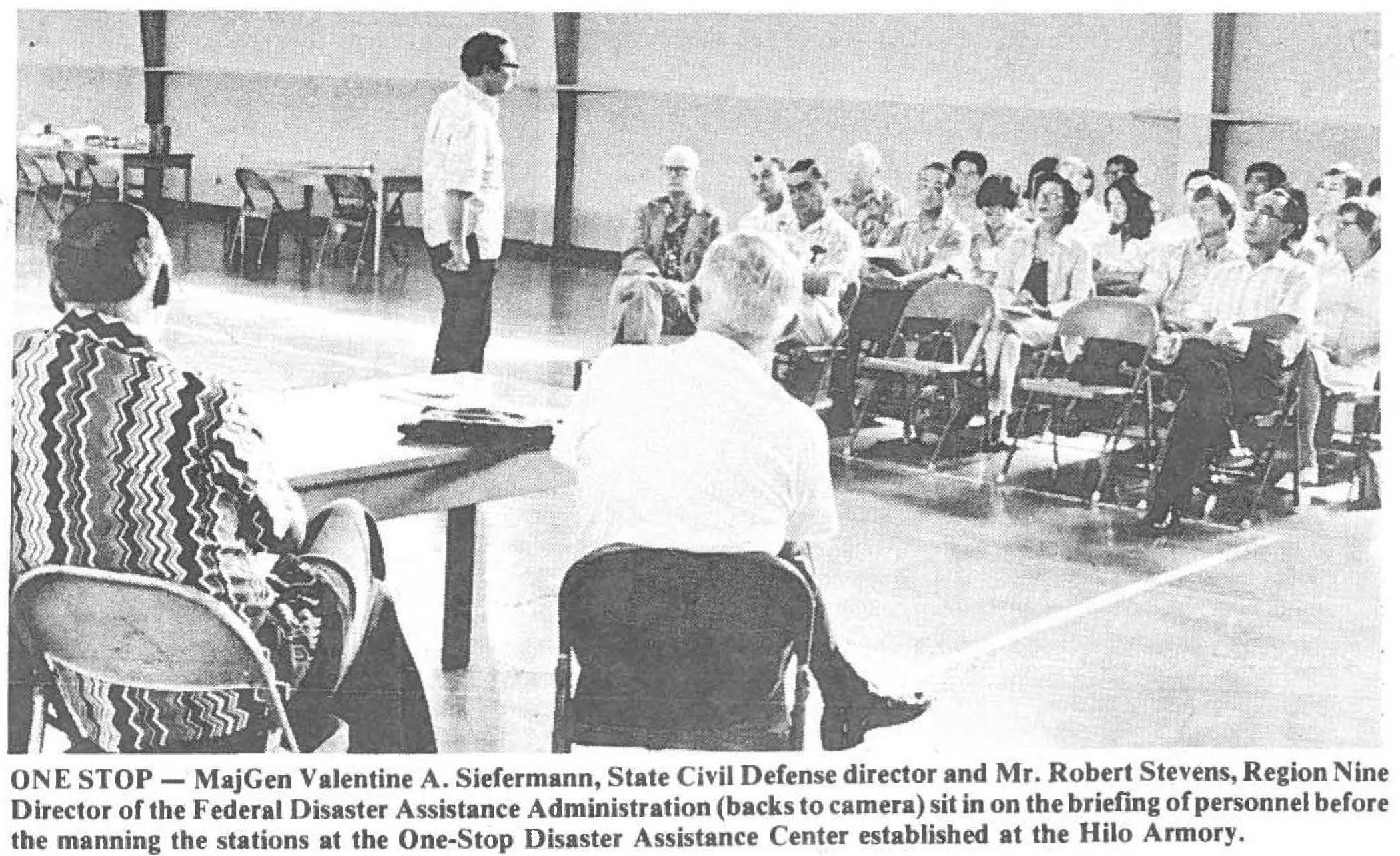
State Civil Defense, in cooperation with the Federal Disaster Assistance Admini stration, set up a joint Federal-State disaster assistance center. The purpose of the center was to provide help to those who suffered losses due to the disaster.
At the fiscal year’s end , Hawaii County had also received $175,000 in Federal funds as reimbursement for public facilities damaged by the earthquake-tsunami.
Earthquake-tsunami on Hawaii Island , Nov. 29: Two people were killed and approximately $4.1 million in property damage occurred when an earthquake and tsunami hit the island of Hawaii.
Hawaii County Mayor Herbert T. Matayoshi, Gov. George R. Ariyoshi, and President Gerald R. Ford all declared the Big Island a major disaster area.
The earthquake occurred at 448 a.m. and was followed within minutes by the locally generated tsunami. The quake measured 7.2 on the Richter scale and was centered two miles off the coast of Hawaii Island. Kilauea Volcano erupted virtually at the same time that the trembler occurred.
Twenty-eight people were injured by the earthquake and tsunami. Fifty-four persons were evacuated. There were 58 homes, 7 businesses. 26 boats, and 2 churches damaged.
The Hawaii County Civil Defense Agency sounded the sirens and evacuated as many people as possible from coastal areas due to the expected tsunami waves. Some sirens did not go off due to power failures in parts of Hawaii Island, so sirens on police cars were used. Also, Police and CD personnel went house to house urging residents to evacuate.
The city of Hilo suffered extensive damage in its downtown district. Its small fishing fleet was badly damaged when a 5-foot tsunami caused a 10-foot swell as it thundered up Wailoa River before dawn.
There was also considerable damage to the Hilo sewage outfall system.
In Kona ‘s Keauhou area, boats and homes were damaged.
Ka’u lost its only tourist facility when the wave generated by the quake roared through the center of Punaluu Village Restaurant, gutting the $1 million facility. Five homes nearby were leveled and cars were washed inland.
Extensive damage took place in the volcano area. There, a path of devastation was left through Hawaii Volcanoes National Park, which had to be closed due to the heavy road cracking.
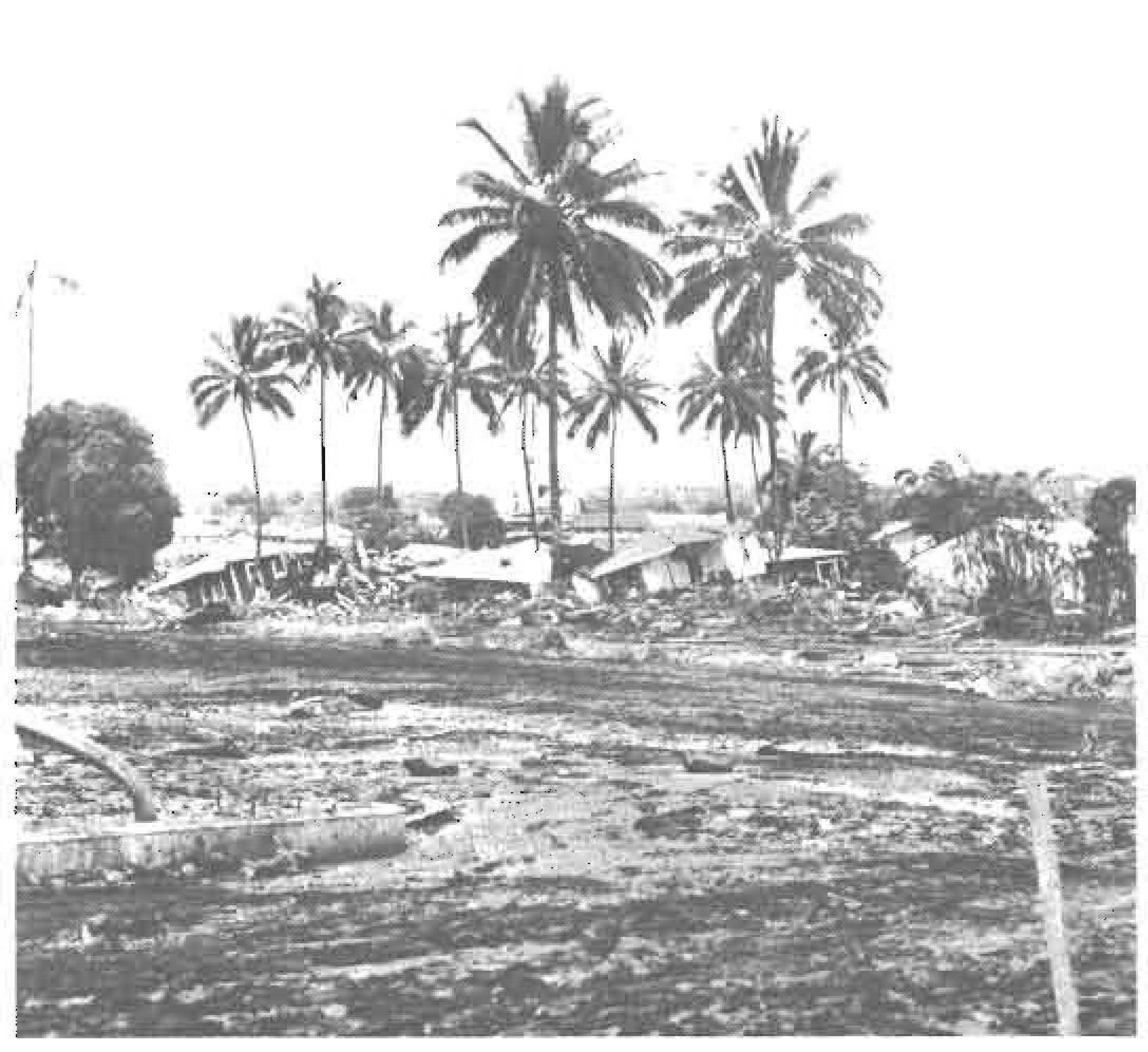
Halape, a remote sandy beach, literally disappeared as the coastline subsided.
On Dec. 7, after President Ford proclaimed the Big Island a major disaster area, a Federal-State one-stop disaster assistance center was set up in the Hawaii National Guard Armory at General Lyman Field in Hilo.
The center was staffed by Federal , State and County officials, as well as the American Red Cross. By the time it closed on Dec. 16, at 6 p.m., it had processed 175 applications from Big Island residents.
Among the types of assistance provided were cash grants for serious unmet needs, Red Cross grants, low interest loans, emergency housing, food stamps, unemployment insurance, and Federal and State income tax assistance on how to write off losses incurred because of the disaster.
In addition, it is estimated that Hawaii County is eligible for approximately $1 million in Federal funds for the repair of public facilities damaged by the earthquake and tsunami. Work on this public property assistance was continuing at the end of the fiscal year.
State CD, in connection with the Nov. 29 earthquake, tsunami , and volcanic eruption, prepared the necessary damage surveys and supporting documents to successfully obtain declarations of major disaster by the Governor of Hawaii and the President of the United States, Following these declarations, State CD coordinated the preparation of detailed Damage Survey Reports and applications for Federal financial assistance provided by Public Law 93-288, the omnibus Federal Disaster Assistance Act, in the total amount of $1,250,000. Repairs to damaged schools were sought by State CD and resulted in authorization by the Department of Health, Education and Welfare in the amount of $125,000,
State CD established a “one-stop” disaster assistance center and coordinated and administered the Individual and Family Grant Program to provide assistance to victims of this disaster, This program disbursed $36,000, funded 75 percent by the Federal Government and 25 percent by the State government.
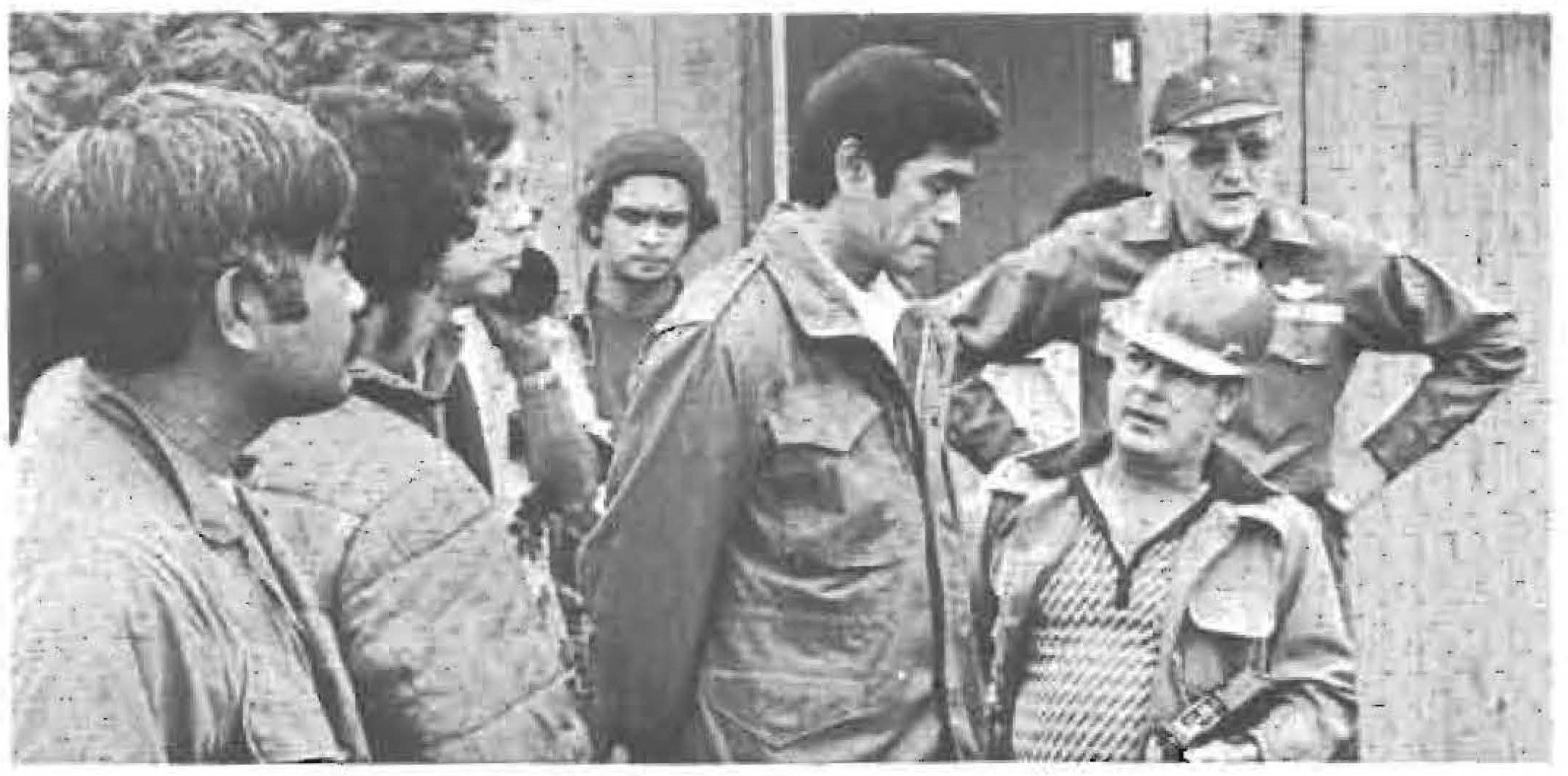
CLEAN-UP Photo by Ron Edmonds Honolulu Star Bulletin Should disaster strike . . . Expect the worstONE STOP – Maj Gen Valentine A. Siefermann, State Civil Defense director and Mr. Robert Stevens, Region Nine Director of the Federal Disaster Assistance Administration (backs to camera) sit in on the brieC-mg of personnel before the manning the stations at the One-Stop Disaster Assistance Center established at the Hilo Armory. THE SINKING OF HALAPE Photo by Warren Rolls – Honolulu Star Bulletin (Pictures from the 1976 January Pūpūkahi)
Two people were killed and approximately $4.1 million in property damage occurred when an earthquake and tsunami (tidal waves) hit the island of Hawaii.
The earthquake occurred at 4:48 a.m. on Nov. 29 and was followed within minutes by the locally generated tsunami. The earthquake measured 7.2 on the Richter and was center.i–two -to-three miles off the coast of the Big Island. Kilauea Volcano erupted virtually at the same time that the trembler occurred.
Twenty-nine people were injured by the earthquake and tsunami.
The Hawaii County Civil Defense Agency sounded the sirens and evacuated as many people as possible from coastal areas due to the expected tsunami wave . Some sirens did not go off due to power failures on parts of Hawaii lsland, so sirens on police cars were used. Also, Police and Civil Defense perso nnel went house-to-house urging residents to evacuate.
The city of Hilo had considerable damage in its downtown district. Its small fishing neet suffered damage, too, when a five-foot tsunami generated a 10-foot swell as it roared up Wailoa River shortly after the earthquake.
There was also extensive damage to the Hilo sewage outfall system.
In Kona’s Keauhou area, homes and boats were damaged.
In Ka’u, the only tourist facility was lost temporarily when a tsunami swept through the Punaluu Village Restaurant. Cars were washed inland and five homes nearby were leveled.
The worst damage took place in the Volcano area. Extremely dense and heavy road cracking took place at the Hawaii Volcanoes National Park.
The beautiful remote sandy beach of Halape just about vanished as the coastline subsided .
In the day immediately following the disaster, Gov. George R. Ariyoshi, Maj. Gen. Valentine A. Siefermann, State director of Civil Defense and adjutant general, and John N. Butchart, State vice director of Civil Defense, toured the damaged areas.
They were joined by Robert C. Steven , Region Nine director of the Federal Disaster Assistance Administration.
On Tue day, Dec. 2, Mayor Herbert T. Matayoshi of Hawaii County declared the Big Island a major disaster area.
On Thursday, Dec. 4, Governor Ariyoshi declared Hawaii County a major disaster area.
On Sunday, Dec. 7, President Ford proclaimed the Big Island a major disaster area, making its government and citizens eligible for a host of Federal benefits.
This will include approximately $1 million for the repair of public facilities damaged by the earthquake and tsunami.
On Wednesday, Dec. 10, a joint Federal-State one-stop disaster assistance center was opened at noon in the Hawaii National Guard Armory at General Lyman Field in Hilo.
It was staffed by Federal, State and County officials. as well as the American Red Cross.
Robert F. Sorg, State CD resources officer, and A. Charles De Meo, State CD procurement and supply specialist, were among the coordinators of the relief center.
Robert C. Stevens, Region Nine director of the Federal Disaster Assistance Administration (FDAA), and Maj. Gen. Valentine A. Siefermann, State director of Civil Defense and adjutant general, coordinated the opening of the center.
Scott Martin and Joe Laux, both of FDAA, also assisted in the operation of the center.
The one-stop facility was open after the first day from IO a.m. to 6 p.m. daily except for Sunday.
By the time it closed on Tuesday, Dec. 9, at 6 p. m., it had processed 175 applications from Big Islanders.
Among the types of assistance provided were cash grants for erious unmet needs, Red Cross grants. low-interest loans, emergency housing, food stamps, unemployment insurance, and Federal and State income tax assistance on how to write off losses incurred because of the disaster.
Although the one-stop center is closed, assistance is continuing, but Big Islanders must now apply directly to the various agencies involved in the massive relief effort.
The Hawaii National Guard provided 14 450-gallon water tailers to Hawaii County to provide emergency water supplies to householders who had suffered damage or destruction of their water tanks because of the earthquake.