Do you need help in another language? We will get you a free interpreter. Call 808-369-3580 to tell us which language you speak.
您需要其它語言嗎?如有需要,請致電 (808-369-3478), 我們會提供免費翻譯服務
您需要其它语言吗?如有需要,请致电 (808-369-3478), 我们会提供免费翻译服务
En mi niit alilis lon pwal eu kapas? Sipwe angei emon chon chiaku ngonuk ese kamo. Kokori (808-369-3478) omw kopwe ureni kich meni kapas ka ani.
Makemake `oe i kokua i pili kekahi `olelo o na `aina `e? Makemake la maua i ki`i `oe mea unuhi manuahi. E kelepona (808-369-3478)`oe ia la kaua a e ha`ina `oe ia la maua mea `olelo o na `aina `e.
Masapulyo kadi ti tulong iti sabali a pagsasao? Ikkandakayo iti libre nga paraipatarus. Awaganyo ti
(808-369-3478) tapno ibagayo kadakami no ania ti pagsasao nga ar-aramatenyo.
다른언어로 도움이 필요하십니까? 저희가 무료로 통역을 제공합니다. (808-369-3478)로 전화해서 사용하는 언어를 알려주십시요
Kwoj aikuij ke jiban kin juon bar kajin? Kim naj lewaj juon am dri ukok eo ejjelok wonen. Kirtok
(808-369-3478) im kwalok non kim kajin ta eo kwo melele im kenono kake.
E te mana'o mia se fesosoani i se isi gagana? Matou te fesosoani e ave atu fua se faaliliu upu mo oe. Vili mai i le numera lea (808-369-3478) pea e mana'o mia se fesosoani mo se faaliliu upu.
¿Necesita ayuda en otro idioma? Nosotros le ayudaremos a conseguir un intérprete gratuito. Llame al (808-369-3478) y diganos que idioma habla.
Kailangan ba ninyo ng tulong sa ibang lengguwahe? Ikukuha namin kayo ng libreng tagasalin. Tumawag sa (808-369-3478) para sabihin kung anong lengguwahe ang nais ninyong gamitin.
‘Okú ke fie maʻu tokoni ʻi ha lea fakafonua ʻe taha? Temau kumi haʻo taha fakatonulea taʻetotongi. Telefoni ki he (808-369-3478) ke fakahā mai ʻa e lea fakafonua ʻokú ke lea aí.
Bạn có cần giúp đỡ bằng ngôn ngữ khác không ? Chúng tôi se yêu cầu một người thông dịch viên miễn phí cho bạn. Gọi (808-369-3478)nói cho chúng tôi biết bạn dùng ngôn ngữ nào
Gakinahanglan ka ba ug tabang sa imong pinulongan? Amo kang mahatagan ug libre nga maghuhubad. Tawag sa (808-369-3478) aron magpahibalo kung unsa ang imong sinulti-han.
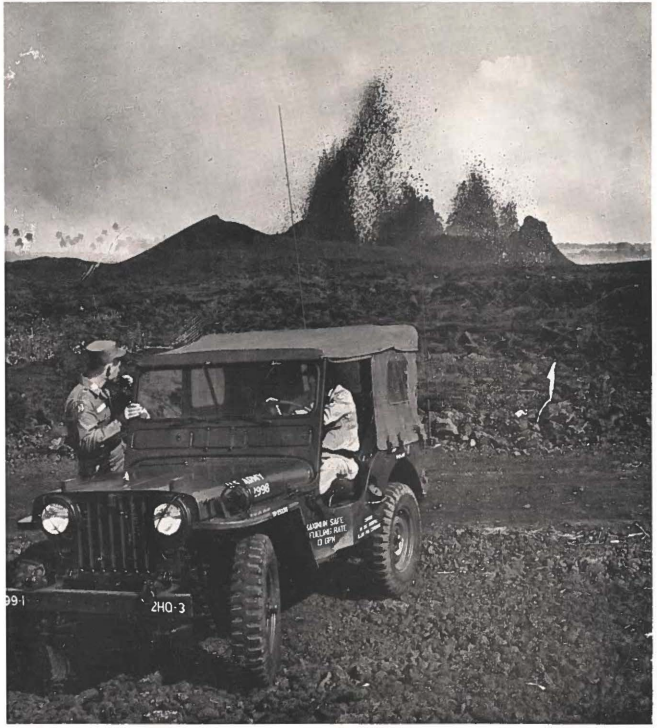
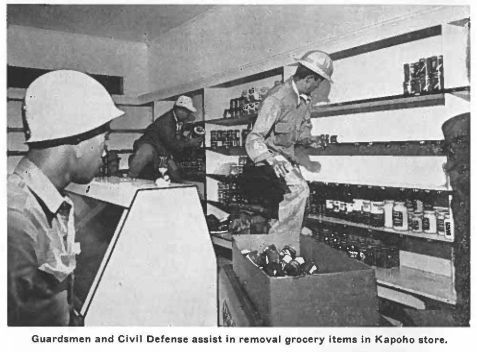
Kapoho Disaster: Personnel from the 2d Battle Group, 299th Inf supported Civil Defense officials during the volcanic eruption at Kapoho, Hawaii which began on 13 January 1960 and lasted for 33 days. Support by the HNG included 100 cots, 400 blankets, buses and trucks to assist in evacuation of civilians and property, vehicular radio communications, an aircraft for constant aerial observation and two twin, engined aircrafts to ferry Federal and State officials to the disaster area. 704 man days were expended by Guardsmen on State active duty in this disaster.
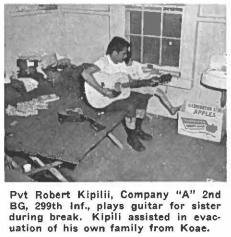
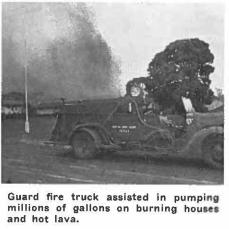
KAPOHOPvt Robert Kipilii, Company “A” 2nd BG, 299th Inf., plays guitar for sister during break. Kipili assisted in evacuation of his own family from Koae. Guard fire truck assisted in pumping millions of gallons on burning houses and hot lava. Guardsmen and Civil Defense assist in removal grocery items in Kapoho store. (Pictures from the 1960 March The Hawaii Guardsman)
Big Island Army National Guardsmen were kept busy for a period of 33 days, keeping track of a rampaging volcano in the small community of Kapoho. The volcanic activity started on a Wednesday evening, 13 January 1960. What began as a long crack in the earth became an active volcanic vent, sometimes spouting molten magma over 1,200 feet into the air.
Warned one day in advance by heavy earthquakes, large ground cracks and depressions, Kapoho residents were advised by Civil Defense Officials to evacuate their homes in the Kapoho-Koae area. Those who voluntarily left their homes and farms, took refuge in the Pahoa school. One hundred cots and 400 blankets were supplied by the HNG.
On Thursday morning, the eruption began. Volunteer Guardsmen began the task of evacuating residents and their belongings. One Guardsman, Pvt Robert Kipili, a radio operator with Company A, 2nd BG, 299th Infantry, assisted in the evacuation of his own family from Koae.
Back in Pahoa, the Red Cross set up kitchen facilities to feed displaced persons while the police, firemen and National Guardsmen kept a watchful eye on the unpredictable volcano.
During the early stages of the eruption, the Guard supplied one 37-passenger bus, five 21/2-ton trucks and two radio jeeps. As the activity mounted, additional radio vehicles were added to the force. Radio jeeps were stationed at Koae, Kapoho Cemetery hill and CD headquarters at Pahoa School.
Later, when power and police lines were overrun by lava, the Police and National Guard radio-nets were the only means of communication between the Kapoho area and Pahoa.
During lulls in the early stages of volcanic activity, HNG trucks returned a few evacuees to Kapoho from Pahoa in order that they may feed their livestock. Later, when the village seemed doomed, the livestock was removed to safer ground.
Overhead, the constant drone of an HNG Army Aviation L-19 could he heard. Pilots made hourly flights over the area reporting the lava’s progress. On a number of trips various volcanologists were flown over the eruption to observe the lava’s movement as well as collect gas samples from bellowing cloud masses over the activity.
The single engine craft was repeatedly pelted by hits of cinder thrown thousands of feet into the air by the fountain.
Below, fire trucks pumped thousands of gallons of water on the slow creeping lava in the hope of cooling it and thus slowing its progress into the village of Kapoho. One fire truck stood out; it was marked “ARMY NATIONAL GUARD.”
Further down the road, dozens of bulldozers worked through the day and night, constructing huge earth dikes in an effort to save Warm Springs and lower Kapoho. The dikes failed and Warm Springs fell victim to Pele’s wrath. Houses, emptied of their many helping hands, burned.
The Honolulu based Army Aviation Twin Beech (L-23) and the Air National Guard C-47 were kept busy flying Government and State officials to and from Hawaii.
Honolulu Advertiser and Honolulu Star-Bulletin newspaper reporters had high praise for the conduct and courtesy of Big Island Guardsmen. Reporters frequently received reliable last minute information from Guardsmen operating the radio network. Singled out as being most courteous and helpful was Police Officer Francis Rodillas. Officer Rodillas, also a First Lieutenant with the 284th Transportation Company, HIARNG, was on duty with the Hilo Police department.
On St. Valentine’s Day, February 14, 33 days after the eruption began, the HNG moved its men and equipment hack to Hilo. Pele was again quiet. Keeping a lonely vigil for 8 additional days was one light aircraft of the HNG Army Aviation.
The sleepy town of Kapoho is dead, buried under tons of black rock, but, the memory of the sacrifice and hard work of Hilo Police and Fire Department, National Guardsmen, Civil Defense officials and volunteer workers of the American Red Cross will long he remembered.
As far as the National Guard is concerned, this was hut another reminder to the people of Hawaii that whenever and wherever disaster strikes in the 50th State, Guardsmen will be on hand to assist.
An eruption of lava in the Kapoho area necessitated use of Guardsmen for evacuation of people and for the setting up of temporary quarters at Pahoa school. HNG’men set up 100 cots and suppled 400 blankets to displaced persons and manned communications vehicles to report lava progress. Army Aviation pilots, flying single engine aircraft, flew many reconnaissance missions. Guardsmen were on duty for 33 days.