
1946 Hawaiʻi National Guard Reestablishment Post WWII
At the commencement of the 1947 Fiscal Year on July 1, 1946, the Hawaii Territorial Guard, under command of Brig. General James McInerney Huey, was on active duty in the service of the Territory. The Hawaii National Guard was on inactive status, having been demobilized from Federal Service.
Upon recommendation of the Governor of Hawaii to the President of the United States, Colonel F. W. Makinney, USA, Ret’d., had been recommended for the position as Adjutant General, Territory of Hawaii, to relieve Colonel Perry M. Smoot upon expiration of his term on August 8, 1946. Colonel Smoot had held this post for the past twenty-four years. The appointment of Colonel Makinney was approved by the President and so published in War Department Orders by Paragraph 7, Special Order 146, dated 2 July 1946.
The War Department, in official correspondence to the Governor, had urged the reestablishment of the Hawaii National Guard and had offered the Territory an allocation of troops. It was imperative that the newly appointed Adjutant General take over command of the Territorial Guard, for the purpose of inactivating these units and to reestablish the Hawaii National Guard on the effective date of his appointment, August 4, 1946.
Accordingly, and upon Executive Order of the Governor of Hawaii dated 1 July 1946, Colonel F. W. Makinney, USA, Ret’d., was placed in command of the Territorial Guard effective 0001 hours, 2 July 1946, relieving Brig. General James Huey.
During the period July 2, 1946, to August 3, 1946, a survey of the National Guard installations throughout the Territory was conducted. Conferences were held with National Guard officers for the purpose of determining the strength, composition and location of units of the postwar Guard. The conclusions reached formed a basis for recommendations to the Governor on the postwar Hawaii National Guard.
Formal acceptance of troops allocated by the War Department was made by the Governor of Hawaii on 4th of August, and the reestablishment of the Hawaii National Guard was started.
– 1946-1947 Annual Report pp. 4
THE ADJUTANT GENERAL’S PAGE
1946–1956
Ten Years of Service and PROGRESS
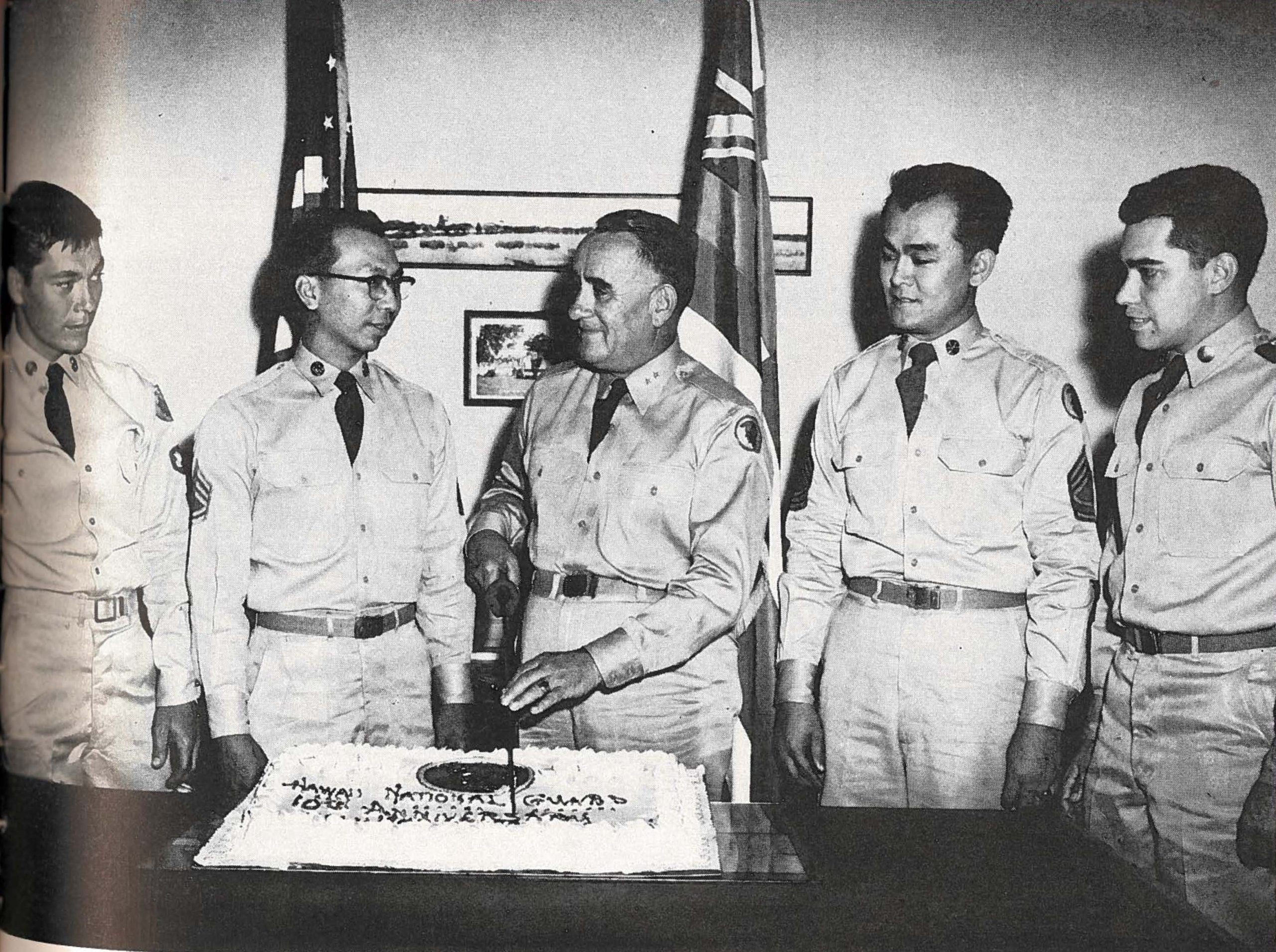
Ten years ago, on the 4th of August, two events marked the reestablishment of the Hawaii National Guard following World War II. First was the appointment of the present incumbent as Adjutant General of the Territory, which was followed by the acceptance by the Governor of the Territory of the allocation of National Guard troops.
On that date, all units of the Guard, which were ordered to Federal Service in 1940, were inactivated; the last unit, the First Battalion, 298th Infantry, was inactivated on January 22, 1946.
The Hawaii Territorial Guard, with a strength of 44 officers and 617 enlisted men, was placed on inactive status on the 3rd of August. Funds, representing the unexpended balance which was appropriated by the 1945 legislature in support of the HTG, totaling $146,126.00, were converted to National Guard use, and a full-time duty staff for the Military Department was organized.
Some of the biggest problems faced were the acquisition of armory and storage facilities, training areas including rifle ranges for the 64 company-sized units of the two Regimental Combat Teams, two bands, the Ordnance MM Co., and State Headquarters making up the Army troop basis, and facilities for the Fighter Squadron and supporting elements of the Air National Guard.
There were available nine inadequate armories, three small rifle ranges and one reservation, all located on the major islands of the Territory. With the acquisition of a portion of Bellows Field and the installations thereon, the air units were housed; then came the lease from the Army of facilities at Fort Ruger and East Range, Wahiawa, which provided administration buildings, warehouses, supply rooms, classrooms, and target ranges for units of the 298th RCT and Special Troops.
On Hawaii, the return of the old National Guard reservation at Keaukaha by the Navy, and with it the supply buildings, provided housing for the Hilo units. Quonset hut-type armories were constructed for country units.
Later, the expansion of the Hanapepe Armory, the rehabilitation of a gymnasium at Laupahoehoe, Hawaii, and a warehouse building at Kekaha, Kauai, provided excellent facilities for units located there.
The acquisition of warehouse buildings at Honolulu Airport on lease from the Navy, and warehouses at Wheeler Field from the Air Force, provided concentration site facilities for vehicles not used during armory training.
The support given by each legislature during the period in approving in full the budget for the Military Department was a big factor in the progress of the Guard. The legislators from the County of Hawaii, from the very first, backed the armory construction program, and through their support, the first armory, a five-unit armory at Keaukaha National Guard Reservation in Hilo, was built. Presently, two armories at Olaa, Hawaii, and Kapaa, Kauai, are under contract for construction this year, and two others at Wahiawa, Oahu, and Kahului, Maui, will be put out to bid in the next few months.
Each year saw the Hawaii National Guard grow in strength, the latest type of equipment issued, service centers organized and facilities built. Training methods also improved through increased number of men completing service schools and qualified as instructors, and general improvement in maintenance procedures and supply discipline.
Two new units were organized—the Signal Support Company and the Military Police Company—to make up a more balanced force. To provide antiaircraft defense for the Territory, the 483rd FA Bn. was converted to an AAA Bn. the past year. Receiving their equipment in February, they fired their guns at summer camp in June and did an exceptionally fine job.
Each year brought better ratings in annual armory inspections and field training inspections. Maintenance inspection this past year of Ordnance, Signal, Engineer, and Chemical equipment brought a rating of Superior.
The Air Guard organized a new unit, the 109th Aircraft Control and Warning Squadron, to support the Fighter Squadron in its missions. New facilities were acquired by the Fighter Squadron at Hickam Field and, with the conversion from the F-47 fighter aircraft to the F-86 Sabrejet, increased interest was shown, resulting in a stepped-up pilot training program and larger maintenance personnel attendance at service schools.
The acquisition of land and buildings at Sand Island for the AC&W unit gave them a home, a training site and facility which is perhaps the best of any site occupied by a comparable unit. With the receipt of the latest radar equipment and with the number of skilled personnel in the unit, the squadron can take its place among the best of its kind in the Air Force.
– 1956 September Hawaii Guardsmen pp. 2
1946 – Hawaii National Guard – 1956
The reestablishment of the postwar Hawaii National Guard was effected on August 4, 1946, by the issuance of an Executive Order by Governor Stainback, then Governor of Hawaii. The Governor simultaneously inactivated the Hawaii Territorial Guard, which was initially activated on December 7, 1941, as territorial troops to replace the Hawaii National Guard, which was then on active federal duty. With the reestablishment of the Guard, the Governor recommended to the President of the United States the appointment of General F. W. Makinney as the Adjutant General.
The postwar reactivation of the Guard authorized the activation of the following units: 298th Regimental Combat Team on Oahu and Kauai; the 299th Regimental Combat Team on Hawaii, Maui and Molokai; and State Headquarters and Headquarters Detachment, 613th Ordnance Company, 199th Fighter Squadron, 199th Utility Flight, 199th Weather Station and Detachment “C,” 199th Air Service Group on Oahu. The initial allocation of troops totaled 7,754 individuals.
The initial plan of organization was announced shortly after the acceptance of the allocation of troops. It was in three phases: (1) organization of certain units to meet federal requirements for recognition by December 31, 1946; (2) organization of certain other units by June 30, 1947; and (3) organization of the remaining sixty-four units, depending upon availability of armories and other facilities.
Men selected to lead the new Guard were appointed by Governor Stainback in August 1946. In addition to General Makinney, Lt. Colonel William C. Nolan was given command of the Hawaii Air National Guard, Colonel Robert L. Stevenson was appointed commanding officer of the 298th RCT, and Colonel Jack Conley was appointed commanding officer of the 299th RCT.
The next step in organizing the new Guard was the formation of a recruiting campaign and putting it in effect. On November 11, 1946, the recruiting campaign was launched. There were radio addresses by the Governor, General Makinney and other military and civilian leaders in Hawaii. The recruiting campaign ended on November 16, 1947, with 1,253 recruits enlisted in the Hawaii National Guard.
On August 3, 1948, all units initially allocated to the Territory of Hawaii were organized and federally recognized. At the completion of the postwar activation of the Hawaii National Guard, General Cramer, then Chief of the National Guard Bureau at Washington, D.C., announced that the Hawaii National Guard was at the top with four states in status of organization.
The following additional units were added to the initial troop allotment to Hawaii and were federally recognized on the dates indicated: 120th Military Police Company, January 8, 1951; 8199th Replacement Training Squadron, July 12, 1953; 120th Signal Company, January 4, 1954; and 158th Anti-Aircraft Artillery Battalion, September 1, 1955.
Today, the Hawaii National Guard has a total enrolled strength of 5,974 individuals, 5,089 in the Army Guard and 885 in the Air Guard. This represents 67% of the authorized strength for all units. Since initial reactivation of the postwar Guard, 15,000 individuals have been discharged from the National Guard for various reasons, with enlistments in the regular Armed Forces as the major cause for such discharges. The reenlistment rate of today’s Guard is 83%. . .
TERRITORIAL SUPPORT OF HNG
In its post-World War II reorganizational year ended June 30, 1946, when the HNG was due for release from Federal service to replace the then existing Territorial Guard, the Military Department was staffed with seven full-time territorially paid employees and expended $15,544.00 appropriated out of General Funds.
The inadequacy of the staff of the Military Department to effectively perform the functions of the postwar Guard was quickly realized at the close of fiscal year 1946, and during the ensuing year, major organizational and budgetary changes were effected. The civilian staff was increased to 56 employees, and the Department expended a total of $136,977.00 for operational purposes. . .
– 1956 September Hawaii Guardsmen pp. 4-5