Do you need help in another language? We will get you a free interpreter. Call 808-369-3580 to tell us which language you speak.
您需要其它語言嗎?如有需要,請致電 (808-369-3478), 我們會提供免費翻譯服務
您需要其它语言吗?如有需要,请致电 (808-369-3478), 我们会提供免费翻译服务
En mi niit alilis lon pwal eu kapas? Sipwe angei emon chon chiaku ngonuk ese kamo. Kokori (808-369-3478) omw kopwe ureni kich meni kapas ka ani.
Makemake `oe i kokua i pili kekahi `olelo o na `aina `e? Makemake la maua i ki`i `oe mea unuhi manuahi. E kelepona (808-369-3478)`oe ia la kaua a e ha`ina `oe ia la maua mea `olelo o na `aina `e.
Masapulyo kadi ti tulong iti sabali a pagsasao? Ikkandakayo iti libre nga paraipatarus. Awaganyo ti
(808-369-3478) tapno ibagayo kadakami no ania ti pagsasao nga ar-aramatenyo.
다른언어로 도움이 필요하십니까? 저희가 무료로 통역을 제공합니다. (808-369-3478)로 전화해서 사용하는 언어를 알려주십시요
Kwoj aikuij ke jiban kin juon bar kajin? Kim naj lewaj juon am dri ukok eo ejjelok wonen. Kirtok
(808-369-3478) im kwalok non kim kajin ta eo kwo melele im kenono kake.
E te mana'o mia se fesosoani i se isi gagana? Matou te fesosoani e ave atu fua se faaliliu upu mo oe. Vili mai i le numera lea (808-369-3478) pea e mana'o mia se fesosoani mo se faaliliu upu.
¿Necesita ayuda en otro idioma? Nosotros le ayudaremos a conseguir un intérprete gratuito. Llame al (808-369-3478) y diganos que idioma habla.
Kailangan ba ninyo ng tulong sa ibang lengguwahe? Ikukuha namin kayo ng libreng tagasalin. Tumawag sa (808-369-3478) para sabihin kung anong lengguwahe ang nais ninyong gamitin.
‘Okú ke fie maʻu tokoni ʻi ha lea fakafonua ʻe taha? Temau kumi haʻo taha fakatonulea taʻetotongi. Telefoni ki he (808-369-3478) ke fakahā mai ʻa e lea fakafonua ʻokú ke lea aí.
Bạn có cần giúp đỡ bằng ngôn ngữ khác không ? Chúng tôi se yêu cầu một người thông dịch viên miễn phí cho bạn. Gọi (808-369-3478)nói cho chúng tôi biết bạn dùng ngôn ngữ nào
Gakinahanglan ka ba ug tabang sa imong pinulongan? Amo kang mahatagan ug libre nga maghuhubad. Tawag sa (808-369-3478) aron magpahibalo kung unsa ang imong sinulti-han.
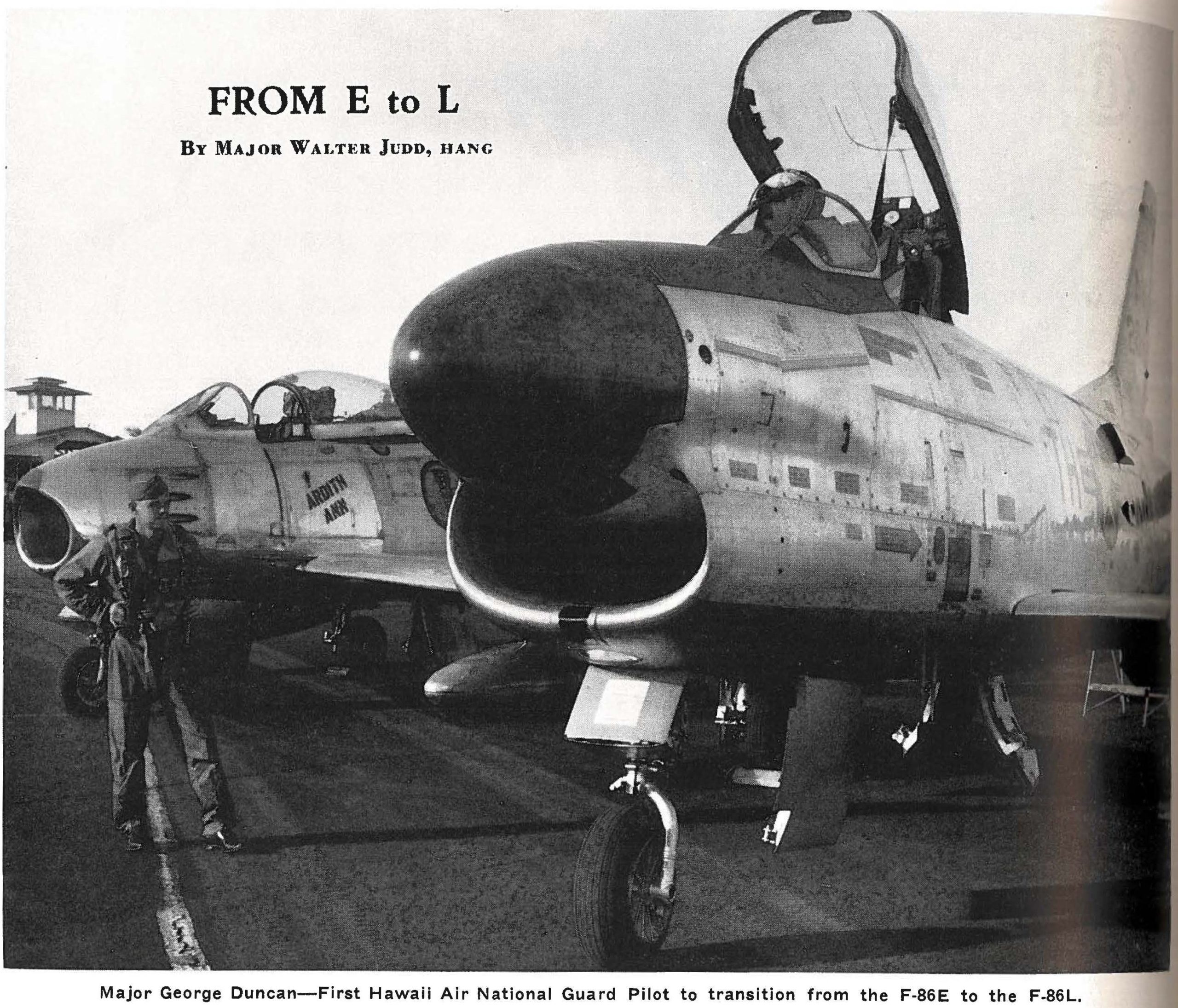
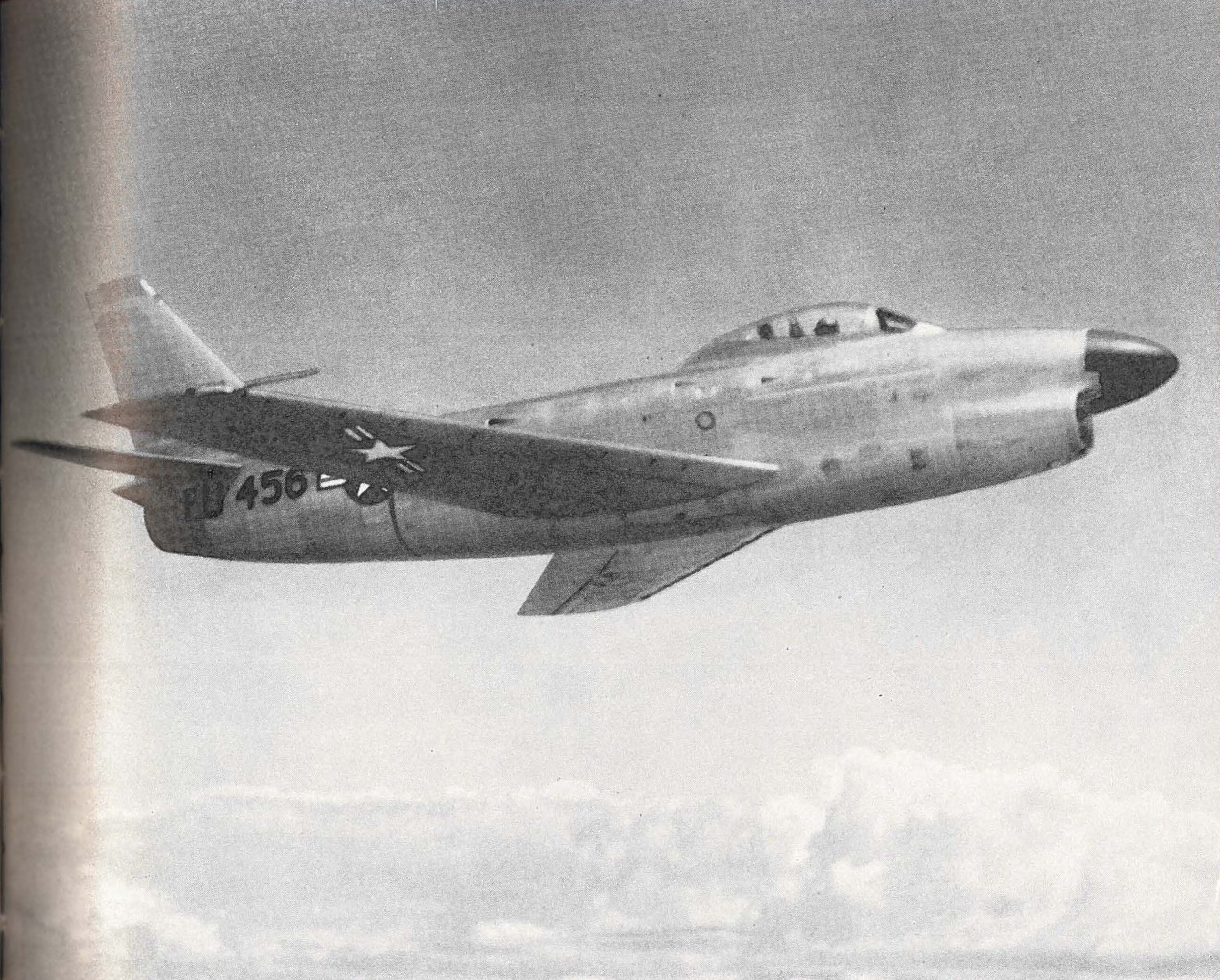
Air GuardThe F86-L, rocket firing, all weather Jet, of the Hawaii Air National Guard (Right), takes over as guardian of Hawaii’s skies front the now obsolete F86-E (Left).(Pictures from the 1958 Annual Report)
Fighter: The 199th Fighter Interceptor Squadron converted from F-86E day fighters to F-86L all weather fighters with the first “L” being received on 5 February 1958. The new aircraft is a lethal weapon which is not restricted to visual contact during daytime; it can perform its mission day or night and in any type of weather. Instead of machine guns, the F-86L carries the “Mighty Mouse” air-to-air rockets.
On 1 May 1958 the “L” replaced the “E” on the Air Defense Augmentation program and the Hawaii Air National Guard received a wire of congratulations from the Chief, National Guard Bureau on the rapid conversion-“The Best Yet.” By the end of June 1958 all tactical pilots of the Hawaii Air National Guard units had been transitioned into the new aircraft.
During conversion, the unit received big assists from the local Air Force. Personnel had to be retrained for the more complex aircraft and supplies and support equipment procured. First, the F-86-6 Mobile Training Detachment instructed all personnel concerned with the ground training requirements; secondly, the assignment of three well qualified all weather jet pilot” to the 199th Fighter Interceptor Squadron was accomplished to assist in the flying training of tactical pilots. Without the assistance of these pilots, transition would not have progressed smoothly or rapidly. They have been of tremendous value to the squadron.
During the fiscal period, 6,854 jet hours were flown by HAFNG pilots, an increase of 153 hours over the previous year’s 6,701 jet hours. The tactical pilots averaged 201 hours of flying time. Considering the fact that each hour flown is tactical flying-gunnery, tactics, radar intercepts, etc.-this is a notable achievement even for an active duty outfit.
Major George Duncan-First Hawaii Air National Guard Pilot to transition from the F-86E to the F-86L. (Pictures from the 1958 March The Hawaii Guardsmen)
Significance
The 199th Fighter Interceptor Squadron is converting from F-86E to F-86L Sabrejets. There is a much bigger change involved than just the letters “E” and “L”—the squadron’s mission is changed from Day Fighter Interceptor to All Weather Fighter Interceptor. The new aircraft is a lethal weapon which is not restricted to visual contact during daytime; it can perform its mission day or night and in any type of weather. The F-86L uses different tactics for its function of intercepting enemy bombers.
Regretfully, the days of friendly competition “bouncing” the Marine jet fighters across the island are almost passé. The “L” has secondary fighter-versus-fighter capability.
Aircraft
Both models, “E” and “L,” are made by the North American Aviation Company and have General Electric engines. But there the similarity stops, as they are entirely different aircraft. In configuration, the “L” is larger and heavier, has the air scoop below a radome in the nose, and uses a clamshell canopy. The “L” engine has an afterburner for additional thrust for climbing or interception, and its fuel is metered by an electronic fuel control. There is an automatic pilot control system to be used in conjunction with interceptions, and a drag chute which is released upon landing to shorten the landing roll distance.
As mentioned above, the armament and fire control system are entirely new to us and considerably more complicated. Lots of little electronic black boxes! For each little black box in the “E,” there are ten in the “L” …
Incidentally, although there are other all-weather interceptors assigned to Air Guard squadrons, the 199th is one of the first to be honored with the F-86L, which is the latest and most up-to-date all-weather fighter in the Air Guard inventory.
Conversion
Conversion hit the HANG-men suddenly, and followed in the wake of current financial austerity to complicate planning. Big assists were received from Pacific Air Force, Hawaiian Air Defense Division, and PACAFBASECOM after many meetings to determine who does what. There was a sack full of problems. An important consideration was facilities. For example: the new engine and its afterburner require much more height than our present engine shop; the drag chutes have to be packed, so we needed a larger parachute-building area. Conversion meant not only finding the true facilities, but the time-consuming preparation of plans and specifications, etc., and getting the jobs done.
Being at the end of a long 120-day supply pipeline, logistical support required lots of thought and push. Some 5,000 new line items of parts and equipment had to be obtained by HANG Base Supply, and about 5,000 line items in stock disposed of. We found that only some 10% of F-86E parts were interchangeable with the F-86L. Each type of aircraft has its own auxiliary and test equipment—the “L” has some 290 line items, much of which is scarce and difficult to come by. The NGB and MANA surveyed their resources, and Pacific Air Force obtained some items from regular outfits in the Pacific. Without adequate support equipment, combat readiness would stand short and slow, if at all.
Another big problem concerned the flight simulator, which is an elaborate and complex piece of ground equipment for simulating aerial flights under differing conditions and problems. Much necessary instrument and procedure training is obtained that is so realistic that the incumbent pilot sometimes forgets—imagines himself airborne—and the sweat pours out as the operator cranks in difficult or emergency conditions. (One model simulator even has a seat that will jolt slightly when the pilot is in a condition where he has no alternative but to pull the ejection handle!)
We had a C-11B Link Trainer, some $65,000 worth of equipment, which was housed in a recently rehabilitated and air-conditioned building in the HANG Area, Hickam AFB. The new simulator proved too large to fit the building, so Hickam generously provided space in their simulator building by moving out a C-97 Flight Simulator.
It was found that the power requirements for our new simulator were more than for the two Hickam simulators combined, so there was a mad scramble for additional electricity … and so on.
These simulators occupy positions of such importance that our new one was airlifted from Louisiana in a C-124.
The new simulator has a book value of $405,000 and is accompanied by two factory technical representatives for installation and maintenance assistance to our synthetic trainer personnel. Speaking of dollars, the F-86E is valued at $219,457 and the F-86L is valued at $582,493. Multiply this by twenty-seven aircraft assigned to the 199th and you’ll come up with a respectable dollar inventory. We assume we’ll use as much jet fuel as we did last year—over $300,000 worth.
Whenever an outfit in the USAF or ANG is re-equipped with new aircraft, several sorts of skilled technical help are provided to assist in getting the squadron initially trained and over the hump. In our case, USAF provided a Mobile Training Detachment of one officer and ten airmen who have been conducting day and night classes these past few months for the pilots and maintenance personnel. They have superior mockups and provide instruction in the theory and actual operation of the F-86L systems.
Factory technical representatives, contracted for by the National Guard Bureau and who will be with us for up to a year, are on hand from the North American Aviation Co. (aircraft), General Electric Co. (engine), Lear Inc. (auto pilot), and Engineering Research Corp. (flight simulator). These “Tech Reps” will aid us in maintenance and troubleshooting techniques, and will assist us in learning the finer points of the new aircraft.
Tactics
There are completely new tactics for this jet fighter that our pilots will have to learn. In the F-86E on a ground-controlled interception mission, the AC&W Controllers would position the fighter 90° abeam, higher, and in visual contact with the target. The “E” is equipped with a computing sight that has radar to provide range information. The fighter pilot would bank his aircraft towards the target, keep the sight pipper on the target, and fire his six cal. .50 machine guns at a norm of about 1,000 feet from the target, and at about a 20–25° angle. This attack is known as the “pursuit curve.”
The F-86L has a much more elaborate fire control system that calculates for a “lead collision” attack during which the pilot does not have to see the target visually. The AC&W Controllers direct the fighter to a position and course which, if continued, would pass slightly astern of the target and at a 90° angle. When the fighter’s radar “locks on” to the target, the fighter pilot takes over control of the interception, and his own computing fire control system tells him where and how to go by means of a radar scope presentation. The armament is fired automatically at an optimum range by the fire control system after being activated by the fighter pilot.
Instead of machine guns, the F-86L carries twenty-four 2.75-inch “Mighty Mouse” air-to-air folding-fin rockets in a pod located below the cockpit which lowers and fires in a fraction of a second. Each rocket is about four feet long, weighs less than twenty pounds, and one hit is considered lethal to the target as the rocket has an explosive head.
Air Defense
It is known that for some time the HANG has provided the local Air Force with the basic tools to do the Air Defense job. The two AC&W squadrons man radar sites around the clock, which provide aircraft movement information and ground-controlled interceptions upon direction. The 199th is the other part of the team which provides two pilots and jet fighters on five-minute alert for interceptions, backed up by the remainder of the squadron’s aircraft and pilots.
We of the 199th are especially glad to get the “Ls” as they will provide us with the capability to handle the Air Defense fighter job in fair weather or foul and during longer operational hours. “Aerial Minutemen” is a realistic phrase which is taken seriously and means much to Hawaii’s Air Guardsmen.
Lots of Work Ahead
The pilots have to learn the new aircraft and their new tactics. The AC&W Controllers have to learn even more refined positioning. The squadron ground crews have to learn to maintain a very much more complicated aircraft, especially in the electronic and fire control fields. Like the entire Air National Guard, one of the biggest problems we face is to get the best of our young men properly trained to maintain the electronic black boxes. This beautifully efficient aircraft is useless unless we can properly maintain and adjust the complex equipment so it will function when needed.
And we will maintain our Air Defense Alert commitment in the “E’s” until we can do it in the “L’s.” Our squadron insignia is personified as “Manu Lele o ke Akua Kaua”—Flying Birds of the War God … We can do it!
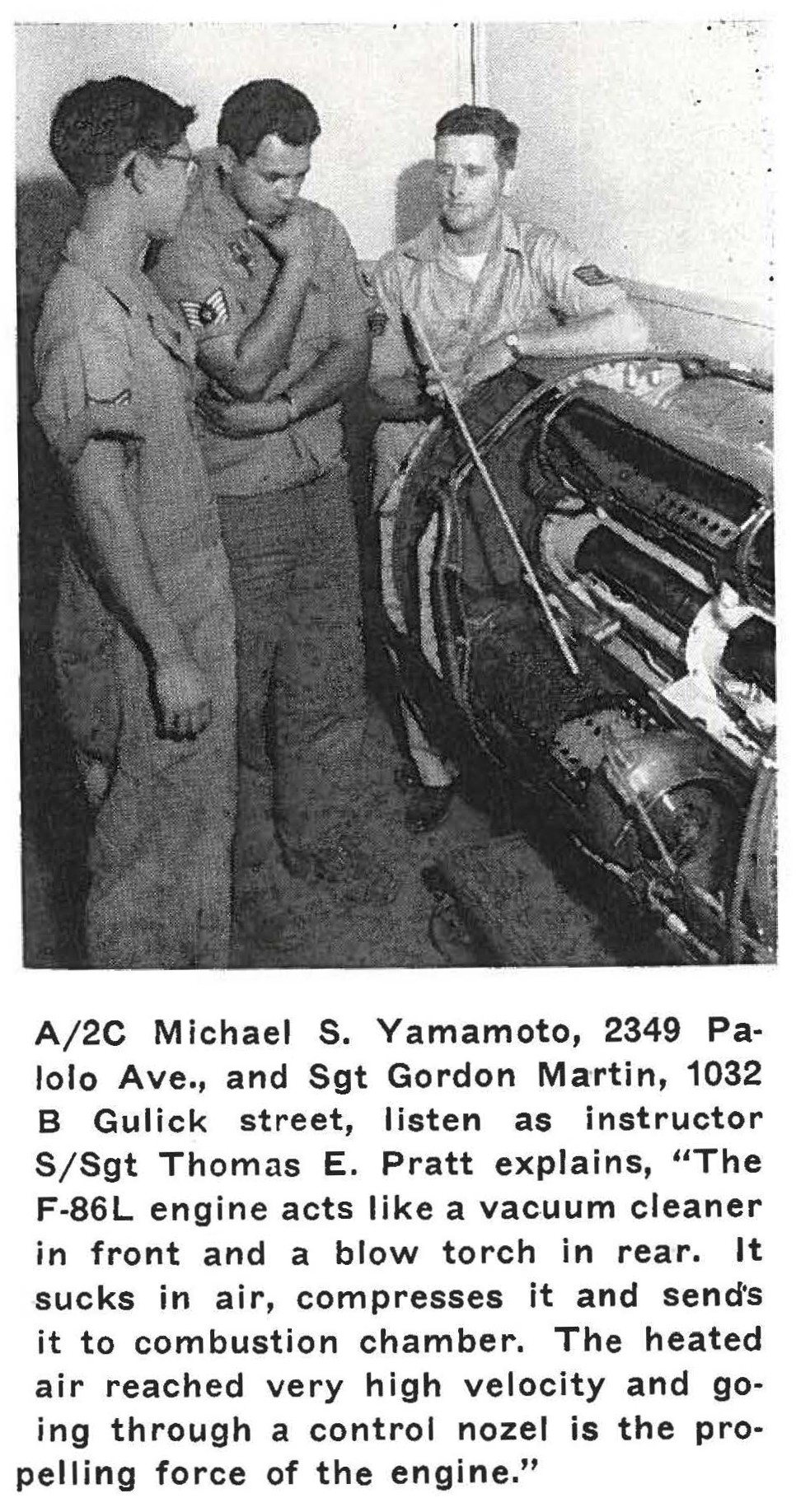
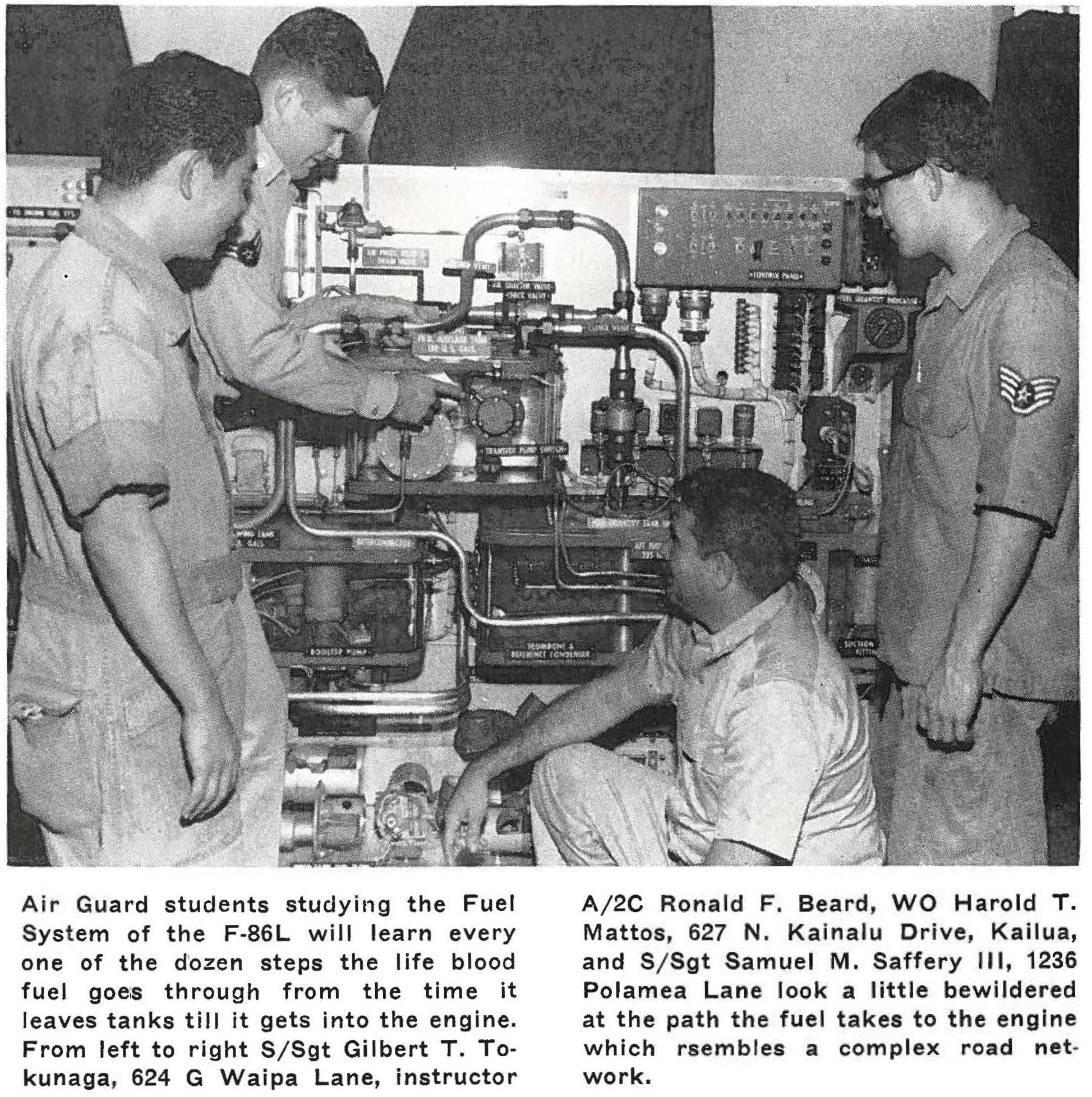
A/2C Michael S. Yamamoto, 2349 Palolo Ave., and Sgt Gordon Ma-rtin, 1032 8 Gulick street, listen as instructor S/Sgt Thomas E. Pratt explains, “The F-86L engine acts like a vacuum cleaner in front and a blow torch in rear. It sucks in air, compresses it and send’s it to combustion chamber. The heated air reached very high velocity and going through a control nozel is the propelling force of the engine.”Air Guard students studying the Fuel System of the F-86L will learn every one of the dozen steps the life blood fuel goes through from the time it leaves tanks till it gets into the engine. From left to right S/Sgt Gilbert T. Tokunaga, 624 G Waipa Lane, instructor A/2C Ronald F. Beard, WO Harold T. Mattos, 627 N. Kainalu Drive, Kailua, and S/Sgt Samuel M. Saffery Ill, 1236 Polamea Lane look a little bewildered at the path the fuel takes to the engine which rsembles a complex road network. (Pictures from the 1958 March The Hawaii Guardsmen)
The 199th Fighter Interceptor Squadron, Hawaii Air National Guard, was kept busy preparing for the arrival of twenty-seven of the latest jet fighters ever assigned to any Guard unit. The F-86L’s, which arrived last month, will beef up Hawaii’s air defenses since they are all-weather fighters and are faster and more deadly than the F-86E’s now used by the Guard.
To instruct the Guardsmen in performing maintenance on this complex fighter, the Air Force sent the F-86-6 Mobile Training Detachment from Chanute Air Force Base, Illinois, to Hawaii. The detachment, consisting of Captain Paul F. Drake and ten enlisted instructor specialists, began training the Guard personnel in converting to the F-86L on November 17th.
They arrived in Hawaii with an elaborate series of training aids and a well-planned, rigid course in all phases of maintenance on the F-86L’s.
The Air Guard personnel attended classes at Hickam four hours a day in addition to their regular duties. The Guard pilots attended evening and weekend classes. The classes were from 7:15 in the morning until 3:45 in the afternoon.
The maintenance men, who were already specialists with the F-86E’s, were taught hydraulics, radio navigational electronics equipment, armament and fire control, radar instruments, electrical systems, engine maintenance, and electronic fuel control in order to become specialists in these fields with the F-86L’s. Although there is much similarity between the two planes, there are a great many differences. The new F-86L’s fire rockets exclusively, whereas the F-86E’s armament consisted of machine guns. The radar system of the F-86L is also greatly improved and enables a pilot to shoot down a target without seeing it except as a blip on his radar screen.
The Mobile Training Detachment set up a separate course for each group of specialists who will work on the new all-weather fighter. The electronics specialists, for example, received a 120-hour course, whereas the crew chiefs were given a 96-hour course. The men were required to pass detailed examinations before they graduated from the training.
In addition to training the maintenance men, the F-86-6 Mobile Training Detachment instructed the Guard pilots in all the technical phases of the aircraft they would need to know to fly it safely and effectively.
Technical Sergeant Donald J. Quinn, the noncommissioned officer in charge of the detachment, said that about 80 percent of the Guard’s maintenance personnel completed the classroom training by the time the new jets arrived, and the balance of the men were well along with the training. He said that the 199th was probably the sharpest outfit he had ever worked with and that he was amazed at the quality of the students.
Quinn stated his detachment would remain for several months after the new jets arrived to give the Guardsmen practical training on the plane. He said it would take the men a while to get used to the new aircraft, but that the F-86L’s would definitely be in good hands by the time his detachment returned to the Mainland.
Lieutenant Colonel James R. Ashford, commanding officer of the 199th Fighter Interceptor Squadron, said that the excellent assistance of the F-86-6 Mobile Training Detachment would ease the conversion to the new aircraft considerably and was greatly appreciated by his unit.
Another in the long line of “firsts” for the 199th Fighter Interceptor Squadron, Hawaii Air National Guard, took form when the carrier Windham Bay unloaded $16,000,000 worth of F-86Ls at Pearl Harbor.
Equipped with afterburners, these rocket-firing, radar-equipped interceptors will eventually pave the way for a 24-hour air defense alert of the Hawaiian Islands. Aided by an accurate fire control system, the pilot of the 625-mile-per-hour all-weather jet interceptor can loose 24 “Mighty Mouse” rockets at an aggressor, as compared with the .50-caliber machine-gun firepower of the present F-86E Sabrejet.
Dangerous at all hours, the pilot is directed to his target by radar, which aims the rockets and fires them without his having actually seen the intruders.
2nd Lt. Walter M. Okino was the last pilot to qualify in the F-86L, the all-weather jet interceptor flown by the 199th. Lt. Okino’s check-out meant 100 percent transition of all tactical pilots from the F-86E Sabre jets to the “L.”
Lt. Okino was all smiles as he was presented a lei by the Cherry Blossom Queen, Jane Kuwata, as he taxied in.
Pretty Jayne Kuwata, 1958 Cherry Blossom Queen, drapes a lei around 2d Lt Walter M. Okino, tactical pilot with the 199th Fighter Interceptor Squadron. Lt Okino was the last pilot to check out with the F-86L, the all-weather jet interceptor flown by the 199th. The Squadron was scheduled to complete transition of all pilots to the “L” at the end of camp; the changeover, however, was done in nine days. (199th HAFNG photo)(Picture from the 1958 September The Hawaii Guardsman)
“The ‘L’ Was Sure Tested”
Robert (Bob) Hoover, former chief experimental test pilot for North American Aviation Inc., treated spectators to a spectacular display of aerial maneuvers with the F-86L at Kaneohe Marine Corps Air Station. Bob, who is a member of an F-86L Aircrew Indoctrination Team, did a roll on takeoff, 4-, 8-, and 16-point hesitation rolls, a low-speed flyby wherein he literally dragged the plane’s tail 50 feet off the runway while traveling at a mere 95 mph, and a dazzling one-wheel landing, first on the left and then on the right wheel.
Bob emphasized that these maneuvers were performed primarily to show the capabilities of the F-86L.
However, on Feb. 5, 1958, the HANG was authorized to receive the newer F-86L All Weather Fighter Interceptor and with it the responsibility for a 24-hour active air defense commitment. On May 1, 1958, the HANG commenced sunrise to sunset air defense duties with the “Ls”, and the “Es” were phased out by May 30, 1958.
The year 1961 ushered in major changes for both the HANG and the 150th ACWS. The missile firing, supersonic, swept winged F-102 “Delta Dagger” was introduced into the HANG replacing the reliable but ancient F-86L.