Do you need help in another language? We will get you a free interpreter. Call 808-369-3580 to tell us which language you speak.
您需要其它語言嗎?如有需要,請致電 (808-369-3478), 我們會提供免費翻譯服務
您需要其它语言吗?如有需要,请致电 (808-369-3478), 我们会提供免费翻译服务
En mi niit alilis lon pwal eu kapas? Sipwe angei emon chon chiaku ngonuk ese kamo. Kokori (808-369-3478) omw kopwe ureni kich meni kapas ka ani.
Makemake `oe i kokua i pili kekahi `olelo o na `aina `e? Makemake la maua i ki`i `oe mea unuhi manuahi. E kelepona (808-369-3478)`oe ia la kaua a e ha`ina `oe ia la maua mea `olelo o na `aina `e.
Masapulyo kadi ti tulong iti sabali a pagsasao? Ikkandakayo iti libre nga paraipatarus. Awaganyo ti
(808-369-3478) tapno ibagayo kadakami no ania ti pagsasao nga ar-aramatenyo.
다른언어로 도움이 필요하십니까? 저희가 무료로 통역을 제공합니다. (808-369-3478)로 전화해서 사용하는 언어를 알려주십시요
Kwoj aikuij ke jiban kin juon bar kajin? Kim naj lewaj juon am dri ukok eo ejjelok wonen. Kirtok
(808-369-3478) im kwalok non kim kajin ta eo kwo melele im kenono kake.
E te mana'o mia se fesosoani i se isi gagana? Matou te fesosoani e ave atu fua se faaliliu upu mo oe. Vili mai i le numera lea (808-369-3478) pea e mana'o mia se fesosoani mo se faaliliu upu.
¿Necesita ayuda en otro idioma? Nosotros le ayudaremos a conseguir un intérprete gratuito. Llame al (808-369-3478) y diganos que idioma habla.
Kailangan ba ninyo ng tulong sa ibang lengguwahe? Ikukuha namin kayo ng libreng tagasalin. Tumawag sa (808-369-3478) para sabihin kung anong lengguwahe ang nais ninyong gamitin.
‘Okú ke fie maʻu tokoni ʻi ha lea fakafonua ʻe taha? Temau kumi haʻo taha fakatonulea taʻetotongi. Telefoni ki he (808-369-3478) ke fakahā mai ʻa e lea fakafonua ʻokú ke lea aí.
Bạn có cần giúp đỡ bằng ngôn ngữ khác không ? Chúng tôi se yêu cầu một người thông dịch viên miễn phí cho bạn. Gọi (808-369-3478)nói cho chúng tôi biết bạn dùng ngôn ngữ nào
Gakinahanglan ka ba ug tabang sa imong pinulongan? Amo kang mahatagan ug libre nga maghuhubad. Tawag sa (808-369-3478) aron magpahibalo kung unsa ang imong sinulti-han.
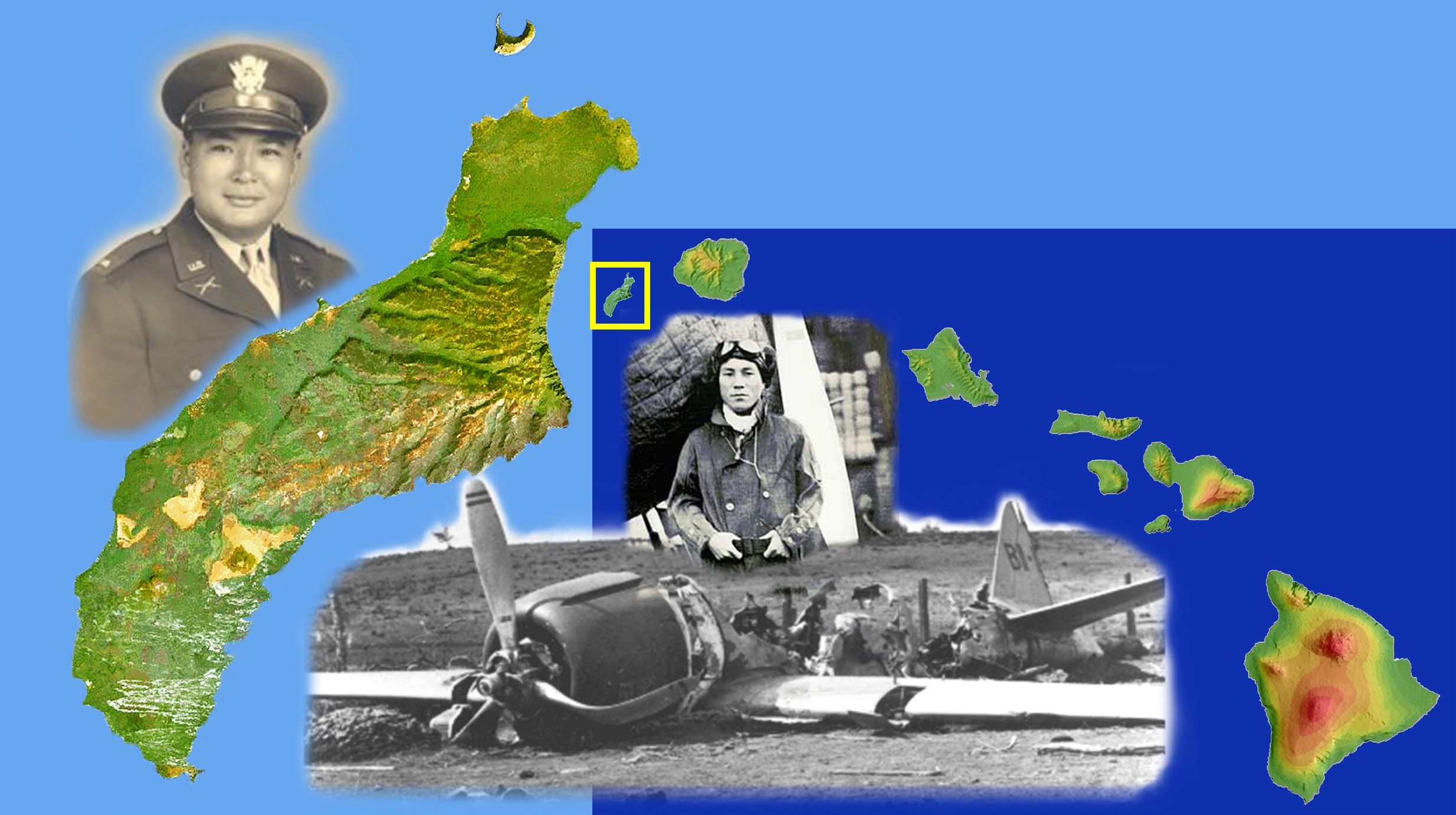
Japanese Hawaii Guard officer leads Niihau incident inspection team
By Retired Master Sgt. Stephen M. Lum
Japanese Hawaii Guard officer leads Niihau incident inspection team(Picture from the 2016 November Pupukahi)
Pre-World War II Hawaii
Before the United States is “drawn” into World War II, Maui-born, American of Japanese Ancestry “Jack” Hifuo Mizuha prepares for a life time of community service. His parents were among the earliest Japanese immigrants from Hiroshima Prefecture to come to Hawaii when it was still a kingdom and he was born Nov. 5, 1913, when Hawaii was a U.S. Territory. Mizuha attends the University of Hawaii where he earns undergraduate degrees in business and economics in 1934. While at the university, he joins the Reserve Officer Training Corps which pays for his schooling and he is awarded an officers commission after successfully completing the program. He joins the Hawaii National Guard’s 299th Infantry shortly after graduation.
Jack continues his studies at the university working on a master’s in education. To earn money to pay for his schooling, he works as a Honolulu Police Department reporter/police patrolman clerk, where he also learns shorthand. He meet a young police officer named James A. Burns, who becomes Hawaii’s second Hawaii State governor. Dualcitizen Mizuha, divests himself of his Japanese citizenship Mar. 28, 1936 in formal expatriation proceedings, severing ties with his father’s country of birth. After earning his degree in 1936, he moves to Kauai for a teaching position at Waimea High School, where he meets and marries a fellow teacher. On Sept. 3, 1939 he becomes Kauai’s Huleia School principal and six days later is place on active duty as the U.S. prepares for an anticipated involvement in the war raging in Europe and the Asian-Pacific theatres. He is one of the original 40 AJA members of the Hawaii Guard to be mobilized on Oct. 15, 1940. Militarily the first lieutenant is assigned to Company M, 299th Infantry, at Burns Field, Hanapepe, Kauai, becoming unit commander in August 1941.
Niihau incident capsulized
Following the attack on Pearl Harbor, Imperial Japanese Navy fighter pilot Petty Officer 1st Class Shigenori Nishikaichi crash lands his disabled A6M3 Zero on what he thinks is an uninhabited island (isolated island Niihau off Kauai) on Dec. 7, 1941, the day of the Pearl Harbor attack.
The island’s 100 plus civilian population, which had no telephones or radios, had not heard of the attack events on Oahu. The first to see the Japanese pilot is Hawila “Howard” Hanohano as the Zero crashes in front of his home. Hanohano pulls the groggy Nishikaichi clear of the plane, removing his sidearm and official looking papers. Hanohano feeds the pilot breakfast at his home, while a Japan-born 60-year old beekeeper, Ishimatsu Shintani, is summoned to translate. Shintani, a 41-year Hawaii resident, who had child born in the island and therefore were American citizens, wanted not part of questionable situation. Another Niihau AJA resident, Yoshio Harada, a bookkeeper, is then brought translate for Nishikaichi and is intimidated by the pilot who tells the Haradas about the attack on Oahu and a rescue submarine was on its way. Harada and his wife Irene are swayed into helping the stranded pilot. The Haradas fearing for their safety, not only translate for Nishikaichi, but align themselves with the invader. The lightly secured Zero pilot and Harada secure weapons and threaten to kill island residents if they don’t help them. The week long standoff come to a head when Nishikaichi shoots Benehakaka “Benny” Kanahele three time and despite his wounds, Kanehele kills the pilot by lifting him up and knocking his head against a wall. As Kanahele’s wife, Ella, hit Nishikaichi repeatedly with a rock, Benny sliced the pilot’s throat. Shortly thereafter, a scared Harada commits suicide.
Several days’ later, Hanohano and other locals, who escaped on a lifeboat earlier, arrive on Kauai and inform the authorities. The events would lend “credence” those who preached not trusting AJAs and talk of internment.
Military deploys investigation team
Later that week, eager to prove his loyalty, 1st Lt. Mizuha volunteers to lead 13 enlisted Soldiers from the Hawaii Guard’s Hanapepe unit to the island of Niihau to capture the pilot, rescue the local population and investigate what happened.
Among the volunteers is Kauai AJA Pfc. Ben Kobayashi, whose family also migrated from Hiroshima. Kobayashi, who joined the Hawaii Guard Nov. 10, 1940, was to serve as Mizuha’s driver/translator. The “old,” over 30 Soldier, didn’t know that a former co-worker was the local (Harada) who helped the Zero pilot.
Mizuha, who was the Burns Air Field (Hanapepe, Kauai) unit commander up until Dec. 7, 1941, was demoted to executive officer in response to white officer’s concerns of the loyalty of Japanese American Soldiers of the Hawaii Guard. After landing on Niihau, Mizuha leads the detachment across the island. Survivors are questioned as Mizuha uses his police-reporter learned shorthand to take comprehensive notes. The dead bodies of the Nishikaichi and Harada are found and buried. The confiscated Japanese pilot’s papers and detainees Shintani and Irene Harada are brought for further review on Kauai. Niihau’s Irene Harada is incarcerated until June 1944 and Ishimatsu Shintani is eventually sent to an internment camp on the mainland. Mizuha is transferred to Schofield Barracks, where he is promoted to captain. In 1945, Kanahele receives a Purple Heart and Medal of Merit from U.S. government. The remnants of the Japanese Zero today is on display at the Pacific Aviation Museum on Ford Island, Pearl Harbor, Oahu.
Japanese American Soldiers, including Mizuha, removed from Hawaii Guard units
Newly promoted Capt. Mizuha is assigned as Co. D, 299th Infantry. commander, and quickly earns the respect of his young Soldiers. “I remember him very well,” recalled veteran Goro Sumida in a 2012 interview “He came and raided our crap game and gave all the money to the Red Cross.” More fallout for the AJA Soldiers after the Pearl Harbor attack included weapons being “turned-in” and demotions from guard missions to work details. On May 28, 1942, Mizuha and all the other AJAs were removed from the ranks of the 298th and 299th Infantry Regimenst, 798 men from the 298th and 608 men from the 299th along with 28 officers.
100th Infantry Battalion goes to war While the federalized AJAs Soldiers, originally scheduled to discharge are moved and form the nucleus of the newly created Hawaiian Provisional Infantry Battalion, AJA Hawaii Territorial Guard Soldiers were dismissed Jan. 19 (many were University ROTC cadets were now 4C, enemy aliens status).
In June 1942, the provisional battalion boards the U.S. Transport Maui, bound for the mainland and eventually Camp McCoy, Wis. While in transit the unit was activated as the 100th Infantry Bn. (Separate). After more training the battalion goes on to Salerno, Italy, in the European theatre of operations and breaks racial barriers for its newly created bigger brother the 442th Regimental Combat Team. The 100th Bn. later becomes the 442nd RCT’s first infantry battalion, but retained the 100th name (2nd and 3rd Infantry Battalions follow the normal protocol of names).
Maui-born 1st Sgt. Takashi Kitaoka, Co. B, 100th Bn., said that upon landing in Salerno, Italy, in September 1943, he and Mizuha were huddled together as projectiles were landing nearby, “We’re sitting here being shelled, let’s move over there and get away from this place.” ‘And Mizuha says, Kit, don’t move. They already shelled here. They are not going to shell here again [if they don’t see anybody].’ He was a very smart guy.” Kitaoka, who went on to become a Maui Circuit Court Judge, recently died Aug. 9, 2016, at the age of 104. On Sept. 29, shortly after arriving in Salerno, Mizuha volunteers to lead a team to located where a German machine gun nest is holding up the advance of the 100th Battalion. Kobayashi (Mizuha’s Kauai driver) chimed in, “Mizuha was a good man; he is always volunteering for stuff.” While leading the troops against heavy gun fire in Colli, Italy, he suffered a bullet wound that entered his back, narrowly missing his spine and lungs. He survives the wound, but is hospitalized for nearly a year, first to Africa, then to North Carolina and finally Chicago.
Disabling injuries exempting him from further military service do not stop Mizuha from fighting for the correcting the injustices done to the AJA Soldiers. While convalescing he writes public letters defending the loyalty and rights of the AJAs. The President’s wife, Eleanor, invites him to the White House where his ask the First Lady “to support measures to grant citizenship to the parents of Nisei soldiers.” He wrote letters for fellow Soldiers letting those at home, like politicians, public officials and employers know, that the returning Soldiers would need jobs and assistance adjusting to life with various mental and physical disabilities. Much like today’s Employer Support of the Guard and Reserve, and the Veterans Administration work for the veterans.
Mizuha’s post military career
Mizuha returns to Hawaii after he had been medically discharged and returns to his educational career with an appointment as principal of Hanamaulu School on Kauai. His wartime injuries did not slow down his continued fight to inform communities, Rotary clubs and other organizations about the need to assist returning veterans readjustment to everyday life back home in the islands. After the war ends, he used the G.I. Bill to attend the University of Michigan Law School and returned to Kauai and passed the Hawaii Bar exam. Mizuha become one of the few 100th Bn., 442nd RCT veterans to join the Republican Party. In 1948, he runs for and is elected to Kauai’s Board of Supervisors (prelude to County Council) and later a Territory constitutional convention delegate. He also serves an appointment as a University of Hawaii regent in the 1950s. In 1958, he serves as Hawaii’s attorney general, following year he is appointed as an Oahu circuit court justice. In 1961, Republican Gov. William F. Quinn appoints Mizuha to the state Supreme Court as an associate justice. In one of his first duties, Mizuha gets to swear in his battle buddy Takashi Kitaoka as a Maui Circuit Court justice. After an eight year appointment, where he championed individual rights, protecting the Constitution, collective bargaining and free public schools, Mizuha retired to his own private law practice.
Club 100 legacy
Mizuha was an original member of the 100th Battalion and a founding member of Club 100, the 100th Infantry Battalion Veterans. Members had a set amount of the paycheck during their activation put into a fund to build a club house where 100th Battalion members, their families and friends could gather after the war for fellowship and community activism (fighting for veteran’s rights and benefits). As active as Jack was in fighting for the rights of others, he rarely frequented the club house or discussed the war. He died in 1972 at age 72.