Do you need help in another language? We will get you a free interpreter. Call 808-369-3580 to tell us which language you speak.
您需要其它語言嗎?如有需要,請致電 (808-369-3478), 我們會提供免費翻譯服務
您需要其它语言吗?如有需要,请致电 (808-369-3478), 我们会提供免费翻译服务
En mi niit alilis lon pwal eu kapas? Sipwe angei emon chon chiaku ngonuk ese kamo. Kokori (808-369-3478) omw kopwe ureni kich meni kapas ka ani.
Makemake `oe i kokua i pili kekahi `olelo o na `aina `e? Makemake la maua i ki`i `oe mea unuhi manuahi. E kelepona (808-369-3478)`oe ia la kaua a e ha`ina `oe ia la maua mea `olelo o na `aina `e.
Masapulyo kadi ti tulong iti sabali a pagsasao? Ikkandakayo iti libre nga paraipatarus. Awaganyo ti
(808-369-3478) tapno ibagayo kadakami no ania ti pagsasao nga ar-aramatenyo.
다른언어로 도움이 필요하십니까? 저희가 무료로 통역을 제공합니다. (808-369-3478)로 전화해서 사용하는 언어를 알려주십시요
Kwoj aikuij ke jiban kin juon bar kajin? Kim naj lewaj juon am dri ukok eo ejjelok wonen. Kirtok
(808-369-3478) im kwalok non kim kajin ta eo kwo melele im kenono kake.
E te mana'o mia se fesosoani i se isi gagana? Matou te fesosoani e ave atu fua se faaliliu upu mo oe. Vili mai i le numera lea (808-369-3478) pea e mana'o mia se fesosoani mo se faaliliu upu.
¿Necesita ayuda en otro idioma? Nosotros le ayudaremos a conseguir un intérprete gratuito. Llame al (808-369-3478) y diganos que idioma habla.
Kailangan ba ninyo ng tulong sa ibang lengguwahe? Ikukuha namin kayo ng libreng tagasalin. Tumawag sa (808-369-3478) para sabihin kung anong lengguwahe ang nais ninyong gamitin.
‘Okú ke fie maʻu tokoni ʻi ha lea fakafonua ʻe taha? Temau kumi haʻo taha fakatonulea taʻetotongi. Telefoni ki he (808-369-3478) ke fakahā mai ʻa e lea fakafonua ʻokú ke lea aí.
Bạn có cần giúp đỡ bằng ngôn ngữ khác không ? Chúng tôi se yêu cầu một người thông dịch viên miễn phí cho bạn. Gọi (808-369-3478)nói cho chúng tôi biết bạn dùng ngôn ngữ nào
Gakinahanglan ka ba ug tabang sa imong pinulongan? Amo kang mahatagan ug libre nga maghuhubad. Tawag sa (808-369-3478) aron magpahibalo kung unsa ang imong sinulti-han.
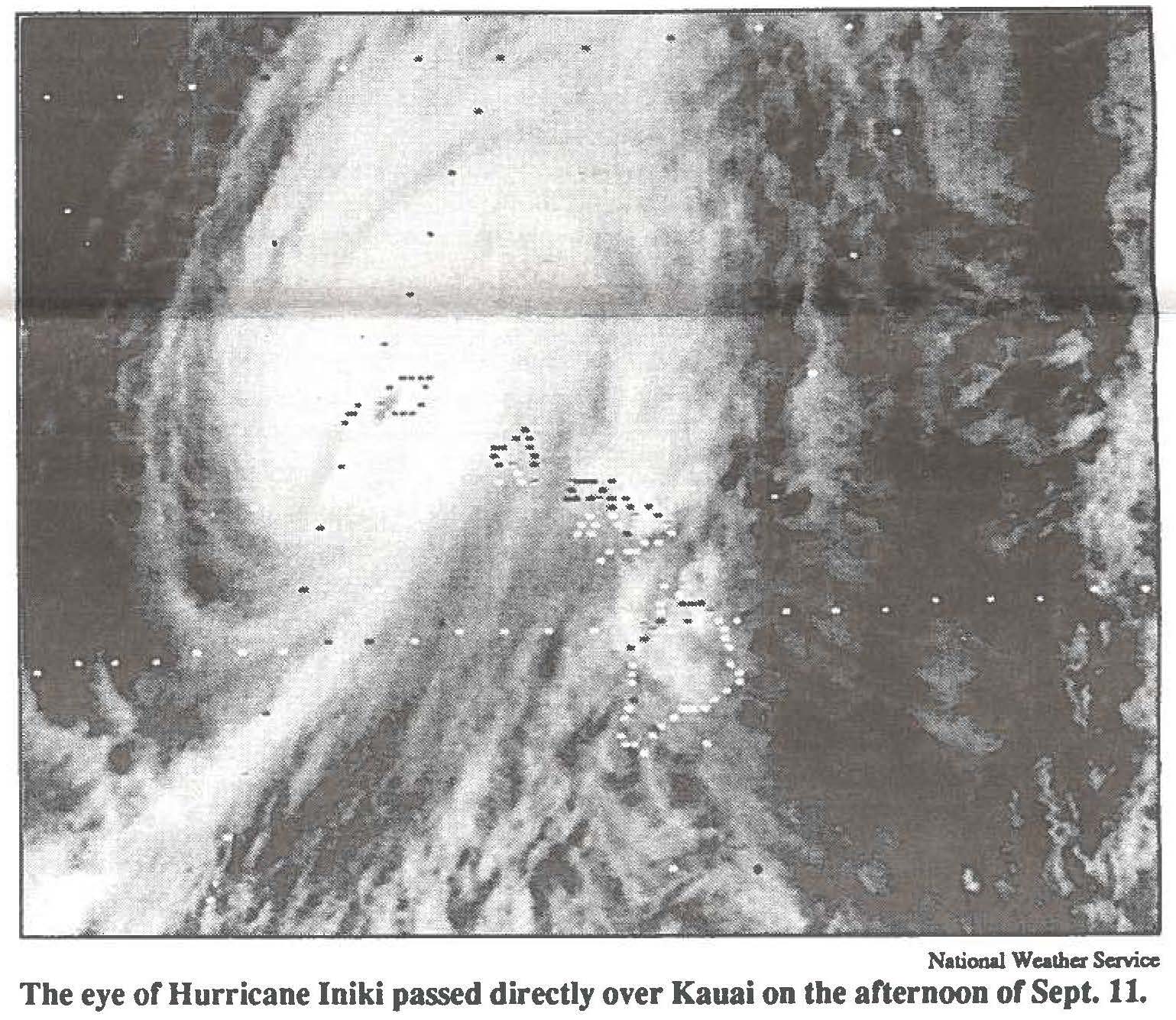
The eye of Hurricane Iniki passed directly over Kauai on the afternoon of Sept. 11.(Picture from the 1992 August – September Pūpūkahi)
The most destructive hurricane to hit the Hawaiian Islands and the third costliest natural disaster in U.S. history ripped through Kauai Sept. 11, packing 145 mile-per-hour winds with gusts of up to 227 that devastated the island and left a path of destruction extending to Oahu’s Waianae coast and the Big Island. When it finally passed, Hurricane Iniki had destroyed or damaged seventy percent of Kauai homes and businesses, more than 560 homes on Oahu and 32 homes on the Big Island.
Although the immediate response and deployment of Hawaii National Guard members and equipment to Kauai was well documented by the news media, the state Department of Defense’s preparation prior to the disaster adds insight into why the emergency response was so quick and effective.
Beginning on Sept. 6, five days before Iniki hit, State Civil Defense began to routinely monitor the storm as it appeared as a tropical depression (TD18E) in the southeastern Pacific Ocean. The storm systemn was more than 1,360 nautical miles southeast of Hawaii. At about 11 p.m., Tuesday, Sept. 8, Iniki was upgraded to a hurricane.
At 5:00 p.m., Sept. 10, the storm turned on a northwest track and was reported to be 400 nautical miles south ofLihue. Maj. Gen. Edward V. Richardson, the adjutant general and director of civil defense, State Civil Defense (SCD) and Hawaii National Guard (HING) emergency operating centers (EOCs) on Oahu. By this time, L.t. Col. Myron N. Dobashi, commander of the the 154th Air Control Squadron on Kauai was at the county EOC and Maj. Theodore A. Daligdig III, battalion administrative assistant, readied the Hawaii National Guard’s Kapaa Armory to serve as an evacuation center. Kauai National Guard technicians secured equipment and vehicles and the more than 400 Army and Air Guard members on Kauai were advised to take care of their families. Commanders, key staff and unit members on other islands were placed on standby in accordance with established procedures. Hawaii Air National Guard communications units were also directed to prepare for deployment.
The state coordinated with county agencies to sound civil defense sirens at 5:30 the next morning and decided to close schools and require only emergency essential personnel to report to work. At 1:20p.m., Sept. 11, power went out on Kauai as Iniki swept over the island. A short time later, emergency communication went out between the Garden Isle and Oahu. At the state EOC on Oahu, Maj. Gen. Richardson and Roy C. Price Jr., vice director for SCD, briefed Gov. John Waihee on Iniki’s movement and the state’s contingency plans. The Federal Emergency Management Agency team arrived that same afternoon.
Throughout the evening, fierce winds trailing Iniki prevented aircraft from flying to Kauai. When they finally subsided at 5:30 a.m. the next day, more than 300 Big Island soldiers began deploying to Kauai aboard Air National Guard, Coast Guard and commercial aircraft, including six (6) California combat Air Guard C-130s and four (4) Coast Guard C-130s on loan for the recovery effort. Being the first military forces to arrive on Kauai, Army Guard troops were tasked to provide security and assist Kauai police, while the Air Guard re-established communications and coordinated the air flow. By the end of the day, C-130s had airlifted more than 100 tons of equipment and supplies to Kauai.
That morning, Gov. Waihee and Kauai Mayor JoAnn Yukimura, followed by Senators Daniel K. Inouye and Daniel K. Akaka, U.S. Representatives Patsy T. Mink and Neil Abercrombie, Maj. Gen. Richardson and key staff conducted aerial surveys of the island. The damage wrought by lniki was nearly incomprehensible: thousands of utility poles were down, knocking out Kauai’s electrical and telephone systems; electric water pumps were inoperative, cutting off the water supply to homes; crops lay in ruin; the shoreline and beaches were decimated; 14,340 homes on the island were damaged.
-5,000 severely damaged or destroyed; and the many luxury hotels along the coast were badly damaged. At least 7,000 residents were homeless and another 8,000 needed food and water. Three people were dead. The destruction of the Lihue Airport tower’s communication system resulted in the suspension of commercial airline flights into Lihue Airport and left thousands of tourists stranded at evacuation centers.
A National Guard team led by Col Edward L. Correa Jr., deputy commander of the Hawaii Army National Guard, moved to the Kauai County Building to coordinate the emergency response and recovery. More than 380 Army Guard soldiers provided security, safety and courtesy patrols; airmen from the 154th Civil Engineering Squadron and 154th Services Flight served meals from their mobile kitchen trailers; and Kauai soldiers and airmen helped their neighbors, giving them food, water and offering them a place for temporary shelter. At the Kapaa Armory alone, food and shelter were provided for more than 600 residents.
A presidential disaster declaration was signed in the early hours of Sept 12.
The same day, the Air National Guard transported Wilcox Memorial Hospital patients and stranded tourists to Oahu. Forty two patients and more than 1,220 visitors were eventually flown from Kauai. The Guard also continued to transport relief supplies, food and medical personnel.
The sole Guard fatality occurred late Monday, Sept. 13, when Tech. Sgt Dennis C. Dalen of the Hawaii Air National Guard’s 297th Air Traffic Control Flight died in a traffic accident enroute to repairing a generator. Dalen was interred at the State Veterans Cemetery on Oahu with full military honors.
The Hawaii National Guard task force grew to nearly 1,300 troops with the Sept 14 arrival of the Army Guard’s 1st Battalion, 299th Infantry, 129th Signal Detachment, 29th Support Battalion, 297th Supply and Service Battalion, 298th Engineer Detachment and 227th Engineer Company and the Air Guard’s 154th Security Police Flight.
Restoring electrical power on the island was a top priority. Col. David Rodrigues, Hawaii Air National Guard chief of staff and vice president of operations for Hawaiian Electric Co., was selected to oversee electricity restoration and deployment of repair crews and equipment Throughout the recovery, the Hawaii National Guard kept its generators running.
Food, ice, plastic sheeting and medical care were in great demand following the hurricane. Soldiers of the 297th Supply and Service Battalion set up and operated relief distribution centers at Lihue, Kapaa, Hanapepe, Kalaheo and Princeville.
Two battalion aid stations were established at the Kapaa and Hanapepe armories. Medical teams augmented military aid personnel by going house-to-house to treat residents. By the end of the month, Guard medics had treated more than 1,000 patients, mostly for minor injuries, cuts and bruises.
The possibility of rain made repairing roofs another priority. Armed with carpentry tools and chainsaws, the 298th and 227th engineers repaired homes for residents unable help themselves.
Gov. Waihee tasked Maj. Gen. Richardson to coordinate the clean-up of public schools on Kauai and to launch “Operation Garden Sweep,” a joint county, state and federal effort to collect and transport household garbage and debris to Kauai landfill sites. Guard and active duty military personnel removed debris, patched roofs and cleaned classrooms at 15 schools throughout the island. On Monday, Sept 21, more than 500 Hawaii Air National Guard members deployed to Lihue to participate in “Garden Sweep.”
In the first three weeks of the emergency and response phase of Operation Iniki, more than 3,000 members of the Hawaii National Guard were directly involved in serving and assisting Kauai county residents.
On Saturday, Sept. 26, the 500 airmen on Kauai for “Operation Garden Sweep” redeployed to their home stations.
That same day, the Army Guard’s 1st Battalion, 487th Field Artillery, deployed to Kauai to replace the 1st and 2nd Battalions, 299th Infantry units and military police in their security missions. Upon their return, Sunday, Sept. 27, the infantry units and military police were greeted by welcome home celebrations with families and friends.
Today, the State Department of Defense continues to work with county, federal and active military organizations to support Iniki recovery efforts.
On behalf of Governor John Waiheeand the residents of Kauai, I extend my heartfelt appreciation to the entire State Department of Defense family for your outstanding performance before, during and after Hurricane Iniki struck the islands on Sept 11. I am extremely proud of what the department was able to accomplish, specifically, the emergency preparation, response and recovery assistance provided to the victims of that devastating storm. Many of you worked around-the-clock either on Kauai, Oahu’s Waianae coast, at State Civil Defense, Hawaii Army or Air National Guard headquarters or at unit armories/facilities in support of our efforts. Other employees in the department shouldered the day-today responsibilities in your absence as did the thousands of family members who supported our people at home during this, the most intensely demanding state mission in our history.
Hurricane Iniki has already been recorded as the most destructive storm to hit Hawaii and the third most costly natural disaster in U.S. history. Our success in meeting the numerous requirements throughout this period is a culmination of many factors.
First, and possibly the most important, was the proactive nature of the actions we took before the hurricane hit. As the article on page one of this issue of the pupukahi notes, we followed the storm system from Sept. 6 when it first appeared as a tropical depression to its being upgraded to a hurricane, Sept. 8. When Iniki turned on a northwest track toward Kauai and Oahu, Sept. 10, we activated our emergency operating centers, tracked the progress of the storm with our two radar sites, prepared our vehicles and equipment, and had units on Hawaii and Maui on standby alert. On Sept. 11, Governor Waihee approved our recommendation to sound our civil defense sirens, close schools, and have only emergency essential employees report to work. Lt Gen. John B. Conaway, chief, National Guard Bureau, offered six California Air National Guard C-130 aircraft and mobile communications equipment for our use. Rear Admiral William C. Donnell commander, 14th Coast Guard District, volunteered four more C-130 aircraft.
As the hurricane approached Kauai and Oahu on Sept. 11, we pre-positioned aircraft and equipment, notified our troops and were ready to deploy them and their equipment as soon as weather permitted.
A second factor was the State’s leadership during the initial response and recovery phases. Governor Waihee provided the leadership and guidance to ensure the State did everything possible to support the County of Kauai and help residents during the emergency response and recovery phases. He also tasked me to coordinate the cleaning and repair of public schools and to launch “Operation Garden Sweep,” a joint effort to clean Kauai for recovery and public health reasons.
The third factor was the teamwork demonstrated by all levels of the county, state and federal governments. No single agency or level of government could have singlehandedly provided all of the support and resources required for a disaster of this magnitude. All of the leaders involved in the effort recognized this early on and cooperated fully toward the common goal of being responsive to the needs of Kauai’s people. This spirit of cooperation and teamwork enabled us to deploy and position all available assets in a timely and efficient manner. I thank Mr. Wallace Stickney, director of the Federal Emergency Management Agency (FEMA) and Lt. Gen. Johnnie Corns, commander of the U.S. Army Pacific, for their outstanding support.
It is also important to remember that all of the actions we took before, during and after Iniki struck Kauai were based on lessons learned from previous disasters and emergency response exercises. The training we have done in civil defense has paid off and we will continue to refine our plans and conduct training to be proactive and to provide a rapid response to all disasters.
Each of you made significant contributions to our total effort. You should be proud of your monumental achievements and take pride in the professional manner in which you accomplished these assignments. Again, mahalo to all of the soldiers, airmen, civilians and family members of the State Department of Defense. You have all done an incredibly outstanding job and truly deserve the praise andgratitude of the entire state.
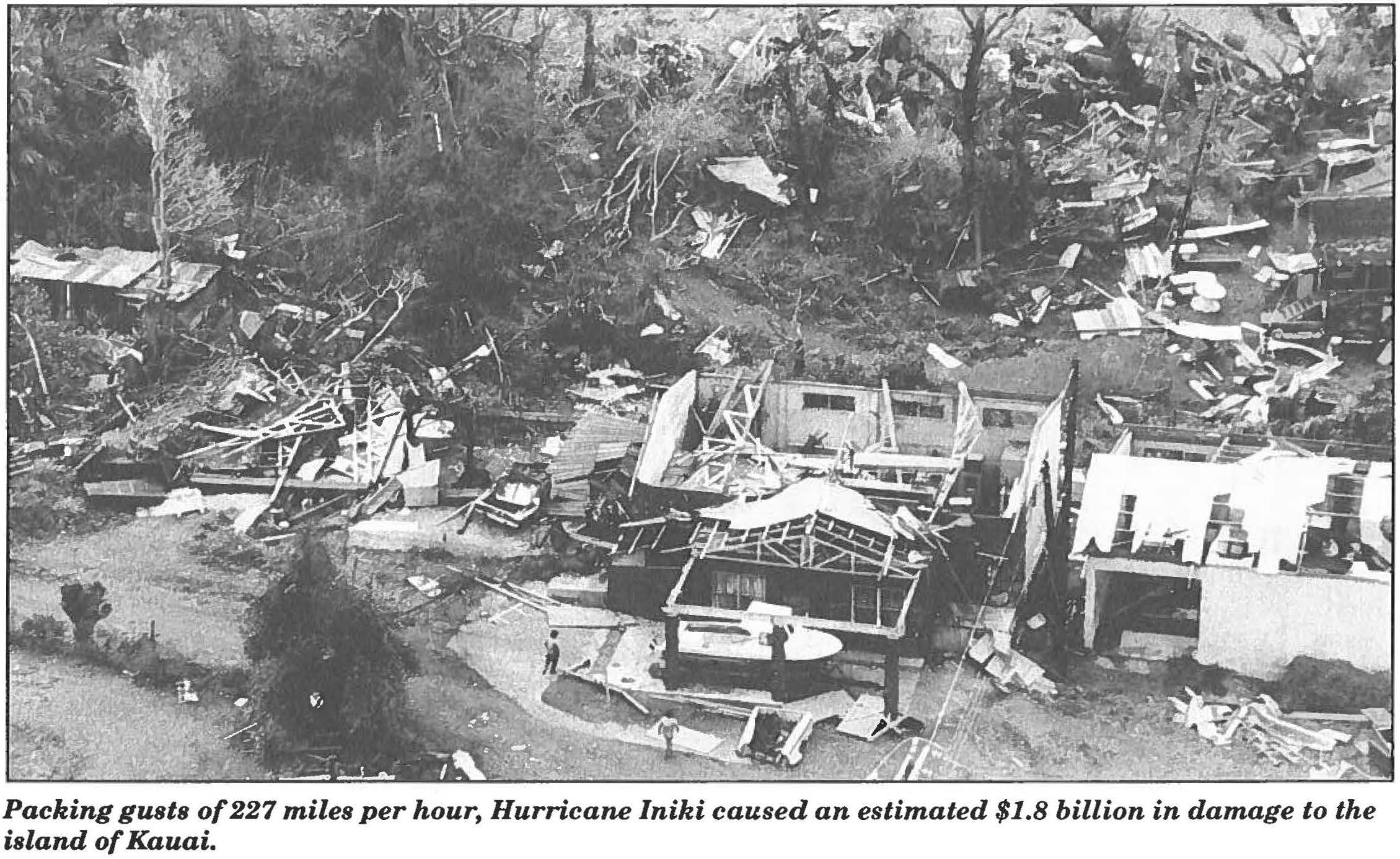
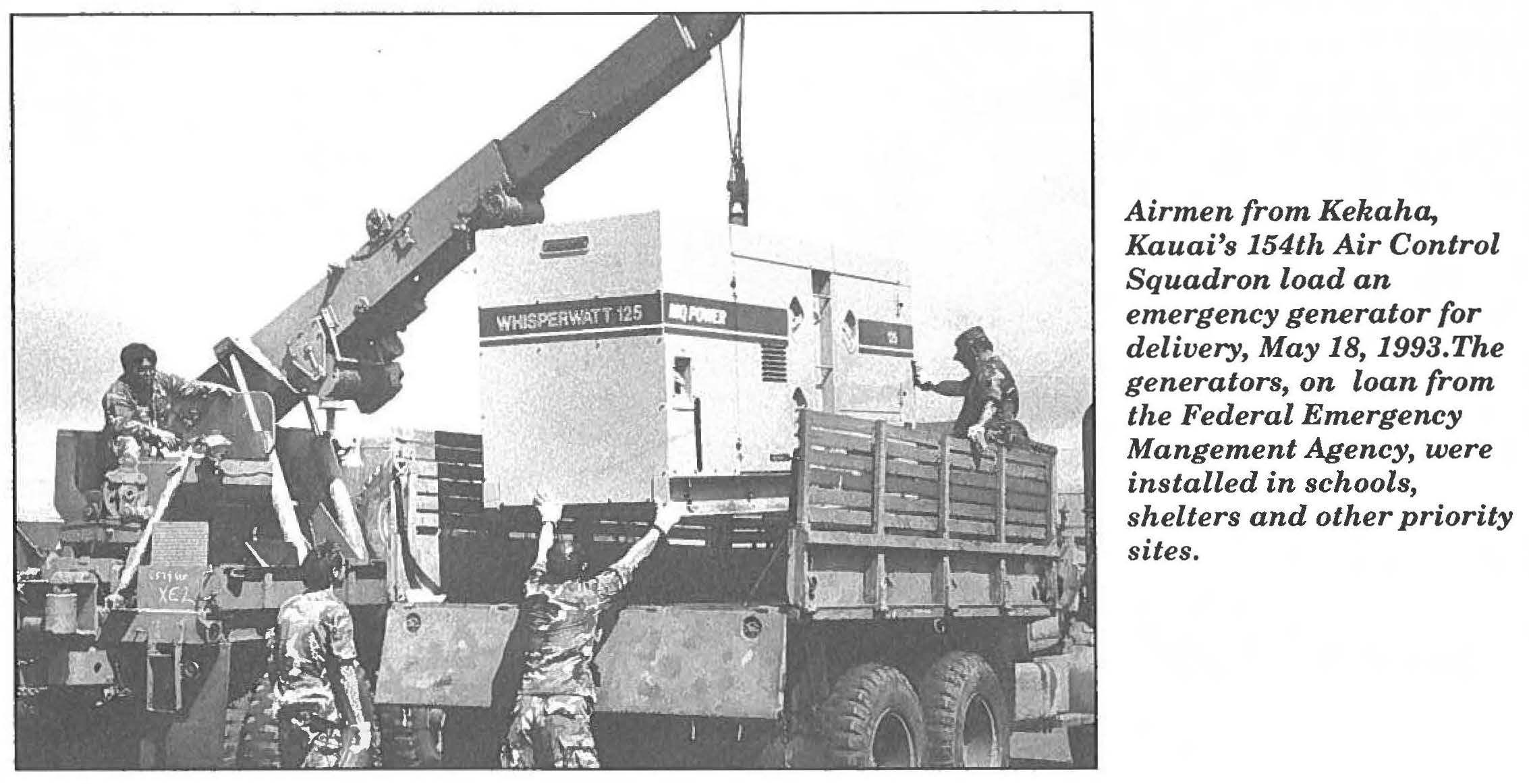
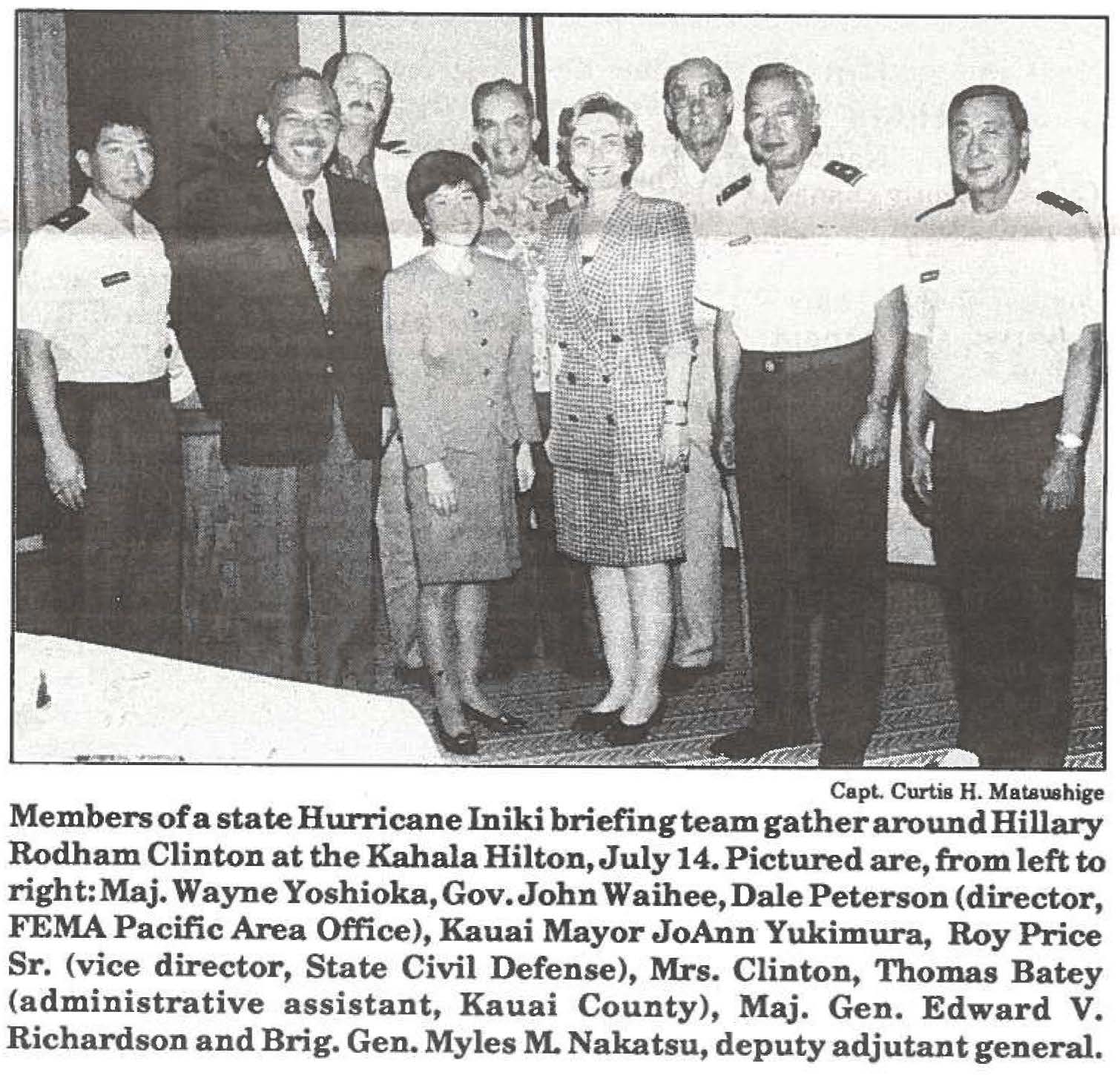
Packing gusts of 227 miles per hour, Hurricane Iniki caused an estimated $1.8 billion in damage to the island of Kauai.Members of a state Hurricane Iniki briefing team gather with first lady Hillary Rodham Clinton at the Kahala Hilton, July 14, 1993. From left to right are: Maj. Wayne Yoshioka, Gov. John Waihee, Dale Peterson (director, Federal Emergency Management Agency, Pacific Area Office), Kauai Mayor JoAnn Yukimura, Roy C. Price Sr. (vice director, State Civil Defense), Mrs. Clinton, Thomas Batey (administrative assistant, Kauai County), Maj. Gen. Edward V. Richardson (state adjutant general) and Brig. Gen. Myles M. Nakatsu (deputy adjutant general).Airmen from Kekaha, Kauai’s 154th Air Control Squadron load an emergency generator for delivery, May 18, 1993. The generators, on loan from the Federal Emergency Management Agency, were installed in schools, shelters and other priority sites.(Pictures from the 1993 Annual Report)
On Sept. 11, 1992, the state of Hawaii experienced the worst storm ever to strike the islands. With maximum sustained winds clocked at 145 miles per hour and gusts up to 227 miles per hour, Hurricane Iniki struck with devastating force. While all islands were touched by the storm, the island of Kauai felt the full impact as the eye swung directly over the island. Damage surveys completed the following morning showed that virtually no structure on Kauai had been left untouched.
Communications and lifeline utilities were severed. Portions of Oahu, particularly the Leeward coast, suffered damage from peripheral winds and storm surge, and isolated power outages were reported around the island. Maui and the Big Island also reported damage, but Kauai absorbed most of the storm’s impact. Hurricane Iniki caused an estimated $1.8 billion in damages, and was billed as the third costliest natural disaster in U.S. history.
The hurricane recovery effort, dubbed “Operation lniki,” was a joint county, state and federal venture. However, the State of Hawaii Department of Defense (DOD) played a major role in the operation.
Days before the storm, Maj. Gen. Edward V. Richardson, state adjutant general and director of civil defense, and the State DOD staff began to routinely monitor the storm. On Thursday, Sept. 10, lniki turned on a northwest track toward Hawaii. It was only 400 nautical miles south of the islands of Kauai and Oahu.
Based on this information, Richardson implemented 24- hour operations at the State Civil Defense and Hawaii National Guard Emergency Operating Centers, and directed intensified response planning. Hawaii National Guard units on all islands began preparing their vehicles and equipment.
The Hawaii Air National Guard’s Aircraft Control and Warning Squadrons on Kauai and Oahu provided continuous radar information to State Civil Defense and were invaluable in successfully tracking the storm.
At 11 a.m., Sept. 11, Iniki was perilously close to Oahu and Kauai. Key Hawaii National Guard soldiers and airmen were at their stations; the Big Island’s 2nd Battalion, 299th Infantry was on standby alert; and Oahu units were set to perform evacuation missions.
At 3:15 p.m., power was reported out on Kauai as Iniki carved a destructive path through the island. A short time after the hurricane hit, emergency communication was reported out between Oahu and Kauai.
At the state emergency operating center on Oahu, Richardson briefed Gov. John Waihee on Iniki’s effects and the state’s contingency plans. The governor immediately issued a State Disaster Proclamation, authorizing the state response and activation of the Hawaii National Guard. The governor’s action led to a Presidential Declaration of Disaster, which paved the way for federal disaster aid through the Federal Emergency Management Agency (FEMA).
At 5:30 a.m., the winds subsided and nearly 400 Big Island soldiers and airmen began deploying to Kauai aboard Air National Guard C-130 aircraft. Hawaiian and Aloha Airlines and Coast Guard aircraft also helped move troops and equipment from the Big Island.
The communications system at Lihue Airport was destroyed, and commercial airline flights were suspended for 10 days, leaving thousands of tourists stranded on the island. On Sunday, Sept. 13, the Hawaii Air National Guard, with support from Aloha, Hawaiian and United Airlines, began transporting tourists to Oahu, eventually evacuating more than 5,000 visitors.
Elsewhere on the island, more than 7,000 people were housed and over 15,000 fed at National Guard, Red Cross and Salvation Army shelters.
Also on the 13th, an active duty military Joint Task Force made up of Army, Air Force, Navy, Marine and Coast Guard units began assisting the state and county. The Task Force provided personnel and began airlifting and shipping tons of equipment and emergency supplies.
On Sept. 15, two battalion aid stations were established at the Hawaii National Guard’s Kapaa and Hanapepe armories. Medics also went house-to-house to treat injured residents. By Sept. 30, the medical teams had treated more than 1,000 patients, mostly for minor injuries, cuts and bruises.
National Guard engineers deployed on Sept. 15 with vehicles, carpentry tools and chainsaws to do house-to-house repairs for residents who could not fix their own homes.
The National Guard also set up and operated five relief distribution centers at Lihue, Kapaa, Hanapepe, Kalaheo and Princeville, providing food, water, ice and plastic sheeting. The distribution centers, which included Red Cross and Salvation Army functions, were colocated with federal disaster assistance centers to provide one-stop, full-service programs for residents.
In mid-September, the governor tasked Richardson to coordinate the cleaning up of public schools, state facilities and highways. National Guard and active duty military personnel removed debris, patched roofs, cleaned classrooms and installed generators at 15 schools throughout the island. As a result of the emphasis on schools, Wilcox Elementary in Lihue opened on schedule, Sept. 22.
To reduce the risk of injury, infections and the spread of diseases, the governor also tasked Richardson to initiate “Operation Garden Sweep.” This massive, two-phase clean-up of the entire island was a joint county, state and federal effort.
The workers collected and hauled more than 32,000 tons of household garbage and debris to existing and temporary landfill sites on the island.
For the first three weeks of the emergency response phase of Operation Iniki, more than 5,500 members of the Hawaii National Guard were directly or indirectly involved in efforts to serve and assist Kauai County.
National Guard helicopters and fixed-wing aircraft, including six C-130s from the California Air Guard, flew over 1,887 sorties, transporting more than 3,427 tons of cargo and 9,552 passengers.
On Friday, Sept. 25, the soldiers and airmen who had been on Kauai since Hurricane Iniki hit began returning to their homes on the Big Island, Oahu and Maui. Other Hawaii National Guard members deployed to Kauai to continue to provide security, clean-up assistance and outreach support until Nov. 6.
There were a number of factors that made the emergency response phase of Operation Iniki a success. First, and most important, was the fact that all agencies recognized the leadership role of the state in managing, coordinating, prioritizing and executing the emergency response effort. The federal government, namely FEMA and the active duty military, allocated resources based on priorities identified in conjunction with the state and county.
Another factor was the proactive nature of the actions taken by the State Department of Defense, even before the hurricane hit. These actions included the pre-positioning of equipment, aircraft and vehicles, as well as the decision to use Hawaii National Guard personnel from islands not seriously affected by the storm.
The third factor was the ability of the State Department of Defense to conduct joint operations. Since assuming command, the adjutant general has directed joint Army and Air National Guard operations during weekend and annual training, as well as during special events. In the Civil Defense arena, this joint operational concept has been practiced during routine emergency response training exercises to include the private sector and county and federal agencies.
The fourth factor is that the adjutant general of Hawaii serves as both director of State Civil Defense and commander of the Hawaii National Guard. This centralizes authority, enabling the adjutant general to deploy emergency response assets and direct civil defense actions at the state level.
The department has also developed close working relationships with county and state agencies through training at ail levels and a number of regional and state affiliations that promote professional as well as social interaction. This close working relationship is shared with the active military as well. A final factor is that Hawaii National Guard personnel were placed on state active duty, allowing them to perform vital security missions and avoid restrictions under the Posse Comitatus Act, which prohibits the use off Federal troops for civilian law enforcement.
Operation Iniki demonstrated that the county, state and federal governments can work together to effectively manage and execute an emergency response and recovery effort, while at the same time win the confidence of the people they serve.
Hurricane Iniki a record breaker. Damage surveys conducted on all islands confirmed the wrath of Iniki. While the northernmost portion of the state was battered by the full force of the storm, peripheral winds caused millions of dollars in damages to the rest of the island chain. In the wake of unprecedented damage and destruction, disaster response and recovery rapidly took on heroic proportions.
Gov. John Waihee issued a State Disaster Proclamation, setting in motion state response and activation of the Hawaii National Guard. All contingents had been prepared to move swiftly at the first signs of the Iniki threat. The governor’s action led to an immediate Presidential Declaration of Disaster, paving the way for federal disaster aid.
Under the umbrella of the Federal Emergency Management Agency’s response plan, dozens of federal agencies joined state and county agencies to help support local recovery and response organizations.
At the height of the response, over 20,000 persons were employed in disaster aid delivery. The combined federal, state and county team mounted the largest response and recovery effort in Hawaii’s history.
In the weeks and months following the hurricane, the transition from response to recovery took form. As islanders returned to repair homes, possessions and businesses, the rebuilding process gained rapid momentum.
Short-term concerns however, such as social and human services, housing, employment and the economy, remained compelling issues for the people of Kauai. Coupled with the emotional stress that normally follows a disaster, a major insurance crisis brought added problems. Affordable temporary housing, contractor problems and climbing jobless rates all added to the distress.
To address these and other recovery issues, the governor formed a Hurricane Iniki Recovery Task Force in March 1993 to help keep recovery efforts balanced and positive. Maj. Gen. Edward V. Richardson, SCD director, was charged by the governor to spearhead the taskforce. State departments and agencies were grouped into three major areas: housing and insurance, economic development and crisis intervention. The sub taskforces worked with Kauai county and private, nonprofit agencies to maintain the recovery’s forward momentum.
With the Garden Isle’s economy strongly tied to tourism, employment- and visitor related business will continue to be affected until the industry fully rebounds. While emergency unemployment compensation and temporary jobs helped ease the jobless rate, benefits and programs were due to lapse by the close of September. State agencies worked to counter the impact by offering job training and placement services, and helped to develop diversified economic strategies for the long term.
Hurricane Iniki exacerbated Kauai’s housing shortage when over one-third of the housing inventory was destroyed or heavily damaged. The scant availability of safe, affordable rentals, coupled with the need for permanent housing, led to rising rents and overcrowding. While repair and new construction has been underway for many months, affordable housing and rentals remain compelling issues. The housing solution lies with the private construction industry and state and county sponsored affordable and market housing projects.
In just a few short months the rebuilding process has been remarkable, but much remains to be done. By mid-year, about 40 percent of Kauai’s hotel rooms were once again ready for visitors. But some major resort properties had yet to reopen and would remain closed until the end of the year or longer. As the visitor industry and related services regain vitality, Kauai’s economy will see some needed gains.
State and county agencies continue the partnership begun in the early days of Iniki to follow through with ongoing programs to boost the economic and social health of the community.
Initially heavily engaged in crisis response and coordination, State Civil Defense is currently managing public assistance projects for repair and construction of state, county and private nonprofit facilities. At the end of the fiscal year, 2,092 damage survey reports have been written for repairs to 109 departments and agencies. Nearly $117 million had been paid out or was pending payment. An estimated $150 million in public property damage was recorded as the result of the hurricane.
First lady praises the State Department of Defense
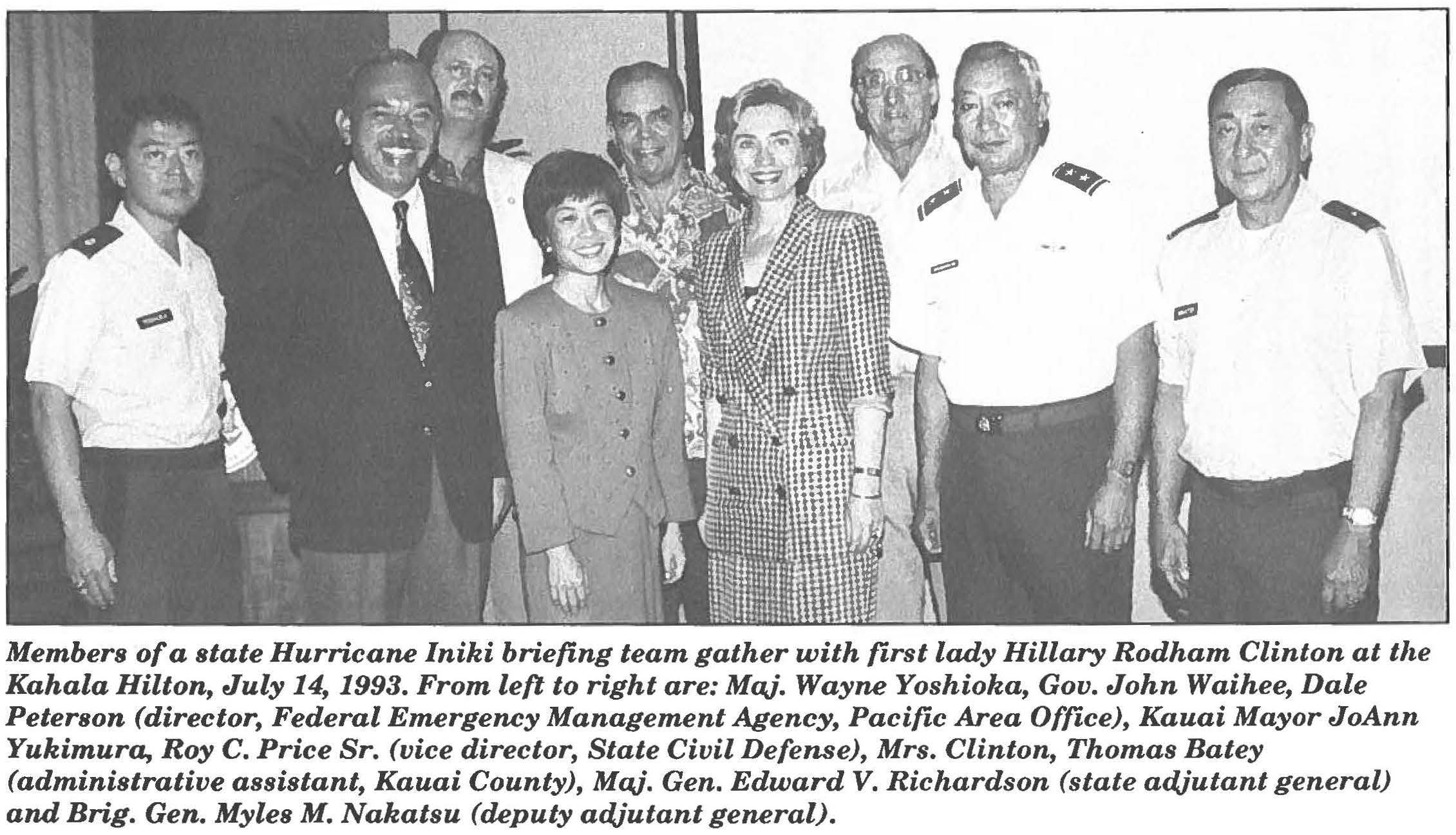
First lady Hillary Rodham Clinton met with Gov. John Waihee, Kauai Mayor JoAnn Yukimura and members of the state Department of Defense to discuss the state’s Hurricane lniki recovery efforts at the Kabala Hilton, July 14.
Members of a state Hurricane Iniki briefing team gather with first lady Hillary Rodham Clinton at the Kahala Hilton, July 14, 1993. From left to right are: Maj. Wayne Yoshioka, Gov. John Waihee, Dale Peterson (director, Federal Emergency Management Agency, Pacific Area Office), Kauai Mayor JoAnn Yukimura, Roy C. Price Sr. (vice director, State Civil Defense), Mrs. Clinton, Thomas Batey (administrative assistant, Kauai County), Maj. Gen. Edward V. Richardson (state adjutant general) and Brig. Gen. Myles M. Nakatsu (deputy adjutant general).(Picture from the 1993 July-August Pupukahi)
Maj. Gen. Edward V. Richardson, state adjutant general, led the discussion.
After Mrs. Clinton was briefed on the joint efforts of the state, county and federal governments immediately following Hurricane Iniki, Roy Price, vice director of State Civil Defense, outlined the current state of Kauai’s recovery. Mayor Yukimura then covered conditions and concerns from the county’s perspective.
During a press conference at the Hyatt Regency on Kauai later that day, Mrs. Clinton called Operation Iniki “the most remarkable and efficient response effort to a disaster that we have had in our country,” and congratulated Richardson and everyone who worked with him.
”I believe it will become a model on how the federal and county governments should work together,” Mrs. Clinton said.
Iniki losses top $2 billion, recovery ongoing. In January 1994, total losses from 1992’s Hurricane lniki topped the $2 billion dollar mark, and by June, had edged near $2.2 billion. Hawaii insurers bore the brunt of those costs, however, with over $1.5 million in claims paid out on property damage. Insurance figures represent roughly 71 percent of all losses attributable to the storm. By mid-year, an estimated 92 percent of all private insurance claims had been settled.
Damage to government facilities and private nonprofit agencies was also heavy, totalling over $140 million. Some 2,169 repair projects are currently underway for 109 state and county agencies statewide. Currently, 489 projects are ready for closeout and another 1,182 are in various stages of completion. An additional 498 projects are awaiting insurance settlement. Fifty-nine private nonprofit agencies have received an estimated $1.6 million for repairs.
As the office of record for all major disasters, SCD is currently engaged in the monitoring, inspection and audit process for long-term repair projects. Ongoing repair for damages resulting from Hawaii’s most devastating storm will take years to complete. A special recovery branch has been in place since early 1993 to manage in-progress repair work.
In the nearly two years since Hurricane Iniki, long-term recovery is taking shape. For the island of Kauai, with an economy traditionally tied to tourism, the road to economic recovery hinges on the reopening of hotels and resort properties. Until the island’s major employer is once again in full swing, the Garden Island will continue to feel residual effects of the tourism downturn. Long-term development projects to help diversify the county’s economy and bring needed new jobs will help ease the reliance on a vulnerable tourist market. Coupled with economic diversification efforts, development projects to ease Kauai’s tight housing and rental market will also contribute to gaining a firm foothold on a brighter future.
With a record $2.6 billion dollars in damages, the cleanup after Hurricane Iniki has been an enormous task. Residential losses totaled over $1.5 billion dollars, and to date, over 96 percent of residential insurance claims have been paid out. One hundred and nine state and county facilities and private nonprofit agencies also sustained an estimated $150 million in damages. As the office of record, State Civil Defense is currently working on 2,226 public repair projects currently in various stages of completion. A special Recovery Branch has been in place since early 1993 to manage in-progress repair work, as well as project monitoring, inspections, and auditing.
In the three years since Hawaii’s largest natural disaster, the outward damaging effects of Hurricane Iniki are increasingly less apparent. Residential repair and reconstruction have made significant progress on Kaua’i, as have new housing starts for moderate income projects. The early construction boom has subsided now, and the Garden Isle has turned to focus on its economy. Retailers and visitor services continue to struggle with a sluggish economy. With the shutdown of plantations around the state, Kaua’i is looking to restructure its agricultural landscape.
Diversified agriculture, development of new businesses and technology, as well as new visitor industry strategies, will be needed to sustain growth in the future. Kauai is not alone in this outlook. With the imminent demise of sugar and pineapple, as well as the plantation lifestyle, Hawaii must turn to products and services which will enhance longterm growth rates.
The special recovery staff assembled in early 1993 to oversee public repair projects continues the job of managing current repair work, as well as project closeouts. The staff has worked on over 2,200 repair projects, the result of an estimated $150 million in damages to government property and private nonprofit agencies. Project monitoring, inspection, and audits will most likely continue into the year 2000. Hurricane Iniki was Hawaii’s worst disaster, with damages topping $2.6 billion. This Hawaiian storm is listed with Hurricanes Andrew, Hugo, Alicia, and Camille as the worst hurricanes to strike the United States in the twentieth century.
Hurricane Iniki recovery goes on. With over $2.2 billion in damages, Hurricane Iniki was Hawaii’s most costly disaster. The federal government provided $584 million in various disaster assistance programs, and state funds totaled $35.2 million in direct and indirect aid. Volunteer organizations and local businesses contributed over $38 million in donated goods and services, as well as funds. Insurance settlements exceeded $1.6 billion. FEMA recovery programs have granted over $143 million in assistance to state and county agencies, $100 million of which has gone to the County of Kauai. State Civil Defense is currently processing $13 .5 million in additional state and county requests for assistance. A total of $8.8 million has been disbursed to 63 private nonprofit agencies, with $2.2 million in the course of processing. As the office of record for the disaster, State Civil Defense continues the inspection, audit and closeout on repair projects. Many of the more than 2,000 repair projects have been completed.
Recovery operations set to wind down. Since September 1992, State Civil Defense has been actively involved in recovery operations in the wake of Hurricane Iniki. After causing over $2.2 billion in damages, repair work has been protracted due to the number of projects. Over 2,000 repair projects have been completed in the six years since the hurricane, with most of the work focused on Kauai. Final closeout was scheduled to occur in the final quarter of 1998. Federal agencies provided $584 million in disaster assistance programs, with the State providing $35.2 million in direct and indirect aid. Donated goods, services and funding came from private nonprofit agencies and local businesses. Insurance settlements exceeded a record $1.6 billion.
FEMA recovery programs have granted over $141 million in assistance to state and county agencies, with $106 million going to Kauai. By mid-year, State Civil Defense was processing an additional $10 million in state and county agency funding requests. A total of $8.1 million in recovery funding was disbursed to private nonprofit agencies, with an additional $2.1 million in process mid-year. Hurricane Iniki remains the largest natural disaster to strike Hawaii and one of the strongest hurricanes on record in the U.S.