Do you need help in another language? We will get you a free interpreter. Call 808-369-3580 to tell us which language you speak.
您需要其它語言嗎?如有需要,請致電 (808-369-3478), 我們會提供免費翻譯服務
您需要其它语言吗?如有需要,请致电 (808-369-3478), 我们会提供免费翻译服务
En mi niit alilis lon pwal eu kapas? Sipwe angei emon chon chiaku ngonuk ese kamo. Kokori (808-369-3478) omw kopwe ureni kich meni kapas ka ani.
Makemake `oe i kokua i pili kekahi `olelo o na `aina `e? Makemake la maua i ki`i `oe mea unuhi manuahi. E kelepona (808-369-3478)`oe ia la kaua a e ha`ina `oe ia la maua mea `olelo o na `aina `e.
Masapulyo kadi ti tulong iti sabali a pagsasao? Ikkandakayo iti libre nga paraipatarus. Awaganyo ti
(808-369-3478) tapno ibagayo kadakami no ania ti pagsasao nga ar-aramatenyo.
다른언어로 도움이 필요하십니까? 저희가 무료로 통역을 제공합니다. (808-369-3478)로 전화해서 사용하는 언어를 알려주십시요
Kwoj aikuij ke jiban kin juon bar kajin? Kim naj lewaj juon am dri ukok eo ejjelok wonen. Kirtok
(808-369-3478) im kwalok non kim kajin ta eo kwo melele im kenono kake.
E te mana'o mia se fesosoani i se isi gagana? Matou te fesosoani e ave atu fua se faaliliu upu mo oe. Vili mai i le numera lea (808-369-3478) pea e mana'o mia se fesosoani mo se faaliliu upu.
¿Necesita ayuda en otro idioma? Nosotros le ayudaremos a conseguir un intérprete gratuito. Llame al (808-369-3478) y diganos que idioma habla.
Kailangan ba ninyo ng tulong sa ibang lengguwahe? Ikukuha namin kayo ng libreng tagasalin. Tumawag sa (808-369-3478) para sabihin kung anong lengguwahe ang nais ninyong gamitin.
‘Okú ke fie maʻu tokoni ʻi ha lea fakafonua ʻe taha? Temau kumi haʻo taha fakatonulea taʻetotongi. Telefoni ki he (808-369-3478) ke fakahā mai ʻa e lea fakafonua ʻokú ke lea aí.
Bạn có cần giúp đỡ bằng ngôn ngữ khác không ? Chúng tôi se yêu cầu một người thông dịch viên miễn phí cho bạn. Gọi (808-369-3478)nói cho chúng tôi biết bạn dùng ngôn ngữ nào
Gakinahanglan ka ba ug tabang sa imong pinulongan? Amo kang mahatagan ug libre nga maghuhubad. Tawag sa (808-369-3478) aron magpahibalo kung unsa ang imong sinulti-han.
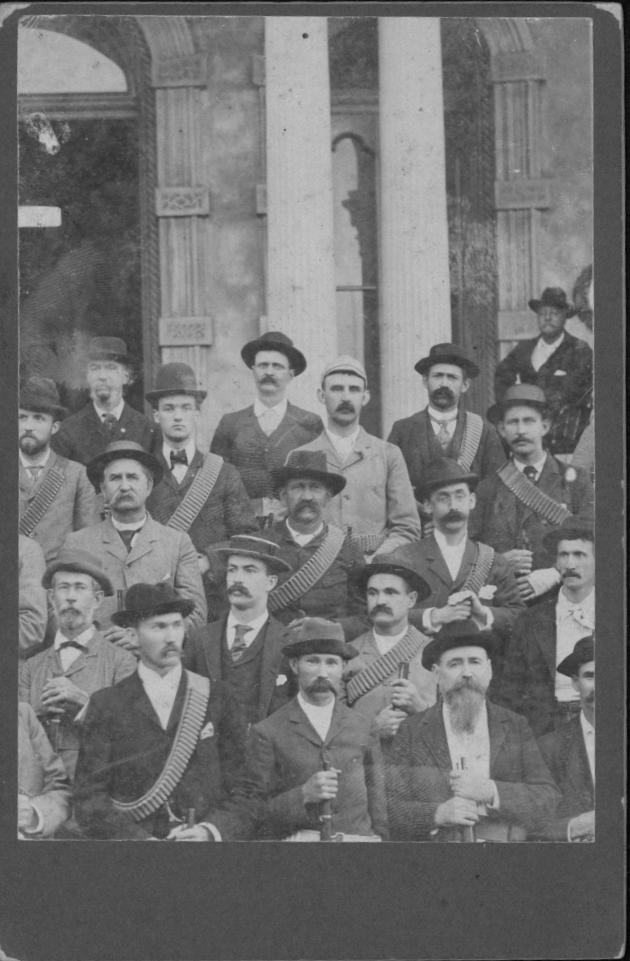
1895. Citizens’ GuardCITIZENS GUARD – Officers of the Citizen’s Guard. Reading from left to right -Standing – Hugh Gunn and Geo. W. Smith. Sitting – Andrew Brown Citizens’ Guard (Schultzen Club)CITIZENS GUARD – Sharp Shooters. Left to right- Lieut. Henry Waterhouse and Frank S. Dodge. Sitting – Capt. John KidwellCitizens Guard Citizens Guard CITIZENS GUARD – Members of the Thomas Square Squad #4, Sgt. Charles M. Cooke in command. See Paradise of the Pacific July 1927 p. 111895. First Co. Sharpshooters Citizens Guard. Capt. John Kidwell in command1895. Citizens’ Guard – In front of Iolani Barracks. Capt. Good in command(Pictures from the Hawaiʻi State Archives)
There is another military organization that deserves mention at this time. This was the Citizens’ Guard. It was not organized as were the volunteer companies of the National Guard, but was composed of some ten squads located all over the Island of Oahu. Each squad contained about fifty men known to be loyal to the Provisional Government. The Citizens’ Guard was not required to drill, or in any way obligate itself in time of peace. In time of rebellion or invasion, however, it agreed to take over guard duty and patrol the streets, so that the National Guard might be allowed a free hand in its military operations.
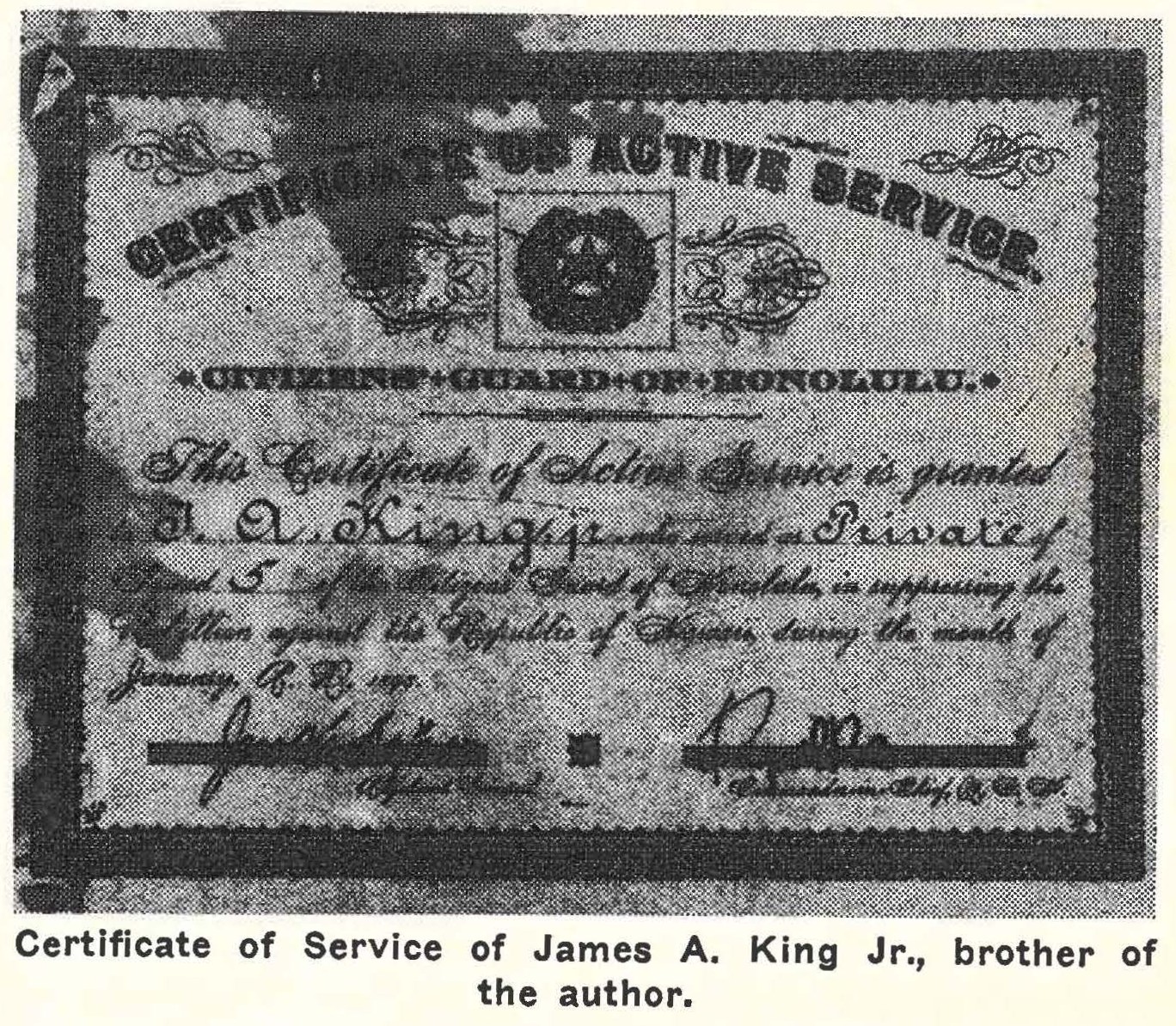
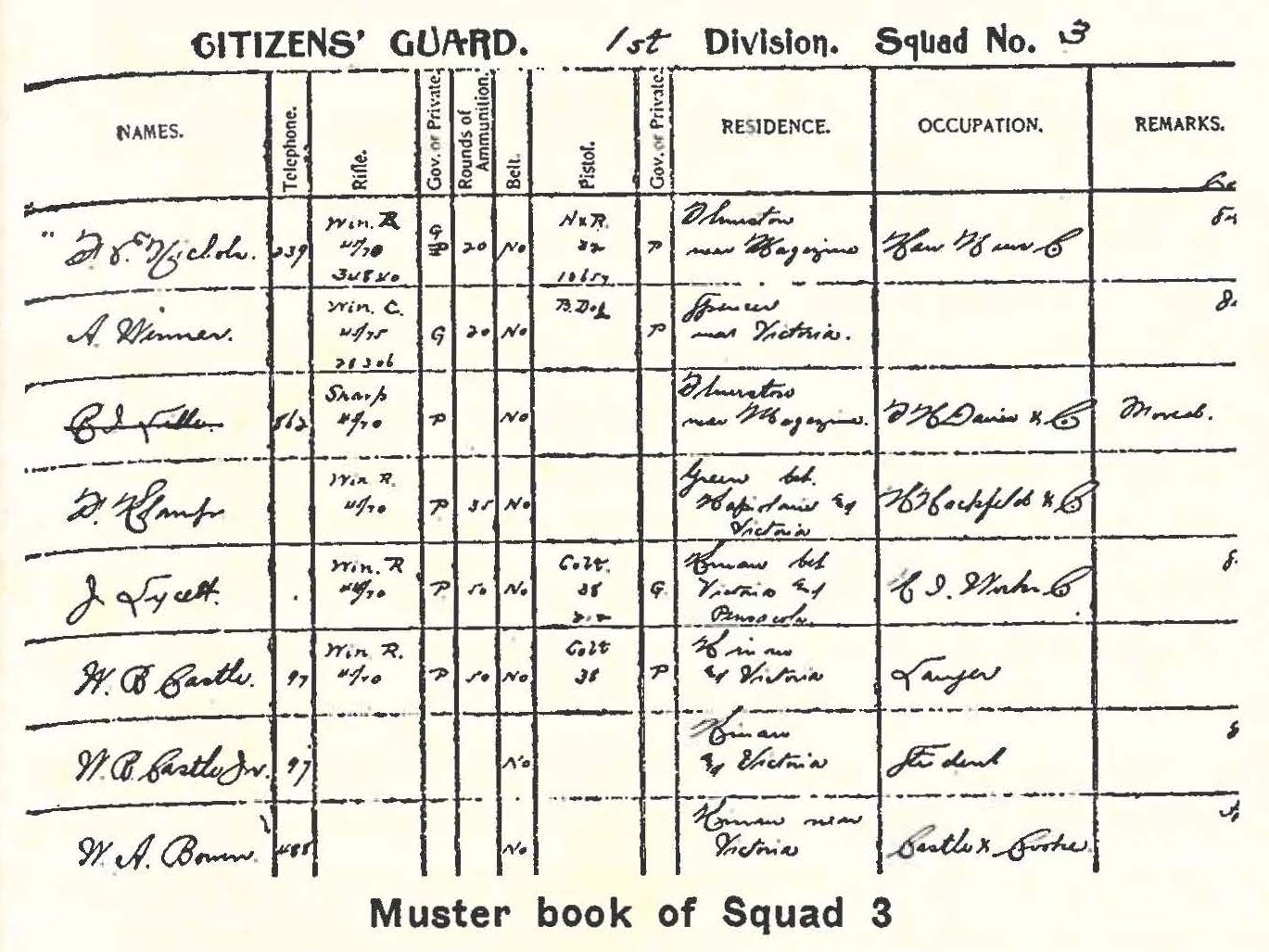
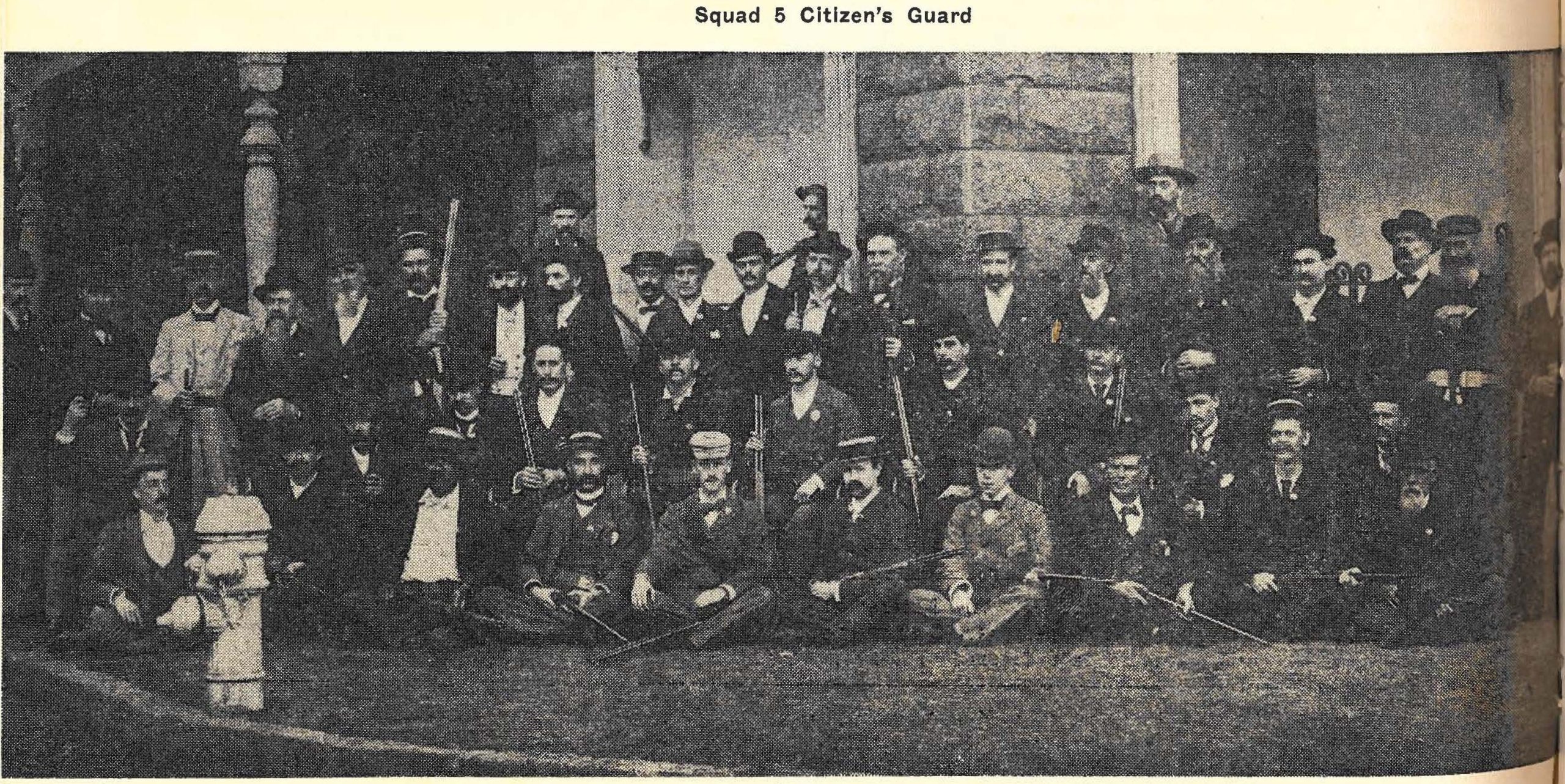
Certificate of Service of James A. King Jr., brother of the authorMuster book of Squad 3Squad 5 Citizen’s Guard (Pictures from the 1953 November Hawaii Guardsman)
Not long after the overthrow of the monarchy in January 1893, President Dole, other high officials of the Provisional Government of Hawaii, the Annexation Club, and influential members of the community considered the advisability of organizing a citizens’ guard for the protection of the new government, for either defense or attack. The Annexation Club, organized at that time for the purpose of ascertaining the strength of the annexation movement throughout the islands, seems to have been the motivating power behind the proposed civilian volunteer organization.
Frank B. McStocker, chairman of the executive committee of the Annexation Club, was given the duty of formulating a plan of procedure. He, after consultation with Judge A. S. Hartwell, George C. Stratemeyer, T. B. Murray, and others, decided upon the name, “Citizens’ Guard.” Judge Hartwell, chosen to command the Guard, was suddenly called away from the Islands on business, and resigned in favor of Mr. McStocker. The latter met with ready response, and the Citizens’ Guard was soon ready for active service. Sergeants were appointed from among the members who had acted most zealously in the formation and enrollment of their respective squads. All members of the Guard were required to take an oath to support the Government.
The Citizens’ Guard was not called into active service until the Rebellion of January 1895, when the adherents of ex-Queen Liliuokalani attempted to restore her to the throne and re-establish the monarchy. During this brief conflict, the Guard, originally consisting of 390 men in nine squads, was increased by new enrollments to sixteen squads of nearly 600 men. Each member held a Special Police Constable’s Commission, issued by E. G. Hitchcock, Marshal of the Republic, and was approved by W. O. Smith, the Attorney-General of the Republic. The membership was drawn from all classes of people in Honolulu: department heads of the Government as well as office employees; executives of large and small businesses, their office personnel, and others. They received no pay for their services, furnished their own arms and ammunition in most cases, and wore no uniforms.
The Citizens’ Guard had a simple organization, without any high-ranking officers. F. B. McStocker, then the Deputy Collector of Customs at Honolulu, was the captain commanding the Guard. George P. Castle of Castle & Cooke held the rank of First Lieutenant; C. B. Ripley, a practicing architect, was the Second Lieutenant; Dr. C. B. Wood, a well-known physician, held the rank of Third Lieutenant. George C. Stratemeyer, Port Surveyor of Honolulu, and R. C. A. (Bert) Peterson, a business agent, were the orderlies. These few men comprised the staff in command of some six hundred men.
There were fourteen squads in Honolulu proper, and their principal duty was the patrolling of the residential sections of town. They averaged about fifty members each, and each squad was commanded by a sergeant with two or more corporals under him to command the details sent out on picket duty. The squads were neighborhood groups, each taking in a few adjoining residence blocks. Individual members of a squad were thus neighbors, and the sergeant who kept the enrollment book of his squad knew all the men in his squad. Besides listing the home and business address of the members, the sergeant’s book recorded the personal arms equipment of each man, including the type of rifle or pistol, the serial number, and the number of rounds of ammunition. All members were familiar with the use of firearms, and were well drilled in their duties as patrols on picket duty.
Many of these Guard members had had previous military experience — some in the Honolulu Rifles, which put down the Wilcox revolution in 1889; others had served in National Guard units in the States, and still others were veterans of the Civil War. Frank McStocker, captain in command of the Citizens’ Guard, had served as a member of Company B, Third Regiment of the National Guard of Pennsylvania, prior to coming to Honolulu to live. William C. Wilder, a member of Squad Two, had served in the First Illinois Cavalry in the Civil War, and J. T. Copeland, 1st Corporal of Squad Eleven, served in the Ninth Indiana during the Civil War. Judge A. S. Hartwell, who preceded McStocker in command of the Citizens’ Guard, had served with the 55th Massachusetts in the Union Army.
In March 1895, Edward A. Towse, editor of The Hawaiian Star, published a history of the rebellion, in which he gave a complete roster of all members of the National Guard, the Citizens’ Guard, and the Sharpshooters Company. Mr. Towse served in the rebellion as staff sergeant major of the National Guard. From this roster the writer was able to list some of the men enrolled in the Citizens’ Guard.
Squad One was led by B. F. Dillingham, sergeant, and the members were men well-known in the business section of Honolulu—merchants, attorneys, surveyors. Mr. Dillingham was the manager of the Oahu Railway & Land Co., which he had promoted in the late 1880s.
Squad Two was one of the neighborhood squads, most of the members of which lived along Lunalilo and Pensacola Streets and in the nearby vicinity. J. C. Lorenzen, the sergeant in command, was a Honolulu Harbor pilot.
Squad Three lay to the west of Squad Two, and embraced the residential blocks from Green Street makai to Kinau Street, and from Ernest Street on the east to Hackfeld Street westward. F. J. Lowrey, commanding this squad, was a member of the firm of Lewers & Cooke, and after its incorporation, served as its president for many years. Other members were T. F. Lansing, who was the treasurer of the Annexation Club; H. F. Wichman, head of the jewelry firm bearing his name; W. A. Bowen, an officer of Castle & Cooke; C. A. Kibling, the purser of S.S. Kinau of the Wilder S.S. Co.; and W. R. Castle, a prominent attorney.
Squad Four was known as the Thomas Square squad, and its membership was drawn from residents living along Beretania and King Streets and adjoining streets as far west as Punchbowl Street. C. M. Cooke, commander of this squad, was a partner in the firm of Lewers & Cooke, and was the proud possessor of a “Winchester 73,” a famous repeating rifle put out by the Winchester Arms Co. in 1873. Of .30 caliber, with a 20-inch barrel, this remarkable firearm was considered far superior to any other rifle in use at that time.
Squad Five was known as the Masonic Temple squad, and lay to the westward of Squad Four. It had a total enrollment of sixty-six men drawn from Beretania, Emma, Hotel, Alakea and adjoining streets. Among its members were listed E. F. Cameron, skipper of the S.S. Claudine of the Wilder S.S. Co.; C. V. E. Dove, a government surveyor; D. Howard Hitchcock, the artist; James A. King, and his son James, Jr.; M. Douglas Monsarrat, a surveyor; James F. Morgan, auctioneer; W. M. Pomeroy, a marine engineer; W. A. Whiting, a Circuit Court judge; and Harry Wooten, a steam engineer.
Similar squads were organized among the residents of Fort and Nuuanu Streets above Beretania Street.
Squads Six, Seven and Eight fell within this area. Six was commanded by T. B. Murray. W. H. Hoogs commanded Squad Seven, and Squad Eight was in charge of J. V. Simonson. Squad Nine was one of the larger squads, and included among its membership residents of Nuuanu Valley living mauka of School Street. Squads Eleven, Twelve, Thirteen and Fourteen covered the area along Liliha Street and westward.
Squad Fifteen, known as the Koolau squad, was based at Kaneohe, and had an enrollment of 43 members. It was in command of William Henry, and one of its well-known members was Henry Cobb Adams. Both of these men were long-time residents of Kaneohe, and their names appear today on roads in the Kaneohe area.
Squad Sixteen, known as the Ewa squad, was based at Ewa, and had an enrollment of 37 members, drawn from the plantation and surrounding countryside. W. J. Lowrie, manager of Ewa Plantation Company, commanded this squad.
In 1895 Honolulu had a population of about 25,000, and the residential section in general ended at the foothills, with some homes extending into the lower part of the valleys, excepting in the case of Nuuanu Valley, which was pretty well built up with homes. Pauoa, Manoa and Palolo Valleys had very few inhabitants. With the exception of the Tantalus area, which had a number of summer homes reached by a narrow dirt road, the heights back of Honolulu were undeveloped in 1895. A good many people lived in the Waikiki area permanently, while others maintained summer homes along the beach opposite Kapiolani Park. The development of Kaimuki as a residence and business area was not commenced until about 1900.
During the rebellion, actual fighting began about five o’clock Sunday afternoon, January 6, 1895, at the Bertelmann home, which was located on the shore below Diamond Head. Marshal Hitchcock had learned that a considerable force of Royalists was congregating there. The Marshal sent his Deputy, A. M. Brown, and a senior police captain, Robert W. Parker, accompanied by a small detachment of policemen, with a search warrant. While Brown was reading the warrant to Mr. Bertelmann, the Royalists began firing on the police, and fighting soon became general. Attracted by the firing, James B. Castle, A. L. C. (Jack) Atkinson, Charles L. Carter, and his cousin Alfred W. Carter, all of whom were at Waikiki not far from the Bertelmann home, armed themselves with rifles, and joined in the fighting. Two policemen and Charles L. Carter were wounded in this short engagement. As a result of his wounds, Mr. Carter died at 5:30 the next morning. He was a member of Squad One of the Citizens’ Guard and was the only man to lose his life of the more than twelve hundred men enrolled in the government’s armed forces during the rebellion. His death saddened the entire community. The small police detachment was quickly surrounded by the more numerous forces of the Royalists, and was forced to retreat into the house for protection. Deputy Brown managed to escape, and later that evening the rest of the group were rescued by troops from Co. E, National Guard of Hawaii. On the next day, a larger force of National Guard troops engaged 150 Royalists in a pitched battle on the slopes of Diamond Head. By nightfall of the 7th the Royalists were defeated and fled mauka.
Besides patrolling the residential sections throughout Honolulu, the Citizens’ Guard acted in close cooperation with the National Guard, which was kept in the field until the rebellion was completely suppressed. During the course of another major battle in and near Moiliili, Squad Six under Sergeant T. B. Murray, assigned to patrol Waialae Road, encountered the forces of Samuel Nowlein, a Royalist leader, beyond Moiliili attempting to reach Palolo. Company F under Captain Ziegler was sent out with a field piece. The Royalists entrenched themselves in a small crater, but were driven out by Captain Ziegler’s company. In this engagement Lieut. Ludewig of Company F was wounded. Thirty-three Royalist prisoners were taken, seven others surrendered later, and three were reported killed.
The Royalists were soon driven into the hills back of Honolulu, where detachments of the government forces were sent to round them up, in order that none of them could escape to other parts of the island. All of the passes leading out of the mountains were guarded. Besides keeping sentries at its town positions, the Citizens’ Guard posted a double line of pickets in Nuuanu Valley as far up as the Pali. The Ewa Squad under W. J. Lowrie was sent into the Waianae Mountains, while the Koolau Squad under William Henry scoured the countryside around Kaneohe. A picked squad of Citizens’ Guardsmen under Cecil Brown were sent to guard the passes back of Waimanalo. This detail, which made camp in the hills, had among its members Alfred Carter, C. D. Chase, C. P. Iaukea, Sen. W. H. Rice and D. Howard Hitchcock. The government was determined that none of the Royalists should escape arrest. By 14 January nearly all of the Royalist rebels who had scattered to various hiding places had been captured, and the rebellion was over. The Citizens’ Guard had performed valuable services in support of the National Guard troops who bore the brunt of the fighting.
On January 25, 1895, the following communication was sent to the President of the Republic of Hawaii. This was set forth in resolutions unanimously adopted by Squad One of the Citizens’ Guard, at a meeting held on that day at the residence of Mr. B. F. Dillingham:
“To Sanford B. Dole, President of the Republic of Hawaii:
Dear Sir,
We the undersigned members of the Citizens’ Guard, hereby express our entire confidence in your wisdom and good judgment under the trying circumstances of the present situation.
We desire you to understand that we are in hearty accord with you in your determination to preserve the Republic from any possible renewal of rebellion, by dealing out impartial justice; and
We pledge to you, in the future as in the past, our unwavering support of the course which you shall deem best for the interests of this Republic.”
When these resolutions were adopted, the rebellion had been suppressed, and all Royalist participants were under arrest.
The pages of this phase of Hawaii’s history have long since been turned, but it might be well for us to remember that the men of the Citizens’ Guard were ready and willing to bear arms to protect the integrity of the Republic of Hawaii, though many of them were well past middle life. These same men labored untiringly until annexation to the United States became an accomplished fact, and today their sons and their sons’ sons are working with the same singleness of purpose towards Hawaii’s ultimate goal as a full-fledged member of the Union of States.