Do you need help in another language? We will get you a free interpreter. Call 808-369-3580 to tell us which language you speak.
您需要其它語言嗎?如有需要,請致電 (808-369-3478), 我們會提供免費翻譯服務
您需要其它语言吗?如有需要,请致电 (808-369-3478), 我们会提供免费翻译服务
En mi niit alilis lon pwal eu kapas? Sipwe angei emon chon chiaku ngonuk ese kamo. Kokori (808-369-3478) omw kopwe ureni kich meni kapas ka ani.
Makemake `oe i kokua i pili kekahi `olelo o na `aina `e? Makemake la maua i ki`i `oe mea unuhi manuahi. E kelepona (808-369-3478)`oe ia la kaua a e ha`ina `oe ia la maua mea `olelo o na `aina `e.
Masapulyo kadi ti tulong iti sabali a pagsasao? Ikkandakayo iti libre nga paraipatarus. Awaganyo ti
(808-369-3478) tapno ibagayo kadakami no ania ti pagsasao nga ar-aramatenyo.
다른언어로 도움이 필요하십니까? 저희가 무료로 통역을 제공합니다. (808-369-3478)로 전화해서 사용하는 언어를 알려주십시요
Kwoj aikuij ke jiban kin juon bar kajin? Kim naj lewaj juon am dri ukok eo ejjelok wonen. Kirtok
(808-369-3478) im kwalok non kim kajin ta eo kwo melele im kenono kake.
E te mana'o mia se fesosoani i se isi gagana? Matou te fesosoani e ave atu fua se faaliliu upu mo oe. Vili mai i le numera lea (808-369-3478) pea e mana'o mia se fesosoani mo se faaliliu upu.
¿Necesita ayuda en otro idioma? Nosotros le ayudaremos a conseguir un intérprete gratuito. Llame al (808-369-3478) y diganos que idioma habla.
Kailangan ba ninyo ng tulong sa ibang lengguwahe? Ikukuha namin kayo ng libreng tagasalin. Tumawag sa (808-369-3478) para sabihin kung anong lengguwahe ang nais ninyong gamitin.
‘Okú ke fie maʻu tokoni ʻi ha lea fakafonua ʻe taha? Temau kumi haʻo taha fakatonulea taʻetotongi. Telefoni ki he (808-369-3478) ke fakahā mai ʻa e lea fakafonua ʻokú ke lea aí.
Bạn có cần giúp đỡ bằng ngôn ngữ khác không ? Chúng tôi se yêu cầu một người thông dịch viên miễn phí cho bạn. Gọi (808-369-3478)nói cho chúng tôi biết bạn dùng ngôn ngữ nào
Gakinahanglan ka ba ug tabang sa imong pinulongan? Amo kang mahatagan ug libre nga maghuhubad. Tawag sa (808-369-3478) aron magpahibalo kung unsa ang imong sinulti-han.
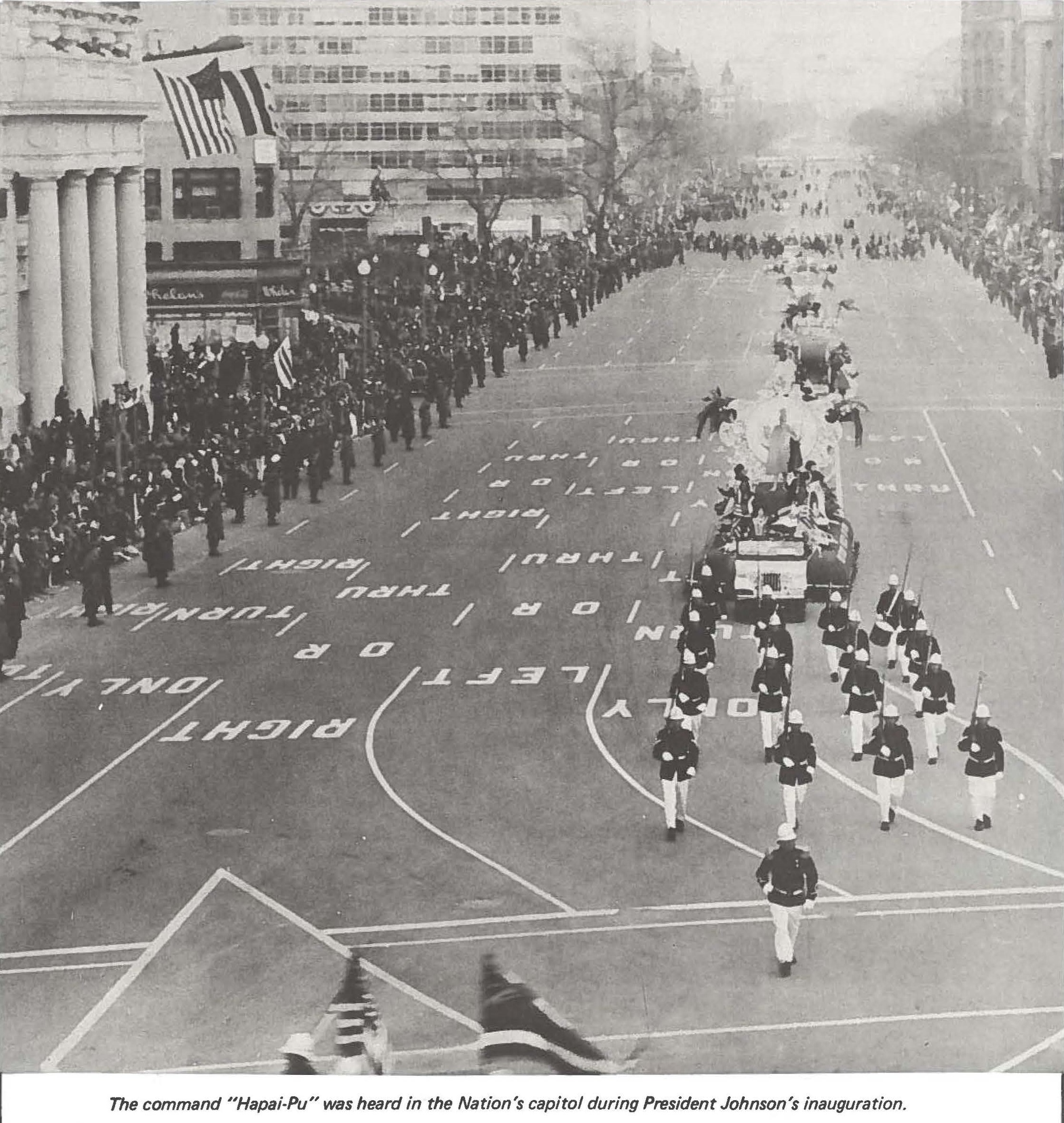
The command “Hapai-Pu” was heard in the Nation’s capitol during President Johnson’s inauguration. (Picture from the 1971 Fall The Hawaii Guardsman)
‘We Paraded for President Johnson
By SMSGT THEODORE D. HUSSEY
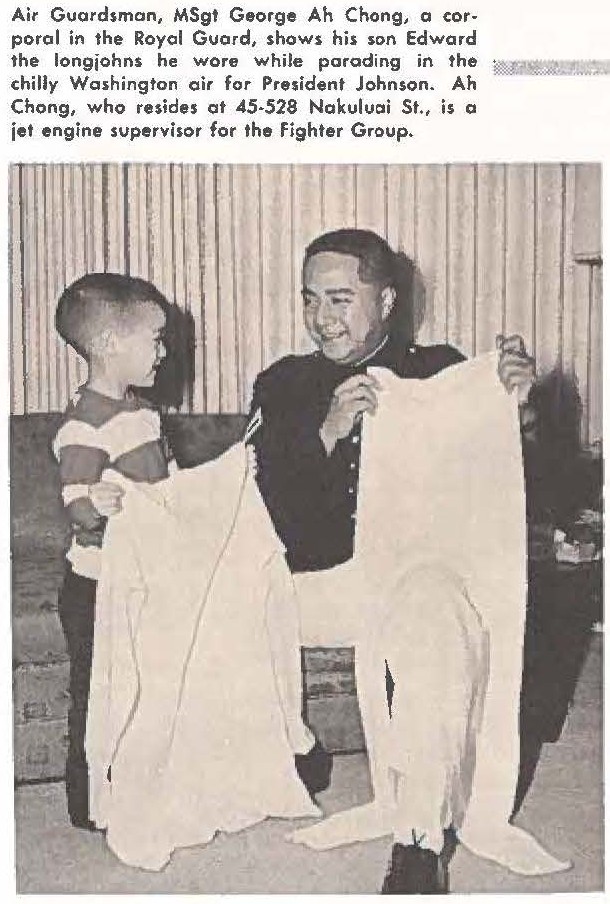
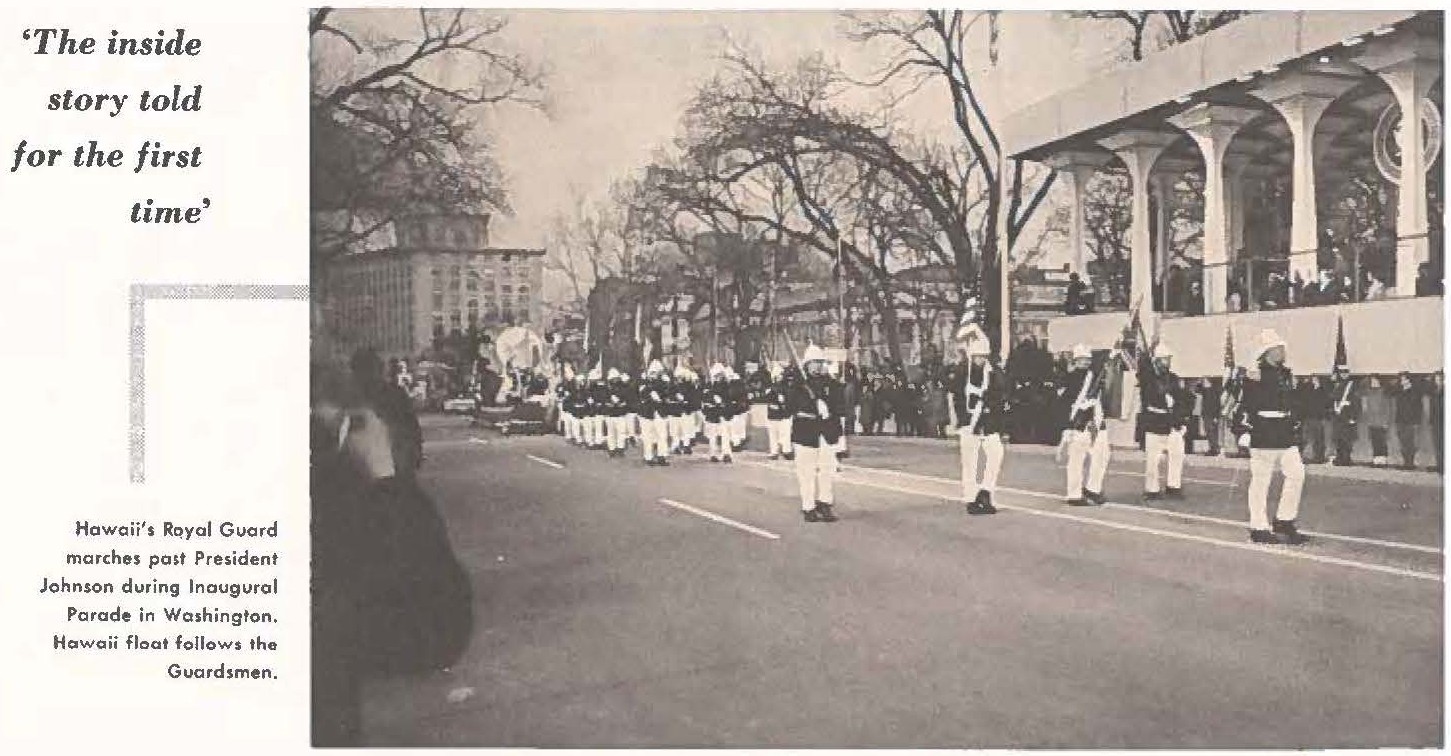
Air Guardsman, MSgt George Ah Chong, a corporal in the Royal Guard, shows his son Edward the longjohns he wore while parading in the chilly Washington air for President Johnson. Ah Chong, who resides at 45-528 Nakuluai St., is a jet engine supervisor for the Fighter Group.We paraded for Johnson Hawaii’s Royal Guard marches past President Johnson during Inaugural Parade in Washington. Hawaii float follows the Guardsmen. (Pictures from the 1965 March The Hawaii Guardsman)
The “main body” of the Royal Guard left Hickam on a MATS flight Sunday morning the 17th of January 1965 on our way to represent the State of Hawaii in the Washington, D. C. Inaugural Parade in honor of President Lyndon B. Johnson. It seemed odd to he wearing the Air Force blue blouse and carrying an overcoat in sunny Hawaii, hut we knew we would welcome them shortly. Departure was on schedule, the flight was 10 hours, and as Travis AFB was “socked in” with fog, we landed at San Francisco International Airport. Air Force buses came for us and it was midnight when we finally arrived at Travis and found those who had preceded us on four other flights waiting for us at the MATS Terminal. It seemed silly to draw bedding for just a few hours, so we all hung around the Terminal, had a long breakfast, and a cribbage tournament.
When the crew of the California Air National Guard C-97 came to the Terminal, we were Ready, hoarded the plane at 0600, and waited for 2½ hours until the weather cleared (300 foot ceiling) so we could take off. During the comfortable 10 hours flight we practiced singing Hawaiian songs, then some played cards or read, the remainder dozed off for some much needed rest. Looking out the windows of the aircraft we could see our country covered with a mantle of snow which brilliantly reflected the sun. The Air Guard really helped make this trip possible; on our return trip to Travis we flew in a New York ANG C-97.
When we arrived at Andrews AFB, we were met by Mr. Orvin Nelson, President of the Hawaii State Society of Washington, D. C., and others. We went to the Crystal House, a centrally located apartment house in Arlington, where we met and dispersed with the different families who were kind enough to take us into their homes for our stay in Washington. Some were relatives, some calabash relatives, others knew our families or vice versa, so we felt at home with these friendly people.
During our stay in Washington there was much sightseeing in our Nation’s Capital. We started off with a visit to Senator Hiram Fong’s office and then visited the Senate in session, We were surprised to see only about five Senators there, and guessed that the other Senators weren’t interested in what was being discussed or were in Committee meetings. One Senator was making a speech concerning the proposed closing of the Veterans Administration Hospital in Nebraska. When we were having lunch in the Senate Dining Room Senator Dan Inouye came over and talked to us.
We visited the Washington Memorial, Jefferson Memorial and the Lincoln Memorial. We really had the VIP treatment when we went to Arlington Cemetery. One of our hosts, Lt Colonel James L. Mylar, had arranged that we drive right in. The Colonel-in-Charge of Arlington escorted us to see the quarters below the Tomb of the Unknown Soldier where the guards stayed. It was spic and span. We were escorted on the VIP path past President Kennedy’s grave, which was most impressive. This special treatment really meant a lot to us.
I was most impressed by the Iwo Jima Memorial which is adjacent to the Arlington Cemetery. The famous picture of the Marines raising the United States flag during World War II has been reproduced as a statue. The tightness and tension that is seen as they struggle to force the staff into the ground brought out everything in that statue. You could see the gritting of teeth, the mud on their shoes, the great determination,
We also visited the White House which is really beautiful. Mrs. Kennedy must have spent hours and hours on the selection of colors, wall-paper, furniture, and artwork. They showed us the East Room where President Kennedy lay before being removed to the Rotunda. We also visited the Federal Bureau of Investigation, the Bureau of Engraving and Printing, Mount Vernon, the Smithsonian, etc.
One evening, the Hawaii State Society had a wonderful reception for mi, typical Hawaiian style. Off went the shoes, and everyone relaxed. Of course old Hawaiian songs were sung- there seemed to be almost a song competition between the Royal Guardsmen and the people from the Hawaii State Society. I think we won because we came up with a lot of prepared selections which we had practiced. We discovered talented hula dancers in our group that we had not known about before. One of the ladies and Herbert Panoke sang Ke Kali Nei Au, and I think all the members of the Hawaii State Society present were sorry they had left Hawaii.
Wednesday, the 20th of January 1965, was the BIG DAY. We assembled and changed into Royal Guard uniforms and rode a bus to the Staging Area with a police escort. We found that we would be the last marching unit of the Parade, as those following would he only represented by their Governors and Floats. We moved to the Assembly Area and waited there for two hours. It was cold, about 50° when we got there, and the temperature gradually dropped to 25 ‘ when we finally passed in review. We stayed warm in a nearby building until we formed up, and then we noticed the cold mostly in our feet- the long johns kept the rest of ourselves pretty warm, Once we got started, it was better.
The Parade Officials had me sign two affidavits that there was no ammunition in the rifles and that the bayonets would not be used for any other purpose than to remain on the rifles!
As we were some eight marching units away from the nearest hand, they allowed us to have a drum, which made our drummer, Lester Chambers, happy. We were to march at the standard 120 paces a minute, hut as the Parade had been delayed, we were rushed twice.
When we finally started, made our column left and entered the Parade, many of the throngs of spectators who must have been in Hawaii sometime or another kept yelling ALOHA, ALOHA, and kept it up continuously. We fell in behind our Governor, and the float, which the Hawaii State Society had made, followed behind us. When we gave the command Na Maka, Ma Ka Hema, Huli-eyes left- we all saw our President, who waved to us.
It made us all feel full of pride to march past our new President carrying the American and Hawaiian flags and representing the entire State of Hawaii. After the Parade Governor Burns stopped and congratulated us. We are in being to preserve and represent the image of Hawaii we are proud that we had the opportunity to do so on this important occasion.
The Royal Guard had even a greater honor on 20 January 1965. They were selected to represent Hawaii at President Lyndon B. Johnson’s Inaugural Parade in Washington, D. C. (The long march down Pennsylvania Avenue in 25° weather was made as comfortable as possible with concealed “long johns”). Arrangements were multi-source: air to and from west coast via MATS, to D.C. via California ANG C-97 and return by New York C-97, billetting in Washington courtesy of the Hawaii State Society.