Do you need help in another language? We will get you a free interpreter. Call 808-369-3580 to tell us which language you speak.
您需要其它語言嗎?如有需要,請致電 (808-369-3478), 我們會提供免費翻譯服務
您需要其它语言吗?如有需要,请致电 (808-369-3478), 我们会提供免费翻译服务
En mi niit alilis lon pwal eu kapas? Sipwe angei emon chon chiaku ngonuk ese kamo. Kokori (808-369-3478) omw kopwe ureni kich meni kapas ka ani.
Makemake `oe i kokua i pili kekahi `olelo o na `aina `e? Makemake la maua i ki`i `oe mea unuhi manuahi. E kelepona (808-369-3478)`oe ia la kaua a e ha`ina `oe ia la maua mea `olelo o na `aina `e.
Masapulyo kadi ti tulong iti sabali a pagsasao? Ikkandakayo iti libre nga paraipatarus. Awaganyo ti
(808-369-3478) tapno ibagayo kadakami no ania ti pagsasao nga ar-aramatenyo.
다른언어로 도움이 필요하십니까? 저희가 무료로 통역을 제공합니다. (808-369-3478)로 전화해서 사용하는 언어를 알려주십시요
Kwoj aikuij ke jiban kin juon bar kajin? Kim naj lewaj juon am dri ukok eo ejjelok wonen. Kirtok
(808-369-3478) im kwalok non kim kajin ta eo kwo melele im kenono kake.
E te mana'o mia se fesosoani i se isi gagana? Matou te fesosoani e ave atu fua se faaliliu upu mo oe. Vili mai i le numera lea (808-369-3478) pea e mana'o mia se fesosoani mo se faaliliu upu.
¿Necesita ayuda en otro idioma? Nosotros le ayudaremos a conseguir un intérprete gratuito. Llame al (808-369-3478) y diganos que idioma habla.
Kailangan ba ninyo ng tulong sa ibang lengguwahe? Ikukuha namin kayo ng libreng tagasalin. Tumawag sa (808-369-3478) para sabihin kung anong lengguwahe ang nais ninyong gamitin.
‘Okú ke fie maʻu tokoni ʻi ha lea fakafonua ʻe taha? Temau kumi haʻo taha fakatonulea taʻetotongi. Telefoni ki he (808-369-3478) ke fakahā mai ʻa e lea fakafonua ʻokú ke lea aí.
Bạn có cần giúp đỡ bằng ngôn ngữ khác không ? Chúng tôi se yêu cầu một người thông dịch viên miễn phí cho bạn. Gọi (808-369-3478)nói cho chúng tôi biết bạn dùng ngôn ngữ nào
Gakinahanglan ka ba ug tabang sa imong pinulongan? Amo kang mahatagan ug libre nga maghuhubad. Tawag sa (808-369-3478) aron magpahibalo kung unsa ang imong sinulti-han.
In the summer of 1942, 1406 enlisted men and 28 officers of Japanese ancestry were transferred from the Guard and organized into the 100th Battalion, later to become the Army’s most decorated unit.
Following the war, many of the former Guardsmen who went into the 100th Battalion and 442nd Infantry returned m the Guard. Others, who had not previously been members of the National Guard, became Guardsmen after the war. Among chem are Brigadier General Francis S. Takemoto, first Nisei to achieve this rank and now commanding general of the 29th Infantry Brigade, and Colonel Edward M. Yoshimasu, chief of staff of the Hawaii Army National Guard.
. . . In spring 1942, Guardsmen of Japanese descent were formed into a separate group that later became the 100th Infantry Battalion. The 299th Infantry was so depleted by this reorganization that the regiment was inactivated and its remaining members transferred to the 298th.
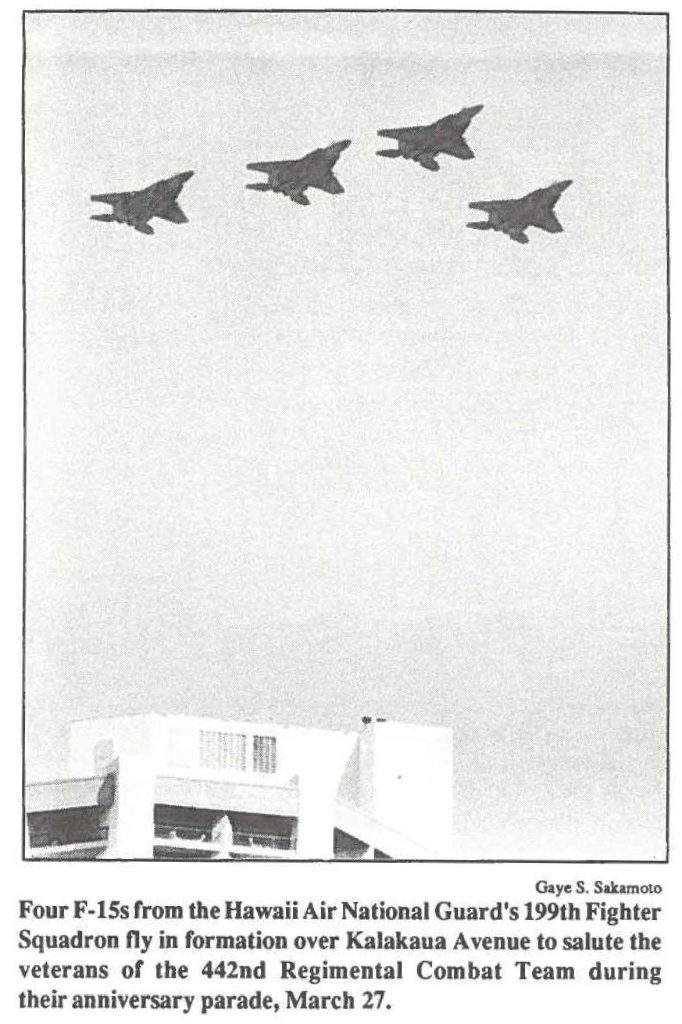
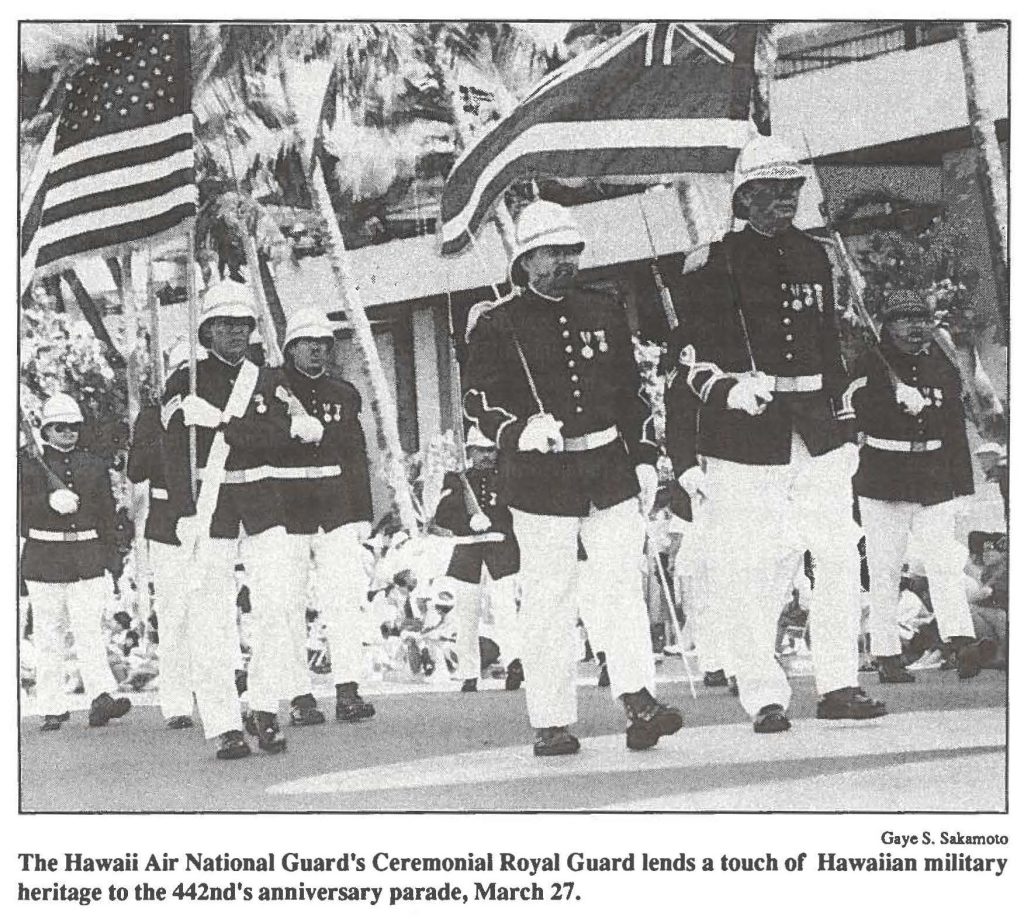
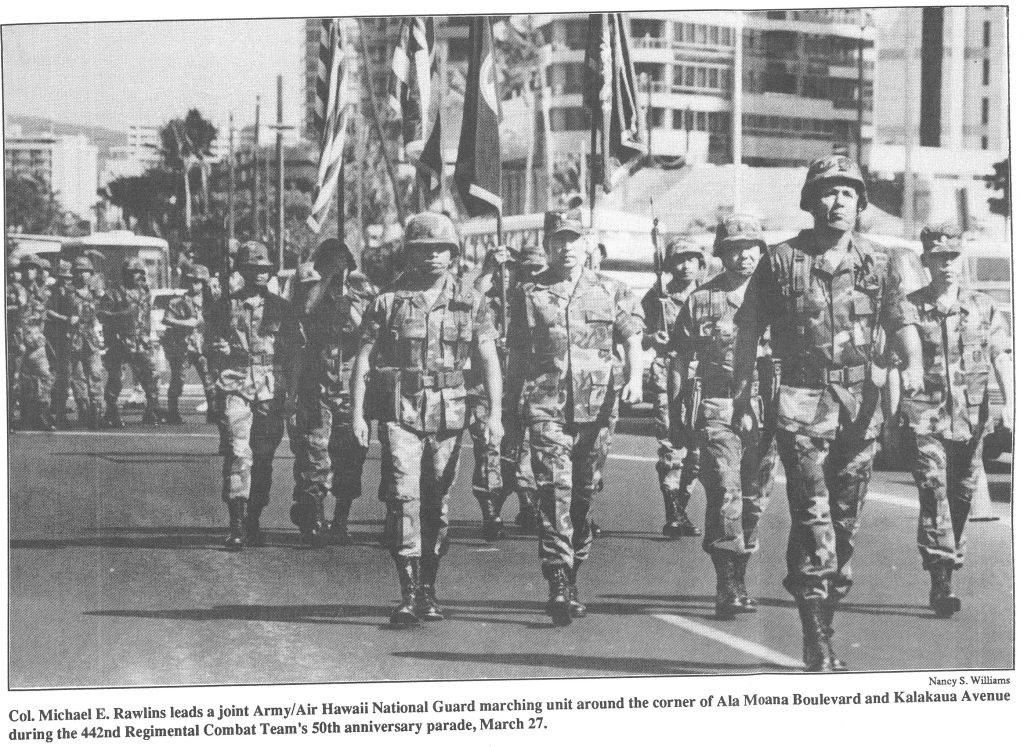
Four F-15s from the Hawaii Air National Guard’s 199th Fighter Squadron fly in formation over Kalakaua Avenue to salute the veterans or the 442nd Regimental Combat Team during their anniversary parade, March 27. The Hawaii Air National Guard’s Ceremonial Royal Guard lends a touch or Hawaiian military heritage to the 442nd’s anniversary parade, March 27. Col. Michael E. Rawlins leads a joint Army/ Air Hawaii National Guard marching unit around the corner of Ala Moana Boulevard and Kalakaua Avenue during the 442nd Regimental Combat Team’s 50th anniversary parade, March 27. Guard helps 442nd celebrate 50th anniversary page 4-5 (Pictures from the 1993 February – March Pūpūkahi)
The Hawaii National Guard helped honor the 100th battalion and the 442nd Regimental Combat Team by providing two marching units and an F-15 flyover for their 50th anniversary parade, March 27.
The Hawaii Air National Guard’s (HIANG) Ceremonial Royal Guard made a distinctive showing in their authentic uniforms recreated from the reign of King Kalakaua. Twenty members of the Royal Guard participated in the parade. Also representing the Hawaii National Guard was a combined Army/Air marching unit led by Col. Michael E. Rawlins. The combined unit included a joint staff and color guard, a 50-member Hawaii Army National Guard marching unit led by Lt. Col Vern T. Miyagi, and a 50-member Air Guard group led by Lt. Col. Michael J. Melich.
At 10:10 am. four F-15 fighters from the HIANG’s 199th Fighter Squadron swept over the procession in a thundering salute to the veterans below, many of whom had walked the entire route.
The 442nd Regimental Combat Team was created as an all-Japanese-American unit in March 1943, with 4,500 men — 3,000 from Hawaii. After training at Camp Shelby, Mississippi, it went on to join and absorb its predecessor, the 100th Battalion, on the Italian front
The 100th Battalion had been Conned the year before and was made up of Japanese-Americans who had been members of the Hawaii National Guard’s 298th and 299th regiments when the war began.
The442nd earned the everlasting gratitude and respect of many for its heroic efforts on the battlefield and elsewhere during and after World War II.
Aware that they were fighting for a higher ideal, these Japanese-Americans responded with honor rather than anger to a country that discriminated against them and confined their families in relocation camps.
On the battlefield, they fought with valor and heroism, proving their loyalty and becoming one of the most decorated units in United States Army history.
The 442nd is best known for its fierce fighting in France, where it liberated the towns of Bruyeres and Biffontaine and rescued the “Lost Battalion,” a Texas unit isolated behind enemy lines.
Upon their return from the battlefield, members of the 442nd became prominent members of Hawaii’s business and political communities, breaking down barriers and opening doors for generations to follow.
The 442nd’s 50th anniversary comemorative activities began March 23 as Gov. John Waihee proclaimed March 24 “442nd Regimental Combat Team Day in Hawaii” and the week of March 22 to March 28 “442nd Regimental Combat Team Week in Hawaii.”
The reunion involved more than 3,000 participants from Hawaii, the mainland, europe and Japan. These included the Mayor of Biffontaine and representatives from Bruyeres as well as members of the 4th and 36th Division (the “Lost Battalion”) from Texas.
U.S. Senator Daniel K. Inouye, a combat-wounded veteran of the 442nd, was resent throughout the ceremonies and activities and addressed the veterans and their families at the Aloha banquet, March 4, and at a memorial service held at the National Memorial Cemetery of the Pafie (Punchbowl), March 28.
Other activities included golf tournaments at Hickam, Leilehua, Kaneohe and Mililani golf courses, a fashion show, individual chapter reunions and a Sayonara Banquet held in the evening of March 27. Army Chief of Staff Gordon Sullivan spoke at the Sayonara Banquet