Annual Training – Summer Camp – Annual Encampments

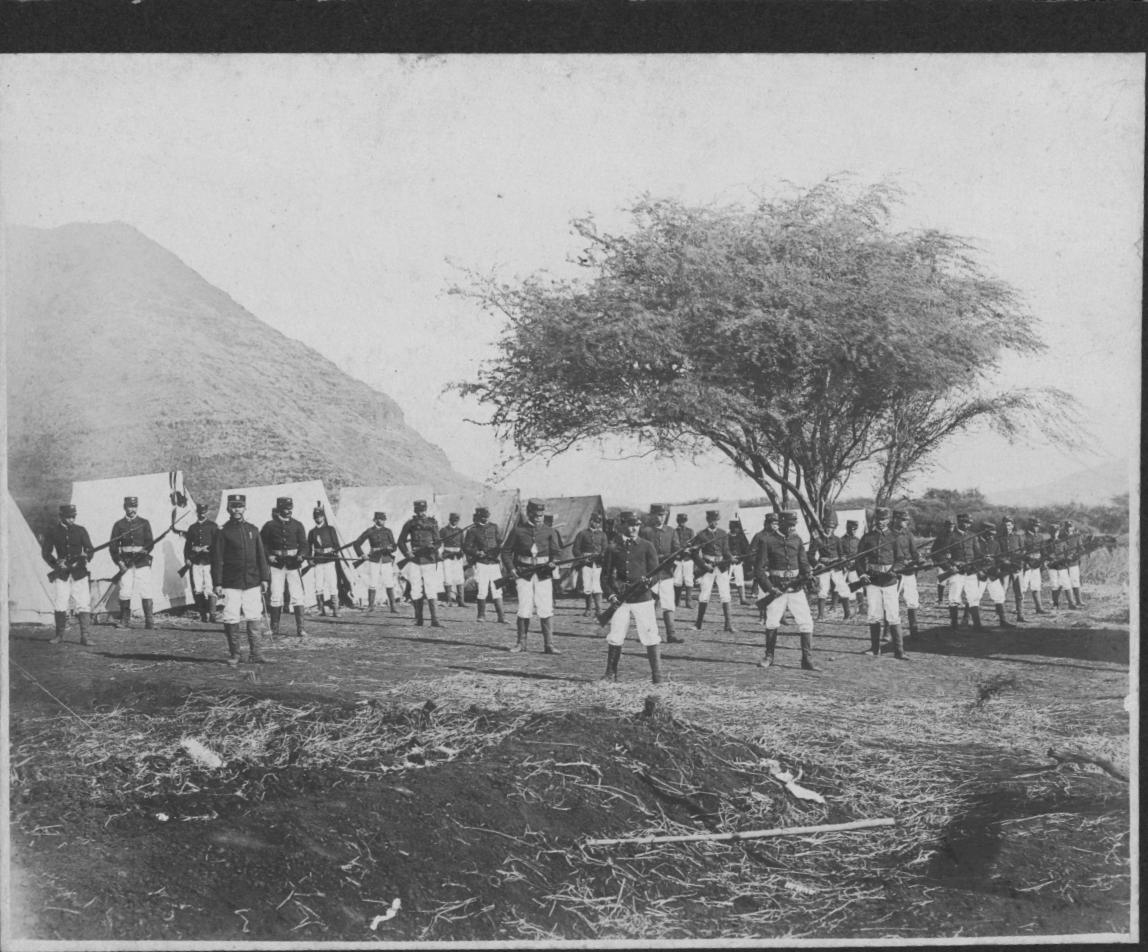
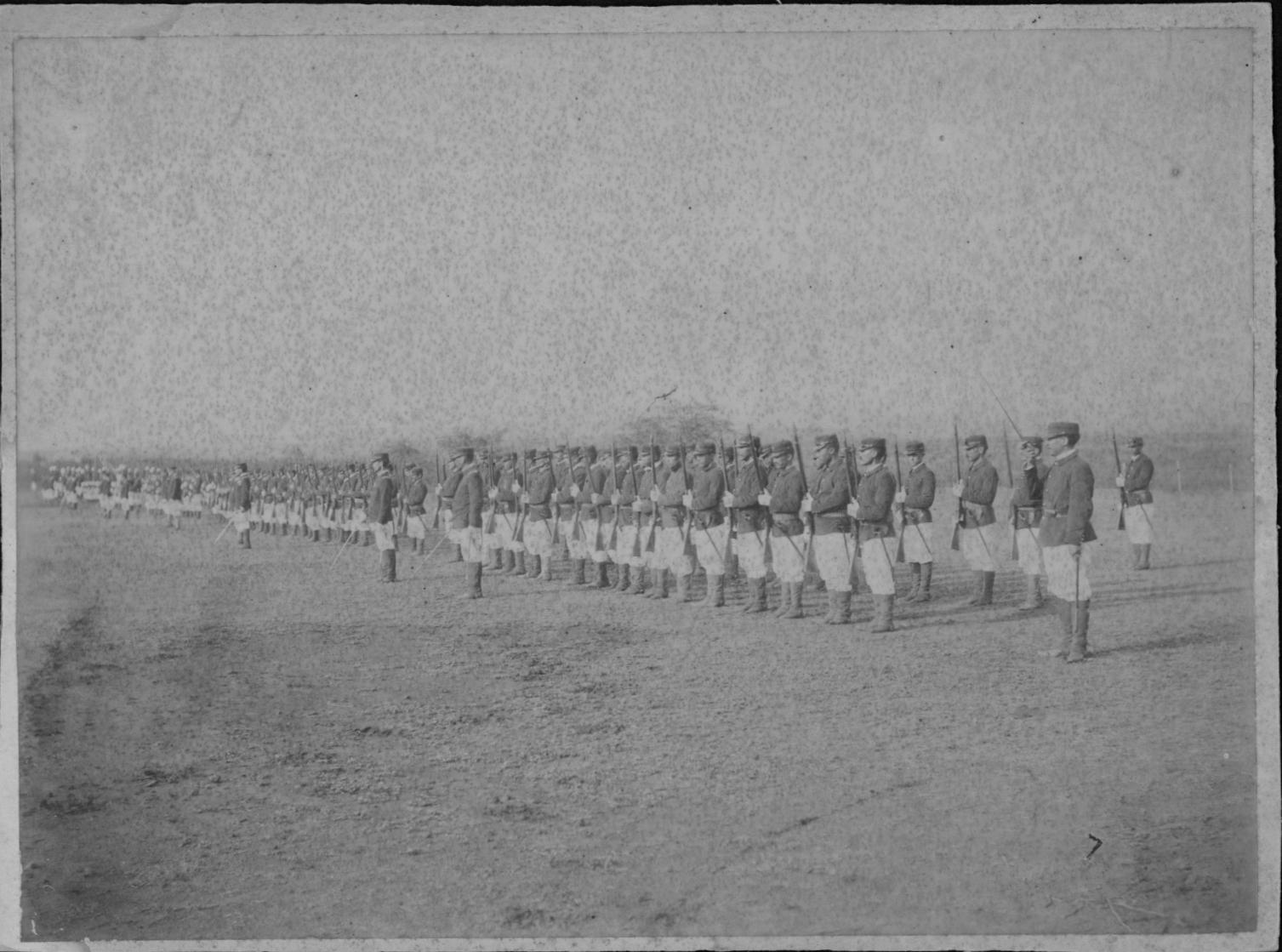
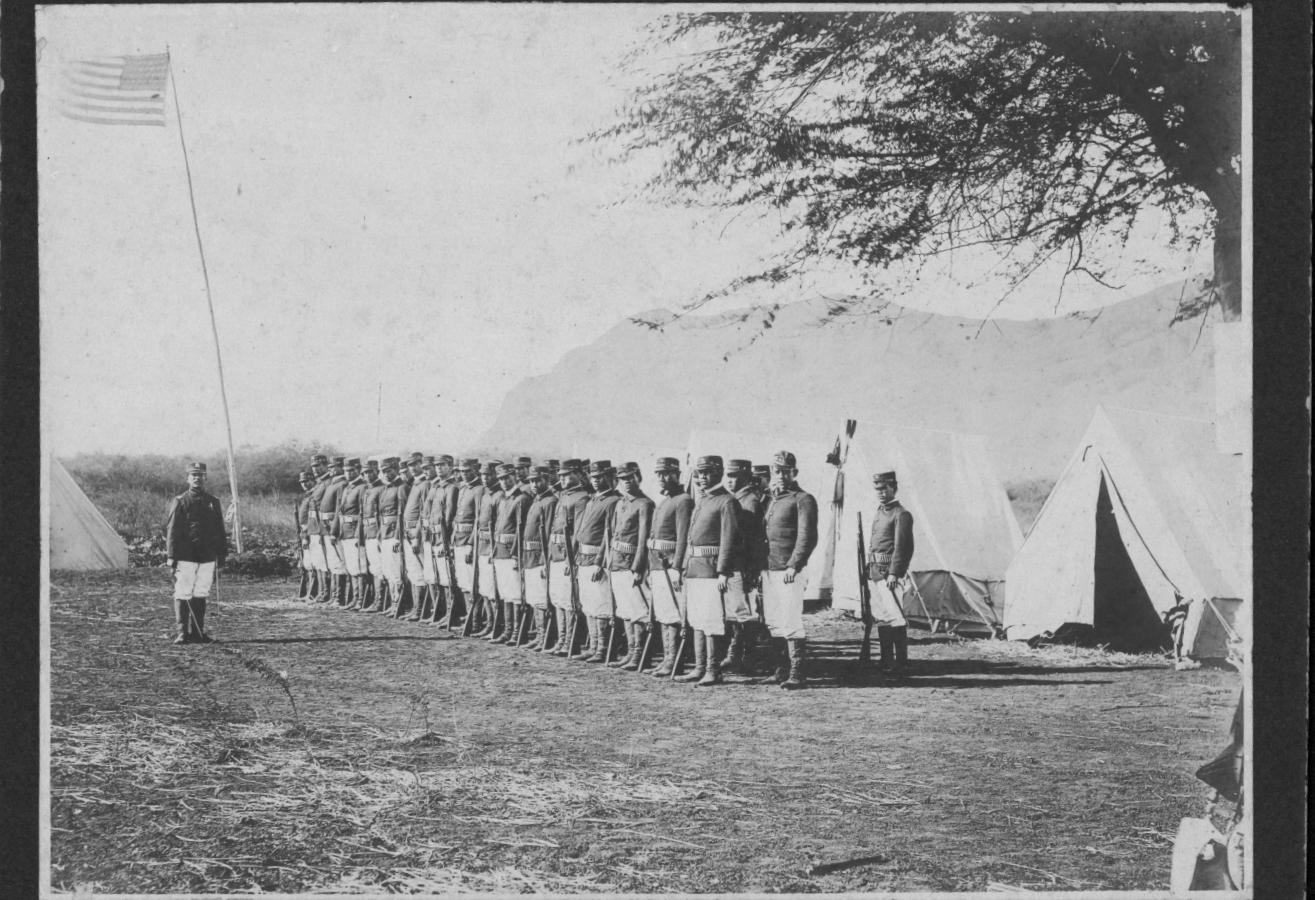
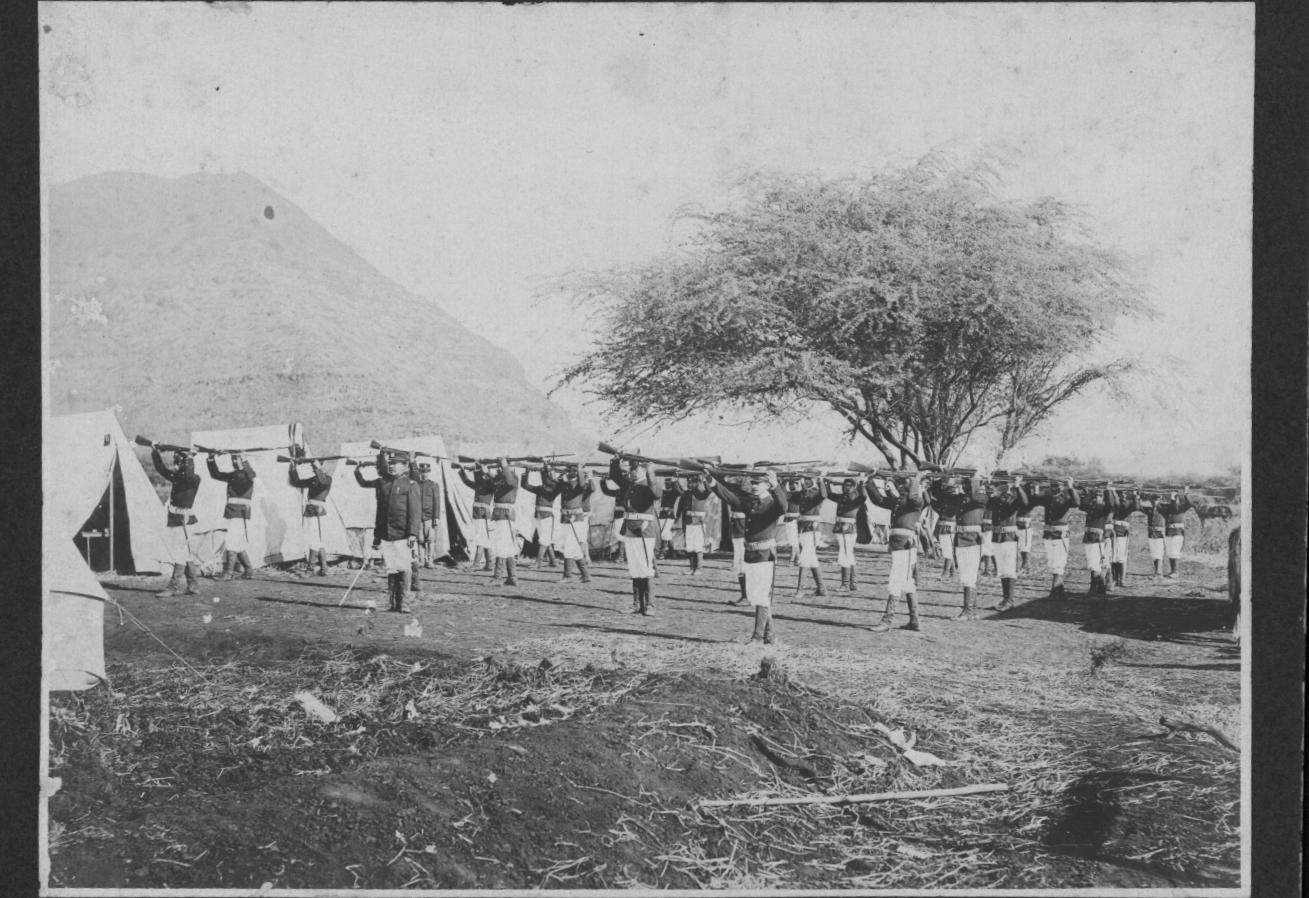
Under the Republic of Hawaii, the National Guard had made several overnight practice marches, but no formal camps under war-time conditions had ever been held. In 1899 a two-day encampment had been held at Raymond Grove in which the men set their tents, prepared their meals in the open, and slept on the ground. The following two years similar camps were established and the new volunteer companies on Hawaii and Maui went on practice marches.

It was not until 1903, however, that the present system of annual encampments came into effect. The Militia Bill of 1902 allowed the various National Guard organizations to participate in annual camps of instruction with the regular troops wherever practical, and to be paid fifty cents per day per man for their time. . . .

After this encampment, orders were issued that in the future a camp of at least five days’ duration would be held each year, preferably in conjunction with the regular troops stationed in Hawaii.

– History of the Hawaii National Guard pp. 59-60

Since the World War annual encampments of fifteen days by the National Guard have become a permanent fixture. The companies have also held innumerable overnight marches. For these, as well as the regular weekly drills, the Guardsmen have been generously paid by the Federal Government and the attendance was very good until the 1932 Second Special Session of the Territorial Legislature repealed the statute which exempted all Guardsmen from paying a territorial poll tax. As has been shown so frequently in past years in the history of the National Guard, the territorial military organization received another setback, and to the enlisted personnel an expensive blow, from the public, through its legislature, the very people it has sworn to protect in any emergency. This same session of the legislature also deleted the provisions whereby the territory from time to time paid the enlisted men a small remuneration for their attendance at the fifteen day annual field training period. By so doing, the legislature wiped out all financial aid the Territorial Government had been donating toward the support of its territorial police force, the Hawaii National Guard.

– History of the Hawaii National Guard pp. 92

The other part of this plan was to alternate the annual encampments of the entire 299th Infantry between Hilo, Hawaii, and Paukukalo, Maui, rather than to hold two separate camps. This plan was followed until the termination of the 1931 encampment, when it was definitely decided to establish a permanent camp site for this regiment on the Island of Maui. This decision was really forced upon the authorities owing to the excessive rainfall in the vicinity of Hilo and because it was not practicable to establish a camp site in any other district on the Island of Hawaii.

– History of the Hawaii National Guard pp. 93

Years of Annual Training – Summer Camp – Annual Encampments

1894

1895

1896

1899 – 20 MAY

On May 20, 1899, the National Guard of Hawaii went into camp at Raymond Grove and conducted field exercises, returning to town two days later.

– History of the Hawaii National Guard pp.51

In 1899 a two-day encampment had been held at Raymond Grove in which the men set their tents, prepared their meals in the open, and slept on the ground.

– History of the Hawaii National Guard pp. 59-60

1900

The following two years similar camps were established and the new volunteer companies on Hawaii and Maui went on practice marches.

– History of the Hawaii National Guard pp. 59-60

1901

The following two years similar camps were established and the new volunteer companies on Hawaii and Maui went on practice marches.

– History of the Hawaii National Guard pp. 59-60

1902

1903 – 10 JUN

On June 10, 1903, the National Guard of Hawaii was ordered to proceed to Camp McKinley to participate with the regular troops in their annual maneuvers. Companies A, B, C, E, F, G and H immediately marched to camp and Company D at Hilo was instructed to proceed to Honolulu as soon as possible to join with the other companies at Camp McKinley. A total of four hundred and one officers and men of the National Guard of Hawaii reported to the commanding officer of the camp. They stayed in camp for five days and during that time received concentrated instruction in the latest military procedure.

– History of the Hawaii National Guard pp. 59-60

1904

Camp held

1905

no camp was held in 1905 because the legislature had failed to appropriate sufficient funds.

– History of the Hawaii National Guard pp. 60
1906

In 1906 a two-day encampment was held, but attendance was poor and little interest was shown in the work, due to the low morale of the Guardsmen during these years.

– History of the Hawaii National Guard pp. 60
1907 – 20 FEB

In 1907 a five-day camp was established at Camp Taft, Leilehua, but was not successful and the following year the camp was discontinued.

– History of the Hawaii National Guard pp. 60

ENCAMPMENTS.

An encampment of the National Guard of Hawaii, participated in by six. companies of the first Infantry, Headquarters and band, one signal company and one hospital company, was held for five days at “Camp. Taft,” on February 20th, 1907. The usual camp orders specifying the list of calls and routine duties were published, guard duty was performed and some drills had. Almost the entire time of the encampment was given up to target practice and work incidental thereto. While in camp the Guard was reviewed by the Commander-in-Chief and inspected in heavy marching order by the inspecting officer, Major R. C. Van Vliet, 10th U.S. Infantry.

No encampment was held in 1908.

An order was issued December 31, 1908, providing for an encampment to be held in February, 1909.

Headquarters First Infantry, N. G. H.,

Honolulu, Oahu, Feb. 11-5th, 1907.

General Order No. 5.

The First Infantry, N. G. H., will assemble under arms at the “Drill Shed” on Tuesday, February 19th, 1907, at 7:30 p. m., in heavy marching order in pursuance of General Order No. 1, A. G. 0., preparatory to going into camp. Officers will wear the blanket roll.

Uniform: Service.

By order of Colonel Jones,

THOS. P. CUMMINS,

Capt. and Adj. 1st Infantry N. G. H.

Headquarters First Infantry, N. G. H.,

Honolulu, Oahu, February 19th, 1907.

General Order No. 6.

  1. Company “E”, 1st Infantry, N. G. H., will constitute the guard which will go on duty at the armory, February 19, at o’clock p. m., and will continue as the guard throughout Tuesday night and upon arrival at Camp Taft. will furnish all detail, provost guard, etc., up and until the time set for guard mounting Wednesday evening.
  2. Promptly at 4:30 Wednesday morning. February 20th the entire command will march from the armory to the Oahu Railway & Land Company depot and entrain for wahiawa.
  3. Immediately upon getting into camp. company Commanders will receive proper tentage, cots, and blankets for their men. and will furnish fatigue parties for latrine, etc.
  4. Companies will alternate in furnishing the guard and all necessary markers on the range throughout the encampment.
  5. Particular attention will be paid to the fact that the limits of “Camp Taff’ will be one mile outside of and around the camp and rifle range and that no man will go outside of such limits without permission in writing to do so. Also that no person not a member of the National Guard is allowed inside of those limits except in accordance with the provisions of this order.
  6. Members and officers of the Dowsett Company. Limited, and their employees will be at liberty to go anywhere within said prohibited limit; with the exception of such camp limits where tents are pitched, from which all persons are prohibited except during the hours set apart for Visitors; unless special authorization is given. such special authorization will be written.
  7. Hours for visitors will be from 9 a. m. until 5 p. m. All visitors entering and leaving camp must enter and leave passing by the guard house, on leaving proceeding in an easterly direction until outside of the camp limits.
  8. AII gates must be kept closed and the use of firearms of any description except on the target ranges is strictly prohibited.
  9. Special attention is called to paragraph 9 of General Order No. 1, A. G. O., elated January 29. 1907, which reads as follows:

‘”The rights of property must be respected and officers and enlisted men must understand that any depredations or the cutting of trees or the killing or wounding of game or animals is strictly prohibited, and that in the case of such depredations even though some may be accidental. payment will be made therefor out of and from the amount due the troops for services and a pro rata reduction will be made from the pay of every officer and enlisted man of the command.

By order of Colonel Jones,

THOS. P. CUMMINS,

Capt. and Adj. 1st Infantry N. G. H.

Headquarters First Infantry, N. G. H.,

Camp Taft, Leilelma, Oahu, Feb. 20th, 1907.

General Order No. I.

For the information of the 1st Infantry N. G. H., the following list of “Service Calls” will be observed until further orders:

  • Reveille, First Call . . . . . . . . . . . . . . . . 5:15 A. M.
  • Reveille . . . . . . . . . . . . . . . . . . . . . . . . 5:30 “
  • Assembly immediately after.
  • Mess CaII . . . . . . . . . . . . . . . . . . . . . . 5 :40 “
  • Sick Call . . . . . . . . . . . . . . . . . . . . . . . 6:00 “
  • Drill Call . . . . . . . . . . . . . . . . . . . . . . . 6:15 “
  • Assembly . . . . . . . . . . . . . . . . . . . . . . 6:20 “
  • Recall . . . . . . . . . . . . . . . . . . . . . . . . . 11:30 “
  • Mess Call . . . . . . . . . . . . . . . . . . . . . . 12:00 noon
  • Drill Call . . . . . . . . . . . . . . . . . . . . . . . 2:50 P. M.
  • Assembly . . . . . . . . . . . . . . . . . . . . . . 1:00 “
  • Guard Mounting . . . . . . . . . . . . . . . . .4:20 “
  • Assembly . . . . . . . . . . . . . . . . . . . . . . 4:30 “
  • Recall . . . . . . . . . . . . . . . . . . . . . . . . . 4:45 “
  • Mess Call . . . . . . . . . . . . . . . . . . . . . . 5:50 “
  • Parade, First Call . . . . . . . . . . . . . . . . 5:50 “
  • Assembly . . . . . . . . . . . . . . . . . . . . . . 6:00 “
  • Tattoo . . . . . . . . . . . . . . . . . . . . . . . . . 8:30 “
  • Call to Quarters . . . . . . . . . . . . . . . . . 8:45 “
  • Taps . . . . . . . . . . . . . . . . . . . . . . . . . . 9:00 “

Position and aiming drill will be conducted by companiesnunder supervision of company officers, between Reveille and mess Calls.

by order of Colonel Jones,

THOS. P. CUMMINS,

Capt. and Adj. 1st Infantry, N. G. H.

Headquarters First Infantry, NG. H.,

Camp Taft. Leilehua, Oahu, Feb. 20th, 1907.

General Order No. 2.

First Lieut. J. G. Hannah and Second Lieut. H. M. Cooper, 10th U. S. Infantry, are requested to act as instructors to all officers of the National Guard in attendance at “Camp Taft,” and every assistance will be rendered them by officers and members of this command.

By order of Colonel Jones,

THOS. P. CUMMINS,

Capt. and Adj. 1st Infantry, N. G. H.

The First Infantry, National Guard of Hawaii, assembled at the Drill Shed,” Tuesday, February 19, 1907, at 7 :30 p. m., in heavy marching order, preparatory to going into camp, as prescribed in General Order No. 1 A. G. O., dated January 29, 1907.

Company “E”‘ constituted the guard on duty at the Armory, and upon arrival at “Camp Taft,” furnished all details, provost guard, etc., up and until time for Guard Mounting, Wednesday, 4:30 p. m.

Company D”, with three commissioned officers and forty enlisted men, and Company ‘T’ with three commissioned officers and forty-six enlisted men, arrived by the S. S. Claudine at 2:30 a. m., February 20th, 1907, and marched to the Capitol grounds soon after disembarking. Upon their arrival at headquarters, necessary quartermaster and ordnance property was issued to both companies .

At 4:15 a. m. coffee and sandwiches were furnished the entire command.

At 4:30 a. m., “assembly” was sounded, and the command was formed in column of squads, and marched to the Oahu Railway Station, entraining at 5 a. m., from which point 1st Lieut. J. G. Hannah and 2nd Lieut. H. M. Cooper, Sergt. Bunner and Private McCarthy, U. S. 10th Infantry, accompanied the command to “Camp Taft.” At 5 :20 a. m., the train left Honolulu, arriving- at Wahiawa at 7 :30 a. m. and the command marched six miles to camp, arriving there at 9 :30 a. m.

Upon arrival at camp, details were made for digging latrines, kitchen and police work, and guard established over the water supply.

Instruction in cooking and the issuing of rations to the different companies was given by Sergeant Bunner and Private McCarthy. U. S. 10th Infantry. All companies with the exception of Co. “F” and the Hospital Corps had their noon and evening mess served to them from the officers kitchen for the first day in camp.

J. W. JONES

Adjutant General.

1907-1908 Biennial Report pp. 19-21
1908

No encampment was held in 1908.

1907-1908 Biennial Report pp. 19
1909 – 18 FEB

However, by 1909 the condition of the National Guard was considerably improved and the regular army encouraged it to hold another camp Moanalua, Oahu, was selected as the site and on February 18th the First Infantry, National Guard of Hawaii, consisting of nine infantry companies and the Hospital Corps, along with a battalion of the 20th Infantry. under the command of Major Samuel W. Dunning, established Camp Sam Damon. The National Guard was given instruction in practical field work and tactics which was much appreciated by the officers and men, who showed a marked improvement in spirit and attention to duty over their attitude of the past few years.

– History of the Hawaii National Guard pp. 60

ENCAMPMENTS.

In pursuance of General Orders No. 32, A. G. 0., December 31, 1908, the National Guard of Hawaii went into camp for five days with a battalion of the 20th U. S. Infantry under command of Major Samuel W. Dunning. The camp was established on February 18, 1909, at Moanalua, being designated as “Camp S. M. Damon.” Major Dunning was requested to assume command of the Territorial troops and prescribe instruction and maneuvers therefor.

The instruction given in field work was new to the National Guard of Hawaii, and was much appreciated by the officers and men.

Camp S. M. Damon,

February 17th, 1909.

The following orders and reports show the nature of the instruction :

General Orders:

No. 1.

1. The undersigned hereby assumes command of this camp, which is designated as above.

The following named officers compose the Staff:

First Lieut. J. S. McCleery, Batt. Adjt., 20th Infantry, Adjt Second Lieut. P. G. Wright.son, 20th Infantry, Q. M. & Comsy Major S. H. Wadhams, Medical Corps, Surgeon. Second Lieut. J. A. Rogers, 20th Infantry, Signal Officer.

(Sgd) S. W. DUNNING,

Major, 20th Infantry,

Commanding.

Official:

J. S. McCLEERY,

1st Lt. & Batt. Adjt., Adjutant.

Camp S. M. Damon,

February 17th, 1909

General Orders :

No. 2.

1. The following list of calls is announced:

  • Taps . . . . . . . . . . . . . . . . . . . . . . . . 10:00
  • First call . . . . . . . . . . . . . . . . . . . . . . . . 5:45 A. M.
  • March . . . . . . . . . . . . . . . . . . . . . . . . 5:55
  • Assembly and Reveille . . . . . . . . . . . . . . . . . . . . . . . . 6:00
  • Mess call (breakfast) . . . . . . . . . . . . . . . . . . . . . . . . 6:15
  • Police . . . . . . . . . . . . . . . . . . . . . . . . 7:00
  • Drill call ( not less than 2 hours). . . . . . . . . . . . . . . . . . . . . . . . 7:50
  • Assembly . . . . . . . . . . . . . . . . . . . . . . . . 8:00
  • First Sergeant’s call . . . . . . . . . . . . . . . . . . . . . . . . 11:30
  • Mess call ( dinner) . . . . . . . . . . . . . . . . . . . . . . . . 12:00 M.
  • Instruction (not less than 2 hours) . . . . . . . . . . . . . . . . . . . . . . . . 1:30 P. M.
  • Sick call . . . . . . . . . . . . . . . . . . . . . . . . 4:00
  • Guard mounting, first call . . . . . . . . . . . . . . . . . . . . . . . . 4:40
  • assembly . . . . . . . . . . . . . . . . . . . . . . . . 4:45
  • Mess call (supper) . . . . . . . . . . . . . . . . . . . . . . . . 5:30
  • Retreat, first call . . . . . . . . . . . . . . . . . . . . . . . . 5:50
  • assembly . . . . . . . . . . . . . . . . . . . . . . . . 6:00
  • Tattoo . . . . . . . . . . . . . . . . . . . . . . . . 9:00
  • Call to quarters . . . . . . . . . . . . . . . . . . . . . . . . 9:45

Formation for Retreat will be under arms under direction of an officer.

2. SCHEDULE OF INSTRUCTION.

Forenoon.

  • Thursday, Feb. 18. Batt. Drill.
  • Friday, Feb. 19. Batt. Drill.
  • Saturday, Feb. 20. Batt. Drill.
  • Sunday, Feb. 21. Annual Inspt.
  • Monday, Feb. 22. Regt. Drill.

Afternoon.

  • Advance, Rear, Flank Guards and Patrols.
  • Outpost & Reconnaissance by Battalion.
  • Formation for Attack and Defense by Companies.
  • Formation for Attack & Defense by Battalion.
  • Formation for Attack & Defense by Regiment.

By order of Major Dunning.

(Sgd) J. S. McCLEERY,

1st Lieut. & Batt. Adjt., 20th Infantry, Adjutant.

Official:

J. S. McCLEERY,

1st Lieut. & Batt. Adjt., 20th Infantry, Adjutant.

Camp S. M. Damon,

February 17th, 1909.

General Orders:

No. 3.

1. For drills the National Guard will be organized in two battalions, each under a Major.

For field exercises, three battalions will be organized, each. composed of one company regular troops and three companies militia. The senior officer of the regular troops will exercise control by advice and direction to the Battalion Commander but will not take actual command.

Ammunition.

All ball ammunition will be secured by Company Commanders and none allowed at any time in possession of the men.

Guard.

The National Guard will mount a guard for their part of the camp of sufficient size to protect property. Special authority will be obtained to mount a guard for instruction purposes only.

Police and Sanitation.

  • (a) Grounds occupied by units will be policed by them. Necessary instructions for final disposition of garbage and refuse will be given by the Chief Sanitary Officer.
  • (b) Officers must insist upon scrupulous cleanliness of the kitchens, cooking utensils and everything connected with the mess. The cooks will be required to be clean in their person and neat in appearance.
  • (c) The interior of tents will be maintained in a sanitary condition. All clothing and bedding will be frequently aired. Tent walls will be raised during the day, weather permitting.
  • (d) The senior regular medical officer will act as chief sanitary officer, and will require and direct all other medical officers to assist him.
  • (e) Sinks will be properly dug and protected as directed by the chief sanitary officer.
  • (f) To prevent soiling of ground at night, cans will be placed for urinals in convenient places. These will be emptied immediately after Reveille each morning. Urinating on the ground is strictly prohibited.
  • (g) Galvanized iron cans should be provided, one for dry and the other for wet refuse. Tin cans, bottles, etc., will be placed separately.
  • (h) Each organization will have designated one place for lavatory purposes and soiled water will be disposed of so as not to create a nuisance.

By order of Major Dunning.

(Sgd) J. S. McCLEERY,

1st Lieut. & Batt. Adjt., 20th Infantry, Adjutant.

Official:

J. S. McCLEERY,

1st Lieut. & Batt. Adjt., 20th Infantry, Adjutant.

Camp S. M. Damon,

February 18th, 1909.

Memorandum for Officers Accompanying National Guard.

  1. 1st Battalion-Company “H,” 20th Infantry, Companies “A,” ”B” and “I,” National .Guard of Hawaii; Major Riley, Comdg., Captain Shipp, 20th Infantry, attached: Proceed toward Fort Shafter; commencing exercises beyond road leading to Dal Lake, returning at such time as will give each company necessary instructions and not interfere or conflict with 2nd Battalion which is operating on Salt Lake road.
  2. 2nd Battalion-Company “C,” 20th Infantry, Companies “E,” ”F” and “D,” National Guard of Hawaii; Major Rose, Comdg., Captain Exton, 20th Infantry, attached: Beginning at Camp or thereabouts, proceed via County road and Salt Lake road in direction of Puuloa. The 1st Battalion has instructions with the 2nd Battalion.
  3. 3rd Battalion-Company “F,” 20th Infantry, Companies “C,” ‘”L” and “G,” National Guard of Hawaii; Captain Camara, Comdg., Lieut. Chilton, 20th Infantry, attached: Proceed in direction of Aiea and return. Form Advance, Rear and Flank Guards and Patrols, each company being used in turn.

By order of Major Dunning.

(Sgd) J. S. McCLEERY,

1st Lieut. & Batt. Adjt., 20th Infantry, Adjutant.

Camp S. M. Damon,

February 19th, 1909.

Memorandum for Officers Accompanying National Guard of Hawaii.

  1. 1st Battalion-Command (imaginary) in camp near Polo Field; establish outpost to protect against approach of enemy (imaginary) from direction of Aiea.
  2. 2nd Battalion-Command (imaginary) in camp near west edge of Camp Damon; establish outpost to protect camp against approach of enemy (imaginary) from Honolulu.
  3. 3rd Battalion-Command (imaginary) in camp near Fort Shafter; establish outpost to protect camp against approach of enemy (imaginary) reported at Puuloa; County road is protected by other troops.
  4. Each Battalion will march to designated station; establish outpost for larger independent forces (imaginary); enemy of observation and send out Patrols.

By order of Major Dunning.

(Sgd) J. S. McCLEERY,

1st Lieut. & Batt. Adjt., 20th Infantry, Adjutant.

Camp S. M. Damon,

February 19th.

General Orders:

No. 4.

1. So much of paragraph 2, General Orders No. 2, Camp S. M. Damon, February 17th, 1909, as prescribes the exercises for the afternoons of February 20th and 21st, is revoked.

The exercises for the afternoon of February 20th, will consist of formation for attack and Defense by Battalion, and for February 21st, by Regiment. The exercise prescribed for the afternoon of February 20th will be omitted.

By order of Major Dunning.

(Sgd) J. S. McCLEERY,

1st Lieut. & Batt. Adjt., 20th Infantry, Adjutant.

Camp S. M. Damon,

February 22nd, 1909.

General Orders:

No. 5.

  1. Headquarters, 1st Regiment, National Guard of Hawaii, and Companies “A,” “B,” “C,” “E,” “F,” “G” and Hospital Corps Company are relieved from duty at this camp today at 1 :00 p. m.
  2. After camp is struck and packed the ground will be thoroughly policed, latrines and incinerator pit filled in and the camp ground placed in thorough sanitary condition.
  3. The command will be marched to their station, Honolulu, Hawaii as soon as grounds are reported by sanitary officer to be in proper condition.

By order of Major Dunning.

J. S. McCLEERY,

1st Lieut. & Batt. Adjt., 20th Infantry, Adjutant.

Fort Shafter, Honolulu, Hawaii,

March 24th, 1909.

The Adjutant General,

Depprtment of California,

San Francisco, California.

Sir :-In compliance with Schedule of Instruction for 1908, amended by telegram from your headquarters elated September, 14th, 1908, and war Department January 23rd, 1909, I have the honor to report that Headquarters, F. & S. 2nd Battalion and Companies ‘”F;” ”G” and “H,” 20th Infantry, left Fort Shafter February 17th and went into camp at Moanalua, Hawaii, preparatory to a five days’ encampment with the organized Militia of Hawaii.

The Militia arrived in camp about midnight February 17th, arranged camp and were ready to take up the schedule of instruction prescribed in G. 0. No. 2, elated Camp S. M. Damon, H. T .. February 17th, 1909, on the afternoon of February 18th. The schedule was changed, clue to unforeseen circumstances, so as to omit formation for attack and defense by companies, and the formation for attack and defense by regiment was not held, as the Militia left camp the afternoon the exercise was scheduled to be held.

The regular troops were used purely for instruction purposes, as the militia of this Territory have had little or no field work on open ground and none on varied ground.

The reports marked “A,” “B,” “C,” enclosed herewith explain in detail the scope of work accomplished.

Talks were given the officers by Major Wadhams on Camp Sanitation; Captain Exton on reconnaissance and patrolling; Captain Shipp on orders; Major Dunning on saluting, commands and requirements of officers on drill. The officers were attentive, appreciative, and all, from the Adjutant General down, feel that their time and money has been well spent. All are exceedingly zealous, but require rudimentary instruction in field work.

The conduct of the Militia was exemplary and no complaint could be made. Their camp “‘as kept well policed and in a sanitary condition, and the ground left in perfect condition on breaking camp.

I observed the close order drills, and, although much is lacking in details of command and execution, still all could get through in fair shape and showed improvement.

A review held for the Territorial Legislature was very creditable.

Camp S. M. Damon,

February 21st, 1909.

The Adjutant

Present

Sir :-I have the honor to submit the following report of my observations while accompanying the National Guard in their field exercises during the past three days:

On February 18th, the exercises required the forming of advance, rear and flank guards and patrols, each company being used in turn.

On February 19th, the exercise required the establishment of outposts for larger independent force; companies in turn to take their place on line of observation, and send out patrols.

On February 20th, the exercise required battalion formed as advance guard, from which it was to make an attack of a position, after which disposition was to be made for defense of position.

In the exercise on the 18th, a company of regular troops first took up the formation of advance guard, etc., thus illustrating the method, after which each company of the National Guard, in turn, took up same formation.

All companies showed a greater or less knowledge of the formation, and the method of taking it, but very little knowledge of the purpose of an advance guard and the method of moving in a hostile country. Officers were, with few exceptions, keen and alive to their work and kept their men well in hand, though the efforts of the men to keep in step and be very military almost destroyed their usefulness. All bodies moved too rapidly, especially the flankers, and the various units did not keep in touch properly, or at proper distance. Patrols did not take proper formation, little or no use was made of signals, and there was too much yelling of commands. Sergeants and corporals were not at all familiar with their duties. The company from Hilo was best instructed.

In the exercise of the 19th, a company of regular troops was required to take its place on the line of observation and send out patrols. This it did, forming a line of cossack posts. It was then withdrawn and the three small companies of guardsmen formed on same line. It was found that these companies had never had any instruction whatever in outpost duty. It was therefore quite impracticable to give them any instruction of value within the limited time and in such rough country. I would recommend that they be first taught the formation of an outpost on some open ground, and also the elements of the duties of an outpost.

In the exercise of the 20th, the battalion formed as an advance guard, and at the proper time changed to the attack formation.

The company composing the leading part of the vanguard took a position under cover, when fired upon, and fired upon the enemy’s position while the remaining companies moved under cover to the attack from the left front. Although these companies were assumed to be under cover, they crawled on their hands and knees for nearly three hundred yards. They should have advanced more rapidly while under cover. In other respects the work was well done.

Very respectfuIly,

(Sgd) C. W. EXTON,

Captain, 20th Infantry.

A true copy:

S. W. DUNNING,

Major, 20th Infantry.

Company “H,” 20th Infantry,

Fort Shafter, H. T.

March 18th, 1909.

The Adjutant,

Fort Shafter, H. T.,

Sir :-I have the honor to submit a report of my observations while accompanying the National Guard of Hawaii in their field exercises at Camp Damon, Hawaii:

February 18, 1909, I accompanied Major Riley, National Guard, Hawaii, commanding a Battalion of Companies “A,” “B” and “I,” National Guard, with Company “H,” 20th Infantry, attached. The problem was for each Company successively to act as advance guard, rear guard or flank guard to the other companies. I illustrated positions of tactical components of an advance guard with “H” Company by deploying it on an open plain at reduced distances where all could be seen and explained the object of an advance guard, its duties, etc.

I recalled “H” Company and attached noncommissioned officers of the National Guard to each squad of “H” Company for instruction, and again threw out “H” Company as advance guard for rest of Battalion marching along road toward Honolulu; after going far enough to illustrate duties of flankers, halted and assembled.

Then I requested Major Riley to combine Companies “A” and “I” on account of their small size, and to attach noncommissioned officers of “H” Company to each tactical component and to throw out the combined Companies as an advance guard.

Under the guidance of the noncommissioned officers attached they deployed in fairly good time and took up the normal formation.

In the same way the Companies were shown the rear guard and flank guard mechanism, and were marched in these formations.

The officers and enlisted men of the Guard showed little knowledge of these formations, but were all zealous and eager to learn, and I believe now they could act with much more intelligence along these lines.

February 19th I again accompanied Major Riley; he was commanding the same Battalion as on the previous day.

I assembled the officers and talked briefly on duties of an outpost, illustrating its several components. I requested Major Riley to then establish his Battalion as an outpost for a brigade supposed to be encamped at Mr. Damon’s polo field, the enemy in the direction of Pearl City. This was done, combining the cordon and patrol system.

System of patrolling was explained and duties of each part of the outpost. The Companies were changed from line of observation and resistance so all could have benefit of learning their various functions ..

February 20th, I accompanied Major Rose, commanding a Battalion of four Companies of the National Guard.

This Battalion was marching in advance· guard formation along the County road in the direction of Pearl City and was supposed to be fired upon from the direction of Aiea. Under my advice he made a reconnaissance and attacked with the vanguard as the firing line. The normal attack of a Battalion was then carried out, and on taking the position, the troops were disposed for its defense.

My observation was that the commissioned and enlisted personnel of the National Guard were quite ignorant on field exercises, but all were very anxious to learn, and zealous in their work. I found it of great advantage to attach noncommissioned officers and selected privates of “H” Company, 20th Infantry, to the different components of the Command. In this way the enlisted men of the Guard were better able to learn the duties of a soldier under various conditions.

Very respectfully,

(Sgd) A. M. SHIPP,

Captain, 20th Infantry,

Commanding Company “H.”

A true copy:

S. W. DUNNING,

Major, 20th Infantry.

1909-1910 Biennial Report pp. 46-55
1910

The following year no regular encampment took place, but a Camp of Instruction for Infantry Officers was conducted at Fort Shafter by the regular army. The purpose of this camp was to give the National Guard officers experience in handling regular troops.

– History of the Hawaii National Guard pp. 60
1911 – 22 MAY

In 1911 the camp was increased to include not only officers but also noncommissioned officers and cooks. Although this failed to grant any instruction to the file of the National Guard, nevertheless it gave them a number of efficient and experienced key men, around whom the organization could be effected.

– History of the Hawaii National Guard pp. 60

Camps of Instruction

A camp of instruction was held May 22-27, 1911, for officers, non-commissioned officers and company cooks of the First Infantry.

The course of instruction for officers included the following: Military Topography, Field Engineering, Minor Tactics, Military Law, Company Papers, Small Arms, Sanitation, Paper Work for Adjutants, Quartermasters and Commissaries. The method followed was to explain a subject, illustrate it by practical work and follow with a problem on the ground to see if the illustration was understood. The subjects were presented in an interesting and instructive manner and the student officers were materially benefited by the course.

The course for enlisted men included the following: Drill in close and extended order, bayonet exercises, discipline, saluting, reporting to and addressing an officer, care of rifle and equipment, issue and preparation of rations, toot pitching, advance and rear guards, intrenching, outposts, patrolling, scouting, estimating distances, position sketching, road sketching, loading wagons, sanitation and first aid.

In commenting upon the work of the men, their instructors say: “All without exception showed a marked desire to learn, and the attention paid the instructors was excellent. That these men gained much by observation cannot be doubted, daily evidence that they did so was apparent. Their interest in the work was intelligent and worthy of comment. A number of the men showed marked ability in handling patrols. So much natural talent and keen interest was exhibited in road-sketching as to call forth enthusiastic commendation from the instructors. The men showed unusual proficiency in estimating distances and also in patrolling; in this last their work indicated a natural talent.”

In view of the foregoing, and on June 7, 1911, report was made to the Commanding General of the Distriet of Hawaii recommending the organization of a company of Hawaiian scouts.

The fact that the instructors have been so successful in imparting knowledge to the officers and enlisted men participating in these encampments largely due largely to the unfailing zeal, courtesyand consideration of the instructors and their constant endeavor, during the brief time at their disposal to impart to the students as much information as possible. Judging from the verbal and written reports of the student officers to these headquarters and the increased interest they take in their duties, and the more efficient service they receive from their non-commissioned officers, the National Guard of Hawaii has materially benefited from the instruction received.

1911-1912 Biennial Report pp. 69-70

1912 – 29 AUG

In 1912 the entire 1st Infantry, National Guard of Hawaii, again went into camp at Moanalua. The experience gained by the officers during the past two years was particularly noticeable at this camp, which was the most efficient held up to that time.

– History of the Hawaii National Guard pp. 60

Under the provisions of General Orders Nos. 11 and 12 A. G. 0. 1912, a camp was established at Moanalua, Oahu, Aug. 29 to Sept. 2, 1912. The following is the inspection report thereon.

1911-1912 Biennial Report pp. 69-70

1913

No encampments were held in 1913 or 1915 but in both 1914 and 1916 the entire National Guard of Hawaii turned out and held joint exercises with the regular troops.

– History of the Hawaii National Guard pp. 60
1914 – 25 JUL

No encampments were held in 1913 or 1915 but in both 1914 and 1916 the entire National Guard of Hawaii turned out and held joint exercises with the regular troops.

– History of the Hawaii National Guard pp. 60

CAMPS OF INSTRUCTION.

Battalion and company overnight camps have been had from time to time during 1914 with practice marchs.

A “Joint Camp of Instruction” (Regular and National Guard troops) was held July 25-30, 1914.

officersenlisted men
1st Infantry38 612
Sanitary Troops112
Total39624

The field inspection report of this encampment is as follows:

SUMMARY OF ATTENDANCE.

Present in camp 38 officers, 612 enlisted men.

Absent from camp 8 officers, 220 enlisted men.

Average number present at drill and maneuvers 36 officers 522 enlisted men.

ORGANIZATION.

Company L is below the prescribed minimum strength. The regiment has no band.

DRILL AND INSTRUCTION.

Company extended order

Company combat

Camping

} Very good.

Battalion close order good, in view of the fact that but little drill had been held previous to the encampment.

Battalion combat good. An inclination to “run away to the front” showing that fire tactics are not thoroughly understood.

Regimental combat good. Due to lack of practice, attack was not co-ordinated, so that troops would have been beaten in detail.

Maneuvers.-Two regimental problems with represented enemy were held, viz.: march with advance guard and an attack. The plans and tactics were good, but the team work was poor.

Marches were made in good order without straggling.

Security and information very good:

Discipline :-Satisfactory.

Arms, Uniforms and Equipment :-Satisfactory. No surplus kits on hand.

Sanitation and Messing :-Food not properly protected from flies.

OFFICERS.

The following comments were made by the inspector in regard to the officers of the rigiment :

Lieut. Colonel William R. Riley, 1st Infantry, was very earnest and conscientious in the performance of his duties. He devoted much attention to the sanitation of the camp and to discipline. He allowed no absenteeism except when specially excused by himself and noted on the rolls. He was in harmony with the officers detailed as inspector-instructors.

Captain George B. Schrader, 1st Infantry, performed his duties in a satisfactory manner. This was this officer’s first experience as quartermaster and he displayed ability in performing his duties. He is hard working and conscientious and the troops were well supplied.

Captain Reginald W. Warham, Commissary, 1st Infantry, performed his duties well. This was his first duty as commissary and the troops wanted for nothing in the way of commissary supplies. He displayed ability in performing his duties and is very conscientious and hard working. Captain James A. Thompson, Adjutant, Captain Arthur W. Neely, I. S. A. P., and Chaplain Valentine H. Franx, performed their duties satisfactorily: All other staff officers were satisfactory.

1913-1914 Biennial Report pp. 5-7

1915

No encampments were held in 1913 or 1915 but in both 1914 and 1916 the entire National Guard of Hawaii turned out and held joint exercises with the regular troops.

– History of the Hawaii National Guard pp. 60

FIELD TRAINING.

No extensive camps of instruction were held during 1915,

1915-1916 Annual Report pp. 11

1916 – 19 NOV

No encampments were held in 1913 or 1915 but in both 1914 and 1916 the entire National Guard of Hawaii turned out and held joint exercises with the regular troops. The encampment of November, 1916, had over eight hundred officers and men of the National Guard present.

– History of the Hawaii National Guard pp. 60

FIELD TRAINING.

No extensive camps of instruction were held during 1915, but in 1916 the entire 1st Regiment of Infantry and the 1st Separate Company of Engineers engaged in a field training period, with troops of the Regular Army, from November 19 to 25, both dates inclusive. This encampment was held at Red Hill, Oahu, and was productive of satisfactory results.

There were present at this camp 50 officers and 731 enlisted men of the 1st Infantry, 3 officers and 41 enlisted men of the 1st Separate Company of Engineers, and 1 officer and 15 enlisted men of the Medical Detachment of the 1st Infantry.

In addition, and prior to this encampment, overnight battalion camps were held at the Punchbowl rifle range by all battalions of the 1st Regiment.

Field training for new units of the National Guard stationed on islands other than Oahu, was impracticable during the biennial period just closed owing to lack of equipment of all classes.

During 1916 a semi-permanent camp or cantonment has been constructed near the Volcano House, Island of Hawaii, funds for the same being raised by public subscription among the citizens of Hawaii. This camp will be used, not only by National Guard troops, but also by troops of the Regular Army.

1915-1916 Annual Report pp.11-12

1917 – 9 NOV

By far the most important activity of the National Guard during 1917, however, was the annual encampment held at Camp Liliuokalani, Kawailoa, Oahu, from November 9th to 27th. All of the National Guard troops participated, including Brigade Headquarters, the General Staff, the 1st Infantry, the 2nd Infantry, the 1st Separate Troop of Hawaiian Cavalry, Field Company B, Signal Corps and the Medical Detachment.

The Quartermaster Detachment and twenty-four men from Company B, 1st Infantry, proceeded to Kawailoa on the 7th of November to prepare the camp and to establish a railhead for the distribution of supplies. The 1st Infantry arrived November 9th and found the camp in readiness. With the cooperation of the Inter-Island Steam Navigation Company, the entire 2nd Infantry was in camp by the 13th, and the military activities commenced. By the following day there were 115 officers and 3,213 enlisted men of the National Guard present at Camp Liliuokalani.

A large number of regular army officers and enlisted men were assigned to this camp as instructors, and it was intended to give the Guardsmen a taste of war-time difficulties. Although considerable experience was gained by the men, the camp did not prove quite so successful as had been anticipated. General Johnson, the Brigade Commander, was compelled to be away from camp a great deal of the time, as he was attending the Reserve Officers’ Training Camp at Schofield Barracks. A large amount of valuable time was wasted in preparing for a parade in honor of several visiting congressmen. Many of the men were new and without any previous military training, due to the recent reorganization of the National Guard. Discipline was rather lax around the camp.

However, the camp did have its bright side. Sanitation was kept perfect and very few cases of sickness were reported. Meals were served regularly and were well cooked. The companies were given considerable instruction by the regular officers and gained much practical experience. This was the largest annual camp that has ever been held by the National Guard of Hawaii.

– History of the Hawaii National Guard pp. 74

Camps of Instruction.

To comply with the provisions of the National Defense Act of June 3, 1916, relating to camps of instruction, National Guard, this office early in the month of July, 1917, began plans for the annual encampment of the First Brigade. Commanding officers of all units stationed outside of Honolulu and the Commanding General of the Hawaiian Department were communicated with as to time and possibility of securing as large an attendance as possible. The Territorial Quartermaster was instructed to prepare a schedule for the transportation of troops and equipment; also an estimate for the Federal allowance.

All arrangements having been completed, the entire National Guard was ordered into camp at Kawailoa, Oahu, by authority of the Commanding General, Hawaiian Department, General Orders No. 35, 1917, for a period of fifteen days, comencing November 9, 1917, the troops ordered to participate being as follows:

  • Brigade Headquarters.
  • Staff Corps and Departments, Hawn. N.G.
  • First Hawaiian Infantry, (less one company) .
  • Second Hawaiian Infantry.
  • First Separate Troop of Hawaiian Cavalry.
  • Field Company B, Hawaiian Signal Corps.
  • Detachments, Hawaiian Medical Departments.

These were preceded by a detachment composed of members of the Quartermaster Corps and 24 men of Company B, 1st Hawaiian Infantry, sent out on November 7, 1917, to prepare a camp site and establish a station as distributing point of supplies for the Staff Corps and Departments.

The entire Brigade was in camp by the thirteenth of November, the Second Regiment and the Troop of Cavalry. having been mobilized from the stations outside of Honolulu in four days, there being under canvas 115 officers and 3213 enlisted men, and from that time to the close of the camp, with an average attendance of approximately 110 officers and 3150 enlisted men. This is by far the largest body of National Guard troops ever assembled in one camp in this Territory.

A large detail of officers and enlisted men of the Regular Army with Major, then Captain Edward F. Witsell as Senior Inspector-Instructor, was furnished for instruction purposes by orders of the Commanding General, Hawaiian Department. The instruction was comprehensive and was ably conducted. The highest praise must be extended to these officers and enlisted men for their zealous work and the interest taken by them to see that all officers and enlisted men of the Guard were properly instructed in their duties.

The officers and men of the Guard showed their willingness at all times by their presence at drills and lectures given, but it is to be regretted, as reports show, that the schedule prepared for the work of the Brigade while in camp was interrupted by what was apparent to be a loss of time in preparing for reviews and formations for picture taking which consumed about three days and which should have been used to better advantage. This interference and the almost continual absence of the Brigade Commander from the camp was the cause of much adverse comment and dissatisfaction.

The sanitation of the camp was exceptionally good considering the large proportion of inexperienced officers and men. Credit for this must be given to medical officers of the Army who ably assisted the medical officers of the National Guard.

The discipline started very lax. This was due to the fact that this was the first experience of the great majority of the men in a military camp under officers and enlisted men of the Regular Army, but marked improvement was noticeable before the close of the camp.

Although it was claimed that the camp was not as successful as it might have been, yet a great deal was learned by the officers and enlisted men of the Guard which proved of value when the Guard was again mobilized for induction into the Federal Service. In future camps, steps will be taken to prevent the occurrence of the things complained of, and it is believed that good results will be gained by past experience.

With only a very small number of officers and enlisted men remaining in the Guard, no encampment was held this year.

1917-1918 Biennial Report pp. 9-11

1918

With only a very small number of officers and enlisted men remaining in the Guard, no encampment was held this year.

1917-1918 Biennial Report pp. 11
1919

The first camp of instruction held after the War was during September, 1920

– History of the Hawaii National Guard pp. 92

1920 – SEP

The first camp of instruction held after the War was during September, 1920, when 22 officers and 319 men went into the camp that the National Guard of Hawaii had established at Schofield Barracks while on active duty during the World War, and received regular combat training. This camp has been the favorite site for the National Guard camps since that time because of its excellent condition and position. It is equipped with water, electricity and telephones, and is easily accessible. There has been some criticism that the camp is too modern to simulate real field conditions, but because of its many advantages it has usually been chosen as the site for the annual field training of the 298th Infantry.

– History of the Hawaii National Guard pp. 92

1921

No encampment was held during 1921.

– History of the Hawaii National Guard pp. 92

1922

No encampment was held during 1921 but in the fall of 1922 the National Guard troops on Oahu again went into camp at Schofield Barracks and remained the usual fifteen days. At the same time camps were also held on both Maui and Hawaii. It was the policy of the National Guard of Hawaii at this time to have the organizations on these two latter islands hold separate camps as the cost of transporting them by sea travel to one place was almost prohibitive.

– History of the Hawaii National Guard pp. 92-93
1923 – 19 OCT

In September, 1923 a fifteen days’ encampment was held by the two companies on Maui. The following month the 1st and 2nd Battalions of the 298th Infantry again journeyed to Schofield Barracks to hold joint maneuvers with the regular troops. The 3rd Battalion, 298th Infantry. held its camp at Hilo, Hawaii, during November, 1923.

– History of the Hawaii National Guard pp. 93

TRAINING

The following required Fifteen-Day Annual Field Training Periods were held during this biennial period:

1923-1924 Biennial Report pp. 10-12

1924

Due to the disorganized condition of the National Guard of Hawaii, caused by the discharge of the Filipinos, no encampments were held during 1924 . . .

– History of the Hawaii National Guard pp. 93

TRAINING

The following required Fifteen-Day Annual Field Training Periods were held during this biennial period:

Owing to the discharge of more than 500 Filipinos through their technical ineligibility to be members of the Militia during the months of November and December, the Annual Encampments of all other units were cancelled. Abolishing the Annual Encampments is a most unfortunate and retrogressive step for the Territorial Guard, but could not be avoided as few units could have mustered the attendance required by Federal Regulations.

1923-1924 Annual Report pp. 10-12

Owing to the large number of discharges of ineligible Filipinos. all camps of instruction Were discontinued for the calendar year 1924 of Infantry units. Two annual field training periods were held, however, as follows:

1924-1925 Annual Report pp. 5
1925 – 25 APR

The following year all National Guard troops participated in the defense of the Islands during the great Joint Army and Navy Exercises held in the Territory from April 25 to May 2, 1925. The National Guard organizations on Oahu were given a separate mission in the defense of Honolulu from attack by sea and went into camp at the Territorial Fair Grounds on April 18th. The organizations on Maui were transported to reenforce this camp and the companies on Hawaii were grouped at Hilo to defend that city from invasion. The National Guard of Hawaii carried out its assignments perfectly during this mimic war and received considerable commendation from the regular army.

– History of the Hawaii National Guard pp. 93

On January 21, 1925, these Headquarters were notified by Headquarters Hawaiian Department that Joint Army and Navy Field Exercises would be held about April, 1925, and an invitation extended the Hawaii National Guard to furnish at least a Battalion of Infantry to assist the “Black Forces” in the defense of Oahu. At the time of receipt of this invitation, there was but one company recruited to strength all others being in a depleted condition of personnel owing to the discharge of about 60% of the enlisted men who were ineligible Filipinos. The invitation of Headquarters Hawaiian Department was accepted and a regiment of Infantry pledged for the maneuvers due to begin April 25. Immediate and strenuous efforts were made by these Headquarters and the entire remaining Guard personnel to have our ranks filled with the required numbers of intelligent recruits. A fifteen-day field training period was authorized from April 18 to May 2, with the view to intensive field training from April 18 to 24 and participation in the Joint Army and Navy Exercises from April 25 to May 2. Following are the organizations that attended the encampment and maneuvers:        

During the period of the exercises (April 25 – April 27), 13 companies of Infantry. 1 Quartermaster Detachment and 1 Medical detachment were on constant duty in the Honolulu Forts Sub-sector, defending the beach line from Diamond Head Lighthouse to the center of the Pearl Harbor Channel. In addition to the above troops. 1 battalion of 4 companies of infantry was furnished the Commanding Officer Schofield Sector, as a reserve. This battalion was used during the “hostilities” in defense of the Haleiwa Sub-sector.

1924-1925 Annual Report pp.5

ANNUAL FIELD TRAINING

The following required Fifteen-Day Annual Field Training Periods were held during this biennial period:

1925-1926 Biennial Report pp. 14-16

1926 – 14 AUG

The following year the camps were held at Schofield Barracks and Hilo, and with the complete organization of the 298th and 299th Infantries. In 1927 a definite annual camping plan was placed in effect.

– History of the Hawaii National Guard pp. 93

ANNUAL FIELD TRAINING

The following required Fifteen-Day Annual Field Training Periods were held during this biennial period:

1925-1926 Biennial Report pp. 18-19

10. The following encampments for field instruction were held during the year:

Schofield Barracks, Oahu, T. H., August 14, 1926 to August 28, 1926, both dates inclusive.

Punchbowl Target Range, Honolulu, T. R., September 11, 1926 to September 25, 1926, both dates inclusive.

Hilo, Hawaii, T. H., September 25, 1926 to October 9, 1926 both dates inclusive.

(In addition to the 361, two Reserve officers were attached to this camp for training).

Wailuku, Maui, T. H., October 16, 1926 tv October 30, 1926 both dates inclusive.

1926-1927 Annual Report pp. 8-9

1927 – 13 AUG

12. The following encampments for field training were held during the year:

Schofield Barracks, Oahu, T. H., August 13, 1927 to ,August 27, 1927, both dates inclusive

Wailuku, Maui, T. H, September 10, 1927 to September 24, 1927, both dates inclusive:

Hilo, Hawaii, October 1,1927 to October 15,1927, both dates inclusive:

Punchbowl Target Range, Honolulu, T. H., October 15, 1927 ‘to October 29, 1927, both dates inclusive:

The totals represent a gain of attendance of 112 over the attendance for the previous year at the annual encampments.

1927-1928 Annual Report pp. 9-11
1928 – 15 SEP

FIELD TRAINING

10. The following Field Training Encampments were held during the past year:

Schofield Barracks, Oahu, August 18, 1928 to September 1, 1928, both dates inclusive:

Pankukalo, Wailuku, Maui, September 15, 1928, to September 29, 1928, both dates inclusive:

Punchbowl Target Range, Honolulu, T. H., October 16, 1928, to October 29, 1928, both dates inclusive:

The totals represent a gain of 112 over the attendance for the previous year at the annual encampments

1928-1929 Annual Report pp. 10-11
1929 – 13 JUL

FIELD TRAINING

12. The following Field training encampments were held the past year:

Fort Shafter, Oahu, from July 13, 1929 to July 27, 1929 both dates inclusive:

Schofield, Oahu, from August 10, 1929 to August 24, 1929 both dates inclusive:

Preformed Advance and Rear Detachment Duties

On account of the then pending change of station of Company “D”, 298th infantry, then at Aiea, Oahu, that organization did not attend the Field training camp held the past year.

Honolulu Park, Hilo, Hawaii, from September 14, 1929 to September 28, 1929, both dates inclusive:

Preformed Advance and Rear Detachment Duties

The 1st Battalion, 299th Infantry, stationed the island of Maui was transported in two contingents, the first leaving Lahaina by inter-island steamship “Haleakala” and consisting of companies “A” and “D”, 299th infantry. The second wave, consisting of Companies “B” and “C” and Headquarters Company, 1st Battalion, 299th Infantry, left from Kahului, Maui on the inter-island steamship “Hualalai”.

The following units reported in their respective camps with all officers and all enlisted men present, thereby having 100% attendance during Field Training periods.

1929-1930 Annual Report pp.10-13
1930 – 9 AUG

FIELD TRAINING

The annual encampment for the fiscal year 1930 were held at the places indicated below:

Schofield Barracks, Oahu, August 9, 1930 to August 23, 1930 both dates inclusive:

Paukukalo, Maui, September 13, 1930 to September 27, 1930 both dates inclusive:

The 299th Infantry, less 1st Bn; Hq. and Hq. Co., 2nd Bn.; and 3rd Bn. (inactive), sailed from Hilo, Hawaii, On the “S.S. Hualalai” at 10:00 a.m., September 13, 1930. Hq. Co., 2nd Bn., 299th Infantry sailed from Hilo, Hawaii at 4:00 p.m., September 14, 1930, and disembarked at Lahaina, Maui at 1:30am., September 15, 1930. Returning 2nd Bn. Hq, Co., 299 Infantry, sailed from Lahaina, Maui at 9:30 p.m., September 26, 1930, arrived and disembarked at Hilo, Hawaii, at 7:00 a.m., September 27, 1930. The299th Infantry less 1st Bn; Hq. and Hq. Co., 2nd Bn.; and 3rd Bn. (inactive), sailed from Kahului, Maui at 6:00p.m., September 27, 1930 arrived and disembarked at Hilo, Hawaii at 7:30 a.m., September 28, 1930.

The following organizations were present at the Annual Field Training Encampments with 100% of both commissioned and enlisted personnel:

The attendance at the Annual Field Encampments for this year set a new record in the history of the Hawaii National Guard. The allotted strength of the Hawaii National Guard is 1727 Officers, Warrent Officers and enlisted men. During the field encampment under discussion the total attendance was 82.5% of our authorized enrollment. A comparison of the attendance figures of our field encampments for the past four years shows the following increases and decreases in attendance each year.

One officer of the Assigned National Guard Reserve was ordered to active duty for Field Training.

1930-1931 Annual Report pp. 28-31

1931 – 8 AUG

The Annual Encampments for the fiscal year 1931 were held at the places indicated below:

Schofield Barracks, Oahu, from August 8, 1931, to August 22, 1931 inclusive:

Hoolulu Park, Hilo, Hawaii, from September 5, 1931, to September 19, 1931, inclusive:

Paukukalo, Maui, September 19, 1931, to October 3, 1931, inclusive:

Fort Shafter, Oahu, August 8, 1931, to August 22, 1931, inclusive:

In compliance with the wishes of the Militia Bureau, recruiting just prior to the annual encampments was held to a minimum by prescribing that no man be enlisted during the sixty-day period preceding the field camps unless he had previous military experience. This plan operated successfully,

The attendance at the field camps this year set a new record for the Hawaii National Guard, with no change in the allotted strength. 83.9% of the allotted strength attended field training, as compared with 82.5% attending In 1930, the previous high mark for attendance. The total attendance for the past five years is as follows:

Two officers of the Assigned National Guard Reserve attended field training on an active duty status. One officer of the Hawaii National Guard attended field training with the Regular Army,

1931-1932 Annual Report pp. 11
1932 – 30 JUL

The Annual Encampments for the calendar year 1932 were held at the places Indicated below:

Honolulu, Oahu, from July 30, 1932, to August 13, 1932, Inclusive:

Schofield Barracks, Oahu, from August 13, 1932, to August 27, 1933, inclusive:

Paukukalo, Maui, September 10, 1932, to September 24, inclusive:

In compliance with the wishes of the National Guard Bureau, recruiting just prior to the annual encampments was held to a minimum by prescribing that no man enlisted during the sixty-day period preceding the field camps unless he has previous military experience, This plan operated successfully.

Attendance at the Flied Training Camps for the past six years has been as follows:

1932-1933 Annual Report pp. 11-13
1933 – 12 AUG

In 1933 the 298th Infantry camped along the southeast coast of Oahu in the vicinity of Fort Kamehameha and Fort Weaver, while in 1934 the annual field training period was spent in camp and in conducting maneuvers in the vicinity of Koko Head. During these two encampments along the coast of Oahu the 298th Infantry rehearsed some of its probable war-time activities in defending the coast lines of these islands.

– History of the Hawaii National Guard pp. 93

Field Training – 1933 was the first time since 1925 that the 298th Infantry encamped elsewhere than Schofield Barracks and it is believed that the regiment profited a great deal from Its encampment on the beach. The annual encampments for the calendar year 1933 were held at the places indicated below:

At Headquarters Hawaiian Department, Fort Shafter, August 12, 1933 to August 26, 193:

At Fort Armstrong, Honolulu, from August 12 1933 to August 26, 1933:

At Fort Kamehameha and vicinity, August 12, l933 to August 26, 1933:

PaukukaIo, Maui, September 9, 1933, to September 23, 1933, inclusive:

The attendance at the 1933 field camps was the lowest since 1927, with 1931 having the largest attendance. This low record of attendance is partially attributable to the fact that the enlisted men no longer receive fifty cents per day from the Territory as In former years. Although this may appear a small amount, the ordinary working individual in the National Guard cannot afford to let his family suffer while he is away at the field camps and consequently he elects to remain at work rather than go to camp. A large number of Territorial employees failed to attend the field camps on account of not having accrued sufficient leave to attend camp, without which their Territorial pay would have been deducted the amount they received during camp from the Federal Government.

1933-1934 Annual Report pp. 10-12
1934 – 14 JUL

In 1934 the annual field training period was spent in camp and in conducting maneuvers in the vicinity of Koko Head. During these two encampments along the coast of Oahu the 298th Infantry rehearsed some of its probable war-time activities in defending the coast lines of these islands.

– History of the Hawaii National Guard pp. 93

Field Training-The annual encampments for the calendar year 1934 were held as indicated below:

At Honolulu, Oahu, July 14-28, 1934, incl.

At Koko Head, Oahu, T.H., Aug. 11-25, 1934, incl.

At Paukukalo, Maui, Sept. 8-22, 1934, incl.

The training during the past year was greatly diversified and included, in addition to the routine training, firing at moving water targets with rifles, machine guns, 37 mm guns and trench mortars, as well as an interesting course of instruction in gas defense conducted by Major George F. Unmacht, CWS, USA.

A number of Territorial employees who are members of the Guard failed to attend field training camps due to the requirement that unless regular annual leave is taken the amount received by the individual from the Federal Government be deducted from their territorial pay.

1934-1935 Annual Report pp. 12-14
1935 – 13 JUL

Field Training- The annual encampments for the calendar year 1935 were held as indicated below:

At Honolulu, Oahu, July 13-27, 1935, incl.

At Schofield, Oahu, Aug. 10-24, 1935, incl.

At Paukukalo, Maui, Sept. 14-28. 1935, incl.

1935-1936 Annual Report pp. 12-14

1936

Field Training-In 1936 field training was conducted at Fort Shafter, Oahu, for the Territorial Staff; Fort Armstrong, Oahu, for the Territorial Detachment; Kawaihapai, Oahu, for the 298th Infantry; and Paukukalo, Maui, for the 299th Infantry. The following tabulation shows the number of officers and enlisted men present for field training at each of these camps:

During the field training period all units were inspected by a Federal Inspection Board and rated “Satisfactory.” This rating covers all phases of training and the percentage of readiness to take the field for combat service.

1936-1937 Annual Report pp. 6
1937 – 17 JUL

Field Training-Field training was conducted as follows:

State (Terr.) Staff, at the Honolulu Armory, Honolulu, from July 17 to 31. 1937. incl., with 5 officers in attendance. Major Henry L. Best. Inf., IGD, attended the ‘298th and 299th Infantry camps; 7 days at Schofield Barracks and 8 days at Pauku’kalo, Maui. Captain Joseph I. deVille, FD, attended camp at Schofield Barracks and Paukukalo, Maui for 20 days each as Camp Quartermaster.

State (Terr.) Detachment, at Fort Armstrong, Honolulu, from July 17 to 31,1937, incl., with 1 officer and 12 enlisted men in attendance. Ten other members of the State (Terr.) Detachment were detailed to duty as camp supply detachments; five at the 298th Infantry camp and five at the 299th Infantry camp.

298th Infantry, at Schofield Barracks from August 14 to 28, 1937, incl. 41 officers and 534 enlisted men present.

299th Infantry, at Paukukalo, Maul, from October 9 to 23, 1937, incl. Attendance: 51 officers, 1 warrant officer and 729 enlisted men.

1937-1938 Annual Report pp. 10
1938 – 16 JUL

Annual Field Training – The annual field training was performed at the Honolulu National Guard Armory from July 16th to 30th, 1938, inclusive. This training period was devoted to the preparation of Plans for Rapid Mobilization and Selective Service Regulations for the man­ power of the Territory

Inspector General’s Section-Major H. L. Best, Infantry,

Chief of Section

The activities of the Inspector General’s Department for the year ending June 30, 1939, are enumerated herewith.

  • (a) Attended the annual encampments at Schofield Barracks, Oahu; Paukukalo, Maui; Waimea, Hawaii, and that of the State Detachment at Fort Armstrong, Oahu, A report of these field encampments was made at the close of each camp.
  • (b) Made the semi-annual audits of the various units of the Hawaii National Guard as required by existing regulations.
  • (c) Investigated and reported on all applicants for commissions and for enrollments in the West Point Preparatory School at Schofield Barracks.
  • (d) Made a number of special investigations during the year for which detailed reports were rendered.
  • (e) Checked and supervised training schedules of all units of the Hawaii National Guard during the entire training year and found them satisfactory and complete.
1938-1939 Annual Report pp. 21-22
1939 – 8 JUL

Field Training: Field training was conducted as follows: State (Territorial) Staff and three enlisted men from the detachment at Honolulu, July 8 to 22, 1939. The Staff Officers spent the entire fifteen days in the Honolulu Armory in the study and revising of plans for volunteer recruiting and selective service. The detachment of three enlisted clerks assisted the staff officers with clerical work. One U. S. Naval Reserve officer, two U. S. Army Reserve officers and one Territorial Militia officer attended this training with the State (Territorial) Staff Officers

The 299th Infantry field training was conducted on the Islands of Kauai and Maui. The camp on Kauai was held at Wailua from September 9 to 23, 1939. Units which attended training on Kauai were: Headquarters and Headquarters Company, 299th Infantry (less Anti-tank Platoon); Service Company, 299th Infantry (less Band Section); 1 Medical Officer; 3rd Battalion, 299th Infantry (less Company K, 299th Infantry) and a detachment of 1 officer from the State (Territorial) Staff. There were 13 officers and 229 enlisted men present. The camp on Maui was held at Paukukalo camp site. Units which attended this camp were the 1st and 2nd Battalions, 299th Infantry; Anti-tank Platoon, Headquarters Company, 299th
Infantry: Medical Department Detachment, 299th Infantry (less 1 officer); Company K, 299th Infantry; and 2 officers and 19 enlisted men from the State (Territorial) Staff and Detachment, a total of 43 officers, 1 warrant officer and 681 enlisted men.

The 298th Infantry camp for the fiscal year 1940 was conducted at Schofield Barracks from June 8 to 28, 1940, inclusive. This camp was ordered by the War Department to be for twenty-one days instead
of the usual fifteen days. This camp took place in June 1940 being authorized for the convenience of the 298th Infantry. The officers and men gained more in this training camp and enjoyed a more or­derly camp instead of the usual rush and condensed training. There were forty-six officers, one warrant officer and six hundred and nineteen enlisted men present. The outstanding features of this camp were the excellent spirit and morale of both officers and men and the increase in efficiency in the training.

During the past fiscal year when the President of the United States proclaimed a limited emergency, an additional seven days field training period was ordered to be conducted between October 15 1939 and January 31, 1940. The units of the Hawaii National Guard re­sponded with whole-hearted enthusiasm. The units of Maui Molokai and Hawaii were in camp then, at Paukukalo, Maui, when the orders were receIved and they extended their camp for seven additional days. The 298th Infantry returned to Schofield Barracks from November 11 to 19, 1939. Two additional days were extended in the field in lieu of armory training. The units of the 299th Infantry stationed on the islands of Oahu and Kauai conducted their seven days addItIonal field training during week-ends. The units on Oahu con­ducted problems at Kawaialoa on November 24, 25, and 26; at Kuliouou on December I, 2, 3; and at National Guard Woods, Schofield Barracks on December 9 and 10, 1939, while the units on Kauai conducted their training in the vicinity of Nawiliwili, Lihue, and Ahukini on· November 25 and 26: December 2 and 3; 9 and 10; and on the 17th 1939.

The State (Territorial) Staff and Detachment conducted their seven days additional field training by continuing their study on Volunteer Recruiting and Selective Service from December 9 to 15
1939, inclusive.

1939-1940 Annual Report pp. 16-17
1940 – 7 JUL

State (Territorial) Staff and Detachment: The State (Territorial) Staff and Detachment, consisting of 6 officers and 18 enlisted men, held twenty-one days of field training from July 7 to 27, 1940, inclusive, at the Honolulu Armory. The entire period was devoted to the vital task of perfecting Selective Service plans for the mobilization of Hawaii’s manpower. This training was of great importance, and both the officers and enlisted men achieved gratifying results during this training period, during which was laid the foundation for the smooth-running Territorial Selective Service machine which went into operation on Tuesday, November 12, 1940.

298th Infantry: A report of the field training of the 298th Infantry, Colonel Wilhelm A. Andersen, commanding, for the period June 8 to 28, 1940, inclusive, is contained in the fiscal report for the period ending June 30, 1940.

299th Infantry: The 299th Infantry, commanded by Colonel Gordon C. Ross, held its annual field training at the Paukukalo Camp Site, Paukukalo, Island of Maui, for a twenty-one day period, September 7 to 27, 1940, inclusive.

1940-1941 Annual Report pp. 10-11

1941

1942

1943

1944

1945

1946

1947 – 17 AUG

Hawaii’s first postwar field training was held at Ft. Ruger during the period 17-31 August 1947. Due to limited funds only the State Staff & Hq Det.; G13th Ordnance (MM) Co.; and the 111th Army Band attended with a total of 10 officers and 102 enlisted men. During the period 1-12 December 1947 a special school for selected officers and enlisted men was held at Schofield Barracks. Personnel attending this school were selected from Guardsmen who had not attended the previous camp. Courses in Administration, Communication, Tank Maintenance, and Small Arm Tactics were given to 24 officers and 134 enlisted men.

1947-1948 Annual Report pp. 19

1948

The second postwar field training period (FY 1948) was authorized and held during 12 to 27 June 1948 and included the entire Guard. Army units encamped at Schofield Barracks while Air Units trained at Hickam Air Base. The movement of this large number of personnel and equipment (191 officers and 2753 enlisted men representing 74% of actual strength) was accomplished by an Army Transport, a Navy LST, a destroyer escort, a commercial ship, and several flights of the 19th Troop Carrier Squadron, and 199th Utility Flight HANG, as well a s by unit trucks. The Master Training Programs (Shown below) required 92 hours and were carried out in detail, covering basic instructions, small unit tactical problems, and marksmanship.

Official reports, based on findings of the Inspector General, Hq United States Army, Pacific, as well as comments received from observers and personnel attending the encampments, all attest to the success of the training program and the conduct of the camps. Examples of the comments are to be found in these two letters:

1947-1948 Annual Report pp. 19-20
1949 – 12 JUN

Field Training was held at Schofield Barracks, Oahu, during the period 12-26 June 1949 and included all Army units of the HNG. There were 188 officers, 11 warrant officers, and 3824 enlisted men present, representing 76.4% of the total Army Units’ strength. The Oahu units, consisting of the State Hq & Hq Det., the 613th Ord (MMl Co, and the 298th RCT moved to Camp via their own organic vehicles in regulated military motor convoys. The units on Hawaii (299th RCT) and Maui (1 st Bn 2.99th Inf) moved via Navy and Army Transports, while the units on Kauai (3rd Bn 298th Infl and Molokai (Co B, 299th Inf) were flown by Military Air Transport Service and the 199th Utility Flight, HANG.

The Master Training Program for Field Training FY 49 included the following subjects:

  • Troop Movements
  • Tactics, individual
  • Crew Served Weapons firing
  • Ceremonies and Inspections
  • Operations of Squads, Sections, and Platoons
  • Marches and Bivouacs

The appearance of the men, the manner in which training was conducted and the military bearing of troops during movements, training, and off duty periods indicated that much had been gained during the Armory training phase. Training progressed rapidly thru individual, squad, and platoon phases to the end that all subject, scheduled were covered completely during the period. The results were gratifying and are reflected in the following letter;

COPY

“HEADQUARTERS SCHOFIELD BARRACKS, T. H.

OFFICE OF THE COMMANDING GENERAL

APO 957

30 June 1949

Brigadier General F. W. Makinney
The Adjutant General
Hawaiian National Guard
Honolulu, T. H.

My dear General Makinney:

At the end of the 1948 camp it was my privilege to extend to you my appreciation for the fine conduct and discipline of the Guard while serving at Schofield Barracks.

The 1949 camp of the Guard not only maintained the high standards of conduct and military discipline set in 1948 but also improved these standards as well as evidencing considerable progress along training lines. In my opinion, the standards you maintained compare very favorably with any military unit in any Army component that it has been my privilege to observe during thirty years of military service.

This command stands ready to serve the Guard in the future in matters of facilities, assistance in the training of the Guard and providing any other requirements within our capabilities.

Sincerely,

C. B. Ferenbaugh (SGD)
C. B. FERENBAUGH
Brigadier General, USA
Commanding”

During the entire period a team of inspectors were observing the HNG. The Inspector General rated all units “Excellent” in the Field, Inspection Reports.

1948-1949 Annual Report pp. 19-21

B. Field Training
The field training period for FY 1949 was held from 14 June to 28 June 1949, inclusive. During this field training period, officers and airmen received an extensive course on basic military subjects and were given an idea of what would be expected of them when they participate in their respective technical and tactical duties during an emergency.

Strength
The attendance strength during this field training period was:

Off.W.O.Airman
199th Fighter Squadron SE25089
199th Air Service Group (Ftr) Det c41139
199th Utility Flight6023
199th Weather Station (Type A)304
381255

The attendance strength during field training was 83.5% of aggregate strength.

Program

The training program utilized by all units of the Hawaii Air National Guard was based upon the three-year master training program. All officers and airmen were trained in Squadron tactical operations. All basic recruits completed their basic training during the first week of field training and during the second week these graduates from basic training actually participated in squadron tactical operations. The outstanding performance of the routine assigned duties indicated that these former basic recruits could
perform their squadron duties in such a manner that the over-all tactical operations of the Fighter Squadron were accomplished in accordance with the highest standards of tactical efficiency.

Operations Readiness Test

During the last four (4) days of field training, the Hawaii Air National Guard received the regular Air Force Operational Readiness Test. This test was made to determine the over-all combat efficiency of the Fighter Squadron and attached units. This operational Readiness Test lasted for ninety-six (96) hours of continuous operation. The total score awarded tJ the Hawaii Air National Guard is believed to be one of the highest if not the highest Operational Readiness Test score received by any air National Guard organization. Final Operational Readiness Test scores for all air units are not available at this time. The local Air Force Commanders (Pacific Division, Military Air Transport Service) in charge of supervising
the Hawaii Air National Guard progress, has commended the entire organization on their splendid achievements during the past fiscal year and the outstanding Operational Readiness Test results. It may be assumed from the above test that the Hawaii Air National Guard is considered a combat ready tactical organization, an organization which could, if called upon, perform its assigned mission.

1948-1949 Annual Report pp. 39
1950 – 10 JUN

Field Training was held at Schofield Barracks, Oahu from June 10 to June 25, 1950. The highlights of the training under the second year of the National Guard Training Program were Infantry battalion attack problems, village fighting by platoons, the Army’s new transition firing course, Rocket Launcher, Rifle and Hand Grenade practice with live ammunition, and the firing of the 90mm tank guns at Navy towed targets off Dillingham Air Field. In the battalion attack problems, the tank company and the
199th Fighter Squadron lent support. The 483rd and 487th FA Bns concentrated on battery and battalion service practice at Schofield Barracks and Makua ranges and Battery and Battalion section training exercises and reconnaissance, organization, and occupation of position over the varied terrain of Schofield, East Range, Makua, and Wheeler Field. The range practice period was devoted to crew-serve weapons and transition firing, with some guardsmen who had not qualified firing their individual
weapons for record. The field phase of the training was held at Kahuku where troops bivouaced on the beach at the air strip and used the air field and hills for their company attack, defensive exercises, and the battalion dawn attacks. The entire program was covered completely during the period and to a high degree of efficiency as indicated in the report of the Regular Inspection Board. In “PERFORMANCE” the ratings were:

Performance of:Superior Excellent SatisfactoryUnsatisfactory
Unit Maintenance138180
Tactics and Technique835140
Communications436134
Deployments738120

The Commanding General, USARPAC, Lt General Aurand in a letter to the Adjutant General of Hawaii dated July 19, 1950 wrote in part as follows:

“I believe that the progressive training of our National Guard Units is one of the vital steps in maintaining a strong and effective military establishment. I was pleased to note the standards throughout your organizations during my visit to your camp,”

1949-1950 Annual Report pp. 21
1951 – 9 JUN

Field Training 1951. Field training was conducted at Schofield Barracks, Kahuku, and Makua, Oahu during the period 9-30 June with, the Hq & Hq Det., HNG; 298th RCT; 120th MP Co; and 111th Army Band reporting on June 9th for 15 days and the 299th RCT, 613th Ord (MM) Co, and 11 Oth Army Band on June 16th for 15 days.

Training accomplished covered the third year subjects as outlined in the National Guard Training Program. During the first week the Infantry riflemen, crew served weapons teams, and rifle squads fired the various combat ranges to develop battlefield technique and team work, while the Artillery Battalions and Tank Companies performed service practice in direct and indirect fire support missions. The second week’s training was devoted to tactical exercises at Kahuku. The first half covered the Infantry Battalion supported by tanks, artillery, and engineers in attack, defense, and withdrawal. The last two days were used for the conduct of the reinforced regiment in a dawn attack on an entrenched enemy,
followed by a position defense and ending with a withdrawal from action.

1950-1951 Annual Report pp. 16

Field Training
All Air units of the Hawaii National Guard attended field training from 9 June-23 June 1951, the 199th Fighter Squadron, Attached Elements and Weather Station at Barking Sands, Kauai and the 109th Aircraft Control & Warning Squadron at Wheeler Air Force Base, Oahu. A total of 631 Air Guardsmen attended the summer encampment, 92% of the assigned officers and airmen.

The 199th Fighter Squadron successfully completed the first movement of its entire organization, equipment and personnel, ever attempted in the 4 years of its existence. The success of the overwater move and the whole encampment, is a tribute to the harmonious relations that exist between the Regular Military Establishment and the Hawaii National Guard. Neither the move nor the camp could have been a success without the wholehearted cooperation of the Army, Air Force, (MATS) and Navy (MSTS).

The training of the fighter squadron was concentrated on the development of a well disciplined unit capable of sustaining itself in the field.

The 1951 field training period of the newly activated 109th Aircraft Control & Warning Squadron was very successful. The Regular Air Force Radar Unit, the 614th Aircraft Control & Warning Squadron is largely
responsible for the tremendous success of the 109th’s encampment training program. The 109th was integrated into the 614th for the IS-day period.

1950-1951 Annual Report pp. 29
1952 – 22 JUN

All army units of the Hawaii National Guard attended field training on Oahu as follows: 299th RCT June 9-23; Hq &, Hq Det HNG, 6l3th Ordnance Co and l20th Military Police Co June 14-28 and 298th RCT June 22 to July 6. The base camp of the regimental combat teams and the 613th Ordnance Company was on the old Kahuku airfield, with one infantry battalion at a time operating for 2 days out of a camp on the Schofield Barracks weapons ranges. The Field Artillery battalions each spent several days training and firing at Makua Valley, Schofield, East Range and Wheeler Field, and the two Tank Companies spent a week each at the Schofield ranges. The 613th Ordnance Company supported the combat team units at Kahuku. while the State Staff (Hq &, Hq Det HNG) supervised all units from Schofield Barracks. The 120th Military Police Company trained at Schofield Barracks, Pupukea heights and Dillingham Air Force Base. The training program covered the first year fie ld training subjects of the National Guard Training Program which concentrates on the individual and small units such as the squad, platoon, section, and company or battery, Emphasis was placed on combat firing and other subjects necessary to prepare for the army training tests which were administered to each unit. These tests are devised by Army Field Forces to determine the status of training of small combat units, and were modified by local Army and Hawaii National Guard teams to fit the existing conditions, The results o f the tests are proving of great value in evaluating past training procedures and methods for possible improvement

1951-1952 Annual Report pp. 14

All units of the HANG participated in the annual field training exercises 14 June through 28 June 1952. The field training site of the 199th Fighter Squadron was Barking Sands Air Force Base, Kauai. Twenty-seven officers and 375 airmen were present there including 4 airmen of the 199th Weather Station. The 109th AC&W Squadron was located at Koko Head Radar Station for field training. The radar officers and radar maintenance sections operated on a 24 hour schedule for the entire 2 weeks

1951-1952 Annual Report pp. 29
1953 – 6 JUN

Field training was scheduled for June 1953 and was timed to occur just after the closing of the schools and just prior to the time when most of the island canneries would be hiring the bulk of their seasonal employees. All army units attended summer camp at Schofield Barracks, Oahu, between 6 and 27 June. Adequate training areas were made available at Schofield, the Wahiawa East Range. Wheeler Air Force Base, Dillingham Air Force Base, Makua Valley, and Kahuku. Total attendance at field training was 4944 officers and men, which was 98%, of the actual assigned strength of the units at that time. The attendance record was outstanding and is attributed to good morale, and excellent community support and cooperation. The program at field training again stressed those subjects which require outdoor facilities. The continuity of training, housekeeping activities, discipline, etc . provided by the two week
periods in valuable in molding the individual Guardsmen into capable, functioning units. Beginning where
armory training left off, the summer camp schedule provided for the training and exercising of small units, i.e., squads, platoons, companies. and batteries. All of these units were given training tests designed to provide indications of the effectiveness of past training and to point out areas where improvement was needed. Much was learned from these tests, and the lessons were applied in planning the next year’s training. One of the outstanding features of this camp was the fact that all troops from islands other than Oahu were flown in to Hickam Air Force Base by the Military Air Transport Service. Some 2400 troops were airlifted to and from camp, saving two days of travel time which had been spent on shipboard in past years. The 4800 mandays of training thus saved were put to blood use at Schofield.

1953 Annual Report pp. 5-6

Field training for the 199th was held at Wheeler AFB, Oahu, 13-27 June 1953. The primary flying missions were aerial gunnery, squadron formation, and ground controlled intercept in coordination with the 109th AC&W Squadron. The total flying hours increased one-third from the previous years’ encampment and the total missions flown were almost doubled. . .

Due to limited billeting facilities at the Koko Head site, the 109th conducted its annual field training 011 a
detachment basis. Detachment “A” operated from 6 to 20 June and Detachment “B” operated from 22. June to 6 July 1953. Since the 199th Fighter Squadron trained from 13 to 27 June both Detachments were able to work with the fighter squadron.

1953 Annual Report pp. 12
1954 – 5 JUN

Field Training. The Hawaii National Guard again scheduled its field training for the month of June, and during the period 5 June to 5 July, 5815 officers and men attended two weeks of training. That figure included 841 members of the air units and 4974 from the army units.

Army unit training was scheduled at two principal campsites, Schofield Barracks on Oahu, and Keaukaha
Military Reservation on Hawaii. The two artillery battalions (749 men) trained on Hawaii while the balance of the regimental combat teams and the special units (4225 men) were at Schofield. See Plate VI for dates, locations, strengths, etc. In both cases satellite training areas were utilized, namely, on Hawaii, the Pohakuloa artillery range and bivouac, and, on Oahu, Makua Valley, Kahuku Army Training Area, Wheeler Air Force Base, and the Wahiawa East Range.

The establishment of the camp on Hawaii marked the first such use of that island by the Hawaii National Guard since 1938. The principal reason for establishing the camp was to permit the artillery units to take advantage of the unlimited artillery firing range at Pohakuloa. The army training areas on Oahu do not permit live artillery firing at ranges greater than 4000 yards, which imposed a serious limitation on the training of the battalions. A secondary reason for establishing the Hawaii camp was the possibility that
large numbers of Regular Army troops might occupy Schofield Barracks in the near future, in which case
the limited training areas and facilities of that post might not be adequate to support both the regular and National Guard training programs. Territorial and Federal funds were used to construct minimum facilities for a one battalion base camp at the Keaukaha Military Reservation in Hilo. The battalions used
this camp for the first week of training, and during the second week they operated out of the Pohakuloa
bivouac area. The training periods were staggered one week so that each battalion had free use of the base camp.

As in past years, the army units which trained at Schofield were housed in permanent type barracks.
Due to familiarity with the area from previous camps, the operation of the camp there posed no major
difficulties.

The training mission of the army units was to complete the first year field training subjects specified
in the National Guard Training ProgTam. These subjects were designed to achieve the objectives of training individuals to the level of efficiency and leadership required by their unit assignment, and to train small units such as squads, sections and platoons to function as teams in the fulfillment of their designated missions.

Field training for the air units was conducted at two sites on Oahu, the Koko Head Radar Site, home
of the 109th AC&W Squadron, and Kaneohe Marine Corps Air Station.

By arrangements with Fleet Marine Force Pacific, the latter base was used for training the flying elements of the Hawaii Air National Guard. The reason for this was the fact that intensive flying operation with jet aircraft constituted a serious hazard in the Honolulu Airport-Hickam AFB area with its heavy commercial and military transport traffic. It was felt that more benefit would be derived from the training period if it were scheduled at Kaneohe, which was in operation as a jet base and was free from interfering traffic. The cooperation and assistance extended by the Marine Air Group stationed there contributed
greatly to the success of the training. The training program centered around the flying operations which consisted of transi tion training in T-33 and F-86 aircraft, formation flying in F-86’s, familiarization aerial
gunnery missions, and ground controlled intercept missions in conjunction with the 109th AC&W Squadron.

The 109th AC&W Squadron was forced to schedule its training in two separate periods, one for Detachment A and one for Detachment B. The reason for that action was that the limited equipment and facilities available were not adequate to support an active training program for both detachments simultaneously. The program consisted of maintaining a 24-hour radar operation involving surveillance for warning purposes and the ground controlled interception missions mentioned above. All personnel of the squadron were trained on the job in their specialties.

1954 Annual Report pp. 7-8
1955 – 4 JUN

Field Training. 4-25 June. The training mission was to complete all subjects necessary to accomplish
the year’s objective, i.e., to train the individual to the level of efficiency and leadership required by his unit assignment and to train the unit to the degree of proficiency required by its primary mission starting with the squad or comparable unit and progressing to larger units as smaller components thereof become proficient. The training was conducted on Oahu and Hawaii. The major effort was directed toward combat range firing and tactical problems. All troops received a four-hour Chemical Biological and Radiological course at the USARPAC CBR School and attended a special firing demonstration conducted by the 25th Division. The encampment was extremely successful and the training objectives were achieved. The cooperation and support rendered by the 25th Division was excellent.

1955 Annual Report pp. 3

Flying during FY 1955 reached a peak at the Summer Camp, held at Kaneohe MCAS, where 847:05 hours were flown. This was made possible by Hying continuously during the hours of daylight.

1955 Annual Report pp. 12
1956 – 9 JUN

Field Training: 9 June – 1 July, training was conducted in three stages to accommodate special desires of the units involved. The 299th RCT and Special Troop Units trained from 9- 23 June, the 158th AAA Bn from 16-30 June and the 298th RCT from 17 June – 1 July. The training mission was to complete all subjects necessary to accomplish the year’s objective, i.e. to train the individual to the level of efficiency and leadership required by his unit assignment and to train the unit to the degree of proficiency required by its primary mission starting with the squad or comparable unit and progressing to larger units as smaller components thereof become proficient. The training was conducted on Oahu and Hawaii. The major effort was directed toward combat range firing and tactical problems. Recruit detachments
for the year displayed considerable enthusiasm and a willingness to learn which was evidenced in their fine training record. Again, the cooperation and support rendered by the 25th Division was excellent.

1956 Annual Report pp. 4

The two weeks Annual Field Training was again held at Kaneohe MCAS. There was a significant increase in flying activity over the preceding summer camp. 729 training sorties were flown versus 626 the previous year.

The aircraft were flown six periods a day (0500-2000) in two shifts, each of which was operated by the 199th or the 8199th. This type of scheduling was necessary to utilize the small number of jet aircraft. 12 F-86s and 3 T-33s were taken over for the encampment. An average of II F·86s were available daily (87% I and each aircraft flew an average of 48 times (41 :30 hours utilization) during this intensive period of operational training. The T·33s performed yeoman service in instrument training
and towing targets. Each T·33 flew an average of 62 times (67 hours utilization).

The tactical pilots averaged 22:10 hours of prescribed missions in tactical aircraft during this two week period. Primary emphasis was on aerial gunnery (126 missions’ and ground controlled intercept (114 missions) in cooperation with the 109th. The average scores for the 59,400 rounds of cal. .50 ammunition expended in aerial gunnery were 15.6% above 20,000 feet and 14.9% above 27,000
feet. (Qualification for combat ready is 15 % ).

In spite of the desires and efforts of our Weather
Flight, passing rain showers obscured Kaneohe MCAS at times and occasional returning flights were diverted to land at Hickam AFB. This necessitated the cancelling of the next flying period of these aircraft.

The limited number of F·86 aircraft presented considerable utilization and training problems.

The 199th Aerial Gunnery team fired their qualifying official scores during Annual Field Training. The Team’s score was sufficient so that they will compete with 4 other ANG teams (winners of ANG Regional Matches) in the Annual Air National Guard Gunnery Meet in September 1956 to determine the Air National Guard winner.

109th AC&W Sq. Annual Field Training for the 109th was held at Sand Island, Koko Head and Punamano.
All sections of the squadron were on an operational basis. The radar operations section maintained 24 hour surveillance at Punamano and the Sand Island Air Defense Control Center, while the Koko Head site maintained 16 hour operation. Needless to say there were difficulties in the one squadron operating three sites. Half way through the encampment the antenna pedestal at Punamano became inoperative thus necessitating only a two site operation for the second week.

The radar operators netted a total of 1,450 tracks and 9,538 plots in covering air activity during these two weeks. The jet fighters from the 199th Ftr Intcp Sq provided simulated unidentified and friendly fighters for ground controlled intercepts. In addition, Kaneohe MCAS fighter units assisted in GCI missions by providing numerous flights. A total of 154 GCI missions were recorded with 130 as successful interceptions

1956 Annual Report pp. 11
1957 – 15 JUN

Was conducted during 15-29 June at three locations: (1) Area X, Schofield Barracks for Camp Hq, 299th RCT and Special Troops, (2) Dillingham AFB for the 298th AAA Gp and (3) Pohakuloa, Hawaii for the 487th FA Bn and Tk Co, 299th RCT. The training mission to complete all subjects necessary to accomplish the year’s objective was achieved. The major effort was directed towards: combat firing and tactical problems for the 299th RCT; operation and maintenance of AAA equipment to assure the delivery of effective fire against aerial targets for the 298th AAA Group; advanced individual training for the 227th Engr Bn and qualification for the Special Security Forces for the 158th AAA Bn. Special Troops conducted flormal support operations. The cooperation and support rendered by the Regular Services was excellent. ‘Furthermore, a team of 16 officers and EM was sent by the 16th AAA Bn, Boston, Massachusetts to assist the two new AAA battalions in their first field training period.

1957 Annual Report pp. 4

The Annual Field Training attendance averaged 98% for the entire Hawaii Air National Guard. . . During Annual Field Training at Kaneohe Marine Corps Air Station in June 1957, the tactical pilots averaged 24:05 hours of flying time for this two-week intensive unit training. 777 sorties were flown, which totaled 744 :40 hours of jet pilot time. The aerial gunnery average was 19.7% hits, which included the newly assigned pilots. The flying schedule was such that considerable aircraft maintenance training was performed to increase the capability of the lesser skilled airmen.

1957 Annual Report pp. 7
1957 – 21 JUN

Field Training: Units of the Hawaii Air National Guard reported on 21 June 1958 for 15 days of active duty
for training. For the first time, Pacific Air Forces conducted a Practice Mobilization Test of all units on the first day of camp, commencing at 0300 hours, resulting in an overall percentage of 72.5% of the available personnel reporting for duty within two hours. Also, for the first time, PACAF conducted their annual general air inspection during field training. All units were given a Satisfactory Rating. During this inspection, an Operational Readiness Evaluation (ORE) was conducted to provide a status report of the progress made by the tactical units in developing an all-weather air defense capability. Considering the fact that the 199th Fighter Interceptor Squadron had just been converted to all-weather aircraft and that new tactics had to be learned by all personnel, all units performed in an excellent manner during the ORE.

1958 Annual Report pp. 10
1959 – 13 JUN

Field Training: For all except the 298th AAA Group, was conducted during the period 13-27 June
1959 as follows:

Organization

  • Hq & Hq Det
  • 111th Army Band
  • 120th MP Co
  • 613th Ord Co (DS)
  • 227th Engr Bn (lnf Div)
  • 29th InfBde (Sep)

Location

  • Schofield Barracks
  • Schofield Barracks
  • Schofield Barracks
  • Schofield Barracks
  • Schofield Barracks
  • Schofield Barracks

(1) The 298th AAA Group will train on RA sites in the Los Angeles area and receive Nike-Hercules instructions from batteries of the 47th Arty Bde (AD). Emphasis will be directed towards on-the-job training and practical exercises. Every man will be familiarized with the overall Nike system and trained in at least one tactical TOE position. This training required all personnel of the 298th AAA Group to be cleared for access to SECRET defense information. MATS will provide air transportation for the approximately 923 officers and men of the Group.

(2) The 29th Inf Bde conducted practical field exercises utilizing all principles taught during armory drills.
The principles of mobile task force organization, battle drill, and combat formations were practiced by all units in actual basic unit field problems.

(3) During the first week the 227th Engr Bn conducted advance individual and unit training in infantry
and engineer tactics to include construction of an infantry footbridge and assault river crossing. The
second week was devoted to all engineer project which consisted of the rehabilitation and realignment of
approximately four (4) miles of road in the Kahuku training area. This project provided excellent practical
training.

(4) Special Troops provided normal support operations alld training.

1959 Annual Report pp. 7

Field Training: Units of the HANG conducted their annual field training with 98% of the assigned
personnel in attendance. The period of the encampment was 13 June through 27 June 1959. In conjunction with field training, the Pacific Air Forces conducted an Annual and Operational Readiness Inspection of the Hawaiian Air Defense Division and HANG units. It is noteworthy to mention that on the Operational Readiness phase of the inspection, the HANG units were rated as follows: 199th Ftr Intcp Sq-fulLy operationally ready; 109th ACW Sq – fully operationally ready; and 169th ACW Sq -operationally ready. All units performed in all excellent manner during the OHI and the encampment.

1959 Annual Report pp. 9
1960 – 11 JUN

Field Training: For all, except the 298th Arty Gp (AD), annual field training was conducted during the period 11-25 June 1960 as follows:

Organization

  • Special Troops
  • 227th Engr Bn (Inf Div)
  • 29th Inf Bde

Location

  • Schofield Barracks
  • Kahuku
  • Schofield Barracks & Kahuku

a. The 29th Infantry Brigade stressed training at the rifle platoon level. Rifle platoons successfully
completed platoon tests during the period. The next level of testing will be at the company level. numerous schools and demonstrations were conducted for the Brigade by the 25th Inf Div. Some of these were: Radiological Monitoring & Survey, a special NCO Academy Course of two weeks duration, 81mm Mortar anti 106mm Rifle Instruction, Counterfire Training, anti Radar Training. Other concentrated
training areas inclutled principles of mohile task force organizations, battle (hill, and combat formations in actual basic unit field problems.

b. The 298th Arty Group (Air Defense) will train primarily at its Sand Islantl and East Range NikeHercules training sites during August 1960 utilizing Nike-Hercules equipment. Training stressed battery
drills to include Operational Readiness Inspection, tracking missions, and Air Defense Exercises to increase the speed and proficiency of teams to ready themselves for any firing Mission. This organization
is 90% complete in qualifying each officer and enlisted men as a basic missileman. This training is
additional anti is conducted primarily during the individual’s own time so as not be interrupt the unit’s
training program. Each member is required to be cross trained in three related tactical positions to
add depth in all critical positions in the 298th Arty Group.

c. The 227th Engr Bn (Inf Div) was employed as a direct support organization to the 1st and 2nd Battle Groups of the 299th Inf. Major support included the repair and maintenance of approximately twelve
(12) miles of roads in the Kahuku Training Area, presentations of instructions on the “rifle company
in defense” with concentration on demolitions, mines, barbed wire, and fieM fortifications. This unit conducted a special demonstration for all HARNG troops on the Claymore Mine, the Army’s newest and most lethal anti-personnel mine. Special projects included the rehabilitation of an emergency airstrip and the construction of a cross-strip thereon at Waialee anti the construction of a Class 60 ton bridge at East
Range, Oahu. This bridge which can support the heaviest known tank win diminish the travel time previously required of heavy vehicles to enter this area.

1960 Annual Report pp. 5

Field Training: HANG units conducted their annual field training with 98% of the assigned personnel in attendance. The period of the encampment was 11 through 25 June 1960. Again, in conjunction with
field training, the Pacific Air Forces conducted a Readiness Inspection of HADD and HANG units. It
is noteworthy to report that the 199th FI Squadron, 109th and 169th ACW Squadrons were rated fully operationally ready and considered capable of accomplishing their assigned operational mission. All
units performed in an excellent manner during the readiness inspection and the encampment.

1960 Annual Report pp. 8

1961

b. Field Training. For all, except the 298th Arty. Gp. (AD), annual field training was conducted during the period 17 June 61 thru 1 July 61 as follows:

Organization

  • Special Troops
  • 227th Engr Bn (lnf Div)
  • 29th InC Bde

Location

  • Schofield Barracks
  • Schofield Barracks & Kahuku
  • Schofield Barracks & Kahuku

All units (less Air Defense Arty.) conducted a minimum of four (4) days and four (4) nights in
field tactical exercises in conjunction with their required training during this period.

(1) The 29th Infantry Brigade stressed training at the rifle company level. All rifle companies successfully completed practice company tests during the period. Actual tests will be at the company level next year. Numerous schools and demonstrations were conducted for the Brigade by the 25th Inf. Div. Some of these were: Radiological Monitoring & Survey, 81mm Mortar and 106mm Rifle Instruction, Counterfire Training, and Radar Training. Other concentrated training areas included principles of mobile task force organizations, battle drill, and combat formations in actual basic unit field problems.

1961 Annual Report pp. 5
1962 – 16 JUN

b. Field Training. For all, except the 298th Arty Gp (AD), annual field training was conducted during the period 16 Jun 62 thru 30 Jun 62 as follows:

ORGANIZATION

  • Special Troops
  • 227th Engr Bn (lnf Div)
  • 29th Inf Bde (.)
  • 2nd BG 299th Inf

LOCATION

  • Schofield Barracks
  • Schofield Barracks & Kahuku
  • Schofield Barracks & Kahuku
  • Pohakuloa Tng Area, Hawaii

All units (less Air Defense Arty ) conducted a minimum of four (4) days and four (4) nights in field tactical exercises in conjunction with required training during this period.

(l) The 29th Infantry Brigade stressed training at the rifle company level. All rifle companies successfully completed company level exercises during the period and live firing platoon tests. Numerous schools and demonstrations were conducted for the Brigade by the 25th Inf Div. Some of these were: Radiological Monitoring & Survey, 81mm Mortar and 106mm Rifle Instruction, Counterfire Training, and Radar Training. Other concentrated training areas included principles of mobile task force organizations, battle drill, and combat formations in actual basic unit field problems.

(2) The 298th Arty Gp (AD) conducted two periods of annual field training this past fiscal year. Annual field training for calendar year 1961 was conducted during the period 26 July 61 to 12 Aug 1961, while training for calendar year 1962 was held during the period 9-23 June 1962. All periods of annual field training were conducted at the six Nike-Hercules sites. Annual service practice for the six on-site units were conducted from the Dillingham site during November & December Three of the six units were cited as honor batteries with Btry B 1st Msl Bn 298th Arty establishing a world record for range to intercept against a supersonic RP76 drone aircraft.

(3) The 227th Engr Bn (lnf Div) successfully completed engineer platoon training test during field training. One week was spent at Kahuku with primary training centering on tactical exercises and maneuvers in preparation for the engineer company training test. During this period and simultaneously with its own required training tests, the battalion provided direct support operations for other units of the Hawaii ARNG by maintaining training area roads, operating water points, servoing as infantry when required, etc.

(4) Special Troop units provided normal support operations. In addition, two (2) units, the 613th Ord
Co (DS) and the 120th MP Co provided direct support for 2nd BG units training at Pohakuloa, Hawaii.

1962 Annual Report pp. 4-5

Year Round Field Training

A departure was made from previous years’ 15 consecutive days of Annual Field Training in that “summer camp” was only five consecutive days in June and the remaining ten days were scheduled by Unit commanders. This provided for more concentrated On the Job Training for individuals and also provided an additional capability to assist in supporting peak workloads. Individuals were scheduled for the ten days released to the units on weekends, dependent upon school vacations, or as coordinated for the convenience of employers of Air Guardsmen. So much of Hawaii Air National Guard training is in technical fields that it is extremely advantageous to have individuals or small sections train together. This proved effective, and will be continued.

1962 Annual Report pp. 7
1963 – 29 JUN

h. Field Training. For all units (except the 298th Arty Gp) training was conducted during the period 15 through 29 June 1963 at Schofield Barracks. Emphasis was placed on the firing of heavy crew served
weapons, combat formations, battle drill, and other technical training in radar and communications which led towards battalion and company controlled small unit tacticar problems and platoon level Army Training Tests.

In addition, emphasis was placed on Jungle and Guerrilla Warfare. Excellent instructions were presented
by personnel of the 25th Infantry Division in a compact thirty-two hour course involving mountain climbing; rappelling; river crossings by rope bridges and expedient means; jungle crafts, shelters, and food; U.S. Guerrilla and counter-guerrilla operations; communist guerrilla operations; jungle first aid and hygiene; ambush organization, execution, and counter ambush methods; jungle land and compass navigation; jungle tactics; and aerial resupply and evacuation.

This training was designed to develop the individual into a jungle fighting and instill confidence in him to
survive while traversing the jungle, using the natural environment to construct shelters and secure food. At the completion of field traIning 1963, the HARNG earned the distinction of being the only JUNGLE TRAINED reserve component in the nation.

1963 Annual Report pp. 5

Year Round Field Training: The 298th Artillery Group (AD) embarked upon a new concept of field training this year by extending field training throughout the entire year rather than the traditional 15 day unit encampment. The entire Group conducted a six day on-site training period during June. The remaining nine days was scheduled by Unit Commanders. This system enabled more efficient utilization of manpower during peak work periods and provided better on the job training for non full time members of units.

1963 Annual Report pp. 7

Year Round Field Training
Again in Fiscal Year 1963, the year round active duty for training concept proved effective. Under this
program, individual members of the HANG were permitted to train with their units on a random schedule.
Individuals reported to units throughout the year whenever proper training facilities were available. This flexible concept made it possible for closely supervised on-the job training. Of the 15 active duty for training days available to reservists, various combinations were used by HANG unit commanders.
As an example, the 169th Aircraft Control and Warning Squadron employed a 10/ 5 concept. This program allowed individuals to use ten days throughout the year in a random fashion , while during the month of June the whole unit reported for five days summer encampment. Training emphasis during the summer phase was directed toward up-grading each individual. In line with this idea the HANG and Utah Air National Guard engaged in Operation “Big Switch” during the summer encampment. A total of one hundred Utah and Hawaii personnel swapped places. This cross training program enabled HANGmen to observe an air defense environment as it exists on the mainland.

1963 Annual Report pp. 9

Twelve days Year Round Field Training was conducted from 15 June to 26 June. Seven days of this period were spent in intensive day and night weather station operation, including observing, plotting, forecasting and weather briefing. During the remaining 5 days, emphasis was placed on group and individual technical training, plus administrative and preventive maintenance details. Three days of Year Round Field Training were accomplished during the remainder of the year at the convenience of the individual, at the Air National Guard Weather Station (Hickam), the Hickam Weather Station (Base Operations), at the U. S. Weather Bureau, or at Detachment 3, 1st Weather Wing (Kunia ) .

1963 Annual Report pp. 11
1964 – 6 JUN

h. Field Training. The 298th Arty Group, because of its mission and annual service practice, conducted its field training on a modified schedule. All other units of the HARNG trained at Schofield Barracks during the period 6 June to 20 June 1064. The 29th Infantry Brigade (- I placed emphasis on Platoon and Company tactics during the first week. Second Battalion of the 299th Infantry marched from East Range over the Koolau Range into Waikane Valley to carry out Phase II of Jungle Training. Third Battalion 209th Infantry carried out Phase II at the Kahuku Training area. During the second week, elements of the 20th Infantry Brigade (-I completed Phase I of Jungle Warfare and the Code of Conduct training. Crew served weapons were fired during the second week also.

Certain National Guard units throughout the United States were selected to participate in Guardlift 1. The Hawaii Army National Guard, invited to participate, selected the 1st Battalion of the 299th Infantry to ex·
change places with the 1st Battalion of the 185th Infantry of the California National Guard. Lt Col Archie
Kennison, Jr. and his 1st Battalion, augmented b y elements of the 3rd Battalion and Special Troops, spent their Field Training at Camp Roberts, California. The different climatic condition and rolling terrain offered new training experiences. On the other hand, the California Battalion participated in Phase I and Phase II of Jungle Warfare and Code of Conduct to fill out their field training requirements.

1964 Annual Report pp. 4

Year Round Field Training: The 298th Artillery Group (AD) continued the use of year round training.
The three headquarters units attended two consecutive five day ANACDUTRA periods to coincide with HARNG Field Training while the six fire units each used 5 days for Annual Service Practice and will spread the remaining days throughout the year in an “as needed” basis.

1964 Annual Report pp. 6

Year Round Field Training
Again in FY 1964 HANGmen performed field training under the year ronnd concept wherein individuals
are ordered to active duty for training throughout the year. This concept of field trainin g affords unit commanders the flexibility of scheduling drill status personnel to augment full time technicians during peak work periods. Another important benefit of the year round training is the ideal instructor-student ratio for on-the job training and personalized classroom training. The Guardsmen employers are also pleased with the year round concept particularly where a large number of employees are in various reserve organizations.

Operation ” Big Switch II,” the exchange of training stations, was successfully completed in FY 1964 with
some 120 Utah and Hawaii Guardsmen participating. Aside from the many military benefits derived from this operation, the ” Big Switch” operation has been a tremendous boost for morale, recruiting and retention .

1964 Annual Report pp. 8

Nine days of Year Round Field Training was conducted 13 June 1964 through 21 June 1964. Four of these days were spent in intensive day and night weather station operations, including observing, plotting, forecasting and weather briefing. During the remaining five days, emphasis was on group and individual training, plus administrative and preventive maintenance details. Also, a two day fi eld trip was made to Kauai for technical training in radiosonde operation at the Lihue Weather Bureau Station and orientation visits to the Kokee Radar Site and Bonham Field. Six days of Year Round Field Training was accomplished during the remainder of the year at the convenience of the individual, at the ANG Weather Station (Hickam I , the Hickam Weather Station (Base Operations I , the U.S. Weather Bureau, or at Detachment 3, 1st Weather Wing (Kunia).

1964 Annual Report pp. 10

1964 Annual Report pp. 10

The 1964 Annual Field Training was conducted at Koko Crater Air Force Station for 10 days in June. The other five days were utilized by the sections of the squadron during the year under the “Texas Plan.”

1965

1966 – 11 JUN

ANNUAL FIELD TRAINING (AFT)
All HARNG units minus the 298th Arty Gp (AD) conducted their AFT at Schofield Barracks during the period 11-25 June. State HHD, 117th PI Det and the 111th Army Band supported the training of the 29th Inf Bde.

HHC, 29th Inf Bde, 227th Engr Co and the 29th Spt Bn (-Co A) (Admin) are considered to have successfully passed their company level ATT. Co A (Admin) will complete its A TT prior to AFT 67.

The 1st Bn, 487th Arty conducted an abbreviated battery level ATT for its units. These tests were locally de­vised to evaluate the units operational procedures under simulated combat conditions.

The 1st and 2d Infantry Battalions, 299th Infantry met their USCONARC mission by successfully passing the battalion level ATT. This is an exceptional accomplishment for any ARNG Infantry Battalion and places them among the best of the ARNGUS.

The Active Army evaluates the operational efficiency of each unit during the AFT period. Unit training performance ratings are either Superior, Satisfactory or Unsatisfactory using a new USCONARC Form 151. All HARNG units were awarded Satisfactory or higher ratings.

1966 Annual Report pp. 5-6

1966 Annual Report pp. 9

Annual Field Training
The year round active duty for training concept proved very effective during FY 1966. The Hawaii ANG Headquarters, 150th ACW Sq and 169th ACW Sq accompliShed the annual 15 days active duty for training under the Year Round Concept. The 154th Ftr Gp (AD), 199th Wea Fit and 109th ACW Sq conducted the traditional 15 consecutive days encampment during 11-25 June 1966. Major emphasis during the 154th Ftr Gp’s June camp was deployment operations from Hickam AFB to Dillingham
AFB and Bonham ALE Major field maintenance support functions continued at Hickam AFB. All operational aircrews, aircraft and deployment team personnel were rotated between Hickam AFB and the two deployment fields. The 109th ACW Sq furnished communications support to the 154th Ftr Gp., and the 199th Wea FIt supported the flying operation at Dillingham AFB, Bonham ALF and Hickam AFB.
The 150th ACW: Sq conducted part of their field training from 11-1 9 June 1966 in support of the 154th Ftr Gp (AD). Prime objective during camp was squadron section and individual training. The 169th ACW Sq conducted their active duty for training from 18-22 June 1966 in conjunction with the All HANG and support of the 151th Ftr Gp (AD).

1967 – 17 JUN

ANNUAL FIELD TRAINING (AFT)
All HARNG units minus the 298th Artillery Group (AD) conducted AFT during the period 17 June-1 July. The 298th Artillery Group conducts its AFT period on a year-round basis a its Nike-Hercules operational sites.

Major units of the 29th Infantry Brigade successfully passed all training tests administered during the AFT period. This is considered a significant achievement and places the Brigade among the nation’s best ARNG organizations, to wit:

  • a. The 227th Engineer Company successfully passed its Army Training Test. The test encompassed the infantry and engineer missions of this 217 man unit. This unit trained at Schofield Barracks.
  • b. The 1st Battalion, 487th Artillery, successfully completed all firing battery tests and conducted a practice battalion level Army Training Test at Pohakuloa Training Area on the Island of Hawaii. This unit has progressed remarkably since its reorganization and conversion in November 1965, from an engineer to an artillery battalion.
  • c. The 1st and 2d Battalions, 299th Infantry also trained at Pohakuloa Training Area. Both units were administered the Army’s battalion level Operational Readiness Test. This is the highest level test for these units. Both successfully passed the test which places these units among the best of the ARNGUS.
  • d. The 29th Support Battalion was administered a battalion level Army Training Test at Schofield Barracks. The test encompassed all areas of combat and combat support missions of this unit. The success in passing the test in view of the myriad responsibilities of the battalion is indeed commendable.

The State Headquarters and Headquarters Detachment, 117th Public Information Detachment, 111th Army Band and Headquarters and Headquarters Company, 29th Infantry Brigade conducted support operations from Schofield Barracks.

The Active Army evaluates the operational efficiency of each ARNG unit during the AFT period. Unit training performance ratings are either Superior; Satisfactory or Unsatisfactory. All HARNG units were rated Satisfactory or higher.

1967 Annual Report pp. 5

Year Round Field Training
In 1967, the 15 days of year round active duty for training was broken down into two 6-day periods of field training. Objective was: 1) Provide individual productive work from the available manpower supporting the daily mission requirements; 2) Provide periods during which all HANG units can be fully exercised in the performance of the Air Defense and related mission. The remaining three days, individual members of the HANG were permitted to train with their units on an individually suited random schedule.

Exercises conducted during the All HANG Training periods tested the capability of the units to accomplish its M-Day war plan. This included recall of personnel, mass loading of all aircraft intercepting “faker” aircraft quick recovery, turnaround and relaunch of aircraft and unit defense against saboteurs. Interceptors were deployed to the Forward Operating Bases during the All HANG Training periods.

1967 Annual Report pp. 9
1968 – 15 JUN

ANNUAL FIELD TRAINING (AFT)
All HARNG units minus the 298th Arty Gp were scheduled to conduct AFT during the period 15-29 June
1968 at Schofield Barracks. The mobilization alert of the 29th Inf Bde caused an immediate change in these plans. Authority was received from CNGB for HHD HARNG (minus Selective Service Section), 111th Army Band, and 117th Pub Info Det to conduct year around training. The 111 th Army Band and the 117th Pub Info Det utilized all 15 days to ‘assist the 29th Inf Bde in their preparation for mobilization, while HHD, HARNG, scheduled ten days to assist the 29th Inf Bde and five days for training in Military Support to Civil Authorities.

Selective Service Section, HHD HARNG, conducted AFT 68 during the period 15-29 June 1968 at the Office of State Selective Service.

1968 Annual Report pp. 10

1968 Annual Report pp. 14

Year Round Field Training
The HANG participated in a Year Round Field Training Program during FY68. The objectives were:

  1. Increase participation by commanders, staff officers and supervisors in planning and supervisory
    responsibilities for daily operations of the unit.
  2. Increase daily support capability for participation in gaining command exercises and activities.
  3. Improve individual proficiency training through reduction of trainer to trainee ratio and increase actual job performance in normal duty Air Force specialties.
1969 – 9 AUG

ANNUAL FIELD TRAINING (AFT)
Headquarters & Headquarters Detachment, Hawaii Army National Guard, less the Selective Service Section; 111th Army Band; 117th Public Information Detachment: and the State Officer Candidate School will conduct AFT at Fort Ruger during the period 9-23 August 1969. Originally scheduled to be held at Schofield Barracks, the training site was changed to Fort Ruger due to the redeployment of troops from Vietnam to Schofield Barracks.

The Selective Service Section of Headquarters and Headquarters Detachment began their AFT on a year around basis on 1 June 1969 at the headquarters of the local Selective Service System. Emphasis will be placed on the study of current operations and on-the-job training and work performance with the local Selective Service Headquarters.

The 298th Artillery Group continued to conduct AFT on a year-around basis.

1969 Annual Report pp. 10

Annual Held Training
During FY69, Hawaii Air Guardsmen performed 12 days active duty for training from 2-13 June 1969 and used the remaining three days throughout the year to satisfy sectional training needs. The 201st Mbl Comm Sq conducted field training from 16-27 June 1969, with a select number of air traffic controllers and communications specialist training with 154th Ftr Gp to support flying activities at the forward bases. The air defense augmentation segments of the HANG continued to maintain the 24-hour
alert commitment. For the first time in HANG’s summer camp program, a C-124 was used to airlift personnel and equipment to Barking Sands, Kauai. The heavy transport was furnished thru the courtesy of the Utah ANG and afforded our deployment personnel valuable training in mass cargo handling. F-102 pilots of the 199th Ftr Intep Sq logged 325 hours during the 12 days encampment flying runway alert, air defense and tactical training missions. Weapons controllers of the ]69th ACW Sq amassed 241
ground control intercepts while the controllers at Kokee Air Force Station (AFS), Kauai, logged 188. The 326th Air Division, HANG’s Intermediate Gaining Command, conducted a no-notice Alert Force Capability Test of the 154th Ftr Gp and 169th ACW Sq on 12 June 1969. Both units passed the test in a commendable fashion, in many areas surpassing test criteria established by the Air Force. Another first in HANG’s long history occurred on 15 June when over 1,200 of Hawaii’s air militia paraded for their Commander-in-Chief, Governor John A. Burns and military dignitaries. Highlighting the parade was an award presentation ceremony wherein 39 military awards were bestowed upon Air Guardsmen and one Air Force Technical Advisor. Awards included six Air Medals to F -102 pilots who flew aerial combat missions in Southeast Asia (SEA) under the Air Guard Palace Alert program and 26 merit certificates to 201st Mbl Comm Sq airmen for their outstanding support of Southeast Asian Treaty Organization
(SEATO) Exercise “Sea Spirit” held in Thailand.

1969 Annual Report pp. 14

ANNUAL TRAINING
Annual training for Headquarters and Headquarters Detachment, HARNG, less the Selective Service Section, 111th Army Band, 117th Public Information Detachment, and the State Officer Candidate School was held at Fort Ruger during the period August 9 to 23, 1969, The Selective Service Section conducted its training on a year-around basis at the headquarters of the local Selective Service System, The 298th Artillery Group (AD) continued its annual training on a year-around basis prior to its reorganization,

1970 Annual Report pp. 10

1970 – 23 MAR

ANNUAL FIELD TRAINING
HANG units, with the exception of the 201st MCS, conducted the FY 1970 field training during spring (March 23 to April 3) on an experimental basis. The switch from camp conducted during the summer months to one held during the spring was made to coincide with the Easter break for college students
and to allow greater participation by F-102 pilots employed by the local airlines. The remaining three days of authorized active duty were performed at the discretion of the Air Guardsman with his commander’s concurrence. Commanders scheduled the three days throughout the year to assist in cutting down work backlogs and to provide extra manpower for short-deadline special projects.

The 326 Air Division conducted a 24-hour JTF 119 exercise from March 25 to 26 to test o ur unit’s combat readiness. All test criteria were satisfied. F-I02 pilots of the 199 Ftr Intcp Sq recorded 277 flying hours or a total of 193 alert, transition, and combat crew training sorties during the 12-day encampment. A professional and dedicated aircraft maintenance team kept an average of 87 percent of the 21 F-I02 possessed in an operational ready status. Eleven weapons controllers of the 150 ACW Sq, located at Kokee, Kauai, ran 377 ground-controlled intercepts, while their counterparts in the 169 ACW Sq at Wheeler AFB logged 410 intercepts during the highly successful spring camp.

1970 Annual Report pp.13
1971 – 8 AUG

ANNUAL TRAINING
Annual training for all units (less the Selective Service Section and the 111th Army Band which performed their training on a year-round basis) was held at Schofield Barracks during the period August 8-22, 1970. Five Hawaii National Guard Medals for Merit and fifty Hawaii National Guard Commendation Medals were presented to members of the 29th Brigade during the Governor’s Day Review on August 15 for their outstanding performances while on active duty.

1971 Annual Report pp. 12

Annual Field Training
HANG units, with the exception of the 201st, conducted their FY 1971 annual training during spring (April 5-April 16,1971). The change from the summer months to spring was made to coincide with the Easter break for college students and to allow greater participation by F -102 pilots employed by the local airlines. The remaining three days of authorized active duty were preformed at the discretion of the Air Guardsmen with his commander’s concurrence. Commanders scheduled the three days throughout the year to reduce work backlogs and complete short deadline special projects.

Headquarters PACAF (IGI) conducted an Operational Readiness and General Inspection of the Hawaii Air National Guard during April 3-15, 1971. The purpose of the Operational Readiness Inspection (ORI) was to evaluate the capability of the Hawaii Air National Guard and its supporting units to accomplish their assigned missions. The purpose of the General Inspection was to evaluate the efficiency and effectiveness of daily operations and to assess the degree of compliance with applicable USAF and ANG directives. All test criteria were satisfied. The Hawaii Air National Guard was rated as satisfactory.

F-102 pilots of the 199th Fighter Interceptor Squadron recorded 382 flying hours. They also flew 238 alert, transition, and combat crew training sorties during the 12 day encampment. A professional and dedicated aircraft maintenance team kept an average of 90% of the 2] F -1 02s in an operationally ready status. Twelve weapons controllers of the 150th ACW Squadron, Kokee, Kauai, made 36] ground controlled intercepts while their counterparts at the 169th ACW Squadron at Wheeler AFB, logged 494 intercepts during the highly successful spring camp.

The 201st MCS held their annual field training June 12-26, 1971.

1971 Annual Report pp. 15

1972

Annual Training: Annual training for all units (less the Selective Service and MSCA Sections of Headquarters and Headquarters Detachment and the 111th Army Band which performed their training on a year round basis) was held at Schofield Barracks during the period of August 7-21, 1971. In addition, selected personnel from the 298th Field Depo t were sent to Fort Lee, Virginia, to receive specialized training in baking, petroleum, and stock control accounting operations. All units were rated satisfactory in their training by regular Army evaluators. The highlight of the annual training period was the Governor’s Day Review which was held on August 14.

1972 Annual Report pp. 10

Annual Field Training: HANG units conducted annual training from June’ 12 to 17. The remaining nine
days of active duty authorized were performed at the discretion of each air guardsman with his commander’s concurrence. Commanders scheduled the nine days throughout the yea r to reduce work back logs, complete short deadline special projects and to provide upgraded training.

The 201st MCS conducted two overlapping annual training periods during May 29 to June 23. Equipment and personnel were deployed to Dillingham AFB and Barking Sands PMRF for training.

The Headquarters, Pacific Air Force (PACAF) Inspector General’s Office conducted an operational readiness and general inspection of the Hawaii Air National Guard from June 10 to 16. The purpose of the operation a l readiness inspection (ORI) was to evaluate the capability of the Hawaii Air National Guard and its supporting units to accomplish their assigned missions. The general inspection is conducted to evaluate the efficiency and effectiveness of daily operations and to assess the degree of compliance with applicable USAF, ANG and PACAF directives. All test criteria were satisfied. The HANG was rated satisfactory.

F-I02 pilots of the 199th FIS recorded 180 flying hours or a total of 121 alert, transition, and combat crew training sorties during the six-day encampment. The aircraft maintenance team kept an average of 81 percent of the 20 F-I02’s in an operationally ready status. Twenty-four weapons controllers of the l69th ACW Squadron conducted 200 ground controlled intercepts while their counterparts of the 150th ACW Squadron on Kauai logged 121 intercepts during this highly successful summer encampment.

1972 Annual Report pp. 15

1973

Annual Training
Annual training for all units of the Hawaii Army National Guard (less Selective Service Section, 111th Armv
Band, 117th Public Information Detachment, and military Support to Civil Authorities Section, which performed their training on year-round basis) was held at Schofield Barracks during the period August 12-26, HHC, 298th Field Depot, sent a contingent of officers and enlisted personnel to Camp Pickett, Virginia, to participate in a logistical exercise (LOGEXI RC-73) during May 19 -June 2, 1973.

1973 Annual Report pp. 10

ANNUAL FIELD TRAINING
HANG units conducted FY 73 annual training from June 11 thru 16, 1973 . The remaining nine days of active duty were performed at the discretion of the air guardsmen with their commanders’ concurrence .

Hq PACAF did not conduct an operational readiness and general inspection of the HANG this year.

F-I02 pilots of the 199th FIS recorded 164 flying hours and a total of 117 alert, transition and combat crew training sorties during the six-day encampment. The maintenance team kept an average of 11 of the 20 F-I 02’s in an operational-ready status. Thirteen weapons controllers of the 150th ACW Squadron at Kokee , Kauai, ran 173 ground controlled intercepts while their counterparts at the 169th ACW Squadron at Wheeler AFB logged 237 intercepts during summer camp.

HANG also entered into an agreement with the Air Force Satellite Control Facility to operate and maintain a microwave repeater system located at Mount Kaala. The system links the Kaena Point tracking station with the site at Helemano.

HANG and Pacific Air Forces initiated several programming actions to update and improve the active air defense capability of HANG communications-electronics units. Significant among these was the program to relocate the height finder radar at Kokee. It will be moved from a temperate type radar tower to an artic type radar tower. Existing video mappers and aircraft identification equipment will be replaced. These actions will significantly increase the utility, reliability and maintainability of the equipment.

A team of position classifiers from the NGB conducted an on-site survey of authorized full-time technician positions in HANG communications-electronics units. The survey resulted in some reorganization and reclassification of positions.

Continued delays were encountered in the installation of the second height finder radar at Mount Kaala. The projected operational date was revised to FY 74.

A new system for unit training assemblies (UTA) was adopted by the 154th Fighter Interceptor Group. Two UTA weekends were scheduled during several of the months of FY 73. The “double drill” months made it easier for people to attend drills and allowed for a higher production of flying hours.

The assigned C-54 aircraft flew 446 hours in support of all HNG activities. The plane had an operational rate of 75 percent. In December, 1972, the C-54M model was replaced by a C-54G model which had undergone a major overhaul.

Favorable trends continued in most major areas of concern during FY 73. One adverse trend, the reduction in personnel strength from 747 to 715 , reflected the transition to a “zero draft” environment. The trend resulted in increased recruiting emphasis.

A significant savings in funds expended for supplies (including aircraft spare parts) was made by developing cost consciousness at all levels of the organization. Savings of over $229,000 were made by all HANG units. A reduction of 30 percent from past expenditures was accomplished without adverse affects on mission accomplishment.

1973 Annual Report pp. 14

1974

Annual Training
Annual training for the majority of the units of the Hawaii Army National Guard (l ess the Selective Service Section, the 117th Public Information Detachment, and the 111th Army Band which are on a year-around basis) was held at Schofield Barracks during August 11-25, The 487th Field Artillery Battalion performed their annual training at the Pohakuloa Training Area on the island of Hawaii during the same period. Elements of the 298th Field Depot and the 297th Supply and Service Battalion participated in a logistical exercise (LOGEX-74) for their annual training during the period May 4-18, 1974, at Camp Pickett, Virginia.

1974 Annual Report pp. 10

Annual Training
HANG units conducted the 15 days of annual training by dividing them into six year-round-training (YRT)
periods. Ea ch period was five days long and emphasized night operations. The units and personnel were able to maintain a higher degree of proficiency in mission requirements and individual skills. This was possible because of the increased equipment-to-personnel ratio. Training was conducted on an individual, small team, subsectional, and sectional basis rather than the larger squadron or group oriented Y R T which had been used in the past.

Because of the energy crisis, the flying hour program was reduced by 483 hours. This was approximately five weeks of flying. The time spent going to and from the training area was also reduced by modifying the F-I02 departure and arrival times with the cooperation of the Federal Aviation Administration Air Traffic Control Facilities. This increased the training time for each interceptor sortie. Further, by rescheduling and rerouting of the targets, more intercepts were run. These measures enabled the pilots of the 154th FIG and the weapons controllers of the 169th and 150th ACW Squadrons to accomplish their training requirements in spite of the reduction.

1974 Annual Report pp. 16

1975

Annual Training
Annual training for units of the Hawaii Army National Guard (less the Selective Service Section, the 117th Public Information Detachment, and the 111th Army Band which are on a year-around training basis) was conducted at Schofield Barracks, Hawaii, during Aug. 10-24, 1974. The 487th Field Artillery Battalion trained at the Pohakuloa Training Area on the island of Hawaii. During the same period, members of the 291 st Maintenance Company performed their annual training at Tooele Army Depot in Salt Lake City, Utah, for the first time. All units met the training goals for annual training. The Hawaii Military Academy performed their annual training at Schofield Barracks, Hawaii, during July 27 to Aug. 10, 1974. Nine senior officer candidates were awarded their second lieutenant bars on Aug. 9, 1974. During the same period , twenty junior officer candidates started their training to become commissioned officers of the Hawaii Army National Guard.

1975 Annual Report pp. 9

Annual Training
The allotted 15 days of annual training were again programmed into 6 year-round-training (YRT) periods.
These 5-day periods allowed better emphasis on flight operations. As opposed to large squadron or group activity, training was conducted on an individual, small team, subsectional, and sectional basis, thereby maximizing the equipment-to-personnel ratio. The 201 st MCS utilized two overlapping YRT periods during August and September to deploy personnel and equipment to Barking Sands, Kauai. Deployment incorporated communications and air traffic controller training. Twenty select maintenance personnel of the 150th ACW Squadron, the 169th ACW Squadron, and the 201st MCS conducted their YRT at McClellan AFB, California, the prime USAF overhaul depot for electronic equipment.

1975 Annual Report pp. 16

1976

Annual Training (AT 75)
AT 75 for units of the Hawaii Army National Guard, less Selective Service section, the 117th Public Information Detachment, and the 111th Army Band, which are on a year-around basis, was held at the Pohakuloa Training Area (PTA) and Keaukaha Military Reservation (KMR) on the island of Hawaii and at Schofield Barracks, Oahu, during Aug. 9-23, 1975. The Hawaii Military Academy performed its annual training period during July 19 through Aug. 2, 1975 at the Koko Head Armory, Oahu

1976 Annual Report pp. 8

Annual Training
Two year round training (YRT) periods of five days each were conducted by the 154th TFG during Jan. 1976. These periods were utilized to attain the highest degree of proficiency attainable prior to activating the conversion from the F-1 02A to the F-4C aircraft. The balance of the YRT and the supplemental active duty training periods provided by the NGB were utilized for the preconversion and conversion activities. Intercept training sorties were reduced to provide the necessary training required for the conversion. The 150th and 169th ACW Squadrons conducted their YRT periods on an individual and small team basis to sustain weapons controller and weapons technician proficiency throughout the year. This planned course of action provided a better equipment-to-personnel ratio during the conversion .

1976 Annual Report pp. 15

1977

Annual Training (AT)
AT 76 for most units of the HARNG was held at the Pohakuloa Training Area (PTA) and Keaukaha Military
Reservation on the island of Hawaii and at Schofield Barracks, Oahu, during Aug. 7-21, 1976. The Selective Service section, the 117th Public Information Detachment (Pub. Info. De!.) and the 111th Army Band performed AT on a year-round basis. The HHC, 297th Supply and Service Battalion (Sup. and Svc. Bn.) conducted AT at Yakima, Washington, during Aug. 14-28 The Hawaii Military Academy performed AT during July 17-31,1976 at the Koko Head Armory, Oahu. All units met their training objectives.

1977 Annual Report pp. 9

Annual Training (AT)
Air defense units performed their year-round-training
on an individual and small-team basis to provide a better equipment-to-personnel ratio during the period of conversion.

An all-HANG encampment was held on June 13-17, All units participated with emphasis placed on
increasing the live-in aspects of training for those units which had quarters and messing. The camp period was so successful that it is scheduled to be repeated next year.

The 201st CMBTCG participated in the all-HANG camp by providing ground controlled approaches
(GCAs) at Barking Sands, Kauai, and installing and operating communications between the islands of
Hawaii and Oahu. They also conducted a similar GCA operation at Barking Sands in February 1977.

1977 Annual Report pp. 15

1978

Annual Training
Annual Training 1977 for most units of the Hawaii Army National Guard was held at Schofield Barracks. The 298th Engineer Detachment trained at the Keaukaha Military Reservation and the 487th Field Artillery Battalion at Pohakuloa Training Area, both on the island of Hawaii from August 6 to 20, The Hawaii Military Academy conducted annual training from July 16 to 30, 1977 at the Koko Head Armory, Oahu. All units met their training objectives and were rated satisfactory. The Selective Service section, the 117th Public Affairs Detachment and the 111th Army Band performed annual training on a year-round basis. The 227th Engineer Company performed annual training at Camp Roberts, California, from July 2 to 16, 1977. Company C, 1st Battalion, 299th Infantry and Company B, 2d Battalion, 299th Infantry conducted annual training at Camp Roberts, California, from May 20 to June 3,

1978 Annual Report pp. 10

1979

Annual Training
Annual Training 1979 for most units of the Hawaii Army National Guard was performed at Schofield Barracks. The 487th Field Artillery trained at Pohakuloa Training Area (PTA) and the 298th Engineer Detachment at Keaukaha Military Reservation (KMR), both on the island of Hawaii. Units that
performed annual training out of state are listed below. All units were rated satisfactory.

UNITS

  • Company C, 1st Battalion, 299th Infantry (Maui)
  • Company B, 2nd Battalion, 299th Infantry (Hawaii)
  • Selective Service Section (Oahu)
  • Headquarters Installation Command (Oahu) -­ 23 Guard members
  • Scout Platoon, 1st Battalion, 299th Infantry (Molokai)

ANNUAL TRAINING LOCATION

  • Camp Roberts, California
  • Camp Roberts, California
  • San Diego, California
  • Sacramento Army Depot, California
  • Republic of the Philippines
1979 Annual Report pp. 5

1980