
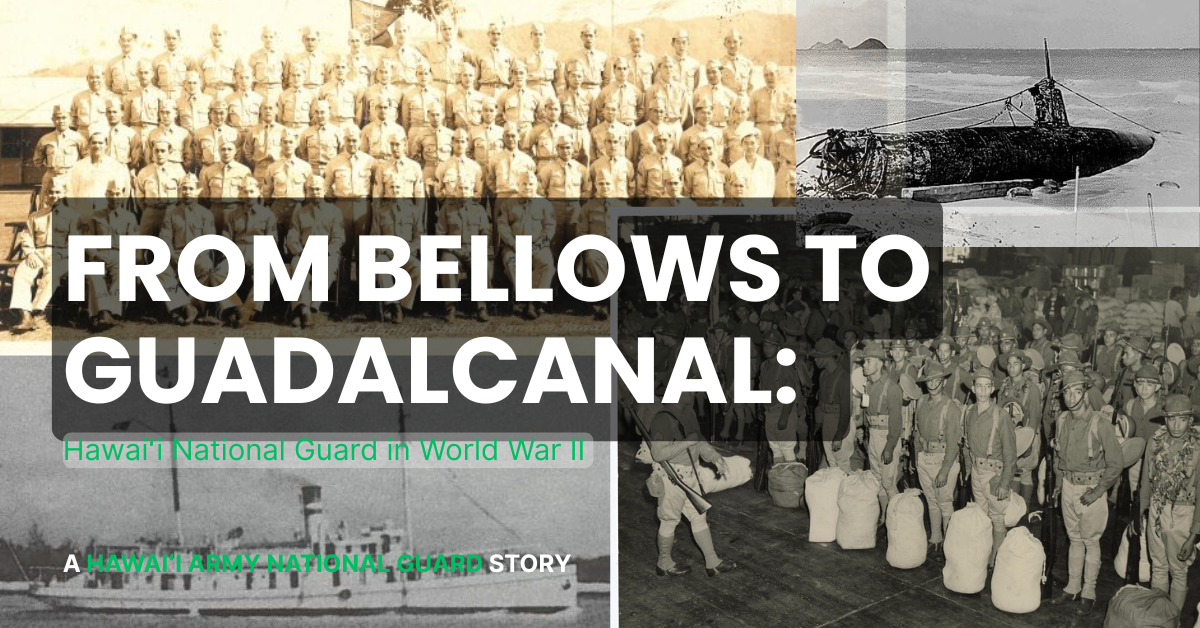
Eighty-five years ago, on Oct. 15, 1940, the Hawaiʻi National Guard’s 298th and 299th Infantry Regiments marched into Schofield Barracks under new orders from President Franklin Roosevelt. What began as a 12-month mobilization soon stretched into more than five years of wartime service, forever shaping the Guard’s history.
The newspapers of the day proudly called them “Hawaiʻi’s Own.” Local families and businesses rallied behind the soldiers, donating money and supplies to ease the transition from civilian to Army life. Within weeks, Guardsmen had built their own cantonments at Schofield, an area nicknamed the National Guard Woods.
At Bellows Field on the morning after Pearl Harbor, Company G of the 298th Infantry Regiment found itself in the middle of an encounter that would make history. In the predawn darkness of Dec. 8, 1941, Corporal David Akui spotted what he thought was a turtle swimming ashore.
It turned out to be a man — Ensign Kazuo Sakamaki, commander of a Japanese midget submarine. Akui and other Guardsmen captured Sakamaki, who became the first Japanese prisoner of war taken by U.S. forces in World War II.
Not all the Guard’s stories were about triumph. On Jan. 28, 1942, an Army transport called the Royal T. Frank was torpedoed by a Japanese submarine while carrying new recruits of the 299th Infantry Regiment to Hilo. Seventeen Guardsmen were killed. Survivor George Taketa remembered hearing someone cry, “Wake up. I see some big fish coming!” — moments before the torpedo struck.
The survivors were taken to Maui, afterwards nine continued service with the 298th Infantry Regiment. Eight later transferred into the famed 100th Infantry Battalion, 442nd Regimental Combat Team.
In the spring of 1942, the War Department ordered the removal of Guardsmen of Japanese ancestry, leading to the formation of the 100th Infantry Battalion, which later became one of the most decorated units in U.S. Army history.
The reorganization weakened the 299th Infantry Regiment, which was inactivated in June 1942, and its soldiers absorbed into the 298th Infantry Regiment. The reorganized regiment deployed to the South Pacific, guarding installations on Guadalcanal and Espiritu Santo. For many Hawaiʻi Guardsmen, the deployment carried unexpected memories.
Former Platoon Sgt. Dai Woon Sur recalled: “This war wasn’t only killing and destruction . . . During the period we were there, it was like a picnic for the local boys.”
The Guardsmen built grass-roofed mess halls, held Friday fish frys for hundreds of men, and even made homemade surfboards from scrap lumber. “On Sunday, our day off, we’d paddle four or five miles up the coast. We lived off the land and the sea — just like home.”
By the war’s end in 1945, the 298th Infantry Regiment had earned honors for the Central Pacific Campaign. The regiment was fully inactivated by January 1946, having spent more than five continuous years on federal service — longer than any other Hawaiʻi-based unit.
The story of Hawaiʻi’s Guardsmen in World War II is one of resilience, sacrifice, and spirit. They defended their islands after Pearl Harbor, endured tragedy at sea, contributed soldiers to the legendary 100th Infantry Battalion, 442nd Regimental Combat Team, and carried Hawaiian culture with them to distant shores.
Eighty-five years later, we remember them still — citizen-soldiers who stood ready when history called, and who lived up to the name given to them: “Hawaiʻi’s Own.”
References: 1940-1941 Annual Report, 1941-1942 Annual Report, 1955 August The Hawaii Guardsmen, 1964 December The Hawaii Guardsman, 1968 Spring The Hawaii Guardsman, 1969 Summer The Hawaii Guardsman, 1971 Fall The Hawaii Guardsman, 1990 July – September Pūpūkahi, 1991 October – December Pūpūkahi, 1993 February – March Pūpūkahi, 1995 January – February Pūpūkahi, 2016 November Pupukahi, 2022 Winter Pūpūkahi, For Some, Guadalcanal a ‘South Pacific’ Scene by Bob Krauss Honolulu Advertiser, Aug. 13, 1995
The State of Hawaii, Department of Defense (HIDOD)’ Retiree News does not endorse any of the external hyperlinks listed or posted on this site. This includes linked websites, information, products, or services contained therein. We are a government run website for which transparency and accountability are paramount. HIDOD cannot have the appearance of endorsement and are bound by the HIDOD Social Media Policy concerning political posts being respectful, honest, and accurate. Operational Security will additionally be adhered to. Retiree News does not exercise any editorial control over the information you may find at linked sites. Some of the sites linked to may limit the number of stories you can access without a paid subscription. All links were provided with the intent of meeting the mission of the HIDOD’s version of Retiree News.