
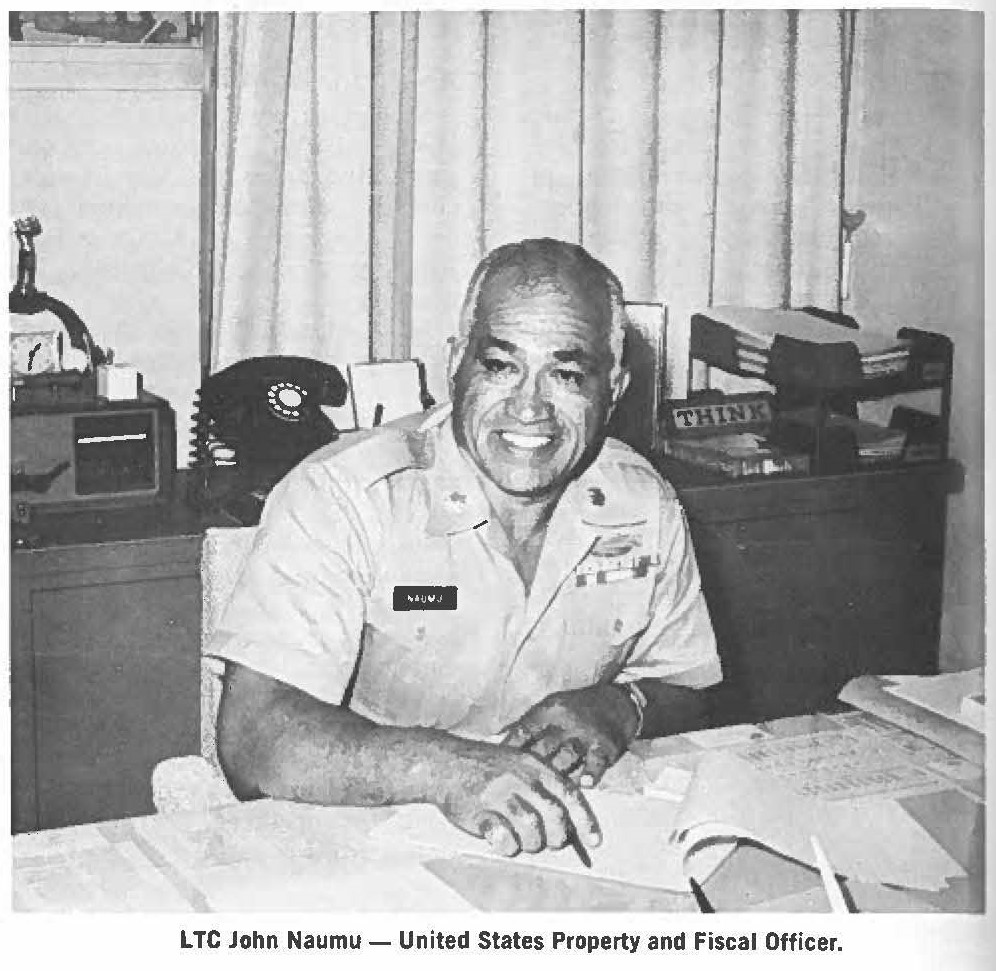
John (Johnny) Punualiʻi Naumu, was a professional football player who played the halfback position and was a Hawai’i Guardsman. He was born on Sept. 30, 1919, in Honolulu, Hawai’I but was raised on Molokai. Naumu was one of 12 children. He graduated from Mckinely High School and went on to play college football for the University of Hawai’i at Manoa (UH) from 1939 to 1941. His career was interrupted by World War II, during which he served in the Army. Afterwards Naumu resumed playing football at UH and then transferred to University of Southern California (USC) in 1946.
During his time at USC, he was a standout player. In 1947, Naumu was given the Richard Barrett Award for the most cooperative member of the varsity squad. That award is now known as the Sam Berry Spartan Award, which is given to the team member selected by the coaching staff who contributed the most to the development of the varsity squad during the season.
After graduating, Naumu played professional football in the All-America Football Conference in 1948 for the Los Angeles Dons for a year. The 5’ 8”, 175-pound back played as a free agent as they finished 3rd in the All-America Football Conference, Western Division, with a record of 7-7.
The All-America Football Conference (AAFC), founded in 1946, emerged as a bold and ambitious challenger to the long-established National Football League. For four intense seasons, from 1946 through 1949, the league pushed the boundaries of the sport, introducing innovations that would leave a lasting mark on professional football. By 1949, the AAFC was unable to sustain the fight, and it dissolved, with several of its strongest teams absorbed into the NFL.
Following his football career, Naumu served in the Hawai’i National Guard and was the Vice President of Honolulu Federal Savings and Loan. He was known for his leadership and community involvement. Naumu’s military service was marked by both wartime duty and steadfast leadership at home. From 1961 to 1974, he served as Commandant of the Hawaiʻi Army National Guard Officer Candidate School, guiding a rigorous one-year program that shaped generations of new officers. Under his direction, the school commissioned numerous officers and achieved notable distinction, earning honors including the Army Area Certificate of Academic Excellence and the National Doughboy Award. The National Doughboy Award is the highest honor bestowed by the U.S. Army Infantry Chief, recognizing individuals for significant, lasting contributions to the Infantry and its community. Established in 1980, it is presented annually at the Maneuver Warfighter Conference to soldiers, officers and civilians. His service stood as a lasting testament to his commitment to the defense of Hawaiʻi and to the development of those who would follow in uniform.
Naumu retired in 1974 as a colonel with 36 years of service (16 Active, 20 inactive). His notable assignments include Assistant Chief of Staff, G-3, Headquarters and Headquarters Detachment (HHD), Hawaiʻi Army National Guard; Battalion Commander; Headquarters, Headquarters Company, 1st Battalion, 299th Infantry and G3 – HHD Hawaiʻi Army National Guard.
Naumu died Sept. 23, 1982, of heart failure while playing racquetball. He is buried at the National Memorial Cemetery of the Pacific.
The State of Hawaii, Department of Defense (HIDOD)’ Retiree News does not endorse any of the external hyperlinks listed or posted on this site. This includes linked websites, information, products, or services contained therein. We are a government run website for which transparency and accountability are paramount. HIDOD cannot have the appearance of endorsement and are bound by the HIDOD Social Media Policy concerning political posts being respectful, honest, and accurate. Operational Security will additionally be adhered to. Retiree News does not exercise any editorial control over the information you may find at linked sites. Some of the sites linked to may limit the number of stories you can access without a paid subscription. All links were provided with the intent of meeting the mission of the HIDOD’s version of Retiree News.