
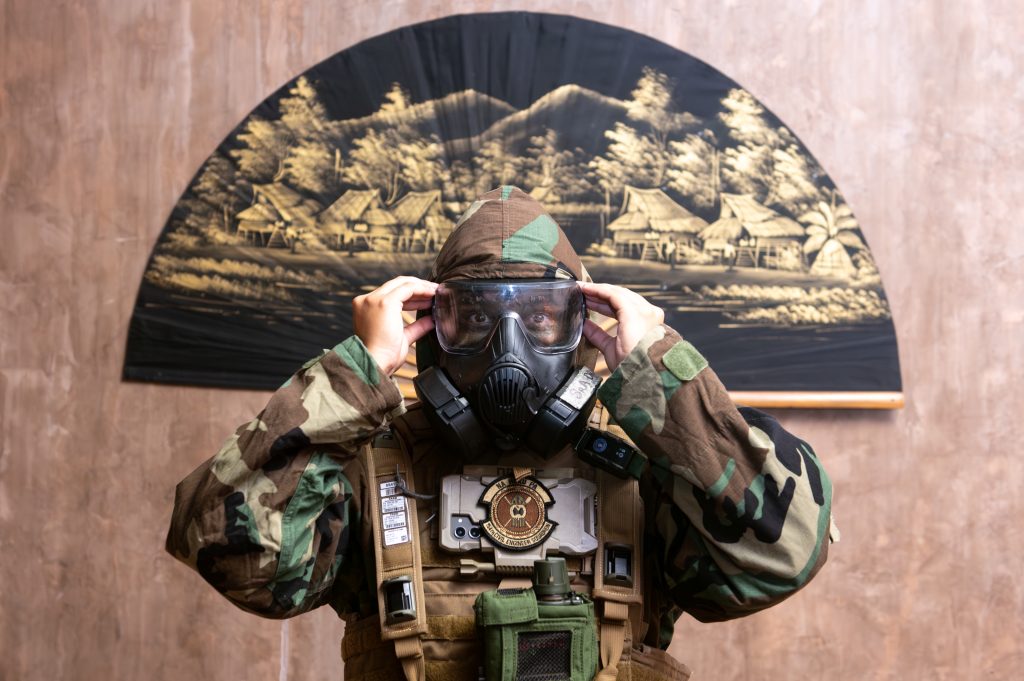
The Hawaii Air National Guard, in partnership with the U.S. Marine Corps, wrapped up the Toxic Swell 25 contamination response deployment training exercise with an explosive firefight in a mock-marketplace Aug. 21 at Bellows Air Force Station.
This third iteration of the exercise was co-hosted by Airmen from the 154th Civil Engineering Squadron and Marines from Marine Wing Support Squadron 174. It gathered 44 participants from all three U.S. Air Force components and the Marine Corps, and several members of the Royal Australian Air Force to enhance proficiency in emergency management and chemical, biological, radiological, and nuclear tactics, techniques and procedures.
Conducted at Joint Base Pearl Harbor-Hickam and Marine Corps Training Area Bellows, Toxic Swell exercise fosters joint integration, enabling Airmen and Marines to develop shared CBRN warning, reporting, and defense practices in a deployed environment.
“Looking back on the two weeks of training the most valuable thing we walked away with was understanding joint operations and utilizing collaborative knowledge to accomplish the variety of missions effectively,” said Senior Airman Cathleen Drake, a 154th CES emergency management specialist, “For example the Air Force provided different equipment that is less used by the Marine Corps CBRN, such as the ResQ, that allowed us to reduce time in the danger zone when collecting samples while the Marine Corps provided close-quarter battle techniques to us to get in and out of the danger zone safely and effectively.”